
A English
Aromatic hydrocarbon Questions in English
Class 11 Chemistry · Hydrocarbons · Aromatic hydrocarbon
872+
Questions
English
Language
100%
With Solutions
Showing 50 of 872 questions in English
1
EasyMCQ
Nitrating mixture is
A
Fuming nitric acid
B
Mixture of conc. $H_2SO_4$ and conc. $HNO_3$
C
Mixture of nitric acid and anhydrous zinc chloride
D
None of these
Solution
(B) The mixture of conc. $H_2SO_4$ and conc. $HNO_3$ is called nitrating mixture.
It is used in the nitration of aryl compounds,for example,the reaction of benzene with this mixture produces nitrobenzene:
$\text{Benzene} + HNO_3 \xrightarrow{\text{conc. } H_2SO_4} \text{Nitrobenzene} + H_2O$
It is used in the nitration of aryl compounds,for example,the reaction of benzene with this mixture produces nitrobenzene:
$\text{Benzene} + HNO_3 \xrightarrow{\text{conc. } H_2SO_4} \text{Nitrobenzene} + H_2O$
0 likes
View Solution2
EasyMCQ
Each carbon atom in benzene is in the state of hybridization:
A
$sp^3$
B
$sp^2$
C
$sp$
D
$s^3p$
Solution
(B) In benzene $(C_6H_6)$,each carbon atom is bonded to two other carbon atoms and one hydrogen atom via $\sigma$-bonds,and it also participates in a delocalized $\pi$-system.
Since each carbon atom forms $3 \sigma$-bonds and has no lone pairs,the steric number is $3$.
Therefore,the hybridization of each carbon atom in benzene is $sp^2$.
Since each carbon atom forms $3 \sigma$-bonds and has no lone pairs,the steric number is $3$.
Therefore,the hybridization of each carbon atom in benzene is $sp^2$.
0 likes
View Solution3
EasyMCQ
Number of $\pi$ electrons present in naphthalene is
A
$4$
B
$6$
C
$10$
D
$14$
Solution
(C) Naphthalene consists of two fused benzene rings.
It has $5$ $\pi$ bonds in its structure.
Since each $\pi$ bond contains $2$ electrons,the total number of $\pi$ electrons is $5 \times 2 = 10$.
It has $5$ $\pi$ bonds in its structure.
Since each $\pi$ bond contains $2$ electrons,the total number of $\pi$ electrons is $5 \times 2 = 10$.
0 likes
View Solution4
EasyMCQ
The number of $\sigma$ bonds in $o$-xylene is
A
$6$
B
$9$
C
$12$
D
$18$
Solution
(D) The chemical formula of $o$-xylene is $C_8H_{10}$.
Structure: $A$ benzene ring with two methyl groups at the ortho $(1,2)$ positions.
Total $\sigma$ bonds = (bonds in benzene ring) + (bonds in two methyl groups) + (bonds between ring and methyl groups).
- $6$ $C-C$ bonds in the ring (including $3$ single and $3$ double,where each double bond has $1 \sigma$ and $1 \pi$ bond).
- $4$ $C-H$ bonds on the ring.
- $6$ $C-H$ bonds in the two methyl groups ($3$ per group).
- $2$ $C-C$ bonds connecting the methyl groups to the ring.
Total $\sigma$ bonds = $6$ (ring $C-C$) + $4$ (ring $C-H$) + $6$ (methyl $C-H$) + $2$ (methyl-ring $C-C$) = $18$.
Thus,the correct option is $D$.
Structure: $A$ benzene ring with two methyl groups at the ortho $(1,2)$ positions.
Total $\sigma$ bonds = (bonds in benzene ring) + (bonds in two methyl groups) + (bonds between ring and methyl groups).
- $6$ $C-C$ bonds in the ring (including $3$ single and $3$ double,where each double bond has $1 \sigma$ and $1 \pi$ bond).
- $4$ $C-H$ bonds on the ring.
- $6$ $C-H$ bonds in the two methyl groups ($3$ per group).
- $2$ $C-C$ bonds connecting the methyl groups to the ring.
Total $\sigma$ bonds = $6$ (ring $C-C$) + $4$ (ring $C-H$) + $6$ (methyl $C-H$) + $2$ (methyl-ring $C-C$) = $18$.
Thus,the correct option is $D$.
0 likes
View Solution5
EasyMCQ
In benzene,the total number of $\sigma$ bonds is
A
$3$
B
$6$
C
$9$
D
$12$
Solution
(D) The chemical formula of benzene is $C_6H_6$.
In the benzene ring,there are $6$ $C-C$ $\sigma$ bonds and $6$ $C-H$ $\sigma$ bonds.
Total $\sigma$ bonds $= 6 + 6 = 12$.
In the benzene ring,there are $6$ $C-C$ $\sigma$ bonds and $6$ $C-H$ $\sigma$ bonds.
Total $\sigma$ bonds $= 6 + 6 = 12$.
0 likes
View Solution6
MediumMCQ
The hybridization involved in the six carbon atoms of benzene is
A
$3sp^3, 3sp^2$
B
$3sp^3, 3sp$
C
All $6sp$
D
All $6sp^2$
Solution
(D) . In benzene,the structure consists of a hexagonal ring where each of the $6$ carbon atoms is bonded to two other carbon atoms and one hydrogen atom.
Each carbon atom forms three $\sigma$-bonds and one $\pi$-bond.
Since each carbon atom is involved in three $\sigma$-bonds,the hybridization of each carbon atom is $sp^2$.
Each carbon atom forms three $\sigma$-bonds and one $\pi$-bond.
Since each carbon atom is involved in three $\sigma$-bonds,the hybridization of each carbon atom is $sp^2$.
0 likes
View Solution7
MediumMCQ
Toluene has
A
$6 \sigma$ and $3 \pi$ bonds
B
$9 \sigma$ and $3 \pi$ bonds
C
$9 \sigma$ and $6 \pi$ bonds
D
$15 \sigma$ and $3 \pi$ bonds
Solution
(D) The chemical formula of toluene is $C_6H_5CH_3$.
In the benzene ring,there are $6$ $C-C$ bonds (including $3$ double bonds) and $5$ $C-H$ bonds.
In the methyl group $(-CH_3)$,there are $1$ $C-C$ bond and $3$ $C-H$ bonds.
Total $\sigma$ bonds = $6$ (ring $C-C$) + $5$ (ring $C-H$) + $1$ ($C-C$ bond to methyl) + $3$ ($C-H$ bonds in methyl) = $15$ $\sigma$ bonds.
Total $\pi$ bonds = $3$ (from the $3$ double bonds in the benzene ring) = $3$ $\pi$ bonds.
Therefore,toluene has $15$ $\sigma$ and $3$ $\pi$ bonds.
In the benzene ring,there are $6$ $C-C$ bonds (including $3$ double bonds) and $5$ $C-H$ bonds.
In the methyl group $(-CH_3)$,there are $1$ $C-C$ bond and $3$ $C-H$ bonds.
Total $\sigma$ bonds = $6$ (ring $C-C$) + $5$ (ring $C-H$) + $1$ ($C-C$ bond to methyl) + $3$ ($C-H$ bonds in methyl) = $15$ $\sigma$ bonds.
Total $\pi$ bonds = $3$ (from the $3$ double bonds in the benzene ring) = $3$ $\pi$ bonds.
Therefore,toluene has $15$ $\sigma$ and $3$ $\pi$ bonds.
0 likes
View Solution8
MediumMCQ
How many $\pi$-bonds are present in a naphthalene molecule?
A
$3$
B
$4$
C
$5$
D
$6$
Solution
(C) Naphthalene $(C_{10}H_8)$ consists of two fused benzene rings.
In the structure of naphthalene,there are $5$ double bonds.
Each double bond contains one $\pi$-bond.
Therefore,there are $5$ $\pi$-bonds present in a naphthalene molecule.
In the structure of naphthalene,there are $5$ double bonds.
Each double bond contains one $\pi$-bond.
Therefore,there are $5$ $\pi$-bonds present in a naphthalene molecule.
0 likes
View Solution9
MediumMCQ
Calculate the total number of $\sigma$ bonds in toluene $(C_6H_5CH_3)$.
A
$6$
B
$15$
C
$10$
D
$12$
Solution
(B) The structure of toluene $(C_6H_5CH_3)$ consists of a benzene ring attached to a methyl group $(-CH_3)$.
In the benzene ring $(C_6H_6)$,there are $6$ $C-C$ $\sigma$ bonds and $6$ $C-H$ $\sigma$ bonds. However,in toluene,one $H$ atom of the benzene ring is replaced by a $-CH_3$ group.
Thus,the benzene ring part has $6$ $C-C$ $\sigma$ bonds and $5$ $C-H$ $\sigma$ bonds.
The methyl group $(-CH_3)$ has $3$ $C-H$ $\sigma$ bonds and $1$ $C-C$ $\sigma$ bond (connecting the methyl group to the ring).
Total $\sigma$ bonds = ($6$ $C-C$ ring bonds) + ($5$ $C-H$ ring bonds) + ($3$ $C-H$ methyl bonds) + ($1$ $C-C$ bond between ring and methyl) = $6 + 5 + 3 + 1 = 15$ $\sigma$ bonds.
Therefore,the correct option is $(B)$.
In the benzene ring $(C_6H_6)$,there are $6$ $C-C$ $\sigma$ bonds and $6$ $C-H$ $\sigma$ bonds. However,in toluene,one $H$ atom of the benzene ring is replaced by a $-CH_3$ group.
Thus,the benzene ring part has $6$ $C-C$ $\sigma$ bonds and $5$ $C-H$ $\sigma$ bonds.
The methyl group $(-CH_3)$ has $3$ $C-H$ $\sigma$ bonds and $1$ $C-C$ $\sigma$ bond (connecting the methyl group to the ring).
Total $\sigma$ bonds = ($6$ $C-C$ ring bonds) + ($5$ $C-H$ ring bonds) + ($3$ $C-H$ methyl bonds) + ($1$ $C-C$ bond between ring and methyl) = $6 + 5 + 3 + 1 = 15$ $\sigma$ bonds.
Therefore,the correct option is $(B)$.
0 likes
View Solution10
MediumMCQ
What is the number of $\sigma$ and $\pi$ bonds in benzene $(C_6H_6)$?
A
$6 \sigma$ and $3 \pi$
B
$12 \sigma$ and $3 \pi$
C
$3 \pi$ and $12 \pi$
D
$6 \sigma$ and $6 \pi$
Solution
(B) The chemical formula of benzene is $C_6H_6$.
In the structure of benzene,there are $6$ $C-C$ bonds (consisting of $3$ single bonds and $3$ double bonds) and $6$ $C-H$ bonds.
Each single bond is a $\sigma$ bond,and each double bond consists of $1$ $\sigma$ bond and $1$ $\pi$ bond.
Total $\sigma$ bonds = $6$ ($C-C$ $\sigma$ bonds) + $6$ ($C-H$ $\sigma$ bonds) = $12$ $\sigma$ bonds.
Total $\pi$ bonds = $3$ $\pi$ bonds (from the $3$ $C=C$ double bonds).
Therefore,benzene contains $12$ $\sigma$ bonds and $3$ $\pi$ bonds.
In the structure of benzene,there are $6$ $C-C$ bonds (consisting of $3$ single bonds and $3$ double bonds) and $6$ $C-H$ bonds.
Each single bond is a $\sigma$ bond,and each double bond consists of $1$ $\sigma$ bond and $1$ $\pi$ bond.
Total $\sigma$ bonds = $6$ ($C-C$ $\sigma$ bonds) + $6$ ($C-H$ $\sigma$ bonds) = $12$ $\sigma$ bonds.
Total $\pi$ bonds = $3$ $\pi$ bonds (from the $3$ $C=C$ double bonds).
Therefore,benzene contains $12$ $\sigma$ bonds and $3$ $\pi$ bonds.
0 likes
View Solution11
MediumMCQ
Aromatic properties of $benzene$ are proved by
A
$Aromatic$ $sextet$ $theory$
B
$Resonance$ $theory$
C
$Molecular$ $orbital$ $theory$
D
$All$ $of$ $these$
Solution
(D) The aromatic character of $benzene$ is explained by multiple theoretical frameworks:
$1$. The $Aromatic$ $sextet$ $theory$ explains the stability of the $6\pi$ electron system.
$2$. $Resonance$ $theory$ accounts for the delocalization of electrons and the equivalence of $C-C$ bond lengths.
$3$. $Molecular$ $orbital$ $theory$ provides a quantum mechanical description of the cyclic delocalization of $\pi$ electrons in the $p$-orbitals.
Therefore,all these theories contribute to our understanding of the aromatic properties of $benzene$.
$1$. The $Aromatic$ $sextet$ $theory$ explains the stability of the $6\pi$ electron system.
$2$. $Resonance$ $theory$ accounts for the delocalization of electrons and the equivalence of $C-C$ bond lengths.
$3$. $Molecular$ $orbital$ $theory$ provides a quantum mechanical description of the cyclic delocalization of $\pi$ electrons in the $p$-orbitals.
Therefore,all these theories contribute to our understanding of the aromatic properties of $benzene$.
0 likes
View Solution12
MediumMCQ
Which of the following will show aromatic behaviour?
A
Decalin
B
Benzene
C
Cyclohexene
D
Furan
Solution
(B) For a molecule to be aromatic,it must satisfy $H$ückel's rule ($4n + 2$ $\pi$ electrons),be planar,and have a fully conjugated cyclic system.
$1$. Decalin is non-planar and non-aromatic.
$2$. Benzene $(C_6H_6)$ is planar,cyclic,fully conjugated,and has $6$ $\pi$ electrons $(4(1) + 2 = 6)$,thus it is aromatic.
$3$. Cyclohexene is not fully conjugated and is non-aromatic.
$4$. Furan is aromatic,but among the given options,Benzene is the most standard example of a simple aromatic hydrocarbon.
$1$. Decalin is non-planar and non-aromatic.
$2$. Benzene $(C_6H_6)$ is planar,cyclic,fully conjugated,and has $6$ $\pi$ electrons $(4(1) + 2 = 6)$,thus it is aromatic.
$3$. Cyclohexene is not fully conjugated and is non-aromatic.
$4$. Furan is aromatic,but among the given options,Benzene is the most standard example of a simple aromatic hydrocarbon.
0 likes
View Solution13
DifficultMCQ
Benzene is relatively unreactive towards electrophilic addition reactions because
A
It has double bonds
B
It has carbon-carbon single bonds
C
Carbon atoms are $sp^2$ hybridized
D
$\pi$ electrons are delocalized
Solution
(D) Benzene is relatively unreactive towards electrophilic addition reactions because the $6\pi$ electrons are delocalized over the entire ring due to resonance,which provides extra stability to the molecule.
0 likes
View Solution14
EasyMCQ
Credit for the ring structure of benzene goes to
A
Wholer
B
Faraday
C
Kekule
D
Baeyer
Solution
(C) The ring structure of benzene $(C_6H_6)$ was proposed by August Kekule in $1865$.
He suggested that benzene consists of a hexagonal ring of carbon atoms with alternating single and double bonds.
He suggested that benzene consists of a hexagonal ring of carbon atoms with alternating single and double bonds.
0 likes
View Solution15
MediumMCQ
In the mixture of conc. $H_2SO_4$ and $HNO_3$,the nitrating species is:
A
$N_2O_4$
B
$NO_2^+$
C
$NO_2$
D
$NO_2^-$
Solution
(B) The reaction between concentrated $H_2SO_4$ and $HNO_3$ is as follows:
$HNO_3 + 2H_2SO_4 \rightleftarrows NO_2^+ + H_3O^+ + 2HSO_4^-$
Here,$NO_2^+$ is the nitronium ion,which acts as the electrophile or the active nitrating species in the nitration reaction.
$HNO_3 + 2H_2SO_4 \rightleftarrows NO_2^+ + H_3O^+ + 2HSO_4^-$
Here,$NO_2^+$ is the nitronium ion,which acts as the electrophile or the active nitrating species in the nitration reaction.
0 likes
View Solution16
MediumMCQ
Which of the following are not aromatic?
A
Benzene
B
Cyclooctatetraenyl dianion
C
Tropylium cation
D
Cyclopentadienyl cation
Solution
(D) To determine aromaticity,we use $H$ückel's rule: a compound is aromatic if it is cyclic,planar,fully conjugated,and contains $(4n + 2) \pi$ electrons.
$A$. Benzene $(C_6H_6)$ has $6 \pi$ electrons $(n=1)$,so it is aromatic.
$B$. Cyclooctatetraenyl dianion $(C_8H_8^{2-})$ has $10 \pi$ electrons $(n=2)$,so it is aromatic.
$C$. Tropylium cation $(C_7H_7^+)$ has $6 \pi$ electrons $(n=1)$,so it is aromatic.
$D$. Cyclopentadienyl cation $(C_5H_5^+)$ has $4 \pi$ electrons ($n=1$ in $4n$ rule),making it anti-aromatic. Thus,it is not aromatic.
$A$. Benzene $(C_6H_6)$ has $6 \pi$ electrons $(n=1)$,so it is aromatic.
$B$. Cyclooctatetraenyl dianion $(C_8H_8^{2-})$ has $10 \pi$ electrons $(n=2)$,so it is aromatic.
$C$. Tropylium cation $(C_7H_7^+)$ has $6 \pi$ electrons $(n=1)$,so it is aromatic.
$D$. Cyclopentadienyl cation $(C_5H_5^+)$ has $4 \pi$ electrons ($n=1$ in $4n$ rule),making it anti-aromatic. Thus,it is not aromatic.
0 likes
View Solution17
MediumMCQ
The cyclopentadienyl anion is:
A
Aromatic
B
Non-aromatic
C
Non-planar
D
Aliphatic
Solution
(A) The cyclopentadienyl anion $(C_5H_5^-)$ has a cyclic structure with $sp^2$ hybridized carbon atoms,making it planar. It contains $6 \pi$-electrons ($4$ from the two double bonds and $2$ from the lone pair on the negatively charged carbon),which follows $H$ückel's rule ($4n + 2 = 6$,where $n = 1$). Therefore,it is aromatic.
0 likes
View Solution18
EasyMCQ
$C-C$ bond length in benzene is $...... \ \mathring{A}$
A
$1.39$
B
$1.54$
C
$1.34$
D
Different in different bonds
Solution
(A) The $C-C$ bond length in benzene is $1.39 \ \mathring{A}$.
This value is intermediate between the single bond length of $C-C$ $(1.54 \ \mathring{A})$ and the double bond length of $C=C$ $(1.34 \ \mathring{A})$.
This is due to the delocalization of $\pi$-electrons in the benzene ring,known as resonance.
This value is intermediate between the single bond length of $C-C$ $(1.54 \ \mathring{A})$ and the double bond length of $C=C$ $(1.34 \ \mathring{A})$.
This is due to the delocalization of $\pi$-electrons in the benzene ring,known as resonance.
0 likes
View Solution19
EasyMCQ
The reagent used in Friedel-Crafts reaction is:
A
Pyridine
B
$RCOCl$
C
$RCOOH$
D
$HCl$
Solution
(B) The Friedel-Crafts reaction involves the electrophilic substitution of an aromatic ring.
In Friedel-Crafts acylation,an acyl halide (such as $RCOCl$) reacts with an aromatic compound in the presence of a Lewis acid catalyst,typically $AlCl_3$.
Therefore,$RCOCl$ acts as the reagent for the acylation process.
In Friedel-Crafts acylation,an acyl halide (such as $RCOCl$) reacts with an aromatic compound in the presence of a Lewis acid catalyst,typically $AlCl_3$.
Therefore,$RCOCl$ acts as the reagent for the acylation process.
0 likes
View Solution20
MediumMCQ
An aromatic compound,among other things,should have a $\pi$-electron cloud containing $(4n + 2)$ electrons,where $n$ cannot be:
A
$0.5$
B
$3$
C
$2$
D
$1$
Solution
(A) According to $H$ückel's rule,for a compound to be aromatic,it must contain $(4n + 2)$ $\pi$-electrons,where $n$ is an integer $(n = 0, 1, 2, 3, ...)$.
Since $n$ must be an integer,$0.5$ is not a valid value for $n$.
Since $n$ must be an integer,$0.5$ is not a valid value for $n$.
0 likes
View Solution21
MediumMCQ
The reaction shown below proceeds through which mechanism?
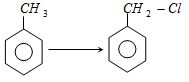
A
Nucleophilic substitution
B
Electrophilic substitution
C
Free radical substitution
D
More than one of the above processes
Solution
(C) The reaction of toluene with chlorine in the presence of light $(h\nu)$ is a classic example of side-chain chlorination.
This reaction proceeds via a free radical mechanism.
$1$. Initiation: $Cl_2 \xrightarrow{h\nu} 2Cl^\bullet$
$2$. Propagation: The chlorine radical abstracts a hydrogen atom from the methyl group of toluene to form a benzyl radical,which then reacts with $Cl_2$ to form benzyl chloride $(C_6H_5CH_2Cl)$.
This reaction proceeds via a free radical mechanism.
$1$. Initiation: $Cl_2 \xrightarrow{h\nu} 2Cl^\bullet$
$2$. Propagation: The chlorine radical abstracts a hydrogen atom from the methyl group of toluene to form a benzyl radical,which then reacts with $Cl_2$ to form benzyl chloride $(C_6H_5CH_2Cl)$.
0 likes
View Solution22
MediumMCQ
In electrophilic substitution reaction,nitrobenzene is:
A
Para-directing
B
Ortho-directing
C
Meta-directing
D
Not reactive and does not undergo any substitution
Solution
(C) Nitrobenzene is meta-directing for an electrophilic substitution reaction because it contains an electron-withdrawing group (i.e.,$-NO_2$).
Due to the $-I$ and $-M$ effects of the $-NO_2$ group,the electron density at the ortho- and para- positions of the benzene ring is significantly reduced compared to the meta- position.
Consequently,the incoming electrophile preferentially attacks the meta- position,where the electron density is relatively higher.
Due to the $-I$ and $-M$ effects of the $-NO_2$ group,the electron density at the ortho- and para- positions of the benzene ring is significantly reduced compared to the meta- position.
Consequently,the incoming electrophile preferentially attacks the meta- position,where the electron density is relatively higher.
0 likes
View Solution23
MediumMCQ
The most common type of reaction in aromatic compounds is
A
Elimination reaction
B
Addition reaction
C
Electrophilic substitution reaction
D
Rearrangement reaction
Solution
(C) Aromatic compounds or arenes undergo substitution reactions,in which the aromatic hydrogen is replaced with an electrophile,hence their reactions proceed via electrophilic substitution.
Arenes contain double bonds just like alkenes but they do not undergo electrophilic addition because these would result in the loss of their ring aromaticity.
Arenes contain double bonds just like alkenes but they do not undergo electrophilic addition because these would result in the loss of their ring aromaticity.
0 likes
View Solution24
MediumMCQ
The function of $AlCl_3$ in Friedel-Crafts reaction is
A
To absorb $HCl$
B
To absorb water
C
To produce nucleophile
D
To produce electrophile
Solution
(D) In the Friedel-Crafts reaction,$AlCl_3$ acts as a Lewis acid catalyst.
It reacts with the alkyl halide or acyl halide to generate a carbocation or an acylium ion,which acts as an electrophile.
This electrophile then attacks the benzene ring to initiate the substitution reaction.
For example: $CH_3-CH_2-CH_2-Cl + AlCl_3 \rightarrow CH_3-CH_2-CH_2^+ + AlCl_4^-$.
It reacts with the alkyl halide or acyl halide to generate a carbocation or an acylium ion,which acts as an electrophile.
This electrophile then attacks the benzene ring to initiate the substitution reaction.
For example: $CH_3-CH_2-CH_2-Cl + AlCl_3 \rightarrow CH_3-CH_2-CH_2^+ + AlCl_4^-$.
0 likes
View Solution25
MediumMCQ
The electrophile in the nitration of benzene is
A
$NO_2^+$
B
$NO_2$
C
$NO^+$
D
$NO_2^-$
Solution
(A) The electrophile in the nitration of benzene is the nitronium ion,$NO_2^+$.
It is generated by the reaction between concentrated $HNO_3$ and concentrated $H_2SO_4$ as follows:
$HNO_3 + H_2SO_4 \to NO_2^+ + HSO_4^- + H_2O$
Thus,the correct option is $A$.
It is generated by the reaction between concentrated $HNO_3$ and concentrated $H_2SO_4$ as follows:
$HNO_3 + H_2SO_4 \to NO_2^+ + HSO_4^- + H_2O$
Thus,the correct option is $A$.
0 likes
View Solution26
MediumMCQ
Which of the following compounds will undergo electrophilic substitution more readily than benzene?
A
Nitrobenzene
B
Benzoic acid
C
Benzaldehyde
D
Phenol
Solution
(D) The reactivity of benzene towards electrophilic substitution depends on the electron density of the ring.
Groups that donate electrons to the ring (activating groups) increase the rate of electrophilic substitution,while groups that withdraw electrons (deactivating groups) decrease it.
$Nitrobenzene$,$Benzoic \text{ } acid$,and $Benzaldehyde$ contain electron-withdrawing groups ($-NO_2$,$-COOH$,and $-CHO$ respectively),which deactivate the benzene ring.
$Phenol$ contains an $-OH$ group,which is a strong electron-donating group due to resonance,thereby increasing the electron density of the ring and making it more reactive towards electrophilic substitution than benzene.
Therefore,the correct option is $(D)$.
Groups that donate electrons to the ring (activating groups) increase the rate of electrophilic substitution,while groups that withdraw electrons (deactivating groups) decrease it.
$Nitrobenzene$,$Benzoic \text{ } acid$,and $Benzaldehyde$ contain electron-withdrawing groups ($-NO_2$,$-COOH$,and $-CHO$ respectively),which deactivate the benzene ring.
$Phenol$ contains an $-OH$ group,which is a strong electron-donating group due to resonance,thereby increasing the electron density of the ring and making it more reactive towards electrophilic substitution than benzene.
Therefore,the correct option is $(D)$.
0 likes
View Solution27
DifficultMCQ
The major product obtained when the following compound is treated with $Br_2/Fe$ is:
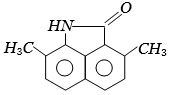
A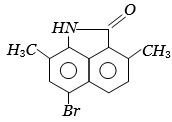
B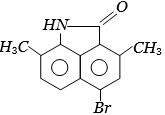
C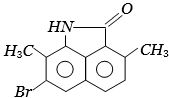
D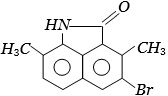
Solution
(D) The given molecule is a bicyclic system where one ring is attached to an $-NH-$ group (which is an activating group due to the lone pair on nitrogen) and the other ring is attached to a $-C(=O)-$ group (which is a deactivating group).
Electrophilic aromatic substitution,such as bromination using $Br_2/Fe$,occurs preferentially on the more electron-rich ring.
The ring containing the $-NH-$ group is activated,making it more susceptible to electrophilic attack.
The $-NH-$ group is ortho/para directing. Due to steric hindrance from the methyl group at the ortho position,the bromination occurs at the para position relative to the $-NH-$ group.
Thus,the bromine atom will be substituted at the para position of the activated ring.
Electrophilic aromatic substitution,such as bromination using $Br_2/Fe$,occurs preferentially on the more electron-rich ring.
The ring containing the $-NH-$ group is activated,making it more susceptible to electrophilic attack.
The $-NH-$ group is ortho/para directing. Due to steric hindrance from the methyl group at the ortho position,the bromination occurs at the para position relative to the $-NH-$ group.
Thus,the bromine atom will be substituted at the para position of the activated ring.
0 likes
View Solution28
DifficultMCQ
What is the decreasing order of reactivity amongst the following compounds towards aromatic electrophilic substitution?
$I.$ Chlorobenzene
$II.$ Benzene
$III.$ Anilinium chloride
$IV.$ Toluene
$I.$ Chlorobenzene
$II.$ Benzene
$III.$ Anilinium chloride
$IV.$ Toluene
A
$I > II > III > IV$
B
$IV > II > I > III$
C
$II > I > III > IV$
D
$III > I > II > IV$
Solution
(B) The reactivity of a benzene ring towards electrophilic aromatic substitution depends on the electron density of the ring.
$1.$ $Toluene$ $(IV)$ has a methyl group $(-CH_3)$,which is an electron-donating group ($+I$ effect and hyperconjugation),increasing electron density.
$2.$ $Benzene$ $(II)$ is the reference compound.
$3.$ $Chlorobenzene$ $(I)$ has a chlorine atom,which is deactivating due to its strong $-I$ effect,although it is ortho/para directing due to resonance ($+M$ effect).
$4.$ $Anilinium$ $chloride$ $(III)$ contains the $-NH_3^+$ group,which is a strong electron-withdrawing group ($-I$ effect),significantly reducing electron density.
Therefore,the order of reactivity is $IV > II > I > III$.
$1.$ $Toluene$ $(IV)$ has a methyl group $(-CH_3)$,which is an electron-donating group ($+I$ effect and hyperconjugation),increasing electron density.
$2.$ $Benzene$ $(II)$ is the reference compound.
$3.$ $Chlorobenzene$ $(I)$ has a chlorine atom,which is deactivating due to its strong $-I$ effect,although it is ortho/para directing due to resonance ($+M$ effect).
$4.$ $Anilinium$ $chloride$ $(III)$ contains the $-NH_3^+$ group,which is a strong electron-withdrawing group ($-I$ effect),significantly reducing electron density.
Therefore,the order of reactivity is $IV > II > I > III$.
0 likes
View Solution29
MediumMCQ
The total number of isomers of a disubstituted benzene compound is:
A
$1$
B
$2$
C
$3$
D
$4$
Solution
(C) disubstituted benzene compound has two substituents attached to the benzene ring. Depending on the relative positions of these two substituents,there are three possible structural isomers:
$1$. Ortho ($1,2$-position)
$2$. Meta ($1,3$-position)
$3$. Para ($1,4$-position)
Therefore,the total number of isomers is $3$.
$1$. Ortho ($1,2$-position)
$2$. Meta ($1,3$-position)
$3$. Para ($1,4$-position)
Therefore,the total number of isomers is $3$.
0 likes
View Solution30
MediumMCQ
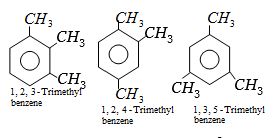
The total number of possible isomeric trimethyl benzene is
A
$2$
B
$3$
C
$4$
D
$6$
Solution
(B) The molecular formula for trimethyl benzene is $C_9H_{12}$.
There are $3$ possible structural isomers for trimethyl benzene:
$1.$ $1,2,3$-Trimethylbenzene (Hemimellitene)
$2.$ $1,2,4$-Trimethylbenzene (Pseudocumene)
$3.$ $1,3,5$-Trimethylbenzene (Mesitylene)
Therefore,the total number of possible isomeric trimethyl benzene is $3$.
There are $3$ possible structural isomers for trimethyl benzene:
$1.$ $1,2,3$-Trimethylbenzene (Hemimellitene)
$2.$ $1,2,4$-Trimethylbenzene (Pseudocumene)
$3.$ $1,3,5$-Trimethylbenzene (Mesitylene)
Therefore,the total number of possible isomeric trimethyl benzene is $3$.
0 likes
View Solution31
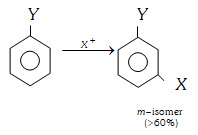
MediumMCQ
In a reaction of ${C_6H_5Y}$,the major product $(> 60\%)$ is the $m$-isomer. Therefore,the group $Y$ is:
A
$-COOH$
B
$-NH_2$
C
$-OH$
D
$-Cl$
Solution
(A) The reaction involves electrophilic aromatic substitution on a substituted benzene ring ${C_6H_5Y}$.
Groups that are electron-withdrawing by resonance or induction (deactivating groups) are meta-directing.
Among the given options,$-COOH$ is an electron-withdrawing group and acts as a meta-directing group.
Conversely,$-NH_2$,$-OH$,and $-Cl$ are electron-donating groups (by resonance) and act as ortho/para-directing groups.
Therefore,the correct option is $A$.
Groups that are electron-withdrawing by resonance or induction (deactivating groups) are meta-directing.
Among the given options,$-COOH$ is an electron-withdrawing group and acts as a meta-directing group.
Conversely,$-NH_2$,$-OH$,and $-Cl$ are electron-donating groups (by resonance) and act as ortho/para-directing groups.
Therefore,the correct option is $A$.
0 likes
View Solution32
MediumMCQ
Among the following,the aromatic compound is:
A
Cyclopropenyl cation
B
Cyclobutadiene
C
Cyclopentadienyl cation
D
Cyclopropenyl anion
Solution
(A) According to $H$ückel's rule for aromaticity,a molecule must be planar,cyclic,and possess a delocalized $(4n + 2) \, \pi$ electron system,where $n$ is an integer $(n = 0, 1, 2, 3, \dots)$.
$1.$ The cyclopropenyl cation has $2 \, \pi$ electrons $(n = 0)$,making it aromatic.
$2.$ Cyclobutadiene has $4 \, \pi$ electrons ($4n$ system),making it anti-aromatic.
$3.$ The cyclopentadienyl cation has $4 \, \pi$ electrons ($4n$ system),making it anti-aromatic.
$4.$ The cyclopropenyl anion has $4 \, \pi$ electrons ($4n$ system),making it anti-aromatic.
Therefore,the cyclopropenyl cation is the aromatic compound.
$1.$ The cyclopropenyl cation has $2 \, \pi$ electrons $(n = 0)$,making it aromatic.
$2.$ Cyclobutadiene has $4 \, \pi$ electrons ($4n$ system),making it anti-aromatic.
$3.$ The cyclopentadienyl cation has $4 \, \pi$ electrons ($4n$ system),making it anti-aromatic.
$4.$ The cyclopropenyl anion has $4 \, \pi$ electrons ($4n$ system),making it anti-aromatic.
Therefore,the cyclopropenyl cation is the aromatic compound.
0 likes
View Solution33
MediumMCQ
Cyclic hydrocarbon molecule $A$ has all the carbon and hydrogen atoms in a single plane. All the carbon-carbon bonds are of the same length and are less than $1.54 \ \mathring{A}$ but more than $1.34 \ \mathring{A}$. The $C-C-C$ bond angle will be:
A
$120^{\circ}$
B
$180^{\circ}$
C
$100^{\circ}$
D
$109^{\circ}28'$
Solution
(A) The cyclic hydrocarbon $A$ described is benzene $(C_6H_6)$.
In benzene,all carbon atoms are $sp^2$ hybridized and lie in the same plane.
The carbon-carbon bond length in benzene is $1.39 \ \mathring{A}$,which satisfies the condition $1.34 \ \mathring{A} < 1.39 \ \mathring{A} < 1.54 \ \mathring{A}$.
For $sp^2$ hybridized carbon atoms in a planar ring,the $C-C-C$ bond angle is $120^{\circ}$.
In benzene,all carbon atoms are $sp^2$ hybridized and lie in the same plane.
The carbon-carbon bond length in benzene is $1.39 \ \mathring{A}$,which satisfies the condition $1.34 \ \mathring{A} < 1.39 \ \mathring{A} < 1.54 \ \mathring{A}$.
For $sp^2$ hybridized carbon atoms in a planar ring,the $C-C-C$ bond angle is $120^{\circ}$.
0 likes
View Solution34
MediumMCQ
Using anhydrous $AlCl_3$ as a catalyst,which one of the following reactions produces ethylbenzene $(PhEt)$?
A
$H_2C = CH_2 + C_6H_6$
B
$H_3C - CH_3 + C_6H_6$
C
$H_3C - CH_2OH + C_6H_6$
D
$CH_3 - CH = CH_2 + C_6H_6$
Solution
(A) The reaction of benzene $(C_6H_6)$ with ethene $(H_2C = CH_2)$ in the presence of an anhydrous $AlCl_3$ catalyst (often with a trace of $HCl$) is an example of Friedel-Crafts alkylation.
This reaction proceeds via the formation of an ethyl carbocation intermediate,which then attacks the benzene ring to form ethylbenzene $(C_6H_5CH_2CH_3)$.
The reaction is: $C_6H_6 + H_2C = CH_2 \xrightarrow{AlCl_3, HCl} C_6H_5CH_2CH_3$.
This reaction proceeds via the formation of an ethyl carbocation intermediate,which then attacks the benzene ring to form ethylbenzene $(C_6H_5CH_2CH_3)$.
The reaction is: $C_6H_6 + H_2C = CH_2 \xrightarrow{AlCl_3, HCl} C_6H_5CH_2CH_3$.
0 likes
View Solution35
MediumMCQ
The product formed when acetylene is passed through a red-hot tube is:
A
Benzene
B
Cyclohexane
C
Neoprene
D
Ethane
Solution
(A) When acetylene $(C_2H_2)$ is passed through a red-hot iron tube at $873 \ K$,it undergoes cyclic polymerization to form benzene $(C_6H_6)$.
The reaction is as follows:
$3C_2H_2 \xrightarrow{\text{red hot tube}} C_6H_6$
Thus,the correct option is $A$.
The reaction is as follows:
$3C_2H_2 \xrightarrow{\text{red hot tube}} C_6H_6$
Thus,the correct option is $A$.
0 likes
View Solution36
EasyMCQ
Which of the following is $NOT$ obtained by the fractional distillation of coal tar?
A
Light oil
B
Middle oil
C
Heavy oil
D
Mobil oil
Solution
(D) The fractional distillation of coal tar yields several fractions based on their boiling point ranges:
$1$. Light oil (up to $200 \ ^\circ C$)
$2$. Middle oil $(200-250 \ ^\circ C)$
$3$. Heavy oil $(250-300 \ ^\circ C)$
$4$. Anthracene oil $(300-350 \ ^\circ C)$
$5$. Pitch (residue)
Mobil oil is a lubricant derived from petroleum,not from coal tar distillation.
$1$. Light oil (up to $200 \ ^\circ C$)
$2$. Middle oil $(200-250 \ ^\circ C)$
$3$. Heavy oil $(250-300 \ ^\circ C)$
$4$. Anthracene oil $(300-350 \ ^\circ C)$
$5$. Pitch (residue)
Mobil oil is a lubricant derived from petroleum,not from coal tar distillation.
0 likes
View Solution37
DifficultMCQ
Xylenes on oxidation with acidic $KMnO_4$ give:
A
Terephthalic acid
B
Phthalic acid
C
Isophthalic acid
D
All of these
Solution
(D) Xylenes are dimethyl derivatives of benzene. There are three isomers of xylene: $o$-xylene,$m$-xylene,and $p$-xylene.
When these isomers are oxidized with acidic $KMnO_4$,the methyl groups are oxidized to carboxylic acid groups $(-COOH)$.
$o$-Xylene gives phthalic acid (benzene$-1,2-$dicarboxylic acid).
$m$-Xylene gives isophthalic acid (benzene$-1,3-$dicarboxylic acid).
$p$-Xylene gives terephthalic acid (benzene$-1,4-$dicarboxylic acid).
Since all three isomers are xylenes,they yield their respective dicarboxylic acids upon oxidation.
When these isomers are oxidized with acidic $KMnO_4$,the methyl groups are oxidized to carboxylic acid groups $(-COOH)$.
$o$-Xylene gives phthalic acid (benzene$-1,2-$dicarboxylic acid).
$m$-Xylene gives isophthalic acid (benzene$-1,3-$dicarboxylic acid).
$p$-Xylene gives terephthalic acid (benzene$-1,4-$dicarboxylic acid).
Since all three isomers are xylenes,they yield their respective dicarboxylic acids upon oxidation.
0 likes
View Solution38
MediumMCQ
The function of anhydrous $AlCl_3$ in the Friedel-Crafts reaction is to
A
Absorb water
B
Absorb $HCl$
C
Produce an electrophile
D
Produce a nucleophile
Solution
(C) In the Friedel-Crafts reaction,anhydrous $AlCl_3$ acts as a Lewis acid.
It reacts with the alkyl halide or acyl halide to generate a carbocation or an acylium ion,which acts as an electrophile.
This electrophile then attacks the benzene ring to initiate the substitution reaction.
For example: $CH_3CH_2CH_2Cl + AlCl_3 \rightarrow CH_3CH_2CH_2^+ + AlCl_4^-$.
The generated $CH_3CH_2CH_2^+$ is the electrophile.
It reacts with the alkyl halide or acyl halide to generate a carbocation or an acylium ion,which acts as an electrophile.
This electrophile then attacks the benzene ring to initiate the substitution reaction.
For example: $CH_3CH_2CH_2Cl + AlCl_3 \rightarrow CH_3CH_2CH_2^+ + AlCl_4^-$.
The generated $CH_3CH_2CH_2^+$ is the electrophile.
0 likes
View Solution39
MediumMCQ
Benzene reacts with $CH_3COCl$ in the presence of $AlCl_3$ to give
A
$C_6H_5Cl$
B
$C_6H_5COCl$
C
$C_6H_5CH_3$
D
$C_6H_5COCH_3$
Solution
(D) The reaction of benzene with acetyl chloride $(CH_3COCl)$ in the presence of anhydrous aluminum chloride $(AlCl_3)$ is known as the Friedel-Crafts acylation reaction.
In this reaction,the acetyl group $(-COCH_3)$ replaces a hydrogen atom on the benzene ring to form acetophenone $(C_6H_5COCH_3)$.
The chemical equation is: $C_6H_6 + CH_3COCl \xrightarrow{AlCl_3} C_6H_5COCH_3 + HCl$.
Therefore,the correct option is $(d)$.
In this reaction,the acetyl group $(-COCH_3)$ replaces a hydrogen atom on the benzene ring to form acetophenone $(C_6H_5COCH_3)$.
The chemical equation is: $C_6H_6 + CH_3COCl \xrightarrow{AlCl_3} C_6H_5COCH_3 + HCl$.
Therefore,the correct option is $(d)$.
0 likes
View Solution40
MediumMCQ
Acylation process is preferred over direct alkylation in the Friedel-Crafts reaction because:
A
In alkylation,a poisonous gas is evolved
B
In alkylation,a large amount of heat is evolved
C
In alkylation,a polyalkylated product is formed
D
Alkylation is very costly
Solution
(C) In the Friedel-Crafts alkylation of benzene,the alkyl group introduced is electron-donating,which activates the benzene ring towards further electrophilic substitution. This leads to the formation of polyalkylated products.
In contrast,the acyl group introduced in acylation is electron-withdrawing,which deactivates the ring and prevents further substitution,ensuring the formation of a mono-acylated product.
Therefore,acylation is preferred,followed by the reduction of the carbonyl group to a methylene group to obtain the desired alkyl benzene.
In contrast,the acyl group introduced in acylation is electron-withdrawing,which deactivates the ring and prevents further substitution,ensuring the formation of a mono-acylated product.
Therefore,acylation is preferred,followed by the reduction of the carbonyl group to a methylene group to obtain the desired alkyl benzene.
0 likes
View Solution41
MediumMCQ
Benzene cannot undergo
A
Substitution
B
Addition
C
Elimination
D
Oxidation
Solution
(C) Benzene typically undergoes electrophilic aromatic substitution reactions (e.g.,nitration,sulfonation,halogenation).
Benzene can undergo addition reactions under specific conditions,such as hydrogenation to cyclohexane or addition of chlorine in the presence of $UV$ light.
Benzene can undergo oxidation reactions,such as catalytic oxidation to maleic anhydride or oxidation to phenol.
Benzene does not undergo elimination reactions because it lacks a leaving group attached to an $sp^3$ hybridized carbon that could be removed to form a double or triple bond within the ring system without destroying its aromatic stability.
Therefore,the correct answer is $C$.
Benzene can undergo addition reactions under specific conditions,such as hydrogenation to cyclohexane or addition of chlorine in the presence of $UV$ light.
Benzene can undergo oxidation reactions,such as catalytic oxidation to maleic anhydride or oxidation to phenol.
Benzene does not undergo elimination reactions because it lacks a leaving group attached to an $sp^3$ hybridized carbon that could be removed to form a double or triple bond within the ring system without destroying its aromatic stability.
Therefore,the correct answer is $C$.
0 likes
View Solution42
MediumMCQ
Which of the following is not formed by the ozonolysis of $o-$xylene?
A
Glyoxal
B
Ethyl glyoxal
C
Dimethyl glyoxal
D
Methyl glyoxal
Solution
(B) $o-$Xylene exists in two resonance structures.
Ozonolysis of $o-$xylene involves the cleavage of double bonds in the benzene ring.
Based on the two resonance structures,the products formed are methylglyoxal,$1,2-$dimethylglyoxal (also known as diacetyl),and glyoxal.
Ethyl glyoxal is not among the products formed during this reaction.
Therefore,the correct option is $B$.
Ozonolysis of $o-$xylene involves the cleavage of double bonds in the benzene ring.
Based on the two resonance structures,the products formed are methylglyoxal,$1,2-$dimethylglyoxal (also known as diacetyl),and glyoxal.
Ethyl glyoxal is not among the products formed during this reaction.
Therefore,the correct option is $B$.
0 likes
View Solution43
MediumMCQ
The number of $\sigma$ and $\pi$ bonds in a molecule of benzene is
A
$6\sigma$ and $9\pi$
B
$9\sigma$ and $3\pi$
C
$12\sigma$ and $3\pi$
D
$6\sigma$ and $6\pi$
Solution
(C) The chemical formula of benzene is $C_6H_6$.
In the benzene ring,there are $6$ $C-C$ $\sigma$ bonds and $6$ $C-H$ $\sigma$ bonds,totaling $12$ $\sigma$ bonds.
Additionally,there are $3$ $C-C$ $\pi$ bonds due to the alternating double bonds in the ring.
Therefore,a molecule of benzene contains $12$ $\sigma$ bonds and $3$ $\pi$ bonds.
Thus,the correct option is $(C)$.
In the benzene ring,there are $6$ $C-C$ $\sigma$ bonds and $6$ $C-H$ $\sigma$ bonds,totaling $12$ $\sigma$ bonds.
Additionally,there are $3$ $C-C$ $\pi$ bonds due to the alternating double bonds in the ring.
Therefore,a molecule of benzene contains $12$ $\sigma$ bonds and $3$ $\pi$ bonds.
Thus,the correct option is $(C)$.
0 likes
View Solution44
MediumMCQ
The ratio of $\sigma$ and $\pi$ bonds in benzene is:
A
$2$
B
$4$
C
$6$
D
$8$
Solution
(B) In a benzene molecule $(C_6H_6)$,there are $12$ sigma $(\sigma)$ bonds ($6$ $C-C$ and $6$ $C-H$ bonds) and $3$ pi $(\pi)$ bonds.
Ratio = $\frac{\sigma \text{ bonds}}{\pi \text{ bonds}} = \frac{12}{3} = 4$.
Ratio = $\frac{\sigma \text{ bonds}}{\pi \text{ bonds}} = \frac{12}{3} = 4$.
0 likes
View Solution45
MediumMCQ
The bond angle between carbon atoms in a benzene molecule is
A
$120^o$
B
$180^o$
C
$109^o 28'$
D
$60^o$
Solution
(A) In a benzene molecule $(C_6H_6)$,each carbon atom is $sp^2$ hybridized.
Due to $sp^2$ hybridization,the geometry around each carbon atom is trigonal planar.
Therefore,the bond angle between the carbon atoms in the benzene ring is $120^o$.
Due to $sp^2$ hybridization,the geometry around each carbon atom is trigonal planar.
Therefore,the bond angle between the carbon atoms in the benzene ring is $120^o$.
0 likes
View Solution46
MediumMCQ
When benzene is treated with excess of $Cl_2$ in the presence of $FeCl_3$ (or $I_2$ as a carrier),the end product is:
A
Monochlorobenzene
B
Trichlorobenzene
C
Hexachlorobenzene
D
Benzene hexachloride
Solution
(C) When benzene reacts with excess $Cl_2$ in the presence of a Lewis acid catalyst like $FeCl_3$ or $I_2$,it undergoes electrophilic aromatic substitution.
In the presence of excess chlorine,all hydrogen atoms of the benzene ring are replaced by chlorine atoms,resulting in the formation of $C_6Cl_6$,which is known as hexachlorobenzene.
Note: If the reaction were performed in the presence of $UV$ light (free radical addition),the product would be benzene hexachloride $(C_6H_6Cl_6)$. Since the question specifies $I_2$ (a Lewis acid catalyst),the product is hexachlorobenzene.
In the presence of excess chlorine,all hydrogen atoms of the benzene ring are replaced by chlorine atoms,resulting in the formation of $C_6Cl_6$,which is known as hexachlorobenzene.
Note: If the reaction were performed in the presence of $UV$ light (free radical addition),the product would be benzene hexachloride $(C_6H_6Cl_6)$. Since the question specifies $I_2$ (a Lewis acid catalyst),the product is hexachlorobenzene.
0 likes
View Solution47
MediumMCQ
Gammexane is obtained from benzene when it reacts with
A
$Br_2$ in bright sunlight (in the absence of a catalyst)
B
$Cl_2$ in bright sunlight (in the absence of a catalyst)
C
$CH_3Cl$ in the presence of anhydrous $AlCl_3$
D
$COCl_2$ in the presence of anhydrous $AlCl_3$
Solution
(B) Gammexane,also known as Benzene Hexachloride $(BHC)$ or Lindane,is produced by the additive chlorination of benzene.
When benzene reacts with $3$ moles of $Cl_2$ in the presence of bright sunlight (ultraviolet light),an addition reaction occurs to form $1,2,3,4,5,6$-hexachlorocyclohexane.
The reaction is: $C_6H_6 + 3Cl_2 \xrightarrow{\text{sunlight}} C_6H_6Cl_6$ (Gammexane).
When benzene reacts with $3$ moles of $Cl_2$ in the presence of bright sunlight (ultraviolet light),an addition reaction occurs to form $1,2,3,4,5,6$-hexachlorocyclohexane.
The reaction is: $C_6H_6 + 3Cl_2 \xrightarrow{\text{sunlight}} C_6H_6Cl_6$ (Gammexane).
0 likes
View Solution48
MediumMCQ
Point out the wrong statement in relation to the structure of benzene.
A
It forms only one monosubstitution product.
B
The $C-C$ bond distance in benzene is uniformly $1.397 \ \mathring{A}$.
C
It is a resonance hybrid of a number of canonical forms.
D
It has three delocalised $\pi-$ molecular orbitals.
Solution
(D) Benzene $(C_6H_6)$ has a planar hexagonal structure with delocalized $\pi$-electrons.
According to molecular orbital theory,the six $p$-orbitals overlap to form a single delocalized $\pi$-molecular orbital system covering the entire ring,not three separate ones.
Therefore,the statement that it has three delocalized $\pi$-molecular orbitals is incorrect.
According to molecular orbital theory,the six $p$-orbitals overlap to form a single delocalized $\pi$-molecular orbital system covering the entire ring,not three separate ones.
Therefore,the statement that it has three delocalized $\pi$-molecular orbitals is incorrect.
0 likes
View Solution49
MediumMCQ
Which equation represents an example of Friedel-Crafts reaction?
A
$C_6H_6 + C_2H_5Cl \xrightarrow{AlCl_3} C_6H_5C_2H_5 + HCl$
B
$C_2H_5OH + HCl \xrightarrow{ZnCl_2} C_2H_5Cl + H_2O$
C
$C_6H_5Cl + CH_3COCl \xrightarrow{AlCl_3} C_6H_5COCH_3 + Cl_2$
D
$C_2H_5Br + Mg \xrightarrow{\text{Ether}} C_2H_5MgBr$
Solution
(A) The Friedel-Crafts reaction involves the electrophilic substitution of an aromatic ring,typically using a Lewis acid catalyst like $AlCl_3$.
Option $A$ represents Friedel-Crafts alkylation,where benzene reacts with an alkyl halide $(C_2H_5Cl)$ in the presence of $AlCl_3$ to form ethylbenzene.
Option $B$ is a nucleophilic substitution reaction.
Option $C$ is chemically incorrect as it shows an impossible product for the given reactants.
Option $D$ is the formation of a Grignard reagent.
Option $A$ represents Friedel-Crafts alkylation,where benzene reacts with an alkyl halide $(C_2H_5Cl)$ in the presence of $AlCl_3$ to form ethylbenzene.
Option $B$ is a nucleophilic substitution reaction.
Option $C$ is chemically incorrect as it shows an impossible product for the given reactants.
Option $D$ is the formation of a Grignard reagent.
0 likes
View Solution50
MediumMCQ
Which of the following reactions takes place when a mixture of concentrated $HNO_3$ and $H_2SO_4$ reacts with benzene at $350 \ K$?
A
Sulphonation
B
Nitration
C
Hydrogenation
D
Dehydration
Solution
(B) When benzene reacts with a mixture of concentrated $HNO_3$ and concentrated $H_2SO_4$ at $350 \ K$,the electrophile $NO_2^+$ (nitronium ion) is generated.
This electrophile attacks the benzene ring to form nitrobenzene.
This process is known as nitration.
The reaction is: $C_6H_6 + HNO_3 \xrightarrow{Conc. H_2SO_4, 350 \ K} C_6H_5NO_2 + H_2O$.
This electrophile attacks the benzene ring to form nitrobenzene.
This process is known as nitration.
The reaction is: $C_6H_6 + HNO_3 \xrightarrow{Conc. H_2SO_4, 350 \ K} C_6H_5NO_2 + H_2O$.
0 likes
View SolutionHydrocarbons — Aromatic hydrocarbon · Frequently Asked Questions
1Are these Hydrocarbons questions useful for JEE and NEET?
Yes. All questions in this section are mapped to JEE Main and NEET exam patterns. Previous year questions from JEE Main, NEET, GUJCET and state-level exams are included with full solutions.
2Can I switch to Hindi or Gujarati for these questions?
Yes. Use the language tabs in the hero section or the sidebar to view the same questions and solutions in English, Hindi or Gujarati.
3How do I generate a question paper from this subtopic?
Use the Vedclass Exam Paper Generator — select the chapter and subtopic, set difficulty, and generate Sets A, B, C, D automatically. First 3 chapters of every subject are free.
Vedclass Products
For Students
Vedclass Test Series
Mock tests in real JEE/NEET style with performance analysis. 5-day free trial.
Start Free TrialFor Teachers
Exam Paper Generator
Generate Set A/B/C/D papers from this chapter in 2 minutes. 3 chapters free.
Try FreeFor Institutes
Online Exam Module
Live online exams with unlimited students, 360° analytics & white-label branding.
See DemoFor Teachers & Institutes
Generate a Hydrocarbons Exam Paper in 2 Minutes
Select subtopic & difficulty — Sets A, B, C, D auto-generated with No Repeat logic.
First 3 chapters of every subject are free — no payment required.