
A English
Aromatic hydrocarbon Questions in English
Class 11 Chemistry · Hydrocarbons · Aromatic hydrocarbon
872+
Questions
English
Language
100%
With Solutions
Showing 50 of 872 questions in English
651
DifficultMCQ
Benzene on nitration gives nitrobenzene in the presence of a mixture of $HNO_3$ and $H_2SO_4$,where:
A
$HNO_3$ acts as an acid and $H_2SO_4$ acts as a base
B
Both $H_2SO_4$ and $HNO_3$ act as bases
C
$HNO_3$ acts as a base and $H_2SO_4$ acts as an acid
D
Both $H_2SO_4$ and $HNO_3$ act as acids
Solution
(C) In the nitration of benzene,the mixture of concentrated $H_2SO_4$ and $HNO_3$ is used.
$H_2SO_4$ is a stronger acid than $HNO_3$,so it donates a proton $(H^+)$ to $HNO_3$.
$H_2SO_4 + HNO_3 \rightleftharpoons HSO_4^- + H_2NO_3^+$
Here,$H_2SO_4$ acts as an acid (proton donor) and $HNO_3$ acts as a base (proton acceptor).
The $H_2NO_3^+$ species then loses a water molecule to form the electrophile,the nitronium ion $(NO_2^+)$:
$H_2NO_3^+ \rightleftharpoons H_2O + NO_2^+$
$H_2SO_4$ is a stronger acid than $HNO_3$,so it donates a proton $(H^+)$ to $HNO_3$.
$H_2SO_4 + HNO_3 \rightleftharpoons HSO_4^- + H_2NO_3^+$
Here,$H_2SO_4$ acts as an acid (proton donor) and $HNO_3$ acts as a base (proton acceptor).
The $H_2NO_3^+$ species then loses a water molecule to form the electrophile,the nitronium ion $(NO_2^+)$:
$H_2NO_3^+ \rightleftharpoons H_2O + NO_2^+$
0 likes
View Solution652
MediumMCQ
Which among the following is the strongest acid?
A
Cyclopentadiene
B
Toluene
C
Cyclopropene
D
$CH_3 CH_2 CH_2 CH_3$
Solution
(A) The acidity of a compound depends on the stability of its conjugate base.
When cyclopentadiene loses a proton $(H^+)$,it forms a cyclopentadienyl anion.
This anion has $6 \pi$ electrons and is cyclic and planar,making it aromatic according to $H$ückel's rule.
Since the conjugate base is aromatic,it is exceptionally stable,which makes cyclopentadiene the strongest acid among the given options.
When cyclopentadiene loses a proton $(H^+)$,it forms a cyclopentadienyl anion.
This anion has $6 \pi$ electrons and is cyclic and planar,making it aromatic according to $H$ückel's rule.
Since the conjugate base is aromatic,it is exceptionally stable,which makes cyclopentadiene the strongest acid among the given options.
0 likes
View Solution653
MediumMCQ
Amongst the following compounds,the one which is most easily sulphonated is:
A
Benzene
B
Nitrobenzene
C
Toluene
D
Chlorobenzene
Solution
(C) Sulphonation is an electrophilic aromatic substitution reaction. The rate of this reaction depends on the electron density of the benzene ring.
Groups that donate electrons to the ring (activating groups) increase the electron density and make the ring more susceptible to electrophilic attack.
$1$. $CH_3$ group in Toluene is an electron-donating group ($+I$ and hyperconjugation effect),which activates the benzene ring.
$2$. $Cl$ in Chlorobenzene is deactivating due to its strong $-I$ effect.
$3$. $NO_2$ in Nitrobenzene is a strongly deactivating group due to its $-I$ and $-M$ effects.
$4$. Benzene has no substituent.
Therefore,Toluene is the most reactive towards electrophilic substitution among the given options.
Groups that donate electrons to the ring (activating groups) increase the electron density and make the ring more susceptible to electrophilic attack.
$1$. $CH_3$ group in Toluene is an electron-donating group ($+I$ and hyperconjugation effect),which activates the benzene ring.
$2$. $Cl$ in Chlorobenzene is deactivating due to its strong $-I$ effect.
$3$. $NO_2$ in Nitrobenzene is a strongly deactivating group due to its $-I$ and $-M$ effects.
$4$. Benzene has no substituent.
Therefore,Toluene is the most reactive towards electrophilic substitution among the given options.
0 likes
View Solution654
EasyMCQ
Which compound amongst the following is not an aromatic compound?
A
Cycloheptatrienyl cation
B
Cyclopropenyl cation
C
Cyclooctatetraene
D
Cyclopentadienyl anion
Solution
(C) To determine if a compound is aromatic,it must follow $H$ückel's rule:
$1$. The molecule must be cyclic.
$2$. The molecule must be planar.
$3$. The molecule must be fully conjugated.
$4$. The molecule must have $(4n + 2) \pi$ electrons,where $n = 0, 1, 2, ...$
Let's analyze each option:
- $A$: Cycloheptatrienyl cation has $6 \pi$ electrons $(n=1)$,is cyclic,planar,and conjugated. It is aromatic.
- $B$: Cyclopropenyl cation has $2 \pi$ electrons $(n=0)$,is cyclic,planar,and conjugated. It is aromatic.
- $C$: Cyclooctatetraene has $8 \pi$ electrons. It is not planar (it adopts a tub shape) and does not follow the $(4n + 2) \pi$ rule. It is non-aromatic.
- $D$: Cyclopentadienyl anion has $6 \pi$ electrons $(n=1)$,is cyclic,planar,and conjugated. It is aromatic.
Therefore,the compound that is not aromatic is cyclooctatetraene.
$1$. The molecule must be cyclic.
$2$. The molecule must be planar.
$3$. The molecule must be fully conjugated.
$4$. The molecule must have $(4n + 2) \pi$ electrons,where $n = 0, 1, 2, ...$
Let's analyze each option:
- $A$: Cycloheptatrienyl cation has $6 \pi$ electrons $(n=1)$,is cyclic,planar,and conjugated. It is aromatic.
- $B$: Cyclopropenyl cation has $2 \pi$ electrons $(n=0)$,is cyclic,planar,and conjugated. It is aromatic.
- $C$: Cyclooctatetraene has $8 \pi$ electrons. It is not planar (it adopts a tub shape) and does not follow the $(4n + 2) \pi$ rule. It is non-aromatic.
- $D$: Cyclopentadienyl anion has $6 \pi$ electrons $(n=1)$,is cyclic,planar,and conjugated. It is aromatic.
Therefore,the compound that is not aromatic is cyclooctatetraene.
0 likes
View Solution655
EasyMCQ
Which of the following structures are aromatic in nature?
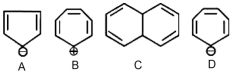
A
$A, B, C$ and $D$
B
Only $A$ and $B$
C
Only $A$ and $C$
D
Only $B, C$ and $D$
Solution
(B) compound is aromatic if it is cyclic,planar,fully conjugated,and follows $H$ückel's rule ($4n+2$ $\pi$ electrons).
$A$ (Cyclopentadienyl anion): It has $6$ $\pi$ electrons ($4$ from double bonds + $2$ from the lone pair on the $sp^3$ carbon,which becomes $sp^2$ due to conjugation). It is cyclic,planar,and aromatic.
$B$ (Tropylium cation): It has $6$ $\pi$ electrons. It is cyclic,planar,and aromatic.
$C$ (Cyclooctatetraene derivative): It is non-planar (tub-shaped) to avoid anti-aromaticity,hence it is non-aromatic.
$D$ (Cycloheptatrienyl anion): It has $8$ $\pi$ electrons ($4n$ system),making it anti-aromatic.
Therefore,only $A$ and $B$ are aromatic.
$A$ (Cyclopentadienyl anion): It has $6$ $\pi$ electrons ($4$ from double bonds + $2$ from the lone pair on the $sp^3$ carbon,which becomes $sp^2$ due to conjugation). It is cyclic,planar,and aromatic.
$B$ (Tropylium cation): It has $6$ $\pi$ electrons. It is cyclic,planar,and aromatic.
$C$ (Cyclooctatetraene derivative): It is non-planar (tub-shaped) to avoid anti-aromaticity,hence it is non-aromatic.
$D$ (Cycloheptatrienyl anion): It has $8$ $\pi$ electrons ($4n$ system),making it anti-aromatic.
Therefore,only $A$ and $B$ are aromatic.
0 likes
View Solution656
MediumMCQ
Which of the following is not an example of a benzenoid compound?
A
Phenanthrene
B
Cyclooctatetraene
C
Naphthalene
D
Aniline
Solution
(B) Benzenoid compounds are organic compounds that contain at least one benzene ring.
$A$ (Phenanthrene),$C$ (Naphthalene),and $D$ (Aniline) all contain benzene rings in their structures.
$B$ (Cyclooctatetraene) is an eight-membered cyclic polyene $(C_8H_8)$ that does not contain a benzene ring.
Therefore,cyclooctatetraene is not a benzenoid compound.
$A$ (Phenanthrene),$C$ (Naphthalene),and $D$ (Aniline) all contain benzene rings in their structures.
$B$ (Cyclooctatetraene) is an eight-membered cyclic polyene $(C_8H_8)$ that does not contain a benzene ring.
Therefore,cyclooctatetraene is not a benzenoid compound.
0 likes
View Solution657
EasyMCQ
Which of the following compounds is not aromatic?
A
Cyclopentadienyl anion
B
Cyclopropenyl cation
C
$[10]$ Annulene
D
Naphthalene
Solution
(C) $[10]$ Annulene,although it follows the $(4n + 2) \pi$ electron rule,is non-aromatic due to its non-planar nature.
It is non-planar because of the steric repulsion between the two $C-H$ bonds present inside the ring.
It is non-planar because of the steric repulsion between the two $C-H$ bonds present inside the ring.
0 likes
View Solution658
MediumMCQ
In the presence of sunlight,benzene reacts with $Cl_{2}$ to give product $X$. The number of hydrogens in $X$ is $.....$
A
$5$
B
$4$
C
$6$
D
$3$
Solution
(C) When benzene $(C_{6}H_{6})$ reacts with excess chlorine $(Cl_{2})$ in the presence of sunlight ($UV$ light),an addition reaction occurs.
This reaction results in the formation of benzene hexachloride $(C_{6}H_{6}Cl_{6})$,also known as gammaxene or lindane.
The product $X$ is $C_{6}H_{6}Cl_{6}$.
In this molecule,each of the $6$ carbon atoms is bonded to one hydrogen atom and one chlorine atom.
Therefore,the total number of hydrogen atoms in $X$ is $6$.
This reaction results in the formation of benzene hexachloride $(C_{6}H_{6}Cl_{6})$,also known as gammaxene or lindane.
The product $X$ is $C_{6}H_{6}Cl_{6}$.
In this molecule,each of the $6$ carbon atoms is bonded to one hydrogen atom and one chlorine atom.
Therefore,the total number of hydrogen atoms in $X$ is $6$.
0 likes
View Solution659
DifficultMCQ
Given below are two statements. One is labelled as Assertion $A$ and the other is labelled as Reason $R$.
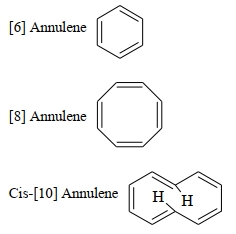
Assertion $A$: $[6]-$Annulene,$[8]-$Annulene and cis$-10-$Annulene are respectively aromatic,non-aromatic and non-aromatic.
Reason $R$: Planarity is one of the requirements of aromatic systems.
In the light of the above statements,choose the most appropriate answer from the options given below.
Assertion $A$: $[6]-$Annulene,$[8]-$Annulene and cis$-10-$Annulene are respectively aromatic,non-aromatic and non-aromatic.
Reason $R$: Planarity is one of the requirements of aromatic systems.
In the light of the above statements,choose the most appropriate answer from the options given below.
A
Both $A$ and $R$ are correct and $R$ is the correct explanation of $A$.
B
Both $A$ and $R$ are correct but $R$ is $NOT$ the correct explanation of $A$.
C
$A$ is correct but $R$ is not correct.
D
$A$ is not correct but $R$ is correct.
Solution
(D) $[6]-$Annulene (benzene) is aromatic as it is planar,cyclic,and has $6\pi$ electrons ($4n+2$ rule,$n=1$).
$[8]-$Annulene is non-aromatic because it is non-planar (tub-shaped) to avoid angle strain,despite having $8\pi$ electrons ($4n$ rule).
Cis$-10-$Annulene is non-aromatic because the internal hydrogen atoms at positions $1$ and $6$ experience steric hindrance,forcing the molecule out of planarity,which prevents continuous conjugation.
Thus,Assertion $A$ is incorrect because it labels cis$-10-$Annulene as aromatic.
Reason $R$ is correct because planarity is indeed a fundamental requirement for a molecule to be aromatic ($H$ückel's rule).
Therefore,$A$ is not correct but $R$ is correct.
$[8]-$Annulene is non-aromatic because it is non-planar (tub-shaped) to avoid angle strain,despite having $8\pi$ electrons ($4n$ rule).
Cis$-10-$Annulene is non-aromatic because the internal hydrogen atoms at positions $1$ and $6$ experience steric hindrance,forcing the molecule out of planarity,which prevents continuous conjugation.
Thus,Assertion $A$ is incorrect because it labels cis$-10-$Annulene as aromatic.
Reason $R$ is correct because planarity is indeed a fundamental requirement for a molecule to be aromatic ($H$ückel's rule).
Therefore,$A$ is not correct but $R$ is correct.
0 likes
View Solution660
MediumMCQ
Arrange the following in increasing order of reactivity towards nitration:
$A$. $p$-xylene
$B$. bromobenzene
$C$. mesitylene
$D$. nitrobenzene
$E$. benzene
Choose the correct answer from the options given below.
$A$. $p$-xylene
$B$. bromobenzene
$C$. mesitylene
$D$. nitrobenzene
$E$. benzene
Choose the correct answer from the options given below.
A
$C < D < E < A < B$
B
$D < B < E < A < C$
C
$D < C < E < A < B$
D
$C < D < E < B < A$
Solution
(B) The reactivity towards electrophilic aromatic substitution (like nitration) depends on the electron density of the benzene ring.
$1$. $-NO_2$ (in $D$) is a strongly electron-withdrawing group (deactivating),making the ring least reactive.
$2$. $-Br$ (in $B$) is an electron-withdrawing group due to the inductive effect (deactivating),but less so than $-NO_2$.
$3$. $E$ (benzene) is the reference point.
$4$. $-CH_3$ groups are electron-donating (activating) due to hyperconjugation and inductive effects.
$5$. $p$-xylene $(A)$ has two $-CH_3$ groups,and mesitylene $(C)$ has three $-CH_3$ groups. More electron-donating groups increase the reactivity further.
Thus,the order of increasing reactivity is: $D < B < E < A < C$.
$1$. $-NO_2$ (in $D$) is a strongly electron-withdrawing group (deactivating),making the ring least reactive.
$2$. $-Br$ (in $B$) is an electron-withdrawing group due to the inductive effect (deactivating),but less so than $-NO_2$.
$3$. $E$ (benzene) is the reference point.
$4$. $-CH_3$ groups are electron-donating (activating) due to hyperconjugation and inductive effects.
$5$. $p$-xylene $(A)$ has two $-CH_3$ groups,and mesitylene $(C)$ has three $-CH_3$ groups. More electron-donating groups increase the reactivity further.
Thus,the order of increasing reactivity is: $D < B < E < A < C$.
0 likes
View Solution661
MediumMCQ
Which among the following pairs of the structures will give different products on ozonolysis? (Consider the double bonds in the structures are rigid and not delocalized.)
A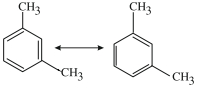
B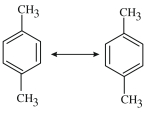
C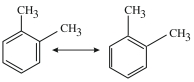
D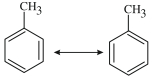
Solution
(C) Ozonolysis of a benzene ring with fixed double bonds involves the cleavage of the $C=C$ bonds to form carbonyl compounds.
For $1,2$-dimethylbenzene ($o$-xylene),the two resonance structures have different positions of the double bonds relative to the methyl groups.
In the first structure,the double bonds are between $C_1-C_2$,$C_3-C_4$,and $C_5-C_6$. Ozonolysis yields $CH_3-CO-CO-CH_3$ and $2 \ CHO-CHO$.
In the second structure,the double bonds are between $C_2-C_3$,$C_4-C_5$,and $C_6-C_1$. Ozonolysis yields $2 \ CH_3-CO-CHO$ and $CHO-CHO$.
Since the products are different,the pair of $o$-xylene structures gives different products upon ozonolysis.
For $1,2$-dimethylbenzene ($o$-xylene),the two resonance structures have different positions of the double bonds relative to the methyl groups.
In the first structure,the double bonds are between $C_1-C_2$,$C_3-C_4$,and $C_5-C_6$. Ozonolysis yields $CH_3-CO-CO-CH_3$ and $2 \ CHO-CHO$.
In the second structure,the double bonds are between $C_2-C_3$,$C_4-C_5$,and $C_6-C_1$. Ozonolysis yields $2 \ CH_3-CO-CHO$ and $CHO-CHO$.
Since the products are different,the pair of $o$-xylene structures gives different products upon ozonolysis.
0 likes
View Solution662
DifficultMCQ
Which among the following is a non-benzenoid aromatic compound?
A
$o$-xylene
B
Phenanthrene
C
Indole
D
Thiophene
Solution
(D)
Non-benzenoid aromatic compounds are those compounds which do not contain a benzene ring in their structure. They exhibit aromaticity due to the presence of alternate $\pi$-bonds in the cyclic system.
$o$-xylene,Phenanthrene,and Indole all contain at least one benzene ring fused or substituted in their structure.
Thiophene is a five-membered heterocyclic compound containing sulfur,which does not contain a benzene ring,yet it is aromatic.
Therefore,Thiophene is a non-benzenoid aromatic compound.
Non-benzenoid aromatic compounds are those compounds which do not contain a benzene ring in their structure. They exhibit aromaticity due to the presence of alternate $\pi$-bonds in the cyclic system.
$o$-xylene,Phenanthrene,and Indole all contain at least one benzene ring fused or substituted in their structure.
Thiophene is a five-membered heterocyclic compound containing sulfur,which does not contain a benzene ring,yet it is aromatic.
Therefore,Thiophene is a non-benzenoid aromatic compound.
0 likes
View Solution663
MediumMCQ
In electrophilic aromatic substitution reactions of chlorobenzene,the $ortho/para$-directing ability of chlorine is due to its
A
positive inductive effect $(+I)$
B
negative inductive effect $(-I)$
C
positive resonance effect $(+R)$
D
negative resonance effect $(-R)$
Solution
(C)
In electrophilic aromatic substitution reactions of chlorobenzene,the $ortho/para$-directing ability of chlorine is due to its $+R$-effect.
Chlorine has lone pairs of electrons that can be delocalized into the benzene ring through resonance.
The resonating structures of chlorobenzene are as follows:
Due to this effect,the electron density increases more at $ortho$ and $para$-positions than at $meta$-position,making these positions more susceptible to electrophilic attack.
In electrophilic aromatic substitution reactions of chlorobenzene,the $ortho/para$-directing ability of chlorine is due to its $+R$-effect.
Chlorine has lone pairs of electrons that can be delocalized into the benzene ring through resonance.
The resonating structures of chlorobenzene are as follows:
Due to this effect,the electron density increases more at $ortho$ and $para$-positions than at $meta$-position,making these positions more susceptible to electrophilic attack.
0 likes
View Solution664
MediumMCQ
The major product obtained in the reaction of toluene with $1-$bromo$-2-$methylpropane in the presence of anhydrous $AlCl_3$ is
A
$1-$methyl$-4-$($2$-methylpropyl)benzene
B
$1-$methyl$-2-$($2$-methylpropyl)benzene
C
$1-$methyl$-4-$($1$,$1$-dimethylethyl)benzene
D
$1-$methyl$-3-$($1$,$1$-dimethylethyl)benzene
Solution
(C) The reaction is a Friedel-Crafts alkylation. The alkyl halide $CH_3-CH(CH_3)-CH_2Br$ reacts with $AlCl_3$ to form a primary carbocation,which undergoes a $1,2-$hydride shift to form a more stable tertiary carbocation,$(CH_3)_3C^+$. This tertiary carbocation acts as the electrophile and attacks the toluene ring. Since the $-CH_3$ group is ortho/para directing and the tert-butyl group is bulky,the para-substituted product is the major product due to less steric hindrance. The major product is $1-$methyl$-4-(1,1-$dimethylethyl$)$benzene.
0 likes
View Solution665
MediumMCQ
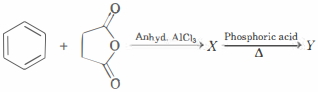
In the following reactions,$X$ and $Y$,respectively,are
A
$4-$oxo$-4-$phenylbutanoic acid and $1-$naphthol
B
$4-$oxo$-4-$phenylbutanoic acid and $1,4-$naphthoquinone
C
$4-$oxo$-4-$phenylbutanoic acid and $1-$tetralone
D
$4-$oxo$-4-$phenylbutanoic acid and $1,2,3,4-$tetrahydronaphthalene$-1,4-$dione
Solution
(C) The reaction of benzene with succinic anhydride in the presence of anhydrous $AlCl_3$ is a Friedel-Crafts acylation reaction. This produces $X$,which is $4$-oxo-$4$-phenylbutanoic acid (also known as $\beta$-benzoylpropionic acid).
In the second step,$X$ undergoes intramolecular cyclization (Friedel-Crafts acylation) in the presence of phosphoric acid $(H_3PO_4)$ and heat $(\Delta)$. This results in the formation of $Y$,which is $1$-tetralone ($3,4$-dihydro-$1(2H)$-naphthalenone).
Therefore,$X$ is $4$-oxo-$4$-phenylbutanoic acid and $Y$ is $1$-tetralone.
In the second step,$X$ undergoes intramolecular cyclization (Friedel-Crafts acylation) in the presence of phosphoric acid $(H_3PO_4)$ and heat $(\Delta)$. This results in the formation of $Y$,which is $1$-tetralone ($3,4$-dihydro-$1(2H)$-naphthalenone).
Therefore,$X$ is $4$-oxo-$4$-phenylbutanoic acid and $Y$ is $1$-tetralone.
0 likes
View Solution666
MediumMCQ
In the reaction of benzene with an electrophile $E^{+}$,the structure of the intermediate $\sigma$-complex can be represented as
A
The structure shows a radical on the benzene ring with $E$ and $H$ attached.
B
The structure shows a carbocation at the ortho position relative to the $E$ group.
C
The structure shows a carbocation at the ipso position where $E$ is attached.
D
The structure shows a carbocation at the meta position relative to the $E$ group.
Solution
(D) When benzene reacts with an electrophile $E^{+}$,the electrophile attacks the $\pi$-electron system of the benzene ring to form a resonance-stabilized carbocation intermediate known as the $\sigma$-complex or arenium ion. In this intermediate,the carbon atom at the site of attack becomes $sp^3$ hybridized,bearing both the electrophile $E$ and the hydrogen atom $H$. The positive charge is delocalized over the remaining five carbon atoms of the ring,specifically at the ortho and para positions relative to the site of attack. Among the given options,the structure that correctly represents the delocalization of the positive charge in the arenium ion is option $(d)$.
0 likes
View Solution667
MediumMCQ
Friedel-Crafts acylation is
A
$ \alpha $-acylation of a carbonyl compound
B
acylation of phenols to generate esters
C
acylation of aliphatic olefins
D
acylation of aromatic nucleus
Solution
(D) The correct answer is $ (D) $.
Friedel-Crafts acylation is an electrophilic aromatic substitution reaction. In this process,an acyl group $( RCO- )$ is introduced into an aromatic ring by reacting the aromatic compound with an acyl chloride or an acid anhydride in the presence of a Lewis acid catalyst,such as $ AlCl_3 $.
The reaction can be represented as:
$ C_6H_6 + CH_3COCl \xrightarrow{AlCl_3} C_6H_5COCH_3 + HCl $
Friedel-Crafts acylation is an electrophilic aromatic substitution reaction. In this process,an acyl group $( RCO- )$ is introduced into an aromatic ring by reacting the aromatic compound with an acyl chloride or an acid anhydride in the presence of a Lewis acid catalyst,such as $ AlCl_3 $.
The reaction can be represented as:
$ C_6H_6 + CH_3COCl \xrightarrow{AlCl_3} C_6H_5COCH_3 + HCl $
0 likes
View Solution668
DifficultMCQ
The aromatic carbocation among the following is
A
Cyclopentadienyl cation
B
Cyclohexadienyl cation
C
Tropylium cation (cycloheptatrienyl cation)
D
Cyclooctatrienyl cation
Solution
(C) compound is aromatic if it satisfies the following conditions:
$1$. It must be cyclic.
$2$. It must be planar.
$3$. It must have a fully conjugated system of $\pi$ electrons.
$4$. It must follow $H$ückel's rule,i.e.,it must contain $(4n+2) \pi$ electrons,where $n = 0, 1, 2, ...$.
Let us analyze the given options:
- Option $(A)$: The cyclopentadienyl cation has $4 \pi$ electrons. It is anti-aromatic.
- Option $(B)$: The cyclohexadienyl cation is non-planar and non-aromatic.
- Option $(C)$: The tropylium cation (cycloheptatrienyl cation) has $6 \pi$ electrons $(n=1)$. It is cyclic,planar,and fully conjugated. Thus,it is aromatic.
- Option $(D)$: The cyclooctatrienyl cation is non-planar and non-aromatic.
Therefore,the correct option is $(C)$.
$1$. It must be cyclic.
$2$. It must be planar.
$3$. It must have a fully conjugated system of $\pi$ electrons.
$4$. It must follow $H$ückel's rule,i.e.,it must contain $(4n+2) \pi$ electrons,where $n = 0, 1, 2, ...$.
Let us analyze the given options:
- Option $(A)$: The cyclopentadienyl cation has $4 \pi$ electrons. It is anti-aromatic.
- Option $(B)$: The cyclohexadienyl cation is non-planar and non-aromatic.
- Option $(C)$: The tropylium cation (cycloheptatrienyl cation) has $6 \pi$ electrons $(n=1)$. It is cyclic,planar,and fully conjugated. Thus,it is aromatic.
- Option $(D)$: The cyclooctatrienyl cation is non-planar and non-aromatic.
Therefore,the correct option is $(C)$.
0 likes
View Solution669
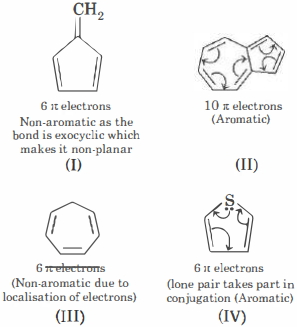
MediumMCQ
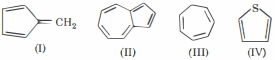
Among the following,the aromatic compounds are:
A
$I$ and $II$
B
$I$ and $III$
C
$II$ and $III$
D
$II$ and $IV$
Solution
(D) The aromatic compounds are those that satisfy the following conditions:
$(i)$ The compound must be cyclic and planar.
$(ii)$ There must be complete delocalization of $\pi$ electrons in the ring.
$(iii)$ It must follow $H$ückel's rule,i.e.,it must contain $(4n+2) \pi$ electrons,where $n$ is an integer $(n = 0, 1, 2, \dots)$.
Analysis of the given structures:
$(I)$ Fulvene: It is non-aromatic because the exocyclic double bond makes the structure non-planar or prevents continuous conjugation.
$(II)$ Azulene: It has $10 \pi$ electrons ($4n+2$ with $n=2$),is cyclic,and planar. It is aromatic.
$(III)$ Cycloheptatriene: It is non-aromatic because one carbon atom is $sp^3$ hybridized,which breaks the continuous conjugation.
$(IV)$ Thiophene: It has $6 \pi$ electrons ($4n+2$ with $n=1$) including the lone pair on sulfur participating in conjugation. It is aromatic.
Thus,compounds $(II)$ and $(IV)$ are aromatic.
Therefore,the correct option is $(d).$
$(i)$ The compound must be cyclic and planar.
$(ii)$ There must be complete delocalization of $\pi$ electrons in the ring.
$(iii)$ It must follow $H$ückel's rule,i.e.,it must contain $(4n+2) \pi$ electrons,where $n$ is an integer $(n = 0, 1, 2, \dots)$.
Analysis of the given structures:
$(I)$ Fulvene: It is non-aromatic because the exocyclic double bond makes the structure non-planar or prevents continuous conjugation.
$(II)$ Azulene: It has $10 \pi$ electrons ($4n+2$ with $n=2$),is cyclic,and planar. It is aromatic.
$(III)$ Cycloheptatriene: It is non-aromatic because one carbon atom is $sp^3$ hybridized,which breaks the continuous conjugation.
$(IV)$ Thiophene: It has $6 \pi$ electrons ($4n+2$ with $n=1$) including the lone pair on sulfur participating in conjugation. It is aromatic.
Thus,compounds $(II)$ and $(IV)$ are aromatic.
Therefore,the correct option is $(d).$
0 likes
View Solution670
MediumMCQ
The compound shown below can be readily prepared by Friedel-Crafts reaction between
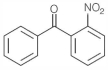
A
benzene and $2$-nitrobenzoyl chloride
B
benzyl chloride and nitrobenzene
C
nitrobenzene and benzoyl chloride
D
benzene and $2$-nitrobenzyl chloride
Solution
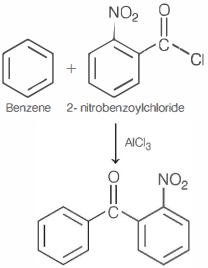
(A) The correct answer is $A$.
This reaction is a Friedel-Crafts acylation.
In this reaction,benzene reacts with an acyl halide (such as $2$-nitrobenzoyl chloride) in the presence of a Lewis acid catalyst like $AlCl_3$ to yield the corresponding acylbenzene derivative.
This reaction is a Friedel-Crafts acylation.
In this reaction,benzene reacts with an acyl halide (such as $2$-nitrobenzoyl chloride) in the presence of a Lewis acid catalyst like $AlCl_3$ to yield the corresponding acylbenzene derivative.
0 likes
View Solution671
MediumMCQ
In the following reaction,$X, Y$ and $Z$ are
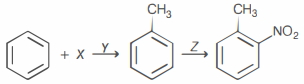
A
$X = CH_3Cl$; $Y = \text{Anhydrous } AlCl_3$; $Z = HNO_3 + H_2SO_4$
B
$X = CH_3COCl$; $Y = \text{Anhydrous } AlCl_3$; $Z = HNO_3 + H_2SO_4$
C
$X = CH_3Cl$; $Y = \text{Conc. } H_2SO_4$; $Z = HNO_3 + H_2SO_4$
D
$X = CH_3Cl$; $Y = \text{Dil. } H_2SO_4$; $Z = HNO_3$
Solution
(A) The reaction sequence is as follows:
$1$. Benzene reacts with $CH_3Cl$ in the presence of anhydrous $AlCl_3$ (a Lewis acid catalyst) to form toluene. This is a Friedel-Crafts alkylation reaction.
$2$. Toluene then undergoes nitration using a nitrating mixture of concentrated $HNO_3$ and concentrated $H_2SO_4$ to form $2$-nitrotoluene (ortho-isomer) and $4$-nitrotoluene (para-isomer).
Therefore,$X = CH_3Cl$,$Y = \text{Anhydrous } AlCl_3$,and $Z = HNO_3 + H_2SO_4$.
$1$. Benzene reacts with $CH_3Cl$ in the presence of anhydrous $AlCl_3$ (a Lewis acid catalyst) to form toluene. This is a Friedel-Crafts alkylation reaction.
$2$. Toluene then undergoes nitration using a nitrating mixture of concentrated $HNO_3$ and concentrated $H_2SO_4$ to form $2$-nitrotoluene (ortho-isomer) and $4$-nitrotoluene (para-isomer).
Therefore,$X = CH_3Cl$,$Y = \text{Anhydrous } AlCl_3$,and $Z = HNO_3 + H_2SO_4$.
0 likes
View Solution672
MediumMCQ
$A$ compound $X$ formed after heating coke with lime reacts with water to give $Y$,which on passing over red-hot iron at $873 \ K$ produces $Z$. The compound $Z$ is
A
Benzene
B
Hexane
C
Cyclohexane
D
Hexene
Solution
(A) The reaction sequence is as follows:
$1$. Heating coke $(C)$ with lime $(CaO)$ gives calcium carbide $(CaC_2)$,which is compound $X$.
$CaO + 3C \xrightarrow{\Delta} CaC_2 + CO$
$2$. Calcium carbide reacts with water to form acetylene $(C_2H_2)$,which is compound $Y$.
$CaC_2 + 2H_2O \rightarrow C_2H_2 + Ca(OH)_2$
$3$. Passing acetylene over red-hot iron at $873 \ K$ leads to cyclic trimerization to produce benzene $(C_6H_6)$,which is compound $Z$.
$3C_2H_2 \xrightarrow{\text{Fe, } 873 \ K} C_6H_6$ (Benzene)
Thus,the correct option is $A$.
$1$. Heating coke $(C)$ with lime $(CaO)$ gives calcium carbide $(CaC_2)$,which is compound $X$.
$CaO + 3C \xrightarrow{\Delta} CaC_2 + CO$
$2$. Calcium carbide reacts with water to form acetylene $(C_2H_2)$,which is compound $Y$.
$CaC_2 + 2H_2O \rightarrow C_2H_2 + Ca(OH)_2$
$3$. Passing acetylene over red-hot iron at $873 \ K$ leads to cyclic trimerization to produce benzene $(C_6H_6)$,which is compound $Z$.
$3C_2H_2 \xrightarrow{\text{Fe, } 873 \ K} C_6H_6$ (Benzene)
Thus,the correct option is $A$.
0 likes
View Solution673
DifficultMCQ
In the following set of aromatic compounds,the correct order of reactivity toward Friedel-Crafts alkylation is:
$(i)$ Nitrobenzene
(ii) Benzene
(iii) Methyl benzoate
(iv) Anisole
$(i)$ Nitrobenzene
(ii) Benzene
(iii) Methyl benzoate
(iv) Anisole
A
$i > ii > iii > iv$
B
$ii > iv > iii > i$
C
$iv > ii > iii > i$
D
$ii > i > iv > iii$
Solution
(C) The reactivity of aromatic compounds towards electrophilic aromatic substitution like Friedel-Crafts alkylation depends on the electron density of the benzene ring.
Electron-donating groups $(EDG)$ increase the electron density and thus increase reactivity,while electron-withdrawing groups $(EWG)$ decrease the electron density and decrease reactivity.
(iv) Anisole $(-OCH_3)$ has an $EDG$ which strongly activates the ring.
(ii) Benzene is the reference compound.
(iii) Methyl benzoate $(-COOCH_3)$ has an $EWG$ which deactivates the ring.
$(i)$ Nitrobenzene $(-NO_2)$ has a very strong $EWG$ which strongly deactivates the ring.
The order of reactivity is: $(iv) > (ii) > (iii) > (i)$.
Electron-donating groups $(EDG)$ increase the electron density and thus increase reactivity,while electron-withdrawing groups $(EWG)$ decrease the electron density and decrease reactivity.
(iv) Anisole $(-OCH_3)$ has an $EDG$ which strongly activates the ring.
(ii) Benzene is the reference compound.
(iii) Methyl benzoate $(-COOCH_3)$ has an $EWG$ which deactivates the ring.
$(i)$ Nitrobenzene $(-NO_2)$ has a very strong $EWG$ which strongly deactivates the ring.
The order of reactivity is: $(iv) > (ii) > (iii) > (i)$.
0 likes
View Solution674
MediumMCQ
Among the given compounds,which one is not aromatic?
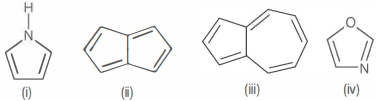
A
$(i)$
B
$(ii)$
C
$(iii)$
D
$(iv)$
Solution
(B) The conditions for a compound to be aromatic are:
$(i)$ The molecule should be planar.
$(ii)$ It should be cyclic with a continuous system of conjugated $\pi$ electrons.
$(iii)$ It should follow Huckel's rule,i.e.,it should have $(4n+2) \pi$ electrons,where $n = 0, 1, 2, \dots$
Let us analyze the given compounds:
$(i)$ Pyrrole: It has $6 \pi$ electrons ($4$ from double bonds + $2$ from the lone pair on $N$),which follows $(4n+2)$ rule $(n=1)$. It is aromatic.
$(ii)$ Pentalene: It has $8 \pi$ electrons. This follows the $4n$ rule $(n=2)$,making it anti-aromatic,not aromatic.
$(iii)$ Azulene: It has $10 \pi$ electrons,which follows $(4n+2)$ rule $(n=2)$. It is aromatic.
$(iv)$ Oxazole: It has $6 \pi$ electrons ($4$ from double bonds + $2$ from the lone pair on $O$),which follows $(4n+2)$ rule $(n=1)$. It is aromatic.
Thus,compound $(ii)$ is not aromatic.
$(i)$ The molecule should be planar.
$(ii)$ It should be cyclic with a continuous system of conjugated $\pi$ electrons.
$(iii)$ It should follow Huckel's rule,i.e.,it should have $(4n+2) \pi$ electrons,where $n = 0, 1, 2, \dots$
Let us analyze the given compounds:
$(i)$ Pyrrole: It has $6 \pi$ electrons ($4$ from double bonds + $2$ from the lone pair on $N$),which follows $(4n+2)$ rule $(n=1)$. It is aromatic.
$(ii)$ Pentalene: It has $8 \pi$ electrons. This follows the $4n$ rule $(n=2)$,making it anti-aromatic,not aromatic.
$(iii)$ Azulene: It has $10 \pi$ electrons,which follows $(4n+2)$ rule $(n=2)$. It is aromatic.
$(iv)$ Oxazole: It has $6 \pi$ electrons ($4$ from double bonds + $2$ from the lone pair on $O$),which follows $(4n+2)$ rule $(n=1)$. It is aromatic.
Thus,compound $(ii)$ is not aromatic.
0 likes
View Solution675
MediumMCQ
Given below are two statements,one is labelled as Assertion $A$ and the other is labelled as Reason $R$.
Assertion $A$ : Benzene is more stable than hypothetical cyclohexatriene.
Reason $R$ : The delocalized $\pi$ electron cloud is attracted more strongly by nuclei of carbon atoms.
In the light of the above statements,choose the correct answer from the options given below:
Assertion $A$ : Benzene is more stable than hypothetical cyclohexatriene.
Reason $R$ : The delocalized $\pi$ electron cloud is attracted more strongly by nuclei of carbon atoms.
In the light of the above statements,choose the correct answer from the options given below:
A
$A$ is true but $R$ is false.
B
$A$ is false but $R$ is true.
C
Both $A$ and $R$ are correct and $R$ is the correct explanation of $A$.
D
Both $A$ and $R$ are correct but $R$ is $NOT$ the correct explanation of $A$.
Solution
(C) Assertion $A$: Benzene is more stable than hypothetical cyclohexatriene due to resonance energy. This statement is true.
Reason $R$: The delocalized $\pi$ electron cloud in benzene is spread over the entire ring and is held more strongly by the carbon nuclei compared to localized double bonds in cyclohexatriene,contributing to its stability. This statement is true and provides the correct explanation for the stability of benzene.
Therefore,both $A$ and $R$ are correct and $R$ is the correct explanation of $A$.
Reason $R$: The delocalized $\pi$ electron cloud in benzene is spread over the entire ring and is held more strongly by the carbon nuclei compared to localized double bonds in cyclohexatriene,contributing to its stability. This statement is true and provides the correct explanation for the stability of benzene.
Therefore,both $A$ and $R$ are correct and $R$ is the correct explanation of $A$.
0 likes
View Solution676
MediumMCQ
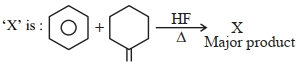
In the above reaction,' $X$ ' is:
A
$1-$methyl$-1-$phenylcyclohexane
B
$3-$methyl$-1-$phenylcyclohexane
C
$2-$methyl$-1-$phenylcyclohexane
D
$1-$methyl$-2-$phenylcyclohexane
Solution
(A) The reaction involves the electrophilic addition of benzene to methylenecyclohexane in the presence of an acid catalyst $(HF)$.
$1$. First,the $HF$ protonates the double bond of methylenecyclohexane to form a stable tertiary carbocation,the $1$-methylcyclohexyl cation.
$2$. This carbocation then acts as an electrophile and undergoes an electrophilic aromatic substitution $(EAS)$ reaction with benzene.
$3$. The final product formed is $1$-methyl-$1$-phenylcyclohexane.
$1$. First,the $HF$ protonates the double bond of methylenecyclohexane to form a stable tertiary carbocation,the $1$-methylcyclohexyl cation.
$2$. This carbocation then acts as an electrophile and undergoes an electrophilic aromatic substitution $(EAS)$ reaction with benzene.
$3$. The final product formed is $1$-methyl-$1$-phenylcyclohexane.
0 likes
View Solution677
MediumMCQ
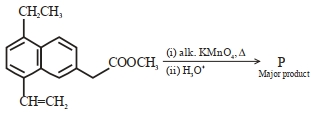
The major product '$P$' formed in the given reaction is
A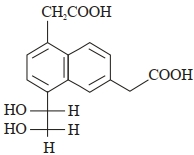
B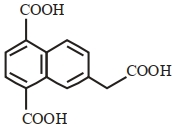
C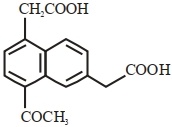
D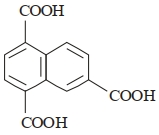
Solution
(C) The reaction involves the oxidation of side chains on a naphthalene ring using alkaline $KMnO_4$ followed by acidic workup.
$1$. The ethyl group $(-CH_2CH_3)$ at the benzylic position has $\alpha$-hydrogens,so it is oxidized to a carboxylic acid group $(-COOH)$.
$2$. The vinyl group $(-CH=CH_2)$ is also oxidized to a carboxylic acid group $(-COOH)$ by strong oxidizing agents like alkaline $KMnO_4$.
$3$. The ester group $(-COOCH_3)$ is hydrolyzed under alkaline conditions to a carboxylate salt,which upon acidic workup $(H_3O^+)$ becomes a carboxylic acid group $(-COOH)$.
$4$. Therefore,all three side chains are converted into carboxylic acid groups,resulting in the product shown in option $C$.
$1$. The ethyl group $(-CH_2CH_3)$ at the benzylic position has $\alpha$-hydrogens,so it is oxidized to a carboxylic acid group $(-COOH)$.
$2$. The vinyl group $(-CH=CH_2)$ is also oxidized to a carboxylic acid group $(-COOH)$ by strong oxidizing agents like alkaline $KMnO_4$.
$3$. The ester group $(-COOCH_3)$ is hydrolyzed under alkaline conditions to a carboxylate salt,which upon acidic workup $(H_3O^+)$ becomes a carboxylic acid group $(-COOH)$.
$4$. Therefore,all three side chains are converted into carboxylic acid groups,resulting in the product shown in option $C$.
0 likes
View Solution678
MediumMCQ
Given below are two statements:
Statement $I$: Tropolone is an aromatic compound and has $8 \pi$ electrons.
Statement $II$: $\pi$ electrons of $ > C = O $ group in tropolone is involved in aromaticity.
In the light of the above statements,choose the correct answer from the options given below:
Statement $I$: Tropolone is an aromatic compound and has $8 \pi$ electrons.
Statement $II$: $\pi$ electrons of $ > C = O $ group in tropolone is involved in aromaticity.
In the light of the above statements,choose the correct answer from the options given below:
A
Both Statement $I$ and Statement $II$ are true
B
Statement $I$ is true but Statement $II$ is false
C
Statement $I$ is false but Statement $II$ is true
D
Both Statement $I$ and Statement $II$ are false
Solution
(D) Statement $I$ is false: Tropolone is an aromatic compound,but it follows $H$ückel's rule ($4n+2$ $\pi$ electrons). It has $6$ $\pi$ electrons in the seven-membered ring,which makes it aromatic. It does not have $8$ $\pi$ electrons involved in the aromatic system.
Statement $II$ is false: The $\pi$ electrons of the $ > C = O $ group are not involved in the aromaticity of the ring. The aromaticity arises from the $6$ $\pi$ electrons present within the seven-membered ring system (as shown in the resonance structure where the oxygen atom carries a negative charge and the ring carbon carries a positive charge).
Therefore,both statements are false.
Statement $II$ is false: The $\pi$ electrons of the $ > C = O $ group are not involved in the aromaticity of the ring. The aromaticity arises from the $6$ $\pi$ electrons present within the seven-membered ring system (as shown in the resonance structure where the oxygen atom carries a negative charge and the ring carbon carries a positive charge).
Therefore,both statements are false.
0 likes
View Solution679
DifficultMCQ
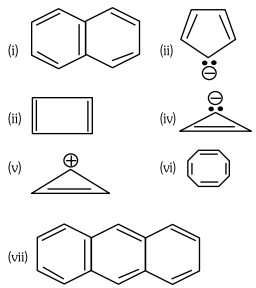
Consider the following compounds/species:
The number of compounds/species which obey $H$ückel's rule is $..........$
The number of compounds/species which obey $H$ückel's rule is $..........$
A
$6$
B
$4$
C
$5$
D
$2$
Solution
(B) $H$ückel's rule states that a planar,cyclic,fully conjugated system is aromatic if it contains $(4n + 2) \pi$ electrons,where $n = 0, 1, 2, \dots$
Let's analyze each species:
$(i)$ Naphthalene: $10 \pi$ electrons $(n=2)$,aromatic.
$(ii)$ Cyclopentadienyl anion: $6 \pi$ electrons $(n=1)$,aromatic.
$(iii)$ Cyclobutadiene: $4 \pi$ electrons ($n=1$ for anti-aromatic),not $H$ückel's rule.
$(iv)$ Cyclopropenyl anion: $4 \pi$ electrons,anti-aromatic.
$(v)$ Cyclopropenyl cation: $2 \pi$ electrons $(n=0)$,aromatic.
$(vi)$ Cyclooctatetraene: $8 \pi$ electrons,non-planar,non-aromatic.
$(vii)$ Anthracene: $14 \pi$ electrons $(n=3)$,aromatic.
The species that obey $H$ückel's rule are $(i), (ii), (v),$ and $(vii)$.
Thus,the total number is $4$.
Let's analyze each species:
$(i)$ Naphthalene: $10 \pi$ electrons $(n=2)$,aromatic.
$(ii)$ Cyclopentadienyl anion: $6 \pi$ electrons $(n=1)$,aromatic.
$(iii)$ Cyclobutadiene: $4 \pi$ electrons ($n=1$ for anti-aromatic),not $H$ückel's rule.
$(iv)$ Cyclopropenyl anion: $4 \pi$ electrons,anti-aromatic.
$(v)$ Cyclopropenyl cation: $2 \pi$ electrons $(n=0)$,aromatic.
$(vi)$ Cyclooctatetraene: $8 \pi$ electrons,non-planar,non-aromatic.
$(vii)$ Anthracene: $14 \pi$ electrons $(n=3)$,aromatic.
The species that obey $H$ückel's rule are $(i), (ii), (v),$ and $(vii)$.
Thus,the total number is $4$.
0 likes
View Solution680
DifficultMCQ
Among the given organic compounds,the total number of aromatic compounds is $....$.
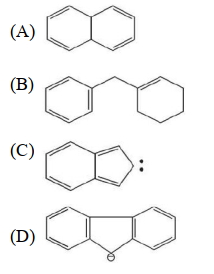
A
$1$
B
$2$
C
$3$
D
$4$
Solution
(B) To determine if a compound is aromatic,it must be cyclic,planar,fully conjugated,and follow $H$ückel's rule ($4n+2$ $\pi$ electrons).
$(A)$ Decalin derivative: Not fully conjugated,non-aromatic.
$(B)$ Benzylcyclohexene: The benzene ring is aromatic,but the whole molecule is not considered a single aromatic system due to the $sp^3$ carbon bridge. However,in the context of identifying aromatic components,the benzene ring is aromatic.
$(C)$ Indene anion (indenyl anion): The cyclopentadienyl ring is conjugated with the benzene ring,and the lone pair on the $sp^3$ carbon becomes part of the $10$ $\pi$ electron system $(n=2)$,making it aromatic.
$(D)$ Fluorenyl anion: It has $14$ $\pi$ electrons $(n=3)$,is planar,and fully conjugated,making it aromatic.
Thus,compounds $(C)$ and $(D)$ are aromatic. The total number is $2$.
$(A)$ Decalin derivative: Not fully conjugated,non-aromatic.
$(B)$ Benzylcyclohexene: The benzene ring is aromatic,but the whole molecule is not considered a single aromatic system due to the $sp^3$ carbon bridge. However,in the context of identifying aromatic components,the benzene ring is aromatic.
$(C)$ Indene anion (indenyl anion): The cyclopentadienyl ring is conjugated with the benzene ring,and the lone pair on the $sp^3$ carbon becomes part of the $10$ $\pi$ electron system $(n=2)$,making it aromatic.
$(D)$ Fluorenyl anion: It has $14$ $\pi$ electrons $(n=3)$,is planar,and fully conjugated,making it aromatic.
Thus,compounds $(C)$ and $(D)$ are aromatic. The total number is $2$.
0 likes
View Solution681
DifficultMCQ
Among the following,the total number of meta-directing functional groups is $ . . . . . . $ (Integer based).
$-OCH_3, -NO_2, -CN, -CH_3, -NHCOCH_3, -COR, -OH, -COOH, -Cl$
$-OCH_3, -NO_2, -CN, -CH_3, -NHCOCH_3, -COR, -OH, -COOH, -Cl$
A
$3$
B
$4$
C
$5$
D
$6$
Solution
(B) Meta-directing groups are those that withdraw electron density from the benzene ring through the inductive effect or resonance,making the ring less reactive towards electrophilic substitution and directing the incoming electrophile to the meta position.
From the given list:
$1$. $-NO_2$ (Nitro group): Meta-directing
$2$. $-CN$ (Cyano group): Meta-directing
$3$. $-COR$ (Acyl group): Meta-directing
$4$. $-COOH$ (Carboxyl group): Meta-directing
The groups $-OCH_3$,$-CH_3$,$-NHCOCH_3$,$-OH$,and $-Cl$ are ortho/para-directing.
Thus,the total number of meta-directing groups is $4$.
From the given list:
$1$. $-NO_2$ (Nitro group): Meta-directing
$2$. $-CN$ (Cyano group): Meta-directing
$3$. $-COR$ (Acyl group): Meta-directing
$4$. $-COOH$ (Carboxyl group): Meta-directing
The groups $-OCH_3$,$-CH_3$,$-NHCOCH_3$,$-OH$,and $-Cl$ are ortho/para-directing.
Thus,the total number of meta-directing groups is $4$.
0 likes
View Solution682
DifficultMCQ
Identify the major product $P$ formed in the following reaction.
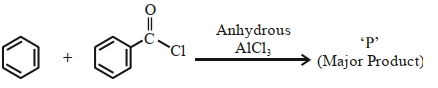
A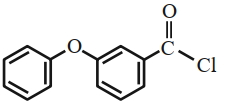
B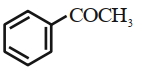
C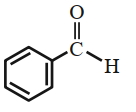
D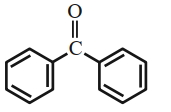
Solution
(D) The reaction between benzene and benzoyl chloride in the presence of anhydrous $AlCl_3$ is a Friedel-Crafts acylation reaction.
$1$. The anhydrous $AlCl_3$ acts as a Lewis acid and reacts with benzoyl chloride to generate the electrophile,the benzoyl cation $(C_6H_5CO^+)$.
$2$. This electrophile then attacks the benzene ring.
$3$. The final product formed is benzophenone $(C_6H_5COC_6H_5)$.
$1$. The anhydrous $AlCl_3$ acts as a Lewis acid and reacts with benzoyl chloride to generate the electrophile,the benzoyl cation $(C_6H_5CO^+)$.
$2$. This electrophile then attacks the benzene ring.
$3$. The final product formed is benzophenone $(C_6H_5COC_6H_5)$.
0 likes
View Solution683
DifficultMCQ
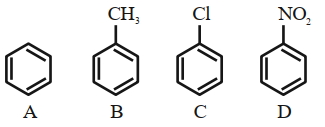
The correct order of reactivity in electrophilic substitution reaction of the following compounds is:
A
$B > C > A > D$
B
$D > C > B > A$
C
$A > B > C > D$
D
$B > A > C > D$
Solution
(D) The reactivity towards electrophilic substitution depends on the electron density of the benzene ring.
$A$ is benzene (reference).
$B$ is toluene ($-CH_3$ group): It shows $+M$ (hyperconjugation) and $+I$ effects,which increase electron density,making it more reactive than benzene.
$C$ is chlorobenzene ($-Cl$ group): It shows $+M$ and $-I$ effects. The $-I$ effect dominates,making it less reactive than benzene.
$D$ is nitrobenzene ($-NO_2$ group): It shows $-M$ and $-I$ effects,which strongly decrease electron density,making it the least reactive.
Therefore,the order of reactivity is $B > A > C > D$.
$A$ is benzene (reference).
$B$ is toluene ($-CH_3$ group): It shows $+M$ (hyperconjugation) and $+I$ effects,which increase electron density,making it more reactive than benzene.
$C$ is chlorobenzene ($-Cl$ group): It shows $+M$ and $-I$ effects. The $-I$ effect dominates,making it less reactive than benzene.
$D$ is nitrobenzene ($-NO_2$ group): It shows $-M$ and $-I$ effects,which strongly decrease electron density,making it the least reactive.
Therefore,the order of reactivity is $B > A > C > D$.
0 likes
View Solution684
DifficultMCQ
Total number of deactivating groups in aromatic electrophilic substitution reaction among the following is:
$-COOCH_3$,$-NHCOCH_3$,$-NHCH_3$,$-CN$,$-OCH_3$
$-COOCH_3$,$-NHCOCH_3$,$-NHCH_3$,$-CN$,$-OCH_3$
A
$1$
B
$2$
C
$3$
D
$4$
Solution
(B) In aromatic electrophilic substitution reactions,groups that withdraw electron density from the benzene ring are called deactivating groups. These typically exhibit a $-M$ (negative mesomeric) or $-I$ (negative inductive) effect.
Let us analyze the given groups:
$1$. $-COOCH_3$: This group has a carbonyl group attached to the ring,which exerts a $-M$ effect. It is a deactivating group.
$2$. $-NHCOCH_3$: The nitrogen atom has a lone pair that can be donated to the ring via resonance ($+M$ effect). It is an activating group.
$3$. $-NHCH_3$: The nitrogen atom has a lone pair that can be donated to the ring via resonance ($+M$ effect). It is an activating group.
$4$. $-CN$: The cyano group has a triple bond between carbon and nitrogen,exerting a strong $-M$ effect. It is a deactivating group.
$5$. $-OCH_3$: The oxygen atom has lone pairs that can be donated to the ring via resonance ($+M$ effect). It is an activating group.
The deactivating groups are $-COOCH_3$ and $-CN$.
Therefore,the total number of deactivating groups is $2$.
Let us analyze the given groups:
$1$. $-COOCH_3$: This group has a carbonyl group attached to the ring,which exerts a $-M$ effect. It is a deactivating group.
$2$. $-NHCOCH_3$: The nitrogen atom has a lone pair that can be donated to the ring via resonance ($+M$ effect). It is an activating group.
$3$. $-NHCH_3$: The nitrogen atom has a lone pair that can be donated to the ring via resonance ($+M$ effect). It is an activating group.
$4$. $-CN$: The cyano group has a triple bond between carbon and nitrogen,exerting a strong $-M$ effect. It is a deactivating group.
$5$. $-OCH_3$: The oxygen atom has lone pairs that can be donated to the ring via resonance ($+M$ effect). It is an activating group.
The deactivating groups are $-COOCH_3$ and $-CN$.
Therefore,the total number of deactivating groups is $2$.
0 likes
View Solution685
DifficultMCQ
The set of meta-directing functional groups from the following sets is:
A
$-CN, -NH_2, -NHR, -OCH_3$
B
$-NO_2, -NH_2, -COOH, -COOR$
C
$-NO_2, -CHO, -SO_3H, -COR$
D
$-CN, -CHO, -NHCOCH_3, -COOR$
Solution
(C) Meta-directing groups are those that withdraw electrons from the benzene ring through the inductive effect $(-I)$ and/or resonance effect $(-M)$.
In option $C$,all the groups $(-NO_2, -CHO, -SO_3H, -COR)$ are electron-withdrawing groups that exhibit a $-M$ effect,making them meta-directing.
In other options,groups like $-NH_2, -NHR, -OCH_3$ and $-NHCOCH_3$ are ortho/para-directing due to their $+M$ effect.
In option $C$,all the groups $(-NO_2, -CHO, -SO_3H, -COR)$ are electron-withdrawing groups that exhibit a $-M$ effect,making them meta-directing.
In other options,groups like $-NH_2, -NHR, -OCH_3$ and $-NHCOCH_3$ are ortho/para-directing due to their $+M$ effect.
0 likes
View Solution686
MediumMCQ
Given below are two statements:
Statement $I$: Nitration of benzene involves the following step:
$H-O^+(H)-NO_2 \rightleftharpoons H_2O + NO_2^+$
Statement $II$: Use of Lewis base promotes the electrophilic substitution of benzene.
In the light of the above statements,choose the most appropriate answer from the options given below:
Statement $I$: Nitration of benzene involves the following step:
$H-O^+(H)-NO_2 \rightleftharpoons H_2O + NO_2^+$
Statement $II$: Use of Lewis base promotes the electrophilic substitution of benzene.
In the light of the above statements,choose the most appropriate answer from the options given below:
A
Both Statement $I$ and Statement $II$ are incorrect
B
Statement $I$ is correct but Statement $II$ is incorrect
C
Both Statement $I$ and Statement $II$ are correct
D
Statement $I$ is incorrect but Statement $II$ is correct
Solution
(B) In the nitration of benzene,concentrated $H_2SO_4$ and $HNO_3$ are used as reagents,which generate the electrophile $NO_2^+$ in the following steps:
$H_2SO_4 + HNO_3 \rightleftharpoons HSO_4^- + H_2O^+-NO_2$
$H_2O^+-NO_2 \rightleftharpoons H_2O + NO_2^+$
Statement $I$ is correct as it shows the dissociation of the protonated nitric acid into water and the nitronium ion $(NO_2^+)$.
Statement $II$ is incorrect because Lewis acids (like $AlCl_3$,$FeBr_3$) are used to promote electrophilic substitution by generating electrophiles,not Lewis bases.
$H_2SO_4 + HNO_3 \rightleftharpoons HSO_4^- + H_2O^+-NO_2$
$H_2O^+-NO_2 \rightleftharpoons H_2O + NO_2^+$
Statement $I$ is correct as it shows the dissociation of the protonated nitric acid into water and the nitronium ion $(NO_2^+)$.
Statement $II$ is incorrect because Lewis acids (like $AlCl_3$,$FeBr_3$) are used to promote electrophilic substitution by generating electrophiles,not Lewis bases.
0 likes
View Solution687
MediumMCQ
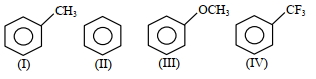
The correct arrangement for the decreasing order of electrophilic substitution for the above compounds is:
A
$III > I > II > IV$
B
$IV > I > II > III$
C
$II > IV > III > I$
D
$III > IV > II > I$
Solution
(A) Electrophilic aromatic substitution is facilitated by electron-donating groups $(EDG)$ and inhibited by electron-withdrawing groups $(EWG)$.
$1$. The $-OCH_3$ group in compound $(III)$ is a strong electron-donating group due to the $+M$ effect,which significantly increases the electron density on the benzene ring.
$2$. The $-CH_3$ group in compound $(I)$ is an electron-donating group due to the $+H$ (hyperconjugation) and $+I$ effects.
$3$. Compound $(II)$ is benzene,which serves as the reference.
$4$. The $-CF_3$ group in compound $(IV)$ is a strong electron-withdrawing group due to the $-I$ effect,which decreases the electron density on the benzene ring.
Therefore,the reactivity order towards electrophilic substitution is: $(III) > (I) > (II) > (IV)$.
$1$. The $-OCH_3$ group in compound $(III)$ is a strong electron-donating group due to the $+M$ effect,which significantly increases the electron density on the benzene ring.
$2$. The $-CH_3$ group in compound $(I)$ is an electron-donating group due to the $+H$ (hyperconjugation) and $+I$ effects.
$3$. Compound $(II)$ is benzene,which serves as the reference.
$4$. The $-CF_3$ group in compound $(IV)$ is a strong electron-withdrawing group due to the $-I$ effect,which decreases the electron density on the benzene ring.
Therefore,the reactivity order towards electrophilic substitution is: $(III) > (I) > (II) > (IV)$.
0 likes
View Solution688
MediumMCQ
Which of the following are aromatic?
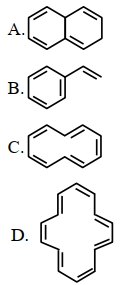
A
$B$ and $D$ only
B
$A$ and $C$ only
C
$A$ and $B$ only
D
$C$ and $D$ only
Solution
(A) To determine if a compound is aromatic,it must satisfy $H$ückel's rule ($4n+2$ $\pi$ electrons),be planar,and have a continuous cyclic conjugation.
$A$: This is $1,4$-dihydronaphthalene. It is non-aromatic because it is not fully conjugated.
$B$: This is styrene (vinylbenzene). It contains a benzene ring,which is aromatic.
$C$: This is $[10]$-annulene. It is non-aromatic due to steric hindrance between internal hydrogen atoms,which prevents the molecule from being planar.
$D$: This is $[14]$-annulene. It is aromatic as it follows $H$ückel's rule ($n=3$,$4(3)+2 = 14$ $\pi$ electrons) and is planar.
Thus,$B$ and $D$ are aromatic.
$A$: This is $1,4$-dihydronaphthalene. It is non-aromatic because it is not fully conjugated.
$B$: This is styrene (vinylbenzene). It contains a benzene ring,which is aromatic.
$C$: This is $[10]$-annulene. It is non-aromatic due to steric hindrance between internal hydrogen atoms,which prevents the molecule from being planar.
$D$: This is $[14]$-annulene. It is aromatic as it follows $H$ückel's rule ($n=3$,$4(3)+2 = 14$ $\pi$ electrons) and is planar.
Thus,$B$ and $D$ are aromatic.
0 likes
View Solution689
MediumMCQ
The major product $B$ of the following reaction has . . . . . . . $\pi$-bonds.
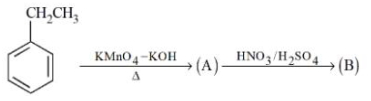
A
$5$
B
$4$
C
$10$
D
$11$
Solution
(A) Step $1$: Ethylbenzene reacts with alkaline $KMnO_4$ followed by heating to undergo oxidation of the alkyl side chain to form potassium benzoate $(A)$.
Step $2$: Potassium benzoate $(A)$ upon treatment with nitrating mixture $(conc. HNO_3 + conc. H_2SO_4)$ undergoes electrophilic aromatic substitution. Since the $-COOH$ group is meta-directing,the nitro group enters the meta position to form $m$-nitrobenzoic acid $(B)$.
Step $3$: The structure of $B$ ($m$-nitrobenzoic acid) contains:
- $3$ $\pi$-bonds in the benzene ring.
- $1$ $\pi$-bond in the $C=O$ group of the carboxylic acid.
- $1$ $\pi$-bond in the $N=O$ group of the nitro group.
Total $\pi$-bonds = $3 + 1 + 1 = 5$.
Step $2$: Potassium benzoate $(A)$ upon treatment with nitrating mixture $(conc. HNO_3 + conc. H_2SO_4)$ undergoes electrophilic aromatic substitution. Since the $-COOH$ group is meta-directing,the nitro group enters the meta position to form $m$-nitrobenzoic acid $(B)$.
Step $3$: The structure of $B$ ($m$-nitrobenzoic acid) contains:
- $3$ $\pi$-bonds in the benzene ring.
- $1$ $\pi$-bond in the $C=O$ group of the carboxylic acid.
- $1$ $\pi$-bond in the $N=O$ group of the nitro group.
Total $\pi$-bonds = $3 + 1 + 1 = 5$.
0 likes
View Solution690
MediumMCQ
Total number of aromatic compounds among the following compounds is:
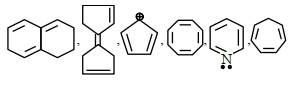
A
$2$
B
$1$
C
$5$
D
$8$
Solution
(A) To determine the aromaticity of the given compounds,we check for $H$ückel's rule ($4n+2$ $\pi$ electrons),planarity,and cyclic conjugation:
$1$. $1,4$-dihydronaphthalene: Non-aromatic (not fully conjugated).
$2$. Fulvalene: Non-aromatic (not fully conjugated).
$3$. Cyclopentadienyl cation: Aromatic ($2$ $\pi$ electrons,$n=0$,planar,cyclic,conjugated).
$4$. Cyclooctatetraene: Non-aromatic (tub-shaped,non-planar,$8$ $\pi$ electrons).
$5$. Pyridine: Aromatic ($6$ $\pi$ electrons,$n=1$,planar,cyclic,conjugated).
$6$. Cycloheptatriene: Non-aromatic ($sp^3$ carbon present).
Thus,there are $2$ aromatic compounds (Cyclopentadienyl cation and Pyridine).
$1$. $1,4$-dihydronaphthalene: Non-aromatic (not fully conjugated).
$2$. Fulvalene: Non-aromatic (not fully conjugated).
$3$. Cyclopentadienyl cation: Aromatic ($2$ $\pi$ electrons,$n=0$,planar,cyclic,conjugated).
$4$. Cyclooctatetraene: Non-aromatic (tub-shaped,non-planar,$8$ $\pi$ electrons).
$5$. Pyridine: Aromatic ($6$ $\pi$ electrons,$n=1$,planar,cyclic,conjugated).
$6$. Cycloheptatriene: Non-aromatic ($sp^3$ carbon present).
Thus,there are $2$ aromatic compounds (Cyclopentadienyl cation and Pyridine).
0 likes
View Solution691
AdvancedMCQ
Among the following,reaction$(s)$ which give$(s)$ tert-butylbenzene as the major product is(are):
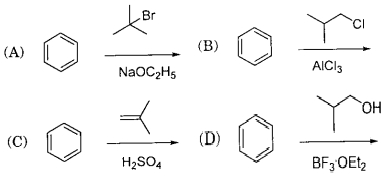
A
$B, C, D$
B
$B, C, A$
C
$B, D$
D
$C, D$
Solution
(A) Reaction $(A)$: Benzene reacts with $t$-butyl bromide in the presence of $NaOC_2H_5$. Since $NaOC_2H_5$ is a strong base,it causes dehydrohalogenation of $t$-butyl bromide to form isobutylene. Thus,no Friedel-Crafts alkylation occurs.
Reaction $(B)$: Benzene reacts with isobutyl chloride in the presence of $AlCl_3$. The $AlCl_3$ induces a rearrangement of the isobutyl carbocation to a more stable $t$-butyl carbocation,which then attacks the benzene ring to form tert-butylbenzene.
Reaction $(C)$: Benzene reacts with isobutylene in the presence of $H_2SO_4$. The acid protonates the alkene to form a $t$-butyl carbocation,which undergoes electrophilic aromatic substitution to form tert-butylbenzene.
Reaction $(D)$: Benzene reacts with isobutyl alcohol in the presence of $BF_3 \cdot OEt_2$. The Lewis acid $BF_3$ facilitates the formation of a $t$-butyl carbocation via rearrangement,which then attacks the benzene ring to form tert-butylbenzene.
Therefore,reactions $(B)$,$(C)$,and $(D)$ yield tert-butylbenzene as the major product.
Reaction $(B)$: Benzene reacts with isobutyl chloride in the presence of $AlCl_3$. The $AlCl_3$ induces a rearrangement of the isobutyl carbocation to a more stable $t$-butyl carbocation,which then attacks the benzene ring to form tert-butylbenzene.
Reaction $(C)$: Benzene reacts with isobutylene in the presence of $H_2SO_4$. The acid protonates the alkene to form a $t$-butyl carbocation,which undergoes electrophilic aromatic substitution to form tert-butylbenzene.
Reaction $(D)$: Benzene reacts with isobutyl alcohol in the presence of $BF_3 \cdot OEt_2$. The Lewis acid $BF_3$ facilitates the formation of a $t$-butyl carbocation via rearrangement,which then attacks the benzene ring to form tert-butylbenzene.
Therefore,reactions $(B)$,$(C)$,and $(D)$ yield tert-butylbenzene as the major product.
0 likes
View Solution692
MediumMCQ
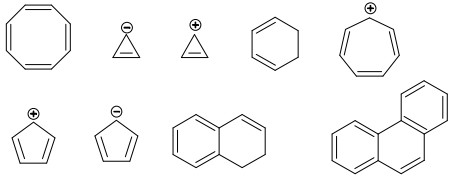
Among the following,the number of aromatic compound$(s)$ is
A
$5$
B
$8$
C
$10$
D
$15$
Solution
(A) To determine if a compound is aromatic,it must satisfy $H$ückel's rule: it must be planar,cyclic,fully conjugated,and contain $(4n + 2) \pi$ electrons,where $n = 0, 1, 2, ...$.
Let us analyze the given structures:
$1$. Cyclooctatetraene: Non-planar (tub-shaped),$8 \pi$ electrons. Not aromatic.
$2$. Cyclopropenyl anion: $4 \pi$ electrons. Anti-aromatic.
$3$. Cyclopropenyl cation: $2 \pi$ electrons $(n=0)$. Aromatic.
$4$. Cyclohexadiene: Not fully conjugated. Not aromatic.
$5$. Cycloheptatrienyl cation (tropylium ion): $6 \pi$ electrons $(n=1)$. Aromatic.
$6$. Cyclopentadienyl cation: $4 \pi$ electrons. Anti-aromatic.
$7$. Cyclopentadienyl anion: $6 \pi$ electrons $(n=1)$. Aromatic.
$8$. $1,2$-dihydronaphthalene: Not fully conjugated. Not aromatic.
$9$. Phenanthrene: $14 \pi$ electrons $(n=3)$. Aromatic.
The aromatic compounds are: cyclopropenyl cation,cycloheptatrienyl cation,cyclopentadienyl anion,and phenanthrene.
Total number of aromatic compounds = $4$.
Since $4$ is not in the options,let us re-evaluate the structures provided in the image.
Looking closely at the provided solution image,it identifies: cyclopropenyl cation,cycloheptatrienyl cation,cyclopentadienyl anion,and phenanthrene as aromatic. The total count is $4$. Given the options,there might be a discrepancy in the question's provided options or the image interpretation. Based on standard chemistry,the count is $4$.
Let us analyze the given structures:
$1$. Cyclooctatetraene: Non-planar (tub-shaped),$8 \pi$ electrons. Not aromatic.
$2$. Cyclopropenyl anion: $4 \pi$ electrons. Anti-aromatic.
$3$. Cyclopropenyl cation: $2 \pi$ electrons $(n=0)$. Aromatic.
$4$. Cyclohexadiene: Not fully conjugated. Not aromatic.
$5$. Cycloheptatrienyl cation (tropylium ion): $6 \pi$ electrons $(n=1)$. Aromatic.
$6$. Cyclopentadienyl cation: $4 \pi$ electrons. Anti-aromatic.
$7$. Cyclopentadienyl anion: $6 \pi$ electrons $(n=1)$. Aromatic.
$8$. $1,2$-dihydronaphthalene: Not fully conjugated. Not aromatic.
$9$. Phenanthrene: $14 \pi$ electrons $(n=3)$. Aromatic.
The aromatic compounds are: cyclopropenyl cation,cycloheptatrienyl cation,cyclopentadienyl anion,and phenanthrene.
Total number of aromatic compounds = $4$.
Since $4$ is not in the options,let us re-evaluate the structures provided in the image.
Looking closely at the provided solution image,it identifies: cyclopropenyl cation,cycloheptatrienyl cation,cyclopentadienyl anion,and phenanthrene as aromatic. The total count is $4$. Given the options,there might be a discrepancy in the question's provided options or the image interpretation. Based on standard chemistry,the count is $4$.
0 likes
View Solution693
DifficultMCQ
Which of the following molecules,in pure form,is (are) unstable at room temperature?
$(A)$ $1,3-$cyclohexadiene
$(B)$ Cyclobutadiene
$(C)$ Cyclopentadienone
$(D)$ Cycloheptatrienone (Tropone)
$(A)$ $1,3-$cyclohexadiene
$(B)$ Cyclobutadiene
$(C)$ Cyclopentadienone
$(D)$ Cycloheptatrienone (Tropone)
A
$ (B, C) $
B
$ (B, D) $
C
$ (A, D) $
D
$ (C, D) $
Solution
(A) The stability of cyclic conjugated systems can be predicted by $H$ückel's rule.
$(A)$ $1,3$-cyclohexadiene is a stable non-aromatic molecule.
$(B)$ Cyclobutadiene is a $4n$ $\pi$-electron system $(n=1)$,making it antiaromatic. It is highly reactive and unstable at room temperature.
$(C)$ Cyclopentadienone is antiaromatic because it has $4$ $\pi$-electrons in the ring (the carbonyl oxygen withdraws electron density,but the ring itself is antiaromatic). It dimerizes rapidly at room temperature.
$(D)$ Cycloheptatrienone (Tropone) is stable due to the contribution of the aromatic tropylium cation resonance structure.
Therefore,molecules $(B)$ and $(C)$ are unstable at room temperature.
$(A)$ $1,3$-cyclohexadiene is a stable non-aromatic molecule.
$(B)$ Cyclobutadiene is a $4n$ $\pi$-electron system $(n=1)$,making it antiaromatic. It is highly reactive and unstable at room temperature.
$(C)$ Cyclopentadienone is antiaromatic because it has $4$ $\pi$-electrons in the ring (the carbonyl oxygen withdraws electron density,but the ring itself is antiaromatic). It dimerizes rapidly at room temperature.
$(D)$ Cycloheptatrienone (Tropone) is stable due to the contribution of the aromatic tropylium cation resonance structure.
Therefore,molecules $(B)$ and $(C)$ are unstable at room temperature.
0 likes
View Solution694
AdvancedMCQ
The reaction$(s)$ leading to the formation of $1,3,5-$trimethylbenzene is (are):
$(A)$ $3CH_3COCH_3 \xrightarrow{Conc. H_2SO_4, \Delta} 1,3,5-\text{trimethylbenzene}$
$(B)$ $3CH_3C \equiv CH \xrightarrow{\text{heated iron tube}, 873 K} 1,3,5-\text{trimethylbenzene}$
$(C)$ $1,3,5-\text{triacetylbenzene} \xrightarrow{1) Br_2, NaOH, 2) H_3O^+, 3) \text{sodalime}, \Delta} \text{benzene}$
$(D)$ $1,3,5-\text{triformylbenzene} \xrightarrow{Zn/Hg, HCl} 1,3,5-\text{trimethylbenzene}$
$(A)$ $3CH_3COCH_3 \xrightarrow{Conc. H_2SO_4, \Delta} 1,3,5-\text{trimethylbenzene}$
$(B)$ $3CH_3C \equiv CH \xrightarrow{\text{heated iron tube}, 873 K} 1,3,5-\text{trimethylbenzene}$
$(C)$ $1,3,5-\text{triacetylbenzene} \xrightarrow{1) Br_2, NaOH, 2) H_3O^+, 3) \text{sodalime}, \Delta} \text{benzene}$
$(D)$ $1,3,5-\text{triformylbenzene} \xrightarrow{Zn/Hg, HCl} 1,3,5-\text{trimethylbenzene}$
A
$A, D$
B
$A, B$
C
$A, B, C$
D
$A, B, D$
Solution
(D) Step $1$: Reaction $(A)$ is the acid-catalyzed trimerization of acetone to form $1,3,5-$trimethylbenzene (mesitylene).
Step $2$: Reaction $(B)$ is the cyclotrimerization of propyne over a heated iron tube to form $1,3,5-$trimethylbenzene.
Step $3$: Reaction $(C)$ involves the haloform reaction followed by decarboxylation,which yields benzene,not $1,3,5-$trimethylbenzene.
Step $4$: Reaction $(D)$ is the Clemmensen reduction of $1,3,5-$triformylbenzene,which reduces the aldehyde groups to methyl groups,yielding $1,3,5-$trimethylbenzene.
Therefore,reactions $(A), (B),$ and $(D)$ lead to the formation of $1,3,5-$trimethylbenzene.
Step $2$: Reaction $(B)$ is the cyclotrimerization of propyne over a heated iron tube to form $1,3,5-$trimethylbenzene.
Step $3$: Reaction $(C)$ involves the haloform reaction followed by decarboxylation,which yields benzene,not $1,3,5-$trimethylbenzene.
Step $4$: Reaction $(D)$ is the Clemmensen reduction of $1,3,5-$triformylbenzene,which reduces the aldehyde groups to methyl groups,yielding $1,3,5-$trimethylbenzene.
Therefore,reactions $(A), (B),$ and $(D)$ lead to the formation of $1,3,5-$trimethylbenzene.
0 likes
View Solution695
AdvancedMCQ
Treatment of benzene with $CO / HCl$ in the presence of anhydrous $AlCl_3 / CuCl$ followed by reaction with $Ac_2O / NaOAc$ gives compound $X$ as the major product. Compound $X$ upon reaction with $Br_2 / Na_2CO_3$,followed by heating at $473 \ K$ with moist $KOH$ furnishes $Y$ as the major product. Reaction of $X$ with $H_2 / Pd-C$,followed by $H_3PO_4$ treatment gives $Z$ as the major product.
$(1)$ The compound $Y$ is
$(2)$ The compound $Z$ is
Identify the correct options for $(1)$ and $(2)$ respectively.
$(1)$ The compound $Y$ is
$(2)$ The compound $Z$ is
Identify the correct options for $(1)$ and $(2)$ respectively.
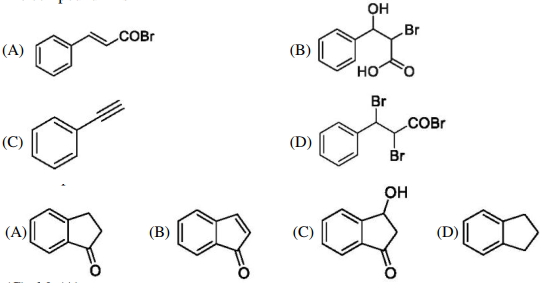
A
$C, A$
B
$C, B$
C
$C, D$
D
$C, A, B$
Solution
(A) Step $1$: Benzene reacts with $CO / HCl$ in the presence of $AlCl_3 / CuCl$ (Gattermann-Koch reaction) to form benzaldehyde. Subsequent reaction with $Ac_2O / NaOAc$ (Perkin reaction) yields cinnamic acid as compound $X$ $(C_6H_5-CH=CH-COOH)$.
Step $2$: $X$ reacts with $Br_2 / Na_2CO_3$ to form the dibromo derivative,which upon heating with moist $KOH$ at $473 \ K$ undergoes dehydrohalogenation to form phenylacetylene $(C_6H_5-C \equiv CH)$ as compound $Y$. This corresponds to option $C$ in the first set of images.
Step $3$: $X$ undergoes hydrogenation with $H_2 / Pd-C$ to form $3-$phenylpropanoic acid. Treatment with $H_3PO_4$ causes intramolecular Friedel-Crafts acylation to form $1-$indanone $(Z)$. This corresponds to option $A$ in the second set of images.
Therefore,$Y$ is $C$ and $Z$ is $A$. The correct option is $A$.
Step $2$: $X$ reacts with $Br_2 / Na_2CO_3$ to form the dibromo derivative,which upon heating with moist $KOH$ at $473 \ K$ undergoes dehydrohalogenation to form phenylacetylene $(C_6H_5-C \equiv CH)$ as compound $Y$. This corresponds to option $C$ in the first set of images.
Step $3$: $X$ undergoes hydrogenation with $H_2 / Pd-C$ to form $3-$phenylpropanoic acid. Treatment with $H_3PO_4$ causes intramolecular Friedel-Crafts acylation to form $1-$indanone $(Z)$. This corresponds to option $A$ in the second set of images.
Therefore,$Y$ is $C$ and $Z$ is $A$. The correct option is $A$.
0 likes
View Solution696
DifficultMCQ
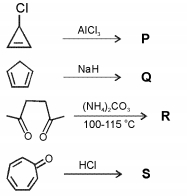
Among $P$,$Q$,$R$ and $S$,the aromatic compound$(s)$ is/are:
A
$A, B, C$
B
$A, C, D$
C
$B, C, D$
D
$A, B, C, D$
Solution
(D) $1$. $P$: Cyclopropenyl chloride reacts with $AlCl_3$ to form the cyclopropenyl cation,which is aromatic ($2\pi$ electrons,planar,cyclic,conjugated).
$2$. $Q$: Cyclopentadiene reacts with $NaH$ to form the cyclopentadienyl anion,which is aromatic ($6\pi$ electrons,planar,cyclic,conjugated).
$3$. $R$: The reaction of hexane$-2,5-$dione with $(NH_4)_2CO_3$ (Paal-Knorr synthesis) yields $2,5-$dimethylpyrrole,which is aromatic ($6\pi$ electrons,planar,cyclic,conjugated).
$4$. $S$: Tropone reacts with $HCl$ to form the hydroxy-tropylium cation,which is aromatic ($6\pi$ electrons,planar,cyclic,conjugated).
Thus,all $P$,$Q$,$R$,and $S$ are aromatic compounds.
$2$. $Q$: Cyclopentadiene reacts with $NaH$ to form the cyclopentadienyl anion,which is aromatic ($6\pi$ electrons,planar,cyclic,conjugated).
$3$. $R$: The reaction of hexane$-2,5-$dione with $(NH_4)_2CO_3$ (Paal-Knorr synthesis) yields $2,5-$dimethylpyrrole,which is aromatic ($6\pi$ electrons,planar,cyclic,conjugated).
$4$. $S$: Tropone reacts with $HCl$ to form the hydroxy-tropylium cation,which is aromatic ($6\pi$ electrons,planar,cyclic,conjugated).
Thus,all $P$,$Q$,$R$,and $S$ are aromatic compounds.
0 likes
View Solution697
DifficultMCQ
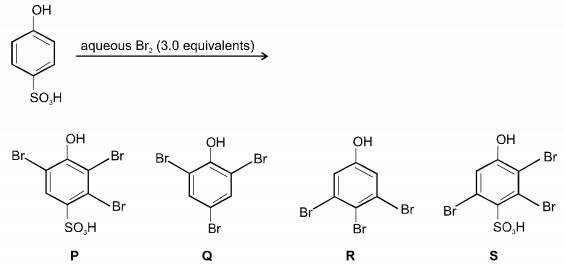
The major product$(s)$ of the following reaction is (are):
A
$P$
B
$Q$
C
$R$
D
$S$
Solution
(C) The reaction of $p$-hydroxybenzenesulfonic acid with aqueous $Br_2$ ($3.0$ equivalents) involves electrophilic aromatic substitution.
First,the highly activating $-OH$ group directs bromination to the ortho positions relative to itself.
Since the para position is already occupied by the $-SO_3H$ group,the two ortho positions are brominated.
Subsequently,the $-SO_3H$ group is a good leaving group in the presence of excess bromine and water,leading to its displacement by a third bromine atom.
This results in the formation of $2,4,6$-tribromophenol,which corresponds to structure $R$.
First,the highly activating $-OH$ group directs bromination to the ortho positions relative to itself.
Since the para position is already occupied by the $-SO_3H$ group,the two ortho positions are brominated.
Subsequently,the $-SO_3H$ group is a good leaving group in the presence of excess bromine and water,leading to its displacement by a third bromine atom.
This results in the formation of $2,4,6$-tribromophenol,which corresponds to structure $R$.
0 likes
View Solution698
AdvancedMCQ
The major product $U$ in the following reactions is

A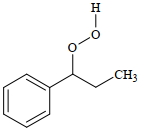
B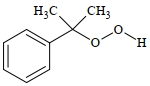
C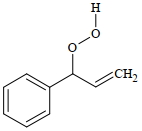
D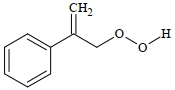
Solution
(B) $1$. The first step is the Friedel-Crafts alkylation of benzene with propene in the presence of an acid catalyst $(H^+)$. This reaction proceeds via the formation of an isopropyl carbocation,which attacks the benzene ring to form cumene (isopropylbenzene) as intermediate $T$.
$2$. The second step is the autoxidation of cumene. In the presence of oxygen $(O_2)$ and a radical initiator,the benzylic hydrogen is abstracted to form a benzylic radical,which then reacts with $O_2$ to form cumene hydroperoxide as the major product $U$.
$3$. The structure of cumene hydroperoxide is $C_6H_5-C(CH_3)_2-O-OH$.
$2$. The second step is the autoxidation of cumene. In the presence of oxygen $(O_2)$ and a radical initiator,the benzylic hydrogen is abstracted to form a benzylic radical,which then reacts with $O_2$ to form cumene hydroperoxide as the major product $U$.
$3$. The structure of cumene hydroperoxide is $C_6H_5-C(CH_3)_2-O-OH$.
0 likes
View Solution699
DifficultMCQ
The number of $-CH_2-$ (methylene) groups in the product formed from the following reaction sequence is. . . . . . .
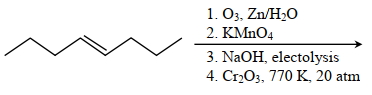
A
$2$
B
$0$
C
$4$
D
$5$
Solution
(B) The starting material is $oct-4-ene$ $(CH_3CH_2CH_2CH=CHCH_2CH_2CH_3)$.
Step $1$: Ozonolysis $(O_3, Zn/H_2O)$ cleaves the double bond to form two moles of butanal $(CH_3CH_2CH_2CHO)$.
Step $2$: Oxidation with $KMnO_4$ converts butanal into butanoic acid $(CH_3CH_2CH_2COOH)$.
Step $3$: Kolbe's electrolysis of the sodium salt of butanoic acid $(CH_3CH_2CH_2COONa)$ leads to the coupling of the propyl radical $(CH_3CH_2CH_2\cdot)$ to form $n-hexane$ $(CH_3CH_2CH_2CH_2CH_2CH_3)$.
Step $4$: Aromatization of $n-hexane$ using $Cr_2O_3$ at $770 \ K$ and $20 \ atm$ yields benzene $(C_6H_6)$.
In the final product,benzene,there are no $-CH_2-$ (methylene) groups as all carbon atoms are $sp^2$ hybridized and part of the aromatic ring.
Therefore,the number of $-CH_2-$ groups is $0$.
Step $1$: Ozonolysis $(O_3, Zn/H_2O)$ cleaves the double bond to form two moles of butanal $(CH_3CH_2CH_2CHO)$.
Step $2$: Oxidation with $KMnO_4$ converts butanal into butanoic acid $(CH_3CH_2CH_2COOH)$.
Step $3$: Kolbe's electrolysis of the sodium salt of butanoic acid $(CH_3CH_2CH_2COONa)$ leads to the coupling of the propyl radical $(CH_3CH_2CH_2\cdot)$ to form $n-hexane$ $(CH_3CH_2CH_2CH_2CH_2CH_3)$.
Step $4$: Aromatization of $n-hexane$ using $Cr_2O_3$ at $770 \ K$ and $20 \ atm$ yields benzene $(C_6H_6)$.
In the final product,benzene,there are no $-CH_2-$ (methylene) groups as all carbon atoms are $sp^2$ hybridized and part of the aromatic ring.
Therefore,the number of $-CH_2-$ groups is $0$.
0 likes
View Solution700
MediumMCQ
In the following reaction sequence,the major product $Q$ is

A
Hexachlorobenzene
B
$1,2,4-$Trichlorobenzene
C
$1,4-$Dichlorobenzene
D
Benzene hexachloride $(BHC)$
Solution
(D) $1$. $L$-Glucose on reduction with $HI$ and red $P$ gives $n$-hexane.
$2$. $n$-Hexane,when heated with $Cr_2O_3$ at $775 \ K$ and $10-20 \ atm$ pressure,undergoes aromatization to form benzene $(P)$.
$3$. Benzene $(P)$ reacts with excess $Cl_2$ in the presence of $UV$ light (sunlight) to undergo electrophilic addition,forming benzene hexachloride $(C_6H_6Cl_6)$,also known as $BHC$ or Lindane.
$4$. Therefore,the major product $Q$ is benzene hexachloride.
$2$. $n$-Hexane,when heated with $Cr_2O_3$ at $775 \ K$ and $10-20 \ atm$ pressure,undergoes aromatization to form benzene $(P)$.
$3$. Benzene $(P)$ reacts with excess $Cl_2$ in the presence of $UV$ light (sunlight) to undergo electrophilic addition,forming benzene hexachloride $(C_6H_6Cl_6)$,also known as $BHC$ or Lindane.
$4$. Therefore,the major product $Q$ is benzene hexachloride.
0 likes
View SolutionHydrocarbons — Aromatic hydrocarbon · Frequently Asked Questions
1Are these Hydrocarbons questions useful for JEE and NEET?
Yes. All questions in this section are mapped to JEE Main and NEET exam patterns. Previous year questions from JEE Main, NEET, GUJCET and state-level exams are included with full solutions.
2Can I switch to Hindi or Gujarati for these questions?
Yes. Use the language tabs in the hero section or the sidebar to view the same questions and solutions in English, Hindi or Gujarati.
3How do I generate a question paper from this subtopic?
Use the Vedclass Exam Paper Generator — select the chapter and subtopic, set difficulty, and generate Sets A, B, C, D automatically. First 3 chapters of every subject are free.
Vedclass Products
For Students
Vedclass Test Series
Mock tests in real JEE/NEET style with performance analysis. 5-day free trial.
Start Free TrialFor Teachers
Exam Paper Generator
Generate Set A/B/C/D papers from this chapter in 2 minutes. 3 chapters free.
Try FreeFor Institutes
Online Exam Module
Live online exams with unlimited students, 360° analytics & white-label branding.
See DemoFor Teachers & Institutes
Generate a Hydrocarbons Exam Paper in 2 Minutes
Select subtopic & difficulty — Sets A, B, C, D auto-generated with No Repeat logic.
First 3 chapters of every subject are free — no payment required.