
A English
Aromatic hydrocarbon Questions in English
Class 11 Chemistry · Hydrocarbons · Aromatic hydrocarbon
872+
Questions
English
Language
100%
With Solutions
Showing 50 of 872 questions in English
701
MediumMCQ
Identify correct statement/s :
$(A)$ $-OCH_3$ and $-NHCOCH_3$ are activating groups
$(B)$ $-CN$ and $-OH$ are meta directing groups
$(C)$ $-CN$ and $-SO_3H$ are meta directing groups
$(D)$ Activating groups act as ortho- and para-directing groups
$(E)$ Halides are activating groups
Choose the correct answer from the options given below :
$(A)$ $-OCH_3$ and $-NHCOCH_3$ are activating groups
$(B)$ $-CN$ and $-OH$ are meta directing groups
$(C)$ $-CN$ and $-SO_3H$ are meta directing groups
$(D)$ Activating groups act as ortho- and para-directing groups
$(E)$ Halides are activating groups
Choose the correct answer from the options given below :
A
$A$,$C$ and $D$ only
B
$A$,$B$ and $E$ only
C
$A$ only
D
$A$ and $C$ only
Solution
(A) $-OCH_3$ and $-NHCOCH_3$ are activating groups due to the $+M$ effect. This is correct.
$(B)$ $-CN$ is meta-directing,but $-OH$ is ortho/para-directing. This is incorrect.
$(C)$ Both $-CN$ and $-SO_3H$ are electron-withdrawing groups that are meta-directing. This is correct.
$(D)$ Activating groups increase electron density at ortho and para positions,making them ortho/para-directing. This is correct.
$(E)$ Halides are deactivating groups due to the $-I$ effect,despite being ortho/para-directing. This is incorrect.
Therefore,statements $(A)$,$(C)$,and $(D)$ are correct.
$(B)$ $-CN$ is meta-directing,but $-OH$ is ortho/para-directing. This is incorrect.
$(C)$ Both $-CN$ and $-SO_3H$ are electron-withdrawing groups that are meta-directing. This is correct.
$(D)$ Activating groups increase electron density at ortho and para positions,making them ortho/para-directing. This is correct.
$(E)$ Halides are deactivating groups due to the $-I$ effect,despite being ortho/para-directing. This is incorrect.
Therefore,statements $(A)$,$(C)$,and $(D)$ are correct.
0 likes
View Solution702
DifficultMCQ
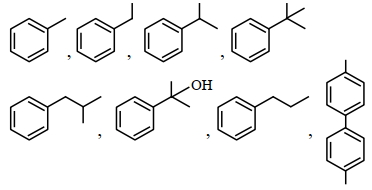
The total number of compounds from the list below that,when treated with hot $KMnO_4$,yield benzoic acid is:
A
$3$
B
$4$
C
$6$
D
$5$
Solution
(D) Compounds containing at least one benzylic hydrogen atom $(\alpha-H)$ undergo oxidation with hot alkaline $KMnO_4$ to form benzoic acid.
Looking at the provided structures:
$1$. Toluene (methylbenzene) has $3$ $\alpha-H$ atoms.
$2$. Ethylbenzene has $2$ $\alpha-H$ atoms.
$3$. Isopropylbenzene (cumene) has $1$ $\alpha-H$ atom.
$4$. Isobutylbenzene has $1$ $\alpha-H$ atom.
$5$. Propylbenzene has $2$ $\alpha-H$ atoms.
Compounds like tert-butylbenzene (no $\alpha-H$),$2$-phenylpropan$-2-$ol,and biphenyl do not yield benzoic acid under these conditions.
Thus,there are $5$ such compounds.
Looking at the provided structures:
$1$. Toluene (methylbenzene) has $3$ $\alpha-H$ atoms.
$2$. Ethylbenzene has $2$ $\alpha-H$ atoms.
$3$. Isopropylbenzene (cumene) has $1$ $\alpha-H$ atom.
$4$. Isobutylbenzene has $1$ $\alpha-H$ atom.
$5$. Propylbenzene has $2$ $\alpha-H$ atoms.
Compounds like tert-butylbenzene (no $\alpha-H$),$2$-phenylpropan$-2-$ol,and biphenyl do not yield benzoic acid under these conditions.
Thus,there are $5$ such compounds.
0 likes
View Solution703
MediumMCQ
Given below are two statements $:$
Statement $(I) :$ On nitration of $m-$xylene with $HNO_3, H_2SO_4$ followed by oxidation,$4-$nitrobenzene$-1, 3-$dicarboxylic acid is obtained as the major product.
Statement $(II) :$ $-CH_3$ group is $o/p-$directing while $-NO_2$ group is $m-$directing group.
In the light of the above statements,choose the correct answer from the options given below $:$
Statement $(I) :$ On nitration of $m-$xylene with $HNO_3, H_2SO_4$ followed by oxidation,$4-$nitrobenzene$-1, 3-$dicarboxylic acid is obtained as the major product.
Statement $(II) :$ $-CH_3$ group is $o/p-$directing while $-NO_2$ group is $m-$directing group.
In the light of the above statements,choose the correct answer from the options given below $:$
A
Both Statement $I$ and Statement $II$ are false
B
Statement $I$ is false but Statement $II$ is true
C
Both Statement $I$ and Statement $II$ are true
D
Statement $I$ is true but Statement $II$ is false
Solution
(C) Statement $(I)$ is true: Nitration of $m-$xylene ($1, 3-$dimethylbenzene) occurs at the $4-$position because the two methyl groups activate the ring and direct the incoming electrophile $(NO_2^+)$ to the $o/p$ positions. The $4-$position is ortho to one methyl group and para to the other. Subsequent oxidation of the two methyl groups with $KMnO_4$ converts them into carboxylic acid groups $(-COOH)$,yielding $4-$nitrobenzene$-1, 3-$dicarboxylic acid.
Statement $(II)$ is true: The $-CH_3$ group is an electron-donating group by inductive and hyperconjugation effects,making it $o/p-$directing. The $-NO_2$ group is an electron-withdrawing group by resonance and inductive effects,making it $m-$directing.
Statement $(II)$ is true: The $-CH_3$ group is an electron-donating group by inductive and hyperconjugation effects,making it $o/p-$directing. The $-NO_2$ group is an electron-withdrawing group by resonance and inductive effects,making it $m-$directing.
0 likes
View Solution704
MediumMCQ
For isomeric hydrocarbons with molecular formula $C_9H_{12}$ that give a negative Baeyer's test,determine the total number of isomers that possess four different non-aliphatic substitution sites.
A
$1$
B
$2$
C
$3$
D
$4$
Solution
(B) The molecular formula $C_9H_{12}$ corresponds to a degree of unsaturation of $4$,which is consistent with an aromatic ring (benzene ring) plus three carbons in the side chain$(s)$. $A$ negative Baeyer's test indicates the absence of aliphatic unsaturation (no double or triple bonds in the side chains).
For an aromatic ring to have four different non-aliphatic (aromatic) substitution sites,the ring must have two substituents such that the remaining four positions on the ring are chemically distinct.
Considering the isomers of $C_9H_{12}$ (propylbenzenes,ethylmethylbenzenes,and trimethylbenzenes),the two isomers that satisfy this condition are $1$-ethyl-$2$-methylbenzene ($o$-ethyltoluene) and $1$-ethyl-$3$-methylbenzene ($m$-ethyltoluene).
In these structures,the four remaining hydrogen-bearing carbons on the benzene ring are non-equivalent,providing four distinct sites for electrophilic aromatic substitution.
Thus,the total number of such isomers is $2$.
For an aromatic ring to have four different non-aliphatic (aromatic) substitution sites,the ring must have two substituents such that the remaining four positions on the ring are chemically distinct.
Considering the isomers of $C_9H_{12}$ (propylbenzenes,ethylmethylbenzenes,and trimethylbenzenes),the two isomers that satisfy this condition are $1$-ethyl-$2$-methylbenzene ($o$-ethyltoluene) and $1$-ethyl-$3$-methylbenzene ($m$-ethyltoluene).
In these structures,the four remaining hydrogen-bearing carbons on the benzene ring are non-equivalent,providing four distinct sites for electrophilic aromatic substitution.
Thus,the total number of such isomers is $2$.
0 likes
View Solution705
DifficultMCQ
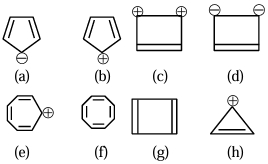
Designate whether each of the following compounds is aromatic or not aromatic.
A
$a, c, d, e, h$ are aromatic and $b, f, g$ are not aromatic
B
$b, e, f, g$ are aromatic and $a, c, d, h$ are not aromatic
C
$a, b, c, d$ are aromatic and $e, f, g, h$ are not aromatic
D
$a, c, d, e, h$ are aromatic and $b, f, g$ are not aromatic
Solution
(A) To determine aromaticity,a compound must be cyclic,planar,fully conjugated,and follow Huckel's rule ($4n+2$ $\pi$ electrons,where $n=0, 1, 2, ...$).
$(a)$ Cyclopentadienyl anion: $6$ $\pi$ electrons $(n=1)$,aromatic.
$(b)$ Cyclopentadienyl cation: $4$ $\pi$ electrons ($n=1$ anti-aromatic),not aromatic.
$(c)$ Cyclobutadiene dication: $2$ $\pi$ electrons $(n=0)$,aromatic.
$(d)$ Cyclobutadiene dianion: $6$ $\pi$ electrons $(n=1)$,aromatic.
$(e)$ Tropylium cation: $6$ $\pi$ electrons $(n=1)$,aromatic.
$(f)$ Cyclooctatetraene: $8$ $\pi$ electrons (non-planar),not aromatic.
$(g)$ Cyclobutadiene: $4$ $\pi$ electrons (anti-aromatic),not aromatic.
$(h)$ Cyclopropenyl cation: $2$ $\pi$ electrons $(n=0)$,aromatic.
Thus,$a, c, d, e, h$ are aromatic and $b, f, g$ are not aromatic.
$(a)$ Cyclopentadienyl anion: $6$ $\pi$ electrons $(n=1)$,aromatic.
$(b)$ Cyclopentadienyl cation: $4$ $\pi$ electrons ($n=1$ anti-aromatic),not aromatic.
$(c)$ Cyclobutadiene dication: $2$ $\pi$ electrons $(n=0)$,aromatic.
$(d)$ Cyclobutadiene dianion: $6$ $\pi$ electrons $(n=1)$,aromatic.
$(e)$ Tropylium cation: $6$ $\pi$ electrons $(n=1)$,aromatic.
$(f)$ Cyclooctatetraene: $8$ $\pi$ electrons (non-planar),not aromatic.
$(g)$ Cyclobutadiene: $4$ $\pi$ electrons (anti-aromatic),not aromatic.
$(h)$ Cyclopropenyl cation: $2$ $\pi$ electrons $(n=0)$,aromatic.
Thus,$a, c, d, e, h$ are aromatic and $b, f, g$ are not aromatic.
0 likes
View Solution706
DifficultMCQ
The total number of structural isomers possible for the substituted benzene derivatives with the molecular formula $C_9H_{12}$ is $.........$
A
$8$
B
$7$
C
$6$
D
$5$
Solution
(A) For the molecular formula $C_9H_{12}$,the degree of unsaturation is $4$,which corresponds to a benzene ring ($3$ double bonds + $1$ ring).
We need to find the number of structural isomers for substituted benzene derivatives.
The possible isomers are:
$1$. $n$-Propylbenzene
$2$. Isopropylbenzene (Cumene)
$3$. $1$-Ethyl-$2$-methylbenzene ($o$-Ethyltoluene)
$4$. $1$-Ethyl-$3$-methylbenzene ($m$-Ethyltoluene)
$5$. $1$-Ethyl-$4$-methylbenzene ($p$-Ethyltoluene)
$6$. $1,2,3$-Trimethylbenzene (Hemimellitene)
$7$. $1,2,4$-Trimethylbenzene (Pseudocumene)
$8$. $1,3,5$-Trimethylbenzene (Mesitylene)
Thus,the total number of structural isomers is $8$.
We need to find the number of structural isomers for substituted benzene derivatives.
The possible isomers are:
$1$. $n$-Propylbenzene
$2$. Isopropylbenzene (Cumene)
$3$. $1$-Ethyl-$2$-methylbenzene ($o$-Ethyltoluene)
$4$. $1$-Ethyl-$3$-methylbenzene ($m$-Ethyltoluene)
$5$. $1$-Ethyl-$4$-methylbenzene ($p$-Ethyltoluene)
$6$. $1,2,3$-Trimethylbenzene (Hemimellitene)
$7$. $1,2,4$-Trimethylbenzene (Pseudocumene)
$8$. $1,3,5$-Trimethylbenzene (Mesitylene)
Thus,the total number of structural isomers is $8$.
0 likes
View Solution707
DifficultMCQ
Benzene is treated with oleum to produce compound $(X)$,which when further heated with molten sodium hydroxide followed by acidification produces compound $(Y)$. The compound $(Y)$ is treated with zinc metal to produce compound $(Z)$. Identify the structure of compound $(Z)$ from the following options.
A
$1,4-$dihydroxybenzene
B
Benzene
C
Phenol
D
$1,2-$dihydroxybenzene
Solution
(B) $1$. Benzene reacts with oleum $(H_2SO_4 + SO_3)$ to form benzene sulfonic acid (compound $X$).
$2$. Benzene sulfonic acid is heated with molten $NaOH$ followed by acidification to produce phenol (compound $Y$).
$3$. Phenol is treated with zinc dust $(Zn)$,which acts as a reducing agent,to reduce phenol back to benzene (compound $Z$).
Therefore,the structure of compound $Z$ is benzene.
$2$. Benzene sulfonic acid is heated with molten $NaOH$ followed by acidification to produce phenol (compound $Y$).
$3$. Phenol is treated with zinc dust $(Zn)$,which acts as a reducing agent,to reduce phenol back to benzene (compound $Z$).
Therefore,the structure of compound $Z$ is benzene.
0 likes
View Solution708
DifficultMCQ
Which one of the following reactions does $NOT$ give benzene as the product?
A
Sodium benzoate + sodalime $\xrightarrow{\Delta}$ Benzene
B
$n$-hexane $\xrightarrow{Mo_2O_3, 773K, 10-20 \ atm}$ Benzene
C
Ethyne $\xrightarrow{\text{red hot iron tube}, 873K}$ Benzene
D
Benzenediazonium chloride $\xrightarrow{H_2O, \text{warm}}$ Phenol
Solution
(D) Let us analyze each reaction:
$(1)$ Sodium benzoate reacts with sodalime $(NaOH + CaO)$ upon heating to undergo decarboxylation,yielding benzene.
$(2)$ $n$-hexane undergoes aromatization in the presence of $Mo_2O_3$ at $773K$ and $10-20 \ atm$ to form benzene.
$(3)$ Ethyne undergoes cyclic polymerization when passed through a red hot iron tube at $873K$ to form benzene.
$(4)$ Benzenediazonium chloride reacts with warm water to form phenol,not benzene.
Therefore,the reaction that does not give benzene as the product is the reaction of benzenediazonium chloride with warm water.
$(1)$ Sodium benzoate reacts with sodalime $(NaOH + CaO)$ upon heating to undergo decarboxylation,yielding benzene.
$(2)$ $n$-hexane undergoes aromatization in the presence of $Mo_2O_3$ at $773K$ and $10-20 \ atm$ to form benzene.
$(3)$ Ethyne undergoes cyclic polymerization when passed through a red hot iron tube at $873K$ to form benzene.
$(4)$ Benzenediazonium chloride reacts with warm water to form phenol,not benzene.
Therefore,the reaction that does not give benzene as the product is the reaction of benzenediazonium chloride with warm water.
0 likes
View Solution709
DifficultMCQ
Identify the correct statement regarding the products $A$ and $B$ formed in the following reactions of benzene:
$1$. Benzene + $6Cl_2$ $\xrightarrow{AlCl_3 \text{ (excess)}}$ $A$
$2$. Benzene + $Cl_2$ (excess) $\xrightarrow{h\nu, 500 \ K}$ $B$
$1$. Benzene + $6Cl_2$ $\xrightarrow{AlCl_3 \text{ (excess)}}$ $A$
$2$. Benzene + $Cl_2$ (excess) $\xrightarrow{h\nu, 500 \ K}$ $B$
A
$A$ is not aromatic,but $B$ is aromatic
B
Both are aromatic
C
$A$ is aromatic but $B$ is non-aromatic
D
$B$ is hexachlorobenzene
Solution
(C) In the first reaction,benzene reacts with $Cl_2$ in the presence of a Lewis acid catalyst $(AlCl_3)$ to undergo electrophilic aromatic substitution,resulting in the formation of hexachlorobenzene $(C_6Cl_6)$,which is aromatic.
In the second reaction,benzene reacts with excess $Cl_2$ in the presence of ultraviolet light $(h\nu)$,which leads to electrophilic addition across the double bonds,forming benzene hexachloride ($C_6H_6Cl_6$,also known as gammaxene or lindane). This product is non-aromatic because the conjugation of the benzene ring is destroyed.
Therefore,$A$ is aromatic and $B$ is non-aromatic.
In the second reaction,benzene reacts with excess $Cl_2$ in the presence of ultraviolet light $(h\nu)$,which leads to electrophilic addition across the double bonds,forming benzene hexachloride ($C_6H_6Cl_6$,also known as gammaxene or lindane). This product is non-aromatic because the conjugation of the benzene ring is destroyed.
Therefore,$A$ is aromatic and $B$ is non-aromatic.
0 likes
View Solution710
MediumMCQ
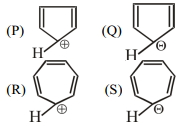
Among the cyclic ions,the aromatic character is shown by $:-$
A
$P$ and $S$
B
$Q$ and $S$
C
$Q$ and $R$
D
$P, Q, R$ and $S$
Solution
(C) To determine the aromatic character,we apply $H$ückel's rule,which states that a cyclic,planar,fully conjugated system with $(4n+2) \pi$ electrons is aromatic.
$(P)$ Cyclopentadienyl cation: It has $4 \pi$ electrons. It is anti-aromatic.
$(Q)$ Cyclopentadienyl anion: It has $6 \pi$ electrons ($4$ from double bonds + $2$ from the lone pair on the carbon atom). It is aromatic.
$(R)$ Cycloheptatrienyl cation: It has $6 \pi$ electrons. It is aromatic.
$(S)$ Cycloheptatrienyl anion: It has $8 \pi$ electrons. It is anti-aromatic.
Therefore,the aromatic ions are $Q$ and $R$.
$(P)$ Cyclopentadienyl cation: It has $4 \pi$ electrons. It is anti-aromatic.
$(Q)$ Cyclopentadienyl anion: It has $6 \pi$ electrons ($4$ from double bonds + $2$ from the lone pair on the carbon atom). It is aromatic.
$(R)$ Cycloheptatrienyl cation: It has $6 \pi$ electrons. It is aromatic.
$(S)$ Cycloheptatrienyl anion: It has $8 \pi$ electrons. It is anti-aromatic.
Therefore,the aromatic ions are $Q$ and $R$.
0 likes
View Solution711
MediumMCQ
Match the following reactions given in Column-$I$ with their respective names in Column-$II$:
| Column-$I$ | Column-$II$ |
|---|---|
| $(i)$ $\text{Benzene} + \text{Conc. } HNO_3 + \text{Conc. } H_2SO_4 \rightarrow \text{Nitrobenzene}$ | $(A)$ $\text{Halogenation}$ |
| $(ii)$ $\text{Benzene} + Cl_2 \xrightarrow{\text{Anhy. } AlCl_3} \text{Chlorobenzene}$ | $(B)$ $\text{Nitration}$ |
| $(iii)$ $\text{Benzene} + CH_3Cl \xrightarrow{\text{Anhy. } AlCl_3} \text{Toluene}$ | $(C)$ $\text{Friedel-Crafts acylation}$ |
| $(iv)$ $\text{Benzene} + CH_3COCl \xrightarrow{\text{Anhy. } AlCl_3} \text{Acetophenone}$ | $(D)$ $\text{Friedel-Crafts alkylation}$ |
A
$i-A, ii-B, iii-C, iv-D$
B
$i-B, ii-A, iii-D, iv-C$
C
$i-B, ii-A, iii-C, iv-D$
D
$i-A, ii-C, iii-D, iv-B$
Solution
(C) The given reactions are electrophilic aromatic substitution reactions:
$(i)$ $\text{Benzene}$ reacts with $\text{conc. } HNO_3$ and $\text{conc. } H_2SO_4$ to form $\text{nitrobenzene}$,which is $\text{Nitration}$ $(B)$.
$(ii)$ $\text{Benzene}$ reacts with $Cl_2$ in the presence of $\text{anhydrous } AlCl_3$ to form $\text{chlorobenzene}$,which is $\text{Halogenation}$ $(A)$.
$(iii)$ $\text{Benzene}$ reacts with $CH_3Cl$ in the presence of $\text{anhydrous } AlCl_3$ to form $\text{toluene}$,which is $\text{Friedel-Crafts alkylation}$ $(D)$.
$(iv)$ $\text{Benzene}$ reacts with $CH_3COCl$ in the presence of $\text{anhydrous } AlCl_3$ to form $\text{acetophenone}$,which is $\text{Friedel-Crafts acylation}$ $(C)$.
Therefore,the correct matching is $i-B, ii-A, iii-D, iv-C$.
$(i)$ $\text{Benzene}$ reacts with $\text{conc. } HNO_3$ and $\text{conc. } H_2SO_4$ to form $\text{nitrobenzene}$,which is $\text{Nitration}$ $(B)$.
$(ii)$ $\text{Benzene}$ reacts with $Cl_2$ in the presence of $\text{anhydrous } AlCl_3$ to form $\text{chlorobenzene}$,which is $\text{Halogenation}$ $(A)$.
$(iii)$ $\text{Benzene}$ reacts with $CH_3Cl$ in the presence of $\text{anhydrous } AlCl_3$ to form $\text{toluene}$,which is $\text{Friedel-Crafts alkylation}$ $(D)$.
$(iv)$ $\text{Benzene}$ reacts with $CH_3COCl$ in the presence of $\text{anhydrous } AlCl_3$ to form $\text{acetophenone}$,which is $\text{Friedel-Crafts acylation}$ $(C)$.
Therefore,the correct matching is $i-B, ii-A, iii-D, iv-C$.
0 likes
View Solution712
MediumMCQ
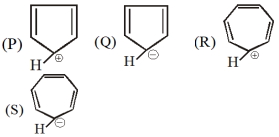
Among the following cyclic ions,which exhibit aromatic character?
A
$P$ and $S$
B
$Q$ and $S$
C
$Q$ and $R$
D
$P, Q, R$ and $S$
Solution
(C) To determine aromaticity,a molecule must follow $H$ückel's rule: it must be cyclic,planar,fully conjugated,and contain $(4n + 2) \pi$ electrons.
$(P)$ Cyclopentadienyl cation: It has $4 \pi$ electrons. It is anti-aromatic.
$(Q)$ Cyclopentadienyl anion: It has $6 \pi$ electrons ($4$ from double bonds + $2$ from the lone pair on the $sp^3$ carbon which becomes $sp^2$ to allow conjugation). It is aromatic.
$(R)$ Cycloheptatrienyl cation (tropylium ion): It has $6 \pi$ electrons. It is aromatic.
$(S)$ Cycloheptatrienyl anion: It has $8 \pi$ electrons. It is anti-aromatic.
Thus,$Q$ and $R$ are aromatic.
$(P)$ Cyclopentadienyl cation: It has $4 \pi$ electrons. It is anti-aromatic.
$(Q)$ Cyclopentadienyl anion: It has $6 \pi$ electrons ($4$ from double bonds + $2$ from the lone pair on the $sp^3$ carbon which becomes $sp^2$ to allow conjugation). It is aromatic.
$(R)$ Cycloheptatrienyl cation (tropylium ion): It has $6 \pi$ electrons. It is aromatic.
$(S)$ Cycloheptatrienyl anion: It has $8 \pi$ electrons. It is anti-aromatic.
Thus,$Q$ and $R$ are aromatic.
0 likes
View Solution713
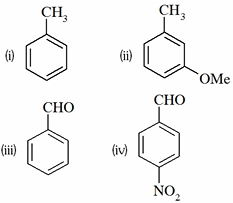
MediumMCQ
The correct order of reactivity towards $ESR$ (Electrophilic Substitution Reaction) is:
A
$i > iii > ii > iv$
B
$ii > i > iii > iv$
C
$i > iv > iii > ii$
D
$iv > ii > iii > i$
Solution
(B) The reactivity of aromatic compounds towards $ESR$ depends on the electron density in the benzene ring. Electron-donating groups increase reactivity,while electron-withdrawing groups decrease it.
$(i)$ Toluene: Contains a $-CH_3$ group,which is electron-donating via hyperconjugation $(+H)$ and inductive effect $(+I)$.
(ii) $m$-methoxytoluene: Contains a $-CH_3$ group $(+H, +I)$ and a $-OCH_3$ group. The $-OCH_3$ group is strongly electron-donating via resonance $(+M)$. Thus,(ii) has the highest electron density.
(iii) Benzaldehyde: Contains a $-CHO$ group,which is electron-withdrawing via resonance $(-M)$ and inductive effect $(-I)$.
(iv) $p$-nitrobenzaldehyde: Contains a $-CHO$ group and a $-NO_2$ group. Both are strongly electron-withdrawing ($-M$ and $-I$). This compound has the lowest electron density.
Comparing the substituents:
(ii) has both $+H$ and $+M$ effects.
$(i)$ has only $+H$ effect.
(iii) has a $-M$ effect.
(iv) has two strong $-M$ effects.
Therefore,the order of reactivity is $(ii) > (i) > (iii) > (iv)$.
$(i)$ Toluene: Contains a $-CH_3$ group,which is electron-donating via hyperconjugation $(+H)$ and inductive effect $(+I)$.
(ii) $m$-methoxytoluene: Contains a $-CH_3$ group $(+H, +I)$ and a $-OCH_3$ group. The $-OCH_3$ group is strongly electron-donating via resonance $(+M)$. Thus,(ii) has the highest electron density.
(iii) Benzaldehyde: Contains a $-CHO$ group,which is electron-withdrawing via resonance $(-M)$ and inductive effect $(-I)$.
(iv) $p$-nitrobenzaldehyde: Contains a $-CHO$ group and a $-NO_2$ group. Both are strongly electron-withdrawing ($-M$ and $-I$). This compound has the lowest electron density.
Comparing the substituents:
(ii) has both $+H$ and $+M$ effects.
$(i)$ has only $+H$ effect.
(iii) has a $-M$ effect.
(iv) has two strong $-M$ effects.
Therefore,the order of reactivity is $(ii) > (i) > (iii) > (iv)$.
0 likes
View Solution714
MediumMCQ
Which of the following compounds are arranged in the order of decreasing reactivity towards electrophilic aromatic substitution?
A
Fluorobenzene $>$ chlorobenzene $>$ bromobenzene
B
Phenol $>$ $n$-propylbenzene $>$ benzoic acid
C
Chlorotoluene $>$ nitrobenzene $>$ benzene
D
Benzoic acid $>$ phenol $>$ $n$-propylbenzene
Solution
(B) The reactivity of aromatic compounds towards electrophilic aromatic substitution depends on the electron density of the ring.
Electron-donating groups $(EDG)$ increase reactivity by increasing electron density,while electron-withdrawing groups $(EWG)$ decrease reactivity.
In option $B$:
$1$. Phenol ($-OH$ group) is strongly activating due to the $+M$ effect.
$2$. $n$-propylbenzene ($-CH_2CH_2CH_3$ group) is activating due to the $+I$ effect and hyperconjugation.
$3$. Benzoic acid ($-COOH$ group) is strongly deactivating due to the $-M$ and $-I$ effects.
Therefore,the order of reactivity is $\text{Phenol} > n\text{-propylbenzene} > \text{benzoic acid}$.
Electron-donating groups $(EDG)$ increase reactivity by increasing electron density,while electron-withdrawing groups $(EWG)$ decrease reactivity.
In option $B$:
$1$. Phenol ($-OH$ group) is strongly activating due to the $+M$ effect.
$2$. $n$-propylbenzene ($-CH_2CH_2CH_3$ group) is activating due to the $+I$ effect and hyperconjugation.
$3$. Benzoic acid ($-COOH$ group) is strongly deactivating due to the $-M$ and $-I$ effects.
Therefore,the order of reactivity is $\text{Phenol} > n\text{-propylbenzene} > \text{benzoic acid}$.
0 likes
View Solution715
MediumMCQ
Statement-$I$: Benzene gives Friedel-Crafts reaction.
Statement-$II$: All substituted benzenes give Friedel-Crafts reaction.
Choose the correct statement:
Statement-$II$: All substituted benzenes give Friedel-Crafts reaction.
Choose the correct statement:
A
Statement-$I$ and Statement-$II$ both are correct.
B
Statement-$I$ is correct but Statement-$II$ is incorrect.
C
Statement-$I$ and Statement-$II$ both are incorrect.
D
Statement-$I$ is incorrect but Statement-$II$ is correct.
Solution
(B) Statement-$I$ is correct because benzene undergoes Friedel-Crafts alkylation and acylation in the presence of a Lewis acid catalyst like $AlCl_3$.
Statement-$II$ is incorrect because substituted benzenes with strongly electron-withdrawing groups (e.g.,$-NO_2$,$-SO_3H$,$-CN$,$-COR$) deactivate the ring significantly,making them unreactive towards Friedel-Crafts reactions. Additionally,amino groups ($-NH_2$,$-NHR$,$-NR_2$) form complexes with the Lewis acid catalyst,which also inhibits the reaction.
Statement-$II$ is incorrect because substituted benzenes with strongly electron-withdrawing groups (e.g.,$-NO_2$,$-SO_3H$,$-CN$,$-COR$) deactivate the ring significantly,making them unreactive towards Friedel-Crafts reactions. Additionally,amino groups ($-NH_2$,$-NHR$,$-NR_2$) form complexes with the Lewis acid catalyst,which also inhibits the reaction.
0 likes
View Solution716
MediumMCQ
Which of the following compounds is not aromatic?
A
Cyclobutadiene dication $(C_4H_4^{2+})$
B
Cyclobutadiene dianion $(C_4H_4^{2-})$
C
Cyclooctatetraene $(C_8H_8)$
D
Biphenyl $(C_{12}H_{10})$
Solution
(C) To determine aromaticity,we use $H$ückel's rule,which states that a planar,cyclic,fully conjugated system is aromatic if it has $(4n + 2) \pi$ electrons,where $n$ is an integer $(0, 1, 2, ...)$.
$A$. Cyclobutadiene dication $(C_4H_4^{2+})$: It has $2 \pi$ electrons $(n=0)$,is cyclic,planar,and fully conjugated. It is aromatic.
$B$. Cyclobutadiene dianion $(C_4H_4^{2-})$: It has $6 \pi$ electrons $(n=1)$,is cyclic,planar,and fully conjugated. It is aromatic.
$C$. Cyclooctatetraene $(C_8H_8)$: It has $8 \pi$ electrons ($4n$ system). It is non-planar (tub-shaped) to avoid anti-aromaticity. Therefore,it is non-aromatic.
$D$. Biphenyl $(C_{12}H_{10})$: It consists of two benzene rings joined together. It follows $H$ückel's rule and is aromatic.
Thus,cyclooctatetraene is not aromatic.
$A$. Cyclobutadiene dication $(C_4H_4^{2+})$: It has $2 \pi$ electrons $(n=0)$,is cyclic,planar,and fully conjugated. It is aromatic.
$B$. Cyclobutadiene dianion $(C_4H_4^{2-})$: It has $6 \pi$ electrons $(n=1)$,is cyclic,planar,and fully conjugated. It is aromatic.
$C$. Cyclooctatetraene $(C_8H_8)$: It has $8 \pi$ electrons ($4n$ system). It is non-planar (tub-shaped) to avoid anti-aromaticity. Therefore,it is non-aromatic.
$D$. Biphenyl $(C_{12}H_{10})$: It consists of two benzene rings joined together. It follows $H$ückel's rule and is aromatic.
Thus,cyclooctatetraene is not aromatic.
0 likes
View Solution717
MediumMCQ
The reaction $2 C_6H_6 + CH_2Cl_2 \xrightarrow{AlCl_3, \Delta} ?$ gives the major product:
A
$Ph-CH_2-Cl$
B
$Ph-CH_2-Ph$
C
$Ph-CH(Cl)-Ph$
D
$Ph-CH_2-CH_2-Ph$
Solution
(B) The reaction is a Friedel-Crafts alkylation.
Benzene reacts with dichloromethane $(CH_2Cl_2)$ in the presence of a Lewis acid catalyst like $AlCl_3$.
The electrophile $CH_2Cl^{+}$ attacks the benzene ring to form benzyl chloride $(Ph-CH_2Cl)$.
This intermediate then reacts with another molecule of benzene to form diphenylmethane $(Ph-CH_2-Ph)$.
The overall reaction is: $2 C_6H_6 + CH_2Cl_2 \xrightarrow{AlCl_3} Ph-CH_2-Ph + 2 HCl$.
Benzene reacts with dichloromethane $(CH_2Cl_2)$ in the presence of a Lewis acid catalyst like $AlCl_3$.
The electrophile $CH_2Cl^{+}$ attacks the benzene ring to form benzyl chloride $(Ph-CH_2Cl)$.
This intermediate then reacts with another molecule of benzene to form diphenylmethane $(Ph-CH_2-Ph)$.
The overall reaction is: $2 C_6H_6 + CH_2Cl_2 \xrightarrow{AlCl_3} Ph-CH_2-Ph + 2 HCl$.
0 likes
View Solution718
MediumMCQ
Which of the following cation/anion is not aromatic?
A
Cyclopentadienyl anion
B
Tropylium cation
C
Cyclopropenyl cation
D
Cyclopentadienyl cation
Solution
(D) To determine if a species is aromatic,it must follow $H$ückel's rule ($4n+2$ $\pi$ electrons,where $n=0, 1, 2, ...$) and be planar and cyclic.
$A$. Cyclopentadienyl anion: It has $6$ $\pi$ electrons ($4$ from double bonds + $2$ from the lone pair on the carbon atom),which follows $4n+2$ $(n=1)$. It is aromatic.
$B$. Tropylium cation: It has $6$ $\pi$ electrons ($3$ double bonds),which follows $4n+2$ $(n=1)$. It is aromatic.
$C$. Cyclopropenyl cation: It has $2$ $\pi$ electrons ($1$ double bond),which follows $4n+2$ $(n=0)$. It is aromatic.
$D$. Cyclopentadienyl cation: It has $4$ $\pi$ electrons ($2$ double bonds),which follows $4n$ $(n=1)$. It is anti-aromatic,not aromatic.
$A$. Cyclopentadienyl anion: It has $6$ $\pi$ electrons ($4$ from double bonds + $2$ from the lone pair on the carbon atom),which follows $4n+2$ $(n=1)$. It is aromatic.
$B$. Tropylium cation: It has $6$ $\pi$ electrons ($3$ double bonds),which follows $4n+2$ $(n=1)$. It is aromatic.
$C$. Cyclopropenyl cation: It has $2$ $\pi$ electrons ($1$ double bond),which follows $4n+2$ $(n=0)$. It is aromatic.
$D$. Cyclopentadienyl cation: It has $4$ $\pi$ electrons ($2$ double bonds),which follows $4n$ $(n=1)$. It is anti-aromatic,not aromatic.
0 likes
View Solution719
EasyMCQ
How many hydroxy groups are present in hydroxyquinol?
A
$4$
B
$1$
C
$3$
D
$2$
Solution
(C) The chemical structure of hydroxyquinol ($1,2,4$-trihydroxybenzene) consists of a benzene ring with three hydroxy $(-OH)$ groups attached at the $1$,$2$,and $4$ positions.
By observing the structure,we can count the number of $-OH$ groups,which is $3$.
Therefore,the correct option is $C$.
By observing the structure,we can count the number of $-OH$ groups,which is $3$.
Therefore,the correct option is $C$.
0 likes
View Solution720
EasyMCQ
Identify the structural formula of phloroglucinol.
A
$1,3,5-$trihydroxybenzene
B
$1,2,3-$trihydroxybenzene
C
$1,2,4-$trihydroxybenzene
D
$1,3-$dihydroxybenzene
Solution
(A) Phloroglucinol is the common name for $1,3,5$-trihydroxybenzene.
It consists of a benzene ring with three hydroxyl $(-OH)$ groups attached at the $1$,$3$,and $5$ positions.
Option $A$ represents the structure of $1,3,5$-trihydroxybenzene.
It consists of a benzene ring with three hydroxyl $(-OH)$ groups attached at the $1$,$3$,and $5$ positions.
Option $A$ represents the structure of $1,3,5$-trihydroxybenzene.
0 likes
View Solution721
MediumMCQ
Identify the non-benzenoid aromatic compound from the following:
A
Benzene
B
Phenol
C
Tropone
D
Naphthalene
Solution
(C) non-benzenoid aromatic compound is a cyclic,planar,conjugated system that follows $H$ückel's rule ($4n+2$ $\pi$ electrons) but does not contain a benzene ring.
$1$. Benzene,Phenol,and Naphthalene are all benzenoid aromatic compounds as they contain at least one benzene ring.
$2$. Tropone $(C_7H_6O)$ contains a seven-membered ring. Its resonance structure involves a dipolar form where the seven-membered ring becomes a tropylium cation $(C_7H_7^+)$,which is aromatic ($6$ $\pi$ electrons) and non-benzenoid.
Therefore,the correct option is $C$.
$1$. Benzene,Phenol,and Naphthalene are all benzenoid aromatic compounds as they contain at least one benzene ring.
$2$. Tropone $(C_7H_6O)$ contains a seven-membered ring. Its resonance structure involves a dipolar form where the seven-membered ring becomes a tropylium cation $(C_7H_7^+)$,which is aromatic ($6$ $\pi$ electrons) and non-benzenoid.
Therefore,the correct option is $C$.
0 likes
View Solution722
MediumMCQ
Which compound from the following contains an $N$ atom in its ring?
A
Furan
B
Thiophene
C
$THF$
D
Pyrrole
Solution
(D) The structures of the given compounds are as follows:
$1$. Furan: $A$ five-membered heterocyclic ring containing an oxygen atom.
$2$. Thiophene: $A$ five-membered heterocyclic ring containing a sulfur atom.
$3$. $THF$ (Tetrahydrofuran): $A$ saturated five-membered ring containing an oxygen atom.
$4$. Pyrrole: $A$ five-membered heterocyclic ring containing a nitrogen $(N)$ atom.
Therefore,the compound that contains an $N$ atom in its ring is Pyrrole.
$1$. Furan: $A$ five-membered heterocyclic ring containing an oxygen atom.
$2$. Thiophene: $A$ five-membered heterocyclic ring containing a sulfur atom.
$3$. $THF$ (Tetrahydrofuran): $A$ saturated five-membered ring containing an oxygen atom.
$4$. Pyrrole: $A$ five-membered heterocyclic ring containing a nitrogen $(N)$ atom.
Therefore,the compound that contains an $N$ atom in its ring is Pyrrole.
0 likes
View Solution723
MediumMCQ
Which of the following compounds contains an $S$ atom in its ring?
A
Nitromethane
B
Furan
C
Pyran
D
Thiophene
Solution
(D) The structure of thiophene is a five-membered heterocyclic ring containing four carbon atoms and one sulfur atom.
Among the given options,only thiophene contains an $S$ atom in its ring structure.
Among the given options,only thiophene contains an $S$ atom in its ring structure.
0 likes
View Solution724
EasyMCQ
Which of the following statements about tropone is true?
A
It is heterocyclic having molecular formula $C_5H_{10}O$
B
It is benzenoid having molecular formula $C_{10}H_8O$
C
It is non-benzenoid having molecular formula $C_7H_6O$
D
It is heterocyclic having molecular formula $C_7H_6O$
Solution
(C) Tropone is a cyclic organic compound with a seven-membered ring containing a ketone group.
It is classified as a non-benzenoid aromatic compound because it does not contain a benzene ring.
The molecular formula of tropone is $C_7H_6O$.
It is classified as a non-benzenoid aromatic compound because it does not contain a benzene ring.
The molecular formula of tropone is $C_7H_6O$.
0 likes
View Solution725
EasyMCQ
Identify the heteroatom and the number of double bonds present in furan,respectively.
A
$S, 2$
B
$O, 2$
C
$N, 2$
D
$O, 1$
Solution
(B) Furan is a heterocyclic aromatic compound with the chemical formula $C_4H_4O$.
In the furan ring,the heteroatom (an atom other than carbon in the ring) is oxygen $(O)$.
By observing the structure of furan,there are two carbon-carbon double bonds present in the five-membered ring.
Therefore,the heteroatom is $O$ and the number of double bonds is $2$.
In the furan ring,the heteroatom (an atom other than carbon in the ring) is oxygen $(O)$.
By observing the structure of furan,there are two carbon-carbon double bonds present in the five-membered ring.
Therefore,the heteroatom is $O$ and the number of double bonds is $2$.
0 likes
View Solution726
MediumMCQ
Identify the molecular formula of pyridine from the following.
A
$C_5H_{11}N$
B
$C_4H_4S$
C
$C_4H_4O$
D
$C_5H_5N$
Solution
(D) Pyridine is a heterocyclic aromatic organic compound with the chemical formula $C_5H_5N$.
It consists of a six-membered ring containing five carbon atoms and one nitrogen atom.
It consists of a six-membered ring containing five carbon atoms and one nitrogen atom.
0 likes
View Solution727
MediumMCQ
Which of the following is a non-benzenoid aromatic compound?
A
Aniline
B
Tropone
C
Naphthalene
D
Phenol
Solution
(B) Aromatic compounds are classified into two types: benzenoid and non-benzenoid.
Benzenoid compounds contain at least one benzene ring, such as $Aniline$, $Naphthalene$, and $Phenol$.
Non-benzenoid aromatic compounds possess aromaticity but do not contain a benzene ring.
$Tropone$ (cycloheptatrienone) is a classic example of a non-benzenoid aromatic compound because it follows Hückel's rule ($4n+2$ $\pi$ electrons) and has a cyclic, planar, conjugated structure without a benzene ring.
Benzenoid compounds contain at least one benzene ring, such as $Aniline$, $Naphthalene$, and $Phenol$.
Non-benzenoid aromatic compounds possess aromaticity but do not contain a benzene ring.
$Tropone$ (cycloheptatrienone) is a classic example of a non-benzenoid aromatic compound because it follows Hückel's rule ($4n+2$ $\pi$ electrons) and has a cyclic, planar, conjugated structure without a benzene ring.
0 likes
View Solution728
EasyMCQ
Identify the nonbenzenoid aromatic compound from the following.
A
Aniline
B
Tropone
C
Naphthalene
D
Phenol
Solution
(B) Aniline,naphthalene,and phenol are benzenoid aromatic compounds because they contain at least one benzene ring.
In contrast,tropone is a nonbenzenoid aromatic compound because it is aromatic but does not contain a benzene ring.
In contrast,tropone is a nonbenzenoid aromatic compound because it is aromatic but does not contain a benzene ring.
0 likes
View Solution729
MediumMCQ
How many $\pi$ electrons are present in naphthalene to decide its aromaticity?
A
$6$
B
$8$
C
$7$
D
$10$
Solution
(D) Naphthalene consists of two fused benzene rings.
It contains $5$ double bonds in its structure.
Each double bond contributes $2$ $\pi$ electrons.
Therefore,the total number of $\pi$ electrons = $5 \times 2 = 10$ $\pi$ electrons.
This satisfies $H$ückel's rule ($4n + 2 = 10$,where $n = 2$),confirming its aromatic nature.
It contains $5$ double bonds in its structure.
Each double bond contributes $2$ $\pi$ electrons.
Therefore,the total number of $\pi$ electrons = $5 \times 2 = 10$ $\pi$ electrons.
This satisfies $H$ückel's rule ($4n + 2 = 10$,where $n = 2$),confirming its aromatic nature.
0 likes
View Solution730
EasyMCQ
What is the number of $\pi$ electrons present in pyridine?
A
$4$
B
$8$
C
$2$
D
$6$
Solution
(D) Pyridine is a heterocyclic aromatic compound with the formula $C_5H_5N$.
It contains three double bonds in the ring,each contributing $2$ $\pi$ electrons.
The lone pair on the nitrogen atom is in an $sp^2$ hybridized orbital and is not part of the aromatic $\pi$ system.
Therefore,the total number of $\pi$ electrons is $3 \times 2 = 6$.
It contains three double bonds in the ring,each contributing $2$ $\pi$ electrons.
The lone pair on the nitrogen atom is in an $sp^2$ hybridized orbital and is not part of the aromatic $\pi$ system.
Therefore,the total number of $\pi$ electrons is $3 \times 2 = 6$.
0 likes
View Solution731
MediumMCQ
Which of the following compounds is not aromatic?
A
Cyclobutadiene
B
Pyridine
C
Furan
D
Thiophene
Solution
(A) Aromatic compounds satisfy the $(4n+2) \pi$ $H$ückel rule.
$(A)$ Cyclobutadiene: Number of $\pi$ electrons $= 4$. Since it is not equal to $4n+2$,it is anti-aromatic,not aromatic.
$(B)$ Pyridine: Number of $\pi$ electrons $= 6$ ($4n+2$,where $n=1$). The lone pair on $N$ is not involved in delocalization.
$(C)$ Furan: Number of $\pi$ electrons $= 4 + 2 = 6$ ($4n+2$,where $n=1$).
$(D)$ Thiophene: Number of $\pi$ electrons $= 4 + 2 = 6$ ($4n+2$,where $n=1$).
Thus,except cyclobutadiene,all other species are aromatic.
$(A)$ Cyclobutadiene: Number of $\pi$ electrons $= 4$. Since it is not equal to $4n+2$,it is anti-aromatic,not aromatic.
$(B)$ Pyridine: Number of $\pi$ electrons $= 6$ ($4n+2$,where $n=1$). The lone pair on $N$ is not involved in delocalization.
$(C)$ Furan: Number of $\pi$ electrons $= 4 + 2 = 6$ ($4n+2$,where $n=1$).
$(D)$ Thiophene: Number of $\pi$ electrons $= 4 + 2 = 6$ ($4n+2$,where $n=1$).
Thus,except cyclobutadiene,all other species are aromatic.
0 likes
View Solution732
MediumMCQ
Identify the product $A$ in the following reaction:
$C_6H_6 + CH_2Cl_2 \xrightarrow{\text{Anhy. } AlCl_3} A$
$C_6H_6 + CH_2Cl_2 \xrightarrow{\text{Anhy. } AlCl_3} A$
A
Benzyl chloride
B
Benzal chloride
C
Chlorobenzene
D
Diphenylmethane
Solution
(D) The reaction of benzene with dichloromethane $(CH_2Cl_2)$ in the presence of anhydrous $AlCl_3$ is a Friedel-Crafts alkylation reaction.
Since benzene is present in excess,the reaction proceeds as follows:
$2C_6H_6 + CH_2Cl_2 \xrightarrow{\text{Anhy. } AlCl_3} C_6H_5-CH_2-C_6H_5 + 2HCl$
The product formed is diphenylmethane.
Since benzene is present in excess,the reaction proceeds as follows:
$2C_6H_6 + CH_2Cl_2 \xrightarrow{\text{Anhy. } AlCl_3} C_6H_5-CH_2-C_6H_5 + 2HCl$
The product formed is diphenylmethane.
0 likes
View Solution733
EasyMCQ
The molecular formula of hexachlorobenzene is
A
$C_6H_6Cl_6$
B
$C_6Cl_6$
C
$C_6H_5Cl$
D
$C_6H_6Cl$
Solution
(B) Hexachlorobenzene is a derivative of benzene where all six hydrogen atoms of the benzene ring $(C_6H_6)$ are replaced by chlorine atoms.
Therefore,the molecular formula is $C_6Cl_6$.
Therefore,the molecular formula is $C_6Cl_6$.
0 likes
View Solution734
MediumMCQ
Arenes on treatment with chlorine in the presence of ferric chloride $(FeCl_3)$ as a catalyst undergo what type of reaction?
A
Electrophilic substitution
B
Nucleophilic substitution
C
Electrophilic addition
D
Nucleophilic addition
Solution
(A) The reaction of arenes (like benzene) with chlorine $(Cl_2)$ in the presence of a Lewis acid catalyst such as ferric chloride $(FeCl_3)$ is a classic example of electrophilic aromatic substitution.
In this reaction,the $FeCl_3$ acts as a Lewis acid to generate the electrophile $Cl^+$,which then attacks the benzene ring to replace a hydrogen atom,resulting in the formation of chlorobenzene and hydrogen chloride $(HCl)$.
In this reaction,the $FeCl_3$ acts as a Lewis acid to generate the electrophile $Cl^+$,which then attacks the benzene ring to replace a hydrogen atom,resulting in the formation of chlorobenzene and hydrogen chloride $(HCl)$.
0 likes
View Solution735
MediumMCQ
Identify the product $X$ obtained in the following reaction:
$CH_{3}-(CH_{2})_{4}-CH_{3} \xrightarrow{Cr_{2}O_{3}, 773 \ K, 10-20 \ atm} X$
$CH_{3}-(CH_{2})_{4}-CH_{3} \xrightarrow{Cr_{2}O_{3}, 773 \ K, 10-20 \ atm} X$
A
$CH_{3}-CH=CH-CH_{3} + CH_{2}=CH_{2} + H_{2}$
B
$2 \ CH_{3}-CH=CH_{2} + H_{2}$
C
$C_{6}H_{6} + 4 \ H_{2}$
D
$CH_{3}-(CH_{2})_{3}-CH=CH_{2} + H_{2}$
Solution
(C) The reaction of $n$-hexane $(CH_{3}-(CH_{2})_{4}-CH_{3})$ in the presence of $Cr_{2}O_{3}$ supported on alumina at $773 \ K$ and $10-20 \ atm$ pressure is known as aromatization or catalytic reforming.
In this process,$n$-hexane undergoes cyclization and dehydrogenation to form benzene $(C_{6}H_{6})$ and hydrogen gas $(H_{2})$.
The balanced chemical equation is:
$CH_{3}-(CH_{2})_{4}-CH_{3} \xrightarrow{Cr_{2}O_{3}, 773 \ K, 10-20 \ atm} C_{6}H_{6} + 4 \ H_{2}$
Thus,the product $X$ is $C_{6}H_{6} + 4 \ H_{2}$.
In this process,$n$-hexane undergoes cyclization and dehydrogenation to form benzene $(C_{6}H_{6})$ and hydrogen gas $(H_{2})$.
The balanced chemical equation is:
$CH_{3}-(CH_{2})_{4}-CH_{3} \xrightarrow{Cr_{2}O_{3}, 773 \ K, 10-20 \ atm} C_{6}H_{6} + 4 \ H_{2}$
Thus,the product $X$ is $C_{6}H_{6} + 4 \ H_{2}$.
0 likes
View Solution736
EasyMCQ
Conversion of hexane into benzene involves the reaction of:
A
Hydration
B
Hydrolysis
C
Hydrogenation
D
Dehydrogenation
Solution
(D) The conversion of $n$-hexane $(CH_3-CH_2-CH_2-CH_2-CH_2-CH_3)$ into benzene $(C_6H_6)$ is a process known as aromatization or catalytic reforming.
In this reaction,$n$-hexane is heated under high pressure in the presence of catalysts like $Cr_2O_3$,$V_2O_5$,or $Mo_2O_3$ supported on alumina $(Al_2O_3)$.
This process involves the removal of hydrogen atoms from the alkane chain to form a cyclic aromatic ring,which is specifically termed as dehydrogenation.
Therefore,the correct reaction is dehydrogenation.
In this reaction,$n$-hexane is heated under high pressure in the presence of catalysts like $Cr_2O_3$,$V_2O_5$,or $Mo_2O_3$ supported on alumina $(Al_2O_3)$.
This process involves the removal of hydrogen atoms from the alkane chain to form a cyclic aromatic ring,which is specifically termed as dehydrogenation.
Therefore,the correct reaction is dehydrogenation.
0 likes
View Solution737
MediumMCQ
Identify the product $P$ obtained in the following reaction:
$\text{Benzene} + \text{Ozone (excess)}$ $\xrightarrow{CCl_4} \text{Benzene triozonide}$ $\xrightarrow{Zn/H_2O} P + H_2O_2$
$\text{Benzene} + \text{Ozone (excess)}$ $\xrightarrow{CCl_4} \text{Benzene triozonide}$ $\xrightarrow{Zn/H_2O} P + H_2O_2$
A
Benzoic acid
B
Benzaldehyde
C
Phenol
D
Glyoxal
Solution
(D) When benzene is treated with ozone $(O_3)$ in the presence of an inert solvent such as carbon tetrachloride $(CCl_4)$,benzene triozonide is formed.
This triozonide is then decomposed by zinc dust and water $(Zn/H_2O)$ to yield three molecules of glyoxal $(CHO-CHO)$.
The reaction is: $C_6H_6 + 3O_3$ $\rightarrow C_6H_6O_9$ $\xrightarrow{Zn/H_2O} 3CHO-CHO + 3H_2O_2$.
This triozonide is then decomposed by zinc dust and water $(Zn/H_2O)$ to yield three molecules of glyoxal $(CHO-CHO)$.
The reaction is: $C_6H_6 + 3O_3$ $\rightarrow C_6H_6O_9$ $\xrightarrow{Zn/H_2O} 3CHO-CHO + 3H_2O_2$.
0 likes
View Solution738
MediumMCQ
Identify the meta-directing group from the following.
A
$-Br$
B
$-SO_3H$
C
$-CH_3$
D
$-OH$
Solution
(B) Groups that withdraw electrons from the benzene ring via the inductive effect or resonance effect are meta-directing.
$-SO_3H$ is a strong electron-withdrawing group ($-M$ effect),which deactivates the ring and directs incoming electrophiles to the meta position.
In contrast,$-Br$,$-CH_3$,and $-OH$ are ortho/para-directing groups.
$-SO_3H$ is a strong electron-withdrawing group ($-M$ effect),which deactivates the ring and directs incoming electrophiles to the meta position.
In contrast,$-Br$,$-CH_3$,and $-OH$ are ortho/para-directing groups.
0 likes
View Solution739
MediumMCQ
Which of the following reactions is not possible for benzene due to its reversible nature?
A
Hydrogenation
B
Chlorination
C
Bromination
D
Iodination
Solution
(D) The electrophilic substitution reaction of benzene with iodine $(I_2)$ is a reversible process. The reaction is as follows: $C_6H_6 + I_2 \rightleftharpoons C_6H_5I + HI$.
Because the byproduct $HI$ is a strong reducing agent,it reduces the iodobenzene back to benzene,making the forward reaction unfavorable. Therefore,direct iodination of benzene is not possible without the presence of an oxidizing agent (like $HNO_3$ or $HIO_3$) to consume the $HI$ produced.
Because the byproduct $HI$ is a strong reducing agent,it reduces the iodobenzene back to benzene,making the forward reaction unfavorable. Therefore,direct iodination of benzene is not possible without the presence of an oxidizing agent (like $HNO_3$ or $HIO_3$) to consume the $HI$ produced.
0 likes
View Solution740
MediumMCQ
Identify compound $A$ in the following reaction:
$\text{Benzene} + \text{ozone (excess)}$ $\rightarrow \text{Benzenetrizonide}$ $\xrightarrow{A} \text{glyoxal}$
$\text{Benzene} + \text{ozone (excess)}$ $\rightarrow \text{Benzenetrizonide}$ $\xrightarrow{A} \text{glyoxal}$
A
$Zn$
B
$Ni$
C
$Zn/H_2O$
D
conc. $HNO_3$
Solution
(C) The reaction of benzene with ozone $(O_3)$ in excess leads to the formation of benzenetrizonide.
This intermediate is then subjected to reductive cleavage using zinc dust and water $(Zn/H_2O)$ to produce glyoxal $(CHO-CHO)$.
Therefore,the reagent $A$ is $Zn/H_2O$.
This intermediate is then subjected to reductive cleavage using zinc dust and water $(Zn/H_2O)$ to produce glyoxal $(CHO-CHO)$.
Therefore,the reagent $A$ is $Zn/H_2O$.
0 likes
View Solution741
EasyMCQ
Which of the following aromatic compounds undergoes sulphonation reaction most easily?
A
Chlorobenzene
B
Nitrobenzene
C
Toluene
D
Benzene
Solution
(C) The rate of electrophilic aromatic substitution,such as sulphonation,depends on the electron density of the benzene ring.
$CH_3$ group in Toluene is an electron-donating group ($+I$ effect and hyperconjugation),which increases the electron density of the benzene ring,making it more reactive towards electrophiles compared to Benzene,Chlorobenzene (deactivating),and Nitrobenzene (strongly deactivating).
Therefore,Toluene undergoes sulphonation most easily.
$CH_3$ group in Toluene is an electron-donating group ($+I$ effect and hyperconjugation),which increases the electron density of the benzene ring,making it more reactive towards electrophiles compared to Benzene,Chlorobenzene (deactivating),and Nitrobenzene (strongly deactivating).
Therefore,Toluene undergoes sulphonation most easily.
0 likes
View Solution742
DifficultMCQ
Which among the following sources contains caryophyllene?
A
Peppermint
B
Oil of roses
C
Oil of ginger
D
Oil of cloves
Solution
(D) Caryophyllene is a natural bicyclic sesquiterpene that is a constituent of many essential oils.
It is primarily found in the essential oil of $Syzygium$ $aromaticum$ (cloves),$Cannabis$ $sativa$,rosemary,and hops.
Therefore,the correct source among the given options is oil of cloves.
It is primarily found in the essential oil of $Syzygium$ $aromaticum$ (cloves),$Cannabis$ $sativa$,rosemary,and hops.
Therefore,the correct source among the given options is oil of cloves.
0 likes
View Solution743
EasyMCQ
If $P$ and $S$ are toluene,identify $Q$ and $R$ respectively in the following reaction sequence:
$P$ $\xrightarrow{KMnO_4/KOH} Q$ $\xrightarrow{\text{soda lime}, \Delta} R$ $\xrightarrow{CH_3Cl, \text{anhydrous } AlCl_3} S$
$P$ $\xrightarrow{KMnO_4/KOH} Q$ $\xrightarrow{\text{soda lime}, \Delta} R$ $\xrightarrow{CH_3Cl, \text{anhydrous } AlCl_3} S$
A
Benzoic acid,Benzene
B
Benzaldehyde,Benzoic Acid
C
Benzaldehyde,sodium benzoate
D
Benzene,Benzoic Acid
Solution
(A) $1$. $P$ is toluene $(C_6H_5CH_3)$.
$2$. Oxidation of toluene with $KMnO_4/KOH$ gives potassium benzoate,which upon acidification yields benzoic acid $(C_6H_5COOH)$. Thus,$Q$ is benzoic acid.
$3$. Decarboxylation of benzoic acid with soda lime $(NaOH + CaO)$ gives benzene $(C_6H_6)$. Thus,$R$ is benzene.
$4$. Friedel-Crafts alkylation of benzene with $CH_3Cl$ in the presence of anhydrous $AlCl_3$ gives toluene $(S)$.
$5$. Therefore,$Q$ is benzoic acid and $R$ is benzene.
$2$. Oxidation of toluene with $KMnO_4/KOH$ gives potassium benzoate,which upon acidification yields benzoic acid $(C_6H_5COOH)$. Thus,$Q$ is benzoic acid.
$3$. Decarboxylation of benzoic acid with soda lime $(NaOH + CaO)$ gives benzene $(C_6H_6)$. Thus,$R$ is benzene.
$4$. Friedel-Crafts alkylation of benzene with $CH_3Cl$ in the presence of anhydrous $AlCl_3$ gives toluene $(S)$.
$5$. Therefore,$Q$ is benzoic acid and $R$ is benzene.
0 likes
View Solution744
EasyMCQ
Which of the following compounds upon oxidation gives isophthalic acid?
A
$p-$xylene
B
$m-$xylene
C
$o-$xylene
D
$m-$cresol
Solution
(B) The oxidation of alkyl benzenes with strong oxidizing agents like $KMnO_4$ in an alkaline medium followed by acidification leads to the formation of aromatic carboxylic acids.
$m-$xylene ($1$,$3$-dimethylbenzene) contains two methyl groups at the meta positions.
Upon vigorous oxidation with $KMnO_4/KOH$ followed by $H_3O^+$,both methyl groups are oxidized to carboxylic acid $(-COOH)$ groups.
This reaction converts $m-$xylene into benzene$-1,3-$dicarboxylic acid,which is commonly known as isophthalic acid.
Therefore,the correct option is $B$.
$m-$xylene ($1$,$3$-dimethylbenzene) contains two methyl groups at the meta positions.
Upon vigorous oxidation with $KMnO_4/KOH$ followed by $H_3O^+$,both methyl groups are oxidized to carboxylic acid $(-COOH)$ groups.
This reaction converts $m-$xylene into benzene$-1,3-$dicarboxylic acid,which is commonly known as isophthalic acid.
Therefore,the correct option is $B$.
0 likes
View Solution745
EasyMCQ
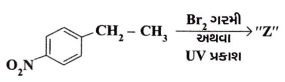
Which is the major product "$Z$" in the following reaction?
A
$1-$nitro$-4-$($1$-bromoethyl)benzene
B
$1-$nitro$-4-$($2$-bromoethyl)benzene
C
$2-$bromo$-1-$nitro$-4-$ethylbenzene
D
$1-$bromo$-2-$nitro$-4-$ethylbenzene
Solution
(A) The reaction of $p$-ethylnitrobenzene with $Br_2$ in the presence of heat or $UV$ light proceeds via a free radical substitution mechanism.
In this mechanism,the bromine radical abstracts a hydrogen atom from the benzylic position because the resulting benzylic radical is stabilized by resonance with the benzene ring.
Specifically,the hydrogen atom is removed from the $\alpha$-carbon (the carbon attached directly to the benzene ring) of the ethyl group.
This leads to the formation of a stable benzylic radical,which then reacts with $Br_2$ to form the major product,$1-nitro-4-(1-bromoethyl)benzene$.
Therefore,the correct structure is $O_2N-C_6H_4-CH(Br)CH_3$.
In this mechanism,the bromine radical abstracts a hydrogen atom from the benzylic position because the resulting benzylic radical is stabilized by resonance with the benzene ring.
Specifically,the hydrogen atom is removed from the $\alpha$-carbon (the carbon attached directly to the benzene ring) of the ethyl group.
This leads to the formation of a stable benzylic radical,which then reacts with $Br_2$ to form the major product,$1-nitro-4-(1-bromoethyl)benzene$.
Therefore,the correct structure is $O_2N-C_6H_4-CH(Br)CH_3$.
0 likes
View Solution746
EasyMCQ
The carbon-carbon bond length in benzene is
A
in between $C_{2}H_{6}$ and $C_{2}H_{4}$
B
same as in $C_{2}H_{4}$
C
in between $C_{2}H_{6}$ and $C_{2}H_{2}$
D
in between $C_{2}H_{4}$ and $C_{2}H_{2}$
Solution
(A) The carbon-carbon bond length in benzene is $1.39 \ \mathring{A}$.
In ethane $(C_{2}H_{6})$,the $C-C$ single bond length is $1.54 \ \mathring{A}$.
In ethene $(C_{2}H_{4})$,the $C=C$ double bond length is $1.34 \ \mathring{A}$.
Since $1.34 \ \mathring{A} < 1.39 \ \mathring{A} < 1.54 \ \mathring{A}$,the bond length in benzene lies between that of $C_{2}H_{6}$ and $C_{2}H_{4}$.
In ethane $(C_{2}H_{6})$,the $C-C$ single bond length is $1.54 \ \mathring{A}$.
In ethene $(C_{2}H_{4})$,the $C=C$ double bond length is $1.34 \ \mathring{A}$.
Since $1.34 \ \mathring{A} < 1.39 \ \mathring{A} < 1.54 \ \mathring{A}$,the bond length in benzene lies between that of $C_{2}H_{6}$ and $C_{2}H_{4}$.
0 likes
View Solution747
EasyMCQ
The number of $\pi$-bonds and $\sigma$-bonds present in naphthalene are respectively
A
$5, 11$
B
$5, 20$
C
$6, 19$
D
$5, 19$
Solution
(D) The chemical formula of naphthalene is $C_{10}H_8$.
In the structure of naphthalene,there are two fused benzene rings.
The number of $\pi$-bonds is equal to the number of double bonds in the structure,which is $5$.
The number of $\sigma$-bonds can be calculated by counting all single bonds and one bond from each double bond.
Total $\sigma$-bonds = $19$.
Therefore,the number of $\pi$-bonds and $\sigma$-bonds are $5$ and $19$ respectively.
The correct option is $(D)$.
In the structure of naphthalene,there are two fused benzene rings.
The number of $\pi$-bonds is equal to the number of double bonds in the structure,which is $5$.
The number of $\sigma$-bonds can be calculated by counting all single bonds and one bond from each double bond.
Total $\sigma$-bonds = $19$.
Therefore,the number of $\pi$-bonds and $\sigma$-bonds are $5$ and $19$ respectively.
The correct option is $(D)$.
0 likes
View Solution748
MediumMCQ
Which of the following is not an aromatic compound?
A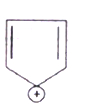
B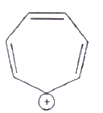
C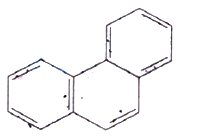
D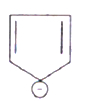
Solution
(A) To determine if a compound is aromatic,it must follow $H$ückel's rule ($4n+2$ $\pi$ electrons,where $n=0, 1, 2, ...$),be planar,and have a cyclic conjugated system.
$A$: Cyclopentadienyl cation has $4$ $\pi$ electrons ($n=1$ for antiaromatic,$4n$ rule). It is antiaromatic.
$B$: Cycloheptatrienyl cation has $6$ $\pi$ electrons $(n=1)$,which is aromatic.
$C$: Phenanthrene is a polycyclic aromatic hydrocarbon with $14$ $\pi$ electrons $(n=3)$,which is aromatic.
$D$: Cyclopentadienyl anion has $6$ $\pi$ electrons $(n=1)$,which is aromatic.
Therefore,the compound that is not aromatic is the cyclopentadienyl cation.
$A$: Cyclopentadienyl cation has $4$ $\pi$ electrons ($n=1$ for antiaromatic,$4n$ rule). It is antiaromatic.
$B$: Cycloheptatrienyl cation has $6$ $\pi$ electrons $(n=1)$,which is aromatic.
$C$: Phenanthrene is a polycyclic aromatic hydrocarbon with $14$ $\pi$ electrons $(n=3)$,which is aromatic.
$D$: Cyclopentadienyl anion has $6$ $\pi$ electrons $(n=1)$,which is aromatic.
Therefore,the compound that is not aromatic is the cyclopentadienyl cation.
0 likes
View Solution749
MediumMCQ
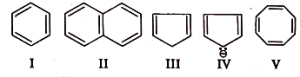
Among the following,the set which represents aromatic species is:
A
$I, II$ and $III$
B
$III, IV$ and $V$
C
$II$ and $III$
D
$I, II$ and $IV$
Solution
(D) species is aromatic if it follows $H$ückel's rule,which states it must be planar,cyclic,fully conjugated,and contain $(4n+2)$ $\pi$-electrons,where $n = 0, 1, 2, \dots$
$I$ (Benzene): Planar,cyclic,fully conjugated,$6$ $\pi$-electrons $(n=1)$. It is aromatic.
$II$ (Naphthalene): Planar,cyclic,fully conjugated,$10$ $\pi$-electrons $(n=2)$. It is aromatic.
$III$ (Cyclopentadiene): Not fully conjugated because of the $sp^3$ hybridized carbon. It is non-aromatic.
$IV$ (Cyclopentadienyl anion): Planar,cyclic,fully conjugated,$6$ $\pi$-electrons $(n=1)$. It is aromatic.
$V$ (Cyclooctatetraene): It has $8$ $\pi$-electrons ($4n$ system,$n=2$) and is non-planar (tub-shaped). It is non-aromatic.
Thus,the aromatic species are $I, II$ and $IV$.
$I$ (Benzene): Planar,cyclic,fully conjugated,$6$ $\pi$-electrons $(n=1)$. It is aromatic.
$II$ (Naphthalene): Planar,cyclic,fully conjugated,$10$ $\pi$-electrons $(n=2)$. It is aromatic.
$III$ (Cyclopentadiene): Not fully conjugated because of the $sp^3$ hybridized carbon. It is non-aromatic.
$IV$ (Cyclopentadienyl anion): Planar,cyclic,fully conjugated,$6$ $\pi$-electrons $(n=1)$. It is aromatic.
$V$ (Cyclooctatetraene): It has $8$ $\pi$-electrons ($4n$ system,$n=2$) and is non-planar (tub-shaped). It is non-aromatic.
Thus,the aromatic species are $I, II$ and $IV$.
0 likes
View Solution750
EasyMCQ
Which one of these is not true for benzene?
A
It forms only one type of monosubstituted product
B
There are three carbon-carbon single bonds and three carbon-carbon double bonds
C
The heat of hydrogenation of benzene is less than the theoretical value
D
The bond angle between the carbon-carbon bonds is $120^{\circ}$
Solution
(B) Benzene exhibits resonance,and all carbon-carbon bonds are equivalent due to the delocalization of $\pi$ electrons.
It does not contain distinct single and double bonds as suggested in option $B$.
Therefore,the statement that there are three carbon-carbon single bonds and three carbon-carbon double bonds is incorrect.
It does not contain distinct single and double bonds as suggested in option $B$.
Therefore,the statement that there are three carbon-carbon single bonds and three carbon-carbon double bonds is incorrect.
0 likes
View SolutionHydrocarbons — Aromatic hydrocarbon · Frequently Asked Questions
1Are these Hydrocarbons questions useful for JEE and NEET?
Yes. All questions in this section are mapped to JEE Main and NEET exam patterns. Previous year questions from JEE Main, NEET, GUJCET and state-level exams are included with full solutions.
2Can I switch to Hindi or Gujarati for these questions?
Yes. Use the language tabs in the hero section or the sidebar to view the same questions and solutions in English, Hindi or Gujarati.
3How do I generate a question paper from this subtopic?
Use the Vedclass Exam Paper Generator — select the chapter and subtopic, set difficulty, and generate Sets A, B, C, D automatically. First 3 chapters of every subject are free.
Vedclass Products
For Students
Vedclass Test Series
Mock tests in real JEE/NEET style with performance analysis. 5-day free trial.
Start Free TrialFor Teachers
Exam Paper Generator
Generate Set A/B/C/D papers from this chapter in 2 minutes. 3 chapters free.
Try FreeFor Institutes
Online Exam Module
Live online exams with unlimited students, 360° analytics & white-label branding.
See DemoFor Teachers & Institutes
Generate a Hydrocarbons Exam Paper in 2 Minutes
Select subtopic & difficulty — Sets A, B, C, D auto-generated with No Repeat logic.
First 3 chapters of every subject are free — no payment required.