
A English
Alkene Questions in English
Class 11 Chemistry · Hydrocarbons · Alkene
1080+
Questions
English
Language
100%
With Solutions
Showing 50 of 1080 questions in English
401
DifficultMCQ
$CH_3-CH(CH_3)-CH=CH_2 + HBr \to X$ (major product). $X$ is:
A
$CH_3-CH(CH_3)-CH_2-CH_2Br$
B
$CH_3-C(Br)(CH_3)-CH_2-CH_3$
C
$CH_3-CH(CH_3)-CH(Br)-CH_3$
D
None is correct
Solution
(B) The reaction proceeds via electrophilic addition involving carbocation formation and rearrangement.
$1.$ Protonation of $CH_3-CH(CH_3)-CH=CH_2$ occurs at the terminal carbon to form a secondary $(2^\circ)$ carbocation: $CH_3-CH(CH_3)-CH^+-CH_3$.
$2.$ $A$ $1,2$-hydride shift occurs from the adjacent tertiary carbon to form a more stable tertiary $(3^\circ)$ carbocation: $CH_3-C^+(CH_3)-CH_2-CH_3$.
$3.$ The nucleophile $Br^-$ then attacks the $3^\circ$ carbocation to yield the major product: $CH_3-C(Br)(CH_3)-CH_2-CH_3$ ($2$-bromo-$2$-methylbutane).
$1.$ Protonation of $CH_3-CH(CH_3)-CH=CH_2$ occurs at the terminal carbon to form a secondary $(2^\circ)$ carbocation: $CH_3-CH(CH_3)-CH^+-CH_3$.
$2.$ $A$ $1,2$-hydride shift occurs from the adjacent tertiary carbon to form a more stable tertiary $(3^\circ)$ carbocation: $CH_3-C^+(CH_3)-CH_2-CH_3$.
$3.$ The nucleophile $Br^-$ then attacks the $3^\circ$ carbocation to yield the major product: $CH_3-C(Br)(CH_3)-CH_2-CH_3$ ($2$-bromo-$2$-methylbutane).
0 likes
View Solution402
MediumMCQ
$X$ is

A
$Ph-CH(Br)-CH_2-CH_3$
B
$Ph-CH_2-CH(Br)-CH_3$
C
$Ph-CH_2-CH_2-CH_2-Br$
D
$p-Br-C_6H_4-CH_2-CH_2-CH_3$
Solution
(C) The reaction of allylbenzene $(Ph-CH_2-CH=CH_2)$ with $HBr$ in the presence of peroxide $(R_2O_2)$ follows the anti-Markovnikov addition rule (Kharasch effect or peroxide effect).
According to this rule,the bromine atom attaches to the carbon atom of the double bond that has more hydrogen atoms.
In the reactant $Ph-CH_2-CH=CH_2$,the terminal carbon $(CH_2)$ has two hydrogen atoms,while the internal carbon $(CH)$ has one hydrogen atom.
Therefore,the $Br$ atom adds to the terminal $CH_2$ group,and the $H$ atom adds to the $CH$ group.
The product formed is $Ph-CH_2-CH_2-CH_2-Br$ ($1$-phenyl$-3-$bromopropane).
Thus,the correct option is $C$.
According to this rule,the bromine atom attaches to the carbon atom of the double bond that has more hydrogen atoms.
In the reactant $Ph-CH_2-CH=CH_2$,the terminal carbon $(CH_2)$ has two hydrogen atoms,while the internal carbon $(CH)$ has one hydrogen atom.
Therefore,the $Br$ atom adds to the terminal $CH_2$ group,and the $H$ atom adds to the $CH$ group.
The product formed is $Ph-CH_2-CH_2-CH_2-Br$ ($1$-phenyl$-3-$bromopropane).
Thus,the correct option is $C$.
0 likes
View Solution403
AdvancedMCQ
In the given reaction sequence,$Y$ is:
Cyclohexanol $\xrightarrow{H^{\oplus}/\Delta} X$ $\xrightarrow[(2) H_2O/Zn]{(1) O_3} Y$
Cyclohexanol $\xrightarrow{H^{\oplus}/\Delta} X$ $\xrightarrow[(2) H_2O/Zn]{(1) O_3} Y$
A
$OHC-(CH_2)_4-CHO$
B
$OHC-(CH_2)_3-CHO$
C
$OHC-(CH_2)_2-CHO$
D
$OHC-CH_2-CHO$
Solution
(A) $1$. Cyclohexanol undergoes acid-catalyzed dehydration $(H^{\oplus}/\Delta)$ to form cyclohexene $(X)$.
$2$. Cyclohexene then undergoes reductive ozonolysis $((1) O_3, (2) H_2O/Zn)$ to break the double bond and form a dicarbonyl compound.
$3$. The reaction is: Cyclohexene $\xrightarrow{O_3/Zn, H_2O}$ Hexanedial $(OHC-(CH_2)_4-CHO)$.
$4$. Therefore,$Y$ is $OHC-(CH_2)_4-CHO$.
$2$. Cyclohexene then undergoes reductive ozonolysis $((1) O_3, (2) H_2O/Zn)$ to break the double bond and form a dicarbonyl compound.
$3$. The reaction is: Cyclohexene $\xrightarrow{O_3/Zn, H_2O}$ Hexanedial $(OHC-(CH_2)_4-CHO)$.
$4$. Therefore,$Y$ is $OHC-(CH_2)_4-CHO$.
0 likes
View Solution404
DifficultMCQ
Which of the following alkenes yield $3-$bromo$-3-$methylpentane as the major product upon addition of $HBr$?
$(I)$ $3-$methylpent$-2-$ene
$(II)$ $3-$methylpent$-2-$ene (isomer)
$(III)$ $3-$ethylpent$-1-$ene
$(IV)$ $3-$methylpent$-1-$ene
$(I)$ $3-$methylpent$-2-$ene
$(II)$ $3-$methylpent$-2-$ene (isomer)
$(III)$ $3-$ethylpent$-1-$ene
$(IV)$ $3-$methylpent$-1-$ene
A
$I$ and $II$ only
B
$III$ only
C
$I, II,$ and $III$ only
D
All of them
Solution
(A) The addition of $HBr$ to alkenes follows Markovnikov's rule,where the electrophile $H^+$ adds to the carbon with more hydrogens,forming the most stable carbocation intermediate.
$3-$bromo$-3-$methylpentane has the structure $CH_3CH_2C(Br)(CH_3)CH_2CH_3$.
To obtain this product,the intermediate carbocation must be the $3-$methylpentan$-3-$yl cation $(CH_3CH_2C^+(CH_3)CH_2CH_3)$,which is a tertiary carbocation.
$(I)$ $3-$methylpent$-2-$ene $(CH_3CH_2C(CH_3)=CHCH_3)$: Protonation at $C2$ gives the $3-$methylpentan$-3-$yl cation.
$(II)$ $3-$methylpent$-2-$ene (isomer): Protonation at $C2$ gives the $3-$methylpentan$-3-$yl cation.
$(III)$ $3-$ethylpent$-1-$ene $(CH_3CH_2C(CH_2CH_3)=CH_2)$: Protonation at $C1$ gives the $3-$ethylpentan$-3-$yl cation,which is a tertiary carbocation,but it leads to $3-$bromo$-3-$ethylpentane,not $3-$bromo$-3-$methylpentane.
$(IV)$ $3-$methylpent$-1-$ene $(CH_3CH_2CH(CH_3)CH=CH_2)$: Protonation at $C1$ gives a secondary carbocation,which rearranges to a more stable tertiary carbocation,but not the specific one required.
Thus,only structures $(I)$ and $(II)$ yield the desired product.
$3-$bromo$-3-$methylpentane has the structure $CH_3CH_2C(Br)(CH_3)CH_2CH_3$.
To obtain this product,the intermediate carbocation must be the $3-$methylpentan$-3-$yl cation $(CH_3CH_2C^+(CH_3)CH_2CH_3)$,which is a tertiary carbocation.
$(I)$ $3-$methylpent$-2-$ene $(CH_3CH_2C(CH_3)=CHCH_3)$: Protonation at $C2$ gives the $3-$methylpentan$-3-$yl cation.
$(II)$ $3-$methylpent$-2-$ene (isomer): Protonation at $C2$ gives the $3-$methylpentan$-3-$yl cation.
$(III)$ $3-$ethylpent$-1-$ene $(CH_3CH_2C(CH_2CH_3)=CH_2)$: Protonation at $C1$ gives the $3-$ethylpentan$-3-$yl cation,which is a tertiary carbocation,but it leads to $3-$bromo$-3-$ethylpentane,not $3-$bromo$-3-$methylpentane.
$(IV)$ $3-$methylpent$-1-$ene $(CH_3CH_2CH(CH_3)CH=CH_2)$: Protonation at $C1$ gives a secondary carbocation,which rearranges to a more stable tertiary carbocation,but not the specific one required.
Thus,only structures $(I)$ and $(II)$ yield the desired product.
0 likes
View Solution405
MediumMCQ
The reaction of trans-but$-2-$ene with $Br_2$ in $CCl_4$ yields products. The number of stereoisomeric products $(X)$ formed is:
A
$0$
B
$1$
C
$2$
D
$3$
Solution
(C) The reaction of $trans$-but$-2-$ene with $Br_2$ in $CCl_4$ proceeds via an anti-addition mechanism.
This reaction involves the formation of a cyclic bromonium ion intermediate.
Since the starting material is $trans$-but$-2-$ene,the anti-addition of bromine atoms to the double bond results in the formation of a pair of enantiomers (racemic mixture).
The two stereoisomeric products formed are $(2R, 3R)-2,3-dibromobutane$ and $(2S, 3S)-2,3-dibromobutane$.
Therefore,the total number of stereoisomeric products $(X)$ is $2$.
This reaction involves the formation of a cyclic bromonium ion intermediate.
Since the starting material is $trans$-but$-2-$ene,the anti-addition of bromine atoms to the double bond results in the formation of a pair of enantiomers (racemic mixture).
The two stereoisomeric products formed are $(2R, 3R)-2,3-dibromobutane$ and $(2S, 3S)-2,3-dibromobutane$.
Therefore,the total number of stereoisomeric products $(X)$ is $2$.
0 likes
View Solution406
MediumMCQ
Which of the following alkenes is the most stable?
A
$3-$methylpent$-1-$ene
B
$2-$ethylbut$-1-$ene
C
$3-$methylpent$-1-$ene (isomer)
D
$3-$methylpent$-2-$ene
Solution
(D) The stability of an alkene is directly proportional to the number of $\alpha-H$ atoms attached to the double-bonded carbons (hyperconjugation).
Let us analyze the number of $\alpha-H$ atoms for each structure:
$A$: $3-\text{methylpent-}1-\text{ene}$ has $2$ $\alpha-H$ atoms.
$B$: $2-\text{ethylbut-}1-\text{ene}$ has $4$ $\alpha-H$ atoms.
$C$: $3-\text{methylpent-}1-\text{ene}$ has $2$ $\alpha-H$ atoms.
$D$: $3-\text{methylpent-}2-\text{ene}$ has $5$ $\alpha-H$ atoms ($3$ from the methyl group and $2$ from the methylene group).
Since structure $D$ has the highest number of $\alpha-H$ atoms $(5)$,it is the most stable alkene.
Let us analyze the number of $\alpha-H$ atoms for each structure:
$A$: $3-\text{methylpent-}1-\text{ene}$ has $2$ $\alpha-H$ atoms.
$B$: $2-\text{ethylbut-}1-\text{ene}$ has $4$ $\alpha-H$ atoms.
$C$: $3-\text{methylpent-}1-\text{ene}$ has $2$ $\alpha-H$ atoms.
$D$: $3-\text{methylpent-}2-\text{ene}$ has $5$ $\alpha-H$ atoms ($3$ from the methyl group and $2$ from the methylene group).
Since structure $D$ has the highest number of $\alpha-H$ atoms $(5)$,it is the most stable alkene.
0 likes
View Solution407
MediumMCQ
Which of the following has the most negative heat of hydrogenation?
A
Vinylcyclohexane
B
Methylenecyclohexane
C
$1-$Isopropylidenecyclohexane
D
$1-$Methylcyclohexene
Solution
(A) The heat of hydrogenation $(\Delta H_{hyd})$ is directly proportional to the instability of the alkene. More substituted alkenes are generally more stable due to hyperconjugation and inductive effects,thus they have a less negative heat of hydrogenation.
Comparing the structures:
$(A)$ Vinylcyclohexane: Monosubstituted alkene.
$(B)$ Methylenecyclohexane: Disubstituted alkene.
$(C)$ $1-$Isopropylidenecyclohexane: Tetrasubstituted alkene.
$(D)$ $1-$Methylcyclohexene: Disubstituted alkene.
Among these,the monosubstituted alkene (Vinylcyclohexane) is the least stable,meaning it has the highest potential energy and therefore releases the most energy upon hydrogenation. Thus,it has the most negative heat of hydrogenation.
Comparing the structures:
$(A)$ Vinylcyclohexane: Monosubstituted alkene.
$(B)$ Methylenecyclohexane: Disubstituted alkene.
$(C)$ $1-$Isopropylidenecyclohexane: Tetrasubstituted alkene.
$(D)$ $1-$Methylcyclohexene: Disubstituted alkene.
Among these,the monosubstituted alkene (Vinylcyclohexane) is the least stable,meaning it has the highest potential energy and therefore releases the most energy upon hydrogenation. Thus,it has the most negative heat of hydrogenation.
0 likes
View Solution408
MediumMCQ
In which of the following compounds will the carbon-carbon double bond length be maximum?
A
$CH_3-CH=CH_2$
B
$CH_3-CH=CH-CH_3$
C
$CH_3-C(CH_3)=C(CH_3)-CH_3$
D
$CH_2=CH_2$
Solution
(C) The carbon-carbon double bond length increases with the number of $\alpha$-hydrogens due to hyperconjugation.
Hyperconjugation delocalizes the $\sigma$-electrons of the $C-H$ bond into the $\pi$-system,giving the double bond some single bond character and thus increasing its length.
Among the given options,$CH_3-C(CH_3)=C(CH_3)-CH_3$ has the maximum number of $\alpha$-hydrogens $(12)$,resulting in the longest $C=C$ bond.
Hyperconjugation delocalizes the $\sigma$-electrons of the $C-H$ bond into the $\pi$-system,giving the double bond some single bond character and thus increasing its length.
Among the given options,$CH_3-C(CH_3)=C(CH_3)-CH_3$ has the maximum number of $\alpha$-hydrogens $(12)$,resulting in the longest $C=C$ bond.
0 likes
View Solution409
DifficultMCQ
Rank the following alkenes in order of increasing $\lambda_{max}$:
$(1)$ $A$ conjugated diene in a bicyclic system.
$(2)$ An isolated diene in a bicyclic system.
$(3)$ $A$ conjugated diene in a bicyclic system (different substitution pattern).
$(1)$ $A$ conjugated diene in a bicyclic system.
$(2)$ An isolated diene in a bicyclic system.
$(3)$ $A$ conjugated diene in a bicyclic system (different substitution pattern).

A
$1 < 2 < 3$
B
$1 < 3 < 2$
C
$2 < 1 < 3$
D
$2 < 3 < 1$
Solution
(D) The wavelength of maximum absorption $(\lambda_{max})$ is inversely proportional to the energy gap between the $HOMO$ and $LUMO$ of the $\pi$ system,as given by $E = \frac{hc}{\lambda}$.
Conjugated dienes have a smaller $HOMO$-$LUMO$ gap compared to isolated dienes,which means they absorb at a higher wavelength $(\lambda_{max})$.
Structure $(2)$ is an isolated diene,so it will have the lowest $\lambda_{max}$.
Structures $(1)$ and $(3)$ are conjugated dienes. Structure $(1)$ is a more substituted conjugated diene compared to $(3)$,and increased substitution in a conjugated system generally leads to a bathochromic shift (higher $\lambda_{max}$).
Therefore,the order of increasing $\lambda_{max}$ is $2 < 3 < 1$.
Conjugated dienes have a smaller $HOMO$-$LUMO$ gap compared to isolated dienes,which means they absorb at a higher wavelength $(\lambda_{max})$.
Structure $(2)$ is an isolated diene,so it will have the lowest $\lambda_{max}$.
Structures $(1)$ and $(3)$ are conjugated dienes. Structure $(1)$ is a more substituted conjugated diene compared to $(3)$,and increased substitution in a conjugated system generally leads to a bathochromic shift (higher $\lambda_{max}$).
Therefore,the order of increasing $\lambda_{max}$ is $2 < 3 < 1$.
0 likes
View Solution410
AdvancedMCQ
Which of the following reactions is not exothermic?
A
$CH_3-Cl + CH_3-CH_3 \to CH_4 + CH_3-CH_2-Cl$
B
$CH_3-Cl + (CH_3)_3C-H \to CH_4 + (CH_3)_3C-Cl$
C
$CH_3-Cl + CH_2=CH-CH_3 \to CH_4 + CH_2=CH-CH_2-Cl$
D
$CH_3-Cl + CH_2=CH_2 \to CH_4 + CH_2=CHCl$
Solution
(D) In the given reactions,we are replacing a $C-H$ bond with a $C-Cl$ bond.
For the reaction to be exothermic,the bond dissociation energy of the $C-H$ bond being broken must be less than the $C-Cl$ bond being formed.
In option $D$,the reaction involves the removal of a hydrogen atom from an $sp^2$ hybridized carbon atom in ethene $(CH_2=CH_2)$.
The $C-H$ bond in ethene is significantly stronger than the $C-H$ bond in alkanes due to higher $s$-character.
Breaking this strong $C-H$ bond requires more energy than is released by forming the $C-Cl$ bond,making the reaction endothermic.
For the reaction to be exothermic,the bond dissociation energy of the $C-H$ bond being broken must be less than the $C-Cl$ bond being formed.
In option $D$,the reaction involves the removal of a hydrogen atom from an $sp^2$ hybridized carbon atom in ethene $(CH_2=CH_2)$.
The $C-H$ bond in ethene is significantly stronger than the $C-H$ bond in alkanes due to higher $s$-character.
Breaking this strong $C-H$ bond requires more energy than is released by forming the $C-Cl$ bond,making the reaction endothermic.
0 likes
View Solution411
MediumMCQ
Rank the following alkenes in order of decreasing heats of hydrogenation (largest first):
$1$. $1-$butene
$2$. $2-$methyl$-2-$butene
$3$. trans$-2-$butene
$4$. cis$-2-$butene
$1$. $1-$butene
$2$. $2-$methyl$-2-$butene
$3$. trans$-2-$butene
$4$. cis$-2-$butene
A
$2 > 3 > 4 > 1$
B
$2 > 4 > 3 > 1$
C
$1 > 3 > 4 > 2$
D
$1 > 4 > 3 > 2$
Solution
(D) The heat of hydrogenation is inversely proportional to the stability of the alkene.
Stability order of the given alkenes based on hyperconjugation and steric hindrance is:
$2$ (trisubstituted) $> 3$ (trans-disubstituted) $> 4$ (cis-disubstituted) $> 1$ (monosubstituted).
Therefore,the order of decreasing heat of hydrogenation is the reverse of the stability order:
$1 > 4 > 3 > 2$.
Thus,the correct option is $(d)$.
Stability order of the given alkenes based on hyperconjugation and steric hindrance is:
$2$ (trisubstituted) $> 3$ (trans-disubstituted) $> 4$ (cis-disubstituted) $> 1$ (monosubstituted).
Therefore,the order of decreasing heat of hydrogenation is the reverse of the stability order:
$1 > 4 > 3 > 2$.
Thus,the correct option is $(d)$.
0 likes
View Solution412
MediumMCQ
$CH_3-CH=CH_2$ $\xrightarrow{Br_2, hv (\text{low conc.})} \dots$ $\xrightarrow{Mg, \text{Dry ether}} \dots$ $\xrightarrow{CH_3-CO-CH_3, NH_4Cl} \dots$ $\xrightarrow{H^{+}, \Delta} (X)$. The end product $(X)$ of the above reaction is:
A
$CH_2=CH-CH_2-C(=CH_2)-CH_3$
B
$CH_2=CH-CH=C(CH_3)_2$
C
$CH_2=CH-CH_2-C(OH)(CH_3)_2$
D
$CH_2=CH-CH_2-CH(CH_3)-CH_2-OH$
Solution
(B) The reaction sequence is as follows:
$1.$ Allylic bromination of propene with $Br_2$ at low concentration and $hv$ gives allyl bromide: $CH_3-CH=CH_2 \xrightarrow{Br_2, hv} CH_2=CH-CH_2Br$.
$2.$ Reaction with $Mg$ in dry ether forms the Grignard reagent: $CH_2=CH-CH_2Br \xrightarrow{Mg, \text{ether}} CH_2=CH-CH_2MgBr$.
$3.$ Nucleophilic addition of the Grignard reagent to acetone followed by hydrolysis with $NH_4Cl$ gives $2-\text{methylpent-}4-\text{en-}2-\text{ol}$: $CH_2=CH-CH_2MgBr + CH_3-CO-CH_3 \xrightarrow{NH_4Cl} CH_2=CH-CH_2-C(OH)(CH_3)_2$.
$4.$ Acid-catalyzed dehydration $(H^{+}, \Delta)$ of the alcohol produces the more stable conjugated diene,$2-\text{methylpenta-}1,3-\text{diene}$,as the major product $(X)$: $CH_2=CH-CH_2-C(OH)(CH_3)_2 \xrightarrow{H^{+}, \Delta} CH_2=CH-CH=C(CH_3)_2$.
$1.$ Allylic bromination of propene with $Br_2$ at low concentration and $hv$ gives allyl bromide: $CH_3-CH=CH_2 \xrightarrow{Br_2, hv} CH_2=CH-CH_2Br$.
$2.$ Reaction with $Mg$ in dry ether forms the Grignard reagent: $CH_2=CH-CH_2Br \xrightarrow{Mg, \text{ether}} CH_2=CH-CH_2MgBr$.
$3.$ Nucleophilic addition of the Grignard reagent to acetone followed by hydrolysis with $NH_4Cl$ gives $2-\text{methylpent-}4-\text{en-}2-\text{ol}$: $CH_2=CH-CH_2MgBr + CH_3-CO-CH_3 \xrightarrow{NH_4Cl} CH_2=CH-CH_2-C(OH)(CH_3)_2$.
$4.$ Acid-catalyzed dehydration $(H^{+}, \Delta)$ of the alcohol produces the more stable conjugated diene,$2-\text{methylpenta-}1,3-\text{diene}$,as the major product $(X)$: $CH_2=CH-CH_2-C(OH)(CH_3)_2 \xrightarrow{H^{+}, \Delta} CH_2=CH-CH=C(CH_3)_2$.
0 likes
View Solution413
EasyMCQ
The conversion of $2,3-$dibromobutane to $2-$butene with $Zn$ is
A
Redox reaction
B
$\alpha-$Elimination
C
$\beta-$Elimination
D
Both $\alpha-$elimination and redox reaction
Solution
(C) The reaction of $2,3-$dibromobutane with $Zn$ dust is a dehalogenation reaction.
In this process,two bromine atoms are removed from adjacent carbon atoms ($C2$ and $C3$),resulting in the formation of a double bond between them to produce $2-$butene.
This type of elimination,where atoms are removed from adjacent carbons,is known as $\beta-$elimination.
In this process,two bromine atoms are removed from adjacent carbon atoms ($C2$ and $C3$),resulting in the formation of a double bond between them to produce $2-$butene.
This type of elimination,where atoms are removed from adjacent carbons,is known as $\beta-$elimination.
0 likes
View Solution414
MediumMCQ
$CH_3-C(CH_3)(Br)-CH(CH_3)_2 \xrightarrow[\Delta]{EtOH} (A)$
Major product $(A)$ is
Major product $(A)$ is
A
$2,3-$dimethylbut$-1-$ene
B
$2,3-$dimethylbut$-2-$ene
C
$3,3-$dimethylbut$-1-$ene
D
$2-$methylpent$-2-$ene
Solution
(B) The reaction proceeds via an $E1$ mechanism.
$1$. The substrate $CH_3-C(CH_3)(Br)-CH(CH_3)_2$ undergoes ionization to form a secondary carbocation: $CH_3-C^+(CH_3)-CH(CH_3)_2$.
$2$. This secondary carbocation undergoes a $1,2-methyl$ shift to form a more stable tertiary carbocation: $(CH_3)_2C^+-CH(CH_3)_2$.
$3$. Finally, the loss of a proton $(H^+)$ from the adjacent carbon leads to the formation of the most stable alkene, which is $2,3-dimethylbut-2-ene$ (tetrasubstituted alkene).
$1$. The substrate $CH_3-C(CH_3)(Br)-CH(CH_3)_2$ undergoes ionization to form a secondary carbocation: $CH_3-C^+(CH_3)-CH(CH_3)_2$.
$2$. This secondary carbocation undergoes a $1,2-methyl$ shift to form a more stable tertiary carbocation: $(CH_3)_2C^+-CH(CH_3)_2$.
$3$. Finally, the loss of a proton $(H^+)$ from the adjacent carbon leads to the formation of the most stable alkene, which is $2,3-dimethylbut-2-ene$ (tetrasubstituted alkene).
0 likes
View Solution415
MediumMCQ
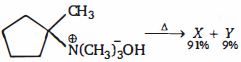
Two alkenes,$X$ ($91\%$ yield) and $Y$ ($9\%$ yield),are formed when the following compound is heated:
The structures of $X$ and $Y$,respectively,are:
The structures of $X$ and $Y$,respectively,are:
A
$1-$methylcyclopentene and methylenecyclopentane
B
$3-$methylcyclopentene and $1-$methylcyclopentene
C
methylenecyclopentane and $1-$methylcyclopentene
D
$3-$methylcyclopentene and methylenecyclopentane
Solution
(C) The reaction is a Hoffmann elimination (also known as the Cope elimination if an amine oxide is used,but here it is a quaternary ammonium hydroxide).
In Hoffmann elimination,the less substituted alkene (the one with fewer alkyl groups on the double-bonded carbons) is the major product because the bulky leaving group (trimethylamine) prefers to abstract a proton from the less sterically hindered $\beta$-carbon.
$1$. The starting material is $1$-methylcyclopentyltrimethylammonium hydroxide.
$2$. The $\beta$-hydrogens are available on the ring carbons adjacent to the quaternary nitrogen.
$3$. Removing a proton from the $CH_2$ group adjacent to the quaternary center leads to the formation of methylenecyclopentane (the less substituted,Hoffmann product).
$4$. Removing a proton from the $CH$ group (the tertiary carbon) leads to the formation of $1$-methylcyclopentene (the more substituted,Zaitsev product).
Since Hoffmann elimination favors the less substituted alkene as the major product,$X$ $(91\%)$ is methylenecyclopentane and $Y$ $(9\%)$ is $1$-methylcyclopentene.
Therefore,the correct option is $(C)$.
In Hoffmann elimination,the less substituted alkene (the one with fewer alkyl groups on the double-bonded carbons) is the major product because the bulky leaving group (trimethylamine) prefers to abstract a proton from the less sterically hindered $\beta$-carbon.
$1$. The starting material is $1$-methylcyclopentyltrimethylammonium hydroxide.
$2$. The $\beta$-hydrogens are available on the ring carbons adjacent to the quaternary nitrogen.
$3$. Removing a proton from the $CH_2$ group adjacent to the quaternary center leads to the formation of methylenecyclopentane (the less substituted,Hoffmann product).
$4$. Removing a proton from the $CH$ group (the tertiary carbon) leads to the formation of $1$-methylcyclopentene (the more substituted,Zaitsev product).
Since Hoffmann elimination favors the less substituted alkene as the major product,$X$ $(91\%)$ is methylenecyclopentane and $Y$ $(9\%)$ is $1$-methylcyclopentene.
Therefore,the correct option is $(C)$.
0 likes
View Solution416
DifficultMCQ
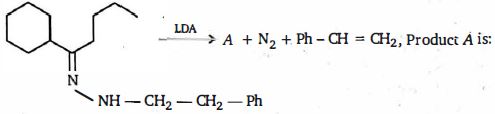
$LDA = \text{Lithium di-isopropyl amide}$. In the given reaction,identify product $A$:
A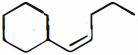
B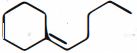
C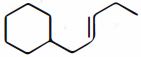
D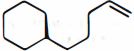
Solution
(A) The reaction is a base-induced decomposition of a hydrazone derivative,often referred to as a Shapiro-type reaction or related elimination.
$1$. $LDA$ (a strong,sterically hindered base) abstracts an $\alpha$-proton from the alkyl chain attached to the hydrazone carbon.
$2$. This leads to the formation of a vinylic carbanion intermediate.
$3$. The carbanion undergoes elimination,releasing $N_2$ gas and the alkene $Ph-CH=CH_2$ as byproducts.
$4$. The final product $A$ is the alkene formed by the double bond between the original hydrazone carbon and the adjacent carbon of the alkyl chain.
$5$. Based on the structure,the product $A$ is $1\text{-cyclohexylbut-1-ene}$ (or a similar isomer depending on the specific alkyl chain structure provided in the image). Looking at the options,the structure corresponds to the formation of the double bond at the position where the hydrazone was located.
$1$. $LDA$ (a strong,sterically hindered base) abstracts an $\alpha$-proton from the alkyl chain attached to the hydrazone carbon.
$2$. This leads to the formation of a vinylic carbanion intermediate.
$3$. The carbanion undergoes elimination,releasing $N_2$ gas and the alkene $Ph-CH=CH_2$ as byproducts.
$4$. The final product $A$ is the alkene formed by the double bond between the original hydrazone carbon and the adjacent carbon of the alkyl chain.
$5$. Based on the structure,the product $A$ is $1\text{-cyclohexylbut-1-ene}$ (or a similar isomer depending on the specific alkyl chain structure provided in the image). Looking at the options,the structure corresponds to the formation of the double bond at the position where the hydrazone was located.
0 likes
View Solution417
DifficultMCQ
What will be the major product of each of the two reactions shown below?
$1.$ $CH_3-CH_2-CH(N^{+}(CH_3)_3)OH^{-} \xrightarrow{\text{heat}} CH_3-CH=CH-CH_3 (X) + CH_3-CH_2-CH=CH_2 (Y)$
$2.$ $CH_3-CH_2-CH(Br)-CH_3 \xrightarrow{\text{heat}} CH_3-CH=CH-CH_3 (X) + CH_3-CH_2-CH=CH_2 (Y)$
$1.$ $CH_3-CH_2-CH(N^{+}(CH_3)_3)OH^{-} \xrightarrow{\text{heat}} CH_3-CH=CH-CH_3 (X) + CH_3-CH_2-CH=CH_2 (Y)$
$2.$ $CH_3-CH_2-CH(Br)-CH_3 \xrightarrow{\text{heat}} CH_3-CH=CH-CH_3 (X) + CH_3-CH_2-CH=CH_2 (Y)$
A
$1-X, 2-X$
B
$1-Y, 2-X$
C
$1-X, 2-Y$
D
$1-Y, 2-Y$
Solution
(B) In reaction $1$,the quaternary ammonium hydroxide undergoes Hofmann elimination. Due to the steric bulk of the leaving group $-N^{+}(CH_3)_3$,the less substituted alkene,$1$-butene $(Y)$,is the major product.
In reaction $2$,the alkyl halide undergoes dehydrohalogenation following Zaitsev's rule,where the more substituted alkene,$2$-butene $(X)$,is the major product.
Therefore,the correct answer is $1-Y, 2-X$.
In reaction $2$,the alkyl halide undergoes dehydrohalogenation following Zaitsev's rule,where the more substituted alkene,$2$-butene $(X)$,is the major product.
Therefore,the correct answer is $1-Y, 2-X$.
0 likes
View Solution418
MediumMCQ
$Br-CH_2-CH=CH-CH_2-Br \xrightarrow{Zn (dust)} (A)$
Above reaction is an example of $1,4$-elimination. Predict the product.
Above reaction is an example of $1,4$-elimination. Predict the product.
A
$CH_3-CH=C=CH_2$
B
$CH_3-C \equiv C-CH_3$
C
$CH_3-CH_2-C \equiv CH$
D
$H_2C=CH-CH=CH_2$
Solution
(D) The reaction of $1,4$-dibromobut$-2-$ene with $Zn$ dust involves the removal of two bromine atoms from the $1$ and $4$ positions.
This process is known as $1,4$-elimination.
The mechanism involves the formation of a cyclic transition state or an organozinc intermediate,leading to the formation of a conjugated diene.
The product formed is $1,3$-butadiene,which has the structure $H_2C=CH-CH=CH_2$.
This process is known as $1,4$-elimination.
The mechanism involves the formation of a cyclic transition state or an organozinc intermediate,leading to the formation of a conjugated diene.
The product formed is $1,3$-butadiene,which has the structure $H_2C=CH-CH=CH_2$.
0 likes
View Solution419
MediumMCQ
Identify $C$ in the following series $C_3H_7I$ $\xrightarrow[alc.]{KOH} A$ $\xrightarrow[\Delta]{NBS} B$ $\xrightarrow[alc.]{KCN} C$.
A
$CH_3CH_2CH_2CN$
B
$CH_2=CHCH_2CN$
C
$CH_3CH(CN)CH_3$
D
$CH_2=CHCN$
Solution
(B) $1$. $C_3H_7I$ (isopropyl iodide or n-propyl iodide) reacts with alcoholic $KOH$ via dehydrohalogenation to form propene: $CH_3CH_2CH_2I \xrightarrow[alc.]{KOH} CH_3CH=CH_2$.
$2$. Propene reacts with $NBS$ ($N$-Bromosuccinimide) under heating conditions to undergo allylic bromination: $CH_3CH=CH_2 \xrightarrow[\Delta]{NBS} BrCH_2CH=CH_2$ (allyl bromide).
$3$. Allyl bromide reacts with alcoholic $KCN$ (nucleophilic substitution) to form allyl cyanide: $BrCH_2CH=CH_2 \xrightarrow[alc.]{KCN} CNCH_2CH=CH_2$.
$2$. Propene reacts with $NBS$ ($N$-Bromosuccinimide) under heating conditions to undergo allylic bromination: $CH_3CH=CH_2 \xrightarrow[\Delta]{NBS} BrCH_2CH=CH_2$ (allyl bromide).
$3$. Allyl bromide reacts with alcoholic $KCN$ (nucleophilic substitution) to form allyl cyanide: $BrCH_2CH=CH_2 \xrightarrow[alc.]{KCN} CNCH_2CH=CH_2$.
0 likes
View Solution420
MediumMCQ
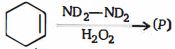
The product $(P)$ is:
A
Cyclohexane
B
cis$-1,2-$dideuteriocyclohexane
C
trans$-1,2-$dideuteriocyclohexane
D
both $(b)$ & $(c)$
Solution
(B) The reaction of cyclohexene with $ND_2-ND_2$ (deutero-diazene) in the presence of $H_2O_2$ is a syn-addition reaction.
This reaction is a specific method for the cis-addition of deuterium atoms across the double bond of an alkene.
Since the addition is syn,both deuterium atoms are added to the same face of the cyclohexene ring,resulting in the formation of cis$-1,2-$dideuteriocyclohexane.
Therefore,the correct product $(P)$ is cis$-1,2-$dideuteriocyclohexane.
This reaction is a specific method for the cis-addition of deuterium atoms across the double bond of an alkene.
Since the addition is syn,both deuterium atoms are added to the same face of the cyclohexene ring,resulting in the formation of cis$-1,2-$dideuteriocyclohexane.
Therefore,the correct product $(P)$ is cis$-1,2-$dideuteriocyclohexane.
0 likes
View Solution421
MediumMCQ
On catalytic reduction $(H_2 / Pt)$,how many alkenes will give $n$-butane?
A
$1$
B
$2$
C
$3$
D
$4$
Solution
(C) The catalytic reduction of an alkene with $H_2 / Pt$ involves the addition of hydrogen across the double bond to form the corresponding alkane.
To obtain $n$-butane $(CH_3-CH_2-CH_2-CH_3)$,the starting alkene must have a four-carbon straight chain.
The possible alkenes with a four-carbon straight chain are:
$1$. $1$-butene $(CH_2=CH-CH_2-CH_3)$
$2$. $cis$-$2$-butene $(CH_3-CH=CH-CH_3)$
$3$. $trans$-$2$-butene $(CH_3-CH=CH-CH_3)$
All three of these alkenes,upon hydrogenation,yield $n$-butane.
Therefore,there are $3$ such alkenes.
To obtain $n$-butane $(CH_3-CH_2-CH_2-CH_3)$,the starting alkene must have a four-carbon straight chain.
The possible alkenes with a four-carbon straight chain are:
$1$. $1$-butene $(CH_2=CH-CH_2-CH_3)$
$2$. $cis$-$2$-butene $(CH_3-CH=CH-CH_3)$
$3$. $trans$-$2$-butene $(CH_3-CH=CH-CH_3)$
All three of these alkenes,upon hydrogenation,yield $n$-butane.
Therefore,there are $3$ such alkenes.
0 likes
View Solution422
MediumMCQ
On catalytic reduction $(H_2/Pt)$,how many alkenes will give $2-$methylbutane?
A
$1$
B
$2$
C
$3$
D
$4$
Solution
(C) Catalytic hydrogenation of an alkene involves the addition of $H_2$ across the double bond to form the corresponding alkane. The carbon skeleton of the alkene remains unchanged during this process.
To obtain $2-$methylbutane $(CH_3-CH(CH_3)-CH_2-CH_3)$,the starting alkene must have the same carbon skeleton.
The possible alkenes that yield $2-$methylbutane upon hydrogenation are:
$1$. $2-$methylbut-$1-$ene: $CH_2=C(CH_3)-CH_2-CH_3$
$2$. $2-$methylbut-$2-$ene: $CH_3-C(CH_3)=CH-CH_3$
$3$. $3-$methylbut-$1-$ene: $CH_2=CH-CH(CH_3)-CH_3$
Thus,there are $3$ such alkenes.
To obtain $2-$methylbutane $(CH_3-CH(CH_3)-CH_2-CH_3)$,the starting alkene must have the same carbon skeleton.
The possible alkenes that yield $2-$methylbutane upon hydrogenation are:
$1$. $2-$methylbut-$1-$ene: $CH_2=C(CH_3)-CH_2-CH_3$
$2$. $2-$methylbut-$2-$ene: $CH_3-C(CH_3)=CH-CH_3$
$3$. $3-$methylbut-$1-$ene: $CH_2=CH-CH(CH_3)-CH_3$
Thus,there are $3$ such alkenes.
0 likes
View Solution423
MediumMCQ
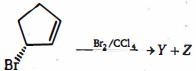
$(R)-3-$bromocyclopentene (shown below) reacts with $Br_2/CCl_4$ to form two products,$Y$ and $Z$. $Y$ is not optically active (does not rotate plane-polarized light). What is the structure of $Y$?
A
$1,2,3-$tribromocyclopentane (all trans)
B
$1,2,3-$tribromocyclopentane (cis-trans-trans)
C
$1,2,3-$tribromocyclopentane (trans-cis-trans)
D
$1,2,3-$tribromocyclopentane (cis-cis-trans)
Solution
(A) The reaction of $(R)-3-$bromocyclopentene with $Br_2/CCl_4$ involves the anti-addition of bromine across the double bond.
Since the starting material has a bromine atom at the $3-$position,the addition of $Br_2$ results in the formation of $1,2,3-$tribromocyclopentane.
Anti-addition means the two new bromine atoms will be added on opposite faces of the cyclopentene ring.
For the $(R)-3-$bromocyclopentene isomer,one of the resulting diastereomers will possess an internal plane of symmetry,making it a meso compound.
$A$ meso compound is achiral and therefore optically inactive.
Based on the stereochemistry of anti-addition to the $(R)-$enantiomer,the product $Y$ that is optically inactive (meso) has the structure where the bromine atoms are arranged such that a plane of symmetry exists.
Since the starting material has a bromine atom at the $3-$position,the addition of $Br_2$ results in the formation of $1,2,3-$tribromocyclopentane.
Anti-addition means the two new bromine atoms will be added on opposite faces of the cyclopentene ring.
For the $(R)-3-$bromocyclopentene isomer,one of the resulting diastereomers will possess an internal plane of symmetry,making it a meso compound.
$A$ meso compound is achiral and therefore optically inactive.
Based on the stereochemistry of anti-addition to the $(R)-$enantiomer,the product $Y$ that is optically inactive (meso) has the structure where the bromine atoms are arranged such that a plane of symmetry exists.
0 likes
View Solution424
MediumMCQ
$KO_2C-CH_2-CH_2-CO_2K \xrightarrow{\text{electrolysis}} (A) \text{ (major)}$ (Kolbe electrolysis method). The product $(A)$ of the reaction is:
A
$CH_3-CH_3$
B
$CH_2=CH_2$
C
$CH_3-CH=CH_2$
D
\text{none of these}
Solution
(B) In Kolbe's electrolysis of potassium succinate $(KO_2C-CH_2-CH_2-CO_2K)$,the succinate ion undergoes decarboxylation at the anode to form a diradical $\cdot CH_2-CH_2 \cdot$.
This diradical then undergoes intramolecular coupling to form ethene $(CH_2=CH_2)$ as the major product.
This diradical then undergoes intramolecular coupling to form ethene $(CH_2=CH_2)$ as the major product.
0 likes
View Solution425
MediumMCQ
The reaction of propene with $H_3O^{+}$ proceeds through which of the following intermediates?
A
$CH_3-CH_2-CH_2-O^{+}H_2$
B
$CH_3-C^{+}H-CH_2-OH$
C
$CH_3-CH(O^{+}H_2)-CH_3$
D
$CH_3-CH(OH)-CH_3$
Solution
(C) The reaction of propene $(CH_3-CH=CH_2)$ with $H_3O^{+}$ (acid-catalyzed hydration) follows Markovnikov's rule.
In the first step,a proton $(H^{+})$ adds to the terminal carbon to form the more stable secondary carbocation $(CH_3-C^{+}H-CH_3)$.
In the second step,water $(H_2O)$ acts as a nucleophile and attacks the carbocation to form the oxonium ion intermediate $CH_3-CH(O^{+}H_2)-CH_3$.
In the first step,a proton $(H^{+})$ adds to the terminal carbon to form the more stable secondary carbocation $(CH_3-C^{+}H-CH_3)$.
In the second step,water $(H_2O)$ acts as a nucleophile and attacks the carbocation to form the oxonium ion intermediate $CH_3-CH(O^{+}H_2)-CH_3$.

0 likes
View Solution426
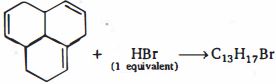
MediumMCQ
Which of the following bromides is the major product of the reaction shown below,assuming that there are no carbocation rearrangement?
A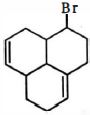
B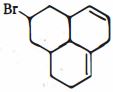
C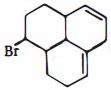
D
Solution
(D) The reaction involves the electrophilic addition of $HBr$ to the given polycyclic alkene.
First,the proton $(H^+)$ from $HBr$ attacks one of the double bonds to form the most stable carbocation intermediate.
In this structure,the formation of a tertiary $(3^\circ)$ carbocation is possible at the bridgehead position,which is more stable than secondary $(2^\circ)$ carbocations.
Assuming no carbocation rearrangement,the bromide ion $(Br^-)$ then attacks this $3^\circ$ carbocation to form the final product.
Based on the provided solution image,the product corresponds to the addition of $Br$ at the tertiary bridgehead carbon.
First,the proton $(H^+)$ from $HBr$ attacks one of the double bonds to form the most stable carbocation intermediate.
In this structure,the formation of a tertiary $(3^\circ)$ carbocation is possible at the bridgehead position,which is more stable than secondary $(2^\circ)$ carbocations.
Assuming no carbocation rearrangement,the bromide ion $(Br^-)$ then attacks this $3^\circ$ carbocation to form the final product.
Based on the provided solution image,the product corresponds to the addition of $Br$ at the tertiary bridgehead carbon.
0 likes
View Solution427
MediumMCQ
What is a likely product of the reaction shown?
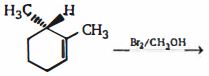
A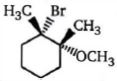
B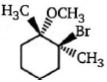
C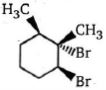
D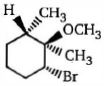
Solution
(D) The reaction of an alkene with $Br_2$ in the presence of a nucleophilic solvent like $CH_3OH$ proceeds via the formation of a cyclic bromonium ion intermediate.
$1$. The double bond attacks $Br_2$ to form a cyclic bromonium ion.
$2$. The nucleophile $(CH_3OH)$ then attacks the more substituted carbon atom of the bromonium ion from the side opposite to the bromine atom (anti-addition).
$3$. Based on the stereochemistry of the starting material,the $CH_3O$ group will be added to the more substituted carbon,and the $Br$ atom will be on the adjacent carbon,resulting in the anti-addition product as shown in the solution image.
$1$. The double bond attacks $Br_2$ to form a cyclic bromonium ion.
$2$. The nucleophile $(CH_3OH)$ then attacks the more substituted carbon atom of the bromonium ion from the side opposite to the bromine atom (anti-addition).
$3$. Based on the stereochemistry of the starting material,the $CH_3O$ group will be added to the more substituted carbon,and the $Br$ atom will be on the adjacent carbon,resulting in the anti-addition product as shown in the solution image.
0 likes
View Solution428
MediumMCQ
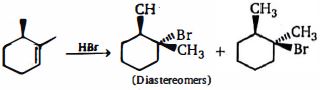
The product $(s)$ of the following reaction can best be described as
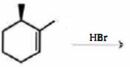
A
a racemic mixture
B
a single enantiomer
C
a pair of diastereomers
D
an achiral molecule
Solution
(C) The reaction involves the electrophilic addition of $HBr$ to $1,2-dimethylcyclohexene$.
First,the protonation of the double bond occurs to form a carbocation intermediate.
Since the starting material is chiral ($1-methyl-2-methylcyclohexene$ with a fixed stereocenter),the addition of the bromide ion can occur from either the top or bottom face of the planar carbocation.
This results in the formation of two new stereocenters,leading to the creation of two diastereomers,as the existing stereocenter remains unchanged while a new one is formed at the carbon where the bromine attaches.
First,the protonation of the double bond occurs to form a carbocation intermediate.
Since the starting material is chiral ($1-methyl-2-methylcyclohexene$ with a fixed stereocenter),the addition of the bromide ion can occur from either the top or bottom face of the planar carbocation.
This results in the formation of two new stereocenters,leading to the creation of two diastereomers,as the existing stereocenter remains unchanged while a new one is formed at the carbon where the bromine attaches.
0 likes
View Solution429
MediumMCQ
How many products will be formed in this reaction?
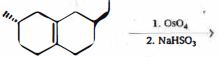
A
$10$
B
$2$
C
$3$
D
$4$
Solution
(B) The reaction of the given alkene with $OsO_4$ followed by $NaHSO_3$ is a $syn$-dihydroxylation reaction.
Since the molecule is chiral and lacks a plane of symmetry,the $OsO_4$ reagent can attack the double bond from either the top face or the bottom face of the ring.
These two modes of attack result in the formation of two diastereomeric products.
Therefore,the correct answer is $2$.
Since the molecule is chiral and lacks a plane of symmetry,the $OsO_4$ reagent can attack the double bond from either the top face or the bottom face of the ring.
These two modes of attack result in the formation of two diastereomeric products.
Therefore,the correct answer is $2$.
0 likes
View Solution430
MediumMCQ
Diimide $(N_2H_2)$ is used to reduce the double bond of:
A
$-C=O$
B
$-C \equiv N$
C
$-NO_2$
D
$-CH=CH-$
Solution
(D) Diimide $(N_2H_2)$ is a selective reducing agent used for the stereospecific syn-hydrogenation of non-polar multiple bonds like alkenes $(-CH=CH-)$ and alkynes.
It does not reduce polar functional groups such as carbonyls $(-C=O)$,nitriles $(-C \equiv N)$,or nitro groups $(-NO_2)$.
It does not reduce polar functional groups such as carbonyls $(-C=O)$,nitriles $(-C \equiv N)$,or nitro groups $(-NO_2)$.
0 likes
View Solution431
MediumMCQ
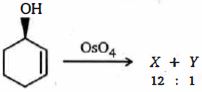
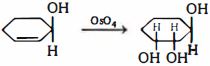
The reaction of $3$-cyclohexenol with $OsO_4$ gives two products $X$ and $Y$ in a ratio of $12:1$. The major product $(X)$ is:
A
B
C
D
Solution
(C) The reaction of $OsO_4$ with an alkene involves syn-dihydroxylation,where two hydroxyl groups are added to the same face of the double bond.
In $3$-cyclohexenol,the existing hydroxyl group at the $1$-position exerts steric hindrance.
When $OsO_4$ approaches the double bond,it prefers the face opposite to the bulky $-OH$ group to minimize steric repulsion.
Therefore,the major product $(X)$ is the one where the two new $-OH$ groups are added to the face opposite to the existing $-OH$ group,resulting in a cis-triol configuration relative to the new hydroxyls.
In $3$-cyclohexenol,the existing hydroxyl group at the $1$-position exerts steric hindrance.
When $OsO_4$ approaches the double bond,it prefers the face opposite to the bulky $-OH$ group to minimize steric repulsion.
Therefore,the major product $(X)$ is the one where the two new $-OH$ groups are added to the face opposite to the existing $-OH$ group,resulting in a cis-triol configuration relative to the new hydroxyls.
0 likes
View Solution432
MediumMCQ
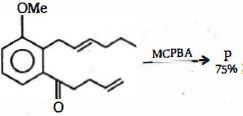
Product $(P)$ is
A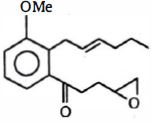
B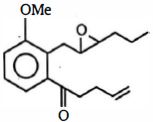
C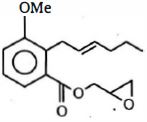
D
None of these
Solution
(C) $MCPBA$ (meta-chloroperoxybenzoic acid) is an electrophilic reagent that reacts with alkenes to form epoxides.
The reaction rate of epoxidation with $MCPBA$ is faster for more electron-rich (more substituted) alkenes.
In the given molecule,there are two alkene groups: a disubstituted internal alkene and a monosubstituted terminal alkene.
The disubstituted alkene is more electron-rich than the terminal alkene,making it more reactive towards the electrophilic $MCPBA$.
Therefore,the epoxide will form at the more substituted internal alkene position.
The reaction rate of epoxidation with $MCPBA$ is faster for more electron-rich (more substituted) alkenes.
In the given molecule,there are two alkene groups: a disubstituted internal alkene and a monosubstituted terminal alkene.
The disubstituted alkene is more electron-rich than the terminal alkene,making it more reactive towards the electrophilic $MCPBA$.
Therefore,the epoxide will form at the more substituted internal alkene position.
0 likes
View Solution433
MediumMCQ
Product $(A)$ is
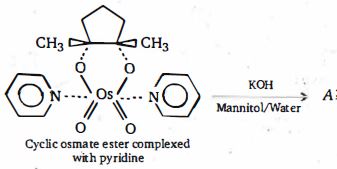
A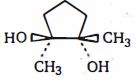
B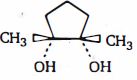
C
D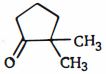
Solution
(B) The reaction shown is the syn-dihydroxylation of an alkene using $OsO_4$ (often complexed with pyridine).
This process adds two hydroxyl $(-OH)$ groups across the double bond in a syn-fashion.
Since the starting material is a $1,2-$dimethylcyclopentene derivative,the two $-OH$ groups will be added to the same face of the ring,resulting in a cis-diol.
Looking at the options,option $(B)$ represents the cis$-1,2-$dihydroxy$-1,2-$dimethylcyclopentane structure where the hydroxyl groups are on the same side of the ring.
This process adds two hydroxyl $(-OH)$ groups across the double bond in a syn-fashion.
Since the starting material is a $1,2-$dimethylcyclopentene derivative,the two $-OH$ groups will be added to the same face of the ring,resulting in a cis-diol.
Looking at the options,option $(B)$ represents the cis$-1,2-$dihydroxy$-1,2-$dimethylcyclopentane structure where the hydroxyl groups are on the same side of the ring.
0 likes
View Solution434
MediumMCQ
$m$-chloroperbenzoic acid $(MCPBA)$ reacts with the given alkene. The product $(A)$ of the above reaction is:

A
An epoxide formed at the more substituted double bond.
B
An epoxide formed at the less substituted double bond.
C
An allylic alcohol.
D
$A$ homoallylic alcohol.
Solution
(A) $MCPBA$ is a peroxyacid that reacts with alkenes to form epoxides (oxiranes).
In a molecule with multiple double bonds,the reaction is regioselective.
The rate of epoxidation increases with the electron density of the double bond.
Therefore,the more substituted (more nucleophilic) alkene reacts faster with $MCPBA$ to form the epoxide.
In a molecule with multiple double bonds,the reaction is regioselective.
The rate of epoxidation increases with the electron density of the double bond.
Therefore,the more substituted (more nucleophilic) alkene reacts faster with $MCPBA$ to form the epoxide.
0 likes
View Solution435
MediumMCQ
The major product of the following reaction sequence is:
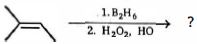
A
$2-$methylbutan$-2-$ol
B
$3-$methylbutan$-2-$ol
C
$2,3-$epoxy$-2-$methylbutane
D
$2-$methylbutan$-1-$ol
Solution
(B) The reaction is a hydroboration-oxidation of $2\text{-methylbut-2-ene}$.
Hydroboration-oxidation follows anti-Markovnikov addition of water ($H$ and $OH$) across the double bond.
In $2\text{-methylbut-2-ene}$ $(CH_3-C(CH_3)=CH-CH_3)$,the double bond is between $C_2$ and $C_3$.
The $OH$ group attaches to the less substituted carbon atom $(C_3)$,and the $H$ atom attaches to the more substituted carbon atom $(C_2)$.
This results in the formation of $3\text{-methylbutan-2-ol}$ as the major product.
Hydroboration-oxidation follows anti-Markovnikov addition of water ($H$ and $OH$) across the double bond.
In $2\text{-methylbut-2-ene}$ $(CH_3-C(CH_3)=CH-CH_3)$,the double bond is between $C_2$ and $C_3$.
The $OH$ group attaches to the less substituted carbon atom $(C_3)$,and the $H$ atom attaches to the more substituted carbon atom $(C_2)$.
This results in the formation of $3\text{-methylbutan-2-ol}$ as the major product.
0 likes
View Solution436
MediumMCQ
Which one of the following compounds gives acetone $(CH_3)_2C=O$ as one of the products of its ozonolysis?
A
$2-$methylpent$-1-$ene
B
$4-$methylpent$-2-$ene
C
$2-$methylpent$-2-$ene
D
isopropylidenecyclohexane
Solution
(D) Ozonolysis of an alkene involves the cleavage of the $C=C$ double bond to form carbonyl compounds. If the alkene has the structure $R_2C=CR'_2$,the products will be $R_2C=O$ and $R'_2C=O$.
To obtain acetone $(CH_3)_2C=O$,the starting alkene must contain an isopropylidene group,i.e.,$(CH_3)_2C=$ moiety.
Among the given options,isopropylidenecyclohexane has the structure where a cyclohexyl ring is double-bonded to a carbon atom that is also attached to two methyl groups.
Upon ozonolysis,the $C=C$ bond breaks to yield cyclohexanone and acetone $(CH_3)_2C=O$.
To obtain acetone $(CH_3)_2C=O$,the starting alkene must contain an isopropylidene group,i.e.,$(CH_3)_2C=$ moiety.
Among the given options,isopropylidenecyclohexane has the structure where a cyclohexyl ring is double-bonded to a carbon atom that is also attached to two methyl groups.
Upon ozonolysis,the $C=C$ bond breaks to yield cyclohexanone and acetone $(CH_3)_2C=O$.
0 likes
View Solution437
MediumMCQ
Addition of $HCl$ to $3,3$-dimethyl-$1$-butene yields two products,one of which has a rearranged carbon skeleton. Among the following carbocations,select the possible intermediates in that reaction:
$1.$ $(CH_3)_3C-C^+H-CH_3$
$2.$ $(CH_3)_3C-CH_2-C^+H_2$
$3.$ $(CH_3)_2C(Cl)-C^+(CH_3)_2$
$4.$ $(CH_3)_2C^+-CH(CH_3)_2$
$1.$ $(CH_3)_3C-C^+H-CH_3$
$2.$ $(CH_3)_3C-CH_2-C^+H_2$
$3.$ $(CH_3)_2C(Cl)-C^+(CH_3)_2$
$4.$ $(CH_3)_2C^+-CH(CH_3)_2$
A
$1, 2$
B
$1, 3$
C
$1, 4$
D
$2, 4$
Solution
(C) The reaction of $3,3$-dimethyl-$1$-butene with $HCl$ proceeds via carbocation intermediates.
First,protonation of the alkene double bond according to Markovnikov's rule gives a secondary carbocation: $(CH_3)_3C-C^+H-CH_3$ (Intermediate $1$).
This carbocation then undergoes a $1,2$-methyl shift from the adjacent quaternary carbon to form a more stable tertiary carbocation: $(CH_3)_2C^+-CH(CH_3)_2$ (Intermediate $4$).
Thus,the possible intermediates in the reaction are $1$ and $4$.
First,protonation of the alkene double bond according to Markovnikov's rule gives a secondary carbocation: $(CH_3)_3C-C^+H-CH_3$ (Intermediate $1$).
This carbocation then undergoes a $1,2$-methyl shift from the adjacent quaternary carbon to form a more stable tertiary carbocation: $(CH_3)_2C^+-CH(CH_3)_2$ (Intermediate $4$).
Thus,the possible intermediates in the reaction are $1$ and $4$.
0 likes
View Solution438
MediumMCQ
Conversion of cyclohexene to cyclohexanol can be conveniently achieved by
A
$NaOH + H_2O$
B
$Br_2 - H_2O$
C
hydroboration-oxidation
D
hydroboration hydrolysis
Solution
(C) The conversion of cyclohexene to cyclohexanol is an example of anti-Markovnikov hydration of an alkene.
This is achieved by the hydroboration-oxidation reaction,which involves the addition of $BH_3$ followed by oxidation with $H_2O_2$ in the presence of $OH^-$.
This process ensures the formation of the alcohol with high regioselectivity and syn-addition.
This is achieved by the hydroboration-oxidation reaction,which involves the addition of $BH_3$ followed by oxidation with $H_2O_2$ in the presence of $OH^-$.
This process ensures the formation of the alcohol with high regioselectivity and syn-addition.
0 likes
View Solution439
MediumMCQ
$trans$-cyclohexane-$1,2$-diol can be obtained by the reaction of cyclohexene with
A
$KMnO_4$
B
$OsO_4$
C
peroxyformic acid / $H_3O^+$
D
$SeO_2$
Solution
(C) The reaction of cyclohexene with peroxyformic acid $(HCO_3H)$ followed by acid-catalyzed hydrolysis $(H_3O^+)$ proceeds via the formation of an epoxide intermediate.
This process involves an anti-addition mechanism,which results in the formation of $trans$-cyclohexane-$1,2$-diol.
In contrast,reagents like $KMnO_4$ and $OsO_4$ perform syn-hydroxylation,yielding $cis$-cyclohexane-$1,2$-diol.
This process involves an anti-addition mechanism,which results in the formation of $trans$-cyclohexane-$1,2$-diol.
In contrast,reagents like $KMnO_4$ and $OsO_4$ perform syn-hydroxylation,yielding $cis$-cyclohexane-$1,2$-diol.
0 likes
View Solution440
MediumMCQ
Bromination of $(E)-2$-butenedioic acid gives:
A
$(2R, 3S)-2, 3$-dibromosuccinic acid
B
$(2R, 3R)-2, 3$-dibromosuccinic acid
C
a mixture of $(2R, 3R)$ and $(2S, 3S)-2, 3$-dibromosuccinic acid
D
$(2S, 3S)-2, 3$-dibromosuccinic acid
Solution
(C) The bromination of $(E)-2$-butenedioic acid (fumaric acid) proceeds via an anti-addition mechanism.
Since the starting material is a trans-alkene,anti-addition of bromine results in the formation of a racemic mixture of the $(2R, 3R)$ and $(2S, 3S)$ enantiomers of $2, 3$-dibromosuccinic acid.
Therefore,the correct option is $C$.
Since the starting material is a trans-alkene,anti-addition of bromine results in the formation of a racemic mixture of the $(2R, 3R)$ and $(2S, 3S)$ enantiomers of $2, 3$-dibromosuccinic acid.
Therefore,the correct option is $C$.
0 likes
View Solution441
MediumMCQ
The major product formed during the reaction of $1$-methylcyclopentene with $CH_3CO_3H$ is
A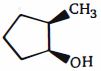
B
C
D
Solution
(C) The reaction of an alkene with a peroxyacid ($CH_3CO_3H$ is peroxyacetic acid) is an epoxidation reaction.
This reaction proceeds via a concerted mechanism to form an epoxide (oxirane) ring.
$1$-methylcyclopentene reacts with $CH_3CO_3H$ to yield $1$-methyl-$-1,2$-epoxycyclopentane as the major product.
This reaction proceeds via a concerted mechanism to form an epoxide (oxirane) ring.
$1$-methylcyclopentene reacts with $CH_3CO_3H$ to yield $1$-methyl-$-1,2$-epoxycyclopentane as the major product.
0 likes
View Solution442
MediumMCQ
The product $(P)$ is:
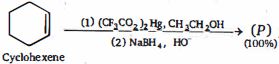
A
Cyclohexanol
B
Ethoxycyclohexane
C
Cyclohexane$-1,2-$diol
D
$1,2-$Diethoxycyclohexane
Solution
(B) The reaction shown is an alkoxymercuration-demercuration of cyclohexene using mercury$(II)$ trifluoroacetate,$(CF_3CO_2)_2Hg$,and ethanol,$CH_3CH_2OH$,followed by reduction with $NaBH_4$ in the presence of base $(HO^-)$.
This reaction follows Markovnikov's rule,where the alkoxy group $(-OCH_2CH_3)$ adds to the more substituted carbon of the double bond. Since cyclohexene is symmetric,the product formed is ethoxycyclohexane.
This reaction follows Markovnikov's rule,where the alkoxy group $(-OCH_2CH_3)$ adds to the more substituted carbon of the double bond. Since cyclohexene is symmetric,the product formed is ethoxycyclohexane.
0 likes
View Solution443
MediumMCQ
What is the major product expected from the following reaction?
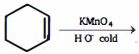
A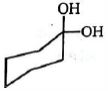
Cyclohexane$-1,1-$diol
B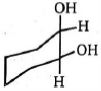
cis-Cyclohexane$-1,2-$diol
C
trans-Cyclohexane$-1,2-$diol
D
$2-$Hydroxycyclohexanone
Solution
(B) The reaction of cyclohexene with cold,dilute alkaline $KMnO_4$ (Baeyer's reagent) is a syn-hydroxylation reaction.
This process adds two hydroxyl $(-OH)$ groups to the same side of the double bond,resulting in the formation of a cis-diol.
Therefore,the major product is cis-cyclohexane$-1,2-$diol.
This process adds two hydroxyl $(-OH)$ groups to the same side of the double bond,resulting in the formation of a cis-diol.
Therefore,the major product is cis-cyclohexane$-1,2-$diol.
0 likes
View Solution444
MediumMCQ
$CH_3-CH=CH_2 \xrightarrow[{(low \, conc.)}]{Br_2/h\nu} (A)$; Product $(A)$ of the reaction is
A
$CH_3-CH(Br)-CH_2-Br$
B
$CH_2=CH-CH_2-Br$
C
$CH_3-C(Br)=CH_2$
D
$Br-CH_2-CH_2-CH_2-Br$
Solution
(B) The reaction of propene with $Br_2$ at low concentration in the presence of light $(h\nu)$ or high temperature follows a free radical substitution mechanism at the allylic position.
This is known as allylic bromination.
The hydrogen atom attached to the allylic carbon ($CH_3$ group in propene) is replaced by a bromine atom.
The product $(A)$ is allyl bromide: $CH_2=CH-CH_2-Br$.
This is known as allylic bromination.
The hydrogen atom attached to the allylic carbon ($CH_3$ group in propene) is replaced by a bromine atom.
The product $(A)$ is allyl bromide: $CH_2=CH-CH_2-Br$.
0 likes
View Solution445
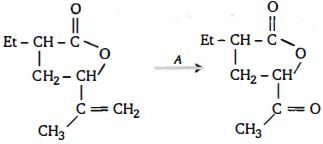
MediumMCQ
Reagent $(A)$ in the reaction is
A
$O_3 / Zn(H_2O)$
B
$HIO_4$
C
$CrO_3$
D
Cold dil. $KMnO_4$
Solution
(A) The reaction shows the conversion of an alkene group $(>C=CH_2)$ into a ketone group $(>C=O)$.
This transformation is a selective oxidation of the terminal double bond.
Ozonolysis $(O_3 / Zn(H_2O))$ typically cleaves the double bond to form carbonyl compounds.
However,in this specific structure,the reagent $CrO_3$ (Jones reagent or similar conditions) is often used for the selective oxidation of specific functional groups,but looking at the options provided,the transformation of an alkene to a ketone is characteristic of oxidative cleavage or specific oxidation reactions.
Given the options,$O_3 / Zn(H_2O)$ is the standard reagent for oxidative cleavage of alkenes to carbonyls.
This transformation is a selective oxidation of the terminal double bond.
Ozonolysis $(O_3 / Zn(H_2O))$ typically cleaves the double bond to form carbonyl compounds.
However,in this specific structure,the reagent $CrO_3$ (Jones reagent or similar conditions) is often used for the selective oxidation of specific functional groups,but looking at the options provided,the transformation of an alkene to a ketone is characteristic of oxidative cleavage or specific oxidation reactions.
Given the options,$O_3 / Zn(H_2O)$ is the standard reagent for oxidative cleavage of alkenes to carbonyls.
0 likes
View Solution446
MediumMCQ
What is the product of the following reaction?
$1,2-\text{dimethylcyclopentene} \xrightarrow[2. NaHSO_3]{1. OsO_4} \text{Product}$
$1,2-\text{dimethylcyclopentene} \xrightarrow[2. NaHSO_3]{1. OsO_4} \text{Product}$
A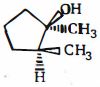
$A$
B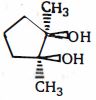
$B$
C
$C$
D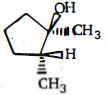
$D$
Solution
(C) The reaction of an alkene with $OsO_4$ followed by $NaHSO_3$ is a syn-dihydroxylation reaction.
This process adds two hydroxyl $(-OH)$ groups to the same side of the double bond,resulting in the formation of a cis-diol.
For $1,2-\text{dimethylcyclopentene}$,the two $-OH$ groups will be added to the same face of the cyclopentane ring,while the two methyl groups will be pushed to the opposite side.
Looking at the options,option $C$ represents the correct stereochemistry where both $-OH$ groups are on the same side (cis) and both $-CH_3$ groups are on the same side (cis).
This process adds two hydroxyl $(-OH)$ groups to the same side of the double bond,resulting in the formation of a cis-diol.
For $1,2-\text{dimethylcyclopentene}$,the two $-OH$ groups will be added to the same face of the cyclopentane ring,while the two methyl groups will be pushed to the opposite side.
Looking at the options,option $C$ represents the correct stereochemistry where both $-OH$ groups are on the same side (cis) and both $-CH_3$ groups are on the same side (cis).
0 likes
View Solution447
MediumMCQ
Which compound is a possible product from the addition of $Br_2$ to $but-1-ene$?
A
$1,1-$dibromobutane
B
$2,2-$dibromobutane
C
$1,4-$dibromobutane
D
$1,2-$dibromobutane
Solution
(D) The addition of $Br_2$ to an alkene like $but-1-ene$ $(CH_3-CH_2-CH=CH_2)$ is an electrophilic addition reaction.
This reaction proceeds via the formation of a cyclic bromonium ion intermediate.
The bromide ion $(Br^-)$ then attacks the more substituted carbon from the opposite side (anti-addition).
This results in the formation of a vicinal dibromide,specifically $1,2-dibromobutane$ $(CH_3-CH_2-CH(Br)-CH_2Br)$.
This reaction proceeds via the formation of a cyclic bromonium ion intermediate.
The bromide ion $(Br^-)$ then attacks the more substituted carbon from the opposite side (anti-addition).
This results in the formation of a vicinal dibromide,specifically $1,2-dibromobutane$ $(CH_3-CH_2-CH(Br)-CH_2Br)$.
0 likes
View Solution448
MediumMCQ
Addition of $Br_2$ to $cis$-$2$-butene would give a product which is
A
achiral
B
racemic
C
meso
D
optically active
Solution
(B) The addition of $Br_2$ to an alkene is an anti-addition reaction.
For $cis$-$2$-butene,the anti-addition of $Br_2$ results in the formation of a pair of enantiomers,which is a racemic mixture.
Specifically,the reaction produces $(2R, 3R)$-$2,3$-dibromobutane and $(2S, 3S)$-$2,3$-dibromobutane in equal amounts.
Therefore,the product is a racemic mixture.
For $cis$-$2$-butene,the anti-addition of $Br_2$ results in the formation of a pair of enantiomers,which is a racemic mixture.
Specifically,the reaction produces $(2R, 3R)$-$2,3$-dibromobutane and $(2S, 3S)$-$2,3$-dibromobutane in equal amounts.
Therefore,the product is a racemic mixture.
0 likes
View Solution449
MediumMCQ
Addition of $Br_2$ to $trans-2-butene$ would give a product which is
A
achiral
B
racemic
C
meso
D
optically active
Solution
(C) The addition of $Br_2$ to an alkene is an anti-addition reaction.
For $trans-2-butene$,the anti-addition of $Br_2$ results in the formation of a $meso$ compound.
This is because the resulting $2,3-dibromobutane$ molecule possesses a plane of symmetry $(POS)$,making it optically inactive despite having chiral centers.
For $trans-2-butene$,the anti-addition of $Br_2$ results in the formation of a $meso$ compound.
This is because the resulting $2,3-dibromobutane$ molecule possesses a plane of symmetry $(POS)$,making it optically inactive despite having chiral centers.
0 likes
View Solution450
MediumMCQ
Addition of $OsO_4$ to cyclopentene would give a product which is
A
achiral
B
racemic
C
meso
D
optically active
Solution
(C) The reaction of $OsO_4$ with cyclopentene is a syn-dihydroxylation reaction.
This process adds two hydroxyl $(-OH)$ groups to the same face of the double bond.
For cyclopentene,this results in the formation of $cis-1,2-cyclopentanediol$.
Since the molecule has an internal plane of symmetry,it is a $meso$ compound,which is achiral and optically inactive.
This process adds two hydroxyl $(-OH)$ groups to the same face of the double bond.
For cyclopentene,this results in the formation of $cis-1,2-cyclopentanediol$.
Since the molecule has an internal plane of symmetry,it is a $meso$ compound,which is achiral and optically inactive.
0 likes
View SolutionHydrocarbons — Alkene · Frequently Asked Questions
1Are these Hydrocarbons questions useful for JEE and NEET?
Yes. All questions in this section are mapped to JEE Main and NEET exam patterns. Previous year questions from JEE Main, NEET, GUJCET and state-level exams are included with full solutions.
2Can I switch to Hindi or Gujarati for these questions?
Yes. Use the language tabs in the hero section or the sidebar to view the same questions and solutions in English, Hindi or Gujarati.
3How do I generate a question paper from this subtopic?
Use the Vedclass Exam Paper Generator — select the chapter and subtopic, set difficulty, and generate Sets A, B, C, D automatically. First 3 chapters of every subject are free.
Vedclass Products
For Students
Vedclass Test Series
Mock tests in real JEE/NEET style with performance analysis. 5-day free trial.
Start Free TrialFor Teachers
Exam Paper Generator
Generate Set A/B/C/D papers from this chapter in 2 minutes. 3 chapters free.
Try FreeFor Institutes
Online Exam Module
Live online exams with unlimited students, 360° analytics & white-label branding.
See DemoFor Teachers & Institutes
Generate a Hydrocarbons Exam Paper in 2 Minutes
Select subtopic & difficulty — Sets A, B, C, D auto-generated with No Repeat logic.
First 3 chapters of every subject are free — no payment required.