
A English
Alkene Questions in English
Class 11 Chemistry · Hydrocarbons · Alkene
1080+
Questions
English
Language
100%
With Solutions
Showing 50 of 1080 questions in English
451
MediumMCQ
Addition of $BH_3$ followed by $H_2O_2$ to $trans-2-butene$ would give a product which is
A
achiral
B
racemic
C
meso
D
optically active
Solution
(B) The reaction of $trans-2-butene$ with $BH_3$ followed by $H_2O_2/OH^-$ is a hydroboration-oxidation process,which proceeds via $syn-addition$.
When $syn-addition$ of $OH$ and $H$ occurs across the double bond of $trans-2-butene$,it results in the formation of $butan-2-ol$.
Since the product $butan-2-ol$ has a chiral center,the reaction produces a pair of enantiomers in equal amounts,resulting in a $racemic$ mixture.
When $syn-addition$ of $OH$ and $H$ occurs across the double bond of $trans-2-butene$,it results in the formation of $butan-2-ol$.
Since the product $butan-2-ol$ has a chiral center,the reaction produces a pair of enantiomers in equal amounts,resulting in a $racemic$ mixture.
0 likes
View Solution452
MediumMCQ
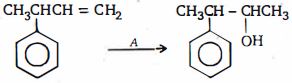
Reagent $A$ may be:
A
$H_2O/H^{+}$
B
$BH_3 \cdot THF/H_2O_2-OH^{-}$
C
$Hg(OCOCH_3)_2 \cdot H_2O/NaBH_4 \cdot NaOH$
D
All are possible
Solution
(C) The reaction shows the hydration of an alkene to form a secondary alcohol.
$1$. Acid-catalyzed hydration $(H_2O/H^{+})$ would involve a carbocation intermediate,which would rearrange to form a more stable benzylic carbocation,leading to a different product.
$2$. Hydroboration-oxidation $(BH_3 \cdot THF/H_2O_2-OH^{-})$ follows anti-Markovnikov addition,which would yield a primary alcohol.
$3$. Oxymercuration-demercuration $(Hg(OCOCH_3)_2 \cdot H_2O/NaBH_4 \cdot NaOH)$ follows Markovnikov's rule without carbocation rearrangement,yielding the observed secondary alcohol.
Therefore,the correct reagent is $(C)$.
$1$. Acid-catalyzed hydration $(H_2O/H^{+})$ would involve a carbocation intermediate,which would rearrange to form a more stable benzylic carbocation,leading to a different product.
$2$. Hydroboration-oxidation $(BH_3 \cdot THF/H_2O_2-OH^{-})$ follows anti-Markovnikov addition,which would yield a primary alcohol.
$3$. Oxymercuration-demercuration $(Hg(OCOCH_3)_2 \cdot H_2O/NaBH_4 \cdot NaOH)$ follows Markovnikov's rule without carbocation rearrangement,yielding the observed secondary alcohol.
Therefore,the correct reagent is $(C)$.
0 likes
View Solution453
MediumMCQ
The major product of the following reaction is $CH_3 - CH = CH_2 + HBr \xrightarrow{(C_6H_5CO)_2O_2}$
A
$CH_3 - CH_2 - CH_2 - Br$
B
$CH_3 - CH(Br) - CH_3$
C
$Br - CH_2 - CH = CH_2$
D
Cyclopropyl bromide
Solution
(A) The reaction of propene with $HBr$ in the presence of benzoyl peroxide $((C_6H_5CO)_2O_2)$ proceeds via a free radical mechanism.
This is known as the Kharasch effect or Peroxide effect.
According to this effect,the addition of $HBr$ to an unsymmetrical alkene follows Anti-Markovnikov's rule.
Therefore,the bromine atom attaches to the carbon atom with the greater number of hydrogen atoms.
The reaction is: $CH_3 - CH = CH_2 + HBr \xrightarrow{Peroxide} CH_3 - CH_2 - CH_2 - Br$ ($1$-bromopropane).
Thus,the correct option is $A$.
This is known as the Kharasch effect or Peroxide effect.
According to this effect,the addition of $HBr$ to an unsymmetrical alkene follows Anti-Markovnikov's rule.
Therefore,the bromine atom attaches to the carbon atom with the greater number of hydrogen atoms.
The reaction is: $CH_3 - CH = CH_2 + HBr \xrightarrow{Peroxide} CH_3 - CH_2 - CH_2 - Br$ ($1$-bromopropane).
Thus,the correct option is $A$.
0 likes
View Solution454
MediumMCQ
In methyl alcohol solution,bromine reacts with ethylene (ethene) to yield $BrCH_2CH_2OCH_3$ in addition to $1, 2-dibromoethane$ because
A
the methyl alcohol solvates the bromine
B
the ion formed initially may react with $Br^{-}$ or $CH_3OH$
C
this is a free radical reaction
D
the reaction follows Markovnikov's rule
Solution
(B) The reaction of bromine with ethene proceeds through the formation of a cyclic bromonium ion intermediate.
In a solvent like methyl alcohol $(CH_3OH)$,the cyclic bromonium ion can be attacked by either the bromide ion $(Br^-)$ or the solvent molecule $(CH_3OH)$ acting as a nucleophile.
Attack by $Br^-$ leads to the formation of $1, 2-dibromoethane$,while attack by $CH_3OH$ followed by deprotonation leads to the formation of $BrCH_2CH_2OCH_3$.
In a solvent like methyl alcohol $(CH_3OH)$,the cyclic bromonium ion can be attacked by either the bromide ion $(Br^-)$ or the solvent molecule $(CH_3OH)$ acting as a nucleophile.
Attack by $Br^-$ leads to the formation of $1, 2-dibromoethane$,while attack by $CH_3OH$ followed by deprotonation leads to the formation of $BrCH_2CH_2OCH_3$.
0 likes
View Solution455
MediumMCQ
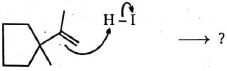
Taking into account the stability of various cycloalkanes and carbocations,as well as the rules governing mechanisms of carbocation rearrangements,what is the most likely product of this reaction?
A
$1-$iodo$-1-$methyl$-2-$isopropylcyclopentane
B
$1-$iodo$-1,2-$dimethylcyclohexane
C
$1-$iodo$-1-$methyl$-2-$ethylcyclopentane
D
$1-$iodo$-1,2,2-$trimethylcyclohexane
Solution
(B) The reaction proceeds via the electrophilic addition of $HI$ to the alkene.
$1$. Protonation of the double bond occurs to form the most stable carbocation. The initial carbocation formed is a secondary carbocation adjacent to a cyclopentyl ring.
$2$. To relieve ring strain and form a more stable tertiary carbocation,a ring expansion occurs,converting the five-membered ring into a six-membered ring.
$3$. The resulting tertiary carbocation is then attacked by the iodide ion $(I^-)$ to form the final product,which is $1$-iodo-$1,2$-dimethylcyclohexane.
$1$. Protonation of the double bond occurs to form the most stable carbocation. The initial carbocation formed is a secondary carbocation adjacent to a cyclopentyl ring.
$2$. To relieve ring strain and form a more stable tertiary carbocation,a ring expansion occurs,converting the five-membered ring into a six-membered ring.
$3$. The resulting tertiary carbocation is then attacked by the iodide ion $(I^-)$ to form the final product,which is $1$-iodo-$1,2$-dimethylcyclohexane.
0 likes
View Solution456
MediumMCQ
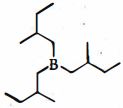
Which of the following compounds would yield the trialkylborane shown below when treated with $BH_3/THF$?
A
$2$-methylbut-$1$-ene
B
$2$-methylbut-$2$-ene
C
$3$-methylbut-$1$-ene
D
$3$-methylbut-$1$-yne
Solution
(A) Hydroboration-oxidation of alkenes with $BH_3/THF$ follows anti-Markovnikov addition,where the boron atom attaches to the less substituted carbon atom of the double bond.
The product shown is tris($2$-methylbutyl)borane,which contains three $2$-methylbutyl groups attached to the boron atom.
This indicates that the starting alkene must be $2$-methylbut-$1$-ene $(CH_2=C(CH_3)CH_2CH_3)$.
Upon reaction with $BH_3$,the boron atom adds to the terminal $CH_2$ group,resulting in the formation of the trialkylborane derivative shown.
The product shown is tris($2$-methylbutyl)borane,which contains three $2$-methylbutyl groups attached to the boron atom.
This indicates that the starting alkene must be $2$-methylbut-$1$-ene $(CH_2=C(CH_3)CH_2CH_3)$.
Upon reaction with $BH_3$,the boron atom adds to the terminal $CH_2$ group,resulting in the formation of the trialkylborane derivative shown.
0 likes
View Solution457
MediumMCQ
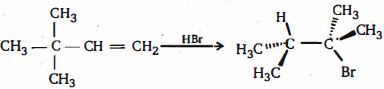
Consider the addition of $HBr$ to $3,3$-Dimethyl-$1$-butene shown below. What is the best mechanistic explanation for the formation of the observed product?
A
Protonation of the alkene followed by a hydride shift and addition of bromide to the carbocation
B
Double bond shift in the alkene following by the protonation and addition of bromide to the carbocation
C
Addition of bromide to the alkene followed by a double bond shift and protonation
D
Protonation of the alkene followed by a methyl shift and addition of bromide to the carbocation
Solution
(D) The reaction proceeds via the following steps:
$1$. Protonation of the alkene ($3,3$-Dimethyl-$1$-butene) by $HBr$ occurs to form a secondary carbocation $(CH_3-C(CH_3)_2-CH^+-CH_3)$.
$2$. This secondary carbocation undergoes a $1,2$-methyl shift to form a more stable tertiary carbocation $(CH_3-C^+(CH_3)-CH(CH_3)_2)$.
$3$. Finally,the bromide ion $(Br^-)$ attacks the tertiary carbocation to yield the final product,$2$-bromo-$2,3$-dimethylbutane.
$1$. Protonation of the alkene ($3,3$-Dimethyl-$1$-butene) by $HBr$ occurs to form a secondary carbocation $(CH_3-C(CH_3)_2-CH^+-CH_3)$.
$2$. This secondary carbocation undergoes a $1,2$-methyl shift to form a more stable tertiary carbocation $(CH_3-C^+(CH_3)-CH(CH_3)_2)$.
$3$. Finally,the bromide ion $(Br^-)$ attacks the tertiary carbocation to yield the final product,$2$-bromo-$2,3$-dimethylbutane.
0 likes
View Solution458
MediumMCQ
Propene $CH_3CH=CH_2$ can be converted into propan$-1-$ol by oxidation. Indicate which set of reagents amongst the following is ideal to effect the above conversion?
A
$KMnO_4$ (alkaline)
B
Osmium tetroxide $(OsO_4/CH_2Cl_2)$
C
$B_2H_6$ and alkaline $H_2O_2$
D
$O_3/Zn$
Solution
(C) The conversion of propene $(CH_3CH=CH_2)$ to propan$-1-$ol $(CH_3CH_2CH_2OH)$ is an anti-Markovnikov hydration reaction.
This transformation is achieved via the hydroboration-oxidation process.
In the first step,diborane $(B_2H_6)$ adds to the double bond,and in the second step,oxidation with alkaline hydrogen peroxide $(H_2O_2/OH^-)$ yields the primary alcohol.
Therefore,the correct set of reagents is $B_2H_6$ and alkaline $H_2O_2$.
This transformation is achieved via the hydroboration-oxidation process.
In the first step,diborane $(B_2H_6)$ adds to the double bond,and in the second step,oxidation with alkaline hydrogen peroxide $(H_2O_2/OH^-)$ yields the primary alcohol.
Therefore,the correct set of reagents is $B_2H_6$ and alkaline $H_2O_2$.
0 likes
View Solution459
MediumMCQ
The principal organic product formed in the reaction given below is
$CH_2 = CH(CH_2)_8COOH + HBr \xrightarrow{\text{peroxide}} ....$
$CH_2 = CH(CH_2)_8COOH + HBr \xrightarrow{\text{peroxide}} ....$
A
$CH_3-CHBr(CH_2)_8COOH$
B
$CH_2 = CH(CH_2)_8COBr$
C
$BrCH_2-CH_2(CH_2)_8COOH$
D
$CH_2 = CH(CH_2)_7CHBrCOOH$
Solution
(C) The reaction involves the addition of $HBr$ to an alkene in the presence of a peroxide,which follows the Anti-Markovnikov addition rule (Kharasch effect).
In this mechanism,the $Br^{\bullet}$ radical attacks the terminal carbon atom of the double bond to form a more stable secondary radical.
Consequently,the hydrogen atom attaches to the internal carbon atom.
The final product is $BrCH_2-CH_2(CH_2)_8COOH$.
In this mechanism,the $Br^{\bullet}$ radical attacks the terminal carbon atom of the double bond to form a more stable secondary radical.
Consequently,the hydrogen atom attaches to the internal carbon atom.
The final product is $BrCH_2-CH_2(CH_2)_8COOH$.
0 likes
View Solution460
MediumMCQ
Which of the following alkenes gives both $cis$ and $trans$ isomers upon catalytic hydrogenation?
A
$4-$methylmethylenecyclohexane
B
$1,4-$dimethylcyclohex$-1-$ene
C
$3,3,6-$trimethylcyclohex$-1-$ene
D
All of these
Solution
(D) Catalytic hydrogenation $(H_2/Ni)$ of alkenes involves the syn-addition of hydrogen across the double bond.
$(a)$ $4-$methylmethylenecyclohexane on hydrogenation yields both $cis-1,4-$dimethylcyclohexane and $trans-1,4-$dimethylcyclohexane due to the approach of $H_2$ from either face of the ring.
$(b)$ $1,4-$dimethylcyclohex$-1-$ene similarly yields both $cis$ and $trans$ isomers of $1,4-$dimethylcyclohexane.
$(c)$ $3,3,6-$trimethylcyclohex$-1-$ene also produces stereoisomeric products upon hydrogenation.
Since all the given alkenes can produce $cis$ and $trans$ isomers (or diastereomers) upon catalytic hydrogenation, the correct answer is 'All of these'.
$(a)$ $4-$methylmethylenecyclohexane on hydrogenation yields both $cis-1,4-$dimethylcyclohexane and $trans-1,4-$dimethylcyclohexane due to the approach of $H_2$ from either face of the ring.
$(b)$ $1,4-$dimethylcyclohex$-1-$ene similarly yields both $cis$ and $trans$ isomers of $1,4-$dimethylcyclohexane.
$(c)$ $3,3,6-$trimethylcyclohex$-1-$ene also produces stereoisomeric products upon hydrogenation.
Since all the given alkenes can produce $cis$ and $trans$ isomers (or diastereomers) upon catalytic hydrogenation, the correct answer is 'All of these'.
0 likes
View Solution461
MediumMCQ
In the reaction of hydrogen bromide with an alkene (in the absence of peroxides),the first step of the reaction is the ................. to the alkene.
A
fast addition of an electrophilic
B
slow addition of an electrophile
C
fast addition of a nucleophilic
D
slow addition of a nucleophile
Solution
(B) The reaction of $HBr$ with an alkene follows electrophilic addition mechanism.
The first step involves the attack of the electrophile $(H^+)$ on the double bond of the alkene to form a carbocation.
This step is the rate-determining step because it involves the breaking of the $\pi$-bond and is therefore a slow step.
Thus,the correct answer is the slow addition of an electrophile.
The first step involves the attack of the electrophile $(H^+)$ on the double bond of the alkene to form a carbocation.
This step is the rate-determining step because it involves the breaking of the $\pi$-bond and is therefore a slow step.
Thus,the correct answer is the slow addition of an electrophile.
0 likes
View Solution462
MediumMCQ
Which of the species shown below is the most stable form of the intermediate in the electrophilic addition of $Cl_2$ in water to cyclohexene to form a halohydrin?
A
B
C
D
Solution
(D) In the electrophilic addition of $Cl_2$ to an alkene,the first step involves the formation of a cyclic halonium ion intermediate. For cyclohexene,the reaction with $Cl_2$ leads to the formation of a cyclic chloronium ion. This species is more stable than a simple open-chain carbocation because the lone pair on the chlorine atom can be donated into the empty $p$-orbital of the carbocation,effectively delocalizing the positive charge. Therefore,the cyclic chloronium ion is the most stable intermediate.
0 likes
View Solution463
MediumMCQ
The reaction,$(CH_3)_2C = CH_2 + Br^{\bullet} \to (CH_3)_2 C^{\bullet} - CH_2Br$ is an example of a/an ................ step in a radical chain reaction.
A
initiation
B
termination
C
propagation
D
heterolytic cleavage
Solution
(C) The given reaction involves the attack of a free radical $(Br^{\bullet})$ on an alkene to form a new carbon-centered radical.
In a radical chain reaction,a step that consumes one radical and produces another radical is known as a propagation step.
Therefore,the correct answer is $(C)$.
In a radical chain reaction,a step that consumes one radical and produces another radical is known as a propagation step.
Therefore,the correct answer is $(C)$.
0 likes
View Solution464
MediumMCQ
An optically active compound $A$ with molecular formula $C_8H_{14}$ undergoes catalytic hydrogenation to give a meso compound. The structure of $(A)$ is:
A
$1,2-$dimethylcyclohex$-1-$ene
B
cis$-3,5-$dimethylcyclohex$-1-$ene
C
$1-$ethylcyclohex$-1-$ene
D
trans$-3,5-$dimethylcyclohex$-1-$ene
Solution
(B) The catalytic hydrogenation of an alkene using $H_2/Pt$ is a syn-addition reaction.
For the product to be a meso compound,the starting alkene must be capable of forming a molecule with a plane of symmetry upon the addition of two hydrogen atoms to the same side of the double bond.
Among the given options,cis$-3,5-$dimethylcyclohex$-1-$ene is optically active due to the absence of a plane of symmetry in the alkene.
Upon catalytic hydrogenation,the two hydrogen atoms add to the same face of the double bond,resulting in cis$-1,3-$dimethylcyclohexane,which possesses a plane of symmetry $(POS)$ and is therefore a meso compound.
Thus,the correct structure is cis$-3,5-$dimethylcyclohex$-1-$ene.
For the product to be a meso compound,the starting alkene must be capable of forming a molecule with a plane of symmetry upon the addition of two hydrogen atoms to the same side of the double bond.
Among the given options,cis$-3,5-$dimethylcyclohex$-1-$ene is optically active due to the absence of a plane of symmetry in the alkene.
Upon catalytic hydrogenation,the two hydrogen atoms add to the same face of the double bond,resulting in cis$-1,3-$dimethylcyclohexane,which possesses a plane of symmetry $(POS)$ and is therefore a meso compound.
Thus,the correct structure is cis$-3,5-$dimethylcyclohex$-1-$ene.
0 likes
View Solution465
MediumMCQ
How many products will be formed in the reaction shown below?
$CH_3-CH_2-C(CH_3)=C(CH_3)-CH_2-CH_3 + HBr \xrightarrow{R_2O_2} \text{Products}$
$CH_3-CH_2-C(CH_3)=C(CH_3)-CH_2-CH_3 + HBr \xrightarrow{R_2O_2} \text{Products}$
A
$2$
B
$4$
C
$3$
D
$6$
Solution
(B) The reaction is the anti-Markovnikov addition of $HBr$ to an alkene in the presence of peroxide $(R_2O_2)$.
The reactant is $3,4$-dimethylhex-$3$-ene.
Upon addition of $HBr$ via a free radical mechanism,the bromine radical adds to one of the carbons of the double bond,and the hydrogen adds to the other.
This creates two chiral centers in the product,$3$-bromo-$3,4$-dimethylhexane.
Since there are two chiral centers,there are $2^n = 2^2 = 4$ possible stereoisomers (optical isomers) formed as products.
These are the $(R,R)$,$(S,S)$,$(R,S)$,and $(S,R)$ configurations.
The reactant is $3,4$-dimethylhex-$3$-ene.
Upon addition of $HBr$ via a free radical mechanism,the bromine radical adds to one of the carbons of the double bond,and the hydrogen adds to the other.
This creates two chiral centers in the product,$3$-bromo-$3,4$-dimethylhexane.
Since there are two chiral centers,there are $2^n = 2^2 = 4$ possible stereoisomers (optical isomers) formed as products.
These are the $(R,R)$,$(S,S)$,$(R,S)$,and $(S,R)$ configurations.
0 likes
View Solution466
MediumMCQ
cis-$2$-butene $\xrightarrow{HBr/\text{Peroxide}}$ product; Product of the reaction is:
A
Racemic
B
Diastereomer
C
Meso
D
$E$ and $Z$ isomers
Solution
(A) The reaction of cis-$2$-butene with $HBr$ in the presence of peroxide follows a free radical addition mechanism.
First,the peroxide generates a bromine radical $(Br^{\bullet})$.
This radical adds to the double bond of cis-$2$-butene to form a secondary alkyl radical intermediate $(CH_3-CH^{\bullet}-CH(Br)-CH_3)$.
Since the radical carbon is $sp^2$ hybridized and planar,the hydrogen atom can abstract from either side of the radical center with equal probability.
This leads to the formation of both $(R)$-$2$-bromobutane and $(S)$-$2$-bromobutane in equal amounts.
$A$ $50:50$ mixture of enantiomers is known as a racemic mixture.
First,the peroxide generates a bromine radical $(Br^{\bullet})$.
This radical adds to the double bond of cis-$2$-butene to form a secondary alkyl radical intermediate $(CH_3-CH^{\bullet}-CH(Br)-CH_3)$.
Since the radical carbon is $sp^2$ hybridized and planar,the hydrogen atom can abstract from either side of the radical center with equal probability.
This leads to the formation of both $(R)$-$2$-bromobutane and $(S)$-$2$-bromobutane in equal amounts.
$A$ $50:50$ mixture of enantiomers is known as a racemic mixture.
0 likes
View Solution467
MediumMCQ
The product $A$ of the following reaction is:
$R_2C=CHR' \xrightarrow[Zn/H_2O]{O_3} A$
$R_2C=CHR' \xrightarrow[Zn/H_2O]{O_3} A$
A
$R_2C=O$
B
$R'-CHO$
C
$R_2C=O + R'-CHO$
D
$R_2C(OH)_2$
Solution
(C) The reductive ozonolysis of an alkene with the structure $R_2C=CHR'$ involves the cleavage of the carbon-carbon double bond.
The reaction proceeds via the formation of an ozonide intermediate,which is then reduced by $Zn/H_2O$ or dimethyl sulfide to yield carbonyl compounds.
The cleavage of $R_2C=CHR'$ results in the formation of a ketone $(R_2C=O)$ and an aldehyde $(R'-CHO)$.
Therefore,the product $A$ is a mixture of $R_2C=O$ and $R'-CHO$.
The reaction proceeds via the formation of an ozonide intermediate,which is then reduced by $Zn/H_2O$ or dimethyl sulfide to yield carbonyl compounds.
The cleavage of $R_2C=CHR'$ results in the formation of a ketone $(R_2C=O)$ and an aldehyde $(R'-CHO)$.
Therefore,the product $A$ is a mixture of $R_2C=O$ and $R'-CHO$.
0 likes
View Solution468
MediumMCQ
The product of the following reaction is:
$CH_3-CH=CH-CH_3 \xrightarrow{MCPBA, CH_2Cl_2} \text{Product}$
$CH_3-CH=CH-CH_3 \xrightarrow{MCPBA, CH_2Cl_2} \text{Product}$
A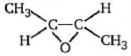
B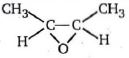
C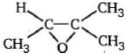
D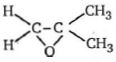
Solution
(B) The reaction of an alkene with $MCPBA$ (meta-chloroperbenzoic acid) in $CH_2Cl_2$ is an epoxidation reaction.
This reaction is stereospecific,meaning the stereochemistry of the starting alkene is preserved in the product.
Since the starting material is $cis-but-2-ene$,the product will be $cis-2,3-dimethyloxirane$ (cis-epoxide).
Therefore,the correct product is the one where the two methyl groups are on the same side of the epoxide ring.
This reaction is stereospecific,meaning the stereochemistry of the starting alkene is preserved in the product.
Since the starting material is $cis-but-2-ene$,the product will be $cis-2,3-dimethyloxirane$ (cis-epoxide).
Therefore,the correct product is the one where the two methyl groups are on the same side of the epoxide ring.
0 likes
View Solution469
MediumMCQ
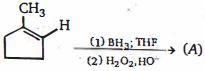
What is the product of the following reaction?
A
$1-$methylcyclopentanol (trans-isomer)
B
$2-$methylcyclopentanol (cis-isomer)
C
$2-$methylcyclopentanol (trans-isomer)
D
$1,2-$dimethylcyclopentanol
Solution
(B) The reaction is a hydroboration-oxidation of $1$-methylcyclopentene.
Hydroboration-oxidation is a syn-addition reaction that follows anti-Markovnikov regioselectivity.
In $1$-methylcyclopentene,the double bond is between $C_1$ and $C_2$.
The $OH$ group adds to the less substituted carbon $(C_2)$ and the $H$ atom adds to the more substituted carbon $(C_1)$.
Since it is a syn-addition,both the $H$ and $OH$ add from the same face of the ring.
Therefore,the product is $2$-methylcyclopentanol where the $H$ at $C_1$ and the $OH$ at $C_2$ are cis to each other.
This corresponds to the cis-isomer of $2$-methylcyclopentanol.
Hydroboration-oxidation is a syn-addition reaction that follows anti-Markovnikov regioselectivity.
In $1$-methylcyclopentene,the double bond is between $C_1$ and $C_2$.
The $OH$ group adds to the less substituted carbon $(C_2)$ and the $H$ atom adds to the more substituted carbon $(C_1)$.
Since it is a syn-addition,both the $H$ and $OH$ add from the same face of the ring.
Therefore,the product is $2$-methylcyclopentanol where the $H$ at $C_1$ and the $OH$ at $C_2$ are cis to each other.
This corresponds to the cis-isomer of $2$-methylcyclopentanol.
0 likes
View Solution470
MediumMCQ
$CH_3 - CH = CH_2 \xrightarrow[(2) CH_3CO_2T]{(1) THF : BD_3} (A)$; Product $(A)$ of the above reaction is
A
$CH_3 - CHD - CH_2D$
B
$CH_3 - CHT - CH_2T$
C
$CH_3 - CHD - CH_2T$
D
$CH_3 - CHT - CH_2D$
Solution
(C) The reaction is a hydroboration-oxidation (or reduction) sequence using $BD_3$ and $CH_3CO_2T$.
Step $1$: Hydroboration of propene with $BD_3$ in $THF$ follows anti-Markovnikov addition,where $D$ adds to the more substituted carbon and $B$ adds to the less substituted carbon,forming $(CH_3-CH(D)-CH_2)_3B$.
Step $2$: Treatment with $CH_3CO_2T$ (deuterated acetic acid) replaces the boron atom with a tritium $(T)$ atom via protodeboronation.
Therefore,the final product $(A)$ is $CH_3-CHD-CH_2T$.
Step $1$: Hydroboration of propene with $BD_3$ in $THF$ follows anti-Markovnikov addition,where $D$ adds to the more substituted carbon and $B$ adds to the less substituted carbon,forming $(CH_3-CH(D)-CH_2)_3B$.
Step $2$: Treatment with $CH_3CO_2T$ (deuterated acetic acid) replaces the boron atom with a tritium $(T)$ atom via protodeboronation.
Therefore,the final product $(A)$ is $CH_3-CHD-CH_2T$.
0 likes
View Solution471
MediumMCQ
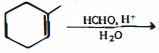
The major product of this reaction is:
A
$1-$methylcyclohexane$-1,2-$diol
B
$2-$($1$-methylcyclohexyl)ethanol
C
($1$-methylcyclohexyl)methanol
D
$1-$methyl$-2-$(hydroxymethyl)cyclohexan$-1-$ol
Solution
(D) The reaction is a Prins reaction,which involves the electrophilic addition of an aldehyde (in this case,formaldehyde,$HCHO$) to an alkene in the presence of an acid catalyst $(H^+)$.
$1$. The protonated formaldehyde acts as an electrophile and attacks the double bond of $1$-methylcyclohexene to form a carbocation intermediate.
$2$. The carbocation is then attacked by water $(H_2O)$ to form the final product,which is $1$-methyl-$2$-(hydroxymethyl)cyclohexan-$1$-ol.
$1$. The protonated formaldehyde acts as an electrophile and attacks the double bond of $1$-methylcyclohexene to form a carbocation intermediate.
$2$. The carbocation is then attacked by water $(H_2O)$ to form the final product,which is $1$-methyl-$2$-(hydroxymethyl)cyclohexan-$1$-ol.
0 likes
View Solution472
MediumMCQ
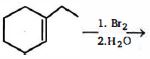
Choose the correct product of this reaction:
A
$1-$ethyl$-1,2-$dibromocyclohexane
B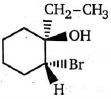
$2-$bromo$-1-$ethylcyclohexan$-1-$ol
C
$1-$bromo$-1-$ethylcyclohexene
D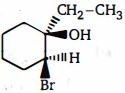
$1-$ethyl$-2-$bromocyclohexan$-1-$ol
Solution
(B) The reaction of an alkene with $Br_2$ in the presence of $H_2O$ is a halohydrin formation reaction.
This reaction proceeds through the formation of a cyclic bromonium ion intermediate.
Water acts as a nucleophile and attacks the more substituted carbon atom of the bromonium ion due to its higher partial positive charge.
This results in an anti-addition of the $-Br$ and $-OH$ groups across the double bond.
For the given substrate,$1$-ethylcyclohexene,the $-OH$ group will attach to the carbon bearing the ethyl group,and the $-Br$ atom will attach to the adjacent carbon,resulting in the formation of $2-$bromo$-1-$ethylcyclohexan$-1-$ol.
This reaction proceeds through the formation of a cyclic bromonium ion intermediate.
Water acts as a nucleophile and attacks the more substituted carbon atom of the bromonium ion due to its higher partial positive charge.
This results in an anti-addition of the $-Br$ and $-OH$ groups across the double bond.
For the given substrate,$1$-ethylcyclohexene,the $-OH$ group will attach to the carbon bearing the ethyl group,and the $-Br$ atom will attach to the adjacent carbon,resulting in the formation of $2-$bromo$-1-$ethylcyclohexan$-1-$ol.
0 likes
View Solution473
MediumMCQ
What is the product of the following reaction?
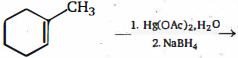
A
$1-$methylcyclohexanol (trans-isomer)
B
$1-$methylcyclohexene
C
$1,1-$dimethylcyclohexanol
D
$1-$methylcyclohexanol (cis-isomer)
Solution
(A) The reaction sequence $1. \text{Hg(OAc)}_2, \text{H}_2\text{O}; 2. \text{NaBH}_4$ is the Oxymercuration-Demercuration process.
This reaction involves the anti-addition of $\text{H}$ and $\text{OH}$ across the double bond,following Markovnikov's rule.
For $1$-methylcyclohexene,the $\text{OH}$ group adds to the more substituted carbon (the one with the methyl group),resulting in $1$-methylcyclohexanol.
Since the addition is anti,the $\text{OH}$ and $\text{H}$ add from opposite faces,resulting in the formation of $1$-methylcyclohexanol where the $\text{OH}$ and $\text{CH}_3$ groups are in a specific stereochemical relationship.
Based on the provided options,the correct product is $1$-methylcyclohexanol.
This reaction involves the anti-addition of $\text{H}$ and $\text{OH}$ across the double bond,following Markovnikov's rule.
For $1$-methylcyclohexene,the $\text{OH}$ group adds to the more substituted carbon (the one with the methyl group),resulting in $1$-methylcyclohexanol.
Since the addition is anti,the $\text{OH}$ and $\text{H}$ add from opposite faces,resulting in the formation of $1$-methylcyclohexanol where the $\text{OH}$ and $\text{CH}_3$ groups are in a specific stereochemical relationship.
Based on the provided options,the correct product is $1$-methylcyclohexanol.
0 likes
View Solution474
MediumMCQ
Choose the correct product of the following reaction:
$1$,$2$-dimethylcyclopent$-1-$ene $\xrightarrow[2. H_3O^+]{1. mCPBA}$ Product
$1$,$2$-dimethylcyclopent$-1-$ene $\xrightarrow[2. H_3O^+]{1. mCPBA}$ Product
A
$1,2-$dimethylcyclopentane$-1,2-$diol (cis-isomer)
B
$1,2-$dimethylcyclopentane$-1,2-$diol (trans-isomer)
C
$1,2-$dimethylcyclopentane$-1,2-$diol (mixture of cis and trans)
D
None of these
Solution
(B) The reaction of an alkene with a peroxyacid (like $mCPBA$) followed by acid-catalyzed hydrolysis $(H_3O^+)$ is a two-step process that results in anti-dihydroxylation.
$1$. The alkene reacts with $mCPBA$ to form an epoxide.
$2$. The epoxide undergoes acid-catalyzed ring opening by water,which proceeds via an $S_N2$-like mechanism,leading to the anti-addition of two hydroxyl groups.
For $1,2-dimethylcyclopent-1-ene$,this results in the formation of the trans$-1,2-$dimethylcyclopentane$-1,2-$diol.
$1$. The alkene reacts with $mCPBA$ to form an epoxide.
$2$. The epoxide undergoes acid-catalyzed ring opening by water,which proceeds via an $S_N2$-like mechanism,leading to the anti-addition of two hydroxyl groups.
For $1,2-dimethylcyclopent-1-ene$,this results in the formation of the trans$-1,2-$dimethylcyclopentane$-1,2-$diol.
0 likes
View Solution475
MediumMCQ
Identify $(Z)$ in the above sequence of reactions:
$CH_3-CH_2-CH=CH_2$ $\xrightarrow{HCl/\text{peroxide}} (A)$ $\xrightarrow{EtONa/\Delta} (Z) \text{ (major)}$
$CH_3-CH_2-CH=CH_2$ $\xrightarrow{HCl/\text{peroxide}} (A)$ $\xrightarrow{EtONa/\Delta} (Z) \text{ (major)}$
A
$CH_3-CH_2-CH=CH_2$
B
$CH_3-CH=CH-CH_3$
C
$CH_3-CH_2-CH_2-CH_2-OEt$
D
$CH_3-CH_2-CH(CH_3)-OEt$
Solution
(B) The reaction sequence is as follows:
$1$. The starting material is but$-1-$ene $(CH_3-CH_2-CH=CH_2)$.
$2$. The addition of $HCl$ in the presence of peroxide is a radical addition. However,$HCl$ does not undergo anti-Markovnikov addition with peroxide because the $H-Cl$ bond is too strong to be cleaved by radicals. Thus,it follows Markovnikov's rule,yielding $2-$chlorobutane $(CH_3-CH_2-CHCl-CH_3)$ as $(A)$.
$3$. The reaction of $(A)$ $(CH_3-CH_2-CHCl-CH_3)$ with $EtONa/\Delta$ (a strong base) undergoes an $E2$ elimination reaction.
$4$. According to Zaitsev's rule,the more substituted alkene is the major product. Thus,but$-2-$ene $(CH_3-CH=CH-CH_3)$ is formed as the major product $(Z)$.
$1$. The starting material is but$-1-$ene $(CH_3-CH_2-CH=CH_2)$.
$2$. The addition of $HCl$ in the presence of peroxide is a radical addition. However,$HCl$ does not undergo anti-Markovnikov addition with peroxide because the $H-Cl$ bond is too strong to be cleaved by radicals. Thus,it follows Markovnikov's rule,yielding $2-$chlorobutane $(CH_3-CH_2-CHCl-CH_3)$ as $(A)$.
$3$. The reaction of $(A)$ $(CH_3-CH_2-CHCl-CH_3)$ with $EtONa/\Delta$ (a strong base) undergoes an $E2$ elimination reaction.
$4$. According to Zaitsev's rule,the more substituted alkene is the major product. Thus,but$-2-$ene $(CH_3-CH=CH-CH_3)$ is formed as the major product $(Z)$.
0 likes
View Solution476
MediumMCQ
$CH_3-CH(CO_2K)-CH(CO_2K)-CH_3 \xrightarrow{\text{electrolysis}} (A) \text{ (Major)}$
The major product $(A)$ of the above reaction is:
The major product $(A)$ of the above reaction is:
A
cis-But$-2-$ene
B
But$-1-$ene
C
trans-But$-2-$ene
D
Butane
Solution
(C) In Kolbe's electrolysis,the electrolysis of potassium salts of vicinal dicarboxylic acids results in the formation of an alkene.
The reaction proceeds via a free radical mechanism:
$CH_3-CH(CO_2K)-CH(CO_2K)-CH_3 \xrightarrow{\text{electrolysis}} CH_3-CH=CH-CH_3 + 2CO_2 + H_2 + 2KOH$
Between the possible geometric isomers,the trans-isomer is more stable due to reduced steric hindrance between the methyl groups.
Thus,the major product is trans-But$-2-$ene.
The reaction proceeds via a free radical mechanism:
$CH_3-CH(CO_2K)-CH(CO_2K)-CH_3 \xrightarrow{\text{electrolysis}} CH_3-CH=CH-CH_3 + 2CO_2 + H_2 + 2KOH$
Between the possible geometric isomers,the trans-isomer is more stable due to reduced steric hindrance between the methyl groups.
Thus,the major product is trans-But$-2-$ene.
0 likes
View Solution477
MediumMCQ
In the reaction $Me-C \equiv C-Et$ $\xrightarrow{Na/liq. NH_3} P$ $\xrightarrow[CCl_4]{Br_2} (Q)$; then $Q$ is
A
$A$ pure compound which is optically inactive due to internal compensation
B
$A$ binary mixture which is optically inactive due to external compensation
C
$A$ binary mixture which is optically active
D
$A$ pure compound which is optically inactive due to absence of chiral centre
Solution
(B) $1$. The reduction of $Me-C \equiv C-Et$ with $Na/liq. NH_3$ (Birch reduction/dissolving metal reduction) yields the trans-alkene,$trans-pent-2-ene$ $(P)$.
$2$. The subsequent reaction of $trans-pent-2-ene$ with $Br_2$ in $CCl_4$ proceeds via anti-addition.
$3$. Anti-addition of $Br_2$ to a trans-alkene results in the formation of a pair of enantiomers,which constitutes a racemic mixture.
$4$. $A$ racemic mixture is optically inactive due to external compensation,as the optical rotation of one enantiomer is cancelled by the equal and opposite rotation of the other.
$2$. The subsequent reaction of $trans-pent-2-ene$ with $Br_2$ in $CCl_4$ proceeds via anti-addition.
$3$. Anti-addition of $Br_2$ to a trans-alkene results in the formation of a pair of enantiomers,which constitutes a racemic mixture.
$4$. $A$ racemic mixture is optically inactive due to external compensation,as the optical rotation of one enantiomer is cancelled by the equal and opposite rotation of the other.
0 likes
View Solution478
MediumMCQ
Which $\pi$-bond will be reduced first when the compound shown below undergoes catalytic hydrogenation?
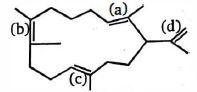
A
$a$
B
$b$
C
$c$
D
$d$
Solution
(D) The rate of catalytic hydrogenation of alkenes is inversely proportional to their stability.
More substituted alkenes are more stable and thus react more slowly.
Comparing the substitution of the double bonds:
- Bond $a$: Trisubstituted alkene.
- Bond $b$: Trisubstituted alkene.
- Bond $c$: Trisubstituted alkene.
- Bond $d$: Monosubstituted (terminal) alkene.
Since the monosubstituted alkene $(d)$ is the least substituted and therefore the least stable,it will undergo catalytic hydrogenation most readily (first).
More substituted alkenes are more stable and thus react more slowly.
Comparing the substitution of the double bonds:
- Bond $a$: Trisubstituted alkene.
- Bond $b$: Trisubstituted alkene.
- Bond $c$: Trisubstituted alkene.
- Bond $d$: Monosubstituted (terminal) alkene.
Since the monosubstituted alkene $(d)$ is the least substituted and therefore the least stable,it will undergo catalytic hydrogenation most readily (first).
0 likes
View Solution479
MediumMCQ
Which of the following reactions generates the major product shown?
A
$1-$methylcyclohexene + $HBr$ $\rightarrow$ $1-$bromo$-2-$methylcyclohexane
B
$1-$methylcyclohexene $\xrightarrow{(1) Hg(OAc)_2, H_2O, THF \ (2) NaBH_4}$ $2-$methylcyclohexanol
C
$1-$methylcyclohexene $\xrightarrow{(1) BH_3 \ (2) OH^-, H_2O_2, H_2O}$ $1-$methylcyclohexanol
D
$1-$methylcyclohexene $\xrightarrow{H_2O, H_2SO_4}$ $1-$methylcyclohexanol
Solution
(D) The reaction in option $D$ is the acid-catalyzed hydration of $1-$methylcyclohexene.
In this reaction,the proton $(H^+)$ adds to the less substituted carbon of the double bond to form a more stable tertiary carbocation at the carbon bearing the methyl group.
Water then attacks this tertiary carbocation,followed by deprotonation to yield $1-$methylcyclohexanol as the major product.
This follows Markovnikov's rule.
In this reaction,the proton $(H^+)$ adds to the less substituted carbon of the double bond to form a more stable tertiary carbocation at the carbon bearing the methyl group.
Water then attacks this tertiary carbocation,followed by deprotonation to yield $1-$methylcyclohexanol as the major product.
This follows Markovnikov's rule.
0 likes
View Solution480
MediumMCQ
In the given selective hydrogenation,which combination is incorrect?
A
Limonene + $H_2$ / $W.C.$ $\rightarrow$ $1-$methyl$-4-$(prop$-1-$en$-2-$yl)cyclohex$-1-$ene (selective reduction of exocyclic double bond)
B
$3,7-$dimethylocta$-1,6-$diene + $H_2$ / $W.C.$ $\rightarrow$ $2,6-$dimethyloct$-2-$ene (selective reduction of terminal double bond)
C
$1-$methylcyclohex$-1-$ene + $H_2$ / $W.C.$ $\rightarrow$ methylcyclohexane (selective reduction of endocyclic double bond)
D
Buta$-1,3-$diene + $H_2$ / $\Delta$ $\rightarrow$ But$-2-$ene
Solution
(C) Wilkinson's catalyst $(W.C.)$,$[RhCl(PPh_3)_3]$,is a homogeneous catalyst used for the selective hydrogenation of alkenes.
It is highly sensitive to steric hindrance.
It preferentially reduces less sterically hindered alkenes (e.g.,terminal alkenes) over more substituted or sterically hindered ones.
In option $C$,the endocyclic double bond in $1$-methylcyclohex-$1$-ene is more substituted and sterically hindered than a terminal alkene,so it is not the preferred site for reduction by $W.C.$ compared to terminal alkenes. Thus,the reaction shown in option $C$ is incorrect.
It is highly sensitive to steric hindrance.
It preferentially reduces less sterically hindered alkenes (e.g.,terminal alkenes) over more substituted or sterically hindered ones.
In option $C$,the endocyclic double bond in $1$-methylcyclohex-$1$-ene is more substituted and sterically hindered than a terminal alkene,so it is not the preferred site for reduction by $W.C.$ compared to terminal alkenes. Thus,the reaction shown in option $C$ is incorrect.
0 likes
View Solution481
MediumMCQ
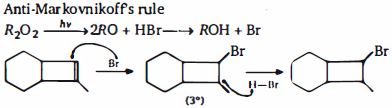
The major product $(A)$ is:
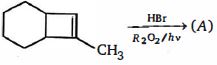
A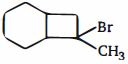
$1-$bromo$-1-$methylbicyclo[$4.2$.$0$]octane
B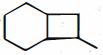
$2-$bromo$-1-$methylbicyclo[$4.2$.$0$]octane
C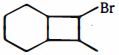
$1-$methylbicyclo[$4.2$.$0$]octane
D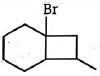
$8-$bromo$-1-$methylbicyclo[$4.2$.$0$]octane
Solution
(B) The reaction of an alkene with $HBr$ in the presence of a peroxide $(R_2O_2)$ and light $(hv)$ proceeds via a free radical mechanism,which follows the Anti-Markovnikov rule.
In this mechanism,the bromine radical $(Br^{\bullet})$ attacks the double bond to form the more stable radical intermediate.
For the given substrate,the $Br^{\bullet}$ radical attacks the less substituted carbon of the double bond,leading to a more stable tertiary $(3^{\circ})$ radical intermediate.
Subsequently,this radical abstracts a hydrogen atom from $HBr$ to form the final product,which is $1$-methyl-$2$-bromobicyclo$[4.2.0]$octane.
In this mechanism,the bromine radical $(Br^{\bullet})$ attacks the double bond to form the more stable radical intermediate.
For the given substrate,the $Br^{\bullet}$ radical attacks the less substituted carbon of the double bond,leading to a more stable tertiary $(3^{\circ})$ radical intermediate.
Subsequently,this radical abstracts a hydrogen atom from $HBr$ to form the final product,which is $1$-methyl-$2$-bromobicyclo$[4.2.0]$octane.
0 likes
View Solution482
MediumMCQ
In the reaction given below,the product would be: $CH_3-CH=CH-CH_3 \xrightarrow{H_3O^{+}} CH_3-CH_2-CH(OH)-CH_3$
A
a mixture of diastereomers
B
optically active
C
optically pure enantiomer
D
a racemic mixture
Solution
(D) The reaction of but$-2-$ene with $H_3O^{+}$ involves the formation of a planar carbocation intermediate,$CH_3-CH_2-C^{+}H-CH_3$.
Since the carbocation is planar,the nucleophile $(H_2O)$ can attack from either side of the plane with equal probability.
This results in the formation of a $50:50$ mixture of $(R)$ and $(S)$ enantiomers of butan$-2-$ol,which is a racemic mixture.
Since the carbocation is planar,the nucleophile $(H_2O)$ can attack from either side of the plane with equal probability.
This results in the formation of a $50:50$ mixture of $(R)$ and $(S)$ enantiomers of butan$-2-$ol,which is a racemic mixture.

0 likes
View Solution483
MediumMCQ
Surprisingly,the reaction shown below goes through a classical carbocation. What is the major product of this reaction?
A
$trans-1,3-dibromocyclohexane$
B
$cis-1,3-dibromocyclohexane$
C
$trans-1,2-dibromocyclohexane$
D
$cis-1,2-dibromocyclohexane$
Solution
(A) The reaction involves the electrophilic addition of $HBr$ to $3-bromocyclohexene$.
First,the protonation of the double bond occurs to form a stable carbocation at the $C-3$ position relative to the existing $Br$ atom.
Since the reaction proceeds through a classical carbocation,the $Br^-$ ion can attack the carbocation from either face.
However,due to steric hindrance and the geometry of the cyclohexane ring,the attack of the bromide ion results in the formation of $trans-1,3-dibromocyclohexane$ as the major product,as shown in the reaction mechanism.
First,the protonation of the double bond occurs to form a stable carbocation at the $C-3$ position relative to the existing $Br$ atom.
Since the reaction proceeds through a classical carbocation,the $Br^-$ ion can attack the carbocation from either face.
However,due to steric hindrance and the geometry of the cyclohexane ring,the attack of the bromide ion results in the formation of $trans-1,3-dibromocyclohexane$ as the major product,as shown in the reaction mechanism.
0 likes
View Solution484
MediumMCQ
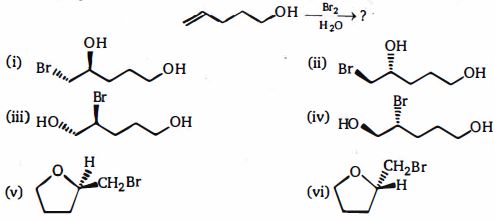
The major product of the reaction given below is
A
$(i)$ and $(ii)$
B
$(iii)$ and $(iv)$
C
$(v)$ and $(vi)$
D
none of these
Solution
(C) The reaction of pent$-4-$en$-1-$ol with $Br_2$ in $H_2O$ proceeds via the formation of a cyclic bromonium ion intermediate.
The internal hydroxyl group $(-OH)$ then attacks the more substituted carbon of the bromonium ion in an intramolecular $S_N2$ fashion to form a five-membered tetrahydrofuran ring.
Since the bromonium ion can form on either face of the double bond,the resulting product is a racemic mixture of the two enantiomers shown in $(v)$ and $(vi)$.
The internal hydroxyl group $(-OH)$ then attacks the more substituted carbon of the bromonium ion in an intramolecular $S_N2$ fashion to form a five-membered tetrahydrofuran ring.
Since the bromonium ion can form on either face of the double bond,the resulting product is a racemic mixture of the two enantiomers shown in $(v)$ and $(vi)$.
0 likes
View Solution485
MediumMCQ
Which reaction will occur at the fastest rate?
A
Cyclohexene + $HBr$ $\rightarrow$ Bromocyclohexane
B
$2-$methyl$-1-$butene + $HBr$ $\rightarrow$ $1-$bromo$-2-$methylbutane
C
$1,3-$cyclohexadiene + $HBr$ $\rightarrow$ $3-$bromocyclohexene
D
$2-$methyl$-1-$butene + $HBr$ $\rightarrow$ $2-$bromo$-2-$methylbutane
Solution
(D) The reaction of alkenes with $HBr$ proceeds via the formation of a carbocation intermediate. The rate of the reaction is directly proportional to the stability of the carbocation formed in the rate-determining step.
$(A)$ Forms a secondary $(2^{\circ})$ carbocation.
$(B)$ Forms a primary $(1^{\circ})$ carbocation.
$(C)$ Forms an allylic carbocation (stabilized by resonance).
$(D)$ Forms a tertiary $(3^{\circ})$ carbocation.
Since a tertiary $(3^{\circ})$ carbocation is more stable than a secondary $(2^{\circ})$,primary $(1^{\circ})$,or even an allylic carbocation in this specific context of alkyl substitution,the reaction in option $(D)$ proceeds at the fastest rate.
$(A)$ Forms a secondary $(2^{\circ})$ carbocation.
$(B)$ Forms a primary $(1^{\circ})$ carbocation.
$(C)$ Forms an allylic carbocation (stabilized by resonance).
$(D)$ Forms a tertiary $(3^{\circ})$ carbocation.
Since a tertiary $(3^{\circ})$ carbocation is more stable than a secondary $(2^{\circ})$,primary $(1^{\circ})$,or even an allylic carbocation in this specific context of alkyl substitution,the reaction in option $(D)$ proceeds at the fastest rate.
0 likes
View Solution486
MediumMCQ
Which of the following compounds gives diastereomers when treated with $Br_2$ in $CCl_4$?
A
$3-Methylcyclopentene$
B
$1-Methylcyclopentene$
C
$4-Methylcyclopentene$
D
$cis-2-Butene$
Solution
(A) The addition of $Br_2$ to an alkene is an anti-addition reaction. When an alkene already contains a chiral center,the addition of $Br_2$ creates new chiral centers. The resulting products will be diastereomers because the configuration at the existing chiral center remains unchanged,while the new chiral centers are formed in different relative configurations. $3-Methylcyclopentene$ contains a chiral center at the $C-3$ position. Upon reaction with $Br_2$ in $CCl_4$,the anti-addition of bromine across the double bond results in the formation of two diastereomeric products,as the existing chiral center at $C-3$ is not involved in the reaction.
0 likes
View Solution487
MediumMCQ
Which of the following compounds does not evolve $CO_2$ gas when it undergoes oxidative ozonolysis?
A
Methylenecyclohexane
B
$2-$Cyclohexylprop$-1-$ene
C
$H_2C = CH - CH = CH_2$
D
Cyclohexene
Solution
(D) Oxidative ozonolysis of alkenes using $O_3 / H_2O_2$ leads to the cleavage of the double bond.
If the alkene has a terminal $=CH_2$ group,it is oxidized to $CO_2$ and $H_2O$.
If it has a $=CHR$ group,it is oxidized to a carboxylic acid $(RCOOH)$.
If it has a $=CR_2$ group,it is oxidized to a ketone $(R_2C=O)$.
$(A)$ Methylenecyclohexane has a terminal $=CH_2$ group,so it evolves $CO_2$.
$(B)$ $2-$Cyclohexylprop$-1-$ene has a terminal $=CH_2$ group,so it evolves $CO_2$.
$(C)$ Buta$-1,3-$diene $(H_2C=CH-CH=CH_2)$ has terminal $=CH_2$ groups,so it evolves $CO_2$.
$(D)$ Cyclohexene has an internal double bond $(=CH-)$,which upon oxidative ozonolysis yields adipic acid $(HOOC-(CH_2)_4-COOH)$,not $CO_2$.
Therefore,cyclohexene does not evolve $CO_2$ gas.
If the alkene has a terminal $=CH_2$ group,it is oxidized to $CO_2$ and $H_2O$.
If it has a $=CHR$ group,it is oxidized to a carboxylic acid $(RCOOH)$.
If it has a $=CR_2$ group,it is oxidized to a ketone $(R_2C=O)$.
$(A)$ Methylenecyclohexane has a terminal $=CH_2$ group,so it evolves $CO_2$.
$(B)$ $2-$Cyclohexylprop$-1-$ene has a terminal $=CH_2$ group,so it evolves $CO_2$.
$(C)$ Buta$-1,3-$diene $(H_2C=CH-CH=CH_2)$ has terminal $=CH_2$ groups,so it evolves $CO_2$.
$(D)$ Cyclohexene has an internal double bond $(=CH-)$,which upon oxidative ozonolysis yields adipic acid $(HOOC-(CH_2)_4-COOH)$,not $CO_2$.
Therefore,cyclohexene does not evolve $CO_2$ gas.
0 likes
View Solution488
MediumMCQ
$cis-3-hexene \xrightarrow{(a)} \text{meso } 3,4-hexanediol$
$trans-3-hexene \xrightarrow{(b)} \text{meso } 3,4-hexanediol$
Choose the pair of reagents $(a, b)$ for the above conversions.
$trans-3-hexene \xrightarrow{(b)} \text{meso } 3,4-hexanediol$
Choose the pair of reagents $(a, b)$ for the above conversions.
A
Cold $KMnO_4, OsO_4$
B
Cold $KMnO_4, RCO_3H / H_3O^{\oplus}$
C
$RCO_3H / H_3O^{\oplus}$,Cold $KMnO_4$
D
None of these
Solution
(B) $1$. $cis-3-hexene$ undergoes $syn-addition$ of $OH$ groups using cold alkaline $KMnO_4$ or $OsO_4$ to form $meso-3,4-hexanediol$.
$2$. $trans-3-hexene$ undergoes $anti-addition$ of $OH$ groups using $RCO_3H$ followed by acid-catalyzed hydrolysis $(H_3O^{\oplus})$ to form $meso-3,4-hexanediol$.
$3$. Therefore,$(a)$ is cold $KMnO_4$ (or $OsO_4$) and $(b)$ is $RCO_3H / H_3O^{\oplus}$.
$2$. $trans-3-hexene$ undergoes $anti-addition$ of $OH$ groups using $RCO_3H$ followed by acid-catalyzed hydrolysis $(H_3O^{\oplus})$ to form $meso-3,4-hexanediol$.
$3$. Therefore,$(a)$ is cold $KMnO_4$ (or $OsO_4$) and $(b)$ is $RCO_3H / H_3O^{\oplus}$.
0 likes
View Solution489
MediumMCQ
Product $(A)$ of the above reaction is

A
$2,2-$dimethyltetrahydro-2H-pyran
B
$2,6-$dimethyltetrahydro-2H-pyran
C
$2,2-$dimethyltetrahydro-2H-pyran
D
$2,5-$dimethyltetrahydro-2H-pyran
Solution
(C) The reaction is an intramolecular oxymercuration-demercuration $(OMDM)$ reaction.
$1$. The alkene reacts with $Hg(OAc)_2$ to form a cyclic mercurinium ion intermediate.
$2$. The internal hydroxyl group $(-OH)$ acts as a nucleophile and attacks the more substituted carbon of the mercurinium ion,leading to ring closure.
$3$. The subsequent treatment with $NaBH_4$ replaces the $-HgOAc$ group with a hydrogen atom.
$4$. The starting material is $6$-methylhept-$5$-en-$1$-ol. The cyclization forms a six-membered ring containing an oxygen atom (a tetrahydropyran derivative) with two methyl groups at the $2$-position.
$5$. The final product is $2,2$-dimethyltetrahydro-$2H$-pyran.
$1$. The alkene reacts with $Hg(OAc)_2$ to form a cyclic mercurinium ion intermediate.
$2$. The internal hydroxyl group $(-OH)$ acts as a nucleophile and attacks the more substituted carbon of the mercurinium ion,leading to ring closure.
$3$. The subsequent treatment with $NaBH_4$ replaces the $-HgOAc$ group with a hydrogen atom.
$4$. The starting material is $6$-methylhept-$5$-en-$1$-ol. The cyclization forms a six-membered ring containing an oxygen atom (a tetrahydropyran derivative) with two methyl groups at the $2$-position.
$5$. The final product is $2,2$-dimethyltetrahydro-$2H$-pyran.
0 likes
View Solution490
MediumMCQ
Product $(A)$ is:
(cyclobutylidene)methylcyclopropane + $HBr \rightarrow A$ (Major)
(cyclobutylidene)methylcyclopropane + $HBr \rightarrow A$ (Major)
A
$1-$bromo$-1-$methylcyclopentane
B
$1-$bromo$-2-$methylcyclopentane
C
$1-$bromo$-1-$methylcyclohexane
D
bromomethylcyclohexane
Solution
(A) The reaction proceeds via electrophilic addition of $HBr$ to the alkene.
$1$. Protonation of the double bond occurs to form the most stable carbocation. The initial carbocation formed is a tertiary carbocation on the cyclobutane ring.
$2$. The four-membered ring undergoes ring expansion to form a more stable five-membered ring carbocation.
$3$. $A$ $1,2$-methyl shift occurs to generate an even more stable tertiary carbocation.
$4$. Finally,the bromide ion $(Br^-)$ attacks this tertiary carbocation to form the major product,$1$-bromo-$1$-methylcyclopentane.
$1$. Protonation of the double bond occurs to form the most stable carbocation. The initial carbocation formed is a tertiary carbocation on the cyclobutane ring.
$2$. The four-membered ring undergoes ring expansion to form a more stable five-membered ring carbocation.
$3$. $A$ $1,2$-methyl shift occurs to generate an even more stable tertiary carbocation.
$4$. Finally,the bromide ion $(Br^-)$ attacks this tertiary carbocation to form the major product,$1$-bromo-$1$-methylcyclopentane.
0 likes
View Solution491
MediumMCQ
$CH_3-C(CH_3)=CH-CH_3 \xrightarrow{Hg(OAc)_2/EtOH} (A) (90\%)$. The product $(A)$ of the above reaction is:
A
$CH_3-C(CH_3)(HgOAc)-CH(OEt)-CH_3$
B
$CH_3-C(CH_3)(OEt)-CH(HgOAc)-CH_3$
C
$CH_3-C(CH_3)(OH)-CH(HgOAc)-CH_3$
D
$CH_3-C(CH_3)(HgOAc)-CH(OH)-CH_3$
Solution
(B) The reaction is an alkoxymercuration reaction.
First,a cyclic mercurinium ion intermediate is formed across the double bond.
The nucleophile $(EtOH)$ attacks the more substituted carbon atom (Markovnikov's rule) because it can better stabilize the partial positive charge in the transition state.
Therefore,the $-OEt$ group attaches to the tertiary carbon,and the $-HgOAc$ group attaches to the secondary carbon.
The final product is $CH_3-C(CH_3)(OEt)-CH(HgOAc)-CH_3$.
First,a cyclic mercurinium ion intermediate is formed across the double bond.
The nucleophile $(EtOH)$ attacks the more substituted carbon atom (Markovnikov's rule) because it can better stabilize the partial positive charge in the transition state.
Therefore,the $-OEt$ group attaches to the tertiary carbon,and the $-HgOAc$ group attaches to the secondary carbon.
The final product is $CH_3-C(CH_3)(OEt)-CH(HgOAc)-CH_3$.

0 likes
View Solution492
MediumMCQ
In which of the following reactions is Markownikoff's rule violated?
A
$CH_3 - O - CH = CH_2 \xrightarrow[CCl_4]{HBr}$
B
$CH_3 - NH - CH = CH_2 \xrightarrow[CCl_4]{HBr}$
C
$CH_3 - S - CH = CH_2 \xrightarrow[CCl_4]{HBr}$
D
$O_2N - CH = CH_2 \xrightarrow[CCl_4]{HBr}$
Solution
(D) Markownikoff's rule states that in the electrophilic addition of $HX$ to an unsymmetrical alkene,the negative part of the addendum $(X^-)$ attaches to the carbon atom with the fewer number of hydrogen atoms.
This rule is based on the formation of the most stable carbocation intermediate.
In the reaction of $O_2N - CH = CH_2$ with $HBr$,the $-NO_2$ group is a strong electron-withdrawing group ($-I$ and $-M$ effect).
When $H^+$ attacks the terminal $CH_2$ group,it forms a carbocation at the carbon attached to the $-NO_2$ group $(CH_3 - CH^+ - NO_2)$.
This carbocation is highly unstable due to the electron-withdrawing nature of the $-NO_2$ group.
Consequently,the addition occurs in a way that avoids this unstable intermediate,effectively violating the standard Markownikoff's rule as the $Br^-$ attaches to the carbon with more hydrogen atoms to avoid the highly destabilized carbocation.
This rule is based on the formation of the most stable carbocation intermediate.
In the reaction of $O_2N - CH = CH_2$ with $HBr$,the $-NO_2$ group is a strong electron-withdrawing group ($-I$ and $-M$ effect).
When $H^+$ attacks the terminal $CH_2$ group,it forms a carbocation at the carbon attached to the $-NO_2$ group $(CH_3 - CH^+ - NO_2)$.
This carbocation is highly unstable due to the electron-withdrawing nature of the $-NO_2$ group.
Consequently,the addition occurs in a way that avoids this unstable intermediate,effectively violating the standard Markownikoff's rule as the $Br^-$ attaches to the carbon with more hydrogen atoms to avoid the highly destabilized carbocation.
0 likes
View Solution493
MediumMCQ
For the following reactions,the major products are shown: $H_2C=CH-CH=CH_2$ $\xrightarrow[0^\circ C]{HBr} CH_2=CH-CH(Br)-CH_3$ $\xrightarrow{25^\circ C} Br-CH_2-CH=CH-CH_3$. These provide an example of $1$ control at low temperature and $2$ control at higher temperature.
A
$1 = \text{kinetic}, 2 = \text{thermodynamic}$
B
$1 = \text{thermodynamic}, 2 = \text{kinetic}$
C
$1 = \text{kinetic}, 2 = \text{kinetic}$
D
$1 = \text{thermodynamic}, 2 = \text{thermodynamic}$
Solution
(A) At low temperature $(0^\circ C)$,the $1,2$-addition product $(CH_2=CH-CH(Br)-CH_3)$ is the major product because it forms faster due to a lower activation energy; this is known as kinetic control.
At higher temperatures $(25^\circ C)$,the reaction is reversible and reaches equilibrium,favoring the more stable $1,4$-addition product $(Br-CH_2-CH=CH-CH_3)$ which has a more substituted double bond; this is known as thermodynamic control.
At higher temperatures $(25^\circ C)$,the reaction is reversible and reaches equilibrium,favoring the more stable $1,4$-addition product $(Br-CH_2-CH=CH-CH_3)$ which has a more substituted double bond; this is known as thermodynamic control.
0 likes
View Solution494
MediumMCQ
How many moles of $BH_3$ are needed to react completely with $2 \ mol$ of $1$-pentene in a hydroboration-oxidation reaction?
A
$2$
B
$3$
C
$0.67$
D
$1.5$
Solution
(C) In the hydroboration-oxidation reaction,$3 \ mol$ of alkene reacts with $1 \ mol$ of $BH_3$ to form a trialkylborane intermediate.
Therefore,the stoichiometry is $3 \text{ moles of alkene} : 1 \text{ mole of } BH_3$.
For $2 \ mol$ of $1$-pentene,the moles of $BH_3$ required = $\frac{1}{3} \times 2 = 0.666... \approx 0.67 \ mol$.
Therefore,the stoichiometry is $3 \text{ moles of alkene} : 1 \text{ mole of } BH_3$.
For $2 \ mol$ of $1$-pentene,the moles of $BH_3$ required = $\frac{1}{3} \times 2 = 0.666... \approx 0.67 \ mol$.
0 likes
View Solution495
MediumMCQ
$^{14}CH_2=CH-CH_3 \xrightarrow[\text{or high temp}]{\text{low conc of } Br_2} (?)$
Product of the above reaction is
Product of the above reaction is
A
$^{14}CH_2=CH-CH_2-Br$
B
$CH_2=CH-^{14}CH_2-Br$
C
$Br-^{14}CH_2-CH(Br)-CH_3$
D
both $(A)$ and $(B)$
Solution
(D) Under conditions of low concentration of $Br_2$ and high temperature,the reaction proceeds via a free radical mechanism.
This mechanism favors allylic substitution over electrophilic addition.
The allylic radical formed is $CH_2=CH-CH_2^{\bullet}$ (where the label $^{14}C$ is at the terminal position).
Due to resonance,the radical can be represented as $CH_2=CH-CH_2^{\bullet} \leftrightarrow ^{\bullet}CH_2-CH=CH_2$.
Since the radical is delocalized,the bromine atom can attach to either terminal carbon,resulting in a mixture of $^{14}CH_2=CH-CH_2-Br$ and $CH_2=CH-^{14}CH_2-Br$.
Therefore,both $(A)$ and $(B)$ are formed.
This mechanism favors allylic substitution over electrophilic addition.
The allylic radical formed is $CH_2=CH-CH_2^{\bullet}$ (where the label $^{14}C$ is at the terminal position).
Due to resonance,the radical can be represented as $CH_2=CH-CH_2^{\bullet} \leftrightarrow ^{\bullet}CH_2-CH=CH_2$.
Since the radical is delocalized,the bromine atom can attach to either terminal carbon,resulting in a mixture of $^{14}CH_2=CH-CH_2-Br$ and $CH_2=CH-^{14}CH_2-Br$.
Therefore,both $(A)$ and $(B)$ are formed.
0 likes
View Solution496
MediumMCQ
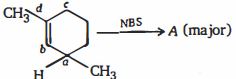
In the given reaction,at which position does bromination take place?
A
$a$
B
$b$
C
$c$
D
$d$
Solution
(A) The reaction involves allylic bromination using $NBS$ ($N$-Bromosuccinimide),which proceeds via a free radical mechanism.
The reaction proceeds through the formation of the most stable allylic free radical.
Removing a hydrogen atom from position $a$ generates a $3^o$ allylic free radical,which is stabilized by resonance with the adjacent double bond.
Since the $3^o$ allylic free radical is more stable than other possible radicals,bromination occurs preferentially at position $a$.
The reaction proceeds through the formation of the most stable allylic free radical.
Removing a hydrogen atom from position $a$ generates a $3^o$ allylic free radical,which is stabilized by resonance with the adjacent double bond.
Since the $3^o$ allylic free radical is more stable than other possible radicals,bromination occurs preferentially at position $a$.
0 likes
View Solution497
MediumMCQ
Predict the major product of the reaction.

A
$CH_3-C(CH_3)=C(CH_3)-CH_2-CH-CH_2$ (with an epoxide ring on the terminal $CH-CH_2$ group)
B
$CH_3-C-C(CH_3)-CH_2-CH=CH_2$ (with an epoxide ring on the internal $C=C$ group)
C
$CH_3-C(CH_3)=C(CH_3)-CH_2-CH(OH)-CH_2OH$
D
$CH_3-C(OH)(CH_3)-C(OH)(CH_3)-CH_2-CH=CH_2$
Solution
(B) The reagent $m-CPBA$ (meta-chloroperbenzoic acid) is an electrophilic reagent used for the epoxidation of alkenes.
Epoxidation occurs more readily at the alkene with higher electron density,which is the more substituted alkene.
In the given molecule,the internal double bond $(CH_3-C(CH_3)=C(CH_3)-)$ is more substituted (tetrasubstituted) than the terminal double bond ($-CH=CH_2$,monosubstituted).
Therefore,the $m-CPBA$ will selectively epoxidize the more substituted internal double bond.
Epoxidation occurs more readily at the alkene with higher electron density,which is the more substituted alkene.
In the given molecule,the internal double bond $(CH_3-C(CH_3)=C(CH_3)-)$ is more substituted (tetrasubstituted) than the terminal double bond ($-CH=CH_2$,monosubstituted).
Therefore,the $m-CPBA$ will selectively epoxidize the more substituted internal double bond.
0 likes
View Solution498
MediumMCQ
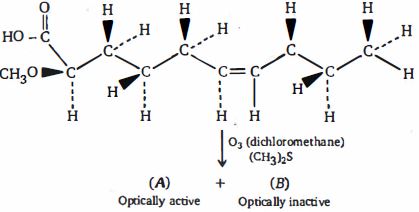
The product $(A)$ of the above reaction is:
A
$CH_3O-CH(CO_2H)-CH_2-CH_2-CHO$
B
$CH_3O-CH_2-CH(CH_2OH)-CH_2-CO_2H$
C
$CH_3O-CH(CO_2H)-CH_2-CH_2-CO_2H$
D
$CH_3O-CH(CO_2H)-CH_2-CH_2-CH_2-CHO$
Solution
(D) The given reactant is $CH_3O-CH(CO_2H)-CH_2-CH_2-CH=CH-CH_2-CH_3$.
Ozonolysis ($O_3$ followed by $(CH_3)_2S$) cleaves the $C=C$ double bond to form two carbonyl compounds.
The cleavage results in:
$CH_3O-CH(CO_2H)-CH_2-CH_2-CHO \ (A)$
and
$CH_3-CH_2-CHO \ (B)$.
Compound $(A)$ is optically active due to the chiral center at the carbon atom attached to the $-OCH_3$ and $-CO_2H$ groups.
Therefore,the correct option is $(D)$.
Ozonolysis ($O_3$ followed by $(CH_3)_2S$) cleaves the $C=C$ double bond to form two carbonyl compounds.
The cleavage results in:
$CH_3O-CH(CO_2H)-CH_2-CH_2-CHO \ (A)$
and
$CH_3-CH_2-CHO \ (B)$.
Compound $(A)$ is optically active due to the chiral center at the carbon atom attached to the $-OCH_3$ and $-CO_2H$ groups.
Therefore,the correct option is $(D)$.
0 likes
View Solution499
MediumMCQ
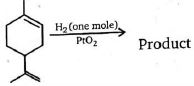
In polyenes that contain differently substituted $(C=C)$ double bonds,it is possible to hydrogenate chemoselectively one $(C=C)$ double bond. The product of the reaction of limonene with one mole of $H_2$ in the presence of $PtO_2$ is:
A
$1-$methyl$-4-$(prop$-1-$en$-2-$yl)cyclohexane
B
$1-$methyl$-4-$isopropylcyclohex$-1-$ene
C
$4-$isopropyl$-1-$methylcyclohex$-1-$ene
D
$1-$isopropyl$-4-$methylcyclohex$-1-$ene
Solution
(B) The molecule is limonene,which has two $(C=C)$ double bonds: one is a trisubstituted double bond inside the ring,and the other is a disubstituted terminal double bond (exocyclic).
Catalytic hydrogenation using $PtO_2$ is sensitive to the steric hindrance and the stability of the alkene.
The less substituted (and thus less stable) double bond is more reactive towards hydrogenation.
The terminal exocyclic double bond is less substituted and more accessible than the endocyclic trisubstituted double bond.
Therefore,the terminal double bond is reduced first to form $1$-methyl-$4$-isopropylcyclohex-$1$-ene.
Catalytic hydrogenation using $PtO_2$ is sensitive to the steric hindrance and the stability of the alkene.
The less substituted (and thus less stable) double bond is more reactive towards hydrogenation.
The terminal exocyclic double bond is less substituted and more accessible than the endocyclic trisubstituted double bond.
Therefore,the terminal double bond is reduced first to form $1$-methyl-$4$-isopropylcyclohex-$1$-ene.
0 likes
View Solution500
MediumMCQ
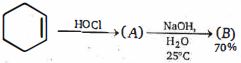
The correct statement about the reaction shown above is:
A
$A = \text{cis-2-chlorocyclohexanol}$,$B = \text{cyclohexene oxide}$
B
$A = \text{trans-2-chlorocyclohexanol}$,$B = \text{anti-diol}$
C
$A = \text{trans-2-chlorocyclohexanol}$,$B = \text{cyclohexene oxide}$
D
$A = \text{cis-2-chlorocyclohexanol}$,$B = \text{anti-diol}$
Solution
(C) $1$. The reaction of cyclohexene with $HOCl$ (hypochlorous acid) proceeds via the formation of a chloronium ion intermediate,followed by the attack of water (nucleophile) from the side opposite to the chlorine atom. This results in the formation of $trans-2-chlorocyclohexanol$ as product $(A)$.
$2$. In the presence of a base like $NaOH$,the $trans-2-chlorocyclohexanol$ undergoes an intramolecular $S_N2$ reaction. The hydroxyl group is deprotonated to form an alkoxide ion,which then attacks the carbon atom bearing the chlorine atom from the backside,displacing the chloride ion. This process is facilitated by Neighbouring Group Participation ($N$.$G$.$P$.).
$3$. This intramolecular cyclization leads to the formation of $cyclohexene oxide$ (an epoxide) as product $(B)$.
$2$. In the presence of a base like $NaOH$,the $trans-2-chlorocyclohexanol$ undergoes an intramolecular $S_N2$ reaction. The hydroxyl group is deprotonated to form an alkoxide ion,which then attacks the carbon atom bearing the chlorine atom from the backside,displacing the chloride ion. This process is facilitated by Neighbouring Group Participation ($N$.$G$.$P$.).
$3$. This intramolecular cyclization leads to the formation of $cyclohexene oxide$ (an epoxide) as product $(B)$.
0 likes
View SolutionHydrocarbons — Alkene · Frequently Asked Questions
1Are these Hydrocarbons questions useful for JEE and NEET?
Yes. All questions in this section are mapped to JEE Main and NEET exam patterns. Previous year questions from JEE Main, NEET, GUJCET and state-level exams are included with full solutions.
2Can I switch to Hindi or Gujarati for these questions?
Yes. Use the language tabs in the hero section or the sidebar to view the same questions and solutions in English, Hindi or Gujarati.
3How do I generate a question paper from this subtopic?
Use the Vedclass Exam Paper Generator — select the chapter and subtopic, set difficulty, and generate Sets A, B, C, D automatically. First 3 chapters of every subject are free.
Vedclass Products
For Students
Vedclass Test Series
Mock tests in real JEE/NEET style with performance analysis. 5-day free trial.
Start Free TrialFor Teachers
Exam Paper Generator
Generate Set A/B/C/D papers from this chapter in 2 minutes. 3 chapters free.
Try FreeFor Institutes
Online Exam Module
Live online exams with unlimited students, 360° analytics & white-label branding.
See DemoFor Teachers & Institutes
Generate a Hydrocarbons Exam Paper in 2 Minutes
Select subtopic & difficulty — Sets A, B, C, D auto-generated with No Repeat logic.
First 3 chapters of every subject are free — no payment required.