
A English
Alkene Questions in English
Class 11 Chemistry · Hydrocarbons · Alkene
1080+
Questions
English
Language
100%
With Solutions
Showing 28 of 1080 questions in English
1051
MediumMCQ
In organic reactions,sodium in liquid ammonia is used as:
A
reducing agent
B
hydrating agent
C
oxidising agent
D
precipitating agent
Solution
(A) Sodium in liquid ammonia $(Na/NH_3(l))$ is a well-known reagent used for the Birch reduction.
In this reaction,the sodium metal dissolves in liquid ammonia to release solvated electrons,which act as a powerful $reducing \text{ } agent$.
It is specifically used to reduce alkynes to trans-alkenes and aromatic rings to $1,4-$cyclohexadienes.
In this reaction,the sodium metal dissolves in liquid ammonia to release solvated electrons,which act as a powerful $reducing \text{ } agent$.
It is specifically used to reduce alkynes to trans-alkenes and aromatic rings to $1,4-$cyclohexadienes.
0 likes
View Solution1052
DifficultMCQ
The percentage composition of an organic compound $A$ is: carbon = $85.71 \%$ and hydrogen = $14.29 \%$. Its vapour density is $14$. Consider the following reaction sequence:
$A$ $\xrightarrow{Cl_2/H_2O} B$ $\xrightarrow[(ii) H_3O^+]{(i) KCN/EtOH} C$
Identify $C$.
$A$ $\xrightarrow{Cl_2/H_2O} B$ $\xrightarrow[(ii) H_3O^+]{(i) KCN/EtOH} C$
Identify $C$.
A
$CH_3-CH(OH)-CO_2H$
B
$HO-CH_2-CH_2-CO_2H$
C
$HO-CH_2-CO_2H$
D
$CH_3-CH_2-CO_2H$
Solution
(B) Step $1$: Determine the empirical formula of $A$.
$C = 85.71 \% = \frac{85.71}{12} = 7.14$; $\frac{7.14}{7.14} = 1$
$H = 14.29 \% = \frac{14.29}{1} = 14.29$; $\frac{14.29}{7.14} = 2$
Empirical formula $= CH_2$.
Step $2$: Determine the molecular formula of $A$.
Molecular weight $= 2 \times \text{vapour density} = 2 \times 14 = 28$.
$n = \frac{28}{14} = 2$.
Molecular formula $= (CH_2)_2 = C_2H_4$ (Ethene).
Step $3$: Reaction sequence.
$A$ is $CH_2=CH_2$.
$CH_2=CH_2 + Cl_2/H_2O \rightarrow HO-CH_2-CH_2-Cl$ ($B$,Ethylene chlorohydrin).
$HO-CH_2-CH_2-Cl + KCN \rightarrow HO-CH_2-CH_2-CN$ (Nucleophilic substitution).
$HO-CH_2-CH_2-CN + H_3O^+ \rightarrow HO-CH_2-CH_2-COOH$ ($C$,$3$-hydroxypropanoic acid).
$C = 85.71 \% = \frac{85.71}{12} = 7.14$; $\frac{7.14}{7.14} = 1$
$H = 14.29 \% = \frac{14.29}{1} = 14.29$; $\frac{14.29}{7.14} = 2$
Empirical formula $= CH_2$.
Step $2$: Determine the molecular formula of $A$.
Molecular weight $= 2 \times \text{vapour density} = 2 \times 14 = 28$.
$n = \frac{28}{14} = 2$.
Molecular formula $= (CH_2)_2 = C_2H_4$ (Ethene).
Step $3$: Reaction sequence.
$A$ is $CH_2=CH_2$.
$CH_2=CH_2 + Cl_2/H_2O \rightarrow HO-CH_2-CH_2-Cl$ ($B$,Ethylene chlorohydrin).
$HO-CH_2-CH_2-Cl + KCN \rightarrow HO-CH_2-CH_2-CN$ (Nucleophilic substitution).
$HO-CH_2-CH_2-CN + H_3O^+ \rightarrow HO-CH_2-CH_2-COOH$ ($C$,$3$-hydroxypropanoic acid).
0 likes
View Solution1053
EasyMCQ
The number of possible organobromine compounds which can be obtained in the allylic bromination of $but-1-ene$ with $N-bromosuccinimide$ $(NBS)$ is
A
$1$
B
$2$
C
$3$
D
$4$
Solution
(D) $NBS$ $(N-bromosuccinimide)$ performs allylic bromination via a free radical mechanism.
For $but-1-ene$ $(CH_3-CH_2-CH=CH_2)$,the allylic hydrogen is at the $C-3$ position.
Abstraction of this hydrogen generates an allylic radical: $CH_3-\dot{C}H-CH=CH_2 \leftrightarrow CH_3-CH=CH-\dot{C}H_2$.
Reaction of this resonance-stabilized radical with $Br \cdot$ leads to two constitutional isomers:
$1$. $3-bromobut-1-ene$ $(CH_3-CH(Br)-CH=CH_2)$,which contains a chiral center and thus exists as a pair of enantiomers ($d$ and $l$).
$2$. $1-bromobut-2-ene$ $(CH_3-CH=CH-CH_2Br)$,which exhibits geometrical isomerism ($cis$ and $trans$).
Therefore,the total number of possible organobromine compounds is $2$ (enantiomers) $2$ (geometrical isomers) = $4$.
For $but-1-ene$ $(CH_3-CH_2-CH=CH_2)$,the allylic hydrogen is at the $C-3$ position.
Abstraction of this hydrogen generates an allylic radical: $CH_3-\dot{C}H-CH=CH_2 \leftrightarrow CH_3-CH=CH-\dot{C}H_2$.
Reaction of this resonance-stabilized radical with $Br \cdot$ leads to two constitutional isomers:
$1$. $3-bromobut-1-ene$ $(CH_3-CH(Br)-CH=CH_2)$,which contains a chiral center and thus exists as a pair of enantiomers ($d$ and $l$).
$2$. $1-bromobut-2-ene$ $(CH_3-CH=CH-CH_2Br)$,which exhibits geometrical isomerism ($cis$ and $trans$).
Therefore,the total number of possible organobromine compounds is $2$ (enantiomers) $2$ (geometrical isomers) = $4$.
0 likes
View Solution1054
EasyMCQ
Baeyer's reagent is
A
alkaline potassium permanganate
B
acidified potassium permanganate
C
neutral potassium permanganate
D
alkaline potassium manganate
Solution
(A) Baeyer's reagent is $1 \%$ cold dilute alkaline potassium permanganate $(KMnO_4)$.
It is used to identify unsaturation in organic compounds.
When added to unsaturated compounds,the purple colour of the reagent disappears.
It is used to identify unsaturation in organic compounds.
When added to unsaturated compounds,the purple colour of the reagent disappears.
0 likes
View Solution1055
MediumMCQ
The stability of $Me_2C=CH_2$ is more than that of $MeCH_2CH=CH_2$ due to
A
inductive effect of the $Me$ groups
B
resonance effect of the $Me$ groups
C
hyperconjugative effect of the $Me$ groups
D
resonance as well as inductive effect of the $Me$ groups
Solution
(C) The stability of alkenes is determined by the number of hyperconjugative structures,which depends on the number of $\alpha$-hydrogen atoms attached to the $sp^2$ hybridized carbon atoms.
In $Me_2C=CH_2$ ($2$-methylprop$-1-$ene),there are two $Me$ groups attached to the double-bonded carbon,providing $3 + 3 = 6$ $\alpha$-hydrogen atoms.
In $MeCH_2CH=CH_2$ (but$-1-$ene),there is only one $MeCH_2$ group attached to the double-bonded carbon,providing $2$ $\alpha$-hydrogen atoms.
Since $Me_2C=CH_2$ has more $\alpha$-hydrogen atoms $(6)$ compared to $MeCH_2CH=CH_2$ $(2)$,it exhibits a greater hyperconjugative effect,making it more stable.
In $Me_2C=CH_2$ ($2$-methylprop$-1-$ene),there are two $Me$ groups attached to the double-bonded carbon,providing $3 + 3 = 6$ $\alpha$-hydrogen atoms.
In $MeCH_2CH=CH_2$ (but$-1-$ene),there is only one $MeCH_2$ group attached to the double-bonded carbon,providing $2$ $\alpha$-hydrogen atoms.
Since $Me_2C=CH_2$ has more $\alpha$-hydrogen atoms $(6)$ compared to $MeCH_2CH=CH_2$ $(2)$,it exhibits a greater hyperconjugative effect,making it more stable.
0 likes
View Solution1056
MediumMCQ
The product$(s)$ in the following sequence of reactions will be: $Me-C \equiv C-Me \xrightarrow[2. \text{dil. alkaline } KMnO_4]{1. Na/NH_3(liq.), \text{ethanol}, -33^\circ C}$ Product$(s)$
A
Meso-butane$-2,3-$diol
B
$(2R, 3R)$-butane$-2,3-$diol
C
Racemic mixture of butane$-2,3-$diol
D
$(2S, 3S)$-butane$-2,3-$diol
Solution
(C) Step $1$: $Me-C \equiv C-Me$ (but$-2-$yne) reacts with $Na/NH_3(liq.)$ to form $trans$-but$-2-$ene.
Step $2$: $trans$-but$-2-$ene reacts with dilute alkaline $KMnO_4$ (Baeyer's reagent),which performs $syn$-hydroxylation.
The $syn$-addition of two $-OH$ groups to a $trans$-alkene results in a racemic mixture of butane$-2,3-$diol.
Step $2$: $trans$-but$-2-$ene reacts with dilute alkaline $KMnO_4$ (Baeyer's reagent),which performs $syn$-hydroxylation.
The $syn$-addition of two $-OH$ groups to a $trans$-alkene results in a racemic mixture of butane$-2,3-$diol.
0 likes
View Solution1057
MediumMCQ
The decreasing order of reactivity of the following alkenes towards $HBr$ addition is:
$(I) \ CH_3-CH=CH_2$
$(II) \ CF_3-CH=CH_2$
$(III) \ MeOCH=CH_2$
$(IV) \ CH_3-CO-CH=CH_2$
$(I) \ CH_3-CH=CH_2$
$(II) \ CF_3-CH=CH_2$
$(III) \ MeOCH=CH_2$
$(IV) \ CH_3-CO-CH=CH_2$
A
$I > II > III > IV$
B
$II > IV > I > III$
C
$III > IV > I > II$
D
$III > I > II > IV$
Solution
(D) The reactivity of alkenes towards electrophilic addition of $HBr$ depends on the stability of the carbocation intermediate formed in the rate-determining step (r.d.s.).
$1$. In $(III) \ MeOCH=CH_2$,the methoxy group $(-OCH_3)$ shows a strong $+M$ effect,which highly stabilizes the carbocation.
$2$. In $(I) \ CH_3-CH=CH_2$,the methyl group shows $+I$ and hyperconjugation,providing moderate stability.
$3$. In $(IV) \ CH_3-CO-CH=CH_2$,the carbonyl group $(-CO-)$ shows a $-M$ effect,which destabilizes the carbocation.
$4$. In $(II) \ CF_3-CH=CH_2$,the trifluoromethyl group $(-CF_3)$ shows a very strong $-I$ effect,which strongly destabilizes the carbocation.
Thus,the stability order of the carbocation (and hence reactivity) is: $III > I > IV > II$.
$1$. In $(III) \ MeOCH=CH_2$,the methoxy group $(-OCH_3)$ shows a strong $+M$ effect,which highly stabilizes the carbocation.
$2$. In $(I) \ CH_3-CH=CH_2$,the methyl group shows $+I$ and hyperconjugation,providing moderate stability.
$3$. In $(IV) \ CH_3-CO-CH=CH_2$,the carbonyl group $(-CO-)$ shows a $-M$ effect,which destabilizes the carbocation.
$4$. In $(II) \ CF_3-CH=CH_2$,the trifluoromethyl group $(-CF_3)$ shows a very strong $-I$ effect,which strongly destabilizes the carbocation.
Thus,the stability order of the carbocation (and hence reactivity) is: $III > I > IV > II$.
0 likes
View Solution1058
MediumMCQ
In the reaction sequence $Me_3CCH=CH_2 \xrightarrow{Q} Me_3CCH_2CH_2OH$ and $Me_3CCH=CH_2 \xrightarrow{R} Me_3C-CH(OH)-CH_3$,$Q$ and $R$ are respectively:
A
$Hg(OAc)_2, NaBH_4 / \overline{O}H ; B_2H_6, H_2O_2 / \overline{O}H$
B
$B_2H_6, H_2O_2 / \overline{O}H ; H^{+} / H_2O$
C
$Hg(OAc)_2, NaBH_4 / \overline{O}H ; H^{+} / H_2O$
D
$B_2H_6, H_2O_2 / \overline{O}H ; Hg(OAc)_2, NaBH_4 / \overline{O}H$
Solution
(D) The reaction $Me_3CCH=CH_2 \xrightarrow{Q} Me_3CCH_2CH_2OH$ represents an anti-Markovnikov addition of water,which is achieved by hydroboration-oxidation using $B_2H_6, H_2O_2 / \overline{O}H$.
The reaction $Me_3CCH=CH_2 \xrightarrow{R} Me_3C-CH(OH)-CH_3$ represents a Markovnikov addition of water without rearrangement,which is achieved by oxymercuration-demercuration using $Hg(OAc)_2, NaBH_4 / \overline{O}H$.
Therefore,$Q$ is $B_2H_6, H_2O_2 / \overline{O}H$ and $R$ is $Hg(OAc)_2, NaBH_4 / \overline{O}H$.
The reaction $Me_3CCH=CH_2 \xrightarrow{R} Me_3C-CH(OH)-CH_3$ represents a Markovnikov addition of water without rearrangement,which is achieved by oxymercuration-demercuration using $Hg(OAc)_2, NaBH_4 / \overline{O}H$.
Therefore,$Q$ is $B_2H_6, H_2O_2 / \overline{O}H$ and $R$ is $Hg(OAc)_2, NaBH_4 / \overline{O}H$.
0 likes
View Solution1059
DifficultMCQ
The conversion$(s)$ that can be carried out by bromine in carbon tetrachloride $(CCl_4)$ solvent is/are:
A
$PhCH=CHCH_3 \rightarrow PhCHBrCHBrCH_3$
B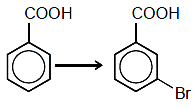
C
$CH_3CH_2COOH \rightarrow CH_3CHBrCOOH$
D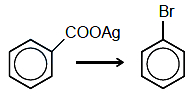
Solution
(A, D) The reaction of $Br_2$ in $CCl_4$ is typically used for the electrophilic addition to alkenes.
$(A)$ $PhCH=CHCH_3 + Br_2 \xrightarrow{CCl_4} PhCHBrCHBrCH_3$. This is a standard addition reaction.
$(B)$ Bromination of benzoic acid requires a Lewis acid catalyst like $FeBr_3$ and is not achieved by $Br_2/CCl_4$ alone.
$(C)$ $CH_3CH_2COOH \rightarrow CH_3CHBrCOOH$ is the Hell-Volhard-Zelinsky $(HVZ)$ reaction,which requires $Br_2$ and red phosphorus $(P)$.
$(D)$ The conversion of silver benzoate to bromobenzene is the Borodine-Hunsdiecker reaction,which uses $Br_2$ in $CCl_4$ under reflux conditions.
Therefore,the conversions that can be carried out by $Br_2$ in $CCl_4$ are $(A)$ and $(D)$.
$(A)$ $PhCH=CHCH_3 + Br_2 \xrightarrow{CCl_4} PhCHBrCHBrCH_3$. This is a standard addition reaction.
$(B)$ Bromination of benzoic acid requires a Lewis acid catalyst like $FeBr_3$ and is not achieved by $Br_2/CCl_4$ alone.
$(C)$ $CH_3CH_2COOH \rightarrow CH_3CHBrCOOH$ is the Hell-Volhard-Zelinsky $(HVZ)$ reaction,which requires $Br_2$ and red phosphorus $(P)$.
$(D)$ The conversion of silver benzoate to bromobenzene is the Borodine-Hunsdiecker reaction,which uses $Br_2$ in $CCl_4$ under reflux conditions.
Therefore,the conversions that can be carried out by $Br_2$ in $CCl_4$ are $(A)$ and $(D)$.
0 likes
View Solution1060
MediumMCQ
An optically active alkene having molecular formula $C_8H_{16}$ gives acetone as one of the products on ozonolysis. The structure of the alkene is:
A
$2,3-$dimethylhex$-2-$ene
B
$3,4-$dimethylhex$-2-$ene
C
$3,4-$dimethylhex$-3-$ene
D
$2,3-$dimethylhex$-3-$ene
Solution
(B) $1$. Ozonolysis of an alkene involves the cleavage of the $C=C$ double bond to form carbonyl compounds.
$2$. The formation of acetone $(CH_3)_2C=O$ indicates that the alkene must have a $(CH_3)_2C=$ group.
$3$. The molecular formula is $C_8H_{16}$. If one part is acetone $(C_3H_6O)$,the other part must be a $C_5$ aldehyde or ketone.
$4$. For the alkene to be optically active,it must contain a chiral center. In the structure $2,3$-dimethylhex-$2$-ene,the molecule is achiral. In $3,4$-dimethylhex-$2$-ene,the carbon at position $3$ is chiral because it is bonded to four different groups: $-H$,$-CH_3$,$-CH_2CH_3$,and $-C(CH_3)=C(CH_3)_2$.
$5$. The structure shown in option $B$ corresponds to $3,4$-dimethylhex-$2$-ene,which contains a chiral center (marked with an asterisk) and produces acetone upon ozonolysis.
$2$. The formation of acetone $(CH_3)_2C=O$ indicates that the alkene must have a $(CH_3)_2C=$ group.
$3$. The molecular formula is $C_8H_{16}$. If one part is acetone $(C_3H_6O)$,the other part must be a $C_5$ aldehyde or ketone.
$4$. For the alkene to be optically active,it must contain a chiral center. In the structure $2,3$-dimethylhex-$2$-ene,the molecule is achiral. In $3,4$-dimethylhex-$2$-ene,the carbon at position $3$ is chiral because it is bonded to four different groups: $-H$,$-CH_3$,$-CH_2CH_3$,and $-C(CH_3)=C(CH_3)_2$.
$5$. The structure shown in option $B$ corresponds to $3,4$-dimethylhex-$2$-ene,which contains a chiral center (marked with an asterisk) and produces acetone upon ozonolysis.
0 likes
View Solution1061
EasyMCQ
The major product of the following reaction is $F_3C-CH=CH_2 + HBr \rightarrow$
A
$F_3C-CH_2-CH_2Br$
B
$F_3C-CH(Br)-CH_3$
C
$F_2C(Br)-CH(F)-CH_3$
D
$F_2CH-CH(Br)-CH_2F$
Solution
(A) The reaction of $F_3C-CH=CH_2$ with $HBr$ follows electrophilic addition. The $F_3C-$ group is a strong electron-withdrawing group due to the inductive effect ($-I$ effect).
When the proton $(H^+)$ attacks the double bond,it can form two possible carbocations:
$1$. $F_3C-CH^+-CH_3$ (secondary carbocation,destabilized by the strong $-I$ effect of the $F_3C$ group).
$2$. $F_3C-CH_2-CH_2^+$ (primary carbocation,less destabilized by the $-I$ effect as the positive charge is further away).
Since the primary carbocation $F_3C-CH_2-CH_2^+$ is more stable than the secondary carbocation $F_3C-CH^+-CH_3$ in this specific case due to the proximity of the electron-withdrawing group,the bromide ion $(Br^-)$ attacks the primary carbocation to form the major product $F_3C-CH_2-CH_2Br$.
When the proton $(H^+)$ attacks the double bond,it can form two possible carbocations:
$1$. $F_3C-CH^+-CH_3$ (secondary carbocation,destabilized by the strong $-I$ effect of the $F_3C$ group).
$2$. $F_3C-CH_2-CH_2^+$ (primary carbocation,less destabilized by the $-I$ effect as the positive charge is further away).
Since the primary carbocation $F_3C-CH_2-CH_2^+$ is more stable than the secondary carbocation $F_3C-CH^+-CH_3$ in this specific case due to the proximity of the electron-withdrawing group,the bromide ion $(Br^-)$ attacks the primary carbocation to form the major product $F_3C-CH_2-CH_2Br$.
0 likes
View Solution1062
MediumMCQ
The total number of alkyl bromides (including stereoisomers) formed in the reaction $(CH_3)_3C-CH=CH_2 + HBr \rightarrow$ will be
A
$1$
B
$2$
C
$3$
D
$4$
Solution
(C) The reaction of $3,3-dimethylbut-1-ene$ with $HBr$ proceeds via the formation of a carbocation intermediate.
Initially,the protonation of the double bond yields a secondary carbocation,which undergoes a $1,2-methyl$ shift to form a more stable tertiary carbocation.
$1$. The direct addition of $Br^-$ to the secondary carbocation gives $2-bromo-3,3-dimethylbutane$. This molecule has a chiral center,so it exists as a pair of enantiomers ($R$ and $S$).
$2$. The addition of $Br^-$ to the rearranged tertiary carbocation gives $2-bromo-2,3-dimethylbutane$,which is achiral.
Thus,the total number of alkyl bromides formed is $2$ (enantiomers) $+ 1$ (rearranged product) $= 3$.
Initially,the protonation of the double bond yields a secondary carbocation,which undergoes a $1,2-methyl$ shift to form a more stable tertiary carbocation.
$1$. The direct addition of $Br^-$ to the secondary carbocation gives $2-bromo-3,3-dimethylbutane$. This molecule has a chiral center,so it exists as a pair of enantiomers ($R$ and $S$).
$2$. The addition of $Br^-$ to the rearranged tertiary carbocation gives $2-bromo-2,3-dimethylbutane$,which is achiral.
Thus,the total number of alkyl bromides formed is $2$ (enantiomers) $+ 1$ (rearranged product) $= 3$.
0 likes
View Solution1063
MediumMCQ
The number of alkene$(s)$ which can produce $2-butanol$ by the successive treatment of $(i)$ $B_{2}H_{6}$ in tetrahydrofuran solvent and $(ii)$ alkaline $H_{2}O_{2}$ solution is:
A
$1$
B
$2$
C
$3$
D
$4$
Solution
(B) The reaction described is hydroboration-oxidation,which follows anti-Markovnikov addition of water across the double bond.
To obtain $2-butanol$ $(CH_{3}CH(OH)CH_{2}CH_{3})$,the starting alkene must be $1-butene$ $(CH_{3}CH_{2}CH=CH_{2})$ or $2-butene$ $(CH_{3}CH=CHCH_{3})$.
For $1-butene$: The anti-Markovnikov addition of $H_{2}O$ yields $1-butanol$.
For $2-butene$ ($cis$ or $trans$): The anti-Markovnikov addition of $H_{2}O$ yields $2-butanol$ because both carbons of the double bond are equivalent.
Thus,only $2-butene$ (both $cis$ and $trans$ isomers) produces $2-butanol$ as the product.
Therefore,the number of such alkenes is $2$.
To obtain $2-butanol$ $(CH_{3}CH(OH)CH_{2}CH_{3})$,the starting alkene must be $1-butene$ $(CH_{3}CH_{2}CH=CH_{2})$ or $2-butene$ $(CH_{3}CH=CHCH_{3})$.
For $1-butene$: The anti-Markovnikov addition of $H_{2}O$ yields $1-butanol$.
For $2-butene$ ($cis$ or $trans$): The anti-Markovnikov addition of $H_{2}O$ yields $2-butanol$ because both carbons of the double bond are equivalent.
Thus,only $2-butene$ (both $cis$ and $trans$ isomers) produces $2-butanol$ as the product.
Therefore,the number of such alkenes is $2$.
0 likes
View Solution1064
EasyMCQ
The major products obtained in the following reaction is/are:
$CH_3-CH=CH-C_2H_5 + Br_2 \rightarrow ?$
$CH_3-CH=CH-C_2H_5 + Br_2 \rightarrow ?$
A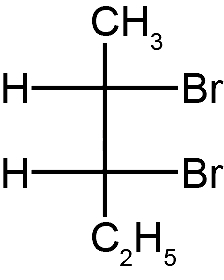
B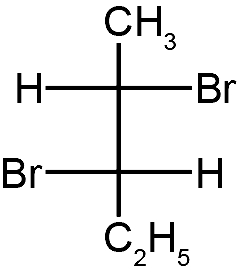
C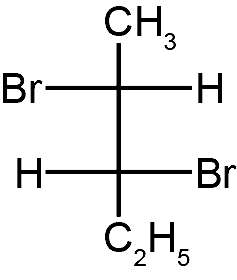
D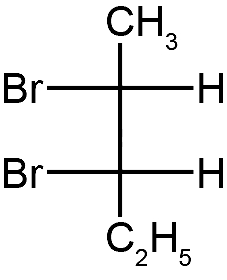
Solution
(A) The reaction of an alkene with $Br_2$ proceeds via the formation of a cyclic bromonium ion intermediate. The $Br^-$ ion then attacks the bromonium ion from the side opposite to the bridged bromine atom,resulting in anti-addition. For the given alkene,$CH_3-CH=CH-C_2H_5$ (pent$-2-$ene),the anti-addition of $Br_2$ leads to the formation of a pair of enantiomers as the major products. These are represented by the structures in options $A$ and $D$ (or equivalent representations of the enantiomeric pair).
0 likes
View Solution1065
MediumMCQ
Ozonolysis of an alkene produces only one dicarbonyl compound. The structure of the alkene is:
A
$CH_3-CH=CH-CH_3$
B
Cyclobutene
C
Methylenecyclobutane
D
$CH_3-CH=CH-CH=CH_2$
Solution
(B) Ozonolysis of a cyclic alkene results in the cleavage of the double bond,leading to the formation of a single dicarbonyl compound. Among the given options,cyclobutene is a cyclic alkene. Upon ozonolysis,the double bond in cyclobutene breaks to form butane$-1,4-$dial (a dicarbonyl compound). The other options are acyclic alkenes,which would produce multiple carbonyl compounds upon ozonolysis.
0 likes
View Solution1066
MediumMCQ
The major products obtained during ozonolysis of $2,3-$dimethyl$-1-$butene and subsequent reduction with $Zn$ and $H_2O$ are
A
methanoic acid and $2-$methyl$-2-$butanone
B
methanal and $3-$methyl$-2-$butanone
C
methanol and $2,2-$dimethyl$-3-$butanone
D
methanoic acid and $2-$methyl$-3-$butanone
Solution
(B) Ozonolysis of an alkene followed by reduction with $Zn/H_2O$ (reductive ozonolysis) involves the cleavage of the $C=C$ double bond to form carbonyl compounds.
For $2,3-$dimethyl$-1-$butene,the structure is $(CH_3)_2CH-C(CH_3)=CH_2$.
Upon ozonolysis,the $C=C$ bond breaks to yield $HCHO$ (methanal) and $(CH_3)_2CH-CO-CH_3$ ($3-$methyl$-2-$butanone).
Thus,the products are methanal and $3-$methyl$-2-$butanone.
For $2,3-$dimethyl$-1-$butene,the structure is $(CH_3)_2CH-C(CH_3)=CH_2$.
Upon ozonolysis,the $C=C$ bond breaks to yield $HCHO$ (methanal) and $(CH_3)_2CH-CO-CH_3$ ($3-$methyl$-2-$butanone).
Thus,the products are methanal and $3-$methyl$-2-$butanone.
0 likes
View Solution1067
MediumMCQ
The major product of the above reaction is
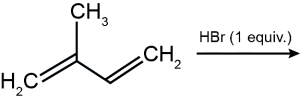
A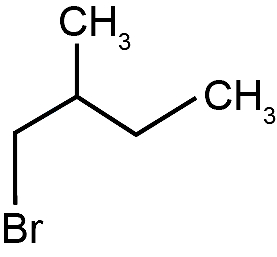
B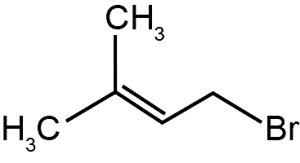
C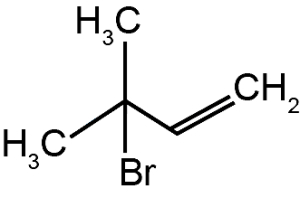
D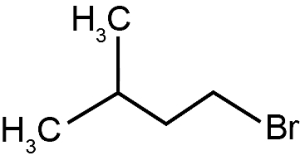
Solution
(C) The reaction of $HBr$ with $2-$methyl$-1,3-$butadiene (isoprene) involves electrophilic addition to the conjugated diene system.
$H^{+}$ adds to the terminal carbon to form the most stable carbocation,which is a resonance-stabilized allylic carbocation.
At room temperature,the thermodynamic product,which is the more substituted alkene,is the major product.
This corresponds to the $1,4-$addition product,which is $1-$bromo$-3-$methyl$-2-$butene.
$H^{+}$ adds to the terminal carbon to form the most stable carbocation,which is a resonance-stabilized allylic carbocation.
At room temperature,the thermodynamic product,which is the more substituted alkene,is the major product.
This corresponds to the $1,4-$addition product,which is $1-$bromo$-3-$methyl$-2-$butene.
0 likes
View Solution1068
EasyMCQ
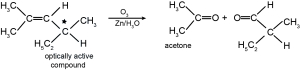
An optically active compound having molecular formula $C_8H_{16}$ on ozonolysis gives acetone as one of the products. The structure of the compound is
A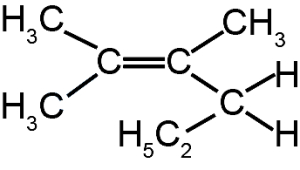
B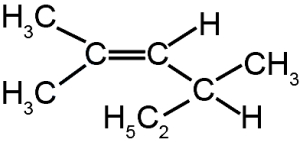
C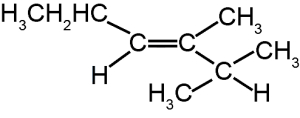
D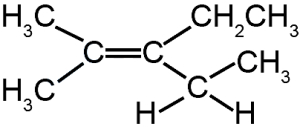
Solution
(B) $1$. The molecular formula $C_8H_{16}$ corresponds to the general formula $C_nH_{2n}$,which indicates an alkene.
$2$. Ozonolysis of an alkene involves the cleavage of the $C=C$ double bond to form carbonyl compounds.
$3$. The problem states that one of the products is acetone,which is $CH_3COCH_3$. This implies the original alkene must contain a $(CH_3)_2C=$ group.
$4$. The compound must also be optically active,meaning it must contain a chiral center (a carbon atom bonded to four different groups).
$5$. Analyzing the options,the structure in option $B$ is $3,4$-dimethylhex-$2$-ene,but specifically,the structure shown is $2,3$-dimethylhex-$2$-ene. Let's re-examine the structure: the compound $2,3$-dimethylhex-$2$-ene has a chiral center at the $C_3$ position,which is bonded to a methyl group,an ethyl group,a hydrogen atom,and the $C=C$ group. Thus,it is optically active.
$6$. Ozonolysis of $2,3$-dimethylhex-$2$-ene yields acetone and $2$-methylbutanal. Therefore,the correct structure is the one shown in option $B$.
$2$. Ozonolysis of an alkene involves the cleavage of the $C=C$ double bond to form carbonyl compounds.
$3$. The problem states that one of the products is acetone,which is $CH_3COCH_3$. This implies the original alkene must contain a $(CH_3)_2C=$ group.
$4$. The compound must also be optically active,meaning it must contain a chiral center (a carbon atom bonded to four different groups).
$5$. Analyzing the options,the structure in option $B$ is $3,4$-dimethylhex-$2$-ene,but specifically,the structure shown is $2,3$-dimethylhex-$2$-ene. Let's re-examine the structure: the compound $2,3$-dimethylhex-$2$-ene has a chiral center at the $C_3$ position,which is bonded to a methyl group,an ethyl group,a hydrogen atom,and the $C=C$ group. Thus,it is optically active.
$6$. Ozonolysis of $2,3$-dimethylhex-$2$-ene yields acetone and $2$-methylbutanal. Therefore,the correct structure is the one shown in option $B$.
0 likes
View Solution1069
EasyMCQ
Among the alkenes,which one produces tertiary butyl alcohol on acid hydration?
A
$CH_3-CH_2-CH=CH_2$
B
$CH_3-CH=CH-CH_3$
C
$(CH_3)_2C=CH_2$
D
$CH_3-CH=CH_2$
Solution
(C) Acid hydration of alkenes follows Markovnikov's rule,where the electrophile $H^+$ adds to the carbon with more hydrogen atoms to form the most stable carbocation intermediate.
For $(CH_3)_2C=CH_2$ (isobutylene),the addition of $H^+$ leads to the formation of a tertiary carbocation: $(CH_3)_2C^+-CH_3$.
This tertiary carbocation is then attacked by water $(H_2O)$ to form the protonated alcohol,which subsequently loses a proton to yield tertiary butyl alcohol,$(CH_3)_3C-OH$.
The reaction sequence is:
$(CH_3)_2C=CH_2 \xrightarrow{H^+} (CH_3)_3C^+$
$(CH_3)_3C^+ \xrightarrow{H_2O} (CH_3)_3C-OH_2^+$
$(CH_3)_3C-OH_2^+ \xrightarrow{-H^+} (CH_3)_3C-OH$ (tertiary butyl alcohol).
For $(CH_3)_2C=CH_2$ (isobutylene),the addition of $H^+$ leads to the formation of a tertiary carbocation: $(CH_3)_2C^+-CH_3$.
This tertiary carbocation is then attacked by water $(H_2O)$ to form the protonated alcohol,which subsequently loses a proton to yield tertiary butyl alcohol,$(CH_3)_3C-OH$.
The reaction sequence is:
$(CH_3)_2C=CH_2 \xrightarrow{H^+} (CH_3)_3C^+$
$(CH_3)_3C^+ \xrightarrow{H_2O} (CH_3)_3C-OH_2^+$
$(CH_3)_3C-OH_2^+ \xrightarrow{-H^+} (CH_3)_3C-OH$ (tertiary butyl alcohol).
0 likes
View Solution1070
EasyMCQ
The addition of $HBr$ to $2-$pentene gives
A
$2-$bromopentane only
B
$3-$bromopentane only
C
$2-$bromopentane and $3-$bromopentane
D
$1-$bromopentane and $3-$bromopentane
Solution
(C) The reaction of $HBr$ with $2-$pentene $(CH_3-CH=CH-CH_2-CH_3)$ is an electrophilic addition reaction.
According to Markovnikov's rule,the proton $(H^+)$ adds to the carbon atom of the double bond that already has more hydrogen atoms,or in this case,to form the more stable carbocation intermediate.
$2-$pentene is a symmetrical alkene with respect to the double bond position relative to the chain ends,but the two carbons of the double bond are not equivalent.
Protonation at $C_2$ gives a secondary carbocation at $C_3$ $(CH_3-CH^+-CH_2-CH_2-CH_3)$,and protonation at $C_3$ gives a secondary carbocation at $C_2$ $(CH_3-CH_2-CH^+-CH_2-CH_3)$.
Both carbocations are secondary and have similar stability.
Therefore,the bromide ion $(Br^-)$ can attack either carbocation,resulting in a mixture of $2-$bromopentane and $3-$bromopentane.
According to Markovnikov's rule,the proton $(H^+)$ adds to the carbon atom of the double bond that already has more hydrogen atoms,or in this case,to form the more stable carbocation intermediate.
$2-$pentene is a symmetrical alkene with respect to the double bond position relative to the chain ends,but the two carbons of the double bond are not equivalent.
Protonation at $C_2$ gives a secondary carbocation at $C_3$ $(CH_3-CH^+-CH_2-CH_2-CH_3)$,and protonation at $C_3$ gives a secondary carbocation at $C_2$ $(CH_3-CH_2-CH^+-CH_2-CH_3)$.
Both carbocations are secondary and have similar stability.
Therefore,the bromide ion $(Br^-)$ can attack either carbocation,resulting in a mixture of $2-$bromopentane and $3-$bromopentane.
0 likes
View Solution1071
EasyMCQ
The correct order of the addition reaction rates of halogen acids with ethylene is
A
$HCl > HBr > HI$
B
$HI > HBr > HCl$
C
$HBr > HCl > HI$
D
$HI > HCl > HBr$
Solution
(B) In halogen acids,as the size of the halogen atom increases,the bond strength between the halogen and hydrogen atom decreases.
This makes the $H-X$ bond easier to break,facilitating the electrophilic addition reaction.
The bond dissociation energy follows the order: $HCl > HBr > HI$.
Therefore,the reactivity order for the addition reaction with ethylene is $HI > HBr > HCl$.
Thus,the correct option is $(B)$.
This makes the $H-X$ bond easier to break,facilitating the electrophilic addition reaction.
The bond dissociation energy follows the order: $HCl > HBr > HI$.
Therefore,the reactivity order for the addition reaction with ethylene is $HI > HBr > HCl$.
Thus,the correct option is $(B)$.
0 likes
View Solution1072
DifficultMCQ
$Ph-CH=CH_2 \xrightarrow[HBr]{(PhCOO)_2} \text{Product}$
Consider the above reaction:
$A$. The reaction proceeds through a more stable radical intermediate.
$B$. The role of peroxide is to generate $\dot{H}$ (Hydrogen radical).
$C$. During this reaction,benzene is formed as a byproduct.
$D$. $1-\text{Bromo}-2-\text{phenylethane}$ is formed as the minor product.
$E$. The same reaction in the absence of peroxide proceeds via a carbocation intermediate.
Identify the correct statements. Choose the correct answer from the options given below:
Consider the above reaction:
$A$. The reaction proceeds through a more stable radical intermediate.
$B$. The role of peroxide is to generate $\dot{H}$ (Hydrogen radical).
$C$. During this reaction,benzene is formed as a byproduct.
$D$. $1-\text{Bromo}-2-\text{phenylethane}$ is formed as the minor product.
$E$. The same reaction in the absence of peroxide proceeds via a carbocation intermediate.
Identify the correct statements. Choose the correct answer from the options given below:
A
$A$ & $E$ Only
B
$A, B$ & $D$ Only
C
$C, D$ & $E$ Only
D
$A, C$ & $E$ Only
Solution
(D) The reaction $Ph-CH=CH_2 + HBr \xrightarrow{(PhCOO)_2} Ph-CH_2-CH_2-Br$ is an Anti-Markovnikov addition.
$A$. Correct: The reaction proceeds via a free radical mechanism where the more stable benzylic radical intermediate is formed.
$B$. Incorrect: The role of peroxide is to generate the benzoyloxy radical,which then abstracts $H$ from $HBr$ to generate the bromine radical $(\dot{Br})$,not the hydrogen radical $(\dot{H})$.
$C$. Correct: As shown in the mechanism,the benzoyloxy radical decomposes to form $Ph\dot{}$ radical,which abstracts $H$ from $HBr$ to form benzene $(Ph-H)$ as a byproduct.
$D$. Incorrect: $1-\text{Bromo}-2-\text{phenylethane}$ is the major product in this Anti-Markovnikov addition.
$E$. Correct: In the absence of peroxide,the reaction follows the electrophilic addition mechanism,which proceeds via a carbocation intermediate (Markovnikov addition).
Therefore,statements $A, C,$ and $E$ are correct.
$A$. Correct: The reaction proceeds via a free radical mechanism where the more stable benzylic radical intermediate is formed.
$B$. Incorrect: The role of peroxide is to generate the benzoyloxy radical,which then abstracts $H$ from $HBr$ to generate the bromine radical $(\dot{Br})$,not the hydrogen radical $(\dot{H})$.
$C$. Correct: As shown in the mechanism,the benzoyloxy radical decomposes to form $Ph\dot{}$ radical,which abstracts $H$ from $HBr$ to form benzene $(Ph-H)$ as a byproduct.
$D$. Incorrect: $1-\text{Bromo}-2-\text{phenylethane}$ is the major product in this Anti-Markovnikov addition.
$E$. Correct: In the absence of peroxide,the reaction follows the electrophilic addition mechanism,which proceeds via a carbocation intermediate (Markovnikov addition).
Therefore,statements $A, C,$ and $E$ are correct.
0 likes
View Solution1073
DifficultMCQ
Arrange the following alkenes in decreasing order of stability. Choose the correct answer from the options given below:
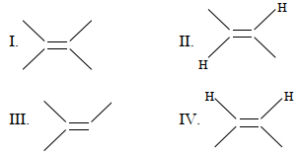
A
$I > III > II > IV$
B
$III > II > I > IV$
C
$I > III > IV > II$
D
$II > I > III > IV$
Solution
(A) The stability of alkenes is determined by the number of hyperconjugative structures (alpha-hydrogens) and steric factors.
$I$: Tetrasubstituted alkene,$12 \ \alpha-H$,most stable.
$III$: Trisubstituted alkene,$9 \ \alpha-H$.
$II$: Disubstituted trans-alkene,$6 \ \alpha-H$,more stable than cis due to less steric hindrance.
$IV$: Disubstituted cis-alkene,$6 \ \alpha-H$,less stable than trans.
Thus,the decreasing order of stability is $I > III > II > IV$.
$I$: Tetrasubstituted alkene,$12 \ \alpha-H$,most stable.
$III$: Trisubstituted alkene,$9 \ \alpha-H$.
$II$: Disubstituted trans-alkene,$6 \ \alpha-H$,more stable than cis due to less steric hindrance.
$IV$: Disubstituted cis-alkene,$6 \ \alpha-H$,less stable than trans.
Thus,the decreasing order of stability is $I > III > II > IV$.
0 likes
View Solution1074
DifficultMCQ
Consider compounds $A$,$B$ and $C$ with following structural formulae: $A = CH_{3} - CH_{2} - CH_{2} - CH_{2} - CH_{2} - OH$,$B = CH_{2} = CH - CH_{2} - CH_{2} - CH_{3}$,$C = HO - CH_{2} - CH_{2} - CH(OH) - CH_{3}$. For the conversion of $B$ from $A$,reagent $(D)$ required is . . . . . . and structural formula of product $(E)$ obtained when $C$ undergoes same reaction using excess reagent $(D)$ is . . . . . . .
A
Conc. $H_{2}SO_{4}$,$CH_{2} = CH - CH(OH)CH_{3}$
B
$D$: Conc. $H_{2}SO_{4}$,$E$: $HO - CH_{2} - CH_{2} - CH = CH_{2}$
C
$D$: $PCC$,$E$: $CH_{2} = CH - CH = CH_{2}$
D
$D$: Conc. $H_{2}SO_{4}$ or $H_{3}PO_{4}$,$E$: $CH_{2} = CH - CH = CH_{2}$
Solution
(D) The conversion of alcohol $(A)$ to alkene $(B)$ is an acid-catalyzed dehydration reaction,which requires a strong acid like $Conc. H_{2}SO_{4}$ or $H_{3}PO_{4}$ as reagent $D$.
Compound $C$ is $HO - CH_{2} - CH_{2} - CH(OH) - CH_{3}$,which is a diol.
When $C$ undergoes dehydration with excess reagent $D$,both hydroxyl $(-OH)$ groups are eliminated to form a conjugated diene.
The product $E$ formed is $CH_{2} = CH - CH = CH_{2}$ (buta$-1,3-$diene).
Compound $C$ is $HO - CH_{2} - CH_{2} - CH(OH) - CH_{3}$,which is a diol.
When $C$ undergoes dehydration with excess reagent $D$,both hydroxyl $(-OH)$ groups are eliminated to form a conjugated diene.
The product $E$ formed is $CH_{2} = CH - CH = CH_{2}$ (buta$-1,3-$diene).
0 likes
View Solution1075
DifficultMCQ
Consider compounds $A$,$B$,and $C$ with the following structural formulae:
$A = CH_3 - CH_2 - CH_2 - CH_2 - CH_2 - OH$
$B = CH_2 = CH - CH_2 - CH_2 - CH_3$
$C = HO - CH_2 - CH_2 - CH(OH) - CH_3$
For the conversion of $B$ from $A$,the reagent $(D)$ required is . . . . . . and the structural formula of the product $(E)$ obtained when $C$ undergoes the same reaction using excess reagent $(D)$ is . . . . . . .
$A = CH_3 - CH_2 - CH_2 - CH_2 - CH_2 - OH$
$B = CH_2 = CH - CH_2 - CH_2 - CH_3$
$C = HO - CH_2 - CH_2 - CH(OH) - CH_3$
For the conversion of $B$ from $A$,the reagent $(D)$ required is . . . . . . and the structural formula of the product $(E)$ obtained when $C$ undergoes the same reaction using excess reagent $(D)$ is . . . . . . .
A
Conc. $H_2SO_4$,$CH_2=CH-CH(OH)CH_3$
B
$D$: $PCC$,$E$: $HO-CH_2-CH_2-CH=CH_2$
C
$D$: $PCC$,$E$: $CH_2=CH-CH=CH_2$
D
$D$: conc. $H_2SO_4$ or $H_3PO_4$,$E$: $CH_2 = CH - CH = CH_2$
Solution
(D) The conversion of alcohol $A$ $(pentan-1-ol)$ to alkene $B$ $(pent-1-ene)$ is a dehydration reaction.
Dehydration of alcohols is typically carried out using a strong acid catalyst like concentrated $H_2SO_4$ or $H_3PO_4$ at high temperatures.
Compound $C$ is $butane-1,3-diol$ $(HO-CH_2-CH_2-CH(OH)-CH_3)$.
When $C$ reacts with an excess of a dehydrating agent like concentrated $H_2SO_4$,both hydroxyl $(-OH)$ groups are removed to form two double bonds,resulting in the formation of a diene.
The product $E$ is $buta-1,3-diene$ $(CH_2=CH-CH=CH_2)$.
Dehydration of alcohols is typically carried out using a strong acid catalyst like concentrated $H_2SO_4$ or $H_3PO_4$ at high temperatures.
Compound $C$ is $butane-1,3-diol$ $(HO-CH_2-CH_2-CH(OH)-CH_3)$.
When $C$ reacts with an excess of a dehydrating agent like concentrated $H_2SO_4$,both hydroxyl $(-OH)$ groups are removed to form two double bonds,resulting in the formation of a diene.
The product $E$ is $buta-1,3-diene$ $(CH_2=CH-CH=CH_2)$.
0 likes
View Solution1076
DifficultMCQ
$R_f$ value for $2$-methylpropene in a solvent system (Ethyl acetate + ether) is $0.42$. $2$-methylpropene is treated with dilute $H_2SO_4$ to give major organic product $(X)$. $R_f$ value for $(X)$ in the same solvent system under identical condition will be:
A
$0.42$
B
$0.82$
C
$0.62$
D
$0.12$
Solution
(D) The reaction of $2$-methylpropene with dilute $H_2SO_4$ is an acid-catalyzed hydration reaction which follows Markovnikov's rule to yield $2$-methylpropan-$2$-ol (tert-butyl alcohol) as the major product $(X)$.
In thin-layer chromatography $(TLC)$,the $R_f$ value is inversely related to the polarity of the compound when using a polar stationary phase like silica gel.
$2$-methylpropene is a non-polar hydrocarbon,whereas $2$-methylpropan-$2$-ol is a polar alcohol capable of forming hydrogen bonds with the stationary phase.
Due to stronger interactions with the polar stationary phase,the polar product $(X)$ will travel a shorter distance compared to the non-polar reactant.
Therefore,the $R_f$ value of $(X)$ must be significantly lower than $0.42$.
Among the given options,$0.12$ is the only value lower than $0.42$.
In thin-layer chromatography $(TLC)$,the $R_f$ value is inversely related to the polarity of the compound when using a polar stationary phase like silica gel.
$2$-methylpropene is a non-polar hydrocarbon,whereas $2$-methylpropan-$2$-ol is a polar alcohol capable of forming hydrogen bonds with the stationary phase.
Due to stronger interactions with the polar stationary phase,the polar product $(X)$ will travel a shorter distance compared to the non-polar reactant.
Therefore,the $R_f$ value of $(X)$ must be significantly lower than $0.42$.
Among the given options,$0.12$ is the only value lower than $0.42$.
0 likes
View Solution1077
DifficultMCQ
An alkene $(X)$ on ozonolysis followed by reduction gives the following products: $H-CHO$ ($2$ moles),$H-CO-CHO$,and $CH_3-CO-CO-CH_3$. The alkene $(X)$ is:
A
B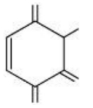
C
D
Solution
(A) Ozonolysis cleaves $C=C$ bonds to form carbonyl compounds.
Given products are $2$ moles of $HCHO$ (formaldehyde),$HCOCHO$ (glyoxal),and $CH_3COCOCH_3$ (butane$-2,3-$dione).
By analyzing the fragments,we can reconstruct the original cyclic alkene structure.
$HCHO$ comes from terminal $=CH_2$ groups.
$HCOCHO$ and $CH_3COCOCH_3$ represent the internal segments of the ring.
By connecting these fragments,we find that the structure corresponds to $1,2,4,5$-tetramethylenecyclohexane or a similar derivative based on the provided options. Based on the standard chemical analysis of such ozonolysis products,the structure is identified as option $A$.
Given products are $2$ moles of $HCHO$ (formaldehyde),$HCOCHO$ (glyoxal),and $CH_3COCOCH_3$ (butane$-2,3-$dione).
By analyzing the fragments,we can reconstruct the original cyclic alkene structure.
$HCHO$ comes from terminal $=CH_2$ groups.
$HCOCHO$ and $CH_3COCOCH_3$ represent the internal segments of the ring.
By connecting these fragments,we find that the structure corresponds to $1,2,4,5$-tetramethylenecyclohexane or a similar derivative based on the provided options. Based on the standard chemical analysis of such ozonolysis products,the structure is identified as option $A$.
0 likes
View Solution1078
MediumMCQ
The $IUPAC$ names of some alkenes are given below. Determine the correct stability order: $A$. $2$-Methylbut-$2$-ene,$B$. $cis$-But-$2$-ene,$C$. $2,3$-Dimethylbut-$2$-ene,$D$. Prop-$1$-ene.
A
$C > A > B > D$
B
$C > A > D > B$
C
$B > D > A > C$
D
$A > B > C > D$
Solution
(A) The stability of alkenes increases with the number of alkyl substituents attached to the double-bonded carbons due to the hyperconjugation effect.
$C$ ($2,3$-Dimethylbut-$2$-ene) has $4$ alkyl groups attached to the double bond.
$A$ ($2$-Methylbut-$2$-ene) has $3$ alkyl groups attached to the double bond.
$B$ ($cis$-But-$2$-ene) has $2$ alkyl groups attached to the double bond.
$D$ (Prop-$1$-ene) has $1$ alkyl group attached to the double bond.
Therefore,the order of stability is $C > A > B > D$.
$C$ ($2,3$-Dimethylbut-$2$-ene) has $4$ alkyl groups attached to the double bond.
$A$ ($2$-Methylbut-$2$-ene) has $3$ alkyl groups attached to the double bond.
$B$ ($cis$-But-$2$-ene) has $2$ alkyl groups attached to the double bond.
$D$ (Prop-$1$-ene) has $1$ alkyl group attached to the double bond.
Therefore,the order of stability is $C > A > B > D$.
0 likes
View SolutionHydrocarbons — Alkene · Frequently Asked Questions
1Are these Hydrocarbons questions useful for JEE and NEET?
Yes. All questions in this section are mapped to JEE Main and NEET exam patterns. Previous year questions from JEE Main, NEET, GUJCET and state-level exams are included with full solutions.
2Can I switch to Hindi or Gujarati for these questions?
Yes. Use the language tabs in the hero section or the sidebar to view the same questions and solutions in English, Hindi or Gujarati.
3How do I generate a question paper from this subtopic?
Use the Vedclass Exam Paper Generator — select the chapter and subtopic, set difficulty, and generate Sets A, B, C, D automatically. First 3 chapters of every subject are free.
Vedclass Products
For Students
Vedclass Test Series
Mock tests in real JEE/NEET style with performance analysis. 5-day free trial.
Start Free TrialFor Teachers
Exam Paper Generator
Generate Set A/B/C/D papers from this chapter in 2 minutes. 3 chapters free.
Try FreeFor Institutes
Online Exam Module
Live online exams with unlimited students, 360° analytics & white-label branding.
See DemoFor Teachers & Institutes
Generate a Hydrocarbons Exam Paper in 2 Minutes
Select subtopic & difficulty — Sets A, B, C, D auto-generated with No Repeat logic.
First 3 chapters of every subject are free — no payment required.