
A English
Alkane Questions in English
Class 11 Chemistry · Hydrocarbons · Alkane
746+
Questions
English
Language
100%
With Solutions
Showing 49 of 746 questions in English
401
DifficultMCQ
The reaction of $n$-butane with bromine in the presence of light at $725\,^oC$ yields ...................
A
$CH_3CH_2CH_2CH_2Br$
B
$CH_3CH_2CH(Br)CH_3$
C
$CH_2=CH-CH(Br)CH_3$
D
$(CH_3)_3C-CH_2Br$
Solution
(B) The reaction of $n$-butane with bromine in the presence of light is a free radical substitution reaction.
At high temperatures like $725\,^oC$,the reaction is highly selective.
Bromination is more selective than chlorination,and the reactivity order of hydrogen atoms is $3^\circ > 2^\circ > 1^\circ$.
In $n$-butane $(CH_3-CH_2-CH_2-CH_3)$,the $2^\circ$ hydrogen atoms are more reactive than the $1^\circ$ hydrogen atoms.
Therefore,the major product formed is $2$-bromobutane,which is $CH_3CH_2CH(Br)CH_3$.
At high temperatures like $725\,^oC$,the reaction is highly selective.
Bromination is more selective than chlorination,and the reactivity order of hydrogen atoms is $3^\circ > 2^\circ > 1^\circ$.
In $n$-butane $(CH_3-CH_2-CH_2-CH_3)$,the $2^\circ$ hydrogen atoms are more reactive than the $1^\circ$ hydrogen atoms.
Therefore,the major product formed is $2$-bromobutane,which is $CH_3CH_2CH(Br)CH_3$.
0 likes
View Solution402
DifficultMCQ
The reaction of ethyl bromide and $n$-propyl bromide with sodium in ether gives .................
A
Only one alkane
B
$A$ mixture of two alkanes
C
$A$ mixture of three alkanes
D
$A$ mixture of four alkanes
Solution
(C) The reaction of alkyl halides with sodium in dry ether is known as the Wurtz reaction. When a mixture of two different alkyl halides (e.g.,$R-X$ and $R'-X$) is used,the reaction produces a mixture of three alkanes.
In this case,the reactants are ethyl bromide $(C_2H_5Br)$ and $n$-propyl bromide $(C_3H_7Br)$.
The possible products are:
$1$. Coupling of two ethyl groups: $C_2H_5-C_2H_5$ ($n$-butane)
$2$. Coupling of two $n$-propyl groups: $C_3H_7-C_3H_7$ ($n$-hexane)
$3$. Cross-coupling of ethyl and $n$-propyl groups: $C_2H_5-C_3H_7$ ($n$-pentane)
Thus,a mixture of three alkanes is obtained.
In this case,the reactants are ethyl bromide $(C_2H_5Br)$ and $n$-propyl bromide $(C_3H_7Br)$.
The possible products are:
$1$. Coupling of two ethyl groups: $C_2H_5-C_2H_5$ ($n$-butane)
$2$. Coupling of two $n$-propyl groups: $C_3H_7-C_3H_7$ ($n$-hexane)
$3$. Cross-coupling of ethyl and $n$-propyl groups: $C_2H_5-C_3H_7$ ($n$-pentane)
Thus,a mixture of three alkanes is obtained.
0 likes
View Solution403
DifficultMCQ
The reaction of lithium di-$3-$pentylcuprate with ethyl bromide yields an alkane with the molecular formula $C_7H_{16}$. What is the structure of the alkane?
A
$3-$methylhexane
B
$2-$ethylpentane
C
$3-$ethylpentane
D
$n-$heptane
Solution
(C) The reaction is a Corey-House synthesis (alkylation of organocopper reagents).
Lithium di-$3-$pentylcuprate is $(CH_3CH_2CH(CH_2CH_3))_2CuLi$.
Ethyl bromide is $CH_3CH_2Br$.
The reaction involves the coupling of the alkyl group from the cuprate with the alkyl group from the halide:
$(CH_3CH_2CH(CH_2CH_3))_2CuLi + CH_3CH_2Br \rightarrow CH_3CH_2CH(CH_2CH_3)CH_2CH_3 + CH_3CH_2Cu + LiBr$.
The product is $CH_3CH_2CH(CH_2CH_3)CH_2CH_3$.
Naming the structure: The longest chain is $6$ carbons long (hexane),with an ethyl group at position $3$.
Thus,the structure is $3-$ethylhexane.
Wait,checking the carbon count: $3-$ethylhexane has $8$ carbons $(C_8H_{18})$.
Let's re-evaluate: The reactant is lithium di-$3-$pentylcuprate ($C_5H_{11}$ group) and ethyl bromide ($C_2H_5$ group).
$C_5H_{11} + C_2H_5 = C_7H_{16}$.
The structure formed is $CH_3CH_2CH(CH_2CH_3)CH_2CH_3$ which is $3-$ethylpentane.
$3-$ethylpentane has $7$ carbons $(C_7H_{16})$.
Lithium di-$3-$pentylcuprate is $(CH_3CH_2CH(CH_2CH_3))_2CuLi$.
Ethyl bromide is $CH_3CH_2Br$.
The reaction involves the coupling of the alkyl group from the cuprate with the alkyl group from the halide:
$(CH_3CH_2CH(CH_2CH_3))_2CuLi + CH_3CH_2Br \rightarrow CH_3CH_2CH(CH_2CH_3)CH_2CH_3 + CH_3CH_2Cu + LiBr$.
The product is $CH_3CH_2CH(CH_2CH_3)CH_2CH_3$.
Naming the structure: The longest chain is $6$ carbons long (hexane),with an ethyl group at position $3$.
Thus,the structure is $3-$ethylhexane.
Wait,checking the carbon count: $3-$ethylhexane has $8$ carbons $(C_8H_{18})$.
Let's re-evaluate: The reactant is lithium di-$3-$pentylcuprate ($C_5H_{11}$ group) and ethyl bromide ($C_2H_5$ group).
$C_5H_{11} + C_2H_5 = C_7H_{16}$.
The structure formed is $CH_3CH_2CH(CH_2CH_3)CH_2CH_3$ which is $3-$ethylpentane.
$3-$ethylpentane has $7$ carbons $(C_7H_{16})$.
0 likes
View Solution404
DifficultMCQ
When a mixture of methane and oxygen is passed over heated molybdenum oxide, the product obtained is ........ .
A
Methanoic acid
B
Ethanal
C
Methanol
D
Methanal
0 likes
View Solution405
MediumMCQ
Which of the following is the best method for the preparation of methane?
A
Reduction of $CH_2Cl_2$
B
Wurtz reaction
C
Liquefaction of natural gas
D
None of these
Solution
(D) The reduction of methyl halides (like $CH_3Cl$ or $CH_3I$) with zinc and hydrochloric acid $(Zn/HCl)$ or lithium aluminium hydride $(LiAlH_4)$ is a standard laboratory method for preparing methane. Among the given options,none represent the standard laboratory preparation method (like the reduction of methyl halides or the decarboxylation of sodium acetate). Therefore,the correct choice is $D$.
0 likes
View Solution406
DifficultMCQ
Pure methane can be produced by:
A
Wurtz reaction
B
Kolbe's electrolysis
C
Sodalime decarboxylation
D
Reduction of $CCl_4$ by $H_2$
Solution
(C) Pure methane $(CH_4)$ is produced by the decarboxylation of sodium acetate with sodalime $(NaOH + CaO)$.
The reaction is: $CH_3COONa + NaOH \xrightarrow{CaO, \Delta} CH_4 + Na_2CO_3$.
Other methods like Wurtz reaction are used for higher alkanes (even number of carbon atoms),and Kolbe's electrolysis of sodium acetate produces ethane.
The reaction is: $CH_3COONa + NaOH \xrightarrow{CaO, \Delta} CH_4 + Na_2CO_3$.
Other methods like Wurtz reaction are used for higher alkanes (even number of carbon atoms),and Kolbe's electrolysis of sodium acetate produces ethane.
0 likes
View Solution407
DifficultMCQ
For which of the following are only two isomeric monochloro derivatives possible?
A
$2-$methylpropane
B
$n-$butane
C
Benzene
D
$2,4-$dimethylpentane
Solution
(B) To determine the number of monochloro derivatives,we identify the number of non-equivalent hydrogen atoms in the molecule.
$1$. $2-$methylpropane $(CH_3-CH(CH_3)-CH_3)$: It has two types of hydrogen atoms (primary and tertiary),so it gives two monochloro derivatives.
$2$. $n-$butane $(CH_3-CH_2-CH_2-CH_3)$: It has two types of hydrogen atoms (terminal and internal),so it gives two monochloro derivatives.
$3$. Benzene $(C_6H_6)$: All hydrogen atoms are equivalent,so it gives only one monochloro derivative.
$4$. $2,4-$dimethylpentane: It has three types of hydrogen atoms,so it gives three monochloro derivatives.
Since both $2-$methylpropane and $n-$butane yield two isomers,the question implies a standard selection. However,$n-$butane is the most common textbook example for this specific property.
$1$. $2-$methylpropane $(CH_3-CH(CH_3)-CH_3)$: It has two types of hydrogen atoms (primary and tertiary),so it gives two monochloro derivatives.
$2$. $n-$butane $(CH_3-CH_2-CH_2-CH_3)$: It has two types of hydrogen atoms (terminal and internal),so it gives two monochloro derivatives.
$3$. Benzene $(C_6H_6)$: All hydrogen atoms are equivalent,so it gives only one monochloro derivative.
$4$. $2,4-$dimethylpentane: It has three types of hydrogen atoms,so it gives three monochloro derivatives.
Since both $2-$methylpropane and $n-$butane yield two isomers,the question implies a standard selection. However,$n-$butane is the most common textbook example for this specific property.
0 likes
View Solution408
DifficultMCQ
The molecular mass of a hydrocarbon is $86 \ g/mol$. What is the number of its possible structural isomers?
A
$4$
B
$5$
C
$6$
D
$7$
Solution
(B) The general formula for an alkane is $C_nH_{2n+2}$.
Given molecular mass = $86 \ g/mol$.
$12n + 1(2n+2) = 86$
$14n + 2 = 86$
$14n = 84$
$n = 6$.
The hydrocarbon is hexane $(C_6H_{14})$.
The structural isomers of hexane are:
$1$. $n$-hexane $(CH_3-CH_2-CH_2-CH_2-CH_2-CH_3)$
$2$. $2$-methylpentane $(CH_3-CH(CH_3)-CH_2-CH_2-CH_3)$
$3$. $3$-methylpentane $(CH_3-CH_2-CH(CH_3)-CH_2-CH_3)$
$4$. $2,2$-dimethylbutane $(CH_3-C(CH_3)_2-CH_2-CH_3)$
$5$. $2,3$-dimethylbutane $(CH_3-CH(CH_3)-CH(CH_3)-CH_3)$
Total number of structural isomers = $5$.
Given molecular mass = $86 \ g/mol$.
$12n + 1(2n+2) = 86$
$14n + 2 = 86$
$14n = 84$
$n = 6$.
The hydrocarbon is hexane $(C_6H_{14})$.
The structural isomers of hexane are:
$1$. $n$-hexane $(CH_3-CH_2-CH_2-CH_2-CH_2-CH_3)$
$2$. $2$-methylpentane $(CH_3-CH(CH_3)-CH_2-CH_2-CH_3)$
$3$. $3$-methylpentane $(CH_3-CH_2-CH(CH_3)-CH_2-CH_3)$
$4$. $2,2$-dimethylbutane $(CH_3-C(CH_3)_2-CH_2-CH_3)$
$5$. $2,3$-dimethylbutane $(CH_3-CH(CH_3)-CH(CH_3)-CH_3)$
Total number of structural isomers = $5$.
0 likes
View Solution409
MediumMCQ
Identify the straight-chain hydrocarbon that is an isomer of $3-$ethyl$-2-$methylhexane.
A
$n-$heptane
B
$n-$octane
C
$n-$nonane
D
$n-$decane
Solution
(C) The given compound is $3-$ethyl$-2-$methylhexane.
First,determine the molecular formula by counting the total number of carbon atoms.
The parent chain is hexane ($6$ carbons),plus an ethyl group ($2$ carbons) and a methyl group ($1$ carbon).
Total carbons = $6 + 2 + 1 = 9$.
The general formula for an alkane is $C_nH_{2n+2}$. For $n=9$,the formula is $C_9H_{20}$.
An isomer must have the same molecular formula.
Among the options,$n-$nonane $(C_9H_{20})$ is the straight-chain isomer of $3-$ethyl$-2-$methylhexane.
First,determine the molecular formula by counting the total number of carbon atoms.
The parent chain is hexane ($6$ carbons),plus an ethyl group ($2$ carbons) and a methyl group ($1$ carbon).
Total carbons = $6 + 2 + 1 = 9$.
The general formula for an alkane is $C_nH_{2n+2}$. For $n=9$,the formula is $C_9H_{20}$.
An isomer must have the same molecular formula.
Among the options,$n-$nonane $(C_9H_{20})$ is the straight-chain isomer of $3-$ethyl$-2-$methylhexane.
0 likes
View Solution410
MediumMCQ
The number of monobromo isomers of neopentane is ........ .
A
$1$
B
$2$
C
$3$
D
$4$
Solution
(A) Neopentane is $2,2$-dimethylpropane,which has the structure $C(CH_3)_4$.
All $12$ hydrogen atoms in neopentane are equivalent because the molecule has a highly symmetrical tetrahedral structure.
Replacing any one of these $12$ hydrogen atoms with a bromine atom results in the same product,$1$-bromo-$2,2$-dimethylpropane.
Therefore,there is only $1$ possible monobromo isomer for neopentane.
All $12$ hydrogen atoms in neopentane are equivalent because the molecule has a highly symmetrical tetrahedral structure.
Replacing any one of these $12$ hydrogen atoms with a bromine atom results in the same product,$1$-bromo-$2,2$-dimethylpropane.
Therefore,there is only $1$ possible monobromo isomer for neopentane.
0 likes
View Solution411
MediumMCQ
In which of the following is the rotation around the carbon-carbon bond least restricted?
A
$Ethane$
B
$Ethene$
C
$Acetylene$
D
$Hexachloroethane$
Solution
(A) The restriction of rotation around a $C-C$ bond depends on the bond order and the steric hindrance caused by substituents.
$1$. $Ethane$ $(CH_3-CH_3)$ has a $C-C$ single bond,allowing free rotation.
$2$. $Ethene$ $(CH_2=CH_2)$ has a $C=C$ double bond,which restricts rotation.
$3$. $Acetylene$ $(CH \equiv CH)$ has a $C \equiv C$ triple bond,which further restricts rotation.
$4$. $Hexachloroethane$ $(CCl_3-CCl_3)$ has a $C-C$ single bond,but the large $Cl$ atoms cause significant steric hindrance,restricting rotation compared to $Ethane$.
Therefore,$Ethane$ has the least restricted rotation.
$1$. $Ethane$ $(CH_3-CH_3)$ has a $C-C$ single bond,allowing free rotation.
$2$. $Ethene$ $(CH_2=CH_2)$ has a $C=C$ double bond,which restricts rotation.
$3$. $Acetylene$ $(CH \equiv CH)$ has a $C \equiv C$ triple bond,which further restricts rotation.
$4$. $Hexachloroethane$ $(CCl_3-CCl_3)$ has a $C-C$ single bond,but the large $Cl$ atoms cause significant steric hindrance,restricting rotation compared to $Ethane$.
Therefore,$Ethane$ has the least restricted rotation.
0 likes
View Solution412
MediumMCQ
Which of the following alkanes with the lowest number of carbon atoms is optically active?
A
$2-$ Methyl pentane
B
$3-$ Methyl pentane
C
$3-$ Methyl hexane
D
$3-$ Methyl heptane
Solution
(C) An alkane is optically active if it contains at least one chiral carbon atom (a carbon atom bonded to four different groups).
$2-$ Methyl pentane: $CH_3-CH(CH_3)-CH_2-CH_2-CH_3$ (No chiral carbon).
$3-$ Methyl pentane: $CH_3-CH_2-CH(CH_3)-CH_2-CH_3$ (No chiral carbon).
$3-$ Methyl hexane: $CH_3-CH_2-CH(CH_3)-CH_2-CH_2-CH_3$. The $C_3$ atom is bonded to $-H$,$-CH_3$,$-CH_2CH_3$,and $-CH_2CH_2CH_3$. Since all four groups are different,it is chiral.
$3-$ Methyl hexane has $7$ carbon atoms,which is the lowest number among the options provided that exhibits optical activity.
$2-$ Methyl pentane: $CH_3-CH(CH_3)-CH_2-CH_2-CH_3$ (No chiral carbon).
$3-$ Methyl pentane: $CH_3-CH_2-CH(CH_3)-CH_2-CH_3$ (No chiral carbon).
$3-$ Methyl hexane: $CH_3-CH_2-CH(CH_3)-CH_2-CH_2-CH_3$. The $C_3$ atom is bonded to $-H$,$-CH_3$,$-CH_2CH_3$,and $-CH_2CH_2CH_3$. Since all four groups are different,it is chiral.
$3-$ Methyl hexane has $7$ carbon atoms,which is the lowest number among the options provided that exhibits optical activity.
0 likes
View Solution413
DifficultMCQ
The interaction that causes the most instability in the boat conformation of cyclohexane is .......
A
eclipsing
B
flagpole-flagpole
C
$1,3-$diaxial
D
$1,3-$diequatorial
Solution
(B) The boat conformation of cyclohexane is less stable than the chair conformation due to two main factors:
$1$. Torsional strain caused by eclipsing interactions of bonds on adjacent carbons.
$2$. Steric strain (van der Waals repulsion) between the two hydrogen atoms at the $C-1$ and $C-4$ positions,which are known as flagpole hydrogens.
The flagpole-flagpole interaction is the most significant source of instability in the boat conformation.
$1$. Torsional strain caused by eclipsing interactions of bonds on adjacent carbons.
$2$. Steric strain (van der Waals repulsion) between the two hydrogen atoms at the $C-1$ and $C-4$ positions,which are known as flagpole hydrogens.
The flagpole-flagpole interaction is the most significant source of instability in the boat conformation.
0 likes
View Solution414
MediumMCQ
In which of the following is the $Baeyer$ angular strain maximum?
A
$Cyclopentane$
B
$Cyclodecane$
C
$Cyclooctane$
D
$Cyclohexane$
Solution
(A) According to $Baeyer's$ strain theory,the angular strain is given by the formula: $\text{Angle strain} = \frac{1}{2} (109^\circ 28' - \text{bond angle})$.
For $Cyclopentane$,the bond angle is $108^\circ$,which is very close to the tetrahedral angle $(109^\circ 28')$,resulting in low strain.
However,among the given options,$Cyclopentane$ has the smallest ring size compared to $Cyclohexane$,$Cyclooctane$,and $Cyclodecane$.
According to $Baeyer$,the deviation from the tetrahedral angle increases as the ring size deviates from the ideal $5$-membered ring (which he incorrectly assumed to be the most stable).
In the context of standard chemistry problems regarding $Baeyer$ strain,$Cyclopentane$ is often cited for its specific strain characteristics compared to larger rings.
For $Cyclopentane$,the bond angle is $108^\circ$,which is very close to the tetrahedral angle $(109^\circ 28')$,resulting in low strain.
However,among the given options,$Cyclopentane$ has the smallest ring size compared to $Cyclohexane$,$Cyclooctane$,and $Cyclodecane$.
According to $Baeyer$,the deviation from the tetrahedral angle increases as the ring size deviates from the ideal $5$-membered ring (which he incorrectly assumed to be the most stable).
In the context of standard chemistry problems regarding $Baeyer$ strain,$Cyclopentane$ is often cited for its specific strain characteristics compared to larger rings.
0 likes
View Solution415
DifficultMCQ
Which reactive intermediate is involved in the following reaction?
$2-\text{methylbutane} \xrightarrow{Br_2, hv} 2-\text{bromo}-3-\text{methylbutane}$ (not the major product)
$2-\text{methylbutane} \xrightarrow{Br_2, hv} 2-\text{bromo}-3-\text{methylbutane}$ (not the major product)
A
Tertiary carbocation
B
Secondary carbocation
C
Tertiary free radical
D
Secondary free radical
Solution
(D) The reaction of an alkane with $Br_2$ in the presence of $hv$ (ultraviolet light) proceeds via a free radical substitution mechanism.
In the first step,the bromine molecule undergoes homolytic cleavage to form bromine radicals $(Br^{\bullet})$.
These bromine radicals then abstract a hydrogen atom from the alkane to form an alkyl radical intermediate.
For $2-\text{methylbutane}$ $(CH_3-CH(CH_3)-CH_2-CH_3)$,the abstraction of a hydrogen atom from the $C-2$ position leads to a tertiary free radical,while abstraction from the $C-3$ position leads to a secondary free radical.
The formation of $2-\text{bromo}-3-\text{methylbutane}$ involves the secondary free radical intermediate formed at the $C-3$ position.
In the first step,the bromine molecule undergoes homolytic cleavage to form bromine radicals $(Br^{\bullet})$.
These bromine radicals then abstract a hydrogen atom from the alkane to form an alkyl radical intermediate.
For $2-\text{methylbutane}$ $(CH_3-CH(CH_3)-CH_2-CH_3)$,the abstraction of a hydrogen atom from the $C-2$ position leads to a tertiary free radical,while abstraction from the $C-3$ position leads to a secondary free radical.
The formation of $2-\text{bromo}-3-\text{methylbutane}$ involves the secondary free radical intermediate formed at the $C-3$ position.
0 likes
View Solution416
DifficultMCQ
If a mixture of methyl iodide and ethyl iodide in equal proportions is treated with metallic sodium in dry ether,the number of possible products obtained will be ....................
A
$2$
B
$3$
C
$1$
D
$4$
Solution
(B) The reaction of alkyl halides with sodium in the presence of dry ether is known as the Wurtz reaction.
When a mixture of two different alkyl halides ($R-X$ and $R'-X$) is used,it results in a mixture of three alkanes:
$1$. $CH_3I + CH_3I + 2Na \xrightarrow{\text{dry ether}} CH_3-CH_3 + 2NaI$ (Ethane)
$2$. $C_2H_5I + C_2H_5I + 2Na \xrightarrow{\text{dry ether}} C_2H_5-C_2H_5 + 2NaI$ (n-Butane)
$3$. $CH_3I + C_2H_5I + 2Na \xrightarrow{\text{dry ether}} CH_3-C_2H_5 + 2NaI$ (Propane)
Thus,a total of $3$ different alkanes are formed as products.
When a mixture of two different alkyl halides ($R-X$ and $R'-X$) is used,it results in a mixture of three alkanes:
$1$. $CH_3I + CH_3I + 2Na \xrightarrow{\text{dry ether}} CH_3-CH_3 + 2NaI$ (Ethane)
$2$. $C_2H_5I + C_2H_5I + 2Na \xrightarrow{\text{dry ether}} C_2H_5-C_2H_5 + 2NaI$ (n-Butane)
$3$. $CH_3I + C_2H_5I + 2Na \xrightarrow{\text{dry ether}} CH_3-C_2H_5 + 2NaI$ (Propane)
Thus,a total of $3$ different alkanes are formed as products.
0 likes
View Solution417
DifficultMCQ
The reaction of $1, 3-$dibromopropane with metallic zinc gives ..........
A
Propene
B
Propane
C
Cyclopropane
D
Hexane
Solution
(C) When $1, 3-$dibromopropane $(Br-CH_2-CH_2-CH_2-Br)$ is treated with metallic zinc $(Zn)$,an intramolecular dehalogenation reaction occurs.
This reaction results in the formation of a three-membered ring,which is $Cyclopropane$ $(C_3H_6)$,along with the byproduct $ZnBr_2$.
This reaction results in the formation of a three-membered ring,which is $Cyclopropane$ $(C_3H_6)$,along with the byproduct $ZnBr_2$.
0 likes
View Solution418
DifficultMCQ
The reaction of ethylene dichloride with aqueous $KOH$ gives .........
A
$CH_3CHO$
B
$CH_2(OH)-CH_2OH$
C
$HCHO$
D
$OHC-CHO$
Solution
(B) Ethylene dichloride is $Cl-CH_2-CH_2-Cl$.
When it reacts with aqueous $KOH$,it undergoes nucleophilic substitution where the chlorine atoms are replaced by hydroxyl groups.
The reaction is: $Cl-CH_2-CH_2-Cl + 2KOH(aq) \rightarrow HO-CH_2-CH_2-OH + 2KCl$.
The product formed is ethylene glycol $(CH_2(OH)-CH_2OH)$.
When it reacts with aqueous $KOH$,it undergoes nucleophilic substitution where the chlorine atoms are replaced by hydroxyl groups.
The reaction is: $Cl-CH_2-CH_2-Cl + 2KOH(aq) \rightarrow HO-CH_2-CH_2-OH + 2KCl$.
The product formed is ethylene glycol $(CH_2(OH)-CH_2OH)$.
0 likes
View Solution419
DifficultMCQ
Identify the major product $Y$ in the following reaction sequence:
$CH_3-CH(CH_3)-CH_2-Cl$ $\xrightarrow[\text{dry ether}]{Na} X$ $\xrightarrow[\text{monobromination}]{Br_2/h\nu} Y$ (major)
$CH_3-CH(CH_3)-CH_2-Cl$ $\xrightarrow[\text{dry ether}]{Na} X$ $\xrightarrow[\text{monobromination}]{Br_2/h\nu} Y$ (major)
A
$2-$bromo$-2,3-$dimethylbutane
B
$1-$bromo$-2,3-$dimethylbutane
C
$2-$bromohexane
D
$3-$bromohexane
Solution
(A) $1$. The first step is the Wurtz reaction: $2CH_3-CH(CH_3)-CH_2-Cl + 2Na \xrightarrow{\text{dry ether}} CH_3-CH(CH_3)-CH_2-CH_2-CH(CH_3)-CH_3 + 2NaCl$. The product $X$ is $2,5-\text{dimethylhexane}$.
$2$. The second step is the free radical monobromination of $2,5-\text{dimethylhexane}$ with $Br_2/h\nu$.
$3$. The structure of $2,5-\text{dimethylhexane}$ is $CH_3-CH(CH_3)-CH_2-CH_2-CH(CH_3)-CH_3$. It has primary,secondary,and tertiary hydrogens. The reactivity order for free radical substitution is $3^\circ > 2^\circ > 1^\circ$.
$4$. The tertiary hydrogens are at the $C-2$ and $C-5$ positions. Replacing a tertiary hydrogen leads to the most stable free radical intermediate,resulting in the major product: $2-\text{bromo}-2,5-\text{dimethylhexane}$.
$5$. Reviewing the options,the provided structures in the images correspond to different isomers. Based on the standard reaction path for $2,5-\text{dimethylhexane}$,the major product is $2-\text{bromo}-2,5-\text{dimethylhexane}$. Given the options provided,option $A$ represents $2-\text{bromo}-2,3-\text{dimethylbutane}$,which is not the product of this specific reaction. However,assuming the question intended to show $2,5-\text{dimethylhexane}$ as $X$,the major product is $2-\text{bromo}-2,5-\text{dimethylhexane}$.
$2$. The second step is the free radical monobromination of $2,5-\text{dimethylhexane}$ with $Br_2/h\nu$.
$3$. The structure of $2,5-\text{dimethylhexane}$ is $CH_3-CH(CH_3)-CH_2-CH_2-CH(CH_3)-CH_3$. It has primary,secondary,and tertiary hydrogens. The reactivity order for free radical substitution is $3^\circ > 2^\circ > 1^\circ$.
$4$. The tertiary hydrogens are at the $C-2$ and $C-5$ positions. Replacing a tertiary hydrogen leads to the most stable free radical intermediate,resulting in the major product: $2-\text{bromo}-2,5-\text{dimethylhexane}$.
$5$. Reviewing the options,the provided structures in the images correspond to different isomers. Based on the standard reaction path for $2,5-\text{dimethylhexane}$,the major product is $2-\text{bromo}-2,5-\text{dimethylhexane}$. Given the options provided,option $A$ represents $2-\text{bromo}-2,3-\text{dimethylbutane}$,which is not the product of this specific reaction. However,assuming the question intended to show $2,5-\text{dimethylhexane}$ as $X$,the major product is $2-\text{bromo}-2,5-\text{dimethylhexane}$.
0 likes
View Solution420
DifficultMCQ
What is the final product obtained by the reduction of glycerol with hydriodic acid $(HI)$?
A
Propane
B
Propanoic acid
C
Propene
D
None of these
Solution
(A) When glycerol $(CH_2OH-CHOH-CH_2OH)$ is heated with excess hydriodic acid $(HI)$,it undergoes reduction.
First,the hydroxyl groups are replaced by iodine atoms to form $1,2,3-triiodopropane$.
This compound is unstable and loses iodine to form allyl iodide $(CH_2=CH-CH_2I)$.
Further reaction with $HI$ leads to the formation of $2-iodopropane$ $(CH_3-CH(I)-CH_3)$.
Finally,the reduction of $2-iodopropane$ with $HI$ yields $2-iodopropane$ which further reduces to propane $(CH_3-CH_2-CH_3)$.
First,the hydroxyl groups are replaced by iodine atoms to form $1,2,3-triiodopropane$.
This compound is unstable and loses iodine to form allyl iodide $(CH_2=CH-CH_2I)$.
Further reaction with $HI$ leads to the formation of $2-iodopropane$ $(CH_3-CH(I)-CH_3)$.
Finally,the reduction of $2-iodopropane$ with $HI$ yields $2-iodopropane$ which further reduces to propane $(CH_3-CH_2-CH_3)$.
0 likes
View Solution421
DifficultMCQ
The most important method of preparation of hydrocarbons of lower carbon number is
A
Pyrolysis of higher carbon number of hydrocarbons
B
Electrolysis of salts of fatty acids
C
Sabatier and Senderens reaction
D
Direct synthesis
Solution
(A) Pyrolysis (or cracking) is the process of breaking down higher alkanes into lower alkanes and alkenes by heating them in the absence of air.
For example: $C_6H_{14} \xrightarrow[\Delta]{\text{Pyrolysis}} C_2H_4 + C_4H_{10}$
This is the most effective industrial method for obtaining hydrocarbons with a lower carbon number from higher ones.
For example: $C_6H_{14} \xrightarrow[\Delta]{\text{Pyrolysis}} C_2H_4 + C_4H_{10}$
This is the most effective industrial method for obtaining hydrocarbons with a lower carbon number from higher ones.
0 likes
View Solution422
MediumMCQ
Which one of the following cannot be prepared by Wurtz reaction?
A
$CH_4$
B
$C_2H_6$
C
$C_3H_8$
D
$C_4H_{10}$
Solution
(A) The Wurtz reaction involves the coupling of two alkyl halide molecules to form a symmetric alkane with an even number of carbon atoms.
$CH_4$ (methane) contains only one carbon atom.
Since the Wurtz reaction requires at least two alkyl groups to combine,it is impossible to form a single-carbon alkane like methane.
Therefore,$CH_4$ cannot be prepared by this method.
$CH_4$ (methane) contains only one carbon atom.
Since the Wurtz reaction requires at least two alkyl groups to combine,it is impossible to form a single-carbon alkane like methane.
Therefore,$CH_4$ cannot be prepared by this method.
0 likes
View Solution423
DifficultMCQ
Assertion : $CH_4$ does not react with $Cl_2$ in dark.
Reason : Chlorination of $CH_4$ takes place in sunlight.
Reason : Chlorination of $CH_4$ takes place in sunlight.
A
If both Assertion and Reason are correct and the Reason is a correct explanation of the Assertion.
B
If both Assertion and Reason are correct but Reason is not a correct explanation of the Assertion.
C
If the Assertion is correct but Reason is incorrect.
D
If both the Assertion and Reason are incorrect.
Solution
(A) The chlorination of $CH_4$ is a free radical substitution reaction.
In the dark,there is no energy source (like $h\nu$ or high temperature) to initiate the homolytic cleavage of the $Cl-Cl$ bond to produce $Cl$ free radicals.
Therefore,the reaction does not occur in the dark.
Sunlight provides the necessary energy to initiate the formation of $Cl$ free radicals,which then propagate the reaction.
Thus,both the Assertion and Reason are correct,and the Reason is the correct explanation of the Assertion.
In the dark,there is no energy source (like $h\nu$ or high temperature) to initiate the homolytic cleavage of the $Cl-Cl$ bond to produce $Cl$ free radicals.
Therefore,the reaction does not occur in the dark.
Sunlight provides the necessary energy to initiate the formation of $Cl$ free radicals,which then propagate the reaction.
Thus,both the Assertion and Reason are correct,and the Reason is the correct explanation of the Assertion.
0 likes
View Solution424
MediumMCQ
The alkane that gives only one mono-chloro product on chlorination with $Cl_2$ in the presence of diffused sunlight is:
A
$2,2-$dimethylbutane
B
neopentane
C
$n-$pentane
D
Isopentane
Solution
(B) For an alkane to produce only one mono-chloro product,all hydrogen atoms in the molecule must be equivalent.
Neopentane ($2,2-$dimethylpropane) has the structure $C(CH_3)_4$.
In neopentane,all $12$ hydrogen atoms are attached to equivalent primary carbon atoms.
Therefore,substitution of any of these $12$ hydrogen atoms by a chlorine atom results in the same product,$1-$chloro$-2,2-$dimethylpropane.
Other options like $n-$pentane,isopentane,and $2,2-$dimethylbutane contain non-equivalent hydrogen atoms,leading to a mixture of isomeric mono-chloro products.
Neopentane ($2,2-$dimethylpropane) has the structure $C(CH_3)_4$.
In neopentane,all $12$ hydrogen atoms are attached to equivalent primary carbon atoms.
Therefore,substitution of any of these $12$ hydrogen atoms by a chlorine atom results in the same product,$1-$chloro$-2,2-$dimethylpropane.
Other options like $n-$pentane,isopentane,and $2,2-$dimethylbutane contain non-equivalent hydrogen atoms,leading to a mixture of isomeric mono-chloro products.
0 likes
View Solution425
MediumMCQ
Hydrocarbon $(A)$ reacts with bromine by substitution to form an alkyl bromide,which by Wurtz reaction is converted to a gaseous hydrocarbon containing less than four carbon atoms. $(A)$ is
A
$CH \equiv CH$
B
$CH_2 = CH_2$
C
$CH_3-CH_3$
D
$CH_4$
Solution
(D) The hydrocarbon $(A)$ is methane $(CH_4)$.
$CH_4$ reacts with $Br_2$ in the presence of light $(hv)$ via free radical substitution to form methyl bromide $(CH_3Br)$.
$CH_4 + Br_2 \xrightarrow{hv} CH_3Br + HBr$
Methyl bromide $(CH_3Br)$ undergoes the Wurtz reaction in the presence of sodium $(Na)$ and dry ether to form ethane $(CH_3-CH_3)$.
$2CH_3Br + 2Na \xrightarrow{\text{dry ether}} CH_3-CH_3 + 2NaBr$
Ethane $(CH_3-CH_3)$ is a gaseous hydrocarbon containing two carbon atoms,which is less than four carbon atoms.
$CH_4$ reacts with $Br_2$ in the presence of light $(hv)$ via free radical substitution to form methyl bromide $(CH_3Br)$.
$CH_4 + Br_2 \xrightarrow{hv} CH_3Br + HBr$
Methyl bromide $(CH_3Br)$ undergoes the Wurtz reaction in the presence of sodium $(Na)$ and dry ether to form ethane $(CH_3-CH_3)$.
$2CH_3Br + 2Na \xrightarrow{\text{dry ether}} CH_3-CH_3 + 2NaBr$
Ethane $(CH_3-CH_3)$ is a gaseous hydrocarbon containing two carbon atoms,which is less than four carbon atoms.
0 likes
View Solution426
DifficultMCQ
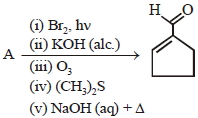
In the following reaction,$A$ is:
A
Cyclohexane
B
Cyclohexene
C
Cyclopentane
D
Methylcyclopentane
Solution
(A) The reaction sequence is as follows:
$1$. $A$ reacts with $Br_2, h\nu$ to form a brominated product.
$2$. Treatment with $KOH$ (alc.) causes dehydrohalogenation to form an alkene.
$3$. Ozonolysis $(O_3, (CH_3)_2S)$ of the alkene cleaves the ring to form a dialdehyde.
$4$. Intramolecular aldol condensation followed by dehydration with $NaOH (aq) + \Delta$ yields the final product,which is cyclopent$-1-$ene$-1-$carbaldehyde.
$5$. Working backwards from the final product,the precursor dialdehyde is hexane$-1,6-$dial. The alkene formed after step (ii) is cyclohexene. The brominated product is bromocyclohexane. Therefore,$A$ must be cyclohexane.
$1$. $A$ reacts with $Br_2, h\nu$ to form a brominated product.
$2$. Treatment with $KOH$ (alc.) causes dehydrohalogenation to form an alkene.
$3$. Ozonolysis $(O_3, (CH_3)_2S)$ of the alkene cleaves the ring to form a dialdehyde.
$4$. Intramolecular aldol condensation followed by dehydration with $NaOH (aq) + \Delta$ yields the final product,which is cyclopent$-1-$ene$-1-$carbaldehyde.
$5$. Working backwards from the final product,the precursor dialdehyde is hexane$-1,6-$dial. The alkene formed after step (ii) is cyclohexene. The brominated product is bromocyclohexane. Therefore,$A$ must be cyclohexane.
0 likes
View Solution427
Medium
Write the structures of different chain isomers of alkanes corresponding to the molecular formula $C_{6}H_{14}$. Also,write their $IUPAC$ names.
Solution
(N/A) $(i) \ CH_{3}-CH_{2}-CH_{2}-CH_{2}-CH_{2}-CH_{3}$ : $n$-Hexane
$(ii) \ CH_{3}-CH(CH_{3})-CH_{2}-CH_{2}-CH_{3}$ : $2$-Methylpentane
$(iii) \ CH_{3}-CH_{2}-CH(CH_{3})-CH_{2}-CH_{3}$ : $3$-Methylpentane
$(iv) \ CH_{3}-CH(CH_{3})-CH(CH_{3})-CH_{3}$ : $2,3$-Dimethylbutane
$(v) \ CH_{3}-C(CH_{3})_{2}-CH_{2}-CH_{3}$ : $2,2$-Dimethylbutane
$(ii) \ CH_{3}-CH(CH_{3})-CH_{2}-CH_{2}-CH_{3}$ : $2$-Methylpentane
$(iii) \ CH_{3}-CH_{2}-CH(CH_{3})-CH_{2}-CH_{3}$ : $3$-Methylpentane
$(iv) \ CH_{3}-CH(CH_{3})-CH(CH_{3})-CH_{3}$ : $2,3$-Dimethylbutane
$(v) \ CH_{3}-C(CH_{3})_{2}-CH_{2}-CH_{3}$ : $2,2$-Dimethylbutane
0 likes
View Solution428
Easy
Write the structural formulas of the following compounds:
$(i)$ $3,4,4,5-$Tetramethylheptane
$(ii)$ $2,5-$Dimethylhexane
$(i)$ $3,4,4,5-$Tetramethylheptane
$(ii)$ $2,5-$Dimethylhexane
Solution
(N/A) $(i)$ The parent chain is heptane ($7$ carbons). Substituents are four methyl groups at positions $3, 4, 4,$ and $5$. The structure is: $CH_3-CH_2-CH(CH_3)-C(CH_3)_2-CH(CH_3)-CH_2-CH_3$
$(ii)$ The parent chain is hexane ($6$ carbons). Substituents are two methyl groups at positions $2$ and $5$. The structure is: $CH_3-CH(CH_3)-CH_2-CH_2-CH(CH_3)-CH_3$
$(ii)$ The parent chain is hexane ($6$ carbons). Substituents are two methyl groups at positions $2$ and $5$. The structure is: $CH_3-CH(CH_3)-CH_2-CH_2-CH(CH_3)-CH_3$
1 likes
View Solution429
Medium
The sodium salt of which acid is required for the preparation of propane by decarboxylation? Write the chemical equation for the reaction.
Solution
(N/A) To prepare propane $(CH_3CH_2CH_3)$ by decarboxylation,the sodium salt of butanoic acid $(CH_3CH_2CH_2COONa)$ is required.
The chemical equation for the reaction is:
$CH_3CH_2CH_2COONa + NaOH \xrightarrow{CaO, \Delta} CH_3CH_2CH_3 + Na_2CO_3$
The chemical equation for the reaction is:
$CH_3CH_2CH_2COONa + NaOH \xrightarrow{CaO, \Delta} CH_3CH_2CH_3 + Na_2CO_3$
0 likes
View Solution430
Medium
How do you account for the formation of ethane during the chlorination of methane?
Solution
(N/A) The chlorination of methane proceeds via a free radical chain mechanism,which involves three steps:
Step $1$: Initiation: The reaction begins with the homolytic cleavage of the $Cl-Cl$ bond: $Cl-Cl \xrightarrow{hv} 2\overset{\centerdot }{Cl}$.
Step $2$: Propagation: Chlorine free radicals attack methane molecules to generate methyl radicals: $CH_{4} + \overset{\centerdot }{Cl} \to \overset{\centerdot }{CH_{3}} + HCl$. These methyl radicals then react with $Cl_{2}$ to form methyl chloride: $\overset{\centerdot }{CH_{3}} + Cl-Cl \to CH_{3}Cl + \overset{\centerdot }{Cl}$.
Step $3$: Termination: The chain reaction terminates when free radicals combine. Ethane is formed by the combination of two methyl radicals: $\overset{\centerdot }{CH_{3}} + \overset{\centerdot }{CH_{3}} \to CH_{3}-CH_{3}$ (Ethane). Thus,ethane is obtained as a minor by-product during the termination step.
Step $1$: Initiation: The reaction begins with the homolytic cleavage of the $Cl-Cl$ bond: $Cl-Cl \xrightarrow{hv} 2\overset{\centerdot }{Cl}$.
Step $2$: Propagation: Chlorine free radicals attack methane molecules to generate methyl radicals: $CH_{4} + \overset{\centerdot }{Cl} \to \overset{\centerdot }{CH_{3}} + HCl$. These methyl radicals then react with $Cl_{2}$ to form methyl chloride: $\overset{\centerdot }{CH_{3}} + Cl-Cl \to CH_{3}Cl + \overset{\centerdot }{Cl}$.
Step $3$: Termination: The chain reaction terminates when free radicals combine. Ethane is formed by the combination of two methyl radicals: $\overset{\centerdot }{CH_{3}} + \overset{\centerdot }{CH_{3}} \to CH_{3}-CH_{3}$ (Ethane). Thus,ethane is obtained as a minor by-product during the termination step.
0 likes
View Solution431
Medium
In the alkane $CH_3-CH_2-C(CH_3)_2-CH_2-CH(CH_3)_2$,identify $1^{\circ}$,$2^{\circ}$,and $3^{\circ}$ carbon atoms and give the number of $H$ atoms bonded to each one of these.
Solution
(N/A) $1^{\circ}$ carbon atoms are bonded to only one other carbon atom. In the given structure,there are five $1^{\circ}$ carbon atoms (the terminal methyl groups),which are bonded to a total of $15 \ H$ atoms.
$2^{\circ}$ carbon atoms are bonded to two other carbon atoms. In the given structure,there are two $2^{\circ}$ carbon atoms (the methylene groups $-CH_2-$),which are bonded to a total of $4 \ H$ atoms.
$3^{\circ}$ carbon atoms are bonded to three other carbon atoms. In the given structure,there is one $3^{\circ}$ carbon atom (the methine group $-CH-$),which is bonded to $1 \ H$ atom.
$2^{\circ}$ carbon atoms are bonded to two other carbon atoms. In the given structure,there are two $2^{\circ}$ carbon atoms (the methylene groups $-CH_2-$),which are bonded to a total of $4 \ H$ atoms.
$3^{\circ}$ carbon atoms are bonded to three other carbon atoms. In the given structure,there is one $3^{\circ}$ carbon atom (the methine group $-CH-$),which is bonded to $1 \ H$ atom.
0 likes
View Solution432
Medium
What do you mean by $Alkane$? Explain the formation of $Alkane$ from $Methane$ $(CH_{4})$,by substituting the hydrogen atoms with a $-CH_{3}$ group.
Solution
(N/A) Alkanes are saturated open-chain hydrocarbons containing carbon-carbon single bonds.
$Methane$ $(CH_{4})$ is the first member of this family. If you replace one hydrogen atom of $Methane$ with a $-CH_{3}$ group,the resulting hydrocarbon is $Ethane$ $(C_{2}H_{6})$.
By continuing this process of replacing a hydrogen atom with a $-CH_{3}$ group,we can derive higher alkanes. For example,replacing a hydrogen in $Ethane$ leads to $Propane$ $(C_{3}H_{8})$,and further substitution leads to $Butane$ $(C_{4}H_{10})$ and its isomers like $Isobutane$.
$Methane$ $(CH_{4})$ is the first member of this family. If you replace one hydrogen atom of $Methane$ with a $-CH_{3}$ group,the resulting hydrocarbon is $Ethane$ $(C_{2}H_{6})$.
By continuing this process of replacing a hydrogen atom with a $-CH_{3}$ group,we can derive higher alkanes. For example,replacing a hydrogen in $Ethane$ leads to $Propane$ $(C_{3}H_{8})$,and further substitution leads to $Butane$ $(C_{4}H_{10})$ and its isomers like $Isobutane$.
0 likes
View Solution433
Medium
Give the general formula of the alkane series and discuss the structure of methane.
Solution
(N/A) The general formula for alkanes is $C_{n}H_{2n+2}$, where $n$ is the number of carbon atoms and $(2n+2)$ is the number of hydrogen atoms in the molecule. For example, butane has $4$ carbon atoms and $10$ hydrogen atoms, so its formula is $C_{4}H_{10}$.
Bonding and structure: Methane has a tetrahedral structure. The carbon atom lies at the center, and the four hydrogen atoms lie at the four corners of a regular tetrahedron.
$(i)$ In methane, the $H-C-H$ bond angle is $109.5^{\circ}$.
(ii) In methane, the $C-H$ bond length is $112 \text{ pm}$.
(iii) The $C-H$ bonds are formed by the head-on overlapping of $sp^{3}$ hybrid orbitals of carbon and $1s$ orbitals of hydrogen atoms.
In alkanes, tetrahedra are joined together where $C-C$ and $C-H$ bond lengths are $154 \text{ pm}$ and $112 \text{ pm}$ respectively. All these are sigma $(\sigma)$ bonds. The $C-C$ sigma bond is formed by $sp^{3}-sp^{3}$ overlap, and the $C-H$ sigma bond is formed by $sp^{3}-1s$ overlap.
Bonding and structure: Methane has a tetrahedral structure. The carbon atom lies at the center, and the four hydrogen atoms lie at the four corners of a regular tetrahedron.
$(i)$ In methane, the $H-C-H$ bond angle is $109.5^{\circ}$.
(ii) In methane, the $C-H$ bond length is $112 \text{ pm}$.
(iii) The $C-H$ bonds are formed by the head-on overlapping of $sp^{3}$ hybrid orbitals of carbon and $1s$ orbitals of hydrogen atoms.
In alkanes, tetrahedra are joined together where $C-C$ and $C-H$ bond lengths are $154 \text{ pm}$ and $112 \text{ pm}$ respectively. All these are sigma $(\sigma)$ bonds. The $C-C$ sigma bond is formed by $sp^{3}-sp^{3}$ overlap, and the $C-H$ sigma bond is formed by $sp^{3}-1s$ overlap.
0 likes
View Solution434
Medium
Give the name,formula and structure of the cycloalkane which has only one structure.
Solution
(N/A) The simplest cycloalkane is cyclopropane $(C_3H_6)$.
It consists of a three-membered carbon ring where each carbon is bonded to two hydrogen atoms.
Since all positions in the ring are equivalent,it has only one possible structure.
Name: Cyclopropane
Formula: $C_3H_6$
Structure: $A$ triangle with a $CH_2$ group at each vertex.
It consists of a three-membered carbon ring where each carbon is bonded to two hydrogen atoms.
Since all positions in the ring are equivalent,it has only one possible structure.
Name: Cyclopropane
Formula: $C_3H_6$
Structure: $A$ triangle with a $CH_2$ group at each vertex.
0 likes
View Solution435
MediumMCQ
Identify all the possible monochloro structural isomers expected to be formed on free radical monochlorination of $(CH_3)_2CHCH_2CH_3$.
A
$2$
B
$3$
C
$4$
D
$5$
Solution
(C) The given molecule is $2$-methylbutane,which has the structure $(CH_3)_2CHCH_2CH_3$.
There are four distinct types of hydrogen atoms in this molecule:
$1$. Primary hydrogens on the terminal methyl groups attached to the $CH$ group.
$2$. The tertiary hydrogen on the $CH$ group.
$3$. The secondary hydrogens on the $CH_2$ group.
$4$. The primary hydrogens on the terminal methyl group attached to the $CH_2$ group.
Replacing each type of hydrogen with a chlorine atom gives the following four structural isomers:
$(i) (CH_3)_2CHCH_2CH_2Cl$
$(ii) (CH_3)_2CHCH(Cl)CH_3$
$(iii) (CH_3)_2C(Cl)CH_2CH_3$
$(iv) CH_3CH(CH_2Cl)CH_2CH_3$
Thus,there are $4$ possible monochloro structural isomers.
There are four distinct types of hydrogen atoms in this molecule:
$1$. Primary hydrogens on the terminal methyl groups attached to the $CH$ group.
$2$. The tertiary hydrogen on the $CH$ group.
$3$. The secondary hydrogens on the $CH_2$ group.
$4$. The primary hydrogens on the terminal methyl group attached to the $CH_2$ group.
Replacing each type of hydrogen with a chlorine atom gives the following four structural isomers:
$(i) (CH_3)_2CHCH_2CH_2Cl$
$(ii) (CH_3)_2CHCH(Cl)CH_3$
$(iii) (CH_3)_2C(Cl)CH_2CH_3$
$(iv) CH_3CH(CH_2Cl)CH_2CH_3$
Thus,there are $4$ possible monochloro structural isomers.
1 likes
View Solution436
Easy
Among the isomeric alkanes of molecular formula $C_{5}H_{12}$,identify the one that on photochemical chlorination yields:
$(i)$ $A$ single monochloride.
$(ii)$ Three isomeric monochlorides.
$(iii)$ Four isomeric monochlorides.
$(i)$ $A$ single monochloride.
$(ii)$ Three isomeric monochlorides.
$(iii)$ Four isomeric monochlorides.
Solution
(N/A) $(i)$ To have a single monochloride,there should be only one type of $H$ atom in the isomer of the alkane of the molecular formula $C_{5}H_{12}$. This is because replacement of any $H$ atom leads to the formation of the same product. The isomer is neopentane ($2,2-$dimethylpropane).
$CH_{3}-C(CH_{3})_{2}-CH_{3}$ (neopentane)
$(ii)$ To have three isomeric monochlorides,the isomer of the alkane of the molecular formula $C_{5}H_{12}$ should contain three different types of $H$ atoms. Therefore,the isomer is $n-$pentane. It can be observed that there are three types of $H$ atoms labelled as $a, b,$ and $c$ in $n-$pentane.
$CH_{3}^{c}-CH_{2}^{b}-CH_{2}^{a}-CH_{2}^{b}-CH_{3}^{c}$ ($n-$pentane)
$(iii)$ To have four isomeric monochlorides,the isomer of the alkane of the molecular formula $C_{5}H_{12}$ should contain four different types of $H$ atoms. Therefore,the isomer is $2-$methylbutane. It can be observed that there are four types of $H$ atoms labelled as $a, b, c,$ and $d$ in $2-$methylbutane.
$CH_{3}^{a}-CH^{b}(CH_{3}^{a})-CH_{2}^{c}-CH_{3}^{d}$ ($2-$methylbutane)
$CH_{3}-C(CH_{3})_{2}-CH_{3}$ (neopentane)
$(ii)$ To have three isomeric monochlorides,the isomer of the alkane of the molecular formula $C_{5}H_{12}$ should contain three different types of $H$ atoms. Therefore,the isomer is $n-$pentane. It can be observed that there are three types of $H$ atoms labelled as $a, b,$ and $c$ in $n-$pentane.
$CH_{3}^{c}-CH_{2}^{b}-CH_{2}^{a}-CH_{2}^{b}-CH_{3}^{c}$ ($n-$pentane)
$(iii)$ To have four isomeric monochlorides,the isomer of the alkane of the molecular formula $C_{5}H_{12}$ should contain four different types of $H$ atoms. Therefore,the isomer is $2-$methylbutane. It can be observed that there are four types of $H$ atoms labelled as $a, b, c,$ and $d$ in $2-$methylbutane.
$CH_{3}^{a}-CH^{b}(CH_{3}^{a})-CH_{2}^{c}-CH_{3}^{d}$ ($2-$methylbutane)
0 likes
View Solution437
Easy
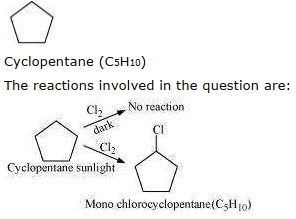
$A$ hydrocarbon $C_{5}H_{10}$ does not react with chlorine in the dark but gives a single monochloro compound $C_{5}H_{9}Cl$ in bright sunlight. Identify the hydrocarbon.
Solution
(N/A) hydrocarbon with the molecular formula $C_{5}H_{10}$ belongs to the group with a general molecular formula $C_{n}H_{2n}$.
Therefore,it may either be an alkene or a cycloalkane.
Since the hydrocarbon does not react with chlorine in the dark,it cannot be an alkene (alkenes undergo addition reactions with chlorine even in the dark).
Thus,it must be a cycloalkane.
Further,the hydrocarbon gives a single monochloro compound,$C_{5}H_{9}Cl$,by reacting with chlorine in bright sunlight.
Since a single monochloro compound is formed,all hydrogen atoms in the hydrocarbon must be equivalent.
In cyclopentane,all $10$ hydrogen atoms are equivalent due to the symmetry of the ring.
Hence,the hydrocarbon is cyclopentane.
Therefore,it may either be an alkene or a cycloalkane.
Since the hydrocarbon does not react with chlorine in the dark,it cannot be an alkene (alkenes undergo addition reactions with chlorine even in the dark).
Thus,it must be a cycloalkane.
Further,the hydrocarbon gives a single monochloro compound,$C_{5}H_{9}Cl$,by reacting with chlorine in bright sunlight.
Since a single monochloro compound is formed,all hydrogen atoms in the hydrocarbon must be equivalent.
In cyclopentane,all $10$ hydrogen atoms are equivalent due to the symmetry of the ring.
Hence,the hydrocarbon is cyclopentane.
0 likes
View Solution438
Difficult
Write the formula and name of alkyl groups.
Solution
(N/A) In branched chain hydrocarbons,the alkyl group is present as a branch.
$\rightarrow$ Alkyl groups $(-R)$: The removal of one hydrogen atom from the molecule of an alkane gives an alkyl group.
$R-H \xrightarrow{-H} R-$
$\Rightarrow$ Nomenclature: $(\text{Alkane} - \text{ane} + \text{yl} = \text{Alkyl})$. These small alkyl groups are found in branched chain hydrocarbons. In a branched chain compound,small chains of carbon atoms are attached at one or more carbon atoms of the parent chain. The small carbon chains (branches) are called alkyl groups.
For example:
In a four-carbon containing parent chain,the $-CH_3$ (Methyl) alkyl group is in the branch.
In a five-carbon containing parent chain,the $-CH_3$ and $-CH_2CH_3$ groups are in the branch.
$(B)$ Nomenclature of alkyl group: In order to name such compounds,the name of the alkyl groups is prefixed to the name of the parent alkane.
$\rightarrow$ General formula of alkyl group: $C_nH_{2n+1}$
- Name of alkyl group: $(\text{Alkane} - \text{ane} + \text{yl}) = \text{Alkyl}$. One $H$ atom is less in an alkyl group than in the corresponding alkane.
$\rightarrow$ Alkyl groups $(-R)$: The removal of one hydrogen atom from the molecule of an alkane gives an alkyl group.
$R-H \xrightarrow{-H} R-$
$\Rightarrow$ Nomenclature: $(\text{Alkane} - \text{ane} + \text{yl} = \text{Alkyl})$. These small alkyl groups are found in branched chain hydrocarbons. In a branched chain compound,small chains of carbon atoms are attached at one or more carbon atoms of the parent chain. The small carbon chains (branches) are called alkyl groups.
For example:
In a four-carbon containing parent chain,the $-CH_3$ (Methyl) alkyl group is in the branch.
In a five-carbon containing parent chain,the $-CH_3$ and $-CH_2CH_3$ groups are in the branch.
$(B)$ Nomenclature of alkyl group: In order to name such compounds,the name of the alkyl groups is prefixed to the name of the parent alkane.
$\rightarrow$ General formula of alkyl group: $C_nH_{2n+1}$
- Name of alkyl group: $(\text{Alkane} - \text{ane} + \text{yl}) = \text{Alkyl}$. One $H$ atom is less in an alkyl group than in the corresponding alkane.
| Alkane (Formula,Name) | Alkyl (Formula,Name,Short Name) |
|---|---|
| $CH_4$,Methane | $CH_3-$,Methyl,$Me$ |
| $C_2H_6$,Ethane | $CH_3CH_2-$,Ethyl,$Et$ |
| $C_3H_8$,Propane | $C_3H_7-$,Propyl,$Pr$ |
| $C_4H_{10}$,Butane | $C_4H_9-$,Butyl,$Bu$ |
| $C_5H_{12}$,Pentane | $C_5H_{11}-$,Pentyl,$Pent$ |
| $C_{10}H_{22}$,Decane | $C_{10}H_{21}-$,Decyl,$Dec$ |
0 likes
View Solution439
Medium
Write the $IUPAC$ name and molecular formula for the alkane series containing $1$ to $10$ carbon atoms.
Solution
(N/A) The general formula for the alkane series is $C_nH_{2n+2}$,where $n$ represents the number of carbon atoms. Based on this,the series from $n=1$ to $n=10$ is as follows:
| $C$ atoms | Name | Formula |
|---|---|---|
| $1$ | Methane | $CH_4$ |
| $2$ | Ethane | $C_2H_6$ |
| $3$ | Propane | $C_3H_8$ |
| $4$ | Butane | $C_4H_{10}$ |
| $5$ | Pentane | $C_5H_{12}$ |
| $6$ | Hexane | $C_6H_{14}$ |
| $7$ | Heptane | $C_7H_{16}$ |
| $8$ | Octane | $C_8H_{18}$ |
| $9$ | Nonane | $C_9H_{20}$ |
| $10$ | Decane | $C_{10}H_{22}$ |
0 likes
View Solution440
Medium
Explain: Alkyl group.
Solution
(N/A) An $ \text{alkyl group} $ is a univalent radical derived from an alkane by the removal of one hydrogen atom.
The general formula for an alkane is $ C_nH_{2n+2} $.
By removing one hydrogen atom,the general formula for an alkyl group becomes $ C_nH_{2n+1} $.
These groups are often represented by the symbol $ R $.
For example,removing one hydrogen atom from methane $( CH_4 )$ results in a methyl group $( -CH_3 )$,and removing one hydrogen atom from ethane $( C_2H_6 )$ results in an ethyl group $( -C_2H_5 )$.
The general formula for an alkane is $ C_nH_{2n+2} $.
By removing one hydrogen atom,the general formula for an alkyl group becomes $ C_nH_{2n+1} $.
These groups are often represented by the symbol $ R $.
For example,removing one hydrogen atom from methane $( CH_4 )$ results in a methyl group $( -CH_3 )$,and removing one hydrogen atom from ethane $( C_2H_6 )$ results in an ethyl group $( -C_2H_5 )$.
0 likes
View Solution441
Easy
When are the compounds called normal $(n-)$? Give an example.
Solution
(N/A) In organic chemistry,the prefix $n-$ (short for normal) is used to denote a straight-chain alkane where all carbon atoms are linked in a continuous,unbranched chain.
This means that no carbon atom is attached to more than two other carbon atoms.
For example,$CH_3-CH_2-CH_2-CH_3$ is called $n$-butane.
This means that no carbon atom is attached to more than two other carbon atoms.
For example,$CH_3-CH_2-CH_2-CH_3$ is called $n$-butane.
0 likes
View Solution442
Medium
Explain the difference between an alkane and an alkyl group with an example.
Solution
(N/A) $1$. $Alkane$: An alkane is a saturated hydrocarbon with the general formula $C_nH_{2n+2}$. It is a stable,neutral molecule. For example,$CH_4$ is methane.
$2$. $Alkyl \text{ group}$: An alkyl group is formed by the removal of one hydrogen atom from an alkane molecule. Its general formula is $C_nH_{2n+1}$. It is a reactive radical or substituent. For example,removing one $H$ atom from methane $(CH_4)$ gives the methyl group $(-CH_3)$.
$2$. $Alkyl \text{ group}$: An alkyl group is formed by the removal of one hydrogen atom from an alkane molecule. Its general formula is $C_nH_{2n+1}$. It is a reactive radical or substituent. For example,removing one $H$ atom from methane $(CH_4)$ gives the methyl group $(-CH_3)$.
0 likes
View Solution443
Easy
Do you expect the carbon hydrides of the type $C_nH_{2n+2}$ to act as 'Lewis' acid or base? Justify your answer.
Solution
(N/A) Carbon hydrides of the type $(C_nH_{2n+2})$ are known as electron-precise hydrides.
They possess the exact number of electrons required to form the necessary covalent bonds in their structure.
Since they have no lone pairs to donate and no vacant orbitals to accept electrons,they do not exhibit any tendency to gain or lose electrons.
Therefore,they act neither as Lewis acids nor as Lewis bases.
They possess the exact number of electrons required to form the necessary covalent bonds in their structure.
Since they have no lone pairs to donate and no vacant orbitals to accept electrons,they do not exhibit any tendency to gain or lose electrons.
Therefore,they act neither as Lewis acids nor as Lewis bases.
0 likes
View Solution444
Easy
What is catenation?
Solution
(N/A) Catenation is the unique property of an element,particularly carbon,to form stable covalent bonds with other atoms of the same element,leading to the formation of long chains,branched structures,or rings.
0 likes
View Solution445
Medium
Give the methods of preparation of alkanes. Write the general reactions.
Solution
(N/A) The important methods for the preparation of alkanes are as follows:
$(i)$ From unsaturated hydrocarbons (Hydrogenation):
$R-CH=CH_2 + H_2 \xrightarrow{Pt/Pd/Ni} R-CH_2-CH_3$
$R-C \equiv CH + 2H_2 \xrightarrow{Pt/Pd/Ni} R-CH_2-CH_3$
$(ii)$ From alkyl halides (Reduction):
$R-X + H_2 \xrightarrow{Zn + HCl \text{ (dil.)}} R-H + HX$
$(iii)$ Wurtz reaction:
$2R-X + 2Na \xrightarrow{\text{dry ether}} R-R + 2NaX$
$(iv)$ From carboxylic acids (Decarboxylation):
$R-COONa + NaOH \xrightarrow{CaO, \Delta} R-H + Na_2CO_3$
Soda lime is a mixture of $NaOH$ and $CaO$.
$(i)$ From unsaturated hydrocarbons (Hydrogenation):
$R-CH=CH_2 + H_2 \xrightarrow{Pt/Pd/Ni} R-CH_2-CH_3$
$R-C \equiv CH + 2H_2 \xrightarrow{Pt/Pd/Ni} R-CH_2-CH_3$
$(ii)$ From alkyl halides (Reduction):
$R-X + H_2 \xrightarrow{Zn + HCl \text{ (dil.)}} R-H + HX$
$(iii)$ Wurtz reaction:
$2R-X + 2Na \xrightarrow{\text{dry ether}} R-R + 2NaX$
$(iv)$ From carboxylic acids (Decarboxylation):
$R-COONa + NaOH \xrightarrow{CaO, \Delta} R-H + Na_2CO_3$
Soda lime is a mixture of $NaOH$ and $CaO$.
0 likes
View Solution446
Medium
Describe the preparation of alkanes from unsaturated hydrocarbons.
Solution
(N/A) The process of adding dihydrogen gas to alkenes and alkynes in the presence of finely divided catalysts like $Pt$,$Pd$,or $Ni$ to form alkanes is known as hydrogenation.
Catalytic Mechanism: These metals adsorb dihydrogen gas on their surfaces,which activates the $H-H$ bond. $Pt$ and $Pd$ catalyze the reaction at room temperature,whereas $Ni$ requires higher temperature and pressure.
Examples:
$(i)$ $CH_2=CH_2 + H_2 \xrightarrow{Pt/Pd \text{ or } Ni, \Delta} CH_3-CH_3$ (Ethene to Ethane)
$(ii)$ $CH_3-CH=CH_2 + H_2 \xrightarrow{Pt/Pd \text{ or } Ni, \Delta} CH_3-CH_2-CH_3$ (Propene to Propane)
$(iii)$ $CH_3-C \equiv CH + 2H_2 \xrightarrow{Pt/Pd \text{ or } Ni, \Delta} CH_3-CH_2-CH_3$ (Propyne to Propane)
Catalytic Mechanism: These metals adsorb dihydrogen gas on their surfaces,which activates the $H-H$ bond. $Pt$ and $Pd$ catalyze the reaction at room temperature,whereas $Ni$ requires higher temperature and pressure.
Examples:
$(i)$ $CH_2=CH_2 + H_2 \xrightarrow{Pt/Pd \text{ or } Ni, \Delta} CH_3-CH_3$ (Ethene to Ethane)
$(ii)$ $CH_3-CH=CH_2 + H_2 \xrightarrow{Pt/Pd \text{ or } Ni, \Delta} CH_3-CH_2-CH_3$ (Propene to Propane)
$(iii)$ $CH_3-C \equiv CH + 2H_2 \xrightarrow{Pt/Pd \text{ or } Ni, \Delta} CH_3-CH_2-CH_3$ (Propyne to Propane)
0 likes
View Solution447
Medium
Give an example of the preparation of an alkane from an alkyl halide.
Solution
Alkyl halides (except fluorides) on reduction with zinc and dilute hydrochloric acid give alkanes.
$R-X + H_2 \xrightarrow{Zn + H^+} R-H + HX$
Example of reaction:
$(i)$ $CH_3Cl + H_2 \xrightarrow{Zn + H^+} CH_4 + HCl$
Chloromethane $\rightarrow$ Methane
$(ii)$ $CH_3CH_2Cl + H_2 \xrightarrow{Zn + H^+} CH_3CH_3 + HCl$
Chloroethane $\rightarrow$ Ethane
$(iii)$ $CH_3CH_2CH_2Cl + H_2 \xrightarrow{Zn + H^+} CH_3CH_2CH_3 + HCl$
$1$-Chloropropane $\rightarrow$ Propane
$(iv)$ $CH_3CH_2Br + H_2 \xrightarrow{Zn + H^+} CH_3CH_3 + HBr$
Bromoethane $\rightarrow$ Ethane
$(v)$ $CH_3CH(Br)CH_2CH_3 + H_2 \xrightarrow{Zn + H^+} CH_3CH_2CH_2CH_3 + HBr$
$2$-Bromobutane $\rightarrow$ Butane
$R-X + H_2 \xrightarrow{Zn + H^+} R-H + HX$
Example of reaction:
$(i)$ $CH_3Cl + H_2 \xrightarrow{Zn + H^+} CH_4 + HCl$
Chloromethane $\rightarrow$ Methane
$(ii)$ $CH_3CH_2Cl + H_2 \xrightarrow{Zn + H^+} CH_3CH_3 + HCl$
Chloroethane $\rightarrow$ Ethane
$(iii)$ $CH_3CH_2CH_2Cl + H_2 \xrightarrow{Zn + H^+} CH_3CH_2CH_3 + HCl$
$1$-Chloropropane $\rightarrow$ Propane
$(iv)$ $CH_3CH_2Br + H_2 \xrightarrow{Zn + H^+} CH_3CH_3 + HBr$
Bromoethane $\rightarrow$ Ethane
$(v)$ $CH_3CH(Br)CH_2CH_3 + H_2 \xrightarrow{Zn + H^+} CH_3CH_2CH_2CH_3 + HBr$
$2$-Bromobutane $\rightarrow$ Butane
0 likes
View Solution448
Medium
Write about the Wurtz reaction or describe the preparation of alkanes from alkyl halides via the Wurtz reaction,including examples and its limitations.
Solution
(N/A) Wurtz reaction: Alkyl halides,when treated with sodium metal in a dry ethereal (moisture-free) solution,yield higher alkanes. This reaction is known as the Wurtz reaction and is primarily used for the preparation of higher alkanes containing an even number of carbon atoms.
Examples:
$i$. Formation of ethane from bromomethane $(CH_3Br)$:
$2CH_3Br + 2Na \xrightarrow{\text{dry ether}} CH_3-CH_3 + 2NaBr$
$ii$. Preparation of butane from bromoethane $(C_2H_5Br)$:
$2C_2H_5Br + 2Na \xrightarrow{\text{dry ether}} C_4H_{10} (n-\text{butane}) + 2NaBr$
Limitations of the Wurtz reaction:
$i$. It is generally limited to the synthesis of symmetric alkanes.
$ii$. If a mixture of two different alkyl halides is used,a mixture of alkanes is formed,which is difficult to separate.
$iii$. It is not suitable for the preparation of alkanes with an odd number of carbon atoms in high yield due to the formation of side products.
Examples:
$i$. Formation of ethane from bromomethane $(CH_3Br)$:
$2CH_3Br + 2Na \xrightarrow{\text{dry ether}} CH_3-CH_3 + 2NaBr$
$ii$. Preparation of butane from bromoethane $(C_2H_5Br)$:
$2C_2H_5Br + 2Na \xrightarrow{\text{dry ether}} C_4H_{10} (n-\text{butane}) + 2NaBr$
Limitations of the Wurtz reaction:
$i$. It is generally limited to the synthesis of symmetric alkanes.
$ii$. If a mixture of two different alkyl halides is used,a mixture of alkanes is formed,which is difficult to separate.
$iii$. It is not suitable for the preparation of alkanes with an odd number of carbon atoms in high yield due to the formation of side products.
0 likes
View Solution449
Difficult
Why is Wurtz reaction not preferred for the preparation of alkanes containing an odd number of carbon atoms? Illustrate your answer by taking one example.
Solution
(N/A) In the Wurtz reaction,an alkyl halide $(R-X)$ reacts with sodium in the presence of dry ether to form a symmetric alkane with double the number of carbon atoms present in the alkyl group.
If we attempt to prepare an alkane with an odd number of carbon atoms by using a mixture of two different alkyl halides ($R-X$ and $R'-X$),a mixture of three different alkanes is formed: $R-R$,$R'-R'$,and $R-R'$.
For example,to prepare propane $(C_3H_8)$,a mixture of methyl bromide $(CH_3Br)$ and ethyl bromide $(C_2H_5Br)$ is used:
$2CH_3Br + 2Na \xrightarrow{\text{Dry ether}} CH_3-CH_3 + 2NaBr$
$2C_2H_5Br + 2Na \xrightarrow{\text{Dry ether}} C_2H_5-C_2H_5 + 2NaBr$
$CH_3Br + C_2H_5Br + 2Na \xrightarrow{\text{Dry ether}} CH_3-C_2H_5 + 2NaBr$
As seen,the product is a mixture of ethane,$n$-butane,and propane. Since the boiling points of these alkanes are very close,their separation is extremely difficult and costly. Therefore,the Wurtz reaction is not preferred for the synthesis of alkanes with an odd number of carbon atoms.
If we attempt to prepare an alkane with an odd number of carbon atoms by using a mixture of two different alkyl halides ($R-X$ and $R'-X$),a mixture of three different alkanes is formed: $R-R$,$R'-R'$,and $R-R'$.
For example,to prepare propane $(C_3H_8)$,a mixture of methyl bromide $(CH_3Br)$ and ethyl bromide $(C_2H_5Br)$ is used:
$2CH_3Br + 2Na \xrightarrow{\text{Dry ether}} CH_3-CH_3 + 2NaBr$
$2C_2H_5Br + 2Na \xrightarrow{\text{Dry ether}} C_2H_5-C_2H_5 + 2NaBr$
$CH_3Br + C_2H_5Br + 2Na \xrightarrow{\text{Dry ether}} CH_3-C_2H_5 + 2NaBr$
As seen,the product is a mixture of ethane,$n$-butane,and propane. Since the boiling points of these alkanes are very close,their separation is extremely difficult and costly. Therefore,the Wurtz reaction is not preferred for the synthesis of alkanes with an odd number of carbon atoms.
0 likes
View SolutionHydrocarbons — Alkane · Frequently Asked Questions
1Are these Hydrocarbons questions useful for JEE and NEET?
Yes. All questions in this section are mapped to JEE Main and NEET exam patterns. Previous year questions from JEE Main, NEET, GUJCET and state-level exams are included with full solutions.
2Can I switch to Hindi or Gujarati for these questions?
Yes. Use the language tabs in the hero section or the sidebar to view the same questions and solutions in English, Hindi or Gujarati.
3How do I generate a question paper from this subtopic?
Use the Vedclass Exam Paper Generator — select the chapter and subtopic, set difficulty, and generate Sets A, B, C, D automatically. First 3 chapters of every subject are free.
Vedclass Products
For Students
Vedclass Test Series
Mock tests in real JEE/NEET style with performance analysis. 5-day free trial.
Start Free TrialFor Teachers
Exam Paper Generator
Generate Set A/B/C/D papers from this chapter in 2 minutes. 3 chapters free.
Try FreeFor Institutes
Online Exam Module
Live online exams with unlimited students, 360° analytics & white-label branding.
See DemoFor Teachers & Institutes
Generate a Hydrocarbons Exam Paper in 2 Minutes
Select subtopic & difficulty — Sets A, B, C, D auto-generated with No Repeat logic.
First 3 chapters of every subject are free — no payment required.