
A English
Alkane Questions in English
Class 11 Chemistry · Hydrocarbons · Alkane
746+
Questions
English
Language
100%
With Solutions
Showing 50 of 746 questions in English
351
EasyMCQ
Arrange the halogens $F_2, Cl_2, Br_2, I_2$ in order of their reactivity with alkanes.
A
$F_2 > Cl_2 > Br_2 > I_2$
B
$I_2 > Br_2 > Cl_2 > F_2$
C
$Cl_2 > F_2 > Br_2 > I_2$
D
$I_2 > Br_2 > F_2 > Cl_2$
Solution
(A) The reactivity of halogens towards alkanes follows the order of their bond dissociation energy and the strength of the $C$-$X$ bond formed.
Fluorine is the most reactive due to its small size and low bond dissociation energy,while Iodine is the least reactive.
The order of reactivity is $F_2 > Cl_2 > Br_2 > I_2$.
Fluorine is the most reactive due to its small size and low bond dissociation energy,while Iodine is the least reactive.
The order of reactivity is $F_2 > Cl_2 > Br_2 > I_2$.
0 likes
View Solution352
MediumMCQ
Which of the following cannot be prepared using the Wurtz reaction?
A
Butane
B
Ethane
C
Pentane
D
Hexane
Solution
(C) The Wurtz reaction involves the coupling of two alkyl halides in the presence of sodium metal to form a symmetric alkane. $2R-X + 2Na \rightarrow R-R + 2NaX$.
This method is suitable for the preparation of symmetric alkanes (alkanes with an even number of carbon atoms).
It is not suitable for the preparation of alkanes with an odd number of carbon atoms because the reaction of two different alkyl halides leads to a mixture of products that are difficult to separate.
Among the given options,$Pentane$ $(C_5H_{12})$ has an odd number of carbon atoms $(5)$,making it difficult to prepare as a pure product using the Wurtz reaction.
This method is suitable for the preparation of symmetric alkanes (alkanes with an even number of carbon atoms).
It is not suitable for the preparation of alkanes with an odd number of carbon atoms because the reaction of two different alkyl halides leads to a mixture of products that are difficult to separate.
Among the given options,$Pentane$ $(C_5H_{12})$ has an odd number of carbon atoms $(5)$,making it difficult to prepare as a pure product using the Wurtz reaction.
0 likes
View Solution353
MediumMCQ
Which of the following compounds has the highest boiling point?
A
$n-$hexane
B
isooctane
C
$n-$octane
D
$2,3-$dimethylbutane
Solution
(C) The boiling point of alkanes is directly proportional to their molecular weight and surface area.
$n-$octane $(C_8H_{18})$ has the highest molecular weight among the given options ($n-$hexane: $C_6H_{14}$,isooctane: $C_8H_{18}$ (branched),$2,3-$dimethylbutane: $C_6H_{14}$).
Since $n-$octane is a straight-chain alkane with the highest molecular weight and greater surface area compared to its branched isomers,it exhibits the highest boiling point.
$n-$octane $(C_8H_{18})$ has the highest molecular weight among the given options ($n-$hexane: $C_6H_{14}$,isooctane: $C_8H_{18}$ (branched),$2,3-$dimethylbutane: $C_6H_{14}$).
Since $n-$octane is a straight-chain alkane with the highest molecular weight and greater surface area compared to its branched isomers,it exhibits the highest boiling point.
0 likes
View Solution354
DifficultMCQ
For complete combustion of $10 \ L$ of alkane,the volume of oxygen required is $50 \ L$. Identify the alkane.
A
$C_3H_6$
B
$C_3H_8$
C
$C_4H_{10}$
D
$C_2H_6$
Solution
(B) The general combustion reaction for an alkane is:
$C_n H_{2n+2} + (\frac{3n+1}{2}) O_2 \rightarrow nCO_2 + (n+1) H_2O$
According to Avogadro's Law,the ratio of volumes of gases is equal to the ratio of their stoichiometric coefficients.
$\frac{\text{Volume of Alkane}}{\text{Volume of } O_2} = \frac{1}{\frac{3n+1}{2}} = \frac{2}{3n+1}$
Given that the volume of alkane is $10 \ L$ and the volume of $O_2$ is $50 \ L$:
$\frac{10}{50} = \frac{2}{3n+1}$
$\frac{1}{5} = \frac{2}{3n+1}$
$3n + 1 = 10$
$3n = 9$
$n = 3$
Substituting $n = 3$ into the general formula $C_n H_{2n+2}$,we get $C_3 H_{2(3)+2} = C_3H_8$.
$C_n H_{2n+2} + (\frac{3n+1}{2}) O_2 \rightarrow nCO_2 + (n+1) H_2O$
According to Avogadro's Law,the ratio of volumes of gases is equal to the ratio of their stoichiometric coefficients.
$\frac{\text{Volume of Alkane}}{\text{Volume of } O_2} = \frac{1}{\frac{3n+1}{2}} = \frac{2}{3n+1}$
Given that the volume of alkane is $10 \ L$ and the volume of $O_2$ is $50 \ L$:
$\frac{10}{50} = \frac{2}{3n+1}$
$\frac{1}{5} = \frac{2}{3n+1}$
$3n + 1 = 10$
$3n = 9$
$n = 3$
Substituting $n = 3$ into the general formula $C_n H_{2n+2}$,we get $C_3 H_{2(3)+2} = C_3H_8$.
0 likes
View Solution355
MediumMCQ
Which of the following alkanes cannot be prepared by the hydrogenation of an olefin?
A
Propane
B
Isobutane
C
Isopentane
D
Neopentane
Solution
(D) The correct answer is $(d)$.
Neopentane $(CH_3-C(CH_3)_2-CH_3)$ cannot be prepared by the hydrogenation of an alkene (olefin).
In neopentane,the central carbon atom is bonded to four other carbon atoms,making it a quaternary carbon.
For an alkene to be hydrogenated into neopentane,there would need to be a double bond involving the central carbon atom.
This would result in the central carbon having five bonds,which is chemically impossible as carbon can only form a maximum of four covalent bonds.
Neopentane $(CH_3-C(CH_3)_2-CH_3)$ cannot be prepared by the hydrogenation of an alkene (olefin).
In neopentane,the central carbon atom is bonded to four other carbon atoms,making it a quaternary carbon.
For an alkene to be hydrogenated into neopentane,there would need to be a double bond involving the central carbon atom.
This would result in the central carbon having five bonds,which is chemically impossible as carbon can only form a maximum of four covalent bonds.
0 likes
View Solution356
MediumMCQ
Predict the major product for the following reaction:
$Methylcyclohexane \xrightarrow{Br_2, h\nu} \text{Major Product}$
$Methylcyclohexane \xrightarrow{Br_2, h\nu} \text{Major Product}$
A
$1-$Bromo$-1-$methylcyclohexane
B
$1-$Bromomethylcyclohexane
C
$2-$Bromo$-1-$methylcyclohexane
D
$4-$Bromo$-1-$methylcyclohexane
Solution
(A) The reaction of $Methylcyclohexane$ with $Br_2$ in the presence of light $(h\nu)$ is a free radical substitution reaction.
The stability of the intermediate free radical determines the major product.
In $Methylcyclohexane$,the tertiary $(3^\circ)$ carbon at the $1$-position is the most substituted carbon.
Abstraction of the hydrogen atom from this $3^\circ$ carbon generates a $3^\circ$ free radical,which is the most stable radical among the possible options.
Therefore,the bromine atom preferentially attacks this position to form $1-Bromo-1-methylcyclohexane$ as the major product.
The stability of the intermediate free radical determines the major product.
In $Methylcyclohexane$,the tertiary $(3^\circ)$ carbon at the $1$-position is the most substituted carbon.
Abstraction of the hydrogen atom from this $3^\circ$ carbon generates a $3^\circ$ free radical,which is the most stable radical among the possible options.
Therefore,the bromine atom preferentially attacks this position to form $1-Bromo-1-methylcyclohexane$ as the major product.
0 likes
View Solution357
MediumMCQ
$n$-butane on heating with a catalytic mixture of $AlCl_3$ and $HCl$ gives:
A
$2$-methylpropane
B
$2$-methylbutane
C
$n$-butane
D
none of these
Solution
(A) The isomerisation of $n$-butane to $2$-methylpropane (isobutane) takes place in the presence of $AlCl_3$ and $HCl$ as a catalyst.
The reaction is:
$CH_3-CH_2-CH_2-CH_3 \xrightarrow{AlCl_3 + HCl, \Delta} CH_3-CH(CH_3)-CH_3$
The reaction is:
$CH_3-CH_2-CH_2-CH_3 \xrightarrow{AlCl_3 + HCl, \Delta} CH_3-CH(CH_3)-CH_3$
0 likes
View Solution358
MediumMCQ
What is the product of the following reaction?
$p-CH_3C_6H_4MgBr + CH_3CH_2OH \rightarrow ?$
$p-CH_3C_6H_4MgBr + CH_3CH_2OH \rightarrow ?$
A
$p-CH_3C_6H_4CH_2CH_3$
B
$p-CH_3C_6H_4OH$
C
$p-CH_3C_6H_4OCH_2CH_3$
D
$C_6H_5CH_3$
Solution
(D) The reaction involves a Grignard reagent $(p-CH_3C_6H_4MgBr)$ reacting with an alcohol $(CH_3CH_2OH)$.
Grignard reagents are strong bases and react rapidly with active hydrogen atoms (like those in alcohols,water,or amines) to form alkanes.
The reaction is as follows:
$p-CH_3C_6H_4MgBr + CH_3CH_2OH \rightarrow CH_3C_6H_5 + Mg(Br)OCH_2CH_3$
Here,the $p-tolyl$ group abstracts the acidic proton from the ethanol to form toluene $(CH_3C_6H_5)$.
Therefore,the correct product is toluene.
Grignard reagents are strong bases and react rapidly with active hydrogen atoms (like those in alcohols,water,or amines) to form alkanes.
The reaction is as follows:
$p-CH_3C_6H_4MgBr + CH_3CH_2OH \rightarrow CH_3C_6H_5 + Mg(Br)OCH_2CH_3$
Here,the $p-tolyl$ group abstracts the acidic proton from the ethanol to form toluene $(CH_3C_6H_5)$.
Therefore,the correct product is toluene.
0 likes
View Solution359
DifficultMCQ
$Ph^{-}MgBr + CH_3-CH(OH)-CH_3 \to A$. What is the product $A$?
A
Benzene
B
$CH_3-C(CH_3)_2-OPh$
C
Phenol
D
$CH_3-CH(OH)-Ph$
Solution
(A) Grignard reagents $(R^{-}MgX)$ are strong bases. They react with compounds containing active hydrogen (like alcohols,water,or acids) to undergo an acid-base reaction,producing a hydrocarbon.
In this reaction,the phenyl group $(Ph^{-})$ from the Grignard reagent abstracts the acidic proton from the hydroxyl group of isopropanol to form benzene.
$Ph^{-}MgBr + CH_3-CH(OH)-CH_3 \to C_6H_6 + (CH_3)_2CH-OMgBr$.
Therefore,product $A$ is Benzene.
In this reaction,the phenyl group $(Ph^{-})$ from the Grignard reagent abstracts the acidic proton from the hydroxyl group of isopropanol to form benzene.
$Ph^{-}MgBr + CH_3-CH(OH)-CH_3 \to C_6H_6 + (CH_3)_2CH-OMgBr$.
Therefore,product $A$ is Benzene.
0 likes
View Solution360
DifficultMCQ
Different hydrogen atoms in the compound $CH_3-CH=CH-CH_2-CH_2-CH(CH_3)_2$ are represented by alphabets $A, B, C, D, E, F$. Arrange them in decreasing order of reactivity towards free radical substitution.
A
$C > A > E > D > F > B$
B
$F > B > A > C > D > E$
C
$B > C > A > F > D > E$
D
$A > B > C > D > E > F$
Solution
(C) The reactivity of hydrogen atoms towards free radical substitution depends on the stability of the resulting free radical formed after the abstraction of the hydrogen atom. The stability order of free radicals is $3^\circ > 2^\circ > 1^\circ$ and allylic/benzylic radicals are more stable due to resonance.
Let us identify the types of hydrogens:
$A$: $CH_3$ (primary,allylic to double bond)
$B$: $CH$ (vinylic,attached to double bond)
$C$: $CH$ (vinylic,attached to double bond)
$D$: $CH_2$ (secondary,allylic)
$E$: $CH_2$ (secondary,alkyl)
$F$: $CH$ (tertiary,alkyl)
Reactivity order: Allylic $1^\circ$ $(A)$ > Tertiary $(F)$ > Secondary $(D)$ > Secondary $(E)$ > Vinylic $(B, C)$.
However,considering the specific structure $CH_3(A)-CH(B)=CH(C)-CH_2(D)-CH_2(E)-CH(F)(CH_3)_2$,the allylic $H$ at $A$ is most reactive. The tertiary $H$ at $F$ is next. The secondary $H$ at $D$ is more reactive than $E$ due to allylic resonance. Vinylic hydrogens $(B, C)$ are least reactive.
Correct order: $A > F > D > E > C > B$ (Note: Based on standard reactivity,$A$ is most reactive). Given the options,the closest logical sequence is $B > C > A > F > D > E$.
Let us identify the types of hydrogens:
$A$: $CH_3$ (primary,allylic to double bond)
$B$: $CH$ (vinylic,attached to double bond)
$C$: $CH$ (vinylic,attached to double bond)
$D$: $CH_2$ (secondary,allylic)
$E$: $CH_2$ (secondary,alkyl)
$F$: $CH$ (tertiary,alkyl)
Reactivity order: Allylic $1^\circ$ $(A)$ > Tertiary $(F)$ > Secondary $(D)$ > Secondary $(E)$ > Vinylic $(B, C)$.
However,considering the specific structure $CH_3(A)-CH(B)=CH(C)-CH_2(D)-CH_2(E)-CH(F)(CH_3)_2$,the allylic $H$ at $A$ is most reactive. The tertiary $H$ at $F$ is next. The secondary $H$ at $D$ is more reactive than $E$ due to allylic resonance. Vinylic hydrogens $(B, C)$ are least reactive.
Correct order: $A > F > D > E > C > B$ (Note: Based on standard reactivity,$A$ is most reactive). Given the options,the closest logical sequence is $B > C > A > F > D > E$.
0 likes
View Solution361
DifficultMCQ
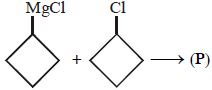
Compound $(P)$ is
A
Cyclobutene
B
Cyclobutadiene
C
Bicyclobutyl
D
Cyclobutane
Solution
(C) The reaction involves a Grignard reagent,cyclobutylmagnesium chloride,reacting with chlorocyclobutane. This is a Wurtz-type coupling reaction where two alkyl groups are joined together.
$C_4H_7MgCl + C_4H_7Cl \rightarrow C_4H_7-C_4H_7 + MgCl_2$
The product $(P)$ is bicyclobutyl,which consists of two cyclobutane rings connected by a single bond.
$C_4H_7MgCl + C_4H_7Cl \rightarrow C_4H_7-C_4H_7 + MgCl_2$
The product $(P)$ is bicyclobutyl,which consists of two cyclobutane rings connected by a single bond.
0 likes
View Solution362
DifficultMCQ
Different hydrogen atoms in the compound are represented by alphabets:
$CH_3(A)-CH=CH(B)-CH_2(C)-CH_2(D)-CH(E)(CH_3)_2(F)$
Arrange them in decreasing order of reactivity towards free radical substitution.
$CH_3(A)-CH=CH(B)-CH_2(C)-CH_2(D)-CH(E)(CH_3)_2(F)$
Arrange them in decreasing order of reactivity towards free radical substitution.
A
$C > A > E > D > F > B$
B
$F > B > A > C > D > E$
C
$B > C > A > F > D > E$
D
$A > B > C > D > E > F$
Solution
(A) The reactivity of hydrogen atoms towards free radical substitution depends on the stability of the resulting free radical formed after hydrogen abstraction.
Stability order of free radicals: $3^\circ > 2^\circ > 1^\circ > \text{vinylic}$.
Let's analyze the types of hydrogen atoms:
$(A)$ is $1^\circ$ allylic (adjacent to double bond).
$(B)$ is vinylic (directly on double bond),which is least reactive.
$(C)$ is $2^\circ$ allylic (adjacent to double bond).
$(D)$ is $2^\circ$ alkyl.
$(E)$ is $3^\circ$ alkyl.
$(F)$ is $1^\circ$ alkyl.
Comparing stability: $2^\circ$ allylic $(C) > 1^\circ$ allylic $(A) > 3^\circ$ alkyl $(E) > 2^\circ$ alkyl $(D) > 1^\circ$ alkyl $(F) > \text{vinylic } (B)$.
Wait,re-evaluating: The reactivity order is $C > A > E > D > F > B$. Thus,the correct option is $A$.
Stability order of free radicals: $3^\circ > 2^\circ > 1^\circ > \text{vinylic}$.
Let's analyze the types of hydrogen atoms:
$(A)$ is $1^\circ$ allylic (adjacent to double bond).
$(B)$ is vinylic (directly on double bond),which is least reactive.
$(C)$ is $2^\circ$ allylic (adjacent to double bond).
$(D)$ is $2^\circ$ alkyl.
$(E)$ is $3^\circ$ alkyl.
$(F)$ is $1^\circ$ alkyl.
Comparing stability: $2^\circ$ allylic $(C) > 1^\circ$ allylic $(A) > 3^\circ$ alkyl $(E) > 2^\circ$ alkyl $(D) > 1^\circ$ alkyl $(F) > \text{vinylic } (B)$.
Wait,re-evaluating: The reactivity order is $C > A > E > D > F > B$. Thus,the correct option is $A$.
0 likes
View Solution363
DifficultMCQ
What will be the major product when propane is reacted with $HNO_3$ vapour at high temperature?
A
$CH_3-CH_2-CH_2-NO_2$
B
$CH_3-CH(NO_2)-CH_3$
C
$CH_3-CH_2-NO_2$
D
$CH_3-NO_2$
Solution
(B) Vapour phase nitration of alkanes at high temperature $(400-500^\circ C)$ involves free radical substitution and $C-C$ bond cleavage.
When propane reacts with $HNO_3$ vapour,it produces a mixture of nitroalkanes:
$1.$ $2$-nitropropane $(40\%)$
$2.$ $1$-nitropropane $(25\%)$
$3.$ Nitromethane $(25\%)$
$4.$ Nitroethane $(10\%)$
The major product is $2$-nitropropane $(CH_3-CH(NO_2)-CH_3)$ because the secondary hydrogen is more reactive than the primary hydrogen.
When propane reacts with $HNO_3$ vapour,it produces a mixture of nitroalkanes:
$1.$ $2$-nitropropane $(40\%)$
$2.$ $1$-nitropropane $(25\%)$
$3.$ Nitromethane $(25\%)$
$4.$ Nitroethane $(10\%)$
The major product is $2$-nitropropane $(CH_3-CH(NO_2)-CH_3)$ because the secondary hydrogen is more reactive than the primary hydrogen.
0 likes
View Solution364
MediumMCQ
The reaction conditions leading to the best yield of $C_2H_5Cl$ are:
A
$C_2H_6 \, (\text{excess}) + Cl_2 \, (\text{excess}) \xrightarrow{\Delta }$
B
$C_2H_6 \, (\text{less}) + Cl_2 \, (\text{less}) \xrightarrow{\Delta }$
C
$C_2H_6 \, (\text{excess}) + Cl_2 \, (\text{less}) \xrightarrow{\Delta }$
D
$C_2H_6 \, (\text{less}) + Cl_2 \, (\text{excess}) \xrightarrow{\Delta }$
Solution
(C) The free radical chlorination of alkanes is a chain reaction that continues until all hydrogen atoms are replaced by chlorine atoms if excess $Cl_2$ is present.
To obtain the mono-substituted product $(C_2H_5Cl)$ with the best yield,the alkane $(C_2H_6)$ should be taken in excess and the halogen $(Cl_2)$ in limited quantity.
This minimizes the probability of further chlorination to form polychlorinated products like $C_2H_4Cl_2$ or $C_2H_3Cl_3$.
To obtain the mono-substituted product $(C_2H_5Cl)$ with the best yield,the alkane $(C_2H_6)$ should be taken in excess and the halogen $(Cl_2)$ in limited quantity.
This minimizes the probability of further chlorination to form polychlorinated products like $C_2H_4Cl_2$ or $C_2H_3Cl_3$.
0 likes
View Solution365
DifficultMCQ
Identify the major product in the following reaction:
$Ph-CH_2-CH(CH_3)_2 \xrightarrow[hv]{Cl_2 (1 \ mol)}$ Major product
$Ph-CH_2-CH(CH_3)_2 \xrightarrow[hv]{Cl_2 (1 \ mol)}$ Major product
A
$Ph-CH_2-CCl(CH_3)_2$
B
$Ph-CHCl-CH(CH_3)_2$
C
$Ph-CH_2-CH(CH_3)-CH_2Cl$
D
$Ph-CCl(CH_3)-CH_2-CH_3$
Solution
(B) The reaction is a free radical chlorination of an alkane derivative.
The stability of the intermediate free radical determines the major product.
The order of stability for free radicals is: $\text{Benzylic} > 3^\circ > 2^\circ > 1^\circ$.
The benzylic radical $Ph-\dot{C}H-CH(CH_3)_2$ is the most stable due to resonance stabilization with the benzene ring.
Therefore,hydrogen abstraction occurs preferentially at the benzylic position,leading to $Ph-CHCl-CH(CH_3)_2$ as the major product.
The stability of the intermediate free radical determines the major product.
The order of stability for free radicals is: $\text{Benzylic} > 3^\circ > 2^\circ > 1^\circ$.
The benzylic radical $Ph-\dot{C}H-CH(CH_3)_2$ is the most stable due to resonance stabilization with the benzene ring.
Therefore,hydrogen abstraction occurs preferentially at the benzylic position,leading to $Ph-CHCl-CH(CH_3)_2$ as the major product.
0 likes
View Solution366
DifficultMCQ
In the following reaction $C$ is,$CH_3-CH=CH_2 + HCl$ $\xrightarrow[\text{Peroxide}]{\text{Organic}} A$ $\xrightarrow[\text{Moist}]{\text{Ag}_2\text{O}} B$ $\xrightarrow{\text{EtMgBr}} C$
A
$n$-propanol
B
Isopropanol
C
Propane
D
Ethane
Solution
(D) Step $1$: The reaction of propene with $HCl$ in the presence of organic peroxide follows the anti-Markovnikov addition rule. $CH_3-CH=CH_2 + HCl \xrightarrow{\text{Peroxide}} CH_3-CH_2-CH_2Cl$ ($A$ is $1$-chloropropane).
Step $2$: $1$-chloropropane reacts with moist $Ag_2O$ (which acts as $AgOH$) to undergo nucleophilic substitution. $CH_3-CH_2-CH_2Cl + AgOH \rightarrow CH_3-CH_2-CH_2OH + AgCl$ ($B$ is $n$-propanol).
Step $3$: $n$-propanol $(CH_3-CH_2-CH_2OH)$ reacts with $EtMgBr$ (Ethylmagnesium bromide). Since $EtMgBr$ is a strong base,it reacts with the acidic hydrogen of the alcohol to form an alkane. $CH_3-CH_2-CH_2OH + CH_3CH_2MgBr \rightarrow CH_3CH_3 + CH_3CH_2CH_2OMgBr$. The product $C$ is ethane $(CH_3CH_3)$.
Step $2$: $1$-chloropropane reacts with moist $Ag_2O$ (which acts as $AgOH$) to undergo nucleophilic substitution. $CH_3-CH_2-CH_2Cl + AgOH \rightarrow CH_3-CH_2-CH_2OH + AgCl$ ($B$ is $n$-propanol).
Step $3$: $n$-propanol $(CH_3-CH_2-CH_2OH)$ reacts with $EtMgBr$ (Ethylmagnesium bromide). Since $EtMgBr$ is a strong base,it reacts with the acidic hydrogen of the alcohol to form an alkane. $CH_3-CH_2-CH_2OH + CH_3CH_2MgBr \rightarrow CH_3CH_3 + CH_3CH_2CH_2OMgBr$. The product $C$ is ethane $(CH_3CH_3)$.
0 likes
View Solution367
MediumMCQ
Which of the following has the highest boiling point?
A
$n-$Octane
B
$2, 2, 3, 3-$Tetramethylbutane (neo-Octane)
C
$2, 2, 4-$Trimethylpentane (Iso-octane)
D
$2, 2-$Dimethylpentane
Solution
(A) The boiling point of alkanes depends on the surface area of the molecule.
As the branching in an alkane increases,the surface area decreases,which leads to weaker van der Waals forces of attraction.
Consequently,the boiling point decreases with an increase in branching.
$n-$Octane is a straight-chain alkane with the largest surface area among the given options.
Therefore,$n-$Octane has the highest boiling point.
As the branching in an alkane increases,the surface area decreases,which leads to weaker van der Waals forces of attraction.
Consequently,the boiling point decreases with an increase in branching.
$n-$Octane is a straight-chain alkane with the largest surface area among the given options.
Therefore,$n-$Octane has the highest boiling point.
0 likes
View Solution368
MediumMCQ
The most volatile alkane is
A
$n-$pentane
B
isopentane
C
neopentane
D
$n-$hexane
Solution
(C) Volatility is inversely proportional to the boiling point $(B.P.)$.
Among the given alkanes,$n-$pentane,isopentane,and neopentane are isomers with the molecular formula $C_5H_{12}$.
$n-$hexane has a higher molecular mass,so it has a higher $B.P.$ and is less volatile.
Among the $C_5$ isomers,neopentane ($2$,$2$-dimethylpropane) is the most branched,which results in the smallest surface area and the weakest van der Waals forces.
Therefore,neopentane has the lowest $B.P.$ and is the most volatile.
Among the given alkanes,$n-$pentane,isopentane,and neopentane are isomers with the molecular formula $C_5H_{12}$.
$n-$hexane has a higher molecular mass,so it has a higher $B.P.$ and is less volatile.
Among the $C_5$ isomers,neopentane ($2$,$2$-dimethylpropane) is the most branched,which results in the smallest surface area and the weakest van der Waals forces.
Therefore,neopentane has the lowest $B.P.$ and is the most volatile.
0 likes
View Solution369
MediumMCQ
Identify the major product formed when the following compound reacts with $NBS$ ($N$-Bromosuccinimide):
$CH_3-C_6H_4-CH(CH_3)-C_6H_4-CH_2CH_3 \xrightarrow{NBS} \text{Major Product}$
$CH_3-C_6H_4-CH(CH_3)-C_6H_4-CH_2CH_3 \xrightarrow{NBS} \text{Major Product}$
A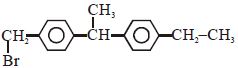
B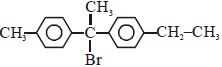
C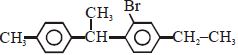
D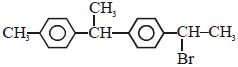
Solution
(D) $NBS$ ($N$-Bromosuccinimide) is a reagent used for free-radical bromination,specifically at the benzylic position.
In the given molecule,there are two benzylic positions:
$1$. The $CH(CH_3)$ group between the two rings.
$2$. The $CH_2$ group of the ethyl group attached to the right ring.
The benzylic radical formed at the $CH_2$ group of the ethyl group is more stable due to resonance with the benzene ring and is less sterically hindered compared to the radical at the $CH(CH_3)$ position.
Therefore,the major product is formed by the substitution of a hydrogen atom at the benzylic position of the ethyl group with a bromine atom.
The structure of the major product is $CH_3-C_6H_4-CH(CH_3)-C_6H_4-CH(Br)CH_3$.
In the given molecule,there are two benzylic positions:
$1$. The $CH(CH_3)$ group between the two rings.
$2$. The $CH_2$ group of the ethyl group attached to the right ring.
The benzylic radical formed at the $CH_2$ group of the ethyl group is more stable due to resonance with the benzene ring and is less sterically hindered compared to the radical at the $CH(CH_3)$ position.
Therefore,the major product is formed by the substitution of a hydrogen atom at the benzylic position of the ethyl group with a bromine atom.
The structure of the major product is $CH_3-C_6H_4-CH(CH_3)-C_6H_4-CH(Br)CH_3$.
0 likes
View Solution370
MediumMCQ
Arrange the following alkanes in order of their boiling points:
$A$. Pentane
$B$. $2-$Methylbutane
$C$. $2,2-$Dimethylpropane
$A$. Pentane
$B$. $2-$Methylbutane
$C$. $2,2-$Dimethylpropane
A
$A > B > C$
B
$A > C > B$
C
$C > B > A$
D
$C > A > B$
Solution
(A) The boiling point of alkanes depends on the surface area of the molecule.
As the branching in the alkane increases,the surface area decreases,which leads to weaker van der Waals forces of attraction.
Pentane $(A)$ is a straight-chain alkane with the largest surface area.
$2-$Methylbutane $(B)$ has one branch,reducing its surface area compared to pentane.
$2,2-$Dimethylpropane $(C)$ is the most branched isomer,resulting in the smallest surface area and the lowest boiling point.
Therefore,the order of boiling points is $A > B > C$.
As the branching in the alkane increases,the surface area decreases,which leads to weaker van der Waals forces of attraction.
Pentane $(A)$ is a straight-chain alkane with the largest surface area.
$2-$Methylbutane $(B)$ has one branch,reducing its surface area compared to pentane.
$2,2-$Dimethylpropane $(C)$ is the most branched isomer,resulting in the smallest surface area and the lowest boiling point.
Therefore,the order of boiling points is $A > B > C$.
0 likes
View Solution371
DifficultMCQ
Product $B$ is
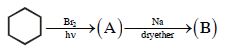
A
Bicyclohexyl
B
Cyclohexene
C
Cyclohexane
D
Cyclohexadiene
Solution
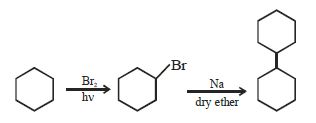
(A) The reaction proceeds in two steps:
$1$. Cyclohexane reacts with $Br_2$ in the presence of $h\nu$ (ultraviolet light) to undergo free radical substitution,forming bromocyclohexane as product $A$.
$2$. Bromocyclohexane reacts with $Na$ in the presence of dry ether,which is a Wurtz reaction. Two molecules of bromocyclohexane couple to form bicyclohexyl as product $B$.
$1$. Cyclohexane reacts with $Br_2$ in the presence of $h\nu$ (ultraviolet light) to undergo free radical substitution,forming bromocyclohexane as product $A$.
$2$. Bromocyclohexane reacts with $Na$ in the presence of dry ether,which is a Wurtz reaction. Two molecules of bromocyclohexane couple to form bicyclohexyl as product $B$.
0 likes
View Solution372
MediumMCQ
Which of the following has the lowest boiling point?
A
Kerosene
B
Diesel oil
C
Gasoline
D
Heavy oil
Solution
(C) The boiling point of petroleum fractions depends on the number of carbon atoms in the hydrocarbon chains.
Lower molecular weight hydrocarbons have lower boiling points.
Gasoline (petrol) consists of hydrocarbons with $C_5$ to $C_{12}$ carbon atoms.
Kerosene consists of $C_{12}$ to $C_{16}$,Diesel oil consists of $C_{15}$ to $C_{18}$,and Heavy oil consists of $C_{20}$ and above.
Since Gasoline has the shortest carbon chain length among the given options,it has the lowest boiling point.
Lower molecular weight hydrocarbons have lower boiling points.
Gasoline (petrol) consists of hydrocarbons with $C_5$ to $C_{12}$ carbon atoms.
Kerosene consists of $C_{12}$ to $C_{16}$,Diesel oil consists of $C_{15}$ to $C_{18}$,and Heavy oil consists of $C_{20}$ and above.
Since Gasoline has the shortest carbon chain length among the given options,it has the lowest boiling point.
0 likes
View Solution373
DifficultMCQ
The octane number $100$ is assigned to .............
A
$n-$hexane
B
iso-octane
C
neo-pentane
D
neo-octane
Solution
(B) The octane number is a measure of the anti-knocking property of gasoline.
By convention,$n-$heptane is assigned an octane number of $0$ because it knocks easily.
Iso-octane ($2,2,4-$trimethylpentane) is assigned an octane number of $100$ because it has excellent anti-knocking properties.
Therefore,the correct option is $B$.
By convention,$n-$heptane is assigned an octane number of $0$ because it knocks easily.
Iso-octane ($2,2,4-$trimethylpentane) is assigned an octane number of $100$ because it has excellent anti-knocking properties.
Therefore,the correct option is $B$.
0 likes
View Solution374
EasyMCQ
Tetraethyl lead $(TEL)$ is used as a ............... .
A
Fire extinguisher
B
Pain killer
C
Petroleum additive
D
Mosquito repellent
Solution
(C) Tetraethyl lead,with the chemical formula $(C_2H_5)_4Pb$,was historically used as an antiknock agent in gasoline (petrol) to improve the octane rating of the fuel and prevent engine knocking. Therefore,it is classified as a petroleum additive.
0 likes
View Solution375
EasyMCQ
Iso-octane is used in petrol for ............ .
A
Precipitation of inorganic matter
B
Preventing freezing of petrol
C
Increasing the boiling point of petrol
D
Increasing the octane number
Solution
(D) Iso-octane ($2,2,4$-trimethylpentane) is used as a reference fuel for determining the quality of petrol. It is assigned an octane number of $100$. It is added to petrol to increase its octane number,which improves the anti-knocking properties of the fuel.
0 likes
View Solution376
MediumMCQ
When the fuel mainly contains ...............,knocking occurs more in the engine.
A
$n-$alkanes
B
$CO_2$
C
$CO$
D
Lubricating oil
Solution
(A) Knocking in an internal combustion engine is caused by the premature ignition of the fuel-air mixture. $n-$alkanes (straight-chain alkanes) have a low octane number and are highly prone to pre-ignition,which leads to knocking. Branched-chain alkanes,cycloalkanes,and aromatics have higher octane numbers and resist knocking better.
0 likes
View Solution377
MediumMCQ
The gas responsible for explosions in coal mines is .......
A
Methane
B
Ethane
C
$C_3H_8$
D
$CO$
Solution
(A) Methane $(CH_4)$ is the primary component of natural gas and is known as 'firedamp' in coal mining contexts.
It forms an explosive mixture with air in coal mines,which is the primary cause of explosions in these environments.
It forms an explosive mixture with air in coal mines,which is the primary cause of explosions in these environments.
0 likes
View Solution378
MediumMCQ
The octane number of $2, 2, 3-$trimethylbutane is considered to be ............ .
A
$100$
B
$-45$
C
$124$
D
$0$
Solution
(C) The octane number is a measure of the anti-knock properties of motor fuel.
By definition,$n$-heptane is assigned an octane number of $0$,and $2, 2, 4-$trimethylpentane (isooctane) is assigned an octane number of $100$.
$2, 2, 3-$trimethylbutane is a branched isomer of octane that has a higher anti-knock rating than isooctane,with an octane number of approximately $124$.
By definition,$n$-heptane is assigned an octane number of $0$,and $2, 2, 4-$trimethylpentane (isooctane) is assigned an octane number of $100$.
$2, 2, 3-$trimethylbutane is a branched isomer of octane that has a higher anti-knock rating than isooctane,with an octane number of approximately $124$.
0 likes
View Solution379
MediumMCQ
Indane is ...............
A
Commercial propane
B
Commercial mixture of isobutane and propane
C
Mixture of methane and propane
D
Mixture of butane and ethane
Solution
(B) Indane gas,commonly used for domestic cooking,is a commercial mixture of $isobutane$ and $propane$.
0 likes
View Solution380
MediumMCQ
The chemical added to petrol to prevent the deposition of lead in the combustion chamber is ............... .
A
Iso-octane
B
Ethylene dibromide
C
Tetraethyl lead
D
Mercaptan
Solution
(B) Tetraethyl lead $(TEL)$ was historically added to petrol as an antiknock agent.
However,its combustion leads to the deposition of lead oxide in the engine.
To prevent this,ethylene dibromide $(C_2H_4Br_2)$ is added to the petrol.
It reacts with lead oxide to form volatile lead bromide $(PbBr_2)$,which is expelled from the engine through the exhaust.
However,its combustion leads to the deposition of lead oxide in the engine.
To prevent this,ethylene dibromide $(C_2H_4Br_2)$ is added to the petrol.
It reacts with lead oxide to form volatile lead bromide $(PbBr_2)$,which is expelled from the engine through the exhaust.
0 likes
View Solution381
MediumMCQ
$A$ fuel has the same knocking property as a mixture of $70\%$ isooctane and $30\%$ $n$-heptane. The octane number of the fuel is .............
A
$100$
B
$70$
C
$50$
D
$40$
Solution
(B) The octane number of a fuel is defined as the percentage of isooctane in a mixture of isooctane and $n$-heptane that has the same knocking characteristics as the fuel.
Since the fuel has the same knocking property as a mixture of $70\%$ isooctane and $30\%$ $n$-heptane,its octane number is $70$.
Since the fuel has the same knocking property as a mixture of $70\%$ isooctane and $30\%$ $n$-heptane,its octane number is $70$.
0 likes
View Solution382
MediumMCQ
Which of the following has an octane number of zero?
A
$n-$Heptane
B
Iso-octane
C
$n-$Hexane
D
Iso-heptane
Solution
(A) The octane number is a measure of the anti-knocking property of a fuel.
By definition,$n-$heptane is assigned an octane number of $0$ because it has very poor anti-knocking properties.
Iso-octane ($2,2,4-$trimethylpentane) is assigned an octane number of $100$ because it has excellent anti-knocking properties.
Therefore,the correct answer is $n-$heptane.
By definition,$n-$heptane is assigned an octane number of $0$ because it has very poor anti-knocking properties.
Iso-octane ($2,2,4-$trimethylpentane) is assigned an octane number of $100$ because it has excellent anti-knocking properties.
Therefore,the correct answer is $n-$heptane.
0 likes
View Solution383
MediumMCQ
Which of the following has the lowest octane number?
A
Iso-octane
B
$n$-Heptane
C
$n$-Hexane
D
$n$-Hexadecane
Solution
(B) The octane number is a measure of the anti-knocking property of a fuel.
By definition,$n$-heptane is assigned an octane number of $0$ because it has very poor anti-knocking properties and causes significant knocking in engines.
Iso-octane ($2,2,4$-trimethylpentane) is assigned an octane number of $100$.
Since $n$-heptane has the lowest defined octane number among standard reference fuels,it is the correct answer.
By definition,$n$-heptane is assigned an octane number of $0$ because it has very poor anti-knocking properties and causes significant knocking in engines.
Iso-octane ($2,2,4$-trimethylpentane) is assigned an octane number of $100$.
Since $n$-heptane has the lowest defined octane number among standard reference fuels,it is the correct answer.
0 likes
View Solution384
EasyMCQ
Marsh gas mainly contains .........
A
$C_2H_2$
B
$CH_4$
C
$H_2S$
D
$CO$
Solution
(B) Marsh gas is formed by the anaerobic decomposition of organic matter in waterlogged areas like marshes and swamps.
It primarily consists of methane $(CH_4)$,which is the simplest alkane.
Therefore,the correct option is $B$.
It primarily consists of methane $(CH_4)$,which is the simplest alkane.
Therefore,the correct option is $B$.
0 likes
View Solution385
MediumMCQ
The photochemical chlorination of alkanes is initiated by .....
A
Thermal decomposition
B
Substitution
C
Homolysis
D
Peroxidation
Solution
(C) The photochemical chlorination of alkanes is a free radical substitution reaction.
It is initiated by the homolytic cleavage (homolysis) of the $Cl-Cl$ bond in the presence of $UV$ light or heat,which generates chlorine free radicals $(Cl^{\bullet})$.
It is initiated by the homolytic cleavage (homolysis) of the $Cl-Cl$ bond in the presence of $UV$ light or heat,which generates chlorine free radicals $(Cl^{\bullet})$.
0 likes
View Solution386
DifficultMCQ
Electrolysis of potassium acetate yields .........
A
Ethylene
B
Acetylene
C
Ethane
D
Methane
Solution
(C) The electrolysis of an aqueous solution of potassium acetate is known as the Kolbe's electrolysis reaction.
The reaction is: $2CH_3COOK + 2H_2O \rightarrow CH_3-CH_3 + 2CO_2 + H_2 + 2KOH$.
During this process,ethane $(CH_3-CH_3)$ is produced at the anode.
The reaction is: $2CH_3COOK + 2H_2O \rightarrow CH_3-CH_3 + 2CO_2 + H_2 + 2KOH$.
During this process,ethane $(CH_3-CH_3)$ is produced at the anode.
0 likes
View Solution387
DifficultMCQ
Which of the following products is $NOT$ formed by the reaction between methane and chlorine in the presence of sunlight?
A
$CH_3Cl$
B
$CHCl_3$
C
$CH_3CH_3$
D
$CH_3CH_2CH_3$
Solution
(D) The reaction between methane $(CH_4)$ and chlorine $(Cl_2)$ in the presence of sunlight is a free radical substitution reaction.
This reaction proceeds through the following steps:
$CH_4 + Cl_2 \xrightarrow{h\nu} CH_3Cl + HCl$
$CH_3Cl + Cl_2 \xrightarrow{h\nu} CH_2Cl_2 + HCl$
$CH_2Cl_2 + Cl_2 \xrightarrow{h\nu} CHCl_3 + HCl$
$CHCl_3 + Cl_2 \xrightarrow{h\nu} CCl_4 + HCl$
Additionally,ethane $(CH_3CH_3)$ can be formed as a minor byproduct due to the coupling of two methyl radicals $(CH_3^{\bullet} + CH_3^{\bullet} \rightarrow CH_3CH_3)$.
Propane $(CH_3CH_2CH_3)$ contains three carbon atoms,whereas methane only contains one carbon atom. Therefore,propane cannot be formed in this reaction.
This reaction proceeds through the following steps:
$CH_4 + Cl_2 \xrightarrow{h\nu} CH_3Cl + HCl$
$CH_3Cl + Cl_2 \xrightarrow{h\nu} CH_2Cl_2 + HCl$
$CH_2Cl_2 + Cl_2 \xrightarrow{h\nu} CHCl_3 + HCl$
$CHCl_3 + Cl_2 \xrightarrow{h\nu} CCl_4 + HCl$
Additionally,ethane $(CH_3CH_3)$ can be formed as a minor byproduct due to the coupling of two methyl radicals $(CH_3^{\bullet} + CH_3^{\bullet} \rightarrow CH_3CH_3)$.
Propane $(CH_3CH_2CH_3)$ contains three carbon atoms,whereas methane only contains one carbon atom. Therefore,propane cannot be formed in this reaction.
0 likes
View Solution388
MediumMCQ
Which reagent is used to convert halides,alcohols,carbonyl compounds,and acids into alkanes?
A
$Zn - Hg / HCl$
B
$Red\, P + HI$
C
$LiAlH_4$
D
None of these.
Solution
(B) The reagent $Red\, P + HI$ is a powerful reducing agent that can reduce various functional groups like halides,alcohols,aldehydes,ketones,and carboxylic acids directly into their corresponding alkanes.
$Zn - Hg / HCl$ (Clemmensen reduction) is specific to carbonyl compounds.
$LiAlH_4$ is a reducing agent but typically reduces carbonyls to alcohols,not alkanes.
$Zn - Hg / HCl$ (Clemmensen reduction) is specific to carbonyl compounds.
$LiAlH_4$ is a reducing agent but typically reduces carbonyls to alcohols,not alkanes.
0 likes
View Solution389
MediumMCQ
Electrolysis of an aqueous solution containing sodium acetate and sodium propionate yields ..........
A
Ethane
B
Propane
C
Butane
D
All of the above
Solution
(D) The electrolysis of a mixture of sodium salts of carboxylic acids is known as the Kolbe electrolysis reaction.
For a mixture of sodium acetate $(CH_3COONa)$ and sodium propionate $(CH_3CH_2COONa)$,the following reactions occur at the anode:
$1$. $CH_3COO^-$ $\rightarrow CH_3COO^{\bullet} + e^-$ $\rightarrow CH_3^{\bullet} + CO_2$
$2$. $CH_3CH_2COO^-$ $\rightarrow CH_3CH_2COO^{\bullet} + e^-$ $\rightarrow CH_3CH_2^{\bullet} + CO_2$
The free radicals formed ($CH_3^{\bullet}$ and $CH_3CH_2^{\bullet}$) combine in three possible ways:
- $CH_3^{\bullet} + CH_3^{\bullet} \rightarrow CH_3-CH_3$ (Ethane)
- $CH_3CH_2^{\bullet} + CH_3CH_2^{\bullet} \rightarrow CH_3CH_2-CH_2CH_3$ (Butane)
- $CH_3^{\bullet} + CH_3CH_2^{\bullet} \rightarrow CH_3-CH_2CH_3$ (Propane)
Thus,the mixture of products obtained is Ethane,Propane,and Butane.
For a mixture of sodium acetate $(CH_3COONa)$ and sodium propionate $(CH_3CH_2COONa)$,the following reactions occur at the anode:
$1$. $CH_3COO^-$ $\rightarrow CH_3COO^{\bullet} + e^-$ $\rightarrow CH_3^{\bullet} + CO_2$
$2$. $CH_3CH_2COO^-$ $\rightarrow CH_3CH_2COO^{\bullet} + e^-$ $\rightarrow CH_3CH_2^{\bullet} + CO_2$
The free radicals formed ($CH_3^{\bullet}$ and $CH_3CH_2^{\bullet}$) combine in three possible ways:
- $CH_3^{\bullet} + CH_3^{\bullet} \rightarrow CH_3-CH_3$ (Ethane)
- $CH_3CH_2^{\bullet} + CH_3CH_2^{\bullet} \rightarrow CH_3CH_2-CH_2CH_3$ (Butane)
- $CH_3^{\bullet} + CH_3CH_2^{\bullet} \rightarrow CH_3-CH_2CH_3$ (Propane)
Thus,the mixture of products obtained is Ethane,Propane,and Butane.
0 likes
View Solution390
DifficultMCQ
The product obtained by the reaction of $CH_3MgBr$ with $C_2H_5OH$ is .......
A
$CH_3COCH_3$
B
$CH_3CHO$
C
$CH_4$
D
$C_2H_6$
Solution
(C) Grignard reagents $(RMgX)$ act as strong bases when they react with compounds containing active hydrogen atoms (like alcohols,water,or amines).
In this reaction,$CH_3MgBr$ reacts with $C_2H_5OH$ to form methane $(CH_4)$ and magnesium ethoxy bromide $(Mg(OC_2H_5)Br)$.
The reaction is: $CH_3MgBr + C_2H_5OH \rightarrow CH_4 + Mg(OC_2H_5)Br$.
Therefore,the product is methane $(CH_4)$.
In this reaction,$CH_3MgBr$ reacts with $C_2H_5OH$ to form methane $(CH_4)$ and magnesium ethoxy bromide $(Mg(OC_2H_5)Br)$.
The reaction is: $CH_3MgBr + C_2H_5OH \rightarrow CH_4 + Mg(OC_2H_5)Br$.
Therefore,the product is methane $(CH_4)$.
0 likes
View Solution391
DifficultMCQ
The reaction of an alkyl bromide $(X)$ with $Na$ in dry ether gives $4, 5-$diethyl octane. Then $(X)$ is:
A
$CH_3(CH_2)_3Br$
B
$CH_3(CH_2)_5Br$
C
$CH_3(CH_2)_3CH(Br)CH_3$
D
$CH_3(CH_2)_2CH(Br)CH_2CH_3$
Solution
(D) The Wurtz reaction involves the coupling of two alkyl halide molecules to form a symmetric alkane: $2R-X + 2Na \rightarrow R-R + 2NaX$.
Given the product is $4, 5-$diethyl octane,which has the structure $CH_3-CH_2-CH_2-CH(C_2H_5)-CH(C_2H_5)-CH_2-CH_2-CH_3$.
Splitting this molecule at the center (between $C_4$ and $C_5$),we get two identical fragments: $CH_3-CH_2-CH_2-CH(C_2H_5)-$.
Replacing the radical with a bromine atom,we get the alkyl bromide $(X)$ as $CH_3-CH_2-CH_2-CH(Br)-CH_2-CH_3$.
This corresponds to $3-$bromohexane,which is $CH_3-CH_2-CH_2-CH(Br)CH_2CH_3$.
Given the product is $4, 5-$diethyl octane,which has the structure $CH_3-CH_2-CH_2-CH(C_2H_5)-CH(C_2H_5)-CH_2-CH_2-CH_3$.
Splitting this molecule at the center (between $C_4$ and $C_5$),we get two identical fragments: $CH_3-CH_2-CH_2-CH(C_2H_5)-$.
Replacing the radical with a bromine atom,we get the alkyl bromide $(X)$ as $CH_3-CH_2-CH_2-CH(Br)-CH_2-CH_3$.
This corresponds to $3-$bromohexane,which is $CH_3-CH_2-CH_2-CH(Br)CH_2CH_3$.
0 likes
View Solution392
DifficultMCQ
The addition of oxygen to the reaction mixture of methane and chlorine in $photochemical \ chlorination$:
A
accelerates the reaction.
B
inhibits the reaction for some time.
C
has no effect on the reaction rate.
D
accelerates or inhibits the reaction depending on the amount of oxygen.
Solution
(B) The $photochemical \ chlorination$ of methane is a free radical chain reaction.
Oxygen $(O_2)$ acts as an inhibitor in this process because it reacts with the free radical intermediates (like $CH_3^{\bullet}$) to form stable peroxy radicals.
This effectively terminates the chain reaction,thereby inhibiting the reaction for some time until the oxygen is consumed.
Oxygen $(O_2)$ acts as an inhibitor in this process because it reacts with the free radical intermediates (like $CH_3^{\bullet}$) to form stable peroxy radicals.
This effectively terminates the chain reaction,thereby inhibiting the reaction for some time until the oxygen is consumed.
0 likes
View Solution393
MediumMCQ
The melting points of alkanes with an odd number of carbon atoms are ............... compared to those with an even number of carbon atoms in the chain.
A
lower
B
higher
C
the same
D
independent of the chain
Solution
(A) Alkanes with an even number of carbon atoms pack better in the crystal lattice due to their symmetrical structure,leading to stronger intermolecular forces of attraction.
Consequently,alkanes with an even number of carbon atoms have higher melting points compared to their immediate neighbors with an odd number of carbon atoms.
Therefore,alkanes with an odd number of carbon atoms have lower melting points.
Consequently,alkanes with an even number of carbon atoms have higher melting points compared to their immediate neighbors with an odd number of carbon atoms.
Therefore,alkanes with an odd number of carbon atoms have lower melting points.
0 likes
View Solution394
MediumMCQ
Paraffin is soluble in .........
A
Distilled water
B
Benzene
C
Methanol
D
Saline water
Solution
(B) Paraffin refers to alkanes,which are non-polar hydrocarbons. According to the principle of 'like dissolves like',non-polar substances dissolve in non-polar solvents. Among the given options,$Benzene$ $(C_6H_6)$ is a non-polar organic solvent,while water,methanol,and saline water are polar solvents. Therefore,paraffin is soluble in $Benzene$.
0 likes
View Solution395
DifficultMCQ
In the preparation of $n$-butane by the reaction of $C_2H_5I$ with $Na$ in the presence of ether,which of the following impurities is involved?
A
$C_2H_4$
B
$C_3H_6$
C
$CH_4$
D
None of these
Solution
(A) The reaction of $C_2H_5I$ with $Na$ in the presence of dry ether is the Wurtz reaction:
$2C_2H_5I + 2Na \xrightarrow{\text{dry ether}} C_4H_{10} + 2NaI$.
In this reaction,side products like ethene $(C_2H_4)$ and ethane $(C_2H_6)$ can be formed due to disproportionation or radical abstraction.
Among the given options,$C_2H_4$ is a possible impurity formed via the elimination reaction of the ethyl radical or ethyl iodide.
$2C_2H_5I + 2Na \xrightarrow{\text{dry ether}} C_4H_{10} + 2NaI$.
In this reaction,side products like ethene $(C_2H_4)$ and ethane $(C_2H_6)$ can be formed due to disproportionation or radical abstraction.
Among the given options,$C_2H_4$ is a possible impurity formed via the elimination reaction of the ethyl radical or ethyl iodide.
0 likes
View Solution396
DifficultMCQ
Which of the following is the most reactive alkane?
A
$CH_4$
B
$CH_3(CH_2)_2CH_3$
C
$CH_3CH_2CH_3$
D
$(CH_3)_3CH$
Solution
(D) The reactivity of alkanes towards free radical substitution reactions depends on the stability of the intermediate free radical formed during the reaction.
In the given alkanes,the stability of the free radical formed by the abstraction of a hydrogen atom follows the order: $3^\circ > 2^\circ > 1^\circ$.
$CH_4$ is a primary alkane,$CH_3CH_2CH_3$ has $2^\circ$ hydrogens,$CH_3(CH_2)_2CH_3$ has $2^\circ$ hydrogens,and $(CH_3)_3CH$ (isobutane) has a $3^\circ$ hydrogen.
The abstraction of the $3^\circ$ hydrogen from isobutane leads to the formation of a tertiary butyl radical,which is the most stable among the options provided.
Therefore,$(CH_3)_3CH$ is the most reactive alkane.
In the given alkanes,the stability of the free radical formed by the abstraction of a hydrogen atom follows the order: $3^\circ > 2^\circ > 1^\circ$.
$CH_4$ is a primary alkane,$CH_3CH_2CH_3$ has $2^\circ$ hydrogens,$CH_3(CH_2)_2CH_3$ has $2^\circ$ hydrogens,and $(CH_3)_3CH$ (isobutane) has a $3^\circ$ hydrogen.
The abstraction of the $3^\circ$ hydrogen from isobutane leads to the formation of a tertiary butyl radical,which is the most stable among the options provided.
Therefore,$(CH_3)_3CH$ is the most reactive alkane.
0 likes
View Solution397
MediumMCQ
The iodination of alkanes requires the use of an .......... .
A
Alcohol
B
Oxidizing agent
C
Benzene
D
Reducing agent
Solution
(B) The iodination of alkanes is a reversible reaction: $CH_4 + I_2 \rightleftharpoons CH_3I + HI$.
To drive the reaction in the forward direction,the byproduct $HI$ must be removed.
This is achieved by using an oxidizing agent like $HIO_3$ (iodic acid) or $HNO_3$,which oxidizes $HI$ to $I_2$ $(5HI + HIO_3 \rightarrow 3I_2 + 3H_2O)$.
Therefore,an oxidizing agent is necessary.
To drive the reaction in the forward direction,the byproduct $HI$ must be removed.
This is achieved by using an oxidizing agent like $HIO_3$ (iodic acid) or $HNO_3$,which oxidizes $HI$ to $I_2$ $(5HI + HIO_3 \rightarrow 3I_2 + 3H_2O)$.
Therefore,an oxidizing agent is necessary.
0 likes
View Solution398
MediumMCQ
The reaction of methane with concentrated $HNO_3$ at high temperature yields .........
A
$CO_2$ and $H_2O$
B
$HCHO$
C
$HCOOH$
D
$CH_3NO_2$
0 likes
View Solution399
MediumMCQ
In the $Wurtz$ reaction,which compound is sometimes formed due to the disproportionation of free radicals?
A
Alkyne
B
Alkene
C
$CO_2$
D
Alkyl halide
Solution
(B) In the $Wurtz$ reaction,alkyl halides react with sodium metal in the presence of dry ether to form alkanes.
However,the reaction proceeds via a free radical mechanism.
Sometimes,these free radicals undergo disproportionation,where one radical abstracts a hydrogen atom from another,resulting in the formation of an alkane and an alkene.
Therefore,the formation of an alkene is a common side reaction due to the disproportionation of free radicals.
However,the reaction proceeds via a free radical mechanism.
Sometimes,these free radicals undergo disproportionation,where one radical abstracts a hydrogen atom from another,resulting in the formation of an alkane and an alkene.
Therefore,the formation of an alkene is a common side reaction due to the disproportionation of free radicals.
0 likes
View Solution400
MediumMCQ
Compared to the chlorination of alkanes,bromination is.......
A
slower
B
faster
C
at the same rate
D
at the same or different rate depending on temperature
Solution
(A) The halogenation of alkanes follows the reactivity order $F_2 > Cl_2 > Br_2 > I_2$.
Chlorination is highly exothermic and less selective,whereas bromination is endothermic and highly selective.
Due to the higher activation energy required for the abstraction of hydrogen by a bromine radical compared to a chlorine radical,the rate of bromination is significantly slower than that of chlorination.
Chlorination is highly exothermic and less selective,whereas bromination is endothermic and highly selective.
Due to the higher activation energy required for the abstraction of hydrogen by a bromine radical compared to a chlorine radical,the rate of bromination is significantly slower than that of chlorination.
0 likes
View SolutionHydrocarbons — Alkane · Frequently Asked Questions
1Are these Hydrocarbons questions useful for JEE and NEET?
Yes. All questions in this section are mapped to JEE Main and NEET exam patterns. Previous year questions from JEE Main, NEET, GUJCET and state-level exams are included with full solutions.
2Can I switch to Hindi or Gujarati for these questions?
Yes. Use the language tabs in the hero section or the sidebar to view the same questions and solutions in English, Hindi or Gujarati.
3How do I generate a question paper from this subtopic?
Use the Vedclass Exam Paper Generator — select the chapter and subtopic, set difficulty, and generate Sets A, B, C, D automatically. First 3 chapters of every subject are free.
Vedclass Products
For Students
Vedclass Test Series
Mock tests in real JEE/NEET style with performance analysis. 5-day free trial.
Start Free TrialFor Teachers
Exam Paper Generator
Generate Set A/B/C/D papers from this chapter in 2 minutes. 3 chapters free.
Try FreeFor Institutes
Online Exam Module
Live online exams with unlimited students, 360° analytics & white-label branding.
See DemoFor Teachers & Institutes
Generate a Hydrocarbons Exam Paper in 2 Minutes
Select subtopic & difficulty — Sets A, B, C, D auto-generated with No Repeat logic.
First 3 chapters of every subject are free — no payment required.