
A English
Alkane Questions in English
Class 11 Chemistry · Hydrocarbons · Alkane
746+
Questions
English
Language
100%
With Solutions
Showing 50 of 746 questions in English
301
MediumMCQ
$n$-Butane $\xrightarrow{Cl_2/hv}$ Give the total number of monochloro products (including stereoisomers) possible in the above reaction.
A
$2$
B
$3$
C
$4$
D
$5$
Solution
(B) $n$-Butane is $CH_3-CH_2-CH_2-CH_3$.
Monochlorination can occur at the $1^{st}$ or $2^{nd}$ carbon.
$1.$ $CH_3-CH_2-CH_2-CH_2-Cl$ ($1$-chlorobutane) is achiral,resulting in $1$ isomer.
$2.$ $CH_3-CH(Cl)-CH_2-CH_3$ ($2$-chlorobutane) is chiral,resulting in $2$ stereoisomers ($R$ and $S$ configurations).
Total number of monochloro products = $1 + 2 = 3$.
Monochlorination can occur at the $1^{st}$ or $2^{nd}$ carbon.
$1.$ $CH_3-CH_2-CH_2-CH_2-Cl$ ($1$-chlorobutane) is achiral,resulting in $1$ isomer.
$2.$ $CH_3-CH(Cl)-CH_2-CH_3$ ($2$-chlorobutane) is chiral,resulting in $2$ stereoisomers ($R$ and $S$ configurations).
Total number of monochloro products = $1 + 2 = 3$.
0 likes
View Solution302
MediumMCQ
$CH_4 + Cl_2 \xrightarrow{hv} CH_3Cl + HCl$
To obtain high yields of $CH_3Cl$,the ratio of $CH_4$ to $Cl_2$ must be
To obtain high yields of $CH_3Cl$,the ratio of $CH_4$ to $Cl_2$ must be
A
high
B
low
C
equal
D
can't be predicted
Solution
(A) The correct answer is $A$. To maximize the yield of the monohalogenated product $(CH_3Cl)$,the reaction should be carried out with an excess of the alkane $(CH_4)$.
By keeping the concentration of $CH_4$ high relative to $Cl_2$,the probability of the chlorine radical $(Cl^{\bullet})$ colliding with a $CH_4$ molecule is significantly higher than its collision with a $CH_3Cl$ molecule.
If $Cl_2$ were in excess,the chlorine radicals would react with the already formed $CH_3Cl$ to produce polyhalogenated products like $CH_2Cl_2$ via the following steps:
$Cl^{\bullet} + CH_3Cl \to {^{\bullet}}CH_2Cl + HCl$
${^{\bullet}}CH_2Cl + Cl_2 \to CH_2Cl_2 + Cl^{\bullet}$
Therefore,a high ratio of $CH_4$ to $Cl_2$ is required.
By keeping the concentration of $CH_4$ high relative to $Cl_2$,the probability of the chlorine radical $(Cl^{\bullet})$ colliding with a $CH_4$ molecule is significantly higher than its collision with a $CH_3Cl$ molecule.
If $Cl_2$ were in excess,the chlorine radicals would react with the already formed $CH_3Cl$ to produce polyhalogenated products like $CH_2Cl_2$ via the following steps:
$Cl^{\bullet} + CH_3Cl \to {^{\bullet}}CH_2Cl + HCl$
${^{\bullet}}CH_2Cl + Cl_2 \to CH_2Cl_2 + Cl^{\bullet}$
Therefore,a high ratio of $CH_4$ to $Cl_2$ is required.
0 likes
View Solution303
MediumMCQ
$CH_3-CH(CH_3)-CH_2-CH_3 \xrightarrow[hv]{Cl_2} (x)$. Find the number of monochloro products including stereoisomers.
A
$4$
B
$5$
C
$6$
D
$7$
Solution
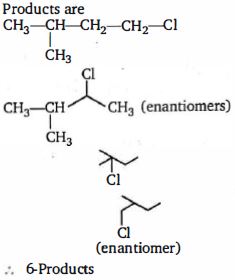
(C) The reactant is $2$-methylbutane (isopentane). Monochlorination yields four structural isomers:
$1.$ $Cl-CH_2-CH(CH_3)-CH_2-CH_3$ ($1$-chloro-$2$-methylbutane): The $C2$ carbon is chiral,so it exists as a pair of enantiomers ($2$ stereoisomers).
$2.$ $CH_3-CCl(CH_3)-CH_2-CH_3$ ($2$-chloro-$2$-methylbutane): This molecule is achiral,so it exists as $1$ stereoisomer.
$3.$ $CH_3-CH(CH_3)-CHCl-CH_3$ ($2$-chloro-$3$-methylbutane): The $C3$ carbon is chiral,so it exists as a pair of enantiomers ($2$ stereoisomers).
$4.$ $CH_3-CH(CH_3)-CH_2-CH_2-Cl$ ($1$-chloro-$3$-methylbutane): This molecule is achiral,so it exists as $1$ stereoisomer.
Total number of monochloro products including stereoisomers = $2 + 1 + 2 + 1 = 6$.
$1.$ $Cl-CH_2-CH(CH_3)-CH_2-CH_3$ ($1$-chloro-$2$-methylbutane): The $C2$ carbon is chiral,so it exists as a pair of enantiomers ($2$ stereoisomers).
$2.$ $CH_3-CCl(CH_3)-CH_2-CH_3$ ($2$-chloro-$2$-methylbutane): This molecule is achiral,so it exists as $1$ stereoisomer.
$3.$ $CH_3-CH(CH_3)-CHCl-CH_3$ ($2$-chloro-$3$-methylbutane): The $C3$ carbon is chiral,so it exists as a pair of enantiomers ($2$ stereoisomers).
$4.$ $CH_3-CH(CH_3)-CH_2-CH_2-Cl$ ($1$-chloro-$3$-methylbutane): This molecule is achiral,so it exists as $1$ stereoisomer.
Total number of monochloro products including stereoisomers = $2 + 1 + 2 + 1 = 6$.
0 likes
View Solution304
MediumMCQ
Arrange the following alkanes in decreasing order of their heats of combustion:
$(i)$ $CH_3-C(CH_3)_2-CH_3$ (Neopentane)
$(ii)$ $CH_3-CH(CH_3)-CH_2-CH_3$ (Isopentane)
$(iii)$ $CH_3-CH_2-CH_2-CH_2-CH_3$ ($n$-pentane)
$(i)$ $CH_3-C(CH_3)_2-CH_3$ (Neopentane)
$(ii)$ $CH_3-CH(CH_3)-CH_2-CH_3$ (Isopentane)
$(iii)$ $CH_3-CH_2-CH_2-CH_2-CH_3$ ($n$-pentane)
A
$(i) > (ii) > (iii)$
B
$(iii) > (i) > (ii)$
C
$(iii) > (ii) > (i)$
D
$(i) > (iii) > (ii)$
Solution
(C) For isomeric alkanes,the heat of combustion is inversely proportional to their stability.
As branching increases,the stability of the alkane increases.
Stability order: Neopentane > Isopentane > $n$-pentane.
Therefore,the order of heat of combustion is: $n$-pentane > Isopentane > Neopentane,which is $(iii) > (ii) > (i)$.
Heat of combustion $\propto \frac{1}{\text{Stability}}$
As branching increases,the stability of the alkane increases.
Stability order: Neopentane > Isopentane > $n$-pentane.
Therefore,the order of heat of combustion is: $n$-pentane > Isopentane > Neopentane,which is $(iii) > (ii) > (i)$.
Heat of combustion $\propto \frac{1}{\text{Stability}}$
0 likes
View Solution305
MediumMCQ
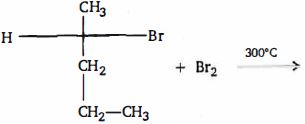
Which of the following compounds will not be obtained as a product in the above reaction?
A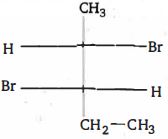
B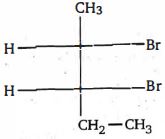
C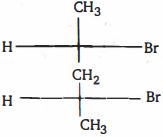
D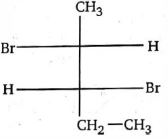
Solution
(D) The reaction is a free radical bromination of $2$-bromopentane. The rate-determining step involves the abstraction of a hydrogen atom to form a free radical. The most stable free radical is formed at the $C-3$ position. Since the chiral center at $C-2$ is not involved in the reaction,its configuration remains unchanged. The $C-3$ carbon becomes a new chiral center upon bromination,leading to two diastereomers. The configuration at $C-2$ is fixed as $S$ in the starting material. Therefore,the products must retain the $S$ configuration at $C-2$. The option showing a change in configuration at $C-2$ (i.e.,$2R, 3S$) is not possible.
0 likes
View Solution306
MediumMCQ
Ethane is subjected to a combustion process. During the combustion,the hybrid state of carbon changes from
A
$sp^3$ to $sp^2$
B
$sp^3$ to $sp$
C
$sp$ to $sp^3$
D
$sp^2$ to $sp^2$
Solution
(B) The combustion reaction of ethane is: $2C_2H_6(g) + 7O_2(g) \rightarrow 4CO_2(g) + 6H_2O(l)$.
In ethane $(C_2H_6)$,the carbon atoms are $sp^3$ hybridized.
In the product carbon dioxide $(CO_2)$,the carbon atom is $sp$ hybridized.
Therefore,the hybridization changes from $sp^3$ to $sp$.
In ethane $(C_2H_6)$,the carbon atoms are $sp^3$ hybridized.
In the product carbon dioxide $(CO_2)$,the carbon atom is $sp$ hybridized.
Therefore,the hybridization changes from $sp^3$ to $sp$.
0 likes
View Solution307
MediumMCQ
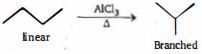
$CH_3-CH_2-CH_2-CH_3 \xrightarrow[\Delta]{AlCl_3} CH_3-CH(CH_3)-CH_3$
The above reaction is an example of:
The above reaction is an example of:
A
isomerization
B
polymerization
C
cracking
D
dehydrogenation
Solution
(A) The conversion of $n$-alkanes to branched-chain alkanes in the presence of anhydrous $AlCl_3$ and $HCl$ gas is known as isomerization.
In this reaction,$n$-butane is converted into its isomer,isobutane ($2$-methylpropane).
In this reaction,$n$-butane is converted into its isomer,isobutane ($2$-methylpropane).
0 likes
View Solution308
MediumMCQ
Pure methane can be prepared by
A
Wurtz reaction
B
Kolbe electrolysis method
C
soda-lime de-carboxylation
D
reduction with $H_2$
Solution
(C) Soda-lime de-carboxylation involves heating sodium acetate with soda-lime $(NaOH + CaO)$.
The reaction is: $CH_3COONa + NaOH \xrightarrow[\Delta]{CaO} CH_4 + Na_2CO_3$.
This method is suitable for the laboratory preparation of pure methane.
The reaction is: $CH_3COONa + NaOH \xrightarrow[\Delta]{CaO} CH_4 + Na_2CO_3$.
This method is suitable for the laboratory preparation of pure methane.
0 likes
View Solution309
MediumMCQ
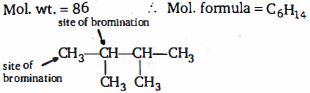
An alkane (mol. wt. = $86$) on bromination gives only two monobromo derivatives (excluding stereoisomers). The alkane is
A
$CH_3-CH(CH_3)-CH_2-CH_2-CH_3$
B
$CH_3-C(CH_3)_2-CH_2-CH_3$
C
$CH_3-CH(CH_3)-CH(CH_3)-CH_3$
D
$C(CH_3)_4$
Solution
(C) The molecular weight of the alkane is $86$.
General formula for alkane: $C_nH_{2n+2} = 86$
$12n + 2n + 2 = 86$
$14n = 84$
$n = 6$
The alkane is $C_6H_{14}$.
$2$,$3$-dimethylbutane $(CH_3-CH(CH_3)-CH(CH_3)-CH_3)$ has two types of equivalent hydrogen atoms:
$1.$ Twelve $CH_3$ hydrogens are equivalent (on the four methyl groups).
$2.$ Two $CH$ hydrogens are equivalent (on the two tertiary carbons).
Thus,it gives only two monobromo derivatives.
General formula for alkane: $C_nH_{2n+2} = 86$
$12n + 2n + 2 = 86$
$14n = 84$
$n = 6$
The alkane is $C_6H_{14}$.
$2$,$3$-dimethylbutane $(CH_3-CH(CH_3)-CH(CH_3)-CH_3)$ has two types of equivalent hydrogen atoms:
$1.$ Twelve $CH_3$ hydrogens are equivalent (on the four methyl groups).
$2.$ Two $CH$ hydrogens are equivalent (on the two tertiary carbons).
Thus,it gives only two monobromo derivatives.
0 likes
View Solution310
MediumMCQ
The correct order of reactivity of $(I)$,$(II)$,and $(III)$ towards addition reactions is:
$(I)$ Cyclopropane
$(II)$ Cyclobutane
$(III)$ Cyclopentane
$(I)$ Cyclopropane
$(II)$ Cyclobutane
$(III)$ Cyclopentane
A
$I > II > III$
B
$I > III > II$
C
$III > II > I$
D
$III > I > II$
Solution
(A) The reactivity of cycloalkanes towards addition reactions is governed by ring strain.
According to Baeyer's strain theory,the ring strain decreases as the ring size increases from $3$ to $5$ members.
$(I)$ Cyclopropane has the highest ring strain ($60^{\circ}$ bond angle),making it the most unstable and most reactive towards addition reactions.
$(II)$ Cyclobutane has intermediate ring strain ($90^{\circ}$ bond angle).
$(III)$ Cyclopentane has the lowest ring strain ($108^{\circ}$ bond angle),making it the most stable and least reactive towards addition reactions.
Therefore,the order of reactivity is $I > II > III$.
According to Baeyer's strain theory,the ring strain decreases as the ring size increases from $3$ to $5$ members.
$(I)$ Cyclopropane has the highest ring strain ($60^{\circ}$ bond angle),making it the most unstable and most reactive towards addition reactions.
$(II)$ Cyclobutane has intermediate ring strain ($90^{\circ}$ bond angle).
$(III)$ Cyclopentane has the lowest ring strain ($108^{\circ}$ bond angle),making it the most stable and least reactive towards addition reactions.
Therefore,the order of reactivity is $I > II > III$.
0 likes
View Solution311
DifficultMCQ
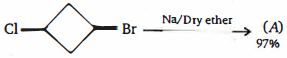
The product $(A)$ of the above reaction is:
A
Cyclobutene
B
Bicyclobutane
C
Cyclobutane
D
Methylenecyclobutane
Solution
(B) The reaction is an example of an intramolecular Wurtz reaction.
Sodium $(Na)$ acts as a reducing agent,providing electrons $(e^{\ominus})$ to the substrate.
The mechanism involves the following steps:
$1$. An electron $(e^{\ominus})$ attacks the carbon attached to the bromine atom,leading to the departure of the bromide ion $(Br^{\ominus})$ and the formation of a radical.
$2$. Another electron $(e^{\ominus})$ attacks the carbon attached to the chlorine atom,leading to the departure of the chloride ion $(Cl^{\ominus})$ and the formation of a second radical.
$3$. The two radicals then combine to form a new $C-C$ bond,resulting in the formation of bicyclobutane.
Therefore,the correct product $(A)$ is bicyclobutane.
Sodium $(Na)$ acts as a reducing agent,providing electrons $(e^{\ominus})$ to the substrate.
The mechanism involves the following steps:
$1$. An electron $(e^{\ominus})$ attacks the carbon attached to the bromine atom,leading to the departure of the bromide ion $(Br^{\ominus})$ and the formation of a radical.
$2$. Another electron $(e^{\ominus})$ attacks the carbon attached to the chlorine atom,leading to the departure of the chloride ion $(Cl^{\ominus})$ and the formation of a second radical.
$3$. The two radicals then combine to form a new $C-C$ bond,resulting in the formation of bicyclobutane.
Therefore,the correct product $(A)$ is bicyclobutane.

0 likes
View Solution312
MediumMCQ
Which of the following reactants is suitable for the preparation of methane and ethane by using one step only?
A
$H_2C=CH_2$
B
$CH_3OH$
C
$CH_3-Br$
D
$CH_3-CH_2-OH$
Solution
(C) Methyl bromide $(CH_3-Br)$ can be reduced to methane $(CH_4)$ using a reducing agent like $Zn/HCl$ or $LiAlH_4$ in one step.
Methyl bromide $(CH_3-Br)$ can be converted to ethane $(CH_3-CH_3)$ using the $Wurtz$ reaction $(2CH_3-Br + 2Na \xrightarrow{dry \ ether} CH_3-CH_3 + 2NaBr)$ in one step.
Therefore,$CH_3-Br$ is the suitable reactant.
Methyl bromide $(CH_3-Br)$ can be converted to ethane $(CH_3-CH_3)$ using the $Wurtz$ reaction $(2CH_3-Br + 2Na \xrightarrow{dry \ ether} CH_3-CH_3 + 2NaBr)$ in one step.
Therefore,$CH_3-Br$ is the suitable reactant.
0 likes
View Solution313
MediumMCQ
How many carbon atoms does an alkane (not a cycloalkane) need before it is capable of existing in an enantiomeric form?
A
$4$
B
$5$
C
$6$
D
$7$
Solution
(D) For an alkane to exist in an enantiomeric form,it must possess at least one chiral carbon atom (a carbon atom bonded to four different groups).
Let the chiral carbon be $C^*$. The four groups attached to $C^*$ must be different.
In an alkane,the smallest groups are hydrogen $(-H)$,methyl $(-CH_3)$,ethyl $(-CH_2CH_3)$,and propyl $(-CH_2CH_2CH_3)$.
Summing the carbon atoms in these groups: $1$ (for the chiral carbon) $+ 1$ (methyl) $+ 2$ (ethyl) $+ 3$ (propyl) $= 7$ carbon atoms.
Therefore,the smallest alkane capable of exhibiting enantiomerism is $3$-methylhexane,which has $7$ carbon atoms.
Let the chiral carbon be $C^*$. The four groups attached to $C^*$ must be different.
In an alkane,the smallest groups are hydrogen $(-H)$,methyl $(-CH_3)$,ethyl $(-CH_2CH_3)$,and propyl $(-CH_2CH_2CH_3)$.
Summing the carbon atoms in these groups: $1$ (for the chiral carbon) $+ 1$ (methyl) $+ 2$ (ethyl) $+ 3$ (propyl) $= 7$ carbon atoms.
Therefore,the smallest alkane capable of exhibiting enantiomerism is $3$-methylhexane,which has $7$ carbon atoms.
0 likes
View Solution314
MediumMCQ
Among the following free radical bromination reactions,select those in which a $2^o$ halide is the major product. The reactions are as follows:
$(P)$ Cyclohexane + $Br_2/hv$
$(Q)$ Methylcyclobutane + $Br_2/hv$
$(R)$ Ethylbenzene + $Br_2/hv$
$(S)$ $3-$Methylhexane + $Br_2/hv$
$(T)$ Decalin + $Br_2/hv$
$(U)$ Butane + $Br_2/hv$
$(P)$ Cyclohexane + $Br_2/hv$
$(Q)$ Methylcyclobutane + $Br_2/hv$
$(R)$ Ethylbenzene + $Br_2/hv$
$(S)$ $3-$Methylhexane + $Br_2/hv$
$(T)$ Decalin + $Br_2/hv$
$(U)$ Butane + $Br_2/hv$
A
$P, Q, R, S$
B
$P, R, U$
C
$P, R, S, T$
D
$P, Q, R, S, T$
Solution
(B) Bromination is highly selective for the most stable radical intermediate.
$(P)$ Cyclohexane gives bromocyclohexane ($2^o$ halide).
$(Q)$ Methylcyclobutane gives $1-$bromo$-1-$methylcyclobutane ($3^o$ halide).
$(R)$ Ethylbenzene gives $1-$bromo$-1-$phenylethane (benzylic halide,which is more stable than $2^o$ alkyl halide,but often classified as $2^o$ in terms of carbon substitution).
$(S)$ $3-$Methylhexane gives $3-$bromo$-3-$methylhexane ($3^o$ halide).
$(T)$ Decalin gives a $3^o$ halide at the bridgehead position.
$(U)$ Butane gives $2-$bromobutane ($2^o$ halide).
Therefore,$P, R, U$ are the reactions where $2^o$ (or equivalent) halides are the major products.
$(P)$ Cyclohexane gives bromocyclohexane ($2^o$ halide).
$(Q)$ Methylcyclobutane gives $1-$bromo$-1-$methylcyclobutane ($3^o$ halide).
$(R)$ Ethylbenzene gives $1-$bromo$-1-$phenylethane (benzylic halide,which is more stable than $2^o$ alkyl halide,but often classified as $2^o$ in terms of carbon substitution).
$(S)$ $3-$Methylhexane gives $3-$bromo$-3-$methylhexane ($3^o$ halide).
$(T)$ Decalin gives a $3^o$ halide at the bridgehead position.
$(U)$ Butane gives $2-$bromobutane ($2^o$ halide).
Therefore,$P, R, U$ are the reactions where $2^o$ (or equivalent) halides are the major products.
0 likes
View Solution315
MediumMCQ
$(A) + Cl_2 \xrightarrow{hv} \text{monochloro product}$. To maximize the yield of the monochloro product in the above reaction:
A
$Cl_2$ must be added in excess
B
Reactant $(A)$ must be added in excess
C
Reaction must be carried out in dark
D
Reaction must be carried out with equimolar mixture of $Cl_2$ and $(A)$
Solution
(B) The free radical chlorination of an alkane $(A)$ is a chain reaction that can lead to polychlorination if $Cl_2$ is present in excess.
To maximize the yield of the monochloro product,the concentration of the alkane $(A)$ must be kept high relative to $Cl_2$.
By adding reactant $(A)$ in excess,the probability of a $Cl^{\bullet}$ radical colliding with an unreacted molecule of $(A)$ is significantly higher than colliding with a monochloro product molecule,thereby minimizing further chlorination.
To maximize the yield of the monochloro product,the concentration of the alkane $(A)$ must be kept high relative to $Cl_2$.
By adding reactant $(A)$ in excess,the probability of a $Cl^{\bullet}$ radical colliding with an unreacted molecule of $(A)$ is significantly higher than colliding with a monochloro product molecule,thereby minimizing further chlorination.
0 likes
View Solution316
MediumMCQ
$CH_3-CH_2-CH_2-CH_3 \xrightarrow{Br_2/hv}$
Major product in the above reaction is
Major product in the above reaction is
A
Racemic mixture
B
Meso
C
Diastereomers
D
Constitutional isomers
Solution
(A) The reaction of $n$-butane with $Br_2$ in the presence of $hv$ (light) proceeds via a free radical mechanism.
The abstraction of a secondary hydrogen atom is more favorable than a primary hydrogen atom due to the greater stability of the $2^o$ alkyl radical.
The intermediate $CH_3-CH^{\bullet}-CH_2-CH_3$ is $sp^2$-hybridized and planar.
Attack of $Br_2$ on either face of the planar radical leads to the formation of both enantiomers of $2$-bromobutane in equal amounts.
Therefore,the major product is a racemic mixture.
The abstraction of a secondary hydrogen atom is more favorable than a primary hydrogen atom due to the greater stability of the $2^o$ alkyl radical.
The intermediate $CH_3-CH^{\bullet}-CH_2-CH_3$ is $sp^2$-hybridized and planar.
Attack of $Br_2$ on either face of the planar radical leads to the formation of both enantiomers of $2$-bromobutane in equal amounts.
Therefore,the major product is a racemic mixture.
0 likes
View Solution317
MediumMCQ
Select the chain propagation steps in the free-radical chlorination of methane.
$(1) \, Cl_2 \to 2Cl^{\bullet}$
$(2) \, Cl^{\bullet} + CH_4 \to CH_3Cl + H^{\bullet}$
$(3) \, Cl^{\bullet} + CH_4 \to CH_3^{\bullet} + HCl$
$(4) \, H^{\bullet} + Cl_2 \to HCl + Cl^{\bullet}$
$(5) \, CH_3^{\bullet} + Cl_2 \to CH_3Cl + Cl^{\bullet}$
$(1) \, Cl_2 \to 2Cl^{\bullet}$
$(2) \, Cl^{\bullet} + CH_4 \to CH_3Cl + H^{\bullet}$
$(3) \, Cl^{\bullet} + CH_4 \to CH_3^{\bullet} + HCl$
$(4) \, H^{\bullet} + Cl_2 \to HCl + Cl^{\bullet}$
$(5) \, CH_3^{\bullet} + Cl_2 \to CH_3Cl + Cl^{\bullet}$
A
$(2), (3), (5)$
B
$(1), (3), (6)$
C
$(3), (5)$
D
$(2), (3), (4)$
Solution
(C) The free-radical chlorination of methane proceeds through three stages: initiation,propagation,and termination.
Step $(1)$ is the initiation step where $Cl_2$ undergoes homolytic cleavage to form chlorine radicals.
Propagation steps are those where a radical reacts with a molecule to form a new molecule and a new radical.
Step $(3)$ is a propagation step: $Cl^{\bullet} + CH_4 \to CH_3^{\bullet} + HCl$.
Step $(5)$ is a propagation step: $CH_3^{\bullet} + Cl_2 \to CH_3Cl + Cl^{\bullet}$.
Therefore,the propagation steps are $(3)$ and $(5)$.
Step $(1)$ is the initiation step where $Cl_2$ undergoes homolytic cleavage to form chlorine radicals.
Propagation steps are those where a radical reacts with a molecule to form a new molecule and a new radical.
Step $(3)$ is a propagation step: $Cl^{\bullet} + CH_4 \to CH_3^{\bullet} + HCl$.
Step $(5)$ is a propagation step: $CH_3^{\bullet} + Cl_2 \to CH_3Cl + Cl^{\bullet}$.
Therefore,the propagation steps are $(3)$ and $(5)$.
0 likes
View Solution318
MediumMCQ
The number of possible monobromo products for the reaction of methylcyclohexane with $Br_2/hv$ is (excluding stereoisomers):
A
$4$
B
$5$
C
$8$
D
$10$
Solution
(B) The reaction of methylcyclohexane with $Br_2/hv$ involves free radical substitution.
Methylcyclohexane has different types of hydrogen atoms available for substitution:
$1$. The hydrogen on the methyl group (primary carbon).
$2$. The hydrogen on the tertiary carbon of the cyclohexane ring (at the position where the methyl group is attached).
$3$. The hydrogens on the secondary carbons of the cyclohexane ring at the ortho position.
$4$. The hydrogens on the secondary carbons of the cyclohexane ring at the meta position.
$5$. The hydrogen on the secondary carbon of the cyclohexane ring at the para position.
Thus,there are $5$ distinct positions where bromine can substitute,leading to $5$ structural isomers. Excluding stereoisomers,the total number of monobromo products is $5$.
Methylcyclohexane has different types of hydrogen atoms available for substitution:
$1$. The hydrogen on the methyl group (primary carbon).
$2$. The hydrogen on the tertiary carbon of the cyclohexane ring (at the position where the methyl group is attached).
$3$. The hydrogens on the secondary carbons of the cyclohexane ring at the ortho position.
$4$. The hydrogens on the secondary carbons of the cyclohexane ring at the meta position.
$5$. The hydrogen on the secondary carbon of the cyclohexane ring at the para position.
Thus,there are $5$ distinct positions where bromine can substitute,leading to $5$ structural isomers. Excluding stereoisomers,the total number of monobromo products is $5$.
0 likes
View Solution319
MediumMCQ
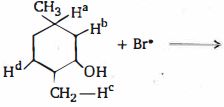
$Br^{\bullet}$ will abstract which of the hydrogen most readily?
A
$a$
B
$b$
C
$c$
D
$d$
Solution
(A) The bromine radical $(Br^{\bullet})$ is highly selective in hydrogen abstraction reactions.
It preferentially abstracts the hydrogen atom that leads to the formation of the most stable free radical.
Comparing the positions:
- Hydrogen '$a$' is on a tertiary carbon atom. Removal of this hydrogen results in a $3^{\circ}$ free radical.
- Hydrogen '$b$' is on a secondary carbon atom.
- Hydrogen '$c$' is on a primary carbon atom.
- Hydrogen '$d$' is on a secondary carbon atom.
Since the $3^{\circ}$ free radical is the most stable among the options,the bromine radical will most readily abstract the hydrogen at position '$a$'.
It preferentially abstracts the hydrogen atom that leads to the formation of the most stable free radical.
Comparing the positions:
- Hydrogen '$a$' is on a tertiary carbon atom. Removal of this hydrogen results in a $3^{\circ}$ free radical.
- Hydrogen '$b$' is on a secondary carbon atom.
- Hydrogen '$c$' is on a primary carbon atom.
- Hydrogen '$d$' is on a secondary carbon atom.
Since the $3^{\circ}$ free radical is the most stable among the options,the bromine radical will most readily abstract the hydrogen at position '$a$'.
0 likes
View Solution320
MediumMCQ
For the molecule $CH_3(a)-CH_2(b)-CH_2(c)-CH_2(d)-F$,arrange the hydrogens $a, b, c, d$ in decreasing order of their reactivities towards free radical chlorination.
A
$a > b > c > d$
B
$b > c > d > a$
C
$b > c > a > d$
D
$c > b > a > d$
Solution
(C) The reactivity of hydrogens towards free radical chlorination depends on the stability of the intermediate radical formed after hydrogen abstraction.
Stability of radicals follows the order: $3^o > 2^o > 1^o$.
Additionally,the $-I$ effect of the fluorine atom destabilizes the radical formed on the adjacent carbons,with the effect decreasing as the distance from the $F$ atom increases.
For $CH_3(a)-CH_2(b)-CH_2(c)-CH_2(d)-F$:
- Hydrogen $d$ is on the carbon attached to $F$ (most destabilized by $-I$ effect).
- Hydrogen $c$ is on the $\beta$-carbon.
- Hydrogen $b$ is on the $\gamma$-carbon.
- Hydrogen $a$ is on the $\delta$-carbon (least affected by $-I$ effect).
However,considering the radical stability,$b$ and $c$ are $2^o$ radicals,while $a$ and $d$ are $1^o$ radicals.
Comparing the $-I$ effect,the reactivity order is $b > c > a > d$.
Stability of radicals follows the order: $3^o > 2^o > 1^o$.
Additionally,the $-I$ effect of the fluorine atom destabilizes the radical formed on the adjacent carbons,with the effect decreasing as the distance from the $F$ atom increases.
For $CH_3(a)-CH_2(b)-CH_2(c)-CH_2(d)-F$:
- Hydrogen $d$ is on the carbon attached to $F$ (most destabilized by $-I$ effect).
- Hydrogen $c$ is on the $\beta$-carbon.
- Hydrogen $b$ is on the $\gamma$-carbon.
- Hydrogen $a$ is on the $\delta$-carbon (least affected by $-I$ effect).
However,considering the radical stability,$b$ and $c$ are $2^o$ radicals,while $a$ and $d$ are $1^o$ radicals.
Comparing the $-I$ effect,the reactivity order is $b > c > a > d$.
0 likes
View Solution321
MediumMCQ
How many dichloro products are formed in the reaction of cyclopentane with excess $Cl_2$ in the presence of $h\nu$ (including stereoisomers)?
A
$5$
B
$6$
C
$7$
D
$9$
Solution
(C) The reaction of cyclopentane with excess $Cl_2$ under $h\nu$ leads to the formation of various dichloro derivatives.
$1$. $1,1$-dichlorocyclopentane: $1$ isomer.
$2$. $1,2$-dichlorocyclopentane: This has $2$ chiral centers,so it exists as $3$ stereoisomers ($cis$ (meso) and $trans$ (enantiomeric pair)).
$3$. $1,3$-dichlorocyclopentane: This also has $2$ chiral centers,so it exists as $3$ stereoisomers ($cis$ (meso) and $trans$ (enantiomeric pair)).
Total number of dichloro products = $1 + 3 + 3 = 7$.
$1$. $1,1$-dichlorocyclopentane: $1$ isomer.
$2$. $1,2$-dichlorocyclopentane: This has $2$ chiral centers,so it exists as $3$ stereoisomers ($cis$ (meso) and $trans$ (enantiomeric pair)).
$3$. $1,3$-dichlorocyclopentane: This also has $2$ chiral centers,so it exists as $3$ stereoisomers ($cis$ (meso) and $trans$ (enantiomeric pair)).
Total number of dichloro products = $1 + 3 + 3 = 7$.
0 likes
View Solution322
MediumMCQ
$Ph-CH_2-CH(D)-CH_3 \xrightarrow{Br_2/hv}$
Product of the above reaction will be:
Product of the above reaction will be:
A
Diastereomers
B
Racemic mixture
C
Meso
D
Constitutional isomers
Solution
(A) The reaction is a free radical bromination.
The most stable radical is formed at the benzylic position $(Ph-\dot{C}H-CH(D)-CH_3)$ due to resonance stabilization with the phenyl ring.
Bromination at this position creates a new chiral center.
Since the starting molecule already contains a chiral center at the carbon atom bonded to deuterium $(D)$,the formation of a second chiral center results in a pair of diastereomers.
The most stable radical is formed at the benzylic position $(Ph-\dot{C}H-CH(D)-CH_3)$ due to resonance stabilization with the phenyl ring.
Bromination at this position creates a new chiral center.
Since the starting molecule already contains a chiral center at the carbon atom bonded to deuterium $(D)$,the formation of a second chiral center results in a pair of diastereomers.
0 likes
View Solution323
MediumMCQ
$CH_3-CH(CH_3)-CH_3 + CH_2=CH_2 \xrightarrow[2.5^oC]{HF} (A)$; $(A)$ is:
A
$CH_3-CH_2-CH_2-CH_2-CH_3$
B
$CH_3-CH(CH_3)-CH_2-CH_3$
C
$CH_3-C(CH_3)_2-CH_2-CH_3$
D
$CH_3-CH(CH_3)-CH_2-CH=CH_2$
Solution
(C) The reaction of isobutane with ethene in the presence of $HF$ at low temperature is an alkylation reaction.
$1$. The mechanism involves the formation of a tert-butyl carbocation $(CH_3)_3C^+$ by the protonation of isobutane.
$2$. This carbocation adds to the ethene molecule to form a new carbocation $(CH_3)_3C-CH_2-CH_2^+$.
$3$. Through a series of rearrangements ($1$,$2$-hydride shift followed by $1,2-$methyl shift),a more stable carbocation is formed.
$4$. Finally,hydride abstraction from another isobutane molecule yields the major product,$2$,$2$-dimethylbutane $(CH_3-C(CH_3)_2-CH_2-CH_3)$.
$1$. The mechanism involves the formation of a tert-butyl carbocation $(CH_3)_3C^+$ by the protonation of isobutane.
$2$. This carbocation adds to the ethene molecule to form a new carbocation $(CH_3)_3C-CH_2-CH_2^+$.
$3$. Through a series of rearrangements ($1$,$2$-hydride shift followed by $1,2-$methyl shift),a more stable carbocation is formed.
$4$. Finally,hydride abstraction from another isobutane molecule yields the major product,$2$,$2$-dimethylbutane $(CH_3-C(CH_3)_2-CH_2-CH_3)$.
0 likes
View Solution324
MediumMCQ
Select the reaction$(s)$ that would result in the formation of $2-$bromopropane.
$(I) \ CH_3-CH=CH_2 + HBr \xrightarrow{\text{peroxide}}$
$(II) \ CH_3-CH=CH_2 + HBr \xrightarrow{CCl_4}$
$(III) \ CH_3-CH_2-CH_3 + Br_2 \xrightarrow{hv}$
$(IV) \ CH_3-CH=CH_2 + Br_2 \xrightarrow{CCl_4}$
$(I) \ CH_3-CH=CH_2 + HBr \xrightarrow{\text{peroxide}}$
$(II) \ CH_3-CH=CH_2 + HBr \xrightarrow{CCl_4}$
$(III) \ CH_3-CH_2-CH_3 + Br_2 \xrightarrow{hv}$
$(IV) \ CH_3-CH=CH_2 + Br_2 \xrightarrow{CCl_4}$
A
$I$ and $III$
B
$II$ and $III$
C
$I, II,$ and $III$
D
$II$ and $IV$
Solution
(B) $(I)$ Reaction with $HBr$ in the presence of peroxide follows anti-Markovnikov addition to form $1-$bromopropane.
$(II)$ Reaction with $HBr$ in $CCl_4$ follows Markovnikov's addition to form $2-$bromopropane.
$(III)$ Free radical bromination of propane $(CH_3-CH_2-CH_3)$ with $Br_2$ under $hv$ (light) preferentially forms $2-$bromopropane due to the higher stability of the secondary free radical intermediate.
$(IV)$ Reaction with $Br_2$ in $CCl_4$ results in the formation of $1,2-$dibromopropane.
Therefore,reactions $(II)$ and $(III)$ result in the formation of $2-$bromopropane.
$(II)$ Reaction with $HBr$ in $CCl_4$ follows Markovnikov's addition to form $2-$bromopropane.
$(III)$ Free radical bromination of propane $(CH_3-CH_2-CH_3)$ with $Br_2$ under $hv$ (light) preferentially forms $2-$bromopropane due to the higher stability of the secondary free radical intermediate.
$(IV)$ Reaction with $Br_2$ in $CCl_4$ results in the formation of $1,2-$dibromopropane.
Therefore,reactions $(II)$ and $(III)$ result in the formation of $2-$bromopropane.
0 likes
View Solution325
DifficultMCQ
$CH_3-CH_2-CH_2-CH_2-CH_3 \xrightarrow{CH_2N_2/\Delta} \text{Product}$.
Which of the following product$(s)$ can be obtained in the above reaction?
Which of the following product$(s)$ can be obtained in the above reaction?
A
$2-$Methylpentane
B
$3-$Methylpentane
C
$n-$Hexane
D
All of the above
Solution
(D) The reaction of an alkane with diazomethane $(CH_2N_2)$ in the presence of heat or light involves the generation of a carbene intermediate $(:CH_2)$.
The carbene undergoes an insertion reaction into the $C-H$ bonds of the alkane.
For $n-$pentane $(CH_3-CH_2-CH_2-CH_2-CH_3)$,there are three types of $C-H$ bonds:
$1.$ Insertion into the primary $C-H$ bond ($C_1$ or $C_5$) gives $n-$hexane $(CH_3-CH_2-CH_2-CH_2-CH_2-CH_3)$.
$2.$ Insertion into the secondary $C-H$ bond at $C_2$ (or $C_4$) gives $2-$methylpentane $(CH_3-CH(CH_3)-CH_2-CH_2-CH_3)$.
$3.$ Insertion into the secondary $C-H$ bond at $C_3$ gives $3-$methylpentane $(CH_3-CH_2-CH(CH_3)-CH_2-CH_3)$.
Therefore,all the listed products are obtained.
The carbene undergoes an insertion reaction into the $C-H$ bonds of the alkane.
For $n-$pentane $(CH_3-CH_2-CH_2-CH_2-CH_3)$,there are three types of $C-H$ bonds:
$1.$ Insertion into the primary $C-H$ bond ($C_1$ or $C_5$) gives $n-$hexane $(CH_3-CH_2-CH_2-CH_2-CH_2-CH_3)$.
$2.$ Insertion into the secondary $C-H$ bond at $C_2$ (or $C_4$) gives $2-$methylpentane $(CH_3-CH(CH_3)-CH_2-CH_2-CH_3)$.
$3.$ Insertion into the secondary $C-H$ bond at $C_3$ gives $3-$methylpentane $(CH_3-CH_2-CH(CH_3)-CH_2-CH_3)$.
Therefore,all the listed products are obtained.
0 likes
View Solution326
MediumMCQ
Identify the type of reaction shown in the following chemical equation:
$C_6H_5CH_3 + Br_2 \xrightarrow{h\nu} C_6H_5CH_2Br + HBr$
$C_6H_5CH_3 + Br_2 \xrightarrow{h\nu} C_6H_5CH_2Br + HBr$
A
Nucleophilic addition
B
Nucleophilic substitution
C
Electrophilic addition
D
Free radical substitution
Solution
(D) The given reaction is the bromination of toluene in the presence of light $(h\nu)$.
This reaction proceeds via a free radical mechanism where a hydrogen atom on the methyl group of toluene is replaced by a bromine atom.
Therefore,it is a $Free \ radical \ substitution$ reaction.
This reaction proceeds via a free radical mechanism where a hydrogen atom on the methyl group of toluene is replaced by a bromine atom.
Therefore,it is a $Free \ radical \ substitution$ reaction.
0 likes
View Solution327
DifficultMCQ
The gas evolved on heating $CH_3MgBr$ in methanol is
A
Methane
B
Ethane
C
Propane
D
$HBr$
Solution
(A) $CH_3MgBr$ is a Grignard reagent,which acts as a strong base.
Methanol $(CH_3OH)$ contains an acidic hydrogen atom attached to the oxygen atom.
When $CH_3MgBr$ reacts with $CH_3OH$,the methyl group $(CH_3^-)$ abstracts the acidic proton from the methanol to form methane $(CH_4)$ gas.
The reaction is: $CH_3MgBr + CH_3OH \rightarrow CH_4 \uparrow + Mg(OCH_3)Br$.
Methanol $(CH_3OH)$ contains an acidic hydrogen atom attached to the oxygen atom.
When $CH_3MgBr$ reacts with $CH_3OH$,the methyl group $(CH_3^-)$ abstracts the acidic proton from the methanol to form methane $(CH_4)$ gas.
The reaction is: $CH_3MgBr + CH_3OH \rightarrow CH_4 \uparrow + Mg(OCH_3)Br$.
0 likes
View Solution328
DifficultMCQ
$5 \, L$ of an alkane requires $25 \, L$ of oxygen for its complete combustion. If all volumes are measured at constant temperature and pressure,the alkane is
A
Isobutane
B
Ethane
C
Butane
D
Propane
Solution
(D) The general combustion reaction for an alkane $C_nH_{2n+2}$ is:
$C_nH_{2n+2} + (\frac{3n+1}{2})O_2 \to nCO_2 + (n+1)H_2O$
According to Avogadro's law,at constant temperature and pressure,the volume of a gas is directly proportional to the number of moles.
Therefore,the ratio of volumes is equal to the ratio of stoichiometric coefficients:
$\frac{V_{alkane}}{V_{O_2}} = \frac{1}{\frac{3n+1}{2}} = \frac{2}{3n+1}$
Given $V_{alkane} = 5 \, L$ and $V_{O_2} = 25 \, L$:
$\frac{5}{25} = \frac{2}{3n+1}$
$\frac{1}{5} = \frac{2}{3n+1}$
$3n+1 = 10$
$3n = 9$
$n = 3$
Since $n=3$,the alkane is propane $(C_3H_8)$.
$C_nH_{2n+2} + (\frac{3n+1}{2})O_2 \to nCO_2 + (n+1)H_2O$
According to Avogadro's law,at constant temperature and pressure,the volume of a gas is directly proportional to the number of moles.
Therefore,the ratio of volumes is equal to the ratio of stoichiometric coefficients:
$\frac{V_{alkane}}{V_{O_2}} = \frac{1}{\frac{3n+1}{2}} = \frac{2}{3n+1}$
Given $V_{alkane} = 5 \, L$ and $V_{O_2} = 25 \, L$:
$\frac{5}{25} = \frac{2}{3n+1}$
$\frac{1}{5} = \frac{2}{3n+1}$
$3n+1 = 10$
$3n = 9$
$n = 3$
Since $n=3$,the alkane is propane $(C_3H_8)$.
0 likes
View Solution329
DifficultMCQ
The major product obtained in the photo-catalyzed bromination of $2-$methylbutane is:
A
$1-$bromo$-2-$methylbutane
B
$1-$bromo$-3-$methylbutane
C
$2-$bromo$-3-$methylbutane
D
$2-$bromo$-2-$methylbutane
Solution
(D) The bromination of alkanes follows a free radical mechanism.
Bromine is highly selective and preferentially replaces the hydrogen atom on the carbon that forms the most stable radical.
In $2-$methylbutane $(CH_3-CH(CH_3)-CH_2-CH_3)$,the $C2$ position is a tertiary $(3^\circ)$ carbon.
The $3^\circ$ radical is significantly more stable than $2^\circ$ or $1^\circ$ radicals.
Thus,the major product is $2-$bromo$-2-$methylbutane.
Bromine is highly selective and preferentially replaces the hydrogen atom on the carbon that forms the most stable radical.
In $2-$methylbutane $(CH_3-CH(CH_3)-CH_2-CH_3)$,the $C2$ position is a tertiary $(3^\circ)$ carbon.
The $3^\circ$ radical is significantly more stable than $2^\circ$ or $1^\circ$ radicals.
Thus,the major product is $2-$bromo$-2-$methylbutane.
0 likes
View Solution330
DifficultMCQ
The major product obtained in the photobromination of $2-$methylbutane is
A
$2-$bromo$-2-$methylbutane
B
$1-$bromo$-2-$methylbutane
C
$1-$bromo$-3-$methylbutane
D
$2-$bromo$-3-$methylbutane
Solution
(A) The photobromination of $2-$methylbutane involves the formation of a free radical intermediate.
$CH_3-CH(CH_3)-CH_2-CH_3 \xrightarrow[Br_2]{hv} CH_3-C(Br)(CH_3)-CH_2-CH_3$ ($2-$bromo$-2-$methylbutane).
The reactivity of hydrogen atoms towards free radical substitution follows the order: $3^{\circ} > 2^{\circ} > 1^{\circ}$.
Since $2-$methylbutane has one tertiary $(3^{\circ})$ hydrogen atom at the $C-2$ position,the abstraction of this hydrogen leads to the most stable tertiary free radical.
Therefore,$2-$bromo$-2-$methylbutane is the major product.
$CH_3-CH(CH_3)-CH_2-CH_3 \xrightarrow[Br_2]{hv} CH_3-C(Br)(CH_3)-CH_2-CH_3$ ($2-$bromo$-2-$methylbutane).
The reactivity of hydrogen atoms towards free radical substitution follows the order: $3^{\circ} > 2^{\circ} > 1^{\circ}$.
Since $2-$methylbutane has one tertiary $(3^{\circ})$ hydrogen atom at the $C-2$ position,the abstraction of this hydrogen leads to the most stable tertiary free radical.
Therefore,$2-$bromo$-2-$methylbutane is the major product.
0 likes
View Solution331
MediumMCQ
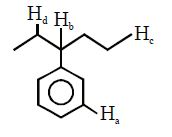
What is the correct order of ease of replacement of the hydrogen atom by a chlorine atom in the following compound by photochlorination?
A
$H_a > H_b > H_c > H_d$
B
$H_b > H_d > H_a > H_c$
C
$H_b > H_d > H_c > H_a$
D
$H_d > H_b > H_c > H_a$
Solution
(C) Photochlorination proceeds via a free radical mechanism. The ease of replacement of a hydrogen atom depends on the stability of the resulting free radical intermediate.
$1$. $H_b$ is a benzylic hydrogen. The resulting radical is resonance-stabilized by the benzene ring,making it the most stable radical.
$2$. $H_d$ is a secondary $(2^{\circ})$ alkyl hydrogen. The resulting radical is a secondary alkyl radical,which is more stable than primary radicals.
$3$. $H_c$ is a primary $(1^{\circ})$ alkyl hydrogen. The resulting radical is a primary alkyl radical.
$4$. $H_a$ is an aromatic hydrogen attached directly to the benzene ring. Replacing this requires breaking a strong $sp^2$ $C-H$ bond,which is very difficult under standard photochlorination conditions.
Therefore,the stability order of the radicals is: Benzylic > $2^{\circ}$ alkyl > $1^{\circ}$ alkyl > Aromatic.
The order of ease of replacement is $H_b > H_d > H_c > H_a$.
$1$. $H_b$ is a benzylic hydrogen. The resulting radical is resonance-stabilized by the benzene ring,making it the most stable radical.
$2$. $H_d$ is a secondary $(2^{\circ})$ alkyl hydrogen. The resulting radical is a secondary alkyl radical,which is more stable than primary radicals.
$3$. $H_c$ is a primary $(1^{\circ})$ alkyl hydrogen. The resulting radical is a primary alkyl radical.
$4$. $H_a$ is an aromatic hydrogen attached directly to the benzene ring. Replacing this requires breaking a strong $sp^2$ $C-H$ bond,which is very difficult under standard photochlorination conditions.
Therefore,the stability order of the radicals is: Benzylic > $2^{\circ}$ alkyl > $1^{\circ}$ alkyl > Aromatic.
The order of ease of replacement is $H_b > H_d > H_c > H_a$.
0 likes
View Solution332
MediumMCQ
Which of the following alkanes is synthesized from a single alkyl halide by the Wurtz reaction?
A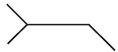
B
C
D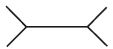
Solution
(D) The Wurtz reaction involves the coupling of two alkyl halide molecules in the presence of sodium metal to form a symmetric alkane.
When a single alkyl halide is used,the resulting alkane must have an even number of carbon atoms and a symmetric structure formed by joining two identical alkyl groups.
For example,$2,3-$Dimethylbutane can be synthesized from $2-$chloropropane:
$2CH_3-CH(Cl)-CH_3 + 2Na \xrightarrow{\text{dry ether}} CH_3-CH(CH_3)-CH(CH_3)-CH_3 + 2NaCl$
$n-$Butane,$n-$Pentane,and $2-$Methylbutane are either asymmetric or have an odd number of carbon atoms,making them unsuitable for synthesis from a single alkyl halide in high yield.
When a single alkyl halide is used,the resulting alkane must have an even number of carbon atoms and a symmetric structure formed by joining two identical alkyl groups.
For example,$2,3-$Dimethylbutane can be synthesized from $2-$chloropropane:
$2CH_3-CH(Cl)-CH_3 + 2Na \xrightarrow{\text{dry ether}} CH_3-CH(CH_3)-CH(CH_3)-CH_3 + 2NaCl$
$n-$Butane,$n-$Pentane,and $2-$Methylbutane are either asymmetric or have an odd number of carbon atoms,making them unsuitable for synthesis from a single alkyl halide in high yield.
0 likes
View Solution333
MediumMCQ
Which of the following will not give one monochloro product?
A
$2,2-$dimethylpropane
B
$2,2,3,3-$tetramethylbutane
C
Cyclopentane
D
$2-$methylpropane
Solution
(D) compound gives only one monochloro product if all its hydrogen atoms are equivalent.
$(A)$ $2,2-$dimethylpropane $(C(CH_3)_4)$ has all $12$ hydrogen atoms equivalent,so it gives only one monochloro product.
$(B)$ $2,2,3,3-$tetramethylbutane $((CH_3)_3C-C(CH_3)_3)$ has all $18$ hydrogen atoms equivalent,so it gives only one monochloro product.
$(C)$ Cyclopentane $(C_5H_{10})$ has all $10$ hydrogen atoms equivalent,so it gives only one monochloro product.
$(D)$ $2-$methylpropane $(CH_3-CH(CH_3)-CH_3)$ has two types of hydrogen atoms (primary and tertiary),so it gives two different monochloro products: $1-$chloro-$2-$methylpropane and $2-$chloro-$2-$methylpropane.
$(A)$ $2,2-$dimethylpropane $(C(CH_3)_4)$ has all $12$ hydrogen atoms equivalent,so it gives only one monochloro product.
$(B)$ $2,2,3,3-$tetramethylbutane $((CH_3)_3C-C(CH_3)_3)$ has all $18$ hydrogen atoms equivalent,so it gives only one monochloro product.
$(C)$ Cyclopentane $(C_5H_{10})$ has all $10$ hydrogen atoms equivalent,so it gives only one monochloro product.
$(D)$ $2-$methylpropane $(CH_3-CH(CH_3)-CH_3)$ has two types of hydrogen atoms (primary and tertiary),so it gives two different monochloro products: $1-$chloro-$2-$methylpropane and $2-$chloro-$2-$methylpropane.
0 likes
View Solution334
DifficultMCQ
Number of cycloalkanes having the molecular formula $C_5H_{10}$?
A
$5$
B
$6$
C
$7$
D
$4$
Solution
(A) The molecular formula $C_5H_{10}$ corresponds to a degree of unsaturation of $1$ $(5 - 10/2 + 1 = 1)$.
Cycloalkanes are saturated cyclic hydrocarbons with the general formula $C_nH_{2n}$.
For $C_5H_{10}$,the possible cycloalkanes are:
$1$. Cyclopentane
$2$. Methylcyclobutane
$3$. $1,1$-Dimethylcyclopropane
$4$. $1,2$-Dimethylcyclopropane (exists as cis and trans isomers)
$5$. Ethylcyclopropane
Counting the stereoisomers ($cis$ and $trans$ for $1,2$-dimethylcyclopropane),the total number of distinct cycloalkanes is $5$.
Cycloalkanes are saturated cyclic hydrocarbons with the general formula $C_nH_{2n}$.
For $C_5H_{10}$,the possible cycloalkanes are:
$1$. Cyclopentane
$2$. Methylcyclobutane
$3$. $1,1$-Dimethylcyclopropane
$4$. $1,2$-Dimethylcyclopropane (exists as cis and trans isomers)
$5$. Ethylcyclopropane
Counting the stereoisomers ($cis$ and $trans$ for $1,2$-dimethylcyclopropane),the total number of distinct cycloalkanes is $5$.
0 likes
View Solution335
MediumMCQ
$Ph^{-}MgCl \xrightarrow{\text{Hydrolysis}} \text{Product}$
Product will be
Product will be
A
Phenol
B
Benzene
C
Toluene
D
Biphenyl
Solution
(B) The reaction of a Grignard reagent $(PhMgCl)$ with water (hydrolysis) involves the protonation of the carbanion part of the reagent.
The phenyl group $(Ph^-)$ acts as a strong base and abstracts a proton $(H^+)$ from the water molecule $(H_2O)$.
The reaction is as follows:
$PhMgCl + H_2O \rightarrow C_6H_6 + Mg(OH)Cl$
Here,$PhMgCl$ reacts with $H_2O$ to form benzene $(C_6H_6)$ and magnesium hydroxychloride $(Mg(OH)Cl)$.
Therefore,the product is benzene.
The phenyl group $(Ph^-)$ acts as a strong base and abstracts a proton $(H^+)$ from the water molecule $(H_2O)$.
The reaction is as follows:
$PhMgCl + H_2O \rightarrow C_6H_6 + Mg(OH)Cl$
Here,$PhMgCl$ reacts with $H_2O$ to form benzene $(C_6H_6)$ and magnesium hydroxychloride $(Mg(OH)Cl)$.
Therefore,the product is benzene.
0 likes
View Solution336
DifficultMCQ
Kolbe's electrolysis of sodium acetate at the anode gives:
A
Ethane only
B
Only $CO_2$
C
Ethane + $CO_2$
D
$CO_2 + H_2$
Solution
(C) The correct option is $(C)$.
In Kolbe's electrolysis of sodium acetate $(CH_3COONa)$,the acetate ions $(CH_3COO^{-})$ migrate to the anode.
At the anode,they undergo oxidation to form ethane $(CH_3-CH_3)$ and carbon dioxide $(CO_2)$.
The reaction at the anode is: $2CH_3COO^{-} \rightarrow CH_3-CH_3 + 2CO_2 + 2e^{-}$.
In Kolbe's electrolysis of sodium acetate $(CH_3COONa)$,the acetate ions $(CH_3COO^{-})$ migrate to the anode.
At the anode,they undergo oxidation to form ethane $(CH_3-CH_3)$ and carbon dioxide $(CO_2)$.
The reaction at the anode is: $2CH_3COO^{-} \rightarrow CH_3-CH_3 + 2CO_2 + 2e^{-}$.
0 likes
View Solution337
DifficultMCQ
The number of monochloro-products formed from $n-$butane is:
A
$1$
B
$2$
C
$3$
D
$4$
Solution
(C) The structure of $n-$butane is $CH_3-CH_2-CH_2-CH_3$.
Chlorination of $n-$butane can occur at the $C-1$ position or the $C-2$ position.
Substitution at $C-1$ gives $1-$chlorobutane $(CH_3-CH_2-CH_2-CH_2Cl)$.
Substitution at $C-2$ gives $2-$chlorobutane $(CH_3-CH_2-CHCl-CH_3)$.
Since $2-$chlorobutane has a chiral center,it exists as a pair of enantiomers ($d$ and $l$ forms).
Therefore,the total number of distinct monochloro-products (including stereoisomers) is $3$ ($1-$chlorobutane,$d-2-$chlorobutane,and $l-2-$chlorobutane).
Chlorination of $n-$butane can occur at the $C-1$ position or the $C-2$ position.
Substitution at $C-1$ gives $1-$chlorobutane $(CH_3-CH_2-CH_2-CH_2Cl)$.
Substitution at $C-2$ gives $2-$chlorobutane $(CH_3-CH_2-CHCl-CH_3)$.
Since $2-$chlorobutane has a chiral center,it exists as a pair of enantiomers ($d$ and $l$ forms).
Therefore,the total number of distinct monochloro-products (including stereoisomers) is $3$ ($1-$chlorobutane,$d-2-$chlorobutane,and $l-2-$chlorobutane).
0 likes
View Solution338
MediumMCQ
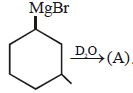
Product $(A)$ is
A
$3-$methylcyclohexane with a hydrogen atom at the $1$-position
B
$3-$methylcyclohexane with a deuterium atom at the $1$-position
C
cyclohexane with a deuterium atom at the $1$-position
D
$1-$methylcyclohexane with a deuterium atom at the $1$-position
Solution
(B) The reaction of a Grignard reagent $(R-MgBr)$ with $D_2O$ is a standard method for the deuteration of alkanes.
In this reaction,the nucleophilic carbon atom of the Grignard reagent attacks the deuterium atom of $D_2O$,replacing the $MgBr$ group with a deuterium atom $(D)$.
The starting material is $3$-methylcyclohexylmagnesium bromide.
Upon treatment with $D_2O$,the $MgBr$ group at the $1$-position is replaced by $D$.
Thus,the product $(A)$ is $1$-deuterio$-3-$methylcyclohexane.
In this reaction,the nucleophilic carbon atom of the Grignard reagent attacks the deuterium atom of $D_2O$,replacing the $MgBr$ group with a deuterium atom $(D)$.
The starting material is $3$-methylcyclohexylmagnesium bromide.
Upon treatment with $D_2O$,the $MgBr$ group at the $1$-position is replaced by $D$.
Thus,the product $(A)$ is $1$-deuterio$-3-$methylcyclohexane.
0 likes
View Solution339
DifficultMCQ
What is the product of the following reaction?
Cyclohexanecarboxylic acid $\xrightarrow{\text{Sodalime}}$ ?
Cyclohexanecarboxylic acid $\xrightarrow{\text{Sodalime}}$ ?
A
Cyclohexane
B
Cyclohexene
C
$1,3-$Cyclohexadiene
D
Cyclohexanone
Solution
(A) The reaction of a carboxylic acid with sodalime $(NaOH + CaO)$ is known as decarboxylation.
In this process,the $-COOH$ group is removed and replaced by a hydrogen atom.
For cyclohexanecarboxylic acid,the reaction is:
$\text{Cyclohexanecarboxylic acid} + NaOH/CaO \rightarrow \text{Cyclohexane} + Na_2CO_3$.
Thus,the product is cyclohexane.
In this process,the $-COOH$ group is removed and replaced by a hydrogen atom.
For cyclohexanecarboxylic acid,the reaction is:
$\text{Cyclohexanecarboxylic acid} + NaOH/CaO \rightarrow \text{Cyclohexane} + Na_2CO_3$.
Thus,the product is cyclohexane.
0 likes
View Solution340
DifficultMCQ
In the structure $CH_3 - C^2H(C^1H_3) - C^3H_2 - C^4H_3$,the order of homolytic bond dissociation energy for $C_1-H, C_2-H, C_3-H$ and $C_4-H$ is:
A
$C_2-H > C_3-H > C_4-H > C_1-H$
B
$C_1-H > C_4-H > C_2-H > C_3-H$
C
$C_2-H > C_3-H > C_1-H > C_4-H$
D
$C_1-H > C_4-H > C_3-H > C_2-H$
Solution
(D) Homolytic bond dissociation energy $(BDE)$ is inversely proportional to the stability of the free radical formed after the bond breaks.
Stability of free radicals follows the order: $3^\circ > 2^\circ > 1^\circ$.
In the given molecule (isopentane):
$1.$ $C_2-H$ is a $3^\circ$ bond (forms a $3^\circ$ radical,which is the most stable).
$2.$ $C_3-H$ is a $2^\circ$ bond (forms a $2^\circ$ radical).
$3.$ $C_1-H$ and $C_4-H$ are $1^\circ$ bonds (form $1^\circ$ radicals,which are the least stable).
Among the $1^\circ$ bonds,the $C_4$ radical is slightly more stable than the $C_1$ radical because $C_4$ has two $\beta$-hydrogens available for hyperconjugation,while $C_1$ has only one.
Therefore,the $BDE$ order is: $C_1-H > C_4-H > C_3-H > C_2-H$.
Stability of free radicals follows the order: $3^\circ > 2^\circ > 1^\circ$.
In the given molecule (isopentane):
$1.$ $C_2-H$ is a $3^\circ$ bond (forms a $3^\circ$ radical,which is the most stable).
$2.$ $C_3-H$ is a $2^\circ$ bond (forms a $2^\circ$ radical).
$3.$ $C_1-H$ and $C_4-H$ are $1^\circ$ bonds (form $1^\circ$ radicals,which are the least stable).
Among the $1^\circ$ bonds,the $C_4$ radical is slightly more stable than the $C_1$ radical because $C_4$ has two $\beta$-hydrogens available for hyperconjugation,while $C_1$ has only one.
Therefore,the $BDE$ order is: $C_1-H > C_4-H > C_3-H > C_2-H$.
0 likes
View Solution341
DifficultMCQ
The number of different substitution products possible when bromine and ethane are allowed to react is:
A
$6$
B
$8$
C
$7$
D
$9$
Solution
(B) The reaction of ethane $(CH_3-CH_3)$ with bromine $(Br_2)$ leads to the substitution of hydrogen atoms by bromine atoms. The possible substitution products are:
$1$. $CH_3-CH_2Br$ (Bromoethane)
$2$. $CH_3-CHBr_2$ ($1$,$1$-Dibromoethane)
$3$. $CH_2Br-CH_2Br$ ($1$,$2$-Dibromoethane)
$4$. $CH_3-CBr_3$ ($1$,$1$,$1$-Tribromoethane)
$5$. $CH_2Br-CHBr_2$ ($1$,$1$,$2$-Tribromoethane)
$6$. $CHBr_2-CHBr_2$ ($1$,$1$,$2$,$2$-Tetrabromoethane)
$7$. $CHBr_2-CBr_3$ (Pentabromoethane)
$8$. $CBr_3-CBr_3$ (Hexabromoethane)
There are a total of $8$ possible substitution products.
$1$. $CH_3-CH_2Br$ (Bromoethane)
$2$. $CH_3-CHBr_2$ ($1$,$1$-Dibromoethane)
$3$. $CH_2Br-CH_2Br$ ($1$,$2$-Dibromoethane)
$4$. $CH_3-CBr_3$ ($1$,$1$,$1$-Tribromoethane)
$5$. $CH_2Br-CHBr_2$ ($1$,$1$,$2$-Tribromoethane)
$6$. $CHBr_2-CHBr_2$ ($1$,$1$,$2$,$2$-Tetrabromoethane)
$7$. $CHBr_2-CBr_3$ (Pentabromoethane)
$8$. $CBr_3-CBr_3$ (Hexabromoethane)
There are a total of $8$ possible substitution products.
0 likes
View Solution342
AdvancedMCQ
Isobutyl magnesium bromide with dry ether and absolute alcohol gives
A
$CH_3-CH(CH_3)-CH_2-OH$ and $CH_3-CH_2-MgBr$
B
$CH_3-CH(CH_3)-CH_2-CH_2-CH_3$ and $Mg(OH)Br$
C
$CH_3-CH(CH_3)-CH=CH_2$ and $Mg(OH)Br$
D
$CH_3-CH(CH_3)-CH_3$ and $CH_3-CH_2-OMgBr$
Solution
(D) Grignard reagents $(R-MgX)$ react with compounds containing active hydrogen (like alcohols,$R'-OH$) to form alkanes $(R-H)$ and magnesium alkoxides $(R'-OMgX)$.
The reaction of isobutyl magnesium bromide with absolute alcohol (ethanol) is as follows:
$CH_3-CH(CH_3)-CH_2-MgBr + CH_3-CH_2-OH \rightarrow CH_3-CH(CH_3)-CH_3 + CH_3-CH_2-OMgBr$.
The products are isobutane and magnesium ethoxide bromide.
The reaction of isobutyl magnesium bromide with absolute alcohol (ethanol) is as follows:
$CH_3-CH(CH_3)-CH_2-MgBr + CH_3-CH_2-OH \rightarrow CH_3-CH(CH_3)-CH_3 + CH_3-CH_2-OMgBr$.
The products are isobutane and magnesium ethoxide bromide.
0 likes
View Solution343
DifficultMCQ
Consider the following reaction,$CH_3-CH(D)-CH(CH_3)-CH_3 + \dot{Br} \to X + HBr$. Identify the structure of major product $X$.
A
$CH_3-CH(D)-CH(CH_3)-\dot{C}H_2$
B
$CH_3-CH(D)-\dot{C}(CH_3)-CH_3$
C
$CH_3-\dot{C}(D)-CH(CH_3)-CH_3$
D
$CH_3-\dot{C}H-CH(CH_3)-CH_3$
Solution
(B) The reaction involves the abstraction of a hydrogen atom by a bromine radical $(\dot{Br})$.
Stability of free radicals follows the order: $3^{\circ} > 2^{\circ} > 1^{\circ}$.
In the given molecule $CH_3-CH(D)-CH(CH_3)-CH_3$,there are different types of hydrogen atoms available for abstraction.
The abstraction of a hydrogen atom from the $C-3$ position leads to the formation of a $3^{\circ}$ free radical,$CH_3-CH(D)-\dot{C}(CH_3)-CH_3$,which is the most stable intermediate.
Since the $C-H$ bond energy is lower than the $C-D$ bond energy,the hydrogen atom is abstracted preferentially over the deuterium atom.
Thus,the major product $X$ is $CH_3-CH(D)-\dot{C}(CH_3)-CH_3$.
Stability of free radicals follows the order: $3^{\circ} > 2^{\circ} > 1^{\circ}$.
In the given molecule $CH_3-CH(D)-CH(CH_3)-CH_3$,there are different types of hydrogen atoms available for abstraction.
The abstraction of a hydrogen atom from the $C-3$ position leads to the formation of a $3^{\circ}$ free radical,$CH_3-CH(D)-\dot{C}(CH_3)-CH_3$,which is the most stable intermediate.
Since the $C-H$ bond energy is lower than the $C-D$ bond energy,the hydrogen atom is abstracted preferentially over the deuterium atom.
Thus,the major product $X$ is $CH_3-CH(D)-\dot{C}(CH_3)-CH_3$.
0 likes
View Solution344
AdvancedMCQ
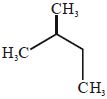
For the reaction of $2-$methylbutane with $Cl_2$ in the presence of $hv$,let $N$ be the total number of isomeric monochlorinated products (including stereoisomers). If these products are separated by fractional distillation,let $M$ be the number of fractions obtained. Find the values of $N$ and $M$.
A
$6, 6$
B
$6, 4$
C
$4, 4$
D
$3, 3$
Solution
(B) The starting material is $2$-methylbutane,$CH_3-CH(CH_3)-CH_2-CH_3$.
Chlorination with $Cl_2/hv$ can occur at four different types of hydrogen atoms:
$1$. $CH_3-CH(CH_3)-CH_2-CH_2-Cl$ ($1$-chloro$-2-$methylbutane,achiral)
$2$. $CH_3-CH(CH_3)-CHCl-CH_3$ ($2$-chloro$-2-$methylbutane,chiral,gives $d$ and $l$ enantiomers)
$3$. $CH_3-C(Cl)(CH_3)-CH_2-CH_3$ ($2$-chloro$-2-$methylbutane,achiral)
$4$. $ClCH_2-CH(CH_3)-CH_2-CH_3$ ($1$-chloro$-3-$methylbutane,chiral,gives $d$ and $l$ enantiomers)
Total number of isomers $N = 1 + 2 + 1 + 2 = 6$.
Fractional distillation separates compounds based on boiling points. Enantiomers ($d$ and $l$ pairs) have identical boiling points and cannot be separated by fractional distillation.
Thus,the number of fractions $M = 4$ (corresponding to the four constitutional isomers).
Chlorination with $Cl_2/hv$ can occur at four different types of hydrogen atoms:
$1$. $CH_3-CH(CH_3)-CH_2-CH_2-Cl$ ($1$-chloro$-2-$methylbutane,achiral)
$2$. $CH_3-CH(CH_3)-CHCl-CH_3$ ($2$-chloro$-2-$methylbutane,chiral,gives $d$ and $l$ enantiomers)
$3$. $CH_3-C(Cl)(CH_3)-CH_2-CH_3$ ($2$-chloro$-2-$methylbutane,achiral)
$4$. $ClCH_2-CH(CH_3)-CH_2-CH_3$ ($1$-chloro$-3-$methylbutane,chiral,gives $d$ and $l$ enantiomers)
Total number of isomers $N = 1 + 2 + 1 + 2 = 6$.
Fractional distillation separates compounds based on boiling points. Enantiomers ($d$ and $l$ pairs) have identical boiling points and cannot be separated by fractional distillation.
Thus,the number of fractions $M = 4$ (corresponding to the four constitutional isomers).
0 likes
View Solution345
MediumMCQ
Which of the following is true for the given reaction $R-H + X_2 \xrightarrow{hv} R-X + H-X$?
A
Reactivity of different halogens for the reaction is $I_2 > Br_2 > Cl_2 > F_2$
B
The reaction follows electrophilic substitution mechanism
C
Iodination is carried out in the presence of $HIO_3$ to increase the yield of alkyl iodide
D
All
Solution
(C) The given reaction is a free radical halogenation of alkanes.
$1$. The reactivity order of halogens is $F_2 > Cl_2 > Br_2 > I_2$. Thus,option $A$ is incorrect.
$2$. The reaction proceeds via a free radical substitution mechanism,not electrophilic substitution. Thus,option $B$ is incorrect.
$3$. Iodination is a reversible reaction $(R-H + I_2 \rightleftharpoons R-I + H-I)$. The $H-I$ formed is a strong reducing agent and reduces $R-I$ back to $R-H$. To shift the equilibrium forward,an oxidizing agent like $HIO_3$ or $HNO_3$ is used to consume $H-I$ $(5H-I + HIO_3 \rightarrow 3I_2 + 3H_2O)$. Thus,option $C$ is correct.
$1$. The reactivity order of halogens is $F_2 > Cl_2 > Br_2 > I_2$. Thus,option $A$ is incorrect.
$2$. The reaction proceeds via a free radical substitution mechanism,not electrophilic substitution. Thus,option $B$ is incorrect.
$3$. Iodination is a reversible reaction $(R-H + I_2 \rightleftharpoons R-I + H-I)$. The $H-I$ formed is a strong reducing agent and reduces $R-I$ back to $R-H$. To shift the equilibrium forward,an oxidizing agent like $HIO_3$ or $HNO_3$ is used to consume $H-I$ $(5H-I + HIO_3 \rightarrow 3I_2 + 3H_2O)$. Thus,option $C$ is correct.
0 likes
View Solution346
MediumMCQ
When isobutane is treated with $Cl_2$ in sunlight,the major product is
A
$1^o$ alkyl chloride
B
$2^o$ alkyl chloride
C
$3^o$ alkyl chloride
D
alkene
Solution
(A) The reaction of isobutane with $Cl_2$ in the presence of sunlight (hv) proceeds via a free radical mechanism.
Isobutane has $9$ primary $(1^o)$ hydrogen atoms and $1$ tertiary $(3^o)$ hydrogen atom.
The relative reactivity of $1^o$,$2^o$,and $3^o$ hydrogen atoms towards chlorination is approximately $1 : 3.8 : 5$.
For $1^o$ hydrogen atoms: $\text{Number of } H \times \text{relative rate} = 9 \times 1 = 9$.
For $3^o$ hydrogen atom: $\text{Number of } H \times \text{relative rate} = 1 \times 5 = 5$.
Since the product of the number of hydrogen atoms and their relative reactivity is higher for the $1^o$ position $(9 > 5)$,the $1^o$ alkyl chloride (isobutyl chloride) is the major product.
Isobutane has $9$ primary $(1^o)$ hydrogen atoms and $1$ tertiary $(3^o)$ hydrogen atom.
The relative reactivity of $1^o$,$2^o$,and $3^o$ hydrogen atoms towards chlorination is approximately $1 : 3.8 : 5$.
For $1^o$ hydrogen atoms: $\text{Number of } H \times \text{relative rate} = 9 \times 1 = 9$.
For $3^o$ hydrogen atom: $\text{Number of } H \times \text{relative rate} = 1 \times 5 = 5$.
Since the product of the number of hydrogen atoms and their relative reactivity is higher for the $1^o$ position $(9 > 5)$,the $1^o$ alkyl chloride (isobutyl chloride) is the major product.
0 likes
View Solution347
MediumMCQ
The reaction conditions leading to the best yields of $C_2H_5Cl$ are
A
$C_2H_6 \text{ (excess)} + Cl_2 \xrightarrow{UV}$
B
$C_2H_6 + Cl_2 \xrightarrow[\text{room temp.}]{\text{dark}}$
C
$C_2H_6 + Cl_2 \text{ (excess)} \xrightarrow{UV}$
D
$C_2H_6 + Cl_2 \xrightarrow{UV}$
Solution
(A) The free radical chlorination of alkanes is a chain reaction that often leads to a mixture of products due to polyhalogenation.
To obtain the mono-substituted product $C_2H_5Cl$ in the best yield,it is necessary to minimize further chlorination.
By taking an excess of ethane $(C_2H_6)$,the probability of a chlorine radical colliding with an ethane molecule is significantly higher than its collision with a $C_2H_5Cl$ molecule.
Therefore,$C_2H_6 \text{ (excess)} + Cl_2 \xrightarrow{UV}$ is the condition that favors the formation of $C_2H_5Cl$ as the major product.
To obtain the mono-substituted product $C_2H_5Cl$ in the best yield,it is necessary to minimize further chlorination.
By taking an excess of ethane $(C_2H_6)$,the probability of a chlorine radical colliding with an ethane molecule is significantly higher than its collision with a $C_2H_5Cl$ molecule.
Therefore,$C_2H_6 \text{ (excess)} + Cl_2 \xrightarrow{UV}$ is the condition that favors the formation of $C_2H_5Cl$ as the major product.
0 likes
View Solution348
MediumMCQ
$(CH_3)_2CHBr$ $\xrightarrow[(2) CuI]{(1) Li} (A)$ $\xrightarrow{(CH_3)_2CHCH_2Br} B$.
$'B'$ is
$'B'$ is
A
$(CH_3)_2CHCH_2CH_3$
B
$(CH_3)_2CHCH(CH_3)_2$
C
$(CH_3)_2CHCH_2CH(CH_3)_2$
D
$(CH_3)_2CHCH_2CH_2CH(CH_3)_2$
Solution
(C) The reaction is a Corey-House synthesis,which is used to prepare alkanes by coupling an alkyl halide with a lithium dialkylcuprate (Gilman reagent).
Step $1$: Formation of Gilman reagent $(A)$.
$2(CH_3)_2CHBr + 4Li \rightarrow 2(CH_3)_2CHLi + 2LiBr$
$2(CH_3)_2CHLi + CuI \rightarrow [(CH_3)_2CH]_2CuLi + LiI$
So,$(A)$ is the Gilman reagent $[(CH_3)_2CH]_2CuLi$.
Step $2$: Coupling reaction.
$[(CH_3)_2CH]_2CuLi + (CH_3)_2CHCH_2Br \rightarrow (CH_3)_2CH-CH_2CH(CH_3)_2 + (CH_3)_2CHCu + LiBr$
The product $B$ is $2,4$-dimethylpentane,which is $(CH_3)_2CHCH_2CH(CH_3)_2$.
Step $1$: Formation of Gilman reagent $(A)$.
$2(CH_3)_2CHBr + 4Li \rightarrow 2(CH_3)_2CHLi + 2LiBr$
$2(CH_3)_2CHLi + CuI \rightarrow [(CH_3)_2CH]_2CuLi + LiI$
So,$(A)$ is the Gilman reagent $[(CH_3)_2CH]_2CuLi$.
Step $2$: Coupling reaction.
$[(CH_3)_2CH]_2CuLi + (CH_3)_2CHCH_2Br \rightarrow (CH_3)_2CH-CH_2CH(CH_3)_2 + (CH_3)_2CHCu + LiBr$
The product $B$ is $2,4$-dimethylpentane,which is $(CH_3)_2CHCH_2CH(CH_3)_2$.
0 likes
View Solution349
DifficultMCQ
Identify $D$ and $E$ in the following reaction: $CH_3-CH(CH_3)-CH(CH_3)-CH_3 \xleftarrow[ether]{Na} R'-Br$ $\xrightarrow{Mg} D$ $\xrightarrow{H_2O} E$
A
$D \to CH_3-CH(MgBr)-CH_3, E \to CH_3-CH_2-CH_3$
B
$D \to CH_3-C(CH_3)_2-MgBr, E \to CH_3-C(CH_3)_2-OH$
C
$D \to CH_3-C(CH_3)_2-MgBr, E \to CH_3-CH(CH_3)_2$
D
$D \to CH_3-CH(MgBr)-CH_3, E \to CH_3-CH(OH)-CH_3$
Solution
(A) The product of the Wurtz reaction is $2,3$-dimethylbutane $(CH_3-CH(CH_3)-CH(CH_3)-CH_3)$. This indicates that the starting alkyl bromide $R'-Br$ is isopropyl bromide $(CH_3-CH(Br)-CH_3)$.
Step $1$: $2 CH_3-CH(Br)-CH_3 + 2 Na \xrightarrow{ether} CH_3-CH(CH_3)-CH(CH_3)-CH_3 + 2 NaBr$.
Step $2$: $CH_3-CH(Br)-CH_3 + Mg \xrightarrow{ether} CH_3-CH(MgBr)-CH_3$ $(D)$.
Step $3$: $CH_3-CH(MgBr)-CH_3 + H_2O \to CH_3-CH_2-CH_3$ $(E)$ $+ Mg(OH)Br$.
Therefore,$D$ is isopropyl magnesium bromide and $E$ is propane.
Step $1$: $2 CH_3-CH(Br)-CH_3 + 2 Na \xrightarrow{ether} CH_3-CH(CH_3)-CH(CH_3)-CH_3 + 2 NaBr$.
Step $2$: $CH_3-CH(Br)-CH_3 + Mg \xrightarrow{ether} CH_3-CH(MgBr)-CH_3$ $(D)$.
Step $3$: $CH_3-CH(MgBr)-CH_3 + H_2O \to CH_3-CH_2-CH_3$ $(E)$ $+ Mg(OH)Br$.
Therefore,$D$ is isopropyl magnesium bromide and $E$ is propane.
0 likes
View Solution350
AdvancedMCQ
In which of the following reactions is a $1^\circ$ alkyl halide the major product?
A
$CH_3-CH(Ph)-CH_3 \xrightarrow{Cl_2/hv} \text{Product}$
B
$CH_3-CH(CH_3)-CH_3 \xrightarrow{Br_2/hv + \Delta} \text{Product}$
C
$CH_3-CH(CH_3)-CH_3 \xrightarrow{Cl_2/hv} \text{Product}$
D
$CH_3-CH(CH_3)-CH=CH_2 \xrightarrow{Cl_2/hv + \Delta} \text{Product}$
Solution
(C) In the chlorination of isobutane $(CH_3-CH(CH_3)-CH_3)$,there are $9$ primary $(1^\circ)$ hydrogens and $1$ tertiary $(3^\circ)$ hydrogen.
The relative reactivity of $Cl$ radicals with $1^\circ, 2^\circ, 3^\circ$ hydrogens is approximately $1 : 3.8 : 5$.
Relative yield of $1^\circ$ product = $9 \times 1 = 9$.
Relative yield of $3^\circ$ product = $1 \times 5 = 5$.
Since $9 > 5$,the $1^\circ$ alkyl halide ($1$-chloro-$2$-methylpropane) is the major product.
The relative reactivity of $Cl$ radicals with $1^\circ, 2^\circ, 3^\circ$ hydrogens is approximately $1 : 3.8 : 5$.
Relative yield of $1^\circ$ product = $9 \times 1 = 9$.
Relative yield of $3^\circ$ product = $1 \times 5 = 5$.
Since $9 > 5$,the $1^\circ$ alkyl halide ($1$-chloro-$2$-methylpropane) is the major product.
0 likes
View SolutionHydrocarbons — Alkane · Frequently Asked Questions
1Are these Hydrocarbons questions useful for JEE and NEET?
Yes. All questions in this section are mapped to JEE Main and NEET exam patterns. Previous year questions from JEE Main, NEET, GUJCET and state-level exams are included with full solutions.
2Can I switch to Hindi or Gujarati for these questions?
Yes. Use the language tabs in the hero section or the sidebar to view the same questions and solutions in English, Hindi or Gujarati.
3How do I generate a question paper from this subtopic?
Use the Vedclass Exam Paper Generator — select the chapter and subtopic, set difficulty, and generate Sets A, B, C, D automatically. First 3 chapters of every subject are free.
Vedclass Products
For Students
Vedclass Test Series
Mock tests in real JEE/NEET style with performance analysis. 5-day free trial.
Start Free TrialFor Teachers
Exam Paper Generator
Generate Set A/B/C/D papers from this chapter in 2 minutes. 3 chapters free.
Try FreeFor Institutes
Online Exam Module
Live online exams with unlimited students, 360° analytics & white-label branding.
See DemoFor Teachers & Institutes
Generate a Hydrocarbons Exam Paper in 2 Minutes
Select subtopic & difficulty — Sets A, B, C, D auto-generated with No Repeat logic.
First 3 chapters of every subject are free — no payment required.