
A English
Alkane Questions in English
Class 11 Chemistry · Hydrocarbons · Alkane
746+
Questions
English
Language
100%
With Solutions
Showing 50 of 746 questions in English
251
DifficultMCQ
$4.3 \ g$ of an alkane is burnt in sufficient oxygen. The $CO_2$ formed reacts completely with $300 \ mL, 2 \ N \ NaOH$ solution producing $Na_2CO_3$. The alkane is:
A
$C_3H_8$
B
$C_{12}H_{26}$
C
$C_6H_{14}$
D
$C_2H_6$
Solution
(C) The combustion reaction of an alkane is: $C_nH_{2n+2} + \frac{3n+1}{2} O_2 \to nCO_2 + (n+1) H_2O$
The reaction of $CO_2$ with $NaOH$ to form $Na_2CO_3$ is: $CO_2 + 2NaOH \to Na_2CO_3 + H_2O$
Given $300 \ mL$ of $2 \ N \ NaOH$ solution. Since the $n$-factor for $NaOH$ is $1$,$Normality = Molarity$. Thus,moles of $NaOH = 0.3 \ L \times 2 \ M = 0.6 \ mol$.
From the stoichiometry of the second reaction,$2 \ mol$ of $NaOH$ react with $1 \ mol$ of $CO_2$. Therefore,moles of $CO_2 = \frac{0.6}{2} = 0.3 \ mol$.
From the combustion reaction,$1 \ mol$ of $C_nH_{2n+2}$ produces $n \ mol$ of $CO_2$. Thus,moles of alkane = $\frac{0.3}{n}$.
Given the mass of the alkane is $4.3 \ g$ and its molar mass is $(14n + 2) \ g/mol$,we have: $\frac{4.3}{14n + 2} = \frac{0.3}{n}$.
Solving for $n$: $4.3n = 0.3(14n + 2) \implies 4.3n = 4.2n + 0.6 \implies 0.1n = 0.6 \implies n = 6$.
Thus,the alkane is $C_6H_{14}$.
The reaction of $CO_2$ with $NaOH$ to form $Na_2CO_3$ is: $CO_2 + 2NaOH \to Na_2CO_3 + H_2O$
Given $300 \ mL$ of $2 \ N \ NaOH$ solution. Since the $n$-factor for $NaOH$ is $1$,$Normality = Molarity$. Thus,moles of $NaOH = 0.3 \ L \times 2 \ M = 0.6 \ mol$.
From the stoichiometry of the second reaction,$2 \ mol$ of $NaOH$ react with $1 \ mol$ of $CO_2$. Therefore,moles of $CO_2 = \frac{0.6}{2} = 0.3 \ mol$.
From the combustion reaction,$1 \ mol$ of $C_nH_{2n+2}$ produces $n \ mol$ of $CO_2$. Thus,moles of alkane = $\frac{0.3}{n}$.
Given the mass of the alkane is $4.3 \ g$ and its molar mass is $(14n + 2) \ g/mol$,we have: $\frac{4.3}{14n + 2} = \frac{0.3}{n}$.
Solving for $n$: $4.3n = 0.3(14n + 2) \implies 4.3n = 4.2n + 0.6 \implies 0.1n = 0.6 \implies n = 6$.
Thus,the alkane is $C_6H_{14}$.
0 likes
View Solution252
MediumMCQ
Which of the following does not represent the correct major product?
A
$Me_3C-Cl \xrightarrow[Dry-ether]{Na} CH_2=C(CH_3)-CH_3 + CH_3-CH(CH_3)-CH_3$
B
$CH_3COONa(aq.) \xrightarrow{Electrolysis} CH_3-CH_3$
C
$(CH_3)_3CCOONa(aq.) \xrightarrow{Electrolysis} CH_2=C(CH_3)-CH_3 + CH_4$
D
$CH_3-Cl \xrightarrow[Dry-ether]{Na} CH_3-CH_3$
Solution
(C) In Kolbe's electrolysis of sodium pivalate $((CH_3)_3CCOONa)$,the tert-butyl radical $((CH_3)_3C \cdot)$ is formed.
This radical undergoes disproportionation to form isobutylene $(CH_2=C(CH_3)-CH_3)$ and isobutane $(CH_3-CH(CH_3)-CH_3)$,or dimerization to form $2,2,3,3-tetramethylbutane$.
Methane $(CH_4)$ is not a product of this reaction.
Therefore,option $C$ is incorrect.
This radical undergoes disproportionation to form isobutylene $(CH_2=C(CH_3)-CH_3)$ and isobutane $(CH_3-CH(CH_3)-CH_3)$,or dimerization to form $2,2,3,3-tetramethylbutane$.
Methane $(CH_4)$ is not a product of this reaction.
Therefore,option $C$ is incorrect.
0 likes
View Solution253
AdvancedMCQ
Identify the major product $'E'$ in the following reaction sequence:
Cyclohexane $\xrightarrow{Br_2, h\nu} (A)$ $\xrightarrow{Na, D.E.} (B)$ $\xrightarrow{Br_2, h\nu} (C)$ $\xrightarrow{H_2O} (D)$ $\xrightarrow{conc. H_2SO_4} (E)$
Cyclohexane $\xrightarrow{Br_2, h\nu} (A)$ $\xrightarrow{Na, D.E.} (B)$ $\xrightarrow{Br_2, h\nu} (C)$ $\xrightarrow{H_2O} (D)$ $\xrightarrow{conc. H_2SO_4} (E)$
A
Bicyclohexyl
B
Chlorocyclohexane
C
$1-$cyclohexylcyclohexanol
D
Bicyclohexylidene
Solution
(D) $1$. Cyclohexane reacts with $Br_2$ in the presence of $h\nu$ (free radical substitution) to form bromocyclohexane $(A)$.
$2$. Bromocyclohexane $(A)$ reacts with $Na$ in dry ether (Wurtz reaction) to form bicyclohexyl $(B)$.
$3$. Bicyclohexyl $(B)$ reacts with $Br_2$ in the presence of $h\nu$ to form $1-$bromobicyclohexyl $(C)$.
$4$. $1-$bromobicyclohexyl $(C)$ undergoes hydrolysis with $H_2O$ to form $1-$hydroxybicyclohexyl (or $1-$cyclohexylcyclohexanol) $(D)$.
$5$. $1-$cyclohexylcyclohexanol $(D)$ undergoes acid-catalyzed dehydration with $conc. H_2SO_4$ to form the major product $(E)$,which is bicyclohexylidene (or dicyclohexylidene).
$2$. Bromocyclohexane $(A)$ reacts with $Na$ in dry ether (Wurtz reaction) to form bicyclohexyl $(B)$.
$3$. Bicyclohexyl $(B)$ reacts with $Br_2$ in the presence of $h\nu$ to form $1-$bromobicyclohexyl $(C)$.
$4$. $1-$bromobicyclohexyl $(C)$ undergoes hydrolysis with $H_2O$ to form $1-$hydroxybicyclohexyl (or $1-$cyclohexylcyclohexanol) $(D)$.
$5$. $1-$cyclohexylcyclohexanol $(D)$ undergoes acid-catalyzed dehydration with $conc. H_2SO_4$ to form the major product $(E)$,which is bicyclohexylidene (or dicyclohexylidene).
0 likes
View Solution254
AdvancedMCQ
If per $H$-atom selectivity for chlorination is $3^o : 2^o : 1^o = 5 : 3.8 : 1$,then identify the correct product ratio for the following reactions.
A
Propane + $Cl_2$ / $h\nu$ $\rightarrow$ $1-$chloropropane : $2-$chloropropane = $6 : 7.6$
B
Propane + $Cl_2$ / $h\nu$ $\rightarrow$ $1-$chloropropane : $2-$chloropropane = $6 : 16$
C
$2,3-$Dimethylbutane + $Cl_2$ / $h\nu$ $\rightarrow$ $1-$chloro$-2,3-$dimethylbutane : $2-$chloro$-2,3-$dimethylbutane = $6 : 10$
D
$2,4-$Dimethylpentane + $Cl_2$ / $h\nu$ $\rightarrow$ $1-$chloro$-2,4-$dimethylpentane : $3-$chloro$-2,4-$dimethylpentane : $2-$chloro$-2,4-$dimethylpentane = $12 : 8 : 10$
Solution
(A) The product ratio is calculated as: $(\text{Number of } H \text{ atoms}) \times (\text{Selectivity ratio})$.
For Propane $(CH_3-CH_2-CH_3)$:
$1^o H = 6$,$2^o H = 2$.
Ratio = $(6 \times 1) : (2 \times 3.8) = 6 : 7.6$. Thus,option $A$ is correct.
For $2,3-$Dimethylbutane:
$1^o H = 12$,$3^o H = 2$.
Ratio = $(12 \times 1) : (2 \times 5) = 12 : 10 = 6 : 5$. Option $C$ is incorrect.
For $2,4-$Dimethylpentane:
$1^o H = 12$,$2^o H = 2$,$3^o H = 2$.
Ratio = $(12 \times 1) : (2 \times 3.8) : (2 \times 5) = 12 : 7.6 : 10$. Option $D$ is incorrect.
For Propane $(CH_3-CH_2-CH_3)$:
$1^o H = 6$,$2^o H = 2$.
Ratio = $(6 \times 1) : (2 \times 3.8) = 6 : 7.6$. Thus,option $A$ is correct.
For $2,3-$Dimethylbutane:
$1^o H = 12$,$3^o H = 2$.
Ratio = $(12 \times 1) : (2 \times 5) = 12 : 10 = 6 : 5$. Option $C$ is incorrect.
For $2,4-$Dimethylpentane:
$1^o H = 12$,$2^o H = 2$,$3^o H = 2$.
Ratio = $(12 \times 1) : (2 \times 3.8) : (2 \times 5) = 12 : 7.6 : 10$. Option $D$ is incorrect.
0 likes
View Solution255
DifficultMCQ
Of the five isomeric hexanes,the isomer which can give two monochlorinated compounds is
A
$2-$methylpentane
B
$2,2-$dimethylbutane
C
$2,3-$dimethylbutane
D
$n-$hexane
Solution
(C) To obtain only two monochlorinated products,the isomer must have only two types of equivalent hydrogen atoms.
In $2,3-$dimethylbutane,the structure is $(CH_3)_2CH-CH(CH_3)_2$.
The two tertiary $H$ atoms are equivalent,and the twelve primary $H$ atoms (in four $CH_3$ groups) are equivalent.
Thus,substitution at these two distinct positions yields only two monochlorinated isomers.
In $2,3-$dimethylbutane,the structure is $(CH_3)_2CH-CH(CH_3)_2$.
The two tertiary $H$ atoms are equivalent,and the twelve primary $H$ atoms (in four $CH_3$ groups) are equivalent.
Thus,substitution at these two distinct positions yields only two monochlorinated isomers.
0 likes
View Solution256
AdvancedMCQ
$C_8H_{18}$ $(A)$ on mono-chlorination forms only one type of $C_8H_{17}Cl$ $(B)$. Hence $(A)$ can be:
A
$2,3-$dimethylhexane
B
n-octane
C
$2,5-$dimethylhexane
D
$2,2,3,3-$tetramethylbutane
Solution
(D) For an alkane to form only one type of mono-chlorinated product,all hydrogen atoms in the molecule must be equivalent.
In $2,2,3,3$-tetramethylbutane,all $18$ hydrogen atoms are equivalent because the molecule is highly symmetrical.
Therefore,mono-chlorination of $2,2,3,3$-tetramethylbutane yields only one isomer of $C_8H_{17}Cl$.
In $2,2,3,3$-tetramethylbutane,all $18$ hydrogen atoms are equivalent because the molecule is highly symmetrical.
Therefore,mono-chlorination of $2,2,3,3$-tetramethylbutane yields only one isomer of $C_8H_{17}Cl$.
0 likes
View Solution257
DifficultMCQ
In which of the following reactions is the product a hydrocarbon?
A
$RCOOK \xrightarrow{\text{Electrolysis}}$
B
$RCOOAg \xrightarrow{I_2/\Delta}$
C
$CH_3-CH_3 \xrightarrow{Cl_2/h\nu}$
D
$CH_3-C(CH_3)_2-Cl \xrightarrow{C_2H_5OH}$
Solution
(A) In Kolbe's electrolysis,the electrolysis of an aqueous solution of the potassium salt of a carboxylic acid produces a hydrocarbon (alkane) at the anode.
The reaction is: $2RCOOK + 2H_2O \xrightarrow{\text{Electrolysis}} R-R + 2CO_2 + H_2 + 2KOH$.
Thus,option $A$ is the correct reaction.
The reaction is: $2RCOOK + 2H_2O \xrightarrow{\text{Electrolysis}} R-R + 2CO_2 + H_2 + 2KOH$.
Thus,option $A$ is the correct reaction.
0 likes
View Solution258
MediumMCQ
What will be the major product when $2-$methylbutane undergoes bromination in the presence of light?
A
$1-$bromo$-2-$methylbutane
B
$2-$bromo$-2-$methylbutane
C
$2-$bromo$-3-$methylbutane
D
$1-$bromo$-3-$methylbutane
Solution
(B) In the presence of sunlight,the reaction proceeds via a free radical mechanism.
Bromination is highly selective,and the stability of the intermediate free radical determines the major product.
The $3^{\circ}$ free radical is more stable than $1^{\circ}$ or $2^{\circ}$ free radicals.
Therefore,the hydrogen atom attached to the $C-2$ carbon is replaced by bromine to form $2-$bromo$-2-$methylbutane as the major product.
Bromination is highly selective,and the stability of the intermediate free radical determines the major product.
The $3^{\circ}$ free radical is more stable than $1^{\circ}$ or $2^{\circ}$ free radicals.
Therefore,the hydrogen atom attached to the $C-2$ carbon is replaced by bromine to form $2-$bromo$-2-$methylbutane as the major product.
0 likes
View Solution259
MediumMCQ
The smallest compound,which on photochlorination produces diastereomers is
A
$3-$methylhexane
B
$2-$chlorobutane
C
$1-$bromopropane
D
$1-$bromo$-3-$methylbutane
Solution
(A) Photochlorination involves the substitution of a hydrogen atom with a chlorine atom. Diastereomers are stereoisomers that are not mirror images of each other. For a compound to produce diastereomers upon chlorination,it must already contain at least one chiral center,and the chlorination must occur at a position that creates a second chiral center.
$1$. Consider $3-$methylhexane: The structure is $CH_3-CH_2-CH(CH_3)-CH_2-CH_2-CH_3$. It has a chiral center at $C3$. Upon photochlorination,substitution at different positions (like $C2$ or $C4$) creates a new chiral center,resulting in diastereomeric pairs.
$2$. $2-$chlorobutane already has a chiral center,but chlorination would create a dichlorobutane derivative which is not the smallest hydrocarbon precursor.
$3$. $1-$bromopropane and $1-$bromo$-3-$methylbutane do not satisfy the requirement of being the smallest hydrocarbon capable of generating diastereomers through this specific mechanism.
Thus,$3-$methylhexane is the smallest alkane that produces diastereomers upon photochlorination.
$1$. Consider $3-$methylhexane: The structure is $CH_3-CH_2-CH(CH_3)-CH_2-CH_2-CH_3$. It has a chiral center at $C3$. Upon photochlorination,substitution at different positions (like $C2$ or $C4$) creates a new chiral center,resulting in diastereomeric pairs.
$2$. $2-$chlorobutane already has a chiral center,but chlorination would create a dichlorobutane derivative which is not the smallest hydrocarbon precursor.
$3$. $1-$bromopropane and $1-$bromo$-3-$methylbutane do not satisfy the requirement of being the smallest hydrocarbon capable of generating diastereomers through this specific mechanism.
Thus,$3-$methylhexane is the smallest alkane that produces diastereomers upon photochlorination.
0 likes
View Solution260
MediumMCQ
Which of the following will give two isomeric monochloro derivatives?
A
$2,3-$dimethylbutane
B
$n-$hexane
C
Isopentane
D
Butane
Solution
(A) $2,3-$dimethylbutane $(CH_3-CH(CH_3)-CH(CH_3)-CH_3)$ contains two types of equivalent hydrogen atoms: primary $(CH_3)$ and tertiary $(CH)$.
Substitution of a hydrogen atom from the primary carbon leads to $1-$chloro-$2,3-$dimethylbutane.
Substitution of a hydrogen atom from the tertiary carbon leads to $2-$chloro-$2,3-$dimethylbutane.
Since there are only two distinct types of hydrogen atoms,it yields exactly two isomeric monochloro derivatives.
Substitution of a hydrogen atom from the primary carbon leads to $1-$chloro-$2,3-$dimethylbutane.
Substitution of a hydrogen atom from the tertiary carbon leads to $2-$chloro-$2,3-$dimethylbutane.
Since there are only two distinct types of hydrogen atoms,it yields exactly two isomeric monochloro derivatives.
0 likes
View Solution261
MediumMCQ
Which of the following has the maximum boiling point $(B.P.)$?
A
$CH_3-CH_2-CH_2-CH_2-CH_3$ (n-pentane)
B
$CH_3-CH(CH_3)-CH(CH_3)_2$ ($2$,$3$-dimethylbutane)
C
$CH_3-C(CH_3)_2-CH_2-CH_3$ ($2$,$2$-dimethylbutane)
D
$CH_3-CH(CH_3)-CH_2-CH_3$ (isopentane)
Solution
(A) The boiling point of alkanes depends on the surface area of the molecule.
As the branching in an alkane increases,its surface area decreases,which leads to weaker van der Waals forces of attraction.
Therefore,the boiling point decreases as branching increases.
Comparing the isomers of pentane $(C_5H_{12})$:
$1$. $n$-pentane (straight chain) has the maximum surface area and thus the highest boiling point.
$2$. Isopentane ($2$-methylbutane) has one branch.
$3$. Neopentane ($2$,$2$-dimethylpropane) has two branches (most branched).
Among the given options,$n$-pentane is a straight-chain isomer with no branching,giving it the largest surface area and the highest boiling point.
As the branching in an alkane increases,its surface area decreases,which leads to weaker van der Waals forces of attraction.
Therefore,the boiling point decreases as branching increases.
Comparing the isomers of pentane $(C_5H_{12})$:
$1$. $n$-pentane (straight chain) has the maximum surface area and thus the highest boiling point.
$2$. Isopentane ($2$-methylbutane) has one branch.
$3$. Neopentane ($2$,$2$-dimethylpropane) has two branches (most branched).
Among the given options,$n$-pentane is a straight-chain isomer with no branching,giving it the largest surface area and the highest boiling point.
0 likes
View Solution262
MediumMCQ
How many $1^o$ carbon atoms will be present in the simplest hydrocarbon having two $3^o$ and one $2^o$ carbon atom?
A
$3$
B
$4$
C
$5$
D
$6$
Solution
(B) The simplest hydrocarbon with two $3^o$ and one $2^o$ carbon atom is $2,3-$dimethylbutane.
Structure: $(CH_3)_2CH-CH(CH_3)_2$.
In this structure:
- The two $CH$ groups are $3^o$ carbon atoms (attached to three other carbons).
- The $CH_2$ group is not present,but wait,the question asks for one $2^o$ carbon atom.
- Let us re-evaluate: $2,4-$dimethylpentane has the structure $CH_3-CH(CH_3)-CH_2-CH(CH_3)-CH_3$.
- Here,there are two $3^o$ carbon atoms (at positions $2$ and $4$) and one $2^o$ carbon atom (at position $3$).
- Counting the $1^o$ carbon atoms (terminal $CH_3$ groups): there are four $1^o$ carbon atoms.
Therefore,the number of $1^o$ carbon atoms is $4$.
Structure: $(CH_3)_2CH-CH(CH_3)_2$.
In this structure:
- The two $CH$ groups are $3^o$ carbon atoms (attached to three other carbons).
- The $CH_2$ group is not present,but wait,the question asks for one $2^o$ carbon atom.
- Let us re-evaluate: $2,4-$dimethylpentane has the structure $CH_3-CH(CH_3)-CH_2-CH(CH_3)-CH_3$.
- Here,there are two $3^o$ carbon atoms (at positions $2$ and $4$) and one $2^o$ carbon atom (at position $3$).
- Counting the $1^o$ carbon atoms (terminal $CH_3$ groups): there are four $1^o$ carbon atoms.
Therefore,the number of $1^o$ carbon atoms is $4$.
0 likes
View Solution263
DifficultMCQ
$A$ racemic mixture is obtained due to the halogenation of:
A
$n-$pentane
B
Isopentane
C
Neopentane
D
Both $A$ and $B$
Solution
(D) racemic mixture is formed when a chiral center is generated during a reaction.
$n-$pentane $(CH_3CH_2CH_2CH_2CH_3)$ upon chlorination gives $2-$chloropentane,which has a chiral carbon at the $C-2$ position.
Isopentane $(CH_3CH(CH_3)CH_2CH_3)$ upon chlorination at the $C-2$ position gives $2-$chloro-$2-$methylbutane (achiral) but chlorination at the $C-3$ position gives $2-$methyl-$3-$chlorobutane,which has a chiral carbon at the $C-3$ position.
Since both $n-$pentane and isopentane can form products with chiral centers via free radical halogenation,they can lead to the formation of racemic mixtures.
$n-$pentane $(CH_3CH_2CH_2CH_2CH_3)$ upon chlorination gives $2-$chloropentane,which has a chiral carbon at the $C-2$ position.
Isopentane $(CH_3CH(CH_3)CH_2CH_3)$ upon chlorination at the $C-2$ position gives $2-$chloro-$2-$methylbutane (achiral) but chlorination at the $C-3$ position gives $2-$methyl-$3-$chlorobutane,which has a chiral carbon at the $C-3$ position.
Since both $n-$pentane and isopentane can form products with chiral centers via free radical halogenation,they can lead to the formation of racemic mixtures.
0 likes
View Solution264
DifficultMCQ
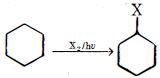
For the fastest rate of reaction in the given free radical halogenation of cyclohexane,$X_2$ must be:
A
$F_2$
B
$Cl_2$
C
$Br_2$
D
$I_2$
Solution
(A) The reaction shown is a free radical halogenation of an alkane (cyclohexane).
The reactivity order of halogens towards free radical substitution is $F_2 > Cl_2 > Br_2 > I_2$.
Fluorine $(F_2)$ is the most reactive halogen due to its high electronegativity and the low bond dissociation energy of the $F-F$ bond,making the reaction with $F_2$ extremely fast and often explosive.
Therefore,the fastest rate of reaction is observed with $F_2$.
The reactivity order of halogens towards free radical substitution is $F_2 > Cl_2 > Br_2 > I_2$.
Fluorine $(F_2)$ is the most reactive halogen due to its high electronegativity and the low bond dissociation energy of the $F-F$ bond,making the reaction with $F_2$ extremely fast and often explosive.
Therefore,the fastest rate of reaction is observed with $F_2$.
0 likes
View Solution265
MediumMCQ
The major product of which of the following reactions will not decolorize $Br_2 + H_2O$?
A
$Al_4C_3 + H_2O \rightarrow CH_4$
B
$Mg_2C_3 + H_2O \rightarrow CH_3-C \equiv CH$
C
$CaC_2 + H_2O \rightarrow CH \equiv CH$
D
$Ag_2C_2 + H_2O \rightarrow \text{No reaction}$
Solution
(A) The reagent $Br_2 + H_2O$ (bromine water) is used to test for unsaturation (alkenes and alkynes). Compounds containing double or triple bonds will decolorize the reddish-brown color of bromine water.
$1$. $Al_4C_3 + 12H_2O \rightarrow 3CH_4 + 4Al(OH)_3$. Methane $(CH_4)$ is a saturated alkane and does not react with bromine water.
$2$. $Mg_2C_3 + 4H_2O \rightarrow CH_3-C \equiv CH + 2Mg(OH)_2$. Propyne is an alkyne and will decolorize bromine water.
$3$. $CaC_2 + 2H_2O \rightarrow HC \equiv CH + Ca(OH)_2$. Ethyne is an alkyne and will decolorize bromine water.
$4$. $Ag_2C_2$ is a metal acetylide that is generally insoluble and does not undergo simple hydrolysis to yield an unsaturated hydrocarbon product in this context.
Comparing the options,$Al_4C_3$ produces methane,which is saturated and will not decolorize bromine water.
$1$. $Al_4C_3 + 12H_2O \rightarrow 3CH_4 + 4Al(OH)_3$. Methane $(CH_4)$ is a saturated alkane and does not react with bromine water.
$2$. $Mg_2C_3 + 4H_2O \rightarrow CH_3-C \equiv CH + 2Mg(OH)_2$. Propyne is an alkyne and will decolorize bromine water.
$3$. $CaC_2 + 2H_2O \rightarrow HC \equiv CH + Ca(OH)_2$. Ethyne is an alkyne and will decolorize bromine water.
$4$. $Ag_2C_2$ is a metal acetylide that is generally insoluble and does not undergo simple hydrolysis to yield an unsaturated hydrocarbon product in this context.
Comparing the options,$Al_4C_3$ produces methane,which is saturated and will not decolorize bromine water.
0 likes
View Solution266
DifficultMCQ
Identify the total number of monochlorinated products formed when $2$-methylpentane reacts with $Cl_2 / hv$.
A
$5$
B
$6$
C
$8$
D
$9$
Solution
(A) The structure of $2$-methylpentane is $CH_3-CH(CH_3)-CH_2-CH_2-CH_3$.
There are $5$ distinct types of hydrogen atoms in the molecule:
$1$. The $CH_3$ group attached to $C_2$ (position $1$).
$2$. The $CH$ group at $C_2$ (position $2$).
$3$. The $CH_2$ group at $C_3$ (position $3$).
$4$. The $CH_2$ group at $C_4$ (position $4$).
$5$. The $CH_3$ group at $C_5$ (position $5$).
Since there are $5$ non-equivalent hydrogen atoms,replacing any one of them with a chlorine atom will result in a unique monochlorinated product.
Note that the two $CH_3$ groups at the $C_2$ position are equivalent.
Therefore,the total number of monochlorinated products is $5$.
There are $5$ distinct types of hydrogen atoms in the molecule:
$1$. The $CH_3$ group attached to $C_2$ (position $1$).
$2$. The $CH$ group at $C_2$ (position $2$).
$3$. The $CH_2$ group at $C_3$ (position $3$).
$4$. The $CH_2$ group at $C_4$ (position $4$).
$5$. The $CH_3$ group at $C_5$ (position $5$).
Since there are $5$ non-equivalent hydrogen atoms,replacing any one of them with a chlorine atom will result in a unique monochlorinated product.
Note that the two $CH_3$ groups at the $C_2$ position are equivalent.
Therefore,the total number of monochlorinated products is $5$.
0 likes
View Solution267
AdvancedMCQ
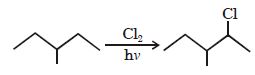
The relative reactivities for the replacement of $-H$ are $3^o : 2^o : 1^o = 6 : 4 : 1$. For the reaction shown in the image,determine the relative amount of the given product.
A
$3/31$
B
$6/31$
C
$16/31$
D
$16/29$
Solution
(C) The reactant is $3$-methylpentane. Let us identify the number of hydrogen atoms of each type:
$1^o$ hydrogens: There are $9$ such hydrogens ($3$ at each terminal methyl group).
$2^o$ hydrogens: There are $4$ such hydrogens ($2$ at $C_2$ and $2$ at $C_4$).
$3^o$ hydrogens: There is $1$ such hydrogen (at $C_3$).
The relative rates of formation are calculated as (Number of $H$ atoms) $\times$ (Relative reactivity):
For $1^o$ products: $9 \times 1 = 9$
For $2^o$ products: $4 \times 4 = 16$
For $3^o$ products: $1 \times 6 = 6$
Total relative rate = $9 + 16 + 6 = 31$.
The product shown is a $2^o$ chloro derivative formed by replacing a hydrogen at $C_2$ or $C_4$. The relative amount of this specific product is $16/31$.
$1^o$ hydrogens: There are $9$ such hydrogens ($3$ at each terminal methyl group).
$2^o$ hydrogens: There are $4$ such hydrogens ($2$ at $C_2$ and $2$ at $C_4$).
$3^o$ hydrogens: There is $1$ such hydrogen (at $C_3$).
The relative rates of formation are calculated as (Number of $H$ atoms) $\times$ (Relative reactivity):
For $1^o$ products: $9 \times 1 = 9$
For $2^o$ products: $4 \times 4 = 16$
For $3^o$ products: $1 \times 6 = 6$
Total relative rate = $9 + 16 + 6 = 31$.
The product shown is a $2^o$ chloro derivative formed by replacing a hydrogen at $C_2$ or $C_4$. The relative amount of this specific product is $16/31$.
0 likes
View Solution268
MediumMCQ
Which of the following compounds can be best prepared by Wurtz reaction?
A
$Isobutane$
B
$n-Butane$
C
$n-Pentane$
D
$Isopentane$
Solution
(B) The Wurtz reaction involves the coupling of two alkyl halides in the presence of sodium metal to form a symmetrical alkane.
It is most effective for the synthesis of symmetrical alkanes with an even number of carbon atoms.
Among the given options,$n-butane$ $(CH_3-CH_2-CH_2-CH_3)$ is a symmetrical alkane that can be efficiently prepared by the Wurtz reaction using ethyl chloride $(CH_3-CH_2-Cl)$ and sodium metal.
It is most effective for the synthesis of symmetrical alkanes with an even number of carbon atoms.
Among the given options,$n-butane$ $(CH_3-CH_2-CH_2-CH_3)$ is a symmetrical alkane that can be efficiently prepared by the Wurtz reaction using ethyl chloride $(CH_3-CH_2-Cl)$ and sodium metal.
0 likes
View Solution269
DifficultMCQ
What is the major product?
$(CH_3-CH_2)_2CuLi \xrightarrow{CH_3-Cl} \text{Product}$
$(CH_3-CH_2)_2CuLi \xrightarrow{CH_3-Cl} \text{Product}$
A
$CH_3-CH_2-CH_2-CH_3$
B
$CH_3-CH_3$
C
$CH_3-CH_2-CH_2-CH_2-CH_3$
D
$CH_3-CH(CH_3)-CH_3$
Solution
(A) The reaction between a Gilman reagent (lithium dialkylcuprate) and an alkyl halide is known as the Corey-House synthesis.
The general reaction is: $R_2CuLi + R'-X \rightarrow R-R' + R-Cu + LiX$.
In this specific case,the Gilman reagent is $(CH_3-CH_2)_2CuLi$ (lithium diethylcuprate) and the alkyl halide is $CH_3-Cl$ (methyl chloride).
The ethyl group from the Gilman reagent replaces the chlorine atom on the methyl chloride to form propane:
$(CH_3-CH_2)_2CuLi + CH_3-Cl \rightarrow CH_3-CH_2-CH_3 + CH_3-CH_2-Cu + LiCl$.
The major product is propane $(CH_3-CH_2-CH_3)$.
The general reaction is: $R_2CuLi + R'-X \rightarrow R-R' + R-Cu + LiX$.
In this specific case,the Gilman reagent is $(CH_3-CH_2)_2CuLi$ (lithium diethylcuprate) and the alkyl halide is $CH_3-Cl$ (methyl chloride).
The ethyl group from the Gilman reagent replaces the chlorine atom on the methyl chloride to form propane:
$(CH_3-CH_2)_2CuLi + CH_3-Cl \rightarrow CH_3-CH_2-CH_3 + CH_3-CH_2-Cu + LiCl$.
The major product is propane $(CH_3-CH_2-CH_3)$.
0 likes
View Solution270
MediumMCQ
Identify the major product of the following reaction: $CH_3-CH(CH_3)-CH_2-COOH \xrightarrow{NaOH + CaO, \Delta}$
A
$CH_3-CH_2-CH_2-CH_3$
B
$CH_3-CH(CH_3)-CH_3$
C
$CH_3-CH(CH_3)-CH_2-CH_3$
D
$CH_3-C(CH_3)_2-CH_3$
Solution
(B) The reaction of a carboxylic acid with soda lime $(NaOH + CaO)$ is known as decarboxylation.
In this reaction,the $-COOH$ group is removed as $Na_2CO_3$ and replaced by a hydrogen atom.
The reactant is $3$-methylbutanoic acid,$CH_3-CH(CH_3)-CH_2-COOH$.
Upon heating with soda lime,the $-COOH$ group is eliminated,resulting in the formation of isobutane $(CH_3-CH(CH_3)-CH_3)$.
In this reaction,the $-COOH$ group is removed as $Na_2CO_3$ and replaced by a hydrogen atom.
The reactant is $3$-methylbutanoic acid,$CH_3-CH(CH_3)-CH_2-COOH$.
Upon heating with soda lime,the $-COOH$ group is eliminated,resulting in the formation of isobutane $(CH_3-CH(CH_3)-CH_3)$.
0 likes
View Solution271
MediumMCQ
Which of the following isomeric heptanes can yield seven different monochlorinated products upon free radical chlorination?
A
$2,2-$Dimethylpentane
B
$2-$Methylhexane
C
$3-$Methylhexane
D
$2,4-$Dimethylpentane
Solution
(C) To determine the number of monochlorinated products,we need to count the number of non-equivalent hydrogen atoms in the molecule.
$3-$Methylhexane has the structure $CH_3-CH_2-CH(CH_3)-CH_2-CH_2-CH_3$.
Let's identify the distinct types of hydrogen atoms:
$1$. The $CH_3$ group at the end of the chain (position $1$ in the image).
$2$. The $CH_2$ group adjacent to the $CH_3$ (position $2$).
$3$. The $CH$ group with the methyl branch (position $3$).
$4$. The $CH_3$ group attached to the $CH$ (position $7$).
$5$. The $CH_2$ group next to the $CH$ (position $4$).
$6$. The $CH_2$ group next to that (position $5$).
$7$. The terminal $CH_3$ group at the other end (position $6$).
Since there are $7$ non-equivalent hydrogen atoms,$3-$Methylhexane yields $7$ different monochlorinated products.
$3-$Methylhexane has the structure $CH_3-CH_2-CH(CH_3)-CH_2-CH_2-CH_3$.
Let's identify the distinct types of hydrogen atoms:
$1$. The $CH_3$ group at the end of the chain (position $1$ in the image).
$2$. The $CH_2$ group adjacent to the $CH_3$ (position $2$).
$3$. The $CH$ group with the methyl branch (position $3$).
$4$. The $CH_3$ group attached to the $CH$ (position $7$).
$5$. The $CH_2$ group next to the $CH$ (position $4$).
$6$. The $CH_2$ group next to that (position $5$).
$7$. The terminal $CH_3$ group at the other end (position $6$).
Since there are $7$ non-equivalent hydrogen atoms,$3-$Methylhexane yields $7$ different monochlorinated products.
0 likes
View Solution272
AdvancedMCQ
Match the column $I$ with column $II$ to identify the products of oxidation of alkanes and mark the appropriate choice.
| Column $I$ | Column $II$ |
| $A$. $(CH_3)_3CH + O_2 \xrightarrow{KMnO_4} (CH_3)_3COH$ | $i$. $CH_3COOH + H_2O$ |
| $B$. $2CH_4 + O_2 \xrightarrow[100 \ atm]{Cu/523 \ K} 2CH_3OH$ | |
| $C$. $CH_4 + O_2 \xrightarrow[\Delta]{Mo_2O_3} HCHO + H_2O$ | $iii$. $2CH_3OH$ |
| $D$. $CH_3-CH_3 + \frac{3}{2}O_2 \xrightarrow{(CH_3COO)_2Mn} CH_3COOH + H_2O$ | $iv$. $HCHO + H_2O$ |
A
$A-i, B-ii, C-iii, D-iv$
B
$A-ii, B-iii, C-iv, D-i$
C
$A-iv, B-ii, C-iii, D-i$
D
$A-iii, B-i, C-ii, D-iv$
Solution
(B) The oxidation of alkanes under controlled conditions yields different products:
$A$. $(CH_3)_3CH + O_2 \xrightarrow{KMnO_4} (CH_3)_3COH$ (tert-butyl alcohol) matches with $ii$.
$B$. $2CH_4 + O_2 \xrightarrow[100 \ atm]{Cu/523 \ K} 2CH_3OH$ (methanol) matches with $iii$.
$C$. $CH_4 + O_2 \xrightarrow[\Delta]{Mo_2O_3} HCHO + H_2O$ (methanal) matches with $iv$.
$D$. $CH_3-CH_3 + \frac{3}{2}O_2 \xrightarrow{(CH_3COO)_2Mn} CH_3COOH + H_2O$ (ethanoic acid) matches with $i$.
Thus,the correct matching is $A-ii, B-iii, C-iv, D-i$.
$A$. $(CH_3)_3CH + O_2 \xrightarrow{KMnO_4} (CH_3)_3COH$ (tert-butyl alcohol) matches with $ii$.
$B$. $2CH_4 + O_2 \xrightarrow[100 \ atm]{Cu/523 \ K} 2CH_3OH$ (methanol) matches with $iii$.
$C$. $CH_4 + O_2 \xrightarrow[\Delta]{Mo_2O_3} HCHO + H_2O$ (methanal) matches with $iv$.
$D$. $CH_3-CH_3 + \frac{3}{2}O_2 \xrightarrow{(CH_3COO)_2Mn} CH_3COOH + H_2O$ (ethanoic acid) matches with $i$.
Thus,the correct matching is $A-ii, B-iii, C-iv, D-i$.
0 likes
View Solution273
MediumMCQ
Rotation around the bond (between the underlined atoms) is not restricted in
A
$C_2H_4$ (double bond between carbons)
B
$H_2O_2$ (single bond between oxygens)
C
$C_2H_2$ (triple bond between carbons)
D
$C_2H_6$ (single bond between carbons)
Solution
(D) Rotation is restricted around double and triple bonds due to the presence of $\pi$ bonds.
In $C_2H_4$ $(CH_2=CH_2)$,there is a $C=C$ double bond.
In $C_2H_2$ $(CH \equiv CH)$,there is a $C \equiv C$ triple bond.
In $H_2O_2$ $(H-O-O-H)$,although there is a single bond,the lone pairs on oxygen atoms cause repulsion,leading to a restricted rotation in its non-planar 'open book' structure.
In $C_2H_6$ $(CH_3-CH_3)$,there is a $C-C$ single bond,which allows free rotation around the bond axis.
In $C_2H_4$ $(CH_2=CH_2)$,there is a $C=C$ double bond.
In $C_2H_2$ $(CH \equiv CH)$,there is a $C \equiv C$ triple bond.
In $H_2O_2$ $(H-O-O-H)$,although there is a single bond,the lone pairs on oxygen atoms cause repulsion,leading to a restricted rotation in its non-planar 'open book' structure.
In $C_2H_6$ $(CH_3-CH_3)$,there is a $C-C$ single bond,which allows free rotation around the bond axis.
0 likes
View Solution274
AdvancedMCQ
Match the column and find the correct answer:
| Column-$I$ | Column-$II$ |
| $i$. $n$-Butane $\to 2$-methylpropane | $A$. Free radical substitution |
| $ii$. $CH_4 + Cl_2 \xrightarrow{hv} CH_3Cl + HCl$ | $B$. Wurtz reaction |
| $iii$. $R-COONa \xrightarrow{\text{soda-lime}} R-H$ | $C$. Isomerism |
| $iv$. $R-X + Na \xrightarrow{\text{Ether}} R-R$ | $D$. Decarboxylation |
A
$i-C, ii-A, iii-D, iv-B$
B
$i-A, ii-C, iii-D, iv-B$
C
$i-C, ii-A, iii-B, iv-D$
D
$i-B, ii-A, iii-D, iv-C$
Solution
(A) $i$. The conversion of $n$-butane to $2$-methylpropane is an example of isomerization,which is categorized under $C$. Isomerism.
$ii$. The reaction $CH_4 + Cl_2 \xrightarrow{hv} CH_3Cl + HCl$ is a classic example of free radical substitution,which is $A$.
$iii$. The reaction $R-COONa \xrightarrow{\text{soda-lime}} R-H$ is the decarboxylation of sodium salts of carboxylic acids,which is $D$.
$iv$. The reaction $R-X + Na \xrightarrow{\text{Ether}} R-R$ is the Wurtz reaction,which is $B$.
Therefore,the correct matching is $i-C, ii-A, iii-D, iv-B$.
$ii$. The reaction $CH_4 + Cl_2 \xrightarrow{hv} CH_3Cl + HCl$ is a classic example of free radical substitution,which is $A$.
$iii$. The reaction $R-COONa \xrightarrow{\text{soda-lime}} R-H$ is the decarboxylation of sodium salts of carboxylic acids,which is $D$.
$iv$. The reaction $R-X + Na \xrightarrow{\text{Ether}} R-R$ is the Wurtz reaction,which is $B$.
Therefore,the correct matching is $i-C, ii-A, iii-D, iv-B$.
0 likes
View Solution275
MediumMCQ
What happens when methane reacts with concentrated $HNO_3$ at high temperature?
A
Nitromethane is formed
B
Methanol is formed
C
$CO_2$ and $H_2O$ are formed
D
$CO$ and $H_2O$ are formed
Solution
(A) When methane reacts with concentrated nitric acid at high temperatures (vapor phase nitration),it undergoes nitration to form nitromethane.
$CH_4 + HNO_3 \xrightarrow[400^{\circ}C]{\Delta} CH_3NO_2 + H_2O$
$CH_4 + HNO_3 \xrightarrow[400^{\circ}C]{\Delta} CH_3NO_2 + H_2O$
0 likes
View Solution276
MediumMCQ
Which of the following obtained products is not correct?
A
B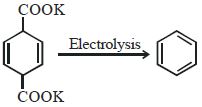
C
$CH_3-CH=CH_2 \xrightarrow[R_2O_2]{HCl} CH_3-CH_2-CH_2-Cl$
D
$CH_3-CH=CH_2 \xrightarrow[hv]{NBS} Br-CH_2-CH=CH_2$
Solution
(C) The peroxide effect (Kharasch effect) is only observed with $HBr$. $HCl$ and $HI$ do not show the peroxide effect because the $H-Cl$ bond is too strong for the radical chain propagation step,and the addition of $I\cdot$ to the alkene is endothermic. Therefore,$HCl$ adds to propene according to Markovnikov's rule to give $2$-chloropropane $(CH_3-CHCl-CH_3)$,making the product in option $(c)$ incorrect.
0 likes
View Solution277
DifficultMCQ
Determine the number of mono-chloro products (structural isomers only) formed by the reaction of isopropylcyclopentane with $Cl_2/\Delta$.
A
$5$
B
$6$
C
$4$
D
$7$
Solution
(A) The reactant is isopropylcyclopentane. To find the number of structural mono-chloro products,we identify all non-equivalent hydrogen atoms in the molecule.
$1$. The isopropyl group has a tertiary hydrogen at the junction $(CH)$ and six equivalent primary hydrogens on the two methyl groups $(CH_3)$. This gives $2$ products.
$2$. The cyclopentane ring has five carbons. The carbon attached to the isopropyl group is a tertiary carbon $(CH)$. The two adjacent carbons $(CH_2)$ are equivalent,and the two carbons further away $(CH_2)$ are also equivalent.
$3$. Thus,the distinct positions for substitution are:
- Tertiary $H$ on the isopropyl group ($1$ product).
- Primary $H$ on the methyl groups ($1$ product).
- Tertiary $H$ on the cyclopentane ring ($1$ product).
- Secondary $H$ on the carbons adjacent to the isopropyl group ($1$ product).
- Secondary $H$ on the carbons further from the isopropyl group ($1$ product).
Total structural isomers = $1 + 1 + 1 + 1 + 1 = 5$.
$1$. The isopropyl group has a tertiary hydrogen at the junction $(CH)$ and six equivalent primary hydrogens on the two methyl groups $(CH_3)$. This gives $2$ products.
$2$. The cyclopentane ring has five carbons. The carbon attached to the isopropyl group is a tertiary carbon $(CH)$. The two adjacent carbons $(CH_2)$ are equivalent,and the two carbons further away $(CH_2)$ are also equivalent.
$3$. Thus,the distinct positions for substitution are:
- Tertiary $H$ on the isopropyl group ($1$ product).
- Primary $H$ on the methyl groups ($1$ product).
- Tertiary $H$ on the cyclopentane ring ($1$ product).
- Secondary $H$ on the carbons adjacent to the isopropyl group ($1$ product).
- Secondary $H$ on the carbons further from the isopropyl group ($1$ product).
Total structural isomers = $1 + 1 + 1 + 1 + 1 = 5$.
0 likes
View Solution278
AdvancedMCQ
Identify the final product $C$ in the following reaction sequence:
$Br-(CH_2)_5-Br$ $\xrightarrow{Na, \text{D.E.}} A$ $\xrightarrow{Br_2, \Delta} B$ $\xrightarrow{\text{alc. KOH}, \Delta} C$
$Br-(CH_2)_5-Br$ $\xrightarrow{Na, \text{D.E.}} A$ $\xrightarrow{Br_2, \Delta} B$ $\xrightarrow{\text{alc. KOH}, \Delta} C$
A
B
C
D
Solution
(A) $1$. The first step is an intramolecular Wurtz reaction: $Br-(CH_2)_5-Br \xrightarrow{Na, \text{D.E.}} \text{cyclopentane} (A)$.
$2$. The second step is free radical bromination: $\text{cyclopentane} \xrightarrow{Br_2, \Delta} \text{bromocyclopentane} (B)$.
$3$. The third step is dehydrohalogenation using alcoholic $KOH$: $\text{bromocyclopentane} \xrightarrow{\text{alc. KOH}, \Delta} \text{cyclopentene} (C)$.
$2$. The second step is free radical bromination: $\text{cyclopentane} \xrightarrow{Br_2, \Delta} \text{bromocyclopentane} (B)$.
$3$. The third step is dehydrohalogenation using alcoholic $KOH$: $\text{bromocyclopentane} \xrightarrow{\text{alc. KOH}, \Delta} \text{cyclopentene} (C)$.
0 likes
View Solution279
DifficultMCQ
In which of the following reactions is the product not an alkane?
A
$CH_3-CH_2-I \xrightarrow{Na/Ether, \Delta}$
B
$CH_3-COONa \xrightarrow{Electrolysis}$
C
$CH_3-COOH \xrightarrow{NaOH + CaO, \Delta}$
D
$CH_3-COOAg \xrightarrow{Br_2/CCl_4, \Delta}$
Solution
(D) In the Hunsdiecker reaction,silver salts of carboxylic acids react with $Br_2$ in $CCl_4$ to form alkyl bromides.
$CH_3-COOAg + Br_2 \xrightarrow{CCl_4, \Delta} CH_3-Br + CO_2 + AgBr$
Methyl bromide $(CH_3-Br)$ is an alkyl halide,not an alkane.
In other options:
$(a)$ Wurtz reaction produces butane ($C_4H_{10}$,an alkane).
$(b)$ Kolbe's electrolysis produces ethane ($C_2H_6$,an alkane).
$(c)$ Decarboxylation produces methane ($CH_4$,an alkane).
$CH_3-COOAg + Br_2 \xrightarrow{CCl_4, \Delta} CH_3-Br + CO_2 + AgBr$
Methyl bromide $(CH_3-Br)$ is an alkyl halide,not an alkane.
In other options:
$(a)$ Wurtz reaction produces butane ($C_4H_{10}$,an alkane).
$(b)$ Kolbe's electrolysis produces ethane ($C_2H_6$,an alkane).
$(c)$ Decarboxylation produces methane ($CH_4$,an alkane).
0 likes
View Solution280
DifficultMCQ
The relative reactivity of $1^o H$,$2^o H$,and $3^o H$ in bromination reaction has been found to be $1 : 82 : 1600$ respectively. In the reaction $CH_3-CH(CH_3)-CH_3 \text{ (excess)} + Br_2$ $\xrightarrow{hv} CH_3-C(Br)(CH_3)-CH_3 \text{ (A)} + CH_3-CH(CH_3)-CH_2-Br \text{ (B)}$,the percentage yields of the products $(A)$ and $(B)$ are expected to be:
A
$99.4\%, 0.6\%$
B
$50\%, 50\%$
C
$0.6\%, 99.4\%$
D
$20\%, 80\%$
Solution
(A) Isobutane $CH_3-CH(CH_3)-CH_3$ contains $9$ primary $(1^o)$ hydrogens and $1$ tertiary $(3^o)$ hydrogen.
Relative reactivity: $1^o H : 3^o H = 1 : 1600$.
Relative amount of product $(A)$ (from $3^o H$) $= 1 \times 1600 = 1600$.
Relative amount of product $(B)$ (from $1^o H$) $= 9 \times 1 = 9$.
Total relative amount $= 1600 + 9 = 1609$.
$\% \text{ yield of } (A) = \frac{1600}{1609} \times 100 \approx 99.4\%$.
$\% \text{ yield of } (B) = \frac{9}{1609} \times 100 \approx 0.6\%$.
Relative reactivity: $1^o H : 3^o H = 1 : 1600$.
Relative amount of product $(A)$ (from $3^o H$) $= 1 \times 1600 = 1600$.
Relative amount of product $(B)$ (from $1^o H$) $= 9 \times 1 = 9$.
Total relative amount $= 1600 + 9 = 1609$.
$\% \text{ yield of } (A) = \frac{1600}{1609} \times 100 \approx 99.4\%$.
$\% \text{ yield of } (B) = \frac{9}{1609} \times 100 \approx 0.6\%$.
0 likes
View Solution281
MediumMCQ
Which of the following is true for the given reaction: $R - H + X_2 \xrightarrow{hv} R - X + H - X$?
A
The reactivity of different halogens for the reaction is $I_2 > Br_2 > Cl_2 > F_2$
B
The reaction follows an electrophilic substitution mechanism
C
Iodination is carried out in the presence of $HIO_3$ to increase the yield of alkyl iodide
D
All of the above
Solution
(C) The given reaction is a free radical halogenation of alkanes.
$1$. The reactivity order of halogens is $F_2 > Cl_2 > Br_2 > I_2$. Thus,option $A$ is incorrect.
$2$. The reaction proceeds via a free radical substitution mechanism,not electrophilic substitution. Thus,option $B$ is incorrect.
$3$. Iodination is a reversible reaction. To drive the reaction forward and increase the yield of alkyl iodide,an oxidizing agent like $HIO_3$ or $HNO_3$ is used to consume the $HI$ produced. Thus,option $C$ is correct.
$1$. The reactivity order of halogens is $F_2 > Cl_2 > Br_2 > I_2$. Thus,option $A$ is incorrect.
$2$. The reaction proceeds via a free radical substitution mechanism,not electrophilic substitution. Thus,option $B$ is incorrect.
$3$. Iodination is a reversible reaction. To drive the reaction forward and increase the yield of alkyl iodide,an oxidizing agent like $HIO_3$ or $HNO_3$ is used to consume the $HI$ produced. Thus,option $C$ is correct.
0 likes
View Solution282
DifficultMCQ
Identify the product $A$ in the following reaction:
$C_6H_{11}CH_2Br \xrightarrow{Na, \text{Dry ether}} A$
$C_6H_{11}CH_2Br \xrightarrow{Na, \text{Dry ether}} A$
A
$1$,$1$'-dicyclohexylmethane
B
$1,2-$dicyclohexylethane
C
Bicyclohexyl
D
$1,3-$dicyclohexylpropane
Solution
(B) The given reaction is a Wurtz reaction,where an alkyl halide reacts with sodium metal in the presence of dry ether to form a symmetrical alkane.
The reaction is:
$2 C_6H_{11}CH_2Br + 2 Na \xrightarrow{\text{Dry ether}} C_6H_{11}CH_2-CH_2C_6H_{11} + 2 NaBr$
Here,two molecules of (cyclohexylmethyl) bromide couple together to form $1,2-$dicyclohexylethane.
The reaction is:
$2 C_6H_{11}CH_2Br + 2 Na \xrightarrow{\text{Dry ether}} C_6H_{11}CH_2-CH_2C_6H_{11} + 2 NaBr$
Here,two molecules of (cyclohexylmethyl) bromide couple together to form $1,2-$dicyclohexylethane.
0 likes
View Solution283
MediumMCQ
$CH_4$ gas is obtained in :-
$(a)$ Hydrolysis of $Al_4C_3$
$(b)$ Hydrolysis of $Be_2C$
$(c)$ Hydrolysis of $Mg_2C_3$
$(d)$ Hydrolysis of $CaC_2$
$(a)$ Hydrolysis of $Al_4C_3$
$(b)$ Hydrolysis of $Be_2C$
$(c)$ Hydrolysis of $Mg_2C_3$
$(d)$ Hydrolysis of $CaC_2$
A
only $a, b, c$
B
only $a, b$
C
only $a, c$
D
only $b, c, d$
Solution
(B) The hydrolysis reactions of the given carbides are as follows:
$Al_4C_3 + 12H_2O \to 4Al(OH)_3 + 3CH_4$ (Methane is produced)
$Be_2C + 4H_2O \to 2Be(OH)_2 + CH_4$ (Methane is produced)
$Mg_2C_3 + 4H_2O \to 2Mg(OH)_2 + C_3H_4$ (Propyne is produced)
$CaC_2 + 2H_2O \to Ca(OH)_2 + C_2H_2$ (Acetylene is produced)
Therefore,$CH_4$ gas is obtained from the hydrolysis of $Al_4C_3$ and $Be_2C$ only.
$Al_4C_3 + 12H_2O \to 4Al(OH)_3 + 3CH_4$ (Methane is produced)
$Be_2C + 4H_2O \to 2Be(OH)_2 + CH_4$ (Methane is produced)
$Mg_2C_3 + 4H_2O \to 2Mg(OH)_2 + C_3H_4$ (Propyne is produced)
$CaC_2 + 2H_2O \to Ca(OH)_2 + C_2H_2$ (Acetylene is produced)
Therefore,$CH_4$ gas is obtained from the hydrolysis of $Al_4C_3$ and $Be_2C$ only.
0 likes
View Solution284
MediumMCQ
In the given reaction,product $B$ is:
Cyclohexane $\xrightarrow{Br_2, h\nu}$ $(A) \xrightarrow{Na, \text{dry ether}}$ $(B)$
Cyclohexane $\xrightarrow{Br_2, h\nu}$ $(A) \xrightarrow{Na, \text{dry ether}}$ $(B)$
A
Bicyclohexyl
B
Cyclohexene
C
Cyclohexane
D
$1,3-$Cyclohexadiene
Solution
(A) $1$. The reaction of cyclohexane with $Br_2$ in the presence of $h\nu$ ($UV$ light) is a free-radical substitution reaction,which produces bromocyclohexane as product $(A)$.
$2$. The reaction of bromocyclohexane with $Na$ in the presence of dry ether is a Wurtz reaction,which involves the coupling of two alkyl groups to form a higher alkane.
$3$. Two molecules of bromocyclohexane react with $2Na$ to form bicyclohexyl as product $(B)$.
$2$. The reaction of bromocyclohexane with $Na$ in the presence of dry ether is a Wurtz reaction,which involves the coupling of two alkyl groups to form a higher alkane.
$3$. Two molecules of bromocyclohexane react with $2Na$ to form bicyclohexyl as product $(B)$.
0 likes
View Solution285
MediumMCQ
$C-C$ bond length is maximum in
A
$CH_3-CH_3$
B
$CH_2=CH_2$
C
$CH\equiv CH$
D
$CH_2=C=CH_2$
Solution
(A) The bond length between carbon atoms depends on the hybridization of the carbon atoms involved.
$1$. In $CH_3-CH_3$ (ethane), both carbons are $sp^3$ hybridized. The $C-C$ bond is a single bond with a bond length of approximately $154 \ pm$.
$2$. In $CH_2=CH_2$ (ethene), carbons are $sp^2$ hybridized. The $C=C$ bond length is $134 \ pm$.
$3$. In $CH\equiv CH$ (ethyne), carbons are $sp$ hybridized. The $C\equiv C$ bond length is $120 \ pm$.
$4$. In $CH_2=C=CH_2$ (allene), the central carbon is $sp$ hybridized and terminal carbons are $sp^2$ hybridized. The $C-C$ bond length is approximately $131 \ pm$.
Comparing these, the $C-C$ single bond in ethane $(sp^3-sp^3)$ has the maximum bond length.
$1$. In $CH_3-CH_3$ (ethane), both carbons are $sp^3$ hybridized. The $C-C$ bond is a single bond with a bond length of approximately $154 \ pm$.
$2$. In $CH_2=CH_2$ (ethene), carbons are $sp^2$ hybridized. The $C=C$ bond length is $134 \ pm$.
$3$. In $CH\equiv CH$ (ethyne), carbons are $sp$ hybridized. The $C\equiv C$ bond length is $120 \ pm$.
$4$. In $CH_2=C=CH_2$ (allene), the central carbon is $sp$ hybridized and terminal carbons are $sp^2$ hybridized. The $C-C$ bond length is approximately $131 \ pm$.
Comparing these, the $C-C$ single bond in ethane $(sp^3-sp^3)$ has the maximum bond length.
0 likes
View Solution286
MediumMCQ
Among the given pairs,in which pair does the first compound have a higher boiling point than the second?
A
$CH_3-CH_2-O-CH_3$ and $CH_3-CH(OH)-CH_3$
B
$CH_3-CH_2-CH_2-CH_3$ and $CH_3-CH_2-CH_3$
C
$CH_3-CH_2-CH_2-CH_2-CH_3$ and $CH_3-CH(CH_2-CH_3)-CH_2-OH$
D
$CH_3-CH_2-CH_2-CH_3$ and $CH_3-CH_2-CH_2-Cl$
Solution
(B) The boiling point of a compound depends on its molecular weight and intermolecular forces.
In option $B$,$CH_3-CH_2-CH_2-CH_3$ (Butane) has a higher molecular weight than $CH_3-CH_2-CH_3$ (Propane),leading to stronger London dispersion forces and a higher boiling point.
In option $A$,the second compound $(CH_3-CH(OH)-CH_3)$ can form hydrogen bonds,whereas the first $(CH_3-CH_2-O-CH_3)$ cannot,so the second has a higher boiling point.
In option $C$,the second compound is an alcohol,which has higher boiling points due to hydrogen bonding compared to the alkane.
In option $D$,the second compound $(CH_3-CH_2-CH_2-Cl)$ has a higher molecular weight and dipole-dipole interactions compared to the alkane,resulting in a higher boiling point.
In option $B$,$CH_3-CH_2-CH_2-CH_3$ (Butane) has a higher molecular weight than $CH_3-CH_2-CH_3$ (Propane),leading to stronger London dispersion forces and a higher boiling point.
In option $A$,the second compound $(CH_3-CH(OH)-CH_3)$ can form hydrogen bonds,whereas the first $(CH_3-CH_2-O-CH_3)$ cannot,so the second has a higher boiling point.
In option $C$,the second compound is an alcohol,which has higher boiling points due to hydrogen bonding compared to the alkane.
In option $D$,the second compound $(CH_3-CH_2-CH_2-Cl)$ has a higher molecular weight and dipole-dipole interactions compared to the alkane,resulting in a higher boiling point.
0 likes
View Solution287
DifficultMCQ
Which metal catalyzed reaction would release the maximum amount of heat per $CH_2$ unit?
A
cyclopropane $+ H_2 \to$ propane
B
cyclobutane $+ H_2 \to$ butane
C
cyclopentane $+ H_2 \to$ pentane
D
cyclohexane $+ H_2 \to$ hexane
Solution
(A) The heat of hydrogenation per $CH_2$ unit is directly proportional to the ring strain present in the cycloalkane.
Cyclopropane has the highest ring strain due to significant angle strain ($60^{\circ}$ bond angles compared to the ideal $109.5^{\circ}$),making it highly unstable.
Upon hydrogenation,the ring opens to form a stable alkane,releasing a large amount of energy.
The order of heat of combustion ($H$.$O$.$C$.) per $CH_2$ unit is: cyclopropane $>$ cyclobutane $>$ cyclopentane $>$ cyclohexane.
Therefore,the reaction involving cyclopropane releases the maximum amount of heat per $CH_2$ unit.
Cyclopropane has the highest ring strain due to significant angle strain ($60^{\circ}$ bond angles compared to the ideal $109.5^{\circ}$),making it highly unstable.
Upon hydrogenation,the ring opens to form a stable alkane,releasing a large amount of energy.
The order of heat of combustion ($H$.$O$.$C$.) per $CH_2$ unit is: cyclopropane $>$ cyclobutane $>$ cyclopentane $>$ cyclohexane.
Therefore,the reaction involving cyclopropane releases the maximum amount of heat per $CH_2$ unit.
0 likes
View Solution288
DifficultMCQ
Which of the following reactions is most exothermic?
A
Propane + $Cl_2 \xrightarrow{hv}$ $2-$chloropropane + $HCl$
B
Propane + $Br_2 \xrightarrow{hv}$ $2-$bromopropane + $HBr$
C
Isobutane + $Cl_2 \xrightarrow{hv}$ $2-$chloro$-2-$methylpropane + $HCl$
D
Isobutane + $Br_2 \xrightarrow{hv}$ $2-$bromo$-2-$methylpropane + $HBr$
Solution
(C) The enthalpy change of a free radical halogenation reaction depends on the bond dissociation energies of the reactants and products.
$(i)$ Chlorination is generally more exothermic than bromination because the $C-Cl$ bond formed is stronger than the $C-Br$ bond,and the $H-Cl$ bond formed is stronger than the $H-Br$ bond.
$(ii)$ Among the given options,the chlorination of alkanes is more exothermic than bromination.
$(iii)$ Comparing the chlorination of propane and isobutane,the reaction with isobutane is more exothermic because it leads to the formation of a more stable $3^{\circ}$ alkyl chloride compared to the $2^{\circ}$ alkyl chloride formed from propane,due to the higher stability of the $3^{\circ}$ free radical intermediate.
Therefore,the reaction of isobutane with $Cl_2$ is the most exothermic.
$(i)$ Chlorination is generally more exothermic than bromination because the $C-Cl$ bond formed is stronger than the $C-Br$ bond,and the $H-Cl$ bond formed is stronger than the $H-Br$ bond.
$(ii)$ Among the given options,the chlorination of alkanes is more exothermic than bromination.
$(iii)$ Comparing the chlorination of propane and isobutane,the reaction with isobutane is more exothermic because it leads to the formation of a more stable $3^{\circ}$ alkyl chloride compared to the $2^{\circ}$ alkyl chloride formed from propane,due to the higher stability of the $3^{\circ}$ free radical intermediate.
Therefore,the reaction of isobutane with $Cl_2$ is the most exothermic.
0 likes
View Solution289
DifficultMCQ
Which of the following has the lowest barrier to rotation about the indicated bond?
A
Cyclopentane (bond between $C_1$ and $C_2$)
B
Buta$-1,3-$diene (bond between $C_2$ and $C_3$)
C
n-Butane (bond between $C_2$ and $C_3$)
D
$2,3-$Dimethylbutane (bond between $C_2$ and $C_3$)
Solution
(C) The rotational barrier is determined by steric hindrance and the electronic nature of the bond.
$A$: Cyclopentane has a cyclic structure,and rotation about a $C-C$ bond is restricted by the ring strain.
$B$: Buta$-1,3-$diene has partial double-bond character between $C_2$ and $C_3$ due to conjugation,leading to a high rotational barrier.
$C$: $n$-Butane $(CH_3-CH_2-CH_2-CH_3)$ has a simple $sp^3-sp^3$ single bond with minimal steric hindrance compared to the other options,resulting in the lowest rotational energy barrier.
$D$: $2,3-$Dimethylbutane has significant steric repulsion between the bulky methyl groups during rotation,leading to a higher barrier than $n$-butane.
$A$: Cyclopentane has a cyclic structure,and rotation about a $C-C$ bond is restricted by the ring strain.
$B$: Buta$-1,3-$diene has partial double-bond character between $C_2$ and $C_3$ due to conjugation,leading to a high rotational barrier.
$C$: $n$-Butane $(CH_3-CH_2-CH_2-CH_3)$ has a simple $sp^3-sp^3$ single bond with minimal steric hindrance compared to the other options,resulting in the lowest rotational energy barrier.
$D$: $2,3-$Dimethylbutane has significant steric repulsion between the bulky methyl groups during rotation,leading to a higher barrier than $n$-butane.
0 likes
View Solution290
MediumMCQ
Which of the following statements is true?
A
van der Waals' strain in $cis-1,2-dimethylcyclopropane$ is the principal reason for its decreased stability relative to the $trans$ isomer.
B
Cyclohexane gives off more heat per $CH_2$ group on being burned in air than any other cycloalkane.
C
The principal source of strain in the boat conformation of cyclohexane is angle strain.
D
The principal source of strain in the gauche conformation of butane is torsional strain.
Solution
(A) is correct. In $cis-1,2-dimethylcyclopropane$,the two methyl groups are on the same side of the ring,leading to significant van der Waals' repulsion (steric strain) between them,which makes the $cis$ isomer less stable than the $trans$ isomer.
$B$ is incorrect because cyclohexane has the lowest heat of combustion per $CH_2$ group due to its lack of angle strain.
$C$ is incorrect because the principal source of strain in the boat conformation of cyclohexane is torsional strain (eclipsing interactions) and flagpole interactions,not angle strain.
$D$ is incorrect because the principal source of strain in the gauche conformation of butane is van der Waals' repulsion (steric strain) between the methyl groups,not torsional strain.
$B$ is incorrect because cyclohexane has the lowest heat of combustion per $CH_2$ group due to its lack of angle strain.
$C$ is incorrect because the principal source of strain in the boat conformation of cyclohexane is torsional strain (eclipsing interactions) and flagpole interactions,not angle strain.
$D$ is incorrect because the principal source of strain in the gauche conformation of butane is van der Waals' repulsion (steric strain) between the methyl groups,not torsional strain.
0 likes
View Solution291
DifficultMCQ
$Ph-CH=NO_2H$ $\xrightarrow[{3 \ days}]{{isomerises}}$ $\mathop {(x)}\limits_{(50-50\%)}$,Isomer $(x)$ is
A
$Ph-NO-CH_2OH$
B
$Ph-CH_2-NO_2$
C
$Ph-NH-CO_2H$
D
None
Solution
(B) The given compound $Ph-CH=NO_2H$ is an aci-nitro compound.
Nitro-aci-nitro tautomerism is a type of tautomerism where a nitro compound $(R-CH_2-NO_2)$ exists in equilibrium with its aci-form $(R-CH=NO_2H)$.
In this case,the aci-nitro form $Ph-CH=NO_2H$ tautomerizes to the stable nitro form $Ph-CH_2-NO_2$.
Therefore,the isomer $(x)$ is $Ph-CH_2-NO_2$.
Nitro-aci-nitro tautomerism is a type of tautomerism where a nitro compound $(R-CH_2-NO_2)$ exists in equilibrium with its aci-form $(R-CH=NO_2H)$.
In this case,the aci-nitro form $Ph-CH=NO_2H$ tautomerizes to the stable nitro form $Ph-CH_2-NO_2$.
Therefore,the isomer $(x)$ is $Ph-CH_2-NO_2$.
0 likes
View Solution292
MediumMCQ
$A$ mixture of all isomers possible from the mono-chlorination of the structure $n$-pentane $(CH_3-CH_2-CH_2-CH_2-CH_3)$ is subjected to fractional distillation. How many fractions will be obtained?
A
$2$
B
$3$
C
$4$
D
$5$
Solution
(B) The structure provided is $n$-pentane $(CH_3-CH_2-CH_2-CH_2-CH_3)$.
Mono-chlorination of $n$-pentane can occur at three non-equivalent carbon positions:
$1$. At the $C_1$ position (terminal carbon): $CH_3-CH_2-CH_2-CH_2-CH_2Cl$ ($1$-chloropentane).
$2$. At the $C_2$ position: $CH_3-CH_2-CH_2-CHCl-CH_3$ ($2$-chloropentane).
$3$. At the $C_3$ position: $CH_3-CH_2-CHCl-CH_2-CH_3$ ($3$-chloropentane).
Note that $2$-chloropentane and $3$-chloropentane are chiral molecules,meaning each exists as a pair of enantiomers ($R$ and $S$ forms).
However,fractional distillation separates compounds based on their boiling points. Enantiomers have identical boiling points and cannot be separated by fractional distillation.
Therefore,the distinct products with different boiling points are:
- $1$-chloropentane
- $2$-chloropentane (racemic mixture)
- $3$-chloropentane (racemic mixture)
This results in $3$ distinct fractions.
Mono-chlorination of $n$-pentane can occur at three non-equivalent carbon positions:
$1$. At the $C_1$ position (terminal carbon): $CH_3-CH_2-CH_2-CH_2-CH_2Cl$ ($1$-chloropentane).
$2$. At the $C_2$ position: $CH_3-CH_2-CH_2-CHCl-CH_3$ ($2$-chloropentane).
$3$. At the $C_3$ position: $CH_3-CH_2-CHCl-CH_2-CH_3$ ($3$-chloropentane).
Note that $2$-chloropentane and $3$-chloropentane are chiral molecules,meaning each exists as a pair of enantiomers ($R$ and $S$ forms).
However,fractional distillation separates compounds based on their boiling points. Enantiomers have identical boiling points and cannot be separated by fractional distillation.
Therefore,the distinct products with different boiling points are:
- $1$-chloropentane
- $2$-chloropentane (racemic mixture)
- $3$-chloropentane (racemic mixture)
This results in $3$ distinct fractions.
0 likes
View Solution293
MediumMCQ
$HO-CH_2-CH(OH)-CH_2-SH + CH_3MgBr \text{ (Excess)} \rightarrow xCH_4$. What is the value of $x$ in the above reaction?
A
$1$
B
$2$
C
$3$
D
$4$
Solution
(C) Grignard reagents $(RMgX)$ react with compounds containing active hydrogen atoms (hydrogen atoms attached to electronegative atoms like $O, S, N$) to produce alkanes.
The reaction is: $R-MgX + R'-H \rightarrow R-H + Mg(R')X$.
In the given compound $HO-CH_2-CH(OH)-CH_2-SH$,there are three such active hydrogen atoms (two in $-OH$ groups and one in the $-SH$ group).
Thus,$3$ moles of $CH_3MgBr$ will react with $1$ mole of the compound to release $3$ moles of methane $(CH_4)$.
Therefore,$x = 3$.
The reaction is: $R-MgX + R'-H \rightarrow R-H + Mg(R')X$.
In the given compound $HO-CH_2-CH(OH)-CH_2-SH$,there are three such active hydrogen atoms (two in $-OH$ groups and one in the $-SH$ group).
Thus,$3$ moles of $CH_3MgBr$ will react with $1$ mole of the compound to release $3$ moles of methane $(CH_4)$.
Therefore,$x = 3$.
0 likes
View Solution294
DifficultMCQ
$1,3-$Dibromopropane is heated with zinc dust in ether. The product formed is
A
propene
B
propane
C
cyclopropane
D
$3-$bromopropane
Solution
(C) When $1,3-$dibromopropane $(Br-CH_2-CH_2-CH_2-Br)$ is heated with zinc dust in an ether solvent,an intramolecular dehalogenation reaction occurs.
Zinc acts as a reducing agent and removes the two bromine atoms from the terminal carbons.
The two terminal carbon atoms then bond together to form a three-membered ring.
The reaction is: $Br-CH_2-CH_2-CH_2-Br + Zn \xrightarrow{\text{ether}} \text{cyclopropane} + ZnBr_2$.
Thus,the product formed is cyclopropane.
Zinc acts as a reducing agent and removes the two bromine atoms from the terminal carbons.
The two terminal carbon atoms then bond together to form a three-membered ring.
The reaction is: $Br-CH_2-CH_2-CH_2-Br + Zn \xrightarrow{\text{ether}} \text{cyclopropane} + ZnBr_2$.
Thus,the product formed is cyclopropane.
0 likes
View Solution295
MediumMCQ
On halogenation,an alkane gives only one monohalogenated product. The alkane may be
A
$2-$methylbutane
B
$2,2-$dimethylpropane
C
cyclopentane
D
both $(b)$ and $(c)$
Solution
(D) For an alkane to give only one monohalogenated product,all hydrogen atoms in the molecule must be equivalent.
$1$. $2-$methylbutane has different types of hydrogen atoms,leading to multiple monohalogenated products.
$2$. $2,2-$dimethylpropane (neopentane) has $12$ equivalent hydrogen atoms attached to the four equivalent methyl groups. Thus,it gives only one monohalogenated product.
$3$. Cyclopentane has $10$ equivalent hydrogen atoms in a cyclic structure. Thus,it also gives only one monohalogenated product.
Therefore,both $(b)$ and $(c)$ are correct.
$1$. $2-$methylbutane has different types of hydrogen atoms,leading to multiple monohalogenated products.
$2$. $2,2-$dimethylpropane (neopentane) has $12$ equivalent hydrogen atoms attached to the four equivalent methyl groups. Thus,it gives only one monohalogenated product.
$3$. Cyclopentane has $10$ equivalent hydrogen atoms in a cyclic structure. Thus,it also gives only one monohalogenated product.
Therefore,both $(b)$ and $(c)$ are correct.
0 likes
View Solution296
MediumMCQ
Which of the following compounds can be best prepared by Wurtz-reaction?
A
Iso-butane
B
$n$-butane
C
$n$-pentane
D
Iso-pentane
Solution
(B) $2CH_3-CH_2-Cl \xrightarrow[Dry \ ether]{Na} CH_3-CH_2-CH_2-CH_3 + 2NaCl$
The Wurtz reaction is most effective for the preparation of symmetrical alkanes with an even number of carbon atoms.
In the case of $n$-butane,it is formed by the coupling of two ethyl radicals $(CH_3-CH_2 \cdot)$,making it the ideal product for this reaction.
The Wurtz reaction is most effective for the preparation of symmetrical alkanes with an even number of carbon atoms.
In the case of $n$-butane,it is formed by the coupling of two ethyl radicals $(CH_3-CH_2 \cdot)$,making it the ideal product for this reaction.
0 likes
View Solution297
MediumMCQ
$A$ hydrocarbon $A$ $(V.D. = 36)$ forms only one monochloro substitution product. $A$ will be:
A
iso-pentane
B
neo-pentane
C
cyclohexane
D
methyl-cyclohexane
Solution
(B) The molecular weight of hydrocarbon $A = 2 \times V.D. = 2 \times 36 = 72$.
For an alkane with formula $C_nH_{2n+2}$,$12n + 2n + 2 = 72$ $\Rightarrow 14n = 70$ $\Rightarrow n = 5$.
The molecular formula is $C_5H_{12}$.
Among the isomers of $C_5H_{12}$,neo-pentane $(CH_3-C(CH_3)_2-CH_3)$ has all $12$ hydrogen atoms equivalent.
Therefore,it forms only one monochloro substitution product.
For an alkane with formula $C_nH_{2n+2}$,$12n + 2n + 2 = 72$ $\Rightarrow 14n = 70$ $\Rightarrow n = 5$.
The molecular formula is $C_5H_{12}$.
Among the isomers of $C_5H_{12}$,neo-pentane $(CH_3-C(CH_3)_2-CH_3)$ has all $12$ hydrogen atoms equivalent.
Therefore,it forms only one monochloro substitution product.
0 likes
View Solution298
MediumMCQ
Ethyl iodide and $n$-propyl iodide are allowed to undergo Wurtz reaction. The alkane which will not be obtained in this reaction is
A
butane
B
propane
C
pentane
D
hexane
Solution
(B) The Wurtz reaction involves the coupling of alkyl halides in the presence of sodium and dry ether.
When a mixture of two different alkyl halides ($R-X$ and $R'-X$) is used,a mixture of three possible alkanes is formed: $R-R$,$R'-R'$,and $R-R'$.
Here,the reactants are ethyl iodide $(C_2H_5I)$ and $n$-propyl iodide $(C_3H_7I)$.
The possible products are:
$1$. $C_2H_5-C_2H_5$ ($n$-butane)
$2$. $C_3H_7-C_3H_7$ ($n$-hexane)
$3$. $C_2H_5-C_3H_7$ ($n$-pentane)
Propane $(C_3H_8)$ is not formed in this reaction.
When a mixture of two different alkyl halides ($R-X$ and $R'-X$) is used,a mixture of three possible alkanes is formed: $R-R$,$R'-R'$,and $R-R'$.
Here,the reactants are ethyl iodide $(C_2H_5I)$ and $n$-propyl iodide $(C_3H_7I)$.
The possible products are:
$1$. $C_2H_5-C_2H_5$ ($n$-butane)
$2$. $C_3H_7-C_3H_7$ ($n$-hexane)
$3$. $C_2H_5-C_3H_7$ ($n$-pentane)
Propane $(C_3H_8)$ is not formed in this reaction.
0 likes
View Solution299
MediumMCQ
$CH_3-CH(CH_3)-CH_2-CH_3 \xrightarrow[h\nu]{Cl_2}$
Number of chiral centers generated during monochlorination in the above reaction
Number of chiral centers generated during monochlorination in the above reaction
A
$1$
B
$2$
C
$3$
D
$4$
Solution
(B) The reactant is $2$-methylbutane $(CH_3-CH(CH_3)-CH_2-CH_3)$. Monochlorination can occur at four different positions:
$1.$ At $C1$: $ClCH_2-CH(CH_3)-CH_2-CH_3$ ($1$-chloro-$2$-methylbutane). Here,$C2$ becomes a chiral center.
$2.$ At $C2$: $CH_3-C(Cl)(CH_3)-CH_2-CH_3$ ($2$-chloro-$2$-methylbutane). No chiral center is formed.
$3.$ At $C3$: $CH_3-CH(CH_3)-CHCl-CH_3$ ($2$-chloro-$3$-methylbutane). Here,$C3$ becomes a chiral center.
$4.$ At $C4$: $CH_3-CH(CH_3)-CH_2-CH_2Cl$ ($1$-chloro-$3$-methylbutane). No chiral center is formed.
Therefore,the total number of unique chiral centers generated is $2$.
$1.$ At $C1$: $ClCH_2-CH(CH_3)-CH_2-CH_3$ ($1$-chloro-$2$-methylbutane). Here,$C2$ becomes a chiral center.
$2.$ At $C2$: $CH_3-C(Cl)(CH_3)-CH_2-CH_3$ ($2$-chloro-$2$-methylbutane). No chiral center is formed.
$3.$ At $C3$: $CH_3-CH(CH_3)-CHCl-CH_3$ ($2$-chloro-$3$-methylbutane). Here,$C3$ becomes a chiral center.
$4.$ At $C4$: $CH_3-CH(CH_3)-CH_2-CH_2Cl$ ($1$-chloro-$3$-methylbutane). No chiral center is formed.
Therefore,the total number of unique chiral centers generated is $2$.
0 likes
View Solution300
MediumMCQ
$CH_3Cl \to CH_4$
Above conversion can be achieved by
Above conversion can be achieved by
A
$Zn / H^{+}$
B
$LiAlH_4$
C
$Mg / \text{ether}$ then $H_2O$
D
all of these
Solution
(D) $1$. $CH_3Cl \xrightarrow{Zn/H^{+}} CH_4$ (Reduction by metal-acid).
$2$. $CH_3Cl \xrightarrow{LiAlH_4} CH_4$ (Reduction by strong reducing agent).
$3$. $CH_3Cl$ $\xrightarrow{Mg, \text{ dry ether}} CH_3MgCl$ $\xrightarrow{H_2O} CH_4$ (Grignard reagent formation followed by hydrolysis).
Since all three methods successfully convert chloromethane to methane,the correct option is $D$.
$2$. $CH_3Cl \xrightarrow{LiAlH_4} CH_4$ (Reduction by strong reducing agent).
$3$. $CH_3Cl$ $\xrightarrow{Mg, \text{ dry ether}} CH_3MgCl$ $\xrightarrow{H_2O} CH_4$ (Grignard reagent formation followed by hydrolysis).
Since all three methods successfully convert chloromethane to methane,the correct option is $D$.
0 likes
View SolutionHydrocarbons — Alkane · Frequently Asked Questions
1Are these Hydrocarbons questions useful for JEE and NEET?
Yes. All questions in this section are mapped to JEE Main and NEET exam patterns. Previous year questions from JEE Main, NEET, GUJCET and state-level exams are included with full solutions.
2Can I switch to Hindi or Gujarati for these questions?
Yes. Use the language tabs in the hero section or the sidebar to view the same questions and solutions in English, Hindi or Gujarati.
3How do I generate a question paper from this subtopic?
Use the Vedclass Exam Paper Generator — select the chapter and subtopic, set difficulty, and generate Sets A, B, C, D automatically. First 3 chapters of every subject are free.
Vedclass Products
For Students
Vedclass Test Series
Mock tests in real JEE/NEET style with performance analysis. 5-day free trial.
Start Free TrialFor Teachers
Exam Paper Generator
Generate Set A/B/C/D papers from this chapter in 2 minutes. 3 chapters free.
Try FreeFor Institutes
Online Exam Module
Live online exams with unlimited students, 360° analytics & white-label branding.
See DemoFor Teachers & Institutes
Generate a Hydrocarbons Exam Paper in 2 Minutes
Select subtopic & difficulty — Sets A, B, C, D auto-generated with No Repeat logic.
First 3 chapters of every subject are free — no payment required.