
A English
Alkane Questions in English
Class 11 Chemistry · Hydrocarbons · Alkane
746+
Questions
English
Language
100%
With Solutions
Showing 47 of 746 questions in English
651
EasyMCQ
What is the number of moles of secondary carbon atoms in $n \ mol$ of isopentane?
A
$4 n$
B
$3 n$
C
$2 n$
D
$n$
Solution
(D) The structure of isopentane is $CH_3-CH(CH_3)-CH_2-CH_3$.
In this molecule,there is only one secondary $(2^{\circ})$ carbon atom (the $-CH_2-$ group).
Therefore,$1 \ mol$ of isopentane contains $1 \ mol$ of secondary carbon atoms.
Thus,$n \ mol$ of isopentane contains $n \ mol$ of secondary carbon atoms.
In this molecule,there is only one secondary $(2^{\circ})$ carbon atom (the $-CH_2-$ group).
Therefore,$1 \ mol$ of isopentane contains $1 \ mol$ of secondary carbon atoms.
Thus,$n \ mol$ of isopentane contains $n \ mol$ of secondary carbon atoms.
0 likes
View Solution652
DifficultMCQ
Which of the following on combustion gives maximum energy?
A
Ethane
B
Propane
C
Methane
D
Butane
Solution
(D) The general equation for the combustion of alkanes is $C_n H_{2n+2} + (\frac{3n+1}{2}) O_2 \rightarrow n CO_2 + (n+1) H_2O + \text{Heat}$.
Greater the value of $n$ (number of carbon atoms),greater will be the amount of heat produced upon combustion.
Comparing the given alkanes: Methane $(n=1)$,Ethane $(n=2)$,Propane $(n=3)$,and Butane $(n=4)$.
Since Butane has the highest number of carbon atoms $(n=4)$,it releases the maximum energy upon combustion.
Greater the value of $n$ (number of carbon atoms),greater will be the amount of heat produced upon combustion.
Comparing the given alkanes: Methane $(n=1)$,Ethane $(n=2)$,Propane $(n=3)$,and Butane $(n=4)$.
Since Butane has the highest number of carbon atoms $(n=4)$,it releases the maximum energy upon combustion.
0 likes
View Solution653
EasyMCQ
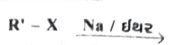
$R^{\prime}-X \xrightarrow{Na / \text{ether}} 2,3-\text{dimethylbutane}$. Identify $R^{\prime}$.
A
$(CH_3CH_2)_3C-$
B
$(C_2H_5)_2CH-$
C
$(CH_3)_3C-$
D
$(CH_3)_2CH-$
Solution
(D) The reaction given is the Wurtz reaction,where an alkyl halide reacts with sodium in the presence of dry ether to form a symmetric alkane.
$2R^{\prime}-X + 2Na \xrightarrow{\text{ether}} R^{\prime}-R^{\prime} + 2NaX$
Given the product is $2,3-\text{dimethylbutane}$,which has the structure $(CH_3)_2CH-CH(CH_3)_2$.
This indicates that the alkyl group $R^{\prime}$ must be an isopropyl group,$(CH_3)_2CH-$.
Therefore,$R^{\prime}-X$ is isopropyl halide,$(CH_3)_2CH-X$.
$2R^{\prime}-X + 2Na \xrightarrow{\text{ether}} R^{\prime}-R^{\prime} + 2NaX$
Given the product is $2,3-\text{dimethylbutane}$,which has the structure $(CH_3)_2CH-CH(CH_3)_2$.
This indicates that the alkyl group $R^{\prime}$ must be an isopropyl group,$(CH_3)_2CH-$.
Therefore,$R^{\prime}-X$ is isopropyl halide,$(CH_3)_2CH-X$.
0 likes
View Solution654
EasyMCQ
Which product is obtained on heating sodium acetate with sodalime?
A
Butane
B
Propane
C
Ethane
D
Methane
Solution
(D) The reaction of sodium acetate $(CH_3COONa)$ with sodalime $(NaOH + CaO)$ is known as decarboxylation.
When sodium acetate is heated with sodalime,it loses a molecule of $CO_2$ to form methane $(CH_4)$ and sodium carbonate $(Na_2CO_3)$.
The chemical equation is: $CH_3COONa + NaOH \xrightarrow{CaO, \Delta} CH_4 + Na_2CO_3$.
Thus,the product obtained is methane.
When sodium acetate is heated with sodalime,it loses a molecule of $CO_2$ to form methane $(CH_4)$ and sodium carbonate $(Na_2CO_3)$.
The chemical equation is: $CH_3COONa + NaOH \xrightarrow{CaO, \Delta} CH_4 + Na_2CO_3$.
Thus,the product obtained is methane.
0 likes
View Solution655
EasyMCQ
Which reagent will be used in the following process?
$CH_3-CH_2-CH_2-CH_3 \rightarrow CH_3-CH_2-CH_2-CH_2-Cl + CH_3-CH_2-CHCl-CH_3$
$CH_3-CH_2-CH_2-CH_3 \rightarrow CH_3-CH_2-CH_2-CH_2-Cl + CH_3-CH_2-CHCl-CH_3$
A
$NaCl + H_2SO_4$
B
$Cl_2$ / Air / Darkness
C
$Cl_2 / UV$ light
D
$Cl_2$ / Air / $Fe$ / Darkness
Solution
(C) The given reaction is the free radical chlorination of $n$-butane.
This reaction proceeds via a free radical mechanism initiated by ultraviolet $(UV)$ light.
$CH_3-CH_2-CH_2-CH_3 + Cl_2 \xrightarrow{UV \ light} CH_3-CH_2-CH_2-CH_2-Cl + CH_3-CH_2-CHCl-CH_3 + HCl$.
Therefore,the correct reagent is $Cl_2 / UV$ light.
This reaction proceeds via a free radical mechanism initiated by ultraviolet $(UV)$ light.
$CH_3-CH_2-CH_2-CH_3 + Cl_2 \xrightarrow{UV \ light} CH_3-CH_2-CH_2-CH_2-Cl + CH_3-CH_2-CHCl-CH_3 + HCl$.
Therefore,the correct reagent is $Cl_2 / UV$ light.
0 likes
View Solution656
EasyMCQ
$R'-Cl \xrightarrow{Na/\text{Ether}} 2,3-\text{dimethylbutane}$. What is $R'$ in the above reaction?
A
$n-\text{propyl}$
B
$isobutyl$
C
$sec-\text{butyl}$
D
$isopropyl$
Solution
(D) The given reaction is a Wurtz reaction,where two molecules of an alkyl halide $(R'-Cl)$ react with sodium in the presence of dry ether to form a symmetric alkane.
The reaction is: $2R'-Cl + 2Na \xrightarrow{\text{Dry ether}} R'-R' + 2NaCl$.
The product formed is $2,3-\text{dimethylbutane}$,which has the structure $CH_3-CH(CH_3)-CH(CH_3)-CH_3$.
By splitting this symmetric alkane at the center,we get two identical fragments of $CH_3-CH(CH_3)-$. Thus,the alkyl group $R'$ is the isopropyl group,$CH_3-CH(CH_3)-$.
Therefore,$R'-Cl$ is isopropyl chloride.
The reaction is: $2R'-Cl + 2Na \xrightarrow{\text{Dry ether}} R'-R' + 2NaCl$.
The product formed is $2,3-\text{dimethylbutane}$,which has the structure $CH_3-CH(CH_3)-CH(CH_3)-CH_3$.
By splitting this symmetric alkane at the center,we get two identical fragments of $CH_3-CH(CH_3)-$. Thus,the alkyl group $R'$ is the isopropyl group,$CH_3-CH(CH_3)-$.
Therefore,$R'-Cl$ is isopropyl chloride.
0 likes
View Solution657
EasyMCQ
Which compound in the following will give only one mono-chlorination product in the presence of light?
A
$n-$Butane
B
iso-pentane
C
neo-pentane
D
$n-$pentane
Solution
(C) Mono-chlorination involves the replacement of a hydrogen atom with a chlorine atom in the presence of light $(h\nu)$.
For a compound to yield only one mono-chlorination product,all hydrogen atoms in the molecule must be equivalent.
$A$. $n-$Butane $(CH_3-CH_2-CH_2-CH_3)$ has two types of hydrogen atoms,yielding two products.
$B$. iso-pentane $((CH_3)_2CH-CH_2-CH_3)$ has four types of hydrogen atoms,yielding four products.
$C$. neo-pentane $((CH_3)_4C)$ has all $12$ hydrogen atoms equivalent (attached to the same type of carbon),yielding only one product: $1-$chloro-$2,2-$dimethylpropane.
$D$. $n-$pentane $(CH_3-CH_2-CH_2-CH_2-CH_3)$ has three types of hydrogen atoms,yielding three products.
Therefore,the correct answer is $C$.
For a compound to yield only one mono-chlorination product,all hydrogen atoms in the molecule must be equivalent.
$A$. $n-$Butane $(CH_3-CH_2-CH_2-CH_3)$ has two types of hydrogen atoms,yielding two products.
$B$. iso-pentane $((CH_3)_2CH-CH_2-CH_3)$ has four types of hydrogen atoms,yielding four products.
$C$. neo-pentane $((CH_3)_4C)$ has all $12$ hydrogen atoms equivalent (attached to the same type of carbon),yielding only one product: $1-$chloro-$2,2-$dimethylpropane.
$D$. $n-$pentane $(CH_3-CH_2-CH_2-CH_2-CH_3)$ has three types of hydrogen atoms,yielding three products.
Therefore,the correct answer is $C$.
0 likes
View Solution658
EasyMCQ
How many monochloro structural isomers are expected to be formed on free radical monochlorination of isopentane?
A
$2$
B
$4$
C
$3$
D
$5$
Solution
(B) The structure of isopentane is $CH_3-CH(CH_3)-CH_2-CH_3$.
There are $4$ distinct types of hydrogen atoms in isopentane:
$1$. Primary hydrogens on the terminal $CH_3$ group attached to the $CH$ group.
$2$. Tertiary hydrogen on the $CH$ group.
$3$. Secondary hydrogens on the $CH_2$ group.
$4$. Primary hydrogens on the terminal $CH_3$ group attached to the $CH_2$ group.
Since there are $4$ different types of hydrogen atoms,replacing any one of them with a chlorine atom will result in $4$ different monochloro structural isomers.
Therefore,the correct answer is $4$.
There are $4$ distinct types of hydrogen atoms in isopentane:
$1$. Primary hydrogens on the terminal $CH_3$ group attached to the $CH$ group.
$2$. Tertiary hydrogen on the $CH$ group.
$3$. Secondary hydrogens on the $CH_2$ group.
$4$. Primary hydrogens on the terminal $CH_3$ group attached to the $CH_2$ group.
Since there are $4$ different types of hydrogen atoms,replacing any one of them with a chlorine atom will result in $4$ different monochloro structural isomers.
Therefore,the correct answer is $4$.
0 likes
View Solution659
DifficultMCQ
Sodium ethanoate on heating with soda lime gives '$X$'. Electrolysis of aqueous solution of sodium ethanoate gives '$Y$'. '$X$' and '$Y$' respectively are
A
methane and ethane
B
methane and methane
C
ethane and methane
D
ethane and ethane
Solution
(A) The complete reaction sequence involved is as follows:
$CH_3COONa + NaOH \xrightarrow[\Delta]{CaO} CH_4 + Na_2CO_3$
(Sodium ethanoate) (Methane $X$)
$2CH_3COONa + 2H_2O \xrightarrow{\text{Electrolysis}} CH_3-CH_3 + 2CO_2 + H_2 + 2NaOH$
(Ethane $Y$)
Thus,the compounds $X$ and $Y$ are methane and ethane respectively.
$CH_3COONa + NaOH \xrightarrow[\Delta]{CaO} CH_4 + Na_2CO_3$
(Sodium ethanoate) (Methane $X$)
$2CH_3COONa + 2H_2O \xrightarrow{\text{Electrolysis}} CH_3-CH_3 + 2CO_2 + H_2 + 2NaOH$
(Ethane $Y$)
Thus,the compounds $X$ and $Y$ are methane and ethane respectively.
0 likes
View Solution660
EasyMCQ
For the preparation of alkanes,an aqueous solution of sodium or potassium salt of carboxylic acid is subjected to:
A
Hydrolysis
B
Oxidation
C
Hydrogenation
D
Electrolysis
Solution
(D) This is $Kolbe's$ electrolytic method which produces alkanes.
$2 RCOONa + 2 H_2O \xrightarrow{\text{Electrolysis}} R-R + 2 NaOH + H_2 + 2 CO_2$
Steps of reaction:
$2 CH_3COONa \rightleftharpoons 2 CH_3COO^{-} + 2 Na^{+}$
$2 H_2O \rightleftharpoons 2 OH^{-} + 2 H^{+}$
At anode:
$2 CH_3COO^{-} - 2 e^{-}$ $\rightarrow [2 CH_3COO]$ $\rightarrow CH_3-CH_3 + 2 CO_2$
At cathode:
$2 H^{+} + 2 e^{-}$ $\rightarrow [2 H]$ $\rightarrow H_2$
$2 RCOONa + 2 H_2O \xrightarrow{\text{Electrolysis}} R-R + 2 NaOH + H_2 + 2 CO_2$
Steps of reaction:
$2 CH_3COONa \rightleftharpoons 2 CH_3COO^{-} + 2 Na^{+}$
$2 H_2O \rightleftharpoons 2 OH^{-} + 2 H^{+}$
At anode:
$2 CH_3COO^{-} - 2 e^{-}$ $\rightarrow [2 CH_3COO]$ $\rightarrow CH_3-CH_3 + 2 CO_2$
At cathode:
$2 H^{+} + 2 e^{-}$ $\rightarrow [2 H]$ $\rightarrow H_2$
0 likes
View Solution661
DifficultMCQ
$100 \ mL$ of $0.1 \ M$ acetic acid is completely neutralized using a standard solution of $NaOH$. The volume of ethane obtained at $STP$ after the complete electrolysis of the resulting solution is (in $mL$)
A
$56$
B
$224$
C
$560$
D
$112$
Solution
(D) The neutralization reaction is: $CH_3COOH + NaOH \rightarrow CH_3COONa + H_2O$.
Moles of $CH_3COOH = 0.1 \ M \times 0.1 \ L = 0.01 \ mol$.
Thus,$0.01 \ mol$ of $CH_3COONa$ is formed.
Kolbe's electrolysis reaction is: $2CH_3COONa + 2H_2O \rightarrow C_2H_6 + 2CO_2 + H_2 + 2NaOH$.
According to the stoichiometry,$2 \ mol$ of $CH_3COONa$ produces $1 \ mol$ of $C_2H_6$.
Therefore,$0.01 \ mol$ of $CH_3COONa$ produces $0.005 \ mol$ of $C_2H_6$.
Volume of $C_2H_6$ at $STP = 0.005 \ mol \times 22400 \ mL/mol = 112 \ mL$.
Moles of $CH_3COOH = 0.1 \ M \times 0.1 \ L = 0.01 \ mol$.
Thus,$0.01 \ mol$ of $CH_3COONa$ is formed.
Kolbe's electrolysis reaction is: $2CH_3COONa + 2H_2O \rightarrow C_2H_6 + 2CO_2 + H_2 + 2NaOH$.
According to the stoichiometry,$2 \ mol$ of $CH_3COONa$ produces $1 \ mol$ of $C_2H_6$.
Therefore,$0.01 \ mol$ of $CH_3COONa$ produces $0.005 \ mol$ of $C_2H_6$.
Volume of $C_2H_6$ at $STP = 0.005 \ mol \times 22400 \ mL/mol = 112 \ mL$.
0 likes
View Solution662
MediumMCQ
The angle strain in cyclobutane is
A
$24^{\circ} 44^{\prime}$
B
$29^{\circ} 16^{\prime}$
C
$19^{\circ} 22^{\prime}$
D
$9^{\circ} 44^{\prime}$
Solution
(D) In an ideal $sp^3$ hybridized carbon atom,the bond angle is $109^{\circ} 28^{\prime}$.
In cyclobutane,the carbon atoms form a square,so the internal bond angle is $90^{\circ}$.
The total deviation from the tetrahedral angle is $109^{\circ} 28^{\prime} - 90^{\circ} = 19^{\circ} 28^{\prime}$.
According to Baeyer's strain theory,the angle strain is half of this deviation.
$\text{Angle strain} = \frac{1}{2} \times (109^{\circ} 28^{\prime} - 90^{\circ}) = \frac{19^{\circ} 28^{\prime}}{2} = 9^{\circ} 44^{\prime}$.
In cyclobutane,the carbon atoms form a square,so the internal bond angle is $90^{\circ}$.
The total deviation from the tetrahedral angle is $109^{\circ} 28^{\prime} - 90^{\circ} = 19^{\circ} 28^{\prime}$.
According to Baeyer's strain theory,the angle strain is half of this deviation.
$\text{Angle strain} = \frac{1}{2} \times (109^{\circ} 28^{\prime} - 90^{\circ}) = \frac{19^{\circ} 28^{\prime}}{2} = 9^{\circ} 44^{\prime}$.
0 likes
View Solution663
MediumMCQ
The angle strain in cyclopropane is:
A
$24^{\circ} 44^{\prime}$
B
$9^{\circ} 44^{\prime}$
C
$44^{\prime}$
D
$-5^{\circ} 16^{\prime}$
Solution
(A) The bond angle in cyclopropane is calculated as $\theta = \frac{180(n-2)}{n} = \frac{180(3-2)}{3} = 60^{\circ}$.
Angle strain is defined as $\alpha = \frac{1}{2} (109^{\circ} 28^{\prime} - \theta)$.
Substituting the value of $\theta = 60^{\circ}$:
$\alpha = \frac{1}{2} (109^{\circ} 28^{\prime} - 60^{\circ}) = \frac{1}{2} (49^{\circ} 28^{\prime}) = 24^{\circ} 44^{\prime}$.
Angle strain is defined as $\alpha = \frac{1}{2} (109^{\circ} 28^{\prime} - \theta)$.
Substituting the value of $\theta = 60^{\circ}$:
$\alpha = \frac{1}{2} (109^{\circ} 28^{\prime} - 60^{\circ}) = \frac{1}{2} (49^{\circ} 28^{\prime}) = 24^{\circ} 44^{\prime}$.
0 likes
View Solution664
EasyMCQ
The cycloalkane formed when $1,4$-dibromopentane is heated with sodium is:
A
methyl cyclobutane
B
cyclopentane
C
cyclobutane
D
methyl cyclopentane
Solution
(A) When $1,4$-dibromopentane is treated with sodium metal,an intramolecular Wurtz reaction occurs.
This leads to the formation of a four-membered ring with a methyl substituent.
The reaction is represented as:
$CH_3-CH(Br)-CH_2-CH_2-CH_2-Br + 2Na \rightarrow \text{Methylcyclobutane} + 2NaBr$.
Thus,the product formed is methyl cyclobutane.
This leads to the formation of a four-membered ring with a methyl substituent.
The reaction is represented as:
$CH_3-CH(Br)-CH_2-CH_2-CH_2-Br + 2Na \rightarrow \text{Methylcyclobutane} + 2NaBr$.
Thus,the product formed is methyl cyclobutane.
0 likes
View Solution665
MediumMCQ
$A$ dibromo derivative of an alkane reacts with sodium metal to form an alicyclic hydrocarbon. The derivative is
A
$1, 1-$dibromopropane
B
$2, 2-$dibromobutane
C
$1, 2-$dibromoethane
D
$1, 4-$dibromobutane
Solution
(D) When $\omega$-dihalides (terminal dihalides) react with sodium metal in the presence of dry ether,an intramolecular Wurtz reaction occurs,leading to the formation of a cyclic hydrocarbon.
For example,$1, 4-$dibromobutane reacts with $2Na$ to form cyclobutane and $2NaBr$ as a byproduct.
The reaction is: $Br-CH_2-CH_2-CH_2-CH_2-Br + 2Na \rightarrow \text{Cyclobutane} + 2NaBr$.
For example,$1, 4-$dibromobutane reacts with $2Na$ to form cyclobutane and $2NaBr$ as a byproduct.
The reaction is: $Br-CH_2-CH_2-CH_2-CH_2-Br + 2Na \rightarrow \text{Cyclobutane} + 2NaBr$.
0 likes
View Solution666
MediumMCQ
$n$-Propyl chloride reacts with sodium metal in dry ether to give:
A
$CH_{3}CH_{2}CH_{2}CH_{2}CH_{2}CH_{3}$
B
$CH_{3}CH_{2}CH_{3}$
C
$CH_{3}CH_{2}CH_{2}CH_{3}$
D
$CH_{3}CH_{2}CH_{2}CH_{2}CH_{2}CH_{2}CH_{3}$
Solution
(A) This reaction is an example of the $Wurtz$ reaction,where alkyl halides react with sodium metal in the presence of dry ether to form higher alkanes.
$2 CH_{3}CH_{2}CH_{2}Cl + 2 Na \xrightarrow{\text{dry ether}} CH_{3}CH_{2}CH_{2}CH_{2}CH_{2}CH_{3} + 2 NaCl$
As $n$-propyl chloride $(CH_{3}CH_{2}CH_{2}Cl)$ is used,the product formed is $n$-hexane $(CH_{3}CH_{2}CH_{2}CH_{2}CH_{2}CH_{3})$.
$2 CH_{3}CH_{2}CH_{2}Cl + 2 Na \xrightarrow{\text{dry ether}} CH_{3}CH_{2}CH_{2}CH_{2}CH_{2}CH_{3} + 2 NaCl$
As $n$-propyl chloride $(CH_{3}CH_{2}CH_{2}Cl)$ is used,the product formed is $n$-hexane $(CH_{3}CH_{2}CH_{2}CH_{2}CH_{2}CH_{3})$.
0 likes
View Solution667
EasyMCQ
$Methane$ can be converted into $ethane$ by the reactions
A
chlorination followed by the reaction with alcoholic $KOH$
B
chlorination followed by the reaction with aqueous $KOH$
C
chlorination followed by $Wurtz$ reaction
D
chlorination followed by decarboxylation
Solution
(C) The chlorination of $methane$ is carried out by treating it with chlorine in the presence of ultraviolet light or by heating the reaction mixture to $520-670 \ K$.
$CH_{4} + Cl_{2} \xrightarrow{hv \ or \ \Delta} CH_{3}Cl + HCl$
This $methyl \ chloride$ reacts with metallic $Na$ in the presence of dry ether to form a symmetrical alkane with a higher number of carbon atoms $(ethane)$.
$2CH_{3}Cl + 2Na \xrightarrow{\text{dry ether}} CH_{3}-CH_{3} + 2NaCl$
This reaction is called the $Wurtz$ reaction.
$CH_{4} + Cl_{2} \xrightarrow{hv \ or \ \Delta} CH_{3}Cl + HCl$
This $methyl \ chloride$ reacts with metallic $Na$ in the presence of dry ether to form a symmetrical alkane with a higher number of carbon atoms $(ethane)$.
$2CH_{3}Cl + 2Na \xrightarrow{\text{dry ether}} CH_{3}-CH_{3} + 2NaCl$
This reaction is called the $Wurtz$ reaction.
0 likes
View Solution668
MediumMCQ
What are $X$ and $Y$ respectively in the following reaction sequence?
Isopentane $\xrightarrow{KMnO_4} X$ $\xrightarrow{\text{dehydration}} \underset{\text{Major}}{Y}$
Isopentane $\xrightarrow{KMnO_4} X$ $\xrightarrow{\text{dehydration}} \underset{\text{Major}}{Y}$
A
$X$ = $2-$methylbutan$-2-$ol,$Y$ = $2-$methylbut$-2-$ene
B
$X$ = $3-$methylbutan$-2-$ol,$Y$ = $2-$methylbut$-2-$ene
C
$X$ = $2-$methylbutan$-2-$ol,$Y$ = $2-$methylbut$-1-$ene
D
$X$ = $3-$methylbutan$-2-$ol,$Y$ = $3-$methylbut$-1-$ene
Solution
(A) The reaction proceeds as follows:
$1$. Oxidation of isopentane ($2$-methylbutane) with $KMnO_4$ occurs at the tertiary carbon atom to form $2-$methylbutan$-2-$ol $(X)$.
$2$. Dehydration of $2-$methylbutan$-2-$ol using an acid catalyst follows Saytzeff's rule to form the more substituted and stable alkene,$2$-methylbut$-2-$ene,as the major product $(Y)$.
$1$. Oxidation of isopentane ($2$-methylbutane) with $KMnO_4$ occurs at the tertiary carbon atom to form $2-$methylbutan$-2-$ol $(X)$.
$2$. Dehydration of $2-$methylbutan$-2-$ol using an acid catalyst follows Saytzeff's rule to form the more substituted and stable alkene,$2$-methylbut$-2-$ene,as the major product $(Y)$.
0 likes
View Solution669
EasyMCQ
Wurtz reaction of bromoethane gives $n$-butane. Sodium salt of $X$ on heating with sodalime also results in $n$-butane. Compound $X$ is
A
$CH_3-CH_2-CH_2-COOH$
B
$CH_3-(CH_2)_3-COOH$
C
$CH_3-(CH_2)_4-COOH$
D
$CH_3-CH_2-COOH$
Solution
(B) In Wurtz reaction, two molecules of bromoethane react with $2$ molecules of sodium to form $n$-butane:
$2CH_3CH_2Br + 2Na \rightarrow CH_3CH_2CH_2CH_3 + 2NaBr$
Decarboxylation of the sodium salt of a carboxylic acid with sodalime $(NaOH + CaO)$ removes one carbon atom as $Na_2CO_3$ to produce an alkane with one less carbon atom than the original acid.
To obtain $n$-butane ($4$ carbons), the sodium salt must be derived from a pentanoic acid ($5$ carbons).
The reaction is:
$CH_3CH_2CH_2CH_2COONa + NaOH \xrightarrow{CaO, \Delta} CH_3CH_2CH_2CH_3 + Na_2CO_3$
Thus, $X$ is pentanoic acid, $CH_3(CH_2)_3COOH$.
$2CH_3CH_2Br + 2Na \rightarrow CH_3CH_2CH_2CH_3 + 2NaBr$
Decarboxylation of the sodium salt of a carboxylic acid with sodalime $(NaOH + CaO)$ removes one carbon atom as $Na_2CO_3$ to produce an alkane with one less carbon atom than the original acid.
To obtain $n$-butane ($4$ carbons), the sodium salt must be derived from a pentanoic acid ($5$ carbons).
The reaction is:
$CH_3CH_2CH_2CH_2COONa + NaOH \xrightarrow{CaO, \Delta} CH_3CH_2CH_2CH_3 + Na_2CO_3$
Thus, $X$ is pentanoic acid, $CH_3(CH_2)_3COOH$.
0 likes
View Solution670
MediumMCQ
On electrolysis of an aqueous solution of sodium butanoate,a hydrocarbon is formed. The number of carbon atoms present in the hydrocarbon is:
A
$6$
B
$4$
C
$8$
D
$3$
Solution
(A) The electrolysis of sodium salts of carboxylic acids is known as Kolbe's electrolysis.
For sodium butanoate $(CH_3CH_2CH_2COONa)$,the reaction is:
$2CH_3CH_2CH_2COONa + 2H_2O \rightarrow CH_3CH_2CH_2-CH_2CH_2CH_3 + 2CO_2 + H_2 + 2NaOH$.
The hydrocarbon formed is hexane $(C_6H_{14})$,which contains $6$ carbon atoms.
For sodium butanoate $(CH_3CH_2CH_2COONa)$,the reaction is:
$2CH_3CH_2CH_2COONa + 2H_2O \rightarrow CH_3CH_2CH_2-CH_2CH_2CH_3 + 2CO_2 + H_2 + 2NaOH$.
The hydrocarbon formed is hexane $(C_6H_{14})$,which contains $6$ carbon atoms.
0 likes
View Solution671
DifficultMCQ
$A$ compound $A$ contains $C$ and $H$ only and has a molecular mass of $72$. Its photochlorination gives a mixture containing only one monochloro and two dichloro hydrocarbons. What is its $IUPAC$ name?
A
$2, 2-$dimethylpropane
B
$n-$pentane
C
$2-$methylbutane
D
cyclopentane
Solution
(A) The molecular formula $C_5H_{12}$ corresponds to a molecular mass of $72 \ g/mol$.
Among the isomers of pentane,$2, 2-$dimethylpropane $(neopentane)$ has all $12$ hydrogen atoms equivalent.
Therefore,it yields only one monochloro derivative upon photochlorination.
Further substitution leads to two distinct dichloro derivatives.
The structure of $A$ is $CH_3-C(CH_3)_2-CH_3$.
Among the isomers of pentane,$2, 2-$dimethylpropane $(neopentane)$ has all $12$ hydrogen atoms equivalent.
Therefore,it yields only one monochloro derivative upon photochlorination.
Further substitution leads to two distinct dichloro derivatives.
The structure of $A$ is $CH_3-C(CH_3)_2-CH_3$.
0 likes
View Solution672
MediumMCQ
When ethyl bromide and $n$-propyl bromide are allowed to react with $Na$ metal in dry ether,the number of different alkanes formed is
A
$1$
B
$2$
C
$3$
D
$4$
Solution
(C) The reaction of a mixture of two different alkyl halides with $Na$ metal in dry ether is known as the Wurtz reaction.
When a mixture of ethyl bromide $(C_2H_5Br)$ and $n$-propyl bromide $(C_3H_7Br)$ reacts with $Na$ in dry ether,three different alkanes are formed due to the coupling of alkyl radicals:
$1$. Coupling of two ethyl radicals: $C_2H_5-C_2H_5$ ($n$-butane)
$2$. Coupling of two $n$-propyl radicals: $C_3H_7-C_3H_7$ ($n$-hexane)
$3$. Cross-coupling of one ethyl and one $n$-propyl radical: $C_2H_5-C_3H_7$ ($n$-pentane)
Thus,a total of $3$ different alkanes are formed.
When a mixture of ethyl bromide $(C_2H_5Br)$ and $n$-propyl bromide $(C_3H_7Br)$ reacts with $Na$ in dry ether,three different alkanes are formed due to the coupling of alkyl radicals:
$1$. Coupling of two ethyl radicals: $C_2H_5-C_2H_5$ ($n$-butane)
$2$. Coupling of two $n$-propyl radicals: $C_3H_7-C_3H_7$ ($n$-hexane)
$3$. Cross-coupling of one ethyl and one $n$-propyl radical: $C_2H_5-C_3H_7$ ($n$-pentane)
Thus,a total of $3$ different alkanes are formed.
0 likes
View Solution673
EasyMCQ
Which is the correct option for the following reaction?
$ 2 CH_3 CH_2 Br \xrightarrow{2 Na / \text{Dry ether}} ? $
$ 2 CH_3 CH_2 Br \xrightarrow{2 Na / \text{Dry ether}} ? $
A
Wurtz reaction; $CH_3 CH_2 CH_2 CH_3$
B
Wurtz-Fittig reaction; $CH_3 CH_2 CH_2 CH_3$
C
Wurtz reaction; $CH_3 CH_2 CH_2 CH_2 CH_3$
D
Wurtz-Fittig reaction; $CH_3 CH_2 CH_2 CH_2 CH_3$
Solution
(A) The given reaction is: $2 CH_3 CH_2 Br + 2 Na \xrightarrow{\text{Dry ether}} CH_3 CH_2 CH_2 CH_3 + 2 NaBr$.
This reaction involves the coupling of two alkyl halide molecules in the presence of sodium metal and dry ether to form a higher alkane.
This specific reaction is known as the Wurtz reaction.
The product formed is $n$-butane $(CH_3 CH_2 CH_2 CH_3)$.
This reaction involves the coupling of two alkyl halide molecules in the presence of sodium metal and dry ether to form a higher alkane.
This specific reaction is known as the Wurtz reaction.
The product formed is $n$-butane $(CH_3 CH_2 CH_2 CH_3)$.
0 likes
View Solution674
EasyMCQ
The major products $P$ and $Q$ of the following reactions respectively are:
$I$. $n$-pentyl bromide $\xrightarrow{Zn / H^{+}} P$
$II$. $n$-pentyl bromide $\xrightarrow[\text{Dry ether}]{Na} Q$
$I$. $n$-pentyl bromide $\xrightarrow{Zn / H^{+}} P$
$II$. $n$-pentyl bromide $\xrightarrow[\text{Dry ether}]{Na} Q$
A
pentane; decane
B
pent$-1-$ene; decane
C
pentane; pentane
D
pentane; $1$-decene
Solution
(A) In reaction $I$,$n$-pentyl bromide $(CH_3CH_2CH_2CH_2CH_2Br)$ reacts with $Zn/H^+$ (a reducing agent),which replaces the $Br$ atom with an $H$ atom to form pentane $(CH_3CH_2CH_2CH_2CH_3)$ as product $P$.
In reaction $II$,$n$-pentyl bromide reacts with $Na$ in the presence of dry ether,which is the Wurtz reaction. This reaction couples two alkyl groups to form a symmetric alkane,resulting in decane $(CH_3(CH_2)_8CH_3)$ as product $Q$.
In reaction $II$,$n$-pentyl bromide reacts with $Na$ in the presence of dry ether,which is the Wurtz reaction. This reaction couples two alkyl groups to form a symmetric alkane,resulting in decane $(CH_3(CH_2)_8CH_3)$ as product $Q$.
0 likes
View Solution675
EasyMCQ
Identify the initiation step$(s)$ $(X)$ and termination step$(s)$ $(Y)$ of free radical chlorination of $CH_4$ from the following:
$a) \dot{C}H_3 + \dot{Cl} \rightarrow CH_3-Cl$
$b) \dot{Cl} + \dot{Cl} \rightarrow Cl_2$
$c) \dot{C}H_3 + Cl_2 \rightarrow CH_3-Cl + \dot{Cl}$
$d) Cl_2 \rightarrow 2\dot{Cl}$
$e) CH_4 + \dot{Cl} \rightarrow \dot{C}H_3 + HCl$
$f) \dot{C}H_3 + \dot{C}H_3 \rightarrow CH_3-CH_3$
$a) \dot{C}H_3 + \dot{Cl} \rightarrow CH_3-Cl$
$b) \dot{Cl} + \dot{Cl} \rightarrow Cl_2$
$c) \dot{C}H_3 + Cl_2 \rightarrow CH_3-Cl + \dot{Cl}$
$d) Cl_2 \rightarrow 2\dot{Cl}$
$e) CH_4 + \dot{Cl} \rightarrow \dot{C}H_3 + HCl$
$f) \dot{C}H_3 + \dot{C}H_3 \rightarrow CH_3-CH_3$
A
$X: c, d; Y: a, b$
B
$X: b, d; Y: a, c, e$
C
$X: d, e; Y: b, c, f$
D
$X: d; Y: a, b, f$
Solution
(D) In the free radical chlorination of methane $(CH_4)$:
$1.$ **Initiation step $(X)$:** $A$ neutral molecule breaks into radicals,usually in the presence of $UV$ light or heat. Here,$d) Cl_2 \rightarrow 2\dot{Cl}$ is the initiation step.
$2.$ **Propagation steps:** $A$ radical reacts with a neutral molecule to produce another radical and a neutral molecule. Steps $(c)$ and $(e)$ are propagation steps.
$3.$ **Termination steps $(Y)$:** Two radicals combine to form a neutral molecule,ending the chain reaction. Steps $(a), (b),$ and $(f)$ are termination steps.
Thus,$X = \{d\}$ and $Y = \{a, b, f\}$.
$1.$ **Initiation step $(X)$:** $A$ neutral molecule breaks into radicals,usually in the presence of $UV$ light or heat. Here,$d) Cl_2 \rightarrow 2\dot{Cl}$ is the initiation step.
$2.$ **Propagation steps:** $A$ radical reacts with a neutral molecule to produce another radical and a neutral molecule. Steps $(c)$ and $(e)$ are propagation steps.
$3.$ **Termination steps $(Y)$:** Two radicals combine to form a neutral molecule,ending the chain reaction. Steps $(a), (b),$ and $(f)$ are termination steps.
Thus,$X = \{d\}$ and $Y = \{a, b, f\}$.
0 likes
View Solution676
MediumMCQ
Consider the following:
Statement-$I$ : Kolbe's electrolysis of sodium propionate gives $n$-hexane as product.
Statement-$II$ : In Kolbe's process,$CO_2$ is liberated at the anode and $H_2$ is liberated at the cathode.
The correct answer is:
Statement-$I$ : Kolbe's electrolysis of sodium propionate gives $n$-hexane as product.
Statement-$II$ : In Kolbe's process,$CO_2$ is liberated at the anode and $H_2$ is liberated at the cathode.
The correct answer is:
A
Both statement-$I$ and statement-$II$ are correct.
B
Both statement-$I$ and statement-$II$ are not correct.
C
Statement-$I$ is correct,but statement-$II$ is not correct.
D
Statement-$I$ is not correct,but statement-$II$ is correct.
Solution
(D) In Kolbe's electrolysis,the reaction is $2CH_3CH_2COONa + 2H_2O \xrightarrow{\text{electrolysis}} CH_3CH_2CH_2CH_2CH_3 + 2CO_2 + H_2 + 2NaOH$.
Statement-$I$: Sodium propionate $(CH_3CH_2COONa)$ undergoes electrolysis to form $n$-butane $(CH_3CH_2CH_2CH_3)$,not $n$-hexane. Thus,statement-$I$ is incorrect.
Statement-$II$: During the electrolysis of sodium salts of carboxylic acids,$CO_2$ is evolved at the anode and $H_2$ is evolved at the cathode. Thus,statement-$II$ is correct.
Statement-$I$: Sodium propionate $(CH_3CH_2COONa)$ undergoes electrolysis to form $n$-butane $(CH_3CH_2CH_2CH_3)$,not $n$-hexane. Thus,statement-$I$ is incorrect.
Statement-$II$: During the electrolysis of sodium salts of carboxylic acids,$CO_2$ is evolved at the anode and $H_2$ is evolved at the cathode. Thus,statement-$II$ is correct.
0 likes
View Solution677
MediumMCQ
$A$ mixture of ethyl iodide and $n$-propyl iodide is subjected to Wurtz reaction. The hydrocarbon which will not be formed is
A
Butane
B
Propane
C
Pentane
D
Hexane
Solution
(B) The Wurtz reaction involves the coupling of alkyl halides in the presence of sodium and dry ether.
When a mixture of ethyl iodide $(C_2H_5I)$ and $n$-propyl iodide $(C_3H_7I)$ is used,the following coupling reactions occur:
$1$. $C_2H_5I + C_2H_5I \xrightarrow{Na/dry ether} C_4H_{10}$ ($n$-butane)
$2$. $C_3H_7I + C_3H_7I \xrightarrow{Na/dry ether} C_6H_{14}$ ($n$-hexane)
$3$. $C_2H_5I + C_3H_7I \xrightarrow{Na/dry ether} C_5H_{12}$ ($n$-pentane)
Thus,$n$-butane,$n$-hexane,and $n$-pentane are formed,while propane is not formed.
When a mixture of ethyl iodide $(C_2H_5I)$ and $n$-propyl iodide $(C_3H_7I)$ is used,the following coupling reactions occur:
$1$. $C_2H_5I + C_2H_5I \xrightarrow{Na/dry ether} C_4H_{10}$ ($n$-butane)
$2$. $C_3H_7I + C_3H_7I \xrightarrow{Na/dry ether} C_6H_{14}$ ($n$-hexane)
$3$. $C_2H_5I + C_3H_7I \xrightarrow{Na/dry ether} C_5H_{12}$ ($n$-pentane)
Thus,$n$-butane,$n$-hexane,and $n$-pentane are formed,while propane is not formed.
0 likes
View Solution678
MediumMCQ
In Kolbe's electrolysis of sodium propanoate,products formed at anode and cathode are respectively:
A
$C_2H_6, H_2$
B
$C_3H_8, H_2$
C
$C_4H_{10}, H_2$
D
$H_2, C_4H_{10}$
Solution
(C) In Kolbe's electrolysis,the reaction is as follows:
$2CH_3CH_2COONa + 2H_2O \rightarrow CH_3CH_2CH_2CH_3 + 2CO_2 + H_2 + 2NaOH$
At the anode,the propanoate ion $(CH_3CH_2COO^-)$ undergoes oxidation to form an alkyl radical $(CH_3CH_2^\bullet)$,which then dimerizes to form $n$-butane $(C_4H_{10})$ along with the release of $CO_2$.
At the cathode,water is reduced to form hydrogen gas $(H_2)$ and hydroxide ions $(OH^-)$.
Therefore,the products at the anode and cathode are $C_4H_{10}$ and $H_2$ respectively.
$2CH_3CH_2COONa + 2H_2O \rightarrow CH_3CH_2CH_2CH_3 + 2CO_2 + H_2 + 2NaOH$
At the anode,the propanoate ion $(CH_3CH_2COO^-)$ undergoes oxidation to form an alkyl radical $(CH_3CH_2^\bullet)$,which then dimerizes to form $n$-butane $(C_4H_{10})$ along with the release of $CO_2$.
At the cathode,water is reduced to form hydrogen gas $(H_2)$ and hydroxide ions $(OH^-)$.
Therefore,the products at the anode and cathode are $C_4H_{10}$ and $H_2$ respectively.
0 likes
View Solution679
EasyMCQ
The correct order of boiling points of the following molecules is:
$(i)$ $n$-Hexane
$(ii)$ $2$-methylpentane
$(iii)$ $2,3$-dimethylbutane
$(i)$ $n$-Hexane
$(ii)$ $2$-methylpentane
$(iii)$ $2,3$-dimethylbutane
A
$i > ii > iii$
B
$iii > ii > i$
C
$iii > i > ii$
D
$i > iii > ii$
Solution
(A) The boiling point of isomeric alkanes decreases with increasing branching due to a decrease in the exposed surface area,which leads to weaker van der Waals forces.
$n$-Hexane $(i)$ is a straight-chain alkane with the largest surface area,hence it has the highest boiling point.
$2$-methylpentane $(ii)$ has one branch,reducing its surface area compared to $n$-hexane.
$2,3$-dimethylbutane $(iii)$ has two branches,resulting in the most compact structure and the smallest surface area,hence it has the lowest boiling point.
Therefore,the correct order is $i > ii > iii$.
$n$-Hexane $(i)$ is a straight-chain alkane with the largest surface area,hence it has the highest boiling point.
$2$-methylpentane $(ii)$ has one branch,reducing its surface area compared to $n$-hexane.
$2,3$-dimethylbutane $(iii)$ has two branches,resulting in the most compact structure and the smallest surface area,hence it has the lowest boiling point.
Therefore,the correct order is $i > ii > iii$.
0 likes
View Solution680
EasyMCQ
Assertion $(A):$ Sodium acetate on Kolbe's electrolysis gives ethane.
Reason $(R):$ Methyl free radical is formed at cathode.
Reason $(R):$ Methyl free radical is formed at cathode.
A
Both $A$ and $R$ are true and $R$ is a correct explanation for $A$
B
Both $A$ and $R$ are true but $R$ is not a correct explanation for $A$
C
$A$ is true,$R$ is false
D
$A$ is false,$R$ is true
Solution
(C) In Kolbe's electrolysis,sodium acetate $(CH_3COONa)$ undergoes electrolysis to produce ethane $(C_2H_6)$.
The dissociation is: $CH_3COONa \rightleftharpoons CH_3COO^{-} + Na^{+}$.
At the anode,the acetate ion loses an electron to form an acetoxy radical,which then decarboxylates to form a methyl free radical $(CH_3^{\bullet})$. Two methyl radicals combine to form ethane.
At the cathode,water is reduced to produce hydrogen gas $(H_2)$ and hydroxide ions $(OH^{-})$.
Therefore,the methyl free radical is formed at the anode,not the cathode. Thus,Assertion $(A)$ is true,but Reason $(R)$ is false.
The dissociation is: $CH_3COONa \rightleftharpoons CH_3COO^{-} + Na^{+}$.
At the anode,the acetate ion loses an electron to form an acetoxy radical,which then decarboxylates to form a methyl free radical $(CH_3^{\bullet})$. Two methyl radicals combine to form ethane.
At the cathode,water is reduced to produce hydrogen gas $(H_2)$ and hydroxide ions $(OH^{-})$.
Therefore,the methyl free radical is formed at the anode,not the cathode. Thus,Assertion $(A)$ is true,but Reason $(R)$ is false.
0 likes
View Solution681
EasyMCQ
The general formula of a cycloalkane is
A
$C_n H_{2n+2}$
B
$C_n H_{2n-2}$
C
$C_n H_{2n}$
D
$C_n H_n$
Solution
(C) cycloalkane is a saturated hydrocarbon that contains one ring structure.
For an open-chain alkane,the general formula is $C_n H_{2n+2}$.
When a ring is formed,two hydrogen atoms are removed from the chain to connect the ends,resulting in the loss of $2$ hydrogen atoms.
Therefore,the general formula for a cycloalkane becomes $C_n H_{2n+2-2} = C_n H_{2n}$.
For an open-chain alkane,the general formula is $C_n H_{2n+2}$.
When a ring is formed,two hydrogen atoms are removed from the chain to connect the ends,resulting in the loss of $2$ hydrogen atoms.
Therefore,the general formula for a cycloalkane becomes $C_n H_{2n+2-2} = C_n H_{2n}$.
0 likes
View Solution682
DifficultMCQ
Sodium acetate was electrolysed by Kolbe's method to form two gases $A$ and $B$ at the anode. $C$ and $D$ are formed when $B$ is heated with a regulated supply of $O_2$ or air in the presence of $(CH_3COO)_2Mn$. $C$ reacts with $NaOH$ to form a salt. $A$ and $D$ are respectively,
A
$CO_2, CH_3COOH$
B
$CO_2, H_2O$
C
$C_2H_6, H_2O$
D
$CO_2, H_2O_2$
Solution
(C) Kolbe electrolysis of $CH_3COONa$ produces $C_2H_6$ and $CO_2$ at the anode.
$2CH_3COONa + 2H_2O \xrightarrow{\text{electrolysis}} CH_3-CH_3 (A) + 2CO_2 (B) + H_2 + 2NaOH$
When $B$ $(CO_2)$ is heated with $O_2$ in the presence of $(CH_3COO)_2Mn$,it is not the standard reaction; however,the question implies the oxidation of $CH_3-CH_3$ $(A)$. The combustion of ethane is:
$2C_2H_6 + 7O_2 \xrightarrow{(CH_3COO)_2Mn} 4CO_2 (C) + 6H_2O (D)$
$C$ $(CO_2)$ reacts with $NaOH$ to form sodium carbonate $(Na_2CO_3)$ or sodium bicarbonate $(NaHCO_3)$,which are salts.
Thus,$A$ is $C_2H_6$ and $D$ is $H_2O$.
$2CH_3COONa + 2H_2O \xrightarrow{\text{electrolysis}} CH_3-CH_3 (A) + 2CO_2 (B) + H_2 + 2NaOH$
When $B$ $(CO_2)$ is heated with $O_2$ in the presence of $(CH_3COO)_2Mn$,it is not the standard reaction; however,the question implies the oxidation of $CH_3-CH_3$ $(A)$. The combustion of ethane is:
$2C_2H_6 + 7O_2 \xrightarrow{(CH_3COO)_2Mn} 4CO_2 (C) + 6H_2O (D)$
$C$ $(CO_2)$ reacts with $NaOH$ to form sodium carbonate $(Na_2CO_3)$ or sodium bicarbonate $(NaHCO_3)$,which are salts.
Thus,$A$ is $C_2H_6$ and $D$ is $H_2O$.
0 likes
View Solution683
MediumMCQ
Identify the correct statements from the following:
$(i)$ Petrol and $CNG$ operated automobiles cause less pollution.
$(ii)$ Alkanes having tertiary hydrogen can be oxidised to alcohols by $KMnO_4$.
$(iii)$ Methane can be prepared by Kolbe's electrolytic method.
$(iv)$ Alkyl chloride on reduction with zinc and dilute hydrochloric acid gives alkane.
$(i)$ Petrol and $CNG$ operated automobiles cause less pollution.
$(ii)$ Alkanes having tertiary hydrogen can be oxidised to alcohols by $KMnO_4$.
$(iii)$ Methane can be prepared by Kolbe's electrolytic method.
$(iv)$ Alkyl chloride on reduction with zinc and dilute hydrochloric acid gives alkane.
A
$i, iii, iv$
B
$i, ii$
C
$i, ii, iv$
D
$iii, iv$
Solution
(C) $(i)$ Petrol and $CNG$ are cleaner fuels compared to diesel or coal,thus they cause less pollution. This statement is correct.
$(ii)$ Alkanes containing a tertiary hydrogen atom can be oxidized to tertiary alcohols using $KMnO_4$. This statement is correct.
$(iii)$ Kolbe's electrolytic method involves the electrolysis of sodium or potassium salts of carboxylic acids to produce alkanes. Methane $(CH_4)$ cannot be prepared by this method because the reaction requires at least two carbon atoms to form an alkane. This statement is incorrect.
$(iv)$ Alkyl chlorides undergo reduction with $Zn$ and dilute $HCl$ to form alkanes $(R-Cl + 2[H] \xrightarrow{Zn/HCl} R-H + HCl)$. This statement is correct.
Therefore,the correct statements are $(i)$,$(ii)$,and $(iv)$.
$(ii)$ Alkanes containing a tertiary hydrogen atom can be oxidized to tertiary alcohols using $KMnO_4$. This statement is correct.
$(iii)$ Kolbe's electrolytic method involves the electrolysis of sodium or potassium salts of carboxylic acids to produce alkanes. Methane $(CH_4)$ cannot be prepared by this method because the reaction requires at least two carbon atoms to form an alkane. This statement is incorrect.
$(iv)$ Alkyl chlorides undergo reduction with $Zn$ and dilute $HCl$ to form alkanes $(R-Cl + 2[H] \xrightarrow{Zn/HCl} R-H + HCl)$. This statement is correct.
Therefore,the correct statements are $(i)$,$(ii)$,and $(iv)$.
0 likes
View Solution684
MediumMCQ
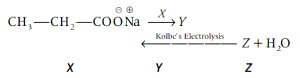
What are $X$,$Y$ and $Z$ in the following reactions?
A
$X = NaOH + CaO / \Delta, Y = CH_3CH_2CH_2CH_3, Z = CH_3CH_2COONa$
B
$X = NaOH + CaO / \Delta, Y = C_2H_6, Z = CH_3COONa$
C
$X = (CH_3COO)_2Mn / \Delta, Y = C_3H_8, Z = CH_3CH_2COONa$
D
$X = NaOH + CaO / \Delta, Y = CH_3CH_3, Z = CH_3COONa$
Solution
(D) The reaction $CH_3-CH_2-COONa \xrightarrow{NaOH + CaO / \Delta} CH_3-CH_3 + Na_2CO_3$ is a decarboxylation reaction,where $X = NaOH + CaO / \Delta$ and $Y = CH_3-CH_3$.
The reaction $2CH_3COONa + 2H_2O \xrightarrow{\text{Kolbe's electrolysis}} CH_3-CH_3 + 2CO_2 + H_2 + 2NaOH$ involves $Z = CH_3COONa$ as the reactant for Kolbe's electrolysis to produce ethane.
The reaction $2CH_3COONa + 2H_2O \xrightarrow{\text{Kolbe's electrolysis}} CH_3-CH_3 + 2CO_2 + H_2 + 2NaOH$ involves $Z = CH_3COONa$ as the reactant for Kolbe's electrolysis to produce ethane.
0 likes
View Solution685
EasyMCQ
The catalyst used for the isomerisation of $n$-alkanes to branched chain alkanes is
A
Anhy. $AlCl_3 / HCl$
B
$Mo_2O_3$
C
$FeCl_3$
D
$TiCl_4 + R_3Al$
Solution
(A) The isomerisation of $n$-alkanes to branched chain alkanes is a process used to improve the octane rating of fuel.
This reaction is typically carried out in the presence of a Lewis acid catalyst,such as anhydrous $AlCl_3$ combined with $HCl$ gas.
Therefore,the correct catalyst is anhydrous $AlCl_3 / HCl$.
This reaction is typically carried out in the presence of a Lewis acid catalyst,such as anhydrous $AlCl_3$ combined with $HCl$ gas.
Therefore,the correct catalyst is anhydrous $AlCl_3 / HCl$.
0 likes
View Solution686
MediumMCQ
Ethane on heating with a regulated supply of air at high pressure in the presence of manganese acetate forms '$Q$'. '$Q$' is:
A
$CH_3 CH_2 OH$
B
$CH_3 CHO$
C
$HCOOH$
D
$CH_3 COOH$
Solution
(D) The controlled catalytic oxidation of ethane with air at high pressure in the presence of manganese acetate $(CH_3 COO)_2 Mn$ yields acetic acid as the final product.
The chemical equation is:
$2 CH_3-CH_3 + 3 O_2 \xrightarrow[\Delta]{(CH_3 COO)_2 Mn} 2 CH_3 COOH + 2 H_2 O$
Therefore,'$Q$' is $CH_3 COOH$.
The chemical equation is:
$2 CH_3-CH_3 + 3 O_2 \xrightarrow[\Delta]{(CH_3 COO)_2 Mn} 2 CH_3 COOH + 2 H_2 O$
Therefore,'$Q$' is $CH_3 COOH$.
0 likes
View Solution687
MediumMCQ
The suitable reagents for the conversion of methane into methyl iodide are
A
$I_2, HNO_2$
B
$I_2, H_2 O_2$
C
$I_2, H_2 O$
D
$I_2, HNO_3$
Solution
(D) The reaction of methane with iodine is a reversible process: $CH_4 + I_2 \rightleftharpoons CH_3I + HI$.
Since $HI$ is a strong reducing agent,it reduces $CH_3I$ back to $CH_4$.
To drive the reaction in the forward direction,an oxidizing agent like $HNO_3$ is added to consume $HI$ and convert it back into $I_2$: $2HNO_3 + 2HI \longrightarrow 2NO_2 + 2H_2O + I_2$.
Therefore,$I_2$ and $HNO_3$ are the suitable reagents.
Since $HI$ is a strong reducing agent,it reduces $CH_3I$ back to $CH_4$.
To drive the reaction in the forward direction,an oxidizing agent like $HNO_3$ is added to consume $HI$ and convert it back into $I_2$: $2HNO_3 + 2HI \longrightarrow 2NO_2 + 2H_2O + I_2$.
Therefore,$I_2$ and $HNO_3$ are the suitable reagents.
0 likes
View Solution688
EasyMCQ
Identify $X$ and $Y$ in the following reactions:
$CH_4 + O_2 \xrightarrow{Mo_2O_3 / \Delta} X$
$2CH_4 + O_2 \xrightarrow{Cu / 523 \ K / 100 \ atm} 2Y$
$CH_4 + O_2 \xrightarrow{Mo_2O_3 / \Delta} X$
$2CH_4 + O_2 \xrightarrow{Cu / 523 \ K / 100 \ atm} 2Y$
A
$CH_3OH, HCO_2H$
B
$HCO_2H, CH_2O$
C
$CH_3OH, CH_2O$
D
$CH_2O, CH_3OH$
Solution
(D) The partial oxidation of methane $(CH_4)$ under different conditions yields different products.
$1$. When $CH_4$ is oxidized with $O_2$ in the presence of $Mo_2O_3$ at high temperature $(\Delta)$,it forms formaldehyde ($HCHO$ or $CH_2O$):
$CH_4 + O_2 \xrightarrow{Mo_2O_3 / \Delta} HCHO + H_2O$
Thus,$X = CH_2O$.
$2$. When $CH_4$ is oxidized with $O_2$ in the presence of $Cu$ at $523 \ K$ and $100 \ atm$,it forms methanol $(CH_3OH)$:
$2CH_4 + O_2 \xrightarrow{Cu / 523 \ K / 100 \ atm} 2CH_3OH$
Thus,$Y = CH_3OH$.
Therefore,$X = CH_2O$ and $Y = CH_3OH$.
$1$. When $CH_4$ is oxidized with $O_2$ in the presence of $Mo_2O_3$ at high temperature $(\Delta)$,it forms formaldehyde ($HCHO$ or $CH_2O$):
$CH_4 + O_2 \xrightarrow{Mo_2O_3 / \Delta} HCHO + H_2O$
Thus,$X = CH_2O$.
$2$. When $CH_4$ is oxidized with $O_2$ in the presence of $Cu$ at $523 \ K$ and $100 \ atm$,it forms methanol $(CH_3OH)$:
$2CH_4 + O_2 \xrightarrow{Cu / 523 \ K / 100 \ atm} 2CH_3OH$
Thus,$Y = CH_3OH$.
Therefore,$X = CH_2O$ and $Y = CH_3OH$.
0 likes
View Solution689
EasyMCQ
Which of the following reactions proceeds via a secondary free radical?
A
$CH_3-CH=CH_2 \xrightarrow{HBr} CH_3-CH(Br)-CH_3$
B
$CH_3-CH=CH_2 \xrightarrow[UV \text{ light}]{HBr, R_2O_2} CH_3-CH_2-CH_2Br$
C
$C_6H_6 \xrightarrow{Br_2 / FeBr_3} C_6H_5Br$
D
$CH_3-CH_2-CH_3 \xrightarrow{Br_2, h\nu} CH_3-CH(Br)-CH_3$
Solution
(D) The reaction $CH_3-CH_2-CH_3 \xrightarrow{Br_2, h\nu} CH_3-CH(Br)-CH_3$ is a free radical substitution reaction.
In the propagation step,a bromine radical abstracts a hydrogen atom from the secondary carbon of propane to form a secondary propyl radical $(CH_3-\dot{C}H-CH_3)$.
This secondary free radical is more stable than a primary free radical,making this the preferred pathway.
In the propagation step,a bromine radical abstracts a hydrogen atom from the secondary carbon of propane to form a secondary propyl radical $(CH_3-\dot{C}H-CH_3)$.
This secondary free radical is more stable than a primary free radical,making this the preferred pathway.
0 likes
View Solution690
EasyMCQ
What is $Z$ in the following sequence of reaction? $2-$methyl$-2-$bromopropane $\underset{\text{Dry ether}}{}$ ${\xrightarrow{Mg}} X$ $\xrightarrow{H_2O} Z$
A
Propane
B
$2-$methyl propene
C
$2-$methyl propane
D
$2-$methyl butane
Solution
(C) The reaction sequence is as follows:
$1$. $2-$methyl$-2-$bromopropane reacts with $Mg$ in the presence of dry ether to form a Grignard reagent,$X$,which is $2-$methyl$-2-$propylmagnesium bromide: $(CH_3)_3CBr + Mg \xrightarrow{\text{Dry ether}} (CH_3)_3CMgBr (X)$.
$2$. The Grignard reagent $X$ then reacts with water $(H_2O)$ to undergo hydrolysis,yielding $2-$methyl propane $(Z)$ and magnesium hydroxybromide: $(CH_3)_3CMgBr + H_2O \rightarrow (CH_3)_3CH (Z) + Mg(OH)Br$.
$3$. Therefore,$Z$ is $2-$methyl propane.
$1$. $2-$methyl$-2-$bromopropane reacts with $Mg$ in the presence of dry ether to form a Grignard reagent,$X$,which is $2-$methyl$-2-$propylmagnesium bromide: $(CH_3)_3CBr + Mg \xrightarrow{\text{Dry ether}} (CH_3)_3CMgBr (X)$.
$2$. The Grignard reagent $X$ then reacts with water $(H_2O)$ to undergo hydrolysis,yielding $2-$methyl propane $(Z)$ and magnesium hydroxybromide: $(CH_3)_3CMgBr + H_2O \rightarrow (CH_3)_3CH (Z) + Mg(OH)Br$.
$3$. Therefore,$Z$ is $2-$methyl propane.
0 likes
View Solution691
DifficultMCQ
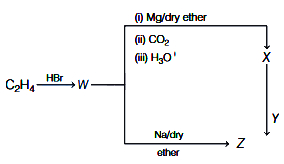
What are $Y$ and $Z$ in the following reaction sequence?
A
$Y - NaOH / CaO; Z - CH_3(CH_2)_2 CH_3$
B
$Y - NaOH / \text{electrolysis}; Z - CH_3CH_2CH_2CH_3$
C
$Y - NaOH / CaO; Z - CH_3CH_2CH_2CH_3$
D
$Y - NaOH / \text{electrolysis}; Z - CH_3CH_2CH_2CH_3$
Solution
(D) The reaction sequence is as follows:
$1$. $C_2H_4 + HBr \rightarrow CH_3CH_2Br$ $(W)$
$2$. $W + Mg / \text{dry ether} \rightarrow CH_3CH_2MgBr$
$3$. $CH_3CH_2MgBr + CO_2 \xrightarrow{H_3O^+} CH_3CH_2COOH$ $(X)$
$4$. $CH_3CH_2COOH$ undergoes Kolbe's electrolysis $(Y)$ to form $CH_3CH_2CH_2CH_3$ $(Z)$.
$5$. $W + Na / \text{dry ether}$ (Wurtz reaction) also forms $CH_3CH_2CH_2CH_3$ $(Z)$.
Thus,$Y$ is electrolysis and $Z$ is $CH_3CH_2CH_2CH_3$.
$1$. $C_2H_4 + HBr \rightarrow CH_3CH_2Br$ $(W)$
$2$. $W + Mg / \text{dry ether} \rightarrow CH_3CH_2MgBr$
$3$. $CH_3CH_2MgBr + CO_2 \xrightarrow{H_3O^+} CH_3CH_2COOH$ $(X)$
$4$. $CH_3CH_2COOH$ undergoes Kolbe's electrolysis $(Y)$ to form $CH_3CH_2CH_2CH_3$ $(Z)$.
$5$. $W + Na / \text{dry ether}$ (Wurtz reaction) also forms $CH_3CH_2CH_2CH_3$ $(Z)$.
Thus,$Y$ is electrolysis and $Z$ is $CH_3CH_2CH_2CH_3$.
0 likes
View Solution692
EasyMCQ
Aluminum carbide on reaction with $D_2 O$ gives $Al(OD)_3$ and '$X$'. What is '$X$'?
A
$C_2 D_2$
B
$C_3 D_4$
C
$C_2 D_4$
D
$CD_4$
Solution
(D) The chemical reaction between aluminum carbide and heavy water is given by:
$Al_4 C_3 + 12 D_2 O \rightarrow 4 Al(OD)_3 + 3 CD_4$
Aluminum carbide $(Al_4 C_3)$ reacts with $D_2 O$ to produce aluminum deuteroxide $(Al(OD)_3)$ and deutero-methane $(CD_4)$.
Therefore,'$X$' is $CD_4$.
$Al_4 C_3 + 12 D_2 O \rightarrow 4 Al(OD)_3 + 3 CD_4$
Aluminum carbide $(Al_4 C_3)$ reacts with $D_2 O$ to produce aluminum deuteroxide $(Al(OD)_3)$ and deutero-methane $(CD_4)$.
Therefore,'$X$' is $CD_4$.
0 likes
View Solution693
MediumMCQ
What are $X$ and $Y$ in the following reaction sequence?
Iso-pentane $\xrightarrow{KMnO_4} X$ $\xrightarrow[358 \ K]{20 \% H_3PO_4} Y$
Iso-pentane $\xrightarrow{KMnO_4} X$ $\xrightarrow[358 \ K]{20 \% H_3PO_4} Y$
A
$2-$methylbutan$-2-$ol,$2$-methylbut$-1-$ene
B
$2-$methylbutan$-2-$ol,$2$-methylbut$-2-$ene
C
$3-$methylbutan$-2-$ol,$3$-methylbut$-1-$ene
D
$2-$methylbutan$-1-$ol,$2$-methylbut$-1-$ene
Solution
(B) The reaction of iso-pentane ($2$-methylbutane) with $KMnO_4$ is an oxidation reaction that occurs at the tertiary carbon atom,which is the most reactive site for oxidation in alkanes. This leads to the formation of $2$-methylbutan-$2$-ol as the major product $X$.
$CH_3-CH(CH_3)-CH_2-CH_3 \xrightarrow{KMnO_4} CH_3-C(OH)(CH_3)-CH_2-CH_3$ $(X)$
Next,the dehydration of $2$-methylbutan-$2$-ol $(X)$ in the presence of $20 \% H_3PO_4$ at $358 \ K$ follows Saytzeff's rule,which states that the more substituted alkene is the major product.
$CH_3-C(OH)(CH_3)-CH_2-CH_3 \xrightarrow[358 \ K]{20 \% H_3PO_4} CH_3-C(CH_3)=CH-CH_3$ $(Y)$ + $H_2O$
Thus,$X$ is $2$-methylbutan-$2$-ol and $Y$ is $2$-methylbut-$2$-ene.
$CH_3-CH(CH_3)-CH_2-CH_3 \xrightarrow{KMnO_4} CH_3-C(OH)(CH_3)-CH_2-CH_3$ $(X)$
Next,the dehydration of $2$-methylbutan-$2$-ol $(X)$ in the presence of $20 \% H_3PO_4$ at $358 \ K$ follows Saytzeff's rule,which states that the more substituted alkene is the major product.
$CH_3-C(OH)(CH_3)-CH_2-CH_3 \xrightarrow[358 \ K]{20 \% H_3PO_4} CH_3-C(CH_3)=CH-CH_3$ $(Y)$ + $H_2O$
Thus,$X$ is $2$-methylbutan-$2$-ol and $Y$ is $2$-methylbut-$2$-ene.
0 likes
View Solution694
DifficultMCQ
At high pressure and regulated supply of air, methane is heated with catalyst '$X$' to give methanol and with catalyst '$Y$' to give methanal. $X$ and $Y$ respectively are
A
$Mo_2O_3, Cu$
B
$Cu, Mo_2O_3$
C
$V_2O_5, KMnO_4$
D
$KMnO_4, Cr_2O_3$
Solution
(B) The controlled oxidation of methane under different conditions yields different products.
$1$. When methane is heated with $Cu$ at $523 \ K$ and $100 \ atm$ pressure, it gives methanol: $2CH_4 + O_2 \xrightarrow{Cu / 523 \ K / 100 \ atm} 2CH_3OH$.
$2$. When methane is heated with $Mo_2O_3$, it gives methanal: $CH_4 + O_2 \xrightarrow{Mo_2O_3 / \Delta} HCHO + H_2O$.
Therefore, $X = Cu$ and $Y = Mo_2O_3$.
$1$. When methane is heated with $Cu$ at $523 \ K$ and $100 \ atm$ pressure, it gives methanol: $2CH_4 + O_2 \xrightarrow{Cu / 523 \ K / 100 \ atm} 2CH_3OH$.
$2$. When methane is heated with $Mo_2O_3$, it gives methanal: $CH_4 + O_2 \xrightarrow{Mo_2O_3 / \Delta} HCHO + H_2O$.
Therefore, $X = Cu$ and $Y = Mo_2O_3$.
0 likes
View Solution695
MediumMCQ
Consider the given sequence of reactions.
$C_2H_6 + \frac{3}{2}O_2$ $\xrightarrow[\Delta]{(CH_3COO)_2Mn} X$ $\xrightarrow{NaOH} Y$
Electrolysis of aqueous solution of $Y$ gives gases $P$ and $Q$ at anode. $P$ and $Q$ are respectively.
$C_2H_6 + \frac{3}{2}O_2$ $\xrightarrow[\Delta]{(CH_3COO)_2Mn} X$ $\xrightarrow{NaOH} Y$
Electrolysis of aqueous solution of $Y$ gives gases $P$ and $Q$ at anode. $P$ and $Q$ are respectively.
A
$C_2H_6, CO_2$
B
$CH_4, CO_2$
C
$C_2H_6, H_2$
D
$CH_4, CO$
Solution
(A) The reaction $C_2H_6 + \frac{3}{2}O_2 \xrightarrow[(CH_3COO)_2Mn]{\Delta} CH_3COOH$ produces $X = CH_3COOH$ (acetic acid).
The reaction $CH_3COOH + NaOH \rightarrow CH_3COONa + H_2O$ produces $Y = CH_3COONa$ (sodium acetate).
Kolbe's electrolysis of aqueous sodium acetate $(CH_3COONa)$ is represented as:
$2CH_3COONa + 2H_2O \xrightarrow{\text{electrolysis}} CH_3-CH_3 + 2CO_2 + H_2 + 2NaOH$.
At the anode,the products formed are ethane $(C_2H_6)$ and carbon dioxide $(CO_2)$.
Thus,$P$ and $Q$ are $C_2H_6$ and $CO_2$ respectively.
The reaction $CH_3COOH + NaOH \rightarrow CH_3COONa + H_2O$ produces $Y = CH_3COONa$ (sodium acetate).
Kolbe's electrolysis of aqueous sodium acetate $(CH_3COONa)$ is represented as:
$2CH_3COONa + 2H_2O \xrightarrow{\text{electrolysis}} CH_3-CH_3 + 2CO_2 + H_2 + 2NaOH$.
At the anode,the products formed are ethane $(C_2H_6)$ and carbon dioxide $(CO_2)$.
Thus,$P$ and $Q$ are $C_2H_6$ and $CO_2$ respectively.
0 likes
View Solution696
EasyMCQ
What is $Z$ in the following reaction?
$CH_3-CH_2-CO_2^{\ominus} Na^{\oplus} \stackrel{NaOH / CaO}{\longrightarrow} Z$
$CH_3-CH_2-CO_2^{\ominus} Na^{\oplus} \stackrel{NaOH / CaO}{\longrightarrow} Z$
A
propane
B
$n$-butane
C
ethane
D
ethyne
Solution
(C) The reaction given is a decarboxylation reaction,also known as the soda-lime decarboxylation.
When a sodium salt of a carboxylic acid is heated with soda lime $(NaOH + CaO)$,it loses a molecule of $CO_2$ to form an alkane with one carbon atom less than the parent carboxylic acid.
$CH_3-CH_2-CO_2^{\ominus} Na^{\oplus} + NaOH \xrightarrow{CaO, \Delta} CH_3-CH_3 + Na_2CO_3$
Here,sodium propanoate ($3$ carbons) reacts to form ethane ($2$ carbons).
Therefore,$Z$ is ethane.
When a sodium salt of a carboxylic acid is heated with soda lime $(NaOH + CaO)$,it loses a molecule of $CO_2$ to form an alkane with one carbon atom less than the parent carboxylic acid.
$CH_3-CH_2-CO_2^{\ominus} Na^{\oplus} + NaOH \xrightarrow{CaO, \Delta} CH_3-CH_3 + Na_2CO_3$
Here,sodium propanoate ($3$ carbons) reacts to form ethane ($2$ carbons).
Therefore,$Z$ is ethane.
0 likes
View Solution697
MediumMCQ
Acetic acid is reacted with metallic sodium to form hydrogen and $X$. When $X$ is heated with sodalime,$Y$ and sodium carbonate are formed. $Y$ is
A
$C_2H_6$
B
$CH_4$
C
$CH_3COONa$
D
$CH_3CONH_2$
Solution
(B) Step $1$: Reaction of acetic acid with metallic sodium:
$2CH_3COOH + 2Na \rightarrow 2CH_3COONa + H_2 \uparrow$
Here,$X$ is sodium acetate $(CH_3COONa)$.
Step $2$: Decarboxylation of sodium acetate with sodalime $(NaOH + CaO)$:
$CH_3COONa + NaOH \xrightarrow{CaO, \Delta} CH_4 + Na_2CO_3$
Here,$Y$ is methane $(CH_4)$.
$2CH_3COOH + 2Na \rightarrow 2CH_3COONa + H_2 \uparrow$
Here,$X$ is sodium acetate $(CH_3COONa)$.
Step $2$: Decarboxylation of sodium acetate with sodalime $(NaOH + CaO)$:
$CH_3COONa + NaOH \xrightarrow{CaO, \Delta} CH_4 + Na_2CO_3$
Here,$Y$ is methane $(CH_4)$.
0 likes
View SolutionHydrocarbons — Alkane · Frequently Asked Questions
1Are these Hydrocarbons questions useful for JEE and NEET?
Yes. All questions in this section are mapped to JEE Main and NEET exam patterns. Previous year questions from JEE Main, NEET, GUJCET and state-level exams are included with full solutions.
2Can I switch to Hindi or Gujarati for these questions?
Yes. Use the language tabs in the hero section or the sidebar to view the same questions and solutions in English, Hindi or Gujarati.
3How do I generate a question paper from this subtopic?
Use the Vedclass Exam Paper Generator — select the chapter and subtopic, set difficulty, and generate Sets A, B, C, D automatically. First 3 chapters of every subject are free.
Vedclass Products
For Students
Vedclass Test Series
Mock tests in real JEE/NEET style with performance analysis. 5-day free trial.
Start Free TrialFor Teachers
Exam Paper Generator
Generate Set A/B/C/D papers from this chapter in 2 minutes. 3 chapters free.
Try FreeFor Institutes
Online Exam Module
Live online exams with unlimited students, 360° analytics & white-label branding.
See DemoFor Teachers & Institutes
Generate a Hydrocarbons Exam Paper in 2 Minutes
Select subtopic & difficulty — Sets A, B, C, D auto-generated with No Repeat logic.
First 3 chapters of every subject are free — no payment required.