
A English
Alkane Questions in English
Class 11 Chemistry · Hydrocarbons · Alkane
746+
Questions
English
Language
100%
With Solutions
Showing 48 of 746 questions in English
601
MediumMCQ
Which of the following alkanes is optically active?
A
$2-$Methylbutane
B
$2,3-$Dimethylbutane
C
$2,3-$Dimethylpentane
D
$2-$Methylpropane
Solution
(C) molecule is optically active if it contains at least one chiral carbon atom (a carbon atom bonded to four different groups).
In $2,3-$dimethylpentane,the carbon at position $3$ is bonded to a hydrogen atom,a methyl group $(-CH_3)$,an ethyl group $(-CH_2CH_3)$,and an isopropyl group $(-CH(CH_3)_2)$.
Since all four groups attached to the $C-3$ atom are different,it is a chiral center.
Therefore,$2,3-$dimethylpentane is optically active.
In $2,3-$dimethylpentane,the carbon at position $3$ is bonded to a hydrogen atom,a methyl group $(-CH_3)$,an ethyl group $(-CH_2CH_3)$,and an isopropyl group $(-CH(CH_3)_2)$.
Since all four groups attached to the $C-3$ atom are different,it is a chiral center.
Therefore,$2,3-$dimethylpentane is optically active.
0 likes
View Solution602
MediumMCQ
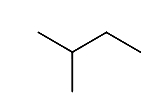
How many isomers of monobromo derivatives are obtained on the bromination of the following compound?
A
$4$
B
$3$
C
$2$
D
$5$
Solution
(A) The given compound is $2-$methylbutane $(CH_3-CH(CH_3)-CH_2-CH_3)$.
There are $4$ distinct types of hydrogen atoms in $2-$methylbutane,which leads to the formation of $4$ different monobromo isomers upon bromination:
$1.$ $1-$bromo$-2-$methylbutane
$2.$ $2-$bromo$-2-$methylbutane
$3.$ $2-$bromo$-3-$methylbutane
$4.$ $1-$bromo$-3-$methylbutane
Therefore,the total number of isomers is $4$.
There are $4$ distinct types of hydrogen atoms in $2-$methylbutane,which leads to the formation of $4$ different monobromo isomers upon bromination:
$1.$ $1-$bromo$-2-$methylbutane
$2.$ $2-$bromo$-2-$methylbutane
$3.$ $2-$bromo$-3-$methylbutane
$4.$ $1-$bromo$-3-$methylbutane
Therefore,the total number of isomers is $4$.
0 likes
View Solution603
MediumMCQ
How many isomers are possible for an alkane having molecular formula $C_5H_{12}$?
A
$5$
B
$3$
C
$4$
D
$2$
Solution
(B) There are $3$ possible isomers for an alkane with the molecular formula $C_5H_{12}$. These are:
$1$. $n$-pentane: $CH_3CH_2CH_2CH_2CH_3$
$2$. Isopentane ($2$-methylbutane): $CH_3-CH(CH_3)-CH_2-CH_3$
$3$. Neopentane ($2,2$-dimethylpropane): $C(CH_3)_4$
$1$. $n$-pentane: $CH_3CH_2CH_2CH_2CH_3$
$2$. Isopentane ($2$-methylbutane): $CH_3-CH(CH_3)-CH_2-CH_3$
$3$. Neopentane ($2,2$-dimethylpropane): $C(CH_3)_4$
0 likes
View Solution604
EasyMCQ
How many isomeric vicinal-dihalides are possible for the compound having molecular formula $C_3H_6Cl_2$?
A
$1$
B
$2$
C
$3$
D
$4$
Solution
(A) In vicinal-dihalides,the two $-Cl$ atoms are present at adjacent carbon atoms. For the molecular formula $C_3H_6Cl_2$,the only possible vicinal-dihalide is $1,2-dichloropropane$,which has the structure $CH_3-CHCl-CH_2Cl$. Thus,only $1$ such isomer is possible.
0 likes
View Solution605
MediumMCQ
Which of the following is $NOT$ obtained when a mixture of methyl bromide and ethyl bromide is treated with sodium metal in the presence of dry ether?
A
$Ethane$
B
$Propane$
C
$Butane$
D
$Pentane$
Solution
(D) The reaction of a mixture of alkyl halides with sodium metal in the presence of dry ether is known as the Wurtz reaction.
When a mixture of methyl bromide $(CH_3Br)$ and ethyl bromide $(C_2H_5Br)$ is treated with sodium metal,the following coupling reactions occur:
$1$. $CH_3Br + 2Na + BrCH_3 \rightarrow CH_3-CH_3$ $(Ethane)$
$2$. $C_2H_5Br + 2Na + BrC_2H_5 \rightarrow C_2H_5-C_2H_5$ $(n-Butane)$
$3$. $CH_3Br + 2Na + BrC_2H_5 \rightarrow CH_3-C_2H_5$ $(Propane)$
Since $Pentane$ $(C_5H_{12})$ cannot be formed from the coupling of methyl $(C_1)$ and ethyl $(C_2)$ radicals,it is not obtained in the product mixture.
When a mixture of methyl bromide $(CH_3Br)$ and ethyl bromide $(C_2H_5Br)$ is treated with sodium metal,the following coupling reactions occur:
$1$. $CH_3Br + 2Na + BrCH_3 \rightarrow CH_3-CH_3$ $(Ethane)$
$2$. $C_2H_5Br + 2Na + BrC_2H_5 \rightarrow C_2H_5-C_2H_5$ $(n-Butane)$
$3$. $CH_3Br + 2Na + BrC_2H_5 \rightarrow CH_3-C_2H_5$ $(Propane)$
Since $Pentane$ $(C_5H_{12})$ cannot be formed from the coupling of methyl $(C_1)$ and ethyl $(C_2)$ radicals,it is not obtained in the product mixture.
0 likes
View Solution606
EasyMCQ
Which of the following is obtained as the major product when an excess of methane is treated with a limited amount of chlorine in the presence of $UV$ light?
A
Chloromethane
B
Dichloromethane
C
Trichloromethane
D
Tetrachloromethane
Solution
(A) The reaction between methane $(CH_4)$ and chlorine $(Cl_2)$ in the presence of $UV$ light is a free radical substitution reaction.
When methane is in excess and chlorine is limited,the probability of a chlorine radical colliding with a methane molecule is much higher than colliding with a chloromethane molecule.
Therefore,the reaction stops primarily at the first substitution step:
$CH_4 + Cl_2 \xrightarrow{UV \text{ light}} CH_3Cl + HCl$
Thus,chloromethane $(CH_3Cl)$ is obtained as the major product.
When methane is in excess and chlorine is limited,the probability of a chlorine radical colliding with a methane molecule is much higher than colliding with a chloromethane molecule.
Therefore,the reaction stops primarily at the first substitution step:
$CH_4 + Cl_2 \xrightarrow{UV \text{ light}} CH_3Cl + HCl$
Thus,chloromethane $(CH_3Cl)$ is obtained as the major product.
0 likes
View Solution607
DifficultMCQ
What is the molar mass of the product hydrocarbon when $2$ moles of methyl bromide react with a large excess of sodium in dry ether?
A
$15.0 \ g \ mol^{-1}$
B
$30.0 \ g \ mol^{-1}$
C
$7.5 \ g \ mol^{-1}$
D
$40.0 \ g \ mol^{-1}$
Solution
(B) The reaction of methyl bromide $(CH_3Br)$ with sodium in the presence of dry ether is a Wurtz reaction.
The chemical equation for the reaction is:
$2CH_3Br + 2Na \xrightarrow{\text{dry ether}} CH_3-CH_3 + 2NaBr$
The product formed is ethane $(C_2H_6)$.
The molar mass of ethane is calculated as:
$M = (2 \times 12.01) + (6 \times 1.008) \approx 24 + 6 = 30.0 \ g \ mol^{-1}$.
Thus,the molar mass of the product is $30.0 \ g \ mol^{-1}$.
The chemical equation for the reaction is:
$2CH_3Br + 2Na \xrightarrow{\text{dry ether}} CH_3-CH_3 + 2NaBr$
The product formed is ethane $(C_2H_6)$.
The molar mass of ethane is calculated as:
$M = (2 \times 12.01) + (6 \times 1.008) \approx 24 + 6 = 30.0 \ g \ mol^{-1}$.
Thus,the molar mass of the product is $30.0 \ g \ mol^{-1}$.
0 likes
View Solution608
EasyMCQ
Identify the major product formed in the bromination of $2-$methylpropane.
A
$1-$Bromopropane
B
$2-$Bromopropane
C
$1-$Bromo$-2-$methylpropane
D
$2-$Bromo$-2-$methylpropane
Solution
(D) The bromination of $2-$methylpropane proceeds via a free radical mechanism.
In the propagation step,a hydrogen atom is abstracted from the alkane to form an alkyl radical.
The abstraction of a hydrogen atom from the tertiary carbon atom leads to the formation of a $3^{\circ}$ alkyl radical,while abstraction from a primary carbon atom leads to a $1^{\circ}$ alkyl radical.
Since the $3^{\circ}$ alkyl radical is more stable than the $1^{\circ}$ alkyl radical due to hyperconjugation and inductive effects,the reaction proceeds primarily through the $3^{\circ}$ radical intermediate.
Consequently,$2-$bromo$-2-$methylpropane is the major product.
In the propagation step,a hydrogen atom is abstracted from the alkane to form an alkyl radical.
The abstraction of a hydrogen atom from the tertiary carbon atom leads to the formation of a $3^{\circ}$ alkyl radical,while abstraction from a primary carbon atom leads to a $1^{\circ}$ alkyl radical.
Since the $3^{\circ}$ alkyl radical is more stable than the $1^{\circ}$ alkyl radical due to hyperconjugation and inductive effects,the reaction proceeds primarily through the $3^{\circ}$ radical intermediate.
Consequently,$2-$bromo$-2-$methylpropane is the major product.
0 likes
View Solution609
MediumMCQ
Identify the major product $(99 \%)$ formed when $(CH_3)_3CH$ is treated with $Br_2$ in $UV$ light.
A
$(CH_3)_3CHCH_2Br$
B
$(CH_3)_3CBr$
C
$(CH_3)_2CHCH(CH_3)Br$
D
$CH_3(CH_2)_2CH_2Br$
Solution
(B) The reaction of $(CH_3)_3CH$ (isobutane) with $Br_2$ in the presence of $UV$ light is a free radical substitution reaction.
Bromination is highly selective compared to chlorination.
The stability of the intermediate free radical determines the major product.
The tertiary free radical $(CH_3)_3C^{\bullet}$ is more stable than the primary free radical $(CH_3)_2CHCH_2^{\bullet}$.
Therefore,the bromine atom replaces the hydrogen atom at the tertiary carbon to form $2-$bromo$-2-$methylpropane as the major product $(99 \%)$.
Bromination is highly selective compared to chlorination.
The stability of the intermediate free radical determines the major product.
The tertiary free radical $(CH_3)_3C^{\bullet}$ is more stable than the primary free radical $(CH_3)_2CHCH_2^{\bullet}$.
Therefore,the bromine atom replaces the hydrogen atom at the tertiary carbon to form $2-$bromo$-2-$methylpropane as the major product $(99 \%)$.
0 likes
View Solution610
MediumMCQ
Identify the product $B$ in the following reaction sequence.
$C_2H_5-Br$ $\xrightarrow[\text{Dry ether}]{Mg} A$ $\xrightarrow{CH_3OH} B$
$C_2H_5-Br$ $\xrightarrow[\text{Dry ether}]{Mg} A$ $\xrightarrow{CH_3OH} B$
A
$CH_3-CH_2-CH_3$
B
$C_2H_5-O^-CH_3$
C
$C_2H_6$
D
$C_2H_5-OH$
Solution
(C) $1$. The reaction of $C_2H_5-Br$ with $Mg$ in the presence of dry ether forms a Grignard reagent,$C_2H_5MgBr$ (compound $A$).
$2$. Grignard reagents are strong bases and react with compounds containing active hydrogen atoms (like alcohols,water,or amines) to form alkanes.
$3$. The reaction is: $C_2H_5MgBr + CH_3OH \rightarrow C_2H_6 + Mg(Br)OCH_3$.
$4$. Thus,the product $B$ is ethane $(C_2H_6)$.
$2$. Grignard reagents are strong bases and react with compounds containing active hydrogen atoms (like alcohols,water,or amines) to form alkanes.
$3$. The reaction is: $C_2H_5MgBr + CH_3OH \rightarrow C_2H_6 + Mg(Br)OCH_3$.
$4$. Thus,the product $B$ is ethane $(C_2H_6)$.
0 likes
View Solution611
EasyMCQ
Identify the product obtained when isopropyl bromide is reacted with metallic sodium in dry ether.
A
$2-$Methylpropane
B
$2,3-$Dimethylpentane
C
$2,3-$Dimethylbutane
D
$2,3-$Dimethylhexane
Solution
(C) The Wurtz reaction involves the coupling of two alkyl halide molecules in the presence of sodium metal and dry ether.
For isopropyl bromide $(CH_3-CH(Br)-CH_3)$,two moles react to form $2,3-$dimethylbutane:
$2CH_3-CH(Br)-CH_3 + 2Na \rightarrow CH_3-CH(CH_3)-CH(CH_3)-CH_3 + 2NaBr$.
For isopropyl bromide $(CH_3-CH(Br)-CH_3)$,two moles react to form $2,3-$dimethylbutane:
$2CH_3-CH(Br)-CH_3 + 2Na \rightarrow CH_3-CH(CH_3)-CH(CH_3)-CH_3 + 2NaBr$.
0 likes
View Solution612
MediumMCQ
What is the number of moles of ethane obtained from $2n$ moles of bromomethane using $2n$ moles of sodium atoms in dry ether medium?
A
$4n$
B
$3n$
C
$2n$
D
$n$
Solution
(D) The Wurtz reaction is given by the equation: $2CH_3Br + 2Na \xrightarrow{\text{Dry ether}} CH_3-CH_3 + 2NaBr$.
According to the stoichiometry of the reaction,$2$ moles of bromomethane $(CH_3Br)$ react with $2$ moles of sodium $(Na)$ to produce $1$ mole of ethane $(CH_3-CH_3)$.
Given that we have $2n$ moles of bromomethane and $2n$ moles of sodium,the reaction will produce $n$ moles of ethane.
According to the stoichiometry of the reaction,$2$ moles of bromomethane $(CH_3Br)$ react with $2$ moles of sodium $(Na)$ to produce $1$ mole of ethane $(CH_3-CH_3)$.
Given that we have $2n$ moles of bromomethane and $2n$ moles of sodium,the reaction will produce $n$ moles of ethane.
0 likes
View Solution613
MediumMCQ
If a mixture of iodomethane $(CH_3I)$ and iodoethane $(C_2H_5I)$ is treated with sodium metal in the presence of dry ether,it forms:
A
propane and ethane
B
ethane and butane
C
propane and butane
D
ethane,propane and butane
Solution
(D) The reaction of a mixture of two different alkyl halides with sodium metal in the presence of dry ether is known as the Wurtz reaction. $2CH_3I + 2C_2H_5I + 4Na \xrightarrow{\text{dry ether}} CH_3-CH_3 + CH_3-CH_2-CH_2-CH_3 + CH_3-CH_2-CH_3 + 4NaI$. The products formed are a mixture of alkanes: ethane $(CH_3-CH_3)$,butane $(CH_3-CH_2-CH_2-CH_3)$,and propane $(CH_3-CH_2-CH_3)$.
0 likes
View Solution614
MediumMCQ
Identify the product '$B$' in the following reaction sequence.
Alkyl halide $\xrightarrow{Mg / \text{Dry ether}}$ $A$ $\xrightarrow{NH_3}$ $B$
Alkyl halide $\xrightarrow{Mg / \text{Dry ether}}$ $A$ $\xrightarrow{NH_3}$ $B$
A
Alkyl magnesium halide
B
Alkyl amine
C
Hydrocarbon
D
Alkyl nitrile
Solution
(C) The reaction sequence is as follows:
$1$. Alkyl halide $(R-X)$ reacts with $Mg$ in the presence of dry ether to form a Grignard reagent,$A$,which is $R-MgX$.
$2$. Grignard reagents $(R-MgX)$ react with $NH_3$ (ammonia) to undergo an acid-base reaction. Since $NH_3$ is a proton donor,it protonates the alkyl group $(R^-)$ of the Grignard reagent to form an alkane $(R-H)$.
$3$. Therefore,the product $B$ is a hydrocarbon $(R-H)$.
$1$. Alkyl halide $(R-X)$ reacts with $Mg$ in the presence of dry ether to form a Grignard reagent,$A$,which is $R-MgX$.
$2$. Grignard reagents $(R-MgX)$ react with $NH_3$ (ammonia) to undergo an acid-base reaction. Since $NH_3$ is a proton donor,it protonates the alkyl group $(R^-)$ of the Grignard reagent to form an alkane $(R-H)$.
$3$. Therefore,the product $B$ is a hydrocarbon $(R-H)$.
0 likes
View Solution615
EasyMCQ
Which of the following compounds has the highest boiling point?
A
$n-$Hexane
B
$2-$Methylpentane
C
$3-$Methylpentane
D
$2,2-$Dimethylbutane
Solution
(A) The boiling point of alkanes depends on the surface area of the molecule.
As the branching in the alkane increases,the surface area decreases,which leads to weaker van der Waals forces of attraction.
Therefore,the boiling point decreases as the number of branches increases.
Comparing the given isomers of $C_6H_{14}$:
$1$. $n-$Hexane (straight chain) has the largest surface area.
$2$. $2-$Methylpentane and $3-$Methylpentane have one branch.
$3$. $2,2-$Dimethylbutane has two branches (most compact).
Thus,$n-$Hexane has the highest boiling point.
As the branching in the alkane increases,the surface area decreases,which leads to weaker van der Waals forces of attraction.
Therefore,the boiling point decreases as the number of branches increases.
Comparing the given isomers of $C_6H_{14}$:
$1$. $n-$Hexane (straight chain) has the largest surface area.
$2$. $2-$Methylpentane and $3-$Methylpentane have one branch.
$3$. $2,2-$Dimethylbutane has two branches (most compact).
Thus,$n-$Hexane has the highest boiling point.
0 likes
View Solution616
EasyMCQ
Which of the following alkanes is used for road surfacing?
A
Alkanes with less than $10$ carbon atoms
B
Alkanes having $20$ to $25$ carbon atoms
C
Alkanes having $25$ to $30$ carbon atoms
D
Alkanes having more than $35$ carbon atoms
Solution
(D) Road surfacing is typically done using bitumen or asphalt,which are mixtures of high molecular weight hydrocarbons.
Alkanes with more than $35$ carbon atoms are generally solid at room temperature and are used in the production of asphalt and bitumen for road surfacing.
Alkanes with more than $35$ carbon atoms are generally solid at room temperature and are used in the production of asphalt and bitumen for road surfacing.
0 likes
View Solution617
EasyMCQ
What is the molar mass of the third homologue of the alkane series?
A
$40 \ g \ mol^{-1}$
B
$58 \ g \ mol^{-1}$
C
$44 \ g \ mol^{-1}$
D
$46 \ g \ mol^{-1}$
Solution
(C) The general formula for the alkane series is $C_nH_{2n+2}$.
For the first homologue $(n=1)$,the formula is $CH_4$ (methane).
For the second homologue $(n=2)$,the formula is $C_2H_6$ (ethane).
For the third homologue $(n=3)$,the formula is $C_3H_8$ (propane).
The molar mass of $C_3H_8$ is calculated as:
$M = (3 \times 12.01) + (8 \times 1.008) \approx 36 + 8 = 44 \ g \ mol^{-1}$.
For the first homologue $(n=1)$,the formula is $CH_4$ (methane).
For the second homologue $(n=2)$,the formula is $C_2H_6$ (ethane).
For the third homologue $(n=3)$,the formula is $C_3H_8$ (propane).
The molar mass of $C_3H_8$ is calculated as:
$M = (3 \times 12.01) + (8 \times 1.008) \approx 36 + 8 = 44 \ g \ mol^{-1}$.
0 likes
View Solution618
EasyMCQ
What is the difference in molar masses of the third and fourth homologues of the alkane series?
A
$28 \ g \ mol^{-1}$
B
$14 \ g \ mol^{-1}$
C
$15 \ g \ mol^{-1}$
D
$16 \ g \ mol^{-1}$
Solution
(B) The general formula for the alkane series is $C_nH_{2n+2}$.
For the third homologue $(n=3)$,the formula is $C_3H_8$,and its molar mass is $(3 \times 12) + (8 \times 1) = 44 \ g \ mol^{-1}$.
For the fourth homologue $(n=4)$,the formula is $C_4H_{10}$,and its molar mass is $(4 \times 12) + (10 \times 1) = 58 \ g \ mol^{-1}$.
Any two successive homologues in an alkane series differ by a $-CH_2-$ group.
The molar mass of a $-CH_2-$ group is $12 + (2 \times 1) = 14 \ g \ mol^{-1}$.
Therefore,the difference in molar masses is $58 - 44 = 14 \ g \ mol^{-1}$.
For the third homologue $(n=3)$,the formula is $C_3H_8$,and its molar mass is $(3 \times 12) + (8 \times 1) = 44 \ g \ mol^{-1}$.
For the fourth homologue $(n=4)$,the formula is $C_4H_{10}$,and its molar mass is $(4 \times 12) + (10 \times 1) = 58 \ g \ mol^{-1}$.
Any two successive homologues in an alkane series differ by a $-CH_2-$ group.
The molar mass of a $-CH_2-$ group is $12 + (2 \times 1) = 14 \ g \ mol^{-1}$.
Therefore,the difference in molar masses is $58 - 44 = 14 \ g \ mol^{-1}$.
0 likes
View Solution619
MediumMCQ
Which of the following is $NOT$ obtained when a mixture of bromoethane and $1$-bromopropane is treated with sodium metal in dry ether?
A
Propane
B
Butane
C
Pentane
D
Hexane
Solution
(A) The reaction of a mixture of alkyl halides with sodium metal in the presence of dry ether is known as the Wurtz reaction. When a mixture of $CH_3CH_2Br$ (bromoethane) and $CH_3CH_2CH_2Br$ ($1$-bromopropane) is used,the following coupling products are formed:
$1$. Self-coupling of bromoethane: $CH_3CH_2-CH_2CH_3$ ($n$-butane).
$2$. Self-coupling of $1$-bromopropane: $CH_3CH_2CH_2-CH_2CH_2CH_3$ ($n$-hexane).
$3$. Cross-coupling of bromoethane and $1$-bromopropane: $CH_3CH_2-CH_2CH_2CH_3$ ($n$-pentane).
Propane is not formed in this reaction mixture.
$1$. Self-coupling of bromoethane: $CH_3CH_2-CH_2CH_3$ ($n$-butane).
$2$. Self-coupling of $1$-bromopropane: $CH_3CH_2CH_2-CH_2CH_2CH_3$ ($n$-hexane).
$3$. Cross-coupling of bromoethane and $1$-bromopropane: $CH_3CH_2-CH_2CH_2CH_3$ ($n$-pentane).
Propane is not formed in this reaction mixture.
0 likes
View Solution620
EasyMCQ
Which of the following has the highest boiling point?
A
$2-$methoxypropane
B
$n-$butane
C
$2-$methylbutane
D
$n-$pentane
Solution
(D) The boiling point of alkanes increases with an increase in the number of carbon atoms due to increased van der Waals forces.
For isomers,the boiling point decreases with an increase in branching due to a decrease in surface area.
$n-$pentane $(C_5H_{12})$ has five carbon atoms in a straight chain,whereas $2-$methylbutane is a branched isomer with a lower boiling point.
$n-$butane has only four carbon atoms,and $2-$methoxypropane is an ether.
Comparing the molar masses and intermolecular forces,$n-$pentane exhibits the highest boiling point among the given options.
For isomers,the boiling point decreases with an increase in branching due to a decrease in surface area.
$n-$pentane $(C_5H_{12})$ has five carbon atoms in a straight chain,whereas $2-$methylbutane is a branched isomer with a lower boiling point.
$n-$butane has only four carbon atoms,and $2-$methoxypropane is an ether.
Comparing the molar masses and intermolecular forces,$n-$pentane exhibits the highest boiling point among the given options.
0 likes
View Solution621
EasyMCQ
Which of the following is $NOT$ obtained when a mixture of methyl chloride and $n-$propyl chloride is treated with sodium metal in dry ether?
A
Ethane
B
Propane
C
Butane
D
Hexane
Solution
(B) The Wurtz reaction involves the coupling of alkyl halides in the presence of sodium metal and dry ether.
When a mixture of methyl chloride $(CH_3Cl)$ and $n-$propyl chloride $(CH_3CH_2CH_2Cl)$ is used,the following coupling reactions occur:
$1$. $CH_3Cl + CH_3Cl + 2Na \rightarrow CH_3-CH_3$ (Ethane)
$2$. $CH_3CH_2CH_2Cl + CH_3CH_2CH_2Cl + 2Na \rightarrow CH_3CH_2CH_2CH_2CH_2CH_3$ ($n-$Hexane)
$3$. $CH_3Cl + CH_3CH_2CH_2Cl + 2Na \rightarrow CH_3CH_2CH_2CH_3$ ($n-$Butane)
Propane is not formed in this reaction.
When a mixture of methyl chloride $(CH_3Cl)$ and $n-$propyl chloride $(CH_3CH_2CH_2Cl)$ is used,the following coupling reactions occur:
$1$. $CH_3Cl + CH_3Cl + 2Na \rightarrow CH_3-CH_3$ (Ethane)
$2$. $CH_3CH_2CH_2Cl + CH_3CH_2CH_2Cl + 2Na \rightarrow CH_3CH_2CH_2CH_2CH_2CH_3$ ($n-$Hexane)
$3$. $CH_3Cl + CH_3CH_2CH_2Cl + 2Na \rightarrow CH_3CH_2CH_2CH_3$ ($n-$Butane)
Propane is not formed in this reaction.
0 likes
View Solution622
EasyMCQ
What is the number of moles of nascent hydrogen required to prepare $1$ mole of methane from iodomethane?
A
$4$
B
$3$
C
$2$
D
$1$
Solution
(C) The reduction of iodomethane $(CH_3I)$ to methane $(CH_4)$ using nascent hydrogen $([H])$ is represented by the following chemical equation:
$CH_3I + 2[H] \xrightarrow{Zn, HCl} CH_4 + HI$
From the stoichiometry of the reaction,$1$ mole of iodomethane reacts with $2$ moles of nascent hydrogen to produce $1$ mole of methane.
Therefore,the number of moles of nascent hydrogen required is $2$.
$CH_3I + 2[H] \xrightarrow{Zn, HCl} CH_4 + HI$
From the stoichiometry of the reaction,$1$ mole of iodomethane reacts with $2$ moles of nascent hydrogen to produce $1$ mole of methane.
Therefore,the number of moles of nascent hydrogen required is $2$.
0 likes
View Solution623
EasyMCQ
Identify the product formed by the action of $H_{2_{(g)}}$ with $CO_{(g)}$ in the presence of $Ni$.
A
Methane and water
B
Methyl alcohol
C
Acetaldehyde
D
Ethylene oxide
Solution
(A) The reaction between carbon monoxide and hydrogen in the presence of a nickel catalyst at high temperature leads to the formation of methane and water vapor.
The chemical equation is: $CO_{(g)} + 3H_{2_{(g)}} \xrightarrow{Ni} CH_{4_{(g)}} + H_{2}O_{(g)}$
The chemical equation is: $CO_{(g)} + 3H_{2_{(g)}} \xrightarrow{Ni} CH_{4_{(g)}} + H_{2}O_{(g)}$
0 likes
View Solution624
DifficultMCQ
Which of the following alkanes is used for road surfacing?
A
$C_{20}H_{42}$ to $C_{24}H_{50}$
B
$C_{36}H_{74}$ and above
C
$C_{10}H_{22}$ to $C_{12}H_{26}$
D
$C_{15}H_{32}$ to $C_{19}H_{40}$
Solution
(B) Alkanes with high molecular weight,specifically $C_{36}H_{74}$ and above,are known as paraffin wax or asphaltic residues,which are commonly used for road surfacing and waterproofing.
0 likes
View Solution625
MediumMCQ
Which of the following is $NOT$ formed when a mixture of methyl bromide and $n$-propyl bromide is treated with sodium metal in dry ether?
A
Butane
B
Propane
C
Ethane
D
Hexane
Solution
(B) The reaction of a mixture of alkyl halides with sodium metal in dry ether is known as the Wurtz reaction. When a mixture of methyl bromide $(CH_3Br)$ and $n$-propyl bromide $(CH_3CH_2CH_2Br)$ is treated with sodium in dry ether,the following products are formed:
$1$. Coupling of two methyl bromide molecules: $CH_3-CH_3$ (Ethane)
$2$. Coupling of two $n$-propyl bromide molecules: $CH_3-CH_2-CH_2-CH_2-CH_2-CH_3$ ($n$-Hexane)
$3$. Cross-coupling of methyl bromide and $n$-propyl bromide: $CH_3-CH_2-CH_2-CH_3$ ($n$-Butane)
Thus,propane $(CH_3-CH_2-CH_3)$ is not formed in this reaction.
$1$. Coupling of two methyl bromide molecules: $CH_3-CH_3$ (Ethane)
$2$. Coupling of two $n$-propyl bromide molecules: $CH_3-CH_2-CH_2-CH_2-CH_2-CH_3$ ($n$-Hexane)
$3$. Cross-coupling of methyl bromide and $n$-propyl bromide: $CH_3-CH_2-CH_2-CH_3$ ($n$-Butane)
Thus,propane $(CH_3-CH_2-CH_3)$ is not formed in this reaction.
0 likes
View Solution626
EasyMCQ
Which isomer of $C_6H_{14}$ has the highest boiling point?
A
Hexane
B
$3-$Methylpentane
C
$2-$Methylpentane
D
$2,2-$Dimethylbutane
Solution
(A) The boiling point of alkanes depends on the surface area of the molecule.
As the number of branches increases,the surface area decreases,leading to weaker van der Waals forces and a lower boiling point.
Among the isomers of $C_6H_{14}$,$n-$hexane is a straight-chain alkane with the maximum surface area.
Therefore,$n-$hexane has the highest boiling point compared to its branched isomers like $2-$methylpentane,$3-$methylpentane,and $2,2-$dimethylbutane.
As the number of branches increases,the surface area decreases,leading to weaker van der Waals forces and a lower boiling point.
Among the isomers of $C_6H_{14}$,$n-$hexane is a straight-chain alkane with the maximum surface area.
Therefore,$n-$hexane has the highest boiling point compared to its branched isomers like $2-$methylpentane,$3-$methylpentane,and $2,2-$dimethylbutane.
0 likes
View Solution627
MediumMCQ
Which of the following is $NOT$ obtained when a mixture of bromomethane and bromoethane is treated with sodium in dry ether?
A
Propane
B
Butane
C
Methane
D
Ethane
Solution
(C) In the $Wurtz$ reaction,a mixture of two different alkyl halides gives a mixture of alkanes.
Bromomethane $(CH_3Br)$ and bromoethane $(CH_3CH_2Br)$ react with sodium in dry ether to form ethane $(CH_3CH_3)$,propane $(CH_3CH_2CH_3)$,and butane $(CH_3CH_2CH_2CH_3)$.
Methane $(CH_4)$ is not formed in this reaction because the $Wurtz$ reaction involves the coupling of two alkyl groups to form a higher alkane.
Bromomethane $(CH_3Br)$ and bromoethane $(CH_3CH_2Br)$ react with sodium in dry ether to form ethane $(CH_3CH_3)$,propane $(CH_3CH_2CH_3)$,and butane $(CH_3CH_2CH_2CH_3)$.
Methane $(CH_4)$ is not formed in this reaction because the $Wurtz$ reaction involves the coupling of two alkyl groups to form a higher alkane.
0 likes
View Solution628
EasyMCQ
What is the number of carbon atoms in alkanes found in diesel?
A
$C_{29}$ to $C_{31}$
B
$C_{6}$ to $C_{8}$
C
$C_{1}$ to $C_{4}$
D
$C_{15}$ to $C_{18}$
Solution
(D) Diesel fuel consists mainly of paraffins,aromatics,and naphthenes.
Gasoline hydrocarbons typically contain $4-12$ carbon atoms with a boiling range between $30 \ ^\circ C$ and $210 \ ^\circ C$.
In contrast,diesel fuel contains hydrocarbons with approximately $15-18$ carbon atoms and a boiling range between $170 \ ^\circ C$ and $360 \ ^\circ C$.
Gasoline hydrocarbons typically contain $4-12$ carbon atoms with a boiling range between $30 \ ^\circ C$ and $210 \ ^\circ C$.
In contrast,diesel fuel contains hydrocarbons with approximately $15-18$ carbon atoms and a boiling range between $170 \ ^\circ C$ and $360 \ ^\circ C$.
0 likes
View Solution629
MediumMCQ
What is the source of an alkane if its molar mass is $240 \ g \ mol^{-1}$ and the percentage by mass of hydrogen is $15 \ \%$?
A
Gasoline
B
Diesel
C
Petrol
D
Coatings on green leaves
Solution
(B) For an alkane with general formula $C_nH_{2n+2}$,the molar mass is $12n + 1(2n+2) = 14n + 2 = 240 \ g \ mol^{-1}$.
$14n = 238$,so $n = 17$.
The alkane is $C_{17}H_{36}$.
The mass percentage of hydrogen is $\frac{36}{240} \times 100 = 15 \ \%$.
$C_{17}H_{36}$ is a component found in diesel fuel.
$14n = 238$,so $n = 17$.
The alkane is $C_{17}H_{36}$.
The mass percentage of hydrogen is $\frac{36}{240} \times 100 = 15 \ \%$.
$C_{17}H_{36}$ is a component found in diesel fuel.
0 likes
View Solution630
EasyMCQ
Which alkane is secreted by cockroaches to attract the opposite gender of its species?
A
$Octane$
B
$Nonane$
C
$Undecane$
D
$Decane$
Solution
(C) $Undecane$ is a volatile hydrocarbon secreted by cockroaches as a sex pheromone to attract the opposite gender of its species.
0 likes
View Solution631
EasyMCQ
The alkane formed on heating sodium butanoate with sodalime is
A
Methane
B
Ethane
C
Propane
D
Butane
Solution
(C) The reaction of sodium butanoate with sodalime $(NaOH + CaO)$ is a decarboxylation reaction.
In this process,the carboxyl group $(-COO^-Na^+)$ is removed as $Na_2CO_3$,and the resulting alkane contains one carbon atom less than the parent carboxylic acid salt.
Sodium butanoate $(CH_3CH_2CH_2COONa)$ has $4$ carbon atoms.
Upon decarboxylation,it yields propane $(CH_3CH_2CH_3)$,which has $3$ carbon atoms.
Reaction: $CH_3CH_2CH_2COONa + NaOH \xrightarrow[\Delta]{CaO} CH_3CH_2CH_3 + Na_2CO_3$
In this process,the carboxyl group $(-COO^-Na^+)$ is removed as $Na_2CO_3$,and the resulting alkane contains one carbon atom less than the parent carboxylic acid salt.
Sodium butanoate $(CH_3CH_2CH_2COONa)$ has $4$ carbon atoms.
Upon decarboxylation,it yields propane $(CH_3CH_2CH_3)$,which has $3$ carbon atoms.
Reaction: $CH_3CH_2CH_2COONa + NaOH \xrightarrow[\Delta]{CaO} CH_3CH_2CH_3 + Na_2CO_3$
0 likes
View Solution632
DifficultMCQ
How many grams of sodium $(atomic \ mass = 23 \ u)$ are required to prepare one mole of ethane from methyl chloride by the Wurtz reaction?
A
$2$
B
$23$
C
$11.5$
D
$46$
Solution
(D) The Wurtz reaction between methyl chloride and sodium metal in the presence of dry ether is represented by the equation:
$2 CH_3Cl + 2 Na \xrightarrow{\text{Dry ether}} CH_3-CH_3 + 2 NaCl$
From the stoichiometry of the reaction,$2$ moles of sodium $(Na)$ are required to produce $1$ mole of ethane $(CH_3-CH_3)$.
The molar mass of sodium is $23 \ g/mol$.
Therefore,the mass of $2$ moles of sodium is $2 \times 23 \ g = 46 \ g$.
Thus,$46 \ g$ of sodium is required to prepare one mole of ethane.
$2 CH_3Cl + 2 Na \xrightarrow{\text{Dry ether}} CH_3-CH_3 + 2 NaCl$
From the stoichiometry of the reaction,$2$ moles of sodium $(Na)$ are required to produce $1$ mole of ethane $(CH_3-CH_3)$.
The molar mass of sodium is $23 \ g/mol$.
Therefore,the mass of $2$ moles of sodium is $2 \times 23 \ g = 46 \ g$.
Thus,$46 \ g$ of sodium is required to prepare one mole of ethane.
0 likes
View Solution633
EasyMCQ
In the reaction,$2n \ R-X \xrightarrow[\text{Dry ether}]{+2n \ Na} \text{product}$. The product obtained is
A
$n \ \text{Alkene}$
B
$n \ \text{Sodium halide}$
C
$n \ \text{Alcohol}$
D
$n \ \text{Alkane}$
Solution
(D) The given reaction is the Wurtz reaction.
$2n \ R-X + 2n \ Na \xrightarrow{\text{Dry ether}} n \ R-R + 2n \ NaX$
Here,$R-R$ represents an alkane.
Thus,the product obtained is $n \ \text{alkane}$.
$2n \ R-X + 2n \ Na \xrightarrow{\text{Dry ether}} n \ R-R + 2n \ NaX$
Here,$R-R$ represents an alkane.
Thus,the product obtained is $n \ \text{alkane}$.
0 likes
View Solution634
MediumMCQ
The reaction of propane with bromine in the presence of $UV$ light predominantly forms
A
$1-$Bromopropane
B
$2-$Bromopropane
C
$1,2-$dibromopropane
D
$1,3-$dibromopropane
Solution
(B) The reaction of propane $(CH_3-CH_2-CH_3)$ with bromine $(Br_2)$ in the presence of $UV$ light is a free radical substitution reaction.
Bromination is highly selective compared to chlorination.
The stability of the intermediate free radical determines the major product.
Secondary $(2^{\circ})$ free radicals are more stable than primary $(1^{\circ})$ free radicals.
Propane has two primary carbons and one secondary carbon.
Abstraction of a hydrogen atom from the secondary carbon leads to the formation of a $2^{\circ}$ propyl radical $(CH_3-dot{C}H-CH_3)$,which is more stable.
Therefore,the reaction predominantly forms $2-$bromopropane $(CH_3-CH(Br)-CH_3)$.
Bromination is highly selective compared to chlorination.
The stability of the intermediate free radical determines the major product.
Secondary $(2^{\circ})$ free radicals are more stable than primary $(1^{\circ})$ free radicals.
Propane has two primary carbons and one secondary carbon.
Abstraction of a hydrogen atom from the secondary carbon leads to the formation of a $2^{\circ}$ propyl radical $(CH_3-dot{C}H-CH_3)$,which is more stable.
Therefore,the reaction predominantly forms $2-$bromopropane $(CH_3-CH(Br)-CH_3)$.
0 likes
View Solution635
EasyMCQ
Which major product is formed when excess of methane is treated with chlorine in the presence of $UV$ light?
A
Chloromethane
B
Dichloromethane
C
Trichloromethane
D
Tetrachloromethane
Solution
(A) When methane $(CH_4)$ is treated with chlorine $(Cl_2)$ in the presence of $UV$ light,a free radical substitution reaction occurs.
Since methane is taken in excess,the reaction is limited to the first step of substitution.
The reaction is: $CH_4 + Cl_2 \xrightarrow{UV \ light} CH_3Cl + HCl$.
Therefore,the major product formed is chloromethane $(CH_3Cl)$.
Since methane is taken in excess,the reaction is limited to the first step of substitution.
The reaction is: $CH_4 + Cl_2 \xrightarrow{UV \ light} CH_3Cl + HCl$.
Therefore,the major product formed is chloromethane $(CH_3Cl)$.
0 likes
View Solution636
EasyMCQ
Identify the reagent $R$ used in the following reaction:
$CH_3-CH(CH_3)-CH_3 \xrightarrow{R} CH_3-C(Br)(CH_3)-CH_3$
$CH_3-CH(CH_3)-CH_3 \xrightarrow{R} CH_3-C(Br)(CH_3)-CH_3$
A
$HBr / UV$ light
B
$HBr$
C
$Br_2$
D
$Br_2 / UV$ light
Solution
(D) The given reaction is the free radical bromination of an alkane.
In this reaction,isobutane ($2$-methylpropane) reacts with bromine $(Br_2)$ in the presence of $UV$ light to form $2$-bromo-$2$-methylpropane.
This is a substitution reaction where a hydrogen atom is replaced by a bromine atom.
The reagent $R$ is $Br_2 / UV$ light.
Therefore,the correct option is $D$.
In this reaction,isobutane ($2$-methylpropane) reacts with bromine $(Br_2)$ in the presence of $UV$ light to form $2$-bromo-$2$-methylpropane.
This is a substitution reaction where a hydrogen atom is replaced by a bromine atom.
The reagent $R$ is $Br_2 / UV$ light.
Therefore,the correct option is $D$.
0 likes
View Solution637
DifficultMCQ
Compound $A$ on reaction with chlorine in the presence of $U.V.$ light gives $B$; which when reacted with $NaNO_{2}$ in the solvent $N, N$-dimethylformamide $(DMF)$,gives $2$-nitrobutane. The compound $A$ is:
A
Butane
B
Butan-$2$-ol
C
$2$-chloropropane
D
$1$-chlorobutane
Solution
(A) The reaction sequence is as follows:
$1$. Compound $A$ is $n$-butane $(CH_{3}CH_{2}CH_{2}CH_{3})$.
$2$. Reaction with $Cl_{2}$ in the presence of $U.V.$ light (free radical substitution) gives $2$-chlorobutane $(B)$ as the major product: $CH_{3}CH_{2}CH_{2}CH_{3} + Cl_{2} \xrightarrow{h\nu} CH_{3}CH_{2}CHClCH_{3} (B) + HCl$.
$3$. $2$-chlorobutane $(B)$ reacts with $NaNO_{2}$ in $DMF$ (a polar aprotic solvent) via an $S_{N}2$ mechanism to form $2$-nitrobutane: $CH_{3}CH_{2}CHClCH_{3} + NaNO_{2} \xrightarrow{DMF} CH_{3}CH_{2}CH(NO_{2})CH_{3} + NaCl$.
Thus,compound $A$ is butane.
$1$. Compound $A$ is $n$-butane $(CH_{3}CH_{2}CH_{2}CH_{3})$.
$2$. Reaction with $Cl_{2}$ in the presence of $U.V.$ light (free radical substitution) gives $2$-chlorobutane $(B)$ as the major product: $CH_{3}CH_{2}CH_{2}CH_{3} + Cl_{2} \xrightarrow{h\nu} CH_{3}CH_{2}CHClCH_{3} (B) + HCl$.
$3$. $2$-chlorobutane $(B)$ reacts with $NaNO_{2}$ in $DMF$ (a polar aprotic solvent) via an $S_{N}2$ mechanism to form $2$-nitrobutane: $CH_{3}CH_{2}CHClCH_{3} + NaNO_{2} \xrightarrow{DMF} CH_{3}CH_{2}CH(NO_{2})CH_{3} + NaCl$.
Thus,compound $A$ is butane.
0 likes
View Solution638
EasyMCQ
The reactions of alkanes are explosive with which halogen?
A
Fluorine
B
Chlorine
C
Bromine
D
Iodine
Solution
(A) The reaction of alkanes with fluorine is highly exothermic and difficult to control,often leading to explosive conditions.
The initiation step involves the homolytic cleavage of the $F-F$ bond.
$F-F \rightarrow 2\dot{F} ; \Delta H = +158 \ kJ/mol$
Once fluorine radicals are formed,the propagation steps are extremely exothermic.
$CH_4 + \dot{F} \rightarrow \dot{C}H_3 + HF ; \Delta H = -134 \ kJ/mol$
$\dot{C}H_3 + F_2 \rightarrow CH_3F + \dot{F} ; \Delta H = -293 \ kJ/mol$
The overall reaction is highly exothermic,which releases enough energy to cause explosions if not carefully controlled.
The initiation step involves the homolytic cleavage of the $F-F$ bond.
$F-F \rightarrow 2\dot{F} ; \Delta H = +158 \ kJ/mol$
Once fluorine radicals are formed,the propagation steps are extremely exothermic.
$CH_4 + \dot{F} \rightarrow \dot{C}H_3 + HF ; \Delta H = -134 \ kJ/mol$
$\dot{C}H_3 + F_2 \rightarrow CH_3F + \dot{F} ; \Delta H = -293 \ kJ/mol$
The overall reaction is highly exothermic,which releases enough energy to cause explosions if not carefully controlled.
0 likes
View Solution639
MediumMCQ
The false statement regarding alkanes is
A
they do not undergo polymerization reactions
B
they do not undergo elimination reactions
C
they do not decolourise dilute $KMnO_{4}$ solution
D
they do not decolourise bromine water
Solution
(B) Alkanes are saturated hydrocarbons and generally do not undergo addition reactions,which is why they do not decolourise bromine water or dilute $KMnO_{4}$ solution. They also do not typically undergo polymerization. However,alkanes do undergo elimination reactions,specifically dehydrogenation or cracking,when heated to high temperatures $(500-700^{\circ} C)$ in the absence of air. For example,propane undergoes cracking to form propene,ethene,methane,and hydrogen. Therefore,the statement that alkanes do not undergo elimination reactions is false.
0 likes
View Solution640
MediumMCQ
Identify the product $C$ in the following reaction:
$CH_{3}CH_{2}COOH$ $\xrightarrow{NaOH} A$ $\xrightarrow{NaOH, CaO, \Delta} B$ $\xrightarrow{HNO_{3}, \Delta} C$
$CH_{3}CH_{2}COOH$ $\xrightarrow{NaOH} A$ $\xrightarrow{NaOH, CaO, \Delta} B$ $\xrightarrow{HNO_{3}, \Delta} C$
A
$CH_{3}CH_{2}CH_{3}$
B
$CH_{2}=CH_{2}$
C
$CH_{3}CH_{2}NO_{2}$
D
$CH_{3}CH_{2}CH_{2}OH$
Solution
(C) Step $1$: $CH_{3}CH_{2}COOH + NaOH \rightarrow CH_{3}CH_{2}COONa (A) + H_{2}O$
Step $2$: $CH_{3}CH_{2}COONa + NaOH \xrightarrow{CaO, \Delta} CH_{3}CH_{3} (B) + Na_{2}CO_{3}$ (Decarboxylation)
Step $3$: $CH_{3}CH_{3} + HNO_{3} \xrightarrow{\Delta} CH_{3}CH_{2}NO_{2} (C) + H_{2}O$ (Nitration of alkane)
Thus,the product $C$ is nitroethane $(CH_{3}CH_{2}NO_{2})$.
Step $2$: $CH_{3}CH_{2}COONa + NaOH \xrightarrow{CaO, \Delta} CH_{3}CH_{3} (B) + Na_{2}CO_{3}$ (Decarboxylation)
Step $3$: $CH_{3}CH_{3} + HNO_{3} \xrightarrow{\Delta} CH_{3}CH_{2}NO_{2} (C) + H_{2}O$ (Nitration of alkane)
Thus,the product $C$ is nitroethane $(CH_{3}CH_{2}NO_{2})$.
0 likes
View Solution641
EasyMCQ
Which among the following reagents is used for the conversion of alkanes into an alcohol?
A
$KMnO_4 / H_2O_2$
B
$B_2H_6 / H_2O_2$
C
$H_2 / Ni$
D
aqueous $NaOH$
Solution
(A) The oxidation of alkanes to alcohols is a challenging process due to the inert nature of $C-H$ bonds in alkanes.
However,in the context of laboratory reagents,$KMnO_4$ (potassium permanganate) in the presence of $H_2O_2$ or under specific conditions is often cited for the oxidation of alkanes to alcohols or further to carboxylic acids.
Therefore,the correct reagent among the given options is $KMnO_4 / H_2O_2$.
However,in the context of laboratory reagents,$KMnO_4$ (potassium permanganate) in the presence of $H_2O_2$ or under specific conditions is often cited for the oxidation of alkanes to alcohols or further to carboxylic acids.
Therefore,the correct reagent among the given options is $KMnO_4 / H_2O_2$.
0 likes
View Solution642
DifficultMCQ
Identify '$B$' in the following reaction: $C_{2}H_{6}$ $\xrightarrow[AlBr_{3}]{Br_{2}} A$ $\xrightarrow[\Delta]{CH_{3}COOAg} B$
A
$CH_{3}COOC_{2}H_{5}$
B
$C_{2}H_{5}COOCH_{3}$
C
$CH_{3}COOCH_{3}$
D
$C_{2}H_{5}COOC_{2}H_{5}$
Solution
(A) Step $1$: The reaction of ethane $(C_{2}H_{6})$ with bromine $(Br_{2})$ in the presence of $AlBr_{3}$ is a bromination reaction,which yields ethyl bromide $(A = C_{2}H_{5}Br)$.
Step $2$: The reaction of ethyl bromide $(C_{2}H_{5}Br)$ with silver acetate $(CH_{3}COOAg)$ is a nucleophilic substitution reaction (specifically,an esterification reaction).
Step $3$: The reaction proceeds as follows: $C_{2}H_{5}Br + CH_{3}COOAg \rightarrow CH_{3}COOC_{2}H_{5} + AgBr$.
Step $4$: The product $B$ is ethyl acetate,which is $CH_{3}COOC_{2}H_{5}$.
Step $2$: The reaction of ethyl bromide $(C_{2}H_{5}Br)$ with silver acetate $(CH_{3}COOAg)$ is a nucleophilic substitution reaction (specifically,an esterification reaction).
Step $3$: The reaction proceeds as follows: $C_{2}H_{5}Br + CH_{3}COOAg \rightarrow CH_{3}COOC_{2}H_{5} + AgBr$.
Step $4$: The product $B$ is ethyl acetate,which is $CH_{3}COOC_{2}H_{5}$.
0 likes
View Solution643
DifficultMCQ
Which of the following compounds does not give different isomers on monochlorination?
A
$Neo$-pentane
B
$n$-butane
C
$Iso$-butane
D
$Iso$-pentane
Solution
(A) $Neo$-pentane ($2,2$-dimethylpropane) has all $12$ hydrogen atoms equivalent. Therefore,its monochlorination yields only one product,$1$-chloro-$2,2$-dimethylpropane.
$n$-butane gives two isomers ($1$-chlorobutane and $2$-chlorobutane).
$Iso$-butane gives two isomers ($1$-chloro-$2$-methylpropane and $2$-chloro-$2$-methylpropane).
$Iso$-pentane gives four isomers.
Thus,$Neo$-pentane does not give different isomers on monochlorination.
$n$-butane gives two isomers ($1$-chlorobutane and $2$-chlorobutane).
$Iso$-butane gives two isomers ($1$-chloro-$2$-methylpropane and $2$-chloro-$2$-methylpropane).
$Iso$-pentane gives four isomers.
Thus,$Neo$-pentane does not give different isomers on monochlorination.
0 likes
View Solution644
EasyMCQ
Identify the hydrocarbon compound from the following containing carbon atoms in the range of $C_{6}$ to $C_{8}$?
A
Waxes
B
Petrol
C
Diesel
D
$CNG$
Solution
(B) The correct answer is $B$ (Petrol).
Petrol is a mixture of hydrocarbons containing carbon atoms typically in the range of $C_{6}$ to $C_{8}$.
It consists of various alkanes (linear or branched) and cycloalkanes.
Specifically,petrol is composed of alkanes ranging from pentane $(C_{5}H_{12})$ to octane $(C_{8}H_{18})$,making it the correct choice for the given range.
Petrol is a mixture of hydrocarbons containing carbon atoms typically in the range of $C_{6}$ to $C_{8}$.
It consists of various alkanes (linear or branched) and cycloalkanes.
Specifically,petrol is composed of alkanes ranging from pentane $(C_{5}H_{12})$ to octane $(C_{8}H_{18})$,making it the correct choice for the given range.
0 likes
View Solution645
EasyMCQ
What is the range of the number of carbon atoms in alkanes found in paraffin wax?
A
$C_{21}$ to $C_{30}$
B
$C_{17}$ to $C_{18}$
C
$C_{19}$ to $C_{20}$
D
$C_{6}$ to $C_{8}$
Solution
(A) Paraffin wax is a white or colourless soft solid that is derived from petroleum,coal,or oil shale.
It consists of a mixture of hydrocarbon molecules,specifically alkanes.
The range of carbon atoms in these alkanes typically falls between $C_{20}$ and $C_{40}$,but the most common range cited for commercial paraffin wax is $C_{21}$ to $C_{30}$.
It is widely used in applications such as candles,wax paper,polishes,cosmetics,and electrical insulation.
It consists of a mixture of hydrocarbon molecules,specifically alkanes.
The range of carbon atoms in these alkanes typically falls between $C_{20}$ and $C_{40}$,but the most common range cited for commercial paraffin wax is $C_{21}$ to $C_{30}$.
It is widely used in applications such as candles,wax paper,polishes,cosmetics,and electrical insulation.
0 likes
View Solution646
EasyMCQ
Identify the reactivity order for halogens towards alkanes.
A
$F_2 > Cl_2 > Br_2 > I_2$
B
$Br_2 > Cl_2 > F_2 > I_2$
C
$F_2 > Cl_2 > Br_2 > I_2$
D
$Cl_2 > F_2 > Br_2 > I_2$
Solution
(A) The reactivity of halogens towards alkanes is determined by the bond dissociation energy and the electronegativity of the halogen atoms.
Fluorine is the most reactive due to its high electronegativity and the low bond dissociation energy of the $F-F$ bond.
As we move down the group,the reactivity decreases.
Therefore,the correct order of reactivity is $F_2 > Cl_2 > Br_2 > I_2$.
Fluorine is the most reactive due to its high electronegativity and the low bond dissociation energy of the $F-F$ bond.
As we move down the group,the reactivity decreases.
Therefore,the correct order of reactivity is $F_2 > Cl_2 > Br_2 > I_2$.
0 likes
View Solution647
EasyMCQ
What is the difference in molar masses of Undecane and Decane?
A
$140 \ g \ mol^{-1}$
B
$70 \ g \ mol^{-1}$
C
$24 \ g \ mol^{-1}$
D
$14 \ g \ mol^{-1}$
Solution
(D) The general formula for alkanes is $C_nH_{2n+2}$.
Decane has $n = 10$,so its formula is $C_{10}H_{22}$.
Undecane has $n = 11$,so its formula is $C_{11}H_{24}$.
The difference between the two is one $CH_2$ group.
The molar mass of a $CH_2$ group is $(1 \times 12.01) + (2 \times 1.008) \approx 14.02 \ g \ mol^{-1}$.
Rounding to the nearest whole number,the difference is $14 \ g \ mol^{-1}$.
Decane has $n = 10$,so its formula is $C_{10}H_{22}$.
Undecane has $n = 11$,so its formula is $C_{11}H_{24}$.
The difference between the two is one $CH_2$ group.
The molar mass of a $CH_2$ group is $(1 \times 12.01) + (2 \times 1.008) \approx 14.02 \ g \ mol^{-1}$.
Rounding to the nearest whole number,the difference is $14 \ g \ mol^{-1}$.
0 likes
View Solution648
MediumMCQ
What is the number of moles of $sp^2$ hybridized carbon atoms present in $n$ moles of isopentane?
A
zero
B
one
C
two
D
three
Solution
(A) The structure of isopentane is $CH_3-CH(CH_3)-CH_2-CH_3$.
In isopentane,all carbon atoms are bonded to four other atoms via single bonds.
Therefore,all carbon atoms in isopentane are $sp^3$ hybridized.
There are no $sp^2$ hybridized carbon atoms in isopentane.
Thus,the number of moles of $sp^2$ hybridized carbon atoms in $n$ moles of isopentane is $0$.
In isopentane,all carbon atoms are bonded to four other atoms via single bonds.
Therefore,all carbon atoms in isopentane are $sp^3$ hybridized.
There are no $sp^2$ hybridized carbon atoms in isopentane.
Thus,the number of moles of $sp^2$ hybridized carbon atoms in $n$ moles of isopentane is $0$.
0 likes
View SolutionHydrocarbons — Alkane · Frequently Asked Questions
1Are these Hydrocarbons questions useful for JEE and NEET?
Yes. All questions in this section are mapped to JEE Main and NEET exam patterns. Previous year questions from JEE Main, NEET, GUJCET and state-level exams are included with full solutions.
2Can I switch to Hindi or Gujarati for these questions?
Yes. Use the language tabs in the hero section or the sidebar to view the same questions and solutions in English, Hindi or Gujarati.
3How do I generate a question paper from this subtopic?
Use the Vedclass Exam Paper Generator — select the chapter and subtopic, set difficulty, and generate Sets A, B, C, D automatically. First 3 chapters of every subject are free.
Vedclass Products
For Students
Vedclass Test Series
Mock tests in real JEE/NEET style with performance analysis. 5-day free trial.
Start Free TrialFor Teachers
Exam Paper Generator
Generate Set A/B/C/D papers from this chapter in 2 minutes. 3 chapters free.
Try FreeFor Institutes
Online Exam Module
Live online exams with unlimited students, 360° analytics & white-label branding.
See DemoFor Teachers & Institutes
Generate a Hydrocarbons Exam Paper in 2 Minutes
Select subtopic & difficulty — Sets A, B, C, D auto-generated with No Repeat logic.
First 3 chapters of every subject are free — no payment required.