
A English
Alkane Questions in English
Class 11 Chemistry · Hydrocarbons · Alkane
746+
Questions
English
Language
100%
With Solutions
Showing 39 of 746 questions in English
701
MediumMCQ
Acetic acid is reacted with metallic sodium to form hydrogen and $X$. When $X$ is heated with sodalime,$Y$ and sodium carbonate are formed. $Y$ is
A
$C_2H_6$
B
$CH_4$
C
$CH_3COONa$
D
$CH_3CONH_2$
Solution
(B) Step $1$: Reaction of acetic acid with metallic sodium:
$2CH_3COOH + 2Na \rightarrow 2CH_3COONa + H_2 \uparrow$
Here,$X$ is sodium acetate $(CH_3COONa)$.
Step $2$: Decarboxylation of sodium acetate with sodalime $(NaOH + CaO)$:
$CH_3COONa + NaOH \xrightarrow{CaO, \Delta} CH_4 + Na_2CO_3$
Here,$Y$ is methane $(CH_4)$.
$2CH_3COOH + 2Na \rightarrow 2CH_3COONa + H_2 \uparrow$
Here,$X$ is sodium acetate $(CH_3COONa)$.
Step $2$: Decarboxylation of sodium acetate with sodalime $(NaOH + CaO)$:
$CH_3COONa + NaOH \xrightarrow{CaO, \Delta} CH_4 + Na_2CO_3$
Here,$Y$ is methane $(CH_4)$.
0 likes
View Solution702
MediumMCQ
In the synthesis of sodium lauryl sulphate,lauryl alcohol is treated with $H_2SO_4$ to form lauryl hydrogen sulphate,which is then neutralized with $NaOH$. The structure of lauryl alcohol is $CH_3(CH_2)_nCH_2OH$. What is the value of '$n$'?
A
$10$
B
$12$
C
$16$
D
$14$
Solution
(A) Lauryl alcohol is $1$-dodecanol,which has a total of $12$ carbon atoms in its chain.
The chemical formula for lauryl alcohol is $CH_3(CH_2)_{10}CH_2OH$.
Comparing this with the given general formula $CH_3(CH_2)_nCH_2OH$,we find that $n=10$.
The chemical formula for lauryl alcohol is $CH_3(CH_2)_{10}CH_2OH$.
Comparing this with the given general formula $CH_3(CH_2)_nCH_2OH$,we find that $n=10$.
0 likes
View Solution703
MediumMCQ
When vegetation is burnt in the absence of oxygen,which of the following will be formed?
A
$CH_4$
B
$H_2C=CH_2$
C
$HC \equiv CH$
D
$H_3C-CH_3$
Solution
(A) When vegetation is burnt in the absence of oxygen,a process known as pyrolysis or anaerobic decomposition occurs.
This process leads to the formation of methane $(CH_4)$ as a primary product.
$CH_4$ is the simplest alkane and is commonly known as marsh gas or natural gas.
This process leads to the formation of methane $(CH_4)$ as a primary product.
$CH_4$ is the simplest alkane and is commonly known as marsh gas or natural gas.
0 likes
View Solution704
EasyMCQ
$2, 3-$dimethylhexane contains tertiary,secondary,and primary carbon atoms,respectively:
A
$2, 2, 4$
B
$2, 4, 3$
C
$4, 3, 2$
D
$3, 2, 4$
Solution
(A) The structure of $2, 3-$dimethylhexane is: $CH_3-CH(CH_3)-CH(CH_3)-CH_2-CH_2-CH_3$.
$1$. Tertiary $(3^{\circ})$ carbon atoms: These are carbon atoms bonded to three other carbon atoms. In this structure,the carbons at positions $2$ and $3$ of the hexane chain are tertiary. Total $= 2$.
$2$. Secondary $(2^{\circ})$ carbon atoms: These are carbon atoms bonded to two other carbon atoms. In this structure,the carbons at positions $4$ and $5$ of the hexane chain are secondary. Total $= 2$.
$3$. Primary $(1^{\circ})$ carbon atoms: These are carbon atoms bonded to only one other carbon atom. In this structure,the two methyl groups attached at positions $2$ and $3$,and the terminal carbons at positions $1$ and $6$ are primary. Total $= 4$.
Thus,the number of tertiary,secondary,and primary carbon atoms are $2, 2, 4$ respectively. However,looking at the options provided,the correct sequence is $2, 2, 4$. Since $2, 2, 4$ is not explicitly listed as an option,we evaluate the provided options. Option $A$ is $2, 2, 4$.
$1$. Tertiary $(3^{\circ})$ carbon atoms: These are carbon atoms bonded to three other carbon atoms. In this structure,the carbons at positions $2$ and $3$ of the hexane chain are tertiary. Total $= 2$.
$2$. Secondary $(2^{\circ})$ carbon atoms: These are carbon atoms bonded to two other carbon atoms. In this structure,the carbons at positions $4$ and $5$ of the hexane chain are secondary. Total $= 2$.
$3$. Primary $(1^{\circ})$ carbon atoms: These are carbon atoms bonded to only one other carbon atom. In this structure,the two methyl groups attached at positions $2$ and $3$,and the terminal carbons at positions $1$ and $6$ are primary. Total $= 4$.
Thus,the number of tertiary,secondary,and primary carbon atoms are $2, 2, 4$ respectively. However,looking at the options provided,the correct sequence is $2, 2, 4$. Since $2, 2, 4$ is not explicitly listed as an option,we evaluate the provided options. Option $A$ is $2, 2, 4$.
0 likes
View Solution705
MediumMCQ
The number of possible constitutional isomers of an alkane with the formula $C_6H_{14}$ is:
A
$3$
B
$5$
C
$2$
D
$10$
Solution
(B) The constitutional isomers of $C_6H_{14}$ (hexane) are as follows:
$(i)$ $n$-Hexane: $CH_3-CH_2-CH_2-CH_2-CH_2-CH_3$
$(ii)$ $2$-Methylpentane: $CH_3-CH(CH_3)-CH_2-CH_2-CH_3$
$(iii)$ $3$-Methylpentane: $CH_3-CH_2-CH(CH_3)-CH_2-CH_3$
$(iv)$ $2,2$-Dimethylbutane: $CH_3-C(CH_3)_2-CH_2-CH_3$
$(v)$ $2,3$-Dimethylbutane: $CH_3-CH(CH_3)-CH(CH_3)-CH_3$
Thus,there are $5$ possible constitutional isomers.
$(i)$ $n$-Hexane: $CH_3-CH_2-CH_2-CH_2-CH_2-CH_3$
$(ii)$ $2$-Methylpentane: $CH_3-CH(CH_3)-CH_2-CH_2-CH_3$
$(iii)$ $3$-Methylpentane: $CH_3-CH_2-CH(CH_3)-CH_2-CH_3$
$(iv)$ $2,2$-Dimethylbutane: $CH_3-C(CH_3)_2-CH_2-CH_3$
$(v)$ $2,3$-Dimethylbutane: $CH_3-CH(CH_3)-CH(CH_3)-CH_3$
Thus,there are $5$ possible constitutional isomers.
0 likes
View Solution706
MediumMCQ
The Newman projection of the staggered conformation of ethane is:
A
$A$ sawhorse projection representation.
B
An eclipsed Newman projection.
C
Another sawhorse projection representation.
D
The staggered Newman projection.
Solution
(D) In a Newman projection,the molecule is viewed along the $C-C$ bond axis.
For ethane $(CH_3-CH_3)$,the staggered conformation is the one where the hydrogen atoms on the front carbon are positioned between the hydrogen atoms on the back carbon,minimizing steric repulsion.
Option $D$ shows the staggered conformation where the dihedral angle between the $C-H$ bonds of adjacent carbons is $60^{\circ}$.
For ethane $(CH_3-CH_3)$,the staggered conformation is the one where the hydrogen atoms on the front carbon are positioned between the hydrogen atoms on the back carbon,minimizing steric repulsion.
Option $D$ shows the staggered conformation where the dihedral angle between the $C-H$ bonds of adjacent carbons is $60^{\circ}$.
0 likes
View Solution707
MediumMCQ
Assertion $(A)$: Cyclohexane is the most stable cycloalkane.
Reason $(R)$: Cyclopropane and cyclobutane are less stable due to angle strain and torsional strain.
The correct answer is
Reason $(R)$: Cyclopropane and cyclobutane are less stable due to angle strain and torsional strain.
The correct answer is
A
Both $(A)$ and $(R)$ are true but $(R)$ is not the correct explanation of $(A)$.
B
$(A)$ is true but $(R)$ is not true.
C
$(A)$ is not true but $(R)$ is true.
D
Both $(A)$ and $(R)$ are true and $(R)$ is the correct explanation of $(A)$.
Solution
(D) In cycloalkanes,the heat of combustion per $CH_2$ group for cyclohexane $(657.9 \ kJ \ mol^{-1})$ is the lowest,which indicates it has the least ring strain and is the most stable cycloalkane.
Cyclopropane and cyclobutane possess significant angle strain and torsional strain,making them less stable and more reactive compared to cyclohexane.
Therefore,both $(A)$ and $(R)$ are true and $(R)$ is the correct explanation of $(A)$.
Cyclopropane and cyclobutane possess significant angle strain and torsional strain,making them less stable and more reactive compared to cyclohexane.
Therefore,both $(A)$ and $(R)$ are true and $(R)$ is the correct explanation of $(A)$.
0 likes
View Solution708
MediumMCQ
When $CH_3Br$ and $C_2H_5Br$ are subjected to Wurtz reaction,the maximum number of possible alkane product$(s)$ formed is/are
A
$1$
B
$2$
C
$3$
D
$4$
Solution
(C) The Wurtz reaction involves the coupling of alkyl halides in the presence of sodium metal and dry ether to form higher alkanes.
When a mixture of $CH_3Br$ and $C_2H_5Br$ is used,the following free radicals are generated: $CH_3^{\bullet}$ and $C_2H_5^{\bullet}$.
These radicals combine in all possible ways:
$1$. $CH_3^{\bullet} + CH_3^{\bullet} \rightarrow CH_3-CH_3$ (Ethane)
$2$. $C_2H_5^{\bullet} + C_2H_5^{\bullet} \rightarrow C_2H_5-C_2H_5$ ($n$-Butane)
$3$. $CH_3^{\bullet} + C_2H_5^{\bullet} \rightarrow CH_3-C_2H_5$ (Propane)
Thus,a total of $3$ different alkane products are formed.
When a mixture of $CH_3Br$ and $C_2H_5Br$ is used,the following free radicals are generated: $CH_3^{\bullet}$ and $C_2H_5^{\bullet}$.
These radicals combine in all possible ways:
$1$. $CH_3^{\bullet} + CH_3^{\bullet} \rightarrow CH_3-CH_3$ (Ethane)
$2$. $C_2H_5^{\bullet} + C_2H_5^{\bullet} \rightarrow C_2H_5-C_2H_5$ ($n$-Butane)
$3$. $CH_3^{\bullet} + C_2H_5^{\bullet} \rightarrow CH_3-C_2H_5$ (Propane)
Thus,a total of $3$ different alkane products are formed.
0 likes
View Solution709
MediumMCQ
What is the minimum quantity (in grams) of methyl iodide required for preparing one mole of ethane by Wurtz reaction?
(Atomic weight of iodine $= 127$)
(Atomic weight of iodine $= 127$)
A
$142$
B
$568$
C
$326$
D
$284$
Solution
(D) The Wurtz reaction for the preparation of ethane is:
$2CH_3I + 2Na \xrightarrow{\text{dry ether}} C_2H_6 + 2NaI$
From the stoichiometry of the reaction,$2 \text{ moles}$ of methyl iodide $(CH_3I)$ are required to produce $1 \text{ mole}$ of ethane $(C_2H_6)$.
The molar mass of $CH_3I = 12 + (3 \times 1) + 127 = 142 \text{ g/mol}$.
Therefore,the mass of $2 \text{ moles}$ of $CH_3I = 2 \times 142 \text{ g} = 284 \text{ g}$.
$2CH_3I + 2Na \xrightarrow{\text{dry ether}} C_2H_6 + 2NaI$
From the stoichiometry of the reaction,$2 \text{ moles}$ of methyl iodide $(CH_3I)$ are required to produce $1 \text{ mole}$ of ethane $(C_2H_6)$.
The molar mass of $CH_3I = 12 + (3 \times 1) + 127 = 142 \text{ g/mol}$.
Therefore,the mass of $2 \text{ moles}$ of $CH_3I = 2 \times 142 \text{ g} = 284 \text{ g}$.
0 likes
View Solution710
MediumMCQ
Arrange the following in decreasing order of their boiling points:
$(A)$ $2-$Methylbutane
$(B)$ $2,2-$Dimethylpropane
$(C)$ Pentane
$(D)$ Hexane
$(A)$ $2-$Methylbutane
$(B)$ $2,2-$Dimethylpropane
$(C)$ Pentane
$(D)$ Hexane
A
$D > C > A > B$
B
$B > A > C > D$
C
$D > A > C > B$
D
$B > C > A > D$
Solution
(A) The boiling point of alkanes depends on the surface area of the molecule.
As the number of carbon atoms increases,the boiling point increases.
For isomers,the boiling point decreases with an increase in branching because branching reduces the surface area,leading to weaker van der Waals forces.
The given compounds are:
$(A)$ $2-$Methylbutane ($C_5H_{12}$,branched)
$(B)$ $2,2-$Dimethylpropane ($C_5H_{12}$,highly branched)
$(C)$ Pentane ($C_5H_{12}$,straight chain)
$(D)$ Hexane ($C_6H_{14}$,straight chain)
Comparing the $C_5$ isomers ($A$,$B$,$C$): The order of boiling points is $Pentane > 2-$Methylbutane $> 2,2-$Dimethylpropane $(C > A > B)$.
Hexane $(D)$ has the highest boiling point due to the highest number of carbon atoms.
Therefore,the decreasing order is $D > C > A > B$.
As the number of carbon atoms increases,the boiling point increases.
For isomers,the boiling point decreases with an increase in branching because branching reduces the surface area,leading to weaker van der Waals forces.
The given compounds are:
$(A)$ $2-$Methylbutane ($C_5H_{12}$,branched)
$(B)$ $2,2-$Dimethylpropane ($C_5H_{12}$,highly branched)
$(C)$ Pentane ($C_5H_{12}$,straight chain)
$(D)$ Hexane ($C_6H_{14}$,straight chain)
Comparing the $C_5$ isomers ($A$,$B$,$C$): The order of boiling points is $Pentane > 2-$Methylbutane $> 2,2-$Dimethylpropane $(C > A > B)$.
Hexane $(D)$ has the highest boiling point due to the highest number of carbon atoms.
Therefore,the decreasing order is $D > C > A > B$.
0 likes
View Solution711
MediumMCQ
$X$ is an isomer of $C_6H_{14}$. It has four primary carbons and two tertiary carbons. '$X$' can be prepared from which of the following reactions?
A
Hydrogenation of $2$-methylpent-$2$-ene
B
Wurtz reaction of $1$-bromopropane
C
Reduction of $2$-chloro-$3$-methylpentane
D
Wurtz reaction of $2$-bromopropane
Solution
(D) The isomer of $C_6H_{14}$ with four primary carbons and two tertiary carbons is $2,3$-dimethylbutane $(CH_3-CH(CH_3)-CH(CH_3)-CH_3)$.
Let's analyze the options:
$A$: Hydrogenation of $2$-methylpent-$2$-ene gives $2$-methylpentane,which has five primary carbons and one tertiary carbon.
$B$: Wurtz reaction of $1$-bromopropane $(CH_3CH_2CH_2Br)$ gives $n$-hexane $(CH_3CH_2CH_2CH_2CH_2CH_3)$.
$C$: Reduction of $2$-chloro-$3$-methylpentane gives $3$-methylpentane,which has three primary carbons and one tertiary carbon.
$D$: Wurtz reaction of $2$-bromopropane $(CH_3CH(Br)CH_3)$ with $Na$ in dry ether leads to the coupling of two isopropyl groups to form $2,3$-dimethylbutane $(CH_3-CH(CH_3)-CH(CH_3)-CH_3)$.
Thus,the correct reaction is $D$.
Let's analyze the options:
$A$: Hydrogenation of $2$-methylpent-$2$-ene gives $2$-methylpentane,which has five primary carbons and one tertiary carbon.
$B$: Wurtz reaction of $1$-bromopropane $(CH_3CH_2CH_2Br)$ gives $n$-hexane $(CH_3CH_2CH_2CH_2CH_2CH_3)$.
$C$: Reduction of $2$-chloro-$3$-methylpentane gives $3$-methylpentane,which has three primary carbons and one tertiary carbon.
$D$: Wurtz reaction of $2$-bromopropane $(CH_3CH(Br)CH_3)$ with $Na$ in dry ether leads to the coupling of two isopropyl groups to form $2,3$-dimethylbutane $(CH_3-CH(CH_3)-CH(CH_3)-CH_3)$.
Thus,the correct reaction is $D$.
0 likes
View Solution712
MediumMCQ
Compound '$A$' on heating with sodalime gives propane. Identify the compound '$A$'.
A
$CH_3-CH_2-CH_2-OH$
B
$CH_3-CH_2-CO_2Na$
C
$CH_3-CH_2-CH_2-CO_2Na$
D
$CH_3-CO-CH_3$
Solution
(C) Decarboxylation of sodium salts of carboxylic acids with sodalime $(NaOH + CaO)$ removes one carbon atom as $Na_2CO_3$ to form an alkane with one less carbon atom.
To obtain propane ($CH_3-CH_2-CH_3$,$3$ carbons),the starting material must be a sodium salt of butanoic acid ($4$ carbons).
The reaction is: $CH_3-CH_2-CH_2-COONa + NaOH \xrightarrow[\Delta]{CaO} CH_3-CH_2-CH_3 + Na_2CO_3$.
Therefore,compound '$A$' is sodium butanoate $(CH_3-CH_2-CH_2-CO_2Na)$.
To obtain propane ($CH_3-CH_2-CH_3$,$3$ carbons),the starting material must be a sodium salt of butanoic acid ($4$ carbons).
The reaction is: $CH_3-CH_2-CH_2-COONa + NaOH \xrightarrow[\Delta]{CaO} CH_3-CH_2-CH_3 + Na_2CO_3$.
Therefore,compound '$A$' is sodium butanoate $(CH_3-CH_2-CH_2-CO_2Na)$.
0 likes
View Solution713
MediumMCQ
The alkane which is next to methane in the homologous series can be prepared from which of the following reactions?
$I$. $2 CH_3 Br \xrightarrow[\text{dry ether}]{Na}$
$II$. $CH_3 COOH \xrightarrow[CaO, \Delta]{NaOH}$
$III$. $CH_3 CH=CH_2 \xrightarrow{H_2 / Pt}$
$IV$. $CH_3 CH_2 Br \xrightarrow[H^{+}]{Zn}$
Correct answer is
$I$. $2 CH_3 Br \xrightarrow[\text{dry ether}]{Na}$
$II$. $CH_3 COOH \xrightarrow[CaO, \Delta]{NaOH}$
$III$. $CH_3 CH=CH_2 \xrightarrow{H_2 / Pt}$
$IV$. $CH_3 CH_2 Br \xrightarrow[H^{+}]{Zn}$
Correct answer is
A
$I, IV$ only
B
$II, III$ only
C
$I, III$ only
D
$II, IV$ only
Solution
(A) The homologous series of alkanes is represented by the general formula $C_n H_{2n+2}$.
Methane is $CH_4$ $(n=1)$.
The next member in the homologous series is ethane,$C_2 H_6$ $(n=2)$.
$I$. Wurtz reaction: $2 CH_3 Br \xrightarrow[\text{dry ether}]{Na} CH_3-CH_3 + 2 NaBr$. This produces ethane.
$II$. Decarboxylation: $CH_3 COONa \xrightarrow[CaO, \Delta]{NaOH} CH_4 + Na_2 CO_3$. This produces methane.
$III$. Hydrogenation: $CH_3-CH=CH_2 \xrightarrow{H_2 / Pt} CH_3-CH_2-CH_3$. This produces propane.
$IV$. Reduction of alkyl halide: $CH_3-CH_2 Br \xrightarrow[H^{+}]{Zn} CH_3-CH_3 + HBr$. This produces ethane.
Therefore,reactions $I$ and $IV$ produce ethane.
Methane is $CH_4$ $(n=1)$.
The next member in the homologous series is ethane,$C_2 H_6$ $(n=2)$.
$I$. Wurtz reaction: $2 CH_3 Br \xrightarrow[\text{dry ether}]{Na} CH_3-CH_3 + 2 NaBr$. This produces ethane.
$II$. Decarboxylation: $CH_3 COONa \xrightarrow[CaO, \Delta]{NaOH} CH_4 + Na_2 CO_3$. This produces methane.
$III$. Hydrogenation: $CH_3-CH=CH_2 \xrightarrow{H_2 / Pt} CH_3-CH_2-CH_3$. This produces propane.
$IV$. Reduction of alkyl halide: $CH_3-CH_2 Br \xrightarrow[H^{+}]{Zn} CH_3-CH_3 + HBr$. This produces ethane.
Therefore,reactions $I$ and $IV$ produce ethane.
0 likes
View Solution714
EasyMCQ
The most suitable solvent for $Wurtz$ reaction is
A
Dry acetonitrile
B
Dry dichloromethane
C
Dry ethanol
D
Dry ether
Solution
(D) In the $Wurtz$ reaction,alkanes are prepared by the reaction of alkyl halides with sodium metal $(Na)$.
Since sodium metal is highly reactive,the solvent used must be inert towards it.
An aprotic solvent is required as the reaction medium to prevent side reactions.
Dry ether is a commonly used,suitable aprotic solvent for this reaction.
Since sodium metal is highly reactive,the solvent used must be inert towards it.
An aprotic solvent is required as the reaction medium to prevent side reactions.
Dry ether is a commonly used,suitable aprotic solvent for this reaction.
0 likes
View Solution715
DifficultMCQ
Among the following reactions,the reaction that "does not" give an alkane product is:
A
$CH_3-C \equiv C-CH_3 \xrightarrow{Pt, H_2}$
B
$CH_3-CH_2-CH_2-CH_2-CO_2Na \xrightarrow{\text{Electrolysis}}$
C
$CH_3-CH_2-Br \xrightarrow{Na, \text{dry ether}}$
D
$CH_3-CH_2-CH_2-CH_2-F \xrightarrow{Zn, H^{\oplus}}$
Solution
(D) The reaction in option $(a)$ is the catalytic hydrogenation of an alkyne,which produces an alkane $(CH_3-CH_2-CH_2-CH_3)$.
The reaction in option $(b)$ is Kolbe's electrolytic decarboxylation,which produces an alkane ($CH_3-CH_2-CH_2-CH_2-CH_2-CH_2-CH_2-CH_3$ from the radical coupling of the pentanoate ion).
The reaction in option $(c)$ is the Wurtz reaction,which produces an alkane $(CH_3-CH_2-CH_2-CH_3)$.
The reaction in option $(d)$ involves an alkyl fluoride $(CH_3-CH_2-CH_2-CH_2-F)$ with $Zn/H^{\oplus}$. Alkyl fluorides are generally unreactive towards reduction by $Zn/H^{\oplus}$ due to the high strength of the $C-F$ bond. Therefore,this reaction does not produce an alkane.
The reaction in option $(b)$ is Kolbe's electrolytic decarboxylation,which produces an alkane ($CH_3-CH_2-CH_2-CH_2-CH_2-CH_2-CH_2-CH_3$ from the radical coupling of the pentanoate ion).
The reaction in option $(c)$ is the Wurtz reaction,which produces an alkane $(CH_3-CH_2-CH_2-CH_3)$.
The reaction in option $(d)$ involves an alkyl fluoride $(CH_3-CH_2-CH_2-CH_2-F)$ with $Zn/H^{\oplus}$. Alkyl fluorides are generally unreactive towards reduction by $Zn/H^{\oplus}$ due to the high strength of the $C-F$ bond. Therefore,this reaction does not produce an alkane.
0 likes
View Solution716
MediumMCQ
Which one of the following reactions gives the product with a lesser number of carbon atoms than the starting material?
A
$R - X \xrightarrow{Na, \text{ Ether}}$
B
$RCO_2Na \xrightarrow[\Delta]{NaOH, CaO}$
C
$RCO_2K \xrightarrow{\text{Electrolysis}}$
D
$R - X \xrightarrow{Zn, HCl}$
Solution
(B) The reaction of the sodium salt of a carboxylic acid $(RCOONa)$ with soda lime $(NaOH + CaO)$ is known as decarboxylation.
In this process,a molecule of $CO_2$ is removed as $Na_2CO_3$,resulting in an alkane with one carbon atom less than the starting carboxylic acid.
The reaction is: $RCOONa + NaOH \xrightarrow{CaO, \Delta} R-H + Na_2CO_3$.
Other options like Wurtz reaction $(R-X + Na)$ or Kolbe electrolysis increase the carbon chain length.
In this process,a molecule of $CO_2$ is removed as $Na_2CO_3$,resulting in an alkane with one carbon atom less than the starting carboxylic acid.
The reaction is: $RCOONa + NaOH \xrightarrow{CaO, \Delta} R-H + Na_2CO_3$.
Other options like Wurtz reaction $(R-X + Na)$ or Kolbe electrolysis increase the carbon chain length.
0 likes
View Solution717
DifficultMCQ
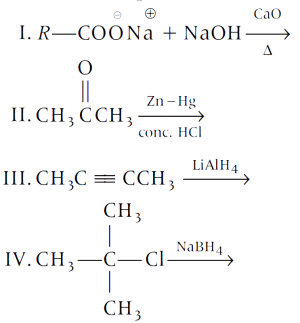
Which of the following reactions produce an alkane as the product?
A
$I, II, III$
B
$I, III, IV$
C
$I, II, IV$
D
$II, III, IV$
Solution
(C) $(I)$ The mixture of $NaOH + CaO$ is called sodalime. When it reacts with the sodium salt of a carboxylic acid,it gives the corresponding alkane. This reaction is called decarboxylation of salts of carboxylic acids: $R-COONa + NaOH \xrightarrow[\Delta]{CaO} R-H + Na_2CO_3$ (Alkane).
$(II)$ This reaction is called Clemmensen reduction. It converts aldehydes and ketones to the corresponding alkane: $CH_3COCH_3 \xrightarrow[conc. HCl]{Zn-Hg} CH_3CH_2CH_3$ (Propane,an alkane).
$(III)$ The reaction of $CH_3C \equiv CCH_3$ with $LiAlH_4$ does not typically reduce alkynes to alkanes; it is generally unreactive toward isolated alkynes,or may lead to complex mixtures depending on conditions,but it is not a standard method for alkane synthesis.
$(IV)$ The reaction of a tertiary alkyl halide like $(CH_3)_3CCl$ with $NaBH_4$ is generally slow or does not occur under standard conditions,as $NaBH_4$ is a mild reducing agent typically used for aldehydes and ketones,not alkyl halides.
Therefore,only reactions $(I)$ and $(II)$ produce alkanes. However,reviewing the options provided,if we re-evaluate the reactivity,$(IV)$ can sometimes undergo reduction to alkanes with specific reagents,but based on standard textbook reactions,$(I)$ and $(II)$ are the primary alkane-producing reactions. Given the options,$(C)$ is the most plausible choice if $(IV)$ is considered to proceed under specific conditions.
$(II)$ This reaction is called Clemmensen reduction. It converts aldehydes and ketones to the corresponding alkane: $CH_3COCH_3 \xrightarrow[conc. HCl]{Zn-Hg} CH_3CH_2CH_3$ (Propane,an alkane).
$(III)$ The reaction of $CH_3C \equiv CCH_3$ with $LiAlH_4$ does not typically reduce alkynes to alkanes; it is generally unreactive toward isolated alkynes,or may lead to complex mixtures depending on conditions,but it is not a standard method for alkane synthesis.
$(IV)$ The reaction of a tertiary alkyl halide like $(CH_3)_3CCl$ with $NaBH_4$ is generally slow or does not occur under standard conditions,as $NaBH_4$ is a mild reducing agent typically used for aldehydes and ketones,not alkyl halides.
Therefore,only reactions $(I)$ and $(II)$ produce alkanes. However,reviewing the options provided,if we re-evaluate the reactivity,$(IV)$ can sometimes undergo reduction to alkanes with specific reagents,but based on standard textbook reactions,$(I)$ and $(II)$ are the primary alkane-producing reactions. Given the options,$(C)$ is the most plausible choice if $(IV)$ is considered to proceed under specific conditions.
0 likes
View Solution718
EasyMCQ
Which of the following statements is correct in the Kolbe's electrolysis?
A
Hydrocarbons containing even number of carbon atoms produced at anode
B
Hydrocarbons containing odd number of carbon atoms produced at anode
C
Hydrocarbons containing even number of carbon atoms produced at cathode
D
Hydrocarbons containing odd number of carbon atoms produced at cathode
Solution
(A) In Kolbe's electrolysis,the aqueous solution of sodium or potassium salt of a carboxylic acid is electrolyzed. The reaction is: $2RCOO^{-}Na^{+} + 2H_2O \rightarrow R-R + 2CO_2 + H_2 + 2NaOH$.
At the anode,the carboxylate ion loses an electron to form a radical,which then decarboxylates and dimerizes to form an alkane: $2RCOO^{-}$ $\rightarrow 2RCOO^{\bullet} + 2e^{-}$ $\rightarrow 2R^{\bullet} + 2CO_2$ $\rightarrow R-R + 2CO_2$.
Since the product $R-R$ is formed by the coupling of two identical alkyl groups $(R)$,the resulting hydrocarbon always contains an even number of carbon atoms.
At the cathode,water is reduced to produce hydrogen gas: $2H_2O + 2e^{-} \rightarrow H_2 + 2OH^{-}$.
Therefore,hydrocarbons with an even number of carbon atoms are produced at the anode.
Thus,option $(A)$ is the correct answer.
At the anode,the carboxylate ion loses an electron to form a radical,which then decarboxylates and dimerizes to form an alkane: $2RCOO^{-}$ $\rightarrow 2RCOO^{\bullet} + 2e^{-}$ $\rightarrow 2R^{\bullet} + 2CO_2$ $\rightarrow R-R + 2CO_2$.
Since the product $R-R$ is formed by the coupling of two identical alkyl groups $(R)$,the resulting hydrocarbon always contains an even number of carbon atoms.
At the cathode,water is reduced to produce hydrogen gas: $2H_2O + 2e^{-} \rightarrow H_2 + 2OH^{-}$.
Therefore,hydrocarbons with an even number of carbon atoms are produced at the anode.
Thus,option $(A)$ is the correct answer.
0 likes
View Solution719
MediumMCQ
The chemicals and the reaction conditions required for the preparation of ethane are:
A
$C_2H_5I, Zn-Cu, C_2H_5OH$
B
$CH_3Cl, Na, \text{dry ether}$
C
$KOOC-CH=CH-COOK, \text{electrolysis}$
D
$CH_3CO_2Na, NaOH, CaO, \Delta$
Solution
$(A)$ The preparation of ethane $(C_2H_6)$ can be achieved through the reduction of iodoethane $(C_2H_5I)$ using a $Zn-Cu$ couple in the presence of ethanol $(C_2H_5OH)$.
The chemical reaction is: $C_2H_5I + 2[H] \xrightarrow{Zn-Cu, C_2H_5OH} C_2H_6 + HI$.
Therefore, option $A$ provides the correct reagents and conditions for the preparation of ethane.
The chemical reaction is: $C_2H_5I + 2[H] \xrightarrow{Zn-Cu, C_2H_5OH} C_2H_6 + HI$.
Therefore, option $A$ provides the correct reagents and conditions for the preparation of ethane.
0 likes
View Solution720
EasyMCQ
$C_2H_6 \xrightarrow{450^{\circ}C} C_2H_4 + H_2$
The above reaction is called:
The above reaction is called:
A
combustion
B
rearrangement
C
pyrolysis
D
cleavage
Solution
(C) The decomposition of a compound by the application of heat is known as pyrolysis.
Specifically,the thermal decomposition of higher alkanes into a mixture of lower alkanes,alkenes,and hydrogen is referred to as cracking or pyrolysis.
Specifically,the thermal decomposition of higher alkanes into a mixture of lower alkanes,alkenes,and hydrogen is referred to as cracking or pyrolysis.
0 likes
View Solution721
EasyMCQ
The chlorination of ethane is an example of which of the following types of reactions?
A
Nucleophilic substitution
B
Electrophilic substitution
C
Free radical substitution
D
Rearrangement
Solution
(C) The chlorination of ethane is a classic example of a free radical substitution reaction. It proceeds through three main stages:
Step $I$: Initiation step,where chlorine molecules undergo homolytic fission in the presence of light $(hv)$ to form chlorine free radicals:
$Cl_2 \stackrel{hv}{\longrightarrow} 2 Cl^{\bullet}$
Step $II$: Propagation step,where the chlorine radical reacts with ethane to form an ethyl radical,which then reacts with another chlorine molecule to form chloroethane and regenerate a chlorine radical:
$CH_3CH_3 + Cl^{\bullet} \longrightarrow CH_3CH_2^{\bullet} + HCl$
$CH_3CH_2^{\bullet} + Cl_2 \longrightarrow CH_3CH_2Cl + Cl^{\bullet}$
Step $III$: Termination step,where free radicals combine to end the chain reaction:
$CH_3CH_2^{\bullet} + Cl^{\bullet} \longrightarrow CH_3CH_2Cl$
$Cl^{\bullet} + Cl^{\bullet} \longrightarrow Cl_2$
$2 CH_3CH_2^{\bullet} \longrightarrow CH_3CH_2CH_2CH_3$
Step $I$: Initiation step,where chlorine molecules undergo homolytic fission in the presence of light $(hv)$ to form chlorine free radicals:
$Cl_2 \stackrel{hv}{\longrightarrow} 2 Cl^{\bullet}$
Step $II$: Propagation step,where the chlorine radical reacts with ethane to form an ethyl radical,which then reacts with another chlorine molecule to form chloroethane and regenerate a chlorine radical:
$CH_3CH_3 + Cl^{\bullet} \longrightarrow CH_3CH_2^{\bullet} + HCl$
$CH_3CH_2^{\bullet} + Cl_2 \longrightarrow CH_3CH_2Cl + Cl^{\bullet}$
Step $III$: Termination step,where free radicals combine to end the chain reaction:
$CH_3CH_2^{\bullet} + Cl^{\bullet} \longrightarrow CH_3CH_2Cl$
$Cl^{\bullet} + Cl^{\bullet} \longrightarrow Cl_2$
$2 CH_3CH_2^{\bullet} \longrightarrow CH_3CH_2CH_2CH_3$
0 likes
View Solution722
MediumMCQ
Identify '$B$' in the following reaction:
$CH_2=CH_2 + HCl$ $\xrightarrow{\text{anhy. } AlCl_3} A$ $\xrightarrow{2[H]}$ $\xrightarrow{Zn-Cu / C_2H_5OH} B + HCl$
$CH_2=CH_2 + HCl$ $\xrightarrow{\text{anhy. } AlCl_3} A$ $\xrightarrow{2[H]}$ $\xrightarrow{Zn-Cu / C_2H_5OH} B + HCl$
A
$CH_4$
B
$C_2H_6$
C
$C_2H_5Cl$
D
$C_2H_5OH$
Solution
(B) Step $1$: The reaction of ethene $(CH_2=CH_2)$ with $HCl$ in the presence of anhydrous $AlCl_3$ yields chloroethane $(CH_3CH_2Cl)$ as product $A$.
$CH_2=CH_2 + HCl \rightarrow CH_3CH_2Cl$ $(A)$
Step $2$: The reduction of alkyl halides using $Zn-Cu$ couple in the presence of ethanol $(C_2H_5OH)$ is a standard method to obtain alkanes.
$CH_3CH_2Cl + 2[H] \xrightarrow{Zn-Cu / C_2H_5OH} CH_3CH_3$ $(B)$ $+ HCl$
Thus,$B$ is ethane $(C_2H_6)$.
$CH_2=CH_2 + HCl \rightarrow CH_3CH_2Cl$ $(A)$
Step $2$: The reduction of alkyl halides using $Zn-Cu$ couple in the presence of ethanol $(C_2H_5OH)$ is a standard method to obtain alkanes.
$CH_3CH_2Cl + 2[H] \xrightarrow{Zn-Cu / C_2H_5OH} CH_3CH_3$ $(B)$ $+ HCl$
Thus,$B$ is ethane $(C_2H_6)$.
0 likes
View Solution723
EasyMCQ
What will be the organic compound formed when aluminium carbide reacts with deuterated water?
A
$CD_3OD$
B
$DCOOD$
C
$CD_4$
D
$D_3C^{-}O^{-}CD_3$
Solution
(C) Aluminium carbide $(Al_4C_3)$ reacts with deuterated water $(D_2O)$ to produce aluminium deuteroxide $(Al(OD)_3)$ and deutero-methane $(CD_4)$.
The balanced chemical equation for the reaction is:
$Al_4C_3 + 12 D_2O \longrightarrow 4 Al(OD)_3 + 3 CD_4$
Thus,the organic compound formed is $CD_4$.
The balanced chemical equation for the reaction is:
$Al_4C_3 + 12 D_2O \longrightarrow 4 Al(OD)_3 + 3 CD_4$
Thus,the organic compound formed is $CD_4$.
0 likes
View Solution724
MediumMCQ
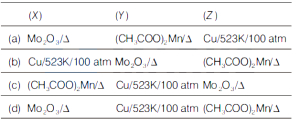
Identify the correct catalyst and reaction conditions for the controlled oxidation of methane to $(i)$ methanol $(X)$,$(ii)$ methanal $(Y)$ and ethane to $(iii)$ ethanoic acid $(Z)$.
A
$(a)$
B
$(b)$
C
$(c)$
D
$(d)$
Solution
(B) The controlled oxidation reactions of alkanes are as follows:
$1$. Methane to methanol $(X)$: $CH_4 + [O] \xrightarrow{Cu / 523 \ K, 100 \ atm} CH_3OH$
$2$. Methane to methanal $(Y)$: $CH_4 + O_2 \xrightarrow{Mo_2O_3 / \Delta} HCHO + H_2O$
$3$. Ethane to ethanoic acid $(Z)$: $2CH_3CH_3 + 3O_2 \xrightarrow{(CH_3COO)_2Mn / \Delta} 2CH_3COOH + 2H_2O$
Comparing these with the given options,the correct sequence is $(X = Cu / 523 \ K / 100 \ atm)$,$(Y = Mo_2O_3 / \Delta)$,and $(Z = (CH_3COO)_2Mn / \Delta)$.
Thus,option $(b)$ is correct.
$1$. Methane to methanol $(X)$: $CH_4 + [O] \xrightarrow{Cu / 523 \ K, 100 \ atm} CH_3OH$
$2$. Methane to methanal $(Y)$: $CH_4 + O_2 \xrightarrow{Mo_2O_3 / \Delta} HCHO + H_2O$
$3$. Ethane to ethanoic acid $(Z)$: $2CH_3CH_3 + 3O_2 \xrightarrow{(CH_3COO)_2Mn / \Delta} 2CH_3COOH + 2H_2O$
Comparing these with the given options,the correct sequence is $(X = Cu / 523 \ K / 100 \ atm)$,$(Y = Mo_2O_3 / \Delta)$,and $(Z = (CH_3COO)_2Mn / \Delta)$.
Thus,option $(b)$ is correct.
0 likes
View Solution725
EasyMCQ
The $4^{th}$ higher homologue of ethane is
A
$a.$ butane
B
$b.$ pentane
C
$c.$ hexane
D
$d.$ heptane
Solution
(C) Ethane is $C_2H_6$.
Homologues in an alkane series differ by a $-CH_2-$ unit.
The $4^{th}$ higher homologue is obtained by adding four $-CH_2-$ units to ethane.
$C_2H_6 + 4(CH_2) = C_6H_{14}$.
The compound with the molecular formula $C_6H_{14}$ is hexane.
Homologues in an alkane series differ by a $-CH_2-$ unit.
The $4^{th}$ higher homologue is obtained by adding four $-CH_2-$ units to ethane.
$C_2H_6 + 4(CH_2) = C_6H_{14}$.
The compound with the molecular formula $C_6H_{14}$ is hexane.
0 likes
View Solution726
EasyMCQ
$2-$methylpropane on monochlorination under photochemical conditions gives:
A
$2-$chloro$-2-$methylpropane as major product
B
$1:1$ mixture of $1-$chloro$-2-$methylpropane and $2-$chloro$-2-$methylpropane
C
$1-$chloro$-2-$methylpropane as a major product
D
$1:9$ mixture of $1-$chloro$-2-$methylpropane and $2-$chloro$-2-$methylpropane
Solution
(C) In $2-$methylpropane,there are $9$ primary hydrogens and $1$ tertiary hydrogen.
The relative reactivity of tertiary hydrogen towards chlorination is about $5.0$ to $5.5$ times that of primary hydrogen.
However,the number of primary hydrogens $(9)$ is much greater than the number of tertiary hydrogens $(1)$.
Therefore,the statistical factor $(9 \times 1 = 9)$ outweighs the reactivity factor $(1 \times 5.5 = 5.5)$.
As a result,$1-$chloro$-2-$methylpropane is formed as the major product.
The relative reactivity of tertiary hydrogen towards chlorination is about $5.0$ to $5.5$ times that of primary hydrogen.
However,the number of primary hydrogens $(9)$ is much greater than the number of tertiary hydrogens $(1)$.
Therefore,the statistical factor $(9 \times 1 = 9)$ outweighs the reactivity factor $(1 \times 5.5 = 5.5)$.
As a result,$1-$chloro$-2-$methylpropane is formed as the major product.
0 likes
View Solution727
EasyMCQ
The best method for the preparation of $2, 2-$dimethylbutane is via the reaction of
A
$Me_3CBr$ and $MeCH_2Br$ in $Na$/ether
B
$(Me_3C)_2CuLi$ and $MeCH_2Br$
C
$(MeCH_2)_2CuLi$ and $Me_3CBr$
D
$Me_3CMgI$ and $MeCH_2I$
Solution
(B) $2, 2-$dimethylbutane is prepared using the Corey-House synthesis,which involves the reaction of a lithium dialkylcuprate with an alkyl halide.
To prepare $2, 2-$dimethylbutane $(CH_3-C(CH_3)_2-CH_2-CH_3)$,we need a tert-butyl group and an ethyl group.
The Corey-House reaction follows an $S_N2$ mechanism,which works best with primary alkyl halides.
Therefore,the reaction between $(Me_3C)_2CuLi$ and $MeCH_2Br$ is the most efficient route.
The reaction is: $(Me_3C)_2CuLi + MeCH_2Br \rightarrow Me_3C-CH_2CH_3 + Me_3CCu + LiBr$.
To prepare $2, 2-$dimethylbutane $(CH_3-C(CH_3)_2-CH_2-CH_3)$,we need a tert-butyl group and an ethyl group.
The Corey-House reaction follows an $S_N2$ mechanism,which works best with primary alkyl halides.
Therefore,the reaction between $(Me_3C)_2CuLi$ and $MeCH_2Br$ is the most efficient route.
The reaction is: $(Me_3C)_2CuLi + MeCH_2Br \rightarrow Me_3C-CH_2CH_3 + Me_3CCu + LiBr$.
0 likes
View Solution728
EasyMCQ
How many monobrominated product$(s)$ (including stereoisomers) would form in the free radical bromination of $n$-butane?
A
$2$
B
$1$
C
$3$
D
$4$
Solution
(C) The free radical bromination of $n$-butane $(CH_3-CH_2-CH_2-CH_3)$ can occur at two different types of carbon atoms:
$1$. At the terminal carbon ($C_1$ or $C_4$),it forms $1$-bromobutane $(CH_3-CH_2-CH_2-CH_2Br)$. This product is achiral.
$2$. At the internal carbon ($C_2$ or $C_3$),it forms $2$-bromobutane $(CH_3-CHBr-CH_2-CH_3)$. This product has a chiral center at $C_2$,resulting in a pair of enantiomers ($R$ and $S$ forms).
Therefore,the total number of monobrominated products including stereoisomers is $1$ (from $1$-bromobutane) + $2$ (from $2$-bromobutane) = $3$ products.
$1$. At the terminal carbon ($C_1$ or $C_4$),it forms $1$-bromobutane $(CH_3-CH_2-CH_2-CH_2Br)$. This product is achiral.
$2$. At the internal carbon ($C_2$ or $C_3$),it forms $2$-bromobutane $(CH_3-CHBr-CH_2-CH_3)$. This product has a chiral center at $C_2$,resulting in a pair of enantiomers ($R$ and $S$ forms).
Therefore,the total number of monobrominated products including stereoisomers is $1$ (from $1$-bromobutane) + $2$ (from $2$-bromobutane) = $3$ products.
0 likes
View Solution729
EasyMCQ
On mixing an alkane with chlorine and irradiating with ultra-violet light,it forms only one mono-chloro-alkane. The alkane is
A
Propane
B
Pentane
C
Isopentane
D
Neopentane
Solution
(D) The reaction of an alkane with chlorine in the presence of ultra-violet light is a free radical substitution reaction.
For an alkane to form only one mono-chloro-alkane,all the hydrogen atoms in the alkane must be equivalent.
In $Neopentane$ $(2,2-dimethylpropane)$,all $12$ hydrogen atoms are attached to equivalent primary carbon atoms.
Therefore,replacing any one of these hydrogen atoms with a chlorine atom results in the same product,$1-chloro-2,2-dimethylpropane$.
For an alkane to form only one mono-chloro-alkane,all the hydrogen atoms in the alkane must be equivalent.
In $Neopentane$ $(2,2-dimethylpropane)$,all $12$ hydrogen atoms are attached to equivalent primary carbon atoms.
Therefore,replacing any one of these hydrogen atoms with a chlorine atom results in the same product,$1-chloro-2,2-dimethylpropane$.
0 likes
View Solution730
DifficultMCQ
The reactions which produce alcohol as the product are:
$A$. $CH_{4} + O_{2} \xrightarrow{Mo_{2}O_{3}}$
$B$. $2CH_{3}CH_{3} + 3O_{2} \xrightarrow[\Delta]{(CH_{3}COO)_{2}Mn}$
$C$. $(CH_{3})_{3}CH \xrightarrow{KMnO_{4}}$
$D$. $2CH_{4} + O_{2} \xrightarrow{Cu/523 \ K/100 \ atm.}$
$E$. $CH_{3}CH=CHCH_{3} \xrightarrow{KMnO_{4}/H^{+}}$
Choose the correct answer from the options given below:
$A$. $CH_{4} + O_{2} \xrightarrow{Mo_{2}O_{3}}$
$B$. $2CH_{3}CH_{3} + 3O_{2} \xrightarrow[\Delta]{(CH_{3}COO)_{2}Mn}$
$C$. $(CH_{3})_{3}CH \xrightarrow{KMnO_{4}}$
$D$. $2CH_{4} + O_{2} \xrightarrow{Cu/523 \ K/100 \ atm.}$
$E$. $CH_{3}CH=CHCH_{3} \xrightarrow{KMnO_{4}/H^{+}}$
Choose the correct answer from the options given below:
A
$A$ and $D$ Only
B
$A, C$ and $E$ Only
C
$C$ and $D$ Only
D
$B, D$ and $E$ Only
Solution
(C) Let us analyze each reaction:
$(A)$ $CH_{4} + O_{2} \xrightarrow{Mo_{2}O_{3}} HCHO$ (Formaldehyde is produced,not an alcohol).
$(B)$ $2CH_{3}CH_{3} + 3O_{2} \xrightarrow[\Delta]{(CH_{3}COO)_{2}Mn} 2CH_{3}COOH$ (Ethanoic acid is produced).
$(C)$ $(CH_{3})_{3}CH \xrightarrow{KMnO_{4}} (CH_{3})_{3}COH$ (tert-Butyl alcohol is produced).
$(D)$ $2CH_{4} + O_{2} \xrightarrow[523 \ K, 100 \ atm.]{Cu} 2CH_{3}OH$ (Methanol is produced).
$(E)$ $CH_{3}CH=CHCH_{3} \xrightarrow{KMnO_{4}/H^{+}} 2CH_{3}COOH$ (Ethanoic acid is produced).
Thus,reactions $(C)$ and $(D)$ produce alcohol as the product.
$(A)$ $CH_{4} + O_{2} \xrightarrow{Mo_{2}O_{3}} HCHO$ (Formaldehyde is produced,not an alcohol).
$(B)$ $2CH_{3}CH_{3} + 3O_{2} \xrightarrow[\Delta]{(CH_{3}COO)_{2}Mn} 2CH_{3}COOH$ (Ethanoic acid is produced).
$(C)$ $(CH_{3})_{3}CH \xrightarrow{KMnO_{4}} (CH_{3})_{3}COH$ (tert-Butyl alcohol is produced).
$(D)$ $2CH_{4} + O_{2} \xrightarrow[523 \ K, 100 \ atm.]{Cu} 2CH_{3}OH$ (Methanol is produced).
$(E)$ $CH_{3}CH=CHCH_{3} \xrightarrow{KMnO_{4}/H^{+}} 2CH_{3}COOH$ (Ethanoic acid is produced).
Thus,reactions $(C)$ and $(D)$ produce alcohol as the product.
0 likes
View Solution731
DifficultMCQ
$n$-Butane on monochlorination under photochemical conditions gives an optically active compound "$P$". "$P$" on further chlorination gives dichloro compounds. The number of dichloro compounds obtained (ignore stereoisomers) is:
A
$3$
B
$4$
C
$5$
D
$6$
Solution
(C) $n$-Butane is $CH_{3}CH_{2}CH_{2}CH_{3}$.
Monochlorination of $n$-butane yields $2$-chlorobutane $(CH_{3}CHClCH_{2}CH_{3})$,which contains a chiral center and is thus optically active ('$P$').
Further chlorination of $2$-chlorobutane can occur at different carbon positions to form dichloro derivatives.
The possible structural isomers for the dichloro products are:
$1,1$-dichlorobutane
$1,2$-dichlorobutane
$1,3$-dichlorobutane
$2,2$-dichlorobutane
$2,3$-dichlorobutane
Ignoring stereoisomers,there are $5$ distinct structural isomers.
Monochlorination of $n$-butane yields $2$-chlorobutane $(CH_{3}CHClCH_{2}CH_{3})$,which contains a chiral center and is thus optically active ('$P$').
Further chlorination of $2$-chlorobutane can occur at different carbon positions to form dichloro derivatives.
The possible structural isomers for the dichloro products are:
$1,1$-dichlorobutane
$1,2$-dichlorobutane
$1,3$-dichlorobutane
$2,2$-dichlorobutane
$2,3$-dichlorobutane
Ignoring stereoisomers,there are $5$ distinct structural isomers.
0 likes
View Solution732
DifficultMCQ
$n$-Butane on monochlorination under photochemical conditions gives an optically active compound "$P$". "$P$" on further chlorination gives dichloro compounds. The number of dichloro compounds obtained (ignore stereoisomers) is:
A
$3$
B
$4$
C
$5$
D
$6$
Solution
(C) $n$-Butane $(CH_3-CH_2-CH_2-CH_3)$ on monochlorination gives $2$-chlorobutane $(CH_3-CHCl-CH_2-CH_3)$,which is the optically active compound "$P$".
Further chlorination of $2$-chlorobutane involves the substitution of a hydrogen atom by a chlorine atom at different positions.
The possible dichloro products are:
$1,1$-dichlorobutane $(CH_3-CH_2-CH_2-CHCl_2)$
$1,2$-dichlorobutane $(CH_3-CH_2-CHCl-CH_2Cl)$
$1,3$-dichlorobutane $(CH_3-CHCl-CH_2-CH_2Cl)$
$2,2$-dichlorobutane $(CH_3-CCl_2-CH_2-CH_3)$
$2,3$-dichlorobutane $(CH_3-CHCl-CHCl-CH_3)$
Ignoring stereoisomers,there are $5$ distinct constitutional isomers.
Further chlorination of $2$-chlorobutane involves the substitution of a hydrogen atom by a chlorine atom at different positions.
The possible dichloro products are:
$1,1$-dichlorobutane $(CH_3-CH_2-CH_2-CHCl_2)$
$1,2$-dichlorobutane $(CH_3-CH_2-CHCl-CH_2Cl)$
$1,3$-dichlorobutane $(CH_3-CHCl-CH_2-CH_2Cl)$
$2,2$-dichlorobutane $(CH_3-CCl_2-CH_2-CH_3)$
$2,3$-dichlorobutane $(CH_3-CHCl-CHCl-CH_3)$
Ignoring stereoisomers,there are $5$ distinct constitutional isomers.
0 likes
View Solution733
MediumMCQ
Given below are two statements:
Statement $I$: Methane can be prepared by decarboxylation of sodium ethanoate,Kolbe's electrolysis of sodium acetate and reaction of $CH_3MgBr$ with water.
Statement $II$: Methane cannot be prepared from unsaturated hydrocarbons and by Wurtz reaction.
In the light of the above statements,choose the correct answer from the options given below.
Statement $I$: Methane can be prepared by decarboxylation of sodium ethanoate,Kolbe's electrolysis of sodium acetate and reaction of $CH_3MgBr$ with water.
Statement $II$: Methane cannot be prepared from unsaturated hydrocarbons and by Wurtz reaction.
In the light of the above statements,choose the correct answer from the options given below.
A
Both Statement $I$ and Statement $II$ are true
B
Both Statement $I$ and Statement $II$ are false
C
Statement $I$ is true but Statement $II$ is false
D
Statement $I$ is false but Statement $II$ is true
Solution
(D) Statement $I$ is false because while decarboxylation of sodium ethanoate $(CH_3COONa + NaOH xrightarrow{CaO} CH_4 + Na_2CO_3)$ and the reaction of $CH_3MgBr$ with water $(CH_3MgBr + H_2O
ightarrow CH_4 + Mg(OH)Br)$ produce methane,Kolbe's electrolysis of sodium acetate produces ethane $(2CH_3COONa + 2H_2O
ightarrow CH_3-CH_3 + 2CO_2 + H_2 + 2NaOH)$.
Statement $II$ is true because methane $(CH_4)$ contains only one carbon atom,whereas the Wurtz reaction $(2R-X + 2Na ightarrow R-R + 2NaX)$ is used to prepare alkanes with an even number of carbon atoms (at least two carbons) by coupling two alkyl groups.
Statement $II$ is true because methane $(CH_4)$ contains only one carbon atom,whereas the Wurtz reaction $(2R-X + 2Na ightarrow R-R + 2NaX)$ is used to prepare alkanes with an even number of carbon atoms (at least two carbons) by coupling two alkyl groups.
0 likes
View Solution734
MediumMCQ
The compound $(X)$ on $(i)$ heating in the presence of anhydrous $AlCl_3$ and $HCl$ gas gives $2,4$-dimethylpentane,$(ii)$ aromatization gives toluene,and $(iii)$ cyclisation gives methylcyclohexane. The correct name of compound $(X)$ is:
A
Hept$-2-$ene
B
Hept$-1,3,5-$triene
C
Heptane
D
Hept$-2,4,6-$triene
Solution
(C) Heptane $(C_7H_{16})$ undergoes isomerisation in the presence of $AlCl_3/HCl$ to give branched isomers like $2,4$-dimethylpentane.
Aromatisation (dehydrocyclization) of $C_7$ alkanes leads to the formation of toluene $(C_6H_5CH_3)$.
Cyclisation of heptane specifically yields methylcyclohexane.
Since all these chemical properties are characteristic of the straight-chain alkane heptane,the compound $(X)$ is heptane.
Aromatisation (dehydrocyclization) of $C_7$ alkanes leads to the formation of toluene $(C_6H_5CH_3)$.
Cyclisation of heptane specifically yields methylcyclohexane.
Since all these chemical properties are characteristic of the straight-chain alkane heptane,the compound $(X)$ is heptane.
0 likes
View Solution735
DifficultMCQ
$RMgI$ when treated with ice-cold water liberated a gas which occupied $1.4 \text{ dm}^3/\text{g}$ at $STP$. The gas produced is further reacted with iodine in the presence of $HIO_3$ to give compound $(X)$. Compound $(X)$ in the presence of $Na$ and dry ether produced compound $(Y)$. The molar mass of compound $(Y)$ is . . . . . . $\text{g mol}^{-1}$. (Nearest integer)
A
$26$
B
$28$
C
$30$
D
$32$
Solution
(C) $1$. Reaction with water: $RMgI + H_2O \rightarrow RH + Mg(OH)I$. The gas produced is an alkane $RH$.
$2$. Molar mass calculation: At $STP$,$1 \text{ mole}$ of gas occupies $22.4 \text{ dm}^3$. Given density is $1.4 \text{ dm}^3/\text{g}$,so molar mass $M = 22.4 / 1.4 = 16 \text{ g/mol}$.
$3$. Identification: The alkane with molar mass $16 \text{ g/mol}$ is methane $(CH_4)$.
$4$. Reaction with iodine: $CH_4 + I_2 \xrightarrow{HIO_3} CH_3I (X) + HI$.
$5$. Wurtz reaction: $2CH_3I + 2Na \xrightarrow{\text{dry ether}} C_2H_6 (Y) + 2NaI$.
$6$. Molar mass of $(Y)$ $(C_2H_6)$: $(2 \times 12) + (6 \times 1) = 30 \text{ g/mol}$.
$2$. Molar mass calculation: At $STP$,$1 \text{ mole}$ of gas occupies $22.4 \text{ dm}^3$. Given density is $1.4 \text{ dm}^3/\text{g}$,so molar mass $M = 22.4 / 1.4 = 16 \text{ g/mol}$.
$3$. Identification: The alkane with molar mass $16 \text{ g/mol}$ is methane $(CH_4)$.
$4$. Reaction with iodine: $CH_4 + I_2 \xrightarrow{HIO_3} CH_3I (X) + HI$.
$5$. Wurtz reaction: $2CH_3I + 2Na \xrightarrow{\text{dry ether}} C_2H_6 (Y) + 2NaI$.
$6$. Molar mass of $(Y)$ $(C_2H_6)$: $(2 \times 12) + (6 \times 1) = 30 \text{ g/mol}$.
0 likes
View Solution736
DifficultMCQ
An alkane $(Y)$ requires $8$ moles of oxygen for complete combustion and on chlorination with $Cl_2/h\nu$,$(Y)$ gives only one monochlorinated product $(Z)$. The total number of primary carbon atoms in $(Y)$ is . . . . . . .
A
$1$
B
$2$
C
$3$
D
$4$
Solution
(D) $1$. The general formula for the combustion of an alkane is $C_nH_{2n+2} + (\frac{3n+1}{2})O_2 \rightarrow nCO_2 + (n+1)H_2O$.
$2$. Given that the moles of oxygen required is $8$,we set $\frac{3n+1}{2} = 8$,which gives $3n+1 = 16$,so $3n = 15$,and $n = 5$.
$3$. The alkane is pentane $(C_5H_{12})$. For an alkane to yield only one monochlorinated product upon reaction with $Cl_2/h\nu$,all hydrogen atoms must be equivalent. This structure is neopentane ($2,2$-dimethylpropane).
$4$. In neopentane,there are $4$ methyl groups attached to a central quaternary carbon atom. Each methyl group contains a primary carbon atom. Therefore,there are $4$ primary carbon atoms.
$2$. Given that the moles of oxygen required is $8$,we set $\frac{3n+1}{2} = 8$,which gives $3n+1 = 16$,so $3n = 15$,and $n = 5$.
$3$. The alkane is pentane $(C_5H_{12})$. For an alkane to yield only one monochlorinated product upon reaction with $Cl_2/h\nu$,all hydrogen atoms must be equivalent. This structure is neopentane ($2,2$-dimethylpropane).
$4$. In neopentane,there are $4$ methyl groups attached to a central quaternary carbon atom. Each methyl group contains a primary carbon atom. Therefore,there are $4$ primary carbon atoms.
0 likes
View Solution737
DifficultMCQ
One mole of an alkane $(x)$ requires $8$ mole oxygen for complete combustion. The sum of the number of carbon and hydrogen atoms in the alkane $(x)$ is . . . . . . .
A
$15$
B
$17$
C
$12$
D
$19$
Solution
(B) $1$. The general combustion reaction for an alkane $C_nH_{2n+2}$ is: $C_nH_{2n+2} + (\frac{3n+1}{2})O_2 \rightarrow nCO_2 + (n+1)H_2O$.
$2$. According to the problem,the coefficient of $O_2$ is $8$,so: $\frac{3n+1}{2} = 8$.
$3$. Solving for $n$: $3n + 1 = 16 \Rightarrow 3n = 15 \Rightarrow n = 5$.
$4$. The alkane is $C_5H_{12}$ (pentane).
$5$. The sum of carbon and hydrogen atoms is $n + (2n + 2) = 5 + 12 = 17$.
$2$. According to the problem,the coefficient of $O_2$ is $8$,so: $\frac{3n+1}{2} = 8$.
$3$. Solving for $n$: $3n + 1 = 16 \Rightarrow 3n = 15 \Rightarrow n = 5$.
$4$. The alkane is $C_5H_{12}$ (pentane).
$5$. The sum of carbon and hydrogen atoms is $n + (2n + 2) = 5 + 12 = 17$.
0 likes
View Solution738
DifficultMCQ
Consider the isomers of the hydrocarbon with molecular formula $C_5H_{10}$. These isomers do not decolourise $KMnO_4$ solution. These isomers are subjected to chlorination with chlorine in the presence of light to give monochloro compounds. The total number of monochloro compounds (structural isomers only) formed from all these isomers is . . . . . . .
A
$3$
B
$4$
C
$2$
D
$5$
Solution
(B) $1$. The molecular formula $C_5H_{10}$ corresponds to the general formula $C_nH_{2n}$,which indicates either an alkene or a cycloalkane. Since the isomers do not decolourise $KMnO_4$ solution,they must be saturated cyclic hydrocarbons (cycloalkanes).
$2$. The possible cycloalkane isomers for $C_5H_{10}$ are: Cyclopentane,Methylcyclobutane,$1,1$-Dimethylcyclopropane,and $1,2$-Dimethylcyclopropane (cis and trans).
$3$. Chlorination of Cyclopentane gives $1$ monochloro product.
$4$. Chlorination of Methylcyclobutane gives $3$ structural isomers ($1$-chloro-$1$-methylcyclobutane,$2$-chloro-$1$-methylcyclobutane,and $3$-chloro-$1$-methylcyclobutane).
$5$. Chlorination of $1,1$-Dimethylcyclopropane gives $2$ structural isomers ($1$-chloro-$1,1$-dimethylcyclopropane and $2$-chloro-$1,1$-dimethylcyclopropane).
$6$. Chlorination of $1,2$-Dimethylcyclopropane gives $3$ structural isomers.
$7$. The question asks for the total number of monochloro compounds formed from these isomers. Summing the unique structural isomers: Cyclopentane $(1)$ + Methylcyclobutane $(3)$ + $1,1$-Dimethylcyclopropane $(2)$ + $1,2$-Dimethylcyclopropane $(3)$ = $9$. However,in standard competitive chemistry problems of this type,the question often refers to the number of isomers of the parent hydrocarbon itself. Given the options provided,the number of parent isomers is $4$.
$2$. The possible cycloalkane isomers for $C_5H_{10}$ are: Cyclopentane,Methylcyclobutane,$1,1$-Dimethylcyclopropane,and $1,2$-Dimethylcyclopropane (cis and trans).
$3$. Chlorination of Cyclopentane gives $1$ monochloro product.
$4$. Chlorination of Methylcyclobutane gives $3$ structural isomers ($1$-chloro-$1$-methylcyclobutane,$2$-chloro-$1$-methylcyclobutane,and $3$-chloro-$1$-methylcyclobutane).
$5$. Chlorination of $1,1$-Dimethylcyclopropane gives $2$ structural isomers ($1$-chloro-$1,1$-dimethylcyclopropane and $2$-chloro-$1,1$-dimethylcyclopropane).
$6$. Chlorination of $1,2$-Dimethylcyclopropane gives $3$ structural isomers.
$7$. The question asks for the total number of monochloro compounds formed from these isomers. Summing the unique structural isomers: Cyclopentane $(1)$ + Methylcyclobutane $(3)$ + $1,1$-Dimethylcyclopropane $(2)$ + $1,2$-Dimethylcyclopropane $(3)$ = $9$. However,in standard competitive chemistry problems of this type,the question often refers to the number of isomers of the parent hydrocarbon itself. Given the options provided,the number of parent isomers is $4$.
0 likes
View Solution739
MediumMCQ
Methane reacts with steam at $1273 \ K$ in the presence of a nickel catalyst to form:
A
$CO$ and $H_2$
B
$CO$ and $H_2O$
C
$CO_2$ and $H_2$
D
$CO_2$ and $H_2O$
Solution
(A) The reaction of methane with steam is known as steam reforming.
The chemical equation for this reaction is:
$CH_4(g) + H_2O(g) \xrightarrow{Ni, 1273 \ K} CO(g) + 3H_2(g)$
In this process,methane reacts with steam at $1273 \ K$ in the presence of a nickel catalyst to produce carbon monoxide $(CO)$ and hydrogen gas $(H_2)$.
The chemical equation for this reaction is:
$CH_4(g) + H_2O(g) \xrightarrow{Ni, 1273 \ K} CO(g) + 3H_2(g)$
In this process,methane reacts with steam at $1273 \ K$ in the presence of a nickel catalyst to produce carbon monoxide $(CO)$ and hydrogen gas $(H_2)$.
0 likes
View SolutionHydrocarbons — Alkane · Frequently Asked Questions
1Are these Hydrocarbons questions useful for JEE and NEET?
Yes. All questions in this section are mapped to JEE Main and NEET exam patterns. Previous year questions from JEE Main, NEET, GUJCET and state-level exams are included with full solutions.
2Can I switch to Hindi or Gujarati for these questions?
Yes. Use the language tabs in the hero section or the sidebar to view the same questions and solutions in English, Hindi or Gujarati.
3How do I generate a question paper from this subtopic?
Use the Vedclass Exam Paper Generator — select the chapter and subtopic, set difficulty, and generate Sets A, B, C, D automatically. First 3 chapters of every subject are free.
Vedclass Products
For Students
Vedclass Test Series
Mock tests in real JEE/NEET style with performance analysis. 5-day free trial.
Start Free TrialFor Teachers
Exam Paper Generator
Generate Set A/B/C/D papers from this chapter in 2 minutes. 3 chapters free.
Try FreeFor Institutes
Online Exam Module
Live online exams with unlimited students, 360° analytics & white-label branding.
See DemoFor Teachers & Institutes
Generate a Hydrocarbons Exam Paper in 2 Minutes
Select subtopic & difficulty — Sets A, B, C, D auto-generated with No Repeat logic.
First 3 chapters of every subject are free — no payment required.