
A English
VSEPR Theory Questions in English
Class 11 Chemistry · Chemical Bonding and Molecular Structure · VSEPR Theory
702+
Questions
English
Language
100%
With Solutions
Showing 46 of 702 questions in English
651
MediumMCQ
Match the following:
The correct answer is:
| $A$. $SnCl_2$ | $I$. Trigonal planar |
| $B$. $NH_3$ | $II$. Linear |
| $C$. $I_3^{-}$ | $III$. Angular |
| $D$. $SO_3$ | $IV$. Trigonal pyramidal |
The correct answer is:
A
$A-III, B-IV, C-II, D-I$
B
$A-IV, B-III, C-I, D-II$
C
$A-III, B-I, C-IV, D-II$
D
$A-III, B-IV, C-II, D-I$
Solution
(A) $Sn$ belongs to group $14$ and has four valence electrons,out of which two are used for forming two $Sn-Cl$ bonds and the remaining two form a lone pair of electrons.
Thus,$SnCl_2$ will be angular or bent in shape $(A \rightarrow III)$.
$NH_3$ has three bond pairs and one lone pair,so it acquires a trigonal pyramidal shape $(B \rightarrow IV)$.
$I_3^{-}$ has a linear geometry as the two bond pairs lie along a straight line while the three lone pairs occupy the equatorial positions $(C \rightarrow II)$.
$SO_3$ has three bond pairs only,so it forms a trigonal planar shape $(D \rightarrow I)$.
Therefore,the correct matching is $A-III, B-IV, C-II, D-I$.
Thus,$SnCl_2$ will be angular or bent in shape $(A \rightarrow III)$.
$NH_3$ has three bond pairs and one lone pair,so it acquires a trigonal pyramidal shape $(B \rightarrow IV)$.
$I_3^{-}$ has a linear geometry as the two bond pairs lie along a straight line while the three lone pairs occupy the equatorial positions $(C \rightarrow II)$.
$SO_3$ has three bond pairs only,so it forms a trigonal planar shape $(D \rightarrow I)$.
Therefore,the correct matching is $A-III, B-IV, C-II, D-I$.
0 likes
View Solution652
MediumMCQ
In which of the following options,molecules are correctly arranged with respect to their bond angles?
A
$S_6 < O_3 < S_8 < P_4$
B
$P_4 < O_3 < S_6 < S_8$
C
$P_4 < S_6 < S_8 < O_3$
D
$S_6 < P_4 < S_8 < O_3$
Solution
(C) The bond angles for the given species are as follows:
$1$. $P_4$: The bond angle is $60^\circ$ due to the strained tetrahedral structure.
$2$. $S_6$: The bond angle is $102^\circ$ in the chair-like puckered ring.
$3$. $S_8$: The bond angle is $107^\circ$ in the crown-shaped puckered ring.
$4$. $O_3$: The bond angle is approximately $117^\circ$ (often approximated as $120^\circ$ in resonance structures).
Thus,the correct increasing order of bond angles is: $P_4 < S_6 < S_8 < O_3$.
$1$. $P_4$: The bond angle is $60^\circ$ due to the strained tetrahedral structure.
$2$. $S_6$: The bond angle is $102^\circ$ in the chair-like puckered ring.
$3$. $S_8$: The bond angle is $107^\circ$ in the crown-shaped puckered ring.
$4$. $O_3$: The bond angle is approximately $117^\circ$ (often approximated as $120^\circ$ in resonance structures).
Thus,the correct increasing order of bond angles is: $P_4 < S_6 < S_8 < O_3$.
0 likes
View Solution653
MediumMCQ
Which one of the following compounds has the maximum 'lone pair-lone pair' electron repulsions?
A
$ClF_3$
B
$IF_5$
C
$SF_4$
D
$XeF_2$
Solution
(D) To determine the maximum 'lone pair-lone pair' repulsion,we analyze the number of lone pairs on the central atom:
$ClF_3$: $Cl$ has $2$ lone pairs.
$IF_5$: $I$ has $1$ lone pair.
$SF_4$: $S$ has $1$ lone pair.
$XeF_2$: $Xe$ has $3$ lone pairs.
According to $VSEPR$ theory,the repulsion between lone pairs is significant. In $XeF_2$,the central atom $Xe$ is surrounded by $3$ lone pairs in the equatorial positions of a trigonal bipyramidal geometry,leading to maximum 'lone pair-lone pair' repulsions compared to the others.
$ClF_3$: $Cl$ has $2$ lone pairs.
$IF_5$: $I$ has $1$ lone pair.
$SF_4$: $S$ has $1$ lone pair.
$XeF_2$: $Xe$ has $3$ lone pairs.
According to $VSEPR$ theory,the repulsion between lone pairs is significant. In $XeF_2$,the central atom $Xe$ is surrounded by $3$ lone pairs in the equatorial positions of a trigonal bipyramidal geometry,leading to maximum 'lone pair-lone pair' repulsions compared to the others.
0 likes
View Solution654
MediumMCQ
Match the following:
| List-$I$ (Molecule) | List-$II$ (Shape) |
|---|---|
| $A$. $XeF_4$ | $I$. Square pyramidal |
| $B$. $ClF_3$ | $II$. Pentagonal bipyramidal |
| $C$. $BrF_5$ | $III$. Square planar |
| $D$. $IF_7$ | $IV$. Bent $T$-shape |
A
$A-III, B-IV, C-I, D-II$
B
$A-III, B-II, C-IV, D-I$
C
$A-III, B-IV, C-II, D-I$
D
$A-IV, B-II, C-I, D-III$
Solution
(A) $XeF_4$: Central atom $Xe$ has $4$ bond pairs and $2$ lone pairs,resulting in square planar geometry $(III)$.
$ClF_3$: Central atom $Cl$ has $3$ bond pairs and $2$ lone pairs,resulting in bent $T$-shape geometry $(IV)$.
$BrF_5$: Central atom $Br$ has $5$ bond pairs and $1$ lone pair,resulting in square pyramidal geometry $(I)$.
$IF_7$: Central atom $I$ has $7$ bond pairs and $0$ lone pairs,resulting in pentagonal bipyramidal geometry $(II)$.
Therefore,the correct match is $A-III, B-IV, C-I, D-II$.
$ClF_3$: Central atom $Cl$ has $3$ bond pairs and $2$ lone pairs,resulting in bent $T$-shape geometry $(IV)$.
$BrF_5$: Central atom $Br$ has $5$ bond pairs and $1$ lone pair,resulting in square pyramidal geometry $(I)$.
$IF_7$: Central atom $I$ has $7$ bond pairs and $0$ lone pairs,resulting in pentagonal bipyramidal geometry $(II)$.
Therefore,the correct match is $A-III, B-IV, C-I, D-II$.
0 likes
View Solution655
MediumMCQ
Identify the number of molecules in which the central atom has one lone pair of electrons from the following list:
$PbCl_2, PH_3, ClF_3, SF_4, BF_3, SnCl_2$
$PbCl_2, PH_3, ClF_3, SF_4, BF_3, SnCl_2$
A
$3$
B
$4$
C
$1$
D
$2$
Solution
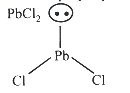
(B) $PbCl_2$: $sp^2$ Hybridisation,bent geometry,one lone pair.
$PH_3$: $sp^3$ Hybridisation,pyramidal geometry,one lone pair.
$ClF_3$: $sp^3d$ Hybridisation,$T$-shaped geometry,two lone pairs.
$SF_4$: $sp^3d$ Hybridisation,see-saw geometry,one lone pair.
$BF_3$: $sp^2$ Hybridisation,trigonal planar geometry,zero lone pairs.
$SnCl_2$: $sp^2$ Hybridisation,bent geometry,one lone pair.
Thus,the molecules with one lone pair on the central atom are $PbCl_2, PH_3, SF_4$,and $SnCl_2$.
Total number of such molecules = $4$.
$PH_3$: $sp^3$ Hybridisation,pyramidal geometry,one lone pair.
$ClF_3$: $sp^3d$ Hybridisation,$T$-shaped geometry,two lone pairs.
$SF_4$: $sp^3d$ Hybridisation,see-saw geometry,one lone pair.
$BF_3$: $sp^2$ Hybridisation,trigonal planar geometry,zero lone pairs.
$SnCl_2$: $sp^2$ Hybridisation,bent geometry,one lone pair.
Thus,the molecules with one lone pair on the central atom are $PbCl_2, PH_3, SF_4$,and $SnCl_2$.
Total number of such molecules = $4$.
0 likes
View Solution656
EasyMCQ
In which of the following,are the molecules arranged in the increasing order of their bond angles?
A
$H_2O < NH_3 < SO_2$
B
$SO_2 < NH_3 < H_2O$
C
$NH_3 < H_2O < SO_2$
D
$H_2O < SO_2 < NH_3$
Solution
(A) The bond angles for the given molecules are as follows:
$H_2O$: The bond angle is $104.5^{\circ}$ due to two lone pairs on the oxygen atom.
$NH_3$: The bond angle is $107^{\circ}$ due to one lone pair on the nitrogen atom.
$SO_2$: The bond angle is $119.5^{\circ}$ due to the $sp^2$ hybridization of the sulfur atom.
Comparing these values,the increasing order of bond angles is $H_2O < NH_3 < SO_2$ $(104.5^{\circ} < 107^{\circ} < 119.5^{\circ})$.
Therefore,the correct option is $A$.
$H_2O$: The bond angle is $104.5^{\circ}$ due to two lone pairs on the oxygen atom.
$NH_3$: The bond angle is $107^{\circ}$ due to one lone pair on the nitrogen atom.
$SO_2$: The bond angle is $119.5^{\circ}$ due to the $sp^2$ hybridization of the sulfur atom.
Comparing these values,the increasing order of bond angles is $H_2O < NH_3 < SO_2$ $(104.5^{\circ} < 107^{\circ} < 119.5^{\circ})$.
Therefore,the correct option is $A$.
0 likes
View Solution657
EasyMCQ
The linear molecule among the following is
A
$SnCl_2$
B
$PbCl_2$
C
$SO_2$
D
$XeF_2$
Solution
(D) In $SnCl_2$,the central $Sn$ atom is $sp^2$ hybridized with one lone pair,resulting in an angular (bent) shape.
In $PbCl_2$,the structure is also angular due to the presence of a lone pair on the $Pb$ atom.
In $SO_2$,the $S$ atom is $sp^2$ hybridized with one lone pair,leading to a bent shape.
In $XeF_2$,the $Xe$ atom undergoes $sp^3d$ hybridization and possesses three lone pairs in the equatorial positions,which results in a linear molecular geometry.
In $PbCl_2$,the structure is also angular due to the presence of a lone pair on the $Pb$ atom.
In $SO_2$,the $S$ atom is $sp^2$ hybridized with one lone pair,leading to a bent shape.
In $XeF_2$,the $Xe$ atom undergoes $sp^3d$ hybridization and possesses three lone pairs in the equatorial positions,which results in a linear molecular geometry.
0 likes
View Solution658
MediumMCQ
The correct order of the bond angles of the compounds $SiCl_4, BF_3, BeCl_2$ and $SF_6$ is
A
$BF_3 > BeCl_2 > SF_6 > SiCl_4$
B
$BeCl_2 > SF_6 > SiCl_4 > BF_3$
C
$BeCl_2 > SiCl_4 > BF_3 > SF_6$
D
$BeCl_2 > BF_3 > SiCl_4 > SF_6$
Solution
(D) $BeCl_2$ has a linear structure,so the bond angle is $180^{\circ}$.
$BF_3$ has a trigonal planar structure,so the bond angle is $120^{\circ}$.
$SiCl_4$ has a tetrahedral structure,so the bond angle is $109.5^{\circ}$.
$SF_6$ has an octahedral structure,so the bond angle is $90^{\circ}$.
Therefore,the correct order of bond angles is $BeCl_2 (180^{\circ}) > BF_3 (120^{\circ}) > SiCl_4 (109.5^{\circ}) > SF_6 (90^{\circ})$.
$BF_3$ has a trigonal planar structure,so the bond angle is $120^{\circ}$.
$SiCl_4$ has a tetrahedral structure,so the bond angle is $109.5^{\circ}$.
$SF_6$ has an octahedral structure,so the bond angle is $90^{\circ}$.
Therefore,the correct order of bond angles is $BeCl_2 (180^{\circ}) > BF_3 (120^{\circ}) > SiCl_4 (109.5^{\circ}) > SF_6 (90^{\circ})$.
0 likes
View Solution659
EasyMCQ
The correct pair of species which are not isostructural is
A
$PF_6^-$ and $SF_6$
B
$IO_3^-$ and $XeO_3$
C
$BH_4^-$ and $NH_4^+$
D
$BrF_5$ and $XeF_4$
Solution
(D) $PF_6^-$ and $SF_6$ are both octahedral.
$IO_3^-$ and $XeO_3$ are both pyramidal.
$BH_4^-$ and $NH_4^+$ are both tetrahedral.
$BrF_5$ has a square pyramidal geometry,whereas $XeF_4$ has a square planar geometry. Therefore,they are not isostructural.
$IO_3^-$ and $XeO_3$ are both pyramidal.
$BH_4^-$ and $NH_4^+$ are both tetrahedral.
$BrF_5$ has a square pyramidal geometry,whereas $XeF_4$ has a square planar geometry. Therefore,they are not isostructural.
0 likes
View Solution660
MediumMCQ
$A$ pair of molecules with see-saw shape and linear shape,respectively,is
A
$CH_4$ and $SO_3$
B
$XeF_4$ and $CS_2$
C
$SF_4$ and $C_2H_2$
D
$CCl_4$ and $CO_2$
Solution
(C) According to the $VSEPR$ theory,for a molecule with $sp^3d$ hybridization,if the central atom has one lone pair of electrons,the molecular geometry is see-saw.
In $SF_4$,the sulfur atom is $sp^3d$ hybridized with one lone pair,resulting in a see-saw shape.
In $C_2H_2$ (ethyne),the carbon atoms are $sp$ hybridized,which results in a linear geometry.
In $SF_4$,the sulfur atom is $sp^3d$ hybridized with one lone pair,resulting in a see-saw shape.
In $C_2H_2$ (ethyne),the carbon atoms are $sp$ hybridized,which results in a linear geometry.
0 likes
View Solution661
MediumMCQ
The shapes of $BrF_5$ and $XeF_4$,respectively are
A
square pyramid,square pyramid
B
square planar,square planar
C
square planar,square pyramid
D
square pyramid,square planar
Solution
(D) For $BrF_5$: The central atom $Br$ has $7$ valence electrons. It forms $5$ bonds with $F$ atoms and has $1$ lone pair. The steric number is $5 + 1 = 6$,which corresponds to $sp^3d^2$ hybridisation. Due to $1$ lone pair,the geometry is octahedral,but the shape is square pyramidal.
For $XeF_4$: The central atom $Xe$ has $8$ valence electrons. It forms $4$ bonds with $F$ atoms and has $2$ lone pairs. The steric number is $4 + 2 = 6$,which corresponds to $sp^3d^2$ hybridisation. Due to $2$ lone pairs at axial positions,the shape is square planar.
For $XeF_4$: The central atom $Xe$ has $8$ valence electrons. It forms $4$ bonds with $F$ atoms and has $2$ lone pairs. The steric number is $4 + 2 = 6$,which corresponds to $sp^3d^2$ hybridisation. Due to $2$ lone pairs at axial positions,the shape is square planar.
0 likes
View Solution662
MediumMCQ
Match the following:
The correct match is:
| List-$I$ | List-$II$ |
| $A$. $BF_3$ | $II$. Trigonal planar |
| $B$. $ClF_3$ | $III$. $T$-shape |
| $C$. $NH_3$ | $IV$. Trigonal pyramidal |
| $D$. $NH_4^+$ | $I$. Tetrahedral |
The correct match is:
A
$A-III, B-II, C-IV, D-I$
B
$A-III, B-II, C-I, D-IV$
C
$A-II, B-III, C-IV, D-I$
D
$A-II, B-III, C-I, D-IV$
Solution
(C) $BF_3$: Central atom $B$ has $3$ bond pairs and $0$ lone pairs,resulting in trigonal planar geometry $(A-II)$.
$ClF_3$: Central atom $Cl$ has $3$ bond pairs and $2$ lone pairs,resulting in $T$-shape geometry $(B-III)$.
$NH_3$: Central atom $N$ has $3$ bond pairs and $1$ lone pair,resulting in trigonal pyramidal geometry $(C-IV)$.
$NH_4^+$: Central atom $N$ has $4$ bond pairs and $0$ lone pairs,resulting in tetrahedral geometry $(D-I)$.
Therefore,the correct match is $A-II, B-III, C-IV, D-I$.
$ClF_3$: Central atom $Cl$ has $3$ bond pairs and $2$ lone pairs,resulting in $T$-shape geometry $(B-III)$.
$NH_3$: Central atom $N$ has $3$ bond pairs and $1$ lone pair,resulting in trigonal pyramidal geometry $(C-IV)$.
$NH_4^+$: Central atom $N$ has $4$ bond pairs and $0$ lone pairs,resulting in tetrahedral geometry $(D-I)$.
Therefore,the correct match is $A-II, B-III, C-IV, D-I$.
0 likes
View Solution663
MediumMCQ
The correct order of $H-N-H$ bond angles of ammonia,ammonium ion,and amide ion is:
A
$NH_2^{-} > NH_3 > NH_4^{+}$
B
$NH_4^{+} > NH_3 > NH_2^{-}$
C
$NH_3 > NH_2^{-} > NH_4^{+}$
D
$NH_3 > NH_4^{+} > NH_2^{-}$
Solution
(B) According to $VSEPR$ theory,the bond angle depends on the number of lone pairs on the central nitrogen atom.
As the number of lone pairs increases,the repulsion between lone pair-bond pair increases,which compresses the bond angle.
- $NH_4^{+}$: $0$ lone pairs,$4$ bond pairs,bond angle $\approx 109^{\circ} 28'$.
- $NH_3$: $1$ lone pair,$3$ bond pairs,bond angle $\approx 107^{\circ}$.
- $NH_2^{-}$: $2$ lone pairs,$2$ bond pairs,bond angle $\approx 105^{\circ}$.
Therefore,the correct order of bond angles is $NH_4^{+} > NH_3 > NH_2^{-}$.
As the number of lone pairs increases,the repulsion between lone pair-bond pair increases,which compresses the bond angle.
- $NH_4^{+}$: $0$ lone pairs,$4$ bond pairs,bond angle $\approx 109^{\circ} 28'$.
- $NH_3$: $1$ lone pair,$3$ bond pairs,bond angle $\approx 107^{\circ}$.
- $NH_2^{-}$: $2$ lone pairs,$2$ bond pairs,bond angle $\approx 105^{\circ}$.
Therefore,the correct order of bond angles is $NH_4^{+} > NH_3 > NH_2^{-}$.
0 likes
View Solution664
EasyMCQ
$XeF_4$ is square planar while $XeF_6$ has a distorted octahedral structure. What is the correct explanation for this observation?
A
Both molecules have one lone pair of electrons
B
Both molecules have two lone pairs of electrons
C
$XeF_4$ does not have any lone pair of electrons; $XeF_6$ has one lone pair of electrons on $Xe$
D
$XeF_4$ has two lone pairs of electrons on $Xe$; $XeF_6$ has one lone pair of electrons on $Xe$
Solution
(D) $XeF_4$ has $4$ bond pairs and $2$ lone pairs of electrons on $Xe$,resulting in $sp^3d^2$ hybridisation and a square planar geometry.
$XeF_6$ has $6$ bond pairs and $1$ lone pair of electrons on $Xe$,resulting in $sp^3d^3$ hybridisation and a distorted octahedral geometry due to the presence of the lone pair.
Thus,option $D$ is correct.
$XeF_6$ has $6$ bond pairs and $1$ lone pair of electrons on $Xe$,resulting in $sp^3d^3$ hybridisation and a distorted octahedral geometry due to the presence of the lone pair.
Thus,option $D$ is correct.
0 likes
View Solution665
MediumMCQ
Match the molecular geometries in List-$I$ with their corresponding molecules in List-$II$:
The correct match for $A, B, C, D$ is:
| $A$. Trigonal planar | $I$. $PCl_5$ |
| $B$. Tetrahedral | $II$. $SF_6$ |
| $C$. Trigonal bipyramidal | $III$. $BF_3$ |
| $D$. Octahedral | $IV$. $CCl_4$ |
The correct match for $A, B, C, D$ is:
A
$A-III, B-IV, C-I, D-II$
B
$A-III, B-IV, C-II, D-I$
C
$A-IV, B-III, C-I, D-II$
D
$A-I, B-IV, C-III, D-II$
Solution
(A) . Trigonal planar geometry is observed in $BF_3$ $(III)$.
$B$. Tetrahedral geometry is observed in $CCl_4$ $(IV)$.
$C$. Trigonal bipyramidal geometry is observed in $PCl_5$ $(I)$.
$D$. Octahedral geometry is observed in $SF_6$ $(II)$.
Therefore,the correct match is $A-III, B-IV, C-I, D-II$.
$B$. Tetrahedral geometry is observed in $CCl_4$ $(IV)$.
$C$. Trigonal bipyramidal geometry is observed in $PCl_5$ $(I)$.
$D$. Octahedral geometry is observed in $SF_6$ $(II)$.
Therefore,the correct match is $A-III, B-IV, C-I, D-II$.
0 likes
View Solution666
MediumMCQ
Which of the following have linear structure?
| $I. SnCl_2$ | $II. BeF_2$ |
| $III. SO_2$ | $IV. NO_2^+$ |
| $V. C_2H_2$ |
A
$I, II, IV$
B
$II, IV, V$
C
$II, III, IV$
D
$I, IV, V$
Solution
(B) To determine the linear structure,we analyze the hybridization and lone pairs on the central atom:
$I. SnCl_2$: $Sn$ has $4$ valence electrons. It forms $2$ sigma bonds and has $1$ lone pair. Due to the lone pair,it has a bent ($V$-shaped) structure.
$II. BeF_2$: $Be$ has $2$ valence electrons,both involved in bonding with $F$ atoms. It has no lone pair and is $sp$ hybridized,resulting in a linear structure.
$III. SO_2$: $S$ has $6$ valence electrons. It forms $2$ sigma bonds and $2$ pi bonds with $O$ atoms,leaving $1$ lone pair on $S$. This results in a bent structure.
$IV. NO_2^+$: The nitronium ion $(NO_2^+)$ has $N$ as the central atom with $4$ valence electrons (after losing one). It forms $2$ double bonds with $O$ atoms. It has no lone pair and is $sp$ hybridized,resulting in a linear structure.
$V. C_2H_2$: Each $C$ atom is $sp$ hybridized,forming $1$ sigma bond with $H$ and $1$ sigma bond with the other $C$ atom,plus $2$ pi bonds. The molecule is linear.
Thus,$II, IV,$ and $V$ have linear structures. The correct option is $(b)$.
$I. SnCl_2$: $Sn$ has $4$ valence electrons. It forms $2$ sigma bonds and has $1$ lone pair. Due to the lone pair,it has a bent ($V$-shaped) structure.
$II. BeF_2$: $Be$ has $2$ valence electrons,both involved in bonding with $F$ atoms. It has no lone pair and is $sp$ hybridized,resulting in a linear structure.
$III. SO_2$: $S$ has $6$ valence electrons. It forms $2$ sigma bonds and $2$ pi bonds with $O$ atoms,leaving $1$ lone pair on $S$. This results in a bent structure.
$IV. NO_2^+$: The nitronium ion $(NO_2^+)$ has $N$ as the central atom with $4$ valence electrons (after losing one). It forms $2$ double bonds with $O$ atoms. It has no lone pair and is $sp$ hybridized,resulting in a linear structure.
$V. C_2H_2$: Each $C$ atom is $sp$ hybridized,forming $1$ sigma bond with $H$ and $1$ sigma bond with the other $C$ atom,plus $2$ pi bonds. The molecule is linear.
Thus,$II, IV,$ and $V$ have linear structures. The correct option is $(b)$.
0 likes
View Solution667
MediumMCQ
The species having a pyramidal shape according to $VSEPR$ theory is:
A
$SO_3$
B
$BrF_3$
C
$SO_3^{2-}$
D
$XeF_2$
Solution
(C) According to $VSEPR$ theory,the shape of a molecule depends on the number of bonding pairs $(b.p.)$ and lone pairs $(l.p.)$ around the central atom.
$1.$ $SO_3$: Central atom $S$ has $3$ $b.p.$ and $0$ $l.p.$,resulting in a trigonal planar shape.
$2.$ $BrF_3$: Central atom $Br$ has $3$ $b.p.$ and $2$ $l.p.$,resulting in a $T$-shaped geometry.
$3.$ $SO_3^{2-}$: Central atom $S$ has $3$ $b.p.$ and $1$ $l.p.$,which gives it a pyramidal shape.
$4.$ $XeF_2$: Central atom $Xe$ has $2$ $b.p.$ and $3$ $l.p.$,resulting in a linear shape.
Therefore,the correct species with a pyramidal shape is $SO_3^{2-}$.
$1.$ $SO_3$: Central atom $S$ has $3$ $b.p.$ and $0$ $l.p.$,resulting in a trigonal planar shape.
$2.$ $BrF_3$: Central atom $Br$ has $3$ $b.p.$ and $2$ $l.p.$,resulting in a $T$-shaped geometry.
$3.$ $SO_3^{2-}$: Central atom $S$ has $3$ $b.p.$ and $1$ $l.p.$,which gives it a pyramidal shape.
$4.$ $XeF_2$: Central atom $Xe$ has $2$ $b.p.$ and $3$ $l.p.$,resulting in a linear shape.
Therefore,the correct species with a pyramidal shape is $SO_3^{2-}$.
0 likes
View Solution668
EasyMCQ
Match the molecules in List-$I$ with their correct geometries in List-$II$ according to $VSEPR$ theory:
| List-$I$ | List-$II$ |
|---|---|
| $(A)$ $PCl_3$ | $(I)$ Square planar |
| $(B)$ $BF_3$ | $(II)$ $T$-shape |
| $(C)$ $ClF_3$ | $(III)$ Trigonal pyramidal |
| $(D)$ $XeF_4$ | $(IV)$ See-saw |
| $(V)$ Trigonal planar |
A
$A-III, B-V, C-II, D-I$
B
$A-II, B-V, C-III, D-I$
C
$A-III, B-V, C-II, D-IV$
D
$A-I, B-III, C-V, D-II$
Solution
(A) According to $VSEPR$ theory:
$1$. $PCl_3$: Central atom $P$ has $5$ valence electrons. It forms $3$ bonds with $Cl$ and has $1$ lone pair. Total electron pairs = $4$ ($3$ bond pairs + $1$ lone pair),resulting in a Trigonal pyramidal geometry $(A-III)$.
$2$. $BF_3$: Central atom $B$ has $3$ valence electrons. It forms $3$ bonds with $F$ and has $0$ lone pairs. Total electron pairs = $3$,resulting in a Trigonal planar geometry $(B-V)$.
$3$. $ClF_3$: Central atom $Cl$ has $7$ valence electrons. It forms $3$ bonds with $F$ and has $2$ lone pairs. Total electron pairs = $5$,resulting in a $T$-shape geometry $(C-II)$.
$4$. $XeF_4$: Central atom $Xe$ has $8$ valence electrons. It forms $4$ bonds with $F$ and has $2$ lone pairs. Total electron pairs = $6$,resulting in a Square planar geometry $(D-I)$.
Therefore,the correct match is $A-III, B-V, C-II, D-I$.
$1$. $PCl_3$: Central atom $P$ has $5$ valence electrons. It forms $3$ bonds with $Cl$ and has $1$ lone pair. Total electron pairs = $4$ ($3$ bond pairs + $1$ lone pair),resulting in a Trigonal pyramidal geometry $(A-III)$.
$2$. $BF_3$: Central atom $B$ has $3$ valence electrons. It forms $3$ bonds with $F$ and has $0$ lone pairs. Total electron pairs = $3$,resulting in a Trigonal planar geometry $(B-V)$.
$3$. $ClF_3$: Central atom $Cl$ has $7$ valence electrons. It forms $3$ bonds with $F$ and has $2$ lone pairs. Total electron pairs = $5$,resulting in a $T$-shape geometry $(C-II)$.
$4$. $XeF_4$: Central atom $Xe$ has $8$ valence electrons. It forms $4$ bonds with $F$ and has $2$ lone pairs. Total electron pairs = $6$,resulting in a Square planar geometry $(D-I)$.
Therefore,the correct match is $A-III, B-V, C-II, D-I$.
0 likes
View Solution669
MediumMCQ
Number of bonding electron pairs and number of lone pairs of electrons in $ClF_3$,$SF_4$,$BrF_5$ respectively are
A
$3,2 ; 4,2 ; 5,2$
B
$3,1 ; 4,1 ; 5,2$
C
$3,1 ; 4,2 ; 5,1$
D
$3,2 ; 4,1 ; 5,1$
Solution
(D) To determine the number of bonding electron pairs and lone pairs,we look at the central atom of each molecule:
$1$. In $ClF_3$: The central atom $Cl$ is bonded to $3$ $F$ atoms (bonding pairs = $3$) and has $2$ lone pairs on the $Cl$ atom (lone pairs = $2$).
$2$. In $SF_4$: The central atom $S$ is bonded to $4$ $F$ atoms (bonding pairs = $4$) and has $1$ lone pair on the $S$ atom (lone pairs = $1$).
$3$. In $BrF_5$: The central atom $Br$ is bonded to $5$ $F$ atoms (bonding pairs = $5$) and has $1$ lone pair on the $Br$ atom (lone pairs = $1$).
Thus,the number of bonding pairs and lone pairs are $3,2$; $4,1$; and $5,1$ respectively.
$1$. In $ClF_3$: The central atom $Cl$ is bonded to $3$ $F$ atoms (bonding pairs = $3$) and has $2$ lone pairs on the $Cl$ atom (lone pairs = $2$).
$2$. In $SF_4$: The central atom $S$ is bonded to $4$ $F$ atoms (bonding pairs = $4$) and has $1$ lone pair on the $S$ atom (lone pairs = $1$).
$3$. In $BrF_5$: The central atom $Br$ is bonded to $5$ $F$ atoms (bonding pairs = $5$) and has $1$ lone pair on the $Br$ atom (lone pairs = $1$).
Thus,the number of bonding pairs and lone pairs are $3,2$; $4,1$; and $5,1$ respectively.
0 likes
View Solution670
EasyMCQ
In which of the following pairs,the central atoms have the same number of lone pairs of electrons?
A
$PCl_5, BrF_5$
B
$XeF_2, ICl_2^{-}$
C
$XeF_4, ClO_4^{-}$
D
$SCl_4, CH_4$
Solution
(B) To determine the number of lone pairs on the central atom,we use the formula: $\text{Lone pairs} = \frac{1}{2} (V - N - C)$,where $V$ is the number of valence electrons of the central atom,$N$ is the number of monovalent atoms bonded to it,and $C$ is the charge on the species.
$1$. For $XeF_2$: $V=8, N=2, C=0$. $\text{Lone pairs} = \frac{1}{2}(8-2) = 3$.
$2$. For $ICl_2^{-}$: $V=7, N=2, C=1$. $\text{Lone pairs} = \frac{1}{2}(7-2+1) = 3$.
Both $XeF_2$ and $ICl_2^{-}$ have $3$ lone pairs on their respective central atoms.
$1$. For $XeF_2$: $V=8, N=2, C=0$. $\text{Lone pairs} = \frac{1}{2}(8-2) = 3$.
$2$. For $ICl_2^{-}$: $V=7, N=2, C=1$. $\text{Lone pairs} = \frac{1}{2}(7-2+1) = 3$.
Both $XeF_2$ and $ICl_2^{-}$ have $3$ lone pairs on their respective central atoms.
0 likes
View Solution671
MediumMCQ
Which of the following is not tetrahedral?
A
$BF_4^{-}$
B
$NH_4^{+}$
C
$CO_3^{2-}$
D
$SO_4^{2-}$
Solution
(C) In the $CO_3^{2-}$ ion,the central $C$ atom undergoes $sp^2$ hybridization,resulting in a trigonal planar geometry.
In contrast,$BF_4^{-}$,$NH_4^{+}$,and $SO_4^{2-}$ all involve $sp^3$ hybridization of the central atom,which gives them a tetrahedral structure.
In contrast,$BF_4^{-}$,$NH_4^{+}$,and $SO_4^{2-}$ all involve $sp^3$ hybridization of the central atom,which gives them a tetrahedral structure.
0 likes
View Solution672
MediumMCQ
The number of lone pairs of electrons present on $Xe$ in $XeF_4$ is
A
$3$
B
$4$
C
$1$
D
$2$
Solution
(D) The central atom $Xe$ has $8$ valence electrons.
In $XeF_4$,$Xe$ forms $4$ single bonds with $4$ fluorine atoms.
Number of electrons used for bonding $= 4$.
Number of remaining valence electrons $= 8 - 4 = 4$.
Number of lone pairs $= \frac{4}{2} = 2$.
Thus,there are $2$ lone pairs on $Xe$ in $XeF_4$.
In $XeF_4$,$Xe$ forms $4$ single bonds with $4$ fluorine atoms.
Number of electrons used for bonding $= 4$.
Number of remaining valence electrons $= 8 - 4 = 4$.
Number of lone pairs $= \frac{4}{2} = 2$.
Thus,there are $2$ lone pairs on $Xe$ in $XeF_4$.
0 likes
View Solution673
MediumMCQ
The correct order of bond angles of the following compounds is
A
$H_2O < H_2S < H_2Se < H_2Te$
B
$H_2S < H_2O < H_2Se < H_2Te$
C
$H_2Se < H_2S < H_2O < H_2Te$
D
$H_2Te < H_2Se < H_2S < H_2O$
Solution
(D) As we move down the group,the electronegativity of the central atom decreases and its atomic size increases.
Due to the increase in the size of the central atom,the bond pairs of electrons are further away from the central atom,which reduces the bond pair-bond pair repulsion.
Consequently,the bond angle decreases as we move down the group from $O$ to $Te$.
The correct order of bond angles is: $H_2O (104.5^{\circ}) > H_2S (92.1^{\circ}) > H_2Se (91.0^{\circ}) > H_2Te (90.0^{\circ})$.
Due to the increase in the size of the central atom,the bond pairs of electrons are further away from the central atom,which reduces the bond pair-bond pair repulsion.
Consequently,the bond angle decreases as we move down the group from $O$ to $Te$.
The correct order of bond angles is: $H_2O (104.5^{\circ}) > H_2S (92.1^{\circ}) > H_2Se (91.0^{\circ}) > H_2Te (90.0^{\circ})$.
0 likes
View Solution674
MediumMCQ
The equatorial and axial $P-Cl$ bond lengths (in $pm$) respectively in $PCl_5$ are:
A
$202, 240$
B
$240, 202$
C
$200, 400$
D
$200, 410$
Solution
(A) $PCl_5$ has a trigonal bipyramidal geometry.
In this structure, the three equatorial $P-Cl$ bonds are shorter than the two axial $P-Cl$ bonds due to greater repulsion experienced by the axial bonds.
The equatorial $P-Cl$ bond length is $202 \ pm$ and the axial $P-Cl$ bond length is $240 \ pm$.
In this structure, the three equatorial $P-Cl$ bonds are shorter than the two axial $P-Cl$ bonds due to greater repulsion experienced by the axial bonds.
The equatorial $P-Cl$ bond length is $202 \ pm$ and the axial $P-Cl$ bond length is $240 \ pm$.
0 likes
View Solution675
MediumMCQ
The correct order of the bond angles of the given compounds is
A
$NH_3 < PH_3 < AsH_3 < SbH_3$
B
$SbH_3 < AsH_3 < PH_3 < NH_3$
C
$NH_3 < AsH_3 < SbH_3 < PH_3$
D
$PH_3 < SbH_3 < AsH_3 < NH_3$
Solution
(B) In the group $15$ hydrides $(NH_3, PH_3, AsH_3, SbH_3)$,the central atom size increases down the group $(N < P < As < Sb)$.
As the size of the central atom increases,the bond pair-bond pair repulsion decreases,and the electronegativity of the central atom decreases.
This leads to a decrease in the bond angle as we move down the group.
Therefore,the correct order of bond angles is $SbH_3 < AsH_3 < PH_3 < NH_3$.
As the size of the central atom increases,the bond pair-bond pair repulsion decreases,and the electronegativity of the central atom decreases.
This leads to a decrease in the bond angle as we move down the group.
Therefore,the correct order of bond angles is $SbH_3 < AsH_3 < PH_3 < NH_3$.
0 likes
View Solution676
DifficultMCQ
What is the bond angle in $ClO_2$ (OClO) (in $^{\circ}$)?
A
$90$
B
$118$
C
$105$
D
$111$
Solution
(B) The structure of $ClO_2$ is angular (bent).
In $ClO_2$,the central chlorine atom has one unpaired electron and is $sp^3$-hybridised.
Due to the presence of the unpaired electron and lone pairs,the bond angle is observed to be $118^{\circ}$,and the $Cl-O$ bond length is $1.47 \mathring{A}$.
In $ClO_2$,the central chlorine atom has one unpaired electron and is $sp^3$-hybridised.
Due to the presence of the unpaired electron and lone pairs,the bond angle is observed to be $118^{\circ}$,and the $Cl-O$ bond length is $1.47 \mathring{A}$.
0 likes
View Solution677
MediumMCQ
The number of lone pairs of electrons on the central atom of $XeO_3$,$XeOF_4$ and $XeF_6$ respectively is
A
$1, 1, 1$
B
$3, 2, 1$
C
$2, 1, 0$
D
$1, 2, 1$
Solution
(A) The central atom in all these compounds is Xenon $(Xe)$,which has $8$ valence electrons.
$1$. In $XeO_3$: $Xe$ forms $3$ double bonds with $3$ oxygen atoms. It uses $6$ electrons for bonding. Remaining electrons = $8 - 6 = 2$. Thus,$1$ lone pair.
$2$. In $XeOF_4$: $Xe$ forms $4$ single bonds with $4$ fluorine atoms and $1$ double bond with $1$ oxygen atom. It uses $4 + 2 = 6$ electrons for bonding. Remaining electrons = $8 - 6 = 2$. Thus,$1$ lone pair.
$3$. In $XeF_6$: $Xe$ forms $6$ single bonds with $6$ fluorine atoms. It uses $6$ electrons for bonding. Remaining electrons = $8 - 6 = 2$. Thus,$1$ lone pair.
Therefore,the number of lone pairs is $1, 1, 1$.
$1$. In $XeO_3$: $Xe$ forms $3$ double bonds with $3$ oxygen atoms. It uses $6$ electrons for bonding. Remaining electrons = $8 - 6 = 2$. Thus,$1$ lone pair.
$2$. In $XeOF_4$: $Xe$ forms $4$ single bonds with $4$ fluorine atoms and $1$ double bond with $1$ oxygen atom. It uses $4 + 2 = 6$ electrons for bonding. Remaining electrons = $8 - 6 = 2$. Thus,$1$ lone pair.
$3$. In $XeF_6$: $Xe$ forms $6$ single bonds with $6$ fluorine atoms. It uses $6$ electrons for bonding. Remaining electrons = $8 - 6 = 2$. Thus,$1$ lone pair.
Therefore,the number of lone pairs is $1, 1, 1$.
0 likes
View Solution678
MediumMCQ
The geometry of $XeOF_4$ is
A
octahedral
B
tetrahedral
C
linear
D
square pyramidal
Solution
(D) $I$. The central atom $Xe$ has $8$ valence electrons.
$II$. It forms one double bond with $O$ and four single bonds with $F$ atoms,utilizing $6$ electrons for bonding.
$III$. This leaves one lone pair of electrons on $Xe$.
$IV$. According to $VSEPR$ theory,with $5$ bond pairs and $1$ lone pair,the steric number is $6$,which corresponds to an octahedral electron geometry.
$V$. Due to the presence of one lone pair,the molecular geometry is square pyramidal.
$II$. It forms one double bond with $O$ and four single bonds with $F$ atoms,utilizing $6$ electrons for bonding.
$III$. This leaves one lone pair of electrons on $Xe$.
$IV$. According to $VSEPR$ theory,with $5$ bond pairs and $1$ lone pair,the steric number is $6$,which corresponds to an octahedral electron geometry.
$V$. Due to the presence of one lone pair,the molecular geometry is square pyramidal.
0 likes
View Solution679
MediumMCQ
Which of the following contains the maximum number of lone pairs on the central atom?
A
$ClO_3^{-}$
B
$XeF_4$
C
$SF_4$
D
$I_3^{-}$
Solution
(D) To determine the number of lone pairs on the central atom,we use the formula: $\text{Lone pairs} = \frac{1}{2} (V - M - C + A)$,where $V$ is the number of valence electrons of the central atom,$M$ is the number of monovalent atoms,$C$ is the cationic charge,and $A$ is the anionic charge.
$A) \ ClO_3^{-}$: Central atom $Cl$ $(V=7)$. $3$ oxygen atoms are divalent. Lone pairs $= \frac{1}{2} (7 - 0 - 0 + 1) = 4$ electrons,which corresponds to $1$ lone pair.
$B) \ XeF_4$: Central atom $Xe$ $(V=8)$. $4$ fluorine atoms are monovalent. Lone pairs $= \frac{1}{2} (8 - 4) = 2$ lone pairs.
$C) \ SF_4$: Central atom $S$ $(V=6)$. $4$ fluorine atoms are monovalent. Lone pairs $= \frac{1}{2} (6 - 4) = 1$ lone pair.
$D) \ I_3^{-}$: Central atom $I$ $(V=7)$. $2$ iodine atoms are monovalent. Lone pairs $= \frac{1}{2} (7 - 2 + 1) = 3$ lone pairs.
Thus,$I_3^{-}$ has the maximum number of lone pairs $(3)$ on the central atom.
$A) \ ClO_3^{-}$: Central atom $Cl$ $(V=7)$. $3$ oxygen atoms are divalent. Lone pairs $= \frac{1}{2} (7 - 0 - 0 + 1) = 4$ electrons,which corresponds to $1$ lone pair.
$B) \ XeF_4$: Central atom $Xe$ $(V=8)$. $4$ fluorine atoms are monovalent. Lone pairs $= \frac{1}{2} (8 - 4) = 2$ lone pairs.
$C) \ SF_4$: Central atom $S$ $(V=6)$. $4$ fluorine atoms are monovalent. Lone pairs $= \frac{1}{2} (6 - 4) = 1$ lone pair.
$D) \ I_3^{-}$: Central atom $I$ $(V=7)$. $2$ iodine atoms are monovalent. Lone pairs $= \frac{1}{2} (7 - 2 + 1) = 3$ lone pairs.
Thus,$I_3^{-}$ has the maximum number of lone pairs $(3)$ on the central atom.
0 likes
View Solution680
DifficultMCQ
The molecular shapes of $SF_4$,$CF_4$ and $XeF_4$ are
A
the same with $2, 0$ and $1$ lone pairs of electrons on the central atoms,respectively.
B
the same with $1, 1$ and $1$ lone pairs of electrons on the central atoms,respectively
C
different with $0, 1$ and $2$ lone pairs of electrons on the central atoms,respectively
D
different with $1, 0$ and $2$ lone pairs of electrons on the central atoms,respectively
Solution
(D) To determine the molecular shapes and lone pairs ($L$.$P$.) on the central atoms:
$1$. For $SF_4$: The central atom $S$ has $6$ valence electrons. It forms $4$ bonds with $F$ atoms,leaving $1$ lone pair. The shape is see-saw.
$2$. For $CF_4$: The central atom $C$ has $4$ valence electrons. It forms $4$ bonds with $F$ atoms,leaving $0$ lone pairs. The shape is tetrahedral.
$3$. For $XeF_4$: The central atom $Xe$ has $8$ valence electrons. It forms $4$ bonds with $F$ atoms,leaving $2$ lone pairs. The shape is square planar.
Thus,the shapes are different with $1, 0$ and $2$ lone pairs of electrons on the central atoms,respectively.
$1$. For $SF_4$: The central atom $S$ has $6$ valence electrons. It forms $4$ bonds with $F$ atoms,leaving $1$ lone pair. The shape is see-saw.
$2$. For $CF_4$: The central atom $C$ has $4$ valence electrons. It forms $4$ bonds with $F$ atoms,leaving $0$ lone pairs. The shape is tetrahedral.
$3$. For $XeF_4$: The central atom $Xe$ has $8$ valence electrons. It forms $4$ bonds with $F$ atoms,leaving $2$ lone pairs. The shape is square planar.
Thus,the shapes are different with $1, 0$ and $2$ lone pairs of electrons on the central atoms,respectively.
0 likes
View Solution681
MediumMCQ
$XeF_2, NO_2, HCN, ClO_2, CO_2$. Identify the non-linear molecule pair from the above-mentioned molecules.
A
$XeF_2, ClO_2$
B
$CO_2, NO_2$
C
$HCN, NO_2$
D
$ClO_2, NO_2$
Solution
(D) To determine the geometry of the molecules,we analyze their structures:
$1$. $XeF_2$: The central atom $Xe$ has $2$ bond pairs and $3$ lone pairs,resulting in a linear geometry.
$2$. $NO_2$: The central atom $N$ has $1$ odd electron and $2$ bond pairs,resulting in a bent (non-linear) geometry.
$3$. $HCN$: The central atom $C$ has $2$ bond pairs and no lone pairs,resulting in a linear geometry.
$4$. $ClO_2$: The central atom $Cl$ has $2$ bond pairs and $1$ lone pair,resulting in a bent (non-linear) geometry.
$5$. $CO_2$: The central atom $C$ has $2$ bond pairs and no lone pairs,resulting in a linear geometry.
Thus,the non-linear molecules are $NO_2$ and $ClO_2$.
$1$. $XeF_2$: The central atom $Xe$ has $2$ bond pairs and $3$ lone pairs,resulting in a linear geometry.
$2$. $NO_2$: The central atom $N$ has $1$ odd electron and $2$ bond pairs,resulting in a bent (non-linear) geometry.
$3$. $HCN$: The central atom $C$ has $2$ bond pairs and no lone pairs,resulting in a linear geometry.
$4$. $ClO_2$: The central atom $Cl$ has $2$ bond pairs and $1$ lone pair,resulting in a bent (non-linear) geometry.
$5$. $CO_2$: The central atom $C$ has $2$ bond pairs and no lone pairs,resulting in a linear geometry.
Thus,the non-linear molecules are $NO_2$ and $ClO_2$.
0 likes
View Solution682
EasyMCQ
The $H_3O^{+}$ ion has the following shape:
A
Tetrahedral
B
Pyramidal
C
Trigonal planar
D
$T$-shaped
Solution
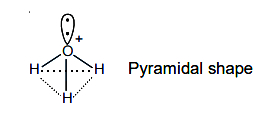
(B) In the $H_3O^{+}$ ion,the central oxygen atom is $sp^3$ hybridized.
It contains $3$ bond pairs and $1$ lone pair.
According to the $VSEPR$ theory,the presence of one lone pair in a tetrahedral electron geometry results in a pyramidal molecular shape.
It contains $3$ bond pairs and $1$ lone pair.
According to the $VSEPR$ theory,the presence of one lone pair in a tetrahedral electron geometry results in a pyramidal molecular shape.
0 likes
View Solution683
EasyMCQ
The $H-N-H$ angle in ammonia is $107.6^{\circ}$ while the $H-P-H$ angle in phosphine is $93.5^{\circ}.$ Relative to phosphine,the $p$-character of the lone-pair on ammonia is expected to be
A
Less
B
More
C
Same
D
Cannot be predicted
Solution
(A) Key point: As the percentage of $s$-character in a bond increases,the bond angle also increases.
According to Bent's Rule,the lone pair occupies an orbital with more $s$-character as the electronegativity of the central atom increases.
In $NH_3$,the $N$ atom is more electronegative than $P$ in $PH_3$.
Since the bond angle in $NH_3$ $(107.6^{\circ})$ is greater than in $PH_3$ $(93.5^{\circ})$,the bonding orbitals in $NH_3$ have more $s$-character.
Consequently,the lone pair orbital in $NH_3$ has more $s$-character and less $p$-character compared to the lone pair in $PH_3$.
Thus,the $p$-character of the lone pair on ammonia is less than that of phosphine.
Hence,option $(A)$ is the correct answer.
According to Bent's Rule,the lone pair occupies an orbital with more $s$-character as the electronegativity of the central atom increases.
In $NH_3$,the $N$ atom is more electronegative than $P$ in $PH_3$.
Since the bond angle in $NH_3$ $(107.6^{\circ})$ is greater than in $PH_3$ $(93.5^{\circ})$,the bonding orbitals in $NH_3$ have more $s$-character.
Consequently,the lone pair orbital in $NH_3$ has more $s$-character and less $p$-character compared to the lone pair in $PH_3$.
Thus,the $p$-character of the lone pair on ammonia is less than that of phosphine.
Hence,option $(A)$ is the correct answer.
0 likes
View Solution684
MediumMCQ
The number of lone pairs of electrons on the central atoms of $H_{2}O, SnCl_{2}, PCl_{3}$ and $XeF_{2}$ respectively,are
A
$2, 1, 1, 3$
B
$2, 2, 1, 3$
C
$3, 1, 1, 2$
D
$2, 1, 2, 3$
Solution
(A) The number of lone pairs on the central atoms are calculated as follows:
$1$. In $H_{2}O$,Oxygen has $6$ valence electrons,$2$ are used in bonding with $H$,leaving $4$ electrons or $2$ lone pairs.
$2$. In $SnCl_{2}$,Tin $(Sn)$ has $4$ valence electrons,$2$ are used in bonding with $Cl$,leaving $2$ electrons or $1$ lone pair.
$3$. In $PCl_{3}$,Phosphorus $(P)$ has $5$ valence electrons,$3$ are used in bonding with $Cl$,leaving $2$ electrons or $1$ lone pair.
$4$. In $XeF_{2}$,Xenon $(Xe)$ has $8$ valence electrons,$2$ are used in bonding with $F$,leaving $6$ electrons or $3$ lone pairs.
Thus,the number of lone pairs are $2, 1, 1$ and $3$ respectively.
$1$. In $H_{2}O$,Oxygen has $6$ valence electrons,$2$ are used in bonding with $H$,leaving $4$ electrons or $2$ lone pairs.
$2$. In $SnCl_{2}$,Tin $(Sn)$ has $4$ valence electrons,$2$ are used in bonding with $Cl$,leaving $2$ electrons or $1$ lone pair.
$3$. In $PCl_{3}$,Phosphorus $(P)$ has $5$ valence electrons,$3$ are used in bonding with $Cl$,leaving $2$ electrons or $1$ lone pair.
$4$. In $XeF_{2}$,Xenon $(Xe)$ has $8$ valence electrons,$2$ are used in bonding with $F$,leaving $6$ electrons or $3$ lone pairs.
Thus,the number of lone pairs are $2, 1, 1$ and $3$ respectively.
0 likes
View Solution685
EasyMCQ
The structure of $XeF_{6}$ is experimentally determined to be a distorted octahedron. Its structure according to $VSEPR$ theory is
A
octahedron
B
trigonal bipyramid
C
pentagonal bipyramid
D
tetragonal bipyramid
Solution
(C) In $XeF_{6}$,the central atom $Xe$ has $8$ valence electrons.
$6$ electrons are used in bonding with fluorine atoms (forming $6$ bond pairs),and the remaining $2$ electrons form $1$ lone pair.
Total electron pairs around $Xe = 6 \text{ (bond pairs)} + 1 \text{ (lone pair)} = 7$.
According to $VSEPR$ theory,a steric number of $7$ corresponds to a pentagonal bipyramidal electron geometry.
$6$ electrons are used in bonding with fluorine atoms (forming $6$ bond pairs),and the remaining $2$ electrons form $1$ lone pair.
Total electron pairs around $Xe = 6 \text{ (bond pairs)} + 1 \text{ (lone pair)} = 7$.
According to $VSEPR$ theory,a steric number of $7$ corresponds to a pentagonal bipyramidal electron geometry.
0 likes
View Solution686
EasyMCQ
In $SOCl_{2}$,the $Cl-S-Cl$ and $Cl-S-O$ bond angles are
A
$130^{\circ}$ and $115^{\circ}$
B
$106^{\circ}$ and $96^{\circ}$
C
$107^{\circ}$ and $108^{\circ}$
D
$96^{\circ}$ and $106^{\circ}$
Solution
(D) The molecule $SOCl_{2}$ (thionyl chloride) has a trigonal pyramidal geometry due to the presence of a lone pair on the sulfur atom.
According to $VSEPR$ theory,the lone pair-bond pair repulsion is greater than the bond pair-bond pair repulsion.
In $SOCl_{2}$,the $Cl-S-Cl$ bond angle is approximately $96^{\circ}$ and the $Cl-S-O$ bond angle is approximately $106^{\circ}$.
According to $VSEPR$ theory,the lone pair-bond pair repulsion is greater than the bond pair-bond pair repulsion.
In $SOCl_{2}$,the $Cl-S-Cl$ bond angle is approximately $96^{\circ}$ and the $Cl-S-O$ bond angle is approximately $106^{\circ}$.
0 likes
View Solution687
EasyMCQ
The increasing order of $O-N-O$ bond angle in the species $NO_2$,$NO_2^+$ and $NO_2^-$ is
A
$NO_2^+ < NO_2 < NO_2^-$
B
$NO_2 < NO_2^- < NO_2^+$
C
$NO_2^+ < NO_2^- < NO_2$
D
None of these
Solution
(D) The bond angles for the given species are as follows:
$1.$ $NO_2^+$: It has $sp$ hybridization and a linear geometry,resulting in a bond angle of $180^\circ$.
$2.$ $NO_2$: It has $sp^2$ hybridization with one unpaired electron,resulting in a bond angle of approximately $134^\circ$.
$3.$ $NO_2^-$: It has $sp^2$ hybridization with one lone pair,resulting in a bond angle of approximately $115^\circ$.
Comparing these values,the increasing order of the bond angle is $NO_2^- < NO_2 < NO_2^+$.
Since this specific order is not listed in options $A$,$B$,or $C$,the correct answer is $D$.
$1.$ $NO_2^+$: It has $sp$ hybridization and a linear geometry,resulting in a bond angle of $180^\circ$.
$2.$ $NO_2$: It has $sp^2$ hybridization with one unpaired electron,resulting in a bond angle of approximately $134^\circ$.
$3.$ $NO_2^-$: It has $sp^2$ hybridization with one lone pair,resulting in a bond angle of approximately $115^\circ$.
Comparing these values,the increasing order of the bond angle is $NO_2^- < NO_2 < NO_2^+$.
Since this specific order is not listed in options $A$,$B$,or $C$,the correct answer is $D$.
0 likes
View Solution688
MediumMCQ
The bond angle in $NF_{3}$ $(102.3^{\circ})$ is smaller than $NH_{3}$ $(107.2^{\circ})$. This is because of
A
large size of $F$ compared to $H$
B
large size of $N$ compared to $F$
C
opposite polarity of $N$ in the two molecules
D
small size of $H$ compared to $N$
Solution
(C) In $NH_{3}$,the electronegativity of $N$ $(3.04)$ is higher than that of $H$ $(2.20)$,so the bonding electron pairs are shifted towards $N$. This increases the repulsion between the bonding pairs,leading to a larger bond angle $(107.2^{\circ})$.
In $NF_{3}$,the electronegativity of $F$ $(3.98)$ is higher than that of $N$ $(3.04)$,so the bonding electron pairs are shifted away from $N$ towards $F$. This reduces the repulsion between the bonding pairs,resulting in a smaller bond angle $(102.3^{\circ})$.
Therefore,the difference in the polarity of the $N-X$ bond (where $X = H$ or $F$) causes the difference in bond angles.
In $NF_{3}$,the electronegativity of $F$ $(3.98)$ is higher than that of $N$ $(3.04)$,so the bonding electron pairs are shifted away from $N$ towards $F$. This reduces the repulsion between the bonding pairs,resulting in a smaller bond angle $(102.3^{\circ})$.
Therefore,the difference in the polarity of the $N-X$ bond (where $X = H$ or $F$) causes the difference in bond angles.
0 likes
View Solution689
EasyMCQ
Atoms in a $P_4$ molecule of white phosphorus are arranged regularly in the following way:
A
at the corners of a cube
B
at the corners of a octahedron
C
at the corners of a tetrahedron
D
at the centre and corners of a tetrahedron
Solution
(C) In a $P_4$ molecule of white phosphorus,each phosphorus atom is $sp^3$ hybridized.
These four phosphorus atoms are linked to each other by single covalent bonds.
They are arranged at the four corners of a regular tetrahedron,with bond angles of $60^{\circ}$.
These four phosphorus atoms are linked to each other by single covalent bonds.
They are arranged at the four corners of a regular tetrahedron,with bond angles of $60^{\circ}$.
0 likes
View Solution690
EasyMCQ
The shape of $XeF_{5}^{-}$ will be
A
square pyramid
B
trigonal bipyramidal
C
planar
D
pentagonal bipyramid
Solution
(C) To determine the shape of $XeF_{5}^{-}$,we calculate the number of electron pairs around the central $Xe$ atom:
Number of electron pairs $= \frac{1}{2} [V + M - C + A] = \frac{1}{2} [8 + 5 - 0 + 1] = 7$.
Here,$V = 8$ (valence electrons of $Xe$),$M = 5$ (monovalent atoms),and $A = 1$ (anionic charge).
With $7$ electron pairs,the electron geometry is pentagonal bipyramidal ($sp^{3}d^{3}$ hybridization).
Out of these $7$ pairs,$5$ are bond pairs and $2$ are lone pairs.
The two lone pairs occupy the axial positions to minimize repulsion,leaving the $5$ $Xe-F$ bonds in a single equatorial plane.
Therefore,the molecular shape of $XeF_{5}^{-}$ is pentagonal planar.
Number of electron pairs $= \frac{1}{2} [V + M - C + A] = \frac{1}{2} [8 + 5 - 0 + 1] = 7$.
Here,$V = 8$ (valence electrons of $Xe$),$M = 5$ (monovalent atoms),and $A = 1$ (anionic charge).
With $7$ electron pairs,the electron geometry is pentagonal bipyramidal ($sp^{3}d^{3}$ hybridization).
Out of these $7$ pairs,$5$ are bond pairs and $2$ are lone pairs.
The two lone pairs occupy the axial positions to minimize repulsion,leaving the $5$ $Xe-F$ bonds in a single equatorial plane.
Therefore,the molecular shape of $XeF_{5}^{-}$ is pentagonal planar.
0 likes
View Solution691
DifficultMCQ
Identify the molecule $(X)$ with the maximum number of lone pairs of electrons (obtained using Lewis dot structure) among $HNO_{3}$,$H_{2}SO_{4}$,$NF_{3}$,and $O_{3}$. Choose the correct bond angle made by the central atom of the molecule $(X)$. (in $^{\circ}$)
A
$120$
B
$107$
C
$102$
D
$116$
Solution
(C) Let us calculate the total number of lone pairs for each molecule:
$HNO_{3}$: $N$ has $0$,$O$ atoms have $2+2+3 = 7$ lone pairs. Total = $7$.
$H_{2}SO_{4}$: $S$ has $0$,$O$ atoms have $2+2+2+2 = 8$ lone pairs. Total = $8$.
$NF_{3}$: $N$ has $1$,each $F$ has $3$. Total = $1 + 3(3) = 10$ lone pairs.
$O_{3}$: Central $O$ has $1$,terminal $O$ atoms have $2$ and $3$. Total = $6$ lone pairs.
Thus,$NF_{3}$ has the maximum number of lone pairs $(10)$.
The hybridization of $N$ in $NF_{3}$ is $sp^{3}$. Due to the high electronegativity of $F$ atoms,the bond angle is compressed to approximately $102^{\circ}$.
$HNO_{3}$: $N$ has $0$,$O$ atoms have $2+2+3 = 7$ lone pairs. Total = $7$.
$H_{2}SO_{4}$: $S$ has $0$,$O$ atoms have $2+2+2+2 = 8$ lone pairs. Total = $8$.
$NF_{3}$: $N$ has $1$,each $F$ has $3$. Total = $1 + 3(3) = 10$ lone pairs.
$O_{3}$: Central $O$ has $1$,terminal $O$ atoms have $2$ and $3$. Total = $6$ lone pairs.
Thus,$NF_{3}$ has the maximum number of lone pairs $(10)$.
The hybridization of $N$ in $NF_{3}$ is $sp^{3}$. Due to the high electronegativity of $F$ atoms,the bond angle is compressed to approximately $102^{\circ}$.
0 likes
View Solution692
DifficultMCQ
Match List-$I$ with List-$II$ according to shape.
Choose the correct answer from the options given below :
| List-$I$ | List-$II$ |
|---|---|
| $A$. $XeO_{3}$ | $I$. $BrF_{5}$ |
| $B$. $XeF_{2}$ | $II$. $NH_{3}$ |
| $C$. $XeO_{2}F_{2}$ | $III$. $[I_{3}]^{-}$ |
| $D$. $XeOF_{4}$ | $IV$. $SF_{4}$ |
Choose the correct answer from the options given below :
A
$A-II, B-III, C-IV, D-I$
B
$A-II, B-I, C-III, D-IV$
C
$A-II, B-III, C-I, D-IV$
D
$A-II, B-II, C-IV, D-I$
Solution
(A) The shapes of the molecules are determined by the number of bond pairs and lone pairs around the central atom:
$XeO_{3}$ and $NH_{3}$: Both have $3$ bond pairs and $1$ lone pair,resulting in a pyramidal shape.
$XeF_{2}$ and $[I_{3}]^{-}$: Both have $2$ bond pairs and $3$ lone pairs,resulting in a linear shape.
$XeO_{2}F_{2}$ and $SF_{4}$: Both have $4$ bond pairs and $1$ lone pair,resulting in a see-saw shape.
$XeOF_{4}$ and $BrF_{5}$: Both have $5$ bond pairs and $1$ lone pair,resulting in a square pyramidal shape.
Therefore,the correct matching is $A-II, B-III, C-IV, D-I$.
$XeO_{3}$ and $NH_{3}$: Both have $3$ bond pairs and $1$ lone pair,resulting in a pyramidal shape.
$XeF_{2}$ and $[I_{3}]^{-}$: Both have $2$ bond pairs and $3$ lone pairs,resulting in a linear shape.
$XeO_{2}F_{2}$ and $SF_{4}$: Both have $4$ bond pairs and $1$ lone pair,resulting in a see-saw shape.
$XeOF_{4}$ and $BrF_{5}$: Both have $5$ bond pairs and $1$ lone pair,resulting in a square pyramidal shape.
Therefore,the correct matching is $A-II, B-III, C-IV, D-I$.
0 likes
View Solution693
DifficultMCQ
Given below are two statements:
Statement $I$: Aluminium upon reaction with $NaOH$ forms $[Al(OH)_6]^{3-}$ ion.
Statement $II$: The geometry of $ICl_4^-$,$ClO_3^-$,and $IBr_2^-$ is square planar,pyramidal,and linear respectively.
In the light of the above statements,choose the correct answer from the options given below:
Statement $I$: Aluminium upon reaction with $NaOH$ forms $[Al(OH)_6]^{3-}$ ion.
Statement $II$: The geometry of $ICl_4^-$,$ClO_3^-$,and $IBr_2^-$ is square planar,pyramidal,and linear respectively.
In the light of the above statements,choose the correct answer from the options given below:
A
Both Statement $I$ and Statement $II$ are true
B
Both Statement $I$ and Statement $II$ are false
C
Statement $I$ is true but Statement $II$ is false
D
Statement $I$ is false but Statement $II$ is true
Solution
(A) Statement $I$ is true: Aluminium reacts with $NaOH$ to form sodium aluminate,which is represented as $[Al(OH)_4]^-$ or in its hydrated form as $[Al(OH)_6]^{3-}$.
Statement $II$ is true:
$ICl_4^-$: The central iodine atom has $sp^3d^2$ hybridization with $2$ lone pairs,resulting in a square planar geometry.
$ClO_3^-$: The central chlorine atom has $sp^3$ hybridization with $1$ lone pair,resulting in a trigonal pyramidal geometry.
$IBr_2^-$: The central iodine atom has $sp^3d$ hybridization with $3$ lone pairs,resulting in a linear geometry.
Therefore,both statements are correct.
Statement $II$ is true:
$ICl_4^-$: The central iodine atom has $sp^3d^2$ hybridization with $2$ lone pairs,resulting in a square planar geometry.
$ClO_3^-$: The central chlorine atom has $sp^3$ hybridization with $1$ lone pair,resulting in a trigonal pyramidal geometry.
$IBr_2^-$: The central iodine atom has $sp^3d$ hybridization with $3$ lone pairs,resulting in a linear geometry.
Therefore,both statements are correct.
0 likes
View Solution694
DifficultMCQ
$SF_4$ is isostructural with:
A
$C$ Only
B
$C$ and $E$ Only
C
$A$ and $D$ Only
D
$B$ and $E$ Only
Solution
(B) $SF_4$ has a see-saw structure (steric number $5$,$4$ bond pairs,$1$ lone pair).
$1$. $BrF_4^{\ominus}$: Steric number = $\frac{1}{2}(7+4+1) = 6$ (Square planar).
$2$. $CH_4$: Steric number = $4$ (Tetrahedral).
$3$. $IF_4^{\oplus}$: Steric number = $\frac{1}{2}(7+4-1) = 5$ ($4$ bond pairs,$1$ lone pair,see-saw).
$4$. $XeF_4$: Steric number = $\frac{1}{2}(8+4) = 6$ (Square planar).
$5$. $XeO_2F_2$: Steric number = $\frac{1}{2}(8+2+2) = 5$ ($4$ bond pairs,$1$ lone pair,see-saw).
Both $IF_4^{\oplus}$ and $XeO_2F_2$ are isostructural with $SF_4$.
$1$. $BrF_4^{\ominus}$: Steric number = $\frac{1}{2}(7+4+1) = 6$ (Square planar).
$2$. $CH_4$: Steric number = $4$ (Tetrahedral).
$3$. $IF_4^{\oplus}$: Steric number = $\frac{1}{2}(7+4-1) = 5$ ($4$ bond pairs,$1$ lone pair,see-saw).
$4$. $XeF_4$: Steric number = $\frac{1}{2}(8+4) = 6$ (Square planar).
$5$. $XeO_2F_2$: Steric number = $\frac{1}{2}(8+2+2) = 5$ ($4$ bond pairs,$1$ lone pair,see-saw).
Both $IF_4^{\oplus}$ and $XeO_2F_2$ are isostructural with $SF_4$.
0 likes
View Solution695
DifficultMCQ
Given below are two statements:
Statement $I$: The number of compounds among $SO_2$,$SO_3$,$SF_4$,$SF_6$ and $H_2S$ in which sulphur does not obey the Octet rule is $3$.
Statement $II$: Among $[H_2O, ClF_3, SF_4]$,$[NH_3, BrF_5, SF_4]$,$[BrF_5, ClF_3, XeF_4]$ and $[XeF_4, ClF_3, H_2O]$,the number of sets in which all the molecules have one lone pair of electrons on the central atom is $1$.
Statement $I$: The number of compounds among $SO_2$,$SO_3$,$SF_4$,$SF_6$ and $H_2S$ in which sulphur does not obey the Octet rule is $3$.
Statement $II$: Among $[H_2O, ClF_3, SF_4]$,$[NH_3, BrF_5, SF_4]$,$[BrF_5, ClF_3, XeF_4]$ and $[XeF_4, ClF_3, H_2O]$,the number of sets in which all the molecules have one lone pair of electrons on the central atom is $1$.
A
Both Statement $I$ and Statement $II$ are true
B
Both Statement $I$ and Statement $II$ are false
C
Statement $I$ is true but Statement $II$ is false
D
Statement $I$ is false but Statement $II$ is true
Solution
(D) Statement $I$: In $SO_2$ (valence electrons around $S = 10$),$SO_3$ (valence electrons around $S = 12$),$SF_4$ (valence electrons around $S = 10$),and $SF_6$ (valence electrons around $S = 12$),the octet rule is not obeyed (expanded octet).
In $H_2S$,sulphur has $8$ electrons in its valence shell,thus it follows the octet rule.
Therefore,there are $4$ compounds that do not obey the octet rule. Statement $I$ is false.
Statement $II$: Let us count the lone pairs $(LP)$ on the central atom:
$1$. $[H_2O(2 LP), ClF_3(2 LP), SF_4(1 LP)]$
$2$. $[NH_3(1 LP), BrF_5(1 LP), SF_4(1 LP)]$
$3$. $[BrF_5(1 LP), ClF_3(2 LP), XeF_4(2 LP)]$
$4$. $[XeF_4(2 LP), ClF_3(2 LP), H_2O(2 LP)]$
Only the second set contains molecules where all have exactly $1$ lone pair on the central atom.
Thus,there is only $1$ such set. Statement $II$ is true.
In $H_2S$,sulphur has $8$ electrons in its valence shell,thus it follows the octet rule.
Therefore,there are $4$ compounds that do not obey the octet rule. Statement $I$ is false.
Statement $II$: Let us count the lone pairs $(LP)$ on the central atom:
$1$. $[H_2O(2 LP), ClF_3(2 LP), SF_4(1 LP)]$
$2$. $[NH_3(1 LP), BrF_5(1 LP), SF_4(1 LP)]$
$3$. $[BrF_5(1 LP), ClF_3(2 LP), XeF_4(2 LP)]$
$4$. $[XeF_4(2 LP), ClF_3(2 LP), H_2O(2 LP)]$
Only the second set contains molecules where all have exactly $1$ lone pair on the central atom.
Thus,there is only $1$ such set. Statement $II$ is true.
0 likes
View Solution696
DifficultMCQ
Bromine trifluoride autoionizes to form $BrF_2^+$ and $BrF_4^-$. The shapes of the cation and anion are respectively . . . . . . ,and . . . . . . .
A
bent,square planar
B
linear,square planar
C
bent,see-saw
D
linear,tetrahedral
Solution
(A) For $BrF_2^+$: The central $Br$ atom has $7$ valence electrons. It forms $2$ bonds with $F$ atoms and loses $1$ electron to become a cation,leaving $3$ lone pairs. However,considering $VSEPR$ theory for $AX_2E_2$ type (where $X=2$ bonding pairs and $E=2$ lone pairs),the geometry is bent.
For $BrF_4^-$: The central $Br$ atom has $7$ valence electrons,gains $1$ electron from the anion formation,and forms $4$ bonds with $F$ atoms,leaving $2$ lone pairs. This corresponds to $AX_4E_2$ type,which results in a square planar structure.
For $BrF_4^-$: The central $Br$ atom has $7$ valence electrons,gains $1$ electron from the anion formation,and forms $4$ bonds with $F$ atoms,leaving $2$ lone pairs. This corresponds to $AX_4E_2$ type,which results in a square planar structure.
0 likes
View SolutionChemical Bonding and Molecular Structure — VSEPR Theory · Frequently Asked Questions
1Are these Chemical Bonding and Molecular Structure questions useful for JEE and NEET?
Yes. All questions in this section are mapped to JEE Main and NEET exam patterns. Previous year questions from JEE Main, NEET, GUJCET and state-level exams are included with full solutions.
2Can I switch to Hindi or Gujarati for these questions?
Yes. Use the language tabs in the hero section or the sidebar to view the same questions and solutions in English, Hindi or Gujarati.
3How do I generate a question paper from this subtopic?
Use the Vedclass Exam Paper Generator — select the chapter and subtopic, set difficulty, and generate Sets A, B, C, D automatically. First 3 chapters of every subject are free.
Vedclass Products
For Students
Vedclass Test Series
Mock tests in real JEE/NEET style with performance analysis. 5-day free trial.
Start Free TrialFor Teachers
Exam Paper Generator
Generate Set A/B/C/D papers from this chapter in 2 minutes. 3 chapters free.
Try FreeFor Institutes
Online Exam Module
Live online exams with unlimited students, 360° analytics & white-label branding.
See DemoFor Teachers & Institutes
Generate a Chemical Bonding and Molecular Structure Exam Paper in 2 Minutes
Select subtopic & difficulty — Sets A, B, C, D auto-generated with No Repeat logic.
First 3 chapters of every subject are free — no payment required.