
A English
VSEPR Theory Questions in English
Class 11 Chemistry · Chemical Bonding and Molecular Structure · VSEPR Theory
702+
Questions
English
Language
100%
With Solutions
Showing 49 of 702 questions in English
601
EasyMCQ
Which of the following molecules has $T$-shaped geometry?
A
$PF_3$
B
$BCl_3$
C
$IF_3$
D
$NH_3$
Solution
(C) The central atom in $IF_3$ is $I$ (iodine),which has $7$ valence electrons.
It forms $3$ bond pairs with $F$ atoms and has $2$ lone pairs of electrons.
The total number of electron pairs is $3 + 2 = 5$,which corresponds to $sp^3d$ hybridization.
According to $VSEPR$ theory,the presence of $2$ lone pairs in the equatorial positions of a trigonal bipyramidal geometry results in a $T$-shaped molecular geometry.
It forms $3$ bond pairs with $F$ atoms and has $2$ lone pairs of electrons.
The total number of electron pairs is $3 + 2 = 5$,which corresponds to $sp^3d$ hybridization.
According to $VSEPR$ theory,the presence of $2$ lone pairs in the equatorial positions of a trigonal bipyramidal geometry results in a $T$-shaped molecular geometry.
0 likes
View Solution602
EasyMCQ
Match the following molecules with their respective geometries and choose the correct code.
| Molecule | Geometry |
|---|---|
| $(A)$ $XeF_2$ | $1$. Trigonal pyramidal |
| $(B)$ $XeO_3$ | $2$. Distorted octahedral |
| $(C)$ $XeF_6$ | $3$. Linear |
| $(D)$ $XeOF_4$ | $4$. Square pyramidal |
A
$A-3, B-1, C-2, D-4$
B
$A-4, B-3, C-2, D-1$
C
$A-3, B-1, C-4, D-2$
D
$A-4, B-3, C-1, D-2$
Solution
(A) The geometries of the given Xenon compounds are as follows:
$(A)$ $XeF_2$: The molecule has $sp^3d$ hybridization with $3$ lone pairs on the central $Xe$ atom,resulting in a linear geometry $(A-3)$.
$(B)$ $XeO_3$: The molecule has $sp^3$ hybridization with $1$ lone pair on the central $Xe$ atom,resulting in a trigonal pyramidal geometry $(B-1)$.
$(C)$ $XeF_6$: The molecule has $sp^3d^3$ hybridization with $1$ lone pair on the central $Xe$ atom,resulting in a distorted octahedral geometry $(C-2)$.
$(D)$ $XeOF_4$: The molecule has $sp^3d^2$ hybridization with $1$ lone pair on the central $Xe$ atom,resulting in a square pyramidal geometry $(D-4)$.
Thus,the correct matching is $A-3, B-1, C-2, D-4$.
$(A)$ $XeF_2$: The molecule has $sp^3d$ hybridization with $3$ lone pairs on the central $Xe$ atom,resulting in a linear geometry $(A-3)$.
$(B)$ $XeO_3$: The molecule has $sp^3$ hybridization with $1$ lone pair on the central $Xe$ atom,resulting in a trigonal pyramidal geometry $(B-1)$.
$(C)$ $XeF_6$: The molecule has $sp^3d^3$ hybridization with $1$ lone pair on the central $Xe$ atom,resulting in a distorted octahedral geometry $(C-2)$.
$(D)$ $XeOF_4$: The molecule has $sp^3d^2$ hybridization with $1$ lone pair on the central $Xe$ atom,resulting in a square pyramidal geometry $(D-4)$.
Thus,the correct matching is $A-3, B-1, C-2, D-4$.
0 likes
View Solution603
EasyMCQ
The shape of the $XeF_4$ molecule is:
A
pyramidal
B
square planar
C
triangular planar
D
linear
Solution
(B) The central atom $Xe$ has $8$ valence electrons.
In $XeF_4$,$Xe$ forms $4$ bonds with $F$ atoms and has $2$ lone pairs of electrons.
The total number of electron pairs is $4 + 2 = 6$,which corresponds to $sp^3d^2$ hybridisation.
According to $VSEPR$ theory,the presence of $2$ lone pairs in an octahedral geometry results in a square planar shape.
In $XeF_4$,$Xe$ forms $4$ bonds with $F$ atoms and has $2$ lone pairs of electrons.
The total number of electron pairs is $4 + 2 = 6$,which corresponds to $sp^3d^2$ hybridisation.
According to $VSEPR$ theory,the presence of $2$ lone pairs in an octahedral geometry results in a square planar shape.
0 likes
View Solution604
EasyMCQ
Which of the following molecules can be represented as $AB_2E_2$,where $A$ is the central atom,$B$ represents bond pairs of electrons,and $E$ represents lone pairs of electrons?
A
$SO_2$
B
$H_2O_2$
C
$H_2O$
D
$XeF_2$
Solution
(C) To determine the $AB_nE_m$ type for a molecule,we identify the central atom $(A)$,the number of atoms bonded to it $(B)$,and the number of lone pairs on the central atom $(E)$:
$1$. For $SO_2$: The central atom $S$ has $2$ bond pairs and $1$ lone pair,so it is $AB_2E$.
$2$. For $H_2O_2$: The structure is $H-O-O-H$. Each oxygen atom is bonded to $2$ atoms and has $2$ lone pairs,but it is not a simple $AB_2E_2$ system due to the $O-O$ bond.
$3$. For $H_2O$: The central oxygen atom is bonded to $2$ hydrogen atoms $(B=2)$ and has $2$ lone pairs $(E=2)$. Thus,it is $AB_2E_2$.
$4$. For $XeF_2$: The central xenon atom is bonded to $2$ fluorine atoms $(B=2)$ and has $3$ lone pairs $(E=3)$. Thus,it is $AB_2E_3$.
Therefore,the correct molecule is $H_2O$.
$1$. For $SO_2$: The central atom $S$ has $2$ bond pairs and $1$ lone pair,so it is $AB_2E$.
$2$. For $H_2O_2$: The structure is $H-O-O-H$. Each oxygen atom is bonded to $2$ atoms and has $2$ lone pairs,but it is not a simple $AB_2E_2$ system due to the $O-O$ bond.
$3$. For $H_2O$: The central oxygen atom is bonded to $2$ hydrogen atoms $(B=2)$ and has $2$ lone pairs $(E=2)$. Thus,it is $AB_2E_2$.
$4$. For $XeF_2$: The central xenon atom is bonded to $2$ fluorine atoms $(B=2)$ and has $3$ lone pairs $(E=3)$. Thus,it is $AB_2E_3$.
Therefore,the correct molecule is $H_2O$.
0 likes
View Solution605
EasyMCQ
The number of $120^{\circ}$ $Cl-P-Cl$ angles in phosphorus pentachloride is
A
$3$
B
$6$
C
$9$
D
$1$
Solution
(A) The geometry of the phosphorus pentachloride $(PCl_5)$ molecule is trigonal bipyramidal,where the central $P$ atom is $sp^3d$ hybridized.
In this structure,three $Cl$ atoms are located at the equatorial positions,forming a trigonal plane.
The bond angle between any two equatorial $Cl-P-Cl$ bonds is $120^{\circ}$.
Since there are three such equatorial $Cl$ atoms,the number of $120^{\circ}$ angles is $3$ (specifically,the angles between equatorial-equatorial bonds).
In this structure,three $Cl$ atoms are located at the equatorial positions,forming a trigonal plane.
The bond angle between any two equatorial $Cl-P-Cl$ bonds is $120^{\circ}$.
Since there are three such equatorial $Cl$ atoms,the number of $120^{\circ}$ angles is $3$ (specifically,the angles between equatorial-equatorial bonds).
0 likes
View Solution606
EasyMCQ
What is the shape of $I_3^{-}$ ion?
A
Trigonal
B
Linear
C
Bent
D
Trigonal planar
Solution
(B) The central iodine atom in the $I_3^{-}$ ion is surrounded by $3$ lone pairs and $2$ bond pairs,resulting in a total of $5$ electron pairs.
According to $VSEPR$ theory,this corresponds to $sp^3d$ hybridization with a trigonal bipyramidal electron geometry.
Since the $3$ lone pairs occupy the equatorial positions to minimize repulsion,the remaining $2$ iodine atoms occupy the axial positions,resulting in a linear molecular geometry.
Hence,the correct option is $B$.
According to $VSEPR$ theory,this corresponds to $sp^3d$ hybridization with a trigonal bipyramidal electron geometry.
Since the $3$ lone pairs occupy the equatorial positions to minimize repulsion,the remaining $2$ iodine atoms occupy the axial positions,resulting in a linear molecular geometry.
Hence,the correct option is $B$.
0 likes
View Solution607
MediumMCQ
Which among the following represents the correct order of variation of bond angles in the given molecules?
A
$NH_3 > NF_3 > PCl_3 > BF_3$
B
$BF_3 > PCl_3 > NH_3 > NF_3$
C
$BF_3 > NH_3 > PCl_3 > NF_3$
D
$BF_3 > NH_3 > NF_3 > PCl_3$
Solution
(D) The bond angles for the given molecules are as follows:
$BF_3$: $120^{\circ}$ (trigonal planar geometry)
$NH_3$: $107^{\circ}$ (pyramidal geometry)
$NF_3$: $102^{\circ}$ (pyramidal geometry,lower than $NH_3$ due to higher electronegativity of $F$)
$PCl_3$: $100^{\circ}$ (pyramidal geometry,lower than $NH_3$ due to larger size of $P$ atom)
Thus,the correct order of bond angles is $BF_3 > NH_3 > NF_3 > PCl_3$.
Therefore,the correct option is $(D)$.
$BF_3$: $120^{\circ}$ (trigonal planar geometry)
$NH_3$: $107^{\circ}$ (pyramidal geometry)
$NF_3$: $102^{\circ}$ (pyramidal geometry,lower than $NH_3$ due to higher electronegativity of $F$)
$PCl_3$: $100^{\circ}$ (pyramidal geometry,lower than $NH_3$ due to larger size of $P$ atom)
Thus,the correct order of bond angles is $BF_3 > NH_3 > NF_3 > PCl_3$.
Therefore,the correct option is $(D)$.
0 likes
View Solution608
EasyMCQ
The molecular geometry of $PF_3$ is $...$.
A
tetrahedral
B
pyramidal
C
trigonal planar
D
square planar
Solution
(B) The central $P$ atom in $PF_3$ has $5$ valence electrons. It forms $3$ $P-F$ bonds and has $1$ lone pair of electrons.
Total electron pairs = $3$ (bonding) + $1$ (lone pair) = $4$.
According to $VSEPR$ theory,$4$ electron pairs result in a tetrahedral electron geometry.
Due to the presence of one lone pair,the molecular geometry is trigonal pyramidal.
Thus,the correct option is $B$.
Total electron pairs = $3$ (bonding) + $1$ (lone pair) = $4$.
According to $VSEPR$ theory,$4$ electron pairs result in a tetrahedral electron geometry.
Due to the presence of one lone pair,the molecular geometry is trigonal pyramidal.
Thus,the correct option is $B$.
0 likes
View Solution609
EasyMCQ
Which of the following species has tetrahedral geometry?
A
$BH_4^{-}$
B
$NH_2^{-}$
C
$CO_3^{2-}$
D
$H_3O^{+}$
Solution
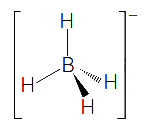
(A) The central $B$ atom in $BH_4^{-}$ undergoes $sp^3$ hybridisation.
This results in a tetrahedral geometry with $4$ bond pairs and $0$ lone pairs of electrons,as shown in the structure.
This results in a tetrahedral geometry with $4$ bond pairs and $0$ lone pairs of electrons,as shown in the structure.
0 likes
View Solution610
EasyMCQ
What is the molecular geometry of $H_3O^{+}$?
A
Trigonal pyramidal
B
Square planar
C
Trigonal bipyramidal
D
Trigonal planar
Solution
(A) The central oxygen atom in $H_3O^{+}$ is $sp^3$ hybridized.
It has $3$ bond pairs and $1$ lone pair of electrons,resulting in a total of $4$ electron domains.
According to the $\text{VSEPR}$ theory,the electron geometry is tetrahedral,but the presence of one lone pair distorts the shape.
Therefore,the molecular geometry of $H_3O^{+}$ is trigonal pyramidal.
Hence,the correct option is $(A)$.
It has $3$ bond pairs and $1$ lone pair of electrons,resulting in a total of $4$ electron domains.
According to the $\text{VSEPR}$ theory,the electron geometry is tetrahedral,but the presence of one lone pair distorts the shape.
Therefore,the molecular geometry of $H_3O^{+}$ is trigonal pyramidal.
Hence,the correct option is $(A)$.
0 likes
View Solution611
MediumMCQ
The isostructural molecules among $CO_2, SiO_2, SO_2, TeO_2, [NO_2]^{+}$ are
A
$CO_2, SO_2, TeO_2$
B
$CO_2, SiO_2, [NO_2]^{+}$
C
$CO_2, [NO_2]^{+}$
D
$SO_2, TeO_2$
Solution
(C) To determine isostructural molecules,we check the hybridization and geometry of the central atom:
$CO_2$: The central $C$ atom is $sp$-hybridized,resulting in a linear geometry.
$[NO_2]^{+}$: The central $N$ atom is $sp$-hybridized,resulting in a linear geometry.
$SiO_2$: Exists as a giant covalent network (quartz) with $sp^3$ hybridization.
$SO_2$ and $TeO_2$: Both have $sp^2$ hybridization with one lone pair,resulting in a bent (angular) geometry.
Since both $CO_2$ and $[NO_2]^{+}$ are linear,they are isostructural.
Thus,the correct option is $C$.
$CO_2$: The central $C$ atom is $sp$-hybridized,resulting in a linear geometry.
$[NO_2]^{+}$: The central $N$ atom is $sp$-hybridized,resulting in a linear geometry.
$SiO_2$: Exists as a giant covalent network (quartz) with $sp^3$ hybridization.
$SO_2$ and $TeO_2$: Both have $sp^2$ hybridization with one lone pair,resulting in a bent (angular) geometry.
Since both $CO_2$ and $[NO_2]^{+}$ are linear,they are isostructural.
Thus,the correct option is $C$.
0 likes
View Solution612
EasyMCQ
Identify the molecule in which the arrangement of electron pairs around the central atom is octahedral and the shape is not octahedral.
A
$SF_6$
B
$XeF_6$
C
$BrF_5$
D
$XeO_2F_4$
Solution
(C) The arrangement of electron pairs around the central atom is octahedral when the steric number is $6$ (i.e.,$sp^3d^2$ hybridization). $A$ molecule has a non-octahedral shape if it contains one or more lone pairs of electrons.
$(i)$ $SF_6$: Steric number = $6$ ($6$ bond pairs,$0$ lone pairs). Shape is octahedral.
$(ii)$ $XeF_6$: Steric number = $7$ ($6$ bond pairs,$1$ lone pair). The electron pair arrangement is pentagonal bipyramidal,not octahedral.
$(iii)$ $BrF_5$: Steric number = $6$ ($5$ bond pairs,$1$ lone pair). The electron pair arrangement is octahedral,but the shape is square pyramidal (not octahedral).
$(iv)$ $XeO_2F_4$: Steric number = $6$ ($6$ bond pairs,$0$ lone pairs). Shape is octahedral.
Therefore,$BrF_5$ is the molecule where the electron pair arrangement is octahedral but the shape is not.
$(i)$ $SF_6$: Steric number = $6$ ($6$ bond pairs,$0$ lone pairs). Shape is octahedral.
$(ii)$ $XeF_6$: Steric number = $7$ ($6$ bond pairs,$1$ lone pair). The electron pair arrangement is pentagonal bipyramidal,not octahedral.
$(iii)$ $BrF_5$: Steric number = $6$ ($5$ bond pairs,$1$ lone pair). The electron pair arrangement is octahedral,but the shape is square pyramidal (not octahedral).
$(iv)$ $XeO_2F_4$: Steric number = $6$ ($6$ bond pairs,$0$ lone pairs). Shape is octahedral.
Therefore,$BrF_5$ is the molecule where the electron pair arrangement is octahedral but the shape is not.
0 likes
View Solution613
EasyMCQ
Observe the following molecules: $PCl_5, BrF_5, ClF_5, PF_5, ClF_3, XeF_4, XeF_2, IF_5$. The number of molecules having square pyramidal geometry from the above is:
A
$4$
B
$5$
C
$3$
D
$6$
Solution
(C) To determine the geometry,we calculate the hybridization and the number of lone pairs for each molecule:
$1$. $PCl_5$: $sp^3d$ hybridization,trigonal bipyramidal geometry.
$2$. $BrF_5$: $sp^3d^2$ hybridization with $1$ lone pair,square pyramidal geometry.
$3$. $ClF_5$: $sp^3d^2$ hybridization with $1$ lone pair,square pyramidal geometry.
$4$. $PF_5$: $sp^3d$ hybridization,trigonal bipyramidal geometry.
$5$. $ClF_3$: $sp^3d$ hybridization with $2$ lone pairs,$T$-shaped geometry.
$6$. $XeF_4$: $sp^3d^2$ hybridization with $2$ lone pairs,square planar geometry.
$7$. $XeF_2$: $sp^3d$ hybridization with $3$ lone pairs,linear geometry.
$8$. $IF_5$: $sp^3d^2$ hybridization with $1$ lone pair,square pyramidal geometry.
Thus,the molecules with square pyramidal geometry are $BrF_5, ClF_5$,and $IF_5$.
The total count is $3$.
$1$. $PCl_5$: $sp^3d$ hybridization,trigonal bipyramidal geometry.
$2$. $BrF_5$: $sp^3d^2$ hybridization with $1$ lone pair,square pyramidal geometry.
$3$. $ClF_5$: $sp^3d^2$ hybridization with $1$ lone pair,square pyramidal geometry.
$4$. $PF_5$: $sp^3d$ hybridization,trigonal bipyramidal geometry.
$5$. $ClF_3$: $sp^3d$ hybridization with $2$ lone pairs,$T$-shaped geometry.
$6$. $XeF_4$: $sp^3d^2$ hybridization with $2$ lone pairs,square planar geometry.
$7$. $XeF_2$: $sp^3d$ hybridization with $3$ lone pairs,linear geometry.
$8$. $IF_5$: $sp^3d^2$ hybridization with $1$ lone pair,square pyramidal geometry.
Thus,the molecules with square pyramidal geometry are $BrF_5, ClF_5$,and $IF_5$.
The total count is $3$.
0 likes
View Solution614
EasyMCQ
Match the following:
The correct answer is:
| List-$I$ | List-$II$ |
| $A. BrF_5$ | $I. AB_4E$,see-saw |
| $B. SF_4$ | $II. AB_4E_2$,square planar |
| $C. XeF_4$ | $III. AB_5E$,square pyramidal |
| $D. ClF_3$ | $IV. AB_3E_2$,$T$-shape |
The correct answer is:
A
$A-V, B-I, C-II, D-IV$
B
$A-III, B-I, C-II, D-V$
C
$A-III, B-I, C-II, D-IV$
D
$A-V, B-I, C-III, D-II$
Solution
(C) The molecular geometries are determined by $VSEPR$ theory:
Matching the items:
$A$ $(BrF_5)$ matches $III$ ($AB_5E$,square pyramidal).
$B$ $(SF_4)$ matches $I$ ($AB_4E$,see-saw).
$C$ $(XeF_4)$ matches $II$ ($AB_4E_2$,square planar).
$D$ $(ClF_3)$ matches $IV$ ($AB_3E_2$,$T$-shape).
Therefore,the correct match is $A-III, B-I, C-II, D-IV$.
| Molecule | Type | Shape |
| $BrF_5$ | $AB_5E$ | Square pyramidal |
| $SF_4$ | $AB_4E$ | See-saw |
| $XeF_4$ | $AB_4E_2$ | Square planar |
| $ClF_3$ | $AB_3E_2$ | $T$-shape |
Matching the items:
$A$ $(BrF_5)$ matches $III$ ($AB_5E$,square pyramidal).
$B$ $(SF_4)$ matches $I$ ($AB_4E$,see-saw).
$C$ $(XeF_4)$ matches $II$ ($AB_4E_2$,square planar).
$D$ $(ClF_3)$ matches $IV$ ($AB_3E_2$,$T$-shape).
Therefore,the correct match is $A-III, B-I, C-II, D-IV$.
0 likes
View Solution615
MediumMCQ
Observe the following statements:
$i$. According to $\text{VSEPR}$ theory,$ClF_3$ and $SO_2$ are shown as $AB_3E_2$ and $AB_2E$ type molecules respectively.
$ii$. $SF_4$ has a "See-saw" shape.
$iii$. $HgCl_2$ and $PbCl_2$ have the same shape.
The statements which are not correct are:
$i$. According to $\text{VSEPR}$ theory,$ClF_3$ and $SO_2$ are shown as $AB_3E_2$ and $AB_2E$ type molecules respectively.
$ii$. $SF_4$ has a "See-saw" shape.
$iii$. $HgCl_2$ and $PbCl_2$ have the same shape.
The statements which are not correct are:
A
$i, ii$ only
B
$i, iii$ only
C
$i, ii, iii$
D
$ii, iii$ only
Solution
(B) Statement $(i)$ is correct: $ClF_3$ has $3$ bond pairs and $2$ lone pairs $(AB_3E_2)$,and $SO_2$ has $2$ bond pairs and $1$ lone pair $(AB_2E)$.
Statement $(ii)$ is correct: $SF_4$ has $4$ bond pairs and $1$ lone pair,resulting in a "See-saw" geometry.
Statement $(iii)$ is incorrect: $HgCl_2$ has $2$ bond pairs and $0$ lone pairs,resulting in a linear shape. $PbCl_2$ has $2$ bond pairs and $1$ lone pair,resulting in a bent shape.
Therefore,only statement $(iii)$ is incorrect.
Statement $(ii)$ is correct: $SF_4$ has $4$ bond pairs and $1$ lone pair,resulting in a "See-saw" geometry.
Statement $(iii)$ is incorrect: $HgCl_2$ has $2$ bond pairs and $0$ lone pairs,resulting in a linear shape. $PbCl_2$ has $2$ bond pairs and $1$ lone pair,resulting in a bent shape.
Therefore,only statement $(iii)$ is incorrect.
0 likes
View Solution616
MediumMCQ
Which set of the following molecules has only one lone pair of electrons on their respective central atoms?
$(i)$ $SO_2$
$(ii)$ $XeF_4$
$(iii)$ $PbCl_2$
$(iv)$ $SF_4$
$(v)$ $ClF_3$
$(i)$ $SO_2$
$(ii)$ $XeF_4$
$(iii)$ $PbCl_2$
$(iv)$ $SF_4$
$(v)$ $ClF_3$
A
$(i)$,$(iii)$,$(iv)$
B
$(ii)$,$(iii)$,$(iv)$
C
$(i)$,$(ii)$,$(v)$
D
$(i)$,$(iii)$,$(v)$
Solution
(A) To determine the number of lone pairs on the central atom,we use the formula: $\text{Lone pair} = \frac{1}{2} (V - N)$,where $V$ is the number of valence electrons of the central atom and $N$ is the number of bonding electrons.
$(i)$ $SO_2$: $S$ has $6$ valence electrons. It forms $2$ double bonds with $O$ atoms,so $N = 4$. $\text{Lone pair} = \frac{1}{2} (6 - 4) = 1$.
$(ii)$ $XeF_4$: $Xe$ has $8$ valence electrons. It forms $4$ single bonds with $F$ atoms,so $N = 4$. $\text{Lone pair} = \frac{1}{2} (8 - 4) = 2$.
$(iii)$ $PbCl_2$: $Pb$ (Group $14$) has $4$ valence electrons. It forms $2$ single bonds with $Cl$ atoms,so $N = 2$. $\text{Lone pair} = \frac{1}{2} (4 - 2) = 1$.
$(iv)$ $SF_4$: $S$ has $6$ valence electrons. It forms $4$ single bonds with $F$ atoms,so $N = 4$. $\text{Lone pair} = \frac{1}{2} (6 - 4) = 1$.
$(v)$ $ClF_3$: $Cl$ has $7$ valence electrons. It forms $3$ single bonds with $F$ atoms,so $N = 3$. $\text{Lone pair} = \frac{1}{2} (7 - 3) = 2$.
Thus,molecules $(i)$,$(iii)$,and $(iv)$ have only one lone pair on their central atoms.
$(i)$ $SO_2$: $S$ has $6$ valence electrons. It forms $2$ double bonds with $O$ atoms,so $N = 4$. $\text{Lone pair} = \frac{1}{2} (6 - 4) = 1$.
$(ii)$ $XeF_4$: $Xe$ has $8$ valence electrons. It forms $4$ single bonds with $F$ atoms,so $N = 4$. $\text{Lone pair} = \frac{1}{2} (8 - 4) = 2$.
$(iii)$ $PbCl_2$: $Pb$ (Group $14$) has $4$ valence electrons. It forms $2$ single bonds with $Cl$ atoms,so $N = 2$. $\text{Lone pair} = \frac{1}{2} (4 - 2) = 1$.
$(iv)$ $SF_4$: $S$ has $6$ valence electrons. It forms $4$ single bonds with $F$ atoms,so $N = 4$. $\text{Lone pair} = \frac{1}{2} (6 - 4) = 1$.
$(v)$ $ClF_3$: $Cl$ has $7$ valence electrons. It forms $3$ single bonds with $F$ atoms,so $N = 3$. $\text{Lone pair} = \frac{1}{2} (7 - 3) = 2$.
Thus,molecules $(i)$,$(iii)$,and $(iv)$ have only one lone pair on their central atoms.
0 likes
View Solution617
MediumMCQ
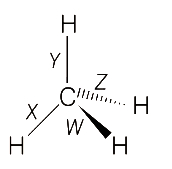
In the following three-dimensional structure of $CH_4$,the bonds are labelled as $W, X, Y$ and $Z$. The bonds projecting out of the plane are:
A
$X, Y$
B
$W, Z$
C
$X, Z$
D
$W, Y$
Solution
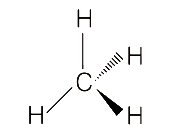
(B) The bonds that are projecting out of the plane are $W$ and $Z$.
Here,normal lines $(-)$ show the bonds lying in the plane of the paper.
Solid-wedge shows the bond projecting out of the plane of paper towards the observer $(W)$.
Dashed-wedge shows the bond projecting out of the plane of paper away from the observer $(Z)$.
Here,normal lines $(-)$ show the bonds lying in the plane of the paper.
Solid-wedge shows the bond projecting out of the plane of paper towards the observer $(W)$.
Dashed-wedge shows the bond projecting out of the plane of paper away from the observer $(Z)$.
0 likes
View Solution618
MediumMCQ
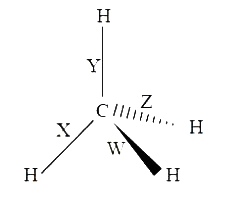
The three-dimensional structure of $CH_4$ is given below. The bonds are labelled as $W, X, Y$ and $Z$. What are the bonds lying in the plane $(A)$,projecting out of the plane away from the observer $(B)$ and projecting out of the plane towards the observer $(C)$?
A
| $A$ (In-plane) | $B$ (Away) | $C$ (Towards) |
| $X, Y$ | $Z$ | $W$ |
B
| $A$ (In-plane) | $B$ (Away) | $C$ (Towards) |
| $Z$ | $W$ | $X, Y$ |
C
| $A$ (In-plane) | $B$ (Away) | $C$ (Towards) |
| $X, Y$ | $W$ | $Z$ |
D
| $A$ (In-plane) | $B$ (Away) | $C$ (Towards) |
| $W$ | $X, Y$ | $Z$ |
Solution
(A) In the $CH_4$ molecule,the carbon atom is $sp^3$ hybridized with a tetrahedral geometry.
In the provided structure:
$1$. The bonds $X$ and $Y$ are represented by simple lines,indicating they lie in the plane of the paper.
$2$. The bond $Z$ is represented by a dashed wedge,indicating it projects away from the observer (behind the plane).
$3$. The bond $W$ is represented by a solid wedge,indicating it projects towards the observer (in front of the plane).
Therefore,the correct mapping is: In-plane $(A)$ = $X, Y$; Away from observer $(B)$ = $Z$; Towards observer $(C)$ = $W$.
In the provided structure:
$1$. The bonds $X$ and $Y$ are represented by simple lines,indicating they lie in the plane of the paper.
$2$. The bond $Z$ is represented by a dashed wedge,indicating it projects away from the observer (behind the plane).
$3$. The bond $W$ is represented by a solid wedge,indicating it projects towards the observer (in front of the plane).
Therefore,the correct mapping is: In-plane $(A)$ = $X, Y$; Away from observer $(B)$ = $Z$; Towards observer $(C)$ = $W$.
0 likes
View Solution619
MediumMCQ
$X$ and $Y$ are two covalent molecules in which the hybridization of the central atoms is the same,but the shapes are different. What are $X$ and $Y$?
A
$XeF_4, NH_3$
B
$XeF_2, PF_5$
C
$BF_3, H_2O$
D
$CH_4, BeCl_2$
Solution
(B) $XeF_2$ and $PF_5$ both have $sp^3d$ hybridization.
According to the $\text{VSEPR}$ theory,their shapes are different.
$XeF_2$ has $3$ lone pairs on the central $Xe$ atom,resulting in a linear geometry.
$PF_5$ has $0$ lone pairs on the central $P$ atom,resulting in a trigonal bipyramidal geometry.
According to the $\text{VSEPR}$ theory,their shapes are different.
$XeF_2$ has $3$ lone pairs on the central $Xe$ atom,resulting in a linear geometry.
$PF_5$ has $0$ lone pairs on the central $P$ atom,resulting in a trigonal bipyramidal geometry.
0 likes
View Solution620
MediumMCQ
Match the following:
The correct answer is
| List-$I$ | List-$II$ |
| $a$. See-Saw Shape | $i$. $XeF_4$ |
| $b$. Square Pyramidal | $ii$. $ClF_3$ |
| $c$. $T$-Shape | $iii$. $PbCl_2$ |
| $d$. Bent Shape | $iv$. $SF_4$ |
| $v$. $BrF_5$ |
The correct answer is
A
$a-iv, b-v, c-iii, d-ii$
B
$a-iv, b-v, c-ii, d-iii$
C
$a-i, b-iii, c-iv, d-ii$
D
$a-i, b-iv, c-v, d-iii$
Solution
(B) To determine the geometry,we use $VSEPR$ theory:
$a$. $SF_4$: Steric number is $5$ ($4$ bond pairs + $1$ lone pair),resulting in a See-Saw shape $(iv)$.
$b$. $BrF_5$: Steric number is $6$ ($5$ bond pairs + $1$ lone pair),resulting in a Square Pyramidal shape $(v)$.
$c$. $ClF_3$: Steric number is $5$ ($3$ bond pairs + $2$ lone pairs),resulting in a $T$-shape $(ii)$.
$d$. $PbCl_2$: This is an ionic compound with a bent geometry in the gas phase due to the lone pair on $Pb^{2+}$ $(iii)$.
Therefore,the correct matching is $a-iv, b-v, c-ii, d-iii$.
$a$. $SF_4$: Steric number is $5$ ($4$ bond pairs + $1$ lone pair),resulting in a See-Saw shape $(iv)$.
$b$. $BrF_5$: Steric number is $6$ ($5$ bond pairs + $1$ lone pair),resulting in a Square Pyramidal shape $(v)$.
$c$. $ClF_3$: Steric number is $5$ ($3$ bond pairs + $2$ lone pairs),resulting in a $T$-shape $(ii)$.
$d$. $PbCl_2$: This is an ionic compound with a bent geometry in the gas phase due to the lone pair on $Pb^{2+}$ $(iii)$.
Therefore,the correct matching is $a-iv, b-v, c-ii, d-iii$.
0 likes
View Solution621
MediumMCQ
Which one of the following sets is correct for the interhalogen compound $BrF_5$?
A
Trigonal pyramidal shape,$3$ bond pairs and one lone pair
B
$T$-shape,$3$ bond pairs and two lone pairs
C
Square pyramidal shape,$4$ bond pairs and two lone pairs
D
Square pyramidal shape,$5$ bond pairs and one lone pair
Solution
(D) The central atom $Br$ has $7$ valence electrons. In $BrF_5$,it forms $5$ single bonds with $F$ atoms,utilizing $5$ electrons. This leaves $2$ electrons,which form $1$ lone pair. The total number of electron pairs is $5 + 1 = 6$,which corresponds to $sp^3d^2$ hybridization. According to $VSEPR$ theory,a molecule with $5$ bond pairs and $1$ lone pair adopts a square pyramidal geometry.
0 likes
View Solution622
MediumMCQ
The number of bond pairs,lone pairs present on the central atom of $SF_4$ molecule and its shape respectively are
A
$4$,$2$,tetrahedral
B
$4$,$2$,square planar
C
$4$,$1$,tetrahedral
D
$4$,$1$,see-saw
Solution
(D) In $SF_4$,the central atom is sulfur $(S)$.
Sulfur has $6$ valence electrons.
It forms $4$ single bonds with $4$ fluorine atoms,using $4$ valence electrons.
This leaves $6 - 4 = 2$ electrons,which form $1$ lone pair on the sulfur atom.
Thus,there are $4$ bond pairs and $1$ lone pair.
The steric number is $4 + 1 = 5$,which corresponds to $sp^3d$ hybridization.
Due to the presence of $1$ lone pair in the equatorial position of a trigonal bipyramidal geometry,the shape of the $SF_4$ molecule is see-saw.
Sulfur has $6$ valence electrons.
It forms $4$ single bonds with $4$ fluorine atoms,using $4$ valence electrons.
This leaves $6 - 4 = 2$ electrons,which form $1$ lone pair on the sulfur atom.
Thus,there are $4$ bond pairs and $1$ lone pair.
The steric number is $4 + 1 = 5$,which corresponds to $sp^3d$ hybridization.
Due to the presence of $1$ lone pair in the equatorial position of a trigonal bipyramidal geometry,the shape of the $SF_4$ molecule is see-saw.
0 likes
View Solution623
EasyMCQ
In which of the following molecules,the maximum number of lone pairs is present on the central atom?
A
$NH_3$
B
$H_2O$
C
$ClF_3$
D
$XeF_2$
Solution
(D) To determine the number of lone pairs on the central atom,we use the formula: $\text{Lone pairs} = \frac{1}{2} \times (V - N)$,where $V$ is the number of valence electrons of the central atom and $N$ is the number of electrons involved in bonding (monovalent atoms).
$1$. For $NH_3$: Central atom $N$ has $5$ valence electrons. It forms $3$ bonds. $\text{Lone pairs} = \frac{1}{2} \times (5 - 3) = 1$.
$2$. For $H_2O$: Central atom $O$ has $6$ valence electrons. It forms $2$ bonds. $\text{Lone pairs} = \frac{1}{2} \times (6 - 2) = 2$.
$3$. For $ClF_3$: Central atom $Cl$ has $7$ valence electrons. It forms $3$ bonds. $\text{Lone pairs} = \frac{1}{2} \times (7 - 3) = 2$.
$4$. For $XeF_2$: Central atom $Xe$ has $8$ valence electrons. It forms $2$ bonds. $\text{Lone pairs} = \frac{1}{2} \times (8 - 2) = 3$.
Thus,$XeF_2$ has the maximum number of lone pairs $(3)$ on the central atom.
$1$. For $NH_3$: Central atom $N$ has $5$ valence electrons. It forms $3$ bonds. $\text{Lone pairs} = \frac{1}{2} \times (5 - 3) = 1$.
$2$. For $H_2O$: Central atom $O$ has $6$ valence electrons. It forms $2$ bonds. $\text{Lone pairs} = \frac{1}{2} \times (6 - 2) = 2$.
$3$. For $ClF_3$: Central atom $Cl$ has $7$ valence electrons. It forms $3$ bonds. $\text{Lone pairs} = \frac{1}{2} \times (7 - 3) = 2$.
$4$. For $XeF_2$: Central atom $Xe$ has $8$ valence electrons. It forms $2$ bonds. $\text{Lone pairs} = \frac{1}{2} \times (8 - 2) = 3$.
Thus,$XeF_2$ has the maximum number of lone pairs $(3)$ on the central atom.
0 likes
View Solution624
MediumMCQ
In which of the following molecules,all bond lengths are not equal?
A
$SF_6$
B
$PCl_5$
C
$BCl_3$
D
$CCl_4$
Solution
(B) In $PCl_5$ (phosphorus pentachloride),the geometry is trigonal bipyramidal.
Due to the presence of three equatorial bonds and two axial bonds,the axial $P-Cl$ bonds are longer than the equatorial $P-Cl$ bonds because of greater repulsion from the equatorial bond pairs.
In $SF_6$,$BCl_3$,and $CCl_4$,all bond lengths are equivalent due to the high symmetry of the molecules.
Due to the presence of three equatorial bonds and two axial bonds,the axial $P-Cl$ bonds are longer than the equatorial $P-Cl$ bonds because of greater repulsion from the equatorial bond pairs.
In $SF_6$,$BCl_3$,and $CCl_4$,all bond lengths are equivalent due to the high symmetry of the molecules.
0 likes
View Solution625
MediumMCQ
The correct order of bond angles of the following is: $H_2O$ $(I)$,$NH_3$ $(II)$,$CH_4$ $(III)$,$SO_2$ $(IV)$
A
$IV > III > II > I$
B
$IV > III > I > II$
C
$I > II > III > IV$
D
$I > II > IV > III$
Solution
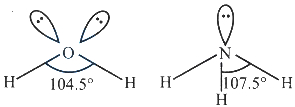
(A) According to $VSEPR$ theory,the bond angle depends on the hybridization and the number of lone pairs on the central atom.1. $SO_2$ $(IV)$: The central atom $S$ is $sp^2$ hybridized with one lone pair. The bond angle is approximately $119.5^\circ$.2. $CH_4$ $(III)$: The central atom $C$ is $sp^3$ hybridized with no lone pairs. It has a perfect tetrahedral bond angle of $109.5^\circ$.3. $NH_3$ $(II)$: The central atom $N$ is $sp^3$ hybridized with one lone pair. Due to lone pair-bond pair repulsion,the bond angle reduces to approximately $107^\circ$.4. $H_2O$ $(I)$: The central atom $O$ is $sp^3$ hybridized with two lone pairs. Due to greater lone pair-lone pair repulsion,the bond angle reduces further to approximately $104.5^\circ$.Therefore,the correct order is: $SO_2$ $(IV)$ $> CH_4$ $(III)$ $> NH_3$ $(II)$ $> H_2O$ $(I)$.
0 likes
View Solution626
EasyMCQ
What are the formal charges on the terminal oxygen atoms of the ozone $(O_3)$ molecule?
A
$+1, -1$
B
$+1, +1$
C
$-1, -1$
D
$0, -1$
Solution
(D) The structure of ozone $(O_3)$ consists of a central oxygen atom double-bonded to one terminal oxygen atom and single-bonded to another terminal oxygen atom.
Using the formal charge formula: $FC = V - L - \frac{1}{2}B$,where $V$ is the number of valence electrons,$L$ is the number of lone pair electrons,and $B$ is the number of bonding electrons.
For the central oxygen atom: $FC = 6 - 2 - \frac{1}{2}(6) = +1$.
For the terminal oxygen atom with a double bond: $FC = 6 - 4 - \frac{1}{2}(4) = 0$.
For the terminal oxygen atom with a single bond: $FC = 6 - 6 - \frac{1}{2}(2) = -1$.
Thus,the formal charges on the terminal oxygen atoms are $0$ and $-1$.
Using the formal charge formula: $FC = V - L - \frac{1}{2}B$,where $V$ is the number of valence electrons,$L$ is the number of lone pair electrons,and $B$ is the number of bonding electrons.
For the central oxygen atom: $FC = 6 - 2 - \frac{1}{2}(6) = +1$.
For the terminal oxygen atom with a double bond: $FC = 6 - 4 - \frac{1}{2}(4) = 0$.
For the terminal oxygen atom with a single bond: $FC = 6 - 6 - \frac{1}{2}(2) = -1$.
Thus,the formal charges on the terminal oxygen atoms are $0$ and $-1$.
0 likes
View Solution627
EasyMCQ
If the dipole moments of $H_2S$,$NH_3$,$NF_3$,and $BF_3$ are $0.95 \ D$,$1.47 \ D$,$0.23 \ D$,and $0.0 \ D$ respectively,the molecule that has a trigonal planar structure is:
A
$BF_3$
B
$NH_3$
C
$H_2S$
D
$NF_3$
Solution
(A) The structure of a molecule is determined by its hybridization and the number of lone pairs on the central atom.
$BF_3$ has $sp^2$ hybridization with no lone pairs on the boron atom,resulting in a trigonal planar geometry.
$NH_3$ and $NF_3$ have $sp^3$ hybridization with one lone pair,resulting in a trigonal pyramidal geometry.
$H_2S$ has $sp^3$ hybridization with two lone pairs,resulting in a bent ($V$-shaped) geometry.
Since $BF_3$ is the only molecule with a trigonal planar structure,the correct option is $A$.
$BF_3$ has $sp^2$ hybridization with no lone pairs on the boron atom,resulting in a trigonal planar geometry.
$NH_3$ and $NF_3$ have $sp^3$ hybridization with one lone pair,resulting in a trigonal pyramidal geometry.
$H_2S$ has $sp^3$ hybridization with two lone pairs,resulting in a bent ($V$-shaped) geometry.
Since $BF_3$ is the only molecule with a trigonal planar structure,the correct option is $A$.
0 likes
View Solution628
MediumMCQ
The geometry of $SF_6$ molecule is
A
tetrahedral
B
planar
C
octahedral
D
trigonal bipyramidal
Solution
(C) In $SF_6$,the central sulphur atom is bonded to $6$ fluorine atoms.
There are $6$ bond pairs and $0$ lone pairs around the sulphur atom.
According to $VSEPR$ theory,a molecule with $6$ bond pairs and $0$ lone pairs has an octahedral geometry.
There are $6$ bond pairs and $0$ lone pairs around the sulphur atom.
According to $VSEPR$ theory,a molecule with $6$ bond pairs and $0$ lone pairs has an octahedral geometry.
0 likes
View Solution629
EasyMCQ
In the reaction given below,what are the geometries of $BCl_3$ and $X$ respectively?
$BCl_3 + NH_3 \rightarrow X$
$BCl_3 + NH_3 \rightarrow X$
A
Pyramidal,tetrahedral
B
Pyramidal,octahedral
C
Trigonal planar,tetrahedral
D
Trigonal planar,octahedral
Solution
(C) The reaction is $BCl_3 + NH_3 \rightarrow BCl_3 \cdot NH_3$ (where $X = BCl_3 \cdot NH_3$).
In $BCl_3$,the boron atom is $sp^2$ hybridized with three bond pairs and no lone pairs,resulting in a trigonal planar geometry.
In the adduct $X$ $(BCl_3 \cdot NH_3)$,the boron atom undergoes a change in hybridization from $sp^2$ to $sp^3$ as it accepts a lone pair from the nitrogen atom of $NH_3$.
Consequently,the boron atom in $X$ adopts a tetrahedral geometry.
In $BCl_3$,the boron atom is $sp^2$ hybridized with three bond pairs and no lone pairs,resulting in a trigonal planar geometry.
In the adduct $X$ $(BCl_3 \cdot NH_3)$,the boron atom undergoes a change in hybridization from $sp^2$ to $sp^3$ as it accepts a lone pair from the nitrogen atom of $NH_3$.
Consequently,the boron atom in $X$ adopts a tetrahedral geometry.
0 likes
View Solution630
MediumMCQ
$BF_3$ is used as a catalyst in several industrial processes due to its
A
strong reducing nature
B
weak reducing action
C
strong Lewis acid nature
D
weak Lewis acid character
Solution
(C) $BF_3$ is used as a catalyst in several industrial processes due to its strong Lewis acid nature.
$sp^2$-hybridized boron in $BF_3$ is electron-deficient ($6 \ e^-$ in valence shell,$2 \ e^-$ less than the octet) and acts as a strong Lewis acid.
$sp^2$-hybridized boron in $BF_3$ is electron-deficient ($6 \ e^-$ in valence shell,$2 \ e^-$ less than the octet) and acts as a strong Lewis acid.
0 likes
View Solution631
MediumMCQ
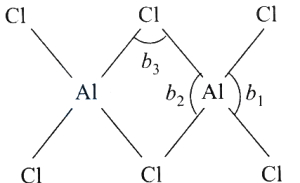
The bond angles $b_1, b_2, b_3$ in the above structure of $Al_2Cl_6$ are respectively (in $^{\circ}$):
A
$79, 101, 118$
B
$118, 101, 79$
C
$79, 118, 101$
D
$118, 79, 101$
Solution
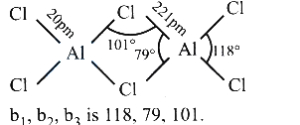
(D) The structure of $Al_2Cl_6$ (aluminum chloride dimer) consists of two $AlCl_4$ tetrahedra sharing an edge.
In this structure,the terminal $Cl-Al-Cl$ bond angle $(b_1)$ is approximately $118^{\circ}$.
The bridging $Al-Cl-Al$ bond angle $(b_2)$ is approximately $79^{\circ}$.
The $Cl-Al-Cl$ bond angle involving the bridging chlorine atoms $(b_3)$ is approximately $101^{\circ}$.
Therefore,the values for $b_1, b_2, b_3$ are $118^{\circ}, 79^{\circ}, 101^{\circ}$ respectively.
In this structure,the terminal $Cl-Al-Cl$ bond angle $(b_1)$ is approximately $118^{\circ}$.
The bridging $Al-Cl-Al$ bond angle $(b_2)$ is approximately $79^{\circ}$.
The $Cl-Al-Cl$ bond angle involving the bridging chlorine atoms $(b_3)$ is approximately $101^{\circ}$.
Therefore,the values for $b_1, b_2, b_3$ are $118^{\circ}, 79^{\circ}, 101^{\circ}$ respectively.
0 likes
View Solution632
MediumMCQ
The geometry with respect to the central atom of the molecules $N(SiH_3)_3$,$Me_3N$,and $(SiH_3)_3P$ respectively are
A
$planar, pyramidal, planar$
B
$planar, pyramidal, pyramidal$
C
$pyramidal, pyramidal, pyramidal$
D
$pyramidal, planar, pyramidal$
Solution
(B) $1$. In $N(SiH_3)_3$,the nitrogen atom has a lone pair which is donated into the vacant $3d$-orbital of the silicon atom,forming a $p\pi-d\pi$ back-bonding. This makes the nitrogen atom $sp^2$ hybridized,resulting in a $planar$ geometry.
$2$. In $Me_3N$ (trimethylamine),the carbon atom does not have vacant $d$-orbitals,so no back-bonding occurs. The nitrogen atom remains $sp^3$ hybridized with a lone pair,resulting in a $pyramidal$ geometry.
$3$. In $(SiH_3)_3P$,the phosphorus atom is larger and has a lower electronegativity compared to nitrogen. The lone pair on phosphorus is stereochemically active and does not participate in significant back-bonding with silicon. Thus,it retains a $pyramidal$ geometry.
$2$. In $Me_3N$ (trimethylamine),the carbon atom does not have vacant $d$-orbitals,so no back-bonding occurs. The nitrogen atom remains $sp^3$ hybridized with a lone pair,resulting in a $pyramidal$ geometry.
$3$. In $(SiH_3)_3P$,the phosphorus atom is larger and has a lower electronegativity compared to nitrogen. The lone pair on phosphorus is stereochemically active and does not participate in significant back-bonding with silicon. Thus,it retains a $pyramidal$ geometry.
0 likes
View Solution633
MediumMCQ
In $NO_3^{-}$ ion,the number of bond pairs and lone pairs of electrons on the nitrogen atom are
A
$2,2$
B
$3,1$
C
$1,3$
D
$4,0$
Solution
(D) The nitrogen atom in the $NO_3^{-}$ ion has a valence shell configuration of $2s^2 2p^3$.
In the nitrate ion,nitrogen forms three sigma bonds (one with each oxygen atom) and one pi bond (delocalized over the three oxygen atoms).
This means nitrogen uses all its $5$ valence electrons to form $4$ bonds ($3$ single bonds and $1$ double bond equivalent in resonance).
Therefore,the number of bond pairs of electrons on the nitrogen atom is $4$.
Since all valence electrons are involved in bonding,there are $0$ lone pairs of electrons on the nitrogen atom.
Thus,the correct answer is $4,0$.
In the nitrate ion,nitrogen forms three sigma bonds (one with each oxygen atom) and one pi bond (delocalized over the three oxygen atoms).
This means nitrogen uses all its $5$ valence electrons to form $4$ bonds ($3$ single bonds and $1$ double bond equivalent in resonance).
Therefore,the number of bond pairs of electrons on the nitrogen atom is $4$.
Since all valence electrons are involved in bonding,there are $0$ lone pairs of electrons on the nitrogen atom.
Thus,the correct answer is $4,0$.
0 likes
View Solution634
EasyMCQ
Identify the molecule which contains a lone pair of electrons on the sulphur atom.
A
$H_2SO_5$
B
$H_2S_2O_8$
C
$H_2S_2O_7$
D
$H_2SO_3$
Solution
(D) To identify the molecule with a lone pair on the sulphur atom,we examine the oxidation state and bonding of sulphur in each molecule:
$1$. In $H_2SO_5$ (peroxymonosulphuric acid),$H_2S_2O_8$ (peroxydisulphuric acid),and $H_2S_2O_7$ (pyrosulphuric acid),the sulphur atom is in the $+6$ oxidation state. In this state,sulphur uses all its valence electrons for bonding,leaving no lone pair.
$2$. In $H_2SO_3$ (sulphurous acid),the sulphur atom is in the $+4$ oxidation state. The electronic configuration of sulphur is $[Ne] 3s^2 3p^4$. In $H_2SO_3$,sulphur forms two $S-OH$ bonds and one $S=O$ double bond. This utilizes $4$ valence electrons,leaving one lone pair on the sulphur atom.
Therefore,$H_2SO_3$ is the correct molecule.
$1$. In $H_2SO_5$ (peroxymonosulphuric acid),$H_2S_2O_8$ (peroxydisulphuric acid),and $H_2S_2O_7$ (pyrosulphuric acid),the sulphur atom is in the $+6$ oxidation state. In this state,sulphur uses all its valence electrons for bonding,leaving no lone pair.
$2$. In $H_2SO_3$ (sulphurous acid),the sulphur atom is in the $+4$ oxidation state. The electronic configuration of sulphur is $[Ne] 3s^2 3p^4$. In $H_2SO_3$,sulphur forms two $S-OH$ bonds and one $S=O$ double bond. This utilizes $4$ valence electrons,leaving one lone pair on the sulphur atom.
Therefore,$H_2SO_3$ is the correct molecule.
0 likes
View Solution635
EasyMCQ
$S +$ Conc. $H_2SO_4 \longrightarrow X + Y$
Here $X$ is a gas and $Y$ is a liquid and both are triatomic molecules. The number of electron lone pairs present on the central atoms of $X$ and $Y$ are respectively.
Here $X$ is a gas and $Y$ is a liquid and both are triatomic molecules. The number of electron lone pairs present on the central atoms of $X$ and $Y$ are respectively.
A
$2, 1$
B
$1, 0$
C
$1, 2$
D
$2, 2$
Solution
(C) The chemical reaction is:
$S + 2H_2SO_4 \text{ (conc.)} \longrightarrow 3SO_2 + 2H_2O$
Here,$X = SO_2$ (gas) and $Y = H_2O$ (liquid).
Both $SO_2$ and $H_2O$ are triatomic molecules.
In $SO_2$,the central atom is sulphur $(S)$. Sulphur has $6$ valence electrons. It forms two double bonds with two oxygen atoms,using $4$ electrons. Thus,it has $6 - 4 = 2$ electrons remaining,which form $1$ lone pair.
In $H_2O$,the central atom is oxygen $(O)$. Oxygen has $6$ valence electrons. It forms two single bonds with two hydrogen atoms,using $2$ electrons. Thus,it has $6 - 2 = 4$ electrons remaining,which form $2$ lone pairs.
Therefore,the number of lone pairs on the central atoms of $X$ and $Y$ are $1$ and $2$ respectively.
$S + 2H_2SO_4 \text{ (conc.)} \longrightarrow 3SO_2 + 2H_2O$
Here,$X = SO_2$ (gas) and $Y = H_2O$ (liquid).
Both $SO_2$ and $H_2O$ are triatomic molecules.
In $SO_2$,the central atom is sulphur $(S)$. Sulphur has $6$ valence electrons. It forms two double bonds with two oxygen atoms,using $4$ electrons. Thus,it has $6 - 4 = 2$ electrons remaining,which form $1$ lone pair.
In $H_2O$,the central atom is oxygen $(O)$. Oxygen has $6$ valence electrons. It forms two single bonds with two hydrogen atoms,using $2$ electrons. Thus,it has $6 - 2 = 4$ electrons remaining,which form $2$ lone pairs.
Therefore,the number of lone pairs on the central atoms of $X$ and $Y$ are $1$ and $2$ respectively.
0 likes
View Solution636
EasyMCQ
Molecular bromine on reaction with three moles of molecular fluorine produces an interhalogen compound. The total number of lone pairs at the central halogen atom is
A
$3$
B
$2$
C
$1$
D
$0$
Solution
(B) Molecular bromine $(Br_2)$ reacts with $3$ moles of molecular fluorine $(F_2)$ to produce $2$ moles of $BrF_3$.
$BrF_3$ is an interhalogen compound.
The chemical reaction is:
$Br_{2(g)} + 3F_{2(g)} \longrightarrow 2BrF_{3(g)}$
In $BrF_3$,the central bromine atom has $7$ valence electrons. It forms $3$ covalent bonds with $3$ fluorine atoms,using $3$ electrons.
Remaining electrons = $7 - 3 = 4$ electrons,which form $2$ lone pairs.
Thus,the total number of lone pairs at the central bromine atom is $2$.
$BrF_3$ is an interhalogen compound.
The chemical reaction is:
$Br_{2(g)} + 3F_{2(g)} \longrightarrow 2BrF_{3(g)}$
In $BrF_3$,the central bromine atom has $7$ valence electrons. It forms $3$ covalent bonds with $3$ fluorine atoms,using $3$ electrons.
Remaining electrons = $7 - 3 = 4$ electrons,which form $2$ lone pairs.
Thus,the total number of lone pairs at the central bromine atom is $2$.
0 likes
View Solution637
MediumMCQ
$SF_6$ is a kinetically inert substance because
A
fluorine is highly electronegative
B
it is sterically protected
C
greater difference in electronegativities of $S$ and $F$
D
larger size of $S$-atom
Solution
(B) In $SF_6$,the sulphur atom is $sp^3d^2$ hybridized,resulting in an octahedral geometry.
Six fluorine atoms surround the central sulphur atom,creating a highly crowded environment.
This steric hindrance prevents the attack of any nucleophile or electrophile on the sulphur atom,making $SF_6$ kinetically inert.
Six fluorine atoms surround the central sulphur atom,creating a highly crowded environment.
This steric hindrance prevents the attack of any nucleophile or electrophile on the sulphur atom,making $SF_6$ kinetically inert.
0 likes
View Solution638
DifficultMCQ
Fluorine reacts with dilute $NaOH$ and forms a gaseous product $A$. The bond angle in the molecule of $A$ is
A
$104^{\circ} 40^{\prime}$
B
$103^{\circ}$
C
$107^{\circ}$
D
$109^{\circ} 28^{\prime}$
Solution
(B) The reaction of fluorine with dilute $NaOH$ is given by:
$2F_2 + 2NaOH \rightarrow 2NaF + OF_2 + H_2O$
Thus,the gaseous product $A$ is oxygen difluoride $(OF_2)$.
In $OF_2$,the central oxygen atom is $sp^3$ hybridized with two bond pairs and two lone pairs.
Due to the high electronegativity of fluorine atoms,the lone pair-lone pair repulsion is significant,which compresses the bond angle.
The bond angle in $OF_2$ is $103^{\circ}$.
$2F_2 + 2NaOH \rightarrow 2NaF + OF_2 + H_2O$
Thus,the gaseous product $A$ is oxygen difluoride $(OF_2)$.
In $OF_2$,the central oxygen atom is $sp^3$ hybridized with two bond pairs and two lone pairs.
Due to the high electronegativity of fluorine atoms,the lone pair-lone pair repulsion is significant,which compresses the bond angle.
The bond angle in $OF_2$ is $103^{\circ}$.
0 likes
View Solution639
MediumMCQ
The pair of xenon compounds,which have the same number of lone pairs of electrons on the central atom is
A
$XeO_3, XeF_6$
B
$XeF_2, XeF_4$
C
$XeF_4, XeO_3$
D
$XeF_4, XeOF_4$
Solution
(A) To determine the number of lone pairs on the central $Xe$ atom,we use the formula: $\text{Lone pairs} = \frac{1}{2} (V - M)$,where $V$ is the number of valence electrons of the central atom ($8$ for $Xe$) and $M$ is the number of monovalent atoms bonded to it (Oxygen is divalent,so it does not contribute to $M$).
$(1) XeO_3$: $V=8$,$M=0$. $\text{Lone pairs} = \frac{1}{2} (8 - 0) = 4$ electrons,which is $1$ lone pair.
$(2) XeF_6$: $V=8$,$M=6$. $\text{Lone pairs} = \frac{1}{2} (8 - 6) = 2$ electrons,which is $1$ lone pair.
$(3) XeF_2$: $V=8$,$M=2$. $\text{Lone pairs} = \frac{1}{2} (8 - 2) = 6$ electrons,which is $3$ lone pairs.
$(4) XeF_4$: $V=8$,$M=4$. $\text{Lone pairs} = \frac{1}{2} (8 - 4) = 4$ electrons,which is $2$ lone pairs.
$(5) XeOF_4$: $V=8$,$M=4$ (Oxygen is divalent). $\text{Lone pairs} = \frac{1}{2} (8 - 4) = 4$ electrons,which is $1$ lone pair.
Comparing the results,$XeO_3$,$XeF_6$,and $XeOF_4$ all have $1$ lone pair. Among the given options,the pair $(XeO_3, XeF_6)$ matches.
$(1) XeO_3$: $V=8$,$M=0$. $\text{Lone pairs} = \frac{1}{2} (8 - 0) = 4$ electrons,which is $1$ lone pair.
$(2) XeF_6$: $V=8$,$M=6$. $\text{Lone pairs} = \frac{1}{2} (8 - 6) = 2$ electrons,which is $1$ lone pair.
$(3) XeF_2$: $V=8$,$M=2$. $\text{Lone pairs} = \frac{1}{2} (8 - 2) = 6$ electrons,which is $3$ lone pairs.
$(4) XeF_4$: $V=8$,$M=4$. $\text{Lone pairs} = \frac{1}{2} (8 - 4) = 4$ electrons,which is $2$ lone pairs.
$(5) XeOF_4$: $V=8$,$M=4$ (Oxygen is divalent). $\text{Lone pairs} = \frac{1}{2} (8 - 4) = 4$ electrons,which is $1$ lone pair.
Comparing the results,$XeO_3$,$XeF_6$,and $XeOF_4$ all have $1$ lone pair. Among the given options,the pair $(XeO_3, XeF_6)$ matches.
0 likes
View Solution640
MediumMCQ
The bond angle in $A$ is $X$ and the bond angle in $B$ is $Y$. What are $X$ and $Y$?
| $A$ | $B$ |
| $CH_3OH$ | $CH_3OCH_3$ |
A
$X < 109^{\circ} 28', Y > 109^{\circ} 28'$
B
$X < 109^{\circ} 28', Y < 109^{\circ} 28'$
C
$X > 109^{\circ} 28', Y < 109^{\circ} 28'$
D
$X > 109^{\circ} 28', Y > 109^{\circ} 28'$
Solution
(A) In $CH_3OH$ (methanol),the oxygen atom is $sp^3$ hybridized with two lone pairs. Due to the repulsion between lone pairs,the bond angle is compressed to less than the tetrahedral angle of $109^{\circ} 28'$.
In $CH_3OCH_3$ (dimethyl ether),the oxygen atom is also $sp^3$ hybridized,but the presence of two bulky methyl groups causes steric repulsion between them,which increases the bond angle to greater than $109^{\circ} 28'$.
Therefore,$X < 109^{\circ} 28'$ and $Y > 109^{\circ} 28'$.
In $CH_3OCH_3$ (dimethyl ether),the oxygen atom is also $sp^3$ hybridized,but the presence of two bulky methyl groups causes steric repulsion between them,which increases the bond angle to greater than $109^{\circ} 28'$.
Therefore,$X < 109^{\circ} 28'$ and $Y > 109^{\circ} 28'$.
0 likes
View Solution641
MediumMCQ
The sets of molecules in which the central atom has no lone pair of electrons are:
$i$. $SnCl_2, NH_3, SF_4$
$ii$. $HgCl_2, SO_3, SF_6$
$iii$. $BeCl_2, BF_3, PCl_5$
$iv$. $ClF_3, BrF_5, XeF_6$
$i$. $SnCl_2, NH_3, SF_4$
$ii$. $HgCl_2, SO_3, SF_6$
$iii$. $BeCl_2, BF_3, PCl_5$
$iv$. $ClF_3, BrF_5, XeF_6$
A
$i, iv$ only
B
$ii, iii$ only
C
$ii, iii, iv$ only
D
$i, ii, iii$ only
Solution
(B) To determine the presence of lone pairs on the central atom,we calculate the number of lone pairs using the formula: $\text{Lone pair} = \frac{1}{2} (V - N)$,where $V$ is the number of valence electrons of the central atom and $N$ is the number of bonding electrons (monovalent atoms attached).
$i$. $SnCl_2$ ($Sn$ has $2$ lone pairs),$NH_3$ ($N$ has $1$ lone pair),$SF_4$ ($S$ has $1$ lone pair).
$ii$. $HgCl_2$ ($Hg$ has $0$ lone pairs),$SO_3$ ($S$ has $0$ lone pairs),$SF_6$ ($S$ has $0$ lone pairs).
$iii$. $BeCl_2$ ($Be$ has $0$ lone pairs),$BF_3$ ($B$ has $0$ lone pairs),$PCl_5$ ($P$ has $0$ lone pairs).
$iv$. $ClF_3$ ($Cl$ has $2$ lone pairs),$BrF_5$ ($Br$ has $1$ lone pair),$XeF_6$ ($Xe$ has $1$ lone pair).
Thus,sets $ii$ and $iii$ contain molecules where the central atom has no lone pairs.
$i$. $SnCl_2$ ($Sn$ has $2$ lone pairs),$NH_3$ ($N$ has $1$ lone pair),$SF_4$ ($S$ has $1$ lone pair).
$ii$. $HgCl_2$ ($Hg$ has $0$ lone pairs),$SO_3$ ($S$ has $0$ lone pairs),$SF_6$ ($S$ has $0$ lone pairs).
$iii$. $BeCl_2$ ($Be$ has $0$ lone pairs),$BF_3$ ($B$ has $0$ lone pairs),$PCl_5$ ($P$ has $0$ lone pairs).
$iv$. $ClF_3$ ($Cl$ has $2$ lone pairs),$BrF_5$ ($Br$ has $1$ lone pair),$XeF_6$ ($Xe$ has $1$ lone pair).
Thus,sets $ii$ and $iii$ contain molecules where the central atom has no lone pairs.
0 likes
View Solution642
EasyMCQ
Find out the correct order of repulsive interaction of electron pairs in the following systems.
$(I)$ Lone pair - lone pair
$(II)$ Lone pair - bond pair
$(III)$ Bond pair - bond pair
$(I)$ Lone pair - lone pair
$(II)$ Lone pair - bond pair
$(III)$ Bond pair - bond pair
A
$I > II > III$
B
$II > I > III$
C
$III > II > I$
D
$I > III > II$
Solution
(A) According to the $VSEPR$ theory,electron pairs arrange themselves as far apart as possible to minimize repulsion.
The magnitude of different types of electronic repulsions follows the order:
$Lone pair - Lone pair > Lone pair - Bond pair > Bond pair - Bond pair$
Therefore,the correct order is $(I) > (II) > (III)$.
The magnitude of different types of electronic repulsions follows the order:
$Lone pair - Lone pair > Lone pair - Bond pair > Bond pair - Bond pair$
Therefore,the correct order is $(I) > (II) > (III)$.
0 likes
View Solution643
MediumMCQ
The molecule '$X$' has a see-saw shape with a central atom in $sp^3d$ hybridization. What is '$X$'?
A
$ClF_3$
B
$XeF_4$
C
$SF_4$
D
$BrF_5$
Solution
(C) $1$. The molecule '$X$' has $sp^3d$ hybridization and a see-saw geometry.
$2$. $sp^3d$ hybridization involves $5$ electron pairs around the central atom.
$3$. $A$ see-saw shape occurs when there are $4$ bond pairs and $1$ lone pair of electrons.
$4$. In $SF_4$,Sulfur $(S)$ has $6$ valence electrons. It forms $4$ bonds with $F$ atoms and has $1$ lone pair,resulting in $sp^3d$ hybridization and a see-saw shape.
$5$. $ClF_3$ has $T$-shaped geometry,$XeF_4$ has square planar geometry,and $BrF_5$ has square pyramidal geometry.
$6$. Therefore,'$X$' is $SF_4$.
$2$. $sp^3d$ hybridization involves $5$ electron pairs around the central atom.
$3$. $A$ see-saw shape occurs when there are $4$ bond pairs and $1$ lone pair of electrons.
$4$. In $SF_4$,Sulfur $(S)$ has $6$ valence electrons. It forms $4$ bonds with $F$ atoms and has $1$ lone pair,resulting in $sp^3d$ hybridization and a see-saw shape.
$5$. $ClF_3$ has $T$-shaped geometry,$XeF_4$ has square planar geometry,and $BrF_5$ has square pyramidal geometry.
$6$. Therefore,'$X$' is $SF_4$.
0 likes
View Solution644
MediumMCQ
In which of the following options,the molecules are correctly arranged in the increasing order of their bond angles?
A
$NH_3 < O_3 < H_2 O < SO_2$
B
$H_2 O < O_3 < NH_3 < SO_2$
C
$H_2 O < NH_3 < SO_2 < O_3$
D
$H_2 O < NH_3 < O_3 < SO_2$
Solution
(D) To determine the bond angles,we look at the hybridization and lone pairs of the central atoms:
$1$. $H_2O$: $sp^3$ hybridization,$2$ lone pairs,bond angle $\approx 104.5^\circ$.
$2$. $NH_3$: $sp^3$ hybridization,$1$ lone pair,bond angle $\approx 107^\circ$.
$3$. $O_3$: $sp^2$ hybridization,$1$ lone pair,bond angle $\approx 117^\circ$.
$4$. $SO_2$: $sp^2$ hybridization,$1$ lone pair,bond angle $\approx 119^\circ$.
Comparing these,the increasing order is $H_2O < NH_3 < O_3 < SO_2$.
Thus,the correct option is $D$.
$1$. $H_2O$: $sp^3$ hybridization,$2$ lone pairs,bond angle $\approx 104.5^\circ$.
$2$. $NH_3$: $sp^3$ hybridization,$1$ lone pair,bond angle $\approx 107^\circ$.
$3$. $O_3$: $sp^2$ hybridization,$1$ lone pair,bond angle $\approx 117^\circ$.
$4$. $SO_2$: $sp^2$ hybridization,$1$ lone pair,bond angle $\approx 119^\circ$.
Comparing these,the increasing order is $H_2O < NH_3 < O_3 < SO_2$.
Thus,the correct option is $D$.
0 likes
View Solution645
MediumMCQ
Arrange the following molecules in the correct order of their bond angles:
| $S_8$ | $A$ |
| $P_4$ | $B$ |
| $S_6$ | $C$ |
| $O_3$ | $D$ |
A
$A < C < D < B$
B
$B < A < C < D$
C
$C < B < A < D$
D
$B < C < A < D$
Solution
(D) To determine the bond angles,we analyze the geometry of each molecule:
$1$. $P_4$: The phosphorus atoms are at the corners of a tetrahedron. The bond angle is $60^\circ$.
$2$. $S_6$: This molecule has a chair-like conformation with bond angles approximately $102^\circ$.
$3$. $S_8$: This molecule has a crown-shaped conformation with bond angles approximately $107^\circ$.
$4$. $O_3$: Ozone has a bent geometry with a bond angle of approximately $117^\circ$.
Comparing these values: $60^\circ (P_4) < 102^\circ (S_6) < 107^\circ (S_8) < 117^\circ (O_3)$.
In terms of designations: $B (P_4) < C (S_6) < A (S_8) < D (O_3)$.
Therefore,the correct order is $B < C < A < D$.
$1$. $P_4$: The phosphorus atoms are at the corners of a tetrahedron. The bond angle is $60^\circ$.
$2$. $S_6$: This molecule has a chair-like conformation with bond angles approximately $102^\circ$.
$3$. $S_8$: This molecule has a crown-shaped conformation with bond angles approximately $107^\circ$.
$4$. $O_3$: Ozone has a bent geometry with a bond angle of approximately $117^\circ$.
Comparing these values: $60^\circ (P_4) < 102^\circ (S_6) < 107^\circ (S_8) < 117^\circ (O_3)$.
In terms of designations: $B (P_4) < C (S_6) < A (S_8) < D (O_3)$.
Therefore,the correct order is $B < C < A < D$.
0 likes
View Solution646
EasyMCQ
Consider the following reactions:
$2 Cu_2S + 3 O_2 \rightarrow 2 Cu_2O + 2 SO_2$
$2 Cu_2O + Cu_2S \rightarrow 6 Cu + SO_2 \uparrow$
Here,$X$ is $Cu_2S$ and $Y$ is $SO_2$. The shape of the molecule $Y$ is:
$2 Cu_2S + 3 O_2 \rightarrow 2 Cu_2O + 2 SO_2$
$2 Cu_2O + Cu_2S \rightarrow 6 Cu + SO_2 \uparrow$
Here,$X$ is $Cu_2S$ and $Y$ is $SO_2$. The shape of the molecule $Y$ is:
A
Linear
B
Tetrahedral
C
Pyramidal
D
Angular
Solution
(D) The given reactions are part of the copper extraction process:
$1. 2 Cu_2S + 3 O_2 \rightarrow 2 Cu_2O + 2 SO_2$ (where $X = Cu_2S$)
$2. 2 Cu_2O + Cu_2S \rightarrow 6 Cu + SO_2$ (where $Y = SO_2$)
In the $SO_2$ molecule,the sulfur atom is $sp^2$ hybridized with one lone pair of electrons.
Due to the presence of the lone pair,the geometry is bent or angular.
$1. 2 Cu_2S + 3 O_2 \rightarrow 2 Cu_2O + 2 SO_2$ (where $X = Cu_2S$)
$2. 2 Cu_2O + Cu_2S \rightarrow 6 Cu + SO_2$ (where $Y = SO_2$)
In the $SO_2$ molecule,the sulfur atom is $sp^2$ hybridized with one lone pair of electrons.
Due to the presence of the lone pair,the geometry is bent or angular.
0 likes
View Solution647
EasyMCQ
Match the molecules in List-$I$ with their respective shapes in List-$II$.
| List-$I$ (Molecule) | List-$II$ (Shape) |
|---|---|
| $A. SF_4$ | $I. T\text{-shaped}$ |
| $B. ClF_3$ | $II. \text{Square planar}$ |
| $C. BrF_5$ | $III. \text{See-saw}$ |
| $D. XeF_4$ | $IV. \text{Square pyramidal}$ |
A
$A-II, B-III, C-I, D-IV$
B
$A-II, B-I, C-IV, D-III$
C
$A-III, B-II, C-IV, D-I$
D
$A-III, B-I, C-IV, D-II$
Solution
(D) To determine the shape of the molecules, we use the $VSEPR$ theory:
$A. SF_4$: Hybridisation is $sp^3d$ with one lone pair, resulting in a see-saw shape $(III)$.
$B. ClF_3$: Hybridisation is $sp^3d$ with two lone pairs, resulting in a $T$-shaped geometry $(I)$.
$C. BrF_5$: Hybridisation is $sp^3d^2$ with one lone pair, resulting in a square pyramidal shape $(IV)$.
$D. XeF_4$: Hybridisation is $sp^3d^2$ with two lone pairs, resulting in a square planar shape $(II)$.
Therefore, the correct matching is $A-III, B-I, C-IV, D-II$.
$A. SF_4$: Hybridisation is $sp^3d$ with one lone pair, resulting in a see-saw shape $(III)$.
$B. ClF_3$: Hybridisation is $sp^3d$ with two lone pairs, resulting in a $T$-shaped geometry $(I)$.
$C. BrF_5$: Hybridisation is $sp^3d^2$ with one lone pair, resulting in a square pyramidal shape $(IV)$.
$D. XeF_4$: Hybridisation is $sp^3d^2$ with two lone pairs, resulting in a square planar shape $(II)$.
Therefore, the correct matching is $A-III, B-I, C-IV, D-II$.
0 likes
View Solution648
EasyMCQ
The number of lone pairs of electrons on the central atom of $ClF_3, NF_3, SF_4,$ and $XeF_4$ respectively are:
A
$0, 1, 0, 2$
B
$2, 1, 0, 0$
C
$2, 1, 1, 2$
D
$2, 1, 1, 0$
Solution
(C) To determine the number of lone pairs on the central atom,we use the formula: $\text{Lone pairs} = \frac{1}{2} (V - N)$,where $V$ is the number of valence electrons of the central atom and $N$ is the number of monovalent atoms bonded to it.
$1$. For $ClF_3$: $V = 7, N = 3$. $\text{Lone pairs} = \frac{1}{2} (7 - 3) = 2$.
$2$. For $NF_3$: $V = 5, N = 3$. $\text{Lone pairs} = \frac{1}{2} (5 - 3) = 1$.
$3$. For $SF_4$: $V = 6, N = 4$. $\text{Lone pairs} = \frac{1}{2} (6 - 4) = 1$.
$4$. For $XeF_4$: $V = 8, N = 4$. $\text{Lone pairs} = \frac{1}{2} (8 - 4) = 2$.
Therefore,the correct sequence is $2, 1, 1, 2$.
$1$. For $ClF_3$: $V = 7, N = 3$. $\text{Lone pairs} = \frac{1}{2} (7 - 3) = 2$.
$2$. For $NF_3$: $V = 5, N = 3$. $\text{Lone pairs} = \frac{1}{2} (5 - 3) = 1$.
$3$. For $SF_4$: $V = 6, N = 4$. $\text{Lone pairs} = \frac{1}{2} (6 - 4) = 1$.
$4$. For $XeF_4$: $V = 8, N = 4$. $\text{Lone pairs} = \frac{1}{2} (8 - 4) = 2$.
| Compound | Lone pairs |
| $ClF_3$ | $2$ |
| $NF_3$ | $1$ |
| $SF_4$ | $1$ |
| $XeF_4$ | $2$ |
Therefore,the correct sequence is $2, 1, 1, 2$.
0 likes
View Solution649
MediumMCQ
The bond angles $H-O-N$ and $O-N-O$ in the planar structure of nitric acid molecule are respectively:
A
$130^{\circ}, 102^{\circ}$
B
$102^{\circ}, 130^{\circ}$
C
$134^{\circ}, 100^{\circ}$
D
$100^{\circ}, 134^{\circ}$
Solution
(B) In the planar structure of the nitric acid $(HNO_3)$ molecule,the nitrogen atom is $sp^2$ hybridized.
Based on the experimental structural data provided in the image:
The bond angle $H-O-N$ is approximately $102.2^{\circ}$.
The bond angle $O-N-O$ (between the two oxygen atoms bonded to nitrogen) is approximately $130.27^{\circ}$.
Therefore,the respective bond angles are $102^{\circ}$ and $130^{\circ}$.
Based on the experimental structural data provided in the image:
The bond angle $H-O-N$ is approximately $102.2^{\circ}$.
The bond angle $O-N-O$ (between the two oxygen atoms bonded to nitrogen) is approximately $130.27^{\circ}$.
Therefore,the respective bond angles are $102^{\circ}$ and $130^{\circ}$.
0 likes
View SolutionChemical Bonding and Molecular Structure — VSEPR Theory · Frequently Asked Questions
1Are these Chemical Bonding and Molecular Structure questions useful for JEE and NEET?
Yes. All questions in this section are mapped to JEE Main and NEET exam patterns. Previous year questions from JEE Main, NEET, GUJCET and state-level exams are included with full solutions.
2Can I switch to Hindi or Gujarati for these questions?
Yes. Use the language tabs in the hero section or the sidebar to view the same questions and solutions in English, Hindi or Gujarati.
3How do I generate a question paper from this subtopic?
Use the Vedclass Exam Paper Generator — select the chapter and subtopic, set difficulty, and generate Sets A, B, C, D automatically. First 3 chapters of every subject are free.
Vedclass Products
For Students
Vedclass Test Series
Mock tests in real JEE/NEET style with performance analysis. 5-day free trial.
Start Free TrialFor Teachers
Exam Paper Generator
Generate Set A/B/C/D papers from this chapter in 2 minutes. 3 chapters free.
Try FreeFor Institutes
Online Exam Module
Live online exams with unlimited students, 360° analytics & white-label branding.
See DemoFor Teachers & Institutes
Generate a Chemical Bonding and Molecular Structure Exam Paper in 2 Minutes
Select subtopic & difficulty — Sets A, B, C, D auto-generated with No Repeat logic.
First 3 chapters of every subject are free — no payment required.