
A English
Molecular orbital theory Questions in English
Class 11 Chemistry · Chemical Bonding and Molecular Structure · Molecular orbital theory
501+
Questions
English
Language
100%
With Solutions
Showing 50 of 501 questions in English
351
MediumMCQ
Total number of electrons present in $(\pi^*)$ molecular orbitals of $O_2$,$O_2^{+}$,and $O_2^{-}$ is ............
A
$6$
B
$7$
C
$9$
D
$10$
Solution
(A) The molecular orbital configuration for $O_2$ $(16 \ e^-)$ is $(\sigma_{1s})^2(\sigma_{1s}^*)^2(\sigma_{2s})^2(\sigma_{2s}^*)^2(\sigma_{2p_z})^2(\pi_{2p_x})^2(\pi_{2p_y})^2(\pi_{2p_x}^*)^1(\pi_{2p_y}^*)^1$.
Number of electrons in $(\pi^*)$ of $O_2 = 2$.
For $O_2^{+}$ $(15 \ e^-)$,one electron is removed from the $(\pi^*)$ orbital,so number of electrons in $(\pi^*)$ of $O_2^{+} = 1$.
For $O_2^{-}$ $(17 \ e^-)$,one electron is added to the $(\pi^*)$ orbital,so number of electrons in $(\pi^*)$ of $O_2^{-} = 3$.
Total number of electrons in $(\pi^*)$ orbitals $= 2 + 1 + 3 = 6$.
Number of electrons in $(\pi^*)$ of $O_2 = 2$.
For $O_2^{+}$ $(15 \ e^-)$,one electron is removed from the $(\pi^*)$ orbital,so number of electrons in $(\pi^*)$ of $O_2^{+} = 1$.
For $O_2^{-}$ $(17 \ e^-)$,one electron is added to the $(\pi^*)$ orbital,so number of electrons in $(\pi^*)$ of $O_2^{-} = 3$.
Total number of electrons in $(\pi^*)$ orbitals $= 2 + 1 + 3 = 6$.
0 likes
View Solution352
MediumMCQ
Match List-$I$ with List-$II$.
Choose the correct answer from the options given below:
| List-$I$ (Molecule) | List-$II$ (Number and types of bond/s between two carbon atoms) |
| $A.$ Ethane | $I.$ One $\sigma$-bond and two $\pi$-bonds |
| $B.$ Ethene | $II.$ Two $\pi$-bonds |
| $C.$ Carbon molecule,$C_2$ | $III.$ One $\sigma$-bond |
| $D.$ Ethyne | $IV.$ One $\sigma$-bond and one $\pi$-bond |
Choose the correct answer from the options given below:
A
$A-IV, B-III, C-II, D-I$
B
$A-III, B-IV, C-II, D-I$
C
$A-III, B-IV, C-I, D-II$
D
$A-I, B-IV, C-II, D-III$
Solution
(B) Ethane $(CH_3-CH_3)$ contains a single bond between two carbon atoms which is one $\sigma$-bond. Thus,$A-III$.
Ethene $(CH_2=CH_2)$ contains a double bond between two carbon atoms which consists of one $\sigma$-bond and one $\pi$-bond. Thus,$B-IV$.
Carbon molecule $(C_2)$ in its ground state,according to molecular orbital theory,has two $\pi$-bonds and no $\sigma$-bond between the two carbon atoms. Thus,$C-II$.
Ethyne $(HC \equiv CH)$ contains a triple bond between two carbon atoms which consists of one $\sigma$-bond and two $\pi$-bonds. Thus,$D-I$.
The correct matching is $A-III, B-IV, C-II, D-I$.
Ethene $(CH_2=CH_2)$ contains a double bond between two carbon atoms which consists of one $\sigma$-bond and one $\pi$-bond. Thus,$B-IV$.
Carbon molecule $(C_2)$ in its ground state,according to molecular orbital theory,has two $\pi$-bonds and no $\sigma$-bond between the two carbon atoms. Thus,$C-II$.
Ethyne $(HC \equiv CH)$ contains a triple bond between two carbon atoms which consists of one $\sigma$-bond and two $\pi$-bonds. Thus,$D-I$.
The correct matching is $A-III, B-IV, C-II, D-I$.
0 likes
View Solution353
DifficultMCQ
Among the following,the paramagnetic compound is
A
$Na_2O_2$
B
$O_3$
C
$N_2O$
D
$KO_2$
Solution
(D) Paramagnetism is due to the presence of unpaired electrons.
$1$. $Na_2O_2$ contains the peroxide ion $O_2^{2-}$. Its molecular orbital configuration is $\sigma 1s^2, \sigma^* 1s^2, \sigma 2s^2, \sigma^* 2s^2, \sigma 2p_z^2, \pi 2p_x^2 = \pi 2p_y^2, \pi^* 2p_x^2 = \pi^* 2p_y^2$. It has $0$ unpaired electrons,so it is diamagnetic.
$2$. $O_3$ (Ozone) is diamagnetic as all electrons are paired.
$3$. $N_2O$ is diamagnetic as all electrons are paired.
$4$. $KO_2$ contains the superoxide ion $O_2^-$. Its molecular orbital configuration is $\sigma 1s^2, \sigma^* 1s^2, \sigma 2s^2, \sigma^* 2s^2, \sigma 2p_z^2, \pi 2p_x^2 = \pi 2p_y^2, \pi^* 2p_x^2 = \pi^* 2p_y^1$. It has $1$ unpaired electron,making it paramagnetic.
Therefore,$KO_2$ is the paramagnetic compound. The correct option is $(D)$.
$1$. $Na_2O_2$ contains the peroxide ion $O_2^{2-}$. Its molecular orbital configuration is $\sigma 1s^2, \sigma^* 1s^2, \sigma 2s^2, \sigma^* 2s^2, \sigma 2p_z^2, \pi 2p_x^2 = \pi 2p_y^2, \pi^* 2p_x^2 = \pi^* 2p_y^2$. It has $0$ unpaired electrons,so it is diamagnetic.
$2$. $O_3$ (Ozone) is diamagnetic as all electrons are paired.
$3$. $N_2O$ is diamagnetic as all electrons are paired.
$4$. $KO_2$ contains the superoxide ion $O_2^-$. Its molecular orbital configuration is $\sigma 1s^2, \sigma^* 1s^2, \sigma 2s^2, \sigma^* 2s^2, \sigma 2p_z^2, \pi 2p_x^2 = \pi 2p_y^2, \pi^* 2p_x^2 = \pi^* 2p_y^1$. It has $1$ unpaired electron,making it paramagnetic.
Therefore,$KO_2$ is the paramagnetic compound. The correct option is $(D)$.
0 likes
View Solution354
DifficultMCQ
The species having a bond order different from that in $CO$ is
A
$NO^{-}$
B
$NO^{+}$
C
$CN^{-}$
D
$N_2$
Solution
(A) The bond order of $CO$ ($14$ electrons) is $3$.
$NO^{+}$ ($14$ electrons),$CN^{-}$ ($14$ electrons),and $N_2$ ($14$ electrons) are isoelectronic with $CO$,so they all have a bond order of $3$.
$NO^{-}$ has $16$ electrons. Using the molecular orbital configuration: $\sigma 1s^2, \sigma^* 1s^2, \sigma 2s^2, \sigma^* 2s^2, \sigma 2p_z^2, \pi 2p_x^2 = \pi 2p_y^2, \pi^* 2p_x^1 = \pi^* 2p_y^1$.
Bond order $= \frac{1}{2} (N_b - N_a) = \frac{1}{2} (10 - 6) = 2$.
Thus,$NO^{-}$ has a bond order of $2$,which is different from $CO$.
$NO^{+}$ ($14$ electrons),$CN^{-}$ ($14$ electrons),and $N_2$ ($14$ electrons) are isoelectronic with $CO$,so they all have a bond order of $3$.
$NO^{-}$ has $16$ electrons. Using the molecular orbital configuration: $\sigma 1s^2, \sigma^* 1s^2, \sigma 2s^2, \sigma^* 2s^2, \sigma 2p_z^2, \pi 2p_x^2 = \pi 2p_y^2, \pi^* 2p_x^1 = \pi^* 2p_y^1$.
Bond order $= \frac{1}{2} (N_b - N_a) = \frac{1}{2} (10 - 6) = 2$.
Thus,$NO^{-}$ has a bond order of $2$,which is different from $CO$.
0 likes
View Solution355
DifficultMCQ
Match each of the diatomic molecules in Column $I$ with its property / properties in Column $II$.
| Column $I$ | Column $II$ |
| $(A)$ $B_2$ | $(p)$ Paramagnetic |
| $(B)$ $N_2$ | $(q)$ Undergoes oxidation |
| $(C)$ $O_2^{-}$ | $(r)$ Undergoes reduction |
| $(D)$ $O_2$ | $(s)$ Bond order $\geq 2$ |
| $(t)$ Mixing of '$s$' and '$p$' orbitals |
A
$(A)$ $\rightarrow p, q, r \& \ t, (B)$ $\rightarrow q, r, s \& \ t, (C)$ $\rightarrow p, q, r, (D)$ $\rightarrow p, q, r \& \ s$
B
$(A)$ $\rightarrow s, t, r \& \ p, (B)$ $\rightarrow p, r, s \& \ t, (C)$ $\rightarrow p, s, r, (D)$ $\rightarrow p, q, r \& \ s$
C
$(A)$ $\rightarrow q, s, r \& \ t, (B)$ $\rightarrow p, r, s \& \ t, (C)$ $\rightarrow s, q, r, (D)$ $\rightarrow p, q, r \& \ s$
D
$(A)$ $\rightarrow p, s, q \& \ t, (B)$ $\rightarrow q, t, s \& \ p, (C)$ $\rightarrow p, q, r, (D)$ $\rightarrow r, q, p \& \ s$
Solution
(A) $B_2$: $\sigma 1s^2 \sigma^{\star} 1s^2 \sigma 2s^2 \sigma^{\star} 2s^2 \pi 2p_y^1 \pi 2p_z^1$. It is paramagnetic. Bond order $= (6-4)/2 = 1$. Mixing of $s$ and $p$ orbitals occurs. $B_2$ undergoes oxidation and reduction.
$(B)$ $N_2$: $\sigma 1s^2 \sigma^{\star} 1s^2 \sigma 2s^2 \sigma^{\star} 2s^2 \sigma 2p_x^2 \pi 2p_y^2 \pi 2p_z^2$. It is diamagnetic. Bond order $= (10-4)/2 = 3$. Mixing of $s$ and $p$ orbitals occurs. $N_2$ undergoes oxidation and reduction.
$(C)$ $O_2^{-}$: Paramagnetic with bond order $= 1.5$. $O_2^{-}$ undergoes oxidation and reduction.
$(D)$ $O_2$: $\sigma 1s^2 \sigma^{\star} 1s^2 \sigma 2s^2 \sigma^{\star} 2s^2 \sigma 2p_x^2 \pi 2p_y^2 \pi 2p_z^2 \pi^{\star} 2p_y^1 \pi^{\star} 2p_z^1$. Paramagnetic with bond order $= 2$. $O_2$ undergoes oxidation and reduction.
Correct mapping: $(A)$ $\rightarrow p, q, r, t; (B)$ $\rightarrow q, r, s, t; (C)$ $\rightarrow p, q, r; (D)$ $\rightarrow p, q, r, s$.
$(B)$ $N_2$: $\sigma 1s^2 \sigma^{\star} 1s^2 \sigma 2s^2 \sigma^{\star} 2s^2 \sigma 2p_x^2 \pi 2p_y^2 \pi 2p_z^2$. It is diamagnetic. Bond order $= (10-4)/2 = 3$. Mixing of $s$ and $p$ orbitals occurs. $N_2$ undergoes oxidation and reduction.
$(C)$ $O_2^{-}$: Paramagnetic with bond order $= 1.5$. $O_2^{-}$ undergoes oxidation and reduction.
$(D)$ $O_2$: $\sigma 1s^2 \sigma^{\star} 1s^2 \sigma 2s^2 \sigma^{\star} 2s^2 \sigma 2p_x^2 \pi 2p_y^2 \pi 2p_z^2 \pi^{\star} 2p_y^1 \pi^{\star} 2p_z^1$. Paramagnetic with bond order $= 2$. $O_2$ undergoes oxidation and reduction.
Correct mapping: $(A)$ $\rightarrow p, q, r, t; (B)$ $\rightarrow q, r, s, t; (C)$ $\rightarrow p, q, r; (D)$ $\rightarrow p, q, r, s$.
0 likes
View Solution356
AdvancedMCQ
According to Molecular Orbital Theory,which of the following statements is/are correct?
$(A)$ $C_2^{2-}$ is expected to be diamagnetic
$(B)$ $O_2^{2+}$ is expected to have a longer bond length than $O_2$
$(C)$ $N_2^{+}$ and $N_2^{-}$ have the same bond order
$(D)$ $He_2^{+}$ has the same energy as two isolated $He$ atoms
$(A)$ $C_2^{2-}$ is expected to be diamagnetic
$(B)$ $O_2^{2+}$ is expected to have a longer bond length than $O_2$
$(C)$ $N_2^{+}$ and $N_2^{-}$ have the same bond order
$(D)$ $He_2^{+}$ has the same energy as two isolated $He$ atoms
A
$A, D$
B
$A, C$
C
$A, B$
D
$A, B, C$
Solution
(B) The correct statements are $(A)$ and $(C)$.
$(A)$ $C_2^{2-}$ has $14$ electrons. Its configuration is $\sigma_{1s}^2 \sigma_{1s}^{*2} \sigma_{2s}^2 \sigma_{2s}^{*2} \pi_{2p_x}^2 \pi_{2p_y}^2 \sigma_{2p_z}^2$. Since all electrons are paired,it is diamagnetic.
$(B)$ Bond order of $O_2^{2+}$ is $3$ and $O_2$ is $2$. Higher bond order implies shorter bond length. Thus,$O_2$ has a longer bond length than $O_2^{2+}$.
$(C)$ Bond order of $N_2^{+}$ ($13$ electrons) is $(9-4)/2 = 2.5$. Bond order of $N_2^{-}$ ($15$ electrons) is $(10-5)/2 = 2.5$. They have the same bond order.
$(D)$ $He_2^{+}$ has a bond order of $0.5$. Since the bond order is non-zero,it is more stable than two isolated $He$ atoms,meaning it has lower energy.
$(A)$ $C_2^{2-}$ has $14$ electrons. Its configuration is $\sigma_{1s}^2 \sigma_{1s}^{*2} \sigma_{2s}^2 \sigma_{2s}^{*2} \pi_{2p_x}^2 \pi_{2p_y}^2 \sigma_{2p_z}^2$. Since all electrons are paired,it is diamagnetic.
$(B)$ Bond order of $O_2^{2+}$ is $3$ and $O_2$ is $2$. Higher bond order implies shorter bond length. Thus,$O_2$ has a longer bond length than $O_2^{2+}$.
$(C)$ Bond order of $N_2^{+}$ ($13$ electrons) is $(9-4)/2 = 2.5$. Bond order of $N_2^{-}$ ($15$ electrons) is $(10-5)/2 = 2.5$. They have the same bond order.
$(D)$ $He_2^{+}$ has a bond order of $0.5$. Since the bond order is non-zero,it is more stable than two isolated $He$ atoms,meaning it has lower energy.
0 likes
View Solution357
EasyMCQ
The correct molecular orbital diagram for $F_2$ molecule in the ground state is
A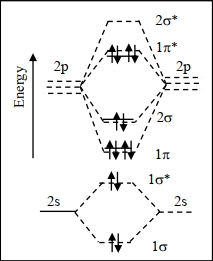
B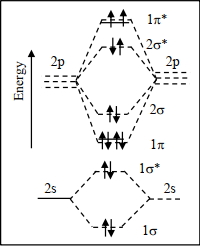
C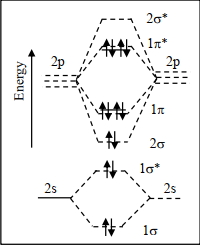
D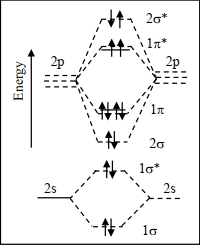
Solution
(C) The $F_2$ molecule has $18$ electrons. The molecular orbital configuration is: $\sigma 1s^2, \sigma^* 1s^2, \sigma 2s^2, \sigma^* 2s^2, \sigma 2p_z^2, \pi 2p_x^2 = \pi 2p_y^2, \pi^* 2p_x^2 = \pi^* 2p_y^2$.
In the $F_2$ molecule,the energy of the $\sigma 2p_z$ orbital is lower than the $\pi 2p_x$ and $\pi 2p_y$ orbitals due to the lack of $s-p$ mixing for elements with higher atomic numbers $(Z > 7)$.
Comparing the given options with the standard molecular orbital diagram for $F_2$,option $C$ correctly represents the energy levels and electron filling.
In the $F_2$ molecule,the energy of the $\sigma 2p_z$ orbital is lower than the $\pi 2p_x$ and $\pi 2p_y$ orbitals due to the lack of $s-p$ mixing for elements with higher atomic numbers $(Z > 7)$.
Comparing the given options with the standard molecular orbital diagram for $F_2$,option $C$ correctly represents the energy levels and electron filling.
0 likes
View Solution358
MediumMCQ
Among $H_2, He_2^{+}, Li_2, Be_2, B_2, C_2, N_2, O_2^{-}$,and $F_2$,the number of diamagnetic species is (Atomic numbers: $H=1, He=2, Li=3, Be=4, B=5, C=6, N=7, O=8, F=9$)
A
$4$
B
$8$
C
$6$
D
$5$
Solution
(D) To determine the magnetic nature,we use Molecular Orbital Theory $(MOT)$ configurations:
$H_2 (2e^-): \sigma 1s^2$ (Diamagnetic)
$He_2^+ (3e^-): \sigma 1s^2, \sigma^* 1s^1$ (Paramagnetic)
$Li_2 (6e^-): \sigma 1s^2, \sigma^* 1s^2, \sigma 2s^2$ (Diamagnetic)
$Be_2 (8e^-): \sigma 1s^2, \sigma^* 1s^2, \sigma 2s^2, \sigma^* 2s^2$ (Diamagnetic,though unstable)
$B_2 (10e^-): \sigma 1s^2, \sigma^* 1s^2, \sigma 2s^2, \sigma^* 2s^2, \pi 2p_x^1, \pi 2p_y^1$ (Paramagnetic)
$C_2 (12e^-): \sigma 1s^2, \sigma^* 1s^2, \sigma 2s^2, \sigma^* 2s^2, \pi 2p_x^2, \pi 2p_y^2$ (Diamagnetic)
$N_2 (14e^-): \sigma 1s^2, \sigma^* 1s^2, \sigma 2s^2, \sigma^* 2s^2, \pi 2p_x^2, \pi 2p_y^2, \sigma 2p_z^2$ (Diamagnetic)
$O_2^- (17e^-): \sigma 1s^2, \sigma^* 1s^2, \sigma 2s^2, \sigma^* 2s^2, \sigma 2p_z^2, \pi 2p_x^2, \pi 2p_y^2, \pi^* 2p_x^2, \pi^* 2p_y^1$ (Paramagnetic)
$F_2 (18e^-): \sigma 1s^2, \sigma^* 1s^2, \sigma 2s^2, \sigma^* 2s^2, \sigma 2p_z^2, \pi 2p_x^2, \pi 2p_y^2, \pi^* 2p_x^2, \pi^* 2p_y^2$ (Diamagnetic)
The diamagnetic species are $H_2, Li_2, Be_2, C_2, N_2$,and $F_2$. Excluding $Be_2$ due to its non-existence,the count is $5$.
$H_2 (2e^-): \sigma 1s^2$ (Diamagnetic)
$He_2^+ (3e^-): \sigma 1s^2, \sigma^* 1s^1$ (Paramagnetic)
$Li_2 (6e^-): \sigma 1s^2, \sigma^* 1s^2, \sigma 2s^2$ (Diamagnetic)
$Be_2 (8e^-): \sigma 1s^2, \sigma^* 1s^2, \sigma 2s^2, \sigma^* 2s^2$ (Diamagnetic,though unstable)
$B_2 (10e^-): \sigma 1s^2, \sigma^* 1s^2, \sigma 2s^2, \sigma^* 2s^2, \pi 2p_x^1, \pi 2p_y^1$ (Paramagnetic)
$C_2 (12e^-): \sigma 1s^2, \sigma^* 1s^2, \sigma 2s^2, \sigma^* 2s^2, \pi 2p_x^2, \pi 2p_y^2$ (Diamagnetic)
$N_2 (14e^-): \sigma 1s^2, \sigma^* 1s^2, \sigma 2s^2, \sigma^* 2s^2, \pi 2p_x^2, \pi 2p_y^2, \sigma 2p_z^2$ (Diamagnetic)
$O_2^- (17e^-): \sigma 1s^2, \sigma^* 1s^2, \sigma 2s^2, \sigma^* 2s^2, \sigma 2p_z^2, \pi 2p_x^2, \pi 2p_y^2, \pi^* 2p_x^2, \pi^* 2p_y^1$ (Paramagnetic)
$F_2 (18e^-): \sigma 1s^2, \sigma^* 1s^2, \sigma 2s^2, \sigma^* 2s^2, \sigma 2p_z^2, \pi 2p_x^2, \pi 2p_y^2, \pi^* 2p_x^2, \pi^* 2p_y^2$ (Diamagnetic)
The diamagnetic species are $H_2, Li_2, Be_2, C_2, N_2$,and $F_2$. Excluding $Be_2$ due to its non-existence,the count is $5$.
0 likes
View Solution359
AdvancedMCQ
Assuming that Hund's rule is violated,the bond order and magnetic nature of the diatomic molecule $B_2$ is
A
$1$ and diamagnetic
B
$0$ and diamagnetic
C
$1$ and paramagnetic
D
$0$ and paramagnetic
Solution
(A) The electronic configuration of $B_2$ ($10$ electrons) is $\sigma_{1s}^2 \sigma_{1s}^{*2} \sigma_{2s}^2 \sigma_{2s}^{*2} \pi_{2p_x}^2$.
Bond order is calculated as $\frac{\text{Number of bonding electrons} - \text{Number of antibonding electrons}}{2}$.
Bond order = $\frac{6 - 4}{2} = 1$.
Since all electrons are paired in the $\pi_{2p_x}$ orbital under the assumption that Hund's rule is violated,the molecule is diamagnetic.
Bond order is calculated as $\frac{\text{Number of bonding electrons} - \text{Number of antibonding electrons}}{2}$.
Bond order = $\frac{6 - 4}{2} = 1$.
Since all electrons are paired in the $\pi_{2p_x}$ orbital under the assumption that Hund's rule is violated,the molecule is diamagnetic.
0 likes
View Solution360
AdvancedMCQ
Assuming $2s-2p$ mixing is $NOT$ operative,the paramagnetic species among the following is:
A
$Be_2$
B
$B_2$
C
$C_2$
D
$N_2$
Solution
(C) If $2s-2p$ mixing is not operative,the energy order of molecular orbitals is: $\sigma 1s < \sigma^* 1s < \sigma 2s < \sigma^* 2s < \sigma 2p_z < \pi 2p_x = \pi 2p_y < \pi^* 2p_x = \pi^* 2p_y < \sigma^* 2p_z$.
Electronic configurations:
$Be_2$ ($8$ electrons): $(\sigma 1s)^2, (\sigma^* 1s)^2, (\sigma 2s)^2, (\sigma^* 2s)^2$ (Diamagnetic).
$B_2$ ($10$ electrons): $(\sigma 1s)^2, (\sigma^* 1s)^2, (\sigma 2s)^2, (\sigma^* 2s)^2, (\sigma 2p_z)^2$ (Diamagnetic).
$C_2$ ($12$ electrons): $(\sigma 1s)^2, (\sigma^* 1s)^2, (\sigma 2s)^2, (\sigma^* 2s)^2, (\sigma 2p_z)^2, (\pi 2p_x)^1, (\pi 2p_y)^1$ (Paramagnetic due to two unpaired electrons).
$N_2$ ($14$ electrons): $(\sigma 1s)^2, (\sigma^* 1s)^2, (\sigma 2s)^2, (\sigma^* 2s)^2, (\sigma 2p_z)^2, (\pi 2p_x)^2, (\pi 2p_y)^2$ (Diamagnetic).
Electronic configurations:
$Be_2$ ($8$ electrons): $(\sigma 1s)^2, (\sigma^* 1s)^2, (\sigma 2s)^2, (\sigma^* 2s)^2$ (Diamagnetic).
$B_2$ ($10$ electrons): $(\sigma 1s)^2, (\sigma^* 1s)^2, (\sigma 2s)^2, (\sigma^* 2s)^2, (\sigma 2p_z)^2$ (Diamagnetic).
$C_2$ ($12$ electrons): $(\sigma 1s)^2, (\sigma^* 1s)^2, (\sigma 2s)^2, (\sigma^* 2s)^2, (\sigma 2p_z)^2, (\pi 2p_x)^1, (\pi 2p_y)^1$ (Paramagnetic due to two unpaired electrons).
$N_2$ ($14$ electrons): $(\sigma 1s)^2, (\sigma^* 1s)^2, (\sigma 2s)^2, (\sigma^* 2s)^2, (\sigma 2p_z)^2, (\pi 2p_x)^2, (\pi 2p_y)^2$ (Diamagnetic).
0 likes
View Solution361
DifficultMCQ
For diatomic molecules,the correct statement$(s)$ about the molecular orbitals formed by the overlap of two $2p_z$ orbitals is(are):
$(A)$ $\sigma$ orbital has a total of two nodal planes.
$(B)$ $\sigma^*$ orbital has one node in the $xz$-plane containing the molecular axis.
$(C)$ $\pi$ orbital has one node in the plane which is perpendicular to the molecular axis and goes through the center of the molecule.
$(D)$ $\pi^*$ orbital has one node in the $xy$-plane containing the molecular axis.
$(A)$ $\sigma$ orbital has a total of two nodal planes.
$(B)$ $\sigma^*$ orbital has one node in the $xz$-plane containing the molecular axis.
$(C)$ $\pi$ orbital has one node in the plane which is perpendicular to the molecular axis and goes through the center of the molecule.
$(D)$ $\pi^*$ orbital has one node in the $xy$-plane containing the molecular axis.
A
$A, B$
B
$A, C$
C
$A, B, C$
D
$A, D$
Solution
(D) The overlap of two $2p_z$ orbitals along the $z$-axis (internuclear axis) leads to the formation of $\sigma$ and $\sigma^*$ molecular orbitals.
$(A)$ The $\sigma$ molecular orbital formed by $2p_z-2p_z$ overlap has two nodal planes perpendicular to the internuclear axis,one for each $p_z$ orbital. This is correct.
$(B)$ The $\sigma^*$ antibonding molecular orbital has a nodal plane perpendicular to the internuclear axis between the two nuclei. It does not have a node in the $xz$-plane containing the molecular axis. This is incorrect.
$(C)$ The $\pi$ molecular orbital is formed by the lateral overlap of $p_x$ or $p_y$ orbitals. The question specifically asks about $2p_z$ overlap,which forms $\sigma$ bonds. However,if we consider the nodal properties of $\pi$ orbitals in general,they have one nodal plane containing the molecular axis. The statement provided is incorrect regarding the description of the $\pi$ orbital node.
$(D)$ The $\pi^*$ antibonding molecular orbital has two nodal planes: one containing the molecular axis (the $xz$-plane) and one perpendicular to the molecular axis. The statement describes a node in the $xy$-plane,which is correct for the $\pi^*$ orbital formed from $p_x$ orbitals. Given the options,$(A)$ and $(D)$ are the correct statements.
$(A)$ The $\sigma$ molecular orbital formed by $2p_z-2p_z$ overlap has two nodal planes perpendicular to the internuclear axis,one for each $p_z$ orbital. This is correct.
$(B)$ The $\sigma^*$ antibonding molecular orbital has a nodal plane perpendicular to the internuclear axis between the two nuclei. It does not have a node in the $xz$-plane containing the molecular axis. This is incorrect.
$(C)$ The $\pi$ molecular orbital is formed by the lateral overlap of $p_x$ or $p_y$ orbitals. The question specifically asks about $2p_z$ overlap,which forms $\sigma$ bonds. However,if we consider the nodal properties of $\pi$ orbitals in general,they have one nodal plane containing the molecular axis. The statement provided is incorrect regarding the description of the $\pi$ orbital node.
$(D)$ The $\pi^*$ antibonding molecular orbital has two nodal planes: one containing the molecular axis (the $xz$-plane) and one perpendicular to the molecular axis. The statement describes a node in the $xy$-plane,which is correct for the $\pi^*$ orbital formed from $p_x$ orbitals. Given the options,$(A)$ and $(D)$ are the correct statements.
0 likes
View Solution362
AdvancedMCQ
Thermal decomposition of $AgNO_3$ produces two paramagnetic gases. The total number of electrons present in the antibonding molecular orbitals of the gas that has the higher number of unpaired electrons is. . . . .
A
$2$
B
$3$
C
$4$
D
$6$
Solution
(D) The thermal decomposition of $AgNO_3$ is given by the reaction: $2AgNO_3(s) \rightarrow 2Ag(s) + 2NO_2(g) + O_2(g)$.
The two paramagnetic gases produced are $NO_2$ and $O_2$.
$NO_2$ is an odd-electron molecule with $1$ unpaired electron.
$O_2$ has $2$ unpaired electrons in its antibonding $\pi^*2p_y$ and $\pi^*2p_z$ orbitals.
Since $O_2$ has a higher number of unpaired electrons $(2 > 1)$,we consider the antibonding molecular orbitals of $O_2$.
The molecular orbital configuration of $O_2$ ($16$ electrons) is: $\sigma1s^2, \sigma^*1s^2, \sigma2s^2, \sigma^*2s^2, \sigma2p_x^2, \pi2p_y^2 = \pi2p_z^2, \pi^*2p_y^1 = \pi^*2p_z^1$.
The antibonding molecular orbitals are $\sigma^*1s$,$\sigma^*2s$,and $\pi^*2p_y, \pi^*2p_z$.
The number of electrons in these orbitals are $2 + 2 + 1 + 1 = 6$.
The two paramagnetic gases produced are $NO_2$ and $O_2$.
$NO_2$ is an odd-electron molecule with $1$ unpaired electron.
$O_2$ has $2$ unpaired electrons in its antibonding $\pi^*2p_y$ and $\pi^*2p_z$ orbitals.
Since $O_2$ has a higher number of unpaired electrons $(2 > 1)$,we consider the antibonding molecular orbitals of $O_2$.
The molecular orbital configuration of $O_2$ ($16$ electrons) is: $\sigma1s^2, \sigma^*1s^2, \sigma2s^2, \sigma^*2s^2, \sigma2p_x^2, \pi2p_y^2 = \pi2p_z^2, \pi^*2p_y^1 = \pi^*2p_z^1$.
The antibonding molecular orbitals are $\sigma^*1s$,$\sigma^*2s$,and $\pi^*2p_y, \pi^*2p_z$.
The number of electrons in these orbitals are $2 + 2 + 1 + 1 = 6$.
0 likes
View Solution363
DifficultMCQ
Which of the following linear combinations of atomic orbitals will lead to the formation of molecular orbitals in homonuclear diatomic molecules [internuclear axis in $z$-direction]?
A
$E$ Only
B
$A$ and $B$ Only
C
Only $C$ and $D$
D
$D$ Only
Solution
(D) For the formation of molecular orbitals,the atomic orbitals must have the same symmetry with respect to the internuclear axis ($z$-axis in this case).
$A$: $2p_z$ and $2p_x$ have different symmetries ($p_z$ is $\sigma$-type,$p_x$ is $\pi$-type),so they do not combine.
$B$: $2s$ and $2p_x$ have different symmetries ($s$ is $\sigma$-type,$p_x$ is $\pi$-type),so they do not combine.
$C$: $3d_{xy}$ and $3d_{x^2-y^2}$ have different symmetries,so they do not combine.
$D$: $2s$ and $2p_z$ both have cylindrical symmetry about the $z$-axis ($\sigma$-type),so they can combine to form a $\sigma$ molecular orbital.
$E$: $2p_z$ and $3d_{x^2-y^2}$ have different symmetries,so they do not combine.
Therefore,only the combination in $D$ leads to the formation of a molecular orbital.
$A$: $2p_z$ and $2p_x$ have different symmetries ($p_z$ is $\sigma$-type,$p_x$ is $\pi$-type),so they do not combine.
$B$: $2s$ and $2p_x$ have different symmetries ($s$ is $\sigma$-type,$p_x$ is $\pi$-type),so they do not combine.
$C$: $3d_{xy}$ and $3d_{x^2-y^2}$ have different symmetries,so they do not combine.
$D$: $2s$ and $2p_z$ both have cylindrical symmetry about the $z$-axis ($\sigma$-type),so they can combine to form a $\sigma$ molecular orbital.
$E$: $2p_z$ and $3d_{x^2-y^2}$ have different symmetries,so they do not combine.
Therefore,only the combination in $D$ leads to the formation of a molecular orbital.
0 likes
View Solution364
MediumMCQ
Which of the following molecule$(s)$ show$(s)$ paramagnetic behavior?
$(A) O_2$ $(B) N_2$ $(C) F_2$ $(D) S_2$ $(E) Cl_2$
Choose the correct answer from the options given below:
$(A) O_2$ $(B) N_2$ $(C) F_2$ $(D) S_2$ $(E) Cl_2$
Choose the correct answer from the options given below:
A
$B$ only
B
$A \& C$ only
C
$A \& E$ only
D
$A \& D$ only
Solution
(D) According to Molecular Orbital Theory $(MOT)$,a molecule is paramagnetic if it contains one or more unpaired electrons.
Since $O_2$ and $S_2$ contain unpaired electrons,they exhibit paramagnetic behavior. Therefore,the correct option is $A \& D$.
| Molecule | No. of unpaired $e^-$ |
| $A. O_2$ | $2$ |
| $B. N_2$ | $0$ |
| $C. F_2$ | $0$ |
| $D. S_2$ | $2$ |
| $E. Cl_2$ | $0$ |
Since $O_2$ and $S_2$ contain unpaired electrons,they exhibit paramagnetic behavior. Therefore,the correct option is $A \& D$.
0 likes
View Solution365
MediumMCQ
Given below are two statements:
Statement $I$: $A$ hypothetical diatomic molecule with bond order zero is quite stable.
Statement $II$: As bond order increases,the bond length increases.
In the light of the above statements,choose the most appropriate answer from the options given below.
Statement $I$: $A$ hypothetical diatomic molecule with bond order zero is quite stable.
Statement $II$: As bond order increases,the bond length increases.
In the light of the above statements,choose the most appropriate answer from the options given below.
A
Both Statement $I$ and Statement $II$ are true.
B
Both Statement $I$ and Statement $II$ are false.
C
Statement $I$ is true but Statement $II$ is false.
D
Statement $I$ is false but Statement $II$ is true.
Solution
(B) Statement $I$: $A$ molecule with a bond order of $0$ implies that the number of bonding electrons equals the number of antibonding electrons,making the molecule unstable or non-existent (e.g.,$He_2$,$Be_2$,$Ne_2$). Thus,Statement $I$ is false.
Statement $II$: According to Molecular Orbital Theory,bond order is inversely proportional to bond length $(\text{Bond order} \propto \frac{1}{\text{Bond length}})$. Therefore,as bond order increases,bond length decreases. Thus,Statement $II$ is false.
Statement $II$: According to Molecular Orbital Theory,bond order is inversely proportional to bond length $(\text{Bond order} \propto \frac{1}{\text{Bond length}})$. Therefore,as bond order increases,bond length decreases. Thus,Statement $II$ is false.
0 likes
View Solution366
MediumMCQ
Match the following:
| Pair of species | Identical property |
|---|---|
| $A$. $B_2 \& O_2$ | $P$. Bond order $= 2.5$ |
| $B$. $Be_2 \& H_2^{2-}$ | $Q$. Paramagnetic nature |
| $C$. $N_2^{+} \& N_2^{-}$ | $R$. Diamagnetic nature |
| $D$. $O_2^{+} \& O_2^{-}$ | $S$. Doesn't exist |
A
$A-Q, B-S, C-P, D-Q$
B
$A-P, Q, B-Q, C-R, S, D-Q$
C
$A-R, S, B-P, Q, C-Q, R, D-P$
D
$A-Q, B-S, C-R, D-P$
Solution
(A) To solve this,we analyze the molecular orbital configuration and properties of each species:
$A$. $B_2$ ($10$ electrons) is paramagnetic with bond order $1$. $O_2$ ($16$ electrons) is paramagnetic with bond order $2$. Both are paramagnetic $(Q)$.
$B$. $Be_2$ ($8$ electrons) has bond order $0$ (does not exist). $H_2^{2-}$ ($4$ electrons) has bond order $0$ (does not exist). Both do not exist $(S)$.
$C$. $N_2^{+}$ ($13$ electrons) has bond order $2.5$ and is paramagnetic. $N_2^{-}$ ($15$ electrons) has bond order $2.5$ and is paramagnetic. Both have bond order $2.5$ $(P)$ and are paramagnetic $(Q)$.
$D$. $O_2^{+}$ ($15$ electrons) has bond order $2.5$ and is paramagnetic. $O_2^{-}$ ($17$ electrons) has bond order $1.5$ and is paramagnetic. Both are paramagnetic $(Q)$.
Correct matching: $A-Q, B-S, C-P, Q, D-Q$.
$A$. $B_2$ ($10$ electrons) is paramagnetic with bond order $1$. $O_2$ ($16$ electrons) is paramagnetic with bond order $2$. Both are paramagnetic $(Q)$.
$B$. $Be_2$ ($8$ electrons) has bond order $0$ (does not exist). $H_2^{2-}$ ($4$ electrons) has bond order $0$ (does not exist). Both do not exist $(S)$.
$C$. $N_2^{+}$ ($13$ electrons) has bond order $2.5$ and is paramagnetic. $N_2^{-}$ ($15$ electrons) has bond order $2.5$ and is paramagnetic. Both have bond order $2.5$ $(P)$ and are paramagnetic $(Q)$.
$D$. $O_2^{+}$ ($15$ electrons) has bond order $2.5$ and is paramagnetic. $O_2^{-}$ ($17$ electrons) has bond order $1.5$ and is paramagnetic. Both are paramagnetic $(Q)$.
Correct matching: $A-Q, B-S, C-P, Q, D-Q$.
0 likes
View Solution367
MediumMCQ
Assertion : $C_2$ contains two $\pi$ bonds.
Reason : $C_2$ is diamagnetic in nature.
Reason : $C_2$ is diamagnetic in nature.
A
Both Assertion and Reason are true but Reason is $NOT$ the correct explanation of Assertion.
B
Assertion is true but Reason is false.
C
Assertion is false but Reason is true.
D
Both Assertion and Reason are true and Reason is the correct explanation of Assertion.
Solution
(D) According to Molecular Orbital Theory $(MOT)$,the electronic configuration of $C_2$ is $\sigma 1s^2, \sigma^* 1s^2, \sigma 2s^2, \sigma^* 2s^2, \pi 2p_x^2 = \pi 2p_y^2$.
Since all electrons are paired,$C_2$ is diamagnetic in nature.
In $C_2$,the bond order is $\frac{8-4}{2} = 2$. Both bonds are $\pi$ bonds because the $\sigma 2p_z$ orbital is higher in energy than the $\pi 2p$ orbitals in $C_2$.
Thus,both Assertion and Reason are true,and the Reason correctly explains the nature of the bonding in $C_2$.
Since all electrons are paired,$C_2$ is diamagnetic in nature.
In $C_2$,the bond order is $\frac{8-4}{2} = 2$. Both bonds are $\pi$ bonds because the $\sigma 2p_z$ orbital is higher in energy than the $\pi 2p$ orbitals in $C_2$.
Thus,both Assertion and Reason are true,and the Reason correctly explains the nature of the bonding in $C_2$.
0 likes
View Solution368
MediumMCQ
Stability of the species $Li_2$,$Li_2^-$ and $Li_2^+$ increases in the order of $:-$
A
$Li_2 < Li_2^+ < Li_2^-$
B
$Li_2^- < Li_2^+ < Li_2$
C
$Li_2 < Li_2^- < Li_2^+$
D
$Li_2^- < Li_2 < Li_2^+$
Solution
(B) The stability of a molecular species is directly proportional to its bond order.
The electronic configuration of $Li_2$ ($6$ electrons) is $\sigma 1s^2, \sigma^* 1s^2, \sigma 2s^2$. Bond order $= (4-2)/2 = 1$.
The electronic configuration of $Li_2^+$ ($5$ electrons) is $\sigma 1s^2, \sigma^* 1s^2, \sigma 2s^1$. Bond order $= (3-2)/2 = 0.5$.
The electronic configuration of $Li_2^-$ ($7$ electrons) is $\sigma 1s^2, \sigma^* 1s^2, \sigma 2s^2, \sigma^* 2s^1$. Bond order $= (4-3)/2 = 0.5$.
Comparing $Li_2^+$ and $Li_2^-$,$Li_2^+$ is more stable than $Li_2^-$ because $Li_2^-$ has an electron in the antibonding $\sigma^* 2s$ orbital,which decreases stability.
Thus,the order of stability is $Li_2^- < Li_2^+ < Li_2$.
The electronic configuration of $Li_2$ ($6$ electrons) is $\sigma 1s^2, \sigma^* 1s^2, \sigma 2s^2$. Bond order $= (4-2)/2 = 1$.
The electronic configuration of $Li_2^+$ ($5$ electrons) is $\sigma 1s^2, \sigma^* 1s^2, \sigma 2s^1$. Bond order $= (3-2)/2 = 0.5$.
The electronic configuration of $Li_2^-$ ($7$ electrons) is $\sigma 1s^2, \sigma^* 1s^2, \sigma 2s^2, \sigma^* 2s^1$. Bond order $= (4-3)/2 = 0.5$.
Comparing $Li_2^+$ and $Li_2^-$,$Li_2^+$ is more stable than $Li_2^-$ because $Li_2^-$ has an electron in the antibonding $\sigma^* 2s$ orbital,which decreases stability.
Thus,the order of stability is $Li_2^- < Li_2^+ < Li_2$.
0 likes
View Solution369
MediumMCQ
Which of the following statements is incorrect when $C_2$ changes to $C_2^{2-}$?
A
Magnetic properties remain same
B
Bond order increases
C
Number of $\sigma$ bonds decreases
D
Number of $\sigma$ bonds increases
Solution
(C) The molecular orbital configuration of $C_2$ ($12$ electrons) is $\sigma 1s^2, \sigma^* 1s^2, \sigma 2s^2, \sigma^* 2s^2, \pi 2p_x^2 = \pi 2p_y^2$. It has a bond order of $2$ (consisting of $2 \pi$ bonds).
When $C_2$ changes to $C_2^{2-}$ ($14$ electrons),the configuration becomes $\sigma 1s^2, \sigma^* 1s^2, \sigma 2s^2, \sigma^* 2s^2, \pi 2p_x^2 = \pi 2p_y^2, \sigma 2p_z^2$. The bond order increases to $3$ (consisting of $2 \pi$ bonds and $1 \sigma$ bond).
Therefore,the number of $\sigma$ bonds increases from $0$ to $1$,and the bond order increases from $2$ to $3$. The statement that 'Bond order increases' is correct,and '$\sigma$ bond increases' is correct. The statement '$\sigma$ bond decreases' is incorrect.
When $C_2$ changes to $C_2^{2-}$ ($14$ electrons),the configuration becomes $\sigma 1s^2, \sigma^* 1s^2, \sigma 2s^2, \sigma^* 2s^2, \pi 2p_x^2 = \pi 2p_y^2, \sigma 2p_z^2$. The bond order increases to $3$ (consisting of $2 \pi$ bonds and $1 \sigma$ bond).
Therefore,the number of $\sigma$ bonds increases from $0$ to $1$,and the bond order increases from $2$ to $3$. The statement that 'Bond order increases' is correct,and '$\sigma$ bond increases' is correct. The statement '$\sigma$ bond decreases' is incorrect.
0 likes
View Solution370
MediumMCQ
Select the correct order $-$
A
Bond length $= O_2^{2-} > O_2^{-} > O_2 > O_2^{+}$
B
Bond strength $= O_2^{+} > O_2 > O_2^{-} > O_2^{2-}$
C
Unpaired electron$(s) = O_2 > O_2^{+} = O_2^{-} > O_2^{2-}$
D
All
Solution
(D) According to Molecular Orbital Theory $(MOT)$,the bond order is calculated as $\text{Bond Order} = \frac{N_b - N_a}{2}$.
For $O_2^{2-}$ ($18$ electrons): Bond order $= 1$,unpaired electrons $= 0$.
For $O_2^{-}$ ($17$ electrons): Bond order $= 1.5$,unpaired electrons $= 1$.
For $O_2$ ($16$ electrons): Bond order $= 2$,unpaired electrons $= 2$.
For $O_2^{+}$ ($15$ electrons): Bond order $= 2.5$,unpaired electrons $= 1$.
$1$. Bond length is inversely proportional to bond order: $O_2^{2-} (1) > O_2^{-} (1.5) > O_2 (2) > O_2^{+} (2.5)$. This is correct.
$2$. Bond strength is directly proportional to bond order: $O_2^{+} (2.5) > O_2 (2) > O_2^{-} (1.5) > O_2^{2-} (1)$. This is correct.
$3$. Number of unpaired electrons: $O_2 (2) > O_2^{+} (1) = O_2^{-} (1) > O_2^{2-} (0)$. This is correct.
Since all statements are correct,the answer is $D$.
For $O_2^{2-}$ ($18$ electrons): Bond order $= 1$,unpaired electrons $= 0$.
For $O_2^{-}$ ($17$ electrons): Bond order $= 1.5$,unpaired electrons $= 1$.
For $O_2$ ($16$ electrons): Bond order $= 2$,unpaired electrons $= 2$.
For $O_2^{+}$ ($15$ electrons): Bond order $= 2.5$,unpaired electrons $= 1$.
$1$. Bond length is inversely proportional to bond order: $O_2^{2-} (1) > O_2^{-} (1.5) > O_2 (2) > O_2^{+} (2.5)$. This is correct.
$2$. Bond strength is directly proportional to bond order: $O_2^{+} (2.5) > O_2 (2) > O_2^{-} (1.5) > O_2^{2-} (1)$. This is correct.
$3$. Number of unpaired electrons: $O_2 (2) > O_2^{+} (1) = O_2^{-} (1) > O_2^{2-} (0)$. This is correct.
Since all statements are correct,the answer is $D$.
0 likes
View Solution371
MediumMCQ
Which of the following statements is not correct according to molecular orbital theory $:-$
A
$B_2$ molecule is paramagnetic.
B
$O_2^{+}$ is more stable than $O_2^{-}$.
C
Energy of $\sigma_{2p_z}$ is more than $\pi_{2p_x}$ in $N_2$.
D
In $C_2$ molecule,one sigma and one pi bond is present.
Solution
(D) According to molecular orbital theory:
$1$. $B_2$ has $10$ electrons,configuration is $\sigma_{1s}^2, \sigma_{1s}^{*2}, \sigma_{2s}^2, \sigma_{2s}^{*2}, \pi_{2p_x}^1 = \pi_{2p_y}^1$. It is paramagnetic due to unpaired electrons.
$2$. Bond order of $O_2^{+}$ is $2.5$ and $O_2^{-}$ is $1.5$. Higher bond order implies higher stability,so $O_2^{+}$ is more stable than $O_2^{-}$.
$3$. In $N_2$ ($14$ electrons),the energy of $\pi_{2p_x} = \pi_{2p_y}$ is lower than $\sigma_{2p_z}$ due to $s-p$ mixing. Thus,the statement that $\sigma_{2p_z}$ is higher than $\pi_{2p_x}$ is correct.
$4$. In $C_2$ ($12$ electrons),the configuration is $\sigma_{1s}^2, \sigma_{1s}^{*2}, \sigma_{2s}^2, \sigma_{2s}^{*2}, \pi_{2p_x}^2 = \pi_{2p_y}^2$. Both bonds are pi bonds; there is no sigma bond. Thus,the statement in option $D$ is incorrect.
$1$. $B_2$ has $10$ electrons,configuration is $\sigma_{1s}^2, \sigma_{1s}^{*2}, \sigma_{2s}^2, \sigma_{2s}^{*2}, \pi_{2p_x}^1 = \pi_{2p_y}^1$. It is paramagnetic due to unpaired electrons.
$2$. Bond order of $O_2^{+}$ is $2.5$ and $O_2^{-}$ is $1.5$. Higher bond order implies higher stability,so $O_2^{+}$ is more stable than $O_2^{-}$.
$3$. In $N_2$ ($14$ electrons),the energy of $\pi_{2p_x} = \pi_{2p_y}$ is lower than $\sigma_{2p_z}$ due to $s-p$ mixing. Thus,the statement that $\sigma_{2p_z}$ is higher than $\pi_{2p_x}$ is correct.
$4$. In $C_2$ ($12$ electrons),the configuration is $\sigma_{1s}^2, \sigma_{1s}^{*2}, \sigma_{2s}^2, \sigma_{2s}^{*2}, \pi_{2p_x}^2 = \pi_{2p_y}^2$. Both bonds are pi bonds; there is no sigma bond. Thus,the statement in option $D$ is incorrect.
0 likes
View Solution372
MediumMCQ
Match the following:
| Pair of species | Identical property |
|---|---|
| $A$. $B_2 \& O_2$ | $P$. Bond order $= 2.5$ |
| $B$. $Be_2 \& H_2^{2-}$ | $Q$. Paramagnetic nature |
| $C$. $N_2^{+} \& N_2^{-}$ | $R$. Diamagnetic nature |
| $D$. $O_2^{+} \& O_2^{-}$ | $S$. Doesn't exist |
A
$A-Q, B-S, C-P, D-Q$
B
$A-P, B-Q, C-R, D-S$
C
$A-Q, B-S, C-Q, D-P$
D
$A-R, B-S, C-Q, D-P$
Solution
(A) $1$. $B_2$ ($10$ electrons) is paramagnetic ($HOMO$ $\pi_{2p_y}^1 \pi_{2p_z}^1$) and $O_2$ ($16$ electrons) is paramagnetic ($HOMO$ $\pi_{2p_y}^{*1} \pi_{2p_z}^{*1}$). Thus,$A-Q$.
$2$. $Be_2$ ($8$ electrons) and $H_2^{2-}$ ($4$ electrons) both have bond order $0$ and do not exist. Thus,$B-S$.
$3$. $N_2^{+}$ ($13$ electrons) and $N_2^{-}$ ($15$ electrons) both have a bond order of $2.5$. Thus,$C-P$.
$4$. $O_2^{+}$ ($15$ electrons) and $O_2^{-}$ ($17$ electrons) are both paramagnetic. Thus,$D-Q$.
Therefore,the correct match is $A-Q, B-S, C-P, D-Q$.
$2$. $Be_2$ ($8$ electrons) and $H_2^{2-}$ ($4$ electrons) both have bond order $0$ and do not exist. Thus,$B-S$.
$3$. $N_2^{+}$ ($13$ electrons) and $N_2^{-}$ ($15$ electrons) both have a bond order of $2.5$. Thus,$C-P$.
$4$. $O_2^{+}$ ($15$ electrons) and $O_2^{-}$ ($17$ electrons) are both paramagnetic. Thus,$D-Q$.
Therefore,the correct match is $A-Q, B-S, C-P, D-Q$.
0 likes
View Solution373
MediumMCQ
$H_{2}$ molecule is more stable than $Li_{2}$ molecule,because
A
In $H_{2}$ molecule $\sigma_{1s}$ molecular orbitals are shielded by electrons.
B
In $H_{2}$ bond order is one.
C
In $Li_{2}$ molecule $\sigma_{1s}$ molecular orbitals are shielded by electrons.
D
In $Li_{2}$ molecule,outer $\sigma_{2s}$ molecular orbitals are shielded by the inner electrons.
Solution
(D) The electronic configuration of $H_{2}$ is $(\sigma_{1s})^2$,giving a bond order of $\frac{2-0}{2} = 1$.
The electronic configuration of $Li_{2}$ is $(\sigma_{1s})^2, (\sigma_{1s}^*)^2, (\sigma_{2s})^2$,giving a bond order of $\frac{4-2}{2} = 1$.
However,in $Li_{2}$,the presence of inner $(\sigma_{1s})^2$ and $(\sigma_{1s}^*)^2$ electrons effectively shields the valence $\sigma_{2s}$ electrons from the nucleus,reducing the effective nuclear charge experienced by the bonding electrons and making the bond weaker compared to $H_{2}$.
The electronic configuration of $Li_{2}$ is $(\sigma_{1s})^2, (\sigma_{1s}^*)^2, (\sigma_{2s})^2$,giving a bond order of $\frac{4-2}{2} = 1$.
However,in $Li_{2}$,the presence of inner $(\sigma_{1s})^2$ and $(\sigma_{1s}^*)^2$ electrons effectively shields the valence $\sigma_{2s}$ electrons from the nucleus,reducing the effective nuclear charge experienced by the bonding electrons and making the bond weaker compared to $H_{2}$.
0 likes
View Solution374
MediumMCQ
Select the incorrect statement about $N_2$ molecule.
A
It is more stable than $O_2$ molecule.
B
It consists of more electrons in bonding molecular orbitals than $O_2$.
C
Its bond order is $3$.
D
It is diamagnetic.
Solution
(D) The electronic configuration of $N_2$ ($14$ electrons) is $\sigma 1s^2, \sigma^* 1s^2, \sigma 2s^2, \sigma^* 2s^2, \pi 2p_x^2 = \pi 2p_y^2, \sigma 2p_z^2$.
Bond order = $\frac{1}{2}(N_b - N_a) = \frac{1}{2}(10 - 4) = 3$.
Since all electrons are paired,$N_2$ is diamagnetic.
$O_2$ ($16$ electrons) has a bond order of $2$ and is paramagnetic due to two unpaired electrons in $\pi^* 2p$ orbitals.
$N_2$ has $10$ bonding electrons,while $O_2$ has $8$ bonding electrons.
Therefore,the statement '$N_2$ is diamagnetic' is correct,and the statement '$N_2$ is paramagnetic' would be incorrect.
Given the options,the statement '$N_2$ is diamagnetic' is correct,but if the option was written as 'It is dimagnetic' (a typo for diamagnetic),it is still the intended correct property.
However,all statements $A$,$B$,$C$,and $D$ are actually correct descriptions of $N_2$.
If we assume the question asks for the incorrect statement,there might be a typo in the provided options.
Based on standard chemistry,$N_2$ is diamagnetic,so option $D$ is a correct statement.
Bond order = $\frac{1}{2}(N_b - N_a) = \frac{1}{2}(10 - 4) = 3$.
Since all electrons are paired,$N_2$ is diamagnetic.
$O_2$ ($16$ electrons) has a bond order of $2$ and is paramagnetic due to two unpaired electrons in $\pi^* 2p$ orbitals.
$N_2$ has $10$ bonding electrons,while $O_2$ has $8$ bonding electrons.
Therefore,the statement '$N_2$ is diamagnetic' is correct,and the statement '$N_2$ is paramagnetic' would be incorrect.
Given the options,the statement '$N_2$ is diamagnetic' is correct,but if the option was written as 'It is dimagnetic' (a typo for diamagnetic),it is still the intended correct property.
However,all statements $A$,$B$,$C$,and $D$ are actually correct descriptions of $N_2$.
If we assume the question asks for the incorrect statement,there might be a typo in the provided options.
Based on standard chemistry,$N_2$ is diamagnetic,so option $D$ is a correct statement.
0 likes
View Solution375
MediumMCQ
Which of the following molecules contains the maximum number of electrons in antibonding molecular orbitals?
A
$Li_2$
B
$N_2$
C
$O_2$
D
$F_2$
Solution
(D) To determine the number of electrons in antibonding molecular orbitals,we write the molecular orbital configuration for each molecule:
$1$. $Li_2$ ($6$ electrons): $\sigma 1s^2, \sigma^* 1s^2, \sigma 2s^2$. Antibonding electrons = $2$ (in $\sigma^* 1s$).
$2$. $N_2$ ($14$ electrons): $\sigma 1s^2, \sigma^* 1s^2, \sigma 2s^2, \sigma^* 2s^2, \pi 2p_x^2 = \pi 2p_y^2, \sigma 2p_z^2$. Antibonding electrons = $2+2 = 4$.
$3$. $O_2$ ($16$ electrons): $\sigma 1s^2, \sigma^* 1s^2, \sigma 2s^2, \sigma^* 2s^2, \sigma 2p_z^2, \pi 2p_x^2 = \pi 2p_y^2, \pi^* 2p_x^1 = \pi^* 2p_y^1$. Antibonding electrons = $2+2+2 = 6$.
$4$. $F_2$ ($18$ electrons): $\sigma 1s^2, \sigma^* 1s^2, \sigma 2s^2, \sigma^* 2s^2, \sigma 2p_z^2, \pi 2p_x^2 = \pi 2p_y^2, \pi^* 2p_x^2 = \pi^* 2p_y^2$. Antibonding electrons = $2+2+4 = 8$.
Thus,$F_2$ contains the maximum number of electrons in antibonding molecular orbitals.
$1$. $Li_2$ ($6$ electrons): $\sigma 1s^2, \sigma^* 1s^2, \sigma 2s^2$. Antibonding electrons = $2$ (in $\sigma^* 1s$).
$2$. $N_2$ ($14$ electrons): $\sigma 1s^2, \sigma^* 1s^2, \sigma 2s^2, \sigma^* 2s^2, \pi 2p_x^2 = \pi 2p_y^2, \sigma 2p_z^2$. Antibonding electrons = $2+2 = 4$.
$3$. $O_2$ ($16$ electrons): $\sigma 1s^2, \sigma^* 1s^2, \sigma 2s^2, \sigma^* 2s^2, \sigma 2p_z^2, \pi 2p_x^2 = \pi 2p_y^2, \pi^* 2p_x^1 = \pi^* 2p_y^1$. Antibonding electrons = $2+2+2 = 6$.
$4$. $F_2$ ($18$ electrons): $\sigma 1s^2, \sigma^* 1s^2, \sigma 2s^2, \sigma^* 2s^2, \sigma 2p_z^2, \pi 2p_x^2 = \pi 2p_y^2, \pi^* 2p_x^2 = \pi^* 2p_y^2$. Antibonding electrons = $2+2+4 = 8$.
Thus,$F_2$ contains the maximum number of electrons in antibonding molecular orbitals.
0 likes
View Solution376
MediumMCQ
What is the number of electrons in bonding molecular orbitals and antibonding molecular orbitals respectively in $F_2$ molecule?
A
$12$ and $6$
B
$10$ and $8$
C
$8$ and $10$
D
$6$ and $12$
Solution
(B) The total number of electrons in an $F_2$ molecule is $18$ $(9 + 9)$.
The molecular orbital configuration for $F_2$ is: $\sigma 1s^2, \sigma^* 1s^2, \sigma 2s^2, \sigma^* 2s^2, \sigma 2p_z^2, \pi 2p_x^2 = \pi 2p_y^2, \pi^* 2p_x^2 = \pi^* 2p_y^2$.
Counting the electrons in bonding molecular orbitals (those without an asterisk): $2 (\sigma 1s) + 2 (\sigma 2s) + 2 (\sigma 2p_z) + 4 (\pi 2p_x, \pi 2p_y) = 10$.
Counting the electrons in antibonding molecular orbitals (those with an asterisk): $2 (\sigma^* 1s) + 2 (\sigma^* 2s) + 4 (\pi^* 2p_x, \pi^* 2p_y) = 8$.
Therefore,the number of electrons in bonding and antibonding molecular orbitals are $10$ and $8$ respectively.
The molecular orbital configuration for $F_2$ is: $\sigma 1s^2, \sigma^* 1s^2, \sigma 2s^2, \sigma^* 2s^2, \sigma 2p_z^2, \pi 2p_x^2 = \pi 2p_y^2, \pi^* 2p_x^2 = \pi^* 2p_y^2$.
Counting the electrons in bonding molecular orbitals (those without an asterisk): $2 (\sigma 1s) + 2 (\sigma 2s) + 2 (\sigma 2p_z) + 4 (\pi 2p_x, \pi 2p_y) = 10$.
Counting the electrons in antibonding molecular orbitals (those with an asterisk): $2 (\sigma^* 1s) + 2 (\sigma^* 2s) + 4 (\pi^* 2p_x, \pi^* 2p_y) = 8$.
Therefore,the number of electrons in bonding and antibonding molecular orbitals are $10$ and $8$ respectively.
0 likes
View Solution377
EasyMCQ
Identify the bond order of $NO^{+}$ ion.
A
$1$
B
$2$
C
$3$
D
$4$
Solution
(C) The total number of electrons in $NO^{+}$ is $7 (N) + 8 (O) - 1 = 14$ electrons.
According to Molecular Orbital Theory,the electronic configuration of $NO^{+}$ is: $\sigma 1s^2, \sigma^* 1s^2, \sigma 2s^2, \sigma^* 2s^2, \sigma 2p_z^2, \pi 2p_x^2 = \pi 2p_y^2$.
The bond order is calculated as: $\text{Bond Order} = \frac{N_b - N_a}{2} = \frac{10 - 4}{2} = \frac{6}{2} = 3$.
According to Molecular Orbital Theory,the electronic configuration of $NO^{+}$ is: $\sigma 1s^2, \sigma^* 1s^2, \sigma 2s^2, \sigma^* 2s^2, \sigma 2p_z^2, \pi 2p_x^2 = \pi 2p_y^2$.
The bond order is calculated as: $\text{Bond Order} = \frac{N_b - N_a}{2} = \frac{10 - 4}{2} = \frac{6}{2} = 3$.
0 likes
View Solution378
EasyMCQ
What is the bond order in $CO$ molecule?
A
$1$
B
$3$
C
$2$
D
$0.5$
Solution
(B) According to Molecular Orbital Theory,the bond order is calculated as $\frac{N_b - N_a}{2}$,where $N_b$ is the number of bonding electrons and $N_a$ is the number of antibonding electrons.
For $CO$ molecule,the total number of electrons is $6 + 8 = 14$.
The molecular orbital configuration is $\sigma 1s^2, \sigma^* 1s^2, \sigma 2s^2, \sigma^* 2s^2, \pi 2p_x^2 = \pi 2p_y^2, \sigma 2p_z^2$.
Here,$N_b = 10$ and $N_a = 4$.
Bond order = $\frac{10 - 4}{2} = \frac{6}{2} = 3$.
For $CO$ molecule,the total number of electrons is $6 + 8 = 14$.
The molecular orbital configuration is $\sigma 1s^2, \sigma^* 1s^2, \sigma 2s^2, \sigma^* 2s^2, \pi 2p_x^2 = \pi 2p_y^2, \sigma 2p_z^2$.
Here,$N_b = 10$ and $N_a = 4$.
Bond order = $\frac{10 - 4}{2} = \frac{6}{2} = 3$.
0 likes
View Solution379
EasyMCQ
Identify the bond order and magnetic nature of $Li_2$ molecule respectively.
A
$1$ and diamagnetic
B
$2$ and diamagnetic
C
$1$ and paramagnetic
D
$2$ and paramagnetic
Solution
(A) The electronic configuration of $Li_2$ molecule is $(\sigma 1s)^2 (\sigma^* 1s)^2 (\sigma 2s)^2$.
Bond order of $Li_2$ molecule is calculated as:
$\text{Bond Order} = \frac{N_b - N_a}{2} = \frac{4 - 2}{2} = 1$.
Since all electrons are paired in the $Li_2$ molecule,it is diamagnetic.
Bond order of $Li_2$ molecule is calculated as:
$\text{Bond Order} = \frac{N_b - N_a}{2} = \frac{4 - 2}{2} = 1$.
Since all electrons are paired in the $Li_2$ molecule,it is diamagnetic.
0 likes
View Solution380
EasyMCQ
Which of the following molecules has a bond order of $2$?
A
$N_2$
B
$H_2$
C
$O_2$
D
$F_2$
Solution
(C) The electronic configuration of the $O_2$ molecule is $(\sigma 1s)^2 (\sigma^* 1s)^2 (\sigma 2s)^2 (\sigma^* 2s)^2 (\sigma 2p_z)^2 (\pi 2p_x)^2 (\pi 2p_y)^2 (\pi^* 2p_x)^1 (\pi^* 2p_y)^1$.
Bond order is calculated as $\frac{N_b - N_a}{2}$,where $N_b$ is the number of bonding electrons and $N_a$ is the number of antibonding electrons.
For $O_2$,$N_b = 10$ and $N_a = 6$.
Bond order $= \frac{10 - 6}{2} = \frac{4}{2} = 2$.
Bond order is calculated as $\frac{N_b - N_a}{2}$,where $N_b$ is the number of bonding electrons and $N_a$ is the number of antibonding electrons.
For $O_2$,$N_b = 10$ and $N_a = 6$.
Bond order $= \frac{10 - 6}{2} = \frac{4}{2} = 2$.
0 likes
View Solution381
EasyMCQ
What is the total number of electrons present in bonding orbitals of $O_2$ molecule according to molecular orbital theory?
A
$16$
B
$06$
C
$10$
D
$04$
Solution
(C) The electronic configuration of $O_2$ molecule is $(\sigma 1s)^2 (\sigma^* 1s)^2 (\sigma 2s)^2 (\sigma^* 2s)^2 (\sigma 2p_z)^2 (\pi 2p_x)^2 (\pi 2p_y)^2 (\pi^* 2p_x)^1 (\pi^* 2p_y)^1$.
Bonding molecular orbitals are those without an asterisk $(*)$.
These are $(\sigma 1s)^2$,$(\sigma 2s)^2$,$(\sigma 2p_z)^2$,$(\pi 2p_x)^2$,and $(\pi 2p_y)^2$.
Total number of electrons in bonding orbitals = $2 + 2 + 2 + 2 + 2 = 10$.
Bonding molecular orbitals are those without an asterisk $(*)$.
These are $(\sigma 1s)^2$,$(\sigma 2s)^2$,$(\sigma 2p_z)^2$,$(\pi 2p_x)^2$,and $(\pi 2p_y)^2$.
Total number of electrons in bonding orbitals = $2 + 2 + 2 + 2 + 2 = 10$.
0 likes
View Solution382
EasyMCQ
What is the number of electrons present in antibonding orbitals of $N_2$ molecule according to molecular orbital theory?
A
$14$
B
$04$
C
$10$
D
$06$
Solution
(B) The electronic configuration of $N_2$ molecule ($14$ electrons) is $(\sigma 1s)^2 (\sigma^* 1s)^2 (\sigma 2s)^2 (\sigma^* 2s)^2 (\pi 2p_x)^2 (\pi 2p_y)^2 (\sigma 2p_z)^2$.
Antibonding orbitals are those denoted with an asterisk $(*)$.
These are $(\sigma^* 1s)^2$ and $(\sigma^* 2s)^2$.
Total number of electrons in antibonding orbitals $= 2 + 2 = 4$.
Antibonding orbitals are those denoted with an asterisk $(*)$.
These are $(\sigma^* 1s)^2$ and $(\sigma^* 2s)^2$.
Total number of electrons in antibonding orbitals $= 2 + 2 = 4$.
0 likes
View Solution383
EasyMCQ
What is the number of unpaired electrons in the $NO$ molecule?
A
$0$
B
$1$
C
$2$
D
$3$
Solution
(B) The total number of electrons in the $NO$ molecule is $7 + 8 = 15$.
According to Molecular Orbital Theory,the electronic configuration of $NO$ is:
$\sigma 1s^2, \sigma^* 1s^2, \sigma 2s^2, \sigma^* 2s^2, \sigma 2p_z^2, \pi 2p_x^2 = \pi 2p_y^2, \pi^* 2p_x^1$.
There is $1$ unpaired electron in the antibonding $\pi^* 2p_x$ orbital.
Therefore,the number of unpaired electrons is $1$.
According to Molecular Orbital Theory,the electronic configuration of $NO$ is:
$\sigma 1s^2, \sigma^* 1s^2, \sigma 2s^2, \sigma^* 2s^2, \sigma 2p_z^2, \pi 2p_x^2 = \pi 2p_y^2, \pi^* 2p_x^1$.
There is $1$ unpaired electron in the antibonding $\pi^* 2p_x$ orbital.
Therefore,the number of unpaired electrons is $1$.
0 likes
View Solution384
EasyMCQ
What is the bond order of the $F_2$ molecule?
A
$0.5$
B
$1$
C
$2$
D
$3$
Solution
(B) The total number of electrons in an $F_2$ molecule is $18$.
The molecular orbital configuration is: $(\sigma 1s)^2 (\sigma^* 1s)^2 (\sigma 2s)^2 (\sigma^* 2s)^2 (\sigma 2p_z)^2 (\pi 2p_x)^2 (\pi 2p_y)^2 (\pi^* 2p_x)^2 (\pi^* 2p_y)^2$.
Number of bonding electrons $(N_b)$ $= 10$.
Number of antibonding electrons $(N_a)$ $= 8$.
Bond order $= \frac{N_b - N_a}{2} = \frac{10 - 8}{2} = 1$.
The molecular orbital configuration is: $(\sigma 1s)^2 (\sigma^* 1s)^2 (\sigma 2s)^2 (\sigma^* 2s)^2 (\sigma 2p_z)^2 (\pi 2p_x)^2 (\pi 2p_y)^2 (\pi^* 2p_x)^2 (\pi^* 2p_y)^2$.
Number of bonding electrons $(N_b)$ $= 10$.
Number of antibonding electrons $(N_a)$ $= 8$.
Bond order $= \frac{N_b - N_a}{2} = \frac{10 - 8}{2} = 1$.
0 likes
View Solution385
EasyMCQ
What is the bond order in $N_2^{+}$?
A
$0$
B
$1$
C
$2$
D
$2.5$
Solution
(D) The total number of electrons in $N_2^{+}$ is $13$.
The molecular orbital configuration is: $(\sigma 1s)^2 (\sigma^* 1s)^2 (\sigma 2s)^2 (\sigma^* 2s)^2 (\pi 2p_x)^2 (\pi 2p_y)^2 (\sigma 2p_z)^1$.
Number of bonding electrons $(N_b)$ $= 9$.
Number of antibonding electrons $(N_a)$ $= 4$.
Bond order $= \frac{N_b - N_a}{2} = \frac{9 - 4}{2} = \frac{5}{2} = 2.5$.
The molecular orbital configuration is: $(\sigma 1s)^2 (\sigma^* 1s)^2 (\sigma 2s)^2 (\sigma^* 2s)^2 (\pi 2p_x)^2 (\pi 2p_y)^2 (\sigma 2p_z)^1$.
Number of bonding electrons $(N_b)$ $= 9$.
Number of antibonding electrons $(N_a)$ $= 4$.
Bond order $= \frac{N_b - N_a}{2} = \frac{9 - 4}{2} = \frac{5}{2} = 2.5$.
0 likes
View Solution386
MediumMCQ
Identify the correct increasing order of energies of molecular orbitals for the $F_2$ molecule.
A
$\sigma 1s < \sigma^* 1s < \sigma 2s < \sigma^* 2s$
B
$\sigma 1s < \sigma^* 1s < \sigma^* 2s < \sigma 2s$
C
$\sigma^* 1s < \sigma 1s < \sigma 2s < \sigma^* 2s$
D
$\sigma 1s < \sigma 2s < \sigma^* 1s < \sigma^* 2s$
Solution
(A) According to Molecular Orbital Theory,the energy of molecular orbitals increases as follows:
$\sigma 1s < \sigma^* 1s < \sigma 2s < \sigma^* 2s < \sigma 2p_z < (\pi 2p_x = \pi 2p_y) < (\pi^* 2p_x = \pi^* 2p_y) < \sigma^* 2p_z$.
For the $F_2$ molecule,the order of the lower energy orbitals is $\sigma 1s < \sigma^* 1s < \sigma 2s < \sigma^* 2s$.
$\sigma 1s < \sigma^* 1s < \sigma 2s < \sigma^* 2s < \sigma 2p_z < (\pi 2p_x = \pi 2p_y) < (\pi^* 2p_x = \pi^* 2p_y) < \sigma^* 2p_z$.
For the $F_2$ molecule,the order of the lower energy orbitals is $\sigma 1s < \sigma^* 1s < \sigma 2s < \sigma^* 2s$.
0 likes
View Solution387
EasyMCQ
What is the bond order of the $O_2$ molecule?
A
$1$
B
$1.5$
C
$2.0$
D
$3.5$
Solution
(C) According to Molecular Orbital Theory,the electronic configuration of $O_2$ ($16$ electrons) is: $\sigma 1s^2, \sigma^* 1s^2, \sigma 2s^2, \sigma^* 2s^2, \sigma 2p_z^2, \pi 2p_x^2 = \pi 2p_y^2, \pi^* 2p_x^1 = \pi^* 2p_y^1$.
Bond Order = $\frac{N_b - N_a}{2} = \frac{10 - 6}{2} = \frac{4}{2} = 2.0$.
Bond Order = $\frac{N_b - N_a}{2} = \frac{10 - 6}{2} = \frac{4}{2} = 2.0$.
0 likes
View Solution388
EasyMCQ
Which of the following molecules has a bond order greater than $1$?
A
$F_2$
B
$H_2$
C
$Li_2$
D
$N_2$
Solution
(D) The bond order is calculated using the formula: $\text{Bond Order} = \frac{1}{2} (N_b - N_a)$.
For $F_2$ ($18$ electrons): $\text{Bond Order} = 1$.
For $H_2$ ($2$ electrons): $\text{Bond Order} = 1$.
For $Li_2$ ($6$ electrons): $\text{Bond Order} = 1$.
For $N_2$ ($14$ electrons): $\text{Bond Order} = 3$.
Since $3 > 1$,the molecule $N_2$ has a bond order greater than $1$.
For $F_2$ ($18$ electrons): $\text{Bond Order} = 1$.
For $H_2$ ($2$ electrons): $\text{Bond Order} = 1$.
For $Li_2$ ($6$ electrons): $\text{Bond Order} = 1$.
For $N_2$ ($14$ electrons): $\text{Bond Order} = 3$.
Since $3 > 1$,the molecule $N_2$ has a bond order greater than $1$.
0 likes
View Solution389
EasyMCQ
What is the bond order of the $O_2$ molecule?
A
$1$
B
$1.5$
C
$2$
D
$3$
Solution
(C) According to Molecular Orbital Theory $(MOT)$,the electronic configuration of the $O_2$ molecule ($16$ electrons) is:
$\sigma 1s^2, \sigma^* 1s^2, \sigma 2s^2, \sigma^* 2s^2, \sigma 2p_z^2, \pi 2p_x^2 = \pi 2p_y^2, \pi^* 2p_x^1 = \pi^* 2p_y^1$.
Bond order is calculated as:
$\text{Bond Order} = \frac{N_b - N_a}{2}$
Where $N_b$ is the number of bonding electrons and $N_a$ is the number of antibonding electrons.
$N_b = 10$
$N_a = 6$
$\text{Bond Order} = \frac{10 - 6}{2} = \frac{4}{2} = 2$.
Thus,the bond order of $O_2$ is $2$.
$\sigma 1s^2, \sigma^* 1s^2, \sigma 2s^2, \sigma^* 2s^2, \sigma 2p_z^2, \pi 2p_x^2 = \pi 2p_y^2, \pi^* 2p_x^1 = \pi^* 2p_y^1$.
Bond order is calculated as:
$\text{Bond Order} = \frac{N_b - N_a}{2}$
Where $N_b$ is the number of bonding electrons and $N_a$ is the number of antibonding electrons.
$N_b = 10$
$N_a = 6$
$\text{Bond Order} = \frac{10 - 6}{2} = \frac{4}{2} = 2$.
Thus,the bond order of $O_2$ is $2$.
0 likes
View Solution390
EasyMCQ
What is the bond order of the $CO$ molecule?
A
$0$
B
$2$
C
$1$
D
$3$
Solution
(D) The $CO$ molecule has a triple bond between the carbon and oxygen atoms,represented as $:C \equiv O:$.
Using the Molecular Orbital Theory,the bond order is calculated as:
$B.O. = \frac{1}{2} (N_b - N_a) = \frac{1}{2} (10 - 4) = 3$.
Therefore,the bond order of $CO$ is $3$.
Using the Molecular Orbital Theory,the bond order is calculated as:
$B.O. = \frac{1}{2} (N_b - N_a) = \frac{1}{2} (10 - 4) = 3$.
Therefore,the bond order of $CO$ is $3$.
0 likes
View Solution391
EasyMCQ
Which of the following concepts is $NOT$ part of the valence bond theory $(VBT)$?
A
Covalent character of bond
B
Shielding effect of electrons
C
Delocalization of electrons over the two nuclei
D
Combination of atomic orbitals to give molecular orbitals
Solution
(D) The concept of the combination of atomic orbitals to form molecular orbitals belongs to the Molecular Orbital Theory $(MOT)$,not the Valence Bond Theory $(VBT)$.
0 likes
View Solution392
DifficultMCQ
According to molecular orbital theory,antibonding molecular orbitals of $O_2$ contain
A
$4$ electrons
B
$6$ electrons
C
$10$ electrons
D
$8$ electrons
Solution
(B) According to Molecular Orbital Theory,the electronic configuration of the $O_2$ molecule ($16$ electrons) is:
$(\sigma 1s)^2 (\sigma^* 1s)^2 (\sigma 2s)^2 (\sigma^* 2s)^2 (\sigma 2p_z)^2 (\pi 2p_x)^2 = (\pi 2p_y)^2 (\pi^* 2p_x)^1 = (\pi^* 2p_y)^1$
The antibonding molecular orbitals (ABMOs) are $\sigma^* 1s$,$\sigma^* 2s$,$\pi^* 2p_x$,and $\pi^* 2p_y$.
The electrons in these antibonding orbitals are:
$\sigma^* 1s$: $2$ electrons
$\sigma^* 2s$: $2$ electrons
$\pi^* 2p_x$: $1$ electron
$\pi^* 2p_y$: $1$ electron
Total antibonding electrons = $2 + 2 + 1 + 1 = 6$ electrons.
$(\sigma 1s)^2 (\sigma^* 1s)^2 (\sigma 2s)^2 (\sigma^* 2s)^2 (\sigma 2p_z)^2 (\pi 2p_x)^2 = (\pi 2p_y)^2 (\pi^* 2p_x)^1 = (\pi^* 2p_y)^1$
The antibonding molecular orbitals (ABMOs) are $\sigma^* 1s$,$\sigma^* 2s$,$\pi^* 2p_x$,and $\pi^* 2p_y$.
The electrons in these antibonding orbitals are:
$\sigma^* 1s$: $2$ electrons
$\sigma^* 2s$: $2$ electrons
$\pi^* 2p_x$: $1$ electron
$\pi^* 2p_y$: $1$ electron
Total antibonding electrons = $2 + 2 + 1 + 1 = 6$ electrons.
0 likes
View Solution393
MediumMCQ
What is the bond order of $B_{2}$ molecule?
A
$0$
B
$1$
C
$3$
D
$2$
Solution
(B) The electronic configuration of $B_{2}$ molecule ($10$ electrons) is: $\sigma 1s^2, \sigma^* 1s^2, \sigma 2s^2, \sigma^* 2s^2, \pi 2p_x^1, \pi 2p_y^1$.
Number of bonding electrons $(N_b)$ = $2+2+1+1 = 6$.
Number of antibonding electrons $(N_a)$ = $2+2 = 4$.
Bond order = $\frac{N_b - N_a}{2} = \frac{6 - 4}{2} = \frac{2}{2} = 1$.
Number of bonding electrons $(N_b)$ = $2+2+1+1 = 6$.
Number of antibonding electrons $(N_a)$ = $2+2 = 4$.
Bond order = $\frac{N_b - N_a}{2} = \frac{6 - 4}{2} = \frac{2}{2} = 1$.
0 likes
View Solution394
MediumMCQ
What is the bond order in $N_{2}$ molecule?
A
$2$
B
zero
C
$1$
D
$3$
Solution
(D) The electronic configuration of $N_{2}$ ($14$ electrons) is: $\sigma 1s^2, \sigma^* 1s^2, \sigma 2s^2, \sigma^* 2s^2, \pi 2p_x^2 = \pi 2p_y^2, \sigma 2p_z^2$.
Bond order is calculated as: $\text{Bond Order} = \frac{N_b - N_a}{2}$,where $N_b$ is the number of bonding electrons and $N_a$ is the number of antibonding electrons.
Here,$N_b = 10$ and $N_a = 4$.
$\text{Bond Order} = \frac{10 - 4}{2} = \frac{6}{2} = 3$.
Thus,the bond order in $N_{2}$ is $3$.
Bond order is calculated as: $\text{Bond Order} = \frac{N_b - N_a}{2}$,where $N_b$ is the number of bonding electrons and $N_a$ is the number of antibonding electrons.
Here,$N_b = 10$ and $N_a = 4$.
$\text{Bond Order} = \frac{10 - 4}{2} = \frac{6}{2} = 3$.
Thus,the bond order in $N_{2}$ is $3$.
0 likes
View Solution395
MediumMCQ
What is the bond order of the $Be_{2}$ molecule?
A
$2$
B
$3$
C
$0$
D
$1$
Solution
(C) The electronic configuration of the $Be_{2}$ molecule ($8$ electrons) is: $\sigma_{1s}^{2} \sigma_{1s}^{*2} \sigma_{2s}^{2} \sigma_{2s}^{*2}$.
Here,the number of bonding electrons $(N_{b})$ is $4$ and the number of antibonding electrons $(N_{a})$ is $4$.
The bond order is calculated as: $\text{Bond Order} = \frac{N_{b} - N_{a}}{2} = \frac{4 - 4}{2} = 0$.
Since the bond order is $0$,the $Be_{2}$ molecule does not exist.
Here,the number of bonding electrons $(N_{b})$ is $4$ and the number of antibonding electrons $(N_{a})$ is $4$.
The bond order is calculated as: $\text{Bond Order} = \frac{N_{b} - N_{a}}{2} = \frac{4 - 4}{2} = 0$.
Since the bond order is $0$,the $Be_{2}$ molecule does not exist.
0 likes
View Solution396
MediumMCQ
Which of the following species has the highest bond energy?
A
$O_{2}^{2-}$
B
$O_{2}^{+}$
C
$O_{2}^{-}$
D
$O_{2}$
Solution
(B) The bond energy is directly proportional to the bond order. The bond order can be calculated using the formula: $\text{Bond Order} = \frac{N_b - N_a}{2}$,where $N_b$ is the number of bonding electrons and $N_a$ is the number of antibonding electrons.
$(A)$ $O_{2}^{2-}$: Total electrons = $18$. Configuration: $KK(\sigma 2s)^2, (\sigma^* 2s)^2, (\sigma 2p_z)^2, (\pi 2p_x)^2, (\pi 2p_y)^2, (\pi^* 2p_x)^2, (\pi^* 2p_y)^2$. Bond order = $\frac{10-8}{2} = 1$.
$(B)$ $O_{2}^{+}$: Total electrons = $15$. Configuration: $KK(\sigma 2s)^2, (\sigma^* 2s)^2, (\sigma 2p_z)^2, (\pi 2p_x)^2, (\pi 2p_y)^2, (\pi^* 2p_x)^1$. Bond order = $\frac{10-5}{2} = 2.5$.
$(C)$ $O_{2}^{-}$: Total electrons = $17$. Configuration: $KK(\sigma 2s)^2, (\sigma^* 2s)^2, (\sigma 2p_z)^2, (\pi 2p_x)^2, (\pi 2p_y)^2, (\pi^* 2p_x)^2, (\pi^* 2p_y)^1$. Bond order = $\frac{10-7}{2} = 1.5$.
$(D)$ $O_{2}$: Total electrons = $16$. Configuration: $KK(\sigma 2s)^2, (\sigma^* 2s)^2, (\sigma 2p_z)^2, (\pi 2p_x)^2, (\pi 2p_y)^2, (\pi^* 2p_x)^1, (\pi^* 2p_y)^1$. Bond order = $\frac{10-6}{2} = 2$.
Comparing the bond orders: $O_{2}^{+} (2.5) > O_{2} (2) > O_{2}^{-} (1.5) > O_{2}^{2-} (1)$.
Since $O_{2}^{+}$ has the highest bond order,it has the highest bond energy.
$(A)$ $O_{2}^{2-}$: Total electrons = $18$. Configuration: $KK(\sigma 2s)^2, (\sigma^* 2s)^2, (\sigma 2p_z)^2, (\pi 2p_x)^2, (\pi 2p_y)^2, (\pi^* 2p_x)^2, (\pi^* 2p_y)^2$. Bond order = $\frac{10-8}{2} = 1$.
$(B)$ $O_{2}^{+}$: Total electrons = $15$. Configuration: $KK(\sigma 2s)^2, (\sigma^* 2s)^2, (\sigma 2p_z)^2, (\pi 2p_x)^2, (\pi 2p_y)^2, (\pi^* 2p_x)^1$. Bond order = $\frac{10-5}{2} = 2.5$.
$(C)$ $O_{2}^{-}$: Total electrons = $17$. Configuration: $KK(\sigma 2s)^2, (\sigma^* 2s)^2, (\sigma 2p_z)^2, (\pi 2p_x)^2, (\pi 2p_y)^2, (\pi^* 2p_x)^2, (\pi^* 2p_y)^1$. Bond order = $\frac{10-7}{2} = 1.5$.
$(D)$ $O_{2}$: Total electrons = $16$. Configuration: $KK(\sigma 2s)^2, (\sigma^* 2s)^2, (\sigma 2p_z)^2, (\pi 2p_x)^2, (\pi 2p_y)^2, (\pi^* 2p_x)^1, (\pi^* 2p_y)^1$. Bond order = $\frac{10-6}{2} = 2$.
Comparing the bond orders: $O_{2}^{+} (2.5) > O_{2} (2) > O_{2}^{-} (1.5) > O_{2}^{2-} (1)$.
Since $O_{2}^{+}$ has the highest bond order,it has the highest bond energy.
0 likes
View Solution397
MediumMCQ
Which of the following has the least bond energy?
A
$N_{2}^{2-}$
B
$N_{2}^{-}$
C
$N_{2}^{+}$
D
$N_{2}$
Solution
(A) The bond energy is directly proportional to the bond order. Let us calculate the bond order for each species using Molecular Orbital Theory:
$(A)$ $N_{2}^{2-}$: Total electrons = $14 + 2 = 16$. Configuration: $KK(\sigma 2s)^2 (\sigma^* 2s)^2 (\sigma 2p_z)^2 (\pi 2p_x)^2 (\pi 2p_y)^2 (\pi^* 2p_x)^1 (\pi^* 2p_y)^1$. Bond order = $(8 - 6) / 2 = 1$.
$(B)$ $N_{2}^{-}$: Total electrons = $14 + 1 = 15$. Configuration: $KK(\sigma 2s)^2 (\sigma^* 2s)^2 (\sigma 2p_z)^2 (\pi 2p_x)^2 (\pi 2p_y)^2 (\pi^* 2p_x)^1$. Bond order = $(8 - 5) / 2 = 1.5$.
$(C)$ $N_{2}^{+}$: Total electrons = $14 - 1 = 13$. Configuration: $KK(\sigma 2s)^2 (\sigma^* 2s)^2 (\sigma 2p_z)^1 (\pi 2p_x)^2 (\pi 2p_y)^2$. Bond order = $(7 - 2) / 2 = 2.5$.
$(D)$ $N_{2}$: Total electrons = $14$. Configuration: $KK(\sigma 2s)^2 (\sigma^* 2s)^2 (\pi 2p_x)^2 (\pi 2p_y)^2 (\sigma 2p_z)^2$. Bond order = $(8 - 2) / 2 = 3$.
Since $N_{2}^{2-}$ has the lowest bond order $(1)$,it has the least bond energy.
$(A)$ $N_{2}^{2-}$: Total electrons = $14 + 2 = 16$. Configuration: $KK(\sigma 2s)^2 (\sigma^* 2s)^2 (\sigma 2p_z)^2 (\pi 2p_x)^2 (\pi 2p_y)^2 (\pi^* 2p_x)^1 (\pi^* 2p_y)^1$. Bond order = $(8 - 6) / 2 = 1$.
$(B)$ $N_{2}^{-}$: Total electrons = $14 + 1 = 15$. Configuration: $KK(\sigma 2s)^2 (\sigma^* 2s)^2 (\sigma 2p_z)^2 (\pi 2p_x)^2 (\pi 2p_y)^2 (\pi^* 2p_x)^1$. Bond order = $(8 - 5) / 2 = 1.5$.
$(C)$ $N_{2}^{+}$: Total electrons = $14 - 1 = 13$. Configuration: $KK(\sigma 2s)^2 (\sigma^* 2s)^2 (\sigma 2p_z)^1 (\pi 2p_x)^2 (\pi 2p_y)^2$. Bond order = $(7 - 2) / 2 = 2.5$.
$(D)$ $N_{2}$: Total electrons = $14$. Configuration: $KK(\sigma 2s)^2 (\sigma^* 2s)^2 (\pi 2p_x)^2 (\pi 2p_y)^2 (\sigma 2p_z)^2$. Bond order = $(8 - 2) / 2 = 3$.
Since $N_{2}^{2-}$ has the lowest bond order $(1)$,it has the least bond energy.
0 likes
View Solution398
MediumMCQ
Which among the following orbitals form $\delta$ molecular orbitals?
A
$d_{xy}$ and $d_{x^2-y^2}$ orbitals
B
$d_{z^2}$ and $d_{x^2-y^2}$ orbitals
C
$d_{yz}$ and $d_{x^2-y^2}$ orbitals
D
$d_{xy}$ and $d_{yz}$ orbitals
Solution
(A) $\delta$ bond is formed by the lateral overlap of two $d$-orbitals where all four lobes of one orbital overlap with the four lobes of another orbital.
This occurs when two $d_{xy}$ orbitals or two $d_{x^2-y^2}$ orbitals approach each other along the $z$-axis.
Specifically,the $d_{xy}$ orbitals (lying in the $xy$-plane) and $d_{x^2-y^2}$ orbitals (lying along the $x$ and $y$ axes) are capable of forming $\delta$ bonds due to their specific spatial orientation.
Therefore,the correct pair is $d_{xy}$ and $d_{x^2-y^2}$.
This occurs when two $d_{xy}$ orbitals or two $d_{x^2-y^2}$ orbitals approach each other along the $z$-axis.
Specifically,the $d_{xy}$ orbitals (lying in the $xy$-plane) and $d_{x^2-y^2}$ orbitals (lying along the $x$ and $y$ axes) are capable of forming $\delta$ bonds due to their specific spatial orientation.
Therefore,the correct pair is $d_{xy}$ and $d_{x^2-y^2}$.
0 likes
View Solution399
MediumMCQ
What is the number of electrons present in antibonding orbitals of $N_2$ molecule according to molecular orbital theory?
A
$14$
B
$04$
C
$10$
D
$06$
Solution
(B) The electronic configuration of $N_2$ molecule ($14$ electrons) is $(\sigma 1s)^2 (\sigma^* 1s)^2 (\sigma 2s)^2 (\sigma^* 2s)^2 (\pi 2p_x)^2 (\pi 2p_y)^2 (\sigma 2p_z)^2$.
The antibonding orbitals are those marked with an asterisk $(*)$.
These are $(\sigma^* 1s)^2$ and $(\sigma^* 2s)^2$.
Total number of electrons in antibonding orbitals $= 2 + 2 = 4$.
The antibonding orbitals are those marked with an asterisk $(*)$.
These are $(\sigma^* 1s)^2$ and $(\sigma^* 2s)^2$.
Total number of electrons in antibonding orbitals $= 2 + 2 = 4$.
0 likes
View Solution400
MediumMCQ
Match List-$I$ with List-$II$ and select the correct option:
| List-$I$ (Molecule / ion) | List-$II$ (Bond order) |
|---|---|
| $1$. $NO$ | $i$. $1.5$ |
| $2$. $CO$ | $ii$. $2.0$ |
| $3$. $O_2^{-}$ | $iii$. $2.5$ |
| $4$. $O_2$ | $iv$. $3.0$ |
A
$1-iii, 2-iv, 3-i, 4-ii$
B
$1-i, 2-iv, 3-iii, 4-ii$
C
$1-ii, 2-iii, 3-iv, 4-i$
D
$1-iv, 2-iii, 3-ii, 4-i$
Solution
(A) The bond order is calculated using the formula: $\text{Bond Order} = \frac{1}{2} [\text{Number of bonding electrons} - \text{Number of antibonding electrons}]$.
$1$. For $NO$ ($15$ electrons): $\text{Bond Order} = \frac{1}{2} [10 - 5] = 2.5$ (Matches $iii$).
$2$. For $CO$ ($14$ electrons): $\text{Bond Order} = \frac{1}{2} [10 - 4] = 3.0$ (Matches $iv$).
$3$. For $O_2^{-}$ ($17$ electrons): $\text{Bond Order} = \frac{1}{2} [10 - 7] = 1.5$ (Matches $i$).
$4$. For $O_2$ ($16$ electrons): $\text{Bond Order} = \frac{1}{2} [10 - 6] = 2.0$ (Matches $ii$).
Thus,the correct matching is $1-iii, 2-iv, 3-i, 4-ii$.
$1$. For $NO$ ($15$ electrons): $\text{Bond Order} = \frac{1}{2} [10 - 5] = 2.5$ (Matches $iii$).
$2$. For $CO$ ($14$ electrons): $\text{Bond Order} = \frac{1}{2} [10 - 4] = 3.0$ (Matches $iv$).
$3$. For $O_2^{-}$ ($17$ electrons): $\text{Bond Order} = \frac{1}{2} [10 - 7] = 1.5$ (Matches $i$).
$4$. For $O_2$ ($16$ electrons): $\text{Bond Order} = \frac{1}{2} [10 - 6] = 2.0$ (Matches $ii$).
Thus,the correct matching is $1-iii, 2-iv, 3-i, 4-ii$.
0 likes
View SolutionChemical Bonding and Molecular Structure — Molecular orbital theory · Frequently Asked Questions
1Are these Chemical Bonding and Molecular Structure questions useful for JEE and NEET?
Yes. All questions in this section are mapped to JEE Main and NEET exam patterns. Previous year questions from JEE Main, NEET, GUJCET and state-level exams are included with full solutions.
2Can I switch to Hindi or Gujarati for these questions?
Yes. Use the language tabs in the hero section or the sidebar to view the same questions and solutions in English, Hindi or Gujarati.
3How do I generate a question paper from this subtopic?
Use the Vedclass Exam Paper Generator — select the chapter and subtopic, set difficulty, and generate Sets A, B, C, D automatically. First 3 chapters of every subject are free.
Vedclass Products
For Students
Vedclass Test Series
Mock tests in real JEE/NEET style with performance analysis. 5-day free trial.
Start Free TrialFor Teachers
Exam Paper Generator
Generate Set A/B/C/D papers from this chapter in 2 minutes. 3 chapters free.
Try FreeFor Institutes
Online Exam Module
Live online exams with unlimited students, 360° analytics & white-label branding.
See DemoFor Teachers & Institutes
Generate a Chemical Bonding and Molecular Structure Exam Paper in 2 Minutes
Select subtopic & difficulty — Sets A, B, C, D auto-generated with No Repeat logic.
First 3 chapters of every subject are free — no payment required.