
A English
Molecular orbital theory Questions in English
Class 11 Chemistry · Chemical Bonding and Molecular Structure · Molecular orbital theory
501+
Questions
English
Language
100%
With Solutions
Showing 47 of 501 questions in English
451
MediumMCQ
The bond dissociation energy $(E)$ and bond length $(R)$ of $O_2$,$N_2$,and $F_2$ follow the order as:
A
$E(N_2) > E(O_2) > E(F_2)$ and $R(N_2) > R(O_2) > R(F_2)$
B
$E(F_2) > E(O_2) > E(N_2)$ and $R(F_2) > R(O_2) > R(N_2)$
C
$E(N_2) > E(O_2) > E(F_2)$ and $R(F_2) > R(O_2) > R(N_2)$
D
$E(O_2) > E(N_2) > E(F_2)$ and $R(F_2) > R(N_2) > R(O_2)$
Solution
(C) Bond dissociation energy $(E)$ is directly proportional to the bond order,while bond length $(R)$ is inversely proportional to the bond order.
The bond orders are: $N_2$ (triple bond,$B.O. = 3$),$O_2$ (double bond,$B.O. = 2$),and $F_2$ (single bond,$B.O. = 1$).
Therefore,the order of bond dissociation energy is: $E(N_2) > E(O_2) > E(F_2)$.
The order of bond length is: $R(F_2) > R(O_2) > R(N_2)$.
The bond orders are: $N_2$ (triple bond,$B.O. = 3$),$O_2$ (double bond,$B.O. = 2$),and $F_2$ (single bond,$B.O. = 1$).
Therefore,the order of bond dissociation energy is: $E(N_2) > E(O_2) > E(F_2)$.
The order of bond length is: $R(F_2) > R(O_2) > R(N_2)$.
0 likes
View Solution452
EasyMCQ
The correct order of energy of $\sigma_{2p_z}$,$\pi_{2p_x}$,$\pi_{2p_y}$,$\pi_{2p_x}^*$,$\pi_{2p_y}^*$ and $\sigma_{2p_z}^*$ orbitals in $F_2$ is:
A
$\sigma_{2p_z} < \pi_{2p_x} = \pi_{2p_y} < \pi_{2p_x}^* = \pi_{2p_y}^* < \sigma_{2p_z}^*$
B
$\pi_{2p_x} = \pi_{2p_y} < \sigma_{2p_z} < \pi_{2p_x}^* = \pi_{2p_y}^* < \sigma_{2p_z}^*$
C
$\sigma_{2p_z} > \pi_{2p_x} = \pi_{2p_y} > \pi_{2p_x}^* = \pi_{2p_y}^* > \sigma_{2p_z}^*$
D
$\pi_{2p_x} = \pi_{2p_y} < \pi_{2p_x}^* = \pi_{2p_y}^* < \sigma_{2p_z} < \sigma_{2p_z}^*$
Solution
(A) According to Molecular Orbital Theory,for molecules with $Z > 7$ (like $O_2$ and $F_2$),the energy of the $\sigma_{2p_z}$ orbital is lower than the energy of the $\pi_{2p_x}$ and $\pi_{2p_y}$ orbitals.
The correct energy order for $F_2$ is: $\sigma_{2p_z} < \pi_{2p_x} = \pi_{2p_y} < \pi_{2p_x}^* = \pi_{2p_y}^* < \sigma_{2p_z}^*$.
The correct energy order for $F_2$ is: $\sigma_{2p_z} < \pi_{2p_x} = \pi_{2p_y} < \pi_{2p_x}^* = \pi_{2p_y}^* < \sigma_{2p_z}^*$.
0 likes
View Solution453
DifficultMCQ
Which among the following have diamagnetic property?
$(i)$ $B_2$
$(ii)$ $N_2$
$(iii)$ $O_2$
$(iv)$ $C_2$
$(i)$ $B_2$
$(ii)$ $N_2$
$(iii)$ $O_2$
$(iv)$ $C_2$
A
$ii, iii$
B
$i, iv$
C
$ii, iv$
D
$i, ii$
Solution
(C) Molecular orbital configuration:
$(i)$ $B_2$ ($10$ electrons): $\sigma 1s^2, \sigma^* 1s^2, \sigma 2s^2, \sigma^* 2s^2, \pi 2p_x^1 \approx \pi 2p_y^1$. It has two unpaired electrons,hence it is paramagnetic.
$(ii)$ $N_2$ ($14$ electrons): $\sigma 1s^2, \sigma^* 1s^2, \sigma 2s^2, \sigma^* 2s^2, \pi 2p_x^2 \approx \pi 2p_y^2, \sigma 2p_z^2$. It has no unpaired electrons,hence it is diamagnetic.
$(iii)$ $O_2$ ($16$ electrons): $\sigma 1s^2, \sigma^* 1s^2, \sigma 2s^2, \sigma^* 2s^2, \sigma 2p_z^2, \pi 2p_x^2 \approx \pi 2p_y^2, \pi^* 2p_x^1 \approx \pi^* 2p_y^1$. It has two unpaired electrons,hence it is paramagnetic.
$(iv)$ $C_2$ ($12$ electrons): $\sigma 1s^2, \sigma^* 1s^2, \sigma 2s^2, \sigma^* 2s^2, \pi 2p_x^2 \approx \pi 2p_y^2$. It has no unpaired electrons,hence it is diamagnetic.
Therefore,$N_2$ and $C_2$ are diamagnetic.
$(i)$ $B_2$ ($10$ electrons): $\sigma 1s^2, \sigma^* 1s^2, \sigma 2s^2, \sigma^* 2s^2, \pi 2p_x^1 \approx \pi 2p_y^1$. It has two unpaired electrons,hence it is paramagnetic.
$(ii)$ $N_2$ ($14$ electrons): $\sigma 1s^2, \sigma^* 1s^2, \sigma 2s^2, \sigma^* 2s^2, \pi 2p_x^2 \approx \pi 2p_y^2, \sigma 2p_z^2$. It has no unpaired electrons,hence it is diamagnetic.
$(iii)$ $O_2$ ($16$ electrons): $\sigma 1s^2, \sigma^* 1s^2, \sigma 2s^2, \sigma^* 2s^2, \sigma 2p_z^2, \pi 2p_x^2 \approx \pi 2p_y^2, \pi^* 2p_x^1 \approx \pi^* 2p_y^1$. It has two unpaired electrons,hence it is paramagnetic.
$(iv)$ $C_2$ ($12$ electrons): $\sigma 1s^2, \sigma^* 1s^2, \sigma 2s^2, \sigma^* 2s^2, \pi 2p_x^2 \approx \pi 2p_y^2$. It has no unpaired electrons,hence it is diamagnetic.
Therefore,$N_2$ and $C_2$ are diamagnetic.
0 likes
View Solution454
EasyMCQ
Bond order is an inverse measure of
A
bond length
B
bond angle
C
bond dissociation energy
D
stability
Solution
(A) The bond order is a measure of the number of chemical bonds between a pair of atoms.
It is directly proportional to the bond dissociation energy and the stability of the molecule.
However,it is inversely proportional to the bond length.
As the bond order increases,the atoms are pulled closer together,resulting in a shorter bond length.
Therefore,$Bond \ Order \propto \frac{1}{Bond \ Length}$.
It is directly proportional to the bond dissociation energy and the stability of the molecule.
However,it is inversely proportional to the bond length.
As the bond order increases,the atoms are pulled closer together,resulting in a shorter bond length.
Therefore,$Bond \ Order \propto \frac{1}{Bond \ Length}$.
0 likes
View Solution455
EasyMCQ
The formation of molecular orbitals can be described by the linear combination of atomic orbitals. Which one of the following correctly represents the formation of bonding molecular orbital from the atomic orbitals having wave functions $\psi_A$ and $\psi_B$?
A
$\psi_A \times \psi_B$
B
$\psi_A / \psi_B$
C
$\psi_A + \psi_B$
D
$\psi_A - \psi_B$
Solution
(C) The formation of molecular orbitals is described by the Linear Combination of Atomic Orbitals $(LCAO)$ method.
Bonding molecular orbitals are formed by the constructive interference of atomic orbitals,which corresponds to the addition of their wave functions.
Therefore,the wave function for a bonding molecular orbital is given by $\psi_{bonding} = \psi_A + \psi_B$.
Conversely,antibonding molecular orbitals are formed by the destructive interference,represented by the subtraction of wave functions,$\psi_{antibonding} = \psi_A - \psi_B$.
Bonding molecular orbitals are formed by the constructive interference of atomic orbitals,which corresponds to the addition of their wave functions.
Therefore,the wave function for a bonding molecular orbital is given by $\psi_{bonding} = \psi_A + \psi_B$.
Conversely,antibonding molecular orbitals are formed by the destructive interference,represented by the subtraction of wave functions,$\psi_{antibonding} = \psi_A - \psi_B$.
0 likes
View Solution456
MediumMCQ
The wave functions of $1s$-orbitals of two hydrogen atoms are $\psi_A$ and $\psi_B$. $\psi_A$ and $\psi_B$ are linearly combined to form two molecular orbitals ($\sigma$ and $\sigma^*$). Which of the following statements are correct?
$I$. $\sigma^*$ is equal to $(\psi_A - \psi_B)$.
$II$. In $\sigma$-orbital,one nodal plane is present in between two nuclei.
$III$. The energy of $\sigma$-orbital is lower than the energy of $\sigma^*$-orbital.
$I$. $\sigma^*$ is equal to $(\psi_A - \psi_B)$.
$II$. In $\sigma$-orbital,one nodal plane is present in between two nuclei.
$III$. The energy of $\sigma$-orbital is lower than the energy of $\sigma^*$-orbital.
A
$I, II, III$
B
$I, II$ only
C
$II, III$ only
D
$I, III$ only
Solution
(D) According to molecular orbital theory:
$I$. $\sigma^*$-orbitals are formed by the subtraction of two wave functions,$\psi_A$ and $\psi_B$,therefore $\sigma^* = \psi_A - \psi_B$. This is correct.
$II$. $\sigma$-orbitals are formed by the constructive interference of two orbitals in the same phase,and thus,they do not have a nodal plane between the two nuclei. This statement is incorrect.
$III$. The combination of two $1s$ atomic orbitals gives two molecular orbitals,one of which is of lower energy,called the $\sigma$ bonding orbital,and the other is of higher energy,called the $\sigma^*$ anti-bonding orbital. This is correct.
Hence,$(I)$ and $(III)$ are the correct statements,and option $(D)$ is the correct answer.
$I$. $\sigma^*$-orbitals are formed by the subtraction of two wave functions,$\psi_A$ and $\psi_B$,therefore $\sigma^* = \psi_A - \psi_B$. This is correct.
$II$. $\sigma$-orbitals are formed by the constructive interference of two orbitals in the same phase,and thus,they do not have a nodal plane between the two nuclei. This statement is incorrect.
$III$. The combination of two $1s$ atomic orbitals gives two molecular orbitals,one of which is of lower energy,called the $\sigma$ bonding orbital,and the other is of higher energy,called the $\sigma^*$ anti-bonding orbital. This is correct.
Hence,$(I)$ and $(III)$ are the correct statements,and option $(D)$ is the correct answer.
0 likes
View Solution457
EasyMCQ
Arrange the molecules $B_2, He_2, N_2$ and $C_2$ in the increasing order of their bond order values.
A
$C_2 < He_2 < B_2 < N_2$
B
$N_2 < B_2 < C_2 < He_2$
C
$He_2 < B_2 < C_2 < N_2$
D
$He_2 < C_2 < N_2 < B_2$
Solution
(C) Bond order can be calculated by using the formula,$\text{B.O.} = \frac{1}{2} [N_b - N_a]$.
Molecular orbital electronic configuration of $B_2 = (\sigma 1s)^2 (\sigma^* 1s)^2 (\sigma 2s)^2 (\sigma^* 2s)^2 (\pi 2p_x^1 = \pi 2p_y^1)$.
Bond order of $B_2 = \frac{1}{2} [6 - 4] = 1$.
Molecular orbital electronic configuration of $He_2 = (\sigma 1s)^2 (\sigma^* 1s)^2$.
Bond order of $He_2 = \frac{1}{2} [2 - 2] = 0$.
Molecular orbital electronic configuration of $N_2 = (\sigma 1s)^2 (\sigma^* 1s)^2 (\sigma 2s)^2 (\sigma^* 2s)^2 (\pi 2p_x^2 = \pi 2p_y^2) (\sigma 2p_z)^2$.
Bond order of $N_2 = \frac{1}{2} [10 - 4] = 3$.
Molecular orbital electronic configuration of $C_2 = (\sigma 1s)^2 (\sigma^* 1s)^2 (\sigma 2s)^2 (\sigma^* 2s)^2 (\pi 2p_x^2 = \pi 2p_y^2)$.
Bond order of $C_2 = \frac{1}{2} [8 - 4] = 2$.
Therefore,the increasing order of bond order values is $He_2 (0) < B_2 (1) < C_2 (2) < N_2 (3)$.
Molecular orbital electronic configuration of $B_2 = (\sigma 1s)^2 (\sigma^* 1s)^2 (\sigma 2s)^2 (\sigma^* 2s)^2 (\pi 2p_x^1 = \pi 2p_y^1)$.
Bond order of $B_2 = \frac{1}{2} [6 - 4] = 1$.
Molecular orbital electronic configuration of $He_2 = (\sigma 1s)^2 (\sigma^* 1s)^2$.
Bond order of $He_2 = \frac{1}{2} [2 - 2] = 0$.
Molecular orbital electronic configuration of $N_2 = (\sigma 1s)^2 (\sigma^* 1s)^2 (\sigma 2s)^2 (\sigma^* 2s)^2 (\pi 2p_x^2 = \pi 2p_y^2) (\sigma 2p_z)^2$.
Bond order of $N_2 = \frac{1}{2} [10 - 4] = 3$.
Molecular orbital electronic configuration of $C_2 = (\sigma 1s)^2 (\sigma^* 1s)^2 (\sigma 2s)^2 (\sigma^* 2s)^2 (\pi 2p_x^2 = \pi 2p_y^2)$.
Bond order of $C_2 = \frac{1}{2} [8 - 4] = 2$.
Therefore,the increasing order of bond order values is $He_2 (0) < B_2 (1) < C_2 (2) < N_2 (3)$.
0 likes
View Solution458
MediumMCQ
Consider the following statements.
$I$. In the conversion of $O_2$ to $O_2^{2+}$,bond order decreases.
$II$. In the conversion of $O_2$ to $O_2^{2+}$,magnetic property is not changed.
$III$. In the conversion of $O_2$ to $O_2^{2+}$,bond length decreases.
$IV$. $O_2^{2-}$ and $B_2$ have same bond order.
Identify the correct statements.
$I$. In the conversion of $O_2$ to $O_2^{2+}$,bond order decreases.
$II$. In the conversion of $O_2$ to $O_2^{2+}$,magnetic property is not changed.
$III$. In the conversion of $O_2$ to $O_2^{2+}$,bond length decreases.
$IV$. $O_2^{2-}$ and $B_2$ have same bond order.
Identify the correct statements.
A
$I$ & $III$ only
B
$II$ & $III$ only
C
$III$ & $IV$ only
D
$I$ & $IV$ only
Solution
(C) The electronic configuration of $O_2$ ($16$ electrons) is $\sigma 1s^2, \sigma^* 1s^2, \sigma 2s^2, \sigma^* 2s^2, \sigma 2p_z^2, \pi 2p_x^2 = \pi 2p_y^2, \pi^* 2p_x^1 = \pi^* 2p_y^1$. Bond order = $(10-6)/2 = 2$. It is paramagnetic.
The electronic configuration of $O_2^{2+}$ ($14$ electrons) is $\sigma 1s^2, \sigma^* 1s^2, \sigma 2s^2, \sigma^* 2s^2, \sigma 2p_z^2, \pi 2p_x^2 = \pi 2p_y^2$. Bond order = $(10-4)/2 = 3$. It is diamagnetic.
Statement $I$ is incorrect because bond order increases from $2$ to $3$.
Statement $II$ is incorrect because $O_2$ is paramagnetic and $O_2^{2+}$ is diamagnetic.
Statement $III$ is correct because bond order increases,so bond length decreases.
For $O_2^{2-}$ ($18$ electrons),bond order = $(10-8)/2 = 1$. For $B_2$ ($10$ electrons),bond order = $(6-4)/2 = 1$.
Statement $IV$ is correct because both have a bond order of $1$.
The electronic configuration of $O_2^{2+}$ ($14$ electrons) is $\sigma 1s^2, \sigma^* 1s^2, \sigma 2s^2, \sigma^* 2s^2, \sigma 2p_z^2, \pi 2p_x^2 = \pi 2p_y^2$. Bond order = $(10-4)/2 = 3$. It is diamagnetic.
Statement $I$ is incorrect because bond order increases from $2$ to $3$.
Statement $II$ is incorrect because $O_2$ is paramagnetic and $O_2^{2+}$ is diamagnetic.
Statement $III$ is correct because bond order increases,so bond length decreases.
For $O_2^{2-}$ ($18$ electrons),bond order = $(10-8)/2 = 1$. For $B_2$ ($10$ electrons),bond order = $(6-4)/2 = 1$.
Statement $IV$ is correct because both have a bond order of $1$.
0 likes
View Solution459
MediumMCQ
The sum of bond order of $O_2^{+}$,$O_2^{-}$,$O_2$ and $O_2^{2+}$ is equal to
A
$5$
B
$4$
C
$6$
D
$9$
Solution
(D) According to Molecular Orbital Theory $(MOT)$,the bond order is calculated as $BO = \frac{1}{2}(N_b - N_a)$,where $N_b$ is the number of bonding electrons and $N_a$ is the number of antibonding electrons.
For $O_2$ ($16$ electrons): Bond order = $2.0$.
For $O_2^{+}$ ($15$ electrons): Bond order = $2.5$.
For $O_2^{-}$ ($17$ electrons): Bond order = $1.5$.
For $O_2^{2+}$ ($14$ electrons): Bond order = $3.0$.
Sum of bond orders = $2.0 + 2.5 + 1.5 + 3.0 = 9.0$.
For $O_2$ ($16$ electrons): Bond order = $2.0$.
For $O_2^{+}$ ($15$ electrons): Bond order = $2.5$.
For $O_2^{-}$ ($17$ electrons): Bond order = $1.5$.
For $O_2^{2+}$ ($14$ electrons): Bond order = $3.0$.
Sum of bond orders = $2.0 + 2.5 + 1.5 + 3.0 = 9.0$.
0 likes
View Solution460
MediumMCQ
If the sum of bond orders of $O_2^{-}$ and $O_2^{2-}$ is $x$,then bond order of $O_2^{2+}$ will be (in $x$)
A
$1.20$
B
$1.33$
C
$1.50$
D
$2.50$
Solution
(A) According to Molecular Orbital Theory $(MOT)$,the bond order is calculated as $\frac{N_b - N_a}{2}$,where $N_b$ is the number of bonding electrons and $N_a$ is the number of antibonding electrons.
For $O_2$ ($16$ electrons): Bond order = $2.0$.
For $O_2^{-}$ ($17$ electrons): Bond order = $1.5$.
For $O_2^{2-}$ ($18$ electrons): Bond order = $1.0$.
Sum of bond orders of $O_2^{-}$ and $O_2^{2-}$ = $1.5 + 1.0 = 2.5$. Thus,$x = 2.5$.
For $O_2^{2+}$ ($14$ electrons): Bond order = $3.0$.
We need to express the bond order of $O_2^{2+}$ $(3.0)$ in terms of $x$ $(2.5)$.
$3.0 = k \times 2.5 \implies k = \frac{3.0}{2.5} = 1.2$.
Therefore,the bond order of $O_2^{2+}$ is $1.2x$.
For $O_2$ ($16$ electrons): Bond order = $2.0$.
For $O_2^{-}$ ($17$ electrons): Bond order = $1.5$.
For $O_2^{2-}$ ($18$ electrons): Bond order = $1.0$.
Sum of bond orders of $O_2^{-}$ and $O_2^{2-}$ = $1.5 + 1.0 = 2.5$. Thus,$x = 2.5$.
For $O_2^{2+}$ ($14$ electrons): Bond order = $3.0$.
We need to express the bond order of $O_2^{2+}$ $(3.0)$ in terms of $x$ $(2.5)$.
$3.0 = k \times 2.5 \implies k = \frac{3.0}{2.5} = 1.2$.
Therefore,the bond order of $O_2^{2+}$ is $1.2x$.
0 likes
View Solution461
MediumMCQ
Identify the pair in which the difference in bond order value is maximum.
A
$O_2^{-}, O_2^{+}$
B
$O_2^{2-}, O_2^{2+}$
C
$O_2, O_2^{2+}$
D
$O_2^{+}, O_2^{2+}$
Solution
(B) The bond order is calculated as: $\text{Bond order} = \frac{1}{2} [N_b - N_a]$,where $N_b$ is the number of bonding electrons and $N_a$ is the number of anti-bonding electrons.
For $O_2$ ($16$ electrons): $\text{Bond order} = \frac{1}{2} [10 - 6] = 2.0$.
For $O_2^{-}$ ($17$ electrons): $\text{Bond order} = \frac{1}{2} [10 - 7] = 1.5$.
For $O_2^{+}$ ($15$ electrons): $\text{Bond order} = \frac{1}{2} [10 - 5] = 2.5$.
For $O_2^{2-}$ ($18$ electrons): $\text{Bond order} = \frac{1}{2} [10 - 8] = 1.0$.
For $O_2^{2+}$ ($14$ electrons): $\text{Bond order} = \frac{1}{2} [10 - 4] = 3.0$.
Calculating the differences:
$(A)$ $|2.5 - 1.5| = 1.0$
$(B)$ $|3.0 - 1.0| = 2.0$
$(C)$ $|3.0 - 2.0| = 1.0$
$(D)$ $|3.0 - 2.5| = 0.5$
The maximum difference is $2.0$ for the pair $O_2^{2-}$ and $O_2^{2+}$.
For $O_2$ ($16$ electrons): $\text{Bond order} = \frac{1}{2} [10 - 6] = 2.0$.
For $O_2^{-}$ ($17$ electrons): $\text{Bond order} = \frac{1}{2} [10 - 7] = 1.5$.
For $O_2^{+}$ ($15$ electrons): $\text{Bond order} = \frac{1}{2} [10 - 5] = 2.5$.
For $O_2^{2-}$ ($18$ electrons): $\text{Bond order} = \frac{1}{2} [10 - 8] = 1.0$.
For $O_2^{2+}$ ($14$ electrons): $\text{Bond order} = \frac{1}{2} [10 - 4] = 3.0$.
Calculating the differences:
$(A)$ $|2.5 - 1.5| = 1.0$
$(B)$ $|3.0 - 1.0| = 2.0$
$(C)$ $|3.0 - 2.0| = 1.0$
$(D)$ $|3.0 - 2.5| = 0.5$
The maximum difference is $2.0$ for the pair $O_2^{2-}$ and $O_2^{2+}$.
0 likes
View Solution462
MediumMCQ
According to molecular orbital theory,which of the following statements is not correct?
A
$C_2$ molecule is diamagnetic in nature
B
Bond order of $C_2$ molecule is $2$
C
$C_2^{-}$ ion is paramagnetic in nature
D
$C_2$ consists of $1 \sigma$ and $1 \pi$ bond
Solution
(D) The electronic configuration of $C_2$ ($12$ electrons) is: $(\sigma 1s)^2 (\sigma^* 1s)^2 (\sigma 2s)^2 (\sigma^* 2s)^2 (\pi 2p_x)^2 (\pi 2p_y)^2$.
Bond order $= \frac{1}{2}(N_b - N_a) = \frac{1}{2}(8 - 4) = 2$.
Since all electrons are paired,$C_2$ is diamagnetic.
$C_2^{-}$ has $13$ electrons,configuration: $(\sigma 1s)^2 (\sigma^* 1s)^2 (\sigma 2s)^2 (\sigma^* 2s)^2 (\pi 2p_x)^2 (\pi 2p_y)^2 (\sigma 2p_z)^1$. It has one unpaired electron,so it is paramagnetic.
In $C_2$,the two highest occupied molecular orbitals are $\pi$ orbitals,meaning $C_2$ consists of two $\pi$ bonds.
Therefore,the statement that $C_2$ consists of $1 \sigma$ and $1 \pi$ bond is incorrect.
Bond order $= \frac{1}{2}(N_b - N_a) = \frac{1}{2}(8 - 4) = 2$.
Since all electrons are paired,$C_2$ is diamagnetic.
$C_2^{-}$ has $13$ electrons,configuration: $(\sigma 1s)^2 (\sigma^* 1s)^2 (\sigma 2s)^2 (\sigma^* 2s)^2 (\pi 2p_x)^2 (\pi 2p_y)^2 (\sigma 2p_z)^1$. It has one unpaired electron,so it is paramagnetic.
In $C_2$,the two highest occupied molecular orbitals are $\pi$ orbitals,meaning $C_2$ consists of two $\pi$ bonds.
Therefore,the statement that $C_2$ consists of $1 \sigma$ and $1 \pi$ bond is incorrect.
0 likes
View Solution463
MediumMCQ
The bond order of $O_2^{+}$ is $x$. The bond orders of $O_2^{-}$ and $O_2^{2+}$ are respectively
A
$\frac{5}{3} x, \frac{5}{6} x$
B
$\frac{3}{5} x, \frac{6}{5} x$
C
$\frac{2}{5} x, \frac{3}{5} x$
D
$\frac{5}{2} x, \frac{5}{3} x$
Solution
(B) $\text{B.O.} = \frac{N_b - N_a}{2}$
For $O_2^{+}$: $\sigma 1s^2 \sigma^* 1s^2 \sigma 2s^2 \sigma^* 2s^2 \sigma 2p_z^2 \pi 2p_x^2 \pi 2p_y^2 \pi^* 2p_x^1$
$\Rightarrow \text{B.O.} = \frac{10 - 5}{2} = 2.5 = x$
For $O_2^{-}$: $\sigma 1s^2 \sigma^* 1s^2 \sigma 2s^2 \sigma^* 2s^2 \sigma 2p_z^2 \pi 2p_x^2 \pi 2p_y^2 \pi^* 2p_x^2 \pi^* 2p_y^1$
$\Rightarrow \text{B.O.} = \frac{10 - 7}{2} = 1.5$
For $O_2^{2+}$: $\sigma 1s^2 \sigma^* 1s^2 \sigma 2s^2 \sigma^* 2s^2 \sigma 2p_z^2 \pi 2p_x^2 \pi 2p_y^2$
$\Rightarrow \text{B.O.} = \frac{10 - 4}{2} = 3$
Now,express $1.5$ and $3$ in terms of $x = 2.5$:
$\frac{1.5}{2.5} x = \frac{3}{5} x$
$\frac{3}{2.5} x = \frac{6}{5} x$
Thus,the bond orders are $\frac{3}{5} x$ and $\frac{6}{5} x$.
For $O_2^{+}$: $\sigma 1s^2 \sigma^* 1s^2 \sigma 2s^2 \sigma^* 2s^2 \sigma 2p_z^2 \pi 2p_x^2 \pi 2p_y^2 \pi^* 2p_x^1$
$\Rightarrow \text{B.O.} = \frac{10 - 5}{2} = 2.5 = x$
For $O_2^{-}$: $\sigma 1s^2 \sigma^* 1s^2 \sigma 2s^2 \sigma^* 2s^2 \sigma 2p_z^2 \pi 2p_x^2 \pi 2p_y^2 \pi^* 2p_x^2 \pi^* 2p_y^1$
$\Rightarrow \text{B.O.} = \frac{10 - 7}{2} = 1.5$
For $O_2^{2+}$: $\sigma 1s^2 \sigma^* 1s^2 \sigma 2s^2 \sigma^* 2s^2 \sigma 2p_z^2 \pi 2p_x^2 \pi 2p_y^2$
$\Rightarrow \text{B.O.} = \frac{10 - 4}{2} = 3$
Now,express $1.5$ and $3$ in terms of $x = 2.5$:
$\frac{1.5}{2.5} x = \frac{3}{5} x$
$\frac{3}{2.5} x = \frac{6}{5} x$
Thus,the bond orders are $\frac{3}{5} x$ and $\frac{6}{5} x$.
0 likes
View Solution464
MediumMCQ
From the following,identify the ions with the same bond order.
$I$. $CN^{-}$
$II$. $N_2^{+}$
$III$. $O_2^{2-}$
$IV$. $NO^{+}$
$I$. $CN^{-}$
$II$. $N_2^{+}$
$III$. $O_2^{2-}$
$IV$. $NO^{+}$
A
$I$ & $II$ only
B
$II$ & $III$ only
C
$I$ & $IV$ only
D
$I$ & $III$ only
Solution
(C) The bond order is determined by the total number of electrons in the species.
$CN^{-}$ has $6 + 7 + 1 = 14$ electrons.
$N_2^{+}$ has $7 + 7 - 1 = 13$ electrons.
$O_2^{2-}$ has $8 + 8 + 2 = 18$ electrons.
$NO^{+}$ has $7 + 8 - 1 = 14$ electrons.
Since $CN^{-}$ and $NO^{+}$ both have $14$ electrons,they have the same bond order of $3$.
$CN^{-}$ has $6 + 7 + 1 = 14$ electrons.
$N_2^{+}$ has $7 + 7 - 1 = 13$ electrons.
$O_2^{2-}$ has $8 + 8 + 2 = 18$ electrons.
$NO^{+}$ has $7 + 8 - 1 = 14$ electrons.
Since $CN^{-}$ and $NO^{+}$ both have $14$ electrons,they have the same bond order of $3$.
0 likes
View Solution465
EasyMCQ
According to $MO$ theory,the molecule which contains only $\pi$-bonds between the atoms is
A
$C_2$
B
$N_2$
C
$O_2$
D
$B_2$
Solution
(A) The molecular orbital configuration for $C_2$ ($12$ electrons) is: $\sigma 1s^2, \sigma^* 1s^2, \sigma 2s^2, \sigma^* 2s^2, \pi 2p_x^2 = \pi 2p_y^2$.
In $C_2$,the bond order is $\frac{1}{2}(N_b - N_a) = \frac{1}{2}(8 - 4) = 2$.
Since the last electrons enter the $\pi 2p$ orbitals,both bonds in $C_2$ are $\pi$-bonds.
Therefore,$C_2$ is the molecule that contains only $\pi$-bonds.
In $C_2$,the bond order is $\frac{1}{2}(N_b - N_a) = \frac{1}{2}(8 - 4) = 2$.
Since the last electrons enter the $\pi 2p$ orbitals,both bonds in $C_2$ are $\pi$-bonds.
Therefore,$C_2$ is the molecule that contains only $\pi$-bonds.
0 likes
View Solution466
MediumMCQ
How many of the following species have the bond order $2$?
$C_2, B_2^{2-}, N_2^{2+}, CN^{+}, NO^{-}, O_2, C_2^{+}$
$C_2, B_2^{2-}, N_2^{2+}, CN^{+}, NO^{-}, O_2, C_2^{+}$
A
$3$
B
$4$
C
$6$
D
$5$
Solution
(C) The bond order can be determined by using the formula:
$\text{Bond order} = \frac{N_b - N_a}{2}$
where $N_b$ is the number of bonding electrons and $N_a$ is the number of antibonding electrons.
$1. C_2$ ($12$ electrons): $\sigma 1s^2, \sigma^* 1s^2, \sigma 2s^2, \sigma^* 2s^2, \pi 2p_x^2, \pi 2p_y^2$. $N_b = 8, N_a = 4$. $B.O. = \frac{8-4}{2} = 2$.
$2. B_2^{2-}$ ($12$ electrons): Same configuration as $C_2$. $B.O. = 2$.
$3. N_2^{2+}$ ($12$ electrons): Same configuration as $C_2$. $B.O. = 2$.
$4. CN^{+}$ ($12$ electrons): Same configuration as $C_2$. $B.O. = 2$.
$5. NO^{-}$ ($12$ electrons): Same configuration as $C_2$. $B.O. = 2$.
$6. O_2$ ($16$ electrons): $\sigma 1s^2, \sigma^* 1s^2, \sigma 2s^2, \sigma^* 2s^2, \sigma 2p_z^2, \pi 2p_x^2, \pi 2p_y^2, \pi^* 2p_x^1, \pi^* 2p_y^1$. $N_b = 10, N_a = 6$. $B.O. = \frac{10-6}{2} = 2$.
$7. C_2^{+}$ ($11$ electrons): $B.O. = \frac{7-4}{2} = 1.5$.
Thus,the species with bond order $2$ are $C_2, B_2^{2-}, N_2^{2+}, CN^{+}, NO^{-}, O_2$. Total $6$ species.
$\text{Bond order} = \frac{N_b - N_a}{2}$
where $N_b$ is the number of bonding electrons and $N_a$ is the number of antibonding electrons.
$1. C_2$ ($12$ electrons): $\sigma 1s^2, \sigma^* 1s^2, \sigma 2s^2, \sigma^* 2s^2, \pi 2p_x^2, \pi 2p_y^2$. $N_b = 8, N_a = 4$. $B.O. = \frac{8-4}{2} = 2$.
$2. B_2^{2-}$ ($12$ electrons): Same configuration as $C_2$. $B.O. = 2$.
$3. N_2^{2+}$ ($12$ electrons): Same configuration as $C_2$. $B.O. = 2$.
$4. CN^{+}$ ($12$ electrons): Same configuration as $C_2$. $B.O. = 2$.
$5. NO^{-}$ ($12$ electrons): Same configuration as $C_2$. $B.O. = 2$.
$6. O_2$ ($16$ electrons): $\sigma 1s^2, \sigma^* 1s^2, \sigma 2s^2, \sigma^* 2s^2, \sigma 2p_z^2, \pi 2p_x^2, \pi 2p_y^2, \pi^* 2p_x^1, \pi^* 2p_y^1$. $N_b = 10, N_a = 6$. $B.O. = \frac{10-6}{2} = 2$.
$7. C_2^{+}$ ($11$ electrons): $B.O. = \frac{7-4}{2} = 1.5$.
Thus,the species with bond order $2$ are $C_2, B_2^{2-}, N_2^{2+}, CN^{+}, NO^{-}, O_2$. Total $6$ species.
0 likes
View Solution467
MediumMCQ
The correct pair of species with $(A)$ the highest bond order and $(B)$ diamagnetic character is
A
$O_2, O_2^{+}$
B
$O_2^{+}, O_2^{2-}$
C
$O_2^{-}, O_2$
D
$O_2^{2-}, O_2^{+}$
Solution
(B) To determine the bond order and magnetic character,we use Molecular Orbital Theory $(MOT)$. The total number of electrons for each species is:
$O_2$ $(16 \ e^-)$: Bond order = $\frac{10-6}{2} = 2$,Paramagnetic.
$O_2^{+}$ $(15 \ e^-)$: Bond order = $\frac{10-5}{2} = 2.5$,Paramagnetic.
$O_2^{-}$ $(17 \ e^-)$: Bond order = $\frac{10-7}{2} = 1.5$,Paramagnetic.
$O_2^{2-}$ $(18 \ e^-)$: Bond order = $\frac{10-8}{2} = 1$,Diamagnetic.
$(A)$ The species with the highest bond order is $O_2^{+}$ (Bond order = $2.5$).
$(B)$ The species with diamagnetic character is $O_2^{2-}$ (all electrons are paired).
Therefore,the pair is $(O_2^{+}, O_2^{2-})$.
$O_2$ $(16 \ e^-)$: Bond order = $\frac{10-6}{2} = 2$,Paramagnetic.
$O_2^{+}$ $(15 \ e^-)$: Bond order = $\frac{10-5}{2} = 2.5$,Paramagnetic.
$O_2^{-}$ $(17 \ e^-)$: Bond order = $\frac{10-7}{2} = 1.5$,Paramagnetic.
$O_2^{2-}$ $(18 \ e^-)$: Bond order = $\frac{10-8}{2} = 1$,Diamagnetic.
$(A)$ The species with the highest bond order is $O_2^{+}$ (Bond order = $2.5$).
$(B)$ The species with diamagnetic character is $O_2^{2-}$ (all electrons are paired).
Therefore,the pair is $(O_2^{+}, O_2^{2-})$.
0 likes
View Solution468
DifficultMCQ
Identify all the species that do not exist: $H_2^{+}, He_2^{2+}, Li_2^{2-}, Ne_2, Be_2^{-}, He_2$.
A
$He_2, Ne_2$ only
B
$Li_2^{2-}, Ne_2, He_2$ only
C
$Be_2^{-}, He_2, Ne_2$ only
D
$H_2^{+}, Li_2^{2-}$ only
Solution
(B) According to Molecular Orbital Theory,a species does not exist if its Bond Order $(B.O.)$ is $0$.
$B.O. = \frac{1}{2} (N_b - N_a)$,where $N_b$ is the number of bonding electrons and $N_a$ is the number of antibonding electrons.
$1$. $H_2^{+} (1e^-): \sigma 1s^1, B.O. = 0.5$ (Exists)
$2$. $He_2^{2+} (2e^-): \sigma 1s^2, B.O. = 1$ (Exists)
$3$. $Li_2^{2-} (8e^-): \sigma 1s^2 \sigma^* 1s^2 \sigma 2s^2 \sigma^* 2s^2, B.O. = \frac{1}{2}(4-4) = 0$ (Does not exist)
$4$. $Ne_2 (20e^-): \sigma 1s^2 \sigma^* 1s^2 \sigma 2s^2 \sigma^* 2s^2 \sigma 2pz^2 \pi 2px^2 \pi 2py^2 \pi^* 2px^2 \pi^* 2py^2 \sigma^* 2pz^2, B.O. = \frac{1}{2}(10-10) = 0$ (Does not exist)
$5$. $Be_2^{-} (9e^-): \sigma 1s^2 \sigma^* 1s^2 \sigma 2s^2 \sigma^* 2s^2 \sigma 2pz^1, B.O. = 0.5$ (Exists)
$6$. $He_2 (4e^-): \sigma 1s^2 \sigma^* 1s^2, B.O. = \frac{1}{2}(2-2) = 0$ (Does not exist)
Thus,$Li_2^{2-}, Ne_2,$ and $He_2$ do not exist.
$B.O. = \frac{1}{2} (N_b - N_a)$,where $N_b$ is the number of bonding electrons and $N_a$ is the number of antibonding electrons.
$1$. $H_2^{+} (1e^-): \sigma 1s^1, B.O. = 0.5$ (Exists)
$2$. $He_2^{2+} (2e^-): \sigma 1s^2, B.O. = 1$ (Exists)
$3$. $Li_2^{2-} (8e^-): \sigma 1s^2 \sigma^* 1s^2 \sigma 2s^2 \sigma^* 2s^2, B.O. = \frac{1}{2}(4-4) = 0$ (Does not exist)
$4$. $Ne_2 (20e^-): \sigma 1s^2 \sigma^* 1s^2 \sigma 2s^2 \sigma^* 2s^2 \sigma 2pz^2 \pi 2px^2 \pi 2py^2 \pi^* 2px^2 \pi^* 2py^2 \sigma^* 2pz^2, B.O. = \frac{1}{2}(10-10) = 0$ (Does not exist)
$5$. $Be_2^{-} (9e^-): \sigma 1s^2 \sigma^* 1s^2 \sigma 2s^2 \sigma^* 2s^2 \sigma 2pz^1, B.O. = 0.5$ (Exists)
$6$. $He_2 (4e^-): \sigma 1s^2 \sigma^* 1s^2, B.O. = \frac{1}{2}(2-2) = 0$ (Does not exist)
Thus,$Li_2^{2-}, Ne_2,$ and $He_2$ do not exist.
0 likes
View Solution469
MediumMCQ
The correct sequence of bond order is
A
$O_2^{+} > O_2^{-} > O_2 > O_2^{2-}$
B
$O_2^{+} > O_2 > O_2^{-} > O_2^{2-}$
C
$O_2^{+} > O_2 > O_2^{2-} > O_2^{-}$
D
$O_2^{+} > O_2^{2-} > O_2^{-} > O_2$
Solution
(B) According to molecular orbital theory,the bond order is calculated as:
$Bond \ order = \frac{(\text{Number of } e^{-} \text{ in bonding MO}) - (\text{Number of } e^{-} \text{ in antibonding MO})}{2}$
Calculating bond orders for the given species:
$O_2^{+} (15 \ e^{-}): \sigma 1s^2, \sigma^{*} 1s^2, \sigma 2s^2, \sigma^{*} 2s^2, \sigma 2p_z^2, \pi 2p_x^2 = \pi 2p_y^2, \pi^{*} 2p_x^1$. $B.O. = \frac{10-5}{2} = 2.5$
$O_2 (16 \ e^{-}): \sigma 1s^2, \sigma^{*} 1s^2, \sigma 2s^2, \sigma^{*} 2s^2, \sigma 2p_z^2, \pi 2p_x^2 = \pi 2p_y^2, \pi^{*} 2p_x^1 = \pi^{*} 2p_y^1$. $B.O. = \frac{10-6}{2} = 2.0$
$O_2^{-} (17 \ e^{-}): \sigma 1s^2, \sigma^{*} 1s^2, \sigma 2s^2, \sigma^{*} 2s^2, \sigma 2p_z^2, \pi 2p_x^2 = \pi 2p_y^2, \pi^{*} 2p_x^2 = \pi^{*} 2p_y^1$. $B.O. = \frac{10-7}{2} = 1.5$
$O_2^{2-} (18 \ e^{-}): \sigma 1s^2, \sigma^{*} 1s^2, \sigma 2s^2, \sigma^{*} 2s^2, \sigma 2p_z^2, \pi 2p_x^2 = \pi 2p_y^2, \pi^{*} 2p_x^2 = \pi^{*} 2p_y^2$. $B.O. = \frac{10-8}{2} = 1.0$
Comparing the values: $2.5 > 2.0 > 1.5 > 1.0$.
Thus,the correct sequence is $O_2^{+} > O_2 > O_2^{-} > O_2^{2-}$.
$Bond \ order = \frac{(\text{Number of } e^{-} \text{ in bonding MO}) - (\text{Number of } e^{-} \text{ in antibonding MO})}{2}$
Calculating bond orders for the given species:
$O_2^{+} (15 \ e^{-}): \sigma 1s^2, \sigma^{*} 1s^2, \sigma 2s^2, \sigma^{*} 2s^2, \sigma 2p_z^2, \pi 2p_x^2 = \pi 2p_y^2, \pi^{*} 2p_x^1$. $B.O. = \frac{10-5}{2} = 2.5$
$O_2 (16 \ e^{-}): \sigma 1s^2, \sigma^{*} 1s^2, \sigma 2s^2, \sigma^{*} 2s^2, \sigma 2p_z^2, \pi 2p_x^2 = \pi 2p_y^2, \pi^{*} 2p_x^1 = \pi^{*} 2p_y^1$. $B.O. = \frac{10-6}{2} = 2.0$
$O_2^{-} (17 \ e^{-}): \sigma 1s^2, \sigma^{*} 1s^2, \sigma 2s^2, \sigma^{*} 2s^2, \sigma 2p_z^2, \pi 2p_x^2 = \pi 2p_y^2, \pi^{*} 2p_x^2 = \pi^{*} 2p_y^1$. $B.O. = \frac{10-7}{2} = 1.5$
$O_2^{2-} (18 \ e^{-}): \sigma 1s^2, \sigma^{*} 1s^2, \sigma 2s^2, \sigma^{*} 2s^2, \sigma 2p_z^2, \pi 2p_x^2 = \pi 2p_y^2, \pi^{*} 2p_x^2 = \pi^{*} 2p_y^2$. $B.O. = \frac{10-8}{2} = 1.0$
Comparing the values: $2.5 > 2.0 > 1.5 > 1.0$.
Thus,the correct sequence is $O_2^{+} > O_2 > O_2^{-} > O_2^{2-}$.
0 likes
View Solution470
EasyMCQ
Find out the bond order in $He_2, He_2^{+}, O_2$ and $O_2^{+}$ respectively.
A
$0, 0.5, 2$ and $2.5$
B
$0.5, 0, 3$ and $2$
C
$0, 0.5, 2$ and $1$
D
$0, 0.5, 2.5$ and $2$
Solution
(A) The bond order is calculated using the formula: $\text{Bond Order} = \frac{N_b - N_a}{2}$,where $N_b$ is the number of bonding electrons and $N_a$ is the number of anti-bonding electrons.
$1$. For $He_2$ ($4$ electrons): Configuration is $\sigma 1s^2 \sigma^* 1s^2$. $BO = \frac{2-2}{2} = 0$.
$2$. For $He_2^+$ ($3$ electrons): Configuration is $\sigma 1s^2 \sigma^* 1s^1$. $BO = \frac{2-1}{2} = 0.5$.
$3$. For $O_2$ ($16$ electrons): Configuration is $KK \sigma 2s^2 \sigma^* 2s^2 \sigma 2p_z^2 \pi 2p_x^2 = \pi 2p_y^2 \pi^* 2p_x^1 = \pi^* 2p_y^1$. $BO = \frac{10-6}{2} = 2$.
$4$. For $O_2^+$ ($15$ electrons): Configuration is $KK \sigma 2s^2 \sigma^* 2s^2 \sigma 2p_z^2 \pi 2p_x^2 = \pi 2p_y^2 \pi^* 2p_x^1$. $BO = \frac{10-5}{2} = 2.5$.
Thus,the bond orders are $0, 0.5, 2$ and $2.5$ respectively.
$1$. For $He_2$ ($4$ electrons): Configuration is $\sigma 1s^2 \sigma^* 1s^2$. $BO = \frac{2-2}{2} = 0$.
$2$. For $He_2^+$ ($3$ electrons): Configuration is $\sigma 1s^2 \sigma^* 1s^1$. $BO = \frac{2-1}{2} = 0.5$.
$3$. For $O_2$ ($16$ electrons): Configuration is $KK \sigma 2s^2 \sigma^* 2s^2 \sigma 2p_z^2 \pi 2p_x^2 = \pi 2p_y^2 \pi^* 2p_x^1 = \pi^* 2p_y^1$. $BO = \frac{10-6}{2} = 2$.
$4$. For $O_2^+$ ($15$ electrons): Configuration is $KK \sigma 2s^2 \sigma^* 2s^2 \sigma 2p_z^2 \pi 2p_x^2 = \pi 2p_y^2 \pi^* 2p_x^1$. $BO = \frac{10-5}{2} = 2.5$.
Thus,the bond orders are $0, 0.5, 2$ and $2.5$ respectively.
0 likes
View Solution471
MediumMCQ
Which of the following molecules does not exist according to molecular orbital theory?
A
$Li_2$
B
$Be_2$
C
$B_2$
D
$C_2$
Solution
(B) According to molecular orbital theory,the bond order of a molecule is calculated as: $Bond \ Order = \frac{1}{2} (N_b - N_a)$,where $N_b$ is the number of bonding electrons and $N_a$ is the number of antibonding electrons.
For $Be_2$ ($Z=4$,total $8$ electrons),the electronic configuration is: $\sigma 1s^2, \sigma^* 1s^2, \sigma 2s^2, \sigma^* 2s^2$.
Here,$N_b = 4$ and $N_a = 4$.
$Bond \ Order = \frac{1}{2} (4 - 4) = 0$.
Since the bond order is $0$,the $Be_2$ molecule is unstable and does not exist.
For $Be_2$ ($Z=4$,total $8$ electrons),the electronic configuration is: $\sigma 1s^2, \sigma^* 1s^2, \sigma 2s^2, \sigma^* 2s^2$.
Here,$N_b = 4$ and $N_a = 4$.
$Bond \ Order = \frac{1}{2} (4 - 4) = 0$.
Since the bond order is $0$,the $Be_2$ molecule is unstable and does not exist.
0 likes
View Solution472
MediumMCQ
Which of the following molecules is not paramagnetic in nature?
A
$O_2$
B
$O_2^{+}$
C
$O_2^{-}$
D
$O_2^{2-}$
Solution
(D) If all the electrons are paired,the molecule is diamagnetic,while if one or more electrons in a molecule are unpaired,the species is paramagnetic.
$O_2^{2-}$ is not paramagnetic because in $O_2^{2-}$ all the electrons are paired.
Configuration of $O_2^{2-}$ (Total electrons $= 18$): $(\sigma 1s)^2, (\sigma^* 1s)^2, (\sigma 2s)^2, (\sigma^* 2s)^2, (\sigma 2p_z)^2, (\pi 2p_x)^2, (\pi 2p_y)^2, (\pi^* 2p_x)^2, (\pi^* 2p_y)^2$.
Since all electrons are paired,$O_2^{2-}$ is diamagnetic.
$O_2^{2-}$ is not paramagnetic because in $O_2^{2-}$ all the electrons are paired.
Configuration of $O_2^{2-}$ (Total electrons $= 18$): $(\sigma 1s)^2, (\sigma^* 1s)^2, (\sigma 2s)^2, (\sigma^* 2s)^2, (\sigma 2p_z)^2, (\pi 2p_x)^2, (\pi 2p_y)^2, (\pi^* 2p_x)^2, (\pi^* 2p_y)^2$.
Since all electrons are paired,$O_2^{2-}$ is diamagnetic.
0 likes
View Solution473
MediumMCQ
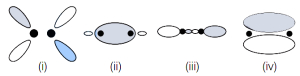
The correct set of symbols for the molecular orbitals given below is:
A
$I. = \sigma^*, II. = \sigma, III. = \pi^*, IV. = \pi$
B
$I. = \sigma^*, II. = \pi, III. = \pi^*, IV. = \sigma$
C
$I. = \pi^*, II. = \sigma, III. = \sigma^*, IV. = \pi$
D
$I. = \pi, II. = \sigma^*, III. = \sigma, IV. = \pi^*$
Solution
(C) Based on the molecular orbital theory diagrams:
$(i)$ Represents an antibonding pi orbital,denoted as $\pi^*$.
(ii) Represents a bonding sigma orbital,denoted as $\sigma$.
(iii) Represents an antibonding sigma orbital,denoted as $\sigma^*$.
(iv) Represents a bonding pi orbital,denoted as $\pi$.
Therefore,the correct set is $I. = \pi^*, II. = \sigma, III. = \sigma^*, IV. = \pi$.
$(i)$ Represents an antibonding pi orbital,denoted as $\pi^*$.
(ii) Represents a bonding sigma orbital,denoted as $\sigma$.
(iii) Represents an antibonding sigma orbital,denoted as $\sigma^*$.
(iv) Represents a bonding pi orbital,denoted as $\pi$.
Therefore,the correct set is $I. = \pi^*, II. = \sigma, III. = \sigma^*, IV. = \pi$.
0 likes
View Solution474
MediumMCQ
What is the correct order of bond lengths in the following molecules? $I. O_2, II. O_2^+, III. O_2^-, IV. O_2^{2-}$
A
$III > IV > II > I$
B
$III > IV > I > II$
C
$IV > III > II > I$
D
$IV > III > I > II$
Solution
(D) Bond length is inversely proportional to bond order.
The bond order for these species is calculated using Molecular Orbital Theory:
Bond order of $O_2^+ = 2.5$
Bond order of $O_2 = 2.0$
Bond order of $O_2^- = 1.5$
Bond order of $O_2^{2-} = 1.0$
Since bond length $\propto \frac{1}{\text{bond order}}$,the order of bond length is $O_2^{2-} (IV) > O_2^- (III) > O_2 (I) > O_2^+ (II)$.
Thus,the correct sequence is $IV > III > I > II$.
The bond order for these species is calculated using Molecular Orbital Theory:
Bond order of $O_2^+ = 2.5$
Bond order of $O_2 = 2.0$
Bond order of $O_2^- = 1.5$
Bond order of $O_2^{2-} = 1.0$
Since bond length $\propto \frac{1}{\text{bond order}}$,the order of bond length is $O_2^{2-} (IV) > O_2^- (III) > O_2 (I) > O_2^+ (II)$.
Thus,the correct sequence is $IV > III > I > II$.
0 likes
View Solution475
EasyMCQ
How many of the following species are diamagnetic? $He_2^{+}, H_2, H_2^{+}, H_2^{-}, He$
A
$1$
B
$2$
C
$3$
D
$0$
Solution
(B) According to molecular orbital theory,species with all paired electrons in their electronic configuration are diamagnetic in nature.
$He_2^{+} \rightarrow$ Total $3$ electrons,configuration $\sigma 1s^2, \sigma^* 1s^1$. It contains one unpaired electron and is paramagnetic.
$H_2 \rightarrow$ Total $2$ electrons,configuration $\sigma 1s^2$. All electrons are paired,hence it is diamagnetic.
$H_2^{+} \rightarrow$ Total $1$ electron,configuration $\sigma 1s^1$. It contains one unpaired electron and is paramagnetic.
$H_2^{-} \rightarrow$ Total $3$ electrons,configuration $\sigma 1s^2, \sigma^* 1s^1$. It contains one unpaired electron and is paramagnetic.
$He \rightarrow$ Total $2$ electrons,configuration $\sigma 1s^2$. All electrons are paired,hence it is diamagnetic.
Therefore,$H_2$ and $He$ are diamagnetic. The total count is $2$.
$He_2^{+} \rightarrow$ Total $3$ electrons,configuration $\sigma 1s^2, \sigma^* 1s^1$. It contains one unpaired electron and is paramagnetic.
$H_2 \rightarrow$ Total $2$ electrons,configuration $\sigma 1s^2$. All electrons are paired,hence it is diamagnetic.
$H_2^{+} \rightarrow$ Total $1$ electron,configuration $\sigma 1s^1$. It contains one unpaired electron and is paramagnetic.
$H_2^{-} \rightarrow$ Total $3$ electrons,configuration $\sigma 1s^2, \sigma^* 1s^1$. It contains one unpaired electron and is paramagnetic.
$He \rightarrow$ Total $2$ electrons,configuration $\sigma 1s^2$. All electrons are paired,hence it is diamagnetic.
Therefore,$H_2$ and $He$ are diamagnetic. The total count is $2$.
0 likes
View Solution476
MediumMCQ
How many ions of the following have a bond order of $2.5 ?$
$N_2^{-} ; NO^{-} ; C_2^{-} ; N_2^{+} ; C_2^{2-} ; CN^{+}$
$N_2^{-} ; NO^{-} ; C_2^{-} ; N_2^{+} ; C_2^{2-} ; CN^{+}$
A
$4$
B
$3$
C
$2$
D
$5$
Solution
(B) Bond order is calculated using the formula: $\text{Bond Order} = \frac{N_b - N_a}{2}$,where $N_b$ is the number of bonding electrons and $N_a$ is the number of antibonding electrons.
From the table,the ions with a bond order of $2.5$ are $N_2^{-}$,$C_2^{-}$,and $N_2^{+}$.
Therefore,there are $3$ such ions.
| Species | Bond Order |
| $N_2^{-}$ | $2.5$ |
| $NO^{-}$ | $2$ |
| $C_2^{-}$ | $2.5$ |
| $N_2^{+}$ | $2.5$ |
| $C_2^{2-}$ | $3$ |
| $CN^{+}$ | $2$ |
From the table,the ions with a bond order of $2.5$ are $N_2^{-}$,$C_2^{-}$,and $N_2^{+}$.
Therefore,there are $3$ such ions.
0 likes
View Solution477
MediumMCQ
Match the following molecules/ions in List-$I$ with their respective bond orders in List-$II$:
| List-$I$ (Molecules/ions) | List-$II$ (Bond order) |
| :--- | :--- |
| $A. N_2^+$ | $I. 1.0$ |
| $B. CO$ | $II. 1.5$ |
| $C. O_2$ | $III. 2.0$ |
| $D. O_2^-$ | $IV. 2.5$ |
| | $V. 3.0$ |
| List-$I$ (Molecules/ions) | List-$II$ (Bond order) |
| :--- | :--- |
| $A. N_2^+$ | $I. 1.0$ |
| $B. CO$ | $II. 1.5$ |
| $C. O_2$ | $III. 2.0$ |
| $D. O_2^-$ | $IV. 2.5$ |
| | $V. 3.0$ |
A
$A-IV, B-V, C-III, D-II$
B
$A-III, B-V, C-IV, D-II$
C
$A-IV, B-V, C-II, D-III$
D
$A-V, B-IV, C-III, D-II$
Solution
(A) The bond order is calculated using the formula: $\text{Bond order} = \frac{1}{2} (N_b - N_a)$,where $N_b$ is the number of bonding electrons and $N_a$ is the number of antibonding electrons.
$A. N_2^+$ ($13$ electrons): $\sigma 1s^2 < \sigma^* 1s^2 < \sigma 2s^2 < \sigma^* 2s^2 < \pi 2p_x^2 = \pi 2p_y^2 < \sigma 2p_z^1$. Bond order = $\frac{9-4}{2} = 2.5$ $(IV)$.
$B. CO$ ($14$ electrons): $\sigma 1s^2 < \sigma^* 1s^2 < \sigma 2s^2 < \sigma^* 2s^2 < \sigma 2p_z^2 < \pi 2p_x^2 = \pi 2p_y^2$. Bond order = $\frac{10-4}{2} = 3.0$ $(V)$.
$C. O_2$ ($16$ electrons): $\sigma 1s^2 < \sigma^* 1s^2 < \sigma 2s^2 < \sigma^* 2s^2 < \sigma 2p_z^2 < \pi 2p_x^2 = \pi 2p_y^2 < \pi^* 2p_x^1 = \pi^* 2p_y^1$. Bond order = $\frac{10-6}{2} = 2.0$ $(III)$.
$D. O_2^-$ ($17$ electrons): $\sigma 1s^2 < \sigma^* 1s^2 < \sigma 2s^2 < \sigma^* 2s^2 < \sigma 2p_z^2 < \pi 2p_x^2 = \pi 2p_y^2 < \pi^* 2p_x^2 = \pi^* 2p_y^1$. Bond order = $\frac{10-7}{2} = 1.5$ $(II)$.
Therefore,the correct match is $A-IV, B-V, C-III, D-II$.
$A. N_2^+$ ($13$ electrons): $\sigma 1s^2 < \sigma^* 1s^2 < \sigma 2s^2 < \sigma^* 2s^2 < \pi 2p_x^2 = \pi 2p_y^2 < \sigma 2p_z^1$. Bond order = $\frac{9-4}{2} = 2.5$ $(IV)$.
$B. CO$ ($14$ electrons): $\sigma 1s^2 < \sigma^* 1s^2 < \sigma 2s^2 < \sigma^* 2s^2 < \sigma 2p_z^2 < \pi 2p_x^2 = \pi 2p_y^2$. Bond order = $\frac{10-4}{2} = 3.0$ $(V)$.
$C. O_2$ ($16$ electrons): $\sigma 1s^2 < \sigma^* 1s^2 < \sigma 2s^2 < \sigma^* 2s^2 < \sigma 2p_z^2 < \pi 2p_x^2 = \pi 2p_y^2 < \pi^* 2p_x^1 = \pi^* 2p_y^1$. Bond order = $\frac{10-6}{2} = 2.0$ $(III)$.
$D. O_2^-$ ($17$ electrons): $\sigma 1s^2 < \sigma^* 1s^2 < \sigma 2s^2 < \sigma^* 2s^2 < \sigma 2p_z^2 < \pi 2p_x^2 = \pi 2p_y^2 < \pi^* 2p_x^2 = \pi^* 2p_y^1$. Bond order = $\frac{10-7}{2} = 1.5$ $(II)$.
Therefore,the correct match is $A-IV, B-V, C-III, D-II$.
0 likes
View Solution478
EasyMCQ
The molecular orbital theory supports paramagnetic behaviour of:
A
$Be_2$
B
$C_2$
C
$N_2$
D
$O_2$
Solution
(D) The molecular orbital electronic configuration of $Be_2$ is: $\sigma 1s^2 < \sigma^* 1s^2 < \sigma 2s^2 < \sigma^* 2s^2$.
The molecular orbital electronic configuration of $C_2$ is: $\sigma 1s^2 < \sigma^* 1s^2 < \sigma 2s^2 < \sigma^* 2s^2 < [\pi 2p_{x}^2 = \pi 2p_{y}^2]$.
The molecular orbital electronic configuration of $N_2$ is: $\sigma 1s^2 < \sigma^* 1s^2 < \sigma 2s^2 < \sigma^* 2s^2 < [\pi 2p_{x}^2 = \pi 2p_{y}^2] < \sigma 2p_{z}^2$.
The molecular orbital electronic configuration of $O_2$ is: $\sigma 1s^2 < \sigma^* 1s^2 < \sigma 2s^2 < \sigma^* 2s^2 < \sigma 2p_{z}^2 < [\pi 2p_{x}^2 = \pi 2p_{y}^2] < [\pi^* 2p_{x}^1 = \pi^* 2p_{y}^1]$.
Molecules having unpaired electrons are paramagnetic,and those without unpaired electrons are diamagnetic.
Since $O_2$ has $2$ unpaired electrons in its antibonding molecular orbitals,it is paramagnetic. Conversely,$Be_2$,$C_2$,and $N_2$ have no unpaired electrons,making them diamagnetic.
The molecular orbital electronic configuration of $C_2$ is: $\sigma 1s^2 < \sigma^* 1s^2 < \sigma 2s^2 < \sigma^* 2s^2 < [\pi 2p_{x}^2 = \pi 2p_{y}^2]$.
The molecular orbital electronic configuration of $N_2$ is: $\sigma 1s^2 < \sigma^* 1s^2 < \sigma 2s^2 < \sigma^* 2s^2 < [\pi 2p_{x}^2 = \pi 2p_{y}^2] < \sigma 2p_{z}^2$.
The molecular orbital electronic configuration of $O_2$ is: $\sigma 1s^2 < \sigma^* 1s^2 < \sigma 2s^2 < \sigma^* 2s^2 < \sigma 2p_{z}^2 < [\pi 2p_{x}^2 = \pi 2p_{y}^2] < [\pi^* 2p_{x}^1 = \pi^* 2p_{y}^1]$.
Molecules having unpaired electrons are paramagnetic,and those without unpaired electrons are diamagnetic.
Since $O_2$ has $2$ unpaired electrons in its antibonding molecular orbitals,it is paramagnetic. Conversely,$Be_2$,$C_2$,and $N_2$ have no unpaired electrons,making them diamagnetic.
0 likes
View Solution479
MediumMCQ
Match the molecules in List-$I$ with their respective bond orders in List-$II$.
| List-$I$ | List-$II$ |
|---|---|
| $A. Li_2$ | $i. 3$ |
| $B. N_2$ | $ii. 1.5$ |
| $C. Be_2$ | $iii. 1.0$ |
| $D. O_2$ | $iv. 0$ |
| $v. 2$ |
A
$A-iii, B-i, C-iv, D-v$
B
$A-ii, B-i, C-iv, D-v$
C
$A-iii, B-v, C-iv, D-i$
D
$A-i, B-iii, C-iv, D-v$
Solution
(A) According to Molecular Orbital Theory $(MOT)$:
Bond Order $(B.O.)$ = $\frac{1}{2} (N_b - N_a)$
For $Li_2$ ($6$ electrons): $\sigma 1s^2, \sigma^* 1s^2, \sigma 2s^2$. $B.O. = \frac{1}{2} (4 - 2) = 1.0$ $(iii)$.
For $N_2$ ($14$ electrons): $\sigma 1s^2, \sigma^* 1s^2, \sigma 2s^2, \sigma^* 2s^2, \pi 2p_x^2 = \pi 2p_y^2, \sigma 2p_z^2$. $B.O. = \frac{1}{2} (10 - 4) = 3$ $(i)$.
For $Be_2$ ($8$ electrons): $\sigma 1s^2, \sigma^* 1s^2, \sigma 2s^2, \sigma^* 2s^2$. $B.O. = \frac{1}{2} (4 - 4) = 0$ $(iv)$.
For $O_2$ ($16$ electrons): $\sigma 1s^2, \sigma^* 1s^2, \sigma 2s^2, \sigma^* 2s^2, \sigma 2p_z^2, \pi 2p_x^2 = \pi 2p_y^2, \pi^* 2p_x^1 = \pi^* 2p_y^1$. $B.O. = \frac{1}{2} (10 - 6) = 2$ $(v)$.
Therefore,the correct match is $A-iii, B-i, C-iv, D-v$.
Bond Order $(B.O.)$ = $\frac{1}{2} (N_b - N_a)$
For $Li_2$ ($6$ electrons): $\sigma 1s^2, \sigma^* 1s^2, \sigma 2s^2$. $B.O. = \frac{1}{2} (4 - 2) = 1.0$ $(iii)$.
For $N_2$ ($14$ electrons): $\sigma 1s^2, \sigma^* 1s^2, \sigma 2s^2, \sigma^* 2s^2, \pi 2p_x^2 = \pi 2p_y^2, \sigma 2p_z^2$. $B.O. = \frac{1}{2} (10 - 4) = 3$ $(i)$.
For $Be_2$ ($8$ electrons): $\sigma 1s^2, \sigma^* 1s^2, \sigma 2s^2, \sigma^* 2s^2$. $B.O. = \frac{1}{2} (4 - 4) = 0$ $(iv)$.
For $O_2$ ($16$ electrons): $\sigma 1s^2, \sigma^* 1s^2, \sigma 2s^2, \sigma^* 2s^2, \sigma 2p_z^2, \pi 2p_x^2 = \pi 2p_y^2, \pi^* 2p_x^1 = \pi^* 2p_y^1$. $B.O. = \frac{1}{2} (10 - 6) = 2$ $(v)$.
Therefore,the correct match is $A-iii, B-i, C-iv, D-v$.
0 likes
View Solution480
MediumMCQ
Group the following molecules/ions according to their bond order: $O_2^{2-}, Li_2, O_2^{2+}, F_2, N_2, He_2^{2+}$.
A
$O_2^{2-}, Li_2, O_2^{2+}, F_2, N_2, He_2^{2+}$
B
$F_2, O_2^{2+}, N_2, O_2^{2-}, He_2^{2+}, Li_2$
C
$O_2^{-}, Li_2, F_2, He_2^{2+}, N_2, O_2^{2+}$
D
$Li_2, F_2, O_2^{2+}, N_2, O_2^{2-}, He_2^{2+}$
Solution
(A) To group the species by bond order,we calculate the bond order $(B.O.)$ for each using Molecular Orbital Theory:
$1$. $O_2^{2-}$ ($18$ electrons): $B.O. = \frac{1}{2}(10-8) = 1$
$2$. $Li_2$ ($6$ electrons): $B.O. = \frac{1}{2}(4-2) = 1$
$3$. $F_2$ ($18$ electrons): $B.O. = \frac{1}{2}(10-8) = 1$
$4$. $He_2^{2+}$ ($2$ electrons): $B.O. = \frac{1}{2}(2-0) = 1$
$5$. $N_2$ ($14$ electrons): $B.O. = \frac{1}{2}(10-4) = 3$
$6$. $O_2^{2+}$ ($14$ electrons): $B.O. = \frac{1}{2}(10-4) = 3$
Thus,the species with $B.O. = 1$ are $(O_2^{2-}, Li_2, F_2, He_2^{2+})$ and the species with $B.O. = 3$ are $(N_2, O_2^{2+})$.
$1$. $O_2^{2-}$ ($18$ electrons): $B.O. = \frac{1}{2}(10-8) = 1$
$2$. $Li_2$ ($6$ electrons): $B.O. = \frac{1}{2}(4-2) = 1$
$3$. $F_2$ ($18$ electrons): $B.O. = \frac{1}{2}(10-8) = 1$
$4$. $He_2^{2+}$ ($2$ electrons): $B.O. = \frac{1}{2}(2-0) = 1$
$5$. $N_2$ ($14$ electrons): $B.O. = \frac{1}{2}(10-4) = 3$
$6$. $O_2^{2+}$ ($14$ electrons): $B.O. = \frac{1}{2}(10-4) = 3$
Thus,the species with $B.O. = 1$ are $(O_2^{2-}, Li_2, F_2, He_2^{2+})$ and the species with $B.O. = 3$ are $(N_2, O_2^{2+})$.
0 likes
View Solution481
MediumMCQ
The bond orders of $He_2^{+}$ and $He_2$ are respectively
A
$1/2, 0$
B
$0, 1/2$
C
$0, 1$
D
$1, 0$
Solution
(A) The molecular orbital electronic configuration of $He_2$ is $\sigma 1s^2, \sigma^* 1s^2$.
Bond order $= \frac{(\text{electrons in bonding MO}) - (\text{electrons in antibonding MO})}{2}$.
For $He_2$,bond order $= \frac{2-2}{2} = 0$.
Since the bond order is $0$,the $He_2$ molecule does not exist.
For $He_2^{+}$,the molecular orbital electronic configuration is $\sigma 1s^2, \sigma^* 1s^1$.
Bond order $= \frac{2-1}{2} = 1/2$.
Bond order $= \frac{(\text{electrons in bonding MO}) - (\text{electrons in antibonding MO})}{2}$.
For $He_2$,bond order $= \frac{2-2}{2} = 0$.
Since the bond order is $0$,the $He_2$ molecule does not exist.
For $He_2^{+}$,the molecular orbital electronic configuration is $\sigma 1s^2, \sigma^* 1s^1$.
Bond order $= \frac{2-1}{2} = 1/2$.
0 likes
View Solution482
EasyMCQ
What is the bond order of $N_2$?
A
$3$
B
$4$
C
$2$
D
$1$
Solution
(A) The electronic configuration of $N_2$ ($14$ electrons) is: $\sigma 1s^2, \sigma^* 1s^2, \sigma 2s^2, \sigma^* 2s^2, \pi 2p_x^2 = \pi 2p_y^2, \sigma 2p_z^2$.
Bond order is calculated as: $\text{Bond order} = \frac{N_b - N_a}{2} = \frac{10 - 4}{2} = 3$.
Bond order is calculated as: $\text{Bond order} = \frac{N_b - N_a}{2} = \frac{10 - 4}{2} = 3$.
0 likes
View Solution483
MediumMCQ
According to molecular orbital theory,the total number of bonding electron pairs in $O_2$ is
A
$2$
B
$3$
C
$5$
D
$4$
Solution
(C) The molecular orbital electronic configuration of $O_2$ ($16$ electrons) is: $\sigma 1s^2, \sigma^* 1s^2, \sigma 2s^2, \sigma^* 2s^2, \sigma 2p_z^2, \pi 2p_x^2, \pi 2p_y^2, \pi^* 2p_x^1, \pi^* 2p_y^1$.
Bonding molecular orbitals are those without an asterisk $(*)$.
The bonding orbitals are $\sigma 1s, \sigma 2s, \sigma 2p_z, \pi 2p_x, \pi 2p_y$.
Each of these $5$ orbitals contains $2$ electrons,totaling $10$ bonding electrons.
Therefore,the number of bonding electron pairs is $10 / 2 = 5$.
Bonding molecular orbitals are those without an asterisk $(*)$.
The bonding orbitals are $\sigma 1s, \sigma 2s, \sigma 2p_z, \pi 2p_x, \pi 2p_y$.
Each of these $5$ orbitals contains $2$ electrons,totaling $10$ bonding electrons.
Therefore,the number of bonding electron pairs is $10 / 2 = 5$.
0 likes
View Solution484
EasyMCQ
$KO_2$ exhibits paramagnetic behaviour. This is due to the paramagnetic nature of
A
$KO^{-}$
B
$K^{+}$
C
$O_2$
D
$O_2^{-}$
Solution
(D) $KO_2$ is a superoxide compound consisting of $K^{+}$ and $O_2^{-}$ ions.
The $K^{+}$ ion has a noble gas configuration and is diamagnetic.
The superoxide ion $O_2^{-}$ has $17$ electrons.
According to molecular orbital theory,the electronic configuration of $O_2^{-}$ is $\sigma 1s^2, \sigma^* 1s^2, \sigma 2s^2, \sigma^* 2s^2, \sigma 2p_z^2, \pi 2p_x^2 = \pi 2p_y^2, \pi^* 2p_x^2 = \pi^* 2p_y^1$.
Due to the presence of one unpaired electron in the $\pi^* 2p$ orbital,$O_2^{-}$ is paramagnetic.
The $K^{+}$ ion has a noble gas configuration and is diamagnetic.
The superoxide ion $O_2^{-}$ has $17$ electrons.
According to molecular orbital theory,the electronic configuration of $O_2^{-}$ is $\sigma 1s^2, \sigma^* 1s^2, \sigma 2s^2, \sigma^* 2s^2, \sigma 2p_z^2, \pi 2p_x^2 = \pi 2p_y^2, \pi^* 2p_x^2 = \pi^* 2p_y^1$.
Due to the presence of one unpaired electron in the $\pi^* 2p$ orbital,$O_2^{-}$ is paramagnetic.
0 likes
View Solution485
EasyMCQ
Find the odd-electron molecules from the following:
$(i) C_2, (ii) H_2, (iii) SCl_2, (iv) NO, (v) NO_2$
$(i) C_2, (ii) H_2, (iii) SCl_2, (iv) NO, (v) NO_2$
A
$(i), (iii), (iv)$
B
$(ii), (iii)$
C
$(iv), (v)$
D
$(iii), (v)$
Solution
(C) An odd-electron molecule is a molecule that contains an odd number of valence electrons.
$1$. $C_2$: Total valence electrons = $4 + 4 = 8$ (even).
$2$. $H_2$: Total valence electrons = $1 + 1 = 2$ (even).
$3$. $SCl_2$: Total valence electrons = $6 + 7(2) = 20$ (even).
$4$. $NO$: Total valence electrons = $5 + 6 = 11$ (odd).
$5$. $NO_2$: Total valence electrons = $5 + 6(2) = 17$ (odd).
Therefore,$NO$ and $NO_2$ are odd-electron molecules.
$1$. $C_2$: Total valence electrons = $4 + 4 = 8$ (even).
$2$. $H_2$: Total valence electrons = $1 + 1 = 2$ (even).
$3$. $SCl_2$: Total valence electrons = $6 + 7(2) = 20$ (even).
$4$. $NO$: Total valence electrons = $5 + 6 = 11$ (odd).
$5$. $NO_2$: Total valence electrons = $5 + 6(2) = 17$ (odd).
Therefore,$NO$ and $NO_2$ are odd-electron molecules.
0 likes
View Solution486
EasyMCQ
The bond order of $HeH^{+}$ is
A
$1$
B
$2$
C
$3$
D
$4$
Solution
(A) The total number of electrons in $HeH^{+}$ is $2 + 1 - 1 = 2$.
The molecular orbital electronic configuration is $\sigma_{1s}^2$.
Bond Order $= \frac{1}{2} [N_b - N_a] = \frac{1}{2} [2 - 0] = 1$.
The molecular orbital electronic configuration is $\sigma_{1s}^2$.
Bond Order $= \frac{1}{2} [N_b - N_a] = \frac{1}{2} [2 - 0] = 1$.
0 likes
View Solution487
MediumMCQ
Bond order of $He_{2}$,$He_{2}^{+}$ and $He_{2}^{2+}$ are respectively:
A
$1, 0.5, 0$
B
$0, 0.5, 1$
C
$0.5, 1, 0$
D
$1, 0, 0.5$
Solution
(B) The bond order is calculated using the formula: $B.O. = \frac{1}{2} (N_b - N_a)$,where $N_b$ is the number of bonding electrons and $N_a$ is the number of antibonding electrons.
For $He_{2}$ $(4 \ e^{-})$: Configuration is $\sigma(1s)^{2}, \sigma^{*}(1s)^{2}$. $B.O. = \frac{2-2}{2} = 0$.
For $He_{2}^{+}$ $(3 \ e^{-})$: Configuration is $\sigma(1s)^{2}, \sigma^{*}(1s)^{1}$. $B.O. = \frac{2-1}{2} = 0.5$.
For $He_{2}^{2+}$ $(2 \ e^{-})$: Configuration is $\sigma(1s)^{2}$. $B.O. = \frac{2-0}{2} = 1$.
Thus,the bond orders are $0, 0.5, 1$ respectively.
For $He_{2}$ $(4 \ e^{-})$: Configuration is $\sigma(1s)^{2}, \sigma^{*}(1s)^{2}$. $B.O. = \frac{2-2}{2} = 0$.
For $He_{2}^{+}$ $(3 \ e^{-})$: Configuration is $\sigma(1s)^{2}, \sigma^{*}(1s)^{1}$. $B.O. = \frac{2-1}{2} = 0.5$.
For $He_{2}^{2+}$ $(2 \ e^{-})$: Configuration is $\sigma(1s)^{2}$. $B.O. = \frac{2-0}{2} = 1$.
Thus,the bond orders are $0, 0.5, 1$ respectively.
0 likes
View Solution488
EasyMCQ
$A$ homonuclear diatomic gas molecule shows $2$-electron magnetic moment. The one-electron and two-electron reduced species obtained from the above gas molecule can act as both oxidizing and reducing agents. When the gas molecule is one-electron oxidized,the bond length decreases compared to the neutral molecule. The gas molecule is
A
$N_2$
B
$Cl_2$
C
$O_2$
D
$B_2$
Solution
(C) The molecule is $O_2$.
$1$. $O_2$ has two unpaired electrons in its antibonding $\pi^*{2p}$ orbitals,which corresponds to a $2$-electron magnetic moment (paramagnetic).
$2$. The one-electron reduced species is the superoxide ion $(O_2^-)$ and the two-electron reduced species is the peroxide ion $(O_2^{2-})$. Both can act as oxidizing and reducing agents.
$3$. When $O_2$ is one-electron oxidized,it forms the dioxygenyl cation $(O_2^+)$. In $O_2$,the bond order is $2.0$ (electrons in antibonding orbitals). Removing one electron from the antibonding orbital increases the bond order to $2.5$,which causes the bond length to decrease.
$1$. $O_2$ has two unpaired electrons in its antibonding $\pi^*{2p}$ orbitals,which corresponds to a $2$-electron magnetic moment (paramagnetic).
$2$. The one-electron reduced species is the superoxide ion $(O_2^-)$ and the two-electron reduced species is the peroxide ion $(O_2^{2-})$. Both can act as oxidizing and reducing agents.
$3$. When $O_2$ is one-electron oxidized,it forms the dioxygenyl cation $(O_2^+)$. In $O_2$,the bond order is $2.0$ (electrons in antibonding orbitals). Removing one electron from the antibonding orbital increases the bond order to $2.5$,which causes the bond length to decrease.
0 likes
View Solution489
MediumMCQ
Which statements are correct for the peroxide ion?
A
It has five completely filled anti-bonding molecular orbitals
B
It is diamagnetic
C
It has bond order one
D
It is isoelectronic with neon
Solution
(B, C) The correct statements for the peroxide ion $(O_{2}^{2-})$ are that it is diamagnetic and it has a bond order of $1$.
Electronic configuration of $O_{2}^{2-}$ is: $\sigma 1s^{2}, \sigma^{*} 1s^{2}, \sigma 2s^{2}, \sigma^{*} 2s^{2}, \sigma 2p_{z}^{2}, (\pi 2p_{x}^{2} = \pi 2p_{y}^{2}), (\pi^{*} 2p_{x}^{2} = \pi^{*} 2p_{y}^{2})$.
Bond order $= \frac{1}{2} (\text{Number of bonding electrons} - \text{Number of anti-bonding electrons})$.
$BO = \frac{10 - 8}{2} = \frac{2}{2} = 1$.
Since the number of unpaired electrons is $0$,$O_{2}^{2-}$ is diamagnetic in nature.
Electronic configuration of $O_{2}^{2-}$ is: $\sigma 1s^{2}, \sigma^{*} 1s^{2}, \sigma 2s^{2}, \sigma^{*} 2s^{2}, \sigma 2p_{z}^{2}, (\pi 2p_{x}^{2} = \pi 2p_{y}^{2}), (\pi^{*} 2p_{x}^{2} = \pi^{*} 2p_{y}^{2})$.
Bond order $= \frac{1}{2} (\text{Number of bonding electrons} - \text{Number of anti-bonding electrons})$.
$BO = \frac{10 - 8}{2} = \frac{2}{2} = 1$.
Since the number of unpaired electrons is $0$,$O_{2}^{2-}$ is diamagnetic in nature.
0 likes
View Solution490
MediumMCQ
In case of heteronuclear diatomics of the type $AB$,where $A$ is more electronegative than $B$,the bonding molecular orbital resembles the character of $A$ more than that of $B$. The statement
A
is false
B
is true
C
cannot be evaluated since data is not sufficient
D
is true only for certain systems
Solution
(B) In a heteronuclear diatomic molecule $AB$,if $A$ is more electronegative than $B$,the bonding molecular orbital is closer in energy to the atomic orbital of the more electronegative atom $A$.
Consequently,the electron density in the bonding molecular orbital is concentrated more towards the more electronegative atom $A$.
Thus,the bonding molecular orbital resembles the character of $A$ more than that of $B$.
Consequently,the electron density in the bonding molecular orbital is concentrated more towards the more electronegative atom $A$.
Thus,the bonding molecular orbital resembles the character of $A$ more than that of $B$.
0 likes
View Solution491
MediumMCQ
The ground state electronic configuration of $CO$ molecule is
A
$1 \sigma^{2} 2 \sigma^{2} 1 \pi^{4} 3 \sigma^{2}$
B
$1 \sigma^{2} 2 \sigma^{2} 3 \sigma^{2} 1 \pi^{2} 2 \pi^{2}$
C
$1 \sigma^{2} 2 \sigma^{2} 1 \pi^{2} 3 \sigma^{2} 2 \pi^{2}$
D
$1 \sigma^{2} 1 \pi^{2} 2 \sigma^{2} 2 \sigma^{2}$
Solution
(A) The $CO$ molecule has a total of $14$ electrons ($6$ from $C$ and $8$ from $O$).
According to Molecular Orbital Theory,for molecules with $14$ or fewer electrons,the energy order of molecular orbitals is $\sigma 1s < \sigma^* 1s < \sigma 2s < \sigma^* 2s < \pi 2p_x = \pi 2p_y < \sigma 2p_z < \pi^* 2p_x = \pi^* 2p_y < \sigma^* 2p_z$.
Filling the $14$ electrons into these orbitals:
$1\sigma^2, 2\sigma^2, 3\sigma^2, 4\sigma^2, 1\pi^4, 5\sigma^2$.
In many textbooks,the notation is simplified as $1\sigma^2 2\sigma^2 1\pi^4 3\sigma^2$ where $1\sigma$ is $\sigma 1s$,$2\sigma$ is $\sigma^* 1s$,$3\sigma$ is $\sigma 2s$,$4\sigma$ is $\sigma^* 2s$,$1\pi$ is $\pi 2p$,and $5\sigma$ is $\sigma 2p_z$.
Thus,the correct configuration is $1\sigma^2 2\sigma^2 3\sigma^2 4\sigma^2 1\pi^4 5\sigma^2$,which corresponds to option $A$ when simplified.
According to Molecular Orbital Theory,for molecules with $14$ or fewer electrons,the energy order of molecular orbitals is $\sigma 1s < \sigma^* 1s < \sigma 2s < \sigma^* 2s < \pi 2p_x = \pi 2p_y < \sigma 2p_z < \pi^* 2p_x = \pi^* 2p_y < \sigma^* 2p_z$.
Filling the $14$ electrons into these orbitals:
$1\sigma^2, 2\sigma^2, 3\sigma^2, 4\sigma^2, 1\pi^4, 5\sigma^2$.
In many textbooks,the notation is simplified as $1\sigma^2 2\sigma^2 1\pi^4 3\sigma^2$ where $1\sigma$ is $\sigma 1s$,$2\sigma$ is $\sigma^* 1s$,$3\sigma$ is $\sigma 2s$,$4\sigma$ is $\sigma^* 2s$,$1\pi$ is $\pi 2p$,and $5\sigma$ is $\sigma 2p_z$.
Thus,the correct configuration is $1\sigma^2 2\sigma^2 3\sigma^2 4\sigma^2 1\pi^4 5\sigma^2$,which corresponds to option $A$ when simplified.
0 likes
View Solution492
EasyMCQ
The paramagnetic behaviour of $B_2$ is due to the presence of
A
two unpaired electrons in $\pi^*$ $MO$
B
two unpaired electrons in $\pi$ $MO$
C
two unpaired electrons in $\sigma$ $MO$
D
two unpaired electrons in $\sigma^*$ $MO$
Solution
(B) The total number of electrons in $B_2$ is $5 + 5 = 10 \ e^-$.
According to Molecular Orbital Theory,the electronic configuration is: $\sigma 1s^2, \sigma^* 1s^2, \sigma 2s^2, \sigma^* 2s^2, \pi 2p_x^1, \pi 2p_y^1$.
Due to the presence of $2$ unpaired electrons in the $\pi 2p$ bonding molecular orbitals,$B_2$ exhibits paramagnetic behaviour.
According to Molecular Orbital Theory,the electronic configuration is: $\sigma 1s^2, \sigma^* 1s^2, \sigma 2s^2, \sigma^* 2s^2, \pi 2p_x^1, \pi 2p_y^1$.
Due to the presence of $2$ unpaired electrons in the $\pi 2p$ bonding molecular orbitals,$B_2$ exhibits paramagnetic behaviour.
0 likes
View Solution493
MediumMCQ
Which one of the following is paramagnetic?
A
$N_2$
B
$NO$
C
$CO$
D
$O_3$
Solution
(B) Paramagnetic substances contain one or more unpaired electrons.
According to Molecular Orbital Theory $(MOT)$:
$N_2$ (total $14$ electrons): $({\sigma}1s)^2 ({\sigma}^*1s)^2 ({\sigma}2s)^2 ({\sigma}^*2s)^2 ({\pi}2p_x)^2 ({\pi}2p_y)^2 ({\sigma}2p_z)^2$. All electrons are paired,so it is diamagnetic.
$NO$ (total $15$ electrons): $({\sigma}1s)^2 ({\sigma}^*1s)^2 ({\sigma}2s)^2 ({\sigma}^*2s)^2 ({\sigma}2p_z)^2 ({\pi}2p_x)^2 ({\pi}2p_y)^2 ({\pi}^*2p_x)^1$. It has one unpaired electron in the antibonding ${\pi}^*$ orbital,so it is paramagnetic.
$CO$ (total $14$ electrons): Similar to $N_2$,it is diamagnetic.
$O_3$ (total $24$ electrons): It is a diamagnetic molecule.
Therefore,$NO$ is the correct answer.
According to Molecular Orbital Theory $(MOT)$:
$N_2$ (total $14$ electrons): $({\sigma}1s)^2 ({\sigma}^*1s)^2 ({\sigma}2s)^2 ({\sigma}^*2s)^2 ({\pi}2p_x)^2 ({\pi}2p_y)^2 ({\sigma}2p_z)^2$. All electrons are paired,so it is diamagnetic.
$NO$ (total $15$ electrons): $({\sigma}1s)^2 ({\sigma}^*1s)^2 ({\sigma}2s)^2 ({\sigma}^*2s)^2 ({\sigma}2p_z)^2 ({\pi}2p_x)^2 ({\pi}2p_y)^2 ({\pi}^*2p_x)^1$. It has one unpaired electron in the antibonding ${\pi}^*$ orbital,so it is paramagnetic.
$CO$ (total $14$ electrons): Similar to $N_2$,it is diamagnetic.
$O_3$ (total $24$ electrons): It is a diamagnetic molecule.
Therefore,$NO$ is the correct answer.
0 likes
View Solution494
EasyMCQ
The bond order of $CO$ molecule is
A
$2$
B
$2.5$
C
$3$
D
$3.5$
Solution
(C) The molecular orbital configuration of $CO$ ($14$ electrons) is: $\sigma(1s)^2, \sigma^*(1s)^2, \sigma(2s)^2, \sigma^*(2s)^2, \pi(2p_x)^2 = \pi(2p_y)^2, \sigma(2p_z)^2$.
Number of bonding electrons $(N_b)$ = $10$.
Number of antibonding electrons $(N_a)$ = $4$.
Bond Order = $\frac{N_b - N_a}{2} = \frac{10 - 4}{2} = 3$.
Number of bonding electrons $(N_b)$ = $10$.
Number of antibonding electrons $(N_a)$ = $4$.
Bond Order = $\frac{N_b - N_a}{2} = \frac{10 - 4}{2} = 3$.
0 likes
View Solution495
EasyMCQ
The ground state magnetic property of $B_{2}$ and $C_{2}$ molecules will be
A
$B_{2}$ paramagnetic and $C_{2}$ diamagnetic
B
$B_{2}$ diamagnetic and $C_{2}$ paramagnetic
C
Both are diamagnetic
D
Both are paramagnetic
Solution
(A) According to molecular orbital theory,the electronic configuration for $B_{2}$ ($10$ electrons) is: $\sigma 1s^{2}, \sigma^{*} 1s^{2}, \sigma 2s^{2}, \sigma^{*} 2s^{2}, \pi 2p_{x}^{1} = \pi 2p_{y}^{1}$.
Since it contains two unpaired electrons,$B_{2}$ is paramagnetic.
The electronic configuration for $C_{2}$ ($12$ electrons) is: $\sigma 1s^{2}, \sigma^{*} 1s^{2}, \sigma 2s^{2}, \sigma^{*} 2s^{2}, \pi 2p_{x}^{2} = \pi 2p_{y}^{2}$.
Since all electrons are paired,$C_{2}$ is diamagnetic.
Since it contains two unpaired electrons,$B_{2}$ is paramagnetic.
The electronic configuration for $C_{2}$ ($12$ electrons) is: $\sigma 1s^{2}, \sigma^{*} 1s^{2}, \sigma 2s^{2}, \sigma^{*} 2s^{2}, \pi 2p_{x}^{2} = \pi 2p_{y}^{2}$.
Since all electrons are paired,$C_{2}$ is diamagnetic.
0 likes
View Solution496
DifficultMCQ
Pair of species among the following having same bond order as well as paramagnetic character will be -
A
$O_{2}^{+}, N_{2}^{2-}$
B
$O_{2}^{-}, N_{2}^{+}$
C
$O_{2}^{+}, N_{2}^{-}$
D
$O_{2}^{-}, N_{2}$
Solution
(C) To determine the bond order and magnetic nature,we use the Molecular Orbital Theory $(MOT)$ configuration:
Comparing the options:
$O_{2}^{+}$ has a bond order of $2.5$ and is paramagnetic.
$N_{2}^{-}$ has a bond order of $2.5$ and is paramagnetic.
Therefore,the pair $(O_{2}^{+}, N_{2}^{-})$ has the same bond order and magnetic character.
| Species | Bond Order and Magnetic Nature |
|---|---|
| $O_{2}^{+}$ ($15$ electrons) | $2.5$,Paramagnetic |
| $O_{2}^{-}$ ($17$ electrons) | $1.5$,Paramagnetic |
| $N_{2}^{+}$ ($13$ electrons) | $2.5$,Paramagnetic |
| $N_{2}^{-}$ ($15$ electrons) | $2.5$,Paramagnetic |
| $N_{2}^{2-}$ ($16$ electrons) | $2.0$,Paramagnetic |
| $N_{2}$ ($14$ electrons) | $3.0$,Diamagnetic |
Comparing the options:
$O_{2}^{+}$ has a bond order of $2.5$ and is paramagnetic.
$N_{2}^{-}$ has a bond order of $2.5$ and is paramagnetic.
Therefore,the pair $(O_{2}^{+}, N_{2}^{-})$ has the same bond order and magnetic character.
0 likes
View Solution497
MediumMCQ
Which of the following pictorial diagrams most correctly represents the $\pi^*$ ($\pi$-antibonding) molecular orbital between two atoms if the internuclear axis is taken to be in the $z$-direction?
A
B
C
D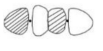
Solution
(C) $\pi^*$ antibonding molecular orbital is formed by the out-of-phase overlap of two atomic orbitals (e.g.,$p_x$ or $p_y$ orbitals).
This results in the presence of a nodal plane between the two nuclei where the electron probability density is zero,in addition to the nodal plane containing the internuclear axis.
In the $\pi^*$ orbital,the lobes of the atomic orbitals have opposite signs (represented by shading) facing each other,leading to destructive interference.
Diagram $C$ correctly depicts this out-of-phase combination,showing the nodal plane between the nuclei.
This results in the presence of a nodal plane between the two nuclei where the electron probability density is zero,in addition to the nodal plane containing the internuclear axis.
In the $\pi^*$ orbital,the lobes of the atomic orbitals have opposite signs (represented by shading) facing each other,leading to destructive interference.
Diagram $C$ correctly depicts this out-of-phase combination,showing the nodal plane between the nuclei.
0 likes
View SolutionChemical Bonding and Molecular Structure — Molecular orbital theory · Frequently Asked Questions
1Are these Chemical Bonding and Molecular Structure questions useful for JEE and NEET?
Yes. All questions in this section are mapped to JEE Main and NEET exam patterns. Previous year questions from JEE Main, NEET, GUJCET and state-level exams are included with full solutions.
2Can I switch to Hindi or Gujarati for these questions?
Yes. Use the language tabs in the hero section or the sidebar to view the same questions and solutions in English, Hindi or Gujarati.
3How do I generate a question paper from this subtopic?
Use the Vedclass Exam Paper Generator — select the chapter and subtopic, set difficulty, and generate Sets A, B, C, D automatically. First 3 chapters of every subject are free.
Vedclass Products
For Students
Vedclass Test Series
Mock tests in real JEE/NEET style with performance analysis. 5-day free trial.
Start Free TrialFor Teachers
Exam Paper Generator
Generate Set A/B/C/D papers from this chapter in 2 minutes. 3 chapters free.
Try FreeFor Institutes
Online Exam Module
Live online exams with unlimited students, 360° analytics & white-label branding.
See DemoFor Teachers & Institutes
Generate a Chemical Bonding and Molecular Structure Exam Paper in 2 Minutes
Select subtopic & difficulty — Sets A, B, C, D auto-generated with No Repeat logic.
First 3 chapters of every subject are free — no payment required.