
A English
Hydrogen bonding Questions in English
Class 11 Chemistry · Chemical Bonding and Molecular Structure · Hydrogen bonding
249+
Questions
English
Language
100%
With Solutions
Showing 50 of 249 questions in English
151
MediumMCQ
Select the incorrect match.
A
$o\text{-nitrophenol} > p\text{-nitrophenol} \Rightarrow \text{Vapour pressure}$
B
$o\text{-nitrophenol} < p\text{-nitrophenol} \Rightarrow \text{Boiling point}$
C
$HO-CH_2-CH_2-OH < HO-CH_2-CH(OH)-CH_2-OH \Rightarrow \text{Viscosity}$
D
$H_2O < HF \Rightarrow \text{Boiling point}$
Solution
(D) is the incorrect match.
$H_2O$ has a higher boiling point than $HF$.
Although $F$ is more electronegative than $O$,each $H_2O$ molecule can form four hydrogen bonds on average,while each $HF$ molecule forms only two.
Therefore,the correct order of boiling point is $H_2O > HF$.
Other options are correct:
$o\text{-nitrophenol}$ is more volatile (higher vapour pressure) than $p\text{-nitrophenol}$ due to intramolecular hydrogen bonding.
Glycerol $(HO-CH_2-CH(OH)-CH_2-OH)$ is more viscous than glycol $(HO-CH_2-CH_2-OH)$ due to more $-OH$ groups and stronger intermolecular hydrogen bonding.
$H_2O$ has a higher boiling point than $HF$.
Although $F$ is more electronegative than $O$,each $H_2O$ molecule can form four hydrogen bonds on average,while each $HF$ molecule forms only two.
Therefore,the correct order of boiling point is $H_2O > HF$.
Other options are correct:
$o\text{-nitrophenol}$ is more volatile (higher vapour pressure) than $p\text{-nitrophenol}$ due to intramolecular hydrogen bonding.
Glycerol $(HO-CH_2-CH(OH)-CH_2-OH)$ is more viscous than glycol $(HO-CH_2-CH_2-OH)$ due to more $-OH$ groups and stronger intermolecular hydrogen bonding.
0 likes
View Solution152
MediumMCQ
When two ice cubes are pressed together,they join to form a single cube. Which of the following forces is responsible for holding them together?
A
Hydrogen bond formation
B
Van der Waals forces
C
Covalent attractions
D
Ionic interactions
Solution
(A) When two ice cubes are pressed together,the pressure applied lowers the melting point of ice at the contact surface,causing a thin layer of ice to melt into water.
Once the pressure is released,the water refreezes because the temperature is below $0 \ ^\circ C$.
This process is known as regelation.
The formation of hydrogen bonds between the water molecules in the refrozen layer acts as the primary force holding the two ice cubes together.
Once the pressure is released,the water refreezes because the temperature is below $0 \ ^\circ C$.
This process is known as regelation.
The formation of hydrogen bonds between the water molecules in the refrozen layer acts as the primary force holding the two ice cubes together.
0 likes
View Solution153
MediumMCQ
What is the reason for the exceptionally high boiling point of water?
A
It has covalent bonds between $H$ and $O$
B
The water molecule is linear
C
Water molecules are associated with hydrogen bonding
D
The water molecule is not linear
Solution
(C) The exceptionally high boiling point of water is due to the presence of extensive intermolecular hydrogen bonding between water molecules.
This hydrogen bonding requires a significant amount of energy to break,thereby increasing the boiling point compared to other hydrides of group $16$ elements.
This hydrogen bonding requires a significant amount of energy to break,thereby increasing the boiling point compared to other hydrides of group $16$ elements.
0 likes
View Solution154
MediumMCQ
What is the maximum number of hydrogen bonds in which a single water molecule can participate?
A
$1$
B
$2$
C
$6$
D
$4$
Solution
(D) single water molecule $(H_2O)$ has two hydrogen atoms attached to an oxygen atom via covalent bonds,which can act as hydrogen bond donors.
Additionally,the oxygen atom has two lone pairs of electrons,which can act as hydrogen bond acceptors.
Therefore,each water molecule can form a total of $4$ hydrogen bonds (two as a donor and two as an acceptor) with surrounding water molecules in an ice crystal lattice structure.
Additionally,the oxygen atom has two lone pairs of electrons,which can act as hydrogen bond acceptors.
Therefore,each water molecule can form a total of $4$ hydrogen bonds (two as a donor and two as an acceptor) with surrounding water molecules in an ice crystal lattice structure.
0 likes
View Solution155
MediumMCQ
The boiling point of $NH_3$ is higher than that of $PH_3$ because ...
A
$PH_3$ has a higher molecular mass
B
$NH_3$ has a pyramidal shape
C
$NH_3$ exhibits hydrogen bonding
D
$NH_3$ has ionic bonds,while $PH_3$ has covalent bonds
Solution
(C) The boiling point of a substance depends on the intermolecular forces present.
In $NH_3$,the nitrogen atom is highly electronegative and small,which allows it to form intermolecular hydrogen bonds.
In $PH_3$,the phosphorus atom is less electronegative and larger,so it does not form hydrogen bonds.
Therefore,$NH_3$ has stronger intermolecular forces compared to $PH_3$,resulting in a higher boiling point.
In $NH_3$,the nitrogen atom is highly electronegative and small,which allows it to form intermolecular hydrogen bonds.
In $PH_3$,the phosphorus atom is less electronegative and larger,so it does not form hydrogen bonds.
Therefore,$NH_3$ has stronger intermolecular forces compared to $PH_3$,resulting in a higher boiling point.
0 likes
View Solution156
EasyMCQ
Which of the following has the highest boiling point?
A
$H_2O$
B
$H_2S$
C
$H_2Se$
D
$H_2Te$
Solution
(A) The boiling point of hydrides of group $16$ elements generally increases down the group due to an increase in molecular mass and the resulting increase in van der Waals forces of attraction.
However,$H_2O$ exhibits an anomalously high boiling point compared to other hydrides $(H_2S, H_2Se, H_2Te)$ because of the presence of strong intermolecular hydrogen bonding.
Among the remaining hydrides,the boiling point follows the order: $H_2S < H_2Se < H_2Te$.
Comparing $H_2O$ with $H_2Te$,the hydrogen bonding in $H_2O$ is significantly stronger,making its boiling point $(373 \ K)$ higher than that of $H_2Te$ $(269 \ K)$.
However,$H_2O$ exhibits an anomalously high boiling point compared to other hydrides $(H_2S, H_2Se, H_2Te)$ because of the presence of strong intermolecular hydrogen bonding.
Among the remaining hydrides,the boiling point follows the order: $H_2S < H_2Se < H_2Te$.
Comparing $H_2O$ with $H_2Te$,the hydrogen bonding in $H_2O$ is significantly stronger,making its boiling point $(373 \ K)$ higher than that of $H_2Te$ $(269 \ K)$.
0 likes
View Solution157
EasyMCQ
Unlike other hydrogen halides,hydrogen fluoride is a liquid because..........
A
The size of the fluorine atom is small
B
$HF$ is the weakest acid
C
Fluorine is very reactive
D
$HF$ forms intermolecular hydrogen bonds
Solution
(D) Hydrogen fluoride $(HF)$ is a liquid at room temperature,whereas other hydrogen halides ($HCl$,$HBr$,$HI$) are gases. This is because fluorine is highly electronegative and small in size,which allows $HF$ molecules to form strong intermolecular hydrogen bonds. These hydrogen bonds hold the molecules together in the liquid state.
0 likes
View Solution158
EasyMCQ
Which of the following has the highest enthalpy of vaporization?
A
$HF$
B
$HCl$
C
$HBr$
D
$HI$
Solution
(A) The enthalpy of vaporization depends on the strength of intermolecular forces.
$HF$ molecules are held together by strong hydrogen bonding,which is a significantly stronger intermolecular force compared to the dipole-dipole interactions present in $HCl$,$HBr$,and $HI$.
As the molecular mass increases from $HCl$ to $HI$,the London dispersion forces increase,but they are still weaker than the hydrogen bonding in $HF$.
Therefore,$HF$ requires the most energy to overcome these forces,resulting in the highest enthalpy of vaporization.
$HF$ molecules are held together by strong hydrogen bonding,which is a significantly stronger intermolecular force compared to the dipole-dipole interactions present in $HCl$,$HBr$,and $HI$.
As the molecular mass increases from $HCl$ to $HI$,the London dispersion forces increase,but they are still weaker than the hydrogen bonding in $HF$.
Therefore,$HF$ requires the most energy to overcome these forces,resulting in the highest enthalpy of vaporization.
0 likes
View Solution159
MediumMCQ
Assertion : Water is liquid but $H_2S$ is a gas.
Reason : Oxygen is paramagnetic.
Reason : Oxygen is paramagnetic.
A
If both Assertion and Reason are correct and the Reason is a correct explanation of the Assertion.
B
If both Assertion and Reason are correct but Reason is not a correct explanation of the Assertion.
C
If the Assertion is correct but Reason is incorrect.
D
If both the Assertion and Reason are incorrect.
Solution
(B) The Assertion is correct: Water $(H_2O)$ exists as a liquid at room temperature due to the presence of intermolecular hydrogen bonding,whereas $H_2S$ does not form hydrogen bonds and exists as a gas.
The Reason is correct: Oxygen $(O_2)$ is paramagnetic due to the presence of two unpaired electrons in its antibonding molecular orbitals $(\pi^*)$.
However,the paramagnetism of oxygen is not the reason for the liquid state of water. Therefore,the Reason is not the correct explanation for the Assertion.
The Reason is correct: Oxygen $(O_2)$ is paramagnetic due to the presence of two unpaired electrons in its antibonding molecular orbitals $(\pi^*)$.
However,the paramagnetism of oxygen is not the reason for the liquid state of water. Therefore,the Reason is not the correct explanation for the Assertion.
0 likes
View Solution160
MediumMCQ
Assertion : Molar enthalpy of vaporisation of water is different from ethanol.
Reason : Water is more polar than ethanol.
Reason : Water is more polar than ethanol.
A
If both Assertion and Reason are correct and the Reason is a correct explanation of the Assertion.
B
If both Assertion and Reason are correct but Reason is not a correct explanation of the Assertion.
C
If the Assertion is correct but Reason is incorrect.
D
If both the Assertion and Reason are incorrect.
Solution
(A) The molar enthalpy of vaporisation of water is $40.7 \ kJ/mol$,while for ethanol it is $38.6 \ kJ/mol$.
This difference arises because water molecules exhibit stronger hydrogen bonding compared to ethanol molecules.
Water is indeed more polar than ethanol due to the presence of two $O-H$ bonds and a higher dipole moment.
However,the primary reason for the difference in enthalpy of vaporisation is the extent and strength of hydrogen bonding,which is directly related to the polarity of the molecules.
Therefore,both statements are correct and the reason explains the assertion.
This difference arises because water molecules exhibit stronger hydrogen bonding compared to ethanol molecules.
Water is indeed more polar than ethanol due to the presence of two $O-H$ bonds and a higher dipole moment.
However,the primary reason for the difference in enthalpy of vaporisation is the extent and strength of hydrogen bonding,which is directly related to the polarity of the molecules.
Therefore,both statements are correct and the reason explains the assertion.
0 likes
View Solution161
EasyMCQ
The number of hydrogen bonded water molecule$(s)$ associated with $CuSO_4 \cdot 5H_2O$ is
A
$3$
B
$1$
C
$2$
D
$5$
Solution
(B) In $CuSO_4 \cdot 5H_2O$,the structure consists of four water molecules coordinated directly to the $Cu^{2+}$ ion.
The fifth water molecule is held by hydrogen bonds between the $SO_4^{2-}$ ion and the coordinated water molecules.
Therefore,only $1$ water molecule is involved in hydrogen bonding.
The fifth water molecule is held by hydrogen bonds between the $SO_4^{2-}$ ion and the coordinated water molecules.
Therefore,only $1$ water molecule is involved in hydrogen bonding.
0 likes
View Solution162
Medium
Define hydrogen bond. Is it weaker or stronger than the van der Waals forces?
Solution
(N/A) hydrogen bond is defined as an attractive force acting between the hydrogen atom attached to an electronegative atom of one molecule and an electronegative atom of a different molecule (or the same molecule).
Due to the difference in electronegativities,the bond pair between hydrogen and the electronegative atom is shifted away from the hydrogen atom. As a result,the hydrogen atom acquires a partial positive charge $(H^{\delta+})$ and the electronegative atom acquires a partial negative charge $(X^{\delta-})$.
$H^{\delta+} - X^{\delta-} \dots\dots H^{\delta+} - X^{\delta-} \dots\dots H^{\delta+} - X^{\delta-}$
The magnitude of $H$-bonding is maximum in the solid state and minimum in the gaseous state.
There are two types of $H$-bonds:
$(i)$ Intermolecular $H$-bond,e.g.,$HF$,$H_2O$.
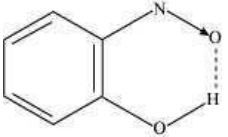
$(ii)$ Intramolecular $H$-bond,e.g.,$o$-nitrophenol (as shown in the structure).
Hydrogen bonds are stronger than van der Waals forces because hydrogen bonds are considered an extreme form of dipole-dipole interaction.
Due to the difference in electronegativities,the bond pair between hydrogen and the electronegative atom is shifted away from the hydrogen atom. As a result,the hydrogen atom acquires a partial positive charge $(H^{\delta+})$ and the electronegative atom acquires a partial negative charge $(X^{\delta-})$.
$H^{\delta+} - X^{\delta-} \dots\dots H^{\delta+} - X^{\delta-} \dots\dots H^{\delta+} - X^{\delta-}$
The magnitude of $H$-bonding is maximum in the solid state and minimum in the gaseous state.
There are two types of $H$-bonds:
$(i)$ Intermolecular $H$-bond,e.g.,$HF$,$H_2O$.
$(ii)$ Intramolecular $H$-bond,e.g.,$o$-nitrophenol (as shown in the structure).
Hydrogen bonds are stronger than van der Waals forces because hydrogen bonds are considered an extreme form of dipole-dipole interaction.
0 likes
View Solution163
Medium
Explain: Hydrogen Bond and Thermal Energy.
Solution
(N/A) Hydrogen Bond: The attractive force present between a partially positive $\delta^{+}$ hydrogen atom and a partially negative electronegative atom (like $N, O, F$) in molecules is known as a Hydrogen Bond.
Examples: $(i)$ $N-H$ of $NH_{3}$,$(ii)$ $O-H$ of $H_{2}O$,$C_{2}H_{5}OH$,$C_{6}H_{5}OH$,$(iii)$ $H-F$ of $HF$.
Characteristics:
$\Rightarrow$ Although hydrogen bonding is primarily limited to $N, O, F$,other electronegative species like $Cl$ can sometimes participate.
$\Rightarrow$ The energy of a hydrogen bond varies between $10$ to $100 \ kJ \ mol^{-1}$.
$\Rightarrow$ This is a significant amount of energy,making hydrogen bonds powerful forces in determining the structure and properties of many compounds,such as proteins and nucleic acids.
$\Rightarrow$ The strength of the $H$-bond is determined by the coulombic interaction between the lone-pair electrons of the electronegative atom of one molecule and the hydrogen atom of another molecule.
$\Rightarrow$ As the distance between molecules in the same substance increases,the strength of the $H$-bond decreases (e.g.,$Solid$ $\rightarrow Liquid$ $\rightarrow Gas$).
Thermal Energy: Thermal energy is the energy of a body arising from the motion of its atoms or molecules.
$\Rightarrow$ It is directly proportional to the temperature of the substance.
$\Rightarrow$ It is a measure of the average kinetic energy of the particles of matter and is responsible for the movement of particles.
Examples: $(i)$ $N-H$ of $NH_{3}$,$(ii)$ $O-H$ of $H_{2}O$,$C_{2}H_{5}OH$,$C_{6}H_{5}OH$,$(iii)$ $H-F$ of $HF$.
Characteristics:
$\Rightarrow$ Although hydrogen bonding is primarily limited to $N, O, F$,other electronegative species like $Cl$ can sometimes participate.
$\Rightarrow$ The energy of a hydrogen bond varies between $10$ to $100 \ kJ \ mol^{-1}$.
$\Rightarrow$ This is a significant amount of energy,making hydrogen bonds powerful forces in determining the structure and properties of many compounds,such as proteins and nucleic acids.
$\Rightarrow$ The strength of the $H$-bond is determined by the coulombic interaction between the lone-pair electrons of the electronegative atom of one molecule and the hydrogen atom of another molecule.
$\Rightarrow$ As the distance between molecules in the same substance increases,the strength of the $H$-bond decreases (e.g.,$Solid$ $\rightarrow Liquid$ $\rightarrow Gas$).
Thermal Energy: Thermal energy is the energy of a body arising from the motion of its atoms or molecules.
$\Rightarrow$ It is directly proportional to the temperature of the substance.
$\Rightarrow$ It is a measure of the average kinetic energy of the particles of matter and is responsible for the movement of particles.
0 likes
View Solution164
Medium
What is a hydrogen bond? Explain its characteristics with examples.
Solution
(N/A) hydrogen bond is an attractive force present between a partially positive $H^{\delta+}$ ion and a partially negative atom (like $N, O, F$) in molecules.
Examples: $(i)$ $N-H$ bond in $NH_3$,$(ii)$ $O-H$ bond in $H_2O, C_2H_5OH, C_6H_5OH$,$(iii)$ $H-F$ bond in $HF$,$(iv)$ $o-$chlorophenol.
Characteristics:
$\Rightarrow$ Although hydrogen bonding is primarily limited to $N, O, F$,species such as $Cl$ may also participate in hydrogen bonding under specific conditions.
$\Rightarrow$ The energy of a hydrogen bond varies between $10$ to $100 \ kJ \ mol^{-1}$.
$\Rightarrow$ This is a significant amount of energy; therefore,hydrogen bonds are a powerful force in determining the structure and properties of many compounds,such as proteins and nucleic acids.
$\Rightarrow$ The strength of the hydrogen bond is determined by the coulombic interaction between the lone-pair electrons of the electronegative atom of one molecule and the hydrogen atom of another molecule.
$\Rightarrow$ As the distance between molecules in the same substance increases,the strength of the hydrogen bond decreases (e.g.,$Solid$ $\rightarrow Liquid$ $\rightarrow Gas$).
Examples: $(i)$ $N-H$ bond in $NH_3$,$(ii)$ $O-H$ bond in $H_2O, C_2H_5OH, C_6H_5OH$,$(iii)$ $H-F$ bond in $HF$,$(iv)$ $o-$chlorophenol.
Characteristics:
$\Rightarrow$ Although hydrogen bonding is primarily limited to $N, O, F$,species such as $Cl$ may also participate in hydrogen bonding under specific conditions.
$\Rightarrow$ The energy of a hydrogen bond varies between $10$ to $100 \ kJ \ mol^{-1}$.
$\Rightarrow$ This is a significant amount of energy; therefore,hydrogen bonds are a powerful force in determining the structure and properties of many compounds,such as proteins and nucleic acids.
$\Rightarrow$ The strength of the hydrogen bond is determined by the coulombic interaction between the lone-pair electrons of the electronegative atom of one molecule and the hydrogen atom of another molecule.
$\Rightarrow$ As the distance between molecules in the same substance increases,the strength of the hydrogen bond decreases (e.g.,$Solid$ $\rightarrow Liquid$ $\rightarrow Gas$).
0 likes
View Solution165
Easy
Would you expect the hydrides of $N$,$O$ and $F$ to have lower boiling points than the hydrides of their subsequent group members? Give reasons.
Solution
(N/A) Based on molecular masses,the boiling points of $NH_{3}$,$H_{2}O$ and $HF$ would be expected to be lower than those of the hydrides of their subsequent group members (e.g.,$PH_{3}$,$H_{2}S$,$HCl$).
However,due to the high electronegativity of $N$,$O$ and $F$ atoms,these hydrides exhibit strong intermolecular hydrogen bonding.
This hydrogen bonding leads to molecular association,which significantly increases the energy required to vaporize these substances.
Consequently,the boiling points of $NH_{3}$,$H_{2}O$ and $HF$ are actually higher than those of the hydrides of their subsequent group members.
However,due to the high electronegativity of $N$,$O$ and $F$ atoms,these hydrides exhibit strong intermolecular hydrogen bonding.
This hydrogen bonding leads to molecular association,which significantly increases the energy required to vaporize these substances.
Consequently,the boiling points of $NH_{3}$,$H_{2}O$ and $HF$ are actually higher than those of the hydrides of their subsequent group members.
0 likes
View Solution166
Medium
Among $NH_{3}$,$H_{2}O$,and $HF$,which would you expect to have the highest magnitude of hydrogen bonding and why?
Solution
(B) The extent of hydrogen bonding depends on the electronegativity of the atom and the number of hydrogen atoms available for bonding.
Although fluorine is the most electronegative,the actual order of the extent of hydrogen bonding is $H_{2}O > HF > NH_{3}$.
In $H_{2}O$,each oxygen atom has two lone pairs and two hydrogen atoms,allowing it to form a three-dimensional network structure. This results in the highest magnitude of hydrogen bonding.
In $HF$,there is only one hydrogen atom per fluorine atom,which limits the bonding to a linear chain structure.
In $NH_{3}$,nitrogen has only one lone pair,which limits its ability to form extensive hydrogen bonds compared to water and $HF$.
Although fluorine is the most electronegative,the actual order of the extent of hydrogen bonding is $H_{2}O > HF > NH_{3}$.
In $H_{2}O$,each oxygen atom has two lone pairs and two hydrogen atoms,allowing it to form a three-dimensional network structure. This results in the highest magnitude of hydrogen bonding.
In $HF$,there is only one hydrogen atom per fluorine atom,which limits the bonding to a linear chain structure.
In $NH_{3}$,nitrogen has only one lone pair,which limits its ability to form extensive hydrogen bonds compared to water and $HF$.
0 likes
View Solution167
EasyMCQ
$PH_3$ has a lower boiling point than $NH_3$. Why?
A
Due to higher molecular weight of $PH_3$.
B
Due to the presence of hydrogen bonding in $NH_3$.
C
Due to the presence of hydrogen bonding in $PH_3$.
D
Due to the difference in bond angles.
Solution
(B) $NH_3$ molecules are associated through intermolecular hydrogen bonding due to the high electronegativity of nitrogen.
$PH_3$ molecules do not exhibit hydrogen bonding because phosphorus has low electronegativity.
Therefore,$PH_3$ has a lower boiling point than $NH_3$.
$PH_3$ molecules do not exhibit hydrogen bonding because phosphorus has low electronegativity.
Therefore,$PH_3$ has a lower boiling point than $NH_3$.
0 likes
View Solution168
Medium
Why is $H_2O$ a liquid and $H_2S$ a gas?
Solution
(N/A) $H_2O$ has oxygen as the central atom. Oxygen has a smaller size and higher electronegativity compared to sulphur. Therefore,there is extensive hydrogen bonding in $H_2O$,which is absent in $H_2S$. Molecules of $H_2S$ are held together only by weak van der Waal's forces of attraction.
Hence,$H_2O$ exists as a liquid while $H_2S$ exists as a gas.
Hence,$H_2O$ exists as a liquid while $H_2S$ exists as a gas.
0 likes
View Solution169
MediumMCQ
Why does $NH_{3}$ form hydrogen bond but $PH_{3}$ does not?
A
Due to the larger size of $N$ atom.
B
Due to the high electronegativity and small size of $N$ atom.
C
Due to the presence of lone pair on $P$ atom.
D
Due to the low electronegativity of $H$ atom.
Solution
(B) Hydrogen bonding occurs when hydrogen is covalently bonded to a highly electronegative atom like $N$,$O$,or $F$.
Nitrogen $(N)$ has a high electronegativity $(3.04)$ and a small atomic size,which allows it to polarize the $N-H$ bond significantly,leading to strong hydrogen bonding in $NH_{3}$.
In contrast,phosphorus $(P)$ has a much lower electronegativity $(2.19)$,which is similar to that of hydrogen.
Therefore,the $P-H$ bond is not sufficiently polarized to form hydrogen bonds in $PH_{3}$.
Nitrogen $(N)$ has a high electronegativity $(3.04)$ and a small atomic size,which allows it to polarize the $N-H$ bond significantly,leading to strong hydrogen bonding in $NH_{3}$.
In contrast,phosphorus $(P)$ has a much lower electronegativity $(2.19)$,which is similar to that of hydrogen.
Therefore,the $P-H$ bond is not sufficiently polarized to form hydrogen bonds in $PH_{3}$.
0 likes
View Solution170
Medium
Explain why,in spite of having nearly the same electronegativity,oxygen forms hydrogen bonding while chlorine does not.
Solution
(N/A) Both chlorine and oxygen have almost the same electronegativity values ($3.44$ for $O$ and $3.16$ for $Cl$),but chlorine rarely forms hydrogen bonding. This is because,in comparison to chlorine,oxygen has a much smaller atomic size. As a result,oxygen has a higher electron density per unit volume,which allows it to exert a stronger electrostatic attraction on the hydrogen atom of another molecule,facilitating the formation of hydrogen bonds.
0 likes
View Solution171
MediumMCQ
Water,Ethanol,and Ether are all liquids at room temperature; why do their boiling points differ?
A
Due to differences in molecular weight.
B
Due to differences in the strength of intermolecular forces.
C
Due to differences in their density.
D
Due to differences in their chemical reactivity.
Solution
(B) The boiling point of a liquid depends on the strength of the intermolecular forces holding the molecules together.
$1$. Water $(H_2O)$ exhibits strong hydrogen bonding,leading to a high boiling point of $100 \ ^\circ C$.
$2$. Ethanol $(C_2H_5OH)$ also exhibits hydrogen bonding,but it is weaker than in water due to the presence of the hydrophobic ethyl group,resulting in a boiling point of $78 \ ^\circ C$.
$3$. Diethyl ether $((C_2H_5)_2O)$ lacks hydrogen bonding and is held together by weaker dipole-dipole interactions,resulting in a much lower boiling point of $34.6 \ ^\circ C$.
Therefore,the difference in boiling points is primarily due to the varying strength of intermolecular forces.
$1$. Water $(H_2O)$ exhibits strong hydrogen bonding,leading to a high boiling point of $100 \ ^\circ C$.
$2$. Ethanol $(C_2H_5OH)$ also exhibits hydrogen bonding,but it is weaker than in water due to the presence of the hydrophobic ethyl group,resulting in a boiling point of $78 \ ^\circ C$.
$3$. Diethyl ether $((C_2H_5)_2O)$ lacks hydrogen bonding and is held together by weaker dipole-dipole interactions,resulting in a much lower boiling point of $34.6 \ ^\circ C$.
Therefore,the difference in boiling points is primarily due to the varying strength of intermolecular forces.
0 likes
View Solution172
Easy
The molar enthalpy of vaporisation of acetone is less than that of water. Why?
Solution
(N/A) The amount of heat required to vaporise one mole of a liquid at constant temperature and under standard pressure $(1 \ bar)$ is called its molar enthalpy of vaporisation,denoted as $\Delta_{vap} H^{\ominus}$.
The molar enthalpy of vaporisation of water is higher than that of acetone because there is strong intermolecular hydrogen bonding present in $H_{2}O$ molecules,whereas acetone molecules are held together by weaker dipole-dipole interactions.
The molar enthalpy of vaporisation of water is higher than that of acetone because there is strong intermolecular hydrogen bonding present in $H_{2}O$ molecules,whereas acetone molecules are held together by weaker dipole-dipole interactions.
0 likes
View Solution173
EasyMCQ
Why is the boiling point of $H_2O$ higher than that of $H_2S$?
A
$H_2O$ has stronger covalent bonds.
B
$H_2O$ molecules are associated through intermolecular hydrogen bonding.
C
$H_2S$ has a higher molecular weight.
D
$H_2S$ has stronger van der Waals forces.
Solution
(B) The boiling point of $H_2O$ is significantly higher than that of $H_2S$ because $H_2O$ molecules are associated through intermolecular hydrogen bonding.
In contrast,$H_2S$ molecules are held together only by weak van der Waals forces,which require less energy to overcome.
In contrast,$H_2S$ molecules are held together only by weak van der Waals forces,which require less energy to overcome.
0 likes
View Solution174
EasyMCQ
$BO_3$ units in boric acid are linked by which type of bond?
A
Ionic bond
B
Covalent bond
C
Hydrogen bond
D
Metallic bond
Solution
(C) In the solid state,boric acid $(H_3BO_3)$ consists of planar $BO_3$ units. These units are linked together by $H$-bonds to form a two-dimensional layered structure.
0 likes
View Solution175
Medium
Out of $o$-nitrophenol and $p$-nitrophenol,which is more volatile?
Solution
(A) $o$-Nitrophenol is more volatile because of intramolecular $H$-bonding (chelation),whereas intermolecular $H$-bonding is present in $p$-nitrophenol.
Thus,$p$-nitrophenol is associated with other molecules through $H$-bonding,which results in a higher boiling point compared to $o$-nitrophenol.
Thus,$p$-nitrophenol is associated with other molecules through $H$-bonding,which results in a higher boiling point compared to $o$-nitrophenol.
0 likes
View Solution176
Medium
Define hydrogen bond. Is it weaker or stronger than the van der Waals forces?
Solution
(N/A) Definition: Nitrogen,oxygen,and fluorine are highly electronegative elements. When they are attached to a hydrogen atom to form a covalent bond,the electrons of the covalent bond are shifted towards the more electronegative atom.
This partially positively charged hydrogen atom $(H^{+\delta})$ forms a bond with another electronegative atom. This bond is known as a hydrogen bond.
In short: Hydrogen bond is represented as $H^{+\delta} \dots X^{-\delta}$ (where,$X = N, O, F, Cl$ etc.).
It is represented by a dotted line.
Hydrogen bond can be defined as the attractive force which binds the hydrogen atom of one molecule with the electronegative atom ($F, O, N$ or $Cl$) of another molecule.
Normally,van der Waals forces are weaker than hydrogen bonds.
Hydrogen bond energy is approximately $40 \ kJ \ mol^{-1}$,while van der Waals forces are typically less than $10 \ kJ \ mol^{-1}$.
This partially positively charged hydrogen atom $(H^{+\delta})$ forms a bond with another electronegative atom. This bond is known as a hydrogen bond.
In short: Hydrogen bond is represented as $H^{+\delta} \dots X^{-\delta}$ (where,$X = N, O, F, Cl$ etc.).
It is represented by a dotted line.
Hydrogen bond can be defined as the attractive force which binds the hydrogen atom of one molecule with the electronegative atom ($F, O, N$ or $Cl$) of another molecule.
Normally,van der Waals forces are weaker than hydrogen bonds.
Hydrogen bond energy is approximately $40 \ kJ \ mol^{-1}$,while van der Waals forces are typically less than $10 \ kJ \ mol^{-1}$.
0 likes
View Solution177
Difficult
How is a hydrogen bond formed? Give the reason for the formation of a hydrogen bond with an example.
Solution
(N/A) hydrogen bond is formed when a hydrogen atom is covalently bonded to a highly electronegative atom $(X)$ such as $N, O,$ or $F$.
Reason for formation: When hydrogen is bonded to a strongly electronegative element '$X$',the shared electron pair is pulled towards the electronegative atom. This causes the hydrogen atom to acquire a partial positive charge $(+\delta)$ and the electronegative atom to acquire a partial negative charge $(-\delta)$. This creates a dipole,and the electrostatic force of attraction between the partial positive hydrogen of one molecule and the partial negative electronegative atom of another molecule is called a hydrogen bond.
Representation: $A$ hydrogen bond is represented by a dotted line $(\ldots)$,while a solid line $(-)$ represents a covalent bond.
Example: In hydrogen fluoride $(HF)$,the interaction is represented as: $H^{\delta+} - F^{\delta-} \ldots \ldots H^{\delta+} - F^{\delta-}$
Reason for formation: When hydrogen is bonded to a strongly electronegative element '$X$',the shared electron pair is pulled towards the electronegative atom. This causes the hydrogen atom to acquire a partial positive charge $(+\delta)$ and the electronegative atom to acquire a partial negative charge $(-\delta)$. This creates a dipole,and the electrostatic force of attraction between the partial positive hydrogen of one molecule and the partial negative electronegative atom of another molecule is called a hydrogen bond.
Representation: $A$ hydrogen bond is represented by a dotted line $(\ldots)$,while a solid line $(-)$ represents a covalent bond.
Example: In hydrogen fluoride $(HF)$,the interaction is represented as: $H^{\delta+} - F^{\delta-} \ldots \ldots H^{\delta+} - F^{\delta-}$
0 likes
View Solution178
Medium
State the factors affecting the strength of a hydrogen bond.
Solution
(N/A) The strength of a hydrogen bond is primarily affected by the following factors:
$1$. $\text{Electronegativity}$: The strength of the $H$-bond depends on the electronegativity of the atom bonded to the hydrogen atom. As the electronegativity of the atom decreases,the strength of the $H$-bond decreases.
$2$. $\text{Physical state}$: The strength of the $H$-bond is influenced by the intermolecular distance. In the solid state,the intermolecular distance is the smallest,leading to the strongest $H$-bonding,whereas in the gaseous state,the distance is the largest,leading to the weakest $H$-bonding.
For example,the strength of $H$-bonding in water follows the order:
$(H_2O_{(s)} \text{ (Ice)}) > (H_2O_{(l)} \text{ (Water)}) > (H_2O_{(g)} \text{ (Vapour)})$.
$1$. $\text{Electronegativity}$: The strength of the $H$-bond depends on the electronegativity of the atom bonded to the hydrogen atom. As the electronegativity of the atom decreases,the strength of the $H$-bond decreases.
$2$. $\text{Physical state}$: The strength of the $H$-bond is influenced by the intermolecular distance. In the solid state,the intermolecular distance is the smallest,leading to the strongest $H$-bonding,whereas in the gaseous state,the distance is the largest,leading to the weakest $H$-bonding.
For example,the strength of $H$-bonding in water follows the order:
$(H_2O_{(s)} \text{ (Ice)}) > (H_2O_{(l)} \text{ (Water)}) > (H_2O_{(g)} \text{ (Vapour)})$.
0 likes
View Solution179
Difficult
Explain the types of Hydrogen bond,provide examples,and discuss their effect on physical properties.
Solution
(N/A) Hydrogen bonding is a special type of dipole-dipole attraction between a hydrogen atom covalently bonded to a highly electronegative atom (like $F$,$O$,or $N$) and another electronegative atom in the same or a different molecule.
$1$. Intermolecular Hydrogen Bonding:
- It occurs between two different molecules of the same or different compounds.
- Example: Liquid $HF$ or $H_2O$.
- Effect: It leads to association of molecules,resulting in higher melting and boiling points.
$2$. Intramolecular Hydrogen Bonding:
- It occurs when a hydrogen atom is bonded to a highly electronegative atom and is attracted to another electronegative atom present within the same molecule.
- Example: $o$-Nitrophenol.
- Effect: It results in chelation,which generally decreases the boiling point compared to its isomers due to reduced intermolecular association.
$1$. Intermolecular Hydrogen Bonding:
- It occurs between two different molecules of the same or different compounds.
- Example: Liquid $HF$ or $H_2O$.
- Effect: It leads to association of molecules,resulting in higher melting and boiling points.
$2$. Intramolecular Hydrogen Bonding:
- It occurs when a hydrogen atom is bonded to a highly electronegative atom and is attracted to another electronegative atom present within the same molecule.
- Example: $o$-Nitrophenol.
- Effect: It results in chelation,which generally decreases the boiling point compared to its isomers due to reduced intermolecular association.
0 likes
View Solution180
Difficult
Give the difference between intermolecular hydrogen bond and intramolecular hydrogen bond.
Solution
(A) The differences between intermolecular and intramolecular hydrogen bonds are as follows:
| Feature | Intermolecular Hydrogen Bond | Intramolecular Hydrogen Bond |
| :--- | :--- | :--- |
| Definition | It is formed between two different molecules of the same or different compounds. | It is formed when a hydrogen atom is between two highly electronegative atoms present within the same molecule. |
| Example | Liquid $HF$ | $o$-Nitrophenol |
| Effect on physical properties | It increases the boiling point and melting point of the substance. | It has a lesser effect on physical properties compared to intermolecular hydrogen bonding. |
| Structural aspect | It leads to association of molecules. | It leads to chelation (ring formation) within the molecule. |
| Feature | Intermolecular Hydrogen Bond | Intramolecular Hydrogen Bond |
| :--- | :--- | :--- |
| Definition | It is formed between two different molecules of the same or different compounds. | It is formed when a hydrogen atom is between two highly electronegative atoms present within the same molecule. |
| Example | Liquid $HF$ | $o$-Nitrophenol |
| Effect on physical properties | It increases the boiling point and melting point of the substance. | It has a lesser effect on physical properties compared to intermolecular hydrogen bonding. |
| Structural aspect | It leads to association of molecules. | It leads to chelation (ring formation) within the molecule. |
0 likes
View Solution181
Medium
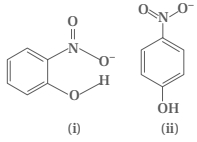
Structures of molecules of two compounds are given below:
$(a)$ Which of the two compounds will have intermolecular hydrogen bonding and which compound is expected to show intramolecular hydrogen bonding.
$(b)$ The melting point of a compound depends on,among other things,the extent of hydrogen bonding. On this basis,explain which of the above two compounds will show a higher melting point.
$(c)$ Solubility of compounds in water depends on the power to form hydrogen bonds with water. Which of the above compounds will form hydrogen bonds with water easily and be more soluble in it?
$(a)$ Which of the two compounds will have intermolecular hydrogen bonding and which compound is expected to show intramolecular hydrogen bonding.
$(b)$ The melting point of a compound depends on,among other things,the extent of hydrogen bonding. On this basis,explain which of the above two compounds will show a higher melting point.
$(c)$ Solubility of compounds in water depends on the power to form hydrogen bonds with water. Which of the above compounds will form hydrogen bonds with water easily and be more soluble in it?
Solution
(N/A) In compound $(i)$,intramolecular $H$-bonding is formed. Here,the $H$-atom is present between two highly electronegative oxygen atoms within the same molecule (ortho-nitrophenol).
In compound $(ii)$,intermolecular $H$-bonding is formed. In para-nitrophenol,there is a gap between the $NO_2$ and $OH$ groups,allowing $H$-bonding between the $H$-atom of one molecule and the $O$-atom of another molecule.
$(b)$ Compound $(ii)$ possesses a higher melting point because a large number of molecules are joined together by intermolecular $H$-bonds,requiring more energy to break.
$(c)$ Due to intramolecular $H$-bonding,compound $(i)$ is less able to form $H$-bonds with water,making it less soluble. Compound $(ii)$ can easily form $H$-bonds with $H_2O$ molecules,making it more soluble in water.
In compound $(ii)$,intermolecular $H$-bonding is formed. In para-nitrophenol,there is a gap between the $NO_2$ and $OH$ groups,allowing $H$-bonding between the $H$-atom of one molecule and the $O$-atom of another molecule.
$(b)$ Compound $(ii)$ possesses a higher melting point because a large number of molecules are joined together by intermolecular $H$-bonds,requiring more energy to break.
$(c)$ Due to intramolecular $H$-bonding,compound $(i)$ is less able to form $H$-bonds with water,making it less soluble. Compound $(ii)$ can easily form $H$-bonds with $H_2O$ molecules,making it more soluble in water.
0 likes
View Solution182
Medium
In which of the following molecules does hydrogen bonding occur? Why?
$CH_3OH, CH_3COOH, CH_4, Cl, HF, C_6H_6, NH_3, NF_3$
$CH_3OH, CH_3COOH, CH_4, Cl, HF, C_6H_6, NH_3, NF_3$
Solution
(N/A) Hydrogen bonding occurs in $CH_3OH, CH_3COOH, HF,$ and $NH_3$.
This is because these molecules contain a partially positively charged hydrogen atom $(H^{\delta+})$ bonded to a highly electronegative atom (like $O, N,$ or $F$),allowing for the formation of a hydrogen bond with another electronegative atom.
This is because these molecules contain a partially positively charged hydrogen atom $(H^{\delta+})$ bonded to a highly electronegative atom (like $O, N,$ or $F$),allowing for the formation of a hydrogen bond with another electronegative atom.
0 likes
View Solution183
Medium
Identify the type of hydrogen bonding in the following substances: Ice,Water,Liquid Ammonia,$o$-Nitrophenol,$p$-Nitrophenol.
Solution
(N/A) Intermolecular $H$-bonding: Ice,Water,Liquid Ammonia,$p$-Nitrophenol.
Intramolecular $H$-bonding: $o$-Nitrophenol.
Intramolecular $H$-bonding: $o$-Nitrophenol.
0 likes
View Solution184
Medium
Identify which molecule in each of the following pairs has stronger $H$-bonding:
$(i)$ $H_2O$ and $H_2S$
$(ii)$ $NH_3$ and $PH_3$
$(iii)$ $HF$ and $HCl$
$(i)$ $H_2O$ and $H_2S$
$(ii)$ $NH_3$ and $PH_3$
$(iii)$ $HF$ and $HCl$
Solution
(A) $(i)$ $H_2O$ has stronger $H$-bonding than $H_2S$ because oxygen is more electronegative than sulfur.
$(ii)$ $NH_3$ has stronger $H$-bonding than $PH_3$ because nitrogen is more electronegative than phosphorus.
$(iii)$ $HF$ has stronger $H$-bonding than $HCl$ because fluorine is more electronegative than chlorine.
In all cases,the strength of $H$-bonding depends on the electronegativity of the atom bonded to the hydrogen atom.
$(ii)$ $NH_3$ has stronger $H$-bonding than $PH_3$ because nitrogen is more electronegative than phosphorus.
$(iii)$ $HF$ has stronger $H$-bonding than $HCl$ because fluorine is more electronegative than chlorine.
In all cases,the strength of $H$-bonding depends on the electronegativity of the atom bonded to the hydrogen atom.
0 likes
View Solution185
Easy
What are the two main requirements for the formation of a hydrogen bond?
Solution
(N/A) $(i)$ The size of the electronegative atom should be as small as possible.
$(ii)$ The electronegativity of the atom bonded to the $H$ atom should be as high as possible.
$(ii)$ The electronegativity of the atom bonded to the $H$ atom should be as high as possible.
0 likes
View Solution186
Difficult
Use the information and data given below to answer the questions $(a)$ to $(c)$. Stronger intermolecular forces result in higher boiling point.
Strength of London forces increases with the number of electrons in the molecule.
Boiling points of $HF, HCl, HBr$ and $HI$ are $293 \ K, 189 \ K, 200 \ K$ and $238 \ K$ respectively.
$(a)$ Which type of intermolecular forces are present in the molecules $HF, HCl, HBr$ and $HI$?
$(b)$ Looking at the trend of boiling points of $HCl, HBr$ and $HI$,explain out of dipole-dipole interaction and London interaction,which one is predominant here.
$(c)$ Why is the boiling point of hydrogen fluoride highest while that of hydrogen chloride lowest?
Strength of London forces increases with the number of electrons in the molecule.
Boiling points of $HF, HCl, HBr$ and $HI$ are $293 \ K, 189 \ K, 200 \ K$ and $238 \ K$ respectively.
$(a)$ Which type of intermolecular forces are present in the molecules $HF, HCl, HBr$ and $HI$?
$(b)$ Looking at the trend of boiling points of $HCl, HBr$ and $HI$,explain out of dipole-dipole interaction and London interaction,which one is predominant here.
$(c)$ Why is the boiling point of hydrogen fluoride highest while that of hydrogen chloride lowest?
Solution
(N/A) The molecules $HF, HCl, HBr$ and $HI$ are polar,so they exhibit dipole-dipole interactions. Additionally,all molecules possess London dispersion forces.
$(b)$ For $HCl, HBr$ and $HI$,the boiling point increases as the molecular size and number of electrons increase $(HCl < HBr < HI)$. This indicates that London dispersion forces are the predominant factor influencing the boiling point trend in these hydrogen halides.
$(c)$ $HF$ has the highest boiling point due to strong intermolecular hydrogen bonding. $HCl$ has the lowest boiling point because it has the smallest molecular size and the fewest electrons among the group,resulting in the weakest London dispersion forces,and it lacks the strong hydrogen bonding present in $HF$.
$(b)$ For $HCl, HBr$ and $HI$,the boiling point increases as the molecular size and number of electrons increase $(HCl < HBr < HI)$. This indicates that London dispersion forces are the predominant factor influencing the boiling point trend in these hydrogen halides.
$(c)$ $HF$ has the highest boiling point due to strong intermolecular hydrogen bonding. $HCl$ has the lowest boiling point because it has the smallest molecular size and the fewest electrons among the group,resulting in the weakest London dispersion forces,and it lacks the strong hydrogen bonding present in $HF$.
0 likes
View Solution187
Medium
Name two intermolecular forces that exist between $HF$ molecules in the liquid state.
Solution
(N/A) $HF$ is a polar covalent molecule that exhibits dipole-dipole interactions due to the electronegativity difference between $H$ and $F$. Additionally,because $F$ is a highly electronegative atom bonded to $H$,$HF$ molecules also exhibit hydrogen bonding. Therefore,the two intermolecular forces present between $HF$ molecules in the liquid state are $1.$ Hydrogen bonding and $2.$ Dipole-dipole interactions.
0 likes
View Solution188
Medium
Viscosity of a liquid arises due to strong intermolecular forces existing between the molecules. Stronger the intermolecular forces,greater is the viscosity. Name the intermolecular forces existing in the following liquids and arrange them in the increasing order of their viscosities. Also give reason for the assigned order in one line.
Water,hexane $(CH_3CH_2CH_2CH_2CH_2CH_3)$,glycerine $(CH_2OHCH(OH)CH_2OH)$
Water,hexane $(CH_3CH_2CH_2CH_2CH_2CH_3)$,glycerine $(CH_2OHCH(OH)CH_2OH)$
Solution
(N/A) $1$. $H_2O$ and glycerine: Hydrogen bonding and dipole-dipole interactions are present due to their polar nature.
$2$. Hexane: Only weak London dispersion forces exist due to its non-polar nature.
$3$. Order of intermolecular forces: $\text{hexane} < \text{water} < \text{glycerine}$.
$4$. Since viscosity is directly proportional to the strength of intermolecular forces,the increasing order of viscosity is: $\text{hexane} < \text{water} < \text{glycerine}$.
$2$. Hexane: Only weak London dispersion forces exist due to its non-polar nature.
$3$. Order of intermolecular forces: $\text{hexane} < \text{water} < \text{glycerine}$.
$4$. Since viscosity is directly proportional to the strength of intermolecular forces,the increasing order of viscosity is: $\text{hexane} < \text{water} < \text{glycerine}$.
0 likes
View Solution189
MediumMCQ
What type of force is a hydrogen bond?
A
Covalent bond
B
Ionic bond
C
Special dipole-dipole interaction
D
London dispersion force
Solution
(C) hydrogen bond is a special type of dipole-dipole interaction force that occurs when a hydrogen atom is covalently bonded to a highly electronegative atom (like $F, O,$ or $N$) and is attracted to another electronegative atom.
0 likes
View Solution190
MediumMCQ
What is the energy of a hydrogen bond?
A
$10-100 \ kJ \ mol^{-1}$
B
$100-200 \ kJ \ mol^{-1}$
C
$200-300 \ kJ \ mol^{-1}$
D
$300-400 \ kJ \ mol^{-1}$
Solution
(A) The energy of a hydrogen bond typically ranges from $10$ to $100 \ kJ \ mol^{-1}$.
0 likes
View Solution191
EasyMCQ
Between ethanol and water,which one has higher viscosity and why?
A
Ethanol,due to stronger intermolecular forces.
B
Water,due to stronger hydrogen bonding.
C
Ethanol,due to higher molecular weight.
D
Water,due to lower surface tension.
Solution
(B) Water has a higher viscosity than ethanol.
This is because water molecules form a more extensive and stronger network of hydrogen bonds compared to ethanol molecules,which increases the internal resistance to flow.
This is because water molecules form a more extensive and stronger network of hydrogen bonds compared to ethanol molecules,which increases the internal resistance to flow.
0 likes
View Solution192
Easy
Explain why $HCl$ is a gas and $HF$ is a liquid?
Solution
(N/A) Due to the higher electronegativity of $F$ compared to $Cl$,$HF$ molecules undergo strong intermolecular $H$-bonding.
In contrast,$HCl$ molecules do not exhibit significant $H$-bonding.
As a result,$HF$ has a much higher boiling point than $HCl$.
Therefore,$HF$ exists as a liquid at room temperature,whereas $HCl$ exists as a gas.
In contrast,$HCl$ molecules do not exhibit significant $H$-bonding.
As a result,$HF$ has a much higher boiling point than $HCl$.
Therefore,$HF$ exists as a liquid at room temperature,whereas $HCl$ exists as a gas.
0 likes
View Solution193
Easy
Why does water show a high boiling point compared to hydrogen sulphide? Give reasons for your answer.
Solution
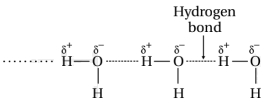
(N/A) Water shows a high boiling point compared to hydrogen sulphide due to the high electronegativity of oxygen $(EN = 3.5)$. Water undergoes extensive $H$-bonding,as a result of which water exists as associated molecules.
To break these hydrogen bonds,a large amount of energy is required; so,the boiling point of $H_2O$ is high. In contrast,due to the lower electronegativity of $S$,hydrogen sulphide does not undergo hydrogen bonding. $H_2S$ exists as discrete molecules and hence its boiling point is much lower than that of $H_2O$. That is why $H_2S$ is a gas at room temperature.
To break these hydrogen bonds,a large amount of energy is required; so,the boiling point of $H_2O$ is high. In contrast,due to the lower electronegativity of $S$,hydrogen sulphide does not undergo hydrogen bonding. $H_2S$ exists as discrete molecules and hence its boiling point is much lower than that of $H_2O$. That is why $H_2S$ is a gas at room temperature.
0 likes
View Solution194
DifficultMCQ
$o-$Nitrophenol is less soluble in water than $p-$ and $m-$nitrophenols because:
A
$o-$Nitrophenol is more volatile than $m-$ and $p-$ isomers.
B
$o-$Nitrophenol shows intramolecular $H-$bonding.
C
$o-$Nitrophenol shows intermolecular $H-$bonding.
D
Melting point of $o-$nitrophenol is lower than those of $m-$ and $p-$ isomers.
Solution
(B) In $o-$nitrophenol,the $-OH$ group forms an intramolecular hydrogen bond with the adjacent nitro group.
This makes the $-OH$ group unavailable for intermolecular hydrogen bonding with water molecules.
Consequently,$o-$nitrophenol exhibits lower solubility in water compared to $m-$ and $p-$nitrophenols,which form intermolecular hydrogen bonds with water.
This makes the $-OH$ group unavailable for intermolecular hydrogen bonding with water molecules.
Consequently,$o-$nitrophenol exhibits lower solubility in water compared to $m-$ and $p-$nitrophenols,which form intermolecular hydrogen bonds with water.
0 likes
View Solution195
EasyMCQ
Given below are two statements: one is labelled as Assertion $A$ and the other is labelled as Reason $R$.
Assertion $A$: Dipole-dipole interactions are the only non-covalent interactions resulting in hydrogen bond formation.
Reason $R$: Fluorine is the most electronegative element and hydrogen bonds in $HF$ are symmetrical.
Assertion $A$: Dipole-dipole interactions are the only non-covalent interactions resulting in hydrogen bond formation.
Reason $R$: Fluorine is the most electronegative element and hydrogen bonds in $HF$ are symmetrical.
A
$A$ is false but $R$ is true
B
Both $A$ and $R$ are true and $R$ is the correct explanation of $A$
C
$A$ is true but $R$ is false
D
Both $A$ and $R$ are true but $R$ is $NOT$ the correct explanation of $A$
Solution
(A) Assertion $A$ is false. Hydrogen bonding is a special type of dipole-dipole interaction,but it is not the only non-covalent interaction that can be involved in molecular associations. Furthermore,the statement implies that only dipole-dipole interactions form hydrogen bonds,which is a restrictive definition.
Reason $R$ is true. Fluorine is indeed the most electronegative element. In the solid state,$HF$ molecules form a zig-zag chain structure where the hydrogen bonds are symmetrical,represented as $[F-H...F]^-$. The hydrogen atom is located symmetrically between two fluorine atoms.
Reason $R$ is true. Fluorine is indeed the most electronegative element. In the solid state,$HF$ molecules form a zig-zag chain structure where the hydrogen bonds are symmetrical,represented as $[F-H...F]^-$. The hydrogen atom is located symmetrically between two fluorine atoms.
0 likes
View Solution196
EasyMCQ
Given below are two statements:
Statement $I$: $o$-Nitrophenol is steam volatile due to intramolecular hydrogen bonding.
Statement $II$: $o$-Nitrophenol has a high melting point due to hydrogen bonding.
In the light of the above statements,choose the most appropriate answer from the options given below:
Statement $I$: $o$-Nitrophenol is steam volatile due to intramolecular hydrogen bonding.
Statement $II$: $o$-Nitrophenol has a high melting point due to hydrogen bonding.
In the light of the above statements,choose the most appropriate answer from the options given below:
A
Statement $I$ is false but Statement $II$ is true
B
Both statement $I$ and statement $II$ are true
C
Both statement $I$ and statement $II$ are false
D
Statement $I$ is true but statement $II$ is false
Solution
(D) $o$-Nitrophenol exhibits intramolecular hydrogen bonding,which reduces the intermolecular forces of attraction between its molecules. This makes it steam volatile.
Conversely,$p$-Nitrophenol exhibits intermolecular hydrogen bonding,leading to association of molecules and a higher melting point. $o$-Nitrophenol has a relatively low melting point compared to its isomers due to the lack of intermolecular hydrogen bonding.
Therefore,Statement $I$ is true and Statement $II$ is false.
Conversely,$p$-Nitrophenol exhibits intermolecular hydrogen bonding,leading to association of molecules and a higher melting point. $o$-Nitrophenol has a relatively low melting point compared to its isomers due to the lack of intermolecular hydrogen bonding.
Therefore,Statement $I$ is true and Statement $II$ is false.
0 likes
View Solution197
EasyMCQ
The compound/s which will show significant intermolecular $H$-bonding is/are :
$(a)$ $o$-Nitrophenol
$(b)$ $N$-($4$-hydroxyphenyl)acetamide
$(c)$ $2,6$-di-tert-butylphenol
$(a)$ $o$-Nitrophenol
$(b)$ $N$-($4$-hydroxyphenyl)acetamide
$(c)$ $2,6$-di-tert-butylphenol
A
$b$ only
B
$c$ only
C
$a$ and $b$ only
D
$a, b$ and $c$
Solution
(A) ($o$-Nitrophenol) shows strong intramolecular $H$-bonding due to the proximity of the $-OH$ and $-NO_2$ groups,which prevents intermolecular $H$-bonding.
$b$ ($N$-($4$-hydroxyphenyl)acetamide) contains both $-OH$ and $-NH-$ groups,which are capable of forming significant intermolecular $H$-bonding with other molecules.
$c$ ($2,6$-di-tert-butylphenol) has two bulky tert-butyl groups at the ortho positions,which create significant steric hindrance around the $-OH$ group,preventing it from participating in intermolecular $H$-bonding.
Therefore,only compound $b$ shows significant intermolecular $H$-bonding.
$b$ ($N$-($4$-hydroxyphenyl)acetamide) contains both $-OH$ and $-NH-$ groups,which are capable of forming significant intermolecular $H$-bonding with other molecules.
$c$ ($2,6$-di-tert-butylphenol) has two bulky tert-butyl groups at the ortho positions,which create significant steric hindrance around the $-OH$ group,preventing it from participating in intermolecular $H$-bonding.
Therefore,only compound $b$ shows significant intermolecular $H$-bonding.
0 likes
View Solution198
EasyMCQ
The correct order of increasing intermolecular hydrogen bond strength is .... .
A
$HCN < H_2O < NH_3$
B
$HCN < CH_4 < NH_3$
C
$CH_4 < HCN < NH_3$
D
$CH_4 < NH_3 < HCN$
Solution
(C) The strength of hydrogen bonding depends on the electronegativity of the atom bonded to hydrogen and the number of hydrogen bonds formed.
$CH_4$ is a non-polar molecule and does not form hydrogen bonds.
$HCN$ exhibits weak hydrogen bonding due to the electronegativity of nitrogen.
$NH_3$ forms stronger hydrogen bonds compared to $HCN$ due to the higher electron density on the nitrogen atom and the availability of lone pairs.
Therefore,the correct order of increasing strength is $CH_4 < HCN < NH_3$.
$CH_4$ is a non-polar molecule and does not form hydrogen bonds.
$HCN$ exhibits weak hydrogen bonding due to the electronegativity of nitrogen.
$NH_3$ forms stronger hydrogen bonds compared to $HCN$ due to the higher electron density on the nitrogen atom and the availability of lone pairs.
Therefore,the correct order of increasing strength is $CH_4 < HCN < NH_3$.
0 likes
View Solution199
MediumMCQ
The molecule which does not exhibit strong hydrogen bonding is
A
methyl amine
B
acetic acid
C
diethyl ether
D
glucose
Solution
(C) . Hydrogen bonding occurs in a molecule when a hydrogen atom is directly linked to a highly electronegative atom like $F$,$O$,or $N$. In the case of diethyl ether $(C_2H_5-O-C_2H_5)$,the hydrogen atoms are bonded to carbon atoms,not to the oxygen atom. Therefore,it does not exhibit strong hydrogen bonding.
0 likes
View Solution200
DifficultMCQ
Select the compound from the following that will show intramolecular hydrogen bonding.
A
$H_2O$
B
$NH_3$
C
$C_2H_5OH$
D
$o$-nitrophenol
Solution
(D) $H_2O$,$NH_3$,and $C_2H_5OH$ exhibit intermolecular hydrogen bonding.
In $o$-nitrophenol,the hydrogen atom of the hydroxyl group is close to the oxygen atom of the nitro group,which leads to the formation of a stable six-membered ring through intramolecular hydrogen bonding.
In $o$-nitrophenol,the hydrogen atom of the hydroxyl group is close to the oxygen atom of the nitro group,which leads to the formation of a stable six-membered ring through intramolecular hydrogen bonding.
0 likes
View SolutionChemical Bonding and Molecular Structure — Hydrogen bonding · Frequently Asked Questions
1Are these Chemical Bonding and Molecular Structure questions useful for JEE and NEET?
Yes. All questions in this section are mapped to JEE Main and NEET exam patterns. Previous year questions from JEE Main, NEET, GUJCET and state-level exams are included with full solutions.
2Can I switch to Hindi or Gujarati for these questions?
Yes. Use the language tabs in the hero section or the sidebar to view the same questions and solutions in English, Hindi or Gujarati.
3How do I generate a question paper from this subtopic?
Use the Vedclass Exam Paper Generator — select the chapter and subtopic, set difficulty, and generate Sets A, B, C, D automatically. First 3 chapters of every subject are free.
Vedclass Products
For Students
Vedclass Test Series
Mock tests in real JEE/NEET style with performance analysis. 5-day free trial.
Start Free TrialFor Teachers
Exam Paper Generator
Generate Set A/B/C/D papers from this chapter in 2 minutes. 3 chapters free.
Try FreeFor Institutes
Online Exam Module
Live online exams with unlimited students, 360° analytics & white-label branding.
See DemoFor Teachers & Institutes
Generate a Chemical Bonding and Molecular Structure Exam Paper in 2 Minutes
Select subtopic & difficulty — Sets A, B, C, D auto-generated with No Repeat logic.
First 3 chapters of every subject are free — no payment required.