
A English
Hydrogen bonding Questions in English
Class 11 Chemistry · Chemical Bonding and Molecular Structure · Hydrogen bonding
249+
Questions
English
Language
100%
With Solutions
Showing 48 of 249 questions in English
201
MediumMCQ
The correct statement/s about Hydrogen bonding is/are:
$A$. Hydrogen bonding exists when $H$ is covalently bonded to a highly electronegative atom.
$B$. Intermolecular $H$ bonding is present in $o$-nitrophenol.
$C$. Intramolecular $H$ bonding is present in $HF$.
$D$. The magnitude of $H$ bonding depends on the physical state of the compound.
$E$. $H$-bonding has a powerful effect on the structure and properties of compounds.
Choose the correct answer from the options given below:
$A$. Hydrogen bonding exists when $H$ is covalently bonded to a highly electronegative atom.
$B$. Intermolecular $H$ bonding is present in $o$-nitrophenol.
$C$. Intramolecular $H$ bonding is present in $HF$.
$D$. The magnitude of $H$ bonding depends on the physical state of the compound.
$E$. $H$-bonding has a powerful effect on the structure and properties of compounds.
Choose the correct answer from the options given below:
A
$A$ only
B
$A, D, E$ only
C
$A, B, D$ only
D
$A, B, C$ only
Solution
(B) . Correct: Hydrogen bonding occurs when $H$ is covalently bonded to highly electronegative atoms like $F, O,$ or $N$.
$B$. Incorrect: $o$-nitrophenol exhibits intramolecular $H$-bonding,not intermolecular.
$C$. Incorrect: $HF$ exhibits intermolecular $H$-bonding,not intramolecular.
$D$. Correct: The magnitude of $H$-bonding is influenced by the physical state (e.g.,solid vs. liquid).
$E$. Correct: $H$-bonding significantly affects physical properties like melting point,boiling point,and solubility.
Therefore,statements $A, D,$ and $E$ are correct.
$B$. Incorrect: $o$-nitrophenol exhibits intramolecular $H$-bonding,not intermolecular.
$C$. Incorrect: $HF$ exhibits intermolecular $H$-bonding,not intramolecular.
$D$. Correct: The magnitude of $H$-bonding is influenced by the physical state (e.g.,solid vs. liquid).
$E$. Correct: $H$-bonding significantly affects physical properties like melting point,boiling point,and solubility.
Therefore,statements $A, D,$ and $E$ are correct.
0 likes
View Solution202
MediumMCQ
Number of molecules from the following which can exhibit hydrogen bonding is $..........$ (nearest integer).
$CH_3OH, H_2O, C_2H_6, C_6H_6, \text{o-nitrophenol}, HF, NH_3$
$CH_3OH, H_2O, C_2H_6, C_6H_6, \text{o-nitrophenol}, HF, NH_3$
A
$5$
B
$6$
C
$4$
D
$7$
Solution
(A) Hydrogen bonding occurs in molecules where hydrogen is covalently bonded to a highly electronegative atom like $F, O,$ or $N$.
$1$. $CH_3OH$: Contains $-OH$ group,exhibits $H$-bonding.
$2$. $H_2O$: Contains $O-H$ bonds,exhibits $H$-bonding.
$3$. $C_2H_6$: Only $C-H$ bonds,no $H$-bonding.
$4$. $C_6H_6$: Only $C-H$ bonds,no $H$-bonding.
$5$. $\text{o-nitrophenol}$: Contains $-OH$ group and $-NO_2$ group,exhibits intramolecular $H$-bonding.
$6$. $HF$: Contains $H-F$ bond,exhibits $H$-bonding.
$7$. $NH_3$: Contains $N-H$ bonds,exhibits $H$-bonding.
Total molecules exhibiting $H$-bonding are $CH_3OH, H_2O, \text{o-nitrophenol}, HF, NH_3$,which equals $5$.
$1$. $CH_3OH$: Contains $-OH$ group,exhibits $H$-bonding.
$2$. $H_2O$: Contains $O-H$ bonds,exhibits $H$-bonding.
$3$. $C_2H_6$: Only $C-H$ bonds,no $H$-bonding.
$4$. $C_6H_6$: Only $C-H$ bonds,no $H$-bonding.
$5$. $\text{o-nitrophenol}$: Contains $-OH$ group and $-NO_2$ group,exhibits intramolecular $H$-bonding.
$6$. $HF$: Contains $H-F$ bond,exhibits $H$-bonding.
$7$. $NH_3$: Contains $N-H$ bonds,exhibits $H$-bonding.
Total molecules exhibiting $H$-bonding are $CH_3OH, H_2O, \text{o-nitrophenol}, HF, NH_3$,which equals $5$.
0 likes
View Solution203
MediumMCQ
Intramolecular hydrogen bonding is present in
A
$p$-nitrophenol
B
$m$-nitrophenol
C
$HF$
D
$o$-nitrophenol
Solution
(D) Intramolecular hydrogen bonding occurs within a single molecule when a hydrogen atom is bonded to a highly electronegative atom (like $O$,$N$,or $F$) and is simultaneously attracted to another electronegative atom within the same molecule.
In $o$-nitrophenol,the hydroxyl group $(-OH)$ and the nitro group $(-NO_2)$ are at adjacent positions (ortho position). This allows the hydrogen atom of the $-OH$ group to form a hydrogen bond with one of the oxygen atoms of the $-NO_2$ group,resulting in a stable six-membered ring structure.
Therefore,intramolecular hydrogen bonding is present in $o$-nitrophenol.
In $o$-nitrophenol,the hydroxyl group $(-OH)$ and the nitro group $(-NO_2)$ are at adjacent positions (ortho position). This allows the hydrogen atom of the $-OH$ group to form a hydrogen bond with one of the oxygen atoms of the $-NO_2$ group,resulting in a stable six-membered ring structure.
Therefore,intramolecular hydrogen bonding is present in $o$-nitrophenol.
0 likes
View Solution204
AdvancedMCQ
$Statement-1$: $p$-Hydroxybenzoic acid has a lower boiling point than $o$-hydroxybenzoic acid.
$Statement-2$: $o$-Hydroxybenzoic acid has intramolecular hydrogen bonding.
$Statement-2$: $o$-Hydroxybenzoic acid has intramolecular hydrogen bonding.
A
$Statement-1$ is True,$Statement-2$ is True; $Statement-2$ is a correct explanation for $Statement-1$.
B
$Statement-1$ is True,$Statement-2$ is True; $Statement-2$ is $NOT$ a correct explanation for $Statement-1$.
C
$Statement-1$ is True,$Statement-2$ is False.
D
$Statement-1$ is False,$Statement-2$ is True.
Solution
(D) $o$-Hydroxybenzoic acid (salicylic acid) exhibits intramolecular hydrogen bonding,which reduces its ability to form intermolecular hydrogen bonds with other molecules.
$p$-Hydroxybenzoic acid exhibits strong intermolecular hydrogen bonding,which leads to association of molecules and consequently a higher boiling point.
Therefore,$Statement-1$ is False because $p$-hydroxybenzoic acid has a higher boiling point,and $Statement-2$ is True.
$p$-Hydroxybenzoic acid exhibits strong intermolecular hydrogen bonding,which leads to association of molecules and consequently a higher boiling point.
Therefore,$Statement-1$ is False because $p$-hydroxybenzoic acid has a higher boiling point,and $Statement-2$ is True.
0 likes
View Solution205
MediumMCQ
Hydrogen bonding plays a central role in the following phenomena:
$(A)$ Ice floats in water.
$(B)$ Higher Lewis basicity of primary amines than tertiary amines in aqueous solutions.
$(C)$ Formic acid is more acidic than acetic acid.
$(D)$ Dimerisation of acetic acid in benzene.
$(A)$ Ice floats in water.
$(B)$ Higher Lewis basicity of primary amines than tertiary amines in aqueous solutions.
$(C)$ Formic acid is more acidic than acetic acid.
$(D)$ Dimerisation of acetic acid in benzene.
A
$(B, C, D)$
B
$(A, C, D)$
C
$(A, B, D)$
D
$(A, B, C)$
Solution
(C) Ice is less dense than water due to an open crystal structure formed by $H$-bonding.
The basicity of $1^{\circ}$ amines is higher than $3^{\circ}$ amines in aqueous solutions because the conjugate acid formed after protonation $(R-NH_3^+)$ is stabilized by $H$-bonding with $H_2O$ molecules (solvation). In tertiary amines,this stabilization is significantly less due to steric hindrance.
The dimerisation of acetic acid in benzene occurs due to intermolecular $H$-bonding,forming a cyclic dimer.
Formic acid is more acidic than acetic acid primarily due to the electron-donating inductive effect ($+I$ effect) of the methyl group in acetic acid,which destabilizes the carboxylate anion. This is not a phenomenon primarily attributed to $H$-bonding.
Therefore,the phenomena involving $H$-bonding are $(A)$,$(B)$,and $(D)$.
Hence,the correct option is $(A, B, D)$.
The basicity of $1^{\circ}$ amines is higher than $3^{\circ}$ amines in aqueous solutions because the conjugate acid formed after protonation $(R-NH_3^+)$ is stabilized by $H$-bonding with $H_2O$ molecules (solvation). In tertiary amines,this stabilization is significantly less due to steric hindrance.
The dimerisation of acetic acid in benzene occurs due to intermolecular $H$-bonding,forming a cyclic dimer.
Formic acid is more acidic than acetic acid primarily due to the electron-donating inductive effect ($+I$ effect) of the methyl group in acetic acid,which destabilizes the carboxylate anion. This is not a phenomenon primarily attributed to $H$-bonding.
Therefore,the phenomena involving $H$-bonding are $(A)$,$(B)$,and $(D)$.
Hence,the correct option is $(A, B, D)$.
0 likes
View Solution206
MediumMCQ
The steam volatile compounds among the following are $:$
$(A)$ $o$-nitrophenol
$(B)$ $o$-nitroaniline
$(C)$ $p$-aminophenol
$(D)$ $p$-hydroquinone
Choose the correct answer from the options given below $:$
$(A)$ $o$-nitrophenol
$(B)$ $o$-nitroaniline
$(C)$ $p$-aminophenol
$(D)$ $p$-hydroquinone
Choose the correct answer from the options given below $:$
A
$B$ and $D$ only
B
$A$ and $C$ only
C
$A$ and $B$ only
D
$A, B$ and $C$ only
Solution
(C) Steam volatility is observed in compounds that exhibit intramolecular hydrogen bonding,which reduces intermolecular forces of attraction and increases volatility.
$(A)$ $o$-Nitrophenol exhibits intramolecular hydrogen bonding between the $-OH$ group and the $-NO_2$ group.
$(B)$ $o$-Nitroaniline exhibits intramolecular hydrogen bonding between the $-NH_2$ group and the $-NO_2$ group.
$(C)$ $p$-Aminophenol and $(D)$ $p$-hydroquinone exhibit strong intermolecular hydrogen bonding,which leads to higher boiling points and lower volatility.
Therefore,compounds $(A)$ and $(B)$ are steam volatile.
$(A)$ $o$-Nitrophenol exhibits intramolecular hydrogen bonding between the $-OH$ group and the $-NO_2$ group.
$(B)$ $o$-Nitroaniline exhibits intramolecular hydrogen bonding between the $-NH_2$ group and the $-NO_2$ group.
$(C)$ $p$-Aminophenol and $(D)$ $p$-hydroquinone exhibit strong intermolecular hydrogen bonding,which leads to higher boiling points and lower volatility.
Therefore,compounds $(A)$ and $(B)$ are steam volatile.
0 likes
View Solution207
MediumMCQ
Acetic acid exists as a dimer in benzene due to:
A
Condensation reaction
B
Hydrogen bonding
C
Presence of carboxyl group
D
None
Solution
(B) In non-polar solvents like benzene,acetic acid molecules undergo intermolecular association to form a dimer.
This association occurs due to the formation of $2$ hydrogen bonds between the two acetic acid molecules.
This leads to an abnormal molecular mass,which is double the actual molecular mass of acetic acid.
This association occurs due to the formation of $2$ hydrogen bonds between the two acetic acid molecules.
This leads to an abnormal molecular mass,which is double the actual molecular mass of acetic acid.
0 likes
View Solution208
EasyMCQ
Which among the following compounds does $NOT$ form intermolecular hydrogen bonding?
A
Ethoxy ethane
B
Butane
C
Phenol
D
Butan-$1$-$ol$
Solution
(B) Intermolecular hydrogen bonding occurs in compounds where hydrogen is covalently bonded to a highly electronegative atom like $O$,$N$,or $F$.
$1$. $Phenol$ $(C_6H_5OH)$ contains an $-OH$ group,allowing for intermolecular hydrogen bonding.
$2$. $Butan-1-ol$ $(CH_3CH_2CH_2CH_2OH)$ also contains an $-OH$ group,facilitating intermolecular hydrogen bonding.
$3$. $Ethoxy$ $ethane$ $(CH_3CH_2OCH_2CH_3)$ is an ether. While it has an oxygen atom,it lacks a hydrogen atom directly bonded to the oxygen,so it cannot form intermolecular hydrogen bonds with itself.
$4$. $Butane$ $(C_4H_{10})$ is a hydrocarbon consisting only of $C-C$ and $C-H$ bonds. Since there is no significant electronegativity difference between $C$ and $H$,it cannot form hydrogen bonds.
However,in the context of common chemistry problems,$Butane$ is a non-polar alkane that lacks any polar functional group,making it the most prominent example of a compound that cannot form hydrogen bonds compared to ethers,which have dipole-dipole interactions.
$1$. $Phenol$ $(C_6H_5OH)$ contains an $-OH$ group,allowing for intermolecular hydrogen bonding.
$2$. $Butan-1-ol$ $(CH_3CH_2CH_2CH_2OH)$ also contains an $-OH$ group,facilitating intermolecular hydrogen bonding.
$3$. $Ethoxy$ $ethane$ $(CH_3CH_2OCH_2CH_3)$ is an ether. While it has an oxygen atom,it lacks a hydrogen atom directly bonded to the oxygen,so it cannot form intermolecular hydrogen bonds with itself.
$4$. $Butane$ $(C_4H_{10})$ is a hydrocarbon consisting only of $C-C$ and $C-H$ bonds. Since there is no significant electronegativity difference between $C$ and $H$,it cannot form hydrogen bonds.
However,in the context of common chemistry problems,$Butane$ is a non-polar alkane that lacks any polar functional group,making it the most prominent example of a compound that cannot form hydrogen bonds compared to ethers,which have dipole-dipole interactions.
0 likes
View Solution209
EasyMCQ
Which of the following molecules does not develop intermolecular hydrogen bonding?
A
$H_2O$
B
$NH_3$
C
$Br_2$
D
$HF$
Solution
(C) Intermolecular hydrogen bonding occurs in molecules where a hydrogen atom is covalently bonded to a highly electronegative atom like $F$,$O$,or $N$.
In $H_2O$,$NH_3$,and $HF$,the hydrogen atom is bonded to $O$,$N$,and $F$ respectively,allowing for hydrogen bonding.
In $Br_2$,the molecule consists of two bromine atoms bonded together. Since there is no hydrogen atom bonded to a highly electronegative atom,$Br_2$ cannot form intermolecular hydrogen bonding.
Therefore,the correct option is $C$.
In $H_2O$,$NH_3$,and $HF$,the hydrogen atom is bonded to $O$,$N$,and $F$ respectively,allowing for hydrogen bonding.
In $Br_2$,the molecule consists of two bromine atoms bonded together. Since there is no hydrogen atom bonded to a highly electronegative atom,$Br_2$ cannot form intermolecular hydrogen bonding.
Therefore,the correct option is $C$.
0 likes
View Solution210
EasyMCQ
Which of the following molecules can form hydrogen bonding with itself?
A
$NH_3$
B
$C_2H_6$
C
$H_2S$
D
$CH_3-O-CH_3$
Solution
(A) Hydrogen bonding occurs when a hydrogen atom is covalently bonded to a highly electronegative atom (like $N$,$O$,or $F$).
In $NH_3$,the hydrogen atoms are bonded to a highly electronegative nitrogen atom,allowing it to form intermolecular hydrogen bonds with other $NH_3$ molecules.
$C_2H_6$ (ethane) is non-polar and lacks such bonds.
$H_2S$ does not form significant hydrogen bonds because sulfur is not electronegative enough.
$CH_3-O-CH_3$ (dimethyl ether) has an oxygen atom but lacks a hydrogen atom directly bonded to it,so it cannot form hydrogen bonds with itself.
In $NH_3$,the hydrogen atoms are bonded to a highly electronegative nitrogen atom,allowing it to form intermolecular hydrogen bonds with other $NH_3$ molecules.
$C_2H_6$ (ethane) is non-polar and lacks such bonds.
$H_2S$ does not form significant hydrogen bonds because sulfur is not electronegative enough.
$CH_3-O-CH_3$ (dimethyl ether) has an oxygen atom but lacks a hydrogen atom directly bonded to it,so it cannot form hydrogen bonds with itself.
0 likes
View Solution211
EasyMCQ
Which of the following molecules shows intramolecular hydrogen bonding?
A
Benzoic acid
B
Salicylaldehyde
C
Benzaldehyde
D
Phenol
Solution
(B) Intramolecular hydrogen bonding occurs when a stable five-membered or six-membered ring is formed within the molecule.
Benzoic acid,benzaldehyde,and phenol do not possess the necessary structural arrangement to form such rings,and thus they cannot form intramolecular hydrogen bonds.
In the case of salicylaldehyde,the hydroxyl group $(-OH)$ is ortho to the aldehyde group $(-CHO)$. This proximity allows the hydrogen atom of the hydroxyl group to form a hydrogen bond with the oxygen atom of the carbonyl group,resulting in a stable six-membered ring as shown below:
(Image: $231309-$s)
Benzoic acid,benzaldehyde,and phenol do not possess the necessary structural arrangement to form such rings,and thus they cannot form intramolecular hydrogen bonds.
In the case of salicylaldehyde,the hydroxyl group $(-OH)$ is ortho to the aldehyde group $(-CHO)$. This proximity allows the hydrogen atom of the hydroxyl group to form a hydrogen bond with the oxygen atom of the carbonyl group,resulting in a stable six-membered ring as shown below:
(Image: $231309-$s)
0 likes
View Solution212
EasyMCQ
Which of the following compounds does $NOT$ develop intermolecular hydrogen bonding?
A
Cyclohexylamine
B
Allylamine
C
Trimethylamine
D
Diphenylamine
Solution
(C) Intermolecular hydrogen bonding requires a hydrogen atom covalently bonded to a highly electronegative atom like $N$,$O$,or $F$.
Trimethylamine,$N(CH_3)_3$,contains only $C-N$ bonds and no $N-H$ bonds.
Therefore,it cannot act as a hydrogen bond donor,and it does not develop intermolecular hydrogen bonding.
Trimethylamine,$N(CH_3)_3$,contains only $C-N$ bonds and no $N-H$ bonds.
Therefore,it cannot act as a hydrogen bond donor,and it does not develop intermolecular hydrogen bonding.
0 likes
View Solution213
EasyMCQ
Which of the following molecules has intramolecular hydrogen bonding?
A
Ammonia
B
Hydrogen fluoride
C
Water
D
Ethylene glycol
Solution
(D) Intramolecular hydrogen bonding occurs within the same molecule.
In $Ethylene \ glycol$ $(HO-CH_2-CH_2-OH)$,the hydrogen atom of one hydroxyl group forms a hydrogen bond with the oxygen atom of the other hydroxyl group within the same molecule,as shown in the structure:
$CH_2(OH)-CH_2(OH)$ forming a cyclic structure via hydrogen bonding.
Ammonia $(NH_3)$,Hydrogen fluoride $(HF)$,and Water $(H_2O)$ exhibit intermolecular hydrogen bonding (between different molecules).
In $Ethylene \ glycol$ $(HO-CH_2-CH_2-OH)$,the hydrogen atom of one hydroxyl group forms a hydrogen bond with the oxygen atom of the other hydroxyl group within the same molecule,as shown in the structure:
$CH_2(OH)-CH_2(OH)$ forming a cyclic structure via hydrogen bonding.
Ammonia $(NH_3)$,Hydrogen fluoride $(HF)$,and Water $(H_2O)$ exhibit intermolecular hydrogen bonding (between different molecules).
0 likes
View Solution214
MediumMCQ
In which of the following compounds is intramolecular hydrogen bonding present?
A
ethanol
B
$o-$nitrophenol
C
water
D
ammonia
Solution
(B) The correct answer is $o-$nitrophenol.
In $o-$nitrophenol,there is intramolecular hydrogen bonding between the hydrogen atom of the $-OH$ group and the oxygen atom of the $-NO_2$ group,which are located on adjacent positions of the benzene ring. This type of hydrogen bonding occurs within the same molecule,resulting in a lower boiling point compared to its isomers.
In $o-$nitrophenol,there is intramolecular hydrogen bonding between the hydrogen atom of the $-OH$ group and the oxygen atom of the $-NO_2$ group,which are located on adjacent positions of the benzene ring. This type of hydrogen bonding occurs within the same molecule,resulting in a lower boiling point compared to its isomers.
0 likes
View Solution215
MediumMCQ
What type of intermolecular or intramolecular forces are present in ethylene glycol?
A
Dipole-induced dipole
B
Dipole-dipole
C
Dispersion forces
D
Intramolecular hydrogen bonding
Solution
(D) Ethylene glycol $(HO-CH_2-CH_2-OH)$ contains two hydroxyl $(-OH)$ groups on adjacent carbon atoms.
Due to the proximity of these two $-OH$ groups,a hydrogen atom from one hydroxyl group forms a hydrogen bond with the oxygen atom of the other hydroxyl group within the same molecule.
This specific type of interaction is known as intramolecular hydrogen bonding.
Due to the proximity of these two $-OH$ groups,a hydrogen atom from one hydroxyl group forms a hydrogen bond with the oxygen atom of the other hydroxyl group within the same molecule.
This specific type of interaction is known as intramolecular hydrogen bonding.
0 likes
View Solution216
EasyMCQ
The relatively high boiling point of $HF$ is due to:
A
High reactivity of fluorine
B
Small size of hydrogen atom
C
Formation of hydrogen bonds and resulting association
D
High $IE$ of fluorine
Solution
(C) The high electronegativity of fluorine atoms leads to intermolecular hydrogen bonding in $(HF)_{n}$.
Hydrogen bonding facilitates the association of $HF$ molecules,which is why $HF$ exists in the liquid state.
$H-F \dots H-F \dots H-F$
Here,the bond between $F \dots H$ is the hydrogen bond.
Hydrogen bonding facilitates the association of $HF$ molecules,which is why $HF$ exists in the liquid state.
$H-F \dots H-F \dots H-F$
Here,the bond between $F \dots H$ is the hydrogen bond.
0 likes
View Solution217
EasyMCQ
Assertion : Boiling point of $p$-nitrophenol is higher than that of $o$-nitrophenol.
Reason : $p$-nitrophenol has intermolecular hydrogen bond whereas $o$-nitrophenol has intramolecular hydrogen bond.
Reason : $p$-nitrophenol has intermolecular hydrogen bond whereas $o$-nitrophenol has intramolecular hydrogen bond.
A
Both assertion and reason are wrong
B
Assertion is wrong but reason is correct
C
Assertion is correct but reason is wrong
D
Both assertion and reason are correct
Solution
(D) $p$-nitrophenol exhibits intermolecular hydrogen bonding,which leads to the association of molecules,thereby increasing the boiling point.
In contrast,$o$-nitrophenol exhibits intramolecular hydrogen bonding,which prevents the association of molecules,resulting in a lower boiling point.
Therefore,both the assertion and the reason are correct,and the reason is the correct explanation for the assertion.
The correct option is $D$.
In contrast,$o$-nitrophenol exhibits intramolecular hydrogen bonding,which prevents the association of molecules,resulting in a lower boiling point.
Therefore,both the assertion and the reason are correct,and the reason is the correct explanation for the assertion.
The correct option is $D$.
0 likes
View Solution218
EasyMCQ
The intramolecular hydrogen bond is present in
A
Phenol
B
$o-$Nitrophenol
C
$p-$Nitrophenol
D
$p-$Cresol
Solution
(B) Intramolecular hydrogen bonding occurs within the same molecule. In $o-$nitrophenol,the hydrogen atom of the hydroxyl group $(-OH)$ forms a hydrogen bond with the oxygen atom of the adjacent nitro group $(-NO_2)$. This is known as chelation or intramolecular hydrogen bonding. In contrast,$p-$nitrophenol exhibits intermolecular hydrogen bonding.
0 likes
View Solution219
EasyMCQ
Intramolecular hydrogen bonding is formed in
A
$H_2O$
B
salicylaldehyde
C
$NH_3$
D
benzophenone
Solution
(B) Intramolecular hydrogen bonding occurs within a single molecule. It typically happens in compounds where a hydrogen atom is bonded to a highly electronegative atom (like $O$,$N$,or $F$) and is positioned close to another electronegative atom within the same molecule,allowing for the formation of a stable ring structure. In salicylaldehyde,the hydrogen atom of the hydroxyl $(-OH)$ group is close to the oxygen atom of the aldehyde $(-CHO)$ group,leading to the formation of an intramolecular hydrogen bond. $H_2O$ and $NH_3$ exhibit intermolecular hydrogen bonding,while benzophenone lacks the necessary donor group ($-OH$,$-NH_2$,etc.) for hydrogen bonding.
0 likes
View Solution220
EasyMCQ
The maximum number of hydrogen bonds that a molecule of water can have is
A
$1$
B
$2$
C
$3$
D
$4$
Solution
(D) single water molecule $(H_2O)$ has two hydrogen atoms that can act as donors for hydrogen bonding and two lone pairs on the oxygen atom that can act as acceptors for hydrogen bonding.
Thus,one water molecule can form a maximum of four hydrogen bonds with surrounding water molecules.
This is represented by the structure where the central oxygen atom is bonded to two hydrogen atoms via covalent bonds and interacts with two other hydrogen atoms from neighboring water molecules via hydrogen bonds,while the two hydrogen atoms of the central molecule interact with the oxygen atoms of two other neighboring water molecules.
Thus,one water molecule can form a maximum of four hydrogen bonds with surrounding water molecules.
This is represented by the structure where the central oxygen atom is bonded to two hydrogen atoms via covalent bonds and interacts with two other hydrogen atoms from neighboring water molecules via hydrogen bonds,while the two hydrogen atoms of the central molecule interact with the oxygen atoms of two other neighboring water molecules.
0 likes
View Solution221
MediumMCQ
The correct order of boiling point in the following compounds is
A
$HF > H_{2}O > NH_{3}$
B
$H_{2}O > HF > NH_{3}$
C
$NH_{3} > H_{2}O > HF$
D
$NH_{3} > HF > H_{2}O$
Solution
(B) The boiling point depends on the extent of intermolecular hydrogen bonding.
$H_{2}O$ has the highest boiling point because each molecule can form four hydrogen bonds due to the presence of two hydrogen atoms and two lone pairs on the oxygen atom.
$HF$ has a high boiling point due to strong hydrogen bonding,but it forms fewer hydrogen bonds per molecule compared to $H_{2}O$.
$NH_{3}$ has the lowest boiling point among these three because nitrogen is less electronegative than oxygen and fluorine,resulting in weaker hydrogen bonding.
Therefore,the correct order is $H_{2}O > HF > NH_{3}$.
$H_{2}O$ has the highest boiling point because each molecule can form four hydrogen bonds due to the presence of two hydrogen atoms and two lone pairs on the oxygen atom.
$HF$ has a high boiling point due to strong hydrogen bonding,but it forms fewer hydrogen bonds per molecule compared to $H_{2}O$.
$NH_{3}$ has the lowest boiling point among these three because nitrogen is less electronegative than oxygen and fluorine,resulting in weaker hydrogen bonding.
Therefore,the correct order is $H_{2}O > HF > NH_{3}$.
0 likes
View Solution222
DifficultMCQ
Out of the given two compounds,the vapour pressure of $B$ at a particular temperature is:
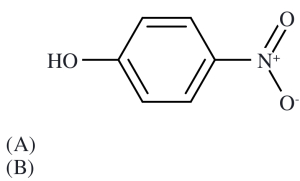
A
higher than that of $A$
B
lower than that of $A$
C
higher or lower than $A$ depending on the size of the vessel
D
same as that of $A$
Solution
(B) Compound $A$ is $o$-nitrophenol and compound $B$ is $p$-nitrophenol.
$o$-Nitrophenol exhibits intramolecular hydrogen bonding,which reduces its intermolecular attraction,making it more volatile.
$p$-Nitrophenol exhibits intermolecular hydrogen bonding,which leads to association of molecules,making it less volatile.
Therefore,the vapour pressure of $o$-nitrophenol $(A)$ is higher than that of $p$-nitrophenol $(B)$.
Thus,the vapour pressure of $B$ is lower than that of $A$.
$o$-Nitrophenol exhibits intramolecular hydrogen bonding,which reduces its intermolecular attraction,making it more volatile.
$p$-Nitrophenol exhibits intermolecular hydrogen bonding,which leads to association of molecules,making it less volatile.
Therefore,the vapour pressure of $o$-nitrophenol $(A)$ is higher than that of $p$-nitrophenol $(B)$.
Thus,the vapour pressure of $B$ is lower than that of $A$.
0 likes
View Solution223
EasyMCQ
Observe the following substances: Ethanol,acetic acid,ethylamine,trimethylamine,salicylic acid,ethanal. In the above list,the number of substances with $H$-bonding is:
A
$4$
B
$3$
C
$5$
D
$2$
Solution
(A) To determine the number of substances with $H$-bonding,we check for the presence of hydrogen atoms bonded to highly electronegative atoms like $N$,$O$,or $F$ in the molecule:
$1$. Ethanol $(C_2H_5OH)$: Contains an $-OH$ group,so it exhibits $H$-bonding.
$2$. Acetic acid $(CH_3COOH)$: Contains an $-OH$ group,so it exhibits $H$-bonding.
$3$. Ethylamine $(C_2H_5NH_2)$: Contains an $-NH_2$ group,so it exhibits $H$-bonding.
$4$. Trimethylamine $((CH_3)_3N)$: Nitrogen is bonded only to carbon atoms,so no $H$-bonding.
$5$. Salicylic acid $(C_6H_4(OH)COOH)$: Contains $-OH$ and $-COOH$ groups,so it exhibits $H$-bonding.
$6$. Ethanal $(CH_3CHO)$: Contains a carbonyl group but no $H$ atom directly bonded to $O$,so no $H$-bonding.
Thus,the substances with $H$-bonding are Ethanol,acetic acid,ethylamine,and salicylic acid.
The total count is $4$.
$1$. Ethanol $(C_2H_5OH)$: Contains an $-OH$ group,so it exhibits $H$-bonding.
$2$. Acetic acid $(CH_3COOH)$: Contains an $-OH$ group,so it exhibits $H$-bonding.
$3$. Ethylamine $(C_2H_5NH_2)$: Contains an $-NH_2$ group,so it exhibits $H$-bonding.
$4$. Trimethylamine $((CH_3)_3N)$: Nitrogen is bonded only to carbon atoms,so no $H$-bonding.
$5$. Salicylic acid $(C_6H_4(OH)COOH)$: Contains $-OH$ and $-COOH$ groups,so it exhibits $H$-bonding.
$6$. Ethanal $(CH_3CHO)$: Contains a carbonyl group but no $H$ atom directly bonded to $O$,so no $H$-bonding.
Thus,the substances with $H$-bonding are Ethanol,acetic acid,ethylamine,and salicylic acid.
The total count is $4$.
0 likes
View Solution224
MediumMCQ
In which of the following is intramolecular $H$-bonding absent?
A
Salicylic acid
B
Salicylaldehyde
C
Quinol
D
Catechol
Solution
(C) Intramolecular $H$-bonding occurs when a hydrogen atom is bonded to an electronegative atom and is simultaneously attracted to another electronegative atom within the same molecule,typically forming a stable $5$ or $6$-membered ring.
$1$. In $Salicylic \ acid$ ($o$-hydroxybenzoic acid),the $-OH$ group and $-COOH$ group are adjacent,allowing for intramolecular $H$-bonding.
$2$. In $Salicylaldehyde$ ($o$-hydroxybenzaldehyde),the $-OH$ group and $-CHO$ group are adjacent,allowing for intramolecular $H$-bonding.
$3$. In $Catechol$ ($o$-dihydroxybenzene),the two $-OH$ groups are adjacent,allowing for intramolecular $H$-bonding.
$4$. In $Quinol$ ($p$-dihydroxybenzene),the two $-OH$ groups are at the $1$ and $4$ positions (para-position). Due to the large distance between the two groups,they cannot form an intramolecular $H$-bond. Instead,they exhibit intermolecular $H$-bonding.
Therefore,intramolecular $H$-bonding is absent in $Quinol$.
$1$. In $Salicylic \ acid$ ($o$-hydroxybenzoic acid),the $-OH$ group and $-COOH$ group are adjacent,allowing for intramolecular $H$-bonding.
$2$. In $Salicylaldehyde$ ($o$-hydroxybenzaldehyde),the $-OH$ group and $-CHO$ group are adjacent,allowing for intramolecular $H$-bonding.
$3$. In $Catechol$ ($o$-dihydroxybenzene),the two $-OH$ groups are adjacent,allowing for intramolecular $H$-bonding.
$4$. In $Quinol$ ($p$-dihydroxybenzene),the two $-OH$ groups are at the $1$ and $4$ positions (para-position). Due to the large distance between the two groups,they cannot form an intramolecular $H$-bond. Instead,they exhibit intermolecular $H$-bonding.
Therefore,intramolecular $H$-bonding is absent in $Quinol$.
0 likes
View Solution225
EasyMCQ
Identify the correct sequence with respect to the strength of hydrogen bonding among the following.
A
$H_2O_2 > H_2O > HF > H_2S$
B
$H_2O > HF > H_2O_2 > H_2S$
C
$H_2O > HF > H_2S > H_2O_2$
D
$H_2O_2 > H_2O > HF > H_2S$
Solution
(A) The strength of hydrogen bonding is determined by the electronegativity of the atom and the number of hydrogen bonds formed per molecule.
$H_2O_2$ has two hydrogen atoms and two lone pairs on oxygen atoms,allowing for an extensive network of hydrogen bonding.
$H_2O$ also forms strong hydrogen bonds,but $H_2O_2$ exhibits a higher extent of intermolecular hydrogen bonding due to its structure.
$HF$ forms strong hydrogen bonds but is limited by the number of donor/acceptor sites.
$H_2S$ does not form significant hydrogen bonds because sulfur has low electronegativity.
Thus,the correct order is $H_2O_2 > H_2O > HF > H_2S$.
$H_2O_2$ has two hydrogen atoms and two lone pairs on oxygen atoms,allowing for an extensive network of hydrogen bonding.
$H_2O$ also forms strong hydrogen bonds,but $H_2O_2$ exhibits a higher extent of intermolecular hydrogen bonding due to its structure.
$HF$ forms strong hydrogen bonds but is limited by the number of donor/acceptor sites.
$H_2S$ does not form significant hydrogen bonds because sulfur has low electronegativity.
Thus,the correct order is $H_2O_2 > H_2O > HF > H_2S$.
0 likes
View Solution226
EasyMCQ
Among the common mineral acids,$H_2SO_4$ is less volatile due to
A
hydrogen bonding
B
van der Waals' forces
C
disulphide linkages
D
strong bonds
Solution
(A) $H_2SO_4$ molecules exhibit intermolecular hydrogen bonding,which leads to strong association between the molecules. This increases the boiling point and makes the acid less volatile.
0 likes
View Solution227
EasyMCQ
The dominant intermolecular force that must be overcome to convert liquid methanol to its vapour is
A
covalent bonds
B
dipole-dipole interactions
C
hydrogen bonds
D
coordinate bonds
Solution
(C) In methanol $(CH_3OH)$,intermolecular hydrogen bonding exists. When a hydrogen atom is directly linked with a highly electronegative atom like nitrogen,oxygen,or fluorine,it forms an intermolecular or intramolecular hydrogen bond. Hence,the intermolecular hydrogen bonding in methanol molecules must be overcome to convert liquid $CH_3OH$ into its vapour state.
0 likes
View Solution228
EasyMCQ
In which of the following substances will hydrogen bonds be strongest?
A
$HCl$
B
$H_2O$
C
$HI$
D
$H_2S$
Solution
(B) The strength of hydrogen bonding depends on the electronegativity of the atom bonded to the hydrogen atom. The order of electronegativity is $F > O > N > Cl$.
Hydrogen bonding is significant when $H$ is bonded to highly electronegative elements like $F$,$O$,or $N$.
$HI$ and $H_2S$ do not form significant hydrogen bonds.
In $HCl$,the electronegativity difference is small,making $H$-bonding very weak.
Among the given options,$H_2O$ contains $O-H$ bonds,which exhibit the strongest hydrogen bonding.
Hydrogen bonding is significant when $H$ is bonded to highly electronegative elements like $F$,$O$,or $N$.
$HI$ and $H_2S$ do not form significant hydrogen bonds.
In $HCl$,the electronegativity difference is small,making $H$-bonding very weak.
Among the given options,$H_2O$ contains $O-H$ bonds,which exhibit the strongest hydrogen bonding.
0 likes
View Solution229
EasyMCQ
The number of hydrogen bonds formed by a water molecule at normal conditions is
A
$1$
B
$2$
C
$3$
D
$4$
Solution
(D) In a water molecule $(H_2O)$,the oxygen atom is $sp^3$ hybridized and has two lone pairs of electrons.
Each water molecule can form hydrogen bonds through its two hydrogen atoms (as donors) and its two lone pairs on the oxygen atom (as acceptors).
Therefore,a single water molecule can theoretically form up to $4$ hydrogen bonds with surrounding water molecules.
In liquid water at $25^{\circ}C$,due to thermal motion,the average number of hydrogen bonds per molecule is approximately $3.4$ to $3.6$.
Among the given options,$4$ represents the maximum number of hydrogen bonds a water molecule can form in its tetrahedral structure.
Hence,the correct option is $(D)$.
Each water molecule can form hydrogen bonds through its two hydrogen atoms (as donors) and its two lone pairs on the oxygen atom (as acceptors).
Therefore,a single water molecule can theoretically form up to $4$ hydrogen bonds with surrounding water molecules.
In liquid water at $25^{\circ}C$,due to thermal motion,the average number of hydrogen bonds per molecule is approximately $3.4$ to $3.6$.
Among the given options,$4$ represents the maximum number of hydrogen bonds a water molecule can form in its tetrahedral structure.
Hence,the correct option is $(D)$.
0 likes
View Solution230
MediumMCQ
Arrange the hydrides $NH_3$,$HF$,$H_2O$,and $HCl$ in the increasing order of their boiling points.
A
$HCl < NH_3 < HF < H_2O$
B
$HCl < NH_3 < H_2O < HF$
C
$NH_3 < HCl < H_2O < HF$
D
$HCl < NH_3 < HF < H_2O$
Solution
(A) $H_2O$,$HF$,and $NH_3$ exhibit hydrogen bonding as the intermolecular force,whereas $HCl$ possesses weaker dipole-dipole interactions.
Thus,$HCl$ has the lowest boiling point.
Among $H_2O$,$HF$,and $NH_3$,$H_2O$ has the highest boiling point due to an extensive network of hydrogen bonds.
Between $NH_3$ and $HF$,$HF$ forms stronger hydrogen bonds due to the very high electronegativity of fluorine.
Therefore,the increasing order of boiling points is: $HCl < NH_3 < HF < H_2O$.
Thus,$HCl$ has the lowest boiling point.
Among $H_2O$,$HF$,and $NH_3$,$H_2O$ has the highest boiling point due to an extensive network of hydrogen bonds.
Between $NH_3$ and $HF$,$HF$ forms stronger hydrogen bonds due to the very high electronegativity of fluorine.
Therefore,the increasing order of boiling points is: $HCl < NH_3 < HF < H_2O$.
0 likes
View Solution231
MediumMCQ
In which of the following,intramolecular hydrogen bonding is present?
A
Resorcinol
B
Catechol
C
Quinol
D
$o$-Cresol
Solution
(B) Intramolecular hydrogen bonding occurs when a hydrogen atom is bonded to an electronegative atom and is simultaneously attracted to another electronegative atom within the same molecule.
In $o$-Cresol ($2$-methylphenol),the hydroxyl $(-OH)$ group and the methyl $(-CH_3)$ group are adjacent to each other. However,the hydrogen atom of the $-OH$ group forms an intramolecular hydrogen bond with the oxygen atom of the same $-OH$ group in some configurations,but more specifically,in $o$-nitrophenol or similar ortho-substituted phenols,it is very common. Among the given options,$o$-Cresol allows for the proximity of the $-OH$ group to the ortho-position,facilitating intramolecular interactions compared to the meta (Resorcinol) or para (Quinol) isomers where only intermolecular hydrogen bonding is possible.
Catechol ($1,2$-dihydroxybenzene) also exhibits intramolecular hydrogen bonding between the two adjacent $-OH$ groups.
In $o$-Cresol ($2$-methylphenol),the hydroxyl $(-OH)$ group and the methyl $(-CH_3)$ group are adjacent to each other. However,the hydrogen atom of the $-OH$ group forms an intramolecular hydrogen bond with the oxygen atom of the same $-OH$ group in some configurations,but more specifically,in $o$-nitrophenol or similar ortho-substituted phenols,it is very common. Among the given options,$o$-Cresol allows for the proximity of the $-OH$ group to the ortho-position,facilitating intramolecular interactions compared to the meta (Resorcinol) or para (Quinol) isomers where only intermolecular hydrogen bonding is possible.
Catechol ($1,2$-dihydroxybenzene) also exhibits intramolecular hydrogen bonding between the two adjacent $-OH$ groups.
0 likes
View Solution232
EasyMCQ
The intramolecular hydrogen bonding is present in
A
Phenol
B
Benzoic acid
C
para-Nitrophenol
D
$2-$Hydroxybenzoic acid
Solution
(D) Intramolecular hydrogen bonding occurs when a hydrogen atom is bonded to a highly electronegative atom (like $O$,$N$,or $F$) and is simultaneously attracted to another electronegative atom within the same molecule.
In $2-$Hydroxybenzoic acid (also known as salicylic acid),the hydrogen atom of the hydroxyl $(-OH)$ group forms a hydrogen bond with the oxygen atom of the adjacent carboxylic acid $(-COOH)$ group.
This creates a stable six-membered ring structure within the molecule,which is characteristic of intramolecular hydrogen bonding.
Phenol,benzoic acid,and $p-$nitrophenol exhibit intermolecular hydrogen bonding rather than intramolecular hydrogen bonding.
In $2-$Hydroxybenzoic acid (also known as salicylic acid),the hydrogen atom of the hydroxyl $(-OH)$ group forms a hydrogen bond with the oxygen atom of the adjacent carboxylic acid $(-COOH)$ group.
This creates a stable six-membered ring structure within the molecule,which is characteristic of intramolecular hydrogen bonding.
Phenol,benzoic acid,and $p-$nitrophenol exhibit intermolecular hydrogen bonding rather than intramolecular hydrogen bonding.
0 likes
View Solution233
MediumMCQ
The boiling point of hydrogen halides varies in the order:
A
$HF > HI > HBr > HCl$
B
$HF > HCl > HBr > HI$
C
$HI > HBr > HCl > HF$
D
$HBr > HI > HCl > HF$
Solution
(A) The boiling point of hydrogen halides is determined by the strength of intermolecular forces.
In $HF$,strong hydrogen bonding exists between molecules,which significantly increases its boiling point.
For the remaining hydrogen halides ($HCl$,$HBr$,$HI$),the boiling point is primarily determined by van der Waals forces,which increase with the increase in molecular size and molar mass.
Thus,the order of boiling points is $HI > HBr > HCl$.
Combining these,the overall order is $HF > HI > HBr > HCl$.
In $HF$,strong hydrogen bonding exists between molecules,which significantly increases its boiling point.
For the remaining hydrogen halides ($HCl$,$HBr$,$HI$),the boiling point is primarily determined by van der Waals forces,which increase with the increase in molecular size and molar mass.
Thus,the order of boiling points is $HI > HBr > HCl$.
Combining these,the overall order is $HF > HI > HBr > HCl$.
0 likes
View Solution234
MediumMCQ
In which of the following,the compounds are correctly arranged in the decreasing order of boiling points?
A
$HF > H_2O > NH_3 > PH_3$
B
$H_2O > HF > NH_3 > PH_3$
C
$H_2O > HF > PH_3 > NH_3$
D
$HF > NH_3 > H_2O > PH_3$
Solution
(B) The boiling point of a compound depends on the strength of intermolecular forces,primarily hydrogen bonding and molecular mass.
$H_2O$ has the highest boiling point $(373 \ K)$ because each $H_2O$ molecule can form four hydrogen bonds.
$HF$ has a high boiling point $(293 \ K)$ due to strong hydrogen bonding,but it forms fewer hydrogen bonds per molecule than $H_2O$.
$NH_3$ has a boiling point of $240 \ K$ due to weaker hydrogen bonding compared to $HF$.
$PH_3$ has the lowest boiling point $(185 \ K)$ as it does not exhibit hydrogen bonding and relies only on weak van der Waals forces.
Thus,the correct decreasing order is $H_2O > HF > NH_3 > PH_3$.
$H_2O$ has the highest boiling point $(373 \ K)$ because each $H_2O$ molecule can form four hydrogen bonds.
$HF$ has a high boiling point $(293 \ K)$ due to strong hydrogen bonding,but it forms fewer hydrogen bonds per molecule than $H_2O$.
$NH_3$ has a boiling point of $240 \ K$ due to weaker hydrogen bonding compared to $HF$.
$PH_3$ has the lowest boiling point $(185 \ K)$ as it does not exhibit hydrogen bonding and relies only on weak van der Waals forces.
Thus,the correct decreasing order is $H_2O > HF > NH_3 > PH_3$.
0 likes
View Solution235
MediumMCQ
The melting point of $o$-hydroxybenzaldehyde $(A)$ is lower than that of $p$-hydroxybenzaldehyde $(B)$. This is because
A
$(A)$ has intermolecular $H$-bonding and $(B)$ has intramolecular $H$-bonding
B
Both $(A)$ and $(B)$ have intermolecular $H$-bonding
C
Both $(A)$ and $(B)$ have intramolecular $H$-bonding
D
$(A)$ has intramolecular $H$-bonding and $(B)$ has intermolecular $H$-bonding
Solution
(D) $o$-hydroxybenzaldehyde $(A)$ exhibits intramolecular $H$-bonding,which leads to the formation of a stable chelate ring within the molecule. This restricts the association between different molecules.
In contrast,$p$-hydroxybenzaldehyde $(B)$ exhibits intermolecular $H$-bonding,which allows for strong association between different molecules,resulting in a higher melting point.
Therefore,the lower melting point of $(A)$ is due to the presence of intramolecular $H$-bonding,while $(B)$ has intermolecular $H$-bonding.
In contrast,$p$-hydroxybenzaldehyde $(B)$ exhibits intermolecular $H$-bonding,which allows for strong association between different molecules,resulting in a higher melting point.
Therefore,the lower melting point of $(A)$ is due to the presence of intramolecular $H$-bonding,while $(B)$ has intermolecular $H$-bonding.
0 likes
View Solution236
EasyMCQ
Assertion $(A)$: Hydrogen fluoride has a higher boiling point than other hydrogen halides.
Reason $(R)$: Hydrogen fluoride exhibits strong hydrogen bonding. The correct option among the following is:
Reason $(R)$: Hydrogen fluoride exhibits strong hydrogen bonding. The correct option among the following is:
A
$A$. $(A)$ is true,$(R)$ is true and $(R)$ is the correct explanation for $(A)$
B
$B$. $(A)$ is true,$(R)$ is true but $(R)$ is not the correct explanation for $(A)$
C
$C$. $(A)$ is true but $(R)$ is false
D
$D$. $(A)$ is false but $(R)$ is true
Solution
(A) Fluorine $(F)$ is the most electronegative element among the halogens.
Due to the high electronegativity of $F$,the $H-F$ bond is highly polar,which leads to the formation of strong intermolecular hydrogen bonding.
This strong hydrogen bonding in $HF$ molecules requires more energy to break compared to the dipole-dipole interactions present in other hydrogen halides ($HCl$,$HBr$,$HI$).
Therefore,$HF$ has a significantly higher boiling point than other hydrogen halides.
Thus,both $(A)$ and $(R)$ are true,and $(R)$ is the correct explanation for $(A)$.
Due to the high electronegativity of $F$,the $H-F$ bond is highly polar,which leads to the formation of strong intermolecular hydrogen bonding.
This strong hydrogen bonding in $HF$ molecules requires more energy to break compared to the dipole-dipole interactions present in other hydrogen halides ($HCl$,$HBr$,$HI$).
Therefore,$HF$ has a significantly higher boiling point than other hydrogen halides.
Thus,both $(A)$ and $(R)$ are true,and $(R)$ is the correct explanation for $(A)$.
0 likes
View Solution237
MediumMCQ
The number of $H_2O$ molecules participating in hydrogen bonding in $CuSO_4 \cdot 5H_2O$ is/are
A
$4$
B
$2$
C
$1$
D
$0$
Solution
(C) The structure of $CuSO_4 \cdot 5H_2O$ is represented as $[Cu(H_2O)_4]SO_4 \cdot H_2O$.
In this structure,four $H_2O$ molecules are directly coordinated to the $Cu^{2+}$ ion.
The fifth $H_2O$ molecule is held by hydrogen bonding between the $SO_4^{2-}$ ion and the coordinated $H_2O$ molecules.
Therefore,only $1$ water molecule participates in hydrogen bonding.
In this structure,four $H_2O$ molecules are directly coordinated to the $Cu^{2+}$ ion.
The fifth $H_2O$ molecule is held by hydrogen bonding between the $SO_4^{2-}$ ion and the coordinated $H_2O$ molecules.
Therefore,only $1$ water molecule participates in hydrogen bonding.
0 likes
View Solution238
EasyMCQ
In which of the following is the hydrogen bonding strongest?
A
$O-H \cdots N$
B
$O-H \cdots O$
C
$O-H \cdots F$
D
$F-H \cdots F$
Solution
(D) Key Idea: The strength of hydrogen bonding is directly proportional to the electronegativity difference between the $H$-atom and the atom to which it is covalently bonded,as well as the electronegativity of the atom forming the hydrogen bond.
Since the electronegativity of $F$ is the highest among $N$,$O$,and $F$,the $H-F$ bond is the most polar,and the interaction in $F-H \cdots F$ is the strongest.
Therefore,option $D$ is the correct answer.
Since the electronegativity of $F$ is the highest among $N$,$O$,and $F$,the $H-F$ bond is the most polar,and the interaction in $F-H \cdots F$ is the strongest.
Therefore,option $D$ is the correct answer.
0 likes
View Solution239
MediumMCQ
The molecular interactions responsible for hydrogen bonding in $HF$ are:
A
ion-induced dipole
B
dipole-dipole
C
dipole-induced dipole
D
ion-dipole
Solution
(B) hydrogen bond is a special type of dipole-dipole attraction between a hydrogen atom covalently bonded to a highly electronegative atom and another electronegative atom with a lone pair.
In an $HF$ molecule,there is a significant electronegativity difference between $H$ and $F$,which creates a permanent dipole.
Consequently,the interaction between $HF$ molecules is a form of dipole-dipole interaction.
In the gaseous state,several $HF$ molecules polymerize through these $H$-bonding interactions.
In an $HF$ molecule,there is a significant electronegativity difference between $H$ and $F$,which creates a permanent dipole.
Consequently,the interaction between $HF$ molecules is a form of dipole-dipole interaction.
In the gaseous state,several $HF$ molecules polymerize through these $H$-bonding interactions.
0 likes
View Solution240
MediumMCQ
How many water molecules present in $CuSO_4 \cdot 5 H_2 O$ are hydrogen bonded?
A
$5$
B
$1$
C
$4$
D
$2$
Solution
(B) In the structure of $CuSO_4 \cdot 5 H_2 O$,there are $5$ water molecules present as water of crystallization.
Out of these $5 H_2 O$ molecules,$4 H_2 O$ molecules are directly coordinated to the $Cu^{2+}$ ion through coordinate covalent bonds.
The fifth $H_2 O$ molecule is held in the crystal lattice by hydrogen bonding between the $SO_4^{2-}$ ion and the coordinated water molecules.
Therefore,only $1$ water molecule is hydrogen bonded.
Thus,option $(b)$ is the correct answer.
Out of these $5 H_2 O$ molecules,$4 H_2 O$ molecules are directly coordinated to the $Cu^{2+}$ ion through coordinate covalent bonds.
The fifth $H_2 O$ molecule is held in the crystal lattice by hydrogen bonding between the $SO_4^{2-}$ ion and the coordinated water molecules.
Therefore,only $1$ water molecule is hydrogen bonded.
Thus,option $(b)$ is the correct answer.
0 likes
View Solution241
MediumMCQ
The correct order of boiling points of $H_2O, H_2S, H_2Se$ and $H_2Te$ respectively is
A
$H_2O > H_2S = H_2Se = H_2Te$
B
$H_2O < H_2S < H_2Se < H_2Te$
C
$H_2O > H_2S > H_2Se > H_2Te$
D
$H_2O > H_2Te > H_2Se > H_2S$
Solution
(D) All the elements of Group $16$ form hydrides of the type $H_2E$ (where $E = O, S, Se, Te, Po$).
Boiling point depends on the molecular mass and intermolecular forces.
As the size of the central atom increases,the van der Waals forces increase,which generally leads to an increase in boiling point from $H_2S$ to $H_2Te$.
However,$H_2O$ exhibits exceptionally high boiling point due to the presence of strong intermolecular hydrogen bonding.
Therefore,the correct order of boiling points is $H_2O > H_2Te > H_2Se > H_2S$.
Boiling point depends on the molecular mass and intermolecular forces.
As the size of the central atom increases,the van der Waals forces increase,which generally leads to an increase in boiling point from $H_2S$ to $H_2Te$.
However,$H_2O$ exhibits exceptionally high boiling point due to the presence of strong intermolecular hydrogen bonding.
Therefore,the correct order of boiling points is $H_2O > H_2Te > H_2Se > H_2S$.
0 likes
View Solution242
EasyMCQ
The correct order of boiling points of hydrogen halides is
A
$HF < HCl < HBr < HI$
B
$HI < HBr < HCl < HF$
C
$HCl < HBr < HI < HF$
D
$HBr < HCl < HI < HF$
Solution
(C) The boiling points of hydrogen halides follow the order: $HCl < HBr < HI < HF$.
$HF$ exhibits strong intermolecular hydrogen bonding,which significantly increases its boiling point compared to other hydrogen halides.
For the remaining hydrogen halides $(HCl, HBr, HI)$,the boiling point increases with an increase in molecular mass due to stronger van der Waals forces.
$HF$ exhibits strong intermolecular hydrogen bonding,which significantly increases its boiling point compared to other hydrogen halides.
For the remaining hydrogen halides $(HCl, HBr, HI)$,the boiling point increases with an increase in molecular mass due to stronger van der Waals forces.
0 likes
View Solution243
MediumMCQ
The boiling point of water is higher than that of liquid $HF$. The reason is that
A
Hydrogen bonds are stronger in water
B
Hydrogen bonds are stronger in $HF$
C
Hydrogen bonds are larger in number in $HF$
D
Hydrogen bonds are larger in number in water
Solution
(D) In $H_2O$,each oxygen atom has two hydrogen atoms and two lone pairs of electrons,allowing each water molecule to form four hydrogen bonds with neighboring molecules. This creates a three-dimensional network structure.
In $HF$,each fluorine atom has three lone pairs but only one hydrogen atom,which limits each $HF$ molecule to forming only two hydrogen bonds,resulting in a linear chain structure.
Because water molecules can form a larger number of hydrogen bonds per molecule compared to $HF$,more energy is required to break these intermolecular forces,leading to a higher boiling point for water.
In $HF$,each fluorine atom has three lone pairs but only one hydrogen atom,which limits each $HF$ molecule to forming only two hydrogen bonds,resulting in a linear chain structure.
Because water molecules can form a larger number of hydrogen bonds per molecule compared to $HF$,more energy is required to break these intermolecular forces,leading to a higher boiling point for water.
0 likes
View Solution244
EasyMCQ
Which of the following hydrogen bonds is likely to be the weakest?
A
$C-H \cdots O$
B
$N-H \cdots O$
C
$O-H \cdots O$
D
$O-H \cdots F$
Solution
(A) The strength of a hydrogen bond $X-H \cdots Y$ depends on the electronegativity difference between $X$ and $H$.
As the electronegativity of $X$ decreases,the polarity of the $X-H$ bond decreases,resulting in a smaller partial positive charge $(\delta+)$ on the hydrogen atom.
This leads to a weaker electrostatic attraction between the hydrogen atom and the electronegative atom $Y$.
The electronegativity values are $C (2.5) < N (3.0) < O (3.5)$.
Therefore,the $C-H \cdots O$ hydrogen bond is the weakest among the given options.
As the electronegativity of $X$ decreases,the polarity of the $X-H$ bond decreases,resulting in a smaller partial positive charge $(\delta+)$ on the hydrogen atom.
This leads to a weaker electrostatic attraction between the hydrogen atom and the electronegative atom $Y$.
The electronegativity values are $C (2.5) < N (3.0) < O (3.5)$.
Therefore,the $C-H \cdots O$ hydrogen bond is the weakest among the given options.
0 likes
View Solution245
EasyMCQ
Which of the following has the strongest $H$-bond?
A
$O-H...S$
B
$S-H...O$
C
$F-H...F$
D
$F-H...O$
Solution
(C) The strength of a hydrogen bond depends on the electronegativity of the atoms involved in the bond. The greater the electronegativity difference between the hydrogen atom and the atom it is bonded to,the stronger the hydrogen bond will be.
Fluorine $(F)$ is the most electronegative element in the periodic table.
Therefore,the $F-H...F$ bond is the strongest among the given options because fluorine has the highest electronegativity compared to oxygen $(O)$ and sulphur $(S)$.
The electronegativity order is $F > O > S$.
Fluorine $(F)$ is the most electronegative element in the periodic table.
Therefore,the $F-H...F$ bond is the strongest among the given options because fluorine has the highest electronegativity compared to oxygen $(O)$ and sulphur $(S)$.
The electronegativity order is $F > O > S$.
0 likes
View Solution246
MediumMCQ
The boiling points of $HF$,$HCl$,$HBr$ and $HI$ follow the order:
A
$HF > HCl > HBr > HI$
B
$HF > HI > HBr > HCl$
C
$HI > HBr > HCl > HF$
D
$HCl > HF > HBr > HI$
Solution
(B) Due to strong intermolecular hydrogen bonding,$HF$ exhibits the highest boiling point among the hydrogen halides.
For the remaining hydrogen halides ($HCl$,$HBr$,$HI$),the boiling point is determined by the magnitude of van der Waals' forces.
As the molecular size and mass increase down the group,the van der Waals' forces increase,leading to an increase in boiling point.
Therefore,the order of boiling points is $HI > HBr > HCl$.
Combining these,the overall order is $HF > HI > HBr > HCl$.
For the remaining hydrogen halides ($HCl$,$HBr$,$HI$),the boiling point is determined by the magnitude of van der Waals' forces.
As the molecular size and mass increase down the group,the van der Waals' forces increase,leading to an increase in boiling point.
Therefore,the order of boiling points is $HI > HBr > HCl$.
Combining these,the overall order is $HF > HI > HBr > HCl$.
0 likes
View Solution247
EasyMCQ
Which of the following compounds shows evidence of the strongest hydrogen bonding?
A
propan$-1-$ol
B
propan$-2-$ol
C
propan$-1,2-$diol
D
propan$-1,2,3-$triol
Solution
(D) The strength of hydrogen bonding in a compound depends on the number of $-OH$ groups available for intermolecular interaction.
Propan$-1,2,3-$triol (glycerol) contains three $-OH$ groups,which allows for a greater extent of intermolecular hydrogen bonding compared to the other options.
Therefore,it exhibits the strongest hydrogen bonding.
Propan$-1,2,3-$triol (glycerol) contains three $-OH$ groups,which allows for a greater extent of intermolecular hydrogen bonding compared to the other options.
Therefore,it exhibits the strongest hydrogen bonding.
0 likes
View Solution248
EasyMCQ
The hydrides of the first elements in groups $15-17$,namely $NH_3$,$H_2O$ and $HF$ respectively show abnormally high values for melting and boiling points. This is due to
A
small size of $N$,$O$ and $F$
B
the ability to form extensive intermolecular $H$-bonding
C
the ability to form extensive intramolecular $H$-bonding
D
effective van der Waals' interaction
Solution
(B) Hydrides of $N$,$O$ and $F$ possess small size and high electronegativity.
Due to this,they have the ability to form extensive intermolecular (between two molecules) hydrogen bonding.
Consequently,a large amount of energy is required to break these bonds,which results in abnormally high melting and boiling points for these hydrides.
Due to this,they have the ability to form extensive intermolecular (between two molecules) hydrogen bonding.
Consequently,a large amount of energy is required to break these bonds,which results in abnormally high melting and boiling points for these hydrides.
0 likes
View SolutionChemical Bonding and Molecular Structure — Hydrogen bonding · Frequently Asked Questions
1Are these Chemical Bonding and Molecular Structure questions useful for JEE and NEET?
Yes. All questions in this section are mapped to JEE Main and NEET exam patterns. Previous year questions from JEE Main, NEET, GUJCET and state-level exams are included with full solutions.
2Can I switch to Hindi or Gujarati for these questions?
Yes. Use the language tabs in the hero section or the sidebar to view the same questions and solutions in English, Hindi or Gujarati.
3How do I generate a question paper from this subtopic?
Use the Vedclass Exam Paper Generator — select the chapter and subtopic, set difficulty, and generate Sets A, B, C, D automatically. First 3 chapters of every subject are free.
Vedclass Products
For Students
Vedclass Test Series
Mock tests in real JEE/NEET style with performance analysis. 5-day free trial.
Start Free TrialFor Teachers
Exam Paper Generator
Generate Set A/B/C/D papers from this chapter in 2 minutes. 3 chapters free.
Try FreeFor Institutes
Online Exam Module
Live online exams with unlimited students, 360° analytics & white-label branding.
See DemoFor Teachers & Institutes
Generate a Chemical Bonding and Molecular Structure Exam Paper in 2 Minutes
Select subtopic & difficulty — Sets A, B, C, D auto-generated with No Repeat logic.
First 3 chapters of every subject are free — no payment required.