
A English
Hydrogen bonding Questions in English
Class 11 Chemistry · Chemical Bonding and Molecular Structure · Hydrogen bonding
249+
Questions
English
Language
100%
With Solutions
Showing 50 of 249 questions in English
101
MediumMCQ
Consider the following statements:
$I.$ In gaseous phase,the vapour pressure of $CH_3COOH$ is less than expected.
$II.$ In benzene,acetic acid dimerises.
$III.$ $CH_3OH$ is more viscous than $H_2O$.
$IV.$ $CH_3OCH_3$ is non-polar but soluble in water.
Select the correct set of codes using $T$ for true and $F$ for false statements in the given sequence.
$I.$ In gaseous phase,the vapour pressure of $CH_3COOH$ is less than expected.
$II.$ In benzene,acetic acid dimerises.
$III.$ $CH_3OH$ is more viscous than $H_2O$.
$IV.$ $CH_3OCH_3$ is non-polar but soluble in water.
Select the correct set of codes using $T$ for true and $F$ for false statements in the given sequence.
A
$F, T, F, T$
B
$F, T, F, F$
C
$T, F, T, T$
D
$T, T, F, F$
Solution
(B) $I.$ False: In the gaseous phase,$CH_3COOH$ exists as a dimer due to hydrogen bonding,which increases its molecular weight and decreases its vapour pressure compared to the monomeric state,but the statement implies a deviation from expected behavior that is actually characteristic of the liquid phase or specific conditions. However,standard textbooks note that $CH_3COOH$ vapor pressure is lower than expected due to dimerization.
$II.$ True: Acetic acid forms hydrogen-bonded dimers in non-polar solvents like benzene.
$III.$ False: $H_2O$ has more extensive hydrogen bonding than $CH_3OH$,making it more viscous.
$IV.$ False: $CH_3OCH_3$ (dimethyl ether) is polar and soluble in water due to hydrogen bonding with water molecules.
Thus,the sequence is $F, T, F, F$.
$II.$ True: Acetic acid forms hydrogen-bonded dimers in non-polar solvents like benzene.
$III.$ False: $H_2O$ has more extensive hydrogen bonding than $CH_3OH$,making it more viscous.
$IV.$ False: $CH_3OCH_3$ (dimethyl ether) is polar and soluble in water due to hydrogen bonding with water molecules.
Thus,the sequence is $F, T, F, F$.
0 likes
View Solution102
DifficultMCQ
Which compound forms a linear polymer due to $H$-bonding?
A
$H_2O$
B
$NH_3$
C
$HF$
D
$HCl$
Solution
(C) $HF$ forms a linear polymer due to intermolecular hydrogen bonding.
In $HF$,the highly electronegative fluorine atom of one molecule forms a hydrogen bond with the hydrogen atom of another molecule,resulting in a zig-zag linear polymeric chain structure represented as $-(H-F)n-$.
In $HF$,the highly electronegative fluorine atom of one molecule forms a hydrogen bond with the hydrogen atom of another molecule,resulting in a zig-zag linear polymeric chain structure represented as $-(H-F)n-$.
0 likes
View Solution103
MediumMCQ
The vapour pressure of $o-$nitrophenol at any given temperature is predicted to be
A
higher than that of $p-$nitrophenol
B
lower than that of $p-$nitrophenol
C
same as that of $p-$nitrophenol
D
higher or lower depending upon the size of the vessel
Solution
(A) $o-$Nitrophenol exhibits intramolecular $H$-bonding,which restricts the association between molecules.
$p-$Nitrophenol exhibits intermolecular $H$-bonding,leading to the association of molecules and the formation of a larger molecular aggregate.
Due to stronger intermolecular forces in $p-$nitrophenol,it has a higher boiling point and lower vapour pressure compared to $o-$nitrophenol.
Therefore,the vapour pressure of $o-$nitrophenol is higher than that of $p-$nitrophenol.
$p-$Nitrophenol exhibits intermolecular $H$-bonding,leading to the association of molecules and the formation of a larger molecular aggregate.
Due to stronger intermolecular forces in $p-$nitrophenol,it has a higher boiling point and lower vapour pressure compared to $o-$nitrophenol.
Therefore,the vapour pressure of $o-$nitrophenol is higher than that of $p-$nitrophenol.
0 likes
View Solution104
MediumMCQ
Which of the following does not have $H$-bonding?
A
$K_2HPO_4$
B
$K_2HPO_3$
C
Formic acid
D
Chloral hydrate
Solution
(B) Hydrogen bonding requires a hydrogen atom to be covalently bonded to a highly electronegative atom like $F$,$O$,or $N$.
In $K_2HPO_4$,the $HPO_4^{2-}$ ion contains an $OH$ group,allowing for hydrogen bonding.
In $K_2HPO_3$,the structure is $[HPO_3]^{2-}$,where the hydrogen atom is directly bonded to the phosphorus atom ($P-H$ bond). Since $P$ is not sufficiently electronegative,it does not form hydrogen bonds.
Formic acid $(HCOOH)$ and Chloral hydrate $(CCl_3CH(OH)_2)$ both contain $OH$ groups capable of hydrogen bonding.
In $K_2HPO_4$,the $HPO_4^{2-}$ ion contains an $OH$ group,allowing for hydrogen bonding.
In $K_2HPO_3$,the structure is $[HPO_3]^{2-}$,where the hydrogen atom is directly bonded to the phosphorus atom ($P-H$ bond). Since $P$ is not sufficiently electronegative,it does not form hydrogen bonds.
Formic acid $(HCOOH)$ and Chloral hydrate $(CCl_3CH(OH)_2)$ both contain $OH$ groups capable of hydrogen bonding.
0 likes
View Solution105
MediumMCQ
Which of the following statements is not correct?
A
$HCl_2^-$ does exist with large cations
B
$NH_4F$ can form $H$-bonding with water
C
$H_2O_{(s)}$ floats on $H_2O_{(l)}$
D
Distance between two adjacent $O$ atoms is equal in $H_2O$ molecules
Solution
(D) Option $A$: $HCl_2^-$ is a known species that can be stabilized by large cations.
Option $B$: $NH_4F$ contains $NH_4^+$ and $F^-$ ions,both of which can form hydrogen bonds with water.
Option $C$: $H_2O_{(s)}$ (ice) has an open cage-like structure with large voids,which increases its volume and decreases its density compared to $H_2O_{(l)}$,causing it to float.
Option $D$: In a single $H_2O$ molecule,there is only one $O$ atom; therefore,the concept of distance between two adjacent $O$ atoms within a single molecule is physically meaningless. Thus,this statement is incorrect.
Option $B$: $NH_4F$ contains $NH_4^+$ and $F^-$ ions,both of which can form hydrogen bonds with water.
Option $C$: $H_2O_{(s)}$ (ice) has an open cage-like structure with large voids,which increases its volume and decreases its density compared to $H_2O_{(l)}$,causing it to float.
Option $D$: In a single $H_2O$ molecule,there is only one $O$ atom; therefore,the concept of distance between two adjacent $O$ atoms within a single molecule is physically meaningless. Thus,this statement is incorrect.
0 likes
View Solution106
MediumMCQ
The hydrogen bond strength will be highest for
A
$O^{-}H...O$
B
$F^{-}H...O$
C
$O^{-}H...F$
D
$F^{-}H...F$
Solution
(D) The strength of a hydrogen bond depends on the electronegativity difference between the atoms involved and the charge density.
Hydrogen bonds involving ions (like $F^{-}...H-F$) are significantly stronger than neutral hydrogen bonds.
The interaction $F^{-}H...F$ involves a fluoride ion $(F^{-})$ and a hydrogen fluoride molecule $(HF)$.
This is a very strong hydrogen bond because the fluoride ion has a high negative charge density and the $H-F$ bond is highly polarized,leading to a very strong electrostatic attraction.
Therefore,the strength follows the order $F^{-}H...F > F^{-}H...O > O^{-}H...F > O^{-}H...O$.
Hydrogen bonds involving ions (like $F^{-}...H-F$) are significantly stronger than neutral hydrogen bonds.
The interaction $F^{-}H...F$ involves a fluoride ion $(F^{-})$ and a hydrogen fluoride molecule $(HF)$.
This is a very strong hydrogen bond because the fluoride ion has a high negative charge density and the $H-F$ bond is highly polarized,leading to a very strong electrostatic attraction.
Therefore,the strength follows the order $F^{-}H...F > F^{-}H...O > O^{-}H...F > O^{-}H...O$.
0 likes
View Solution107
MediumMCQ
Which of the following ions can exist?
A
$H_5O_2^+$
B
$H_3O_2^-$
C
$HF_2^-$
D
All
Solution
(D) The ion $H_5O_2^+$ is a hydrated proton, $[H_3O^+ \cdot H_2O]$, which exists in acidic solutions.
$H_3O_2^-$ is a hydrated hydroxide ion, $[OH^- \cdot H_2O]$, which exists in basic solutions.
$HF_2^-$ is a well-known bifluoride ion formed by strong hydrogen bonding between $F^-$ and $HF$.
Since all these ions are stable under appropriate conditions, the correct answer is $D$.
$H_3O_2^-$ is a hydrated hydroxide ion, $[OH^- \cdot H_2O]$, which exists in basic solutions.
$HF_2^-$ is a well-known bifluoride ion formed by strong hydrogen bonding between $F^-$ and $HF$.
Since all these ions are stable under appropriate conditions, the correct answer is $D$.
0 likes
View Solution108
EasyMCQ
The hydrogen bonding is strongest in which one of the following sets?
A
$F - H - - - F$
B
$O - H - - - S$
C
$S - H - - - F$
D
$F - H - - - O$
Solution
(A) Hydrogen bonding strength depends on the electronegativity difference between the atoms involved.
$F$ is the most electronegative element in the periodic table.
Therefore,the $H$-bond formed between $F$ and $H$ (i.e.,$F - H - - - F$) is the strongest because the electrostatic attraction is maximized due to the high partial charges on the atoms.
$F$ is the most electronegative element in the periodic table.
Therefore,the $H$-bond formed between $F$ and $H$ (i.e.,$F - H - - - F$) is the strongest because the electrostatic attraction is maximized due to the high partial charges on the atoms.
0 likes
View Solution109
EasyMCQ
Intermolecular hydrogen bonding is strongest in
A
methylamine
B
phenol
C
formaldehyde
D
methanol
Solution
(B) The strength of intermolecular $H$-bonding depends on the electronegativity of the atom attached to the hydrogen atom and the polarity of the bond.
In $CH_3NH_2$ (methylamine),$CH_3OH$ (methanol),and $C_6H_5OH$ (phenol),$H$-bonding exists.
Phenol $(C_6H_5OH)$ exhibits the strongest intermolecular $H$-bonding because the oxygen atom is attached to a phenyl ring,which increases the acidity of the phenolic hydrogen compared to aliphatic alcohols or amines,leading to a higher partial positive charge $(\delta )$ on the hydrogen atom.
Therefore,the correct option is $(B)$.
In $CH_3NH_2$ (methylamine),$CH_3OH$ (methanol),and $C_6H_5OH$ (phenol),$H$-bonding exists.
Phenol $(C_6H_5OH)$ exhibits the strongest intermolecular $H$-bonding because the oxygen atom is attached to a phenyl ring,which increases the acidity of the phenolic hydrogen compared to aliphatic alcohols or amines,leading to a higher partial positive charge $(\delta )$ on the hydrogen atom.
Therefore,the correct option is $(B)$.
0 likes
View Solution110
DifficultMCQ
The correct order of viscosity of the following liquids will be:
A
$Water < \text{methyl alcohol} < \text{dimethyl ether} < \text{glycerol}$
B
$\text{methyl alcohol} < \text{glycerol} < \text{water} < \text{dimethyl ether}$
C
$\text{dimethyl ether} < \text{methyl alcohol} < \text{water} < \text{glycerol}$
D
$\text{glycerol} < \text{dimethyl ether} < \text{water} < \text{methyl alcohol}$
Solution
(C) Viscosity is primarily determined by the extent of intermolecular hydrogen bonding.
Dimethyl ether $(CH_3OCH_3)$ has no hydrogen bonding,so it has the lowest viscosity.
Methyl alcohol $(CH_3OH)$ has one $-OH$ group,allowing for some hydrogen bonding.
Water $(H_2O)$ has two $-OH$ groups per molecule,leading to more extensive hydrogen bonding than methyl alcohol.
Glycerol $(CH_2(OH)CH(OH)CH_2OH)$ has three $-OH$ groups,resulting in the most extensive hydrogen bonding network,making it the most viscous.
Therefore,the correct order is: $\text{dimethyl ether} < \text{methyl alcohol} < \text{water} < \text{glycerol}$.
Dimethyl ether $(CH_3OCH_3)$ has no hydrogen bonding,so it has the lowest viscosity.
Methyl alcohol $(CH_3OH)$ has one $-OH$ group,allowing for some hydrogen bonding.
Water $(H_2O)$ has two $-OH$ groups per molecule,leading to more extensive hydrogen bonding than methyl alcohol.
Glycerol $(CH_2(OH)CH(OH)CH_2OH)$ has three $-OH$ groups,resulting in the most extensive hydrogen bonding network,making it the most viscous.
Therefore,the correct order is: $\text{dimethyl ether} < \text{methyl alcohol} < \text{water} < \text{glycerol}$.
0 likes
View Solution111
MediumMCQ
$HF$ has the highest boiling point among hydrogen halides because it has:
A
lowest dissociation enthalpy
B
strongest van der Waals interactions
C
strongest hydrogen bonding
D
lowest ionic character
Solution
(C) $HF$ exhibits strong intermolecular hydrogen bonding.
Due to the high electronegativity of the $F$ atom compared to $H$,a significant dipole is created,leading to strong hydrogen bonds.
These strong intermolecular forces require more energy to overcome,resulting in the highest boiling point among hydrogen halides ($HCl$,$HBr$,$HI$).
Due to the high electronegativity of the $F$ atom compared to $H$,a significant dipole is created,leading to strong hydrogen bonds.
These strong intermolecular forces require more energy to overcome,resulting in the highest boiling point among hydrogen halides ($HCl$,$HBr$,$HI$).
0 likes
View Solution112
MediumMCQ
Which of the following statements is incorrect?
A
$B.P.$ of $o-$nitrophenol is greater than $p-$nitrophenol
B
In $SO_3$,$p\pi-d\pi$ bond is present
C
In $S_3O_9$,the number of bridging oxygen atoms is $3$
D
All of these
Solution
(A) $o-$nitrophenol exhibits intramolecular hydrogen bonding,while $p-$nitrophenol exhibits intermolecular hydrogen bonding.
Due to intermolecular hydrogen bonding,$p-$nitrophenol molecules associate,leading to a higher boiling point compared to $o-$nitrophenol.
Therefore,the statement that the $B.P.$ of $o-$nitrophenol is greater than $p-$nitrophenol is incorrect.
In $SO_3$,sulfur uses $d-$orbitals to form $p\pi-d\pi$ bonds with oxygen.
In the cyclic trimer $S_3O_9$,there are $3$ bridging oxygen atoms connecting the sulfur atoms.
Due to intermolecular hydrogen bonding,$p-$nitrophenol molecules associate,leading to a higher boiling point compared to $o-$nitrophenol.
Therefore,the statement that the $B.P.$ of $o-$nitrophenol is greater than $p-$nitrophenol is incorrect.
In $SO_3$,sulfur uses $d-$orbitals to form $p\pi-d\pi$ bonds with oxygen.
In the cyclic trimer $S_3O_9$,there are $3$ bridging oxygen atoms connecting the sulfur atoms.
0 likes
View Solution113
AdvancedMCQ
The boiling points at atmospheric pressure of $HF$,$H_2S$,and $NH_3$ can be arranged in the following order:
A
$HF > NH_3 > H_2S$
B
$HF > H_2S > NH_3$
C
$HF < H_2S < NH_3$
D
$HF < NH_3 < H_2S$
Solution
(A) The boiling point of a substance depends on the strength of intermolecular forces.
$HF$ exhibits strong intermolecular hydrogen bonding,which leads to a significantly higher boiling point $(293 \ K)$.
$NH_3$ also exhibits hydrogen bonding,but it is weaker than in $HF$ because $N$ is less electronegative than $F$,resulting in a lower boiling point $(240 \ K)$.
$H_2S$ does not exhibit significant hydrogen bonding and relies on weaker dipole-dipole interactions,resulting in the lowest boiling point among the three $(213 \ K)$.
Therefore,the correct order is $HF > NH_3 > H_2S$.
$HF$ exhibits strong intermolecular hydrogen bonding,which leads to a significantly higher boiling point $(293 \ K)$.
$NH_3$ also exhibits hydrogen bonding,but it is weaker than in $HF$ because $N$ is less electronegative than $F$,resulting in a lower boiling point $(240 \ K)$.
$H_2S$ does not exhibit significant hydrogen bonding and relies on weaker dipole-dipole interactions,resulting in the lowest boiling point among the three $(213 \ K)$.
Therefore,the correct order is $HF > NH_3 > H_2S$.
0 likes
View Solution114
AdvancedMCQ
The correct order of strength of hydrogen bonding in the following compounds is:
A
$HF > H_2O > H_2O_2 > H_2S$
B
$HF > H_2O_2 > H_2O > H_2S$
C
$HF > H_2O > H_2S > H_2O_2$
D
$HF > H_2O > H_2O_2 > H_2S$
Solution
(A) The strength of hydrogen bonding depends on the electronegativity of the atom bonded to hydrogen and the partial negative charge density on the electronegative atom.
$HF$ has the strongest hydrogen bonding due to the highest electronegativity of fluorine.
In $H_2O$,the oxygen atom is bonded to two hydrogen atoms,resulting in a higher partial negative charge density compared to $H_2O_2$,where the oxygen atoms are bonded to each other and one hydrogen atom,leading to a lower partial negative charge on each oxygen.
$H_2S$ does not form significant hydrogen bonds because sulfur is not sufficiently electronegative.
Therefore,the correct order of strength is $HF > H_2O > H_2O_2 > H_2S$.
$HF$ has the strongest hydrogen bonding due to the highest electronegativity of fluorine.
In $H_2O$,the oxygen atom is bonded to two hydrogen atoms,resulting in a higher partial negative charge density compared to $H_2O_2$,where the oxygen atoms are bonded to each other and one hydrogen atom,leading to a lower partial negative charge on each oxygen.
$H_2S$ does not form significant hydrogen bonds because sulfur is not sufficiently electronegative.
Therefore,the correct order of strength is $HF > H_2O > H_2O_2 > H_2S$.
0 likes
View Solution115
DifficultMCQ
Which statement is correct?
A
$m.p.$ of $H_2O$ and $NH_3$ are maximum in their respective groups due to intermolecular $H$-bonding.
B
$b.p.$ of $CH_4$ among $CH_4, SiH_4, GeH_4$,and $SnH_4$ is the least due to weak intermolecular forces of attraction.
C
Formic acid forms a dimer by $H$-bonding.
D
All are correct.
Solution
(D) $1$. The $m.p.$ of $H_2O$ and $NH_3$ are indeed the highest in their respective groups ($Group$ $16$ and $Group$ $15$) due to the presence of strong intermolecular $H$-bonding.
$2$. The $b.p.$ of hydrides of $Group$ $14$ $(CH_4, SiH_4, GeH_4, SnH_4)$ increases with increasing molecular mass due to stronger van der Waals forces. Thus,$CH_4$ has the lowest $b.p.$
$3$. Formic acid $(HCOOH)$ exists as a dimer in the vapor state and in non-polar solvents due to intermolecular $H$-bonding.
$4$. Since all statements are correct,the correct option is $D$.
$2$. The $b.p.$ of hydrides of $Group$ $14$ $(CH_4, SiH_4, GeH_4, SnH_4)$ increases with increasing molecular mass due to stronger van der Waals forces. Thus,$CH_4$ has the lowest $b.p.$
$3$. Formic acid $(HCOOH)$ exists as a dimer in the vapor state and in non-polar solvents due to intermolecular $H$-bonding.
$4$. Since all statements are correct,the correct option is $D$.
0 likes
View Solution116
AdvancedMCQ
Which of the following molecules are expected to exhibit intermolecular $H$-bonding?
$(I)$ Acetic acid $(II)$ $o$-nitrophenol $(III)$ $m$-nitrophenol $(IV)$ $o$-boric acid
Select the correct alternative.
$(I)$ Acetic acid $(II)$ $o$-nitrophenol $(III)$ $m$-nitrophenol $(IV)$ $o$-boric acid
Select the correct alternative.
A
$I, II, III$
B
$I, II, IV$
C
$I, III, IV$
D
$II, III, IV$
Solution
(C) Intermolecular $H$-bonding occurs between different molecules of the same or different substances.
$(I)$ Acetic acid forms a dimer via intermolecular $H$-bonding.
$(II)$ $o$-nitrophenol exhibits intramolecular $H$-bonding (chelation) due to the proximity of the $-OH$ and $-NO_2$ groups.
$(III)$ $m$-nitrophenol exhibits intermolecular $H$-bonding because the $-OH$ and $-NO_2$ groups are not close enough for intramolecular bonding.
$(IV)$ Boric acid $(H_3BO_3)$ forms a layered structure in the solid state held together by intermolecular $H$-bonding.
Thus,$(I)$,$(III)$,and $(IV)$ exhibit intermolecular $H$-bonding.
$(I)$ Acetic acid forms a dimer via intermolecular $H$-bonding.
$(II)$ $o$-nitrophenol exhibits intramolecular $H$-bonding (chelation) due to the proximity of the $-OH$ and $-NO_2$ groups.
$(III)$ $m$-nitrophenol exhibits intermolecular $H$-bonding because the $-OH$ and $-NO_2$ groups are not close enough for intramolecular bonding.
$(IV)$ Boric acid $(H_3BO_3)$ forms a layered structure in the solid state held together by intermolecular $H$-bonding.
Thus,$(I)$,$(III)$,and $(IV)$ exhibit intermolecular $H$-bonding.
0 likes
View Solution117
DifficultMCQ
Which of the following compounds can form $H$-bonding with each other?
A
$CH_3COOH$ and $H_2O$
B
Phenol and $CH_4$
C
$CHF_3$ and acetone
D
$PH_3$ and $HF$
Solution
(A) Hydrogen bonding occurs when a hydrogen atom is covalently bonded to a highly electronegative atom $(F, O, N)$ and is attracted to another electronegative atom.
In the pair $CH_3COOH$ and $H_2O$,both molecules contain $O-H$ bonds,allowing for strong intermolecular $H$-bonding.
In other options,either one of the components lacks the necessary $H$ atom attached to a highly electronegative atom (like $CH_4$ or $PH_3$) or the interaction is not sufficient to be classified as $H$-bonding.
In the pair $CH_3COOH$ and $H_2O$,both molecules contain $O-H$ bonds,allowing for strong intermolecular $H$-bonding.
In other options,either one of the components lacks the necessary $H$ atom attached to a highly electronegative atom (like $CH_4$ or $PH_3$) or the interaction is not sufficient to be classified as $H$-bonding.
0 likes
View Solution118
DifficultMCQ
Which of the following compounds has the lowest boiling point?
A
$HF$
B
$HCl$
C
$HBr$
D
$HI$
Solution
(B) The boiling point of hydrogen halides depends on the intermolecular forces present.
$HF$ exhibits strong intermolecular hydrogen bonding,which results in a significantly higher boiling point.
For the remaining hydrogen halides ($HCl$,$HBr$,$HI$),the boiling point increases with increasing molecular mass due to the increase in the strength of Van der Waals forces.
Since $HCl$ has the lowest molecular mass among these,it has the weakest Van der Waals forces and therefore the lowest boiling point.
The order of boiling points is: $HCl < HBr < HI < HF$.
$HF$ exhibits strong intermolecular hydrogen bonding,which results in a significantly higher boiling point.
For the remaining hydrogen halides ($HCl$,$HBr$,$HI$),the boiling point increases with increasing molecular mass due to the increase in the strength of Van der Waals forces.
Since $HCl$ has the lowest molecular mass among these,it has the weakest Van der Waals forces and therefore the lowest boiling point.
The order of boiling points is: $HCl < HBr < HI < HF$.
0 likes
View Solution119
AdvancedMCQ
The incorrect order of boiling point is
A
$H_2O > CH_3OH$
B
$N(CH_3)_3 > NH(CH_3)_2$
C
$H_3PO_4 > Me_3PO_4$
D
$CH_3N_3 > HN_3$
Solution
(D) The correct answer is $(D)$.
In option $(A)$,$H_2O$ has more extensive hydrogen bonding than $CH_3OH$,so $H_2O > CH_3OH$ is correct.
In option $(B)$,$NH(CH_3)_2$ has intermolecular hydrogen bonding while $N(CH_3)_3$ does not,so the order $N(CH_3)_3 > NH(CH_3)_2$ is actually incorrect as well,but usually,in such multiple-choice questions,we look for the most prominent discrepancy. However,$CH_3N_3$ (methyl azide) has only dipole-dipole interactions,whereas $HN_3$ (hydrazoic acid) exhibits intermolecular hydrogen bonding,making $HN_3 > CH_3N_3$. Thus,the order $CH_3N_3 > HN_3$ is incorrect.
In option $(A)$,$H_2O$ has more extensive hydrogen bonding than $CH_3OH$,so $H_2O > CH_3OH$ is correct.
In option $(B)$,$NH(CH_3)_2$ has intermolecular hydrogen bonding while $N(CH_3)_3$ does not,so the order $N(CH_3)_3 > NH(CH_3)_2$ is actually incorrect as well,but usually,in such multiple-choice questions,we look for the most prominent discrepancy. However,$CH_3N_3$ (methyl azide) has only dipole-dipole interactions,whereas $HN_3$ (hydrazoic acid) exhibits intermolecular hydrogen bonding,making $HN_3 > CH_3N_3$. Thus,the order $CH_3N_3 > HN_3$ is incorrect.
0 likes
View Solution120
EasyMCQ
The crystal lattice of ice is mostly formed by
A
ionic forces
B
covalent bonds
C
intramolecular $H$-bonds
D
covalent as well as intermolecular $H$-bonds
Solution
(D) In the crystal lattice of ice,each water molecule is linked to four other water molecules by hydrogen bonds.
Within each water molecule,the $O-H$ bonds are covalent.
Between the water molecules,there exist intermolecular hydrogen bonds.
Therefore,the structure of ice is maintained by both covalent bonds and intermolecular hydrogen bonds.
Within each water molecule,the $O-H$ bonds are covalent.
Between the water molecules,there exist intermolecular hydrogen bonds.
Therefore,the structure of ice is maintained by both covalent bonds and intermolecular hydrogen bonds.
0 likes
View Solution121
DifficultMCQ
The boiling points of methanol,water,and dimethyl ether are respectively $65\,^{\circ}C$,$100\,^{\circ}C$,and $-24.8\,^{\circ}C$ (note: dimethyl ether is a gas at room temperature). Which of the following best explains these wide variations in boiling point $(b.p.)$?
A
The molecular mass increases from water $(18)$ to methanol $(32)$ to dimethyl ether $(46)$.
B
The extent of $H$-bonding decreases from water to methanol,while it is absent in dimethyl ether.
C
The extent of intramolecular $H$-bonding decreases from dimethyl ether to methanol to water.
D
The density of water is $1.00\, g\, mL^{-1}$,methanol is $0.7914\, g\, mL^{-1}$,and that of dimethyl ether is $0.7137\, g\, mL^{-1}$.
Solution
(B) The boiling point of a substance is significantly influenced by intermolecular forces.
Water $(H_2O)$ exhibits extensive intermolecular $H$-bonding due to the presence of two $H$ atoms attached to a highly electronegative oxygen atom,resulting in a high boiling point of $100\,^{\circ}C$.
Methanol $(CH_3OH)$ also exhibits $H$-bonding,but to a lesser extent than water because it has only one $H$ atom capable of $H$-bonding and the electron-donating $+I$ effect of the $CH_3$ group reduces the polarity of the $O-H$ bond,resulting in a lower boiling point of $65\,^{\circ}C$.
Dimethyl ether $(CH_3OCH_3)$ lacks $H$-bonding as there is no $H$ atom directly bonded to an oxygen atom; it only experiences weak dipole-dipole interactions and London dispersion forces,leading to a very low boiling point.
Water $(H_2O)$ exhibits extensive intermolecular $H$-bonding due to the presence of two $H$ atoms attached to a highly electronegative oxygen atom,resulting in a high boiling point of $100\,^{\circ}C$.
Methanol $(CH_3OH)$ also exhibits $H$-bonding,but to a lesser extent than water because it has only one $H$ atom capable of $H$-bonding and the electron-donating $+I$ effect of the $CH_3$ group reduces the polarity of the $O-H$ bond,resulting in a lower boiling point of $65\,^{\circ}C$.
Dimethyl ether $(CH_3OCH_3)$ lacks $H$-bonding as there is no $H$ atom directly bonded to an oxygen atom; it only experiences weak dipole-dipole interactions and London dispersion forces,leading to a very low boiling point.
0 likes
View Solution122
MediumMCQ
In ice,the length of $H$-bonds:
A
is less than that of covalent bonds
B
is greater than that of covalent bonds
C
is same as that of covalent bonds
D
can be less,greater,or same as that of covalent bonds
Solution
(B) The correct option is $B$. In ice,the $H$-bond length is approximately $2.76 \ \mathring{A}$,whereas the $O-H$ covalent bond length is approximately $0.96 \ \mathring{A}$.
$H$-bonds are intermolecular forces of attraction,which are significantly weaker and longer than the strong intramolecular covalent bonds that hold the atoms together within a single water molecule.
$H$-bonds are intermolecular forces of attraction,which are significantly weaker and longer than the strong intramolecular covalent bonds that hold the atoms together within a single water molecule.
0 likes
View Solution123
MediumMCQ
The correct order of the strength of $H$ bonds is
A
$H \dots F > H \dots O > H \dots N$
B
$H \dots N > H \dots O > H \dots F$
C
$H \dots O > H \dots N > H \dots F$
D
$H \dots F > H \dots N > H \dots O$
Solution
(A) The strength of the $H$ bond depends on the electronegativity of the atom bonded to the hydrogen atom.
As the electronegativity of the atom increases,the polarity of the $H-X$ bond increases,leading to a stronger $H$ bond.
The electronegativity order of the atoms is $F > O > N$.
Therefore,the strength of the $H$ bond follows the order $H \dots F > H \dots O > H \dots N$.
As the electronegativity of the atom increases,the polarity of the $H-X$ bond increases,leading to a stronger $H$ bond.
The electronegativity order of the atoms is $F > O > N$.
Therefore,the strength of the $H$ bond follows the order $H \dots F > H \dots O > H \dots N$.
0 likes
View Solution124
EasyMCQ
$o-$nitrophenol can be easily steam distilled whereas $p-$nitrophenol cannot be. This is because of
A
strong intermolecular hydrogen bonding in $o-$nitrophenol
B
strong intramolecular hydrogen bonding in $o-$nitrophenol
C
strong intramolecular hydrogen bonding in $p-$nitrophenol
D
dipole moment of $p-$nitrophenol is larger than that of $o-$nitrophenol
Solution
(B) $o-$nitrophenol and $p-$nitrophenol can be separated by steam distillation.
In $o-$nitrophenol,the $-OH$ and $-NO_2$ groups are adjacent,allowing for the formation of stable intramolecular hydrogen bonding. This reduces the intermolecular forces between molecules,making it more volatile and easily steam distilled.
In $p-$nitrophenol,the $-OH$ and $-NO_2$ groups are at opposite positions,preventing intramolecular hydrogen bonding. Instead,it forms strong intermolecular hydrogen bonding,which leads to molecular association,higher boiling point,and lower volatility,making it difficult to steam distill.
In $o-$nitrophenol,the $-OH$ and $-NO_2$ groups are adjacent,allowing for the formation of stable intramolecular hydrogen bonding. This reduces the intermolecular forces between molecules,making it more volatile and easily steam distilled.
In $p-$nitrophenol,the $-OH$ and $-NO_2$ groups are at opposite positions,preventing intramolecular hydrogen bonding. Instead,it forms strong intermolecular hydrogen bonding,which leads to molecular association,higher boiling point,and lower volatility,making it difficult to steam distill.
0 likes
View Solution125
DifficultMCQ
When ice melts to form liquid water at $0\,^{\circ}C$,there is a contraction in volume. This is due to
A
the molecules contracting in size
B
a partial disruption of the hydrogen bonded network of ice on melting
C
the absorption of heat during the melting process
D
the dissolving of air into the water during the melting process
Solution
(B) Ice has a highly ordered,open cage-like structure due to extensive hydrogen bonding.
When ice melts at $0\,^{\circ}C$,some of these hydrogen bonds break,causing the rigid structure to collapse.
This results in the water molecules coming closer together,which leads to a contraction in volume.
When ice melts at $0\,^{\circ}C$,some of these hydrogen bonds break,causing the rigid structure to collapse.
This results in the water molecules coming closer together,which leads to a contraction in volume.
0 likes
View Solution126
DifficultMCQ
Which of the following is not a best representation of the $H$-bond?
A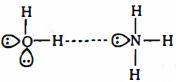
B
C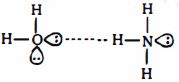
D
None of these.
Solution
(C) hydrogen bond is formed when a hydrogen atom is covalently bonded to a highly electronegative atom (like $F, O, N$) and is attracted to another electronegative atom with a lone pair.
In option $(A)$,the $H$ atom of $H_2O$ (which is more acidic) is attracted to the lone pair on the $N$ atom of $NH_3$. This is a correct representation.
In option $(B)$,the $H$ atom of the $-OH$ group in $o$-chlorophenol forms an intramolecular hydrogen bond with the $Cl$ atom. While $Cl$ is not as electronegative as $F, O, N$,it can participate in weak hydrogen bonding in specific geometries.
In option $(C)$,the $H$ atom of $NH_3$ is shown bonded to the $O$ atom of $H_2O$. Since $N$ is less electronegative than $O$,the $N-H$ bond is less polar than the $O-H$ bond. Therefore,the $H$ atom in $NH_3$ is less acidic and less capable of forming a strong hydrogen bond compared to the $H$ atom in $H_2O$. Thus,$(C)$ is the least favorable representation among the given choices.
In option $(A)$,the $H$ atom of $H_2O$ (which is more acidic) is attracted to the lone pair on the $N$ atom of $NH_3$. This is a correct representation.
In option $(B)$,the $H$ atom of the $-OH$ group in $o$-chlorophenol forms an intramolecular hydrogen bond with the $Cl$ atom. While $Cl$ is not as electronegative as $F, O, N$,it can participate in weak hydrogen bonding in specific geometries.
In option $(C)$,the $H$ atom of $NH_3$ is shown bonded to the $O$ atom of $H_2O$. Since $N$ is less electronegative than $O$,the $N-H$ bond is less polar than the $O-H$ bond. Therefore,the $H$ atom in $NH_3$ is less acidic and less capable of forming a strong hydrogen bond compared to the $H$ atom in $H_2O$. Thus,$(C)$ is the least favorable representation among the given choices.
0 likes
View Solution127
DifficultMCQ
The hydrogen bonds in solid $HF$ can be best represented as:
A
$H-F \dots H-F \dots H-F$
B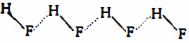
C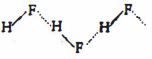
D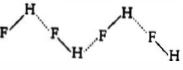
Solution
(B) In solid $HF$,each fluorine atom is covalently bonded to one hydrogen atom and hydrogen-bonded to another hydrogen atom. The arrangement of bonding pairs $(bp)$ and lone pairs $(lp)$ around the fluorine atom is tetrahedral. This results in a zig-zag chain structure where the $H-F \dots H$ bond angle is approximately $120^{\circ}$. The correct representation is a zig-zag chain where $F$ is covalently bonded to $H$ and hydrogen-bonded to the next $H$ in the chain,which corresponds to the structure where $H$ atoms are positioned between $F$ atoms in a zig-zag manner.
0 likes
View Solution128
AdvancedMCQ
Which of the following interactions lies in the range of $8 - 42 \, kJ/mol$?
A
$H_2 \dots H_2O$
B
$HCl \dots HCl$
C
$F^{-} \dots HF$
D
$HCN \dots NH_3$
Solution
(D) $(a) \, H_2 \dots H_2O$: Dipole-induced dipole interaction (van der Waals force) energy is $< 8 \, kJ/mol$.
$(b) \, HCl \dots HCl$: Dipole-dipole interaction (van der Waals force) energy is $< 8 \, kJ/mol$.
$(c) \, F^{-} \dots HF$: Ion-dipole $H$-bond (very strong $H$-bond) energy is $> 42 \, kJ/mol$.
$(d) \, HCN \dots NH_3$: $H$-bond energy typically ranges from $8 - 42 \, kJ/mol$.
$(b) \, HCl \dots HCl$: Dipole-dipole interaction (van der Waals force) energy is $< 8 \, kJ/mol$.
$(c) \, F^{-} \dots HF$: Ion-dipole $H$-bond (very strong $H$-bond) energy is $> 42 \, kJ/mol$.
$(d) \, HCN \dots NH_3$: $H$-bond energy typically ranges from $8 - 42 \, kJ/mol$.
0 likes
View Solution129
EasyMCQ
The boiling point of $NH_3$ is much higher than that of $PH_3$ because.......
A
$NH_3$ has a much higher molecular weight.
B
$NH_3$ undergoes pyramidal inversion.
C
$NH_3$ molecules form hydrogen bonds.
D
$NH_3$ has ionic bonds while $PH_3$ has covalent bonds.
Solution
(C) $NH_3$ molecules exhibit intermolecular hydrogen bonding.
Due to this,it shows a much higher boiling point compared to $PH_3$.
Due to this,it shows a much higher boiling point compared to $PH_3$.
0 likes
View Solution130
EasyMCQ
Which of the following is the correct order of increasing enthalpy of vaporization for the given hydrides?
A
$NH_3, PH_3, AsH_3$
B
$AsH_3, PH_3, NH_3$
C
$NH_3, AsH_3, PH_3$
D
$PH_3, AsH_3, NH_3$
Solution
(D) The enthalpy of vaporization generally increases with an increase in molecular mass due to stronger van der Waals forces. However,$NH_3$ exhibits an exceptionally high enthalpy of vaporization due to the presence of intermolecular $H$-bonding. Therefore,the correct order of increasing enthalpy of vaporization is $PH_3 < AsH_3 < NH_3$.
0 likes
View Solution131
MediumMCQ
The electronegativity of oxygen is higher than that of sulfur. Yet,$H_2S$ is acidic while $H_2O$ is neutral. The reason for this is .........
A
Water is a highly associated compound.
B
The molecular weight of $H_2O$ is higher than that of $H_2S$.
C
$H_2S$ is a gas under normal conditions while $H_2O$ is a liquid.
D
The $H-S$ bond is weaker than the $H-O$ bond.
Solution
(D) The $H-S$ bond is weaker than the $H-O$ bond due to the larger size of the sulfur atom compared to the oxygen atom.
Consequently,$H_2S$ has a greater tendency to release a proton $(H^+)$ compared to $H_2O$,making it more acidic.
Consequently,$H_2S$ has a greater tendency to release a proton $(H^+)$ compared to $H_2O$,making it more acidic.
0 likes
View Solution132
EasyMCQ
Among $H_2O, H_2S, H_2Se$ and $H_2Te$,the substance with the highest boiling point is,
A
$H_2O$,due to hydrogen bonding.
B
$H_2Te$,due to its high molecular weight.
C
$H_2S$,due to hydrogen bonding.
D
$H_2Se$,due to its low molecular weight.
Solution
(A) $H_2O$ has the highest boiling point among the hydrides of group $16$ elements because it exhibits extensive intermolecular hydrogen bonding.
0 likes
View Solution133
EasyMCQ
Unlike other hydrogen halides,hydrogen fluoride is a liquid. The reason for this is:
A
The size of the fluorine atom is small.
B
$HF$ is the weakest acid.
C
Fluorine is highly reactive.
D
$HF$ molecules form intermolecular $H$-bonds.
Solution
(D) $HF$ molecules are associated due to strong intermolecular $H$-bonding,which is not present in other hydrogen halides. This association leads to a higher boiling point,causing $HF$ to exist as a liquid at room temperature.
0 likes
View Solution134
EasyMCQ
In which of the following compounds does hydrogen bonding not play a role in its boiling point?
A
$NH_3$
B
$H_2O$
C
$HI$
D
$C_2H_5OH$
Solution
(C) Hydrogen bonding occurs when hydrogen is covalently bonded to highly electronegative atoms like $F$,$O$,or $N$.
In $NH_3$,$H_2O$,and $C_2H_5OH$,hydrogen bonding is present.
Iodine is not sufficiently electronegative to form hydrogen bonds.
Therefore,hydrogen bonding does not play a role in the boiling point of $HI$.
In $NH_3$,$H_2O$,and $C_2H_5OH$,hydrogen bonding is present.
Iodine is not sufficiently electronegative to form hydrogen bonds.
Therefore,hydrogen bonding does not play a role in the boiling point of $HI$.
0 likes
View Solution135
EasyMCQ
Which of the following exhibits the strongest hydrogen bond?
A
$F-H \dots O$
B
$F-H \dots N$
C
$F-H \dots F$
D
All are approximately equal in strength.
Solution
(C) The strength of a hydrogen bond is directly proportional to the electronegativity difference between the atoms involved. Since $F$ is the most electronegative element,the $F-H \dots F$ hydrogen bond is the strongest among the given options.
0 likes
View Solution136
EasyMCQ
Which of the following halogen acids is a liquid?
A
$HF$
B
$HCl$
C
$HBr$
D
$HI$
Solution
(A) $HF$ exists as a liquid due to the presence of strong intermolecular hydrogen bonding. In contrast,all other hydrogen halides ($HCl$,$HBr$,$HI$) exist as gases at room temperature.
0 likes
View Solution137
EasyMCQ
In which of the following is the strongest hydrogen bonding observed?
A
Water
B
Ammonia
C
Hydrogen fluoride
D
Hydrogen sulfide
Solution
(C) Hydrogen bonding strength depends on the electronegativity of the atom bonded to hydrogen.
Since fluorine $(F)$ is the most electronegative element,the $H-F$ bond exhibits the strongest hydrogen bonding.
Since fluorine $(F)$ is the most electronegative element,the $H-F$ bond exhibits the strongest hydrogen bonding.
0 likes
View Solution138
MediumMCQ
$KF$ combines with $HF$ to form $KHF_2$. Which of the following species are present in this compound?
A
$K^{+}, F^{-}$ and $H^{+}$
B
$K^{+}, F^{-}$ and $HF$
C
$K^{+}$ and $[HF_2]^{-}$
D
$[KHF]^{+}$ and $F^{-}$
Solution
(C) $KF$ reacts with $HF$ to form potassium hydrogen difluoride $(KHF_2)$.
In the solid state,$KHF_2$ is an ionic compound consisting of potassium ions $(K^{+})$ and hydrogen difluoride ions $([HF_2]^{-})$.
The $[HF_2]^{-}$ ion is formed due to strong hydrogen bonding between the fluoride ion $(F^{-})$ and the hydrogen fluoride molecule $(HF)$: $F^{-} \cdots H-F \rightarrow [F-H-F]^{-}$.
Therefore,the compound contains $K^{+}$ and $[HF_2]^{-}$ ions.
In the solid state,$KHF_2$ is an ionic compound consisting of potassium ions $(K^{+})$ and hydrogen difluoride ions $([HF_2]^{-})$.
The $[HF_2]^{-}$ ion is formed due to strong hydrogen bonding between the fluoride ion $(F^{-})$ and the hydrogen fluoride molecule $(HF)$: $F^{-} \cdots H-F \rightarrow [F-H-F]^{-}$.
Therefore,the compound contains $K^{+}$ and $[HF_2]^{-}$ ions.
0 likes
View Solution139
MediumMCQ
The correct order of volatility is:
A
$NH_3 < H_2O$
B
$p-\text{nitrophenol} < o-\text{nitrophenol}$
C
$CH_3OH > CH_3OCH_3$
D
$HF < HCl$
Solution
(B) Volatility is inversely proportional to the strength of intermolecular forces.
$1$. In $p-\text{nitrophenol}$,strong intermolecular $H$-bonding exists,leading to higher boiling point and lower volatility.
$2$. In $o-\text{nitrophenol}$,intramolecular $H$-bonding occurs,which reduces intermolecular attraction,making it more volatile.
Therefore,the correct order of volatility is $p-\text{nitrophenol} < o-\text{nitrophenol}$.
$1$. In $p-\text{nitrophenol}$,strong intermolecular $H$-bonding exists,leading to higher boiling point and lower volatility.
$2$. In $o-\text{nitrophenol}$,intramolecular $H$-bonding occurs,which reduces intermolecular attraction,making it more volatile.
Therefore,the correct order of volatility is $p-\text{nitrophenol} < o-\text{nitrophenol}$.
0 likes
View Solution140
MediumMCQ
Which one of the following molecules will form a linear polymeric structure due to $H$-bonding?
A
$HCl$
B
$HF$
C
$H_2O$
D
$NH_3$
Solution
(B) $HF$ forms a linear polymeric structure due to intermolecular $H$-bonding.
In this structure,each $F$ atom is bonded to one $H$ atom covalently and to another $H$ atom via a hydrogen bond,resulting in a zigzag chain structure.
$H_2O$ forms a three-dimensional network structure due to $H$-bonding.
$NH_3$ forms a pyramidal structure and does not form a linear polymer.
$HCl$ does not exhibit significant $H$-bonding.
In this structure,each $F$ atom is bonded to one $H$ atom covalently and to another $H$ atom via a hydrogen bond,resulting in a zigzag chain structure.
$H_2O$ forms a three-dimensional network structure due to $H$-bonding.
$NH_3$ forms a pyramidal structure and does not form a linear polymer.
$HCl$ does not exhibit significant $H$-bonding.
0 likes
View Solution141
MediumMCQ
Among $H_2O$,$H_2S$,$H_2Se$ and $H_2Te$,the one with the highest boiling point is
A
$H_2O$ because of hydrogen bonding
B
$H_2Te$ because of higher molecular weight
C
$H_2S$ because of hydrogen bonding
D
$H_2Se$ because of lower molecular weight
Solution
(A) The boiling points of hydrides of group $16$ elements depend on both molecular mass and intermolecular forces.
As we move down the group from $O$ to $Te$,the molecular mass increases,which leads to an increase in van der Waals forces,generally increasing the boiling point.
However,$H_2O$ molecules are held together by strong intermolecular hydrogen bonding,which is absent in the other hydrides ($H_2S$,$H_2Se$,$H_2Te$).
Due to this strong hydrogen bonding,$H_2O$ has an anomalously high boiling point compared to the other hydrides in the series.
As we move down the group from $O$ to $Te$,the molecular mass increases,which leads to an increase in van der Waals forces,generally increasing the boiling point.
However,$H_2O$ molecules are held together by strong intermolecular hydrogen bonding,which is absent in the other hydrides ($H_2S$,$H_2Se$,$H_2Te$).
Due to this strong hydrogen bonding,$H_2O$ has an anomalously high boiling point compared to the other hydrides in the series.
0 likes
View Solution142
MediumMCQ
Which among the following attractions is the strongest?
A
$HF^{-} \dots H_2O$
B
$HF^{-} \dots Cl_2$
C
$H_2O \dots Cl_2$
D
$Cl_2 \dots Cl_2$
Solution
(A) The strength of intermolecular forces depends on the nature of the interaction.
$HF^{-} \dots H_2O$ represents an ion-dipole interaction,which is significantly stronger than dipole-induced dipole or London dispersion forces.
$HF^{-} \dots Cl_2$ and $H_2O \dots Cl_2$ are dipole-induced dipole interactions.
$Cl_2 \dots Cl_2$ is a London dispersion force (induced dipole-induced dipole),which is the weakest among the given options.
Therefore,the ion-dipole interaction $HF^{-} \dots H_2O$ is the strongest.
$HF^{-} \dots H_2O$ represents an ion-dipole interaction,which is significantly stronger than dipole-induced dipole or London dispersion forces.
$HF^{-} \dots Cl_2$ and $H_2O \dots Cl_2$ are dipole-induced dipole interactions.
$Cl_2 \dots Cl_2$ is a London dispersion force (induced dipole-induced dipole),which is the weakest among the given options.
Therefore,the ion-dipole interaction $HF^{-} \dots H_2O$ is the strongest.
0 likes
View Solution143
MediumMCQ
Hydrogen bonding is present in:
A
$KHF_2$
B
$KH_2PO_4$
C
$KH_2PO_2$
D
Both $(A)$ and $(B)$
Solution
(D) In $KHF_2$,the anion is $[F-H-F]^-$,which contains a strong symmetric hydrogen bond between the two fluoride ions.
In $KH_2PO_4$,the phosphate units are linked by intermolecular hydrogen bonds,forming a polymeric structure.
In $KH_2PO_2$,the phosphorus atom is bonded to two hydrogen atoms directly,and there are no acidic protons available to form hydrogen bonds.
Therefore,both $(A)$ and $(B)$ exhibit hydrogen bonding.
In $KH_2PO_4$,the phosphate units are linked by intermolecular hydrogen bonds,forming a polymeric structure.
In $KH_2PO_2$,the phosphorus atom is bonded to two hydrogen atoms directly,and there are no acidic protons available to form hydrogen bonds.
Therefore,both $(A)$ and $(B)$ exhibit hydrogen bonding.
0 likes
View Solution144
MediumMCQ
Which among the following attractions is the strongest?
A
$HF \dots H_2O$
B
$HF \dots Cl_2$
C
$H_2O \dots Cl_2$
D
$Cl_2 \dots Cl_2$
Solution
(A) The strength of intermolecular forces depends on the nature of the interaction.
$HF \dots H_2O$ involves hydrogen bonding,which is the strongest type of dipole-dipole interaction among the given options.
$HF \dots Cl_2$ involves dipole-induced dipole interaction.
$H_2O \dots Cl_2$ involves dipole-induced dipole interaction.
$Cl_2 \dots Cl_2$ involves London dispersion forces,which are the weakest.
Therefore,the hydrogen bond between $HF$ and $H_2O$ is the strongest.
$HF \dots H_2O$ involves hydrogen bonding,which is the strongest type of dipole-dipole interaction among the given options.
$HF \dots Cl_2$ involves dipole-induced dipole interaction.
$H_2O \dots Cl_2$ involves dipole-induced dipole interaction.
$Cl_2 \dots Cl_2$ involves London dispersion forces,which are the weakest.
Therefore,the hydrogen bond between $HF$ and $H_2O$ is the strongest.
0 likes
View Solution145
MediumMCQ
Intramolecular hydrogen bonding is not present in
A
Urea
B
Chloral hydrate
C
Salicylaldehyde
D
$o$-Fluorophenol
Solution
(A) Intramolecular hydrogen bonding occurs within the same molecule,typically forming a stable ring structure (chelation).
$1$. $o$-Fluorophenol exhibits intramolecular hydrogen bonding between the $-OH$ group and the $F$ atom.
$2$. Salicylaldehyde exhibits intramolecular hydrogen bonding between the $-OH$ group and the $-CHO$ group.
$3$. Chloral hydrate $(CCl_3CH(OH)_2)$ exhibits intramolecular hydrogen bonding between the two hydroxyl groups.
$4$. Urea $(NH_2CONH_2)$ exhibits intermolecular hydrogen bonding,where hydrogen bonds form between different molecules,leading to a high melting point and solid state structure. It does not exhibit intramolecular hydrogen bonding.
$1$. $o$-Fluorophenol exhibits intramolecular hydrogen bonding between the $-OH$ group and the $F$ atom.
$2$. Salicylaldehyde exhibits intramolecular hydrogen bonding between the $-OH$ group and the $-CHO$ group.
$3$. Chloral hydrate $(CCl_3CH(OH)_2)$ exhibits intramolecular hydrogen bonding between the two hydroxyl groups.
$4$. Urea $(NH_2CONH_2)$ exhibits intermolecular hydrogen bonding,where hydrogen bonds form between different molecules,leading to a high melting point and solid state structure. It does not exhibit intramolecular hydrogen bonding.
0 likes
View Solution146
DifficultMCQ
Correct decreasing order of boiling point of given compounds:
$I. \ HCl$
$II. \ H_2O$
$III. \ HF$
$IV. \ NH_3$
$I. \ HCl$
$II. \ H_2O$
$III. \ HF$
$IV. \ NH_3$
A
$III > II > IV > I$
B
$III > IV > II > I$
C
$II > III > IV > I$
D
$II > III > I > IV$
Solution
(C) The boiling point of these compounds is primarily determined by the strength of intermolecular hydrogen bonding.
$H_2O$ has the highest boiling point because each molecule can form up to $4$ hydrogen bonds,creating a strong three-dimensional network.
$HF$ has the next highest boiling point due to strong hydrogen bonding,though it forms fewer bonds per molecule than $H_2O$.
$NH_3$ has a lower boiling point than $HF$ because the electronegativity difference between $N$ and $H$ is smaller,leading to weaker hydrogen bonds.
$HCl$ does not exhibit significant hydrogen bonding and relies on dipole-dipole interactions,resulting in the lowest boiling point among the given compounds.
Therefore,the decreasing order is $II > III > IV > I$.
$H_2O$ has the highest boiling point because each molecule can form up to $4$ hydrogen bonds,creating a strong three-dimensional network.
$HF$ has the next highest boiling point due to strong hydrogen bonding,though it forms fewer bonds per molecule than $H_2O$.
$NH_3$ has a lower boiling point than $HF$ because the electronegativity difference between $N$ and $H$ is smaller,leading to weaker hydrogen bonds.
$HCl$ does not exhibit significant hydrogen bonding and relies on dipole-dipole interactions,resulting in the lowest boiling point among the given compounds.
Therefore,the decreasing order is $II > III > IV > I$.
0 likes
View Solution147
MediumMCQ
The hydrogen bond is not present in
A
phenol
B
liquid $HCl$
C
water
D
liquid $NH_3$
Solution
(B) Hydrogen bonding occurs in compounds where $H$ atoms are covalently bonded to highly electronegative atoms like $F$,$O$,or $N$.
In $HCl$,the chlorine atom is not sufficiently electronegative to facilitate hydrogen bonding.
Therefore,$HCl$ does not exhibit hydrogen bonding.
In $HCl$,the chlorine atom is not sufficiently electronegative to facilitate hydrogen bonding.
Therefore,$HCl$ does not exhibit hydrogen bonding.
0 likes
View Solution148
MediumMCQ
Which of the following forms a dimer by $H$-bond?
A
$CH_3COOH$
B
$H_2SO_4$
C
$AlCl_3$
D
$o$-nitrophenol
Solution
(A) Acetic acid $(CH_3COOH)$ exists as a dimer in the vapor phase and in non-polar solvents due to intermolecular hydrogen bonding.
Two molecules of acetic acid are held together by two hydrogen bonds to form a cyclic dimer structure.
$o$-nitrophenol exhibits intramolecular hydrogen bonding,which prevents dimerization.
$AlCl_3$ exists as a dimer $(Al_2Cl_6)$ due to coordinate covalent bonding,not hydrogen bonding.
Two molecules of acetic acid are held together by two hydrogen bonds to form a cyclic dimer structure.
$o$-nitrophenol exhibits intramolecular hydrogen bonding,which prevents dimerization.
$AlCl_3$ exists as a dimer $(Al_2Cl_6)$ due to coordinate covalent bonding,not hydrogen bonding.
0 likes
View Solution149
MediumMCQ
Which one of the following does not have intermolecular hydrogen bonding?
A
$H_2O$
B
$o$-nitrophenol
C
$HF$
D
$CH_3COOH$
Solution
(B) Intermolecular hydrogen bonding occurs between different molecules of the same or different substances.
$H_2O$,$HF$,and $CH_3COOH$ exhibit intermolecular hydrogen bonding.
$o$-nitrophenol exhibits intramolecular hydrogen bonding,where the hydrogen atom is bonded to an oxygen atom within the same molecule,forming a stable six-membered ring.
$H_2O$,$HF$,and $CH_3COOH$ exhibit intermolecular hydrogen bonding.
$o$-nitrophenol exhibits intramolecular hydrogen bonding,where the hydrogen atom is bonded to an oxygen atom within the same molecule,forming a stable six-membered ring.
0 likes
View Solution150
DifficultMCQ
Which of the following has maximum volatility?
A
o-Hydroxybenzoic acid
B
p-Hydroxybenzoic acid
C
m-Chlorobenzoic acid
D
p-Chlorobenzoic acid
Solution
(A) Volatility is inversely proportional to intermolecular hydrogen bonding and boiling point.
$o$-Hydroxybenzoic acid (salicylic acid) exhibits intramolecular hydrogen bonding,which reduces its intermolecular association compared to the other options.
Due to weaker intermolecular forces,$o$-hydroxybenzoic acid has the lowest boiling point and therefore the maximum volatility among the given compounds.
$o$-Hydroxybenzoic acid (salicylic acid) exhibits intramolecular hydrogen bonding,which reduces its intermolecular association compared to the other options.
Due to weaker intermolecular forces,$o$-hydroxybenzoic acid has the lowest boiling point and therefore the maximum volatility among the given compounds.
0 likes
View SolutionChemical Bonding and Molecular Structure — Hydrogen bonding · Frequently Asked Questions
1Are these Chemical Bonding and Molecular Structure questions useful for JEE and NEET?
Yes. All questions in this section are mapped to JEE Main and NEET exam patterns. Previous year questions from JEE Main, NEET, GUJCET and state-level exams are included with full solutions.
2Can I switch to Hindi or Gujarati for these questions?
Yes. Use the language tabs in the hero section or the sidebar to view the same questions and solutions in English, Hindi or Gujarati.
3How do I generate a question paper from this subtopic?
Use the Vedclass Exam Paper Generator — select the chapter and subtopic, set difficulty, and generate Sets A, B, C, D automatically. First 3 chapters of every subject are free.
Vedclass Products
For Students
Vedclass Test Series
Mock tests in real JEE/NEET style with performance analysis. 5-day free trial.
Start Free TrialFor Teachers
Exam Paper Generator
Generate Set A/B/C/D papers from this chapter in 2 minutes. 3 chapters free.
Try FreeFor Institutes
Online Exam Module
Live online exams with unlimited students, 360° analytics & white-label branding.
See DemoFor Teachers & Institutes
Generate a Chemical Bonding and Molecular Structure Exam Paper in 2 Minutes
Select subtopic & difficulty — Sets A, B, C, D auto-generated with No Repeat logic.
First 3 chapters of every subject are free — no payment required.