
A English
Hydrogen bonding Questions in English
Class 11 Chemistry · Chemical Bonding and Molecular Structure · Hydrogen bonding
249+
Questions
English
Language
100%
With Solutions
Showing 50 of 249 questions in English
51
MediumMCQ
Orthophosphoric acid $(H_3PO_4)$ exhibits high viscosity due to:
A
Hydrogen bonding
B
Phosphorus group
C
Maximum oxygen group
D
Tribasicity
Solution
(A) Orthophosphoric acid $(H_3PO_4)$ exhibits high viscosity due to extensive intermolecular hydrogen bonding. Each molecule of $H_3PO_4$ can form multiple hydrogen bonds with neighboring molecules,leading to a highly associated structure.
0 likes
View Solution52
MediumMCQ
At room temperature $H_2O$ is a liquid while $H_2S$ is a gas. The reason is
A
Electronegativity of $O$ is greater than $S$
B
Difference in the bond angles of both the molecules
C
Association takes place in $H_2O$ due to $H$-bonding while no $H$-bonding in $H_2S$
D
$O$ and $S$ belong to different periods
Solution
(C) $H_2O$ molecules are associated through intermolecular hydrogen bonding due to the high electronegativity and small size of the oxygen atom.
In contrast,$H_2S$ does not exhibit hydrogen bonding because sulfur has low electronegativity and a larger atomic size,resulting in weaker intermolecular forces (van der Waals forces) and making it a gas at room temperature.
In contrast,$H_2S$ does not exhibit hydrogen bonding because sulfur has low electronegativity and a larger atomic size,resulting in weaker intermolecular forces (van der Waals forces) and making it a gas at room temperature.
0 likes
View Solution53
MediumMCQ
Amongst $H_2O$,$H_2S$,$H_2Se$ and $H_2Te$,the one with the highest boiling point is:
A
$H_2O$ because of hydrogen bonding
B
$H_2Te$ because of higher molecular weight
C
$H_2S$ because of hydrogen bonding
D
$H_2Se$ because of lower molecular weight
Solution
(A) The boiling points of hydrides of group $16$ elements follow the order: $H_2O > H_2Te > H_2Se > H_2S$.
$H_2O$ has an anomalously high boiling point due to the presence of strong intermolecular hydrogen bonding,which is absent in the other hydrides of this group.
Therefore,the correct option is $A$.
$H_2O$ has an anomalously high boiling point due to the presence of strong intermolecular hydrogen bonding,which is absent in the other hydrides of this group.
Therefore,the correct option is $A$.
0 likes
View Solution54
MediumMCQ
Which one of the halogen acids is a liquid at room temperature?
A
$HF$
B
$HCl$
C
$HBr$
D
$HI$
Solution
(A) $HF$ is a liquid at room temperature due to the presence of strong intermolecular hydrogen bonding,whereas other hydrogen halides exist as gases.
0 likes
View Solution55
MediumMCQ
$HCl$ is a gas,but $HF$ is a low boiling liquid. This is because
A
$H-F$ bond is strong
B
$H-F$ bond is weak
C
The molecules aggregate because of hydrogen bonding in $HF$
D
$HF$ is a weak acid
Solution
(C) $HF$ is a liquid at room temperature while $HCl$ is a gas. This is due to extensive $H$-bonding in $HF$,which increases its boiling point.
0 likes
View Solution56
EasyMCQ
Hydrogen bonding does not play any role in the boiling of
A
$NH_3$
B
$H_2O$
C
$HI$
D
$C_2H_5OH$
Solution
(C) . Hydrogen bonding is absent in $HI$ because iodine is not sufficiently electronegative to form a hydrogen bond.
In contrast,hydrogen bonding is present in $NH_3$,$H_2O$,and $C_2H_5OH$ due to the presence of highly electronegative atoms like $N$,$O$,or $F$ bonded to hydrogen.
In contrast,hydrogen bonding is present in $NH_3$,$H_2O$,and $C_2H_5OH$ due to the presence of highly electronegative atoms like $N$,$O$,or $F$ bonded to hydrogen.
0 likes
View Solution57
EasyMCQ
Which of the following has the highest molar heat of vaporisation?
A
$HF$
B
$HCl$
C
$HBr$
D
$HI$
Solution
(D) The molar heat of vaporisation depends on the strength of intermolecular forces.
In $HF$,hydrogen bonding is present.
In $HCl$,$HBr$,and $HI$,only London dispersion forces (a type of Van der Waals force) are present.
As the size of the halogen atom increases from $Cl$ to $I$,the polarisability and the strength of Van der Waals forces increase.
Therefore,$HI$ has the strongest intermolecular forces among the hydrogen halides ($HCl$,$HBr$,$HI$),leading to the highest molar heat of vaporisation.
Note: While $HF$ has hydrogen bonding,the magnitude of the Van der Waals forces in $HI$ due to its large size and high polarisability results in a higher molar heat of vaporisation compared to $HF$.
In $HF$,hydrogen bonding is present.
In $HCl$,$HBr$,and $HI$,only London dispersion forces (a type of Van der Waals force) are present.
As the size of the halogen atom increases from $Cl$ to $I$,the polarisability and the strength of Van der Waals forces increase.
Therefore,$HI$ has the strongest intermolecular forces among the hydrogen halides ($HCl$,$HBr$,$HI$),leading to the highest molar heat of vaporisation.
Note: While $HF$ has hydrogen bonding,the magnitude of the Van der Waals forces in $HI$ due to its large size and high polarisability results in a higher molar heat of vaporisation compared to $HF$.
0 likes
View Solution58
EasyMCQ
Which of the following hydrogen halides has the highest boiling point?
A
$HF$
B
$HCl$
C
$HBr$
D
$HI$
Solution
(A) The boiling point of hydrogen halides depends on the strength of intermolecular forces.
In $HF$,the molecules are associated due to strong intermolecular hydrogen bonding.
This results in a significantly higher boiling point compared to $HCl$,$HBr$,and $HI$,where only weak van der Waals forces exist.
Therefore,$HF$ has the highest boiling point.
In $HF$,the molecules are associated due to strong intermolecular hydrogen bonding.
This results in a significantly higher boiling point compared to $HCl$,$HBr$,and $HI$,where only weak van der Waals forces exist.
Therefore,$HF$ has the highest boiling point.
0 likes
View Solution59
EasyMCQ
Hydrogen bonding is present in
A
$HF$
B
$HCl$
C
$HBr$
D
$HI$
Solution
(A) Hydrogen bonding occurs when hydrogen is covalently bonded to a highly electronegative atom such as $F$,$O$,or $N$.
In the given options,$F$ is the most electronegative element.
Therefore,$HF$ exhibits strong intermolecular hydrogen bonding,whereas $HCl$,$HBr$,and $HI$ do not show significant hydrogen bonding due to the lower electronegativity of $Cl$,$Br$,and $I$.
In the given options,$F$ is the most electronegative element.
Therefore,$HF$ exhibits strong intermolecular hydrogen bonding,whereas $HCl$,$HBr$,and $HI$ do not show significant hydrogen bonding due to the lower electronegativity of $Cl$,$Br$,and $I$.
0 likes
View Solution60
MediumMCQ
Hydrogen bonding is maximum in
A
$C_2H_5OH$
B
$CH_3-O-CH_3$
C
$(CH_3)_2C=O$
D
$CH_3CHO$
Solution
(A) Hydrogen bonding occurs when a hydrogen atom is covalently bonded to a highly electronegative atom like $F$,$O$,or $N$.
Among the given options,$C_2H_5OH$ (ethanol) contains an $-OH$ group where $H$ is directly bonded to an oxygen atom,which is highly electronegative.
In $CH_3-O-CH_3$ (dimethyl ether),$(CH_3)_2C=O$ (acetone),and $CH_3CHO$ (acetaldehyde),there is no $H$ atom directly bonded to an $O$ or $N$ atom,so they cannot form intermolecular hydrogen bonds.
Therefore,hydrogen bonding is maximum in $C_2H_5OH$.
Among the given options,$C_2H_5OH$ (ethanol) contains an $-OH$ group where $H$ is directly bonded to an oxygen atom,which is highly electronegative.
In $CH_3-O-CH_3$ (dimethyl ether),$(CH_3)_2C=O$ (acetone),and $CH_3CHO$ (acetaldehyde),there is no $H$ atom directly bonded to an $O$ or $N$ atom,so they cannot form intermolecular hydrogen bonds.
Therefore,hydrogen bonding is maximum in $C_2H_5OH$.
0 likes
View Solution61
EasyMCQ
Which of the following has the maximum vapour pressure?
A
$HI$
B
$HBr$
C
$HCl$
D
$HF$
Solution
(C) The vapour pressure of a substance is inversely proportional to its boiling point.
Lower boiling point implies higher vapour pressure.
The boiling point order of the given hydrogen halides is $HCl < HBr < HI < HF$.
$HF$ has the highest boiling point due to strong intermolecular hydrogen bonding.
$HCl$ has the lowest boiling point among the given options,therefore it has the maximum vapour pressure.
Lower boiling point implies higher vapour pressure.
The boiling point order of the given hydrogen halides is $HCl < HBr < HI < HF$.
$HF$ has the highest boiling point due to strong intermolecular hydrogen bonding.
$HCl$ has the lowest boiling point among the given options,therefore it has the maximum vapour pressure.
0 likes
View Solution62
DifficultMCQ
$Ortho$-nitrophenol is steam volatile whereas $para$-nitrophenol is not. This is due to
A
Intramolecular hydrogen bonding present in $ortho$-nitrophenol
B
Intermolecular hydrogen bonding
C
Intramolecular hydrogen bonding present in $para$-nitrophenol
D
None of these
Solution
(A) $Ortho$-nitrophenol and $para$-nitrophenol can be separated by steam distillation.
$o$-nitrophenol is steam volatile due to the presence of intramolecular hydrogen bonding,which reduces the intermolecular forces of attraction.
In contrast,$p$-nitrophenol exhibits intermolecular hydrogen bonding,leading to the association of molecules,which increases its boiling point and makes it less volatile.
Intramolecular hydrogen bonding occurs in $ortho$-nitrophenol because the $-NO_2$ and $-OH$ groups are in close proximity to each other.
$o$-nitrophenol is steam volatile due to the presence of intramolecular hydrogen bonding,which reduces the intermolecular forces of attraction.
In contrast,$p$-nitrophenol exhibits intermolecular hydrogen bonding,leading to the association of molecules,which increases its boiling point and makes it less volatile.
Intramolecular hydrogen bonding occurs in $ortho$-nitrophenol because the $-NO_2$ and $-OH$ groups are in close proximity to each other.
0 likes
View Solution63
MediumMCQ
Which of the following explains the viscous nature of glycerol?
A
Covalent bonds
B
Hydrogen bonds
C
Van der Waals forces
D
Ionic forces
Solution
(B) Glycerol undergoes extensive hydrogen bonding due to the presence of $3$ $-OH$ groups.
As a result,the glycerol molecules are highly associated,and thus it has high viscosity.
As a result,the glycerol molecules are highly associated,and thus it has high viscosity.
0 likes
View Solution64
EasyMCQ
The boiling point of glycerol is higher than that of propanol because of:
A
Hydrogen bonding
B
Hybridisation
C
Resonance
D
All the above
Solution
(A) Glycerol $(CH_2OH-CHOH-CH_2OH)$ contains three $-OH$ groups,whereas propanol $(CH_3CH_2CH_2OH)$ contains only one $-OH$ group.
Due to the presence of more $-OH$ groups in glycerol,it forms a more extensive network of intermolecular hydrogen bonding compared to propanol.
As a result,more energy is required to break these intermolecular forces,leading to a significantly higher boiling point for glycerol.
Due to the presence of more $-OH$ groups in glycerol,it forms a more extensive network of intermolecular hydrogen bonding compared to propanol.
As a result,more energy is required to break these intermolecular forces,leading to a significantly higher boiling point for glycerol.
0 likes
View Solution65
MediumMCQ
The compound with the highest boiling point is
A
$CH_4$
B
$CH_3OH$
C
$CH_3Cl$
D
$CH_3Br$
Solution
(B) The compound $CH_3OH$ has the highest boiling point among the given options.
This is due to the presence of intermolecular hydrogen bonding in $CH_3OH$,which is a strong attractive force compared to the dipole-dipole interactions or London dispersion forces present in the other compounds.
This is due to the presence of intermolecular hydrogen bonding in $CH_3OH$,which is a strong attractive force compared to the dipole-dipole interactions or London dispersion forces present in the other compounds.
0 likes
View Solution66
MediumMCQ
The boiling point of $CH_3OH$ (methanol) is greater than that of $CH_3SH$ (methyl thiol) because
A
There is intramolecular hydrogen bonding in methanol and intermolecular hydrogen bonding in methyl thiol
B
There is intermolecular hydrogen bonding in methanol and no hydrogen bonding in methyl thiol
C
There is no hydrogen bonding in methanol and intermolecular hydrogen bonding in methyl thiol
D
There is intramolecular hydrogen bonding in methanol and no hydrogen bonding in methyl thiol
Solution
(B) Methanol $(CH_3OH)$ has a higher boiling point than methyl thiol $(CH_3SH)$ because the oxygen atom in methanol is highly electronegative,allowing for the formation of intermolecular hydrogen bonding.
In contrast,sulfur in $CH_3SH$ is less electronegative and does not form significant hydrogen bonds.
In contrast,sulfur in $CH_3SH$ is less electronegative and does not form significant hydrogen bonds.
0 likes
View Solution67
MediumMCQ
Acetic acid exists as a dimer in benzene solution. This is due to
A
Condensation
B
Presence of $-COOH$ group
C
Presence of $\alpha-hydrogen$
D
Hydrogen bonding
Solution
(D) In non-polar solvents like benzene,carboxylic acids such as acetic acid $(CH_3COOH)$ exist as dimers due to intermolecular hydrogen bonding.
This association is represented as:
$CH_3-C(=O)OH \cdots O=C(OH)CH_3$
This leads to the formation of a stable eight-membered ring structure held together by two hydrogen bonds.
This association is represented as:
$CH_3-C(=O)OH \cdots O=C(OH)CH_3$
This leads to the formation of a stable eight-membered ring structure held together by two hydrogen bonds.
0 likes
View Solution68
EasyMCQ
When two ice cubes are pressed over each other,they unite to form one cube. Which of the following forces is responsible for holding them together?
A
Hydrogen bond formation
B
Van der Waals forces
C
Covalent attractions
D
Ionic interactions
Solution
(A) When two ice cubes are pressed together,the pressure causes local melting at the interface. As the pressure is released,the water molecules re-orient and form $H$-bonds across the interface,causing the two cubes to fuse into one.
0 likes
View Solution69
EasyMCQ
What is the maximum number of hydrogen bonds in which a water molecule can participate?
A
$1$
B
$2$
C
$3$
D
$4$
Solution
(D) single water molecule $(H_2O)$ can participate in a maximum of $4$ hydrogen bonds.
This is because each water molecule has two hydrogen atoms that can form hydrogen bonds with the lone pairs of oxygen atoms of neighboring water molecules,and the oxygen atom has two lone pairs that can accept hydrogen bonds from the hydrogen atoms of neighboring water molecules.
Thus,the total number of hydrogen bonds per water molecule is $2 + 2 = 4$.
This is because each water molecule has two hydrogen atoms that can form hydrogen bonds with the lone pairs of oxygen atoms of neighboring water molecules,and the oxygen atom has two lone pairs that can accept hydrogen bonds from the hydrogen atoms of neighboring water molecules.
Thus,the total number of hydrogen bonds per water molecule is $2 + 2 = 4$.
0 likes
View Solution70
MediumMCQ
Which of the following compounds exhibits hydrogen bonding?
A
$CH_4$
B
$H_2O$
C
$NaCl$
D
$CHCl_3$
Solution
(B) Hydrogen bonding occurs when a hydrogen atom is covalently bonded to a highly electronegative atom such as $F$,$O$,or $N$.
In $H_2O$,the oxygen atom is highly electronegative and small in size,which allows it to form strong hydrogen bonds.
In $H_2O$,the oxygen atom is highly electronegative and small in size,which allows it to form strong hydrogen bonds.
0 likes
View Solution71
MediumMCQ
The density of water is higher than that of ice due to:
A
Dipole-dipole interactions
B
Hydrogen bonding interactions
C
Dipole-induced dipole interactions
D
None of the above
Solution
(B) In ice,water molecules are held together by hydrogen bonds in a three-dimensional open cage-like structure.
This structure occupies more volume per unit mass compared to liquid water,which results in a lower density for ice.
Therefore,liquid water has a higher density than ice due to the nature of its hydrogen bonding network.
This structure occupies more volume per unit mass compared to liquid water,which results in a lower density for ice.
Therefore,liquid water has a higher density than ice due to the nature of its hydrogen bonding network.
0 likes
View Solution72
EasyMCQ
Which of the following molecules forms a linear polymeric structure due to hydrogen bonding?
A
$HCl$
B
$HF$
C
$H_2O$
D
$NH_3$
Solution
(B) Due to strong hydrogen bonding,$HF$ molecules associate to form a linear polymeric structure.
The structure can be represented as: $\cdots H-F \cdots H-F \cdots H-F \cdots H-F \cdots$
The structure can be represented as: $\cdots H-F \cdots H-F \cdots H-F \cdots H-F \cdots$
0 likes
View Solution73
DifficultMCQ
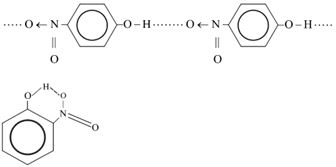
The boiling point of $p$-nitrophenol is higher than that of $o$-nitrophenol because:
A
$p$-nitrophenol has intermolecular hydrogen bonding and $o$-nitrophenol has intramolecular hydrogen bonding.
B
$p$-nitrophenol has intramolecular hydrogen bonding and $o$-nitrophenol has intermolecular hydrogen bonding.
C
$p$-nitrophenol is polar while $o$-nitrophenol is non-polar.
D
Van der Waals forces are stronger in $o$-nitrophenol.
Solution
(A) $p$-nitrophenol molecules are associated through intermolecular hydrogen bonding,which leads to a higher boiling point.
In contrast,$o$-nitrophenol molecules exhibit intramolecular hydrogen bonding,which restricts association between molecules,resulting in a lower boiling point.
In contrast,$o$-nitrophenol molecules exhibit intramolecular hydrogen bonding,which restricts association between molecules,resulting in a lower boiling point.
0 likes
View Solution74
EasyMCQ
In which of the following compounds is hydrogen bonding $NOT$ present?
A
Glycerine
B
Water
C
Hydrogen sulfide
D
Hydrogen fluoride
Solution
(C) Hydrogen bonding is not present in $H_2S$ because sulfur has a large atomic size and low electronegativity compared to oxygen or fluorine.
0 likes
View Solution75
MediumMCQ
When two ice balls are pressed against each other,they unite to form one ball. Which of the following forces are responsible for holding them together?
A
Hydrogen bond formation
B
Van der Waals forces
C
Covalent attraction
D
Dipole interaction
Solution
(A) When two ice balls are pressed together,the pressure causes local melting at the contact point. Upon releasing the pressure,the water refreezes,and the formation of $H$-bonds between the water molecules across the interface holds the two pieces together.
0 likes
View Solution76
MediumMCQ
Which of the following compounds forms the maximum number of hydrogen bonds?
A
$H_2O$
B
$H_2Se$
C
$H_2S$
D
$HF$
Solution
(A) Both $H_2O$ and $HF$ form hydrogen bonds.
In $H_2O$,each oxygen atom has two lone pairs and two hydrogen atoms,allowing it to form a maximum of $4$ hydrogen bonds per molecule.
In $HF$,although fluorine is highly electronegative,it has only one hydrogen atom available for bonding,limiting its ability to form a network compared to $H_2O$.
In $H_2O$,each oxygen atom has two lone pairs and two hydrogen atoms,allowing it to form a maximum of $4$ hydrogen bonds per molecule.
In $HF$,although fluorine is highly electronegative,it has only one hydrogen atom available for bonding,limiting its ability to form a network compared to $H_2O$.
0 likes
View Solution77
EasyMCQ
Water $(H_2O)$ is a liquid while hydrogen sulfide $(H_2S)$ is a gas. This is due to:
A
Higher molecular weight of water.
B
Hydrogen sulfide is a weak acid.
C
Electronegativity of sulfur is higher than that of oxygen.
D
Water molecules are associated through $H$-bonding.
Solution
(D) Water molecules $(H_2O)$ are associated through intermolecular $H$-bonding,which leads to its liquid state at room temperature. In contrast,$H_2S$ does not exhibit $H$-bonding due to the lower electronegativity of sulfur compared to oxygen.
0 likes
View Solution78
EasyMCQ
In ice,the $H - O - H$ bond angle is closest to which of the following?
A
$120^o 28'$
B
$60^o$
C
$90^o$
D
$109^o 28'$
Solution
(D) In the structure of ice,each oxygen atom is tetrahedrally surrounded by four other water molecules through hydrogen bonding. Due to this tetrahedral geometry,the $H - O - H$ bond angle is approximately $109^o 28'$.
0 likes
View Solution79
EasyMCQ
What is the maximum number of $H$-bonds that a single water molecule can form?
A
$4$
B
$3$
C
$2$
D
$1$
Solution
(A) single water molecule $(H_2O)$ has two hydrogen atoms and two lone pairs on the oxygen atom.
Each hydrogen atom can form one $H$-bond with an electronegative atom of another molecule,and each lone pair on the oxygen atom can accept one $H$-bond from a hydrogen atom of another molecule.
Therefore,a single water molecule can form a maximum of $4$ $H$-bonds.
Each hydrogen atom can form one $H$-bond with an electronegative atom of another molecule,and each lone pair on the oxygen atom can accept one $H$-bond from a hydrogen atom of another molecule.
Therefore,a single water molecule can form a maximum of $4$ $H$-bonds.
0 likes
View Solution80
MediumMCQ
Ortho-nitrophenol is less soluble in water than $p-$ and $m-$nitrophenol because...
A
$o-$nitrophenol has a lower melting point than $m-$ and $p-$isomers.
B
$o-$nitrophenol is more steam volatile than $m-$ and $p-$isomers.
C
$o-$nitrophenol shows intermolecular $H-$bonding.
D
$o-$nitrophenol shows intramolecular $H-$bonding.
0 likes
View Solution81
MediumMCQ
Which of the following compounds will have the maximum hydrogen bonding?
A
Ethylamine
B
Ammonia
C
Ethyl alcohol
D
Diethyl ether
Solution
(C) Among the given compounds,$C_2H_5OH$ (Ethyl alcohol) exhibits the strongest hydrogen bonding due to the high electronegativity of the oxygen atom bonded to a hydrogen atom,which is more effective than the $N-H$ bonding in amines or ammonia,and the absence of $O-H$ bonds in diethyl ether.
0 likes
View Solution82
MediumMCQ
Which of the following concepts best explains why $o$-nitrophenol is more volatile than $p$-nitrophenol?
A
Resonance
B
Hydrogen bonding
C
Hyperconjugation
D
Steric hindrance
Solution
(B) $p$-Nitrophenol exhibits intermolecular hydrogen bonding,which leads to the association of molecules and higher boiling point.
In contrast,$o$-nitrophenol exhibits intramolecular hydrogen bonding,which prevents the association of molecules.
Due to the lack of intermolecular association,$o$-nitrophenol has a lower boiling point and is more volatile than $p$-nitrophenol.
In contrast,$o$-nitrophenol exhibits intramolecular hydrogen bonding,which prevents the association of molecules.
Due to the lack of intermolecular association,$o$-nitrophenol has a lower boiling point and is more volatile than $p$-nitrophenol.
0 likes
View Solution83
EasyMCQ
Hydrogen bonding is not present in
A
Glycerine
B
Water
C
Hydrogen sulphide
D
Hydrogen fluoride
Solution
(C) Hydrogen bonding occurs when a hydrogen atom is covalently bonded to a highly electronegative atom such as $F, O,$ or $N$.
In $H_2O$ (water),$HF$ (hydrogen fluoride),and glycerine $(C_3H_8O_3)$,hydrogen is bonded to $O$ or $F$,allowing for hydrogen bonding.
In $H_2S$ (hydrogen sulphide),the electronegativity of sulfur is not high enough to facilitate significant hydrogen bonding.
Therefore,the correct option is $C$.
In $H_2O$ (water),$HF$ (hydrogen fluoride),and glycerine $(C_3H_8O_3)$,hydrogen is bonded to $O$ or $F$,allowing for hydrogen bonding.
In $H_2S$ (hydrogen sulphide),the electronegativity of sulfur is not high enough to facilitate significant hydrogen bonding.
Therefore,the correct option is $C$.
0 likes
View Solution84
MediumMCQ
Which one of the following is the correct decreasing order of boiling point?
A
$H_2O > H_2S > H_2Se > H_2Te$
B
$H_2Te > H_2Se > H_2S > H_2O$
C
$H_2O > H_2Te > H_2Se > H_2S$
D
$H_2Te > H_2O > H_2Se > H_2S$
Solution
(C) The correct decreasing order of boiling point is $H_2O > H_2Te > H_2Se > H_2S$.
$H_2O$ has the highest boiling point due to strong intermolecular hydrogen bonding.
For the remaining hydrides $(H_2S, H_2Se, H_2Te)$,the boiling point increases with increasing molecular mass due to the increase in van der Waals forces of attraction.
$H_2O$ has the highest boiling point due to strong intermolecular hydrogen bonding.
For the remaining hydrides $(H_2S, H_2Se, H_2Te)$,the boiling point increases with increasing molecular mass due to the increase in van der Waals forces of attraction.
0 likes
View Solution85
MediumMCQ
Which one of the following compounds shows the presence of intramolecular hydrogen bond?
A
$H_2O_2$
B
$HCN$
C
Cellulose
D
Concentrated acetic acid
Solution
(C) Intramolecular hydrogen bonding occurs within a single molecule,whereas intermolecular hydrogen bonding occurs between different molecules.
$H_2O_2$,$HCN$,and concentrated $CH_3COOH$ exhibit intermolecular hydrogen bonding.
Cellulose contains multiple hydroxyl $(-OH)$ groups within its polymeric structure,which allow for the formation of intramolecular hydrogen bonds between the chains and within the glucose units,stabilizing its structure.
$H_2O_2$,$HCN$,and concentrated $CH_3COOH$ exhibit intermolecular hydrogen bonding.
Cellulose contains multiple hydroxyl $(-OH)$ groups within its polymeric structure,which allow for the formation of intramolecular hydrogen bonds between the chains and within the glucose units,stabilizing its structure.
0 likes
View Solution86
MediumMCQ
What is the dominant intermolecular force or bond that must be overcome in converting liquid $CH_3OH$ to a gas?
A
Dipole-dipole interaction
B
Covalent bonds
C
London dispersion force
D
Hydrogen bonding
Solution
(D) When an $H$ atom is directly bonded to a highly electronegative atom like $N$,$O$,or $F$,a strong dipole is created,leading to the formation of intermolecular hydrogen bonding.
In liquid $CH_3OH$ (methanol),the $H$ atom is bonded to an $O$ atom,which allows for the formation of intermolecular hydrogen bonds between adjacent molecules.
To convert liquid $CH_3OH$ to a gas,these intermolecular hydrogen bonds must be overcome,as they are the dominant attractive forces holding the liquid molecules together.
In liquid $CH_3OH$ (methanol),the $H$ atom is bonded to an $O$ atom,which allows for the formation of intermolecular hydrogen bonds between adjacent molecules.
To convert liquid $CH_3OH$ to a gas,these intermolecular hydrogen bonds must be overcome,as they are the dominant attractive forces holding the liquid molecules together.
0 likes
View Solution87
DifficultMCQ
The variation of the boiling points of the hydrogen halides is in the order $HF > HI > HBr > HCl$. What explains the higher boiling point of hydrogen fluoride?
A
There is strong hydrogen bonding between $HF$ molecules.
B
The bond energy of $HF$ molecules is greater than in other hydrogen halides.
C
The effect of nuclear shielding is much reduced in fluorine which polarises the $HF$ molecule.
D
The electronegativity of fluorine is much higher than for other elements in the group.
Solution
(A) The boiling point of hydrogen halides depends on the intermolecular forces of attraction.
In $HF$ molecules,the high electronegativity and small size of the fluorine atom lead to the formation of strong intermolecular hydrogen bonding.
This results in a significantly higher boiling point compared to other hydrogen halides $(HI, HBr, HCl)$,where only weaker van der Waals forces are present.
Thus,the order is $HF > HI > HBr > HCl$.
In $HF$ molecules,the high electronegativity and small size of the fluorine atom lead to the formation of strong intermolecular hydrogen bonding.
This results in a significantly higher boiling point compared to other hydrogen halides $(HI, HBr, HCl)$,where only weaker van der Waals forces are present.
Thus,the order is $HF > HI > HBr > HCl$.
0 likes
View Solution88
MediumMCQ
Which of the following hydrogen bonds is the strongest?
A
$O-H \cdots F$
B
$O-H \cdots H$
C
$F-H \cdots F$
D
$O-H \cdots O$
Solution
(C) The strength of a hydrogen bond depends on the electronegativity difference between the atoms involved in the bond.
Greater the electronegativity difference,the stronger the hydrogen bond.
Fluorine $(F)$ is the most electronegative element.
Therefore,the $F-H \cdots F$ hydrogen bond is the strongest among the given options.
Greater the electronegativity difference,the stronger the hydrogen bond.
Fluorine $(F)$ is the most electronegative element.
Therefore,the $F-H \cdots F$ hydrogen bond is the strongest among the given options.
0 likes
View Solution89
EasyMCQ
The intermolecular interaction that is dependent on the inverse cube of distance between the molecules is:
A
London force
B
hydrogen bond
C
ion - ion interaction
D
ion - dipole interaction
Solution
(B) The interaction energy between two dipoles (dipole-dipole interaction) is proportional to $1/r^3$ for stationary dipoles,where $r$ is the distance between the molecules.
Hydrogen bonding is a specific,strong type of dipole-dipole interaction.
London dispersion forces depend on $1/r^6$.
Ion-ion interaction depends on $1/r$.
Ion-dipole interaction depends on $1/r^2$.
Hydrogen bonding is a specific,strong type of dipole-dipole interaction.
London dispersion forces depend on $1/r^6$.
Ion-ion interaction depends on $1/r$.
Ion-dipole interaction depends on $1/r^2$.
0 likes
View Solution90
DifficultMCQ
Hydrogen bonding is $NOT$ responsible for:
A
Layer structure of solid boric acid
B
Less volatile nature of $p-nitrophenol$ as compared to its ortho isomer
C
More solubility of $CH_3-CH_2-OH$ in water as compared to $CH_3-O-CH_3$
D
Higher boiling point of fluorobenzene as compared to benzene
Solution
(D) Fluorobenzene $(C_6H_5F)$ has a higher boiling point than benzene $(C_6H_6)$ primarily due to its higher molecular mass and dipole-dipole interactions.
Hydrogen bonding is not present in fluorobenzene because the fluorine atom is bonded to a carbon atom,not a hydrogen atom,and there are no $N-H$,$O-H$,or $F-H$ bonds to act as donors.
In contrast,options $(a)$,$(b)$,and $(c)$ are all consequences of hydrogen bonding.
Hydrogen bonding is not present in fluorobenzene because the fluorine atom is bonded to a carbon atom,not a hydrogen atom,and there are no $N-H$,$O-H$,or $F-H$ bonds to act as donors.
In contrast,options $(a)$,$(b)$,and $(c)$ are all consequences of hydrogen bonding.
0 likes
View Solution91
MediumMCQ
Which of the following molecules has intramolecular $H$-bonding?
A
Ortho-nitrophenol
B
Ortho-boric acid
C
Both $(A)$ & $(B)$
D
None of these
Solution
(A) Ortho-nitrophenol exhibits intramolecular hydrogen bonding,where the hydrogen atom of the hydroxyl group is bonded to the oxygen atom of the adjacent nitro group within the same molecule.
Boric acid $(H_3BO_3)$ exhibits intermolecular hydrogen bonding,where hydrogen bonds form between different molecules to create a layered structure.
Therefore,only ortho-nitrophenol has intramolecular $H$-bonding.
Boric acid $(H_3BO_3)$ exhibits intermolecular hydrogen bonding,where hydrogen bonds form between different molecules to create a layered structure.
Therefore,only ortho-nitrophenol has intramolecular $H$-bonding.
0 likes
View Solution92
MediumMCQ
The correct order of $H$-bond strength for the following interactions is:
$a: F^{-}H...F^{-}$
$b: F^{-}H...F$
$c: O^{-}H...N$
$d: O^{-}H...O$
Identify the correct order of strength.
$a: F^{-}H...F^{-}$
$b: F^{-}H...F$
$c: O^{-}H...N$
$d: O^{-}H...O$
Identify the correct order of strength.
A
$a > b > d > c$
B
$a > b > c > d$
C
$b > a > d > c$
D
$b > a > c > d$
Solution
(A) The strength of a hydrogen bond depends on the electronegativity difference and the charge density of the atoms involved.
$1$. The interaction $a$ $(F^{-}H...F^{-})$ is a symmetric,very strong hydrogen bond (often called a low-barrier hydrogen bond) due to the high electronegativity of $F$ and the negative charge,making it the strongest.
$2$. The interaction $b$ $(F^{-}H...F)$ involves a neutral $F$ atom,making it weaker than $a$ but stronger than interactions involving $O$ and $N$.
$3$. Comparing $c$ $(O^{-}H...N)$ and $d$ $(O^{-}H...O)$,the electronegativity of $O$ $(3.44)$ is greater than that of $N$ $(3.04)$. Thus,the $O-H...O$ interaction $(d)$ is stronger than the $O-H...N$ interaction $(c)$.
Therefore,the correct order of strength is $a > b > d > c$.
$1$. The interaction $a$ $(F^{-}H...F^{-})$ is a symmetric,very strong hydrogen bond (often called a low-barrier hydrogen bond) due to the high electronegativity of $F$ and the negative charge,making it the strongest.
$2$. The interaction $b$ $(F^{-}H...F)$ involves a neutral $F$ atom,making it weaker than $a$ but stronger than interactions involving $O$ and $N$.
$3$. Comparing $c$ $(O^{-}H...N)$ and $d$ $(O^{-}H...O)$,the electronegativity of $O$ $(3.44)$ is greater than that of $N$ $(3.04)$. Thus,the $O-H...O$ interaction $(d)$ is stronger than the $O-H...N$ interaction $(c)$.
Therefore,the correct order of strength is $a > b > d > c$.
0 likes
View Solution93
MediumMCQ
Which of the following is the incorrect order of viscosity?
A
$H_2SO_4 > HNO_3$
B
$H_2O > CH_3OH$
C
$o$-nitrophenol > p-nitrophenol
D
Glycol > ether
Solution
(C) Viscosity is primarily determined by the extent of intermolecular hydrogen bonding.
In $p$-nitrophenol,intermolecular hydrogen bonding is extensive,leading to association of molecules and higher viscosity.
In $o$-nitrophenol,intramolecular hydrogen bonding occurs,which restricts intermolecular association,resulting in lower viscosity.
Therefore,the correct order is $p$-nitrophenol > $o$-nitrophenol.
The given option $o$-nitrophenol > $p$-nitrophenol is incorrect.
In $p$-nitrophenol,intermolecular hydrogen bonding is extensive,leading to association of molecules and higher viscosity.
In $o$-nitrophenol,intramolecular hydrogen bonding occurs,which restricts intermolecular association,resulting in lower viscosity.
Therefore,the correct order is $p$-nitrophenol > $o$-nitrophenol.
The given option $o$-nitrophenol > $p$-nitrophenol is incorrect.
0 likes
View Solution94
MediumMCQ
Bond energy of covalent $O-H$ bond in water is
A
Greater than bond energy of $H$-bond
B
Equal to bond energy of $H$-bond
C
Less than bond energy of $H$-bond
D
None of these
Solution
(A) hydrogen bond is a weak electrostatic force of attraction (a type of dipole-dipole interaction) between a hydrogen atom and a small,highly electronegative atom. It is significantly weaker than a covalent bond.
The $O-H$ bond in water is a covalent bond,and its bond energy is much greater than that of a hydrogen bond.
The $O-H$ bond in water is a covalent bond,and its bond energy is much greater than that of a hydrogen bond.
0 likes
View Solution95
DifficultMCQ
Which of the following is the correct order?
A
$HF < H_2O < H_2O_2$ (Extent of $H$-bond)
B
$HF > H_2O > H_2O_2$ ($H$-bond strength)
C
$H_2O(\ell) > H_2O(s)$ (density)
D
All of these
Solution
(D) $1$. The extent of $H$-bonding depends on the number of $H$-bonds per molecule. $HF$ has $2$ $H$-bonds,$H_2O$ has $4$ $H$-bonds,and $H_2O_2$ has $6$ $H$-bonds. Thus,the order of extent is $HF < H_2O < H_2O_2$.
$2$. The strength of an $H$-bond depends on the electronegativity of the atom bonded to $H$. $F$ is more electronegative than $O$,so the $H$-bond strength order is $HF > H_2O > H_2O_2$.
$3$. Due to the open cage-like structure of ice $(H_2O(s))$ formed by $H$-bonding,its density is lower than that of liquid water $(H_2O(\ell))$. Thus,$H_2O(\ell) > H_2O(s)$ is correct.
$4$. Since all statements are correct,the answer is $D$.
$2$. The strength of an $H$-bond depends on the electronegativity of the atom bonded to $H$. $F$ is more electronegative than $O$,so the $H$-bond strength order is $HF > H_2O > H_2O_2$.
$3$. Due to the open cage-like structure of ice $(H_2O(s))$ formed by $H$-bonding,its density is lower than that of liquid water $(H_2O(\ell))$. Thus,$H_2O(\ell) > H_2O(s)$ is correct.
$4$. Since all statements are correct,the answer is $D$.
0 likes
View Solution96
MediumMCQ
Intramolecular $H$-bond is present in
A
$HF$
B
o-chlorophenol
C
o-fluorophenol
D
o-cresol
Solution
(C) Intramolecular $H$-bonding occurs when a hydrogen atom is bonded to a highly electronegative atom (like $F, O, N$) and is also attracted to another electronegative atom within the same molecule,forming a stable ring structure.
In $o$-fluorophenol,the hydrogen atom of the $-OH$ group forms an intramolecular hydrogen bond with the fluorine atom at the ortho position,resulting in a stable five-membered ring.
Therefore,$o$-fluorophenol exhibits intramolecular $H$-bonding.
In $o$-fluorophenol,the hydrogen atom of the $-OH$ group forms an intramolecular hydrogen bond with the fluorine atom at the ortho position,resulting in a stable five-membered ring.
Therefore,$o$-fluorophenol exhibits intramolecular $H$-bonding.
0 likes
View Solution97
MediumMCQ
Water $(H_2O)$ is a liquid while hydrogen sulphide $(H_2S)$ is a gas because
A
water has a higher molecular weight
B
hydrogen sulphide is a weak acid
C
sulphur has higher electronegativity than oxygen
D
water molecules associate through hydrogen bonding
Solution
(D) Oxygen is highly electronegative and small in size,which allows $H_2O$ molecules to form intermolecular hydrogen bonds.
These hydrogen bonds hold the water molecules together in a liquid state at room temperature.
In contrast,sulphur has lower electronegativity and larger size,so $H_2S$ does not form intermolecular hydrogen bonds,existing as a gas.
These hydrogen bonds hold the water molecules together in a liquid state at room temperature.
In contrast,sulphur has lower electronegativity and larger size,so $H_2S$ does not form intermolecular hydrogen bonds,existing as a gas.
0 likes
View Solution98
MediumMCQ
The pair likely to form the strongest hydrogen bonding is
A
$CH_4$ and $H_2O$
B
$HCOOH$ and $CH_3COOH$
C
$CH_3COOH$ and $CH_3COOCH_3$
D
$SiH_4$ and $SiCl_4$
Solution
(B) Hydrogen bonding occurs between a hydrogen atom covalently bonded to a highly electronegative atom (like $F, O, N$) and another highly electronegative atom with a lone pair of electrons.
In the pair $HCOOH$ (formic acid) and $CH_3COOH$ (acetic acid),both molecules contain a hydroxyl group $(-OH)$ and a carbonyl group $(C=O)$.
These groups allow for the formation of strong intermolecular hydrogen bonds between the hydrogen of the $-OH$ group of one molecule and the oxygen of the $C=O$ group of the other.
This leads to the formation of stable dimers,which represents a very strong form of hydrogen bonding compared to the other given options.
In the pair $HCOOH$ (formic acid) and $CH_3COOH$ (acetic acid),both molecules contain a hydroxyl group $(-OH)$ and a carbonyl group $(C=O)$.
These groups allow for the formation of strong intermolecular hydrogen bonds between the hydrogen of the $-OH$ group of one molecule and the oxygen of the $C=O$ group of the other.
This leads to the formation of stable dimers,which represents a very strong form of hydrogen bonding compared to the other given options.
0 likes
View Solution99
MediumMCQ
In which of the following is intermolecular $H$-bonding present?
A
Chloral hydrate
B
$H_2O + ROH$
C
$o$-Nitrophenol
D
$[Ni(DMG)_2]$
Solution
(B) Intermolecular $H$-bonding occurs between different molecules.
In the mixture of $H_2O$ and $ROH$ (alcohol),hydrogen bonding exists between the water molecule and the alcohol molecule.
$o$-Nitrophenol exhibits intramolecular $H$-bonding.
Chloral hydrate $(CCl_3CH(OH)_2)$ exhibits intramolecular $H$-bonding.
$[Ni(DMG)_2]$ also exhibits strong intramolecular $H$-bonding.
In the mixture of $H_2O$ and $ROH$ (alcohol),hydrogen bonding exists between the water molecule and the alcohol molecule.
$o$-Nitrophenol exhibits intramolecular $H$-bonding.
Chloral hydrate $(CCl_3CH(OH)_2)$ exhibits intramolecular $H$-bonding.
$[Ni(DMG)_2]$ also exhibits strong intramolecular $H$-bonding.
0 likes
View Solution100
DifficultMCQ
Hydrogen bonding does not play a central role in the following phenomena:
A
Ice floats in water
B
Higher Lewis basicity of primary amines than tertiary amines in aqueous solutions
C
Formic acid is more acidic than acetic acid
D
Dimerisation of acetic acid in benzene
Solution
(C) $(C)$ Formic acid is more acidic than acetic acid due to the absence of the electron-donating $+I$ effect of the methyl group, which is present in acetic acid. Hydrogen bonding is responsible for the density of ice, the solvation/basicity of amines in water, and the dimerisation of carboxylic acids in non-polar solvents like benzene.
0 likes
View SolutionChemical Bonding and Molecular Structure — Hydrogen bonding · Frequently Asked Questions
1Are these Chemical Bonding and Molecular Structure questions useful for JEE and NEET?
Yes. All questions in this section are mapped to JEE Main and NEET exam patterns. Previous year questions from JEE Main, NEET, GUJCET and state-level exams are included with full solutions.
2Can I switch to Hindi or Gujarati for these questions?
Yes. Use the language tabs in the hero section or the sidebar to view the same questions and solutions in English, Hindi or Gujarati.
3How do I generate a question paper from this subtopic?
Use the Vedclass Exam Paper Generator — select the chapter and subtopic, set difficulty, and generate Sets A, B, C, D automatically. First 3 chapters of every subject are free.
Vedclass Products
For Students
Vedclass Test Series
Mock tests in real JEE/NEET style with performance analysis. 5-day free trial.
Start Free TrialFor Teachers
Exam Paper Generator
Generate Set A/B/C/D papers from this chapter in 2 minutes. 3 chapters free.
Try FreeFor Institutes
Online Exam Module
Live online exams with unlimited students, 360° analytics & white-label branding.
See DemoFor Teachers & Institutes
Generate a Chemical Bonding and Molecular Structure Exam Paper in 2 Minutes
Select subtopic & difficulty — Sets A, B, C, D auto-generated with No Repeat logic.
First 3 chapters of every subject are free — no payment required.