
A English
Mix Examples- Morphology of Flowering Plants Questions in English
Class 11 Biology · Morphology of Flowering Plants · Mix Examples- Morphology of Flowering Plants
169+
Questions
English
Language
100%
With Solutions
Showing 50 of 169 questions in English
101
MediumMCQ
Which one of the following figures represents the placentation in Dianthus?
A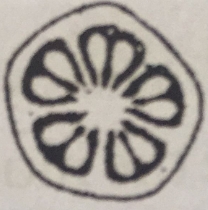
B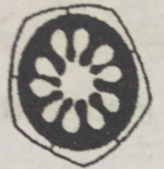
C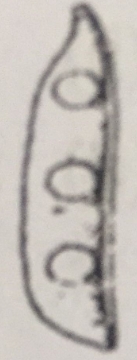
D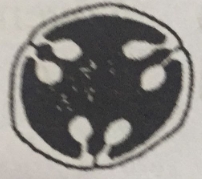
Solution
(B) The correct answer is $B$.
In $Dianthus$,the type of placentation is free central.
In free central placentation,the ovary is unilocular (single-chambered) and the ovules are borne on a central axis that is not connected to the ovary wall by septa.
Figure $B$ illustrates this arrangement,where the ovules are attached to a central column within a single-chambered ovary,which is characteristic of the family $Caryophyllaceae$ (e.g.,$Dianthus$ and $Primrose$).
In $Dianthus$,the type of placentation is free central.
In free central placentation,the ovary is unilocular (single-chambered) and the ovules are borne on a central axis that is not connected to the ovary wall by septa.
Figure $B$ illustrates this arrangement,where the ovules are attached to a central column within a single-chambered ovary,which is characteristic of the family $Caryophyllaceae$ (e.g.,$Dianthus$ and $Primrose$).
0 likes
View Solution102
MediumMCQ
Aestivation of petals in the flower of cotton is correctly shown in
A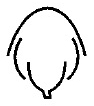
B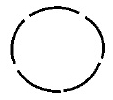
C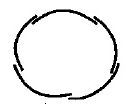
D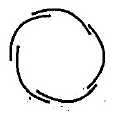
Solution
(D) The correct answer is $D$.
In plants like cotton,China rose,and lady's finger,the margins of sepals or petals overlap with the margin of the next one in a regular pattern.
This specific mode of arrangement of sepals or petals in a floral bud with respect to the other members of the same whorl is known as aestivation.
In the twisted type of aestivation,one margin of each petal overlaps the next one,creating a spiral or twisted appearance.
Image $D$ correctly represents this twisted aestivation.
In plants like cotton,China rose,and lady's finger,the margins of sepals or petals overlap with the margin of the next one in a regular pattern.
This specific mode of arrangement of sepals or petals in a floral bud with respect to the other members of the same whorl is known as aestivation.
In the twisted type of aestivation,one margin of each petal overlaps the next one,creating a spiral or twisted appearance.
Image $D$ correctly represents this twisted aestivation.
0 likes
View Solution103
MediumMCQ
The correct floral formula of soybean is
A
B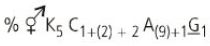
C
D
Solution
(C) The correct floral formula for soybean (a member of the family Fabaceae) is: % ♀ K_{$(5)$} C_{$1$+$2$+$(2)$} A_{$(9)$+$1$} G_{$1$}.
Explanation:
$1$. %: Zygomorphic flower.
$2$. ♀: Bisexual flower.
$3$. K_{$(5)$}: Calyx with $5$ sepals,gamosepalous (fused).
$4$. C_{$1$+$2$+$(2)$}: Corolla with $5$ petals,polypetalous,showing vexillary aestivation ($1$ standard,$2$ wings,$2$ fused keels).
$5$. A_{$(9)$+$1$}: Androecium with $10$ stamens,diadelphous ($9$ fused,$1$ free).
$6$. G_{$1$}: Gynoecium with a single monocarpellary ovary,superior (indicated by the underline).
Explanation:
$1$. %: Zygomorphic flower.
$2$. ♀: Bisexual flower.
$3$. K_{$(5)$}: Calyx with $5$ sepals,gamosepalous (fused).
$4$. C_{$1$+$2$+$(2)$}: Corolla with $5$ petals,polypetalous,showing vexillary aestivation ($1$ standard,$2$ wings,$2$ fused keels).
$5$. A_{$(9)$+$1$}: Androecium with $10$ stamens,diadelphous ($9$ fused,$1$ free).
$6$. G_{$1$}: Gynoecium with a single monocarpellary ovary,superior (indicated by the underline).
0 likes
View Solution104
MediumMCQ
Consider the following four statements $(i), (ii), (iii)$ and $(iv)$ and select the right option for two correct statements.
Statements:
$(i)$ In vexillary aestivation,the large posterior petal is called standard,two lateral ones are wings and two small anterior petals are termed keel.
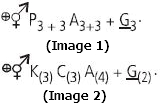
$(ii)$ The floral formula for Liliaceae is $\oplus \text{ } \text{O}\mkern-11mu{^\nearrow} \text{ } P_{(3+3)} A_{3+3} \underline{G}_{(3)}$.
$(iii)$ In pea flower,the stamens are monadelphous.
$(iv)$ The floral formula for Solanaceae is $\oplus \text{ } \text{O}\mkern-11mu{^\nearrow} \text{ } K_{(5)} C_{(5)} A_{5} \underline{G}_{(2)}$.
The correct statements are:
Statements:
$(i)$ In vexillary aestivation,the large posterior petal is called standard,two lateral ones are wings and two small anterior petals are termed keel.
$(ii)$ The floral formula for Liliaceae is $\oplus \text{ } \text{O}\mkern-11mu{^\nearrow} \text{ } P_{(3+3)} A_{3+3} \underline{G}_{(3)}$.
$(iii)$ In pea flower,the stamens are monadelphous.
$(iv)$ The floral formula for Solanaceae is $\oplus \text{ } \text{O}\mkern-11mu{^\nearrow} \text{ } K_{(5)} C_{(5)} A_{5} \underline{G}_{(2)}$.
The correct statements are:
A
$(i)$ and $(iii)$
B
$(i)$ and $(ii)$
C
$(ii)$ and $(iii)$
D
$(iii)$ and $(iv)$
Solution
(B) Statement $(i)$ is correct: In vexillary aestivation (found in Fabaceae),the largest posterior petal is the standard (vexillum),two lateral petals are wings (alae),and two anterior petals form the keel (carina).
Statement $(ii)$ is correct: The floral formula for Liliaceae is $\oplus \text{ } \text{O}\mkern-11mu{^\nearrow} \text{ } P_{(3+3)} A_{3+3} \underline{G}_{(3)}$.
Statement $(iii)$ is incorrect: In pea flowers (Fabaceae),the stamens are diadelphous ($9+1$ arrangement),not monadelphous.
Statement $(iv)$ is incorrect: The floral formula for Solanaceae is $\oplus \text{ } \text{O}\mkern-11mu{^\nearrow} \text{ } K_{(5)} C_{(5)} A_{5} \underline{G}_{(2)}$. The formula provided in the image is incorrect.
Therefore,statements $(i)$ and $(ii)$ are correct. The correct option is $(b)$.
Statement $(ii)$ is correct: The floral formula for Liliaceae is $\oplus \text{ } \text{O}\mkern-11mu{^\nearrow} \text{ } P_{(3+3)} A_{3+3} \underline{G}_{(3)}$.
Statement $(iii)$ is incorrect: In pea flowers (Fabaceae),the stamens are diadelphous ($9+1$ arrangement),not monadelphous.
Statement $(iv)$ is incorrect: The floral formula for Solanaceae is $\oplus \text{ } \text{O}\mkern-11mu{^\nearrow} \text{ } K_{(5)} C_{(5)} A_{5} \underline{G}_{(2)}$. The formula provided in the image is incorrect.
Therefore,statements $(i)$ and $(ii)$ are correct. The correct option is $(b)$.
0 likes
View Solution105
MediumMCQ
Match the correct pair.
| Column-$I$ | Column-$II$ |
| $(1)$ Imbricate | $(P)$ Gulmohur |
| $(2)$ Valvate | $(Q)$ Cotton |
| $(3)$ Twisted | $(R)$ Calotropis |
| $(4)$ Vexillary | $(S)$ Pea |
A
$(1-P), (2-R), (3-Q), (4-S)$
B
$(1-Q), (2-S), (3-P), (4-R)$
C
$(1-P), (2-Q), (3-R), (4-S)$
D
$(1-S), (2-R), (3-P), (4-Q)$
Solution
(A) The arrangement of sepals or petals in a floral bud with respect to the other members of the same whorl is known as aestivation.
$1$. Imbricate: In this type,the margins of sepals or petals overlap one another but not in any particular direction,as seen in Gulmohur and Cassia.
$2$. Valvate: When sepals or petals in a whorl just touch one another at the margin,without overlapping,as in Calotropis.
$3$. Twisted: If one margin of the appendage overlaps that of the next one and so on,as in China rose,lady's finger,and cotton.
$4$. Vexillary: In pea and bean flowers,there are five petals; the largest (standard) overlaps the two lateral petals (wings),which in turn overlap the two smallest anterior petals (keel). This is known as vexillary or papilionaceous aestivation.
Therefore,the correct matching is $(1-P), (2-R), (3-Q), (4-S)$.
$1$. Imbricate: In this type,the margins of sepals or petals overlap one another but not in any particular direction,as seen in Gulmohur and Cassia.
$2$. Valvate: When sepals or petals in a whorl just touch one another at the margin,without overlapping,as in Calotropis.
$3$. Twisted: If one margin of the appendage overlaps that of the next one and so on,as in China rose,lady's finger,and cotton.
$4$. Vexillary: In pea and bean flowers,there are five petals; the largest (standard) overlaps the two lateral petals (wings),which in turn overlap the two smallest anterior petals (keel). This is known as vexillary or papilionaceous aestivation.
Therefore,the correct matching is $(1-P), (2-R), (3-Q), (4-S)$.
0 likes
View Solution106
MediumMCQ
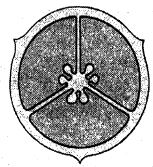
Placentation in the given figure is found in which plant?
A
China rose
B
Dianthus
C
Marigold
D
Argemone
Solution
(A) The figure shows axile placentation,where the placenta is axial and the ovules are attached to it in a multilocular ovary.
This type of placentation is characteristic of plants like China rose,tomato,and lemon.
Therefore,among the given options,China rose exhibits this type of placentation.
- Dianthus shows free central placentation.
- Marigold shows basal placentation.
- Argemone shows parietal placentation.
This type of placentation is characteristic of plants like China rose,tomato,and lemon.
Therefore,among the given options,China rose exhibits this type of placentation.
- Dianthus shows free central placentation.
- Marigold shows basal placentation.
- Argemone shows parietal placentation.
0 likes
View Solution107
MediumMCQ
Choose the correct sentence.
A
Free central placentation is found in mustard.
B
Mango is a dry fruit.
C
Maize is a dicot seed.
D
Twisted aestivation is found in China rose.
Solution
(D) $1$. Free central placentation is found in Dianthus and Primrose,not mustard. Mustard shows parietal placentation.
$2$. Mango is a fleshy fruit (drupe),not a dry fruit.
$3$. Maize is a monocot seed,not a dicot seed.
$4$. Twisted aestivation is characteristic of China rose (Hibiscus),lady's finger,and cotton. Therefore,option $D$ is correct.
$2$. Mango is a fleshy fruit (drupe),not a dry fruit.
$3$. Maize is a monocot seed,not a dicot seed.
$4$. Twisted aestivation is characteristic of China rose (Hibiscus),lady's finger,and cotton. Therefore,option $D$ is correct.
0 likes
View Solution108
MediumMCQ
Identify the odd one out from the following types of placentation.
A
Marginal
B
Axile
C
Valvate
D
Basal
Solution
(C) The options $Marginal$,$Axile$,and $Basal$ are types of placentation,which refers to the arrangement of ovules within the ovary.
$Valvate$ is a type of aestivation,which refers to the mode of arrangement of sepals or petals in a floral bud with respect to the other members of the same whorl.
Therefore,$Valvate$ is the odd one out.
$Valvate$ is a type of aestivation,which refers to the mode of arrangement of sepals or petals in a floral bud with respect to the other members of the same whorl.
Therefore,$Valvate$ is the odd one out.
0 likes
View Solution109
MediumMCQ
Which type of placentation is found in primrose and lemon,respectively?
A
Free central and axile
B
Marginal and axile
C
Basal and free central
D
Parietal and axile
Solution
(A) Placentation refers to the arrangement of ovules within the ovary.
In $Primula$ (primrose),the ovules are borne on a central axis,and septa are absent,which is known as free central placentation.
In lemon $(Citrus)$,the ovary is multilocular,and the ovules are attached to the central axis of the ovary,which is known as axile placentation.
Therefore,the correct sequence for primrose and lemon is free central and axile,respectively.
In $Primula$ (primrose),the ovules are borne on a central axis,and septa are absent,which is known as free central placentation.
In lemon $(Citrus)$,the ovary is multilocular,and the ovules are attached to the central axis of the ovary,which is known as axile placentation.
Therefore,the correct sequence for primrose and lemon is free central and axile,respectively.
0 likes
View Solution110
MediumMCQ
Units of............ are united or free.
A
Calyx
B
Corolla
C
Stamen
D
All correct
Solution
(D) In the morphology of flowering plants,the floral parts such as sepals (calyx),petals (corolla),and stamens (androecium) can be either free (aposepalous,apopetalous,or apostemonous) or united (gamosepalous,gamopetalous,or synandrous). Since all these floral whorls exhibit the condition of being either united or free,the correct answer is 'All correct'.
0 likes
View Solution111
MediumMCQ
Which type of placentation is formed in plants having vexillary aestivation?
A
Axile
B
Basal
C
Free central
D
Marginal
Solution
(D) Vexillary aestivation is a characteristic feature of the family $Fabaceae$ (e.g.,pea,bean).
In the family $Fabaceae$,the ovary is monocarpellary and unilocular.
The ovules are attached to the ventral suture of the ovary wall.
This type of arrangement of ovules within the ovary is known as marginal placentation.
Therefore,plants with vexillary aestivation exhibit marginal placentation.
In the family $Fabaceae$,the ovary is monocarpellary and unilocular.
The ovules are attached to the ventral suture of the ovary wall.
This type of arrangement of ovules within the ovary is known as marginal placentation.
Therefore,plants with vexillary aestivation exhibit marginal placentation.
0 likes
View Solution112
EasyMCQ
Match the following symbols and terms used in floral formulas:
| Column-$I$ | Column-$II$ |
|---|---|
| $(a)$ $\oplus$ or $\text{symbol shown}$ | $(p)$ Perianth |
| $(b)$ $\overline{G}$ | $(q)$ Bracteate |
| $(c)$ $P$ | $(r)$ Inferior ovary |
| $(d)$ $Br$ | $(s)$ Bisexual |

A
$(a-s), (b-r), (c-p), (d-q)$
B
$(a-q), (b-p), (c-r), (d-s)$
C
$(a-r), (b-q), (c-p), (d-s)$
D
$(a-p), (b-r), (c-q), (d-s)$
Solution
(A) The correct matches are as follows:
$(a)$ The symbol $\oplus$ represents actinomorphic symmetry,and the provided image represents a bisexual flower ($\text{male} + \text{female}$ symbol). Thus,$(a-s)$.
$(b)$ The symbol $\overline{G}$ represents an inferior ovary. Thus,$(b-r)$.
$(c)$ The symbol $P$ stands for Perianth. Thus,$(c-p)$.
$(d)$ The symbol $Br$ stands for Bracteate. Thus,$(d-q)$.
Therefore,the correct matching is $(a-s), (b-r), (c-p), (d-q)$.
$(a)$ The symbol $\oplus$ represents actinomorphic symmetry,and the provided image represents a bisexual flower ($\text{male} + \text{female}$ symbol). Thus,$(a-s)$.
$(b)$ The symbol $\overline{G}$ represents an inferior ovary. Thus,$(b-r)$.
$(c)$ The symbol $P$ stands for Perianth. Thus,$(c-p)$.
$(d)$ The symbol $Br$ stands for Bracteate. Thus,$(d-q)$.
Therefore,the correct matching is $(a-s), (b-r), (c-p), (d-q)$.
0 likes
View Solution113
MediumMCQ
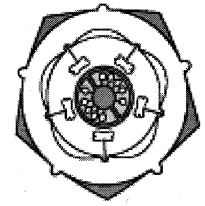
The given floral diagram indicates which family?
A
Fabaceae
B
Solanaceae
C
Liliaceae
D
Poaceae
Solution
(C) The provided floral diagram shows the following characteristics:
$1$. The flower is actinomorphic (radially symmetrical).
$2$. It is bisexual.
$3$. The perianth consists of $3+3$ tepals,which are fused at the base.
$4$. There are $3+3$ stamens,which are epiphyllous (attached to the tepals).
$5$. The ovary is tricarpellary,syncarpous,and superior with axile placentation.
These features are characteristic of the family Liliaceae.
$1$. The flower is actinomorphic (radially symmetrical).
$2$. It is bisexual.
$3$. The perianth consists of $3+3$ tepals,which are fused at the base.
$4$. There are $3+3$ stamens,which are epiphyllous (attached to the tepals).
$5$. The ovary is tricarpellary,syncarpous,and superior with axile placentation.
These features are characteristic of the family Liliaceae.
0 likes
View Solution114
MediumMCQ
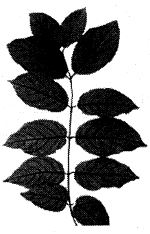
Identify the phyllotaxy shown in the figure.
A
Alternate
B
Opposite
C
Whorled
D
None of the above
Solution
(B) The figure shows a pair of leaves arising at each node and lying opposite to each other. This type of phyllotaxy is known as opposite phyllotaxy. In this arrangement,a pair of leaves arises at each node and lies opposite to each other,as seen in plants like Calotropis and Guava.
0 likes
View Solution115
MediumMCQ
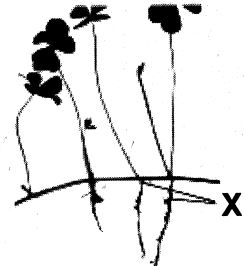
Identify $X$ in the given figure.
A
Stem modified into tendril
B
Stem modified into spine
C
Roots arising from nodes
D
Modification of stem for food storage.
Solution
(C) The given figure represents a runner (a type of sub-aerial stem modification). In this plant,the stem grows horizontally along the soil surface. The nodes of the stem produce leaves above and adventitious roots below,which is indicated by $X$ in the diagram. Therefore,$X$ represents roots arising from the nodes.
0 likes
View Solution116
MediumMCQ
Match the following:
| Column-$I$ | Column-$II$ |
| $(1)$ Carrot and turnip | $(p)$ Roots develop from branch |
| $(2)$ Banyan tree | $(q)$ Taproot |
| $(3)$ Maize and sugarcane | $(4)$ Shoot system |
| $(4)$ Bud | $(s)$ Roots develop from lower node of stem |
A
$(1-p), (2-q), (3-r), (4-s)$
B
$(1-q), (2-p), (3-s), (4-r)$
C
$(1-r), (2-p), (3-q), (4-s)$
D
$(1-s), (2-r), (3-p), (4-q)$
Solution
(B) The correct matches are as follows:
$(1)$ Carrot and turnip: These plants possess a taproot system modified for food storage. Thus,$(1-q)$.
$(2)$ Banyan tree: It has prop roots that develop from branches to provide support. Thus,$(2-p)$.
$(3)$ Maize and sugarcane: These plants have adventitious roots that develop from the lower nodes of the stem (stilt roots). Thus,$(3-s)$.
$(4)$ Bud: $A$ bud is a compact growth on a plant that develops into a shoot system (leaves,flowers,or stems). Thus,$(4-r)$.
Therefore,the correct sequence is $(1-q), (2-p), (3-s), (4-r)$.
$(1)$ Carrot and turnip: These plants possess a taproot system modified for food storage. Thus,$(1-q)$.
$(2)$ Banyan tree: It has prop roots that develop from branches to provide support. Thus,$(2-p)$.
$(3)$ Maize and sugarcane: These plants have adventitious roots that develop from the lower nodes of the stem (stilt roots). Thus,$(3-s)$.
$(4)$ Bud: $A$ bud is a compact growth on a plant that develops into a shoot system (leaves,flowers,or stems). Thus,$(4-r)$.
Therefore,the correct sequence is $(1-q), (2-p), (3-s), (4-r)$.
0 likes
View Solution117
MediumMCQ
Which of the following is not correct?
A
Actinomorphic - $Datura$
B
Zygomorphic - $Bean$
C
Asymmetric - $Canna$
D
Vexillary - $Cassia$
Solution
(D) $1$. $Actinomorphic$ (radial symmetry) is found in $Datura$,$Mustard$,and $Chilli$.
$2$. $Zygomorphic$ (bilateral symmetry) is found in $Bean$,$Gulmohur$,$Cassia$,and $Pea$.
$3$. $Asymmetric$ (irregular) is found in $Canna$.
$4$. $Vexillary$ aestivation is characteristic of the $Fabaceae$ family (e.g.,$Pea$,$Bean$),whereas $Cassia$ exhibits $Imbricate$ aestivation.
$5$. Therefore,the statement '$Vexillary - Cassia$' is incorrect.
$2$. $Zygomorphic$ (bilateral symmetry) is found in $Bean$,$Gulmohur$,$Cassia$,and $Pea$.
$3$. $Asymmetric$ (irregular) is found in $Canna$.
$4$. $Vexillary$ aestivation is characteristic of the $Fabaceae$ family (e.g.,$Pea$,$Bean$),whereas $Cassia$ exhibits $Imbricate$ aestivation.
$5$. Therefore,the statement '$Vexillary - Cassia$' is incorrect.
0 likes
View Solution118
MediumMCQ
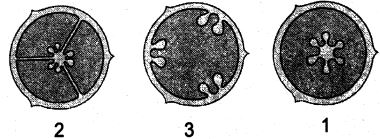
The following diagrams represent the type of placentation in an ovary. Identify the correct combination of labelling for $1 - 2 - 3$.
A
Free central - Axile - Parietal
B
Parietal - Axile - Free central
C
Axile - Parietal - Free central
D
Axile - Free central - Parietal
Solution
(A) In the provided diagrams:
- Diagram $1$ shows Free central placentation,where the ovules are borne on a central axis and septa are absent.
- Diagram $2$ shows Axile placentation,where the placenta is axial and the ovules are attached to it in a multilocular ovary.
- Diagram $3$ shows Parietal placentation,where the ovules develop on the inner wall of the ovary or on a peripheral part.
Therefore,the correct sequence for $1 - 2 - 3$ is Free central - Axile - Parietal.
- Diagram $1$ shows Free central placentation,where the ovules are borne on a central axis and septa are absent.
- Diagram $2$ shows Axile placentation,where the placenta is axial and the ovules are attached to it in a multilocular ovary.
- Diagram $3$ shows Parietal placentation,where the ovules develop on the inner wall of the ovary or on a peripheral part.
Therefore,the correct sequence for $1 - 2 - 3$ is Free central - Axile - Parietal.
0 likes
View Solution119
MediumMCQ
Select the correct floral diagram of the family Brassicaceae.
A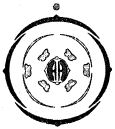
B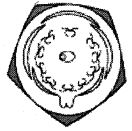
C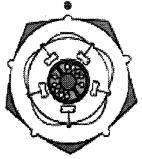
D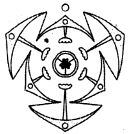
Solution
(A) The family Brassicaceae (formerly Cruciferae) is characterized by the following floral features:
$1$. Actinomorphic symmetry $(\oplus)$.
$2$. Bisexual flowers $(\text{⚥})$.
$3$. Four sepals arranged in two whorls $(2+2)$.
$4$. Four petals arranged in a cruciform manner.
$5$. Six stamens arranged in two whorls $(2+4)$, where the outer two are shorter and the inner four are longer (tetradynamous condition).
$6$. Superior ovary with two carpels, syncarpous, and typically bilocular due to the formation of a false septum (replum).
Looking at the provided diagrams, the first diagram ($579$-a601) correctly depicts these features, specifically the $2+4$ arrangement of stamens and the bicarpellary superior ovary.
$1$. Actinomorphic symmetry $(\oplus)$.
$2$. Bisexual flowers $(\text{⚥})$.
$3$. Four sepals arranged in two whorls $(2+2)$.
$4$. Four petals arranged in a cruciform manner.
$5$. Six stamens arranged in two whorls $(2+4)$, where the outer two are shorter and the inner four are longer (tetradynamous condition).
$6$. Superior ovary with two carpels, syncarpous, and typically bilocular due to the formation of a false septum (replum).
Looking at the provided diagrams, the first diagram ($579$-a601) correctly depicts these features, specifically the $2+4$ arrangement of stamens and the bicarpellary superior ovary.
0 likes
View Solution120
MediumMCQ
In a monocarpellary ovary with a single ovule, the placentation is . . . . . . .
A
Marginal
B
Basal
C
Free central
D
Axile
Solution
(A) In marginal placentation, the placenta forms a ridge along the ventral suture of the ovary, and the ovules are borne on this ridge, forming two rows. This is characteristic of the family Fabaceae, which typically has a monocarpellary ovary with one or more ovules. Therefore, the correct answer is $Marginal$ placentation.
0 likes
View Solution121
Easy
How would you distinguish monocots from dicots?
Solution
(N/A) Monocots and dicots can be differentiated through their morphological and anatomical characteristics as follows:
| Characteristic | Monocot vs Dicot |
|---|---|
| $1$. Roots | Monocots have fibrous roots,whereas dicots have tap roots. |
| $2$. Venation | Monocots show parallel venation,while dicots show reticulate venation. |
| $3$. Flowers | Monocots are generally trimerous,while dicots are pentamerous. |
| $4$. Cotyledons | Monocots have one cotyledon,while dicots have two. |
| $5$. Vascular Bundles | Monocots have numerous scattered bundles; dicots have bundles arranged in a ring. |
| $6$. Cambium | Absent in monocots (no secondary growth); present in dicots. |
0 likes
View Solution122
Medium
Justify the following statements on the basis of external features:
$(i)$ Underground parts of a plant are not always roots.
$(ii)$ Flower is a modified shoot.
$(i)$ Underground parts of a plant are not always roots.
$(ii)$ Flower is a modified shoot.
Solution
(N/A) $(i)$ Various parts of plants are modified into underground structures to perform various functions,such as stems,leaves,and even fruits.
The stems in ginger and banana are underground and swollen due to the storage of food; they are called rhizomes. Similarly,a corm is an underground stem in Colocasia and Zamin-khand. The tips of the underground stem in potato become swollen due to the accumulation of food and form a tuber. Tubers bear eyes,which are subtended by a leaf scar. Basal leaves in onions become fleshy because of the accumulation of food. In peanuts,the flower after fertilization gets pushed inside the soil by the growth of a flower stalk,where the formation of fruits and seeds takes place.
$(ii)$ During the flowering season,the apical meristem gives rise to the floral meristem. The axis of the stem gets condensed,and the internodes lie very close to each other. Instead of leaves,various floral appendages arise from the nodes. Therefore,it can be said that the flower is a modified shoot.
The stems in ginger and banana are underground and swollen due to the storage of food; they are called rhizomes. Similarly,a corm is an underground stem in Colocasia and Zamin-khand. The tips of the underground stem in potato become swollen due to the accumulation of food and form a tuber. Tubers bear eyes,which are subtended by a leaf scar. Basal leaves in onions become fleshy because of the accumulation of food. In peanuts,the flower after fertilization gets pushed inside the soil by the growth of a flower stalk,where the formation of fruits and seeds takes place.
$(ii)$ During the flowering season,the apical meristem gives rise to the floral meristem. The axis of the stem gets condensed,and the internodes lie very close to each other. Instead of leaves,various floral appendages arise from the nodes. Therefore,it can be said that the flower is a modified shoot.
0 likes
View Solution123
Easy
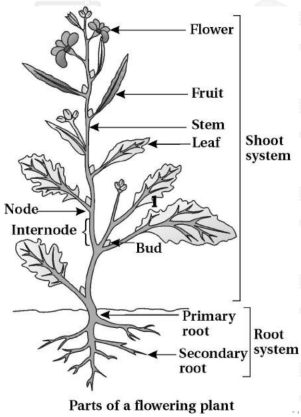
Describe the various parts of a flowering plant with the help of a diagram.
Solution
(N/A) The morphology of angiosperms shows broad diversities.
Flowering plants are primarily classified into two systems based on their location relative to the ground:
$1$. Root System: The underground part of the flowering plant is known as the root system. It typically consists of the primary root and its branches (secondary and tertiary roots).
$2$. Shoot System: The portion of the plant above the ground forms the shoot system. It includes the stem,leaves,flowers,and fruits.
Key components of the shoot system include:
- Stem: The main axis of the plant body.
- Leaves: Lateral,generally flattened structures borne on the stem.
- Flowers: The reproductive structures of the plant.
- Fruits: The ripened ovary that develops after fertilization.
- Nodes and Internodes: The stem bears nodes (where leaves arise) and internodes (the portion between two nodes).
- Buds: Small lateral or terminal growths that develop into branches or flowers.
Flowering plants are primarily classified into two systems based on their location relative to the ground:
$1$. Root System: The underground part of the flowering plant is known as the root system. It typically consists of the primary root and its branches (secondary and tertiary roots).
$2$. Shoot System: The portion of the plant above the ground forms the shoot system. It includes the stem,leaves,flowers,and fruits.
Key components of the shoot system include:
- Stem: The main axis of the plant body.
- Leaves: Lateral,generally flattened structures borne on the stem.
- Flowers: The reproductive structures of the plant.
- Fruits: The ripened ovary that develops after fertilization.
- Nodes and Internodes: The stem bears nodes (where leaves arise) and internodes (the portion between two nodes).
- Buds: Small lateral or terminal growths that develop into branches or flowers.
0 likes
View Solution124
Medium
Draw a labelled diagram of various parts of the flowering plant.
Solution
(N/A) The flowering plant body is divided into two main systems:
$1$. Root System: The underground part of the plant,which includes the primary root and secondary roots.
$2$. Shoot System: The aerial part of the plant,which includes the stem,leaves,flowers,fruits,buds,nodes,and internodes.
Refer to the provided diagram for the visual representation of these parts.
$1$. Root System: The underground part of the plant,which includes the primary root and secondary roots.
$2$. Shoot System: The aerial part of the plant,which includes the stem,leaves,flowers,fruits,buds,nodes,and internodes.
Refer to the provided diagram for the visual representation of these parts.
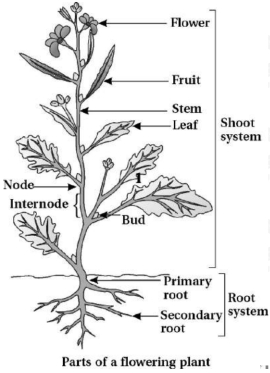
0 likes
View Solution125
Medium
Differentiate between Dicotyledons and Monocotyledons.
Solution
(N/A)
| Feature | Dicotyledons | Monocotyledons |
| $(1)$ Cotyledons | Two cotyledons are present. | Only one cotyledon is present. |
| $(2)$ Root System | Taproot system. | Fibrous root system. |
| $(3)$ Venation | Reticulate venation. | Parallel venation. |
| $(4)$ Flower Symmetry | Tetramerous or pentamerous. | Trimerous. |
| $(5)$ Vascular Bundles | Arranged in a ring. | Scattered in the stem. |
0 likes
View Solution126
Easy
Define/Explain the following terms:
$(i)$ Bulbil
$(ii)$ Stipule
$(i)$ Bulbil
$(ii)$ Stipule
Solution
(N/A) $(i)$ In $Agave$ and $Oxalis$,the floral buds or vegetative buds first store food and become fleshy. They then detach from the parent plant and germinate under favorable conditions to form new plants. Such modified buds are called bulbils.
$(ii)$ At the base of the leaf,small lateral outgrowths often develop. These are leaf-like structures known as stipules.
$(ii)$ At the base of the leaf,small lateral outgrowths often develop. These are leaf-like structures known as stipules.
0 likes
View Solution127
Easy
Definitions / Explanation :
$(i)$ Phylloclade
$(ii)$ Aestivation
$(i)$ Phylloclade
$(ii)$ Aestivation
Solution
(N/A) $(i)$ In some plants,the petiole expands,becomes green,and synthesizes food. This modified structure is called a phyllode (often confused with phylloclade,but in the context of $NCERT$ morphology,the flattened petiole is a phyllode). $A$ phylloclade is a green,flattened or cylindrical stem that performs photosynthesis,commonly seen in Opuntia.
$(ii)$ The mode of arrangement of sepals or petals in a floral bud with respect to the other members of the same whorl is known as aestivation.
$(ii)$ The mode of arrangement of sepals or petals in a floral bud with respect to the other members of the same whorl is known as aestivation.
0 likes
View Solution128
Medium
Explain the importance of the following structures in plants:
$(i)$ Root nodules (Rhizobium association)
$(ii)$ Stipular tendrils
$(i)$ Root nodules (Rhizobium association)
$(ii)$ Stipular tendrils
Solution
(N/A) $(i)$ In leguminous plants like bean and pea,the roots develop nodules that house $Rhizobium$ bacteria. These bacteria fix atmospheric nitrogen into a usable form for the plant,which is essential for protein synthesis.
$(ii)$ In some plants,the stipules (leaf-like appendages at the base of the leaf) are modified into tendrils to provide support for climbing. This is known as a stipular tendril. In the pea plant ($Pisum$ $sativum$),the stipules are large and leaf-like,assisting in photosynthesis while the tendrils help the weak stem climb.
$(ii)$ In some plants,the stipules (leaf-like appendages at the base of the leaf) are modified into tendrils to provide support for climbing. This is known as a stipular tendril. In the pea plant ($Pisum$ $sativum$),the stipules are large and leaf-like,assisting in photosynthesis while the tendrils help the weak stem climb.
0 likes
View Solution129
Medium
Below is a list of plant fibres. From which part of the plant are these obtained?
$(a)$ Coir $(b)$ Hemp $(c)$ Cotton $(d)$ Jute
$(a)$ Coir $(b)$ Hemp $(c)$ Cotton $(d)$ Jute
Solution
(N/A) The plant parts from which these fibres are obtained are as follows:
$(a)$ Coir: Obtained from the mesocarp (husk) of the coconut fruit (Cocos nucifera).
$(b)$ Hemp: Obtained from the phloem or bast fibres of the stem of the Cannabis sativa plant.
$(c)$ Cotton: Obtained from the epidermal hair of the seeds of the Gossypium plant.
$(d)$ Jute: Obtained from the phloem or bast fibres of the stem of the Corchorus plant.
$(a)$ Coir: Obtained from the mesocarp (husk) of the coconut fruit (Cocos nucifera).
$(b)$ Hemp: Obtained from the phloem or bast fibres of the stem of the Cannabis sativa plant.
$(c)$ Cotton: Obtained from the epidermal hair of the seeds of the Gossypium plant.
$(d)$ Jute: Obtained from the phloem or bast fibres of the stem of the Corchorus plant.
0 likes
View Solution130
Medium
Distinguish between the following: Stem hair and root hair.
Solution
The differences between root hair and stem hair are as follows:
| Feature | Root hair | Stem hair |
| :--- | :--- | :--- |
| Nature | They are unicellular elongations of the epiblema. | They are multicellular epidermal outgrowths,also known as trichomes. |
| Function | They help in the absorption of water and mineral elements from the soil by increasing the surface area. | They help in preventing water loss due to transpiration. |
| Feature | Root hair | Stem hair |
| :--- | :--- | :--- |
| Nature | They are unicellular elongations of the epiblema. | They are multicellular epidermal outgrowths,also known as trichomes. |
| Function | They help in the absorption of water and mineral elements from the soil by increasing the surface area. | They help in preventing water loss due to transpiration. |
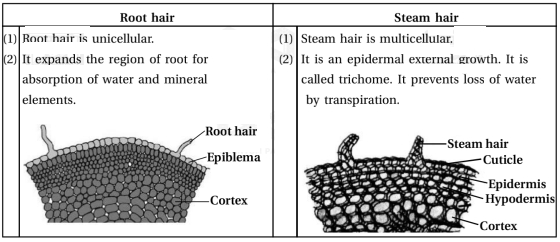
0 likes
View Solution131
Medium
Categorise the following plants into hydrophytes,halophytes,mesophytes,and xerophytes. Give reasons for your answers.
$(a)$ Salvinia $(b)$ Opuntia $(c)$ Rhizophora $(d)$ Mangifera
$(a)$ Salvinia $(b)$ Opuntia $(c)$ Rhizophora $(d)$ Mangifera
Solution
(N/A) Salvinia is a hydrophyte because it is an aquatic plant that grows in water.
$(b)$ Opuntia is a xerophyte because it is adapted to survive in arid,dry environments with limited water availability.
$(c)$ Rhizophora is a halophyte because it grows in saline,marshy environments like mangroves and possesses specialized roots for salt tolerance.
$(d)$ Mangifera is a mesophyte because it grows in environments with moderate water availability,which is typical for most terrestrial plants.
$(b)$ Opuntia is a xerophyte because it is adapted to survive in arid,dry environments with limited water availability.
$(c)$ Rhizophora is a halophyte because it grows in saline,marshy environments like mangroves and possesses specialized roots for salt tolerance.
$(d)$ Mangifera is a mesophyte because it grows in environments with moderate water availability,which is typical for most terrestrial plants.
0 likes
View Solution132
Easy
Match the columns:
| Column $I$ | Column $II$ |
|---|---|
| $(a)$ The outermost whorl of the flower | $(w)$ Corolla |
| $(b)$ The second accessory whorl of the flower | $(x)$ Calyx |
| $(c)$ The essential outer whorl of the flower | $(y)$ Pistil (Gynoecium) |
| $(d)$ The innermost whorl of the flower | $(z)$ Stamen (Androecium) |
Solution
(A) The floral parts are arranged in four whorls from outermost to innermost:
$1$. Calyx (sepals) - The outermost accessory whorl $(a - x)$.
$2$. Corolla (petals) - The second accessory whorl $(b - w)$.
$3$. Androecium (stamens) - The essential outer whorl $(c - z)$.
$4$. Gynoecium (pistil/carpel) - The innermost whorl $(d - y)$.
Therefore,the correct match is $(a - x), (b - w), (c - z), (d - y)$.
$1$. Calyx (sepals) - The outermost accessory whorl $(a - x)$.
$2$. Corolla (petals) - The second accessory whorl $(b - w)$.
$3$. Androecium (stamens) - The essential outer whorl $(c - z)$.
$4$. Gynoecium (pistil/carpel) - The innermost whorl $(d - y)$.
Therefore,the correct match is $(a - x), (b - w), (c - z), (d - y)$.
0 likes
View Solution133
Medium
Identify the correct terms for the following analogy-based questions:
$(i)$ Sunflower : Alternate phyllotaxy :: Alstonia : ...........
$(ii)$ Datura : Actinomorphic flower :: Bean : ............
$(i)$ Sunflower : Alternate phyllotaxy :: Alstonia : ...........
$(ii)$ Datura : Actinomorphic flower :: Bean : ............
Solution
(A) $(i)$ Whorled phyllotaxy. In Alstonia,more than two leaves arise at a node and form a whorl.
$(ii)$ Zygomorphic flower. In bean (Fabaceae family),the flower is zygomorphic,meaning it can be divided into two similar halves only in one particular vertical plane.
$(ii)$ Zygomorphic flower. In bean (Fabaceae family),the flower is zygomorphic,meaning it can be divided into two similar halves only in one particular vertical plane.
0 likes
View Solution134
MediumMCQ
Identify the correct terms for the given analogy-based questions:
$(i)$ Pea : Marginal placentation :: Dianthus : .....
$(ii)$ Solanaceae : Capsule :: Fabaceae : ..........
$(i)$ Pea : Marginal placentation :: Dianthus : .....
$(ii)$ Solanaceae : Capsule :: Fabaceae : ..........
A
$(i)$ Free central,$(ii)$ Legume
B
$(i)$ Axile,$(ii)$ Drupe
C
$(i)$ Basal,$(ii)$ Berry
D
$(i)$ Parietal,$(ii)$ Siliqua
Solution
(A) $(i)$ In pea plants,the placentation is marginal. In Dianthus,the placentation is free central.
$(ii)$ In Solanaceae,the fruit type is typically a capsule or berry. In Fabaceae,the fruit is a legume (pod).
$(ii)$ In Solanaceae,the fruit type is typically a capsule or berry. In Fabaceae,the fruit is a legume (pod).
0 likes
View Solution135
MediumMCQ
Choose the correct option from the following:
$(i)$ Stilt roots are found in $Pothos$ / $Maize$.
$(ii)$ Alternate phyllotaxy is found in $China$ $rose$ / $Nerium$.
$(i)$ Stilt roots are found in $Pothos$ / $Maize$.
$(ii)$ Alternate phyllotaxy is found in $China$ $rose$ / $Nerium$.
A
$i-Maize, ii-China rose$
B
$i-Pothos, ii-Nerium$
C
$i-Maize, ii-Nerium$
D
$i-Pothos, ii-China rose$
Solution
(A) $(i)$ Stilt roots are adventitious roots that arise from the lower nodes of the stem to provide support. These are characteristic of plants like $Maize$ and $Sugarcane$.
$(ii)$ Alternate phyllotaxy is a pattern where a single leaf arises at each node in an alternate manner. This is observed in plants like $China$ $rose$,$Mustard$,and $Sunflower$. $Nerium$ exhibits whorled phyllotaxy.
$(ii)$ Alternate phyllotaxy is a pattern where a single leaf arises at each node in an alternate manner. This is observed in plants like $China$ $rose$,$Mustard$,and $Sunflower$. $Nerium$ exhibits whorled phyllotaxy.
0 likes
View Solution136
MediumMCQ
Select the correct option for the following statements:
$(i)$ Monocots possess a large shield-shaped cotyledon. It is called the scutellum.
$(ii)$ In $Ocimum$ (Tulsi),the flowers are zygomorphic (irregular).
$(i)$ Monocots possess a large shield-shaped cotyledon. It is called the scutellum.
$(ii)$ In $Ocimum$ (Tulsi),the flowers are zygomorphic (irregular).
A
$(i)$ Scutellum,$(ii)$ Irregular
B
$(i)$ Coleoptile,$(ii)$ Regular
C
$(i)$ Scutellum,$(ii)$ Regular
D
$(i)$ Coleorhiza,$(ii)$ Irregular
Solution
(A) $(i)$ In monocotyledonous seeds,such as maize,the embryo consists of one large shield-shaped cotyledon known as the scutellum.
$(ii)$ In $Ocimum$ (Tulsi),the flowers exhibit zygomorphic symmetry,which means they are irregular and can be divided into two equal halves only in one particular vertical plane.
$(ii)$ In $Ocimum$ (Tulsi),the flowers exhibit zygomorphic symmetry,which means they are irregular and can be divided into two equal halves only in one particular vertical plane.
0 likes
View Solution137
MediumMCQ
Match the following columns:
| Column-$I$ | Column-$II$ |
| $(a)$ Mango | $(1)$ Multicarpellary syncarpous |
| $(b)$ Hibiscus | $(2)$ Multicarpellary apocarpous |
| $(c)$ Michelia | $(3)$ Monocarpellary |
A
$a-2, b-1, c-3$
B
$a-2, b-3, c-1$
C
$a-3, b-1, c-2$
D
$a-1, b-3, c-2$
Solution
(C) The correct matching is as follows:
$(a)$ Mango: It is a monocarpellary flower, meaning it has a single carpel. Thus, $(a-3)$.
$(b)$ Hibiscus: It is a multicarpellary syncarpous flower, meaning it has many carpels that are fused together. Thus, $(b-1)$.
$(c)$ Michelia: It is a multicarpellary apocarpous flower, meaning it has many carpels that are free. Thus, $(c-2)$.
Therefore, the correct sequence is $a-3, b-1, c-2$.
$(a)$ Mango: It is a monocarpellary flower, meaning it has a single carpel. Thus, $(a-3)$.
$(b)$ Hibiscus: It is a multicarpellary syncarpous flower, meaning it has many carpels that are fused together. Thus, $(b-1)$.
$(c)$ Michelia: It is a multicarpellary apocarpous flower, meaning it has many carpels that are free. Thus, $(c-2)$.
Therefore, the correct sequence is $a-3, b-1, c-2$.
0 likes
View Solution138
MediumMCQ
Identify the epiphytic plant from the following.
A
Orchid
B
Cuscuta
C
Viscum
D
All of these
Solution
(A) An epiphyte is a plant that grows on another plant but is not parasitic; it uses the host plant only for physical support to reach sunlight and does not derive nutrients from it.
Orchids are classic examples of epiphytes,commonly found in tropical rainforests.
Cuscuta (dodder) is a parasitic plant,not an epiphyte.
Viscum (mistletoe) is a hemiparasitic plant.
Therefore,the correct answer is Orchid.
Orchids are classic examples of epiphytes,commonly found in tropical rainforests.
Cuscuta (dodder) is a parasitic plant,not an epiphyte.
Viscum (mistletoe) is a hemiparasitic plant.
Therefore,the correct answer is Orchid.
0 likes
View Solution139
DifficultMCQ
Match the following:
| Fruit Type | Plant Species |
|---|---|
| $(a)$ Siliqua | $(i)$ Lycopersicum esculentum |
| $(b)$ Caryopsis | $(ii)$ Triticum aestivum |
| $(c)$ Berry | $(iii)$ Helianthus annuus |
| $(d)$ Cypsela | $(iv)$ Brassica campestris |
A
$a-ii, b-i, c-iii, d-iv$
B
$a-i, b-ii, c-iii, d-iv$
C
$a-iv, b-ii, c-i, d-iii$
D
$a-iii, b-ii, c-i, d-iv$
Solution
(C) The correct matching is as follows:
$1$. $(a)$ Siliqua: This is a characteristic fruit of the family Brassicaceae,found in $(iv)$ Brassica campestris.
$2$. $(b)$ Caryopsis: This is a dry,indehiscent fruit characteristic of the family Poaceae,found in $(ii)$ Triticum aestivum.
$3$. $(c)$ Berry: This is a fleshy fruit,found in $(i)$ Lycopersicum esculentum (Tomato).
$4$. $(d)$ Cypsela: This is a dry,indehiscent fruit characteristic of the family Asteraceae,found in $(iii)$ Helianthus annuus (Sunflower).
Therefore,the correct sequence is $a-iv, b-ii, c-i, d-iii$. The correct option is $(C)$.
$1$. $(a)$ Siliqua: This is a characteristic fruit of the family Brassicaceae,found in $(iv)$ Brassica campestris.
$2$. $(b)$ Caryopsis: This is a dry,indehiscent fruit characteristic of the family Poaceae,found in $(ii)$ Triticum aestivum.
$3$. $(c)$ Berry: This is a fleshy fruit,found in $(i)$ Lycopersicum esculentum (Tomato).
$4$. $(d)$ Cypsela: This is a dry,indehiscent fruit characteristic of the family Asteraceae,found in $(iii)$ Helianthus annuus (Sunflower).
Therefore,the correct sequence is $a-iv, b-ii, c-i, d-iii$. The correct option is $(C)$.
0 likes
View Solution140
MediumMCQ
Find the incorrect match:
A
Fleshy leaves - Onion
B
Underground stem - Turmeric
C
Racemose - Solanum
D
Phylloclade - Euphorbia
Solution
(C) Inflorescence refers to the arrangement of flowers on the floral axis.
In $Solanum$,the inflorescence is not racemose; it typically exhibits a solitary or cymose (specifically scorpioid cyme) type of inflorescence.
Therefore,the match $Racemose - Solanum$ is incorrect.
In $Solanum$,the inflorescence is not racemose; it typically exhibits a solitary or cymose (specifically scorpioid cyme) type of inflorescence.
Therefore,the match $Racemose - Solanum$ is incorrect.
0 likes
View Solution141
MediumMCQ
Match the following:
| Column-$I$ | Column-$II$ |
|---|---|
| $(i)$ Tap root | $(a)$ Sweet potato |
| $(ii)$ Adventitious root | $(b)$ Turnip |
| $(iii)$ Stem | $(c)$ Wheat |
| $(iv)$ Fibrous root | $(d)$ Potato |
A
$(i)-a, (ii)-b, (iii)-c, (iv)-d$
B
$(i)-b, (ii)-c, (iii)-a, (iv)-d$
C
$(i)-b, (ii)-a, (iii)-d, (iv)-c$
D
$(i)-d, (ii)-c, (iii)-b, (iv)-a$
Solution
(C) $(i)$ Tap root: Turnip $(b)$ - Tap roots are primary roots that grow downwards and are modified for food storage in plants like turnip.
$(ii)$ Adventitious root: Sweet potato $(a)$ - Adventitious roots arise from parts of the plant other than the radicle,such as in sweet potato.
$(iii)$ Stem: Potato $(d)$ - Potato is a modified underground stem (tuber) used for food storage.
$(iv)$ Fibrous root: Wheat $(c)$ - Fibrous root systems consist of a network of thin,moderately branching roots,commonly found in monocots like wheat.
Therefore,the correct matching is $(i)-b, (ii)-a, (iii)-d, (iv)-c$.
$(ii)$ Adventitious root: Sweet potato $(a)$ - Adventitious roots arise from parts of the plant other than the radicle,such as in sweet potato.
$(iii)$ Stem: Potato $(d)$ - Potato is a modified underground stem (tuber) used for food storage.
$(iv)$ Fibrous root: Wheat $(c)$ - Fibrous root systems consist of a network of thin,moderately branching roots,commonly found in monocots like wheat.
Therefore,the correct matching is $(i)-b, (ii)-a, (iii)-d, (iv)-c$.
0 likes
View Solution142
MediumMCQ
The plant having monadelphous stamens and axile placentation is
A
Lemon
B
Pea
C
Tomato
D
China rose
Solution
(D) In $monadelphous$ stamens, the filaments of all stamens are united into a single bundle, which is a characteristic feature of the family $Malvaceae$, such as in $China$ $rose$ ($Hibiscus$ $rosa-sinensis$).
In $axile$ placentation, the ovary is multilocular and the placenta develops from the central axis, with ovules attached to it. This is observed in plants like $China$ $rose$, $tomato$, and $lemon$.
Since $China$ $rose$ exhibits both $monadelphous$ stamens and $axile$ placentation, it is the correct answer.
In $axile$ placentation, the ovary is multilocular and the placenta develops from the central axis, with ovules attached to it. This is observed in plants like $China$ $rose$, $tomato$, and $lemon$.
Since $China$ $rose$ exhibits both $monadelphous$ stamens and $axile$ placentation, it is the correct answer.
0 likes
View Solution143
MediumMCQ
China rose is called shoeflower because
A
The flowers are showy
B
The flowers produce black dye
C
The flowers are shoe shaped
D
Petals are used for blackening the shoes
Solution
(D) China rose or $Hibiscus \text{ } rosa-sinensis$ is commonly known as shoeflower because the petals of this flower contain pigments that were traditionally used for blackening and polishing leather shoes.
0 likes
View Solution144
MediumMCQ
Consider the following statements:
$I$. In racemose inflorescence,the flowers are borne in a basipetal order.
$II$. Epigynous flowers are seen in rose plant.
$III$. In brinjal,the ovary is superior.
Which of these statements are correct?
$I$. In racemose inflorescence,the flowers are borne in a basipetal order.
$II$. Epigynous flowers are seen in rose plant.
$III$. In brinjal,the ovary is superior.
Which of these statements are correct?
A
$I$ and $II$ are true but $III$ is false
B
$I$ and $III$ are true but $II$ is false
C
$I$ and $II$ are false but $III$ is true
D
$I$ and $III$ are false but $II$ is true
Solution
(C) Statement $I$ is false because in racemose inflorescence,flowers are borne in an acropetal order (younger flowers at the apex and older flowers at the base).
Statement $II$ is false because rose plants exhibit perigynous flowers,not epigynous.
Statement $III$ is true because brinjal (Solanaceae family) possesses a superior ovary.
Therefore,only statement $III$ is true.
Statement $II$ is false because rose plants exhibit perigynous flowers,not epigynous.
Statement $III$ is true because brinjal (Solanaceae family) possesses a superior ovary.
Therefore,only statement $III$ is true.
0 likes
View Solution145
MediumMCQ
Colchicine:
$I.$ is obtained from $Colchicum \text{ } autumnale$
$II.$ is a cytokinesis inhibitor
$III.$ induces polyploidy
$IV.$ is obtained from $Fabaceae$ family
$V.$ Floral formula: $\oplus \text{ } \text{O} \text{ } P_{3+3} A_{3+3} G_{(3)}$
Which are the correct statements?
$I.$ is obtained from $Colchicum \text{ } autumnale$
$II.$ is a cytokinesis inhibitor
$III.$ induces polyploidy
$IV.$ is obtained from $Fabaceae$ family
$V.$ Floral formula: $\oplus \text{ } \text{O} \text{ } P_{3+3} A_{3+3} G_{(3)}$
Which are the correct statements?
A
$I, II$ and $III$
B
$III, V$ and $IV$
C
$II, III$ and $IV$
D
$V, II$ and $I$
Solution
(A) $Colchicine$ is an alkaloid obtained from the corm of $Colchicum \text{ } autumnale$.
It belongs to the family $Liliaceae$ (Lily family), not the $Fabaceae$ family.
$Colchicine$ acts as a spindle poison; it inhibits the formation of spindle fibers during cell division, thereby preventing cytokinesis.
By inhibiting cytokinesis, it leads to the doubling of chromosomes, a process known as inducing polyploidy.
Statement $V$ represents the floral formula of the $Liliaceae$ family, which is $\oplus \text{ } \text{O} \text{ } P_{3+3} A_{3+3} G_{(3)}$.
Therefore, statements $I, II, III,$ and $V$ are correct.
It belongs to the family $Liliaceae$ (Lily family), not the $Fabaceae$ family.
$Colchicine$ acts as a spindle poison; it inhibits the formation of spindle fibers during cell division, thereby preventing cytokinesis.
By inhibiting cytokinesis, it leads to the doubling of chromosomes, a process known as inducing polyploidy.
Statement $V$ represents the floral formula of the $Liliaceae$ family, which is $\oplus \text{ } \text{O} \text{ } P_{3+3} A_{3+3} G_{(3)}$.
Therefore, statements $I, II, III,$ and $V$ are correct.
0 likes
View Solution146
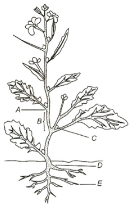
MediumMCQ
Identify $A$ to $E$ in the given diagram.
A
$A-Node, B-Internode, C-Accessory bud, D-Primary root, E-Secondary root$
B
$A-Node, B-Internode, C-Bud, D-Primary root, E-Secondary root$
C
$A-Internode, B-Node, C-Bud, D-Primary root, E-Secondary root$
D
$A-Internode, B-Node, C-Callus, D-Primary root, E-Secondary root$
Solution
(B) In the given diagram of a flowering plant:
$A$ points to the node,which is the region of the stem where leaves are borne.
$B$ points to the internode,which is the portion of the stem between two nodes.
$C$ points to the axillary bud,which develops in the axil of leaves and is capable of developing into a branch or flower.
$D$ points to the primary root,which is the direct elongation of the radicle.
$E$ points to the secondary root,which are the lateral branches of the primary root.
Therefore,the correct identification is $A-Node, B-Internode, C-Bud, D-Primary root, E-Secondary root$.
$A$ points to the node,which is the region of the stem where leaves are borne.
$B$ points to the internode,which is the portion of the stem between two nodes.
$C$ points to the axillary bud,which develops in the axil of leaves and is capable of developing into a branch or flower.
$D$ points to the primary root,which is the direct elongation of the radicle.
$E$ points to the secondary root,which are the lateral branches of the primary root.
Therefore,the correct identification is $A-Node, B-Internode, C-Bud, D-Primary root, E-Secondary root$.
0 likes
View Solution147
MediumMCQ
Mark the incorrect match.
A
$Calotropis$ - $Valvate$
B
$Lady's$ $finger$ - $Twisted$
C
$Cassia$ - $Valvate$
D
$Gulmohur$ - $Imbricate$
Solution
(C) Aestivation refers to the mode of arrangement of sepals or petals in a floral bud with respect to the other members of the same whorl.
In $Calotropis$,the sepals or petals in a whorl just touch one another at the margin,without overlapping,which is known as $Valvate$ aestivation.
In $Lady's$ $finger$ $(Hibiscus)$,one margin of the appendage overlaps that of the next one and so on,which is known as $Twisted$ aestivation.
In $Cassia$ and $Gulmohur$,the margins of sepals or petals overlap one another but not in any particular direction,which is known as $Imbricate$ aestivation.
Therefore,the match $Cassia$ - $Valvate$ is incorrect because $Cassia$ exhibits $Imbricate$ aestivation.
In $Calotropis$,the sepals or petals in a whorl just touch one another at the margin,without overlapping,which is known as $Valvate$ aestivation.
In $Lady's$ $finger$ $(Hibiscus)$,one margin of the appendage overlaps that of the next one and so on,which is known as $Twisted$ aestivation.
In $Cassia$ and $Gulmohur$,the margins of sepals or petals overlap one another but not in any particular direction,which is known as $Imbricate$ aestivation.
Therefore,the match $Cassia$ - $Valvate$ is incorrect because $Cassia$ exhibits $Imbricate$ aestivation.
0 likes
View Solution148
MediumMCQ
Thorns,spines and prickles work as . . . . . . in plants.
A
Respiratory organs
B
Excretory organs
C
Organs of offense
D
Defensive organs
Solution
(D) Thorns,spines and prickles are modified plant structures that serve as defensive organs. They protect plants from being eaten by herbivores by making them difficult or painful to consume.
0 likes
View Solution149
MediumMCQ
Select an incorrect match.
A
Whorled phyllotaxy - $Alstonia$,$Nerium$
B
Decussate phyllotaxy - $Quisqualis$,$Psidium$,$Syzygium$
C
Alternate phyllotaxy - Mustard,China rose,Sunflower
D
Opposite phyllotaxy - $Zinnia$,$Calotropis$
Solution
(D) In $Alstonia$ and $Nerium$,more than two leaves arise at a node,which is known as whorled phyllotaxy.
In alternate phyllotaxy,a single leaf arises at each node,as seen in Mustard,China rose,and Sunflower.
In opposite phyllotaxy,a pair of leaves arises at each node,lying opposite to each other,as seen in $Calotropis$ and $Guava$ $(Psidium)$.
Decussate phyllotaxy is a specific type of opposite phyllotaxy where successive pairs of leaves are at right angles to each other,as seen in $Zinnia$,$Ocimum$,and $Syzygium$.
Therefore,the match in option $D$ is incorrect because $Zinnia$ and $Calotropis$ represent different types of opposite phyllotaxy (decussate and superposed,respectively),and the classification provided in the options is inconsistent with standard botanical definitions.
In alternate phyllotaxy,a single leaf arises at each node,as seen in Mustard,China rose,and Sunflower.
In opposite phyllotaxy,a pair of leaves arises at each node,lying opposite to each other,as seen in $Calotropis$ and $Guava$ $(Psidium)$.
Decussate phyllotaxy is a specific type of opposite phyllotaxy where successive pairs of leaves are at right angles to each other,as seen in $Zinnia$,$Ocimum$,and $Syzygium$.
Therefore,the match in option $D$ is incorrect because $Zinnia$ and $Calotropis$ represent different types of opposite phyllotaxy (decussate and superposed,respectively),and the classification provided in the options is inconsistent with standard botanical definitions.
0 likes
View Solution150
MediumMCQ
$A$. Citrus and Ricinus have synandrous condition.
$B$. In epitepalous condition,the cohesion occurs between tepal and filament of stamen.
$C$. Tetradynamous condition consists of two long and four short stamen filaments.
$B$. In epitepalous condition,the cohesion occurs between tepal and filament of stamen.
$C$. Tetradynamous condition consists of two long and four short stamen filaments.
A
All are incorrect
B
Only $A$ is incorrect
C
Only $C$ is incorrect
D
Only $B$ is incorrect
Solution
(A) . Citrus exhibits polyadelphous condition (stamens united in more than two bundles),not synandrous. Ricinus also does not show synandrous condition.
$B$. Epitepalous condition refers to the attachment of stamens to the tepals,which is correct.
$C$. Tetradynamous condition (found in Brassicaceae) consists of $6$ stamens,where $4$ are long and $2$ are short. The statement claims $2$ long and $4$ short,which is incorrect.
Therefore,both $A$ and $C$ are incorrect.
$B$. Epitepalous condition refers to the attachment of stamens to the tepals,which is correct.
$C$. Tetradynamous condition (found in Brassicaceae) consists of $6$ stamens,where $4$ are long and $2$ are short. The statement claims $2$ long and $4$ short,which is incorrect.
Therefore,both $A$ and $C$ are incorrect.
0 likes
View SolutionMorphology of Flowering Plants — Mix Examples- Morphology of Flowering Plants · Frequently Asked Questions
1Are these Morphology of Flowering Plants questions useful for JEE and NEET?
Yes. All questions in this section are mapped to JEE Main and NEET exam patterns. Previous year questions from JEE Main, NEET, GUJCET and state-level exams are included with full solutions.
2Can I switch to Hindi or Gujarati for these questions?
Yes. Use the language tabs in the hero section or the sidebar to view the same questions and solutions in English, Hindi or Gujarati.
3How do I generate a question paper from this subtopic?
Use the Vedclass Exam Paper Generator — select the chapter and subtopic, set difficulty, and generate Sets A, B, C, D automatically. First 3 chapters of every subject are free.
Vedclass Products
For Students
Vedclass Test Series
Mock tests in real JEE/NEET style with performance analysis. 5-day free trial.
Start Free TrialFor Teachers
Exam Paper Generator
Generate Set A/B/C/D papers from this chapter in 2 minutes. 3 chapters free.
Try FreeFor Institutes
Online Exam Module
Live online exams with unlimited students, 360° analytics & white-label branding.
See DemoFor Teachers & Institutes
Generate a Morphology of Flowering Plants Exam Paper in 2 Minutes
Select subtopic & difficulty — Sets A, B, C, D auto-generated with No Repeat logic.
First 3 chapters of every subject are free — no payment required.