
A English
Mix Examples- Morphology of Flowering Plants Questions in English
Class 11 Biology · Morphology of Flowering Plants · Mix Examples- Morphology of Flowering Plants
169+
Questions
English
Language
100%
With Solutions
Showing 50 of 169 questions in English
51
EasyMCQ
Triticum durum is ..... (in $n$)
A
$8$
B
$4$
C
$6$
D
$2$
Solution
(B) $Triticum$ $durum$ is a tetraploid species of wheat.
It has a chromosome number of $2n = 4x = 28$,where $x = 7$ is the basic haploid chromosome number.
Therefore,it is represented as $4n$ (tetraploid).
It has a chromosome number of $2n = 4x = 28$,where $x = 7$ is the basic haploid chromosome number.
Therefore,it is represented as $4n$ (tetraploid).
0 likes
View Solution52
EasyMCQ
Which of the following species is used to obtain both edible oil and fibers?
A
Cocos nucifera (Coconut)
B
Brassica campestris (Mustard)
C
Mangifera indica (Mango)
D
Arachis hypogaea (Groundnut)
Solution
(A) The correct answer is $A$. $Cocos$ $nucifera$ (Coconut) is a versatile plant. Its endosperm (kernel) is used to extract edible coconut oil,and the husk of the fruit provides coir fibers,which are used for making ropes,mats,and brushes. While $Brassica$ $campestris$ and $Arachis$ $hypogaea$ are primarily sources of edible oil,they do not provide significant fibers for commercial use.
0 likes
View Solution53
EasyMCQ
Which of the following provides the most durable wood?
A
Cedrus deodara
B
Dalbergia sissoo
C
Shorea robusta
D
Tectona grandis
Solution
(D) The most durable wood is obtained from $Tectona$ $grandis$,commonly known as Teak.
Teak wood is highly valued for its durability,water resistance,and resistance to termites and fungi due to the presence of natural oils and silica in the wood.
It is widely used in furniture making,shipbuilding,and construction.
Teak wood is highly valued for its durability,water resistance,and resistance to termites and fungi due to the presence of natural oils and silica in the wood.
It is widely used in furniture making,shipbuilding,and construction.
0 likes
View Solution54
EasyMCQ
Which of the following pairs is correctly matched?
A
Cuscuta - Parasitic
B
Dischidia - Insectivorous
C
Opuntia - Predatory
D
Capsella - Hydrophytic
Solution
(A) $Cuscuta$ is a well-known parasitic plant that derives nutrients from the host plant.
$Dischidia$ is an epiphytic plant,not insectivorous.
$Opuntia$ is a xerophytic plant,not predatory.
$Capsella$ is a terrestrial plant,not hydrophytic.
Therefore,the correct pair is $Cuscuta$ - Parasitic.
$Dischidia$ is an epiphytic plant,not insectivorous.
$Opuntia$ is a xerophytic plant,not predatory.
$Capsella$ is a terrestrial plant,not hydrophytic.
Therefore,the correct pair is $Cuscuta$ - Parasitic.
0 likes
View Solution55
EasyMCQ
The starch grains found in latex are .........
A
Prism-shaped
B
Rod-shaped
C
Oval-shaped
D
Dumbbell-shaped
Solution
(D) Starch grains found in the latex of certain plants, such as those in the family $Euphorbiaceae$ (e.g., $Manihot$ $esculenta$ or cassava), are typically $dumbbell-shaped$. These specialized starch granules are distinct from the spherical or oval starch grains found in other storage tissues.
0 likes
View Solution56
EasyMCQ
The inflorescence and fruit of sunflower are ......... respectively.
A
Capitulum and Cypsela
B
Corymb and Achene
C
Capitulum and Achene
D
Corymb and Cypsela
Solution
(A) In sunflower $(Helianthus \text{ } annuus)$, the inflorescence is of the $Capitulum$ (or $Head$) type, where many small florets are arranged on a flattened receptacle.
The fruit of the sunflower is a $Cypsela$, which is a dry, indehiscent, single-seeded fruit that develops from an inferior ovary.
The fruit of the sunflower is a $Cypsela$, which is a dry, indehiscent, single-seeded fruit that develops from an inferior ovary.
0 likes
View Solution57
MediumMCQ
Twisted aestivation is found in $......$.
A
Malvaceae
B
Asteraceae
C
Fabaceae
D
Mimosoideae
Solution
(A) Aestivation refers to the mode of arrangement of sepals or petals in a floral bud with respect to the other members of the same whorl.
In twisted aestivation,one margin of the appendage overlaps that of the next one and so on.
This type of aestivation is characteristic of the family $Malvaceae$ (e.g.,China rose,lady's finger,and cotton).
In $Fabaceae$,the aestivation is vexillary,while in $Asteraceae$,it is often valvate or imbricate.
In twisted aestivation,one margin of the appendage overlaps that of the next one and so on.
This type of aestivation is characteristic of the family $Malvaceae$ (e.g.,China rose,lady's finger,and cotton).
In $Fabaceae$,the aestivation is vexillary,while in $Asteraceae$,it is often valvate or imbricate.
0 likes
View Solution58
EasyMCQ
The botanical name of groundnut is .....
A
Cicer arietinum
B
Glycine max
C
Arachis hypogaea
D
Lens esculentus
Solution
(C) The botanical name of groundnut (peanut) is $Arachis \text{ } hypogaea$.
$Cicer \text{ } arietinum$ is the botanical name of chickpea (gram).
$Glycine \text{ } max$ is the botanical name of soybean.
$Lens \text{ } esculentus$ is the botanical name of lentil.
$Cicer \text{ } arietinum$ is the botanical name of chickpea (gram).
$Glycine \text{ } max$ is the botanical name of soybean.
$Lens \text{ } esculentus$ is the botanical name of lentil.
0 likes
View Solution59
MediumMCQ
Which of the following groups of plants produces economically useful fibers?
A
$Gossypium$,$Hibiscus$,$Crotalaria$
B
$Gossypium$,$Cassia$,$Lycopersicum$
C
$Gossypium$,$Brassica$,$Glycine$
D
$Gossypium$,$Agave$,$Nicotiana$
Solution
(A) The plants $Gossypium$ (cotton),$Hibiscus$ (hemp/fiber),and $Crotalaria$ (sunn hemp) are well-known for producing economically important fibers.
$Gossypium$ provides cotton fibers from the seed coat.
$Hibiscus$ species are used for bast fibers.
$Crotalaria$ $juncea$ is a major source of sunn hemp fiber.
$Gossypium$ provides cotton fibers from the seed coat.
$Hibiscus$ species are used for bast fibers.
$Crotalaria$ $juncea$ is a major source of sunn hemp fiber.
0 likes
View Solution60
MediumMCQ
Which of the following statements is correct?
A
The fruit in tomato is a berry.
B
Orchid seeds contain an oily endosperm.
C
The placentation in primrose is basal.
D
Tulip flowers are modified roots.
Solution
(A) $1$. In tomato ($Solanum$ $lycopersicum$),the fruit is a berry,which develops from a superior ovary and is fleshy. Thus,statement $A$ is correct.
$2$. Orchid seeds are non-endospermic (exalbuminous) and very small,lacking an oily endosperm. Thus,statement $B$ is incorrect.
$3$. In primrose $(Primula)$,the placentation is free-central,not basal. Basal placentation is seen in Asteraceae and Poaceae. Thus,statement $C$ is incorrect.
$4$. Tulip flowers are modified shoots,not roots. Thus,statement $D$ is incorrect.
$2$. Orchid seeds are non-endospermic (exalbuminous) and very small,lacking an oily endosperm. Thus,statement $B$ is incorrect.
$3$. In primrose $(Primula)$,the placentation is free-central,not basal. Basal placentation is seen in Asteraceae and Poaceae. Thus,statement $C$ is incorrect.
$4$. Tulip flowers are modified shoots,not roots. Thus,statement $D$ is incorrect.
0 likes
View Solution61
MediumMCQ
In which of the following are the cotyledon and aril the edible parts, respectively?
A
Cashew and Litchi
B
Groundnut and Pomegranate
C
Walnut and Tamarind
D
Kidney bean and Coconut
Solution
(A) In $Cashew$ $(Anacardium \text{ } occidentale)$, the edible part is the fleshy pedicel (thalamus) and the cotyledons. However, in the context of standard botanical questions, the cotyledon is the primary edible part of the seed. In $Litchi$ $(Litchi \text{ } chinensis)$, the fleshy, succulent outgrowth arising from the base of the ovule is called the $aril$, which is the edible part. Therefore, $Cashew$ and $Litchi$ represent the correct pair where the cotyledon and aril are the edible parts, respectively.
0 likes
View Solution62
MediumMCQ
Which of the following is not a seed-surface fiber?
A
Kapok (Ceiba)
B
Red silk cotton (Salmalia)
C
Cotton (Gossypium)
D
Dhaincha (Sesbania)
Solution
(D) Seed-surface fibers are epidermal outgrowths of the seed coat.
$1$. Cotton $(Gossypium)$ is a classic example of a seed-surface fiber.
$2$. Kapok $(Ceiba)$ and Red silk cotton $(Salmalia)$ also produce fibers from the inner wall of the fruit or seed coat.
$3$. Dhaincha $(Sesbania)$ is a legume plant where the fiber is obtained from the stem (bast fiber),not the seed surface.
Therefore,$Sesbania$ is not a seed-surface fiber.
$1$. Cotton $(Gossypium)$ is a classic example of a seed-surface fiber.
$2$. Kapok $(Ceiba)$ and Red silk cotton $(Salmalia)$ also produce fibers from the inner wall of the fruit or seed coat.
$3$. Dhaincha $(Sesbania)$ is a legume plant where the fiber is obtained from the stem (bast fiber),not the seed surface.
Therefore,$Sesbania$ is not a seed-surface fiber.
0 likes
View Solution63
EasyMCQ
Stem thorns,leaf spines,and prickles are examples of ........
A
Organs for protection
B
Respiratory organs
C
Both $(A)$ and $(B)$
D
None of the above
Solution
(A) Stem thorns (e.g.,in Citrus and Bougainvillea),leaf spines (e.g.,in Opuntia),and prickles (e.g.,in Rose) are all modified structures that serve the primary function of protection against herbivores. These structures prevent animals from grazing on the plants,thereby acting as defensive organs.
0 likes
View Solution64
EasyMCQ
What is the scientific name of Jojoba?
A
Parthenium argentatum
B
Leucaena leucocephala
C
Psophocarpus tetragonolobus
D
Simmondsia chinensis
Solution
(D) The scientific name of Jojoba is $Simmondsia \ chinensis$.
It is a shrub native to the southwestern United States and northwestern Mexico,known for the liquid wax (often called jojoba oil) extracted from its seeds.
It is a shrub native to the southwestern United States and northwestern Mexico,known for the liquid wax (often called jojoba oil) extracted from its seeds.
0 likes
View Solution65
MediumMCQ
Which useful product is derived from the epidermis?
A
Saffron
B
Cotton
C
Clove
D
Cork
Solution
(B) Cotton fibers are unicellular outgrowths of the epidermal cells of the seed coat. These fibers are essentially composed of cellulose and are economically significant as a textile raw material. Saffron is obtained from the stigma of the flower,clove is a dried flower bud,and cork is derived from the phellogen (cork cambium) of the periderm,not the epidermis.
0 likes
View Solution66
EasyMCQ
Commercially useful surface fibers are obtained from which of the following?
A
Cannabis
B
Helianthus
C
Gossypium
D
Agave
Solution
(C) Surface fibers are those that arise from the surface of seeds or fruits.
$Gossypium$ (cotton) is the most important source of surface fibers.
These fibers are epidermal outgrowths of the seed coat.
$Cannabis$ and $Agave$ provide bast fibers (phloem fibers),which are obtained from the stem or leaves,not the surface of seeds.
$Helianthus$ (sunflower) is primarily cultivated for its seeds and oil,not for commercial fibers.
$Gossypium$ (cotton) is the most important source of surface fibers.
These fibers are epidermal outgrowths of the seed coat.
$Cannabis$ and $Agave$ provide bast fibers (phloem fibers),which are obtained from the stem or leaves,not the surface of seeds.
$Helianthus$ (sunflower) is primarily cultivated for its seeds and oil,not for commercial fibers.
0 likes
View Solution67
EasyMCQ
According to the classification system of Bentham and Hooker,what is the total number of families of seed-bearing plants (Phanerogams)?
A
$202$
B
$199$
C
$34$
D
$85$
Solution
(A) George Bentham and Joseph Dalton Hooker published their monumental work 'Genera Plantarum' in three volumes between $1862$ and $1883$.
In this system,they classified seed-bearing plants (Phanerogams) into $202$ families.
This system is widely regarded as one of the most natural systems of classification for seed plants.
In this system,they classified seed-bearing plants (Phanerogams) into $202$ families.
This system is widely regarded as one of the most natural systems of classification for seed plants.
0 likes
View Solution68
DifficultMCQ
Match the following columns based on Bentham and Hooker's classification system:
| Column-$I$ | Column-$II$ |
|---|---|
| $(a)$ Inferae | $(i)$ Hibiscus |
| $(b)$ Heteromerae | $(ii)$ Lemon |
| $(c)$ Bicarpellatae | $(iii)$ Sunflower |
| $(d)$ Thalamiflorae | $(iv)$ Madhuca |
| $(e)$ Calyciflorae | $(v)$ Catharanthus |
| $(vi)$ Rose |
A
$a-ii, b-iv, c-vi, d-i, e-v$
B
$a-iii, b-iv, c-v, d-i, e-vi$
C
$a-iv, b-iii, c-ii, d-i, e-vi$
D
$a-i, b-ii, c-iv, d-v, e-iii$
Solution
(B) According to the Bentham and Hooker classification system for Dicotyledons:
$1$. $(a)$ Inferae: Includes plants with inferior ovaries,such as Sunflower (Asteraceae family). So,$(a)-(iii)$.
$2$. $(b)$ Heteromerae: Includes plants with superior ovaries and more than two carpels,such as Madhuca. So,$(b)-(iv)$.
$3$. $(c)$ Bicarpellatae: Includes plants with superior ovaries and two carpels,such as Catharanthus (Periwinkle). So,$(c)-(v)$.
$4$. $(d)$ Thalamiflorae: Includes plants with superior ovaries and thalamus not expanded,such as Hibiscus. So,$(d)-(i)$.
$5$. $(e)$ Calyciflorae: Includes plants with perigynous or epigynous flowers,such as Rose. So,$(e)-(vi)$.
Therefore,the correct matching is $a-iii, b-iv, c-v, d-i, e-vi$.
$1$. $(a)$ Inferae: Includes plants with inferior ovaries,such as Sunflower (Asteraceae family). So,$(a)-(iii)$.
$2$. $(b)$ Heteromerae: Includes plants with superior ovaries and more than two carpels,such as Madhuca. So,$(b)-(iv)$.
$3$. $(c)$ Bicarpellatae: Includes plants with superior ovaries and two carpels,such as Catharanthus (Periwinkle). So,$(c)-(v)$.
$4$. $(d)$ Thalamiflorae: Includes plants with superior ovaries and thalamus not expanded,such as Hibiscus. So,$(d)-(i)$.
$5$. $(e)$ Calyciflorae: Includes plants with perigynous or epigynous flowers,such as Rose. So,$(e)-(vi)$.
Therefore,the correct matching is $a-iii, b-iv, c-v, d-i, e-vi$.
0 likes
View Solution69
EasyMCQ
How many series does the sub-class Gamopetalae contain?
A
Eight
B
Three
C
Four
D
Seven
Solution
(B) In the Bentham and Hooker classification system,the sub-class $Gamopetalae$ is divided into $3$ series: $Inferae$,$Heteromerae$,and $Bicarpellatae$.
0 likes
View Solution70
EasyMCQ
What is the size of $Wolffia$?
A
$0.1$ to $0.2$ mm
B
$0.5$ to $1.5$ mm
C
$2$ to $3$ mm
D
$5$ to $10$ mm
Solution
(B) $Wolffia$ is a genus of nine to eleven species which include the smallest flowering plants on Earth.
These are commonly known as watermeal or duckweed.
The size of $Wolffia$ plants typically ranges from $0.5$ mm to $1.5$ mm in length.
Therefore,the most accurate range among the given options is $0.5$ to $1.5$ mm.
These are commonly known as watermeal or duckweed.
The size of $Wolffia$ plants typically ranges from $0.5$ mm to $1.5$ mm in length.
Therefore,the most accurate range among the given options is $0.5$ to $1.5$ mm.
0 likes
View Solution71
EasyMCQ
How many orders does the series Thalamiflorae contain?
A
Four
B
Six
C
Five
D
Three
Solution
(B) In the Bentham and Hooker classification system,the series Thalamiflorae is part of the class Dicotyledonae and the subclass Polypetalae. It consists of $6$ orders: Ranales,Parietales,Polygalinae,Caryophyllinae,Guttiferales,and Malvales.
0 likes
View Solution72
MediumMCQ
Which of the following characteristics is $NOT$ associated with dicotyledonous plants?
A
Seeds contain two cotyledons
B
Flowers are pentamerous
C
Leaves show reticulate venation
D
Ovules are orthotropous
Solution
(D) Dicotyledonous plants are characterized by the presence of two cotyledons in their seeds,pentamerous or tetramerous flowers,and reticulate venation in their leaves. The arrangement of ovules (orthotropous,anatropous,etc.) is not a defining characteristic used to distinguish between monocots and dicots. Therefore,the statement that ovules are orthotropous is not a general characteristic associated with dicotyledonous plants.
0 likes
View Solution73
EasyMCQ
What is the scientific name of $Bougainvillea$ $spectabilis$?
A
Hibiscus
B
Bougainvillea
C
Periwinkle
D
Mahua
Solution
(B) The scientific name $Bougainvillea$ $spectabilis$ refers to the plant commonly known as $Bougainvillea$.
It is a genus of thorny ornamental vines,bushes,and trees belonging to the family $Nyctaginaceae$.
It is a genus of thorny ornamental vines,bushes,and trees belonging to the family $Nyctaginaceae$.
0 likes
View Solution74
EasyMCQ
What is the approximate height reached by the Eucalyptus tree?
A
$150$ meters
B
$90-100$ meters
C
$2-5$ mm
D
$6$ meters
Solution
(B) The Eucalyptus tree,commonly known as the gum tree,is one of the tallest known tree species in the world.
It is known to reach heights of approximately $90-100$ meters.
Therefore,option $B$ is the correct answer.
It is known to reach heights of approximately $90-100$ meters.
Therefore,option $B$ is the correct answer.
0 likes
View Solution75
MediumMCQ
Match the following columns based on Bentham and Hooker's classification of Polypetalae:
| Column-$I$ | Column-$II$ |
| $A$. Thalamiflorae | $i$. Gynoecium always bicarpellary |
| $B$. Calyciflorae | $ii$. Ovary superior |
| $C$. Bicarpellatae | $iii$. Receptacle cup-shaped |
| $D$. Inferae | $iv$. Receptacle dome-shaped |
| $E$. Heteromerae | $v$. Ovary inferior |
A
$A-i, B-iii, C-ii, D-iv, E-v$
B
$A-ii, B-iv, C-i, D-iii, E-v$
C
$A-iii, B-ii, C-v, D-iv, E-i$
D
$A-iv, B-iii, C-i, D-v, E-ii$
Solution
(D) Bentham and Hooker's classification of Polypetalae is divided into three series:
$1$. Thalamiflorae: Flowers have a dome-shaped receptacle with a superior ovary $(A-iv)$.
$2$. Calyciflorae: Receptacle is cup-shaped or tubular, surrounding the ovary $(B-iii)$.
$3$. Disciflorae: (Not listed here).
For the Gamopetalae series:
$1$. Bicarpellatae: Gynoecium is always bicarpellary $(C-i)$.
$2$. Inferae: Ovary is inferior $(D-v)$.
$3$. Heteromerae: Ovary is superior with more than two carpels $(E-ii)$.
Therefore, the correct matching is $A-iv, B-iii, C-i, D-v, E-ii$.
$1$. Thalamiflorae: Flowers have a dome-shaped receptacle with a superior ovary $(A-iv)$.
$2$. Calyciflorae: Receptacle is cup-shaped or tubular, surrounding the ovary $(B-iii)$.
$3$. Disciflorae: (Not listed here).
For the Gamopetalae series:
$1$. Bicarpellatae: Gynoecium is always bicarpellary $(C-i)$.
$2$. Inferae: Ovary is inferior $(D-v)$.
$3$. Heteromerae: Ovary is superior with more than two carpels $(E-ii)$.
Therefore, the correct matching is $A-iv, B-iii, C-i, D-v, E-ii$.
0 likes
View Solution76
EasyMCQ
$Helianthus$ $annuus$ is the scientific name of which of the following?
A
Rose
B
Sunflower
C
Marigold
D
Bougainvillea
Solution
(B) The scientific name $Helianthus$ $annuus$ refers to the common sunflower.
$Helianthus$ is the genus name,and $annuus$ is the specific epithet.
It belongs to the family $Asteraceae$.
$Helianthus$ is the genus name,and $annuus$ is the specific epithet.
It belongs to the family $Asteraceae$.
0 likes
View Solution77
EasyMCQ
What is the approximate height reached by Eucalyptus trees?
A
$150 \ m$
B
$90-100 \ m$
C
$2-5 \ mm$
D
$6 \ m$
Solution
(B) Eucalyptus is a genus of flowering trees in the myrtle family,Myrtaceae. Some species of Eucalyptus,such as Eucalyptus regnans,are known to be among the tallest trees in the world. They can reach heights of approximately $90-100 \ m$.
0 likes
View Solution78
EasyMCQ
Which of the following is $NOT$ a characteristic of dicotyledons?
A
The embryo has two cotyledons.
B
Flowers are pentamerous.
C
Leaves exhibit parallel venation.
D
It is divided into three subclasses.
Solution
(C) Dicotyledons (dicots) are characterized by having two cotyledons in their embryo,pentamerous or tetramerous flowers,and reticulate venation in their leaves. Parallel venation is a characteristic feature of monocotyledons,not dicotyledons. Therefore,the statement that leaves exhibit parallel venation is incorrect for dicots.
0 likes
View Solution79
MediumMCQ
Match the following columns based on Bentham and Hooker's classification of Polypetalae:
| Column-$I$ (Series) | Column-$II$ (Characteristics) |
| $(a)$ Bicarpellatae | $(p)$ Ovary superior |
| $(b)$ Inferae | $(q)$ Thalamus cup-shaped |
| $(c)$ Thalamiflorae | $(r)$ Thalamus dome-shaped |
| $(d)$ Calyciflorae | $(s)$ Gynoecium always bicarpellary |
| $(e)$ Heteromerae | $(t)$ Ovary inferior |
A
$(a - t), (b - s), (c - r), (d - q), (e - p)$
B
$(a - s), (b - t), (c - r), (d - q), (e - p)$
C
$(a - q), (b - r), (c - s), (d - t), (e - p)$
D
$(a - t), (b - q), (c - p), (d - r), (e - s)$
Solution
(B) According to Bentham and Hooker's classification of Polypetalae:
$1$. $(a)$ Bicarpellatae: Characterized by a bicarpellary ovary $(s)$.
$2$. $(b)$ Inferae: Characterized by an inferior ovary $(t)$.
$3$. $(c)$ Thalamiflorae: Characterized by a dome-shaped thalamus with a superior ovary $(r)$.
$4$. $(d)$ Calyciflorae: Characterized by a cup-shaped thalamus $(q)$.
$5$. $(e)$ Heteromerae: Characterized by a superior ovary with more than two carpels $(p)$.
Thus, the correct matching is $(a-s), (b-t), (c-r), (d-q), (e-p)$.
$1$. $(a)$ Bicarpellatae: Characterized by a bicarpellary ovary $(s)$.
$2$. $(b)$ Inferae: Characterized by an inferior ovary $(t)$.
$3$. $(c)$ Thalamiflorae: Characterized by a dome-shaped thalamus with a superior ovary $(r)$.
$4$. $(d)$ Calyciflorae: Characterized by a cup-shaped thalamus $(q)$.
$5$. $(e)$ Heteromerae: Characterized by a superior ovary with more than two carpels $(p)$.
Thus, the correct matching is $(a-s), (b-t), (c-r), (d-q), (e-p)$.
0 likes
View Solution80
MediumMCQ
$S$ Statement: Amorphophallus (Elephant foot yam) has a large inflorescence of about $6 \ m$ height.
$R$ Statement: Rafflesia arnoldii has the largest flower with a weight of about $8 \ kg$ and a diameter of about $1 \ m$.
$R$ Statement: Rafflesia arnoldii has the largest flower with a weight of about $8 \ kg$ and a diameter of about $1 \ m$.
A
$S$ and $R$ are both true,$R$ is the correct explanation of $S$.
B
$S$ and $R$ are both true,but $R$ is not the correct explanation of $S$.
C
$S$ is true and $R$ is false.
D
$S$ is false and $R$ is true.
Solution
(B) The $S$ statement is true because the inflorescence of Amorphophallus (Elephant foot yam) is indeed very large,reaching heights of up to $6 \ m$.
The $R$ statement is also true because Rafflesia arnoldii is known to produce the largest individual flower in the world,which can reach a diameter of about $1 \ m$ and weigh up to $8-10 \ kg$.
However,the size of the inflorescence in Amorphophallus and the size of the individual flower in Rafflesia are independent biological facts. Therefore,$R$ does not explain $S$.
The $R$ statement is also true because Rafflesia arnoldii is known to produce the largest individual flower in the world,which can reach a diameter of about $1 \ m$ and weigh up to $8-10 \ kg$.
However,the size of the inflorescence in Amorphophallus and the size of the individual flower in Rafflesia are independent biological facts. Therefore,$R$ does not explain $S$.
0 likes
View Solution81
MediumMCQ
Which of the following is an incorrect series of Polypetalae?
A
Disciflorae
B
Calyciflorae
C
Inferae
D
Thalamiflorae
Solution
(C) In the Bentham and Hooker classification system,the subclass Polypetalae is divided into three series: $1$. Thalamiflorae,$2$. Disciflorae,and $3$. Calyciflorae. The series $Inferae$ belongs to the subclass Gamopetalae,not Polypetalae. Therefore,$Inferae$ is the incorrect series for Polypetalae.
0 likes
View Solution82
DifficultMCQ
Identify the incorrect pair from the following based on Bentham and Hooker's classification of Polypetalae:
A
Calyciflorae - $Rosa$ $indica$
B
Thalamiflorae - $Catharanthus$ $roseus$
C
Inferae - $Helianthus$ $annuus$
D
Disciflorae - $Citrus$ $limon$
Solution
(B) Bentham and Hooker classified Polypetalae into three series: Thalamiflorae,Disciflorae,and Calyciflorae.
$1$. Thalamiflorae includes flowers with a convex or conical thalamus and superior ovary (e.g.,$Ranunculaceae$). $Catharanthus$ $roseus$ belongs to the family $Apocynaceae$,which is classified under Gamopetalae,not Polypetalae.
$2$. Disciflorae includes flowers with a prominent disc (e.g.,$Rutaceae$ like $Citrus$ $limon$).
$3$. Calyciflorae includes flowers with a cup-shaped thalamus and perigynous or epigynous ovary (e.g.,$Rosaceae$ like $Rosa$ $indica$).
$4$. Inferae is a series under Gamopetalae,not Polypetalae,and includes $Helianthus$ $annuus$ $(Asteraceae)$.
Since the question asks for the incorrect pair based on the classification of Polypetalae,$Catharanthus$ $roseus$ is incorrectly placed as it belongs to Gamopetalae.
$1$. Thalamiflorae includes flowers with a convex or conical thalamus and superior ovary (e.g.,$Ranunculaceae$). $Catharanthus$ $roseus$ belongs to the family $Apocynaceae$,which is classified under Gamopetalae,not Polypetalae.
$2$. Disciflorae includes flowers with a prominent disc (e.g.,$Rutaceae$ like $Citrus$ $limon$).
$3$. Calyciflorae includes flowers with a cup-shaped thalamus and perigynous or epigynous ovary (e.g.,$Rosaceae$ like $Rosa$ $indica$).
$4$. Inferae is a series under Gamopetalae,not Polypetalae,and includes $Helianthus$ $annuus$ $(Asteraceae)$.
Since the question asks for the incorrect pair based on the classification of Polypetalae,$Catharanthus$ $roseus$ is incorrectly placed as it belongs to Gamopetalae.
0 likes
View Solution83
MediumMCQ
Match the following columns:
| Column-$I$ | Column-$II$ |
|---|---|
| $(A)$ Inferae | $(i)$ Hibiscus |
| $(B)$ Heteromerae | $(ii)$ Lemon |
| $(C)$ Bicarpellatae | $(iii)$ Sunflower |
| $(D)$ Thalamiflorae | $(iv)$ Madhuca |
| $(E)$ Calyciflorae | $(v)$ Catharanthus |
| $(vi)$ Rose |
A
$(A-iii), (B-iv), (C-v), (D-i), (E-vi)$
B
$(A-i), (B-ii), (C-iii), (D-iv), (E-v)$
C
$(A-iv), (B-iii), (C-ii), (D-i), (E-vi)$
D
$(A-i), (B-ii), (C-iv), (D-v), (E-iii)$
Solution
(A) The classification provided refers to the Bentham and Hooker system of classification for Dicotyledons:
$1$. $(A)$ Inferae: Characterized by an inferior ovary. Example: Sunflower $(iii)$.
$2$. $(B)$ Heteromerae: Characterized by a superior ovary with more than two carpels. Example: Madhuca $(iv)$.
$3$. $(C)$ Bicarpellatae: Characterized by a superior ovary with two carpels. Example: Catharanthus $(v)$.
$4$. $(D)$ Thalamiflorae: Characterized by a superior ovary and thalamus with many stamens. Example: Hibiscus $(i)$.
$5$. $(E)$ Calyciflorae: Characterized by a perigynous or epigynous flower. Example: Rose $(vi)$.
Therefore,the correct matching is $(A-iii), (B-iv), (C-v), (D-i), (E-vi)$.
$1$. $(A)$ Inferae: Characterized by an inferior ovary. Example: Sunflower $(iii)$.
$2$. $(B)$ Heteromerae: Characterized by a superior ovary with more than two carpels. Example: Madhuca $(iv)$.
$3$. $(C)$ Bicarpellatae: Characterized by a superior ovary with two carpels. Example: Catharanthus $(v)$.
$4$. $(D)$ Thalamiflorae: Characterized by a superior ovary and thalamus with many stamens. Example: Hibiscus $(i)$.
$5$. $(E)$ Calyciflorae: Characterized by a perigynous or epigynous flower. Example: Rose $(vi)$.
Therefore,the correct matching is $(A-iii), (B-iv), (C-v), (D-i), (E-vi)$.
0 likes
View Solution84
EasyMCQ
Match the following columns:
| Column-$I$ (Local Name) | Column-$II$ (Scientific Name) |
| $A$. China rose | $i$. Bougainvillea spectabilis |
| $B$. Lemon | $ii$. Allium cepa |
| $C$. Sunflower | $iii$. Hibiscus rosa-sinensis |
| $D$. Onion | $iv$. Citrus limon |
| $E$. Bougainvillea | $v$. Helianthus annuus |
| - | $vi$. Rosa indica |
A
$A-iii, B-iv, C-v, D-ii, E-i$
B
$A-vi, B-iv, C-v, D-i, E-ii$
C
$A-v, B-vi, C-iii, D-ii, E-i$
D
$A-i, B-ii, C-iv, D-v, E-iii$
Solution
(A) The correct matches are as follows:
$A$. China rose (Hibiscus rosa-sinensis) matches with $iii$.
$B$. Lemon (Citrus limon) matches with $iv$.
$C$. Sunflower (Helianthus annuus) matches with $v$.
$D$. Onion (Allium cepa) matches with $ii$.
$E$. Bougainvillea (Bougainvillea spectabilis) matches with $i$.
Therefore,the correct sequence is $A-iii, B-iv, C-v, D-ii, E-i$.
$A$. China rose (Hibiscus rosa-sinensis) matches with $iii$.
$B$. Lemon (Citrus limon) matches with $iv$.
$C$. Sunflower (Helianthus annuus) matches with $v$.
$D$. Onion (Allium cepa) matches with $ii$.
$E$. Bougainvillea (Bougainvillea spectabilis) matches with $i$.
Therefore,the correct sequence is $A-iii, B-iv, C-v, D-ii, E-i$.
0 likes
View Solution85
MediumMCQ
Match the plants in Column-$I$ with their specific floral characteristics in Column-$II$ and select the correct option.
| Column-$I$ | Column-$II$ |
| $(A)$ China rose | $(p)$ Thalamus disc-shaped |
| $(B)$ Lemon | $(q)$ Ovary inferior |
| $(C)$ Rose | $(r)$ Thalamus dome-shaped |
| $(D)$ Sunflower | $(s)$ Perianth |
| $(E)$ Bougainvillea | $(t)$ Thalamus cup-shaped |
| $(u)$ Ovary superior |
A
$(A-t), (B-p), (C-r), (D-q), (E-s)$
B
$(A-p), (B-r), (C-t), (D-u), (E-s)$
C
$(A-r), (B-p), (C-t), (D-q), (E-s)$
D
$(A-p), (B-t), (C-r), (D-u), (E-s)$
Solution
(C) The correct matching is as follows:
$1$. $(A)$ China rose (Hibiscus): It has a dome-shaped thalamus with a superior ovary. Thus,$(A-r)$.
$2$. $(B)$ Lemon: It has a disc-shaped thalamus with a superior ovary. Thus,$(B-p)$.
$3$. $(C)$ Rose: It has a cup-shaped thalamus (perigynous flower). Thus,$(C-t)$.
$4$. $(D)$ Sunflower: It has an inferior ovary (epigynous flower). Thus,$(D-q)$.
$5$. $(E)$ Bougainvillea: It is characterized by the presence of a perianth (bracts are petaloid). Thus,$(E-s)$.
Therefore,the correct sequence is $(A-r), (B-p), (C-t), (D-q), (E-s)$.
$1$. $(A)$ China rose (Hibiscus): It has a dome-shaped thalamus with a superior ovary. Thus,$(A-r)$.
$2$. $(B)$ Lemon: It has a disc-shaped thalamus with a superior ovary. Thus,$(B-p)$.
$3$. $(C)$ Rose: It has a cup-shaped thalamus (perigynous flower). Thus,$(C-t)$.
$4$. $(D)$ Sunflower: It has an inferior ovary (epigynous flower). Thus,$(D-q)$.
$5$. $(E)$ Bougainvillea: It is characterized by the presence of a perianth (bracts are petaloid). Thus,$(E-s)$.
Therefore,the correct sequence is $(A-r), (B-p), (C-t), (D-q), (E-s)$.
0 likes
View Solution86
EasyMCQ
Match the following columns and select the correct option.
| Column-$I$ (Common Name) | Column-$II$ (Scientific Name) |
| $(A)$ Hibiscus | $(i)$ Bougainvillea spectabilis |
| $(B)$ Lemon | $(ii)$ Allium cepa |
| $(C)$ Sunflower | $(iii)$ Hibiscus rosa-sinensis |
| $(D)$ Bougainvillea | $(iv)$ Citrus limon |
| $(E)$ Onion | $(v)$ Helianthus annuus |
| - | $(vi)$ Rosa indica |
A
$(A)-(iii); (B)-(iv); (C)-(v); (D)-(i); (E)-(ii)$
B
$(A)-(vi); (B)-(iv); (C)-(v); (D)-(ii); (E)-(i)$
C
$(A)-(v); (B)-(vi); (C)-(iii); (D)-(i); (E)-(ii)$
D
$(A)-(i); (B)-(ii); (C)-(iv); (D)-(iii); (E)-(v)$
Solution
(A) The correct scientific names for the given plants are as follows:
$1$. Hibiscus: $Hibiscus \, rosa-sinensis$ (iii)
$2$. Lemon: $Citrus \, limon$ (iv)
$3$. Sunflower: $Helianthus \, annuus$ $(v)$
$4$. Bougainvillea: $Bougainvillea \, spectabilis (i)$
$5$. Onion: $Allium \, cepa$ (ii)
Therefore, the correct matching is $(A)-(iii), (B)-(iv), (C)-(v), (D)-(i), (E)-(ii)$.
$1$. Hibiscus: $Hibiscus \, rosa-sinensis$ (iii)
$2$. Lemon: $Citrus \, limon$ (iv)
$3$. Sunflower: $Helianthus \, annuus$ $(v)$
$4$. Bougainvillea: $Bougainvillea \, spectabilis (i)$
$5$. Onion: $Allium \, cepa$ (ii)
Therefore, the correct matching is $(A)-(iii), (B)-(iv), (C)-(v), (D)-(i), (E)-(ii)$.
0 likes
View Solution87
MediumMCQ
Which of the following is a characteristic of a dicotyledonous plant?
A
The embryo has two cotyledons.
B
Leaves exhibit reticulate venation.
C
Flowers are pentamerous.
D
All of the above $(A), (B),$ and $(C)$.
Solution
(D) Dicotyledonous plants (dicots) are characterized by several key features:
$1$. The embryo typically contains two cotyledons (seed leaves).
$2$. The leaves of dicots generally show reticulate venation,where veins form a network.
$3$. The floral parts in dicots are often pentamerous (in multiples of $5$) or tetramerous (in multiples of $4$).
Since all these statements describe the characteristics of dicots,the correct option is $(D)$.
$1$. The embryo typically contains two cotyledons (seed leaves).
$2$. The leaves of dicots generally show reticulate venation,where veins form a network.
$3$. The floral parts in dicots are often pentamerous (in multiples of $5$) or tetramerous (in multiples of $4$).
Since all these statements describe the characteristics of dicots,the correct option is $(D)$.
0 likes
View Solution88
MediumMCQ
Which of the following is a characteristic of monocots?
A
Flowers are trimerous.
B
The embryo has a single cotyledon.
C
Leaves show parallel venation.
D
All of the above $(A), (B)$ and $(C)$.
Solution
(D) Monocots (Monocotyledons) are characterized by several key features:
$1$. The embryo possesses only a single cotyledon (seed leaf).
$2$. The leaves typically exhibit parallel venation.
$3$. The flowers are generally trimerous,meaning the floral parts are in multiples of three.
Since all these statements describe characteristics of monocots,the correct option is $(D)$.
$1$. The embryo possesses only a single cotyledon (seed leaf).
$2$. The leaves typically exhibit parallel venation.
$3$. The flowers are generally trimerous,meaning the floral parts are in multiples of three.
Since all these statements describe characteristics of monocots,the correct option is $(D)$.
0 likes
View Solution89
MediumMCQ
Select the correct match for $X$ and $Y$:
| Column $X$ | Column $Y$ |
| $(1)$ Thalamiflorae | $(P)$ Ovary inferior |
| $(2)$ Inferae | $(Q)$ Always two carpels |
| $(3)$ Disciflorae | $(R)$ $6$ cohorts and many families |
| $(4)$ Bicarpellatae | $(S)$ Citrus limon |
A
$(1) - (R), (2) - (S), (3) - (P), (4) - (Q)$
B
$(1) - (R), (2) - (S), (3) - (Q), (4) - (P)$
C
$(1) - (R), (2) - (P), (3) - (S), (4) - (Q)$
D
$(1) - (S), (2) - (R), (3) - (Q), (4) - (P)$
Solution
(C) The classification system by Bentham and Hooker divides Dicotyledonae into three subclasses: Polypetalae, Gamopetalae, and Monochlamydeae.
Polypetalae is further divided into three series: Thalamiflorae, Disciflorae, and Calyciflorae.
$(1)$ Thalamiflorae consists of $6$ cohorts and many families.
$(2)$ Inferae belongs to Gamopetalae and is characterized by an inferior ovary $(P)$.
$(3)$ Disciflorae includes plants like $Citrus$ $limon$ $(S)$ which possess a disc-like thalamus.
$(4)$ Bicarpellatae belongs to Gamopetalae and is characterized by having two carpels $(Q)$.
Therefore, the correct matching is: $(1)-(R), (2)-(P), (3)-(S), (4)-(Q)$.
Polypetalae is further divided into three series: Thalamiflorae, Disciflorae, and Calyciflorae.
$(1)$ Thalamiflorae consists of $6$ cohorts and many families.
$(2)$ Inferae belongs to Gamopetalae and is characterized by an inferior ovary $(P)$.
$(3)$ Disciflorae includes plants like $Citrus$ $limon$ $(S)$ which possess a disc-like thalamus.
$(4)$ Bicarpellatae belongs to Gamopetalae and is characterized by having two carpels $(Q)$.
Therefore, the correct matching is: $(1)-(R), (2)-(P), (3)-(S), (4)-(Q)$.
0 likes
View Solution90
MediumMCQ
Select the correct match for $X$ and $Y$:
| Column $X$ | Column $Y$ |
| $(1)$ Hibiscus | $(P)$ Bougainvillea spectabilis |
| $(2)$ Catharanthus roseus | $(Q)$ Lemon |
| $(3)$ Bougainvillea | $(R)$ Hibiscus rosa-sinensis |
| $(4)$ Citrus limon | $(S)$ Periwinkle |
A
$(1)-(R), (2)-(S), (3)-(Q), (4)-(P)$
B
$(1)-(R), (2)-(S), (3)-(P), (4)-(Q)$
C
$(1)-(R), (2)-(Q), (3)-(S), (4)-(P)$
D
$(1)-(R), (2)-(P), (3)-(Q), (4)-(S)$
Solution
(B) The correct matches are as follows:
$(1)$ Hibiscus corresponds to $(R)$ Hibiscus rosa-sinensis.
$(2)$ Catharanthus roseus corresponds to $(S)$ Periwinkle (common name).
$(3)$ Bougainvillea corresponds to $(P)$ Bougainvillea spectabilis (scientific name).
$(4)$ Citrus limon corresponds to $(Q)$ Lemon (common name).
Therefore, the correct sequence is $(1)-(R), (2)-(S), (3)-(P), (4)-(Q)$.
$(1)$ Hibiscus corresponds to $(R)$ Hibiscus rosa-sinensis.
$(2)$ Catharanthus roseus corresponds to $(S)$ Periwinkle (common name).
$(3)$ Bougainvillea corresponds to $(P)$ Bougainvillea spectabilis (scientific name).
$(4)$ Citrus limon corresponds to $(Q)$ Lemon (common name).
Therefore, the correct sequence is $(1)-(R), (2)-(S), (3)-(P), (4)-(Q)$.
0 likes
View Solution91
MediumMCQ
Statement $X$: $Hibiscus$ $rosa-sinensis$ was placed in $Thalamiflorae$ by $Bentham$ and $Hooker$.
Statement $Y$: It possesses a cup-shaped thalamus and its petals are fused.
Statement $Y$: It possesses a cup-shaped thalamus and its petals are fused.
A
Statement $X$ is true and Statement $Y$ is false.
B
Statement $X$ and $Y$ are both true and Statement $Y$ is not the correct explanation of Statement $X$.
C
Statement $X$ and $Y$ are both true and Statement $Y$ is the correct explanation of Statement $X$.
D
Statement $Y$ is true and Statement $X$ is false.
Solution
(A) In the $Bentham$ and $Hooker$ classification system,the class $Dicotyledonae$ is divided into three subclasses: $Polypetalae$,$Gamopetalae$,and $Monochlamydeae$.
The subclass $Polypetalae$ is further divided into three series: $Thalamiflorae$,$Disciflorae$,and $Calyciflorae$.
$Hibiscus$ $rosa-sinensis$ (family $Malvaceae$) is placed in the series $Thalamiflorae$ because it has a thalamus that is not cup-shaped (it is convex or conical) and the flowers are hypogynous with free petals.
Statement $X$ is true,but Statement $Y$ is false because $Hibiscus$ does not have a cup-shaped thalamus (which is a characteristic of $Calyciflorae$) and its petals are free (polypetalous),not fused.
The subclass $Polypetalae$ is further divided into three series: $Thalamiflorae$,$Disciflorae$,and $Calyciflorae$.
$Hibiscus$ $rosa-sinensis$ (family $Malvaceae$) is placed in the series $Thalamiflorae$ because it has a thalamus that is not cup-shaped (it is convex or conical) and the flowers are hypogynous with free petals.
Statement $X$ is true,but Statement $Y$ is false because $Hibiscus$ does not have a cup-shaped thalamus (which is a characteristic of $Calyciflorae$) and its petals are free (polypetalous),not fused.
0 likes
View Solution92
EasyMCQ
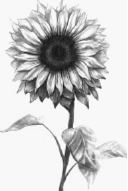
Identify the plant shown in the figure.
A
Sunflower
B
Teak
C
Maize
D
Fern
Solution
(A) The image provided shows a typical sunflower plant,which is a member of the family Asteraceae. It is characterized by its large,composite flower head. Therefore,the correct option is Sunflower.
0 likes
View Solution93
EasyMCQ
To which class does the plant shown in the figure belong?
A
Monocotyledons
B
Bryophytes
C
Dicotyledons
D
Algae
Solution
(C) The plant shown in the figure is a sunflower (Helianthus annuus).
Sunflower belongs to the family Asteraceae.
It is a dicotyledonous plant,characterized by having two cotyledons in its seeds and reticulate venation in its leaves.
Sunflower belongs to the family Asteraceae.
It is a dicotyledonous plant,characterized by having two cotyledons in its seeds and reticulate venation in its leaves.
0 likes
View Solution94
EasyMCQ
What is the scientific name of maize?
A
Rana tigrina
B
Periplaneta americana
C
Helianthus annuus
D
Zea mays
Solution
(D) The scientific name of maize (corn) is $Zea \text{ } mays$.
$Rana \text{ } tigrina$ is the scientific name of the Indian bullfrog.
$Periplaneta \text{ } americana$ is the scientific name of the American cockroach.
$Helianthus \text{ } annuus$ is the scientific name of the sunflower.
$Rana \text{ } tigrina$ is the scientific name of the Indian bullfrog.
$Periplaneta \text{ } americana$ is the scientific name of the American cockroach.
$Helianthus \text{ } annuus$ is the scientific name of the sunflower.
0 likes
View Solution95
MediumMCQ
Match Column $X$ with Column $Y$ and select the correct option:
| Column $X$ | Column $Y$ |
| $(1)$ Asteraceae | $(P)$ Orthoptera |
| $(2)$ Megascolecidae | $(Q)$ Glumiflorae |
| $(3)$ Blattidae | $(R)$ Inferae |
| $(4)$ Poaceae | $(S)$ Opisthopora |
A
$(1-R), (2-P), (3-S), (4-Q)$
B
$(1-R), (2-S), (3-Q), (4-P)$
C
$(1-R), (2-S), (3-P), (4-Q)$
D
$(1-S), (2-R), (3-P), (4-Q)$
Solution
(C) The correct matches are as follows:
$(1)$ Asteraceae belongs to the series Inferae $(R)$ in the Bentham and Hooker system of classification.
$(2)$ Megascolecidae is a family of earthworms belonging to the order Opisthopora $(S)$.
$(3)$ Blattidae is the family of cockroaches belonging to the order Orthoptera $(P)$ (specifically Blattodea, often grouped under Orthoptera in older classifications).
$(4)$ Poaceae is a family of grasses belonging to the series Glumiflorae $(Q)$.
Therefore, the correct matching is $(1-R), (2-S), (3-P), (4-Q)$.
$(1)$ Asteraceae belongs to the series Inferae $(R)$ in the Bentham and Hooker system of classification.
$(2)$ Megascolecidae is a family of earthworms belonging to the order Opisthopora $(S)$.
$(3)$ Blattidae is the family of cockroaches belonging to the order Orthoptera $(P)$ (specifically Blattodea, often grouped under Orthoptera in older classifications).
$(4)$ Poaceae is a family of grasses belonging to the series Glumiflorae $(Q)$.
Therefore, the correct matching is $(1-R), (2-S), (3-P), (4-Q)$.
0 likes
View Solution96
MediumMCQ
How many plants among $Indigofera$,$Sesbania$,$Salvia$,$Allium$,$Aloe$,mustard,groundnut,radish,gram,and turnip have stamens with different lengths in their flowers?
A
Three
B
Four
C
Five
D
Six
Solution
(B) The plants listed are $Indigofera$,$Sesbania$,$Salvia$,$Allium$,$Aloe$,mustard,groundnut,radish,gram,and turnip.
Stamens with different lengths in flowers are characteristic of specific families:
$1$. $Salvia$ (Family $Lamiaceae$): Exhibits didynamous condition (two long and two short stamens).
$2$. Mustard ($Brassica$ $campestris$): Exhibits tetradynamous condition (four long and two short stamens).
$3$. Radish ($Raphanus$ $sativus$): Exhibits tetradynamous condition (four long and two short stamens).
$4$. Turnip ($Brassica$ $rapa$): Exhibits tetradynamous condition (four long and two short stamens).
$Indigofera$,$Sesbania$,$gram$,and $groundnut$ (Family $Fabaceae$) have diadelphous stamens but generally uniform lengths.
$Allium$ and $Aloe$ (Family $Liliaceae$) have stamens of similar lengths.
Therefore,there are $4$ plants ($Salvia$,mustard,radish,and turnip) that have stamens with different lengths.
Stamens with different lengths in flowers are characteristic of specific families:
$1$. $Salvia$ (Family $Lamiaceae$): Exhibits didynamous condition (two long and two short stamens).
$2$. Mustard ($Brassica$ $campestris$): Exhibits tetradynamous condition (four long and two short stamens).
$3$. Radish ($Raphanus$ $sativus$): Exhibits tetradynamous condition (four long and two short stamens).
$4$. Turnip ($Brassica$ $rapa$): Exhibits tetradynamous condition (four long and two short stamens).
$Indigofera$,$Sesbania$,$gram$,and $groundnut$ (Family $Fabaceae$) have diadelphous stamens but generally uniform lengths.
$Allium$ and $Aloe$ (Family $Liliaceae$) have stamens of similar lengths.
Therefore,there are $4$ plants ($Salvia$,mustard,radish,and turnip) that have stamens with different lengths.
0 likes
View Solution97
MediumMCQ
Which of the following is not a stem modification?
A
Tendrils of cucumber
B
Flattened structures of Opuntia
C
Pitcher of Nepenthes
D
Thorns of citrus
Solution
(C) The correct answer is $C$.
$1$. The pitcher of $Nepenthes$ (pitcher plant) is a modification of the leaf.
$2$. In $Nepenthes$,the leaf lamina is modified into a pitcher-like structure to trap and digest insects.
$3$. The leaf apex forms a lid to cover the pitcher,and the leaf base often becomes leaf-like (phyllode).
$4$. Tendrils of cucumber,flattened structures of $Opuntia$ (phylloclade),and thorns of citrus are all examples of stem modifications.
$1$. The pitcher of $Nepenthes$ (pitcher plant) is a modification of the leaf.
$2$. In $Nepenthes$,the leaf lamina is modified into a pitcher-like structure to trap and digest insects.
$3$. The leaf apex forms a lid to cover the pitcher,and the leaf base often becomes leaf-like (phyllode).
$4$. Tendrils of cucumber,flattened structures of $Opuntia$ (phylloclade),and thorns of citrus are all examples of stem modifications.
0 likes
View Solution98
MediumMCQ
Among China rose,mustard,brinjal,potato,guava,cucumber,onion and tulip,how many plants have superior ovary?
A
Three
B
Four
C
Five
D
Six
Solution
(D) The plants listed are China rose,mustard,brinjal,potato,guava,cucumber,onion,and tulip.
$1$. China rose: Superior ovary (Hypogynous flower).
$2$. Mustard: Superior ovary (Hypogynous flower).
$3$. Brinjal: Superior ovary (Hypogynous flower).
$4$. Potato: Superior ovary (Hypogynous flower).
$5$. Guava: Inferior ovary (Epigynous flower).
$6$. Cucumber: Inferior ovary (Epigynous flower).
$7$. Onion: Superior ovary (Hypogynous flower).
$8$. Tulip: Superior ovary (Hypogynous flower).
Thus,China rose,mustard,brinjal,potato,onion,and tulip have a superior ovary. The total count is $6$.
$1$. China rose: Superior ovary (Hypogynous flower).
$2$. Mustard: Superior ovary (Hypogynous flower).
$3$. Brinjal: Superior ovary (Hypogynous flower).
$4$. Potato: Superior ovary (Hypogynous flower).
$5$. Guava: Inferior ovary (Epigynous flower).
$6$. Cucumber: Inferior ovary (Epigynous flower).
$7$. Onion: Superior ovary (Hypogynous flower).
$8$. Tulip: Superior ovary (Hypogynous flower).
Thus,China rose,mustard,brinjal,potato,onion,and tulip have a superior ovary. The total count is $6$.
0 likes
View Solution99
MediumMCQ
Which one of the following organisms is correctly matched with its three characteristics?
A
Pea: $C_3$ pathway,endospermic seed,vexillary aestivation
B
Tomato: twisted aestivation,axile placentation,berry
C
Onion: bulb,imbricate aestivation,axile placentation
D
Maize: $C_3$ pathway,closed vascular bundles,scutellum
Solution
(C) The correct answer is $C$.
$1$. Onion ($Allium$ $cepa$) is a monocot belonging to the family $Liliaceae$. It stores food in fleshy leaves forming a bulb.
$2$. The aestivation in $Liliaceae$ (like Onion) is imbricate,where the margins of the sepals or petals overlap one another but not in any particular direction.
$3$. It exhibits axile placentation,where the placenta is axial and the ovules are attached to it in a multilocular ovary.
Analysis of other options:
- Pea: It has non-endospermic (exalbuminous) seeds,not endospermic.
- Tomato: It shows valvate aestivation,not twisted.
- Maize: It is a $C_4$ plant,not a $C_3$ plant.
$1$. Onion ($Allium$ $cepa$) is a monocot belonging to the family $Liliaceae$. It stores food in fleshy leaves forming a bulb.
$2$. The aestivation in $Liliaceae$ (like Onion) is imbricate,where the margins of the sepals or petals overlap one another but not in any particular direction.
$3$. It exhibits axile placentation,where the placenta is axial and the ovules are attached to it in a multilocular ovary.
Analysis of other options:
- Pea: It has non-endospermic (exalbuminous) seeds,not endospermic.
- Tomato: It shows valvate aestivation,not twisted.
- Maize: It is a $C_4$ plant,not a $C_3$ plant.
0 likes
View Solution100
MediumMCQ
How many plants in the list given below have marginal placentation: Mustard,Gram,Tulip,Asparagus,Arhar,Sun hemp,Chilli,Colchicum,Onion,Moong,Pea,Tobacco,Lupin?
A
Four
B
Five
C
Six
D
Three
Solution
(C) Marginal placentation is a characteristic feature of the family $Fabaceae$.
In the given list,the plants belonging to the family $Fabaceae$ are: Gram,Arhar,Sun hemp,Moong,Pea,and Lupin.
$1$. Gram ($Cicer$ $arietinum$)
$2$. Arhar ($Cajanus$ $cajan$)
$3$. Sun hemp ($Crotalaria$ $juncea$)
$4$. Moong ($Vigna$ $radiata$)
$5$. Pea ($Pisum$ $sativum$)
$6$. Lupin $(Lupinus)$
Therefore,there are $6$ plants that exhibit marginal placentation.
The correct option is $C$.
In the given list,the plants belonging to the family $Fabaceae$ are: Gram,Arhar,Sun hemp,Moong,Pea,and Lupin.
$1$. Gram ($Cicer$ $arietinum$)
$2$. Arhar ($Cajanus$ $cajan$)
$3$. Sun hemp ($Crotalaria$ $juncea$)
$4$. Moong ($Vigna$ $radiata$)
$5$. Pea ($Pisum$ $sativum$)
$6$. Lupin $(Lupinus)$
Therefore,there are $6$ plants that exhibit marginal placentation.
The correct option is $C$.
0 likes
View SolutionMorphology of Flowering Plants — Mix Examples- Morphology of Flowering Plants · Frequently Asked Questions
1Are these Morphology of Flowering Plants questions useful for JEE and NEET?
Yes. All questions in this section are mapped to JEE Main and NEET exam patterns. Previous year questions from JEE Main, NEET, GUJCET and state-level exams are included with full solutions.
2Can I switch to Hindi or Gujarati for these questions?
Yes. Use the language tabs in the hero section or the sidebar to view the same questions and solutions in English, Hindi or Gujarati.
3How do I generate a question paper from this subtopic?
Use the Vedclass Exam Paper Generator — select the chapter and subtopic, set difficulty, and generate Sets A, B, C, D automatically. First 3 chapters of every subject are free.
Vedclass Products
For Students
Vedclass Test Series
Mock tests in real JEE/NEET style with performance analysis. 5-day free trial.
Start Free TrialFor Teachers
Exam Paper Generator
Generate Set A/B/C/D papers from this chapter in 2 minutes. 3 chapters free.
Try FreeFor Institutes
Online Exam Module
Live online exams with unlimited students, 360° analytics & white-label branding.
See DemoFor Teachers & Institutes
Generate a Morphology of Flowering Plants Exam Paper in 2 Minutes
Select subtopic & difficulty — Sets A, B, C, D auto-generated with No Repeat logic.
First 3 chapters of every subject are free — no payment required.