
A English
Semi-technical Description of a Typical Flowering Plant Questions in English
Class 11 Biology · Morphology of Flowering Plants · Semi-technical Description of a Typical Flowering Plant
32+
Questions
English
Language
100%
With Solutions
Showing 32 of 32 questions in English
1
MediumMCQ
Plants lacking a corolla are placed under which of the following groups?
A
Polypetalae
B
Gamopetalae
C
Polychlamydeae
D
Monochlamydeae
Solution
(D) In the Bentham and Hooker classification system,the subclass $Monochlamydeae$ includes plants where the perianth is either undifferentiated into calyx and corolla or the corolla is completely absent.
$Polypetalae$ consists of plants with free petals.
$Gamopetalae$ consists of plants with fused petals.
Therefore,plants lacking a corolla are placed under $Monochlamydeae$.
$Polypetalae$ consists of plants with free petals.
$Gamopetalae$ consists of plants with fused petals.
Therefore,plants lacking a corolla are placed under $Monochlamydeae$.
0 likes
View Solution2
MediumMCQ
Floral formula represents
A
Position of flower
B
Symmetry of a flower
C
Functions of a flower
D
Diagrammatic notation of floral characters
Solution
(D) The floral formula is a symbolic and numerical representation used to provide information about the floral parts of a plant.
It includes details such as the number,position,cohesion,and adhesion of floral parts,as well as the symmetry and sexuality of the flower.
Therefore,it serves as a concise diagrammatic notation of floral characters.
It includes details such as the number,position,cohesion,and adhesion of floral parts,as well as the symmetry and sexuality of the flower.
Therefore,it serves as a concise diagrammatic notation of floral characters.
0 likes
View Solution3
MediumMCQ
Which of the following characters does not become apparent in a floral formula?
A
Placentation and aestivation
B
Number of floral parts
C
Whorls of floral parts
D
Position of ovary
Solution
(A) floral formula provides information about the number of floral parts (calyx,corolla,androecium,and gynoecium),their arrangement in whorls,and the position of the ovary relative to other floral parts.
However,specific details such as the mode of arrangement of sepals or petals in the floral bud (aestivation) and the arrangement of ovules within the ovary (placentation) are not represented in a floral formula. These are typically described in a floral diagram.
However,specific details such as the mode of arrangement of sepals or petals in the floral bud (aestivation) and the arrangement of ovules within the ovary (placentation) are not represented in a floral formula. These are typically described in a floral diagram.
0 likes
View Solution4
EasyMCQ
Disciflorae consists of ........
A
$6$ orders and many families.
B
$4$ orders and many families.
C
$5$ orders and many families.
D
$3$ orders and many families.
Solution
(C) In the Bentham and Hooker system of classification,the subclass $Disciflorae$ is characterized by the presence of a prominent disc-like structure (hypogynous disc) between the stamens and the ovary.
This subclass includes $5$ orders and $22$ families.
This subclass includes $5$ orders and $22$ families.
0 likes
View Solution5
EasyMCQ
$A$ floral formula represents $......$.
A
Symmetry of the plant
B
Position of the flower
C
Floral characteristics
D
Function of the flower
Solution
(C) floral formula is a symbolic representation of the floral structure of a plant. It provides information about the floral characteristics such as symmetry,sex,number of floral parts (sepals,petals,stamens,and carpels),their arrangement,and their fusion or adhesion. Therefore,it represents the floral characteristics of a plant.
0 likes
View Solution6
EasyMCQ
$A$ floral diagram is a . . . . . . .
A
diagram of a flower
B
three-dimensional view of a flower
C
longitudinal section of a flower
D
transverse section of a flower
Solution
(D) floral diagram provides information about the number of parts of a flower,their arrangement,and the relation they have with one another. It represents a cross-section or a transverse section of a flower,showing the relative positions of the calyx,corolla,androecium,and gynoecium as seen from above.
0 likes
View Solution7
MediumMCQ
...... is known as incomplete because in this subclass,the calyx and corolla are not distinct. The flowers usually have only a single whorl of perianth,which is sepaloid.
A
Monochlamydeae
B
Polypetalae
C
Gamopetalae
D
Both $(A)$ and $(B)$
Solution
(A) In the Bentham and Hooker classification system,the subclass $Monochlamydeae$ is characterized by flowers that are incomplete.
These flowers lack a distinct calyx and corolla.
Instead,they possess a single whorl of perianth,which is typically sepaloid (resembling sepals in appearance).
Therefore,the correct answer is $Monochlamydeae$.
These flowers lack a distinct calyx and corolla.
Instead,they possess a single whorl of perianth,which is typically sepaloid (resembling sepals in appearance).
Therefore,the correct answer is $Monochlamydeae$.
0 likes
View Solution8
DifficultMCQ
Which characters are used for the description of a new species of higher plants?
A
Floral characters of the new species
B
Anatomical characters of the new species
C
Physiological characters of the new species
D
Endosperm characters
Solution
(A) In taxonomy,especially for higher plants (Angiosperms),floral characters are considered the most reliable and stable for classification and description of new species. This is because vegetative characters (like leaves or stems) are more prone to environmental variations,whereas floral structures are relatively constant and evolutionarily significant.
0 likes
View Solution9
DifficultMCQ
The characterization of a family is based on which of the following?
A
Vegetative characters
B
Reproductive characters
C
Both $(A)$ and $(B)$
D
None of these
Solution
(C) In biological classification,a family is a taxonomic category that groups together related genera. The characterization of a family is based on both vegetative and reproductive features of the plant species. Therefore,both $(A)$ and $(B)$ are correct.
0 likes
View Solution10
EasyMCQ
Which of the following is a series of Gamopetalae?
A
Superae
B
Disciflorae
C
Thalamiflorae
D
Calyciflorae
Solution
(A) In Bentham and Hooker's classification system,the class Dicotyledonae is divided into three subclasses: Polypetalae,Gamopetalae,and Monochlamydeae.
Subclass Gamopetalae is further divided into three series: Inferae,Heteromerae,and Bicarpellatae.
Among the given options,'Superae' is not a standard series in this classification,but 'Inferae' is. However,looking at the options provided,'Inferae' is the intended answer (often misspelled as 'Superae').
Thalamiflorae,Disciflorae,and Calyciflorae are series belonging to the subclass Polypetalae.
Subclass Gamopetalae is further divided into three series: Inferae,Heteromerae,and Bicarpellatae.
Among the given options,'Superae' is not a standard series in this classification,but 'Inferae' is. However,looking at the options provided,'Inferae' is the intended answer (often misspelled as 'Superae').
Thalamiflorae,Disciflorae,and Calyciflorae are series belonging to the subclass Polypetalae.
0 likes
View Solution11
MediumMCQ
The series of Gamopetalae which includes $4$ cohorts and many orders is:
A
Disciflorae
B
Bicarpellatae
C
Thalamiflorae
D
Inferae
Solution
(B) In the Bentham and Hooker system of classification,the subclass Gamopetalae is divided into three series: $1$. Inferae,$2$. Heteromerae,and $3$. Bicarpellatae.
- The series $Inferae$ includes $3$ orders and $9$ families.
- The series $Heteromerae$ includes $3$ orders and $12$ families.
- The series $Bicarpellatae$ includes $4$ orders and $24$ families.
- Therefore,the series that includes $4$ orders (cohorts) is $Bicarpellatae$.
- The series $Inferae$ includes $3$ orders and $9$ families.
- The series $Heteromerae$ includes $3$ orders and $12$ families.
- The series $Bicarpellatae$ includes $4$ orders and $24$ families.
- Therefore,the series that includes $4$ orders (cohorts) is $Bicarpellatae$.
0 likes
View Solution12
MediumMCQ
Column-$I$ lists the series and Column-$II$ lists the number of orders in Bentham and Hooker's classification system. Match them correctly.
| Column-$I$ (Series) | Column-$II$ (Number of Orders) |
| $(A)$ Thalamiflorae | $(p)$ $4$ |
| $(B)$ Inferae | $(q)$ $3$ |
| $(C)$ Disciflorae | $(r)$ $5$ |
| $(D)$ Calyciflorae | $(s)$ $6$ |
A
$(A-s), (B-p), (C-q), (D-r)$
B
$(A-q), (B-s), (C-r), (D-p)$
C
$(A-s), (B-q), (C-p), (D-r)$
D
$(A-r), (B-s), (C-p), (D-q)$
Solution
(C) In Bentham and Hooker's classification system for Polypetalae,the series are divided as follows:
$1$. Thalamiflorae consists of $6$ orders.
$2$. Disciflorae consists of $4$ orders.
$3$. Calyciflorae consists of $5$ orders.
$4$. Inferae (under Gamopetalae) consists of $3$ orders.
Therefore,the correct matching is: $(A-s), (B-q), (C-p), (D-r)$.
$1$. Thalamiflorae consists of $6$ orders.
$2$. Disciflorae consists of $4$ orders.
$3$. Calyciflorae consists of $5$ orders.
$4$. Inferae (under Gamopetalae) consists of $3$ orders.
Therefore,the correct matching is: $(A-s), (B-q), (C-p), (D-r)$.
0 likes
View Solution13
MediumMCQ
In floral formula,$Br =$ ?
A
Calyx
B
Corolla
C
Tepal
D
Bract
Solution
(D) In a floral formula,symbols are used to represent various floral parts.
$Br$ stands for Bracteate,which indicates the presence of a bract.
$Ebr$ stands for Ebracteate,which indicates the absence of a bract.
Therefore,$Br$ represents a Bract.
$Br$ stands for Bracteate,which indicates the presence of a bract.
$Ebr$ stands for Ebracteate,which indicates the absence of a bract.
Therefore,$Br$ represents a Bract.
0 likes
View Solution14
MediumMCQ
Floral characters are used for identification of angiosperms because ...........
A
Flowers are of different colors.
B
Flowers can be easily pressed.
C
Reproductive parts are more stable and conservative than vegetative parts.
D
Flowers can be worked with beautifully.
Solution
(C) Floral characters are preferred for the identification and classification of angiosperms because vegetative characters (such as leaves,stems,and roots) are highly plastic and can change rapidly due to environmental factors. In contrast,floral parts (reproductive organs) are more stable and conservative,meaning they show less variation over evolutionary time. Therefore,they provide more reliable and consistent taxonomic markers for classification.
0 likes
View Solution15
MediumMCQ
Floral diagram fails to indicate
A
epiphylly and epipetaly
B
aestivation and placentation
C
position of ovary on the thalamus
D
cohesion of carpels and stamens
Solution
(C) floral diagram provides information about the number of parts of a flower,their arrangement,and the relation they have with one another.
It indicates the aestivation,placentation,and cohesion or adhesion of floral parts.
However,it does not represent the position of the ovary on the thalamus (i.e.,whether the flower is hypogynous,perigynous,or epigynous),which is instead indicated by the floral formula.
It indicates the aestivation,placentation,and cohesion or adhesion of floral parts.
However,it does not represent the position of the ovary on the thalamus (i.e.,whether the flower is hypogynous,perigynous,or epigynous),which is instead indicated by the floral formula.
0 likes
View Solution16
Medium
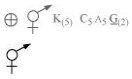
Write the floral formula of an actinomorphic,bisexual,hypogynous flower with five united sepals,five free petals,five free stamens,and two united carpels with a superior ovary and axile placentation.
Solution
(N/A) The floral formula of the described flower is represented as: $\oplus \; \text{⚥} \; K_{(5)} \; C_{5} \; A_{5} \; \underline{G}_{(2)}$
$1$. Actinomorphic flowers are represented by the symbol $\oplus$.
$2$. $A$ bisexual flower is indicated by the symbol $\text{⚥}$.
$3$. The calyx contains five united sepals,represented as $K_{(5)}$.
$4$. The corolla consists of five free petals,represented as $C_{5}$.
$5$. The androecium consists of five free stamens,represented as $A_{5}$.
$6$. The gynoecium consists of a superior ovary with two united carpels,represented as $\underline{G}_{(2)}$. The axile placentation is a characteristic feature of this arrangement.
$1$. Actinomorphic flowers are represented by the symbol $\oplus$.
$2$. $A$ bisexual flower is indicated by the symbol $\text{⚥}$.
$3$. The calyx contains five united sepals,represented as $K_{(5)}$.
$4$. The corolla consists of five free petals,represented as $C_{5}$.
$5$. The androecium consists of five free stamens,represented as $A_{5}$.
$6$. The gynoecium consists of a superior ovary with two united carpels,represented as $\underline{G}_{(2)}$. The axile placentation is a characteristic feature of this arrangement.
0 likes
View Solution17
Medium
Explain: How is a floral diagram drawn?
Solution
(N/A) $\rightarrow$ $A$ floral diagram provides information about the number of parts of a flower,their arrangement,and the relation they have with one another.
$\rightarrow$ The position of the mother axis with respect to the flower is represented by a dot on the top of the floral diagram.
$\rightarrow$ Calyx,corolla,androecium,and gynoecium are drawn in successive whorls,with the calyx being the outermost and the gynoecium being in the center.
$\rightarrow$ The floral diagram also illustrates cohesion and adhesion within parts of whorls and between whorls.
$\rightarrow$ The position of the mother axis with respect to the flower is represented by a dot on the top of the floral diagram.
$\rightarrow$ Calyx,corolla,androecium,and gynoecium are drawn in successive whorls,with the calyx being the outermost and the gynoecium being in the center.
$\rightarrow$ The floral diagram also illustrates cohesion and adhesion within parts of whorls and between whorls.
0 likes
View Solution18
Medium
Write the floral formula for a flower which is bisexual,actinomorphic,sepals five,twisted aestivation,petals five,valvate aestivation,stamens six,ovary tricarpellary,syncarpous,superior,trilocular with axile placentation.
Solution
(D) The floral formula is a symbolic representation of the floral structure. Based on the given characteristics:
$1$. Bisexual: $\text{\textcircled{\raisebox{-0.9pt}{+}}}$
$2$. Actinomorphic: $\oplus$
$3$. Sepals: $K_5$ (twisted aestivation is indicated by parentheses or specific notation,but standard formula uses $K_5$)
$4$. Petals: $C_5$ (valvate aestivation)
$5$. Stamens: $A_6$
$6$. Ovary: Tricarpellary,syncarpous,superior,trilocular: $\underline{G}_{(3)}$
Combining these,the floral formula is: $\text{\textcircled{\raisebox{-0.9pt}{+}}} \oplus K_5 C_5 A_6 \underline{G}_{(3)}$.
$1$. Bisexual: $\text{\textcircled{\raisebox{-0.9pt}{+}}}$
$2$. Actinomorphic: $\oplus$
$3$. Sepals: $K_5$ (twisted aestivation is indicated by parentheses or specific notation,but standard formula uses $K_5$)
$4$. Petals: $C_5$ (valvate aestivation)
$5$. Stamens: $A_6$
$6$. Ovary: Tricarpellary,syncarpous,superior,trilocular: $\underline{G}_{(3)}$
Combining these,the floral formula is: $\text{\textcircled{\raisebox{-0.9pt}{+}}} \oplus K_5 C_5 A_6 \underline{G}_{(3)}$.
0 likes
View Solution19
MediumMCQ
In angiosperms,characters of flowers are used in classification because
A
flowers are attractive.
B
flowers are large.
C
characters of flowers are conserved.
D
none of the above.
Solution
(C) Classification is the process by which organisms are grouped into convenient categories based on some easily observable characters.
In angiosperms,floral characters are used in classification because they are more stable and less susceptible to environmental influence compared to vegetative characters.
Reproductive characters are evolutionarily conserved and provide a reliable basis for taxonomic identification and classification.
In angiosperms,floral characters are used in classification because they are more stable and less susceptible to environmental influence compared to vegetative characters.
Reproductive characters are evolutionarily conserved and provide a reliable basis for taxonomic identification and classification.
0 likes
View Solution20
MediumMCQ
Percentage ( $\%$ ) sign is used for
A
Actinomorphic flower
B
Zygomorphic flower
C
Incomplete flower
D
Epigynous flower
Solution
(B) When the flower is bilaterally symmetrical, i.e., divisible into only two equal halves by a single vertical plane, it is termed as zygomorphic.
Examples include $Adhatoda$, pea, $Larkspur$, and $Ocimum$.
The zygomorphic condition of a flower is represented by the symbol $\%$.
Examples include $Adhatoda$, pea, $Larkspur$, and $Ocimum$.
The zygomorphic condition of a flower is represented by the symbol $\%$.
0 likes
View Solution21
MediumMCQ
In a floral formula,the ( male female ) symbol stands for:
A
Staminate flower
B
Bisexual flower
C
Pistillate flower
D
Imperfect flower
Solution
(B) The symbol ( male female ) represents a bisexual flower in a floral formula.
Common symbols used in floral formulas are:
$Br$ - Bracteate
$Brl$ - Bracteolate
$EBr$ - Ebracteate
$\oplus$ - Actinomorphic
$\%$ - Zygomorphic
male female - Bisexual
male - Staminate flower
female - Pistillate flower
$K$ - Calyx
$C$ - Corolla (Petals)
$A$ - Androecium (stamens)
$P$ - Perianth (tepals)
$G$ - Gynoecium (carpels)
Common symbols used in floral formulas are:
$Br$ - Bracteate
$Brl$ - Bracteolate
$EBr$ - Ebracteate
$\oplus$ - Actinomorphic
$\%$ - Zygomorphic
male female - Bisexual
male - Staminate flower
female - Pistillate flower
$K$ - Calyx
$C$ - Corolla (Petals)
$A$ - Androecium (stamens)
$P$ - Perianth (tepals)
$G$ - Gynoecium (carpels)
0 likes
View Solution22
MediumMCQ
$G(\underline{2})$ represents
A
Gynoecium,bicarpellary,syncarpous,superior
B
Gynoecium,monocarpellary,syncarpous,inferior
C
Gynoecium,bicarpellary,syncarpous,inferior
D
Gynoecium,bicarpellary,apocarpous,superior
Solution
(A) In floral formulas,$G$ stands for Gynoecium.
The number in the subscript (e.g.,$2$) indicates the number of carpels.
If the number is underlined,it indicates that the ovary is superior.
If the number is enclosed in brackets,it indicates that the carpels are fused (syncarpous).
Therefore,$G(\underline{2})$ represents Gynoecium,bicarpellary,syncarpous,and superior ovary.
The number in the subscript (e.g.,$2$) indicates the number of carpels.
If the number is underlined,it indicates that the ovary is superior.
If the number is enclosed in brackets,it indicates that the carpels are fused (syncarpous).
Therefore,$G(\underline{2})$ represents Gynoecium,bicarpellary,syncarpous,and superior ovary.
0 likes
View Solution23
MediumMCQ
In a floral formula,'$K$' and '$C$' stand for:
A
$K$-Corolla,$C$-Calyx
B
$K$-Calyx,$C$-Corolla
C
$K$-Calyx,$C$-Calyx
D
$K$-Corolla,$C$-Corolla
Solution
(B) In a floral formula,specific symbols are used to represent different floral parts:
$Br$: Bracteate
$K$: Calyx (sepals)
$C$: Corolla (petals)
$A$: Androecium (stamens)
$G$: Gynoecium (carpels)
$P$: Perianth (tepals)
$\oplus$: Actinomorphic symmetry
$\%$: Zygomorphic symmetry
female: Female flower
male: Male flower
Therefore,'$K$' stands for Calyx and '$C$' stands for Corolla.
$Br$: Bracteate
$K$: Calyx (sepals)
$C$: Corolla (petals)
$A$: Androecium (stamens)
$G$: Gynoecium (carpels)
$P$: Perianth (tepals)
$\oplus$: Actinomorphic symmetry
$\%$: Zygomorphic symmetry
female: Female flower
male: Male flower
Therefore,'$K$' stands for Calyx and '$C$' stands for Corolla.
0 likes
View Solution24
MediumMCQ
$\oint$ stands for $\ldots A \ldots$ $\oplus$ stands for ...$B$... $\%$ stands for ...$C$...
Here, $A$ to $C$ refers to
Here, $A$ to $C$ refers to
A
$A$-bisexual plant, $B$-actinomorphic, $C$-zygomorphic
B
$A$-unisexual, $B$-actinomorphic, $C$-zygomorphic
C
$A$-unisexual, $B$-zygomorphic, $C$-actinomorphic
D
$A$-bisexual plant, $B$-zygomorphic, $C$-actinomorphic
Solution
(A) In floral formulas, specific symbols are used to represent floral characteristics:
$1$. $\oint$ (or $\text{male and female symbol combined}$) represents a bisexual or perfect flower.
$2$. $\oplus$ represents actinomorphic (radial symmetry) flowers.
$3$. $\%$ represents zygomorphic (bilateral symmetry) flowers.
Therefore, $A$ is bisexual, $B$ is actinomorphic, and $C$ is zygomorphic.
$1$. $\oint$ (or $\text{male and female symbol combined}$) represents a bisexual or perfect flower.
$2$. $\oplus$ represents actinomorphic (radial symmetry) flowers.
$3$. $\%$ represents zygomorphic (bilateral symmetry) flowers.
Therefore, $A$ is bisexual, $B$ is actinomorphic, and $C$ is zygomorphic.
0 likes
View Solution25
EasyMCQ
While representing a floral formula, $G$ stands for
A
Epigynous flower
B
Superior ovary
C
Inferior ovary
D
Androecium
Solution
(B) In a floral formula, the symbol $G$ represents the gynoecium.
When $G$ is written with a line below it $(\underline{G})$, it indicates a superior ovary.
When $G$ is written with a line above it $(\overline{G})$, it indicates an inferior ovary.
Therefore, in the context of floral notation, $G$ is the symbol for the gynoecium, and its position relative to the line indicates the ovary type.
When $G$ is written with a line below it $(\underline{G})$, it indicates a superior ovary.
When $G$ is written with a line above it $(\overline{G})$, it indicates an inferior ovary.
Therefore, in the context of floral notation, $G$ is the symbol for the gynoecium, and its position relative to the line indicates the ovary type.
0 likes
View Solution26
MediumMCQ
Select the correct option.
| Column-$I$ | Column-$II$ |
| $(a). Br$ | $(i). \text{Corolla}$ |
| $(b). K$ | $(ii). \text{Perianth}$ |
| $(c). C$ | $(iii). \text{Calyx}$ |
| $(d). P$ | $(iv). \text{Bracteate}$ |
A
$a(iv), b(iii), c(i), d(ii)$
B
$a(iv), b(ii), c(iii), d(i)$
C
$a(iv), b(iii), c(ii), d(i)$
D
$a(i), b(ii), c(iii), d(iv)$
Solution
(A) In floral formulas, specific symbols are used to represent floral parts:
$Br$ stands for Bracteate (presence of bracts).
$K$ stands for Calyx (whorl of sepals).
$C$ stands for Corolla (whorl of petals).
$P$ stands for Perianth (when sepals and petals are not distinct).
Therefore, the correct matching is: $a(iv), b(iii), c(i), d(ii)$.
$Br$ stands for Bracteate (presence of bracts).
$K$ stands for Calyx (whorl of sepals).
$C$ stands for Corolla (whorl of petals).
$P$ stands for Perianth (when sepals and petals are not distinct).
Therefore, the correct matching is: $a(iv), b(iii), c(i), d(ii)$.
0 likes
View Solution27
MediumMCQ
Actinomorphic nature of a flower is represented by which of the following symbols?
A
$A$
B
$\%$
C
$\oplus$
D
Solution
(C) In floral formulas, the symmetry of a flower is represented by specific symbols.
$1$. Actinomorphic (radial symmetry) is represented by the symbol $\oplus$.
$2$. Zygomorphic (bilateral symmetry) is represented by the symbol $\%$.
$3$. The symbol shown in option $D$ represents a bisexual flower (hermaphrodite).
$1$. Actinomorphic (radial symmetry) is represented by the symbol $\oplus$.
$2$. Zygomorphic (bilateral symmetry) is represented by the symbol $\%$.
$3$. The symbol shown in option $D$ represents a bisexual flower (hermaphrodite).
0 likes
View Solution28
MediumMCQ
What does the given symbol represent?

A
Epipetalous stamen
B
Episepalous stamen
C
Epiphyllous stamen
D
Gynandrous stamen
Solution
(C) In floral formulas,symbols are used to represent various floral parts and their relationships.
- The symbol $P$ stands for Perianth (Tepals).
- The symbol $A$ stands for Androecium (Stamens).
- The line connecting $P$ and $A$ indicates that the stamens are attached to the perianth (tepals).
- This condition is known as Epiphyllous (or Epitepalous) stamen,commonly seen in the family Liliaceae.
- The symbol $P$ stands for Perianth (Tepals).
- The symbol $A$ stands for Androecium (Stamens).
- The line connecting $P$ and $A$ indicates that the stamens are attached to the perianth (tepals).
- This condition is known as Epiphyllous (or Epitepalous) stamen,commonly seen in the family Liliaceae.
0 likes
View Solution29
MediumMCQ
What does the symbol $\oplus$ represent in floral morphology?
A
Zygomorphic flower
B
Actinomorphic flower
C
Asymmetric flower
D
None of the above
Solution
(B) In floral formula notation,the symbol $\oplus$ represents an actinomorphic flower.
An actinomorphic flower is one that exhibits radial symmetry,meaning it can be divided into two equal radial halves in any radial plane passing through the center.
Examples include mustard,datura,and chili.
An actinomorphic flower is one that exhibits radial symmetry,meaning it can be divided into two equal radial halves in any radial plane passing through the center.
Examples include mustard,datura,and chili.
0 likes
View Solution30
MediumMCQ
Select the correct option for the floral formula symbols.
A
$K$ - Calyx,$C$ - Corolla,$P$ - Perianth
B
$K$ - Corolla,$C$ - Calyx,$P$ - Perianth
C
$K$ - Perianth,$C$ - Corolla,$P$ - Calyx
D
$K$ - Perianth,$C$ - Calyx,$P$ - Corolla
Solution
(A) In a floral formula,specific symbols are used to represent the floral parts:
$1$. $K$ stands for Calyx (whorl of sepals).
$2$. $C$ stands for Corolla (whorl of petals).
$3$. $P$ stands for Perianth (when sepals and petals are not distinct,as in the lily family).
$4$. $A$ stands for Androecium (stamens).
$5$. $G$ stands for Gynoecium (carpels).
Therefore,the correct representation is $K$ - Calyx,$C$ - Corolla,$P$ - Perianth.
$1$. $K$ stands for Calyx (whorl of sepals).
$2$. $C$ stands for Corolla (whorl of petals).
$3$. $P$ stands for Perianth (when sepals and petals are not distinct,as in the lily family).
$4$. $A$ stands for Androecium (stamens).
$5$. $G$ stands for Gynoecium (carpels).
Therefore,the correct representation is $K$ - Calyx,$C$ - Corolla,$P$ - Perianth.
0 likes
View Solution31
MediumMCQ
Given below are two statements:
Statement $I$: In a floral formula,$\oplus$ stands for zygomorphic nature of the flower,and $\underline{G}$ stands for inferior ovary.
Statement $II$: In a floral formula,$\oplus$ stands for actinomorphic nature of the flower,and $\underline{G}$ stands for superior ovary.
In the light of the above statements,choose the correct answer from the options given below:
Statement $I$: In a floral formula,$\oplus$ stands for zygomorphic nature of the flower,and $\underline{G}$ stands for inferior ovary.
Statement $II$: In a floral formula,$\oplus$ stands for actinomorphic nature of the flower,and $\underline{G}$ stands for superior ovary.
In the light of the above statements,choose the correct answer from the options given below:
A
Both Statement $I$ and Statement $II$ are correct.
B
Both Statement $I$ and Statement $II$ are incorrect.
C
Statement $I$ is correct but Statement $II$ is incorrect.
D
Statement $I$ is incorrect but Statement $II$ is correct.
Solution
(D) In floral formulas,the symbol $\oplus$ represents actinomorphic (radially symmetrical) flowers,while $\%$ represents zygomorphic (bilaterally symmetrical) flowers.
The symbol $\underline{G}$ represents a superior ovary (where the ovary is placed above other floral parts),whereas $\overline{G}$ represents an inferior ovary.
Statement $I$ is incorrect because $\oplus$ is actinomorphic,not zygomorphic,and $\underline{G}$ is superior,not inferior.
Statement $II$ is correct because $\oplus$ is actinomorphic and $\underline{G}$ is superior.
Therefore,Statement $I$ is incorrect and Statement $II$ is correct.
The symbol $\underline{G}$ represents a superior ovary (where the ovary is placed above other floral parts),whereas $\overline{G}$ represents an inferior ovary.
Statement $I$ is incorrect because $\oplus$ is actinomorphic,not zygomorphic,and $\underline{G}$ is superior,not inferior.
Statement $II$ is correct because $\oplus$ is actinomorphic and $\underline{G}$ is superior.
Therefore,Statement $I$ is incorrect and Statement $II$ is correct.
0 likes
View Solution32
MediumMCQ
Which of the following floral features is shown by both the floral formula and the floral diagram?
A
Aestivation of sepals in the floral bud
B
Adhesion between parts of floral whorls
C
Number of locule/s in the ovary
D
Arrangement of ovule/s within the ovary
Solution
(B) floral formula is a symbolic representation of the floral structure,while a floral diagram provides a cross-sectional view of the flower.
Both representations are used to depict the number of floral parts,their arrangement,and their cohesion or adhesion.
Specifically,adhesion (the fusion between different floral whorls,such as epipetalous stamens) is clearly indicated in both: in the floral formula by a line or bracket connecting the symbols,and in the floral diagram by the physical connection between the whorls.
Both representations are used to depict the number of floral parts,their arrangement,and their cohesion or adhesion.
Specifically,adhesion (the fusion between different floral whorls,such as epipetalous stamens) is clearly indicated in both: in the floral formula by a line or bracket connecting the symbols,and in the floral diagram by the physical connection between the whorls.
0 likes
View SolutionMorphology of Flowering Plants — Semi-technical Description of a Typical Flowering Plant · Frequently Asked Questions
1Are these Morphology of Flowering Plants questions useful for JEE and NEET?
Yes. All questions in this section are mapped to JEE Main and NEET exam patterns. Previous year questions from JEE Main, NEET, GUJCET and state-level exams are included with full solutions.
2Can I switch to Hindi or Gujarati for these questions?
Yes. Use the language tabs in the hero section or the sidebar to view the same questions and solutions in English, Hindi or Gujarati.
3How do I generate a question paper from this subtopic?
Use the Vedclass Exam Paper Generator — select the chapter and subtopic, set difficulty, and generate Sets A, B, C, D automatically. First 3 chapters of every subject are free.
Vedclass Products
For Students
Vedclass Test Series
Mock tests in real JEE/NEET style with performance analysis. 5-day free trial.
Start Free TrialFor Teachers
Exam Paper Generator
Generate Set A/B/C/D papers from this chapter in 2 minutes. 3 chapters free.
Try FreeFor Institutes
Online Exam Module
Live online exams with unlimited students, 360° analytics & white-label branding.
See DemoFor Teachers & Institutes
Generate a Morphology of Flowering Plants Exam Paper in 2 Minutes
Select subtopic & difficulty — Sets A, B, C, D auto-generated with No Repeat logic.
First 3 chapters of every subject are free — no payment required.