
A English
Mix Examples- Morphology of Flowering Plants Questions in English
Class 11 Biology · Morphology of Flowering Plants · Mix Examples- Morphology of Flowering Plants
169+
Questions
English
Language
100%
With Solutions
Showing 50 of 169 questions in English
1
MediumMCQ
Vertical transmission of mycoplasmal diseases in plants may occur through which of the following?
A
Bulbs
B
Tubers
C
Corms
D
All the above
Solution
(D) Vertical transmission refers to the transfer of pathogens from parent plants to their offspring through vegetative propagules.
Mycoplasmas (phytoplasmas) are plant pathogens that reside in the phloem tissue.
Since bulbs,tubers,and corms are vegetative reproductive structures (propagules) derived from the parent plant,they can harbor mycoplasmas and transmit the infection to the new plant generation.
Therefore,all the listed structures can facilitate the vertical transmission of mycoplasmal diseases.
Mycoplasmas (phytoplasmas) are plant pathogens that reside in the phloem tissue.
Since bulbs,tubers,and corms are vegetative reproductive structures (propagules) derived from the parent plant,they can harbor mycoplasmas and transmit the infection to the new plant generation.
Therefore,all the listed structures can facilitate the vertical transmission of mycoplasmal diseases.
0 likes
View Solution2
MediumMCQ
Thorns,spines and prickles are
A
Organs of defence
B
Organs of offence
C
Organs of clinging
D
Specialised for gaseous exchange
Solution
(A) Thorns,spines,and prickles are sharp,pointed,straight,or curved hard structures that perform a similar function of protection against herbivores,thus acting as organs of defence.
0 likes
View Solution3
MediumMCQ
In onion leaves, food is stored in the form of:
A
Sugar
B
Starch
C
Protein
D
Malic acid
Solution
(A) In onion $(Allium \text{ } cepa)$, the fleshy leaves are modified to store food. The primary form of stored carbohydrate in these leaves is sugar (specifically glucose and sucrose), rather than starch, which is the common storage form in many other plants.
0 likes
View Solution4
EasyMCQ
Where will you get spiny stipules for protection against grazing animals?
A
Zizyphus
B
Acacia
C
Capparis
D
All of these
Solution
(D) In some plants,the stipules are modified into hard,pointed defensive organs called spines. These structures provide protection against grazing animals. Examples of such plants include $Acacia$,$Zizyphus$,and $Capparis$. Therefore,all the given options are correct.
0 likes
View Solution5
EasyMCQ
Sometimes sepals are modified into hairy structures which are useful in dispersal of seeds. These are called
A
Tepals
B
Epik
C
Pappus
D
Trichome
Solution
(C) In some plants,particularly in the family $Asteraceae$,the sepals are modified into persistent,hairy,or feathery structures known as $Pappus$.
These structures act like a parachute,which helps in the wind dispersal of seeds or fruits.
These structures act like a parachute,which helps in the wind dispersal of seeds or fruits.
0 likes
View Solution6
MediumMCQ
Parachute-like pappus is found in
A
Liliaceae / Cotton
B
Gramineae / Paddy
C
Compositae / Marigold
D
Solanaceae / Calotropis
Solution
(C) The correct answer is $C$.
$Pappus$ refers to modified sepals that form hairy or feathery structures.
These structures act like a parachute,facilitating the dispersal of seeds by wind.
This characteristic is a diagnostic feature of the family $Compositae$ (also known as $Asteraceae$),and $Marigold$ is a common example of this family.
$Pappus$ refers to modified sepals that form hairy or feathery structures.
These structures act like a parachute,facilitating the dispersal of seeds by wind.
This characteristic is a diagnostic feature of the family $Compositae$ (also known as $Asteraceae$),and $Marigold$ is a common example of this family.
0 likes
View Solution7
MediumMCQ
In syngynia,the flowers are
A
Epigynous
B
Fused to form a disc
C
Fused by gynaecia only
D
Both $(a)$ and $(b)$
Solution
(D) Syngynia is a condition in which the anthers are fused while the filaments remain free. This condition is characteristic of the family $Asteraceae$ (Compositae). In this family,the flowers are epigynous (ovary is inferior) and the florets are often arranged in a head or capitulum inflorescence,where they are fused to form a disc-like structure.
0 likes
View Solution8
MediumMCQ
Which one of the following is odd?
A
Allium cepa
B
Helianthus annuus
C
Brassica juncea
D
Arachis hypogea
Solution
(A) $Allium \ cepa$ (Onion) belongs to the monocot family $Liliaceae$.
$Helianthus \ annuus$ (Sunflower),$Brassica \ juncea$ (Mustard),and $Arachis \ hypogea$ (Groundnut) all belong to dicot families ($Asteraceae$,$Brassicaceae$,and $Fabaceae$ respectively).
Therefore,$Allium \ cepa$ is the odd one out.
$Helianthus \ annuus$ (Sunflower),$Brassica \ juncea$ (Mustard),and $Arachis \ hypogea$ (Groundnut) all belong to dicot families ($Asteraceae$,$Brassicaceae$,and $Fabaceae$ respectively).
Therefore,$Allium \ cepa$ is the odd one out.
0 likes
View Solution9
MediumMCQ
The typical floral formula for the family Gramineae (Poaceae) is:
A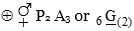
B
C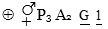
D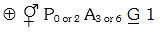
Solution
(D) The family Gramineae,also known as Poaceae,is characterized by the following floral features:
$1$. The flowers are actinomorphic $(\oplus)$ and bisexual $(\text{O\hspace{-0.5em}/})$.
$2$. The perianth is represented by lodicules,which are typically $2$ in number $(P_2)$.
$3$. The androecium consists of $3$ or $6$ stamens $(A_{3 \text{ or } 6})$.
$4$. The gynoecium is monocarpellary with a superior ovary ($G_1$ or $\underline{G}_1$).
Therefore,the correct floral formula is $\oplus \,\, \text{O\hspace{-0.5em}/} \,\, P_{0 \text{ or } 2} \, A_{3 \text{ or } 6} \, \underline{G}_1$.
$1$. The flowers are actinomorphic $(\oplus)$ and bisexual $(\text{O\hspace{-0.5em}/})$.
$2$. The perianth is represented by lodicules,which are typically $2$ in number $(P_2)$.
$3$. The androecium consists of $3$ or $6$ stamens $(A_{3 \text{ or } 6})$.
$4$. The gynoecium is monocarpellary with a superior ovary ($G_1$ or $\underline{G}_1$).
Therefore,the correct floral formula is $\oplus \,\, \text{O\hspace{-0.5em}/} \,\, P_{0 \text{ or } 2} \, A_{3 \text{ or } 6} \, \underline{G}_1$.
0 likes
View Solution10
MediumMCQ
Which of the following families does not possess axile placentation?
A
Solanaceae
B
Malvaceae
C
Leguminosae/Cruciferae
D
Liliaceae
Solution
(C) In axile placentation,the placenta is axial and ovules are attached to it in a multilocular ovary.
$A$. Solanaceae,$B$. Malvaceae,and $D$. Liliaceae exhibit axile placentation.
$C$. Leguminosae (Fabaceae) exhibits marginal placentation,while Cruciferae (Brassicaceae) exhibits parietal placentation.
Therefore,the correct answer is $C$.
$A$. Solanaceae,$B$. Malvaceae,and $D$. Liliaceae exhibit axile placentation.
$C$. Leguminosae (Fabaceae) exhibits marginal placentation,while Cruciferae (Brassicaceae) exhibits parietal placentation.
Therefore,the correct answer is $C$.
0 likes
View Solution11
MediumMCQ
The floral formula for Malvaceae is
A
B
C
D
Solution
(D) The correct floral formula for the family Malvaceae is $\oplus \,\, \text{O\kern-0.4em\raisebox{.3ex}{\tiny\char'26}} \,\, \text{Epi}_{(3-7)} \,\, \text{K}_{(5)} \,\, \text{C}_{5} \,\, \text{A}_{(\infty)} \,\, \underline{\text{G}}_{(5-\infty)}$.
$1$. $\oplus$: Actinomorphic (radial symmetry).
$2$. $\text{O\kern-0.4em\raisebox{.3ex}{\tiny\char'26}}$: Bisexual.
$3$. $\text{Epi}_{(3-7)}$: Epicalyx $3$ to $7$.
$4$. $\text{K}_{(5)}$: Calyx $5$,gamosepalous (fused).
$5$. $\text{C}_{5}$: Corolla $5$,polypetalous (free),often adnate to the staminal tube.
$6$. $\text{A}_{(\infty)}$: Androecium with indefinite stamens,monadelphous.
$7$. $\underline{\text{G}}_{(5-\infty)}$: Gynoecium,multicarpellary (usually $5$ to many),syncarpous,ovary superior.
Option $(D)$ is the most accurate representation among the choices provided,as it correctly indicates the syncarpous nature and the variable number of carpels ($3$ to $\infty$) often found in the family.
$1$. $\oplus$: Actinomorphic (radial symmetry).
$2$. $\text{O\kern-0.4em\raisebox{.3ex}{\tiny\char'26}}$: Bisexual.
$3$. $\text{Epi}_{(3-7)}$: Epicalyx $3$ to $7$.
$4$. $\text{K}_{(5)}$: Calyx $5$,gamosepalous (fused).
$5$. $\text{C}_{5}$: Corolla $5$,polypetalous (free),often adnate to the staminal tube.
$6$. $\text{A}_{(\infty)}$: Androecium with indefinite stamens,monadelphous.
$7$. $\underline{\text{G}}_{(5-\infty)}$: Gynoecium,multicarpellary (usually $5$ to many),syncarpous,ovary superior.
Option $(D)$ is the most accurate representation among the choices provided,as it correctly indicates the syncarpous nature and the variable number of carpels ($3$ to $\infty$) often found in the family.
0 likes
View Solution12
MediumMCQ
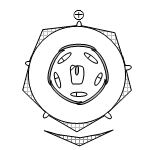
Choose the correct description depicted by the floral diagram.
A
United valvate sepals,free twisted petals,free stamens,unilocular ovary with marginal placenta.
B
United valvate sepals,free imbricate petals,free stamens,unilocular ovary with axile placenta.
C
United valvate sepals,free imbricate petals,epipetalous stamens,unilocular ovary with marginal placenta.
D
United valvate sepals,free imbricate petals,free stamens,unilocular ovary with marginal placentation.
Solution
(D) The floral diagram shows:
$1$. Sepals: $5$,united (gamosepalous) with valvate aestivation.
$2$. Petals: $5$,free (polypetalous) with imbricate aestivation.
$3$. Stamens: $5$,free (polyandrous).
$4$. Ovary: Unilocular with marginal placentation.
This floral diagram is characteristic of the family Fabaceae (specifically the subfamily Caesalpinioideae). Therefore,option $D$ is the correct description.
$1$. Sepals: $5$,united (gamosepalous) with valvate aestivation.
$2$. Petals: $5$,free (polypetalous) with imbricate aestivation.
$3$. Stamens: $5$,free (polyandrous).
$4$. Ovary: Unilocular with marginal placentation.
This floral diagram is characteristic of the family Fabaceae (specifically the subfamily Caesalpinioideae). Therefore,option $D$ is the correct description.
0 likes
View Solution13
EasyMCQ
Which of the following plants has a watery latex?
A
Papaya
B
Plantain
C
Opium
D
Ficus
Solution
(A) The latex of $Papaya$ $(Carica \ papaya)$ is watery and clear.
In contrast,$Opium$ $(Papaver \ somniferum)$ and $Ficus$ species typically produce a milky,viscous latex.
$Plantain$ does not produce latex.
Therefore,$Papaya$ is the correct answer.
In contrast,$Opium$ $(Papaver \ somniferum)$ and $Ficus$ species typically produce a milky,viscous latex.
$Plantain$ does not produce latex.
Therefore,$Papaya$ is the correct answer.
0 likes
View Solution14
EasyMCQ
Starch grains in latex are
A
Elongated
B
Prismatic
C
Dumbbell shaped
D
Oval
Solution
(C) In many plants that produce latex,such as those in the family $Euphorbiaceae$,the starch grains found within the laticifers (latex-containing cells) exhibit a distinct $dumbbell$ shape.
These $dumbbell$-shaped starch grains are a characteristic feature used in the identification of certain plant species.
These $dumbbell$-shaped starch grains are a characteristic feature used in the identification of certain plant species.
0 likes
View Solution15
EasyMCQ
Raphides are found in
A
Citrus
B
Colocasia
C
Nerium
D
Mango
Solution
(C) Raphides are needle-like crystals of calcium oxalate found in the cells of various plants as a defense mechanism against herbivores.
In the plant $Nerium$ (oleander),raphides are specifically located in the tissues below the upper epidermis.
Therefore,the correct option is $C$.
In the plant $Nerium$ (oleander),raphides are specifically located in the tissues below the upper epidermis.
Therefore,the correct option is $C$.
0 likes
View Solution16
EasyMCQ
Raphides are needle-like crystals of calcium oxalate which are specially found in
A
Pistia
B
Rose
C
Asparagus
D
Dahlia
Solution
(A) Raphides are needle-like crystals composed of calcium oxalate.
These structures serve as a defense mechanism against herbivores in various plants.
They are commonly found in aquatic plants like $Pistia$ (water lettuce) and $Eichhornia$ (water hyacinth),as well as in members of the $Araceae$ family.
Among the given options,$Pistia$ is the correct answer.
These structures serve as a defense mechanism against herbivores in various plants.
They are commonly found in aquatic plants like $Pistia$ (water lettuce) and $Eichhornia$ (water hyacinth),as well as in members of the $Araceae$ family.
Among the given options,$Pistia$ is the correct answer.
0 likes
View Solution17
EasyMCQ
The longest cell of plants is found in:
A
Victoria amazonica
B
Eucalyptus
C
Boehmeria nivea
D
Sequoia
Solution
(C) The longest plant cells are the bast fibers of $Boehmeria$ $\text{nivea}$ (also known as ramie).
These fibers can reach lengths of up to $55$ $\text{cm}$.
While $Sequoia$ is the tallest tree and $Eucalyptus$ is also very tall, the individual cells of $Boehmeria$ $\text{nivea}$ are recognized as the longest among plant species.
These fibers can reach lengths of up to $55$ $\text{cm}$.
While $Sequoia$ is the tallest tree and $Eucalyptus$ is also very tall, the individual cells of $Boehmeria$ $\text{nivea}$ are recognized as the longest among plant species.
0 likes
View Solution18
EasyMCQ
Raphides are needle-like crystals of calcium oxalate which are specially common in
A
Asparagus
B
Dahlia
C
Balsam
D
Rose
Solution
(C) Raphides are needle-like crystals of calcium oxalate found in the cells of many plants as a defense mechanism against herbivores.
They are particularly common in plants like $Balsam$ (Impatiens),$Colocasia$,and $Lemna$.
These crystals are stored in specialized cells called idioblasts.
Therefore,among the given options,$Balsam$ is the correct answer.
They are particularly common in plants like $Balsam$ (Impatiens),$Colocasia$,and $Lemna$.
These crystals are stored in specialized cells called idioblasts.
Therefore,among the given options,$Balsam$ is the correct answer.
0 likes
View Solution19
EasyMCQ
Raphides are needle-like crystals made up of
A
Calcium carbonate
B
Calcium sulphate
C
Calcium oxalate
D
Calcium pectate
Solution
(C) Raphides are needle-like or hair-like crystals of calcium oxalate found in many plant species. They are typically stored in specialized cells called idioblasts. These crystals serve as a defense mechanism against herbivores by causing irritation when ingested.
0 likes
View Solution20
EasyMCQ
The sugarcane plant has
A
Dumb-bell shaped guard cells
B
Pentamerous flowers
C
Reticulate venation
D
Capsular fruits
Solution
(A) Sugarcane ($Saccharum$ $officinarum$) belongs to the family $Poaceae$ (also known as $Gramineae$),which is a monocotyledonous family.
In monocots,the guard cells of the stomata are typically dumb-bell shaped,whereas in dicots,they are usually kidney or bean-shaped.
Therefore,the correct characteristic of the sugarcane plant is that it possesses dumb-bell shaped guard cells.
In monocots,the guard cells of the stomata are typically dumb-bell shaped,whereas in dicots,they are usually kidney or bean-shaped.
Therefore,the correct characteristic of the sugarcane plant is that it possesses dumb-bell shaped guard cells.
0 likes
View Solution21
MediumMCQ
Which of the following is an adaptation to reduce water loss?
A
Presence of thick cuticle
B
Change of leaf into spine
C
Change of leaf into phylloclade
D
All the above
Solution
(D) The correct answer is $D$.
$A$. The presence of a thick,waxy cuticle on the leaf surface reduces cuticular transpiration.
$B$. Leaves modified into spines reduce the surface area available for transpiration and protect the plant from herbivores.
$C$. $A$ phylloclade is a modified stem that performs photosynthesis and stores water,often found in plants where leaves are reduced to minimize water loss.
Since all these features are characteristic adaptations of xerophytic plants to survive in water-scarce environments,the correct option is $D$.
$A$. The presence of a thick,waxy cuticle on the leaf surface reduces cuticular transpiration.
$B$. Leaves modified into spines reduce the surface area available for transpiration and protect the plant from herbivores.
$C$. $A$ phylloclade is a modified stem that performs photosynthesis and stores water,often found in plants where leaves are reduced to minimize water loss.
Since all these features are characteristic adaptations of xerophytic plants to survive in water-scarce environments,the correct option is $D$.
0 likes
View Solution22
EasyMCQ
Majority of the orchids are
A
Epizoics
B
Epiphytes
C
Saprophytes
D
Parasites
Solution
(B) The correct answer is $B$.
Most orchids are epiphytes,meaning they grow on the surface of other plants,typically the trunks or branches of trees,for support.
They do not derive nutrients from the host plant but use it only for physical support.
They possess specialized aerial roots that contain a spongy tissue called $velamen$,which helps them absorb moisture and nutrients from the surrounding atmosphere.
Most orchids are epiphytes,meaning they grow on the surface of other plants,typically the trunks or branches of trees,for support.
They do not derive nutrients from the host plant but use it only for physical support.
They possess specialized aerial roots that contain a spongy tissue called $velamen$,which helps them absorb moisture and nutrients from the surrounding atmosphere.
0 likes
View Solution23
EasyMCQ
The botanical name of $Venus$ $Fly$ $Trap$ is:
A
Aldrovanda
B
Dionaea
C
Utricularia
D
Nepenthes
Solution
(B) The $Venus$ $Fly$ $Trap$ is a carnivorous plant known for its specialized leaves that snap shut to trap insects. Its scientific name is $Dionaea$ $muscipula$. Therefore,the correct option is $B$.
0 likes
View Solution24
EasyMCQ
The Bird of Paradise flower is:
A
Ravenea madagascariensis
B
Strelitzia reginae
C
Heliconia schlideana
D
Musa chinensis
Solution
(B) The Bird of Paradise flower is scientifically known as $Strelitzia reginae$. It belongs to the family $Strelitziaceae$ and is native to South Africa. The flower is named for its striking resemblance to the head of a bird of paradise.
0 likes
View Solution25
EasyMCQ
The example of sun-dressers is:
A
Mango
B
Saraca indica
C
Ferns
D
Palm
Solution
(D) Sun-dressers are plants that are adapted to grow in direct sunlight or high-intensity light conditions. Among the given options,$Palm$ trees are well-known examples of plants that thrive in open,sunny environments,often referred to as sun-loving or heliophytic plants.
0 likes
View Solution26
MediumMCQ
Alpine plants,which are commonly found at the top of mountains,show:
A
Xerophytism
B
Hydrophytism
C
Semitism
D
None of the above
Solution
(A) Alpine plants are found at high altitudes where the temperature is very low.
Due to the freezing temperatures,water in the soil often remains in the form of ice.
Since plants cannot absorb water in the form of ice,they experience physiological drought.
To survive under these conditions of water scarcity,these plants develop adaptations similar to xerophytes (plants adapted to dry environments),such as reduced leaf size or thick cuticles,to minimize water loss.
Therefore,they exhibit $Xerophytism$.
Due to the freezing temperatures,water in the soil often remains in the form of ice.
Since plants cannot absorb water in the form of ice,they experience physiological drought.
To survive under these conditions of water scarcity,these plants develop adaptations similar to xerophytes (plants adapted to dry environments),such as reduced leaf size or thick cuticles,to minimize water loss.
Therefore,they exhibit $Xerophytism$.
0 likes
View Solution27
MediumMCQ
The vegetation of Delhi is chiefly
A
Hydrophytic
B
Xerophytic
C
Mesophytic
D
Halophytic
Solution
(C) Delhi experiences a semi-arid climate with distinct seasonal variations,including hot summers and cold winters. The vegetation in such regions,where water availability is moderate but often limited by high evaporation rates and seasonal rainfall,is primarily classified as mesophytic. Mesophytes are plants adapted to environments that are neither extremely dry nor extremely wet,which characterizes the typical flora found in the Delhi region.
0 likes
View Solution28
MediumMCQ
Extreme xerophytic condition is shown by
A
Brassica
B
Capparis
C
Cactus
D
Nerium
Solution
(C) The correct answer is $C$ (Cactus).
Cactus plants exhibit extreme xerophytic adaptations to survive in arid environments with very little water.
These adaptations include the modification of leaves into spines to reduce transpiration,a thick waxy cuticle on the stem,and a succulent stem that stores water for long periods.
Cactus plants exhibit extreme xerophytic adaptations to survive in arid environments with very little water.
These adaptations include the modification of leaves into spines to reduce transpiration,a thick waxy cuticle on the stem,and a succulent stem that stores water for long periods.
0 likes
View Solution29
EasyMCQ
$Acacia arabica$ is a
A
Mesophyte
B
Hydrophyte
C
Xerophyte
D
Halophyte
Solution
(C) $Acacia arabica$ (commonly known as Babul) is a plant adapted to survive in dry, arid environments with limited water availability.
Plants that are adapted to grow in dry conditions are classified as xerophytes.
Therefore, $Acacia arabica$ is a xerophyte.
Plants that are adapted to grow in dry conditions are classified as xerophytes.
Therefore, $Acacia arabica$ is a xerophyte.
0 likes
View Solution30
EasyMCQ
$Casuarina$ $equisetifolia$ is a
A
Mesophyte
B
Xerophyte
C
Halophyte
D
Forest epiphyte
Solution
(B) $Casuarina$ $equisetifolia$ is a plant that is well-adapted to survive in dry,sandy,or saline environments,often found in coastal regions.
It exhibits characteristics such as reduced leaves (scale-like) to minimize water loss through transpiration,making it a $Xerophyte$.
It exhibits characteristics such as reduced leaves (scale-like) to minimize water loss through transpiration,making it a $Xerophyte$.
0 likes
View Solution31
EasyMCQ
Which of the following is a submerged hydrophyte?
A
Ceratophyllum
B
Utricularia
C
Vallisneria and Hydrilla
D
Lemna
Solution
(C) Submerged hydrophytes are aquatic plants that grow completely underwater.
$Ceratophyllum$,$Vallisneria$,and $Hydrilla$ are examples of submerged hydrophytes.
$Utricularia$ is a free-floating insectivorous plant.
$Lemna$ is a free-floating hydrophyte.
Since both $Ceratophyllum$ and the combination of $Vallisneria$ and $Hydrilla$ are submerged,the most comprehensive answer provided in the options is $C$.
$Ceratophyllum$,$Vallisneria$,and $Hydrilla$ are examples of submerged hydrophytes.
$Utricularia$ is a free-floating insectivorous plant.
$Lemna$ is a free-floating hydrophyte.
Since both $Ceratophyllum$ and the combination of $Vallisneria$ and $Hydrilla$ are submerged,the most comprehensive answer provided in the options is $C$.
0 likes
View Solution32
MediumMCQ
Which of the following is not true regarding hydrophytes?
A
Poorly developed root system
B
Thin membranous leaves
C
Poorly developed large air spaces
D
Poorly developed vascular bundles
Solution
(C) Hydrophytes are plants adapted to live in aquatic environments. Their characteristic features include a poorly developed root system,thin membranous leaves,and poorly developed vascular bundles because water absorption and transport are easier in aquatic habitats. However,they possess well-developed large air spaces known as $aerenchyma$ to provide buoyancy and facilitate gas exchange. Therefore,the statement that they have poorly developed large air spaces is incorrect.
0 likes
View Solution33
MediumMCQ
$A$ non-succulent xerophyte with thick leathery leaves having a white sticky waxy coating is:
A
Nerium
B
Calotropis
C
Bryophyllum
D
Ruscus
Solution
(A) $Nerium$ is a classic example of a non-succulent xerophyte.
It possesses thick,leathery leaves that are adapted to reduce transpiration.
The leaves are covered with a white,sticky,waxy coating (cuticle) which further helps in preventing water loss and reflecting excess sunlight.
$Calotropis$ is also a xerophyte but is typically succulent,while $Bryophyllum$ is a succulent plant,and $Ruscus$ is a cladode-bearing xerophyte.
It possesses thick,leathery leaves that are adapted to reduce transpiration.
The leaves are covered with a white,sticky,waxy coating (cuticle) which further helps in preventing water loss and reflecting excess sunlight.
$Calotropis$ is also a xerophyte but is typically succulent,while $Bryophyllum$ is a succulent plant,and $Ruscus$ is a cladode-bearing xerophyte.
0 likes
View Solution34
MediumMCQ
Which hydrophyte exhibits both hydrophytic and xerophytic traits?
A
Agave
B
Nerium
C
Vallisneria
D
None of the above
Solution
(D) The question asks for a hydrophyte that shows both hydrophytic and xerophytic traits.
$Agave$ is a xerophyte.
$Vallisneria$ is a typical submerged hydrophyte.
$Nerium$ is a xerophyte (specifically a sclerophyte) that grows in dry habitats but is often used as an example of plants with xerophytic adaptations like sunken stomata.
None of the options provided represent a plant that is primarily a hydrophyte while also possessing significant xerophytic traits. Therefore,the correct answer is $D$.
$Agave$ is a xerophyte.
$Vallisneria$ is a typical submerged hydrophyte.
$Nerium$ is a xerophyte (specifically a sclerophyte) that grows in dry habitats but is often used as an example of plants with xerophytic adaptations like sunken stomata.
None of the options provided represent a plant that is primarily a hydrophyte while also possessing significant xerophytic traits. Therefore,the correct answer is $D$.
0 likes
View Solution35
MediumMCQ
Alpine plants show
A
Mesophytism
B
Halophytism
C
Xerophytism
D
Luxuriant growth
Solution
(C) Alpine plants grow in high-altitude regions where water availability is often limited due to freezing conditions (physiological drought) and high wind speeds. These environmental conditions force the plants to adapt similarly to plants in arid regions. Therefore,alpine plants exhibit characteristics of $Xerophytism$ to conserve water and survive the harsh,cold,and windy climate.
0 likes
View Solution36
EasyMCQ
In elephants,the tusks are modified:
A
Incisors
B
Canines
C
Premolars
D
Molars
Solution
(A) In elephants,the tusks are elongated,continuously growing teeth that protrude beyond the mouth.
These structures are specifically modified $2^{nd}$ upper incisors.
They are composed of ivory (dentine) and are used for digging,lifting objects,gathering food,and defense.
These structures are specifically modified $2^{nd}$ upper incisors.
They are composed of ivory (dentine) and are used for digging,lifting objects,gathering food,and defense.
0 likes
View Solution37
EasyMCQ
Ikebana is the art of
A
Sketching flowers
B
Rangoli drawing
C
Floral arrangement
D
Making models of flowers
Solution
(C) $Ikebana$ is the traditional Japanese art of floral arrangement. It emphasizes harmony,color use,rhythm,and elegantly simple design.
0 likes
View Solution38
EasyMCQ
The pod of $Dolichos$ $lablab$ is used as:
A
Vegetable
B
Pulse
C
Both $(a)$ and $(b)$
D
None of the above
Solution
(A) The plant $Dolichos$ $lablab$,commonly known as the hyacinth bean or Indian bean,is a member of the family $Fabaceae$.
Its green,immature pods and seeds are widely consumed as a vegetable in various cuisines.
While the mature seeds can be used as pulses,the primary culinary use of the pod itself is as a vegetable.
Its green,immature pods and seeds are widely consumed as a vegetable in various cuisines.
While the mature seeds can be used as pulses,the primary culinary use of the pod itself is as a vegetable.
0 likes
View Solution39
MediumMCQ
Which of the following is $NOT$ a characteristic of dicotyledons?
A
The embryo has two cotyledons.
B
Flowers are pentamerous.
C
Leaves show parallel venation.
D
They are divided into three subclasses.
Solution
(C) The characteristic features of dicotyledons (dicots) include:
$1$. The embryo possesses two cotyledons.
$2$. Flowers are typically pentamerous (parts in multiples of $5$) or tetramerous.
$3$. Leaves exhibit reticulate venation,not parallel venation.
$4$. Parallel venation is a characteristic feature of monocotyledons (monocots).
Therefore,the statement 'Leaves show parallel venation' is incorrect for dicots.
$1$. The embryo possesses two cotyledons.
$2$. Flowers are typically pentamerous (parts in multiples of $5$) or tetramerous.
$3$. Leaves exhibit reticulate venation,not parallel venation.
$4$. Parallel venation is a characteristic feature of monocotyledons (monocots).
Therefore,the statement 'Leaves show parallel venation' is incorrect for dicots.
0 likes
View Solution40
MediumMCQ
The series of Gamopetalae containing $4$ cohorts and many orders is:
A
Disciflorae
B
Bicarpellatae
C
Thalamiflorae
D
Inferae
Solution
(B) In the Bentham and Hooker system of classification,the series $Bicarpellatae$ belongs to the subclass $Gamopetalae$. It is characterized by having an ovary that is typically bicarpellary. This series is significant as it includes $4$ cohorts (orders) and many families,making it the largest series within the $Gamopetalae$ subclass.
0 likes
View Solution41
MediumMCQ
Which of the following is true for the $Heteromery$ series?
A
Ovary is inferior
B
Number of carpels is two
C
Thalamus is cup-shaped
D
Ovary is superior
Solution
(D) The $Heteromery$ series,according to the $Bentham$ and $Hooker$ classification system,belongs to the class $Dicotyledonae$ and subclass $Polypetalae$.
Key characteristics of the $Heteromery$ series include:
$1$. The ovary is superior ($Ovary$ $superior$).
$2$. The flowers have more than two carpels $(Carpels > 2)$.
$3$. The floral parts are not in a fixed number of whorls.
Therefore,the correct statement is that the ovary is superior.
Key characteristics of the $Heteromery$ series include:
$1$. The ovary is superior ($Ovary$ $superior$).
$2$. The flowers have more than two carpels $(Carpels > 2)$.
$3$. The floral parts are not in a fixed number of whorls.
Therefore,the correct statement is that the ovary is superior.
0 likes
View Solution42
MediumMCQ
Identify the incorrect match regarding the classification of thalamus based on the position of floral parts:
A
Calyciflorae - $Rosa$ $indica$
B
Thalamiflorae - $Catharanthus$ $roseus$
C
Inferae - $Helianthus$ $annuus$
D
Disciflorae - $Citrus$ $limon$
Solution
(B) The classification of thalamus based on the position of floral parts (Bentham and Hooker's system) is as follows:
$1$. Thalamiflorae: Ovary is superior,and stamens are inserted on the thalamus.
$2$. Disciflorae: $A$ disc-like structure is present on the thalamus,and the ovary is superior.
$3$. Calyciflorae: Thalamus is cup-shaped,and the ovary is inferior or semi-inferior.
$4$. Inferae: Ovary is inferior.
In the given options,$Catharanthus$ $roseus$ (Periwinkle) belongs to the family Apocynaceae,which is characterized by a superior ovary and is typically placed under Thalamiflorae. However,the classification provided in the options is based on Bentham and Hooker's system. $Rosa$ $indica$ is correctly placed under Calyciflorae. $Helianthus$ $annuus$ (Sunflower) has an inferior ovary and is correctly placed under Inferae. $Citrus$ $limon$ is correctly placed under Disciflorae. All options provided are botanically correct classifications; however,if one must be identified as the 'incorrect' match in a standard context,$Catharanthus$ $roseus$ is often associated with Thalamiflorae,but the question implies a specific mismatch. Upon review,all matches are technically correct according to Bentham and Hooker's system.
$1$. Thalamiflorae: Ovary is superior,and stamens are inserted on the thalamus.
$2$. Disciflorae: $A$ disc-like structure is present on the thalamus,and the ovary is superior.
$3$. Calyciflorae: Thalamus is cup-shaped,and the ovary is inferior or semi-inferior.
$4$. Inferae: Ovary is inferior.
In the given options,$Catharanthus$ $roseus$ (Periwinkle) belongs to the family Apocynaceae,which is characterized by a superior ovary and is typically placed under Thalamiflorae. However,the classification provided in the options is based on Bentham and Hooker's system. $Rosa$ $indica$ is correctly placed under Calyciflorae. $Helianthus$ $annuus$ (Sunflower) has an inferior ovary and is correctly placed under Inferae. $Citrus$ $limon$ is correctly placed under Disciflorae. All options provided are botanically correct classifications; however,if one must be identified as the 'incorrect' match in a standard context,$Catharanthus$ $roseus$ is often associated with Thalamiflorae,but the question implies a specific mismatch. Upon review,all matches are technically correct according to Bentham and Hooker's system.
0 likes
View Solution43
MediumMCQ
The plant body is differentiated into which of the following parts?
A
Stem,leaf,fruit
B
Root,stem,flower
C
Leaf,stem,root
D
Stem,root,seed
Solution
(C) In higher plants (Angiosperms),the plant body is well-differentiated into three primary vegetative organs: the root,the stem,and the leaf. These organs are responsible for anchorage,absorption of water and minerals,conduction,and photosynthesis,respectively. Therefore,the correct option is $C$.
0 likes
View Solution44
MediumMCQ
$S:$ Lemon is an example of Disciflorae.
$R:$ In lemon,the thalamus is cup-shaped.
$R:$ In lemon,the thalamus is cup-shaped.
A
$S$ and $R$ are both true,and $R$ is the correct explanation of $S$.
B
$S$ and $R$ are both true,but $R$ is not the correct explanation of $S$.
C
$S$ is true and $R$ is false.
D
$S$ is false and $R$ is true.
Solution
(C) The classification system by Bentham and Hooker places the order $Geraniales$ (which includes the family $Rutaceae$ to which lemon belongs) under the series $Disciflorae$.
In $Disciflorae$,a prominent nectar-secreting disc is present on the thalamus.
The thalamus in lemon is not cup-shaped; rather,it is slightly convex or flat with a disc,whereas a cup-shaped thalamus is characteristic of the $Perigynous$ condition (e.g.,$Rose$ or $Plum$).
Therefore,statement $S$ is true,and statement $R$ is false.
In $Disciflorae$,a prominent nectar-secreting disc is present on the thalamus.
The thalamus in lemon is not cup-shaped; rather,it is slightly convex or flat with a disc,whereas a cup-shaped thalamus is characteristic of the $Perigynous$ condition (e.g.,$Rose$ or $Plum$).
Therefore,statement $S$ is true,and statement $R$ is false.
0 likes
View Solution45
MediumMCQ
$S :$ In Catharanthus roseus,the number of carpels is two.
$R :$ Catharanthus roseus is an example of a bicarpellary condition.
$R :$ Catharanthus roseus is an example of a bicarpellary condition.
A
$S$ and $R$ are both true,and $R$ is the correct explanation of $S$.
B
$S$ and $R$ are both true,but $R$ is not the correct explanation of $S$.
C
$S$ is true and $R$ is false.
D
$S$ is false and $R$ is true.
Solution
(A) The plant $Catharanthus$ $roseus$ (commonly known as periwinkle or 'baramasi') belongs to the family $Apocynaceae$.
In this family,the gynoecium is typically bicarpellary (consisting of two carpels).
Therefore,statement $S$ is true because the number of carpels is two.
Statement $R$ is also true because $Catharanthus$ $roseus$ is indeed an example of a bicarpellary condition.
Since the bicarpellary nature of the flower explains why there are two carpels,$R$ is the correct explanation of $S$.
In this family,the gynoecium is typically bicarpellary (consisting of two carpels).
Therefore,statement $S$ is true because the number of carpels is two.
Statement $R$ is also true because $Catharanthus$ $roseus$ is indeed an example of a bicarpellary condition.
Since the bicarpellary nature of the flower explains why there are two carpels,$R$ is the correct explanation of $S$.
0 likes
View Solution46
MediumMCQ
Which of the following is an incorrect pair regarding Bentham and Hooker's classification of Polypetalae?
A
Thalamiflorae - Hibiscus
B
Disciflorae - Citrus
C
Calyciflorae - Sunflower
D
Heteromerae - Madhuca
Solution
(C) Bentham and Hooker classified the subclass $Polypetalae$ into three series: $Thalamiflorae$,$Disciflorae$,and $Calyciflorae$.
$1$. $Thalamiflorae$ includes plants with a convex or conical thalamus (e.g.,$Hibiscus$).
$2$. $Disciflorae$ includes plants with a prominent disc-like thalamus (e.g.,$Citrus$).
$3$. $Calyciflorae$ includes plants where the thalamus is cup-shaped or tubular,surrounding the ovary (e.g.,$Rose$,$Pea$).
$4$. $Heteromerae$ is a series under the subclass $Gamopetalae$,not $Polypetalae$.
Therefore,the pair $Calyciflorae - Sunflower$ is incorrect because $Sunflower$ $(Asteraceae)$ belongs to the series $Inferae$ under $Gamopetalae$.
$1$. $Thalamiflorae$ includes plants with a convex or conical thalamus (e.g.,$Hibiscus$).
$2$. $Disciflorae$ includes plants with a prominent disc-like thalamus (e.g.,$Citrus$).
$3$. $Calyciflorae$ includes plants where the thalamus is cup-shaped or tubular,surrounding the ovary (e.g.,$Rose$,$Pea$).
$4$. $Heteromerae$ is a series under the subclass $Gamopetalae$,not $Polypetalae$.
Therefore,the pair $Calyciflorae - Sunflower$ is incorrect because $Sunflower$ $(Asteraceae)$ belongs to the series $Inferae$ under $Gamopetalae$.
0 likes
View Solution47
MediumMCQ
Match the following columns based on Bentham and Hooker's classification of Polypetalae:
| Column-$I$ | Column-$II$ |
| $A$. Thalamiflorae | $i$. Gynoecium bicarpellary |
| $B$. Calyciflorae | $ii$. Ovary superior |
| $C$. Bicarpellatae | $iii$. Thalamus cup-shaped |
| $D$. Inferae | $iv$. Thalamus dome-shaped |
| $E$. Heteromerae | $v$. Ovary inferior |
A
$A-iv, B-iii, C-i, D-v, E-ii$
B
$A-ii, B-iii, C-iv, D-v, E-i$
C
$A-iii, B-iv, C-v, D-i, E-ii$
D
$A-iv, B-iii, C-i, D-iv, E-ii$
Solution
(A) Bentham and Hooker classified Polypetalae into three series based on the position of the ovary and the shape of the thalamus:
$1$. $A$. Thalamiflorae: The thalamus is dome-shaped, and the ovary is superior $(A-iv)$.
$2$. $B$. Calyciflorae: The thalamus is cup-shaped or tubular, and the ovary is perigynous or epigynous $(B-iii)$.
$3$. $C$. Bicarpellatae: This series is characterized by a bicarpellary gynoecium $(C-i)$.
$4$. $D$. Inferae: The ovary is inferior $(D-v)$.
$5$. $E$. Heteromerae: The ovary is superior with more than two carpels $(E-ii)$.
Thus, the correct matching is $A-iv, B-iii, C-i, D-v, E-ii$.
$1$. $A$. Thalamiflorae: The thalamus is dome-shaped, and the ovary is superior $(A-iv)$.
$2$. $B$. Calyciflorae: The thalamus is cup-shaped or tubular, and the ovary is perigynous or epigynous $(B-iii)$.
$3$. $C$. Bicarpellatae: This series is characterized by a bicarpellary gynoecium $(C-i)$.
$4$. $D$. Inferae: The ovary is inferior $(D-v)$.
$5$. $E$. Heteromerae: The ovary is superior with more than two carpels $(E-ii)$.
Thus, the correct matching is $A-iv, B-iii, C-i, D-v, E-ii$.
0 likes
View Solution48
DifficultMCQ
Match the following columns based on the position of the floral parts on the thalamus (Bentham and Hooker's classification):
| Column-$I$ | Column-$II$ |
| $(A)$ Inferae | $(i)$ Hibiscus |
| $(B)$ Hypogyny | $(ii)$ Lemon |
| $(C)$ Bicarpellary | $(iii)$ Sunflower |
| $(D)$ Thalamiflorae | $(iv)$ Madhuca |
| $(E)$ Calyciflorae | $(v)$ Periwinkle |
| $(F)$ Epigyny | $(vi)$ Rose |
A
$(A-iii), (B-iv), (C-v), (D-i), (E-vi)$
B
$(A-i), (B-i), (C-iii), (D-iv), (E-v)$
C
$(A-iv), (B-iii), (C-ii), (D-i), (E-vi)$
D
$(A-i), (B-ii), (C-iv), (D-v), (E-iii)$
Solution
(A) The classification of flowers based on the position of the ovary and other floral parts relative to the thalamus is as follows:
$(A)$ Inferae: The ovary is inferior,as seen in $(iii)$ Sunflower (Asteraceae).
$(B)$ Hypogyny: The ovary is superior,as seen in $(iv)$ Madhuca.
$(C)$ Bicarpellary: $A$ condition with two carpels,as seen in $(v)$ Periwinkle (Catharanthus).
$(D)$ Thalamiflorae: Stamens are hypogynous,as seen in $(i)$ Hibiscus.
$(E)$ Calyciflorae: Floral parts are perigynous or epigynous,as seen in $(vi)$ Rose.
Therefore,the correct matching is $(A-iii), (B-iv), (C-v), (D-i), (E-vi)$.
$(A)$ Inferae: The ovary is inferior,as seen in $(iii)$ Sunflower (Asteraceae).
$(B)$ Hypogyny: The ovary is superior,as seen in $(iv)$ Madhuca.
$(C)$ Bicarpellary: $A$ condition with two carpels,as seen in $(v)$ Periwinkle (Catharanthus).
$(D)$ Thalamiflorae: Stamens are hypogynous,as seen in $(i)$ Hibiscus.
$(E)$ Calyciflorae: Floral parts are perigynous or epigynous,as seen in $(vi)$ Rose.
Therefore,the correct matching is $(A-iii), (B-iv), (C-v), (D-i), (E-vi)$.
0 likes
View Solution49
EasyMCQ
Match the following columns:
| Column-$I$ (Common Name) | Column-$II$ (Scientific Name) |
| $A$. Hibiscus | $i$. Bougainvillea spectabilis |
| $B$. Lemon | $ii$. Allium cepa |
| $C$. Sunflower | $iii$. Hibiscus rosa-sinensis |
| $D$. Bougainvillea | $iv$. Citrus limon |
| $E$. Onion | $v$. Helianthus annuus |
| - | $vi$. Rosa indica |
A
$(A-iii), (B-iv), (C-v), (D-i), (E-ii)$
B
$(A-vi), (B-iv), (C-v), (D-i), (E-ii)$
C
$(A-v), (B-vi), (C-iii), (D-ii), (E-i)$
D
$(A-i), (B-ii), (C-iv), (D-v), (E-iii)$
Solution
(A) The correct scientific names for the given plants are as follows:
$A$. Hibiscus: $Hibiscus$ $rosa-sinensis$ $(iii)$
$B$. Lemon: $Citrus$ $limon$ $(iv)$
$C$. Sunflower: $Helianthus$ $annuus$ $(v)$
$D$. Bougainvillea: $Bougainvillea$ $spectabilis$ $(i)$
$E$. Onion: $Allium$ $cepa$ $(ii)$
Therefore, the correct matching is $(A-iii), (B-iv), (C-v), (D-i), (E-ii)$.
$A$. Hibiscus: $Hibiscus$ $rosa-sinensis$ $(iii)$
$B$. Lemon: $Citrus$ $limon$ $(iv)$
$C$. Sunflower: $Helianthus$ $annuus$ $(v)$
$D$. Bougainvillea: $Bougainvillea$ $spectabilis$ $(i)$
$E$. Onion: $Allium$ $cepa$ $(ii)$
Therefore, the correct matching is $(A-iii), (B-iv), (C-v), (D-i), (E-ii)$.
0 likes
View Solution50
MediumMCQ
Match the plants in Column-$I$ with their specific floral characteristics in Column-$II$. Select the correct option.
| Column-$I$ | Column-$II$ |
| $(A)$ Hibiscus | $(p)$ Thalamus disc-shaped |
| $(B)$ Lemon | $(q)$ Ovary inferior |
| $(C)$ Rose | $(r)$ Thalamus dome-shaped |
| $(D)$ Sunflower | $(s)$ Perianth |
| $(E)$ Bougainvillea | $(t)$ Thalamus cup-shaped |
| $(u)$ Ovary superior |
A
$A-(u), B-(p), C-(t), D-(q), E-(s)$
B
$A-(p), B-(r), C-(t), D-(u), E-(q)$
C
$A-(r), B-(p), C-(t), D-(q), E-(s)$
D
$A-(p), B-(t), C-(r), D-(u), E-(u)$
Solution
(A) The correct matches are as follows:
$1$. Hibiscus $(A)$: It has a superior ovary $(u)$.
$2$. Lemon $(B)$: It has a disc-shaped thalamus $(p)$.
$3$. Rose $(C)$: It has a cup-shaped thalamus $(t)$.
$4$. Sunflower $(D)$: It has an inferior ovary $(q)$.
$5$. Bougainvillea $(E)$: It shows the presence of perianth $(s)$.
Therefore, the correct sequence is $A-(u), B-(p), C-(t), D-(q), E-(s)$.
$1$. Hibiscus $(A)$: It has a superior ovary $(u)$.
$2$. Lemon $(B)$: It has a disc-shaped thalamus $(p)$.
$3$. Rose $(C)$: It has a cup-shaped thalamus $(t)$.
$4$. Sunflower $(D)$: It has an inferior ovary $(q)$.
$5$. Bougainvillea $(E)$: It shows the presence of perianth $(s)$.
Therefore, the correct sequence is $A-(u), B-(p), C-(t), D-(q), E-(s)$.
0 likes
View SolutionMorphology of Flowering Plants — Mix Examples- Morphology of Flowering Plants · Frequently Asked Questions
1Are these Morphology of Flowering Plants questions useful for JEE and NEET?
Yes. All questions in this section are mapped to JEE Main and NEET exam patterns. Previous year questions from JEE Main, NEET, GUJCET and state-level exams are included with full solutions.
2Can I switch to Hindi or Gujarati for these questions?
Yes. Use the language tabs in the hero section or the sidebar to view the same questions and solutions in English, Hindi or Gujarati.
3How do I generate a question paper from this subtopic?
Use the Vedclass Exam Paper Generator — select the chapter and subtopic, set difficulty, and generate Sets A, B, C, D automatically. First 3 chapters of every subject are free.
Vedclass Products
For Students
Vedclass Test Series
Mock tests in real JEE/NEET style with performance analysis. 5-day free trial.
Start Free TrialFor Teachers
Exam Paper Generator
Generate Set A/B/C/D papers from this chapter in 2 minutes. 3 chapters free.
Try FreeFor Institutes
Online Exam Module
Live online exams with unlimited students, 360° analytics & white-label branding.
See DemoFor Teachers & Institutes
Generate a Morphology of Flowering Plants Exam Paper in 2 Minutes
Select subtopic & difficulty — Sets A, B, C, D auto-generated with No Repeat logic.
First 3 chapters of every subject are free — no payment required.