
A English
Mix Examples- Morphology of Flowering Plants Questions in English
Class 11 Biology · Morphology of Flowering Plants · Mix Examples- Morphology of Flowering Plants
169+
Questions
English
Language
100%
With Solutions
Showing 19 of 169 questions in English
151
MediumMCQ
$A$ : There are two alae in $Pisum$ $sativum$ flower.
$R$ : Both alae are covered by the largest petal.
$R$ : Both alae are covered by the largest petal.
A
Assertion and Reason both are correct and Reason is the correct explanation of Assertion.
B
Assertion and Reason both are correct but Reason is not the correct explanation of Assertion.
C
Assertion is correct,but Reason is incorrect.
D
Both Assertion and Reason are incorrect.
Solution
(A) In the family $Fabaceae$,the flower exhibits vexillary aestivation.
This arrangement consists of five petals: one posterior standard (vexillum),two lateral wings (alae),and two anterior petals forming a keel (carina).
The standard petal is the largest and overlaps the two lateral wings (alae),which in turn overlap the two smallest anterior petals (keel).
Therefore,the assertion that there are two alae is correct,and the reason that they are covered by the largest petal (standard) is also correct and explains the structural arrangement.
This arrangement consists of five petals: one posterior standard (vexillum),two lateral wings (alae),and two anterior petals forming a keel (carina).
The standard petal is the largest and overlaps the two lateral wings (alae),which in turn overlap the two smallest anterior petals (keel).
Therefore,the assertion that there are two alae is correct,and the reason that they are covered by the largest petal (standard) is also correct and explains the structural arrangement.
0 likes
View Solution152
EasyMCQ
Raphides are crystals of
A
Calcium carbonate
B
Calcium oxalate
C
Magnesium carbonate
D
Magnesium oxalate
Solution
(B) Raphides are needle-like,long,slender calcium oxalate crystals that usually lie parallel to each other in a bundle.
These bundles are often found within a specialized sac-like cell.
Raphides are commonly observed in plants such as $Alocasia$,$Colocasia$,and $Pistia$.
These bundles are often found within a specialized sac-like cell.
Raphides are commonly observed in plants such as $Alocasia$,$Colocasia$,and $Pistia$.
0 likes
View Solution153
EasyMCQ
Cricket bats are made from the wood of:
A
Pinus wallichiana
B
Shorea robusta
C
Salix sp.
D
Cedrus deodara
Solution
(C) The wood of $Salix$ species,commonly known as willow (specifically $Salix$ $alba$ or $Salix$ $caerulea$),belonging to the family $Salicaceae$,is widely used for the manufacturing of sports goods. This wood is preferred for cricket bats due to its lightweight,toughness,and shock-absorbing properties.
0 likes
View Solution154
MediumMCQ
$A$: Cattle or goats never graze on $Calotropis$.
$R$: Thorns are present as a morphological means of defence.
$R$: Thorns are present as a morphological means of defence.
A
Assertion and Reason both are correct and Reason is the correct explanation of Assertion.
B
Assertion and Reason both are correct but Reason is not the correct explanation of Assertion.
C
Assertion is correct,but Reason is incorrect.
D
Both Assertion and Reason are incorrect.
Solution
(C) $Calotropis$ (Aak) is a plant that produces highly poisonous cardiac glycosides,which prevent cattle and goats from grazing on it. Thus,the Assertion $(A)$ is correct.
However,$Calotropis$ does not possess thorns; it relies on chemical defense mechanisms (toxins). Thorns are indeed a morphological means of defense in plants (such as in $Acacia$ or $Cactus$),but this does not apply to $Calotropis$. Therefore,the Reason $(R)$ is incorrect.
However,$Calotropis$ does not possess thorns; it relies on chemical defense mechanisms (toxins). Thorns are indeed a morphological means of defense in plants (such as in $Acacia$ or $Cactus$),but this does not apply to $Calotropis$. Therefore,the Reason $(R)$ is incorrect.
0 likes
View Solution155
MediumMCQ
Identify the correct set of statements :
$(a)$ The leaflets are modified into pointed hard thorns in Citrus and Bougainvillea
$(b)$ Axillary buds form slender and spirally coiled tendrils in cucumber and pumpkin
$(c)$ Stem is flattened and fleshy in Opuntia and modified to perform the function of leaves
$(d)$ Rhizophora shows vertically upward growing roots that help to get oxygen for respiration
$(e)$ Subaerially growing stems in grasses and strawberry help in vegetative propagation
Choose the correct answer from the options given below:
$(a)$ The leaflets are modified into pointed hard thorns in Citrus and Bougainvillea
$(b)$ Axillary buds form slender and spirally coiled tendrils in cucumber and pumpkin
$(c)$ Stem is flattened and fleshy in Opuntia and modified to perform the function of leaves
$(d)$ Rhizophora shows vertically upward growing roots that help to get oxygen for respiration
$(e)$ Subaerially growing stems in grasses and strawberry help in vegetative propagation
Choose the correct answer from the options given below:
A
$(a)$ and $(d)$ Only
B
$(b), (c), (d)$ and $(e)$ Only
C
$(a), (b), (d)$ and $(e)$ Only
D
$(b)$ and $(c)$ Only
Solution
(B) Let us analyze each statement:
$(a)$ Incorrect: In Citrus and Bougainvillea,the axillary buds are modified into thorns,not leaflets.
$(b)$ Correct: In plants like cucumber and pumpkin,axillary buds develop into slender and spirally coiled structures called tendrils,which help in climbing.
$(c)$ Correct: In Opuntia,the stem becomes flattened and fleshy to perform photosynthesis,acting as a leaf substitute.
$(d)$ Correct: Rhizophora grows in swampy areas and possesses pneumatophores (vertically upward growing roots) to obtain oxygen for respiration.
$(e)$ Correct: Subaerially growing stems (runners,stolons,etc.) in grasses and strawberry facilitate vegetative propagation.
Therefore,statements $(b), (c), (d),$ and $(e)$ are correct.
$(a)$ Incorrect: In Citrus and Bougainvillea,the axillary buds are modified into thorns,not leaflets.
$(b)$ Correct: In plants like cucumber and pumpkin,axillary buds develop into slender and spirally coiled structures called tendrils,which help in climbing.
$(c)$ Correct: In Opuntia,the stem becomes flattened and fleshy to perform photosynthesis,acting as a leaf substitute.
$(d)$ Correct: Rhizophora grows in swampy areas and possesses pneumatophores (vertically upward growing roots) to obtain oxygen for respiration.
$(e)$ Correct: Subaerially growing stems (runners,stolons,etc.) in grasses and strawberry facilitate vegetative propagation.
Therefore,statements $(b), (c), (d),$ and $(e)$ are correct.
0 likes
View Solution156
MediumMCQ
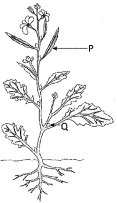
What do $P$ and $Q$ represent in the given figure?
A
Bud,Fruit
B
Fruit,Bud
C
Stem,Bud
D
Bud,Stem
Solution
(B) In the provided diagram of a flowering plant:
$1$. The label $P$ points to a fruit (specifically a siliqua,characteristic of the Brassicaceae family).
$2$. The label $Q$ points to a bud located in the axil of a leaf,which is known as an axillary bud.
$3$. Therefore,$P$ represents the fruit and $Q$ represents the bud.
$4$. The correct option is $B$.
$1$. The label $P$ points to a fruit (specifically a siliqua,characteristic of the Brassicaceae family).
$2$. The label $Q$ points to a bud located in the axil of a leaf,which is known as an axillary bud.
$3$. Therefore,$P$ represents the fruit and $Q$ represents the bud.
$4$. The correct option is $B$.
0 likes
View Solution157
MediumMCQ
Match the following columns:
| Column-$I$ | Column-$II$ |
|---|---|
| $P$. Protection | $I$. Opuntia |
| $Q$. Food storage | $II$. Zaminkand (Corm) |
| $R$. Photosynthesis | $III$. Citrus |
| $S$. Support and climbing | $IV$. Grapevine |
A
$(P-I), (Q-II), (R-III), (S-IV)$
B
$(P-IV), (Q-I), (R-II), (S-III)$
C
$(P-III), (Q-II), (R-IV), (S-I)$
D
$(P-III), (Q-II), (R-I), (S-IV)$
Solution
(D) The correct matches are as follows:
$P$. Protection: Citrus plants have thorns that provide protection against herbivores.
$Q$. Food storage: Zaminkand (corm) is a modified stem used for food storage.
$R$. Photosynthesis: Opuntia has a fleshy,green,flattened stem that performs photosynthesis.
$S$. Support and climbing: Grapevine possesses tendrils,which are modified stems that help in climbing.
Therefore,the correct matching is $P-III, Q-II, R-I, S-IV$.
$P$. Protection: Citrus plants have thorns that provide protection against herbivores.
$Q$. Food storage: Zaminkand (corm) is a modified stem used for food storage.
$R$. Photosynthesis: Opuntia has a fleshy,green,flattened stem that performs photosynthesis.
$S$. Support and climbing: Grapevine possesses tendrils,which are modified stems that help in climbing.
Therefore,the correct matching is $P-III, Q-II, R-I, S-IV$.
0 likes
View Solution158
MediumMCQ
Select the correct option regarding the modification of plant parts.
A
Tendril - Pea - Leaf
B
Photosynthesis - Opuntia - Leaf
C
Tendril - Grapevine - Root
D
Pneumatophores - Rhizophora - Stem
Solution
(A) In plants, various parts undergo modifications to perform specific functions:
$1$. In $Pea$ $(Pisum \text{ } sativum)$, the leaves are modified into tendrils to provide support for climbing.
$2$. In $Opuntia$, the leaves are reduced to spines to reduce water loss, and the stem becomes fleshy and green to perform photosynthesis.
$3$. In $Grapevine$ $(Vitis \text{ } vinifera)$, the tendrils are modifications of the stem, not the root.
$4$. In $Rhizophora$, the roots are modified into pneumatophores (respiratory roots) to help in respiration in marshy areas, not the stem.
Therefore, the correct pair is $Tendril - Pea - Leaf$.
$1$. In $Pea$ $(Pisum \text{ } sativum)$, the leaves are modified into tendrils to provide support for climbing.
$2$. In $Opuntia$, the leaves are reduced to spines to reduce water loss, and the stem becomes fleshy and green to perform photosynthesis.
$3$. In $Grapevine$ $(Vitis \text{ } vinifera)$, the tendrils are modifications of the stem, not the root.
$4$. In $Rhizophora$, the roots are modified into pneumatophores (respiratory roots) to help in respiration in marshy areas, not the stem.
Therefore, the correct pair is $Tendril - Pea - Leaf$.
0 likes
View Solution159
MediumMCQ
Match the following columns:
| Column-$I$ (Modification) | Column-$II$ (Examples) |
|---|---|
| $P$. Tendrils | $I$. Onion,Garlic |
| $Q$. Spines | $II$. Pitcher plant,Venus flytrap |
| $R$. Fleshy leaves for food storage | $III$. Cactus |
| $S$. Phyllode (Photosynthesis) | $IV$. Australian Acacia |
| $T$. Insectivorous | $V$. Pea |
A
$(P-V), (Q-III), (R-I), (S-IV), (T-II)$
B
$(P-IV), (Q-III), (R-I), (S-V), (T-II)$
C
$(P-II), (Q-IV), (R-III), (S-I), (T-V)$
D
$(P-V), (Q-IV), (R-I), (S-II), (T-III)$
Solution
(A) The correct matches are as follows:
$P$. Tendrils: In plants like peas $(V)$,leaves are modified into tendrils for climbing.
$Q$. Spines: In plants like cactus $(III)$,leaves are modified into spines for defense and reducing water loss.
$R$. Fleshy leaves for food storage: In plants like onion and garlic $(I)$,leaves store food.
$S$. Phyllode: In Australian Acacia $(IV)$,the petiole expands and becomes green to perform photosynthesis.
$T$. Insectivorous: In plants like Pitcher plant and Venus flytrap $(II)$,leaves are modified to trap insects.
Therefore,the correct sequence is $(P-V), (Q-III), (R-I), (S-IV), (T-II)$.
$P$. Tendrils: In plants like peas $(V)$,leaves are modified into tendrils for climbing.
$Q$. Spines: In plants like cactus $(III)$,leaves are modified into spines for defense and reducing water loss.
$R$. Fleshy leaves for food storage: In plants like onion and garlic $(I)$,leaves store food.
$S$. Phyllode: In Australian Acacia $(IV)$,the petiole expands and becomes green to perform photosynthesis.
$T$. Insectivorous: In plants like Pitcher plant and Venus flytrap $(II)$,leaves are modified to trap insects.
Therefore,the correct sequence is $(P-V), (Q-III), (R-I), (S-IV), (T-II)$.
0 likes
View Solution160
MediumMCQ
Which of the following plants exhibit variation in the length of their filaments within the same flower?
A
Salvia
B
Mustard
C
Lemon
D
Both $A$ and $B$
Solution
(D) In certain plants,the stamens exhibit variation in the length of their filaments within the same flower.
$1$. In $Salvia$,there is a variation in filament length,which is an adaptation for pollination by insects.
$2$. In $Mustard$ ($Brassica$ $campestris$),the flowers show tetradynamous condition,where there are $6$ stamens in total: $4$ long and $2$ short.
Therefore,both $Salvia$ and $Mustard$ exhibit variation in filament length.
$1$. In $Salvia$,there is a variation in filament length,which is an adaptation for pollination by insects.
$2$. In $Mustard$ ($Brassica$ $campestris$),the flowers show tetradynamous condition,where there are $6$ stamens in total: $4$ long and $2$ short.
Therefore,both $Salvia$ and $Mustard$ exhibit variation in filament length.
0 likes
View Solution161
MediumMCQ
Morphology is the study of $............$
A
Study of visible characters of forms
B
Study of externally visible characters
C
Study of externally visible organs or parts
D
All of the above
Solution
(D) Morphology is a branch of biology that deals with the study of the form and structure of organisms and their specific structural features.
It includes the study of externally visible characters,the form of the organism,and the arrangement of its various organs or parts.
Therefore,all the given options correctly describe aspects of morphology.
It includes the study of externally visible characters,the form of the organism,and the arrangement of its various organs or parts.
Therefore,all the given options correctly describe aspects of morphology.
0 likes
View Solution162
MediumMCQ
Match List $I$ with List $II$:
Choose the correct answer from the options given below:
| List $I$ | List $II$ |
| $A$. Rose | $I$. Twisted aestivation |
| $B$. Pea | $II$. Perigynous flower |
| $C$. Cotton | $III$. Drupe |
| $D$. Mango | $IV$. Marginal placentation |
Choose the correct answer from the options given below:
A
$A-II, B-IV, C-I, D-III$
B
$A-IV, B-III, C-II, D-I$
C
$A-II, B-III, C-IV, D-I$
D
$A-II, B-IV, C-II, D-III$
Solution
$(A)$ The correct matching is as follows:
$A$. Rose: It is a perigynous flower where the ovary is half-inferior $(A-II)$.
$B$. Pea: It exhibits marginal placentation, where the placenta forms a ridge along the ventral suture of the ovary $(B-IV)$.
$C$. Cotton: It shows twisted aestivation, where one margin of the petal overlaps that of the next one $(C-I)$.
$D$. Mango: It develops into a drupe fruit, which develops from a monocarpellary superior ovary and is one-seeded $(D-III)$.
Therefore, the correct sequence is $A-II, B-IV, C-I, D-III$.
$A$. Rose: It is a perigynous flower where the ovary is half-inferior $(A-II)$.
$B$. Pea: It exhibits marginal placentation, where the placenta forms a ridge along the ventral suture of the ovary $(B-IV)$.
$C$. Cotton: It shows twisted aestivation, where one margin of the petal overlaps that of the next one $(C-I)$.
$D$. Mango: It develops into a drupe fruit, which develops from a monocarpellary superior ovary and is one-seeded $(D-III)$.
Therefore, the correct sequence is $A-II, B-IV, C-I, D-III$.
0 likes
View Solution163
EasyMCQ
In pea plant $........$ inflorescence and $........$ flower is present.
A
Racemose,Actinomorphic
B
Racemose,Zygomorphic
C
Cymose,Actinomorphic
D
Cymose,Zygomorphic
Solution
(B) The pea plant $(Pisum \, sativum)$ belongs to the family $Fabaceae$.
In the $Fabaceae$ family, the inflorescence is typically $Racemose$, where the main axis continues to grow and flowers are borne laterally in an acropetal succession.
The flowers in the pea plant are $Zygomorphic$ (bilateral symmetry), meaning they can be divided into two equal halves only in one particular vertical plane.
In the $Fabaceae$ family, the inflorescence is typically $Racemose$, where the main axis continues to grow and flowers are borne laterally in an acropetal succession.
The flowers in the pea plant are $Zygomorphic$ (bilateral symmetry), meaning they can be divided into two equal halves only in one particular vertical plane.
0 likes
View Solution164
MediumMCQ
Read the following statements and choose the set of correct statements:-
$(A)$ In some plants like $Monstera$,roots arise from parts of the plant other than the radicle.
$(B)$ The main functions of the root system are absorption of water and minerals from the soil and providing a proper anchorage to the plant parts.
$(C)$ Leaves originate from shoot apical meristem and are arranged in an acropetal order.
$(D)$ In $Alstonia$,a single leaf arises at each node of stem.
$(E)$ The flowers are hypogynous in cucumber.
Choose the correct option from the options given below:-
$(A)$ In some plants like $Monstera$,roots arise from parts of the plant other than the radicle.
$(B)$ The main functions of the root system are absorption of water and minerals from the soil and providing a proper anchorage to the plant parts.
$(C)$ Leaves originate from shoot apical meristem and are arranged in an acropetal order.
$(D)$ In $Alstonia$,a single leaf arises at each node of stem.
$(E)$ The flowers are hypogynous in cucumber.
Choose the correct option from the options given below:-
A
$(B, D, E)$ only
B
$(A, C, D)$ only
C
$(C, D, E)$ only
D
$(A, B, C)$ only
Solution
(D) Statement $(A)$ is correct: Roots that arise from parts other than the radicle are called adventitious roots,seen in $Monstera$.
Statement $(B)$ is correct: The primary functions of the root system are the absorption of water and minerals and providing anchorage.
Statement $(C)$ is correct: Leaves are produced from the shoot apical meristem and are arranged in an acropetal order (younger leaves at the apex).
Statement $(D)$ is incorrect: In $Alstonia$,the phyllotaxy is whorled,meaning more than two leaves arise at each node.
Statement $(E)$ is incorrect: In cucumber,the flowers are epigynous (ovary is inferior),not hypogynous.
Therefore,statements $(A, B, C)$ are correct.
Statement $(B)$ is correct: The primary functions of the root system are the absorption of water and minerals and providing anchorage.
Statement $(C)$ is correct: Leaves are produced from the shoot apical meristem and are arranged in an acropetal order (younger leaves at the apex).
Statement $(D)$ is incorrect: In $Alstonia$,the phyllotaxy is whorled,meaning more than two leaves arise at each node.
Statement $(E)$ is incorrect: In cucumber,the flowers are epigynous (ovary is inferior),not hypogynous.
Therefore,statements $(A, B, C)$ are correct.
0 likes
View Solution165
MediumMCQ
Given below are two statements.
Statement-$I$: The arrangement of ovules within the ovary is known as placentation.
Statement-$II$: If a fruit is formed by fertilization of the ovary,it is called a parthenocarpic fruit.
Choose the correct answer from the options given below.
Statement-$I$: The arrangement of ovules within the ovary is known as placentation.
Statement-$II$: If a fruit is formed by fertilization of the ovary,it is called a parthenocarpic fruit.
Choose the correct answer from the options given below.
A
Both Statement-$I$ and Statement-$II$ are incorrect
B
Statement-$I$ is correct but Statement-$II$ is incorrect
C
Statement-$I$ is incorrect but Statement-$II$ is correct
D
Both Statement-$I$ and Statement-$II$ are correct
Solution
(B) Statement-$I$ is correct: The arrangement of ovules within the ovary is defined as placentation.
Statement-$II$ is incorrect: $A$ fruit formed from the ovary without fertilization is called a parthenocarpic fruit. If a fruit is formed by fertilization,it is simply called a true fruit.
Statement-$II$ is incorrect: $A$ fruit formed from the ovary without fertilization is called a parthenocarpic fruit. If a fruit is formed by fertilization,it is simply called a true fruit.
0 likes
View Solution166
MediumMCQ
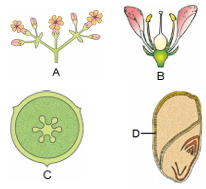
Identify the given figures and select the correct option.
A
$A \rightarrow$ Racemose inflorescence,$B \rightarrow$ Epigynous,$C \rightarrow$ Axile placentation,$D \rightarrow$ Cotyledon
B
$A \rightarrow$ Helicoid inflorescence,$B \rightarrow$ Perigynous,$C \rightarrow$ Free central placentation,$D \rightarrow$ Endosperm
C
$A \rightarrow$ Cymose inflorescence,$B \rightarrow$ Hypogynous,$C \rightarrow$ Axile placentation,$D \rightarrow$ Aleurone layer
D
$A \rightarrow$ Cymose inflorescence,$B \rightarrow$ Hypogynous,$C \rightarrow$ Free central placentation,$D \rightarrow$ Aleurone layer
Solution
(D) The given figures represent the following structures:
$A$: Cymose inflorescence,where the main axis terminates in a flower and growth is limited.
$B$: Hypogynous flower,where the gynoecium occupies the highest position and other floral parts are situated below it.
$C$: Axile placentation,where the placenta is axial and the ovules are attached to it in a multilocular ovary.
$D$: Aleurone layer,which is the protein-rich outer layer of the endosperm in monocot seeds like maize.
Therefore,the correct option is $D$.
$A$: Cymose inflorescence,where the main axis terminates in a flower and growth is limited.
$B$: Hypogynous flower,where the gynoecium occupies the highest position and other floral parts are situated below it.
$C$: Axile placentation,where the placenta is axial and the ovules are attached to it in a multilocular ovary.
$D$: Aleurone layer,which is the protein-rich outer layer of the endosperm in monocot seeds like maize.
Therefore,the correct option is $D$.
0 likes
View Solution167
MediumMCQ
Given below are two statements $:$
Statement $- I :$ The arrangement of ovules within the ovary is known as aestivation.
Statement $- II :$ The mode of arrangement of sepals and petals in floral bud with respect to the other members of the same whorl is known as placentation.
In the light of the above statements,choose the correct answer from the options given below $:$
Statement $- I :$ The arrangement of ovules within the ovary is known as aestivation.
Statement $- II :$ The mode of arrangement of sepals and petals in floral bud with respect to the other members of the same whorl is known as placentation.
In the light of the above statements,choose the correct answer from the options given below $:$
A
Statement $- I$ is True but Statement $- II$ is False.
B
Statement $- I$ is False but Statement $- II$ is True.
C
Both Statement $- I$ and Statement $- II$ are True.
D
Both Statement $- I$ and Statement $- II$ are False.
Solution
(D) Statement $- I$ is False: The arrangement of ovules within the ovary is known as placentation,not aestivation.
Statement $- II$ is False: The mode of arrangement of sepals and petals in a floral bud with respect to the other members of the same whorl is known as aestivation,not placentation.
Therefore,both statements are incorrect.
Statement $- II$ is False: The mode of arrangement of sepals and petals in a floral bud with respect to the other members of the same whorl is known as aestivation,not placentation.
Therefore,both statements are incorrect.
0 likes
View Solution168
MediumMCQ
Match the Column-$I$ and Column-$II$ and choose the correct option:-
| Column-$I$ | Column-$II$ |
|---|---|
| $(i)$ Fibrous root | $(a)$ Citrus |
| $(ii)$ Stem tendrils | $(b)$ Legumes |
| $(iii)$ Stem thorns | $(c)$ Wheat |
| $(iv)$ Pulvinus | $(d)$ Grape vine |
A
$(i)-(a), (ii)-(b), (iii)-(d), (iv)-(c)$
B
$(i)-(c), (ii)-(a), (iii)-(d), (iv)-(b)$
C
$(i)-(d), (ii)-(c), (iii)-(a), (iv)-(b)$
D
$(i)-(c), (ii)-(d), (iii)-(a), (iv)-(b)$
Solution
(D) The correct matches are as follows:
$(i)$ Fibrous root: Found in monocots like Wheat $(c)$.
$(ii)$ Stem tendrils: These are modified stems that help plants climb,seen in Grape vine $(d)$.
$(iii)$ Stem thorns: These are woody,pointed structures for protection,seen in Citrus $(a)$.
$(iv)$ Pulvinus: The swollen leaf base found in legumes $(b)$.
Thus,the correct sequence is $(i)-(c), (ii)-(d), (iii)-(a), (iv)-(b)$.
$(i)$ Fibrous root: Found in monocots like Wheat $(c)$.
$(ii)$ Stem tendrils: These are modified stems that help plants climb,seen in Grape vine $(d)$.
$(iii)$ Stem thorns: These are woody,pointed structures for protection,seen in Citrus $(a)$.
$(iv)$ Pulvinus: The swollen leaf base found in legumes $(b)$.
Thus,the correct sequence is $(i)-(c), (ii)-(d), (iii)-(a), (iv)-(b)$.
0 likes
View Solution169
MediumMCQ
Match List-$I$ with List-$II$:
A
$A$. Marginal - $I$. Mustard
B
$B$. Axile - $II$. Pea
C
$C$. Parietal - $III$. Marigold
D
$D$. Basal - $IV$. Lemon
Solution
(A-II, B-IV, C-I, D-III) The correct matches for placentation types are:
$1$. Marginal placentation: Found in Pea $(A-II)$.
$2$. Axile placentation: Found in Lemon $(B-IV)$.
$3$. Parietal placentation: Found in Mustard $(C-I)$.
$4$. Basal placentation: Found in Marigold $(D-III)$.
Therefore,the correct sequence is $A-II, B-IV, C-I, D-III$.
$1$. Marginal placentation: Found in Pea $(A-II)$.
$2$. Axile placentation: Found in Lemon $(B-IV)$.
$3$. Parietal placentation: Found in Mustard $(C-I)$.
$4$. Basal placentation: Found in Marigold $(D-III)$.
Therefore,the correct sequence is $A-II, B-IV, C-I, D-III$.
0 likes
View SolutionMorphology of Flowering Plants — Mix Examples- Morphology of Flowering Plants · Frequently Asked Questions
1Are these Morphology of Flowering Plants questions useful for JEE and NEET?
Yes. All questions in this section are mapped to JEE Main and NEET exam patterns. Previous year questions from JEE Main, NEET, GUJCET and state-level exams are included with full solutions.
2Can I switch to Hindi or Gujarati for these questions?
Yes. Use the language tabs in the hero section or the sidebar to view the same questions and solutions in English, Hindi or Gujarati.
3How do I generate a question paper from this subtopic?
Use the Vedclass Exam Paper Generator — select the chapter and subtopic, set difficulty, and generate Sets A, B, C, D automatically. First 3 chapters of every subject are free.
Vedclass Products
For Students
Vedclass Test Series
Mock tests in real JEE/NEET style with performance analysis. 5-day free trial.
Start Free TrialFor Teachers
Exam Paper Generator
Generate Set A/B/C/D papers from this chapter in 2 minutes. 3 chapters free.
Try FreeFor Institutes
Online Exam Module
Live online exams with unlimited students, 360° analytics & white-label branding.
See DemoFor Teachers & Institutes
Generate a Morphology of Flowering Plants Exam Paper in 2 Minutes
Select subtopic & difficulty — Sets A, B, C, D auto-generated with No Repeat logic.
First 3 chapters of every subject are free — no payment required.