
A English
Seeds Questions in English
Class 11 Biology · Morphology of Flowering Plants · Seeds
93+
Questions
English
Language
100%
With Solutions
Showing 50 of 93 questions in English
1
MediumMCQ
In cereals,the cotyledon is called:
A
Coleorrhiza
B
Pericarp
C
Scutellum
D
None of these
Solution
(C) The correct answer is $C$.
In monocotyledonous seeds like cereals (e.g.,wheat,maize),the embryo consists of one large,shield-shaped cotyledon known as the $Scutellum$.
The $Scutellum$ is situated towards the endosperm and functions to absorb nutrients from the endosperm and transport them to the developing embryo during germination.
In monocotyledonous seeds like cereals (e.g.,wheat,maize),the embryo consists of one large,shield-shaped cotyledon known as the $Scutellum$.
The $Scutellum$ is situated towards the endosperm and functions to absorb nutrients from the endosperm and transport them to the developing embryo during germination.
0 likes
View Solution2
MediumMCQ
In which of the following plants,cotyledons form the first pair of leaves?
A
Maize
B
Castor
C
Rice
D
Bean
Solution
(B) In castor,the cotyledons come above the surface of the soil into the air and light due to the rapid growth and elongation of the hypocotyl.
The cotyledons turn green and finally dry up and fall off,and the seedling becomes an independent plant.
This is a type of epigeal germination where the cotyledons function as the first pair of photosynthetic leaves.
The cotyledons turn green and finally dry up and fall off,and the seedling becomes an independent plant.
This is a type of epigeal germination where the cotyledons function as the first pair of photosynthetic leaves.
0 likes
View Solution3
MediumMCQ
In which of the following does the seed germinate while still attached to the main plant?
A
Mango
B
Rhizophora
C
Neem
D
Coconut
Solution
(B) The correct answer is $B$.
$Rhizophora$ is a type of mangrove plant that exhibits a phenomenon known as vivipary.
In vivipary,the seed germinates while it is still attached to the parent plant.
This adaptation is common in plants growing in saline,marshy,or swampy areas to ensure the survival of the seedling in a difficult environment.
$Rhizophora$ is a type of mangrove plant that exhibits a phenomenon known as vivipary.
In vivipary,the seed germinates while it is still attached to the parent plant.
This adaptation is common in plants growing in saline,marshy,or swampy areas to ensure the survival of the seedling in a difficult environment.
0 likes
View Solution4
EasyMCQ
Name the plant from whose seeds oil is obtained.
A
Cicer arietinum
B
Saccharum officinarum
C
Saccharum munja
D
Arachis hypogea
Solution
(D) . The cotyledons of the seeds of $Arachis \text{ } hypogea$ (Groundnut/Peanut) are the primary source of groundnut oil.
These seeds are rich in oil $(43-50\%)$ and proteins $(31\%)$.
These seeds are rich in oil $(43-50\%)$ and proteins $(31\%)$.
0 likes
View Solution5
EasyMCQ
During seed germination,which part of the seed gram grows into the root system?
A
Cotyledons
B
Embryonic tissues
C
Radicle
D
Plumule
Solution
(C) During seed germination,the embryonic axis differentiates into two main parts: the radicle and the plumule.
The radicle is the part of the embryonic axis that grows downwards into the soil to form the root system.
The plumule is the part that grows upwards to form the shoot system.
Therefore,the correct part that develops into the root system is the radicle.
The radicle is the part of the embryonic axis that grows downwards into the soil to form the root system.
The plumule is the part that grows upwards to form the shoot system.
Therefore,the correct part that develops into the root system is the radicle.
0 likes
View Solution6
EasyMCQ
The dispersal of cotton and madar seeds takes place by wind because of
A
Wings
B
Hairs
C
Pappus
D
Bracts
Solution
(B) The seeds of cotton and madar (Calotropis) are light in weight and possess tufts of hair. These hairs act as a parachute,allowing the seeds to be easily carried away by wind currents to distant places for dispersal.
0 likes
View Solution7
EasyMCQ
Seeds are dispersed by wind in
A
Petunia
B
Calotropis
C
Oryza
D
Tribulus
Solution
(B) . $Calotropis$ seeds are dispersed by wind. These seeds possess a tuft of hairs (coma) which makes them light and helps in wind dispersal.
Although $Calotropis$ flowers are pollinated by insects using pollinia,the seeds themselves are adapted for anemochory (wind dispersal).
Although $Calotropis$ flowers are pollinated by insects using pollinia,the seeds themselves are adapted for anemochory (wind dispersal).
0 likes
View Solution8
EasyMCQ
Winged seeds occur in
A
Chorea
B
Moringa
C
Cotton
D
Calotropis
Solution
(B) In many plants,the seed coat (testa) is modified to form wing-like structures that aid in seed dispersal by wind.
Examples of plants with winged seeds include $Cinchona$,$Oroxylum$,$Moringa$,$Swietenia$,and $Lagerstroemia$.
Therefore,among the given options,$Moringa$ is the correct answer.
Examples of plants with winged seeds include $Cinchona$,$Oroxylum$,$Moringa$,$Swietenia$,and $Lagerstroemia$.
Therefore,among the given options,$Moringa$ is the correct answer.
0 likes
View Solution9
MediumMCQ
Caruncle in castor seeds helps in
A
Myrmecophily
B
Absorption of water
C
Both $(a)$ and $(b)$
D
Protect micropyle
Solution
(C) The caruncle is a fleshy, oil-rich outgrowth found near the micropyle of the castor seed $(Ricinus \text{ } communis)$.
It serves two primary functions:
$1$. It facilitates the absorption of water, which is essential for seed germination.
$2$. It attracts ants, which aid in the dispersal of seeds, a phenomenon known as myrmecophily.
It serves two primary functions:
$1$. It facilitates the absorption of water, which is essential for seed germination.
$2$. It attracts ants, which aid in the dispersal of seeds, a phenomenon known as myrmecophily.
0 likes
View Solution10
EasyMCQ
The structure that is useful for seed dispersal in $Calotropis$ and is known as coma is:
A
Flattened pericarp
B
Wing
C
Tuft of hair
D
Hairy styles
Solution
(C) The correct answer is $C$. In $Calotropis$,the seeds possess a tuft of silky hairs at one end,which is technically referred to as a coma. This structure acts like a parachute,allowing the seeds to be easily dispersed by wind currents. Therefore,a coma is essentially a tuft of hair attached to the seed.
0 likes
View Solution11
EasyMCQ
Parachute mechanism of seed dispersal occurs in
A
Sunflower
B
Calotropis
C
Mango
D
Apple
Solution
(B) The parachute mechanism of seed dispersal is observed in plants like $Calotropis$ (Madar).
In these plants,the seeds possess hair-like structures called pappus or tufts of hair that act as a parachute.
These structures increase the surface area and reduce the weight of the seed,allowing it to remain suspended in the air for a longer duration and travel over long distances with the help of wind currents.
In these plants,the seeds possess hair-like structures called pappus or tufts of hair that act as a parachute.
These structures increase the surface area and reduce the weight of the seed,allowing it to remain suspended in the air for a longer duration and travel over long distances with the help of wind currents.
0 likes
View Solution12
EasyMCQ
The embryonic axis of the seed is the
A
Plumule
B
Tigellum
C
Radicle
D
Coleoptile
Solution
(B) The embryo consists of an embryonal axis or main axis known as the $Tigellum$.
One end of the $Tigellum$ possesses the $Radicle$ (embryonic root),while the other end possesses the $Plumule$ (embryonic shoot).
One end of the $Tigellum$ possesses the $Radicle$ (embryonic root),while the other end possesses the $Plumule$ (embryonic shoot).
0 likes
View Solution13
MediumMCQ
What are Malpighian cells? These cells form which of the following?
A
Water secretory tissue
B
Solute filtration tissue in plants
C
Macro-sclereids
D
Epidermal hairs
Solution
(C) Malpighian cells are specialized,elongated,columnar cells found in the seed coat (testa) of certain legumes,such as those in the family $Fabaceae$ (e.g.,$Crotalaria$).
These cells are a type of sclereid,specifically referred to as macro-sclereids.
They are characterized by their thick,lignified walls and are responsible for the hardness and impermeability of the seed coat.
These cells are a type of sclereid,specifically referred to as macro-sclereids.
They are characterized by their thick,lignified walls and are responsible for the hardness and impermeability of the seed coat.
0 likes
View Solution14
MediumMCQ
Commercially important fibres of cotton are
A
Woody fibres of roots
B
Bark fibres of stem
C
Epidermal hairs of seeds
D
Phloem fibres of roots
Solution
(C) The commercially important fibres of cotton are derived from the epidermal hairs of the seeds.
These hairs are unicellular,elongated structures that grow from the seed coat (testa) of the cotton plant $(Gossypium)$.
They are not derived from the stem or root tissues,but are specialized outgrowths of the epidermal cells of the seed.
These hairs are unicellular,elongated structures that grow from the seed coat (testa) of the cotton plant $(Gossypium)$.
They are not derived from the stem or root tissues,but are specialized outgrowths of the epidermal cells of the seed.
0 likes
View Solution15
MediumMCQ
Oval-shaped and eccentric starch particles are found in
A
Wheat
B
Maize
C
Potato
D
Rice
Solution
(C) Starch grains are stored in amyloplasts.
In $Potato$ $(Solanum tuberosum)$, the starch grains are characteristically oval-shaped and possess an eccentric hilum (the point around which starch layers are deposited).
In $Wheat$, starch grains are lenticular.
In $Maize$, they are polyhedral.
In $Rice$, they are compound and angular.
In $Potato$ $(Solanum tuberosum)$, the starch grains are characteristically oval-shaped and possess an eccentric hilum (the point around which starch layers are deposited).
In $Wheat$, starch grains are lenticular.
In $Maize$, they are polyhedral.
In $Rice$, they are compound and angular.
0 likes
View Solution16
EasyMCQ
The embryo in sunflower has
A
No cotyledon
B
One cotyledon
C
Two cotyledons
D
Many cotyledons
Solution
(C) Sunflower $(Helianthus \ annuus)$ belongs to the family Asteraceae,which is a group of dicotyledonous plants.
In dicotyledonous plants,the embryo typically possesses two cotyledons.
Therefore,the embryo in a sunflower seed has two cotyledons.
In dicotyledonous plants,the embryo typically possesses two cotyledons.
Therefore,the embryo in a sunflower seed has two cotyledons.
0 likes
View Solution17
MediumMCQ
Which of the following,despite being a dicot,lacks cotyledons?
A
Cuscuta
B
Pistia
C
Dianthus
D
Ranunculus
Solution
(A) $Cuscuta$ (dodder) is a parasitic plant that belongs to the class Dicotyledonae.
It is a holoparasite that lacks chlorophyll and does not possess true leaves or cotyledons in its mature embryo structure,as it relies entirely on the host plant for nutrients.
It is a holoparasite that lacks chlorophyll and does not possess true leaves or cotyledons in its mature embryo structure,as it relies entirely on the host plant for nutrients.
0 likes
View Solution18
MediumMCQ
In which of the following plants do the cotyledons form the first pair of leaves?
A
Maize
B
Castor
C
Rice
D
Bean
Solution
(D) In many dicotyledonous plants, such as $Bean$ ($Phaseolus$ $vulgaris$) and $Castor$ ($Ricinus$ $communis$), the cotyledons emerge above the soil during germination (epigeal germination).
Once they emerge, they turn green and perform photosynthesis, effectively acting as the first pair of leaves for the seedling before the true foliage leaves develop.
In contrast, monocots like $Maize$ and $Rice$ typically exhibit hypogeal germination where the cotyledon remains below the soil.
Once they emerge, they turn green and perform photosynthesis, effectively acting as the first pair of leaves for the seedling before the true foliage leaves develop.
In contrast, monocots like $Maize$ and $Rice$ typically exhibit hypogeal germination where the cotyledon remains below the soil.
0 likes
View Solution19
EasyMCQ
In which part of the peanut plant is the oil stored?
A
Leaf
B
Nodule
C
Cotyledons
D
Root
Solution
(C) Peanuts $(Arachis \text{ } hypogaea)$ are legumes. In legumes, the food reserves, including proteins and oils (fats), are primarily stored in the cotyledons of the seed. Therefore, the oil in the peanut plant is stored in the cotyledons.
0 likes
View Solution20
EasyMCQ
Commercially useful surface fibers are obtained from which of the following?
A
Cannabis
B
Helianthus
C
Gossypium
D
Agave
Solution
(C) Surface fibers are those that arise from the surface of seeds or fruits. $Gossypium$ (Cotton) is the most important source of commercial surface fibers. The fibers are epidermal outgrowths of the seed coat. Therefore,the correct option is $C$.
0 likes
View Solution21
EasyMCQ
From which part of the plant are cotton fibers obtained?
A
Leaf
B
Root
C
Phloem
D
Seed
Solution
(D) Cotton fibers are epidermal outgrowths of the seed coat. These fibers are obtained from the surface of the cotton seeds. Therefore,the correct answer is $D$ (Seed).
0 likes
View Solution22
EasyMCQ
In which fiber are types like lint and fuzz found?
A
Jute
B
Coir
C
Cotton
D
Flax
Solution
(C) Cotton fibers are classified into two types based on their length: $1$. Lint: These are long,coarse fibers that are used for spinning and weaving into textiles. $2$. Fuzz: These are short,fine,and fuzzy fibers that remain attached to the seed after ginning. Therefore,lint and fuzz are characteristic types of cotton fibers.
0 likes
View Solution23
MediumMCQ
Gram seeds are . . . . . . .
A
Non-albuminous and epigeal
B
Non-albuminous and hypogeal
C
Albuminous and epigeal
D
Albuminous and hypogeal
Solution
(B) Gram $(Cicer \text{ } arietinum)$ is a dicotyledonous plant.
In dicot seeds like gram, the endosperm is consumed during embryo development, making them non-albuminous (ex-albuminous) seeds.
Regarding germination, gram seeds exhibit hypogeal germination, where the cotyledons remain below the soil surface while the plumule grows upwards.
In dicot seeds like gram, the endosperm is consumed during embryo development, making them non-albuminous (ex-albuminous) seeds.
Regarding germination, gram seeds exhibit hypogeal germination, where the cotyledons remain below the soil surface while the plumule grows upwards.
0 likes
View Solution24
MediumMCQ
In epigeal germination,which part of the embryo shows the most significant growth?
A
Radicle
B
Plumule
C
Epicotyl
D
Hypocotyl
Solution
(D) In epigeal germination,the $hypocotyl$ (the portion of the embryo axis between the cotyledons and the radicle) elongates rapidly. This rapid elongation pushes the cotyledons above the soil surface. Therefore,the $hypocotyl$ shows the most significant growth during this process.
0 likes
View Solution25
MediumMCQ
The scutellum observed in the grains of wheat or maize is homologous to which part of other monocots?
A
Coleoptile
B
Cotyledon
C
Endosperm
D
Aleurone layer
Solution
(B) In the family $Poaceae$ (grass family),the embryo consists of only one cotyledon.
This single cotyledon is situated towards one side of the embryonal axis and is known as the scutellum.
Therefore,the scutellum is homologous to the cotyledon found in other monocotyledonous plants.
Thus,the correct option is $B$.
This single cotyledon is situated towards one side of the embryonal axis and is known as the scutellum.
Therefore,the scutellum is homologous to the cotyledon found in other monocotyledonous plants.
Thus,the correct option is $B$.
0 likes
View Solution26
MediumMCQ
Seeds exhibiting hypogeal germination and typical cotyledons do not turn green because...
A
they lack chloroplasts.
B
they develop very rapidly.
C
they contain inhibitors.
D
they remain below the soil surface.
Solution
(D) In hypogeal germination,the epicotyl elongates while the hypocotyl remains short. As a result,the cotyledons remain below the soil surface. Since they are not exposed to sunlight,they do not develop chlorophyll and consequently do not turn green.
0 likes
View Solution27
MediumMCQ
The embryo of a sunflower contains......
A
Two cotyledons
B
One cotyledon
C
Eight cotyledons
D
Cotyledons absent
Solution
(A) The sunflower $(Helianthus \text{ } annuus)$ belongs to the family $Asteraceae$, which is a member of the class $Dicotyledonae$ (dicots).
Plants in the class $Dicotyledonae$ are characterized by having embryos with two cotyledons.
Therefore, the embryo of a sunflower contains two cotyledons.
Plants in the class $Dicotyledonae$ are characterized by having embryos with two cotyledons.
Therefore, the embryo of a sunflower contains two cotyledons.
0 likes
View Solution28
MediumMCQ
In which of the following seeds are cotyledons absent?
A
Capsella
B
Cuscuta
C
Santalum
D
Both $B$ and $C$
Solution
(D) In parasitic plants like $Cuscuta$ (Dodder) and $Santalum$ (Sandalwood),the embryo is often reduced and lacks well-developed cotyledons because these plants rely on the host for nutrition during early development. Therefore,both $Cuscuta$ and $Santalum$ exhibit this characteristic.
0 likes
View Solution29
MediumMCQ
Which of the following plants has cotyledons that remain inside the soil during germination?
A
Rhizophora
B
Gram
C
Bean
D
Castor
Solution
(B) Germination is of two main types: $1.$ Epigeal germination and $2.$ Hypogeal germination.
In $1.$ Epigeal germination, the cotyledons are pushed above the soil surface due to the elongation of the hypocotyl (e.g., Castor, Bean).
In $2.$ Hypogeal germination, the cotyledons remain inside the soil because the epicotyl elongates while the hypocotyl does not (e.g., Gram, Pea, Maize).
Therefore, among the given options, Gram $(Cicer \text{ } arietinum)$ exhibits hypogeal germination where cotyledons remain underground.
In $1.$ Epigeal germination, the cotyledons are pushed above the soil surface due to the elongation of the hypocotyl (e.g., Castor, Bean).
In $2.$ Hypogeal germination, the cotyledons remain inside the soil because the epicotyl elongates while the hypocotyl does not (e.g., Gram, Pea, Maize).
Therefore, among the given options, Gram $(Cicer \text{ } arietinum)$ exhibits hypogeal germination where cotyledons remain underground.
0 likes
View Solution30
MediumMCQ
If the seed coat is removed from a soaked gram seed,what is the remaining structure called?
A
$A$ fully mature embryo
B
Cotyledons with endosperm and pericarp
C
Starch-filled cotyledons
D
None of the above
Solution
(C) gram seed is a dicotyledonous seed. When the seed coat (testa) is removed from a soaked gram seed,the remaining structure consists of two fleshy cotyledons and the embryo axis (plumule and radicle). Since the cotyledons in a gram seed are the primary storage organs filled with starch,and the embryo is attached between them,the remaining structure is essentially the embryo along with its cotyledons. Among the given options,the most accurate description of the remaining structure is the cotyledons,which are part of the embryo structure. Therefore,the correct answer is $C$.
0 likes
View Solution31
MediumMCQ
If the plumule is enclosed,then-
A
The primary root dies.
B
The primary shoot dies.
C
Both die simultaneously.
D
Neither dies.
Solution
(D) In monocotyledonous seeds,such as those of grasses,the plumule is protected by a sheath-like structure called the coleoptile. The radicle is protected by the coleorhiza. If the plumule is enclosed within the coleoptile,it is protected from mechanical injury during the emergence of the seedling through the soil. Therefore,the primary shoot does not die; rather,it is shielded and continues to grow. Thus,the correct answer is that neither dies.
0 likes
View Solution32
EasyMCQ
The fibers of $Gossypium$ are ...... .
A
Trichomes
B
Outgrowths of the seed coat
C
Phloem fibers
D
Outgrowths of the pericarp
Solution
(B) The fibers of $Gossypium$ (cotton) are unicellular outgrowths of the seed coat,specifically from the epidermal cells of the seed. These are known as seed hairs or trichomes. They are not derived from the pericarp or phloem.
0 likes
View Solution33
EasyMCQ
Castor oil is obtained from which of the following?
A
Brassica campestris
B
Sesamum indicum
C
Ricinus communis
D
Cocos nucifera
Solution
(C) Castor oil is extracted from the seeds of the plant $Ricinus \text{ } communis$.
$Brassica \text{ } campestris$ is the scientific name for mustard.
$Sesamum \text{ } indicum$ is the scientific name for sesame.
$Cocos \text{ } nucifera$ is the scientific name for coconut.
Therefore, the correct option is $C$.
$Brassica \text{ } campestris$ is the scientific name for mustard.
$Sesamum \text{ } indicum$ is the scientific name for sesame.
$Cocos \text{ } nucifera$ is the scientific name for coconut.
Therefore, the correct option is $C$.
0 likes
View Solution34
EasyMCQ
The shoot develops from ..........
A
Plumule
B
Radicle
C
Both $(A)$ and $(B)$
D
None of the above
Solution
(A) During seed germination,the embryo consists of a radicle and a plumule.
The radicle is the part of the embryo that develops into the root system.
The plumule is the part of the embryo that develops into the shoot system (stem and leaves).
Therefore,the shoot develops from the plumule.
The radicle is the part of the embryo that develops into the root system.
The plumule is the part of the embryo that develops into the shoot system (stem and leaves).
Therefore,the shoot develops from the plumule.
0 likes
View Solution35
MediumMCQ
In which of the following are both the cotyledons and the seed coat edible parts?
A
Walnut and Tamarind
B
Bean and Coconut
C
Cashew and Litchi
D
Groundnut and Pomegranate
Solution
(D) In $Pomegranate$ $(Punica \, granatum)$, the edible part is the succulent seed coat, known as the $aril$. The seeds themselves, which contain the cotyledons, are also consumed. In $Groundnut$ $(Arachis \, hypogaea)$, the cotyledons are the primary edible part, and the thin, papery seed coat (testa) is often consumed along with the cotyledons. Therefore, both cotyledons and seed coats are edible in these cases.
0 likes
View Solution36
EasyMCQ
In which of the following are types like lint and fuzz found in fibers?
A
Jute
B
Coir
C
Cotton
D
Flax
Solution
(C) Cotton fibers are derived from the seed coat of the cotton plant $(Gossypium)$.
These fibers are classified into two types based on their length:
$1$. $Lint$: These are long,coarse fibers that are used for spinning and weaving into textiles.
$2$. $Fuzz$: These are short,fine,and fuzzy fibers that remain attached to the seed even after ginning.
Therefore,lint and fuzz are characteristic types of cotton fibers.
These fibers are classified into two types based on their length:
$1$. $Lint$: These are long,coarse fibers that are used for spinning and weaving into textiles.
$2$. $Fuzz$: These are short,fine,and fuzzy fibers that remain attached to the seed even after ginning.
Therefore,lint and fuzz are characteristic types of cotton fibers.
0 likes
View Solution37
EasyMCQ
In which part of the peanut plant is oil stored?
A
Leaf
B
Nodule
C
Cotyledons
D
Root
Solution
(C) The peanut plant $(Arachis hypogaea)$ stores its oil reserves primarily in the cotyledons of the seed. The cotyledons are the embryonic leaves that contain the nutrients necessary for the germination and early growth of the plant.
0 likes
View Solution38
EasyMCQ
From which part are cotton fibers obtained?
A
Leaf
B
Root
C
Phloem
D
Seed
Solution
(D) Cotton fibers are epidermal outgrowths of the seed coat. These fibers are essentially cellulose and are obtained from the surface of the cotton seeds. Therefore,the correct answer is $D$.
0 likes
View Solution39
MediumMCQ
The cotyledon of a maize grain is called:
A
coleoptile
B
scutellum
C
plumule
D
coleorhiza
Solution
(B) In monocotyledonous seeds like maize, the embryo consists of a single large shield-shaped cotyledon known as the $scutellum$.
$Coleoptile$ is the protective sheath covering the plumule.
$Plumule$ is the embryonic shoot.
$Coleorhiza$ is the protective sheath covering the radicle.
Therefore, the correct option is $B$.
$Coleoptile$ is the protective sheath covering the plumule.
$Plumule$ is the embryonic shoot.
$Coleorhiza$ is the protective sheath covering the radicle.
Therefore, the correct option is $B$.
0 likes
View Solution40
MediumMCQ
Cotyledons and testa respectively are edible parts in
A
walnut and tamarind
B
french bean and coconut
C
cashew nut and litchi
D
groundnut and pomegranate
Solution
(D) The correct answer is $D$.
In groundnut $(Arachis hypogaea)$, the edible part consists of the cotyledons and the embryo.
In pomegranate $(Punica granatum)$, the fruit is a balausta, where the fleshy, edible portion is the succulent testa (seed coat) of the seeds.
In groundnut $(Arachis hypogaea)$, the edible part consists of the cotyledons and the embryo.
In pomegranate $(Punica granatum)$, the fruit is a balausta, where the fleshy, edible portion is the succulent testa (seed coat) of the seeds.
0 likes
View Solution41
MediumMCQ
Seed coat is not thin and membranous in:
A
groundnut
B
gram
C
maize
D
coconut
Solution
(D) In most seeds,the seed coat is thin and membranous. However,in coconut,the seed coat is not thin and membranous; instead,it is thick and fibrous. The coconut fruit is a drupe,and the fibrous part is the mesocarp,while the seed coat is part of the hard endocarp and the seed itself.
0 likes
View Solution42
MediumMCQ
In a cereal grain,the single cotyledon of the embryo is represented by:
A
coleoptile
B
coleorhiza
C
scutellum
D
prophyll
Solution
(C) The correct answer is $C$. In monocotyledonous seeds such as cereal grains (e.g.,maize,wheat),the embryo consists of a single cotyledon,which is shield-shaped and is known as the $scutellum$.
$1$. The $scutellum$ is situated towards one side of the embryonic axis and functions to absorb nutrients from the endosperm and transfer them to the developing embryo.
$2$. The $coleoptile$ is a protective sheath that covers the plumule (shoot apex).
$3$. The $coleorhiza$ is a protective sheath that covers the radicle (root apex).
$4$. Therefore,the single cotyledon in cereal grains is specifically termed the $scutellum$.
$1$. The $scutellum$ is situated towards one side of the embryonic axis and functions to absorb nutrients from the endosperm and transfer them to the developing embryo.
$2$. The $coleoptile$ is a protective sheath that covers the plumule (shoot apex).
$3$. The $coleorhiza$ is a protective sheath that covers the radicle (root apex).
$4$. Therefore,the single cotyledon in cereal grains is specifically termed the $scutellum$.
0 likes
View Solution43
MediumMCQ
Maize seed possesses:
A
Scutellum
B
Aleurone layer
C
Seed coat and fruit wall
D
All of the above
Solution
(D) Maize is a monocotyledonous seed.
$1$. The embryo consists of a single large shield-shaped cotyledon known as the $Scutellum$.
$2$. The outer covering of the endosperm is separated by a proteinaceous layer called the $Aleurone$ layer.
$3$. In maize,the seed coat is membranous and generally fused with the fruit wall (pericarp).
Therefore,all the given options are correct features of a maize seed.
$1$. The embryo consists of a single large shield-shaped cotyledon known as the $Scutellum$.
$2$. The outer covering of the endosperm is separated by a proteinaceous layer called the $Aleurone$ layer.
$3$. In maize,the seed coat is membranous and generally fused with the fruit wall (pericarp).
Therefore,all the given options are correct features of a maize seed.
0 likes
View Solution44
MediumMCQ
Identify the false statement regarding a dicot seed.
A
Possess two cotyledons
B
Food storage in cotyledons
C
Absence of embryonic axis
D
Possess seed coat
Solution
(C) typical dicot seed consists of a seed coat and an embryo.
The embryo is made up of an embryonic axis and two cotyledons.
The cotyledons are often fleshy and full of reserve food materials.
Therefore,the statement 'Absence of embryonic axis' is false because the embryonic axis is a fundamental part of the seed embryo,consisting of the radicle and the plumule.
The embryo is made up of an embryonic axis and two cotyledons.
The cotyledons are often fleshy and full of reserve food materials.
Therefore,the statement 'Absence of embryonic axis' is false because the embryonic axis is a fundamental part of the seed embryo,consisting of the radicle and the plumule.
0 likes
View Solution45
MediumMCQ
The shield-shaped cotyledon is known as:
A
Maize
B
Bean
C
$A$ and $B$ correct
D
$A$ and $B$ incorrect
Solution
(A) In monocotyledonous seeds like $Maize$,the embryo consists of one large and shield-shaped cotyledon known as the $Scutellum$.
$Bean$ is a dicotyledonous seed,which possesses two cotyledons that are not shield-shaped.
Therefore,the shield-shaped cotyledon is specific to $Maize$ (a monocot),making option $A$ the correct answer.
$Bean$ is a dicotyledonous seed,which possesses two cotyledons that are not shield-shaped.
Therefore,the shield-shaped cotyledon is specific to $Maize$ (a monocot),making option $A$ the correct answer.
0 likes
View Solution46
MediumMCQ
Identify $X$ in the given figure of a maize grain.
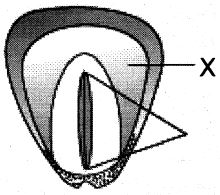
A
Seed coat
B
Radicle
C
Endosperm
D
Embryo
Solution
(C) The provided figure represents a longitudinal section of a maize grain (a monocot seed).
In a maize grain,the bulk of the seed is occupied by a large,starchy tissue that stores food,known as the endosperm.
The region labeled as $X$ points to this large,nutrient-storing tissue.
Therefore,$X$ represents the endosperm.
In a maize grain,the bulk of the seed is occupied by a large,starchy tissue that stores food,known as the endosperm.
The region labeled as $X$ points to this large,nutrient-storing tissue.
Therefore,$X$ represents the endosperm.
0 likes
View Solution47
DifficultMCQ
Vivipary means ...... .
A
Germination of seeds from hypogeal cotyledons
B
Germination of seeds from epigeal cotyledons
C
Development of fruit without pollination
D
Germination of seeds inside the fruit while still attached to the parent plant
Solution
(D) Vivipary is a phenomenon where seeds germinate while still attached to the parent plant.
This is a common adaptation in plants growing in saline marshes or mangroves (e.g.,$Rhizophora$ and $Avicennia$).
In these environments,the seeds would not be able to germinate if they fell into the salty water,so the embryo grows into a seedling while attached to the parent,eventually dropping into the mud to establish itself.
This is a common adaptation in plants growing in saline marshes or mangroves (e.g.,$Rhizophora$ and $Avicennia$).
In these environments,the seeds would not be able to germinate if they fell into the salty water,so the embryo grows into a seedling while attached to the parent,eventually dropping into the mud to establish itself.
0 likes
View Solution48
MediumMCQ
The embryo of a sunflower contains ..........
A
one cotyledon
B
two cotyledons
C
many cotyledons
D
no cotyledons
Solution
(B) Sunflower $(Helianthus \text{ } annuus)$ belongs to the family $Asteraceae$ (or $Compositae$).
It is a dicotyledonous plant.
In dicotyledonous plants, the embryo typically consists of an embryonal axis and two cotyledons.
Therefore, the embryo of a sunflower contains two cotyledons.
It is a dicotyledonous plant.
In dicotyledonous plants, the embryo typically consists of an embryonal axis and two cotyledons.
Therefore, the embryo of a sunflower contains two cotyledons.
0 likes
View Solution49
MediumMCQ
Which of the following is a correctly matched pair for the edible part?
A
Tomato $-$ Thalamus
B
Maize $-$ Cotyledon
C
Guava $-$ Mesocarp
D
Date palm $-$ Endocarp
Solution
(B) In $Tomato$ $(Solanum \text{ } lycopersicum)$, the edible part is the pericarp and placenta. In $Maize$ $(Zea \text{ } mays)$, the edible part is the endosperm and cotyledon. In $Guava$ $(Psidium \text{ } guajava)$, the edible part is the pericarp and placenta. In $Date \text{ } palm$ $(Phoenix \text{ } dactylifera)$, the edible part is the fleshy pericarp. Therefore, the correct match is $Maize - \text{Cotyledon}$ (specifically the scutellum, which is a single cotyledon).
0 likes
View Solution50
MediumMCQ
In the seeds of cereals,the single cotyledon is represented by the . . . . . . .
A
Scutellum
B
Coleoptile
C
Coleorhiza
D
Radicle
Solution
(A) In monocotyledonous seeds such as cereals (e.g.,wheat,maize),the embryo consists of a single cotyledon. This large,shield-shaped cotyledon is known as the $Scutellum$. It is situated towards one side of the embryonal axis. Therefore,the correct option is $A$.
0 likes
View SolutionMorphology of Flowering Plants — Seeds · Frequently Asked Questions
1Are these Morphology of Flowering Plants questions useful for JEE and NEET?
Yes. All questions in this section are mapped to JEE Main and NEET exam patterns. Previous year questions from JEE Main, NEET, GUJCET and state-level exams are included with full solutions.
2Can I switch to Hindi or Gujarati for these questions?
Yes. Use the language tabs in the hero section or the sidebar to view the same questions and solutions in English, Hindi or Gujarati.
3How do I generate a question paper from this subtopic?
Use the Vedclass Exam Paper Generator — select the chapter and subtopic, set difficulty, and generate Sets A, B, C, D automatically. First 3 chapters of every subject are free.
Vedclass Products
For Students
Vedclass Test Series
Mock tests in real JEE/NEET style with performance analysis. 5-day free trial.
Start Free TrialFor Teachers
Exam Paper Generator
Generate Set A/B/C/D papers from this chapter in 2 minutes. 3 chapters free.
Try FreeFor Institutes
Online Exam Module
Live online exams with unlimited students, 360° analytics & white-label branding.
See DemoFor Teachers & Institutes
Generate a Morphology of Flowering Plants Exam Paper in 2 Minutes
Select subtopic & difficulty — Sets A, B, C, D auto-generated with No Repeat logic.
First 3 chapters of every subject are free — no payment required.