
A English
Description of Some Important Families Questions in English
Class 11 Biology · Morphology of Flowering Plants · Description of Some Important Families
416+
Questions
English
Language
100%
With Solutions
Showing 48 of 416 questions in English
1
EasyMCQ
Which family of plants bears nodulated roots?
A
Mimosoideae
B
Caesalpinoideae
C
Papilionatae
D
Solanaceae
Solution
(C) The correct answer is $C$. Plants belonging to the sub-family $Papilionatae$ of the family $Leguminosae$ (e.g.,$pea$,$gram$,etc.) bear nodule-like swellings on their roots,known as root nodules.
These nodules contain symbiotic nitrogen-fixing bacteria (such as $Rhizobium$) which fix atmospheric free nitrogen into ammonia,providing essential nutrients to the plant.
These nodules contain symbiotic nitrogen-fixing bacteria (such as $Rhizobium$) which fix atmospheric free nitrogen into ammonia,providing essential nutrients to the plant.
0 likes
View Solution2
MediumMCQ
Phyllodes are common among which of the following plant families?
A
Malvaceae
B
Papilionatae
C
Mimosoideae
D
Solanaceae
Solution
(C) phyllode is a modified petiole or rachis that becomes flattened and leaf-like,taking over the photosynthetic function of the leaf.
This adaptation is commonly observed in certain members of the subfamily $Mimosoideae$ (e.g.,$Acacia$ $auriculiformis$).
In these plants,the true leaves are often bipinnate and shed early,while the petiole expands to form the phyllode.
This adaptation is commonly observed in certain members of the subfamily $Mimosoideae$ (e.g.,$Acacia$ $auriculiformis$).
In these plants,the true leaves are often bipinnate and shed early,while the petiole expands to form the phyllode.
0 likes
View Solution3
MediumMCQ
Flowers are monochlamydeous in
A
Malvaceae
B
Fabaceae
C
Liliaceae
D
Polygonaceae
Solution
(D) Monochlamydeous flowers are those in which the perianth consists of only one whorl,meaning there is no distinction between calyx and corolla.
In the family $Polygonaceae$,the flowers are typically monochlamydeous,where the perianth is represented by a single whorl of tepals.
Therefore,the correct option is $D$.
In the family $Polygonaceae$,the flowers are typically monochlamydeous,where the perianth is represented by a single whorl of tepals.
Therefore,the correct option is $D$.
0 likes
View Solution4
MediumMCQ
The ligulate corolla found in the family $Compositae$ (Asteraceae) is:
A
Wheel-shaped
B
Strap-shaped
C
Masked
D
Two-lipped
Solution
(B) The term 'ligulate' is derived from the Latin word 'ligula',which means a strap or tongue. In the family $Compositae$ (also known as $Asteraceae$),the ray florets possess a corolla that is flattened and elongated,resembling a strap. Therefore,the ligulate corolla is described as strap-shaped.
0 likes
View Solution5
MediumMCQ
Butterfly-shaped flowers with one standard,two wing-like,and two keeled petals belong to which family?
A
Compositae
B
Rubiaceae
C
Malvaceae
D
Papilionaceae
Solution
(D) The butterfly-shaped corolla,also known as papilionaceous corolla,consists of five petals: one posterior standard (vexillum),two lateral wings (alae),and two anterior petals fused to form a keel (carina).
This type of aestivation is known as descending imbricate or vexillary aestivation.
This characteristic feature is found in the family $Papilionaceae$ (a subfamily of $Fabaceae$).
This type of aestivation is known as descending imbricate or vexillary aestivation.
This characteristic feature is found in the family $Papilionaceae$ (a subfamily of $Fabaceae$).
0 likes
View Solution6
MediumMCQ
Flowers of $Liliaceae$,$Malvaceae$ and $Solanaceae$ are
A
Hypogynous
B
Perigynous
C
Epigynous
D
Amphigynous
Solution
(A) In $Hypogynous$ flowers,the gynoecium occupies the highest position while the other parts are situated below it.
The ovary in such flowers is said to be superior.
$Liliaceae$,$Malvaceae$,and $Solanaceae$ are families that exhibit hypogynous flowers.
Therefore,the correct option is $A$.
The ovary in such flowers is said to be superior.
$Liliaceae$,$Malvaceae$,and $Solanaceae$ are families that exhibit hypogynous flowers.
Therefore,the correct option is $A$.
0 likes
View Solution7
MediumMCQ
Flowers and stamens of Compositae (Asteraceae) are:
A
Hypogynous and inferior
B
Epigynous and superior
C
Hypogynous and superior
D
Epigynous and inferior
Solution
(D) In the family Compositae (also known as Asteraceae),the flowers are epigynous.
In an epigynous flower,the thalamus (receptacle) grows upward and completely encloses the ovary,fusing with its wall.
Consequently,the other floral parts (sepals,petals,and stamens) arise from above the level of the ovary.
Since the ovary is situated below the other floral parts,it is described as an inferior ovary.
Therefore,the flowers are epigynous and the ovary is inferior.
In an epigynous flower,the thalamus (receptacle) grows upward and completely encloses the ovary,fusing with its wall.
Consequently,the other floral parts (sepals,petals,and stamens) arise from above the level of the ovary.
Since the ovary is situated below the other floral parts,it is described as an inferior ovary.
Therefore,the flowers are epigynous and the ovary is inferior.
0 likes
View Solution8
MediumMCQ
The primitive type of stamens are found in the flowers of which family?
A
Liliaceae
B
Malvaceae
C
Gramineae/Poaceae
D
Degeneriaceae/Magnoliaceae
Solution
(D) Primitive stamens are characterized by being broad,leaf-like,and poorly differentiated into filament and anther.
These types of stamens are considered ancestral or primitive features in angiosperms.
Such stamens are typically found in families like $Degeneriaceae$ and $Magnoliaceae$,which are considered basal angiosperms.
These types of stamens are considered ancestral or primitive features in angiosperms.
Such stamens are typically found in families like $Degeneriaceae$ and $Magnoliaceae$,which are considered basal angiosperms.
0 likes
View Solution9
MediumMCQ
Oblique septum and swollen placenta is a characteristic feature of:
A
Gloriosa superba
B
Capsicum frutescens
C
Althaea rosea
D
Dalbergia sissoo
Solution
(B) The family $Solanaceae$ is characterized by a bicarpellary,syncarpous,superior ovary with a bilocular condition.
Due to the swelling of the placenta,the ovary becomes obliquely placed in the flower,which is a diagnostic feature of this family.
Among the given options,$Capsicum$ $frutescens$ (chili) belongs to the family $Solanaceae$,and thus exhibits an oblique septum and a swollen placenta.
Due to the swelling of the placenta,the ovary becomes obliquely placed in the flower,which is a diagnostic feature of this family.
Among the given options,$Capsicum$ $frutescens$ (chili) belongs to the family $Solanaceae$,and thus exhibits an oblique septum and a swollen placenta.
0 likes
View Solution10
MediumMCQ
Leafy or vegetative bract is characteristic of the flower of
A
Cruciferae
B
Malvaceae
C
Liliaceae
D
Papilionatae
Solution
(B) The presence of an additional whorl of $3-9$ leafy structures outside the calyx,called the epicalyx $(hypocalyx)$,which is a modification of bracteoles,is a characteristic feature of the flowers in the family $Malvaceae$.
0 likes
View Solution11
MediumMCQ
Parachute mechanism is found in
A
Cruciferae
B
Compositae
C
Solanaceae
D
None of these
Solution
(B) The correct answer is $B$. In members of the family $Compositae$ (also known as $Asteraceae$),the sepals are modified into tufts of hairs known as $pappus$.
The $pappus$ is persistent and remains attached to the small,single-seeded fruits (cypsela).
This structure acts like a parachute,allowing the wind to carry the seeds over great distances for dispersal.
The $pappus$ is persistent and remains attached to the small,single-seeded fruits (cypsela).
This structure acts like a parachute,allowing the wind to carry the seeds over great distances for dispersal.
0 likes
View Solution12
MediumMCQ
The correct floral formula of Liliaceae is
A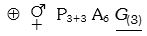
⊕ ⚥ $P_{3+3} A_6 G_{(3)}$
B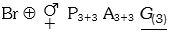
Br ⊕ ⚥ $P_{3+3} A_{3+3} G_{(3)}$
C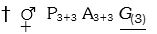
† ⚥ $P_{3+3} A_{3+3} G_{(3)}$
D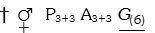
† ⚥ $P_{3+3} A_{3+3} G_{(6)}$
Solution
(A) The floral formula of the family Liliaceae is represented as: ⊕ ⚥ $P_{3+3} A_{3+3} G_{(3)}$
Here,⊕ indicates actinomorphic symmetry,⚥ indicates a bisexual flower,$P_{3+3}$ indicates perianth in two whorls of three,$A_{3+3}$ indicates stamens in two whorls of three,and $G_{(3)}$ indicates a superior ovary with three fused carpels.
Among the given options,option $(A)$ is the most accurate representation of the Liliaceae floral formula.
Here,⊕ indicates actinomorphic symmetry,⚥ indicates a bisexual flower,$P_{3+3}$ indicates perianth in two whorls of three,$A_{3+3}$ indicates stamens in two whorls of three,and $G_{(3)}$ indicates a superior ovary with three fused carpels.
Among the given options,option $(A)$ is the most accurate representation of the Liliaceae floral formula.
0 likes
View Solution13
MediumMCQ
Which two families dominate in having the maximum number of useful plants?
A
Fabaceae and Poaceae
B
Liliaceae and Solanaceae
C
Malvaceae and Brassicaceae
D
Liliaceae and Poaceae
Solution
(A) $Fabaceae$,commonly called the legume family,is the $4^{th}$ largest and $2^{nd}$ most valuable family,containing approximately $600$ genera.
$Poaceae$,commonly called the cereal or grass family,is the $3^{rd}$ largest family globally,but in the context of Indian flora,it constitutes the largest family with $620$ genera.
Together,these two families provide the majority of food crops,pulses,and fodder,making them the most useful families for human consumption.
$Poaceae$,commonly called the cereal or grass family,is the $3^{rd}$ largest family globally,but in the context of Indian flora,it constitutes the largest family with $620$ genera.
Together,these two families provide the majority of food crops,pulses,and fodder,making them the most useful families for human consumption.
0 likes
View Solution14
MediumMCQ
What is the systematic position of the family $Cucurbitaceae$ according to the Bentham and Hooker system of classification?
A
$Thalamiflorae$,$Parietales$
B
$Inferae$,$Asterales$
C
$Calyciflorae$,$Rosales$
D
$Calyciflorae$,$Passiflorales$
Solution
(D) According to the Bentham and Hooker system of classification,the family $Cucurbitaceae$ is placed under the series $Calyciflorae$ and the order $Passiflorales$.
In the series $Calyciflorae$,the flowers are typically perigynous or epigynous,and the ovary is often inferior,which is a characteristic feature of the $Cucurbitaceae$ family.
In the series $Calyciflorae$,the flowers are typically perigynous or epigynous,and the ovary is often inferior,which is a characteristic feature of the $Cucurbitaceae$ family.
0 likes
View Solution15
EasyMCQ
Touch-me-not belongs to which family?
A
Liliaceae
B
Solanaceae
C
Mimosoideae
D
Malvaceae
Solution
(C) The plant commonly known as 'Touch-me-not' is $Mimosa\, pudica$.
It belongs to the subfamily $Mimosoideae$ within the family $Fabaceae$ (formerly known as $Leguminosae$).
It belongs to the subfamily $Mimosoideae$ within the family $Fabaceae$ (formerly known as $Leguminosae$).
0 likes
View Solution16
EasyMCQ
Which of the following families is characterised by the presence of perianth?
A
Malvaceae
B
Liliaceae
C
Cruciferae
D
Solanaceae
Solution
(B) The correct answer is $B$.
$Liliaceae$,commonly known as the lily family,belongs to the monocotyledons.
In this family,the perianth is present,which means the calyx and corolla are $undifferentiated$.
The perianth is biseriate ($2$-whorled) and petaloid (resembling petals).
$Liliaceae$,commonly known as the lily family,belongs to the monocotyledons.
In this family,the perianth is present,which means the calyx and corolla are $undifferentiated$.
The perianth is biseriate ($2$-whorled) and petaloid (resembling petals).
0 likes
View Solution17
EasyMCQ
Dalbergia belongs to
A
Liliaceae
B
Malvaceae
C
Leguminosae
D
Solanaceae
Solution
(C) $Dalbergia$ is a timber plant which belongs to the family Leguminosae $(Fabaceae)$.
$D. sissoo$ $(Indian \text{ } rosewood / shisham)$ and $D. latifolia$ $(Indian \text{ } rosewood)$ are important timber-yielding plants.
$D. sissoo$ $(Indian \text{ } rosewood / shisham)$ and $D. latifolia$ $(Indian \text{ } rosewood)$ are important timber-yielding plants.
0 likes
View Solution18
EasyMCQ
Indian telegraph plant $(Desmodium\, gyrans)$ belongs to
A
Malvaceae
B
Leguminosae
C
Solanaceae
D
Liliaceae
Solution
(B) $Desmodium\, gyrans$ (Telegraph plant) exhibits autonomic movement by moving its two lateral leaflets up and down.
It belongs to the family $Leguminosae$ (also known as $Fabaceae$).
It belongs to the family $Leguminosae$ (also known as $Fabaceae$).
0 likes
View Solution19
MediumMCQ
Which of the following is phylogenetically the most advanced of the dicotyledonous families?
A
Acanthaceae
B
Scrophulariaceae
C
Compositae
D
Umbelliferae
Solution
(C) The correct answer is $C$. Compositae (also known as $Asteraceae$) is considered the most phylogenetically advanced family among dicotyledons.
This is due to several highly evolved characteristics,such as the presence of a capitulum inflorescence,syngenesious stamens,and a specialized pappus for seed dispersal.
It is one of the largest families in the plant kingdom,comprising approximately $950$ genera and $20,000$ species.
These plants are mostly herbs and often possess specialized structures like latex or oil ducts.
This is due to several highly evolved characteristics,such as the presence of a capitulum inflorescence,syngenesious stamens,and a specialized pappus for seed dispersal.
It is one of the largest families in the plant kingdom,comprising approximately $950$ genera and $20,000$ species.
These plants are mostly herbs and often possess specialized structures like latex or oil ducts.
0 likes
View Solution20
DifficultMCQ
Rutaceae differs from Malvaceae in having
A
Simple leaves
B
Polypetalous corolla
C
Syncarpous,superior ovary
D
Obdiplostemonous stamens
Solution
(D) The family $Rutaceae$ is characterized by the presence of $obdiplostemonous$ stamens,which means the stamens are arranged in two whorls with the outer whorl being opposite to the petals. In contrast,the family $Malvaceae$ typically possesses $monadelphous$ stamens where filaments are fused into a tube. Therefore,$obdiplostemonous$ stamens are a distinguishing feature of $Rutaceae$.
0 likes
View Solution21
MediumMCQ
Which statement is wrong for Compositae?
A
$5$ lobed stamens
B
Syngenesious stamens
C
Basal ovule
D
Ligulate ray florets
Solution
(A) The correct answer is $A$. In the family Compositae (Asteraceae),the stamens are $5$ in number,epipetalous,and syngenesious (anthers are fused while filaments are free). The term '$5$-lobed stamens' is incorrect because the stamens themselves are not $5$-lobed; rather,there are $5$ distinct stamens with fused anthers. The family is characterized by basal placentation (basal ovule) and the presence of ligulate ray florets.
0 likes
View Solution22
MediumMCQ
Red Gram is:
A
Phaseolus aureus
B
Cicer arietinum
C
Cajanus cajan
D
Phaseolus mungo
Solution
(C) $Cajanus\ cajan$ (Pigeon pea / Red gram / Arhar) belongs to the family Leguminosae (Fabaceae).
0 likes
View Solution23
MediumMCQ
Millets belong to which family?
A
Fabaceae
B
Poaceae
C
Liliaceae
D
Asteraceae
Solution
(B) Millets are small-seeded grasses that are widely grown around the world for food and fodder.
They belong to the family $Poaceae$ (also known as $Gramineae$).
This family is the $3^{rd}$ largest family of flowering plants and is economically the most important as it includes all major cereals like wheat,rice,maize,and millets.
They belong to the family $Poaceae$ (also known as $Gramineae$).
This family is the $3^{rd}$ largest family of flowering plants and is economically the most important as it includes all major cereals like wheat,rice,maize,and millets.
0 likes
View Solution24
MediumMCQ
Commissural stigma (along carpellary cohesion plane) occurs in which family?
A
Solanaceae
B
Liliaceae
C
Cruciferae
D
Fabaceae
Solution
(C) commissural stigma is a type of stigma that is positioned directly over the carpellary cohesion plane (the line of fusion between carpels).
This characteristic feature is commonly observed in the family $Brassicaceae$,which is also known as $Cruciferae$.
In this family,the ovary is bicarpellary and syncarpous,and the stigma is often bilobed and situated above the commissure of the carpels.
This characteristic feature is commonly observed in the family $Brassicaceae$,which is also known as $Cruciferae$.
In this family,the ovary is bicarpellary and syncarpous,and the stigma is often bilobed and situated above the commissure of the carpels.
0 likes
View Solution25
EasyMCQ
Carthamus tinctorius belongs to the family:
A
Asteraceae
B
Solanaceae
C
Malvaceae
D
Fabaceae
Solution
(A) $Carthamus$ $tinctorius$ (safflower) belongs to the family Asteraceae.
It yields Safflower or Kusum oil,which contains $73\%$ $PUFA$ (Polyunsaturated fatty acids),making it beneficial for heart patients.
It yields Safflower or Kusum oil,which contains $73\%$ $PUFA$ (Polyunsaturated fatty acids),making it beneficial for heart patients.
0 likes
View Solution26
EasyMCQ
The botanical name of cauliflower is:
A
Brassica oleracea var. capitata
B
Brassica campestris
C
Brassica oleracea var. botrytis
D
Brassica oleracea var. gemmifera
Solution
(C) The botanical name of cauliflower is $Brassica \ oleracea \ var. \ botrytis$.
It belongs to the family $Brassicaceae$ (formerly $Cruciferae$).
$Brassica \ oleracea \ var. \ capitata$ is the botanical name for cabbage,while $Brassica \ oleracea \ var. \ gemmifera$ is for Brussels sprouts.
It belongs to the family $Brassicaceae$ (formerly $Cruciferae$).
$Brassica \ oleracea \ var. \ capitata$ is the botanical name for cabbage,while $Brassica \ oleracea \ var. \ gemmifera$ is for Brussels sprouts.
0 likes
View Solution27
MediumMCQ
Plants are always herbs in which of the following families?
A
Fabaceae
B
Solanaceae
C
Brassicaceae
D
None of these
Solution
(C) The correct answer is $C$. The family $Brassicaceae$ (commonly known as the mustard family) consists of plants that are predominantly herbs. These plants are characterized by a pungent smell due to the presence of sulphur-rich glucosides like $sinigrin$.
0 likes
View Solution28
MediumMCQ
Which of the following families belongs to the series $Inferae$ of the subclass $Gamopetalae$?
A
Fabaceae
B
Liliaceae
C
Asteraceae
D
Brassicaceae
Solution
(C) The family $Asteraceae$ (also known as $Compositae$) belongs to the subclass $Gamopetalae$ (characterized by fused petals) and the series $Inferae$ (characterized by an inferior ovary and stamens usually equal in number to the petal lobes).
0 likes
View Solution29
MediumMCQ
$A$ family delimited by the type of inflorescence is
A
Fabaceae
B
Asteraceae
C
Solanaceae
D
Liliaceae
Solution
(B) The family $Asteraceae$ (also known as $Compositae$) is primarily characterized and delimited by its unique type of inflorescence,which is the $capitulum$ or $head$ inflorescence.
In this type of inflorescence,numerous small,sessile flowers called $florets$ are arranged on a common receptacle,often surrounded by an involucre of bracts.
In this type of inflorescence,numerous small,sessile flowers called $florets$ are arranged on a common receptacle,often surrounded by an involucre of bracts.
0 likes
View Solution30
MediumMCQ
Axile placentation occurs in
A
Asteraceae and Fabaceae
B
Brassicaceae and Solanaceae
C
Solanaceae and Liliaceae
D
None of these
Solution
(C) Axile placentation: In a multicarpellary syncarpous gynoecium,the fusing margins grow inwards to meet in the center of the ovary to form an axis,thus making the ovary multilocular.
The ovules are borne on the central axis. Examples include families $Solanaceae$ and $Liliaceae$.
The ovules are borne on the central axis. Examples include families $Solanaceae$ and $Liliaceae$.
0 likes
View Solution31
MediumMCQ
$A$ diagnostic trait for the identification of a fabaceous flower is:
A
Tetradynamous androecium
B
Inferior ovary
C
Cruciform corolla
D
Vexillary aestivation
Solution
(D) The correct answer is $D$. In the $Fabaceae$ family, the corolla exhibits $vexillary$ $aestivation$ (also known as $papilionaceous$ aestivation). The corolla consists of $5$ petals: one large posterior petal called the $standard$ (or $vexillum$), two lateral petals called $wings$ (or $alae$), and two anterior petals that are fused to form a boat-shaped structure called the $keel$ (or $carina$).
0 likes
View Solution32
MediumMCQ
The flower of the family $Fabaceae$ is:
A
Complete,zygomorphic,pentamerous
B
Complete,actinomorphic,trimerous
C
Incomplete,zygomorphic,trimerous
D
Incomplete,actinomorphic,pentamerous
Solution
(A) The flowers of the family $Fabaceae$ are described as follows:
$1$. Complete: They possess all four whorls (calyx,corolla,androecium,and gynoecium).
$2$. Zygomorphic: They exhibit bilateral symmetry,meaning they can be divided into two identical halves only in one particular vertical plane.
$3$. Pentamerous: The floral parts are arranged in multiples of five.
Therefore,the correct description is complete,zygomorphic,and pentamerous.
$1$. Complete: They possess all four whorls (calyx,corolla,androecium,and gynoecium).
$2$. Zygomorphic: They exhibit bilateral symmetry,meaning they can be divided into two identical halves only in one particular vertical plane.
$3$. Pentamerous: The floral parts are arranged in multiples of five.
Therefore,the correct description is complete,zygomorphic,and pentamerous.
0 likes
View Solution33
MediumMCQ
The most important character of $Brassica$ $campestris$ is:
A
False septum
B
Parietal placentation
C
Ebracteate
D
Imbricate aestivation
Solution
(A) The most characteristic feature of the family $Brassicaceae$ (to which $Brassica$ $campestris$ belongs) is the presence of a false septum,also known as a $replum$.
In $Brassica$ $campestris$,the ovary is superior and unilocular,but it becomes bilocular due to the development of a false septum called the $replum$.
While parietal placentation is also present,the formation of the $replum$ is a diagnostic feature of this family.
Therefore,the presence of a false septum is considered the most distinct character.
In $Brassica$ $campestris$,the ovary is superior and unilocular,but it becomes bilocular due to the development of a false septum called the $replum$.
While parietal placentation is also present,the formation of the $replum$ is a diagnostic feature of this family.
Therefore,the presence of a false septum is considered the most distinct character.
0 likes
View Solution34
MediumMCQ
In $Fabaceae$,which of the following immediately encloses the essential reproductive organs?
A
Anterior petals
B
Posterior petal
C
Lateral petals
D
Sepals
Solution
(A) In the family $Fabaceae$,the flower exhibits a papilionaceous aestivation. The corolla consists of five petals: one posterior standard (vexillum),two lateral wings (alae),and two anterior petals. The two anterior petals are fused to form a boat-shaped structure known as the keel or $carina$. This keel structure immediately encloses the essential reproductive organs (stamens and carpel).
0 likes
View Solution35
MediumMCQ
Compositae is also known as:
A
Fabaceae
B
Asteraceae
C
Liliaceae
D
Poaceae
Solution
(B) The family Compositae is commonly known as the Asteraceae family.
It is one of the largest families of flowering plants,characterized by the presence of flower heads (capitulum) consisting of many small florets.
Therefore,the correct option is $B$.
It is one of the largest families of flowering plants,characterized by the presence of flower heads (capitulum) consisting of many small florets.
Therefore,the correct option is $B$.
0 likes
View Solution36
MediumMCQ
Four sepals arranged in two whorls is characteristic of family
A
Solanaceae
B
Fabaceae
C
Brassicaceae
D
Liliaceae
Solution
(C) The family $Brassicaceae$ (also known as $Cruciferae$) is characterized by having $4$ sepals arranged in two whorls of $2$ each.
These sepals are polysepalous (free).
The outer whorl consists of antero-posterior sepals,while the inner whorl consists of lateral sepals.
The lateral sepals are often saccate or pouched at the base.
These sepals are polysepalous (free).
The outer whorl consists of antero-posterior sepals,while the inner whorl consists of lateral sepals.
The lateral sepals are often saccate or pouched at the base.
0 likes
View Solution37
MediumMCQ
Name the family having $(9)+1$ arrangement of stamens.
A
Solanaceae
B
Asteraceae
C
Liliaceae
D
Fabaceae
Solution
(D) In the family $Fabaceae$,the androecium consists of $10$ stamens which are diadelphous.
These stamens are arranged in a $(9)+1$ pattern,where $9$ stamens are fused together to form a bundle,and $1$ stamen remains free.
These stamens are arranged in a $(9)+1$ pattern,where $9$ stamens are fused together to form a bundle,and $1$ stamen remains free.
0 likes
View Solution38
MediumMCQ
The largest family of flowering plants is:
A
Fabaceae
B
Liliaceae
C
Poaceae
D
Asteraceae
Solution
(D) The correct answer is $D$. The family Asteraceae (also known as the sunflower family or Compositae) is the largest family of flowering plants. It is widely distributed and is represented by approximately $950$ genera and $20,000$ species.
0 likes
View Solution39
MediumMCQ
The family $Fabaceae$ belongs to which series in the Bentham and Hooker system of classification?
A
Inferae
B
Thalamiflorae
C
Calyciflorae
D
Disciflorae
Solution
(C) In the Bentham and Hooker system of classification,the family $Fabaceae$ (also known as $Leguminosae$) is placed under the series $Calyciflorae$.
This series is characterized by flowers having a perigynous or epigynous arrangement,where the floral parts are situated on the rim of the receptacle.
This series is characterized by flowers having a perigynous or epigynous arrangement,where the floral parts are situated on the rim of the receptacle.
0 likes
View Solution40
EasyMCQ
Familiar examples of family Liliaceae are
A
Allium cepa,Aloe vera and Tamarindus indica
B
Saraca indica,Allium cepa and Aloe vera
C
Allium sativum,Allium cepa and Aloe vera
D
Tamarindus indica,Allium cepa and Allium sativum
Solution
(C) The family Liliaceae,commonly known as the lily family,includes many ornamental and medicinal plants.
Allium sativum (garlic),Allium cepa (onion),and Aloe vera (Aloe) are all members of the family Liliaceae.
Tamarindus indica belongs to the family Fabaceae,and Saraca indica belongs to the family Fabaceae.
Therefore,the correct option is $C$.
Allium sativum (garlic),Allium cepa (onion),and Aloe vera (Aloe) are all members of the family Liliaceae.
Tamarindus indica belongs to the family Fabaceae,and Saraca indica belongs to the family Fabaceae.
Therefore,the correct option is $C$.
0 likes
View Solution41
EasyMCQ
$Colchicum$ $autumnale$ is a member of which family?
A
Brassicaceae
B
Liliaceae
C
Poaceae
D
Fabaceae
Solution
(B) $Colchicum$ $autumnale$ belongs to the family $Liliaceae$.
The corm of this plant is the source of an alkaloid known as colchicine.
Colchicine is widely used in plant breeding and cytogenetics to induce polyploidy by inhibiting spindle formation during cell division.
The corm of this plant is the source of an alkaloid known as colchicine.
Colchicine is widely used in plant breeding and cytogenetics to induce polyploidy by inhibiting spindle formation during cell division.
0 likes
View Solution42
MediumMCQ
Epipetalous and syngenesious stamens occur in
A
Solanaceae
B
Brassicaceae
C
Fabaceae
D
Asteraceae
Solution
(D) The correct answer is $D$.
$1$. Epipetalous stamens are those where the stamens are attached to the petals.
$2$. Syngenesious stamens are those where the anthers are fused together while the filaments remain free.
$3$. These conditions are characteristic features of the family $Asteraceae$ (also known as $Compositae$).
$4$. In $Solanaceae$, stamens are epipetalous but not syngenesious.
$5$. In $Brassicaceae$, the condition is tetradynamous.
$6$. In $Fabaceae$, the condition is usually diadelphous.
$1$. Epipetalous stamens are those where the stamens are attached to the petals.
$2$. Syngenesious stamens are those where the anthers are fused together while the filaments remain free.
$3$. These conditions are characteristic features of the family $Asteraceae$ (also known as $Compositae$).
$4$. In $Solanaceae$, stamens are epipetalous but not syngenesious.
$5$. In $Brassicaceae$, the condition is tetradynamous.
$6$. In $Fabaceae$, the condition is usually diadelphous.
0 likes
View Solution43
MediumMCQ
Carbohydrate-rich food is obtained from
A
Brassicaceae
B
Poaceae
C
Fabaceae
D
Asteraceae
Solution
(B) The correct answer is $B$.
Cereals are one-seeded fruits known as caryopsis.
They are rich in carbohydrates but poor in amino acids like lysine and tryptophan.
All cereals belong to the family $Poaceae$ (also known as $Gramineae$).
Cereals are one-seeded fruits known as caryopsis.
They are rich in carbohydrates but poor in amino acids like lysine and tryptophan.
All cereals belong to the family $Poaceae$ (also known as $Gramineae$).
0 likes
View Solution44
MediumMCQ
Raphanus belongs to which family?
A
Asteraceae
B
Brassicaceae
C
Solanaceae
D
Liliaceae
Solution
(B) Raphanus,commonly known as radish,belongs to the family $Brassicaceae$ (also known as $Cruciferae$).
This family is characterized by flowers with four petals arranged in a cross-like pattern,tetradynamous stamens,and a siliqua type of fruit.
This family is characterized by flowers with four petals arranged in a cross-like pattern,tetradynamous stamens,and a siliqua type of fruit.
0 likes
View Solution45
MediumMCQ
Bicarpellary,syncarpous,unilocular ovary with basal placentation occurs in
A
Liliaceae
B
Solanaceae
C
Asteraceae
D
Fabaceae
Solution
(C) The family $Asteraceae$ (also known as $Compositae$) is characterized by a bicarpellary,syncarpous,and unilocular ovary.
In this family,the ovary contains a single ovule attached at the base,which is known as basal placentation.
Therefore,the correct answer is $Asteraceae$.
In this family,the ovary contains a single ovule attached at the base,which is known as basal placentation.
Therefore,the correct answer is $Asteraceae$.
0 likes
View Solution46
EasyMCQ
Pulses are obtained from which family?
A
Fabaceae
B
Asteraceae
C
Poaceae
D
Solanaceae
Solution
(A) All pulses belong to the family $Fabaceae$.
This family is widely known for producing protein-rich pulses,which are a primary source of plant-based protein in human diets.
This family is widely known for producing protein-rich pulses,which are a primary source of plant-based protein in human diets.
0 likes
View Solution47
EasyMCQ
$Lycopersicum \text{ } esculentum$ is the scientific name of:
A
Tomato
B
Potato
C
Cabbage
D
Brinjal
Solution
(A) $Lycopersicum \text{ } esculentum$ is the scientific name of the Tomato plant.
It belongs to the family $Solanaceae$.
Potato is $Solanum \text{ } tuberosum$, Cabbage is $Brassica \text{ } oleracea \text{ } var. \text{ } capitata$, and Brinjal is $Solanum \text{ } melongena$.
It belongs to the family $Solanaceae$.
Potato is $Solanum \text{ } tuberosum$, Cabbage is $Brassica \text{ } oleracea \text{ } var. \text{ } capitata$, and Brinjal is $Solanum \text{ } melongena$.
0 likes
View Solution48
MediumMCQ
Which of the following statements is false regarding the family $Asteraceae$?
A
Cypsela fruit
B
Syngenesious androecium
C
Head inflorescence
D
Hypogynous flower
Solution
(D) The family $Asteraceae$ (also known as $Compositae$) is characterized by the following features:
$1$. The inflorescence is typically a $Capitulum$ or $Head$ type.
$2$. The androecium consists of $Syngenesious$ stamens (anthers are fused,filaments are free).
$3$. The fruit is a $Cypsela$.
$4$. The flowers in this family are $Epigynous$ (ovary is inferior),not $Hypogynous$.
Therefore,the statement that the flowers are $Hypogynous$ is false.
$1$. The inflorescence is typically a $Capitulum$ or $Head$ type.
$2$. The androecium consists of $Syngenesious$ stamens (anthers are fused,filaments are free).
$3$. The fruit is a $Cypsela$.
$4$. The flowers in this family are $Epigynous$ (ovary is inferior),not $Hypogynous$.
Therefore,the statement that the flowers are $Hypogynous$ is false.
0 likes
View SolutionMorphology of Flowering Plants — Description of Some Important Families · Frequently Asked Questions
1Are these Morphology of Flowering Plants questions useful for JEE and NEET?
Yes. All questions in this section are mapped to JEE Main and NEET exam patterns. Previous year questions from JEE Main, NEET, GUJCET and state-level exams are included with full solutions.
2Can I switch to Hindi or Gujarati for these questions?
Yes. Use the language tabs in the hero section or the sidebar to view the same questions and solutions in English, Hindi or Gujarati.
3How do I generate a question paper from this subtopic?
Use the Vedclass Exam Paper Generator — select the chapter and subtopic, set difficulty, and generate Sets A, B, C, D automatically. First 3 chapters of every subject are free.
Vedclass Products
For Students
Vedclass Test Series
Mock tests in real JEE/NEET style with performance analysis. 5-day free trial.
Start Free TrialFor Teachers
Exam Paper Generator
Generate Set A/B/C/D papers from this chapter in 2 minutes. 3 chapters free.
Try FreeFor Institutes
Online Exam Module
Live online exams with unlimited students, 360° analytics & white-label branding.
See DemoFor Teachers & Institutes
Generate a Morphology of Flowering Plants Exam Paper in 2 Minutes
Select subtopic & difficulty — Sets A, B, C, D auto-generated with No Repeat logic.
First 3 chapters of every subject are free — no payment required.