
A English
Mix Examples- Biomolecules Questions in English
Class 11 Biology · Biomolecules · Mix Examples- Biomolecules
331+
Questions
English
Language
100%
With Solutions
Showing 50 of 331 questions in English
251
EasyMCQ
Which of the following is correctly matched?
A
Vitamin $E - \text{Tocopherol}$
B
Vitamin $D - \text{Riboflavin}$
C
Vitamin $C - \text{Calciferol}$
D
Vitamin $A - \text{Thiamine}$
Solution
(A) The correct match is Vitamin $E - \text{Tocopherol}$.
Vitamin $D$ is $\text{Calciferol}$.
Vitamin $C$ is $\text{Ascorbic acid}$.
Vitamin $A$ is $\text{Retinol}$.
$\text{Riboflavin}$ is Vitamin $B_2$ and $\text{Thiamine}$ is Vitamin $B_1$.
Vitamin $D$ is $\text{Calciferol}$.
Vitamin $C$ is $\text{Ascorbic acid}$.
Vitamin $A$ is $\text{Retinol}$.
$\text{Riboflavin}$ is Vitamin $B_2$ and $\text{Thiamine}$ is Vitamin $B_1$.
0 likes
View Solution252
EasyMCQ
Which of the following vitamins is correctly matched with its solubility and the deficiency disease it causes?
A
Vitamin $A$ - Fat-soluble - Night blindness
B
Vitamin $K$ - Fat-soluble - Beriberi
C
Vitamin $A$ - Fat-soluble - Beriberi
D
Vitamin $K$ - Water-soluble - Pellagra
Solution
(A) Vitamins are classified based on their solubility into fat-soluble and water-soluble vitamins.
Fat-soluble vitamins include $A, D, E,$ and $K$.
Water-soluble vitamins include $B$-complex and $C$.
Vitamin $A$ (Retinol) is fat-soluble,and its deficiency leads to night blindness (nyctalopia).
Vitamin $K$ is fat-soluble,and its deficiency leads to impaired blood clotting,not Beriberi (which is caused by Vitamin $B_1$ deficiency).
Therefore,the correct match is Vitamin $A$ - Fat-soluble - Night blindness.
Fat-soluble vitamins include $A, D, E,$ and $K$.
Water-soluble vitamins include $B$-complex and $C$.
Vitamin $A$ (Retinol) is fat-soluble,and its deficiency leads to night blindness (nyctalopia).
Vitamin $K$ is fat-soluble,and its deficiency leads to impaired blood clotting,not Beriberi (which is caused by Vitamin $B_1$ deficiency).
Therefore,the correct match is Vitamin $A$ - Fat-soluble - Night blindness.
0 likes
View Solution253
MediumMCQ
Which of the following is a fat-soluble vitamin and its corresponding deficiency disease?
A
Retinol (Vitamin $A$) - Xerophthalmia
B
Cobalamin (Vitamin $B_{12}$) - Beriberi
C
Calciferol (Vitamin $D$) - Pellagra
D
Ascorbic acid (Vitamin $C$) - Scurvy
Solution
(A) Vitamins are classified into two groups: water-soluble and fat-soluble.
Fat-soluble vitamins include $A, D, E,$ and $K$.
Water-soluble vitamins include $B$-complex and $C$.
$1$. Retinol (Vitamin $A$) is fat-soluble,and its deficiency causes Xerophthalmia (dryness of the eyes).
$2$. Cobalamin (Vitamin $B_{12}$) is water-soluble; its deficiency causes pernicious anemia,not Beriberi (which is caused by Vitamin $B_1$ deficiency).
$3$. Calciferol (Vitamin $D$) is fat-soluble,but its deficiency causes Rickets or Osteomalacia,not Pellagra (which is caused by Vitamin $B_3$ deficiency).
$4$. Ascorbic acid (Vitamin $C$) is water-soluble,and its deficiency causes Scurvy.
Therefore,the correct pair is Retinol - Xerophthalmia.
Fat-soluble vitamins include $A, D, E,$ and $K$.
Water-soluble vitamins include $B$-complex and $C$.
$1$. Retinol (Vitamin $A$) is fat-soluble,and its deficiency causes Xerophthalmia (dryness of the eyes).
$2$. Cobalamin (Vitamin $B_{12}$) is water-soluble; its deficiency causes pernicious anemia,not Beriberi (which is caused by Vitamin $B_1$ deficiency).
$3$. Calciferol (Vitamin $D$) is fat-soluble,but its deficiency causes Rickets or Osteomalacia,not Pellagra (which is caused by Vitamin $B_3$ deficiency).
$4$. Ascorbic acid (Vitamin $C$) is water-soluble,and its deficiency causes Scurvy.
Therefore,the correct pair is Retinol - Xerophthalmia.
0 likes
View Solution254
MediumMCQ
Which of the following glucose transporters is insulin-dependent?
A
$GLUT-I$
B
$GLUT-II$
C
$GLUT-III$
D
$GLUT-IV$
Solution
(D) The glucose transporters $(GLUT)$ are a group of membrane proteins that facilitate the transport of glucose across the plasma membrane.
$GLUT-IV$ is the primary insulin-regulated glucose transporter found in adipose tissue and striated muscle (skeletal and cardiac muscle).
When insulin levels rise,$GLUT-IV$ is translocated from intracellular vesicles to the plasma membrane,thereby increasing the rate of glucose uptake into these cells.
In contrast,$GLUT-I$,$GLUT-II$,and $GLUT-III$ are generally considered insulin-independent transporters.
$GLUT-IV$ is the primary insulin-regulated glucose transporter found in adipose tissue and striated muscle (skeletal and cardiac muscle).
When insulin levels rise,$GLUT-IV$ is translocated from intracellular vesicles to the plasma membrane,thereby increasing the rate of glucose uptake into these cells.
In contrast,$GLUT-I$,$GLUT-II$,and $GLUT-III$ are generally considered insulin-independent transporters.
0 likes
View Solution255
MediumMCQ
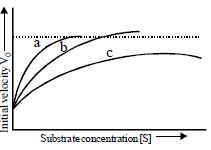
The figure given below shows three velocity-substrate concentration curves for an enzyme reaction. What do the curves $a, b$ and $c$ depict respectively?
A
$a -$ normal enzyme reaction,$b -$ competitive inhibition,$c -$ non-competitive inhibition
B
$a -$ enzyme with an allosteric modulator added,$b -$ normal enzyme activity,$c -$ competitive inhibition.
C
$a -$ enzyme with an allosteric stimulator,$b -$ competitive inhibitor added,$c -$ normal enzyme reaction
D
$a -$ normal enzyme reaction,$b -$ non-competitive inhibitor added,$c -$ allosteric inhibitor added
Solution
(A) In the given graph,curve $a$ represents the normal enzyme reaction with the highest $V_{max}$.
Curve $b$ shows competitive inhibition,where the $K_m$ increases but the $V_{max}$ remains the same as the normal reaction because the inhibition can be overcome by increasing the substrate concentration.
Curve $c$ shows non-competitive inhibition,where the $V_{max}$ is decreased because the inhibitor binds to a site other than the active site,reducing the enzyme's efficiency regardless of substrate concentration.
Curve $b$ shows competitive inhibition,where the $K_m$ increases but the $V_{max}$ remains the same as the normal reaction because the inhibition can be overcome by increasing the substrate concentration.
Curve $c$ shows non-competitive inhibition,where the $V_{max}$ is decreased because the inhibitor binds to a site other than the active site,reducing the enzyme's efficiency regardless of substrate concentration.
0 likes
View Solution256
MediumMCQ
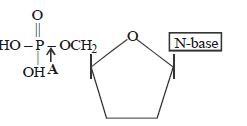
Refer to the given structure of adenylic acid. In this,identify $A$.
A
Glycosidic bond
B
Phosphate bond
C
Ester bond
D
Ionic bond
Solution
(C) In the structure of a nucleotide like adenylic acid,the phosphate group is attached to the $5'$-carbon of the pentose sugar. This linkage is formed by a phosphoester bond,which is a type of ester bond.
0 likes
View Solution257
MediumMCQ
Which match is true?
A
Vitamin deficiency disease $-$ Severe bleeding,Vitamin $-$ Tocopherol,Source $-$ Milk,egg
B
Vitamin deficiency disease $-$ Anaemia,Vitamin $-$ Ascorbic acid,Source $-$ Lemon,orange
C
Vitamin deficiency disease $-$ Night blindness,Vitamin $-$ Retinol,Source $-$ Carrot,milk
D
Vitamin deficiency disease $-$ Sterility,Vitamin $-$ Calciferol,Source $-$ Milk,butter
Solution
(C) Retinol is the chemical name of vitamin $A$,which is primarily found in carrots,milk,cheese,and fish.
Retinol is essential for light absorption in animals,where it is converted into the light-absorbing molecule called retinal.
Deficiency of vitamin $A$ affects the rod cells in the retina,leading to a condition known as night blindness.
Tocopherol is the chemical name of vitamin $E$,which is found in wheat germ oil and brown flour; its deficiency causes sterility in rats.
Vitamin $C$,or ascorbic acid,is found in citrus fruits and potatoes; its deficiency causes scurvy,which affects joints and gums.
Retinol is essential for light absorption in animals,where it is converted into the light-absorbing molecule called retinal.
Deficiency of vitamin $A$ affects the rod cells in the retina,leading to a condition known as night blindness.
Tocopherol is the chemical name of vitamin $E$,which is found in wheat germ oil and brown flour; its deficiency causes sterility in rats.
Vitamin $C$,or ascorbic acid,is found in citrus fruits and potatoes; its deficiency causes scurvy,which affects joints and gums.
0 likes
View Solution258
MediumMCQ
Assertion : Scurvy is caused by deficiency of vitamin.
Reason : Deficiency of ascorbic acid causes scurvy.
Reason : Deficiency of ascorbic acid causes scurvy.
A
If both Assertion and Reason are correct and the Reason is a correct explanation of the Assertion.
B
If both Assertion and Reason are correct but Reason is not a correct explanation of the Assertion.
C
If the Assertion is correct but Reason is incorrect.
D
If both the Assertion and Reason are incorrect.
Solution
(A) Scurvy is a disease caused by the deficiency of vitamin $C$ (ascorbic acid).
Since ascorbic acid is a vitamin,the assertion that scurvy is caused by a vitamin deficiency is correct.
The reason specifically identifies that the deficiency of ascorbic acid leads to scurvy,which directly explains why the deficiency of this specific vitamin causes the disease.
Therefore,both the assertion and reason are correct,and the reason is the correct explanation of the assertion.
Since ascorbic acid is a vitamin,the assertion that scurvy is caused by a vitamin deficiency is correct.
The reason specifically identifies that the deficiency of ascorbic acid leads to scurvy,which directly explains why the deficiency of this specific vitamin causes the disease.
Therefore,both the assertion and reason are correct,and the reason is the correct explanation of the assertion.
0 likes
View Solution259
Medium
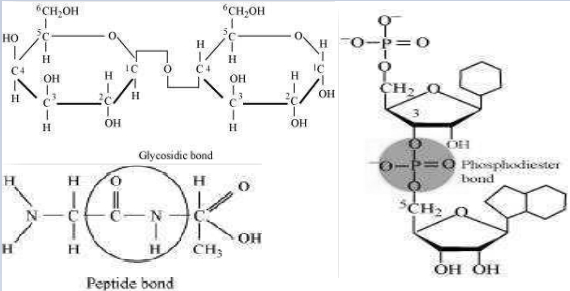
Illustrate a glycosidic,peptide and a phosphodiester bond.
Solution
(N/A) Glycosidic bond: This bond is formed between two carbon atoms,typically $C-1$ and $C-4,$ of adjacent monosaccharide units through a dehydration reaction.
$(b)$ Peptide bond: This is a covalent bond formed between the carboxyl group $(-COOH)$ of one amino acid and the amino group $(-NH_2)$ of the next amino acid,resulting in a $-NH-CO-$ linkage.
$(c)$ Phosphodiester bond: This is a strong covalent bond that connects the $3'$ carbon atom of one sugar molecule to the $5'$ carbon atom of another sugar molecule via a phosphate group. These bonds form the sugar-phosphate backbone of nucleic acids like $DNA$ and $RNA$.
$(b)$ Peptide bond: This is a covalent bond formed between the carboxyl group $(-COOH)$ of one amino acid and the amino group $(-NH_2)$ of the next amino acid,resulting in a $-NH-CO-$ linkage.
$(c)$ Phosphodiester bond: This is a strong covalent bond that connects the $3'$ carbon atom of one sugar molecule to the $5'$ carbon atom of another sugar molecule via a phosphate group. These bonds form the sugar-phosphate backbone of nucleic acids like $DNA$ and $RNA$.
0 likes
View Solution260
Medium
Identify and list $10$ interesting small molecular weight biomolecules. Determine if there are industries that manufacture these compounds through isolation and identify their primary buyers.
Solution
(N/A) Small molecular weight biomolecules are essential in various industrial and research applications. Below is a table representing some common examples,their manufacturers,and their typical buyers:
| Compound | Manufacturer/Industry | Primary Buyers |
|---|---|---|
| $1$. Glucose | Food $\&$ Beverage Industry | Pharmaceuticals,Food processing units |
| $2$. Citric Acid | Biotech/Chemical Industry | Food industry (preservative),cleaning agents |
| $3$. Amylase (Enzyme) | Enzyme manufacturing firms | Textile,Paper,and Detergent industries |
| $4$. Amino Acids (e.g.,Glycine) | Chemical synthesis/Fermentation plants | Nutraceuticals,Animal feed industry |
| $5$. Ethanol | Distilleries/Biofuel plants | Chemical industry,Fuel sector |
| $6$. Cholesterol | Pharmaceutical companies | Research laboratories,Medical diagnostics |
| $7$. Ascorbic Acid (Vitamin $C$) | Nutraceutical manufacturers | Food industry,Pharmaceutical industry |
| $8$. Glycerol | Soap/Biodiesel industry | Cosmetics,Pharmaceutical industry |
| $9$. Lactic Acid | Biotech firms | Food industry,Bioplastic production |
| $10$. Caffeine | Extraction plants | Beverage industry,Pharmaceutical industry |
0 likes
View Solution261
Medium
Find out a qualitative test for proteins,fats and oils,amino acids and test any fruit juice,saliva,sweat and urine for them.
Solution
(N/A) Test for protein
Biuret's test - If Biuret's reagent is added to protein,then the colour of the reagent changes from light blue to purple.
$(b)$ Test for fats and oils
Grease or solubility test.
$(c)$ Test for amino acid
Ninhydrin test - If Ninhydrin reagent is added to the solution,then the colourless solution changes to pink,blue,or purple,depending on the amino acid.
Biuret's test - If Biuret's reagent is added to protein,then the colour of the reagent changes from light blue to purple.
$(b)$ Test for fats and oils
Grease or solubility test.
$(c)$ Test for amino acid
Ninhydrin test - If Ninhydrin reagent is added to the solution,then the colourless solution changes to pink,blue,or purple,depending on the amino acid.
| Item and Test | Procedure and Result |
| $(1)$ Fruit juice (Biuret/Grease/Ninhydrin) | Biuret: Purple color (Protein present); Grease: No spot (Fats absent); Ninhydrin: Color change (Amino acids present). |
| $(2)$ Saliva (Biuret/Grease/Ninhydrin) | Biuret: Purple color (Protein present); Grease: No spot (Fats absent); Ninhydrin: Color change (Amino acids present). |
| $(3)$ Sweat (Biuret/Solubility/Ninhydrin) | Biuret: No change (Protein absent); Solubility: Oily appearance (Fats present); Ninhydrin: No change (Amino acids absent). |
| $(4)$ Urine (Biuret/Solubility/Ninhydrin) | Biuret: Purple color (Protein present); Solubility: Oily appearance (Fats present); Ninhydrin: Color change (Amino acids present). |
0 likes
View Solution262
Medium
From what you have learnt,can you tell whether enzymes are bigger or $DNA$ is bigger in molecular size? How did you know?
Solution
(B) Enzymes are generally smaller than $DNA$ in molecular size. $DNA$ is a long polymer of nucleotides that carries the genetic information for the entire cell,whereas enzymes are specific proteins synthesized based on the instructions provided by a small segment of $DNA$ known as a gene. Since a gene (a segment of $DNA$) only codes for a single polypeptide chain (which forms an enzyme),the $DNA$ molecule itself is significantly larger and more complex than the individual enzyme protein it encodes.
0 likes
View Solution263
MediumMCQ
Complete the following analogy-type questions:
$(i)$ Purine : Guanine :: Pyrimidine : .........
$(ii)$ Hexokinase : Transferase :: Amylase : .........
$(i)$ Purine : Guanine :: Pyrimidine : .........
$(ii)$ Hexokinase : Transferase :: Amylase : .........
A
$(i)$ Thymine,$(ii)$ Hydrolase
B
$(i)$ Cytosine,$(ii)$ Isomerase
C
$(i)$ Adenine,$(ii)$ Ligase
D
$(i)$ Uracil,$(ii)$ Lyase
Solution
(A) $(i)$ The nitrogenous bases are classified into purines (Adenine and Guanine) and pyrimidines (Cytosine,Thymine,and Uracil). Since Guanine is a purine,the corresponding pyrimidine is Thymine (or Cytosine/Uracil).
$(ii)$ Enzymes are classified based on their function. Hexokinase belongs to the class of Transferases. Amylase is an enzyme that catalyzes the hydrolysis of starch,thus it belongs to the class of Hydrolases.
$(ii)$ Enzymes are classified based on their function. Hexokinase belongs to the class of Transferases. Amylase is an enzyme that catalyzes the hydrolysis of starch,thus it belongs to the class of Hydrolases.
0 likes
View Solution264
EasyMCQ
Complete the following analogy-type questions:
$(i)$ Plant : Starch :: Mammal : .......
$(ii)$ Amino acid : Protein :: Nucleotide : ............
$(i)$ Plant : Starch :: Mammal : .......
$(ii)$ Amino acid : Protein :: Nucleotide : ............
A
$(i)$ Glycogen,$(ii)$ Nucleic acid
B
$(i)$ Cellulose,$(ii)$ $DNA$
C
$(i)$ Glucose,$(ii)$ $RNA$
D
$(i)$ Glycogen,$(ii)$ Lipid
Solution
(A) $(i)$ In plants,the storage form of carbohydrates is starch. Similarly,in mammals (animals),the storage form of carbohydrates is glycogen.
$(ii)$ Amino acids are the monomeric units that polymerize to form proteins. Similarly,nucleotides are the monomeric units that polymerize to form nucleic acids ($DNA$ and $RNA$).
$(ii)$ Amino acids are the monomeric units that polymerize to form proteins. Similarly,nucleotides are the monomeric units that polymerize to form nucleic acids ($DNA$ and $RNA$).
0 likes
View Solution265
MediumMCQ
The energy stored in the form of chemical bonds is called $ATP$.
A
$AMP$
B
$ATP$
C
$ADP$
D
$GTP$
Solution
(B) The energy currency of the cell is $ATP$ $(Adenosine Triphosphate)$.
Chemical energy is stored in the high-energy phosphate bonds of the $ATP$ molecule.
When these bonds are broken, energy is released to perform cellular work.
Chemical energy is stored in the high-energy phosphate bonds of the $ATP$ molecule.
When these bonds are broken, energy is released to perform cellular work.
0 likes
View Solution266
Medium
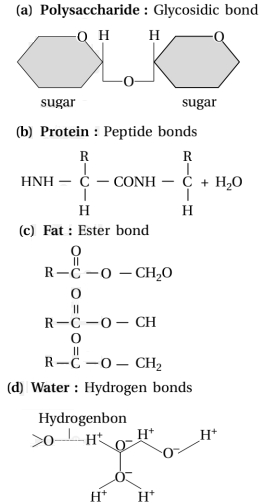
Select an appropriate chemical bond among ester bond,glycosidic bond,peptide bond and hydrogen bond and write against each of the following:
$(a)$ Polysaccharide
$(b)$ Protein
$(c)$ Fat
$(d)$ Water
$(a)$ Polysaccharide
$(b)$ Protein
$(c)$ Fat
$(d)$ Water
Solution
(A-D) Polysaccharide: Glycosidic bond. In polysaccharides,individual monosaccharide units are linked together by glycosidic bonds formed by dehydration synthesis.
$(b)$ Protein: Peptide bond. Proteins are polymers of amino acids,where the carboxyl group of one amino acid reacts with the amino group of another to form a peptide bond.
$(c)$ Fat: Ester bond. Fats (triglycerides) are formed by the esterification of glycerol with three fatty acid molecules,resulting in ester bonds.
$(d)$ Water: Hydrogen bond. Water molecules are held together by hydrogen bonds,which are weak electrostatic attractions between the partial positive charge of a hydrogen atom and the partial negative charge of an oxygen atom in adjacent molecules.
$(b)$ Protein: Peptide bond. Proteins are polymers of amino acids,where the carboxyl group of one amino acid reacts with the amino group of another to form a peptide bond.
$(c)$ Fat: Ester bond. Fats (triglycerides) are formed by the esterification of glycerol with three fatty acid molecules,resulting in ester bonds.
$(d)$ Water: Hydrogen bond. Water molecules are held together by hydrogen bonds,which are weak electrostatic attractions between the partial positive charge of a hydrogen atom and the partial negative charge of an oxygen atom in adjacent molecules.
0 likes
View Solution267
Medium
We commonly call $ATP$ as the energy currency of the cell. Can you think of some other energy carriers present in a cell? Name any two.
Solution
(N/A) Energy carriers are specific molecules that accept,store,and transfer energy required for various cellular chemical processes.
Apart from $ATP$,other important energy carriers present in a cell include $NADH$,$NADPH$,and $FADH_2$. Any two of these can be named as examples.
Apart from $ATP$,other important energy carriers present in a cell include $NADH$,$NADPH$,and $FADH_2$. Any two of these can be named as examples.
0 likes
View Solution268
MediumMCQ
Match the following:
Choose the correct option from the following:
| $(a)$ Inhibitor of catalytic activity | $(i)$ Ricin |
| $(b)$ Possess peptide bonds | $(ii)$ Malonate |
| $(c)$ Cell wall material in fungi | $(iii)$ Chitin |
| $(d)$ Secondary metabolite | $(iv)$ Collagen |
Choose the correct option from the following:
A
$(ii), (iii), (i), (iv)$
B
$(ii), (iv), (iii), (i)$
C
$(iii), (i), (iv), (ii)$
D
$(iii), (iv), (i), (ii)$
Solution
(B) The correct matching is as follows:
$(a)$ Inhibitor of catalytic activity: $(ii)$ Malonate (it acts as a competitive inhibitor of succinate dehydrogenase).
$(b)$ Possess peptide bonds: $(iv)$ Collagen (it is a protein, and proteins are polymers of amino acids linked by peptide bonds).
$(c)$ Cell wall material in fungi: $(iii)$ Chitin (it is a complex polysaccharide forming the fungal cell wall).
$(d)$ Secondary metabolite: $(i)$ Ricin (it is a toxic secondary metabolite produced by plants).
Therefore, the correct sequence is $(a)-(ii), (b)-(iv), (c)-(iii), (d)-(i)$.
$(a)$ Inhibitor of catalytic activity: $(ii)$ Malonate (it acts as a competitive inhibitor of succinate dehydrogenase).
$(b)$ Possess peptide bonds: $(iv)$ Collagen (it is a protein, and proteins are polymers of amino acids linked by peptide bonds).
$(c)$ Cell wall material in fungi: $(iii)$ Chitin (it is a complex polysaccharide forming the fungal cell wall).
$(d)$ Secondary metabolite: $(i)$ Ricin (it is a toxic secondary metabolite produced by plants).
Therefore, the correct sequence is $(a)-(ii), (b)-(iv), (c)-(iii), (d)-(i)$.
0 likes
View Solution269
EasyMCQ
Identify the substances having glycosidic bond and peptide bond,respectively,in their structure.
A
Inulin,insulin
B
Chitin,Cholesterol
C
Glycerol,trypsin
D
Cellulose,lecithin
Solution
(A) $1$. $Inulin$ is a polysaccharide (a polymer of fructose) and therefore contains glycosidic bonds between its monosaccharide units.
$2$. $Insulin$ is a protein (a hormone) composed of amino acids linked together by peptide bonds.
$3$. Therefore,$Inulin$ contains glycosidic bonds and $Insulin$ contains peptide bonds.
$2$. $Insulin$ is a protein (a hormone) composed of amino acids linked together by peptide bonds.
$3$. Therefore,$Inulin$ contains glycosidic bonds and $Insulin$ contains peptide bonds.
0 likes
View Solution270
MediumMCQ
Identify the substances among the following that contain both glycosidic and peptide bonds in their structure.
A
Chitin,Cholesterol
B
Glycerol,Trypsin
C
Cellulose,Lecithin
D
Inulin,Insulin
Solution
(D) $1$. $Inulin$ is a polymer of fructose molecules linked by $\beta-1,2-glycosidic$ bonds. It is a polysaccharide.
$2$. $Insulin$ is a protein hormone composed of two polypeptide chains ($A$ and $B$) linked by disulfide bridges. It contains peptide bonds.
$3$. However,the question asks for substances that contain both bonds. Upon closer inspection of biological molecules,$Inulin$ is a polysaccharide (glycosidic bonds only). $Insulin$ is a protein (peptide bonds only).
$4$. Re-evaluating the options: $Chitin$ is a polysaccharide ($N-acetylglucosamine$ units linked by $\beta-1,4-glycosidic$ bonds). $Cholesterol$ is a lipid.
$5$. Actually,the question likely refers to $Glycoproteins$ or specific complex molecules. Given the options provided,$Inulin$ is a polysaccharide and $Insulin$ is a protein. If the question implies a combination of these types of molecules or a specific complex,$Inulin$ and $Insulin$ are the most distinct representatives of these bond types respectively. However,if we look for a single molecule containing both,it would be a $Glycoprotein$. Since no such option exists,the question likely asks to identify the pair representing these two bond types respectively.
$2$. $Insulin$ is a protein hormone composed of two polypeptide chains ($A$ and $B$) linked by disulfide bridges. It contains peptide bonds.
$3$. However,the question asks for substances that contain both bonds. Upon closer inspection of biological molecules,$Inulin$ is a polysaccharide (glycosidic bonds only). $Insulin$ is a protein (peptide bonds only).
$4$. Re-evaluating the options: $Chitin$ is a polysaccharide ($N-acetylglucosamine$ units linked by $\beta-1,4-glycosidic$ bonds). $Cholesterol$ is a lipid.
$5$. Actually,the question likely refers to $Glycoproteins$ or specific complex molecules. Given the options provided,$Inulin$ is a polysaccharide and $Insulin$ is a protein. If the question implies a combination of these types of molecules or a specific complex,$Inulin$ and $Insulin$ are the most distinct representatives of these bond types respectively. However,if we look for a single molecule containing both,it would be a $Glycoprotein$. Since no such option exists,the question likely asks to identify the pair representing these two bond types respectively.
0 likes
View Solution271
MediumMCQ
Match the following:
Select the correct option:
| $(a)$ Inhibitor of catabolic reaction | $(i)$ Ricin |
| $(b)$ Contains peptide bond | $(ii)$ Malonate |
| $(c)$ Cell wall material in fungi | $(iii)$ Chitin |
| $(d)$ Secondary metabolite | $(iv)$ Collagen |
Select the correct option:
A
$(ii), (iv), (iii), (i)$
B
$(iii), (i), (iv), (ii)$
C
$(iii), (iv), (i), (ii)$
D
$(ii), (iii), (i), (iv)$
Solution
(A) The correct matches are as follows:
$(a)$ Inhibitor of catabolic reaction: $(ii)$ Malonate acts as a competitive inhibitor of succinate dehydrogenase, which is involved in the Krebs cycle (a catabolic pathway).
$(b)$ Contains peptide bond: $(iv)$ Collagen is a protein, and proteins are polymers of amino acids linked by peptide bonds.
$(c)$ Cell wall material in fungi: $(iii)$ Chitin is a complex polysaccharide that forms the structural component of fungal cell walls.
$(d)$ Secondary metabolite: $(i)$ Ricin is a toxic protein produced by the castor plant $(Ricinus \, communis)$, classified as a secondary metabolite.
Therefore, the correct sequence is $(a-ii, b-iv, c-iii, d-i)$.
$(a)$ Inhibitor of catabolic reaction: $(ii)$ Malonate acts as a competitive inhibitor of succinate dehydrogenase, which is involved in the Krebs cycle (a catabolic pathway).
$(b)$ Contains peptide bond: $(iv)$ Collagen is a protein, and proteins are polymers of amino acids linked by peptide bonds.
$(c)$ Cell wall material in fungi: $(iii)$ Chitin is a complex polysaccharide that forms the structural component of fungal cell walls.
$(d)$ Secondary metabolite: $(i)$ Ricin is a toxic protein produced by the castor plant $(Ricinus \, communis)$, classified as a secondary metabolite.
Therefore, the correct sequence is $(a-ii, b-iv, c-iii, d-i)$.
0 likes
View Solution272
EasyMCQ
The yellowish color of cow's milk is due to the presence of which of the following?
A
Carotene
B
Albumin
C
Casein
D
Lactose
Solution
(A) The yellowish tint observed in cow's milk is primarily due to the presence of $Carotene$,which is a fat-soluble pigment found in the diet of the cow (derived from green fodder).
$Casein$ is the primary protein in milk,which gives it a white color.
$Lactose$ is the milk sugar.
$Albumin$ is a type of protein found in milk in smaller quantities.
Therefore,the correct option is $A$.
$Casein$ is the primary protein in milk,which gives it a white color.
$Lactose$ is the milk sugar.
$Albumin$ is a type of protein found in milk in smaller quantities.
Therefore,the correct option is $A$.
0 likes
View Solution273
EasyMCQ
Identify the statement which is incorrect.
A
Tyrosine possesses aromatic ring in its structure
B
Sulphur is an integral part of cysteine
C
Glycine is an example of lipids
D
Lecithin contains phosphorus atom in its structure
Solution
(C) Option $C$ is the correct answer because glycine is the simplest amino acid,not a lipid. The $R$ group in glycine is a hydrogen atom $(H)$. Tyrosine is an aromatic amino acid,cysteine contains a sulphur atom,and lecithin is a phospholipid containing a phosphorus group.
0 likes
View Solution274
EasyMCQ
Match the following:
Select the correct option:
| Column $I$ | Column $II$ |
|---|---|
| $(a)$ Aquaporin | $(i)$ Amide |
| $(b)$ Asparagine | $(ii)$ Polysaccharide |
| $(c)$ Abscisic acid | $(iii)$ Polypeptide |
| $(d)$ Chitin | $(iv)$ Carotenoids |
Select the correct option:
A
$(a)-(iii), (b)-(i), (c)-(ii), (d)-(iv)$
B
$(a)-(iii), (b)-(i), (c)-(iv), (d)-(ii)$
C
$(a)-(ii), (b)-(iii), (c)-(iv), (d)-(i)$
D
$(a)-(ii), (b)-(i), (c)-(iv), (d)-(iii)$
Solution
(B) The correct matches are as follows:
$1$. $(a)$ Aquaporin: It is a membrane protein that facilitates water transport,thus it is a polypeptide $(iii)$.
$2$. $(b)$ Asparagine: It is an amino acid derivative,specifically an amide of aspartic acid $(i)$.
$3$. $(c)$ Abscisic acid: It is a plant hormone derived from carotenoids $(iv)$.
$4$. $(d)$ Chitin: It is a structural homopolysaccharide found in the cell walls of fungi and the exoskeleton of arthropods $(ii)$.
Therefore,the correct sequence is $(a)-(iii), (b)-(i), (c)-(iv), (d)-(ii)$.
$1$. $(a)$ Aquaporin: It is a membrane protein that facilitates water transport,thus it is a polypeptide $(iii)$.
$2$. $(b)$ Asparagine: It is an amino acid derivative,specifically an amide of aspartic acid $(i)$.
$3$. $(c)$ Abscisic acid: It is a plant hormone derived from carotenoids $(iv)$.
$4$. $(d)$ Chitin: It is a structural homopolysaccharide found in the cell walls of fungi and the exoskeleton of arthropods $(ii)$.
Therefore,the correct sequence is $(a)-(iii), (b)-(i), (c)-(iv), (d)-(ii)$.
0 likes
View Solution275
EasyMCQ
Which is not a member of the vitamin $B$ complex group?
A
Retinol
B
Thiamine
C
Riboflavin
D
Pyridoxine
Solution
(A) The vitamin $B$ complex group consists of water-soluble vitamins such as Thiamine $(B_1)$,Riboflavin $(B_2)$,Niacin $(B_3)$,Pantothenic acid $(B_5)$,Pyridoxine $(B_6)$,Biotin $(B_7)$,Folic acid $(B_9)$,and Cobalamin $(B_{12})$.
Retinol is the chemical name for vitamin $A$,which is a fat-soluble vitamin and not a member of the vitamin $B$ complex group.
Therefore,the correct option is $A$.
Retinol is the chemical name for vitamin $A$,which is a fat-soluble vitamin and not a member of the vitamin $B$ complex group.
Therefore,the correct option is $A$.
0 likes
View Solution276
EasyMCQ
Which of the following compounds is known as the antisterility factor?
A
$\alpha$-tocopherol
B
Retinol
C
Calciferol
D
Pyridoxine
Solution
(A) $\alpha$-tocopherol is known as vitamin-$E$.
It is widely recognized as the antisterility factor because it is essential for normal reproductive function.
Deficiency of vitamin-$E$ can lead to reproductive issues,including sterility in certain animals.
It is widely recognized as the antisterility factor because it is essential for normal reproductive function.
Deficiency of vitamin-$E$ can lead to reproductive issues,including sterility in certain animals.
0 likes
View Solution277
EasyMCQ
What is lye?
A
$10 \%$ solution of $NaOH$
B
$10 \%$ solution of $KOH$
C
$10 \%$ solution of $NaCl$
D
$10 \%$ solution of $Na_2CO_3$
Solution
(A) $10 \%$ solution of $NaOH$ (sodium hydroxide) is commonly known as lye.
It is a strong alkaline solution used in the hot process for the manufacturing of soaps (saponification).
It is a strong alkaline solution used in the hot process for the manufacturing of soaps (saponification).
0 likes
View Solution278
EasyMCQ
Vitamin $B_{6}$ is known as
A
Pyridoxine
B
Thiamine
C
Tocopherol
D
Riboflavin
Solution
(A) Vitamin $B_{6}$ is chemically known as pyridoxine.
It is found in various food sources such as fruits,green vegetables,and milk.
$A$ deficiency of Vitamin $B_{6}$ can lead to conditions such as anaemia and skin disorders.
It is found in various food sources such as fruits,green vegetables,and milk.
$A$ deficiency of Vitamin $B_{6}$ can lead to conditions such as anaemia and skin disorders.
0 likes
View Solution279
EasyMCQ
Which of the following vitamins is present in cod-liver oil?
A
$A$
B
$B_{12}$
C
$B_{1}$
D
$C$
Solution
(A) Cod-liver oil is a rich source of fat-soluble vitamins. Specifically,it contains high concentrations of Vitamin $A$ and Vitamin $D$. Among the given options,Vitamin $A$ is the correct choice as it is abundantly found in fish liver oils,egg yolk,and dairy products.
0 likes
View Solution280
EasyMCQ
$A$ chemical substance acts as the currency of energy metabolism in a cell. It is:
A
Adenosine triphosphate
B
Adenosine diphosphate
C
Adenosine monophosphate
D
Glucose
Solution
(A) $ATP$ (Adenosine triphosphate) is known as the energy currency of the cell.
It stores energy in its high-energy phosphate bonds.
When the cell requires energy for metabolic processes,$ATP$ is hydrolyzed to $ADP$ and inorganic phosphate,releasing the stored energy.
It stores energy in its high-energy phosphate bonds.
When the cell requires energy for metabolic processes,$ATP$ is hydrolyzed to $ADP$ and inorganic phosphate,releasing the stored energy.
0 likes
View Solution281
EasyMCQ
Calciferol is
A
Vitamin
B
Antibiotic
C
Hormone
D
Antipyretic
Solution
(A) Calciferol is the chemical name of vitamin $D$.
It is a fat-soluble vitamin that plays a crucial role in calcium absorption and bone health.
It is a fat-soluble vitamin that plays a crucial role in calcium absorption and bone health.
0 likes
View Solution282
EasyMCQ
The catalyst used in the hydrogenation of oils into fats is:
A
$V_{2}O_{5}$
B
$Fe$
C
$Ni$
D
$Pt$
Solution
(C) The process of hydrogenation of oils involves the addition of hydrogen to unsaturated fatty acids (oils) to convert them into saturated fatty acids (fats).
This reaction requires a metal catalyst to facilitate the addition of hydrogen across the double bonds.
Finely divided $Ni$ (Nickel) is the most commonly used catalyst for this industrial process.
Therefore,the correct option is $C$.
This reaction requires a metal catalyst to facilitate the addition of hydrogen across the double bonds.
Finely divided $Ni$ (Nickel) is the most commonly used catalyst for this industrial process.
Therefore,the correct option is $C$.
0 likes
View Solution283
EasyMCQ
Commercial detergents contain mainly:
A
$RONa$
B
$RCOONa$
C
$ROSO_{3}Na$
D
$ROCH_{2}CHORCH_{2}O$
Solution
(C) Commercial detergents are primarily composed of sodium alkyl sulphates or sodium alkyl benzene sulphonates. These compounds contain the $-SO_{3}Na$ or $-OSO_{3}Na$ functional group,which acts as the hydrophilic head. Among the given options,$ROSO_{3}Na$ represents a sodium alkyl sulphate,which is a common type of anionic detergent.
0 likes
View Solution284
EasyMCQ
Which one of the following vitamins contains a metal atom?
A
Riboflavin
B
Vitamin $B_{12}$
C
Vitamin $A$
D
Vitamin $B_{6}$
Solution
(B) Vitamin $B_{12}$,also known as cyanocobalamin,is a complex organic compound that contains a central cobalt $(Co)$ metal ion coordinated within a corrin ring system. Its chemical formula is $C_{63}H_{88}O_{14}N_{14}PCo$. Therefore,it is the only vitamin among the options that contains a metal atom.
0 likes
View Solution285
MediumMCQ
Which of the following vitamins contains an isoprene unit?
A
Vitamin $A$
B
Vitamin $C$
C
Vitamin $B_{2}$
D
Vitamin $D$
Solution
(A) Vitamin $A$ (retinol) is a fat-soluble vitamin that is structurally related to terpenes. It contains a $\beta$-ionone ring and a polyene side chain,which is built from repeating isoprene units $(C_{5}H_{8})$.
0 likes
View Solution286
EasyMCQ
Metal lauryl sulphate acts as:
A
Soap
B
Disinfectant
C
Antiseptic
D
Detergent
Solution
(D) Metal lauryl sulphate,such as sodium lauryl sulphate $(C_{12}H_{25}SO_{4}Na)$,is a type of synthetic detergent.
Synthetic detergents are chemical compounds synthesized in the laboratory that possess properties similar to soaps.
These are surface-active agents (surfactants) that have cleansing capacity.
They are generally sodium or potassium salts of long-chain alkyl benzene sulphonic acids or long-chain alkyl sulphates.
Synthetic detergents are chemical compounds synthesized in the laboratory that possess properties similar to soaps.
These are surface-active agents (surfactants) that have cleansing capacity.
They are generally sodium or potassium salts of long-chain alkyl benzene sulphonic acids or long-chain alkyl sulphates.
0 likes
View Solution287
EasyMCQ
Which vitamin contains $N$?
A
Vitamin $A$
B
Vitamin $C$
C
Vitamin $B$
D
Vitamin $D$
Solution
(C) Nitrogen $(N)$ is a structural component of all $B$-complex vitamins.
For example,Vitamin $B_1$ (thiamine) contains nitrogen in its pyrimidine and thiazole rings.
Vitamin $B_{12}$ (cyanocobalamin) contains a cobalt atom coordinated with nitrogen atoms in a corrin ring.
Therefore,Vitamin $B$ is the correct answer.
For example,Vitamin $B_1$ (thiamine) contains nitrogen in its pyrimidine and thiazole rings.
Vitamin $B_{12}$ (cyanocobalamin) contains a cobalt atom coordinated with nitrogen atoms in a corrin ring.
Therefore,Vitamin $B$ is the correct answer.
0 likes
View Solution288
MediumMCQ
The primary precursor for the production of cholesterol in our body is
A
Acetic acid
B
Citric acid
C
Ethyl alcohol
D
Methanol
Solution
(A) In the human body,cholesterol synthesis occurs primarily in the liver.
The biosynthetic pathway for cholesterol begins with $Acetyl-CoA$,which is derived from acetic acid.
Through a series of complex enzymatic reactions,acetic acid serves as the fundamental carbon source for the synthesis of the cholesterol molecule.
The biosynthetic pathway for cholesterol begins with $Acetyl-CoA$,which is derived from acetic acid.
Through a series of complex enzymatic reactions,acetic acid serves as the fundamental carbon source for the synthesis of the cholesterol molecule.
0 likes
View Solution289
MediumMCQ
$A$: Dextrins are intermediate polysaccharides formed during the hydrolysis of starch into sugar.
$R$: Ascorbic acid is a sugar derivative.
$R$: Ascorbic acid is a sugar derivative.
A
Assertion and Reason both are correct and Reason is the correct explanation of Assertion.
B
Assertion and Reason both are correct but Reason is not the correct explanation of Assertion.
C
Assertion is correct,but Reason is incorrect.
D
Both Assertion and Reason are incorrect.
Solution
(B) Dextrins are indeed intermediate products formed during the partial hydrolysis of starch into maltose and glucose.
Ascorbic acid (Vitamin $C$) is a sugar acid,specifically a derivative of $L$-gulonic acid,which is related to glucose. Therefore,the statement that it is a sugar derivative is scientifically correct.
Since both statements are factually true but the nature of ascorbic acid does not explain the formation of dextrins,the correct option is $B$.
Ascorbic acid (Vitamin $C$) is a sugar acid,specifically a derivative of $L$-gulonic acid,which is related to glucose. Therefore,the statement that it is a sugar derivative is scientifically correct.
Since both statements are factually true but the nature of ascorbic acid does not explain the formation of dextrins,the correct option is $B$.
0 likes
View Solution290
MediumMCQ
In which one of the following is nitrogen not a constituent?
A
Invertase
B
Pepsin
C
Idioblast
D
Bacteriochlorophyll
Solution
(C) Nitrogen is a fundamental component of proteins and many pigments.
$A$. Invertase is an enzyme (protein),which contains nitrogen.
$B$. Pepsin is a digestive enzyme (protein),which contains nitrogen.
$C$. Idioblasts are specialized plant cells that contain crystals of calcium oxalate (raphides) or other substances; they are not a chemical compound but a cell type,and thus do not have nitrogen as a specific chemical constituent in the context of molecular composition.
$D$. Bacteriochlorophyll is a photosynthetic pigment that contains nitrogen in its porphyrin ring structure.
Therefore,the correct answer is $C$.
$A$. Invertase is an enzyme (protein),which contains nitrogen.
$B$. Pepsin is a digestive enzyme (protein),which contains nitrogen.
$C$. Idioblasts are specialized plant cells that contain crystals of calcium oxalate (raphides) or other substances; they are not a chemical compound but a cell type,and thus do not have nitrogen as a specific chemical constituent in the context of molecular composition.
$D$. Bacteriochlorophyll is a photosynthetic pigment that contains nitrogen in its porphyrin ring structure.
Therefore,the correct answer is $C$.
0 likes
View Solution291
EasyMCQ
Energy currency of the cell is:
A
Mitochondria
B
Chloroplast
C
$ATP$
D
Glucose
Solution
(C) $ATP$ (Adenosine Triphosphate) is known as the energy currency of the cell because it stores and provides energy for various cellular processes.
0 likes
View Solution292
EasyMCQ
Deficiency of tocopherol in the human body causes which condition?
A
Beri-beri
B
Pellagra
C
Infertility
D
Scurvy
Solution
(C) Vitamin-$E$,also known as tocopherol,is obtained from sources such as green leafy vegetables,seed oils,milk,cheese,butter,and eggs.
It acts as an antisterility factor and functions as an antioxidant for membrane lipids,skin (reducing keratinization),and hair.
It also helps in reducing atherosclerosis and inhibits the oxidation of vitamin-$A$ and unsaturated fatty acids.
The deficiency of vitamin-$E$ leads to the breakdown of erythrocytes (leading to anaemia),muscular dystrophy (cramps),miscarriage,and reduced fertility.
It acts as an antisterility factor and functions as an antioxidant for membrane lipids,skin (reducing keratinization),and hair.
It also helps in reducing atherosclerosis and inhibits the oxidation of vitamin-$A$ and unsaturated fatty acids.
The deficiency of vitamin-$E$ leads to the breakdown of erythrocytes (leading to anaemia),muscular dystrophy (cramps),miscarriage,and reduced fertility.
0 likes
View Solution293
EasyMCQ
Riboflavin is
A
Vitamin-$B_{12}$
B
Vitamin-$B_{2}$
C
Vitamin-$C$
D
Vitamin-$D$
Solution
(B) Riboflavin is the chemical name for Vitamin-$B_{2}$. It is a water-soluble vitamin that plays a crucial role in energy metabolism and the maintenance of healthy skin and eyes.
0 likes
View Solution294
EasyMCQ
Which of the following vitamins is water-soluble as well as an antioxidant?
A
Vitamin-$B_{1}$
B
Vitamin-$A$
C
Vitamin-$D$
D
Vitamin-$C$
Solution
(D) Vitamins of the $B$-complex group and Vitamin-$C$ are water-soluble,whereas Vitamins-$A, D, E$,and $K$ are fat-soluble.
Vitamin-$C$ (ascorbic acid) acts as a powerful antioxidant in the body.
Citrus fruits are considered rich sources of Vitamin-$C$.
Vitamin-$C$ (ascorbic acid) acts as a powerful antioxidant in the body.
Citrus fruits are considered rich sources of Vitamin-$C$.
0 likes
View Solution295
EasyMCQ
Which of the following metals is present in vitamin $B_{12}$?
A
Cobalt
B
Copper
C
Zinc
D
Magnesium
Solution
(A) Vitamin $B_{12}$,also known as cyanocobalamin,is a complex water-soluble vitamin.
It contains a central cobalt ion coordinated within a corrin ring system,which is structurally similar to the porphyrin ring found in hemoglobin.
Therefore,cobalt is the essential metal present in vitamin $B_{12}$.
It contains a central cobalt ion coordinated within a corrin ring system,which is structurally similar to the porphyrin ring found in hemoglobin.
Therefore,cobalt is the essential metal present in vitamin $B_{12}$.
0 likes
View Solution296
EasyMCQ
Pellagra is caused by the deficiency of
A
Pyridoxine
B
Niacin
C
Folic acid
D
Biotin
Solution
(B) Niacin or nicotinamide (nicotinic acid) is also known as the anti-pellagra vitamin.
Its deficiency causes pellagra,a condition characterized by scaly and pigmented skin.
Deficiency of pyridoxine (Vitamin $B_{6}$) leads to anaemia,neuritic pain,convulsions,and skin lesions.
Deficiency of folic acid causes megaloblastic or macrocytic anaemia.
Deficiency of biotin (Vitamin $B_{7}$ or Vitamin $H$) causes dermatitis and anorexia.
Its deficiency causes pellagra,a condition characterized by scaly and pigmented skin.
Deficiency of pyridoxine (Vitamin $B_{6}$) leads to anaemia,neuritic pain,convulsions,and skin lesions.
Deficiency of folic acid causes megaloblastic or macrocytic anaemia.
Deficiency of biotin (Vitamin $B_{7}$ or Vitamin $H$) causes dermatitis and anorexia.
0 likes
View Solution297
EasyMCQ
Most abundant mineral of animal body is
A
Iron
B
Sodium
C
Potassium
D
Calcium
Solution
(D) The most abundant mineral element in the animal body is $Calcium$.
It is the primary structural component of bones and teeth,providing them with strength and rigidity.
It is the primary structural component of bones and teeth,providing them with strength and rigidity.
0 likes
View Solution298
MediumMCQ
Alcohol is present in which of the following?
A
Vitamin-$D$
B
Vitamin-$B_{2}$
C
Vitamin-$B_{5}$
D
Vitamin-$C$
Solution
(A) Vitamin-$D$ contains an alcohol group in its structure. Specifically,the chemical formula for Vitamin-$D_{3}$ (cholecalciferol) is $C_{27}H_{44}O$,which includes a hydroxyl $(-OH)$ group,characterizing it as an alcohol.
0 likes
View Solution299
MediumMCQ
During starvation,what will be the sequence of digestion of food substrates to meet the energy requirements of the body?
A
Carbohydrate $\rightarrow$ Fat $\rightarrow$ Protein
B
Carbohydrate $\rightarrow$ Protein $\rightarrow$ Fat
C
Fat $\rightarrow$ Protein $\rightarrow$ Carbohydrate
D
Fat $\rightarrow$ Carbohydrate $\rightarrow$ Protein
Solution
(A) During starvation,when the body's energy requirements are not met by ingested food,the body utilizes its stored reserves in a specific order.
First,stored carbohydrates (glycogen) are consumed as they are the primary energy source.
Second,once carbohydrates are depleted,stored fats (adipose tissue) are broken down to provide energy.
Finally,when both carbohydrates and fats are exhausted,proteins are catabolized to meet energy needs.
Proteins are used last because they are the essential structural components of the body.
First,stored carbohydrates (glycogen) are consumed as they are the primary energy source.
Second,once carbohydrates are depleted,stored fats (adipose tissue) are broken down to provide energy.
Finally,when both carbohydrates and fats are exhausted,proteins are catabolized to meet energy needs.
Proteins are used last because they are the essential structural components of the body.
0 likes
View Solution300
EasyMCQ
Which one of the following is an antioxidant vitamin?
A
$C$,$E$ and $A$
B
$B_{1}$ and $B_{4}$
C
$A$,$D$ and $E$
D
$B_{3}$ and $B_{5}$
Solution
(A) Vitamin-$C$,Vitamin-$E$,and $\beta$-carotene (a precursor to Vitamin-$A$) are known as antioxidant vitamins.
These vitamins function by neutralizing free radicals,which are highly reactive molecules containing unpaired electrons that can cause cellular damage.
These vitamins function by neutralizing free radicals,which are highly reactive molecules containing unpaired electrons that can cause cellular damage.
0 likes
View SolutionBiomolecules — Mix Examples- Biomolecules · Frequently Asked Questions
1Are these Biomolecules questions useful for JEE and NEET?
Yes. All questions in this section are mapped to JEE Main and NEET exam patterns. Previous year questions from JEE Main, NEET, GUJCET and state-level exams are included with full solutions.
2Can I switch to Hindi or Gujarati for these questions?
Yes. Use the language tabs in the hero section or the sidebar to view the same questions and solutions in English, Hindi or Gujarati.
3How do I generate a question paper from this subtopic?
Use the Vedclass Exam Paper Generator — select the chapter and subtopic, set difficulty, and generate Sets A, B, C, D automatically. First 3 chapters of every subject are free.
Vedclass Products
For Students
Vedclass Test Series
Mock tests in real JEE/NEET style with performance analysis. 5-day free trial.
Start Free TrialFor Teachers
Exam Paper Generator
Generate Set A/B/C/D papers from this chapter in 2 minutes. 3 chapters free.
Try FreeFor Institutes
Online Exam Module
Live online exams with unlimited students, 360° analytics & white-label branding.
See DemoFor Teachers & Institutes
Generate a Biomolecules Exam Paper in 2 Minutes
Select subtopic & difficulty — Sets A, B, C, D auto-generated with No Repeat logic.
First 3 chapters of every subject are free — no payment required.