
A English
Mix Examples- Biomolecules Questions in English
Class 11 Biology · Biomolecules · Mix Examples- Biomolecules
331+
Questions
English
Language
100%
With Solutions
Showing 31 of 331 questions in English
301
EasyMCQ
Deficiency of which vitamin causes loss of appetite,mental confusion,fatigue,and muscle depreciation?
A
Vitamin-$K$
B
Vitamin-$C$
C
Thiamine
D
Riboflavin
Solution
(C) Thiamine,also known as vitamin-$B_{1}$,is a water-soluble vitamin.
It is essential for carbohydrate metabolism and nerve function.
Sources of thiamine include wheat flour,eggs,meat,liver,and yeast.
Its deficiency leads to conditions such as beri-beri,polyneuritis,and cardiovascular atrophy.
The clinical symptoms of thiamine deficiency include loss of appetite (anorexia),mental confusion,fatigue,muscle depreciation (muscular dystrophy),and heart enlargement.
It is essential for carbohydrate metabolism and nerve function.
Sources of thiamine include wheat flour,eggs,meat,liver,and yeast.
Its deficiency leads to conditions such as beri-beri,polyneuritis,and cardiovascular atrophy.
The clinical symptoms of thiamine deficiency include loss of appetite (anorexia),mental confusion,fatigue,muscle depreciation (muscular dystrophy),and heart enlargement.
0 likes
View Solution302
EasyMCQ
The vitamin containing a cobalt-cyanide linkage is:
A
Vitamin $A$
B
Vitamin $B_{1}$
C
Vitamin $B_{6}$
D
Vitamin $B_{12}$
Solution
(D) Vitamin $B_{12}$,also known as cobalamin,contains a central cobalt ion coordinated to a corrin ring and a cyanide group.
Due to the presence of this cobalt-cyanide linkage,it is chemically referred to as cyanocobalamin.
Due to the presence of this cobalt-cyanide linkage,it is chemically referred to as cyanocobalamin.
0 likes
View Solution303
MediumMCQ
When the body is rapidly oxidizing fat,excessive ketone bodies get accumulated in the body,resulting in the formation of
A
Pyruvic acid
B
Lactic acid
C
Ketoacidosis
D
$ATP$
Solution
(C) Ketoacidosis is a type of metabolic acidosis,which is caused by the high concentration of ketone bodies formed by the breakdown of fatty acids and the deamination of amino acids. Generally,it takes place when there is no adequate glucose for oxidation in the body.
0 likes
View Solution304
MediumMCQ
Haemoglobin contains
A
$Fe^{2+}$
B
$Mg^{2+}$
C
$Na^{+}$
D
$Ca^{2+}$
Solution
(A) Haemoglobin is a respiratory pigment found in red blood cells $(RBCs)$.
It is a conjugated protein consisting of a protein part called globin and a non-protein prosthetic group called heme.
The heme group contains an iron atom in the ferrous state $(Fe^{2+})$,which is responsible for the binding of oxygen molecules to form oxyhaemoglobin.
It is a conjugated protein consisting of a protein part called globin and a non-protein prosthetic group called heme.
The heme group contains an iron atom in the ferrous state $(Fe^{2+})$,which is responsible for the binding of oxygen molecules to form oxyhaemoglobin.
0 likes
View Solution305
EasyMCQ
Vitamin-$E$ is also called:
A
Antisterility vitamin
B
Antihelminthic hormone
C
Inorganic antisterility vitamin
D
None of the above
Solution
(A) Vitamin-$E$ is essential for the maintenance and proper functioning of the reproductive system.
Due to its role in preventing sterility,it is commonly known as the antisterility vitamin.
All vitamins are organic compounds,so option $C$ is incorrect.
Due to its role in preventing sterility,it is commonly known as the antisterility vitamin.
All vitamins are organic compounds,so option $C$ is incorrect.
0 likes
View Solution306
MediumMCQ
Phosphorus is the major constituent of:
$I.$ Biological membranes
$II.$ Nucleic acids
$III.$ Cellular energy
Choose the correct option.
$I.$ Biological membranes
$II.$ Nucleic acids
$III.$ Cellular energy
Choose the correct option.
A
$Only \; I$
B
$Only \; II$
C
$Only \; III$
D
$All \; of \; these$
Solution
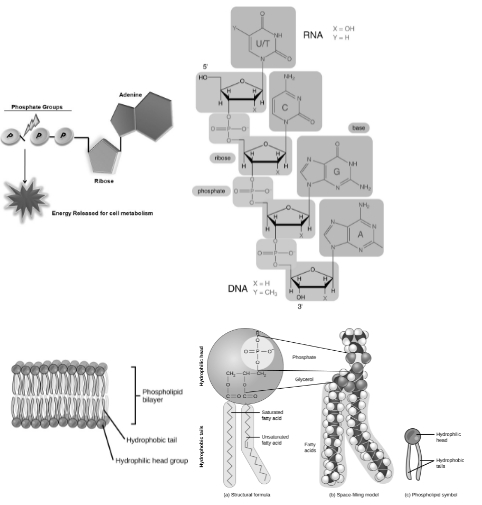
(D) Phosphorus is a vital element for living organisms and is a major constituent of:
$1$. Biological membranes: Phospholipids, which contain phosphate groups, form the structural bilayer of cell membranes.
$2$. Nucleic acids: The backbone of $DNA$ and $RNA$ consists of sugar-phosphate chains, where phosphate groups link the nucleotides.
$3$. Cellular energy: Adenosine triphosphate $(ATP)$ is the primary energy currency of the cell, and its high-energy bonds are formed by phosphate groups.
Therefore, all the given statements are correct.
$1$. Biological membranes: Phospholipids, which contain phosphate groups, form the structural bilayer of cell membranes.
$2$. Nucleic acids: The backbone of $DNA$ and $RNA$ consists of sugar-phosphate chains, where phosphate groups link the nucleotides.
$3$. Cellular energy: Adenosine triphosphate $(ATP)$ is the primary energy currency of the cell, and its high-energy bonds are formed by phosphate groups.
Therefore, all the given statements are correct.
0 likes
View Solution307
MediumMCQ
The amount of usable energy,which is available for doing work,when the temperature and pressure are uniform throughout the system is called
A
Enthalpy
B
Activation energy
C
Spontaneous energy
D
Free energy
Solution
(D) Free energy is the portion of a system's energy that can perform work when temperature and pressure are uniform throughout the system,as in a living cell.
Enthalpy is the total heat content of a system,which includes both usable energy and unusable energy (entropy).
Enthalpy is the total heat content of a system,which includes both usable energy and unusable energy (entropy).
0 likes
View Solution308
MediumMCQ
Match List-$I$ with List-$II$.
Choose the correct answer from the options given below.
| List-$I$ | List-$II$ |
|---|---|
| $(a)$ Protein | $(i)$ $C=C$ double bonds |
| $(b)$ Unsaturated fatty acid | $(ii)$ Phosphodiester bonds |
| $(c)$ Nucleic acid | $(iii)$ Glycosidic bonds |
| $(d)$ Polysaccharide | $(iv)$ Peptide bonds |
Choose the correct answer from the options given below.
A
$(iv)-(i)-(ii)-(iii)$
B
$(i)-(iv)-(iii)-(ii)$
C
$(ii)-(i)-(iv)-(iii)$
D
$(iv)-(iii)-(i)-(ii)$
Solution
(A) The correct matching is as follows:
$(a)$ Protein: Proteins are polymers of amino acids linked by $(iv)$ Peptide bonds.
$(b)$ Unsaturated fatty acid: These contain one or more $(i)$ $C=C$ double bonds in their hydrocarbon chain.
$(c)$ Nucleic acid: Nucleotides in nucleic acids are linked by $(ii)$ Phosphodiester bonds.
$(d)$ Polysaccharide: Monosaccharides in polysaccharides are linked by $(iii)$ Glycosidic bonds.
Therefore,the correct sequence is $(a)-(iv), (b)-(i), (c)-(ii), (d)-(iii)$.
$(a)$ Protein: Proteins are polymers of amino acids linked by $(iv)$ Peptide bonds.
$(b)$ Unsaturated fatty acid: These contain one or more $(i)$ $C=C$ double bonds in their hydrocarbon chain.
$(c)$ Nucleic acid: Nucleotides in nucleic acids are linked by $(ii)$ Phosphodiester bonds.
$(d)$ Polysaccharide: Monosaccharides in polysaccharides are linked by $(iii)$ Glycosidic bonds.
Therefore,the correct sequence is $(a)-(iv), (b)-(i), (c)-(ii), (d)-(iii)$.
0 likes
View Solution309
MediumMCQ
Match List $-I$ with List $-II$.
Choose the correct answer from the options given below:
| List $-I$ (Biological Molecules) | List $-II$ (Biological functions) |
| $(a)$ Glycogen | $(i)$ Hormone |
| $(b)$ Globulin | $(ii)$ Biocatalyst |
| $(c)$ Steroids | $(iii)$ Antibody |
| $(d)$ Thrombin | $(iv)$ Storage product |
Choose the correct answer from the options given below:
A
$(a) - (iv), (b) - (iii), (c) - (i), (d) - (ii)$
B
$(a) - (ii), (b) - (iv), (c) - (iii), (d) - (i)$
C
$(a) - (iv), (b) - (ii), (c) - (i), (d) - (iii)$
D
$(a) - (iii), (b) - (ii), (c) - (iv), (d) - (i)$
Solution
(A) The correct matching is as follows:
$(a)$ Glycogen is a polysaccharide that serves as a storage product in animals.
$(b)$ Globulin is a type of protein that includes antibodies (immunoglobulins) involved in immune defense.
$(c)$ Steroids are a class of lipids that function as hormones (e.g., sex hormones).
$(d)$ Thrombin is a protein enzyme (biocatalyst) involved in the blood clotting process.
Therefore, the correct sequence is $(a)-(iv), (b)-(iii), (c)-(i), (d)-(ii)$.
$(a)$ Glycogen is a polysaccharide that serves as a storage product in animals.
$(b)$ Globulin is a type of protein that includes antibodies (immunoglobulins) involved in immune defense.
$(c)$ Steroids are a class of lipids that function as hormones (e.g., sex hormones).
$(d)$ Thrombin is a protein enzyme (biocatalyst) involved in the blood clotting process.
Therefore, the correct sequence is $(a)-(iv), (b)-(iii), (c)-(i), (d)-(ii)$.
0 likes
View Solution310
MediumMCQ
Choose the correct option from the following.
A
The elements present in the Earth's crust are also found in samples of living tissues.
B
Detailed analysis shows that the amount of carbon and hydrogen is generally higher in any living organism compared to the Earth's crust.
C
Elemental analysis of both living organisms and the Earth's crust reveals the presence of $C$,$H$,$O$,and other elements.
D
All of the above.
Solution
(D) The elemental analysis of Earth's crust and living tissues shows that all the elements present in the Earth's crust are also present in a sample of living tissue.
When comparing the relative abundance of elements,it is observed that carbon and hydrogen are present in significantly higher concentrations in living organisms compared to the Earth's crust.
Both living organisms and non-living matter (Earth's crust) contain the same elements like $C$,$H$,$O$,$N$,$S$,etc.
Therefore,all the given statements are correct.
When comparing the relative abundance of elements,it is observed that carbon and hydrogen are present in significantly higher concentrations in living organisms compared to the Earth's crust.
Both living organisms and non-living matter (Earth's crust) contain the same elements like $C$,$H$,$O$,$N$,$S$,etc.
Therefore,all the given statements are correct.
0 likes
View Solution311
MediumMCQ
Which of the following represents the zwitterionic form of an amino acid?
A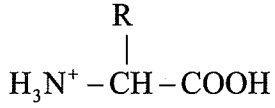
B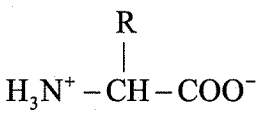
C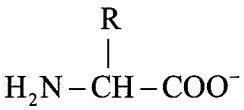
D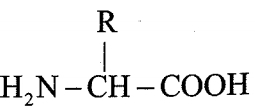
Solution
(B) zwitterion is a molecule that contains an equal number of positively and negatively charged functional groups. In the case of an amino acid,the amino group $(-NH_2)$ acts as a base and accepts a proton to become $-NH_3^+$,while the carboxyl group $(-COOH)$ acts as an acid and loses a proton to become $-COO^-$. This dipolar ion,where the molecule is electrically neutral overall but contains both positive and negative charges,is called a zwitterion. Option $B$ shows the structure $H_3N^+ - CH(R) - COO^-$,which correctly represents this dipolar zwitterionic state.
0 likes
View Solution312
MediumMCQ
Match the following columns:
| Column-$I$ (Polymer) | Column-$II$ (Bond Name) |
|---|---|
| $P$. Polysaccharide | $I$. Ester bond |
| $Q$. Protein | $II$. Peptide bond |
| $R$. Polynucleotide | $III$. Glycosidic bond |
| $S$. Triglyceride | $IV$. Phosphodiester bond |
A
$(P-III), (Q-II), (R-IV), (S-I)$
B
$(P-II), (Q-III), (R-IV), (S-I)$
C
$(P-II), (Q-III), (R-I), (S-IV)$
D
$(P-III), (Q-II), (R-I), (S-IV)$
Solution
(A) The correct matches are as follows:
$1$. Polysaccharides are polymers of monosaccharides linked by glycosidic bonds $(P-III)$.
$2$. Proteins are polymers of amino acids linked by peptide bonds $(Q-II)$.
$3$. Polynucleotides (like $DNA$/$RNA$) consist of nucleotides linked by phosphodiester bonds $(R-IV)$.
$4$. Triglycerides are formed by the esterification of glycerol with fatty acids,resulting in ester bonds $(S-I)$.
Therefore,the correct sequence is $(P-III), (Q-II), (R-IV), (S-I)$.
$1$. Polysaccharides are polymers of monosaccharides linked by glycosidic bonds $(P-III)$.
$2$. Proteins are polymers of amino acids linked by peptide bonds $(Q-II)$.
$3$. Polynucleotides (like $DNA$/$RNA$) consist of nucleotides linked by phosphodiester bonds $(R-IV)$.
$4$. Triglycerides are formed by the esterification of glycerol with fatty acids,resulting in ester bonds $(S-I)$.
Therefore,the correct sequence is $(P-III), (Q-II), (R-IV), (S-I)$.
0 likes
View Solution313
MediumMCQ
Categorize the following processes as Anabolic or Catabolic:
$I -$ Protein synthesis,
$II -$ Lactic acid fermentation,
$III -$ Aerobic respiration,
$IV -$ Alcoholic fermentation,
$V -$ Synthesis of cholesterol from acetic acid,
$VI -$ Photosynthesis,
$VII -$ Digestion,
Identify the Anabolic and Catabolic processes respectively.
$I -$ Protein synthesis,
$II -$ Lactic acid fermentation,
$III -$ Aerobic respiration,
$IV -$ Alcoholic fermentation,
$V -$ Synthesis of cholesterol from acetic acid,
$VI -$ Photosynthesis,
$VII -$ Digestion,
Identify the Anabolic and Catabolic processes respectively.
A
$I, III, V$ and $II, IV, VI, VII$
B
$II, IV, VI, VII$ and $I, III, V$
C
$II, III, IV, VII$ and $I, V, VI$
D
$I, V, VI$ and $II, III, IV, VII$
Solution
(D) Anabolic processes (Anabolism) involve the synthesis of complex molecules from simpler ones,requiring energy. These include:
$I -$ Protein synthesis,
$V -$ Synthesis of cholesterol from acetic acid,
$VI -$ Photosynthesis.
Catabolic processes (Catabolism) involve the breakdown of complex molecules into simpler ones,releasing energy. These include:
$II -$ Lactic acid fermentation,
$III -$ Aerobic respiration,
$IV -$ Alcoholic fermentation,
$VII -$ Digestion.
Therefore,the correct sequence is Anabolic: $(I, V, VI)$ and Catabolic: $(II, III, IV, VII)$.
$I -$ Protein synthesis,
$V -$ Synthesis of cholesterol from acetic acid,
$VI -$ Photosynthesis.
Catabolic processes (Catabolism) involve the breakdown of complex molecules into simpler ones,releasing energy. These include:
$II -$ Lactic acid fermentation,
$III -$ Aerobic respiration,
$IV -$ Alcoholic fermentation,
$VII -$ Digestion.
Therefore,the correct sequence is Anabolic: $(I, V, VI)$ and Catabolic: $(II, III, IV, VII)$.
0 likes
View Solution314
EasyMCQ
What is the full form of $ATP$?
A
Adenine Triphosphate
B
Adenine Tetraphosphate
C
Adenosine Triphosphate
D
Adenosine Tetraphosphate
Solution
(C) $ATP$ stands for Adenosine Triphosphate.
It is a complex organic chemical that provides energy to drive many processes in living cells,such as muscle contraction,nerve impulse propagation,and chemical synthesis.
It consists of an adenosine molecule bonded to three phosphate groups.
It is a complex organic chemical that provides energy to drive many processes in living cells,such as muscle contraction,nerve impulse propagation,and chemical synthesis.
It consists of an adenosine molecule bonded to three phosphate groups.
0 likes
View Solution315
MediumMCQ
Identify the physical and chemical processes from the following:
$I - Ba(OH)_2 + H_2SO_4 \rightarrow BaSO_4 + 2H_2O$
$II -$ Ice $\rightarrow$ Water
$III -$ Water $\rightarrow$ Steam
$IV -$ Starch $\rightarrow$ Glucose
Which of these represent physical processes and chemical processes respectively?
$I - Ba(OH)_2 + H_2SO_4 \rightarrow BaSO_4 + 2H_2O$
$II -$ Ice $\rightarrow$ Water
$III -$ Water $\rightarrow$ Steam
$IV -$ Starch $\rightarrow$ Glucose
Which of these represent physical processes and chemical processes respectively?
A
$I, IV$ and $II, III$
B
$II, III$ and $I, IV$
C
$I, II, III$ and $IV$
D
$IV$ and $I, II, III$
Solution
(B) physical process involves a change in the state of matter without changing the chemical composition of the substance. In $II$ (Ice $\rightarrow$ Water) and $III$ (Water $\rightarrow$ Steam),only the physical state changes,so these are physical processes.
$A$ chemical process involves the formation of new substances with different chemical properties. In $I$ (a neutralization reaction) and $IV$ (hydrolysis of starch into glucose),the chemical composition changes,so these are chemical processes.
Therefore,the physical processes are $II$ and $III$,and the chemical processes are $I$ and $IV$.
$A$ chemical process involves the formation of new substances with different chemical properties. In $I$ (a neutralization reaction) and $IV$ (hydrolysis of starch into glucose),the chemical composition changes,so these are chemical processes.
Therefore,the physical processes are $II$ and $III$,and the chemical processes are $I$ and $IV$.
0 likes
View Solution316
MediumMCQ
The conversion of fatty acids into $CO_2$ and $H_2O$ is called $........$ process,and the synthesis of fatty acids from acetyl $CoA$ is called $........$ process.
A
Catabolic,Catabolic
B
Anabolic,Anabolic
C
Catabolic,Anabolic
D
Anabolic,Catabolic
Solution
(C) The process of breaking down complex molecules into simpler ones to release energy is known as catabolism. The conversion of fatty acids into $CO_2$ and $H_2O$ is a catabolic process.
Conversely,the process of synthesizing complex molecules from simpler precursors is known as anabolism. The synthesis of fatty acids from acetyl $CoA$ is an anabolic process.
Therefore,the correct sequence is catabolic and anabolic.
Conversely,the process of synthesizing complex molecules from simpler precursors is known as anabolism. The synthesis of fatty acids from acetyl $CoA$ is an anabolic process.
Therefore,the correct sequence is catabolic and anabolic.
0 likes
View Solution317
EasyMCQ
What does a bomb calorimeter measure?
A
Energy of food
B
Rate of photosynthesis
C
Rate of respiration
D
Rate of transpiration
Solution
(A) bomb calorimeter is a type of constant-volume calorimeter used in measuring the heat of combustion of a particular reaction. In biological contexts,it is specifically used to determine the gross calorific value or energy content of food samples by burning them in an oxygen-rich environment. The heat released during combustion is measured by the rise in temperature of the surrounding water.
0 likes
View Solution318
MediumMCQ
Match the following columns:
| Column-$I$ | Column-$II$ |
| $P$. Gluconeogenesis | $I$. Conversion of glucose to glycogen |
| $Q$. Glycogenesis | $II$. Conversion of glycogen to glucose |
| $R$. Glycogenolysis | $III$. Formation of glucose from non-carbohydrate sources |
A
$(P-I), (Q-II), (R-III)$
B
$(P-II), (Q-I), (R-III)$
C
$(P-III), (Q-I), (R-II)$
D
$(P-III), (Q-II), (R-I)$
Solution
(C) The correct matches are as follows:
$P$. Gluconeogenesis: This is the process of synthesis of glucose from non-carbohydrate sources like amino acids or glycerol. Thus, $P-III$.
$Q$. Glycogenesis: This is the process of conversion of glucose into glycogen for storage in the liver and muscles. Thus, $Q-I$.
$R$. Glycogenolysis: This is the process of breakdown of glycogen into glucose when the body requires energy. Thus, $R-II$.
Therefore, the correct sequence is $(P-III), (Q-I), (R-II)$.
$P$. Gluconeogenesis: This is the process of synthesis of glucose from non-carbohydrate sources like amino acids or glycerol. Thus, $P-III$.
$Q$. Glycogenesis: This is the process of conversion of glucose into glycogen for storage in the liver and muscles. Thus, $Q-I$.
$R$. Glycogenolysis: This is the process of breakdown of glycogen into glucose when the body requires energy. Thus, $R-II$.
Therefore, the correct sequence is $(P-III), (Q-I), (R-II)$.
0 likes
View Solution319
MediumMCQ
How many of the following biological molecules possess the ability to undergo duplication?
$RNA, DNA,$ Protein,Enzyme,Lipid,Carbohydrate
$RNA, DNA,$ Protein,Enzyme,Lipid,Carbohydrate
A
$1$
B
$2$
C
$3$
D
$4$
Solution
(B) Biological molecules that possess the ability to undergo duplication (replication) are those that can serve as templates for their own synthesis.
$1$. $DNA$: It is the primary genetic material and possesses the inherent ability to replicate itself through the process of $DNA$ replication.
$2$. $RNA$: Certain viruses (e.g.,$RNA$ viruses) use $RNA$ as their genetic material and possess the ability to replicate their $RNA$ genome.
Proteins,enzymes,lipids,and carbohydrates do not possess the inherent ability to undergo self-duplication or replication.
Therefore,only $2$ molecules ($DNA$ and $RNA$) have the ability to undergo duplication.
Thus,the correct option is $B$.
$1$. $DNA$: It is the primary genetic material and possesses the inherent ability to replicate itself through the process of $DNA$ replication.
$2$. $RNA$: Certain viruses (e.g.,$RNA$ viruses) use $RNA$ as their genetic material and possess the ability to replicate their $RNA$ genome.
Proteins,enzymes,lipids,and carbohydrates do not possess the inherent ability to undergo self-duplication or replication.
Therefore,only $2$ molecules ($DNA$ and $RNA$) have the ability to undergo duplication.
Thus,the correct option is $B$.
0 likes
View Solution320
EasyMCQ
In which of the following is phosphorus a major component?
A
Biological membranes
B
Nucleic acids
C
Cellular energy transfer systems
D
All of the above
Solution
(D) Phosphorus is a vital element for living organisms.
$1$. It is a major constituent of biological membranes, specifically phospholipids.
$2$. It is a key component of nucleic acids ($DNA$ and $RNA$), forming the sugar-phosphate backbone.
$3$. It is essential for cellular energy transfer systems, as it is a central part of $ATP$ $(Adenosine Triphosphate)$.
Therefore, all the given options are correct.
$1$. It is a major constituent of biological membranes, specifically phospholipids.
$2$. It is a key component of nucleic acids ($DNA$ and $RNA$), forming the sugar-phosphate backbone.
$3$. It is essential for cellular energy transfer systems, as it is a central part of $ATP$ $(Adenosine Triphosphate)$.
Therefore, all the given options are correct.
0 likes
View Solution321
EasyMCQ
Match List $-I$ with List $-II$ :
Choose the correct answer from the options given below:
| List $-I$ | List $-II$ |
|---|---|
| $a$. Adenine | $i$. Pigment |
| $b$. Anthocyanin | $ii$. Polysaccharide |
| $c$. Chitin | $iii$. Alkaloid |
| $d$. Codeine | $iv$. Purine |
Choose the correct answer from the options given below:
A
$(a) - (iv), (b) - (i), (c) - (ii), (d) - (iii)$
B
$(a) - (iv), (b) - (iii), (c) - (ii), (d) - (i)$
C
$(a) - (iii), (b) - (i), (c) - (iv), (d) - (ii)$
D
$(a) - (i), (b) - (iv), (c) - (iii), (d) - (ii)$
Solution
(A) The correct matching is as follows:
$1$. Adenine is a nitrogenous base belonging to the category of $Purines$.
$2$. Anthocyanin is a secondary metabolite that acts as a $Pigment$.
$3$. Chitin is a structural $Polysaccharide$ found in the cell walls of fungi and the exoskeleton of arthropods.
$4$. Codeine is a secondary metabolite classified as an $Alkaloid$.
Therefore,the correct sequence is $(a) - (iv), (b) - (i), (c) - (ii), (d) - (iii)$.
$1$. Adenine is a nitrogenous base belonging to the category of $Purines$.
$2$. Anthocyanin is a secondary metabolite that acts as a $Pigment$.
$3$. Chitin is a structural $Polysaccharide$ found in the cell walls of fungi and the exoskeleton of arthropods.
$4$. Codeine is a secondary metabolite classified as an $Alkaloid$.
Therefore,the correct sequence is $(a) - (iv), (b) - (i), (c) - (ii), (d) - (iii)$.
0 likes
View Solution322
MediumMCQ
Given below are two statements:
Statement $I$: Low temperature preserves the enzyme in a temporarily inactive state,whereas high temperature destroys enzymatic activity because proteins are denatured by heat.
Statement $II$: When the inhibitor closely resembles the substrate in its molecular structure and inhibits the activity of the enzyme,it is known as a competitive inhibitor.
In the light of the above statements,choose the correct answer from the options given below:
Statement $I$: Low temperature preserves the enzyme in a temporarily inactive state,whereas high temperature destroys enzymatic activity because proteins are denatured by heat.
Statement $II$: When the inhibitor closely resembles the substrate in its molecular structure and inhibits the activity of the enzyme,it is known as a competitive inhibitor.
In the light of the above statements,choose the correct answer from the options given below:
A
Statement $I$ is false but Statement $II$ is true.
B
Both Statement $I$ and Statement $II$ are true.
C
Both Statement $I$ and Statement $II$ are false.
D
Statement $I$ is true but Statement $II$ is false.
Solution
(B) Statement $I$ is true: Enzymes are proteins. At low temperatures,enzymes remain in an inactive state but are not destroyed; they can regain activity when the temperature increases. At high temperatures,the hydrogen bonds and other stabilizing forces in the protein structure break,leading to denaturation and permanent loss of enzymatic activity.
Statement $II$ is true: $A$ competitive inhibitor has a molecular structure similar to the substrate. Because of this structural similarity,it competes with the substrate for the active site of the enzyme,thereby inhibiting the reaction.
Therefore,both statements are correct.
Statement $II$ is true: $A$ competitive inhibitor has a molecular structure similar to the substrate. Because of this structural similarity,it competes with the substrate for the active site of the enzyme,thereby inhibiting the reaction.
Therefore,both statements are correct.
0 likes
View Solution323
MediumMCQ
Given below are two statements:
Statement $I$: $A$ protein is imagined as a line,the left end represented by the first amino acid ($N$-terminal) and the right end represented by the last amino acid ($C$-terminal).
Statement $II$: Adult human haemoglobin consists of $4$ subunits (two subunits of $\alpha$ type and two subunits of $\beta$ type).
In the light of the above statements,choose the correct answer from the options given below:
Statement $I$: $A$ protein is imagined as a line,the left end represented by the first amino acid ($N$-terminal) and the right end represented by the last amino acid ($C$-terminal).
Statement $II$: Adult human haemoglobin consists of $4$ subunits (two subunits of $\alpha$ type and two subunits of $\beta$ type).
In the light of the above statements,choose the correct answer from the options given below:
A
Statement $I$ is false but Statement $II$ is true.
B
Both Statement $I$ and Statement $II$ are true.
C
Both Statement $I$ and Statement $II$ are false.
D
Statement $I$ is true but Statement $II$ is false.
Solution
(A) Statement $I$ is false because,by convention,a protein is represented as a line where the left end is the first amino acid ($N$-terminal) and the right end is the last amino acid ($C$-terminal). The statement incorrectly swapped these terminals.
Statement $II$ is true because adult human haemoglobin is a quaternary structure composed of $4$ polypeptide subunits: two $\alpha$-subunits and two $\beta$-subunits.
Therefore,Statement $I$ is false and Statement $II$ is true.
Statement $II$ is true because adult human haemoglobin is a quaternary structure composed of $4$ polypeptide subunits: two $\alpha$-subunits and two $\beta$-subunits.
Therefore,Statement $I$ is false and Statement $II$ is true.
0 likes
View Solution324
EasyMCQ
Identify the incorrect pair:
A
Palmitic acid $-$ fatty acid
B
Serine $-$ Amino acid
C
Uracil $-$ Nucleoside
D
Lecithin $-$ Phospholipid
Solution
(C) In biological molecules, $Palmitic acid$ is a saturated fatty acid with $16$ carbons.
$Serine$ is a polar amino acid.
$Lecithin$ is a well-known phospholipid found in cell membranes.
$Uracil$ is a nitrogenous base (pyrimidine), not a nucleoside. $A$ nucleoside consists of a nitrogenous base attached to a sugar molecule. Therefore, the pair $Uracil - \text{Nucleoside}$ is incorrect.
$Serine$ is a polar amino acid.
$Lecithin$ is a well-known phospholipid found in cell membranes.
$Uracil$ is a nitrogenous base (pyrimidine), not a nucleoside. $A$ nucleoside consists of a nitrogenous base attached to a sugar molecule. Therefore, the pair $Uracil - \text{Nucleoside}$ is incorrect.
0 likes
View Solution325
EasyMCQ
On its hydrolysis,an $ATP$ molecule releases . . . . . . $K.cal$ of energy.
A
$8$
B
$7.8$
C
$7.3$
D
$7.2$
Solution
(C) The hydrolysis of $ATP$ (Adenosine Triphosphate) into $ADP$ (Adenosine Diphosphate) and inorganic phosphate $(Pi)$ is an exergonic reaction.
This reaction releases approximately $7.3 \ K.cal$ of energy per mole of $ATP$ under standard biological conditions.
Therefore,the correct option is $C$.
This reaction releases approximately $7.3 \ K.cal$ of energy per mole of $ATP$ under standard biological conditions.
Therefore,the correct option is $C$.
0 likes
View Solution326
EasyMCQ
Which of the following sets includes all fat-soluble vitamins?
A
$C, D, K$ and $E$ only
B
$A, D, E$ and $K$ only
C
$B, C$ and $E$ only
D
$A, B$ and $C$ only
Solution
(B) Vitamins are classified into two categories based on their solubility:
$1$. Water-soluble vitamins: These include Vitamin $B$ complex and Vitamin $C$.
$2$. Fat-soluble vitamins: These include Vitamin $A, D, E$ and $K$.
Fat-soluble vitamins are stored in the body's fatty tissues and the liver. Therefore,the set containing all fat-soluble vitamins is $A, D, E$ and $K$.
$1$. Water-soluble vitamins: These include Vitamin $B$ complex and Vitamin $C$.
$2$. Fat-soluble vitamins: These include Vitamin $A, D, E$ and $K$.
Fat-soluble vitamins are stored in the body's fatty tissues and the liver. Therefore,the set containing all fat-soluble vitamins is $A, D, E$ and $K$.
0 likes
View Solution327
Easy
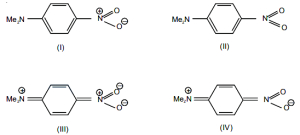
The provided image shows chemical structures related to resonance and electronic effects. Identify the correct relationship or description for these structures.
Solution
(A) The structures represent different resonance contributors of $p$-nitro-$N,N$-dimethylaniline.
Structure $(I)$ is the neutral form with a nitro group.
Structure $(II)$ is another representation.
Structures $(III)$ and $(IV)$ involve charge separation resulting from the strong $+M$ effect of the dimethylamino group and the $-M$ effect of the nitro group,leading to a quinonoid structure.
These structures illustrate the delocalization of electrons across the benzene ring.
Structure $(I)$ is the neutral form with a nitro group.
Structure $(II)$ is another representation.
Structures $(III)$ and $(IV)$ involve charge separation resulting from the strong $+M$ effect of the dimethylamino group and the $-M$ effect of the nitro group,leading to a quinonoid structure.
These structures illustrate the delocalization of electrons across the benzene ring.
0 likes
View Solution328
EasyMCQ
How much energy is liberated when $25$ $ATP$ molecules are hydrolysed to $ADP$ (in $\text{ Kcal}$)?
A
$7.3$
B
$182.50$
C
$277.40$
D
$686$
Solution
(B) The hydrolysis of $1$ mole of $ATP$ into $ADP$ and inorganic phosphate releases approximately $7.3 \text{ Kcal}$ of energy.
Therefore,for $25$ molecules of $ATP$,the total energy liberated is calculated as:
$\text{Total Energy} = 25 \times 7.3 \text{ Kcal} = 182.50 \text{ Kcal}$.
Thus,the correct option is $B$.
Therefore,for $25$ molecules of $ATP$,the total energy liberated is calculated as:
$\text{Total Energy} = 25 \times 7.3 \text{ Kcal} = 182.50 \text{ Kcal}$.
Thus,the correct option is $B$.
0 likes
View Solution329
EasyMCQ
Column-$I$ contains some terms and Column-$II$ contains their meanings. Match them properly and choose the right answer.
| Column-$I$ | Column-$II$ |
|---|---|
| $A$. Glycogenesis | $1$. Conversion of glycogen to glucose |
| $B$. Glycosuria | $2$. Conversion of glucose to glycogen |
| $C$. Gluconeogenesis | $3$. Excretion of glucose in urine |
| $D$. Glycogenolysis | $4$. Conversion of non-carbohydrate sources to glucose |
| $5$. Conversion of glucose to starch |
A
$A-2, B-3, C-4, D-1$
B
$A-1, B-3, C-4, D-2$
C
$A-2, B-1, C-3, D-4$
D
$A-1, B-5, C-2, D-4$
Solution
(A) The correct matching is $A-2, B-3, C-4, D-1$.
• Glycogenesis $(A-2)$: The process of conversion of glucose to glycogen for storage in the liver and muscles.
• Glycosuria $(B-3)$: The presence of excess glucose in the urine,often associated with diabetes mellitus.
• Gluconeogenesis $(C-4)$: The synthesis of glucose from non-carbohydrate precursors like amino acids,glycerol,and lactate.
• Glycogenolysis $(D-1)$: The breakdown of stored glycogen into glucose to maintain blood sugar levels.
• Glycogenesis $(A-2)$: The process of conversion of glucose to glycogen for storage in the liver and muscles.
• Glycosuria $(B-3)$: The presence of excess glucose in the urine,often associated with diabetes mellitus.
• Gluconeogenesis $(C-4)$: The synthesis of glucose from non-carbohydrate precursors like amino acids,glycerol,and lactate.
• Glycogenolysis $(D-1)$: The breakdown of stored glycogen into glucose to maintain blood sugar levels.
0 likes
View Solution330
MediumMCQ
Match List-$I$ with List-$II$:
Choose the correct answer from the options given below:
| $A$. Trypsin | $I$. Intercellular ground substance |
| $B$. Morphine | $II$. Lectin |
| $C$. Concanavalin | $III$. Enzyme |
| $D$. Collagen | $IV$. Alkaloid |
Choose the correct answer from the options given below:
A
$A-III, B-IV, C-II, D-I$
B
$A-IV, B-III, C-II, D-I$
C
$A-I, B-II, C-III, D-IV$
D
$A-III, B-II, C-IV, D-I$
Solution
(A) The correct matches are as follows:
$1$. Trypsin is a protein that acts as an enzyme $(A-III)$.
$2$. Morphine is a secondary metabolite classified as an alkaloid $(B-IV)$.
$3$. Concanavalin $A$ is a secondary metabolite classified as a lectin $(C-II)$.
$4$. Collagen is the most abundant protein in the animal world and forms the intercellular ground substance $(D-I)$.
Therefore,the correct matching is $A-III, B-IV, C-II, D-I$.
$1$. Trypsin is a protein that acts as an enzyme $(A-III)$.
$2$. Morphine is a secondary metabolite classified as an alkaloid $(B-IV)$.
$3$. Concanavalin $A$ is a secondary metabolite classified as a lectin $(C-II)$.
$4$. Collagen is the most abundant protein in the animal world and forms the intercellular ground substance $(D-I)$.
Therefore,the correct matching is $A-III, B-IV, C-II, D-I$.
0 likes
View Solution331
MediumMCQ
Identify the correct statements about biomolecules.
A
$A$. Lipids are generally water soluble.
B
$B$. Proteins are polypeptides.
C
$C$. Polysaccharides are long chains of sugars.
D
$D$. Adenine and guanine are substituted pyrimidines.
Solution
(B, C, E) . Incorrect: Lipids are hydrophobic and generally water-insoluble.
$B$. Correct: Proteins are polymers of amino acids linked by peptide bonds,hence they are polypeptides.
$C$. Correct: Polysaccharides are complex carbohydrates formed by long chains of monosaccharide units.
$D$. Incorrect: Adenine and guanine are purines,not pyrimidines.
$E$. Correct: Most enzymes are proteinaceous in nature,with the exception of some $RNA$ molecules known as ribozymes.
Therefore,the correct statements are $B, C,$ and $E$.
$B$. Correct: Proteins are polymers of amino acids linked by peptide bonds,hence they are polypeptides.
$C$. Correct: Polysaccharides are complex carbohydrates formed by long chains of monosaccharide units.
$D$. Incorrect: Adenine and guanine are purines,not pyrimidines.
$E$. Correct: Most enzymes are proteinaceous in nature,with the exception of some $RNA$ molecules known as ribozymes.
Therefore,the correct statements are $B, C,$ and $E$.
0 likes
View SolutionBiomolecules — Mix Examples- Biomolecules · Frequently Asked Questions
1Are these Biomolecules questions useful for JEE and NEET?
Yes. All questions in this section are mapped to JEE Main and NEET exam patterns. Previous year questions from JEE Main, NEET, GUJCET and state-level exams are included with full solutions.
2Can I switch to Hindi or Gujarati for these questions?
Yes. Use the language tabs in the hero section or the sidebar to view the same questions and solutions in English, Hindi or Gujarati.
3How do I generate a question paper from this subtopic?
Use the Vedclass Exam Paper Generator — select the chapter and subtopic, set difficulty, and generate Sets A, B, C, D automatically. First 3 chapters of every subject are free.
Vedclass Products
For Students
Vedclass Test Series
Mock tests in real JEE/NEET style with performance analysis. 5-day free trial.
Start Free TrialFor Teachers
Exam Paper Generator
Generate Set A/B/C/D papers from this chapter in 2 minutes. 3 chapters free.
Try FreeFor Institutes
Online Exam Module
Live online exams with unlimited students, 360° analytics & white-label branding.
See DemoFor Teachers & Institutes
Generate a Biomolecules Exam Paper in 2 Minutes
Select subtopic & difficulty — Sets A, B, C, D auto-generated with No Repeat logic.
First 3 chapters of every subject are free — no payment required.