
A English
Mix Examples- Biomolecules Questions in English
Class 11 Biology · Biomolecules · Mix Examples- Biomolecules
331+
Questions
English
Language
100%
With Solutions
Showing 50 of 331 questions in English
201
EasyMCQ
Which of the following is the correct structure of guanine?
A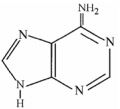
Adenine structure
B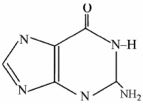
Guanine structure
C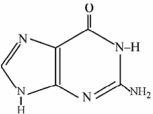
Guanine structure (alternative representation)
D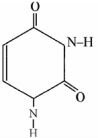
Uracil structure
Solution
(C) Guanine is a purine base found in $DNA$ and $RNA$. Its chemical structure consists of a fused pyrimidine and imidazole ring system. The correct structure of guanine includes a carbonyl group $(C=O)$ at the $6^{th}$ position and an amino group $(-NH_2)$ at the $2^{nd}$ position of the purine ring. Option $C$ correctly represents the chemical structure of guanine.
0 likes
View Solution202
MediumMCQ
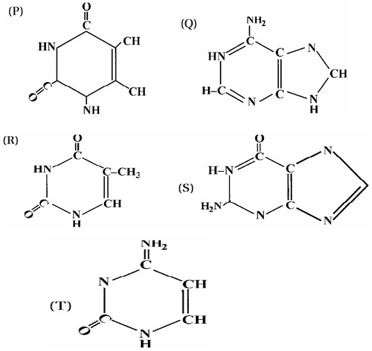
The given figures represent the nitrogenous bases of nucleic acids. Identify the correct group.
A
$P$ = Uracil,$Q$ = Adenine,$R$ = Thymine,$S$ = Guanine,$T$ = Cytosine
B
$P$ = Uracil,$Q$ = Guanine,$R$ = Cytosine,$S$ = Adenine,$T$ = Thymine
C
$P$ = Uracil,$Q$ = Guanine,$R$ = Thymine,$S$ = Adenine,$T$ = Cytosine
D
$P$ = Thymine,$Q$ = Guanine,$R$ = Uracil,$S$ = Adenine,$T$ = Cytosine
Solution
(A) By analyzing the chemical structures of the nitrogenous bases:
$1$. Structure $(P)$ is a pyrimidine with two carbonyl groups and no methyl group,which is Uracil.
$2$. Structure $(Q)$ is a purine with an amino group at position $6$,which is Adenine.
$3$. Structure $(R)$ is a pyrimidine with a methyl group at position $5$,which is Thymine ($5$-methyluracil).
$4$. Structure $(S)$ is a purine with an amino group at position $2$ and a carbonyl group at position $6$,which is Guanine.
$5$. Structure $(T)$ is a pyrimidine with an amino group at position $4$ and a carbonyl group at position $2$,which is Cytosine.
Therefore,the correct identification is: $P$ = Uracil,$Q$ = Adenine,$R$ = Thymine,$S$ = Guanine,$T$ = Cytosine.
$1$. Structure $(P)$ is a pyrimidine with two carbonyl groups and no methyl group,which is Uracil.
$2$. Structure $(Q)$ is a purine with an amino group at position $6$,which is Adenine.
$3$. Structure $(R)$ is a pyrimidine with a methyl group at position $5$,which is Thymine ($5$-methyluracil).
$4$. Structure $(S)$ is a purine with an amino group at position $2$ and a carbonyl group at position $6$,which is Guanine.
$5$. Structure $(T)$ is a pyrimidine with an amino group at position $4$ and a carbonyl group at position $2$,which is Cytosine.
Therefore,the correct identification is: $P$ = Uracil,$Q$ = Adenine,$R$ = Thymine,$S$ = Guanine,$T$ = Cytosine.
0 likes
View Solution203
MediumMCQ
Which of the following statements is false?
A
Glucose-$6$-phosphate,phosphoglucose isomerase $\rightarrow$ Fructose-$6$-phosphate
B
Maltose + $H_2O \rightarrow$ Glucose + Galactose
C
The suffix $-ase$ is added to the name of an enzyme.
D
Calcium is used as a component of human food.
Solution
(B) Statement $B$ is false. Maltose is a disaccharide composed of two glucose units. The hydrolysis of maltose by the enzyme maltase yields two molecules of glucose $(Maltose + H_2O \rightarrow Glucose + Glucose)$. The reaction provided in option $B$ describes the hydrolysis of lactose,not maltose. Option $A$ is correct as phosphoglucose isomerase catalyzes the conversion of glucose-$6$-phosphate to fructose-$6$-phosphate. Option $C$ is correct as enzymes are typically named by adding the suffix $-ase$ to the substrate or reaction type. Option $D$ is correct as calcium is an essential mineral required for human health.
0 likes
View Solution204
MediumMCQ
Statement $P$: $A$ water molecule must be added to form a complex organic substance.
Statement $Q$: $\text{Maltose} + H_2O \xrightarrow{\text{hydrolysis}} \text{Glucose} + \text{Glucose}$
Statement $Q$: $\text{Maltose} + H_2O \xrightarrow{\text{hydrolysis}} \text{Glucose} + \text{Glucose}$
A
Statement $P$ is false,Statement $Q$ is true.
B
Statement $P$ is true,Statement $Q$ is false.
C
Both Statement $P$ and Statement $Q$ are false.
D
Both Statement $P$ and Statement $Q$ are true.
Solution
$(A)$ Statement $P$ is false because the formation of complex organic substances (like polysaccharides,proteins,or nucleic acids) from monomers typically involves a dehydration synthesis (condensation) reaction,where a water molecule is removed,not added.
Statement $Q$ is true because the hydrolysis of maltose (a disaccharide) involves the addition of a water molecule to break the glycosidic bond,resulting in two glucose molecules.
Therefore,Statement $P$ is false and Statement $Q$ is true.
Statement $Q$ is true because the hydrolysis of maltose (a disaccharide) involves the addition of a water molecule to break the glycosidic bond,resulting in two glucose molecules.
Therefore,Statement $P$ is false and Statement $Q$ is true.
0 likes
View Solution205
EasyMCQ
Match the following columns:
| Column $I$ | Column $II$ |
|---|---|
| $(A)$ $NAD$ | $(i)$ Nicotinamide Adenine Dinucleotide Phosphate |
| $(B)$ $NADP$ | $(ii)$ Flavin Mononucleotide |
| $(C)$ $FAD$ | $(iii)$ Nicotinamide Adenine Dinucleotide |
| $(D)$ $FMN$ | $(iv)$ Flavin Adenine Dinucleotide |
A
$(A-iii), (B-i), (C-iv), (D-ii)$
B
$(A-i), (B-ii), (C-iii), (D-iv)$
C
$(A-iv), (B-iii), (C-ii), (D-i)$
D
$(A-ii), (B-iii), (C-iv), (D-i)$
Solution
(A) The correct matches are as follows:
$(A)$ $NAD$ stands for Nicotinamide Adenine Dinucleotide,which corresponds to $(iii)$.
$(B)$ $NADP$ stands for Nicotinamide Adenine Dinucleotide Phosphate,which corresponds to $(i)$.
$(C)$ $FAD$ stands for Flavin Adenine Dinucleotide,which corresponds to $(iv)$.
$(D)$ $FMN$ stands for Flavin Mononucleotide,which corresponds to $(ii)$.
Therefore,the correct sequence is $(A-iii), (B-i), (C-iv), (D-ii)$.
$(A)$ $NAD$ stands for Nicotinamide Adenine Dinucleotide,which corresponds to $(iii)$.
$(B)$ $NADP$ stands for Nicotinamide Adenine Dinucleotide Phosphate,which corresponds to $(i)$.
$(C)$ $FAD$ stands for Flavin Adenine Dinucleotide,which corresponds to $(iv)$.
$(D)$ $FMN$ stands for Flavin Mononucleotide,which corresponds to $(ii)$.
Therefore,the correct sequence is $(A-iii), (B-i), (C-iv), (D-ii)$.
0 likes
View Solution206
EasyMCQ
Which of the following is incorrect?
A
$FAD$ - Flavin Adenine Dinucleotide
B
$NAD$ - Nicotinamide Adenine Dinucleotide
C
$FMN$ - Flavin Mononucleotide
D
$ATP$ - Adenosine Tri-nucleotide Phosphate
Solution
(D) The correct expansion of $ATP$ is Adenosine Triphosphate. It is a nucleotide consisting of an adenosine molecule bonded to three phosphate groups. The term 'Tri-nucleotide' is incorrect as it implies three nucleotides,whereas $ATP$ is a single nucleotide with three phosphate groups.
0 likes
View Solution207
EasyMCQ
Which of the following pairs is mismatched?
A
Purine - Cytosine
B
Pyrimidine - Uracil
C
Cysteine - Polar and uncharged
D
Hexokinase - Transferases
Solution
(A) $1$. Purines are double-ring nitrogenous bases,which include Adenine $(A)$ and Guanine $(G)$. Cytosine $(C)$ is a pyrimidine (single-ring structure). Therefore,the pair Purine-Cytosine is mismatched.
$2$. Pyrimidines are single-ring nitrogenous bases,which include Cytosine $(C)$,Thymine $(T)$,and Uracil $(U)$. Thus,Pyrimidine-Uracil is a correct match.
$3$. Cysteine is an amino acid with a sulfhydryl group,classified as polar and uncharged. This is a correct match.
$4$. Hexokinase is an enzyme that catalyzes the transfer of a phosphate group from $ATP$ to glucose,belonging to the class of Transferases. This is a correct match.
$2$. Pyrimidines are single-ring nitrogenous bases,which include Cytosine $(C)$,Thymine $(T)$,and Uracil $(U)$. Thus,Pyrimidine-Uracil is a correct match.
$3$. Cysteine is an amino acid with a sulfhydryl group,classified as polar and uncharged. This is a correct match.
$4$. Hexokinase is an enzyme that catalyzes the transfer of a phosphate group from $ATP$ to glucose,belonging to the class of Transferases. This is a correct match.
0 likes
View Solution208
MediumMCQ
Match the items in Column-$I$ with Column-$II$ and select the correct option.
| Column-$I$ | Column-$II$ |
|---|---|
| $(A)$ Aspartic acid | $(i)$ Two $\alpha$-chains and two $\beta$-chains |
| $(B)$ Haemoglobin | $(ii)$ $FMN$ |
| $(C)$ Cytoplasm | $(iii)$ Nitrogen fixation |
| $(D)$ Azotobacter | $(iv)$ Site of protein synthesis |
| $(v)$ Polar and negatively charged amino acid |
A
$(A-v), (B-i), (C-iv), (D-iii)$
B
$(A-v), (B-ii), (C-iii), (D-iv)$
C
$(A-iii), (B-iv), (C-v), (D-ii)$
D
$(A-ii), (B-iii), (C-iv), (D-v)$
Solution
(A) The correct matching is as follows:
$1$. Aspartic acid $(A)$ is a polar and negatively charged amino acid $(v)$.
$2$. Haemoglobin $(B)$ is a quaternary protein consisting of two $\alpha$-chains and two $\beta$-chains $(i)$.
$3$. Cytoplasm $(C)$ is the site of protein synthesis (specifically,ribosomes within the cytoplasm) $(iv)$.
$4$. Azotobacter $(D)$ is a free-living bacterium known for nitrogen fixation $(iii)$.
Therefore,the correct sequence is $(A-v), (B-i), (C-iv), (D-iii)$.
$1$. Aspartic acid $(A)$ is a polar and negatively charged amino acid $(v)$.
$2$. Haemoglobin $(B)$ is a quaternary protein consisting of two $\alpha$-chains and two $\beta$-chains $(i)$.
$3$. Cytoplasm $(C)$ is the site of protein synthesis (specifically,ribosomes within the cytoplasm) $(iv)$.
$4$. Azotobacter $(D)$ is a free-living bacterium known for nitrogen fixation $(iii)$.
Therefore,the correct sequence is $(A-v), (B-i), (C-iv), (D-iii)$.
0 likes
View Solution209
MediumMCQ
Match the following columns:
| Column $I$ | Column $II$ |
|---|---|
| $A$. Starch | $i$. Protein synthesis |
| $B$. Hemoglobin | $ii$. Sex hormones |
| $C$. $RNA$ | $iii$. Storage product |
| $D$. Steroids | $iv$. Transport of gases |
A
$A-iii, B-i, C-iv, D-ii$
B
$A-iii, B-iv, C-i, D-ii$
C
$A-iv, B-iii, C-i, D-ii$
D
$A-iii, B-iv, C-ii, D-i$
Solution
(B) The correct matches are as follows:
$1$. Starch $(A)$ is a polysaccharide that acts as a storage product $(iii)$ in plants.
$2$. Hemoglobin $(B)$ is a respiratory pigment in blood responsible for the transport of gases $(iv)$,specifically oxygen and carbon dioxide.
$3$. $RNA$ $(C)$ plays a crucial role in protein synthesis $(i)$ within the cell.
$4$. Steroids $(D)$ are a class of lipids that include various sex hormones $(ii)$ like testosterone and estrogen.
Therefore,the correct sequence is $A-iii, B-iv, C-i, D-ii$.
$1$. Starch $(A)$ is a polysaccharide that acts as a storage product $(iii)$ in plants.
$2$. Hemoglobin $(B)$ is a respiratory pigment in blood responsible for the transport of gases $(iv)$,specifically oxygen and carbon dioxide.
$3$. $RNA$ $(C)$ plays a crucial role in protein synthesis $(i)$ within the cell.
$4$. Steroids $(D)$ are a class of lipids that include various sex hormones $(ii)$ like testosterone and estrogen.
Therefore,the correct sequence is $A-iii, B-iv, C-i, D-ii$.
0 likes
View Solution210
MediumMCQ
Select the correct match for $X$ and $Y$:
| Column $X$ | Column $Y$ |
| $(1)$ Skin color | $(P)$ Immunoglobulin |
| $(2)$ Immunity | $(Q)$ $Mg^{+2}$ containing protein |
| $(3)$ Movement | $(R)$ Melanin |
| $(4)$ Exoskeleton | $(S)$ Protein with four heme groups |
| $(5)$ Photosynthesis | $(T)$ Keratin |
| $(6)$ Transport of respiratory gases | $(U)$ Globular protein |
A
$(1-T), (2-U), (3-R), (4-Q), (5-S), (6-P)$
B
$(1-R), (2-P), (3-U), (4-T), (5-Q), (6-S)$
C
$(1-Q), (2-P), (3-S), (4-R), (5-U), (6-T)$
D
$(1-T), (2-U), (3-S), (4-R), (5-Q), (6-P)$
Solution
(B) The correct matches are as follows:
$(1)$ Skin color is determined by the pigment Melanin $(R)$.
$(2)$ Immunity is provided by antibodies, which are Immunoglobulins $(P)$.
$(3)$ Movement is facilitated by proteins like actin and myosin, which are Globular proteins $(U)$.
$(4)$ Exoskeleton (hair, nails) is formed by the structural protein Keratin $(T)$.
$(5)$ Photosynthesis involves chlorophyll, which is a $Mg^{+2}$ containing porphyrin complex $(Q)$.
$(6)$ Transport of respiratory gases is performed by Hemoglobin, which is a protein with four heme groups $(S)$.
Thus, the correct sequence is $(1-R), (2-P), (3-U), (4-T), (5-Q), (6-S)$.
$(1)$ Skin color is determined by the pigment Melanin $(R)$.
$(2)$ Immunity is provided by antibodies, which are Immunoglobulins $(P)$.
$(3)$ Movement is facilitated by proteins like actin and myosin, which are Globular proteins $(U)$.
$(4)$ Exoskeleton (hair, nails) is formed by the structural protein Keratin $(T)$.
$(5)$ Photosynthesis involves chlorophyll, which is a $Mg^{+2}$ containing porphyrin complex $(Q)$.
$(6)$ Transport of respiratory gases is performed by Hemoglobin, which is a protein with four heme groups $(S)$.
Thus, the correct sequence is $(1-R), (2-P), (3-U), (4-T), (5-Q), (6-S)$.
0 likes
View Solution211
EasyMCQ
Select the correct match for $X$ and $Y$:
| Column $X$ | Column $Y$ |
| $(1)$ Actin | $(P)$ Transport of respiratory gases |
| $(2)$ Immunoglobulin | $(Q)$ Immunity |
| $(3)$ Melanin | $(R)$ Gives color to the body |
| $(4)$ Hemoglobin | $(S)$ Muscle movement |
A
$(1-S), (2-Q), (3-P), (4-R)$
B
$(1-Q), (2-S), (3-R), (4-P)$
C
$(1-P), (2-Q), (3-R), (4-S)$
D
$(1-S), (2-Q), (3-R), (4-P)$
Solution
(D) The correct matches are as follows:
$(1)$ Actin is a contractile protein involved in muscle movement $(S)$.
$(2)$ Immunoglobulin is a protein that provides immunity $(Q)$.
$(3)$ Melanin is a pigment that gives color to the body $(R)$.
$(4)$ Hemoglobin is a protein responsible for the transport of respiratory gases $(P)$.
Therefore, the correct matching is $(1-S), (2-Q), (3-R), (4-P)$.
$(1)$ Actin is a contractile protein involved in muscle movement $(S)$.
$(2)$ Immunoglobulin is a protein that provides immunity $(Q)$.
$(3)$ Melanin is a pigment that gives color to the body $(R)$.
$(4)$ Hemoglobin is a protein responsible for the transport of respiratory gases $(P)$.
Therefore, the correct matching is $(1-S), (2-Q), (3-R), (4-P)$.
0 likes
View Solution212
MediumMCQ
$A$: Variations exist among different species of living organisms.
$R$: The sequence,type,and number of amino acids in the structure of a protein are fixed.
$R$: The sequence,type,and number of amino acids in the structure of a protein are fixed.
A
$A$ and $R$ are both true and $R$ is the correct explanation of $A$.
B
$A$ and $R$ are both true,but $R$ is not the correct explanation of $A$.
C
$A$ is true and $R$ is false.
D
$A$ is false and $R$ is true.
Solution
(B) Assertion $(A)$ is true because genetic variations lead to phenotypic differences among species.
Reason $(R)$ is also true because the primary structure of a protein is determined by the specific sequence,type,and number of amino acids,which are encoded by genes.
However,the reason $(R)$ explains the specificity of protein structure,not the cause of variations among species. Variations among species are primarily due to differences in their genetic makeup ($DNA$ sequences),which in turn lead to different protein structures. Therefore,$R$ is not the correct explanation for $A$.
Reason $(R)$ is also true because the primary structure of a protein is determined by the specific sequence,type,and number of amino acids,which are encoded by genes.
However,the reason $(R)$ explains the specificity of protein structure,not the cause of variations among species. Variations among species are primarily due to differences in their genetic makeup ($DNA$ sequences),which in turn lead to different protein structures. Therefore,$R$ is not the correct explanation for $A$.
0 likes
View Solution213
MediumMCQ
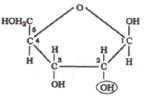
The given figure is useful in the structure of which molecule?
A
$ATP$
B
$RNA$
C
$DNA$
D
Both $(a)$ and $(b)$
Solution
(D) The provided figure shows a ribose sugar molecule.
Key features of ribose sugar include the presence of a hydroxyl group $(-OH)$ at both the $2'$ and $3'$ carbon positions.
$ATP$ (Adenosine triphosphate) contains a ribose sugar as its pentose sugar component.
$RNA$ (Ribonucleic acid) also contains ribose sugar as its pentose sugar component.
$DNA$ (Deoxyribonucleic acid),on the other hand,contains deoxyribose sugar,which lacks the hydroxyl group at the $2'$ position.
Therefore,the ribose sugar shown in the figure is a structural component of both $ATP$ and $RNA$.
Key features of ribose sugar include the presence of a hydroxyl group $(-OH)$ at both the $2'$ and $3'$ carbon positions.
$ATP$ (Adenosine triphosphate) contains a ribose sugar as its pentose sugar component.
$RNA$ (Ribonucleic acid) also contains ribose sugar as its pentose sugar component.
$DNA$ (Deoxyribonucleic acid),on the other hand,contains deoxyribose sugar,which lacks the hydroxyl group at the $2'$ position.
Therefore,the ribose sugar shown in the figure is a structural component of both $ATP$ and $RNA$.
0 likes
View Solution214
MediumMCQ
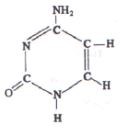
What does the given structural formula represent?
A
Uracil
B
Cytosine
C
Thymine
D
Guanine
Solution
(B) The given structural formula represents a pyrimidine base.
Specifically,it shows a six-membered ring containing two nitrogen atoms at positions $1$ and $3$,an amino group $(-NH_2)$ at position $4$,and a carbonyl group $(=O)$ at position $2$.
This specific arrangement of atoms corresponds to the structure of Cytosine.
Uracil has carbonyl groups at both positions $2$ and $4$,while Thymine is $5-$methyluracil. Guanine is a purine base with a double-ring structure.
Specifically,it shows a six-membered ring containing two nitrogen atoms at positions $1$ and $3$,an amino group $(-NH_2)$ at position $4$,and a carbonyl group $(=O)$ at position $2$.
This specific arrangement of atoms corresponds to the structure of Cytosine.
Uracil has carbonyl groups at both positions $2$ and $4$,while Thymine is $5-$methyluracil. Guanine is a purine base with a double-ring structure.
0 likes
View Solution215
MediumMCQ
Match the following chemical linkages with their respective types:
| Column-$I$ | Column-$II$ |
|---|---|
| $(1) -C-O-C-$ | $(a)$ Phosphodiester bond |
| $(2) -C-O-O-C-$ | $(b)$ Glycosidic bond |
| $(3) -C-NH-CO-$ | $(c)$ Ester bond |
| $(4) -C-O-P-O-C-$ | $(d)$ Peptide bond |
A
$(1-b), (2-c), (3-d), (4-a)$
B
$(1-c), (2-b), (3-a), (4-d)$
C
$(1-a), (2-b), (3-c), (4-d)$
D
$(1-b), (2-d), (3-c), (4-a)$
Solution
(A) The chemical linkages are identified as follows:
$1$. The $-C-O-C-$ linkage represents a Glycosidic bond,which connects two monosaccharides in a carbohydrate.
$2$. The $-C-O-O-C-$ linkage represents an Ester bond,commonly found in lipids (fatty acids and glycerol).
$3$. The $-C-NH-CO-$ linkage represents a Peptide bond,which connects amino acids in a protein.
$4$. The $-C-O-P-O-C-$ linkage represents a Phosphodiester bond,which connects nucleotides in $DNA$ and $RNA$.
Therefore,the correct matching is $(1-b), (2-c), (3-d), (4-a)$.
$1$. The $-C-O-C-$ linkage represents a Glycosidic bond,which connects two monosaccharides in a carbohydrate.
$2$. The $-C-O-O-C-$ linkage represents an Ester bond,commonly found in lipids (fatty acids and glycerol).
$3$. The $-C-NH-CO-$ linkage represents a Peptide bond,which connects amino acids in a protein.
$4$. The $-C-O-P-O-C-$ linkage represents a Phosphodiester bond,which connects nucleotides in $DNA$ and $RNA$.
Therefore,the correct matching is $(1-b), (2-c), (3-d), (4-a)$.
0 likes
View Solution216
EasyMCQ
Select the correct option for the following matches:
| $(1)$ Carbohydrate | $(a)$ Ester bond |
| $(2)$ Lipid | $(b)$ Glycosidic bond |
| $(3)$ Protein | $(c)$ Phosphodiester bond |
| $(4)$ Nucleic acid | $(d)$ Peptide bond |
A
$(1-b), (2-a), (3-c), (4-d)$
B
$(1-b), (2-a), (3-d), (4-c)$
C
$(1-d), (2-c), (3-b), (4-a)$
D
$(1-c), (2-d), (3-a), (4-b)$
Solution
(B) The correct matches are as follows:
$(1)$ Carbohydrates are polymers of monosaccharides linked by glycosidic bonds $(1-b)$.
$(2)$ Lipids (specifically triglycerides) are formed by fatty acids and glycerol linked by ester bonds $(2-a)$.
$(3)$ Proteins are polymers of amino acids linked by peptide bonds $(3-d)$.
$(4)$ Nucleic acids ($DNA$/$RNA$) consist of nucleotides linked by phosphodiester bonds $(4-c)$.
Therefore, the correct sequence is $(1-b), (2-a), (3-d), (4-c)$.
$(1)$ Carbohydrates are polymers of monosaccharides linked by glycosidic bonds $(1-b)$.
$(2)$ Lipids (specifically triglycerides) are formed by fatty acids and glycerol linked by ester bonds $(2-a)$.
$(3)$ Proteins are polymers of amino acids linked by peptide bonds $(3-d)$.
$(4)$ Nucleic acids ($DNA$/$RNA$) consist of nucleotides linked by phosphodiester bonds $(4-c)$.
Therefore, the correct sequence is $(1-b), (2-a), (3-d), (4-c)$.
0 likes
View Solution217
MediumMCQ
Which of the following structures represents ribose sugar?
A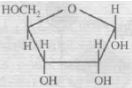
B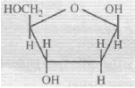
C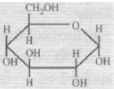
D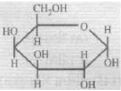
Solution
(A) Ribose is a pentose sugar (a five-carbon sugar) with the chemical formula $C_5H_{10}O_5$.
In its cyclic form,it forms a furanose ring (a five-membered ring containing four carbons and one oxygen).
Structure $A$ shows a five-membered ring with $-OH$ groups on both the $C_2$ and $C_3$ positions,which is characteristic of ribose.
Structure $B$ represents deoxyribose,which lacks an oxygen atom at the $C_2$ position.
Structures $C$ and $D$ represent hexose sugars (six-membered rings),such as glucose or galactose.
In its cyclic form,it forms a furanose ring (a five-membered ring containing four carbons and one oxygen).
Structure $A$ shows a five-membered ring with $-OH$ groups on both the $C_2$ and $C_3$ positions,which is characteristic of ribose.
Structure $B$ represents deoxyribose,which lacks an oxygen atom at the $C_2$ position.
Structures $C$ and $D$ represent hexose sugars (six-membered rings),such as glucose or galactose.
0 likes
View Solution218
MediumMCQ
Match the following structures with their names and select the correct option.
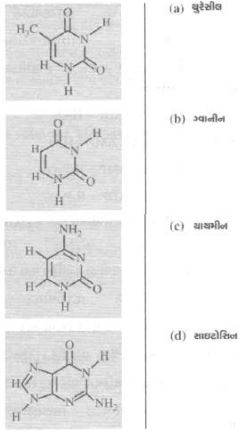
A
$1-c, 2-a, 3-d, 4-b$
B
$1-c, 2-a, 3-b, 4-d$
C
$1-c, 2-b, 3-d, 4-a$
D
$1-a, 2-c, 3-d, 4-b$
Solution
(A) By observing the chemical structures provided in the image:
$1$. The first structure is $5-$methyluracil,which is Thymine $(c)$.
$2$. The second structure is Uracil $(a)$.
$3$. The third structure is Cytosine $(d)$.
$4$. The fourth structure is Guanine $(b)$.
Therefore,the correct matching is $1-c, 2-a, 3-d, 4-b$.
$1$. The first structure is $5-$methyluracil,which is Thymine $(c)$.
$2$. The second structure is Uracil $(a)$.
$3$. The third structure is Cytosine $(d)$.
$4$. The fourth structure is Guanine $(b)$.
Therefore,the correct matching is $1-c, 2-a, 3-d, 4-b$.
0 likes
View Solution219
MediumMCQ
The energy available for the work of a biological system is known as.....
A
Kinetic energy
B
Free energy
C
Stored energy
D
Work energy
Solution
(B) In thermodynamics and biological systems,the energy that is available to perform useful work at a constant temperature and pressure is called Gibbs free energy or simply free energy. It determines the spontaneity of biological reactions.
0 likes
View Solution220
MediumMCQ
Assertion $(S)$: The measure of disorder in a biological system is called free energy.
Reason $(R)$: The energy available in a biological system to perform work is called entropy.
$(A)$ Both $S$ and $R$ are true,and $R$ is the correct explanation of $S$.
$(B)$ Both $S$ and $R$ are true,but $R$ is not the correct explanation of $S$.
$(C)$ $S$ is true and $R$ is false.
$(D)$ $S$ is false and $R$ is true.
$(E)$ Both $S$ and $R$ are false.
Reason $(R)$: The energy available in a biological system to perform work is called entropy.
$(A)$ Both $S$ and $R$ are true,and $R$ is the correct explanation of $S$.
$(B)$ Both $S$ and $R$ are true,but $R$ is not the correct explanation of $S$.
$(C)$ $S$ is true and $R$ is false.
$(D)$ $S$ is false and $R$ is true.
$(E)$ Both $S$ and $R$ are false.
A
$A$
B
$B$
C
$C$
D
$E$
Solution
(D) In thermodynamics,the measure of disorder or randomness in a system is known as entropy,not free energy.
Therefore,Assertion $(S)$ is false.
Free energy is the energy available in a system to perform useful work,not entropy.
Therefore,Reason $(R)$ is also false.
Thus,both Assertion $(S)$ and Reason $(R)$ are incorrect.
Therefore,Assertion $(S)$ is false.
Free energy is the energy available in a system to perform useful work,not entropy.
Therefore,Reason $(R)$ is also false.
Thus,both Assertion $(S)$ and Reason $(R)$ are incorrect.
0 likes
View Solution221
MediumMCQ
Statement $X$: Energy transformation always occurs in the metabolism of living organisms.
Reason $Y$: Living organisms continuously obtain energy from food.
Reason $Y$: Living organisms continuously obtain energy from food.
A
Reason $Y$ is the correct explanation for Statement $X$.
B
Reason $Y$ is not the correct explanation for Statement $X$.
C
Both Statement $X$ and Reason $Y$ are false.
D
Statement $X$ is false while Reason $Y$ is true.
Solution
(A) Metabolism is the sum total of all chemical reactions occurring in a living organism. These reactions involve the transformation of energy,such as the conversion of chemical energy into work or heat. Thus,Statement $X$ is true.
Living organisms require a continuous supply of energy to maintain their life processes,which they obtain from food through the process of respiration. Thus,Reason $Y$ is true.
Since metabolism is the fundamental process by which organisms utilize the energy obtained from food to perform biological work,Reason $Y$ correctly explains why energy transformation occurs in metabolism. Therefore,Reason $Y$ is the correct explanation for Statement $X$.
Living organisms require a continuous supply of energy to maintain their life processes,which they obtain from food through the process of respiration. Thus,Reason $Y$ is true.
Since metabolism is the fundamental process by which organisms utilize the energy obtained from food to perform biological work,Reason $Y$ correctly explains why energy transformation occurs in metabolism. Therefore,Reason $Y$ is the correct explanation for Statement $X$.
0 likes
View Solution222
MediumMCQ
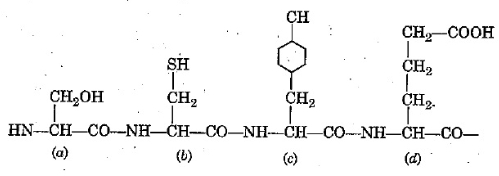
The figure shows a hypothetical tetrapeptide portion of a protein with parts labelled $a$ to $d$. Which one of the following options is correct?
A
$d$ is the acidic amino acid glutamic acid.
B
$c$ is an aromatic amino acid tryptophan.
C
$a$ is the $N$-terminal amino acid and $d$ is the $C$-terminal amino acid.
D
None of these
Solution
(A) By analyzing the structure of the tetrapeptide:
$1$. The amino acid at position $a$ has a side chain $-CH_2OH$,which corresponds to Serine.
$2$. The amino acid at position $b$ has a side chain $-CH_2SH$,which corresponds to Cysteine.
$3$. The amino acid at position $c$ has a side chain $-CH_2-C_6H_5$ (phenylalanine derivative),which is an aromatic amino acid,but not Tryptophan.
$4$. The amino acid at position $d$ has a side chain $-CH_2-CH_2-CH_2-COOH$,which corresponds to Glutamic acid.
$5$. In a polypeptide chain,the $N$-terminal is on the left and the $C$-terminal is on the right. Thus,$a$ is the $N$-terminal and $d$ is the $C$-terminal.
$6$. Option $a$ is incorrect because while $d$ is Glutamic acid,it is not the only correct statement if others are wrong,but looking at the options,none of the specific claims in $a, b, c$ are fully accurate except for the identification of $d$ as Glutamic acid. However,since $d$ is indeed Glutamic acid,option $a$ is the correct choice.
$1$. The amino acid at position $a$ has a side chain $-CH_2OH$,which corresponds to Serine.
$2$. The amino acid at position $b$ has a side chain $-CH_2SH$,which corresponds to Cysteine.
$3$. The amino acid at position $c$ has a side chain $-CH_2-C_6H_5$ (phenylalanine derivative),which is an aromatic amino acid,but not Tryptophan.
$4$. The amino acid at position $d$ has a side chain $-CH_2-CH_2-CH_2-COOH$,which corresponds to Glutamic acid.
$5$. In a polypeptide chain,the $N$-terminal is on the left and the $C$-terminal is on the right. Thus,$a$ is the $N$-terminal and $d$ is the $C$-terminal.
$6$. Option $a$ is incorrect because while $d$ is Glutamic acid,it is not the only correct statement if others are wrong,but looking at the options,none of the specific claims in $a, b, c$ are fully accurate except for the identification of $d$ as Glutamic acid. However,since $d$ is indeed Glutamic acid,option $a$ is the correct choice.
0 likes
View Solution223
MediumMCQ
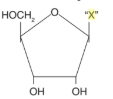
The given diagrammatic representation shows one of the categories of small molecular weight organic compounds in living tissues. Identify the category shown and the one blank component "$X$" in it.
A
Cholesterol $\Rightarrow$ Guanine
B
Amino acid $\Rightarrow$ $NH_2$
C
Nucleotide $\Rightarrow$ Adenine
D
Nucleoside $\Rightarrow$ Uracil
Solution
(D) The given structure represents a ribose sugar molecule attached to a nitrogenous base at position "$X$".
Since the structure consists of a pentose sugar and a nitrogenous base, but lacks a phosphate group, it represents a nucleoside.
In the context of the options provided, the structure is a nucleoside, and "$X$" represents a nitrogenous base such as Uracil.
Since the structure consists of a pentose sugar and a nitrogenous base, but lacks a phosphate group, it represents a nucleoside.
In the context of the options provided, the structure is a nucleoside, and "$X$" represents a nitrogenous base such as Uracil.
0 likes
View Solution224
MediumMCQ
Which one of the following biomolecules is correctly characterized?
A
Lecithin - a phosphorylated glyceride found in cell membrane.
B
Palmitic acid - an unsaturated fatty acid with $18$ carbon atoms.
C
Adenylic acid - adenosine with a glucose phosphate molecule.
D
Alanine amino acid - contains an amino group and an acidic group anywhere in the molecule.
Solution
(A) . Lecithin is a phosphorylated glyceride (phospholipid) found in the cell membrane. It consists of a glycerol backbone,two fatty acids,and a phosphate group linked to choline.
$B$. Palmitic acid is a saturated fatty acid with $16$ carbon atoms,not unsaturated,and it lacks double bonds.
$C$. Adenylic acid (adenosine monophosphate) is a nucleotide formed by the union of adenine (nitrogenous base),ribose (pentose sugar),and a phosphate group,not glucose.
$D$. Alanine is an amino acid where the amino group $(-NH_2)$ and the carboxylic acid group $(-COOH)$ are both attached to the same $\alpha$-carbon atom,not just anywhere in the molecule.
$B$. Palmitic acid is a saturated fatty acid with $16$ carbon atoms,not unsaturated,and it lacks double bonds.
$C$. Adenylic acid (adenosine monophosphate) is a nucleotide formed by the union of adenine (nitrogenous base),ribose (pentose sugar),and a phosphate group,not glucose.
$D$. Alanine is an amino acid where the amino group $(-NH_2)$ and the carboxylic acid group $(-COOH)$ are both attached to the same $\alpha$-carbon atom,not just anywhere in the molecule.
0 likes
View Solution225
MediumMCQ
The most abundant intracellular cation is
A
$H^+$
B
$K^+$
C
$Na^+$
D
$Ca^{++}$
Solution
(B) The correct answer is $B$.
$K^+$ ions are the most abundant cations found in the intracellular fluid (cytoplasm) of cells.
In contrast,$Na^+$ ions are the most abundant cations found in the extracellular fluid.
This ionic gradient is maintained by the $Na^+-K^+$ pump,which is essential for maintaining the resting membrane potential of cells.
$K^+$ ions are the most abundant cations found in the intracellular fluid (cytoplasm) of cells.
In contrast,$Na^+$ ions are the most abundant cations found in the extracellular fluid.
This ionic gradient is maintained by the $Na^+-K^+$ pump,which is essential for maintaining the resting membrane potential of cells.
0 likes
View Solution226
EasyMCQ
Identify the sulphur-containing vitamin.
A
Cystine
B
Thiamine
C
Methionine
D
Glutamic acid
Solution
(B) Thiamine,also known as Vitamin $B_1$,is a water-soluble vitamin that contains sulphur in its molecular structure.
Cystine and Methionine are sulphur-containing amino acids,not vitamins.
Glutamic acid is a non-essential amino acid that does not contain sulphur.
Therefore,the correct option is $B$.
Cystine and Methionine are sulphur-containing amino acids,not vitamins.
Glutamic acid is a non-essential amino acid that does not contain sulphur.
Therefore,the correct option is $B$.
0 likes
View Solution227
MediumMCQ
Find the incorrect pair.
A
Lysosome - Suicidal bag
B
Lipid - Ester bond
C
Protein - Amino acid
D
Golgi body - Leuvan Hawk
Solution
(D) The correct answer is $D$.
$A$. Lysosomes are known as 'suicidal bags' because they contain hydrolytic enzymes that can digest the cell itself. This is a correct pair.
$B$. Lipids are formed by the linkage of fatty acids and glycerol through ester bonds. This is a correct pair.
$C$. Proteins are polymers made up of amino acids linked by peptide bonds. This is a correct pair.
$D$. The Golgi apparatus was discovered by Camillo Golgi,not Leuvan Hawk (Antonie van Leeuwenhoek is known for discovering bacteria and protozoa). Therefore,this is the incorrect pair.
$A$. Lysosomes are known as 'suicidal bags' because they contain hydrolytic enzymes that can digest the cell itself. This is a correct pair.
$B$. Lipids are formed by the linkage of fatty acids and glycerol through ester bonds. This is a correct pair.
$C$. Proteins are polymers made up of amino acids linked by peptide bonds. This is a correct pair.
$D$. The Golgi apparatus was discovered by Camillo Golgi,not Leuvan Hawk (Antonie van Leeuwenhoek is known for discovering bacteria and protozoa). Therefore,this is the incorrect pair.
0 likes
View Solution228
MediumMCQ
$X$ - Glycosidic bond is formed by dehydration.
$Y$ - Due to hydrolases,peptide bond splits.
$Y$ - Due to hydrolases,peptide bond splits.
A
Both are correct
B
Both are incorrect
C
$X$ - Correct,$Y$ - Incorrect
D
$X$ - Incorrect,$Y$ - Correct
Solution
(A) $X$ is correct: $A$ glycosidic bond is formed between two monosaccharides by a dehydration synthesis reaction (removal of a water molecule).
$Y$ is correct: Hydrolases are enzymes that catalyze the hydrolysis of various bonds,including peptide bonds,by adding a water molecule.
$Y$ is correct: Hydrolases are enzymes that catalyze the hydrolysis of various bonds,including peptide bonds,by adding a water molecule.
0 likes
View Solution229
MediumMCQ
Select the correct graph,which shows the effect of temperature on the velocity of a typical enzymatic reaction.
A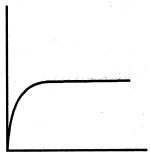
B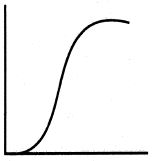
C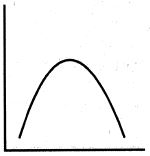
D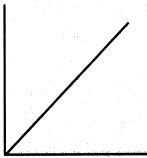
Solution
(C) Enzymes are proteins that function as biological catalysts. Their activity is highly dependent on temperature.
At low temperatures,the enzyme is inactive,and the reaction velocity is low.
As the temperature increases,the kinetic energy of the molecules increases,leading to more frequent collisions between the enzyme and substrate,thus increasing the reaction velocity.
This continues until an optimum temperature is reached,where the reaction velocity is at its maximum.
Beyond this optimum temperature,the heat causes the denaturation of the enzyme's protein structure,leading to a rapid decrease in reaction velocity.
Therefore,the graph showing the effect of temperature on the velocity of an enzymatic reaction is a bell-shaped curve,which corresponds to Graph $C$.
At low temperatures,the enzyme is inactive,and the reaction velocity is low.
As the temperature increases,the kinetic energy of the molecules increases,leading to more frequent collisions between the enzyme and substrate,thus increasing the reaction velocity.
This continues until an optimum temperature is reached,where the reaction velocity is at its maximum.
Beyond this optimum temperature,the heat causes the denaturation of the enzyme's protein structure,leading to a rapid decrease in reaction velocity.
Therefore,the graph showing the effect of temperature on the velocity of an enzymatic reaction is a bell-shaped curve,which corresponds to Graph $C$.
0 likes
View Solution230
MediumMCQ
Identify the amino acids $A$,$B$,and $C$ correctly based on their side chains ($R$-groups) shown in the image.
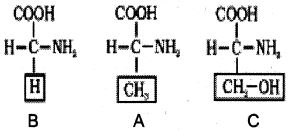
A
$A$-Glycine,$B$-Serine,$C$-Alanine
B
$A$-Alanine,$B$-Glycine,$C$-Serine
C
$A$-Serine,$B$-Glycine,$C$-Alanine
D
$A$-Serine,$B$-Alanine,$C$-Glycine
Solution
(B) The general structure of an amino acid is $R-CH(NH_2)-COOH$. The identity of the amino acid is determined by the $R$ group.
$1$. In structure $B$,the $R$ group is $H$. This corresponds to Glycine.
$2$. In structure $A$,the $R$ group is $CH_3$. This corresponds to Alanine.
$3$. In structure $C$,the $R$ group is $CH_2OH$. This corresponds to Serine.
Therefore,$A$ is Alanine,$B$ is Glycine,and $C$ is Serine.
$1$. In structure $B$,the $R$ group is $H$. This corresponds to Glycine.
$2$. In structure $A$,the $R$ group is $CH_3$. This corresponds to Alanine.
$3$. In structure $C$,the $R$ group is $CH_2OH$. This corresponds to Serine.
Therefore,$A$ is Alanine,$B$ is Glycine,and $C$ is Serine.
0 likes
View Solution231
MediumMCQ
Identify the names of the given structural formulas correctly.
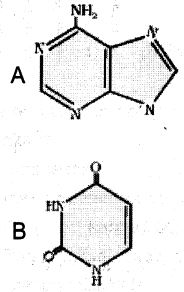
A
$A$-Adenine,$B$-Uracil
B
$A$-Guanine,$B$-Thymine
C
$A$-Adenine,$B$-Guanine
D
$A$-Cytosine,$B$-Thymine
Solution
(A) Structure $A$ represents Adenine,which is a purine base containing a double-ring structure with an amino group $(-NH_2)$.
Structure $B$ represents Uracil,which is a pyrimidine base containing a single-ring structure with two carbonyl groups $(C=O)$ and is found in $RNA$.
Therefore,the correct identification is $A$-Adenine and $B$-Uracil.
Structure $B$ represents Uracil,which is a pyrimidine base containing a single-ring structure with two carbonyl groups $(C=O)$ and is found in $RNA$.
Therefore,the correct identification is $A$-Adenine and $B$-Uracil.
0 likes
View Solution232
MediumMCQ
Match the following columns:
| Column-$I$ | Column-$II$ |
| $(1)$ Lipid | $(p)$ Curcumin |
| $(2)$ Collagen | $(q)$ Morphine |
| $(3)$ Alkaloids | $(r)$ Intercellular ground substance |
| $(4)$ Drugs | $(s)$ Lecithin |
A
$(1-p), (2-q), (3-r), (4-s)$
B
$(1-q), (2-p), (3-r), (4-s)$
C
$(1-s), (2-r), (3-q), (4-p)$
D
$(1-r), (2-s), (3-p), (4-q)$
Solution
(C) The correct matches are as follows:
$(1)$ Lipid: Lecithin is a type of phospholipid,which is a lipid. Thus,$(1-s)$.
$(2)$ Collagen: Collagen is the most abundant protein in the animal world and acts as an intercellular ground substance. Thus,$(2-r)$.
$(3)$ Alkaloids: Morphine and codeine are examples of alkaloids. Thus,$(3-q)$.
$(4)$ Drugs: Curcumin is a secondary metabolite often used as a drug. Thus,$(4-p)$.
Therefore,the correct sequence is $(1-s), (2-r), (3-q), (4-p)$.
$(1)$ Lipid: Lecithin is a type of phospholipid,which is a lipid. Thus,$(1-s)$.
$(2)$ Collagen: Collagen is the most abundant protein in the animal world and acts as an intercellular ground substance. Thus,$(2-r)$.
$(3)$ Alkaloids: Morphine and codeine are examples of alkaloids. Thus,$(3-q)$.
$(4)$ Drugs: Curcumin is a secondary metabolite often used as a drug. Thus,$(4-p)$.
Therefore,the correct sequence is $(1-s), (2-r), (3-q), (4-p)$.
0 likes
View Solution233
EasyMCQ
Which of the following are aromatic amino acids?
A
Tyrosine and tryptophan
B
Tryptophan and phenylalanine
C
Tryptophan and valine
D
$A$ and $B$ both
Solution
(D) Aromatic amino acids are those that contain an aromatic ring in their side chain.
There are three primary aromatic amino acids found in proteins:
$1$. Phenylalanine
$2$. Tyrosine
$3$. Tryptophan
Since both options $A$ (Tyrosine and Tryptophan) and $B$ (Tryptophan and Phenylalanine) consist of aromatic amino acids,the correct choice is $D$.
There are three primary aromatic amino acids found in proteins:
$1$. Phenylalanine
$2$. Tyrosine
$3$. Tryptophan
Since both options $A$ (Tyrosine and Tryptophan) and $B$ (Tryptophan and Phenylalanine) consist of aromatic amino acids,the correct choice is $D$.
0 likes
View Solution234
MediumMCQ
Select the correct structure of Glucose.
A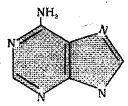
B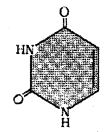
C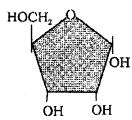
D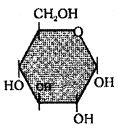
Solution
(D) Glucose is a hexose sugar with the chemical formula $C_6H_{12}O_6$.
In its cyclic form (pyranose form),it consists of a six-membered ring containing five carbon atoms and one oxygen atom.
Option $A$ represents Adenine,a purine base.
Option $B$ represents Uracil,a pyrimidine base.
Option $C$ represents Ribose,a pentose sugar.
Option $D$ represents the cyclic structure of Glucose,which is a six-membered ring with a $CH_2OH$ group attached to the fifth carbon.
In its cyclic form (pyranose form),it consists of a six-membered ring containing five carbon atoms and one oxygen atom.
Option $A$ represents Adenine,a purine base.
Option $B$ represents Uracil,a pyrimidine base.
Option $C$ represents Ribose,a pentose sugar.
Option $D$ represents the cyclic structure of Glucose,which is a six-membered ring with a $CH_2OH$ group attached to the fifth carbon.
0 likes
View Solution235
MediumMCQ
Identify the odd one out.
A
Insulin
B
Starch
C
Glycogen
D
Glucose
Solution
(A) The correct answer is $A$ (Insulin).
$1$. $Starch$, $Glycogen$, and $Glucose$ are all carbohydrates.
$2$. $Starch$ and $Glycogen$ are polysaccharides, while $Glucose$ is a monosaccharide.
$3$. $Insulin$ is a protein (polypeptide hormone) secreted by the pancreas, which regulates blood sugar levels.
$4$. Therefore, $Insulin$ is the odd one out as it belongs to the category of proteins, whereas the others are carbohydrates.
$1$. $Starch$, $Glycogen$, and $Glucose$ are all carbohydrates.
$2$. $Starch$ and $Glycogen$ are polysaccharides, while $Glucose$ is a monosaccharide.
$3$. $Insulin$ is a protein (polypeptide hormone) secreted by the pancreas, which regulates blood sugar levels.
$4$. Therefore, $Insulin$ is the odd one out as it belongs to the category of proteins, whereas the others are carbohydrates.
0 likes
View Solution236
MediumMCQ
Identify the odd one out.
A
Glucose
B
Galactose
C
Fructose
D
Insulin
Solution
(D) $Glucose$, $Galactose$, and $Fructose$ are all monosaccharides, which are simple sugars (carbohydrates).
$Insulin$ is a peptide hormone produced by the pancreas that regulates blood sugar levels.
Therefore, $Insulin$ is the odd one out as it is a protein, not a carbohydrate.
$Insulin$ is a peptide hormone produced by the pancreas that regulates blood sugar levels.
Therefore, $Insulin$ is the odd one out as it is a protein, not a carbohydrate.
0 likes
View Solution237
MediumMCQ
Choose the correct option ($T$-true,$F$-false).
$(I)$ Melting point of oil is lower.
$(II)$ All amino acids are acidic.
$(III)$ Lipid is water soluble.
$(IV)$ Enzyme shows its highest activity at a particular temperature.
$I - II - III - IV$
$(I)$ Melting point of oil is lower.
$(II)$ All amino acids are acidic.
$(III)$ Lipid is water soluble.
$(IV)$ Enzyme shows its highest activity at a particular temperature.
$I - II - III - IV$
A
$F - F - T - T$
B
$T - F - F - T$
C
$T - T - T - F$
D
$F - T - F - F$
Solution
(B) $(I)$ Oils are triglycerides that remain liquid at room temperature due to unsaturated fatty acids,hence they have a lower melting point. This statement is $True$ $(T)$.
$(II)$ Amino acids can be acidic,basic,or neutral depending on the $R$-group. Therefore,not all amino acids are acidic. This statement is $False$ $(F)$.
$(III)$ Lipids are hydrophobic and generally insoluble in water. This statement is $False$ $(F)$.
$(IV)$ Enzymes have an optimum temperature at which their catalytic activity is highest. This statement is $True$ $(T)$.
Thus,the correct sequence is $T - F - F - T$.
$(II)$ Amino acids can be acidic,basic,or neutral depending on the $R$-group. Therefore,not all amino acids are acidic. This statement is $False$ $(F)$.
$(III)$ Lipids are hydrophobic and generally insoluble in water. This statement is $False$ $(F)$.
$(IV)$ Enzymes have an optimum temperature at which their catalytic activity is highest. This statement is $True$ $(T)$.
Thus,the correct sequence is $T - F - F - T$.
0 likes
View Solution238
MediumMCQ
Which bond is degraded by hydrolysis?
A
Ester bond
B
Peptide bond
C
Glycosidic bond
D
All of the above
Solution
(D) Hydrolysis is a chemical process in which a molecule of water is added to a substance to break its chemical bonds.
$1$. Ester bonds (found in lipids) are broken down by hydrolysis into fatty acids and glycerol.
$2$. Peptide bonds (found in proteins) are broken down by hydrolysis into amino acids.
$3$. Glycosidic bonds (found in carbohydrates/polysaccharides) are broken down by hydrolysis into monosaccharides.
Since all these bonds are broken through the addition of water,the correct answer is 'All of the above'.
$1$. Ester bonds (found in lipids) are broken down by hydrolysis into fatty acids and glycerol.
$2$. Peptide bonds (found in proteins) are broken down by hydrolysis into amino acids.
$3$. Glycosidic bonds (found in carbohydrates/polysaccharides) are broken down by hydrolysis into monosaccharides.
Since all these bonds are broken through the addition of water,the correct answer is 'All of the above'.
1 likes
View Solution239
MediumMCQ
What is the function of proteins in a living cell?
A
As hormones
B
As enzymes
C
Fights infectious agents
D
All of the above
Solution
(D) Proteins perform a wide variety of functions in living organisms:
$1$. Enzymes: Most enzymes are proteins that catalyze biochemical reactions (e.g.,pepsin,trypsin).
$2$. Hormones: Some hormones are proteinaceous in nature,such as insulin and glucagon,which regulate metabolic processes.
$3$. Defense: Proteins like antibodies (immunoglobulins) help the body fight against infectious agents like bacteria and viruses.
$4$. Structural support: Proteins like collagen provide structural support to tissues.
Therefore,all the given options are correct functions of proteins.
$1$. Enzymes: Most enzymes are proteins that catalyze biochemical reactions (e.g.,pepsin,trypsin).
$2$. Hormones: Some hormones are proteinaceous in nature,such as insulin and glucagon,which regulate metabolic processes.
$3$. Defense: Proteins like antibodies (immunoglobulins) help the body fight against infectious agents like bacteria and viruses.
$4$. Structural support: Proteins like collagen provide structural support to tissues.
Therefore,all the given options are correct functions of proteins.
0 likes
View Solution240
MediumMCQ
Choose the incorrect pair.
A
Amino acid - peptide bond.
B
Monosaccharide - glycosidic bond.
C
$A$ and $T$ - Three hydrogen bonds.
D
Lipid - Ester bond.
Solution
(C) In $DNA$,Adenine $(A)$ pairs with Thymine $(T)$ via two hydrogen bonds,not three. Guanine $(G)$ and Cytosine $(C)$ pair via three hydrogen bonds. Therefore,the pair '$A$ and $T$ - Three hydrogen bonds' is incorrect. All other pairs are correct: Amino acids are linked by peptide bonds,monosaccharides by glycosidic bonds,and lipids (specifically triglycerides) are formed by ester bonds.
0 likes
View Solution241
MediumMCQ
Match Column-$I$ with Column-$II$:
| Column-$I$ | Column-$II$ |
| $(1)$ Cellulose | $(p)$ Acidic |
| $(2)$ Tyrosine | $(q)$ $CH_2-OH$ containing |
| $(3)$ Serine | $(r)$ Aromatic |
| $(s)$ Homopolymer |
A
$(1-p), (2-q), (3-r)$
B
$(1-q), (2-r), (3-s)$
C
$(1-s), (2-r), (3-q)$
D
$(1-r), (2-s), (3-p)$
Solution
(C) $1$. Cellulose is a polysaccharide made up of only glucose units,hence it is a $Homopolymer$ $(s)$.
$2$. Tyrosine is an amino acid that contains a phenol group in its side chain,making it $Aromatic$ $(r)$.
$3$. Serine is an amino acid that contains a hydroxyl group in its side chain,specifically $CH_2-OH$ $(q)$.
Therefore,the correct matching is $(1-s), (2-r), (3-q)$.
$2$. Tyrosine is an amino acid that contains a phenol group in its side chain,making it $Aromatic$ $(r)$.
$3$. Serine is an amino acid that contains a hydroxyl group in its side chain,specifically $CH_2-OH$ $(q)$.
Therefore,the correct matching is $(1-s), (2-r), (3-q)$.
0 likes
View Solution242
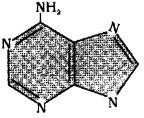
MediumMCQ
Identify the molecule shown in the figure.
A
Adenine
B
Guanine
C
Uracil
D
Cytosine
Solution
(A) The figure shows a double-ring structure,which is characteristic of a purine base.
Specifically,it is $6$-aminopurine,which is known as Adenine.
Guanine is also a purine but contains a carbonyl group and an amino group.
Uracil and Cytosine are pyrimidines,which have a single-ring structure.
Therefore,the correct option is $A$.
Specifically,it is $6$-aminopurine,which is known as Adenine.
Guanine is also a purine but contains a carbonyl group and an amino group.
Uracil and Cytosine are pyrimidines,which have a single-ring structure.
Therefore,the correct option is $A$.
0 likes
View Solution243
MediumMCQ
The blood concentration of glucose in a normal healthy individual is:
A
$5 - 5.5 \text{ ng/ml}$
B
$1 - 2.5 \text{ mM}$
C
$2 - 3 \text{ ng/ml}$
D
$4.2 - 6.1 \text{ mmol/L}$
Solution
(D) In a normal healthy individual,the fasting blood glucose concentration is typically maintained within the range of $4.2 - 6.1 \text{ mmol/L}$ (approximately $70 - 110 \text{ mg/dL}$).
This homeostatic regulation is primarily controlled by hormones such as insulin and glucagon.
Therefore,option $D$ is the correct answer.
This homeostatic regulation is primarily controlled by hormones such as insulin and glucagon.
Therefore,option $D$ is the correct answer.
0 likes
View Solution244
MediumMCQ
Which substance is most abundant in a cell?
A
Water
B
Proteins
C
Nucleic acids
D
Lipids
Solution
(A) In a typical living cell, water is the most abundant chemical substance, accounting for approximately $70-90\%$ of the total cellular mass. Among the organic compounds, proteins are generally the most abundant, but when considering all molecules including inorganic ones, water is the primary component.
0 likes
View Solution245
DifficultMCQ
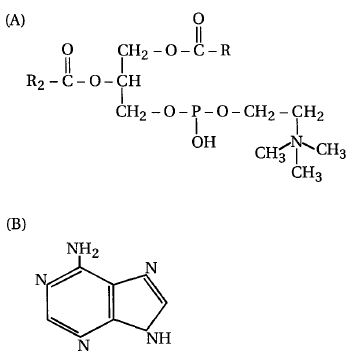
Identify the two organic compounds shown in the molecular structures below and state their respective functions.
A
$b:$ Adenine - Forms nucleic acids from nucleotides.
B
$a:$ Triglyceride - Important source of energy.
C
$b:$ Uracil - Component of $DNA$.
D
$a:$ Lecithin - Component of cell membrane.
Solution
(D) Structure $A$ represents Lecithin,which is a phospholipid. Phospholipids are essential components of the cell membrane,providing structural integrity and regulating permeability.
Structure $B$ represents Adenine,which is a nitrogenous base (purine). Adenine is a fundamental component of nucleotides,which are the building blocks of nucleic acids like $DNA$ and $RNA$.
Structure $B$ represents Adenine,which is a nitrogenous base (purine). Adenine is a fundamental component of nucleotides,which are the building blocks of nucleic acids like $DNA$ and $RNA$.
0 likes
View Solution246
MediumMCQ
Which of the following structures $(A-D)$ correctly represents a basic amino acid?
A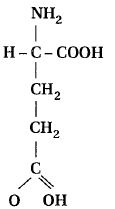
B
$\text{NH}_2-\text{CH}(\text{COOH})-(\text{CH}_2)_4-\text{NH}_2$ (Lysine,a basic amino acid).
C
$\text{CH}_2(\text{OH})-\text{CH}_2-\text{CH}_2-\text{NH}_2$ (Not an amino acid).
D
$\text{NH}_2-\text{CH}(\text{COOH})-\text{CH}_2-\text{OH}$ (Serine,a neutral amino acid).
Solution
(B) basic amino acid contains more amino groups than carboxyl groups in its structure.
Option $A$ represents Glutamic acid,which has two carboxyl groups and one amino group,making it an acidic amino acid.
Option $B$ represents Lysine,which has two amino groups and one carboxyl group,making it a basic amino acid.
Option $C$ is not an amino acid as it lacks the characteristic carboxyl group.
Option $D$ represents Serine,which is a neutral amino acid.
Therefore,the correct structure for a basic amino acid is $B$.
Option $A$ represents Glutamic acid,which has two carboxyl groups and one amino group,making it an acidic amino acid.
Option $B$ represents Lysine,which has two amino groups and one carboxyl group,making it a basic amino acid.
Option $C$ is not an amino acid as it lacks the characteristic carboxyl group.
Option $D$ represents Serine,which is a neutral amino acid.
Therefore,the correct structure for a basic amino acid is $B$.
0 likes
View Solution247
MediumMCQ
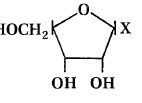
The given structure represents a low molecular weight organic compound found in living tissues. Identify the category and the missing component $X$ in the structure.
Category $-$ Component
Category $-$ Component
A
Cholesterol $-$ Guanine
B
Amino acid $-$ $NH_2$
C
Nucleotide $-$ Adenine
D
Nucleoside $-$ Uracil
Solution
(D) The structure shown is a pentose sugar (ribose) attached to a nitrogenous base at position $X$.
This combination of a pentose sugar and a nitrogenous base is known as a nucleoside.
In the given structure,the nitrogenous base $X$ is attached to the $1'$ carbon of the ribose sugar.
Among the options,'Nucleoside $-$ Uracil' correctly identifies the category and a possible nitrogenous base $(X)$ that can be attached to the sugar to form a nucleoside (specifically,uridine).
This combination of a pentose sugar and a nitrogenous base is known as a nucleoside.
In the given structure,the nitrogenous base $X$ is attached to the $1'$ carbon of the ribose sugar.
Among the options,'Nucleoside $-$ Uracil' correctly identifies the category and a possible nitrogenous base $(X)$ that can be attached to the sugar to form a nucleoside (specifically,uridine).
0 likes
View Solution248
EasyMCQ
Which of the following statements is incorrect?
A
Cellulose is a polysaccharide.
B
Uracil is a pyrimidine.
C
Glycine is a sulphur-containing amino acid.
D
Sucrose is a disaccharide.
Solution
(C) $1$. Cellulose is a polymer of glucose,making it a polysaccharide. This statement is correct.
$2$. Uracil is a nitrogenous base belonging to the pyrimidine family. This statement is correct.
$3$. Glycine is the simplest amino acid with the formula $NH_2CH_2COOH$. It does not contain sulphur. Sulphur-containing amino acids are cysteine and methionine. Therefore,this statement is incorrect.
$4$. Sucrose is a disaccharide composed of glucose and fructose. This statement is correct.
$2$. Uracil is a nitrogenous base belonging to the pyrimidine family. This statement is correct.
$3$. Glycine is the simplest amino acid with the formula $NH_2CH_2COOH$. It does not contain sulphur. Sulphur-containing amino acids are cysteine and methionine. Therefore,this statement is incorrect.
$4$. Sucrose is a disaccharide composed of glucose and fructose. This statement is correct.
0 likes
View Solution249
MediumMCQ
Haemorrhagic disease of the newborn is caused by the deficiency of ..............
A
Vitamin-$A$
B
Vitamin-$B$
C
Vitamin-$B_{12}$
D
Vitamin-$K$
Solution
(D) Haemorrhagic disease of the newborn $(HDN)$, also known as Vitamin-$K$ deficiency bleeding, occurs because newborns have low levels of Vitamin-$K$ at birth.
Vitamin-$K$ is essential for the synthesis of blood clotting factors $(II, VII, IX, \text{and } X)$ in the liver.
A deficiency in Vitamin-$K$ prevents proper blood coagulation, leading to an increased risk of bleeding.
Therefore, the correct option is $D$.
Vitamin-$K$ is essential for the synthesis of blood clotting factors $(II, VII, IX, \text{and } X)$ in the liver.
A deficiency in Vitamin-$K$ prevents proper blood coagulation, leading to an increased risk of bleeding.
Therefore, the correct option is $D$.
0 likes
View Solution250
EasyMCQ
Folic acid and pantothenic acid belong to which of the following groups?
A
Vitamin-$C$
B
Vitamin-$K$
C
Vitamin-$A$
D
Vitamin-$B$ complex
Solution
(D) Folic acid is known as Vitamin-$B_9$ and pantothenic acid is known as Vitamin-$B_5$.
Both of these vitamins are water-soluble and are essential components of the Vitamin-$B$ complex group.
Vitamin-$B$ complex consists of a group of water-soluble vitamins that play important roles in cell metabolism.
Both of these vitamins are water-soluble and are essential components of the Vitamin-$B$ complex group.
Vitamin-$B$ complex consists of a group of water-soluble vitamins that play important roles in cell metabolism.
0 likes
View SolutionBiomolecules — Mix Examples- Biomolecules · Frequently Asked Questions
1Are these Biomolecules questions useful for JEE and NEET?
Yes. All questions in this section are mapped to JEE Main and NEET exam patterns. Previous year questions from JEE Main, NEET, GUJCET and state-level exams are included with full solutions.
2Can I switch to Hindi or Gujarati for these questions?
Yes. Use the language tabs in the hero section or the sidebar to view the same questions and solutions in English, Hindi or Gujarati.
3How do I generate a question paper from this subtopic?
Use the Vedclass Exam Paper Generator — select the chapter and subtopic, set difficulty, and generate Sets A, B, C, D automatically. First 3 chapters of every subject are free.
Vedclass Products
For Students
Vedclass Test Series
Mock tests in real JEE/NEET style with performance analysis. 5-day free trial.
Start Free TrialFor Teachers
Exam Paper Generator
Generate Set A/B/C/D papers from this chapter in 2 minutes. 3 chapters free.
Try FreeFor Institutes
Online Exam Module
Live online exams with unlimited students, 360° analytics & white-label branding.
See DemoFor Teachers & Institutes
Generate a Biomolecules Exam Paper in 2 Minutes
Select subtopic & difficulty — Sets A, B, C, D auto-generated with No Repeat logic.
First 3 chapters of every subject are free — no payment required.