
A English
Mix Examples- Biomolecules Questions in English
Class 11 Biology · Biomolecules · Mix Examples- Biomolecules
331+
Questions
English
Language
100%
With Solutions
Showing 50 of 331 questions in English
151
EasyMCQ
At what temperature is the density of water maximum (in $^\circ \text{C}$)?
A
$100$
B
$10$
C
$365$
D
$4$
Solution
(D) Water exhibits a unique property known as anomalous expansion.
As water is cooled from room temperature,its density increases until it reaches $4^\circ \text{C}$.
At $4^\circ \text{C}$,the water molecules are packed most closely together,resulting in the maximum density of $1 \text{ g/cm}^3$.
Below $4^\circ \text{C}$,the hydrogen bonding structure causes the water molecules to move slightly further apart as they begin to form a crystalline lattice structure (ice),which causes the density to decrease.
Therefore,the density of water is maximum at $4^\circ \text{C}$.
As water is cooled from room temperature,its density increases until it reaches $4^\circ \text{C}$.
At $4^\circ \text{C}$,the water molecules are packed most closely together,resulting in the maximum density of $1 \text{ g/cm}^3$.
Below $4^\circ \text{C}$,the hydrogen bonding structure causes the water molecules to move slightly further apart as they begin to form a crystalline lattice structure (ice),which causes the density to decrease.
Therefore,the density of water is maximum at $4^\circ \text{C}$.
0 likes
View Solution152
MediumMCQ
Due to which property of water is heat distributed uniformly throughout the body of a living organism?
A
Due to low thermal conductivity of water
B
Due to high thermal conductivity of water
C
Due to zero thermal conductivity of water
D
Due to normal thermal conductivity of water
Solution
(B) Water has a high thermal conductivity compared to most other liquids. This property allows water to efficiently conduct and distribute heat throughout the body of a living organism,helping to maintain a uniform body temperature. Therefore,the high thermal conductivity of water is responsible for the uniform distribution of heat.
0 likes
View Solution153
EasyMCQ
For many biochemical reactions,$H^+$ and $OH^-$ ions are obtained from which of the following?
A
Solution
B
Solute
C
Alcohol
D
Water
Solution
(D) Water $(H_2O)$ acts as the universal solvent in biological systems.
It undergoes auto-ionization to produce $H^+$ and $OH^-$ ions,which are essential for various biochemical reactions,including hydrolysis and acid-base catalysis within the cell.
Therefore,water is the primary source of these ions in biological processes.
It undergoes auto-ionization to produce $H^+$ and $OH^-$ ions,which are essential for various biochemical reactions,including hydrolysis and acid-base catalysis within the cell.
Therefore,water is the primary source of these ions in biological processes.
0 likes
View Solution154
EasyMCQ
What type of bond exists between two water molecules?
A
Hydrogen bond
B
Peptide bond
C
Glycosidic bond
D
Ionic bond
Solution
(A) Water molecules $(H_2O)$ are polar in nature. The oxygen atom is more electronegative than the hydrogen atoms,creating a partial negative charge on the oxygen and a partial positive charge on the hydrogen. Due to this polarity,the hydrogen atom of one water molecule is attracted to the oxygen atom of another water molecule,forming a weak electrostatic attraction known as a $Hydrogen$ $bond$.
0 likes
View Solution155
MediumMCQ
Heat is distributed uniformly throughout the body of a living organism because...
A
Water has the highest density.
B
Water has high thermal conductivity.
C
Water has high cohesive force between its molecules.
D
Water has a very high specific heat and latent heat.
Solution
(D) Water acts as a thermal buffer in living organisms. It possesses a very high specific heat capacity,which means it can absorb or release a large amount of heat with minimal change in its own temperature. Additionally,its high latent heat of vaporization helps in cooling the body. These properties allow water to distribute heat uniformly throughout the body,maintaining a stable internal environment (homeostasis).
0 likes
View Solution156
MediumMCQ
$P$: Lake or sea water does not freeze completely.
$Q$: The latent heat of water is very high.
$Q$: The latent heat of water is very high.
A
Statement $P$ is true and statement $Q$ is false.
B
Both statements $P$ and $Q$ are true. Statement $Q$ is the correct explanation of statement $P$.
C
Both statements $P$ and $Q$ are false.
D
Both statements $P$ and $Q$ are true. Statement $Q$ is not the correct explanation of statement $P$.
Solution
(B) Statement $P$ is true because large water bodies like lakes and seas do not freeze completely due to their high heat capacity and the insulating property of ice.
Statement $Q$ is true because water has a very high latent heat of fusion and vaporization,which allows it to absorb or release large amounts of heat without significant temperature changes.
Since the high latent heat and high specific heat capacity of water prevent large bodies of water from freezing,statement $Q$ provides the correct scientific explanation for statement $P$.
Statement $Q$ is true because water has a very high latent heat of fusion and vaporization,which allows it to absorb or release large amounts of heat without significant temperature changes.
Since the high latent heat and high specific heat capacity of water prevent large bodies of water from freezing,statement $Q$ provides the correct scientific explanation for statement $P$.
0 likes
View Solution157
EasyMCQ
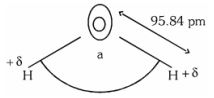
In the given figure,what is the bond angle represented by '$a$' (in $^\circ$)?
A
$108$
B
$104.5$
C
$95.84$
D
$90$
Solution
(B) The figure represents a water $(H_2O)$ molecule.
In a water molecule,the oxygen atom is $sp^3$ hybridized.
Due to the presence of two lone pairs of electrons on the oxygen atom,the bond angle is compressed from the ideal tetrahedral angle of $109.5^\circ$ to approximately $104.5^\circ$.
In a water molecule,the oxygen atom is $sp^3$ hybridized.
Due to the presence of two lone pairs of electrons on the oxygen atom,the bond angle is compressed from the ideal tetrahedral angle of $109.5^\circ$ to approximately $104.5^\circ$.
0 likes
View Solution158
EasyMCQ
Which group of vitamins is fat-soluble?
A
$Vit. A, B, C$
B
$Vit. B, C, D$
C
$Vit. C, D, E$
D
$Vit. A, D, E$
Solution
(D) Vitamins are classified into two categories based on their solubility: water-soluble and fat-soluble.
Water-soluble vitamins include $Vit. B$ complex and $Vit. C$.
Fat-soluble vitamins include $Vit. A, D, E,$ and $K$.
Therefore,the group containing fat-soluble vitamins is $Vit. A, D, E$.
Water-soluble vitamins include $Vit. B$ complex and $Vit. C$.
Fat-soluble vitamins include $Vit. A, D, E,$ and $K$.
Therefore,the group containing fat-soluble vitamins is $Vit. A, D, E$.
0 likes
View Solution159
MediumMCQ
Which of the following substances is found in fruit juices?
A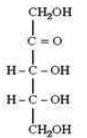
Fructose (Ketose sugar)
B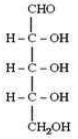
Glucose (Aldose sugar)
C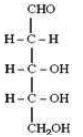
Deoxyribose sugar
D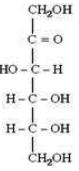
Fructose (Alternative isomer)
Solution
(A) Fruit juices primarily contain fructose,which is a naturally occurring monosaccharide known as fruit sugar.
Fructose is a ketose sugar,meaning it contains a ketone functional group.
The structure shown in option $A$ represents a ketose sugar (specifically $D$-fructose),which is commonly found in fruits.
Glucose (option $B$) is an aldose sugar.
Deoxyribose (option $C$) is a pentose sugar found in $DNA$.
Therefore,the correct structure representing the sugar found in fruit juices is option $A$.
Fructose is a ketose sugar,meaning it contains a ketone functional group.
The structure shown in option $A$ represents a ketose sugar (specifically $D$-fructose),which is commonly found in fruits.
Glucose (option $B$) is an aldose sugar.
Deoxyribose (option $C$) is a pentose sugar found in $DNA$.
Therefore,the correct structure representing the sugar found in fruit juices is option $A$.
0 likes
View Solution160
MediumMCQ
Which of the following options is incorrect for the given substance?
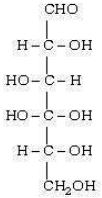
A
It is an aldohexose sugar.
B
It is obtained by the hydrolysis of starch.
C
Its hydrolysis is not possible.
D
It provides energy to the body.
Solution
(C) The given structure is of glucose $(C_6H_{12}O_6)$.
$1$. Glucose is an aldohexose sugar because it contains an aldehyde group and six carbon atoms.
$2$. Glucose is a monosaccharide,which means it cannot be further hydrolyzed into simpler carbohydrates.
$3$. Starch is a polysaccharide,and its complete hydrolysis yields glucose. However,glucose itself is the final product of hydrolysis,not a substance that undergoes further hydrolysis.
$4$. Glucose is the primary source of energy for the body.
Therefore,the statement 'Its hydrolysis is not possible' is technically correct for a monosaccharide,but in the context of identifying the 'incorrect' option regarding its properties,option $C$ is often interpreted as the odd one out if the question implies it is a complex sugar,or if the question is flawed. However,based on chemical facts,all statements $A, B, C, D$ are actually true for glucose. Re-evaluating the question: if the question asks for the 'incorrect' option,and all are true,there may be a misunderstanding. Given the standard nature of such questions,option $C$ is the defining characteristic of a monosaccharide. If the question implies which statement is false,and all are true,the question is flawed. Assuming the question asks for the correct description,all are correct. If we must choose an 'incorrect' one,none are strictly incorrect. However,in many textbook contexts,this question is presented to identify properties of glucose. Given the options,$C$ is a property of glucose (it is a monosaccharide). Let's assume the question intended to ask which is 'correct' or there is a typo in the question. Given the options,all are true for glucose.
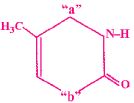
$1$. Glucose is an aldohexose sugar because it contains an aldehyde group and six carbon atoms.
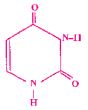
$2$. Glucose is a monosaccharide,which means it cannot be further hydrolyzed into simpler carbohydrates.
$3$. Starch is a polysaccharide,and its complete hydrolysis yields glucose. However,glucose itself is the final product of hydrolysis,not a substance that undergoes further hydrolysis.
$4$. Glucose is the primary source of energy for the body.
Therefore,the statement 'Its hydrolysis is not possible' is technically correct for a monosaccharide,but in the context of identifying the 'incorrect' option regarding its properties,option $C$ is often interpreted as the odd one out if the question implies it is a complex sugar,or if the question is flawed. However,based on chemical facts,all statements $A, B, C, D$ are actually true for glucose. Re-evaluating the question: if the question asks for the 'incorrect' option,and all are true,there may be a misunderstanding. Given the standard nature of such questions,option $C$ is the defining characteristic of a monosaccharide. If the question implies which statement is false,and all are true,the question is flawed. Assuming the question asks for the correct description,all are correct. If we must choose an 'incorrect' one,none are strictly incorrect. However,in many textbook contexts,this question is presented to identify properties of glucose. Given the options,$C$ is a property of glucose (it is a monosaccharide). Let's assume the question intended to ask which is 'correct' or there is a typo in the question. Given the options,all are true for glucose.
0 likes
View Solution161
MediumMCQ
Which carbohydrate is impermeable to the plasma membrane?
A
Monosaccharide
B
Disaccharide
C
Polysaccharide
D
Both $B$ and $C$
Solution
(D) The plasma membrane is a selectively permeable barrier.
Small,uncharged,or lipid-soluble molecules can pass through the membrane easily.
Monosaccharides (like glucose) can be transported across the membrane via specific transport proteins.
However,disaccharides and polysaccharides are larger,polar molecules that cannot cross the lipid bilayer by simple diffusion and generally require specific mechanisms or are too large to pass through standard membrane channels,making them effectively impermeable compared to monosaccharides.
Small,uncharged,or lipid-soluble molecules can pass through the membrane easily.
Monosaccharides (like glucose) can be transported across the membrane via specific transport proteins.
However,disaccharides and polysaccharides are larger,polar molecules that cannot cross the lipid bilayer by simple diffusion and generally require specific mechanisms or are too large to pass through standard membrane channels,making them effectively impermeable compared to monosaccharides.
0 likes
View Solution162
MediumMCQ
Match the following columns:
| Column-$I$ | Column-$II$ |
|---|---|
| $1$. Oleate | $a$. Triose sugar |
| $2$. Trihydroxy alcohol | $b$. Unsaturated fatty acid |
| $3$. Glyceraldehyde | $c$. Subcutaneous fat layer |
| $4$. Amylopectin | $d$. Glycerol |
| $5$. Ergosterol | $e$. Branched chain of glucose units |
A
$1-b, 2-d, 3-a, 4-e, 5-c$
B
$1-b, 2-a, 3-d, 4-e, 5-c$
C
$1-b, 2-e, 3-a, 4-c, 5-d$
D
$1-e, 2-d, 3-a, 4-b, 5-c$
Solution
(A) The correct matches are as follows:
$1$. Oleate is an unsaturated fatty acid $(1-b)$.
$2$. Glycerol is a trihydroxy alcohol $(2-d)$.
$3$. Glyceraldehyde is a triose sugar $(3-a)$.
$4$. Amylopectin is a branched chain of glucose units $(4-e)$.
$5$. Ergosterol is a sterol found in the subcutaneous fat layer or cell membranes $(5-c)$.
Therefore,the correct sequence is $1-b, 2-d, 3-a, 4-e, 5-c$.
$1$. Oleate is an unsaturated fatty acid $(1-b)$.
$2$. Glycerol is a trihydroxy alcohol $(2-d)$.
$3$. Glyceraldehyde is a triose sugar $(3-a)$.
$4$. Amylopectin is a branched chain of glucose units $(4-e)$.
$5$. Ergosterol is a sterol found in the subcutaneous fat layer or cell membranes $(5-c)$.
Therefore,the correct sequence is $1-b, 2-d, 3-a, 4-e, 5-c$.
0 likes
View Solution163
MediumMCQ
In organic compounds,the primary chemical bonds are formed between which atoms?
A
$C-N$
B
$C-C$
C
$C-H$
D
Both $(B)$ and $(C)$
Solution
(D) Organic compounds are defined by the presence of carbon atoms.
In these molecules,carbon atoms form stable covalent bonds with other carbon atoms ($C-C$ bonds) to create the backbone of the molecule.
Additionally,carbon atoms frequently form covalent bonds with hydrogen atoms ($C-H$ bonds).
Therefore,both $C-C$ and $C-H$ bonds are fundamental in organic chemistry.
In these molecules,carbon atoms form stable covalent bonds with other carbon atoms ($C-C$ bonds) to create the backbone of the molecule.
Additionally,carbon atoms frequently form covalent bonds with hydrogen atoms ($C-H$ bonds).
Therefore,both $C-C$ and $C-H$ bonds are fundamental in organic chemistry.
0 likes
View Solution164
EasyMCQ
Which of the following is a fat-soluble vitamin?
A
$A$
B
$D$
C
$E$
D
All of the above
Solution
(D) Vitamins are classified into two categories based on their solubility: water-soluble and fat-soluble.
Water-soluble vitamins include Vitamin $B$ complex and Vitamin $C$.
Fat-soluble vitamins include Vitamin $A$, $D$, $E$, and $K$.
Since options $A$, $D$, and $E$ are all fat-soluble, the correct answer is "All of the above".
Water-soluble vitamins include Vitamin $B$ complex and Vitamin $C$.
Fat-soluble vitamins include Vitamin $A$, $D$, $E$, and $K$.
Since options $A$, $D$, and $E$ are all fat-soluble, the correct answer is "All of the above".
0 likes
View Solution165
MediumMCQ
Why does carbon form a wide variety of compounds by combining with itself and other functional groups?
A
Due to its tetravalency
B
Due to its atomic number being $12$
C
Due to its atomic mass being $12$
D
Due to it being an atmospheric component
Solution
(A) Carbon possesses a unique property known as catenation,which is the ability to form stable bonds with other carbon atoms to create long chains,branched structures,or rings.
Additionally,carbon is tetravalent,meaning it has $4$ valence electrons,allowing it to form $4$ covalent bonds with various other atoms like hydrogen,oxygen,nitrogen,and sulfur,as well as different functional groups.
These two properties,catenation and tetravalency,are the primary reasons for the vast diversity of carbon compounds.
Additionally,carbon is tetravalent,meaning it has $4$ valence electrons,allowing it to form $4$ covalent bonds with various other atoms like hydrogen,oxygen,nitrogen,and sulfur,as well as different functional groups.
These two properties,catenation and tetravalency,are the primary reasons for the vast diversity of carbon compounds.
0 likes
View Solution166
MediumMCQ
Match the following columns:
| Column-$I$ | Column-$II$ |
| $(A)$ Disaccharide | $(i)$ Unsaturated fatty acid |
| $(B)$ Galactose | $(ii)$ Saturated fatty acid |
| $(C)$ Oleic acid | $(iii)$ Monosaccharide |
| $(D)$ Stearic acid | $(iv)$ Monosaccharide pair |
A
$A-iv, B-iii, C-i, D-ii$
B
$A-iii, B-i, C-iv, D-ii$
C
$A-i, B-iv, C-ii, D-iii$
D
$A-ii, B-i, C-iii, D-iv$
Solution
$(A)$ Disaccharide is a carbohydrate composed of two monosaccharide units, hence it matches with $(iv)$ Monosaccharide pair.
$(B)$ Galactose is a simple sugar, which is a $(iii)$ Monosaccharide.
$(C)$ Oleic acid is a common $(i)$ Unsaturated fatty acid found in nature.
$(D)$ Stearic acid is a common $(ii)$ Saturated fatty acid.
Therefore, the correct matching is $A-iv, B-iii, C-i, D-ii$.
$(B)$ Galactose is a simple sugar, which is a $(iii)$ Monosaccharide.
$(C)$ Oleic acid is a common $(i)$ Unsaturated fatty acid found in nature.
$(D)$ Stearic acid is a common $(ii)$ Saturated fatty acid.
Therefore, the correct matching is $A-iv, B-iii, C-i, D-ii$.
0 likes
View Solution167
MediumMCQ
Which of the following is $NOT$ a group of organic compounds?
A
Fats,proteins,enzymes,hormones
B
Coenzymes,hormones,water,mineral salts
C
Proteins,carbohydrates,nucleic acids,hormones
D
Proteins,carbohydrates,fats,enzymes
Solution
(B) Organic compounds are carbon-based molecules that are essential for life,such as proteins,carbohydrates,lipids (fats),nucleic acids,enzymes,and hormones.
Water $(H_2O)$ and mineral salts (inorganic ions like $Na^+$,$Cl^-$,$Ca^{2+}$,etc.) are classified as inorganic compounds because they do not contain carbon-carbon or carbon-hydrogen bonds.
Therefore,the group containing water and mineral salts is not a group of organic compounds.
Water $(H_2O)$ and mineral salts (inorganic ions like $Na^+$,$Cl^-$,$Ca^{2+}$,etc.) are classified as inorganic compounds because they do not contain carbon-carbon or carbon-hydrogen bonds.
Therefore,the group containing water and mineral salts is not a group of organic compounds.
0 likes
View Solution168
MediumMCQ
Match the following columns:
| Column $I$ | Column $II$ |
| $(a)$ Fructose | $(p)$ Respiratory substrate |
| $(b)$ Glucose | $(q)$ Found in fruit juices |
| $(c)$ Starch | $(r)$ Responsible for sweetness of milk |
| $(d)$ Galactose | $(s)$ Stored food in plants |
A
$(a-q), (b-p), (c-r), (d-s)$
B
$(a-r), (b-s), (c-p), (d-q)$
C
$(a-q), (b-p), (c-s), (d-r)$
D
$(a-p), (b-q), (c-r), (d-s)$
Solution
(C) The correct matches are as follows:
$(a)$ Fructose is a monosaccharide commonly found in fruit juices, hence $(a-q)$.
$(b)$ Glucose is the primary respiratory substrate used by cells for energy production, hence $(b-p)$.
$(c)$ Starch is a polysaccharide that serves as the primary stored food material in plants, hence $(c-s)$.
$(d)$ Galactose is a component of lactose (milk sugar) and is responsible for the sweetness of milk, hence $(d-r)$.
Therefore, the correct sequence is $(a-q), (b-p), (c-s), (d-r)$.
$(a)$ Fructose is a monosaccharide commonly found in fruit juices, hence $(a-q)$.
$(b)$ Glucose is the primary respiratory substrate used by cells for energy production, hence $(b-p)$.
$(c)$ Starch is a polysaccharide that serves as the primary stored food material in plants, hence $(c-s)$.
$(d)$ Galactose is a component of lactose (milk sugar) and is responsible for the sweetness of milk, hence $(d-r)$.
Therefore, the correct sequence is $(a-q), (b-p), (c-s), (d-r)$.
0 likes
View Solution169
MediumMCQ
Match the following columns:
| Column $I$ | Column $II$ |
| $(A)$ Chlorine | $(i)$ Outer surface of aerial parts of plants |
| $(B)$ $DHAP$ | $(ii)$ Structural component of plant cell wall |
| $(C)$ Cellulose | $(iii)$ Osmoregulation in blood |
| $(D)$ Crotonic acid | $(iv)$ Phosphorylated ketotriose |
| $(E)$ Wax | $(v)$ Unsaturated fatty acid |
A
$(A-iii), (B-iv), (C-ii), (D-v), (E-i)$
B
$(A-ii), (B-v), (C-iv), (D-iii), (E-i)$
C
$(A-v), (B-iv), (C-i), (D-ii), (E-iii)$
D
$(A-iv), (B-ii), (C-i), (D-iii), (E-v)$
Solution
(A) The correct matches are as follows:
$(A)$ Chlorine: $(iii)$ It plays a role in osmoregulation in blood (chloride shift).
$(B)$ $DHAP$ (Dihydroxyacetone phosphate): $(iv)$ It is a phosphorylated ketotriose sugar formed during glycolysis.
$(C)$ Cellulose: $(ii)$ It is a polysaccharide that serves as a structural component of the plant cell wall.
$(D)$ Crotonic acid: $(v)$ It is an unsaturated fatty acid (specifically a short-chain unsaturated carboxylic acid).
$(E)$ Wax: $(i)$ It forms a protective layer on the outer surface of aerial parts of plants to prevent water loss.
Therefore, the correct sequence is $(A-iii), (B-iv), (C-ii), (D-v), (E-i)$.
$(A)$ Chlorine: $(iii)$ It plays a role in osmoregulation in blood (chloride shift).
$(B)$ $DHAP$ (Dihydroxyacetone phosphate): $(iv)$ It is a phosphorylated ketotriose sugar formed during glycolysis.
$(C)$ Cellulose: $(ii)$ It is a polysaccharide that serves as a structural component of the plant cell wall.
$(D)$ Crotonic acid: $(v)$ It is an unsaturated fatty acid (specifically a short-chain unsaturated carboxylic acid).
$(E)$ Wax: $(i)$ It forms a protective layer on the outer surface of aerial parts of plants to prevent water loss.
Therefore, the correct sequence is $(A-iii), (B-iv), (C-ii), (D-v), (E-i)$.
0 likes
View Solution170
EasyMCQ
Which phosphate-containing compound participates in energy exchange reactions?
A
$PGAL$
B
$DHAP$
C
$ATP$
D
$RuBP$
Solution
(C) $ATP$ (Adenosine Triphosphate) is known as the energy currency of the cell.
It contains high-energy phosphate bonds.
When $ATP$ is hydrolyzed to $ADP$ (Adenosine Diphosphate) and inorganic phosphate $(Pi)$,a significant amount of energy is released,which is used to drive various endergonic biological processes.
Therefore,it is the primary molecule involved in energy exchange within living organisms.
It contains high-energy phosphate bonds.
When $ATP$ is hydrolyzed to $ADP$ (Adenosine Diphosphate) and inorganic phosphate $(Pi)$,a significant amount of energy is released,which is used to drive various endergonic biological processes.
Therefore,it is the primary molecule involved in energy exchange within living organisms.
0 likes
View Solution171
EasyMCQ
The bond angle between $H-O-H$ in a water molecule is ......... (in $^o$)
A
$191.68$
B
$95.84$
C
$59.84$
D
$104.45$
Solution
(D) In a water molecule $(H_2O)$,the oxygen atom is $sp^3$ hybridized.
Due to the presence of two lone pairs of electrons on the oxygen atom,the bond angle is compressed from the ideal tetrahedral angle of $109.5^o$ to $104.45^o$ due to lone pair-bond pair repulsion.
Therefore,the correct bond angle is $104.45^o$.
Due to the presence of two lone pairs of electrons on the oxygen atom,the bond angle is compressed from the ideal tetrahedral angle of $109.5^o$ to $104.45^o$ due to lone pair-bond pair repulsion.
Therefore,the correct bond angle is $104.45^o$.
0 likes
View Solution172
MediumMCQ
Select the correct match for $X$ and $Y$.
| Column $X$ | Column $Y$ |
| $(1)$ Oleic acid | $(P)$ Triose sugar |
| $(2)$ Trihydroxy alcohol | $(Q)$ Unsaturated fatty acid |
| $(3)$ Glyceraldehyde | $(R)$ Subcutaneous fat |
| $(4)$ Amylopectin | $(S)$ Glycerol |
| $(5)$ Cholesterol | $(T)$ Branched chain of glucose units |
A
$(1-Q), (2-S), (3-P), (4-T), (5-R)$
B
$(1-Q), (2-P), (3-S), (4-T), (5-R)$
C
$(1-Q), (2-T), (3-P), (4-R), (5-S)$
D
$(1-T), (2-S), (3-P), (4-Q), (5-R)$
Solution
(A) The correct matches are as follows:
$(1)$ Oleic acid is an unsaturated fatty acid $(Q)$.
$(2)$ Trihydroxy alcohol is Glycerol $(S)$.
$(3)$ Glyceraldehyde is a triose sugar $(P)$.
$(4)$ Amylopectin is a branched chain of glucose units $(T)$.
$(5)$ Cholesterol is a lipid found in subcutaneous fat/membranes $(R)$.
Therefore, the correct sequence is $(1-Q), (2-S), (3-P), (4-T), (5-R)$.
$(1)$ Oleic acid is an unsaturated fatty acid $(Q)$.
$(2)$ Trihydroxy alcohol is Glycerol $(S)$.
$(3)$ Glyceraldehyde is a triose sugar $(P)$.
$(4)$ Amylopectin is a branched chain of glucose units $(T)$.
$(5)$ Cholesterol is a lipid found in subcutaneous fat/membranes $(R)$.
Therefore, the correct sequence is $(1-Q), (2-S), (3-P), (4-T), (5-R)$.
0 likes
View Solution173
MediumMCQ
Select the correct match for $X$ and $Y$.
| Column $X$ | Column $Y$ |
| $(1)$ Starch | $(P)$ Found in animal skeletal tissues |
| $(2)$ Glycogen | $(Q)$ Stored food form in plants |
| $(3)$ Chitin | $(R)$ Provides strength in sclerenchyma |
| $(4)$ Lignin | $(S)$ Stored food form in animals |
A
$(1-S), (2-P), (3-R), (4-Q)$
B
$(1-P), (2-R), (3-S), (4-Q)$
C
$(1-P), (2-Q), (3-R), (4-S)$
D
$(1-Q), (2-S), (3-P), (4-R)$
Solution
(D) The correct matches are as follows:
$(1)$ Starch is the primary stored food form in plants,matching $(Q)$.
$(2)$ Glycogen is the stored food form in animals (often called animal starch),matching $(S)$.
$(3)$ Chitin is a structural polysaccharide found in the exoskeleton of arthropods and fungal cell walls,matching $(P)$.
$(4)$ Lignin is a complex polymer that provides structural support and strength to the cell walls of sclerenchyma tissues in plants,matching $(R)$.
Therefore,the correct sequence is $(1-Q), (2-S), (3-P), (4-R)$.
$(1)$ Starch is the primary stored food form in plants,matching $(Q)$.
$(2)$ Glycogen is the stored food form in animals (often called animal starch),matching $(S)$.
$(3)$ Chitin is a structural polysaccharide found in the exoskeleton of arthropods and fungal cell walls,matching $(P)$.
$(4)$ Lignin is a complex polymer that provides structural support and strength to the cell walls of sclerenchyma tissues in plants,matching $(R)$.
Therefore,the correct sequence is $(1-Q), (2-S), (3-P), (4-R)$.
0 likes
View Solution174
DifficultMCQ
Select the correct combination for Column $X$,Column $Y$,and Column $Z$:
| Column $X$ | Column $Y$ | Column $Z$ |
|---|---|---|
| $(1)$ Dark reaction of photosynthesis | $(A)$ Galactose | $(P)$ Ketohexose |
| $(2)$ Structure of $DNA$ | $(B)$ Fructose | $(Q)$ Aldopentose |
| $(3)$ Fruit juice | $(C)$ $PGAL$ | $(R)$ Aldohexose |
| $(4)$ Digestion of milk | $(D)$ $C_5H_{10}O_4$ | $(S)$ Aldotriose |
A
$(1-C-S), (2-D-Q), (3-B-P), (4-A-R)$
B
$(1-C-S), (2-D-Q), (3-B-P), (4-A-R)$
C
$(1-B-S), (2-D-Q), (3-C-P), (4-A-R)$
D
$(1-B-S), (2-A-R), (3-C-P), (4-D-Q)$
Solution
(B) The correct matching is as follows:
$(1)$ Dark reaction of photosynthesis involves $PGAL$ (Phosphoglyceraldehyde),which is an aldotriose. Thus,$(1-C-S)$.
$(2)$ The structure of $DNA$ contains deoxyribose sugar,which has the formula $C_5H_{10}O_4$ and is an aldopentose. Thus,$(2-D-Q)$.
$(3)$ Fruit juice contains fructose,which is a ketohexose. Thus,$(3-B-P)$.
$(4)$ Digestion of milk involves the breakdown of lactose into glucose and galactose. Galactose is an aldohexose. Thus,$(4-A-R)$.
Therefore,the correct combination is $(1-C-S), (2-D-Q), (3-B-P), (4-A-R)$.
$(1)$ Dark reaction of photosynthesis involves $PGAL$ (Phosphoglyceraldehyde),which is an aldotriose. Thus,$(1-C-S)$.
$(2)$ The structure of $DNA$ contains deoxyribose sugar,which has the formula $C_5H_{10}O_4$ and is an aldopentose. Thus,$(2-D-Q)$.
$(3)$ Fruit juice contains fructose,which is a ketohexose. Thus,$(3-B-P)$.
$(4)$ Digestion of milk involves the breakdown of lactose into glucose and galactose. Galactose is an aldohexose. Thus,$(4-A-R)$.
Therefore,the correct combination is $(1-C-S), (2-D-Q), (3-B-P), (4-A-R)$.
0 likes
View Solution175
MediumMCQ
$A$: Living organisms obtain various molecules and elements from their environment.
$R$: Living organisms synthesize components essential for their body.
$R$: Living organisms synthesize components essential for their body.
A
$A$ and $R$ are both true and $R$ is the correct explanation of $A$.
B
$A$ and $R$ are both true,but $R$ is not the correct explanation of $A$.
C
$A$ is true and $R$ is false.
D
$A$ is false and $R$ is true.
Solution
(B) Living organisms are open systems that interact with their environment to acquire essential nutrients,molecules,and elements required for survival. This is represented by statement $A$. Simultaneously,living organisms possess metabolic pathways to synthesize complex organic compounds (like proteins,lipids,and nucleic acids) from simpler precursors,which are essential for their growth,repair,and maintenance. This is represented by statement $R$. While both statements are scientifically accurate,statement $R$ does not explain why organisms must obtain molecules from the environment; rather,it describes an additional capability of living systems. Therefore,both are true,but $R$ is not the correct explanation of $A$.
0 likes
View Solution176
MediumMCQ
$A$: Water is an efficient solvent.
$R$: Polar nature is an important property of water.
$R$: Polar nature is an important property of water.
A
$A$ and $R$ are both true and $R$ is the correct explanation of $A$.
B
$A$ and $R$ are both true,but $R$ is not the correct explanation of $A$.
C
$A$ is true and $R$ is false.
D
$A$ is false and $R$ is true.
Solution
(A) Water $(H_2O)$ is a polar molecule due to the electronegativity difference between oxygen and hydrogen atoms.
Because of this polar nature,water can dissolve a wide variety of substances,including ionic compounds and polar covalent molecules,making it an efficient solvent.
Therefore,the polar nature of water is the fundamental reason why it acts as an efficient solvent.
Thus,both $A$ and $R$ are true,and $R$ is the correct explanation of $A$.
Because of this polar nature,water can dissolve a wide variety of substances,including ionic compounds and polar covalent molecules,making it an efficient solvent.
Therefore,the polar nature of water is the fundamental reason why it acts as an efficient solvent.
Thus,both $A$ and $R$ are true,and $R$ is the correct explanation of $A$.
0 likes
View Solution177
MediumMCQ
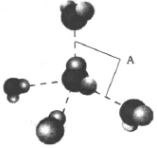
Which molecule's structure is shown in the given figure?
A
$NH_2$
B
$CO_2$
C
$H_2O$
D
$H_2S$
Solution
(C) The figure shows multiple water molecules $(H_2O)$ interacting with each other through hydrogen bonding. The dashed line labeled '$A$' represents a hydrogen bond between the oxygen atom of one water molecule and the hydrogen atom of another. Water is a polar molecule,and this network of hydrogen bonds is characteristic of its structure in the liquid or solid state.
0 likes
View Solution178
EasyMCQ
In the given figure,what does $A$ indicate?
A
Covalent bond
B
Ionic bond
C
Sulfur bond
D
Hydrogen bond
Solution
(D) The figure shows multiple water $(H_2O)$ molecules interacting with each other.
The dashed lines represent the weak electrostatic attraction between the partially positive hydrogen atom of one water molecule and the partially negative oxygen atom of an adjacent water molecule.
This specific type of interaction is known as a hydrogen bond.
Therefore,$A$ indicates a hydrogen bond.
The dashed lines represent the weak electrostatic attraction between the partially positive hydrogen atom of one water molecule and the partially negative oxygen atom of an adjacent water molecule.
This specific type of interaction is known as a hydrogen bond.
Therefore,$A$ indicates a hydrogen bond.
0 likes
View Solution179
EasyMCQ
How many water molecules are present in the given figure?
A
Two
B
Three
C
Five
D
Four
Solution
(C) By observing the provided figure,we can identify individual water molecules $(H_2O)$. Each molecule consists of one large oxygen atom bonded to two smaller hydrogen atoms. Counting these distinct units in the diagram reveals a total of $5$ water molecules. The dashed lines represent hydrogen bonds connecting these molecules.
0 likes
View Solution180
MediumMCQ
How many covalent bonds are present in the water molecules shown in the given figure?
A
$5$
B
$10$
C
$15$
D
$6$
Solution
(B) The figure shows $5$ water $(H_2O)$ molecules.
Each water molecule consists of $2$ covalent bonds between the oxygen atom and the two hydrogen atoms.
Since there are $5$ water molecules,the total number of covalent bonds is $5 \times 2 = 10$.
Therefore,the correct option is $B$.
Each water molecule consists of $2$ covalent bonds between the oxygen atom and the two hydrogen atoms.
Since there are $5$ water molecules,the total number of covalent bonds is $5 \times 2 = 10$.
Therefore,the correct option is $B$.
0 likes
View Solution181
MediumMCQ
Which of the following are nitrogenous organic compounds?
A
Lipids,Proteins
B
Nucleic acids,Lipids
C
Carbohydrates,Proteins
D
Proteins,Enzymes
Solution
(D) Nitrogenous organic compounds are those that contain nitrogen in their molecular structure.
$1$. Proteins are polymers of amino acids,and every amino acid contains an amino group $(-NH_2)$,making proteins nitrogenous.
$2$. Enzymes are primarily proteins (with some exceptions like ribozymes which are $RNA$),and thus they are also nitrogenous.
$3$. Lipids and carbohydrates generally consist of carbon,hydrogen,and oxygen and do not contain nitrogen in their basic structure.
$4$. Nucleic acids ($DNA$ and $RNA$) contain nitrogenous bases,but the question asks for the best pair among the options provided. Since both proteins and enzymes are fundamentally nitrogen-rich,option $D$ is the most accurate choice.
$1$. Proteins are polymers of amino acids,and every amino acid contains an amino group $(-NH_2)$,making proteins nitrogenous.
$2$. Enzymes are primarily proteins (with some exceptions like ribozymes which are $RNA$),and thus they are also nitrogenous.
$3$. Lipids and carbohydrates generally consist of carbon,hydrogen,and oxygen and do not contain nitrogen in their basic structure.
$4$. Nucleic acids ($DNA$ and $RNA$) contain nitrogenous bases,but the question asks for the best pair among the options provided. Since both proteins and enzymes are fundamentally nitrogen-rich,option $D$ is the most accurate choice.
0 likes
View Solution182
MediumMCQ
Water is generally found in liquid form because ........
A
Hydrogen carries a partial positive charge and oxygen carries a partial negative charge.
B
It possesses the property of polarity.
C
There is hydrogen bonding between the molecules.
D
The distance between $H$ and $O$ is $95.84 \text{ pm}$.
Solution
(C) Water $(H_2O)$ molecules are polar due to the electronegativity difference between oxygen and hydrogen atoms.
This polarity leads to the formation of hydrogen bonds between adjacent water molecules.
These intermolecular hydrogen bonds are strong enough to keep water in a liquid state at room temperature, whereas similar-sized molecules without hydrogen bonding are typically gases.
This polarity leads to the formation of hydrogen bonds between adjacent water molecules.
These intermolecular hydrogen bonds are strong enough to keep water in a liquid state at room temperature, whereas similar-sized molecules without hydrogen bonding are typically gases.
0 likes
View Solution183
EasyMCQ
Which of the following statements is $NOT$ true regarding biomolecules?
A
They have a molecular weight of $10,000$ Daltons or more.
B
They are classified into two types: simple micromolecules and macromolecules.
C
They include primary or secondary metabolites.
D
Natural products cannot be considered as biomolecules.
Solution
(D) Biomolecules are organic compounds found in living organisms. Statement $D$ is $NOT$ true because natural products (such as alkaloids,flavonoids,rubber,essential oils,etc.) are secondary metabolites and are indeed considered biomolecules. The other statements are correct: biomolecules are classified into micromolecules and macromolecules,they include primary and secondary metabolites,and macromolecules typically have a molecular weight of $10,000$ Daltons or more.
0 likes
View Solution184
MediumMCQ
Which of the following is the structure of glycerol?
A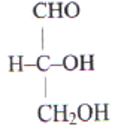
B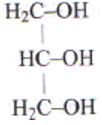
C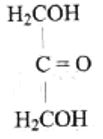
D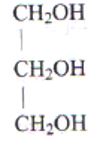
Solution
(B) Glycerol is a simple polyol compound. Its chemical formula is $C_3H_8O_3$.
It consists of a three-carbon backbone,where each carbon atom is bonded to a hydroxyl $(-OH)$ group.
The structural formula is $CH_2OH-CHOH-CH_2OH$.
Option $B$ correctly represents this structure.
It consists of a three-carbon backbone,where each carbon atom is bonded to a hydroxyl $(-OH)$ group.
The structural formula is $CH_2OH-CHOH-CH_2OH$.
Option $B$ correctly represents this structure.
0 likes
View Solution185
MediumMCQ
Find the mismatched pair.
A
Fructose - Ketohexose sugar
B
Lactose - Glucose + Galactose
C
Starch - $n$ (Glucose)
D
$ATP$ - Ribulose
Solution
(D) $1$. Fructose is a ketohexose sugar,which is correct.
$2$. Lactose is a disaccharide composed of glucose and galactose,which is correct.
$3$. Starch is a polysaccharide (polymer) made up of many glucose units ($n$ units),which is correct.
$4$. $ATP$ (Adenosine Triphosphate) consists of an adenine base,a ribose sugar,and three phosphate groups. It does not consist of ribulose. Therefore,the pair '$ATP$ - Ribulose' is incorrect.
$2$. Lactose is a disaccharide composed of glucose and galactose,which is correct.
$3$. Starch is a polysaccharide (polymer) made up of many glucose units ($n$ units),which is correct.
$4$. $ATP$ (Adenosine Triphosphate) consists of an adenine base,a ribose sugar,and three phosphate groups. It does not consist of ribulose. Therefore,the pair '$ATP$ - Ribulose' is incorrect.
0 likes
View Solution186
MediumMCQ
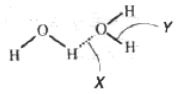
In the given figure,what are '$X$' and '$Y$' respectively?
A
$X-$ Covalent bond,$Y-$ Ionic bond
B
$X-$ Ionic bond,$Y-$ Covalent bond
C
$X-$ Hydrogen bond,$Y-$ Covalent bond
D
$X-$ Covalent bond,$Y-$ Hydrogen bond
Solution
(C) The figure shows two water $(H_2O)$ molecules interacting with each other.
$X$ points to the dotted line representing the attraction between the electronegative oxygen atom of one water molecule and the electropositive hydrogen atom of another water molecule,which is a hydrogen bond.
$Y$ points to the solid line connecting the oxygen atom and hydrogen atom within a single water molecule,which is a covalent bond.
Therefore,$X$ is a hydrogen bond and $Y$ is a covalent bond.
$X$ points to the dotted line representing the attraction between the electronegative oxygen atom of one water molecule and the electropositive hydrogen atom of another water molecule,which is a hydrogen bond.
$Y$ points to the solid line connecting the oxygen atom and hydrogen atom within a single water molecule,which is a covalent bond.
Therefore,$X$ is a hydrogen bond and $Y$ is a covalent bond.
0 likes
View Solution187
MediumMCQ
The variations observed among different species of organisms are due to the differences in their ......... .
A
Differences in abiotic molecules
B
Similarities in biomolecules
C
Presence of biomolecules
D
Differences in biomolecules
Solution
(D) The fundamental chemical composition of all living organisms is remarkably similar,consisting of the same types of biomolecules such as proteins,nucleic acids,carbohydrates,and lipids. However,the specific variations observed between different species are primarily due to the differences in the structure,sequence,and concentration of these biomolecules. Therefore,the correct answer is $D$.
0 likes
View Solution188
MediumMCQ
What is the cause of the variations found in different species of living organisms?
A
Due to the variation in their biological molecules
B
Due to different habitats
C
Due to different modes of nutrition
D
Due to different evolutionary processes
Solution
(A) The variations observed in different species of living organisms are primarily due to the differences in their biological molecules,specifically the sequence and structure of proteins and nucleic acids ($DNA$ and $RNA$). While habitats,nutrition,and evolution play roles in shaping these organisms,the fundamental molecular basis for diversity lies in the unique composition of biomolecules within each species.
0 likes
View Solution189
EasyMCQ
Which of the following is a purine type of nitrogenous base?
A
Cytosine
B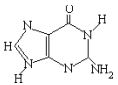
Guanine
C
Thymine
D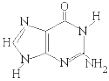
Guanine
Solution
(B) Nitrogenous bases are classified into two types: Purines and Pyrimidines.
Purines are double-ring structures (a six-membered ring fused to a five-membered ring),which include Adenine and Guanine.
Pyrimidines are single-ring structures (a six-membered ring),which include Cytosine,Thymine,and Uracil.
Option $A$ shows Cytosine (pyrimidine).
Option $B$ and $D$ show Guanine (purine).
Option $C$ shows Thymine (pyrimidine).
Therefore,Guanine is the purine type of nitrogenous base.
Purines are double-ring structures (a six-membered ring fused to a five-membered ring),which include Adenine and Guanine.
Pyrimidines are single-ring structures (a six-membered ring),which include Cytosine,Thymine,and Uracil.
Option $A$ shows Cytosine (pyrimidine).
Option $B$ and $D$ show Guanine (purine).
Option $C$ shows Thymine (pyrimidine).
Therefore,Guanine is the purine type of nitrogenous base.
0 likes
View Solution190
EasyMCQ
How does an $ADP$ molecule differ from an $ATP$ molecule?
A
It has one less phosphate group.
B
It has diamine instead of thymine.
C
It has more phosphate bonds.
D
It has lower electrical activity.
Solution
(A) $ATP$ stands for Adenosine Triphosphate,which contains three phosphate groups attached to an adenosine molecule.
$ADP$ stands for Adenosine Diphosphate,which contains two phosphate groups attached to an adenosine molecule.
Therefore,the primary difference is that $ADP$ has one less phosphate group compared to $ATP$.
$ADP$ stands for Adenosine Diphosphate,which contains two phosphate groups attached to an adenosine molecule.
Therefore,the primary difference is that $ADP$ has one less phosphate group compared to $ATP$.
0 likes
View Solution191
EasyMCQ
Which of the following is the correct structure of deoxyribose sugar?
A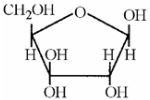
B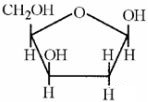
C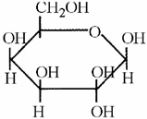
D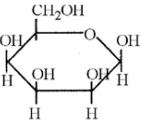
Solution
(B) Deoxyribose is a pentose sugar (a $5$-carbon sugar) found in $DNA$.
Its chemical formula is $C_5H_{10}O_4$.
Unlike ribose,which has a hydroxyl $(-OH)$ group at both the $2'$ and $3'$ positions,deoxyribose lacks an oxygen atom at the $2'$ position.
In the structure of $2$-deoxy-$D$-ribose,the $2'$ carbon atom is bonded to two hydrogen atoms $(-H)$ instead of one hydrogen and one hydroxyl group.
Structure $B$ correctly represents this,showing the $2'$ carbon with two hydrogen atoms and the $3'$ carbon with a hydroxyl group.
Its chemical formula is $C_5H_{10}O_4$.
Unlike ribose,which has a hydroxyl $(-OH)$ group at both the $2'$ and $3'$ positions,deoxyribose lacks an oxygen atom at the $2'$ position.
In the structure of $2$-deoxy-$D$-ribose,the $2'$ carbon atom is bonded to two hydrogen atoms $(-H)$ instead of one hydrogen and one hydroxyl group.
Structure $B$ correctly represents this,showing the $2'$ carbon with two hydrogen atoms and the $3'$ carbon with a hydroxyl group.
0 likes
View Solution192
MediumMCQ
What do "a" and "b" represent in the given structure of the nitrogenous base?
A
a = $C=O$; b = $NH$
B
a = $NH$; b = $C=O$
C
a = $C=O$; b = $C=O$
D
a = $NH$; b = $NH$
Solution
(A) The given structure represents Thymine ($5$-methyluracil).
In the pyrimidine ring of Thymine, the position labeled "a" corresponds to a carbonyl group $(C=O)$ and the position labeled "b" corresponds to an imino group $(NH)$.
Therefore, "a" represents $C=O$ and "b" represents $NH$.
In the pyrimidine ring of Thymine, the position labeled "a" corresponds to a carbonyl group $(C=O)$ and the position labeled "b" corresponds to an imino group $(NH)$.
Therefore, "a" represents $C=O$ and "b" represents $NH$.
0 likes
View Solution193
MediumMCQ
Which nitrogenous base is represented by the given structure?
A
Thymine
B
Adenine
C
Cytosine
D
Uracil
Solution
(D) The given structure represents a pyrimidine ring with two carbonyl groups at positions $2$ and $4$.
This specific structure is characteristic of Uracil.
Thymine is $5$-methyluracil,which would have a methyl group at the $5$th position.
Cytosine has an amino group at the $4$th position instead of a carbonyl group.
Adenine is a purine,which consists of a double-ring structure.
Therefore,the correct option is $D$.
This specific structure is characteristic of Uracil.
Thymine is $5$-methyluracil,which would have a methyl group at the $5$th position.
Cytosine has an amino group at the $4$th position instead of a carbonyl group.
Adenine is a purine,which consists of a double-ring structure.
Therefore,the correct option is $D$.
0 likes
View Solution194
EasyMCQ
Identify the organic compound shown in the given structure.
A
Glucose
B
Ribose
C
Thymine
D
Uracil
Solution
(D) The provided chemical structure represents a pyrimidine base.
Specifically,it is the structure of Uracil,which is a nitrogenous base found in $RNA$.
It consists of a six-membered ring with two nitrogen atoms at positions $1$ and $3$,and two carbonyl groups at positions $2$ and $4$.
Thymine is $5$-methyluracil,which would have a methyl group at the $5$th position,whereas the given structure lacks this group.
Therefore,the correct option is $D$.
Specifically,it is the structure of Uracil,which is a nitrogenous base found in $RNA$.
It consists of a six-membered ring with two nitrogen atoms at positions $1$ and $3$,and two carbonyl groups at positions $2$ and $4$.
Thymine is $5$-methyluracil,which would have a methyl group at the $5$th position,whereas the given structure lacks this group.
Therefore,the correct option is $D$.
0 likes
View Solution195
MediumMCQ
Which of the following is the correct structure of adenine?
A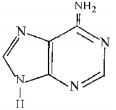
B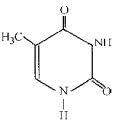
C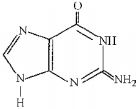
D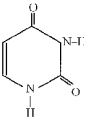
Solution
(A) Adenine is a purine base found in nucleic acids ($DNA$ and $RNA$).
Its chemical structure consists of a fused pyrimidine and imidazole ring system.
Specifically,it is $6$-aminopurine.
Option $A$ represents the correct structure of adenine,which contains an amino group $(-NH_2)$ attached to the $6^{th}$ position of the purine ring.
Option $B$ is thymine,Option $C$ is guanine,and Option $D$ is uracil.
Its chemical structure consists of a fused pyrimidine and imidazole ring system.
Specifically,it is $6$-aminopurine.
Option $A$ represents the correct structure of adenine,which contains an amino group $(-NH_2)$ attached to the $6^{th}$ position of the purine ring.
Option $B$ is thymine,Option $C$ is guanine,and Option $D$ is uracil.
0 likes
View Solution196
EasyMCQ
Which of the following represents the correct structure of cytosine?
A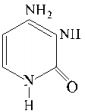
B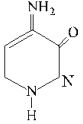
C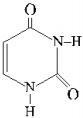
D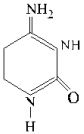
Solution
(A) Cytosine is a pyrimidine nitrogenous base found in $DNA$ and $RNA$.
Its chemical structure consists of a six-membered heterocyclic ring containing two nitrogen atoms at positions $1$ and $3$.
It features an amino group $(-NH_2)$ at position $4$ and a carbonyl group $(=O)$ at position $2$.
Among the given options,the structure in option $A$ correctly represents the chemical formula of cytosine $(C_4H_5N_3O)$.
Option $C$ represents uracil,while others are incorrect representations.
Its chemical structure consists of a six-membered heterocyclic ring containing two nitrogen atoms at positions $1$ and $3$.
It features an amino group $(-NH_2)$ at position $4$ and a carbonyl group $(=O)$ at position $2$.
Among the given options,the structure in option $A$ correctly represents the chemical formula of cytosine $(C_4H_5N_3O)$.
Option $C$ represents uracil,while others are incorrect representations.
0 likes
View Solution197
MediumMCQ
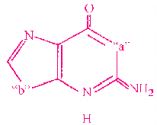
What do '$a$' and '$b$' represent in the given structure?
A
$a = (>C=O); b = -NH$
B
$a = (>C=O); b = (>C=O)$
C
$a = -CH_2; b = -NH$
D
$a = -NH; b = -NH$
Solution
(A) The provided structure is Guanine,which is a purine nitrogenous base.
In the structure of Guanine,the position labeled '$a$' corresponds to a carbon atom involved in a double bond with oxygen,represented as $(>C=O)$.
The position labeled '$b$' corresponds to an amino group attached to the imidazole ring,which is represented as $-NH$ (specifically,the nitrogen atom in the ring structure).
Therefore,the correct representation is $a = (>C=O)$ and $b = -NH$.
In the structure of Guanine,the position labeled '$a$' corresponds to a carbon atom involved in a double bond with oxygen,represented as $(>C=O)$.
The position labeled '$b$' corresponds to an amino group attached to the imidazole ring,which is represented as $-NH$ (specifically,the nitrogen atom in the ring structure).
Therefore,the correct representation is $a = (>C=O)$ and $b = -NH$.
0 likes
View Solution198
MediumMCQ
In the structure of nucleic acids,in which of the following forms is phosphoric acid incorporated?
A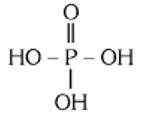
B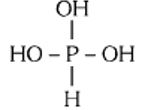
C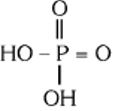
D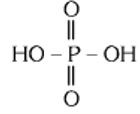
Solution
(A) Nucleic acids ($DNA$ and $RNA$) are polymers of nucleotides. $A$ nucleotide consists of a nitrogenous base,a pentose sugar,and a phosphate group. The phosphate group is derived from phosphoric acid $(H_3PO_4)$. In the structure of a nucleotide,the phosphoric acid is incorporated as a phosphate group $(PO_4^{3-})$. The chemical structure of phosphoric acid $(H_3PO_4)$ consists of a central phosphorus atom double-bonded to one oxygen atom and single-bonded to three hydroxyl $(-OH)$ groups. Option $A$ correctly represents the structure of phosphoric acid $(H_3PO_4)$ as it exists in its standard form before forming ester bonds in the nucleic acid backbone.
0 likes
View Solution199
MediumMCQ
Which of the following structures represents a ribonucleoside?
A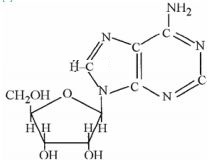
B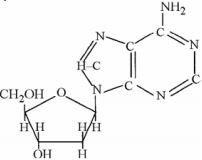
C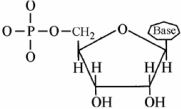
D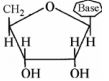
Solution
(A) nucleoside consists of a nitrogenous base attached to a pentose sugar. $A$ ribonucleoside specifically contains a ribose sugar,which has a hydroxyl $(-OH)$ group at both the $2'$ and $3'$ positions of the pentose ring.
$1$. Structure $A$ shows a nitrogenous base (adenine) attached to a ribose sugar (with $-OH$ groups at both $2'$ and $3'$ positions),which is a ribonucleoside (adenosine).
$2$. Structure $B$ shows a nitrogenous base attached to a deoxyribose sugar (lacking an $-OH$ group at the $2'$ position),which is a deoxyribonucleoside.
$3$. Structure $C$ shows a nucleotide (base + sugar + phosphate group).
$4$. Structure $D$ is a general representation of a nucleoside,but structure $A$ specifically depicts a ribonucleoside with the correct sugar configuration.
$1$. Structure $A$ shows a nitrogenous base (adenine) attached to a ribose sugar (with $-OH$ groups at both $2'$ and $3'$ positions),which is a ribonucleoside (adenosine).
$2$. Structure $B$ shows a nitrogenous base attached to a deoxyribose sugar (lacking an $-OH$ group at the $2'$ position),which is a deoxyribonucleoside.
$3$. Structure $C$ shows a nucleotide (base + sugar + phosphate group).
$4$. Structure $D$ is a general representation of a nucleoside,but structure $A$ specifically depicts a ribonucleoside with the correct sugar configuration.
0 likes
View Solution200
EasyMCQ
Which of the following is the structure of thymine?
A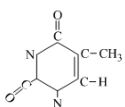
B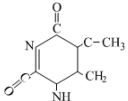
C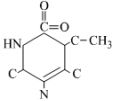
D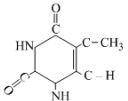
Solution
(D) Thymine,also known as $5$-methyluracil,is a pyrimidine nucleobase.
Its chemical structure consists of a pyrimidine ring with a methyl group $(-CH_3)$ at the $5$-position and two carbonyl groups $(C=O)$ at the $2$ and $4$ positions.
Among the given options,the structure represented by image $608-d1401$ correctly depicts the $5$-methyluracil molecule,where the nitrogen atoms at positions $1$ and $3$ are protonated as $NH$ groups,and the methyl group is attached to the carbon at the $5$-position.
Its chemical structure consists of a pyrimidine ring with a methyl group $(-CH_3)$ at the $5$-position and two carbonyl groups $(C=O)$ at the $2$ and $4$ positions.
Among the given options,the structure represented by image $608-d1401$ correctly depicts the $5$-methyluracil molecule,where the nitrogen atoms at positions $1$ and $3$ are protonated as $NH$ groups,and the methyl group is attached to the carbon at the $5$-position.
0 likes
View SolutionBiomolecules — Mix Examples- Biomolecules · Frequently Asked Questions
1Are these Biomolecules questions useful for JEE and NEET?
Yes. All questions in this section are mapped to JEE Main and NEET exam patterns. Previous year questions from JEE Main, NEET, GUJCET and state-level exams are included with full solutions.
2Can I switch to Hindi or Gujarati for these questions?
Yes. Use the language tabs in the hero section or the sidebar to view the same questions and solutions in English, Hindi or Gujarati.
3How do I generate a question paper from this subtopic?
Use the Vedclass Exam Paper Generator — select the chapter and subtopic, set difficulty, and generate Sets A, B, C, D automatically. First 3 chapters of every subject are free.
Vedclass Products
For Students
Vedclass Test Series
Mock tests in real JEE/NEET style with performance analysis. 5-day free trial.
Start Free TrialFor Teachers
Exam Paper Generator
Generate Set A/B/C/D papers from this chapter in 2 minutes. 3 chapters free.
Try FreeFor Institutes
Online Exam Module
Live online exams with unlimited students, 360° analytics & white-label branding.
See DemoFor Teachers & Institutes
Generate a Biomolecules Exam Paper in 2 Minutes
Select subtopic & difficulty — Sets A, B, C, D auto-generated with No Repeat logic.
First 3 chapters of every subject are free — no payment required.