
A English
Mix Examples - Introduction to Trigonometry Questions in English
Class 10 Mathematics · Introduction to Trigonometry · Mix Examples - Introduction to Trigonometry
135+
Questions
English
Language
100%
With Solutions
Showing 50 of 135 questions in English
51
MediumMCQ
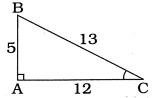
In $\Delta ABC$,$m\angle A = 90^\circ$,$AB = 5$,$AC = 12$ and $BC = 13$. Therefore,$\sin C + \cos C = \ldots$
A
$1$
B
$\frac{7}{13}$
C
$5$
D
$\frac{17}{13}$
Solution
(D) In a right-angled triangle $\Delta ABC$ where $\angle A = 90^\circ$:
For angle $C$,the opposite side is $AB = 5$ and the adjacent side is $AC = 12$. The hypotenuse is $BC = 13$.
Using the trigonometric ratios:
$\sin C = \frac{\text{opposite side}}{\text{hypotenuse}} = \frac{AB}{BC} = \frac{5}{13}$
$\cos C = \frac{\text{adjacent side}}{\text{hypotenuse}} = \frac{AC}{BC} = \frac{12}{13}$
Therefore,$\sin C + \cos C = \frac{5}{13} + \frac{12}{13} = \frac{5 + 12}{13} = \frac{17}{13}$.
For angle $C$,the opposite side is $AB = 5$ and the adjacent side is $AC = 12$. The hypotenuse is $BC = 13$.
Using the trigonometric ratios:
$\sin C = \frac{\text{opposite side}}{\text{hypotenuse}} = \frac{AB}{BC} = \frac{5}{13}$
$\cos C = \frac{\text{adjacent side}}{\text{hypotenuse}} = \frac{AC}{BC} = \frac{12}{13}$
Therefore,$\sin C + \cos C = \frac{5}{13} + \frac{12}{13} = \frac{5 + 12}{13} = \frac{17}{13}$.
0 likes
View Solution52
EasyMCQ
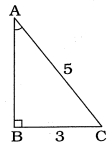
In $\Delta ABC$,$m \angle B = 90^{\circ}$,$BC = 3$ and $AC = 5$,then $\tan A = \ldots$
A
$\frac{3}{4}$
B
$\frac{5}{3}$
C
$\frac{4}{5}$
D
$\frac{3}{2}$
Solution
(A) In $\Delta ABC$,$m \angle B = 90^{\circ}$,therefore $\overline{AC}$ is the hypotenuse.
Given $BC = 3$ and $AC = 5$.
Using the Pythagorean theorem: $AB^{2} + BC^{2} = AC^{2}$.
$AB^{2} + 3^{2} = 5^{2}$
$AB^{2} + 9 = 25$
$AB^{2} = 25 - 9 = 16$
$AB = \sqrt{16} = 4$.
Now,$\tan A = \frac{\text{opposite side}}{\text{adjacent side}} = \frac{BC}{AB}$.
$\tan A = \frac{3}{4}$.
Given $BC = 3$ and $AC = 5$.
Using the Pythagorean theorem: $AB^{2} + BC^{2} = AC^{2}$.
$AB^{2} + 3^{2} = 5^{2}$
$AB^{2} + 9 = 25$
$AB^{2} = 25 - 9 = 16$
$AB = \sqrt{16} = 4$.
Now,$\tan A = \frac{\text{opposite side}}{\text{adjacent side}} = \frac{BC}{AB}$.
$\tan A = \frac{3}{4}$.
0 likes
View Solution53
EasyMCQ
If $\operatorname{cosec} A = \sqrt{10}$,then $\sin A = \dots$
A
$3$
B
$\frac{1}{\sqrt{10}}$
C
$\frac{1}{3}$
D
$\frac{3}{\sqrt{10}}$
Solution
(B) We are given that $\operatorname{cosec} A = \sqrt{10}$.
Since $\sin A$ is the reciprocal of $\operatorname{cosec} A$,we have the identity $\sin A = \frac{1}{\operatorname{cosec} A}$.
Substituting the given value,we get $\sin A = \frac{1}{\sqrt{10}}$.
Since $\sin A$ is the reciprocal of $\operatorname{cosec} A$,we have the identity $\sin A = \frac{1}{\operatorname{cosec} A}$.
Substituting the given value,we get $\sin A = \frac{1}{\sqrt{10}}$.
0 likes
View Solution54
EasyMCQ
$5 \cos A = 4 \sin A$,then $\tan A = \ldots$
A
$\frac{1}{20}$
B
$\frac{1}{4}$
C
$\frac{4}{5}$
D
$\frac{5}{4}$
Solution
(D) Given the equation: $5 \cos A = 4 \sin A$.
To find $\tan A$,we know that $\tan A = \frac{\sin A}{\cos A}$.
Divide both sides of the equation by $\cos A$:
$\frac{5 \cos A}{\cos A} = \frac{4 \sin A}{\cos A}$
$5 = 4 \tan A$
Now,divide both sides by $4$:
$\tan A = \frac{5}{4}$.
To find $\tan A$,we know that $\tan A = \frac{\sin A}{\cos A}$.
Divide both sides of the equation by $\cos A$:
$\frac{5 \cos A}{\cos A} = \frac{4 \sin A}{\cos A}$
$5 = 4 \tan A$
Now,divide both sides by $4$:
$\tan A = \frac{5}{4}$.
0 likes
View Solution55
MediumMCQ
If $\tan \theta = \frac{4}{3}$,then $\frac{5 \sin \theta + 2 \cos \theta}{3 \sin \theta - \cos \theta} = \ldots \ldots$
A
$\frac{22}{13}$
B
$2$
C
$\frac{26}{9}$
D
$\frac{7}{2}$
Solution
(C) Given,$\tan \theta = \frac{4}{3}$.
To evaluate the expression $\frac{5 \sin \theta + 2 \cos \theta}{3 \sin \theta - \cos \theta}$,divide both the numerator and the denominator by $\cos \theta$ (where $\cos \theta \neq 0$):
$= \frac{\frac{5 \sin \theta}{\cos \theta} + \frac{2 \cos \theta}{\cos \theta}}{\frac{3 \sin \theta}{\cos \theta} - \frac{\cos \theta}{\cos \theta}}$
$= \frac{5 \tan \theta + 2}{3 \tan \theta - 1}$
Substitute $\tan \theta = \frac{4}{3}$ into the expression:
$= \frac{5(\frac{4}{3}) + 2}{3(\frac{4}{3}) - 1}$
$= \frac{\frac{20}{3} + 2}{4 - 1}$
$= \frac{\frac{20 + 6}{3}}{3}$
$= \frac{26}{3 \times 3} = \frac{26}{9}$.
To evaluate the expression $\frac{5 \sin \theta + 2 \cos \theta}{3 \sin \theta - \cos \theta}$,divide both the numerator and the denominator by $\cos \theta$ (where $\cos \theta \neq 0$):
$= \frac{\frac{5 \sin \theta}{\cos \theta} + \frac{2 \cos \theta}{\cos \theta}}{\frac{3 \sin \theta}{\cos \theta} - \frac{\cos \theta}{\cos \theta}}$
$= \frac{5 \tan \theta + 2}{3 \tan \theta - 1}$
Substitute $\tan \theta = \frac{4}{3}$ into the expression:
$= \frac{5(\frac{4}{3}) + 2}{3(\frac{4}{3}) - 1}$
$= \frac{\frac{20}{3} + 2}{4 - 1}$
$= \frac{\frac{20 + 6}{3}}{3}$
$= \frac{26}{3 \times 3} = \frac{26}{9}$.
0 likes
View Solution56
EasyMCQ
If $\sec \theta = \frac{13}{5}$,then $\cos \theta = \ldots \ldots \ldots \ldots$
A
$\frac{12}{5}$
B
$\frac{5}{12}$
C
$\frac{5}{13}$
D
$\frac{13}{12}$
Solution
(C) We know that the trigonometric identity for secant and cosine is $\sec \theta = \frac{1}{\cos \theta}$.
Given that $\sec \theta = \frac{13}{5}$.
Therefore,$\cos \theta = \frac{1}{\sec \theta} = \frac{1}{\frac{13}{5}} = \frac{5}{13}$.
Thus,the correct option is $C$.
Given that $\sec \theta = \frac{13}{5}$.
Therefore,$\cos \theta = \frac{1}{\sec \theta} = \frac{1}{\frac{13}{5}} = \frac{5}{13}$.
Thus,the correct option is $C$.
0 likes
View Solution57
EasyMCQ
If $3 \cot \theta = 4$,then $\frac{1 - \tan^2 \theta}{1 + \tan^2 \theta} = \dots$
A
$\frac{7}{25}$
B
$\frac{4}{3}$
C
$\frac{3}{4}$
D
$\frac{1}{7}$
Solution
(A) Given $3 \cot \theta = 4$,we have $\cot \theta = \frac{4}{3}$.
Since $\tan \theta = \frac{1}{\cot \theta}$,we get $\tan \theta = \frac{3}{4}$.
Now,substitute the value of $\tan \theta$ into the expression:
$\frac{1 - \tan^2 \theta}{1 + \tan^2 \theta} = \frac{1 - (\frac{3}{4})^2}{1 + (\frac{3}{4})^2}$
$= \frac{1 - \frac{9}{16}}{1 + \frac{9}{16}}$
$= \frac{\frac{16 - 9}{16}}{\frac{16 + 9}{16}}$
$= \frac{7}{25}$.
Since $\tan \theta = \frac{1}{\cot \theta}$,we get $\tan \theta = \frac{3}{4}$.
Now,substitute the value of $\tan \theta$ into the expression:
$\frac{1 - \tan^2 \theta}{1 + \tan^2 \theta} = \frac{1 - (\frac{3}{4})^2}{1 + (\frac{3}{4})^2}$
$= \frac{1 - \frac{9}{16}}{1 + \frac{9}{16}}$
$= \frac{\frac{16 - 9}{16}}{\frac{16 + 9}{16}}$
$= \frac{7}{25}$.
0 likes
View Solution58
EasyMCQ
Which of the following is true for some $\theta$ (where,$0 < \theta < 90^{\circ}$)?
A
$\cos \theta > 1$
B
$\operatorname{cosec} \theta < 1$
C
$\tan \theta < 0$
D
$\sec \theta > 1$
Solution
(D) For $0^{\circ} < \theta < 90^{\circ}$:
$1$. The value of $\cos \theta$ lies between $0$ and $1$ $(0 < \cos \theta < 1)$. Thus,$\cos \theta > 1$ is false.
$2$. The value of $\operatorname{cosec} \theta$ is always greater than $1$ $(\operatorname{cosec} \theta > 1)$. Thus,$\operatorname{cosec} \theta < 1$ is false.
$3$. The value of $\tan \theta$ is always positive in the first quadrant $(\tan \theta > 0)$. Thus,$\tan \theta < 0$ is false.
$4$. The value of $\sec \theta$ is always greater than $1$ for $0^{\circ} < \theta < 90^{\circ}$ $(\sec \theta > 1)$. Thus,$\sec \theta > 1$ is true.
Therefore,option $D$ is correct.
$1$. The value of $\cos \theta$ lies between $0$ and $1$ $(0 < \cos \theta < 1)$. Thus,$\cos \theta > 1$ is false.
$2$. The value of $\operatorname{cosec} \theta$ is always greater than $1$ $(\operatorname{cosec} \theta > 1)$. Thus,$\operatorname{cosec} \theta < 1$ is false.
$3$. The value of $\tan \theta$ is always positive in the first quadrant $(\tan \theta > 0)$. Thus,$\tan \theta < 0$ is false.
$4$. The value of $\sec \theta$ is always greater than $1$ for $0^{\circ} < \theta < 90^{\circ}$ $(\sec \theta > 1)$. Thus,$\sec \theta > 1$ is true.
Therefore,option $D$ is correct.
0 likes
View Solution59
EasyMCQ
If $\sin \theta = \frac{1}{2}$,then $\theta = \ldots \ldots \ldots \ldots$ (in $^\circ$)
A
$30$
B
$45$
C
$60$
D
$90$
Solution
(A) Given that $\sin \theta = \frac{1}{2}$.
We know from the standard trigonometric table that $\sin 30^\circ = \frac{1}{2}$.
Comparing both sides,we get $\theta = 30^\circ$.
We know from the standard trigonometric table that $\sin 30^\circ = \frac{1}{2}$.
Comparing both sides,we get $\theta = 30^\circ$.
0 likes
View Solution60
EasyMCQ
If $\cos \theta = \frac{1}{\sqrt{2}},$ then $\theta = \ldots$ (in $^\circ$)
A
$30$
B
$45$
C
$60$
D
$90$
Solution
(B) Given that $\cos \theta = \frac{1}{\sqrt{2}}.$
We know from the standard trigonometric table that $\cos 45^\circ = \frac{1}{\sqrt{2}}.$
Comparing both sides,we get $\theta = 45^\circ.$
We know from the standard trigonometric table that $\cos 45^\circ = \frac{1}{\sqrt{2}}.$
Comparing both sides,we get $\theta = 45^\circ.$
0 likes
View Solution61
EasyMCQ
If $\tan \theta = \sqrt{3}$,then $\theta = \ldots$ (in $^\circ$)
A
$30$
B
$45$
C
$60$
D
$90$
Solution
(C) Given that $\tan \theta = \sqrt{3}$.
We know from the trigonometric table that $\tan 60^\circ = \sqrt{3}$.
Comparing both sides,we get $\theta = 60^\circ$.
We know from the trigonometric table that $\tan 60^\circ = \sqrt{3}$.
Comparing both sides,we get $\theta = 60^\circ$.
0 likes
View Solution62
EasyMCQ
If $\operatorname{cosec} \theta = \frac{2}{\sqrt{3}}$,then $\theta = \ldots$ (in $^\circ$)
A
$30$
B
$45$
C
$60$
D
$90$
Solution
(C) Given that $\operatorname{cosec} \theta = \frac{2}{\sqrt{3}}$.
Since $\operatorname{cosec} \theta = \frac{1}{\sin \theta}$,we have $\sin \theta = \frac{1}{\operatorname{cosec} \theta} = \frac{\sqrt{3}}{2}$.
We know from trigonometric standard values that $\sin 60^\circ = \frac{\sqrt{3}}{2}$.
Comparing both sides,we get $\theta = 60^\circ$.
Since $\operatorname{cosec} \theta = \frac{1}{\sin \theta}$,we have $\sin \theta = \frac{1}{\operatorname{cosec} \theta} = \frac{\sqrt{3}}{2}$.
We know from trigonometric standard values that $\sin 60^\circ = \frac{\sqrt{3}}{2}$.
Comparing both sides,we get $\theta = 60^\circ$.
0 likes
View Solution63
EasyMCQ
If $\sec \theta = 1$,then $\theta = \ldots \ldots \ldots$ (in $^{\circ}$)
A
$0$
B
$45$
C
$60$
D
$90$
Solution
(A) Given that $\sec \theta = 1$.
We know that $\sec \theta = \frac{1}{\cos \theta}$.
Therefore,$\frac{1}{\cos \theta} = 1$,which implies $\cos \theta = 1$.
Since $\cos 0^{\circ} = 1$,we have $\theta = 0^{\circ}$.
We know that $\sec \theta = \frac{1}{\cos \theta}$.
Therefore,$\frac{1}{\cos \theta} = 1$,which implies $\cos \theta = 1$.
Since $\cos 0^{\circ} = 1$,we have $\theta = 0^{\circ}$.
0 likes
View Solution64
EasyMCQ
$\sin 60^{\circ} \sin 45^{\circ} + \cos 60^{\circ} \cos 45^{\circ} = \ldots \ldots \ldots \ldots$
A
$\sqrt{3} + 1$
B
$\frac{\sqrt{3} + 1}{2}$
C
$\frac{\sqrt{6} + \sqrt{2}}{4}$
D
$\frac{1}{2}$
Solution
(C) We know the trigonometric values: $\sin 60^{\circ} = \frac{\sqrt{3}}{2}$,$\sin 45^{\circ} = \frac{1}{\sqrt{2}}$,$\cos 60^{\circ} = \frac{1}{2}$,and $\cos 45^{\circ} = \frac{1}{\sqrt{2}}$.
Substituting these values into the expression:
$\sin 60^{\circ} \sin 45^{\circ} + \cos 60^{\circ} \cos 45^{\circ} = \left( \frac{\sqrt{3}}{2} \right) \left( \frac{1}{\sqrt{2}} \right) + \left( \frac{1}{2} \right) \left( \frac{1}{\sqrt{2}} \right)$
$= \frac{\sqrt{3}}{2\sqrt{2}} + \frac{1}{2\sqrt{2}}$
$= \frac{\sqrt{3} + 1}{2\sqrt{2}}$
To rationalize the denominator,multiply the numerator and denominator by $\sqrt{2}$:
$= \frac{(\sqrt{3} + 1) \times \sqrt{2}}{2\sqrt{2} \times \sqrt{2}} = \frac{\sqrt{6} + \sqrt{2}}{2 \times 2} = \frac{\sqrt{6} + \sqrt{2}}{4}$.
Substituting these values into the expression:
$\sin 60^{\circ} \sin 45^{\circ} + \cos 60^{\circ} \cos 45^{\circ} = \left( \frac{\sqrt{3}}{2} \right) \left( \frac{1}{\sqrt{2}} \right) + \left( \frac{1}{2} \right) \left( \frac{1}{\sqrt{2}} \right)$
$= \frac{\sqrt{3}}{2\sqrt{2}} + \frac{1}{2\sqrt{2}}$
$= \frac{\sqrt{3} + 1}{2\sqrt{2}}$
To rationalize the denominator,multiply the numerator and denominator by $\sqrt{2}$:
$= \frac{(\sqrt{3} + 1) \times \sqrt{2}}{2\sqrt{2} \times \sqrt{2}} = \frac{\sqrt{6} + \sqrt{2}}{2 \times 2} = \frac{\sqrt{6} + \sqrt{2}}{4}$.
0 likes
View Solution65
EasyMCQ
$\frac{\sin 60^{\circ} + \cos 30^{\circ}}{1 + \sin 30^{\circ} + \cos 60^{\circ}} = \dots$
A
$\frac{1}{\sqrt{2}}$
B
$\frac{1}{2}$
C
$1$
D
$\frac{\sqrt{3}}{2}$
Solution
(D) We know the trigonometric values: $\sin 60^{\circ} = \frac{\sqrt{3}}{2}$,$\cos 30^{\circ} = \frac{\sqrt{3}}{2}$,$\sin 30^{\circ} = \frac{1}{2}$,and $\cos 60^{\circ} = \frac{1}{2}$.
Substituting these values into the expression:
$\frac{\sin 60^{\circ} + \cos 30^{\circ}}{1 + \sin 30^{\circ} + \cos 60^{\circ}} = \frac{\frac{\sqrt{3}}{2} + \frac{\sqrt{3}}{2}}{1 + \frac{1}{2} + \frac{1}{2}}$
$= \frac{\frac{2\sqrt{3}}{2}}{1 + 1}$
$= \frac{\sqrt{3}}{2}$
Substituting these values into the expression:
$\frac{\sin 60^{\circ} + \cos 30^{\circ}}{1 + \sin 30^{\circ} + \cos 60^{\circ}} = \frac{\frac{\sqrt{3}}{2} + \frac{\sqrt{3}}{2}}{1 + \frac{1}{2} + \frac{1}{2}}$
$= \frac{\frac{2\sqrt{3}}{2}}{1 + 1}$
$= \frac{\sqrt{3}}{2}$
0 likes
View Solution66
EasyMCQ
If $\sin x = \sin 60^{\circ} \cdot \cos 30^{\circ} - \cos 60^{\circ} \cdot \sin 30^{\circ}$,then $x = \ldots$ (in $^{\circ}$)
A
$0$
B
$30$
C
$45$
D
$60$
Solution
(B) Given the equation: $\sin x = \sin 60^{\circ} \cdot \cos 30^{\circ} - \cos 60^{\circ} \cdot \sin 30^{\circ}$.
Using the trigonometric values: $\sin 60^{\circ} = \frac{\sqrt{3}}{2}$,$\cos 30^{\circ} = \frac{\sqrt{3}}{2}$,$\cos 60^{\circ} = \frac{1}{2}$,and $\sin 30^{\circ} = \frac{1}{2}$.
Substituting these values into the equation:
$\sin x = \left( \frac{\sqrt{3}}{2} \right) \cdot \left( \frac{\sqrt{3}}{2} \right) - \left( \frac{1}{2} \right) \cdot \left( \frac{1}{2} \right)$
$\sin x = \frac{3}{4} - \frac{1}{4}$
$\sin x = \frac{2}{4} = \frac{1}{2}$
Since $\sin 30^{\circ} = \frac{1}{2}$,we have $\sin x = \sin 30^{\circ}$.
Therefore,$x = 30^{\circ}$.
Using the trigonometric values: $\sin 60^{\circ} = \frac{\sqrt{3}}{2}$,$\cos 30^{\circ} = \frac{\sqrt{3}}{2}$,$\cos 60^{\circ} = \frac{1}{2}$,and $\sin 30^{\circ} = \frac{1}{2}$.
Substituting these values into the equation:
$\sin x = \left( \frac{\sqrt{3}}{2} \right) \cdot \left( \frac{\sqrt{3}}{2} \right) - \left( \frac{1}{2} \right) \cdot \left( \frac{1}{2} \right)$
$\sin x = \frac{3}{4} - \frac{1}{4}$
$\sin x = \frac{2}{4} = \frac{1}{2}$
Since $\sin 30^{\circ} = \frac{1}{2}$,we have $\sin x = \sin 30^{\circ}$.
Therefore,$x = 30^{\circ}$.
0 likes
View Solution67
MediumMCQ
If $\cot \theta = \frac{a}{b}$,then $\frac{\cos \theta - \sin \theta}{\cos \theta + \sin \theta} = \ldots$
A
$\frac{a}{b}$
B
$\frac{b}{a}$
C
$\frac{a+b}{a-b}$
D
$\frac{a-b}{a+b}$
Solution
(D) Given $\cot \theta = \frac{a}{b}$.
We know that $\cot \theta = \frac{\cos \theta}{\sin \theta}$,so $\frac{\cos \theta}{\sin \theta} = \frac{a}{b}$.
To evaluate $\frac{\cos \theta - \sin \theta}{\cos \theta + \sin \theta}$,divide both the numerator and the denominator by $\sin \theta$:
$\frac{\frac{\cos \theta}{\sin \theta} - \frac{\sin \theta}{\sin \theta}}{\frac{\cos \theta}{\sin \theta} + \frac{\sin \theta}{\sin \theta}} = \frac{\cot \theta - 1}{\cot \theta + 1}$.
Substituting $\cot \theta = \frac{a}{b}$:
$\frac{\frac{a}{b} - 1}{\frac{a}{b} + 1} = \frac{\frac{a-b}{b}}{\frac{a+b}{b}} = \frac{a-b}{a+b}$.
We know that $\cot \theta = \frac{\cos \theta}{\sin \theta}$,so $\frac{\cos \theta}{\sin \theta} = \frac{a}{b}$.
To evaluate $\frac{\cos \theta - \sin \theta}{\cos \theta + \sin \theta}$,divide both the numerator and the denominator by $\sin \theta$:
$\frac{\frac{\cos \theta}{\sin \theta} - \frac{\sin \theta}{\sin \theta}}{\frac{\cos \theta}{\sin \theta} + \frac{\sin \theta}{\sin \theta}} = \frac{\cot \theta - 1}{\cot \theta + 1}$.
Substituting $\cot \theta = \frac{a}{b}$:
$\frac{\frac{a}{b} - 1}{\frac{a}{b} + 1} = \frac{\frac{a-b}{b}}{\frac{a+b}{b}} = \frac{a-b}{a+b}$.
0 likes
View Solution68
EasyMCQ
$2 \sin ^{2} 30^{\circ} \cot 30^{\circ}-3 \cos ^{2} 60^{\circ} \sec ^{2} 30^{\circ} = \dots$
A
$\frac{\sqrt{3}-1}{2}$
B
$\frac{\sqrt{3}-2}{2}$
C
$0$
D
$1$
Solution
(B) Given expression: $2 \sin ^{2} 30^{\circ} \cot 30^{\circ}-3 \cos ^{2} 60^{\circ} \sec ^{2} 30^{\circ}$
Substitute the trigonometric values: $\sin 30^{\circ} = \frac{1}{2}$,$\cot 30^{\circ} = \sqrt{3}$,$\cos 60^{\circ} = \frac{1}{2}$,$\sec 30^{\circ} = \frac{2}{\sqrt{3}}$.
$= 2 \left(\frac{1}{2}\right)^{2} (\sqrt{3}) - 3 \left(\frac{1}{2}\right)^{2} \left(\frac{2}{\sqrt{3}}\right)^{2}$
$= 2 \times \frac{1}{4} \times \sqrt{3} - 3 \times \frac{1}{4} \times \frac{4}{3}$
$= \frac{\sqrt{3}}{2} - 1$
$= \frac{\sqrt{3}-2}{2}$
Substitute the trigonometric values: $\sin 30^{\circ} = \frac{1}{2}$,$\cot 30^{\circ} = \sqrt{3}$,$\cos 60^{\circ} = \frac{1}{2}$,$\sec 30^{\circ} = \frac{2}{\sqrt{3}}$.
$= 2 \left(\frac{1}{2}\right)^{2} (\sqrt{3}) - 3 \left(\frac{1}{2}\right)^{2} \left(\frac{2}{\sqrt{3}}\right)^{2}$
$= 2 \times \frac{1}{4} \times \sqrt{3} - 3 \times \frac{1}{4} \times \frac{4}{3}$
$= \frac{\sqrt{3}}{2} - 1$
$= \frac{\sqrt{3}-2}{2}$
0 likes
View Solution69
MediumMCQ
For acute angle $\theta,$ if $\cos \theta = \sin \theta,$ then $2 \tan^{2} \theta + \sin^{2} \theta + 1 = \ldots$
A
$\frac{5}{2}$
B
$\frac{7}{4}$
C
$\frac{5}{4}$
D
$\frac{7}{2}$
Solution
(D) Given $\cos \theta = \sin \theta.$
Dividing both sides by $\cos \theta,$ we get $\frac{\cos \theta}{\cos \theta} = \frac{\sin \theta}{\cos \theta}.$
Therefore,$1 = \tan \theta.$
Since $\theta$ is an acute angle,$\theta = 45^{\circ}.$
Now,substitute $\theta = 45^{\circ}$ into the expression $2 \tan^{2} \theta + \sin^{2} \theta + 1.$
$2 \tan^{2} 45^{\circ} + \sin^{2} 45^{\circ} + 1 = 2(1)^{2} + (\frac{1}{\sqrt{2}})^{2} + 1.$
$= 2(1) + \frac{1}{2} + 1.$
$= 3 + \frac{1}{2} = \frac{7}{2}.$
Dividing both sides by $\cos \theta,$ we get $\frac{\cos \theta}{\cos \theta} = \frac{\sin \theta}{\cos \theta}.$
Therefore,$1 = \tan \theta.$
Since $\theta$ is an acute angle,$\theta = 45^{\circ}.$
Now,substitute $\theta = 45^{\circ}$ into the expression $2 \tan^{2} \theta + \sin^{2} \theta + 1.$
$2 \tan^{2} 45^{\circ} + \sin^{2} 45^{\circ} + 1 = 2(1)^{2} + (\frac{1}{\sqrt{2}})^{2} + 1.$
$= 2(1) + \frac{1}{2} + 1.$
$= 3 + \frac{1}{2} = \frac{7}{2}.$
0 likes
View Solution70
EasyMCQ
For $0 < \theta < 90^{\circ},$ the value of $\ldots \ldots \ldots \ldots$ increases as $\theta$ increases from $0^{\circ}$ to $90^{\circ}$.
A
$\cos \theta$
B
$\sin \theta$
C
$\operatorname{cosec} \theta$
D
$\cot \theta$
Solution
(B) In the interval $0^{\circ} < \theta < 90^{\circ}$:
$1$. The value of $\sin \theta$ increases from $0$ to $1$ as $\theta$ increases from $0^{\circ}$ to $90^{\circ}$.
$2$. The value of $\cos \theta$ decreases from $1$ to $0$ as $\theta$ increases from $0^{\circ}$ to $90^{\circ}$.
$3$. The value of $\operatorname{cosec} \theta$ decreases from $\infty$ to $1$ as $\theta$ increases from $0^{\circ}$ to $90^{\circ}$.
$4$. The value of $\cot \theta$ decreases from $\infty$ to $0$ as $\theta$ increases from $0^{\circ}$ to $90^{\circ}$.
Therefore,the only trigonometric function among the options that increases as $\theta$ increases is $\sin \theta$.
$1$. The value of $\sin \theta$ increases from $0$ to $1$ as $\theta$ increases from $0^{\circ}$ to $90^{\circ}$.
$2$. The value of $\cos \theta$ decreases from $1$ to $0$ as $\theta$ increases from $0^{\circ}$ to $90^{\circ}$.
$3$. The value of $\operatorname{cosec} \theta$ decreases from $\infty$ to $1$ as $\theta$ increases from $0^{\circ}$ to $90^{\circ}$.
$4$. The value of $\cot \theta$ decreases from $\infty$ to $0$ as $\theta$ increases from $0^{\circ}$ to $90^{\circ}$.
Therefore,the only trigonometric function among the options that increases as $\theta$ increases is $\sin \theta$.
0 likes
View Solution71
EasyMCQ
$\sin (90^\circ - \theta) = \ldots \ldots \ldots$
A
$\cos \theta$
B
$\sec \theta$
C
$\operatorname{cosec} \theta$
D
$\tan \theta$
Solution
(A) In trigonometry,the trigonometric ratios of complementary angles are defined as follows:
$\sin (90^\circ - \theta) = \cos \theta$
$\cos (90^\circ - \theta) = \sin \theta$
$\tan (90^\circ - \theta) = \cot \theta$
$\cot (90^\circ - \theta) = \tan \theta$
$\sec (90^\circ - \theta) = \operatorname{cosec} \theta$
$\operatorname{cosec} (90^\circ - \theta) = \sec \theta$
Therefore,based on the standard trigonometric identity for complementary angles,$\sin (90^\circ - \theta) = \cos \theta$.
$\sin (90^\circ - \theta) = \cos \theta$
$\cos (90^\circ - \theta) = \sin \theta$
$\tan (90^\circ - \theta) = \cot \theta$
$\cot (90^\circ - \theta) = \tan \theta$
$\sec (90^\circ - \theta) = \operatorname{cosec} \theta$
$\operatorname{cosec} (90^\circ - \theta) = \sec \theta$
Therefore,based on the standard trigonometric identity for complementary angles,$\sin (90^\circ - \theta) = \cos \theta$.
0 likes
View Solution72
EasyMCQ
$\sec (90^\circ - \theta) = \dots$
A
$\cos \theta$
B
$\operatorname{cosec} \theta$
C
$\tan \theta$
D
$\cot \theta$
Solution
(B) In trigonometry,the complementary angle identities state that the trigonometric functions of an angle $(90^\circ - \theta)$ are related to the co-functions of $\theta$.
Specifically,for the secant function,the identity is $\sec (90^\circ - \theta) = \operatorname{cosec} \theta$.
Therefore,the correct option is $B$.
Specifically,for the secant function,the identity is $\sec (90^\circ - \theta) = \operatorname{cosec} \theta$.
Therefore,the correct option is $B$.
0 likes
View Solution73
EasyMCQ
$\tan (90^\circ - \theta) = \ldots \ldots \ldots$
A
$\tan \theta$
B
$\cot \theta$
C
$\sec \theta$
D
$\operatorname{cosec} \theta$
Solution
(B) In trigonometry,the trigonometric ratios of complementary angles are defined as follows:
$\sin (90^\circ - \theta) = \cos \theta$
$\cos (90^\circ - \theta) = \sin \theta$
$\tan (90^\circ - \theta) = \cot \theta$
$\cot (90^\circ - \theta) = \tan \theta$
$\sec (90^\circ - \theta) = \operatorname{cosec} \theta$
$\operatorname{cosec} (90^\circ - \theta) = \sec \theta$
Therefore,$\tan (90^\circ - \theta) = \cot \theta$.
$\sin (90^\circ - \theta) = \cos \theta$
$\cos (90^\circ - \theta) = \sin \theta$
$\tan (90^\circ - \theta) = \cot \theta$
$\cot (90^\circ - \theta) = \tan \theta$
$\sec (90^\circ - \theta) = \operatorname{cosec} \theta$
$\operatorname{cosec} (90^\circ - \theta) = \sec \theta$
Therefore,$\tan (90^\circ - \theta) = \cot \theta$.
0 likes
View Solution74
EasyMCQ
$\cos 35^{\circ} = \ldots \ldots \ldots$
A
$\cos 55^{\circ}$
B
$\sin 55^{\circ}$
C
$\sec 35^{\circ}$
D
$\operatorname{cosec} 35^{\circ}$
Solution
(B) We know the trigonometric identity for complementary angles: $\cos \theta = \sin(90^{\circ} - \theta)$.
Substituting $\theta = 35^{\circ}$ into the identity:
$\cos 35^{\circ} = \sin(90^{\circ} - 35^{\circ})$.
$\cos 35^{\circ} = \sin 55^{\circ}$.
Substituting $\theta = 35^{\circ}$ into the identity:
$\cos 35^{\circ} = \sin(90^{\circ} - 35^{\circ})$.
$\cos 35^{\circ} = \sin 55^{\circ}$.
0 likes
View Solution75
EasyMCQ
$\operatorname{cosec} 40^{\circ} = \ldots \ldots \ldots \ldots$
A
$\sin 50^{\circ}$
B
$\sec 50^{\circ}$
C
$\cot 40^{\circ}$
D
$\sin 40^{\circ}$
Solution
(B) We know that the trigonometric identity for complementary angles is $\operatorname{cosec} \theta = \sec(90^{\circ} - \theta)$.
Substituting $\theta = 40^{\circ}$ into the identity:
$\operatorname{cosec} 40^{\circ} = \sec(90^{\circ} - 40^{\circ})$
$\operatorname{cosec} 40^{\circ} = \sec 50^{\circ}$
Substituting $\theta = 40^{\circ}$ into the identity:
$\operatorname{cosec} 40^{\circ} = \sec(90^{\circ} - 40^{\circ})$
$\operatorname{cosec} 40^{\circ} = \sec 50^{\circ}$
0 likes
View Solution76
EasyMCQ
If $\sin 70^{\circ} = \cos \theta$,then $\theta = \ldots \ldots \ldots \ldots$ (in $^{\circ}$)
A
$70$
B
$90$
C
$20$
D
$30$
Solution
(C) We know the trigonometric identity for complementary angles: $\sin(90^{\circ} - A) = \cos A$ and $\cos(90^{\circ} - A) = \sin A$.
Given the equation: $\sin 70^{\circ} = \cos \theta$.
We can rewrite $\sin 70^{\circ}$ as $\cos(90^{\circ} - 70^{\circ})$.
Therefore,$\cos(90^{\circ} - 70^{\circ}) = \cos \theta$.
This simplifies to $\cos 20^{\circ} = \cos \theta$.
By comparing the angles,we get $\theta = 20^{\circ}$.
Given the equation: $\sin 70^{\circ} = \cos \theta$.
We can rewrite $\sin 70^{\circ}$ as $\cos(90^{\circ} - 70^{\circ})$.
Therefore,$\cos(90^{\circ} - 70^{\circ}) = \cos \theta$.
This simplifies to $\cos 20^{\circ} = \cos \theta$.
By comparing the angles,we get $\theta = 20^{\circ}$.
0 likes
View Solution77
EasyMCQ
$\frac{\cos 50^{\circ}}{\sin 40^{\circ}} + \frac{\sin 15^{\circ}}{\cos 75^{\circ}} = \ldots \ldots \ldots \ldots$
A
$0$
B
$1$
C
$2$
D
$3$
Solution
(C) We use the trigonometric identity for complementary angles: $\cos \theta = \sin(90^{\circ} - \theta)$ and $\sin \theta = \cos(90^{\circ} - \theta)$.
For the first term: $\cos 50^{\circ} = \sin(90^{\circ} - 50^{\circ}) = \sin 40^{\circ}$.
Thus,$\frac{\cos 50^{\circ}}{\sin 40^{\circ}} = \frac{\sin 40^{\circ}}{\sin 40^{\circ}} = 1$.
For the second term: $\cos 75^{\circ} = \sin(90^{\circ} - 75^{\circ}) = \sin 15^{\circ}$.
Thus,$\frac{\sin 15^{\circ}}{\cos 75^{\circ}} = \frac{\sin 15^{\circ}}{\sin 15^{\circ}} = 1$.
Adding both results: $1 + 1 = 2$.
For the first term: $\cos 50^{\circ} = \sin(90^{\circ} - 50^{\circ}) = \sin 40^{\circ}$.
Thus,$\frac{\cos 50^{\circ}}{\sin 40^{\circ}} = \frac{\sin 40^{\circ}}{\sin 40^{\circ}} = 1$.
For the second term: $\cos 75^{\circ} = \sin(90^{\circ} - 75^{\circ}) = \sin 15^{\circ}$.
Thus,$\frac{\sin 15^{\circ}}{\cos 75^{\circ}} = \frac{\sin 15^{\circ}}{\sin 15^{\circ}} = 1$.
Adding both results: $1 + 1 = 2$.
0 likes
View Solution78
DifficultMCQ
If $\sin \theta + \sin^2 \theta = 1$,then $\cos^2 \theta + \cos^4 \theta = \dots$
A
$1$
B
$\cos^2 \theta \cdot \sin^2 \theta$
C
$2$
D
$1 + \cos^2 \theta$
Solution
(A) Given that $\sin \theta + \sin^2 \theta = 1$.
We can rewrite this as $\sin \theta = 1 - \sin^2 \theta$.
Using the trigonometric identity $\sin^2 \theta + \cos^2 \theta = 1$,we know that $1 - \sin^2 \theta = \cos^2 \theta$.
Therefore,$\sin \theta = \cos^2 \theta$.
Now,we need to find the value of $\cos^2 \theta + \cos^4 \theta$.
Substitute $\cos^2 \theta = \sin \theta$ into the expression:
$\cos^2 \theta + \cos^4 \theta = \sin \theta + (\cos^2 \theta)^2$.
Since $\cos^2 \theta = \sin \theta$,then $(\cos^2 \theta)^2 = \sin^2 \theta$.
So,the expression becomes $\sin \theta + \sin^2 \theta$.
Given that $\sin \theta + \sin^2 \theta = 1$,the final value is $1$.
We can rewrite this as $\sin \theta = 1 - \sin^2 \theta$.
Using the trigonometric identity $\sin^2 \theta + \cos^2 \theta = 1$,we know that $1 - \sin^2 \theta = \cos^2 \theta$.
Therefore,$\sin \theta = \cos^2 \theta$.
Now,we need to find the value of $\cos^2 \theta + \cos^4 \theta$.
Substitute $\cos^2 \theta = \sin \theta$ into the expression:
$\cos^2 \theta + \cos^4 \theta = \sin \theta + (\cos^2 \theta)^2$.
Since $\cos^2 \theta = \sin \theta$,then $(\cos^2 \theta)^2 = \sin^2 \theta$.
So,the expression becomes $\sin \theta + \sin^2 \theta$.
Given that $\sin \theta + \sin^2 \theta = 1$,the final value is $1$.
0 likes
View Solution79
EasyMCQ
$\sin 60^{\circ} \cdot \cos 30^{\circ} + \cos 60^{\circ} \cdot \sin 30^{\circ} = ..........$
A
$1$
B
$\frac{3}{2}$
C
$\frac{1}{2}$
D
$\frac{1}{4}$
Solution
(A) The given expression is $\sin 60^{\circ} \cdot \cos 30^{\circ} + \cos 60^{\circ} \cdot \sin 30^{\circ}$.
We know the trigonometric values: $\sin 60^{\circ} = \frac{\sqrt{3}}{2}$,$\cos 30^{\circ} = \frac{\sqrt{3}}{2}$,$\cos 60^{\circ} = \frac{1}{2}$,and $\sin 30^{\circ} = \frac{1}{2}$.
Substituting these values into the expression:
$= (\frac{\sqrt{3}}{2} \cdot \frac{\sqrt{3}}{2}) + (\frac{1}{2} \cdot \frac{1}{2})$
$= \frac{3}{4} + \frac{1}{4}$
$= \frac{4}{4} = 1$.
Alternatively,using the identity $\sin(A + B) = \sin A \cos B + \cos A \sin B$,where $A = 60^{\circ}$ and $B = 30^{\circ}$:
$= \sin(60^{\circ} + 30^{\circ}) = \sin 90^{\circ} = 1$.
We know the trigonometric values: $\sin 60^{\circ} = \frac{\sqrt{3}}{2}$,$\cos 30^{\circ} = \frac{\sqrt{3}}{2}$,$\cos 60^{\circ} = \frac{1}{2}$,and $\sin 30^{\circ} = \frac{1}{2}$.
Substituting these values into the expression:
$= (\frac{\sqrt{3}}{2} \cdot \frac{\sqrt{3}}{2}) + (\frac{1}{2} \cdot \frac{1}{2})$
$= \frac{3}{4} + \frac{1}{4}$
$= \frac{4}{4} = 1$.
Alternatively,using the identity $\sin(A + B) = \sin A \cos B + \cos A \sin B$,where $A = 60^{\circ}$ and $B = 30^{\circ}$:
$= \sin(60^{\circ} + 30^{\circ}) = \sin 90^{\circ} = 1$.
0 likes
View Solution80
EasyMCQ
$\sec 55^{\circ} \cdot \sin 35^{\circ} + \cos 35^{\circ} \cdot \operatorname{cosec} 55^{\circ} = \ldots \ldots \ldots \ldots$
A
$1$
B
$1 \frac{1}{2}$
C
$1 \frac{1}{4}$
D
$2$
Solution
(D) We know that $\sec \theta = \frac{1}{\cos \theta}$ and $\operatorname{cosec} \theta = \frac{1}{\sin \theta}$.
Also,$\sin(90^{\circ} - \theta) = \cos \theta$ and $\cos(90^{\circ} - \theta) = \sin \theta$.
Given expression: $\sec 55^{\circ} \cdot \sin 35^{\circ} + \cos 35^{\circ} \cdot \operatorname{cosec} 55^{\circ}$.
Convert $55^{\circ}$ to $(90^{\circ} - 35^{\circ})$:
$= \sec(90^{\circ} - 35^{\circ}) \cdot \sin 35^{\circ} + \cos 35^{\circ} \cdot \operatorname{cosec}(90^{\circ} - 35^{\circ})$
$= \operatorname{cosec} 35^{\circ} \cdot \sin 35^{\circ} + \cos 35^{\circ} \cdot \sec 35^{\circ}$
Since $\operatorname{cosec} 35^{\circ} = \frac{1}{\sin 35^{\circ}}$ and $\sec 35^{\circ} = \frac{1}{\cos 35^{\circ}}$:
$= \left(\frac{1}{\sin 35^{\circ}}\right) \cdot \sin 35^{\circ} + \cos 35^{\circ} \cdot \left(\frac{1}{\cos 35^{\circ}}\right)$
$= 1 + 1 = 2$.
Also,$\sin(90^{\circ} - \theta) = \cos \theta$ and $\cos(90^{\circ} - \theta) = \sin \theta$.
Given expression: $\sec 55^{\circ} \cdot \sin 35^{\circ} + \cos 35^{\circ} \cdot \operatorname{cosec} 55^{\circ}$.
Convert $55^{\circ}$ to $(90^{\circ} - 35^{\circ})$:
$= \sec(90^{\circ} - 35^{\circ}) \cdot \sin 35^{\circ} + \cos 35^{\circ} \cdot \operatorname{cosec}(90^{\circ} - 35^{\circ})$
$= \operatorname{cosec} 35^{\circ} \cdot \sin 35^{\circ} + \cos 35^{\circ} \cdot \sec 35^{\circ}$
Since $\operatorname{cosec} 35^{\circ} = \frac{1}{\sin 35^{\circ}}$ and $\sec 35^{\circ} = \frac{1}{\cos 35^{\circ}}$:
$= \left(\frac{1}{\sin 35^{\circ}}\right) \cdot \sin 35^{\circ} + \cos 35^{\circ} \cdot \left(\frac{1}{\cos 35^{\circ}}\right)$
$= 1 + 1 = 2$.
0 likes
View Solution81
EasyMCQ
$(1-\cos \theta)(1+\cos \theta) = \dots$
A
$\operatorname{cosec}^{2} \theta$
B
$\cos ^{2} \theta$
C
$2-\cos ^{2} \theta$
D
$\sin ^{2} \theta$
Solution
(D) Given expression: $(1-\cos \theta)(1+\cos \theta)$.
Using the algebraic identity $(a-b)(a+b) = a^2 - b^2$,we have:
$(1-\cos \theta)(1+\cos \theta) = 1^2 - \cos^2 \theta = 1 - \cos^2 \theta$.
According to the fundamental trigonometric identity $\sin^2 \theta + \cos^2 \theta = 1$,we can write $1 - \cos^2 \theta = \sin^2 \theta$.
Therefore,the correct option is $D$.
Using the algebraic identity $(a-b)(a+b) = a^2 - b^2$,we have:
$(1-\cos \theta)(1+\cos \theta) = 1^2 - \cos^2 \theta = 1 - \cos^2 \theta$.
According to the fundamental trigonometric identity $\sin^2 \theta + \cos^2 \theta = 1$,we can write $1 - \cos^2 \theta = \sin^2 \theta$.
Therefore,the correct option is $D$.
0 likes
View Solution82
EasyMCQ
$(\sin 80^{\circ} + \cos 10^{\circ})(\sin 80^{\circ} - \cos 10^{\circ}) = \ldots \ldots \ldots$
A
$1$
B
$2$
C
$0$
D
$\cos^{2} 10^{\circ}$
Solution
(C) We know that $\sin(90^{\circ} - \theta) = \cos \theta$.
Therefore,$\sin 80^{\circ} = \sin(90^{\circ} - 10^{\circ}) = \cos 10^{\circ}$.
Substituting this value into the given expression:
$(\cos 10^{\circ} + \cos 10^{\circ})(\cos 10^{\circ} - \cos 10^{\circ})$
$= (2 \cos 10^{\circ})(0)$
$= 0$.
Therefore,$\sin 80^{\circ} = \sin(90^{\circ} - 10^{\circ}) = \cos 10^{\circ}$.
Substituting this value into the given expression:
$(\cos 10^{\circ} + \cos 10^{\circ})(\cos 10^{\circ} - \cos 10^{\circ})$
$= (2 \cos 10^{\circ})(0)$
$= 0$.
0 likes
View Solution83
EasyMCQ
If $\tan ^{2} \theta = \sin ^{2} \theta + \cos ^{2} \theta$,then $\theta = \ldots$ (in $^{\circ}$)
A
$90$
B
$30$
C
$45$
D
$60$
Solution
(C) Given the equation: $\tan ^{2} \theta = \sin ^{2} \theta + \cos ^{2} \theta$.
We know the fundamental trigonometric identity: $\sin ^{2} \theta + \cos ^{2} \theta = 1$.
Substituting this into the equation,we get: $\tan ^{2} \theta = 1$.
Taking the square root on both sides: $\tan \theta = 1$ (considering the acute angle).
Since $\tan 45^{\circ} = 1$,we have $\theta = 45^{\circ}$.
We know the fundamental trigonometric identity: $\sin ^{2} \theta + \cos ^{2} \theta = 1$.
Substituting this into the equation,we get: $\tan ^{2} \theta = 1$.
Taking the square root on both sides: $\tan \theta = 1$ (considering the acute angle).
Since $\tan 45^{\circ} = 1$,we have $\theta = 45^{\circ}$.
0 likes
View Solution84
EasyMCQ
Which of the following pairs is correct for trigonometric inter-relationships?
| $1. \cos \theta$ | $a. \frac{\cos \theta}{\sin \theta}$ |
| $2. \tan \theta$ | $b. \frac{1}{\csc \theta}$ |
| $3. \cot \theta$ | $c. \frac{1}{\sec \theta}$ |
| $4. \sin \theta$ | $d. \frac{1}{\cot \theta}$ |
| $e. \sin \theta \cdot \cos \theta$ |
A
$(1-e), (2-b), (3-c), (4-d)$
B
$(1-d), (2-e), (3-b), (4-a)$
C
$(1-b), (2-a), (3-e), (4-d)$
D
$(1-c), (2-d), (3-a), (4-b)$
Solution
(D) We analyze the trigonometric identities:
$1$. $\cos \theta = \frac{1}{\sec \theta}$ (Matches $c$)
$2$. $\tan \theta = \frac{1}{\cot \theta}$ (Matches $d$)
$3$. $\cot \theta = \frac{\cos \theta}{\sin \theta}$ (Matches $a$)
$4$. $\sin \theta = \frac{1}{\csc \theta}$ (Matches $b$)
Thus,the correct mapping is $(1-c), (2-d), (3-a), (4-b)$.
$1$. $\cos \theta = \frac{1}{\sec \theta}$ (Matches $c$)
$2$. $\tan \theta = \frac{1}{\cot \theta}$ (Matches $d$)
$3$. $\cot \theta = \frac{\cos \theta}{\sin \theta}$ (Matches $a$)
$4$. $\sin \theta = \frac{1}{\csc \theta}$ (Matches $b$)
Thus,the correct mapping is $(1-c), (2-d), (3-a), (4-b)$.
0 likes
View Solution85
MediumMCQ
Which of the following groups truly matches the data of Part $I$ with the data of Part $II$?
| Part $I$ | Part $II$ |
| $1.$ $\cos(90^\circ - \theta)$ | $a.$ $\sec \theta$ |
| $2.$ $\cot(90^\circ - \theta)$ | $b.$ $\sin \theta$ |
| $3.$ $\operatorname{cosec}(90^\circ - \theta)$ | $c.$ $1$ |
| $d.$ $\tan \theta$ |
A
$(1-b), (2-d), (3-a)$
B
$(1-b), (2-a), (3-d)$
C
$(1-c), (2-d), (3-b)$
D
$(1-c), (2-b), (3-a)$
Solution
(A) Using the trigonometric ratios of complementary angles:
$1$. $\cos(90^\circ - \theta) = \sin \theta$. Thus,$1$ matches with $b$.
$2$. $\cot(90^\circ - \theta) = \tan \theta$. Thus,$2$ matches with $d$.
$3$. $\operatorname{cosec}(90^\circ - \theta) = \sec \theta$. Thus,$3$ matches with $a$.
Therefore,the correct matching is $(1-b), (2-d), (3-a)$.
$1$. $\cos(90^\circ - \theta) = \sin \theta$. Thus,$1$ matches with $b$.
$2$. $\cot(90^\circ - \theta) = \tan \theta$. Thus,$2$ matches with $d$.
$3$. $\operatorname{cosec}(90^\circ - \theta) = \sec \theta$. Thus,$3$ matches with $a$.
Therefore,the correct matching is $(1-b), (2-d), (3-a)$.
0 likes
View Solution86
DifficultMCQ
$\tan 23^{\circ} \tan 42^{\circ} \tan 48^{\circ} \tan 67^{\circ} = \ldots \ldots \ldots \ldots .$
A
$4$
B
$3$
C
$2$
D
$1$
Solution
(D) We know that $\tan \theta = \cot(90^{\circ} - \theta)$.
Using this identity:
$\tan 48^{\circ} = \tan(90^{\circ} - 42^{\circ}) = \cot 42^{\circ}$
$\tan 67^{\circ} = \tan(90^{\circ} - 23^{\circ}) = \cot 23^{\circ}$
Now,substitute these values into the expression:
$\tan 23^{\circ} \tan 42^{\circ} \tan 48^{\circ} \tan 67^{\circ} = \tan 23^{\circ} \tan 42^{\circ} \cot 42^{\circ} \cot 23^{\circ}$
Rearranging the terms:
$= (\tan 23^{\circ} \cot 23^{\circ}) \times (\tan 42^{\circ} \cot 42^{\circ})$
Since $\tan \theta \times \cot \theta = 1$:
$= 1 \times 1 = 1$
Using this identity:
$\tan 48^{\circ} = \tan(90^{\circ} - 42^{\circ}) = \cot 42^{\circ}$
$\tan 67^{\circ} = \tan(90^{\circ} - 23^{\circ}) = \cot 23^{\circ}$
Now,substitute these values into the expression:
$\tan 23^{\circ} \tan 42^{\circ} \tan 48^{\circ} \tan 67^{\circ} = \tan 23^{\circ} \tan 42^{\circ} \cot 42^{\circ} \cot 23^{\circ}$
Rearranging the terms:
$= (\tan 23^{\circ} \cot 23^{\circ}) \times (\tan 42^{\circ} \cot 42^{\circ})$
Since $\tan \theta \times \cot \theta = 1$:
$= 1 \times 1 = 1$
0 likes
View Solution87
MediumMCQ
If $\sec 4A = \operatorname{cosec}(A - 20^\circ)$,where $4A$ is an acute angle,then the value of $A$ is $\ldots \ldots \ldots \ldots .$ (in $^\circ$)
A
$45$
B
$70$
C
$30$
D
$22$
Solution
(D) Given: $\sec 4A = \operatorname{cosec}(A - 20^\circ)$
We know that $\sec \theta = \operatorname{cosec}(90^\circ - \theta)$.
Therefore,$\operatorname{cosec}(90^\circ - 4A) = \operatorname{cosec}(A - 20^\circ)$.
Equating the angles,we get: $90^\circ - 4A = A - 20^\circ$.
Rearranging the terms: $90^\circ + 20^\circ = A + 4A$.
$110^\circ = 5A$.
$A = \frac{110^\circ}{5} = 22^\circ$.
We know that $\sec \theta = \operatorname{cosec}(90^\circ - \theta)$.
Therefore,$\operatorname{cosec}(90^\circ - 4A) = \operatorname{cosec}(A - 20^\circ)$.
Equating the angles,we get: $90^\circ - 4A = A - 20^\circ$.
Rearranging the terms: $90^\circ + 20^\circ = A + 4A$.
$110^\circ = 5A$.
$A = \frac{110^\circ}{5} = 22^\circ$.
0 likes
View Solution88
MediumMCQ
If $A+B+C=180^{\circ},$ then $\tan \left(\frac{A+B}{2}\right)=$ ...........
A
$\cot \left(\frac{A+B}{2}\right)$
B
$\cot \frac{C}{2}$
C
$\sec \frac{C}{2}$
D
$\sin \frac{A}{2}$
Solution
(B) Given that $A+B+C=180^{\circ}$.
We can write $A+B = 180^{\circ}-C$.
Dividing both sides by $2$,we get $\frac{A+B}{2} = \frac{180^{\circ}-C}{2} = 90^{\circ}-\frac{C}{2}$.
Now,taking the tangent on both sides: $\tan \left(\frac{A+B}{2}\right) = \tan \left(90^{\circ}-\frac{C}{2}\right)$.
Using the trigonometric identity $\tan(90^{\circ}-\theta) = \cot \theta$,we get $\tan \left(\frac{A+B}{2}\right) = \cot \frac{C}{2}$.
We can write $A+B = 180^{\circ}-C$.
Dividing both sides by $2$,we get $\frac{A+B}{2} = \frac{180^{\circ}-C}{2} = 90^{\circ}-\frac{C}{2}$.
Now,taking the tangent on both sides: $\tan \left(\frac{A+B}{2}\right) = \tan \left(90^{\circ}-\frac{C}{2}\right)$.
Using the trigonometric identity $\tan(90^{\circ}-\theta) = \cot \theta$,we get $\tan \left(\frac{A+B}{2}\right) = \cot \frac{C}{2}$.
0 likes
View Solution89
EasyMCQ
$\cos (40^{\circ}-\theta)-\sin (50^{\circ}+\theta) = \ldots \ldots \ldots \ldots$
A
$\sin 40^{\circ}$
B
$\sin 10^{\circ}$
C
$2$
D
$0$
Solution
(D) We know that $\sin(90^{\circ}-A) = \cos A$.
Therefore,$\sin(50^{\circ}+\theta) = \cos(90^{\circ}-(50^{\circ}+\theta))$.
$= \cos(90^{\circ}-50^{\circ}-\theta) = \cos(40^{\circ}-\theta)$.
Substituting this into the original expression:
$\cos(40^{\circ}-\theta) - \sin(50^{\circ}+\theta) = \cos(40^{\circ}-\theta) - \cos(40^{\circ}-\theta) = 0$.
Therefore,$\sin(50^{\circ}+\theta) = \cos(90^{\circ}-(50^{\circ}+\theta))$.
$= \cos(90^{\circ}-50^{\circ}-\theta) = \cos(40^{\circ}-\theta)$.
Substituting this into the original expression:
$\cos(40^{\circ}-\theta) - \sin(50^{\circ}+\theta) = \cos(40^{\circ}-\theta) - \cos(40^{\circ}-\theta) = 0$.
0 likes
View Solution90
EasyMCQ
$\frac{\cos ^{2} 40^{\circ}+\cos ^{2} 50^{\circ}}{\sin ^{2} 40^{\circ}+\sin ^{2} 50^{\circ}}=\ldots \ldots \ldots \ldots$
A
$2$
B
$4$
C
$1$
D
$0$
Solution
(C) We know that $\cos(90^{\circ}-\theta) = \sin \theta$ and $\sin(90^{\circ}-\theta) = \cos \theta$.
Therefore,$\cos^{2} 50^{\circ} = \cos^{2}(90^{\circ}-40^{\circ}) = \sin^{2} 40^{\circ}$.
Similarly,$\sin^{2} 50^{\circ} = \sin^{2}(90^{\circ}-40^{\circ}) = \cos^{2} 40^{\circ}$.
Substituting these values into the expression:
$\frac{\cos^{2} 40^{\circ} + \sin^{2} 40^{\circ}}{\sin^{2} 40^{\circ} + \cos^{2} 40^{\circ}}$.
Using the trigonometric identity $\sin^{2} \theta + \cos^{2} \theta = 1$,we get:
$\frac{1}{1} = 1$.
Therefore,$\cos^{2} 50^{\circ} = \cos^{2}(90^{\circ}-40^{\circ}) = \sin^{2} 40^{\circ}$.
Similarly,$\sin^{2} 50^{\circ} = \sin^{2}(90^{\circ}-40^{\circ}) = \cos^{2} 40^{\circ}$.
Substituting these values into the expression:
$\frac{\cos^{2} 40^{\circ} + \sin^{2} 40^{\circ}}{\sin^{2} 40^{\circ} + \cos^{2} 40^{\circ}}$.
Using the trigonometric identity $\sin^{2} \theta + \cos^{2} \theta = 1$,we get:
$\frac{1}{1} = 1$.
0 likes
View Solution91
EasyMCQ
$\sin 48^{\circ} \sec 42^{\circ} + \cos 48^{\circ} \operatorname{cosec} 42^{\circ} = \ldots \ldots \ldots \ldots$
A
$2$
B
$1$
C
$\frac{3}{4}$
D
$0$
Solution
(A) Given expression: $\sin 48^{\circ} \sec 42^{\circ} + \cos 48^{\circ} \operatorname{cosec} 42^{\circ}$
Using the complementary angle identities: $\sin(90^{\circ} - \theta) = \cos \theta$ and $\cos(90^{\circ} - \theta) = \sin \theta$.
We can write:
$\sin 48^{\circ} = \sin(90^{\circ} - 42^{\circ}) = \cos 42^{\circ}$
$\cos 48^{\circ} = \cos(90^{\circ} - 42^{\circ}) = \sin 42^{\circ}$
Substituting these values into the expression:
$= \cos 42^{\circ} \sec 42^{\circ} + \sin 42^{\circ} \operatorname{cosec} 42^{\circ}$
Since $\cos \theta \sec \theta = 1$ and $\sin \theta \operatorname{cosec} \theta = 1$:
$= 1 + 1 = 2$
Using the complementary angle identities: $\sin(90^{\circ} - \theta) = \cos \theta$ and $\cos(90^{\circ} - \theta) = \sin \theta$.
We can write:
$\sin 48^{\circ} = \sin(90^{\circ} - 42^{\circ}) = \cos 42^{\circ}$
$\cos 48^{\circ} = \cos(90^{\circ} - 42^{\circ}) = \sin 42^{\circ}$
Substituting these values into the expression:
$= \cos 42^{\circ} \sec 42^{\circ} + \sin 42^{\circ} \operatorname{cosec} 42^{\circ}$
Since $\cos \theta \sec \theta = 1$ and $\sin \theta \operatorname{cosec} \theta = 1$:
$= 1 + 1 = 2$
0 likes
View Solution92
EasyMCQ
The simplification of $\frac{\cos (90^{\circ}- A ) \sin (90^{\circ}- A )}{\tan (90^{\circ}- A )}$ is .......
A
$\sin ^{2} A$
B
$\cos ^{2} A$
C
$\sin A$
D
$1$
Solution
(A) We use the trigonometric identities for complementary angles:
$\cos (90^{\circ}- A ) = \sin A$
$\sin (90^{\circ}- A ) = \cos A$
$\tan (90^{\circ}- A ) = \cot A$
Substituting these into the expression:
$\frac{\cos (90^{\circ}- A ) \sin (90^{\circ}- A )}{\tan (90^{\circ}- A )} = \frac{\sin A \cdot \cos A}{\cot A}$
Since $\cot A = \frac{\cos A}{\sin A}$,we have:
$= \frac{\sin A \cdot \cos A}{\frac{\cos A}{\sin A}}$
$= \sin A \cdot \cos A \cdot \frac{\sin A}{\cos A}$
$= \sin A \cdot \sin A = \sin ^{2} A$
$\cos (90^{\circ}- A ) = \sin A$
$\sin (90^{\circ}- A ) = \cos A$
$\tan (90^{\circ}- A ) = \cot A$
Substituting these into the expression:
$\frac{\cos (90^{\circ}- A ) \sin (90^{\circ}- A )}{\tan (90^{\circ}- A )} = \frac{\sin A \cdot \cos A}{\cot A}$
Since $\cot A = \frac{\cos A}{\sin A}$,we have:
$= \frac{\sin A \cdot \cos A}{\frac{\cos A}{\sin A}}$
$= \sin A \cdot \cos A \cdot \frac{\sin A}{\cos A}$
$= \sin A \cdot \sin A = \sin ^{2} A$
0 likes
View Solution93
MediumMCQ
If $3 \theta$ is the measure of an acute angle and $\sin 3 \theta = \cos (\theta - 26^{\circ})$,then the value of $\theta$ is $\ldots \ldots \ldots \ldots$ (in $^{\circ}$)
A
$64$
B
$16$
C
$29$
D
$58$
Solution
(C) Given that $\sin 3 \theta = \cos (\theta - 26^{\circ})$.
We know that $\sin A = \cos (90^{\circ} - A)$.
Therefore,$\cos (90^{\circ} - 3 \theta) = \cos (\theta - 26^{\circ})$.
Equating the angles,we get $90^{\circ} - 3 \theta = \theta - 26^{\circ}$.
Rearranging the terms,$90^{\circ} + 26^{\circ} = \theta + 3 \theta$.
$116^{\circ} = 4 \theta$.
$\theta = \frac{116^{\circ}}{4} = 29^{\circ}$.
Thus,the value of $\theta$ is $29^{\circ}$.
We know that $\sin A = \cos (90^{\circ} - A)$.
Therefore,$\cos (90^{\circ} - 3 \theta) = \cos (\theta - 26^{\circ})$.
Equating the angles,we get $90^{\circ} - 3 \theta = \theta - 26^{\circ}$.
Rearranging the terms,$90^{\circ} + 26^{\circ} = \theta + 3 \theta$.
$116^{\circ} = 4 \theta$.
$\theta = \frac{116^{\circ}}{4} = 29^{\circ}$.
Thus,the value of $\theta$ is $29^{\circ}$.
0 likes
View Solution94
MediumMCQ
If $0 < \theta < 90$ and $\sin \theta = \cos 30$,then $2 \tan^2 \theta - 1 = \dots$
A
$5$
B
$4$
C
$3$
D
$0$
Solution
(A) Given that $\sin \theta = \cos 30$.
We know that $\cos 30 = \frac{\sqrt{3}}{2}$.
Therefore,$\sin \theta = \frac{\sqrt{3}}{2}$.
Since $\sin 60 = \frac{\sqrt{3}}{2}$,we have $\theta = 60$.
Now,substitute $\theta = 60$ into the expression $2 \tan^2 \theta - 1$:
$2 \tan^2 60 - 1 = 2(\sqrt{3})^2 - 1$.
$= 2(3) - 1 = 6 - 1 = 5$.
We know that $\cos 30 = \frac{\sqrt{3}}{2}$.
Therefore,$\sin \theta = \frac{\sqrt{3}}{2}$.
Since $\sin 60 = \frac{\sqrt{3}}{2}$,we have $\theta = 60$.
Now,substitute $\theta = 60$ into the expression $2 \tan^2 \theta - 1$:
$2 \tan^2 60 - 1 = 2(\sqrt{3})^2 - 1$.
$= 2(3) - 1 = 6 - 1 = 5$.
0 likes
View Solution95
EasyMCQ
If $\tan A = \cot B$,then $A + B = \ldots$
A
$30$
B
$60$
C
$90$
D
$180$
Solution
(C) Given that $\tan A = \cot B$.
We know the trigonometric identity $\cot B = \tan(90^\circ - B)$.
Substituting this into the equation,we get $\tan A = \tan(90^\circ - B)$.
By comparing the angles,we have $A = 90^\circ - B$.
Rearranging the terms,we get $A + B = 90^\circ$.
We know the trigonometric identity $\cot B = \tan(90^\circ - B)$.
Substituting this into the equation,we get $\tan A = \tan(90^\circ - B)$.
By comparing the angles,we have $A = 90^\circ - B$.
Rearranging the terms,we get $A + B = 90^\circ$.
0 likes
View Solution96
MediumMCQ
$2A$ is the measure of an acute angle and $\sec 2A = \operatorname{cosec}(A - 42^\circ)$,then the value of $A$ is $\ldots \ldots \ldots \ldots$ (in $^\circ$)
A
$44$
B
$43$
C
$44.5$
D
$42.5$
Solution
(A) Given that $\sec 2A = \operatorname{cosec}(A - 42^\circ)$.
We know that $\sec \theta = \operatorname{cosec}(90^\circ - \theta)$.
Therefore,$\sec 2A = \operatorname{cosec}(90^\circ - 2A)$.
Substituting this into the given equation:
$\operatorname{cosec}(90^\circ - 2A) = \operatorname{cosec}(A - 42^\circ)$.
Equating the angles:
$90^\circ - 2A = A - 42^\circ$.
Rearranging the terms to solve for $A$:
$90^\circ + 42^\circ = A + 2A$.
$132^\circ = 3A$.
$A = \frac{132^\circ}{3} = 44^\circ$.
We know that $\sec \theta = \operatorname{cosec}(90^\circ - \theta)$.
Therefore,$\sec 2A = \operatorname{cosec}(90^\circ - 2A)$.
Substituting this into the given equation:
$\operatorname{cosec}(90^\circ - 2A) = \operatorname{cosec}(A - 42^\circ)$.
Equating the angles:
$90^\circ - 2A = A - 42^\circ$.
Rearranging the terms to solve for $A$:
$90^\circ + 42^\circ = A + 2A$.
$132^\circ = 3A$.
$A = \frac{132^\circ}{3} = 44^\circ$.
0 likes
View Solution97
MediumMCQ
$0 < \theta < 90$ and $\sec \theta = \operatorname{cosec} 60^\circ$,then the value of $2 \cos^2 \theta - 1$ is ........
A
$3$
B
$1$
C
$\frac{3}{4}$
D
$\frac{1}{2}$
Solution
(D) Given that $\sec \theta = \operatorname{cosec} 60^\circ$.
We know that $\operatorname{cosec} A = \sec(90^\circ - A)$.
Therefore,$\sec \theta = \sec(90^\circ - 60^\circ) = \sec 30^\circ$.
Comparing both sides,we get $\theta = 30^\circ$.
Now,substitute $\theta = 30^\circ$ into the expression $2 \cos^2 \theta - 1$:
$2 \cos^2 30^\circ - 1 = 2 \left( \frac{\sqrt{3}}{2} \right)^2 - 1$.
$= 2 \left( \frac{3}{4} \right) - 1$.
$= \frac{3}{2} - 1 = \frac{1}{2}$.
We know that $\operatorname{cosec} A = \sec(90^\circ - A)$.
Therefore,$\sec \theta = \sec(90^\circ - 60^\circ) = \sec 30^\circ$.
Comparing both sides,we get $\theta = 30^\circ$.
Now,substitute $\theta = 30^\circ$ into the expression $2 \cos^2 \theta - 1$:
$2 \cos^2 30^\circ - 1 = 2 \left( \frac{\sqrt{3}}{2} \right)^2 - 1$.
$= 2 \left( \frac{3}{4} \right) - 1$.
$= \frac{3}{2} - 1 = \frac{1}{2}$.
0 likes
View Solution98
MediumMCQ
$2 \sin ^{2} \theta+4 \sec ^{2} \theta+5 \cot ^{2} \theta+2 \cos ^{2} \theta-4 \tan ^{2} \theta-5 \operatorname{cosec}^{2} \theta = \dots$
A
$4$
B
$3$
C
$2$
D
$1$
Solution
(D) Given expression: $2 \sin ^{2} \theta+4 \sec ^{2} \theta+5 \cot ^{2} \theta+2 \cos ^{2} \theta-4 \tan ^{2} \theta-5 \operatorname{cosec}^{2} \theta$
Rearranging the terms based on trigonometric identities:
$= 2(\sin ^{2} \theta + \cos ^{2} \theta) + 4(\sec ^{2} \theta - \tan ^{2} \theta) - 5(\operatorname{cosec}^{2} \theta - \cot ^{2} \theta)$
Using the fundamental trigonometric identities:
$1) \sin ^{2} \theta + \cos ^{2} \theta = 1$
$2) \sec ^{2} \theta - \tan ^{2} \theta = 1$
$3) \operatorname{cosec}^{2} \theta - \cot ^{2} \theta = 1$
Substituting these values into the expression:
$= 2(1) + 4(1) - 5(1)$
$= 2 + 4 - 5$
$= 1$
Rearranging the terms based on trigonometric identities:
$= 2(\sin ^{2} \theta + \cos ^{2} \theta) + 4(\sec ^{2} \theta - \tan ^{2} \theta) - 5(\operatorname{cosec}^{2} \theta - \cot ^{2} \theta)$
Using the fundamental trigonometric identities:
$1) \sin ^{2} \theta + \cos ^{2} \theta = 1$
$2) \sec ^{2} \theta - \tan ^{2} \theta = 1$
$3) \operatorname{cosec}^{2} \theta - \cot ^{2} \theta = 1$
Substituting these values into the expression:
$= 2(1) + 4(1) - 5(1)$
$= 2 + 4 - 5$
$= 1$
0 likes
View Solution99
EasyMCQ
If $\operatorname{cosec} \theta = \sqrt{2}$,then the value of $\tan \theta$ is:
A
$\sqrt{3}$
B
$1$
C
$\frac{1}{\sqrt{2}}$
D
$\frac{1}{\sqrt{3}}$
Solution
(B) Given that $\operatorname{cosec} \theta = \sqrt{2}$.
We know that $\operatorname{cosec} 45^{\circ} = \sqrt{2}$,therefore $\theta = 45^{\circ}$.
Now,we need to find the value of $\tan \theta$.
$\tan \theta = \tan 45^{\circ}$.
Since $\tan 45^{\circ} = 1$,the value of $\tan \theta$ is $1$.
We know that $\operatorname{cosec} 45^{\circ} = \sqrt{2}$,therefore $\theta = 45^{\circ}$.
Now,we need to find the value of $\tan \theta$.
$\tan \theta = \tan 45^{\circ}$.
Since $\tan 45^{\circ} = 1$,the value of $\tan \theta$ is $1$.
0 likes
View Solution100
EasyMCQ
$\cos \theta = \frac{b}{\sqrt{a^2 + b^2}}$; where,$0 < \theta < 90^\circ$; then $\sin \theta = \dots$
A
$\frac{a}{\sqrt{a^2 + b^2}}$
B
$\frac{a}{b}$
C
$\frac{b}{a}$
D
$\frac{ab}{\sqrt{a^2 + b^2}}$
Solution
(A) We know the trigonometric identity: $\sin^2 \theta + \cos^2 \theta = 1$.
Therefore,$\sin^2 \theta = 1 - \cos^2 \theta$.
Substituting the given value of $\cos \theta = \frac{b}{\sqrt{a^2 + b^2}}$:
$\sin^2 \theta = 1 - \left( \frac{b}{\sqrt{a^2 + b^2}} \right)^2 = 1 - \frac{b^2}{a^2 + b^2}$.
Taking the common denominator:
$\sin^2 \theta = \frac{(a^2 + b^2) - b^2}{a^2 + b^2} = \frac{a^2}{a^2 + b^2}$.
Since $0 < \theta < 90^\circ$,$\sin \theta$ must be positive.
Thus,$\sin \theta = \sqrt{\frac{a^2}{a^2 + b^2}} = \frac{a}{\sqrt{a^2 + b^2}}$.
Therefore,$\sin^2 \theta = 1 - \cos^2 \theta$.
Substituting the given value of $\cos \theta = \frac{b}{\sqrt{a^2 + b^2}}$:
$\sin^2 \theta = 1 - \left( \frac{b}{\sqrt{a^2 + b^2}} \right)^2 = 1 - \frac{b^2}{a^2 + b^2}$.
Taking the common denominator:
$\sin^2 \theta = \frac{(a^2 + b^2) - b^2}{a^2 + b^2} = \frac{a^2}{a^2 + b^2}$.
Since $0 < \theta < 90^\circ$,$\sin \theta$ must be positive.
Thus,$\sin \theta = \sqrt{\frac{a^2}{a^2 + b^2}} = \frac{a}{\sqrt{a^2 + b^2}}$.
0 likes
View SolutionIntroduction to Trigonometry — Mix Examples - Introduction to Trigonometry · Frequently Asked Questions
1Are these Introduction to Trigonometry questions useful for JEE and NEET?
Yes. All questions in this section are mapped to JEE Main and NEET exam patterns. Previous year questions from JEE Main, NEET, GUJCET and state-level exams are included with full solutions.
2Can I switch to Hindi or Gujarati for these questions?
Yes. Use the language tabs in the hero section or the sidebar to view the same questions and solutions in English, Hindi or Gujarati.
3How do I generate a question paper from this subtopic?
Use the Vedclass Exam Paper Generator — select the chapter and subtopic, set difficulty, and generate Sets A, B, C, D automatically. First 3 chapters of every subject are free.
Vedclass Products
For Students
Vedclass Test Series
Mock tests in real JEE/NEET style with performance analysis. 5-day free trial.
Start Free TrialFor Teachers
Exam Paper Generator
Generate Set A/B/C/D papers from this chapter in 2 minutes. 3 chapters free.
Try FreeFor Institutes
Online Exam Module
Live online exams with unlimited students, 360° analytics & white-label branding.
See DemoFor Teachers & Institutes
Generate a Introduction to Trigonometry Exam Paper in 2 Minutes
Select subtopic & difficulty — Sets A, B, C, D auto-generated with No Repeat logic.
First 3 chapters of every subject are free — no payment required.