
ChemistryQ101–150 of 177 questions
Page 3 of 4 · English
101
ChemistryMCQTS EAMCET · 2012
The site of action of insulin is
A
mitochondria
B
nucleus
C
plasma membrane
D
$DNA$
Solution
(C) Insulin is a peptide hormone secreted by the pancreas.
It is transported to different body parts via the bloodstream.
Insulin acts by binding to specific receptors located on the surface of the target cells.
Therefore,its site of action is the $plasma \ membrane$.
It is transported to different body parts via the bloodstream.
Insulin acts by binding to specific receptors located on the surface of the target cells.
Therefore,its site of action is the $plasma \ membrane$.
0 likesView Solution
102
ChemistryMCQTS EAMCET · 2012
Jelly is a colloidal solution of
A
$solid$ in $liquid$
B
$liquid$ in $solid$
C
$liquid$ in $liquid$
D
$solid$ in $solid$
Solution
(B) In jelly,the dispersed phase is $liquid$ and the dispersion medium is $solid$.
Thus,it is a colloidal solution of $liquid$ in $solid$.
Thus,it is a colloidal solution of $liquid$ in $solid$.
0 likesView Solution
103
ChemistryMCQTS EAMCET · 2012
Power radiated by a black body at temperature $T_1$ is $P$ and it radiates maximum energy at a wavelength $\lambda_1$. If the temperature of the black body is changed from $T_1$ to $T_2$, it radiates maximum energy at a wavelength $\frac{\lambda_1}{2}$. The power radiated at $T_2$ is (in $P$)
A
$2$
B
$4$
C
$8$
D
$16$
Solution
(D) According to Wien's displacement law, $\lambda_m T = \text{constant}$, so $T \propto \frac{1}{\lambda_m}$.
Given $\lambda_2 = \frac{\lambda_1}{2}$, therefore $T_2 = 2 T_1$.
According to Stefan-Boltzmann law, the power radiated by a black body is $P = \sigma A T^4$, which implies $P \propto T^4$.
Thus, $\frac{P_2}{P_1} = \left(\frac{T_2}{T_1}\right)^4 = (2)^4 = 16$.
Therefore, $P_2 = 16 P_1 = 16 P$.
Given $\lambda_2 = \frac{\lambda_1}{2}$, therefore $T_2 = 2 T_1$.
According to Stefan-Boltzmann law, the power radiated by a black body is $P = \sigma A T^4$, which implies $P \propto T^4$.
Thus, $\frac{P_2}{P_1} = \left(\frac{T_2}{T_1}\right)^4 = (2)^4 = 16$.
Therefore, $P_2 = 16 P_1 = 16 P$.
0 likesView Solution
104
ChemistryMCQTS EAMCET · 2012
When the temperature of a body increases from $T$ to $T+\Delta T$,its moment of inertia increases from $I$ to $I+\Delta I$. If $\alpha$ is the coefficient of linear expansion of the material of the body,then $\frac{\Delta I}{I}$ is (neglect higher orders of $\alpha$ ).
A
$\alpha \Delta T$
B
$2 \alpha \Delta T$
C
$\frac{\Delta T}{\alpha}$
D
$\frac{2 \alpha}{\Delta T}$
Solution
(B) The moment of inertia $I$ of a body is given by $I = Mk^2$,where $M$ is the mass and $k$ is the radius of gyration.
Since mass $M$ remains constant,we have $I \propto k^2$.
Taking the natural logarithm on both sides: $\ln I = \ln M + 2 \ln k$.
Differentiating both sides,we get $\frac{dI}{I} = 2 \frac{dk}{k}$.
For thermal expansion,the radius of gyration $k$ changes with temperature as $k' = k(1 + \alpha \Delta T)$,which implies $\frac{\Delta k}{k} = \alpha \Delta T$.
Substituting this into the expression for the change in moment of inertia:
$\frac{\Delta I}{I} = 2 \left( \frac{\Delta k}{k} \right) = 2 \alpha \Delta T$.
Since mass $M$ remains constant,we have $I \propto k^2$.
Taking the natural logarithm on both sides: $\ln I = \ln M + 2 \ln k$.
Differentiating both sides,we get $\frac{dI}{I} = 2 \frac{dk}{k}$.
For thermal expansion,the radius of gyration $k$ changes with temperature as $k' = k(1 + \alpha \Delta T)$,which implies $\frac{\Delta k}{k} = \alpha \Delta T$.
Substituting this into the expression for the change in moment of inertia:
$\frac{\Delta I}{I} = 2 \left( \frac{\Delta k}{k} \right) = 2 \alpha \Delta T$.
0 likesView Solution
105
ChemistryMCQTS EAMCET · 2012
When a liquid is heated in a copper vessel, its coefficient of apparent expansion is $6 \times 10^{-6} /{ }^{\circ} C$. When the same liquid is heated in a steel vessel, its coefficient of apparent expansion is $24 \times 10^{-6} /{ }^{\circ} C$. If the coefficient of linear expansion for copper is $18 \times 10^{-6} /{ }^{\circ} C$, what is the coefficient of linear expansion for steel?
A
$20 \times 10^{-6} /{ }^{\circ} C$
B
$24 \times 10^{-6} /{ }^{\circ} C$
C
$36 \times 10^{-6} /{ }^{\circ} C$
D
$12 \times 10^{-6} /{ }^{\circ} C$
Solution
(D) The coefficient of real expansion of a liquid $(\gamma_r)$ is constant and is given by the sum of the coefficient of apparent expansion $(\gamma_a)$ and the coefficient of volume expansion of the container $(\gamma_v = 3\alpha$, where $\alpha$ is the coefficient of linear expansion).
Thus, $\gamma_r = \gamma_{a1} + 3\alpha_1 = \gamma_{a2} + 3\alpha_2$.
Given:
$\gamma_{a1} = 6 \times 10^{-6} /{ }^{\circ} C$ (for copper vessel)
$\alpha_1 = 18 \times 10^{-6} /{ }^{\circ} C$ (for copper)
$\gamma_{a2} = 24 \times 10^{-6} /{ }^{\circ} C$ (for steel vessel)
Substituting the values:
$6 \times 10^{-6} + 3(18 \times 10^{-6}) = 24 \times 10^{-6} + 3\alpha_2$
$6 \times 10^{-6} + 54 \times 10^{-6} = 24 \times 10^{-6} + 3\alpha_2$
$60 \times 10^{-6} = 24 \times 10^{-6} + 3\alpha_2$
$3\alpha_2 = 36 \times 10^{-6} /{ }^{\circ} C$
$\alpha_2 = 12 \times 10^{-6} /{ }^{\circ} C$.
Thus, $\gamma_r = \gamma_{a1} + 3\alpha_1 = \gamma_{a2} + 3\alpha_2$.
Given:
$\gamma_{a1} = 6 \times 10^{-6} /{ }^{\circ} C$ (for copper vessel)
$\alpha_1 = 18 \times 10^{-6} /{ }^{\circ} C$ (for copper)
$\gamma_{a2} = 24 \times 10^{-6} /{ }^{\circ} C$ (for steel vessel)
Substituting the values:
$6 \times 10^{-6} + 3(18 \times 10^{-6}) = 24 \times 10^{-6} + 3\alpha_2$
$6 \times 10^{-6} + 54 \times 10^{-6} = 24 \times 10^{-6} + 3\alpha_2$
$60 \times 10^{-6} = 24 \times 10^{-6} + 3\alpha_2$
$3\alpha_2 = 36 \times 10^{-6} /{ }^{\circ} C$
$\alpha_2 = 12 \times 10^{-6} /{ }^{\circ} C$.
0 likesView Solution
106
ChemistryMCQTS EAMCET · 2012
Work done to increase the temperature of one mole of an ideal gas by $30^{\circ} C$,if it is expanding under the condition $V \propto T^{2/3}$ is,$(R = 8.314 \ J/mol \cdot K)$ (in $J$)
A
$116.2$
B
$136.2$
C
$166.2$
D
$186.2$
Solution
(C) Given the condition $V \propto T^{2/3}$,we can write $V = c T^{2/3}$,which implies $T \propto V^{3/2}$.
Using the ideal gas law $PV = nRT$,we substitute $T \propto V^{3/2}$ to get $PV \propto V^{3/2}$,which simplifies to $P \propto V^{1/2}$.
This represents a polytropic process $PV^x = \text{constant}$,where $x = -1/2$.
The work done in a polytropic process is given by $W = \frac{nR \Delta T}{1-x}$.
Here,$n = 1 \ mol$,$\Delta T = 30 \ K$,and $x = -1/2$.
Substituting the values: $W = \frac{1 \times 8.314 \times 30}{1 - (-1/2)} = \frac{249.42}{1.5} = 166.28 \ J$.
Rounding to the nearest option,we get $166.2 \ J$.
Using the ideal gas law $PV = nRT$,we substitute $T \propto V^{3/2}$ to get $PV \propto V^{3/2}$,which simplifies to $P \propto V^{1/2}$.
This represents a polytropic process $PV^x = \text{constant}$,where $x = -1/2$.
The work done in a polytropic process is given by $W = \frac{nR \Delta T}{1-x}$.
Here,$n = 1 \ mol$,$\Delta T = 30 \ K$,and $x = -1/2$.
Substituting the values: $W = \frac{1 \times 8.314 \times 30}{1 - (-1/2)} = \frac{249.42}{1.5} = 166.28 \ J$.
Rounding to the nearest option,we get $166.2 \ J$.
0 likesView Solution
107
ChemistryMCQTS EAMCET · 2012
$A$ sound wave passing through an ideal gas at $NTP$ produces a pressure change of $0.001 \text{ dyne}/cm^2$ during adiabatic compression. The corresponding change in temperature $(\gamma = 1.5$ for the gas and atmospheric pressure is $1.013 \times 10^6 \text{ dyne}/cm^2)$ is:
A
$8.97 \times 10^{-4} \text{ K}$
B
$8.97 \times 10^{-6} \text{ K}$
C
$8.97 \times 10^{-8} \text{ K}$
D
$8.97 \times 10^{-9} \text{ K}$
Solution
(C) For an adiabatic process,the relation between temperature $T$ and pressure $p$ is given by $T^\gamma p^{1-\gamma} = \text{constant}$.
Taking the natural logarithm on both sides: $\gamma \ln T + (1-\gamma) \ln p = \text{constant}$.
Differentiating both sides: $\gamma \frac{\Delta T}{T} + (1-\gamma) \frac{\Delta p}{p} = 0$.
Rearranging for $\Delta T$: $\frac{\Delta T}{T} = \frac{\gamma - 1}{\gamma} \frac{\Delta p}{p}$.
Given: $T = 273 \text{ K}$ (at $NTP$),$\gamma = 1.5$,$\Delta p = 0.001 \text{ dyne}/cm^2$,$p = 1.013 \times 10^6 \text{ dyne}/cm^2$.
Substituting the values: $\Delta T = 273 \times \left( \frac{1.5 - 1}{1.5} \right) \times \frac{0.001}{1.013 \times 10^6}$.
$\Delta T = 273 \times \frac{0.5}{1.5} \times 9.87 \times 10^{-10}$.
$\Delta T = 273 \times \frac{1}{3} \times 9.87 \times 10^{-10} \approx 8.97 \times 10^{-8} \text{ K}$.
Taking the natural logarithm on both sides: $\gamma \ln T + (1-\gamma) \ln p = \text{constant}$.
Differentiating both sides: $\gamma \frac{\Delta T}{T} + (1-\gamma) \frac{\Delta p}{p} = 0$.
Rearranging for $\Delta T$: $\frac{\Delta T}{T} = \frac{\gamma - 1}{\gamma} \frac{\Delta p}{p}$.
Given: $T = 273 \text{ K}$ (at $NTP$),$\gamma = 1.5$,$\Delta p = 0.001 \text{ dyne}/cm^2$,$p = 1.013 \times 10^6 \text{ dyne}/cm^2$.
Substituting the values: $\Delta T = 273 \times \left( \frac{1.5 - 1}{1.5} \right) \times \frac{0.001}{1.013 \times 10^6}$.
$\Delta T = 273 \times \frac{0.5}{1.5} \times 9.87 \times 10^{-10}$.
$\Delta T = 273 \times \frac{1}{3} \times 9.87 \times 10^{-10} \approx 8.97 \times 10^{-8} \text{ K}$.
0 likesView Solution
108
ChemistryMCQTS EAMCET · 2012
Molar heat capacity $(C_p)$ of water at constant pressure is $75 \ J \ K^{-1} \ mol^{-1}$. The increase in temperature (in $K$) of $100 \ g$ of water when $1 \ kJ$ of heat is supplied to it is
A
$2.4$
B
$0.24$
C
$1.3$
D
$0.13$
Solution
(A) The formula for heat supplied at constant pressure is given by $q = n \times C_p \times \Delta T$.
Given:
Heat supplied $(q)$ = $1 \ kJ = 1000 \ J$.
Molar mass of water $(H_2O)$ = $18 \ g \ mol^{-1}$.
Number of moles $(n)$ = $\frac{\text{mass}}{\text{molar mass}} = \frac{100 \ g}{18 \ g \ mol^{-1}} = \frac{100}{18} \ mol$.
Molar heat capacity $(C_p)$ = $75 \ J \ K^{-1} \ mol^{-1}$.
Substituting the values in the formula:
$1000 = \frac{100}{18} \times 75 \times \Delta T$.
$\Delta T = \frac{1000 \times 18}{100 \times 75} = \frac{180}{75} = 2.4 \ K$.
Given:
Heat supplied $(q)$ = $1 \ kJ = 1000 \ J$.
Molar mass of water $(H_2O)$ = $18 \ g \ mol^{-1}$.
Number of moles $(n)$ = $\frac{\text{mass}}{\text{molar mass}} = \frac{100 \ g}{18 \ g \ mol^{-1}} = \frac{100}{18} \ mol$.
Molar heat capacity $(C_p)$ = $75 \ J \ K^{-1} \ mol^{-1}$.
Substituting the values in the formula:
$1000 = \frac{100}{18} \times 75 \times \Delta T$.
$\Delta T = \frac{1000 \times 18}{100 \times 75} = \frac{180}{75} = 2.4 \ K$.
0 likesView Solution
109
ChemistryMCQTS EAMCET · 2012
The bond energy of $Cl_2$,$Br_2$,and $I_2$ follows the order:
A
$Cl_2 > Br_2 > I_2$
B
$Br_2 > Cl_2 > I_2$
C
$I_2 > Br_2 > Cl_2$
D
$I_2 > Cl_2 > Br_2$
Solution
(A) As the size of the halogen atom increases from $Cl$ to $I$,the $A-A$ bond length increases.
Generally,as the bond length increases,the bond dissociation energy decreases.
Therefore,the bond energy follows the order: $Cl_2 > Br_2 > I_2$.
Generally,as the bond length increases,the bond dissociation energy decreases.
Therefore,the bond energy follows the order: $Cl_2 > Br_2 > I_2$.
0 likesView Solution
110
ChemistryMCQTS EAMCET · 2012
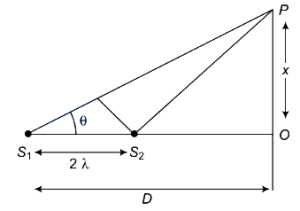
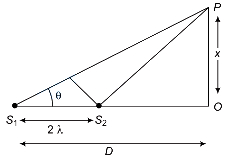
Two coherent point sources $S_1$ and $S_2$ vibrating in phase emit light of wavelength $\lambda$. The separation between them is $2 \lambda$ as shown in the figure. The first bright fringe is formed at $P$ due to interference on a screen placed at a distance $D$ from $S_1$ $(D >> \lambda)$. Then the distance $OP$ is:
A
$\sqrt{2} D$
B
$1.5 D$
C
$\sqrt{3} D$
D
$2 D$
Solution
(C) From the figure,the path difference between the waves reaching point $P$ from $S_1$ and $S_2$ is given by $\Delta x = S_1 P - S_2 P$.
For the first bright fringe,the path difference must be equal to the wavelength $\lambda$ (since they are in phase).
From the geometry of the setup,the path difference can be approximated as $\Delta x = d \cos \theta$,where $d = 2 \lambda$ is the separation between the sources.
Thus,$2 \lambda \cos \theta = \lambda$.
$\cos \theta = \frac{1}{2}$,which implies $\theta = 60^{\circ}$.
From the right-angled triangle formed by the screen,$\tan \theta = \frac{OP}{D} = \frac{x}{D}$.
Since $\theta = 60^{\circ}$,$\tan 60^{\circ} = \sqrt{3}$.
Therefore,$\frac{x}{D} = \sqrt{3}$,which gives $x = \sqrt{3} D$.
For the first bright fringe,the path difference must be equal to the wavelength $\lambda$ (since they are in phase).
From the geometry of the setup,the path difference can be approximated as $\Delta x = d \cos \theta$,where $d = 2 \lambda$ is the separation between the sources.
Thus,$2 \lambda \cos \theta = \lambda$.
$\cos \theta = \frac{1}{2}$,which implies $\theta = 60^{\circ}$.
From the right-angled triangle formed by the screen,$\tan \theta = \frac{OP}{D} = \frac{x}{D}$.
Since $\theta = 60^{\circ}$,$\tan 60^{\circ} = \sqrt{3}$.
Therefore,$\frac{x}{D} = \sqrt{3}$,which gives $x = \sqrt{3} D$.
0 likesView Solution
111
ChemistryMCQTS EAMCET · 2012
$A$ uniform rope of mass $0.1 ~kg$ and length $2.45 ~m$ hangs from a rigid support. The time taken by the transverse wave formed in the rope to travel through the full length of the rope is (Assume $g=9.8 ~m/s^2$) (in $~s$)
A
$0.5$
B
$1.6$
C
$1.2$
D
$1.0$
Solution
(D) The speed of a transverse wave in a rope at a distance $x$ from the free end is given by $v = \sqrt{gx}$.
Since $v = \frac{dx}{dt}$,we have $\frac{dx}{dt} = \sqrt{gx}$.
Rearranging the terms,we get $dt = \frac{dx}{\sqrt{gx}}$.
Integrating from $x=0$ to $x=l$,the total time $t$ is:
$t = \int_{0}^{l} \frac{dx}{\sqrt{gx}} = \frac{1}{\sqrt{g}} [2\sqrt{x}]_{0}^{l} = 2\sqrt{\frac{l}{g}}$.
Substituting the given values $l = 2.45 ~m$ and $g = 9.8 ~m/s^2$:
$t = 2 \sqrt{\frac{2.45}{9.8}} = 2 \sqrt{\frac{1}{4}} = 2 \times 0.5 = 1 ~s$.
Since $v = \frac{dx}{dt}$,we have $\frac{dx}{dt} = \sqrt{gx}$.
Rearranging the terms,we get $dt = \frac{dx}{\sqrt{gx}}$.
Integrating from $x=0$ to $x=l$,the total time $t$ is:
$t = \int_{0}^{l} \frac{dx}{\sqrt{gx}} = \frac{1}{\sqrt{g}} [2\sqrt{x}]_{0}^{l} = 2\sqrt{\frac{l}{g}}$.
Substituting the given values $l = 2.45 ~m$ and $g = 9.8 ~m/s^2$:
$t = 2 \sqrt{\frac{2.45}{9.8}} = 2 \sqrt{\frac{1}{4}} = 2 \times 0.5 = 1 ~s$.
0 likesView Solution
112
ChemistryMCQTS EAMCET · 2012
When a vibrating tuning fork is placed on a sound box of a sonometer, $8$ beats per second are heard when the length of the sonometer wire is kept at $101 \, cm$ or $100 \, cm$. Then the frequency of the tuning fork is (Consider that the tension in the wire is kept constant). (in $ \, Hz$)
A
$1616$
B
$1608$
C
$1632$
D
$1600$
Solution
(B) The frequency of a vibrating wire is given by $n = \frac{1}{2l} \sqrt{\frac{T}{\mu}}$. Since tension $T$ and mass per unit length $\mu$ are constant, we have $n \propto \frac{1}{l}$, which implies $n l = \text{constant}$.
Let $n$ be the frequency of the tuning fork.
At $l_1 = 100 \, cm$, the frequency of the wire is $n_1 = n + 8$ (since the wire is shorter, its frequency is higher).
At $l_2 = 101 \, cm$, the frequency of the wire is $n_2 = n - 8$.
Using $n_1 l_1 = n_2 l_2$:
$(n + 8) \times 100 = (n - 8) \times 101$
$100n + 800 = 101n - 808$
$101n - 100n = 800 + 808$
$n = 1608 \, Hz$.
Let $n$ be the frequency of the tuning fork.
At $l_1 = 100 \, cm$, the frequency of the wire is $n_1 = n + 8$ (since the wire is shorter, its frequency is higher).
At $l_2 = 101 \, cm$, the frequency of the wire is $n_2 = n - 8$.
Using $n_1 l_1 = n_2 l_2$:
$(n + 8) \times 100 = (n - 8) \times 101$
$100n + 800 = 101n - 808$
$101n - 100n = 800 + 808$
$n = 1608 \, Hz$.
0 likesView Solution
113
ChemistryMCQTS EAMCET · 2012
When the engine is switched off,a vehicle of mass $M$ is moving on a rough horizontal road with momentum $p$. If the coefficient of friction between the road and the tyres of the vehicle is $\mu_k$,what is the distance travelled by the vehicle before it comes to rest?
A
$\frac{p^2}{2 \mu_k M^2 g}$
B
$\frac{2 \mu_k M^2 g}{p^2}$
C
$\frac{p^2}{2 \mu_k g}$
D
$\frac{p^2 M^2}{2 \mu_k g}$
Solution
(A) The initial kinetic energy of the vehicle is $K = \frac{p^2}{2M}$.
When the engine is switched off,the only force acting on the vehicle to stop it is the kinetic friction force $f_k = \mu_k M g$.
According to the work-energy theorem,the work done by the friction force is equal to the change in kinetic energy.
$W = \Delta K$
$-f_k \cdot s = 0 - K$
$\mu_k M g s = \frac{p^2}{2M}$
Solving for $s$ (the distance travelled):
$s = \frac{p^2}{2 M^2 \mu_k g}$.
When the engine is switched off,the only force acting on the vehicle to stop it is the kinetic friction force $f_k = \mu_k M g$.
According to the work-energy theorem,the work done by the friction force is equal to the change in kinetic energy.
$W = \Delta K$
$-f_k \cdot s = 0 - K$
$\mu_k M g s = \frac{p^2}{2M}$
Solving for $s$ (the distance travelled):
$s = \frac{p^2}{2 M^2 \mu_k g}$.
0 likesView Solution
114
ChemistryMCQTS EAMCET · 2012
The velocity $v$ reached by a car of mass $m$ at a certain distance from the starting point,driven with constant power $P$,is such that:
A
$v \propto \frac{3 P}{m}$
B
$v^2 \propto \frac{3 P}{m}$
C
$v^3 \propto \frac{2 P}{m}$
D
$v \propto \left(\frac{3 P}{m}\right)^2$
Solution
(C) Power $P$ is defined as the rate of change of kinetic energy: $P = \frac{dK}{dt} = \frac{d}{dt} (\frac{1}{2} m v^2) = m v \frac{dv}{dt}$.
Since $a = \frac{dv}{dt}$,we have $P = m v a = m v (v \frac{dv}{dx}) = m v^2 \frac{dv}{dx}$.
Rearranging the terms: $v^2 dv = \frac{P}{m} dx$.
Integrating both sides: $\int_0^v v^2 dv = \int_0^x \frac{P}{m} dx$.
$\frac{v^3}{3} = \frac{P x}{m}$.
Thus,$v^3 = \frac{3 P x}{m}$.
Since $P$,$m$,and $x$ (at a certain distance) are related,we find $v^3 \propto \frac{P}{m}$.
Since $a = \frac{dv}{dt}$,we have $P = m v a = m v (v \frac{dv}{dx}) = m v^2 \frac{dv}{dx}$.
Rearranging the terms: $v^2 dv = \frac{P}{m} dx$.
Integrating both sides: $\int_0^v v^2 dv = \int_0^x \frac{P}{m} dx$.
$\frac{v^3}{3} = \frac{P x}{m}$.
Thus,$v^3 = \frac{3 P x}{m}$.
Since $P$,$m$,and $x$ (at a certain distance) are related,we find $v^3 \propto \frac{P}{m}$.
0 likesView Solution
115
ChemistryMCQTS EAMCET · 2012
Choose the correct statement$(s)$:
$(A)$ The position of the centre of mass of a system is dependent on the choice of the coordinate system.
$(B)$ Newton's second law of motion is applicable to the centre of mass of the system.
$(C)$ Internal forces cannot change the state of the centre of mass.
$(D)$ Internal forces can change the state of the centre of mass.
$(A)$ The position of the centre of mass of a system is dependent on the choice of the coordinate system.
$(B)$ Newton's second law of motion is applicable to the centre of mass of the system.
$(C)$ Internal forces cannot change the state of the centre of mass.
$(D)$ Internal forces can change the state of the centre of mass.
A
Both $(A)$ and $(B)$ are correct
B
Both $(B)$ and $(C)$ are wrong
C
Both $(A)$ and $(C)$ are wrong
D
Both $(A)$ and $(D)$ are wrong
Solution
(D) Statement $(A)$ is incorrect because the position of the centre of mass is a physical property of the system and is independent of the choice of the coordinate system.
Statement $(B)$ is correct because the motion of the centre of mass is governed by the net external force acting on the system,i.e.,$\vec{F}_{ext} = M\vec{a}_{cm}$.
Statement $(C)$ is correct because internal forces cancel each other out in pairs according to Newton's third law,so they do not affect the motion of the centre of mass.
Statement $(D)$ is incorrect because internal forces cannot change the state of motion of the centre of mass.
Therefore,statements $(A)$ and $(D)$ are wrong.
Statement $(B)$ is correct because the motion of the centre of mass is governed by the net external force acting on the system,i.e.,$\vec{F}_{ext} = M\vec{a}_{cm}$.
Statement $(C)$ is correct because internal forces cancel each other out in pairs according to Newton's third law,so they do not affect the motion of the centre of mass.
Statement $(D)$ is incorrect because internal forces cannot change the state of motion of the centre of mass.
Therefore,statements $(A)$ and $(D)$ are wrong.
0 likesView Solution
116
ChemistryMCQTS EAMCET · 2012
$A$ ball $A$ of mass $m$ moving along the positive $x$-direction with kinetic energy $K$ and momentum $p$ undergoes an elastic head-on collision with a stationary ball $B$ of mass $M$. After the collision,ball $A$ moves along the negative $x$-direction with kinetic energy $K/9$. The final momentum of ball $B$ is:
A
$p$
B
$p/3$
C
$4p/3$
D
$4p$
Solution
(C) Initial kinetic energy of ball $A$ is $K = p^2 / (2m)$,so $p = \sqrt{2mK}$.
Initial velocity of ball $A$ is $u_1 = p/m = \sqrt{2K/m}$.
After collision,ball $A$ moves in the negative $x$-direction with kinetic energy $K' = K/9$.
Let $v_1$ be the final velocity of ball $A$. Then $K' = 1/2 m v_1^2 = K/9$,which gives $v_1 = \sqrt{2K/(9m)} = (1/3) \sqrt{2K/m} = p/(3m)$.
Since ball $A$ moves in the negative $x$-direction,its final velocity is $v_1 = -p/(3m)$.
By the law of conservation of linear momentum: $p_{initial} = p_{final}$.
$p = m v_1 + p_B$,where $p_B$ is the final momentum of ball $B$.
$p = m(-p/(3m)) + p_B$.
$p = -p/3 + p_B$.
$p_B = p + p/3 = 4p/3$.
Initial velocity of ball $A$ is $u_1 = p/m = \sqrt{2K/m}$.
After collision,ball $A$ moves in the negative $x$-direction with kinetic energy $K' = K/9$.
Let $v_1$ be the final velocity of ball $A$. Then $K' = 1/2 m v_1^2 = K/9$,which gives $v_1 = \sqrt{2K/(9m)} = (1/3) \sqrt{2K/m} = p/(3m)$.
Since ball $A$ moves in the negative $x$-direction,its final velocity is $v_1 = -p/(3m)$.
By the law of conservation of linear momentum: $p_{initial} = p_{final}$.
$p = m v_1 + p_B$,where $p_B$ is the final momentum of ball $B$.
$p = m(-p/(3m)) + p_B$.
$p = -p/3 + p_B$.
$p_B = p + p/3 = 4p/3$.
0 likesView Solution
117
ChemistryMediumMCQTS EAMCET · 2012
The formal charges of $C$ and $O$ atoms in $CO_2$ $(\ddot{O}=C=\ddot{O})$ are,respectively:
A
$1, -1$
B
$-1, 1$
C
$2, -2$
D
$0, 0$
Solution
(D) The formal charge $(FC)$ is calculated using the formula: $FC = V - L - \frac{1}{2} B$,where $V$ is the number of valence electrons,$L$ is the number of lone pair electrons,and $B$ is the number of bonding electrons.
For the $CO_2$ molecule with the structure $\ddot{O}=C=\ddot{O}$:
For the $O$ atom: $V = 6$,$L = 4$,$B = 4$. Thus,$FC = 6 - 4 - \frac{1}{2}(4) = 0$.
For the $C$ atom: $V = 4$,$L = 0$,$B = 8$. Thus,$FC = 4 - 0 - \frac{1}{2}(8) = 0$.
Therefore,the formal charges of $C$ and $O$ atoms are $0$ and $0$,respectively.
For the $CO_2$ molecule with the structure $\ddot{O}=C=\ddot{O}$:
For the $O$ atom: $V = 6$,$L = 4$,$B = 4$. Thus,$FC = 6 - 4 - \frac{1}{2}(4) = 0$.
For the $C$ atom: $V = 4$,$L = 0$,$B = 8$. Thus,$FC = 4 - 0 - \frac{1}{2}(8) = 0$.
Therefore,the formal charges of $C$ and $O$ atoms are $0$ and $0$,respectively.
0 likesView Solution
118
ChemistryMediumMCQTS EAMCET · 2012
According to molecular orbital theory,the total number of bonding electron pairs in $O_2$ is
A
$2$
B
$3$
C
$5$
D
$4$
Solution
(C) The molecular orbital electronic configuration of $O_2$ ($16$ electrons) is: $\sigma 1s^2, \sigma^* 1s^2, \sigma 2s^2, \sigma^* 2s^2, \sigma 2p_z^2, \pi 2p_x^2, \pi 2p_y^2, \pi^* 2p_x^1, \pi^* 2p_y^1$.
Bonding molecular orbitals are those without an asterisk $(*)$.
The bonding orbitals are $\sigma 1s, \sigma 2s, \sigma 2p_z, \pi 2p_x, \pi 2p_y$.
Each of these $5$ orbitals contains $2$ electrons,totaling $10$ bonding electrons.
Therefore,the number of bonding electron pairs is $10 / 2 = 5$.
Bonding molecular orbitals are those without an asterisk $(*)$.
The bonding orbitals are $\sigma 1s, \sigma 2s, \sigma 2p_z, \pi 2p_x, \pi 2p_y$.
Each of these $5$ orbitals contains $2$ electrons,totaling $10$ bonding electrons.
Therefore,the number of bonding electron pairs is $10 / 2 = 5$.
0 likesView Solution
119
ChemistryMediumMCQTS EAMCET · 2012
Which of the following statements is not correct?
A
$LiOH$ is a weaker base than $NaOH$
B
Salts of $Be$ undergo hydrolysis
C
$Ca(HCO_3)_2$ is soluble in water
D
Hydrolysis of beryllium carbide gives acetylene
Solution
(D) The correct answer is $D$.
$A$: $LiOH$ is a weaker base than $NaOH$ because the $Li-O$ bond is stronger than the $Na-O$ bond due to the smaller size of $Li^+$,making it harder to release $OH^-$ ions. This is correct.
$B$: Salts of $Be$ undergo hydrolysis because $Be^{2+}$ has a high charge density and small size,which polarizes water molecules. This is correct.
$C$: Calcium bicarbonate,$Ca(HCO_3)_2$,exists only in aqueous solution and is soluble in water. This is correct.
$D$: Hydrolysis of beryllium carbide $(Be_2C)$ produces methane $(CH_4)$,not acetylene $(C_2H_2)$. The reaction is: $Be_2C + 4H_2O \rightarrow CH_4 + 2Be(OH)_2$. Thus,this statement is incorrect.
$A$: $LiOH$ is a weaker base than $NaOH$ because the $Li-O$ bond is stronger than the $Na-O$ bond due to the smaller size of $Li^+$,making it harder to release $OH^-$ ions. This is correct.
$B$: Salts of $Be$ undergo hydrolysis because $Be^{2+}$ has a high charge density and small size,which polarizes water molecules. This is correct.
$C$: Calcium bicarbonate,$Ca(HCO_3)_2$,exists only in aqueous solution and is soluble in water. This is correct.
$D$: Hydrolysis of beryllium carbide $(Be_2C)$ produces methane $(CH_4)$,not acetylene $(C_2H_2)$. The reaction is: $Be_2C + 4H_2O \rightarrow CH_4 + 2Be(OH)_2$. Thus,this statement is incorrect.
0 likesView Solution
120
ChemistryMediumMCQTS EAMCET · 2012
Which one of the following equations represents the variation of viscosity coefficient $(\eta)$ with temperature $(T)$?
A
$\eta = A e^{-E / R T}$
B
$\eta = A e^{E / R T}$
C
$\eta = A e^{-E / k T}$
D
$\eta = A e^{-E / T}$
Solution
(B) The variation of the viscosity coefficient $(\eta)$ of liquids with temperature $(T)$ is described by the Andrade equation,which is given by the expression: $\eta = A e^{E / R T}$.
Here,$A$ is a constant,$E$ is the activation energy for viscous flow,$R$ is the universal gas constant,and $T$ is the absolute temperature.
As temperature increases,the viscosity of liquids decreases,which is consistent with the exponential form $\eta = A e^{E / R T}$.
Here,$A$ is a constant,$E$ is the activation energy for viscous flow,$R$ is the universal gas constant,and $T$ is the absolute temperature.
As temperature increases,the viscosity of liquids decreases,which is consistent with the exponential form $\eta = A e^{E / R T}$.
0 likesView Solution
121
ChemistryEasyMCQTS EAMCET · 2012
In the photoelectric effect,if the work functions of $Li$,$Na$,and $Rb$ are $2.41 \ eV$,$2.30 \ eV$,and $2.09 \ eV$ respectively,the work function of $K$ could approximately be in $eV$?
A
$2.52$
B
$2.20$
C
$2.35$
D
$2.01$
Solution
(B) The work function is the minimum energy required to remove an electron from the surface of a metal. As the atomic size increases down a group,the ionization energy decreases,meaning the work function also decreases.
$Li$,$Na$,$K$,and $Rb$ belong to Group $1$ of the periodic table.
The order of their atomic sizes is $Li < Na < K < Rb$.
Therefore,the order of their work functions is $Li > Na > K > Rb$.
Given values: $Li = 2.41 \ eV$,$Na = 2.30 \ eV$,and $Rb = 2.09 \ eV$.
The work function of $K$ must lie between $Na$ $(2.30 \ eV)$ and $Rb$ $(2.09 \ eV)$.
Among the given options,$2.20 \ eV$ is the only value that falls within the range $2.09 \ eV < K < 2.30 \ eV$.
$Li$,$Na$,$K$,and $Rb$ belong to Group $1$ of the periodic table.
The order of their atomic sizes is $Li < Na < K < Rb$.
Therefore,the order of their work functions is $Li > Na > K > Rb$.
Given values: $Li = 2.41 \ eV$,$Na = 2.30 \ eV$,and $Rb = 2.09 \ eV$.
The work function of $K$ must lie between $Na$ $(2.30 \ eV)$ and $Rb$ $(2.09 \ eV)$.
Among the given options,$2.20 \ eV$ is the only value that falls within the range $2.09 \ eV < K < 2.30 \ eV$.
0 likesView Solution
122
ChemistryMCQTS EAMCET · 2012
If $a, b, c$ and $d \in \mathbb{R}$ such that $a^2+b^2=4$ and $c^2+d^2=2$ and if $(a+ib)^2=(c+id)^2(x+iy)$,then $x^2+y^2$ is equal to
A
$4$
B
$3$
C
$2$
D
$1$
Solution
(A) Given,$(a+ib)^2=(c+id)^2(x+iy)$
Taking the modulus on both sides:
$|(a+ib)^2| = |(c+id)^2(x+iy)|$
$|a+ib|^2 = |c+id|^2 |x+iy|$
Since $|z|^2 = a^2+b^2$,we have:
$a^2+b^2 = (c^2+d^2) \sqrt{x^2+y^2}$
Substituting the given values $a^2+b^2=4$ and $c^2+d^2=2$:
$4 = 2 \sqrt{x^2+y^2}$
$\sqrt{x^2+y^2} = 2$
Squaring both sides:
$x^2+y^2 = 4$
Taking the modulus on both sides:
$|(a+ib)^2| = |(c+id)^2(x+iy)|$
$|a+ib|^2 = |c+id|^2 |x+iy|$
Since $|z|^2 = a^2+b^2$,we have:
$a^2+b^2 = (c^2+d^2) \sqrt{x^2+y^2}$
Substituting the given values $a^2+b^2=4$ and $c^2+d^2=2$:
$4 = 2 \sqrt{x^2+y^2}$
$\sqrt{x^2+y^2} = 2$
Squaring both sides:
$x^2+y^2 = 4$
0 likesView Solution
123
ChemistryMCQTS EAMCET · 2012
If $\alpha$ is a non-real root of the equation $x^6-1=0$,then $\frac{\alpha^2+\alpha^3+\alpha^4+\alpha^5}{\alpha+1}$ is equal to
A
$\alpha$
B
$1$
C
$0$
D
$-1$
Solution
(D) Given that $\alpha$ is a non-real root of $x^6-1=0$.
Since $\alpha^6=1$ and $\alpha \neq 1$ (as $\alpha$ is non-real),we have the sum of the roots of the geometric series:
$1+\alpha+\alpha^2+\alpha^3+\alpha^4+\alpha^5 = \frac{\alpha^6-1}{\alpha-1} = 0$.
This implies $\alpha^2+\alpha^3+\alpha^4+\alpha^5 = -(1+\alpha)$.
Therefore,the expression becomes:
$\frac{\alpha^2+\alpha^3+\alpha^4+\alpha^5}{\alpha+1} = \frac{-(1+\alpha)}{\alpha+1} = -1$.
Since $\alpha^6=1$ and $\alpha \neq 1$ (as $\alpha$ is non-real),we have the sum of the roots of the geometric series:
$1+\alpha+\alpha^2+\alpha^3+\alpha^4+\alpha^5 = \frac{\alpha^6-1}{\alpha-1} = 0$.
This implies $\alpha^2+\alpha^3+\alpha^4+\alpha^5 = -(1+\alpha)$.
Therefore,the expression becomes:
$\frac{\alpha^2+\alpha^3+\alpha^4+\alpha^5}{\alpha+1} = \frac{-(1+\alpha)}{\alpha+1} = -1$.
0 likesView Solution
124
ChemistryMCQTS EAMCET · 2012
If $a, b$ and $c$ form a geometric progression with common ratio $r$,then the sum of the ordinates of the points of intersection of the line $ax + by + c = 0$ and the curve $x + 2y^2 = 0$ is
A
$-\frac{r^2}{2}$
B
$-\frac{r}{2}$
C
$\frac{r}{2}$
D
$r$
Solution
(C) Since $a, b, c$ are in geometric progression,we have $b = ar$ and $c = ar^2$.
Substituting these into the line equation $ax + by + c = 0$,we get $ax + ary + ar^2 = 0$.
Dividing by $a$ (assuming $a \neq 0$),we get $x + ry + r^2 = 0$,or $x = -ry - r^2$.
Substituting this into the curve equation $x + 2y^2 = 0$,we get $(-ry - r^2) + 2y^2 = 0$.
Rearranging gives the quadratic equation $2y^2 - ry - r^2 = 0$.
The sum of the ordinates ($y$-coordinates) is the sum of the roots of this quadratic equation,which is given by $-\frac{\text{coefficient of } y}{\text{coefficient of } y^2} = -(\frac{-r}{2}) = \frac{r}{2}$.
Substituting these into the line equation $ax + by + c = 0$,we get $ax + ary + ar^2 = 0$.
Dividing by $a$ (assuming $a \neq 0$),we get $x + ry + r^2 = 0$,or $x = -ry - r^2$.
Substituting this into the curve equation $x + 2y^2 = 0$,we get $(-ry - r^2) + 2y^2 = 0$.
Rearranging gives the quadratic equation $2y^2 - ry - r^2 = 0$.
The sum of the ordinates ($y$-coordinates) is the sum of the roots of this quadratic equation,which is given by $-\frac{\text{coefficient of } y}{\text{coefficient of } y^2} = -(\frac{-r}{2}) = \frac{r}{2}$.
0 likesView Solution
125
ChemistryEasyMCQTS EAMCET · 2012
The pair of gases responsible for acid rain are
A
$H_2, O_3$
B
$CH_4, O_3$
C
$NO_2, SO_2$
D
$CO, CH_4$
Solution
(C) Acid rain is primarily caused by the emission of oxides of nitrogen and sulphur into the atmosphere.
These gases react with water vapor in the atmosphere to form strong acids,namely nitric acid $(HNO_3)$ and sulphuric acid $(H_2SO_4)$,which then fall as acid rain.
The chemical reactions are as follows:
$2NO_2 + H_2O \rightarrow HNO_3 + HNO_2$
$2SO_2 + O_2 + 2H_2O \rightarrow 2H_2SO_4$
Thus,the pair of gases responsible for acid rain is $NO_2$ and $SO_2$.
These gases react with water vapor in the atmosphere to form strong acids,namely nitric acid $(HNO_3)$ and sulphuric acid $(H_2SO_4)$,which then fall as acid rain.
The chemical reactions are as follows:
$2NO_2 + H_2O \rightarrow HNO_3 + HNO_2$
$2SO_2 + O_2 + 2H_2O \rightarrow 2H_2SO_4$
Thus,the pair of gases responsible for acid rain is $NO_2$ and $SO_2$.
0 likesView Solution
126
ChemistryMCQTS EAMCET · 2012
The minimum value of $27 \tan ^2 \theta + 3 \cot ^2 \theta$ is
A
$15$
B
$18$
C
$24$
D
$30$
Solution
(B) We know that for any positive real numbers $a$ and $b$,the Arithmetic Mean is greater than or equal to the Geometric Mean,i.e.,$\frac{a+b}{2} \geq \sqrt{ab}$.
Let $a = 27 \tan ^2 \theta$ and $b = 3 \cot ^2 \theta$.
Then,$\frac{27 \tan ^2 \theta + 3 \cot ^2 \theta}{2} \geq \sqrt{27 \tan ^2 \theta \cdot 3 \cot ^2 \theta}$.
$\frac{27 \tan ^2 \theta + 3 \cot ^2 \theta}{2} \geq \sqrt{81 \tan ^2 \theta \cdot \cot ^2 \theta}$.
Since $\tan \theta \cdot \cot \theta = 1$,we have $\frac{27 \tan ^2 \theta + 3 \cot ^2 \theta}{2} \geq \sqrt{81 \cdot 1}$.
$\frac{27 \tan ^2 \theta + 3 \cot ^2 \theta}{2} \geq 9$.
$27 \tan ^2 \theta + 3 \cot ^2 \theta \geq 18$.
Thus,the minimum value is $18$.
Let $a = 27 \tan ^2 \theta$ and $b = 3 \cot ^2 \theta$.
Then,$\frac{27 \tan ^2 \theta + 3 \cot ^2 \theta}{2} \geq \sqrt{27 \tan ^2 \theta \cdot 3 \cot ^2 \theta}$.
$\frac{27 \tan ^2 \theta + 3 \cot ^2 \theta}{2} \geq \sqrt{81 \tan ^2 \theta \cdot \cot ^2 \theta}$.
Since $\tan \theta \cdot \cot \theta = 1$,we have $\frac{27 \tan ^2 \theta + 3 \cot ^2 \theta}{2} \geq \sqrt{81 \cdot 1}$.
$\frac{27 \tan ^2 \theta + 3 \cot ^2 \theta}{2} \geq 9$.
$27 \tan ^2 \theta + 3 \cot ^2 \theta \geq 18$.
Thus,the minimum value is $18$.
0 likesView Solution
127
ChemistryMCQTS EAMCET · 2012
If the pair of lines given by $(x^2+y^2) \cos^2 \theta = (x \cos \theta + y \sin \theta)^2$ are perpendicular to each other,then $\theta$ is equal to
A
$0$
B
$\frac{\pi}{4}$
C
$\frac{\pi}{3}$
D
None of these
Solution
(B) The given equation is $(x^2+y^2) \cos^2 \theta = (x \cos \theta + y \sin \theta)^2$.
Expanding the right side:
$(x^2+y^2) \cos^2 \theta = x^2 \cos^2 \theta + y^2 \sin^2 \theta + 2xy \sin \theta \cos \theta$.
Rearranging the terms to the form $Ax^2 + 2Hxy + By^2 = 0$:
$x^2(\cos^2 \theta - \cos^2 \theta) + 2xy(\sin \theta \cos \theta) + y^2(\sin^2 \theta - \cos^2 \theta) = 0$.
$0x^2 + 2xy(\sin \theta \cos \theta) - y^2(\cos^2 \theta - \sin^2 \theta) = 0$.
For a pair of lines to be perpendicular,the sum of the coefficients of $x^2$ and $y^2$ must be zero $(A + B = 0)$.
Here,$A = 0$ and $B = -(\cos^2 \theta - \sin^2 \theta) = -\cos(2\theta)$.
Setting $A + B = 0$:
$0 - \cos(2\theta) = 0 \Rightarrow \cos(2\theta) = 0$.
Thus,$2\theta = \frac{\pi}{2} \Rightarrow \theta = \frac{\pi}{4}$.
Expanding the right side:
$(x^2+y^2) \cos^2 \theta = x^2 \cos^2 \theta + y^2 \sin^2 \theta + 2xy \sin \theta \cos \theta$.
Rearranging the terms to the form $Ax^2 + 2Hxy + By^2 = 0$:
$x^2(\cos^2 \theta - \cos^2 \theta) + 2xy(\sin \theta \cos \theta) + y^2(\sin^2 \theta - \cos^2 \theta) = 0$.
$0x^2 + 2xy(\sin \theta \cos \theta) - y^2(\cos^2 \theta - \sin^2 \theta) = 0$.
For a pair of lines to be perpendicular,the sum of the coefficients of $x^2$ and $y^2$ must be zero $(A + B = 0)$.
Here,$A = 0$ and $B = -(\cos^2 \theta - \sin^2 \theta) = -\cos(2\theta)$.
Setting $A + B = 0$:
$0 - \cos(2\theta) = 0 \Rightarrow \cos(2\theta) = 0$.
Thus,$2\theta = \frac{\pi}{2} \Rightarrow \theta = \frac{\pi}{4}$.
0 likesView Solution
128
ChemistryMCQTS EAMCET · 2012
If the area of the triangle formed by the pair of lines $8x^2 - 6xy + y^2 = 0$ and the line $2x + 3y = a$ is $7$,then $a$ is equal to
A
$14$
B
$14\sqrt{2}$
C
$28\sqrt{2}$
D
$28$
Solution
(D) The given pair of lines is $8x^2 - 6xy + y^2 = 0$.
Factoring the quadratic equation: $8x^2 - 4xy - 2xy + y^2 = 0$ $\Rightarrow 4x(2x - y) - y(2x - y) = 0$ $\Rightarrow (4x - y)(2x - y) = 0$.
Thus,the two lines are $y = 4x$ and $y = 2x$.
The third line is $2x + 3y = a$.
The intersection points are:
$1$. Intersection of $y = 4x$ and $y = 2x$ is $O(0, 0)$.
$2$. Intersection of $y = 4x$ and $2x + 3y = a$: $2x + 3(4x) = a$ $\Rightarrow 14x = a$ $\Rightarrow x = a/14, y = 4a/14 = 2a/7$. Point $A(a/14, 2a/7)$.
$3$. Intersection of $y = 2x$ and $2x + 3y = a$: $2x + 3(2x) = a$ $\Rightarrow 8x = a$ $\Rightarrow x = a/8, y = 2a/8 = a/4$. Point $B(a/8, a/4)$.
The area of the triangle with vertices $(0, 0), (x_1, y_1), (x_2, y_2)$ is $\frac{1}{2} |x_1y_2 - x_2y_1|$.
Area $= \frac{1}{2} |(a/14)(a/4) - (a/8)(2a/7)| = \frac{1}{2} |a^2/56 - 2a^2/56| = \frac{1}{2} |-a^2/56| = a^2/112$.
Given area is $7$,so $a^2/112 = 7$ $\Rightarrow a^2 = 784$ $\Rightarrow a = 28$ (assuming $a > 0$ for area).
Factoring the quadratic equation: $8x^2 - 4xy - 2xy + y^2 = 0$ $\Rightarrow 4x(2x - y) - y(2x - y) = 0$ $\Rightarrow (4x - y)(2x - y) = 0$.
Thus,the two lines are $y = 4x$ and $y = 2x$.
The third line is $2x + 3y = a$.
The intersection points are:
$1$. Intersection of $y = 4x$ and $y = 2x$ is $O(0, 0)$.
$2$. Intersection of $y = 4x$ and $2x + 3y = a$: $2x + 3(4x) = a$ $\Rightarrow 14x = a$ $\Rightarrow x = a/14, y = 4a/14 = 2a/7$. Point $A(a/14, 2a/7)$.
$3$. Intersection of $y = 2x$ and $2x + 3y = a$: $2x + 3(2x) = a$ $\Rightarrow 8x = a$ $\Rightarrow x = a/8, y = 2a/8 = a/4$. Point $B(a/8, a/4)$.
The area of the triangle with vertices $(0, 0), (x_1, y_1), (x_2, y_2)$ is $\frac{1}{2} |x_1y_2 - x_2y_1|$.
Area $= \frac{1}{2} |(a/14)(a/4) - (a/8)(2a/7)| = \frac{1}{2} |a^2/56 - 2a^2/56| = \frac{1}{2} |-a^2/56| = a^2/112$.
Given area is $7$,so $a^2/112 = 7$ $\Rightarrow a^2 = 784$ $\Rightarrow a = 28$ (assuming $a > 0$ for area).
0 likesView Solution
129
ChemistryEasyMCQTS EAMCET · 2012
Different conformations of the same molecule are called
A
isomers
B
epimers
C
enantiomers
D
rotamers
Solution
(D) Conformational isomers are stereoisomers that can be interconverted simply by rotation about a single bond. These are also known as $rotamers$ or $conformers$,and the phenomenon is known as $rotamerism$.
0 likesView Solution
130
ChemistryMediumMCQTS EAMCET · 2012
Match the following pairs in Column-$I$ with their respective isomer types in Column-$II$.
| Column-$I$ | Column-$II$ |
|---|---|
| $A$. Acetaldehyde,vinyl alcohol | $1$. Enantiomers |
| $B$. Eclipsed and staggered ethane | $2$. Tautomers |
| $C$. $(+)$$2$-butanol,$(-)$$2$-butanol | $3$. Chain isomers |
| $D$. Methyl-$n$-propylamine and diethylamine | $4$. Conformational isomers |
| $5$. Metamers |
A
$A-2, B-4, C-1, D-5$
B
$A-2, B-4, C-1, D-3$
C
$A-1, B-4, C-2, D-5$
D
$A-1, B-4, C-2, D-3$
Solution
$(A)$. Acetaldehyde $(CH_3CHO)$ and vinyl alcohol $(CH_2=CH-OH)$ are tautomers,as they exist in dynamic equilibrium involving the migration of an $\alpha$-hydrogen atom.
$B$. Eclipsed and staggered ethane are different spatial arrangements of the same molecule,known as conformational isomers.
$C$. $(+)$$2$-butanol and $(-)$$2$-butanol are non-superimposable mirror images of each other,hence they are enantiomers.
$D$. Methyl-$n$-propylamine $(CH_3-NH-CH_2CH_2CH_3)$ and diethylamine $(CH_3CH_2-NH-CH_2CH_3)$ have different alkyl groups attached to the same nitrogen atom,which defines them as metamers.
$B$. Eclipsed and staggered ethane are different spatial arrangements of the same molecule,known as conformational isomers.
$C$. $(+)$$2$-butanol and $(-)$$2$-butanol are non-superimposable mirror images of each other,hence they are enantiomers.
$D$. Methyl-$n$-propylamine $(CH_3-NH-CH_2CH_2CH_3)$ and diethylamine $(CH_3CH_2-NH-CH_2CH_3)$ have different alkyl groups attached to the same nitrogen atom,which defines them as metamers.
0 likesView Solution
131
ChemistryEasyMCQTS EAMCET · 2012
The chlorination of ethane is an example of which of the following types of reactions?
A
Nucleophilic substitution
B
Electrophilic substitution
C
Free radical substitution
D
Rearrangement
Solution
(C) The chlorination of ethane is a classic example of a free radical substitution reaction. It proceeds through three main stages:
Step $I$: Initiation step,where chlorine molecules undergo homolytic fission in the presence of light $(hv)$ to form chlorine free radicals:
$Cl_2 \stackrel{hv}{\longrightarrow} 2 Cl^{\bullet}$
Step $II$: Propagation step,where the chlorine radical reacts with ethane to form an ethyl radical,which then reacts with another chlorine molecule to form chloroethane and regenerate a chlorine radical:
$CH_3CH_3 + Cl^{\bullet} \longrightarrow CH_3CH_2^{\bullet} + HCl$
$CH_3CH_2^{\bullet} + Cl_2 \longrightarrow CH_3CH_2Cl + Cl^{\bullet}$
Step $III$: Termination step,where free radicals combine to end the chain reaction:
$CH_3CH_2^{\bullet} + Cl^{\bullet} \longrightarrow CH_3CH_2Cl$
$Cl^{\bullet} + Cl^{\bullet} \longrightarrow Cl_2$
$2 CH_3CH_2^{\bullet} \longrightarrow CH_3CH_2CH_2CH_3$
Step $I$: Initiation step,where chlorine molecules undergo homolytic fission in the presence of light $(hv)$ to form chlorine free radicals:
$Cl_2 \stackrel{hv}{\longrightarrow} 2 Cl^{\bullet}$
Step $II$: Propagation step,where the chlorine radical reacts with ethane to form an ethyl radical,which then reacts with another chlorine molecule to form chloroethane and regenerate a chlorine radical:
$CH_3CH_3 + Cl^{\bullet} \longrightarrow CH_3CH_2^{\bullet} + HCl$
$CH_3CH_2^{\bullet} + Cl_2 \longrightarrow CH_3CH_2Cl + Cl^{\bullet}$
Step $III$: Termination step,where free radicals combine to end the chain reaction:
$CH_3CH_2^{\bullet} + Cl^{\bullet} \longrightarrow CH_3CH_2Cl$
$Cl^{\bullet} + Cl^{\bullet} \longrightarrow Cl_2$
$2 CH_3CH_2^{\bullet} \longrightarrow CH_3CH_2CH_2CH_3$
0 likesView Solution
132
ChemistryMediumMCQTS EAMCET · 2012
Which of the following statements is not correct?
A
The six carbons in benzene are $sp^2$ hybridised
B
Benzene has $(4n+2) \pi$ electrons
C
Benzene undergoes substitution reactions
D
Benzene has two carbon-carbon bond lengths,$1.54 \ Å$ and $1.34 \ Å$
Solution
(D) In benzene,all the $C-C$ bond lengths are equal to $1.39 \ Å$ due to resonance. Therefore,the statement that benzene has two different bond lengths of $1.54 \ Å$ and $1.34 \ Å$ is incorrect.
0 likesView Solution
133
ChemistryMediumMCQTS EAMCET · 2012
The product$(s)$ formed when $H_2O_2$ reacts with disodium hydrogen phosphate is
A
$P_2O_5 \cdot Na_3PO_4$
B
$Na_2HPO_4 \cdot H_2O_2$
C
$NaH_2PO_4, H_2O$
D
$Na_2HPO_4 \cdot H_2O$
Solution
(B) $H_2O_2$ reacts with disodium hydrogen phosphate $(Na_2HPO_4)$ to form an addition product.
The reaction is as follows:
$H_2O_2 + Na_2HPO_4 \rightarrow Na_2HPO_4 \cdot H_2O_2$
This is a stable addition product.
The reaction is as follows:
$H_2O_2 + Na_2HPO_4 \rightarrow Na_2HPO_4 \cdot H_2O_2$
This is a stable addition product.
0 likesView Solution
134
ChemistryMCQTS EAMCET · 2012
If $x^2+y^2=t+\frac{1}{t}$ and $x^4+y^4=t^2+\frac{1}{t^2}$,then $x^3 y \frac{d y}{d x}$ is equal to
A
$-1$
B
$1$
C
$0$
D
$t$
Solution
(A) Given,$x^4+y^4=t^2+\frac{1}{t^2}$.
We know that $(t+\frac{1}{t})^2 = t^2 + \frac{1}{t^2} + 2$.
Thus,$t^2 + \frac{1}{t^2} = (t+\frac{1}{t})^2 - 2$.
Substituting the given values,we get $x^4+y^4 = (x^2+y^2)^2 - 2$.
Expanding the right side: $x^4+y^4 = x^4 + y^4 + 2x^2y^2 - 2$.
Subtracting $x^4+y^4$ from both sides,we get $0 = 2x^2y^2 - 2$,which implies $x^2y^2 = 1$.
Therefore,$y^2 = \frac{1}{x^2} = x^{-2}$.
Differentiating both sides with respect to $x$: $\frac{d}{dx}(y^2) = \frac{d}{dx}(x^{-2})$.
$2y \frac{dy}{dx} = -2x^{-3} = -\frac{2}{x^3}$.
Dividing by $2$,we get $y \frac{dy}{dx} = -\frac{1}{x^3}$.
Multiplying both sides by $x^3$,we get $x^3 y \frac{dy}{dx} = -1$.
We know that $(t+\frac{1}{t})^2 = t^2 + \frac{1}{t^2} + 2$.
Thus,$t^2 + \frac{1}{t^2} = (t+\frac{1}{t})^2 - 2$.
Substituting the given values,we get $x^4+y^4 = (x^2+y^2)^2 - 2$.
Expanding the right side: $x^4+y^4 = x^4 + y^4 + 2x^2y^2 - 2$.
Subtracting $x^4+y^4$ from both sides,we get $0 = 2x^2y^2 - 2$,which implies $x^2y^2 = 1$.
Therefore,$y^2 = \frac{1}{x^2} = x^{-2}$.
Differentiating both sides with respect to $x$: $\frac{d}{dx}(y^2) = \frac{d}{dx}(x^{-2})$.
$2y \frac{dy}{dx} = -2x^{-3} = -\frac{2}{x^3}$.
Dividing by $2$,we get $y \frac{dy}{dx} = -\frac{1}{x^3}$.
Multiplying both sides by $x^3$,we get $x^3 y \frac{dy}{dx} = -1$.
0 likesView Solution
135
ChemistryMCQTS EAMCET · 2012
If $x y \neq 0, x+y \neq 0$ and $x^m y^n=(x+y)^{m+n}$,where $m, n \notin N$,then $\frac{d y}{d x}$ is equal to
A
$\frac{y}{x}$
B
$\frac{x+y}{x y}$
C
$x y$
D
$\frac{x}{y}$
Solution
(A) Given,$x^m y^n = (x+y)^{m+n}$.
Taking the natural logarithm on both sides,we get:
$m \ln x + n \ln y = (m+n) \ln (x+y)$.
Differentiating both sides with respect to $x$:
$\frac{m}{x} + \frac{n}{y} \frac{dy}{dx} = \frac{m+n}{x+y} \left(1 + \frac{dy}{dx}\right)$.
Rearranging the terms to isolate $\frac{dy}{dx}$:
$\frac{m}{x} - \frac{m+n}{x+y} = \frac{dy}{dx} \left( \frac{m+n}{x+y} - \frac{n}{y} \right)$.
Simplifying both sides:
$\frac{m(x+y) - x(m+n)}{x(x+y)} = \frac{dy}{dx} \left( \frac{y(m+n) - n(x+y)}{y(x+y)} \right)$.
$\frac{mx + my - mx - nx}{x(x+y)} = \frac{dy}{dx} \left( \frac{my + ny - nx - ny}{y(x+y)} \right)$.
$\frac{my - nx}{x(x+y)} = \frac{dy}{dx} \left( \frac{my - nx}{y(x+y)} \right)$.
Since $my - nx \neq 0$ (as $x, y$ are variables),we can cancel the terms:
$\frac{1}{x} = \frac{dy}{dx} \left( \frac{1}{y} \right)$.
Therefore,$\frac{dy}{dx} = \frac{y}{x}$.
Taking the natural logarithm on both sides,we get:
$m \ln x + n \ln y = (m+n) \ln (x+y)$.
Differentiating both sides with respect to $x$:
$\frac{m}{x} + \frac{n}{y} \frac{dy}{dx} = \frac{m+n}{x+y} \left(1 + \frac{dy}{dx}\right)$.
Rearranging the terms to isolate $\frac{dy}{dx}$:
$\frac{m}{x} - \frac{m+n}{x+y} = \frac{dy}{dx} \left( \frac{m+n}{x+y} - \frac{n}{y} \right)$.
Simplifying both sides:
$\frac{m(x+y) - x(m+n)}{x(x+y)} = \frac{dy}{dx} \left( \frac{y(m+n) - n(x+y)}{y(x+y)} \right)$.
$\frac{mx + my - mx - nx}{x(x+y)} = \frac{dy}{dx} \left( \frac{my + ny - nx - ny}{y(x+y)} \right)$.
$\frac{my - nx}{x(x+y)} = \frac{dy}{dx} \left( \frac{my - nx}{y(x+y)} \right)$.
Since $my - nx \neq 0$ (as $x, y$ are variables),we can cancel the terms:
$\frac{1}{x} = \frac{dy}{dx} \left( \frac{1}{y} \right)$.
Therefore,$\frac{dy}{dx} = \frac{y}{x}$.
0 likesView Solution
136
ChemistryEasyMCQTS EAMCET · 2012
Which one of the following statements is not correct?
A
The $pH$ of $1.0 \times 10^{-8} \ M \ HCl$ is less than $7$
B
The ionic product of water at $25^{\circ} C$ is $1.0 \times 10^{-14} \ mol^{2} \ L^{-2}$
C
$Cl^{-}$ is a Lewis acid
D
Bronsted-Lowry theory cannot explain the acidic character of $AlCl_{3}$
Solution
(C) $Cl^{-}$ is a Lewis base,not a Lewis acid,because its octet is complete and it has a lone pair of electrons to donate.
For $1.0 \times 10^{-8} \ M \ HCl$,the contribution of $H^{+}$ from water must be considered,resulting in a $pH$ slightly less than $7$ (approx $6.98$).
The ionic product of water $(K_w)$ at $25^{\circ} C$ is $1.0 \times 10^{-14} \ mol^2 \ L^{-2}$.
$AlCl_{3}$ acts as a Lewis acid due to an incomplete octet,which is not explained by the Bronsted-Lowry theory.
For $1.0 \times 10^{-8} \ M \ HCl$,the contribution of $H^{+}$ from water must be considered,resulting in a $pH$ slightly less than $7$ (approx $6.98$).
The ionic product of water $(K_w)$ at $25^{\circ} C$ is $1.0 \times 10^{-14} \ mol^2 \ L^{-2}$.
$AlCl_{3}$ acts as a Lewis acid due to an incomplete octet,which is not explained by the Bronsted-Lowry theory.
0 likesView Solution
137
ChemistryMCQTS EAMCET · 2012
If the volume of a sphere increases at the rate of $2 \pi \text{ cm}^3/\text{s}$,then the rate of increase of its radius (in $\text{cm/s}$),when the volume is $288 \pi \text{ cm}^3$,is
A
$\frac{1}{36}$
B
$\frac{1}{72}$
C
$\frac{1}{18}$
D
$\frac{1}{9}$
Solution
(B) Given that the rate of change of volume is $\frac{dV}{dt} = 2 \pi \text{ cm}^3/\text{s}$.
We know that the volume of a sphere is $V = \frac{4}{3} \pi r^3$.
Differentiating both sides with respect to $t$,we get $\frac{dV}{dt} = 4 \pi r^2 \frac{dr}{dt}$.
Given $V = 288 \pi$,we find the radius $r$ as:
$288 \pi = \frac{4}{3} \pi r^3 \Rightarrow 216 = r^3 \Rightarrow r = 6 \text{ cm}$.
Substituting the values into the derivative equation:
$2 \pi = 4 \pi (6)^2 \frac{dr}{dt}$
$2 \pi = 4 \pi (36) \frac{dr}{dt}$
$2 \pi = 144 \pi \frac{dr}{dt}$
$\frac{dr}{dt} = \frac{2 \pi}{144 \pi} = \frac{1}{72} \text{ cm/s}$.
We know that the volume of a sphere is $V = \frac{4}{3} \pi r^3$.
Differentiating both sides with respect to $t$,we get $\frac{dV}{dt} = 4 \pi r^2 \frac{dr}{dt}$.
Given $V = 288 \pi$,we find the radius $r$ as:
$288 \pi = \frac{4}{3} \pi r^3 \Rightarrow 216 = r^3 \Rightarrow r = 6 \text{ cm}$.
Substituting the values into the derivative equation:
$2 \pi = 4 \pi (6)^2 \frac{dr}{dt}$
$2 \pi = 4 \pi (36) \frac{dr}{dt}$
$2 \pi = 144 \pi \frac{dr}{dt}$
$\frac{dr}{dt} = \frac{2 \pi}{144 \pi} = \frac{1}{72} \text{ cm/s}$.
0 likesView Solution
138
ChemistryMCQTS EAMCET · 2012
$\int \frac{dx}{\sqrt{x-x^2}}$ is equal to
A
$2 \sin^{-1} \sqrt{x} + C$
B
$2 \sin^{-1} x + C$
C
$2x \sin^{-1} x + C$
D
$\sin^{-1} \sqrt{x} + C$
Solution
(A) Let $I = \int \frac{dx}{\sqrt{x-x^2}}$.
We can rewrite the denominator as $\sqrt{x(1-x)} = \sqrt{x} \sqrt{1-x}$.
So,$I = \int \frac{dx}{\sqrt{x} \sqrt{1-x}}$.
Let $\sqrt{x} = \sin \theta$. Then $x = \sin^2 \theta$,which implies $dx = 2 \sin \theta \cos \theta \, d\theta$.
Substituting these into the integral:
$I = \int \frac{2 \sin \theta \cos \theta \, d\theta}{\sin \theta \sqrt{1-\sin^2 \theta}}$
$I = \int \frac{2 \sin \theta \cos \theta \, d\theta}{\sin \theta \cos \theta}$
$I = \int 2 \, d\theta = 2\theta + C$.
Since $\sin \theta = \sqrt{x}$,we have $\theta = \sin^{-1} \sqrt{x}$.
Therefore,$I = 2 \sin^{-1} \sqrt{x} + C$.
We can rewrite the denominator as $\sqrt{x(1-x)} = \sqrt{x} \sqrt{1-x}$.
So,$I = \int \frac{dx}{\sqrt{x} \sqrt{1-x}}$.
Let $\sqrt{x} = \sin \theta$. Then $x = \sin^2 \theta$,which implies $dx = 2 \sin \theta \cos \theta \, d\theta$.
Substituting these into the integral:
$I = \int \frac{2 \sin \theta \cos \theta \, d\theta}{\sin \theta \sqrt{1-\sin^2 \theta}}$
$I = \int \frac{2 \sin \theta \cos \theta \, d\theta}{\sin \theta \cos \theta}$
$I = \int 2 \, d\theta = 2\theta + C$.
Since $\sin \theta = \sqrt{x}$,we have $\theta = \sin^{-1} \sqrt{x}$.
Therefore,$I = 2 \sin^{-1} \sqrt{x} + C$.
0 likesView Solution
139
ChemistryMCQTS EAMCET · 2012
If $\int \sec ^2 x \operatorname{cosec}^4 x \, dx = -\frac{1}{3} \cot ^3 x + k \tan x - 2 \cot x + C$,then $k$ is equal to
A
$4$
B
$3$
C
$2$
D
$1$
Solution
(D) Let $I = \int \sec^2 x \operatorname{cosec}^4 x \, dx$.
We can write $\sec^2 x = \frac{1}{\cos^2 x}$ and $\operatorname{cosec}^4 x = \frac{1}{\sin^4 x}$.
So,$I = \int \frac{1}{\sin^4 x \cos^2 x} \, dx$.
Using the identity $1 = \sin^2 x + \cos^2 x$,we have:
$I = \int \frac{\sin^2 x + \cos^2 x}{\sin^4 x \cos^2 x} \, dx = \int \frac{\sin^2 x}{\sin^4 x \cos^2 x} \, dx + \int \frac{\cos^2 x}{\sin^4 x \cos^2 x} \, dx$.
$I = \int \frac{1}{\sin^2 x \cos^2 x} \, dx + \int \frac{1}{\sin^4 x} \, dx$.
$I = \int \frac{\sin^2 x + \cos^2 x}{\sin^2 x \cos^2 x} \, dx + \int \operatorname{cosec}^4 x \, dx$.
$I = \int (\sec^2 x + \operatorname{cosec}^2 x) \, dx + \int \operatorname{cosec}^2 x (1 + \cot^2 x) \, dx$.
$I = \tan x - \cot x + \int \operatorname{cosec}^2 x \, dx + \int \operatorname{cosec}^2 x \cot^2 x \, dx$.
$I = \tan x - \cot x - \cot x + \int \cot^2 x \operatorname{cosec}^2 x \, dx$.
Let $u = \cot x$,then $du = -\operatorname{cosec}^2 x \, dx$.
$I = \tan x - 2 \cot x - \int u^2 \, du = \tan x - 2 \cot x - \frac{u^3}{3} + C$.
$I = -\frac{1}{3} \cot^3 x + \tan x - 2 \cot x + C$.
Comparing this with the given expression $-\frac{1}{3} \cot^3 x + k \tan x - 2 \cot x + C$,we get $k = 1$.
We can write $\sec^2 x = \frac{1}{\cos^2 x}$ and $\operatorname{cosec}^4 x = \frac{1}{\sin^4 x}$.
So,$I = \int \frac{1}{\sin^4 x \cos^2 x} \, dx$.
Using the identity $1 = \sin^2 x + \cos^2 x$,we have:
$I = \int \frac{\sin^2 x + \cos^2 x}{\sin^4 x \cos^2 x} \, dx = \int \frac{\sin^2 x}{\sin^4 x \cos^2 x} \, dx + \int \frac{\cos^2 x}{\sin^4 x \cos^2 x} \, dx$.
$I = \int \frac{1}{\sin^2 x \cos^2 x} \, dx + \int \frac{1}{\sin^4 x} \, dx$.
$I = \int \frac{\sin^2 x + \cos^2 x}{\sin^2 x \cos^2 x} \, dx + \int \operatorname{cosec}^4 x \, dx$.
$I = \int (\sec^2 x + \operatorname{cosec}^2 x) \, dx + \int \operatorname{cosec}^2 x (1 + \cot^2 x) \, dx$.
$I = \tan x - \cot x + \int \operatorname{cosec}^2 x \, dx + \int \operatorname{cosec}^2 x \cot^2 x \, dx$.
$I = \tan x - \cot x - \cot x + \int \cot^2 x \operatorname{cosec}^2 x \, dx$.
Let $u = \cot x$,then $du = -\operatorname{cosec}^2 x \, dx$.
$I = \tan x - 2 \cot x - \int u^2 \, du = \tan x - 2 \cot x - \frac{u^3}{3} + C$.
$I = -\frac{1}{3} \cot^3 x + \tan x - 2 \cot x + C$.
Comparing this with the given expression $-\frac{1}{3} \cot^3 x + k \tan x - 2 \cot x + C$,we get $k = 1$.
0 likesView Solution
140
ChemistryMCQTS EAMCET · 2012
$A$ magnetic needle lying parallel to a magnetic field is turned through $60^{\circ}$. The work done on it is $W$. The torque required to maintain the magnetic needle in the position mentioned above is
A
$\sqrt{3} W$
B
$\frac{\sqrt{3}}{2} W$
C
$\frac{W}{2}$
D
$2 W$
Solution
(A) The work done $W$ in rotating a magnetic dipole of magnetic moment $M$ in a magnetic field $B$ from an angle $\theta_1 = 0^{\circ}$ to $\theta_2 = 60^{\circ}$ is given by:
$W = MB(1 - \cos 60^{\circ}) = MB(1 - 0.5) = \frac{MB}{2}$.
From this,we find $MB = 2W$.
The torque $\tau$ required to maintain the needle at $\theta = 60^{\circ}$ is given by:
$\tau = MB \sin 60^{\circ}$.
Substituting $MB = 2W$ and $\sin 60^{\circ} = \frac{\sqrt{3}}{2}$:
$\tau = (2W) \times \frac{\sqrt{3}}{2} = \sqrt{3} W$.
$W = MB(1 - \cos 60^{\circ}) = MB(1 - 0.5) = \frac{MB}{2}$.
From this,we find $MB = 2W$.
The torque $\tau$ required to maintain the needle at $\theta = 60^{\circ}$ is given by:
$\tau = MB \sin 60^{\circ}$.
Substituting $MB = 2W$ and $\sin 60^{\circ} = \frac{\sqrt{3}}{2}$:
$\tau = (2W) \times \frac{\sqrt{3}}{2} = \sqrt{3} W$.
0 likesView Solution
141
ChemistryMCQTS EAMCET · 2012
The point of intersection of the lines $l_1: r(t)=(i-6j+2k)+t(i+2j+k)$ and $l_2: R(u)=(4j+k)+u(2i+j+2k)$ is
A
$(4,4,5)$
B
$(6,4,7)$
C
$(8,8,9)$
D
$(10,12,11)$
Solution
(C) Let the point of intersection be $P$. Any point on line $l_1$ is given by $(1+t, -6+2t, 2+t)$.
Any point on line $l_2$ is given by $(2u, 4+u, 1+2u)$.
For the lines to intersect,these points must be equal:
$1+t = 2u$ $(i)$
$-6+2t = 4+u$ (ii)
$2+t = 1+2u$ (iii)
From $(i)$,$t = 2u-1$. Substituting this into (ii):
$-6+2(2u-1) = 4+u$
$-6+4u-2 = 4+u$
$3u = 12 \Rightarrow u = 4$.
Substituting $u=4$ into $t=2u-1$,we get $t=2(4)-1 = 7$.
Check with (iii): $2+7 = 9$ and $1+2(4) = 9$. The values are consistent.
The point of intersection is $(1+7, -6+2(7), 2+7) = (8, 8, 9)$.
Any point on line $l_2$ is given by $(2u, 4+u, 1+2u)$.
For the lines to intersect,these points must be equal:
$1+t = 2u$ $(i)$
$-6+2t = 4+u$ (ii)
$2+t = 1+2u$ (iii)
From $(i)$,$t = 2u-1$. Substituting this into (ii):
$-6+2(2u-1) = 4+u$
$-6+4u-2 = 4+u$
$3u = 12 \Rightarrow u = 4$.
Substituting $u=4$ into $t=2u-1$,we get $t=2(4)-1 = 7$.
Check with (iii): $2+7 = 9$ and $1+2(4) = 9$. The values are consistent.
The point of intersection is $(1+7, -6+2(7), 2+7) = (8, 8, 9)$.
0 likesView Solution
142
ChemistryMCQTS EAMCET · 2012
$A$ straight line is equally inclined to all the three coordinate axes. Then,the angle made by the line with the $y$-axis is
A
$\cos ^{-1}\left(\frac{1}{3}\right)$
B
$\cos ^{-1}\left(\frac{1}{\sqrt{3}}\right)$
C
$\cos ^{-1}\left(\frac{2}{\sqrt{3}}\right)$
D
$\frac{\pi}{4}$
Solution
(B) Let the direction cosines of the line be $(l, m, n)$. Since the line is equally inclined to the coordinate axes,the angles made by the line with the $x, y,$ and $z$-axes are equal. Let this angle be $\alpha$.
Thus,$l = \cos \alpha, m = \cos \alpha, n = \cos \alpha$.
We know that for any line,the sum of the squares of the direction cosines is $1$,i.e.,$l^2 + m^2 + n^2 = 1$.
Substituting the values,we get $\cos^2 \alpha + \cos^2 \alpha + \cos^2 \alpha = 1$.
$3 \cos^2 \alpha = 1$.
$\cos^2 \alpha = \frac{1}{3}$.
$\cos \alpha = \pm \frac{1}{\sqrt{3}}$.
Since the angle $\alpha$ is the angle with the $y$-axis,$\cos \alpha = \frac{1}{\sqrt{3}}$ (taking the positive value for the acute angle).
Therefore,$\alpha = \cos^{-1}\left(\frac{1}{\sqrt{3}}\right)$.
Thus,$l = \cos \alpha, m = \cos \alpha, n = \cos \alpha$.
We know that for any line,the sum of the squares of the direction cosines is $1$,i.e.,$l^2 + m^2 + n^2 = 1$.
Substituting the values,we get $\cos^2 \alpha + \cos^2 \alpha + \cos^2 \alpha = 1$.
$3 \cos^2 \alpha = 1$.
$\cos^2 \alpha = \frac{1}{3}$.
$\cos \alpha = \pm \frac{1}{\sqrt{3}}$.
Since the angle $\alpha$ is the angle with the $y$-axis,$\cos \alpha = \frac{1}{\sqrt{3}}$ (taking the positive value for the acute angle).
Therefore,$\alpha = \cos^{-1}\left(\frac{1}{\sqrt{3}}\right)$.
0 likesView Solution
143
ChemistryMCQTS EAMCET · 2012
The equation of the sphere passing through the points $(1,0,0)$,$(0,1,0)$,and $(1,1,1)$ and having the smallest radius is:
A
$3(x^2+y^2+z^2)-4x-4y-2z+1=0$
B
$2(x^2+y^2+z^2)-3x-3y-z+1=0$
C
$x^2+y^2+z^2-x-y+z+1=0$
D
$x^2+y^2+z^2-2x-2y+4z+1=0$
Solution
(A) Let the points be $A(1,0,0)$,$B(0,1,0)$,and $C(1,1,1)$.
Calculate the distances between the points:
$AB = \sqrt{(0-1)^2 + (1-0)^2 + 0^2} = \sqrt{1+1} = \sqrt{2}$
$BC = \sqrt{(1-0)^2 + (1-1)^2 + (1-0)^2} = \sqrt{1+0+1} = \sqrt{2}$
$CA = \sqrt{(1-1)^2 + (1-0)^2 + (1-0)^2} = \sqrt{0+1+1} = \sqrt{2}$
Since $AB = BC = CA = \sqrt{2}$,$\triangle ABC$ is an equilateral triangle.
The sphere with the smallest radius passing through these points has its center at the centroid of $\triangle ABC$.
Center $C' = \left(\frac{1+0+1}{3}, \frac{0+1+1}{3}, \frac{0+0+1}{3}\right) = \left(\frac{2}{3}, \frac{2}{3}, \frac{1}{3}\right)$.
The radius $R$ is the distance from $C'$ to $A(1,0,0)$:
$R^2 = \left(1-\frac{2}{3}\right)^2 + \left(0-\frac{2}{3}\right)^2 + \left(0-\frac{1}{3}\right)^2 = \left(\frac{1}{3}\right)^2 + \left(-\frac{2}{3}\right)^2 + \left(-\frac{1}{3}\right)^2 = \frac{1}{9} + \frac{4}{9} + \frac{1}{9} = \frac{6}{9} = \frac{2}{3}$.
The equation of the sphere is $(x-\frac{2}{3})^2 + (y-\frac{2}{3})^2 + (z-\frac{1}{3})^2 = \frac{2}{3}$.
Expanding this: $x^2 - \frac{4x}{3} + \frac{4}{9} + y^2 - \frac{4y}{3} + \frac{4}{9} + z^2 - \frac{2z}{3} + \frac{1}{9} = \frac{6}{9}$.
$x^2 + y^2 + z^2 - \frac{4x}{3} - \frac{4y}{3} - \frac{2z}{3} + \frac{9}{9} = \frac{6}{9}$.
$x^2 + y^2 + z^2 - \frac{4x}{3} - \frac{4y}{3} - \frac{2z}{3} + 1 = \frac{2}{3}$.
Multiplying by $3$: $3(x^2+y^2+z^2) - 4x - 4y - 2z + 3 = 2$.
$3(x^2+y^2+z^2) - 4x - 4y - 2z + 1 = 0$.
Calculate the distances between the points:
$AB = \sqrt{(0-1)^2 + (1-0)^2 + 0^2} = \sqrt{1+1} = \sqrt{2}$
$BC = \sqrt{(1-0)^2 + (1-1)^2 + (1-0)^2} = \sqrt{1+0+1} = \sqrt{2}$
$CA = \sqrt{(1-1)^2 + (1-0)^2 + (1-0)^2} = \sqrt{0+1+1} = \sqrt{2}$
Since $AB = BC = CA = \sqrt{2}$,$\triangle ABC$ is an equilateral triangle.
The sphere with the smallest radius passing through these points has its center at the centroid of $\triangle ABC$.
Center $C' = \left(\frac{1+0+1}{3}, \frac{0+1+1}{3}, \frac{0+0+1}{3}\right) = \left(\frac{2}{3}, \frac{2}{3}, \frac{1}{3}\right)$.
The radius $R$ is the distance from $C'$ to $A(1,0,0)$:
$R^2 = \left(1-\frac{2}{3}\right)^2 + \left(0-\frac{2}{3}\right)^2 + \left(0-\frac{1}{3}\right)^2 = \left(\frac{1}{3}\right)^2 + \left(-\frac{2}{3}\right)^2 + \left(-\frac{1}{3}\right)^2 = \frac{1}{9} + \frac{4}{9} + \frac{1}{9} = \frac{6}{9} = \frac{2}{3}$.
The equation of the sphere is $(x-\frac{2}{3})^2 + (y-\frac{2}{3})^2 + (z-\frac{1}{3})^2 = \frac{2}{3}$.
Expanding this: $x^2 - \frac{4x}{3} + \frac{4}{9} + y^2 - \frac{4y}{3} + \frac{4}{9} + z^2 - \frac{2z}{3} + \frac{1}{9} = \frac{6}{9}$.
$x^2 + y^2 + z^2 - \frac{4x}{3} - \frac{4y}{3} - \frac{2z}{3} + \frac{9}{9} = \frac{6}{9}$.
$x^2 + y^2 + z^2 - \frac{4x}{3} - \frac{4y}{3} - \frac{2z}{3} + 1 = \frac{2}{3}$.
Multiplying by $3$: $3(x^2+y^2+z^2) - 4x - 4y - 2z + 3 = 2$.
$3(x^2+y^2+z^2) - 4x - 4y - 2z + 1 = 0$.
0 likesView Solution
144
ChemistryMCQTS EAMCET · 2012
$A$ fair coin is tossed $100$ times. The probability of getting tails an odd number of times is
A
$\frac{1}{2}$
B
$\frac{1}{4}$
C
$\frac{1}{8}$
D
$\frac{3}{8}$
Solution
(A) Let $X$ be the number of tails in $100$ tosses. $X$ follows a binomial distribution with $n = 100$ and $p = \frac{1}{2}$.
We need to find the probability that $X$ is odd,i.e.,$P(X \in \{1, 3, 5, \ldots, 99\})$.
The probability is given by $\sum_{k \in \{1, 3, \ldots, 99\}} \binom{100}{k} p^k q^{n-k}$.
Since $p = q = \frac{1}{2}$,this becomes $\sum_{k \in \{1, 3, \ldots, 99\}} \binom{100}{k} (\frac{1}{2})^{100} = \frac{1}{2^{100}} \sum_{k \in \{1, 3, \ldots, 99\}} \binom{100}{k}$.
We know that the sum of odd-indexed binomial coefficients $\binom{n}{1} + \binom{n}{3} + \ldots = 2^{n-1}$.
For $n = 100$,the sum is $2^{100-1} = 2^{99}$.
Therefore,the required probability is $\frac{1}{2^{100}} \times 2^{99} = \frac{2^{99}}{2^{100}} = \frac{1}{2}$.
We need to find the probability that $X$ is odd,i.e.,$P(X \in \{1, 3, 5, \ldots, 99\})$.
The probability is given by $\sum_{k \in \{1, 3, \ldots, 99\}} \binom{100}{k} p^k q^{n-k}$.
Since $p = q = \frac{1}{2}$,this becomes $\sum_{k \in \{1, 3, \ldots, 99\}} \binom{100}{k} (\frac{1}{2})^{100} = \frac{1}{2^{100}} \sum_{k \in \{1, 3, \ldots, 99\}} \binom{100}{k}$.
We know that the sum of odd-indexed binomial coefficients $\binom{n}{1} + \binom{n}{3} + \ldots = 2^{n-1}$.
For $n = 100$,the sum is $2^{100-1} = 2^{99}$.
Therefore,the required probability is $\frac{1}{2^{100}} \times 2^{99} = \frac{2^{99}}{2^{100}} = \frac{1}{2}$.
0 likesView Solution
145
ChemistryMCQTS EAMCET · 2012
Suppose $X$ follows a binomial distribution with parameters $n$ and $p$,where $0 < p < 1$. If $\frac{P(X=r)}{P(X=n-r)}$ is independent of $n$ for every $r$,then $p$ is equal to
A
$\frac{1}{2}$
B
$\frac{1}{3}$
C
$\frac{1}{4}$
D
$\frac{1}{8}$
Solution
(A) The probability mass function for a binomial distribution is given by $P(X=r) = { }^n C_r p^r q^{n-r}$,where $q = 1-p$.
We are given the ratio $\frac{P(X=r)}{P(X=n-r)}$.
Substituting the formula:
$\frac{P(X=r)}{P(X=n-r)} = \frac{{ }^n C_r p^r q^{n-r}}{{ }^n C_{n-r} p^{n-r} q^r}$.
Since ${ }^n C_r = { }^n C_{n-r}$,the expression simplifies to:
$\frac{P(X=r)}{P(X=n-r)} = \frac{p^r q^{n-r}}{p^{n-r} q^r} = \left(\frac{p}{q}\right)^{r - (n-r)} = \left(\frac{p}{q}\right)^{2r-n} = \left(\frac{q}{p}\right)^{n-2r}$.
For this expression to be independent of $n$,the base must be $1$ (or the exponent must be $0$,but it must hold for all $r$).
Thus,$\frac{q}{p} = 1$,which implies $q = p$.
Since $p + q = 1$,we have $p + p = 1$,which gives $2p = 1$.
Therefore,$p = \frac{1}{2}$.
We are given the ratio $\frac{P(X=r)}{P(X=n-r)}$.
Substituting the formula:
$\frac{P(X=r)}{P(X=n-r)} = \frac{{ }^n C_r p^r q^{n-r}}{{ }^n C_{n-r} p^{n-r} q^r}$.
Since ${ }^n C_r = { }^n C_{n-r}$,the expression simplifies to:
$\frac{P(X=r)}{P(X=n-r)} = \frac{p^r q^{n-r}}{p^{n-r} q^r} = \left(\frac{p}{q}\right)^{r - (n-r)} = \left(\frac{p}{q}\right)^{2r-n} = \left(\frac{q}{p}\right)^{n-2r}$.
For this expression to be independent of $n$,the base must be $1$ (or the exponent must be $0$,but it must hold for all $r$).
Thus,$\frac{q}{p} = 1$,which implies $q = p$.
Since $p + q = 1$,we have $p + p = 1$,which gives $2p = 1$.
Therefore,$p = \frac{1}{2}$.
0 likesView Solution
146
ChemistryMCQTS EAMCET · 2012
$A$ tension of $22 ~N$ is applied to a copper wire of cross-sectional area $0.02 ~cm^2$. The Young's modulus of copper is $1.1 \times 10^{11} ~N/m^2$ and the Poisson's ratio is $0.32$. The decrease in cross-sectional area will be:
A
$1.28 \times 10^{-6} ~cm^2$
B
$1.6 \times 10^{-6} ~cm^2$
C
$2.56 \times 10^{-6} ~cm^2$
D
$0.64 \times 10^{-6} ~cm^2$
Solution
(A) Given: Tension $F = 22 ~N$,Area $A = 0.02 ~cm^2 = 0.02 \times 10^{-4} ~m^2$,Young's modulus $Y = 1.1 \times 10^{11} ~N/m^2$,Poisson's ratio $\sigma = 0.32$.
Longitudinal strain is given by $\frac{\Delta l}{l} = \frac{F}{AY} = \frac{22}{0.02 \times 10^{-4} \times 1.1 \times 10^{11}} = \frac{22}{2.2 \times 10^5} = 10^{-4}$.
Poisson's ratio is defined as $\sigma = - \frac{\Delta r/r}{\Delta l/l}$. The lateral strain is $\frac{\Delta r}{r} = -\sigma \frac{\Delta l}{l}$.
The area $A = \pi r^2$,so $\frac{\Delta A}{A} = 2 \frac{\Delta r}{r}$.
Substituting the lateral strain,$\frac{\Delta A}{A} = -2 \sigma \frac{\Delta l}{l}$.
The magnitude of decrease in area is $\Delta A = 2 \sigma A \frac{\Delta l}{l}$.
$\Delta A = 2 \times 0.32 \times 0.02 ~cm^2 \times 10^{-4} = 0.64 \times 0.02 \times 10^{-4} ~cm^2 = 0.0128 \times 10^{-4} ~cm^2 = 1.28 \times 10^{-6} ~cm^2$.
Longitudinal strain is given by $\frac{\Delta l}{l} = \frac{F}{AY} = \frac{22}{0.02 \times 10^{-4} \times 1.1 \times 10^{11}} = \frac{22}{2.2 \times 10^5} = 10^{-4}$.
Poisson's ratio is defined as $\sigma = - \frac{\Delta r/r}{\Delta l/l}$. The lateral strain is $\frac{\Delta r}{r} = -\sigma \frac{\Delta l}{l}$.
The area $A = \pi r^2$,so $\frac{\Delta A}{A} = 2 \frac{\Delta r}{r}$.
Substituting the lateral strain,$\frac{\Delta A}{A} = -2 \sigma \frac{\Delta l}{l}$.
The magnitude of decrease in area is $\Delta A = 2 \sigma A \frac{\Delta l}{l}$.
$\Delta A = 2 \times 0.32 \times 0.02 ~cm^2 \times 10^{-4} = 0.64 \times 0.02 \times 10^{-4} ~cm^2 = 0.0128 \times 10^{-4} ~cm^2 = 1.28 \times 10^{-6} ~cm^2$.
0 likesView Solution
147
ChemistryDifficultMCQTS EAMCET · 2012
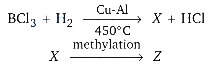
What is $Z$ in the following reactions?
A
$CH_3BH_2$
B
$(CH_3)_4B_2H_2$
C
$(CH_3)_3B_2H_3$
D
$(CH_3)_6B_2$
Solution
(B) The reaction of $BCl_3$ with $H_2$ in the presence of a $Cu-Al$ catalyst at $450^{\circ}C$ produces diborane $(B_2H_6)$ as product $X$:
$2BCl_3 + 6H_2 \xrightarrow{Cu-Al, 450^{\circ}C} B_2H_6 + 6HCl$
Diborane $(B_2H_6)$ undergoes methylation with $CH_3Cl$ to form tetramethyldiborane,which is $Z$:
$B_2H_6 + 4CH_3Cl \rightarrow (CH_3)_4B_2H_2 + 4HCl$
Thus,$Z$ is $(CH_3)_4B_2H_2$.
$2BCl_3 + 6H_2 \xrightarrow{Cu-Al, 450^{\circ}C} B_2H_6 + 6HCl$
Diborane $(B_2H_6)$ undergoes methylation with $CH_3Cl$ to form tetramethyldiborane,which is $Z$:
$B_2H_6 + 4CH_3Cl \rightarrow (CH_3)_4B_2H_2 + 4HCl$
Thus,$Z$ is $(CH_3)_4B_2H_2$.
0 likesView Solution
148
ChemistryDifficultMCQTS EAMCET · 2012
One mole of $N_2H_4$ loses $10 \ moles$ of electrons to form a new compound $Z$. Assuming that all the nitrogen atoms appear in the new compound,what is the oxidation state of nitrogen in $Z$? (There is no change in the oxidation state of hydrogen.)
A
$-1$
B
$-3$
C
$+3$
D
$+5$
Solution
(C) The initial oxidation state of $N$ in $N_2H_4$ is calculated as: $2x + 4(+1) = 0 \implies 2x = -4 \implies x = -2$.
Since $1 \ mole$ of $N_2H_4$ loses $10 \ moles$ of electrons,the total increase in oxidation number is $10$.
Let the oxidation state of $N$ in $Z$ be $y$. Since there are $2$ nitrogen atoms,the total oxidation state of $N$ in $Z$ is $2y$.
The change in oxidation state is $2y - (-4) = +10$.
$2y + 4 = 10 \implies 2y = 6 \implies y = +3$.
Therefore,the oxidation state of nitrogen in $Z$ is $+3$.
Since $1 \ mole$ of $N_2H_4$ loses $10 \ moles$ of electrons,the total increase in oxidation number is $10$.
Let the oxidation state of $N$ in $Z$ be $y$. Since there are $2$ nitrogen atoms,the total oxidation state of $N$ in $Z$ is $2y$.
The change in oxidation state is $2y - (-4) = +10$.
$2y + 4 = 10 \implies 2y = 6 \implies y = +3$.
Therefore,the oxidation state of nitrogen in $Z$ is $+3$.
0 likesView Solution
149
ChemistryEasyMCQTS EAMCET · 2012
Which one of the following elements reduces $NaOH$ to $Na$?
A
$Si$
B
$Pb$
C
$C$
D
$Sn$
Solution
(C) The reduction of $NaOH$ to $Na$ is a highly endothermic and difficult process because $Na$ is a very strong reducing agent. Among the given options,$C$ (carbon) is capable of reducing $NaOH$ to $Na$ at high temperatures. The reaction is: $2NaOH + 2C \rightarrow 2Na + 2CO + H_2$.
0 likesView Solution
150
ChemistryMediumMCQTS EAMCET · 2012
The quantum number which explains the line spectra observed as doublets in the case of hydrogen and alkali metals,and doublets and triplets in the case of alkaline earth metals is:
A
$Spin$
B
$Azimuthal$
C
$Magnetic$
D
$Principal$
Solution
(A) The $Spin$ quantum number $(s)$ explains the fine structure of spectral lines,such as the doublets observed in the spectra of $H$ and alkali metals,and the doublets and triplets observed in the spectra of alkaline earth metals,due to the electron spin angular momentum.
0 likesView Solution
Vedclass Products
For Students
Vedclass Test Series
Mock tests in real TS EAMCET style covering Chemistry with performance analysis. 5-day free trial.
Start Free TrialFor Teachers
Exam Paper Generator
Generate Set A/B/C/D Chemistry papers from 7.5L+ questions in 2 minutes. 3 chapters free.
Try FreeFor Institutes
Online Exam Module
Run live TS EAMCET mock exams with unlimited students, 360° analytics & white-label branding.
See DemoFrequently Asked Questions
How many Chemistry questions are in TS EAMCET 2012?
There are 177 Chemistry questions from the TS EAMCET 2012 paper on Vedclass, each with a detailed step-by-step solution in English.
Are TS EAMCET 2012 Chemistry solutions available in English?
Yes. All solutions on this page are in English. You can also switch to English or Hindi using the language buttons above the questions.
Can I practice TS EAMCET 2012 Chemistry as a timed test?
Yes. Use the Vedclass Test Series to attempt a full TS EAMCET mock test covering Chemistry with time limits and instant score analysis.
Can teachers create Chemistry papers from TS EAMCET previous year questions?
Yes. The Vedclass Exam Paper Generator lets teachers mix TS EAMCET Chemistry questions and generate Set A/B/C/D papers in minutes.
For Teachers & Institutes
Build a Custom Chemistry Paper
Pick TS EAMCET 2012 Chemistry questions, set difficulty, and generate Set A/B/C/D in 2 minutes.