
ChemistryQ1–70 of 188 questions
Page 1 of 4 · English
1
ChemistryMCQTS EAMCET · 2011
The solution of the differential equation $\frac{dy}{dx} = \frac{y}{x} + \frac{\phi \left( \frac{y}{x} \right)}{\phi' \left( \frac{y}{x} \right)}$ is
A
$\phi \left( \frac{y}{x} \right) = kx$
B
$x \phi \left( \frac{y}{x} \right) = k$
C
$\phi \left( \frac{y}{x} \right) = ky$
D
$y \phi \left( \frac{y}{x} \right) = k$
Solution
(A) Given the differential equation: $\frac{dy}{dx} = \frac{y}{x} + \frac{\phi \left( \frac{y}{x} \right)}{\phi' \left( \frac{y}{x} \right)}$.
Substitute $y = vx$,which implies $\frac{dy}{dx} = v + x \frac{dv}{dx}$.
Substituting these into the differential equation,we get:
$v + x \frac{dv}{dx} = v + \frac{\phi(v)}{\phi'(v)}$.
Subtracting $v$ from both sides,we have:
$x \frac{dv}{dx} = \frac{\phi(v)}{\phi'(v)}$.
Separating the variables,we get:
$\frac{\phi'(v)}{\phi(v)} dv = \frac{dx}{x}$.
Integrating both sides:
$\int \frac{\phi'(v)}{\phi(v)} dv = \int \frac{dx}{x}$.
This yields $\log |\phi(v)| = \log |x| + \log |k|$,where $\log |k|$ is the constant of integration.
Using the property of logarithms,$\log |\phi(v)| = \log |kx|$.
Therefore,$\phi(v) = kx$.
Substituting $v = \frac{y}{x}$ back,we obtain the solution:
$\phi \left( \frac{y}{x} \right) = kx$.
Substitute $y = vx$,which implies $\frac{dy}{dx} = v + x \frac{dv}{dx}$.
Substituting these into the differential equation,we get:
$v + x \frac{dv}{dx} = v + \frac{\phi(v)}{\phi'(v)}$.
Subtracting $v$ from both sides,we have:
$x \frac{dv}{dx} = \frac{\phi(v)}{\phi'(v)}$.
Separating the variables,we get:
$\frac{\phi'(v)}{\phi(v)} dv = \frac{dx}{x}$.
Integrating both sides:
$\int \frac{\phi'(v)}{\phi(v)} dv = \int \frac{dx}{x}$.
This yields $\log |\phi(v)| = \log |x| + \log |k|$,where $\log |k|$ is the constant of integration.
Using the property of logarithms,$\log |\phi(v)| = \log |kx|$.
Therefore,$\phi(v) = kx$.
Substituting $v = \frac{y}{x}$ back,we obtain the solution:
$\phi \left( \frac{y}{x} \right) = kx$.
0 likesView Solution
2
ChemistryMCQTS EAMCET · 2011
$A$ constant voltage of $25 ~V$ is applied to a series $L-R$ circuit at $t=0$,by closing a switch. What is the potential difference across the resistor and the inductor at time $t=0$?
A
$0 ~V, 25 ~V$
B
$12.5 ~V, 1.25 ~V$
C
$10 ~V, 15 ~V$
D
$25 ~V, 0 ~V$
Solution
(A) In a series $L-R$ circuit,the current $i$ at any time $t$ is given by $i = i_0(1 - e^{-Rt/L})$,where $i_0 = V/R$.
At $t = 0$,the current $i = i_0(1 - e^0) = i_0(1 - 1) = 0$.
The potential difference across the resistor is $V_R = iR$. Since $i = 0$ at $t = 0$,$V_R = 0 ~V$.
The potential difference across the inductor is $V_L = L(di/dt)$. According to Kirchhoff's voltage law,$V = V_R + V_L$. At $t = 0$,$V = 0 + V_L$,so $V_L = 25 ~V$.
Therefore,the potential difference across the resistor is $0 ~V$ and across the inductor is $25 ~V$.
At $t = 0$,the current $i = i_0(1 - e^0) = i_0(1 - 1) = 0$.
The potential difference across the resistor is $V_R = iR$. Since $i = 0$ at $t = 0$,$V_R = 0 ~V$.
The potential difference across the inductor is $V_L = L(di/dt)$. According to Kirchhoff's voltage law,$V = V_R + V_L$. At $t = 0$,$V = 0 + V_L$,so $V_L = 25 ~V$.
Therefore,the potential difference across the resistor is $0 ~V$ and across the inductor is $25 ~V$.
0 likesView Solution
3
ChemistryMCQTS EAMCET · 2011
Nitrobenzene on reduction using zinc in alkaline medium results in $X$. The number of $\sigma$ and $\pi$ bonds in $X$ is
A
$24 \sigma, 7 \pi$
B
$24 \sigma, 6 \pi$
C
$27 \sigma, 7 \pi$
D
$27 \sigma, 6 \pi$
Solution
(D) The reduction of nitrobenzene with zinc in an alkaline medium (e.g.,$Zn/NaOH$) yields hydrazobenzene $(C_{12}H_{12}N_2)$ as the product $X$.
Structure of hydrazobenzene: $C_6H_5-NH-NH-C_6H_5$.
Calculation of bonds:
$1$. Each phenyl ring $(C_6H_5)$ contains $6$ $C-C$ bonds (including $3$ $\pi$ bonds),$5$ $C-H$ bonds,and $1$ $C-N$ bond.
$2$. Total $\sigma$ bonds = $(6 \times 2) + (5 \times 2) + (1 \times 2) + (N-N \sigma) + (2 \times N-H \sigma) = 12 + 10 + 2 + 1 + 2 = 27$.
$3$. Total $\pi$ bonds = $3$ (in first ring) + $3$ (in second ring) = $6$.
Thus,$X$ contains $27 \sigma$ and $6 \pi$ bonds.
Structure of hydrazobenzene: $C_6H_5-NH-NH-C_6H_5$.
Calculation of bonds:
$1$. Each phenyl ring $(C_6H_5)$ contains $6$ $C-C$ bonds (including $3$ $\pi$ bonds),$5$ $C-H$ bonds,and $1$ $C-N$ bond.
$2$. Total $\sigma$ bonds = $(6 \times 2) + (5 \times 2) + (1 \times 2) + (N-N \sigma) + (2 \times N-H \sigma) = 12 + 10 + 2 + 1 + 2 = 27$.
$3$. Total $\pi$ bonds = $3$ (in first ring) + $3$ (in second ring) = $6$.
Thus,$X$ contains $27 \sigma$ and $6 \pi$ bonds.
0 likesView Solution
4
ChemistryMCQTS EAMCET · 2011
Which one of the following statements is not correct?
A
Except glycine,all other naturally occurring $\alpha$-amino acids are optically active.
B
$\alpha$-amino acids have maximum solubility at their isoelectric point.
C
$A$ tripeptide has two peptide bonds.
D
$\alpha$-amino acids exist as Zwitter ions.
Solution
(B) At the isoelectric point,the concentration of the neutral dipolar ion (Zwitter ion) is maximum,which leads to minimum intermolecular electrostatic repulsion and minimum interaction with water molecules. Consequently,$\alpha$-amino acids have minimum solubility at their isoelectric point. Therefore,the statement that they have maximum solubility at the isoelectric point is incorrect.
0 likesView Solution
5
ChemistryMCQTS EAMCET · 2011
Two identical condensers $M$ and $N$ are connected in series with a battery. The space between the plates of $M$ is completely filled with a dielectric medium of dielectric constant $8$,and a copper plate of thickness $d/2$ is introduced between the plates of $N$ ($d$ is the distance between the plates). Then the potential differences across $M$ and $N$ are,respectively,in the ratio:
A
$1 : 4$
B
$4 : 1$
C
$3 : 8$
D
$1 : 6$
Solution
(A) Let the initial capacitance of each condenser be $C = \frac{A \varepsilon_0}{d}$.
For condenser $M$,the space is filled with a dielectric of constant $K = 8$. The new capacitance is $C_M = K C = 8C$.
For condenser $N$,a copper plate of thickness $t = d/2$ is introduced. The new capacitance is $C_N = \frac{\varepsilon_0 A}{d - t} = \frac{\varepsilon_0 A}{d - d/2} = \frac{\varepsilon_0 A}{d/2} = 2 \left( \frac{\varepsilon_0 A}{d} \right) = 2C$.
Since the capacitors are connected in series,the charge $Q$ on both is the same.
The potential difference $V$ is given by $V = Q/C$,so $V \propto 1/C$.
Therefore,the ratio of potential differences is $V_M : V_N = \frac{1}{C_M} : \frac{1}{C_N} = \frac{1}{8C} : \frac{1}{2C} = \frac{1}{8} : \frac{1}{2} = 2 : 8 = 1 : 4$.
For condenser $M$,the space is filled with a dielectric of constant $K = 8$. The new capacitance is $C_M = K C = 8C$.
For condenser $N$,a copper plate of thickness $t = d/2$ is introduced. The new capacitance is $C_N = \frac{\varepsilon_0 A}{d - t} = \frac{\varepsilon_0 A}{d - d/2} = \frac{\varepsilon_0 A}{d/2} = 2 \left( \frac{\varepsilon_0 A}{d} \right) = 2C$.
Since the capacitors are connected in series,the charge $Q$ on both is the same.
The potential difference $V$ is given by $V = Q/C$,so $V \propto 1/C$.
Therefore,the ratio of potential differences is $V_M : V_N = \frac{1}{C_M} : \frac{1}{C_N} = \frac{1}{8C} : \frac{1}{2C} = \frac{1}{8} : \frac{1}{2} = 2 : 8 = 1 : 4$.
0 likesView Solution
6
ChemistryMCQTS EAMCET · 2011
$A$ fully charged capacitor has a capacitance $C$. It is discharged through a small coil of resistance wire,embedded in a block of specific heat $s$ and mass $m$ under thermally isolated conditions. If the temperature of the block is raised by $\Delta T$,the potential difference $V$ across the capacitor initially is
A
$\left(\frac{2 m s \Delta T}{C}\right)^2$
B
$\left(\frac{2 m s \Delta T}{C}\right)^{1 / 2}$
C
$\left(\frac{2 m s \Delta T}{C}\right)$
D
$2 m s \Delta T C$
Solution
(B) Let $V$ be the potential difference across the capacitor when it is fully charged. The energy stored in the capacitor is given by $U = \frac{1}{2} C V^2$.
When the capacitor is fully discharged through the resistance wire,the entire stored energy is dissipated as heat $\Delta H$ in the block.
Since the system is thermally isolated,the heat gained by the block is equal to the energy lost by the capacitor: $\Delta H = U = \frac{1}{2} C V^2$.
The heat gained by the block is also given by the formula $\Delta H = m s \Delta T$,where $m$ is the mass,$s$ is the specific heat,and $\Delta T$ is the rise in temperature.
Equating the two expressions for $\Delta H$: $\frac{1}{2} C V^2 = m s \Delta T$.
Solving for $V$: $V^2 = \frac{2 m s \Delta T}{C}$,which gives $V = \left(\frac{2 m s \Delta T}{C}\right)^{1 / 2}$.
When the capacitor is fully discharged through the resistance wire,the entire stored energy is dissipated as heat $\Delta H$ in the block.
Since the system is thermally isolated,the heat gained by the block is equal to the energy lost by the capacitor: $\Delta H = U = \frac{1}{2} C V^2$.
The heat gained by the block is also given by the formula $\Delta H = m s \Delta T$,where $m$ is the mass,$s$ is the specific heat,and $\Delta T$ is the rise in temperature.
Equating the two expressions for $\Delta H$: $\frac{1}{2} C V^2 = m s \Delta T$.
Solving for $V$: $V^2 = \frac{2 m s \Delta T}{C}$,which gives $V = \left(\frac{2 m s \Delta T}{C}\right)^{1 / 2}$.
0 likesView Solution
7
ChemistryMCQTS EAMCET · 2011
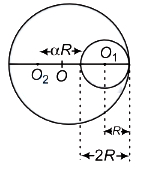
$A$ circular disc of radius $R$ is removed from a bigger circular disc of radius $2R$ such that the circumferences of the discs touch. The centre of mass of the new disc is at a distance $\alpha R$ from the centre of the bigger disc. The value of $\alpha$ is
A
$\frac{1}{2}$
B
$\frac{1}{3}$
C
$\frac{1}{4}$
D
$\frac{1}{6}$
Solution
(B) Let the centre of the bigger disc be the origin $O(0,0)$.
Let the mass of the original disc be $M$ and its radius be $2R$.
The mass of the removed smaller disc of radius $R$ is $m = \frac{\pi R^2}{\pi (2R)^2} M = \frac{M}{4}$.
The centre of the removed disc is at a distance $R$ from the origin along the $x$-axis,so its coordinates are $(R, 0)$.
The centre of mass of the remaining part $(x_{CM})$ is given by the formula:
$x_{CM} = \frac{M_1 x_1 - m x_2}{M_1 - m}$
Here,$M_1 = M$,$x_1 = 0$,$m = M/4$,and $x_2 = R$.
$x_{CM} = \frac{M(0) - (M/4)(R)}{M - M/4} = \frac{-MR/4}{3M/4} = -\frac{R}{3}$.
The distance from the centre is $|x_{CM}| = \frac{R}{3}$.
Comparing this with $\alpha R$,we get $\alpha = \frac{1}{3}$.
Let the mass of the original disc be $M$ and its radius be $2R$.
The mass of the removed smaller disc of radius $R$ is $m = \frac{\pi R^2}{\pi (2R)^2} M = \frac{M}{4}$.
The centre of the removed disc is at a distance $R$ from the origin along the $x$-axis,so its coordinates are $(R, 0)$.
The centre of mass of the remaining part $(x_{CM})$ is given by the formula:
$x_{CM} = \frac{M_1 x_1 - m x_2}{M_1 - m}$
Here,$M_1 = M$,$x_1 = 0$,$m = M/4$,and $x_2 = R$.
$x_{CM} = \frac{M(0) - (M/4)(R)}{M - M/4} = \frac{-MR/4}{3M/4} = -\frac{R}{3}$.
The distance from the centre is $|x_{CM}| = \frac{R}{3}$.
Comparing this with $\alpha R$,we get $\alpha = \frac{1}{3}$.
0 likesView Solution
8
ChemistryMCQTS EAMCET · 2011
$A$ ball is let fall from a height $h_0$. It makes $n$ collisions with the earth. After $n$ collisions it rebounds with a velocity $v_n$ and the ball rises to a height $h_n$. Then the coefficient of restitution is given by:
A
$e=\left[\frac{h_n}{h_0}\right]^{1 / 2 n}$
B
$e=\left[\frac{h_0}{h_n}\right]^{1 / 2 n}$
C
$e=\frac{1}{n} \sqrt{\frac{h_n}{h_0}}$
D
$e=\frac{1}{n} \sqrt{\frac{h_0}{h_n}}$
Solution
(A) The velocity of the ball just before the first collision is $v_0 = \sqrt{2gh_0}$.
After the first collision,the velocity is $v_1 = ev_0$.
After the second collision,the velocity is $v_2 = ev_1 = e^2v_0$.
Following this pattern,after $n$ collisions,the velocity of the ball is $v_n = e^n v_0$.
The height $h_n$ reached after the $n$th collision is given by $h_n = \frac{v_n^2}{2g}$.
Substituting $v_n = e^n v_0$,we get $h_n = \frac{(e^n v_0)^2}{2g} = e^{2n} \frac{v_0^2}{2g}$.
Since $h_0 = \frac{v_0^2}{2g}$,we have $h_n = e^{2n} h_0$.
Therefore,$e^{2n} = \frac{h_n}{h_0}$,which implies $e = \left[\frac{h_n}{h_0}\right]^{1/2n}$.
After the first collision,the velocity is $v_1 = ev_0$.
After the second collision,the velocity is $v_2 = ev_1 = e^2v_0$.
Following this pattern,after $n$ collisions,the velocity of the ball is $v_n = e^n v_0$.
The height $h_n$ reached after the $n$th collision is given by $h_n = \frac{v_n^2}{2g}$.
Substituting $v_n = e^n v_0$,we get $h_n = \frac{(e^n v_0)^2}{2g} = e^{2n} \frac{v_0^2}{2g}$.
Since $h_0 = \frac{v_0^2}{2g}$,we have $h_n = e^{2n} h_0$.
Therefore,$e^{2n} = \frac{h_n}{h_0}$,which implies $e = \left[\frac{h_n}{h_0}\right]^{1/2n}$.
0 likesView Solution
9
ChemistryMCQTS EAMCET · 2011
The total number of $\sigma$ and $\pi$-bonds in pyrophosphoric acid are respectively
A
$8, 2$
B
$10, 2$
C
$12, 2$
D
$8, 4$
Solution
(C) The structure of pyrophosphoric acid $(H_4P_2O_7)$ contains a $P-O-P$ linkage,four $P-OH$ groups,and two $P=O$ bonds.
Counting the bonds:
- There are $4$ $P-OH$ sigma bonds.
- There are $4$ $O-H$ sigma bonds.
- There is $1$ $P-O-P$ sigma bond (two $P-O$ bonds).
- There are $2$ $P=O$ sigma bonds.
- Total sigma bonds = $4 + 4 + 2 + 2 = 12$.
- There are $2$ $P=O$ pi bonds.
Thus,it contains $12$ $\sigma$ and $2$ $\pi$-bonds.
Counting the bonds:
- There are $4$ $P-OH$ sigma bonds.
- There are $4$ $O-H$ sigma bonds.
- There is $1$ $P-O-P$ sigma bond (two $P-O$ bonds).
- There are $2$ $P=O$ sigma bonds.
- Total sigma bonds = $4 + 4 + 2 + 2 = 12$.
- There are $2$ $P=O$ pi bonds.
Thus,it contains $12$ $\sigma$ and $2$ $\pi$-bonds.
0 likesView Solution
10
ChemistryMCQTS EAMCET · 2011
In which of the following pairs,the central atoms have the same number of lone pairs of electrons?
A
$PCl_5, BrF_5$
B
$XeF_2, ICl$
C
$XeF_4, ClO_4^{-}$
D
$SCl_4, CH_4$
Solution
(B) To determine the number of lone pairs on the central atom,we use the formula: $\text{Lone pairs} = \frac{1}{2} (V - N - C)$,where $V$ is the number of valence electrons,$N$ is the number of monovalent atoms,and $C$ is the charge.
$A) PCl_5$: $P$ has $5$ valence electrons. Lone pairs = $\frac{1}{2}(5 - 5) = 0$. $BrF_5$: $Br$ has $7$ valence electrons. Lone pairs = $\frac{1}{2}(7 - 5) = 1$.
$B) XeF_2$: $Xe$ has $8$ valence electrons. Lone pairs = $\frac{1}{2}(8 - 2) = 3$. $ICl$: $I$ has $7$ valence electrons. Lone pairs = $\frac{1}{2}(7 - 1) = 3$.
$C) XeF_4$: $Xe$ has $8$ valence electrons. Lone pairs = $\frac{1}{2}(8 - 4) = 2$. $ClO_4^{-}$: $Cl$ has $7$ valence electrons. Lone pairs = $\frac{1}{2}(7 - 0 + 1) = 4$ (Oxygen is divalent,so $N=0$).
$D) SCl_4$: $S$ has $6$ valence electrons. Lone pairs = $\frac{1}{2}(6 - 4) = 1$. $CH_4$: $C$ has $4$ valence electrons. Lone pairs = $\frac{1}{2}(4 - 4) = 0$.
Thus,both $XeF_2$ and $ICl$ have $3$ lone pairs on their central atoms.
$A) PCl_5$: $P$ has $5$ valence electrons. Lone pairs = $\frac{1}{2}(5 - 5) = 0$. $BrF_5$: $Br$ has $7$ valence electrons. Lone pairs = $\frac{1}{2}(7 - 5) = 1$.
$B) XeF_2$: $Xe$ has $8$ valence electrons. Lone pairs = $\frac{1}{2}(8 - 2) = 3$. $ICl$: $I$ has $7$ valence electrons. Lone pairs = $\frac{1}{2}(7 - 1) = 3$.
$C) XeF_4$: $Xe$ has $8$ valence electrons. Lone pairs = $\frac{1}{2}(8 - 4) = 2$. $ClO_4^{-}$: $Cl$ has $7$ valence electrons. Lone pairs = $\frac{1}{2}(7 - 0 + 1) = 4$ (Oxygen is divalent,so $N=0$).
$D) SCl_4$: $S$ has $6$ valence electrons. Lone pairs = $\frac{1}{2}(6 - 4) = 1$. $CH_4$: $C$ has $4$ valence electrons. Lone pairs = $\frac{1}{2}(4 - 4) = 0$.
Thus,both $XeF_2$ and $ICl$ have $3$ lone pairs on their central atoms.
0 likesView Solution
11
ChemistryMediumMCQTS EAMCET · 2011
The formal charges of $N_{(1)}$,$N_{(2)}$ and $O$ atoms in the structure shown below are respectively:
$:N_{(1)}=N_{(2)}=\ddot{O}:$
$:N_{(1)}=N_{(2)}=\ddot{O}:$
A
$+1, -1, 0$
B
$-1, +1, 0$
C
$+1, +1, 0$
D
$-1, -1, 0$
Solution
(B) The formula for formal charge is:
$\text{Formal charge} = [\text{Total number of valence electrons in the free atom}] - [\text{Total number of non-bonding (lone pair) electrons}] - \frac{1}{2} [\text{Total number of bonding (shared) electrons}]$
For the end $N$ atom marked $(1)$:
$\text{Formal charge} = 5 - 4 - \frac{1}{2}(4) = 5 - 4 - 2 = -1$
For the central $N$ atom marked $(2)$:
$\text{Formal charge} = 5 - 0 - \frac{1}{2}(8) = 5 - 4 = +1$
For the end $O$ atom:
$\text{Formal charge} = 6 - 4 - \frac{1}{2}(4) = 6 - 4 - 2 = 0$
Thus,the formal charges are $-1, +1, 0$ for $N_{(1)}, N_{(2)}$ and $O$ respectively.
$\text{Formal charge} = [\text{Total number of valence electrons in the free atom}] - [\text{Total number of non-bonding (lone pair) electrons}] - \frac{1}{2} [\text{Total number of bonding (shared) electrons}]$
For the end $N$ atom marked $(1)$:
$\text{Formal charge} = 5 - 4 - \frac{1}{2}(4) = 5 - 4 - 2 = -1$
For the central $N$ atom marked $(2)$:
$\text{Formal charge} = 5 - 0 - \frac{1}{2}(8) = 5 - 4 = +1$
For the end $O$ atom:
$\text{Formal charge} = 6 - 4 - \frac{1}{2}(4) = 6 - 4 - 2 = 0$
Thus,the formal charges are $-1, +1, 0$ for $N_{(1)}, N_{(2)}$ and $O$ respectively.
0 likesView Solution
12
ChemistryMCQTS EAMCET · 2011
The hybridisation of $Xe$ and the number of lone pairs of electrons on it in $XeF_6$ are
A
$sp^3d^2, 1$
B
$sp^3d^3, 2$
C
$sp^3d^2, 2$
D
$sp^3d^3, 1$
Solution
(D) The central atom $Xe$ has $8$ valence electrons. In $XeF_6$,it forms $6$ bond pairs with $F$ atoms and has $1$ lone pair.
Steric number = (Number of bond pairs) + (Number of lone pairs) = $6 + 1 = 7$.
$A$ steric number of $7$ corresponds to $sp^3d^3$ hybridisation.
Thus,$XeF_6$ has $sp^3d^3$ hybridisation and $1$ lone pair of electrons.
Steric number = (Number of bond pairs) + (Number of lone pairs) = $6 + 1 = 7$.
$A$ steric number of $7$ corresponds to $sp^3d^3$ hybridisation.
Thus,$XeF_6$ has $sp^3d^3$ hybridisation and $1$ lone pair of electrons.
0 likesView Solution
13
ChemistryMCQTS EAMCET · 2011
Which one of the following is a correct set?
A
Diamond,$sp^2$
B
Graphite,$sp^3$
C
Diamond,$sp$
D
Graphite,$sp^2$
Solution
(D) Graphite has a two-dimensional sheet-like structure.
The adjacent layers of the sheet are held together by weak van der Waals' forces.
In graphite,each carbon atom is present in an $sp^2$ hybridized state.
In contrast,in diamond,each carbon atom is $sp^3$ hybridized.
The adjacent layers of the sheet are held together by weak van der Waals' forces.
In graphite,each carbon atom is present in an $sp^2$ hybridized state.
In contrast,in diamond,each carbon atom is $sp^3$ hybridized.
0 likesView Solution
14
ChemistryMCQTS EAMCET · 2011
If the equilibrium constant for the reaction $2 AB \rightleftharpoons A_2 + B_2$ is $49$,what is the equilibrium constant for $AB \rightleftharpoons \frac{1}{2} A_2 + \frac{1}{2} B_2$?
A
$7$
B
$\frac{1}{7}$
C
$24.5$
D
$49$
Solution
(A) For the reaction $2 AB \rightleftharpoons A_2 + B_2$,the equilibrium constant is $K_c = \frac{[A_2][B_2]}{[AB]^2} = 49$.
For the reaction $AB \rightleftharpoons \frac{1}{2} A_2 + \frac{1}{2} B_2$,the equilibrium constant is $K_c' = \frac{[A_2]^{1/2} [B_2]^{1/2}}{[AB]}$.
This is equal to $\sqrt{K_c}$.
Therefore,$K_c' = \sqrt{49} = 7$.
For the reaction $AB \rightleftharpoons \frac{1}{2} A_2 + \frac{1}{2} B_2$,the equilibrium constant is $K_c' = \frac{[A_2]^{1/2} [B_2]^{1/2}}{[AB]}$.
This is equal to $\sqrt{K_c}$.
Therefore,$K_c' = \sqrt{49} = 7$.
0 likesView Solution
15
ChemistryMCQTS EAMCET · 2011
Which one of the following is an artificial sweetening agent?
A
Aspirin
B
Phenacetin
C
Bithionol
D
Alitame
Solution
(D) Alitame is an artificial sweetening agent. It is $2000$ times sweeter than cane sugar. Its structure is as follows:
$HOOC-CH_2-CH(NH_2)-CONH-CH(CH_3)-CONH-C(CH_3)_2-S-C(CH_3)_2-CH_2-$ (Note: The structure provided in the image represents Alitame).
$HOOC-CH_2-CH(NH_2)-CONH-CH(CH_3)-CONH-C(CH_3)_2-S-C(CH_3)_2-CH_2-$ (Note: The structure provided in the image represents Alitame).
0 likesView Solution
16
ChemistryMCQTS EAMCET · 2011
Which one of the following is the correct order of the second ionisation potential of $Na, Ne, Mg$ and $Al$?
A
$Al < Na < Mg < Ne$
B
$Ne < Al < Na < Mg$
C
$Mg < Al < Ne < Na$
D
$Na < Mg < Ne < Al$
Solution
(C) The electronic configurations of the ions formed after the removal of the first electron are:
$Na^{+} (1s^{2} 2s^{2} 2p^{6})$
$Ne^{+} (1s^{2} 2s^{2} 2p^{5})$
$Mg^{+} (1s^{2} 2s^{2} 2p^{6} 3s^{1})$
$Al^{+} (1s^{2} 2s^{2} 2p^{6} 3s^{2})$
The second ionisation potential $(IE_{2})$ is the energy required to remove an electron from these unipositive ions.
$Na^{+}$ has a stable noble gas configuration $(2s^{2} 2p^{6})$,making it extremely difficult to remove another electron,thus it has the highest $IE_{2}$.
$Mg^{+}$ has a single electron in the $3s$ orbital,which is relatively easy to remove.
$Al^{+}$ has a stable $3s^{2}$ configuration,making its $IE_{2}$ higher than $Mg^{+}$.
$Ne^{+}$ has a $2p^{5}$ configuration,which is less stable than $Na^{+}$ but requires significant energy.
Comparing these,the correct order of $IE_{2}$ is $Mg < Al < Ne < Na$.
$Na^{+} (1s^{2} 2s^{2} 2p^{6})$
$Ne^{+} (1s^{2} 2s^{2} 2p^{5})$
$Mg^{+} (1s^{2} 2s^{2} 2p^{6} 3s^{1})$
$Al^{+} (1s^{2} 2s^{2} 2p^{6} 3s^{2})$
The second ionisation potential $(IE_{2})$ is the energy required to remove an electron from these unipositive ions.
$Na^{+}$ has a stable noble gas configuration $(2s^{2} 2p^{6})$,making it extremely difficult to remove another electron,thus it has the highest $IE_{2}$.
$Mg^{+}$ has a single electron in the $3s$ orbital,which is relatively easy to remove.
$Al^{+}$ has a stable $3s^{2}$ configuration,making its $IE_{2}$ higher than $Mg^{+}$.
$Ne^{+}$ has a $2p^{5}$ configuration,which is less stable than $Na^{+}$ but requires significant energy.
Comparing these,the correct order of $IE_{2}$ is $Mg < Al < Ne < Na$.
0 likesView Solution
17
ChemistryMCQTS EAMCET · 2011
The sensitivity of a galvanometer is $60 \text{ div/A}$. When a shunt is used,its sensitivity becomes $10 \text{ div/A}$. If the resistance of the galvanometer is $20 \ \Omega$,then the value of the shunt used is: (in $Omega$)
A
$4$
B
$5$
C
$20$
D
$2$
Solution
(A) The sensitivity of a galvanometer is defined as the deflection per unit current,$S = \theta / I$.
When a shunt $S_h$ is connected in parallel with a galvanometer of resistance $G$,the new sensitivity $S'$ is given by the formula $S' = S \times \frac{S_h}{G + S_h}$.
Given: $S = 60 \text{ div/A}$,$S' = 10 \text{ div/A}$,and $G = 20 \ \Omega$.
Substituting these values into the formula: $10 = 60 \times \frac{S_h}{20 + S_h}$.
Dividing both sides by $10$: $1 = 6 \times \frac{S_h}{20 + S_h}$.
$20 + S_h = 6 S_h$.
$5 S_h = 20$.
$S_h = 4 \ \Omega$.
Therefore,the value of the shunt used is $4 \ \Omega$.
When a shunt $S_h$ is connected in parallel with a galvanometer of resistance $G$,the new sensitivity $S'$ is given by the formula $S' = S \times \frac{S_h}{G + S_h}$.
Given: $S = 60 \text{ div/A}$,$S' = 10 \text{ div/A}$,and $G = 20 \ \Omega$.
Substituting these values into the formula: $10 = 60 \times \frac{S_h}{20 + S_h}$.
Dividing both sides by $10$: $1 = 6 \times \frac{S_h}{20 + S_h}$.
$20 + S_h = 6 S_h$.
$5 S_h = 20$.
$S_h = 4 \ \Omega$.
Therefore,the value of the shunt used is $4 \ \Omega$.
0 likesView Solution
18
ChemistryMCQTS EAMCET · 2011
The sensitivity of a galvanometer is $60 \text{ division/A}$. When a shunt is used,its sensitivity becomes $10 \text{ division/A}$. If the galvanometer is of resistance $20 \ \Omega$,the value of shunt used is: (in $Omega$)
A
$4$
B
$5$
C
$20$
D
$2$
Solution
(A) The sensitivity of a galvanometer is defined as the deflection per unit current,given by $S_g = \frac{\theta}{i_g}$.
When a shunt $S$ is connected in parallel with a galvanometer of resistance $G$,the current $i_g$ flowing through the galvanometer is given by $i_g = i \left( \frac{S}{G+S} \right)$,where $i$ is the total current.
The new sensitivity $S'$ is given by $S' = \frac{\theta}{i} = \frac{\theta}{i_g} \cdot \frac{i_g}{i} = S_g \cdot \left( \frac{S}{G+S} \right)$.
Given $S_g = 60 \text{ division/A}$ and $S' = 10 \text{ division/A}$.
Substituting the values: $10 = 60 \cdot \left( \frac{S}{20+S} \right)$.
$\frac{10}{60} = \frac{S}{20+S} \Rightarrow \frac{1}{6} = \frac{S}{20+S}$.
$20 + S = 6S \Rightarrow 5S = 20$.
$S = 4 \ \Omega$.
When a shunt $S$ is connected in parallel with a galvanometer of resistance $G$,the current $i_g$ flowing through the galvanometer is given by $i_g = i \left( \frac{S}{G+S} \right)$,where $i$ is the total current.
The new sensitivity $S'$ is given by $S' = \frac{\theta}{i} = \frac{\theta}{i_g} \cdot \frac{i_g}{i} = S_g \cdot \left( \frac{S}{G+S} \right)$.
Given $S_g = 60 \text{ division/A}$ and $S' = 10 \text{ division/A}$.
Substituting the values: $10 = 60 \cdot \left( \frac{S}{20+S} \right)$.
$\frac{10}{60} = \frac{S}{20+S} \Rightarrow \frac{1}{6} = \frac{S}{20+S}$.
$20 + S = 6S \Rightarrow 5S = 20$.
$S = 4 \ \Omega$.
0 likesView Solution
19
ChemistryMCQTS EAMCET · 2011
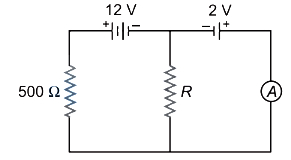
In the circuit shown below,the ammeter reading is zero. Then the value of the resistance $R$ is (in $Omega$)
A
$50$
B
$100$
C
$200$
D
$400$
Solution
(B) Since the ammeter reading is zero,no current flows through the right branch of the circuit.
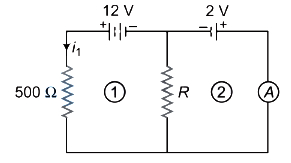
Let $i_1$ be the current flowing through the left loop.
Applying Kirchhoff's voltage law to the left loop:
$12 - 500 i_1 - R i_1 = 0$ --- $(i)$
Since the ammeter reading is zero,the potential difference across the resistor $R$ must be equal to the electromotive force of the battery in the right branch.
Thus,the voltage across $R$ is $V_R = R i_1 = 2 \text{ V}$.
Substituting $R i_1 = 2$ into equation $(i)$:
$12 - 500 i_1 - 2 = 0$
$10 = 500 i_1$
$i_1 = \frac{10}{500} = \frac{1}{50} \text{ A}$.
Now,using $R i_1 = 2$:
$R \times \frac{1}{50} = 2$
$R = 100 \Omega$.
Let $i_1$ be the current flowing through the left loop.
Applying Kirchhoff's voltage law to the left loop:
$12 - 500 i_1 - R i_1 = 0$ --- $(i)$
Since the ammeter reading is zero,the potential difference across the resistor $R$ must be equal to the electromotive force of the battery in the right branch.
Thus,the voltage across $R$ is $V_R = R i_1 = 2 \text{ V}$.
Substituting $R i_1 = 2$ into equation $(i)$:
$12 - 500 i_1 - 2 = 0$
$10 = 500 i_1$
$i_1 = \frac{10}{500} = \frac{1}{50} \text{ A}$.
Now,using $R i_1 = 2$:
$R \times \frac{1}{50} = 2$
$R = 100 \Omega$.
0 likesView Solution
20
ChemistryMCQTS EAMCET · 2011
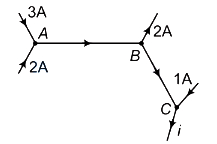
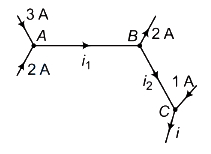
The electric current $i$ in the circuit shown is (in $A$)
A
$6$
B
$2$
C
$3$
D
$4$
Solution
(D) According to Kirchhoff's Current Law $(KCL)$,the sum of currents entering a junction equals the sum of currents leaving it.
At junction $A$:
The incoming currents are $3 \ A$ and $2 \ A$. Let the current flowing from $A$ to $B$ be $i_1$.
$i_1 = 3 \ A + 2 \ A = 5 \ A$.
At junction $B$:
The incoming current is $i_1 = 5 \ A$. The outgoing currents are $2 \ A$ and the current flowing from $B$ to $C$,let it be $i_2$.
$i_1 = 2 \ A + i_2 \implies 5 \ A = 2 \ A + i_2 \implies i_2 = 3 \ A$.
At junction $C$:
The incoming currents are $i_2 = 3 \ A$ and $1 \ A$. The outgoing current is $i$.
$i = i_2 + 1 \ A = 3 \ A + 1 \ A = 4 \ A$.
Therefore,the value of current $i$ is $4 \ A$.
At junction $A$:
The incoming currents are $3 \ A$ and $2 \ A$. Let the current flowing from $A$ to $B$ be $i_1$.
$i_1 = 3 \ A + 2 \ A = 5 \ A$.
At junction $B$:
The incoming current is $i_1 = 5 \ A$. The outgoing currents are $2 \ A$ and the current flowing from $B$ to $C$,let it be $i_2$.
$i_1 = 2 \ A + i_2 \implies 5 \ A = 2 \ A + i_2 \implies i_2 = 3 \ A$.
At junction $C$:
The incoming currents are $i_2 = 3 \ A$ and $1 \ A$. The outgoing current is $i$.
$i = i_2 + 1 \ A = 3 \ A + 1 \ A = 4 \ A$.
Therefore,the value of current $i$ is $4 \ A$.
0 likesView Solution
21
ChemistryMCQTS EAMCET · 2011
Two photons of energy $2.5 \ eV$ and $3.5 \ eV$ fall on a metal surface of work function $1.5 \ eV$. The ratio of the maximum velocities of the photoelectrons emitted from the metal surface is
A
$1 : 4$
B
$2 : 1$
C
$1 : 2$
D
$1 : \sqrt{2}$
Solution
(D) According to Einstein's photoelectric equation,the maximum kinetic energy of emitted photoelectrons is given by $K_{max} = E - \phi_0$,where $E$ is the energy of the incident photon and $\phi_0$ is the work function of the metal.
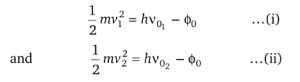
For the first photon: $\frac{1}{2} m v_1^2 = E_1 - \phi_0 = 2.5 \ eV - 1.5 \ eV = 1.0 \ eV$ $(i)$
For the second photon: $\frac{1}{2} m v_2^2 = E_2 - \phi_0 = 3.5 \ eV - 1.5 \ eV = 2.0 \ eV$ (ii)
Dividing equation $(i)$ by equation (ii),we get:
$\frac{\frac{1}{2} m v_1^2}{\frac{1}{2} m v_2^2} = \frac{1.0 \ eV}{2.0 \ eV}$
$\frac{v_1^2}{v_2^2} = \frac{1}{2}$
Taking the square root on both sides:
$\frac{v_1}{v_2} = \frac{1}{\sqrt{2}}$
Thus,the ratio of the maximum velocities is $1 : \sqrt{2}$.
For the first photon: $\frac{1}{2} m v_1^2 = E_1 - \phi_0 = 2.5 \ eV - 1.5 \ eV = 1.0 \ eV$ $(i)$
For the second photon: $\frac{1}{2} m v_2^2 = E_2 - \phi_0 = 3.5 \ eV - 1.5 \ eV = 2.0 \ eV$ (ii)
Dividing equation $(i)$ by equation (ii),we get:
$\frac{\frac{1}{2} m v_1^2}{\frac{1}{2} m v_2^2} = \frac{1.0 \ eV}{2.0 \ eV}$
$\frac{v_1^2}{v_2^2} = \frac{1}{2}$
Taking the square root on both sides:
$\frac{v_1}{v_2} = \frac{1}{\sqrt{2}}$
Thus,the ratio of the maximum velocities is $1 : \sqrt{2}$.
0 likesView Solution
22
ChemistryMCQTS EAMCET · 2011
If the values of $\Lambda_{\infty}$ of $NH_4Cl, NaOH$ and $NaCl$ are $130, 217$ and $109 \ \Omega^{-1} \ cm^2 \ equiv^{-1}$ respectively,the $\Lambda_{\infty}$ of $NH_4OH$ in $\Omega^{-1} \ cm^2 \ equiv^{-1}$ is
A
$238$
B
$196$
C
$22$
D
$456$
Solution
(A) According to Kohlrausch's law of independent migration of ions:
$\Lambda_{\infty} (NH_4Cl) = \Lambda_{\infty} (NH_4^+) + \Lambda_{\infty} (Cl^-) = 130 \ \Omega^{-1} \ cm^2 \ equiv^{-1} \ (i)$
$\Lambda_{\infty} (NaOH) = \Lambda_{\infty} (Na^+) + \Lambda_{\infty} (OH^-) = 217 \ \Omega^{-1} \ cm^2 \ equiv^{-1} \ (ii)$
$\Lambda_{\infty} (NaCl) = \Lambda_{\infty} (Na^+) + \Lambda_{\infty} (Cl^-) = 109 \ \Omega^{-1} \ cm^2 \ equiv^{-1} \ (iii)$
To find $\Lambda_{\infty} (NH_4OH)$,we perform the operation: $(i) + (ii) - (iii)$
$\Lambda_{\infty} (NH_4OH) = \Lambda_{\infty} (NH_4^+) + \Lambda_{\infty} (Cl^-) + \Lambda_{\infty} (Na^+) + \Lambda_{\infty} (OH^-) - (\Lambda_{\infty} (Na^+) + \Lambda_{\infty} (Cl^-))$
$\Lambda_{\infty} (NH_4OH) = \Lambda_{\infty} (NH_4^+) + \Lambda_{\infty} (OH^-)$
$\Lambda_{\infty} (NH_4OH) = 130 + 217 - 109 = 238 \ \Omega^{-1} \ cm^2 \ equiv^{-1}$
$\Lambda_{\infty} (NH_4Cl) = \Lambda_{\infty} (NH_4^+) + \Lambda_{\infty} (Cl^-) = 130 \ \Omega^{-1} \ cm^2 \ equiv^{-1} \ (i)$
$\Lambda_{\infty} (NaOH) = \Lambda_{\infty} (Na^+) + \Lambda_{\infty} (OH^-) = 217 \ \Omega^{-1} \ cm^2 \ equiv^{-1} \ (ii)$
$\Lambda_{\infty} (NaCl) = \Lambda_{\infty} (Na^+) + \Lambda_{\infty} (Cl^-) = 109 \ \Omega^{-1} \ cm^2 \ equiv^{-1} \ (iii)$
To find $\Lambda_{\infty} (NH_4OH)$,we perform the operation: $(i) + (ii) - (iii)$
$\Lambda_{\infty} (NH_4OH) = \Lambda_{\infty} (NH_4^+) + \Lambda_{\infty} (Cl^-) + \Lambda_{\infty} (Na^+) + \Lambda_{\infty} (OH^-) - (\Lambda_{\infty} (Na^+) + \Lambda_{\infty} (Cl^-))$
$\Lambda_{\infty} (NH_4OH) = \Lambda_{\infty} (NH_4^+) + \Lambda_{\infty} (OH^-)$
$\Lambda_{\infty} (NH_4OH) = 130 + 217 - 109 = 238 \ \Omega^{-1} \ cm^2 \ equiv^{-1}$
0 likesView Solution
23
ChemistryMCQTS EAMCET · 2011
Which air pollutant is responsible for the Bhopal gas tragedy?
A
$PIC$
B
$CFC$
C
$MIC$
D
$CO$
Solution
(C) Methyl isocyanate $(MIC)$ gas was responsible for the Bhopal gas tragedy that occurred in $1984$. $MIC$ is a highly toxic chemical intermediate used in the production of carbamate pesticides.
0 likesView Solution
24
ChemistryMCQTS EAMCET · 2011
The order of reactivity of phenol $(I)$,nitrobenzene $(II)$ and benzene $(III)$ towards nitration is
A
$(III) > (I) > (II)$
B
$(II) > (III) > (I)$
C
$(I) > (III) > (II)$
D
$(I) > (II) > (III)$
Solution
(C) Nitration is an electrophilic aromatic substitution reaction. The rate of this reaction depends on the electron density of the benzene ring.
Groups with a $+R$ (resonance) effect increase the electron density of the ring,making it more reactive towards electrophiles. The $-OH$ group in phenol $(I)$ has a strong $+R$ effect,significantly increasing the electron density.
Groups with a $-R$ effect decrease the electron density of the ring,making it less reactive. The $-NO_2$ group in nitrobenzene $(II)$ has a strong $-R$ effect,significantly decreasing the electron density.
Benzene $(III)$ has no substituent.
Therefore,the order of reactivity is: Phenol $(I)$ $>$ Benzene $(III)$ $>$ Nitrobenzene $(II)$.
Groups with a $+R$ (resonance) effect increase the electron density of the ring,making it more reactive towards electrophiles. The $-OH$ group in phenol $(I)$ has a strong $+R$ effect,significantly increasing the electron density.
Groups with a $-R$ effect decrease the electron density of the ring,making it less reactive. The $-NO_2$ group in nitrobenzene $(II)$ has a strong $-R$ effect,significantly decreasing the electron density.
Benzene $(III)$ has no substituent.
Therefore,the order of reactivity is: Phenol $(I)$ $>$ Benzene $(III)$ $>$ Nitrobenzene $(II)$.
0 likesView Solution
25
ChemistryMCQTS EAMCET · 2011
Assertion $(A)$: Cyclohexane is the most stable cycloalkane.
Reason $(R)$: Cyclopropane and cyclobutane are less stable due to angle strain and torsional strain.
The correct answer is:
Reason $(R)$: Cyclopropane and cyclobutane are less stable due to angle strain and torsional strain.
The correct answer is:
A
Both $(A)$ and $(R)$ are true but $(R)$ is not the correct explanation of $(A)$.
B
$(A)$ is true but $(R)$ is not true.
C
$(A)$ is not true but $(R)$ is true.
D
Both $(A)$ and $(R)$ are true and $(R)$ is the correct explanation of $(A)$.
Solution
(D) The stability of cycloalkanes is determined by the total strain present in the ring,which includes angle strain and torsional strain.
Cyclohexane exists in a chair conformation that is essentially free of both angle strain and torsional strain,making it the most stable cycloalkane.
Cyclopropane and cyclobutane possess significant angle strain due to the deviation of bond angles from the ideal tetrahedral angle of $109.5^{\circ}$,as well as torsional strain due to eclipsed hydrogen atoms.
Therefore,both the assertion and the reason are true,and the reason correctly explains why cyclohexane is more stable than the smaller cycloalkanes.
Cyclohexane exists in a chair conformation that is essentially free of both angle strain and torsional strain,making it the most stable cycloalkane.
Cyclopropane and cyclobutane possess significant angle strain due to the deviation of bond angles from the ideal tetrahedral angle of $109.5^{\circ}$,as well as torsional strain due to eclipsed hydrogen atoms.
Therefore,both the assertion and the reason are true,and the reason correctly explains why cyclohexane is more stable than the smaller cycloalkanes.
0 likesView Solution
26
ChemistryMCQTS EAMCET · 2011
Which one of the following exhibits enantiomerism?
A
$BrCH_2-CH_2-CH_2-CH_2Br$
B
$CH_3-CH(Br)-CH_2-CH_3$
C
$CH_3-CH_2-CH_2-CH_2Br$
D
$CH_3-CH_2-C(Br)_2-CH_3$
Solution
(B) compound exhibits enantiomerism if it contains a chiral center (an asymmetric carbon atom bonded to four different groups).
In $CH_3-CH(Br)-CH_2-CH_3$ ($2$-bromobutane),the carbon atom at position $2$ is bonded to four different groups: $-H$,$-CH_3$,$-Br$,and $-CH_2CH_3$.
Since it has a chiral center,it is optically active and exhibits enantiomerism.
In $CH_3-CH(Br)-CH_2-CH_3$ ($2$-bromobutane),the carbon atom at position $2$ is bonded to four different groups: $-H$,$-CH_3$,$-Br$,and $-CH_2CH_3$.
Since it has a chiral center,it is optically active and exhibits enantiomerism.
0 likesView Solution
27
ChemistryMCQTS EAMCET · 2011
$0.16 \ g$ of an organic compound containing sulphur produces $0.233 \ g$ of $BaSO_4$. The percentage of sulphur in the compound is:
A
$20$
B
$80$
C
$50$
D
$10$
Solution
(A) The molar mass of $BaSO_4$ is $233 \ g/mol$.
The atomic mass of sulphur $(S)$ is $32 \ g/mol$.
The formula for the percentage of sulphur is:
$\text{Percentage of } S = \frac{32 \times \text{mass of } BaSO_4 \times 100}{233 \times \text{mass of organic compound}}$.
Substituting the given values:
$\text{Percentage of } S = \frac{32 \times 0.233 \times 100}{233 \times 0.16}$.
Since $0.233 / 233 = 0.001$,the expression becomes:
$\frac{32 \times 0.001 \times 100}{0.16} = \frac{3.2}{0.16} = 20 \%$.
Thus,the percentage of sulphur is $20 \%$.
The atomic mass of sulphur $(S)$ is $32 \ g/mol$.
The formula for the percentage of sulphur is:
$\text{Percentage of } S = \frac{32 \times \text{mass of } BaSO_4 \times 100}{233 \times \text{mass of organic compound}}$.
Substituting the given values:
$\text{Percentage of } S = \frac{32 \times 0.233 \times 100}{233 \times 0.16}$.
Since $0.233 / 233 = 0.001$,the expression becomes:
$\frac{32 \times 0.001 \times 100}{0.16} = \frac{3.2}{0.16} = 20 \%$.
Thus,the percentage of sulphur is $20 \%$.
0 likesView Solution
28
ChemistryMCQTS EAMCET · 2011
Which one of the following oxides is reduced by water gas to obtain the metal during its extraction?
A
$NiO$
B
$ZnO$
C
$WO_3$
D
$Fe_2O_3$
Solution
(A) Nickel oxide $(NiO)$ is reduced by water gas $(CO + H_2)$ to obtain the metal nickel $(Ni)$.
$2NiO + CO + H_2 \rightarrow 2Ni + CO_2 + H_2O$
Other oxides are reduced by different reducing agents:
$ZnO + C \xrightarrow{\Delta} Zn + CO$
$WO_3 + 3H_2 \xrightarrow{\Delta} W + 3H_2O$
$Fe_2O_3 + 3CO \xrightarrow{\Delta} 2Fe + 3CO_2$
$2NiO + CO + H_2 \rightarrow 2Ni + CO_2 + H_2O$
Other oxides are reduced by different reducing agents:
$ZnO + C \xrightarrow{\Delta} Zn + CO$
$WO_3 + 3H_2 \xrightarrow{\Delta} W + 3H_2O$
$Fe_2O_3 + 3CO \xrightarrow{\Delta} 2Fe + 3CO_2$
0 likesView Solution
29
ChemistryMCQTS EAMCET · 2011
Assertion $A$: An astronaut inside a massive spaceship orbiting around the Earth will experience a finite but small gravitational force.
Reason $R$: The centripetal force necessary to keep the spaceship in orbit around the Earth is provided by the gravitational force between the Earth and the spaceship.
Reason $R$: The centripetal force necessary to keep the spaceship in orbit around the Earth is provided by the gravitational force between the Earth and the spaceship.
A
Both $(A)$ and $(R)$ are true and $(R)$ is the correct explanation of $(A)$
B
Both $(A)$ and $(R)$ are true and $(R)$ is not the correct explanation of $(A)$
C
$(A)$ is true but $(R)$ is not true
D
$(A)$ is not true but $(R)$ is true
Solution
(D) The gravitational force acting on an astronaut inside an orbiting spaceship is $F = G \frac{Mm}{r^2}$. This force is finite and non-zero. However,the astronaut is in a state of free fall along with the spaceship. In the non-inertial frame of the spaceship,the gravitational force is balanced by the centrifugal force,resulting in a net force of zero (weightlessness). Therefore,the astronaut does not 'experience' any weight or gravitational force. Thus,Assertion $(A)$ is false.
Reason $(R)$ is a standard physical fact: the gravitational force between the Earth and the spaceship provides the necessary centripetal force for orbital motion. Thus,Reason $(R)$ is true.
Reason $(R)$ is a standard physical fact: the gravitational force between the Earth and the spaceship provides the necessary centripetal force for orbital motion. Thus,Reason $(R)$ is true.
0 likesView Solution
30
ChemistryMCQTS EAMCET · 2011
Phosgene is formed slowly from which one of the following on exposure to air and sunlight?
A
$CHCl_3$
B
$H_3CCl$
C
$H_3COH$
D
$C_2H_5Cl$
Solution
(A) In the presence of air and light,chloroform $(CHCl_3)$ undergoes oxidation to form carbonyl chloride,commonly known as phosgene $(COCl_2)$,which is a highly toxic gas.
The chemical reaction is:
$2CHCl_3 + O_2 \xrightarrow{\text{Air and light}} 2COCl_2 + 2HCl$
The chemical reaction is:
$2CHCl_3 + O_2 \xrightarrow{\text{Air and light}} 2COCl_2 + 2HCl$
0 likesView Solution
31
ChemistryMCQTS EAMCET · 2011
The reagent used in the Wolff-Kishner reduction is
A
$NH_2NH_2 / KOH$
B
$H_2 / Ni$
C
$Sn / HCl$
D
$LiAlH_4$
Solution
(A) The Wolff-Kishner reduction involves the reduction of carbonyl compounds (aldehydes or ketones) to alkanes.
In this reaction,the carbonyl compound is heated with hydrazine $(NH_2NH_2)$ and a strong base like potassium hydroxide $(KOH)$ in a high-boiling solvent such as ethylene glycol.
The reaction proceeds via the formation of a hydrazone intermediate,which then undergoes base-catalyzed decomposition to yield the corresponding alkane and nitrogen gas $(N_2)$.
In this reaction,the carbonyl compound is heated with hydrazine $(NH_2NH_2)$ and a strong base like potassium hydroxide $(KOH)$ in a high-boiling solvent such as ethylene glycol.
The reaction proceeds via the formation of a hydrazone intermediate,which then undergoes base-catalyzed decomposition to yield the corresponding alkane and nitrogen gas $(N_2)$.
0 likesView Solution
32
ChemistryMCQTS EAMCET · 2011
$C_6H_6 + 3O_3$ $\longrightarrow X \stackrel{Zn / H_2O}{}$ ${\longrightarrow} Y$; $X$ and $Y$ are respectively
A
diozonide,glycol
B
triozonide,glyoxalic acid
C
triozonide,glyoxal
D
monoozonide,oxalic acid
Solution
(C) The reaction of benzene $(C_6H_6)$ with ozone $(O_3)$ is an ozonolysis reaction.
Benzene reacts with three molecules of ozone to form benzene triozonide $(X)$.
Benzene triozonide on reductive hydrolysis with $Zn / H_2O$ yields three molecules of glyoxal $(Y)$ $(CHO-CHO)$.
Thus,$X$ is triozonide and $Y$ is glyoxal.
Benzene reacts with three molecules of ozone to form benzene triozonide $(X)$.
Benzene triozonide on reductive hydrolysis with $Zn / H_2O$ yields three molecules of glyoxal $(Y)$ $(CHO-CHO)$.
Thus,$X$ is triozonide and $Y$ is glyoxal.
0 likesView Solution
33
ChemistryMCQTS EAMCET · 2011
Which property among the following is the same for both hydrogen and deuterium molecules?
A
Bond energy
B
Melting point
C
Boiling point
D
Bond length
Solution
(D) Both hydrogen $(H_2)$ and deuterium $(D_2)$ molecules have the same bond length of $74 \ pm$.
However,they differ in their physical and chemical properties such as bond energy,melting point,and boiling point due to the difference in their isotopic masses.
However,they differ in their physical and chemical properties such as bond energy,melting point,and boiling point due to the difference in their isotopic masses.
0 likesView Solution
34
ChemistryMCQTS EAMCET · 2011
The $pH$ of $0.05 \ M$ acetic acid is $(K_a = 2 \times 10^{-5})$
A
$2$
B
$11$
C
$10^{-3}$
D
$3$
Solution
(D) For a weak acid,the concentration of $H^+$ ions is given by $[H^+] = \sqrt{K_a \times C}$.
Given $K_a = 2 \times 10^{-5}$ and $C = 0.05 \ M$.
$[H^+] = \sqrt{2 \times 10^{-5} \times 0.05} = \sqrt{10^{-6}} = 10^{-3} \ M$.
$pH = -\log[H^+] = -\log(10^{-3}) = 3$.
Given $K_a = 2 \times 10^{-5}$ and $C = 0.05 \ M$.
$[H^+] = \sqrt{2 \times 10^{-5} \times 0.05} = \sqrt{10^{-6}} = 10^{-3} \ M$.
$pH = -\log[H^+] = -\log(10^{-3}) = 3$.
0 likesView Solution
35
ChemistryMCQTS EAMCET · 2011
The $pK_a$ values of four carboxylic acids are $4.76, 4.19, 0.23$,and $3.41$ respectively. The $pK_a$ value of the strongest carboxylic acid among them is
A
$4.19$
B
$3.41$
C
$0.23$
D
$4.76$
Solution
(C) The strength of an acid is directly proportional to its acid dissociation constant $(K_a)$ and inversely proportional to its $pK_a$ value.
Mathematically,$pK_a = -\log(K_a)$.
Therefore,a stronger acid possesses a higher $K_a$ value and a smaller $pK_a$ value.
Comparing the given values $(4.76, 4.19, 0.23, 3.41)$,the smallest value is $0.23$.
Thus,the strongest carboxylic acid among them has a $pK_a$ value of $0.23$.
Mathematically,$pK_a = -\log(K_a)$.
Therefore,a stronger acid possesses a higher $K_a$ value and a smaller $pK_a$ value.
Comparing the given values $(4.76, 4.19, 0.23, 3.41)$,the smallest value is $0.23$.
Thus,the strongest carboxylic acid among them has a $pK_a$ value of $0.23$.
0 likesView Solution
36
ChemistryMCQTS EAMCET · 2011
$A$ thin hollow sphere of mass $m$ is completely filled with a liquid of mass $m$. When the sphere rolls with a velocity $v$,the kinetic energy of the system is (neglect friction).
A
$\frac{1}{2} m v^2$
B
$m v^2$
C
$\frac{4}{3} m v^2$
D
$\frac{4}{5} m v^2$
Solution
(C) The total kinetic energy of the system consists of translational kinetic energy and rotational kinetic energy.
Total mass of the system $M = m + m = 2m$.
Translational kinetic energy $KE_{trans} = \frac{1}{2} M v^2 = \frac{1}{2} (2m) v^2 = m v^2$.
Since the sphere is hollow and filled with liquid,the liquid does not rotate with the sphere (it remains stationary relative to the ground). Only the hollow shell rotates.
The moment of inertia of a thin hollow sphere is $I = \frac{2}{3} m R^2$.
Rotational kinetic energy $KE_{rot} = \frac{1}{2} I \omega^2 = \frac{1}{2} (\frac{2}{3} m R^2) (\frac{v}{R})^2 = \frac{1}{3} m v^2$.
Total kinetic energy $KE_{total} = KE_{trans} + KE_{rot} = m v^2 + \frac{1}{3} m v^2 = \frac{4}{3} m v^2$.
Total mass of the system $M = m + m = 2m$.
Translational kinetic energy $KE_{trans} = \frac{1}{2} M v^2 = \frac{1}{2} (2m) v^2 = m v^2$.
Since the sphere is hollow and filled with liquid,the liquid does not rotate with the sphere (it remains stationary relative to the ground). Only the hollow shell rotates.
The moment of inertia of a thin hollow sphere is $I = \frac{2}{3} m R^2$.
Rotational kinetic energy $KE_{rot} = \frac{1}{2} I \omega^2 = \frac{1}{2} (\frac{2}{3} m R^2) (\frac{v}{R})^2 = \frac{1}{3} m v^2$.
Total kinetic energy $KE_{total} = KE_{trans} + KE_{rot} = m v^2 + \frac{1}{3} m v^2 = \frac{4}{3} m v^2$.
0 likesView Solution
37
ChemistryMCQTS EAMCET · 2011
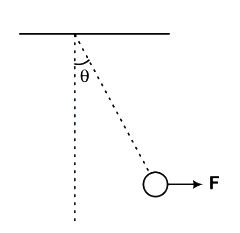
$A$ $1 ~N$ pendulum bob is held at an angle $\theta$ from the vertical by a $2 ~N$ horizontal force $F$ as shown in the figure. The tension in the string supporting the pendulum bob (in newton) is
A
$\cos \theta$
B
$\frac{2}{\cos \theta}$
C
$\sqrt{5}$
D
$1$
Solution
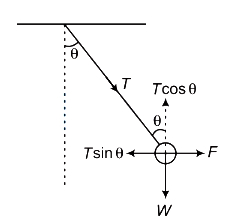
(C) The pendulum bob is in equilibrium under the action of three forces: the tension $T$ in the string,the horizontal force $F = 2 ~N$,and the weight $W = 1 ~N$ acting vertically downwards.
For equilibrium,the net force in both horizontal and vertical directions must be zero.
Resolving the tension $T$ into components:
Horizontal component: $T \sin \theta = F = 2 ~N$ $(i)$
Vertical component: $T \cos \theta = W = 1 ~N$ (ii)
Squaring and adding equations $(i)$ and (ii):
$(T \sin \theta)^2 + (T \cos \theta)^2 = F^2 + W^2$
$T^2 (\sin^2 \theta + \cos^2 \theta) = F^2 + W^2$
$T^2 = F^2 + W^2$
$T = \sqrt{F^2 + W^2} = \sqrt{2^2 + 1^2} = \sqrt{4 + 1} = \sqrt{5} ~N$.
For equilibrium,the net force in both horizontal and vertical directions must be zero.
Resolving the tension $T$ into components:
Horizontal component: $T \sin \theta = F = 2 ~N$ $(i)$
Vertical component: $T \cos \theta = W = 1 ~N$ (ii)
Squaring and adding equations $(i)$ and (ii):
$(T \sin \theta)^2 + (T \cos \theta)^2 = F^2 + W^2$
$T^2 (\sin^2 \theta + \cos^2 \theta) = F^2 + W^2$
$T^2 = F^2 + W^2$
$T = \sqrt{F^2 + W^2} = \sqrt{2^2 + 1^2} = \sqrt{4 + 1} = \sqrt{5} ~N$.
0 likesView Solution
38
ChemistryMCQTS EAMCET · 2011
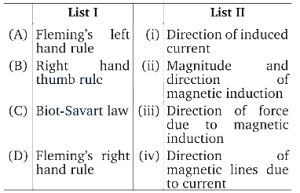
Match the following and find the correct pairs.
| List $I$ | List $II$ |
|---|---|
| $(A)$ Fleming's left hand rule | $(i)$ Direction of induced current |
| $(B)$ Right hand thumb rule | (ii) Magnitude and direction of magnetic induction |
| $(C)$ Biot-Savart law | (iii) Direction of force due to magnetic induction |
| $(D)$ Fleming's right hand rule | (iv) Direction of magnetic lines due to current |
A
$(A)$-(iii),$(B)$-$(i)$,$(C)$-(ii),$(D)$-(iv)
B
$(A)$-(iii),$(B)$-(iv),$(C)$-(ii),$(D)$-$(i)$
C
$(A)$-(ii),$(B)$-(iv),$(C)$-(iii),$(D)$-$(i)$
D
$(A)$-(iv),$(B)$-(iii),$(C)$-$(i)$,$(D)$-(ii)
Solution
(B) The correct matches are as follows:
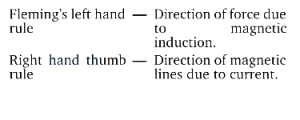
$(A)$ Fleming's left hand rule is used to determine the direction of the force on a current-carrying conductor in a magnetic field. Thus,$(A)$-(iii).
$(B)$ Right hand thumb rule is used to determine the direction of magnetic field lines around a current-carrying conductor. Thus,$(B)$-(iv).
$(C)$ Biot-Savart law is used to calculate the magnitude and direction of magnetic induction due to a current element. Thus,$(C)$-(ii).
$(D)$ Fleming's right hand rule is used to determine the direction of the induced current in a conductor moving in a magnetic field. Thus,$(D)$-$(i)$.
Therefore,the correct matching is $(A)$-(iii),$(B)$-(iv),$(C)$-(ii),$(D)$-$(i)$,which corresponds to option $(b)$.
$(A)$ Fleming's left hand rule is used to determine the direction of the force on a current-carrying conductor in a magnetic field. Thus,$(A)$-(iii).
$(B)$ Right hand thumb rule is used to determine the direction of magnetic field lines around a current-carrying conductor. Thus,$(B)$-(iv).
$(C)$ Biot-Savart law is used to calculate the magnitude and direction of magnetic induction due to a current element. Thus,$(C)$-(ii).
$(D)$ Fleming's right hand rule is used to determine the direction of the induced current in a conductor moving in a magnetic field. Thus,$(D)$-$(i)$.
Therefore,the correct matching is $(A)$-(iii),$(B)$-(iv),$(C)$-(ii),$(D)$-$(i)$,which corresponds to option $(b)$.
0 likesView Solution
39
ChemistryMCQTS EAMCET · 2011
If a bar magnet of pole strength $m$ and magnetic moment $M$ is cut equally $5$ times parallel to its axis and again $3$ times perpendicular to its axis,then the pole strength and magnetic moment of each piece are respectively
A
$\frac{m}{20}, \frac{M}{4}$
B
$\frac{m}{5}, \frac{M}{20}$
C
$\frac{m}{6}, \frac{M}{24}$
D
$\frac{m}{5}, \frac{M}{24}$
Solution
(C) Initial pole strength $= m$ and magnetic moment $= M = m \times (2l)$.
When a magnet is cut $n$ times parallel to its axis,the pole strength of each piece becomes $\frac{m}{n+1}$. Here,$n=5$,so the new pole strength $m' = \frac{m}{5+1} = \frac{m}{6}$.
When a magnet is cut $k$ times perpendicular to its axis,the length of each piece becomes $\frac{2l}{k+1}$. Here,$k=3$,so the new length $2l' = \frac{2l}{3+1} = \frac{2l}{4}$.
The magnetic moment of each piece is $M' = m' \times (2l') = \left(\frac{m}{6}\right) \times \left(\frac{2l}{4}\right) = \frac{m \times 2l}{24} = \frac{M}{24}$.
Thus,the pole strength is $\frac{m}{6}$ and the magnetic moment is $\frac{M}{24}$.
When a magnet is cut $n$ times parallel to its axis,the pole strength of each piece becomes $\frac{m}{n+1}$. Here,$n=5$,so the new pole strength $m' = \frac{m}{5+1} = \frac{m}{6}$.
When a magnet is cut $k$ times perpendicular to its axis,the length of each piece becomes $\frac{2l}{k+1}$. Here,$k=3$,so the new length $2l' = \frac{2l}{3+1} = \frac{2l}{4}$.
The magnetic moment of each piece is $M' = m' \times (2l') = \left(\frac{m}{6}\right) \times \left(\frac{2l}{4}\right) = \frac{m \times 2l}{24} = \frac{M}{24}$.
Thus,the pole strength is $\frac{m}{6}$ and the magnetic moment is $\frac{M}{24}$.
0 likesView Solution
40
ChemistryMCQTS EAMCET · 2011
The value of $a$ for which the equations $x^3+ax+1=0$ and $x^4+ax^2+1=0$ have a common root is
A
-$2$
B
-$1$
C
$1$
D
$2$
Solution
(A) Let the common root be $\alpha$. Then $\alpha^3+a\alpha+1=0$ and $\alpha^4+a\alpha^2+1=0$.
From the first equation,$a\alpha = -\alpha^3-1$,so $a = -\alpha^2 - \frac{1}{\alpha}$.
Substitute $a$ into the second equation: $\alpha^4 + (-\alpha^2 - \frac{1}{\alpha})\alpha^2 + 1 = 0$.
$\alpha^4 - \alpha^4 - \alpha + 1 = 0$.
This gives $\alpha = 1$.
Substituting $\alpha = 1$ into $x^3+ax+1=0$,we get $1^3+a(1)+1=0$,which implies $1+a+1=0$,so $a = -2$.
From the first equation,$a\alpha = -\alpha^3-1$,so $a = -\alpha^2 - \frac{1}{\alpha}$.
Substitute $a$ into the second equation: $\alpha^4 + (-\alpha^2 - \frac{1}{\alpha})\alpha^2 + 1 = 0$.
$\alpha^4 - \alpha^4 - \alpha + 1 = 0$.
This gives $\alpha = 1$.
Substituting $\alpha = 1$ into $x^3+ax+1=0$,we get $1^3+a(1)+1=0$,which implies $1+a+1=0$,so $a = -2$.
0 likesView Solution
41
ChemistryMCQTS EAMCET · 2011
If $a > 0$ and $b^2 - 4ac = 0$,then the curve $y = ax^2 + bx + c$
A
cuts the $x$-axis
B
touches the $x$-axis and lies below it
C
lies entirely above the $x$-axis
D
touches the $x$-axis and lies above it
Solution
(D) The given quadratic expression is $y = ax^2 + bx + c$.
Since the discriminant $D = b^2 - 4ac = 0$,the quadratic equation $ax^2 + bx + c = 0$ has two equal real roots.
This implies that the parabola $y = ax^2 + bx + c$ touches the $x$-axis at exactly one point.
Since $a > 0$,the parabola opens upwards.
Therefore,the curve touches the $x$-axis and lies above it.
Since the discriminant $D = b^2 - 4ac = 0$,the quadratic equation $ax^2 + bx + c = 0$ has two equal real roots.
This implies that the parabola $y = ax^2 + bx + c$ touches the $x$-axis at exactly one point.
Since $a > 0$,the parabola opens upwards.
Therefore,the curve touches the $x$-axis and lies above it.
0 likesView Solution
42
ChemistryMCQTS EAMCET · 2011
$\frac{(1+i)^{2011}}{(1-i)^{2009}}$ is equal to
A
-$1$
B
$1$
C
$2$
D
-$2$
Solution
(D) We know that $(1+i)^2 = 1 + i^2 + 2i = 2i$ and $(1-i)^2 = 1 + i^2 - 2i = -2i$.
Given expression: $E = \frac{(1+i)^{2011}}{(1-i)^{2009}} = \frac{(1+i)^{2009} \cdot (1+i)^2}{(1-i)^{2009}}$.
$E = \left(\frac{1+i}{1-i}\right)^{2009} \cdot (1+i)^2$.
Since $\frac{1+i}{1-i} = \frac{(1+i)^2}{1^2 - i^2} = \frac{2i}{2} = i$,
$E = (i)^{2009} \cdot (2i)$.
$E = (i^{2008} \cdot i) \cdot 2i = (1 \cdot i) \cdot 2i = 2i^2 = 2(-1) = -2$.
Given expression: $E = \frac{(1+i)^{2011}}{(1-i)^{2009}} = \frac{(1+i)^{2009} \cdot (1+i)^2}{(1-i)^{2009}}$.
$E = \left(\frac{1+i}{1-i}\right)^{2009} \cdot (1+i)^2$.
Since $\frac{1+i}{1-i} = \frac{(1+i)^2}{1^2 - i^2} = \frac{2i}{2} = i$,
$E = (i)^{2009} \cdot (2i)$.
$E = (i^{2008} \cdot i) \cdot 2i = (1 \cdot i) \cdot 2i = 2i^2 = 2(-1) = -2$.
0 likesView Solution
43
ChemistryMCQTS EAMCET · 2011
Let $z = a - \frac{i}{2}$,where $a \in R$. Then $|i + z|^2 - |i - z|^2$ is equal to
A
$2$
B
$-2$
C
$4$
D
$-4$
Solution
(B) Given,$z = a - \frac{i}{2}$.
Substitute $z$ into the expression $|i + z|^2 - |i - z|^2$:
$|i + (a - \frac{i}{2})|^2 - |i - (a - \frac{i}{2})|^2$
$= |a + \frac{i}{2}|^2 - |-a + \frac{3i}{2}|^2$
$= (a^2 + (\frac{1}{2})^2) - ((-a)^2 + (\frac{3}{2})^2)$
$= a^2 + \frac{1}{4} - (a^2 + \frac{9}{4})$
$= \frac{1}{4} - \frac{9}{4} = -\frac{8}{4} = -2$.
Substitute $z$ into the expression $|i + z|^2 - |i - z|^2$:
$|i + (a - \frac{i}{2})|^2 - |i - (a - \frac{i}{2})|^2$
$= |a + \frac{i}{2}|^2 - |-a + \frac{3i}{2}|^2$
$= (a^2 + (\frac{1}{2})^2) - ((-a)^2 + (\frac{3}{2})^2)$
$= a^2 + \frac{1}{4} - (a^2 + \frac{9}{4})$
$= \frac{1}{4} - \frac{9}{4} = -\frac{8}{4} = -2$.
0 likesView Solution
44
ChemistryMCQTS EAMCET · 2011
The locus of the complex number $z$ such that $\arg \left(\frac{z-2}{z+2}\right)=\frac{\pi}{3}$ is:
A
a circle
B
a straight line
C
a parabola
D
an ellipse
Solution
(A) Let $z = x + iy$.
Given $\arg \left(\frac{z-2}{z+2}\right) = \frac{\pi}{3}$.
Using the property $\arg \left(\frac{z_1}{z_2}\right) = \arg(z_1) - \arg(z_2)$,we have:
$\arg(z-2) - \arg(z+2) = \frac{\pi}{3}$
$\arg((x-2) + iy) - \arg((x+2) + iy) = \frac{\pi}{3}$
$\tan^{-1}\left(\frac{y}{x-2}\right) - \tan^{-1}\left(\frac{y}{x+2}\right) = \frac{\pi}{3}$
Applying the formula $\tan^{-1} A - \tan^{-1} B = \tan^{-1}\left(\frac{A-B}{1+AB}\right)$:
$\tan^{-1}\left[\frac{\frac{y}{x-2} - \frac{y}{x+2}}{1 + \left(\frac{y}{x-2}\right)\left(\frac{y}{x+2}\right)}\right] = \frac{\pi}{3}$
$\frac{\frac{y(x+2) - y(x-2)}{x^2-4}}{\frac{x^2-4+y^2}{x^2-4}} = \tan\left(\frac{\pi}{3}\right)$
$\frac{4y}{x^2+y^2-4} = \sqrt{3}$
$x^2 + y^2 - \frac{4}{\sqrt{3}}y - 4 = 0$
This is the equation of a circle.
Given $\arg \left(\frac{z-2}{z+2}\right) = \frac{\pi}{3}$.
Using the property $\arg \left(\frac{z_1}{z_2}\right) = \arg(z_1) - \arg(z_2)$,we have:
$\arg(z-2) - \arg(z+2) = \frac{\pi}{3}$
$\arg((x-2) + iy) - \arg((x+2) + iy) = \frac{\pi}{3}$
$\tan^{-1}\left(\frac{y}{x-2}\right) - \tan^{-1}\left(\frac{y}{x+2}\right) = \frac{\pi}{3}$
Applying the formula $\tan^{-1} A - \tan^{-1} B = \tan^{-1}\left(\frac{A-B}{1+AB}\right)$:
$\tan^{-1}\left[\frac{\frac{y}{x-2} - \frac{y}{x+2}}{1 + \left(\frac{y}{x-2}\right)\left(\frac{y}{x+2}\right)}\right] = \frac{\pi}{3}$
$\frac{\frac{y(x+2) - y(x-2)}{x^2-4}}{\frac{x^2-4+y^2}{x^2-4}} = \tan\left(\frac{\pi}{3}\right)$
$\frac{4y}{x^2+y^2-4} = \sqrt{3}$
$x^2 + y^2 - \frac{4}{\sqrt{3}}y - 4 = 0$
This is the equation of a circle.
0 likesView Solution
45
ChemistryMCQTS EAMCET · 2011
$A$ large open tank has two holes in the wall. One is a square hole of side $L$ at a depth $y$ from the top and the other is a circular hole of radius $R$ at a depth $4y$ from the top. When the tank is completely filled with water,the quantities of water flowing out per second from the two holes are the same. Then the value of $R$ is
A
$\frac{L}{\sqrt{2 \pi}}$
B
$2 \pi L$
C
$L \sqrt{\frac{2}{\pi}}$
D
$\frac{L}{2 \pi}$
Solution
(A) The volume flow rate (quantity of water per second) is given by $Q = A v$,where $A$ is the area of the hole and $v$ is the velocity of efflux.
According to Torricelli's law,the velocity of efflux at a depth $h$ is $v = \sqrt{2gh}$.
For the square hole: $A_1 = L^2$ and $v_1 = \sqrt{2gy}$.
Thus,$Q_1 = L^2 \sqrt{2gy}$.
For the circular hole: $A_2 = \pi R^2$ and $v_2 = \sqrt{2g(4y)} = 2\sqrt{2gy}$.
Thus,$Q_2 = \pi R^2 (2\sqrt{2gy})$.
Given that $Q_1 = Q_2$,we have:
$L^2 \sqrt{2gy} = \pi R^2 (2\sqrt{2gy})$
$L^2 = 2\pi R^2$
$R^2 = \frac{L^2}{2\pi}$
$R = \frac{L}{\sqrt{2\pi}}$.
According to Torricelli's law,the velocity of efflux at a depth $h$ is $v = \sqrt{2gh}$.
For the square hole: $A_1 = L^2$ and $v_1 = \sqrt{2gy}$.
Thus,$Q_1 = L^2 \sqrt{2gy}$.
For the circular hole: $A_2 = \pi R^2$ and $v_2 = \sqrt{2g(4y)} = 2\sqrt{2gy}$.
Thus,$Q_2 = \pi R^2 (2\sqrt{2gy})$.
Given that $Q_1 = Q_2$,we have:
$L^2 \sqrt{2gy} = \pi R^2 (2\sqrt{2gy})$
$L^2 = 2\pi R^2$
$R^2 = \frac{L^2}{2\pi}$
$R = \frac{L}{\sqrt{2\pi}}$.
0 likesView Solution
46
ChemistryMCQTS EAMCET · 2011
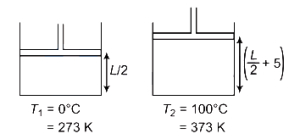
An insulated cylindrical vessel is fitted with an insulated piston of negligible weight and negligible thickness at the midpoint of the vessel. The cylinder contains a gas at $0^{\circ} C$. When the gas is heated to $100^{\circ} C$,the piston moves through a length of $5 ~cm$. The total length of the cylindrical vessel in $cm$ is:
A
$13.65$
B
$27.3$
C
$38.6$
D
$64.6$
Solution
(B) Let the total length of the cylindrical vessel be $L$. Initially,the piston is at the midpoint,so the initial length of the gas column is $V_1 \propto L/2$ at $T_1 = 0^{\circ} C = 273 ~K$.
When heated to $T_2 = 100^{\circ} C = 373 ~K$,the piston moves by $5 ~cm$,so the new length of the gas column is $V_2 \propto (L/2 + 5)$.
Since the pressure remains constant (as the piston is weightless and moves freely),we apply Charles's Law: $\frac{V_1}{T_1} = \frac{V_2}{T_2}$.
Substituting the values: $\frac{L/2}{273} = \frac{L/2 + 5}{373}$.
Cross-multiplying: $373(L/2) = 273(L/2 + 5)$.
$373(L/2) = 273(L/2) + 1365$.
$100(L/2) = 1365$.
$L/2 = 13.65 ~cm$.
Therefore,$L = 27.3 ~cm$.
When heated to $T_2 = 100^{\circ} C = 373 ~K$,the piston moves by $5 ~cm$,so the new length of the gas column is $V_2 \propto (L/2 + 5)$.
Since the pressure remains constant (as the piston is weightless and moves freely),we apply Charles's Law: $\frac{V_1}{T_1} = \frac{V_2}{T_2}$.
Substituting the values: $\frac{L/2}{273} = \frac{L/2 + 5}{373}$.
Cross-multiplying: $373(L/2) = 273(L/2 + 5)$.
$373(L/2) = 273(L/2) + 1365$.
$100(L/2) = 1365$.
$L/2 = 13.65 ~cm$.
Therefore,$L = 27.3 ~cm$.
0 likesView Solution
47
ChemistryMCQTS EAMCET · 2011
Two blocks of masses $1 \ kg$ and $2 \ kg$ are connected by a metal wire going over a smooth pulley. The breaking stress of the metal is $\frac{40}{3 \pi} \times 10^6 \ N m^{-2}$. What should be the minimum radius of the wire used if it should not break (in $mm$)? $\left(g = 10 \ m s^{-2}\right)$
A
$0.5$
B
$1$
C
$1.5$
D
$2$
Solution
(B) The tension $T$ in the wire when two masses $m_1 = 1 \ kg$ and $m_2 = 2 \ kg$ are connected over a pulley is given by $T = \frac{2 m_1 m_2 g}{m_1 + m_2}$.
Substituting the values: $T = \frac{2 \times 1 \times 2 \times 10}{1 + 2} = \frac{40}{3} \ N$.
Breaking stress is defined as $\sigma = \frac{T}{A}$,where $A = \pi r^2$ is the cross-sectional area.
Given $\sigma = \frac{40}{3 \pi} \times 10^6 \ N m^{-2}$.
Equating the two: $\frac{40}{3 \pi} \times 10^6 = \frac{40/3}{\pi r^2}$.
Simplifying: $10^6 = \frac{1}{r^2} \Rightarrow r^2 = 10^{-6} \ m^2$.
Therefore,$r = 10^{-3} \ m = 1 \ mm$.
Substituting the values: $T = \frac{2 \times 1 \times 2 \times 10}{1 + 2} = \frac{40}{3} \ N$.
Breaking stress is defined as $\sigma = \frac{T}{A}$,where $A = \pi r^2$ is the cross-sectional area.
Given $\sigma = \frac{40}{3 \pi} \times 10^6 \ N m^{-2}$.
Equating the two: $\frac{40}{3 \pi} \times 10^6 = \frac{40/3}{\pi r^2}$.
Simplifying: $10^6 = \frac{1}{r^2} \Rightarrow r^2 = 10^{-6} \ m^2$.
Therefore,$r = 10^{-3} \ m = 1 \ mm$.
0 likesView Solution
48
ChemistryMCQTS EAMCET · 2011
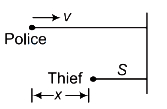
$A$ police party is moving in a jeep at a constant speed $v$. They see a thief at a distance $x$ on a motorcycle which is at rest. The moment the police see the thief,the thief starts moving with a constant acceleration $a$. Which of the following relations is true if the police are able to catch the thief?
A
$v^2 < a x$
B
$v^2 < 2 a x$
C
$v^2 \geq 2 a x$
D
$v^2 = a x$
Solution
(C) Let the police party catch the thief after time $t$.
Distance traveled by the police party in time $t$ is $d_p = v t$.
Distance traveled by the thief in time $t$ starting from rest with acceleration $a$ is $d_t = x + \frac{1}{2} a t^2$.
For the police to catch the thief,the distance covered by the police must be greater than or equal to the distance covered by the thief:
$v t \geq x + \frac{1}{2} a t^2$
Rearranging the terms,we get:
$\frac{1}{2} a t^2 - v t + x \leq 0$
For this quadratic inequality in $t$ to have real solutions,the discriminant $D$ must be greater than or equal to zero:
$D = (-v)^2 - 4(\frac{1}{2} a)(x) \geq 0$
$v^2 - 2 a x \geq 0$
$v^2 \geq 2 a x$
Distance traveled by the police party in time $t$ is $d_p = v t$.
Distance traveled by the thief in time $t$ starting from rest with acceleration $a$ is $d_t = x + \frac{1}{2} a t^2$.
For the police to catch the thief,the distance covered by the police must be greater than or equal to the distance covered by the thief:
$v t \geq x + \frac{1}{2} a t^2$
Rearranging the terms,we get:
$\frac{1}{2} a t^2 - v t + x \leq 0$
For this quadratic inequality in $t$ to have real solutions,the discriminant $D$ must be greater than or equal to zero:
$D = (-v)^2 - 4(\frac{1}{2} a)(x) \geq 0$
$v^2 - 2 a x \geq 0$
$v^2 \geq 2 a x$
0 likesView Solution
49
ChemistryMCQTS EAMCET · 2011
If $200 \text{ MeV}$ of energy is released in the fission of one nucleus of ${ }_{92}^{235} \text{U}$,then the number of nuclei that must undergo fission to release an energy of $1000 \text{ J}$ is
A
$3.125 \times 10^{13}$
B
$6.25 \times 10^{13}$
C
$12.5 \times 10^{13}$
D
$3.125 \times 10^{14}$
Solution
(A) The energy released per fission of one nucleus is $E_1 = 200 \text{ MeV}$.
First,convert this energy into Joules $(J)$:
$E_1 = 200 \times 10^6 \text{ eV} = 200 \times 10^6 \times 1.6 \times 10^{-19} \text{ J} = 3.2 \times 10^{-11} \text{ J}$.
We need to find the number of nuclei $N$ required to release a total energy $E_{\text{total}} = 1000 \text{ J}$.
The formula is $N = \frac{E_{\text{total}}}{E_1}$.
Substituting the values:
$N = \frac{1000}{3.2 \times 10^{-11}} = \frac{1000}{3.2} \times 10^{11} = 312.5 \times 10^{11} = 3.125 \times 10^{13}$.
Therefore,the number of nuclei required is $3.125 \times 10^{13}$.
First,convert this energy into Joules $(J)$:
$E_1 = 200 \times 10^6 \text{ eV} = 200 \times 10^6 \times 1.6 \times 10^{-19} \text{ J} = 3.2 \times 10^{-11} \text{ J}$.
We need to find the number of nuclei $N$ required to release a total energy $E_{\text{total}} = 1000 \text{ J}$.
The formula is $N = \frac{E_{\text{total}}}{E_1}$.
Substituting the values:
$N = \frac{1000}{3.2 \times 10^{-11}} = \frac{1000}{3.2} \times 10^{11} = 312.5 \times 10^{11} = 3.125 \times 10^{13}$.
Therefore,the number of nuclei required is $3.125 \times 10^{13}$.
0 likesView Solution
50
ChemistryMCQTS EAMCET · 2011
If $200 \text{ MeV}$ of energy is released in the fission of one nucleus of ${}_{92}^{236}U$,the number of nuclei that must undergo fission to release an energy of $1000 \text{ J}$ is
A
$3.125 \times 10^{13}$
B
$6.25 \times 10^{13}$
C
$12.5 \times 10^{13}$
D
$3.125 \times 10^{14}$
Solution
(A) Energy released in the fission of one nucleus is $E_1 = 200 \text{ MeV}$.
Converting this energy into Joules:
$E_1 = 200 \times 1.6 \times 10^{-13} \text{ J} = 3.2 \times 10^{-11} \text{ J}$.
We need to find the number of nuclei $n$ required to release a total energy $E_{total} = 1000 \text{ J}$.
The relationship is $E_{total} = n \times E_1$.
Therefore,$n = \frac{E_{total}}{E_1} = \frac{1000}{3.2 \times 10^{-11}}$.
$n = \frac{1000}{3.2} \times 10^{11} = 312.5 \times 10^{11} = 3.125 \times 10^{13}$ nuclei.
Converting this energy into Joules:
$E_1 = 200 \times 1.6 \times 10^{-13} \text{ J} = 3.2 \times 10^{-11} \text{ J}$.
We need to find the number of nuclei $n$ required to release a total energy $E_{total} = 1000 \text{ J}$.
The relationship is $E_{total} = n \times E_1$.
Therefore,$n = \frac{E_{total}}{E_1} = \frac{1000}{3.2 \times 10^{-11}}$.
$n = \frac{1000}{3.2} \times 10^{11} = 312.5 \times 10^{11} = 3.125 \times 10^{13}$ nuclei.
0 likesView Solution
51
ChemistryMediumTS EAMCET · 2011
Match the following:
$A$ $B$ $C$ $D$
$(a)$ $(III)$ $(I)$ $(II)$ $(V)$
$(b)$ $(II)$ $(V)$ $(I)$ $(IV)$
$(c)$ $(III)$ $(IV)$ $(I)$ $(II)$
$(d)$ $(V)$ $(I)$ $(IV)$ $(II)$
| List-$I$ | List-$II$ |
|---|---|
| $(A)$ Potential of hydrogen electrode at $pH = 10$ | $(I)$ $0.76 \ V$ |
| $(B)$ $Cu^{2+} | Cu$ | $(II)$ $0.059$ |
| $(C)$ $Zn | Zn^{2+}$ | $(III)$ $-0.591 \ V$ |
| $(D)$ $\frac{2.303 RT}{F}$ | $(IV)$ $0.337 \ V$ |
| $(V)$ $-0.76 \ V$ |
$A$ $B$ $C$ $D$
$(a)$ $(III)$ $(I)$ $(II)$ $(V)$
$(b)$ $(II)$ $(V)$ $(I)$ $(IV)$
$(c)$ $(III)$ $(IV)$ $(I)$ $(II)$
$(d)$ $(V)$ $(I)$ $(IV)$ $(II)$
Solution
(C) For hydrogen electrode: $E = E^0 - 0.059 \ pH = 0 - 0.059 \times 10 = -0.591 \ V$. Thus,$(A)$ matches with $(III)$.
$(B)$ The standard reduction potential of $Cu^{2+} | Cu$ is $E^0_{Cu^{2+}/Cu} = 0.337 \ V$. Thus,$(B)$ matches with $(IV)$.
$(C)$ The standard oxidation potential of $Zn | Zn^{2+}$ is $E^0_{Zn/Zn^{2+}} = 0.76 \ V$. Thus,$(C)$ matches with $(I)$.
$(D)$ The value of $\frac{2.303 RT}{F}$ at $298 \ K$ is $\frac{2.303 \times 8.314 \times 298}{96500} \approx 0.059$. Thus,$(D)$ matches with $(II)$.
Therefore,the correct matching is $A-III, B-IV, C-I, D-II$,which corresponds to option $(c)$.
$(B)$ The standard reduction potential of $Cu^{2+} | Cu$ is $E^0_{Cu^{2+}/Cu} = 0.337 \ V$. Thus,$(B)$ matches with $(IV)$.
$(C)$ The standard oxidation potential of $Zn | Zn^{2+}$ is $E^0_{Zn/Zn^{2+}} = 0.76 \ V$. Thus,$(C)$ matches with $(I)$.
$(D)$ The value of $\frac{2.303 RT}{F}$ at $298 \ K$ is $\frac{2.303 \times 8.314 \times 298}{96500} \approx 0.059$. Thus,$(D)$ matches with $(II)$.
Therefore,the correct matching is $A-III, B-IV, C-I, D-II$,which corresponds to option $(c)$.
0 likesView Solution
52
ChemistryEasyMCQTS EAMCET · 2011
What are the products formed when moist chlorine gas is reacted with hypo $(Na_2S_2O_3)$?
A
$Na_2SO_4, S, HCl$
B
$Na_2SO_3, S, HCl$
C
$Na_2S_4O_6, Na_2SO_3, HCl$
D
$Na_2S_4O_6, NaCl, HCl$
Solution
(A) When moist chlorine gas reacts with hypo $(Na_2S_2O_3)$,it acts as an oxidizing agent. The reaction produces sodium sulphate,hydrochloric acid,and colloidal sulphur.
The balanced chemical equation is:
$Na_2S_2O_3 + H_2O + Cl_2 \rightarrow Na_2SO_4 + 2HCl + S$
The balanced chemical equation is:
$Na_2S_2O_3 + H_2O + Cl_2 \rightarrow Na_2SO_4 + 2HCl + S$
0 likesView Solution
53
ChemistryMediumMCQTS EAMCET · 2011
Nitrobenzene on reduction using zinc in alkaline medium results in $X$. The number of $\sigma$ and $\pi$ bonds in $X$ is
A
$24 \sigma, 7 \pi$
B
$24 \sigma, 6 \pi$
C
$27 \sigma, 7 \pi$
D
$27 \sigma, 6 \pi$
Solution
(D) The reduction of nitrobenzene with zinc in an alkaline medium (e.g.,$Zn/NaOH$) produces hydrazobenzene $(C_{12}H_{12}N_2)$ as the final product $X$.
Structure of hydrazobenzene: $Ph-NH-NH-Ph$.
Each phenyl ring $(C_6H_5)$ contains $6 \pi$ bonds (from the aromatic ring) and $12 \sigma$ bonds ($6$ $C-C$ and $6$ $C-H$).
For two phenyl rings,we have $12 \pi$ bonds and $24 \sigma$ bonds.
Additionally,the central $N-N$ linkage has $1 \sigma$ bond,and the two $N-H$ bonds contribute $2 \sigma$ bonds.
Total $\sigma$ bonds = $24 + 1 + 2 = 27$.
Total $\pi$ bonds = $3 + 3 = 6$ (from the two benzene rings).
Thus,$X$ contains $27 \sigma$ and $6 \pi$ bonds.
Structure of hydrazobenzene: $Ph-NH-NH-Ph$.
Each phenyl ring $(C_6H_5)$ contains $6 \pi$ bonds (from the aromatic ring) and $12 \sigma$ bonds ($6$ $C-C$ and $6$ $C-H$).
For two phenyl rings,we have $12 \pi$ bonds and $24 \sigma$ bonds.
Additionally,the central $N-N$ linkage has $1 \sigma$ bond,and the two $N-H$ bonds contribute $2 \sigma$ bonds.
Total $\sigma$ bonds = $24 + 1 + 2 = 27$.
Total $\pi$ bonds = $3 + 3 = 6$ (from the two benzene rings).
Thus,$X$ contains $27 \sigma$ and $6 \pi$ bonds.
0 likesView Solution
54
ChemistryDifficultMCQTS EAMCET · 2011
Which one of the following statements is not correct?
A
Except glycine,all other naturally occurring $\alpha$-amino acids are optically active.
B
$\alpha$-amino acids have maximum solubility at their isoelectric point.
C
$A$ tripeptide has two peptide bonds.
D
$\alpha$-amino acids exist as Zwitter ions.
Solution
(B) At the isoelectric point,the net charge on an amino acid is zero,which results in minimum intermolecular electrostatic repulsion and minimum interaction with water molecules. Consequently,amino acids have the least solubility in water at their isoelectric point. Therefore,the statement that they have maximum solubility at their isoelectric point is incorrect.
0 likesView Solution
55
ChemistryMediumMCQTS EAMCET · 2011
The total number of $\sigma$ and $\pi$-bonds in pyrophosphoric acid are respectively
A
$8, 2$
B
$10, 2$
C
$12, 2$
D
$8, 4$
Solution
(C) The structure of pyrophosphoric acid $(H_4P_2O_7)$ consists of two $P=O$ bonds,four $P-OH$ bonds,and one $P-O-P$ bridge.
Counting the bonds:
- Each $P=O$ bond contains $1$ $\sigma$ and $1$ $\pi$-bond (Total: $2$ $\sigma$,$2$ $\pi$).
- Each $P-OH$ bond contains $1$ $\sigma$-bond (Total: $4$ $\sigma$).
- The $P-O-P$ bridge contains $2$ $\sigma$-bonds.
- Each $O-H$ bond contains $1$ $\sigma$-bond (Total: $4$ $\sigma$).
Total $\sigma$-bonds = $2 + 4 + 2 + 4 = 12$.
Total $\pi$-bonds = $2$.
Therefore,the correct answer is $12, 2$.
Counting the bonds:
- Each $P=O$ bond contains $1$ $\sigma$ and $1$ $\pi$-bond (Total: $2$ $\sigma$,$2$ $\pi$).
- Each $P-OH$ bond contains $1$ $\sigma$-bond (Total: $4$ $\sigma$).
- The $P-O-P$ bridge contains $2$ $\sigma$-bonds.
- Each $O-H$ bond contains $1$ $\sigma$-bond (Total: $4$ $\sigma$).
Total $\sigma$-bonds = $2 + 4 + 2 + 4 = 12$.
Total $\pi$-bonds = $2$.
Therefore,the correct answer is $12, 2$.
0 likesView Solution
56
ChemistryEasyMCQTS EAMCET · 2011
Which one of the following is an artificial sweetening agent?
A
Aspirin
B
Phenacetin
C
Bithionol
D
Alitame
Solution
(D) An artificial sweetening agent is a food additive that provides a sweet taste like that of sugar but with significantly less food energy.
Among the given options,$Alitame$ is an artificial sweetening agent.
It is approximately $2000$ times sweeter than cane sugar.
Its chemical structure is represented as follows:
$HOOC-CH_2-CH(NH_2)-CONH-CH(CH_3)-CONH-C(CH_3)_2-CH_2-S-C(CH_3)_2$ (or as shown in the provided image).
Among the given options,$Alitame$ is an artificial sweetening agent.
It is approximately $2000$ times sweeter than cane sugar.
Its chemical structure is represented as follows:
$HOOC-CH_2-CH(NH_2)-CONH-CH(CH_3)-CONH-C(CH_3)_2-CH_2-S-C(CH_3)_2$ (or as shown in the provided image).
0 likesView Solution
57
ChemistryEasyTS EAMCET · 2011
Match the following:
$(a)$ $A-III, B-I, C-II, D-V$
$(b)$ $A-II, B-V, C-I, D-IV$
$(c)$ $A-III, B-IV, C-I, D-II$
$(d)$ $A-V, B-I, C-IV, D-II$
| List-$I$ | List-$II$ |
|---|---|
| $(A)$ Potential of hydrogen electrode at $pH = 10$ | $(I)$ $0.76 \ V$ |
| $(B)$ $Cu^{2+}|Cu$ | $(II)$ $0.059$ |
| $(C)$ $Zn|Zn^{2+}$ | $(III)$ $-0.591 \ V$ |
| $(D)$ $\frac{2.303RT}{F}$ | $(IV)$ $0.337 \ V$ |
| $(V)$ $-0.76 \ V$ |
$(a)$ $A-III, B-I, C-II, D-V$
$(b)$ $A-II, B-V, C-I, D-IV$
$(c)$ $A-III, B-IV, C-I, D-II$
$(d)$ $A-V, B-I, C-IV, D-II$
Solution
(C) For hydrogen electrode: $E = E^0 - 0.0591 \ pH = 0 - 0.0591 \times 10 = -0.591 \ V$. Thus,$A-III$.
$(B)$ Standard reduction potential of $Cu^{2+}|Cu$ is $0.337 \ V$. Thus,$B-IV$.
$(C)$ Standard oxidation potential of $Zn|Zn^{2+}$ is $0.76 \ V$. Thus,$C-I$.
$(D)$ The value of $\frac{2.303RT}{F}$ at $298 \ K$ is $0.059$. Thus,$D-II$.
The correct matching is $A-III, B-IV, C-I, D-II$,which corresponds to option $(c)$.
$(B)$ Standard reduction potential of $Cu^{2+}|Cu$ is $0.337 \ V$. Thus,$B-IV$.
$(C)$ Standard oxidation potential of $Zn|Zn^{2+}$ is $0.76 \ V$. Thus,$C-I$.
$(D)$ The value of $\frac{2.303RT}{F}$ at $298 \ K$ is $0.059$. Thus,$D-II$.
The correct matching is $A-III, B-IV, C-I, D-II$,which corresponds to option $(c)$.
0 likesView Solution
58
ChemistryMediumMCQTS EAMCET · 2011
If the values of $\Lambda_{\infty}$ of $NH_4Cl$,$NaOH$ and $NaCl$ are $130$,$217$ and $109 \ ohm^{-1} \ cm^2 \ equiv^{-1}$ respectively,the $\Lambda_{\infty}$ of $NH_4OH$ in $ohm^{-1} \ cm^2 \ equiv^{-1}$ is:
A
$238$
B
$196$
C
$22$
D
$456$
Solution
(A) According to Kohlrausch's law of independent migration of ions:
$\Lambda_{\infty}(NH_4Cl) = \Lambda_{\infty}(NH_4^+) + \Lambda_{\infty}(Cl^-) = 130 \ ohm^{-1} \ cm^2 \ equiv^{-1}$ $(i)$
$\Lambda_{\infty}(NaOH) = \Lambda_{\infty}(Na^+) + \Lambda_{\infty}(OH^-) = 217 \ ohm^{-1} \ cm^2 \ equiv^{-1}$ $(ii)$
$\Lambda_{\infty}(NaCl) = \Lambda_{\infty}(Na^+) + \Lambda_{\infty}(Cl^-) = 109 \ ohm^{-1} \ cm^2 \ equiv^{-1}$ $(iii)$
To find $\Lambda_{\infty}(NH_4OH)$,we perform the operation: $(i) + (ii) - (iii)$
$\Lambda_{\infty}(NH_4OH) = \Lambda_{\infty}(NH_4^+) + \Lambda_{\infty}(OH^-) = \Lambda_{\infty}(NH_4Cl) + \Lambda_{\infty}(NaOH) - \Lambda_{\infty}(NaCl)$
$\Lambda_{\infty}(NH_4OH) = 130 + 217 - 109 = 238 \ ohm^{-1} \ cm^2 \ equiv^{-1}$
$\Lambda_{\infty}(NH_4Cl) = \Lambda_{\infty}(NH_4^+) + \Lambda_{\infty}(Cl^-) = 130 \ ohm^{-1} \ cm^2 \ equiv^{-1}$ $(i)$
$\Lambda_{\infty}(NaOH) = \Lambda_{\infty}(Na^+) + \Lambda_{\infty}(OH^-) = 217 \ ohm^{-1} \ cm^2 \ equiv^{-1}$ $(ii)$
$\Lambda_{\infty}(NaCl) = \Lambda_{\infty}(Na^+) + \Lambda_{\infty}(Cl^-) = 109 \ ohm^{-1} \ cm^2 \ equiv^{-1}$ $(iii)$
To find $\Lambda_{\infty}(NH_4OH)$,we perform the operation: $(i) + (ii) - (iii)$
$\Lambda_{\infty}(NH_4OH) = \Lambda_{\infty}(NH_4^+) + \Lambda_{\infty}(OH^-) = \Lambda_{\infty}(NH_4Cl) + \Lambda_{\infty}(NaOH) - \Lambda_{\infty}(NaCl)$
$\Lambda_{\infty}(NH_4OH) = 130 + 217 - 109 = 238 \ ohm^{-1} \ cm^2 \ equiv^{-1}$
0 likesView Solution
59
ChemistryMediumMCQTS EAMCET · 2011
The order of reactivity of phenol $(I)$,nitrobenzene $(II)$,and benzene $(III)$ towards nitration is:
A
$(III) > (I) > (II)$
B
$(II) > (III) > (I)$
C
$(I) > (III) > (II)$
D
$(I) > (II) > (III)$
Solution
(C) Nitration is an electrophilic aromatic substitution reaction. The rate of this reaction depends on the electron density of the aromatic ring.
Groups that increase electron density (electron-donating groups) activate the ring,while groups that decrease electron density (electron-withdrawing groups) deactivate the ring.
In phenol $(I)$,the $-OH$ group exerts a strong $+R$ (resonance) effect,which significantly increases the electron density of the ring,making it highly reactive.
In benzene $(III)$,there is no substituent to alter the electron density.
In nitrobenzene $(II)$,the $-NO_2$ group exerts a strong $-R$ effect,which significantly decreases the electron density of the ring,making it the least reactive.
Therefore,the order of reactivity is $(I) > (III) > (II)$.
Groups that increase electron density (electron-donating groups) activate the ring,while groups that decrease electron density (electron-withdrawing groups) deactivate the ring.
In phenol $(I)$,the $-OH$ group exerts a strong $+R$ (resonance) effect,which significantly increases the electron density of the ring,making it highly reactive.
In benzene $(III)$,there is no substituent to alter the electron density.
In nitrobenzene $(II)$,the $-NO_2$ group exerts a strong $-R$ effect,which significantly decreases the electron density of the ring,making it the least reactive.
Therefore,the order of reactivity is $(I) > (III) > (II)$.
0 likesView Solution
60
ChemistryMediumMCQTS EAMCET · 2011
Which one of the following oxides is reduced by water gas to obtain the metal during its extraction?
A
$NiO$
B
$ZnO$
C
$WO_3$
D
$Fe_2O_3$
Solution
(A) Nickel oxide $(NiO)$ is reduced by water gas $(CO + H_2)$ to obtain the metal. The other oxides are reduced by different reducing agents as shown below:
$ZnO + C \xrightarrow{\Delta} Zn + CO$
$WO_3 + 3H_2 \xrightarrow{\Delta} W + 3H_2O$
$Fe_2O_3 + 3CO \xrightarrow{\Delta} 2Fe + 3CO_2$
$2NiO + \underbrace{CO + H_2}_{\text{Water gas}} \longrightarrow 2Ni + CO_2 + H_2O$
$ZnO + C \xrightarrow{\Delta} Zn + CO$
$WO_3 + 3H_2 \xrightarrow{\Delta} W + 3H_2O$
$Fe_2O_3 + 3CO \xrightarrow{\Delta} 2Fe + 3CO_2$
$2NiO + \underbrace{CO + H_2}_{\text{Water gas}} \longrightarrow 2Ni + CO_2 + H_2O$
0 likesView Solution
61
ChemistryEasyMCQTS EAMCET · 2011
Phosgene is formed slowly from which one of the following on exposure to air and sunlight?
A
$CHCl_3$
B
$H_3CCl$
C
$H_3COH$
D
$C_2H_5Cl$
Solution
(A) In the presence of air and light,chloroform $(CHCl_3)$ undergoes oxidation to form carbonyl chloride,commonly known as phosgene $(COCl_2)$,which is a highly toxic gas.
The chemical reaction is:
$CHCl_3 + \frac{1}{2}O_2 \xrightarrow{\text{Air and light}} COCl_2 + HCl$
The chemical reaction is:
$CHCl_3 + \frac{1}{2}O_2 \xrightarrow{\text{Air and light}} COCl_2 + HCl$
0 likesView Solution
62
ChemistryEasyMCQTS EAMCET · 2011
The reagent used in the Wolff-Kishner reduction is
A
$NH_2NH_2 / KOH$
B
$H_2 / Ni$
C
$Sn / HCl$
D
$LiAlH_4$
Solution
(A) The Wolff-Kishner reduction is a chemical reaction used to convert carbonyl groups (aldehydes or ketones) into methylene groups $(-CH_2-)$.
It involves heating the carbonyl compound with hydrazine $(NH_2NH_2)$ and a strong base like potassium hydroxide $(KOH)$ in a high-boiling solvent such as ethylene glycol.
The reaction proceeds via the formation of a hydrazone intermediate,which then undergoes base-catalyzed decomposition to release nitrogen gas $(N_2)$ and form the corresponding alkane.
It involves heating the carbonyl compound with hydrazine $(NH_2NH_2)$ and a strong base like potassium hydroxide $(KOH)$ in a high-boiling solvent such as ethylene glycol.
The reaction proceeds via the formation of a hydrazone intermediate,which then undergoes base-catalyzed decomposition to release nitrogen gas $(N_2)$ and form the corresponding alkane.
0 likesView Solution
63
ChemistryEasyMCQTS EAMCET · 2011
The $pK_a$ values of four carboxylic acids are $4.76, 4.19, 0.23$ and $3.41$ respectively. The $pK_a$ value of the strongest carboxylic acid among them is
A
$4.19$
B
$3.41$
C
$0.23$
D
$4.76$
Solution
(C) The acidity of a substance is inversely proportional to its $pK_a$ value.
Mathematically,$pK_a = -\log(K_a)$.
$A$ stronger acid has a higher $K_a$ value,which corresponds to a smaller $pK_a$ value.
Comparing the given values: $0.23 < 3.41 < 4.19 < 4.76$.
Therefore,the smallest $pK_a$ value of $0.23$ corresponds to the strongest carboxylic acid.
Mathematically,$pK_a = -\log(K_a)$.
$A$ stronger acid has a higher $K_a$ value,which corresponds to a smaller $pK_a$ value.
Comparing the given values: $0.23 < 3.41 < 4.19 < 4.76$.
Therefore,the smallest $pK_a$ value of $0.23$ corresponds to the strongest carboxylic acid.
0 likesView Solution
64
ChemistryEasyMCQTS EAMCET · 2011
Which one of the following is not a biopolymer?
A
Cellulose
B
Nylon-$6$
C
Insulin
D
$DNA$
Solution
(B) Polymers which control various life processes in plants and animals are called biopolymers.
Cellulose,Insulin,$DNA$,starch,and proteins are examples of biopolymers.
Nylon-$6$ is a synthetic polymer,not a biopolymer.
Cellulose,Insulin,$DNA$,starch,and proteins are examples of biopolymers.
Nylon-$6$ is a synthetic polymer,not a biopolymer.
0 likesView Solution
65
ChemistryMediumMCQTS EAMCET · 2011
What are the products formed when moist chlorine gas is reacted with hypo?
A
$Na_2SO_4, S, HCl$
B
$Na_2SO_3, S, HCl$
C
$Na_2S_4O_6, Na_2SO_3, HCl$
D
$Na_2SO_4, NaCl, HCl$
Solution
(A) Hypo is sodium thiosulfate,$Na_2S_2O_3 \cdot 5H_2O$. When moist chlorine gas reacts with sodium thiosulfate,it acts as an oxidizing agent. The reaction is:
$Na_2S_2O_3 + 5H_2O + 4Cl_2 \rightarrow 2NaHSO_4 + 8HCl$.
However,in the context of standard chemistry problems regarding the reaction of hypo with chlorine,it is often represented as:
$Na_2S_2O_3 + H_2O + Cl_2 \rightarrow Na_2SO_4 + S + 2HCl$.
Thus,the products formed are $Na_2SO_4, S, \text{and } HCl$.
$Na_2S_2O_3 + 5H_2O + 4Cl_2 \rightarrow 2NaHSO_4 + 8HCl$.
However,in the context of standard chemistry problems regarding the reaction of hypo with chlorine,it is often represented as:
$Na_2S_2O_3 + H_2O + Cl_2 \rightarrow Na_2SO_4 + S + 2HCl$.
Thus,the products formed are $Na_2SO_4, S, \text{and } HCl$.
0 likesView Solution
66
ChemistryMediumMCQTS EAMCET · 2011
The number of unit cells present in $39 \ g$ of potassium if it crystallizes as a body-centered cubic $(BCC)$ structure is ($N = \text{Avogadro number}$,$\text{At. wt. of potassium} = 39$).
A
$\frac{N}{4}$
B
$\frac{N}{2}$
C
$\frac{N}{3}$
D
$N$
Solution
(B) Potassium crystallizes in a $BCC$ system.
Number of moles of potassium $= \frac{39 \ g}{39 \ g/mol} = 1 \ mol$.
$1 \ mol$ of atoms contains $N$ atoms.
In a $BCC$ unit cell,the number of atoms per unit cell is $2$.
Therefore,the number of unit cells $= \frac{\text{Total number of atoms}}{\text{Atoms per unit cell}} = \frac{N}{2}$.
Number of moles of potassium $= \frac{39 \ g}{39 \ g/mol} = 1 \ mol$.
$1 \ mol$ of atoms contains $N$ atoms.
In a $BCC$ unit cell,the number of atoms per unit cell is $2$.
Therefore,the number of unit cells $= \frac{\text{Total number of atoms}}{\text{Atoms per unit cell}} = \frac{N}{2}$.
0 likesView Solution
67
ChemistryMediumMCQTS EAMCET · 2011
Which one of the following is the ratio of the lowering of vapour pressure of $0.1 \ M$ aqueous solutions of $BaCl_2, NaCl$ and $Al_2(SO_4)_3$ respectively?
A
$3 : 2 : 5$
B
$5 : 2 : 3$
C
$5 : 3 : 2$
D
$2 : 3 : 5$
Solution
(A) The lowering of vapour pressure is a colligative property,which is directly proportional to the van't Hoff factor $(i)$ for the same molar concentration of solute.
$BaCl_2 \rightarrow Ba^{2+} + 2Cl^-$; $i = 3$
$NaCl \rightarrow Na^+ + Cl^-$; $i = 2$
$Al_2(SO_4)_3 \rightarrow 2Al^{3+} + 3SO_4^{2-}$; $i = 5$
Since the concentration is the same $(0.1 \ M)$ for all,the ratio of the lowering of vapour pressure is equal to the ratio of their van't Hoff factors.
Therefore,the ratio is $3 : 2 : 5$.
$BaCl_2 \rightarrow Ba^{2+} + 2Cl^-$; $i = 3$
$NaCl \rightarrow Na^+ + Cl^-$; $i = 2$
$Al_2(SO_4)_3 \rightarrow 2Al^{3+} + 3SO_4^{2-}$; $i = 5$
Since the concentration is the same $(0.1 \ M)$ for all,the ratio of the lowering of vapour pressure is equal to the ratio of their van't Hoff factors.
Therefore,the ratio is $3 : 2 : 5$.
0 likesView Solution
68
ChemistryMediumMCQTS EAMCET · 2011
Identify the order in which the spin-only magnetic moment (in $BM$) increases for the following four ions:
$(I) Fe^{2+}$
$(II) Ti^{2+}$
$(III) Cu^{2+}$
$(IV) V^{2+}$
$(I) Fe^{2+}$
$(II) Ti^{2+}$
$(III) Cu^{2+}$
$(IV) V^{2+}$
A
$I, II, IV, III$
B
$IV, I, II, III$
C
$III, IV, II, I$
D
$III, II, IV, I$
Solution
(D) The spin-only magnetic moment $(\mu)$ is calculated using the formula $\mu = \sqrt{n(n+2)} \ BM$,where $n$ is the number of unpaired electrons.
For the given ions:
$(I) Fe^{2+} ([Ar] 3d^6)$: Number of unpaired electrons $(n)$ = $4$.
$(II) Ti^{2+} ([Ar] 3d^2)$: Number of unpaired electrons $(n)$ = $2$.
$(III) Cu^{2+} ([Ar] 3d^9)$: Number of unpaired electrons $(n)$ = $1$.
$(IV) V^{2+} ([Ar] 3d^3)$: Number of unpaired electrons $(n)$ = $3$.
Comparing the number of unpaired electrons: $1 (III) < 2 (II) < 3 (IV) < 4 (I)$.
Therefore,the increasing order of magnetic moment is $III < II < IV < I$.
For the given ions:
$(I) Fe^{2+} ([Ar] 3d^6)$: Number of unpaired electrons $(n)$ = $4$.
$(II) Ti^{2+} ([Ar] 3d^2)$: Number of unpaired electrons $(n)$ = $2$.
$(III) Cu^{2+} ([Ar] 3d^9)$: Number of unpaired electrons $(n)$ = $1$.
$(IV) V^{2+} ([Ar] 3d^3)$: Number of unpaired electrons $(n)$ = $3$.
Comparing the number of unpaired electrons: $1 (III) < 2 (II) < 3 (IV) < 4 (I)$.
Therefore,the increasing order of magnetic moment is $III < II < IV < I$.
0 likesView Solution
69
ChemistryMediumMCQTS EAMCET · 2011
Which one of the following gives a straight line for Freundlich adsorption isotherm?
A
$\log \frac{x}{m} \ vs \ \log p$
B
$\frac{x}{m} \ vs \ \frac{1}{p}$
C
$\log \frac{x}{m} \ vs \ \log \frac{1}{p}$
D
$\frac{x}{m} \ vs \ p$
Solution
(A) The Freundlich adsorption isotherm is given by the equation: $\frac{x}{m} = K p^{1/n}$.
Taking the logarithm on both sides,we get: $\log \frac{x}{m} = \log K + \frac{1}{n} \log p$.
This equation is in the form of a straight line $y = mx + c$,where $y = \log \frac{x}{m}$,$x = \log p$,slope $m = \frac{1}{n}$,and intercept $c = \log K$.
Therefore,plotting a graph between $\log \frac{x}{m}$ and $\log p$ yields a straight line.
Taking the logarithm on both sides,we get: $\log \frac{x}{m} = \log K + \frac{1}{n} \log p$.
This equation is in the form of a straight line $y = mx + c$,where $y = \log \frac{x}{m}$,$x = \log p$,slope $m = \frac{1}{n}$,and intercept $c = \log K$.
Therefore,plotting a graph between $\log \frac{x}{m}$ and $\log p$ yields a straight line.
0 likesView Solution
70
ChemistryEasyMCQTS EAMCET · 2011
Which one of the following is true for an exothermic reaction $A \rightleftharpoons B$,if $E_f$ and $E_b$ are the activation energies of forward and backward reactions respectively?
A
$E_f > E_b$
B
$E_f = E_b$
C
$E_f = -E_b$
D
$E_f < E_b$
Solution
(D) The activation energy for the forward reaction $(E_f)$ and the activation energy for the backward reaction $(E_b)$ are related to the enthalpy of the reaction $(\Delta_r H)$ by the equation: $\Delta_r H = E_f - E_b$.
For an exothermic reaction,the enthalpy change is negative,meaning $\Delta_r H < 0$.
Substituting this into the equation,we get $E_f - E_b < 0$,which implies $E_f < E_b$.
For an exothermic reaction,the enthalpy change is negative,meaning $\Delta_r H < 0$.
Substituting this into the equation,we get $E_f - E_b < 0$,which implies $E_f < E_b$.
0 likesView Solution
Vedclass Products
For Students
Vedclass Test Series
Mock tests in real TS EAMCET style covering Chemistry with performance analysis. 5-day free trial.
Start Free TrialFor Teachers
Exam Paper Generator
Generate Set A/B/C/D Chemistry papers from 7.5L+ questions in 2 minutes. 3 chapters free.
Try FreeFor Institutes
Online Exam Module
Run live TS EAMCET mock exams with unlimited students, 360° analytics & white-label branding.
See DemoFrequently Asked Questions
How many Chemistry questions are in TS EAMCET 2011?
There are 188 Chemistry questions from the TS EAMCET 2011 paper on Vedclass, each with a detailed step-by-step solution in English.
Are TS EAMCET 2011 Chemistry solutions available in English?
Yes. All solutions on this page are in English. You can also switch to English or Hindi using the language buttons above the questions.
Can I practice TS EAMCET 2011 Chemistry as a timed test?
Yes. Use the Vedclass Test Series to attempt a full TS EAMCET mock test covering Chemistry with time limits and instant score analysis.
Can teachers create Chemistry papers from TS EAMCET previous year questions?
Yes. The Vedclass Exam Paper Generator lets teachers mix TS EAMCET Chemistry questions and generate Set A/B/C/D papers in minutes.
For Teachers & Institutes
Build a Custom Chemistry Paper
Pick TS EAMCET 2011 Chemistry questions, set difficulty, and generate Set A/B/C/D in 2 minutes.