
ChemistryQ101–150 of 188 questions
Page 3 of 4 · English
101
ChemistryMCQTS EAMCET · 2011
The number of unit cells present in $39 \ g$ of potassium if it crystallizes as body-centered cubic $(BCC)$ is ($N = \text{Avogadro number}$,$\text{At. wt. of potassium} = 39$).
A
$\frac{N}{4}$
B
$\frac{N}{2}$
C
$\frac{N}{3}$
D
$N$
Solution
(B) Potassium crystallizes in a $BCC$ system.
Number of moles of potassium $= \frac{39 \ g}{39 \ g/mol} = 1 \ mol$.
Total number of atoms $= 1 \ mol \times N = N \ \text{atoms}$.
In a $BCC$ unit cell,the number of atoms per unit cell is $2$.
Therefore,the number of unit cells $= \frac{\text{Total number of atoms}}{2} = \frac{N}{2}$.
Number of moles of potassium $= \frac{39 \ g}{39 \ g/mol} = 1 \ mol$.
Total number of atoms $= 1 \ mol \times N = N \ \text{atoms}$.
In a $BCC$ unit cell,the number of atoms per unit cell is $2$.
Therefore,the number of unit cells $= \frac{\text{Total number of atoms}}{2} = \frac{N}{2}$.
0 likesView Solution
102
ChemistryMCQTS EAMCET · 2011
Which one of the following is the ratio of the lowering of vapour pressure of $0.1 \ M$ aqueous solutions of $BaCl_2, NaCl$ and $Al_2(SO_4)_3$ respectively?
A
$3 : 2 : 5$
B
$5 : 2 : 3$
C
$5 : 3 : 2$
D
$2 : 3 : 5$
Solution
(A) Lowering of vapour pressure is a colligative property,which depends on the number of particles of the solute (van't Hoff factor,$i$).
For $0.1 \ M$ aqueous solutions,the relative lowering of vapour pressure is proportional to the number of ions produced upon dissociation.
$BaCl_2 \rightarrow Ba^{2+} + 2Cl^-$; $i = 3$
$NaCl \rightarrow Na^+ + Cl^-$; $i = 2$
$Al_2(SO_4)_3 \rightarrow 2Al^{3+} + 3SO_4^{2-}$; $i = 5$
Thus,the ratio of the lowering of vapour pressure for $BaCl_2 : NaCl : Al_2(SO_4)_3$ is $3 : 2 : 5$.
For $0.1 \ M$ aqueous solutions,the relative lowering of vapour pressure is proportional to the number of ions produced upon dissociation.
$BaCl_2 \rightarrow Ba^{2+} + 2Cl^-$; $i = 3$
$NaCl \rightarrow Na^+ + Cl^-$; $i = 2$
$Al_2(SO_4)_3 \rightarrow 2Al^{3+} + 3SO_4^{2-}$; $i = 5$
Thus,the ratio of the lowering of vapour pressure for $BaCl_2 : NaCl : Al_2(SO_4)_3$ is $3 : 2 : 5$.
0 likesView Solution
103
ChemistryMCQTS EAMCET · 2011
$19 \ g$ of a mixture containing $NaHCO_3$ and $Na_2CO_3$ on complete heating liberated $1.12 \ L$ of $CO_2$ at $STP$. The weight of the remaining solid was $15.9 \ g$. What is the weight (in $g$) of $Na_2CO_3$ in the mixture before heating?
A
$8.4$
B
$15.9$
C
$4$
D
$10.6$
Solution
(D) The decomposition reaction of $NaHCO_3$ is: $2NaHCO_3 \rightarrow Na_2CO_3 + H_2O + CO_2$.
Let the mass of $NaHCO_3$ be $x \ g$ and $Na_2CO_3$ be $y \ g$.
Given $x + y = 19$.
Moles of $CO_2$ produced = $\frac{1.12 \ L}{22.4 \ L/mol} = 0.05 \ mol$.
From the reaction,$2 \ mol$ of $NaHCO_3$ produces $1 \ mol$ of $CO_2$.
So,moles of $NaHCO_3 = 2 \times 0.05 = 0.1 \ mol$.
Mass of $NaHCO_3 = 0.1 \ mol \times 84 \ g/mol = 8.4 \ g$.
Mass of $Na_2CO_3$ in the original mixture = $19 \ g - 8.4 \ g = 10.6 \ g$.
Let the mass of $NaHCO_3$ be $x \ g$ and $Na_2CO_3$ be $y \ g$.
Given $x + y = 19$.
Moles of $CO_2$ produced = $\frac{1.12 \ L}{22.4 \ L/mol} = 0.05 \ mol$.
From the reaction,$2 \ mol$ of $NaHCO_3$ produces $1 \ mol$ of $CO_2$.
So,moles of $NaHCO_3 = 2 \times 0.05 = 0.1 \ mol$.
Mass of $NaHCO_3 = 0.1 \ mol \times 84 \ g/mol = 8.4 \ g$.
Mass of $Na_2CO_3$ in the original mixture = $19 \ g - 8.4 \ g = 10.6 \ g$.
0 likesView Solution
104
ChemistryMCQTS EAMCET · 2011
Under which one of the following conditions do real gases approach the ideal gas behaviour?
A
Low temperature and high pressure
B
High temperature and high pressure
C
High temperature and low pressure
D
Low temperature and low pressure
Solution
(C) Real gases deviate from ideal behaviour due to intermolecular forces and the finite volume of gas molecules.
At $High \text{ temperature}$,the kinetic energy of molecules is high,making intermolecular forces negligible.
At $Low \text{ pressure}$,the volume occupied by the gas molecules becomes negligible compared to the total volume of the container.
Therefore,real gases approach ideal gas behaviour under conditions of $High \text{ temperature}$ and $Low \text{ pressure}$.
At $High \text{ temperature}$,the kinetic energy of molecules is high,making intermolecular forces negligible.
At $Low \text{ pressure}$,the volume occupied by the gas molecules becomes negligible compared to the total volume of the container.
Therefore,real gases approach ideal gas behaviour under conditions of $High \text{ temperature}$ and $Low \text{ pressure}$.
0 likesView Solution
105
ChemistryEasyMCQTS EAMCET · 2011
According to Bohr's theory,which one of the following values of angular momentum of an electron in a hydrogen atom is not permitted?
A
$1.25 \frac{h}{\pi}$
B
$1 \frac{h}{\pi}$
C
$1.5 \frac{h}{\pi}$
D
$0.5 \frac{h}{\pi}$
Solution
(A) According to Bohr's postulate,the angular momentum $(L)$ of an electron in a hydrogen atom is quantized and is given by the formula: $L = \frac{n h}{2 \pi}$,where $n$ is an integer $(n = 1, 2, 3, \dots)$.
This can be rewritten as $L = n \times (0.5 \frac{h}{\pi})$.
For the given options:
$A) 1.25 \frac{h}{\pi} = 2.5 \times \frac{h}{2 \pi}$ (Not an integer multiple of $\frac{h}{2 \pi}$)
$B) 1 \frac{h}{\pi} = 2 \times \frac{h}{2 \pi}$ ($n = 2$,permitted)
$C) 1.5 \frac{h}{\pi} = 3 \times \frac{h}{2 \pi}$ ($n = 3$,permitted)
$D) 0.5 \frac{h}{\pi} = 1 \times \frac{h}{2 \pi}$ ($n = 1$,permitted)
Therefore,$1.25 \frac{h}{\pi}$ is not a permitted value.
This can be rewritten as $L = n \times (0.5 \frac{h}{\pi})$.
For the given options:
$A) 1.25 \frac{h}{\pi} = 2.5 \times \frac{h}{2 \pi}$ (Not an integer multiple of $\frac{h}{2 \pi}$)
$B) 1 \frac{h}{\pi} = 2 \times \frac{h}{2 \pi}$ ($n = 2$,permitted)
$C) 1.5 \frac{h}{\pi} = 3 \times \frac{h}{2 \pi}$ ($n = 3$,permitted)
$D) 0.5 \frac{h}{\pi} = 1 \times \frac{h}{2 \pi}$ ($n = 1$,permitted)
Therefore,$1.25 \frac{h}{\pi}$ is not a permitted value.
0 likesView Solution
106
ChemistryMCQTS EAMCET · 2011
Which one of the following frequencies of radiation (in $Hz$) has a wavelength of $600 \ nm$?
A
$2.0 \times 10^{13}$
B
$5.0 \times 10^{16}$
C
$2.0 \times 10^{14}$
D
$5.0 \times 10^{14}$
Solution
(D) The relationship between frequency $(v)$,speed of light $(c)$,and wavelength $(\lambda)$ is given by $v = \frac{c}{\lambda}$.
Given: $c = 3 \times 10^8 \ m/s$ and $\lambda = 600 \ nm = 600 \times 10^{-9} \ m$.
Substituting the values: $v = \frac{3 \times 10^8}{600 \times 10^{-9}} = \frac{3 \times 10^8}{6 \times 10^{-7}} = 0.5 \times 10^{15} = 5.0 \times 10^{14} \ Hz$.
Given: $c = 3 \times 10^8 \ m/s$ and $\lambda = 600 \ nm = 600 \times 10^{-9} \ m$.
Substituting the values: $v = \frac{3 \times 10^8}{600 \times 10^{-9}} = \frac{3 \times 10^8}{6 \times 10^{-7}} = 0.5 \times 10^{15} = 5.0 \times 10^{14} \ Hz$.
0 likesView Solution
107
ChemistryMCQTS EAMCET · 2011
Identify the order in which the spin-only magnetic moment (in $BM$) increases for the following four ions:
$I. Fe^{2+}$
$II. Ti^{2+}$
$III. Cu^{2+}$
$IV. V^{2+}$
$I. Fe^{2+}$
$II. Ti^{2+}$
$III. Cu^{2+}$
$IV. V^{2+}$
A
$I, II, IV, III$
B
$IV, I, II, III$
C
$III, IV, I, II$
D
$III, II, IV, I$
Solution
(D) The spin-only magnetic moment $(\mu)$ is calculated using the formula: $\mu = \sqrt{n(n+2)} \ BM$,where $n$ is the number of unpaired electrons.
Electronic configurations and unpaired electrons $(n)$:
$I. Fe^{2+}: [Ar] 3d^6 \rightarrow n = 4$
$II. Ti^{2+}: [Ar] 3d^2 \rightarrow n = 2$
$III. Cu^{2+}: [Ar] 3d^9 \rightarrow n = 1$
$IV. V^{2+}: [Ar] 3d^3 \rightarrow n = 3$
The magnetic moment increases with the number of unpaired electrons.
Comparing $n$ values: $1 (III) < 2 (II) < 3 (IV) < 4 (I)$.
Therefore,the increasing order is $III < II < IV < I$.
Electronic configurations and unpaired electrons $(n)$:
$I. Fe^{2+}: [Ar] 3d^6 \rightarrow n = 4$
$II. Ti^{2+}: [Ar] 3d^2 \rightarrow n = 2$
$III. Cu^{2+}: [Ar] 3d^9 \rightarrow n = 1$
$IV. V^{2+}: [Ar] 3d^3 \rightarrow n = 3$
The magnetic moment increases with the number of unpaired electrons.
Comparing $n$ values: $1 (III) < 2 (II) < 3 (IV) < 4 (I)$.
Therefore,the increasing order is $III < II < IV < I$.
0 likesView Solution
108
ChemistryMCQTS EAMCET · 2011
Which one of the following gives a straight line for Freundlich adsorption isotherm?
A
$\log \frac{x}{m} \ vs \ \log p$
B
$\frac{x}{m} \ vs \ \frac{1}{p}$
C
$\log \frac{x}{m} \ vs \ \log \frac{1}{p}$
D
$\frac{x}{m} \ vs \ p$
Solution
(A) The Freundlich adsorption isotherm is given by the equation:
$\frac{x}{m} = K p^{1/n}$
Taking the logarithm on both sides:
$\log \frac{x}{m} = \log K + \frac{1}{n} \log p$
This equation is in the form of a straight line equation $y = mx + c$,where $y = \log \frac{x}{m}$,$x = \log p$,slope $m = \frac{1}{n}$,and intercept $c = \log K$.
Therefore,plotting a graph between $\log \frac{x}{m}$ and $\log p$ yields a straight line.
$\frac{x}{m} = K p^{1/n}$
Taking the logarithm on both sides:
$\log \frac{x}{m} = \log K + \frac{1}{n} \log p$
This equation is in the form of a straight line equation $y = mx + c$,where $y = \log \frac{x}{m}$,$x = \log p$,slope $m = \frac{1}{n}$,and intercept $c = \log K$.
Therefore,plotting a graph between $\log \frac{x}{m}$ and $\log p$ yields a straight line.
0 likesView Solution
109
ChemistryMCQTS EAMCET · 2011
Two slabs $A$ and $B$ of different materials but of the same thickness are joined end to end to form a composite slab. The thermal conductivities of $A$ and $B$ are $k_1$ and $k_2$ respectively. $A$ steady temperature difference of $12^{\circ} C$ is maintained across the composite slab. If $k_1 = \frac{k_2}{2}$,the temperature difference across slab $A$ is (in $^{\circ} C$)
A
$4$
B
$6$
C
$8$
D
$10$
Solution
(C) In a steady state,the rate of heat flow $(H)$ through both slabs connected in series must be equal.
$H = \frac{k_1 A (T_1 - T_x)}{L} = \frac{k_2 A (T_x - T_2)}{L}$
Since the thickness $(L)$ and cross-sectional area $(A)$ are the same for both slabs,we have:
$k_1 (12 - x) = k_2 (x - 0)$
Given $k_1 = \frac{k_2}{2}$,we substitute this into the equation:
$\frac{k_2}{2} (12 - x) = k_2 x$
$12 - x = 2x$
$3x = 12 \implies x = 4^{\circ} C$
The temperature difference across slab $A$ is $(12 - x) = 12 - 4 = 8^{\circ} C$.
$H = \frac{k_1 A (T_1 - T_x)}{L} = \frac{k_2 A (T_x - T_2)}{L}$
Since the thickness $(L)$ and cross-sectional area $(A)$ are the same for both slabs,we have:
$k_1 (12 - x) = k_2 (x - 0)$
Given $k_1 = \frac{k_2}{2}$,we substitute this into the equation:
$\frac{k_2}{2} (12 - x) = k_2 x$
$12 - x = 2x$
$3x = 12 \implies x = 4^{\circ} C$
The temperature difference across slab $A$ is $(12 - x) = 12 - 4 = 8^{\circ} C$.
0 likesView Solution
110
ChemistryMCQTS EAMCET · 2011
$A$ reversible engine converts one-sixth of the heat supplied into work. When the temperature of the sink is reduced by $62^{\circ} C$,the efficiency of the engine is doubled. The temperatures of the source and sink are
A
$99^{\circ} C, 37^{\circ} C$
B
$80^{\circ} C, 37^{\circ} C$
C
$95^{\circ} C, 37^{\circ} C$
D
$90^{\circ} C, 37^{\circ} C$
Solution
(A) The efficiency of a Carnot engine is given by $\eta = 1 - \frac{T_2}{T_1}$,where $T_1$ is the source temperature and $T_2$ is the sink temperature in Kelvin.
Given $\eta = \frac{1}{6}$,so $1 - \frac{T_2}{T_1} = \frac{1}{6} \implies \frac{T_2}{T_1} = \frac{5}{6} \implies T_1 = 1.2 T_2$.
When the sink temperature is reduced by $62^{\circ} C$,the new sink temperature is $T_2' = T_2 - 62$. The new efficiency is doubled,so $\eta' = 2 \times \frac{1}{6} = \frac{1}{3}$.
Thus,$1 - \frac{T_2 - 62}{T_1} = \frac{1}{3} \implies \frac{T_2 - 62}{T_1} = \frac{2}{3}$.
Substituting $T_1 = 1.2 T_2$ into the equation: $\frac{T_2 - 62}{1.2 T_2} = \frac{2}{3}$.
$3(T_2 - 62) = 2.4 T_2 \implies 3 T_2 - 186 = 2.4 T_2 \implies 0.6 T_2 = 186 \implies T_2 = 310 \ K$.
Converting to Celsius: $T_2 = 310 - 273 = 37^{\circ} C$.
Then $T_1 = 1.2 \times 310 = 372 \ K$. Converting to Celsius: $T_1 = 372 - 273 = 99^{\circ} C$.
Therefore,the temperatures are $99^{\circ} C$ and $37^{\circ} C$.
Given $\eta = \frac{1}{6}$,so $1 - \frac{T_2}{T_1} = \frac{1}{6} \implies \frac{T_2}{T_1} = \frac{5}{6} \implies T_1 = 1.2 T_2$.
When the sink temperature is reduced by $62^{\circ} C$,the new sink temperature is $T_2' = T_2 - 62$. The new efficiency is doubled,so $\eta' = 2 \times \frac{1}{6} = \frac{1}{3}$.
Thus,$1 - \frac{T_2 - 62}{T_1} = \frac{1}{3} \implies \frac{T_2 - 62}{T_1} = \frac{2}{3}$.
Substituting $T_1 = 1.2 T_2$ into the equation: $\frac{T_2 - 62}{1.2 T_2} = \frac{2}{3}$.
$3(T_2 - 62) = 2.4 T_2 \implies 3 T_2 - 186 = 2.4 T_2 \implies 0.6 T_2 = 186 \implies T_2 = 310 \ K$.
Converting to Celsius: $T_2 = 310 - 273 = 37^{\circ} C$.
Then $T_1 = 1.2 \times 310 = 372 \ K$. Converting to Celsius: $T_1 = 372 - 273 = 99^{\circ} C$.
Therefore,the temperatures are $99^{\circ} C$ and $37^{\circ} C$.
0 likesView Solution
111
ChemistryMCQTS EAMCET · 2011
During an adiabatic process,the pressure of a gas is proportional to the cube of its temperature. The value of $C_p / C_V$ for that gas is
A
$7/5$
B
$4/5$
C
$5/3$
D
$3/2$
Solution
(D) For an adiabatic process,the relation between pressure $p$ and volume $V$ is given by $pV^\gamma = k$,where $\gamma = C_p / C_V$ is the adiabatic index. $(i)$
Given that $p \propto T^3$,we can write $p = k' T^3$,where $k'$ is a constant.
Using the ideal gas equation $pV = nRT$,we have $T = \frac{pV}{nR}$.
Substituting this into the given relation:
$p = k' \left( \frac{pV}{nR} \right)^3$
$p = \left( \frac{k'}{n^3 R^3} \right) p^3 V^3$
$1 = \left( \frac{k'}{n^3 R^3} \right) p^2 V^3$
$p^2 V^3 = \text{constant}$
$p V^{3/2} = \text{constant}$ (ii)
Comparing equation $(i)$ and (ii),we get $\gamma = 3/2$.
Therefore,the value of $C_p / C_V$ is $3/2$.
Given that $p \propto T^3$,we can write $p = k' T^3$,where $k'$ is a constant.
Using the ideal gas equation $pV = nRT$,we have $T = \frac{pV}{nR}$.
Substituting this into the given relation:
$p = k' \left( \frac{pV}{nR} \right)^3$
$p = \left( \frac{k'}{n^3 R^3} \right) p^3 V^3$
$1 = \left( \frac{k'}{n^3 R^3} \right) p^2 V^3$
$p^2 V^3 = \text{constant}$
$p V^{3/2} = \text{constant}$ (ii)
Comparing equation $(i)$ and (ii),we get $\gamma = 3/2$.
Therefore,the value of $C_p / C_V$ is $3/2$.

0 likesView Solution
112
ChemistryMCQTS EAMCET · 2011
Which one of the following is true for an exothermic reaction $A \rightleftharpoons B$,if $E_f$ and $E_b$ are the activation energies of forward and backward reactions respectively?
A
$E_f > E_b$
B
$E_f = E_b$
C
$E_f = -E_b$
D
$E_f < E_b$
Solution
(D) The enthalpy change of a reaction,$\Delta_r H$,is related to the activation energies of the forward reaction $(E_f)$ and the backward reaction $(E_b)$ by the equation: $\Delta_r H = E_f - E_b$.
For an exothermic reaction,the enthalpy change is negative,i.e.,$\Delta_r H < 0$.
Substituting this into the equation,we get $E_f - E_b < 0$,which implies $E_f < E_b$.
For an exothermic reaction,the enthalpy change is negative,i.e.,$\Delta_r H < 0$.
Substituting this into the equation,we get $E_f - E_b < 0$,which implies $E_f < E_b$.
0 likesView Solution
113
ChemistryMCQTS EAMCET · 2011
What is the entropy change in $J K^{-1}$ during the melting of $27.3 \ g$ of ice at $0^{\circ} C$? (Latent heat of fusion of ice $= 330 \ J g^{-1}$)
A
$330$
B
$12.1$
C
$3.3$
D
$33$
Solution
(D) The entropy change for a phase transition is given by the formula $\Delta S = \frac{q_{rev}}{T}$.
For the melting of ice,the heat absorbed is $q = m \times L_f$,where $m = 27.3 \ g$ and $L_f = 330 \ J g^{-1}$.
$q = 27.3 \ g \times 330 \ J g^{-1} = 9009 \ J$.
The melting temperature of ice is $T = 0^{\circ} C = 273 \ K$.
Therefore,$\Delta S = \frac{9009 \ J}{273 \ K} = 33 \ J K^{-1}$.
For the melting of ice,the heat absorbed is $q = m \times L_f$,where $m = 27.3 \ g$ and $L_f = 330 \ J g^{-1}$.
$q = 27.3 \ g \times 330 \ J g^{-1} = 9009 \ J$.
The melting temperature of ice is $T = 0^{\circ} C = 273 \ K$.
Therefore,$\Delta S = \frac{9009 \ J}{273 \ K} = 33 \ J K^{-1}$.
0 likesView Solution
114
ChemistryMCQTS EAMCET · 2011
The dimensional formula of $\frac{1}{2} \mu_0 H^2$ (where $\mu_0 = \text{permeability of free space}$ and $H = \text{magnetic field intensity}$) is:
A
$[MLT^{-1}]$
B
$[ML^2 T^{-2}]$
C
$[ML^{-1} T^{-2}]$
D
$[ML^2 T^{-1}]$
Solution
(C) The expression $\frac{1}{2} \mu_0 H^2$ represents the energy density of a magnetic field.
Energy density is defined as energy per unit volume.
The dimensional formula for energy is $[ML^2 T^{-2}]$ and for volume is $[L^3]$.
Therefore,the dimensional formula for energy density is $\frac{[ML^2 T^{-2}]}{[L^3]} = [ML^{-1} T^{-2}]$.
Alternatively,using the dimensions of $\mu_0$ and $H$:
$[\mu_0] = [MLT^{-2} A^{-2}]$ and $[H] = [AL^{-1}]$.
Substituting these into the expression: $[\mu_0 H^2] = [MLT^{-2} A^{-2}] \times [AL^{-1}]^2 = [MLT^{-2} A^{-2}] \times [A^2 L^{-2}] = [ML^{-1} T^{-2}]$.
Energy density is defined as energy per unit volume.
The dimensional formula for energy is $[ML^2 T^{-2}]$ and for volume is $[L^3]$.
Therefore,the dimensional formula for energy density is $\frac{[ML^2 T^{-2}]}{[L^3]} = [ML^{-1} T^{-2}]$.
Alternatively,using the dimensions of $\mu_0$ and $H$:
$[\mu_0] = [MLT^{-2} A^{-2}]$ and $[H] = [AL^{-1}]$.
Substituting these into the expression: $[\mu_0 H^2] = [MLT^{-2} A^{-2}] \times [AL^{-1}]^2 = [MLT^{-2} A^{-2}] \times [A^2 L^{-2}] = [ML^{-1} T^{-2}]$.
0 likesView Solution
115
ChemistryMCQTS EAMCET · 2011
Some physical quantities are given in List-$I$ and their related units are given in List-$II$. Match the correct pairs.
| List-$I$ | List-$II$ |
| $(A)$ Magnetic field intensity | $(i)$ $Wb$ |
| $(B)$ Magnetic flux | (ii) $Wb \cdot m^{-2}$ |
| $(C)$ Magnetic pole strength | (iii) $A \cdot m$ |
| $(D)$ Magnetic induction | (iv) $A \cdot m^{-1}$ |
A
$(A)-(i), (B)-(ii), (C)-(iii), (D)-(v)$
B
$(A)-(iv), (B)-(i), (C)-(iii), (D)-(ii)$
C
$(A)-(iv), (B)-(i), (C)-(v), (D)-(ii)$
D
$(A)-(ii), (B)-(iii), (C)-(i), (D)-(iv)$
Solution
(B) The physical quantities and their corresponding $SI$ units are as follows:
$1$. Magnetic field intensity $(H)$: The unit is Ampere per meter $(A \cdot m^{-1})$.
$2$. Magnetic flux $(\phi)$: The unit is Weber $(Wb)$.
$3$. Magnetic pole strength $(m)$: The unit is Ampere-meter $(A \cdot m)$.
$4$. Magnetic induction $(B)$: The unit is Weber per square meter $(Wb \cdot m^{-2})$,which is equivalent to Tesla $(T)$.
Matching these with the lists:
$(A)$ Magnetic field intensity $\rightarrow$ (iv) $A \cdot m^{-1}$
$(B)$ Magnetic flux $\rightarrow$ $(i)$ $Wb$
$(C)$ Magnetic pole strength $\rightarrow$ (iii) $A \cdot m$
$(D)$ Magnetic induction $\rightarrow$ (ii) $Wb \cdot m^{-2}$
Therefore,the correct matching is $(A)-(iv), (B)-(i), (C)-(iii), (D)-(ii)$. The correct option is $(b)$.
$1$. Magnetic field intensity $(H)$: The unit is Ampere per meter $(A \cdot m^{-1})$.
$2$. Magnetic flux $(\phi)$: The unit is Weber $(Wb)$.
$3$. Magnetic pole strength $(m)$: The unit is Ampere-meter $(A \cdot m)$.
$4$. Magnetic induction $(B)$: The unit is Weber per square meter $(Wb \cdot m^{-2})$,which is equivalent to Tesla $(T)$.
Matching these with the lists:
$(A)$ Magnetic field intensity $\rightarrow$ (iv) $A \cdot m^{-1}$
$(B)$ Magnetic flux $\rightarrow$ $(i)$ $Wb$
$(C)$ Magnetic pole strength $\rightarrow$ (iii) $A \cdot m$
$(D)$ Magnetic induction $\rightarrow$ (ii) $Wb \cdot m^{-2}$
Therefore,the correct matching is $(A)-(iv), (B)-(i), (C)-(iii), (D)-(ii)$. The correct option is $(b)$.
0 likesView Solution
116
ChemistryMCQTS EAMCET · 2011
In the Young's double slit experiment,the resultant intensity at a point on the screen is $75 \%$ of the maximum intensity of the bright fringe. Then the phase difference between the two interfering rays at that point is
A
$\frac{\pi}{6}$
B
$\frac{\pi}{4}$
C
$\frac{\pi}{3}$
D
$\frac{\pi}{2}$
Solution
(C) The resultant intensity $I_R$ at any point in an interference pattern is given by $I_R = I_{\max} \cos^2(\frac{\phi}{2})$,where $\phi$ is the phase difference.
Given that $I_R = 75 \% \text{ of } I_{\max} = 0.75 I_{\max} = \frac{3}{4} I_{\max}$.
Substituting this into the formula: $\frac{3}{4} I_{\max} = I_{\max} \cos^2(\frac{\phi}{2})$.
$\cos^2(\frac{\phi}{2}) = \frac{3}{4}$.
Taking the square root on both sides: $\cos(\frac{\phi}{2}) = \frac{\sqrt{3}}{2}$.
We know that $\cos(\frac{\pi}{6}) = \frac{\sqrt{3}}{2}$,so $\frac{\phi}{2} = \frac{\pi}{6}$.
Therefore,the phase difference $\phi = \frac{\pi}{3}$.
Given that $I_R = 75 \% \text{ of } I_{\max} = 0.75 I_{\max} = \frac{3}{4} I_{\max}$.
Substituting this into the formula: $\frac{3}{4} I_{\max} = I_{\max} \cos^2(\frac{\phi}{2})$.
$\cos^2(\frac{\phi}{2}) = \frac{3}{4}$.
Taking the square root on both sides: $\cos(\frac{\phi}{2}) = \frac{\sqrt{3}}{2}$.
We know that $\cos(\frac{\pi}{6}) = \frac{\sqrt{3}}{2}$,so $\frac{\phi}{2} = \frac{\pi}{6}$.
Therefore,the phase difference $\phi = \frac{\pi}{3}$.
0 likesView Solution
117
ChemistryMCQTS EAMCET · 2011
The wavelengths of two sound notes in air are $\frac{40}{195} ~m$ and $\frac{40}{193} ~m$. Each note produces $9$ beats per second separately with a third note of fixed frequency. The velocity of sound in air in $m/s$ is
A
$360$
B
$320$
C
$300$
D
$340$
Solution
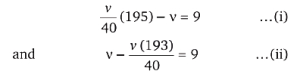
(A) Let $v$ be the velocity of sound in air and $f_0$ be the frequency of the third note.
The frequencies of the two sound notes are $f_1 = \frac{v}{\lambda_1} = \frac{v}{40/195} = \frac{195v}{40}$ and $f_2 = \frac{v}{\lambda_2} = \frac{v}{40/193} = \frac{193v}{40}$.
Since each note produces $9$ beats per second with the third note,we have:
$|f_1 - f_0| = 9$ and $|f_2 - f_0| = 9$.
This implies $f_1 - f_0 = 9$ and $f_0 - f_2 = 9$ (since $f_1 > f_2$).
Adding these two equations:
$(f_1 - f_0) + (f_0 - f_2) = 9 + 9$
$f_1 - f_2 = 18$
Substituting the expressions for $f_1$ and $f_2$:
$\frac{195v}{40} - \frac{193v}{40} = 18$
$\frac{2v}{40} = 18$
$\frac{v}{20} = 18$
$v = 360 ~m/s$.
The frequencies of the two sound notes are $f_1 = \frac{v}{\lambda_1} = \frac{v}{40/195} = \frac{195v}{40}$ and $f_2 = \frac{v}{\lambda_2} = \frac{v}{40/193} = \frac{193v}{40}$.
Since each note produces $9$ beats per second with the third note,we have:
$|f_1 - f_0| = 9$ and $|f_2 - f_0| = 9$.
This implies $f_1 - f_0 = 9$ and $f_0 - f_2 = 9$ (since $f_1 > f_2$).
Adding these two equations:
$(f_1 - f_0) + (f_0 - f_2) = 9 + 9$
$f_1 - f_2 = 18$
Substituting the expressions for $f_1$ and $f_2$:
$\frac{195v}{40} - \frac{193v}{40} = 18$
$\frac{2v}{40} = 18$
$\frac{v}{20} = 18$
$v = 360 ~m/s$.
0 likesView Solution
118
ChemistryMCQTS EAMCET · 2011
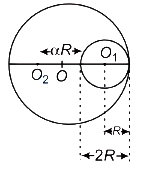
$A$ circular disc of radius $R$ is removed from a bigger circular disc of radius $2R$ such that the circumferences of the discs touch. The centre of mass of the new disc is at a distance $\alpha R$ from the centre of the bigger disc. The value of $\alpha$ is
A
$\frac{1}{2}$
B
$\frac{1}{3}$
C
$\frac{1}{4}$
D
$\frac{1}{6}$
Solution
(B) Let the centre of the bigger disc of radius $2R$ be at the origin $(0,0)$.
Let $M$ be the mass of the bigger disc. The mass per unit area is $\sigma = \frac{M}{\pi(2R)^2} = \frac{M}{4\pi R^2}$.
The mass of the removed smaller disc of radius $R$ is $m = \sigma \cdot \pi R^2 = \frac{M}{4\pi R^2} \cdot \pi R^2 = \frac{M}{4}$.
The centre of mass of the bigger disc is at $x_1 = 0$. The centre of mass of the removed smaller disc is at $x_2 = R$ (since the circumferences touch).
The centre of mass of the remaining part is given by:
$x_{CM} = \frac{M x_1 - m x_2}{M - m}$
$x_{CM} = \frac{M(0) - (M/4)(R)}{M - M/4} = \frac{-MR/4}{3M/4} = -\frac{R}{3}$.
The distance from the centre of the bigger disc is $|x_{CM}| = \frac{R}{3}$.
Comparing this with $\alpha R$,we get $\alpha = \frac{1}{3}$.
Let $M$ be the mass of the bigger disc. The mass per unit area is $\sigma = \frac{M}{\pi(2R)^2} = \frac{M}{4\pi R^2}$.
The mass of the removed smaller disc of radius $R$ is $m = \sigma \cdot \pi R^2 = \frac{M}{4\pi R^2} \cdot \pi R^2 = \frac{M}{4}$.
The centre of mass of the bigger disc is at $x_1 = 0$. The centre of mass of the removed smaller disc is at $x_2 = R$ (since the circumferences touch).
The centre of mass of the remaining part is given by:
$x_{CM} = \frac{M x_1 - m x_2}{M - m}$
$x_{CM} = \frac{M(0) - (M/4)(R)}{M - M/4} = \frac{-MR/4}{3M/4} = -\frac{R}{3}$.
The distance from the centre of the bigger disc is $|x_{CM}| = \frac{R}{3}$.
Comparing this with $\alpha R$,we get $\alpha = \frac{1}{3}$.
0 likesView Solution
119
ChemistryEasyMCQTS EAMCET · 2011
In which of the following pairs,the central atoms have the same number of lone pairs of electrons?
A
$PCl_5, BrF_5$
B
$XeF_2, ICl_2^{-}$
C
$XeF_4, ClO_4^{-}$
D
$SCl_4, CH_4$
Solution
(B) To determine the number of lone pairs on the central atom,we use the formula: $\text{Lone pairs} = \frac{1}{2} (V - N - C)$,where $V$ is the number of valence electrons of the central atom,$N$ is the number of monovalent atoms bonded to it,and $C$ is the charge on the species.
$1$. For $XeF_2$: $V=8, N=2, C=0$. $\text{Lone pairs} = \frac{1}{2}(8-2) = 3$.
$2$. For $ICl_2^{-}$: $V=7, N=2, C=1$. $\text{Lone pairs} = \frac{1}{2}(7-2+1) = 3$.
Both $XeF_2$ and $ICl_2^{-}$ have $3$ lone pairs on their respective central atoms.
$1$. For $XeF_2$: $V=8, N=2, C=0$. $\text{Lone pairs} = \frac{1}{2}(8-2) = 3$.
$2$. For $ICl_2^{-}$: $V=7, N=2, C=1$. $\text{Lone pairs} = \frac{1}{2}(7-2+1) = 3$.
Both $XeF_2$ and $ICl_2^{-}$ have $3$ lone pairs on their respective central atoms.
0 likesView Solution
120
ChemistryMediumMCQTS EAMCET · 2011
The formal charges of $N_{(1)}$,$N_{(2)}$,and $O$ atoms in the structure $N_{(1)} = N_{(2)} = O$ are respectively:
A
$+1, -1, 0$
B
$-1, +1, 0$
C
$+1, +1, 0$
D
$-1, -1, 0$
Solution
(B) The formal charge $(FC)$ is calculated as: $FC = (\text{Total valence electrons}) - (\text{Non-bonding electrons}) - \frac{1}{2}(\text{Bonding electrons})$.
For $N_{(1)}$ (terminal nitrogen with $4$ non-bonding electrons and $2$ bonding electrons from a double bond): $FC = 5 - 4 - \frac{1}{2}(4) = -1$.
For $N_{(2)}$ (central nitrogen with $0$ non-bonding electrons and $8$ bonding electrons from two double bonds): $FC = 5 - 0 - \frac{1}{2}(8) = +1$.
For $O$ (oxygen with $4$ non-bonding electrons and $4$ bonding electrons from a double bond): $FC = 6 - 4 - \frac{1}{2}(4) = 0$.
Thus,the formal charges are $-1, +1, 0$.
For $N_{(1)}$ (terminal nitrogen with $4$ non-bonding electrons and $2$ bonding electrons from a double bond): $FC = 5 - 4 - \frac{1}{2}(4) = -1$.
For $N_{(2)}$ (central nitrogen with $0$ non-bonding electrons and $8$ bonding electrons from two double bonds): $FC = 5 - 0 - \frac{1}{2}(8) = +1$.
For $O$ (oxygen with $4$ non-bonding electrons and $4$ bonding electrons from a double bond): $FC = 6 - 4 - \frac{1}{2}(4) = 0$.
Thus,the formal charges are $-1, +1, 0$.
0 likesView Solution
121
ChemistryEasyMCQTS EAMCET · 2011
The hybridisation of $Xe$ and the number of lone pairs of electrons on it in $XeF_6$ are
A
$sp^3d^2, 1$
B
$sp^3d^3, 2$
C
$sp^3d^2, 2$
D
$sp^3d^3, 1$
Solution
(D) In $XeF_6$,the central atom $Xe$ has $8$ valence electrons. It forms $6$ bonds with $F$ atoms,leaving $2$ electrons as one lone pair.
Steric number = (Number of sigma bonds) + (Number of lone pairs) = $6 + 1 = 7$.
$A$ steric number of $7$ corresponds to $sp^3d^3$ hybridisation.
Thus,$XeF_6$ has $sp^3d^3$ hybridisation and $1$ lone pair of electrons.
Steric number = (Number of sigma bonds) + (Number of lone pairs) = $6 + 1 = 7$.
$A$ steric number of $7$ corresponds to $sp^3d^3$ hybridisation.
Thus,$XeF_6$ has $sp^3d^3$ hybridisation and $1$ lone pair of electrons.
0 likesView Solution
122
ChemistryMediumMCQTS EAMCET · 2011
Which one of the following is a correct set?
A
Diamond,$sp^2$
B
Graphite,$sp^3$
C
Diamond,$sp$
D
Graphite,$sp^2$
Solution
(D) Graphite has a two-dimensional sheet-like structure.
In graphite,each carbon atom is bonded to three other carbon atoms in the same plane,forming hexagonal rings.
Therefore,each carbon atom in graphite is $sp^2$ hybridized.
In contrast,in diamond,each carbon atom is bonded to four other carbon atoms in a tetrahedral arrangement,making it $sp^3$ hybridized.
In graphite,each carbon atom is bonded to three other carbon atoms in the same plane,forming hexagonal rings.
Therefore,each carbon atom in graphite is $sp^2$ hybridized.
In contrast,in diamond,each carbon atom is bonded to four other carbon atoms in a tetrahedral arrangement,making it $sp^3$ hybridized.
0 likesView Solution
123
ChemistryMediumMCQTS EAMCET · 2011
If the equilibrium constant for the reaction $2AB \rightleftharpoons A_2 + B_2$ is $49$,what is the equilibrium constant for $AB \rightleftharpoons \frac{1}{2}A_2 + \frac{1}{2}B_2$?
A
$7$
B
$1/7$
C
$24.5$
D
$49$
Solution
(A) For the reaction $2AB \rightleftharpoons A_2 + B_2$,the equilibrium constant is $K_c = 49$.
When the coefficients of a balanced chemical equation are multiplied by a factor $n$,the new equilibrium constant $K'_c$ is given by $K'_c = (K_c)^n$.
In this case,the original equation is multiplied by $n = 1/2$.
Therefore,$K'_c = (49)^{1/2} = \sqrt{49} = 7$.
When the coefficients of a balanced chemical equation are multiplied by a factor $n$,the new equilibrium constant $K'_c$ is given by $K'_c = (K_c)^n$.
In this case,the original equation is multiplied by $n = 1/2$.
Therefore,$K'_c = (49)^{1/2} = \sqrt{49} = 7$.
0 likesView Solution
124
ChemistryDifficultMCQTS EAMCET · 2011
Which one of the following is the correct order of the second ionisation potential of $Na$,$Ne$,$Mg$,and $Al$?
A
$Al < Na < Mg < Ne$
B
$Ne < Al < Na < Mg$
C
$Mg < Al < Ne < Na$
D
$Na < Mg < Ne < Al$
Solution
(C) The electronic configurations of $Na^+$,$Ne^+$,$Mg^+$,and $Al^+$ (after the removal of the first electron) are as follows:
$Na^+: 1s^2, 2s^2, 2p^6$ (Stable noble gas configuration)
$Ne^+: 1s^2, 2s^2, 2p^5$
$Mg^+: 1s^2, 2s^2, 2p^6, 3s^1$
$Al^+: 1s^2, 2s^2, 2p^6, 3s^2$
Ionisation energy depends on the stability of the electronic configuration,effective nuclear charge,and atomic size.
$Na^+$ has a stable noble gas configuration $(2p^6)$,making the removal of a second electron extremely difficult,resulting in the highest $IE_2$.
$Mg^+$ has a $3s^1$ configuration,which is relatively easy to remove compared to the others.
$Al^+$ has a $3s^2$ configuration,which is more stable than $Mg^+$.
$Ne^+$ has a $2p^5$ configuration,which is more stable than $Al^+$.
Thus,the correct order of $IE_2$ is $Mg < Al < Ne < Na$.
$Na^+: 1s^2, 2s^2, 2p^6$ (Stable noble gas configuration)
$Ne^+: 1s^2, 2s^2, 2p^5$
$Mg^+: 1s^2, 2s^2, 2p^6, 3s^1$
$Al^+: 1s^2, 2s^2, 2p^6, 3s^2$
Ionisation energy depends on the stability of the electronic configuration,effective nuclear charge,and atomic size.
$Na^+$ has a stable noble gas configuration $(2p^6)$,making the removal of a second electron extremely difficult,resulting in the highest $IE_2$.
$Mg^+$ has a $3s^1$ configuration,which is relatively easy to remove compared to the others.
$Al^+$ has a $3s^2$ configuration,which is more stable than $Mg^+$.
$Ne^+$ has a $2p^5$ configuration,which is more stable than $Al^+$.
Thus,the correct order of $IE_2$ is $Mg < Al < Ne < Na$.
0 likesView Solution
125
ChemistryMCQTS EAMCET · 2011
If $\tan A$ and $\tan B$ are the roots of the quadratic equation $x^2-px+q=0$,then $\sin^2(A+B)$ is equal to
A
$\frac{p^2}{p^2+q^2}$
B
$\frac{p^2}{(p+q)^2}$
C
$1-\frac{p}{(1-q)^2}$
D
$\frac{p^2}{p^2+(1-q)^2}$
Solution
(D) Given that $\tan A$ and $\tan B$ are the roots of the quadratic equation $x^2-px+q=0$.
From the properties of roots,we have:
$\tan A + \tan B = p$
$\tan A \tan B = q$
Using the formula for $\tan(A+B)$:
$\tan(A+B) = \frac{\tan A + \tan B}{1 - \tan A \tan B} = \frac{p}{1-q}$
Now,consider a right-angled triangle where the opposite side is $p$ and the adjacent side is $(1-q)$. The hypotenuse is $\sqrt{p^2 + (1-q)^2}$.
Therefore,$\sin(A+B) = \frac{p}{\sqrt{p^2 + (1-q)^2}}$.
Squaring both sides,we get:
$\sin^2(A+B) = \frac{p^2}{p^2 + (1-q)^2}$.
From the properties of roots,we have:
$\tan A + \tan B = p$
$\tan A \tan B = q$
Using the formula for $\tan(A+B)$:
$\tan(A+B) = \frac{\tan A + \tan B}{1 - \tan A \tan B} = \frac{p}{1-q}$
Now,consider a right-angled triangle where the opposite side is $p$ and the adjacent side is $(1-q)$. The hypotenuse is $\sqrt{p^2 + (1-q)^2}$.
Therefore,$\sin(A+B) = \frac{p}{\sqrt{p^2 + (1-q)^2}}$.
Squaring both sides,we get:
$\sin^2(A+B) = \frac{p^2}{p^2 + (1-q)^2}$.
0 likesView Solution
126
ChemistryMCQTS EAMCET · 2011
$\begin{aligned} & \frac{x^2+x+1}{(x-1)(x-2)(x-3)}=\frac{A}{x-1}+\frac{B}{x-2}+\frac{C}{x-3} \\ & \Rightarrow A+C= \end{aligned}$
A
$4$
B
$5$
C
$6$
D
$8$
Solution
(D) Given,$\frac{x^2+x+1}{(x-1)(x-2)(x-3)}=\frac{A}{x-1}+\frac{B}{x-2}+\frac{C}{x-3}$
Multiplying both sides by $(x-1)(x-2)(x-3)$,we get:
$x^2+x+1 = A(x-2)(x-3) + B(x-1)(x-3) + C(x-1)(x-2)$
To find $A$,put $x=1$:
$1^2+1+1 = A(1-2)(1-3) \Rightarrow 3 = A(-1)(-2) \Rightarrow 3 = 2A \Rightarrow A = \frac{3}{2}$
To find $C$,put $x=3$:
$3^2+3+1 = C(3-1)(3-2) \Rightarrow 13 = C(2)(1) \Rightarrow 13 = 2C \Rightarrow C = \frac{13}{2}$
Therefore,$A+C = \frac{3}{2} + \frac{13}{2} = \frac{16}{2} = 8$
Multiplying both sides by $(x-1)(x-2)(x-3)$,we get:
$x^2+x+1 = A(x-2)(x-3) + B(x-1)(x-3) + C(x-1)(x-2)$
To find $A$,put $x=1$:
$1^2+1+1 = A(1-2)(1-3) \Rightarrow 3 = A(-1)(-2) \Rightarrow 3 = 2A \Rightarrow A = \frac{3}{2}$
To find $C$,put $x=3$:
$3^2+3+1 = C(3-1)(3-2) \Rightarrow 13 = C(2)(1) \Rightarrow 13 = 2C \Rightarrow C = \frac{13}{2}$
Therefore,$A+C = \frac{3}{2} + \frac{13}{2} = \frac{16}{2} = 8$
0 likesView Solution
127
ChemistryMCQTS EAMCET · 2011
${ }^{15}P_8 = A + 8 \cdot { }^{14}P_7 \Rightarrow A = $
A
${ }^{14}P_6$
B
${ }^{14}P_8$
C
${ }^{15}P_7$
D
${ }^{16}P_9$
Solution
(B) Given,${ }^{15}P_8 = A + 8 \cdot { }^{14}P_7$
We know that ${ }^{n}P_r = \frac{n!}{(n-r)!}$.
So,$\frac{15!}{(15-8)!} = A + 8 \cdot \frac{14!}{(14-7)!}$
$\frac{15!}{7!} = A + 8 \cdot \frac{14!}{7!}$
$A = \frac{15!}{7!} - 8 \cdot \frac{14!}{7!}$
$A = \frac{15 \cdot 14!}{7!} - 8 \cdot \frac{14!}{7!}$
$A = \frac{14!}{7!} (15 - 8)$
$A = \frac{14!}{7!} (7)$
$A = \frac{14!}{6!} = { }^{14}P_8$
We know that ${ }^{n}P_r = \frac{n!}{(n-r)!}$.
So,$\frac{15!}{(15-8)!} = A + 8 \cdot \frac{14!}{(14-7)!}$
$\frac{15!}{7!} = A + 8 \cdot \frac{14!}{7!}$
$A = \frac{15!}{7!} - 8 \cdot \frac{14!}{7!}$
$A = \frac{15 \cdot 14!}{7!} - 8 \cdot \frac{14!}{7!}$
$A = \frac{14!}{7!} (15 - 8)$
$A = \frac{14!}{7!} (7)$
$A = \frac{14!}{6!} = { }^{14}P_8$
0 likesView Solution
128
ChemistryMCQTS EAMCET · 2011
The number of five-digit numbers divisible by $5$ that can be formed using the digits $0, 1, 2, 3, 4, 5$ without repetition is:
A
$240$
B
$216$
C
$120$
D
$96$
Solution
(B) five-digit number is divisible by $5$ if its unit digit is $0$ or $5$.
Case $I$: When $0$ is in the unit place.
The remaining $4$ places can be filled by the remaining $5$ digits $(1, 2, 3, 4, 5)$ in $^5P_4 = 5! = 120$ ways.
Case $II$: When $5$ is in the unit place.
The first place (ten-thousands place) cannot be $0$. Thus,the first place can be filled by any of the $4$ digits $(1, 2, 3, 4)$.
The remaining $3$ places can be filled by the remaining $4$ digits (including $0$) in $^4P_3 = 4 \times 3 \times 2 = 24$ ways.
So,the number of ways for Case $II$ is $4 \times 24 = 96$.
Total number of ways $= 120 + 96 = 216$.
Case $I$: When $0$ is in the unit place.
The remaining $4$ places can be filled by the remaining $5$ digits $(1, 2, 3, 4, 5)$ in $^5P_4 = 5! = 120$ ways.
Case $II$: When $5$ is in the unit place.
The first place (ten-thousands place) cannot be $0$. Thus,the first place can be filled by any of the $4$ digits $(1, 2, 3, 4)$.
The remaining $3$ places can be filled by the remaining $4$ digits (including $0$) in $^4P_3 = 4 \times 3 \times 2 = 24$ ways.
So,the number of ways for Case $II$ is $4 \times 24 = 96$.
Total number of ways $= 120 + 96 = 216$.
0 likesView Solution
129
ChemistryMCQTS EAMCET · 2011
If ${ }^{(n-1)} C_3+{ }^{(n-1)} C_4>{ }^n C_3$,then the minimum value of $n$ is
A
$5$
B
$6$
C
$7$
D
$8$
Solution
(D) Given the inequality: ${ }^{n-1} C_3+{ }^{n-1} C_4>{ }^n C_3$
Using the Pascal's identity ${ }^{n} C_r+{ }^{n} C_{r-1}={ }^{n+1} C_r$,we have ${ }^{n-1} C_3+{ }^{n-1} C_4={ }^n C_4$.
Substituting this into the inequality: ${ }^n C_4>{ }^n C_3$
Using the formula ${ }^n C_r = \frac{n!}{r!(n-r)!}$,we get:
$\frac{n!}{4!(n-4)!} > \frac{n!}{3!(n-3)!}$
$\frac{1}{4(n-4)!} > \frac{1}{(n-3)(n-4)!}$
$\frac{1}{4} > \frac{1}{n-3}$
$n-3 > 4$
$n > 7$
Since $n$ must be an integer,the minimum value of $n$ is $8$.
Using the Pascal's identity ${ }^{n} C_r+{ }^{n} C_{r-1}={ }^{n+1} C_r$,we have ${ }^{n-1} C_3+{ }^{n-1} C_4={ }^n C_4$.
Substituting this into the inequality: ${ }^n C_4>{ }^n C_3$
Using the formula ${ }^n C_r = \frac{n!}{r!(n-r)!}$,we get:
$\frac{n!}{4!(n-4)!} > \frac{n!}{3!(n-3)!}$
$\frac{1}{4(n-4)!} > \frac{1}{(n-3)(n-4)!}$
$\frac{1}{4} > \frac{1}{n-3}$
$n-3 > 4$
$n > 7$
Since $n$ must be an integer,the minimum value of $n$ is $8$.
0 likesView Solution
130
ChemistryMCQTS EAMCET · 2011
$A$ bag contains $n$ white and $n$ black balls. Pairs of balls are drawn at random without replacement successively,until the bag is empty. If the number of ways in which each pair consists of one white and one black ball is $14400$,then $n$ is equal to
A
$6$
B
$5$
C
$4$
D
$3$
Solution
(B) The total number of balls is $2n$. We draw $n$ pairs of balls one by one.
For the first pair,the number of ways to choose one white and one black ball is $\binom{n}{1} \times \binom{n}{1} = n^2$.
For the second pair,the number of ways is $\binom{n-1}{1} \times \binom{n-1}{1} = (n-1)^2$.
Continuing this until the last pair,the total number of ways is $(n^2) \times (n-1)^2 \times \dots \times 1^2 = (n!)^2$.
Given that $(n!)^2 = 14400$.
Taking the square root on both sides,$n! = \sqrt{14400} = 120$.
Since $5! = 120$,we have $n = 5$.
For the first pair,the number of ways to choose one white and one black ball is $\binom{n}{1} \times \binom{n}{1} = n^2$.
For the second pair,the number of ways is $\binom{n-1}{1} \times \binom{n-1}{1} = (n-1)^2$.
Continuing this until the last pair,the total number of ways is $(n^2) \times (n-1)^2 \times \dots \times 1^2 = (n!)^2$.
Given that $(n!)^2 = 14400$.
Taking the square root on both sides,$n! = \sqrt{14400} = 120$.
Since $5! = 120$,we have $n = 5$.
0 likesView Solution
131
ChemistryEasyMCQTS EAMCET · 2011
Which air pollutant is responsible for the Bhopal gas tragedy?
A
$PIC$
B
$CFC$
C
$MIC$
D
$CO$
Solution
(C) The Bhopal gas tragedy,which occurred in $1984$,was caused by the accidental release of Methyl isocyanate $(CH_3NCO)$ gas.
Methyl isocyanate is commonly abbreviated as $MIC$.
Methyl isocyanate is commonly abbreviated as $MIC$.
0 likesView Solution
132
ChemistryMCQTS EAMCET · 2011
If $1^{\circ} = \alpha$ radians,then the approximate value of $\cos(60^{\circ} 1^{\prime})$ is
A
$\frac{1}{2} + \frac{\alpha \sqrt{3}}{120}$
B
$\frac{1}{2} - \frac{\alpha}{120}$
C
$\frac{1}{2} - \frac{\alpha \sqrt{3}}{120}$
D
$\frac{1}{2} + \frac{\alpha}{120}$
Solution
(C) We know that $60^{\circ} 1^{\prime} = 60^{\circ} + 1^{\prime} = 60^{\circ} + \left(\frac{1}{60}\right)^{\circ}$.
Since $1^{\circ} = \alpha$ radians,then $1^{\prime} = \left(\frac{1}{60}\right)^{\circ} = \frac{\alpha}{60}$ radians.
Using the approximation $\cos(A + B) \approx \cos A - B \sin A$ for small $B$ (where $B$ is in radians):
$\cos(60^{\circ} + 1^{\prime}) \approx \cos(60^{\circ}) - \left(\frac{\alpha}{60}\right) \sin(60^{\circ})$.
Substituting the values $\cos(60^{\circ}) = \frac{1}{2}$ and $\sin(60^{\circ}) = \frac{\sqrt{3}}{2}$:
$\cos(60^{\circ} 1^{\prime}) \approx \frac{1}{2} - \left(\frac{\alpha}{60}\right) \left(\frac{\sqrt{3}}{2}\right) = \frac{1}{2} - \frac{\alpha \sqrt{3}}{120}$.
Since $1^{\circ} = \alpha$ radians,then $1^{\prime} = \left(\frac{1}{60}\right)^{\circ} = \frac{\alpha}{60}$ radians.
Using the approximation $\cos(A + B) \approx \cos A - B \sin A$ for small $B$ (where $B$ is in radians):
$\cos(60^{\circ} + 1^{\prime}) \approx \cos(60^{\circ}) - \left(\frac{\alpha}{60}\right) \sin(60^{\circ})$.
Substituting the values $\cos(60^{\circ}) = \frac{1}{2}$ and $\sin(60^{\circ}) = \frac{\sqrt{3}}{2}$:
$\cos(60^{\circ} 1^{\prime}) \approx \frac{1}{2} - \left(\frac{\alpha}{60}\right) \left(\frac{\sqrt{3}}{2}\right) = \frac{1}{2} - \frac{\alpha \sqrt{3}}{120}$.
0 likesView Solution
133
ChemistryMCQTS EAMCET · 2011
If $f(x) = \sin^6 x + \cos^6 x$ for $x \in R$,then $f(x)$ lies in the interval
A
$\left[\frac{7}{8}, \frac{5}{4}\right]$
B
$\left[\frac{1}{2}, \frac{5}{8}\right]$
C
$\left[\frac{1}{4}, 1\right]$
D
$\left[\frac{1}{4}, \frac{1}{2}\right]$
Solution
(C) Given,$f(x) = \sin^6 x + \cos^6 x$.
We can write this as $f(x) = (\sin^2 x)^3 + (\cos^2 x)^3$.
Using the identity $a^3 + b^3 = (a+b)(a^2 + b^2 - ab)$,we get:
$f(x) = (\sin^2 x + \cos^2 x)(\sin^4 x + \cos^4 x - \sin^2 x \cos^2 x)$.
Since $\sin^2 x + \cos^2 x = 1$,this simplifies to:
$f(x) = \sin^4 x + \cos^4 x - \sin^2 x \cos^2 x$.
Adding and subtracting $2\sin^2 x \cos^2 x$,we get:
$f(x) = (\sin^2 x + \cos^2 x)^2 - 3\sin^2 x \cos^2 x = 1 - 3\sin^2 x \cos^2 x$.
Multiplying and dividing by $4$,we get $f(x) = 1 - \frac{3}{4}(2\sin x \cos x)^2 = 1 - \frac{3}{4}\sin^2(2x)$.
Since $0 \leq \sin^2(2x) \leq 1$,we have:
$1 - \frac{3}{4}(1) \leq f(x) \leq 1 - \frac{3}{4}(0)$.
$\frac{1}{4} \leq f(x) \leq 1$.
Thus,$f(x) \in \left[\frac{1}{4}, 1\right]$.
We can write this as $f(x) = (\sin^2 x)^3 + (\cos^2 x)^3$.
Using the identity $a^3 + b^3 = (a+b)(a^2 + b^2 - ab)$,we get:
$f(x) = (\sin^2 x + \cos^2 x)(\sin^4 x + \cos^4 x - \sin^2 x \cos^2 x)$.
Since $\sin^2 x + \cos^2 x = 1$,this simplifies to:
$f(x) = \sin^4 x + \cos^4 x - \sin^2 x \cos^2 x$.
Adding and subtracting $2\sin^2 x \cos^2 x$,we get:
$f(x) = (\sin^2 x + \cos^2 x)^2 - 3\sin^2 x \cos^2 x = 1 - 3\sin^2 x \cos^2 x$.
Multiplying and dividing by $4$,we get $f(x) = 1 - \frac{3}{4}(2\sin x \cos x)^2 = 1 - \frac{3}{4}\sin^2(2x)$.
Since $0 \leq \sin^2(2x) \leq 1$,we have:
$1 - \frac{3}{4}(1) \leq f(x) \leq 1 - \frac{3}{4}(0)$.
$\frac{1}{4} \leq f(x) \leq 1$.
Thus,$f(x) \in \left[\frac{1}{4}, 1\right]$.
0 likesView Solution
134
ChemistryMCQTS EAMCET · 2011
If $\cos A = \frac{3}{4}$,then $32 \sin \left(\frac{A}{2}\right) \sin \left(\frac{5A}{2}\right) = $
A
$7$
B
$8$
C
$13$
D
$11$
Solution
(D) Given expression: $32 \sin \left(\frac{A}{2}\right) \sin \left(\frac{5A}{2}\right)$
$= 16 \left[ 2 \sin \left(\frac{A}{2}\right) \sin \left(\frac{5A}{2}\right) \right]$
Using the formula $2 \sin X \sin Y = \cos(X-Y) - \cos(X+Y)$:
$= 16 \left[ \cos \left( \frac{5A}{2} - \frac{A}{2} \right) - \cos \left( \frac{5A}{2} + \frac{A}{2} \right) \right]$
$= 16 [ \cos 2A - \cos 3A ]$
$= 16 [ (2 \cos^2 A - 1) - (4 \cos^3 A - 3 \cos A) ]$
Substitute $\cos A = \frac{3}{4}$:
$= 16 \left[ 2 \left( \frac{3}{4} \right)^2 - 1 - 4 \left( \frac{3}{4} \right)^3 + 3 \left( \frac{3}{4} \right) \right]$
$= 16 \left[ 2 \left( \frac{9}{16} \right) - 1 - 4 \left( \frac{27}{64} \right) + \frac{9}{4} \right]$
$= 16 \left[ \frac{9}{8} - 1 - \frac{27}{16} + \frac{9}{4} \right]$
$= 16 \left[ \frac{18 - 16 - 27 + 36}{16} \right]$
$= 18 - 16 - 27 + 36 = 11$
$= 16 \left[ 2 \sin \left(\frac{A}{2}\right) \sin \left(\frac{5A}{2}\right) \right]$
Using the formula $2 \sin X \sin Y = \cos(X-Y) - \cos(X+Y)$:
$= 16 \left[ \cos \left( \frac{5A}{2} - \frac{A}{2} \right) - \cos \left( \frac{5A}{2} + \frac{A}{2} \right) \right]$
$= 16 [ \cos 2A - \cos 3A ]$
$= 16 [ (2 \cos^2 A - 1) - (4 \cos^3 A - 3 \cos A) ]$
Substitute $\cos A = \frac{3}{4}$:
$= 16 \left[ 2 \left( \frac{3}{4} \right)^2 - 1 - 4 \left( \frac{3}{4} \right)^3 + 3 \left( \frac{3}{4} \right) \right]$
$= 16 \left[ 2 \left( \frac{9}{16} \right) - 1 - 4 \left( \frac{27}{64} \right) + \frac{9}{4} \right]$
$= 16 \left[ \frac{9}{8} - 1 - \frac{27}{16} + \frac{9}{4} \right]$
$= 16 \left[ \frac{18 - 16 - 27 + 36}{16} \right]$
$= 18 - 16 - 27 + 36 = 11$
0 likesView Solution
135
ChemistryMCQTS EAMCET · 2011
The most general value of $\theta$ which satisfies both the equations $\tan \theta = -1$ and $\cos \theta = \frac{1}{\sqrt{2}}$ is
A
$n \pi + \frac{7 \pi}{4}$
B
$2 n \pi + \frac{7 \pi}{4}$
C
$n \pi + (-1)^n \frac{7 \pi}{4}$
D
$\frac{7 n \pi}{4}$
Solution
(B) Given trigonometric equations are $\tan \theta = -1$ and $\cos \theta = \frac{1}{\sqrt{2}}$.
Since $\tan \theta$ is negative and $\cos \theta$ is positive,$\theta$ must lie in the fourth quadrant.
The general solution for $\tan \theta = -1$ is $\theta = n \pi + \frac{3 \pi}{4}$.
The general solution for $\cos \theta = \frac{1}{\sqrt{2}}$ is $\theta = 2 n \pi \pm \frac{\pi}{4}$.
For $\theta$ to satisfy both,we look for the angle in the fourth quadrant where $\cos \theta = \frac{1}{\sqrt{2}}$ and $\tan \theta = -1$,which is $\theta = 2 n \pi + \frac{7 \pi}{4}$ (or $2 n \pi - \frac{\pi}{4}$).
Since $\tan \theta$ is negative and $\cos \theta$ is positive,$\theta$ must lie in the fourth quadrant.
The general solution for $\tan \theta = -1$ is $\theta = n \pi + \frac{3 \pi}{4}$.
The general solution for $\cos \theta = \frac{1}{\sqrt{2}}$ is $\theta = 2 n \pi \pm \frac{\pi}{4}$.
For $\theta$ to satisfy both,we look for the angle in the fourth quadrant where $\cos \theta = \frac{1}{\sqrt{2}}$ and $\tan \theta = -1$,which is $\theta = 2 n \pi + \frac{7 \pi}{4}$ (or $2 n \pi - \frac{\pi}{4}$).
0 likesView Solution
136
ChemistryMCQTS EAMCET · 2011
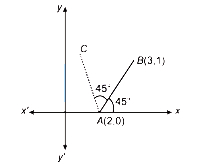
The line joining the points $A(2,0)$ and $B(3,1)$ is rotated through an angle of $45^{\circ}$ about $A$ in the anti-clockwise direction. Find the coordinates of $B$ in the new position.
A
$(2, \sqrt{2})$
B
$(\sqrt{2}, 2)$
C
$(2,2)$
D
$(\sqrt{2}, \sqrt{2})$
Solution
(A) The slope of line $AB$ is $m = \frac{1-0}{3-2} = 1$.
Since $\tan \theta = 1$,the angle that $AB$ makes with the positive $x$-axis is $\theta = 45^{\circ}$.
When the line is rotated by $45^{\circ}$ in the anti-clockwise direction about point $A$,the new angle with the positive $x$-axis becomes $45^{\circ} + 45^{\circ} = 90^{\circ}$.
The length of the segment $AB$ is $r = \sqrt{(3-2)^2 + (1-0)^2} = \sqrt{1^2 + 1^2} = \sqrt{2}$.
Let the new position of $B$ be $C(x, y)$. Since the length remains constant,$AC = AB = \sqrt{2}$.
The coordinates of $C$ are given by $(x_A + r \cos \phi, y_A + r \sin \phi)$,where $\phi = 90^{\circ}$.
$x = 2 + \sqrt{2} \cos 90^{\circ} = 2 + \sqrt{2}(0) = 2$.
$y = 0 + \sqrt{2} \sin 90^{\circ} = 0 + \sqrt{2}(1) = \sqrt{2}$.
Thus,the new coordinates are $(2, \sqrt{2})$.
Since $\tan \theta = 1$,the angle that $AB$ makes with the positive $x$-axis is $\theta = 45^{\circ}$.
When the line is rotated by $45^{\circ}$ in the anti-clockwise direction about point $A$,the new angle with the positive $x$-axis becomes $45^{\circ} + 45^{\circ} = 90^{\circ}$.
The length of the segment $AB$ is $r = \sqrt{(3-2)^2 + (1-0)^2} = \sqrt{1^2 + 1^2} = \sqrt{2}$.
Let the new position of $B$ be $C(x, y)$. Since the length remains constant,$AC = AB = \sqrt{2}$.
The coordinates of $C$ are given by $(x_A + r \cos \phi, y_A + r \sin \phi)$,where $\phi = 90^{\circ}$.
$x = 2 + \sqrt{2} \cos 90^{\circ} = 2 + \sqrt{2}(0) = 2$.
$y = 0 + \sqrt{2} \sin 90^{\circ} = 0 + \sqrt{2}(1) = \sqrt{2}$.
Thus,the new coordinates are $(2, \sqrt{2})$.
0 likesView Solution
137
ChemistryMCQTS EAMCET · 2011
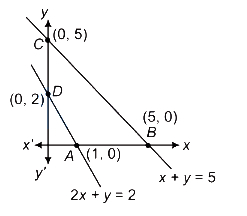
The number of points $P(x, y)$ with natural numbers as coordinates that lie inside the quadrilateral formed by the lines $2x + y = 2$,$x = 0$,$y = 0$,and $x + y = 5$ is
A
$12$
B
$10$
C
$6$
D
$4$
Solution
(C) The quadrilateral is bounded by the lines $x = 0$ ($y$-axis),$y = 0$ ($x$-axis),$2x + y = 2$,and $x + y = 5$.
For a point $(x, y)$ to be inside the quadrilateral with natural number coordinates $(x \geq 1, y \geq 1)$,it must satisfy:
$1) \ x + y < 5$
$2) \ 2x + y > 2$
Since $x, y \geq 1$,the condition $2x + y > 2$ is always satisfied for all natural numbers $(x, y)$.
Now we check the condition $x + y < 5$ for natural numbers:
If $x = 1$,then $1 + y < 5 \implies y < 4$. Possible values for $y$ are $1, 2, 3$. Points: $(1, 1), (1, 2), (1, 3)$.
If $x = 2$,then $2 + y < 5 \implies y < 3$. Possible values for $y$ are $1, 2$. Points: $(2, 1), (2, 2)$.
If $x = 3$,then $3 + y < 5 \implies y < 2$. Possible value for $y$ is $1$. Point: $(3, 1)$.
If $x = 4$,then $4 + y < 5 \implies y < 1$. No natural number $y$ exists.
Total points are $(1, 1), (1, 2), (1, 3), (2, 1), (2, 2), (3, 1)$.
There are $6$ such points.
For a point $(x, y)$ to be inside the quadrilateral with natural number coordinates $(x \geq 1, y \geq 1)$,it must satisfy:
$1) \ x + y < 5$
$2) \ 2x + y > 2$
Since $x, y \geq 1$,the condition $2x + y > 2$ is always satisfied for all natural numbers $(x, y)$.
Now we check the condition $x + y < 5$ for natural numbers:
If $x = 1$,then $1 + y < 5 \implies y < 4$. Possible values for $y$ are $1, 2, 3$. Points: $(1, 1), (1, 2), (1, 3)$.
If $x = 2$,then $2 + y < 5 \implies y < 3$. Possible values for $y$ are $1, 2$. Points: $(2, 1), (2, 2)$.
If $x = 3$,then $3 + y < 5 \implies y < 2$. Possible value for $y$ is $1$. Point: $(3, 1)$.
If $x = 4$,then $4 + y < 5 \implies y < 1$. No natural number $y$ exists.
Total points are $(1, 1), (1, 2), (1, 3), (2, 1), (2, 2), (3, 1)$.
There are $6$ such points.
0 likesView Solution
138
ChemistryMCQTS EAMCET · 2011
The image of the point $(3, 8)$ in the line $x + 3y = 7$ is
A
$(1, 4)$
B
$(4, 1)$
C
$(-1, -4)$
D
$(-4, -1)$
Solution
(C) The equation of the line perpendicular to $x + 3y = 7$ is of the form $3x - y + \lambda = 0$.
Since this line passes through $(3, 8)$,we substitute the coordinates:
$3(3) - 8 + \lambda = 0$ $\Rightarrow 9 - 8 + \lambda = 0$ $\Rightarrow \lambda = -1$.
Thus,the equation of the perpendicular line is $3x - y - 1 = 0$.
The point of intersection of $x + 3y = 7$ and $3x - y - 1 = 0$ is the foot of the perpendicular. Solving these equations:
From the second equation,$y = 3x - 1$. Substituting into the first: $x + 3(3x - 1) = 7$ $\Rightarrow x + 9x - 3 = 7$ $\Rightarrow 10x = 10$ $\Rightarrow x = 1$.
Then $y = 3(1) - 1 = 2$. So,the foot of the perpendicular is $(1, 2)$.
Let the image of the point $(3, 8)$ be $(x_1, y_1)$. Since $(1, 2)$ is the midpoint of the segment joining $(3, 8)$ and $(x_1, y_1)$:
$\frac{3 + x_1}{2} = 1$ $\Rightarrow 3 + x_1 = 2$ $\Rightarrow x_1 = -1$.
$\frac{8 + y_1}{2} = 2$ $\Rightarrow 8 + y_1 = 4$ $\Rightarrow y_1 = -4$.
Therefore,the image of the point is $(-1, -4)$.
Since this line passes through $(3, 8)$,we substitute the coordinates:
$3(3) - 8 + \lambda = 0$ $\Rightarrow 9 - 8 + \lambda = 0$ $\Rightarrow \lambda = -1$.
Thus,the equation of the perpendicular line is $3x - y - 1 = 0$.
The point of intersection of $x + 3y = 7$ and $3x - y - 1 = 0$ is the foot of the perpendicular. Solving these equations:
From the second equation,$y = 3x - 1$. Substituting into the first: $x + 3(3x - 1) = 7$ $\Rightarrow x + 9x - 3 = 7$ $\Rightarrow 10x = 10$ $\Rightarrow x = 1$.
Then $y = 3(1) - 1 = 2$. So,the foot of the perpendicular is $(1, 2)$.
Let the image of the point $(3, 8)$ be $(x_1, y_1)$. Since $(1, 2)$ is the midpoint of the segment joining $(3, 8)$ and $(x_1, y_1)$:
$\frac{3 + x_1}{2} = 1$ $\Rightarrow 3 + x_1 = 2$ $\Rightarrow x_1 = -1$.
$\frac{8 + y_1}{2} = 2$ $\Rightarrow 8 + y_1 = 4$ $\Rightarrow y_1 = -4$.
Therefore,the image of the point is $(-1, -4)$.
0 likesView Solution
139
ChemistryMCQTS EAMCET · 2011
The locus of a point such that the sum of its distances from the points $(0, 2)$ and $(0, -2)$ is $6$,is
A
$9x^2 - 5y^2 = 45$
B
$5x^2 + 9y^2 = 45$
C
$9x^2 + 5y^2 = 45$
D
$5x^2 - 9y^2 = 45$
Solution
(C) Let $P(x, y)$ be any point on the locus. According to the problem,the sum of the distances from $P$ to $F_1(0, 2)$ and $F_2(0, -2)$ is $6$.
$\sqrt{x^2 + (y - 2)^2} + \sqrt{x^2 + (y + 2)^2} = 6$
$\sqrt{x^2 + (y - 2)^2} = 6 - \sqrt{x^2 + (y + 2)^2}$
Squaring both sides:
$x^2 + (y - 2)^2 = 36 + x^2 + (y + 2)^2 - 12\sqrt{x^2 + (y + 2)^2}$
$x^2 + y^2 - 4y + 4 = 36 + x^2 + y^2 + 4y + 4 - 12\sqrt{x^2 + (y + 2)^2}$
$-8y - 36 = -12\sqrt{x^2 + (y + 2)^2}$
$2y + 9 = 3\sqrt{x^2 + (y + 2)^2}$
Squaring again:
$(2y + 9)^2 = 9(x^2 + y^2 + 4y + 4)$
$4y^2 + 36y + 81 = 9x^2 + 9y^2 + 36y + 36$
$9x^2 + 5y^2 = 45$
$\sqrt{x^2 + (y - 2)^2} + \sqrt{x^2 + (y + 2)^2} = 6$
$\sqrt{x^2 + (y - 2)^2} = 6 - \sqrt{x^2 + (y + 2)^2}$
Squaring both sides:
$x^2 + (y - 2)^2 = 36 + x^2 + (y + 2)^2 - 12\sqrt{x^2 + (y + 2)^2}$
$x^2 + y^2 - 4y + 4 = 36 + x^2 + y^2 + 4y + 4 - 12\sqrt{x^2 + (y + 2)^2}$
$-8y - 36 = -12\sqrt{x^2 + (y + 2)^2}$
$2y + 9 = 3\sqrt{x^2 + (y + 2)^2}$
Squaring again:
$(2y + 9)^2 = 9(x^2 + y^2 + 4y + 4)$
$4y^2 + 36y + 81 = 9x^2 + 9y^2 + 36y + 36$
$9x^2 + 5y^2 = 45$
0 likesView Solution
140
ChemistryMediumMCQTS EAMCET · 2011
Assertion $(A)$: Cyclohexane is the most stable cycloalkane.
Reason $(R)$: Cyclopropane and cyclobutane are less stable due to angle strain and torsional strain.
The correct answer is
Reason $(R)$: Cyclopropane and cyclobutane are less stable due to angle strain and torsional strain.
The correct answer is
A
Both $(A)$ and $(R)$ are true but $(R)$ is not the correct explanation of $(A)$.
B
$(A)$ is true but $(R)$ is not true.
C
$(A)$ is not true but $(R)$ is true.
D
Both $(A)$ and $(R)$ are true and $(R)$ is the correct explanation of $(A)$.
Solution
(D) In cycloalkanes,the heat of combustion per $CH_2$ group for cyclohexane $(657.9 \ kJ \ mol^{-1})$ is the lowest,which indicates it has the least ring strain and is the most stable cycloalkane.
Cyclopropane and cyclobutane possess significant angle strain and torsional strain,making them less stable and more reactive compared to cyclohexane.
Therefore,both $(A)$ and $(R)$ are true and $(R)$ is the correct explanation of $(A)$.
Cyclopropane and cyclobutane possess significant angle strain and torsional strain,making them less stable and more reactive compared to cyclohexane.
Therefore,both $(A)$ and $(R)$ are true and $(R)$ is the correct explanation of $(A)$.
0 likesView Solution
141
ChemistryMediumMCQTS EAMCET · 2011
Which one of the following exhibits enantiomerism?
A
$BrCH_2-CH_2-CH_2-CH_2Br$
B
$CH_3-CH(Br)-CH_2-CH_3$
C
$CH_3-CH_2-CH_2-CH_2Br$
D
$CH_3-CH_2-CBr_2-CH_3$
Solution
(B) compound exhibits enantiomerism if it contains at least one chiral center (an asymmetric carbon atom,which is bonded to four different groups).
In $CH_3-CH(Br)-CH_2-CH_3$ ($2$-bromobutane),the second carbon atom is bonded to four different groups: $-H$,$-CH_3$,$-Br$,and $-CH_2CH_3$.
Since it has a chiral center,it is optically active and exhibits enantiomerism.
The other options do not contain any chiral carbon atoms.
In $CH_3-CH(Br)-CH_2-CH_3$ ($2$-bromobutane),the second carbon atom is bonded to four different groups: $-H$,$-CH_3$,$-Br$,and $-CH_2CH_3$.
Since it has a chiral center,it is optically active and exhibits enantiomerism.
The other options do not contain any chiral carbon atoms.
0 likesView Solution
142
ChemistryDifficultMCQTS EAMCET · 2011
$0.16 \ g$ of an organic compound containing sulphur produces $0.233 \ g$ of $BaSO_4$. The percentage of sulphur in the compound is:
A
$20$
B
$80$
C
$50$
D
$10$
Solution
(A) The percentage of sulphur is calculated using the formula:
$\text{Percentage of } S = \frac{32 \times \text{weight of } BaSO_4 \times 100}{233 \times \text{weight of compound}}$
Given:
$\text{Weight of } BaSO_4 = 0.233 \ g$
$\text{Weight of compound} = 0.16 \ g$
Substituting the values:
$\text{Percentage of } S = \frac{32 \times 0.233 \times 100}{233 \times 0.16}$
$\text{Percentage of } S = \frac{32 \times 0.233 \times 100}{233 \times 0.16} = \frac{32 \times 0.233 \times 100}{233 \times 0.16} = \frac{32 \times 100}{1000 \times 0.16} = \frac{3200}{160} = 20 \%$
$\text{Percentage of } S = \frac{32 \times \text{weight of } BaSO_4 \times 100}{233 \times \text{weight of compound}}$
Given:
$\text{Weight of } BaSO_4 = 0.233 \ g$
$\text{Weight of compound} = 0.16 \ g$
Substituting the values:
$\text{Percentage of } S = \frac{32 \times 0.233 \times 100}{233 \times 0.16}$
$\text{Percentage of } S = \frac{32 \times 0.233 \times 100}{233 \times 0.16} = \frac{32 \times 0.233 \times 100}{233 \times 0.16} = \frac{32 \times 100}{1000 \times 0.16} = \frac{3200}{160} = 20 \%$
0 likesView Solution
143
ChemistryEasyMCQTS EAMCET · 2011
$C_6H_6 + 3O_3$ $\longrightarrow X \stackrel{Zn / H_2O}{}$ ${\longrightarrow} Y$; $X$ and $Y$ are respectively
A
diozonide,glycol
B
triozonide,glyoxalic acid
C
triozonide,glyoxal
D
monoozonide,oxalic acid
Solution
(C) The reaction of benzene $(C_6H_6)$ with ozone $(O_3)$ is an ozonolysis reaction.
Benzene reacts with three molecules of ozone to form benzene triozonide $(X)$.
Benzene triozonide on reductive hydrolysis with $Zn / H_2O$ yields three molecules of glyoxal $(Y)$ $(CHO-CHO)$.
Therefore,$X$ is triozonide and $Y$ is glyoxal.
Benzene reacts with three molecules of ozone to form benzene triozonide $(X)$.
Benzene triozonide on reductive hydrolysis with $Zn / H_2O$ yields three molecules of glyoxal $(Y)$ $(CHO-CHO)$.
Therefore,$X$ is triozonide and $Y$ is glyoxal.
0 likesView Solution
144
ChemistryEasyMCQTS EAMCET · 2011
Which property among the following is the same for both hydrogen and deuterium molecules?
A
Bond energy
B
Melting point
C
Boiling point
D
Bond length
Solution
(D) Both hydrogen $(H_2)$ and deuterium $(D_2)$ molecules have the same bond length of $74 \ pm$.
However, they differ in their physical and chemical properties such as bond energy, melting point, and boiling point due to the difference in their isotopic masses.
Based on the data:
- Bond length: $74 \ pm$ (Same)
- Bond energy: $436 \ kJ \ mol^{-1}$ for $H_2$ vs $443.3 \ kJ \ mol^{-1}$ for $D_2$
- Melting point: $0.00 \ ^\circ C$ for $H_2$ vs $3.81 \ ^\circ C$ for $D_2$
- Boiling point: $100.0 \ ^\circ C$ for $H_2$ vs $101.42 \ ^\circ C$ for $D_2$
Therefore, the bond length is the same.
However, they differ in their physical and chemical properties such as bond energy, melting point, and boiling point due to the difference in their isotopic masses.
Based on the data:
- Bond length: $74 \ pm$ (Same)
- Bond energy: $436 \ kJ \ mol^{-1}$ for $H_2$ vs $443.3 \ kJ \ mol^{-1}$ for $D_2$
- Melting point: $0.00 \ ^\circ C$ for $H_2$ vs $3.81 \ ^\circ C$ for $D_2$
- Boiling point: $100.0 \ ^\circ C$ for $H_2$ vs $101.42 \ ^\circ C$ for $D_2$
Therefore, the bond length is the same.
0 likesView Solution
145
ChemistryMCQTS EAMCET · 2011
If $f(x)=|x|+|sin x|$ for $x \in \left(-\frac{\pi}{2}, \frac{\pi}{2}\right)$,then its left hand derivative at $x=0$ is
A
$0$
B
$-1$
C
$-2$
D
$-3$
Solution
(C) The given function is $f(x) = |x| + |\sin x|$.
To find the left hand derivative $(LHD)$ at $x=0$,we use the definition:
$LHD = \lim_{h \to 0^+} \frac{f(0-h) - f(0)}{-h}$
Since $f(0) = |0| + |\sin 0| = 0$,we have:
$LHD = \lim_{h \to 0^+} \frac{|-h| + |\sin(-h)|}{-h}$
For small $h > 0$,$|-h| = h$ and $|\sin(-h)| = |-\sin h| = \sin h$ (since $\sin h > 0$ for $h \in (0, \pi/2)$).
$LHD = \lim_{h \to 0^+} \frac{h + \sin h}{-h}$
$LHD = \lim_{h \to 0^+} -\left( \frac{h}{h} + \frac{\sin h}{h} \right)$
$LHD = -(1 + 1) = -2$.
To find the left hand derivative $(LHD)$ at $x=0$,we use the definition:
$LHD = \lim_{h \to 0^+} \frac{f(0-h) - f(0)}{-h}$
Since $f(0) = |0| + |\sin 0| = 0$,we have:
$LHD = \lim_{h \to 0^+} \frac{|-h| + |\sin(-h)|}{-h}$
For small $h > 0$,$|-h| = h$ and $|\sin(-h)| = |-\sin h| = \sin h$ (since $\sin h > 0$ for $h \in (0, \pi/2)$).
$LHD = \lim_{h \to 0^+} \frac{h + \sin h}{-h}$
$LHD = \lim_{h \to 0^+} -\left( \frac{h}{h} + \frac{\sin h}{h} \right)$
$LHD = -(1 + 1) = -2$.
0 likesView Solution
146
ChemistryEasyMCQTS EAMCET · 2011
The $pH$ of $0.05 \ M$ acetic acid is $(K_a = 2 \times 10^{-5})$.
A
$2$
B
$11$
C
$10^{-3}$
D
$3$
Solution
(D) $CH_3COOH \rightleftharpoons H^{+} + CH_3COO^{-}$
$K_a = \frac{[H^{+}][CH_3COO^{-}]}{[CH_3COOH]} = \frac{[H^{+}]^2}{[CH_3COOH]}$
$[H^{+}] = \sqrt{K_a \times [CH_3COOH]}$
$[H^{+}] = \sqrt{2 \times 10^{-5} \times 0.05}$
$[H^{+}] = \sqrt{10^{-6}} = 10^{-3} \ M$
$pH = -\log[H^{+}]$
$pH = -\log(10^{-3}) = 3$
$K_a = \frac{[H^{+}][CH_3COO^{-}]}{[CH_3COOH]} = \frac{[H^{+}]^2}{[CH_3COOH]}$
$[H^{+}] = \sqrt{K_a \times [CH_3COOH]}$
$[H^{+}] = \sqrt{2 \times 10^{-5} \times 0.05}$
$[H^{+}] = \sqrt{10^{-6}} = 10^{-3} \ M$
$pH = -\log[H^{+}]$
$pH = -\log(10^{-3}) = 3$
0 likesView Solution
147
ChemistryMCQTS EAMCET · 2011
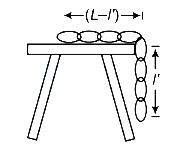
$A$ uniform chain of length $L$ is lying on a horizontal table. If the coefficient of friction between the chain and the table top is $\mu$,what is the maximum length of the chain that can hang over the edge of the table without disturbing the rest of the chain on the table?
A
$\frac{L}{(1+\mu)}$
B
$\frac{\mu L}{(1+\mu)}$
C
$\frac{L}{(1-\mu)}$
D
$\frac{\mu L}{(1-\mu)}$
Solution
(B) Let $\lambda$ be the linear mass density of the chain. The total mass of the chain is $M = \lambda L$.
Let $l'$ be the length of the chain hanging over the edge. The length of the chain on the table is $(L - l')$.
The mass of the hanging part is $m_h = \lambda l'$,and the mass of the part on the table is $m_t = \lambda (L - l')$.
The force pulling the chain down is the weight of the hanging part: $F_g = m_h g = \lambda l' g$.
The maximum static frictional force acting on the part on the table is $f_{max} = \mu N = \mu m_t g = \mu \lambda (L - l') g$.
For the chain to be on the verge of sliding,the pulling force must equal the maximum static friction:
$\lambda l' g = \mu \lambda (L - l') g$
$l' = \mu (L - l')$
$l' = \mu L - \mu l'$
$l' (1 + \mu) = \mu L$
$l' = \frac{\mu L}{(1 + \mu)}$
Let $l'$ be the length of the chain hanging over the edge. The length of the chain on the table is $(L - l')$.
The mass of the hanging part is $m_h = \lambda l'$,and the mass of the part on the table is $m_t = \lambda (L - l')$.
The force pulling the chain down is the weight of the hanging part: $F_g = m_h g = \lambda l' g$.
The maximum static frictional force acting on the part on the table is $f_{max} = \mu N = \mu m_t g = \mu \lambda (L - l') g$.
For the chain to be on the verge of sliding,the pulling force must equal the maximum static friction:
$\lambda l' g = \mu \lambda (L - l') g$
$l' = \mu (L - l')$
$l' = \mu L - \mu l'$
$l' (1 + \mu) = \mu L$
$l' = \frac{\mu L}{(1 + \mu)}$
0 likesView Solution
148
ChemistryMCQTS EAMCET · 2011
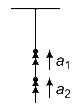
The maximum tension a rope can withstand is $60 ~kg-wt$. The ratio of maximum acceleration with which two boys of masses $20 ~kg$ and $30 ~kg$ can climb up the rope at the same time is
A
$1$ : $2$
B
$2$ : $1$
C
$4$ : $3$
D
$3$ : $2$
Solution
(D) Let the maximum tension in the rope be $T = 60 ~kg-wt = 60g ~N$. The two boys have masses $m_1 = 20 ~kg$ and $m_2 = 30 ~kg$. Let their accelerations be $a_1$ and $a_2$ respectively.
The total force exerted on the rope is the sum of the forces exerted by each boy: $T = m_1(g + a_1) + m_2(g + a_2)$.
Substituting the given values: $60g = 20(g + a_1) + 30(g + a_2)$.
$60g = 20g + 20a_1 + 30g + 30a_2$.
$60g = 50g + 20a_1 + 30a_2$.
$10g = 20a_1 + 30a_2$.
Dividing by $10$,we get $g = 2a_1 + 3a_2$.
To find the ratio of maximum accelerations,we consider the individual limits. If boy $1$ climbs with maximum acceleration $a_1$,then $a_2 = 0$,so $g = 2a_1 \Rightarrow a_1 = g/2$. If boy $2$ climbs with maximum acceleration $a_2$,then $a_1 = 0$,so $g = 3a_2 \Rightarrow a_2 = g/3$.
The ratio of their maximum possible accelerations is $a_1 : a_2 = (g/2) : (g/3) = 3 : 2$.
The total force exerted on the rope is the sum of the forces exerted by each boy: $T = m_1(g + a_1) + m_2(g + a_2)$.
Substituting the given values: $60g = 20(g + a_1) + 30(g + a_2)$.
$60g = 20g + 20a_1 + 30g + 30a_2$.
$60g = 50g + 20a_1 + 30a_2$.
$10g = 20a_1 + 30a_2$.
Dividing by $10$,we get $g = 2a_1 + 3a_2$.
To find the ratio of maximum accelerations,we consider the individual limits. If boy $1$ climbs with maximum acceleration $a_1$,then $a_2 = 0$,so $g = 2a_1 \Rightarrow a_1 = g/2$. If boy $2$ climbs with maximum acceleration $a_2$,then $a_1 = 0$,so $g = 3a_2 \Rightarrow a_2 = g/3$.
The ratio of their maximum possible accelerations is $a_1 : a_2 = (g/2) : (g/3) = 3 : 2$.
0 likesView Solution
149
ChemistryMCQTS EAMCET · 2011
If the distance $s$ travelled by a particle in time $t$ is given by $s=t^2-2t+5$,then its acceleration is
A
$0$
B
$1$
C
$2$
D
$3$
Solution
(C) Given the distance function $s = t^2 - 2t + 5$.
Velocity $v$ is the first derivative of displacement with respect to time: $v = \frac{ds}{dt} = \frac{d}{dt}(t^2 - 2t + 5) = 2t - 2$.
Acceleration $a$ is the derivative of velocity with respect to time: $a = \frac{dv}{dt} = \frac{d}{dt}(2t - 2) = 2$.
Thus,the acceleration of the particle is $2$ units.
Velocity $v$ is the first derivative of displacement with respect to time: $v = \frac{ds}{dt} = \frac{d}{dt}(t^2 - 2t + 5) = 2t - 2$.
Acceleration $a$ is the derivative of velocity with respect to time: $a = \frac{dv}{dt} = \frac{d}{dt}(2t - 2) = 2$.
Thus,the acceleration of the particle is $2$ units.
0 likesView Solution
150
ChemistryMCQTS EAMCET · 2011
If $\int \frac{\sin^8 x - \cos^8 x}{1 - 2 \sin^2 x \cos^2 x} dx = A \sin 2x + B$,then $A$ is equal to
A
$-\frac{1}{2}$
B
$-1$
C
$\frac{1}{2}$
D
$1$
Solution
(A) Let $I = \int \frac{\sin^8 x - \cos^8 x}{1 - 2 \sin^2 x \cos^2 x} dx$.
We know that $\sin^8 x - \cos^8 x = (\sin^4 x - \cos^4 x)(\sin^4 x + \cos^4 x)$.
Also,$\sin^4 x + \cos^4 x = (\sin^2 x + \cos^2 x)^2 - 2 \sin^2 x \cos^2 x = 1 - 2 \sin^2 x \cos^2 x$.
Substituting this into the integral:
$I = \int \frac{(\sin^4 x - \cos^4 x)(1 - 2 \sin^2 x \cos^2 x)}{1 - 2 \sin^2 x \cos^2 x} dx$.
$I = \int (\sin^4 x - \cos^4 x) dx$.
Since $\sin^4 x - \cos^4 x = (\sin^2 x - \cos^2 x)(\sin^2 x + \cos^2 x) = -\cos 2x$.
$I = \int -\cos 2x dx = -\frac{\sin 2x}{2} + B$.
Comparing this with $I = A \sin 2x + B$,we get $A = -\frac{1}{2}$.
We know that $\sin^8 x - \cos^8 x = (\sin^4 x - \cos^4 x)(\sin^4 x + \cos^4 x)$.
Also,$\sin^4 x + \cos^4 x = (\sin^2 x + \cos^2 x)^2 - 2 \sin^2 x \cos^2 x = 1 - 2 \sin^2 x \cos^2 x$.
Substituting this into the integral:
$I = \int \frac{(\sin^4 x - \cos^4 x)(1 - 2 \sin^2 x \cos^2 x)}{1 - 2 \sin^2 x \cos^2 x} dx$.
$I = \int (\sin^4 x - \cos^4 x) dx$.
Since $\sin^4 x - \cos^4 x = (\sin^2 x - \cos^2 x)(\sin^2 x + \cos^2 x) = -\cos 2x$.
$I = \int -\cos 2x dx = -\frac{\sin 2x}{2} + B$.
Comparing this with $I = A \sin 2x + B$,we get $A = -\frac{1}{2}$.
0 likesView Solution
Vedclass Products
For Students
Vedclass Test Series
Mock tests in real TS EAMCET style covering Chemistry with performance analysis. 5-day free trial.
Start Free TrialFor Teachers
Exam Paper Generator
Generate Set A/B/C/D Chemistry papers from 7.5L+ questions in 2 minutes. 3 chapters free.
Try FreeFor Institutes
Online Exam Module
Run live TS EAMCET mock exams with unlimited students, 360° analytics & white-label branding.
See DemoFrequently Asked Questions
How many Chemistry questions are in TS EAMCET 2011?
There are 188 Chemistry questions from the TS EAMCET 2011 paper on Vedclass, each with a detailed step-by-step solution in English.
Are TS EAMCET 2011 Chemistry solutions available in English?
Yes. All solutions on this page are in English. You can also switch to English or Hindi using the language buttons above the questions.
Can I practice TS EAMCET 2011 Chemistry as a timed test?
Yes. Use the Vedclass Test Series to attempt a full TS EAMCET mock test covering Chemistry with time limits and instant score analysis.
Can teachers create Chemistry papers from TS EAMCET previous year questions?
Yes. The Vedclass Exam Paper Generator lets teachers mix TS EAMCET Chemistry questions and generate Set A/B/C/D papers in minutes.
For Teachers & Institutes
Build a Custom Chemistry Paper
Pick TS EAMCET 2011 Chemistry questions, set difficulty, and generate Set A/B/C/D in 2 minutes.