
PhysicsQ1–44 of 44 questions
Page 1 of 1 · English
1
PhysicsMediumMCQTS EAMCET · 2011
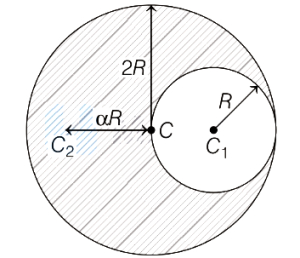
$A$ circular disc of radius $R$ is removed from one end of a bigger circular disc of radius $2R$. The centre of mass of the new disc is at a distance $\alpha R$ from the centre of the bigger disc. The value of $\alpha$ is
A
$\frac{1}{2}$
B
$\frac{1}{3}$
C
$\frac{1}{4}$
D
$\frac{1}{6}$
Solution
(B) Let the mass of the entire disc be $M$.
The mass per unit area is $\sigma = \frac{M}{\pi(2R)^2} = \frac{M}{4\pi R^2}$.
The mass of the removed circular disc of radius $R$ is $M_1 = \sigma \cdot \pi R^2 = \frac{M}{4\pi R^2} \cdot \pi R^2 = \frac{M}{4}$.
The mass of the remaining disc is $M_2 = M - M_1 = M - \frac{M}{4} = \frac{3M}{4}$.
Let the centre of the bigger disc be the origin $(0,0)$. The centre of mass of the removed disc is at $x_1 = R$ and the centre of mass of the remaining disc is at $x_2 = -\alpha R$.
Since the centre of mass of the original disc was at the origin,we have:
$M_1 x_1 + M_2 x_2 = 0$
$\frac{M}{4} \cdot R + \frac{3M}{4} \cdot (-\alpha R) = 0$
$\frac{M}{4} \cdot R = \frac{3M}{4} \cdot \alpha R$
$\alpha = \frac{1}{3}$.
The mass per unit area is $\sigma = \frac{M}{\pi(2R)^2} = \frac{M}{4\pi R^2}$.
The mass of the removed circular disc of radius $R$ is $M_1 = \sigma \cdot \pi R^2 = \frac{M}{4\pi R^2} \cdot \pi R^2 = \frac{M}{4}$.
The mass of the remaining disc is $M_2 = M - M_1 = M - \frac{M}{4} = \frac{3M}{4}$.
Let the centre of the bigger disc be the origin $(0,0)$. The centre of mass of the removed disc is at $x_1 = R$ and the centre of mass of the remaining disc is at $x_2 = -\alpha R$.
Since the centre of mass of the original disc was at the origin,we have:
$M_1 x_1 + M_2 x_2 = 0$
$\frac{M}{4} \cdot R + \frac{3M}{4} \cdot (-\alpha R) = 0$
$\frac{M}{4} \cdot R = \frac{3M}{4} \cdot \alpha R$
$\alpha = \frac{1}{3}$.
0 likesView Solution
2
PhysicsDifficultMCQTS EAMCET · 2011
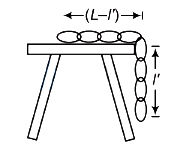
$A$ uniform chain of length $L$ is lying on a horizontal table. If the coefficient of friction between the chain and the table top is $\mu$,what is the maximum length of the chain that can hang over the edge of the table without disturbing the rest of the chain on the table?
A
$\frac{L}{(1+\mu)}$
B
$\frac{\mu L}{(1+\mu)}$
C
$\frac{L}{(1-\mu)}$
D
$\frac{\mu L}{(1-\mu)}$
Solution
(B) Let $\lambda$ be the linear mass density of the chain. The total length of the chain is $L$. Let $l^{\prime}$ be the length of the chain hanging over the edge.
Then,the length of the chain remaining on the table is $(L - l^{\prime})$.
The mass of the hanging part is $m_h = \lambda l^{\prime}$,and the mass of the part on the table is $m_t = \lambda (L - l^{\prime})$.
The force pulling the chain down is the weight of the hanging part: $F_g = m_h g = \lambda l^{\prime} g$.
The maximum static frictional force acting on the part on the table is $f_{max} = \mu N = \mu m_t g = \mu \lambda (L - l^{\prime}) g$.
For the chain to be in equilibrium,the pulling force must be equal to the maximum frictional force:
$\lambda l^{\prime} g = \mu \lambda (L - l^{\prime}) g$
$l^{\prime} = \mu (L - l^{\prime})$
$l^{\prime} = \mu L - \mu l^{\prime}$
$l^{\prime} (1 + \mu) = \mu L$
$l^{\prime} = \frac{\mu L}{(1 + \mu)}$
Then,the length of the chain remaining on the table is $(L - l^{\prime})$.
The mass of the hanging part is $m_h = \lambda l^{\prime}$,and the mass of the part on the table is $m_t = \lambda (L - l^{\prime})$.
The force pulling the chain down is the weight of the hanging part: $F_g = m_h g = \lambda l^{\prime} g$.
The maximum static frictional force acting on the part on the table is $f_{max} = \mu N = \mu m_t g = \mu \lambda (L - l^{\prime}) g$.
For the chain to be in equilibrium,the pulling force must be equal to the maximum frictional force:
$\lambda l^{\prime} g = \mu \lambda (L - l^{\prime}) g$
$l^{\prime} = \mu (L - l^{\prime})$
$l^{\prime} = \mu L - \mu l^{\prime}$
$l^{\prime} (1 + \mu) = \mu L$
$l^{\prime} = \frac{\mu L}{(1 + \mu)}$
0 likesView Solution
3
PhysicsDifficultMCQTS EAMCET · 2011
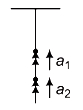
The maximum tension a rope can withstand is $60 \,kg$-wt. The ratio of maximum acceleration with which two boys of masses $20 \,kg$ and $30 \,kg$ can climb up the rope at the same time is
A
$1$ : $2$
B
$2$ : $1$
C
$4$ : $3$
D
$3$ : $2$
Solution
(B) Let the maximum accelerations of the two boys be $a_1$ and $a_2$ respectively.
The total tension $T$ in the rope must not exceed $60 \,kg$-wt.
The equation of motion for the two boys climbing up is:
$T = m_1(g + a_1) + m_2(g + a_2)$
Given $T = 60 \,kg$-wt,$m_1 = 20 \,kg$,and $m_2 = 30 \,kg$:
$60g = 20(g + a_1) + 30(g + a_2)$
$60g = 20g + 20a_1 + 30g + 30a_2$
$60g = 50g + 20a_1 + 30a_2$
$10g = 20a_1 + 30a_2$
Dividing by $10$:
$g = 2a_1 + 3a_2$
To find the ratio of maximum accelerations,we consider the individual limits for each boy. If only one boy were climbing,the maximum acceleration would be $a = (T/m) - g$. For boy $1$: $a_{1,max} = (60/20)g - g = 2g$. For boy $2$: $a_{2,max} = (60/30)g - g = g$.
However,the question asks for the ratio of accelerations when they climb together. Assuming they climb with the same acceleration $a$ to find the limit,$g = 2a + 3a = 5a \Rightarrow a = g/5$. If we look for the ratio of their individual maximum possible accelerations,it is $2g : g = 2 : 1$. Given the options,the intended ratio is $a_1 : a_2 = 2 : 1$.
The total tension $T$ in the rope must not exceed $60 \,kg$-wt.
The equation of motion for the two boys climbing up is:
$T = m_1(g + a_1) + m_2(g + a_2)$
Given $T = 60 \,kg$-wt,$m_1 = 20 \,kg$,and $m_2 = 30 \,kg$:
$60g = 20(g + a_1) + 30(g + a_2)$
$60g = 20g + 20a_1 + 30g + 30a_2$
$60g = 50g + 20a_1 + 30a_2$
$10g = 20a_1 + 30a_2$
Dividing by $10$:
$g = 2a_1 + 3a_2$
To find the ratio of maximum accelerations,we consider the individual limits for each boy. If only one boy were climbing,the maximum acceleration would be $a = (T/m) - g$. For boy $1$: $a_{1,max} = (60/20)g - g = 2g$. For boy $2$: $a_{2,max} = (60/30)g - g = g$.
However,the question asks for the ratio of accelerations when they climb together. Assuming they climb with the same acceleration $a$ to find the limit,$g = 2a + 3a = 5a \Rightarrow a = g/5$. If we look for the ratio of their individual maximum possible accelerations,it is $2g : g = 2 : 1$. Given the options,the intended ratio is $a_1 : a_2 = 2 : 1$.
0 likesView Solution
4
PhysicsDifficultMCQTS EAMCET · 2011
$A$ certain vector in the $xy$-plane has an $x$-component of $4 \,m$ and a $y$-component of $10 \,m$. It is then rotated in the $xy$-plane so that its $x$-component is doubled. Then its new $y$-component is (approximately) (in $\,m$)
A
$20$
B
$7.2$
C
$5.0$
D
$4.5$
Solution
(B) The initial vector is $\vec{A} = 4\hat{i} + 10\hat{j}$.
The magnitude of the vector is $|\vec{A}| = \sqrt{(4)^2 + (10)^2} = \sqrt{16 + 100} = \sqrt{116} \,m$.
When the vector is rotated, its magnitude remains constant.
Let the new vector be $\vec{A}' = 8\hat{i} + n\hat{j}$, where the $x$-component is doubled $(4 \times 2 = 8)$.
Since the magnitude is conserved, $|\vec{A}'| = |\vec{A}|$.
$\sqrt{8^2 + n^2} = \sqrt{116}$.
Squaring both sides, we get $64 + n^2 = 116$.
$n^2 = 116 - 64 = 52$.
$n = \sqrt{52} \approx 7.21 \,m$.
Thus, the new $y$-component is approximately $7.2 \,m$.
The magnitude of the vector is $|\vec{A}| = \sqrt{(4)^2 + (10)^2} = \sqrt{16 + 100} = \sqrt{116} \,m$.
When the vector is rotated, its magnitude remains constant.
Let the new vector be $\vec{A}' = 8\hat{i} + n\hat{j}$, where the $x$-component is doubled $(4 \times 2 = 8)$.
Since the magnitude is conserved, $|\vec{A}'| = |\vec{A}|$.
$\sqrt{8^2 + n^2} = \sqrt{116}$.
Squaring both sides, we get $64 + n^2 = 116$.
$n^2 = 116 - 64 = 52$.
$n = \sqrt{52} \approx 7.21 \,m$.
Thus, the new $y$-component is approximately $7.2 \,m$.
0 likesView Solution
5
PhysicsMediumMCQTS EAMCET · 2011
$A$ non-conducting body floats in a liquid at $20^{\circ} C$ with $\frac{2}{3}$ of its volume immersed in the liquid. When the liquid temperature is increased to $100^{\circ} C$,$\frac{3}{4}$ of the body's volume is immersed in the liquid. Then the coefficient of real expansion of the liquid is (neglecting the expansion of the container of the liquid):
A
$15.6 \times 10^{-4} {}^{\circ} C^{-1}$
B
$156 \times 10^{-4} {}^{\circ} C^{-1}$
C
$1.56 \times 10^{-4} {}^{\circ} C^{-1}$
D
$0.156 \times 10^{4} {}^{\circ} C^{-1}$
Solution
(A) Let $V$ be the volume of the body and $\rho_b$ be its density. Let $\rho_1$ and $\rho_2$ be the densities of the liquid at $20^{\circ} C$ and $100^{\circ} C$ respectively.
By the law of flotation,the weight of the body equals the weight of the displaced liquid.
At $20^{\circ} C$: $V \rho_b g = (\frac{2}{3} V) \rho_1 g \implies \rho_b = \frac{2}{3} \rho_1$.
At $100^{\circ} C$: $V \rho_b g = (\frac{3}{4} V) \rho_2 g \implies \rho_b = \frac{3}{4} \rho_2$.
Equating the two expressions for $\rho_b$: $\frac{2}{3} \rho_1 = \frac{3}{4} \rho_2 \implies \frac{\rho_1}{\rho_2} = \frac{9}{8}$.
Since density $\rho = \frac{\rho_0}{1 + \gamma \Delta t}$,we have $\frac{\rho_1}{\rho_2} = \frac{1 + \gamma \Delta t_2}{1 + \gamma \Delta t_1} = 1 + \gamma \Delta T$ (where $\Delta T = 80^{\circ} C$).
$1 + \gamma (80) = \frac{9}{8} \implies 80 \gamma = \frac{1}{8} \implies \gamma = \frac{1}{640} = 0.0015625 {}^{\circ} C^{-1}$.
$\gamma = 15.6 \times 10^{-4} {}^{\circ} C^{-1}$.
By the law of flotation,the weight of the body equals the weight of the displaced liquid.
At $20^{\circ} C$: $V \rho_b g = (\frac{2}{3} V) \rho_1 g \implies \rho_b = \frac{2}{3} \rho_1$.
At $100^{\circ} C$: $V \rho_b g = (\frac{3}{4} V) \rho_2 g \implies \rho_b = \frac{3}{4} \rho_2$.
Equating the two expressions for $\rho_b$: $\frac{2}{3} \rho_1 = \frac{3}{4} \rho_2 \implies \frac{\rho_1}{\rho_2} = \frac{9}{8}$.
Since density $\rho = \frac{\rho_0}{1 + \gamma \Delta t}$,we have $\frac{\rho_1}{\rho_2} = \frac{1 + \gamma \Delta t_2}{1 + \gamma \Delta t_1} = 1 + \gamma \Delta T$ (where $\Delta T = 80^{\circ} C$).
$1 + \gamma (80) = \frac{9}{8} \implies 80 \gamma = \frac{1}{8} \implies \gamma = \frac{1}{640} = 0.0015625 {}^{\circ} C^{-1}$.
$\gamma = 15.6 \times 10^{-4} {}^{\circ} C^{-1}$.
0 likesView Solution
6
PhysicsEasyMCQTS EAMCET · 2011
If two soap bubbles of different radii are connected by a tube,then
A
air flows from bigger bubble to the smaller bubble till sizes become equal
B
air flows from bigger bubble to the smaller bubble till sizes are interchanged
C
air flows from smaller bubble to bigger
D
there is no flow of air
Solution
(C) The excess pressure inside a soap bubble is given by $P = \frac{4T}{r}$,where $T$ is the surface tension and $r$ is the radius of the bubble.
Since the excess pressure is inversely proportional to the radius $(P \propto \frac{1}{r})$,the smaller bubble has a higher internal pressure compared to the larger bubble.
When connected by a tube,air flows from the region of higher pressure to the region of lower pressure.
Therefore,air flows from the smaller bubble to the larger bubble.
Since the excess pressure is inversely proportional to the radius $(P \propto \frac{1}{r})$,the smaller bubble has a higher internal pressure compared to the larger bubble.
When connected by a tube,air flows from the region of higher pressure to the region of lower pressure.
Therefore,air flows from the smaller bubble to the larger bubble.
0 likesView Solution
7
PhysicsDifficultMCQTS EAMCET · 2011
$A$ ball is let fall from a height $h_0$. It makes $n$ collisions with the earth. After $n$ collisions it rebounds with a velocity $v_n$ and the ball rises to a height $h_n$,then the coefficient of restitution is given by
A
$e=\left[\frac{h_n}{h_0}\right]^{1 / 2 n}$
B
$e=\left[\frac{h_0}{h_n}\right]^{1 / 2 n}$
C
$e=\frac{1}{n} \sqrt{\frac{h_n}{h_0}}$
D
$e=\frac{1}{n} \sqrt{\frac{h_0}{h_n}}$
Solution
(A) The velocity of the ball just before the first impact is $v_0 = \sqrt{2gh_0}$.
After the first collision,the velocity is $v_1 = e v_0$.
After the second collision,the velocity is $v_2 = e v_1 = e^2 v_0$.
Following this pattern,after $n$ collisions,the velocity of the ball is $v_n = e^n v_0$.
The height $h_n$ reached after the $n$th rebound is given by $h_n = \frac{v_n^2}{2g}$.
Substituting $v_n = e^n v_0$,we get $h_n = \frac{(e^n v_0)^2}{2g} = e^{2n} \frac{v_0^2}{2g}$.
Since $h_0 = \frac{v_0^2}{2g}$,we have $h_n = e^{2n} h_0$.
Rearranging for $e$,we get $e^{2n} = \frac{h_n}{h_0}$,which implies $e = \left[\frac{h_n}{h_0}\right]^{1/2n}$.
After the first collision,the velocity is $v_1 = e v_0$.
After the second collision,the velocity is $v_2 = e v_1 = e^2 v_0$.
Following this pattern,after $n$ collisions,the velocity of the ball is $v_n = e^n v_0$.
The height $h_n$ reached after the $n$th rebound is given by $h_n = \frac{v_n^2}{2g}$.
Substituting $v_n = e^n v_0$,we get $h_n = \frac{(e^n v_0)^2}{2g} = e^{2n} \frac{v_0^2}{2g}$.
Since $h_0 = \frac{v_0^2}{2g}$,we have $h_n = e^{2n} h_0$.
Rearranging for $e$,we get $e^{2n} = \frac{h_n}{h_0}$,which implies $e = \left[\frac{h_n}{h_0}\right]^{1/2n}$.
0 likesView Solution
8
PhysicsEasyMCQTS EAMCET · 2011
Assertion $A$: An astronaut inside a massive spaceship orbiting around the Earth will experience a finite but small gravitational force.
Reason $R$: The centripetal force necessary to keep the spaceship in orbit around the Earth is provided by the gravitational force between the Earth and the spaceship.
Reason $R$: The centripetal force necessary to keep the spaceship in orbit around the Earth is provided by the gravitational force between the Earth and the spaceship.
A
Both $(A)$ and $(R)$ are true and $(R)$ is the correct explanation of $(A)$
B
Both $(A)$ and $(R)$ are true and $(R)$ is not the correct explanation of $(A)$
C
$(A)$ is true but $(R)$ is not true
D
$(A)$ is not true but $(R)$ is true
Solution
(D) The gravitational force acting on the astronaut is $F = G \frac{Mm}{r^2}$,which is finite and non-zero. However,the astronaut is in a state of free fall along with the spaceship. In the frame of reference of the spaceship,the gravitational force is balanced by the pseudo-force (centrifugal force),leading to a state of weightlessness. Therefore,the astronaut does not 'experience' any gravitational force (the effective weight is zero). Thus,Assertion $(A)$ is false.
Reason $(R)$ is a standard physical fact describing the orbital motion of satellites,which is true.
Reason $(R)$ is a standard physical fact describing the orbital motion of satellites,which is true.
0 likesView Solution
9
PhysicsDifficultMCQTS EAMCET · 2011
$A$ thin hollow sphere of mass $m$ is completely filled with a liquid of mass $m$. When the sphere rolls with a velocity $v$,the kinetic energy of the system is (neglect friction):
A
$\frac{1}{2} m v^2$
B
$m v^2$
C
$\frac{4}{3} m v^2$
D
$\frac{4}{5} m v^2$
Solution
(C) The total mass of the system is $M = m + m = 2m$.
Since the sphere is rolling,the total kinetic energy is the sum of translational kinetic energy and rotational kinetic energy.
Translational kinetic energy $K_t = \frac{1}{2} M v^2 = \frac{1}{2} (2m) v^2 = m v^2$.
For a hollow sphere filled with liquid,the liquid does not rotate with the sphere (assuming non-viscous liquid). Thus,only the shell rotates. The moment of inertia of a thin hollow sphere is $I = \frac{2}{3} m r^2$.
Rotational kinetic energy $K_r = \frac{1}{2} I \omega^2 = \frac{1}{2} (\frac{2}{3} m r^2) (\frac{v}{r})^2 = \frac{1}{3} m v^2$.
Total kinetic energy $K = K_t + K_r = m v^2 + \frac{1}{3} m v^2 = \frac{4}{3} m v^2$.
Since the sphere is rolling,the total kinetic energy is the sum of translational kinetic energy and rotational kinetic energy.
Translational kinetic energy $K_t = \frac{1}{2} M v^2 = \frac{1}{2} (2m) v^2 = m v^2$.
For a hollow sphere filled with liquid,the liquid does not rotate with the sphere (assuming non-viscous liquid). Thus,only the shell rotates. The moment of inertia of a thin hollow sphere is $I = \frac{2}{3} m r^2$.
Rotational kinetic energy $K_r = \frac{1}{2} I \omega^2 = \frac{1}{2} (\frac{2}{3} m r^2) (\frac{v}{r})^2 = \frac{1}{3} m v^2$.
Total kinetic energy $K = K_t + K_r = m v^2 + \frac{1}{3} m v^2 = \frac{4}{3} m v^2$.
0 likesView Solution
10
PhysicsDifficultMCQTS EAMCET · 2011
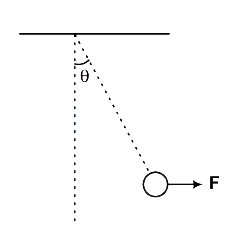
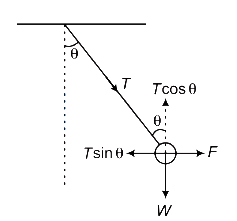
$A$ $1 \text{ N}$ pendulum bob is held at an angle $\theta$ from the vertical by a $2 \text{ N}$ horizontal force $F$ as shown in the figure. The tension in the string supporting the pendulum bob (in newton) is
A
$\cos \theta$
B
$\frac{2}{\cos \theta}$
C
$\sqrt{5}$
D
$1$
Solution
(C) The pendulum bob is in equilibrium under the action of three forces: the tension $T$ in the string,the horizontal force $F = 2 \text{ N}$,and the weight $W = 1 \text{ N}$ acting vertically downwards.
Resolving the tension $T$ into horizontal and vertical components:
Horizontal component: $T \sin \theta = F = 2 \text{ N}$
Vertical component: $T \cos \theta = W = 1 \text{ N}$
Squaring and adding both equations:
$(T \sin \theta)^2 + (T \cos \theta)^2 = F^2 + W^2$
$T^2 (\sin^2 \theta + \cos^2 \theta) = F^2 + W^2$
$T^2 = F^2 + W^2$
$T = \sqrt{F^2 + W^2} = \sqrt{2^2 + 1^2} = \sqrt{4 + 1} = \sqrt{5} \text{ N}$
Resolving the tension $T$ into horizontal and vertical components:
Horizontal component: $T \sin \theta = F = 2 \text{ N}$
Vertical component: $T \cos \theta = W = 1 \text{ N}$
Squaring and adding both equations:
$(T \sin \theta)^2 + (T \cos \theta)^2 = F^2 + W^2$
$T^2 (\sin^2 \theta + \cos^2 \theta) = F^2 + W^2$
$T^2 = F^2 + W^2$
$T = \sqrt{F^2 + W^2} = \sqrt{2^2 + 1^2} = \sqrt{4 + 1} = \sqrt{5} \text{ N}$
0 likesView Solution
11
PhysicsDifficultMCQTS EAMCET · 2011
$A$ large open tank has two holes in the wall. One is a square hole of side $L$ at a depth $y$ from the top and the other is a circular hole of radius $R$ at a depth $4y$ from the top. When the tank is completely filled with water,the quantities of water flowing out per second from the two holes are the same. Then the value of $R$ is
A
$\frac{L}{\sqrt{2 \pi}}$
B
$2 \pi L$
C
$L \sqrt{\frac{2}{\pi}}$
D
$\frac{L}{2 \pi}$
Solution
(A) The volume flow rate (quantity of water per second) is given by $Q = A v$,where $A$ is the area of the hole and $v$ is the velocity of efflux.
According to Torricelli's law,the velocity of efflux at a depth $h$ is $v = \sqrt{2gh}$.
For the square hole: Area $A_1 = L^2$ and depth $h_1 = y$. So,$v_1 = \sqrt{2gy}$.
The flow rate $Q_1 = A_1 v_1 = L^2 \sqrt{2gy}$.
For the circular hole: Area $A_2 = \pi R^2$ and depth $h_2 = 4y$. So,$v_2 = \sqrt{2g(4y)} = 2\sqrt{2gy}$.
The flow rate $Q_2 = A_2 v_2 = \pi R^2 (2\sqrt{2gy})$.
Given that $Q_1 = Q_2$,we have:
$L^2 \sqrt{2gy} = 2\pi R^2 \sqrt{2gy}$.
Canceling $\sqrt{2gy}$ from both sides,we get $L^2 = 2\pi R^2$.
Therefore,$R^2 = \frac{L^2}{2\pi}$,which gives $R = \frac{L}{\sqrt{2\pi}}$.
According to Torricelli's law,the velocity of efflux at a depth $h$ is $v = \sqrt{2gh}$.
For the square hole: Area $A_1 = L^2$ and depth $h_1 = y$. So,$v_1 = \sqrt{2gy}$.
The flow rate $Q_1 = A_1 v_1 = L^2 \sqrt{2gy}$.
For the circular hole: Area $A_2 = \pi R^2$ and depth $h_2 = 4y$. So,$v_2 = \sqrt{2g(4y)} = 2\sqrt{2gy}$.
The flow rate $Q_2 = A_2 v_2 = \pi R^2 (2\sqrt{2gy})$.
Given that $Q_1 = Q_2$,we have:
$L^2 \sqrt{2gy} = 2\pi R^2 \sqrt{2gy}$.
Canceling $\sqrt{2gy}$ from both sides,we get $L^2 = 2\pi R^2$.
Therefore,$R^2 = \frac{L^2}{2\pi}$,which gives $R = \frac{L}{\sqrt{2\pi}}$.
0 likesView Solution
12
PhysicsDifficultMCQTS EAMCET · 2011
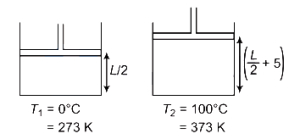
An insulated cylindrical vessel is fitted with an insulated piston of negligible weight and negligible thickness at the midpoint of the vessel. The cylinder contains a gas at $0^{\circ} C$. When the gas is heated to $100^{\circ} C$, the piston moves through a length of $5 \, cm$. The length of the cylindrical vessel in $cm$ is:
A
$13.65$
B
$27.3$
C
$38.6$
D
$64.6$
Solution
(B) Let the total length of the cylinder be $L$. Initially, the piston is at the midpoint, so the length of the gas column is $L_1 = L/2$. The initial temperature is $T_1 = 0^{\circ} C = 273 \, K$.
When the gas is heated to $T_2 = 100^{\circ} C = 373 \, K$, the piston moves by $5 \, cm$. The new length of the gas column is $L_2 = (L/2) + 5$.
Assuming the pressure remains constant (as the piston is weightless and moves freely), we use Charles's Law: $\frac{V_1}{T_1} = \frac{V_2}{T_2}$.
Since the cross-sectional area $A$ is constant, $V = A \times \text{length}$, so $\frac{L_1}{T_1} = \frac{L_2}{T_2}$.
Substituting the values: $\frac{L/2}{273} = \frac{(L/2) + 5}{373}$.
$373(L/2) = 273(L/2 + 5)$.
$373(L/2) = 273(L/2) + 273 \times 5$.
$(373 - 273)(L/2) = 273 \times 5$.
$100(L/2) = 1365$.
$L/2 = 13.65$.
$L = 27.3 \, cm$.
When the gas is heated to $T_2 = 100^{\circ} C = 373 \, K$, the piston moves by $5 \, cm$. The new length of the gas column is $L_2 = (L/2) + 5$.
Assuming the pressure remains constant (as the piston is weightless and moves freely), we use Charles's Law: $\frac{V_1}{T_1} = \frac{V_2}{T_2}$.
Since the cross-sectional area $A$ is constant, $V = A \times \text{length}$, so $\frac{L_1}{T_1} = \frac{L_2}{T_2}$.
Substituting the values: $\frac{L/2}{273} = \frac{(L/2) + 5}{373}$.
$373(L/2) = 273(L/2 + 5)$.
$373(L/2) = 273(L/2) + 273 \times 5$.
$(373 - 273)(L/2) = 273 \times 5$.
$100(L/2) = 1365$.
$L/2 = 13.65$.
$L = 27.3 \, cm$.
0 likesView Solution
13
PhysicsMediumMCQTS EAMCET · 2011
Two blocks of masses $1 \,kg$ and $2 \,kg$ are connected by a metal wire going over a smooth pulley. The breaking stress of metal is $\frac{40}{3 \pi} \times 10^6 \,N m^{-2}$. What should be the minimum radius of the wire used if it should not break (in $mm$)? $(g = 10 \,m s^{-2})$
A
$0.5$
B
$1$
C
$1.5$
D
$2$
Solution
(B) First, calculate the tension $T$ in the wire. For a system of two blocks connected by a string over a pulley, the acceleration $a$ is given by $a = \frac{(m_2 - m_1)g}{m_1 + m_2} = \frac{(2 - 1)10}{2 + 1} = \frac{10}{3} \,m s^{-2}$.
The tension $T$ in the wire is $T = m_1(g + a) = 1(10 + \frac{10}{3}) = \frac{40}{3} \,N$.
The breaking stress is defined as $\sigma = \frac{T}{A}$, where $A = \pi r^2$ is the cross-sectional area.
Given $\sigma = \frac{40}{3 \pi} \times 10^6 \,N m^{-2}$.
Equating the two: $\frac{40}{3 \pi} \times 10^6 = \frac{40/3}{\pi r^2}$.
Simplifying: $\frac{40}{3 \pi} \times 10^6 = \frac{40}{3 \pi r^2}$.
Thus, $10^6 = \frac{1}{r^2}$, which implies $r^2 = 10^{-6} \,m^2$.
Therefore, $r = 10^{-3} \,m = 1 \,mm$.
The tension $T$ in the wire is $T = m_1(g + a) = 1(10 + \frac{10}{3}) = \frac{40}{3} \,N$.
The breaking stress is defined as $\sigma = \frac{T}{A}$, where $A = \pi r^2$ is the cross-sectional area.
Given $\sigma = \frac{40}{3 \pi} \times 10^6 \,N m^{-2}$.
Equating the two: $\frac{40}{3 \pi} \times 10^6 = \frac{40/3}{\pi r^2}$.
Simplifying: $\frac{40}{3 \pi} \times 10^6 = \frac{40}{3 \pi r^2}$.
Thus, $10^6 = \frac{1}{r^2}$, which implies $r^2 = 10^{-6} \,m^2$.
Therefore, $r = 10^{-3} \,m = 1 \,mm$.
0 likesView Solution
14
PhysicsDifficultMCQTS EAMCET · 2011
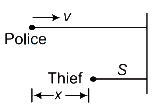
$A$ police party is moving in a jeep at a constant speed $v$. They see a thief at a distance $x$ on a motorcycle which is at rest. The moment the police see the thief,the thief starts moving with a constant acceleration $a$. Which of the following relations is true if the police are able to catch the thief?
A
$v^2 < a x$
B
$v^2 < 2 a x$
C
$v^2 \geq 2 a x$
D
$v^2 = a x$
Solution
(C) Let the police party catch the thief after time $t$.
Distance traveled by the police party in time $t$ is $d_p = v t$.
Distance traveled by the thief in time $t$ starting from rest with acceleration $a$ is $d_t = x + \frac{1}{2} a t^2$.
For the police to catch the thief,the distance traveled by the police must be greater than or equal to the distance traveled by the thief:
$v t \geq x + \frac{1}{2} a t^2$
Rearranging the terms,we get a quadratic inequality in $t$:
$\frac{1}{2} a t^2 - v t + x \leq 0$
For a real solution for $t$ to exist,the discriminant of the corresponding quadratic equation $\frac{1}{2} a t^2 - v t + x = 0$ must be greater than or equal to zero.
The discriminant $D = b^2 - 4ac$ is given by:
$D = (-v)^2 - 4(\frac{1}{2} a)(x) \geq 0$
$v^2 - 2 a x \geq 0$
$v^2 \geq 2 a x$
Distance traveled by the police party in time $t$ is $d_p = v t$.
Distance traveled by the thief in time $t$ starting from rest with acceleration $a$ is $d_t = x + \frac{1}{2} a t^2$.
For the police to catch the thief,the distance traveled by the police must be greater than or equal to the distance traveled by the thief:
$v t \geq x + \frac{1}{2} a t^2$
Rearranging the terms,we get a quadratic inequality in $t$:
$\frac{1}{2} a t^2 - v t + x \leq 0$
For a real solution for $t$ to exist,the discriminant of the corresponding quadratic equation $\frac{1}{2} a t^2 - v t + x = 0$ must be greater than or equal to zero.
The discriminant $D = b^2 - 4ac$ is given by:
$D = (-v)^2 - 4(\frac{1}{2} a)(x) \geq 0$
$v^2 - 2 a x \geq 0$
$v^2 \geq 2 a x$
0 likesView Solution
15
PhysicsMediumMCQTS EAMCET · 2011
$A$ simple harmonic oscillator consists of a particle of mass $m$ and an ideal spring with spring constant $k$. The particle oscillates with a time period $T$. The spring is cut into two equal parts. If one part oscillates with the same particle,the new time period will be
A
$2 T$
B
$\sqrt{2} T$
C
$\frac{T}{\sqrt{2}}$
D
$\frac{T}{2}$
Solution
(C) The initial time period of the simple harmonic oscillator is given by $T = 2 \pi \sqrt{\frac{m}{k}}$.
When a spring of length $l$ and spring constant $k$ is cut into two equal parts,the length of each part becomes $l' = \frac{l}{2}$.
Since the spring constant $k$ is inversely proportional to the length of the spring $(k \propto \frac{1}{l})$,the new spring constant $k'$ for each part will be $k' = 2k$.
The new time period $T'$ with the same mass $m$ and the new spring constant $k'$ is given by $T' = 2 \pi \sqrt{\frac{m}{k'}} = 2 \pi \sqrt{\frac{m}{2k}}$.
Substituting $T = 2 \pi \sqrt{\frac{m}{k}}$,we get $T' = \frac{1}{\sqrt{2}} \times (2 \pi \sqrt{\frac{m}{k}}) = \frac{T}{\sqrt{2}}$.
When a spring of length $l$ and spring constant $k$ is cut into two equal parts,the length of each part becomes $l' = \frac{l}{2}$.
Since the spring constant $k$ is inversely proportional to the length of the spring $(k \propto \frac{1}{l})$,the new spring constant $k'$ for each part will be $k' = 2k$.
The new time period $T'$ with the same mass $m$ and the new spring constant $k'$ is given by $T' = 2 \pi \sqrt{\frac{m}{k'}} = 2 \pi \sqrt{\frac{m}{2k}}$.
Substituting $T = 2 \pi \sqrt{\frac{m}{k}}$,we get $T' = \frac{1}{\sqrt{2}} \times (2 \pi \sqrt{\frac{m}{k}}) = \frac{T}{\sqrt{2}}$.
0 likesView Solution
16
PhysicsMediumMCQTS EAMCET · 2011
Two uniform circular discs having the same mass and the same thickness but different radii are made from different materials. The disc with the smaller rotational inertia is
A
the one made from the more dense material
B
the one made from the less dense material
C
the disc with the larger angular velocity
D
the disc with the larger torque
Solution
(A) The moment of inertia $(I)$ of a uniform circular disc is given by $I = \frac{1}{2} M R^2$.
Since the mass $(M)$ and thickness $(t)$ are constant,we express the radius $(R)$ in terms of density $(\rho)$:
$M = \pi R^2 t \rho \Rightarrow R^2 = \frac{M}{\pi t \rho}$.
Substituting this into the formula for $I$:
$I = \frac{1}{2} M \left( \frac{M}{\pi t \rho} \right) = \frac{M^2}{2 \pi t \rho}$.
Since $M$,$t$,and $\pi$ are constants,we have $I \propto \frac{1}{\rho}$.
Therefore,the disc made from the more dense material (higher $\rho$) will have a smaller rotational inertia.
Since the mass $(M)$ and thickness $(t)$ are constant,we express the radius $(R)$ in terms of density $(\rho)$:
$M = \pi R^2 t \rho \Rightarrow R^2 = \frac{M}{\pi t \rho}$.
Substituting this into the formula for $I$:
$I = \frac{1}{2} M \left( \frac{M}{\pi t \rho} \right) = \frac{M^2}{2 \pi t \rho}$.
Since $M$,$t$,and $\pi$ are constants,we have $I \propto \frac{1}{\rho}$.
Therefore,the disc made from the more dense material (higher $\rho$) will have a smaller rotational inertia.
0 likesView Solution
17
PhysicsEasyMCQTS EAMCET · 2011
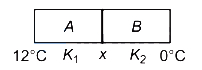
Two slabs $A$ and $B$ of different materials but of the same thickness are joined end to end to form a composite slab. The thermal conductivities of $A$ and $B$ are $k_1$ and $k_2$ respectively. $A$ steady temperature difference of $12^{\circ} C$ is maintained across the composite slab. If $k_1=\frac{k_2}{2}$,the temperature difference across slab $A$ is (in $^{\circ} C$)
A
$4$
B
$6$
C
$8$
D
$10$
Solution
(C) In a steady state,the rate of heat flow $(H)$ through both slabs connected in series is the same.
$H = \frac{k_1 A (\Delta T_A)}{L} = \frac{k_2 A (\Delta T_B)}{L}$
Since the thickness $(L)$ and cross-sectional area $(A)$ are the same for both slabs,we have:
$k_1 (\Delta T_A) = k_2 (\Delta T_B)$
Given $k_1 = \frac{k_2}{2}$,we can write $k_2 = 2k_1$.
Substituting this into the equation:
$k_1 (\Delta T_A) = 2k_1 (\Delta T_B)$
$\Delta T_A = 2 \Delta T_B$
We know the total temperature difference is $\Delta T_A + \Delta T_B = 12^{\circ} C$.
Substituting $\Delta T_A = 2 \Delta T_B$ into the total temperature equation:
$2 \Delta T_B + \Delta T_B = 12^{\circ} C$
$3 \Delta T_B = 12^{\circ} C \implies \Delta T_B = 4^{\circ} C$
Therefore,the temperature difference across slab $A$ is:
$\Delta T_A = 12^{\circ} C - 4^{\circ} C = 8^{\circ} C$.
$H = \frac{k_1 A (\Delta T_A)}{L} = \frac{k_2 A (\Delta T_B)}{L}$
Since the thickness $(L)$ and cross-sectional area $(A)$ are the same for both slabs,we have:
$k_1 (\Delta T_A) = k_2 (\Delta T_B)$
Given $k_1 = \frac{k_2}{2}$,we can write $k_2 = 2k_1$.
Substituting this into the equation:
$k_1 (\Delta T_A) = 2k_1 (\Delta T_B)$
$\Delta T_A = 2 \Delta T_B$
We know the total temperature difference is $\Delta T_A + \Delta T_B = 12^{\circ} C$.
Substituting $\Delta T_A = 2 \Delta T_B$ into the total temperature equation:
$2 \Delta T_B + \Delta T_B = 12^{\circ} C$
$3 \Delta T_B = 12^{\circ} C \implies \Delta T_B = 4^{\circ} C$
Therefore,the temperature difference across slab $A$ is:
$\Delta T_A = 12^{\circ} C - 4^{\circ} C = 8^{\circ} C$.
0 likesView Solution
18
PhysicsDifficultMCQTS EAMCET · 2011
$A$ reversible engine converts one-sixth of the heat supplied into work. When the temperature of the sink is reduced by $62^{\circ} C$,the efficiency of the engine is doubled. The temperatures of the source and sink are
A
$99^{\circ} C, 37^{\circ} C$
B
$80^{\circ} C, 37^{\circ} C$
C
$95^{\circ} C, 37^{\circ} C$
D
$90^{\circ} C, 37^{\circ} C$
Solution
(A) The efficiency of a Carnot engine is given by $\eta = 1 - \frac{T_2}{T_1}$,where $T_1$ is the source temperature and $T_2$ is the sink temperature in Kelvin.
Given $\eta = \frac{1}{6}$,so $1 - \frac{T_2}{T_1} = \frac{1}{6} \implies \frac{T_2}{T_1} = \frac{5}{6} \implies T_2 = \frac{5}{6} T_1$.
When the sink temperature is reduced by $62 \ K$ (a change of $62^{\circ} C$ is equivalent to $62 \ K$),the new efficiency $\eta' = 2\eta = 2 \times \frac{1}{6} = \frac{1}{3}$.
Thus,$1 - \frac{T_2 - 62}{T_1} = \frac{1}{3} \implies \frac{T_2 - 62}{T_1} = \frac{2}{3}$.
Substituting $T_2 = \frac{5}{6} T_1$: $\frac{\frac{5}{6} T_1 - 62}{T_1} = \frac{2}{3} \implies \frac{5}{6} - \frac{62}{T_1} = \frac{4}{6} \implies \frac{62}{T_1} = \frac{1}{6} \implies T_1 = 372 \ K$.
Converting to Celsius: $T_1 = 372 - 273 = 99^{\circ} C$.
Then $T_2 = \frac{5}{6} \times 372 = 310 \ K$. Converting to Celsius: $T_2 = 310 - 273 = 37^{\circ} C$.
Therefore,the temperatures are $99^{\circ} C$ and $37^{\circ} C$.
Given $\eta = \frac{1}{6}$,so $1 - \frac{T_2}{T_1} = \frac{1}{6} \implies \frac{T_2}{T_1} = \frac{5}{6} \implies T_2 = \frac{5}{6} T_1$.
When the sink temperature is reduced by $62 \ K$ (a change of $62^{\circ} C$ is equivalent to $62 \ K$),the new efficiency $\eta' = 2\eta = 2 \times \frac{1}{6} = \frac{1}{3}$.
Thus,$1 - \frac{T_2 - 62}{T_1} = \frac{1}{3} \implies \frac{T_2 - 62}{T_1} = \frac{2}{3}$.
Substituting $T_2 = \frac{5}{6} T_1$: $\frac{\frac{5}{6} T_1 - 62}{T_1} = \frac{2}{3} \implies \frac{5}{6} - \frac{62}{T_1} = \frac{4}{6} \implies \frac{62}{T_1} = \frac{1}{6} \implies T_1 = 372 \ K$.
Converting to Celsius: $T_1 = 372 - 273 = 99^{\circ} C$.
Then $T_2 = \frac{5}{6} \times 372 = 310 \ K$. Converting to Celsius: $T_2 = 310 - 273 = 37^{\circ} C$.
Therefore,the temperatures are $99^{\circ} C$ and $37^{\circ} C$.
0 likesView Solution
19
PhysicsDifficultMCQTS EAMCET · 2011
During an adiabatic process, the pressure of a gas is proportional to the cube of its temperature. The value of $C_p / C_V$ for that gas is
A
$7/5$
B
$4/5$
C
$5/3$
D
$3/2$
Solution
(D) For an adiabatic process, the relation between pressure $p$ and volume $V$ is given by $pV^\gamma = \text{constant}$, where $\gamma = C_p / C_V$.
Given that $p \propto T^3$, we can write $p = k T^3$.
Using the ideal gas equation $pV = nRT$, we have $T = \frac{pV}{nR}$.
Substituting this into the given relation:
$p = k \left( \frac{pV}{nR} \right)^3$
$p = k \frac{p^3 V^3}{(nR)^3}$
$1 = \left( \frac{k}{(nR)^3} \right) p^2 V^3$
$p^2 V^3 = \text{constant}'$
$p V^{3/2} = \text{constant}''$
Comparing this with the standard adiabatic equation $pV^\gamma = \text{constant}$, we get $\gamma = 3/2$.
Thus, the value of $C_p / C_V$ is $3/2$.
Given that $p \propto T^3$, we can write $p = k T^3$.
Using the ideal gas equation $pV = nRT$, we have $T = \frac{pV}{nR}$.
Substituting this into the given relation:
$p = k \left( \frac{pV}{nR} \right)^3$
$p = k \frac{p^3 V^3}{(nR)^3}$
$1 = \left( \frac{k}{(nR)^3} \right) p^2 V^3$
$p^2 V^3 = \text{constant}'$
$p V^{3/2} = \text{constant}''$
Comparing this with the standard adiabatic equation $pV^\gamma = \text{constant}$, we get $\gamma = 3/2$.
Thus, the value of $C_p / C_V$ is $3/2$.

0 likesView Solution
20
PhysicsDifficultMCQTS EAMCET · 2011
The wavelengths of two sound notes in air are $\frac{40}{195} \,m$ and $\frac{40}{193} \,m$. Each note produces $9$ beats per second separately with a third note of fixed frequency. The velocity of sound in air in $m/s$ is
A
$360$
B
$320$
C
$300$
D
$340$
Solution
(A) Let the velocity of sound be $v$ and the frequency of the third note be $f_0$. The frequencies of the two given notes are $f_1 = \frac{v}{\lambda_1} = \frac{v}{40/195} = \frac{195v}{40}$ and $f_2 = \frac{v}{\lambda_2} = \frac{v}{40/193} = \frac{193v}{40}$.
Since each note produces $9$ beats per second with the third note,we have:
$|f_1 - f_0| = 9$ and $|f_2 - f_0| = 9$.
This implies $f_1 - f_0 = 9$ and $f_0 - f_2 = 9$ (assuming $f_1 > f_0 > f_2$).
Adding these two equations:
$(f_1 - f_0) + (f_0 - f_2) = 9 + 9$
$f_1 - f_2 = 18$
$\frac{195v}{40} - \frac{193v}{40} = 18$
$\frac{2v}{40} = 18$
$\frac{v}{20} = 18$
$v = 360 \,m/s$.
Since each note produces $9$ beats per second with the third note,we have:
$|f_1 - f_0| = 9$ and $|f_2 - f_0| = 9$.
This implies $f_1 - f_0 = 9$ and $f_0 - f_2 = 9$ (assuming $f_1 > f_0 > f_2$).
Adding these two equations:
$(f_1 - f_0) + (f_0 - f_2) = 9 + 9$
$f_1 - f_2 = 18$
$\frac{195v}{40} - \frac{193v}{40} = 18$
$\frac{2v}{40} = 18$
$\frac{v}{20} = 18$
$v = 360 \,m/s$.
0 likesView Solution
21
PhysicsMediumMCQTS EAMCET · 2011
Two uniform stretched strings $A$ and $B$,made of steel,are vibrating under the same tension. If the first overtone of $A$ is equal to the second overtone of $B$ and if the radius of $A$ is twice that of $B$,the ratio of the lengths of the strings is
A
$2$ : $3$
B
$1$ : $2$
C
$1$ : $3$
D
$1$ : $4$
Solution
(C) The frequency of the $n$-th harmonic for a string is given by $f_n = \frac{n}{2l} \sqrt{\frac{T}{\mu}}$,where $\mu = \pi r^2 \rho$.
For the first overtone of $A$ $(n=2)$: $f_{A} = \frac{2}{2l_A} \sqrt{\frac{T}{\pi r_A^2 \rho}} = \frac{1}{l_A r_A} \sqrt{\frac{T}{\pi \rho}}$.
For the second overtone of $B$ $(n=3)$: $f_{B} = \frac{3}{2l_B} \sqrt{\frac{T}{\pi r_B^2 \rho}} = \frac{3}{2l_B r_B} \sqrt{\frac{T}{\pi \rho}}$.
Given $f_A = f_B$ and $r_A = 2r_B$:
$\frac{1}{l_A (2r_B)} = \frac{3}{2l_B r_B}$.
Simplifying,$\frac{1}{2l_A} = \frac{3}{2l_B} \Rightarrow \frac{l_A}{l_B} = \frac{1}{3}$.
Thus,the ratio $l_A : l_B = 1 : 3$.
For the first overtone of $A$ $(n=2)$: $f_{A} = \frac{2}{2l_A} \sqrt{\frac{T}{\pi r_A^2 \rho}} = \frac{1}{l_A r_A} \sqrt{\frac{T}{\pi \rho}}$.
For the second overtone of $B$ $(n=3)$: $f_{B} = \frac{3}{2l_B} \sqrt{\frac{T}{\pi r_B^2 \rho}} = \frac{3}{2l_B r_B} \sqrt{\frac{T}{\pi \rho}}$.
Given $f_A = f_B$ and $r_A = 2r_B$:
$\frac{1}{l_A (2r_B)} = \frac{3}{2l_B r_B}$.
Simplifying,$\frac{1}{2l_A} = \frac{3}{2l_B} \Rightarrow \frac{l_A}{l_B} = \frac{1}{3}$.
Thus,the ratio $l_A : l_B = 1 : 3$.
0 likesView Solution
22
PhysicsDifficultMCQTS EAMCET · 2011
The thermo-emf of a hypothetical thermocouple varies with the temperature $\theta$ of the hot junction as $E = a\theta + b\theta^2$ in volts,where the ratio $a/b$ is $700^{\circ}C$. If the cold junction is kept at $0^{\circ}C$,then the neutral temperature is:
A
$700^{\circ}C$
B
$1400^{\circ}C$
C
$390^{\circ}C$
D
None of these
Solution
(D) The thermo-emf $E$ is given by $E = a\theta + b\theta^2$.
The thermoelectric power $P$ is defined as the rate of change of thermo-emf with respect to temperature: $P = \frac{dE}{d\theta} = a + 2b\theta$.
The neutral temperature $T_n$ is the temperature at which the thermoelectric power becomes zero.
Setting $P = 0$,we get $a + 2bT_n = 0$.
Therefore,$T_n = -\frac{a}{2b}$.
Given the ratio $a/b = 700^{\circ}C$,we substitute this into the expression: $T_n = -\frac{700}{2} = -350^{\circ}C$.
Since $-350^{\circ}C$ is not among the given options,the correct choice is $D$.
The thermoelectric power $P$ is defined as the rate of change of thermo-emf with respect to temperature: $P = \frac{dE}{d\theta} = a + 2b\theta$.
The neutral temperature $T_n$ is the temperature at which the thermoelectric power becomes zero.
Setting $P = 0$,we get $a + 2bT_n = 0$.
Therefore,$T_n = -\frac{a}{2b}$.
Given the ratio $a/b = 700^{\circ}C$,we substitute this into the expression: $T_n = -\frac{700}{2} = -350^{\circ}C$.
Since $-350^{\circ}C$ is not among the given options,the correct choice is $D$.
0 likesView Solution
23
PhysicsMediumMCQTS EAMCET · 2011
Calculate the wavelength of the $K_{\alpha}$ line for $Z=31$, when $a=5 \times 10^7 \, Hz^{1/2}$ for a characteristic $X$-ray spectrum.
A
$1.33 \, \mathring{A}$
B
$1.33 \, nm$
C
$133 \times 10^{-10} \, m$
D
$133 \, nm$
Solution
(A) Given, $Z=31$ and $a=5 \times 10^7 \, \text{Hz}^{1/2}$.
According to Moseley's law for $K_{\alpha}$ lines, $\sqrt{\nu} = a(Z-1)$.
Squaring both sides, we get $\nu = a^2(Z-1)^2$.
Substituting the values: $\nu = (5 \times 10^7)^2 \times (31-1)^2$.
$\nu = 25 \times 10^{14} \times 30^2 = 25 \times 10^{14} \times 900 = 2.25 \times 10^{18} \, \text{Hz}$.
We know that $\lambda = \frac{c}{\nu}$, where $c = 3 \times 10^8 \, \text{m/s}$.
$\lambda = \frac{3 \times 10^8}{2.25 \times 10^{18}} = 1.33 \times 10^{-10} \, \text{m}$.
Since $1 \, \mathring{A} = 10^{-10} \, \text{m}$, the wavelength is $1.33 \, \mathring{A}$.
According to Moseley's law for $K_{\alpha}$ lines, $\sqrt{\nu} = a(Z-1)$.
Squaring both sides, we get $\nu = a^2(Z-1)^2$.
Substituting the values: $\nu = (5 \times 10^7)^2 \times (31-1)^2$.
$\nu = 25 \times 10^{14} \times 30^2 = 25 \times 10^{14} \times 900 = 2.25 \times 10^{18} \, \text{Hz}$.
We know that $\lambda = \frac{c}{\nu}$, where $c = 3 \times 10^8 \, \text{m/s}$.
$\lambda = \frac{3 \times 10^8}{2.25 \times 10^{18}} = 1.33 \times 10^{-10} \, \text{m}$.
Since $1 \, \mathring{A} = 10^{-10} \, \text{m}$, the wavelength is $1.33 \, \mathring{A}$.
0 likesView Solution
24
PhysicsDifficultMCQTS EAMCET · 2011
The focal length of a lens of dispersive power $0.45$ which should be placed in contact with a convex lens of focal length $84 \,cm$ and dispersive power $0.21$ to make the achromatic combination from the two lenses,in $cm$ is
A
$45$
B
$90$
C
$180$
D
$-180$
Solution
(D) Given:
Dispersive power of the first lens,$\omega_1 = 0.45$.
Dispersive power of the second lens,$\omega_2 = 0.21$.
Focal length of the second lens (convex),$f_2 = 84 \,cm$.
For an achromatic combination of two thin lenses in contact,the condition is given by:
$\frac{\omega_1}{f_1} + \frac{\omega_2}{f_2} = 0$
$\Rightarrow \frac{\omega_1}{f_1} = -\frac{\omega_2}{f_2}$
$\Rightarrow \frac{f_1}{f_2} = -\frac{\omega_1}{\omega_2}$
Substituting the given values:
$\frac{f_1}{84} = -\frac{0.45}{0.21}$
$f_1 = -\frac{45}{21} \times 84$
$f_1 = -\frac{45}{1} \times 4$
$f_1 = -180 \,cm$
Thus,the focal length of the required lens is $-180 \,cm$.
Dispersive power of the first lens,$\omega_1 = 0.45$.
Dispersive power of the second lens,$\omega_2 = 0.21$.
Focal length of the second lens (convex),$f_2 = 84 \,cm$.
For an achromatic combination of two thin lenses in contact,the condition is given by:
$\frac{\omega_1}{f_1} + \frac{\omega_2}{f_2} = 0$
$\Rightarrow \frac{\omega_1}{f_1} = -\frac{\omega_2}{f_2}$
$\Rightarrow \frac{f_1}{f_2} = -\frac{\omega_1}{\omega_2}$
Substituting the given values:
$\frac{f_1}{84} = -\frac{0.45}{0.21}$
$f_1 = -\frac{45}{21} \times 84$
$f_1 = -\frac{45}{1} \times 4$
$f_1 = -180 \,cm$
Thus,the focal length of the required lens is $-180 \,cm$.
0 likesView Solution
25
PhysicsMediumMCQTS EAMCET · 2011
Which of the following statements are true in the context of a Compound Microscope?
$(A)$ Each lens produces a virtual and inverted image.
$(B)$ The objective has a very short focal length.
$(C)$ The eyepiece is used as a simple magnifying glass.
$(D)$ The objective and eyepiece are convex and concave lenses respectively.
$(A)$ Each lens produces a virtual and inverted image.
$(B)$ The objective has a very short focal length.
$(C)$ The eyepiece is used as a simple magnifying glass.
$(D)$ The objective and eyepiece are convex and concave lenses respectively.
A
$(A)$,$(B)$ and $(D)$
B
$(B)$ and $(C)$
C
$(A)$,$(C)$ and $(D)$
D
$(B)$ and $(D)$
Solution
(B) In a compound microscope,both the objective lens and the eyepiece are convex lenses. Statement $(A)$ is incorrect because the objective lens forms a real and inverted image,while the eyepiece forms a virtual and magnified image.
Statement $(B)$ is correct because the objective lens must have a very short focal length to provide high magnification.
Statement $(C)$ is correct because the eyepiece acts as a simple magnifying glass to view the real image formed by the objective lens.
Statement $(D)$ is incorrect because both lenses are convex,not concave.
Therefore,statements $(B)$ and $(C)$ are true.
Statement $(B)$ is correct because the objective lens must have a very short focal length to provide high magnification.
Statement $(C)$ is correct because the eyepiece acts as a simple magnifying glass to view the real image formed by the objective lens.
Statement $(D)$ is incorrect because both lenses are convex,not concave.
Therefore,statements $(B)$ and $(C)$ are true.
0 likesView Solution
26
PhysicsMediumMCQTS EAMCET · 2011
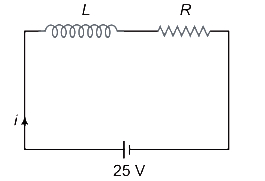
$A$ constant voltage of $25 \, V$ is applied to a series $L-R$ circuit at $t=0$ by closing a switch. What is the potential difference across the resistor and the inductor at time $t=0$?
A
$0 \, V, 25 \, V$
B
$12.5 \, V, 1.25 \, V$
C
$10 \, V, 15 \, V$
D
$25 \, V, 0 \, V$
Solution
(A) In a series $L-R$ circuit, the current $i$ at any time $t$ after closing the switch is given by $i(t) = \frac{V}{R} (1 - e^{-Rt/L})$.
At $t = 0$, the current in the circuit is $i(0) = \frac{V}{R} (1 - e^0) = 0$.
The potential difference across the resistor is $V_R = iR$. Since $i = 0$ at $t = 0$, $V_R = 0 \times R = 0 \, V$.
The potential difference across the inductor is $V_L = L \frac{di}{dt}$. According to Kirchhoff's voltage law, $V = V_R + V_L$. At $t = 0$, $V = 0 + V_L$, which gives $V_L = 25 \, V$.
Therefore, at $t = 0$, the potential difference across the resistor is $0 \, V$ and across the inductor is $25 \, V$.
At $t = 0$, the current in the circuit is $i(0) = \frac{V}{R} (1 - e^0) = 0$.
The potential difference across the resistor is $V_R = iR$. Since $i = 0$ at $t = 0$, $V_R = 0 \times R = 0 \, V$.
The potential difference across the inductor is $V_L = L \frac{di}{dt}$. According to Kirchhoff's voltage law, $V = V_R + V_L$. At $t = 0$, $V = 0 + V_L$, which gives $V_L = 25 \, V$.
Therefore, at $t = 0$, the potential difference across the resistor is $0 \, V$ and across the inductor is $25 \, V$.
0 likesView Solution
27
PhysicsDifficultMCQTS EAMCET · 2011
Two identical condensers $M$ and $N$ are connected in series with a battery. The space between the plates of $M$ is completely filled with a dielectric medium of dielectric constant $8$,and a copper plate of thickness $d/2$ is introduced between the plates of $N$ ($d$ is the distance between the plates). Then the potential differences across $M$ and $N$ are,respectively,in the ratio:
A
$1 : 4$
B
$4 : 1$
C
$3 : 8$
D
$1 : 6$
Solution
(A) Let the initial capacitance of each condenser be $C = \frac{A \varepsilon_0}{d}$.
For condenser $M$,the space is filled with a dielectric of constant $K = 8$. The new capacitance is $C_M = K C = 8C$.
For condenser $N$,a copper plate of thickness $t = d/2$ is introduced. The capacitance of a capacitor with a metal plate of thickness $t$ is $C_N = \frac{A \varepsilon_0}{d - t}$.
Substituting $t = d/2$,we get $C_N = \frac{A \varepsilon_0}{d - d/2} = \frac{A \varepsilon_0}{d/2} = 2 \left( \frac{A \varepsilon_0}{d} \right) = 2C$.
Since the capacitors are connected in series,the charge $Q$ on both is the same.
The potential difference $V$ is given by $V = Q/C$,so $V \propto 1/C$.
Therefore,the ratio of potential differences is $V_M : V_N = \frac{1}{C_M} : \frac{1}{C_N} = \frac{1}{8C} : \frac{1}{2C} = \frac{1}{8} : \frac{1}{2} = 2 : 8 = 1 : 4$.
For condenser $M$,the space is filled with a dielectric of constant $K = 8$. The new capacitance is $C_M = K C = 8C$.
For condenser $N$,a copper plate of thickness $t = d/2$ is introduced. The capacitance of a capacitor with a metal plate of thickness $t$ is $C_N = \frac{A \varepsilon_0}{d - t}$.
Substituting $t = d/2$,we get $C_N = \frac{A \varepsilon_0}{d - d/2} = \frac{A \varepsilon_0}{d/2} = 2 \left( \frac{A \varepsilon_0}{d} \right) = 2C$.
Since the capacitors are connected in series,the charge $Q$ on both is the same.
The potential difference $V$ is given by $V = Q/C$,so $V \propto 1/C$.
Therefore,the ratio of potential differences is $V_M : V_N = \frac{1}{C_M} : \frac{1}{C_N} = \frac{1}{8C} : \frac{1}{2C} = \frac{1}{8} : \frac{1}{2} = 2 : 8 = 1 : 4$.
0 likesView Solution
28
PhysicsDifficultMCQTS EAMCET · 2011
$A$ fully charged capacitor has a capacitance $C$. It is discharged through a small coil of resistance wire,embedded in a block of specific heat $s$ and mass $m$ under thermally isolated conditions. If the temperature of the block is raised by $\Delta T$,the potential difference $V$ across the capacitor initially is
A
$\left(\frac{2 m s \Delta T}{C}\right)^2$
B
$\left(\frac{2 m s \Delta T}{C}\right)^{1 / 2}$
C
$\left(\frac{2 m s \Delta T}{C}\right)$
D
$2 m s \Delta T C$
Solution
(B) Let $V$ be the potential across the capacitor when it is fully charged. The energy stored in the capacitor is given by $U = \frac{1}{2} C V^2$.
When the capacitor is fully discharged through the resistance coil,the entire stored energy is dissipated as heat $\Delta H$ in the block.
Since the system is thermally isolated,the heat gained by the block is equal to the energy lost by the capacitor: $\Delta H = \frac{1}{2} C V^2$.
The heat gained by the block is also given by $\Delta H = m s \Delta T$,where $m$ is the mass and $s$ is the specific heat.
Equating the two expressions for $\Delta H$:
$\frac{1}{2} C V^2 = m s \Delta T$
$V^2 = \frac{2 m s \Delta T}{C}$
$V = \left(\frac{2 m s \Delta T}{C}\right)^{1 / 2}$
When the capacitor is fully discharged through the resistance coil,the entire stored energy is dissipated as heat $\Delta H$ in the block.
Since the system is thermally isolated,the heat gained by the block is equal to the energy lost by the capacitor: $\Delta H = \frac{1}{2} C V^2$.
The heat gained by the block is also given by $\Delta H = m s \Delta T$,where $m$ is the mass and $s$ is the specific heat.
Equating the two expressions for $\Delta H$:
$\frac{1}{2} C V^2 = m s \Delta T$
$V^2 = \frac{2 m s \Delta T}{C}$
$V = \left(\frac{2 m s \Delta T}{C}\right)^{1 / 2}$
0 likesView Solution
29
PhysicsDifficultMCQTS EAMCET · 2011
The sensitivity of a galvanometer is $60 \text{ division/A}$. When a shunt is used,its sensitivity becomes $10 \text{ division/A}$. If the galvanometer is of resistance $20 \ \Omega$,the value of shunt used is (in $Omega$)
A
$4$
B
$5$
C
$20$
D
$2$
Solution
(A) The sensitivity of a galvanometer is defined as the deflection per unit current,given by $S_g = \frac{\theta}{i_g}$. When a shunt $S$ is connected in parallel with a galvanometer of resistance $G$,the new sensitivity $S'$ is given by the ratio of the current through the galvanometer $i_g$ to the total current $i$.
The current through the galvanometer is $i_g = i \left( \frac{S}{G+S} \right)$.
Therefore,the new sensitivity is $S' = \frac{i_g}{i} = \frac{S}{G+S}$.
Given,initial sensitivity $= 60 \text{ div/A}$ and final sensitivity $= 10 \text{ div/A}$.
The ratio of sensitivities is $\frac{S'}{S_g} = \frac{10}{60} = \frac{1}{6}$.
Substituting the formula: $\frac{1}{6} = \frac{S}{G+S}$.
Cross-multiplying gives $G + S = 6S$,which simplifies to $G = 5S$.
Given $G = 20 \ \Omega$,we have $20 = 5S$.
Thus,$S = \frac{20}{5} = 4 \ \Omega$.
The current through the galvanometer is $i_g = i \left( \frac{S}{G+S} \right)$.
Therefore,the new sensitivity is $S' = \frac{i_g}{i} = \frac{S}{G+S}$.
Given,initial sensitivity $= 60 \text{ div/A}$ and final sensitivity $= 10 \text{ div/A}$.
The ratio of sensitivities is $\frac{S'}{S_g} = \frac{10}{60} = \frac{1}{6}$.
Substituting the formula: $\frac{1}{6} = \frac{S}{G+S}$.
Cross-multiplying gives $G + S = 6S$,which simplifies to $G = 5S$.
Given $G = 20 \ \Omega$,we have $20 = 5S$.
Thus,$S = \frac{20}{5} = 4 \ \Omega$.
0 likesView Solution
30
PhysicsMediumMCQTS EAMCET · 2011
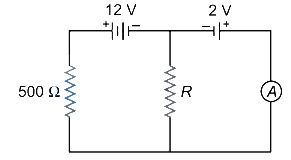
In the circuit shown below,the ammeter reading is zero. Then the value of the resistance $R$ is (in $Omega$)
A
$50$
B
$100$
C
$200$
D
$400$
Solution
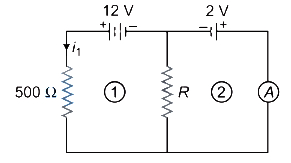
(B) Let $i_1$ be the current flowing through the $500 \Omega$ resistor and the $12 \text{ V}$ battery.
Since the ammeter reading is zero,no current flows through the right branch containing the $2 \text{ V}$ battery and the ammeter.
Therefore,the current $i_1$ flows through the $500 \Omega$ resistor and the resistor $R$ in series.
Applying Kirchhoff's voltage law $(KVL)$ to the left loop:
$12 - 500 i_1 - R i_1 = 0$
$12 = i_1 (500 + R) \quad \dots (i)$
Now,consider the potential difference across the resistor $R$. Since no current flows through the right branch,the potential difference across $R$ must be equal to the electromotive force $(EMF)$ of the battery in the right branch to maintain zero current in that loop.
The potential difference across $R$ is $V_R = i_1 R$.
For the ammeter to read zero,the potential difference across $R$ must balance the $2 \text{ V}$ battery.
Thus,$i_1 R = 2 \text{ V} \Rightarrow i_1 = \frac{2}{R}$.
Substituting $i_1$ into equation $(i)$:
$12 = \frac{2}{R} (500 + R)$
$6 R = 500 + R$
$5 R = 500$
$R = 100 \Omega$
Since the ammeter reading is zero,no current flows through the right branch containing the $2 \text{ V}$ battery and the ammeter.
Therefore,the current $i_1$ flows through the $500 \Omega$ resistor and the resistor $R$ in series.
Applying Kirchhoff's voltage law $(KVL)$ to the left loop:
$12 - 500 i_1 - R i_1 = 0$
$12 = i_1 (500 + R) \quad \dots (i)$
Now,consider the potential difference across the resistor $R$. Since no current flows through the right branch,the potential difference across $R$ must be equal to the electromotive force $(EMF)$ of the battery in the right branch to maintain zero current in that loop.
The potential difference across $R$ is $V_R = i_1 R$.
For the ammeter to read zero,the potential difference across $R$ must balance the $2 \text{ V}$ battery.
Thus,$i_1 R = 2 \text{ V} \Rightarrow i_1 = \frac{2}{R}$.
Substituting $i_1$ into equation $(i)$:
$12 = \frac{2}{R} (500 + R)$
$6 R = 500 + R$
$5 R = 500$
$R = 100 \Omega$
0 likesView Solution
31
PhysicsMediumMCQTS EAMCET · 2011
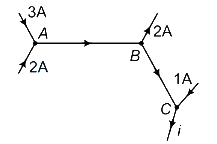
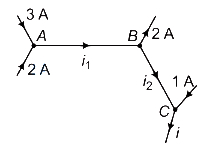
The electric current $i$ in the circuit shown is (in $\text{ A}$)
A
$6$
B
$2$
C
$3$
D
$4$
Solution
(D) According to Kirchhoff's Current Law $(KCL)$, the sum of currents entering a junction equals the sum of currents leaving it.
At junction $A$:
$i_1 = 3 \text{ A} + 2 \text{ A} = 5 \text{ A}$
At junction $B$:
The current $i_1$ enters the junction, and $2 \text{ A}$ leaves it. Let $i_2$ be the current flowing towards junction $C$.
$i_1 = 2 \text{ A} + i_2$
$5 \text{ A} = 2 \text{ A} + i_2 \implies i_2 = 3 \text{ A}$
At junction $C$:
The currents $i_2$ and $1 \text{ A}$ enter the junction, and $i$ leaves it.
$i = i_2 + 1 \text{ A}$
$i = 3 \text{ A} + 1 \text{ A} = 4 \text{ A}$
At junction $A$:
$i_1 = 3 \text{ A} + 2 \text{ A} = 5 \text{ A}$
At junction $B$:
The current $i_1$ enters the junction, and $2 \text{ A}$ leaves it. Let $i_2$ be the current flowing towards junction $C$.
$i_1 = 2 \text{ A} + i_2$
$5 \text{ A} = 2 \text{ A} + i_2 \implies i_2 = 3 \text{ A}$
At junction $C$:
The currents $i_2$ and $1 \text{ A}$ enter the junction, and $i$ leaves it.
$i = i_2 + 1 \text{ A}$
$i = 3 \text{ A} + 1 \text{ A} = 4 \text{ A}$
0 likesView Solution
32
PhysicsDifficultMCQTS EAMCET · 2011
Two photons of energy $2.5 eV$ and $3.5 eV$ fall on a metal surface of work function $1.5 eV$. The ratio of the maximum velocities of the photoelectrons emitted from the metal surface is
A
$1$ : $4$
B
$2$ : $1$
C
$1$ : $2$
D
$1 : \sqrt{2}$
Solution
(D) According to Einstein's photoelectric equation,the maximum kinetic energy $K_{max}$ of an emitted photoelectron is given by $K_{max} = E - \phi_0$,where $E$ is the energy of the incident photon and $\phi_0$ is the work function of the metal.
For the first photon with energy $E_1 = 2.5 eV$:
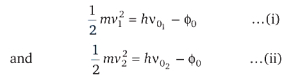
$\frac{1}{2} m v_1^2 = E_1 - \phi_0 = 2.5 eV - 1.5 eV = 1.0 eV$ $(i)$
For the second photon with energy $E_2 = 3.5 eV$:
$\frac{1}{2} m v_2^2 = E_2 - \phi_0 = 3.5 eV - 1.5 eV = 2.0 eV$ (ii)
Dividing equation $(i)$ by equation (ii),we get:
$\frac{\frac{1}{2} m v_1^2}{\frac{1}{2} m v_2^2} = \frac{1.0 eV}{2.0 eV}$
$\frac{v_1^2}{v_2^2} = \frac{1}{2}$
Taking the square root on both sides:
$\frac{v_1}{v_2} = \frac{1}{\sqrt{2}}$
Thus,the ratio of the maximum velocities is $1 : \sqrt{2}$.
For the first photon with energy $E_1 = 2.5 eV$:
$\frac{1}{2} m v_1^2 = E_1 - \phi_0 = 2.5 eV - 1.5 eV = 1.0 eV$ $(i)$
For the second photon with energy $E_2 = 3.5 eV$:
$\frac{1}{2} m v_2^2 = E_2 - \phi_0 = 3.5 eV - 1.5 eV = 2.0 eV$ (ii)
Dividing equation $(i)$ by equation (ii),we get:
$\frac{\frac{1}{2} m v_1^2}{\frac{1}{2} m v_2^2} = \frac{1.0 eV}{2.0 eV}$
$\frac{v_1^2}{v_2^2} = \frac{1}{2}$
Taking the square root on both sides:
$\frac{v_1}{v_2} = \frac{1}{\sqrt{2}}$
Thus,the ratio of the maximum velocities is $1 : \sqrt{2}$.
0 likesView Solution
33
PhysicsMediumMCQTS EAMCET · 2011
The thermo emf of a hypothetical thermocouple varies with the temperature $\theta$ of the hot junction as $E = a\theta + b\theta^2$ in volts,where the ratio $a/b$ is $700^{\circ}C$. If the cold junction is kept at $0^{\circ}C$,then the neutral temperature is:
A
$700^{\circ}C$
B
$1400^{\circ}C$
C
$350^{\circ}C$
D
None of these
Solution
(D) The thermo emf is given by $E = a\theta + b\theta^2$.
To find the neutral temperature $(T_n)$,we differentiate $E$ with respect to $\theta$ and set it to zero,as the thermo emf is maximum at the neutral temperature.
$\frac{dE}{d\theta} = a + 2b\theta$.
Setting $\frac{dE}{d\theta} = 0$,we get $a + 2b\theta = 0$.
Therefore,$T_n = -\frac{a}{2b}$.
Given that $a/b = 700^{\circ}C$,we substitute this into the expression:
$T_n = -\frac{1}{2} \times (700^{\circ}C) = -350^{\circ}C$.
Since the calculated value $-350^{\circ}C$ is not among the options,the correct choice is $D$.
To find the neutral temperature $(T_n)$,we differentiate $E$ with respect to $\theta$ and set it to zero,as the thermo emf is maximum at the neutral temperature.
$\frac{dE}{d\theta} = a + 2b\theta$.
Setting $\frac{dE}{d\theta} = 0$,we get $a + 2b\theta = 0$.
Therefore,$T_n = -\frac{a}{2b}$.
Given that $a/b = 700^{\circ}C$,we substitute this into the expression:
$T_n = -\frac{1}{2} \times (700^{\circ}C) = -350^{\circ}C$.
Since the calculated value $-350^{\circ}C$ is not among the options,the correct choice is $D$.
0 likesView Solution
34
PhysicsDifficultMCQTS EAMCET · 2011
Calculate the wavelength of the $K_{\alpha}$ line for $Z=31$, given $a=5 \times 10^7 \text{ Hz}^{1/2}$ for a characteristic $X$-ray spectrum.
A
$1.33 \text{ Å}$
B
$1.33 \text{ nm}$
C
$133 \times 10^{-10} \text{ m}$
D
$133 \text{ nm}$
Solution
(A) Given: Atomic number $Z=31$ and constant $a=5 \times 10^7 \text{ Hz}^{1/2}$.
According to Moseley's Law for the $K_{\alpha}$ line:
$\sqrt{\nu} = a(Z-1)$
Squaring both sides:
$\nu = a^2(Z-1)^2$
Substitute the values:
$\nu = (5 \times 10^7)^2 \times (31-1)^2$
$\nu = 25 \times 10^{14} \times 30^2$
$\nu = 25 \times 10^{14} \times 900 = 2.25 \times 10^{18} \text{ Hz}$
Now, using the relation $\lambda = \frac{c}{\nu}$ where $c = 3 \times 10^8 \text{ m/s}$:
$\lambda = \frac{3 \times 10^8}{2.25 \times 10^{18}}$
$\lambda = 1.33 \times 10^{-10} \text{ m}$
Since $1 \text{ Å} = 10^{-10} \text{ m}$, we get:
$\lambda = 1.33 \text{ Å}$.
According to Moseley's Law for the $K_{\alpha}$ line:
$\sqrt{\nu} = a(Z-1)$
Squaring both sides:
$\nu = a^2(Z-1)^2$
Substitute the values:
$\nu = (5 \times 10^7)^2 \times (31-1)^2$
$\nu = 25 \times 10^{14} \times 30^2$
$\nu = 25 \times 10^{14} \times 900 = 2.25 \times 10^{18} \text{ Hz}$
Now, using the relation $\lambda = \frac{c}{\nu}$ where $c = 3 \times 10^8 \text{ m/s}$:
$\lambda = \frac{3 \times 10^8}{2.25 \times 10^{18}}$
$\lambda = 1.33 \times 10^{-10} \text{ m}$
Since $1 \text{ Å} = 10^{-10} \text{ m}$, we get:
$\lambda = 1.33 \text{ Å}$.
0 likesView Solution
35
PhysicsEasyMCQTS EAMCET · 2011
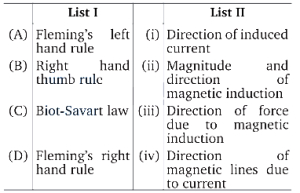
Match the following and find the correct pairs.
| List-$I$ | List-$II$ |
|---|---|
| $(A)$ Fleming's left hand rule | $(i)$ Direction of induced current |
| $(B)$ Right hand thumb rule | (ii) Magnitude and direction of magnetic induction |
| $(C)$ Biot-Savart law | (iii) Direction of force due to magnetic induction |
| $(D)$ Fleming's right hand rule | (iv) Direction of magnetic lines due to current |
A
$(A)-(iii), (B)-(i), (C)-(ii), (D)-(iv)$
B
$(A)-(iii), (B)-(iv), (C)-(ii), (D)-(i)$
C
$(A)-(ii), (B)-(iv), (C)-(iii), (D)-(i)$
D
$(A)-(iv), (B)-(iii), (C)-(i), (D)-(ii)$
Solution
(B) The correct matches are as follows:
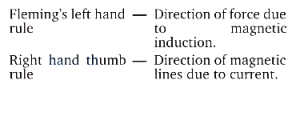
$(A)$ Fleming's left hand rule is used to find the direction of force on a current-carrying conductor in a magnetic field,which corresponds to (iii).
$(B)$ Right hand thumb rule is used to determine the direction of magnetic field lines around a current-carrying conductor,which corresponds to (iv).
$(C)$ Biot-Savart law is used to calculate the magnitude and direction of magnetic induction due to a small current element,which corresponds to (ii).
$(D)$ Fleming's right hand rule is used to find the direction of induced current in a conductor moving in a magnetic field,which corresponds to $(i)$.
Therefore,the correct matching is $(A)-(iii), (B)-(iv), (C)-(ii), (D)-(i)$.
Thus,the correct option is $(b)$.
$(A)$ Fleming's left hand rule is used to find the direction of force on a current-carrying conductor in a magnetic field,which corresponds to (iii).
$(B)$ Right hand thumb rule is used to determine the direction of magnetic field lines around a current-carrying conductor,which corresponds to (iv).
$(C)$ Biot-Savart law is used to calculate the magnitude and direction of magnetic induction due to a small current element,which corresponds to (ii).
$(D)$ Fleming's right hand rule is used to find the direction of induced current in a conductor moving in a magnetic field,which corresponds to $(i)$.
Therefore,the correct matching is $(A)-(iii), (B)-(iv), (C)-(ii), (D)-(i)$.
Thus,the correct option is $(b)$.
0 likesView Solution
36
PhysicsDifficultMCQTS EAMCET · 2011
If a bar magnet of pole strength $m$ and magnetic moment $M$ is cut equally $5$ times parallel to its axis and again $3$ times perpendicular to its axis,then the pole strength and magnetic moment of each piece are respectively
A
$\frac{m}{20}, \frac{M}{4}$
B
$\frac{m}{5}, \frac{M}{20}$
C
$\frac{m}{6}, \frac{M}{24}$
D
$\frac{m}{5}, \frac{M}{24}$
Solution
(C) Initial pole strength $= m$ and magnetic moment $= M = m \times (2l)$,where $2l$ is the length of the magnet.
When a magnet is cut $n$ times parallel to its axis,the pole strength of each piece becomes $m' = \frac{m}{n+1}$. Here,$n=5$,so $m' = \frac{m}{5+1} = \frac{m}{6}$.
When a magnet is cut $k$ times perpendicular to its axis,the length of each piece becomes $l' = \frac{l}{k+1}$. Here,$k=3$,so the new length is $2l' = \frac{2l}{3+1} = \frac{2l}{4} = \frac{l}{2}$.
The pole strength remains unaffected by cuts perpendicular to the axis,so the final pole strength of each piece is $m' = \frac{m}{6}$.
The new magnetic moment $M'$ is the product of the new pole strength and the new length: $M' = m' \times (2l') = \left(\frac{m}{6}\right) \times \left(\frac{2l}{4}\right) = \frac{m \times 2l}{24} = \frac{M}{24}$.
When a magnet is cut $n$ times parallel to its axis,the pole strength of each piece becomes $m' = \frac{m}{n+1}$. Here,$n=5$,so $m' = \frac{m}{5+1} = \frac{m}{6}$.
When a magnet is cut $k$ times perpendicular to its axis,the length of each piece becomes $l' = \frac{l}{k+1}$. Here,$k=3$,so the new length is $2l' = \frac{2l}{3+1} = \frac{2l}{4} = \frac{l}{2}$.
The pole strength remains unaffected by cuts perpendicular to the axis,so the final pole strength of each piece is $m' = \frac{m}{6}$.
The new magnetic moment $M'$ is the product of the new pole strength and the new length: $M' = m' \times (2l') = \left(\frac{m}{6}\right) \times \left(\frac{2l}{4}\right) = \frac{m \times 2l}{24} = \frac{M}{24}$.
0 likesView Solution
37
PhysicsDifficultMCQTS EAMCET · 2011
If $200 \text{ MeV}$ of energy is released in the fission of one nucleus of ${ }_{92}^{236} U$,the number of nuclei that must undergo fission to release an energy of $1000 \text{ J}$ is
A
$3.125 \times 10^{13}$
B
$6.25 \times 10^{13}$
C
$12.5 \times 10^{13}$
D
$3.125 \times 10^{14}$
Solution
(A) Energy released in the fission of one nucleus is $E_1 = 200 \text{ MeV}$.
Converting this energy into Joules:
$E_1 = 200 \times 1.6 \times 10^{-13} \text{ J} = 3.2 \times 10^{-11} \text{ J}$.
We need to find the number of nuclei $(n)$ required to release a total energy $E_{total} = 1000 \text{ J}$.
The relationship is $E_{total} = n \times E_1$.
Therefore,$n = \frac{E_{total}}{E_1} = \frac{1000}{3.2 \times 10^{-11}}$.
$n = \frac{10^3}{3.2 \times 10^{-11}} = \frac{1}{3.2} \times 10^{14} = 0.3125 \times 10^{14} = 3.125 \times 10^{13}$ nuclei.
Converting this energy into Joules:
$E_1 = 200 \times 1.6 \times 10^{-13} \text{ J} = 3.2 \times 10^{-11} \text{ J}$.
We need to find the number of nuclei $(n)$ required to release a total energy $E_{total} = 1000 \text{ J}$.
The relationship is $E_{total} = n \times E_1$.
Therefore,$n = \frac{E_{total}}{E_1} = \frac{1000}{3.2 \times 10^{-11}}$.
$n = \frac{10^3}{3.2 \times 10^{-11}} = \frac{1}{3.2} \times 10^{14} = 0.3125 \times 10^{14} = 3.125 \times 10^{13}$ nuclei.
0 likesView Solution
38
PhysicsMediumMCQTS EAMCET · 2011
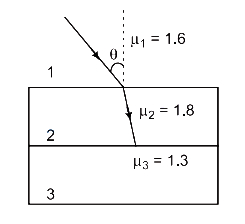
$A$ ray of light refracts from medium $1$ into a thin layer of medium $2$,crosses the layer,and is incident at the critical angle on the interface between medium $2$ and $3$ as shown in the figure. If the angle of incidence of the ray is $\theta$,the value of $\theta$ is
A
$\sin ^{-1}\left(\frac{8}{9}\right)$
B
$\sin ^{-1}\left(\frac{13}{18}\right)$
C
$\sin ^{-1}\left(\frac{13}{16}\right)$
D
$\sin ^{-1}\left(\frac{8}{13}\right)$
Solution
(C) Given: Refractive indices $\mu_1 = 1.6$,$\mu_2 = 1.8$,$\mu_3 = 1.3$.
At the interface between medium $2$ and $3$,the ray is incident at the critical angle $C$. Therefore,$\sin C = \frac{\mu_3}{\mu_2} = \frac{1.3}{1.8}$.
Let $r$ be the angle of refraction in medium $2$. Since the ray is incident at the critical angle at the interface of $2$ and $3$,the angle of refraction $r$ at the first interface is equal to the critical angle $C$ (i.e.,$r = C$).
Applying Snell's Law at the interface between medium $1$ and $2$:
$\mu_1 \sin \theta = \mu_2 \sin r$
Since $r = C$,we have $\sin r = \sin C = \frac{1.3}{1.8}$.
Substituting the values:
$1.6 \times \sin \theta = 1.8 \times \left(\frac{1.3}{1.8}\right)$
$1.6 \times \sin \theta = 1.3$
$\sin \theta = \frac{1.3}{1.6} = \frac{13}{16}$
$\theta = \sin ^{-1}\left(\frac{13}{16}\right)$
At the interface between medium $2$ and $3$,the ray is incident at the critical angle $C$. Therefore,$\sin C = \frac{\mu_3}{\mu_2} = \frac{1.3}{1.8}$.
Let $r$ be the angle of refraction in medium $2$. Since the ray is incident at the critical angle at the interface of $2$ and $3$,the angle of refraction $r$ at the first interface is equal to the critical angle $C$ (i.e.,$r = C$).
Applying Snell's Law at the interface between medium $1$ and $2$:
$\mu_1 \sin \theta = \mu_2 \sin r$
Since $r = C$,we have $\sin r = \sin C = \frac{1.3}{1.8}$.
Substituting the values:
$1.6 \times \sin \theta = 1.8 \times \left(\frac{1.3}{1.8}\right)$
$1.6 \times \sin \theta = 1.3$
$\sin \theta = \frac{1.3}{1.6} = \frac{13}{16}$
$\theta = \sin ^{-1}\left(\frac{13}{16}\right)$
0 likesView Solution
39
PhysicsMediumMCQTS EAMCET · 2011
The focal length (in $cm$) of a lens with dispersive power $0.45$ that should be placed in contact with a convex lens of focal length $84 \,cm$ and dispersive power $0.21$ to form an achromatic combination is:
A
$45$
B
$90$
C
$180$
D
-$180$
Solution
(D) Given:
Dispersive power of the first lens, $\omega_1 = 0.45$.
Dispersive power of the second lens, $\omega_2 = 0.21$.
Focal length of the second lens, $f_2 = 84 \,cm$.
For an achromatic combination of two thin lenses in contact, the condition is given by:
$\frac{\omega_1}{f_1} + \frac{\omega_2}{f_2} = 0$
$\frac{\omega_1}{f_1} = -\frac{\omega_2}{f_2}$
$\frac{f_1}{f_2} = -\frac{\omega_1}{\omega_2}$
Substituting the values:
$f_1 = -f_2 \times \left( \frac{\omega_1}{\omega_2} \right)$
$f_1 = -84 \times \left( \frac{0.45}{0.21} \right)$
$f_1 = -84 \times \left( \frac{45}{21} \right)$
$f_1 = -84 \times \frac{15}{7}$
$f_1 = -12 \times 15 = -180 \,cm$.
Thus, the focal length of the lens is $-180 \,cm$.
Dispersive power of the first lens, $\omega_1 = 0.45$.
Dispersive power of the second lens, $\omega_2 = 0.21$.
Focal length of the second lens, $f_2 = 84 \,cm$.
For an achromatic combination of two thin lenses in contact, the condition is given by:
$\frac{\omega_1}{f_1} + \frac{\omega_2}{f_2} = 0$
$\frac{\omega_1}{f_1} = -\frac{\omega_2}{f_2}$
$\frac{f_1}{f_2} = -\frac{\omega_1}{\omega_2}$
Substituting the values:
$f_1 = -f_2 \times \left( \frac{\omega_1}{\omega_2} \right)$
$f_1 = -84 \times \left( \frac{0.45}{0.21} \right)$
$f_1 = -84 \times \left( \frac{45}{21} \right)$
$f_1 = -84 \times \frac{15}{7}$
$f_1 = -12 \times 15 = -180 \,cm$.
Thus, the focal length of the lens is $-180 \,cm$.
0 likesView Solution
40
PhysicsEasyMCQTS EAMCET · 2011
Which of the following statements are true in the context of a Compound Microscope?
A
$(A), (B)$ and $(D)$
B
$(B)$ and $(C)$
C
$(A), (C)$ and $(D)$
D
$(B)$ and $(D)$
Solution
(B) In a compound microscope,both the objective and the eyepiece are convex lenses.
An objective lens has a very short focal length,while the eyepiece has a larger focal length.
Statement $(A)$ is false because the objective lens forms a real and inverted image,while the eyepiece forms a virtual and magnified image.
Statement $(B)$ is true as the objective lens has a very short focal length.
Statement $(C)$ is true because the eyepiece acts as a simple magnifying glass to view the intermediate image formed by the objective.
Statement $(D)$ is false because both lenses are convex.
Therefore,statements $(B)$ and $(C)$ are correct.
An objective lens has a very short focal length,while the eyepiece has a larger focal length.
Statement $(A)$ is false because the objective lens forms a real and inverted image,while the eyepiece forms a virtual and magnified image.
Statement $(B)$ is true as the objective lens has a very short focal length.
Statement $(C)$ is true because the eyepiece acts as a simple magnifying glass to view the intermediate image formed by the objective.
Statement $(D)$ is false because both lenses are convex.
Therefore,statements $(B)$ and $(C)$ are correct.
0 likesView Solution
41
PhysicsEasyMCQTS EAMCET · 2011
In a $p-n$ junction diode,the thickness of the depletion layer is $2 \times 10^{-6} \,m$ and the barrier potential is $0.3 \,V$. The intensity of the electric field at the junction is
A
$0.6 \times 10^{-6} \,Vm^{-1}$ from $n$ to $p$ side
B
$0.6 \times 10^{-6} \,Vm^{-1}$ from $p$ to $n$ side
C
$1.5 \times 10^5 \,Vm^{-1}$ from $n$ to $p$ side
D
$1.5 \times 10^5 \,Vm^{-1}$ from $p$ to $n$ side
Solution
(C) Given: Barrier potential,$V = 0.3 \,V$.
Thickness of depletion layer,$d = 2 \times 10^{-6} \,m$.
The electric field $E$ is given by the relation $E = \frac{V}{d}$.
Substituting the values,we get:
$E = \frac{0.3}{2 \times 10^{-6}} = 0.15 \times 10^6 = 1.5 \times 10^5 \,V/m$.
In a $p-n$ junction,the electric field is directed from the $n$-region to the $p$-region due to the accumulation of positive ions on the $n$-side and negative ions on the $p$-side of the depletion layer.
Therefore,the correct option is $C$.
Thickness of depletion layer,$d = 2 \times 10^{-6} \,m$.
The electric field $E$ is given by the relation $E = \frac{V}{d}$.
Substituting the values,we get:
$E = \frac{0.3}{2 \times 10^{-6}} = 0.15 \times 10^6 = 1.5 \times 10^5 \,V/m$.
In a $p-n$ junction,the electric field is directed from the $n$-region to the $p$-region due to the accumulation of positive ions on the $n$-side and negative ions on the $p$-side of the depletion layer.
Therefore,the correct option is $C$.
0 likesView Solution
42
PhysicsMediumMCQTS EAMCET · 2011
The dimensional formula of $\frac{1}{2} \mu_0 H^2$ (where $\mu_0$ is the permeability of free space and $H$ is the magnetic field intensity) is:
A
$[MLT^{-1}]$
B
$[ML^2 T^{-2}]$
C
$[ML^{-1} T^{-2}]$
D
$[ML^2 T^{-1}]$
Solution
(C) The expression $\frac{1}{2} \mu_0 H^2$ represents the energy density of a magnetic field.
Energy density is defined as energy per unit volume.
The dimensional formula for energy is $[ML^2 T^{-2}]$ and for volume is $[L^3]$.
Therefore,the dimensional formula for energy density is $\frac{[ML^2 T^{-2}]}{[L^3]} = [ML^{-1} T^{-2}]$.
Alternatively,using the dimensions of the given quantities:
$[\mu_0] = [MLT^{-2} A^{-2}]$ and $[H] = [AL^{-1}]$.
Substituting these into the expression:
$[\frac{1}{2} \mu_0 H^2] = [MLT^{-2} A^{-2}] \times [AL^{-1}]^2 = [MLT^{-2} A^{-2}] \times [A^2 L^{-2}] = [ML^{-1} T^{-2}]$.
Energy density is defined as energy per unit volume.
The dimensional formula for energy is $[ML^2 T^{-2}]$ and for volume is $[L^3]$.
Therefore,the dimensional formula for energy density is $\frac{[ML^2 T^{-2}]}{[L^3]} = [ML^{-1} T^{-2}]$.
Alternatively,using the dimensions of the given quantities:
$[\mu_0] = [MLT^{-2} A^{-2}]$ and $[H] = [AL^{-1}]$.
Substituting these into the expression:
$[\frac{1}{2} \mu_0 H^2] = [MLT^{-2} A^{-2}] \times [AL^{-1}]^2 = [MLT^{-2} A^{-2}] \times [A^2 L^{-2}] = [ML^{-1} T^{-2}]$.
0 likesView Solution
43
PhysicsMediumMCQTS EAMCET · 2011
Some physical quantities are given in List-$I$ and their related units are given in List-$II$. Match the correct pairs.
| List-$I$ | List-$II$ |
| $(A)$ Magnetic field intensity | $(i)$ $Wb$ |
| $(B)$ Magnetic flux | (ii) $Wb \cdot m^{-2}$ |
| $(C)$ Magnetic pole strength | (iii) $A \cdot m$ |
| $(D)$ Magnetic induction | (iv) $A \cdot m^{-1}$ |
A
$(A)-(i), (B)-(ii), (C)-(iii), (D)-(v)$
B
$(A)-(iv), (B)-(i), (C)-(iii), (D)-(ii)$
C
$(A)-(iv), (B)-(i), (C)-(v), (D)-(ii)$
D
$(A)-(ii), (B)-(iii), (C)-(i), (D)-(iv)$
Solution
(B) The units for the given physical quantities are as follows:
$1$. Magnetic field intensity $(H)$ is measured in $A \cdot m^{-1}$. Thus,$(A)-(iv)$.
$2$. Magnetic flux $(\phi)$ is measured in Weber $(Wb)$. Thus,$(B)-(i)$.
$3$. Magnetic pole strength $(m)$ is measured in Ampere-meter $(A \cdot m)$. Thus,$(C)-(iii)$.
$4$. Magnetic induction $(B)$ is measured in $Wb \cdot m^{-2}$ (or Tesla). Thus,$(D)-(ii)$.
Therefore,the correct matching is $(A)-(iv), (B)-(i), (C)-(iii), (D)-(ii)$.
The correct option is $(B)$.
$1$. Magnetic field intensity $(H)$ is measured in $A \cdot m^{-1}$. Thus,$(A)-(iv)$.
$2$. Magnetic flux $(\phi)$ is measured in Weber $(Wb)$. Thus,$(B)-(i)$.
$3$. Magnetic pole strength $(m)$ is measured in Ampere-meter $(A \cdot m)$. Thus,$(C)-(iii)$.
$4$. Magnetic induction $(B)$ is measured in $Wb \cdot m^{-2}$ (or Tesla). Thus,$(D)-(ii)$.
Therefore,the correct matching is $(A)-(iv), (B)-(i), (C)-(iii), (D)-(ii)$.
The correct option is $(B)$.
0 likesView Solution
44
PhysicsEasyMCQTS EAMCET · 2011
In the Young's double slit experiment,the resultant intensity at a point on the screen is $75 \%$ of the maximum intensity of the bright fringe. Then the phase difference between the two interfering rays at that point is
A
$\frac{\pi}{6}$
B
$\frac{\pi}{4}$
C
$\frac{\pi}{3}$
D
$\frac{\pi}{2}$
Solution
(C) The resultant intensity $I_R$ at any point is given by $I_R = I_{\max} \cos^2 \left( \frac{\phi}{2} \right)$,where $\phi$ is the phase difference.
Given that $I_R = 75 \% \text{ of } I_{\max} = 0.75 I_{\max} = \frac{3}{4} I_{\max}$.
Substituting this into the formula:
$\frac{3}{4} I_{\max} = I_{\max} \cos^2 \left( \frac{\phi}{2} \right)$
$\cos^2 \left( \frac{\phi}{2} \right) = \frac{3}{4}$
Taking the square root on both sides:
$\cos \left( \frac{\phi}{2} \right) = \frac{\sqrt{3}}{2}$
Since $\cos \left( \frac{\pi}{6} \right) = \frac{\sqrt{3}}{2}$,we have:
$\frac{\phi}{2} = \frac{\pi}{6}$
$\phi = \frac{\pi}{3}$
Given that $I_R = 75 \% \text{ of } I_{\max} = 0.75 I_{\max} = \frac{3}{4} I_{\max}$.
Substituting this into the formula:
$\frac{3}{4} I_{\max} = I_{\max} \cos^2 \left( \frac{\phi}{2} \right)$
$\cos^2 \left( \frac{\phi}{2} \right) = \frac{3}{4}$
Taking the square root on both sides:
$\cos \left( \frac{\phi}{2} \right) = \frac{\sqrt{3}}{2}$
Since $\cos \left( \frac{\pi}{6} \right) = \frac{\sqrt{3}}{2}$,we have:
$\frac{\phi}{2} = \frac{\pi}{6}$
$\phi = \frac{\pi}{3}$
0 likesView Solution
Vedclass Products
For Students
Vedclass Test Series
Mock tests in real TS EAMCET style covering Physics with performance analysis. 5-day free trial.
Start Free TrialFor Teachers
Exam Paper Generator
Generate Set A/B/C/D Physics papers from 7.5L+ questions in 2 minutes. 3 chapters free.
Try FreeFor Institutes
Online Exam Module
Run live TS EAMCET mock exams with unlimited students, 360° analytics & white-label branding.
See DemoFrequently Asked Questions
How many Physics questions are in TS EAMCET 2011?
There are 44 Physics questions from the TS EAMCET 2011 paper on Vedclass, each with a detailed step-by-step solution in English.
Are TS EAMCET 2011 Physics solutions available in English?
Yes. All solutions on this page are in English. You can also switch to English or Hindi using the language buttons above the questions.
Can I practice TS EAMCET 2011 Physics as a timed test?
Yes. Use the Vedclass Test Series to attempt a full TS EAMCET mock test covering Physics with time limits and instant score analysis.
Can teachers create Physics papers from TS EAMCET previous year questions?
Yes. The Vedclass Exam Paper Generator lets teachers mix TS EAMCET Physics questions and generate Set A/B/C/D papers in minutes.
For Teachers & Institutes
Build a Custom Physics Paper
Pick TS EAMCET 2011 Physics questions, set difficulty, and generate Set A/B/C/D in 2 minutes.