
ChemistryQ151–173 of 193 questions
Page 4 of 4 · English
151
ChemistryMCQTS EAMCET · 2009
$y=e^{a \sin ^{-1} x} \Rightarrow (1-x^2) y_{n+2}-(2 n+1) x y_{n+1}$ is equal to
A
$-\left(n^2+a^2\right) y_n$
B
$\left(n^2-a^2\right) y_n$
C
$\left(n^2+a^2\right) y_n$
D
$-\left(n^2-a^2\right) y_n$
Solution
(C) Given,$y=e^{a \sin ^{-1} x}$.
On differentiating with respect to $x$,we get:
$y_1 = e^{a \sin ^{-1} x} \cdot \frac{a}{\sqrt{1-x^2}}$
$\Rightarrow y_1 \sqrt{1-x^2} = ay$
Squaring both sides:
$(1-x^2) y_1^2 = a^2 y^2$
Again,differentiating with respect to $x$:
$(1-x^2) 2 y_1 y_2 - 2x y_1^2 = a^2 2y y_1$
Dividing by $2y_1$ (assuming $y_1 \neq 0$):
$(1-x^2) y_2 - x y_1 - a^2 y = 0$
Applying Leibnitz's theorem for the $n$-th derivative:
$(1-x^2) y_{n+2} + n(-2x) y_{n+1} + \frac{n(n-1)}{2}(-2) y_n - (x y_{n+1} + n(1) y_n) - a^2 y_n = 0$
$(1-x^2) y_{n+2} - 2nx y_{n+1} - n(n-1) y_n - x y_{n+1} - n y_n - a^2 y_n = 0$
$(1-x^2) y_{n+2} - (2n+1) x y_{n+1} - (n^2 - n + n + a^2) y_n = 0$
$(1-x^2) y_{n+2} - (2n+1) x y_{n+1} = (n^2 + a^2) y_n$
On differentiating with respect to $x$,we get:
$y_1 = e^{a \sin ^{-1} x} \cdot \frac{a}{\sqrt{1-x^2}}$
$\Rightarrow y_1 \sqrt{1-x^2} = ay$
Squaring both sides:
$(1-x^2) y_1^2 = a^2 y^2$
Again,differentiating with respect to $x$:
$(1-x^2) 2 y_1 y_2 - 2x y_1^2 = a^2 2y y_1$
Dividing by $2y_1$ (assuming $y_1 \neq 0$):
$(1-x^2) y_2 - x y_1 - a^2 y = 0$
Applying Leibnitz's theorem for the $n$-th derivative:
$(1-x^2) y_{n+2} + n(-2x) y_{n+1} + \frac{n(n-1)}{2}(-2) y_n - (x y_{n+1} + n(1) y_n) - a^2 y_n = 0$
$(1-x^2) y_{n+2} - 2nx y_{n+1} - n(n-1) y_n - x y_{n+1} - n y_n - a^2 y_n = 0$
$(1-x^2) y_{n+2} - (2n+1) x y_{n+1} - (n^2 - n + n + a^2) y_n = 0$
$(1-x^2) y_{n+2} - (2n+1) x y_{n+1} = (n^2 + a^2) y_n$
0 likesView Solution
152
ChemistryMCQTS EAMCET · 2009
If $f:[2,3] \rightarrow R$ is defined by $f(x)=x^3+3x-2$,then the range of $f(x)$ is contained in the interval
A
$[1,12]$
B
$[12,34]$
C
$[35,50]$
D
$[-12,12]$
Solution
(B) Given,$f(x)=x^3+3x-2$.
On differentiating with respect to $x$,we get $f'(x)=3x^2+3$.
Since $x^2 \geq 0$ for all $x \in [2,3]$,$f'(x) = 3x^2+3 \geq 3 > 0$.
Thus,$f(x)$ is a strictly increasing function on the interval $[2,3]$.
For a strictly increasing function,the range is $[f(2), f(3)]$.
At $x=2$,$f(2) = 2^3 + 3(2) - 2 = 8 + 6 - 2 = 12$.
At $x=3$,$f(3) = 3^3 + 3(3) - 2 = 27 + 9 - 2 = 34$.
Therefore,the range of $f(x)$ is $[12, 34]$.
On differentiating with respect to $x$,we get $f'(x)=3x^2+3$.
Since $x^2 \geq 0$ for all $x \in [2,3]$,$f'(x) = 3x^2+3 \geq 3 > 0$.
Thus,$f(x)$ is a strictly increasing function on the interval $[2,3]$.
For a strictly increasing function,the range is $[f(2), f(3)]$.
At $x=2$,$f(2) = 2^3 + 3(2) - 2 = 8 + 6 - 2 = 12$.
At $x=3$,$f(3) = 3^3 + 3(3) - 2 = 27 + 9 - 2 = 34$.
Therefore,the range of $f(x)$ is $[12, 34]$.
0 likesView Solution
153
ChemistryMCQTS EAMCET · 2009
The maximum value of $\frac{\log x}{x}, 0 < x < \infty$ is
A
$\infty$
B
$e$
C
$1$
D
$e^{-1}$
Solution
(D) Let $f(x) = \frac{\log x}{x}$.
To find the maximum value,we find the derivative $f'(x)$ using the quotient rule:
$f'(x) = \frac{x \cdot \frac{d}{dx}(\log x) - \log x \cdot \frac{d}{dx}(x)}{x^2} = \frac{x \cdot \frac{1}{x} - \log x}{x^2} = \frac{1 - \log x}{x^2}$.
Set $f'(x) = 0$ to find critical points:
$1 - \log x = 0 \Rightarrow \log x = 1 \Rightarrow x = e$.
Now,we check the second derivative $f''(x)$ to confirm the nature of the point:
$f''(x) = \frac{x^2(-\frac{1}{x}) - (1 - \log x)(2x)}{x^4} = \frac{-x - 2x + 2x \log x}{x^4} = \frac{2 \log x - 3}{x^3}$.
At $x = e$,$f''(e) = \frac{2(1) - 3}{e^3} = -\frac{1}{e^3} < 0$.
Since the second derivative is negative,the function has a local maximum at $x = e$.
The maximum value is $f(e) = \frac{\log e}{e} = \frac{1}{e} = e^{-1}$.
To find the maximum value,we find the derivative $f'(x)$ using the quotient rule:
$f'(x) = \frac{x \cdot \frac{d}{dx}(\log x) - \log x \cdot \frac{d}{dx}(x)}{x^2} = \frac{x \cdot \frac{1}{x} - \log x}{x^2} = \frac{1 - \log x}{x^2}$.
Set $f'(x) = 0$ to find critical points:
$1 - \log x = 0 \Rightarrow \log x = 1 \Rightarrow x = e$.
Now,we check the second derivative $f''(x)$ to confirm the nature of the point:
$f''(x) = \frac{x^2(-\frac{1}{x}) - (1 - \log x)(2x)}{x^4} = \frac{-x - 2x + 2x \log x}{x^4} = \frac{2 \log x - 3}{x^3}$.
At $x = e$,$f''(e) = \frac{2(1) - 3}{e^3} = -\frac{1}{e^3} < 0$.
Since the second derivative is negative,the function has a local maximum at $x = e$.
The maximum value is $f(e) = \frac{\log e}{e} = \frac{1}{e} = e^{-1}$.
0 likesView Solution
154
ChemistryMCQTS EAMCET · 2009
$\int \left( \frac{2 - \sin 2x}{1 - \cos 2x} \right) e^x \, dx$ is equal to
A
$-e^x \cot x + c$
B
$e^x \cot x + c$
C
$2e^x \cot x + c$
D
$-2e^x \cot x + c$
Solution
(A) We have the integral $I = \int \left( \frac{2 - \sin 2x}{1 - \cos 2x} \right) e^x \, dx$.
Using trigonometric identities $\sin 2x = 2 \sin x \cos x$ and $1 - \cos 2x = 2 \sin^2 x$,we get:
$I = \int \left( \frac{2 - 2 \sin x \cos x}{2 \sin^2 x} \right) e^x \, dx$
$I = \int \left( \frac{1}{\sin^2 x} - \frac{\sin x \cos x}{\sin^2 x} \right) e^x \, dx$
$I = \int (\operatorname{cosec}^2 x - \cot x) e^x \, dx$
$I = \int e^x \operatorname{cosec}^2 x \, dx - \int e^x \cot x \, dx$
Using integration by parts for the first term $\int e^x \operatorname{cosec}^2 x \, dx$:
Let $u = \cot x$,then $du = -\operatorname{cosec}^2 x \, dx$.
$\int e^x \operatorname{cosec}^2 x \, dx = -e^x \cot x - \int (-e^x \cot x) \, dx = -e^x \cot x + \int e^x \cot x \, dx$.
Substituting this back into the expression for $I$:
$I = (-e^x \cot x + \int e^x \cot x \, dx) - \int e^x \cot x \, dx + c$
$I = -e^x \cot x + c$.
Using trigonometric identities $\sin 2x = 2 \sin x \cos x$ and $1 - \cos 2x = 2 \sin^2 x$,we get:
$I = \int \left( \frac{2 - 2 \sin x \cos x}{2 \sin^2 x} \right) e^x \, dx$
$I = \int \left( \frac{1}{\sin^2 x} - \frac{\sin x \cos x}{\sin^2 x} \right) e^x \, dx$
$I = \int (\operatorname{cosec}^2 x - \cot x) e^x \, dx$
$I = \int e^x \operatorname{cosec}^2 x \, dx - \int e^x \cot x \, dx$
Using integration by parts for the first term $\int e^x \operatorname{cosec}^2 x \, dx$:
Let $u = \cot x$,then $du = -\operatorname{cosec}^2 x \, dx$.
$\int e^x \operatorname{cosec}^2 x \, dx = -e^x \cot x - \int (-e^x \cot x) \, dx = -e^x \cot x + \int e^x \cot x \, dx$.
Substituting this back into the expression for $I$:
$I = (-e^x \cot x + \int e^x \cot x \, dx) - \int e^x \cot x \, dx + c$
$I = -e^x \cot x + c$.
0 likesView Solution
155
ChemistryMCQTS EAMCET · 2009
The differential equation of the family $y=a e^x+b x e^x+c x^2 e^x$ of curves,where $a, b, c$ are arbitrary constants,is
A
$y^{\prime \prime \prime}+3 y^{\prime \prime}+3 y^{\prime}+y=0$
B
$y^{\prime \prime \prime}+3 y^{\prime \prime}-3 y^{\prime}-y=0$
C
$y^{\prime \prime \prime}-3 y^{\prime \prime}-3 y^{\prime}+y=0$
D
$y^{\prime \prime \prime}-3 y^{\prime \prime}+3 y^{\prime}-y=0$
Solution
(D) Given the family of curves: $y = (a + bx + cx^2)e^x$
This can be written as $y e^{-x} = a + bx + cx^2$.
Differentiating with respect to $x$ three times:
First derivative: $\frac{d}{dx}(y e^{-x}) = b + 2cx$
$\Rightarrow y' e^{-x} - y e^{-x} = b + 2cx$
Second derivative: $\frac{d}{dx}(y' e^{-x} - y e^{-x}) = 2c$
$\Rightarrow y'' e^{-x} - y' e^{-x} - (y' e^{-x} - y e^{-x}) = 2c$
$\Rightarrow y'' e^{-x} - 2y' e^{-x} + y e^{-x} = 2c$
Third derivative: $\frac{d}{dx}(y'' e^{-x} - 2y' e^{-x} + y e^{-x}) = 0$
$\Rightarrow y''' e^{-x} - y'' e^{-x} - 2(y'' e^{-x} - y' e^{-x}) + (y' e^{-x} - y e^{-x}) = 0$
$\Rightarrow y''' - y'' - 2y'' + 2y' + y' - y = 0$
$\Rightarrow y''' - 3y'' + 3y' - y = 0$
Thus,the correct option is $D$.
This can be written as $y e^{-x} = a + bx + cx^2$.
Differentiating with respect to $x$ three times:
First derivative: $\frac{d}{dx}(y e^{-x}) = b + 2cx$
$\Rightarrow y' e^{-x} - y e^{-x} = b + 2cx$
Second derivative: $\frac{d}{dx}(y' e^{-x} - y e^{-x}) = 2c$
$\Rightarrow y'' e^{-x} - y' e^{-x} - (y' e^{-x} - y e^{-x}) = 2c$
$\Rightarrow y'' e^{-x} - 2y' e^{-x} + y e^{-x} = 2c$
Third derivative: $\frac{d}{dx}(y'' e^{-x} - 2y' e^{-x} + y e^{-x}) = 0$
$\Rightarrow y''' e^{-x} - y'' e^{-x} - 2(y'' e^{-x} - y' e^{-x}) + (y' e^{-x} - y e^{-x}) = 0$
$\Rightarrow y''' - y'' - 2y'' + 2y' + y' - y = 0$
$\Rightarrow y''' - 3y'' + 3y' - y = 0$
Thus,the correct option is $D$.
0 likesView Solution
156
ChemistryMCQTS EAMCET · 2009
The solution of the differential equation $\frac{dy}{dx} = \sin(x+y) \tan(x+y) - 1$ is
A
$\operatorname{cosec}(x+y) + \tan(x+y) = x + c$
B
$x + \operatorname{cosec}(x+y) = c$
C
$x + \tan(x+y) = c$
D
$x + \sec(x+y) = c$
Solution
(B) Given the differential equation: $\frac{dy}{dx} = \sin(x+y) \tan(x+y) - 1$
Let $x+y = z$. Then,differentiating with respect to $x$,we get $1 + \frac{dy}{dx} = \frac{dz}{dx}$,which implies $\frac{dy}{dx} = \frac{dz}{dx} - 1$.
Substituting this into the original equation:
$\frac{dz}{dx} - 1 = \sin z \tan z - 1$
$\frac{dz}{dx} = \sin z \tan z = \sin z \cdot \frac{\sin z}{\cos z} = \frac{\sin^2 z}{\cos z}$
Rearranging the terms to separate variables:
$\int \frac{\cos z}{\sin^2 z} dz = \int dx$
Let $\sin z = t$,then $\cos z dz = dt$. The integral becomes:
$\int \frac{1}{t^2} dt = x + c$
$- \frac{1}{t} = x + c$
Since $t = \sin z$,we have $-\operatorname{cosec} z = x + c$,which simplifies to $x + \operatorname{cosec} z = -c$. Replacing $c$ with a new constant $C$,we get:
$x + \operatorname{cosec}(x+y) = C$
Let $x+y = z$. Then,differentiating with respect to $x$,we get $1 + \frac{dy}{dx} = \frac{dz}{dx}$,which implies $\frac{dy}{dx} = \frac{dz}{dx} - 1$.
Substituting this into the original equation:
$\frac{dz}{dx} - 1 = \sin z \tan z - 1$
$\frac{dz}{dx} = \sin z \tan z = \sin z \cdot \frac{\sin z}{\cos z} = \frac{\sin^2 z}{\cos z}$
Rearranging the terms to separate variables:
$\int \frac{\cos z}{\sin^2 z} dz = \int dx$
Let $\sin z = t$,then $\cos z dz = dt$. The integral becomes:
$\int \frac{1}{t^2} dt = x + c$
$- \frac{1}{t} = x + c$
Since $t = \sin z$,we have $-\operatorname{cosec} z = x + c$,which simplifies to $x + \operatorname{cosec} z = -c$. Replacing $c$ with a new constant $C$,we get:
$x + \operatorname{cosec}(x+y) = C$
0 likesView Solution
157
ChemistryMCQTS EAMCET · 2009
If a line in space makes angles $\alpha, \beta,$ and $\gamma$ with the coordinate axes,then the value of $\cos 2\alpha + \cos 2\beta + \cos 2\gamma + \sin^2 \alpha + \sin^2 \beta + \sin^2 \gamma$ is equal to:
A
-$1$
B
$0$
C
$1$
D
$2$
Solution
(C) We know that for a line making angles $\alpha, \beta, \gamma$ with the coordinate axes,the direction cosines are $\cos \alpha, \cos \beta, \cos \gamma$,and they satisfy the identity $\cos^2 \alpha + \cos^2 \beta + \cos^2 \gamma = 1$.
Given expression: $E = \cos 2\alpha + \cos 2\beta + \cos 2\gamma + \sin^2 \alpha + \sin^2 \beta + \sin^2 \gamma$.
Using the identity $\cos 2\theta = \cos^2 \theta - \sin^2 \theta$,we can rewrite the expression as:
$E = (\cos^2 \alpha - \sin^2 \alpha) + (\cos^2 \beta - \sin^2 \beta) + (\cos^2 \gamma - \sin^2 \gamma) + \sin^2 \alpha + \sin^2 \beta + \sin^2 \gamma$.
Simplifying the terms:
$E = \cos^2 \alpha - \sin^2 \alpha + \cos^2 \beta - \sin^2 \beta + \cos^2 \gamma - \sin^2 \gamma + \sin^2 \alpha + \sin^2 \beta + \sin^2 \gamma$.
The terms $-\sin^2 \alpha + \sin^2 \alpha$,$-\sin^2 \beta + \sin^2 \beta$,and $-\sin^2 \gamma + \sin^2 \gamma$ cancel out.
Thus,$E = \cos^2 \alpha + \cos^2 \beta + \cos^2 \gamma$.
Since $\cos^2 \alpha + \cos^2 \beta + \cos^2 \gamma = 1$,the value of the expression is $1$.
Given expression: $E = \cos 2\alpha + \cos 2\beta + \cos 2\gamma + \sin^2 \alpha + \sin^2 \beta + \sin^2 \gamma$.
Using the identity $\cos 2\theta = \cos^2 \theta - \sin^2 \theta$,we can rewrite the expression as:
$E = (\cos^2 \alpha - \sin^2 \alpha) + (\cos^2 \beta - \sin^2 \beta) + (\cos^2 \gamma - \sin^2 \gamma) + \sin^2 \alpha + \sin^2 \beta + \sin^2 \gamma$.
Simplifying the terms:
$E = \cos^2 \alpha - \sin^2 \alpha + \cos^2 \beta - \sin^2 \beta + \cos^2 \gamma - \sin^2 \gamma + \sin^2 \alpha + \sin^2 \beta + \sin^2 \gamma$.
The terms $-\sin^2 \alpha + \sin^2 \alpha$,$-\sin^2 \beta + \sin^2 \beta$,and $-\sin^2 \gamma + \sin^2 \gamma$ cancel out.
Thus,$E = \cos^2 \alpha + \cos^2 \beta + \cos^2 \gamma$.
Since $\cos^2 \alpha + \cos^2 \beta + \cos^2 \gamma = 1$,the value of the expression is $1$.
0 likesView Solution
158
ChemistryMCQTS EAMCET · 2009
Suppose that $E_1$ and $E_2$ are two events of a random experiment such that $P(E_1) = \frac{1}{4}$,$P(E_2 / E_1) = \frac{1}{2}$ and $P(E_1 / E_2) = \frac{1}{4}$. Observe the lists given below. The correct matching of List-$I$ from List-$II$ is:
| List-$I$ | List-$II$ |
| $(A)$ $P(E_2)$ | $(i)$ $1/4$ |
| $(B)$ $P(E_1 \cup E_2)$ | $(ii)$ $5/8$ |
| $(C)$ $P(\bar{E}_1 / \bar{E}_2)$ | $(iii)$ $1/8$ |
| $(D)$ $P(E_1 / \bar{E}_2)$ | $(iv)$ $1/2$ |
| $(v)$ $3/8$ | |
| $(vi)$ $3/4$ |
A
$(A)$-$iv$,$(B)$-$ii$,$(C)$-$vi$,$(D)$-$i$
B
$(A)$-$iv$,$(B)$-$v$,$(C)$-$vi$,$(D)$-$i$
C
$(A)$-$iv$,$(B)$-$ii$,$(C)$-$vi$,$(D)$-$i$
D
$(A)$-$i$,$(B)$-$ii$,$(C)$-$iii$,$(D)$-$iv$
Solution
(C) Given: $P(E_1) = \frac{1}{4}$,$P(E_2 / E_1) = \frac{1}{2}$,$P(E_1 / E_2) = \frac{1}{4}$.
Step $1$: Find $P(E_1 \cap E_2)$.
$P(E_2 / E_1) = \frac{P(E_1 \cap E_2)}{P(E_1)} \Rightarrow \frac{1}{2} = \frac{P(E_1 \cap E_2)}{1/4} \Rightarrow P(E_1 \cap E_2) = \frac{1}{8}$.
Step $2$: Find $P(E_2)$.
$P(E_1 / E_2) = \frac{P(E_1 \cap E_2)}{P(E_2)} \Rightarrow \frac{1}{4} = \frac{1/8}{P(E_2)} \Rightarrow P(E_2) = \frac{1/8}{1/4} = \frac{1}{2}$. (Matches $iv$)
Step $3$: Find $P(E_1 \cup E_2)$.
$P(E_1 \cup E_2) = P(E_1) + P(E_2) - P(E_1 \cap E_2) = \frac{1}{4} + \frac{1}{2} - \frac{1}{8} = \frac{2+4-1}{8} = \frac{5}{8}$. (Matches $ii$)
Step $4$: Find $P(\bar{E}_1 / \bar{E}_2)$.
$P(\bar{E}_1 / \bar{E}_2) = \frac{P(\bar{E}_1 \cap \bar{E}_2)}{P(\bar{E}_2)} = \frac{1 - P(E_1 \cup E_2)}{1 - P(E_2)} = \frac{1 - 5/8}{1 - 1/2} = \frac{3/8}{1/2} = \frac{3}{4}$. (Matches $vi$)
Step $5$: Find $P(E_1 / \bar{E}_2)$.
$P(E_1 / \bar{E}_2) = \frac{P(E_1 \cap \bar{E}_2)}{P(\bar{E}_2)} = \frac{P(E_1) - P(E_1 \cap E_2)}{1 - P(E_2)} = \frac{1/4 - 1/8}{1 - 1/2} = \frac{1/8}{1/2} = \frac{1}{4}$. (Matches $i$)
Thus,the correct matching is $(A)$-$iv$,$(B)$-$ii$,$(C)$-$vi$,$(D)$-$i$.
Step $1$: Find $P(E_1 \cap E_2)$.
$P(E_2 / E_1) = \frac{P(E_1 \cap E_2)}{P(E_1)} \Rightarrow \frac{1}{2} = \frac{P(E_1 \cap E_2)}{1/4} \Rightarrow P(E_1 \cap E_2) = \frac{1}{8}$.
Step $2$: Find $P(E_2)$.
$P(E_1 / E_2) = \frac{P(E_1 \cap E_2)}{P(E_2)} \Rightarrow \frac{1}{4} = \frac{1/8}{P(E_2)} \Rightarrow P(E_2) = \frac{1/8}{1/4} = \frac{1}{2}$. (Matches $iv$)
Step $3$: Find $P(E_1 \cup E_2)$.
$P(E_1 \cup E_2) = P(E_1) + P(E_2) - P(E_1 \cap E_2) = \frac{1}{4} + \frac{1}{2} - \frac{1}{8} = \frac{2+4-1}{8} = \frac{5}{8}$. (Matches $ii$)
Step $4$: Find $P(\bar{E}_1 / \bar{E}_2)$.
$P(\bar{E}_1 / \bar{E}_2) = \frac{P(\bar{E}_1 \cap \bar{E}_2)}{P(\bar{E}_2)} = \frac{1 - P(E_1 \cup E_2)}{1 - P(E_2)} = \frac{1 - 5/8}{1 - 1/2} = \frac{3/8}{1/2} = \frac{3}{4}$. (Matches $vi$)
Step $5$: Find $P(E_1 / \bar{E}_2)$.
$P(E_1 / \bar{E}_2) = \frac{P(E_1 \cap \bar{E}_2)}{P(\bar{E}_2)} = \frac{P(E_1) - P(E_1 \cap E_2)}{1 - P(E_2)} = \frac{1/4 - 1/8}{1 - 1/2} = \frac{1/8}{1/2} = \frac{1}{4}$. (Matches $i$)
Thus,the correct matching is $(A)$-$iv$,$(B)$-$ii$,$(C)$-$vi$,$(D)$-$i$.
0 likesView Solution
159
ChemistryMCQTS EAMCET · 2009
If $X$ is a binomial variate with the range $\{0, 1, 2, 3, 4, 5, 6\}$ and $P(X=2) = 4 P(X=4)$,then the parameter $p$ of $X$ is
A
$\frac{1}{3}$
B
$\frac{1}{2}$
C
$\frac{2}{3}$
D
$\frac{3}{4}$
Solution
(A) Given that $X$ is a binomial variate with range $\{0, 1, 2, 3, 4, 5, 6\}$,so $n = 6$.
The probability mass function of a binomial distribution is given by $P(X=k) = { }^n C_k p^k q^{n-k}$,where $q = 1-p$.
According to the given condition,$P(X=2) = 4 P(X=4)$.
Substituting the values:
${ }^6 C_2 p^2 q^4 = 4 \cdot { }^6 C_4 p^4 q^2$
Since ${ }^6 C_2 = 15$ and ${ }^6 C_4 = 15$,we have:
$15 p^2 q^4 = 4 \cdot 15 p^4 q^2$
Dividing both sides by $15 p^2 q^2$ (assuming $p, q \neq 0$):
$q^2 = 4 p^2$
$(1-p)^2 = 4 p^2$
$1 - 2p + p^2 = 4 p^2$
$3p^2 + 2p - 1 = 0$
Factoring the quadratic equation:
$(3p - 1)(p + 1) = 0$
This gives $p = \frac{1}{3}$ or $p = -1$.
Since the probability $p$ must be in the interval $[0, 1]$,we discard $p = -1$.
Therefore,$p = \frac{1}{3}$.
The probability mass function of a binomial distribution is given by $P(X=k) = { }^n C_k p^k q^{n-k}$,where $q = 1-p$.
According to the given condition,$P(X=2) = 4 P(X=4)$.
Substituting the values:
${ }^6 C_2 p^2 q^4 = 4 \cdot { }^6 C_4 p^4 q^2$
Since ${ }^6 C_2 = 15$ and ${ }^6 C_4 = 15$,we have:
$15 p^2 q^4 = 4 \cdot 15 p^4 q^2$
Dividing both sides by $15 p^2 q^2$ (assuming $p, q \neq 0$):
$q^2 = 4 p^2$
$(1-p)^2 = 4 p^2$
$1 - 2p + p^2 = 4 p^2$
$3p^2 + 2p - 1 = 0$
Factoring the quadratic equation:
$(3p - 1)(p + 1) = 0$
This gives $p = \frac{1}{3}$ or $p = -1$.
Since the probability $p$ must be in the interval $[0, 1]$,we discard $p = -1$.
Therefore,$p = \frac{1}{3}$.
0 likesView Solution
160
ChemistryMediumMCQTS EAMCET · 2009
Aluminium reacts with $NaOH$ and forms compound '$X$'. If the coordination number of aluminium in '$X$' is $6$,the correct formula of $X$ is:
A
$[Al(H_2O)_4(OH)_2]^+$
B
$[Al(H_2O)_3(OH)_3]$
C
$[Al(H_2O)_2(OH)_4]^-$
D
$[Al(H_2O)_6](OH)_3$
Solution
(C) Aluminium reacts with aqueous $NaOH$ to form sodium tetrahydroxoaluminate$(III)$.
The reaction is: $2Al(s) + 2NaOH(aq) + 6H_2O(l) \longrightarrow 2Na[Al(OH)_4](aq) + 3H_2(g)$.
In aqueous solution,the species exists as the octahedral complex $[Al(H_2O)_2(OH)_4]^-$,where the coordination number of $Al$ is $6$.
The reaction is: $2Al(s) + 2NaOH(aq) + 6H_2O(l) \longrightarrow 2Na[Al(OH)_4](aq) + 3H_2(g)$.
In aqueous solution,the species exists as the octahedral complex $[Al(H_2O)_2(OH)_4]^-$,where the coordination number of $Al$ is $6$.
0 likesView Solution
161
ChemistryMediumMCQTS EAMCET · 2009
$SiCl_4$ on hydrolysis forms '$X$' and $HCl$. Compound '$X$' loses water at $1000^{\circ} C$ and gives '$Y$'. Compounds '$X$' and '$Y$' respectively are:
A
$H_2SiCl_6, SiO_2$
B
$H_4SiO_4, Si$
C
$SiO_2, Si$
D
$H_4SiO_4, SiO_2$
Solution
(D) The hydrolysis of silicon tetrachloride $(SiCl_4)$ proceeds as follows:
$SiCl_4 + 4H_2O \longrightarrow H_4SiO_4 + 4HCl$
Here,'$X$' is silicic acid $(H_4SiO_4)$.
Upon heating at $1000^{\circ} C$,silicic acid undergoes dehydration:
$H_4SiO_4 \xrightarrow{\Delta, 1000^{\circ} C} SiO_2 + 2H_2O$
Here,'$Y$' is silicon dioxide $(SiO_2)$.
Therefore,'$X$' is $H_4SiO_4$ and '$Y$' is $SiO_2$.
$SiCl_4 + 4H_2O \longrightarrow H_4SiO_4 + 4HCl$
Here,'$X$' is silicic acid $(H_4SiO_4)$.
Upon heating at $1000^{\circ} C$,silicic acid undergoes dehydration:
$H_4SiO_4 \xrightarrow{\Delta, 1000^{\circ} C} SiO_2 + 2H_2O$
Here,'$Y$' is silicon dioxide $(SiO_2)$.
Therefore,'$X$' is $H_4SiO_4$ and '$Y$' is $SiO_2$.
0 likesView Solution
162
ChemistryEasyMCQTS EAMCET · 2009
Assertion $(A)$: $K$,$Rb$,and $Cs$ form superoxides.
Reason $(R)$: The stability of the superoxides increases from $K$ to $Cs$ due to the decrease in lattice energy.
The correct answer is:
Reason $(R)$: The stability of the superoxides increases from $K$ to $Cs$ due to the decrease in lattice energy.
The correct answer is:
A
Both $(A)$ and $(R)$ are true and $(R)$ is the correct explanation of $(A)$
B
Both $(A)$ and $(R)$ are true but $(R)$ is not the correct explanation of $(A)$
C
$(A)$ is true but $(R)$ is not true
D
$(A)$ is not true but $(R)$ is true
Solution
(C) Assertion $(A)$ is true: Alkali metals $K$,$Rb$,and $Cs$ react with excess oxygen to form superoxides of the type $MO_2$.
Reason $(R)$ is false: The stability of superoxides increases from $K$ to $Cs$ because the large size of the alkali metal cation stabilizes the large superoxide anion $(O_2^-)$ through a decrease in lattice energy,but the statement claims stability increases *due to* the decrease in lattice energy,which is a misinterpretation of the thermodynamic stability factor. More accurately,the stability increases due to the increasing size of the cation which matches the size of the large anion,reducing the lattice energy and making the formation more favorable. However,the reason provided is scientifically incorrect in its causal link.
Therefore,$(A)$ is true but $(R)$ is false.
Reason $(R)$ is false: The stability of superoxides increases from $K$ to $Cs$ because the large size of the alkali metal cation stabilizes the large superoxide anion $(O_2^-)$ through a decrease in lattice energy,but the statement claims stability increases *due to* the decrease in lattice energy,which is a misinterpretation of the thermodynamic stability factor. More accurately,the stability increases due to the increasing size of the cation which matches the size of the large anion,reducing the lattice energy and making the formation more favorable. However,the reason provided is scientifically incorrect in its causal link.
Therefore,$(A)$ is true but $(R)$ is false.
0 likesView Solution
163
ChemistryDifficultMCQTS EAMCET · 2009
$1.5 \ g$ of $CdCl_2$ was found to contain $0.9 \ g$ of $Cd$. Calculate the atomic weight of $Cd$.
A
$118$
B
$112$
C
$106.5$
D
$53.25$
Solution
(C) Mass of $Cd = 0.9 \ g$.
Mass of $Cl_2 = 1.5 \ g - 0.9 \ g = 0.6 \ g$.
Atomic weight of $Cl = 35.5 \ g/mol$.
Mass of $Cl_2$ in $CdCl_2 = 2 \times 35.5 = 71 \ g/mol$.
According to the law of chemical equivalence:
$\frac{\text{Mass of } Cd}{\text{Atomic weight of } Cd} = \frac{\text{Mass of } Cl_2}{\text{Equivalent weight of } Cl_2}$.
$\frac{0.9}{x} = \frac{0.6}{71}$.
$x = \frac{0.9 \times 71}{0.6} = 1.5 \times 71 = 106.5 \ g/mol$.
Mass of $Cl_2 = 1.5 \ g - 0.9 \ g = 0.6 \ g$.
Atomic weight of $Cl = 35.5 \ g/mol$.
Mass of $Cl_2$ in $CdCl_2 = 2 \times 35.5 = 71 \ g/mol$.
According to the law of chemical equivalence:
$\frac{\text{Mass of } Cd}{\text{Atomic weight of } Cd} = \frac{\text{Mass of } Cl_2}{\text{Equivalent weight of } Cl_2}$.
$\frac{0.9}{x} = \frac{0.6}{71}$.
$x = \frac{0.9 \times 71}{0.6} = 1.5 \times 71 = 106.5 \ g/mol$.
0 likesView Solution
164
ChemistryDifficultMCQTS EAMCET · 2009
The percentage composition of an organic compound $A$ is: carbon = $85.71 \%$ and hydrogen = $14.29 \%$. Its vapour density is $14$. Consider the following reaction sequence:
$A$ $\xrightarrow{Cl_2/H_2O} B$ $\xrightarrow[(ii) H_3O^+]{(i) KCN/EtOH} C$
Identify $C$.
$A$ $\xrightarrow{Cl_2/H_2O} B$ $\xrightarrow[(ii) H_3O^+]{(i) KCN/EtOH} C$
Identify $C$.
A
$CH_3-CH(OH)-CO_2H$
B
$HO-CH_2-CH_2-CO_2H$
C
$HO-CH_2-CO_2H$
D
$CH_3-CH_2-CO_2H$
Solution
(B) Step $1$: Determine the empirical formula of $A$.
$C = 85.71 \% = \frac{85.71}{12} = 7.14$; $\frac{7.14}{7.14} = 1$
$H = 14.29 \% = \frac{14.29}{1} = 14.29$; $\frac{14.29}{7.14} = 2$
Empirical formula $= CH_2$.
Step $2$: Determine the molecular formula of $A$.
Molecular weight $= 2 \times \text{vapour density} = 2 \times 14 = 28$.
$n = \frac{28}{14} = 2$.
Molecular formula $= (CH_2)_2 = C_2H_4$ (Ethene).
Step $3$: Reaction sequence.
$A$ is $CH_2=CH_2$.
$CH_2=CH_2 + Cl_2/H_2O \rightarrow HO-CH_2-CH_2-Cl$ ($B$,Ethylene chlorohydrin).
$HO-CH_2-CH_2-Cl + KCN \rightarrow HO-CH_2-CH_2-CN$ (Nucleophilic substitution).
$HO-CH_2-CH_2-CN + H_3O^+ \rightarrow HO-CH_2-CH_2-COOH$ ($C$,$3$-hydroxypropanoic acid).
$C = 85.71 \% = \frac{85.71}{12} = 7.14$; $\frac{7.14}{7.14} = 1$
$H = 14.29 \% = \frac{14.29}{1} = 14.29$; $\frac{14.29}{7.14} = 2$
Empirical formula $= CH_2$.
Step $2$: Determine the molecular formula of $A$.
Molecular weight $= 2 \times \text{vapour density} = 2 \times 14 = 28$.
$n = \frac{28}{14} = 2$.
Molecular formula $= (CH_2)_2 = C_2H_4$ (Ethene).
Step $3$: Reaction sequence.
$A$ is $CH_2=CH_2$.
$CH_2=CH_2 + Cl_2/H_2O \rightarrow HO-CH_2-CH_2-Cl$ ($B$,Ethylene chlorohydrin).
$HO-CH_2-CH_2-Cl + KCN \rightarrow HO-CH_2-CH_2-CN$ (Nucleophilic substitution).
$HO-CH_2-CH_2-CN + H_3O^+ \rightarrow HO-CH_2-CH_2-COOH$ ($C$,$3$-hydroxypropanoic acid).
0 likesView Solution
165
ChemistryDifficultMCQTS EAMCET · 2009
How many $mL$ of perhydrol is required to produce sufficient oxygen which can be used to completely convert $2 \ L$ of $SO_2$ gas to $SO_3$ gas (in $mL$)?
A
$10$
B
$5$
C
$20$
D
$30$
Solution
(A) Perhydrol is a $30\% \ w/v$ $H_2O_2$ solution,which corresponds to $100$ volume $H_2O_2$.
This means $1 \ mL$ of perhydrol produces $100 \ mL$ of $O_2$ at $STP$.
The reaction for conversion is: $2SO_2 + O_2 \rightarrow 2SO_3$.
From the stoichiometry,$2 \ L$ of $SO_2$ requires $1 \ L$ of $O_2$ for complete conversion.
Volume of $O_2$ required = $1 \ L = 1000 \ mL$.
Therefore,volume of perhydrol required = $\frac{1000 \ mL}{100} = 10 \ mL$.
This means $1 \ mL$ of perhydrol produces $100 \ mL$ of $O_2$ at $STP$.
The reaction for conversion is: $2SO_2 + O_2 \rightarrow 2SO_3$.
From the stoichiometry,$2 \ L$ of $SO_2$ requires $1 \ L$ of $O_2$ for complete conversion.
Volume of $O_2$ required = $1 \ L = 1000 \ mL$.
Therefore,volume of perhydrol required = $\frac{1000 \ mL}{100} = 10 \ mL$.
0 likesView Solution
166
ChemistryMediumMCQTS EAMCET · 2009
The average kinetic energy of one molecule of an ideal gas at $27^{\circ} C$ and $1 \ atm$ pressure is
A
$900 \ cal \ K^{-1} \ mol^{-1}$
B
$6.21 \times 10^{-21} \ J \ \text{molecule}^{-1}$
C
$336.7 \ J \ \text{molecule}^{-1}$
D
$3741.3 \ J \ mol^{-1}$
Solution
(B) The average kinetic energy per molecule of an ideal gas is given by the formula: $KE_{avg} = \frac{3}{2} k T$.
Here,$k$ is the Boltzmann constant $(k = \frac{R}{N_A})$,$T$ is the temperature in Kelvin,and $N_A$ is Avogadro's number.
Given: $T = 27^{\circ} C = 27 + 273 = 300 \ K$.
Substituting the values:
$KE_{avg} = \frac{3}{2} \times \left( \frac{8.314 \ J \ K^{-1} \ mol^{-1}}{6.022 \times 10^{23} \ mol^{-1}} \right) \times 300 \ K$.
$KE_{avg} = 1.5 \times 1.38 \times 10^{-23} \ J \ K^{-1} \times 300 \ K$.
$KE_{avg} \approx 6.21 \times 10^{-21} \ J \ \text{molecule}^{-1}$.
Here,$k$ is the Boltzmann constant $(k = \frac{R}{N_A})$,$T$ is the temperature in Kelvin,and $N_A$ is Avogadro's number.
Given: $T = 27^{\circ} C = 27 + 273 = 300 \ K$.
Substituting the values:
$KE_{avg} = \frac{3}{2} \times \left( \frac{8.314 \ J \ K^{-1} \ mol^{-1}}{6.022 \times 10^{23} \ mol^{-1}} \right) \times 300 \ K$.
$KE_{avg} = 1.5 \times 1.38 \times 10^{-23} \ J \ K^{-1} \times 300 \ K$.
$KE_{avg} \approx 6.21 \times 10^{-21} \ J \ \text{molecule}^{-1}$.
0 likesView Solution
167
ChemistryDifficultMCQTS EAMCET · 2009
Electrons with a kinetic energy of $6.023 \times 10^4 \ J/mol$ are evolved from the surface of a metal when it is exposed to radiation of wavelength $600 \ nm$. The minimum amount of energy required to remove an electron from the metal atom is
A
$2.3125 \times 10^{-19} \ J$
B
$3 \times 10^{-19} \ J$
C
$6.02 \times 10^{-19} \ J$
D
$6.62 \times 10^{-34} \ J$
Solution
(A) The kinetic energy $(KE)$ of $1 \ mol$ of electrons is $6.023 \times 10^4 \ J$.
Since $1 \ mol = 6.023 \times 10^{23} \ \text{atoms}$,the $KE$ of $1 \ \text{electron}$ is:
$KE = \frac{6.023 \times 10^4 \ J}{6.023 \times 10^{23}} = 1.0 \times 10^{-19} \ J$.
The energy of the incident photon $(E)$ is given by $E = \frac{hc}{\lambda}$:
$E = \frac{6.626 \times 10^{-34} \ J \cdot s \times 3 \times 10^8 \ m/s}{600 \times 10^{-9} \ m} = 3.313 \times 10^{-19} \ J$.
The threshold energy $(Phi)$ is the difference between the incident photon energy and the kinetic energy:
$\Phi = E - KE = 3.313 \times 10^{-19} \ J - 1.0 \times 10^{-19} \ J = 2.313 \times 10^{-19} \ J$.
Since $1 \ mol = 6.023 \times 10^{23} \ \text{atoms}$,the $KE$ of $1 \ \text{electron}$ is:
$KE = \frac{6.023 \times 10^4 \ J}{6.023 \times 10^{23}} = 1.0 \times 10^{-19} \ J$.
The energy of the incident photon $(E)$ is given by $E = \frac{hc}{\lambda}$:
$E = \frac{6.626 \times 10^{-34} \ J \cdot s \times 3 \times 10^8 \ m/s}{600 \times 10^{-9} \ m} = 3.313 \times 10^{-19} \ J$.
The threshold energy $(Phi)$ is the difference between the incident photon energy and the kinetic energy:
$\Phi = E - KE = 3.313 \times 10^{-19} \ J - 1.0 \times 10^{-19} \ J = 2.313 \times 10^{-19} \ J$.
0 likesView Solution
168
ChemistryDifficultMCQTS EAMCET · 2009
The wavelengths of electron waves in two orbits are in the ratio $3: 5$. The ratio of the kinetic energy of the electrons will be:
A
$25: 9$
B
$5: 3$
C
$9: 25$
D
$3: 5$
Solution
(A) From de-Broglie's equation,$\lambda = \frac{h}{mv}$.
Squaring both sides,$\lambda^2 = \frac{h^2}{m^2v^2}$.
Rearranging for kinetic energy $(KE = \frac{1}{2}mv^2)$,we get $mv^2 = \frac{h^2}{m\lambda^2}$.
Therefore,$KE = \frac{1}{2} \times \frac{h^2}{m\lambda^2}$.
This implies $KE \propto \frac{1}{\lambda^2}$.
Given the ratio of wavelengths $\frac{\lambda_1}{\lambda_2} = \frac{3}{5}$,the ratio of kinetic energies is $\frac{K_1}{K_2} = \left(\frac{\lambda_2}{\lambda_1}\right)^2 = \left(\frac{5}{3}\right)^2 = \frac{25}{9}$.
Thus,the ratio is $25: 9$.
Squaring both sides,$\lambda^2 = \frac{h^2}{m^2v^2}$.
Rearranging for kinetic energy $(KE = \frac{1}{2}mv^2)$,we get $mv^2 = \frac{h^2}{m\lambda^2}$.
Therefore,$KE = \frac{1}{2} \times \frac{h^2}{m\lambda^2}$.
This implies $KE \propto \frac{1}{\lambda^2}$.
Given the ratio of wavelengths $\frac{\lambda_1}{\lambda_2} = \frac{3}{5}$,the ratio of kinetic energies is $\frac{K_1}{K_2} = \left(\frac{\lambda_2}{\lambda_1}\right)^2 = \left(\frac{5}{3}\right)^2 = \frac{25}{9}$.
Thus,the ratio is $25: 9$.
0 likesView Solution
169
ChemistryMCQTS EAMCET · 2009
Two cylinders $A$ and $B$ fitted with pistons contain equal number of moles of an ideal monoatomic gas at $400 ~K$. The piston of $A$ is free to move while that of $B$ is held fixed. Same amount of heat energy is given to the gas in each cylinder. If the rise in temperature of the gas in $A$ is $42 ~K$,the rise in temperature of the gas in $B$ is (in $~K$)
A
$21$
B
$35$
C
$70$
D
$42$
Solution
(C) For cylinder $A$ (isobaric process): Heat given $Q = n C_P \Delta T_A$. Given $\Delta T_A = 42 ~K$ and for monoatomic gas $C_P = \frac{5}{2} R$. Thus,$Q = n \left(\frac{5}{2} R\right) (42) = 105 nR$.
For cylinder $B$ (isochoric process): Heat given $Q = n C_V \Delta T_B$. For monoatomic gas $C_V = \frac{3}{2} R$.
Since the heat given is the same,$n \left(\frac{3}{2} R\right) \Delta T_B = 105 nR$.
$\frac{3}{2} \Delta T_B = 105 \implies \Delta T_B = 105 \times \frac{2}{3} = 70 ~K$.
For cylinder $B$ (isochoric process): Heat given $Q = n C_V \Delta T_B$. For monoatomic gas $C_V = \frac{3}{2} R$.
Since the heat given is the same,$n \left(\frac{3}{2} R\right) \Delta T_B = 105 nR$.
$\frac{3}{2} \Delta T_B = 105 \implies \Delta T_B = 105 \times \frac{2}{3} = 70 ~K$.
0 likesView Solution
170
ChemistryDifficultMCQTS EAMCET · 2009
Calculate $\Delta H^{\circ}$ for the reaction,$Na_2O_{(s)} + SO_{3(g)} \longrightarrow Na_2SO_{4(s)}$,given the following reactions:
$(A) \ Na_{(s)} + H_2O_{(l)} \longrightarrow NaOH_{(s)} + \frac{1}{2}H_{2(g)} \quad \Delta H^{\circ} = -146 \ kJ$
$(B) \ Na_2SO_{4(s)} + H_2O_{(l)} \longrightarrow 2NaOH_{(s)} + SO_{3(g)} \quad \Delta H^{\circ} = +418 \ kJ$
$(C) \ 2Na_2O_{(s)} + 2H_{2(g)} \longrightarrow 4Na_{(s)} + 2H_2O_{(l)} \quad \Delta H^{\circ} = +259 \ kJ$
$(A) \ Na_{(s)} + H_2O_{(l)} \longrightarrow NaOH_{(s)} + \frac{1}{2}H_{2(g)} \quad \Delta H^{\circ} = -146 \ kJ$
$(B) \ Na_2SO_{4(s)} + H_2O_{(l)} \longrightarrow 2NaOH_{(s)} + SO_{3(g)} \quad \Delta H^{\circ} = +418 \ kJ$
$(C) \ 2Na_2O_{(s)} + 2H_{2(g)} \longrightarrow 4Na_{(s)} + 2H_2O_{(l)} \quad \Delta H^{\circ} = +259 \ kJ$
A
+$823$ kJ
B
–$581$ kJ
C
–$435$ kJ
D
+$531$ kJ
Solution
(B) To obtain the target reaction $Na_2O_{(s)} + SO_{3(g)} \longrightarrow Na_2SO_{4(s)}$,we manipulate the given equations:
$1$. Multiply equation $(A)$ by $4$: $4Na_{(s)} + 4H_2O_{(l)} \longrightarrow 4NaOH_{(s)} + 2H_{2(g)} \quad \Delta H_1 = 4 \times (-146) = -584 \ kJ$
$2$. Reverse equation $(B)$: $2NaOH_{(s)} + SO_{3(g)} \longrightarrow Na_2SO_{4(s)} + H_2O_{(l)} \quad \Delta H_2 = -418 \ kJ$
$3$. Keep equation $(C)$ as is: $2Na_2O_{(s)} + 2H_{2(g)} \longrightarrow 4Na_{(s)} + 2H_2O_{(l)} \quad \Delta H_3 = +259 \ kJ$
Adding these three equations:
$(4Na + 4H_2O) + (2NaOH + SO_3) + (2Na_2O + 2H_2) \longrightarrow (4NaOH + 2H_2) + (Na_2SO_4 + H_2O) + (4Na + 2H_2O)$
Simplifying the equation gives: $2Na_2O_{(s)} + 2SO_{3(g)} \longrightarrow 2Na_2SO_{4(s)}$
Dividing by $2$: $Na_2O_{(s)} + SO_{3(g)} \longrightarrow Na_2SO_{4(s)}$
The enthalpy change is $\Delta H = \frac{1}{2} (\Delta H_1 + \Delta H_2 + \Delta H_3) = \frac{1}{2} (-584 - 418 + 259) = \frac{1}{2} (-743) = -371.5 \ kJ$.
Wait,re-evaluating the combination:
$2 \times (A) + \frac{1}{2} \times (C) - (B) = 2(-146) + \frac{1}{2}(259) - 418 = -292 + 129.5 - 418 = -580.5 \ kJ \approx -581 \ kJ$.
$1$. Multiply equation $(A)$ by $4$: $4Na_{(s)} + 4H_2O_{(l)} \longrightarrow 4NaOH_{(s)} + 2H_{2(g)} \quad \Delta H_1 = 4 \times (-146) = -584 \ kJ$
$2$. Reverse equation $(B)$: $2NaOH_{(s)} + SO_{3(g)} \longrightarrow Na_2SO_{4(s)} + H_2O_{(l)} \quad \Delta H_2 = -418 \ kJ$
$3$. Keep equation $(C)$ as is: $2Na_2O_{(s)} + 2H_{2(g)} \longrightarrow 4Na_{(s)} + 2H_2O_{(l)} \quad \Delta H_3 = +259 \ kJ$
Adding these three equations:
$(4Na + 4H_2O) + (2NaOH + SO_3) + (2Na_2O + 2H_2) \longrightarrow (4NaOH + 2H_2) + (Na_2SO_4 + H_2O) + (4Na + 2H_2O)$
Simplifying the equation gives: $2Na_2O_{(s)} + 2SO_{3(g)} \longrightarrow 2Na_2SO_{4(s)}$
Dividing by $2$: $Na_2O_{(s)} + SO_{3(g)} \longrightarrow Na_2SO_{4(s)}$
The enthalpy change is $\Delta H = \frac{1}{2} (\Delta H_1 + \Delta H_2 + \Delta H_3) = \frac{1}{2} (-584 - 418 + 259) = \frac{1}{2} (-743) = -371.5 \ kJ$.
Wait,re-evaluating the combination:
$2 \times (A) + \frac{1}{2} \times (C) - (B) = 2(-146) + \frac{1}{2}(259) - 418 = -292 + 129.5 - 418 = -580.5 \ kJ \approx -581 \ kJ$.
0 likesView Solution
171
ChemistryDifficultMCQTS EAMCET · 2009
Given that $\Delta H_f(H) = 218 \ kJ/mol$,express the $H-H$ bond energy in $kcal/mol$.
A
$52.15$
B
$911$
C
$104$
D
$52153$
Solution
(C) Given: $\Delta H_f(H) = 218 \ kJ/mol$
The reaction for the formation of one mole of $H$ atoms is: $\frac{1}{2} H_2 \rightarrow H ; \Delta H = 218 \ kJ/mol$
The bond dissociation energy of $H-H$ is the energy required for the reaction: $H_2 \rightarrow 2H$
Therefore,$\Delta H_{bond} = 2 \times 218 \ kJ/mol = 436 \ kJ/mol$
To convert $kJ/mol$ to $kcal/mol$,we use the conversion factor $1 \ kcal = 4.18 \ kJ$
$\Delta H_{bond} = \frac{436}{4.18} \ kcal/mol \approx 104.3 \ kcal/mol$
Thus,the $H-H$ bond energy is approximately $104 \ kcal/mol$.
The reaction for the formation of one mole of $H$ atoms is: $\frac{1}{2} H_2 \rightarrow H ; \Delta H = 218 \ kJ/mol$
The bond dissociation energy of $H-H$ is the energy required for the reaction: $H_2 \rightarrow 2H$
Therefore,$\Delta H_{bond} = 2 \times 218 \ kJ/mol = 436 \ kJ/mol$
To convert $kJ/mol$ to $kcal/mol$,we use the conversion factor $1 \ kcal = 4.18 \ kJ$
$\Delta H_{bond} = \frac{436}{4.18} \ kcal/mol \approx 104.3 \ kcal/mol$
Thus,the $H-H$ bond energy is approximately $104 \ kcal/mol$.
0 likesView Solution
172
ChemistryMCQTS EAMCET · 2009
In Young's double slit experiment,the $10^{\text{th}}$ maximum of wavelength $\lambda_1$ is at a distance of $y_1$ from the central maximum. When the wavelength of the source is changed to $\lambda_2$,the $5^{\text{th}}$ maximum is at a distance of $y_2$ from its central maximum. The ratio $\left(\frac{y_1}{y_2}\right)$ is
A
$\frac{2 \lambda_1}{\lambda_2}$
B
$\frac{2 \lambda_2}{\lambda_1}$
C
$\frac{\lambda_1}{2 \lambda_2}$
D
$\frac{\lambda_2}{2 \lambda_1}$
Solution
(A) The position of the $n^{\text{th}}$ bright fringe (maximum) from the central maximum in Young's double slit experiment is given by the formula:
$y_n = \frac{n \lambda D}{d}$
where $D$ is the distance between the slits and the screen,and $d$ is the distance between the two slits.
For the first case,the $10^{\text{th}}$ maximum of wavelength $\lambda_1$ is at distance $y_1$:
$y_1 = \frac{10 \lambda_1 D}{d}$
For the second case,the $5^{\text{th}}$ maximum of wavelength $\lambda_2$ is at distance $y_2$:
$y_2 = \frac{5 \lambda_2 D}{d}$
Now,calculating the ratio $\left(\frac{y_1}{y_2}\right)$:
$\frac{y_1}{y_2} = \frac{\frac{10 \lambda_1 D}{d}}{\frac{5 \lambda_2 D}{d}}$
$\frac{y_1}{y_2} = \frac{10 \lambda_1}{5 \lambda_2} = \frac{2 \lambda_1}{\lambda_2}$
$y_n = \frac{n \lambda D}{d}$
where $D$ is the distance between the slits and the screen,and $d$ is the distance between the two slits.
For the first case,the $10^{\text{th}}$ maximum of wavelength $\lambda_1$ is at distance $y_1$:
$y_1 = \frac{10 \lambda_1 D}{d}$
For the second case,the $5^{\text{th}}$ maximum of wavelength $\lambda_2$ is at distance $y_2$:
$y_2 = \frac{5 \lambda_2 D}{d}$
Now,calculating the ratio $\left(\frac{y_1}{y_2}\right)$:
$\frac{y_1}{y_2} = \frac{\frac{10 \lambda_1 D}{d}}{\frac{5 \lambda_2 D}{d}}$
$\frac{y_1}{y_2} = \frac{10 \lambda_1}{5 \lambda_2} = \frac{2 \lambda_1}{\lambda_2}$

0 likesView Solution
173
ChemistryMCQTS EAMCET · 2009
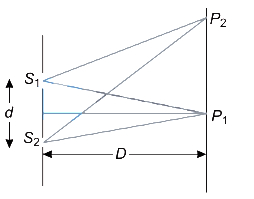
In the Young's double slit experiment,the intensities at two points $P_1$ and $P_2$ on the screen are respectively $I_1$ and $I_2$. If $P_1$ is located at the centre of a bright fringe and $P_2$ is located at a distance equal to a quarter of fringe width from $P_1$,then $\frac{I_1}{I_2}$ is
A
$2$
B
$\frac{1}{2}$
C
$4$
D
$16$
Solution
(A) Let the intensity at the central bright fringe be $I_1 = I_{max} = 4I_0$,where $I_0$ is the intensity of each individual slit.
The path difference $\Delta x$ at a distance $y$ from the central maximum is given by $\Delta x = \frac{yd}{D}$.
The fringe width is $\beta = \frac{\lambda D}{d}$.
Given that $y = \frac{\beta}{4} = \frac{\lambda D}{4d}$,the path difference at $P_2$ is $\Delta x = \frac{(\lambda D / 4d)d}{D} = \frac{\lambda}{4}$.
The corresponding phase difference is $\phi = \frac{2\pi}{\lambda} \Delta x = \frac{2\pi}{\lambda} \cdot \frac{\lambda}{4} = \frac{\pi}{2}$.
The intensity at any point is given by $I = I_{max} \cos^2(\phi / 2)$.
Substituting $\phi = \frac{\pi}{2}$,we get $I_2 = I_{max} \cos^2(\frac{\pi}{4}) = I_{max} (\frac{1}{\sqrt{2}})^2 = \frac{I_{max}}{2}$.
Therefore,$\frac{I_1}{I_2} = \frac{I_{max}}{I_{max}/2} = 2$.
The path difference $\Delta x$ at a distance $y$ from the central maximum is given by $\Delta x = \frac{yd}{D}$.
The fringe width is $\beta = \frac{\lambda D}{d}$.
Given that $y = \frac{\beta}{4} = \frac{\lambda D}{4d}$,the path difference at $P_2$ is $\Delta x = \frac{(\lambda D / 4d)d}{D} = \frac{\lambda}{4}$.
The corresponding phase difference is $\phi = \frac{2\pi}{\lambda} \Delta x = \frac{2\pi}{\lambda} \cdot \frac{\lambda}{4} = \frac{\pi}{2}$.
The intensity at any point is given by $I = I_{max} \cos^2(\phi / 2)$.
Substituting $\phi = \frac{\pi}{2}$,we get $I_2 = I_{max} \cos^2(\frac{\pi}{4}) = I_{max} (\frac{1}{\sqrt{2}})^2 = \frac{I_{max}}{2}$.
Therefore,$\frac{I_1}{I_2} = \frac{I_{max}}{I_{max}/2} = 2$.
0 likesView Solution
Vedclass Products
For Students
Vedclass Test Series
Mock tests in real TS EAMCET style covering Chemistry with performance analysis. 5-day free trial.
Start Free TrialFor Teachers
Exam Paper Generator
Generate Set A/B/C/D Chemistry papers from 7.5L+ questions in 2 minutes. 3 chapters free.
Try FreeFor Institutes
Online Exam Module
Run live TS EAMCET mock exams with unlimited students, 360° analytics & white-label branding.
See DemoFrequently Asked Questions
How many Chemistry questions are in TS EAMCET 2009?
There are 193 Chemistry questions from the TS EAMCET 2009 paper on Vedclass, each with a detailed step-by-step solution in English.
Are TS EAMCET 2009 Chemistry solutions available in English?
Yes. All solutions on this page are in English. You can also switch to English or Hindi using the language buttons above the questions.
Can I practice TS EAMCET 2009 Chemistry as a timed test?
Yes. Use the Vedclass Test Series to attempt a full TS EAMCET mock test covering Chemistry with time limits and instant score analysis.
Can teachers create Chemistry papers from TS EAMCET previous year questions?
Yes. The Vedclass Exam Paper Generator lets teachers mix TS EAMCET Chemistry questions and generate Set A/B/C/D papers in minutes.
For Teachers & Institutes
Build a Custom Chemistry Paper
Pick TS EAMCET 2009 Chemistry questions, set difficulty, and generate Set A/B/C/D in 2 minutes.