
ChemistryQ151–200 of 236 questions
Page 4 of 5 · English
151
ChemistryMCQTS EAMCET · 2001
$A$ force applied by an engine on a train of mass $2.05 \times 10^6 \ kg$ changes its velocity from $5 \ m/s$ to $25 \ m/s$ in $5 \ minutes$. The power of the engine is (in $MW$)
A
$1.025$
B
$2.05$
C
$5$
D
$6$
Solution
(B) Given:
Mass $m = 2.05 \times 10^6 \ kg$
Initial velocity $v_1 = 5 \ m/s$
Final velocity $v_2 = 25 \ m/s$
Time $t = 5 \ minutes = 5 \times 60 = 300 \ s$
Power is defined as the rate of work done,which is equal to the rate of change of kinetic energy:
$P = \frac{W}{t} = \frac{\Delta KE}{t}$
$P = \frac{\frac{1}{2} m (v_2^2 - v_1^2)}{t}$
Substituting the values:
$P = \frac{1}{2} \times \frac{2.05 \times 10^6 \times (25^2 - 5^2)}{300}$
$P = \frac{1}{2} \times \frac{2.05 \times 10^6 \times (625 - 25)}{300}$
$P = \frac{1}{2} \times \frac{2.05 \times 10^6 \times 600}{300}$
$P = \frac{1}{2} \times 2.05 \times 10^6 \times 2$
$P = 2.05 \times 10^6 \ W = 2.05 \ MW$
Mass $m = 2.05 \times 10^6 \ kg$
Initial velocity $v_1 = 5 \ m/s$
Final velocity $v_2 = 25 \ m/s$
Time $t = 5 \ minutes = 5 \times 60 = 300 \ s$
Power is defined as the rate of work done,which is equal to the rate of change of kinetic energy:
$P = \frac{W}{t} = \frac{\Delta KE}{t}$
$P = \frac{\frac{1}{2} m (v_2^2 - v_1^2)}{t}$
Substituting the values:
$P = \frac{1}{2} \times \frac{2.05 \times 10^6 \times (25^2 - 5^2)}{300}$
$P = \frac{1}{2} \times \frac{2.05 \times 10^6 \times (625 - 25)}{300}$
$P = \frac{1}{2} \times \frac{2.05 \times 10^6 \times 600}{300}$
$P = \frac{1}{2} \times 2.05 \times 10^6 \times 2$
$P = 2.05 \times 10^6 \ W = 2.05 \ MW$
0 likesView Solution
152
ChemistryMCQTS EAMCET · 2001
$A$ body of mass $6 ~kg$ is under a force which causes displacement in it given by $s = \frac{t^2}{4}$ metres,where $t$ is time. The work done by the force in $2$ seconds is: (in $~J$)
A
$12$
B
$9$
C
$6$
D
$3$
Solution
(D) Given: Mass $m = 6 ~kg$,Displacement $s = \frac{t^2}{4} ~m$.
Velocity $v = \frac{ds}{dt} = \frac{d}{dt}(\frac{t^2}{4}) = \frac{2t}{4} = \frac{t}{2} ~m/s$.
Acceleration $a = \frac{dv}{dt} = \frac{d}{dt}(\frac{t}{2}) = \frac{1}{2} ~m/s^2$.
Force $F = m \times a = 6 \times \frac{1}{2} = 3 ~N$.
At $t = 2 ~s$,displacement $s = \frac{(2)^2}{4} = \frac{4}{4} = 1 ~m$.
Work done $W = F \times s = 3 ~N \times 1 ~m = 3 ~J$.
Velocity $v = \frac{ds}{dt} = \frac{d}{dt}(\frac{t^2}{4}) = \frac{2t}{4} = \frac{t}{2} ~m/s$.
Acceleration $a = \frac{dv}{dt} = \frac{d}{dt}(\frac{t}{2}) = \frac{1}{2} ~m/s^2$.
Force $F = m \times a = 6 \times \frac{1}{2} = 3 ~N$.
At $t = 2 ~s$,displacement $s = \frac{(2)^2}{4} = \frac{4}{4} = 1 ~m$.
Work done $W = F \times s = 3 ~N \times 1 ~m = 3 ~J$.
0 likesView Solution
153
ChemistryMediumMCQTS EAMCET · 2001
Acetic acid is reacted with metallic sodium to form hydrogen and $X$. When $X$ is heated with sodalime,$Y$ and sodium carbonate are formed. $Y$ is
A
$C_2H_6$
B
$CH_4$
C
$CH_3COONa$
D
$CH_3CONH_2$
Solution
(B) Step $1$: Reaction of acetic acid with metallic sodium:
$2CH_3COOH + 2Na \rightarrow 2CH_3COONa + H_2 \uparrow$
Here,$X$ is sodium acetate $(CH_3COONa)$.
Step $2$: Decarboxylation of sodium acetate with sodalime $(NaOH + CaO)$:
$CH_3COONa + NaOH \xrightarrow{CaO, \Delta} CH_4 + Na_2CO_3$
Here,$Y$ is methane $(CH_4)$.
$2CH_3COOH + 2Na \rightarrow 2CH_3COONa + H_2 \uparrow$
Here,$X$ is sodium acetate $(CH_3COONa)$.
Step $2$: Decarboxylation of sodium acetate with sodalime $(NaOH + CaO)$:
$CH_3COONa + NaOH \xrightarrow{CaO, \Delta} CH_4 + Na_2CO_3$
Here,$Y$ is methane $(CH_4)$.
0 likesView Solution
154
ChemistryMCQTS EAMCET · 2001
The velocities of three particles of masses $20 \ g$,$30 \ g$ and $50 \ g$ are $10 \hat{i}$,$10 \hat{j}$ and $10 \hat{k}$,respectively. The velocity of the centre of mass of the three particles is
A
$2 \hat{i} + 3 \hat{j} + 5 \hat{k}$
B
$10(\hat{i} + \hat{j} + \hat{k})$
C
$20 \hat{i} + 30 \hat{j} + 5 \hat{k}$
D
$2 \hat{i} + 30 \hat{j} + 50 \hat{k}$
Solution
(A) Given masses: $m_1 = 20 \ g$,$m_2 = 30 \ g$,$m_3 = 50 \ g$.
Velocities: $\vec{v}_1 = 10 \hat{i} \ m/s$,$\vec{v}_2 = 10 \hat{j} \ m/s$,$\vec{v}_3 = 10 \hat{k} \ m/s$.
The velocity of the centre of mass is given by:
$\vec{v}_{cm} = \frac{m_1 \vec{v}_1 + m_2 \vec{v}_2 + m_3 \vec{v}_3}{m_1 + m_2 + m_3}$
Substituting the values:
$\vec{v}_{cm} = \frac{20(10 \hat{i}) + 30(10 \hat{j}) + 50(10 \hat{k})}{20 + 30 + 50}$
$\vec{v}_{cm} = \frac{200 \hat{i} + 300 \hat{j} + 500 \hat{k}}{100}$
$\vec{v}_{cm} = 2 \hat{i} + 3 \hat{j} + 5 \hat{k}$
Velocities: $\vec{v}_1 = 10 \hat{i} \ m/s$,$\vec{v}_2 = 10 \hat{j} \ m/s$,$\vec{v}_3 = 10 \hat{k} \ m/s$.
The velocity of the centre of mass is given by:
$\vec{v}_{cm} = \frac{m_1 \vec{v}_1 + m_2 \vec{v}_2 + m_3 \vec{v}_3}{m_1 + m_2 + m_3}$
Substituting the values:
$\vec{v}_{cm} = \frac{20(10 \hat{i}) + 30(10 \hat{j}) + 50(10 \hat{k})}{20 + 30 + 50}$
$\vec{v}_{cm} = \frac{200 \hat{i} + 300 \hat{j} + 500 \hat{k}}{100}$
$\vec{v}_{cm} = 2 \hat{i} + 3 \hat{j} + 5 \hat{k}$
0 likesView Solution
155
ChemistryMediumMCQTS EAMCET · 2001
Which of the following statements is true?
A
Hybridisation of the central atom in $NH_3$ is $sp^2$
B
$BeCl_2$ has $V$ shape while $SO_2$ is linear
C
$SF_6$ is octahedral and $F-S-F$ bond angle is $90^{\circ}$
D
$CO_2$ has a dipole moment
Solution
(C) $NH_3$ has $sp^3$ hybridisation with a trigonal pyramidal shape.
$BeCl_2$ is linear and $SO_2$ is bent ($V$-shaped).
$SF_6$ has $sp^3d^2$ hybridisation,resulting in an octahedral geometry where all $F-S-F$ bond angles are $90^{\circ}$.
$CO_2$ is a linear molecule with a net dipole moment of zero.
$BeCl_2$ is linear and $SO_2$ is bent ($V$-shaped).
$SF_6$ has $sp^3d^2$ hybridisation,resulting in an octahedral geometry where all $F-S-F$ bond angles are $90^{\circ}$.
$CO_2$ is a linear molecule with a net dipole moment of zero.
0 likesView Solution
156
ChemistryMediumMCQTS EAMCET · 2001
The number of lone pairs of electrons present on $Xe$ in $XeF_4$ is
A
$3$
B
$4$
C
$1$
D
$2$
Solution
(D) The central atom $Xe$ has $8$ valence electrons.
In $XeF_4$,$Xe$ forms $4$ single bonds with $4$ fluorine atoms.
Number of electrons used for bonding $= 4$.
Number of remaining valence electrons $= 8 - 4 = 4$.
Number of lone pairs $= \frac{4}{2} = 2$.
Thus,there are $2$ lone pairs on $Xe$ in $XeF_4$.
In $XeF_4$,$Xe$ forms $4$ single bonds with $4$ fluorine atoms.
Number of electrons used for bonding $= 4$.
Number of remaining valence electrons $= 8 - 4 = 4$.
Number of lone pairs $= \frac{4}{2} = 2$.
Thus,there are $2$ lone pairs on $Xe$ in $XeF_4$.
0 likesView Solution
157
ChemistryMediumMCQTS EAMCET · 2001
Equilibrium constant for the reaction $H_2O_{(g)} + CO_{(g)} \rightleftharpoons H_{2(g)} + CO_{2(g)}$ is $81$. If the velocity constant of the forward reaction is $162 \ L \ mol^{-1} \ s^{-1}$,what is the velocity constant (in $L \ mol^{-1} \ s^{-1}$) for the backward reaction?
A
$13122$
B
$2$
C
$261$
D
$243$
Solution
(B) The equilibrium constant $K_c$ is related to the forward rate constant $k_f$ and the backward rate constant $k_b$ by the expression: $K_c = \frac{k_f}{k_b}$.
Given $K_c = 81$ and $k_f = 162 \ L \ mol^{-1} \ s^{-1}$.
Substituting the values: $81 = \frac{162}{k_b}$.
Solving for $k_b$: $k_b = \frac{162}{81} = 2 \ L \ mol^{-1} \ s^{-1}$.
Given $K_c = 81$ and $k_f = 162 \ L \ mol^{-1} \ s^{-1}$.
Substituting the values: $81 = \frac{162}{k_b}$.
Solving for $k_b$: $k_b = \frac{162}{81} = 2 \ L \ mol^{-1} \ s^{-1}$.
0 likesView Solution
158
ChemistryMediumMCQTS EAMCET · 2001
The element with atomic number $12$ belongs to ......... group and ......... period.
A
$I A$,third
B
$III A$,third
C
$II A$,third
D
$II A$,second
Solution
(C) The electronic configuration of the element with atomic number $Z = 12$ is $1s^2, 2s^2, 2p^6, 3s^2$.
Since the valence shell is the $3^{rd}$ shell,the period is $3$.
There are $2$ electrons in the valence shell $(3s^2)$,which corresponds to group $II A$ (or group $2$ in the modern periodic table).
Since the valence shell is the $3^{rd}$ shell,the period is $3$.
There are $2$ electrons in the valence shell $(3s^2)$,which corresponds to group $II A$ (or group $2$ in the modern periodic table).
0 likesView Solution
159
ChemistryEasyMCQTS EAMCET · 2001
Let electronegativity,ionisation energy and electron affinity be represented as $EN$,$IP$ and $EA$ respectively. Which one of the following equations is correct according to Mulliken?
A
$EN = IP \times EA$
B
$EN = \frac{IP}{EA}$
C
$EN = \frac{IP + EA}{2}$
D
$EN = IP - EA$
Solution
(C) According to the Mulliken scale,the electronegativity $(EN)$ of an element is defined as the arithmetic mean of its ionisation potential $(IP)$ and electron affinity $(EA)$.
Mathematically,this is expressed as: $EN = \frac{IP + EA}{2}$.
Mathematically,this is expressed as: $EN = \frac{IP + EA}{2}$.
0 likesView Solution
160
ChemistryMediumMCQTS EAMCET · 2001
The electronic configurations of elements $A, B$ and $C$ are $[He] 2s^1$,$[Ne] 3s^1$ and $[Ar] 4s^1$ respectively. Which one of the following orders is correct for the first ionization potentials (in $kJ \ mol^{-1}$) of $A, B$ and $C$?
A
$A > B > C$
B
$C > B > A$
C
$B > C > A$
D
$C > A > B$
Solution
(A) The elements $A, B$ and $C$ are Lithium $(Li)$,Sodium $(Na)$ and Potassium $(K)$ respectively,which belong to Group $1$ of the periodic table.
As we move down the group,the atomic size increases due to the addition of new shells.
Ionization potential is inversely proportional to the atomic size.
Therefore,as the atomic size increases from $A$ to $C$,the energy required to remove the valence electron decreases.
The correct order of first ionization potential is $A > B > C$.
As we move down the group,the atomic size increases due to the addition of new shells.
Ionization potential is inversely proportional to the atomic size.
Therefore,as the atomic size increases from $A$ to $C$,the energy required to remove the valence electron decreases.
The correct order of first ionization potential is $A > B > C$.
0 likesView Solution
161
ChemistryMCQTS EAMCET · 2001
If $\theta = \frac{\pi}{6}$,then the $10^{th}$ term of the series $1 + (\cos \theta + i \sin \theta) + (\cos \theta + i \sin \theta)^2 + (\cos \theta + i \sin \theta)^3 + \dots$ is equal to:
A
$i$
B
$-1$
C
$1$
D
$-i$
Solution
(D) The given series is a geometric progression where the first term $a = 1$ and the common ratio $r = (\cos \theta + i \sin \theta) = e^{i \theta}$.
The $n^{th}$ term of a geometric progression is given by $T_n = a \cdot r^{n-1}$.
For the $10^{th}$ term,$n = 10$,so $T_{10} = 1 \cdot (e^{i \theta})^{10-1} = e^{i 9 \theta}$.
Given $\theta = \frac{\pi}{6}$,we substitute the value:
$T_{10} = e^{i 9 (\frac{\pi}{6})} = e^{i \frac{3\pi}{2}}$.
Using Euler's formula $e^{i \phi} = \cos \phi + i \sin \phi$:
$T_{10} = \cos(\frac{3\pi}{2}) + i \sin(\frac{3\pi}{2}) = 0 + i(-1) = -i$.
The $n^{th}$ term of a geometric progression is given by $T_n = a \cdot r^{n-1}$.
For the $10^{th}$ term,$n = 10$,so $T_{10} = 1 \cdot (e^{i \theta})^{10-1} = e^{i 9 \theta}$.
Given $\theta = \frac{\pi}{6}$,we substitute the value:
$T_{10} = e^{i 9 (\frac{\pi}{6})} = e^{i \frac{3\pi}{2}}$.
Using Euler's formula $e^{i \phi} = \cos \phi + i \sin \phi$:
$T_{10} = \cos(\frac{3\pi}{2}) + i \sin(\frac{3\pi}{2}) = 0 + i(-1) = -i$.
0 likesView Solution
162
ChemistryMCQTS EAMCET · 2001
Using the digits $0, 2, 4, 6, 8$ not more than once in any number,the number of $5$-digit numbers that can be formed is:
A
$16$
B
$24$
C
$96$
D
$120$
Solution
(C) To form a $5$-digit number using the digits $0, 2, 4, 6, 8$ without repetition,the first digit cannot be $0$.
Total permutations of $5$ digits taken all at once is $^5P_5 = 5! = 120$.
Numbers starting with $0$ are formed by arranging the remaining $4$ digits in the last $4$ positions,which is $^4P_4 = 4! = 24$.
Therefore,the number of $5$-digit numbers is $120 - 24 = 96$.
Total permutations of $5$ digits taken all at once is $^5P_5 = 5! = 120$.
Numbers starting with $0$ are formed by arranging the remaining $4$ digits in the last $4$ positions,which is $^4P_4 = 4! = 24$.
Therefore,the number of $5$-digit numbers is $120 - 24 = 96$.
0 likesView Solution
163
ChemistryEasyMCQTS EAMCET · 2001
Which one of the following is mainly responsible for the depletion of the ozone layer?
A
Methane
B
Carbon dioxide
C
Water
D
Chloro-fluoro carbons
Solution
(D) The depletion of the ozone layer is primarily caused by the release of $Chloro-fluoro \ carbons$ $(CFCs)$.
These compounds,when released into the atmosphere,reach the stratosphere where they are broken down by ultraviolet radiation to release chlorine atoms.
These chlorine atoms then catalyze the destruction of ozone $(O_3)$ molecules into oxygen $(O_2)$.
These compounds,when released into the atmosphere,reach the stratosphere where they are broken down by ultraviolet radiation to release chlorine atoms.
These chlorine atoms then catalyze the destruction of ozone $(O_3)$ molecules into oxygen $(O_2)$.
0 likesView Solution
164
ChemistryMCQTS EAMCET · 2001
The equation $\sqrt{3} \sin x + \cos x = 4$ has
A
only one solution
B
two solutions
C
infinitely many solutions
D
no solution
Solution
(D) We have,$\sqrt{3} \sin x + \cos x = 4$.
Dividing both sides by $2$,we get:
$\frac{\sqrt{3}}{2} \sin x + \frac{1}{2} \cos x = 2$.
Using the identity $\sin(A+B) = \sin A \cos B + \cos A \sin B$,we can write:
$\sin x \cos \frac{\pi}{6} + \cos x \sin \frac{\pi}{6} = 2$.
$\sin(x + \frac{\pi}{6}) = 2$.
Since the range of the sine function is $[-1, 1]$,the value $2$ is not possible.
Therefore,the equation has no solution.
Dividing both sides by $2$,we get:
$\frac{\sqrt{3}}{2} \sin x + \frac{1}{2} \cos x = 2$.
Using the identity $\sin(A+B) = \sin A \cos B + \cos A \sin B$,we can write:
$\sin x \cos \frac{\pi}{6} + \cos x \sin \frac{\pi}{6} = 2$.
$\sin(x + \frac{\pi}{6}) = 2$.
Since the range of the sine function is $[-1, 1]$,the value $2$ is not possible.
Therefore,the equation has no solution.
0 likesView Solution
165
ChemistryMCQTS EAMCET · 2001
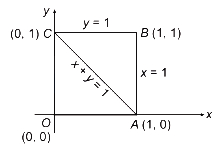
The incentre of the triangle formed by the lines $x+y=1$,$x=1$,and $y=1$ is
A
$\left(1-\frac{1}{\sqrt{2}}, 1-\frac{1}{\sqrt{2}}\right)$
B
$\left(1-\frac{1}{\sqrt{2}}, \frac{1}{\sqrt{2}}\right)$
C
$\left(\frac{1}{\sqrt{2}}, \frac{1}{\sqrt{2}}\right)$
D
$\left(\frac{1}{\sqrt{2}}, 1-\frac{1}{\sqrt{2}}\right)$
Solution
(C) The lines $x=1$ and $y=1$ intersect at $B(1, 1)$. The line $x+y=1$ intersects $x=1$ at $A(1, 0)$ and $y=1$ at $C(0, 1)$.
The vertices of the triangle are $A(1, 0)$,$B(1, 1)$,and $C(0, 1)$.
The lengths of the sides are:
$a = BC = \sqrt{(1-0)^2 + (1-1)^2} = 1$
$b = CA = \sqrt{(1-0)^2 + (0-1)^2} = \sqrt{1+1} = \sqrt{2}$
$c = AB = \sqrt{(1-1)^2 + (1-0)^2} = 1$
The incentre $(I_x, I_y)$ is given by:
$I_x = \frac{ax_1 + bx_2 + cx_3}{a+b+c} = \frac{1(1) + \sqrt{2}(1) + 1(0)}{1+\sqrt{2}+1} = \frac{1+\sqrt{2}}{2+\sqrt{2}} = \frac{1+\sqrt{2}}{\sqrt{2}(\sqrt{2}+1)} = \frac{1}{\sqrt{2}}$
$I_y = \frac{ay_1 + by_2 + cy_3}{a+b+c} = \frac{1(0) + \sqrt{2}(1) + 1(1)}{1+\sqrt{2}+1} = \frac{1+\sqrt{2}}{2+\sqrt{2}} = \frac{1}{\sqrt{2}}$
Thus,the incentre is $\left(\frac{1}{\sqrt{2}}, \frac{1}{\sqrt{2}}\right)$.
The vertices of the triangle are $A(1, 0)$,$B(1, 1)$,and $C(0, 1)$.
The lengths of the sides are:
$a = BC = \sqrt{(1-0)^2 + (1-1)^2} = 1$
$b = CA = \sqrt{(1-0)^2 + (0-1)^2} = \sqrt{1+1} = \sqrt{2}$
$c = AB = \sqrt{(1-1)^2 + (1-0)^2} = 1$
The incentre $(I_x, I_y)$ is given by:
$I_x = \frac{ax_1 + bx_2 + cx_3}{a+b+c} = \frac{1(1) + \sqrt{2}(1) + 1(0)}{1+\sqrt{2}+1} = \frac{1+\sqrt{2}}{2+\sqrt{2}} = \frac{1+\sqrt{2}}{\sqrt{2}(\sqrt{2}+1)} = \frac{1}{\sqrt{2}}$
$I_y = \frac{ay_1 + by_2 + cy_3}{a+b+c} = \frac{1(0) + \sqrt{2}(1) + 1(1)}{1+\sqrt{2}+1} = \frac{1+\sqrt{2}}{2+\sqrt{2}} = \frac{1}{\sqrt{2}}$
Thus,the incentre is $\left(\frac{1}{\sqrt{2}}, \frac{1}{\sqrt{2}}\right)$.
0 likesView Solution
166
ChemistryMCQTS EAMCET · 2001
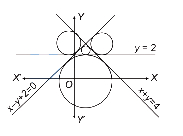
The number of circles that touch all the straight lines $x+y=4$,$x-y=-2$,and $y=2$ is
A
$1$
B
$2$
C
$3$
D
$4$
Solution
(D) The given lines are $L_1: x+y-4=0$,$L_2: x-y+2=0$,and $L_3: y-2=0$.
These three lines form a triangle.
$A$ circle that touches all three sides of a triangle is called an incircle or an excircle.
For any triangle,there is exactly $1$ incircle and $3$ excircles.
Therefore,there are $1+3=4$ circles that touch all three given lines.
These three lines form a triangle.
$A$ circle that touches all three sides of a triangle is called an incircle or an excircle.
For any triangle,there is exactly $1$ incircle and $3$ excircles.
Therefore,there are $1+3=4$ circles that touch all three given lines.
0 likesView Solution
167
ChemistryMCQTS EAMCET · 2001
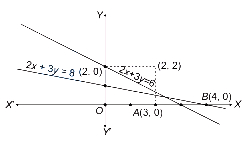
The lines $2x + 3y = 6$ and $2x + 3y = 8$ cut the $X$-axis at $A$ and $B$,respectively. $A$ line $L$ drawn through the point $(2, 2)$ meets the $X$-axis at $C$ in such a way that the abscissae of $A, B,$ and $C$ are in arithmetic progression. Then,the equation of the line $L$ is
A
$2x + 3y = 10$
B
$8x + 2y = 10$
C
$2x - 3y = 10$
D
$8x - 2y = 10$
Solution
(A) Given lines are $2x + 3y = 6$ and $2x + 3y = 8$.
These lines meet the $X$-axis at $A(3, 0)$ and $B(4, 0)$ respectively.
The line $L$ passes through $(2, 2)$ and cuts the $X$-axis at $C(x_1, 0)$,such that the $x$-coordinates of $A, B,$ and $C$ are in arithmetic progression,i.e.,$3, 4, x_1$.
Since they are in arithmetic progression,$2 \times 4 = 3 + x_1$,which gives $x_1 = 8 - 3 = 5$.
So,the coordinates of $C$ are $(5, 0)$.
$A$ line $L$ passing through the points $(2, 2)$ and $(5, 0)$ is given by:
$y - 0 = \frac{0 - 2}{5 - 2}(x - 5)$
$y = \frac{-2}{3}(x - 5)$
$3y = -2x + 10$
$2x + 3y = 10$
These lines meet the $X$-axis at $A(3, 0)$ and $B(4, 0)$ respectively.
The line $L$ passes through $(2, 2)$ and cuts the $X$-axis at $C(x_1, 0)$,such that the $x$-coordinates of $A, B,$ and $C$ are in arithmetic progression,i.e.,$3, 4, x_1$.
Since they are in arithmetic progression,$2 \times 4 = 3 + x_1$,which gives $x_1 = 8 - 3 = 5$.
So,the coordinates of $C$ are $(5, 0)$.
$A$ line $L$ passing through the points $(2, 2)$ and $(5, 0)$ is given by:
$y - 0 = \frac{0 - 2}{5 - 2}(x - 5)$
$y = \frac{-2}{3}(x - 5)$
$3y = -2x + 10$
$2x + 3y = 10$
0 likesView Solution
168
ChemistryEasyMCQTS EAMCET · 2001
The structural formula of $2$-methyl-$2$-butene is
A
$CH_3-CH(CH_3)-CH=CH_2$
B
$CH_3-CH_2-C(CH_3)=CH_2$
C
$CH_3-CH=CH-CH_3$
D
$CH_3-CH=C(CH_3)-CH_3$
Solution
(D) The $IUPAC$ name $2$-methyl-$2$-butene indicates a $4$-carbon chain (butene) with a double bond at the $2$-nd position and a methyl group at the $2$-nd position.
The structure is $CH_3-CH=C(CH_3)-CH_3$.
Therefore,the correct option is $D$.
The structure is $CH_3-CH=C(CH_3)-CH_3$.
Therefore,the correct option is $D$.
0 likesView Solution
169
ChemistryMediumMCQTS EAMCET · 2001
Which one of the following pairs of compounds are functional isomers?
A
$CH_3CH_2CH_2OH, (CH_3)_2CHCH_2OH$
B
$CH_3CH_2CH_2CH_2OH, (CH_3)_2CHCH_2OH$
C
$CH_3CH_2CH_2OH, CH_3CH_2CH_2Cl$
D
$CH_3CH_2CH_2OH, CH_3OCH_2CH_3$
Solution
(D) Functional isomers are compounds that have the same molecular formula but possess different functional groups.
In option $(D)$,the first compound is $CH_3CH_2CH_2OH$ (propan$-1-$ol),which contains an alcohol $(-OH)$ functional group.
The second compound is $CH_3OCH_2CH_3$ (methoxyethane),which contains an ether $(-O-)$ functional group.
Since they have the same molecular formula $(C_3H_8O)$ but different functional groups,they are functional isomers.
In option $(D)$,the first compound is $CH_3CH_2CH_2OH$ (propan$-1-$ol),which contains an alcohol $(-OH)$ functional group.
The second compound is $CH_3OCH_2CH_3$ (methoxyethane),which contains an ether $(-O-)$ functional group.
Since they have the same molecular formula $(C_3H_8O)$ but different functional groups,they are functional isomers.
0 likesView Solution
170
ChemistryMCQTS EAMCET · 2001
Mass $M$ is divided into two parts $xM$ and $(1-x)M$. For a given separation,the value of $x$ for which the gravitational attraction between the two pieces becomes maximum is
A
$1/2$
B
$3/5$
C
$1$
D
$2$
Solution
(A) Let the two parts be $m_1 = xM$ and $m_2 = (1-x)M$.
According to Newton's law of gravitation,the force $F$ between them at a distance $r$ is given by $F = G \frac{m_1 m_2}{r^2}$.
Substituting the values,we get $F = \frac{G}{r^2} (xM)(1-x)M = \frac{GM^2}{r^2} (x - x^2)$.
For the force $F$ to be maximum,the derivative of $F$ with respect to $x$ must be zero: $\frac{dF}{dx} = 0$.
$\frac{d}{dx} [\frac{GM^2}{r^2} (x - x^2)] = 0$.
Since $\frac{GM^2}{r^2}$ is a constant,we have $\frac{d}{dx} (x - x^2) = 0$.
$1 - 2x = 0$.
$2x = 1$,which gives $x = 1/2$.
According to Newton's law of gravitation,the force $F$ between them at a distance $r$ is given by $F = G \frac{m_1 m_2}{r^2}$.
Substituting the values,we get $F = \frac{G}{r^2} (xM)(1-x)M = \frac{GM^2}{r^2} (x - x^2)$.
For the force $F$ to be maximum,the derivative of $F$ with respect to $x$ must be zero: $\frac{dF}{dx} = 0$.
$\frac{d}{dx} [\frac{GM^2}{r^2} (x - x^2)] = 0$.
Since $\frac{GM^2}{r^2}$ is a constant,we have $\frac{d}{dx} (x - x^2) = 0$.
$1 - 2x = 0$.
$2x = 1$,which gives $x = 1/2$.
0 likesView Solution
171
ChemistryMediumMCQTS EAMCET · 2001
Consider the following reactions:
$C_2 H_2 \xrightarrow[500^{\circ}C]{\text{red hot iron tube}} A$
$A \xrightarrow[70^{\circ}C]{\text{conc. } HNO_3, \text{conc. } H_2 SO_4} B$
$B \xrightarrow{LiAlH_4} C_6 H_5-N=N-C_6 H_5$
$A$ and $B$ are:
$C_2 H_2 \xrightarrow[500^{\circ}C]{\text{red hot iron tube}} A$
$A \xrightarrow[70^{\circ}C]{\text{conc. } HNO_3, \text{conc. } H_2 SO_4} B$
$B \xrightarrow{LiAlH_4} C_6 H_5-N=N-C_6 H_5$
$A$ and $B$ are:
A
$A=C_2 H_4, B=C_6 H_6$
B
$A=C_2 H_6, B=C_6 H_5 NH_2$
C
$A=C_2 H_4, B=C_6 H_5 NH_2$
D
$A=C_6 H_6, B=C_6 H_5 NO_2$
Solution
(D) $1$. The reaction of $C_2 H_2$ (acetylene) with a red hot iron tube at $500^{\circ}C$ is a cyclic polymerization reaction that produces $C_6 H_6$ (benzene). Therefore,$A = C_6 H_6$.
$2$. The reaction of benzene $(A)$ with a mixture of concentrated $HNO_3$ and concentrated $H_2 SO_4$ at $70^{\circ}C$ is a nitration reaction,which produces $C_6 H_5 NO_2$ (nitrobenzene). Therefore,$B = C_6 H_5 NO_2$.
$3$. The reduction of nitrobenzene $(B)$ with $LiAlH_4$ can lead to the formation of azobenzene $(C_6 H_5-N=N-C_6 H_5)$ under specific conditions.
$4$. Thus,$A = C_6 H_6$ and $B = C_6 H_5 NO_2$.
$2$. The reaction of benzene $(A)$ with a mixture of concentrated $HNO_3$ and concentrated $H_2 SO_4$ at $70^{\circ}C$ is a nitration reaction,which produces $C_6 H_5 NO_2$ (nitrobenzene). Therefore,$B = C_6 H_5 NO_2$.
$3$. The reduction of nitrobenzene $(B)$ with $LiAlH_4$ can lead to the formation of azobenzene $(C_6 H_5-N=N-C_6 H_5)$ under specific conditions.
$4$. Thus,$A = C_6 H_6$ and $B = C_6 H_5 NO_2$.
0 likesView Solution
172
ChemistryMediumMCQTS EAMCET · 2001
Bond dissociation energies of $HF, HCl, HBr$ follow the order:
A
$HCl > HBr > HF$
B
$HF > HBr > HCl$
C
$HF > HCl > HBr$
D
$HBr > HCl > HF$
Solution
(C) The bond dissociation energy depends on the bond length. As the size of the halogen atom increases from $F$ to $Br$,the bond length increases,which leads to a decrease in the bond dissociation energy.
The atomic size order is $F < Cl < Br$.
Therefore,the bond length order is $H-F < H-Cl < H-Br$.
Consequently,the bond dissociation energy order is $HF > HCl > HBr$.
The atomic size order is $F < Cl < Br$.
Therefore,the bond length order is $H-F < H-Cl < H-Br$.
Consequently,the bond dissociation energy order is $HF > HCl > HBr$.
0 likesView Solution
173
ChemistryMediumMCQTS EAMCET · 2001
In which of the following reactions,$H_2O_2$ acts as a reducing reagent?
A
$PbO_{2(s)} + H_2O_{2(aq)} \longrightarrow PbO_{(s)} + H_2O_{(l)} + O_{2(g)}$
B
$Na_2SO_{3(aq)} + H_2O_{2(aq)} \longrightarrow Na_2SO_{4(aq)} + H_2O_{(l)}$
C
$2KI_{(aq)} + H_2O_{2(aq)} \longrightarrow 2KOH_{(aq)} + I_{2(s)}$
D
$KNO_{2(aq)} + H_2O_{2(aq)} \longrightarrow KNO_{3(aq)} + H_2O_{(l)}$
Solution
(A) reducing agent is a substance that reduces another species and itself gets oxidized. In the reaction $PbO_{2(s)} + H_2O_{2(aq)} \longrightarrow PbO_{(s)} + H_2O_{(l)} + O_{2(g)}$,the oxidation state of oxygen in $H_2O_2$ changes from $-1$ to $0$ (in $O_2$),which indicates oxidation. Therefore,$H_2O_2$ acts as a reducing agent in this reaction. In the other options $(B, C, D)$,$H_2O_2$ acts as an oxidizing agent because it gets reduced to $H_2O$ (oxygen oxidation state changes from $-1$ to $-2$).
0 likesView Solution
174
ChemistryEasyMCQTS EAMCET · 2001
Which process is used for the removal of hardness of water?
A
Calgon
B
Baeyer
C
Serpeck
D
Hoope
Solution
(A) The $Calgon$ process is used for the removal of hardness of water. $Calgon$ is the trade name for sodium hexametaphosphate,$Na_2[Na_4(PO_3)_6]$,which removes $Ca^{2+}$ and $Mg^{2+}$ ions by forming soluble complexes.
0 likesView Solution
175
ChemistryMCQTS EAMCET · 2001
The product of the lengths of the perpendiculars from any point on the hyperbola $x^2-y^2=8$ to its asymptotes is
A
$2$
B
$3$
C
$4$
D
$8$
Solution
(C) The equation of the hyperbola is $x^2-y^2=8$.
The asymptotes of the hyperbola $x^2-y^2=a^2$ are given by $x^2-y^2=0$,which implies $x-y=0$ and $x+y=0$.
Let $P(x, y)$ be any point on the hyperbola.
The length of the perpendicular from $P(x, y)$ to the line $x-y=0$ is $d_1 = \frac{|x-y|}{\sqrt{1^2+(-1)^2}} = \frac{|x-y|}{\sqrt{2}}$.
The length of the perpendicular from $P(x, y)$ to the line $x+y=0$ is $d_2 = \frac{|x+y|}{\sqrt{1^2+1^2}} = \frac{|x+y|}{\sqrt{2}}$.
The product of the lengths of the perpendiculars is $d_1 \times d_2 = \frac{|x-y|}{\sqrt{2}} \times \frac{|x+y|}{\sqrt{2}} = \frac{|x^2-y^2|}{2}$.
Since the point lies on the hyperbola $x^2-y^2=8$,we substitute the value: $\frac{8}{2} = 4$.
The asymptotes of the hyperbola $x^2-y^2=a^2$ are given by $x^2-y^2=0$,which implies $x-y=0$ and $x+y=0$.
Let $P(x, y)$ be any point on the hyperbola.
The length of the perpendicular from $P(x, y)$ to the line $x-y=0$ is $d_1 = \frac{|x-y|}{\sqrt{1^2+(-1)^2}} = \frac{|x-y|}{\sqrt{2}}$.
The length of the perpendicular from $P(x, y)$ to the line $x+y=0$ is $d_2 = \frac{|x+y|}{\sqrt{1^2+1^2}} = \frac{|x+y|}{\sqrt{2}}$.
The product of the lengths of the perpendiculars is $d_1 \times d_2 = \frac{|x-y|}{\sqrt{2}} \times \frac{|x+y|}{\sqrt{2}} = \frac{|x^2-y^2|}{2}$.
Since the point lies on the hyperbola $x^2-y^2=8$,we substitute the value: $\frac{8}{2} = 4$.
0 likesView Solution
176
ChemistryMCQTS EAMCET · 2001
If $f(x) = \frac{x^2-10x+25}{x^2-7x+10}$ and $f$ is continuous at $x = 5$,then $f(5)$ is equal to
A
$0$
B
$5$
C
$10$
D
$25$
Solution
(A) Since $f(x)$ is continuous at $x = 5$,we have $f(5) = \lim_{x \rightarrow 5} f(x)$.
First,we factor the numerator and denominator:
$f(x) = \frac{x^2-10x+25}{x^2-7x+10} = \frac{(x-5)^2}{(x-5)(x-2)}$.
For $x \neq 5$,we can simplify the expression by canceling the common factor $(x-5)$:
$f(x) = \frac{x-5}{x-2}$.
Now,calculate the limit as $x \rightarrow 5$:
$f(5) = \lim_{x \rightarrow 5} \frac{x-5}{x-2} = \frac{5-5}{5-2} = \frac{0}{3} = 0$.
First,we factor the numerator and denominator:
$f(x) = \frac{x^2-10x+25}{x^2-7x+10} = \frac{(x-5)^2}{(x-5)(x-2)}$.
For $x \neq 5$,we can simplify the expression by canceling the common factor $(x-5)$:
$f(x) = \frac{x-5}{x-2}$.
Now,calculate the limit as $x \rightarrow 5$:
$f(5) = \lim_{x \rightarrow 5} \frac{x-5}{x-2} = \frac{5-5}{5-2} = \frac{0}{3} = 0$.
0 likesView Solution
177
ChemistryMCQTS EAMCET · 2001
If $u=e^{x^2-y^2}$,then
A
$x u_x=y u_y$
B
$y u_x=x u u_y$
C
$y u_x+x u_y=0$
D
$x^2 u_y+y^2 u_x=0$
Solution
(C) Given that,$u=e^{x^2-y^2}$.
First,we find the partial derivative of $u$ with respect to $x$:
$u_x = \frac{\partial}{\partial x}(e^{x^2-y^2}) = e^{x^2-y^2}(2x)$.
Multiplying by $y$,we get:
$y u_x = 2xy e^{x^2-y^2} \quad (i)$.
Next,we find the partial derivative of $u$ with respect to $y$:
$u_y = \frac{\partial}{\partial y}(e^{x^2-y^2}) = e^{x^2-y^2}(-2y)$.
Multiplying by $x$,we get:
$x u_y = -2xy e^{x^2-y^2} \quad (ii)$.
Adding equations $(i)$ and $(ii)$:
$y u_x + x u_y = 2xy e^{x^2-y^2} - 2xy e^{x^2-y^2} = 0$.
First,we find the partial derivative of $u$ with respect to $x$:
$u_x = \frac{\partial}{\partial x}(e^{x^2-y^2}) = e^{x^2-y^2}(2x)$.
Multiplying by $y$,we get:
$y u_x = 2xy e^{x^2-y^2} \quad (i)$.
Next,we find the partial derivative of $u$ with respect to $y$:
$u_y = \frac{\partial}{\partial y}(e^{x^2-y^2}) = e^{x^2-y^2}(-2y)$.
Multiplying by $x$,we get:
$x u_y = -2xy e^{x^2-y^2} \quad (ii)$.
Adding equations $(i)$ and $(ii)$:
$y u_x + x u_y = 2xy e^{x^2-y^2} - 2xy e^{x^2-y^2} = 0$.
0 likesView Solution
178
ChemistryMCQTS EAMCET · 2001
$\frac{d}{d x} \sin ^{-1}\left(3 x-4 x^3\right)$ is equal to
A
$\frac{3}{\sqrt{4-x^2}}$
B
$\frac{3}{\sqrt{1-x^2}}$
C
$\frac{1}{\sqrt{4-x^2}}$
D
$-\frac{1}{\sqrt{4-x^2}}$
Solution
(B) Let $y = \sin^{-1}(3x - 4x^3)$.
Substitute $x = \sin \theta$,which implies $\theta = \sin^{-1} x$.
Using the trigonometric identity $\sin 3\theta = 3\sin \theta - 4\sin^3 \theta$,we get:
$y = \sin^{-1}(\sin 3\theta) = 3\theta$.
Substituting back the value of $\theta$:
$y = 3\sin^{-1} x$.
Differentiating with respect to $x$:
$\frac{dy}{dx} = 3 \cdot \frac{d}{dx}(\sin^{-1} x) = 3 \cdot \frac{1}{\sqrt{1-x^2}} = \frac{3}{\sqrt{1-x^2}}$.
Substitute $x = \sin \theta$,which implies $\theta = \sin^{-1} x$.
Using the trigonometric identity $\sin 3\theta = 3\sin \theta - 4\sin^3 \theta$,we get:
$y = \sin^{-1}(\sin 3\theta) = 3\theta$.
Substituting back the value of $\theta$:
$y = 3\sin^{-1} x$.
Differentiating with respect to $x$:
$\frac{dy}{dx} = 3 \cdot \frac{d}{dx}(\sin^{-1} x) = 3 \cdot \frac{1}{\sqrt{1-x^2}} = \frac{3}{\sqrt{1-x^2}}$.
0 likesView Solution
179
ChemistryMCQTS EAMCET · 2001
If $u = x y^2 \tan^{-1}\left(\frac{y}{x}\right)$,then $x \frac{\partial u}{\partial x} + y \frac{\partial u}{\partial y}$ is equal to
A
$2 u$
B
$u$
C
$3 u$
D
$\frac{1}{3} u$
Solution
(C) The given function is $u(x, y) = x y^2 \tan^{-1}\left(\frac{y}{x}\right)$.
This is a homogeneous function of degree $n = 1 + 2 = 3$ because $u(tx, ty) = (tx)(ty)^2 \tan^{-1}\left(\frac{ty}{tx}\right) = t^3 x y^2 \tan^{-1}\left(\frac{y}{x}\right) = t^3 u(x, y)$.
According to Euler's Theorem on homogeneous functions,if $u$ is a homogeneous function of degree $n$ in $x$ and $y$,then $x \frac{\partial u}{\partial x} + y \frac{\partial u}{\partial y} = n u$.
Here,$n = 3$.
Therefore,$x \frac{\partial u}{\partial x} + y \frac{\partial u}{\partial y} = 3 u$.
This is a homogeneous function of degree $n = 1 + 2 = 3$ because $u(tx, ty) = (tx)(ty)^2 \tan^{-1}\left(\frac{ty}{tx}\right) = t^3 x y^2 \tan^{-1}\left(\frac{y}{x}\right) = t^3 u(x, y)$.
According to Euler's Theorem on homogeneous functions,if $u$ is a homogeneous function of degree $n$ in $x$ and $y$,then $x \frac{\partial u}{\partial x} + y \frac{\partial u}{\partial y} = n u$.
Here,$n = 3$.
Therefore,$x \frac{\partial u}{\partial x} + y \frac{\partial u}{\partial y} = 3 u$.
0 likesView Solution
180
ChemistryMediumMCQTS EAMCET · 2001
Which of the following would produce a buffer solution when mixed in equal volumes?
A
$1 \ M \ CH_3COOH$ and $0.5 \ M \ NaOH$
B
$1 \ M \ CH_3COOH$ and $0.5 \ M \ HCl$
C
$1 \ M \ NH_4OH$ and $0.5 \ M \ NaOH$
D
$1 \ M \ NH_4Cl$ and $0.5 \ M \ HCl$
Solution
(A) buffer solution is formed by mixing a weak acid and its salt with a strong base,or a weak base and its salt with a strong acid.
When $1 \ M \ CH_3COOH$ and $0.5 \ M \ NaOH$ are mixed in equal volumes,the reaction is:
$CH_3COOH + NaOH \longrightarrow CH_3COONa + H_2O$.
Since the concentration of $CH_3COOH$ $(1 \ M)$ is double that of $NaOH$ $(0.5 \ M)$,after the reaction,$0.5 \ M$ of $CH_3COOH$ remains unreacted,and $0.5 \ M$ of $CH_3COONa$ is formed.
This mixture of a weak acid $(CH_3COOH)$ and its salt $(CH_3COONa)$ acts as an acidic buffer.
When $1 \ M \ CH_3COOH$ and $0.5 \ M \ NaOH$ are mixed in equal volumes,the reaction is:
$CH_3COOH + NaOH \longrightarrow CH_3COONa + H_2O$.
Since the concentration of $CH_3COOH$ $(1 \ M)$ is double that of $NaOH$ $(0.5 \ M)$,after the reaction,$0.5 \ M$ of $CH_3COOH$ remains unreacted,and $0.5 \ M$ of $CH_3COONa$ is formed.
This mixture of a weak acid $(CH_3COOH)$ and its salt $(CH_3COONa)$ acts as an acidic buffer.
0 likesView Solution
181
ChemistryMediumMCQTS EAMCET · 2001
The $pK_a$ of a weak acid is $4.8$. What should be the ratio of $\frac{[\text{acid}]}{[\text{salt}]}$,if a buffer of $pH = 5.8$ is required?
A
$0.1$
B
$10$
C
$1$
D
$2$
Solution
(A) Using the Henderson-Hasselbalch equation for an acidic buffer:
$pH = pK_a + \log \frac{[\text{salt}]}{[\text{acid}]}$
Given $pH = 5.8$ and $pK_a = 4.8$:
$5.8 = 4.8 + \log \frac{[\text{salt}]}{[\text{acid}]}$
$\log \frac{[\text{salt}]}{[\text{acid}]} = 5.8 - 4.8 = 1.0$
Taking the antilog on both sides:
$\frac{[\text{salt}]}{[\text{acid}]} = 10^1 = 10$
Therefore,the ratio $\frac{[\text{acid}]}{[\text{salt}]} = \frac{1}{10} = 0.1$.
$pH = pK_a + \log \frac{[\text{salt}]}{[\text{acid}]}$
Given $pH = 5.8$ and $pK_a = 4.8$:
$5.8 = 4.8 + \log \frac{[\text{salt}]}{[\text{acid}]}$
$\log \frac{[\text{salt}]}{[\text{acid}]} = 5.8 - 4.8 = 1.0$
Taking the antilog on both sides:
$\frac{[\text{salt}]}{[\text{acid}]} = 10^1 = 10$
Therefore,the ratio $\frac{[\text{acid}]}{[\text{salt}]} = \frac{1}{10} = 0.1$.
0 likesView Solution
182
ChemistryMCQTS EAMCET · 2001
$A$ closed hollow insulated cylinder is filled with gas at $0^{\circ} C$ and also contains an insulated piston of negligible weight and negligible thickness at the middle point. The gas in one side of the piston is heated to $100^{\circ} C$. If the piston moves $5 ~cm$,the total length of the hollow cylinder is: (in $~cm$)
A
$15.65$
B
$27.3$
C
$38.6$
D
$64.6$
Solution
(D) Let the total length of the cylinder be $L$. Initially,the piston is at the middle,so the length of each side is $l = L/2$.
According to Charles's law,at constant pressure,$V \propto T$,which implies $l \propto T$ for a cylinder of uniform cross-section.
Let the initial temperature be $T_1 = 0^{\circ} C = 273 ~K$ and the final temperature of the heated side be $T_2 = 100^{\circ} C = 373 ~K$.
When the piston moves by $5 ~cm$,the length of the heated side becomes $(l + 5)$ and the length of the other side becomes $(l - 5)$.
Applying the ratio: $\frac{l+5}{l-5} = \frac{373}{273}$.
Using componendo and dividendo: $\frac{(l+5) + (l-5)}{(l+5) - (l-5)} = \frac{373 + 273}{373 - 273}$.
$\frac{2l}{10} = \frac{646}{100}$.
$2l = 64.6 ~cm$.
Since the total length of the cylinder is $L = 2l$,the total length is $64.6 ~cm$.
According to Charles's law,at constant pressure,$V \propto T$,which implies $l \propto T$ for a cylinder of uniform cross-section.
Let the initial temperature be $T_1 = 0^{\circ} C = 273 ~K$ and the final temperature of the heated side be $T_2 = 100^{\circ} C = 373 ~K$.
When the piston moves by $5 ~cm$,the length of the heated side becomes $(l + 5)$ and the length of the other side becomes $(l - 5)$.
Applying the ratio: $\frac{l+5}{l-5} = \frac{373}{273}$.
Using componendo and dividendo: $\frac{(l+5) + (l-5)}{(l+5) - (l-5)} = \frac{373 + 273}{373 - 273}$.
$\frac{2l}{10} = \frac{646}{100}$.
$2l = 64.6 ~cm$.
Since the total length of the cylinder is $L = 2l$,the total length is $64.6 ~cm$.
0 likesView Solution
183
ChemistryMCQTS EAMCET · 2001
$A$ particle is projected up along a rough inclined plane of inclination $45^{\circ}$ with the horizontal. If the coefficient of friction is $0.5$,the acceleration is ($g=$ Acceleration due to gravity).
A
$\frac{g}{2}$
B
$\frac{g}{2 \sqrt{2}}$
C
$\frac{3 g}{2 \sqrt{2}}$
D
$\frac{g}{\sqrt{2}}$
Solution
(C) When a particle is projected up an inclined plane,both the component of gravity acting down the plane and the frictional force act in the direction opposite to the motion.
The force acting down the plane is $F = mg \sin \theta + f_k$,where $f_k = \mu N = \mu mg \cos \theta$.
Using Newton's second law,$ma = -(mg \sin \theta + \mu mg \cos \theta)$.
The magnitude of the retardation (deceleration) is $a = g(\sin \theta + \mu \cos \theta)$.
Given $\theta = 45^{\circ}$ and $\mu = 0.5 = \frac{1}{2}$.
Substituting these values: $a = g(\sin 45^{\circ} + 0.5 \cos 45^{\circ})$.
$a = g\left(\frac{1}{\sqrt{2}} + \frac{1}{2} \cdot \frac{1}{\sqrt{2}}\right)$.
$a = g\left(\frac{1}{\sqrt{2}} + \frac{1}{2\sqrt{2}}\right) = g\left(\frac{2+1}{2\sqrt{2}}\right) = \frac{3g}{2\sqrt{2}}$.
The force acting down the plane is $F = mg \sin \theta + f_k$,where $f_k = \mu N = \mu mg \cos \theta$.
Using Newton's second law,$ma = -(mg \sin \theta + \mu mg \cos \theta)$.
The magnitude of the retardation (deceleration) is $a = g(\sin \theta + \mu \cos \theta)$.
Given $\theta = 45^{\circ}$ and $\mu = 0.5 = \frac{1}{2}$.
Substituting these values: $a = g(\sin 45^{\circ} + 0.5 \cos 45^{\circ})$.
$a = g\left(\frac{1}{\sqrt{2}} + \frac{1}{2} \cdot \frac{1}{\sqrt{2}}\right)$.
$a = g\left(\frac{1}{\sqrt{2}} + \frac{1}{2\sqrt{2}}\right) = g\left(\frac{2+1}{2\sqrt{2}}\right) = \frac{3g}{2\sqrt{2}}$.
0 likesView Solution
184
ChemistryMCQTS EAMCET · 2001
$A$ body of weight $64 ~N$ is pushed with just enough force to start it moving across a horizontal floor and the same force continues to act afterwards. If the coefficients of static and dynamic friction are $0.6$ and $0.4$ respectively,the acceleration of the body is (Acceleration due to gravity $= g$)
A
$\frac{g}{6.4}$
B
$0.64 g$
C
$\frac{g}{32}$
D
$0.2 ~g$
Solution
(D) Given: Weight $W = 64 ~N$,coefficient of static friction $\mu_s = 0.6$,coefficient of kinetic friction $\mu_k = 0.4$.
To start the motion,the applied force $F$ must be equal to the limiting friction: $F = \mu_s N = \mu_s W$.
Substituting the values: $F = 0.6 \times 64 ~N = 38.4 ~N$.
Once the body is in motion,the kinetic friction acting on it is $f_k = \mu_k N = \mu_k W$.
Substituting the values: $f_k = 0.4 \times 64 ~N = 25.6 ~N$.
The net force acting on the body is $F_{net} = F - f_k = (\mu_s - \mu_k) W$.
Using Newton's second law,$F_{net} = ma$,where $m = \frac{W}{g}$.
So,$(\mu_s - \mu_k) W = \frac{W}{g} \times a$.
$a = (\mu_s - \mu_k) g$.
$a = (0.6 - 0.4) g = 0.2 ~g$.
To start the motion,the applied force $F$ must be equal to the limiting friction: $F = \mu_s N = \mu_s W$.
Substituting the values: $F = 0.6 \times 64 ~N = 38.4 ~N$.
Once the body is in motion,the kinetic friction acting on it is $f_k = \mu_k N = \mu_k W$.
Substituting the values: $f_k = 0.4 \times 64 ~N = 25.6 ~N$.
The net force acting on the body is $F_{net} = F - f_k = (\mu_s - \mu_k) W$.
Using Newton's second law,$F_{net} = ma$,where $m = \frac{W}{g}$.
So,$(\mu_s - \mu_k) W = \frac{W}{g} \times a$.
$a = (\mu_s - \mu_k) g$.
$a = (0.6 - 0.4) g = 0.2 ~g$.
0 likesView Solution
185
ChemistryMCQTS EAMCET · 2001
If $y_k$ is the $k$-th derivative of $y$ with respect to $x$,and $y = \cos(\sin x)$,then $y_1 \sin x + y_2 \cos x$ is equal to
A
$y \sin^3 x$
B
$-y \sin^3 x$
C
$y \cos^3 x$
D
$-y \cos^3 x$
Solution
(D) Given that $y = \cos(\sin x)$.
First derivative $y_1 = \frac{dy}{dx} = -\sin(\sin x) \cdot \cos x$.
Second derivative $y_2 = \frac{d^2y}{dx^2} = \frac{d}{dx}[-\sin(\sin x) \cdot \cos x]$.
Using the product rule: $y_2 = -[\cos(\sin x) \cdot \cos x \cdot \cos x + \sin(\sin x) \cdot (-\sin x)]$.
$y_2 = -\cos(\sin x) \cos^2 x + \sin(\sin x) \sin x$.
Now,calculate $y_1 \sin x + y_2 \cos x$:
$y_1 \sin x + y_2 \cos x = [-\sin(\sin x) \cos x] \sin x + [-\cos(\sin x) \cos^2 x + \sin(\sin x) \sin x] \cos x$.
$= -\sin(\sin x) \sin x \cos x - \cos(\sin x) \cos^3 x + \sin(\sin x) \sin x \cos x$.
$= -\cos(\sin x) \cos^3 x$.
Since $y = \cos(\sin x)$,the expression becomes $-y \cos^3 x$.
First derivative $y_1 = \frac{dy}{dx} = -\sin(\sin x) \cdot \cos x$.
Second derivative $y_2 = \frac{d^2y}{dx^2} = \frac{d}{dx}[-\sin(\sin x) \cdot \cos x]$.
Using the product rule: $y_2 = -[\cos(\sin x) \cdot \cos x \cdot \cos x + \sin(\sin x) \cdot (-\sin x)]$.
$y_2 = -\cos(\sin x) \cos^2 x + \sin(\sin x) \sin x$.
Now,calculate $y_1 \sin x + y_2 \cos x$:
$y_1 \sin x + y_2 \cos x = [-\sin(\sin x) \cos x] \sin x + [-\cos(\sin x) \cos^2 x + \sin(\sin x) \sin x] \cos x$.
$= -\sin(\sin x) \sin x \cos x - \cos(\sin x) \cos^3 x + \sin(\sin x) \sin x \cos x$.
$= -\cos(\sin x) \cos^3 x$.
Since $y = \cos(\sin x)$,the expression becomes $-y \cos^3 x$.
0 likesView Solution
186
ChemistryMCQTS EAMCET · 2001
If $f(x) = \frac{x^2}{x+a}$,then $f^{\prime \prime}(a)$ is equal to
A
$4a$
B
$\frac{1}{8a}$
C
$\frac{1}{4a}$
D
$8a$
Solution
(C) Given $f(x) = \frac{x^2}{x+a}$.
Using the quotient rule,$f^{\prime}(x) = \frac{(x+a)(2x) - x^2(1)}{(x+a)^2} = \frac{2x^2 + 2ax - x^2}{(x+a)^2} = \frac{x^2 + 2ax}{(x+a)^2}$.
Now,find $f^{\prime \prime}(x)$ by differentiating $f^{\prime}(x)$ again:
$f^{\prime \prime}(x) = \frac{(x+a)^2(2x + 2a) - (x^2 + 2ax)(2(x+a))}{(x+a)^4}$
$f^{\prime \prime}(x) = \frac{(x+a)(2x + 2a) - 2(x^2 + 2ax)}{(x+a)^3} = \frac{2x^2 + 4ax + 2a^2 - 2x^2 - 4ax}{(x+a)^3} = \frac{2a^2}{(x+a)^3}$.
Substituting $x = a$:
$f^{\prime \prime}(a) = \frac{2a^2}{(a+a)^3} = \frac{2a^2}{(2a)^3} = \frac{2a^2}{8a^3} = \frac{1}{4a}$.
Using the quotient rule,$f^{\prime}(x) = \frac{(x+a)(2x) - x^2(1)}{(x+a)^2} = \frac{2x^2 + 2ax - x^2}{(x+a)^2} = \frac{x^2 + 2ax}{(x+a)^2}$.
Now,find $f^{\prime \prime}(x)$ by differentiating $f^{\prime}(x)$ again:
$f^{\prime \prime}(x) = \frac{(x+a)^2(2x + 2a) - (x^2 + 2ax)(2(x+a))}{(x+a)^4}$
$f^{\prime \prime}(x) = \frac{(x+a)(2x + 2a) - 2(x^2 + 2ax)}{(x+a)^3} = \frac{2x^2 + 4ax + 2a^2 - 2x^2 - 4ax}{(x+a)^3} = \frac{2a^2}{(x+a)^3}$.
Substituting $x = a$:
$f^{\prime \prime}(a) = \frac{2a^2}{(a+a)^3} = \frac{2a^2}{(2a)^3} = \frac{2a^2}{8a^3} = \frac{1}{4a}$.
0 likesView Solution
187
ChemistryMCQTS EAMCET · 2001
If $y=A \cos n x+B \sin n x$,then $y_2+n^2 y$ is equal to
A
$0$
B
$1$
C
$y$
D
$-1$
Solution
(A) Given the function: $y = A \cos n x + B \sin n x$.
First,differentiate with respect to $x$:
$y_1 = \frac{dy}{dx} = -A n \sin n x + B n \cos n x$.
Now,differentiate again with respect to $x$ to find the second derivative $y_2$:
$y_2 = \frac{d^2y}{dx^2} = -A n^2 \cos n x - B n^2 \sin n x$.
Factor out $-n^2$:
$y_2 = -n^2 (A \cos n x + B \sin n x)$.
Since $y = A \cos n x + B \sin n x$,we can substitute $y$ into the equation:
$y_2 = -n^2 y$.
Rearranging the terms gives:
$y_2 + n^2 y = 0$.
First,differentiate with respect to $x$:
$y_1 = \frac{dy}{dx} = -A n \sin n x + B n \cos n x$.
Now,differentiate again with respect to $x$ to find the second derivative $y_2$:
$y_2 = \frac{d^2y}{dx^2} = -A n^2 \cos n x - B n^2 \sin n x$.
Factor out $-n^2$:
$y_2 = -n^2 (A \cos n x + B \sin n x)$.
Since $y = A \cos n x + B \sin n x$,we can substitute $y$ into the equation:
$y_2 = -n^2 y$.
Rearranging the terms gives:
$y_2 + n^2 y = 0$.
0 likesView Solution
188
ChemistryMCQTS EAMCET · 2001
$\int(x+1)^2 e^x d x$ is equal to
A
$x e^x+C$
B
$x^2 e^x+C$
C
$(x+1) e^x+C$
D
$(x^2+1) e^x+C$
Solution
(D) We use the integration by parts formula: $\int u v d x = u \int v d x - \int (u' \int v d x) d x$.
Let $u = (x+1)^2$ and $v = e^x$.
Then $u' = 2(x+1)$ and $\int v d x = e^x$.
Applying the formula:
$\int(x+1)^2 e^x d x = (x+1)^2 e^x - \int 2(x+1) e^x d x$.
Now,apply integration by parts again to $\int (x+1) e^x d x$:
$\int (x+1) e^x d x = (x+1) e^x - \int 1 \cdot e^x d x = (x+1) e^x - e^x$.
Substituting this back:
$= (x+1)^2 e^x - 2[(x+1) e^x - e^x] + C$
$= (x^2+2x+1) e^x - 2x e^x - 2 e^x + 2 e^x + C$
$= (x^2+2x+1-2x) e^x + C$
$= (x^2+1) e^x + C$.
Let $u = (x+1)^2$ and $v = e^x$.
Then $u' = 2(x+1)$ and $\int v d x = e^x$.
Applying the formula:
$\int(x+1)^2 e^x d x = (x+1)^2 e^x - \int 2(x+1) e^x d x$.
Now,apply integration by parts again to $\int (x+1) e^x d x$:
$\int (x+1) e^x d x = (x+1) e^x - \int 1 \cdot e^x d x = (x+1) e^x - e^x$.
Substituting this back:
$= (x+1)^2 e^x - 2[(x+1) e^x - e^x] + C$
$= (x^2+2x+1) e^x - 2x e^x - 2 e^x + 2 e^x + C$
$= (x^2+2x+1-2x) e^x + C$
$= (x^2+1) e^x + C$.
0 likesView Solution
189
ChemistryMCQTS EAMCET · 2001
The family of curves in which the sub-tangent at any point to any curve is double the abscissa is given by
A
$x = C y^2$
B
$y = C x^2$
C
$x^2 = C y^2$
D
$y^2 = C x^3$
Solution
(A) The length of the sub-tangent is given by the formula $y \cdot \frac{dx}{dy}$.
Given that the sub-tangent is double the abscissa $(x)$,we have the differential equation:
$y \cdot \frac{dx}{dy} = 2x$
Rearranging the terms to separate the variables:
$\frac{dx}{x} = 2 \frac{dy}{y}$
Integrating both sides:
$\int \frac{1}{x} dx = 2 \int \frac{1}{y} dy$
$\ln|x| = 2 \ln|y| + \ln|C|$
Using logarithmic properties:
$\ln|x| = \ln|y^2| + \ln|C|$
$\ln|x| = \ln|C y^2|$
Taking the exponential of both sides,we get:
$x = C y^2$
Given that the sub-tangent is double the abscissa $(x)$,we have the differential equation:
$y \cdot \frac{dx}{dy} = 2x$
Rearranging the terms to separate the variables:
$\frac{dx}{x} = 2 \frac{dy}{y}$
Integrating both sides:
$\int \frac{1}{x} dx = 2 \int \frac{1}{y} dy$
$\ln|x| = 2 \ln|y| + \ln|C|$
Using logarithmic properties:
$\ln|x| = \ln|y^2| + \ln|C|$
$\ln|x| = \ln|C y^2|$
Taking the exponential of both sides,we get:
$x = C y^2$
0 likesView Solution
190
ChemistryMCQTS EAMCET · 2001
In an experiment of a simple pendulum,the errors in the measurement of length of the pendulum $(L)$ and time period $(T)$ are $3 \%$ and $2 \%$,respectively. The maximum percentage error in the value of $\frac{L}{T^2}$ is (in $\%$)
A
$5$
B
$7$
C
$8$
D
$1$
Solution
(B) Let the quantity be $X = \frac{L}{T^2}$.
The relative error in $X$ is given by $\frac{\Delta X}{X} = \frac{\Delta L}{L} + 2 \frac{\Delta T}{T}$.
Given that the percentage error in $L$ is $\frac{\Delta L}{L} \times 100 = 3 \%$ and the percentage error in $T$ is $\frac{\Delta T}{T} \times 100 = 2 \%$.
The maximum percentage error in $X$ is $\frac{\Delta X}{X} \times 100 = \left( \frac{\Delta L}{L} \times 100 \right) + 2 \left( \frac{\Delta T}{T} \times 100 \right)$.
Substituting the given values: $\text{Percentage Error} = 3 \% + 2 \times (2 \%) = 3 \% + 4 \% = 7 \%$.
The relative error in $X$ is given by $\frac{\Delta X}{X} = \frac{\Delta L}{L} + 2 \frac{\Delta T}{T}$.
Given that the percentage error in $L$ is $\frac{\Delta L}{L} \times 100 = 3 \%$ and the percentage error in $T$ is $\frac{\Delta T}{T} \times 100 = 2 \%$.
The maximum percentage error in $X$ is $\frac{\Delta X}{X} \times 100 = \left( \frac{\Delta L}{L} \times 100 \right) + 2 \left( \frac{\Delta T}{T} \times 100 \right)$.
Substituting the given values: $\text{Percentage Error} = 3 \% + 2 \times (2 \%) = 3 \% + 4 \% = 7 \%$.
0 likesView Solution
191
ChemistryMCQTS EAMCET · 2001
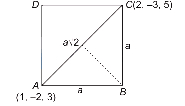
If the extremities of a diagonal of a square are $(1, -2, 3)$ and $(2, -3, 5)$,then the length of its side is
A
$\sqrt{6}$
B
$\sqrt{3}$
C
$\sqrt{5}$
D
$\sqrt{7}$
Solution
(B) Let the side of the square be $a$.
The length of the diagonal $d$ of a square with side $a$ is given by $d = a\sqrt{2}$.
The distance between the two given points $(1, -2, 3)$ and $(2, -3, 5)$ is the length of the diagonal $d$.
$d = \sqrt{(2-1)^2 + (-3 - (-2))^2 + (5-3)^2}$
$d = \sqrt{(1)^2 + (-1)^2 + (2)^2}$
$d = \sqrt{1 + 1 + 4} = \sqrt{6}$
Since $d = a\sqrt{2}$,we have:
$a\sqrt{2} = \sqrt{6}$
$a = \frac{\sqrt{6}}{\sqrt{2}} = \sqrt{3}$
Therefore,the length of the side of the square is $\sqrt{3}$.
The length of the diagonal $d$ of a square with side $a$ is given by $d = a\sqrt{2}$.
The distance between the two given points $(1, -2, 3)$ and $(2, -3, 5)$ is the length of the diagonal $d$.
$d = \sqrt{(2-1)^2 + (-3 - (-2))^2 + (5-3)^2}$
$d = \sqrt{(1)^2 + (-1)^2 + (2)^2}$
$d = \sqrt{1 + 1 + 4} = \sqrt{6}$
Since $d = a\sqrt{2}$,we have:
$a\sqrt{2} = \sqrt{6}$
$a = \frac{\sqrt{6}}{\sqrt{2}} = \sqrt{3}$
Therefore,the length of the side of the square is $\sqrt{3}$.
0 likesView Solution
192
ChemistryMCQTS EAMCET · 2001
If a line makes angles $\frac{\pi}{3}$ and $\frac{\pi}{4}$ with the $X$-axis and $Y$-axis respectively,then the angle made by the line with the $Z$-axis is
A
$\frac{\pi}{2}$
B
$\frac{\pi}{4}$
C
$\frac{5 \pi}{12}$
D
$\frac{\pi}{3}$
Solution
(D) We know that the direction cosines of a line satisfy the relation: $\cos^2 \alpha + \cos^2 \beta + \cos^2 \gamma = 1$,where $\alpha, \beta, \gamma$ are the angles made by the line with the $X, Y,$ and $Z$-axes respectively.
Given $\alpha = \frac{\pi}{3}$ and $\beta = \frac{\pi}{4}$.
Substituting these values into the identity:
$\cos^2 \left(\frac{\pi}{3}\right) + \cos^2 \left(\frac{\pi}{4}\right) + \cos^2 \gamma = 1$
$\Rightarrow \left(\frac{1}{2}\right)^2 + \left(\frac{1}{\sqrt{2}}\right)^2 + \cos^2 \gamma = 1$
$\Rightarrow \frac{1}{4} + \frac{1}{2} + \cos^2 \gamma = 1$
$\Rightarrow \frac{3}{4} + \cos^2 \gamma = 1$
$\Rightarrow \cos^2 \gamma = 1 - \frac{3}{4} = \frac{1}{4}$
$\Rightarrow \cos \gamma = \pm \frac{1}{2}$.
Considering the principal value,$\cos \gamma = \frac{1}{2} = \cos \left(\frac{\pi}{3}\right)$,which gives $\gamma = \frac{\pi}{3}$.
Given $\alpha = \frac{\pi}{3}$ and $\beta = \frac{\pi}{4}$.
Substituting these values into the identity:
$\cos^2 \left(\frac{\pi}{3}\right) + \cos^2 \left(\frac{\pi}{4}\right) + \cos^2 \gamma = 1$
$\Rightarrow \left(\frac{1}{2}\right)^2 + \left(\frac{1}{\sqrt{2}}\right)^2 + \cos^2 \gamma = 1$
$\Rightarrow \frac{1}{4} + \frac{1}{2} + \cos^2 \gamma = 1$
$\Rightarrow \frac{3}{4} + \cos^2 \gamma = 1$
$\Rightarrow \cos^2 \gamma = 1 - \frac{3}{4} = \frac{1}{4}$
$\Rightarrow \cos \gamma = \pm \frac{1}{2}$.
Considering the principal value,$\cos \gamma = \frac{1}{2} = \cos \left(\frac{\pi}{3}\right)$,which gives $\gamma = \frac{\pi}{3}$.
0 likesView Solution
193
ChemistryMCQTS EAMCET · 2001
In a competition,$A, B$,and $C$ are participating. The probability that $A$ wins is twice that of $B$,and the probability that $B$ wins is twice that of $C$. What is the probability that $A$ loses?
A
$\frac{1}{7}$
B
$\frac{2}{7}$
C
$\frac{4}{7}$
D
$\frac{3}{7}$
Solution
(D) Let the probability that $C$ wins be $P(C) = p$.
According to the problem,the probability that $B$ wins is $P(B) = 2p$.
The probability that $A$ wins is $P(A) = 2 \times P(B) = 2(2p) = 4p$.
Since one of them must win,the sum of their probabilities is $1$:
$P(A) + P(B) + P(C) = 1$
$4p + 2p + p = 1$
$7p = 1 \Rightarrow p = \frac{1}{7}$.
Therefore,the probability that $A$ wins is $P(A) = 4p = \frac{4}{7}$.
The probability that $A$ loses is $P(\bar{A}) = 1 - P(A) = 1 - \frac{4}{7} = \frac{3}{7}$.
According to the problem,the probability that $B$ wins is $P(B) = 2p$.
The probability that $A$ wins is $P(A) = 2 \times P(B) = 2(2p) = 4p$.
Since one of them must win,the sum of their probabilities is $1$:
$P(A) + P(B) + P(C) = 1$
$4p + 2p + p = 1$
$7p = 1 \Rightarrow p = \frac{1}{7}$.
Therefore,the probability that $A$ wins is $P(A) = 4p = \frac{4}{7}$.
The probability that $A$ loses is $P(\bar{A}) = 1 - P(A) = 1 - \frac{4}{7} = \frac{3}{7}$.
0 likesView Solution
194
ChemistryMCQTS EAMCET · 2001
Two dice are rolled simultaneously. The probability that the sum of the two numbers on the dice is a prime number is:
A
$\frac{5}{12}$
B
$\frac{7}{12}$
C
$\frac{9}{14}$
D
None of these
Solution
(A) When two dice are rolled,the total number of possible outcomes is $6 \times 6 = 36$.
Let $X$ be the sum of the numbers on the two dice. The possible values for $X$ range from $2$ to $12$.
The prime numbers in this range are $2, 3, 5, 7, 11$.
We calculate the number of outcomes for each sum:
- $X=2$: $(1,1) \rightarrow 1$ outcome
- $X=3$: $(1,2), (2,1) \rightarrow 2$ outcomes
- $X=5$: $(1,4), (2,3), (3,2), (4,1) \rightarrow 4$ outcomes
- $X=7$: $(1,6), (2,5), (3,4), (4,3), (5,2), (6,1) \rightarrow 6$ outcomes
- $X=11$: $(5,6), (6,5) \rightarrow 2$ outcomes
Total favorable outcomes $= 1 + 2 + 4 + 6 + 2 = 15$.
Probability $= \frac{\text{Favorable outcomes}}{\text{Total outcomes}} = \frac{15}{36} = \frac{5}{12}$.
Let $X$ be the sum of the numbers on the two dice. The possible values for $X$ range from $2$ to $12$.
The prime numbers in this range are $2, 3, 5, 7, 11$.
We calculate the number of outcomes for each sum:
- $X=2$: $(1,1) \rightarrow 1$ outcome
- $X=3$: $(1,2), (2,1) \rightarrow 2$ outcomes
- $X=5$: $(1,4), (2,3), (3,2), (4,1) \rightarrow 4$ outcomes
- $X=7$: $(1,6), (2,5), (3,4), (4,3), (5,2), (6,1) \rightarrow 6$ outcomes
- $X=11$: $(5,6), (6,5) \rightarrow 2$ outcomes
Total favorable outcomes $= 1 + 2 + 4 + 6 + 2 = 15$.
Probability $= \frac{\text{Favorable outcomes}}{\text{Total outcomes}} = \frac{15}{36} = \frac{5}{12}$.
0 likesView Solution
195
ChemistryMCQTS EAMCET · 2001
The probability that a number selected at random from the set of numbers ${1, 2, 3, \ldots, 100}$ is a cube,is
A
$\frac{1}{25}$
B
$\frac{2}{25}$
C
$\frac{3}{25}$
D
$\frac{4}{25}$
Solution
(A) The total number of elements in the set $S = \{1, 2, 3, \ldots, 100\}$ is $n(S) = 100$.
$A$ number is a perfect cube if it is of the form $k^3$ for some integer $k$.
The perfect cubes in the given set are $1^3 = 1$,$2^3 = 8$,$3^3 = 27$,and $4^3 = 64$. Note that $5^3 = 125$,which is greater than $100$.
Thus,the set of favorable outcomes is $A = \{1, 8, 27, 64\}$.
The number of favorable outcomes is $n(A) = 4$.
The required probability is $P(A) = \frac{n(A)}{n(S)} = \frac{4}{100} = \frac{1}{25}$.
$A$ number is a perfect cube if it is of the form $k^3$ for some integer $k$.
The perfect cubes in the given set are $1^3 = 1$,$2^3 = 8$,$3^3 = 27$,and $4^3 = 64$. Note that $5^3 = 125$,which is greater than $100$.
Thus,the set of favorable outcomes is $A = \{1, 8, 27, 64\}$.
The number of favorable outcomes is $n(A) = 4$.
The required probability is $P(A) = \frac{n(A)}{n(S)} = \frac{4}{100} = \frac{1}{25}$.
0 likesView Solution
196
ChemistryMCQTS EAMCET · 2001
$A$ tank with vertical walls is mounted so that its base is at a height $H$ above the horizontal ground. The tank is filled with water to a depth $h$. $A$ hole is punched in the side wall of the tank at a depth $x$ below the water surface. To have maximum range of the emerging stream,the value of $x$ is
A
$\frac{H+h}{4}$
B
$\frac{H+h}{2}$
C
$\frac{H+h}{3}$
D
$\frac{3(H+h)}{4}$
Solution
(B) Let the depth of the hole below the water surface be $x$. The height of the hole above the ground is $(h - x + H)$.
The velocity of efflux is $v = \sqrt{2gx}$.
The time taken for the water to reach the ground is $t = \sqrt{\frac{2(h - x + H)}{g}}$.
The horizontal range $R$ is given by $R = v \cdot t = \sqrt{2gx} \cdot \sqrt{\frac{2(h - x + H)}{g}} = 2\sqrt{x(h + H - x)}$.
For maximum range,the expression inside the square root,$f(x) = x(h + H - x) = x(h + H) - x^2$,must be maximized.
Taking the derivative with respect to $x$ and setting it to zero: $\frac{df}{dx} = (h + H) - 2x = 0$.
Thus,$x = \frac{h + H}{2}$.
The velocity of efflux is $v = \sqrt{2gx}$.
The time taken for the water to reach the ground is $t = \sqrt{\frac{2(h - x + H)}{g}}$.
The horizontal range $R$ is given by $R = v \cdot t = \sqrt{2gx} \cdot \sqrt{\frac{2(h - x + H)}{g}} = 2\sqrt{x(h + H - x)}$.
For maximum range,the expression inside the square root,$f(x) = x(h + H - x) = x(h + H) - x^2$,must be maximized.
Taking the derivative with respect to $x$ and setting it to zero: $\frac{df}{dx} = (h + H) - 2x = 0$.
Thus,$x = \frac{h + H}{2}$.
0 likesView Solution
197
ChemistryMCQTS EAMCET · 2001
Water is conveyed through a uniform tube of $8 \text{ cm}$ in diameter and $3140 \text{ m}$ in length at the rate of $2 \times 10^{-3} \text{ m}^3/\text{s}$. The pressure required to maintain the flow is (Viscosity of water $= 10^{-3} \text{ SI units}$):
A
$6.25 \times 10^3 \text{ N/m}^2$
B
$0.625 \text{ N/m}^2$
C
$0.0625 \text{ N/m}^2$
D
$0.00625 \text{ N/m}^2$
Solution
(A) Given: Diameter $d = 8 \text{ cm} = 0.08 \text{ m}$,so radius $r = 0.04 \text{ m} = 4 \times 10^{-2} \text{ m}$.
Length $l = 3140 \text{ m}$.
Flow rate $Q = 2 \times 10^{-3} \text{ m}^3/\text{s}$.
Viscosity $\eta = 10^{-3} \text{ SI units}$.
According to Poiseuille's equation for laminar flow in a pipe:
$Q = \frac{\pi P r^4}{8 \eta l}$
Rearranging for pressure difference $P$:
$P = \frac{8 \eta l Q}{\pi r^4}$
Substituting the values:
$P = \frac{8 \times 10^{-3} \times 3140 \times 2 \times 10^{-3}}{3.14 \times (4 \times 10^{-2})^4}$
$P = \frac{16 \times 3140 \times 10^{-6}}{3.14 \times 256 \times 10^{-8}}$
$P = \frac{16 \times 1000 \times 10^{-6}}{256 \times 10^{-8}} = \frac{16000 \times 10^2}{256} = \frac{1600000}{256} = 6250 \text{ N/m}^2$
$P = 6.25 \times 10^3 \text{ N/m}^2$.
Length $l = 3140 \text{ m}$.
Flow rate $Q = 2 \times 10^{-3} \text{ m}^3/\text{s}$.
Viscosity $\eta = 10^{-3} \text{ SI units}$.
According to Poiseuille's equation for laminar flow in a pipe:
$Q = \frac{\pi P r^4}{8 \eta l}$
Rearranging for pressure difference $P$:
$P = \frac{8 \eta l Q}{\pi r^4}$
Substituting the values:
$P = \frac{8 \times 10^{-3} \times 3140 \times 2 \times 10^{-3}}{3.14 \times (4 \times 10^{-2})^4}$
$P = \frac{16 \times 3140 \times 10^{-6}}{3.14 \times 256 \times 10^{-8}}$
$P = \frac{16 \times 1000 \times 10^{-6}}{256 \times 10^{-8}} = \frac{16000 \times 10^2}{256} = \frac{1600000}{256} = 6250 \text{ N/m}^2$
$P = 6.25 \times 10^3 \text{ N/m}^2$.
0 likesView Solution
198
ChemistryMCQTS EAMCET · 2001
$A$ mercury drop of radius $1 ~cm$ is sprayed into $10^6$ drops of equal size. The energy expended in joules is (Surface tension of mercury is $460 \times 10^{-3} ~N/m$)
A
$0.057$
B
$5.7$
C
$5.7 \times 10^{-4}$
D
$5.7 \times 10^{-3}$
Solution
(A) Given: Radius of big drop $R = 1 ~cm = 10^{-2} ~m$,number of small drops $n = 10^6$,surface tension $T = 460 \times 10^{-3} ~N/m$.
Conservation of volume: $n \times (\frac{4}{3} \pi r^3) = \frac{4}{3} \pi R^3 \implies r^3 = \frac{R^3}{n} \implies r = \frac{R}{n^{1/3}}$.
For $n = 10^6$,$r = \frac{R}{(10^6)^{1/3}} = \frac{R}{10^2} = 10^{-2} R$.
Energy expended $W = T \times \Delta A = T \times (n \times 4 \pi r^2 - 4 \pi R^2) = 4 \pi T (n r^2 - R^2)$.
Substituting $r = R/100$: $W = 4 \pi T (n \frac{R^2}{10^4} - R^2) = 4 \pi R^2 T (\frac{n}{10^4} - 1)$.
Since $n = 10^6$,$W = 4 \pi R^2 T (10^2 - 1) = 4 \pi R^2 T (99)$.
Calculation: $W = 4 \times 3.14 \times (10^{-2})^2 \times 460 \times 10^{-3} \times 99$.
$W = 4 \times 3.14 \times 10^{-4} \times 460 \times 10^{-3} \times 99 \approx 0.057 ~J$.
Conservation of volume: $n \times (\frac{4}{3} \pi r^3) = \frac{4}{3} \pi R^3 \implies r^3 = \frac{R^3}{n} \implies r = \frac{R}{n^{1/3}}$.
For $n = 10^6$,$r = \frac{R}{(10^6)^{1/3}} = \frac{R}{10^2} = 10^{-2} R$.
Energy expended $W = T \times \Delta A = T \times (n \times 4 \pi r^2 - 4 \pi R^2) = 4 \pi T (n r^2 - R^2)$.
Substituting $r = R/100$: $W = 4 \pi T (n \frac{R^2}{10^4} - R^2) = 4 \pi R^2 T (\frac{n}{10^4} - 1)$.
Since $n = 10^6$,$W = 4 \pi R^2 T (10^2 - 1) = 4 \pi R^2 T (99)$.
Calculation: $W = 4 \times 3.14 \times (10^{-2})^2 \times 460 \times 10^{-3} \times 99$.
$W = 4 \times 3.14 \times 10^{-4} \times 460 \times 10^{-3} \times 99 \approx 0.057 ~J$.
0 likesView Solution
199
ChemistryMCQTS EAMCET · 2001
When an air bubble of radius $r$ rises from the bottom to the surface of a lake,its radius becomes $\frac{5r}{4}$. If the atmospheric pressure is equal to the pressure exerted by a $10 \ m$ height of water column,and the temperature remains constant while surface tension is neglected,what is the depth of the lake (in $m$)?
A
$5.53$
B
$6.53$
C
$9.53$
D
$12.53$
Solution
(C) Let the depth of the lake be $h$. The atmospheric pressure $P_0$ is equivalent to a water column of height $H = 10 \ m$.
At the bottom of the lake,the pressure $P_1 = P_0 + h \rho g = (H + h) \rho g$.
At the surface,the pressure $P_2 = P_0 = H \rho g$.
Since the temperature is constant,we use Boyle's Law: $P_1 V_1 = P_2 V_2$.
Given $V_1 = \frac{4}{3} \pi r^3$ and $V_2 = \frac{4}{3} \pi (\frac{5r}{4})^3$.
Substituting the values: $(H + h) \rho g \times \frac{4}{3} \pi r^3 = H \rho g \times \frac{4}{3} \pi (\frac{5r}{4})^3$.
$(10 + h) = 10 \times (\frac{5}{4})^3$.
$10 + h = 10 \times \frac{125}{64} = \frac{1250}{64} = 19.53125$.
$h = 19.53125 - 10 = 9.53125 \ m \approx 9.53 \ m$.
At the bottom of the lake,the pressure $P_1 = P_0 + h \rho g = (H + h) \rho g$.
At the surface,the pressure $P_2 = P_0 = H \rho g$.
Since the temperature is constant,we use Boyle's Law: $P_1 V_1 = P_2 V_2$.
Given $V_1 = \frac{4}{3} \pi r^3$ and $V_2 = \frac{4}{3} \pi (\frac{5r}{4})^3$.
Substituting the values: $(H + h) \rho g \times \frac{4}{3} \pi r^3 = H \rho g \times \frac{4}{3} \pi (\frac{5r}{4})^3$.
$(10 + h) = 10 \times (\frac{5}{4})^3$.
$10 + h = 10 \times \frac{125}{64} = \frac{1250}{64} = 19.53125$.
$h = 19.53125 - 10 = 9.53125 \ m \approx 9.53 \ m$.
0 likesView Solution
200
ChemistryMCQTS EAMCET · 2001
$A$ body is executing simple harmonic motion. At a displacement $x$ its potential energy is $E_1$ and at a displacement $y$ its potential energy is $E_2$. The potential energy $(E)$ at displacement $(x+y)$ is
A
$\sqrt{E}=\sqrt{E_1}-\sqrt{E_2}$
B
$\sqrt{E}=\sqrt{E_1}+\sqrt{E_2}$
C
$E=E_1+E_2$
D
$E=E_1-E_2$
Solution
(B) The potential energy $U$ of a body executing simple harmonic motion $(SHM)$ at a displacement $d$ is given by $U = \frac{1}{2} k d^2$,where $k = m \omega^2$ is the force constant.
Given:
$E_1 = \frac{1}{2} k x^2 \implies x = \sqrt{\frac{2 E_1}{k}}$
$E_2 = \frac{1}{2} k y^2 \implies y = \sqrt{\frac{2 E_2}{k}}$
At displacement $(x+y)$,the potential energy $E$ is:
$E = \frac{1}{2} k (x+y)^2$
Taking the square root of both sides:
$\sqrt{E} = \sqrt{\frac{1}{2} k} (x+y)$
Substituting the expressions for $x$ and $y$:
$\sqrt{E} = \sqrt{\frac{1}{2} k} \left( \sqrt{\frac{2 E_1}{k}} + \sqrt{\frac{2 E_2}{k}} \right)$
$\sqrt{E} = \sqrt{\frac{1}{2} k} \cdot \sqrt{\frac{2}{k}} (\sqrt{E_1} + \sqrt{E_2})$
$\sqrt{E} = \sqrt{\frac{1}{2} k \cdot \frac{2}{k}} (\sqrt{E_1} + \sqrt{E_2})$
$\sqrt{E} = \sqrt{1} (\sqrt{E_1} + \sqrt{E_2})$
$\sqrt{E} = \sqrt{E_1} + \sqrt{E_2}$
Given:
$E_1 = \frac{1}{2} k x^2 \implies x = \sqrt{\frac{2 E_1}{k}}$
$E_2 = \frac{1}{2} k y^2 \implies y = \sqrt{\frac{2 E_2}{k}}$
At displacement $(x+y)$,the potential energy $E$ is:
$E = \frac{1}{2} k (x+y)^2$
Taking the square root of both sides:
$\sqrt{E} = \sqrt{\frac{1}{2} k} (x+y)$
Substituting the expressions for $x$ and $y$:
$\sqrt{E} = \sqrt{\frac{1}{2} k} \left( \sqrt{\frac{2 E_1}{k}} + \sqrt{\frac{2 E_2}{k}} \right)$
$\sqrt{E} = \sqrt{\frac{1}{2} k} \cdot \sqrt{\frac{2}{k}} (\sqrt{E_1} + \sqrt{E_2})$
$\sqrt{E} = \sqrt{\frac{1}{2} k \cdot \frac{2}{k}} (\sqrt{E_1} + \sqrt{E_2})$
$\sqrt{E} = \sqrt{1} (\sqrt{E_1} + \sqrt{E_2})$
$\sqrt{E} = \sqrt{E_1} + \sqrt{E_2}$
0 likesView Solution
Vedclass Products
For Students
Vedclass Test Series
Mock tests in real TS EAMCET style covering Chemistry with performance analysis. 5-day free trial.
Start Free TrialFor Teachers
Exam Paper Generator
Generate Set A/B/C/D Chemistry papers from 7.5L+ questions in 2 minutes. 3 chapters free.
Try FreeFor Institutes
Online Exam Module
Run live TS EAMCET mock exams with unlimited students, 360° analytics & white-label branding.
See DemoFrequently Asked Questions
How many Chemistry questions are in TS EAMCET 2001?
There are 236 Chemistry questions from the TS EAMCET 2001 paper on Vedclass, each with a detailed step-by-step solution in English.
Are TS EAMCET 2001 Chemistry solutions available in English?
Yes. All solutions on this page are in English. You can also switch to English or Hindi using the language buttons above the questions.
Can I practice TS EAMCET 2001 Chemistry as a timed test?
Yes. Use the Vedclass Test Series to attempt a full TS EAMCET mock test covering Chemistry with time limits and instant score analysis.
Can teachers create Chemistry papers from TS EAMCET previous year questions?
Yes. The Vedclass Exam Paper Generator lets teachers mix TS EAMCET Chemistry questions and generate Set A/B/C/D papers in minutes.
For Teachers & Institutes
Build a Custom Chemistry Paper
Pick TS EAMCET 2001 Chemistry questions, set difficulty, and generate Set A/B/C/D in 2 minutes.