
ChemistryQ51–100 of 236 questions
Page 2 of 5 · English
51
ChemistryMCQTS EAMCET · 2001
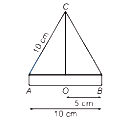
$A$ magnet of length $10 \text{ cm}$ and magnetic moment $1 \text{ Am}^2$ is placed along side $AB$ of an equilateral triangle $ABC$. If the length of the side $AB$ is $10 \text{ cm}$,find the magnetic induction at the point $C$. (Given $\mu_0 = 4\pi \times 10^{-7} \text{ Hm}^{-1}$)
A
$10^{-9} \text{ T}$
B
$10^{-7} \text{ T}$
C
$10^{-5} \text{ T}$
D
$10^{-4} \text{ T}$
Solution
(D) The magnet is placed along $AB$ with its center at $O$. The length of the magnet is $2l = 10 \text{ cm}$,so $l = 5 \text{ cm} = 0.05 \text{ m}$. The magnetic moment $M = 1 \text{ Am}^2$.
Point $C$ lies on the perpendicular bisector of the magnet,which corresponds to the equatorial position.
The distance $r$ of point $C$ from the center $O$ of the magnet is the height of the equilateral triangle with side $a = 10 \text{ cm} = 0.1 \text{ m}$.
$r = \sqrt{a^2 - (a/2)^2} = \sqrt{0.1^2 - 0.05^2} = \sqrt{0.01 - 0.0025} = \sqrt{0.0075} = \sqrt{75} \times 10^{-2} \text{ m} = 5\sqrt{3} \times 10^{-2} \text{ m}$.
The magnetic field $B$ at the equatorial position is given by $B = \frac{\mu_0}{4\pi} \frac{M}{(r^2 + l^2)^{3/2}}$.
Since $r^2 + l^2 = (5\sqrt{3} \times 10^{-2})^2 + (5 \times 10^{-2})^2 = (75 + 25) \times 10^{-4} = 100 \times 10^{-4} = 10^{-2} \text{ m}^2$.
Thus,$(r^2 + l^2)^{3/2} = (10^{-2})^{3/2} = 10^{-3} \text{ m}^3$.
Substituting the values: $B = 10^{-7} \times \frac{1}{10^{-3}} = 10^{-4} \text{ T}$.
Point $C$ lies on the perpendicular bisector of the magnet,which corresponds to the equatorial position.
The distance $r$ of point $C$ from the center $O$ of the magnet is the height of the equilateral triangle with side $a = 10 \text{ cm} = 0.1 \text{ m}$.
$r = \sqrt{a^2 - (a/2)^2} = \sqrt{0.1^2 - 0.05^2} = \sqrt{0.01 - 0.0025} = \sqrt{0.0075} = \sqrt{75} \times 10^{-2} \text{ m} = 5\sqrt{3} \times 10^{-2} \text{ m}$.
The magnetic field $B$ at the equatorial position is given by $B = \frac{\mu_0}{4\pi} \frac{M}{(r^2 + l^2)^{3/2}}$.
Since $r^2 + l^2 = (5\sqrt{3} \times 10^{-2})^2 + (5 \times 10^{-2})^2 = (75 + 25) \times 10^{-4} = 100 \times 10^{-4} = 10^{-2} \text{ m}^2$.
Thus,$(r^2 + l^2)^{3/2} = (10^{-2})^{3/2} = 10^{-3} \text{ m}^3$.
Substituting the values: $B = 10^{-7} \times \frac{1}{10^{-3}} = 10^{-4} \text{ T}$.
0 likesView Solution
52
ChemistryMCQTS EAMCET · 2001
$\frac{\sqrt{8+\sqrt{28}}+\sqrt{8-\sqrt{28}}}{\sqrt{8+\sqrt{28}}-\sqrt{8-\sqrt{28}}}$ is equal to
A
$2$
B
$7$
C
$\sqrt{7}$
D
$\sqrt{2}$
Solution
(C) Let $x = \frac{\sqrt{8+\sqrt{28}}+\sqrt{8-\sqrt{28}}}{\sqrt{8+\sqrt{28}}-\sqrt{8-\sqrt{28}}}$.
Rationalizing the denominator:
$x = \frac{(\sqrt{8+\sqrt{28}}+\sqrt{8-\sqrt{28}})^2}{(\sqrt{8+\sqrt{28}})^2-(\sqrt{8-\sqrt{28}})^2}$
$x = \frac{(8+\sqrt{28}) + (8-\sqrt{28}) + 2\sqrt{(8+\sqrt{28})(8-\sqrt{28})}}{(8+\sqrt{28}) - (8-\sqrt{28})}$
$x = \frac{16 + 2\sqrt{64-28}}{2\sqrt{28}}$
$x = \frac{16 + 2\sqrt{36}}{2\sqrt{4 \times 7}}$
$x = \frac{16 + 2(6)}{2(2\sqrt{7})}$
$x = \frac{16 + 12}{4\sqrt{7}} = \frac{28}{4\sqrt{7}} = \frac{7}{\sqrt{7}} = \sqrt{7}$.
Rationalizing the denominator:
$x = \frac{(\sqrt{8+\sqrt{28}}+\sqrt{8-\sqrt{28}})^2}{(\sqrt{8+\sqrt{28}})^2-(\sqrt{8-\sqrt{28}})^2}$
$x = \frac{(8+\sqrt{28}) + (8-\sqrt{28}) + 2\sqrt{(8+\sqrt{28})(8-\sqrt{28})}}{(8+\sqrt{28}) - (8-\sqrt{28})}$
$x = \frac{16 + 2\sqrt{64-28}}{2\sqrt{28}}$
$x = \frac{16 + 2\sqrt{36}}{2\sqrt{4 \times 7}}$
$x = \frac{16 + 2(6)}{2(2\sqrt{7})}$
$x = \frac{16 + 12}{4\sqrt{7}} = \frac{28}{4\sqrt{7}} = \frac{7}{\sqrt{7}} = \sqrt{7}$.
0 likesView Solution
53
ChemistryMCQTS EAMCET · 2001
If $\alpha, \beta$ are the roots of the equation $x^2+bx+c=0$ and $\alpha+h, \beta+h$ are the roots of the equation $x^2+qx+r=0$,then $h$ is equal to
A
$b+q$
B
$b-q$
C
$\frac{1}{2}(b+q)$
D
$\frac{1}{2}(b-q)$
Solution
(D) Given that $\alpha$ and $\beta$ are the roots of the equation $x^2+bx+c=0$.
From the relation between roots and coefficients,we have $\alpha+\beta = -b$.
Also,$\alpha+h$ and $\beta+h$ are the roots of the equation $x^2+qx+r=0$.
Therefore,the sum of the roots is $(\alpha+h) + (\beta+h) = -q$.
This simplifies to $(\alpha+\beta) + 2h = -q$.
Substituting $\alpha+\beta = -b$,we get $-b + 2h = -q$.
Rearranging the terms,$2h = b-q$.
Thus,$h = \frac{1}{2}(b-q)$.
From the relation between roots and coefficients,we have $\alpha+\beta = -b$.
Also,$\alpha+h$ and $\beta+h$ are the roots of the equation $x^2+qx+r=0$.
Therefore,the sum of the roots is $(\alpha+h) + (\beta+h) = -q$.
This simplifies to $(\alpha+\beta) + 2h = -q$.
Substituting $\alpha+\beta = -b$,we get $-b + 2h = -q$.
Rearranging the terms,$2h = b-q$.
Thus,$h = \frac{1}{2}(b-q)$.
0 likesView Solution
54
ChemistryMCQTS EAMCET · 2001
The minimum value of $(x-\alpha)(x-\beta)$ is
A
$0$
B
$\alpha \beta$
C
$\frac{1}{4}(\alpha-\beta)^2$
D
$-\frac{1}{4}(\alpha-\beta)^2$
Solution
(D) Let $y = (x-\alpha)(x-\beta)$.
Expanding the expression,we get $y = x^2 - (\alpha+\beta)x + \alpha\beta$.
To find the minimum value,we can complete the square:
$y = x^2 - (\alpha+\beta)x + \left(\frac{\alpha+\beta}{2}\right)^2 - \left(\frac{\alpha+\beta}{2}\right)^2 + \alpha\beta$.
$y = \left(x - \frac{\alpha+\beta}{2}\right)^2 - \frac{(\alpha+\beta)^2 - 4\alpha\beta}{4}$.
$y = \left(x - \frac{\alpha+\beta}{2}\right)^2 - \frac{\alpha^2 + 2\alpha\beta + \beta^2 - 4\alpha\beta}{4}$.
$y = \left(x - \frac{\alpha+\beta}{2}\right)^2 - \frac{(\alpha-\beta)^2}{4}$.
Since the square term $\left(x - \frac{\alpha+\beta}{2}\right)^2 \ge 0$,the minimum value occurs when $x = \frac{\alpha+\beta}{2}$.
Thus,the minimum value is $-\frac{1}{4}(\alpha-\beta)^2$.
Expanding the expression,we get $y = x^2 - (\alpha+\beta)x + \alpha\beta$.
To find the minimum value,we can complete the square:
$y = x^2 - (\alpha+\beta)x + \left(\frac{\alpha+\beta}{2}\right)^2 - \left(\frac{\alpha+\beta}{2}\right)^2 + \alpha\beta$.
$y = \left(x - \frac{\alpha+\beta}{2}\right)^2 - \frac{(\alpha+\beta)^2 - 4\alpha\beta}{4}$.
$y = \left(x - \frac{\alpha+\beta}{2}\right)^2 - \frac{\alpha^2 + 2\alpha\beta + \beta^2 - 4\alpha\beta}{4}$.
$y = \left(x - \frac{\alpha+\beta}{2}\right)^2 - \frac{(\alpha-\beta)^2}{4}$.
Since the square term $\left(x - \frac{\alpha+\beta}{2}\right)^2 \ge 0$,the minimum value occurs when $x = \frac{\alpha+\beta}{2}$.
Thus,the minimum value is $-\frac{1}{4}(\alpha-\beta)^2$.
0 likesView Solution
55
ChemistryMCQTS EAMCET · 2001
If $\frac{x-4}{x^2-5x-2k} = \frac{2}{x-2} - \frac{1}{x+k}$,then $k$ is equal to
A
$-3$
B
$-2$
C
$2$
D
$3$
Solution
(A) Given the equation: $\frac{x-4}{x^2-5x-2k} = \frac{2}{x-2} - \frac{1}{x+k}$
Simplifying the right side: $\frac{2(x+k) - (x-2)}{(x-2)(x+k)} = \frac{2x + 2k - x + 2}{(x-2)(x+k)} = \frac{x + 2k + 2}{x^2 + kx - 2x - 2k} = \frac{x + 2k + 2}{x^2 + (k-2)x - 2k}$
Comparing the denominators: $x^2 - 5x - 2k = x^2 + (k-2)x - 2k$
This implies $k-2 = -5$,so $k = -3$
Comparing the numerators: $x-4 = x + 2k + 2$
Substituting $k = -3$: $x-4 = x + 2(-3) + 2 = x - 6 + 2 = x - 4$
Both sides match,therefore $k = -3$.
Simplifying the right side: $\frac{2(x+k) - (x-2)}{(x-2)(x+k)} = \frac{2x + 2k - x + 2}{(x-2)(x+k)} = \frac{x + 2k + 2}{x^2 + kx - 2x - 2k} = \frac{x + 2k + 2}{x^2 + (k-2)x - 2k}$
Comparing the denominators: $x^2 - 5x - 2k = x^2 + (k-2)x - 2k$
This implies $k-2 = -5$,so $k = -3$
Comparing the numerators: $x-4 = x + 2k + 2$
Substituting $k = -3$: $x-4 = x + 2(-3) + 2 = x - 6 + 2 = x - 4$
Both sides match,therefore $k = -3$.
0 likesView Solution
56
ChemistryMCQTS EAMCET · 2001
Each of the roots of the equation $x^3-6x^2+6x-5=0$ is increased by $h$. If the new transformed equation does not contain the $x^2$ term,then $h$ is equal to:
A
$1$
B
$2$
C
$\frac{1}{2}$
D
$\frac{1}{3}$
Solution
(B) The given equation is $x^3-6x^2+6x-5=0$.
To shift the roots by $h$,we replace $x$ with $x+h$.
The new equation becomes $(x+h)^3-6(x+h)^2+6(x+h)-5=0$.
Expanding the terms:
$(x^3+3x^2h+3xh^2+h^3) - 6(x^2+2xh+h^2) + 6(x+h) - 5 = 0$.
Grouping the terms by powers of $x$:
$x^3 + (3h-6)x^2 + (3h^2-12h+6)x + (h^3-6h^2+6h-5) = 0$.
For the $x^2$ term to be absent,its coefficient must be zero:
$3h-6 = 0$.
Therefore,$h = 2$.
To shift the roots by $h$,we replace $x$ with $x+h$.
The new equation becomes $(x+h)^3-6(x+h)^2+6(x+h)-5=0$.
Expanding the terms:
$(x^3+3x^2h+3xh^2+h^3) - 6(x^2+2xh+h^2) + 6(x+h) - 5 = 0$.
Grouping the terms by powers of $x$:
$x^3 + (3h-6)x^2 + (3h^2-12h+6)x + (h^3-6h^2+6h-5) = 0$.
For the $x^2$ term to be absent,its coefficient must be zero:
$3h-6 = 0$.
Therefore,$h = 2$.
0 likesView Solution
57
ChemistryMCQTS EAMCET · 2001
The roots of the equation $x^3-14x^2+56x-64=0$ are in
A
$AGP$
B
$HP$
C
$AP$
D
$GP$
Solution
(D) Given equation: $x^3-14x^2+56x-64=0$.
Let $f(x) = x^3-14x^2+56x-64$.
Testing $x=2$: $f(2) = 8 - 14(4) + 56(2) - 64 = 8 - 56 + 112 - 64 = 0$.
Since $x=2$ is a root,$(x-2)$ is a factor.
Dividing the polynomial by $(x-2)$,we get $x^2(x-2) - 12x(x-2) + 32(x-2) = 0$.
$(x-2)(x^2-12x+32) = 0$.
Factoring the quadratic: $(x-2)(x-4)(x-8) = 0$.
The roots are $2, 4, 8$.
Since $\frac{4}{2} = 2$ and $\frac{8}{4} = 2$,the common ratio is constant,so the roots are in $GP$.
Let $f(x) = x^3-14x^2+56x-64$.
Testing $x=2$: $f(2) = 8 - 14(4) + 56(2) - 64 = 8 - 56 + 112 - 64 = 0$.
Since $x=2$ is a root,$(x-2)$ is a factor.
Dividing the polynomial by $(x-2)$,we get $x^2(x-2) - 12x(x-2) + 32(x-2) = 0$.
$(x-2)(x^2-12x+32) = 0$.
Factoring the quadratic: $(x-2)(x-4)(x-8) = 0$.
The roots are $2, 4, 8$.
Since $\frac{4}{2} = 2$ and $\frac{8}{4} = 2$,the common ratio is constant,so the roots are in $GP$.
0 likesView Solution
58
ChemistryMCQTS EAMCET · 2001
If $1$ is a multiple root of order $3$ for the equation $x^4-2x^3+2x-1=0$,then the other root is
A
$0$
B
$-1$
C
$1$
D
$2$
Solution
(B) Given the polynomial equation $P(x) = x^4-2x^3+2x-1=0$.
Since $1$ is a root of order $3$,$(x-1)^3$ must be a factor of $P(x)$.
Expanding $(x-1)^3 = x^3-3x^2+3x-1$.
Dividing $x^4-2x^3+2x-1$ by $(x-1)^3$:
$x^4-2x^3+2x-1 = (x-1)^3(x+1)$.
Setting the factors to zero,we get $(x-1)^3 = 0$ and $x+1 = 0$.
Thus,the roots are $1, 1, 1$ and $-1$.
The other root is $-1$.
Since $1$ is a root of order $3$,$(x-1)^3$ must be a factor of $P(x)$.
Expanding $(x-1)^3 = x^3-3x^2+3x-1$.
Dividing $x^4-2x^3+2x-1$ by $(x-1)^3$:
$x^4-2x^3+2x-1 = (x-1)^3(x+1)$.
Setting the factors to zero,we get $(x-1)^3 = 0$ and $x+1 = 0$.
Thus,the roots are $1, 1, 1$ and $-1$.
The other root is $-1$.
0 likesView Solution
59
ChemistryMCQTS EAMCET · 2001
The biquadratic equation,two of whose roots are $1+i$ and $1-\sqrt{2}$,is
A
$x^4-4 x^3+5 x^2-2 x-2=0$
B
$x^4+4 x^3-5 x^2+2 x+2=0$
C
$x^4+4 x^3-5 x^2+2 x-2=0$
D
$x^4+4 x^3+5 x^2-2 x+2=0$
Solution
(A) Since the coefficients of the biquadratic equation are assumed to be rational,the irrational and complex roots must occur in conjugate pairs. Thus,the roots are $1+i, 1-i, 1-\sqrt{2}, 1+\sqrt{2}$.
For the roots $1+i$ and $1-i$:
Sum $= (1+i) + (1-i) = 2$
Product $= (1+i)(1-i) = 1^2 - i^2 = 1+1 = 2$
The quadratic factor is $x^2 - 2x + 2 = 0$.
For the roots $1-\sqrt{2}$ and $1+\sqrt{2}$:
Sum $= (1-\sqrt{2}) + (1+\sqrt{2}) = 2$
Product $= (1-\sqrt{2})(1+\sqrt{2}) = 1^2 - (\sqrt{2})^2 = 1-2 = -1$
The quadratic factor is $x^2 - 2x - 1 = 0$.
The biquadratic equation is the product of these two factors:
$(x^2-2x+2)(x^2-2x-1) = 0$
$x^2(x^2-2x-1) - 2x(x^2-2x-1) + 2(x^2-2x-1) = 0$
$x^4 - 2x^3 - x^2 - 2x^3 + 4x^2 + 2x + 2x^2 - 4x - 2 = 0$
$x^4 - 4x^3 + 5x^2 - 2x - 2 = 0$.
For the roots $1+i$ and $1-i$:
Sum $= (1+i) + (1-i) = 2$
Product $= (1+i)(1-i) = 1^2 - i^2 = 1+1 = 2$
The quadratic factor is $x^2 - 2x + 2 = 0$.
For the roots $1-\sqrt{2}$ and $1+\sqrt{2}$:
Sum $= (1-\sqrt{2}) + (1+\sqrt{2}) = 2$
Product $= (1-\sqrt{2})(1+\sqrt{2}) = 1^2 - (\sqrt{2})^2 = 1-2 = -1$
The quadratic factor is $x^2 - 2x - 1 = 0$.
The biquadratic equation is the product of these two factors:
$(x^2-2x+2)(x^2-2x-1) = 0$
$x^2(x^2-2x-1) - 2x(x^2-2x-1) + 2(x^2-2x-1) = 0$
$x^4 - 2x^3 - x^2 - 2x^3 + 4x^2 + 2x + 2x^2 - 4x - 2 = 0$
$x^4 - 4x^3 + 5x^2 - 2x - 2 = 0$.
0 likesView Solution
60
ChemistryMCQTS EAMCET · 2001
The length of an elastic string is $a$ metres when the longitudinal tension is $4 \ N$ and $b$ metres when the longitudinal tension is $5 \ N$. The length of the string in metres when the longitudinal tension is $9 \ N$ is
A
$a-b$
B
$5b-4a$
C
$2b-\frac{1}{4}a$
D
$4a-3b$
Solution
(B) According to Hooke's Law,the extension of an elastic string is proportional to the applied tension. Let $L_0$ be the natural length of the string and $k$ be the force constant.
The length $L$ under tension $T$ is given by $L = L_0 + \frac{T}{k}$.
For $T_1 = 4 \ N$,$L_1 = a = L_0 + \frac{4}{k}$ --- $(1)$
For $T_2 = 5 \ N$,$L_2 = b = L_0 + \frac{5}{k}$ --- $(2)$
Subtracting $(1)$ from $(2)$: $b - a = \frac{5}{k} - \frac{4}{k} = \frac{1}{k} \Rightarrow k = \frac{1}{b-a}$.
Substituting $k$ into $(1)$: $L_0 = a - 4(b-a) = a - 4b + 4a = 5a - 4b$.
Now,for $T_3 = 9 \ N$,the length $x$ is:
$x = L_0 + \frac{9}{k} = (5a - 4b) + 9(b - a)$
$x = 5a - 4b + 9b - 9a$
$x = 5b - 4a$.
The length $L$ under tension $T$ is given by $L = L_0 + \frac{T}{k}$.
For $T_1 = 4 \ N$,$L_1 = a = L_0 + \frac{4}{k}$ --- $(1)$
For $T_2 = 5 \ N$,$L_2 = b = L_0 + \frac{5}{k}$ --- $(2)$
Subtracting $(1)$ from $(2)$: $b - a = \frac{5}{k} - \frac{4}{k} = \frac{1}{k} \Rightarrow k = \frac{1}{b-a}$.
Substituting $k$ into $(1)$: $L_0 = a - 4(b-a) = a - 4b + 4a = 5a - 4b$.
Now,for $T_3 = 9 \ N$,the length $x$ is:
$x = L_0 + \frac{9}{k} = (5a - 4b) + 9(b - a)$
$x = 5a - 4b + 9b - 9a$
$x = 5b - 4a$.
0 likesView Solution
61
ChemistryMCQTS EAMCET · 2001
An object is projected with a velocity of $20 \ m/s$ making an angle of $45^{\circ}$ with the horizontal. The equation for the trajectory is $h = Ax - Bx^2$,where $h$ is the height,$x$ is the horizontal distance,and $A$ and $B$ are constants. The ratio $A:B$ is $(g = 10 \ m/s^2)$.
A
$1:5$
B
$5:1$
C
$1:40$
D
$40:1$
Solution
(D) Given: Initial velocity $u = 20 \ m/s$,angle of projection $\theta = 45^{\circ}$,and $g = 10 \ m/s^2$.
The standard equation of the trajectory of a projectile is given by $h = x \tan \theta - \frac{gx^2}{2u^2 \cos^2 \theta}$.
Comparing this with the given equation $h = Ax - Bx^2$,we get:
$A = \tan \theta = \tan 45^{\circ} = 1$.
$B = \frac{g}{2u^2 \cos^2 \theta} = \frac{10}{2 \times (20)^2 \times (\cos 45^{\circ})^2} = \frac{10}{2 \times 400 \times (1/\sqrt{2})^2} = \frac{10}{800 \times 1/2} = \frac{10}{400} = \frac{1}{40}$.
Now,the ratio $A:B$ is calculated as:
$\frac{A}{B} = \frac{1}{1/40} = 40$.
Therefore,the ratio $A:B$ is $40:1$.
The standard equation of the trajectory of a projectile is given by $h = x \tan \theta - \frac{gx^2}{2u^2 \cos^2 \theta}$.
Comparing this with the given equation $h = Ax - Bx^2$,we get:
$A = \tan \theta = \tan 45^{\circ} = 1$.
$B = \frac{g}{2u^2 \cos^2 \theta} = \frac{10}{2 \times (20)^2 \times (\cos 45^{\circ})^2} = \frac{10}{2 \times 400 \times (1/\sqrt{2})^2} = \frac{10}{800 \times 1/2} = \frac{10}{400} = \frac{1}{40}$.
Now,the ratio $A:B$ is calculated as:
$\frac{A}{B} = \frac{1}{1/40} = 40$.
Therefore,the ratio $A:B$ is $40:1$.
0 likesView Solution
62
ChemistryMCQTS EAMCET · 2001
$A$ heavy nucleus at rest breaks into two fragments which fly off with velocities in the ratio $3: 1$. The ratio of radii of the fragments is
A
$1: 3^{1/3}$
B
$3^{1/3}: 4$
C
$4: 1$
D
$2: 1$
Solution
(A) According to the law of conservation of linear momentum,the initial momentum is zero,so the magnitudes of the momenta of the two fragments must be equal:
$m_1 v_1 = m_2 v_2$
$\frac{m_1}{m_2} = \frac{v_2}{v_1} = \frac{1}{3}$
Assuming the density $\rho$ of the nucleus is constant,the mass $m$ is proportional to the volume $V = \frac{4}{3} \pi R^3$,where $R$ is the radius.
$\frac{m_1}{m_2} = \frac{R_1^3}{R_2^3}$
Equating the two expressions for the mass ratio:
$\frac{R_1^3}{R_2^3} = \frac{v_2}{v_1} = \frac{1}{3}$
Taking the cube root on both sides:
$\frac{R_1}{R_2} = \left(\frac{1}{3}\right)^{1/3} = 1 : 3^{1/3}$
$m_1 v_1 = m_2 v_2$
$\frac{m_1}{m_2} = \frac{v_2}{v_1} = \frac{1}{3}$
Assuming the density $\rho$ of the nucleus is constant,the mass $m$ is proportional to the volume $V = \frac{4}{3} \pi R^3$,where $R$ is the radius.
$\frac{m_1}{m_2} = \frac{R_1^3}{R_2^3}$
Equating the two expressions for the mass ratio:
$\frac{R_1^3}{R_2^3} = \frac{v_2}{v_1} = \frac{1}{3}$
Taking the cube root on both sides:
$\frac{R_1}{R_2} = \left(\frac{1}{3}\right)^{1/3} = 1 : 3^{1/3}$
0 likesView Solution
63
ChemistryMCQTS EAMCET · 2001
$A$ body is executing simple harmonic motion. At a displacement $x$ its potential energy is $E_1$ and at a displacement $y$ its potential energy is $E_2$. The potential energy $(E)$ at displacement $(x+y)$ is
A
$\sqrt{E}=\sqrt{E_1}-\sqrt{E_2}$
B
$\sqrt{E}=\sqrt{E_1}+\sqrt{E_2}$
C
$E=E_1+E_2$
D
$E=E_1-E_2$
Solution
(B) The potential energy $U$ of a body executing simple harmonic motion $(SHM)$ is given by $U = \frac{1}{2} k r^2$,where $k = m \omega^2$ is the force constant and $r$ is the displacement.
Given:
$E_1 = \frac{1}{2} k x^2 \implies x = \sqrt{\frac{2 E_1}{k}}$
$E_2 = \frac{1}{2} k y^2 \implies y = \sqrt{\frac{2 E_2}{k}}$
At displacement $(x+y)$,the potential energy $E$ is:
$E = \frac{1}{2} k (x+y)^2$
Taking the square root of both sides:
$\sqrt{E} = \sqrt{\frac{1}{2} k} (x+y)$
Substituting the expressions for $x$ and $y$:
$\sqrt{E} = \sqrt{\frac{1}{2} k} \left( \sqrt{\frac{2 E_1}{k}} + \sqrt{\frac{2 E_2}{k}} \right)$
$\sqrt{E} = \sqrt{\frac{1}{2} k} \cdot \sqrt{\frac{2}{k}} (\sqrt{E_1} + \sqrt{E_2})$
$\sqrt{E} = \sqrt{\frac{1}{2} \cdot 2} (\sqrt{E_1} + \sqrt{E_2})$
$\sqrt{E} = \sqrt{E_1} + \sqrt{E_2}$
Given:
$E_1 = \frac{1}{2} k x^2 \implies x = \sqrt{\frac{2 E_1}{k}}$
$E_2 = \frac{1}{2} k y^2 \implies y = \sqrt{\frac{2 E_2}{k}}$
At displacement $(x+y)$,the potential energy $E$ is:
$E = \frac{1}{2} k (x+y)^2$
Taking the square root of both sides:
$\sqrt{E} = \sqrt{\frac{1}{2} k} (x+y)$
Substituting the expressions for $x$ and $y$:
$\sqrt{E} = \sqrt{\frac{1}{2} k} \left( \sqrt{\frac{2 E_1}{k}} + \sqrt{\frac{2 E_2}{k}} \right)$
$\sqrt{E} = \sqrt{\frac{1}{2} k} \cdot \sqrt{\frac{2}{k}} (\sqrt{E_1} + \sqrt{E_2})$
$\sqrt{E} = \sqrt{\frac{1}{2} \cdot 2} (\sqrt{E_1} + \sqrt{E_2})$
$\sqrt{E} = \sqrt{E_1} + \sqrt{E_2}$
0 likesView Solution
64
ChemistryMCQTS EAMCET · 2001
Two particles $P$ and $Q$ start from the origin and execute simple harmonic motion along the $X$-axis with the same amplitude but with periods $3 \ s$ and $6 \ s$,respectively. The ratio of the velocities of $P$ and $Q$ when they meet is
A
$1: 2$
B
$2: 1$
C
$2: 3$
D
$3: 2$
Solution
(B) Let the amplitude be $A$. The angular frequencies are $\omega_1 = \frac{2\pi}{T_1} = \frac{2\pi}{3}$ and $\omega_2 = \frac{2\pi}{T_2} = \frac{2\pi}{6} = \frac{\pi}{3}$.
Since they start from the origin,their displacements are $x_1 = A \sin(\omega_1 t)$ and $x_2 = A \sin(\omega_2 t)$.
When they meet,$x_1 = x_2$,so $\sin(\omega_1 t) = \sin(\omega_2 t)$.
This implies $\omega_1 t = \pi - \omega_2 t$ (for the first meeting point),so $t = \frac{\pi}{\omega_1 + \omega_2} = \frac{\pi}{\frac{2\pi}{3} + \frac{\pi}{3}} = 1 \ s$.
The velocity of a particle in $SHM$ is $v = A\omega \cos(\omega t)$.
At $t = 1 \ s$,$v_P = A(\frac{2\pi}{3}) \cos(\frac{2\pi}{3} \cdot 1) = A(\frac{2\pi}{3})(-\frac{1}{2}) = -\frac{A\pi}{3}$.
At $t = 1 \ s$,$v_Q = A(\frac{\pi}{3}) \cos(\frac{\pi}{3} \cdot 1) = A(\frac{\pi}{3})(\frac{1}{2}) = \frac{A\pi}{6}$.
The ratio of the magnitudes of velocities is $|v_P| : |v_Q| = \frac{A\pi}{3} : \frac{A\pi}{6} = 2 : 1$.
Since they start from the origin,their displacements are $x_1 = A \sin(\omega_1 t)$ and $x_2 = A \sin(\omega_2 t)$.
When they meet,$x_1 = x_2$,so $\sin(\omega_1 t) = \sin(\omega_2 t)$.
This implies $\omega_1 t = \pi - \omega_2 t$ (for the first meeting point),so $t = \frac{\pi}{\omega_1 + \omega_2} = \frac{\pi}{\frac{2\pi}{3} + \frac{\pi}{3}} = 1 \ s$.
The velocity of a particle in $SHM$ is $v = A\omega \cos(\omega t)$.
At $t = 1 \ s$,$v_P = A(\frac{2\pi}{3}) \cos(\frac{2\pi}{3} \cdot 1) = A(\frac{2\pi}{3})(-\frac{1}{2}) = -\frac{A\pi}{3}$.
At $t = 1 \ s$,$v_Q = A(\frac{\pi}{3}) \cos(\frac{\pi}{3} \cdot 1) = A(\frac{\pi}{3})(\frac{1}{2}) = \frac{A\pi}{6}$.
The ratio of the magnitudes of velocities is $|v_P| : |v_Q| = \frac{A\pi}{3} : \frac{A\pi}{6} = 2 : 1$.
0 likesView Solution
65
ChemistryMCQTS EAMCET · 2001
What is the molecular formula of borazole?
A
$B_2H_6$
B
$B_6N_6H_6$
C
$B_3N_3H_6$
D
$B_3N_3H_3$
Solution
(C) Borazole,also known as borazine,is an inorganic compound with the chemical formula $B_3N_3H_6$.
It is often referred to as 'inorganic benzene' because it is isoelectronic and structurally similar to benzene $(C_6H_6)$.
It is often referred to as 'inorganic benzene' because it is isoelectronic and structurally similar to benzene $(C_6H_6)$.
0 likesView Solution
66
ChemistryEasyMCQTS EAMCET · 2001
The catenation tendency of $C$,$Si$ and $Ge$ is in the order $Ge < Si < C$. The bond energies (in $kJ \ mol^{-1}$) of $C-C$,$Si-Si$ and $Ge-Ge$ bonds,respectively,are:
A
$348, 180, 167$
B
$180, 167, 348$
C
$348, 167, 180$
D
$180, 348, 167$
Solution
(A) The tendency for catenation is directly proportional to the bond dissociation energy of the element-element bond.
As we move down the group from $C$ to $Ge$,the atomic size increases,which leads to a decrease in the overlap of orbitals and consequently a decrease in bond strength.
The bond dissociation energies for $C-C$,$Si-Si$,and $Ge-Ge$ are approximately $348 \ kJ \ mol^{-1}$,$180 \ kJ \ mol^{-1}$,and $167 \ kJ \ mol^{-1}$ respectively.
Therefore,the correct order of bond energies matches the order of catenation tendency.
As we move down the group from $C$ to $Ge$,the atomic size increases,which leads to a decrease in the overlap of orbitals and consequently a decrease in bond strength.
The bond dissociation energies for $C-C$,$Si-Si$,and $Ge-Ge$ are approximately $348 \ kJ \ mol^{-1}$,$180 \ kJ \ mol^{-1}$,and $167 \ kJ \ mol^{-1}$ respectively.
Therefore,the correct order of bond energies matches the order of catenation tendency.
0 likesView Solution
67
ChemistryMCQTS EAMCET · 2001
What are the products formed when ammonia reacts with excess chlorine?
A
$N_2$ and $NCl_3$
B
$NCl_3$ and $HCl$
C
$N_2$ and $NH_4Cl$
D
$N_2$ and $HCl$
Solution
(B) When ammonia reacts with excess chlorine,nitrogen trichloride $(NCl_3)$ and hydrogen chloride $(HCl)$ are formed.
The balanced chemical equation is:
$NH_3 + 3Cl_2 \text{ (excess)} \longrightarrow NCl_3 + 3HCl$
The balanced chemical equation is:
$NH_3 + 3Cl_2 \text{ (excess)} \longrightarrow NCl_3 + 3HCl$
0 likesView Solution
68
ChemistryMCQTS EAMCET · 2001
What are the products obtained when ammonia is reacted with excess chlorine?
A
$N_2$ and $NCl_3$
B
$N_2$ and $HCl$
C
$N_2$ and $NH_4Cl$
D
$NCl_3$ and $HCl$
Solution
(D) When ammonia reacts with excess chlorine,the reaction is as follows:
$NH_3 + 3Cl_2 \longrightarrow NCl_3 + 3HCl$
Thus,the products obtained are nitrogen trichloride $(NCl_3)$ and hydrogen chloride $(HCl)$.
$NH_3 + 3Cl_2 \longrightarrow NCl_3 + 3HCl$
Thus,the products obtained are nitrogen trichloride $(NCl_3)$ and hydrogen chloride $(HCl)$.
0 likesView Solution
69
ChemistryMCQTS EAMCET · 2001
Which one of the following halogens liberates oxygen,when passed through hot concentrated $KOH$ solution?
A
$I_2$
B
$Cl_2$
C
$Br_2$
D
$F_2$
Solution
(D) Fluorine $(F_2)$ is the most electronegative element and acts as a strong oxidizing agent. When passed through hot concentrated $KOH$ solution,it oxidizes water to oxygen.
The chemical reaction is:
$2F_2 + 4KOH \longrightarrow 4KF + 2H_2O + O_2$.
The chemical reaction is:
$2F_2 + 4KOH \longrightarrow 4KF + 2H_2O + O_2$.
0 likesView Solution
70
ChemistryMCQTS EAMCET · 2001
What are the products formed when chlorine is passed through an aqueous hypo solution?
A
$Na_2SO_3 + HCl + S$
B
$Na_2SO_3 + SO_3 + HCl$
C
$Na_2SO_4 + HCl + S$
D
$Na_2SO_4 + HCl + SO_2$
Solution
(C) When chlorine is passed through an aqueous solution of sodium thiosulfate (hypo),it acts as an oxidizing agent. The reaction is as follows:
$Na_2S_2O_3 + H_2O + Cl_2 \longrightarrow Na_2SO_4 + 2HCl + S \downarrow$
Thus,the products formed are sodium sulfate $(Na_2SO_4)$,hydrochloric acid $(HCl)$,and sulfur $(S)$.
$Na_2S_2O_3 + H_2O + Cl_2 \longrightarrow Na_2SO_4 + 2HCl + S \downarrow$
Thus,the products formed are sodium sulfate $(Na_2SO_4)$,hydrochloric acid $(HCl)$,and sulfur $(S)$.
0 likesView Solution
71
ChemistryMCQTS EAMCET · 2001
$1+\frac{1}{4}+\frac{1 \cdot 3}{4 \cdot 8}+\frac{1 \cdot 3 \cdot 5}{4 \cdot 8 \cdot 12}+\ldots$ is equal to
A
$\sqrt{2}$
B
$\frac{1}{\sqrt{2}}$
C
$\sqrt{3}$
D
$\frac{1}{\sqrt{3}}$
Solution
(A) The general binomial expansion for $(1-x)^{-n}$ is given by $(1-x)^{-n} = 1 + nx + \frac{n(n+1)}{2!}x^2 + \frac{n(n+1)(n+2)}{3!}x^3 + \ldots$
For $n = \frac{1}{2}$,we have $(1-x)^{-1/2} = 1 + \frac{1}{2}x + \frac{\frac{1}{2}(\frac{3}{2})}{2!}x^2 + \frac{\frac{1}{2}(\frac{3}{2})(\frac{5}{2})}{3!}x^3 + \ldots$
$(1-x)^{-1/2} = 1 + \frac{1}{2}x + \frac{1 \cdot 3}{2^2 \cdot 2!}x^2 + \frac{1 \cdot 3 \cdot 5}{2^3 \cdot 3!}x^3 + \ldots$
$(1-x)^{-1/2} = 1 + \frac{x}{2} + \frac{1 \cdot 3}{8}x^2 + \frac{1 \cdot 3 \cdot 5}{48}x^3 + \ldots$
Comparing this with the given series $1 + \frac{1}{4} + \frac{1 \cdot 3}{32} + \ldots$,we set $\frac{x}{2} = \frac{1}{4}$,which gives $x = \frac{1}{2}$.
Substituting $x = \frac{1}{2}$ into the expansion:
$(1 - \frac{1}{2})^{-1/2} = (\frac{1}{2})^{-1/2} = \sqrt{2}$.
Thus,the sum of the series is $\sqrt{2}$.
For $n = \frac{1}{2}$,we have $(1-x)^{-1/2} = 1 + \frac{1}{2}x + \frac{\frac{1}{2}(\frac{3}{2})}{2!}x^2 + \frac{\frac{1}{2}(\frac{3}{2})(\frac{5}{2})}{3!}x^3 + \ldots$
$(1-x)^{-1/2} = 1 + \frac{1}{2}x + \frac{1 \cdot 3}{2^2 \cdot 2!}x^2 + \frac{1 \cdot 3 \cdot 5}{2^3 \cdot 3!}x^3 + \ldots$
$(1-x)^{-1/2} = 1 + \frac{x}{2} + \frac{1 \cdot 3}{8}x^2 + \frac{1 \cdot 3 \cdot 5}{48}x^3 + \ldots$
Comparing this with the given series $1 + \frac{1}{4} + \frac{1 \cdot 3}{32} + \ldots$,we set $\frac{x}{2} = \frac{1}{4}$,which gives $x = \frac{1}{2}$.
Substituting $x = \frac{1}{2}$ into the expansion:
$(1 - \frac{1}{2})^{-1/2} = (\frac{1}{2})^{-1/2} = \sqrt{2}$.
Thus,the sum of the series is $\sqrt{2}$.
0 likesView Solution
72
ChemistryMCQTS EAMCET · 2001
$\frac{\sin 5 \theta}{\sin \theta}$ is equal to
A
$16 \cos ^4 \theta-12 \cos ^2 \theta+1$
B
$16 \cos ^4 \theta+12 \cos ^2 \theta+1$
C
$16 \cos ^4 \theta-12 \cos ^2 \theta-1$
D
$16 \cos ^4 \theta+12 \cos ^2 \theta-1$
Solution
(A) We know that $\sin 5 \theta = 5 \sin \theta - 20 \sin ^3 \theta + 16 \sin ^5 \theta$.
Dividing by $\sin \theta$ (assuming $\sin \theta \neq 0$):
$\frac{\sin 5 \theta}{\sin \theta} = 5 - 20 \sin ^2 \theta + 16 \sin ^4 \theta$.
Using the identity $\sin ^2 \theta = 1 - \cos ^2 \theta$:
$= 5 - 20(1 - \cos ^2 \theta) + 16(1 - \cos ^2 \theta)^2$
$= 5 - 20 + 20 \cos ^2 \theta + 16(1 - 2 \cos ^2 \theta + \cos ^4 \theta)$
$= -15 + 20 \cos ^2 \theta + 16 - 32 \cos ^2 \theta + 16 \cos ^4 \theta$
$= 16 \cos ^4 \theta - 12 \cos ^2 \theta + 1$.
Dividing by $\sin \theta$ (assuming $\sin \theta \neq 0$):
$\frac{\sin 5 \theta}{\sin \theta} = 5 - 20 \sin ^2 \theta + 16 \sin ^4 \theta$.
Using the identity $\sin ^2 \theta = 1 - \cos ^2 \theta$:
$= 5 - 20(1 - \cos ^2 \theta) + 16(1 - \cos ^2 \theta)^2$
$= 5 - 20 + 20 \cos ^2 \theta + 16(1 - 2 \cos ^2 \theta + \cos ^4 \theta)$
$= -15 + 20 \cos ^2 \theta + 16 - 32 \cos ^2 \theta + 16 \cos ^4 \theta$
$= 16 \cos ^4 \theta - 12 \cos ^2 \theta + 1$.
0 likesView Solution
73
ChemistryMCQTS EAMCET · 2001
If $A, B, C, D$ are angles of a cyclic quadrilateral,then $\cos A + \cos B + \cos C + \cos D$ is equal to
A
$0$
B
$1$
C
$-1$
D
$4$
Solution
(A) In a cyclic quadrilateral,the sum of opposite angles is $180^{\circ}$.
Therefore,$A + C = 180^{\circ}$ and $B + D = 180^{\circ}$.
This implies $C = 180^{\circ} - A$ and $D = 180^{\circ} - B$.
Now,consider the expression $\cos A + \cos B + \cos C + \cos D$.
Substituting the values of $C$ and $D$:
$\cos A + \cos B + \cos(180^{\circ} - A) + \cos(180^{\circ} - B)$
Since $\cos(180^{\circ} - \theta) = -\cos \theta$,we have:
$\cos A + \cos B - \cos A - \cos B = 0$.
Therefore,$A + C = 180^{\circ}$ and $B + D = 180^{\circ}$.
This implies $C = 180^{\circ} - A$ and $D = 180^{\circ} - B$.
Now,consider the expression $\cos A + \cos B + \cos C + \cos D$.
Substituting the values of $C$ and $D$:
$\cos A + \cos B + \cos(180^{\circ} - A) + \cos(180^{\circ} - B)$
Since $\cos(180^{\circ} - \theta) = -\cos \theta$,we have:
$\cos A + \cos B - \cos A - \cos B = 0$.
0 likesView Solution
74
ChemistryMCQTS EAMCET · 2001
If $\tan \theta + \cot \theta = 2$,then $\sin \theta$ is equal to
A
$\frac{1}{\sqrt{2}}$
B
$\frac{1}{\sqrt{3}}$
C
$\frac{1}{2}$
D
$1$
Solution
(A) Given that $\tan \theta + \cot \theta = 2$.
We know that $\tan \theta = \frac{\sin \theta}{\cos \theta}$ and $\cot \theta = \frac{\cos \theta}{\sin \theta}$.
Substituting these values,we get $\frac{\sin \theta}{\cos \theta} + \frac{\cos \theta}{\sin \theta} = 2$.
Taking the common denominator,$\frac{\sin^2 \theta + \cos^2 \theta}{\sin \theta \cos \theta} = 2$.
Since $\sin^2 \theta + \cos^2 \theta = 1$,we have $\frac{1}{\sin \theta \cos \theta} = 2$,which implies $\sin \theta \cos \theta = \frac{1}{2}$.
Multiplying both sides by $2$,we get $2 \sin \theta \cos \theta = 1$,which is $\sin 2 \theta = 1$.
Thus,$2 \theta = \frac{\pi}{2}$,so $\theta = \frac{\pi}{4}$.
Therefore,$\sin \theta = \sin \frac{\pi}{4} = \frac{1}{\sqrt{2}}$.
We know that $\tan \theta = \frac{\sin \theta}{\cos \theta}$ and $\cot \theta = \frac{\cos \theta}{\sin \theta}$.
Substituting these values,we get $\frac{\sin \theta}{\cos \theta} + \frac{\cos \theta}{\sin \theta} = 2$.
Taking the common denominator,$\frac{\sin^2 \theta + \cos^2 \theta}{\sin \theta \cos \theta} = 2$.
Since $\sin^2 \theta + \cos^2 \theta = 1$,we have $\frac{1}{\sin \theta \cos \theta} = 2$,which implies $\sin \theta \cos \theta = \frac{1}{2}$.
Multiplying both sides by $2$,we get $2 \sin \theta \cos \theta = 1$,which is $\sin 2 \theta = 1$.
Thus,$2 \theta = \frac{\pi}{2}$,so $\theta = \frac{\pi}{4}$.
Therefore,$\sin \theta = \sin \frac{\pi}{4} = \frac{1}{\sqrt{2}}$.
0 likesView Solution
75
ChemistryMCQTS EAMCET · 2001
If $\operatorname{cosec} \theta = \frac{p+q}{p-q}$,then $\cot \left(\frac{\pi}{4} + \frac{\theta}{2}\right)$ is equal to
A
$\sqrt{\frac{q}{p}}$
B
$\sqrt{\frac{p}{q}}$
C
$\sqrt{pq}$
D
$pq$
Solution
(A) Given $\operatorname{cosec} \theta = \frac{p+q}{p-q}$.
We know $\sin \theta = \frac{p-q}{p+q}$.
Using the formula $\sin \theta = \frac{2 \tan(\theta/2)}{1 + \tan^2(\theta/2)}$,we have $\frac{2 \tan(\theta/2)}{1 + \tan^2(\theta/2)} = \frac{p-q}{p+q}$.
Inverting both sides: $\frac{1 + \tan^2(\theta/2)}{2 \tan(\theta/2)} = \frac{p+q}{p-q}$.
Applying Componendo and Dividendo:
$\frac{1 + \tan^2(\theta/2) + 2 \tan(\theta/2)}{1 + \tan^2(\theta/2) - 2 \tan(\theta/2)} = \frac{(p+q) + (p-q)}{(p+q) - (p-q)}$.
$\frac{(1 + \tan(\theta/2))^2}{(1 - \tan(\theta/2))^2} = \frac{2p}{2q} = \frac{p}{q}$.
Taking the square root: $\frac{1 + \tan(\theta/2)}{1 - \tan(\theta/2)} = \sqrt{\frac{p}{q}}$.
Since $\tan(\pi/4) = 1$,this is $\tan(\pi/4 + \theta/2) = \sqrt{\frac{p}{q}}$.
Therefore,$\cot(\pi/4 + \theta/2) = \frac{1}{\tan(\pi/4 + \theta/2)} = \sqrt{\frac{q}{p}}$.
We know $\sin \theta = \frac{p-q}{p+q}$.
Using the formula $\sin \theta = \frac{2 \tan(\theta/2)}{1 + \tan^2(\theta/2)}$,we have $\frac{2 \tan(\theta/2)}{1 + \tan^2(\theta/2)} = \frac{p-q}{p+q}$.
Inverting both sides: $\frac{1 + \tan^2(\theta/2)}{2 \tan(\theta/2)} = \frac{p+q}{p-q}$.
Applying Componendo and Dividendo:
$\frac{1 + \tan^2(\theta/2) + 2 \tan(\theta/2)}{1 + \tan^2(\theta/2) - 2 \tan(\theta/2)} = \frac{(p+q) + (p-q)}{(p+q) - (p-q)}$.
$\frac{(1 + \tan(\theta/2))^2}{(1 - \tan(\theta/2))^2} = \frac{2p}{2q} = \frac{p}{q}$.
Taking the square root: $\frac{1 + \tan(\theta/2)}{1 - \tan(\theta/2)} = \sqrt{\frac{p}{q}}$.
Since $\tan(\pi/4) = 1$,this is $\tan(\pi/4 + \theta/2) = \sqrt{\frac{p}{q}}$.
Therefore,$\cot(\pi/4 + \theta/2) = \frac{1}{\tan(\pi/4 + \theta/2)} = \sqrt{\frac{q}{p}}$.
0 likesView Solution
76
ChemistryMCQTS EAMCET · 2001
$\cos ^2\left(\frac{\pi}{6}+\theta\right)-\sin ^2\left(\frac{\pi}{6}-\theta\right)$ is equal to
A
$\frac{1}{2} \cos 2 \theta$
B
$0$
C
$-\frac{1}{2} \cos 2 \theta$
D
$\frac{1}{2}$
Solution
(A) We use the trigonometric identity $\cos^2 A - \sin^2 B = \cos(A+B) \cos(A-B)$.
Here,$A = \frac{\pi}{6} + \theta$ and $B = \frac{\pi}{6} - \theta$.
Substituting these values:
$\cos^2\left(\frac{\pi}{6}+\theta\right)-\sin^2\left(\frac{\pi}{6}-\theta\right) = \cos\left(\frac{\pi}{6}+\theta + \frac{\pi}{6}-\theta\right) \cos\left(\frac{\pi}{6}+\theta - (\frac{\pi}{6}-\theta)\right)$
$= \cos\left(\frac{2\pi}{6}\right) \cos(2\theta)$
$= \cos\left(\frac{\pi}{3}\right) \cos(2\theta)$
Since $\cos\left(\frac{\pi}{3}\right) = \frac{1}{2}$,the expression becomes $\frac{1}{2} \cos 2\theta$.
Here,$A = \frac{\pi}{6} + \theta$ and $B = \frac{\pi}{6} - \theta$.
Substituting these values:
$\cos^2\left(\frac{\pi}{6}+\theta\right)-\sin^2\left(\frac{\pi}{6}-\theta\right) = \cos\left(\frac{\pi}{6}+\theta + \frac{\pi}{6}-\theta\right) \cos\left(\frac{\pi}{6}+\theta - (\frac{\pi}{6}-\theta)\right)$
$= \cos\left(\frac{2\pi}{6}\right) \cos(2\theta)$
$= \cos\left(\frac{\pi}{3}\right) \cos(2\theta)$
Since $\cos\left(\frac{\pi}{3}\right) = \frac{1}{2}$,the expression becomes $\frac{1}{2} \cos 2\theta$.
0 likesView Solution
77
ChemistryMCQTS EAMCET · 2001
The equation $\sqrt{3} \sin x + \cos x = 4$ has
A
only one solution
B
two solutions
C
infinitely many solutions
D
no solution
Solution
(D) We have,$\sqrt{3} \sin x + \cos x = 4$.
Dividing both sides by $2$,we get: $\frac{\sqrt{3}}{2} \sin x + \frac{1}{2} \cos x = 2$.
Using the identity $\sin(A+B) = \sin A \cos B + \cos A \sin B$,we can write this as: $\sin(x + \frac{\pi}{6}) = 2$.
Since the range of the sine function is $[-1, 1]$,the value $\sin(x + \frac{\pi}{6}) = 2$ is impossible.
Therefore,the equation has no solution.
Dividing both sides by $2$,we get: $\frac{\sqrt{3}}{2} \sin x + \frac{1}{2} \cos x = 2$.
Using the identity $\sin(A+B) = \sin A \cos B + \cos A \sin B$,we can write this as: $\sin(x + \frac{\pi}{6}) = 2$.
Since the range of the sine function is $[-1, 1]$,the value $\sin(x + \frac{\pi}{6}) = 2$ is impossible.
Therefore,the equation has no solution.
0 likesView Solution
78
ChemistryMCQTS EAMCET · 2001
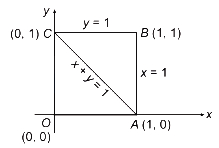
The incentre of the triangle formed by the lines $x+y=1$,$x=1$,and $y=1$ is
A
$\left(1-\frac{1}{\sqrt{2}}, 1-\frac{1}{\sqrt{2}}\right)$
B
$\left(1-\frac{1}{\sqrt{2}}, \frac{1}{\sqrt{2}}\right)$
C
$\left(\frac{1}{\sqrt{2}}, \frac{1}{\sqrt{2}}\right)$
D
$\left(\frac{1}{\sqrt{2}}, 1-\frac{1}{\sqrt{2}}\right)$
Solution
(C) The lines $x=1$ and $y=1$ intersect at $B(1, 1)$.
The line $x+y=1$ intersects $x=1$ at $A(1, 0)$ and $y=1$ at $C(0, 1)$.
The vertices of the triangle are $A(1, 0)$,$B(1, 1)$,and $C(0, 1)$.
The lengths of the sides are:
$a = BC = \sqrt{(1-0)^2 + (1-1)^2} = 1$
$b = CA = \sqrt{(1-0)^2 + (0-1)^2} = \sqrt{1+1} = \sqrt{2}$
$c = AB = \sqrt{(1-1)^2 + (1-0)^2} = 1$
The incentre $(I_x, I_y)$ is given by:
$I_x = \frac{ax_1 + bx_2 + cx_3}{a+b+c} = \frac{1(1) + \sqrt{2}(1) + 1(0)}{1+\sqrt{2}+1} = \frac{1+\sqrt{2}}{2+\sqrt{2}} = \frac{1+\sqrt{2}}{\sqrt{2}(\sqrt{2}+1)} = \frac{1}{\sqrt{2}}$
$I_y = \frac{ay_1 + by_2 + cy_3}{a+b+c} = \frac{1(0) + \sqrt{2}(1) + 1(1)}{1+\sqrt{2}+1} = \frac{1+\sqrt{2}}{2+\sqrt{2}} = \frac{1}{\sqrt{2}}$
Thus,the incentre is $\left(\frac{1}{\sqrt{2}}, \frac{1}{\sqrt{2}}\right)$.
The line $x+y=1$ intersects $x=1$ at $A(1, 0)$ and $y=1$ at $C(0, 1)$.
The vertices of the triangle are $A(1, 0)$,$B(1, 1)$,and $C(0, 1)$.
The lengths of the sides are:
$a = BC = \sqrt{(1-0)^2 + (1-1)^2} = 1$
$b = CA = \sqrt{(1-0)^2 + (0-1)^2} = \sqrt{1+1} = \sqrt{2}$
$c = AB = \sqrt{(1-1)^2 + (1-0)^2} = 1$
The incentre $(I_x, I_y)$ is given by:
$I_x = \frac{ax_1 + bx_2 + cx_3}{a+b+c} = \frac{1(1) + \sqrt{2}(1) + 1(0)}{1+\sqrt{2}+1} = \frac{1+\sqrt{2}}{2+\sqrt{2}} = \frac{1+\sqrt{2}}{\sqrt{2}(\sqrt{2}+1)} = \frac{1}{\sqrt{2}}$
$I_y = \frac{ay_1 + by_2 + cy_3}{a+b+c} = \frac{1(0) + \sqrt{2}(1) + 1(1)}{1+\sqrt{2}+1} = \frac{1+\sqrt{2}}{2+\sqrt{2}} = \frac{1}{\sqrt{2}}$
Thus,the incentre is $\left(\frac{1}{\sqrt{2}}, \frac{1}{\sqrt{2}}\right)$.
0 likesView Solution
79
ChemistryMCQTS EAMCET · 2001
For all values of $a$ and $b$,the line $(a+2b)x + (a-b)y + (a+5b) = 0$ passes through a fixed point. Find that point.
A
$(-1, 2)$
B
$(2, -1)$
C
$(-2, 1)$
D
$(1, -2)$
Solution
(C) The given equation is $(a+2b)x + (a-b)y + (a+5b) = 0$.
Rearranging the terms by grouping $a$ and $b$:
$a(x + y + 1) + b(2x - y + 5) = 0$.
For this equation to hold for all values of $a$ and $b$,the coefficients of $a$ and $b$ must be zero independently:
$x + y + 1 = 0$ --- $(1)$
$2x - y + 5 = 0$ --- $(2)$
Adding equations $(1)$ and $(2)$:
$(x + y + 1) + (2x - y + 5) = 0$
$3x + 6 = 0$
$3x = -6$
$x = -2$.
Substituting $x = -2$ into equation $(1)$:
$-2 + y + 1 = 0$
$y - 1 = 0$
$y = 1$.
Thus,the line passes through the fixed point $(-2, 1)$.
Rearranging the terms by grouping $a$ and $b$:
$a(x + y + 1) + b(2x - y + 5) = 0$.
For this equation to hold for all values of $a$ and $b$,the coefficients of $a$ and $b$ must be zero independently:
$x + y + 1 = 0$ --- $(1)$
$2x - y + 5 = 0$ --- $(2)$
Adding equations $(1)$ and $(2)$:
$(x + y + 1) + (2x - y + 5) = 0$
$3x + 6 = 0$
$3x = -6$
$x = -2$.
Substituting $x = -2$ into equation $(1)$:
$-2 + y + 1 = 0$
$y - 1 = 0$
$y = 1$.
Thus,the line passes through the fixed point $(-2, 1)$.
0 likesView Solution
80
ChemistryMCQTS EAMCET · 2001
The orthocentre of the triangle formed by the lines $x+3y=10$ and $6x^2+xy-y^2=0$ is
A
$(1,3)$
B
$(3,1)$
C
$(-1,3)$
D
$(1,-3)$
Solution
(A) The given lines are $x+3y=10$ and $6x^2+xy-y^2=0$.
Factorizing the second equation: $6x^2+3xy-2xy-y^2=0$ $\Rightarrow 3x(2x+y)-y(2x+y)=0$ $\Rightarrow (3x-y)(2x+y)=0$.
So,the lines are $3x-y=0$ and $2x+y=0$.
Let the vertices of the triangle be $A, B, C$.
Solving $2x+y=0$ and $3x-y=0$ gives $A(0,0)$.
Solving $x+3y=10$ and $3x-y=0$ gives $B(1,3)$.
Solving $x+3y=10$ and $2x+y=0$ gives $C(-2,4)$.
The altitude from $A(0,0)$ to $BC$ $(x+3y=10)$ has slope $3$. Equation: $y-0=3(x-0) \Rightarrow 3x-y=0$.
The altitude from $B(1,3)$ to $AC$ $(2x+y=0)$ has slope $1/2$. Equation: $y-3=\frac{1}{2}(x-1) \Rightarrow x-2y+5=0$.
Solving $3x-y=0$ and $x-2y+5=0$: $y=3x$ $\Rightarrow x-2(3x)+5=0$ $\Rightarrow -5x=-5$ $\Rightarrow x=1, y=3$.
The orthocentre is $(1,3)$.
Factorizing the second equation: $6x^2+3xy-2xy-y^2=0$ $\Rightarrow 3x(2x+y)-y(2x+y)=0$ $\Rightarrow (3x-y)(2x+y)=0$.
So,the lines are $3x-y=0$ and $2x+y=0$.
Let the vertices of the triangle be $A, B, C$.
Solving $2x+y=0$ and $3x-y=0$ gives $A(0,0)$.
Solving $x+3y=10$ and $3x-y=0$ gives $B(1,3)$.
Solving $x+3y=10$ and $2x+y=0$ gives $C(-2,4)$.
The altitude from $A(0,0)$ to $BC$ $(x+3y=10)$ has slope $3$. Equation: $y-0=3(x-0) \Rightarrow 3x-y=0$.
The altitude from $B(1,3)$ to $AC$ $(2x+y=0)$ has slope $1/2$. Equation: $y-3=\frac{1}{2}(x-1) \Rightarrow x-2y+5=0$.
Solving $3x-y=0$ and $x-2y+5=0$: $y=3x$ $\Rightarrow x-2(3x)+5=0$ $\Rightarrow -5x=-5$ $\Rightarrow x=1, y=3$.
The orthocentre is $(1,3)$.
0 likesView Solution
81
ChemistryMCQTS EAMCET · 2001
If one of the lines of the pair of straight lines $ax^2 + 2hxy + by^2 = 0$ bisects the angle between the coordinate axes,then:
A
$a^2 + b^2 = h^2$
B
$(a + b)^2 = 4h^2$
C
$a^2 + b^2 = 4h^2$
D
$(a + b)^2 = h^2$
Solution
(B) The given pair of straight lines is $ax^2 + 2hxy + by^2 = 0$.
The lines bisecting the angle between the coordinate axes are $y = x$ and $y = -x$.
If $y = x$ is one of the lines,then substituting $y = x$ into the equation gives:
$ax^2 + 2h(x)(x) + b(x)^2 = 0$
$ax^2 + 2hx^2 + bx^2 = 0$
$(a + 2h + b)x^2 = 0$
This implies $a + b + 2h = 0$,or $a + b = -2h$.
Squaring both sides,we get $(a + b)^2 = (-2h)^2 = 4h^2$.
Similarly,if $y = -x$ is one of the lines,substituting $y = -x$ gives:
$ax^2 + 2h(x)(-x) + b(-x)^2 = 0$
$ax^2 - 2hx^2 + bx^2 = 0$
$(a - 2h + b)x^2 = 0$
This implies $a + b = 2h$,which also leads to $(a + b)^2 = 4h^2$ upon squaring.
Thus,the condition is $(a + b)^2 = 4h^2$.
The lines bisecting the angle between the coordinate axes are $y = x$ and $y = -x$.
If $y = x$ is one of the lines,then substituting $y = x$ into the equation gives:
$ax^2 + 2h(x)(x) + b(x)^2 = 0$
$ax^2 + 2hx^2 + bx^2 = 0$
$(a + 2h + b)x^2 = 0$
This implies $a + b + 2h = 0$,or $a + b = -2h$.
Squaring both sides,we get $(a + b)^2 = (-2h)^2 = 4h^2$.
Similarly,if $y = -x$ is one of the lines,substituting $y = -x$ gives:
$ax^2 + 2h(x)(-x) + b(-x)^2 = 0$
$ax^2 - 2hx^2 + bx^2 = 0$
$(a - 2h + b)x^2 = 0$
This implies $a + b = 2h$,which also leads to $(a + b)^2 = 4h^2$ upon squaring.
Thus,the condition is $(a + b)^2 = 4h^2$.
0 likesView Solution
82
ChemistryMCQTS EAMCET · 2001
If the slope of one line is twice the slope of the other in the pair of straight lines $ax^2 + 2hxy + by^2 = 0$,then $8h^2$ is equal to (in $ab$)
A
$-9$
B
$9$
C
$-7$
D
$7$
Solution
(B) Given the pair of straight lines $ax^2 + 2hxy + by^2 = 0$.
Let the slopes of the lines be $m_1$ and $m_2$.
Given $m_1 = 2m_2$ ...$(i)$
We know that $m_1 + m_2 = -\frac{2h}{b}$ ...(ii)
and $m_1 m_2 = \frac{a}{b}$ ...(iii)
Substituting $(i)$ into (ii): $2m_2 + m_2 = -\frac{2h}{b} \implies 3m_2 = -\frac{2h}{b} \implies m_2 = -\frac{2h}{3b}$ ...(iv)
Substituting $(i)$ into (iii): $2m_2 \cdot m_2 = \frac{a}{b} \implies 2m_2^2 = \frac{a}{b}$ ...$(v)$
Substituting (iv) into $(v)$: $2(-\frac{2h}{3b})^2 = \frac{a}{b} \implies 2 \cdot \frac{4h^2}{9b^2} = \frac{a}{b} \implies \frac{8h^2}{9b^2} = \frac{a}{b} \implies 8h^2 = 9ab$.
Let the slopes of the lines be $m_1$ and $m_2$.
Given $m_1 = 2m_2$ ...$(i)$
We know that $m_1 + m_2 = -\frac{2h}{b}$ ...(ii)
and $m_1 m_2 = \frac{a}{b}$ ...(iii)
Substituting $(i)$ into (ii): $2m_2 + m_2 = -\frac{2h}{b} \implies 3m_2 = -\frac{2h}{b} \implies m_2 = -\frac{2h}{3b}$ ...(iv)
Substituting $(i)$ into (iii): $2m_2 \cdot m_2 = \frac{a}{b} \implies 2m_2^2 = \frac{a}{b}$ ...$(v)$
Substituting (iv) into $(v)$: $2(-\frac{2h}{3b})^2 = \frac{a}{b} \implies 2 \cdot \frac{4h^2}{9b^2} = \frac{a}{b} \implies \frac{8h^2}{9b^2} = \frac{a}{b} \implies 8h^2 = 9ab$.
0 likesView Solution
83
ChemistryMCQTS EAMCET · 2001
If the polar of a point on the circle $x^2+y^2=p^2$ with respect to the circle $x^2+y^2=q^2$ touches the circle $x^2+y^2=r^2$,then $p, q, r$ are in
A
$AP$
B
$GP$
C
$HP$
D
$AGP$
Solution
(B) Let the point on the circle $x^2+y^2=p^2$ be $(x_1, y_1)$.
Then $x_1^2+y_1^2=p^2$.
The equation of the polar of $(x_1, y_1)$ with respect to the circle $x^2+y^2=q^2$ is $x x_1+y y_1=q^2$.
This line touches the circle $x^2+y^2=r^2$.
The perpendicular distance from the center $(0, 0)$ to the line $x x_1+y y_1-q^2=0$ is equal to the radius $r$.
So,$\frac{|0(x_1)+0(y_1)-q^2|}{\sqrt{x_1^2+y_1^2}} = r$.
This simplifies to $\frac{q^2}{\sqrt{p^2}} = r$,which gives $\frac{q^2}{p} = r$.
Therefore,$q^2 = pr$,which implies that $p, q, r$ are in $GP$.
Then $x_1^2+y_1^2=p^2$.
The equation of the polar of $(x_1, y_1)$ with respect to the circle $x^2+y^2=q^2$ is $x x_1+y y_1=q^2$.
This line touches the circle $x^2+y^2=r^2$.
The perpendicular distance from the center $(0, 0)$ to the line $x x_1+y y_1-q^2=0$ is equal to the radius $r$.
So,$\frac{|0(x_1)+0(y_1)-q^2|}{\sqrt{x_1^2+y_1^2}} = r$.
This simplifies to $\frac{q^2}{\sqrt{p^2}} = r$,which gives $\frac{q^2}{p} = r$.
Therefore,$q^2 = pr$,which implies that $p, q, r$ are in $GP$.
0 likesView Solution
84
ChemistryMCQTS EAMCET · 2001
The limiting points of the co-axial system containing the two circles $x^2+y^2+2x-2y+2=0$ and $25(x^2+y^2)-10x-80y+65=0$ are
A
$(1,-1),(-3,-40)$
B
$(1,-1),\left(-\frac{1}{5}, \frac{8}{5}\right)$
C
$(-1,1),\left(\frac{1}{5}, \frac{8}{5}\right)$
D
$\left(-\frac{1}{5},-\frac{8}{5}\right)$
Solution
(C) The given circles are $S_1: x^2+y^2+2x-2y+2=0$ and $S_2: x^2+y^2-\frac{2}{5}x-\frac{16}{5}y+\frac{13}{5}=0$.
The family of co-axial circles is given by $S_1 + \lambda(S_1 - S_2) = 0$ or $S_1 + k S_2 = 0$.
The limiting points are the centers of the point circles in the system,which occur when the radius $r = 0$.
For a circle $x^2+y^2+2gx+2fy+c=0$,the radius is $r = \sqrt{g^2+f^2-c}$. Setting $r=0$ gives $g^2+f^2=c$.
The radical axis is $S_1 - S_2 = 0$ $\Rightarrow (2 + \frac{2}{5})x + (-2 + \frac{16}{5})y + (2 - \frac{13}{5}) = 0$ $\Rightarrow \frac{12}{5}x + \frac{6}{5}y - \frac{3}{5} = 0$ $\Rightarrow 4x + 2y - 1 = 0$.
Any circle in the system is $S_1 + \lambda(4x + 2y - 1) = 0 \Rightarrow x^2+y^2+(2+4\lambda)x+(-2+2\lambda)y+(2-\lambda)=0$.
For limiting points,$g^2+f^2=c \Rightarrow (1+2\lambda)^2 + (-1+\lambda)^2 = 2-\lambda$.
$1+4\lambda+4\lambda^2 + 1-2\lambda+\lambda^2 = 2-\lambda \Rightarrow 5\lambda^2+3\lambda=0$.
Thus,$\lambda=0$ or $\lambda=-\frac{3}{5}$.
For $\lambda=0$,the center is $(-1, 1)$.
For $\lambda=-\frac{3}{5}$,the center is $(-(1+2(-\frac{3}{5})), -(-1+(-\frac{3}{5}))) = (-1+\frac{6}{5}, 1+\frac{3}{5}) = (\frac{1}{5}, \frac{8}{5})$.
The limiting points are $(-1, 1)$ and $(\frac{1}{5}, \frac{8}{5})$.
The family of co-axial circles is given by $S_1 + \lambda(S_1 - S_2) = 0$ or $S_1 + k S_2 = 0$.
The limiting points are the centers of the point circles in the system,which occur when the radius $r = 0$.
For a circle $x^2+y^2+2gx+2fy+c=0$,the radius is $r = \sqrt{g^2+f^2-c}$. Setting $r=0$ gives $g^2+f^2=c$.
The radical axis is $S_1 - S_2 = 0$ $\Rightarrow (2 + \frac{2}{5})x + (-2 + \frac{16}{5})y + (2 - \frac{13}{5}) = 0$ $\Rightarrow \frac{12}{5}x + \frac{6}{5}y - \frac{3}{5} = 0$ $\Rightarrow 4x + 2y - 1 = 0$.
Any circle in the system is $S_1 + \lambda(4x + 2y - 1) = 0 \Rightarrow x^2+y^2+(2+4\lambda)x+(-2+2\lambda)y+(2-\lambda)=0$.
For limiting points,$g^2+f^2=c \Rightarrow (1+2\lambda)^2 + (-1+\lambda)^2 = 2-\lambda$.
$1+4\lambda+4\lambda^2 + 1-2\lambda+\lambda^2 = 2-\lambda \Rightarrow 5\lambda^2+3\lambda=0$.
Thus,$\lambda=0$ or $\lambda=-\frac{3}{5}$.
For $\lambda=0$,the center is $(-1, 1)$.
For $\lambda=-\frac{3}{5}$,the center is $(-(1+2(-\frac{3}{5})), -(-1+(-\frac{3}{5}))) = (-1+\frac{6}{5}, 1+\frac{3}{5}) = (\frac{1}{5}, \frac{8}{5})$.
The limiting points are $(-1, 1)$ and $(\frac{1}{5}, \frac{8}{5})$.
0 likesView Solution
85
ChemistryMCQTS EAMCET · 2001
The length of the latus rectum of the parabola $y^2+8x-2y+17=0$ is
A
$2$
B
$4$
C
$8$
D
$16$
Solution
(C) The given equation of the parabola is $y^2+8x-2y+17=0$.
Rearranging the terms to complete the square for $y$:
$y^2-2y+1=-8x-17+1$
$(y-1)^2 = -8x-16$
$(y-1)^2 = -8(x+2)$
Comparing this with the standard form $(y-k)^2 = -4a(x-h)$,we get $4a = 8$.
Thus,the length of the latus rectum is $8$.
Rearranging the terms to complete the square for $y$:
$y^2-2y+1=-8x-17+1$
$(y-1)^2 = -8x-16$
$(y-1)^2 = -8(x+2)$
Comparing this with the standard form $(y-k)^2 = -4a(x-h)$,we get $4a = 8$.
Thus,the length of the latus rectum is $8$.
0 likesView Solution
86
ChemistryMCQTS EAMCET · 2001
If the normal to the parabola $y^2=4x$ at $P(1,2)$ meets the parabola again at $Q$,then the coordinates of $Q$ are
A
$(-6,9)$
B
$(9,-6)$
C
$(-9,-6)$
D
$(-6,-9)$
Solution
(B) The given equation of the parabola is $y^2=4x$.
For a point $P(x_1, y_1)$ on the parabola $y^2=4ax$,the normal at $P$ is given by $y-y_1 = -\frac{y_1}{2a}(x-x_1)$.
Here,$a=1$ and $P=(1,2)$,so the slope of the normal is $m = -\frac{2}{2(1)} = -1$.
The equation of the normal at $P(1,2)$ is $y-2 = -1(x-1)$,which simplifies to $x+y=3$,or $x=3-y$.
Substituting $x=3-y$ into the parabola equation $y^2=4x$:
$y^2 = 4(3-y)$
$y^2 = 12-4y$
$y^2+4y-12=0$
$(y-2)(y+6)=0$
This gives $y=2$ (which corresponds to point $P$) and $y=-6$.
For $y=-6$,$x = 3-(-6) = 9$.
Therefore,the coordinates of point $Q$ are $(9,-6)$.
For a point $P(x_1, y_1)$ on the parabola $y^2=4ax$,the normal at $P$ is given by $y-y_1 = -\frac{y_1}{2a}(x-x_1)$.
Here,$a=1$ and $P=(1,2)$,so the slope of the normal is $m = -\frac{2}{2(1)} = -1$.
The equation of the normal at $P(1,2)$ is $y-2 = -1(x-1)$,which simplifies to $x+y=3$,or $x=3-y$.
Substituting $x=3-y$ into the parabola equation $y^2=4x$:
$y^2 = 4(3-y)$
$y^2 = 12-4y$
$y^2+4y-12=0$
$(y-2)(y+6)=0$
This gives $y=2$ (which corresponds to point $P$) and $y=-6$.
For $y=-6$,$x = 3-(-6) = 9$.
Therefore,the coordinates of point $Q$ are $(9,-6)$.
0 likesView Solution
87
ChemistryMCQTS EAMCET · 2001
The coefficient of $x^4$ in the expansion of $\frac{(1-3x)^2}{(1-2x)}$ is equal to
A
$1$
B
$2$
C
$3$
D
$4$
Solution
(D) We have,$\frac{(1-3x)^2}{(1-2x)} = (1 - 6x + 9x^2)(1 - 2x)^{-1}$.
Using the binomial expansion $(1-2x)^{-1} = 1 + (2x) + (2x)^2 + (2x)^3 + (2x)^4 + \dots = 1 + 2x + 4x^2 + 8x^3 + 16x^4 + \dots$.
Now,multiply $(1 - 6x + 9x^2)$ by $(1 + 2x + 4x^2 + 8x^3 + 16x^4 + \dots)$.
The coefficient of $x^4$ is obtained by:
$1 \times (16x^4) - 6x \times (8x^3) + 9x^2 \times (4x^2) = 16x^4 - 48x^4 + 36x^4$.
Summing these coefficients: $16 - 48 + 36 = 4$.
Using the binomial expansion $(1-2x)^{-1} = 1 + (2x) + (2x)^2 + (2x)^3 + (2x)^4 + \dots = 1 + 2x + 4x^2 + 8x^3 + 16x^4 + \dots$.
Now,multiply $(1 - 6x + 9x^2)$ by $(1 + 2x + 4x^2 + 8x^3 + 16x^4 + \dots)$.
The coefficient of $x^4$ is obtained by:
$1 \times (16x^4) - 6x \times (8x^3) + 9x^2 \times (4x^2) = 16x^4 - 48x^4 + 36x^4$.
Summing these coefficients: $16 - 48 + 36 = 4$.
0 likesView Solution
88
ChemistryMCQTS EAMCET · 2001
The eccentricity of the ellipse $\frac{x^2}{16} + \frac{y^2}{9} = 1$ is
A
$\frac{7}{16}$
B
$\frac{5}{4}$
C
$\frac{\sqrt{7}}{4}$
D
$\frac{\sqrt{7}}{2}$
Solution
(C) The given equation of the ellipse is $\frac{x^2}{16} + \frac{y^2}{9} = 1$.
Comparing this with the standard form $\frac{x^2}{a^2} + \frac{y^2}{b^2} = 1$,we get $a^2 = 16$ and $b^2 = 9$.
The formula for eccentricity $e$ is $e = \sqrt{1 - \frac{b^2}{a^2}}$.
Substituting the values,we get $e = \sqrt{1 - \frac{9}{16}}$.
$e = \sqrt{\frac{16 - 9}{16}} = \sqrt{\frac{7}{16}}$.
Therefore,$e = \frac{\sqrt{7}}{4}$.
Comparing this with the standard form $\frac{x^2}{a^2} + \frac{y^2}{b^2} = 1$,we get $a^2 = 16$ and $b^2 = 9$.
The formula for eccentricity $e$ is $e = \sqrt{1 - \frac{b^2}{a^2}}$.
Substituting the values,we get $e = \sqrt{1 - \frac{9}{16}}$.
$e = \sqrt{\frac{16 - 9}{16}} = \sqrt{\frac{7}{16}}$.
Therefore,$e = \frac{\sqrt{7}}{4}$.
0 likesView Solution
89
ChemistryMCQTS EAMCET · 2001
The equation $16 x^2+y^2+8 x y-74 x-78 y+212=0$ represents:
A
a circle
B
a parabola
C
a hyperbola
D
an ellipse
Solution
(B) The given equation is $16 x^2+y^2+8 x y-74 x-78 y+212=0$.
Comparing this with the general second-degree equation $a x^2+b y^2+2 h x y+2 g x+2 f y+c=0$,we get:
$a=16, b=1, h=4, g=-37, f=-39, c=212$.
Now,we calculate the discriminant $h^2 - ab$:
$h^2 - ab = (4)^2 - (16)(1) = 16 - 16 = 0$.
Since $h^2 - ab = 0$,the equation represents a parabola.
Comparing this with the general second-degree equation $a x^2+b y^2+2 h x y+2 g x+2 f y+c=0$,we get:
$a=16, b=1, h=4, g=-37, f=-39, c=212$.
Now,we calculate the discriminant $h^2 - ab$:
$h^2 - ab = (4)^2 - (16)(1) = 16 - 16 = 0$.
Since $h^2 - ab = 0$,the equation represents a parabola.
0 likesView Solution
90
ChemistryMCQTS EAMCET · 2001
The equation of a curve in polar coordinates is $\frac{l}{r} = 2 \sin^2 \frac{\theta}{2}$. This equation represents:
A
a straight line
B
a parabola
C
a circle
D
an ellipse
Solution
(B) Given the polar equation: $\frac{l}{r} = 2 \sin^2 \frac{\theta}{2}$.
Using the trigonometric identity $2 \sin^2 \frac{\theta}{2} = 1 - \cos \theta$,we get:
$\frac{l}{r} = 1 - \cos \theta$
$l = r(1 - \cos \theta)$
$l = r - r \cos \theta$
Since $x = r \cos \theta$ and $r = \sqrt{x^2 + y^2}$,we substitute these into the equation:
$l = \sqrt{x^2 + y^2} - x$
$l + x = \sqrt{x^2 + y^2}$
Squaring both sides:
$(l + x)^2 = x^2 + y^2$
$l^2 + 2lx + x^2 = x^2 + y^2$
$y^2 = 2lx + l^2$
$y^2 = 2l(x + \frac{l}{2})$
This is the standard form of a parabola $Y^2 = 4AX$ with vertex at $(-\frac{l}{2}, 0)$.
Using the trigonometric identity $2 \sin^2 \frac{\theta}{2} = 1 - \cos \theta$,we get:
$\frac{l}{r} = 1 - \cos \theta$
$l = r(1 - \cos \theta)$
$l = r - r \cos \theta$
Since $x = r \cos \theta$ and $r = \sqrt{x^2 + y^2}$,we substitute these into the equation:
$l = \sqrt{x^2 + y^2} - x$
$l + x = \sqrt{x^2 + y^2}$
Squaring both sides:
$(l + x)^2 = x^2 + y^2$
$l^2 + 2lx + x^2 = x^2 + y^2$
$y^2 = 2lx + l^2$
$y^2 = 2l(x + \frac{l}{2})$
This is the standard form of a parabola $Y^2 = 4AX$ with vertex at $(-\frac{l}{2}, 0)$.
0 likesView Solution
91
ChemistryMCQTS EAMCET · 2001
The product of the lengths of the perpendiculars from any point on the hyperbola $x^2 - y^2 = 8$ to its asymptotes is:
A
$2$
B
$3$
C
$4$
D
$8$
Solution
(C) The equation of the hyperbola is $x^2 - y^2 = 8$.
The asymptotes of the hyperbola $x^2 - y^2 = a^2$ are given by $x^2 - y^2 = 0$,which implies $x = \pm y$,or $x + y = 0$ and $x - y = 0$.
Let $P(x, y)$ be any point on the hyperbola.
The length of the perpendicular from $P(x, y)$ to the line $x - y = 0$ is $d_1 = \frac{|x - y|}{\sqrt{1^2 + (-1)^2}} = \frac{|x - y|}{\sqrt{2}}$.
The length of the perpendicular from $P(x, y)$ to the line $x + y = 0$ is $d_2 = \frac{|x + y|}{\sqrt{1^2 + 1^2}} = \frac{|x + y|}{\sqrt{2}}$.
The product of the lengths of the perpendiculars is $d_1 \times d_2 = \frac{|x - y|}{\sqrt{2}} \times \frac{|x + y|}{\sqrt{2}} = \frac{|x^2 - y^2|}{2}$.
Since the point $(x, y)$ lies on the hyperbola $x^2 - y^2 = 8$,we have $d_1 \times d_2 = \frac{8}{2} = 4$.
The asymptotes of the hyperbola $x^2 - y^2 = a^2$ are given by $x^2 - y^2 = 0$,which implies $x = \pm y$,or $x + y = 0$ and $x - y = 0$.
Let $P(x, y)$ be any point on the hyperbola.
The length of the perpendicular from $P(x, y)$ to the line $x - y = 0$ is $d_1 = \frac{|x - y|}{\sqrt{1^2 + (-1)^2}} = \frac{|x - y|}{\sqrt{2}}$.
The length of the perpendicular from $P(x, y)$ to the line $x + y = 0$ is $d_2 = \frac{|x + y|}{\sqrt{1^2 + 1^2}} = \frac{|x + y|}{\sqrt{2}}$.
The product of the lengths of the perpendiculars is $d_1 \times d_2 = \frac{|x - y|}{\sqrt{2}} \times \frac{|x + y|}{\sqrt{2}} = \frac{|x^2 - y^2|}{2}$.
Since the point $(x, y)$ lies on the hyperbola $x^2 - y^2 = 8$,we have $d_1 \times d_2 = \frac{8}{2} = 4$.
0 likesView Solution
92
ChemistryMCQTS EAMCET · 2001
$\lim _{x \rightarrow 0} \frac{\sin x \sin ^{-1} x}{x^2}$ is equal to
A
$0$
B
$1$
C
$-1$
D
$\infty$
Solution
(B) We know that $\lim _{x \rightarrow 0} \frac{\sin x}{x} = 1$ and $\lim _{x \rightarrow 0} \frac{\sin ^{-1} x}{x} = 1$.
Given limit is $\lim _{x \rightarrow 0} \frac{\sin x \sin ^{-1} x}{x^2}$.
This can be rewritten as $\lim _{x \rightarrow 0} \left(\frac{\sin x}{x}\right) \left(\frac{\sin ^{-1} x}{x}\right)$.
Applying the limit properties,we get $1 \times 1 = 1$.
Given limit is $\lim _{x \rightarrow 0} \frac{\sin x \sin ^{-1} x}{x^2}$.
This can be rewritten as $\lim _{x \rightarrow 0} \left(\frac{\sin x}{x}\right) \left(\frac{\sin ^{-1} x}{x}\right)$.
Applying the limit properties,we get $1 \times 1 = 1$.
0 likesView Solution
93
ChemistryMCQTS EAMCET · 2001
$\lim _{x \rightarrow \infty} \left(\frac{x+a}{x+b}\right)^{x}$ is equal to
A
$e^{a-b}$
B
$e^{b-a}$
C
$1$
D
$e^{a+b}$
Solution
(A) We evaluate the limit $\lim _{x \rightarrow \infty} \left(\frac{x+a}{x+b}\right)^{x}$.
This is of the form $1^{\infty}$.
We can rewrite the expression as:
$\lim _{x \rightarrow \infty} \left(\frac{x+b+a-b}{x+b}\right)^{x} = \lim _{x \rightarrow \infty} \left(1 + \frac{a-b}{x+b}\right)^{x}$.
Using the standard limit formula $\lim _{x \rightarrow \infty} (1 + \frac{k}{x})^x = e^k$,we have:
$\lim _{x \rightarrow \infty} \left(1 + \frac{a-b}{x+b}\right)^{x} = \lim _{x \rightarrow \infty} \left[\left(1 + \frac{a-b}{x+b}\right)^{\frac{x+b}{a-b}}\right]^{\frac{x(a-b)}{x+b}}$.
Since $\lim _{x \rightarrow \infty} \frac{x(a-b)}{x+b} = a-b$,the limit is $e^{a-b}$.
This is of the form $1^{\infty}$.
We can rewrite the expression as:
$\lim _{x \rightarrow \infty} \left(\frac{x+b+a-b}{x+b}\right)^{x} = \lim _{x \rightarrow \infty} \left(1 + \frac{a-b}{x+b}\right)^{x}$.
Using the standard limit formula $\lim _{x \rightarrow \infty} (1 + \frac{k}{x})^x = e^k$,we have:
$\lim _{x \rightarrow \infty} \left(1 + \frac{a-b}{x+b}\right)^{x} = \lim _{x \rightarrow \infty} \left[\left(1 + \frac{a-b}{x+b}\right)^{\frac{x+b}{a-b}}\right]^{\frac{x(a-b)}{x+b}}$.
Since $\lim _{x \rightarrow \infty} \frac{x(a-b)}{x+b} = a-b$,the limit is $e^{a-b}$.
0 likesView Solution
94
ChemistryMCQTS EAMCET · 2001
$\lim _{x \rightarrow 0} \left( \frac{x \cdot 10^x - x}{1 - \cos x} \right)$ is equal to
A
$\log 10$
B
$2 \log 10$
C
$3 \log 10$
D
$4 \log 10$
Solution
(B) Given limit: $L = \lim _{x \rightarrow 0} \frac{x(10^x - 1)}{1 - \cos x}$.
Since this is a $\frac{0}{0}$ form,we apply $L$-Hospital's rule:
$L = \lim _{x \rightarrow 0} \frac{x \cdot 10^x \ln 10 + (10^x - 1)}{\sin x}$.
Again,this is a $\frac{0}{0}$ form,so we apply $L$-Hospital's rule again:
$L = \lim _{x \rightarrow 0} \frac{x \cdot 10^x (\ln 10)^2 + 10^x \ln 10 + 10^x \ln 10}{\cos x}$.
Substituting $x = 0$:
$L = \frac{0 \cdot 10^0 (\ln 10)^2 + 10^0 \ln 10 + 10^0 \ln 10}{\cos 0} = \frac{0 + \ln 10 + \ln 10}{1} = 2 \ln 10 = 2 \log_{e} 10$.
Note: In the context of the options provided,$\log 10$ refers to $\ln 10$ (natural logarithm).
Since this is a $\frac{0}{0}$ form,we apply $L$-Hospital's rule:
$L = \lim _{x \rightarrow 0} \frac{x \cdot 10^x \ln 10 + (10^x - 1)}{\sin x}$.
Again,this is a $\frac{0}{0}$ form,so we apply $L$-Hospital's rule again:
$L = \lim _{x \rightarrow 0} \frac{x \cdot 10^x (\ln 10)^2 + 10^x \ln 10 + 10^x \ln 10}{\cos x}$.
Substituting $x = 0$:
$L = \frac{0 \cdot 10^0 (\ln 10)^2 + 10^0 \ln 10 + 10^0 \ln 10}{\cos 0} = \frac{0 + \ln 10 + \ln 10}{1} = 2 \ln 10 = 2 \log_{e} 10$.
Note: In the context of the options provided,$\log 10$ refers to $\ln 10$ (natural logarithm).
0 likesView Solution
95
ChemistryMCQTS EAMCET · 2001
Which one of the following is used in the preparation of styrene?
A
$CH_3CHO$
B
$P_2O_5$
C
$CH_4$
D
$C_6H_6$
Solution
(D) Styrene $(C_6H_5CH=CH_2)$ is prepared from benzene $(C_6H_6)$ in two steps:
$1$. Benzene reacts with ethylene $(CH_2=CH_2)$ in the presence of $AlCl_3$ to form ethylbenzene $(C_6H_5CH_2CH_3)$.
$2$. Ethylbenzene is then dehydrogenated at high temperature (approx. $700 \ ^\circ C$) using a catalyst (like iron oxide or $Al_2O_3$) to produce styrene and hydrogen gas $(H_2)$.
Thus,benzene is the starting material used in the preparation of styrene.
$1$. Benzene reacts with ethylene $(CH_2=CH_2)$ in the presence of $AlCl_3$ to form ethylbenzene $(C_6H_5CH_2CH_3)$.
$2$. Ethylbenzene is then dehydrogenated at high temperature (approx. $700 \ ^\circ C$) using a catalyst (like iron oxide or $Al_2O_3$) to produce styrene and hydrogen gas $(H_2)$.
Thus,benzene is the starting material used in the preparation of styrene.
0 likesView Solution
96
ChemistryMCQTS EAMCET · 2001
In a $\triangle ABC$,the expression $\frac{\cos C+\cos A}{c+a}+\frac{\cos B}{b}$ is equal to
A
$\frac{1}{a}$
B
$\frac{1}{b}$
C
$\frac{c+a}{b}$
D
$1$
Solution
(B) Using the sine rule,$a = 2R \sin A$,$b = 2R \sin B$,and $c = 2R \sin C$.
Substituting these into the first term:
$\frac{\cos C+\cos A}{c+a} = \frac{2 \cos \frac{C+A}{2} \cos \frac{C-A}{2}}{2R(\sin C+\sin A)} = \frac{2 \cos \frac{C+A}{2} \cos \frac{C-A}{2}}{2R(2 \sin \frac{C+A}{2} \cos \frac{C-A}{2})} = \frac{1}{2R} \cot \frac{C+A}{2}$.
Since $A+B+C = \pi$,$\frac{C+A}{2} = \frac{\pi}{2} - \frac{B}{2}$,so $\cot \frac{C+A}{2} = \tan \frac{B}{2}$.
Thus,the first term is $\frac{1}{2R} \tan \frac{B}{2}$.
For the second term:
$\frac{\cos B}{b} = \frac{\cos B}{2R \sin B} = \frac{1}{2R} \cot B = \frac{1}{2R} \left( \frac{1-\tan^2 \frac{B}{2}}{2 \tan \frac{B}{2}} \right)$.
Adding both terms:
$\frac{1}{2R} \left( \tan \frac{B}{2} + \frac{1-\tan^2 \frac{B}{2}}{2 \tan \frac{B}{2}} \right) = \frac{1}{2R} \left( \frac{2 \tan^2 \frac{B}{2} + 1 - \tan^2 \frac{B}{2}}{2 \tan \frac{B}{2}} \right) = \frac{1}{2R} \left( \frac{1+\tan^2 \frac{B}{2}}{2 \tan \frac{B}{2}} \right) = \frac{1}{2R \sin B} = \frac{1}{b}$.
Substituting these into the first term:
$\frac{\cos C+\cos A}{c+a} = \frac{2 \cos \frac{C+A}{2} \cos \frac{C-A}{2}}{2R(\sin C+\sin A)} = \frac{2 \cos \frac{C+A}{2} \cos \frac{C-A}{2}}{2R(2 \sin \frac{C+A}{2} \cos \frac{C-A}{2})} = \frac{1}{2R} \cot \frac{C+A}{2}$.
Since $A+B+C = \pi$,$\frac{C+A}{2} = \frac{\pi}{2} - \frac{B}{2}$,so $\cot \frac{C+A}{2} = \tan \frac{B}{2}$.
Thus,the first term is $\frac{1}{2R} \tan \frac{B}{2}$.
For the second term:
$\frac{\cos B}{b} = \frac{\cos B}{2R \sin B} = \frac{1}{2R} \cot B = \frac{1}{2R} \left( \frac{1-\tan^2 \frac{B}{2}}{2 \tan \frac{B}{2}} \right)$.
Adding both terms:
$\frac{1}{2R} \left( \tan \frac{B}{2} + \frac{1-\tan^2 \frac{B}{2}}{2 \tan \frac{B}{2}} \right) = \frac{1}{2R} \left( \frac{2 \tan^2 \frac{B}{2} + 1 - \tan^2 \frac{B}{2}}{2 \tan \frac{B}{2}} \right) = \frac{1}{2R} \left( \frac{1+\tan^2 \frac{B}{2}}{2 \tan \frac{B}{2}} \right) = \frac{1}{2R \sin B} = \frac{1}{b}$.
0 likesView Solution
97
ChemistryMCQTS EAMCET · 2001
In a $\triangle ABC$,if $\frac{a}{b^2-c^2} + \frac{c}{b^2-a^2} = 0$,then $B$ is equal to
A
$\frac{\pi}{2}$
B
$\frac{\pi}{4}$
C
$\frac{2\pi}{3}$
D
$\frac{\pi}{3}$
Solution
(D) Given,$\frac{a}{b^2-c^2} + \frac{c}{b^2-a^2} = 0$.
Using the sine rule $a = 2R \sin A$,$b = 2R \sin B$,$c = 2R \sin C$:
$\frac{2R \sin A}{4R^2(\sin^2 B - \sin^2 C)} + \frac{2R \sin C}{4R^2(\sin^2 B - \sin^2 A)} = 0$
$\frac{\sin A}{\sin(B+C)\sin(B-C)} + \frac{\sin C}{\sin(B+A)\sin(B-A)} = 0$
Since $A+B+C = \pi$,$\sin(B+C) = \sin A$ and $\sin(B+A) = \sin C$:
$\frac{\sin A}{\sin A \sin(B-C)} + \frac{\sin C}{\sin C \sin(B-A)} = 0$
$\frac{1}{\sin(B-C)} + \frac{1}{\sin(B-A)} = 0$
$\sin(B-A) = -\sin(B-C) = \sin(C-B)$
$B-A = C-B$ or $B-A = \pi - (C-B)$
$2B = A+C$. Since $A+B+C = \pi$,$A+C = \pi - B$.
$2B = \pi - B$ $\Rightarrow 3B = \pi$ $\Rightarrow B = \frac{\pi}{3}$.
Using the sine rule $a = 2R \sin A$,$b = 2R \sin B$,$c = 2R \sin C$:
$\frac{2R \sin A}{4R^2(\sin^2 B - \sin^2 C)} + \frac{2R \sin C}{4R^2(\sin^2 B - \sin^2 A)} = 0$
$\frac{\sin A}{\sin(B+C)\sin(B-C)} + \frac{\sin C}{\sin(B+A)\sin(B-A)} = 0$
Since $A+B+C = \pi$,$\sin(B+C) = \sin A$ and $\sin(B+A) = \sin C$:
$\frac{\sin A}{\sin A \sin(B-C)} + \frac{\sin C}{\sin C \sin(B-A)} = 0$
$\frac{1}{\sin(B-C)} + \frac{1}{\sin(B-A)} = 0$
$\sin(B-A) = -\sin(B-C) = \sin(C-B)$
$B-A = C-B$ or $B-A = \pi - (C-B)$
$2B = A+C$. Since $A+B+C = \pi$,$A+C = \pi - B$.
$2B = \pi - B$ $\Rightarrow 3B = \pi$ $\Rightarrow B = \frac{\pi}{3}$.
0 likesView Solution
98
ChemistryMCQTS EAMCET · 2001
In a $\triangle ABC$,$a^2 \sin 2C + c^2 \sin 2A$ is equal to (in $Delta$)
A
$2$
B
$4$
C
$6$
D
$8$
Solution
(B) We know that $a = 2R \sin A$ and $c = 2R \sin C$. Substituting these into the expression:
$a^2 \sin 2C + c^2 \sin 2A = (2R \sin A)^2 (2 \sin C \cos C) + (2R \sin C)^2 (2 \sin A \cos A)$
$= 8R^2 \sin^2 A \sin C \cos C + 8R^2 \sin^2 C \sin A \cos A$
$= 8R^2 \sin A \sin C [\sin A \cos C + \cos A \sin C]$
$= 8R^2 \sin A \sin C \sin(A + C)$
Since $A + B + C = 180^{\circ}$,$\sin(A + C) = \sin B$.
$= 8R^2 \sin A \sin B \sin C$
Using the formula for the area of a triangle $\Delta = \frac{abc}{4R}$,we have $abc = 4R\Delta$. Also,$\sin A = \frac{a}{2R}$,$\sin B = \frac{b}{2R}$,and $\sin C = \frac{c}{2R}$.
$= 8R^2 \left( \frac{a}{2R} \right) \left( \frac{b}{2R} \right) \left( \frac{c}{2R} \right) = \frac{abc}{R} = \frac{4R\Delta}{R} = 4\Delta$.
$a^2 \sin 2C + c^2 \sin 2A = (2R \sin A)^2 (2 \sin C \cos C) + (2R \sin C)^2 (2 \sin A \cos A)$
$= 8R^2 \sin^2 A \sin C \cos C + 8R^2 \sin^2 C \sin A \cos A$
$= 8R^2 \sin A \sin C [\sin A \cos C + \cos A \sin C]$
$= 8R^2 \sin A \sin C \sin(A + C)$
Since $A + B + C = 180^{\circ}$,$\sin(A + C) = \sin B$.
$= 8R^2 \sin A \sin B \sin C$
Using the formula for the area of a triangle $\Delta = \frac{abc}{4R}$,we have $abc = 4R\Delta$. Also,$\sin A = \frac{a}{2R}$,$\sin B = \frac{b}{2R}$,and $\sin C = \frac{c}{2R}$.
$= 8R^2 \left( \frac{a}{2R} \right) \left( \frac{b}{2R} \right) \left( \frac{c}{2R} \right) = \frac{abc}{R} = \frac{4R\Delta}{R} = 4\Delta$.
0 likesView Solution
99
ChemistryMCQTS EAMCET · 2001
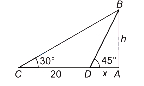
The shadow of a tower standing on a level ground is found to be $60 \ m$ longer when the Sun's altitude is $30^{\circ}$ than when it is $45^{\circ}$. The height of the tower is
A
$30 \ m$
B
$90 \ m$
C
$60 \sqrt{3} \ m$
D
$30(\sqrt{3}+1) \ m$
Solution
(D) Let $h$ be the height of the tower $AB$ and $x$ be the length of the shadow when the Sun's altitude is $45^{\circ}$.
In $\triangle ABD$,$\tan 45^{\circ} = \frac{AB}{AD} = \frac{h}{x}$. Since $\tan 45^{\circ} = 1$,we have $h = x$.
In $\triangle ABC$,the shadow length is $AC = AD + DC = x + 60$. The Sun's altitude is $30^{\circ}$.
$\tan 30^{\circ} = \frac{AB}{AC} = \frac{h}{x + 60}$.
Substituting $x = h$,we get $\frac{1}{\sqrt{3}} = \frac{h}{h + 60}$.
$h + 60 = h\sqrt{3}$.
$60 = h(\sqrt{3} - 1)$.
$h = \frac{60}{\sqrt{3} - 1}$.
Rationalizing the denominator: $h = \frac{60(\sqrt{3} + 1)}{(\sqrt{3} - 1)(\sqrt{3} + 1)} = \frac{60(\sqrt{3} + 1)}{3 - 1} = \frac{60(\sqrt{3} + 1)}{2} = 30(\sqrt{3} + 1) \ m$.
In $\triangle ABD$,$\tan 45^{\circ} = \frac{AB}{AD} = \frac{h}{x}$. Since $\tan 45^{\circ} = 1$,we have $h = x$.
In $\triangle ABC$,the shadow length is $AC = AD + DC = x + 60$. The Sun's altitude is $30^{\circ}$.
$\tan 30^{\circ} = \frac{AB}{AC} = \frac{h}{x + 60}$.
Substituting $x = h$,we get $\frac{1}{\sqrt{3}} = \frac{h}{h + 60}$.
$h + 60 = h\sqrt{3}$.
$60 = h(\sqrt{3} - 1)$.
$h = \frac{60}{\sqrt{3} - 1}$.
Rationalizing the denominator: $h = \frac{60(\sqrt{3} + 1)}{(\sqrt{3} - 1)(\sqrt{3} + 1)} = \frac{60(\sqrt{3} + 1)}{3 - 1} = \frac{60(\sqrt{3} + 1)}{2} = 30(\sqrt{3} + 1) \ m$.
0 likesView Solution
100
ChemistryMCQTS EAMCET · 2001
$A$ square matrix $[a_{ij}]$ in which $a_{ij} = 0$ for $i \neq j$ and $a_{ij} = k$ (constant) for $i = j$ is called a
A
unit matrix
B
scalar matrix
C
null matrix
D
diagonal matrix
Solution
(B) square matrix is called a scalar matrix if all its diagonal elements are equal to a constant $k$ and all non-diagonal elements are zero.
Given that $a_{ij} = 0$ for $i \neq j$ and $a_{ij} = k$ for $i = j$,this definition perfectly matches the definition of a scalar matrix.
Therefore,the correct option is $B$.
Given that $a_{ij} = 0$ for $i \neq j$ and $a_{ij} = k$ for $i = j$,this definition perfectly matches the definition of a scalar matrix.
Therefore,the correct option is $B$.
0 likesView Solution
Vedclass Products
For Students
Vedclass Test Series
Mock tests in real TS EAMCET style covering Chemistry with performance analysis. 5-day free trial.
Start Free TrialFor Teachers
Exam Paper Generator
Generate Set A/B/C/D Chemistry papers from 7.5L+ questions in 2 minutes. 3 chapters free.
Try FreeFor Institutes
Online Exam Module
Run live TS EAMCET mock exams with unlimited students, 360° analytics & white-label branding.
See DemoFrequently Asked Questions
How many Chemistry questions are in TS EAMCET 2001?
There are 236 Chemistry questions from the TS EAMCET 2001 paper on Vedclass, each with a detailed step-by-step solution in English.
Are TS EAMCET 2001 Chemistry solutions available in English?
Yes. All solutions on this page are in English. You can also switch to English or Hindi using the language buttons above the questions.
Can I practice TS EAMCET 2001 Chemistry as a timed test?
Yes. Use the Vedclass Test Series to attempt a full TS EAMCET mock test covering Chemistry with time limits and instant score analysis.
Can teachers create Chemistry papers from TS EAMCET previous year questions?
Yes. The Vedclass Exam Paper Generator lets teachers mix TS EAMCET Chemistry questions and generate Set A/B/C/D papers in minutes.
For Teachers & Institutes
Build a Custom Chemistry Paper
Pick TS EAMCET 2001 Chemistry questions, set difficulty, and generate Set A/B/C/D in 2 minutes.