
MathematicsQ501–550 of 769 questions
Page 11 of 12 · English
501
MathematicsEasyMCQMHT CET · 2024
If $\bar{a} = \hat{i} + \hat{j} + \hat{k}$,$\bar{b} = 4\hat{i} - 2\hat{j} + 3\hat{k}$,and $\bar{c} = \hat{i} - 2\hat{j} + \hat{k}$,then the vector of magnitude $6$ units,which is parallel to the vector $2\bar{a} - \bar{b} + 3\bar{c}$,is:
A
$2\hat{i} - 4\hat{j} + 4\hat{k}$
B
$\hat{i} - \hat{j} + 2\hat{k}$
C
$4\hat{i} + 4\hat{j} - 2\hat{k}$
D
$2\hat{i} + 4\hat{j} + 4\hat{k}$
Solution
(A) Let $\bar{v} = 2\bar{a} - \bar{b} + 3\bar{c}$.
Substituting the given vectors:
$\bar{v} = 2(\hat{i} + \hat{j} + \hat{k}) - (4\hat{i} - 2\hat{j} + 3\hat{k}) + 3(\hat{i} - 2\hat{j} + \hat{k})$
$\bar{v} = (2 - 4 + 3)\hat{i} + (2 + 2 - 6)\hat{j} + (2 - 3 + 3)\hat{k}$
$\bar{v} = \hat{i} - 2\hat{j} + 2\hat{k}$
The magnitude of $\bar{v}$ is $|\bar{v}| = \sqrt{1^2 + (-2)^2 + 2^2} = \sqrt{1 + 4 + 4} = \sqrt{9} = 3$.
The unit vector in the direction of $\bar{v}$ is $\hat{v} = \frac{\bar{v}}{|\bar{v}|} = \frac{1}{3}(\hat{i} - 2\hat{j} + 2\hat{k})$.
The required vector of magnitude $6$ is $6 \times \hat{v} = 6 \times \frac{1}{3}(\hat{i} - 2\hat{j} + 2\hat{k}) = 2(\hat{i} - 2\hat{j} + 2\hat{k}) = 2\hat{i} - 4\hat{j} + 4\hat{k}$.
Substituting the given vectors:
$\bar{v} = 2(\hat{i} + \hat{j} + \hat{k}) - (4\hat{i} - 2\hat{j} + 3\hat{k}) + 3(\hat{i} - 2\hat{j} + \hat{k})$
$\bar{v} = (2 - 4 + 3)\hat{i} + (2 + 2 - 6)\hat{j} + (2 - 3 + 3)\hat{k}$
$\bar{v} = \hat{i} - 2\hat{j} + 2\hat{k}$
The magnitude of $\bar{v}$ is $|\bar{v}| = \sqrt{1^2 + (-2)^2 + 2^2} = \sqrt{1 + 4 + 4} = \sqrt{9} = 3$.
The unit vector in the direction of $\bar{v}$ is $\hat{v} = \frac{\bar{v}}{|\bar{v}|} = \frac{1}{3}(\hat{i} - 2\hat{j} + 2\hat{k})$.
The required vector of magnitude $6$ is $6 \times \hat{v} = 6 \times \frac{1}{3}(\hat{i} - 2\hat{j} + 2\hat{k}) = 2(\hat{i} - 2\hat{j} + 2\hat{k}) = 2\hat{i} - 4\hat{j} + 4\hat{k}$.
0 likesView Solution
502
MathematicsDifficultMCQMHT CET · 2024
Let two non-collinear unit vectors $\hat{a}$ and $\hat{b}$ form an acute angle. $A$ point $P$ moves,so that at any time $t$ the position vector $\overline{OP}$,where $O$ is the origin,is given by $\hat{a} \cos t + \hat{b} \sin t$. When $P$ is farthest from origin $O$,let $M$ be the length of $\overline{OP}$ and $\hat{u}$ be the unit vector along $\overline{OP}$,then
A
$\hat{u}=\frac{\hat{a}+\hat{b}}{|\hat{a}+\hat{b}|}$ and $M=(1+\hat{a} \cdot \hat{b})^{\frac{1}{2}}$
B
$\hat{u}=\frac{\hat{a}-\hat{b}}{|\hat{a}-\hat{b}|}$ and $M=(1+\hat{a} \cdot \hat{b})^{\frac{1}{2}}$
C
$\hat{u}=\frac{\hat{a}+\hat{b}}{|\hat{a}+\hat{b}|}$ and $M=(1+2 \hat{a} \cdot \hat{b})^{\frac{1}{2}}$
D
$\hat{u}=\frac{\hat{a}-\hat{b}}{|\hat{a}-\hat{b}|}$ and $M=(1-2 \hat{a} \cdot \hat{b})^{\frac{1}{2}}$
Solution
(A) The position vector is $\overline{OP} = \hat{a} \cos t + \hat{b} \sin t$.
The length $M = |\overline{OP}|$ is given by:
$M^2 = |\hat{a} \cos t + \hat{b} \sin t|^2 = |\hat{a}|^2 \cos^2 t + |\hat{b}|^2 \sin^2 t + 2(\hat{a} \cdot \hat{b}) \sin t \cos t$.
Since $\hat{a}$ and $\hat{b}$ are unit vectors,$|\hat{a}| = |\hat{b}| = 1$.
$M^2 = \cos^2 t + \sin^2 t + (\hat{a} \cdot \hat{b}) \sin 2t = 1 + (\hat{a} \cdot \hat{b}) \sin 2t$.
For $M$ to be maximum,$\sin 2t$ must be $1$,so $2t = \frac{\pi}{2}$,which means $t = \frac{\pi}{4}$.
Then $M = \sqrt{1 + \hat{a} \cdot \hat{b}}$.
The unit vector $\hat{u}$ along $\overline{OP}$ is $\frac{\overline{OP}}{|\overline{OP}|}$.
At $t = \frac{\pi}{4}$,$\overline{OP} = \hat{a} \cos(\frac{\pi}{4}) + \hat{b} \sin(\frac{\pi}{4}) = \frac{1}{\sqrt{2}}(\hat{a} + \hat{b})$.
Thus,$\hat{u} = \frac{\frac{1}{\sqrt{2}}(\hat{a} + \hat{b})}{|\frac{1}{\sqrt{2}}(\hat{a} + \hat{b})|} = \frac{\hat{a} + \hat{b}}{|\hat{a} + \hat{b}|}$.
The length $M = |\overline{OP}|$ is given by:
$M^2 = |\hat{a} \cos t + \hat{b} \sin t|^2 = |\hat{a}|^2 \cos^2 t + |\hat{b}|^2 \sin^2 t + 2(\hat{a} \cdot \hat{b}) \sin t \cos t$.
Since $\hat{a}$ and $\hat{b}$ are unit vectors,$|\hat{a}| = |\hat{b}| = 1$.
$M^2 = \cos^2 t + \sin^2 t + (\hat{a} \cdot \hat{b}) \sin 2t = 1 + (\hat{a} \cdot \hat{b}) \sin 2t$.
For $M$ to be maximum,$\sin 2t$ must be $1$,so $2t = \frac{\pi}{2}$,which means $t = \frac{\pi}{4}$.
Then $M = \sqrt{1 + \hat{a} \cdot \hat{b}}$.
The unit vector $\hat{u}$ along $\overline{OP}$ is $\frac{\overline{OP}}{|\overline{OP}|}$.
At $t = \frac{\pi}{4}$,$\overline{OP} = \hat{a} \cos(\frac{\pi}{4}) + \hat{b} \sin(\frac{\pi}{4}) = \frac{1}{\sqrt{2}}(\hat{a} + \hat{b})$.
Thus,$\hat{u} = \frac{\frac{1}{\sqrt{2}}(\hat{a} + \hat{b})}{|\frac{1}{\sqrt{2}}(\hat{a} + \hat{b})|} = \frac{\hat{a} + \hat{b}}{|\hat{a} + \hat{b}|}$.
0 likesView Solution
503
MathematicsDifficultMCQMHT CET · 2024
If $\bar{x}=\frac{\bar{b} \times \bar{c}}{[\bar{a} \bar{b} \bar{c}]}, \bar{y}=\frac{\bar{c} \times \bar{a}}{[\bar{a} \bar{b} \bar{c}]}$ and $\bar{z}=\frac{\bar{a} \times \bar{b}}{[\bar{a} \bar{b} \bar{c}]}$ where $\bar{a}, \bar{b}, \bar{c}$ are non-coplanar vectors,then the value of $\bar{x} \cdot(\bar{a}+\bar{b})+\bar{y} \cdot(\bar{b}+\bar{c})+\bar{z} \cdot(\bar{c}+\bar{a})$ is
A
$3$
B
$1$
C
$-1$
D
$0$
Solution
(A) Given $\bar{x}=\frac{\bar{b} \times \bar{c}}{[\bar{a} \bar{b} \bar{c}]}, \bar{y}=\frac{\bar{c} \times \bar{a}}{[\bar{a} \bar{b} \bar{c}]}, \bar{z}=\frac{\bar{a} \times \bar{b}}{[\bar{a} \bar{b} \bar{c}]}$.
We need to evaluate $S = \bar{x} \cdot(\bar{a}+\bar{b})+\bar{y} \cdot(\bar{b}+\bar{c})+\bar{z} \cdot(\bar{c}+\bar{a})$.
Substituting the values of $\bar{x}, \bar{y}, \bar{z}$:
$S = \frac{(\bar{b} \times \bar{c}) \cdot (\bar{a}+\bar{b})}{[\bar{a} \bar{b} \bar{c}]} + \frac{(\bar{c} \times \bar{a}) \cdot (\bar{b}+\bar{c})}{[\bar{a} \bar{b} \bar{c}]} + \frac{(\bar{a} \times \bar{b}) \cdot (\bar{c}+\bar{a})}{[\bar{a} \bar{b} \bar{c}]}$.
Using the property of scalar triple product $[\bar{a} \bar{b} \bar{c}] = (\bar{a} \times \bar{b}) \cdot \bar{c}$ and the fact that the scalar triple product is zero if any two vectors are identical:
$S = \frac{[\bar{b} \bar{c} \bar{a}] + [\bar{b} \bar{c} \bar{b}] + [\bar{c} \bar{a} \bar{b}] + [\bar{c} \bar{a} \bar{c}] + [\bar{a} \bar{b} \bar{c}] + [\bar{a} \bar{b} \bar{a}]}{[\bar{a} \bar{b} \bar{c}]}$.
Since $[\bar{b} \bar{c} \bar{b}] = 0, [\bar{c} \bar{a} \bar{c}] = 0, [\bar{a} \bar{b} \bar{a}] = 0$ and $[\bar{b} \bar{c} \bar{a}] = [\bar{c} \bar{a} \bar{b}] = [\bar{a} \bar{b} \bar{c}]$,we get:
$S = \frac{[\bar{a} \bar{b} \bar{c}] + 0 + [\bar{a} \bar{b} \bar{c}] + 0 + [\bar{a} \bar{b} \bar{c}] + 0}{[\bar{a} \bar{b} \bar{c}]} = \frac{3[\bar{a} \bar{b} \bar{c}]}{[\bar{a} \bar{b} \bar{c}]} = 3$.
We need to evaluate $S = \bar{x} \cdot(\bar{a}+\bar{b})+\bar{y} \cdot(\bar{b}+\bar{c})+\bar{z} \cdot(\bar{c}+\bar{a})$.
Substituting the values of $\bar{x}, \bar{y}, \bar{z}$:
$S = \frac{(\bar{b} \times \bar{c}) \cdot (\bar{a}+\bar{b})}{[\bar{a} \bar{b} \bar{c}]} + \frac{(\bar{c} \times \bar{a}) \cdot (\bar{b}+\bar{c})}{[\bar{a} \bar{b} \bar{c}]} + \frac{(\bar{a} \times \bar{b}) \cdot (\bar{c}+\bar{a})}{[\bar{a} \bar{b} \bar{c}]}$.
Using the property of scalar triple product $[\bar{a} \bar{b} \bar{c}] = (\bar{a} \times \bar{b}) \cdot \bar{c}$ and the fact that the scalar triple product is zero if any two vectors are identical:
$S = \frac{[\bar{b} \bar{c} \bar{a}] + [\bar{b} \bar{c} \bar{b}] + [\bar{c} \bar{a} \bar{b}] + [\bar{c} \bar{a} \bar{c}] + [\bar{a} \bar{b} \bar{c}] + [\bar{a} \bar{b} \bar{a}]}{[\bar{a} \bar{b} \bar{c}]}$.
Since $[\bar{b} \bar{c} \bar{b}] = 0, [\bar{c} \bar{a} \bar{c}] = 0, [\bar{a} \bar{b} \bar{a}] = 0$ and $[\bar{b} \bar{c} \bar{a}] = [\bar{c} \bar{a} \bar{b}] = [\bar{a} \bar{b} \bar{c}]$,we get:
$S = \frac{[\bar{a} \bar{b} \bar{c}] + 0 + [\bar{a} \bar{b} \bar{c}] + 0 + [\bar{a} \bar{b} \bar{c}] + 0}{[\bar{a} \bar{b} \bar{c}]} = \frac{3[\bar{a} \bar{b} \bar{c}]}{[\bar{a} \bar{b} \bar{c}]} = 3$.
0 likesView Solution
504
MathematicsEasyMCQMHT CET · 2024
Let $\overline{a}, \overline{b}$,and $\overline{c}$ be three non-zero vectors such that no two of these are collinear. If the vector $\overline{a}+2\overline{b}$ is collinear with $\overline{c}$ and $\overline{b}+3\overline{c}$ is collinear with $\overline{a}$,then $\overline{a}+2\overline{b}+6\overline{c}$ equals
A
$\lambda \overline{c}$ ($\lambda$ being some non-zero scalar)
B
$\lambda \overline{b}$ ($\lambda$ being some non-zero scalar)
C
$\lambda \overline{a}$ ($\lambda$ being some non-zero scalar)
D
$\overline{0}$
Solution
(D) Given that $\overline{a}+2\overline{b}$ is collinear with $\overline{c}$,we have $\overline{a}+2\overline{b} = n\overline{c}$ for some non-zero scalar $n$. $(i)$
Similarly,$\overline{b}+3\overline{c}$ is collinear with $\overline{a}$,so $\overline{b}+3\overline{c} = m\overline{a}$ for some non-zero scalar $m$. (ii)
From (ii),we have $\overline{b} = m\overline{a} - 3\overline{c}$.
Substitute this into $(i)$: $\overline{a} + 2(m\overline{a} - 3\overline{c}) = n\overline{c}$.
This simplifies to $(1+2m)\overline{a} = (n+6)\overline{c}$.
Since $\overline{a}$ and $\overline{c}$ are not collinear,the coefficients must be zero: $1+2m = 0 \Rightarrow m = -1/2$ and $n+6 = 0 \Rightarrow n = -6$.
Now,consider the expression $\overline{a}+2\overline{b}+6\overline{c}$.
From $(i)$,$\overline{a}+2\overline{b} = n\overline{c} = -6\overline{c}$.
Therefore,$\overline{a}+2\overline{b}+6\overline{c} = -6\overline{c} + 6\overline{c} = \overline{0}$.
Similarly,$\overline{b}+3\overline{c}$ is collinear with $\overline{a}$,so $\overline{b}+3\overline{c} = m\overline{a}$ for some non-zero scalar $m$. (ii)
From (ii),we have $\overline{b} = m\overline{a} - 3\overline{c}$.
Substitute this into $(i)$: $\overline{a} + 2(m\overline{a} - 3\overline{c}) = n\overline{c}$.
This simplifies to $(1+2m)\overline{a} = (n+6)\overline{c}$.
Since $\overline{a}$ and $\overline{c}$ are not collinear,the coefficients must be zero: $1+2m = 0 \Rightarrow m = -1/2$ and $n+6 = 0 \Rightarrow n = -6$.
Now,consider the expression $\overline{a}+2\overline{b}+6\overline{c}$.
From $(i)$,$\overline{a}+2\overline{b} = n\overline{c} = -6\overline{c}$.
Therefore,$\overline{a}+2\overline{b}+6\overline{c} = -6\overline{c} + 6\overline{c} = \overline{0}$.
0 likesView Solution
505
MathematicsMediumMCQMHT CET · 2024
One side and one diagonal of a parallelogram are represented by $3 \hat{i}+\hat{j}-\hat{k}$ and $2 \hat{i}+\hat{j}-2 \hat{k}$ respectively. Then,the area of the parallelogram in square units is:
A
$2 \sqrt{3}$
B
$3 \sqrt{2}$
C
$6 \sqrt{2}$
D
$4 \sqrt{3}$
Solution
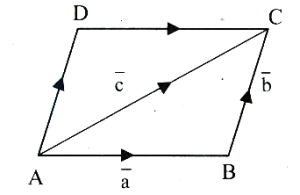
(B) Let the side vector be $\vec{a} = 3 \hat{i} + \hat{j} - \hat{k}$ and the diagonal vector be $\vec{c} = 2 \hat{i} + \hat{j} - 2 \hat{k}$.
In the parallelogram $ABCD$,let $\vec{a} = \vec{AB}$ and $\vec{c} = \vec{AC}$.
By the triangle law of vector addition in $\triangle ABC$,we have $\vec{AB} + \vec{BC} = \vec{AC}$.
Let $\vec{b} = \vec{BC}$. Then $\vec{a} + \vec{b} = \vec{c}$,which implies $\vec{b} = \vec{c} - \vec{a}$.
$\vec{b} = (2 \hat{i} + \hat{j} - 2 \hat{k}) - (3 \hat{i} + \hat{j} - \hat{k}) = -\hat{i} - \hat{k}$.
The area of the parallelogram is given by the magnitude of the cross product of the two adjacent sides,i.e.,$|\vec{a} \times \vec{b}|$.
$\vec{a} \times \vec{b} = \begin{vmatrix} \hat{i} & \hat{j} & \hat{k} \\ 3 & 1 & -1 \\ -1 & 0 & -1 \end{vmatrix} = \hat{i}(-1 - 0) - \hat{j}(-3 - 1) + \hat{k}(0 - (-1)) = -\hat{i} + 4 \hat{j} + \hat{k}$.
Area $= |-\hat{i} + 4 \hat{j} + \hat{k}| = \sqrt{(-1)^2 + 4^2 + 1^2} = \sqrt{1 + 16 + 1} = \sqrt{18} = 3 \sqrt{2} \text{ sq. units}$.
In the parallelogram $ABCD$,let $\vec{a} = \vec{AB}$ and $\vec{c} = \vec{AC}$.
By the triangle law of vector addition in $\triangle ABC$,we have $\vec{AB} + \vec{BC} = \vec{AC}$.
Let $\vec{b} = \vec{BC}$. Then $\vec{a} + \vec{b} = \vec{c}$,which implies $\vec{b} = \vec{c} - \vec{a}$.
$\vec{b} = (2 \hat{i} + \hat{j} - 2 \hat{k}) - (3 \hat{i} + \hat{j} - \hat{k}) = -\hat{i} - \hat{k}$.
The area of the parallelogram is given by the magnitude of the cross product of the two adjacent sides,i.e.,$|\vec{a} \times \vec{b}|$.
$\vec{a} \times \vec{b} = \begin{vmatrix} \hat{i} & \hat{j} & \hat{k} \\ 3 & 1 & -1 \\ -1 & 0 & -1 \end{vmatrix} = \hat{i}(-1 - 0) - \hat{j}(-3 - 1) + \hat{k}(0 - (-1)) = -\hat{i} + 4 \hat{j} + \hat{k}$.
Area $= |-\hat{i} + 4 \hat{j} + \hat{k}| = \sqrt{(-1)^2 + 4^2 + 1^2} = \sqrt{1 + 16 + 1} = \sqrt{18} = 3 \sqrt{2} \text{ sq. units}$.
0 likesView Solution
506
MathematicsEasyMCQMHT CET · 2024
If the points $P, Q$ and $R$ have the position vectors $\hat{i}-2 \hat{j}+3 \hat{k}$,$-2 \hat{i}+3 \hat{j}+2 \hat{k}$ and $-8 \hat{i}+13 \hat{j}$ respectively,then these points are
A
collinear and $Q$ lies between $P$ and $R$.
B
collinear and $R$ lies between $P$ and $Q$.
C
collinear and $P$ lies between $Q$ and $R$.
D
non-collinear.
Solution
(A) Let the position vectors of points $P, Q$ and $R$ be $\vec{p} = \hat{i}-2 \hat{j}+3 \hat{k}$,$\vec{q} = -2 \hat{i}+3 \hat{j}+2 \hat{k}$ and $\vec{r} = -8 \hat{i}+13 \hat{j}$.
First,we find the vectors $\vec{PQ}$ and $\vec{QR}$:
$\vec{PQ} = \vec{q} - \vec{p} = (-2 \hat{i}+3 \hat{j}+2 \hat{k}) - (\hat{i}-2 \hat{j}+3 \hat{k}) = -3 \hat{i}+5 \hat{j}-\hat{k}$.
$\vec{QR} = \vec{r} - \vec{q} = (-8 \hat{i}+13 \hat{j}) - (-2 \hat{i}+3 \hat{j}+2 \hat{k}) = -6 \hat{i}+10 \hat{j}-2 \hat{k}$.
We observe that $\vec{QR} = 2(-3 \hat{i}+5 \hat{j}-\hat{k}) = 2 \vec{PQ}$.
Since $\vec{QR}$ is a scalar multiple of $\vec{PQ}$,the vectors $\vec{PQ}$ and $\vec{QR}$ are parallel.
Because they share a common point $Q$,the points $P, Q$ and $R$ are collinear.
Since $\vec{QR} = 2 \vec{PQ}$,the point $Q$ lies between $P$ and $R$.
First,we find the vectors $\vec{PQ}$ and $\vec{QR}$:
$\vec{PQ} = \vec{q} - \vec{p} = (-2 \hat{i}+3 \hat{j}+2 \hat{k}) - (\hat{i}-2 \hat{j}+3 \hat{k}) = -3 \hat{i}+5 \hat{j}-\hat{k}$.
$\vec{QR} = \vec{r} - \vec{q} = (-8 \hat{i}+13 \hat{j}) - (-2 \hat{i}+3 \hat{j}+2 \hat{k}) = -6 \hat{i}+10 \hat{j}-2 \hat{k}$.
We observe that $\vec{QR} = 2(-3 \hat{i}+5 \hat{j}-\hat{k}) = 2 \vec{PQ}$.
Since $\vec{QR}$ is a scalar multiple of $\vec{PQ}$,the vectors $\vec{PQ}$ and $\vec{QR}$ are parallel.
Because they share a common point $Q$,the points $P, Q$ and $R$ are collinear.
Since $\vec{QR} = 2 \vec{PQ}$,the point $Q$ lies between $P$ and $R$.
0 likesView Solution
507
MathematicsMediumMCQMHT CET · 2024
If the vectors $\overline{AB}=3 \hat{i}+4 \hat{k}$ and $\overline{AC}=5 \hat{i}-2 \hat{j}+4 \hat{k}$ are the sides of the triangle $ABC$,then the length of the median through $A$ is:
A
$\sqrt{45}$ units.
B
$\sqrt{18}$ units.
C
$\sqrt{72}$ units.
D
$\sqrt{33}$ units.
Solution
(D) Let $AD$ be the median of $\triangle ABC$ through vertex $A$.
Since $D$ is the midpoint of $BC$,the vector $\overline{AD}$ is given by the formula $\overline{AD} = \frac{\overline{AB} + \overline{AC}}{2}$.
Substituting the given vectors:
$\overline{AD} = \frac{(3 \hat{i} + 4 \hat{k}) + (5 \hat{i} - 2 \hat{j} + 4 \hat{k})}{2}$
$\overline{AD} = \frac{(3+5) \hat{i} + (-2) \hat{j} + (4+4) \hat{k}}{2}$
$\overline{AD} = \frac{8 \hat{i} - 2 \hat{j} + 8 \hat{k}}{2}$
$\overline{AD} = 4 \hat{i} - \hat{j} + 4 \hat{k}$
Now,the length of the median is the magnitude of vector $\overline{AD}$:
$|\overline{AD}| = \sqrt{4^2 + (-1)^2 + 4^2}$
$|\overline{AD}| = \sqrt{16 + 1 + 16}$
$|\overline{AD}| = \sqrt{33} \text{ units}$.
Since $D$ is the midpoint of $BC$,the vector $\overline{AD}$ is given by the formula $\overline{AD} = \frac{\overline{AB} + \overline{AC}}{2}$.
Substituting the given vectors:
$\overline{AD} = \frac{(3 \hat{i} + 4 \hat{k}) + (5 \hat{i} - 2 \hat{j} + 4 \hat{k})}{2}$
$\overline{AD} = \frac{(3+5) \hat{i} + (-2) \hat{j} + (4+4) \hat{k}}{2}$
$\overline{AD} = \frac{8 \hat{i} - 2 \hat{j} + 8 \hat{k}}{2}$
$\overline{AD} = 4 \hat{i} - \hat{j} + 4 \hat{k}$
Now,the length of the median is the magnitude of vector $\overline{AD}$:
$|\overline{AD}| = \sqrt{4^2 + (-1)^2 + 4^2}$
$|\overline{AD}| = \sqrt{16 + 1 + 16}$
$|\overline{AD}| = \sqrt{33} \text{ units}$.
0 likesView Solution
508
MathematicsEasyMCQMHT CET · 2024
If $\overline{a}, \overline{b}, \overline{c}$ are three vectors such that $\overline{a} \neq \overline{0}$ and $\overline{a} \times \overline{b} = 2 \overline{a} \times \overline{c}$,$|\overline{a}| = |\overline{c}| = 1$,$|\overline{b}| = 4$ and $|\overline{b} \times \overline{c}| = \sqrt{15}$. If $\overline{b} - 2 \overline{c} = \lambda \overline{a}$,then $\lambda$ is
A
$1$
B
$-4$
C
$3$
D
$-2$
Solution
(B) Given $\overline{a} \times \overline{b} = 2 \overline{a} \times \overline{c}$,we can write $\overline{a} \times (\overline{b} - 2 \overline{c}) = \overline{0}$.
This implies that the vector $(\overline{b} - 2 \overline{c})$ is parallel to $\overline{a}$,which is consistent with $\overline{b} - 2 \overline{c} = \lambda \overline{a}$.
Let $\alpha$ be the angle between $\overline{b}$ and $\overline{c}$.
Given $|\overline{b} \times \overline{c}| = \sqrt{15}$,we have $|\overline{b}| |\overline{c}| \sin \alpha = \sqrt{15}$.
Substituting the values,$(4)(1) \sin \alpha = \sqrt{15}$,so $\sin \alpha = \frac{\sqrt{15}}{4}$.
Then $\cos \alpha = \sqrt{1 - \sin^2 \alpha} = \sqrt{1 - \frac{15}{16}} = \sqrt{\frac{1}{16}} = \frac{1}{4}$.
Now,consider $|\overline{b} - 2 \overline{c}|^2 = |\lambda \overline{a}|^2$.
$|\overline{b}|^2 + 4|\overline{c}|^2 - 4(\overline{b} \cdot \overline{c}) = \lambda^2 |\overline{a}|^2$.
$16 + 4(1) - 4(|\overline{b}| |\overline{c}| \cos \alpha) = \lambda^2 (1)^2$.
$20 - 4(4 \times 1 \times \frac{1}{4}) = \lambda^2$.
$20 - 4 = \lambda^2$,which gives $\lambda^2 = 16$.
Thus,$\lambda = \pm 4$. Since the options provide $-4$,the correct choice is $B$.
This implies that the vector $(\overline{b} - 2 \overline{c})$ is parallel to $\overline{a}$,which is consistent with $\overline{b} - 2 \overline{c} = \lambda \overline{a}$.
Let $\alpha$ be the angle between $\overline{b}$ and $\overline{c}$.
Given $|\overline{b} \times \overline{c}| = \sqrt{15}$,we have $|\overline{b}| |\overline{c}| \sin \alpha = \sqrt{15}$.
Substituting the values,$(4)(1) \sin \alpha = \sqrt{15}$,so $\sin \alpha = \frac{\sqrt{15}}{4}$.
Then $\cos \alpha = \sqrt{1 - \sin^2 \alpha} = \sqrt{1 - \frac{15}{16}} = \sqrt{\frac{1}{16}} = \frac{1}{4}$.
Now,consider $|\overline{b} - 2 \overline{c}|^2 = |\lambda \overline{a}|^2$.
$|\overline{b}|^2 + 4|\overline{c}|^2 - 4(\overline{b} \cdot \overline{c}) = \lambda^2 |\overline{a}|^2$.
$16 + 4(1) - 4(|\overline{b}| |\overline{c}| \cos \alpha) = \lambda^2 (1)^2$.
$20 - 4(4 \times 1 \times \frac{1}{4}) = \lambda^2$.
$20 - 4 = \lambda^2$,which gives $\lambda^2 = 16$.
Thus,$\lambda = \pm 4$. Since the options provide $-4$,the correct choice is $B$.
0 likesView Solution
509
MathematicsEasyMCQMHT CET · 2024
If $\bar{a}=2 \hat{i}+2 \hat{j}+3 \hat{k}$,$\bar{b}=-\hat{i}+2 \hat{j}+\hat{k}$ and $\bar{c}=3 \hat{i}+\hat{j}$ are vectors such that $\bar{a}+\lambda \bar{b}$ is perpendicular to $\bar{c}$,then the value of $\lambda$ is
A
$6$
B
$-6$
C
$8$
D
$-8$
Solution
(C) Given vectors are $\bar{a}=2 \hat{i}+2 \hat{j}+3 \hat{k}$,$\bar{b}=-\hat{i}+2 \hat{j}+\hat{k}$ and $\bar{c}=3 \hat{i}+\hat{j}$.
First,we find the vector $\bar{a}+\lambda \bar{b}$:
$\bar{a}+\lambda \bar{b} = (2 \hat{i}+2 \hat{j}+3 \hat{k}) + \lambda(-\hat{i}+2 \hat{j}+\hat{k})$
$= (2-\lambda) \hat{i} + (2+2\lambda) \hat{j} + (3+\lambda) \hat{k}$.
Since $\bar{a}+\lambda \bar{b}$ is perpendicular to $\bar{c}$,their dot product must be zero:
$(\bar{a}+\lambda \bar{b}) \cdot \bar{c} = 0$
$((2-\lambda) \hat{i} + (2+2\lambda) \hat{j} + (3+\lambda) \hat{k}) \cdot (3 \hat{i} + 1 \hat{j} + 0 \hat{k}) = 0$
$(2-\lambda)(3) + (2+2\lambda)(1) + (3+\lambda)(0) = 0$
$6 - 3\lambda + 2 + 2\lambda = 0$
$8 - \lambda = 0$
$\lambda = 8$.
First,we find the vector $\bar{a}+\lambda \bar{b}$:
$\bar{a}+\lambda \bar{b} = (2 \hat{i}+2 \hat{j}+3 \hat{k}) + \lambda(-\hat{i}+2 \hat{j}+\hat{k})$
$= (2-\lambda) \hat{i} + (2+2\lambda) \hat{j} + (3+\lambda) \hat{k}$.
Since $\bar{a}+\lambda \bar{b}$ is perpendicular to $\bar{c}$,their dot product must be zero:
$(\bar{a}+\lambda \bar{b}) \cdot \bar{c} = 0$
$((2-\lambda) \hat{i} + (2+2\lambda) \hat{j} + (3+\lambda) \hat{k}) \cdot (3 \hat{i} + 1 \hat{j} + 0 \hat{k}) = 0$
$(2-\lambda)(3) + (2+2\lambda)(1) + (3+\lambda)(0) = 0$
$6 - 3\lambda + 2 + 2\lambda = 0$
$8 - \lambda = 0$
$\lambda = 8$.
0 likesView Solution
510
MathematicsEasyMCQMHT CET · 2024
If $\bar{a}=2 \hat{i}-\hat{j}+\hat{k}$,$\bar{b}=\hat{i}+\hat{j}-2 \hat{k}$ and $\bar{c}=4 \hat{i}-2 \hat{j}+\hat{k}$,then the unit vector in the direction of $3 \bar{a}+\bar{b}-2 \bar{c}$ is
A
$\frac{1}{\sqrt{6}}(-\hat{i}+2 \hat{j}-\hat{k})$
B
$\frac{1}{\sqrt{6}}(\hat{i}+2 \hat{j}+\hat{k})$
C
$\frac{1}{\sqrt{6}}(2 \hat{i}-\hat{j}-\hat{k})$
D
$\frac{1}{\sqrt{6}}(-\hat{i}-2 \hat{j}+\hat{k})$
Solution
(A) First,calculate the vector $\vec{v} = 3 \bar{a} + \bar{b} - 2 \bar{c}$.
$\vec{v} = 3(2 \hat{i} - \hat{j} + \hat{k}) + (\hat{i} + \hat{j} - 2 \hat{k}) - 2(4 \hat{i} - 2 \hat{j} + \hat{k})$
$\vec{v} = (6 \hat{i} - 3 \hat{j} + 3 \hat{k}) + (\hat{i} + \hat{j} - 2 \hat{k}) - (8 \hat{i} - 4 \hat{j} + 2 \hat{k})$
$\vec{v} = (6 + 1 - 8) \hat{i} + (-3 + 1 + 4) \hat{j} + (3 - 2 - 2) \hat{k}$
$\vec{v} = -\hat{i} + 2 \hat{j} - \hat{k}$
Now,find the magnitude of $\vec{v}$:
$|\vec{v}| = \sqrt{(-1)^2 + 2^2 + (-1)^2} = \sqrt{1 + 4 + 1} = \sqrt{6}$
The unit vector in the direction of $\vec{v}$ is given by $\frac{\vec{v}}{|\vec{v}|} = \frac{-\hat{i} + 2 \hat{j} - \hat{k}}{\sqrt{6}} = \frac{1}{\sqrt{6}}(-\hat{i} + 2 \hat{j} - \hat{k})$.
$\vec{v} = 3(2 \hat{i} - \hat{j} + \hat{k}) + (\hat{i} + \hat{j} - 2 \hat{k}) - 2(4 \hat{i} - 2 \hat{j} + \hat{k})$
$\vec{v} = (6 \hat{i} - 3 \hat{j} + 3 \hat{k}) + (\hat{i} + \hat{j} - 2 \hat{k}) - (8 \hat{i} - 4 \hat{j} + 2 \hat{k})$
$\vec{v} = (6 + 1 - 8) \hat{i} + (-3 + 1 + 4) \hat{j} + (3 - 2 - 2) \hat{k}$
$\vec{v} = -\hat{i} + 2 \hat{j} - \hat{k}$
Now,find the magnitude of $\vec{v}$:
$|\vec{v}| = \sqrt{(-1)^2 + 2^2 + (-1)^2} = \sqrt{1 + 4 + 1} = \sqrt{6}$
The unit vector in the direction of $\vec{v}$ is given by $\frac{\vec{v}}{|\vec{v}|} = \frac{-\hat{i} + 2 \hat{j} - \hat{k}}{\sqrt{6}} = \frac{1}{\sqrt{6}}(-\hat{i} + 2 \hat{j} - \hat{k})$.
0 likesView Solution
511
MathematicsMediumMCQMHT CET · 2024
For all real $x$,the vectors $Cx \hat{i} - 6 \hat{j} - 3 \hat{k}$ and $x \hat{i} + 2 \hat{j} + 2Cx \hat{k}$ make an obtuse angle with each other. Then the value of $C$ can be in:
A
$(0, 1)$
B
$(-2, -\frac{4}{3})$
C
$(-\frac{4}{3}, 0)$
D
$(0, \frac{4}{3})$
Solution
(C) Let $\vec{a} = Cx \hat{i} - 6 \hat{j} - 3 \hat{k}$ and $\vec{b} = x \hat{i} + 2 \hat{j} + 2Cx \hat{k}$.
Since the angle between $\vec{a}$ and $\vec{b}$ is obtuse,their dot product must be negative,i.e.,$\vec{a} \cdot \vec{b} < 0$.
Calculating the dot product: $(Cx)(x) + (-6)(2) + (-3)(2Cx) < 0$.
$Cx^2 - 12 - 6Cx < 0$.
$Cx^2 - 6Cx - 12 < 0$.
For this quadratic expression in $x$ to be negative for all real $x$,the coefficient of $x^2$ must be negative $(C < 0)$ and the discriminant $D$ must be negative $(D < 0)$.
$D = (-6C)^2 - 4(C)(-12) = 36C^2 + 48C < 0$.
Dividing by $12$: $3C^2 + 4C < 0$.
$C(3C + 4) < 0$.
This inequality holds when $-\frac{4}{3} < C < 0$.
Since we also require $C < 0$,the intersection is $(-\frac{4}{3}, 0)$.
Since the angle between $\vec{a}$ and $\vec{b}$ is obtuse,their dot product must be negative,i.e.,$\vec{a} \cdot \vec{b} < 0$.
Calculating the dot product: $(Cx)(x) + (-6)(2) + (-3)(2Cx) < 0$.
$Cx^2 - 12 - 6Cx < 0$.
$Cx^2 - 6Cx - 12 < 0$.
For this quadratic expression in $x$ to be negative for all real $x$,the coefficient of $x^2$ must be negative $(C < 0)$ and the discriminant $D$ must be negative $(D < 0)$.
$D = (-6C)^2 - 4(C)(-12) = 36C^2 + 48C < 0$.
Dividing by $12$: $3C^2 + 4C < 0$.
$C(3C + 4) < 0$.
This inequality holds when $-\frac{4}{3} < C < 0$.
Since we also require $C < 0$,the intersection is $(-\frac{4}{3}, 0)$.
0 likesView Solution
512
MathematicsDifficultMCQMHT CET · 2024
If $x_0$ is the point of local minima of $f(x) = \bar{a} \cdot (\bar{b} \times \bar{c})$ where $\bar{a} = x \hat{i} - 2 \hat{j} + 3 \hat{k}$,$\bar{b} = -2 \hat{i} + x \hat{j} - \hat{k}$,$\bar{c} = 7 \hat{i} - 2 \hat{j} + x \hat{k}$,then the value of $\bar{a} \cdot \bar{b}$ at $x = x_0$ is
A
$-3$
B
$-15$
C
$-12$
D
$-9$
Solution
(B) $f(x) = \bar{a} \cdot (\bar{b} \times \bar{c}) = \begin{vmatrix} x & -2 & 3 \\ -2 & x & -1 \\ 7 & -2 & x \end{vmatrix}$
Expanding the determinant:
$f(x) = x(x^2 - 2) + 2(-2x + 7) + 3(4 - 7x)$
$f(x) = x^3 - 2x - 4x + 14 + 12 - 21x$
$f(x) = x^3 - 27x + 26$
To find local minima,we find $f'(x) = 0$:
$f'(x) = 3x^2 - 27 = 0$
$3(x^2 - 9) = 0 \Rightarrow x = \pm 3$
Using the second derivative test:
$f''(x) = 6x$
$f''(3) = 18 > 0$,so $x_0 = 3$ is the point of local minima.
At $x = 3$:
$\bar{a} = 3 \hat{i} - 2 \hat{j} + 3 \hat{k}$
$\bar{b} = -2 \hat{i} + 3 \hat{j} - \hat{k}$
$\bar{a} \cdot \bar{b} = (3)(-2) + (-2)(3) + (3)(-1)$
$\bar{a} \cdot \bar{b} = -6 - 6 - 3 = -15$
Expanding the determinant:
$f(x) = x(x^2 - 2) + 2(-2x + 7) + 3(4 - 7x)$
$f(x) = x^3 - 2x - 4x + 14 + 12 - 21x$
$f(x) = x^3 - 27x + 26$
To find local minima,we find $f'(x) = 0$:
$f'(x) = 3x^2 - 27 = 0$
$3(x^2 - 9) = 0 \Rightarrow x = \pm 3$
Using the second derivative test:
$f''(x) = 6x$
$f''(3) = 18 > 0$,so $x_0 = 3$ is the point of local minima.
At $x = 3$:
$\bar{a} = 3 \hat{i} - 2 \hat{j} + 3 \hat{k}$
$\bar{b} = -2 \hat{i} + 3 \hat{j} - \hat{k}$
$\bar{a} \cdot \bar{b} = (3)(-2) + (-2)(3) + (3)(-1)$
$\bar{a} \cdot \bar{b} = -6 - 6 - 3 = -15$
0 likesView Solution
513
MathematicsMediumMCQMHT CET · 2024
If $\bar{a}=(2 \hat{i}+2 \hat{j}+3 \hat{k})$,$\bar{b}=(-\hat{i}+2 \hat{j}+\hat{k})$ and $\bar{c}=(3 \hat{i}+\hat{j})$ such that $(\bar{a}+\lambda \bar{b})$ is perpendicular to $\bar{c}$,then the value of $\lambda$ is
A
-$8$
B
$8$
C
$10$
D
$\frac{8}{3}$
Solution
(B) Given vectors are $\bar{a}=(2 \hat{i}+2 \hat{j}+3 \hat{k})$,$\bar{b}=(-\hat{i}+2 \hat{j}+\hat{k})$,and $\bar{c}=(3 \hat{i}+\hat{j})$.
First,calculate the vector $(\bar{a}+\lambda \bar{b})$:
$(\bar{a}+\lambda \bar{b}) = (2 \hat{i}+2 \hat{j}+3 \hat{k}) + \lambda(-\hat{i}+2 \hat{j}+\hat{k})$
$= (2-\lambda) \hat{i} + (2+2\lambda) \hat{j} + (3+\lambda) \hat{k}$.
Since $(\bar{a}+\lambda \bar{b})$ is perpendicular to $\bar{c}$,their dot product must be zero:
$(\bar{a}+\lambda \bar{b}) \cdot \bar{c} = 0$
$((2-\lambda) \hat{i} + (2+2\lambda) \hat{j} + (3+\lambda) \hat{k}) \cdot (3 \hat{i}+1 \hat{j}+0 \hat{k}) = 0$
$(2-\lambda)(3) + (2+2\lambda)(1) + (3+\lambda)(0) = 0$
$6 - 3\lambda + 2 + 2\lambda = 0$
$8 - \lambda = 0$
$\lambda = 8$.
First,calculate the vector $(\bar{a}+\lambda \bar{b})$:
$(\bar{a}+\lambda \bar{b}) = (2 \hat{i}+2 \hat{j}+3 \hat{k}) + \lambda(-\hat{i}+2 \hat{j}+\hat{k})$
$= (2-\lambda) \hat{i} + (2+2\lambda) \hat{j} + (3+\lambda) \hat{k}$.
Since $(\bar{a}+\lambda \bar{b})$ is perpendicular to $\bar{c}$,their dot product must be zero:
$(\bar{a}+\lambda \bar{b}) \cdot \bar{c} = 0$
$((2-\lambda) \hat{i} + (2+2\lambda) \hat{j} + (3+\lambda) \hat{k}) \cdot (3 \hat{i}+1 \hat{j}+0 \hat{k}) = 0$
$(2-\lambda)(3) + (2+2\lambda)(1) + (3+\lambda)(0) = 0$
$6 - 3\lambda + 2 + 2\lambda = 0$
$8 - \lambda = 0$
$\lambda = 8$.
0 likesView Solution
514
MathematicsEasyMCQMHT CET · 2024
If the vectors $\bar{a}=\hat{i}-\hat{j}+2\hat{k}$,$\bar{b}=2\hat{i}+4\hat{j}+\hat{k}$ and $\bar{c}=m\hat{i}+\hat{j}+n\hat{k}$ are mutually perpendicular,then $(m, n)$ is
A
$(3, -2)$
B
$(-2, 3)$
C
$(2, -3)$
D
$(-3, 2)$
Solution
(D) Given vectors are $\bar{a}=\hat{i}-\hat{j}+2\hat{k}$,$\bar{b}=2\hat{i}+4\hat{j}+\hat{k}$ and $\bar{c}=m\hat{i}+\hat{j}+n\hat{k}$.
Since the vectors are mutually perpendicular,$\bar{a} \cdot \bar{c} = 0$ and $\bar{b} \cdot \bar{c} = 0$.
For $\bar{a} \cdot \bar{c} = 0$:
$(1)(m) + (-1)(1) + (2)(n) = 0$
$m - 1 + 2n = 0$
$m + 2n = 1$ ... $(i)$
For $\bar{b} \cdot \bar{c} = 0$:
$(2)(m) + (4)(1) + (1)(n) = 0$
$2m + n = -4$ ... $(ii)$
Multiplying equation $(ii)$ by $2$,we get $4m + 2n = -8$ ... $(iii)$.
Subtracting $(i)$ from $(iii)$:
$(4m + 2n) - (m + 2n) = -8 - 1$
$3m = -9 \implies m = -3$.
Substituting $m = -3$ in $(i)$:
$-3 + 2n = 1 \implies 2n = 4 \implies n = 2$.
Thus,$(m, n) = (-3, 2)$.
Since the vectors are mutually perpendicular,$\bar{a} \cdot \bar{c} = 0$ and $\bar{b} \cdot \bar{c} = 0$.
For $\bar{a} \cdot \bar{c} = 0$:
$(1)(m) + (-1)(1) + (2)(n) = 0$
$m - 1 + 2n = 0$
$m + 2n = 1$ ... $(i)$
For $\bar{b} \cdot \bar{c} = 0$:
$(2)(m) + (4)(1) + (1)(n) = 0$
$2m + n = -4$ ... $(ii)$
Multiplying equation $(ii)$ by $2$,we get $4m + 2n = -8$ ... $(iii)$.
Subtracting $(i)$ from $(iii)$:
$(4m + 2n) - (m + 2n) = -8 - 1$
$3m = -9 \implies m = -3$.
Substituting $m = -3$ in $(i)$:
$-3 + 2n = 1 \implies 2n = 4 \implies n = 2$.
Thus,$(m, n) = (-3, 2)$.
0 likesView Solution
515
MathematicsMediumMCQMHT CET · 2024
The area of the triangle,whose vertices are $A \equiv(1,-1,2)$,$B \equiv(2,1,-1)$ and $C \equiv(3,-1,2)$,is
A
$2 \sqrt{3}$ sq. units
B
$4 \sqrt{13}$ sq. units
C
$\sqrt{13}$ sq. units
D
$4 \sqrt{3}$ sq. units
Solution
(C) The vertices are $A(1, -1, 2)$,$B(2, 1, -1)$,and $C(3, -1, 2)$.
The position vectors are $\vec{a} = \hat{i} - \hat{j} + 2\hat{k}$,$\vec{b} = 2\hat{i} + \hat{j} - \hat{k}$,and $\vec{c} = 3\hat{i} - \hat{j} + 2\hat{k}$.
We find the vectors $\vec{AB}$ and $\vec{AC}$:
$\vec{AB} = \vec{b} - \vec{a} = (2-1)\hat{i} + (1 - (-1))\hat{j} + (-1-2)\hat{k} = \hat{i} + 2\hat{j} - 3\hat{k}$
$\vec{AC} = \vec{c} - \vec{a} = (3-1)\hat{i} + (-1 - (-1))\hat{j} + (2-2)\hat{k} = 2\hat{i} + 0\hat{j} + 0\hat{k}$
The area of the triangle is given by $\frac{1}{2} |\vec{AB} \times \vec{AC}|$.
$\vec{AB} \times \vec{AC} = \begin{vmatrix} \hat{i} & \hat{j} & \hat{k} \\ 1 & 2 & -3 \\ 2 & 0 & 0 \end{vmatrix} = \hat{i}(0 - 0) - \hat{j}(0 - (-6)) + \hat{k}(0 - 4) = -6\hat{j} - 4\hat{k}$.
The magnitude is $|\vec{AB} \times \vec{AC}| = \sqrt{(-6)^2 + (-4)^2} = \sqrt{36 + 16} = \sqrt{52} = 2\sqrt{13}$.
Therefore,the area of the triangle is $\frac{1}{2} \times 2\sqrt{13} = \sqrt{13}$ sq. units.
The position vectors are $\vec{a} = \hat{i} - \hat{j} + 2\hat{k}$,$\vec{b} = 2\hat{i} + \hat{j} - \hat{k}$,and $\vec{c} = 3\hat{i} - \hat{j} + 2\hat{k}$.
We find the vectors $\vec{AB}$ and $\vec{AC}$:
$\vec{AB} = \vec{b} - \vec{a} = (2-1)\hat{i} + (1 - (-1))\hat{j} + (-1-2)\hat{k} = \hat{i} + 2\hat{j} - 3\hat{k}$
$\vec{AC} = \vec{c} - \vec{a} = (3-1)\hat{i} + (-1 - (-1))\hat{j} + (2-2)\hat{k} = 2\hat{i} + 0\hat{j} + 0\hat{k}$
The area of the triangle is given by $\frac{1}{2} |\vec{AB} \times \vec{AC}|$.
$\vec{AB} \times \vec{AC} = \begin{vmatrix} \hat{i} & \hat{j} & \hat{k} \\ 1 & 2 & -3 \\ 2 & 0 & 0 \end{vmatrix} = \hat{i}(0 - 0) - \hat{j}(0 - (-6)) + \hat{k}(0 - 4) = -6\hat{j} - 4\hat{k}$.
The magnitude is $|\vec{AB} \times \vec{AC}| = \sqrt{(-6)^2 + (-4)^2} = \sqrt{36 + 16} = \sqrt{52} = 2\sqrt{13}$.
Therefore,the area of the triangle is $\frac{1}{2} \times 2\sqrt{13} = \sqrt{13}$ sq. units.
0 likesView Solution
516
MathematicsEasyMCQMHT CET · 2024
If $C$ is a given non-zero scalar and $\overline{A}$ and $\overline{B}$ are given non-zero vectors such that $\overline{A}$ is perpendicular to $\overline{B}$. If vector $\overline{X}$ is such that $\overline{A} \cdot \overline{X} = C$ and $\overline{A} \times \overline{X} = \overline{B}$,then $\overline{X}$ is given by:
A
$\frac{C \overline{A} + \overline{A} \times \overline{B}}{|\overline{A}|^2}$
B
$\frac{C \overline{A} \times \overline{B}}{|\overline{A}|^2}$
C
$\frac{C \overline{A} - \overline{A} \times \overline{B}}{|\overline{A}|^2}$
D
$\frac{C \overline{A} + \overline{B}}{|\overline{A}|^2}$
Solution
(C) Given $\overline{A} \times \overline{X} = \overline{B}$.
Taking the cross product with $\overline{A}$ on both sides:
$\overline{A} \times (\overline{A} \times \overline{X}) = \overline{A} \times \overline{B}$.
Using the vector triple product identity $\overline{a} \times (\overline{b} \times \overline{c}) = (\overline{a} \cdot \overline{c}) \overline{b} - (\overline{a} \cdot \overline{b}) \overline{c}$:
$(\overline{A} \cdot \overline{X}) \overline{A} - (\overline{A} \cdot \overline{A}) \overline{X} = \overline{A} \times \overline{B}$.
Substitute $\overline{A} \cdot \overline{X} = C$ and $\overline{A} \cdot \overline{A} = |\overline{A}|^2$:
$C \overline{A} - |\overline{A}|^2 \overline{X} = \overline{A} \times \overline{B}$.
Rearranging for $\overline{X}$:
$|\overline{A}|^2 \overline{X} = C \overline{A} - \overline{A} \times \overline{B}$.
$\overline{X} = \frac{C \overline{A} - \overline{A} \times \overline{B}}{|\overline{A}|^2}$.
Taking the cross product with $\overline{A}$ on both sides:
$\overline{A} \times (\overline{A} \times \overline{X}) = \overline{A} \times \overline{B}$.
Using the vector triple product identity $\overline{a} \times (\overline{b} \times \overline{c}) = (\overline{a} \cdot \overline{c}) \overline{b} - (\overline{a} \cdot \overline{b}) \overline{c}$:
$(\overline{A} \cdot \overline{X}) \overline{A} - (\overline{A} \cdot \overline{A}) \overline{X} = \overline{A} \times \overline{B}$.
Substitute $\overline{A} \cdot \overline{X} = C$ and $\overline{A} \cdot \overline{A} = |\overline{A}|^2$:
$C \overline{A} - |\overline{A}|^2 \overline{X} = \overline{A} \times \overline{B}$.
Rearranging for $\overline{X}$:
$|\overline{A}|^2 \overline{X} = C \overline{A} - \overline{A} \times \overline{B}$.
$\overline{X} = \frac{C \overline{A} - \overline{A} \times \overline{B}}{|\overline{A}|^2}$.
0 likesView Solution
517
MathematicsMediumMCQMHT CET · 2024
Let $\overline{A}=2 \hat{i}+\hat{k}$,$\overline{B}=\hat{i}+\hat{j}+\hat{k}$ and $\overline{C}=4 \hat{i}-3 \hat{j}+7 \hat{k}$. If a vector $\overline{R}$ satisfies $\overline{R} \times \overline{B}=\overline{C} \times \overline{B}$ and $\overline{R} \cdot \overline{A}=0$,then $\overline{R}$ is given by
A
$\hat{i}-8 \hat{j}+2 \hat{k}$
B
$\hat{i}+8 \hat{j}+2 \hat{k}$
C
$-\hat{i}-8 \hat{j}+2 \hat{k}$
D
$-\hat{i}-8 \hat{j}-2 \hat{k}$
Solution
(C) Given $\overline{R} \times \overline{B} = \overline{C} \times \overline{B}$,we can write $(\overline{R} - \overline{C}) \times \overline{B} = 0$.
This implies that $(\overline{R} - \overline{C})$ is parallel to $\overline{B}$,so $\overline{R} - \overline{C} = k\overline{B}$ for some scalar $k$.
Thus,$\overline{R} = \overline{C} + k\overline{B}$.
Given $\overline{R} \cdot \overline{A} = 0$,we substitute $\overline{R}$:
$(\overline{C} + k\overline{B}) \cdot \overline{A} = 0
\Rightarrow \overline{C} \cdot \overline{A} + k(\overline{B} \cdot \overline{A}) = 0$.
Calculate the dot products:
$\overline{A} \cdot \overline{C} = (2 \hat{i} + \hat{k}) \cdot (4 \hat{i} - 3 \hat{j} + 7 \hat{k}) = 2(4) + 0(-3) + 1(7) = 8 + 7 = 15$.
$\overline{A} \cdot \overline{B} = (2 \hat{i} + \hat{k}) \cdot (\hat{i} + \hat{j} + \hat{k}) = 2(1) + 0(1) + 1(1) = 2 + 1 = 3$.
Substituting these values:
$15 + k(3) = 0
\Rightarrow 3k = -15
\Rightarrow k = -5$.
Now,find $\overline{R}$:
$\overline{R} = \overline{C} - 5\overline{B} = (4 \hat{i} - 3 \hat{j} + 7 \hat{k}) - 5(\hat{i} + \hat{j} + \hat{k})
= (4-5)\hat{i} + (-3-5)\hat{j} + (7-5)\hat{k}
= -\hat{i} - 8\hat{j} + 2\hat{k}$.
This implies that $(\overline{R} - \overline{C})$ is parallel to $\overline{B}$,so $\overline{R} - \overline{C} = k\overline{B}$ for some scalar $k$.
Thus,$\overline{R} = \overline{C} + k\overline{B}$.
Given $\overline{R} \cdot \overline{A} = 0$,we substitute $\overline{R}$:
$(\overline{C} + k\overline{B}) \cdot \overline{A} = 0
\Rightarrow \overline{C} \cdot \overline{A} + k(\overline{B} \cdot \overline{A}) = 0$.
Calculate the dot products:
$\overline{A} \cdot \overline{C} = (2 \hat{i} + \hat{k}) \cdot (4 \hat{i} - 3 \hat{j} + 7 \hat{k}) = 2(4) + 0(-3) + 1(7) = 8 + 7 = 15$.
$\overline{A} \cdot \overline{B} = (2 \hat{i} + \hat{k}) \cdot (\hat{i} + \hat{j} + \hat{k}) = 2(1) + 0(1) + 1(1) = 2 + 1 = 3$.
Substituting these values:
$15 + k(3) = 0
\Rightarrow 3k = -15
\Rightarrow k = -5$.
Now,find $\overline{R}$:
$\overline{R} = \overline{C} - 5\overline{B} = (4 \hat{i} - 3 \hat{j} + 7 \hat{k}) - 5(\hat{i} + \hat{j} + \hat{k})
= (4-5)\hat{i} + (-3-5)\hat{j} + (7-5)\hat{k}
= -\hat{i} - 8\hat{j} + 2\hat{k}$.
0 likesView Solution
518
MathematicsEasyMCQMHT CET · 2024
If $|\vec{a}| = \sqrt{27}$,$|\vec{b}| = 7$ and $|\vec{a} \times \vec{b}| = 35$,then $\vec{a} \cdot \vec{b}$ is equal to
A
$\sqrt{\frac{35}{2}}$
B
$\frac{\sqrt{35}}{2}$
C
$7 \sqrt{2}$
D
$\sqrt{35}$
Solution
(C) Given: $|\vec{a}| = \sqrt{27}$,$|\vec{b}| = 7$,and $|\vec{a} \times \vec{b}| = 35$.
We know that $|\vec{a} \times \vec{b}| = |\vec{a}| |\vec{b}| \sin \theta$.
Therefore,$\sin \theta = \frac{|\vec{a} \times \vec{b}|}{|\vec{a}| |\vec{b}|} = \frac{35}{\sqrt{27} \times 7} = \frac{5}{\sqrt{27}}$.
Now,$\cos^2 \theta = 1 - \sin^2 \theta = 1 - \frac{25}{27} = \frac{2}{27}$.
Thus,$\cos \theta = \sqrt{\frac{2}{27}}$ (assuming $\theta$ is acute).
Finally,$\vec{a} \cdot \vec{b} = |\vec{a}| |\vec{b}| \cos \theta = \sqrt{27} \times 7 \times \sqrt{\frac{2}{27}} = 7 \sqrt{2}$.
We know that $|\vec{a} \times \vec{b}| = |\vec{a}| |\vec{b}| \sin \theta$.
Therefore,$\sin \theta = \frac{|\vec{a} \times \vec{b}|}{|\vec{a}| |\vec{b}|} = \frac{35}{\sqrt{27} \times 7} = \frac{5}{\sqrt{27}}$.
Now,$\cos^2 \theta = 1 - \sin^2 \theta = 1 - \frac{25}{27} = \frac{2}{27}$.
Thus,$\cos \theta = \sqrt{\frac{2}{27}}$ (assuming $\theta$ is acute).
Finally,$\vec{a} \cdot \vec{b} = |\vec{a}| |\vec{b}| \cos \theta = \sqrt{27} \times 7 \times \sqrt{\frac{2}{27}} = 7 \sqrt{2}$.
0 likesView Solution
519
MathematicsMediumMCQMHT CET · 2024
Let $\overline{a}=2 \hat{i}+\hat{j}-2 \hat{k}$ and $\overline{b}=\hat{i}+\hat{j}$. Let $\overline{c}$ be a vector such that $|\bar{c}-\bar{a}|=3$ and $|(\bar{a} \times \bar{b}) \times \bar{c}|=3$ and the angle between $\overline{c}$ and $\overline{a} \times \overline{b}$ is $30^{\circ}$,then $\overline{a} \cdot \overline{c}$ is equal to
A
$\frac{2 \sqrt{2}}{3}$
B
$5$
C
$-\frac{1}{8}$
D
$2$
Solution
(D) Given: $\overline{a}=2 \hat{i}+\hat{j}-2 \hat{k}$ and $\overline{b}=\hat{i}+\hat{j}$.
First,calculate the magnitude of $\overline{a}$:
$|\overline{a}|=\sqrt{2^2+1^2+(-2)^2}=\sqrt{4+1+4}=3$.
Next,calculate the cross product $\overline{a} \times \overline{b}$:
$\overline{a} \times \overline{b}=\begin{vmatrix} \hat{i} & \hat{j} & \hat{k} \\ 2 & 1 & -2 \\ 1 & 1 & 0 \end{vmatrix} = \hat{i}(0 - (-2)) - \hat{j}(0 - (-2)) + \hat{k}(2 - 1) = 2 \hat{i}-2 \hat{j}+\hat{k}$.
The magnitude is $|\overline{a} \times \overline{b}|=\sqrt{2^2+(-2)^2+1^2}=\sqrt{4+4+1}=3$.
Given $|(\overline{a} \times \overline{b}) \times \overline{c}|=3$ and the angle $\theta$ between $\overline{c}$ and $\overline{a} \times \overline{b}$ is $30^{\circ}$.
Using the formula $|\overline{u} \times \overline{v}| = |\overline{u}||\overline{v}| \sin \theta$:
$|(\overline{a} \times \overline{b}) \times \overline{c}| = |\overline{a} \times \overline{b}| |\overline{c}| \sin 30^{\circ}$.
$3 = 3 \times |\overline{c}| \times \frac{1}{2} \Rightarrow |\overline{c}| = 2$.
Now,use the given condition $|\overline{c}-\overline{a}|=3$:
$|\overline{c}-\overline{a}|^2 = 3^2 = 9$.
$|\overline{c}|^2 + |\overline{a}|^2 - 2(\overline{a} \cdot \overline{c}) = 9$.
Substitute the known values $|\overline{c}|=2$ and $|\overline{a}|=3$:
$2^2 + 3^2 - 2(\overline{a} \cdot \overline{c}) = 9$.
$4 + 9 - 2(\overline{a} \cdot \overline{c}) = 9$.
$13 - 2(\overline{a} \cdot \overline{c}) = 9$.
$2(\overline{a} \cdot \overline{c}) = 4$.
$\overline{a} \cdot \overline{c} = 2$.
First,calculate the magnitude of $\overline{a}$:
$|\overline{a}|=\sqrt{2^2+1^2+(-2)^2}=\sqrt{4+1+4}=3$.
Next,calculate the cross product $\overline{a} \times \overline{b}$:
$\overline{a} \times \overline{b}=\begin{vmatrix} \hat{i} & \hat{j} & \hat{k} \\ 2 & 1 & -2 \\ 1 & 1 & 0 \end{vmatrix} = \hat{i}(0 - (-2)) - \hat{j}(0 - (-2)) + \hat{k}(2 - 1) = 2 \hat{i}-2 \hat{j}+\hat{k}$.
The magnitude is $|\overline{a} \times \overline{b}|=\sqrt{2^2+(-2)^2+1^2}=\sqrt{4+4+1}=3$.
Given $|(\overline{a} \times \overline{b}) \times \overline{c}|=3$ and the angle $\theta$ between $\overline{c}$ and $\overline{a} \times \overline{b}$ is $30^{\circ}$.
Using the formula $|\overline{u} \times \overline{v}| = |\overline{u}||\overline{v}| \sin \theta$:
$|(\overline{a} \times \overline{b}) \times \overline{c}| = |\overline{a} \times \overline{b}| |\overline{c}| \sin 30^{\circ}$.
$3 = 3 \times |\overline{c}| \times \frac{1}{2} \Rightarrow |\overline{c}| = 2$.
Now,use the given condition $|\overline{c}-\overline{a}|=3$:
$|\overline{c}-\overline{a}|^2 = 3^2 = 9$.
$|\overline{c}|^2 + |\overline{a}|^2 - 2(\overline{a} \cdot \overline{c}) = 9$.
Substitute the known values $|\overline{c}|=2$ and $|\overline{a}|=3$:
$2^2 + 3^2 - 2(\overline{a} \cdot \overline{c}) = 9$.
$4 + 9 - 2(\overline{a} \cdot \overline{c}) = 9$.
$13 - 2(\overline{a} \cdot \overline{c}) = 9$.
$2(\overline{a} \cdot \overline{c}) = 4$.
$\overline{a} \cdot \overline{c} = 2$.
0 likesView Solution
520
MathematicsEasyMCQMHT CET · 2024
If $\overline{a}, \overline{b}, \overline{c}$ are non-coplanar vectors and $\overline{p}=\frac{\overline{b} \times \overline{c}}{[\overline{a} \overline{b} \overline{c}]}, \overline{q}=\frac{\overline{c} \times \overline{a}}{[\overline{a} \overline{b} \overline{c}]}, \overline{r}=\frac{\overline{a} \times \overline{b}}{[\overline{a} \overline{b} \overline{c}]}, \quad$ then $2 \overline{a} \cdot \overline{p}+\overline{b} \cdot \overline{q}+\overline{c} \cdot \overline{r}=$
A
$0$
B
$3$
C
$4$
D
$1$
Solution
(C) Given that $\overline{a}, \overline{b}, \overline{c}$ are non-coplanar vectors,the scalar triple product $[\overline{a} \overline{b} \overline{c}] \neq 0$.
We know that $\overline{a} \cdot \overline{p} = \overline{a} \cdot \frac{\overline{b} \times \overline{c}}{[\overline{a} \overline{b} \overline{c}]} = \frac{[\overline{a} \overline{b} \overline{c}]}{[\overline{a} \overline{b} \overline{c}]} = 1$.
Similarly,$\overline{b} \cdot \overline{q} = \overline{b} \cdot \frac{\overline{c} \times \overline{a}}{[\overline{a} \overline{b} \overline{c}]} = \frac{[\overline{b} \overline{c} \overline{a}]}{[\overline{a} \overline{b} \overline{c}]} = 1$.
And $\overline{c} \cdot \overline{r} = \overline{c} \cdot \frac{\overline{a} \times \overline{b}}{[\overline{a} \overline{b} \overline{c}]} = \frac{[\overline{c} \overline{a} \overline{b}]}{[\overline{a} \overline{b} \overline{c}]} = 1$.
Substituting these values into the expression:
$2 \overline{a} \cdot \overline{p} + \overline{b} \cdot \overline{q} + \overline{c} \cdot \overline{r} = 2(1) + 1 + 1 = 4$.
We know that $\overline{a} \cdot \overline{p} = \overline{a} \cdot \frac{\overline{b} \times \overline{c}}{[\overline{a} \overline{b} \overline{c}]} = \frac{[\overline{a} \overline{b} \overline{c}]}{[\overline{a} \overline{b} \overline{c}]} = 1$.
Similarly,$\overline{b} \cdot \overline{q} = \overline{b} \cdot \frac{\overline{c} \times \overline{a}}{[\overline{a} \overline{b} \overline{c}]} = \frac{[\overline{b} \overline{c} \overline{a}]}{[\overline{a} \overline{b} \overline{c}]} = 1$.
And $\overline{c} \cdot \overline{r} = \overline{c} \cdot \frac{\overline{a} \times \overline{b}}{[\overline{a} \overline{b} \overline{c}]} = \frac{[\overline{c} \overline{a} \overline{b}]}{[\overline{a} \overline{b} \overline{c}]} = 1$.
Substituting these values into the expression:
$2 \overline{a} \cdot \overline{p} + \overline{b} \cdot \overline{q} + \overline{c} \cdot \overline{r} = 2(1) + 1 + 1 = 4$.
0 likesView Solution
521
MathematicsEasyMCQMHT CET · 2024
If $\bar{a}=\hat{i}-2 \hat{j}+3 \hat{k}$ and $\bar{b}=2 \hat{i}+3 \hat{j}-\hat{k}$,then the angle between the vectors $(2 \bar{a}+\bar{b})$ and $(\bar{a}+2 \bar{b})$ is
A
$\frac{\pi}{6}$
B
$\frac{\pi}{3}$
C
$\frac{\pi}{4}$
D
$\frac{\pi}{2}$
Solution
(B) Given,$\bar{a}=\hat{i}-2 \hat{j}+3 \hat{k}$ and $\bar{b}=2 \hat{i}+3 \hat{j}-\hat{k}$.
First,calculate the vectors $(2 \bar{a}+\bar{b})$ and $(\bar{a}+2 \bar{b})$:
$2 \bar{a}+\bar{b} = 2(\hat{i}-2 \hat{j}+3 \hat{k}) + (2 \hat{i}+3 \hat{j}-\hat{k}) = (2+2)\hat{i} + (-4+3)\hat{j} + (6-1)\hat{k} = 4 \hat{i}-\hat{j}+5 \hat{k}$.
$\bar{a}+2 \bar{b} = (\hat{i}-2 \hat{j}+3 \hat{k}) + 2(2 \hat{i}+3 \hat{j}-\hat{k}) = (1+4)\hat{i} + (-2+6)\hat{j} + (3-2)\hat{k} = 5 \hat{i}+4 \hat{j}+\hat{k}$.
Now,calculate the magnitudes:
$|2 \bar{a}+\bar{b}| = \sqrt{4^2+(-1)^2+5^2} = \sqrt{16+1+25} = \sqrt{42}$.
$|\bar{a}+2 \bar{b}| = \sqrt{5^2+4^2+1^2} = \sqrt{25+16+1} = \sqrt{42}$.
Calculate the dot product:
$(2 \bar{a}+\bar{b}) \cdot (\bar{a}+2 \bar{b}) = (4)(5) + (-1)(4) + (5)(1) = 20 - 4 + 5 = 21$.
Using the formula $\cos \theta = \frac{(2 \bar{a}+\bar{b}) \cdot (\bar{a}+2 \bar{b})}{|2 \bar{a}+\bar{b}| |\bar{a}+2 \bar{b}|}$:
$\cos \theta = \frac{21}{\sqrt{42} \cdot \sqrt{42}} = \frac{21}{42} = \frac{1}{2}$.
Therefore,$\theta = \cos^{-1}(\frac{1}{2}) = \frac{\pi}{3}$.
First,calculate the vectors $(2 \bar{a}+\bar{b})$ and $(\bar{a}+2 \bar{b})$:
$2 \bar{a}+\bar{b} = 2(\hat{i}-2 \hat{j}+3 \hat{k}) + (2 \hat{i}+3 \hat{j}-\hat{k}) = (2+2)\hat{i} + (-4+3)\hat{j} + (6-1)\hat{k} = 4 \hat{i}-\hat{j}+5 \hat{k}$.
$\bar{a}+2 \bar{b} = (\hat{i}-2 \hat{j}+3 \hat{k}) + 2(2 \hat{i}+3 \hat{j}-\hat{k}) = (1+4)\hat{i} + (-2+6)\hat{j} + (3-2)\hat{k} = 5 \hat{i}+4 \hat{j}+\hat{k}$.
Now,calculate the magnitudes:
$|2 \bar{a}+\bar{b}| = \sqrt{4^2+(-1)^2+5^2} = \sqrt{16+1+25} = \sqrt{42}$.
$|\bar{a}+2 \bar{b}| = \sqrt{5^2+4^2+1^2} = \sqrt{25+16+1} = \sqrt{42}$.
Calculate the dot product:
$(2 \bar{a}+\bar{b}) \cdot (\bar{a}+2 \bar{b}) = (4)(5) + (-1)(4) + (5)(1) = 20 - 4 + 5 = 21$.
Using the formula $\cos \theta = \frac{(2 \bar{a}+\bar{b}) \cdot (\bar{a}+2 \bar{b})}{|2 \bar{a}+\bar{b}| |\bar{a}+2 \bar{b}|}$:
$\cos \theta = \frac{21}{\sqrt{42} \cdot \sqrt{42}} = \frac{21}{42} = \frac{1}{2}$.
Therefore,$\theta = \cos^{-1}(\frac{1}{2}) = \frac{\pi}{3}$.
0 likesView Solution
522
MathematicsEasyMCQMHT CET · 2024
If the area of the parallelogram with $\bar{a}$ and $\bar{b}$ as two adjacent sides is $15$ square units,then the area (in square units) of the parallelogram,having $3 \bar{a} + 2 \bar{b}$ and $\bar{a} + 3 \bar{b}$ as two adjacent sides,is
A
$45$
B
$75$
C
$105$
D
$120$
Solution
(C) The area of a parallelogram with adjacent sides $\bar{a}$ and $\bar{b}$ is given by $|\bar{a} \times \bar{b}|$.
Given that $|\bar{a} \times \bar{b}| = 15$.
The area of the new parallelogram with adjacent sides $(3 \bar{a} + 2 \bar{b})$ and $(\bar{a} + 3 \bar{b})$ is given by the magnitude of their cross product:
$|(3 \bar{a} + 2 \bar{b}) \times (\bar{a} + 3 \bar{b})|$
$= |3(\bar{a} \times \bar{a}) + 9(\bar{a} \times \bar{b}) + 2(\bar{b} \times \bar{a}) + 6(\bar{b} \times \bar{b})|$
Since $\bar{a} \times \bar{a} = 0$ and $\bar{b} \times \bar{b} = 0$,and $\bar{b} \times \bar{a} = -(\bar{a} \times \bar{b})$,we have:
$= |0 + 9(\bar{a} \times \bar{b}) - 2(\bar{a} \times \bar{b}) + 0|$
$= |7(\bar{a} \times \bar{b})| = 7 |\bar{a} \times \bar{b}|$
$= 7 \times 15 = 105$ square units.
Given that $|\bar{a} \times \bar{b}| = 15$.
The area of the new parallelogram with adjacent sides $(3 \bar{a} + 2 \bar{b})$ and $(\bar{a} + 3 \bar{b})$ is given by the magnitude of their cross product:
$|(3 \bar{a} + 2 \bar{b}) \times (\bar{a} + 3 \bar{b})|$
$= |3(\bar{a} \times \bar{a}) + 9(\bar{a} \times \bar{b}) + 2(\bar{b} \times \bar{a}) + 6(\bar{b} \times \bar{b})|$
Since $\bar{a} \times \bar{a} = 0$ and $\bar{b} \times \bar{b} = 0$,and $\bar{b} \times \bar{a} = -(\bar{a} \times \bar{b})$,we have:
$= |0 + 9(\bar{a} \times \bar{b}) - 2(\bar{a} \times \bar{b}) + 0|$
$= |7(\bar{a} \times \bar{b})| = 7 |\bar{a} \times \bar{b}|$
$= 7 \times 15 = 105$ square units.
0 likesView Solution
523
MathematicsEasyMCQMHT CET · 2024
If $\overline{a}=\hat{i}+\hat{j}+\hat{k}$,$\overline{a} \cdot \overline{b}=1$ and $\overline{a} \times \overline{b}=\hat{j}-\hat{k}$,then $\overline{b}$ is
A
$\hat{i}-\hat{j}+\hat{k}$
B
$2 \hat{j}-\hat{k}$
C
$\hat{i}$
D
$2 \hat{i}$
Solution
(C) Given,$\overline{a}=\hat{i}+\hat{j}+\hat{k}$ and $\overline{a} \times \overline{b}=\hat{j}-\hat{k}$.
Also,$\overline{a} \cdot \overline{b}=1$.
Let $\overline{b}=x \hat{i}+y \hat{j}+z \hat{k}$.
We know that $\overline{a} \times \overline{b} = \begin{vmatrix} \hat{i} & \hat{j} & \hat{k} \\ 1 & 1 & 1 \\ x & y & z \end{vmatrix} = (z-y)\hat{i} - (z-x)\hat{j} + (y-x)\hat{k}$.
Comparing this with $\hat{j}-\hat{k}$,we get:
$z-y=0 \implies z=y$ $(i)$
$-(z-x)=1 \implies x-z=1$ $(ii)$
$y-x=-1$ $(iii)$
From the dot product,$\overline{a} \cdot \overline{b} = x+y+z=1$ $(iv)$.
Substituting $z=y$ and $x=z+1$ into $(iv)$:
$(z+1) + z + z = 1 \implies 3z = 0 \implies z=0$.
Thus,$y=0$ and $x=0+1=1$.
Therefore,$\overline{b} = 1\hat{i} + 0\hat{j} + 0\hat{k} = \hat{i}$.
Also,$\overline{a} \cdot \overline{b}=1$.
Let $\overline{b}=x \hat{i}+y \hat{j}+z \hat{k}$.
We know that $\overline{a} \times \overline{b} = \begin{vmatrix} \hat{i} & \hat{j} & \hat{k} \\ 1 & 1 & 1 \\ x & y & z \end{vmatrix} = (z-y)\hat{i} - (z-x)\hat{j} + (y-x)\hat{k}$.
Comparing this with $\hat{j}-\hat{k}$,we get:
$z-y=0 \implies z=y$ $(i)$
$-(z-x)=1 \implies x-z=1$ $(ii)$
$y-x=-1$ $(iii)$
From the dot product,$\overline{a} \cdot \overline{b} = x+y+z=1$ $(iv)$.
Substituting $z=y$ and $x=z+1$ into $(iv)$:
$(z+1) + z + z = 1 \implies 3z = 0 \implies z=0$.
Thus,$y=0$ and $x=0+1=1$.
Therefore,$\overline{b} = 1\hat{i} + 0\hat{j} + 0\hat{k} = \hat{i}$.
0 likesView Solution
524
MathematicsDifficultMCQMHT CET · 2024
Let $\overline{a}=2 \hat{i}+\hat{j}-2 \hat{k}$ and $\overline{b}=\hat{i}+\hat{j}$. If $\overline{c}$ is a vector such that $\overline{a} \cdot \overline{c}=|\overline{c}|$,$|\overline{c}-\overline{a}|=2 \sqrt{2}$ and the angle between $(\overline{a} \times \overline{b})$ and $\overline{c}$ is $60^{\circ}$,then the value of $|(\overline{a} \times \overline{b}) \times \overline{c}|$ is
A
$\frac{\sqrt{3}}{2}$
B
$\frac{3 \sqrt{3}}{2}$
C
$\frac{5 \sqrt{3}}{2}$
D
$\frac{\sqrt{3}}{4}$
Solution
(B) First,calculate the cross product $\overline{a} \times \overline{b}$:
$\overline{a} \times \overline{b} = \begin{vmatrix} \hat{i} & \hat{j} & \hat{k} \\ 2 & 1 & -2 \\ 1 & 1 & 0 \end{vmatrix} = \hat{i}(0 - (-2)) - \hat{j}(0 - (-2)) + \hat{k}(2 - 1) = 2 \hat{i} - 2 \hat{j} + \hat{k}$.
The magnitude is $|\overline{a} \times \overline{b}| = \sqrt{2^2 + (-2)^2 + 1^2} = \sqrt{4+4+1} = 3$ ...$(i)$.
Given $|\overline{c} - \overline{a}| = 2 \sqrt{2}$,squaring both sides gives $|\overline{c}|^2 + |\overline{a}|^2 - 2(\overline{c} \cdot \overline{a}) = 8$.
Since $|\overline{a}| = \sqrt{2^2 + 1^2 + (-2)^2} = 3$,we have $|\overline{a}|^2 = 9$.
Given $\overline{a} \cdot \overline{c} = |\overline{c}|$,the equation becomes $|\overline{c}|^2 + 9 - 2|\overline{c}| = 8$.
This simplifies to $|\overline{c}|^2 - 2|\overline{c}| + 1 = 0$,which is $(|\overline{c}| - 1)^2 = 0$,so $|\overline{c}| = 1$ ...$(ii)$.
The magnitude of the cross product is $|(\overline{a} \times \overline{b}) \times \overline{c}| = |\overline{a} \times \overline{b}| |\overline{c}| \sin(60^{\circ})$.
Substituting the values: $(3)(1)(\frac{\sqrt{3}}{2}) = \frac{3 \sqrt{3}}{2}$.
$\overline{a} \times \overline{b} = \begin{vmatrix} \hat{i} & \hat{j} & \hat{k} \\ 2 & 1 & -2 \\ 1 & 1 & 0 \end{vmatrix} = \hat{i}(0 - (-2)) - \hat{j}(0 - (-2)) + \hat{k}(2 - 1) = 2 \hat{i} - 2 \hat{j} + \hat{k}$.
The magnitude is $|\overline{a} \times \overline{b}| = \sqrt{2^2 + (-2)^2 + 1^2} = \sqrt{4+4+1} = 3$ ...$(i)$.
Given $|\overline{c} - \overline{a}| = 2 \sqrt{2}$,squaring both sides gives $|\overline{c}|^2 + |\overline{a}|^2 - 2(\overline{c} \cdot \overline{a}) = 8$.
Since $|\overline{a}| = \sqrt{2^2 + 1^2 + (-2)^2} = 3$,we have $|\overline{a}|^2 = 9$.
Given $\overline{a} \cdot \overline{c} = |\overline{c}|$,the equation becomes $|\overline{c}|^2 + 9 - 2|\overline{c}| = 8$.
This simplifies to $|\overline{c}|^2 - 2|\overline{c}| + 1 = 0$,which is $(|\overline{c}| - 1)^2 = 0$,so $|\overline{c}| = 1$ ...$(ii)$.
The magnitude of the cross product is $|(\overline{a} \times \overline{b}) \times \overline{c}| = |\overline{a} \times \overline{b}| |\overline{c}| \sin(60^{\circ})$.
Substituting the values: $(3)(1)(\frac{\sqrt{3}}{2}) = \frac{3 \sqrt{3}}{2}$.
0 likesView Solution
525
MathematicsMediumMCQMHT CET · 2024
If $\overline{a}, \overline{b}$ and $\overline{c}$ are three non-coplanar vectors,then $(\overline{a}+\overline{b}+\overline{c}) \cdot[(\overline{a}+\overline{b}) \times(\overline{a}+\overline{c})]$ equals
A
$0$
B
$[\overline{a} \overline{b} \overline{c}]$
C
$2[\overline{a} \overline{b} \overline{c}]$
D
$-[\overline{a} \overline{b} \overline{c}]$
Solution
(B) We need to evaluate the scalar triple product: $(\overline{a}+\overline{b}+\overline{c}) \cdot [(\overline{a}+\overline{b}) \times (\overline{a}+\overline{c})]$.
First,expand the cross product: $(\overline{a}+\overline{b}) \times (\overline{a}+\overline{c}) = \overline{a} \times \overline{a} + \overline{a} \times \overline{c} + \overline{b} \times \overline{a} + \overline{b} \times \overline{c} = 0 + \overline{a} \times \overline{c} + \overline{b} \times \overline{a} + \overline{b} \times \overline{c}$.
Now,take the dot product with $(\overline{a}+\overline{b}+\overline{c})$:
$(\overline{a}+\overline{b}+\overline{c}) \cdot (\overline{a} \times \overline{c} + \overline{b} \times \overline{a} + \overline{b} \times \overline{c})$.
Using the property of scalar triple products $[\overline{x} \overline{y} \overline{z}] = \overline{x} \cdot (\overline{y} \times \overline{z})$:
$= [\overline{a} \overline{a} \overline{c}] + [\overline{a} \overline{b} \overline{a}] + [\overline{a} \overline{b} \overline{c}] + [\overline{b} \overline{a} \overline{c}] + [\overline{b} \overline{b} \overline{a}] + [\overline{b} \overline{b} \overline{c}] + [\overline{c} \overline{a} \overline{c}] + [\overline{c} \overline{b} \overline{a}] + [\overline{c} \overline{b} \overline{c}]$.
Since any scalar triple product with two identical vectors is $0$:
$= 0 + 0 + [\overline{a} \overline{b} \overline{c}] + [\overline{b} \overline{a} \overline{c}] + 0 + 0 + 0 + [\overline{c} \overline{b} \overline{a}] + 0$.
Using the property $[\overline{x} \overline{y} \overline{z}] = -[\overline{y} \overline{x} \overline{z}]$:
$= [\overline{a} \overline{b} \overline{c}] - [\overline{a} \overline{b} \overline{c}] + [\overline{a} \overline{b} \overline{c}] = [\overline{a} \overline{b} \overline{c}]$.
Wait,re-evaluating the expansion: $(\overline{a}+\overline{b}+\overline{c}) \cdot (\overline{a} \times \overline{c} + \overline{b} \times \overline{a} + \overline{b} \times \overline{c}) = [\overline{a} \overline{a} \overline{c}] + [\overline{a} \overline{b} \overline{a}] + [\overline{a} \overline{b} \overline{c}] + [\overline{b} \overline{a} \overline{c}] + [\overline{b} \overline{b} \overline{a}] + [\overline{b} \overline{b} \overline{c}] + [\overline{c} \overline{a} \overline{c}] + [\overline{c} \overline{b} \overline{a}] + [\overline{c} \overline{b} \overline{c}] = 0 + 0 + [\overline{a} \overline{b} \overline{c}] - [\overline{a} \overline{b} \overline{c}] + 0 + 0 + 0 + [\overline{a} \overline{b} \overline{c}] + 0 = [\overline{a} \overline{b} \overline{c}]$.
Actually,the correct result is $[\overline{a} \overline{b} \overline{c}]$. Let's re-check the expansion: $(\overline{a}+\overline{b}+\overline{c}) \cdot (\overline{a} \times \overline{c} + \overline{b} \times \overline{a} + \overline{b} \times \overline{c}) = [\overline{a} \overline{a} \overline{c}] + [\overline{a} \overline{b} \overline{a}] + [\overline{a} \overline{b} \overline{c}] + [\overline{b} \overline{a} \overline{c}] + [\overline{b} \overline{b} \overline{a}] + [\overline{b} \overline{b} \overline{c}] + [\overline{c} \overline{a} \overline{c}] + [\overline{c} \overline{b} \overline{a}] + [\overline{c} \overline{b} \overline{c}] = 0 + 0 + [\overline{a} \overline{b} \overline{c}] - [\overline{a} \overline{b} \overline{c}] + 0 + 0 + 0 + [\overline{a} \overline{b} \overline{c}] + 0 = [\overline{a} \overline{b} \overline{c}]$.
Correction: The original provided solution was $-[\overline{a} \overline{b} \overline{c}]$,but the calculation yields $[\overline{a} \overline{b} \overline{c}]$. Re-calculating: $[\overline{a} \overline{b} \overline{c}] + [\overline{b} \overline{a} \overline{c}] + [\overline{c} \overline{b} \overline{a}] = [\overline{a} \overline{b} \overline{c}] - [\overline{a} \overline{b} \overline{c}] + [\overline{a} \overline{b} \overline{c}] = [\overline{a} \overline{b} \overline{c}]$.
First,expand the cross product: $(\overline{a}+\overline{b}) \times (\overline{a}+\overline{c}) = \overline{a} \times \overline{a} + \overline{a} \times \overline{c} + \overline{b} \times \overline{a} + \overline{b} \times \overline{c} = 0 + \overline{a} \times \overline{c} + \overline{b} \times \overline{a} + \overline{b} \times \overline{c}$.
Now,take the dot product with $(\overline{a}+\overline{b}+\overline{c})$:
$(\overline{a}+\overline{b}+\overline{c}) \cdot (\overline{a} \times \overline{c} + \overline{b} \times \overline{a} + \overline{b} \times \overline{c})$.
Using the property of scalar triple products $[\overline{x} \overline{y} \overline{z}] = \overline{x} \cdot (\overline{y} \times \overline{z})$:
$= [\overline{a} \overline{a} \overline{c}] + [\overline{a} \overline{b} \overline{a}] + [\overline{a} \overline{b} \overline{c}] + [\overline{b} \overline{a} \overline{c}] + [\overline{b} \overline{b} \overline{a}] + [\overline{b} \overline{b} \overline{c}] + [\overline{c} \overline{a} \overline{c}] + [\overline{c} \overline{b} \overline{a}] + [\overline{c} \overline{b} \overline{c}]$.
Since any scalar triple product with two identical vectors is $0$:
$= 0 + 0 + [\overline{a} \overline{b} \overline{c}] + [\overline{b} \overline{a} \overline{c}] + 0 + 0 + 0 + [\overline{c} \overline{b} \overline{a}] + 0$.
Using the property $[\overline{x} \overline{y} \overline{z}] = -[\overline{y} \overline{x} \overline{z}]$:
$= [\overline{a} \overline{b} \overline{c}] - [\overline{a} \overline{b} \overline{c}] + [\overline{a} \overline{b} \overline{c}] = [\overline{a} \overline{b} \overline{c}]$.
Wait,re-evaluating the expansion: $(\overline{a}+\overline{b}+\overline{c}) \cdot (\overline{a} \times \overline{c} + \overline{b} \times \overline{a} + \overline{b} \times \overline{c}) = [\overline{a} \overline{a} \overline{c}] + [\overline{a} \overline{b} \overline{a}] + [\overline{a} \overline{b} \overline{c}] + [\overline{b} \overline{a} \overline{c}] + [\overline{b} \overline{b} \overline{a}] + [\overline{b} \overline{b} \overline{c}] + [\overline{c} \overline{a} \overline{c}] + [\overline{c} \overline{b} \overline{a}] + [\overline{c} \overline{b} \overline{c}] = 0 + 0 + [\overline{a} \overline{b} \overline{c}] - [\overline{a} \overline{b} \overline{c}] + 0 + 0 + 0 + [\overline{a} \overline{b} \overline{c}] + 0 = [\overline{a} \overline{b} \overline{c}]$.
Actually,the correct result is $[\overline{a} \overline{b} \overline{c}]$. Let's re-check the expansion: $(\overline{a}+\overline{b}+\overline{c}) \cdot (\overline{a} \times \overline{c} + \overline{b} \times \overline{a} + \overline{b} \times \overline{c}) = [\overline{a} \overline{a} \overline{c}] + [\overline{a} \overline{b} \overline{a}] + [\overline{a} \overline{b} \overline{c}] + [\overline{b} \overline{a} \overline{c}] + [\overline{b} \overline{b} \overline{a}] + [\overline{b} \overline{b} \overline{c}] + [\overline{c} \overline{a} \overline{c}] + [\overline{c} \overline{b} \overline{a}] + [\overline{c} \overline{b} \overline{c}] = 0 + 0 + [\overline{a} \overline{b} \overline{c}] - [\overline{a} \overline{b} \overline{c}] + 0 + 0 + 0 + [\overline{a} \overline{b} \overline{c}] + 0 = [\overline{a} \overline{b} \overline{c}]$.
Correction: The original provided solution was $-[\overline{a} \overline{b} \overline{c}]$,but the calculation yields $[\overline{a} \overline{b} \overline{c}]$. Re-calculating: $[\overline{a} \overline{b} \overline{c}] + [\overline{b} \overline{a} \overline{c}] + [\overline{c} \overline{b} \overline{a}] = [\overline{a} \overline{b} \overline{c}] - [\overline{a} \overline{b} \overline{c}] + [\overline{a} \overline{b} \overline{c}] = [\overline{a} \overline{b} \overline{c}]$.
0 likesView Solution
526
MathematicsMediumMCQMHT CET · 2024
Let $\hat{a}$ and $\hat{b}$ be two unit vectors. If the vectors $\bar{c}=\hat{a}+2 \hat{b}$ and $\bar{d}=5 \hat{a}-4 \hat{b}$ are perpendicular to each other,then the angle between $\hat{a}$ and $\hat{b}$ is
A
$\frac{\pi}{6}$
B
$\cos^{-1}\left(\frac{1}{3}\right)$
C
$\frac{\pi}{3}$
D
$\cos^{-1}\left(\frac{1}{4}\right)$
Solution
(C) Let $\theta$ be the angle between $\hat{a}$ and $\hat{b}$.
Since $\bar{c}=\hat{a}+2 \hat{b}$ and $\bar{d}=5 \hat{a}-4 \hat{b}$ are perpendicular,their dot product is zero.
$\bar{c} \cdot \bar{d} = 0$
$(\hat{a}+2 \hat{b}) \cdot (5 \hat{a}-4 \hat{b}) = 0$
$5(\hat{a} \cdot \hat{a}) - 4(\hat{a} \cdot \hat{b}) + 10(\hat{b} \cdot \hat{a}) - 8(\hat{b} \cdot \hat{b}) = 0$
Since $\hat{a}$ and $\hat{b}$ are unit vectors,$|\hat{a}|=1$ and $|\hat{b}|=1$,and $\hat{a} \cdot \hat{a} = 1$,$\hat{b} \cdot \hat{b} = 1$.
$5(1) + 6(\hat{a} \cdot \hat{b}) - 8(1) = 0$
$6(\hat{a} \cdot \hat{b}) - 3 = 0$
$6 \cos \theta = 3$
$\cos \theta = \frac{3}{6} = \frac{1}{2}$
$\theta = \cos^{-1}\left(\frac{1}{2}\right) = \frac{\pi}{3}$
Since $\bar{c}=\hat{a}+2 \hat{b}$ and $\bar{d}=5 \hat{a}-4 \hat{b}$ are perpendicular,their dot product is zero.
$\bar{c} \cdot \bar{d} = 0$
$(\hat{a}+2 \hat{b}) \cdot (5 \hat{a}-4 \hat{b}) = 0$
$5(\hat{a} \cdot \hat{a}) - 4(\hat{a} \cdot \hat{b}) + 10(\hat{b} \cdot \hat{a}) - 8(\hat{b} \cdot \hat{b}) = 0$
Since $\hat{a}$ and $\hat{b}$ are unit vectors,$|\hat{a}|=1$ and $|\hat{b}|=1$,and $\hat{a} \cdot \hat{a} = 1$,$\hat{b} \cdot \hat{b} = 1$.
$5(1) + 6(\hat{a} \cdot \hat{b}) - 8(1) = 0$
$6(\hat{a} \cdot \hat{b}) - 3 = 0$
$6 \cos \theta = 3$
$\cos \theta = \frac{3}{6} = \frac{1}{2}$
$\theta = \cos^{-1}\left(\frac{1}{2}\right) = \frac{\pi}{3}$
0 likesView Solution
527
MathematicsEasyMCQMHT CET · 2024
Let $\overline{a}=3 \hat{i}-\alpha \hat{j}+\hat{k}$ and $\overline{b}=\hat{i}+\alpha \hat{j}+3 \hat{k}$. If the area of the parallelogram whose adjacent sides are represented by the vectors $\overline{a}$ and $\overline{b}$ is $8 \sqrt{3}$ sq. units,then $\overline{a} \cdot \overline{b}$ is equal to
A
$1$
B
$2$
C
$3$
D
$4$
Solution
(B) The area of a parallelogram with adjacent sides $\overline{a}$ and $\overline{b}$ is given by $|\overline{a} \times \overline{b}|$.
First,we calculate the cross product $\overline{a} \times \overline{b}$:
$\overline{a} \times \overline{b} = \begin{vmatrix} \hat{i} & \hat{j} & \hat{k} \\ 3 & -\alpha & 1 \\ 1 & \alpha & 3 \end{vmatrix} = \hat{i}(-3\alpha - \alpha) - \hat{j}(9 - 1) + \hat{k}(3\alpha + \alpha) = -4\alpha \hat{i} - 8 \hat{j} + 4\alpha \hat{k}$.
The magnitude is $|\overline{a} \times \overline{b}| = \sqrt{(-4\alpha)^2 + (-8)^2 + (4\alpha)^2} = \sqrt{16\alpha^2 + 64 + 16\alpha^2} = \sqrt{32\alpha^2 + 64}$.
Given the area is $8\sqrt{3}$,we have $\sqrt{32\alpha^2 + 64} = 8\sqrt{3}$.
Squaring both sides: $32\alpha^2 + 64 = 64 \times 3 = 192$.
$32\alpha^2 = 128 \Rightarrow \alpha^2 = 4$.
Now,calculate the dot product $\overline{a} \cdot \overline{b} = (3\hat{i} - \alpha\hat{j} + \hat{k}) \cdot (\hat{i} + \alpha\hat{j} + 3\hat{k}) = 3(1) - \alpha(\alpha) + 1(3) = 3 - \alpha^2 + 3 = 6 - \alpha^2$.
Substituting $\alpha^2 = 4$,we get $\overline{a} \cdot \overline{b} = 6 - 4 = 2$.
First,we calculate the cross product $\overline{a} \times \overline{b}$:
$\overline{a} \times \overline{b} = \begin{vmatrix} \hat{i} & \hat{j} & \hat{k} \\ 3 & -\alpha & 1 \\ 1 & \alpha & 3 \end{vmatrix} = \hat{i}(-3\alpha - \alpha) - \hat{j}(9 - 1) + \hat{k}(3\alpha + \alpha) = -4\alpha \hat{i} - 8 \hat{j} + 4\alpha \hat{k}$.
The magnitude is $|\overline{a} \times \overline{b}| = \sqrt{(-4\alpha)^2 + (-8)^2 + (4\alpha)^2} = \sqrt{16\alpha^2 + 64 + 16\alpha^2} = \sqrt{32\alpha^2 + 64}$.
Given the area is $8\sqrt{3}$,we have $\sqrt{32\alpha^2 + 64} = 8\sqrt{3}$.
Squaring both sides: $32\alpha^2 + 64 = 64 \times 3 = 192$.
$32\alpha^2 = 128 \Rightarrow \alpha^2 = 4$.
Now,calculate the dot product $\overline{a} \cdot \overline{b} = (3\hat{i} - \alpha\hat{j} + \hat{k}) \cdot (\hat{i} + \alpha\hat{j} + 3\hat{k}) = 3(1) - \alpha(\alpha) + 1(3) = 3 - \alpha^2 + 3 = 6 - \alpha^2$.
Substituting $\alpha^2 = 4$,we get $\overline{a} \cdot \overline{b} = 6 - 4 = 2$.
0 likesView Solution
528
MathematicsEasyMCQMHT CET · 2024
Let $\overline{a}, \overline{b}$ and $\overline{c}$ be vectors of magnitude $2, 3$ and $4$ respectively. If $\overline{a}$ is perpendicular to $(\overline{b}+\overline{c})$,$\overline{b}$ is perpendicular to $(\overline{c}+\overline{a})$ and $\overline{c}$ is perpendicular to $(\overline{a}+\overline{b})$,then the magnitude of $\overline{a}+\overline{b}+\overline{c}$ is equal to
A
$29$
B
$\sqrt{29}$
C
$26$
D
$\sqrt{26}$
Solution
(B) Given that $|\overline{a}| = 2, |\overline{b}| = 3, |\overline{c}| = 4$.
Since $\overline{a} \perp (\overline{b}+\overline{c})$,we have $\overline{a} \cdot (\overline{b}+\overline{c}) = 0 \Rightarrow \overline{a} \cdot \overline{b} + \overline{a} \cdot \overline{c} = 0$.
Since $\overline{b} \perp (\overline{c}+\overline{a})$,we have $\overline{b} \cdot (\overline{c}+\overline{a}) = 0 \Rightarrow \overline{b} \cdot \overline{c} + \overline{b} \cdot \overline{a} = 0$.
Since $\overline{c} \perp (\overline{a}+\overline{b})$,we have $\overline{c} \cdot (\overline{a}+\overline{b}) = 0 \Rightarrow \overline{c} \cdot \overline{a} + \overline{c} \cdot \overline{b} = 0$.
Adding these three equations:
$2(\overline{a} \cdot \overline{b} + \overline{b} \cdot \overline{c} + \overline{c} \cdot \overline{a}) = 0 \Rightarrow \overline{a} \cdot \overline{b} + \overline{b} \cdot \overline{c} + \overline{c} \cdot \overline{a} = 0$.
Now,consider the magnitude squared of the sum:
$|\overline{a}+\overline{b}+\overline{c}|^2 = |\overline{a}|^2 + |\overline{b}|^2 + |\overline{c}|^2 + 2(\overline{a} \cdot \overline{b} + \overline{b} \cdot \overline{c} + \overline{c} \cdot \overline{a})$.
Substituting the known values:
$|\overline{a}+\overline{b}+\overline{c}|^2 = 2^2 + 3^2 + 4^2 + 2(0) = 4 + 9 + 16 = 29$.
Therefore,$|\overline{a}+\overline{b}+\overline{c}| = \sqrt{29}$.
Since $\overline{a} \perp (\overline{b}+\overline{c})$,we have $\overline{a} \cdot (\overline{b}+\overline{c}) = 0 \Rightarrow \overline{a} \cdot \overline{b} + \overline{a} \cdot \overline{c} = 0$.
Since $\overline{b} \perp (\overline{c}+\overline{a})$,we have $\overline{b} \cdot (\overline{c}+\overline{a}) = 0 \Rightarrow \overline{b} \cdot \overline{c} + \overline{b} \cdot \overline{a} = 0$.
Since $\overline{c} \perp (\overline{a}+\overline{b})$,we have $\overline{c} \cdot (\overline{a}+\overline{b}) = 0 \Rightarrow \overline{c} \cdot \overline{a} + \overline{c} \cdot \overline{b} = 0$.
Adding these three equations:
$2(\overline{a} \cdot \overline{b} + \overline{b} \cdot \overline{c} + \overline{c} \cdot \overline{a}) = 0 \Rightarrow \overline{a} \cdot \overline{b} + \overline{b} \cdot \overline{c} + \overline{c} \cdot \overline{a} = 0$.
Now,consider the magnitude squared of the sum:
$|\overline{a}+\overline{b}+\overline{c}|^2 = |\overline{a}|^2 + |\overline{b}|^2 + |\overline{c}|^2 + 2(\overline{a} \cdot \overline{b} + \overline{b} \cdot \overline{c} + \overline{c} \cdot \overline{a})$.
Substituting the known values:
$|\overline{a}+\overline{b}+\overline{c}|^2 = 2^2 + 3^2 + 4^2 + 2(0) = 4 + 9 + 16 = 29$.
Therefore,$|\overline{a}+\overline{b}+\overline{c}| = \sqrt{29}$.
0 likesView Solution
529
MathematicsEasyMCQMHT CET · 2024
Let $\overline{A}, \overline{B}, \overline{C}$ be vectors of lengths $3$ units,$4$ units,and $5$ units respectively. If $\overline{A}$ is perpendicular to $\overline{B}+\overline{C}$,$\overline{B}$ is perpendicular to $\overline{C}+\overline{A}$,and $\overline{C}$ is perpendicular to $\overline{A}+\overline{B}$,then the length of vector $\overline{A}+\overline{B}+\overline{C}$ is
A
$2 \sqrt{5}$
B
$\sqrt{30}$
C
$\sqrt{45}$
D
$5 \sqrt{2}$
Solution
(D) Given that $|\overline{A}|=3, |\overline{B}|=4, |\overline{C}|=5$.
Since $\overline{A} \perp (\overline{B}+\overline{C})$,we have $\overline{A} \cdot (\overline{B}+\overline{C}) = 0 \Rightarrow \overline{A} \cdot \overline{B} + \overline{A} \cdot \overline{C} = 0$.
Since $\overline{B} \perp (\overline{C}+\overline{A})$,we have $\overline{B} \cdot (\overline{C}+\overline{A}) = 0 \Rightarrow \overline{B} \cdot \overline{C} + \overline{B} \cdot \overline{A} = 0$.
Since $\overline{C} \perp (\overline{A}+\overline{B})$,we have $\overline{C} \cdot (\overline{A}+\overline{B}) = 0 \Rightarrow \overline{C} \cdot \overline{A} + \overline{C} \cdot \overline{B} = 0$.
Adding these three equations,we get $2(\overline{A} \cdot \overline{B} + \overline{B} \cdot \overline{C} + \overline{C} \cdot \overline{A}) = 0$.
Now,consider $|\overline{A}+\overline{B}+\overline{C}|^2 = |\overline{A}|^2 + |\overline{B}|^2 + |\overline{C}|^2 + 2(\overline{A} \cdot \overline{B} + \overline{B} \cdot \overline{C} + \overline{C} \cdot \overline{A})$.
Substituting the values,$|\overline{A}+\overline{B}+\overline{C}|^2 = 3^2 + 4^2 + 5^2 + 0 = 9 + 16 + 25 = 50$.
Therefore,$|\overline{A}+\overline{B}+\overline{C}| = \sqrt{50} = 5 \sqrt{2}$.
Since $\overline{A} \perp (\overline{B}+\overline{C})$,we have $\overline{A} \cdot (\overline{B}+\overline{C}) = 0 \Rightarrow \overline{A} \cdot \overline{B} + \overline{A} \cdot \overline{C} = 0$.
Since $\overline{B} \perp (\overline{C}+\overline{A})$,we have $\overline{B} \cdot (\overline{C}+\overline{A}) = 0 \Rightarrow \overline{B} \cdot \overline{C} + \overline{B} \cdot \overline{A} = 0$.
Since $\overline{C} \perp (\overline{A}+\overline{B})$,we have $\overline{C} \cdot (\overline{A}+\overline{B}) = 0 \Rightarrow \overline{C} \cdot \overline{A} + \overline{C} \cdot \overline{B} = 0$.
Adding these three equations,we get $2(\overline{A} \cdot \overline{B} + \overline{B} \cdot \overline{C} + \overline{C} \cdot \overline{A}) = 0$.
Now,consider $|\overline{A}+\overline{B}+\overline{C}|^2 = |\overline{A}|^2 + |\overline{B}|^2 + |\overline{C}|^2 + 2(\overline{A} \cdot \overline{B} + \overline{B} \cdot \overline{C} + \overline{C} \cdot \overline{A})$.
Substituting the values,$|\overline{A}+\overline{B}+\overline{C}|^2 = 3^2 + 4^2 + 5^2 + 0 = 9 + 16 + 25 = 50$.
Therefore,$|\overline{A}+\overline{B}+\overline{C}| = \sqrt{50} = 5 \sqrt{2}$.
0 likesView Solution
530
MathematicsEasyMCQMHT CET · 2024
If $|\bar{a}|=2, |\bar{b}|=3$ and $\bar{a}, \bar{b}$ are mutually perpendicular vectors,then the area of the triangle whose vertices are $0, \bar{a}+2\bar{b}, \bar{a}-2\bar{b}$ is
A
$6 \text{ sq. units}$
B
$12 \text{ sq. units}$
C
$24 \text{ sq. units}$
D
$8 \text{ sq. units}$
Solution
(B) Let the vertices of the triangle be $O(0), A(\bar{a}+2\bar{b}), B(\bar{a}-2\bar{b})$.
The area of the triangle is given by $\frac{1}{2} |\vec{OA} \times \vec{OB}|$.
$\vec{OA} = \bar{a}+2\bar{b}$ and $\vec{OB} = \bar{a}-2\bar{b}$.
$\vec{OA} \times \vec{OB} = (\bar{a}+2\bar{b}) \times (\bar{a}-2\bar{b})$
$= \bar{a} \times \bar{a} - 2(\bar{a} \times \bar{b}) + 2(\bar{b} \times \bar{a}) - 4(\bar{b} \times \bar{b})$
Since $\bar{a} \times \bar{a} = 0$ and $\bar{b} \times \bar{b} = 0$,and $\bar{b} \times \bar{a} = -(\bar{a} \times \bar{b})$:
$= 0 - 2(\bar{a} \times \bar{b}) - 2(\bar{a} \times \bar{b}) - 0 = -4(\bar{a} \times \bar{b})$.
Area $= \frac{1}{2} |-4(\bar{a} \times \bar{b})| = 2 |\bar{a} \times \bar{b}|$.
Since $\bar{a} \perp \bar{b}$,$|\bar{a} \times \bar{b}| = |\bar{a}| |\bar{b}| \sin(90^{\circ}) = 2 \times 3 \times 1 = 6$.
Area $= 2 \times 6 = 12 \text{ sq. units}$.
The area of the triangle is given by $\frac{1}{2} |\vec{OA} \times \vec{OB}|$.
$\vec{OA} = \bar{a}+2\bar{b}$ and $\vec{OB} = \bar{a}-2\bar{b}$.
$\vec{OA} \times \vec{OB} = (\bar{a}+2\bar{b}) \times (\bar{a}-2\bar{b})$
$= \bar{a} \times \bar{a} - 2(\bar{a} \times \bar{b}) + 2(\bar{b} \times \bar{a}) - 4(\bar{b} \times \bar{b})$
Since $\bar{a} \times \bar{a} = 0$ and $\bar{b} \times \bar{b} = 0$,and $\bar{b} \times \bar{a} = -(\bar{a} \times \bar{b})$:
$= 0 - 2(\bar{a} \times \bar{b}) - 2(\bar{a} \times \bar{b}) - 0 = -4(\bar{a} \times \bar{b})$.
Area $= \frac{1}{2} |-4(\bar{a} \times \bar{b})| = 2 |\bar{a} \times \bar{b}|$.
Since $\bar{a} \perp \bar{b}$,$|\bar{a} \times \bar{b}| = |\bar{a}| |\bar{b}| \sin(90^{\circ}) = 2 \times 3 \times 1 = 6$.
Area $= 2 \times 6 = 12 \text{ sq. units}$.
0 likesView Solution
531
MathematicsMediumMCQMHT CET · 2024
Let $\bar{a}, \bar{b}$ and $\bar{c}$ be three vectors having magnitudes $1, 1$ and $2$ respectively. If $\bar{a} \times(\bar{a} \times \bar{c})+\bar{b}=\bar{0}$,then the acute angle between $\bar{a}$ and $\bar{c}$ is
A
$\frac{\pi}{3}$
B
$\frac{\pi}{6}$
C
$\frac{\pi}{4}$
D
$\frac{\pi}{12}$
Solution
(B) Given,$|\bar{a}|=1, |\bar{b}|=1$ and $|\bar{c}|=2$.
Using the vector triple product formula $\bar{a} \times (\bar{a} \times \bar{c}) = (\bar{a} \cdot \bar{c})\bar{a} - (\bar{a} \cdot \bar{a})\bar{c}$.
Given equation: $(\bar{a} \cdot \bar{c})\bar{a} - |\bar{a}|^2\bar{c} + \bar{b} = \bar{0}$.
Since $|\bar{a}|=1$,we have $(\bar{a} \cdot \bar{c})\bar{a} - \bar{c} = -\bar{b}$.
Taking the magnitude squared on both sides: $|(\bar{a} \cdot \bar{c})\bar{a} - \bar{c}|^2 = |-\bar{b}|^2$.
$(\bar{a} \cdot \bar{c})^2 |\bar{a}|^2 + |\bar{c}|^2 - 2(\bar{a} \cdot \bar{c})(\bar{a} \cdot \bar{c}) = |\bar{b}|^2$.
$(\bar{a} \cdot \bar{c})^2(1) + 4 - 2(\bar{a} \cdot \bar{c})^2 = 1$.
$-(\bar{a} \cdot \bar{c})^2 = -3 \Rightarrow (\bar{a} \cdot \bar{c})^2 = 3$.
Thus,$\bar{a} \cdot \bar{c} = \sqrt{3}$ (for acute angle).
$|\bar{a}||\bar{c}| \cos \theta = \sqrt{3} \Rightarrow (1)(2) \cos \theta = \sqrt{3}$.
$\cos \theta = \frac{\sqrt{3}}{2} \Rightarrow \theta = \frac{\pi}{6}$.
Using the vector triple product formula $\bar{a} \times (\bar{a} \times \bar{c}) = (\bar{a} \cdot \bar{c})\bar{a} - (\bar{a} \cdot \bar{a})\bar{c}$.
Given equation: $(\bar{a} \cdot \bar{c})\bar{a} - |\bar{a}|^2\bar{c} + \bar{b} = \bar{0}$.
Since $|\bar{a}|=1$,we have $(\bar{a} \cdot \bar{c})\bar{a} - \bar{c} = -\bar{b}$.
Taking the magnitude squared on both sides: $|(\bar{a} \cdot \bar{c})\bar{a} - \bar{c}|^2 = |-\bar{b}|^2$.
$(\bar{a} \cdot \bar{c})^2 |\bar{a}|^2 + |\bar{c}|^2 - 2(\bar{a} \cdot \bar{c})(\bar{a} \cdot \bar{c}) = |\bar{b}|^2$.
$(\bar{a} \cdot \bar{c})^2(1) + 4 - 2(\bar{a} \cdot \bar{c})^2 = 1$.
$-(\bar{a} \cdot \bar{c})^2 = -3 \Rightarrow (\bar{a} \cdot \bar{c})^2 = 3$.
Thus,$\bar{a} \cdot \bar{c} = \sqrt{3}$ (for acute angle).
$|\bar{a}||\bar{c}| \cos \theta = \sqrt{3} \Rightarrow (1)(2) \cos \theta = \sqrt{3}$.
$\cos \theta = \frac{\sqrt{3}}{2} \Rightarrow \theta = \frac{\pi}{6}$.
0 likesView Solution
532
MathematicsEasyMCQMHT CET · 2024
If $\overline{a}=2 \hat{i}+2 \hat{j}+3 \hat{k}$,$\overline{b}=-\hat{i}+2 \hat{j}+\hat{k}$ and $\overline{c}=3 \hat{i}+\hat{j}$ such that $\overline{b}+\lambda \overline{a}$ is perpendicular to $\overline{c}$,then $\lambda$ is
A
$\frac{1}{2}$
B
$\frac{1}{4}$
C
$\frac{1}{6}$
D
$\frac{1}{8}$
Solution
(D) Given that $\overline{b}+\lambda \overline{a}$ is perpendicular to $\overline{c}$,their dot product must be zero: $(\overline{b}+\lambda \overline{a}) \cdot \overline{c} = 0$.
First,calculate $\overline{b}+\lambda \overline{a}$:
$\overline{b}+\lambda \overline{a} = (-\hat{i}+2 \hat{j}+\hat{k}) + \lambda(2 \hat{i}+2 \hat{j}+3 \hat{k}) = (-1+2\lambda)\hat{i} + (2+2\lambda)\hat{j} + (1+3\lambda)\hat{k}$.
Now,take the dot product with $\overline{c} = 3 \hat{i}+\hat{j}$:
$((-1+2\lambda)\hat{i} + (2+2\lambda)\hat{j} + (1+3\lambda)\hat{k}) \cdot (3 \hat{i}+\hat{j}) = 0$.
$3(-1+2\lambda) + 1(2+2\lambda) + 0(1+3\lambda) = 0$.
$-3 + 6\lambda + 2 + 2\lambda = 0$.
$8\lambda - 1 = 0$.
$8\lambda = 1$.
$\lambda = \frac{1}{8}$.
First,calculate $\overline{b}+\lambda \overline{a}$:
$\overline{b}+\lambda \overline{a} = (-\hat{i}+2 \hat{j}+\hat{k}) + \lambda(2 \hat{i}+2 \hat{j}+3 \hat{k}) = (-1+2\lambda)\hat{i} + (2+2\lambda)\hat{j} + (1+3\lambda)\hat{k}$.
Now,take the dot product with $\overline{c} = 3 \hat{i}+\hat{j}$:
$((-1+2\lambda)\hat{i} + (2+2\lambda)\hat{j} + (1+3\lambda)\hat{k}) \cdot (3 \hat{i}+\hat{j}) = 0$.
$3(-1+2\lambda) + 1(2+2\lambda) + 0(1+3\lambda) = 0$.
$-3 + 6\lambda + 2 + 2\lambda = 0$.
$8\lambda - 1 = 0$.
$8\lambda = 1$.
$\lambda = \frac{1}{8}$.
0 likesView Solution
533
MathematicsMediumMCQMHT CET · 2024
If $\bar{a}=\hat{j}-\hat{k}$ and $\bar{c}=\hat{i}-\hat{j}-\hat{k}$,then the vector $\bar{b}$ satisfying $\bar{a} \times \bar{b}+\bar{c}=\vec{0}$ and $\bar{a} \cdot \bar{b}=3$ is
A
$-\hat{i}+2\hat{j}-2\hat{k}$
B
$-\hat{i}+\hat{j}-2\hat{k}$
C
$-\hat{i}-\hat{j}+\hat{k}$
D
$\hat{i}+\hat{j}+\hat{k}$
Solution
(B) Given: $\bar{a} = \hat{j} - \hat{k}$ and $\bar{c} = \hat{i} - \hat{j} - \hat{k}$.
Let $\bar{b} = x\hat{i} + y\hat{j} + z\hat{k}$.
From $\bar{a} \times \bar{b} + \bar{c} = \vec{0}$,we have $\bar{a} \times \bar{b} = -\bar{c} = -\hat{i} + \hat{j} + \hat{k}$.
Calculating $\bar{a} \times \bar{b}$:
$\bar{a} \times \bar{b} = \begin{vmatrix} \hat{i} & \hat{j} & \hat{k} \\ 0 & 1 & -1 \\ x & y & z \end{vmatrix} = \hat{i}(z + y) - \hat{j}(z) + \hat{k}(-x) = (y + z)\hat{i} - z\hat{j} - x\hat{k}$.
Comparing with $-\hat{i} + \hat{j} + \hat{k}$:
$y + z = -1$,$-z = 1 \Rightarrow z = -1$,$-x = 1 \Rightarrow x = -1$.
Substituting $z = -1$ into $y + z = -1$,we get $y - 1 = -1 \Rightarrow y = 0$.
Now,check $\bar{a} \cdot \bar{b} = 3$:
$\bar{a} \cdot \bar{b} = (0\hat{i} + 1\hat{j} - 1\hat{k}) \cdot (x\hat{i} + y\hat{j} + z\hat{k}) = y - z = 0 - (-1) = 1$.
Since $1 \neq 3$,there is a contradiction in the problem statement's constraints. However,solving for $\bar{b}$ using the cross product condition gives $\bar{b} = -\hat{i} + 0\hat{j} - \hat{k}$. Re-evaluating the system: if $\bar{a} \cdot \bar{b} = 3$ must hold,the vector $\bar{b}$ is not uniquely determined by these equations. Given the options,option $B$ is $-\hat{i} + \hat{j} - 2\hat{k}$. Let's check: $\bar{a} \cdot \bar{b} = 1 - (-2) = 3$ and $\bar{a} \times \bar{b} = (1 - 2)\hat{i} - (-2)\hat{j} - (-1)\hat{k} = -\hat{i} + 2\hat{j} + \hat{k} \neq -\bar{c}$. The provided options do not satisfy both conditions simultaneously.
Let $\bar{b} = x\hat{i} + y\hat{j} + z\hat{k}$.
From $\bar{a} \times \bar{b} + \bar{c} = \vec{0}$,we have $\bar{a} \times \bar{b} = -\bar{c} = -\hat{i} + \hat{j} + \hat{k}$.
Calculating $\bar{a} \times \bar{b}$:
$\bar{a} \times \bar{b} = \begin{vmatrix} \hat{i} & \hat{j} & \hat{k} \\ 0 & 1 & -1 \\ x & y & z \end{vmatrix} = \hat{i}(z + y) - \hat{j}(z) + \hat{k}(-x) = (y + z)\hat{i} - z\hat{j} - x\hat{k}$.
Comparing with $-\hat{i} + \hat{j} + \hat{k}$:
$y + z = -1$,$-z = 1 \Rightarrow z = -1$,$-x = 1 \Rightarrow x = -1$.
Substituting $z = -1$ into $y + z = -1$,we get $y - 1 = -1 \Rightarrow y = 0$.
Now,check $\bar{a} \cdot \bar{b} = 3$:
$\bar{a} \cdot \bar{b} = (0\hat{i} + 1\hat{j} - 1\hat{k}) \cdot (x\hat{i} + y\hat{j} + z\hat{k}) = y - z = 0 - (-1) = 1$.
Since $1 \neq 3$,there is a contradiction in the problem statement's constraints. However,solving for $\bar{b}$ using the cross product condition gives $\bar{b} = -\hat{i} + 0\hat{j} - \hat{k}$. Re-evaluating the system: if $\bar{a} \cdot \bar{b} = 3$ must hold,the vector $\bar{b}$ is not uniquely determined by these equations. Given the options,option $B$ is $-\hat{i} + \hat{j} - 2\hat{k}$. Let's check: $\bar{a} \cdot \bar{b} = 1 - (-2) = 3$ and $\bar{a} \times \bar{b} = (1 - 2)\hat{i} - (-2)\hat{j} - (-1)\hat{k} = -\hat{i} + 2\hat{j} + \hat{k} \neq -\bar{c}$. The provided options do not satisfy both conditions simultaneously.
0 likesView Solution
534
MathematicsDifficultMCQMHT CET · 2024
The shortest distance between lines $\bar{r}=(\hat{i}+2 \hat{j}-\hat{k})+\lambda(2 \hat{i}+\hat{j}-3 \hat{k})$ and $\bar{r}=(2 \hat{i}-\hat{j}+2 \hat{k})+\mu(\hat{i}-\hat{j}+\hat{k})$ is
A
$\frac{4 \sqrt{2}}{19}$ units
B
$\frac{3 \sqrt{2}}{\sqrt{19}}$ units
C
$\frac{5 \sqrt{2}}{\sqrt{19}}$ units
D
$\frac{2 \sqrt{2}}{\sqrt{19}}$ units
Solution
(D) The given lines are $\bar{r} = \bar{a}_1 + \lambda \bar{b}_1$ and $\bar{r} = \bar{a}_2 + \mu \bar{b}_2$.
Here,$\bar{a}_1 = \hat{i} + 2\hat{j} - \hat{k}$,$\bar{b}_1 = 2\hat{i} + \hat{j} - 3\hat{k}$,$\bar{a}_2 = 2\hat{i} - \hat{j} + 2\hat{k}$,and $\bar{b}_2 = \hat{i} - \hat{j} + \hat{k}$.
First,calculate $\bar{a}_2 - \bar{a}_1 = (2-1)\hat{i} + (-1-2)\hat{j} + (2-(-1))\hat{k} = \hat{i} - 3\hat{j} + 3\hat{k}$.
Next,calculate the cross product $\bar{b}_1 \times \bar{b}_2 = \begin{vmatrix} \hat{i} & \hat{j} & \hat{k} \\ 2 & 1 & -3 \\ 1 & -1 & 1 \end{vmatrix} = \hat{i}(1-3) - \hat{j}(2+3) + \hat{k}(-2-1) = -2\hat{i} - 5\hat{j} - 3\hat{k}$.
The magnitude is $|\bar{b}_1 \times \bar{b}_2| = \sqrt{(-2)^2 + (-5)^2 + (-3)^2} = \sqrt{4 + 25 + 9} = \sqrt{38}$.
The shortest distance is $d = \left| \frac{(\bar{b}_1 \times \bar{b}_2) \cdot (\bar{a}_2 - \bar{a}_1)}{|\bar{b}_1 \times \bar{b}_2|} \right| = \left| \frac{(-2\hat{i} - 5\hat{j} - 3\hat{k}) \cdot (\hat{i} - 3\hat{j} + 3\hat{k})}{\sqrt{38}} \right| = \left| \frac{-2 + 15 - 9}{\sqrt{38}} \right| = \frac{4}{\sqrt{38}} = \frac{4}{\sqrt{2} \times \sqrt{19}} = \frac{2 \times 2}{\sqrt{2} \times \sqrt{19}} = \frac{2 \sqrt{2}}{\sqrt{19}}$ units.
Here,$\bar{a}_1 = \hat{i} + 2\hat{j} - \hat{k}$,$\bar{b}_1 = 2\hat{i} + \hat{j} - 3\hat{k}$,$\bar{a}_2 = 2\hat{i} - \hat{j} + 2\hat{k}$,and $\bar{b}_2 = \hat{i} - \hat{j} + \hat{k}$.
First,calculate $\bar{a}_2 - \bar{a}_1 = (2-1)\hat{i} + (-1-2)\hat{j} + (2-(-1))\hat{k} = \hat{i} - 3\hat{j} + 3\hat{k}$.
Next,calculate the cross product $\bar{b}_1 \times \bar{b}_2 = \begin{vmatrix} \hat{i} & \hat{j} & \hat{k} \\ 2 & 1 & -3 \\ 1 & -1 & 1 \end{vmatrix} = \hat{i}(1-3) - \hat{j}(2+3) + \hat{k}(-2-1) = -2\hat{i} - 5\hat{j} - 3\hat{k}$.
The magnitude is $|\bar{b}_1 \times \bar{b}_2| = \sqrt{(-2)^2 + (-5)^2 + (-3)^2} = \sqrt{4 + 25 + 9} = \sqrt{38}$.
The shortest distance is $d = \left| \frac{(\bar{b}_1 \times \bar{b}_2) \cdot (\bar{a}_2 - \bar{a}_1)}{|\bar{b}_1 \times \bar{b}_2|} \right| = \left| \frac{(-2\hat{i} - 5\hat{j} - 3\hat{k}) \cdot (\hat{i} - 3\hat{j} + 3\hat{k})}{\sqrt{38}} \right| = \left| \frac{-2 + 15 - 9}{\sqrt{38}} \right| = \frac{4}{\sqrt{38}} = \frac{4}{\sqrt{2} \times \sqrt{19}} = \frac{2 \times 2}{\sqrt{2} \times \sqrt{19}} = \frac{2 \sqrt{2}}{\sqrt{19}}$ units.
0 likesView Solution
535
MathematicsMediumMCQMHT CET · 2024
The vector of magnitude $6$ units and perpendicular to vectors $2 \hat{i}+\hat{j}-3 \hat{k}$ and $\hat{i}-2 \hat{j}+\hat{k}$ is
A
$2 \sqrt{3}(-\hat{i}+\hat{j}+\hat{k})$
B
$2 \sqrt{3}(\hat{i}-\hat{j}+\hat{k})$
C
$2 \sqrt{3}(\hat{i}+\hat{j}+\hat{k})$
D
$2 \sqrt{3}(-\hat{i}-\hat{j}+\hat{k})$
Solution
(C) Let the required vector be $\vec{r}$. Since $\vec{r}$ is perpendicular to $\vec{a} = 2\hat{i} + \hat{j} - 3\hat{k}$ and $\vec{b} = \hat{i} - 2\hat{j} + \hat{k}$,it must be parallel to $\vec{a} \times \vec{b}$.
First,calculate the cross product $\vec{a} \times \vec{b}$:
$\vec{a} \times \vec{b} = \begin{vmatrix} \hat{i} & \hat{j} & \hat{k} \\ 2 & 1 & -3 \\ 1 & -2 & 1 \end{vmatrix} = \hat{i}(1 - 6) - \hat{j}(2 + 3) + \hat{k}(-4 - 1) = -5\hat{i} - 5\hat{j} - 5\hat{k} = -5(\hat{i} + \hat{j} + \hat{k})$.
The unit vector perpendicular to both is $\hat{n} = \pm \frac{-5(\hat{i} + \hat{j} + \hat{k})}{|-5(\hat{i} + \hat{j} + \hat{k})|} = \pm \frac{-5(\hat{i} + \hat{j} + \hat{k})}{5\sqrt{3}} = \mp \frac{1}{\sqrt{3}}(\hat{i} + \hat{j} + \hat{k})$.
The required vector of magnitude $6$ is $\vec{r} = 6 \times \hat{n} = \pm \frac{6}{\sqrt{3}}(\hat{i} + \hat{j} + \hat{k}) = \pm 2\sqrt{3}(\hat{i} + \hat{j} + \hat{k})$.
Comparing with the given options,the correct vector is $2\sqrt{3}(\hat{i} + \hat{j} + \hat{k})$.
First,calculate the cross product $\vec{a} \times \vec{b}$:
$\vec{a} \times \vec{b} = \begin{vmatrix} \hat{i} & \hat{j} & \hat{k} \\ 2 & 1 & -3 \\ 1 & -2 & 1 \end{vmatrix} = \hat{i}(1 - 6) - \hat{j}(2 + 3) + \hat{k}(-4 - 1) = -5\hat{i} - 5\hat{j} - 5\hat{k} = -5(\hat{i} + \hat{j} + \hat{k})$.
The unit vector perpendicular to both is $\hat{n} = \pm \frac{-5(\hat{i} + \hat{j} + \hat{k})}{|-5(\hat{i} + \hat{j} + \hat{k})|} = \pm \frac{-5(\hat{i} + \hat{j} + \hat{k})}{5\sqrt{3}} = \mp \frac{1}{\sqrt{3}}(\hat{i} + \hat{j} + \hat{k})$.
The required vector of magnitude $6$ is $\vec{r} = 6 \times \hat{n} = \pm \frac{6}{\sqrt{3}}(\hat{i} + \hat{j} + \hat{k}) = \pm 2\sqrt{3}(\hat{i} + \hat{j} + \hat{k})$.
Comparing with the given options,the correct vector is $2\sqrt{3}(\hat{i} + \hat{j} + \hat{k})$.
0 likesView Solution
536
MathematicsEasyMCQMHT CET · 2024
If the vectors $\overline{a}=\hat{i}-\hat{j}+2 \hat{k}$,$\overline{b}=2 \hat{i}+4 \hat{j}+\hat{k}$,and $\overline{c}=\lambda \hat{i}+\hat{j}+\mu \hat{k}$ are mutually orthogonal,then $(\lambda, \mu) = $
A
$(-3, 2)$
B
$(-2, 3)$
C
$(2, -3)$
D
$(3, -2)$
Solution
(A) Since the vectors $\overline{a}$,$\overline{b}$,and $\overline{c}$ are mutually orthogonal,their dot products must be zero: $\overline{a} \cdot \overline{c} = 0$ and $\overline{b} \cdot \overline{c} = 0$.
For $\overline{a} \cdot \overline{c} = 0$:
$(\hat{i}-\hat{j}+2 \hat{k}) \cdot (\lambda \hat{i}+\hat{j}+\mu \hat{k}) = 0$
$\lambda - 1 + 2\mu = 0 \implies \lambda + 2\mu = 1 \quad ...(i)$
For $\overline{b} \cdot \overline{c} = 0$:
$(2 \hat{i}+4 \hat{j}+\hat{k}) \cdot (\lambda \hat{i}+\hat{j}+\mu \hat{k}) = 0$
$2\lambda + 4 + \mu = 0 \implies 2\lambda + \mu = -4 \quad ...(ii)$
Multiplying equation $(ii)$ by $2$,we get $4\lambda + 2\mu = -8 \quad ...(iii)$.
Subtracting $(i)$ from $(iii)$:
$(4\lambda + 2\mu) - (\lambda + 2\mu) = -8 - 1$
$3\lambda = -9 \implies \lambda = -3$.
Substituting $\lambda = -3$ into $(i)$:
$-3 + 2\mu = 1
2\mu = 4
\mu = 2$.
Thus,$(\lambda, \mu) = (-3, 2)$.
For $\overline{a} \cdot \overline{c} = 0$:
$(\hat{i}-\hat{j}+2 \hat{k}) \cdot (\lambda \hat{i}+\hat{j}+\mu \hat{k}) = 0$
$\lambda - 1 + 2\mu = 0 \implies \lambda + 2\mu = 1 \quad ...(i)$
For $\overline{b} \cdot \overline{c} = 0$:
$(2 \hat{i}+4 \hat{j}+\hat{k}) \cdot (\lambda \hat{i}+\hat{j}+\mu \hat{k}) = 0$
$2\lambda + 4 + \mu = 0 \implies 2\lambda + \mu = -4 \quad ...(ii)$
Multiplying equation $(ii)$ by $2$,we get $4\lambda + 2\mu = -8 \quad ...(iii)$.
Subtracting $(i)$ from $(iii)$:
$(4\lambda + 2\mu) - (\lambda + 2\mu) = -8 - 1$
$3\lambda = -9 \implies \lambda = -3$.
Substituting $\lambda = -3$ into $(i)$:
$-3 + 2\mu = 1
2\mu = 4
\mu = 2$.
Thus,$(\lambda, \mu) = (-3, 2)$.
0 likesView Solution
537
MathematicsMediumMCQMHT CET · 2024
The number of unit vectors perpendicular to $\overline{a}=(1,1,0)$ and $\overline{b}=(0,1,1)$ is
A
one.
B
two.
C
three.
D
infinite.
Solution
(B) The vector perpendicular to $\overline{a}$ and $\overline{b}$ is given by the cross product $\overline{a} \times \overline{b}$.
$\overline{a} \times \overline{b} = \begin{vmatrix} \hat{i} & \hat{j} & \hat{k} \\ 1 & 1 & 0 \\ 0 & 1 & 1 \end{vmatrix} = \hat{i}(1-0) - \hat{j}(1-0) + \hat{k}(1-0) = \hat{i} - \hat{j} + \hat{k}$.
The magnitude of this vector is $|\overline{a} \times \overline{b}| = \sqrt{1^2 + (-1)^2 + 1^2} = \sqrt{3}$.
The unit vectors perpendicular to both $\overline{a}$ and $\overline{b}$ are given by $\pm \frac{\overline{a} \times \overline{b}}{|\overline{a} \times \overline{b}|} = \pm \frac{1}{\sqrt{3}}(\hat{i} - \hat{j} + \hat{k})$.
Thus,there are exactly two such unit vectors.
$\overline{a} \times \overline{b} = \begin{vmatrix} \hat{i} & \hat{j} & \hat{k} \\ 1 & 1 & 0 \\ 0 & 1 & 1 \end{vmatrix} = \hat{i}(1-0) - \hat{j}(1-0) + \hat{k}(1-0) = \hat{i} - \hat{j} + \hat{k}$.
The magnitude of this vector is $|\overline{a} \times \overline{b}| = \sqrt{1^2 + (-1)^2 + 1^2} = \sqrt{3}$.
The unit vectors perpendicular to both $\overline{a}$ and $\overline{b}$ are given by $\pm \frac{\overline{a} \times \overline{b}}{|\overline{a} \times \overline{b}|} = \pm \frac{1}{\sqrt{3}}(\hat{i} - \hat{j} + \hat{k})$.
Thus,there are exactly two such unit vectors.
0 likesView Solution
538
MathematicsMediumMCQMHT CET · 2024
If $\hat{a}=\frac{1}{\sqrt{10}}(3 \hat{i}+\hat{k})$ and $\hat{b}=\frac{1}{7}(2 \hat{i}+3 \hat{j}-6 \hat{k})$,then the value of $(2 \hat{a}-\hat{b}) \cdot[(\hat{a} \times \hat{b}) \times(\hat{a}+2 \hat{b})]$ is
A
$5$
B
$3$
C
-$5$
D
-$3$
Solution
(C) Given $\hat{a}=\frac{1}{\sqrt{10}}(3 \hat{i}+\hat{k})$ and $\hat{b}=\frac{1}{7}(2 \hat{i}+3 \hat{j}-6 \hat{k})$.
First,calculate the dot product $\hat{a} \cdot \hat{b} = \frac{1}{7\sqrt{10}}(3 \times 2 + 0 \times 3 + 1 \times (-6)) = \frac{1}{7\sqrt{10}}(6 - 6) = 0$.
Since $\hat{a} \cdot \hat{b} = 0$,$\hat{a}$ and $\hat{b}$ are perpendicular unit vectors,so $|\hat{a}| = 1, |\hat{b}| = 1$ and $\hat{a} \times \hat{b}$ is a unit vector perpendicular to both.
We need to evaluate $(2 \hat{a}-\hat{b}) \cdot [(\hat{a} \times \hat{b}) \times (\hat{a}+2 \hat{b})]$.
Using the scalar triple product property $[\vec{u} \quad \vec{v} \quad \vec{w}] = \vec{u} \cdot (\vec{v} \times \vec{w})$,the expression is $[2 \hat{a}-\hat{b} \quad \hat{a} \times \hat{b} \quad \hat{a}+2 \hat{b}]$.
Using the property of scalar triple product $[\vec{u} \quad \vec{v} \quad \vec{w}] = -[\vec{v} \quad \vec{u} \quad \vec{w}]$,we get $-[\hat{a} \times \hat{b} \quad 2 \hat{a}-\hat{b} \quad \hat{a}+2 \hat{b}]$.
Expanding the cross product inside: $(2 \hat{a}-\hat{b}) \times (\hat{a}+2 \hat{b}) = 2(\hat{a} \times \hat{a}) + 4(\hat{a} \times \hat{b}) - (\hat{b} \times \hat{a}) - 2(\hat{b} \times \hat{b})$.
Since $\hat{a} \times \hat{a} = 0$,$\hat{b} \times \hat{b} = 0$,and $\hat{b} \times \hat{a} = -(\hat{a} \times \hat{b})$,this becomes $0 + 4(\hat{a} \times \hat{b}) + (\hat{a} \times \hat{b}) - 0 = 5(\hat{a} \times \hat{b})$.
Thus,the expression is $-(\hat{a} \times \hat{b}) \cdot [5(\hat{a} \times \hat{b})] = -5 |\hat{a} \times \hat{b}|^2$.
Since $\hat{a} \perp \hat{b}$ and they are unit vectors,$|\hat{a} \times \hat{b}| = |\hat{a}| |\hat{b}| \sin(90^{\circ}) = 1 \times 1 \times 1 = 1$.
Therefore,$-5(1)^2 = -5$.
First,calculate the dot product $\hat{a} \cdot \hat{b} = \frac{1}{7\sqrt{10}}(3 \times 2 + 0 \times 3 + 1 \times (-6)) = \frac{1}{7\sqrt{10}}(6 - 6) = 0$.
Since $\hat{a} \cdot \hat{b} = 0$,$\hat{a}$ and $\hat{b}$ are perpendicular unit vectors,so $|\hat{a}| = 1, |\hat{b}| = 1$ and $\hat{a} \times \hat{b}$ is a unit vector perpendicular to both.
We need to evaluate $(2 \hat{a}-\hat{b}) \cdot [(\hat{a} \times \hat{b}) \times (\hat{a}+2 \hat{b})]$.
Using the scalar triple product property $[\vec{u} \quad \vec{v} \quad \vec{w}] = \vec{u} \cdot (\vec{v} \times \vec{w})$,the expression is $[2 \hat{a}-\hat{b} \quad \hat{a} \times \hat{b} \quad \hat{a}+2 \hat{b}]$.
Using the property of scalar triple product $[\vec{u} \quad \vec{v} \quad \vec{w}] = -[\vec{v} \quad \vec{u} \quad \vec{w}]$,we get $-[\hat{a} \times \hat{b} \quad 2 \hat{a}-\hat{b} \quad \hat{a}+2 \hat{b}]$.
Expanding the cross product inside: $(2 \hat{a}-\hat{b}) \times (\hat{a}+2 \hat{b}) = 2(\hat{a} \times \hat{a}) + 4(\hat{a} \times \hat{b}) - (\hat{b} \times \hat{a}) - 2(\hat{b} \times \hat{b})$.
Since $\hat{a} \times \hat{a} = 0$,$\hat{b} \times \hat{b} = 0$,and $\hat{b} \times \hat{a} = -(\hat{a} \times \hat{b})$,this becomes $0 + 4(\hat{a} \times \hat{b}) + (\hat{a} \times \hat{b}) - 0 = 5(\hat{a} \times \hat{b})$.
Thus,the expression is $-(\hat{a} \times \hat{b}) \cdot [5(\hat{a} \times \hat{b})] = -5 |\hat{a} \times \hat{b}|^2$.
Since $\hat{a} \perp \hat{b}$ and they are unit vectors,$|\hat{a} \times \hat{b}| = |\hat{a}| |\hat{b}| \sin(90^{\circ}) = 1 \times 1 \times 1 = 1$.
Therefore,$-5(1)^2 = -5$.
0 likesView Solution
539
MathematicsMediumMCQMHT CET · 2024
Let $\bar{u}=\hat{i}+\hat{j}$,$\bar{v}=\hat{i}-\hat{j}$ and $\bar{w}=\hat{i}+2\hat{j}+3\hat{k}$. If $\hat{n}$ is a unit vector such that $\bar{u} \cdot \hat{n}=0$ and $\bar{v} \cdot \hat{n}=0$,then $|\bar{w} \cdot \hat{n}|$ is equal to
A
$0$
B
$1$
C
$2$
D
$3$
Solution
(D) Given $\bar{u} \cdot \hat{n}=0$ and $\bar{v} \cdot \hat{n}=0$.
This implies that the unit vector $\hat{n}$ is perpendicular to both $\bar{u}$ and $\bar{v}$.
Therefore,$\hat{n}$ is parallel to the cross product $\bar{u} \times \bar{v}$.
Thus,$\hat{n} = \pm \frac{\bar{u} \times \bar{v}}{|\bar{u} \times \bar{v}|}$.
First,calculate the cross product:
$\bar{u} \times \bar{v} = (\hat{i}+\hat{j}) \times (\hat{i}-\hat{j}) = \hat{i} \times \hat{i} - \hat{i} \times \hat{j} + \hat{j} \times \hat{i} - \hat{j} \times \hat{j} = 0 - \hat{k} - \hat{k} - 0 = -2\hat{k}$.
The magnitude is $|\bar{u} \times \bar{v}| = |-2\hat{k}| = 2$.
So,$\hat{n} = \pm \frac{-2\hat{k}}{2} = \pm \hat{k}$.
Now,calculate $|\bar{w} \cdot \hat{n}|$:
$|\bar{w} \cdot \hat{n}| = |(\hat{i}+2\hat{j}+3\hat{k}) \cdot (\pm \hat{k})| = |\pm 3| = 3$.
This implies that the unit vector $\hat{n}$ is perpendicular to both $\bar{u}$ and $\bar{v}$.
Therefore,$\hat{n}$ is parallel to the cross product $\bar{u} \times \bar{v}$.
Thus,$\hat{n} = \pm \frac{\bar{u} \times \bar{v}}{|\bar{u} \times \bar{v}|}$.
First,calculate the cross product:
$\bar{u} \times \bar{v} = (\hat{i}+\hat{j}) \times (\hat{i}-\hat{j}) = \hat{i} \times \hat{i} - \hat{i} \times \hat{j} + \hat{j} \times \hat{i} - \hat{j} \times \hat{j} = 0 - \hat{k} - \hat{k} - 0 = -2\hat{k}$.
The magnitude is $|\bar{u} \times \bar{v}| = |-2\hat{k}| = 2$.
So,$\hat{n} = \pm \frac{-2\hat{k}}{2} = \pm \hat{k}$.
Now,calculate $|\bar{w} \cdot \hat{n}|$:
$|\bar{w} \cdot \hat{n}| = |(\hat{i}+2\hat{j}+3\hat{k}) \cdot (\pm \hat{k})| = |\pm 3| = 3$.
0 likesView Solution
540
MathematicsMediumMCQMHT CET · 2024
If the vectors $\bar{a}=\hat{i}-\hat{j}+2 \hat{k}$,$\bar{b}=2 \hat{i}+4 \hat{j}+\hat{k}$,and $\bar{c}=p \hat{i}+\hat{j}+q \hat{k}$ are mutually orthogonal,then $(p, q)$ is equal to
A
$(3, -2)$
B
$(-2, 3)$
C
$(-3, 2)$
D
$(2, -3)$
Solution
(C) Since the vectors $\bar{a}$,$\bar{b}$,and $\bar{c}$ are mutually orthogonal,their dot products must be zero.
First,check $\bar{a} \cdot \bar{b} = (1)(2) + (-1)(4) + (2)(1) = 2 - 4 + 2 = 0$.
Next,use $\bar{a} \cdot \bar{c} = 0$:
$(1)(p) + (-1)(1) + (2)(q) = p - 1 + 2q = 0 \implies p + 2q = 1$ ... $(i)$
Then,use $\bar{b} \cdot \bar{c} = 0$:
$(2)(p) + (4)(1) + (1)(q) = 2p + 4 + q = 0 \implies 2p + q = -4$ ... $(ii)$
From $(ii)$,$q = -4 - 2p$. Substituting this into $(i)$:
$p + 2(-4 - 2p) = 1$
$p - 8 - 4p = 1$
$-3p = 9 \implies p = -3$.
Substituting $p = -3$ into $q = -4 - 2p$:
$q = -4 - 2(-3) = -4 + 6 = 2$.
Thus,$(p, q) = (-3, 2)$.
First,check $\bar{a} \cdot \bar{b} = (1)(2) + (-1)(4) + (2)(1) = 2 - 4 + 2 = 0$.
Next,use $\bar{a} \cdot \bar{c} = 0$:
$(1)(p) + (-1)(1) + (2)(q) = p - 1 + 2q = 0 \implies p + 2q = 1$ ... $(i)$
Then,use $\bar{b} \cdot \bar{c} = 0$:
$(2)(p) + (4)(1) + (1)(q) = 2p + 4 + q = 0 \implies 2p + q = -4$ ... $(ii)$
From $(ii)$,$q = -4 - 2p$. Substituting this into $(i)$:
$p + 2(-4 - 2p) = 1$
$p - 8 - 4p = 1$
$-3p = 9 \implies p = -3$.
Substituting $p = -3$ into $q = -4 - 2p$:
$q = -4 - 2(-3) = -4 + 6 = 2$.
Thus,$(p, q) = (-3, 2)$.
0 likesView Solution
541
MathematicsEasyMCQMHT CET · 2024
If $\overline{a}$ and $\overline{b}$ are two unit vectors such that $5 \overline{a} + 4 \overline{b}$ and $\overline{a} - 2 \overline{b}$ are perpendicular to each other,then the angle between $\overline{a}$ and $\overline{b}$ is
A
$\frac{\pi}{3}$
B
$\frac{2 \pi}{3}$
C
$\cos^{-1}\left(\frac{2}{3}\right)$
D
$\cos^{-1}\left(\frac{1}{3}\right)$
Solution
(B) Let $\theta$ be the angle between $\overline{a}$ and $\overline{b}$.
Since $\overline{a}$ and $\overline{b}$ are unit vectors,$|\overline{a}| = 1$ and $|\overline{b}| = 1$.
Given that $(5 \overline{a} + 4 \overline{b})$ and $(\overline{a} - 2 \overline{b})$ are perpendicular,their dot product is zero.
$(5 \overline{a} + 4 \overline{b}) \cdot (\overline{a} - 2 \overline{b}) = 0$
$5(\overline{a} \cdot \overline{a}) - 10(\overline{a} \cdot \overline{b}) + 4(\overline{b} \cdot \overline{a}) - 8(\overline{b} \cdot \overline{b}) = 0$
$5|\overline{a}|^2 - 6(\overline{a} \cdot \overline{b}) - 8|\overline{b}|^2 = 0$
Since $|\overline{a}| = 1$ and $|\overline{b}| = 1$,we have $5(1)^2 - 6(1)(1)\cos \theta - 8(1)^2 = 0$.
$5 - 6 \cos \theta - 8 = 0$
$-6 \cos \theta = 3$
$\cos \theta = -\frac{3}{6} = -\frac{1}{2}$
Since $\cos \theta = -\frac{1}{2}$,the angle $\theta = \frac{2\pi}{3}$.
Since $\overline{a}$ and $\overline{b}$ are unit vectors,$|\overline{a}| = 1$ and $|\overline{b}| = 1$.
Given that $(5 \overline{a} + 4 \overline{b})$ and $(\overline{a} - 2 \overline{b})$ are perpendicular,their dot product is zero.
$(5 \overline{a} + 4 \overline{b}) \cdot (\overline{a} - 2 \overline{b}) = 0$
$5(\overline{a} \cdot \overline{a}) - 10(\overline{a} \cdot \overline{b}) + 4(\overline{b} \cdot \overline{a}) - 8(\overline{b} \cdot \overline{b}) = 0$
$5|\overline{a}|^2 - 6(\overline{a} \cdot \overline{b}) - 8|\overline{b}|^2 = 0$
Since $|\overline{a}| = 1$ and $|\overline{b}| = 1$,we have $5(1)^2 - 6(1)(1)\cos \theta - 8(1)^2 = 0$.
$5 - 6 \cos \theta - 8 = 0$
$-6 \cos \theta = 3$
$\cos \theta = -\frac{3}{6} = -\frac{1}{2}$
Since $\cos \theta = -\frac{1}{2}$,the angle $\theta = \frac{2\pi}{3}$.
0 likesView Solution
542
MathematicsEasyMCQMHT CET · 2024
If $\overline{a}$ and $\overline{b}$ are two unit vectors such that $\overline{a}+2\overline{b}$ and $5\overline{a}-4\overline{b}$ are perpendicular to each other,then the angle between $\overline{a}$ and $\overline{b}$ is
A
$\frac{\pi}{4}$
B
$\frac{\pi}{3}$
C
$\cos^{-1}\left(\frac{1}{3}\right)$
D
$\cos^{-1}\left(\frac{3}{7}\right)$
Solution
(B) Let $\theta$ be the angle between $\overline{a}$ and $\overline{b}$.
Since $\overline{a}$ and $\overline{b}$ are unit vectors,$|\overline{a}| = 1$ and $|\overline{b}| = 1$.
Given that $\overline{c} = \overline{a} + 2\overline{b}$ and $\overline{d} = 5\overline{a} - 4\overline{b}$ are perpendicular,their dot product is zero:
$\overline{c} \cdot \overline{d} = 0$
$(\overline{a} + 2\overline{b}) \cdot (5\overline{a} - 4\overline{b}) = 0$
$5(\overline{a} \cdot \overline{a}) - 4(\overline{a} \cdot \overline{b}) + 10(\overline{b} \cdot \overline{a}) - 8(\overline{b} \cdot \overline{b}) = 0$
$5|\overline{a}|^2 + 6(\overline{a} \cdot \overline{b}) - 8|\overline{b}|^2 = 0$
Since $|\overline{a}| = 1$ and $|\overline{b}| = 1$,and $\overline{a} \cdot \overline{b} = |\overline{a}||\overline{b}| \cos \theta = \cos \theta$:
$5(1) + 6 \cos \theta - 8(1) = 0$
$6 \cos \theta - 3 = 0$
$6 \cos \theta = 3$
$\cos \theta = \frac{3}{6} = \frac{1}{2}$
$\theta = \cos^{-1}\left(\frac{1}{2}\right) = \frac{\pi}{3}$.
Since $\overline{a}$ and $\overline{b}$ are unit vectors,$|\overline{a}| = 1$ and $|\overline{b}| = 1$.
Given that $\overline{c} = \overline{a} + 2\overline{b}$ and $\overline{d} = 5\overline{a} - 4\overline{b}$ are perpendicular,their dot product is zero:
$\overline{c} \cdot \overline{d} = 0$
$(\overline{a} + 2\overline{b}) \cdot (5\overline{a} - 4\overline{b}) = 0$
$5(\overline{a} \cdot \overline{a}) - 4(\overline{a} \cdot \overline{b}) + 10(\overline{b} \cdot \overline{a}) - 8(\overline{b} \cdot \overline{b}) = 0$
$5|\overline{a}|^2 + 6(\overline{a} \cdot \overline{b}) - 8|\overline{b}|^2 = 0$
Since $|\overline{a}| = 1$ and $|\overline{b}| = 1$,and $\overline{a} \cdot \overline{b} = |\overline{a}||\overline{b}| \cos \theta = \cos \theta$:
$5(1) + 6 \cos \theta - 8(1) = 0$
$6 \cos \theta - 3 = 0$
$6 \cos \theta = 3$
$\cos \theta = \frac{3}{6} = \frac{1}{2}$
$\theta = \cos^{-1}\left(\frac{1}{2}\right) = \frac{\pi}{3}$.
0 likesView Solution
543
MathematicsEasyMCQMHT CET · 2024
If $\overline{a}=\hat{i}-2 \hat{j}+3 \hat{k}$ and $\overline{b}=2 \hat{i}+3 \hat{j}-\hat{k}$ are two vectors,then the angle between the vectors $3 \bar{a}+5 \bar{b}$ and $5 \bar{a}+3 \bar{b}$ is
A
$\cos ^{-1}\left(\frac{10}{19}\right)$
B
$\cos ^{-1}\left(\frac{11}{19}\right)$
C
$\cos ^{-1}\left(\frac{13}{19}\right)$
D
$\cos ^{-1}\left(\frac{14}{19}\right)$
Solution
(C) Let $\overline{u} = 3 \overline{a} + 5 \overline{b}$ and $\overline{v} = 5 \overline{a} + 3 \overline{b}$.
$\overline{u} = 3(\hat{i}-2 \hat{j}+3 \hat{k}) + 5(2 \hat{i}+3 \hat{j}-\hat{k}) = (3+10)\hat{i} + (-6+15)\hat{j} + (9-5)\hat{k} = 13 \hat{i} + 9 \hat{j} + 4 \hat{k}$.
$\overline{v} = 5(\hat{i}-2 \hat{j}+3 \hat{k}) + 3(2 \hat{i}+3 \hat{j}-\hat{k}) = (5+6)\hat{i} + (-10+9)\hat{j} + (15-3)\hat{k} = 11 \hat{i} - \hat{j} + 12 \hat{k}$.
The angle $\theta$ between $\overline{u}$ and $\overline{v}$ is given by $\cos \theta = \frac{\overline{u} \cdot \overline{v}}{|\overline{u}| |\overline{v}|}$.
$\overline{u} \cdot \overline{v} = (13)(11) + (9)(-1) + (4)(12) = 143 - 9 + 48 = 182$.
$|\overline{u}| = \sqrt{13^2 + 9^2 + 4^2} = \sqrt{169 + 81 + 16} = \sqrt{266}$.
$|\overline{v}| = \sqrt{11^2 + (-1)^2 + 12^2} = \sqrt{121 + 1 + 144} = \sqrt{266}$.
$\cos \theta = \frac{182}{\sqrt{266} \cdot \sqrt{266}} = \frac{182}{266} = \frac{13}{19}$.
Therefore,$\theta = \cos^{-1}\left(\frac{13}{19}\right)$.
$\overline{u} = 3(\hat{i}-2 \hat{j}+3 \hat{k}) + 5(2 \hat{i}+3 \hat{j}-\hat{k}) = (3+10)\hat{i} + (-6+15)\hat{j} + (9-5)\hat{k} = 13 \hat{i} + 9 \hat{j} + 4 \hat{k}$.
$\overline{v} = 5(\hat{i}-2 \hat{j}+3 \hat{k}) + 3(2 \hat{i}+3 \hat{j}-\hat{k}) = (5+6)\hat{i} + (-10+9)\hat{j} + (15-3)\hat{k} = 11 \hat{i} - \hat{j} + 12 \hat{k}$.
The angle $\theta$ between $\overline{u}$ and $\overline{v}$ is given by $\cos \theta = \frac{\overline{u} \cdot \overline{v}}{|\overline{u}| |\overline{v}|}$.
$\overline{u} \cdot \overline{v} = (13)(11) + (9)(-1) + (4)(12) = 143 - 9 + 48 = 182$.
$|\overline{u}| = \sqrt{13^2 + 9^2 + 4^2} = \sqrt{169 + 81 + 16} = \sqrt{266}$.
$|\overline{v}| = \sqrt{11^2 + (-1)^2 + 12^2} = \sqrt{121 + 1 + 144} = \sqrt{266}$.
$\cos \theta = \frac{182}{\sqrt{266} \cdot \sqrt{266}} = \frac{182}{266} = \frac{13}{19}$.
Therefore,$\theta = \cos^{-1}\left(\frac{13}{19}\right)$.
0 likesView Solution
544
MathematicsMediumMCQMHT CET · 2024
The volume of the parallelepiped formed by the vectors $\hat{i} + m \hat{j} + \hat{k}$,$\hat{j} + m \hat{k}$,and $m \hat{i} + \hat{k}$ becomes minimum when $m$ is
A
$2$
B
$3$
C
$\sqrt{3}$
D
$\frac{1}{\sqrt{3}}$
Solution
(D) The volume $V$ of the parallelepiped formed by vectors $\vec{a}, \vec{b}, \vec{c}$ is given by the scalar triple product $|[\vec{a} \vec{b} \vec{c}]|$.
$V = \begin{vmatrix} 1 & m & 1 \\ 0 & 1 & m \\ m & 0 & 1 \end{vmatrix} = 1(1 - 0) - m(0 - m^2) + 1(0 - m) = 1 + m^3 - m$.
To find the minimum volume,we differentiate $V$ with respect to $m$:
$\frac{dV}{dm} = 3m^2 - 1$.
Setting $\frac{dV}{dm} = 0$,we get $3m^2 = 1$,which implies $m^2 = \frac{1}{3}$,so $m = \pm \frac{1}{\sqrt{3}}$.
Since we are looking for the volume (which must be positive),we consider the magnitude. For $m > 0$,we take $m = \frac{1}{\sqrt{3}}$.
Checking the second derivative: $\frac{d^2V}{dm^2} = 6m$.
For $m = \frac{1}{\sqrt{3}}$,$\frac{d^2V}{dm^2} = 6(\frac{1}{\sqrt{3}}) > 0$,which confirms that the volume is minimum at $m = \frac{1}{\sqrt{3}}$.
$V = \begin{vmatrix} 1 & m & 1 \\ 0 & 1 & m \\ m & 0 & 1 \end{vmatrix} = 1(1 - 0) - m(0 - m^2) + 1(0 - m) = 1 + m^3 - m$.
To find the minimum volume,we differentiate $V$ with respect to $m$:
$\frac{dV}{dm} = 3m^2 - 1$.
Setting $\frac{dV}{dm} = 0$,we get $3m^2 = 1$,which implies $m^2 = \frac{1}{3}$,so $m = \pm \frac{1}{\sqrt{3}}$.
Since we are looking for the volume (which must be positive),we consider the magnitude. For $m > 0$,we take $m = \frac{1}{\sqrt{3}}$.
Checking the second derivative: $\frac{d^2V}{dm^2} = 6m$.
For $m = \frac{1}{\sqrt{3}}$,$\frac{d^2V}{dm^2} = 6(\frac{1}{\sqrt{3}}) > 0$,which confirms that the volume is minimum at $m = \frac{1}{\sqrt{3}}$.
0 likesView Solution
545
MathematicsEasyMCQMHT CET · 2024
The scalar $\overline{a} \cdot [(\overline{b} + \overline{c}) \times (\overline{a} + \overline{b} + \overline{c})]$ equals
A
$0$
B
$[\overline{a} \overline{b} \overline{c}] + [\overline{b} \overline{c} \overline{a}]$
C
$[\overline{a} \overline{b} \overline{c}]$
D
$1$
Solution
(A) Given expression: $\overline{a} \cdot [(\overline{b} + \overline{c}) \times (\overline{a} + \overline{b} + \overline{c})]$
Using the distributive property of the cross product:
$(\overline{b} + \overline{c}) \times (\overline{a} + \overline{b} + \overline{c}) = \overline{b} \times \overline{a} + \overline{b} \times \overline{b} + \overline{b} \times \overline{c} + \overline{c} \times \overline{a} + \overline{c} \times \overline{b} + \overline{c} \times \overline{c}$
Since $\overline{x} \times \overline{x} = 0$ and $\overline{c} \times \overline{b} = -(\overline{b} \times \overline{c})$,we have:
$= \overline{b} \times \overline{a} + 0 + \overline{b} \times \overline{c} + \overline{c} \times \overline{a} - (\overline{b} \times \overline{c}) + 0 = \overline{b} \times \overline{a} + \overline{c} \times \overline{a}$
Now,taking the dot product with $\overline{a}$:
$\overline{a} \cdot (\overline{b} \times \overline{a} + \overline{c} \times \overline{a}) = \overline{a} \cdot (\overline{b} \times \overline{a}) + \overline{a} \cdot (\overline{c} \times \overline{a})$
$= [\overline{a} \overline{b} \overline{a}] + [\overline{a} \overline{c} \overline{a}]$
Since the scalar triple product is zero if any two vectors are identical:
$= 0 + 0 = 0$
Using the distributive property of the cross product:
$(\overline{b} + \overline{c}) \times (\overline{a} + \overline{b} + \overline{c}) = \overline{b} \times \overline{a} + \overline{b} \times \overline{b} + \overline{b} \times \overline{c} + \overline{c} \times \overline{a} + \overline{c} \times \overline{b} + \overline{c} \times \overline{c}$
Since $\overline{x} \times \overline{x} = 0$ and $\overline{c} \times \overline{b} = -(\overline{b} \times \overline{c})$,we have:
$= \overline{b} \times \overline{a} + 0 + \overline{b} \times \overline{c} + \overline{c} \times \overline{a} - (\overline{b} \times \overline{c}) + 0 = \overline{b} \times \overline{a} + \overline{c} \times \overline{a}$
Now,taking the dot product with $\overline{a}$:
$\overline{a} \cdot (\overline{b} \times \overline{a} + \overline{c} \times \overline{a}) = \overline{a} \cdot (\overline{b} \times \overline{a}) + \overline{a} \cdot (\overline{c} \times \overline{a})$
$= [\overline{a} \overline{b} \overline{a}] + [\overline{a} \overline{c} \overline{a}]$
Since the scalar triple product is zero if any two vectors are identical:
$= 0 + 0 = 0$
0 likesView Solution
546
MathematicsMediumMCQMHT CET · 2024
Let $\overline{a}=2 \hat{i}+\hat{j}-2 \hat{k}$ and $\overline{b}=\hat{i}+\hat{j}$. If $\overline{c}$ is a vector such that $\overline{a} \cdot \overline{c}=|\overline{c}|$,$|\overline{c}-\overline{a}|=2 \sqrt{2}$,and the angle between $(\overline{a} \times \overline{b})$ and $\overline{c}$ is $30^{\circ}$,then the value of $|(\overline{a} \times \overline{b}) \times \overline{c}|$ is equal to
A
$\frac{\sqrt{3}}{2}$
B
$\frac{3}{2}$
C
$\frac{1}{\sqrt{2}}$
D
$\frac{\sqrt{3}}{4}$
Solution
(B) Given $|\overline{c}-\overline{a}|=2 \sqrt{2}$. Squaring both sides,we get $|\overline{c}|^2+|\overline{a}|^2-2(\overline{a} \cdot \overline{c})=8$.
Since $|\overline{a}|^2 = 2^2+1^2+(-2)^2 = 9$ and $\overline{a} \cdot \overline{c}=|\overline{c}|$,the equation becomes $|\overline{c}|^2+9-2|\overline{c}|=8$.
This simplifies to $(|\overline{c}|-1)^2=0$,so $|\overline{c}|=1$.
Next,calculate $\overline{a} \times \overline{b} = \begin{vmatrix} \hat{i} & \hat{j} & \hat{k} \\ 2 & 1 & -2 \\ 1 & 1 & 0 \end{vmatrix} = \hat{i}(0 - (-2)) - \hat{j}(0 - (-2)) + \hat{k}(2 - 1) = 2\hat{i}-2\hat{j}+\hat{k}$.
The magnitude is $|\overline{a} \times \overline{b}| = \sqrt{2^2+(-2)^2+1^2} = \sqrt{4+4+1} = 3$.
Finally,$|(\overline{a} \times \overline{b}) \times \overline{c}| = |\overline{a} \times \overline{b}| |\overline{c}| \sin(30^{\circ}) = 3 \times 1 \times \frac{1}{2} = \frac{3}{2}$.
Since $|\overline{a}|^2 = 2^2+1^2+(-2)^2 = 9$ and $\overline{a} \cdot \overline{c}=|\overline{c}|$,the equation becomes $|\overline{c}|^2+9-2|\overline{c}|=8$.
This simplifies to $(|\overline{c}|-1)^2=0$,so $|\overline{c}|=1$.
Next,calculate $\overline{a} \times \overline{b} = \begin{vmatrix} \hat{i} & \hat{j} & \hat{k} \\ 2 & 1 & -2 \\ 1 & 1 & 0 \end{vmatrix} = \hat{i}(0 - (-2)) - \hat{j}(0 - (-2)) + \hat{k}(2 - 1) = 2\hat{i}-2\hat{j}+\hat{k}$.
The magnitude is $|\overline{a} \times \overline{b}| = \sqrt{2^2+(-2)^2+1^2} = \sqrt{4+4+1} = 3$.
Finally,$|(\overline{a} \times \overline{b}) \times \overline{c}| = |\overline{a} \times \overline{b}| |\overline{c}| \sin(30^{\circ}) = 3 \times 1 \times \frac{1}{2} = \frac{3}{2}$.
0 likesView Solution
547
MathematicsMediumMCQMHT CET · 2024
If $\overline{a}$ and $\overline{c}$ are unit vectors inclined at $\frac{\pi}{3}$ with each other and $(\overline{a} \times (\overline{b} \times \overline{c})) \cdot (\overline{a} \times \overline{c}) = 5$,then the value of $5[\overline{a} \overline{b} \overline{c}] = $
A
-$10$
B
$10$
C
$50$
D
-$50$
Solution
(D) Given that $|\overline{a}| = |\overline{c}| = 1$ and the angle between $\overline{a}$ and $\overline{c}$ is $\frac{\pi}{3}$.
$\overline{a} \cdot \overline{c} = |\overline{a}||\overline{c}| \cos \frac{\pi}{3} = 1 \times 1 \times \frac{1}{2} = \frac{1}{2}$.
Using the vector triple product formula $\overline{a} \times (\overline{b} \times \overline{c}) = (\overline{a} \cdot \overline{c}) \overline{b} - (\overline{a} \cdot \overline{b}) \overline{c}$.
Substituting this into the given equation: $((\overline{a} \cdot \overline{c}) \overline{b} - (\overline{a} \cdot \overline{b}) \overline{c}) \cdot (\overline{a} \times \overline{c}) = 5$.
Since $(\overline{c} \cdot (\overline{a} \times \overline{c})) = 0$ (as the scalar triple product with two identical vectors is zero),the equation simplifies to:
$(\overline{a} \cdot \overline{c}) \overline{b} \cdot (\overline{a} \times \overline{c}) = 5$.
$\frac{1}{2} [\overline{b} \overline{a} \overline{c}] = 5 \Rightarrow [\overline{b} \overline{a} \overline{c}] = 10$.
Using the property of scalar triple products,$[\overline{b} \overline{a} \overline{c}] = -[\overline{a} \overline{b} \overline{c}]$.
Therefore,$-[\overline{a} \overline{b} \overline{c}] = 10 \Rightarrow [\overline{a} \overline{b} \overline{c}] = -10$.
Finally,$5[\overline{a} \overline{b} \overline{c}] = 5 \times (-10) = -50$.
$\overline{a} \cdot \overline{c} = |\overline{a}||\overline{c}| \cos \frac{\pi}{3} = 1 \times 1 \times \frac{1}{2} = \frac{1}{2}$.
Using the vector triple product formula $\overline{a} \times (\overline{b} \times \overline{c}) = (\overline{a} \cdot \overline{c}) \overline{b} - (\overline{a} \cdot \overline{b}) \overline{c}$.
Substituting this into the given equation: $((\overline{a} \cdot \overline{c}) \overline{b} - (\overline{a} \cdot \overline{b}) \overline{c}) \cdot (\overline{a} \times \overline{c}) = 5$.
Since $(\overline{c} \cdot (\overline{a} \times \overline{c})) = 0$ (as the scalar triple product with two identical vectors is zero),the equation simplifies to:
$(\overline{a} \cdot \overline{c}) \overline{b} \cdot (\overline{a} \times \overline{c}) = 5$.
$\frac{1}{2} [\overline{b} \overline{a} \overline{c}] = 5 \Rightarrow [\overline{b} \overline{a} \overline{c}] = 10$.
Using the property of scalar triple products,$[\overline{b} \overline{a} \overline{c}] = -[\overline{a} \overline{b} \overline{c}]$.
Therefore,$-[\overline{a} \overline{b} \overline{c}] = 10 \Rightarrow [\overline{a} \overline{b} \overline{c}] = -10$.
Finally,$5[\overline{a} \overline{b} \overline{c}] = 5 \times (-10) = -50$.
0 likesView Solution
548
MathematicsEasyMCQMHT CET · 2024
If $\overline{a}=\hat{i}-\hat{k}$,$\overline{b}=x \hat{i}+\hat{j}+(1-x) \hat{k}$ and $\overline{c}=y \hat{i}+x \hat{j}+(1+x-y) \hat{k}$,then $\overline{a} \cdot(\overline{b} \times \overline{c})$ depends on
A
only $x$
B
only $y$
C
neither $x$ nor $y$
D
both $x$ and $y$
Solution
(C) The scalar triple product $\overline{a} \cdot(\overline{b} \times \overline{c})$ is given by the determinant of the components of the vectors $\overline{a}, \overline{b},$ and $\overline{c}$.
$[\overline{a} \overline{b} \overline{c}] = \begin{vmatrix} 1 & 0 & -1 \\ x & 1 & 1-x \\ y & x & 1+x-y \end{vmatrix}$
Applying the column operation $C_3 \rightarrow C_3 + C_1$:
$[\overline{a} \overline{b} \overline{c}] = \begin{vmatrix} 1 & 0 & -1+1 \\ x & 1 & 1-x+x \\ y & x & 1+x-y+y \end{vmatrix} = \begin{vmatrix} 1 & 0 & 0 \\ x & 1 & 1 \\ y & x & 1+x \end{vmatrix}$
Expanding along the first row:
$= 1 \times \begin{vmatrix} 1 & 1 \\ x & 1+x \end{vmatrix} - 0 + 0$
$= 1 \times ((1+x) - x) = 1 \times 1 = 1$
Since the result is $1$,which is a constant independent of $x$ and $y$,the value of $\overline{a} \cdot(\overline{b} \times \overline{c})$ depends on neither $x$ nor $y$.
$[\overline{a} \overline{b} \overline{c}] = \begin{vmatrix} 1 & 0 & -1 \\ x & 1 & 1-x \\ y & x & 1+x-y \end{vmatrix}$
Applying the column operation $C_3 \rightarrow C_3 + C_1$:
$[\overline{a} \overline{b} \overline{c}] = \begin{vmatrix} 1 & 0 & -1+1 \\ x & 1 & 1-x+x \\ y & x & 1+x-y+y \end{vmatrix} = \begin{vmatrix} 1 & 0 & 0 \\ x & 1 & 1 \\ y & x & 1+x \end{vmatrix}$
Expanding along the first row:
$= 1 \times \begin{vmatrix} 1 & 1 \\ x & 1+x \end{vmatrix} - 0 + 0$
$= 1 \times ((1+x) - x) = 1 \times 1 = 1$
Since the result is $1$,which is a constant independent of $x$ and $y$,the value of $\overline{a} \cdot(\overline{b} \times \overline{c})$ depends on neither $x$ nor $y$.
0 likesView Solution
549
MathematicsMediumMCQMHT CET · 2024
If $\overline{a}, \overline{b}, \overline{c}$ are mutually perpendicular vectors having magnitudes $1, 2, 3$ respectively,then the value of $[\overline{a}+\overline{b}+\overline{c} \quad \overline{b}-\overline{a} \quad \overline{c}]$ is
A
$0$
B
$6$
C
$12$
D
$18$
Solution
(C) Given that $\overline{a}, \overline{b}, \overline{c}$ are mutually perpendicular vectors,we have $\overline{a} \cdot \overline{b} = 0, \overline{b} \cdot \overline{c} = 0, \overline{c} \cdot \overline{a} = 0$ and magnitudes $|\overline{a}|=1, |\overline{b}|=2, |\overline{c}|=3$.
The scalar triple product is defined as $[\overline{a}+\overline{b}+\overline{c} \quad \overline{b}-\overline{a} \quad \overline{c}] = (\overline{a}+\overline{b}+\overline{c}) \cdot ((\overline{b}-\overline{a}) \times \overline{c})$.
Expanding the cross product: $(\overline{b}-\overline{a}) \times \overline{c} = \overline{b} \times \overline{c} - \overline{a} \times \overline{c}$.
Now,substitute this back: $(\overline{a}+\overline{b}+\overline{c}) \cdot (\overline{b} \times \overline{c} - \overline{a} \times \overline{c})$.
Since $\overline{a}, \overline{b}, \overline{c}$ are mutually perpendicular,$\overline{a} \cdot (\overline{b} \times \overline{c}) = |\overline{a}| |\overline{b}| |\overline{c}| = 1 \times 2 \times 3 = 6$.
Also,$\overline{b} \cdot (\overline{b} \times \overline{c}) = 0$ and $\overline{c} \cdot (\overline{b} \times \overline{c}) = 0$.
Similarly,$\overline{a} \cdot (\overline{a} \times \overline{c}) = 0, \overline{b} \cdot (\overline{a} \times \overline{c}) = 0, \overline{c} \cdot (\overline{a} \times \overline{c}) = 0$.
The expression simplifies to: $\overline{a} \cdot (\overline{b} \times \overline{c}) - \overline{a} \cdot (\overline{a} \times \overline{c}) + \overline{b} \cdot (\overline{b} \times \overline{c}) - \overline{b} \cdot (\overline{a} \times \overline{c}) + \overline{c} \cdot (\overline{b} \times \overline{c}) - \overline{c} \cdot (\overline{a} \times \overline{c})$.
This reduces to $\overline{a} \cdot (\overline{b} \times \overline{c}) - (-\overline{b} \cdot (\overline{a} \times \overline{c})) = [\overline{a} \overline{b} \overline{c}] + [\overline{b} \overline{a} \overline{c}] = [\overline{a} \overline{b} \overline{c}] + [\overline{a} \overline{b} \overline{c}] = 2[\overline{a} \overline{b} \overline{c}]$.
Since $[\overline{a} \overline{b} \overline{c}] = 1 \times 2 \times 3 = 6$,the final value is $2 \times 6 = 12$.
The scalar triple product is defined as $[\overline{a}+\overline{b}+\overline{c} \quad \overline{b}-\overline{a} \quad \overline{c}] = (\overline{a}+\overline{b}+\overline{c}) \cdot ((\overline{b}-\overline{a}) \times \overline{c})$.
Expanding the cross product: $(\overline{b}-\overline{a}) \times \overline{c} = \overline{b} \times \overline{c} - \overline{a} \times \overline{c}$.
Now,substitute this back: $(\overline{a}+\overline{b}+\overline{c}) \cdot (\overline{b} \times \overline{c} - \overline{a} \times \overline{c})$.
Since $\overline{a}, \overline{b}, \overline{c}$ are mutually perpendicular,$\overline{a} \cdot (\overline{b} \times \overline{c}) = |\overline{a}| |\overline{b}| |\overline{c}| = 1 \times 2 \times 3 = 6$.
Also,$\overline{b} \cdot (\overline{b} \times \overline{c}) = 0$ and $\overline{c} \cdot (\overline{b} \times \overline{c}) = 0$.
Similarly,$\overline{a} \cdot (\overline{a} \times \overline{c}) = 0, \overline{b} \cdot (\overline{a} \times \overline{c}) = 0, \overline{c} \cdot (\overline{a} \times \overline{c}) = 0$.
The expression simplifies to: $\overline{a} \cdot (\overline{b} \times \overline{c}) - \overline{a} \cdot (\overline{a} \times \overline{c}) + \overline{b} \cdot (\overline{b} \times \overline{c}) - \overline{b} \cdot (\overline{a} \times \overline{c}) + \overline{c} \cdot (\overline{b} \times \overline{c}) - \overline{c} \cdot (\overline{a} \times \overline{c})$.
This reduces to $\overline{a} \cdot (\overline{b} \times \overline{c}) - (-\overline{b} \cdot (\overline{a} \times \overline{c})) = [\overline{a} \overline{b} \overline{c}] + [\overline{b} \overline{a} \overline{c}] = [\overline{a} \overline{b} \overline{c}] + [\overline{a} \overline{b} \overline{c}] = 2[\overline{a} \overline{b} \overline{c}]$.
Since $[\overline{a} \overline{b} \overline{c}] = 1 \times 2 \times 3 = 6$,the final value is $2 \times 6 = 12$.
0 likesView Solution
550
MathematicsMediumMCQMHT CET · 2024
If the volume of a tetrahedron whose vertices are $A \equiv (1, -6, 10)$,$B \equiv (-1, -3, 7)$,$C \equiv (5, -1, k)$,and $D \equiv (7, -4, 7)$ is $11$ cubic units,then the value of $k$ is:
A
$7$
B
$5$
C
$3$
D
$1$
Solution
(A) The volume of a tetrahedron with vertices $A, B, C, D$ is given by $V = \frac{1}{6} |[\vec{AB}, \vec{AC}, \vec{AD}]|$.
Given vertices: $A(1, -6, 10)$,$B(-1, -3, 7)$,$C(5, -1, k)$,$D(7, -4, 7)$.
Vectors are:
$\vec{AB} = (-1-1)\hat{i} + (-3-(-6))\hat{j} + (7-10)\hat{k} = -2\hat{i} + 3\hat{j} - 3\hat{k}$
$\vec{AC} = (5-1)\hat{i} + (-1-(-6))\hat{j} + (k-10)\hat{k} = 4\hat{i} + 5\hat{j} + (k-10)\hat{k}$
$\vec{AD} = (7-1)\hat{i} + (-4-(-6))\hat{j} + (7-10)\hat{k} = 6\hat{i} + 2\hat{j} - 3\hat{k}$
Volume $= \frac{1}{6} |\det(\vec{AB}, \vec{AC}, \vec{AD})| = 11$.
$\det = \begin{vmatrix} -2 & 3 & -3 \\ 4 & 5 & k-10 \\ 6 & 2 & -3 \end{vmatrix} = -2(-15 - 2(k-10)) - 3(-12 - 6(k-10)) - 3(8 - 30)$
$= -2(-15 - 2k + 20) - 3(-12 - 6k + 60) - 3(-22)$
$= -2(5 - 2k) - 3(48 - 6k) + 66$
$= -10 + 4k - 144 + 18k + 66 = 22k - 88$.
Since $V = 11$,$\frac{1}{6} |22k - 88| = 11 \Rightarrow |22k - 88| = 66$.
Case $1$: $22k - 88 = 66 \Rightarrow 22k = 154 \Rightarrow k = 7$.
Case $2$: $22k - 88 = -66 \Rightarrow 22k = 22 \Rightarrow k = 1$.
Given the options,$k=7$ is the correct value.
Given vertices: $A(1, -6, 10)$,$B(-1, -3, 7)$,$C(5, -1, k)$,$D(7, -4, 7)$.
Vectors are:
$\vec{AB} = (-1-1)\hat{i} + (-3-(-6))\hat{j} + (7-10)\hat{k} = -2\hat{i} + 3\hat{j} - 3\hat{k}$
$\vec{AC} = (5-1)\hat{i} + (-1-(-6))\hat{j} + (k-10)\hat{k} = 4\hat{i} + 5\hat{j} + (k-10)\hat{k}$
$\vec{AD} = (7-1)\hat{i} + (-4-(-6))\hat{j} + (7-10)\hat{k} = 6\hat{i} + 2\hat{j} - 3\hat{k}$
Volume $= \frac{1}{6} |\det(\vec{AB}, \vec{AC}, \vec{AD})| = 11$.
$\det = \begin{vmatrix} -2 & 3 & -3 \\ 4 & 5 & k-10 \\ 6 & 2 & -3 \end{vmatrix} = -2(-15 - 2(k-10)) - 3(-12 - 6(k-10)) - 3(8 - 30)$
$= -2(-15 - 2k + 20) - 3(-12 - 6k + 60) - 3(-22)$
$= -2(5 - 2k) - 3(48 - 6k) + 66$
$= -10 + 4k - 144 + 18k + 66 = 22k - 88$.
Since $V = 11$,$\frac{1}{6} |22k - 88| = 11 \Rightarrow |22k - 88| = 66$.
Case $1$: $22k - 88 = 66 \Rightarrow 22k = 154 \Rightarrow k = 7$.
Case $2$: $22k - 88 = -66 \Rightarrow 22k = 22 \Rightarrow k = 1$.
Given the options,$k=7$ is the correct value.
0 likesView Solution
Vedclass Products
For Students
Vedclass Test Series
Mock tests in real MHT CET style covering Mathematics with performance analysis. 5-day free trial.
Start Free TrialFor Teachers
Exam Paper Generator
Generate Set A/B/C/D Mathematics papers from 7.5L+ questions in 2 minutes. 3 chapters free.
Try FreeFor Institutes
Online Exam Module
Run live MHT CET mock exams with unlimited students, 360° analytics & white-label branding.
See DemoFrequently Asked Questions
How many Mathematics questions are in MHT CET 2024?
There are 769 Mathematics questions from the MHT CET 2024 paper on Vedclass, each with a detailed step-by-step solution in English.
Are MHT CET 2024 Mathematics solutions available in English?
Yes. All solutions on this page are in English. You can also switch to English or Hindi using the language buttons above the questions.
Can I practice MHT CET 2024 Mathematics as a timed test?
Yes. Use the Vedclass Test Series to attempt a full MHT CET mock test covering Mathematics with time limits and instant score analysis.
Can teachers create Mathematics papers from MHT CET previous year questions?
Yes. The Vedclass Exam Paper Generator lets teachers mix MHT CET Mathematics questions and generate Set A/B/C/D papers in minutes.
For Teachers & Institutes
Build a Custom Mathematics Paper
Pick MHT CET 2024 Mathematics questions, set difficulty, and generate Set A/B/C/D in 2 minutes.