
MathematicsQ451–500 of 769 questions
Page 10 of 12 · English
451
MathematicsEasyMCQMHT CET · 2024
Let $L$ be the line of intersection of the planes $2x + 3y + z = 1$ and $x + 3y + 2z = 2$. If $L$ makes an angle $\alpha$ with the positive $X$-axis,then $\cos \alpha$ equals
A
$1$
B
$\frac{1}{\sqrt{2}}$
C
$\frac{1}{\sqrt{3}}$
D
$\frac{1}{2}$
Solution
(C) The normal vectors to the given planes are $\vec{n}_1 = 2\hat{i} + 3\hat{j} + \hat{k}$ and $\vec{n}_2 = \hat{i} + 3\hat{j} + 2\hat{k}$.
Since the line $L$ is the intersection of these two planes,it is perpendicular to both normal vectors.
Therefore,the direction vector $\vec{v}$ of the line $L$ is given by the cross product $\vec{n}_1 \times \vec{n}_2$:
$\vec{v} = \begin{vmatrix} \hat{i} & \hat{j} & \hat{k} \\ 2 & 3 & 1 \\ 1 & 3 & 2 \end{vmatrix} = \hat{i}(6-3) - \hat{j}(4-1) + \hat{k}(6-3) = 3\hat{i} - 3\hat{j} + 3\hat{k}$.
We can simplify the direction vector to $\vec{u} = \hat{i} - \hat{j} + \hat{k}$.
The angle $\alpha$ that the line makes with the positive $X$-axis (represented by the unit vector $\hat{i}$) is given by $\cos \alpha = \frac{\vec{u} \cdot \hat{i}}{|\vec{u}| |\hat{i}|}$.
Calculating the dot product: $\vec{u} \cdot \hat{i} = (1)(1) + (-1)(0) + (1)(0) = 1$.
Calculating the magnitude: $|\vec{u}| = \sqrt{1^2 + (-1)^2 + 1^2} = \sqrt{3}$.
Thus,$\cos \alpha = \frac{1}{\sqrt{3} \times 1} = \frac{1}{\sqrt{3}}$.
Since the line $L$ is the intersection of these two planes,it is perpendicular to both normal vectors.
Therefore,the direction vector $\vec{v}$ of the line $L$ is given by the cross product $\vec{n}_1 \times \vec{n}_2$:
$\vec{v} = \begin{vmatrix} \hat{i} & \hat{j} & \hat{k} \\ 2 & 3 & 1 \\ 1 & 3 & 2 \end{vmatrix} = \hat{i}(6-3) - \hat{j}(4-1) + \hat{k}(6-3) = 3\hat{i} - 3\hat{j} + 3\hat{k}$.
We can simplify the direction vector to $\vec{u} = \hat{i} - \hat{j} + \hat{k}$.
The angle $\alpha$ that the line makes with the positive $X$-axis (represented by the unit vector $\hat{i}$) is given by $\cos \alpha = \frac{\vec{u} \cdot \hat{i}}{|\vec{u}| |\hat{i}|}$.
Calculating the dot product: $\vec{u} \cdot \hat{i} = (1)(1) + (-1)(0) + (1)(0) = 1$.
Calculating the magnitude: $|\vec{u}| = \sqrt{1^2 + (-1)^2 + 1^2} = \sqrt{3}$.
Thus,$\cos \alpha = \frac{1}{\sqrt{3} \times 1} = \frac{1}{\sqrt{3}}$.
0 likesView Solution
452
MathematicsDifficultMCQMHT CET · 2024
$A$ plane which is perpendicular to two planes $2x - 2y + z = 0$ and $x - y + 2z = 4$ passes through $(1, 2, 1)$. The distance of the plane from the point $(2, 3, 4)$ is
A
$\sqrt{\frac{2}{5}}$ units
B
$\sqrt{2}$ units
C
$\frac{2}{\sqrt{5}}$ units
D
$\frac{1}{\sqrt{5}}$ units
Solution
(B) $1$. Let the equation of the plane passing through $(1, 2, 1)$ be $a(x - 1) + b(y - 2) + c(z - 1) = 0$.
$2$. The plane is perpendicular to the planes $2x - 2y + z = 0$ and $x - y + 2z = 4$. The normal vectors are $\vec{n_1} = (2, -2, 1)$ and $\vec{n_2} = (1, -1, 2)$.
$3$. The normal vector $\vec{n}$ of the required plane is $\vec{n_1} \times \vec{n_2} = \begin{vmatrix} \hat{i} & \hat{j} & \hat{k} \\ 2 & -2 & 1 \\ 1 & -1 & 2 \end{vmatrix} = \hat{i}(-4 + 1) - \hat{j}(4 - 1) + \hat{k}(-2 + 2) = -3\hat{i} - 3\hat{j} + 0\hat{k}$.
$4$. We can take the normal vector as $(1, 1, 0)$. The equation of the plane is $1(x - 1) + 1(y - 2) + 0(z - 1) = 0$,which simplifies to $x + y - 3 = 0$.
$5$. The distance $d$ from the point $(2, 3, 4)$ to the plane $x + y - 3 = 0$ is $d = \frac{|2 + 3 - 3|}{\sqrt{1^2 + 1^2 + 0^2}} = \frac{2}{\sqrt{2}} = \sqrt{2}$ units.
$2$. The plane is perpendicular to the planes $2x - 2y + z = 0$ and $x - y + 2z = 4$. The normal vectors are $\vec{n_1} = (2, -2, 1)$ and $\vec{n_2} = (1, -1, 2)$.
$3$. The normal vector $\vec{n}$ of the required plane is $\vec{n_1} \times \vec{n_2} = \begin{vmatrix} \hat{i} & \hat{j} & \hat{k} \\ 2 & -2 & 1 \\ 1 & -1 & 2 \end{vmatrix} = \hat{i}(-4 + 1) - \hat{j}(4 - 1) + \hat{k}(-2 + 2) = -3\hat{i} - 3\hat{j} + 0\hat{k}$.
$4$. We can take the normal vector as $(1, 1, 0)$. The equation of the plane is $1(x - 1) + 1(y - 2) + 0(z - 1) = 0$,which simplifies to $x + y - 3 = 0$.
$5$. The distance $d$ from the point $(2, 3, 4)$ to the plane $x + y - 3 = 0$ is $d = \frac{|2 + 3 - 3|}{\sqrt{1^2 + 1^2 + 0^2}} = \frac{2}{\sqrt{2}} = \sqrt{2}$ units.
0 likesView Solution
453
MathematicsEasyMCQMHT CET · 2024
The equation of the plane passing through the points $(-1, 2, -2)$ and $(-1, 3, 2)$ and perpendicular to the $yz$-plane is:
A
$4y + z = 10$
B
$4y - z + 10 = 0$
C
$4y - z = 10$
D
$4y + z + 10 = 0$
Solution
(C) The equation of the $yz$-plane is $x = 0$. Since the required plane is perpendicular to the $yz$-plane,its normal vector must be perpendicular to the normal vector of the $yz$-plane (which is $\hat{i} = (1, 0, 0)$).
Let the points be $A(-1, 2, -2)$ and $B(-1, 3, 2)$.
The vector $\vec{AB} = (-1 - (-1))\hat{i} + (3 - 2)\hat{j} + (2 - (-2))\hat{k} = 0\hat{i} + 1\hat{j} + 4\hat{k}$.
Since the plane is perpendicular to the $yz$-plane,its normal vector $\vec{n}$ is perpendicular to $\hat{i} = (1, 0, 0)$ and $\vec{AB} = (0, 1, 4)$.
Thus,$\vec{n} = \hat{i} \times \vec{AB} = \begin{vmatrix} \hat{i} & \hat{j} & \hat{k} \\ 1 & 0 & 0 \\ 0 & 1 & 4 \end{vmatrix} = \hat{i}(0) - \hat{j}(4) + \hat{k}(1) = (0, -4, 1)$.
The equation of the plane passing through $(-1, 2, -2)$ with normal vector $(0, -4, 1)$ is:
$0(x + 1) - 4(y - 2) + 1(z + 2) = 0$
$-4y + 8 + z + 2 = 0$
$-4y + z + 10 = 0$
$4y - z = 10$.
Let the points be $A(-1, 2, -2)$ and $B(-1, 3, 2)$.
The vector $\vec{AB} = (-1 - (-1))\hat{i} + (3 - 2)\hat{j} + (2 - (-2))\hat{k} = 0\hat{i} + 1\hat{j} + 4\hat{k}$.
Since the plane is perpendicular to the $yz$-plane,its normal vector $\vec{n}$ is perpendicular to $\hat{i} = (1, 0, 0)$ and $\vec{AB} = (0, 1, 4)$.
Thus,$\vec{n} = \hat{i} \times \vec{AB} = \begin{vmatrix} \hat{i} & \hat{j} & \hat{k} \\ 1 & 0 & 0 \\ 0 & 1 & 4 \end{vmatrix} = \hat{i}(0) - \hat{j}(4) + \hat{k}(1) = (0, -4, 1)$.
The equation of the plane passing through $(-1, 2, -2)$ with normal vector $(0, -4, 1)$ is:
$0(x + 1) - 4(y - 2) + 1(z + 2) = 0$
$-4y + 8 + z + 2 = 0$
$-4y + z + 10 = 0$
$4y - z = 10$.
0 likesView Solution
454
MathematicsMediumMCQMHT CET · 2024
The equation of the plane passing through the point $(2,-1,-3)$ and parallel to the lines $\frac{x-1}{3}=\frac{y+2}{2}=\frac{z}{-4}$ and $\frac{x}{2}=\frac{y-1}{-3}=\frac{z-2}{2}$ is
A
$8x+14y+13z+37=0$
B
$2x+y+z=0$
C
$3x-y-z-10=0$
D
$8x+y-13z+27=0$
Solution
(A) The equation of a plane passing through a point $\vec{a}$ and parallel to two lines with direction vectors $\vec{b}$ and $\vec{c}$ is given by $(\vec{r} - \vec{a}) \cdot (\vec{b} \times \vec{c}) = 0$,or $\vec{r} \cdot (\vec{b} \times \vec{c}) = \vec{a} \cdot (\vec{b} \times \vec{c})$.
Here,the point is $\vec{a} = 2\hat{i} - \hat{j} - 3\hat{k}$ and the direction vectors of the lines are $\vec{b} = 3\hat{i} + 2\hat{j} - 4\hat{k}$ and $\vec{c} = 2\hat{i} - 3\hat{j} + 2\hat{k}$.
First,calculate the normal vector $\vec{n} = \vec{b} \times \vec{c}$:
$\vec{n} = \begin{vmatrix} \hat{i} & \hat{j} & \hat{k} \\ 3 & 2 & -4 \\ 2 & -3 & 2 \end{vmatrix} = \hat{i}(4 - 12) - \hat{j}(6 - (-8)) + \hat{k}(-9 - 4) = -8\hat{i} - 14\hat{j} - 13\hat{k}$.
Now,calculate $\vec{a} \cdot \vec{n}$:
$\vec{a} \cdot \vec{n} = (2)(-8) + (-1)(-14) + (-3)(-13) = -16 + 14 + 39 = 37$.
The equation of the plane is $\vec{r} \cdot (-8\hat{i} - 14\hat{j} - 13\hat{k}) = 37$,which can be written as $-8x - 14y - 13z = 37$,or $8x + 14y + 13z + 37 = 0$.
Here,the point is $\vec{a} = 2\hat{i} - \hat{j} - 3\hat{k}$ and the direction vectors of the lines are $\vec{b} = 3\hat{i} + 2\hat{j} - 4\hat{k}$ and $\vec{c} = 2\hat{i} - 3\hat{j} + 2\hat{k}$.
First,calculate the normal vector $\vec{n} = \vec{b} \times \vec{c}$:
$\vec{n} = \begin{vmatrix} \hat{i} & \hat{j} & \hat{k} \\ 3 & 2 & -4 \\ 2 & -3 & 2 \end{vmatrix} = \hat{i}(4 - 12) - \hat{j}(6 - (-8)) + \hat{k}(-9 - 4) = -8\hat{i} - 14\hat{j} - 13\hat{k}$.
Now,calculate $\vec{a} \cdot \vec{n}$:
$\vec{a} \cdot \vec{n} = (2)(-8) + (-1)(-14) + (-3)(-13) = -16 + 14 + 39 = 37$.
The equation of the plane is $\vec{r} \cdot (-8\hat{i} - 14\hat{j} - 13\hat{k}) = 37$,which can be written as $-8x - 14y - 13z = 37$,or $8x + 14y + 13z + 37 = 0$.
0 likesView Solution
455
MathematicsMediumMCQMHT CET · 2024
The vector equation of the plane passing through the point $A(1, 2, -1)$ and parallel to the vectors $2 \hat{i} + \hat{j} - \hat{k}$ and $\hat{i} - \hat{j} + 3 \hat{k}$ is
A
$\overline{r} \cdot (2 \hat{i} + 7 \hat{j} + 3 \hat{k}) = -9$
B
$\overline{r} \cdot (\hat{i} + 2 \hat{j} + 2 \hat{k}) = 9$
C
$\overline{r} \cdot (3 \hat{i} + 2 \hat{j} - 2 \hat{k}) = 9$
D
$\overline{r} \cdot (2 \hat{i} - 7 \hat{j} - 3 \hat{k}) = -9$
Solution
(D) Let the point be $\vec{a} = \hat{i} + 2 \hat{j} - \hat{k}$ and the parallel vectors be $\vec{b} = 2 \hat{i} + \hat{j} - \hat{k}$ and $\vec{c} = \hat{i} - \hat{j} + 3 \hat{k}$.
The normal vector $\vec{n}$ to the plane is given by $\vec{n} = \vec{b} \times \vec{c}$.
$\vec{n} = \begin{vmatrix} \hat{i} & \hat{j} & \hat{k} \\ 2 & 1 & -1 \\ 1 & -1 & 3 \end{vmatrix} = \hat{i}(3 - 1) - \hat{j}(6 + 1) + \hat{k}(-2 - 1) = 2 \hat{i} - 7 \hat{j} - 3 \hat{k}$.
The vector equation of the plane is $\vec{r} \cdot \vec{n} = \vec{a} \cdot \vec{n}$.
$\vec{a} \cdot \vec{n} = (\hat{i} + 2 \hat{j} - \hat{k}) \cdot (2 \hat{i} - 7 \hat{j} - 3 \hat{k}) = (1)(2) + (2)(-7) + (-1)(-3) = 2 - 14 + 3 = -9$.
Thus,the equation is $\vec{r} \cdot (2 \hat{i} - 7 \hat{j} - 3 \hat{k}) = -9$.
The normal vector $\vec{n}$ to the plane is given by $\vec{n} = \vec{b} \times \vec{c}$.
$\vec{n} = \begin{vmatrix} \hat{i} & \hat{j} & \hat{k} \\ 2 & 1 & -1 \\ 1 & -1 & 3 \end{vmatrix} = \hat{i}(3 - 1) - \hat{j}(6 + 1) + \hat{k}(-2 - 1) = 2 \hat{i} - 7 \hat{j} - 3 \hat{k}$.
The vector equation of the plane is $\vec{r} \cdot \vec{n} = \vec{a} \cdot \vec{n}$.
$\vec{a} \cdot \vec{n} = (\hat{i} + 2 \hat{j} - \hat{k}) \cdot (2 \hat{i} - 7 \hat{j} - 3 \hat{k}) = (1)(2) + (2)(-7) + (-1)(-3) = 2 - 14 + 3 = -9$.
Thus,the equation is $\vec{r} \cdot (2 \hat{i} - 7 \hat{j} - 3 \hat{k}) = -9$.
0 likesView Solution
456
MathematicsEasyMCQMHT CET · 2024
The perpendicular distance of the origin from the plane $2x + y - 2z - 18 = 0$ is (in $\text{ units}$)
A
$18$
B
$9$
C
$6$
D
$4$
Solution
(C) The perpendicular distance $d$ of a point $(x_1, y_1, z_1)$ from the plane $Ax + By + Cz + D = 0$ is given by the formula:
$d = \left| \frac{Ax_1 + By_1 + Cz_1 + D}{\sqrt{A^2 + B^2 + C^2}} \right|$
Here,the point is the origin $(0, 0, 0)$ and the plane is $2x + y - 2z - 18 = 0$.
Substituting the values:
$d = \left| \frac{2(0) + 1(0) - 2(0) - 18}{\sqrt{2^2 + 1^2 + (-2)^2}} \right|$
$d = \left| \frac{-18}{\sqrt{4 + 1 + 4}} \right|$
$d = \left| \frac{-18}{\sqrt{9}} \right|$
$d = \left| \frac{-18}{3} \right|$
$d = |-6| = 6 \text{ units}$
$d = \left| \frac{Ax_1 + By_1 + Cz_1 + D}{\sqrt{A^2 + B^2 + C^2}} \right|$
Here,the point is the origin $(0, 0, 0)$ and the plane is $2x + y - 2z - 18 = 0$.
Substituting the values:
$d = \left| \frac{2(0) + 1(0) - 2(0) - 18}{\sqrt{2^2 + 1^2 + (-2)^2}} \right|$
$d = \left| \frac{-18}{\sqrt{4 + 1 + 4}} \right|$
$d = \left| \frac{-18}{\sqrt{9}} \right|$
$d = \left| \frac{-18}{3} \right|$
$d = |-6| = 6 \text{ units}$
0 likesView Solution
457
MathematicsMediumMCQMHT CET · 2024
The distance of the point $(1, -5, 9)$ from the plane $x - y + z = 5$ measured along the line $x = y = z$ is . . . . . . units.
A
$3 \sqrt{10}$
B
$10 \sqrt{3}$
C
$\frac{10}{\sqrt{3}}$
D
$\frac{20}{3}$
Solution
(B) The equation of the line passing through $(1, -5, 9)$ and parallel to the line $x = y = z$ (direction ratios $1, 1, 1$) is given by $\frac{x - 1}{1} = \frac{y + 5}{1} = \frac{z - 9}{1} = \lambda$.
Any point on this line is of the form $(\lambda + 1, \lambda - 5, \lambda + 9)$.
Since this point lies on the plane $x - y + z = 5$,we substitute these coordinates into the plane equation:
$(\lambda + 1) - (\lambda - 5) + (\lambda + 9) = 5$.
$\lambda + 1 - \lambda + 5 + \lambda + 9 = 5$.
$\lambda + 15 = 5$,which gives $\lambda = -10$.
The point of intersection is $(-10 + 1, -10 - 5, -10 + 9) = (-9, -15, -1)$.
The required distance is the distance between $(1, -5, 9)$ and $(-9, -15, -1)$:
$d = \sqrt{(-9 - 1)^2 + (-15 - (-5))^2 + (-1 - 9)^2}$.
$d = \sqrt{(-10)^2 + (-10)^2 + (-10)^2} = \sqrt{100 + 100 + 100} = \sqrt{300} = 10 \sqrt{3}$ units.
Any point on this line is of the form $(\lambda + 1, \lambda - 5, \lambda + 9)$.
Since this point lies on the plane $x - y + z = 5$,we substitute these coordinates into the plane equation:
$(\lambda + 1) - (\lambda - 5) + (\lambda + 9) = 5$.
$\lambda + 1 - \lambda + 5 + \lambda + 9 = 5$.
$\lambda + 15 = 5$,which gives $\lambda = -10$.
The point of intersection is $(-10 + 1, -10 - 5, -10 + 9) = (-9, -15, -1)$.
The required distance is the distance between $(1, -5, 9)$ and $(-9, -15, -1)$:
$d = \sqrt{(-9 - 1)^2 + (-15 - (-5))^2 + (-1 - 9)^2}$.
$d = \sqrt{(-10)^2 + (-10)^2 + (-10)^2} = \sqrt{100 + 100 + 100} = \sqrt{300} = 10 \sqrt{3}$ units.
0 likesView Solution
458
MathematicsDifficultMCQMHT CET · 2024
$A$ variable plane passes through the fixed point $(3, 2, 1)$ and meets $X, Y,$ and $Z$ axes at points $A, B,$ and $C$ respectively. $A$ plane is drawn parallel to the $YZ$-plane through $A$,a second plane is drawn parallel to the $ZX$-plane through $B$,and a third plane is drawn parallel to the $XY$-plane through $C$. Then the locus of the point of intersection of these three planes is:
A
$\frac{1}{x}+\frac{1}{y}+\frac{1}{z}=\frac{11}{6}$
B
$\frac{x}{3}+\frac{y}{2}+\frac{z}{1}=1$
C
$\frac{3}{x}+\frac{2}{y}+\frac{1}{z}=1$
D
$x+y+z=6$
Solution
(C) Let the equation of the variable plane be $\frac{x}{a} + \frac{y}{b} + \frac{z}{c} = 1$.
Since it passes through the fixed point $(3, 2, 1)$,we have $\frac{3}{a} + \frac{2}{b} + \frac{1}{c} = 1$ (Equation $i$).
The coordinates of points $A, B,$ and $C$ are $(a, 0, 0), (0, b, 0),$ and $(0, 0, c)$ respectively.
The plane passing through $A(a, 0, 0)$ parallel to the $YZ$-plane is $x = a$.
The plane passing through $B(0, b, 0)$ parallel to the $ZX$-plane is $y = b$.
The plane passing through $C(0, 0, c)$ parallel to the $XY$-plane is $z = c$.
The point of intersection of these three planes is $(x, y, z) = (a, b, c)$.
Substituting $a = x, b = y,$ and $c = z$ into Equation $i$,we get the locus: $\frac{3}{x} + \frac{2}{y} + \frac{1}{z} = 1$.
Since it passes through the fixed point $(3, 2, 1)$,we have $\frac{3}{a} + \frac{2}{b} + \frac{1}{c} = 1$ (Equation $i$).
The coordinates of points $A, B,$ and $C$ are $(a, 0, 0), (0, b, 0),$ and $(0, 0, c)$ respectively.
The plane passing through $A(a, 0, 0)$ parallel to the $YZ$-plane is $x = a$.
The plane passing through $B(0, b, 0)$ parallel to the $ZX$-plane is $y = b$.
The plane passing through $C(0, 0, c)$ parallel to the $XY$-plane is $z = c$.
The point of intersection of these three planes is $(x, y, z) = (a, b, c)$.
Substituting $a = x, b = y,$ and $c = z$ into Equation $i$,we get the locus: $\frac{3}{x} + \frac{2}{y} + \frac{1}{z} = 1$.
0 likesView Solution
459
MathematicsMediumMCQMHT CET · 2024
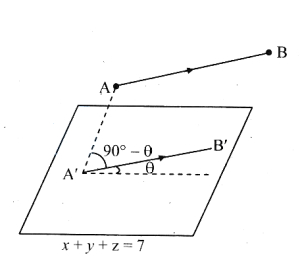
The length of the projection of the line segment joining the points $(5,-1,4)$ and $(4,-1,3)$ on the plane $x+y+z=7$ is
A
$\sqrt{\frac{2}{3}}$ units
B
$\frac{2}{\sqrt{3}}$ units
C
$\frac{2}{3}$ units
D
$\frac{\sqrt{2}}{3}$ units
Solution
(A) Let $A = (5, -1, 4)$ and $B = (4, -1, 3)$.
The vector $\vec{AB} = (4-5)\hat{i} + (-1-(-1))\hat{j} + (3-4)\hat{k} = -\hat{i} - \hat{k}$.
The magnitude of the vector is $|\vec{AB}| = \sqrt{(-1)^2 + 0^2 + (-1)^2} = \sqrt{2}$.
The normal vector to the plane $x+y+z=7$ is $\vec{n} = \hat{i} + \hat{j} + \hat{k}$.
Let $\theta$ be the angle between the line segment $AB$ and the plane. The angle $\phi$ between the line segment and the normal to the plane is given by $\cos \phi = \frac{|\vec{AB} \cdot \vec{n}|}{|\vec{AB}| |\vec{n}|}$.
$\cos \phi = \frac{|(-1)(1) + (0)(1) + (-1)(1)|}{\sqrt{2} \sqrt{1^2+1^2+1^2}} = \frac{|-2|}{\sqrt{2} \sqrt{3}} = \frac{2}{\sqrt{6}} = \sqrt{\frac{2}{3}}$.
Since $\phi$ is the angle with the normal,the angle $\theta$ with the plane is $90^\circ - \phi$,so $\sin \theta = \cos \phi = \sqrt{\frac{2}{3}}$.
Then $\cos \theta = \sqrt{1 - \sin^2 \theta} = \sqrt{1 - \frac{2}{3}} = \sqrt{\frac{1}{3}}$.
The length of the projection of the line segment on the plane is $|\vec{AB}| \cos \theta = \sqrt{2} \times \sqrt{\frac{1}{3}} = \sqrt{\frac{2}{3}}$ units.
The vector $\vec{AB} = (4-5)\hat{i} + (-1-(-1))\hat{j} + (3-4)\hat{k} = -\hat{i} - \hat{k}$.
The magnitude of the vector is $|\vec{AB}| = \sqrt{(-1)^2 + 0^2 + (-1)^2} = \sqrt{2}$.
The normal vector to the plane $x+y+z=7$ is $\vec{n} = \hat{i} + \hat{j} + \hat{k}$.
Let $\theta$ be the angle between the line segment $AB$ and the plane. The angle $\phi$ between the line segment and the normal to the plane is given by $\cos \phi = \frac{|\vec{AB} \cdot \vec{n}|}{|\vec{AB}| |\vec{n}|}$.
$\cos \phi = \frac{|(-1)(1) + (0)(1) + (-1)(1)|}{\sqrt{2} \sqrt{1^2+1^2+1^2}} = \frac{|-2|}{\sqrt{2} \sqrt{3}} = \frac{2}{\sqrt{6}} = \sqrt{\frac{2}{3}}$.
Since $\phi$ is the angle with the normal,the angle $\theta$ with the plane is $90^\circ - \phi$,so $\sin \theta = \cos \phi = \sqrt{\frac{2}{3}}$.
Then $\cos \theta = \sqrt{1 - \sin^2 \theta} = \sqrt{1 - \frac{2}{3}} = \sqrt{\frac{1}{3}}$.
The length of the projection of the line segment on the plane is $|\vec{AB}| \cos \theta = \sqrt{2} \times \sqrt{\frac{1}{3}} = \sqrt{\frac{2}{3}}$ units.
0 likesView Solution
460
MathematicsMediumMCQMHT CET · 2024
If the distance between the plane $Ax-2y+z=d$ and the plane containing the lines $\frac{x-1}{2}=\frac{y-2}{3}=\frac{z-3}{4}$ and $\frac{x-2}{3}=\frac{y-3}{4}=\frac{z-4}{5}$ is $\sqrt{6}$ units,then $|d|$ is
A
$1$
B
$2$
C
$\sqrt{6}$
D
$6$
Solution
(D) The equation of the plane containing the two given lines is given by the determinant form:
$\begin{vmatrix} x-1 & y-2 & z-3 \\ 2 & 3 & 4 \\ 3 & 4 & 5 \end{vmatrix} = 0$
Expanding along the first row:
$(x-1)(15-16) - (y-2)(10-12) + (z-3)(8-9) = 0$
$-(x-1) + 2(y-2) - (z-3) = 0$
$-x + 1 + 2y - 4 - z + 3 = 0$
$-x + 2y - z = 0 \implies x - 2y + z = 0$ ... $(i)$
Given the plane equation $Ax - 2y + z = d$ ... $(ii)$
Since the planes are parallel,the coefficients of $x, y, z$ must be proportional. Thus,$A = 1$.
The distance $D$ between two parallel planes $ax + by + cz = d_1$ and $ax + by + cz = d_2$ is given by $D = \frac{|d_1 - d_2|}{\sqrt{a^2 + b^2 + c^2}}$.
Here,$D = \sqrt{6}$,$a=1, b=-2, c=1$,$d_1 = 0$,and $d_2 = d$.
$\sqrt{6} = \frac{|0 - d|}{\sqrt{1^2 + (-2)^2 + 1^2}} = \frac{|d|}{\sqrt{6}}$
$|d| = \sqrt{6} \times \sqrt{6} = 6$.
$\begin{vmatrix} x-1 & y-2 & z-3 \\ 2 & 3 & 4 \\ 3 & 4 & 5 \end{vmatrix} = 0$
Expanding along the first row:
$(x-1)(15-16) - (y-2)(10-12) + (z-3)(8-9) = 0$
$-(x-1) + 2(y-2) - (z-3) = 0$
$-x + 1 + 2y - 4 - z + 3 = 0$
$-x + 2y - z = 0 \implies x - 2y + z = 0$ ... $(i)$
Given the plane equation $Ax - 2y + z = d$ ... $(ii)$
Since the planes are parallel,the coefficients of $x, y, z$ must be proportional. Thus,$A = 1$.
The distance $D$ between two parallel planes $ax + by + cz = d_1$ and $ax + by + cz = d_2$ is given by $D = \frac{|d_1 - d_2|}{\sqrt{a^2 + b^2 + c^2}}$.
Here,$D = \sqrt{6}$,$a=1, b=-2, c=1$,$d_1 = 0$,and $d_2 = d$.
$\sqrt{6} = \frac{|0 - d|}{\sqrt{1^2 + (-2)^2 + 1^2}} = \frac{|d|}{\sqrt{6}}$
$|d| = \sqrt{6} \times \sqrt{6} = 6$.
0 likesView Solution
461
MathematicsMediumMCQMHT CET · 2024
The equation of the plane,passing through the intersection of the planes $x+y+z=1$ and $2x+3y-z+4=0$ and parallel to $Y$-axis is
A
$x+4z-1=0$
B
$x+4z-7=0$
C
$x-4z+7=0$
D
$x-4z+1=0$
Solution
(B) The equation of any plane passing through the intersection of the planes $P_1: x+y+z-1=0$ and $P_2: 2x+3y-z+4=0$ is given by $P_1 + \lambda P_2 = 0$.
$(x+y+z-1) + \lambda(2x+3y-z+4) = 0$
$(1+2\lambda)x + (1+3\lambda)y + (1-\lambda)z + (4\lambda-1) = 0$
Since the plane is parallel to the $Y$-axis,its normal vector must be perpendicular to the $Y$-axis (which has direction vector $\vec{j} = (0, 1, 0)$).
Therefore,the coefficient of $y$ must be zero:
$1+3\lambda = 0 \Rightarrow \lambda = -\frac{1}{3}$
Substituting $\lambda = -\frac{1}{3}$ into the equation:
$(1 + 2(-\frac{1}{3}))x + (1 + 3(-\frac{1}{3}))y + (1 - (-\frac{1}{3}))z + (4(-\frac{1}{3}) - 1) = 0$
$(1 - \frac{2}{3})x + 0y + (1 + \frac{1}{3})z + (-\frac{4}{3} - 1) = 0$
$\frac{1}{3}x + \frac{4}{3}z - \frac{7}{3} = 0$
Multiplying by $3$,we get $x+4z-7=0$.
$(x+y+z-1) + \lambda(2x+3y-z+4) = 0$
$(1+2\lambda)x + (1+3\lambda)y + (1-\lambda)z + (4\lambda-1) = 0$
Since the plane is parallel to the $Y$-axis,its normal vector must be perpendicular to the $Y$-axis (which has direction vector $\vec{j} = (0, 1, 0)$).
Therefore,the coefficient of $y$ must be zero:
$1+3\lambda = 0 \Rightarrow \lambda = -\frac{1}{3}$
Substituting $\lambda = -\frac{1}{3}$ into the equation:
$(1 + 2(-\frac{1}{3}))x + (1 + 3(-\frac{1}{3}))y + (1 - (-\frac{1}{3}))z + (4(-\frac{1}{3}) - 1) = 0$
$(1 - \frac{2}{3})x + 0y + (1 + \frac{1}{3})z + (-\frac{4}{3} - 1) = 0$
$\frac{1}{3}x + \frac{4}{3}z - \frac{7}{3} = 0$
Multiplying by $3$,we get $x+4z-7=0$.
0 likesView Solution
462
MathematicsMediumMCQMHT CET · 2024
$A$ plane makes positive intercepts of unit length on each of $X$ and $Y$ axes. If it passes through the point $(-1, 1, 2)$ and makes an angle $\theta$ with the $X$-axis,then $\theta$ is
A
$\cos^{-1}\left(\frac{2}{3}\right)$
B
$\cos^{-1}\left(\frac{1}{3}\right)$
C
$\sin^{-1}\left(\frac{1}{3}\right)$
D
$\sin^{-1}\left(\frac{2}{3}\right)$
Solution
(D) The intercept form of the equation of a plane is $\frac{x}{a} + \frac{y}{b} + \frac{z}{c} = 1$.
Given $a = 1$ and $b = 1$,the equation becomes $x + y + \frac{z}{c} = 1$.
Since the plane passes through $(-1, 1, 2)$,we substitute these coordinates: $-1 + 1 + \frac{2}{c} = 1$,which gives $\frac{2}{c} = 1$,so $c = 2$.
The equation of the plane is $x + y + \frac{z}{2} = 1$,or $2x + 2y + z - 2 = 0$.
The normal vector to the plane is $\vec{n} = 2\hat{i} + 2\hat{j} + 1\hat{k}$.
The direction vector of the $X$-axis is $\vec{v} = 1\hat{i} + 0\hat{j} + 0\hat{k}$.
The angle $\theta$ between a line with direction vector $\vec{v}$ and a plane with normal $\vec{n}$ is given by $\sin \theta = \frac{|\vec{n} \cdot \vec{v}|}{|\vec{n}| |\vec{v}|}$.
$\sin \theta = \frac{|(2)(1) + (2)(0) + (1)(0)|}{\sqrt{2^2 + 2^2 + 1^2} \sqrt{1^2 + 0^2 + 0^2}} = \frac{2}{\sqrt{4 + 4 + 1} \cdot 1} = \frac{2}{\sqrt{9}} = \frac{2}{3}$.
Thus,$\theta = \sin^{-1}\left(\frac{2}{3}\right)$.
Given $a = 1$ and $b = 1$,the equation becomes $x + y + \frac{z}{c} = 1$.
Since the plane passes through $(-1, 1, 2)$,we substitute these coordinates: $-1 + 1 + \frac{2}{c} = 1$,which gives $\frac{2}{c} = 1$,so $c = 2$.
The equation of the plane is $x + y + \frac{z}{2} = 1$,or $2x + 2y + z - 2 = 0$.
The normal vector to the plane is $\vec{n} = 2\hat{i} + 2\hat{j} + 1\hat{k}$.
The direction vector of the $X$-axis is $\vec{v} = 1\hat{i} + 0\hat{j} + 0\hat{k}$.
The angle $\theta$ between a line with direction vector $\vec{v}$ and a plane with normal $\vec{n}$ is given by $\sin \theta = \frac{|\vec{n} \cdot \vec{v}|}{|\vec{n}| |\vec{v}|}$.
$\sin \theta = \frac{|(2)(1) + (2)(0) + (1)(0)|}{\sqrt{2^2 + 2^2 + 1^2} \sqrt{1^2 + 0^2 + 0^2}} = \frac{2}{\sqrt{4 + 4 + 1} \cdot 1} = \frac{2}{\sqrt{9}} = \frac{2}{3}$.
Thus,$\theta = \sin^{-1}\left(\frac{2}{3}\right)$.
0 likesView Solution
463
MathematicsMediumMCQMHT CET · 2024
If the line $\frac{x-3}{2}=\frac{y+2}{-1}=\frac{z+4}{3}$ lies in the plane $\ell x+m y-z=9$,then $\ell^2+m^2$ is
A
$1$
B
$4$
C
$2$
D
$5$
Solution
(C) Since the line lies in the plane,the direction vector of the line is perpendicular to the normal vector of the plane. The direction vector of the line is $\vec{v} = 2\hat{i} - \hat{j} + 3\hat{k}$ and the normal to the plane is $\vec{n} = \ell\hat{i} + m\hat{j} - \hat{k}$.
Thus,$\vec{v} \cdot \vec{n} = 0 \Rightarrow (2)(\ell) + (-1)(m) + (3)(-1) = 0 \Rightarrow 2\ell - m = 3$ (Equation $i$).
Also,any point on the line must satisfy the plane equation. The point $(3, -2, -4)$ lies on the line,so it must lie on the plane:
$\ell(3) + m(-2) - (-4) = 9 \Rightarrow 3\ell - 2m + 4 = 9 \Rightarrow 3\ell - 2m = 5$ (Equation $ii$).
Solving the system of equations:
From $(i)$,$m = 2\ell - 3$. Substituting into $(ii)$:
$3\ell - 2(2\ell - 3) = 5 \Rightarrow 3\ell - 4\ell + 6 = 5 \Rightarrow -\ell = -1 \Rightarrow \ell = 1$.
Then $m = 2(1) - 3 = -1$.
Therefore,$\ell^2 + m^2 = (1)^2 + (-1)^2 = 1 + 1 = 2$.
Thus,$\vec{v} \cdot \vec{n} = 0 \Rightarrow (2)(\ell) + (-1)(m) + (3)(-1) = 0 \Rightarrow 2\ell - m = 3$ (Equation $i$).
Also,any point on the line must satisfy the plane equation. The point $(3, -2, -4)$ lies on the line,so it must lie on the plane:
$\ell(3) + m(-2) - (-4) = 9 \Rightarrow 3\ell - 2m + 4 = 9 \Rightarrow 3\ell - 2m = 5$ (Equation $ii$).
Solving the system of equations:
From $(i)$,$m = 2\ell - 3$. Substituting into $(ii)$:
$3\ell - 2(2\ell - 3) = 5 \Rightarrow 3\ell - 4\ell + 6 = 5 \Rightarrow -\ell = -1 \Rightarrow \ell = 1$.
Then $m = 2(1) - 3 = -1$.
Therefore,$\ell^2 + m^2 = (1)^2 + (-1)^2 = 1 + 1 = 2$.
0 likesView Solution
464
MathematicsMediumMCQMHT CET · 2024
The image of the line $\frac{x-1}{3}=\frac{y-3}{1}=\frac{z-4}{-5}$ in the plane $2x-y+z+3=0$ is the line
A
$\frac{x+3}{-3}=\frac{y-5}{-1}=\frac{z+2}{5}$
B
$\frac{x-3}{3}=\frac{y+5}{1}=\frac{z-2}{-5}$
C
$\frac{x-3}{-3}=\frac{y+5}{-1}=\frac{z-2}{5}$
D
$\frac{x+3}{3}=\frac{y-5}{1}=\frac{z-2}{-5}$
Solution
(D) Let the given line be $L: \frac{x-1}{3}=\frac{y-3}{1}=\frac{z-4}{-5} = k$. Any point on $L$ is $(3k+1, k+3, -5k+4)$.
For the intersection point of $L$ and the plane $2x-y+z+3=0$,we have $2(3k+1)-(k+3)+(-5k+4)+3=0$.
$6k+2-k-3-5k+4+3=0 \implies 6=0$,which is impossible. Thus,the line is parallel to the plane.
The image of point $P(1, 3, 4)$ on the line in the plane $2x-y+z+3=0$ is $P'(x', y', z')$.
Using the formula $\frac{x'-1}{2} = \frac{y'-3}{-1} = \frac{z'-4}{1} = -2 \frac{2(1)-3+4+3}{2^2+(-1)^2+1^2} = -2 \frac{6}{6} = -2$.
$x'-1 = -4 \implies x' = -3$.
$y'-3 = 2 \implies y' = 5$.
$z'-4 = -2 \implies z' = 2$.
The image line passes through $(-3, 5, 2)$ and has the same direction ratios $(3, 1, -5)$ as the original line.
Thus,the equation is $\frac{x+3}{3} = \frac{y-5}{1} = \frac{z-2}{-5}$.
For the intersection point of $L$ and the plane $2x-y+z+3=0$,we have $2(3k+1)-(k+3)+(-5k+4)+3=0$.
$6k+2-k-3-5k+4+3=0 \implies 6=0$,which is impossible. Thus,the line is parallel to the plane.
The image of point $P(1, 3, 4)$ on the line in the plane $2x-y+z+3=0$ is $P'(x', y', z')$.
Using the formula $\frac{x'-1}{2} = \frac{y'-3}{-1} = \frac{z'-4}{1} = -2 \frac{2(1)-3+4+3}{2^2+(-1)^2+1^2} = -2 \frac{6}{6} = -2$.
$x'-1 = -4 \implies x' = -3$.
$y'-3 = 2 \implies y' = 5$.
$z'-4 = -2 \implies z' = 2$.
The image line passes through $(-3, 5, 2)$ and has the same direction ratios $(3, 1, -5)$ as the original line.
Thus,the equation is $\frac{x+3}{3} = \frac{y-5}{1} = \frac{z-2}{-5}$.
0 likesView Solution
465
MathematicsEasyMCQMHT CET · 2024
The value of $m$,such that the line $\frac{x-4}{1}=\frac{y-2}{1}=\frac{2z-m}{3}$ lies in the plane $2x-5y+2z=7$,is
A
$8$
B
$10$
C
$9$
D
$7$
Solution
(C) The given line is $\frac{x-4}{1} = \frac{y-2}{1} = \frac{z - m/2}{3/2}$.
This line passes through the point $P(4, 2, m/2)$.
Since the line lies in the plane $2x - 5y + 2z = 7$,the point $P$ must satisfy the equation of the plane.
Substituting the coordinates of $P$ into the plane equation:
$2(4) - 5(2) + 2(m/2) = 7$
$8 - 10 + m = 7$
$-2 + m = 7$
$m = 9$
Also,the direction vector of the line $\vec{v} = (1, 1, 3/2)$ must be perpendicular to the normal of the plane $\vec{n} = (2, -5, 2)$.
Checking the dot product: $\vec{v} \cdot \vec{n} = (1)(2) + (1)(-5) + (3/2)(2) = 2 - 5 + 3 = 0$.
Since the dot product is $0$,the line is parallel to the plane,and since the point $P$ lies on the plane,the entire line lies in the plane for $m = 9$.
This line passes through the point $P(4, 2, m/2)$.
Since the line lies in the plane $2x - 5y + 2z = 7$,the point $P$ must satisfy the equation of the plane.
Substituting the coordinates of $P$ into the plane equation:
$2(4) - 5(2) + 2(m/2) = 7$
$8 - 10 + m = 7$
$-2 + m = 7$
$m = 9$
Also,the direction vector of the line $\vec{v} = (1, 1, 3/2)$ must be perpendicular to the normal of the plane $\vec{n} = (2, -5, 2)$.
Checking the dot product: $\vec{v} \cdot \vec{n} = (1)(2) + (1)(-5) + (3/2)(2) = 2 - 5 + 3 = 0$.
Since the dot product is $0$,the line is parallel to the plane,and since the point $P$ lies on the plane,the entire line lies in the plane for $m = 9$.
0 likesView Solution
466
MathematicsEasyMCQMHT CET · 2024
On which of the following lines does the point of intersection of the line $\frac{x-4}{2}=\frac{y-5}{2}=\frac{z-3}{1}$ and the plane $x+y+z=2$ lie?
A
$\frac{x-1}{1}=\frac{y-3}{2}=\frac{z+4}{-5}$
B
$\frac{x-4}{1}=\frac{y-5}{1}=\frac{z-5}{-1}$
C
$\frac{x-2}{2}=\frac{y-3}{2}=\frac{z+3}{3}$
D
$\frac{x+3}{3}=\frac{4-y}{3}=\frac{z+1}{-2}$
Solution
(A) Let the line be $\frac{x-4}{2}=\frac{y-5}{2}=\frac{z-3}{1}=\lambda$.
Any point on this line is given by $(2\lambda+4, 2\lambda+5, \lambda+3)$.
Since this point lies on the plane $x+y+z=2$,we substitute the coordinates into the plane equation:
$(2\lambda+4) + (2\lambda+5) + (\lambda+3) = 2$.
$5\lambda + 12 = 2$.
$5\lambda = -10$,so $\lambda = -2$.
Substituting $\lambda = -2$ back into the point coordinates:
$x = 2(-2) + 4 = 0$,
$y = 2(-2) + 5 = 1$,
$z = (-2) + 3 = 1$.
The point of intersection is $(0, 1, 1)$.
Now,check which option satisfies the point $(0, 1, 1)$:
For option $(A)$: $\frac{0-1}{1} = -1$,$\frac{1-3}{2} = -1$,$\frac{1+4}{-5} = -1$.
Since all ratios are equal to $-1$,the point $(0, 1, 1)$ lies on the line given in option $(A)$.
Any point on this line is given by $(2\lambda+4, 2\lambda+5, \lambda+3)$.
Since this point lies on the plane $x+y+z=2$,we substitute the coordinates into the plane equation:
$(2\lambda+4) + (2\lambda+5) + (\lambda+3) = 2$.
$5\lambda + 12 = 2$.
$5\lambda = -10$,so $\lambda = -2$.
Substituting $\lambda = -2$ back into the point coordinates:
$x = 2(-2) + 4 = 0$,
$y = 2(-2) + 5 = 1$,
$z = (-2) + 3 = 1$.
The point of intersection is $(0, 1, 1)$.
Now,check which option satisfies the point $(0, 1, 1)$:
For option $(A)$: $\frac{0-1}{1} = -1$,$\frac{1-3}{2} = -1$,$\frac{1+4}{-5} = -1$.
Since all ratios are equal to $-1$,the point $(0, 1, 1)$ lies on the line given in option $(A)$.
0 likesView Solution
467
MathematicsEasyMCQMHT CET · 2024
The lines $\frac{x-2}{1}=\frac{y-3}{1}=\frac{z-4}{-k}$ and $\frac{x-1}{k}=\frac{y-4}{2}=\frac{z-5}{1}$ are coplanar if
A
$k=1$ or $k=-1$
B
$k=0$ or $k=-3$
C
$k=3$ or $k=-3$
D
$k=0$ or $k=3$
Solution
(B) Two lines $\frac{x-x_1}{a_1} = \frac{y-y_1}{b_1} = \frac{z-z_1}{c_1}$ and $\frac{x-x_2}{a_2} = \frac{y-y_2}{b_2} = \frac{z-z_2}{c_2}$ are coplanar if $\left|\begin{array}{ccc} x_2-x_1 & y_2-y_1 & z_2-z_1 \\ a_1 & b_1 & c_1 \\ a_2 & b_2 & c_2 \end{array}\right| = 0$.
Here,$(x_1, y_1, z_1) = (2, 3, 4)$,$(a_1, b_1, c_1) = (1, 1, -k)$,$(x_2, y_2, z_2) = (1, 4, 5)$,and $(a_2, b_2, c_2) = (k, 2, 1)$.
Substituting these values into the determinant condition:
$\left|\begin{array}{ccc} 1-2 & 4-3 & 5-4 \\ 1 & 1 & -k \\ k & 2 & 1 \end{array}\right| = 0$
$\left|\begin{array}{ccc} -1 & 1 & 1 \\ 1 & 1 & -k \\ k & 2 & 1 \end{array}\right| = 0$
Expanding the determinant along the first row:
$-1(1 - (-2k)) - 1(1 - (-k^2)) + 1(2 - k) = 0$
$-1(1 + 2k) - 1(1 + k^2) + 2 - k = 0$
$-1 - 2k - 1 - k^2 + 2 - k = 0$
$-k^2 - 3k = 0$
$k^2 + 3k = 0$
$k(k + 3) = 0$
Therefore,$k = 0$ or $k = -3$.
Here,$(x_1, y_1, z_1) = (2, 3, 4)$,$(a_1, b_1, c_1) = (1, 1, -k)$,$(x_2, y_2, z_2) = (1, 4, 5)$,and $(a_2, b_2, c_2) = (k, 2, 1)$.
Substituting these values into the determinant condition:
$\left|\begin{array}{ccc} 1-2 & 4-3 & 5-4 \\ 1 & 1 & -k \\ k & 2 & 1 \end{array}\right| = 0$
$\left|\begin{array}{ccc} -1 & 1 & 1 \\ 1 & 1 & -k \\ k & 2 & 1 \end{array}\right| = 0$
Expanding the determinant along the first row:
$-1(1 - (-2k)) - 1(1 - (-k^2)) + 1(2 - k) = 0$
$-1(1 + 2k) - 1(1 + k^2) + 2 - k = 0$
$-1 - 2k - 1 - k^2 + 2 - k = 0$
$-k^2 - 3k = 0$
$k^2 + 3k = 0$
$k(k + 3) = 0$
Therefore,$k = 0$ or $k = -3$.
0 likesView Solution
468
MathematicsMediumMCQMHT CET · 2024
The coordinates of the point where the line passing through $A(3, 4, 1)$ and $B(5, 1, 6)$ crosses the $xy$-plane are
A
$\left(\frac{13}{5}, \frac{23}{5}, 0\right)$
B
$\left(-\frac{13}{5}, \frac{23}{5}, 0\right)$
C
$\left(\frac{13}{5}, -\frac{23}{5}, 0\right)$
D
$\left(-\frac{13}{5}, -\frac{23}{5}, 0\right)$
Solution
(A) Let $A(x_1, y_1, z_1) = (3, 4, 1)$ and $B(x_2, y_2, z_2) = (5, 1, 6)$.
The equation of the line passing through two points is $\frac{x-x_1}{x_2-x_1} = \frac{y-y_1}{y_2-y_1} = \frac{z-z_1}{z_2-z_1}$.
Substituting the values,we get $\frac{x-3}{5-3} = \frac{y-4}{1-4} = \frac{z-1}{6-1}$,which simplifies to $\frac{x-3}{2} = \frac{y-4}{-3} = \frac{z-1}{5} = k$.
Since the line crosses the $xy$-plane,the $z$-coordinate must be $0$.
Setting $z = 0$,we have $\frac{0-1}{5} = k$,so $k = -\frac{1}{5}$.
Now,find $x$ and $y$ using $k = -\frac{1}{5}$:
$x - 3 = 2k \Rightarrow x = 3 + 2(-\frac{1}{5}) = 3 - \frac{2}{5} = \frac{13}{5}$.
$y - 4 = -3k \Rightarrow y = 4 - 3(-\frac{1}{5}) = 4 + \frac{3}{5} = \frac{23}{5}$.
Thus,the required point is $\left(\frac{13}{5}, \frac{23}{5}, 0\right)$.
The equation of the line passing through two points is $\frac{x-x_1}{x_2-x_1} = \frac{y-y_1}{y_2-y_1} = \frac{z-z_1}{z_2-z_1}$.
Substituting the values,we get $\frac{x-3}{5-3} = \frac{y-4}{1-4} = \frac{z-1}{6-1}$,which simplifies to $\frac{x-3}{2} = \frac{y-4}{-3} = \frac{z-1}{5} = k$.
Since the line crosses the $xy$-plane,the $z$-coordinate must be $0$.
Setting $z = 0$,we have $\frac{0-1}{5} = k$,so $k = -\frac{1}{5}$.
Now,find $x$ and $y$ using $k = -\frac{1}{5}$:
$x - 3 = 2k \Rightarrow x = 3 + 2(-\frac{1}{5}) = 3 - \frac{2}{5} = \frac{13}{5}$.
$y - 4 = -3k \Rightarrow y = 4 - 3(-\frac{1}{5}) = 4 + \frac{3}{5} = \frac{23}{5}$.
Thus,the required point is $\left(\frac{13}{5}, \frac{23}{5}, 0\right)$.
0 likesView Solution
469
MathematicsMediumMCQMHT CET · 2024
$A$ line with positive direction cosines passes through the point $P(2,1,2)$ and makes equal angles with the coordinate axes. The line meets the plane $2x+y+z=9$ at point $Q$. The length of the line segment $PQ$ equals $\qquad$ units.
A
$\frac{5}{\sqrt{3}}$
B
$\frac{\sqrt{3}}{2}$
C
$\frac{4}{\sqrt{3}}$
D
$4\sqrt{3}$
Solution
(B) $1$. Direction Cosines: Since the line makes equal angles with the coordinate axes,its direction ratios are proportional to $(1, 1, 1)$.
$2$. Equation of the Line: The parametric form of the line passing through $P(2, 1, 2)$ with direction ratios $(1, 1, 1)$ is:
$\frac{x-2}{1} = \frac{y-1}{1} = \frac{z-2}{1} = t$
Thus,$x = 2+t, y = 1+t, z = 2+t$.
$3$. Point of Intersection with Plane: Substituting these into the plane equation $2x+y+z=9$:
$2(2+t) + (1+t) + (2+t) = 9$
$4 + 2t + 1 + t + 2 + t = 9$
$4t + 7 = 9 \Rightarrow 4t = 2 \Rightarrow t = \frac{1}{2}$.
$4$. Coordinates of $Q$: Substituting $t = \frac{1}{2}$ back,we get $Q = (2+\frac{1}{2}, 1+\frac{1}{2}, 2+\frac{1}{2}) = (\frac{5}{2}, \frac{3}{2}, \frac{5}{2})$.
$5$. Length of $PQ$: Using the distance formula:
$PQ = \sqrt{(\frac{5}{2}-2)^2 + (\frac{3}{2}-1)^2 + (\frac{5}{2}-2)^2}$
$PQ = \sqrt{(\frac{1}{2})^2 + (\frac{1}{2})^2 + (\frac{1}{2})^2} = \sqrt{\frac{3}{4}} = \frac{\sqrt{3}}{2}$ units.
$2$. Equation of the Line: The parametric form of the line passing through $P(2, 1, 2)$ with direction ratios $(1, 1, 1)$ is:
$\frac{x-2}{1} = \frac{y-1}{1} = \frac{z-2}{1} = t$
Thus,$x = 2+t, y = 1+t, z = 2+t$.
$3$. Point of Intersection with Plane: Substituting these into the plane equation $2x+y+z=9$:
$2(2+t) + (1+t) + (2+t) = 9$
$4 + 2t + 1 + t + 2 + t = 9$
$4t + 7 = 9 \Rightarrow 4t = 2 \Rightarrow t = \frac{1}{2}$.
$4$. Coordinates of $Q$: Substituting $t = \frac{1}{2}$ back,we get $Q = (2+\frac{1}{2}, 1+\frac{1}{2}, 2+\frac{1}{2}) = (\frac{5}{2}, \frac{3}{2}, \frac{5}{2})$.
$5$. Length of $PQ$: Using the distance formula:
$PQ = \sqrt{(\frac{5}{2}-2)^2 + (\frac{3}{2}-1)^2 + (\frac{5}{2}-2)^2}$
$PQ = \sqrt{(\frac{1}{2})^2 + (\frac{1}{2})^2 + (\frac{1}{2})^2} = \sqrt{\frac{3}{4}} = \frac{\sqrt{3}}{2}$ units.
0 likesView Solution
470
MathematicsEasyMCQMHT CET · 2024
The value of $m$ such that the line $\frac{x-4}{1}=\frac{y-2}{1}=\frac{z+m}{2}$ lies in the plane $2x-4y+z=7$ is
A
$7$
B
$-7$
C
no real value
D
$4$
Solution
(B) For a line to lie in a plane,every point on the line must satisfy the equation of the plane. The line $\frac{x-4}{1}=\frac{y-2}{1}=\frac{z+m}{2}$ passes through the point $(4, 2, -m)$.
Substituting this point into the plane equation $2x - 4y + z = 7$:
$2(4) - 4(2) + (-m) = 7$
$8 - 8 - m = 7$
$-m = 7$
$m = -7$
Additionally,the normal vector of the plane $\vec{n} = (2, -4, 1)$ must be perpendicular to the direction vector of the line $\vec{v} = (1, 1, 2)$.
Checking the dot product: $(2)(1) + (-4)(1) + (1)(2) = 2 - 4 + 2 = 0$.
Since the dot product is $0$,the line is parallel to the plane. Since the point $(4, 2, -m)$ lies on the plane for $m = -7$,the entire line lies in the plane.
Substituting this point into the plane equation $2x - 4y + z = 7$:
$2(4) - 4(2) + (-m) = 7$
$8 - 8 - m = 7$
$-m = 7$
$m = -7$
Additionally,the normal vector of the plane $\vec{n} = (2, -4, 1)$ must be perpendicular to the direction vector of the line $\vec{v} = (1, 1, 2)$.
Checking the dot product: $(2)(1) + (-4)(1) + (1)(2) = 2 - 4 + 2 = 0$.
Since the dot product is $0$,the line is parallel to the plane. Since the point $(4, 2, -m)$ lies on the plane for $m = -7$,the entire line lies in the plane.
0 likesView Solution
471
MathematicsEasyMCQMHT CET · 2024
If the line $\frac{x-2}{3}=\frac{y-1}{-5}=\frac{z+2}{2}$ lies in the plane $x+3y-\alpha z+\beta=0$,then $(\alpha, \beta)=$
A
$(6,-7)$
B
$(-6,7)$
C
$(5,-15)$
D
$(-5,15)$
Solution
(B) The given equation of the line is $\frac{x-2}{3}=\frac{y-1}{-5}=\frac{z+2}{2}$.
This line passes through the point $P(2, 1, -2)$.
Since the line lies in the plane $x+3y-\alpha z+\beta=0$,the point $P$ must satisfy the plane equation:
$2 + 3(1) - \alpha(-2) + \beta = 0$
$2 + 3 + 2\alpha + \beta = 0$
$2\alpha + \beta = -5$ $(i)$
Also,the direction vector of the line $\vec{v} = (3, -5, 2)$ is perpendicular to the normal vector of the plane $\vec{n} = (1, 3, -\alpha)$.
Therefore,their dot product is zero:
$3(1) + (-5)(3) + 2(-\alpha) = 0$
$3 - 15 - 2\alpha = 0$
$-12 - 2\alpha = 0$
$2\alpha = -12 \implies \alpha = -6$
Substituting $\alpha = -6$ into equation $(i)$:
$2(-6) + \beta = -5$
$-12 + \beta = -5$
$\beta = 7$
Thus,$(\alpha, \beta) = (-6, 7)$.
This line passes through the point $P(2, 1, -2)$.
Since the line lies in the plane $x+3y-\alpha z+\beta=0$,the point $P$ must satisfy the plane equation:
$2 + 3(1) - \alpha(-2) + \beta = 0$
$2 + 3 + 2\alpha + \beta = 0$
$2\alpha + \beta = -5$ $(i)$
Also,the direction vector of the line $\vec{v} = (3, -5, 2)$ is perpendicular to the normal vector of the plane $\vec{n} = (1, 3, -\alpha)$.
Therefore,their dot product is zero:
$3(1) + (-5)(3) + 2(-\alpha) = 0$
$3 - 15 - 2\alpha = 0$
$-12 - 2\alpha = 0$
$2\alpha = -12 \implies \alpha = -6$
Substituting $\alpha = -6$ into equation $(i)$:
$2(-6) + \beta = -5$
$-12 + \beta = -5$
$\beta = 7$
Thus,$(\alpha, \beta) = (-6, 7)$.
0 likesView Solution
472
MathematicsEasyMCQMHT CET · 2024
If the line,$\frac{x-3}{2}=\frac{y+2}{1}=\frac{z+4}{3}$ lies in the plane,$\ell x+m y-z=9$,then $\ell^2+m^2$ is equal to
A
$\frac{124}{49}$
B
$\frac{123}{49}$
C
$\frac{121}{49}$
D
$\frac{122}{49}$
Solution
(D) Since the line lies in the plane,the direction vector of the line is perpendicular to the normal vector of the plane. The direction vector of the line is $\vec{v} = 2\hat{i} + \hat{j} + 3\hat{k}$ and the normal to the plane is $\vec{n} = \ell\hat{i} + m\hat{j} - \hat{k}$.
Thus,$\vec{v} \cdot \vec{n} = 0 \Rightarrow 2\ell + m - 3 = 0$,which gives $2\ell + m = 3$ (Equation $i$).
Also,any point on the line must lie on the plane. The point $(3, -2, -4)$ lies on the line,so it must satisfy the plane equation $\ell x + my - z = 9$.
Substituting the point: $3\ell - 2m - (-4) = 9 \Rightarrow 3\ell - 2m = 5$ (Equation $ii$).
Solving the system of equations:
From $(i)$,$m = 3 - 2\ell$. Substituting into $(ii)$:
$3\ell - 2(3 - 2\ell) = 5 \Rightarrow 3\ell - 6 + 4\ell = 5 \Rightarrow 7\ell = 11 \Rightarrow \ell = \frac{11}{7}$.
Then $m = 3 - 2(\frac{11}{7}) = \frac{21 - 22}{7} = -\frac{1}{7}$.
Finally,$\ell^2 + m^2 = (\frac{11}{7})^2 + (-\frac{1}{7})^2 = \frac{121}{49} + \frac{1}{49} = \frac{122}{49}$.
Thus,$\vec{v} \cdot \vec{n} = 0 \Rightarrow 2\ell + m - 3 = 0$,which gives $2\ell + m = 3$ (Equation $i$).
Also,any point on the line must lie on the plane. The point $(3, -2, -4)$ lies on the line,so it must satisfy the plane equation $\ell x + my - z = 9$.
Substituting the point: $3\ell - 2m - (-4) = 9 \Rightarrow 3\ell - 2m = 5$ (Equation $ii$).
Solving the system of equations:
From $(i)$,$m = 3 - 2\ell$. Substituting into $(ii)$:
$3\ell - 2(3 - 2\ell) = 5 \Rightarrow 3\ell - 6 + 4\ell = 5 \Rightarrow 7\ell = 11 \Rightarrow \ell = \frac{11}{7}$.
Then $m = 3 - 2(\frac{11}{7}) = \frac{21 - 22}{7} = -\frac{1}{7}$.
Finally,$\ell^2 + m^2 = (\frac{11}{7})^2 + (-\frac{1}{7})^2 = \frac{121}{49} + \frac{1}{49} = \frac{122}{49}$.
0 likesView Solution
473
MathematicsEasyMCQMHT CET · 2024
The plane $2x + 3y + 4z = 1$ meets the $X$-axis at $A$,the $Y$-axis at $B$,and the $Z$-axis at $C$. Then the centroid of $\triangle ABC$ is:
A
$(2, 3, 4)$
B
$(\frac{1}{2}, \frac{1}{3}, \frac{1}{4})$
C
$(\frac{1}{6}, \frac{1}{9}, \frac{1}{12})$
D
$(\frac{3}{2}, 1, \frac{3}{4})$
Solution
(C) The equation of the plane is $2x + 3y + 4z = 1$.
To find the intersection with the $X$-axis,set $y = 0$ and $z = 0$: $2x = 1 \implies x = \frac{1}{2}$. Thus,$A = (\frac{1}{2}, 0, 0)$.
To find the intersection with the $Y$-axis,set $x = 0$ and $z = 0$: $3y = 1 \implies y = \frac{1}{3}$. Thus,$B = (0, \frac{1}{3}, 0)$.
To find the intersection with the $Z$-axis,set $x = 0$ and $y = 0$: $4z = 1 \implies z = \frac{1}{4}$. Thus,$C = (0, 0, \frac{1}{4})$.
The centroid of $\triangle ABC$ with vertices $(x_1, y_1, z_1)$,$(x_2, y_2, z_2)$,and $(x_3, y_3, z_3)$ is given by $(\frac{x_1+x_2+x_3}{3}, \frac{y_1+y_2+y_3}{3}, \frac{z_1+z_2+z_3}{3})$.
Substituting the coordinates:
Centroid $= (\frac{1/2 + 0 + 0}{3}, \frac{0 + 1/3 + 0}{3}, \frac{0 + 0 + 1/4}{3}) = (\frac{1}{6}, \frac{1}{9}, \frac{1}{12})$.
To find the intersection with the $X$-axis,set $y = 0$ and $z = 0$: $2x = 1 \implies x = \frac{1}{2}$. Thus,$A = (\frac{1}{2}, 0, 0)$.
To find the intersection with the $Y$-axis,set $x = 0$ and $z = 0$: $3y = 1 \implies y = \frac{1}{3}$. Thus,$B = (0, \frac{1}{3}, 0)$.
To find the intersection with the $Z$-axis,set $x = 0$ and $y = 0$: $4z = 1 \implies z = \frac{1}{4}$. Thus,$C = (0, 0, \frac{1}{4})$.
The centroid of $\triangle ABC$ with vertices $(x_1, y_1, z_1)$,$(x_2, y_2, z_2)$,and $(x_3, y_3, z_3)$ is given by $(\frac{x_1+x_2+x_3}{3}, \frac{y_1+y_2+y_3}{3}, \frac{z_1+z_2+z_3}{3})$.
Substituting the coordinates:
Centroid $= (\frac{1/2 + 0 + 0}{3}, \frac{0 + 1/3 + 0}{3}, \frac{0 + 0 + 1/4}{3}) = (\frac{1}{6}, \frac{1}{9}, \frac{1}{12})$.
0 likesView Solution
474
MathematicsDifficultMCQMHT CET · 2024
Let $P(3, 2, 6)$ be a point in space and $Q$ be a point on the line $\vec{r} = (\hat{i} - \hat{j} + 2\hat{k}) + \mu(-3\hat{i} + \hat{j} + 5\hat{k})$. Then the value of $\mu$ for which the vector $\vec{PQ}$ is parallel to the plane $x - 4y + 3z = 1$ is
A
$\frac{1}{4}$
B
$-\frac{1}{4}$
C
$\frac{1}{8}$
D
$-\frac{1}{8}$
Solution
(A) The position vector of point $Q$ on the line is given by $\vec{q} = (1 - 3\mu)\hat{i} + (-1 + \mu)\hat{j} + (2 + 5\mu)\hat{k}$.
Given point $P$ is $(3, 2, 6)$,so its position vector is $\vec{p} = 3\hat{i} + 2\hat{j} + 6\hat{k}$.
The vector $\vec{PQ} = \vec{q} - \vec{p} = (-3\mu - 2)\hat{i} + (\mu - 3)\hat{j} + (5\mu - 4)\hat{k}$.
The normal vector to the plane $x - 4y + 3z = 1$ is $\vec{n} = \hat{i} - 4\hat{j} + 3\hat{k}$.
Since $\vec{PQ}$ is parallel to the plane,it must be perpendicular to the normal vector $\vec{n}$,so $\vec{PQ} \cdot \vec{n} = 0$.
$(-3\mu - 2)(1) + (\mu - 3)(-4) + (5\mu - 4)(3) = 0$.
$-3\mu - 2 - 4\mu + 12 + 15\mu - 12 = 0$.
$8\mu - 2 = 0$.
$8\mu = 2 \Rightarrow \mu = \frac{2}{8} = \frac{1}{4}$.
Given point $P$ is $(3, 2, 6)$,so its position vector is $\vec{p} = 3\hat{i} + 2\hat{j} + 6\hat{k}$.
The vector $\vec{PQ} = \vec{q} - \vec{p} = (-3\mu - 2)\hat{i} + (\mu - 3)\hat{j} + (5\mu - 4)\hat{k}$.
The normal vector to the plane $x - 4y + 3z = 1$ is $\vec{n} = \hat{i} - 4\hat{j} + 3\hat{k}$.
Since $\vec{PQ}$ is parallel to the plane,it must be perpendicular to the normal vector $\vec{n}$,so $\vec{PQ} \cdot \vec{n} = 0$.
$(-3\mu - 2)(1) + (\mu - 3)(-4) + (5\mu - 4)(3) = 0$.
$-3\mu - 2 - 4\mu + 12 + 15\mu - 12 = 0$.
$8\mu - 2 = 0$.
$8\mu = 2 \Rightarrow \mu = \frac{2}{8} = \frac{1}{4}$.
0 likesView Solution
475
MathematicsMediumMCQMHT CET · 2024
If for some $\alpha \in R$,the lines $L_1: \frac{x+1}{2}=\frac{y-2}{-1}=\frac{z-1}{1}$ and $L_2: \frac{x+2}{\alpha}=\frac{y+1}{5-\alpha}=\frac{z+1}{1}$ are coplanar,then the line $L_2$ passes through the point
A
$(10,2,2)$
B
$(2,-10,-2)$
C
$(10,-2,-2)$
D
$(-2,10,2)$
Solution
(B) The lines $L_1$ and $L_2$ are coplanar if the determinant of the vector connecting a point on each line and their direction vectors is zero.
Given points: $P_1 = (-1, 2, 1)$ and $P_2 = (-2, -1, -1)$.
Direction vectors: $\vec{v_1} = (2, -1, 1)$ and $\vec{v_2} = (\alpha, 5-\alpha, 1)$.
The condition for coplanarity is:
$\begin{vmatrix} x_2-x_1 & y_2-y_1 & z_2-z_1 \\ a_1 & b_1 & c_1 \\ a_2 & b_2 & c_2 \end{vmatrix} = 0$
$\begin{vmatrix} -2-(-1) & -1-2 & -1-1 \\ 2 & -1 & 1 \\ \alpha & 5-\alpha & 1 \end{vmatrix} = 0$
$\begin{vmatrix} -1 & -3 & -2 \\ 2 & -1 & 1 \\ \alpha & 5-\alpha & 1 \end{vmatrix} = 0$
Expanding the determinant:
$-1(-1 - (5-\alpha)) + 3(2 - \alpha) - 2(2(5-\alpha) - (-1)\alpha) = 0$
$-1(-6+\alpha) + 6 - 3\alpha - 2(10 - 2\alpha + \alpha) = 0$
$6 - \alpha + 6 - 3\alpha - 20 + 2\alpha = 0$
$-2\alpha - 8 = 0 \Rightarrow \alpha = -4$.
Substituting $\alpha = -4$ into $L_2$:
$L_2: \frac{x+2}{-4} = \frac{y+1}{5-(-4)} = \frac{z+1}{1} \Rightarrow \frac{x+2}{-4} = \frac{y+1}{9} = \frac{z+1}{1}$.
Checking option $(B) (2, -10, -2)$:
$\frac{2+2}{-4} = \frac{-10+1}{9} = \frac{-2+1}{1} \Rightarrow -1 = -1 = -1$.
Thus,the line $L_2$ passes through $(2, -10, -2)$.
Given points: $P_1 = (-1, 2, 1)$ and $P_2 = (-2, -1, -1)$.
Direction vectors: $\vec{v_1} = (2, -1, 1)$ and $\vec{v_2} = (\alpha, 5-\alpha, 1)$.
The condition for coplanarity is:
$\begin{vmatrix} x_2-x_1 & y_2-y_1 & z_2-z_1 \\ a_1 & b_1 & c_1 \\ a_2 & b_2 & c_2 \end{vmatrix} = 0$
$\begin{vmatrix} -2-(-1) & -1-2 & -1-1 \\ 2 & -1 & 1 \\ \alpha & 5-\alpha & 1 \end{vmatrix} = 0$
$\begin{vmatrix} -1 & -3 & -2 \\ 2 & -1 & 1 \\ \alpha & 5-\alpha & 1 \end{vmatrix} = 0$
Expanding the determinant:
$-1(-1 - (5-\alpha)) + 3(2 - \alpha) - 2(2(5-\alpha) - (-1)\alpha) = 0$
$-1(-6+\alpha) + 6 - 3\alpha - 2(10 - 2\alpha + \alpha) = 0$
$6 - \alpha + 6 - 3\alpha - 20 + 2\alpha = 0$
$-2\alpha - 8 = 0 \Rightarrow \alpha = -4$.
Substituting $\alpha = -4$ into $L_2$:
$L_2: \frac{x+2}{-4} = \frac{y+1}{5-(-4)} = \frac{z+1}{1} \Rightarrow \frac{x+2}{-4} = \frac{y+1}{9} = \frac{z+1}{1}$.
Checking option $(B) (2, -10, -2)$:
$\frac{2+2}{-4} = \frac{-10+1}{9} = \frac{-2+1}{1} \Rightarrow -1 = -1 = -1$.
Thus,the line $L_2$ passes through $(2, -10, -2)$.
0 likesView Solution
476
MathematicsMediumMCQMHT CET · 2024
Let $P(2,1,5)$ be a point in space and $Q$ be a point on the line $\vec{r}=(\hat{i}-\hat{j}+2\hat{k})+\mu(-3\hat{i}+\hat{j}+5\hat{k})$. Then the value of $\mu$ for which the vector $\vec{PQ}$ is parallel to the plane $3x-y+4z=1$ is
A
$\frac{-16}{13}$
B
$\frac{16}{13}$
C
$-\frac{13}{16}$
D
$\frac{13}{10}$
Solution
(NONE) Given point $P = (2, 1, 5)$.
Any point $Q$ on the line $\vec{r} = (1, -1, 2) + \mu(-3, 1, 5)$ is given by $Q = (1-3\mu, -1+\mu, 2+5\mu)$.
The vector $\vec{PQ} = Q - P = (1-3\mu-2, -1+\mu-1, 2+5\mu-5) = (-1-3\mu, -2+\mu, -3+5\mu)$.
The normal vector to the plane $3x-y+4z=1$ is $\vec{n} = (3, -1, 4)$.
For $\vec{PQ}$ to be parallel to the plane,$\vec{PQ} \cdot \vec{n} = 0$.
$3(-1-3\mu) - 1(-2+\mu) + 4(-3+5\mu) = 0$.
$-3 - 9\mu + 2 - \mu - 12 + 20\mu = 0$.
$10\mu - 13 = 0$.
$\mu = \frac{13}{10}$.
Any point $Q$ on the line $\vec{r} = (1, -1, 2) + \mu(-3, 1, 5)$ is given by $Q = (1-3\mu, -1+\mu, 2+5\mu)$.
The vector $\vec{PQ} = Q - P = (1-3\mu-2, -1+\mu-1, 2+5\mu-5) = (-1-3\mu, -2+\mu, -3+5\mu)$.
The normal vector to the plane $3x-y+4z=1$ is $\vec{n} = (3, -1, 4)$.
For $\vec{PQ}$ to be parallel to the plane,$\vec{PQ} \cdot \vec{n} = 0$.
$3(-1-3\mu) - 1(-2+\mu) + 4(-3+5\mu) = 0$.
$-3 - 9\mu + 2 - \mu - 12 + 20\mu = 0$.
$10\mu - 13 = 0$.
$\mu = \frac{13}{10}$.
0 likesView Solution
477
MathematicsMediumMCQMHT CET · 2024
The perpendicular distance from the origin to the plane containing the two lines $\frac{x+2}{3}=\frac{y-2}{5}=\frac{z+5}{7}$ and $\frac{x-1}{1}=\frac{y-4}{4}=\frac{z+4}{7}$ is:
A
$\frac{11}{\sqrt{6}}$ units
B
$11 \sqrt{6}$ units
C
$11$ units
D
$6 \sqrt{11}$ units
Solution
(A) The equation of the plane containing the two lines is given by the determinant form:
$\begin{vmatrix} x-x_1 & y-y_1 & z-z_1 \\ a_1 & b_1 & c_1 \\ a_2 & b_2 & c_2 \end{vmatrix} = 0$
Using the point $(1, 4, -4)$ from the second line and the direction vectors $(3, 5, 7)$ and $(1, 4, 7)$:
$\begin{vmatrix} x-1 & y-4 & z+4 \\ 3 & 5 & 7 \\ 1 & 4 & 7 \end{vmatrix} = 0$
Expanding the determinant:
$(x-1)(35-28) - (y-4)(21-7) + (z+4)(12-5) = 0$
$7(x-1) - 14(y-4) + 7(z+4) = 0$
Dividing by $7$:
$(x-1) - 2(y-4) + (z+4) = 0$
$x - 2y + z - 1 + 8 + 4 = 0$
$x - 2y + z + 11 = 0$
The perpendicular distance from the origin $(0, 0, 0)$ to the plane $Ax + By + Cz + D = 0$ is given by $d = \frac{|D|}{\sqrt{A^2 + B^2 + C^2}}$.
$d = \frac{|11|}{\sqrt{1^2 + (-2)^2 + 1^2}} = \frac{11}{\sqrt{1+4+1}} = \frac{11}{\sqrt{6}}$ units.
$\begin{vmatrix} x-x_1 & y-y_1 & z-z_1 \\ a_1 & b_1 & c_1 \\ a_2 & b_2 & c_2 \end{vmatrix} = 0$
Using the point $(1, 4, -4)$ from the second line and the direction vectors $(3, 5, 7)$ and $(1, 4, 7)$:
$\begin{vmatrix} x-1 & y-4 & z+4 \\ 3 & 5 & 7 \\ 1 & 4 & 7 \end{vmatrix} = 0$
Expanding the determinant:
$(x-1)(35-28) - (y-4)(21-7) + (z+4)(12-5) = 0$
$7(x-1) - 14(y-4) + 7(z+4) = 0$
Dividing by $7$:
$(x-1) - 2(y-4) + (z+4) = 0$
$x - 2y + z - 1 + 8 + 4 = 0$
$x - 2y + z + 11 = 0$
The perpendicular distance from the origin $(0, 0, 0)$ to the plane $Ax + By + Cz + D = 0$ is given by $d = \frac{|D|}{\sqrt{A^2 + B^2 + C^2}}$.
$d = \frac{|11|}{\sqrt{1^2 + (-2)^2 + 1^2}} = \frac{11}{\sqrt{1+4+1}} = \frac{11}{\sqrt{6}}$ units.
0 likesView Solution
478
MathematicsMediumMCQMHT CET · 2024
The foot of the perpendicular drawn from the origin to a plane is $M(2, 1, -2)$. Find the vector equation of the plane.
A
$\bar{r} \cdot (2 \hat{i} + \hat{j} - 2 \hat{k}) = 9$
B
$\bar{r} \cdot (-2 \hat{i} - \hat{j} - 2 \hat{k}) = 7$
C
$\bar{r} \cdot (2 \hat{i} - \hat{j} - 2 \hat{k}) = 9$
D
$\bar{r} \cdot (2 \hat{i} - \hat{j} - \hat{k}) = 7$
Solution
(A) Let the origin be $O(0, 0, 0)$ and the foot of the perpendicular be $M(2, 1, -2)$.
Since $OM$ is the normal to the plane,the normal vector $\vec{n}$ is given by the vector $\vec{OM} = (2 - 0)\hat{i} + (1 - 0)\hat{j} + (-2 - 0)\hat{k} = 2\hat{i} + \hat{j} - 2\hat{k}$.
The vector equation of a plane passing through a point with position vector $\vec{a}$ and having normal vector $\vec{n}$ is given by $\vec{r} \cdot \vec{n} = \vec{a} \cdot \vec{n}$.
Here,$\vec{a} = 2\hat{i} + \hat{j} - 2\hat{k}$ and $\vec{n} = 2\hat{i} + \hat{j} - 2\hat{k}$.
Thus,$\vec{r} \cdot (2\hat{i} + \hat{j} - 2\hat{k}) = (2\hat{i} + \hat{j} - 2\hat{k}) \cdot (2\hat{i} + \hat{j} - 2\hat{k})$.
Calculating the dot product: $(2 \times 2) + (1 \times 1) + (-2 \times -2) = 4 + 1 + 4 = 9$.
Therefore,the equation of the plane is $\vec{r} \cdot (2\hat{i} + \hat{j} - 2\hat{k}) = 9$.
Since $OM$ is the normal to the plane,the normal vector $\vec{n}$ is given by the vector $\vec{OM} = (2 - 0)\hat{i} + (1 - 0)\hat{j} + (-2 - 0)\hat{k} = 2\hat{i} + \hat{j} - 2\hat{k}$.
The vector equation of a plane passing through a point with position vector $\vec{a}$ and having normal vector $\vec{n}$ is given by $\vec{r} \cdot \vec{n} = \vec{a} \cdot \vec{n}$.
Here,$\vec{a} = 2\hat{i} + \hat{j} - 2\hat{k}$ and $\vec{n} = 2\hat{i} + \hat{j} - 2\hat{k}$.
Thus,$\vec{r} \cdot (2\hat{i} + \hat{j} - 2\hat{k}) = (2\hat{i} + \hat{j} - 2\hat{k}) \cdot (2\hat{i} + \hat{j} - 2\hat{k})$.
Calculating the dot product: $(2 \times 2) + (1 \times 1) + (-2 \times -2) = 4 + 1 + 4 = 9$.
Therefore,the equation of the plane is $\vec{r} \cdot (2\hat{i} + \hat{j} - 2\hat{k}) = 9$.
0 likesView Solution
479
MathematicsEasyMCQMHT CET · 2024
If the vector $\overline{c}$ lies in the plane of $\overline{a}$ and $\overline{b}$,where $\overline{a}=\hat{i}-\hat{j}+2\hat{k}$,$\overline{b}=\hat{i}+\hat{j}+\hat{k}$ and $\overline{c}=x\hat{i}-(2-x)\hat{j}-\hat{k}$,then the value of $x$ is
A
$4$
B
$-4$
C
$2$
D
$-2$
Solution
(D) Since the vector $\overline{c}$ lies in the plane of $\overline{a}$ and $\overline{b}$,the vectors $\overline{a}, \overline{b}$,and $\overline{c}$ are coplanar.
For three vectors to be coplanar,their scalar triple product must be zero: $\overline{a} \cdot (\overline{b} \times \overline{c}) = 0$.
This is equivalent to the determinant of the components being zero:
$\begin{vmatrix} 1 & -1 & 2 \\ 1 & 1 & 1 \\ x & -(2-x) & -1 \end{vmatrix} = 0$
$\Rightarrow 1(-1 - (-(2-x))) - (-1)(-1 - x) + 2(-(2-x) - x) = 0$
$\Rightarrow 1(-1 + 2 - x) + 1(-1 - x) + 2(-2 + x - x) = 0$
$\Rightarrow 1(1 - x) - 1 - x + 2(-2) = 0$
$\Rightarrow 1 - x - 1 - x - 4 = 0$
$\Rightarrow -2x - 4 = 0$
$\Rightarrow -2x = 4$
$\Rightarrow x = -2$
For three vectors to be coplanar,their scalar triple product must be zero: $\overline{a} \cdot (\overline{b} \times \overline{c}) = 0$.
This is equivalent to the determinant of the components being zero:
$\begin{vmatrix} 1 & -1 & 2 \\ 1 & 1 & 1 \\ x & -(2-x) & -1 \end{vmatrix} = 0$
$\Rightarrow 1(-1 - (-(2-x))) - (-1)(-1 - x) + 2(-(2-x) - x) = 0$
$\Rightarrow 1(-1 + 2 - x) + 1(-1 - x) + 2(-2 + x - x) = 0$
$\Rightarrow 1(1 - x) - 1 - x + 2(-2) = 0$
$\Rightarrow 1 - x - 1 - x - 4 = 0$
$\Rightarrow -2x - 4 = 0$
$\Rightarrow -2x = 4$
$\Rightarrow x = -2$
0 likesView Solution
480
MathematicsEasyMCQMHT CET · 2024
The vector equation of the plane passing through the line of intersection of the planes $x+y+z=1$ and $2x+3y+4z=5$,which is perpendicular to the plane $x-y+z=0$,is
A
$\overline{r} \cdot(\hat{i}-\hat{k})=2$
B
$\overline{r} \cdot(\hat{i}+\hat{k})+2=0$
C
$\overline{r} \cdot(\hat{i}+\hat{k})=2$
D
$\overline{r} \cdot(\hat{i}-\hat{k})+2=0$
Solution
(D) The equation of the family of planes passing through the line of intersection of the planes $x+y+z-1=0$ and $2x+3y+4z-5=0$ is given by $(x+y+z-1) + \lambda(2x+3y+4z-5) = 0$.
Rearranging the terms,we get $(1+2\lambda)x + (1+3\lambda)y + (1+4\lambda)z - (1+5\lambda) = 0$.
This plane is perpendicular to the plane $x-y+z=0$.
The normal vectors of these two planes are $\vec{n_1} = (1+2\lambda)\hat{i} + (1+3\lambda)\hat{j} + (1+4\lambda)\hat{k}$ and $\vec{n_2} = \hat{i} - \hat{j} + \hat{k}$.
Since the planes are perpendicular,their dot product is zero: $\vec{n_1} \cdot \vec{n_2} = 0$.
$(1+2\lambda)(1) + (1+3\lambda)(-1) + (1+4\lambda)(1) = 0$.
$1+2\lambda - 1 - 3\lambda + 1 + 4\lambda = 0$.
$1 + 3\lambda = 0 \Rightarrow \lambda = -\frac{1}{3}$.
Substituting $\lambda = -\frac{1}{3}$ into the equation of the plane:
$(1 - \frac{2}{3})x + (1 - 1)y + (1 - \frac{4}{3})z - (1 - \frac{5}{3}) = 0$.
$\frac{1}{3}x + 0y - \frac{1}{3}z + \frac{2}{3} = 0$.
Multiplying by $3$,we get $x - z + 2 = 0$.
The vector equation is $\overline{r} \cdot (\hat{i} - \hat{k}) + 2 = 0$.
Rearranging the terms,we get $(1+2\lambda)x + (1+3\lambda)y + (1+4\lambda)z - (1+5\lambda) = 0$.
This plane is perpendicular to the plane $x-y+z=0$.
The normal vectors of these two planes are $\vec{n_1} = (1+2\lambda)\hat{i} + (1+3\lambda)\hat{j} + (1+4\lambda)\hat{k}$ and $\vec{n_2} = \hat{i} - \hat{j} + \hat{k}$.
Since the planes are perpendicular,their dot product is zero: $\vec{n_1} \cdot \vec{n_2} = 0$.
$(1+2\lambda)(1) + (1+3\lambda)(-1) + (1+4\lambda)(1) = 0$.
$1+2\lambda - 1 - 3\lambda + 1 + 4\lambda = 0$.
$1 + 3\lambda = 0 \Rightarrow \lambda = -\frac{1}{3}$.
Substituting $\lambda = -\frac{1}{3}$ into the equation of the plane:
$(1 - \frac{2}{3})x + (1 - 1)y + (1 - \frac{4}{3})z - (1 - \frac{5}{3}) = 0$.
$\frac{1}{3}x + 0y - \frac{1}{3}z + \frac{2}{3} = 0$.
Multiplying by $3$,we get $x - z + 2 = 0$.
The vector equation is $\overline{r} \cdot (\hat{i} - \hat{k}) + 2 = 0$.
0 likesView Solution
481
MathematicsEasyMCQMHT CET · 2024
The equation of the plane passing through the point $(2, -1, -3)$ and parallel to the lines $\frac{x-1}{3} = \frac{y+2}{2} = \frac{z}{-4}$ and $\frac{x}{2} = \frac{y-1}{-3} = \frac{z-2}{2}$ is:
A
$8x + 14y + 13z - 37 = 0$
B
$8x - 14y - 13z - 34 = 0$
C
$8x - 14y - 13z + 37 = 0$
D
$8x + 14y + 13z + 37 = 0$
Solution
(D) The equation of a plane passing through $(x_0, y_0, z_0)$ is $a(x-x_0) + b(y-y_0) + c(z-z_0) = 0$.
Given the point $(2, -1, -3)$,the equation is $a(x-2) + b(y+1) + c(z+3) = 0$.
Since the plane is parallel to the lines with direction ratios $(3, 2, -4)$ and $(2, -3, 2)$,the normal vector $\vec{n} = (a, b, c)$ must be perpendicular to both direction vectors.
Thus,$\vec{n} = (3, 2, -4) \times (2, -3, 2) = \begin{vmatrix} \hat{i} & \hat{j} & \hat{k} \\ 3 & 2 & -4 \\ 2 & -3 & 2 \end{vmatrix} = \hat{i}(4 - 12) - \hat{j}(6 + 8) + \hat{k}(-9 - 4) = -8\hat{i} - 14\hat{j} - 13\hat{k}$.
Taking the normal vector as $(8, 14, 13)$,the equation becomes $8(x-2) + 14(y+1) + 13(z+3) = 0$.
Expanding this,we get $8x - 16 + 14y + 14 + 13z + 39 = 0$,which simplifies to $8x + 14y + 13z + 37 = 0$.
Given the point $(2, -1, -3)$,the equation is $a(x-2) + b(y+1) + c(z+3) = 0$.
Since the plane is parallel to the lines with direction ratios $(3, 2, -4)$ and $(2, -3, 2)$,the normal vector $\vec{n} = (a, b, c)$ must be perpendicular to both direction vectors.
Thus,$\vec{n} = (3, 2, -4) \times (2, -3, 2) = \begin{vmatrix} \hat{i} & \hat{j} & \hat{k} \\ 3 & 2 & -4 \\ 2 & -3 & 2 \end{vmatrix} = \hat{i}(4 - 12) - \hat{j}(6 + 8) + \hat{k}(-9 - 4) = -8\hat{i} - 14\hat{j} - 13\hat{k}$.
Taking the normal vector as $(8, 14, 13)$,the equation becomes $8(x-2) + 14(y+1) + 13(z+3) = 0$.
Expanding this,we get $8x - 16 + 14y + 14 + 13z + 39 = 0$,which simplifies to $8x + 14y + 13z + 37 = 0$.
0 likesView Solution
482
MathematicsEasyMCQMHT CET · 2024
The length of the longest interval in which the function $f(x) = 3 \sin x - 4 \sin^3 x$ is increasing is:
A
$\frac{\pi}{3}$
B
$\frac{\pi}{2}$
C
$\frac{3\pi}{2}$
D
$\pi$
Solution
(A) Given $f(x) = 3 \sin x - 4 \sin^3 x$.
Using the identity $\sin 3x = 3 \sin x - 4 \sin^3 x$,we have $f(x) = \sin 3x$.
To find the interval where $f(x)$ is increasing,we find the derivative $f'(x) = 3 \cos 3x$.
For $f(x)$ to be increasing,$f'(x) \geq 0$,which implies $3 \cos 3x \geq 0$,or $\cos 3x \geq 0$.
The cosine function is non-negative in the interval $[-\frac{\pi}{2}, \frac{\pi}{2}]$.
Thus,$-\frac{\pi}{2} \leq 3x \leq \frac{\pi}{2}$.
Dividing by $3$,we get $-\frac{\pi}{6} \leq x \leq \frac{\pi}{6}$.
The length of this interval is $\frac{\pi}{6} - (-\frac{\pi}{6}) = \frac{2\pi}{6} = \frac{\pi}{3}$.
Using the identity $\sin 3x = 3 \sin x - 4 \sin^3 x$,we have $f(x) = \sin 3x$.
To find the interval where $f(x)$ is increasing,we find the derivative $f'(x) = 3 \cos 3x$.
For $f(x)$ to be increasing,$f'(x) \geq 0$,which implies $3 \cos 3x \geq 0$,or $\cos 3x \geq 0$.
The cosine function is non-negative in the interval $[-\frac{\pi}{2}, \frac{\pi}{2}]$.
Thus,$-\frac{\pi}{2} \leq 3x \leq \frac{\pi}{2}$.
Dividing by $3$,we get $-\frac{\pi}{6} \leq x \leq \frac{\pi}{6}$.
The length of this interval is $\frac{\pi}{6} - (-\frac{\pi}{6}) = \frac{2\pi}{6} = \frac{\pi}{3}$.
0 likesView Solution
483
MathematicsMediumMCQMHT CET · 2024
The numerical value of $\tan \left(2 \tan ^{-1}\left(\frac{1}{5}\right)+\frac{\pi}{4}\right)$ is:
A
$\frac{-7}{17}$
B
$\frac{-17}{7}$
C
$\frac{17}{7}$
D
$\frac{7}{17}$
Solution
(C) Let $x = 2 \tan ^{-1}\left(\frac{1}{5}\right)$.
Then $\tan \left(\frac{x}{2}\right) = \frac{1}{5}$.
Using the formula $\tan x = \frac{2 \tan (x/2)}{1 - \tan^2 (x/2)}$,we get:
$\tan x = \frac{2(1/5)}{1 - (1/5)^2} = \frac{2/5}{1 - 1/25} = \frac{2/5}{24/25} = \frac{2}{5} \times \frac{25}{24} = \frac{5}{12}$.
Now,we need to evaluate $\tan \left(x + \frac{\pi}{4}\right)$.
Using the formula $\tan (A + B) = \frac{\tan A + \tan B}{1 - \tan A \tan B}$,we have:
$\tan \left(x + \frac{\pi}{4}\right) = \frac{\tan x + \tan(\pi/4)}{1 - \tan x \tan(\pi/4)}$.
Substituting $\tan x = \frac{5}{12}$ and $\tan(\pi/4) = 1$:
$= \frac{5/12 + 1}{1 - (5/12)(1)} = \frac{17/12}{7/12} = \frac{17}{7}$.
Then $\tan \left(\frac{x}{2}\right) = \frac{1}{5}$.
Using the formula $\tan x = \frac{2 \tan (x/2)}{1 - \tan^2 (x/2)}$,we get:
$\tan x = \frac{2(1/5)}{1 - (1/5)^2} = \frac{2/5}{1 - 1/25} = \frac{2/5}{24/25} = \frac{2}{5} \times \frac{25}{24} = \frac{5}{12}$.
Now,we need to evaluate $\tan \left(x + \frac{\pi}{4}\right)$.
Using the formula $\tan (A + B) = \frac{\tan A + \tan B}{1 - \tan A \tan B}$,we have:
$\tan \left(x + \frac{\pi}{4}\right) = \frac{\tan x + \tan(\pi/4)}{1 - \tan x \tan(\pi/4)}$.
Substituting $\tan x = \frac{5}{12}$ and $\tan(\pi/4) = 1$:
$= \frac{5/12 + 1}{1 - (5/12)(1)} = \frac{17/12}{7/12} = \frac{17}{7}$.
0 likesView Solution
484
MathematicsMediumMCQMHT CET · 2024
The value of $\cos \left(2 \cos ^{-1} x+\sin ^{-1} x\right)$ at $x=\frac{1}{5}$,where $0 \leq \cos ^{-1} x \leq \pi$ and $-\frac{\pi}{2} \leq \sin ^{-1} x \leq \frac{\pi}{2}$,is
A
$\frac{\sqrt{6}}{5}$
B
$-\frac{\sqrt{6}}{5}$
C
$\frac{2 \sqrt{6}}{5}$
D
$-\frac{2 \sqrt{6}}{5}$
Solution
(D) Given the expression $\cos \left(2 \cos ^{-1} x+\sin ^{-1} x\right)$.
We can rewrite the argument as $\cos \left(\cos ^{-1} x + (\cos ^{-1} x + \sin ^{-1} x)\right)$.
Using the identity $\sin ^{-1} x + \cos ^{-1} x = \frac{\pi}{2}$,the expression becomes $\cos \left(\cos ^{-1} x + \frac{\pi}{2}\right)$.
Using the trigonometric identity $\cos \left(\frac{\pi}{2} + \theta\right) = -\sin \theta$,we get $-\sin \left(\cos ^{-1} x\right)$.
Since $\sin \left(\cos ^{-1} x\right) = \sqrt{1-x^2}$,the expression simplifies to $-\sqrt{1-x^2}$.
Substituting $x = \frac{1}{5}$:
$-\sqrt{1-\left(\frac{1}{5}\right)^2} = -\sqrt{1-\frac{1}{25}} = -\sqrt{\frac{24}{25}} = -\frac{2 \sqrt{6}}{5}$.
We can rewrite the argument as $\cos \left(\cos ^{-1} x + (\cos ^{-1} x + \sin ^{-1} x)\right)$.
Using the identity $\sin ^{-1} x + \cos ^{-1} x = \frac{\pi}{2}$,the expression becomes $\cos \left(\cos ^{-1} x + \frac{\pi}{2}\right)$.
Using the trigonometric identity $\cos \left(\frac{\pi}{2} + \theta\right) = -\sin \theta$,we get $-\sin \left(\cos ^{-1} x\right)$.
Since $\sin \left(\cos ^{-1} x\right) = \sqrt{1-x^2}$,the expression simplifies to $-\sqrt{1-x^2}$.
Substituting $x = \frac{1}{5}$:
$-\sqrt{1-\left(\frac{1}{5}\right)^2} = -\sqrt{1-\frac{1}{25}} = -\sqrt{\frac{24}{25}} = -\frac{2 \sqrt{6}}{5}$.
0 likesView Solution
485
MathematicsMediumMCQMHT CET · 2024
The vector equation of a line whose Cartesian equations are $y=2$ and $4x-3z+5=0$ is
A
$\overline{r}=(3 \hat{i}+4 \hat{k})+\lambda(2 \hat{j}+\frac{5}{3} \hat{k})$
B
$\overline{r}=(3 \hat{i}+4 \hat{k})+\lambda(2 \hat{j}-\frac{5}{3} \hat{k})$
C
$\overline{r}=(2 \hat{j}+\frac{5}{3} \hat{k})+\lambda(3 \hat{i}+4 \hat{k})$
D
$\overline{r}=(2 \hat{j}-\frac{5}{3} \hat{k})+\lambda(3 \hat{i}+4 \hat{k})$
Solution
(C) The given Cartesian equations of the line are $y=2$ and $4x-3z+5=0$.
We can rewrite these as $y=2$ and $4x=3z-5$.
Dividing by $12$ to get the standard form $\frac{x-x_1}{a} = \frac{y-y_1}{b} = \frac{z-z_1}{c}$:
$4x = 3(z - \frac{5}{3}) \implies \frac{x}{3} = \frac{z - 5/3}{4}$.
Since $y=2$ is a constant,the direction ratio for $y$ is $0$.
Thus,the line can be written as $\frac{x-0}{3} = \frac{y-2}{0} = \frac{z-5/3}{4}$.
The line passes through the point $(0, 2, 5/3)$ and has direction ratios $(3, 0, 4)$.
The vector equation is $\overline{r} = \vec{a} + \lambda \vec{b}$,where $\vec{a} = 0\hat{i} + 2\hat{j} + \frac{5}{3}\hat{k}$ and $\vec{b} = 3\hat{i} + 0\hat{j} + 4\hat{k}$.
Therefore,$\overline{r} = (2\hat{j} + \frac{5}{3}\hat{k}) + \lambda(3\hat{i} + 4\hat{k})$.
We can rewrite these as $y=2$ and $4x=3z-5$.
Dividing by $12$ to get the standard form $\frac{x-x_1}{a} = \frac{y-y_1}{b} = \frac{z-z_1}{c}$:
$4x = 3(z - \frac{5}{3}) \implies \frac{x}{3} = \frac{z - 5/3}{4}$.
Since $y=2$ is a constant,the direction ratio for $y$ is $0$.
Thus,the line can be written as $\frac{x-0}{3} = \frac{y-2}{0} = \frac{z-5/3}{4}$.
The line passes through the point $(0, 2, 5/3)$ and has direction ratios $(3, 0, 4)$.
The vector equation is $\overline{r} = \vec{a} + \lambda \vec{b}$,where $\vec{a} = 0\hat{i} + 2\hat{j} + \frac{5}{3}\hat{k}$ and $\vec{b} = 3\hat{i} + 0\hat{j} + 4\hat{k}$.
Therefore,$\overline{r} = (2\hat{j} + \frac{5}{3}\hat{k}) + \lambda(3\hat{i} + 4\hat{k})$.
0 likesView Solution
486
MathematicsMediumMCQMHT CET · 2024
The unit vector which is orthogonal to the vector $5 \hat{i}+2 \hat{j}+6 \hat{k}$ and is coplanar with the vectors $2 \hat{i}+\hat{j}+\hat{k}$ and $\hat{i}-\hat{j}+\hat{k}$ is
A
$\frac{2 \hat{i}-6 \hat{j}+\hat{k}}{\sqrt{41}}$
B
$\frac{2 \hat{i}-5 \hat{j}}{\sqrt{29}}$
C
$\frac{3 \hat{j}-\hat{k}}{\sqrt{10}}$
D
$\frac{2 \hat{i}-8 \hat{j}+\hat{k}}{69}$
Solution
(C) Let $\vec{a}=5 \hat{i}+2 \hat{j}+6 \hat{k}$,$\vec{b}=2 \hat{i}+\hat{j}+\hat{k}$,and $\vec{c}=\hat{i}-\hat{j}+\hat{k}$.
Since the required vector is orthogonal to $\vec{a}$ and coplanar with $\vec{b}$ and $\vec{c}$,it must be parallel to $\vec{a} \times (\vec{b} \times \vec{c})$.
Using the vector triple product formula: $\vec{a} \times (\vec{b} \times \vec{c}) = (\vec{a} \cdot \vec{c}) \vec{b} - (\vec{a} \cdot \vec{b}) \vec{c}$.
Calculate the dot products:
$\vec{a} \cdot \vec{c} = (5)(1) + (2)(-1) + (6)(1) = 5 - 2 + 6 = 9$.
$\vec{a} \cdot \vec{b} = (5)(2) + (2)(1) + (6)(1) = 10 + 2 + 6 = 18$.
Substitute these into the formula:
$\vec{a} \times (\vec{b} \times \vec{c}) = 9(2 \hat{i} + \hat{j} + \hat{k}) - 18(\hat{i} - \hat{j} + \hat{k}) = (18-18)\hat{i} + (9+18)\hat{j} + (9-18)\hat{k} = 27 \hat{j} - 9 \hat{k}$.
The magnitude is $|27 \hat{j} - 9 \hat{k}| = \sqrt{27^2 + (-9)^2} = \sqrt{729 + 81} = \sqrt{810} = 9 \sqrt{10}$.
The unit vector is $\pm \frac{27 \hat{j} - 9 \hat{k}}{9 \sqrt{10}} = \pm \frac{3 \hat{j} - \hat{k}}{\sqrt{10}}$.
Comparing with the options,$\frac{3 \hat{j} - \hat{k}}{\sqrt{10}}$ is the correct choice.
Since the required vector is orthogonal to $\vec{a}$ and coplanar with $\vec{b}$ and $\vec{c}$,it must be parallel to $\vec{a} \times (\vec{b} \times \vec{c})$.
Using the vector triple product formula: $\vec{a} \times (\vec{b} \times \vec{c}) = (\vec{a} \cdot \vec{c}) \vec{b} - (\vec{a} \cdot \vec{b}) \vec{c}$.
Calculate the dot products:
$\vec{a} \cdot \vec{c} = (5)(1) + (2)(-1) + (6)(1) = 5 - 2 + 6 = 9$.
$\vec{a} \cdot \vec{b} = (5)(2) + (2)(1) + (6)(1) = 10 + 2 + 6 = 18$.
Substitute these into the formula:
$\vec{a} \times (\vec{b} \times \vec{c}) = 9(2 \hat{i} + \hat{j} + \hat{k}) - 18(\hat{i} - \hat{j} + \hat{k}) = (18-18)\hat{i} + (9+18)\hat{j} + (9-18)\hat{k} = 27 \hat{j} - 9 \hat{k}$.
The magnitude is $|27 \hat{j} - 9 \hat{k}| = \sqrt{27^2 + (-9)^2} = \sqrt{729 + 81} = \sqrt{810} = 9 \sqrt{10}$.
The unit vector is $\pm \frac{27 \hat{j} - 9 \hat{k}}{9 \sqrt{10}} = \pm \frac{3 \hat{j} - \hat{k}}{\sqrt{10}}$.
Comparing with the options,$\frac{3 \hat{j} - \hat{k}}{\sqrt{10}}$ is the correct choice.
0 likesView Solution
487
MathematicsMediumMCQMHT CET · 2024
Let $\overline{a}, \overline{b}, \overline{c}$ be three non-coplanar vectors and $\overline{p}, \overline{q}, \overline{r}$ be defined by the relations $\overline{p}=\frac{\overline{b} \times \overline{c}}{[\overline{a} \overline{b} \overline{c}]}, \overline{q}=\frac{\overline{c} \times \overline{a}}{[\overline{a} \overline{b} \overline{c}]}, \overline{r}=\frac{\overline{a} \times \overline{b}}{[\overline{a} \overline{b} \overline{c}]}$. Then the value of the expression $(\overline{a}+\overline{b}) \cdot \overline{p}+(\overline{b}+\overline{c}) \cdot \overline{q}+(\overline{c}+\overline{a}) \cdot \overline{r}$ is equal to:
A
$0$
B
$1$
C
$2$
D
$3$
Solution
(D) We know that the scalar triple product $[\overline{a} \overline{b} \overline{c}] = (\overline{a} \times \overline{b}) \cdot \overline{c}$.
For the first term: $\overline{p} \cdot (\overline{a} + \overline{b}) = \overline{p} \cdot \overline{a} + \overline{p} \cdot \overline{b}$.
Substituting $\overline{p} = \frac{\overline{b} \times \overline{c}}{[\overline{a} \overline{b} \overline{c}]}$,we get:
$\overline{p} \cdot \overline{a} = \frac{(\overline{b} \times \overline{c}) \cdot \overline{a}}{[\overline{a} \overline{b} \overline{c}]} = \frac{[\overline{b} \overline{c} \overline{a}]}{[\overline{a} \overline{b} \overline{c}]} = \frac{[\overline{a} \overline{b} \overline{c}]}{[\overline{a} \overline{b} \overline{c}]} = 1$.
$\overline{p} \cdot \overline{b} = \frac{(\overline{b} \times \overline{c}) \cdot \overline{b}}{[\overline{a} \overline{b} \overline{c}]} = 0$ (since $\overline{b} \times \overline{c}$ is perpendicular to $\overline{b}$).
Thus,$\overline{p} \cdot (\overline{a} + \overline{b}) = 1 + 0 = 1$.
Similarly,$\overline{q} \cdot (\overline{b} + \overline{c}) = 1$ and $\overline{r} \cdot (\overline{c} + \overline{a}) = 1$.
Adding these,we get $1 + 1 + 1 = 3$.
For the first term: $\overline{p} \cdot (\overline{a} + \overline{b}) = \overline{p} \cdot \overline{a} + \overline{p} \cdot \overline{b}$.
Substituting $\overline{p} = \frac{\overline{b} \times \overline{c}}{[\overline{a} \overline{b} \overline{c}]}$,we get:
$\overline{p} \cdot \overline{a} = \frac{(\overline{b} \times \overline{c}) \cdot \overline{a}}{[\overline{a} \overline{b} \overline{c}]} = \frac{[\overline{b} \overline{c} \overline{a}]}{[\overline{a} \overline{b} \overline{c}]} = \frac{[\overline{a} \overline{b} \overline{c}]}{[\overline{a} \overline{b} \overline{c}]} = 1$.
$\overline{p} \cdot \overline{b} = \frac{(\overline{b} \times \overline{c}) \cdot \overline{b}}{[\overline{a} \overline{b} \overline{c}]} = 0$ (since $\overline{b} \times \overline{c}$ is perpendicular to $\overline{b}$).
Thus,$\overline{p} \cdot (\overline{a} + \overline{b}) = 1 + 0 = 1$.
Similarly,$\overline{q} \cdot (\overline{b} + \overline{c}) = 1$ and $\overline{r} \cdot (\overline{c} + \overline{a}) = 1$.
Adding these,we get $1 + 1 + 1 = 3$.
0 likesView Solution
488
MathematicsEasyMCQMHT CET · 2024
If $A \equiv (1, -1, 0)$,$B \equiv (0, 1, -1)$,and $C \equiv (-1, 0, 1)$,then the unit vector $\overline{d}$ such that $\overline{a}$ and $\overline{d}$ are perpendicular and $\overline{b}, \overline{c}, \overline{d}$ are coplanar is
A
$+\frac{1}{\sqrt{3}}(1, 1, 1)$
B
$+\frac{1}{\sqrt{3}}(-1, -1, 1)$
C
$+\frac{1}{\sqrt{6}}(1, 1, -2)$
D
$+\frac{1}{\sqrt{2}}(1, 1, 0)$
Solution
(C) Let $\overline{d} = p\hat{i} + q\hat{j} + r\hat{k}$,where $p, q, r \in \mathbb{R}$.
Since $\overline{b}, \overline{c}, \overline{d}$ are coplanar,their scalar triple product is zero:
$\begin{vmatrix} 0 & 1 & -1 \\ -1 & 0 & 1 \\ p & q & r \end{vmatrix} = 0$
Expanding the determinant: $0(0 - q) - 1(-r - p) + (-1)(-q - 0) = 0$
$r + p + q = 0 \implies p + q + r = 0 \dots (i)$
Given that $\overline{a}$ and $\overline{d}$ are perpendicular,their dot product is zero:
$\overline{a} \cdot \overline{d} = (1, -1, 0) \cdot (p, q, r) = p - q = 0 \implies p = q \dots (ii)$
Substituting $(ii)$ into $(i)$: $p + p + r = 0 \implies r = -2p$.
Thus,$\overline{d} = p\hat{i} + p\hat{j} - 2p\hat{k} = p(\hat{i} + \hat{j} - 2\hat{k})$.
Since $\overline{d}$ is a unit vector,$|\overline{d}| = 1$:
$|p|\sqrt{1^2 + 1^2 + (-2)^2} = 1 \implies |p|\sqrt{6} = 1 \implies p = \pm \frac{1}{\sqrt{6}}$.
For $p = \frac{1}{\sqrt{6}}$,$\overline{d} = \frac{1}{\sqrt{6}}(1, 1, -2)$,which matches option $(C)$.
Since $\overline{b}, \overline{c}, \overline{d}$ are coplanar,their scalar triple product is zero:
$\begin{vmatrix} 0 & 1 & -1 \\ -1 & 0 & 1 \\ p & q & r \end{vmatrix} = 0$
Expanding the determinant: $0(0 - q) - 1(-r - p) + (-1)(-q - 0) = 0$
$r + p + q = 0 \implies p + q + r = 0 \dots (i)$
Given that $\overline{a}$ and $\overline{d}$ are perpendicular,their dot product is zero:
$\overline{a} \cdot \overline{d} = (1, -1, 0) \cdot (p, q, r) = p - q = 0 \implies p = q \dots (ii)$
Substituting $(ii)$ into $(i)$: $p + p + r = 0 \implies r = -2p$.
Thus,$\overline{d} = p\hat{i} + p\hat{j} - 2p\hat{k} = p(\hat{i} + \hat{j} - 2\hat{k})$.
Since $\overline{d}$ is a unit vector,$|\overline{d}| = 1$:
$|p|\sqrt{1^2 + 1^2 + (-2)^2} = 1 \implies |p|\sqrt{6} = 1 \implies p = \pm \frac{1}{\sqrt{6}}$.
For $p = \frac{1}{\sqrt{6}}$,$\overline{d} = \frac{1}{\sqrt{6}}(1, 1, -2)$,which matches option $(C)$.
0 likesView Solution
489
MathematicsMediumMCQMHT CET · 2024
Let $\overline{a}=\hat{j}-\hat{k}$ and $\overline{c}=\hat{i}-\hat{j}-\hat{k}$. Then the vector $\overline{b}$ satisfying $\overline{a} \times \overline{b}+\overline{c}=\overline{0}$ and $\overline{a} \cdot \overline{b}=3$,is
A
$-\hat{i}+\hat{j}-2 \hat{k}$
B
$2 \hat{i}-\hat{j}+2 \hat{k}$
C
$\hat{i}-\hat{j}-2 \hat{k}$
D
$\hat{i}+\hat{j}-2 \hat{k}$
Solution
(A) Given $\overline{a} \times \overline{b} + \overline{c} = \overline{0}$,which implies $\overline{a} \times \overline{b} = -\overline{c}$.
Taking the cross product with $\overline{a}$ on both sides: $\overline{a} \times (\overline{a} \times \overline{b}) = -\overline{a} \times \overline{c}$.
Using the vector triple product formula $\overline{a} \times (\overline{b} \times \overline{c}) = (\overline{a} \cdot \overline{c})\overline{b} - (\overline{a} \cdot \overline{b})\overline{c}$,we get $(\overline{a} \cdot \overline{b})\overline{a} - (\overline{a} \cdot \overline{a})\overline{b} = -\overline{a} \times \overline{c}$.
Given $\overline{a} = \hat{j} - \hat{k}$,so $\overline{a} \cdot \overline{a} = 0^2 + 1^2 + (-1)^2 = 2$.
Given $\overline{a} \cdot \overline{b} = 3$,so $3\overline{a} - 2\overline{b} = -\overline{a} \times \overline{c}$.
Calculate $\overline{a} \times \overline{c} = \begin{vmatrix} \hat{i} & \hat{j} & \hat{k} \\ 0 & 1 & -1 \\ 1 & -1 & -1 \end{vmatrix} = \hat{i}(-1 - 1) - \hat{j}(0 - (-1)) + \hat{k}(0 - 1) = -2\hat{i} - \hat{j} - \hat{k}$.
Thus,$2\overline{b} = 3\overline{a} + (\overline{a} \times \overline{c}) = 3(\hat{j} - \hat{k}) + (-2\hat{i} - \hat{j} - \hat{k}) = -2\hat{i} + 2\hat{j} - 4\hat{k}$.
Therefore,$\overline{b} = -\hat{i} + \hat{j} - 2\hat{k}$.
Taking the cross product with $\overline{a}$ on both sides: $\overline{a} \times (\overline{a} \times \overline{b}) = -\overline{a} \times \overline{c}$.
Using the vector triple product formula $\overline{a} \times (\overline{b} \times \overline{c}) = (\overline{a} \cdot \overline{c})\overline{b} - (\overline{a} \cdot \overline{b})\overline{c}$,we get $(\overline{a} \cdot \overline{b})\overline{a} - (\overline{a} \cdot \overline{a})\overline{b} = -\overline{a} \times \overline{c}$.
Given $\overline{a} = \hat{j} - \hat{k}$,so $\overline{a} \cdot \overline{a} = 0^2 + 1^2 + (-1)^2 = 2$.
Given $\overline{a} \cdot \overline{b} = 3$,so $3\overline{a} - 2\overline{b} = -\overline{a} \times \overline{c}$.
Calculate $\overline{a} \times \overline{c} = \begin{vmatrix} \hat{i} & \hat{j} & \hat{k} \\ 0 & 1 & -1 \\ 1 & -1 & -1 \end{vmatrix} = \hat{i}(-1 - 1) - \hat{j}(0 - (-1)) + \hat{k}(0 - 1) = -2\hat{i} - \hat{j} - \hat{k}$.
Thus,$2\overline{b} = 3\overline{a} + (\overline{a} \times \overline{c}) = 3(\hat{j} - \hat{k}) + (-2\hat{i} - \hat{j} - \hat{k}) = -2\hat{i} + 2\hat{j} - 4\hat{k}$.
Therefore,$\overline{b} = -\hat{i} + \hat{j} - 2\hat{k}$.
0 likesView Solution
490
MathematicsMediumMCQMHT CET · 2024
Let $L_1: \frac{x+1}{3}=\frac{y+2}{2}=\frac{z+1}{1}$ and $L_2: \frac{x-2}{2}=\frac{y+2}{1}=\frac{z-3}{3}$ be the given lines. Then the unit vector perpendicular to $L_1$ and $L_2$ is
A
$\frac{-5 \hat{i}+7 \hat{j}+2 \hat{k}}{\sqrt{78}}$
B
$\frac{5 \hat{i}-7 \hat{j}+\hat{k}}{5 \sqrt{3}}$
C
$\frac{5 \hat{i}-7 \hat{j}-\hat{k}}{5 \sqrt{3}}$
D
$\frac{5 \hat{i}+7 \hat{j}-\hat{k}}{5 \sqrt{3}}$
Solution
(C) The lines $L_1$ and $L_2$ are parallel to the vectors $\vec{b}_1 = 3 \hat{i} + 2 \hat{j} + \hat{k}$ and $\vec{b}_2 = 2 \hat{i} + \hat{j} + 3 \hat{k}$ respectively.
The unit vector perpendicular to both $L_1$ and $L_2$ is given by $\hat{n} = \frac{\vec{b}_1 \times \vec{b}_2}{|\vec{b}_1 \times \vec{b}_2|}$.
First,we calculate the cross product $\vec{b}_1 \times \vec{b}_2$:
$\vec{b}_1 \times \vec{b}_2 = \begin{vmatrix} \hat{i} & \hat{j} & \hat{k} \\ 3 & 2 & 1 \\ 2 & 1 & 3 \end{vmatrix} = \hat{i}(6-1) - \hat{j}(9-2) + \hat{k}(3-4) = 5 \hat{i} - 7 \hat{j} - \hat{k}$.
Next,we find the magnitude of the cross product:
$|\vec{b}_1 \times \vec{b}_2| = \sqrt{5^2 + (-7)^2 + (-1)^2} = \sqrt{25 + 49 + 1} = \sqrt{75} = 5 \sqrt{3}$.
Therefore,the required unit vector is $\hat{n} = \frac{5 \hat{i} - 7 \hat{j} - \hat{k}}{5 \sqrt{3}}$.
The unit vector perpendicular to both $L_1$ and $L_2$ is given by $\hat{n} = \frac{\vec{b}_1 \times \vec{b}_2}{|\vec{b}_1 \times \vec{b}_2|}$.
First,we calculate the cross product $\vec{b}_1 \times \vec{b}_2$:
$\vec{b}_1 \times \vec{b}_2 = \begin{vmatrix} \hat{i} & \hat{j} & \hat{k} \\ 3 & 2 & 1 \\ 2 & 1 & 3 \end{vmatrix} = \hat{i}(6-1) - \hat{j}(9-2) + \hat{k}(3-4) = 5 \hat{i} - 7 \hat{j} - \hat{k}$.
Next,we find the magnitude of the cross product:
$|\vec{b}_1 \times \vec{b}_2| = \sqrt{5^2 + (-7)^2 + (-1)^2} = \sqrt{25 + 49 + 1} = \sqrt{75} = 5 \sqrt{3}$.
Therefore,the required unit vector is $\hat{n} = \frac{5 \hat{i} - 7 \hat{j} - \hat{k}}{5 \sqrt{3}}$.
0 likesView Solution
491
MathematicsDifficultMCQMHT CET · 2024
If $\overline{a}=a_1 \hat{i}+a_2 \hat{j}+a_3 \hat{k}, \overline{b}=b_1 \hat{i}+b_2 \hat{j}+b_3 \hat{k}$ and $\overline{c}=c_1 \hat{i}+c_2 \hat{j}+c_3 \hat{k}$ are non-zero non-coplanar vectors and $m$ is a non-zero scalar such that $[m\overline{a}+\overline{b} \quad m\overline{b}+\overline{c} \quad m\overline{c}+\overline{a}] = 28[\overline{a} \quad \overline{b} \quad \overline{c}]$,then the value of $m$ is:
A
$2$
B
$3$
C
$4$
D
$7$
Solution
(B) Given the scalar triple product equation: $[m\overline{a}+\overline{b} \quad m\overline{b}+\overline{c} \quad m\overline{c}+\overline{a}] = 28[\overline{a} \quad \overline{b} \quad \overline{c}]$.
Expanding the scalar triple product using the property $[\overline{u}+\overline{v} \quad \overline{w} \quad \overline{x}] = [\overline{u} \quad \overline{w} \quad \overline{x}] + [\overline{v} \quad \overline{w} \quad \overline{x}]$,we get:
$[m\overline{a}+\overline{b} \quad m\overline{b}+\overline{c} \quad m\overline{c}+\overline{a}] = m^3[\overline{a} \quad \overline{b} \quad \overline{c}] + [\overline{b} \quad \overline{c} \quad \overline{a}] = m^3[\overline{a} \quad \overline{b} \quad \overline{c}] + [\overline{a} \quad \overline{b} \quad \overline{c}]$.
Since $[\overline{b} \quad \overline{c} \quad \overline{a}] = [\overline{a} \quad \overline{b} \quad \overline{c}]$ by cyclic permutation.
Thus,$(m^3+1)[\overline{a} \quad \overline{b} \quad \overline{c}] = 28[\overline{a} \quad \overline{b} \quad \overline{c}]$.
Since the vectors are non-coplanar,$[\overline{a} \quad \overline{b} \quad \overline{c}] \neq 0$.
Therefore,$m^3+1 = 28 \implies m^3 = 27 \implies m = 3$.
Expanding the scalar triple product using the property $[\overline{u}+\overline{v} \quad \overline{w} \quad \overline{x}] = [\overline{u} \quad \overline{w} \quad \overline{x}] + [\overline{v} \quad \overline{w} \quad \overline{x}]$,we get:
$[m\overline{a}+\overline{b} \quad m\overline{b}+\overline{c} \quad m\overline{c}+\overline{a}] = m^3[\overline{a} \quad \overline{b} \quad \overline{c}] + [\overline{b} \quad \overline{c} \quad \overline{a}] = m^3[\overline{a} \quad \overline{b} \quad \overline{c}] + [\overline{a} \quad \overline{b} \quad \overline{c}]$.
Since $[\overline{b} \quad \overline{c} \quad \overline{a}] = [\overline{a} \quad \overline{b} \quad \overline{c}]$ by cyclic permutation.
Thus,$(m^3+1)[\overline{a} \quad \overline{b} \quad \overline{c}] = 28[\overline{a} \quad \overline{b} \quad \overline{c}]$.
Since the vectors are non-coplanar,$[\overline{a} \quad \overline{b} \quad \overline{c}] \neq 0$.
Therefore,$m^3+1 = 28 \implies m^3 = 27 \implies m = 3$.
0 likesView Solution
492
MathematicsEasyMCQMHT CET · 2024
The vectors $\bar{a}$ and $\bar{b}$ are not perpendicular and $\overline{c}$ and $\overline{d}$ are two vectors satisfying $\overline{b} \times \overline{c} = \overline{b} \times \overline{d}$ and $\overline{a} \cdot \overline{d} = 0$. Then the vector $\overline{d}$ is equal to:
A
$\bar{b} + \left(\frac{\bar{b} \cdot \bar{c}}{\bar{a} \cdot \bar{b}}\right) \bar{c}$
B
$\overline{c} - \left(\frac{\overline{a} \cdot \overline{c}}{\overline{a} \cdot \overline{b}}\right) \overline{b}$
C
$\bar{b} - \left(\frac{\bar{b} \cdot \bar{c}}{\bar{a} \cdot \bar{b}}\right) \bar{c}$
D
$\overline{c} + \left(\frac{\overline{a} \cdot \overline{c}}{\overline{a} \cdot \overline{b}}\right) \overline{b}$
Solution
(B) Given that $\overline{a}$ and $\overline{b}$ are not perpendicular,so $\overline{a} \cdot \overline{b} \neq 0$.
We are given $\overline{a} \cdot \overline{d} = 0$ and $\overline{b} \times \overline{c} = \overline{b} \times \overline{d}$.
Taking the cross product with $\overline{a}$ on both sides of the equation $\overline{b} \times \overline{c} = \overline{b} \times \overline{d}$,we get:
$\overline{a} \times (\overline{b} \times \overline{c}) = \overline{a} \times (\overline{b} \times \overline{d})$
Using the vector triple product formula $\overline{a} \times (\overline{b} \times \overline{c}) = (\overline{a} \cdot \overline{c}) \overline{b} - (\overline{a} \cdot \overline{b}) \overline{c}$,we have:
$(\overline{a} \cdot \overline{c}) \overline{b} - (\overline{a} \cdot \overline{b}) \overline{c} = (\overline{a} \cdot \overline{d}) \overline{b} - (\overline{a} \cdot \overline{b}) \overline{d}$
Since $\overline{a} \cdot \overline{d} = 0$,the equation simplifies to:
$(\overline{a} \cdot \overline{c}) \overline{b} - (\overline{a} \cdot \overline{b}) \overline{c} = 0 - (\overline{a} \cdot \overline{b}) \overline{d}$
Rearranging to solve for $\overline{d}$:
$(\overline{a} \cdot \overline{b}) \overline{d} = (\overline{a} \cdot \overline{b}) \overline{c} - (\overline{a} \cdot \overline{c}) \overline{b}$
Dividing by $(\overline{a} \cdot \overline{b})$:
$\overline{d} = \overline{c} - \left(\frac{\overline{a} \cdot \overline{c}}{\overline{a} \cdot \overline{b}}\right) \overline{b}$
We are given $\overline{a} \cdot \overline{d} = 0$ and $\overline{b} \times \overline{c} = \overline{b} \times \overline{d}$.
Taking the cross product with $\overline{a}$ on both sides of the equation $\overline{b} \times \overline{c} = \overline{b} \times \overline{d}$,we get:
$\overline{a} \times (\overline{b} \times \overline{c}) = \overline{a} \times (\overline{b} \times \overline{d})$
Using the vector triple product formula $\overline{a} \times (\overline{b} \times \overline{c}) = (\overline{a} \cdot \overline{c}) \overline{b} - (\overline{a} \cdot \overline{b}) \overline{c}$,we have:
$(\overline{a} \cdot \overline{c}) \overline{b} - (\overline{a} \cdot \overline{b}) \overline{c} = (\overline{a} \cdot \overline{d}) \overline{b} - (\overline{a} \cdot \overline{b}) \overline{d}$
Since $\overline{a} \cdot \overline{d} = 0$,the equation simplifies to:
$(\overline{a} \cdot \overline{c}) \overline{b} - (\overline{a} \cdot \overline{b}) \overline{c} = 0 - (\overline{a} \cdot \overline{b}) \overline{d}$
Rearranging to solve for $\overline{d}$:
$(\overline{a} \cdot \overline{b}) \overline{d} = (\overline{a} \cdot \overline{b}) \overline{c} - (\overline{a} \cdot \overline{c}) \overline{b}$
Dividing by $(\overline{a} \cdot \overline{b})$:
$\overline{d} = \overline{c} - \left(\frac{\overline{a} \cdot \overline{c}}{\overline{a} \cdot \overline{b}}\right) \overline{b}$
0 likesView Solution
493
MathematicsEasyMCQMHT CET · 2024
The value of $a$ for which the volume of the parallelepiped formed by $\hat{i} + a \hat{j} + \hat{k}$,$\hat{j} + a \hat{k}$ and $a \hat{i} + \hat{k}$ becomes minimum is
A
$\frac{-1}{\sqrt{3}}$
B
$\frac{1}{\sqrt{3}}$
C
$\sqrt{3}$
D
$-\sqrt{3}$
Solution
(B) The volume $V$ of a parallelepiped formed by vectors $\vec{u}, \vec{v}, \vec{w}$ is given by the scalar triple product $|\vec{u} \cdot (\vec{v} \times \vec{w})|$.
$V = \begin{vmatrix} 1 & a & 1 \\ 0 & 1 & a \\ a & 0 & 1 \end{vmatrix} = 1(1 - 0) - a(0 - a^2) + 1(0 - a) = 1 + a^3 - a$.
To find the minimum volume,we differentiate $V$ with respect to $a$:
$\frac{dV}{da} = 3a^2 - 1$.
Setting $\frac{dV}{da} = 0$,we get $3a^2 = 1$,so $a^2 = \frac{1}{3}$,which implies $a = \pm \frac{1}{\sqrt{3}}$.
Now,we check the second derivative: $\frac{d^2V}{da^2} = 6a$.
For $a = \frac{1}{\sqrt{3}}$,$\frac{d^2V}{da^2} = 6(\frac{1}{\sqrt{3}}) > 0$,which indicates a local minimum.
For $a = -\frac{1}{\sqrt{3}}$,$\frac{d^2V}{da^2} = 6(-\frac{1}{\sqrt{3}}) < 0$,which indicates a local maximum.
Thus,the volume is minimum at $a = \frac{1}{\sqrt{3}}$.
$V = \begin{vmatrix} 1 & a & 1 \\ 0 & 1 & a \\ a & 0 & 1 \end{vmatrix} = 1(1 - 0) - a(0 - a^2) + 1(0 - a) = 1 + a^3 - a$.
To find the minimum volume,we differentiate $V$ with respect to $a$:
$\frac{dV}{da} = 3a^2 - 1$.
Setting $\frac{dV}{da} = 0$,we get $3a^2 = 1$,so $a^2 = \frac{1}{3}$,which implies $a = \pm \frac{1}{\sqrt{3}}$.
Now,we check the second derivative: $\frac{d^2V}{da^2} = 6a$.
For $a = \frac{1}{\sqrt{3}}$,$\frac{d^2V}{da^2} = 6(\frac{1}{\sqrt{3}}) > 0$,which indicates a local minimum.
For $a = -\frac{1}{\sqrt{3}}$,$\frac{d^2V}{da^2} = 6(-\frac{1}{\sqrt{3}}) < 0$,which indicates a local maximum.
Thus,the volume is minimum at $a = \frac{1}{\sqrt{3}}$.
0 likesView Solution
494
MathematicsMediumMCQMHT CET · 2024
Let $\vec{p}$ and $\vec{q}$ be the position vectors of points $P$ and $Q$ respectively,with respect to the origin $O$,and let $|\vec{p}|=p, |\vec{q}|=q$. The points $R$ and $S$ divide the line segment $PQ$ internally and externally in the ratio $2:3$ respectively. If $\vec{OR}$ and $\vec{OS}$ are perpendicular,then:
A
$9p^2 = 4q^2$
B
$4p^2 = 9q^2$
C
$9p = 4q$
D
$4p = 9q$
Solution
(A) Let $\vec{r}$ and $\vec{s}$ be the position vectors of points $R$ and $S$ respectively.
Using the section formula for internal division in ratio $2:3$:
$\vec{r} = \frac{2\vec{q} + 3\vec{p}}{2+3} = \frac{3\vec{p} + 2\vec{q}}{5}$
Using the section formula for external division in ratio $2:3$:
$\vec{s} = \frac{2\vec{q} - 3\vec{p}}{2-3} = \frac{2\vec{q} - 3\vec{p}}{-1} = 3\vec{p} - 2\vec{q}$
Since $\vec{OR}$ and $\vec{OS}$ are perpendicular,their dot product is zero:
$\vec{r} \cdot \vec{s} = 0$
$\left(\frac{3\vec{p} + 2\vec{q}}{5}\right) \cdot (3\vec{p} - 2\vec{q}) = 0$
$(3\vec{p} + 2\vec{q}) \cdot (3\vec{p} - 2\vec{q}) = 0$
$9|\vec{p}|^2 - 6(\vec{p} \cdot \vec{q}) + 6(\vec{q} \cdot \vec{p}) - 4|\vec{q}|^2 = 0$
$9p^2 - 4q^2 = 0$
$9p^2 = 4q^2$
Using the section formula for internal division in ratio $2:3$:
$\vec{r} = \frac{2\vec{q} + 3\vec{p}}{2+3} = \frac{3\vec{p} + 2\vec{q}}{5}$
Using the section formula for external division in ratio $2:3$:
$\vec{s} = \frac{2\vec{q} - 3\vec{p}}{2-3} = \frac{2\vec{q} - 3\vec{p}}{-1} = 3\vec{p} - 2\vec{q}$
Since $\vec{OR}$ and $\vec{OS}$ are perpendicular,their dot product is zero:
$\vec{r} \cdot \vec{s} = 0$
$\left(\frac{3\vec{p} + 2\vec{q}}{5}\right) \cdot (3\vec{p} - 2\vec{q}) = 0$
$(3\vec{p} + 2\vec{q}) \cdot (3\vec{p} - 2\vec{q}) = 0$
$9|\vec{p}|^2 - 6(\vec{p} \cdot \vec{q}) + 6(\vec{q} \cdot \vec{p}) - 4|\vec{q}|^2 = 0$
$9p^2 - 4q^2 = 0$
$9p^2 = 4q^2$
0 likesView Solution
495
MathematicsEasyMCQMHT CET · 2024
Let $\bar{a}=\alpha \hat{i}+3 \hat{j}-\hat{k}$,$\bar{b}=3 \hat{i}-\beta \hat{j}+4 \hat{k}$ and $\overline{c}=\hat{i}+2 \hat{j}-2 \hat{k}$,where $\alpha, \beta \in R$,be three vectors. If the projection of $\overline{a}$ on $\overline{c}$ is $\frac{10}{3}$ and $\bar{b} \times \bar{c}=-6 \hat{i}+10 \hat{j}+7 \hat{k}$,then the value of $2 \alpha+\beta$ is
A
$3$
B
$4$
C
$5$
D
$6$
Solution
(C) The projection of $\overline{a}$ on $\overline{c}$ is given by $\frac{\overline{a} \cdot \overline{c}}{|\overline{c}|}$.
Given $\overline{a} = \alpha \hat{i} + 3 \hat{j} - \hat{k}$ and $\overline{c} = \hat{i} + 2 \hat{j} - 2 \hat{k}$.
$\overline{a} \cdot \overline{c} = (\alpha)(1) + (3)(2) + (-1)(-2) = \alpha + 6 + 2 = \alpha + 8$.
$|\overline{c}| = \sqrt{1^2 + 2^2 + (-2)^2} = \sqrt{1 + 4 + 4} = \sqrt{9} = 3$.
So,$\frac{\alpha + 8}{3} = \frac{10}{3} \implies \alpha + 8 = 10 \implies \alpha = 2$.
Now,$\overline{b} \times \overline{c} = \begin{vmatrix} \hat{i} & \hat{j} & \hat{k} \\ 3 & -\beta & 4 \\ 1 & 2 & -2 \end{vmatrix} = \hat{i}(2\beta - 8) - \hat{j}(-6 - 4) + \hat{k}(6 + \beta) = (2\beta - 8)\hat{i} + 10\hat{j} + (6 + \beta)\hat{k}$.
Comparing this with $-6\hat{i} + 10\hat{j} + 7\hat{k}$,we get $2\beta - 8 = -6 \implies 2\beta = 2 \implies \beta = 1$.
Finally,$2\alpha + \beta = 2(2) + 1 = 4 + 1 = 5$.
Given $\overline{a} = \alpha \hat{i} + 3 \hat{j} - \hat{k}$ and $\overline{c} = \hat{i} + 2 \hat{j} - 2 \hat{k}$.
$\overline{a} \cdot \overline{c} = (\alpha)(1) + (3)(2) + (-1)(-2) = \alpha + 6 + 2 = \alpha + 8$.
$|\overline{c}| = \sqrt{1^2 + 2^2 + (-2)^2} = \sqrt{1 + 4 + 4} = \sqrt{9} = 3$.
So,$\frac{\alpha + 8}{3} = \frac{10}{3} \implies \alpha + 8 = 10 \implies \alpha = 2$.
Now,$\overline{b} \times \overline{c} = \begin{vmatrix} \hat{i} & \hat{j} & \hat{k} \\ 3 & -\beta & 4 \\ 1 & 2 & -2 \end{vmatrix} = \hat{i}(2\beta - 8) - \hat{j}(-6 - 4) + \hat{k}(6 + \beta) = (2\beta - 8)\hat{i} + 10\hat{j} + (6 + \beta)\hat{k}$.
Comparing this with $-6\hat{i} + 10\hat{j} + 7\hat{k}$,we get $2\beta - 8 = -6 \implies 2\beta = 2 \implies \beta = 1$.
Finally,$2\alpha + \beta = 2(2) + 1 = 4 + 1 = 5$.
0 likesView Solution
496
MathematicsMediumMCQMHT CET · 2024
Suppose that $\bar{p}, \bar{q}$ and $\bar{r}$ are three non-coplanar vectors in $\mathbb{R}^3$. Let the components of a vector $\bar{s}$ along $\bar{p}, \bar{q}$ and $\bar{r}$ be $4, 3$ and $5$ respectively. If the components of this vector $\bar{s}$ along $(-\bar{p}+\bar{q}+\bar{r}), (\bar{p}-\bar{q}+\bar{r})$ and $(-\bar{p}-\bar{q}+\bar{r})$ are $x, y$ and $z$ respectively,then the value of $2x+y+z$ is
A
$10$
B
$6$
C
$9$
D
$8$
Solution
(C) Given that $\bar{s} = 4\bar{p} + 3\bar{q} + 5\bar{r}$.
Also,$\bar{s} = x(-\bar{p} + \bar{q} + \bar{r}) + y(\bar{p} - \bar{q} + \bar{r}) + z(-\bar{p} - \bar{q} + \bar{r})$.
Expanding the right side,we get $\bar{s} = (-x + y - z)\bar{p} + (x - y - z)\bar{q} + (x + y + z)\bar{r}$.
Comparing the coefficients of $\bar{p}, \bar{q}, \bar{r}$ with the given expression for $\bar{s}$,we have:
$-x + y - z = 4$ $(i)$
$x - y - z = 3$ $(ii)$
$x + y + z = 5$ $(iii)$
Adding $(ii)$ and $(iii)$,we get $2x = 8 \implies x = 4$.
Adding $(i)$ and $(ii)$,we get $-2z = 7 \implies z = -\frac{7}{2}$.
Substituting $x=4$ and $z=-\frac{7}{2}$ into $(iii)$,we get $4 + y - \frac{7}{2} = 5 \implies y = 1 + \frac{7}{2} = \frac{9}{2}$.
Now,calculate $2x + y + z = 2(4) + \frac{9}{2} - \frac{7}{2} = 8 + \frac{2}{2} = 8 + 1 = 9$.
Also,$\bar{s} = x(-\bar{p} + \bar{q} + \bar{r}) + y(\bar{p} - \bar{q} + \bar{r}) + z(-\bar{p} - \bar{q} + \bar{r})$.
Expanding the right side,we get $\bar{s} = (-x + y - z)\bar{p} + (x - y - z)\bar{q} + (x + y + z)\bar{r}$.
Comparing the coefficients of $\bar{p}, \bar{q}, \bar{r}$ with the given expression for $\bar{s}$,we have:
$-x + y - z = 4$ $(i)$
$x - y - z = 3$ $(ii)$
$x + y + z = 5$ $(iii)$
Adding $(ii)$ and $(iii)$,we get $2x = 8 \implies x = 4$.
Adding $(i)$ and $(ii)$,we get $-2z = 7 \implies z = -\frac{7}{2}$.
Substituting $x=4$ and $z=-\frac{7}{2}$ into $(iii)$,we get $4 + y - \frac{7}{2} = 5 \implies y = 1 + \frac{7}{2} = \frac{9}{2}$.
Now,calculate $2x + y + z = 2(4) + \frac{9}{2} - \frac{7}{2} = 8 + \frac{2}{2} = 8 + 1 = 9$.
0 likesView Solution
497
MathematicsEasyMCQMHT CET · 2024
If the vectors $a \hat{i}+\hat{j}+\hat{k}, \hat{i}+b \hat{j}+\hat{k}, \hat{i}+\hat{j}+c \hat{k}$ $(a \neq 1, b \neq 1, c \neq 1)$ are coplanar,then the value of $\frac{1}{1-a}+\frac{1}{1-b}+\frac{1}{1-c}$ is
A
$1$
B
$-1$
C
$-2$
D
$5$
Solution
(A) Since the vectors are coplanar,their scalar triple product is zero: $\left|\begin{array}{lll}a & 1 & 1 \\ 1 & b & 1 \\ 1 & 1 & c\end{array}\right|=0$.
Applying $R_2 \rightarrow R_2-R_1$ and $R_3 \rightarrow R_3-R_1$,we get $\left|\begin{array}{ccc} a & 1 & 1 \\ 1-a & b-1 & 0 \\ 1-a & 0 & c-1 \end{array}\right|=0$.
Expanding along the first row: $a(b-1)(c-1) - 1(1-a)(c-1) + 1(0 - (b-1)(1-a)) = 0$.
$a(b-1)(c-1) + (1-a)(c-1) + (1-a)(b-1) = 0$.
Dividing the entire equation by $(1-a)(1-b)(1-c)$,we get: $\frac{a(b-1)(c-1)}{(1-a)(1-b)(1-c)} + \frac{(1-a)(c-1)}{(1-a)(1-b)(1-c)} + \frac{(1-a)(b-1)}{(1-a)(1-b)(1-c)} = 0$.
This simplifies to: $\frac{-a}{(1-a)} + \frac{1}{(1-b)} + \frac{1}{(1-c)} = 0$.
We can write $\frac{-a}{1-a}$ as $\frac{1-a-1}{1-a} = 1 - \frac{1}{1-a}$.
Substituting this back: $1 - \frac{1}{1-a} + \frac{1}{1-b} + \frac{1}{1-c} = 0$.
Therefore,$\frac{1}{1-a} + \frac{1}{1-b} + \frac{1}{1-c} = 1$.
Applying $R_2 \rightarrow R_2-R_1$ and $R_3 \rightarrow R_3-R_1$,we get $\left|\begin{array}{ccc} a & 1 & 1 \\ 1-a & b-1 & 0 \\ 1-a & 0 & c-1 \end{array}\right|=0$.
Expanding along the first row: $a(b-1)(c-1) - 1(1-a)(c-1) + 1(0 - (b-1)(1-a)) = 0$.
$a(b-1)(c-1) + (1-a)(c-1) + (1-a)(b-1) = 0$.
Dividing the entire equation by $(1-a)(1-b)(1-c)$,we get: $\frac{a(b-1)(c-1)}{(1-a)(1-b)(1-c)} + \frac{(1-a)(c-1)}{(1-a)(1-b)(1-c)} + \frac{(1-a)(b-1)}{(1-a)(1-b)(1-c)} = 0$.
This simplifies to: $\frac{-a}{(1-a)} + \frac{1}{(1-b)} + \frac{1}{(1-c)} = 0$.
We can write $\frac{-a}{1-a}$ as $\frac{1-a-1}{1-a} = 1 - \frac{1}{1-a}$.
Substituting this back: $1 - \frac{1}{1-a} + \frac{1}{1-b} + \frac{1}{1-c} = 0$.
Therefore,$\frac{1}{1-a} + \frac{1}{1-b} + \frac{1}{1-c} = 1$.
0 likesView Solution
498
MathematicsMediumMCQMHT CET · 2024
$A$ unit vector coplanar with $\hat{i}+\hat{j}+\hat{k}$ and $2\hat{i}+\hat{j}+\hat{k}$ and perpendicular to $\hat{i}+\hat{j}-\hat{k}$ is
A
$+\frac{1}{\sqrt{2}}(-\hat{j}-\hat{k})$
B
$\frac{(\hat{j}-\hat{k})}{\sqrt{2}}$
C
$\frac{-\hat{j}+2\hat{k}}{\sqrt{5}}$
D
$+\frac{1}{\sqrt{26}}(\hat{j}+5\hat{k})$
Solution
(A) Let $\vec{a} = \hat{i}+\hat{j}-\hat{k}$,$\vec{b} = \hat{i}+\hat{j}+\hat{k}$,and $\vec{c} = 2\hat{i}+\hat{j}+\hat{k}$.
Since the required vector is coplanar with $\vec{b}$ and $\vec{c}$,it must be of the form $\vec{v} = \vec{a} \times (\vec{b} \times \vec{c})$.
Using the vector triple product formula,$\vec{a} \times (\vec{b} \times \vec{c}) = (\vec{a} \cdot \vec{c})\vec{b} - (\vec{a} \cdot \vec{b})\vec{c}$.
First,calculate the dot products:
$\vec{a} \cdot \vec{c} = (1)(2) + (1)(1) + (-1)(1) = 2 + 1 - 1 = 2$.
$\vec{a} \cdot \vec{b} = (1)(1) + (1)(1) + (-1)(1) = 1 + 1 - 1 = 1$.
Now,substitute these into the formula:
$\vec{v} = 2(\hat{i}+\hat{j}+\hat{k}) - 1(2\hat{i}+\hat{j}+\hat{k}) = (2\hat{i}+2\hat{j}+2\hat{k}) - (2\hat{i}+\hat{j}+\hat{k}) = \hat{j}+\hat{k}$.
The magnitude of this vector is $|\vec{v}| = \sqrt{0^2 + 1^2 + 1^2} = \sqrt{2}$.
The unit vector is $\pm \frac{\vec{v}}{|\vec{v}|} = \pm \frac{\hat{j}+\hat{k}}{\sqrt{2}}$.
Comparing with the given options,the correct choice is $A$ (considering the negative sign).
Since the required vector is coplanar with $\vec{b}$ and $\vec{c}$,it must be of the form $\vec{v} = \vec{a} \times (\vec{b} \times \vec{c})$.
Using the vector triple product formula,$\vec{a} \times (\vec{b} \times \vec{c}) = (\vec{a} \cdot \vec{c})\vec{b} - (\vec{a} \cdot \vec{b})\vec{c}$.
First,calculate the dot products:
$\vec{a} \cdot \vec{c} = (1)(2) + (1)(1) + (-1)(1) = 2 + 1 - 1 = 2$.
$\vec{a} \cdot \vec{b} = (1)(1) + (1)(1) + (-1)(1) = 1 + 1 - 1 = 1$.
Now,substitute these into the formula:
$\vec{v} = 2(\hat{i}+\hat{j}+\hat{k}) - 1(2\hat{i}+\hat{j}+\hat{k}) = (2\hat{i}+2\hat{j}+2\hat{k}) - (2\hat{i}+\hat{j}+\hat{k}) = \hat{j}+\hat{k}$.
The magnitude of this vector is $|\vec{v}| = \sqrt{0^2 + 1^2 + 1^2} = \sqrt{2}$.
The unit vector is $\pm \frac{\vec{v}}{|\vec{v}|} = \pm \frac{\hat{j}+\hat{k}}{\sqrt{2}}$.
Comparing with the given options,the correct choice is $A$ (considering the negative sign).
0 likesView Solution
499
MathematicsEasyMCQMHT CET · 2024
The vector $\overline{a}=\alpha \hat{i}+2 \hat{j}+\beta \hat{k}$ lies in the plane of the vectors $\bar{b}=\hat{i}+\hat{j}$ and $\bar{c}=\hat{j}+\hat{k}$ and bisects the angle between $\bar{b}$ and $\bar{c}$. Then which one of the following gives possible values of $\alpha$ and $\beta$?
A
$\alpha=1, \beta=1$
B
$\alpha=2, \beta=2$
C
$\alpha=1, \beta=2$
D
$\alpha=2, \beta=1$
Solution
(A) Since $\overline{a}$ bisects the angle between $\overline{b}$ and $\overline{c}$,it must be proportional to the sum of the unit vectors along $\overline{b}$ and $\overline{c}$.
Let $\hat{b} = \frac{\hat{i}+\hat{j}}{\sqrt{2}}$ and $\hat{c} = \frac{\hat{j}+\hat{k}}{\sqrt{2}}$.
The vector $\overline{a}$ is given by $\overline{a} = k(\hat{b} + \hat{c})$ for some scalar $k$.
$\overline{a} = k \left( \frac{\hat{i}+\hat{j}}{\sqrt{2}} + \frac{\hat{j}+\hat{k}}{\sqrt{2}} \right) = \frac{k}{\sqrt{2}} (\hat{i} + 2\hat{j} + \hat{k})$.
Given $\overline{a} = \alpha \hat{i} + 2 \hat{j} + \beta \hat{k}$.
Comparing the components,we have $\alpha = \frac{k}{\sqrt{2}}$,$2 = \frac{2k}{\sqrt{2}}$,and $\beta = \frac{k}{\sqrt{2}}$.
From $2 = \frac{2k}{\sqrt{2}}$,we get $k = \sqrt{2}$.
Substituting $k = \sqrt{2}$ into the expressions for $\alpha$ and $\beta$,we get $\alpha = \frac{\sqrt{2}}{\sqrt{2}} = 1$ and $\beta = \frac{\sqrt{2}}{\sqrt{2}} = 1$.
Thus,$\alpha=1$ and $\beta=1$.
Let $\hat{b} = \frac{\hat{i}+\hat{j}}{\sqrt{2}}$ and $\hat{c} = \frac{\hat{j}+\hat{k}}{\sqrt{2}}$.
The vector $\overline{a}$ is given by $\overline{a} = k(\hat{b} + \hat{c})$ for some scalar $k$.
$\overline{a} = k \left( \frac{\hat{i}+\hat{j}}{\sqrt{2}} + \frac{\hat{j}+\hat{k}}{\sqrt{2}} \right) = \frac{k}{\sqrt{2}} (\hat{i} + 2\hat{j} + \hat{k})$.
Given $\overline{a} = \alpha \hat{i} + 2 \hat{j} + \beta \hat{k}$.
Comparing the components,we have $\alpha = \frac{k}{\sqrt{2}}$,$2 = \frac{2k}{\sqrt{2}}$,and $\beta = \frac{k}{\sqrt{2}}$.
From $2 = \frac{2k}{\sqrt{2}}$,we get $k = \sqrt{2}$.
Substituting $k = \sqrt{2}$ into the expressions for $\alpha$ and $\beta$,we get $\alpha = \frac{\sqrt{2}}{\sqrt{2}} = 1$ and $\beta = \frac{\sqrt{2}}{\sqrt{2}} = 1$.
Thus,$\alpha=1$ and $\beta=1$.
0 likesView Solution
500
MathematicsMediumMCQMHT CET · 2024
Let $\overline{a}, \overline{b}$ and $\overline{c}$ be three non-zero vectors such that no two of them are collinear and $(\overline{a} \times \overline{b}) \times \overline{c} = \frac{1}{3}|\overline{b}||\overline{c}| \overline{a}$. If $\theta$ is the angle between vectors $\overline{b}$ and $\overline{c}$,then the value of $\operatorname{cosec} \theta$ is
A
$\frac{3 \sqrt{3}}{2}$
B
$\frac{2 \sqrt{2}}{3}$
C
$\frac{2}{\sqrt{3}}$
D
$\frac{3}{2 \sqrt{2}}$
Solution
(D) Given: $(\overline{a} \times \overline{b}) \times \overline{c} = \frac{1}{3}|\overline{b}||\overline{c}| \overline{a}$.
Using the vector triple product formula: $(\overline{a} \times \overline{b}) \times \overline{c} = (\overline{a} \cdot \overline{c}) \overline{b} - (\overline{b} \cdot \overline{c}) \overline{a}$.
Since no two vectors are collinear,$\overline{a}$ and $\overline{b}$ are linearly independent. Thus,the coefficient of $\overline{b}$ must be zero,so $(\overline{a} \cdot \overline{c}) = 0$.
Comparing the coefficients of $\overline{a}$,we get: $-(\overline{b} \cdot \overline{c}) = \frac{1}{3}|\overline{b}||\overline{c}|$.
Substituting the definition of the dot product,$-|\overline{b}||\overline{c}| \cos \theta = \frac{1}{3}|\overline{b}||\overline{c}|$.
Since the vectors are non-zero,we divide by $|\overline{b}||\overline{c}|$: $\cos \theta = -\frac{1}{3}$.
Using $\sin^2 \theta = 1 - \cos^2 \theta$,we have $\sin^2 \theta = 1 - (-\frac{1}{3})^2 = 1 - \frac{1}{9} = \frac{8}{9}$.
Thus,$\sin \theta = \sqrt{\frac{8}{9}} = \frac{2\sqrt{2}}{3}$.
Therefore,$\operatorname{cosec} \theta = \frac{1}{\sin \theta} = \frac{3}{2\sqrt{2}}$.
Using the vector triple product formula: $(\overline{a} \times \overline{b}) \times \overline{c} = (\overline{a} \cdot \overline{c}) \overline{b} - (\overline{b} \cdot \overline{c}) \overline{a}$.
Since no two vectors are collinear,$\overline{a}$ and $\overline{b}$ are linearly independent. Thus,the coefficient of $\overline{b}$ must be zero,so $(\overline{a} \cdot \overline{c}) = 0$.
Comparing the coefficients of $\overline{a}$,we get: $-(\overline{b} \cdot \overline{c}) = \frac{1}{3}|\overline{b}||\overline{c}|$.
Substituting the definition of the dot product,$-|\overline{b}||\overline{c}| \cos \theta = \frac{1}{3}|\overline{b}||\overline{c}|$.
Since the vectors are non-zero,we divide by $|\overline{b}||\overline{c}|$: $\cos \theta = -\frac{1}{3}$.
Using $\sin^2 \theta = 1 - \cos^2 \theta$,we have $\sin^2 \theta = 1 - (-\frac{1}{3})^2 = 1 - \frac{1}{9} = \frac{8}{9}$.
Thus,$\sin \theta = \sqrt{\frac{8}{9}} = \frac{2\sqrt{2}}{3}$.
Therefore,$\operatorname{cosec} \theta = \frac{1}{\sin \theta} = \frac{3}{2\sqrt{2}}$.
0 likesView Solution
Vedclass Products
For Students
Vedclass Test Series
Mock tests in real MHT CET style covering Mathematics with performance analysis. 5-day free trial.
Start Free TrialFor Teachers
Exam Paper Generator
Generate Set A/B/C/D Mathematics papers from 7.5L+ questions in 2 minutes. 3 chapters free.
Try FreeFor Institutes
Online Exam Module
Run live MHT CET mock exams with unlimited students, 360° analytics & white-label branding.
See DemoFrequently Asked Questions
How many Mathematics questions are in MHT CET 2024?
There are 769 Mathematics questions from the MHT CET 2024 paper on Vedclass, each with a detailed step-by-step solution in English.
Are MHT CET 2024 Mathematics solutions available in English?
Yes. All solutions on this page are in English. You can also switch to English or Hindi using the language buttons above the questions.
Can I practice MHT CET 2024 Mathematics as a timed test?
Yes. Use the Vedclass Test Series to attempt a full MHT CET mock test covering Mathematics with time limits and instant score analysis.
Can teachers create Mathematics papers from MHT CET previous year questions?
Yes. The Vedclass Exam Paper Generator lets teachers mix MHT CET Mathematics questions and generate Set A/B/C/D papers in minutes.
For Teachers & Institutes
Build a Custom Mathematics Paper
Pick MHT CET 2024 Mathematics questions, set difficulty, and generate Set A/B/C/D in 2 minutes.