
PhysicsQ51–98 of 148 questions
Page 2 of 2 · English
51
PhysicsMediumMCQMHT CET · 2019
$A$ solid sphere rolls down from the top of an inclined plane,$7 \ m$ high,without slipping. Its linear speed at the foot of the plane is $\left(g = 10 \ m/s^2\right)$
A
$\sqrt{70} \ m/s$
B
$\sqrt{\frac{140}{3}} \ m/s$
C
$\sqrt{\frac{280}{3}} \ m/s$
D
$10 \ m/s$
Solution
(D) Given,height of the inclined plane,$h = 7 \ m$.
Acceleration due to gravity,$g = 10 \ m/s^2$.
By the law of conservation of energy,the potential energy lost by the solid sphere equals the total kinetic energy gained (translational + rotational).
$mgh = \frac{1}{2}mv^2 + \frac{1}{2}I\omega^2$
For a solid sphere,the moment of inertia $I = \frac{2}{5}mR^2$ and the condition for rolling without slipping is $\omega = \frac{v}{R}$.
Substituting these values:
$mgh = \frac{1}{2}mv^2 + \frac{1}{2} \left(\frac{2}{5}mR^2\right) \left(\frac{v}{R}\right)^2$
$mgh = \frac{1}{2}mv^2 + \frac{1}{5}mv^2$
$mgh = \frac{7}{10}mv^2$
$v^2 = \frac{10}{7}gh$
$v = \sqrt{\frac{10}{7} \times 10 \times 7} = \sqrt{100} = 10 \ m/s$.
Acceleration due to gravity,$g = 10 \ m/s^2$.
By the law of conservation of energy,the potential energy lost by the solid sphere equals the total kinetic energy gained (translational + rotational).
$mgh = \frac{1}{2}mv^2 + \frac{1}{2}I\omega^2$
For a solid sphere,the moment of inertia $I = \frac{2}{5}mR^2$ and the condition for rolling without slipping is $\omega = \frac{v}{R}$.
Substituting these values:
$mgh = \frac{1}{2}mv^2 + \frac{1}{2} \left(\frac{2}{5}mR^2\right) \left(\frac{v}{R}\right)^2$
$mgh = \frac{1}{2}mv^2 + \frac{1}{5}mv^2$
$mgh = \frac{7}{10}mv^2$
$v^2 = \frac{10}{7}gh$
$v = \sqrt{\frac{10}{7} \times 10 \times 7} = \sqrt{100} = 10 \ m/s$.
0 likesView Solution
52
PhysicsMediumMCQMHT CET · 2019
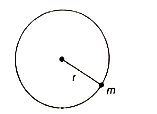
$A$ mass is whirled in a circular path with constant angular velocity and its linear velocity is $v$. If the string is now halved keeping the angular momentum same,the linear velocity is
A
$2v$
B
$\frac{v}{2}$
C
$v$
D
$v \sqrt{2}$
Solution
(A) Initial linear velocity $= v$
Initial radius $= r$
Angular momentum $L = mvr$
When the string is halved,the new radius $r' = \frac{r}{2}$.
Since the angular momentum $L$ remains constant:
$mvr = mv'r'$
$mvr = mv' \left(\frac{r}{2}\right)$
$v = \frac{v'}{2}$
$v' = 2v$
Therefore,the new linear velocity is $2v$.
Initial radius $= r$
Angular momentum $L = mvr$
When the string is halved,the new radius $r' = \frac{r}{2}$.
Since the angular momentum $L$ remains constant:
$mvr = mv'r'$
$mvr = mv' \left(\frac{r}{2}\right)$
$v = \frac{v'}{2}$
$v' = 2v$
Therefore,the new linear velocity is $2v$.
0 likesView Solution
53
PhysicsMediumMCQMHT CET · 2019
$A$ rigid body is rotating with angular velocity $\omega$ about an axis of rotation. Let $v$ be the linear velocity of a particle which is at a perpendicular distance $r$ from the axis of rotation. Then the relation $v = r \omega$ implies that
A
$\omega$ does not depend on $r$
B
$\omega \propto \frac{1}{r}$
C
$\omega \propto r$
D
$\omega = 0$
Solution
(A) The given relation is $v = r \omega$.
In a rotating rigid body,all particles rotate with the same angular velocity $\omega$ about the axis of rotation.
While the linear velocity $v$ of a particle depends on its distance $r$ from the axis (as $v = r \omega$),the angular velocity $\omega$ is a property of the entire rigid body's rotation.
Therefore,$\omega$ remains constant for all particles in the body regardless of their distance $r$ from the axis.
Thus,$\omega$ does not depend on $r$.
In a rotating rigid body,all particles rotate with the same angular velocity $\omega$ about the axis of rotation.
While the linear velocity $v$ of a particle depends on its distance $r$ from the axis (as $v = r \omega$),the angular velocity $\omega$ is a property of the entire rigid body's rotation.
Therefore,$\omega$ remains constant for all particles in the body regardless of their distance $r$ from the axis.
Thus,$\omega$ does not depend on $r$.
0 likesView Solution
54
PhysicsMediumMCQMHT CET · 2019
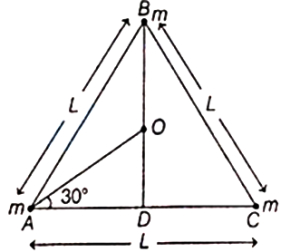
Three point masses,each of mass $m$,are kept at the corners of an equilateral triangle of side $L$. The system rotates about the center of the triangle. The period of rotation $T$ is directly proportional to:
A
$\sqrt{L}$
B
$L^{3/2}$
C
$L$
D
$L^2$
Solution
(B) Let the masses be at vertices $A, B,$ and $C$ of an equilateral triangle with side $L$. Let $O$ be the centroid of the triangle.
The distance from any vertex to the centroid $O$ is $R = \frac{L}{\sqrt{3}}$.
The moment of inertia of the system about the axis passing through $O$ and perpendicular to the plane of the triangle is:
$I = 3 \times (m R^2) = 3 \times m \times \left(\frac{L}{\sqrt{3}}\right)^2 = 3 \times m \times \frac{L^2}{3} = m L^2$.
For the system to rotate,the gravitational force between the masses provides the necessary centripetal force.
The gravitational force on one mass due to the other two is $F_{net} = 2 \times \left(\frac{G m^2}{L^2}\right) \cos 30^{\circ} = 2 \times \frac{G m^2}{L^2} \times \frac{\sqrt{3}}{2} = \frac{\sqrt{3} G m^2}{L^2}$.
This force acts as the centripetal force: $F_{net} = m \omega^2 R$.
$\frac{\sqrt{3} G m^2}{L^2} = m \omega^2 \left(\frac{L}{\sqrt{3}}\right)$.
$\omega^2 = \frac{\sqrt{3} G m}{L^2} \times \frac{\sqrt{3}}{L} = \frac{3 G m}{L^3}$.
Since $T = \frac{2 \pi}{\omega}$,we have $T^2 = \frac{4 \pi^2}{\omega^2} = \frac{4 \pi^2 L^3}{3 G m}$.
Thus,$T^2 \propto L^3$,which implies $T \propto L^{3/2}$.
The distance from any vertex to the centroid $O$ is $R = \frac{L}{\sqrt{3}}$.
The moment of inertia of the system about the axis passing through $O$ and perpendicular to the plane of the triangle is:
$I = 3 \times (m R^2) = 3 \times m \times \left(\frac{L}{\sqrt{3}}\right)^2 = 3 \times m \times \frac{L^2}{3} = m L^2$.
For the system to rotate,the gravitational force between the masses provides the necessary centripetal force.
The gravitational force on one mass due to the other two is $F_{net} = 2 \times \left(\frac{G m^2}{L^2}\right) \cos 30^{\circ} = 2 \times \frac{G m^2}{L^2} \times \frac{\sqrt{3}}{2} = \frac{\sqrt{3} G m^2}{L^2}$.
This force acts as the centripetal force: $F_{net} = m \omega^2 R$.
$\frac{\sqrt{3} G m^2}{L^2} = m \omega^2 \left(\frac{L}{\sqrt{3}}\right)$.
$\omega^2 = \frac{\sqrt{3} G m}{L^2} \times \frac{\sqrt{3}}{L} = \frac{3 G m}{L^3}$.
Since $T = \frac{2 \pi}{\omega}$,we have $T^2 = \frac{4 \pi^2}{\omega^2} = \frac{4 \pi^2 L^3}{3 G m}$.
Thus,$T^2 \propto L^3$,which implies $T \propto L^{3/2}$.
0 likesView Solution
55
PhysicsEasyMCQMHT CET · 2019
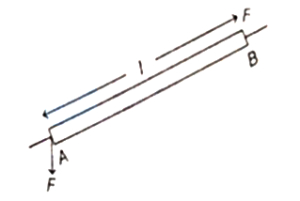
$A$ rod of length $l$ is acted upon by a couple as shown in the figure. The moment of the couple is $\tau \text{ Nm}$. If the force at each end of the rod is $F$,then the magnitude of each force is (given $\sin 30^{\circ} = \cos 60^{\circ} = 0.5$):
A
$\frac{\tau}{l}$
B
$\frac{l}{2 \tau}$
C
$\frac{2 \tau}{l}$
D
$\frac{2 l}{\tau}$
Solution
(C) The moment of a couple is given by the product of the magnitude of one of the forces and the perpendicular distance between the lines of action of the two forces.
Let the angle between the rod and the direction of the force be $\theta = 30^{\circ}$.
The perpendicular distance between the two parallel forces $F$ acting at the ends of the rod of length $l$ is $d = l \sin \theta$.
The moment of the couple $\tau$ is given by:
$\tau = F \times d = F \times l \sin 30^{\circ}$
Given $\sin 30^{\circ} = 0.5 = \frac{1}{2}$.
Substituting the values:
$\tau = F \times l \times \frac{1}{2}$
$\tau = \frac{F l}{2}$
Rearranging to solve for $F$:
$F = \frac{2 \tau}{l}$
Let the angle between the rod and the direction of the force be $\theta = 30^{\circ}$.
The perpendicular distance between the two parallel forces $F$ acting at the ends of the rod of length $l$ is $d = l \sin \theta$.
The moment of the couple $\tau$ is given by:
$\tau = F \times d = F \times l \sin 30^{\circ}$
Given $\sin 30^{\circ} = 0.5 = \frac{1}{2}$.
Substituting the values:
$\tau = F \times l \times \frac{1}{2}$
$\tau = \frac{F l}{2}$
Rearranging to solve for $F$:
$F = \frac{2 \tau}{l}$
0 likesView Solution
56
PhysicsDifficultMCQMHT CET · 2019
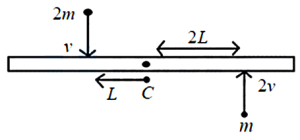
$A$ uniform rod of length $6L$ and mass $8m$ is pivoted at its centre $C$. Two masses $m$ and $2m$ with speeds $2v$ and $v$ respectively,as shown in the figure,strike the rod and stick to it. Initially,the rod is at rest. If it rotates with angular velocity $\omega$ due to the impact,then $\omega$ will be:
A
$\frac{v}{5L}$
B
$\text{Zero}$
C
$\frac{8v}{6L}$
D
$\frac{11v}{3L}$
Solution
(A) Since there is no external torque about the pivot $C$,the angular momentum of the system is conserved.
Initial angular momentum $L_i = (2m)(v)(L) + (m)(2v)(2L) = 2mvL + 4mvL = 6mvL$.
Final moment of inertia $I_f = I_{\text{rod}} + I_{2m} + I_{m} = \frac{(8m)(6L)^2}{12} + (2m)(L)^2 + (m)(2L)^2$.
$I_f = \frac{8m \cdot 36L^2}{12} + 2mL^2 + 4mL^2 = 24mL^2 + 2mL^2 + 4mL^2 = 30mL^2$.
Using $L_i = I_f \omega$:
$6mvL = (30mL^2) \omega$.
$\omega = \frac{6mvL}{30mL^2} = \frac{v}{5L}$.
Initial angular momentum $L_i = (2m)(v)(L) + (m)(2v)(2L) = 2mvL + 4mvL = 6mvL$.
Final moment of inertia $I_f = I_{\text{rod}} + I_{2m} + I_{m} = \frac{(8m)(6L)^2}{12} + (2m)(L)^2 + (m)(2L)^2$.
$I_f = \frac{8m \cdot 36L^2}{12} + 2mL^2 + 4mL^2 = 24mL^2 + 2mL^2 + 4mL^2 = 30mL^2$.
Using $L_i = I_f \omega$:
$6mvL = (30mL^2) \omega$.
$\omega = \frac{6mvL}{30mL^2} = \frac{v}{5L}$.
0 likesView Solution
57
PhysicsMediumMCQMHT CET · 2019
The maximum wavelength of radiation emitted by a star is $289.8 \ nm$. The intensity of radiation for the star is (Given: Stefan's constant $\sigma = 5.67 \times 10^{-8} \ W \ m^{-2} \ K^{-4}$,Wien's constant $b = 2898 \ \mu m \ K$)
A
$5.67 \times 10^{-12} \ W \ m^{-2}$
B
$10.67 \times 10^{14} \ W \ m^{-2}$
C
$5.67 \times 10^8 \ W \ m^{-2}$
D
$10.67 \times 10^7 \ W \ m^{-2}$
Solution
(C) Given,maximum wavelength,$\lambda_m = 289.8 \ nm = 289.8 \times 10^{-9} \ m = 2.898 \times 10^{-7} \ m$.
Stefan's constant,$\sigma = 5.67 \times 10^{-8} \ W \ m^{-2} \ K^{-4}$.
Wien's constant,$b = 2898 \ \mu m \ K = 2898 \times 10^{-6} \ m \ K$.
According to Wien's displacement law,$\lambda_m = \frac{b}{T}$,so $T = \frac{b}{\lambda_m}$.
Substituting the values,$T = \frac{2898 \times 10^{-6}}{289.8 \times 10^{-9}} = \frac{2898 \times 10^{-6}}{2.898 \times 10^{-7}} = 10^4 \ K$.
According to Stefan-Boltzmann law,the intensity of radiation $I$ is given by $I = \sigma T^4$ (assuming the star acts as a black body,$e=1$).
Substituting the values,$I = (5.67 \times 10^{-8}) \times (10^4)^4 = 5.67 \times 10^{-8} \times 10^{16} = 5.67 \times 10^8 \ W \ m^{-2}$.
Stefan's constant,$\sigma = 5.67 \times 10^{-8} \ W \ m^{-2} \ K^{-4}$.
Wien's constant,$b = 2898 \ \mu m \ K = 2898 \times 10^{-6} \ m \ K$.
According to Wien's displacement law,$\lambda_m = \frac{b}{T}$,so $T = \frac{b}{\lambda_m}$.
Substituting the values,$T = \frac{2898 \times 10^{-6}}{289.8 \times 10^{-9}} = \frac{2898 \times 10^{-6}}{2.898 \times 10^{-7}} = 10^4 \ K$.
According to Stefan-Boltzmann law,the intensity of radiation $I$ is given by $I = \sigma T^4$ (assuming the star acts as a black body,$e=1$).
Substituting the values,$I = (5.67 \times 10^{-8}) \times (10^4)^4 = 5.67 \times 10^{-8} \times 10^{16} = 5.67 \times 10^8 \ W \ m^{-2}$.
0 likesView Solution
58
PhysicsEasyMCQMHT CET · 2019
$A$ clock pendulum having a coefficient of linear expansion $\alpha = 9 \times 10^{-7} /^{\circ}C$ has a period of $0.5 \ s$ at $20^{\circ}C$. If the clock is used in a climate where the temperature is $30^{\circ}C$,how much time does the clock lose in each oscillation? (Assume $g$ is constant)
A
$2.5 \times 10^{-7} \ s$
B
$5 \times 10^{-7} \ s$
C
$1.125 \times 10^{-6} \ s$
D
$2.25 \times 10^{-6} \ s$
Solution
(D) The time period of a pendulum is given by $T = 2\pi \sqrt{\frac{L}{g}}$.
Taking the derivative,the change in time period is $\frac{dT}{T} = \frac{1}{2} \frac{dL}{L}$.
Since $\frac{dL}{L} = \alpha \Delta \theta$,we have $\frac{dT}{T} = \frac{1}{2} \alpha \Delta \theta$.
Here,$T = 0.5 \ s$,$\alpha = 9 \times 10^{-7} /^{\circ}C$,and $\Delta \theta = 30^{\circ}C - 20^{\circ}C = 10^{\circ}C$.
Substituting the values: $dT = T \times \frac{1}{2} \times \alpha \times \Delta \theta$.
$dT = 0.5 \times \frac{1}{2} \times (9 \times 10^{-7}) \times 10$.
$dT = 0.25 \times 9 \times 10^{-6} = 2.25 \times 10^{-6} \ s$.
Taking the derivative,the change in time period is $\frac{dT}{T} = \frac{1}{2} \frac{dL}{L}$.
Since $\frac{dL}{L} = \alpha \Delta \theta$,we have $\frac{dT}{T} = \frac{1}{2} \alpha \Delta \theta$.
Here,$T = 0.5 \ s$,$\alpha = 9 \times 10^{-7} /^{\circ}C$,and $\Delta \theta = 30^{\circ}C - 20^{\circ}C = 10^{\circ}C$.
Substituting the values: $dT = T \times \frac{1}{2} \times \alpha \times \Delta \theta$.
$dT = 0.5 \times \frac{1}{2} \times (9 \times 10^{-7}) \times 10$.
$dT = 0.25 \times 9 \times 10^{-6} = 2.25 \times 10^{-6} \ s$.
0 likesView Solution
59
PhysicsMediumMCQMHT CET · 2019
If $\alpha$ is the coefficient of performance of a refrigerator and $Q_1$ is the heat released to the hot reservoir,then the heat extracted from the cold reservoir $Q_2$ is
A
$\frac{\alpha Q_1}{\alpha-1}$
B
$\frac{\alpha-1}{\alpha} Q_1$
C
$\frac{\alpha Q_1}{1+\alpha}$
D
$\frac{1+\alpha}{\alpha} Q_1$
Solution
(C) The coefficient of performance $\alpha$ of a refrigerator is defined as the ratio of heat extracted from the cold reservoir $(Q_2)$ to the work done $(W)$ on the system: $\alpha = \frac{Q_2}{W}$.
Since $W = Q_1 - Q_2$,where $Q_1$ is the heat released to the hot reservoir,we have $\alpha = \frac{Q_2}{Q_1 - Q_2}$.
Cross-multiplying gives: $\alpha(Q_1 - Q_2) = Q_2$.
Expanding the equation: $\alpha Q_1 - \alpha Q_2 = Q_2$.
Rearranging to solve for $Q_2$: $\alpha Q_1 = Q_2 + \alpha Q_2 = Q_2(1 + \alpha)$.
Therefore,$Q_2 = \frac{\alpha Q_1}{1 + \alpha}$.
Since $W = Q_1 - Q_2$,where $Q_1$ is the heat released to the hot reservoir,we have $\alpha = \frac{Q_2}{Q_1 - Q_2}$.
Cross-multiplying gives: $\alpha(Q_1 - Q_2) = Q_2$.
Expanding the equation: $\alpha Q_1 - \alpha Q_2 = Q_2$.
Rearranging to solve for $Q_2$: $\alpha Q_1 = Q_2 + \alpha Q_2 = Q_2(1 + \alpha)$.
Therefore,$Q_2 = \frac{\alpha Q_1}{1 + \alpha}$.
0 likesView Solution
60
PhysicsEasyMCQMHT CET · 2019
$[L^2 M^1 T^{-2}]$ are the dimensions of
A
Torque
B
Force
C
Angular acceleration
D
Angular momentum
Solution
(A) The dimension of torque is $[M^1 L^2 T^{-2}]$.
Torque is defined as the product of force and the perpendicular distance from the axis of rotation,given by $\tau = F \times r$.
The dimensional formula for force $(F)$ is $[M^1 L^1 T^{-2}]$.
The dimensional formula for distance $(r)$ is $[L^1]$.
Therefore,the dimensional formula for torque $(\tau)$ is $[M^1 L^1 T^{-2}] \times [L^1] = [M^1 L^2 T^{-2}]$.
Torque is defined as the product of force and the perpendicular distance from the axis of rotation,given by $\tau = F \times r$.
The dimensional formula for force $(F)$ is $[M^1 L^1 T^{-2}]$.
The dimensional formula for distance $(r)$ is $[L^1]$.
Therefore,the dimensional formula for torque $(\tau)$ is $[M^1 L^1 T^{-2}] \times [L^1] = [M^1 L^2 T^{-2}]$.
0 likesView Solution
61
PhysicsEasyMCQMHT CET · 2019
The $SI$ unit and dimension of Stefan's constant $\sigma$ in the case of Stefan's law of radiation are
A
$\frac{J}{m^3 s K^4}, [M^1 L^0 T^{-3} K^{-4}]$
B
$\frac{J}{m^2 s K}, [M^1 L^0 T^{-3} K^3]$
C
$\frac{J}{m^3 s K^4}, [M^1 L^0 T^{-3} K^4]$
D
$\frac{J}{m^2 s K^4}, [M^1 L^0 T^{-3} K^{-4}]$
Solution
(D) According to Stefan's law,the energy emitted by a body per unit area per unit time is proportional to the fourth power of its absolute temperature.
$E = \sigma T^4$
Where $E$ is the energy emitted per unit area per unit time,$T$ is the absolute temperature in Kelvin,and $\sigma$ is Stefan's constant.
Rearranging for $\sigma$: $\sigma = \frac{E}{T^4}$.
The unit of $E$ is $\frac{J}{m^2 s}$.
Therefore,the unit of $\sigma$ is $\frac{J}{m^2 s K^4}$.
The dimensions of energy are $[M L^2 T^{-2}]$,area is $[L^2]$,time is $[T]$,and temperature is $[K]$.
$\sigma = \frac{[M L^2 T^{-2}]}{[L^2] [T] [K^4]} = [M^1 L^0 T^{-3} K^{-4}]$.
$E = \sigma T^4$
Where $E$ is the energy emitted per unit area per unit time,$T$ is the absolute temperature in Kelvin,and $\sigma$ is Stefan's constant.
Rearranging for $\sigma$: $\sigma = \frac{E}{T^4}$.
The unit of $E$ is $\frac{J}{m^2 s}$.
Therefore,the unit of $\sigma$ is $\frac{J}{m^2 s K^4}$.
The dimensions of energy are $[M L^2 T^{-2}]$,area is $[L^2]$,time is $[T]$,and temperature is $[K]$.
$\sigma = \frac{[M L^2 T^{-2}]}{[L^2] [T] [K^4]} = [M^1 L^0 T^{-3} K^{-4}]$.
0 likesView Solution
62
PhysicsDifficultMCQMHT CET · 2019
The force $F$ acting on a body of density $d$ is related by the equation $F=\frac{y}{\sqrt{d}}$. The dimensions of $y$ are:
A
$[L^{-\frac{1}{2}} M^{\frac{3}{2}} T^{-2}]$
B
$[L^{-1} M^{\frac{1}{2}} T^{-2}]$
C
$[L^{-1} M^{\frac{3}{2}} T^{-2}]$
D
$[L^{-\frac{1}{2}} M^{\frac{1}{2}} T^{-2}]$
Solution
(A) The dimension of force is $[F] = [M L T^{-2}]$.
The dimension of density is $[d] = [M L^{-3} T^0]$.
From the given relation,$F = \frac{y}{\sqrt{d}}$,we can write $y = F \sqrt{d}$.
Substituting the dimensions of $F$ and $d$:
$[y] = [M L T^{-2}] \times [M L^{-3}]^{1/2}$
$[y] = [M L T^{-2}] \times [M^{1/2} L^{-3/2}]$
$[y] = [M^{1 + 1/2} L^{1 - 3/2} T^{-2}]$
$[y] = [M^{3/2} L^{-1/2} T^{-2}]$.
The dimension of density is $[d] = [M L^{-3} T^0]$.
From the given relation,$F = \frac{y}{\sqrt{d}}$,we can write $y = F \sqrt{d}$.
Substituting the dimensions of $F$ and $d$:
$[y] = [M L T^{-2}] \times [M L^{-3}]^{1/2}$
$[y] = [M L T^{-2}] \times [M^{1/2} L^{-3/2}]$
$[y] = [M^{1 + 1/2} L^{1 - 3/2} T^{-2}]$
$[y] = [M^{3/2} L^{-1/2} T^{-2}]$.
0 likesView Solution
63
PhysicsMediumMCQMHT CET · 2019
Dimensions of Gyromagnetic ratio are
A
$[L^1 M^0 T^1 I^1]$
B
$[L^0 M^{-1} T^1 I^1]$
C
$[L^1 M^0 T^0 I^{-1}]$
D
$[L^{-1} M^0 T^1 I^1]$
Solution
(B) The gyromagnetic ratio $(\gamma)$ is defined as the ratio of the magnetic dipole moment $(M)$ to the angular momentum $(L)$ of a system.
$\gamma = \frac{M}{L}$
Since the magnetic moment $M = I \cdot A$ (where $I$ is current and $A$ is area),its dimensions are $[I^1 L^2]$.
Since angular momentum $L = mvr$,its dimensions are $[M^1 L^2 T^{-1}]$.
Therefore,the dimensions of the gyromagnetic ratio are:
$\text{Dimension} = \frac{[I^1 L^2]}{[M^1 L^2 T^{-1}]} = [M^{-1} L^0 T^1 I^1]$.
$\gamma = \frac{M}{L}$
Since the magnetic moment $M = I \cdot A$ (where $I$ is current and $A$ is area),its dimensions are $[I^1 L^2]$.
Since angular momentum $L = mvr$,its dimensions are $[M^1 L^2 T^{-1}]$.
Therefore,the dimensions of the gyromagnetic ratio are:
$\text{Dimension} = \frac{[I^1 L^2]}{[M^1 L^2 T^{-1}]} = [M^{-1} L^0 T^1 I^1]$.
0 likesView Solution
64
PhysicsEasyMCQMHT CET · 2019
The dimensions of torque are the same as that of
A
moment of force
B
pressure
C
acceleration
D
impulse
Solution
(A) The dimensional formula for torque is given by $\tau = r \times F$.
Since the dimensions of force $F$ are $[M^1L^1T^{-2}]$ and the dimensions of distance $r$ are $[L^1]$,the dimensions of torque are $[M^1L^1T^{-2}] \times [L^1] = [M^1L^2T^{-2}]$.
The moment of force is defined as the product of force and the perpendicular distance from the axis of rotation,which is identical to the definition of torque.
Therefore,the dimensions of the moment of force are also $[M^1L^2T^{-2}]$.
Thus,the dimensions of torque are the same as those of the moment of force.
Since the dimensions of force $F$ are $[M^1L^1T^{-2}]$ and the dimensions of distance $r$ are $[L^1]$,the dimensions of torque are $[M^1L^1T^{-2}] \times [L^1] = [M^1L^2T^{-2}]$.
The moment of force is defined as the product of force and the perpendicular distance from the axis of rotation,which is identical to the definition of torque.
Therefore,the dimensions of the moment of force are also $[M^1L^2T^{-2}]$.
Thus,the dimensions of torque are the same as those of the moment of force.
0 likesView Solution
65
PhysicsEasyMCQMHT CET · 2019
In damped $SHM$,the $SI$ unit of damping constant is
A
$N/s$
B
$kg/s$
C
$kg/m$
D
$N/m$
Solution
(B) In damped $SHM$,the damping force $F_d$ is proportional to the velocity $v$ of the oscillator,given by $F_d = -bv$,where $b$ is the damping constant.
Therefore,the damping constant is $b = \frac{F_d}{v}$.
The $SI$ unit of force $F_d$ is $Newton$ $(N)$ or $kg \cdot m/s^2$.
The $SI$ unit of velocity $v$ is $m/s$.
Thus,the $SI$ unit of damping constant $b$ is $\frac{kg \cdot m/s^2}{m/s} = kg/s$.
Hence,the $SI$ unit of damping constant is $kg/s$.
Therefore,the damping constant is $b = \frac{F_d}{v}$.
The $SI$ unit of force $F_d$ is $Newton$ $(N)$ or $kg \cdot m/s^2$.
The $SI$ unit of velocity $v$ is $m/s$.
Thus,the $SI$ unit of damping constant $b$ is $\frac{kg \cdot m/s^2}{m/s} = kg/s$.
Hence,the $SI$ unit of damping constant is $kg/s$.
0 likesView Solution
66
PhysicsEasyMCQMHT CET · 2019
If '$x$','$v$' and '$a$' denote the displacement,velocity and acceleration of a particle respectively executing $SHM$ of periodic time $T$,then which one of the following does not change with time?
A
$\frac{a T}{x}$
B
$a T + 2 \pi v$
C
$\frac{a T}{v}$
D
$a T + 4 \pi^2 v^2$
Solution
(C) For a particle executing $SHM$,the displacement is $x = A \sin(\omega t + \phi)$.
Velocity is $v = \frac{dx}{dt} = A \omega \cos(\omega t + \phi)$.
Acceleration is $a = \frac{dv}{dt} = -A \omega^2 \sin(\omega t + \phi) = -\omega^2 x$.
We know that angular frequency $\omega = \frac{2 \pi}{T}$.
Now,let us evaluate the expression in option $(c)$:
$\frac{a T}{v} = \frac{(-\omega^2 x) T}{A \omega \cos(\omega t + \phi)} = \frac{-\omega^2 (A \sin(\omega t + \phi)) T}{A \omega \cos(\omega t + \phi)} = -\omega T \tan(\omega t + \phi)$.
Wait,let's re-evaluate using the standard relation $a = -\omega^2 x$ and $v = \omega \sqrt{A^2 - x^2}$.
Actually,the ratio $\frac{a}{v}$ for $SHM$ is $\frac{-\omega^2 x}{v}$. Since $v = \omega \sqrt{A^2 - x^2}$,$\frac{a}{v} = \frac{-\omega^2 x}{\omega \sqrt{A^2 - x^2}} = -\omega \frac{x}{\sqrt{A^2 - x^2}}$. This is time-dependent.
However,checking the dimensions: $[a] = [L T^{-2}]$,$[T] = [T]$,$[v] = [L T^{-1}]$.
Dimension of $\frac{a T}{v} = \frac{[L T^{-2}] [T]}{[L T^{-1}]} = \frac{[L T^{-1}]}{[L T^{-1}]} = [M^0 L^0 T^0]$.
Since the expression $\frac{a T}{v}$ is dimensionless and represents a constant factor related to the angular frequency $(2\pi)$,it is the only quantity that remains constant in magnitude relative to the phase of motion.
Velocity is $v = \frac{dx}{dt} = A \omega \cos(\omega t + \phi)$.
Acceleration is $a = \frac{dv}{dt} = -A \omega^2 \sin(\omega t + \phi) = -\omega^2 x$.
We know that angular frequency $\omega = \frac{2 \pi}{T}$.
Now,let us evaluate the expression in option $(c)$:
$\frac{a T}{v} = \frac{(-\omega^2 x) T}{A \omega \cos(\omega t + \phi)} = \frac{-\omega^2 (A \sin(\omega t + \phi)) T}{A \omega \cos(\omega t + \phi)} = -\omega T \tan(\omega t + \phi)$.
Wait,let's re-evaluate using the standard relation $a = -\omega^2 x$ and $v = \omega \sqrt{A^2 - x^2}$.
Actually,the ratio $\frac{a}{v}$ for $SHM$ is $\frac{-\omega^2 x}{v}$. Since $v = \omega \sqrt{A^2 - x^2}$,$\frac{a}{v} = \frac{-\omega^2 x}{\omega \sqrt{A^2 - x^2}} = -\omega \frac{x}{\sqrt{A^2 - x^2}}$. This is time-dependent.
However,checking the dimensions: $[a] = [L T^{-2}]$,$[T] = [T]$,$[v] = [L T^{-1}]$.
Dimension of $\frac{a T}{v} = \frac{[L T^{-2}] [T]}{[L T^{-1}]} = \frac{[L T^{-1}]}{[L T^{-1}]} = [M^0 L^0 T^0]$.
Since the expression $\frac{a T}{v}$ is dimensionless and represents a constant factor related to the angular frequency $(2\pi)$,it is the only quantity that remains constant in magnitude relative to the phase of motion.
0 likesView Solution
67
PhysicsEasyMCQMHT CET · 2019
The ratio of the dimensions of Planck's constant to that of the moment of inertia is the dimension of
A
Angular momentum
B
Velocity
C
Frequency
D
Time
Solution
(C) The dimensions of Planck's constant $h$ are given by $[h] = [M L^2 T^{-1}]$.
The dimensions of the moment of inertia $I$ are given by $[I] = [M L^2]$.
Taking the ratio of the dimensions of Planck's constant to the moment of inertia:
$\frac{[h]}{[I]} = \frac{[M L^2 T^{-1}]}{[M L^2]} = [T^{-1}]$.
The dimension $[T^{-1}]$ corresponds to the dimension of frequency.
The dimensions of the moment of inertia $I$ are given by $[I] = [M L^2]$.
Taking the ratio of the dimensions of Planck's constant to the moment of inertia:
$\frac{[h]}{[I]} = \frac{[M L^2 T^{-1}]}{[M L^2]} = [T^{-1}]$.
The dimension $[T^{-1}]$ corresponds to the dimension of frequency.
0 likesView Solution
68
PhysicsMediumMCQMHT CET · 2019
The radius of the Earth is $6371 \ km$ and the radius of its orbit around the Sun is $149 \times 10^6 \ km$. The order of magnitude of the diameter of the orbit is greater than that of the Earth by
A
$10^3$
B
$10^2$
C
$10^4$
D
$10^5$
Solution
(C) The diameter of the Earth $(D_e)$ is $2 \times 6371 \ km = 12742 \ km = 1.2742 \times 10^4 \ km$.
The order of magnitude of the diameter of the Earth is $10^4$.
The diameter of the orbit $(D_o)$ is $2 \times 149 \times 10^6 \ km = 298 \times 10^6 \ km = 2.98 \times 10^8 \ km$.
The order of magnitude of the diameter of the orbit is $10^8$.
The difference in the order of magnitude is $8 - 4 = 4$.
Therefore,the order of magnitude of the diameter of the orbit is greater than that of the Earth by $10^4$.
The order of magnitude of the diameter of the Earth is $10^4$.
The diameter of the orbit $(D_o)$ is $2 \times 149 \times 10^6 \ km = 298 \times 10^6 \ km = 2.98 \times 10^8 \ km$.
The order of magnitude of the diameter of the orbit is $10^8$.
The difference in the order of magnitude is $8 - 4 = 4$.
Therefore,the order of magnitude of the diameter of the orbit is greater than that of the Earth by $10^4$.
0 likesView Solution
69
PhysicsMediumMCQMHT CET · 2019
$A$ simple harmonic progressive wave is represented as $y = 0.03 \sin \pi (2 t - 0.01 x) \ m$. At a given instant of time,the phase difference between two particles $25 \ m$ apart is
A
$\frac{\pi}{2} \ rad$
B
$\frac{\pi}{4} \ rad$
C
$\frac{\pi}{8} \ rad$
D
$\frac{\pi}{10} \ rad$
Solution
(B) The given equation of the $SHM$ wave is $y = 0.03 \sin \pi (2 t - 0.01 x) \ m$.
Expanding this,we get $y = 0.03 \sin (2 \pi t - 0.01 \pi x) \ m$.
Comparing this with the general wave equation $y = a \sin (\omega t - k x)$,we identify the wave number $k$ as $k = 0.01 \pi \ rad/m$.
The phase difference $\Delta \phi$ between two particles separated by a distance $\Delta x$ is given by the formula $\Delta \phi = k \Delta x$.
Given $\Delta x = 25 \ m$ and $k = 0.01 \pi \ rad/m$,we substitute these values into the formula:
$\Delta \phi = (0.01 \pi) \times 25 = 0.25 \pi = \frac{\pi}{4} \ rad$.
Thus,the phase difference is $\frac{\pi}{4} \ rad$.
Expanding this,we get $y = 0.03 \sin (2 \pi t - 0.01 \pi x) \ m$.
Comparing this with the general wave equation $y = a \sin (\omega t - k x)$,we identify the wave number $k$ as $k = 0.01 \pi \ rad/m$.
The phase difference $\Delta \phi$ between two particles separated by a distance $\Delta x$ is given by the formula $\Delta \phi = k \Delta x$.
Given $\Delta x = 25 \ m$ and $k = 0.01 \pi \ rad/m$,we substitute these values into the formula:
$\Delta \phi = (0.01 \pi) \times 25 = 0.25 \pi = \frac{\pi}{4} \ rad$.
Thus,the phase difference is $\frac{\pi}{4} \ rad$.
0 likesView Solution
70
PhysicsMediumMCQMHT CET · 2019
$A$ stretched wire of length $260 \ cm$ is set into vibrations. It is divided into three segments whose frequencies are in the ratio $2:3:4$. Their lengths must be
A
$80 \ cm, 60 \ cm, 120 \ cm$
B
$120 \ cm, 80 \ cm, 60 \ cm$
C
$60 \ cm, 80 \ cm, 120 \ cm$
D
$120 \ cm, 60 \ cm, 80 \ cm$
Solution
(B) The frequency produced by a stretched wire is given by $f = \frac{p}{2l} \sqrt{\frac{T}{m}}$.
Here,$p$ is the number of loops,$l$ is the length,$T$ is the tension,and $m$ is the mass per unit length.
Since $T$ and $m$ are constant for the same wire,we have $f \propto \frac{1}{l}$.
Given the ratio of frequencies $f_1 : f_2 : f_3 = 2 : 3 : 4$,the ratio of lengths is $l_1 : l_2 : l_3 = \frac{1}{2} : \frac{1}{3} : \frac{1}{4}$.
Multiplying by the least common multiple $(12)$,we get $l_1 : l_2 : l_3 = 6 : 4 : 3$.
The sum of the ratio parts is $6 + 4 + 3 = 13$.
Given the total length $L = 260 \ cm$,the individual lengths are:
$l_1 = \frac{6}{13} \times 260 = 120 \ cm$
$l_2 = \frac{4}{13} \times 260 = 80 \ cm$
$l_3 = \frac{3}{13} \times 260 = 60 \ cm$.
Here,$p$ is the number of loops,$l$ is the length,$T$ is the tension,and $m$ is the mass per unit length.
Since $T$ and $m$ are constant for the same wire,we have $f \propto \frac{1}{l}$.
Given the ratio of frequencies $f_1 : f_2 : f_3 = 2 : 3 : 4$,the ratio of lengths is $l_1 : l_2 : l_3 = \frac{1}{2} : \frac{1}{3} : \frac{1}{4}$.
Multiplying by the least common multiple $(12)$,we get $l_1 : l_2 : l_3 = 6 : 4 : 3$.
The sum of the ratio parts is $6 + 4 + 3 = 13$.
Given the total length $L = 260 \ cm$,the individual lengths are:
$l_1 = \frac{6}{13} \times 260 = 120 \ cm$
$l_2 = \frac{4}{13} \times 260 = 80 \ cm$
$l_3 = \frac{3}{13} \times 260 = 60 \ cm$.
0 likesView Solution
71
PhysicsEasyMCQMHT CET · 2019
$A$ stretched string fixed at both ends has $m$ nodes,then the length of the string will be
A
$(m-1) \frac{\lambda}{2}$
B
$\frac{(m+1) \lambda}{2}$
C
$\frac{m \lambda}{2}$
D
$(m-2) \frac{\lambda}{2}$
Solution
(A) For a stretched string fixed at both ends,the length $l$ is given by $l = \frac{p \lambda}{2}$,where $p$ is the number of loops (or segments).
In a standing wave on a string fixed at both ends,the number of loops $p$ is equal to the number of anti-nodes.
The relationship between the number of nodes $m$ and the number of anti-nodes $p$ is given by $m = p + 1$.
Therefore,the number of loops is $p = m - 1$.
Substituting this value of $p$ into the length formula,we get $l = \frac{(m-1) \lambda}{2}$.
In a standing wave on a string fixed at both ends,the number of loops $p$ is equal to the number of anti-nodes.
The relationship between the number of nodes $m$ and the number of anti-nodes $p$ is given by $m = p + 1$.
Therefore,the number of loops is $p = m - 1$.
Substituting this value of $p$ into the length formula,we get $l = \frac{(m-1) \lambda}{2}$.
0 likesView Solution
72
PhysicsEasyMCQMHT CET · 2019
For the formation of beats,two sound notes must have:
A
Different amplitudes and different frequencies
B
Exactly equal frequencies only
C
Exactly equal amplitudes only
D
Nearly equal frequencies and equal amplitudes
Solution
(D) Beats are the periodic variations in the intensity of sound heard when two sound waves of slightly different frequencies and comparable amplitudes interfere with each other.
For the formation of distinct beats,the two sound sources must have nearly equal frequencies so that the beat frequency $(f_{beat} = |f_1 - f_2|)$ is low enough to be perceived by the human ear.
Additionally,they should have nearly equal amplitudes to ensure that the interference results in clearly audible maximums and minimums of intensity.
For the formation of distinct beats,the two sound sources must have nearly equal frequencies so that the beat frequency $(f_{beat} = |f_1 - f_2|)$ is low enough to be perceived by the human ear.
Additionally,they should have nearly equal amplitudes to ensure that the interference results in clearly audible maximums and minimums of intensity.
0 likesView Solution
73
PhysicsMediumMCQMHT CET · 2019
$A$ pipe open at both ends and a pipe closed at one end have the same length. The ratio of the frequencies of their $P^{\text{th}}$ overtone is:
A
$\frac{P+1}{2P}$
B
$\frac{P+1}{2P+1}$
C
$\frac{2(P+1)}{2P+1}$
D
$\frac{P}{2P+1}$
Solution
(C) For an open organ pipe of length $L$,the frequency of the $P^{\text{th}}$ overtone is given by $f_{\text{open}} = (P+1) \frac{v}{2L}$.
For a closed organ pipe of the same length $L$,the frequency of the $P^{\text{th}}$ overtone is given by $f_{\text{closed}} = (2P+1) \frac{v}{4L}$.
Taking the ratio of the frequency of the $P^{\text{th}}$ overtone of the open pipe to that of the closed pipe:
Ratio $= \frac{(P+1) \frac{v}{2L}}{(2P+1) \frac{v}{4L}}$.
Ratio $= \frac{P+1}{2L} \times \frac{4L}{2P+1} = \frac{2(P+1)}{2P+1}$.
For a closed organ pipe of the same length $L$,the frequency of the $P^{\text{th}}$ overtone is given by $f_{\text{closed}} = (2P+1) \frac{v}{4L}$.
Taking the ratio of the frequency of the $P^{\text{th}}$ overtone of the open pipe to that of the closed pipe:
Ratio $= \frac{(P+1) \frac{v}{2L}}{(2P+1) \frac{v}{4L}}$.
Ratio $= \frac{P+1}{2L} \times \frac{4L}{2P+1} = \frac{2(P+1)}{2P+1}$.
0 likesView Solution
74
PhysicsMediumMCQMHT CET · 2019
In the fundamental mode,the time required for a sound wave to reach the closed end of a pipe filled with air is $t$ seconds. The frequency of vibration of the air column is:
A
$(2t)^{-1}$
B
$4t^{-1}$
C
$2t^{-1}$
D
$(4t)^{-1}$
Solution
(D) For a closed pipe of length $l$,the fundamental frequency is given by $f_0 = \frac{v}{4l}$,where $v$ is the speed of sound.
The time $t$ taken by the sound wave to travel the length of the pipe $l$ is $t = \frac{l}{v}$,which implies $v = \frac{l}{t}$.
Substituting the value of $v$ into the frequency formula:
$f_0 = \frac{l/t}{4l} = \frac{1}{4t}$.
Thus,the frequency of vibration is $(4t)^{-1}$.
The time $t$ taken by the sound wave to travel the length of the pipe $l$ is $t = \frac{l}{v}$,which implies $v = \frac{l}{t}$.
Substituting the value of $v$ into the frequency formula:
$f_0 = \frac{l/t}{4l} = \frac{1}{4t}$.
Thus,the frequency of vibration is $(4t)^{-1}$.
0 likesView Solution
75
PhysicsDifficultMCQMHT CET · 2019
Two open pipes of different lengths and of same diameter,in which the air column vibrates with fundamental frequencies '$n_1$' and '$n_2$' respectively. When both pipes are joined to form a single pipe,its fundamental frequency will be:
A
$\frac{n_1+n_2}{n_1 n_2}$
B
$\frac{n_1 n_2}{2 n_2+n_1}$
C
$\frac{2 n_2+n_1}{n_1 n_2}$
D
$\frac{n_1 n_2}{n_1+n_2}$
Solution
(D) For an open pipe,the fundamental frequency is given by $n = \frac{v}{2l}$,where $v$ is the speed of sound and $l$ is the length of the pipe.
For the two pipes,we have $l_1 = \frac{v}{2n_1}$ and $l_2 = \frac{v}{2n_2}$.
When the two pipes are joined,the new length becomes $L = l_1 + l_2$.
The new fundamental frequency $n'$ is given by $n' = \frac{v}{2L} = \frac{v}{2(l_1 + l_2)}$.
Substituting the values of $l_1$ and $l_2$:
$n' = \frac{v}{2(\frac{v}{2n_1} + \frac{v}{2n_2})} = \frac{v}{\frac{v}{n_1} + \frac{v}{n_2}} = \frac{1}{\frac{1}{n_1} + \frac{1}{n_2}} = \frac{n_1 n_2}{n_1 + n_2}$.
For the two pipes,we have $l_1 = \frac{v}{2n_1}$ and $l_2 = \frac{v}{2n_2}$.
When the two pipes are joined,the new length becomes $L = l_1 + l_2$.
The new fundamental frequency $n'$ is given by $n' = \frac{v}{2L} = \frac{v}{2(l_1 + l_2)}$.
Substituting the values of $l_1$ and $l_2$:
$n' = \frac{v}{2(\frac{v}{2n_1} + \frac{v}{2n_2})} = \frac{v}{\frac{v}{n_1} + \frac{v}{n_2}} = \frac{1}{\frac{1}{n_1} + \frac{1}{n_2}} = \frac{n_1 n_2}{n_1 + n_2}$.
0 likesView Solution
76
PhysicsMediumMCQMHT CET · 2019
Find the wrong statement from the following about the equation of a stationary wave given by $Y = 0.04 \cos(\pi x) \sin(50 \pi t) \text{ m}$,where $t$ is in seconds.
A
Time Period $= 0.02 \text{ s}$
B
Wavelength $= 2 \text{ m}$
C
Velocity $= 50 \text{ m/s}$
D
Amplitude $= 0.02 \text{ m}$
Solution
(A) The given equation is $Y = 0.04 \cos(\pi x) \sin(50 \pi t)$.
Using the trigonometric identity $2 \sin A \cos B = \sin(A+B) + \sin(A-B)$,we can rewrite the equation as:
$Y = 0.02 \sin(50 \pi t + \pi x) + 0.02 \sin(50 \pi t - \pi x)$.
Comparing this with the standard wave equation $y = a \sin(\omega t \pm kx)$:
$1$. Amplitude $a = 0.02 \text{ m}$.
$2$. Angular frequency $\omega = 50 \pi \text{ rad/s}$.
$3$. Wave number $k = \pi \text{ m}^{-1}$.
Now,calculating the parameters:
- Time Period $T = \frac{2 \pi}{\omega} = \frac{2 \pi}{50 \pi} = 0.04 \text{ s}$.
- Wavelength $\lambda = \frac{2 \pi}{k} = \frac{2 \pi}{\pi} = 2 \text{ m}$.
- Velocity $v = \frac{\omega}{k} = \frac{50 \pi}{\pi} = 50 \text{ m/s}$.
Comparing these results with the given options,the statement in option $A$ (Time Period $= 0.02 \text{ s}$) is incorrect,as the calculated time period is $0.04 \text{ s}$.
Using the trigonometric identity $2 \sin A \cos B = \sin(A+B) + \sin(A-B)$,we can rewrite the equation as:
$Y = 0.02 \sin(50 \pi t + \pi x) + 0.02 \sin(50 \pi t - \pi x)$.
Comparing this with the standard wave equation $y = a \sin(\omega t \pm kx)$:
$1$. Amplitude $a = 0.02 \text{ m}$.
$2$. Angular frequency $\omega = 50 \pi \text{ rad/s}$.
$3$. Wave number $k = \pi \text{ m}^{-1}$.
Now,calculating the parameters:
- Time Period $T = \frac{2 \pi}{\omega} = \frac{2 \pi}{50 \pi} = 0.04 \text{ s}$.
- Wavelength $\lambda = \frac{2 \pi}{k} = \frac{2 \pi}{\pi} = 2 \text{ m}$.
- Velocity $v = \frac{\omega}{k} = \frac{50 \pi}{\pi} = 50 \text{ m/s}$.
Comparing these results with the given options,the statement in option $A$ (Time Period $= 0.02 \text{ s}$) is incorrect,as the calculated time period is $0.04 \text{ s}$.
0 likesView Solution
77
PhysicsMediumMCQMHT CET · 2019
$A$ transverse wave is propagating on a string. The linear mass density of the vibrating string is $10^{-3} \ kg/m$. The equation of the wave is $Y = 0.05 \sin(x + 15t)$,where $x$ and $Y$ are in meters and time $t$ is in seconds. The tension in the string is: (in $N$)
A
$0.2$
B
$0.250$
C
$0.225$
D
$0.325$
Solution
(C) The general equation of a transverse wave is given by $Y = A \sin(kx + \omega t)$.
Comparing this with the given equation $Y = 0.05 \sin(x + 15t)$,we get the angular frequency $\omega = 15 \ rad/s$ and the wave number $k = 1 \ m^{-1}$.
The wave speed $v$ is given by $v = \frac{\omega}{k} = \frac{15}{1} = 15 \ m/s$.
The speed of a transverse wave on a string is also given by $v = \sqrt{\frac{T}{\mu}}$,where $T$ is the tension and $\mu$ is the linear mass density.
Given $\mu = 10^{-3} \ kg/m$,we have $15 = \sqrt{\frac{T}{10^{-3}}}$.
Squaring both sides,$225 = \frac{T}{10^{-3}}$.
Therefore,$T = 225 \times 10^{-3} \ N = 0.225 \ N$.
Comparing this with the given equation $Y = 0.05 \sin(x + 15t)$,we get the angular frequency $\omega = 15 \ rad/s$ and the wave number $k = 1 \ m^{-1}$.
The wave speed $v$ is given by $v = \frac{\omega}{k} = \frac{15}{1} = 15 \ m/s$.
The speed of a transverse wave on a string is also given by $v = \sqrt{\frac{T}{\mu}}$,where $T$ is the tension and $\mu$ is the linear mass density.
Given $\mu = 10^{-3} \ kg/m$,we have $15 = \sqrt{\frac{T}{10^{-3}}}$.
Squaring both sides,$225 = \frac{T}{10^{-3}}$.
Therefore,$T = 225 \times 10^{-3} \ N = 0.225 \ N$.
0 likesView Solution
78
PhysicsMediumMCQMHT CET · 2019
$A$ sonometer wire is in unison with a tuning fork when it is stretched by weight $w$ and the corresponding resonating length is $L_1$. If the weight is reduced to $\frac{w}{4}$,the corresponding resonating length becomes $L_2$. The ratio $\frac{L_1}{L_2}$ is:
A
$4:1$
B
$1:4$
C
$1:2$
D
$2:1$
Solution
(D) The frequency of vibration $v$ of a sonometer wire is given by the formula:
$v = \frac{1}{2L} \sqrt{\frac{T}{m}}$
where $T$ is the tension (weight $w$) and $m$ is the mass per unit length.
For the first case,the frequency is:
$v = \frac{1}{2L_1} \sqrt{\frac{w}{m}} \quad (i)$
For the second case,the weight is reduced to $\frac{w}{4}$ and the length becomes $L_2$:
$v = \frac{1}{2L_2} \sqrt{\frac{w/4}{m}} = \frac{1}{2L_2} \cdot \frac{1}{2} \sqrt{\frac{w}{m}} = \frac{1}{4L_2} \sqrt{\frac{w}{m}} \quad (ii)$
Since the tuning fork frequency $v$ remains constant,we equate $(i)$ and $(ii)$:
$\frac{1}{2L_1} \sqrt{\frac{w}{m}} = \frac{1}{4L_2} \sqrt{\frac{w}{m}}$
$\frac{1}{2L_1} = \frac{1}{4L_2}$
$4L_2 = 2L_1$
$\frac{L_1}{L_2} = \frac{4}{2} = 2$
Therefore,the ratio $\frac{L_1}{L_2}$ is $2:1$.
$v = \frac{1}{2L} \sqrt{\frac{T}{m}}$
where $T$ is the tension (weight $w$) and $m$ is the mass per unit length.
For the first case,the frequency is:
$v = \frac{1}{2L_1} \sqrt{\frac{w}{m}} \quad (i)$
For the second case,the weight is reduced to $\frac{w}{4}$ and the length becomes $L_2$:
$v = \frac{1}{2L_2} \sqrt{\frac{w/4}{m}} = \frac{1}{2L_2} \cdot \frac{1}{2} \sqrt{\frac{w}{m}} = \frac{1}{4L_2} \sqrt{\frac{w}{m}} \quad (ii)$
Since the tuning fork frequency $v$ remains constant,we equate $(i)$ and $(ii)$:
$\frac{1}{2L_1} \sqrt{\frac{w}{m}} = \frac{1}{4L_2} \sqrt{\frac{w}{m}}$
$\frac{1}{2L_1} = \frac{1}{4L_2}$
$4L_2 = 2L_1$
$\frac{L_1}{L_2} = \frac{4}{2} = 2$
Therefore,the ratio $\frac{L_1}{L_2}$ is $2:1$.
0 likesView Solution
79
PhysicsMediumMCQMHT CET · 2019
The fundamental frequency of a sonometer wire increases by $9 \ Hz$,if its tension is increased by $69 \%$,keeping the length constant. The frequency of the wire is (in $Hz$)
A
$42$
B
$24$
C
$30$
D
$36$
Solution
(C) The fundamental frequency of a stretched string is given by $v = \frac{1}{2l} \sqrt{\frac{T}{m}}$.
Since $l$ and $m$ are constant,$v \propto \sqrt{T}$.
Let the initial frequency be $v$ and initial tension be $T$.
When tension is increased by $69 \%$,the new tension $T' = T + 0.69T = 1.69T$.
The new frequency is $v' = v + 9$.
Taking the ratio: $\frac{v'}{v} = \sqrt{\frac{T'}{T}} = \sqrt{\frac{1.69T}{T}} = \sqrt{1.69} = 1.3$.
Therefore,$v + 9 = 1.3v$.
$0.3v = 9$.
$v = \frac{9}{0.3} = 30 \ Hz$.
Since $l$ and $m$ are constant,$v \propto \sqrt{T}$.
Let the initial frequency be $v$ and initial tension be $T$.
When tension is increased by $69 \%$,the new tension $T' = T + 0.69T = 1.69T$.
The new frequency is $v' = v + 9$.
Taking the ratio: $\frac{v'}{v} = \sqrt{\frac{T'}{T}} = \sqrt{\frac{1.69T}{T}} = \sqrt{1.69} = 1.3$.
Therefore,$v + 9 = 1.3v$.
$0.3v = 9$.
$v = \frac{9}{0.3} = 30 \ Hz$.
0 likesView Solution
80
PhysicsEasyMCQMHT CET · 2019
The critical angle for light going from medium '$x$' to medium '$Y$' is $\theta$. The speed of light in medium '$x$' is '$V_{x}$'. The speed of light in medium '$Y$' is:
A
$V_{x} \sin \theta$
B
$V_{x} \tan \theta$
C
$\frac{V_{x}}{\tan \theta}$
D
$\frac{V_{x}}{\sin \theta}$
Solution
(D) The refractive index of medium '$x$' with respect to medium '$Y$' is given by the relation: $n_{xy} = \frac{1}{\sin \theta}$.
Also,the refractive index is defined as the ratio of the speed of light in the second medium to the speed of light in the first medium: $n_{xy} = \frac{V_{Y}}{V_{x}}$.
Equating the two expressions: $\frac{V_{Y}}{V_{x}} = \frac{1}{\sin \theta}$.
Therefore,the speed of light in medium '$Y$' is: $V_{Y} = \frac{V_{x}}{\sin \theta}$.
Also,the refractive index is defined as the ratio of the speed of light in the second medium to the speed of light in the first medium: $n_{xy} = \frac{V_{Y}}{V_{x}}$.
Equating the two expressions: $\frac{V_{Y}}{V_{x}} = \frac{1}{\sin \theta}$.
Therefore,the speed of light in medium '$Y$' is: $V_{Y} = \frac{V_{x}}{\sin \theta}$.
0 likesView Solution
81
PhysicsEasyMCQMHT CET · 2019
The refractive index of the material of a crystal is $1.68$ and that of castor oil is $1.2$. When a ray of light passes from oil to the crystal,its velocity will change by a factor of:
A
$\frac{2}{3}$
B
$\frac{3}{4}$
C
$\frac{5}{6}$
D
$\frac{5}{7}$
Solution
(D) The refractive index of a medium is inversely proportional to the speed of light in that medium,given by $\mu = \frac{c}{v}$.
When light travels from oil (medium $1$) to crystal (medium $2$),the ratio of the speeds is given by the inverse ratio of their refractive indices:
$\frac{v_{crystal}}{v_{oil}} = \frac{\mu_{oil}}{\mu_{crystal}}$
Given $\mu_{crystal} = 1.68$ and $\mu_{oil} = 1.2$.
Substituting the values:
$\frac{v_{crystal}}{v_{oil}} = \frac{1.2}{1.68} = \frac{120}{168} = \frac{10}{14} = \frac{5}{7}$.
Thus,the velocity changes by a factor of $\frac{5}{7}$.
When light travels from oil (medium $1$) to crystal (medium $2$),the ratio of the speeds is given by the inverse ratio of their refractive indices:
$\frac{v_{crystal}}{v_{oil}} = \frac{\mu_{oil}}{\mu_{crystal}}$
Given $\mu_{crystal} = 1.68$ and $\mu_{oil} = 1.2$.
Substituting the values:
$\frac{v_{crystal}}{v_{oil}} = \frac{1.2}{1.68} = \frac{120}{168} = \frac{10}{14} = \frac{5}{7}$.
Thus,the velocity changes by a factor of $\frac{5}{7}$.
0 likesView Solution
82
PhysicsEasyMCQMHT CET · 2019
When light enters glass from vacuum,then the wavelength of light
A
Decreases
B
Becomes zero
C
Remains same
D
Increases
Solution
(A) When light enters glass from vacuum,its wavelength decreases. This is because the speed of light in glass is less than that in a vacuum. The frequency of light remains constant when it travels from one medium to another. From the relation $v = f \lambda$,where $v$ is the speed,$f$ is the frequency,and $\lambda$ is the wavelength,we have $\lambda = \frac{v}{f}$. Since the speed $v$ decreases in glass compared to vacuum and the frequency $f$ remains constant,the wavelength $\lambda$ must decrease.
0 likesView Solution
83
PhysicsEasyMCQMHT CET · 2019
$A$ thin hollow prism of refracting angle $3^{\circ}$,filled with water,gives a deviation of $1^{\circ}$. The refractive index of water is
A
$1.59$
B
$1.33$
C
$1.46$
D
$1.51$
Solution
(B) For a thin prism,the angle of deviation $\delta$ is given by the formula: $\delta = (n - 1)A$,where $n$ is the refractive index of the material of the prism and $A$ is the refracting angle of the prism.
Given:
Refracting angle $A = 3^{\circ}$
Angle of deviation $\delta = 1^{\circ}$
Substituting these values into the formula:
$1^{\circ} = (n - 1) \cdot 3^{\circ}$
$n - 1 = \frac{1}{3}$
$n = 1 + \frac{1}{3} = \frac{4}{3}$
$n = 1.33$
Therefore,the refractive index of water is $1.33$.
Given:
Refracting angle $A = 3^{\circ}$
Angle of deviation $\delta = 1^{\circ}$
Substituting these values into the formula:
$1^{\circ} = (n - 1) \cdot 3^{\circ}$
$n - 1 = \frac{1}{3}$
$n = 1 + \frac{1}{3} = \frac{4}{3}$
$n = 1.33$
Therefore,the refractive index of water is $1.33$.
0 likesView Solution
84
PhysicsEasyMCQMHT CET · 2019
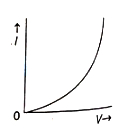
The $V-I$ characteristics of an $LED$ are correctly shown by which graph?
A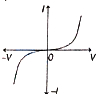
B
C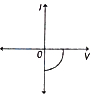
D
Solution
(B) An $LED$ (Light Emitting Diode) is a $p-n$ junction diode that emits light when it is forward-biased.
Therefore,its $V-I$ characteristics are similar to those of a standard $p-n$ junction diode operating in the forward bias region.
In the forward bias region,the current increases exponentially with the applied voltage after the threshold voltage (knee voltage) is reached.
Graph $(b)$ represents this exponential increase in current with voltage in the first quadrant,which is the characteristic behavior of an $LED$ in forward bias.
Graph $(a)$ shows both forward and reverse bias,which is for a general diode.
Graph $(c)$ represents the characteristics of a solar cell.
Graph $(d)$ represents the characteristics of a photodiode.
Therefore,its $V-I$ characteristics are similar to those of a standard $p-n$ junction diode operating in the forward bias region.
In the forward bias region,the current increases exponentially with the applied voltage after the threshold voltage (knee voltage) is reached.
Graph $(b)$ represents this exponential increase in current with voltage in the first quadrant,which is the characteristic behavior of an $LED$ in forward bias.
Graph $(a)$ shows both forward and reverse bias,which is for a general diode.
Graph $(c)$ represents the characteristics of a solar cell.
Graph $(d)$ represents the characteristics of a photodiode.
0 likesView Solution
85
PhysicsEasyMCQMHT CET · 2019
In the case of a $p-n$ junction diode,the width of the depletion region is:
A
Decreased with heavy doping
B
Increased by reverse biasing
C
Decreased with light doping
D
Increased by forward biasing
Solution
(B) In a $p-n$ junction diode,when it is reverse biased,the applied voltage supports the barrier potential,which causes the width of the depletion region to increase.
In forward biasing,the width of the depletion region decreases because the forward voltage opposes the potential barrier.
Additionally,the width of the depletion region decreases with heavy doping because the increased concentration of charge carriers leads to a narrower space charge region.
In forward biasing,the width of the depletion region decreases because the forward voltage opposes the potential barrier.
Additionally,the width of the depletion region decreases with heavy doping because the increased concentration of charge carriers leads to a narrower space charge region.
0 likesView Solution
86
PhysicsMediumMCQMHT CET · 2019
Assuming that the junction diode is ideal, the current in the arrangement shown in the figure is: (in $\text{mA}$)

A
$30$
B
$40$
C
$20$
D
$10$
Solution
(C) The diode is connected in forward bias because the $p$-side is at $+3 \text{ V}$ and the $n$-side is at $+1 \text{ V}$.
Since the diode is ideal, its resistance in forward bias is zero.
The potential difference across the resistor $R = 100 \ \Omega$ is $V = 3 \text{ V} - 1 \text{ V} = 2 \text{ V}$.
Using Ohm's law, the current $I$ is given by $I = \frac{V}{R} = \frac{2 \text{ V}}{100 \ \Omega} = 0.02 \text{ A}$.
Converting to milliamperes, $I = 0.02 \times 1000 \text{ mA} = 20 \text{ mA}$.
Since the diode is ideal, its resistance in forward bias is zero.
The potential difference across the resistor $R = 100 \ \Omega$ is $V = 3 \text{ V} - 1 \text{ V} = 2 \text{ V}$.
Using Ohm's law, the current $I$ is given by $I = \frac{V}{R} = \frac{2 \text{ V}}{100 \ \Omega} = 0.02 \text{ A}$.
Converting to milliamperes, $I = 0.02 \times 1000 \text{ mA} = 20 \text{ mA}$.
0 likesView Solution
87
PhysicsEasyMCQMHT CET · 2019
Which of the following regions of transistors are,respectively,heavily doped and lightly doped?
A
Collector and emitter
B
Base and emitter
C
Emitter and base
D
Emitter and collector
Solution
(C) In a transistor,the emitter region is heavily doped because its primary function is to inject a large number of charge carriers into the base.
The base region is very lightly doped and kept thin to minimize the recombination of charge carriers,allowing most of them to reach the collector.
The collector region is moderately doped compared to the emitter and base.
Therefore,the emitter is heavily doped and the base is lightly doped.
The base region is very lightly doped and kept thin to minimize the recombination of charge carriers,allowing most of them to reach the collector.
The collector region is moderately doped compared to the emitter and base.
Therefore,the emitter is heavily doped and the base is lightly doped.
0 likesView Solution
88
PhysicsMediumMCQMHT CET · 2019
In the study of a transistor as an amplifier,the ratio of collector current to emitter current is $0.98$. Then,the ratio of collector current to base current will be:
A
$99$
B
$49$
C
$50$
D
$98$
Solution
(B) The ratio of collector current $(I_C)$ to emitter current $(I_E)$ is known as the common-base current amplification factor,denoted by $\alpha$. Given: $\alpha = \frac{I_C}{I_E} = 0.98$.
The ratio of collector current $(I_C)$ to base current $(I_B)$ is known as the common-emitter current amplification factor,denoted by $\beta$.
The relationship between $\alpha$ and $\beta$ is given by the formula: $\beta = \frac{\alpha}{1 - \alpha}$.
Substituting the given value: $\beta = \frac{0.98}{1 - 0.98} = \frac{0.98}{0.02} = 49$.
Therefore,the ratio of collector current to base current is $49$.
The ratio of collector current $(I_C)$ to base current $(I_B)$ is known as the common-emitter current amplification factor,denoted by $\beta$.
The relationship between $\alpha$ and $\beta$ is given by the formula: $\beta = \frac{\alpha}{1 - \alpha}$.
Substituting the given value: $\beta = \frac{0.98}{1 - 0.98} = \frac{0.98}{0.02} = 49$.
Therefore,the ratio of collector current to base current is $49$.
0 likesView Solution
89
PhysicsEasyMCQMHT CET · 2019
For a transistor,the current ratio $\beta_{dc}$ is defined as the ratio of:
A
collector current to emitter current
B
collector current to base current
C
base current to collector current
D
emitter current to collector current
Solution
(B) The current gain $\beta_{dc}$ for a common-emitter transistor configuration is defined as the ratio of the collector current $(i_c)$ to the base current $(i_b)$.
Mathematically,$\beta_{dc} = \frac{i_c}{i_b} = \frac{\text{Collector current}}{\text{Base current}}$.
Mathematically,$\beta_{dc} = \frac{i_c}{i_b} = \frac{\text{Collector current}}{\text{Base current}}$.
0 likesView Solution
90
PhysicsEasyMCQMHT CET · 2019
Which of the following is the dimensional formula for electric polarisation?
A
$[M^0 L^{-2} T^1 I^1]$
B
$[M^{-1} L^{-2} T^1 I^{-1}]$
C
$[M^0 L^{-1} T^1 I^1]$
D
$[M^1 L^{-2} T^1 I^1]$
Solution
(A) Electric polarisation $(P)$ is defined as the dipole moment per unit volume.
$P = \frac{p}{V} = \frac{q \cdot d}{A \cdot d} = \frac{q}{A}$
Where $q$ is charge and $A$ is area.
The dimensional formula for charge $q$ is $[I^1 T^1]$.
The dimensional formula for area $A$ is $[L^2]$.
Therefore,the dimensional formula for $P$ is:
$[P] = \frac{[I^1 T^1]}{[L^2]} = [M^0 L^{-2} T^1 I^1]$.
$P = \frac{p}{V} = \frac{q \cdot d}{A \cdot d} = \frac{q}{A}$
Where $q$ is charge and $A$ is area.
The dimensional formula for charge $q$ is $[I^1 T^1]$.
The dimensional formula for area $A$ is $[L^2]$.
Therefore,the dimensional formula for $P$ is:
$[P] = \frac{[I^1 T^1]}{[L^2]} = [M^0 L^{-2} T^1 I^1]$.
0 likesView Solution
91
PhysicsEasyMCQMHT CET · 2019
In the case of the dimensions of electric field and electric dipole moment,the power of mass is respectively:
A
$1, 1$
B
$1, 0$
C
$0, 1$
D
$0, 0$
Solution
(B) The electric field $E$ is defined as force per unit charge: $E = \frac{F}{q}$.
Dimension of force $[F] = [M L T^{-2}]$ and dimension of charge $[q] = [A T]$.
Therefore,the dimension of electric field $[E] = \frac{[M L T^{-2}]}{[A T]} = [M L T^{-3} A^{-1}]$.
The power of mass in the electric field is $1$.
The electric dipole moment $p$ is defined as the product of charge and separation distance: $p = q \times d$.
Dimension of charge $[q] = [A T]$ and dimension of distance $[d] = [L]$.
Therefore,the dimension of electric dipole moment $[p] = [A T L] = [M^0 L^1 T^1 A^1]$.
The power of mass in the electric dipole moment is $0$.
Thus,the powers of mass are $1$ and $0$ respectively.
Dimension of force $[F] = [M L T^{-2}]$ and dimension of charge $[q] = [A T]$.
Therefore,the dimension of electric field $[E] = \frac{[M L T^{-2}]}{[A T]} = [M L T^{-3} A^{-1}]$.
The power of mass in the electric field is $1$.
The electric dipole moment $p$ is defined as the product of charge and separation distance: $p = q \times d$.
Dimension of charge $[q] = [A T]$ and dimension of distance $[d] = [L]$.
Therefore,the dimension of electric dipole moment $[p] = [A T L] = [M^0 L^1 T^1 A^1]$.
The power of mass in the electric dipole moment is $0$.
Thus,the powers of mass are $1$ and $0$ respectively.
0 likesView Solution
92
PhysicsEasyMCQMHT CET · 2019
The dimensions of self or mutual inductance are given as
A
$[L^{-2} M^1 T^{-2} I^{-2}]$
B
$[L^2 M^{-2} T^{-2} I^{-2}]$
C
$[L^2 M^1 T^{-2} I^{-2}]$
D
$[L^2 M^2 T^{-2} I^{-2}]$
Solution
(C) The self or mutual inductance of a coil is defined by the flux linkage per unit current,given by the relation:
$L \text{ or } M = \frac{\phi}{I}$
Where $\phi$ is the magnetic flux and $I$ is the current.
The dimensional formula for magnetic flux $\phi$ is $[M L^2 T^{-2} I^{-1}]$.
The dimensional formula for current $I$ is $[I^1]$.
Therefore,the dimension of inductance is:
$[L] = \frac{[\phi]}{[I]} = \frac{[M L^2 T^{-2} I^{-1}]}{[I^1]} = [M L^2 T^{-2} I^{-2}]$
$L \text{ or } M = \frac{\phi}{I}$
Where $\phi$ is the magnetic flux and $I$ is the current.
The dimensional formula for magnetic flux $\phi$ is $[M L^2 T^{-2} I^{-1}]$.
The dimensional formula for current $I$ is $[I^1]$.
Therefore,the dimension of inductance is:
$[L] = \frac{[\phi]}{[I]} = \frac{[M L^2 T^{-2} I^{-1}]}{[I^1]} = [M L^2 T^{-2} I^{-2}]$
0 likesView Solution
93
PhysicsEasyMCQMHT CET · 2019
Light of wavelength $\lambda$ is incident on a single slit of width $a$,and the distance between the slit and the screen is $D$. In the diffraction pattern,if the slit width is equal to the width of the central maximum,then $D=$
A
$\frac{a^2}{\lambda}$
B
$\frac{a}{\lambda}$
C
$\frac{a^2}{2 \lambda}$
D
$\frac{a}{2 \lambda}$
Solution
(C) The width of the central maximum in a single-slit diffraction pattern is given by the formula: $w = \frac{2 \lambda D}{a}$.
According to the problem,the slit width $a$ is equal to the width of the central maximum $w$.
Therefore,we set $a = \frac{2 \lambda D}{a}$.
Rearranging the equation to solve for $D$,we get: $a^2 = 2 \lambda D$.
Thus,$D = \frac{a^2}{2 \lambda}$.
According to the problem,the slit width $a$ is equal to the width of the central maximum $w$.
Therefore,we set $a = \frac{2 \lambda D}{a}$.
Rearranging the equation to solve for $D$,we get: $a^2 = 2 \lambda D$.
Thus,$D = \frac{a^2}{2 \lambda}$.
0 likesView Solution
94
PhysicsEasyMCQMHT CET · 2019
The luminous border that surrounds the profile of a mountain just before the sun rises behind it is an example of:
A
Dispersion
B
Total internal reflection
C
Interference
D
Diffraction
Solution
(D) The luminous border that surrounds the profile of a mountain just before the sun rises behind it is caused by the diffraction of light. Diffraction is the phenomenon of bending of light around the corners of an obstacle or an aperture. When the sun is slightly below the horizon,the light rays pass near the edges of the mountain. These rays bend around the edges due to diffraction,making the mountain's profile appear luminous.
0 likesView Solution
95
PhysicsEasyMCQMHT CET · 2019
The phenomenon of interference is based on
A
Conservation of momentum
B
Quantum nature of light
C
Conservation of energy
D
Conservation of charge
Solution
(C) In the phenomenon of interference,the energy is redistributed in the medium.
At points of constructive interference,the intensity (and thus energy) is maximum,while at points of destructive interference,the intensity is minimum.
Since the total energy remains constant throughout the medium,the phenomenon of interference is based on the principle of conservation of energy.
At points of constructive interference,the intensity (and thus energy) is maximum,while at points of destructive interference,the intensity is minimum.
Since the total energy remains constant throughout the medium,the phenomenon of interference is based on the principle of conservation of energy.
0 likesView Solution
96
PhysicsMediumMCQMHT CET · 2019
In Young's double slit experiment,the fifth dark fringe is formed opposite to one of the slits. If $D$ is the distance between the slits and the screen and $d$ is the separation between the slits,then the wavelength of light used is:
A
$\frac{d^2}{5 D}$
B
$\frac{d^2}{9 D}$
C
$\frac{d^2}{6 D}$
D
$\frac{d^2}{15 D}$
Solution
(B) The position of the $n^{th}$ dark fringe in Young's double slit experiment is given by:
$x_n = \frac{D}{d} (2n - 1) \frac{\lambda}{2}$
Rearranging for wavelength $\lambda$:
$\lambda = \frac{2 x_n d}{D(2n - 1)} \quad \dots (i)$
Given that the fifth dark fringe $(n=5)$ is formed opposite to one of the slits,the distance of this fringe from the central axis is half the distance between the slits:
$x_5 = \frac{d}{2} \implies 2x_5 = d$
Substituting $n=5$ and $2x_5 = d$ into equation $(i)$:
$\lambda = \frac{(2x_5) d}{D(2 \times 5 - 1)}$
$\lambda = \frac{d \cdot d}{D(10 - 1)}$
$\lambda = \frac{d^2}{9D}$
$x_n = \frac{D}{d} (2n - 1) \frac{\lambda}{2}$
Rearranging for wavelength $\lambda$:
$\lambda = \frac{2 x_n d}{D(2n - 1)} \quad \dots (i)$
Given that the fifth dark fringe $(n=5)$ is formed opposite to one of the slits,the distance of this fringe from the central axis is half the distance between the slits:
$x_5 = \frac{d}{2} \implies 2x_5 = d$
Substituting $n=5$ and $2x_5 = d$ into equation $(i)$:
$\lambda = \frac{(2x_5) d}{D(2 \times 5 - 1)}$
$\lambda = \frac{d \cdot d}{D(10 - 1)}$
$\lambda = \frac{d^2}{9D}$
0 likesView Solution
97
PhysicsEasyMCQMHT CET · 2019
In a Billet's split lens experiment,the distance between the source and the eyepiece is $1.2 \ m$,and the distance between the two virtual sources is $0.84 \ mm$. If the eyepiece is moved transversely through a distance of $2.799 \ cm$ to shift $30$ fringes,calculate the wavelength of the light used.
A
$6533 \ \mathring{A}$
B
$6537 \ \mathring{A}$
C
$6535 \ \mathring{A}$
D
$6531 \ \mathring{A}$
Solution
(D) The fringe width $\beta$ is given by $\beta = \frac{\lambda D}{d}$,where $D = 1.2 \ m$ is the distance between the source and the eyepiece,and $d = 0.84 \ mm = 0.84 \times 10^{-3} \ m$ is the distance between the virtual sources.
When the eyepiece is moved transversely by a distance $y = 2.799 \ cm = 2.799 \times 10^{-2} \ m$,the number of fringes shifted is $n = 30$.
The relationship is $y = n \beta = n \frac{\lambda D}{d}$.
Substituting the values: $2.799 \times 10^{-2} = 30 \times \frac{\lambda \times 1.2}{0.84 \times 10^{-3}}$.
$\lambda = \frac{2.799 \times 10^{-2} \times 0.84 \times 10^{-3}}{30 \times 1.2}$.
$\lambda = \frac{2.35116 \times 10^{-5}}{36} = 0.06531 \times 10^{-5} \ m = 6531 \times 10^{-10} \ m$.
Therefore,$\lambda = 6531 \ \mathring{A}$.
When the eyepiece is moved transversely by a distance $y = 2.799 \ cm = 2.799 \times 10^{-2} \ m$,the number of fringes shifted is $n = 30$.
The relationship is $y = n \beta = n \frac{\lambda D}{d}$.
Substituting the values: $2.799 \times 10^{-2} = 30 \times \frac{\lambda \times 1.2}{0.84 \times 10^{-3}}$.
$\lambda = \frac{2.799 \times 10^{-2} \times 0.84 \times 10^{-3}}{30 \times 1.2}$.
$\lambda = \frac{2.35116 \times 10^{-5}}{36} = 0.06531 \times 10^{-5} \ m = 6531 \times 10^{-10} \ m$.
Therefore,$\lambda = 6531 \ \mathring{A}$.
0 likesView Solution
98
PhysicsEasyMCQMHT CET · 2019
If a star emitting yellow light is accelerated towards the Earth,then to an observer on Earth,it will appear:
A
becoming orange
B
shining yellow
C
gradually changing to blue
D
gradually changing to red
Solution
(C) According to the Doppler effect for light,when a source of light moves towards an observer,the observed frequency $f'$ increases compared to the source frequency $f$.
This is given by the formula $f' = f \sqrt{\frac{c+v}{c-v}}$,where $v$ is the velocity of the source towards the observer and $c$ is the speed of light.
Since the frequency increases,the wavelength $\lambda$ decreases $(\lambda = c/f)$.
$A$ decrease in wavelength corresponds to a shift towards the blue end of the visible spectrum,which is known as a 'blue shift'.
Therefore,the yellow light will appear to shift towards the blue color.
This is given by the formula $f' = f \sqrt{\frac{c+v}{c-v}}$,where $v$ is the velocity of the source towards the observer and $c$ is the speed of light.
Since the frequency increases,the wavelength $\lambda$ decreases $(\lambda = c/f)$.
$A$ decrease in wavelength corresponds to a shift towards the blue end of the visible spectrum,which is known as a 'blue shift'.
Therefore,the yellow light will appear to shift towards the blue color.
0 likesView Solution
Vedclass Products
For Students
Vedclass Test Series
Mock tests in real MHT CET style covering Physics with performance analysis. 5-day free trial.
Start Free TrialFor Teachers
Exam Paper Generator
Generate Set A/B/C/D Physics papers from 7.5L+ questions in 2 minutes. 3 chapters free.
Try FreeFor Institutes
Online Exam Module
Run live MHT CET mock exams with unlimited students, 360° analytics & white-label branding.
See DemoFrequently Asked Questions
How many Physics questions are in MHT CET 2019?
There are 148 Physics questions from the MHT CET 2019 paper on Vedclass, each with a detailed step-by-step solution in English.
Are MHT CET 2019 Physics solutions available in English?
Yes. All solutions on this page are in English. You can also switch to English or Hindi using the language buttons above the questions.
Can I practice MHT CET 2019 Physics as a timed test?
Yes. Use the Vedclass Test Series to attempt a full MHT CET mock test covering Physics with time limits and instant score analysis.
Can teachers create Physics papers from MHT CET previous year questions?
Yes. The Vedclass Exam Paper Generator lets teachers mix MHT CET Physics questions and generate Set A/B/C/D papers in minutes.
For Teachers & Institutes
Build a Custom Physics Paper
Pick MHT CET 2019 Physics questions, set difficulty, and generate Set A/B/C/D in 2 minutes.