
MathematicsQ51–99 of 149 questions
Page 2 of 2 · English
51
MathematicsMediumMCQMHT CET · 2019
$\frac{1-2(\cos 60^{\circ}-\cos 80^{\circ})}{2 \sin 10^{\circ}} = \dots$
A
$2$
B
$1$
C
$\frac{1}{2}$
D
$\frac{3}{2}$
Solution
(B) We have,$\frac{1-2(\cos 60^{\circ}-\cos 80^{\circ})}{2 \sin 10^{\circ}}$
$= \frac{1-2(\frac{1}{2}-\cos 80^{\circ})}{2 \sin 10^{\circ}}$
$= \frac{1-1+2 \cos 80^{\circ}}{2 \sin 10^{\circ}}$
$= \frac{2 \cos 80^{\circ}}{2 \sin 10^{\circ}}$
$= \frac{\cos(90^{\circ}-10^{\circ})}{\sin 10^{\circ}}$
$= \frac{\sin 10^{\circ}}{\sin 10^{\circ}} = 1$
$= \frac{1-2(\frac{1}{2}-\cos 80^{\circ})}{2 \sin 10^{\circ}}$
$= \frac{1-1+2 \cos 80^{\circ}}{2 \sin 10^{\circ}}$
$= \frac{2 \cos 80^{\circ}}{2 \sin 10^{\circ}}$
$= \frac{\cos(90^{\circ}-10^{\circ})}{\sin 10^{\circ}}$
$= \frac{\sin 10^{\circ}}{\sin 10^{\circ}} = 1$
0 likesView Solution
52
MathematicsMediumMCQMHT CET · 2019
$\int \log x \cdot [\log (ex)]^{-2} dx = . . . . . .$
A
$\frac{x}{1 + \log x} + c$
B
$x(1 - \log x) + c$
C
$x(1 + \log x) + c$
D
$\frac{x}{1 - \log x} + c$
Solution
(A) Let $I = \int \log x \cdot [\log (ex)]^{-2} dx$
Since $\log(ex) = \log e + \log x = 1 + \log x$,the integral becomes:
$I = \int \frac{\log x}{(1 + \log x)^{2}} dx$
Substitute $\log x = t$,which implies $x = e^{t}$ and $dx = e^{t} dt$.
$I = \int \frac{t}{(1 + t)^{2}} e^{t} dt$
We can rewrite the numerator as $(t + 1 - 1)$:
$I = \int e^{t} \left( \frac{t + 1 - 1}{(1 + t)^{2}} \right) dt$
$I = \int e^{t} \left( \frac{1}{1 + t} - \frac{1}{(1 + t)^{2}} \right) dt$
Using the standard integral formula $\int e^{x} [f(x) + f'(x)] dx = e^{x} f(x) + C$,where $f(t) = \frac{1}{1 + t}$ and $f'(t) = -\frac{1}{(1 + t)^{2}}$:
$I = e^{t} \cdot \frac{1}{1 + t} + C$
Substituting back $t = \log x$ and $e^{t} = x$:
$I = \frac{x}{1 + \log x} + C$
Since $\log(ex) = \log e + \log x = 1 + \log x$,the integral becomes:
$I = \int \frac{\log x}{(1 + \log x)^{2}} dx$
Substitute $\log x = t$,which implies $x = e^{t}$ and $dx = e^{t} dt$.
$I = \int \frac{t}{(1 + t)^{2}} e^{t} dt$
We can rewrite the numerator as $(t + 1 - 1)$:
$I = \int e^{t} \left( \frac{t + 1 - 1}{(1 + t)^{2}} \right) dt$
$I = \int e^{t} \left( \frac{1}{1 + t} - \frac{1}{(1 + t)^{2}} \right) dt$
Using the standard integral formula $\int e^{x} [f(x) + f'(x)] dx = e^{x} f(x) + C$,where $f(t) = \frac{1}{1 + t}$ and $f'(t) = -\frac{1}{(1 + t)^{2}}$:
$I = e^{t} \cdot \frac{1}{1 + t} + C$
Substituting back $t = \log x$ and $e^{t} = x$:
$I = \frac{x}{1 + \log x} + C$
0 likesView Solution
53
MathematicsMediumMCQMHT CET · 2019
$\int \frac{x^2+1}{x^4-x^2+1} \, dx =$
A
$\tan^{-1}\left(\frac{x^2+1}{2}\right) + c$
B
$\tan^{-1}(x^2) + c$
C
$\tan^{-1}(2x^2-1) + c$
D
$\tan^{-1}\left(\frac{x^2-1}{x}\right) + c$
Solution
(D) Let $I = \int \frac{x^2+1}{x^4-x^2+1} \, dx$.
Divide the numerator and denominator by $x^2$:
$I = \int \frac{1 + \frac{1}{x^2}}{x^2 - 1 + \frac{1}{x^2}} \, dx$.
Rewrite the denominator as $(x - \frac{1}{x})^2 + 1$:
$I = \int \frac{1 + \frac{1}{x^2}}{(x - \frac{1}{x})^2 + 1} \, dx$.
Let $t = x - \frac{1}{x}$. Then $dt = (1 + \frac{1}{x^2}) \, dx$.
Substituting these into the integral:
$I = \int \frac{dt}{t^2 + 1} = \tan^{-1}(t) + c$.
Substituting $t = x - \frac{1}{x}$ back:
$I = \tan^{-1}\left(x - \frac{1}{x}\right) + c = \tan^{-1}\left(\frac{x^2-1}{x}\right) + c$.
Divide the numerator and denominator by $x^2$:
$I = \int \frac{1 + \frac{1}{x^2}}{x^2 - 1 + \frac{1}{x^2}} \, dx$.
Rewrite the denominator as $(x - \frac{1}{x})^2 + 1$:
$I = \int \frac{1 + \frac{1}{x^2}}{(x - \frac{1}{x})^2 + 1} \, dx$.
Let $t = x - \frac{1}{x}$. Then $dt = (1 + \frac{1}{x^2}) \, dx$.
Substituting these into the integral:
$I = \int \frac{dt}{t^2 + 1} = \tan^{-1}(t) + c$.
Substituting $t = x - \frac{1}{x}$ back:
$I = \tan^{-1}\left(x - \frac{1}{x}\right) + c = \tan^{-1}\left(\frac{x^2-1}{x}\right) + c$.
0 likesView Solution
54
MathematicsDifficultMCQMHT CET · 2019
If $\int \tan (x - \alpha) \cdot \tan (x + \alpha) \cdot \tan 2 x \ d x = p \log |\sec 2 x| + q \log |\sec (x + \alpha)| + r \log |\sec (x - \alpha)| + c$,then $p + q + r = . . . . . .$
A
$\frac{-3}{2}$
B
$\frac{-5}{2}$
C
$\frac{5}{2}$
D
$\frac{3}{2}$
Solution
(A) We have,$\tan 2 x = \tan ((x - \alpha) + (x + \alpha))$.
Using the identity $\tan (A + B) = \frac{\tan A + \tan B}{1 - \tan A \tan B}$,we get:
$\tan 2 x = \frac{\tan (x - \alpha) + \tan (x + \alpha)}{1 - \tan (x - \alpha) \tan (x + \alpha)}$.
Rearranging the terms:
$\tan 2 x (1 - \tan (x - \alpha) \tan (x + \alpha)) = \tan (x - \alpha) + \tan (x + \alpha)$.
$\tan 2 x - \tan (x - \alpha) \tan (x + \alpha) \tan 2 x = \tan (x - \alpha) + \tan (x + \alpha)$.
Thus,$\tan (x - \alpha) \tan (x + \alpha) \tan 2 x = \tan 2 x - \tan (x - \alpha) - \tan (x + \alpha)$.
Now,integrating both sides:
$\int \tan (x - \alpha) \tan (x + \alpha) \tan 2 x \ d x = \int (\tan 2 x - \tan (x - \alpha) - \tan (x + \alpha)) \ d x$.
$= \frac{1}{2} \log |\sec 2 x| - \log |\sec (x - \alpha)| - \log |\sec (x + \alpha)| + C$.
Comparing this with $p \log |\sec 2 x| + q \log |\sec (x + \alpha)| + r \log |\sec (x - \alpha)| + c$,we get:
$p = \frac{1}{2}$,$q = -1$,and $r = -1$.
Therefore,$p + q + r = \frac{1}{2} - 1 - 1 = \frac{1}{2} - 2 = \frac{-3}{2}$.
Using the identity $\tan (A + B) = \frac{\tan A + \tan B}{1 - \tan A \tan B}$,we get:
$\tan 2 x = \frac{\tan (x - \alpha) + \tan (x + \alpha)}{1 - \tan (x - \alpha) \tan (x + \alpha)}$.
Rearranging the terms:
$\tan 2 x (1 - \tan (x - \alpha) \tan (x + \alpha)) = \tan (x - \alpha) + \tan (x + \alpha)$.
$\tan 2 x - \tan (x - \alpha) \tan (x + \alpha) \tan 2 x = \tan (x - \alpha) + \tan (x + \alpha)$.
Thus,$\tan (x - \alpha) \tan (x + \alpha) \tan 2 x = \tan 2 x - \tan (x - \alpha) - \tan (x + \alpha)$.
Now,integrating both sides:
$\int \tan (x - \alpha) \tan (x + \alpha) \tan 2 x \ d x = \int (\tan 2 x - \tan (x - \alpha) - \tan (x + \alpha)) \ d x$.
$= \frac{1}{2} \log |\sec 2 x| - \log |\sec (x - \alpha)| - \log |\sec (x + \alpha)| + C$.
Comparing this with $p \log |\sec 2 x| + q \log |\sec (x + \alpha)| + r \log |\sec (x - \alpha)| + c$,we get:
$p = \frac{1}{2}$,$q = -1$,and $r = -1$.
Therefore,$p + q + r = \frac{1}{2} - 1 - 1 = \frac{1}{2} - 2 = \frac{-3}{2}$.
0 likesView Solution
55
MathematicsMediumMCQMHT CET · 2019
$\int \frac{\cos x-\sin x}{8-\sin 2x} dx = \frac{1}{p} \log \left[\frac{3+\sin x+\cos x}{3-\sin x-\cos x}\right]+c$,then $p = \ldots$
A
$6$
B
$1$
C
$3$
D
$12$
Solution
(A) Let $I = \int \frac{\cos x-\sin x}{8-\sin 2x} dx$.
We know that $\sin 2x = 2 \sin x \cos x$ and $1 = \sin^2 x + \cos^2 x$.
So,$8 - \sin 2x = 9 - (1 + 2 \sin x \cos x) = 9 - (\sin x + \cos x)^2$.
Thus,$I = \int \frac{\cos x - \sin x}{3^2 - (\sin x + \cos x)^2} dx$.
Let $t = \sin x + \cos x$. Then $dt = (\cos x - \sin x) dx$.
Substituting these into the integral,we get $I = \int \frac{dt}{3^2 - t^2}$.
Using the formula $\int \frac{dx}{a^2 - x^2} = \frac{1}{2a} \log \left| \frac{a+x}{a-x} \right| + C$,we have:
$I = \frac{1}{2(3)} \log \left| \frac{3+t}{3-t} \right| + C = \frac{1}{6} \log \left| \frac{3+\sin x + \cos x}{3 - (\sin x + \cos x)} \right| + C$.
Comparing this with the given expression $\frac{1}{p} \log \left[\frac{3+\sin x+\cos x}{3-\sin x-\cos x}\right]+c$,we find $p = 6$.
We know that $\sin 2x = 2 \sin x \cos x$ and $1 = \sin^2 x + \cos^2 x$.
So,$8 - \sin 2x = 9 - (1 + 2 \sin x \cos x) = 9 - (\sin x + \cos x)^2$.
Thus,$I = \int \frac{\cos x - \sin x}{3^2 - (\sin x + \cos x)^2} dx$.
Let $t = \sin x + \cos x$. Then $dt = (\cos x - \sin x) dx$.
Substituting these into the integral,we get $I = \int \frac{dt}{3^2 - t^2}$.
Using the formula $\int \frac{dx}{a^2 - x^2} = \frac{1}{2a} \log \left| \frac{a+x}{a-x} \right| + C$,we have:
$I = \frac{1}{2(3)} \log \left| \frac{3+t}{3-t} \right| + C = \frac{1}{6} \log \left| \frac{3+\sin x + \cos x}{3 - (\sin x + \cos x)} \right| + C$.
Comparing this with the given expression $\frac{1}{p} \log \left[\frac{3+\sin x+\cos x}{3-\sin x-\cos x}\right]+c$,we find $p = 6$.
0 likesView Solution
56
MathematicsMediumMCQMHT CET · 2019
$\int \frac{1}{(x^2+1)^2} dx = . . . . . .$
A
$\tan^{-1} x - \frac{1}{2x(x^2+1)} + c$
B
$\frac{1}{2} \tan^{-1} x + \frac{x}{2(x^2+1)} + c$
C
$\tan^{-1} x + \frac{1}{x^2+1} + c$
D
$\tan^{-1} x + \frac{1}{2(x^2+1)} + c$
Solution
(B) Let $I = \int \frac{dx}{(x^2+1)^2}$.
Substitute $x = \tan \theta$,then $dx = \sec^2 \theta d \theta$.
$I = \int \frac{\sec^2 \theta d \theta}{(\tan^2 \theta + 1)^2} = \int \frac{\sec^2 \theta d \theta}{\sec^4 \theta} = \int \cos^2 \theta d \theta$.
Using the identity $\cos^2 \theta = \frac{1 + \cos 2 \theta}{2}$,we get:
$I = \frac{1}{2} \int (1 + \cos 2 \theta) d \theta = \frac{1}{2} (\theta + \frac{\sin 2 \theta}{2}) + c$.
Since $\sin 2 \theta = \frac{2 \tan \theta}{1 + \tan^2 \theta}$ and $\theta = \tan^{-1} x$,we have:
$I = \frac{1}{2} \tan^{-1} x + \frac{1}{4} \cdot \frac{2x}{1 + x^2} + c = \frac{1}{2} \tan^{-1} x + \frac{x}{2(1 + x^2)} + c$.
Substitute $x = \tan \theta$,then $dx = \sec^2 \theta d \theta$.
$I = \int \frac{\sec^2 \theta d \theta}{(\tan^2 \theta + 1)^2} = \int \frac{\sec^2 \theta d \theta}{\sec^4 \theta} = \int \cos^2 \theta d \theta$.
Using the identity $\cos^2 \theta = \frac{1 + \cos 2 \theta}{2}$,we get:
$I = \frac{1}{2} \int (1 + \cos 2 \theta) d \theta = \frac{1}{2} (\theta + \frac{\sin 2 \theta}{2}) + c$.
Since $\sin 2 \theta = \frac{2 \tan \theta}{1 + \tan^2 \theta}$ and $\theta = \tan^{-1} x$,we have:
$I = \frac{1}{2} \tan^{-1} x + \frac{1}{4} \cdot \frac{2x}{1 + x^2} + c = \frac{1}{2} \tan^{-1} x + \frac{x}{2(1 + x^2)} + c$.
0 likesView Solution
57
MathematicsMediumMCQMHT CET · 2019
$\int \frac{\cos x+x \sin x}{x(x+\cos x)} d x = \_\_\_\_$
A
$\log \left|\frac{x \sin x}{x+\cos x}\right|+c$
B
$\log \left|\frac{x}{x+\cos x}\right|+c$
C
$\log |\cos x+x \sin x|+c$
D
$\log \left|x^2+x \cos x\right|+c$
Solution
(B) Let $I = \int \frac{\cos x + x \sin x}{x(x + \cos x)} dx$.
Observe the denominator $f(x) = x^2 + x \cos x$.
The derivative of the denominator is $f'(x) = \frac{d}{dx}(x^2 + x \cos x) = 2x + \cos x - x \sin x$. This does not match the numerator directly.
Let us rewrite the integral as:
$I = \int \frac{x + \cos x + x \sin x - x}{x(x + \cos x)} dx$
$I = \int \left( \frac{x + \cos x}{x(x + \cos x)} + \frac{x \sin x - x}{x(x + \cos x)} \right) dx$
$I = \int \left( \frac{1}{x} + \frac{x(\sin x - 1)}{x(x + \cos x)} \right) dx$
$I = \int \frac{1}{x} dx + \int \frac{\sin x - 1}{x + \cos x} dx$
Let $u = x + \cos x$,then $du = (1 - \sin x) dx$,which means $-(1 - \sin x) dx = du$,or $(\sin x - 1) dx = -du$.
$I = \ln|x| - \int \frac{1}{u} du$
$I = \ln|x| - \ln|u| + c$
$I = \ln|x| - \ln|x + \cos x| + c$
$I = \ln \left| \frac{x}{x + \cos x} \right| + c$.
Observe the denominator $f(x) = x^2 + x \cos x$.
The derivative of the denominator is $f'(x) = \frac{d}{dx}(x^2 + x \cos x) = 2x + \cos x - x \sin x$. This does not match the numerator directly.
Let us rewrite the integral as:
$I = \int \frac{x + \cos x + x \sin x - x}{x(x + \cos x)} dx$
$I = \int \left( \frac{x + \cos x}{x(x + \cos x)} + \frac{x \sin x - x}{x(x + \cos x)} \right) dx$
$I = \int \left( \frac{1}{x} + \frac{x(\sin x - 1)}{x(x + \cos x)} \right) dx$
$I = \int \frac{1}{x} dx + \int \frac{\sin x - 1}{x + \cos x} dx$
Let $u = x + \cos x$,then $du = (1 - \sin x) dx$,which means $-(1 - \sin x) dx = du$,or $(\sin x - 1) dx = -du$.
$I = \ln|x| - \int \frac{1}{u} du$
$I = \ln|x| - \ln|u| + c$
$I = \ln|x| - \ln|x + \cos x| + c$
$I = \ln \left| \frac{x}{x + \cos x} \right| + c$.
0 likesView Solution
58
MathematicsEasyMCQMHT CET · 2019
$\int \frac{\sqrt{x^2-a^2}}{x} d x = \_\_\_\_$
A
$\sqrt{x^2-a^2}-a \sec ^{-1}\left(\frac{x}{a}\right)+c$
B
$x \sqrt{x^2-a^2}-\frac{1}{a} \tan ^{-1}\left(\frac{x}{a}\right)+c$
C
$\sqrt{x^2-a^2}+a \sec ^{-1}\left(\frac{x}{a}\right)+c$
D
$\sqrt{x^2-a^2}+\frac{1}{x} \sec ^{-1}(x)+c$
Solution
(A) Let $I = \int \frac{\sqrt{x^2-a^2}}{x} d x$.
Substitute $x = a \sec \theta$,then $d x = a \sec \theta \tan \theta d \theta$.
Substituting these into the integral:
$I = \int \frac{\sqrt{a^2 \sec^2 \theta - a^2}}{a \sec \theta} (a \sec \theta \tan \theta) d \theta$
$I = \int \frac{a \tan \theta}{a \sec \theta} (a \sec \theta \tan \theta) d \theta$
$I = a \int \tan^2 \theta d \theta$
$I = a \int (\sec^2 \theta - 1) d \theta$
$I = a (\tan \theta - \theta) + c$
Since $x = a \sec \theta$,we have $\sec \theta = \frac{x}{a}$,so $\theta = \sec^{-1}(\frac{x}{a})$ and $\tan \theta = \sqrt{\sec^2 \theta - 1} = \sqrt{(\frac{x}{a})^2 - 1} = \frac{\sqrt{x^2-a^2}}{a}$.
Substituting back:
$I = a (\frac{\sqrt{x^2-a^2}}{a} - \sec^{-1}(\frac{x}{a})) + c$
$I = \sqrt{x^2-a^2} - a \sec^{-1}(\frac{x}{a}) + c$.
Substitute $x = a \sec \theta$,then $d x = a \sec \theta \tan \theta d \theta$.
Substituting these into the integral:
$I = \int \frac{\sqrt{a^2 \sec^2 \theta - a^2}}{a \sec \theta} (a \sec \theta \tan \theta) d \theta$
$I = \int \frac{a \tan \theta}{a \sec \theta} (a \sec \theta \tan \theta) d \theta$
$I = a \int \tan^2 \theta d \theta$
$I = a \int (\sec^2 \theta - 1) d \theta$
$I = a (\tan \theta - \theta) + c$
Since $x = a \sec \theta$,we have $\sec \theta = \frac{x}{a}$,so $\theta = \sec^{-1}(\frac{x}{a})$ and $\tan \theta = \sqrt{\sec^2 \theta - 1} = \sqrt{(\frac{x}{a})^2 - 1} = \frac{\sqrt{x^2-a^2}}{a}$.
Substituting back:
$I = a (\frac{\sqrt{x^2-a^2}}{a} - \sec^{-1}(\frac{x}{a})) + c$
$I = \sqrt{x^2-a^2} - a \sec^{-1}(\frac{x}{a}) + c$.
0 likesView Solution
59
MathematicsDifficultMCQMHT CET · 2019
$\int_{\frac{\pi}{18}}^{\frac{4\pi}{9}} \frac{2\sqrt{\sin x}}{\sqrt{\sin x} + \sqrt{\cos x}} dx = . . . . . .$
A
$\frac{7\pi}{36}$
B
$\frac{5\pi}{36}$
C
$\frac{7\pi}{18}$
D
$\frac{5\pi}{18}$
Solution
(C) Let $I = \int_{\frac{\pi}{18}}^{\frac{4\pi}{9}} \frac{2\sqrt{\sin x}}{\sqrt{\sin x} + \sqrt{\cos x}} dx$ . . . $(i)$
Using the property $\int_{a}^{b} f(x) dx = \int_{a}^{b} f(a+b-x) dx$,where $a = \frac{\pi}{18}$ and $b = \frac{4\pi}{9}$,we have $a+b = \frac{\pi}{18} + \frac{8\pi}{18} = \frac{9\pi}{18} = \frac{\pi}{2}$.
So,$I = 2 \int_{\frac{\pi}{18}}^{\frac{4\pi}{9}} \frac{\sqrt{\sin(\frac{\pi}{2}-x)}}{\sqrt{\sin(\frac{\pi}{2}-x)} + \sqrt{\cos(\frac{\pi}{2}-x)}} dx$
$I = 2 \int_{\frac{\pi}{18}}^{\frac{4\pi}{9}} \frac{\sqrt{\cos x}}{\sqrt{\cos x} + \sqrt{\sin x}} dx$ . . . $(ii)$
Adding $(i)$ and $(ii)$:
$2I = 2 \int_{\frac{\pi}{18}}^{\frac{4\pi}{9}} \left( \frac{\sqrt{\sin x} + \sqrt{\cos x}}{\sqrt{\sin x} + \sqrt{\cos x}} \right) dx$
$2I = 2 \int_{\frac{\pi}{18}}^{\frac{4\pi}{9}} 1 dx = 2 [x]_{\frac{\pi}{18}}^{\frac{4\pi}{9}}$
$2I = 2 \left( \frac{4\pi}{9} - \frac{\pi}{18} \right) = 2 \left( \frac{8\pi - \pi}{18} \right) = 2 \left( \frac{7\pi}{18} \right) = \frac{7\pi}{9}$
$I = \frac{7\pi}{18}$
Using the property $\int_{a}^{b} f(x) dx = \int_{a}^{b} f(a+b-x) dx$,where $a = \frac{\pi}{18}$ and $b = \frac{4\pi}{9}$,we have $a+b = \frac{\pi}{18} + \frac{8\pi}{18} = \frac{9\pi}{18} = \frac{\pi}{2}$.
So,$I = 2 \int_{\frac{\pi}{18}}^{\frac{4\pi}{9}} \frac{\sqrt{\sin(\frac{\pi}{2}-x)}}{\sqrt{\sin(\frac{\pi}{2}-x)} + \sqrt{\cos(\frac{\pi}{2}-x)}} dx$
$I = 2 \int_{\frac{\pi}{18}}^{\frac{4\pi}{9}} \frac{\sqrt{\cos x}}{\sqrt{\cos x} + \sqrt{\sin x}} dx$ . . . $(ii)$
Adding $(i)$ and $(ii)$:
$2I = 2 \int_{\frac{\pi}{18}}^{\frac{4\pi}{9}} \left( \frac{\sqrt{\sin x} + \sqrt{\cos x}}{\sqrt{\sin x} + \sqrt{\cos x}} \right) dx$
$2I = 2 \int_{\frac{\pi}{18}}^{\frac{4\pi}{9}} 1 dx = 2 [x]_{\frac{\pi}{18}}^{\frac{4\pi}{9}}$
$2I = 2 \left( \frac{4\pi}{9} - \frac{\pi}{18} \right) = 2 \left( \frac{8\pi - \pi}{18} \right) = 2 \left( \frac{7\pi}{18} \right) = \frac{7\pi}{9}$
$I = \frac{7\pi}{18}$
0 likesView Solution
60
MathematicsMediumMCQMHT CET · 2019
If $4 \sin ^{-1} x + 6 \cos ^{-1} x = 3 \pi$,then $x = \ldots$.
A
$\frac{1}{\sqrt{2}}$
B
$\frac{1}{2}$
C
$0$
D
$-\frac{1}{2}$
Solution
(C) Given equation: $4 \sin ^{-1} x + 6 \cos ^{-1} x = 3 \pi$.
We know the identity $\sin ^{-1} x + \cos ^{-1} x = \frac{\pi}{2}$,which implies $\cos ^{-1} x = \frac{\pi}{2} - \sin ^{-1} x$.
Substituting this into the equation:
$4 \sin ^{-1} x + 6(\frac{\pi}{2} - \sin ^{-1} x) = 3 \pi$
$4 \sin ^{-1} x + 3 \pi - 6 \sin ^{-1} x = 3 \pi$
$-2 \sin ^{-1} x + 3 \pi = 3 \pi$
$-2 \sin ^{-1} x = 0$
$\sin ^{-1} x = 0$
$x = \sin(0) = 0$.
We know the identity $\sin ^{-1} x + \cos ^{-1} x = \frac{\pi}{2}$,which implies $\cos ^{-1} x = \frac{\pi}{2} - \sin ^{-1} x$.
Substituting this into the equation:
$4 \sin ^{-1} x + 6(\frac{\pi}{2} - \sin ^{-1} x) = 3 \pi$
$4 \sin ^{-1} x + 3 \pi - 6 \sin ^{-1} x = 3 \pi$
$-2 \sin ^{-1} x + 3 \pi = 3 \pi$
$-2 \sin ^{-1} x = 0$
$\sin ^{-1} x = 0$
$x = \sin(0) = 0$.
0 likesView Solution
61
MathematicsDifficultMCQMHT CET · 2019
The value of $\tan ^{-1} \frac{1}{3}+\tan ^{-1} \frac{1}{5}+\tan ^{-1} \frac{1}{7}+\tan ^{-1} \frac{1}{8}$ is $ . . . . . . $
A
$\frac{11 \pi}{5}$
B
$\frac{\pi}{4}$
C
$\pi$
D
$\frac{3 \pi}{4}$
Solution
(B) Let $L = \tan ^{-1} \frac{1}{3} + \tan ^{-1} \frac{1}{5} + \tan ^{-1} \frac{1}{7} + \tan ^{-1} \frac{1}{8}$.
Using the formula $\tan ^{-1} x + \tan ^{-1} y = \tan ^{-1} \left( \frac{x+y}{1-xy} \right)$:
First,group the terms: $L = \left( \tan ^{-1} \frac{1}{3} + \tan ^{-1} \frac{1}{5} \right) + \left( \tan ^{-1} \frac{1}{7} + \tan ^{-1} \frac{1}{8} \right)$.
Calculate the first part: $\tan ^{-1} \left( \frac{1/3 + 1/5}{1 - (1/3)(1/5)} \right) = \tan ^{-1} \left( \frac{8/15}{14/15} \right) = \tan ^{-1} \left( \frac{8}{14} \right) = \tan ^{-1} \left( \frac{4}{7} \right)$.
Calculate the second part: $\tan ^{-1} \left( \frac{1/7 + 1/8}{1 - (1/7)(1/8)} \right) = \tan ^{-1} \left( \frac{15/56}{55/56} \right) = \tan ^{-1} \left( \frac{15}{55} \right) = \tan ^{-1} \left( \frac{3}{11} \right)$.
Now combine them: $L = \tan ^{-1} \left( \frac{4}{7} \right) + \tan ^{-1} \left( \frac{3}{11} \right) = \tan ^{-1} \left( \frac{4/7 + 3/11}{1 - (4/7)(3/11)} \right)$.
$L = \tan ^{-1} \left( \frac{44/77 + 21/77}{1 - 12/77} \right) = \tan ^{-1} \left( \frac{65/77}{65/77} \right) = \tan ^{-1} (1) = \frac{\pi}{4}$.
Using the formula $\tan ^{-1} x + \tan ^{-1} y = \tan ^{-1} \left( \frac{x+y}{1-xy} \right)$:
First,group the terms: $L = \left( \tan ^{-1} \frac{1}{3} + \tan ^{-1} \frac{1}{5} \right) + \left( \tan ^{-1} \frac{1}{7} + \tan ^{-1} \frac{1}{8} \right)$.
Calculate the first part: $\tan ^{-1} \left( \frac{1/3 + 1/5}{1 - (1/3)(1/5)} \right) = \tan ^{-1} \left( \frac{8/15}{14/15} \right) = \tan ^{-1} \left( \frac{8}{14} \right) = \tan ^{-1} \left( \frac{4}{7} \right)$.
Calculate the second part: $\tan ^{-1} \left( \frac{1/7 + 1/8}{1 - (1/7)(1/8)} \right) = \tan ^{-1} \left( \frac{15/56}{55/56} \right) = \tan ^{-1} \left( \frac{15}{55} \right) = \tan ^{-1} \left( \frac{3}{11} \right)$.
Now combine them: $L = \tan ^{-1} \left( \frac{4}{7} \right) + \tan ^{-1} \left( \frac{3}{11} \right) = \tan ^{-1} \left( \frac{4/7 + 3/11}{1 - (4/7)(3/11)} \right)$.
$L = \tan ^{-1} \left( \frac{44/77 + 21/77}{1 - 12/77} \right) = \tan ^{-1} \left( \frac{65/77}{65/77} \right) = \tan ^{-1} (1) = \frac{\pi}{4}$.
0 likesView Solution
62
MathematicsMediumMCQMHT CET · 2019
If $y = \tan^{-1} \left( \frac{1 - \cos 3x}{\sin 3x} \right)$,then $\frac{dy}{dx} = \ldots$
A
$-\frac{3}{2}$
B
$-\frac{1}{2}$
C
$\frac{3}{2}$
D
$\frac{1}{2}$
Solution
(C) Given,$y = \tan^{-1} \left( \frac{1 - \cos 3x}{\sin 3x} \right)$.
Using trigonometric identities $1 - \cos \theta = 2 \sin^2 \left( \frac{\theta}{2} \right)$ and $\sin \theta = 2 \sin \left( \frac{\theta}{2} \right) \cos \left( \frac{\theta}{2} \right)$,we have:
$y = \tan^{-1} \left( \frac{2 \sin^2 \left( \frac{3x}{2} \right)}{2 \sin \left( \frac{3x}{2} \right) \cos \left( \frac{3x}{2} \right)} \right)$
$y = \tan^{-1} \left( \frac{\sin \left( \frac{3x}{2} \right)}{\cos \left( \frac{3x}{2} \right)} \right)$
$y = \tan^{-1} \left( \tan \left( \frac{3x}{2} \right) \right)$
$y = \frac{3x}{2}$
Differentiating with respect to $x$:
$\frac{dy}{dx} = \frac{d}{dx} \left( \frac{3x}{2} \right) = \frac{3}{2}$.
Using trigonometric identities $1 - \cos \theta = 2 \sin^2 \left( \frac{\theta}{2} \right)$ and $\sin \theta = 2 \sin \left( \frac{\theta}{2} \right) \cos \left( \frac{\theta}{2} \right)$,we have:
$y = \tan^{-1} \left( \frac{2 \sin^2 \left( \frac{3x}{2} \right)}{2 \sin \left( \frac{3x}{2} \right) \cos \left( \frac{3x}{2} \right)} \right)$
$y = \tan^{-1} \left( \frac{\sin \left( \frac{3x}{2} \right)}{\cos \left( \frac{3x}{2} \right)} \right)$
$y = \tan^{-1} \left( \tan \left( \frac{3x}{2} \right) \right)$
$y = \frac{3x}{2}$
Differentiating with respect to $x$:
$\frac{dy}{dx} = \frac{d}{dx} \left( \frac{3x}{2} \right) = \frac{3}{2}$.
0 likesView Solution
63
MathematicsDifficultMCQMHT CET · 2019
If $f(x) = \left[\tan \left(\frac{\pi}{4} + x\right)\right]^{\frac{1}{x}}$ for $x \neq 0$ and $f(x) = k$ for $x = 0$ is continuous at $x = 0$,then $k = \dots$
A
$e^2$
B
$1$
C
$e$
D
$e^{-2}$
Solution
(A) Given that $f(x)$ is continuous at $x = 0$,we have $\lim_{x \to 0} f(x) = f(0) = k$.
Since the limit is of the form $1^\infty$,we use the formula $\lim_{x \to a} [g(x)]^{h(x)} = e^{\lim_{x \to a} [g(x) - 1]h(x)}$.
Here,$g(x) = \tan(\frac{\pi}{4} + x)$ and $h(x) = \frac{1}{x}$.
$k = e^{\lim_{x \to 0} [\tan(\frac{\pi}{4} + x) - 1] \cdot \frac{1}{x}}$.
Using $\tan(A+B) = \frac{\tan A + \tan B}{1 - \tan A \tan B}$,we get $\tan(\frac{\pi}{4} + x) = \frac{1 + \tan x}{1 - \tan x}$.
$k = e^{\lim_{x \to 0} [\frac{1 + \tan x}{1 - \tan x} - 1] \cdot \frac{1}{x}} = e^{\lim_{x \to 0} [\frac{1 + \tan x - 1 + \tan x}{1 - \tan x}] \cdot \frac{1}{x}}$.
$k = e^{\lim_{x \to 0} \frac{2 \tan x}{x(1 - \tan x)}} = e^{2 \cdot \lim_{x \to 0} \frac{\tan x}{x} \cdot \lim_{x \to 0} \frac{1}{1 - \tan x}}$.
Since $\lim_{x \to 0} \frac{\tan x}{x} = 1$ and $\lim_{x \to 0} \frac{1}{1 - \tan x} = 1$,we have $k = e^{2 \cdot 1 \cdot 1} = e^2$.
Since the limit is of the form $1^\infty$,we use the formula $\lim_{x \to a} [g(x)]^{h(x)} = e^{\lim_{x \to a} [g(x) - 1]h(x)}$.
Here,$g(x) = \tan(\frac{\pi}{4} + x)$ and $h(x) = \frac{1}{x}$.
$k = e^{\lim_{x \to 0} [\tan(\frac{\pi}{4} + x) - 1] \cdot \frac{1}{x}}$.
Using $\tan(A+B) = \frac{\tan A + \tan B}{1 - \tan A \tan B}$,we get $\tan(\frac{\pi}{4} + x) = \frac{1 + \tan x}{1 - \tan x}$.
$k = e^{\lim_{x \to 0} [\frac{1 + \tan x}{1 - \tan x} - 1] \cdot \frac{1}{x}} = e^{\lim_{x \to 0} [\frac{1 + \tan x - 1 + \tan x}{1 - \tan x}] \cdot \frac{1}{x}}$.
$k = e^{\lim_{x \to 0} \frac{2 \tan x}{x(1 - \tan x)}} = e^{2 \cdot \lim_{x \to 0} \frac{\tan x}{x} \cdot \lim_{x \to 0} \frac{1}{1 - \tan x}}$.
Since $\lim_{x \to 0} \frac{\tan x}{x} = 1$ and $\lim_{x \to 0} \frac{1}{1 - \tan x} = 1$,we have $k = e^{2 \cdot 1 \cdot 1} = e^2$.
0 likesView Solution
64
MathematicsEasyMCQMHT CET · 2019
If $A = \left[\begin{array}{cc}1+2 i & i \\ -i & 1-2 i\end{array}\right]$ where $i=\sqrt{-1}$,then $A (\operatorname{adj} A )=\ldots$. (in $I$)
A
$2$
B
$4$
C
$5$
D
$-2$
Solution
(B) Given $A = \left[ \begin{array}{cc} 1+2i & i \\ -i & 1-2i \end{array} \right]$.
We know that for any square matrix $A$,$A(\text{adj } A) = |A|I$,where $I$ is the identity matrix.
First,calculate the determinant $|A|$:
$|A| = (1+2i)(1-2i) - (i)(-i)$
$|A| = (1^2 - (2i)^2) - (-i^2)$
Since $i^2 = -1$,we have:
$|A| = (1 - 4(-1)) - (-(-1))$
$|A| = (1 + 4) - 1$
$|A| = 5 - 1 = 4$.
Therefore,$A(\text{adj } A) = |A|I = 4I$.
We know that for any square matrix $A$,$A(\text{adj } A) = |A|I$,where $I$ is the identity matrix.
First,calculate the determinant $|A|$:
$|A| = (1+2i)(1-2i) - (i)(-i)$
$|A| = (1^2 - (2i)^2) - (-i^2)$
Since $i^2 = -1$,we have:
$|A| = (1 - 4(-1)) - (-(-1))$
$|A| = (1 + 4) - 1$
$|A| = 5 - 1 = 4$.
Therefore,$A(\text{adj } A) = |A|I = 4I$.
0 likesView Solution
65
MathematicsMediumMCQMHT CET · 2019
If $\omega$ is a complex cube root of unity and $A = \begin{bmatrix} \omega & 0 & 0 \\ 0 & \omega^2 & 0 \\ 0 & 0 & 1 \end{bmatrix}$,then $A^{-1} = \dots$
A
$\begin{bmatrix} \omega^2 & 0 & 0 \\ 0 & \omega & 0 \\ 0 & 0 & 1 \end{bmatrix}$
B
$\begin{bmatrix} 1 & 0 & 0 \\ 0 & 1 & 0 \\ 0 & 0 & 1 \end{bmatrix}$
C
$\begin{bmatrix} 1 & 0 & 0 \\ 0 & \omega^2 & 0 \\ 0 & 0 & \omega \end{bmatrix}$
D
$\begin{bmatrix} 0 & 0 & \omega \\ 0 & \omega^2 & 0 \\ 0 & 0 & 0 \end{bmatrix}$
Solution
(A) Given that $\omega$ is a complex cube root of unity,we have $\omega^3 = 1$.
The inverse of a diagonal matrix $A = \text{diag}(a, b, c)$ is given by $A^{-1} = \text{diag}(a^{-1}, b^{-1}, c^{-1})$.
Here,$A = \begin{bmatrix} \omega & 0 & 0 \\ 0 & \omega^2 & 0 \\ 0 & 0 & 1 \end{bmatrix}$.
Therefore,$A^{-1} = \begin{bmatrix} \omega^{-1} & 0 & 0 \\ 0 & (\omega^2)^{-1} & 0 \\ 0 & 0 & 1^{-1} \end{bmatrix} = \begin{bmatrix} \frac{1}{\omega} & 0 & 0 \\ 0 & \frac{1}{\omega^2} & 0 \\ 0 & 0 & 1 \end{bmatrix}$.
Since $\omega^3 = 1$,we have $\frac{1}{\omega} = \omega^2$ and $\frac{1}{\omega^2} = \omega$.
Thus,$A^{-1} = \begin{bmatrix} \omega^2 & 0 & 0 \\ 0 & \omega & 0 \\ 0 & 0 & 1 \end{bmatrix}$.
The inverse of a diagonal matrix $A = \text{diag}(a, b, c)$ is given by $A^{-1} = \text{diag}(a^{-1}, b^{-1}, c^{-1})$.
Here,$A = \begin{bmatrix} \omega & 0 & 0 \\ 0 & \omega^2 & 0 \\ 0 & 0 & 1 \end{bmatrix}$.
Therefore,$A^{-1} = \begin{bmatrix} \omega^{-1} & 0 & 0 \\ 0 & (\omega^2)^{-1} & 0 \\ 0 & 0 & 1^{-1} \end{bmatrix} = \begin{bmatrix} \frac{1}{\omega} & 0 & 0 \\ 0 & \frac{1}{\omega^2} & 0 \\ 0 & 0 & 1 \end{bmatrix}$.
Since $\omega^3 = 1$,we have $\frac{1}{\omega} = \omega^2$ and $\frac{1}{\omega^2} = \omega$.
Thus,$A^{-1} = \begin{bmatrix} \omega^2 & 0 & 0 \\ 0 & \omega & 0 \\ 0 & 0 & 1 \end{bmatrix}$.
0 likesView Solution
66
MathematicsEasyMCQMHT CET · 2019
If $A$ is a non-singular matrix and $(A+I)(A-I)=0$,then $A+A^{-1} = \dots$
A
$2A$
B
$0$
C
$I$
D
$3I$
Solution
(A) Given that $A$ is a non-singular matrix,so $|A| \neq 0$.
Given equation: $(A+I)(A-I) = 0$.
Expanding the product: $A^2 - AI + IA - I^2 = 0$.
Since $AI = IA = A$ and $I^2 = I$,we get $A^2 - I = 0$.
Therefore,$A^2 = I$.
Multiplying both sides by $A^{-1}$,we get $A^{-1}A^2 = A^{-1}I$.
This simplifies to $A = A^{-1}$.
Now,substituting $A^{-1} = A$ into the expression $A + A^{-1}$,we get $A + A = 2A$.
Given equation: $(A+I)(A-I) = 0$.
Expanding the product: $A^2 - AI + IA - I^2 = 0$.
Since $AI = IA = A$ and $I^2 = I$,we get $A^2 - I = 0$.
Therefore,$A^2 = I$.
Multiplying both sides by $A^{-1}$,we get $A^{-1}A^2 = A^{-1}I$.
This simplifies to $A = A^{-1}$.
Now,substituting $A^{-1} = A$ into the expression $A + A^{-1}$,we get $A + A = 2A$.
0 likesView Solution
67
MathematicsMediumMCQMHT CET · 2019
If $A = \begin{bmatrix} x & 1 \\ 1 & 0 \end{bmatrix}$ and $A = A^{-1}$,then $x = \dots$
A
$0$
B
$4$
C
$2$
D
$1$
Solution
(A) Given $A = \begin{bmatrix} x & 1 \\ 1 & 0 \end{bmatrix}$.
We know that $A^{-1} = \frac{1}{|A|} \text{adj}(A)$.
First,calculate the determinant $|A| = (x \times 0) - (1 \times 1) = -1$.
Next,find the adjoint of $A$ by swapping the diagonal elements and changing the signs of the off-diagonal elements:
$\text{adj}(A) = \begin{bmatrix} 0 & -1 \\ -1 & x \end{bmatrix}$.
Therefore,$A^{-1} = \frac{1}{-1} \begin{bmatrix} 0 & -1 \\ -1 & x \end{bmatrix} = \begin{bmatrix} 0 & 1 \\ 1 & -x \end{bmatrix}$.
Given $A = A^{-1}$,we equate the matrices:
$\begin{bmatrix} x & 1 \\ 1 & 0 \end{bmatrix} = \begin{bmatrix} 0 & 1 \\ 1 & -x \end{bmatrix}$.
Comparing the corresponding elements,we get $x = 0$ and $0 = -x$,which implies $x = 0$.
We know that $A^{-1} = \frac{1}{|A|} \text{adj}(A)$.
First,calculate the determinant $|A| = (x \times 0) - (1 \times 1) = -1$.
Next,find the adjoint of $A$ by swapping the diagonal elements and changing the signs of the off-diagonal elements:
$\text{adj}(A) = \begin{bmatrix} 0 & -1 \\ -1 & x \end{bmatrix}$.
Therefore,$A^{-1} = \frac{1}{-1} \begin{bmatrix} 0 & -1 \\ -1 & x \end{bmatrix} = \begin{bmatrix} 0 & 1 \\ 1 & -x \end{bmatrix}$.
Given $A = A^{-1}$,we equate the matrices:
$\begin{bmatrix} x & 1 \\ 1 & 0 \end{bmatrix} = \begin{bmatrix} 0 & 1 \\ 1 & -x \end{bmatrix}$.
Comparing the corresponding elements,we get $x = 0$ and $0 = -x$,which implies $x = 0$.
0 likesView Solution
68
MathematicsEasyMCQMHT CET · 2019
If $A$ is a non-singular matrix such that $(A-2I)(A-4I)=0$,then $A+8A^{-1} = \_\_\_\_$
A
$I$
B
$0$
C
$3I$
D
$6I$
Solution
(D) Given that $A$ is a non-singular matrix,so $|A| \neq 0$.
Given the equation $(A-2I)(A-4I) = 0$.
Expanding the product,we get $A^2 - 4A - 2A + 8I = 0$,which simplifies to $A^2 - 6A + 8I = 0$.
Since $A$ is non-singular,$A^{-1}$ exists. Multiplying the entire equation by $A^{-1}$ on both sides:
$A^{-1}(A^2 - 6A + 8I) = A^{-1}(0)$
$A - 6I + 8A^{-1} = 0$
Rearranging the terms to solve for $A + 8A^{-1}$,we get:
$A + 8A^{-1} = 6I$.
Given the equation $(A-2I)(A-4I) = 0$.
Expanding the product,we get $A^2 - 4A - 2A + 8I = 0$,which simplifies to $A^2 - 6A + 8I = 0$.
Since $A$ is non-singular,$A^{-1}$ exists. Multiplying the entire equation by $A^{-1}$ on both sides:
$A^{-1}(A^2 - 6A + 8I) = A^{-1}(0)$
$A - 6I + 8A^{-1} = 0$
Rearranging the terms to solve for $A + 8A^{-1}$,we get:
$A + 8A^{-1} = 6I$.
0 likesView Solution
69
MathematicsMediumMCQMHT CET · 2019
It is observed that $25\%$ of the cases related to child labour reported to the police station are solved. If $6$ new cases are reported,then the probability that at least $5$ of them will be solved is . . . . . .
A
$\left(\frac{1}{4}\right)^6$
B
$\frac{19}{1024}$
C
$\frac{19}{2048}$
D
$\frac{19}{4096}$
Solution
(D) Let $p$ be the probability of a case being solved,so $p = 25\% = \frac{1}{4}$.
Let $q$ be the probability of a case not being solved,so $q = 1 - p = \frac{3}{4}$.
Given $n = 6$ trials,we use the binomial distribution formula $P(X=r) = {^nC_r} p^r q^{n-r}$.
We need the probability that at least $5$ cases are solved,which is $P(X \ge 5) = P(X=5) + P(X=6)$.
$P(X=5) = {^6C_5} \left(\frac{1}{4}\right)^5 \left(\frac{3}{4}\right)^1 = 6 \times \frac{1}{1024} \times \frac{3}{4} = \frac{18}{4096}$.
$P(X=6) = {^6C_6} \left(\frac{1}{4}\right)^6 \left(\frac{3}{4}\right)^0 = 1 \times \frac{1}{4096} \times 1 = \frac{1}{4096}$.
Therefore,$P(X \ge 5) = \frac{18}{4096} + \frac{1}{4096} = \frac{19}{4096}$.
Let $q$ be the probability of a case not being solved,so $q = 1 - p = \frac{3}{4}$.
Given $n = 6$ trials,we use the binomial distribution formula $P(X=r) = {^nC_r} p^r q^{n-r}$.
We need the probability that at least $5$ cases are solved,which is $P(X \ge 5) = P(X=5) + P(X=6)$.
$P(X=5) = {^6C_5} \left(\frac{1}{4}\right)^5 \left(\frac{3}{4}\right)^1 = 6 \times \frac{1}{1024} \times \frac{3}{4} = \frac{18}{4096}$.
$P(X=6) = {^6C_6} \left(\frac{1}{4}\right)^6 \left(\frac{3}{4}\right)^0 = 1 \times \frac{1}{4096} \times 1 = \frac{1}{4096}$.
Therefore,$P(X \ge 5) = \frac{18}{4096} + \frac{1}{4096} = \frac{19}{4096}$.
0 likesView Solution
70
MathematicsEasyMCQMHT CET · 2019
$A$ player tosses $2$ fair coins. He wins $Rs. 5$ if $2$ heads appear,$Rs. 2$ if $1$ head appears,and $Rs. 1$ if no head appears. Then,the variance of his winning amount is
A
$\frac{9}{4}$
B
$6$
C
$\frac{5}{2}$
D
$\frac{17}{2}$
Solution
(A) The sample space for tossing $2$ coins is $\{HH, HT, TH, TT\}$.
The probabilities are:
$P(X=5) = P(HH) = \frac{1}{4}$
$P(X=2) = P(HT, TH) = \frac{2}{4} = \frac{1}{2}$
$P(X=1) = P(TT) = \frac{1}{4}$
We calculate the mean $E(X) = \sum p_i x_i = (5 \times \frac{1}{4}) + (2 \times \frac{1}{2}) + (1 \times \frac{1}{4}) = \frac{5}{4} + 1 + \frac{1}{4} = \frac{6}{4} + 1 = \frac{3}{2} + 1 = \frac{5}{2}$.
Next,we calculate $E(X^2) = \sum p_i x_i^2 = (5^2 \times \frac{1}{4}) + (2^2 \times \frac{1}{2}) + (1^2 \times \frac{1}{4}) = \frac{25}{4} + 2 + \frac{1}{4} = \frac{26}{4} + 2 = \frac{13}{2} + 2 = \frac{17}{2}$.
Variance $Var(X) = E(X^2) - [E(X)]^2 = \frac{17}{2} - (\frac{5}{2})^2 = \frac{17}{2} - \frac{25}{4} = \frac{34-25}{4} = \frac{9}{4}$.
The probabilities are:
$P(X=5) = P(HH) = \frac{1}{4}$
$P(X=2) = P(HT, TH) = \frac{2}{4} = \frac{1}{2}$
$P(X=1) = P(TT) = \frac{1}{4}$
We calculate the mean $E(X) = \sum p_i x_i = (5 \times \frac{1}{4}) + (2 \times \frac{1}{2}) + (1 \times \frac{1}{4}) = \frac{5}{4} + 1 + \frac{1}{4} = \frac{6}{4} + 1 = \frac{3}{2} + 1 = \frac{5}{2}$.
Next,we calculate $E(X^2) = \sum p_i x_i^2 = (5^2 \times \frac{1}{4}) + (2^2 \times \frac{1}{2}) + (1^2 \times \frac{1}{4}) = \frac{25}{4} + 2 + \frac{1}{4} = \frac{26}{4} + 2 = \frac{13}{2} + 2 = \frac{17}{2}$.
Variance $Var(X) = E(X^2) - [E(X)]^2 = \frac{17}{2} - (\frac{5}{2})^2 = \frac{17}{2} - \frac{25}{4} = \frac{34-25}{4} = \frac{9}{4}$.
0 likesView Solution
71
MathematicsDifficultMCQMHT CET · 2019
Given the probability density function: $f(x) = \begin{cases} 3(1 - 2x^2), & 0 < x < 1 \\ 0, & \text{otherwise} \end{cases}$ The probability $P\left(\frac{1}{4} < X < \frac{1}{3}\right)$ is given by: $P\left(\frac{1}{4} < X < \frac{1}{3}\right) = \int_{1/4}^{1/3} 3(1 - 2x^2) \, dx$
A
$\frac{179}{864}$
B
$\frac{159}{864}$
C
$\frac{169}{864}$
D
$\frac{189}{864}$
Solution
(A) Given the p.d.f. of a random variable $X$: $f(x) = \begin{cases} 3(1 - 2x^2), & 0 < x < 1 \\ 0, & \text{otherwise} \end{cases}$
The probability is calculated as: $P\left(\frac{1}{4} < X < \frac{1}{3}\right) = \int_{1/4}^{1/3} 3(1 - 2x^2) \, dx$
$= 3 \left[ x - \frac{2}{3}x^3 \right]_{1/4}^{1/3}$
$= 3 \left[ \left( \frac{1}{3} - \frac{2}{3} \cdot \frac{1}{27} \right) - \left( \frac{1}{4} - \frac{2}{3} \cdot \frac{1}{64} \right) \right]$
$= 3 \left[ \left( \frac{1}{3} - \frac{2}{81} \right) - \left( \frac{1}{4} - \frac{1}{96} \right) \right]$
$= 3 \left[ \frac{27-2}{81} - \frac{24-1}{96} \right] = 3 \left[ \frac{25}{81} - \frac{23}{96} \right]$
$= 3 \left[ \frac{25 \times 32 - 23 \times 27}{2592} \right] = 3 \left[ \frac{800 - 621}{2592} \right]$
$= 3 \times \frac{179}{2592} = \frac{179}{864}$
The probability is calculated as: $P\left(\frac{1}{4} < X < \frac{1}{3}\right) = \int_{1/4}^{1/3} 3(1 - 2x^2) \, dx$
$= 3 \left[ x - \frac{2}{3}x^3 \right]_{1/4}^{1/3}$
$= 3 \left[ \left( \frac{1}{3} - \frac{2}{3} \cdot \frac{1}{27} \right) - \left( \frac{1}{4} - \frac{2}{3} \cdot \frac{1}{64} \right) \right]$
$= 3 \left[ \left( \frac{1}{3} - \frac{2}{81} \right) - \left( \frac{1}{4} - \frac{1}{96} \right) \right]$
$= 3 \left[ \frac{27-2}{81} - \frac{24-1}{96} \right] = 3 \left[ \frac{25}{81} - \frac{23}{96} \right]$
$= 3 \left[ \frac{25 \times 32 - 23 \times 27}{2592} \right] = 3 \left[ \frac{800 - 621}{2592} \right]$
$= 3 \times \frac{179}{2592} = \frac{179}{864}$
0 likesView Solution
72
MathematicsDifficultMCQMHT CET · 2019
Let $X$ be the number of successes in $n$ independent Bernoulli trials with probability of success $p = \frac{3}{4}$. The least value of $n$ so that $P(X \ge 1) \ge 0.9375$ is . . . . . .
A
$2$
B
$1$
C
$4$
D
$3$
Solution
(A) We have $p = \frac{3}{4}$,so $q = 1 - p = \frac{1}{4}$.
It is given that $P(X \ge 1) \ge 0.9375$.
Using the complement rule,$P(X \ge 1) = 1 - P(X = 0)$.
Thus,$1 - P(X = 0) \ge 0.9375$.
$1 - ^nC_0 (p^0) (q)^n \ge 0.9375$.
$1 - (\frac{1}{4})^n \ge 0.9375$.
$1 - 0.9375 \ge (\frac{1}{4})^n$.
$0.0625 \ge (\frac{1}{4})^n$.
Since $0.0625 = \frac{625}{10000} = \frac{1}{16}$,we have $\frac{1}{16} \ge (\frac{1}{4})^n$.
$(\frac{1}{4})^2 \ge (\frac{1}{4})^n$.
Since the base is less than $1$,the inequality reverses for the exponents: $n \ge 2$.
The least value of $n$ is $2$.
It is given that $P(X \ge 1) \ge 0.9375$.
Using the complement rule,$P(X \ge 1) = 1 - P(X = 0)$.
Thus,$1 - P(X = 0) \ge 0.9375$.
$1 - ^nC_0 (p^0) (q)^n \ge 0.9375$.
$1 - (\frac{1}{4})^n \ge 0.9375$.
$1 - 0.9375 \ge (\frac{1}{4})^n$.
$0.0625 \ge (\frac{1}{4})^n$.
Since $0.0625 = \frac{625}{10000} = \frac{1}{16}$,we have $\frac{1}{16} \ge (\frac{1}{4})^n$.
$(\frac{1}{4})^2 \ge (\frac{1}{4})^n$.
Since the base is less than $1$,the inequality reverses for the exponents: $n \ge 2$.
The least value of $n$ is $2$.
0 likesView Solution
73
MathematicsMediumMCQMHT CET · 2019
If the standard deviation of the random variable $X$ is $\sqrt{3pq}$ and the mean is $3p$,then $E(X^2) = . . . . . . .$
A
$3pq + 3q^2$
B
$3p(1 + 2p)$
C
$3pq + 3p^2$
D
$3q(1 + 2q)$
Solution
(B) Key Idea: Use $p + q = 1$ and $Var(X) = E(X^2) - (E(X))^2$.
Given that the standard deviation of $X$ is $\sqrt{3pq}$,the variance is $Var(X) = (\sqrt{3pq})^2 = 3pq$.
Given that the mean $E(X) = 3p$.
Using the formula $Var(X) = E(X^2) - (E(X))^2$,we have:
$3pq = E(X^2) - (3p)^2$
$E(X^2) = 3pq + 9p^2$.
Since $p + q = 1$,we can substitute $q = 1 - p$:
$E(X^2) = 3p(1 - p) + 9p^2$
$E(X^2) = 3p - 3p^2 + 9p^2$
$E(X^2) = 3p + 6p^2$
$E(X^2) = 3p(1 + 2p)$.
Given that the standard deviation of $X$ is $\sqrt{3pq}$,the variance is $Var(X) = (\sqrt{3pq})^2 = 3pq$.
Given that the mean $E(X) = 3p$.
Using the formula $Var(X) = E(X^2) - (E(X))^2$,we have:
$3pq = E(X^2) - (3p)^2$
$E(X^2) = 3pq + 9p^2$.
Since $p + q = 1$,we can substitute $q = 1 - p$:
$E(X^2) = 3p(1 - p) + 9p^2$
$E(X^2) = 3p - 3p^2 + 9p^2$
$E(X^2) = 3p + 6p^2$
$E(X^2) = 3p(1 + 2p)$.
0 likesView Solution
74
MathematicsDifficultMCQMHT CET · 2019
The p.d.f. of a random variable $x$ is given by $f(x) = \frac{1}{4a}$ for $0 < x < 4a$ $(a > 0)$ and $f(x) = 0$ otherwise. If $P(x < \frac{3a}{2}) = k P(x > \frac{5a}{2})$,then $k = . . . . . .$
A
$1$
B
$\frac{1}{2}$
C
$\frac{1}{8}$
D
$\frac{3}{2}$
Solution
(A) Given the p.d.f. of a random variable $x$ is $f(x) = \frac{1}{4a}$ for $0 < x < 4a$.
We are given the equation $P(x < \frac{3a}{2}) = k P(x > \frac{5a}{2})$.
Calculating the left side: $P(x < \frac{3a}{2}) = \int_{0}^{\frac{3a}{2}} \frac{1}{4a} dx = \frac{1}{4a} [x]_{0}^{\frac{3a}{2}} = \frac{1}{4a} \times \frac{3a}{2} = \frac{3}{8}$.
Calculating the right side: $P(x > \frac{5a}{2}) = \int_{\frac{5a}{2}}^{4a} \frac{1}{4a} dx = \frac{1}{4a} [x]_{\frac{5a}{2}}^{4a} = \frac{1}{4a} (4a - \frac{5a}{2}) = \frac{1}{4a} \times \frac{3a}{2} = \frac{3}{8}$.
Substituting these values into the given equation: $\frac{3}{8} = k \times \frac{3}{8}$.
Therefore,$k = 1$.
We are given the equation $P(x < \frac{3a}{2}) = k P(x > \frac{5a}{2})$.
Calculating the left side: $P(x < \frac{3a}{2}) = \int_{0}^{\frac{3a}{2}} \frac{1}{4a} dx = \frac{1}{4a} [x]_{0}^{\frac{3a}{2}} = \frac{1}{4a} \times \frac{3a}{2} = \frac{3}{8}$.
Calculating the right side: $P(x > \frac{5a}{2}) = \int_{\frac{5a}{2}}^{4a} \frac{1}{4a} dx = \frac{1}{4a} [x]_{\frac{5a}{2}}^{4a} = \frac{1}{4a} (4a - \frac{5a}{2}) = \frac{1}{4a} \times \frac{3a}{2} = \frac{3}{8}$.
Substituting these values into the given equation: $\frac{3}{8} = k \times \frac{3}{8}$.
Therefore,$k = 1$.
0 likesView Solution
75
MathematicsEasyMCQMHT CET · 2019
In a binomial distribution,the mean is $18$ and the variance is $12$,then $p = . . . . . .$
A
$\frac{2}{3}$
B
$\frac{1}{3}$
C
$\frac{3}{4}$
D
$\frac{1}{2}$
Solution
(B) We know that for a binomial distribution,the mean is given by $\mu = np = 18$ and the variance is given by $\sigma^2 = npq = 12$.
Dividing the variance by the mean,we get: $\frac{npq}{np} = \frac{12}{18}$.
This simplifies to $q = \frac{2}{3}$.
Since $p + q = 1$,we have $p = 1 - q = 1 - \frac{2}{3} = \frac{1}{3}$.
Dividing the variance by the mean,we get: $\frac{npq}{np} = \frac{12}{18}$.
This simplifies to $q = \frac{2}{3}$.
Since $p + q = 1$,we have $p = 1 - q = 1 - \frac{2}{3} = \frac{1}{3}$.
0 likesView Solution
76
MathematicsDifficultMCQMHT CET · 2019
If the $c.d.f.$ (cumulative distribution function) is given by $F(x) = \frac{x-25}{10}$,then $P(27 \leq x \leq 33) = \_\_\_\_$
A
$0.6$
B
$0.3$
C
$0.2$
D
$0.1$
Solution
(A) The probability $P(a \leq x \leq b)$ is given by $F(b) - F(a)$.
Given $F(x) = \frac{x-25}{10}$.
We need to find $P(27 \leq x \leq 33) = F(33) - F(27)$.
$F(33) = \frac{33-25}{10} = \frac{8}{10} = 0.8$.
$F(27) = \frac{27-25}{10} = \frac{2}{10} = 0.2$.
Therefore,$P(27 \leq x \leq 33) = 0.8 - 0.2 = 0.6 = \frac{3}{5}$.
Given $F(x) = \frac{x-25}{10}$.
We need to find $P(27 \leq x \leq 33) = F(33) - F(27)$.
$F(33) = \frac{33-25}{10} = \frac{8}{10} = 0.8$.
$F(27) = \frac{27-25}{10} = \frac{2}{10} = 0.2$.
Therefore,$P(27 \leq x \leq 33) = 0.8 - 0.2 = 0.6 = \frac{3}{5}$.
0 likesView Solution
77
MathematicsDifficultMCQMHT CET · 2019
$A$ random variable $X$ has the following probability distribution. Then,$P(2 \leq X < 5) = $ . . . . . .
| $X = x$ | $1$ | $2$ | $3$ | $4$ | $5$ | $6$ |
| $P(X = x)$ | $K$ | $3K$ | $5K$ | $7K$ | $8K$ | $K$ |
A
$\frac{3}{5}$
B
$\frac{7}{25}$
C
$\frac{23}{25}$
D
$\frac{24}{25}$
Solution
(A) For any probability distribution,the sum of all probabilities must be equal to $1$.
$\sum P(X=x) = K + 3K + 5K + 7K + 8K + K = 1$
$25K = 1 \implies K = \frac{1}{25}$
We need to find $P(2 \leq X < 5)$,which includes the values $X = 2, 3, 4$.
$P(2 \leq X < 5) = P(X=2) + P(X=3) + P(X=4)$
$= 3K + 5K + 7K = 15K$
Substituting $K = \frac{1}{25}$:
$= 15 \times \frac{1}{25} = \frac{15}{25} = \frac{3}{5}$
$\sum P(X=x) = K + 3K + 5K + 7K + 8K + K = 1$
$25K = 1 \implies K = \frac{1}{25}$
We need to find $P(2 \leq X < 5)$,which includes the values $X = 2, 3, 4$.
$P(2 \leq X < 5) = P(X=2) + P(X=3) + P(X=4)$
$= 3K + 5K + 7K = 15K$
Substituting $K = \frac{1}{25}$:
$= 15 \times \frac{1}{25} = \frac{15}{25} = \frac{3}{5}$
0 likesView Solution
78
MathematicsDifficultMCQMHT CET · 2019
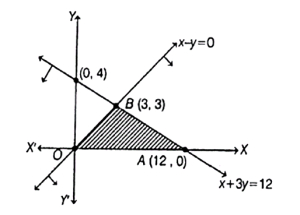
The maximum value of $z=6x+8y$ subject to the constraints $x-y \geq 0$,$x+3y \leq 12$,$x \geq 0$,$y \geq 0$ is:
A
$72$
B
$42$
C
$96$
D
$24$
Solution
(B) The objective function is $z=6x+8y$. The constraints are $x-y \geq 0$,$x+3y \leq 12$,$x \geq 0$,and $y \geq 0$.
To find the feasible region,we plot the lines $x-y=0$ and $x+3y=12$.
The intersection point of $x-y=0$ and $x+3y=12$ is found by substituting $x=y$ into $x+3y=12$,which gives $4y=12$,so $y=3$ and $x=3$. Thus,the intersection point is $B(3, 3)$.
The feasible region is a triangle with vertices $O(0, 0)$,$A(0, 4)$ (from $x+3y=12$ when $x=0$),and $B(3, 3)$.
Evaluating $z=6x+8y$ at these corner points:
At $O(0, 0)$: $z = 6(0) + 8(0) = 0$.
At $A(0, 4)$: $z = 6(0) + 8(4) = 32$.
At $B(3, 3)$: $z = 6(3) + 8(3) = 18 + 24 = 42$.
The maximum value is $42$.
To find the feasible region,we plot the lines $x-y=0$ and $x+3y=12$.
The intersection point of $x-y=0$ and $x+3y=12$ is found by substituting $x=y$ into $x+3y=12$,which gives $4y=12$,so $y=3$ and $x=3$. Thus,the intersection point is $B(3, 3)$.
The feasible region is a triangle with vertices $O(0, 0)$,$A(0, 4)$ (from $x+3y=12$ when $x=0$),and $B(3, 3)$.
Evaluating $z=6x+8y$ at these corner points:
At $O(0, 0)$: $z = 6(0) + 8(0) = 0$.
At $A(0, 4)$: $z = 6(0) + 8(4) = 32$.
At $B(3, 3)$: $z = 6(3) + 8(3) = 18 + 24 = 42$.
The maximum value is $42$.
0 likesView Solution
79
MathematicsMediumMCQMHT CET · 2019
$a$ and $b$ are non-collinear vectors. If $c=(x-2)a+b$ and $d=(2x+1)a-b$ are collinear vectors,then the value of $x = \ldots$
A
$\frac{1}{2}$
B
$\frac{1}{4}$
C
$\frac{1}{5}$
D
$\frac{1}{3}$
Solution
(D) Given that $c = (x-2)a + b$ and $d = (2x+1)a - b$ are collinear vectors.
Since $a$ and $b$ are non-collinear,we can write $c = \lambda d$ for some scalar $\lambda$.
$(x-2)a + b = \lambda((2x+1)a - b)$
$(x-2)a + b = \lambda(2x+1)a - \lambda b$
Comparing the coefficients of $a$ and $b$,we get:
$x-2 = \lambda(2x+1)$ and $1 = -\lambda$.
From the second equation,$\lambda = -1$.
Substituting $\lambda = -1$ into the first equation:
$x-2 = -1(2x+1)$
$x-2 = -2x-1$
$3x = 1$
$x = \frac{1}{3}$
Since $a$ and $b$ are non-collinear,we can write $c = \lambda d$ for some scalar $\lambda$.
$(x-2)a + b = \lambda((2x+1)a - b)$
$(x-2)a + b = \lambda(2x+1)a - \lambda b$
Comparing the coefficients of $a$ and $b$,we get:
$x-2 = \lambda(2x+1)$ and $1 = -\lambda$.
From the second equation,$\lambda = -1$.
Substituting $\lambda = -1$ into the first equation:
$x-2 = -1(2x+1)$
$x-2 = -2x-1$
$3x = 1$
$x = \frac{1}{3}$
0 likesView Solution
80
MathematicsEasyMCQMHT CET · 2019
Which of the following can not be the direction cosines of a line?
A
$\sqrt{\frac{1}{5}},-\sqrt{\frac{1}{2}}, \sqrt{\frac{3}{10}}$
B
$\frac{1}{\sqrt{3}}, \frac{-1}{\sqrt{3}}, \frac{1}{\sqrt{3}}$
C
$\frac{1}{\sqrt{2}}, \frac{-1}{\sqrt{2}}, \frac{-1}{\sqrt{2}}$
D
$\frac{1}{\sqrt{2}}, \frac{-1}{\sqrt{2}}, 0$
Solution
(C) The direction cosines $l, m, n$ of a line must satisfy the condition $l^2 + m^2 + n^2 = 1$.
For option $A$: $(\sqrt{\frac{1}{5}})^2 + (-\sqrt{\frac{1}{2}})^2 + (\sqrt{\frac{3}{10}})^2 = \frac{1}{5} + \frac{1}{2} + \frac{3}{10} = \frac{2+5+3}{10} = \frac{10}{10} = 1$.
For option $B$: $(\frac{1}{\sqrt{3}})^2 + (\frac{-1}{\sqrt{3}})^2 + (\frac{1}{\sqrt{3}})^2 = \frac{1}{3} + \frac{1}{3} + \frac{1}{3} = 1$.
For option $C$: $(\frac{1}{\sqrt{2}})^2 + (\frac{-1}{\sqrt{2}})^2 + (\frac{-1}{\sqrt{2}})^2 = \frac{1}{2} + \frac{1}{2} + \frac{1}{2} = \frac{3}{2} \neq 1$.
For option $D$: $(\frac{1}{\sqrt{2}})^2 + (\frac{-1}{\sqrt{2}})^2 + 0^2 = \frac{1}{2} + \frac{1}{2} + 0 = 1$.
Since the sum of squares for option $C$ is not $1$,it cannot be the direction cosines of a line.
For option $A$: $(\sqrt{\frac{1}{5}})^2 + (-\sqrt{\frac{1}{2}})^2 + (\sqrt{\frac{3}{10}})^2 = \frac{1}{5} + \frac{1}{2} + \frac{3}{10} = \frac{2+5+3}{10} = \frac{10}{10} = 1$.
For option $B$: $(\frac{1}{\sqrt{3}})^2 + (\frac{-1}{\sqrt{3}})^2 + (\frac{1}{\sqrt{3}})^2 = \frac{1}{3} + \frac{1}{3} + \frac{1}{3} = 1$.
For option $C$: $(\frac{1}{\sqrt{2}})^2 + (\frac{-1}{\sqrt{2}})^2 + (\frac{-1}{\sqrt{2}})^2 = \frac{1}{2} + \frac{1}{2} + \frac{1}{2} = \frac{3}{2} \neq 1$.
For option $D$: $(\frac{1}{\sqrt{2}})^2 + (\frac{-1}{\sqrt{2}})^2 + 0^2 = \frac{1}{2} + \frac{1}{2} + 0 = 1$.
Since the sum of squares for option $C$ is not $1$,it cannot be the direction cosines of a line.
0 likesView Solution
81
MathematicsMediumMCQMHT CET · 2019
The direction ratios of the normal to the plane passing through the origin and the line of intersection of the planes $x+2y+3z=4$ and $4x+3y+2z=1$ are . . . . . .
A
$2, 3, 1$
B
$1, 2, 3$
C
$3, 1, 2$
D
$3, 2, 1$
Solution
(D) The equation of the family of planes passing through the line of intersection of the planes $x+2y+3z-4=0$ and $4x+3y+2z-1=0$ is given by $(x+2y+3z-4) + \lambda(4x+3y+2z-1) = 0$.
Since the plane passes through the origin $(0, 0, 0)$,we substitute $x=0, y=0, z=0$ into the equation:
$(0+0+0-4) + \lambda(0+0+0-1) = 0
\Rightarrow -4 - \lambda = 0
\Rightarrow \lambda = -4$.
Substituting $\lambda = -4$ back into the family equation:
$(x+2y+3z-4) - 4(4x+3y+2z-1) = 0
\Rightarrow x+2y+3z-4 - 16x - 12y - 8z + 4 = 0
\Rightarrow -15x - 10y - 5z = 0
\Rightarrow 3x + 2y + z = 0$.
The direction ratios of the normal to the plane $ax+by+cz+d=0$ are $(a, b, c)$.
Thus,the direction ratios of the normal to the plane $3x+2y+z=0$ are $3, 2, 1$.
Since the plane passes through the origin $(0, 0, 0)$,we substitute $x=0, y=0, z=0$ into the equation:
$(0+0+0-4) + \lambda(0+0+0-1) = 0
\Rightarrow -4 - \lambda = 0
\Rightarrow \lambda = -4$.
Substituting $\lambda = -4$ back into the family equation:
$(x+2y+3z-4) - 4(4x+3y+2z-1) = 0
\Rightarrow x+2y+3z-4 - 16x - 12y - 8z + 4 = 0
\Rightarrow -15x - 10y - 5z = 0
\Rightarrow 3x + 2y + z = 0$.
The direction ratios of the normal to the plane $ax+by+cz+d=0$ are $(a, b, c)$.
Thus,the direction ratios of the normal to the plane $3x+2y+z=0$ are $3, 2, 1$.
0 likesView Solution
82
MathematicsMediumMCQMHT CET · 2019
If lines $\frac{2x-4}{\lambda}=\frac{y-1}{2}=\frac{z-3}{1}$ and $\frac{x-1}{1}=\frac{3y-1}{\lambda}=\frac{z-2}{1}$ are perpendicular to each other,then $\lambda = \ldots$.
A
$7$
B
$-\frac{7}{6}$
C
$6$
D
$-\frac{6}{7}$
Solution
(D) Key Idea: If lines $\frac{x-x_1}{a_1}=\frac{y-y_1}{b_1}=\frac{z-z_1}{c_1}$ and $\frac{x-x_2}{a_2}=\frac{y-y_2}{b_2}=\frac{z-z_2}{c_2}$ are perpendicular,then $a_1 a_2 + b_1 b_2 + c_1 c_2 = 0$.
Given lines are:
$\frac{2x-4}{\lambda} = \frac{y-1}{2} = \frac{z-3}{1} \Rightarrow \frac{x-2}{\lambda/2} = \frac{y-1}{2} = \frac{z-3}{1}$ $(i)$
And $\frac{x-1}{1} = \frac{3y-1}{\lambda} = \frac{z-2}{1} \Rightarrow \frac{x-1}{1} = \frac{y-1/3}{\lambda/3} = \frac{z-2}{1}$ (ii)
Since lines $(i)$ and (ii) are perpendicular,the dot product of their direction ratios must be zero:
$(\frac{\lambda}{2})(1) + (2)(\frac{\lambda}{3}) + (1)(1) = 0$
$\frac{\lambda}{2} + \frac{2\lambda}{3} + 1 = 0$
Multiplying by $6$ to clear the denominators:
$3\lambda + 4\lambda + 6 = 0$
$7\lambda = -6$
$\lambda = -\frac{6}{7}$
Given lines are:
$\frac{2x-4}{\lambda} = \frac{y-1}{2} = \frac{z-3}{1} \Rightarrow \frac{x-2}{\lambda/2} = \frac{y-1}{2} = \frac{z-3}{1}$ $(i)$
And $\frac{x-1}{1} = \frac{3y-1}{\lambda} = \frac{z-2}{1} \Rightarrow \frac{x-1}{1} = \frac{y-1/3}{\lambda/3} = \frac{z-2}{1}$ (ii)
Since lines $(i)$ and (ii) are perpendicular,the dot product of their direction ratios must be zero:
$(\frac{\lambda}{2})(1) + (2)(\frac{\lambda}{3}) + (1)(1) = 0$
$\frac{\lambda}{2} + \frac{2\lambda}{3} + 1 = 0$
Multiplying by $6$ to clear the denominators:
$3\lambda + 4\lambda + 6 = 0$
$7\lambda = -6$
$\lambda = -\frac{6}{7}$
0 likesView Solution
83
MathematicsMediumMCQMHT CET · 2019
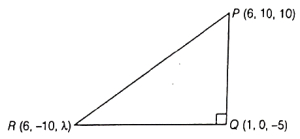
If $P(6, 10, 10)$,$Q(1, 0, -5)$,$R(6, -10, \lambda)$ are vertices of a triangle right-angled at $Q$,then the value of $\lambda$ is ....
A
$0$
B
$1$
C
$3$
D
$2$
Solution
(A) Given that $\triangle PQR$ is right-angled at $Q$.
Therefore,the vectors $\vec{QP}$ and $\vec{QR}$ are perpendicular to each other,which means their dot product is zero: $\vec{QP} \cdot \vec{QR} = 0$.
First,find the vectors $\vec{QP}$ and $\vec{QR}$:
$\vec{QP} = (6-1, 10-0, 10-(-5)) = (5, 10, 15)$
$\vec{QR} = (6-1, -10-0, \lambda-(-5)) = (5, -10, \lambda+5)$
Now,calculate the dot product:
$\vec{QP} \cdot \vec{QR} = (5)(5) + (10)(-10) + (15)(\lambda+5) = 0$
$25 - 100 + 15\lambda + 75 = 0$
$-75 + 15\lambda + 75 = 0$
$15\lambda = 0$
$\lambda = 0$
Therefore,the vectors $\vec{QP}$ and $\vec{QR}$ are perpendicular to each other,which means their dot product is zero: $\vec{QP} \cdot \vec{QR} = 0$.
First,find the vectors $\vec{QP}$ and $\vec{QR}$:
$\vec{QP} = (6-1, 10-0, 10-(-5)) = (5, 10, 15)$
$\vec{QR} = (6-1, -10-0, \lambda-(-5)) = (5, -10, \lambda+5)$
Now,calculate the dot product:
$\vec{QP} \cdot \vec{QR} = (5)(5) + (10)(-10) + (15)(\lambda+5) = 0$
$25 - 100 + 15\lambda + 75 = 0$
$-75 + 15\lambda + 75 = 0$
$15\lambda = 0$
$\lambda = 0$
0 likesView Solution
84
MathematicsMediumMCQMHT CET · 2019
If the lines $\frac{x-1}{2}=\frac{y+1}{3}=\frac{z-1}{4}$ and $\frac{x-3}{1}=\frac{y-\lambda}{2}=\frac{z}{1}$ intersect each other,then $\lambda = \ldots$
A
$\frac{7}{2}$
B
$\frac{3}{2}$
C
$\frac{9}{2}$
D
$\frac{5}{2}$
Solution
(C) Let the given lines be:
$L_1: \frac{x-1}{2}=\frac{y+1}{3}=\frac{z-1}{4} = k_1$
$L_2: \frac{x-3}{1}=\frac{y-\lambda}{2}=\frac{z}{1} = k_2$
Any point on $L_1$ is $(2k_1+1, 3k_1-1, 4k_1+1)$ and any point on $L_2$ is $(k_2+3, 2k_2+\lambda, k_2)$.
If the lines intersect,there exist $k_1, k_2$ such that:
$2k_1+1 = k_2+3 \Rightarrow 2k_1 - k_2 = 2$ $(i)$
$4k_1+1 = k_2 \Rightarrow 4k_1 - k_2 = -1$ $(ii)$
Subtracting $(i)$ from $(ii)$:
$(4k_1 - k_2) - (2k_1 - k_2) = -1 - 2$
$2k_1 = -3 \Rightarrow k_1 = -\frac{3}{2}$
Substituting $k_1$ in $(ii)$:
$4(-\frac{3}{2}) - k_2 = -1 \Rightarrow -6 - k_2 = -1 \Rightarrow k_2 = -5$
Now,equate the $y$-coordinates:
$3k_1 - 1 = 2k_2 + \lambda$
$3(-\frac{3}{2}) - 1 = 2(-5) + \lambda$
$-\frac{9}{2} - 1 = -10 + \lambda$
$-\frac{11}{2} = -10 + \lambda$
$\lambda = 10 - \frac{11}{2} = \frac{20-11}{2} = \frac{9}{2}$
$L_1: \frac{x-1}{2}=\frac{y+1}{3}=\frac{z-1}{4} = k_1$
$L_2: \frac{x-3}{1}=\frac{y-\lambda}{2}=\frac{z}{1} = k_2$
Any point on $L_1$ is $(2k_1+1, 3k_1-1, 4k_1+1)$ and any point on $L_2$ is $(k_2+3, 2k_2+\lambda, k_2)$.
If the lines intersect,there exist $k_1, k_2$ such that:
$2k_1+1 = k_2+3 \Rightarrow 2k_1 - k_2 = 2$ $(i)$
$4k_1+1 = k_2 \Rightarrow 4k_1 - k_2 = -1$ $(ii)$
Subtracting $(i)$ from $(ii)$:
$(4k_1 - k_2) - (2k_1 - k_2) = -1 - 2$
$2k_1 = -3 \Rightarrow k_1 = -\frac{3}{2}$
Substituting $k_1$ in $(ii)$:
$4(-\frac{3}{2}) - k_2 = -1 \Rightarrow -6 - k_2 = -1 \Rightarrow k_2 = -5$
Now,equate the $y$-coordinates:
$3k_1 - 1 = 2k_2 + \lambda$
$3(-\frac{3}{2}) - 1 = 2(-5) + \lambda$
$-\frac{9}{2} - 1 = -10 + \lambda$
$-\frac{11}{2} = -10 + \lambda$
$\lambda = 10 - \frac{11}{2} = \frac{20-11}{2} = \frac{9}{2}$
0 likesView Solution
85
MathematicsMediumMCQMHT CET · 2019
If the line passes through the points $P(6, -1, 2)$,$Q(8, -7, 2\lambda)$,and $R(5, 2, 4)$,then the value of $\lambda$ is $.......$
A
$-3$
B
$0$
C
$-1$
D
$2$
Solution
(C) Since the points $P(6, -1, 2)$,$Q(8, -7, 2\lambda)$,and $R(5, 2, 4)$ are collinear,the direction ratios of the line segments $PQ$ and $PR$ must be proportional.
The direction ratios of $PQ$ are $(8-6, -7-(-1), 2\lambda-2) = (2, -6, 2\lambda-2)$.
The direction ratios of $PR$ are $(5-6, 2-(-1), 4-2) = (-1, 3, 2)$.
Since the points are collinear,the ratio of the direction ratios must be equal:
$\frac{2}{-1} = \frac{-6}{3} = \frac{2\lambda-2}{2}$
$-2 = -2 = \lambda-1$
Equating the last part: $-2 = \lambda-1$,which gives $\lambda = -1$.
The direction ratios of $PQ$ are $(8-6, -7-(-1), 2\lambda-2) = (2, -6, 2\lambda-2)$.
The direction ratios of $PR$ are $(5-6, 2-(-1), 4-2) = (-1, 3, 2)$.
Since the points are collinear,the ratio of the direction ratios must be equal:
$\frac{2}{-1} = \frac{-6}{3} = \frac{2\lambda-2}{2}$
$-2 = -2 = \lambda-1$
Equating the last part: $-2 = \lambda-1$,which gives $\lambda = -1$.
0 likesView Solution
86
MathematicsEasyMCQMHT CET · 2019
The angle between the lines $\frac{x-2}{2} = \frac{y-3}{-2} = \frac{z-5}{1}$ and $\frac{x-2}{1} = \frac{y-3}{2} = \frac{z-5}{2}$ is $ . . . . . . $. (in $^{\circ}$)
A
$30$
B
$60$
C
$45$
D
$90$
Solution
(D) The direction ratios of the first line are $\vec{a_1} = (2, -2, 1)$.
The direction ratios of the second line are $\vec{a_2} = (1, 2, 2)$.
The angle $\theta$ between two lines with direction ratios $(a_1, b_1, c_1)$ and $(a_2, b_2, c_2)$ is given by $\cos \theta = \frac{|a_1 a_2 + b_1 b_2 + c_1 c_2|}{\sqrt{a_1^2 + b_1^2 + c_1^2} \sqrt{a_2^2 + b_2^2 + c_2^2}}$.
Substituting the values:
$\cos \theta = \frac{|(2)(1) + (-2)(2) + (1)(2)|}{\sqrt{2^2 + (-2)^2 + 1^2} \sqrt{1^2 + 2^2 + 2^2}}$
$\cos \theta = \frac{|2 - 4 + 2|}{\sqrt{4 + 4 + 1} \sqrt{1 + 4 + 4}}$
$\cos \theta = \frac{0}{\sqrt{9} \sqrt{9}} = 0$
Since $\cos \theta = 0$,we have $\theta = 90^{\circ}$.
The direction ratios of the second line are $\vec{a_2} = (1, 2, 2)$.
The angle $\theta$ between two lines with direction ratios $(a_1, b_1, c_1)$ and $(a_2, b_2, c_2)$ is given by $\cos \theta = \frac{|a_1 a_2 + b_1 b_2 + c_1 c_2|}{\sqrt{a_1^2 + b_1^2 + c_1^2} \sqrt{a_2^2 + b_2^2 + c_2^2}}$.
Substituting the values:
$\cos \theta = \frac{|(2)(1) + (-2)(2) + (1)(2)|}{\sqrt{2^2 + (-2)^2 + 1^2} \sqrt{1^2 + 2^2 + 2^2}}$
$\cos \theta = \frac{|2 - 4 + 2|}{\sqrt{4 + 4 + 1} \sqrt{1 + 4 + 4}}$
$\cos \theta = \frac{0}{\sqrt{9} \sqrt{9}} = 0$
Since $\cos \theta = 0$,we have $\theta = 90^{\circ}$.
0 likesView Solution
87
MathematicsMediumMCQMHT CET · 2019
If the foot of the perpendicular drawn from the point $(0, 0, 0)$ to the plane is $(4, -2, -5)$,then the equation of the plane is $......$
A
$4x + 2y + 5z = -13$
B
$4x - 2y - 5z = 45$
C
$4x + 2y - 5z = 37$
D
$4x - 2y + 5z = -5$
Solution
(B) The foot of the perpendicular drawn from the origin $O(0, 0, 0)$ to the plane is given as $P(4, -2, -5)$.
Since the line segment $OP$ is perpendicular to the plane,the vector $\vec{OP}$ acts as the normal vector $\vec{n}$ to the plane.
Thus,the direction ratios of the normal are $(4 - 0, -2 - 0, -5 - 0) = (4, -2, -5)$.
The equation of a plane passing through a point $(x_1, y_1, z_1)$ with normal vector $(a, b, c)$ is given by $a(x - x_1) + b(y - y_1) + c(z - z_1) = 0$.
Substituting the values,we get $4(x - 4) - 2(y + 2) - 5(z + 5) = 0$.
Expanding this,we have $4x - 16 - 2y - 4 - 5z - 25 = 0$.
Simplifying,we get $4x - 2y - 5z - 45 = 0$,or $4x - 2y - 5z = 45$.
Since the line segment $OP$ is perpendicular to the plane,the vector $\vec{OP}$ acts as the normal vector $\vec{n}$ to the plane.
Thus,the direction ratios of the normal are $(4 - 0, -2 - 0, -5 - 0) = (4, -2, -5)$.
The equation of a plane passing through a point $(x_1, y_1, z_1)$ with normal vector $(a, b, c)$ is given by $a(x - x_1) + b(y - y_1) + c(z - z_1) = 0$.
Substituting the values,we get $4(x - 4) - 2(y + 2) - 5(z + 5) = 0$.
Expanding this,we have $4x - 16 - 2y - 4 - 5z - 25 = 0$.
Simplifying,we get $4x - 2y - 5z - 45 = 0$,or $4x - 2y - 5z = 45$.
0 likesView Solution
88
MathematicsEasyMCQMHT CET · 2019
Equations of planes parallel to the plane $x-2y+2z+4=0$ which are at a distance of $1$ unit from the point $(1, 2, 3)$ are $.....$
A
$x+2y+2z=-6, x+2y+2z=5$
B
$x-2y-6=0, x-2y+z=6$
C
$x-2y+2z=6, x+2y+2z=0$
D
$x-2y+2z=0, x-2y+2z-6=0$
Solution
(D) The equation of a plane parallel to $x-2y+2z+4=0$ is of the form $x-2y+2z+k=0$.
The distance $d$ from a point $(x_1, y_1, z_1)$ to the plane $Ax+By+Cz+D=0$ is given by $d = \frac{|Ax_1+By_1+Cz_1+D|}{\sqrt{A^2+B^2+C^2}}$.
Given the point $(1, 2, 3)$ and distance $d=1$,we have:
$1 = \frac{|1(1)-2(2)+2(3)+k|}{\sqrt{1^2+(-2)^2+2^2}}$
$1 = \frac{|1-4+6+k|}{\sqrt{1+4+4}}$
$1 = \frac{|3+k|}{\sqrt{9}}$
$|3+k| = 3$
This implies $3+k = 3$ or $3+k = -3$.
Case $1$: $3+k = 3 \Rightarrow k = 0$. The equation is $x-2y+2z=0$.
Case $2$: $3+k = -3 \Rightarrow k = -6$. The equation is $x-2y+2z-6=0$.
Thus,the required equations are $x-2y+2z=0$ and $x-2y+2z-6=0$.
The distance $d$ from a point $(x_1, y_1, z_1)$ to the plane $Ax+By+Cz+D=0$ is given by $d = \frac{|Ax_1+By_1+Cz_1+D|}{\sqrt{A^2+B^2+C^2}}$.
Given the point $(1, 2, 3)$ and distance $d=1$,we have:
$1 = \frac{|1(1)-2(2)+2(3)+k|}{\sqrt{1^2+(-2)^2+2^2}}$
$1 = \frac{|1-4+6+k|}{\sqrt{1+4+4}}$
$1 = \frac{|3+k|}{\sqrt{9}}$
$|3+k| = 3$
This implies $3+k = 3$ or $3+k = -3$.
Case $1$: $3+k = 3 \Rightarrow k = 0$. The equation is $x-2y+2z=0$.
Case $2$: $3+k = -3 \Rightarrow k = -6$. The equation is $x-2y+2z-6=0$.
Thus,the required equations are $x-2y+2z=0$ and $x-2y+2z-6=0$.
0 likesView Solution
89
MathematicsDifficultMCQMHT CET · 2019
The equation of the plane passing through the point $(-1, 2, 1)$ and perpendicular to the line joining the points $(-3, 1, 2)$ and $(2, 3, 4)$ is $.........$
A
$\bar{r} \cdot (5\hat{i} + 2\hat{j} + 2\hat{k}) = 1$
B
$\bar{r} \cdot (5\hat{i} + 2\hat{j} + 2\hat{k}) = -1$
C
$\bar{r} \cdot (5\hat{i} - 2\hat{j} + 2\hat{k}) = -5$
D
$\bar{r} \cdot (5\hat{i} - 2\hat{j} - 2\hat{k}) = 1$
Solution
(A) The direction ratios of the line joining the points $(-3, 1, 2)$ and $(2, 3, 4)$ are $(2 - (-3)), (3 - 1), (4 - 2)$,which are $5, 2, 2$.
Since the plane is perpendicular to this line,the normal vector to the plane is $\vec{n} = 5\hat{i} + 2\hat{j} + 2\hat{k}$.
The equation of a plane passing through a point $\vec{a} = -\hat{i} + 2\hat{j} + \hat{k}$ with normal $\vec{n}$ is given by $(\vec{r} - \vec{a}) \cdot \vec{n} = 0$.
Substituting the values,we get $(\vec{r} - (-\hat{i} + 2\hat{j} + \hat{k})) \cdot (5\hat{i} + 2\hat{j} + 2\hat{k}) = 0$.
This simplifies to $\vec{r} \cdot (5\hat{i} + 2\hat{j} + 2\hat{k}) = (-\hat{i} + 2\hat{j} + \hat{k}) \cdot (5\hat{i} + 2\hat{j} + 2\hat{k})$.
Calculating the dot product on the right side: $(-1)(5) + (2)(2) + (1)(2) = -5 + 4 + 2 = 1$.
Thus,the equation of the plane is $\vec{r} \cdot (5\hat{i} + 2\hat{j} + 2\hat{k}) = 1$.
Since the plane is perpendicular to this line,the normal vector to the plane is $\vec{n} = 5\hat{i} + 2\hat{j} + 2\hat{k}$.
The equation of a plane passing through a point $\vec{a} = -\hat{i} + 2\hat{j} + \hat{k}$ with normal $\vec{n}$ is given by $(\vec{r} - \vec{a}) \cdot \vec{n} = 0$.
Substituting the values,we get $(\vec{r} - (-\hat{i} + 2\hat{j} + \hat{k})) \cdot (5\hat{i} + 2\hat{j} + 2\hat{k}) = 0$.
This simplifies to $\vec{r} \cdot (5\hat{i} + 2\hat{j} + 2\hat{k}) = (-\hat{i} + 2\hat{j} + \hat{k}) \cdot (5\hat{i} + 2\hat{j} + 2\hat{k})$.
Calculating the dot product on the right side: $(-1)(5) + (2)(2) + (1)(2) = -5 + 4 + 2 = 1$.
Thus,the equation of the plane is $\vec{r} \cdot (5\hat{i} + 2\hat{j} + 2\hat{k}) = 1$.
0 likesView Solution
90
MathematicsMediumMCQMHT CET · 2019
The coordinates of the foot of the perpendicular drawn from the origin to the plane $2x - y + 5z - 3 = 0$ are $ . . . . . . $.
A
$\left(\frac{2}{\sqrt{30}}, \frac{-1}{\sqrt{30}}, \frac{5}{\sqrt{30}}\right)$
B
$(2, -1, 5)$
C
$\left(\frac{2}{3}, \frac{-1}{3}, \frac{5}{3}\right)$
D
$\left(\frac{1}{5}, \frac{-1}{10}, \frac{1}{2}\right)$
Solution
(D) The coordinates of the foot of the perpendicular $(x, y, z)$ from a point $(x_1, y_1, z_1)$ to the plane $ax + by + cz + d = 0$ are given by the formula: $\frac{x - x_1}{a} = \frac{y - y_1}{b} = \frac{z - z_1}{c} = -\frac{ax_1 + by_1 + cz_1 + d}{a^2 + b^2 + c^2}$.
Given the plane $2x - y + 5z - 3 = 0$ and the origin $(0, 0, 0)$,we have $x_1 = 0, y_1 = 0, z_1 = 0$.
Substituting these values into the formula:
$\frac{x - 0}{2} = \frac{y - 0}{-1} = \frac{z - 0}{5} = -\frac{2(0) - 1(0) + 5(0) - 3}{2^2 + (-1)^2 + 5^2}$.
$\frac{x}{2} = \frac{y}{-1} = \frac{z}{5} = -\frac{-3}{4 + 1 + 25} = \frac{3}{30} = \frac{1}{10}$.
Equating each part to $\frac{1}{10}$:
$x = 2 \times \frac{1}{10} = \frac{1}{5}$.
$y = -1 \times \frac{1}{10} = -\frac{1}{10}$.
$z = 5 \times \frac{1}{10} = \frac{1}{2}$.
Thus,the coordinates are $\left(\frac{1}{5}, -\frac{1}{10}, \frac{1}{2}\right)$.
Given the plane $2x - y + 5z - 3 = 0$ and the origin $(0, 0, 0)$,we have $x_1 = 0, y_1 = 0, z_1 = 0$.
Substituting these values into the formula:
$\frac{x - 0}{2} = \frac{y - 0}{-1} = \frac{z - 0}{5} = -\frac{2(0) - 1(0) + 5(0) - 3}{2^2 + (-1)^2 + 5^2}$.
$\frac{x}{2} = \frac{y}{-1} = \frac{z}{5} = -\frac{-3}{4 + 1 + 25} = \frac{3}{30} = \frac{1}{10}$.
Equating each part to $\frac{1}{10}$:
$x = 2 \times \frac{1}{10} = \frac{1}{5}$.
$y = -1 \times \frac{1}{10} = -\frac{1}{10}$.
$z = 5 \times \frac{1}{10} = \frac{1}{2}$.
Thus,the coordinates are $\left(\frac{1}{5}, -\frac{1}{10}, \frac{1}{2}\right)$.
0 likesView Solution
91
MathematicsEasyMCQMHT CET · 2019
$\sin \left[3 \sin ^{-1}(0.4)\right] = \ldots$
A
$0.466$
B
$0.256$
C
$0.944$
D
$0.764$
Solution
(C) Let $E = \sin \left[3 \sin ^{-1}(0.4)\right]$.
Put $\sin ^{-1}(0.4) = \theta$,which implies $\sin \theta = 0.4$.
Using the identity $\sin(3\theta) = 3\sin\theta - 4\sin^3\theta$:
$E = 3(0.4) - 4(0.4)^3$
$E = 1.2 - 4(0.064)$
$E = 1.2 - 0.256$
$E = 0.944$
Put $\sin ^{-1}(0.4) = \theta$,which implies $\sin \theta = 0.4$.
Using the identity $\sin(3\theta) = 3\sin\theta - 4\sin^3\theta$:
$E = 3(0.4) - 4(0.4)^3$
$E = 1.2 - 4(0.064)$
$E = 1.2 - 0.256$
$E = 0.944$
0 likesView Solution
92
MathematicsEasyMCQMHT CET · 2019
If the vectors $x \hat{i}-3 \hat{j}+7 \hat{k}$ and $\hat{i}+y \hat{j}-z \hat{k}$ are collinear,then the value of $\frac{x y^2}{z}$ is equal to:
A
$\frac{9}{7}$
B
$\frac{-9}{7}$
C
$\frac{-7}{9}$
D
$\frac{7}{9}$
Solution
(B) Two vectors $\vec{a} = a_1 \hat{i} + a_2 \hat{j} + a_3 \hat{k}$ and $\vec{b} = b_1 \hat{i} + b_2 \hat{j} + b_3 \hat{k}$ are collinear if their components are proportional,i.e.,$\frac{a_1}{b_1} = \frac{a_2}{b_2} = \frac{a_3}{b_3} = k$.
Given vectors are $x \hat{i}-3 \hat{j}+7 \hat{k}$ and $\hat{i}+y \hat{j}-z \hat{k}$.
Therefore,$\frac{x}{1} = \frac{-3}{y} = \frac{7}{-z} = k$.
From this,we get $x = k$,$y = -\frac{3}{k}$,and $z = -\frac{7}{k}$.
Now,substitute these values into the expression $\frac{x y^2}{z}$:
$\frac{x y^2}{z} = \frac{k \cdot (-\frac{3}{k})^2}{-\frac{7}{k}} = \frac{k \cdot \frac{9}{k^2}}{-\frac{7}{k}} = \frac{\frac{9}{k}}{-\frac{7}{k}} = -\frac{9}{7}$.
Given vectors are $x \hat{i}-3 \hat{j}+7 \hat{k}$ and $\hat{i}+y \hat{j}-z \hat{k}$.
Therefore,$\frac{x}{1} = \frac{-3}{y} = \frac{7}{-z} = k$.
From this,we get $x = k$,$y = -\frac{3}{k}$,and $z = -\frac{7}{k}$.
Now,substitute these values into the expression $\frac{x y^2}{z}$:
$\frac{x y^2}{z} = \frac{k \cdot (-\frac{3}{k})^2}{-\frac{7}{k}} = \frac{k \cdot \frac{9}{k^2}}{-\frac{7}{k}} = \frac{\frac{9}{k}}{-\frac{7}{k}} = -\frac{9}{7}$.
0 likesView Solution
93
MathematicsEasyMCQMHT CET · 2019
For any non-zero vectors $a, b, c$,$a \cdot[(b+c) \times(a+b+c)] = \ldots .$
A
$0$
B
$2[a \ b \ c]$
C
$[a \ b \ c]$
D
$[a \ c \ b]$
Solution
(A) We have the expression $a \cdot[(b+c) \times(a+b+c)]$.
Using the distributive property of the cross product,we expand the term inside the bracket:
$(b+c) \times(a+b+c) = (b \times a) + (b \times b) + (b \times c) + (c \times a) + (c \times b) + (c \times c)$.
Since the cross product of any vector with itself is zero ($b \times b = 0$ and $c \times c = 0$) and $c \times b = -(b \times c)$,the expression simplifies to:
$(b \times a) + (b \times c) + (c \times a) - (b \times c) = (b \times a) + (c \times a)$.
Now,taking the dot product with $a$:
$a \cdot [(b \times a) + (c \times a)] = a \cdot (b \times a) + a \cdot (c \times a)$.
By the definition of the scalar triple product,$a \cdot (b \times a) = [a \ b \ a]$ and $a \cdot (c \times a) = [a \ c \ a]$.
Since any scalar triple product with two identical vectors is zero,we have $[a \ b \ a] = 0$ and $[a \ c \ a] = 0$.
Therefore,the final result is $0 + 0 = 0$.
Using the distributive property of the cross product,we expand the term inside the bracket:
$(b+c) \times(a+b+c) = (b \times a) + (b \times b) + (b \times c) + (c \times a) + (c \times b) + (c \times c)$.
Since the cross product of any vector with itself is zero ($b \times b = 0$ and $c \times c = 0$) and $c \times b = -(b \times c)$,the expression simplifies to:
$(b \times a) + (b \times c) + (c \times a) - (b \times c) = (b \times a) + (c \times a)$.
Now,taking the dot product with $a$:
$a \cdot [(b \times a) + (c \times a)] = a \cdot (b \times a) + a \cdot (c \times a)$.
By the definition of the scalar triple product,$a \cdot (b \times a) = [a \ b \ a]$ and $a \cdot (c \times a) = [a \ c \ a]$.
Since any scalar triple product with two identical vectors is zero,we have $[a \ b \ a] = 0$ and $[a \ c \ a] = 0$.
Therefore,the final result is $0 + 0 = 0$.
0 likesView Solution
94
MathematicsEasyMCQMHT CET · 2019
If the scalar triple product of the vectors $-3 \hat{i}+7 \hat{j}-3 \hat{k}$,$3 \hat{i}-7 \hat{j}+\lambda \hat{k}$ and $7 \hat{i}-5 \hat{j}-3 \hat{k}$ is $272$,then $\lambda = \ldots$
A
$9$
B
$11$
C
$8$
D
$10$
Solution
(B) The scalar triple product of vectors $\vec{a}, \vec{b}, \vec{c}$ is given by the determinant of the matrix formed by their components: $[\vec{a} \vec{b} \vec{c}] = \begin{vmatrix} a_1 & a_2 & a_3 \\ b_1 & b_2 & b_3 \\ c_1 & c_2 & c_3 \end{vmatrix}$.
Given the vectors $-3 \hat{i}+7 \hat{j}-3 \hat{k}$,$3 \hat{i}-7 \hat{j}+\lambda \hat{k}$,and $7 \hat{i}-5 \hat{j}-3 \hat{k}$,their scalar triple product is $272$.
$\begin{vmatrix} -3 & 7 & -3 \\ 3 & -7 & \lambda \\ 7 & -5 & -3 \end{vmatrix} = 272$
Expanding the determinant along the first row:
$-3((-7)(-3) - (-5)(\lambda)) - 7((3)(-3) - (7)(\lambda)) - 3((3)(-5) - (7)(-7)) = 272$
$-3(21 + 5\lambda) - 7(-9 - 7\lambda) - 3(-15 + 49) = 272$
$-63 - 15\lambda + 63 + 49\lambda - 3(34) = 272$
$34\lambda - 102 = 272$
$34\lambda = 374$
$\lambda = \frac{374}{34} = 11$.
Given the vectors $-3 \hat{i}+7 \hat{j}-3 \hat{k}$,$3 \hat{i}-7 \hat{j}+\lambda \hat{k}$,and $7 \hat{i}-5 \hat{j}-3 \hat{k}$,their scalar triple product is $272$.
$\begin{vmatrix} -3 & 7 & -3 \\ 3 & -7 & \lambda \\ 7 & -5 & -3 \end{vmatrix} = 272$
Expanding the determinant along the first row:
$-3((-7)(-3) - (-5)(\lambda)) - 7((3)(-3) - (7)(\lambda)) - 3((3)(-5) - (7)(-7)) = 272$
$-3(21 + 5\lambda) - 7(-9 - 7\lambda) - 3(-15 + 49) = 272$
$-63 - 15\lambda + 63 + 49\lambda - 3(34) = 272$
$34\lambda - 102 = 272$
$34\lambda = 374$
$\lambda = \frac{374}{34} = 11$.
0 likesView Solution
95
MathematicsMediumMCQMHT CET · 2019
The vector equation of the plane $r = (2 \hat{i} + \hat{k}) + \lambda(\hat{i}) + \mu(\hat{i} + 2 \hat{j} - 3 \hat{k})$ in scalar product form is $r \cdot (3 \hat{i} + 2 \hat{k}) = \alpha$,then $\alpha = \dots$
A
$2$
B
$3$
C
$1$
D
$0$
Solution
(A) The given equation of the plane is $r = (2 \hat{i} + \hat{k}) + \lambda(\hat{i}) + \mu(\hat{i} + 2 \hat{j} - 3 \hat{k})$.
This plane passes through the point $a = 2 \hat{i} + \hat{k}$ and is parallel to the vectors $b = \hat{i}$ and $c = \hat{i} + 2 \hat{j} - 3 \hat{k}$.
The scalar product form of the plane is $r \cdot (b \times c) = a \cdot (b \times c)$.
First,calculate the normal vector $n = b \times c$:
$n = \begin{vmatrix} \hat{i} & \hat{j} & \hat{k} \\ 1 & 0 & 0 \\ 1 & 2 & -3 \end{vmatrix} = \hat{i}(0 - 0) - \hat{j}(-3 - 0) + \hat{k}(2 - 0) = 3 \hat{j} + 2 \hat{k}$.
Wait,re-calculating the cross product: $\hat{i}(0) - \hat{j}(-3) + \hat{k}(2) = 3 \hat{j} + 2 \hat{k}$.
Actually,the question specifies $r \cdot (3 \hat{i} + 2 \hat{k}) = \alpha$. Let us re-check the cross product: $b = \hat{i} = (1, 0, 0)$,$c = (1, 2, -3)$.
$b \times c = \begin{vmatrix} \hat{i} & \hat{j} & \hat{k} \\ 1 & 0 & 0 \\ 1 & 2 & -3 \end{vmatrix} = \hat{i}(0) - \hat{j}(-3) + \hat{k}(2) = 3 \hat{j} + 2 \hat{k}$.
There seems to be a typo in the provided question's normal vector. Assuming the normal is $3 \hat{j} + 2 \hat{k}$,then $\alpha = a \cdot n = (2 \hat{i} + \hat{k}) \cdot (3 \hat{j} + 2 \hat{k}) = (2)(0) + (0)(3) + (1)(2) = 2$.
Thus,$\alpha = 2$.
This plane passes through the point $a = 2 \hat{i} + \hat{k}$ and is parallel to the vectors $b = \hat{i}$ and $c = \hat{i} + 2 \hat{j} - 3 \hat{k}$.
The scalar product form of the plane is $r \cdot (b \times c) = a \cdot (b \times c)$.
First,calculate the normal vector $n = b \times c$:
$n = \begin{vmatrix} \hat{i} & \hat{j} & \hat{k} \\ 1 & 0 & 0 \\ 1 & 2 & -3 \end{vmatrix} = \hat{i}(0 - 0) - \hat{j}(-3 - 0) + \hat{k}(2 - 0) = 3 \hat{j} + 2 \hat{k}$.
Wait,re-calculating the cross product: $\hat{i}(0) - \hat{j}(-3) + \hat{k}(2) = 3 \hat{j} + 2 \hat{k}$.
Actually,the question specifies $r \cdot (3 \hat{i} + 2 \hat{k}) = \alpha$. Let us re-check the cross product: $b = \hat{i} = (1, 0, 0)$,$c = (1, 2, -3)$.
$b \times c = \begin{vmatrix} \hat{i} & \hat{j} & \hat{k} \\ 1 & 0 & 0 \\ 1 & 2 & -3 \end{vmatrix} = \hat{i}(0) - \hat{j}(-3) + \hat{k}(2) = 3 \hat{j} + 2 \hat{k}$.
There seems to be a typo in the provided question's normal vector. Assuming the normal is $3 \hat{j} + 2 \hat{k}$,then $\alpha = a \cdot n = (2 \hat{i} + \hat{k}) \cdot (3 \hat{j} + 2 \hat{k}) = (2)(0) + (0)(3) + (1)(2) = 2$.
Thus,$\alpha = 2$.
0 likesView Solution
96
MathematicsEasyMCQMHT CET · 2019
Which of the following is not equal to $w \cdot(u \times v)$ ?
A
$u \cdot(v \times w)$
B
$v \cdot(w \times u)$
C
$(u \times v) \cdot w$
D
$v \cdot(u \times w)$
Solution
(D) The scalar triple product of three vectors $a, b, c$ is defined as $a \cdot(b \times c)$.
It follows the cyclic property: $a \cdot(b \times c) = b \cdot(c \times a) = c \cdot(a \times b)$.
Given the expression $w \cdot(u \times v)$,by the cyclic property,this is equal to $u \cdot(v \times w)$ and $v \cdot(w \times u)$.
Also,since the dot product is commutative,$w \cdot(u \times v) = (u \times v) \cdot w$.
However,$v \cdot(u \times w) = -(v \cdot(w \times u)) = -(w \cdot(u \times v))$.
Therefore,$v \cdot(u \times w)$ is not equal to $w \cdot(u \times v)$.
It follows the cyclic property: $a \cdot(b \times c) = b \cdot(c \times a) = c \cdot(a \times b)$.
Given the expression $w \cdot(u \times v)$,by the cyclic property,this is equal to $u \cdot(v \times w)$ and $v \cdot(w \times u)$.
Also,since the dot product is commutative,$w \cdot(u \times v) = (u \times v) \cdot w$.
However,$v \cdot(u \times w) = -(v \cdot(w \times u)) = -(w \cdot(u \times v))$.
Therefore,$v \cdot(u \times w)$ is not equal to $w \cdot(u \times v)$.
0 likesView Solution
97
MathematicsMediumMCQMHT CET · 2019
If $A, B, C$ and $D$ are $(3,7,4), (5,-2,-3), (-4,5,6)$ and $(1,2,3)$ respectively,then the volume of the parallelepiped with $AB, AC$ and $AD$ as the co-terminus edges is .... cubic units.
A
$91$
B
$94$
C
$92$
D
$93$
Solution
(B) The vectors representing the co-terminus edges are given by:
$AB = (5-3)\hat{i} + (-2-7)\hat{j} + (-3-4)\hat{k} = 2\hat{i} - 9\hat{j} - 7\hat{k}$
$AC = (-4-3)\hat{i} + (5-7)\hat{j} + (6-4)\hat{k} = -7\hat{i} - 2\hat{j} + 2\hat{k}$
$AD = (1-3)\hat{i} + (2-7)\hat{j} + (3-4)\hat{k} = -2\hat{i} - 5\hat{j} - 1\hat{k}$
The volume of the parallelepiped is given by the scalar triple product $|[AB, AC, AD]| = |\vec{AB} \cdot (\vec{AC} \times \vec{AD})|$.
This is equal to the absolute value of the determinant:
$|\begin{vmatrix} 2 & -9 & -7 \\ -7 & -2 & 2 \\ -2 & -5 & -1 \end{vmatrix}|$
$= |2(2 - (-10)) - (-9)(7 - (-4)) + (-7)(35 - 4)|$
$= |2(12) + 9(11) - 7(31)|$
$= |24 + 99 - 217|$
$= |123 - 217| = |-94| = 94$ cubic units.
$AB = (5-3)\hat{i} + (-2-7)\hat{j} + (-3-4)\hat{k} = 2\hat{i} - 9\hat{j} - 7\hat{k}$
$AC = (-4-3)\hat{i} + (5-7)\hat{j} + (6-4)\hat{k} = -7\hat{i} - 2\hat{j} + 2\hat{k}$
$AD = (1-3)\hat{i} + (2-7)\hat{j} + (3-4)\hat{k} = -2\hat{i} - 5\hat{j} - 1\hat{k}$
The volume of the parallelepiped is given by the scalar triple product $|[AB, AC, AD]| = |\vec{AB} \cdot (\vec{AC} \times \vec{AD})|$.
This is equal to the absolute value of the determinant:
$|\begin{vmatrix} 2 & -9 & -7 \\ -7 & -2 & 2 \\ -2 & -5 & -1 \end{vmatrix}|$
$= |2(2 - (-10)) - (-9)(7 - (-4)) + (-7)(35 - 4)|$
$= |2(12) + 9(11) - 7(31)|$
$= |24 + 99 - 217|$
$= |123 - 217| = |-94| = 94$ cubic units.
0 likesView Solution
98
MathematicsMediumMCQMHT CET · 2019
If $\bar{p}, \bar{q}$ and $\bar{r}$ are non-zero,non-coplanar vectors,then $[\bar{p}+\bar{q}-\bar{r} \quad \bar{p}-\bar{q} \quad \bar{q}-\bar{r}] = \_\_\_\_$
A
$3[\bar{p} \quad \bar{q} \quad \bar{r}]$
B
$0$
C
$[\bar{p} \quad \bar{q} \quad \bar{r}]$
D
$2[\bar{p} \quad \bar{q} \quad \bar{r}]$
Solution
(C) Given that $\vec{p}, \vec{q}, \vec{r}$ are non-zero,non-coplanar vectors:
The scalar triple product $[\vec{p}+\vec{q}-\vec{r}, \vec{p}-\vec{q}, \vec{q}-\vec{r}]$ can be expressed as the determinant of the coefficients of $\vec{p}, \vec{q}, \vec{r}$ multiplied by the scalar triple product $[\vec{p} \quad \vec{q} \quad \vec{r}]$.
$[\vec{p}+\vec{q}-\vec{r}, \vec{p}-\vec{q}, \vec{q}-\vec{r}] = \begin{vmatrix} 1 & 1 & -1 \\ 1 & -1 & 0 \\ 0 & 1 & -1 \end{vmatrix} [\vec{p} \quad \vec{q} \quad \vec{r}]$
Calculating the determinant:
$= [1((-1)(-1) - (0)(1)) - 1((1)(-1) - (0)(0)) + (-1)((1)(1) - (-1)(0))] [\vec{p} \quad \vec{q} \quad \vec{r}]$
$= [1(1) - 1(-1) - 1(1)] [\vec{p} \quad \vec{q} \quad \vec{r}]$
$= (1 + 1 - 1) [\vec{p} \quad \vec{q} \quad \vec{r}]$
$= [\vec{p} \quad \vec{q} \quad \vec{r}]$
The scalar triple product $[\vec{p}+\vec{q}-\vec{r}, \vec{p}-\vec{q}, \vec{q}-\vec{r}]$ can be expressed as the determinant of the coefficients of $\vec{p}, \vec{q}, \vec{r}$ multiplied by the scalar triple product $[\vec{p} \quad \vec{q} \quad \vec{r}]$.
$[\vec{p}+\vec{q}-\vec{r}, \vec{p}-\vec{q}, \vec{q}-\vec{r}] = \begin{vmatrix} 1 & 1 & -1 \\ 1 & -1 & 0 \\ 0 & 1 & -1 \end{vmatrix} [\vec{p} \quad \vec{q} \quad \vec{r}]$
Calculating the determinant:
$= [1((-1)(-1) - (0)(1)) - 1((1)(-1) - (0)(0)) + (-1)((1)(1) - (-1)(0))] [\vec{p} \quad \vec{q} \quad \vec{r}]$
$= [1(1) - 1(-1) - 1(1)] [\vec{p} \quad \vec{q} \quad \vec{r}]$
$= (1 + 1 - 1) [\vec{p} \quad \vec{q} \quad \vec{r}]$
$= [\vec{p} \quad \vec{q} \quad \vec{r}]$
0 likesView Solution
99
MathematicsEasyMCQMHT CET · 2019
If $\bar{a}+\bar{b}, \bar{b}+\bar{c}$ and $\bar{c}+\bar{a}$ are coterminous edges of a parallelepiped,then its volume is $ . . . . . . $
A
$3[\bar{a} \bar{b} \bar{c}]$
B
$0$
C
$2[\bar{a} \bar{b} \bar{c}]$
D
$4[\bar{a} \bar{b} \bar{c}]$
Solution
(C) The volume of a parallelepiped with coterminous edges $\vec{u}, \vec{v}, \vec{w}$ is given by the scalar triple product $[\vec{u} \vec{v} \vec{w}] = \vec{u} \cdot (\vec{v} \times \vec{w})$.
Given edges are $\vec{a}+\vec{b}, \vec{b}+\vec{c}, \text{ and } \vec{c}+\vec{a}$.
The volume $V = [(\vec{a}+\vec{b}) (\vec{b}+\vec{c}) (\vec{c}+\vec{a})]$.
Using the property of scalar triple product,$[\vec{a}+\vec{b}, \vec{b}+\vec{c}, \vec{c}+\vec{a}] = (\vec{a}+\vec{b}) \cdot ((\vec{b}+\vec{c}) \times (\vec{c}+\vec{a}))$.
Expanding the cross product: $(\vec{b}+\vec{c}) \times (\vec{c}+\vec{a}) = \vec{b} \times \vec{c} + \vec{b} \times \vec{a} + \vec{c} \times \vec{c} + \vec{c} \times \vec{a}$.
Since $\vec{c} \times \vec{c} = 0$,this simplifies to $\vec{b} \times \vec{c} + \vec{b} \times \vec{a} + \vec{c} \times \vec{a}$.
Now,$V = (\vec{a}+\vec{b}) \cdot (\vec{b} \times \vec{c} + \vec{b} \times \vec{a} + \vec{c} \times \vec{a})$.
$V = \vec{a} \cdot (\vec{b} \times \vec{c}) + \vec{a} \cdot (\vec{b} \times \vec{a}) + \vec{a} \cdot (\vec{c} \times \vec{a}) + \vec{b} \cdot (\vec{b} \times \vec{c}) + \vec{b} \cdot (\vec{b} \times \vec{a}) + \vec{b} \cdot (\vec{c} \times \vec{a})$.
Terms like $\vec{a} \cdot (\vec{b} \times \vec{a})$ are zero because $\vec{a}$ is perpendicular to $\vec{b} \times \vec{a}$.
Only $\vec{a} \cdot (\vec{b} \times \vec{c})$ and $\vec{b} \cdot (\vec{c} \times \vec{a})$ remain.
$V = [\vec{a} \vec{b} \vec{c}] + [\vec{b} \vec{c} \vec{a}] = [\vec{a} \vec{b} \vec{c}] + [\vec{a} \vec{b} \vec{c}] = 2[\vec{a} \vec{b} \vec{c}]$.
Given edges are $\vec{a}+\vec{b}, \vec{b}+\vec{c}, \text{ and } \vec{c}+\vec{a}$.
The volume $V = [(\vec{a}+\vec{b}) (\vec{b}+\vec{c}) (\vec{c}+\vec{a})]$.
Using the property of scalar triple product,$[\vec{a}+\vec{b}, \vec{b}+\vec{c}, \vec{c}+\vec{a}] = (\vec{a}+\vec{b}) \cdot ((\vec{b}+\vec{c}) \times (\vec{c}+\vec{a}))$.
Expanding the cross product: $(\vec{b}+\vec{c}) \times (\vec{c}+\vec{a}) = \vec{b} \times \vec{c} + \vec{b} \times \vec{a} + \vec{c} \times \vec{c} + \vec{c} \times \vec{a}$.
Since $\vec{c} \times \vec{c} = 0$,this simplifies to $\vec{b} \times \vec{c} + \vec{b} \times \vec{a} + \vec{c} \times \vec{a}$.
Now,$V = (\vec{a}+\vec{b}) \cdot (\vec{b} \times \vec{c} + \vec{b} \times \vec{a} + \vec{c} \times \vec{a})$.
$V = \vec{a} \cdot (\vec{b} \times \vec{c}) + \vec{a} \cdot (\vec{b} \times \vec{a}) + \vec{a} \cdot (\vec{c} \times \vec{a}) + \vec{b} \cdot (\vec{b} \times \vec{c}) + \vec{b} \cdot (\vec{b} \times \vec{a}) + \vec{b} \cdot (\vec{c} \times \vec{a})$.
Terms like $\vec{a} \cdot (\vec{b} \times \vec{a})$ are zero because $\vec{a}$ is perpendicular to $\vec{b} \times \vec{a}$.
Only $\vec{a} \cdot (\vec{b} \times \vec{c})$ and $\vec{b} \cdot (\vec{c} \times \vec{a})$ remain.
$V = [\vec{a} \vec{b} \vec{c}] + [\vec{b} \vec{c} \vec{a}] = [\vec{a} \vec{b} \vec{c}] + [\vec{a} \vec{b} \vec{c}] = 2[\vec{a} \vec{b} \vec{c}]$.
0 likesView Solution
Vedclass Products
For Students
Vedclass Test Series
Mock tests in real MHT CET style covering Mathematics with performance analysis. 5-day free trial.
Start Free TrialFor Teachers
Exam Paper Generator
Generate Set A/B/C/D Mathematics papers from 7.5L+ questions in 2 minutes. 3 chapters free.
Try FreeFor Institutes
Online Exam Module
Run live MHT CET mock exams with unlimited students, 360° analytics & white-label branding.
See DemoFrequently Asked Questions
How many Mathematics questions are in MHT CET 2019?
There are 149 Mathematics questions from the MHT CET 2019 paper on Vedclass, each with a detailed step-by-step solution in English.
Are MHT CET 2019 Mathematics solutions available in English?
Yes. All solutions on this page are in English. You can also switch to English or Hindi using the language buttons above the questions.
Can I practice MHT CET 2019 Mathematics as a timed test?
Yes. Use the Vedclass Test Series to attempt a full MHT CET mock test covering Mathematics with time limits and instant score analysis.
Can teachers create Mathematics papers from MHT CET previous year questions?
Yes. The Vedclass Exam Paper Generator lets teachers mix MHT CET Mathematics questions and generate Set A/B/C/D papers in minutes.
For Teachers & Institutes
Build a Custom Mathematics Paper
Pick MHT CET 2019 Mathematics questions, set difficulty, and generate Set A/B/C/D in 2 minutes.