
PhysicsQ1–51 of 51 questions
Page 1 of 1 · English
1
PhysicsMediumMCQMHT CET · 2009
At a certain instant,a stationary transverse wave is found to have maximum kinetic energy. The appearance of the string at that instant is:
A
Sinusoidal shape with amplitude $A/3$
B
Sinusoidal shape with amplitude $A/2$
C
Sinusoidal shape with amplitude $A$
D
Straight line
Solution
(D) In a stationary wave,the total energy oscillates between kinetic and potential energy.
When the kinetic energy of the string is maximum,the potential energy is zero.
Potential energy is associated with the deformation (displacement) of the string.
Since potential energy is zero,the displacement of every particle on the string must be zero at that instant.
Therefore,all particles are passing through their mean positions simultaneously.
This results in the string appearing as a straight line along the equilibrium axis.
When the kinetic energy of the string is maximum,the potential energy is zero.
Potential energy is associated with the deformation (displacement) of the string.
Since potential energy is zero,the displacement of every particle on the string must be zero at that instant.
Therefore,all particles are passing through their mean positions simultaneously.
This results in the string appearing as a straight line along the equilibrium axis.
0 likesView Solution
2
PhysicsMediumMCQMHT CET · 2009
If $\rho$ is the density of the planet,the time period of a nearby satellite is given by
A
$\sqrt{\frac{4 \pi}{3 G \rho}}$
B
$\sqrt{\frac{4 \pi}{G \rho}}$
C
$\sqrt{\frac{3 \pi}{G \rho}}$
D
$\sqrt{\frac{\pi}{G \rho}}$
Solution
(C) The time period $T$ of a satellite orbiting near the surface of a planet is given by $T = 2 \pi \sqrt{\frac{R^3}{GM}}$.
Here,$R$ is the radius of the planet and $M$ is its mass.
The mass $M$ of the planet can be expressed in terms of its density $\rho$ as $M = \rho \cdot V = \rho \cdot \frac{4}{3} \pi R^3$.
Substituting this value of $M$ into the time period formula:
$T = 2 \pi \sqrt{\frac{R^3}{G \cdot (\frac{4}{3} \pi R^3 \rho)}}$
$T = 2 \pi \sqrt{\frac{R^3 \cdot 3}{4 \pi G R^3 \rho}}$
$T = 2 \pi \sqrt{\frac{3}{4 \pi G \rho}}$
$T = \sqrt{\frac{4 \pi^2 \cdot 3}{4 \pi G \rho}}$
$T = \sqrt{\frac{3 \pi}{G \rho}}$
Here,$R$ is the radius of the planet and $M$ is its mass.
The mass $M$ of the planet can be expressed in terms of its density $\rho$ as $M = \rho \cdot V = \rho \cdot \frac{4}{3} \pi R^3$.
Substituting this value of $M$ into the time period formula:
$T = 2 \pi \sqrt{\frac{R^3}{G \cdot (\frac{4}{3} \pi R^3 \rho)}}$
$T = 2 \pi \sqrt{\frac{R^3 \cdot 3}{4 \pi G R^3 \rho}}$
$T = 2 \pi \sqrt{\frac{3}{4 \pi G \rho}}$
$T = \sqrt{\frac{4 \pi^2 \cdot 3}{4 \pi G \rho}}$
$T = \sqrt{\frac{3 \pi}{G \rho}}$
0 likesView Solution
3
PhysicsEasyMCQMHT CET · 2009
In a satellite,if the time of revolution is $T$,then $KE$ is proportional to
A
$1/T$
B
$1/T^2$
C
$1/T^3$
D
$T^{-2/3}$
Solution
(D) The orbital velocity of a satellite is given by $v = \sqrt{\frac{GM}{r}}$.
Since kinetic energy $KE = \frac{1}{2}mv^2$,we have $KE \propto v^2 \propto \frac{1}{r}$.
According to Kepler's third law of planetary motion,the square of the time period is proportional to the cube of the orbital radius: $T^2 \propto r^3$,which implies $r \propto T^{2/3}$.
Substituting this into the proportionality for kinetic energy: $KE \propto \frac{1}{r} \propto \frac{1}{T^{2/3}} = T^{-2/3}$.
Since kinetic energy $KE = \frac{1}{2}mv^2$,we have $KE \propto v^2 \propto \frac{1}{r}$.
According to Kepler's third law of planetary motion,the square of the time period is proportional to the cube of the orbital radius: $T^2 \propto r^3$,which implies $r \propto T^{2/3}$.
Substituting this into the proportionality for kinetic energy: $KE \propto \frac{1}{r} \propto \frac{1}{T^{2/3}} = T^{-2/3}$.
0 likesView Solution
4
PhysicsEasyMCQMHT CET · 2009
To what temperature should the hydrogen at $327^{\circ} C$ be cooled at constant pressure,so that the root mean square velocity of its molecules becomes half of its previous value (in $^{\circ} C$)?
A
$-123$
B
$123$
C
$-100$
D
$0$
Solution
(A) The root mean square velocity $(v_{rms})$ of gas molecules is given by the formula $v_{rms} = \sqrt{\frac{3RT}{M}}$.
Since $R$ and $M$ are constants for a given gas,we have $v_{rms} \propto \sqrt{T}$.
This implies $T \propto v_{rms}^2$.
Given that the final velocity $v_2$ is half of the initial velocity $v_1$,i.e.,$v_2 = \frac{v_1}{2}$.
Therefore,$\frac{T_2}{T_1} = \left(\frac{v_2}{v_1}\right)^2 = \left(\frac{1}{2}\right)^2 = \frac{1}{4}$.
The initial temperature $T_1 = 327^{\circ} C = 327 + 273 = 600 \ K$.
Thus,$T_2 = \frac{T_1}{4} = \frac{600 \ K}{4} = 150 \ K$.
Converting back to Celsius: $T_2 = 150 - 273 = -123^{\circ} C$.
Since $R$ and $M$ are constants for a given gas,we have $v_{rms} \propto \sqrt{T}$.
This implies $T \propto v_{rms}^2$.
Given that the final velocity $v_2$ is half of the initial velocity $v_1$,i.e.,$v_2 = \frac{v_1}{2}$.
Therefore,$\frac{T_2}{T_1} = \left(\frac{v_2}{v_1}\right)^2 = \left(\frac{1}{2}\right)^2 = \frac{1}{4}$.
The initial temperature $T_1 = 327^{\circ} C = 327 + 273 = 600 \ K$.
Thus,$T_2 = \frac{T_1}{4} = \frac{600 \ K}{4} = 150 \ K$.
Converting back to Celsius: $T_2 = 150 - 273 = -123^{\circ} C$.
0 likesView Solution
5
PhysicsEasyMCQMHT CET · 2009
At what temperature is the $rms$ speed of air molecules doubled compared to its value at $NTP$?
A
$819^{\circ} C$
B
$719^{\circ} C$
C
$909^{\circ} C$
D
None of these
Solution
(A) The $rms$ speed of gas molecules is given by $v_{rms} = \sqrt{\frac{3RT}{M}}$,which implies $v_{rms} \propto \sqrt{T}$.
Let $v_1$ be the $rms$ speed at $NTP$ $(T_1 = 273 \ K)$ and $v_2$ be the $rms$ speed at temperature $T_2$.
Given that $v_2 = 2v_1$,we have:
$\frac{v_2}{v_1} = \sqrt{\frac{T_2}{T_1}}$
$2 = \sqrt{\frac{T_2}{273}}$
Squaring both sides:
$4 = \frac{T_2}{273}$
$T_2 = 4 \times 273 = 1092 \ K$
Converting to Celsius:
$T_2(^{\circ}C) = 1092 - 273 = 819^{\circ} C$.
Let $v_1$ be the $rms$ speed at $NTP$ $(T_1 = 273 \ K)$ and $v_2$ be the $rms$ speed at temperature $T_2$.
Given that $v_2 = 2v_1$,we have:
$\frac{v_2}{v_1} = \sqrt{\frac{T_2}{T_1}}$
$2 = \sqrt{\frac{T_2}{273}}$
Squaring both sides:
$4 = \frac{T_2}{273}$
$T_2 = 4 \times 273 = 1092 \ K$
Converting to Celsius:
$T_2(^{\circ}C) = 1092 - 273 = 819^{\circ} C$.
0 likesView Solution
6
PhysicsDifficultMCQMHT CET · 2009
The change in energy when a big drop is split into $n$ small droplets is:
A
$4 R^{2}\left(n^{2 / 3}-1\right) T$
B
$4 \pi R^{2}\left(n^{1 / 3}-1\right) T$
C
$4 \pi R^{2}\left(n^{-1 / 3}-1\right) T$
D
$4 \pi R^{2}\left[n^{-2 / 3}-1\right] T$
Solution
(B) When a drop of radius $R$ is split into $n$ smaller drops (each of radius $r$),the total surface area of the liquid increases. Therefore,work must be done against the surface tension. Since the volume of the liquid remains constant:
$\frac{4}{3} \pi R^{3} = n \left( \frac{4}{3} \pi r^{3} \right) \implies R^{3} = n r^{3} \implies r = R n^{-1/3}$.
The change in energy (work done) is given by $W = T \times \Delta A$,where $\Delta A$ is the change in surface area.
$W = T [n(4 \pi r^{2}) - 4 \pi R^{2}]$
Substitute $r = R n^{-1/3}$:
$W = T [n(4 \pi (R n^{-1/3})^{2}) - 4 \pi R^{2}]$
$W = T [4 \pi R^{2} n (n^{-2/3}) - 4 \pi R^{2}]$
$W = 4 \pi R^{2} T [n^{1/3} - 1]$.
$\frac{4}{3} \pi R^{3} = n \left( \frac{4}{3} \pi r^{3} \right) \implies R^{3} = n r^{3} \implies r = R n^{-1/3}$.
The change in energy (work done) is given by $W = T \times \Delta A$,where $\Delta A$ is the change in surface area.
$W = T [n(4 \pi r^{2}) - 4 \pi R^{2}]$
Substitute $r = R n^{-1/3}$:
$W = T [n(4 \pi (R n^{-1/3})^{2}) - 4 \pi R^{2}]$
$W = T [4 \pi R^{2} n (n^{-2/3}) - 4 \pi R^{2}]$
$W = 4 \pi R^{2} T [n^{1/3} - 1]$.
0 likesView Solution
7
PhysicsEasyMCQMHT CET · 2009
For a given material,the Young's modulus is $2.4$ times that of the rigidity modulus. Its Poisson's ratio is
A
$2.4$
B
$1.2$
C
$0.4$
D
$0.2$
Solution
(D) The relationship between Young's modulus $(Y)$,rigidity modulus $(\eta)$,and Poisson's ratio $(\sigma)$ is given by the formula: $Y = 2\eta(1 + \sigma)$.
Given that $Y = 2.4\eta$,we substitute this into the equation:
$2.4\eta = 2\eta(1 + \sigma)$.
Dividing both sides by $2\eta$,we get:
$1.2 = 1 + \sigma$.
Solving for $\sigma$:
$\sigma = 1.2 - 1 = 0.2$.
Therefore,the Poisson's ratio is $0.2$.
Given that $Y = 2.4\eta$,we substitute this into the equation:
$2.4\eta = 2\eta(1 + \sigma)$.
Dividing both sides by $2\eta$,we get:
$1.2 = 1 + \sigma$.
Solving for $\sigma$:
$\sigma = 1.2 - 1 = 0.2$.
Therefore,the Poisson's ratio is $0.2$.
0 likesView Solution
8
PhysicsDifficultMCQMHT CET · 2009
$5 \,m$ long aluminium wire $(Y = 7 \times 10^{10} \,N/m^2)$ of diameter $3 \,mm$ supports a $40 \,kg$ mass. In order to have the same elongation in a copper wire $(Y = 12 \times 10^{10} \,N/m^2)$ of the same length under the same weight, the diameter should be (in $mm$):
A
$1.75$
B
$2.29$
C
$2.5$
D
$5.0$
Solution
(B) The formula for elongation $l$ is given by $l = \frac{F L}{A Y} = \frac{F L}{\pi r^2 Y}$.
Since $l, F,$ and $L$ are constant for both wires, we have $r^2 Y = \text{constant}$, which implies $r^2 \propto \frac{1}{Y}$.
Therefore, $\frac{r_2}{r_1} = \sqrt{\frac{Y_1}{Y_2}}$.
Given $Y_1 = 7 \times 10^{10} \,N/m^2$, $Y_2 = 12 \times 10^{10} \,N/m^2$, and diameter $d_1 = 3 \,mm$ (so $r_1 = 1.5 \,mm$).
$r_2 = r_1 \sqrt{\frac{Y_1}{Y_2}} = 1.5 \times \sqrt{\frac{7 \times 10^{10}}{12 \times 10^{10}}} = 1.5 \times \sqrt{\frac{7}{12}} \approx 1.5 \times 0.7637 \approx 1.145 \,mm$.
The diameter $d_2 = 2 \times r_2 = 2 \times 1.145 = 2.29 \,mm$.
Since $l, F,$ and $L$ are constant for both wires, we have $r^2 Y = \text{constant}$, which implies $r^2 \propto \frac{1}{Y}$.
Therefore, $\frac{r_2}{r_1} = \sqrt{\frac{Y_1}{Y_2}}$.
Given $Y_1 = 7 \times 10^{10} \,N/m^2$, $Y_2 = 12 \times 10^{10} \,N/m^2$, and diameter $d_1 = 3 \,mm$ (so $r_1 = 1.5 \,mm$).
$r_2 = r_1 \sqrt{\frac{Y_1}{Y_2}} = 1.5 \times \sqrt{\frac{7 \times 10^{10}}{12 \times 10^{10}}} = 1.5 \times \sqrt{\frac{7}{12}} \approx 1.5 \times 0.7637 \approx 1.145 \,mm$.
The diameter $d_2 = 2 \times r_2 = 2 \times 1.145 = 2.29 \,mm$.
0 likesView Solution
9
PhysicsEasyMCQMHT CET · 2009
$A$ car is moving with speed $30 \,m/s$ on a circular path of radius $500 \,m$. Its speed is increasing at a rate of $2 \,m/s^2$. What is the total acceleration of the car (in $\,m/s^2$)?
A
$2$
B
$2.7$
C
$1.82$
D
$9.82$
Solution
(B) In non-uniform circular motion, the car possesses two components of acceleration:
$1$. Tangential acceleration $(a_t)$: Given as $2 \,m/s^2$.
$2$. Centripetal (radial) acceleration $(a_c)$: Calculated as $a_c = \frac{v^2}{r} = \frac{(30)^2}{500} = \frac{900}{500} = 1.8 \,m/s^2$.
Since these two components are perpendicular to each other, the net acceleration $(a_{net})$ is given by:
$a_{net} = \sqrt{a_t^2 + a_c^2}$
$a_{net} = \sqrt{(2)^2 + (1.8)^2}$
$a_{net} = \sqrt{4 + 3.24} = \sqrt{7.24} \approx 2.69 \,m/s^2 \approx 2.7 \,m/s^2$.
$1$. Tangential acceleration $(a_t)$: Given as $2 \,m/s^2$.
$2$. Centripetal (radial) acceleration $(a_c)$: Calculated as $a_c = \frac{v^2}{r} = \frac{(30)^2}{500} = \frac{900}{500} = 1.8 \,m/s^2$.
Since these two components are perpendicular to each other, the net acceleration $(a_{net})$ is given by:
$a_{net} = \sqrt{a_t^2 + a_c^2}$
$a_{net} = \sqrt{(2)^2 + (1.8)^2}$
$a_{net} = \sqrt{4 + 3.24} = \sqrt{7.24} \approx 2.69 \,m/s^2 \approx 2.7 \,m/s^2$.
0 likesView Solution
10
PhysicsEasyMCQMHT CET · 2009
The ratio of angular speeds of the minute hand and the hour hand of a watch is:
A
$1: 12$
B
$6: 1$
C
$12: 1$
D
$1: 6$
Solution
(C) The angular speed $\omega$ is defined as $\omega = \frac{2\pi}{T}$,where $T$ is the time period.
For the minute hand,the time period $T_{\min} = 60 \text{ minutes}$. Thus,$\omega_{\min} = \frac{2\pi}{60} \text{ rad/min}$.
For the hour hand,the time period $T_{hr} = 12 \text{ hours} = 12 \times 60 \text{ minutes}$. Thus,$\omega_{hr} = \frac{2\pi}{12 \times 60} \text{ rad/min}$.
The ratio of angular speeds is $\frac{\omega_{\min}}{\omega_{hr}} = \frac{2\pi / 60}{2\pi / (12 \times 60)} = \frac{12 \times 60}{60} = 12$.
Therefore,the ratio is $12: 1$.
For the minute hand,the time period $T_{\min} = 60 \text{ minutes}$. Thus,$\omega_{\min} = \frac{2\pi}{60} \text{ rad/min}$.
For the hour hand,the time period $T_{hr} = 12 \text{ hours} = 12 \times 60 \text{ minutes}$. Thus,$\omega_{hr} = \frac{2\pi}{12 \times 60} \text{ rad/min}$.
The ratio of angular speeds is $\frac{\omega_{\min}}{\omega_{hr}} = \frac{2\pi / 60}{2\pi / (12 \times 60)} = \frac{12 \times 60}{60} = 12$.
Therefore,the ratio is $12: 1$.
0 likesView Solution
11
PhysicsEasyMCQMHT CET · 2009
If $\alpha$ is angular acceleration,$\omega$ is angular velocity,and $a$ is the centripetal acceleration,then which of the following is true?
A
$\alpha = \frac{\omega a}{v}$
B
$\alpha = \frac{v}{\omega a}$
C
$\alpha = \frac{a v}{\omega}$
D
$\alpha = \frac{a}{\omega v}$
Solution
(A) The centripetal acceleration is given by $a = \omega v$,where $\omega$ is angular velocity and $v$ is linear velocity.
From this,we can express $v$ as $v = \frac{a}{\omega}$.
Angular acceleration is defined as $\alpha = \frac{d\omega}{dt}$.
Using the relation $v = r\omega$,we know that for circular motion,the tangential acceleration is $a_t = r\alpha$.
However,considering the relationship between the given variables:
Since $a = \omega v$,we have $\omega = \frac{a}{v}$.
Differentiating with respect to time $t$:
$\alpha = \frac{d\omega}{dt} = \frac{d}{dt} (\frac{a}{v}) = \frac{v \frac{da}{dt} - a \frac{dv}{dt}}{v^2}$.
For uniform circular motion,$a$ is constant,so $\frac{da}{dt} = 0$.
Thus,$\alpha = -\frac{a}{v^2} \frac{dv}{dt}$.
Given the standard options provided in the context of this specific problem type,the relation is derived as:
$\alpha = \frac{\omega a}{v}$ is the dimensionally consistent relation often used in simplified kinematics problems where $\omega = \frac{v}{r}$ and $a = \frac{v^2}{r} = v\omega$.
From this,we can express $v$ as $v = \frac{a}{\omega}$.
Angular acceleration is defined as $\alpha = \frac{d\omega}{dt}$.
Using the relation $v = r\omega$,we know that for circular motion,the tangential acceleration is $a_t = r\alpha$.
However,considering the relationship between the given variables:
Since $a = \omega v$,we have $\omega = \frac{a}{v}$.
Differentiating with respect to time $t$:
$\alpha = \frac{d\omega}{dt} = \frac{d}{dt} (\frac{a}{v}) = \frac{v \frac{da}{dt} - a \frac{dv}{dt}}{v^2}$.
For uniform circular motion,$a$ is constant,so $\frac{da}{dt} = 0$.
Thus,$\alpha = -\frac{a}{v^2} \frac{dv}{dt}$.
Given the standard options provided in the context of this specific problem type,the relation is derived as:
$\alpha = \frac{\omega a}{v}$ is the dimensionally consistent relation often used in simplified kinematics problems where $\omega = \frac{v}{r}$ and $a = \frac{v^2}{r} = v\omega$.
0 likesView Solution
12
PhysicsMediumMCQMHT CET · 2009
What is the ratio of the kinetic energy at the mean position to the potential energy at $y = A / 2$ for a particle performing $SHM$ (in $: 1$)?
A
$2$
B
$4$
C
$8$
D
$1$
Solution
(B) The kinetic energy $K$ of a particle performing $SHM$ is given by $K = \frac{1}{2} m \omega^{2} (A^{2} - y^{2})$.
At the mean position,the displacement $y = 0$.
Therefore,the kinetic energy at the mean position is $K_{mean} = \frac{1}{2} m \omega^{2} A^{2}$.
The potential energy $U$ is given by $U = \frac{1}{2} m \omega^{2} y^{2}$.
At $y = A / 2$,the potential energy is $U = \frac{1}{2} m \omega^{2} (A / 2)^{2} = \frac{1}{2} m \omega^{2} (A^{2} / 4) = \frac{1}{8} m \omega^{2} A^{2}$.
Taking the ratio of kinetic energy at the mean position to the potential energy at $y = A / 2$:
$\frac{K_{mean}}{U} = \frac{\frac{1}{2} m \omega^{2} A^{2}}{\frac{1}{8} m \omega^{2} A^{2}} = \frac{1/2}{1/8} = \frac{8}{2} = 4$.
Thus,the ratio is $4: 1$.
At the mean position,the displacement $y = 0$.
Therefore,the kinetic energy at the mean position is $K_{mean} = \frac{1}{2} m \omega^{2} A^{2}$.
The potential energy $U$ is given by $U = \frac{1}{2} m \omega^{2} y^{2}$.
At $y = A / 2$,the potential energy is $U = \frac{1}{2} m \omega^{2} (A / 2)^{2} = \frac{1}{2} m \omega^{2} (A^{2} / 4) = \frac{1}{8} m \omega^{2} A^{2}$.
Taking the ratio of kinetic energy at the mean position to the potential energy at $y = A / 2$:
$\frac{K_{mean}}{U} = \frac{\frac{1}{2} m \omega^{2} A^{2}}{\frac{1}{8} m \omega^{2} A^{2}} = \frac{1/2}{1/8} = \frac{8}{2} = 4$.
Thus,the ratio is $4: 1$.
0 likesView Solution
13
PhysicsEasyMCQMHT CET · 2009
If a simple pendulum oscillates with an amplitude of $50 \,mm$ and time period of $2 \,s$, then its maximum velocity is (in $\,ms^{-1}$)
A
$0.10$
B
$0.15$
C
$0.8$
D
$0.26$
Solution
(B) The maximum velocity $(v_{\max})$ of a particle executing simple harmonic motion is given by the formula $v_{\max} = A \omega$, where $A$ is the amplitude and $\omega$ is the angular frequency.
Given: Amplitude $A = 50 \,mm = 50 \times 10^{-3} \,m = 0.05 \,m$.
Time period $T = 2 \,s$.
The angular frequency is $\omega = \frac{2 \pi}{T} = \frac{2 \pi}{2} = \pi \,rad/s$.
Substituting the values: $v_{\max} = 0.05 \times \pi \approx 0.05 \times 3.14159 = 0.157 \,ms^{-1}$.
Rounding to two decimal places, we get $v_{\max} \approx 0.16 \,ms^{-1}$. However, based on the provided options, the closest value is $0.15 \,ms^{-1}$.
Given: Amplitude $A = 50 \,mm = 50 \times 10^{-3} \,m = 0.05 \,m$.
Time period $T = 2 \,s$.
The angular frequency is $\omega = \frac{2 \pi}{T} = \frac{2 \pi}{2} = \pi \,rad/s$.
Substituting the values: $v_{\max} = 0.05 \times \pi \approx 0.05 \times 3.14159 = 0.157 \,ms^{-1}$.
Rounding to two decimal places, we get $v_{\max} \approx 0.16 \,ms^{-1}$. However, based on the provided options, the closest value is $0.15 \,ms^{-1}$.
0 likesView Solution
14
PhysicsDifficultMCQMHT CET · 2009
$A$ particle performing $SHM$ has a time period of $\frac{2 \pi}{\sqrt{3}} \,s$ and a path length of $4 \,cm$. The displacement from the mean position at which the magnitude of acceleration is equal to the magnitude of velocity is (in $\,cm$)
A
$0$
B
$0.5$
C
$1$
D
$1.5$
Solution
(C) The velocity of a particle in $SHM$ is given by $v = \omega \sqrt{A^2 - x^2}$.
The acceleration of a particle in $SHM$ is given by $a = \omega^2 x$.
Given that the magnitude of acceleration equals the magnitude of velocity:
$\omega^2 x = \omega \sqrt{A^2 - x^2}$
$\omega x = \sqrt{A^2 - x^2}$ (Equation $i$)
Given the time period $T = \frac{2 \pi}{\sqrt{3}} \,s$,we find the angular frequency:
$\omega = \frac{2 \pi}{T} = \sqrt{3} \,rad/s$.
Substituting $\omega$ into Equation $i$:
$\sqrt{3} x = \sqrt{A^2 - x^2}$
Squaring both sides:
$3x^2 = A^2 - x^2$
$4x^2 = A^2 \Rightarrow A = 2x$.
The path length is $4 \,cm$,so the amplitude $A = \frac{\text{path length}}{2} = 2 \,cm$.
Substituting $A = 2 \,cm$ into $A = 2x$:
$2 = 2x \Rightarrow x = 1 \,cm$.
The acceleration of a particle in $SHM$ is given by $a = \omega^2 x$.
Given that the magnitude of acceleration equals the magnitude of velocity:
$\omega^2 x = \omega \sqrt{A^2 - x^2}$
$\omega x = \sqrt{A^2 - x^2}$ (Equation $i$)
Given the time period $T = \frac{2 \pi}{\sqrt{3}} \,s$,we find the angular frequency:
$\omega = \frac{2 \pi}{T} = \sqrt{3} \,rad/s$.
Substituting $\omega$ into Equation $i$:
$\sqrt{3} x = \sqrt{A^2 - x^2}$
Squaring both sides:
$3x^2 = A^2 - x^2$
$4x^2 = A^2 \Rightarrow A = 2x$.
The path length is $4 \,cm$,so the amplitude $A = \frac{\text{path length}}{2} = 2 \,cm$.
Substituting $A = 2 \,cm$ into $A = 2x$:
$2 = 2x \Rightarrow x = 1 \,cm$.
0 likesView Solution
15
PhysicsEasyMCQMHT CET · 2009
The periodic time of a particle doing simple harmonic motion is $4 \,s$. The time taken by it to go from its mean position to half the maximum displacement (amplitude) is
A
$2 \,s$
B
$1 \,s$
C
$\frac{2}{3} \,s$
D
$\frac{1}{3} \,s$
Solution
(D) The equation for displacement in simple harmonic motion starting from the mean position is given by $y = A \sin(\omega t)$,where $\omega = \frac{2\pi}{T}$.
Given $T = 4 \,s$,we have $\omega = \frac{2\pi}{4} = \frac{\pi}{2} \,rad/s$.
We need to find the time $t$ when the displacement $y = \frac{A}{2}$.
Substituting the values into the equation:
$\frac{A}{2} = A \sin\left(\frac{\pi}{2} t\right)$
$\frac{1}{2} = \sin\left(\frac{\pi}{2} t\right)$
Since $\sin\left(\frac{\pi}{6}\right) = \frac{1}{2}$,we equate the angles:
$\frac{\pi}{2} t = \frac{\pi}{6}$
$t = \frac{2}{6} = \frac{1}{3} \,s$.
Therefore,the time taken is $\frac{1}{3} \,s$.
Given $T = 4 \,s$,we have $\omega = \frac{2\pi}{4} = \frac{\pi}{2} \,rad/s$.
We need to find the time $t$ when the displacement $y = \frac{A}{2}$.
Substituting the values into the equation:
$\frac{A}{2} = A \sin\left(\frac{\pi}{2} t\right)$
$\frac{1}{2} = \sin\left(\frac{\pi}{2} t\right)$
Since $\sin\left(\frac{\pi}{6}\right) = \frac{1}{2}$,we equate the angles:
$\frac{\pi}{2} t = \frac{\pi}{6}$
$t = \frac{2}{6} = \frac{1}{3} \,s$.
Therefore,the time taken is $\frac{1}{3} \,s$.
0 likesView Solution
16
PhysicsMediumMCQMHT CET · 2009
$A$ particle of mass $m$ is rotating in a plane in a circular path of radius $r$. Its angular momentum is $L$. The centripetal force acting on the particle is
A
$\frac{L^{2}}{m r}$
B
$\frac{L^{2} m}{r}$
C
$\frac{L^{2}}{m^{2} r^{2}}$
D
$\frac{L^{2}}{m r^{3}}$
Solution
(D) The centripetal force $F$ acting on a particle of mass $m$ moving in a circular path of radius $r$ with velocity $v$ is given by $F = \frac{m v^{2}}{r}$.
We know that the angular momentum $L$ of a particle is given by $L = mvr$.
From this,we can express the velocity as $v = \frac{L}{mr}$.
Substituting this expression for $v$ into the centripetal force formula:
$F = \frac{m}{r} \left( \frac{L}{mr} \right)^{2} = \frac{m}{r} \cdot \frac{L^{2}}{m^{2} r^{2}} = \frac{L^{2}}{m r^{3}}$.
Therefore,the correct option is $D$.
We know that the angular momentum $L$ of a particle is given by $L = mvr$.
From this,we can express the velocity as $v = \frac{L}{mr}$.
Substituting this expression for $v$ into the centripetal force formula:
$F = \frac{m}{r} \left( \frac{L}{mr} \right)^{2} = \frac{m}{r} \cdot \frac{L^{2}}{m^{2} r^{2}} = \frac{L^{2}}{m r^{3}}$.
Therefore,the correct option is $D$.
0 likesView Solution
17
PhysicsMediumMCQMHT CET · 2009
The moments of inertia of two freely rotating bodies $A$ and $B$ are $I_{A}$ and $I_{B}$ respectively. Given $I_{A} > I_{B}$ and their angular momenta are equal. If $K_{A}$ and $K_{B}$ are their kinetic energies,then:
A
$K_{A} = K_{B}$
B
$K_{A} \neq K_{B}$
C
$K_{A} < K_{B}$
D
$K_{A} = 2 K_{B}$
Solution
(C) The rotational kinetic energy $K$ of a body is given by the formula $K = \frac{L^{2}}{2I}$,where $L$ is the angular momentum and $I$ is the moment of inertia.
Since the angular momenta of both bodies are equal $(L_{A} = L_{B} = L)$,the kinetic energy is inversely proportional to the moment of inertia,i.e.,$K \propto \frac{1}{I}$.
Given that $I_{A} > I_{B}$,it follows that $\frac{1}{I_{A}} < \frac{1}{I_{B}}$.
Therefore,$K_{A} < K_{B}$.
Since the angular momenta of both bodies are equal $(L_{A} = L_{B} = L)$,the kinetic energy is inversely proportional to the moment of inertia,i.e.,$K \propto \frac{1}{I}$.
Given that $I_{A} > I_{B}$,it follows that $\frac{1}{I_{A}} < \frac{1}{I_{B}}$.
Therefore,$K_{A} < K_{B}$.
0 likesView Solution
18
PhysicsEasyMCQMHT CET · 2009
From a disc of radius $R$,a concentric circular portion of radius $r$ is cut out so as to leave an annular disc of mass $M$. The moment of inertia of this annular disc about the axis perpendicular to its plane and passing through its centre of gravity is
A
$\frac{1}{2} M(R^{2}+r^{2})$
B
$\frac{1}{2} M(R^{2}-r^{2})$
C
$\frac{1}{2} M(R^{4}+r^{4})$
D
$\frac{1}{2} M(R^{4}-r^{4})$
Solution
(A) Let $\sigma$ be the surface mass density of the disc. The mass of the original disc of radius $R$ is $M_1 = \sigma \pi R^2$. The mass of the removed portion of radius $r$ is $M_2 = \sigma \pi r^2$. The mass of the annular disc is $M = M_1 - M_2 = \sigma \pi (R^2 - r^2)$,so $\sigma = \frac{M}{\pi(R^2 - r^2)}$.
The moment of inertia of the original disc is $I_1 = \frac{1}{2} M_1 R^2 = \frac{1}{2} (\sigma \pi R^2) R^2 = \frac{1}{2} \sigma \pi R^4$.
The moment of inertia of the removed portion is $I_2 = \frac{1}{2} M_2 r^2 = \frac{1}{2} (\sigma \pi r^2) r^2 = \frac{1}{2} \sigma \pi r^4$.
The moment of inertia of the annular disc is $I = I_1 - I_2 = \frac{1}{2} \sigma \pi (R^4 - r^4)$.
Substituting $\sigma = \frac{M}{\pi(R^2 - r^2)}$,we get $I = \frac{1}{2} \left( \frac{M}{\pi(R^2 - r^2)} \right) \pi (R^4 - r^4) = \frac{1}{2} M \frac{(R^2 - r^2)(R^2 + r^2)}{(R^2 - r^2)} = \frac{1}{2} M(R^2 + r^2)$.
The moment of inertia of the original disc is $I_1 = \frac{1}{2} M_1 R^2 = \frac{1}{2} (\sigma \pi R^2) R^2 = \frac{1}{2} \sigma \pi R^4$.
The moment of inertia of the removed portion is $I_2 = \frac{1}{2} M_2 r^2 = \frac{1}{2} (\sigma \pi r^2) r^2 = \frac{1}{2} \sigma \pi r^4$.
The moment of inertia of the annular disc is $I = I_1 - I_2 = \frac{1}{2} \sigma \pi (R^4 - r^4)$.
Substituting $\sigma = \frac{M}{\pi(R^2 - r^2)}$,we get $I = \frac{1}{2} \left( \frac{M}{\pi(R^2 - r^2)} \right) \pi (R^4 - r^4) = \frac{1}{2} M \frac{(R^2 - r^2)(R^2 + r^2)}{(R^2 - r^2)} = \frac{1}{2} M(R^2 + r^2)$.
0 likesView Solution
19
PhysicsMediumMCQMHT CET · 2009
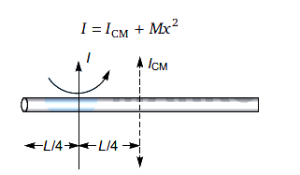
The moment of inertia of a rod of mass $M$ and length $L$ about an axis passing through a point midway between the center and the end is:
A
$\frac{M L^{2}}{6}$
B
$\frac{M L^{2}}{12}$
C
$\frac{7 M L^{2}}{24}$
D
$\frac{7 M L^{2}}{48}$
Solution
(D) To find the moment of inertia about an axis passing through a point midway between the center and the end,we use the parallel axis theorem: $I = I_{CM} + M d^2$.
Here,$I_{CM} = \frac{M L^2}{12}$ is the moment of inertia about the center of mass.
The distance $d$ between the center of mass and the new axis is $d = \frac{L}{4}$.
Substituting these values into the theorem:
$I = \frac{M L^2}{12} + M \left( \frac{L}{4} \right)^2$
$I = \frac{M L^2}{12} + \frac{M L^2}{16}$
Taking the least common multiple $(LCM)$ of $12$ and $16$,which is $48$:
$I = \frac{4 M L^2 + 3 M L^2}{48} = \frac{7 M L^2}{48}$.
Here,$I_{CM} = \frac{M L^2}{12}$ is the moment of inertia about the center of mass.
The distance $d$ between the center of mass and the new axis is $d = \frac{L}{4}$.
Substituting these values into the theorem:
$I = \frac{M L^2}{12} + M \left( \frac{L}{4} \right)^2$
$I = \frac{M L^2}{12} + \frac{M L^2}{16}$
Taking the least common multiple $(LCM)$ of $12$ and $16$,which is $48$:
$I = \frac{4 M L^2 + 3 M L^2}{48} = \frac{7 M L^2}{48}$.
0 likesView Solution
20
PhysicsDifficultMCQMHT CET · 2009
The moment of inertia of a big drop is $I$. If $8$ droplets are formed from the big drop,then the moment of inertia of a small droplet is:
A
$\frac{I}{32}$
B
$\frac{I}{16}$
C
$\frac{I}{8}$
D
$\frac{I}{4}$
Solution
(A) The moment of inertia of a solid sphere (big drop) is $I = \frac{2}{5} M R^{2}$.
When the big drop is divided into $n = 8$ small droplets,the total volume remains constant.
$n \left( \frac{4}{3} \pi r^{3} \right) = \frac{4}{3} \pi R^{3}$
$8 r^{3} = R^{3} \Rightarrow 2r = R \Rightarrow r = \frac{R}{2}$.
The mass of each small droplet is $m = \frac{M}{n} = \frac{M}{8}$.
The moment of inertia of each small droplet $i$ is:
$i = \frac{2}{5} m r^{2}$
$i = \frac{2}{5} \left( \frac{M}{8} \right) \left( \frac{R}{2} \right)^{2}$
$i = \frac{1}{8} \times \frac{1}{4} \times \left( \frac{2}{5} M R^{2} \right)$
$i = \frac{1}{32} I$.
When the big drop is divided into $n = 8$ small droplets,the total volume remains constant.
$n \left( \frac{4}{3} \pi r^{3} \right) = \frac{4}{3} \pi R^{3}$
$8 r^{3} = R^{3} \Rightarrow 2r = R \Rightarrow r = \frac{R}{2}$.
The mass of each small droplet is $m = \frac{M}{n} = \frac{M}{8}$.
The moment of inertia of each small droplet $i$ is:
$i = \frac{2}{5} m r^{2}$
$i = \frac{2}{5} \left( \frac{M}{8} \right) \left( \frac{R}{2} \right)^{2}$
$i = \frac{1}{8} \times \frac{1}{4} \times \left( \frac{2}{5} M R^{2} \right)$
$i = \frac{1}{32} I$.
0 likesView Solution
21
PhysicsDifficultMCQMHT CET · 2009
If $150 \,J$ of energy is incident on an area of $2 \,m^{2}$. If $Q_{r}=15 \,J$ and the coefficient of absorption is $0.6$,then the amount of energy transmitted is: (in $\,J$)
A
$50$
B
$45$
C
$40$
D
$30$
Solution
(B) When thermal radiation $(Q)$ falls on a body,it is partly reflected $(Q_{r})$,partly absorbed $(Q_{a})$,and partly transmitted $(Q_{t})$.
The total energy incident is given by $Q = Q_{a} + Q_{r} + Q_{t}$.
Dividing by $Q$,we get the relation: $a + r + t = 1$,where $a$ is the coefficient of absorption,$r$ is the coefficient of reflection,and $t$ is the coefficient of transmission.
Given: $Q = 150 \,J$,$Q_{r} = 15 \,J$,and $a = 0.6$.
The coefficient of reflection $r = \frac{Q_{r}}{Q} = \frac{15}{150} = 0.1$.
Using the relation $a + r + t = 1$:
$0.6 + 0.1 + t = 1$
$0.7 + t = 1$
$t = 0.3$.
The energy transmitted $Q_{t} = t \times Q = 0.3 \times 150 \,J = 45 \,J$.
The total energy incident is given by $Q = Q_{a} + Q_{r} + Q_{t}$.
Dividing by $Q$,we get the relation: $a + r + t = 1$,where $a$ is the coefficient of absorption,$r$ is the coefficient of reflection,and $t$ is the coefficient of transmission.
Given: $Q = 150 \,J$,$Q_{r} = 15 \,J$,and $a = 0.6$.
The coefficient of reflection $r = \frac{Q_{r}}{Q} = \frac{15}{150} = 0.1$.
Using the relation $a + r + t = 1$:
$0.6 + 0.1 + t = 1$
$0.7 + t = 1$
$t = 0.3$.
The energy transmitted $Q_{t} = t \times Q = 0.3 \times 150 \,J = 45 \,J$.
0 likesView Solution
22
PhysicsEasyMCQMHT CET · 2009
The unit of Wien's constant $b$ is
A
$W m^{-2} K^{-4}$
B
$m^{-1} K^{-1}$
C
$W m^{2}$
D
$m K$
Solution
(D) According to Wien's displacement law,the product of the wavelength $\lambda_{m}$ corresponding to the maximum intensity of radiation and the absolute temperature $T$ of the body is a constant.
Mathematically,$\lambda_{m} T = b$.
Here,$\lambda_{m}$ is measured in meters $(m)$ and $T$ is measured in Kelvin $(K)$.
Therefore,the unit of Wien's constant $b$ is the product of the units of wavelength and temperature,which is $m K$.
Mathematically,$\lambda_{m} T = b$.
Here,$\lambda_{m}$ is measured in meters $(m)$ and $T$ is measured in Kelvin $(K)$.
Therefore,the unit of Wien's constant $b$ is the product of the units of wavelength and temperature,which is $m K$.
0 likesView Solution
23
PhysicsMediumMCQMHT CET · 2009
Beats are produced by two waves given by $y_{1} = a \sin(2000 \pi t)$ and $y_{2} = a \sin(2008 \pi t)$. The number of beats heard per second is
A
zero
B
one
C
four
D
eight
Solution
(C) The number of beats per second is given by the difference in frequencies,$|n_{1} - n_{2}|$.
Given the wave equations $y_{1} = a \sin(2000 \pi t)$ and $y_{2} = a \sin(2008 \pi t)$,we compare them with the standard form $y = a \sin(2 \pi n t)$.
For the first wave: $2 \pi n_{1} = 2000 \pi \implies n_{1} = 1000 \text{ Hz}$.
For the second wave: $2 \pi n_{2} = 2008 \pi \implies n_{2} = 1004 \text{ Hz}$.
The number of beats per second is $|n_{2} - n_{1}| = |1004 - 1000| = 4 \text{ beats per second}$.
Given the wave equations $y_{1} = a \sin(2000 \pi t)$ and $y_{2} = a \sin(2008 \pi t)$,we compare them with the standard form $y = a \sin(2 \pi n t)$.
For the first wave: $2 \pi n_{1} = 2000 \pi \implies n_{1} = 1000 \text{ Hz}$.
For the second wave: $2 \pi n_{2} = 2008 \pi \implies n_{2} = 1004 \text{ Hz}$.
The number of beats per second is $|n_{2} - n_{1}| = |1004 - 1000| = 4 \text{ beats per second}$.
0 likesView Solution
24
PhysicsEasyMCQMHT CET · 2009
The fundamental frequency of a pipe is $100 \ Hz$ and the next two frequencies are $300 \ Hz$ and $500 \ Hz$. Then,the pipe is:
A
open at both ends
B
closed at both ends
C
open at one end and closed at the other
D
None of the above
Solution
(C) For a pipe closed at one end,the allowed frequencies are given by $f_n = n \cdot f_1$,where $n$ is an odd integer $(n = 1, 3, 5, \dots)$.
Given the fundamental frequency $f_1 = 100 \ Hz$,the subsequent frequencies are $f_2 = 3 \times 100 \ Hz = 300 \ Hz$ and $f_3 = 5 \times 100 \ Hz = 500 \ Hz$.
Since the frequencies follow the ratio $1:3:5$,the pipe must be closed at one end and open at the other.
Given the fundamental frequency $f_1 = 100 \ Hz$,the subsequent frequencies are $f_2 = 3 \times 100 \ Hz = 300 \ Hz$ and $f_3 = 5 \times 100 \ Hz = 500 \ Hz$.
Since the frequencies follow the ratio $1:3:5$,the pipe must be closed at one end and open at the other.
0 likesView Solution
25
PhysicsMediumMCQMHT CET · 2009
In a resonance pipe, the first and second resonances are obtained at depths $22.7 \,cm$ and $70.2 \,cm$ respectively. What will be the end correction (in $\,cm$)?
A
$1.05$
B
$115.5$
C
$92.5$
D
$113.5$
Solution
(A) Let the end correction be $x$. The resonance condition for a pipe closed at one end is given by $l_n + x = (2n-1) \frac{\lambda}{4}$.
For the first resonance $(n=1)$: $l_1 + x = \frac{\lambda}{4}$.
For the second resonance $(n=2)$: $l_2 + x = \frac{3\lambda}{4}$.
Dividing the two equations: $\frac{l_2 + x}{l_1 + x} = 3$.
$l_2 + x = 3l_1 + 3x$.
$2x = l_2 - 3l_1$.
$x = \frac{l_2 - 3l_1}{2}$.
Substituting the given values: $x = \frac{70.2 - 3(22.7)}{2} = \frac{70.2 - 68.1}{2} = \frac{2.1}{2} = 1.05 \,cm$.
For the first resonance $(n=1)$: $l_1 + x = \frac{\lambda}{4}$.
For the second resonance $(n=2)$: $l_2 + x = \frac{3\lambda}{4}$.
Dividing the two equations: $\frac{l_2 + x}{l_1 + x} = 3$.
$l_2 + x = 3l_1 + 3x$.
$2x = l_2 - 3l_1$.
$x = \frac{l_2 - 3l_1}{2}$.
Substituting the given values: $x = \frac{70.2 - 3(22.7)}{2} = \frac{70.2 - 68.1}{2} = \frac{2.1}{2} = 1.05 \,cm$.
0 likesView Solution
26
PhysicsEasyMCQMHT CET · 2009
If you set up the $7^{th}$ overtone on a string fixed at both ends,how many nodes and antinodes are set up in it?
A
$9, 8$
B
$8, 9$
C
$7, 8$
D
$8, 7$
Solution
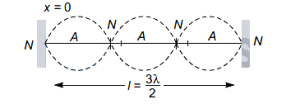
(A) For a string fixed at both ends,the frequency of the $n^{th}$ harmonic is given by $f_n = n f_1$,where $n = 1, 2, 3, \dots$ is the mode number.
The $n^{th}$ harmonic corresponds to $(n-1)^{th}$ overtone.
Given that we have the $7^{th}$ overtone,we have $n-1 = 7$,which implies $n = 8$.
Thus,the $7^{th}$ overtone is the $8^{th}$ harmonic.
In the $n^{th}$ harmonic,the number of loops is $n$.
Therefore,for the $8^{th}$ harmonic,there are $8$ loops.
For a string with $n$ loops,the number of nodes is $n+1$ and the number of antinodes is $n$.
For $n = 8$,the number of nodes is $8 + 1 = 9$ and the number of antinodes is $8$.
The $n^{th}$ harmonic corresponds to $(n-1)^{th}$ overtone.
Given that we have the $7^{th}$ overtone,we have $n-1 = 7$,which implies $n = 8$.
Thus,the $7^{th}$ overtone is the $8^{th}$ harmonic.
In the $n^{th}$ harmonic,the number of loops is $n$.
Therefore,for the $8^{th}$ harmonic,there are $8$ loops.
For a string with $n$ loops,the number of nodes is $n+1$ and the number of antinodes is $n$.
For $n = 8$,the number of nodes is $8 + 1 = 9$ and the number of antinodes is $8$.
0 likesView Solution
27
PhysicsDifficultMCQMHT CET · 2009
The length of an elastic string is $a$ metres when the longitudinal tension is $4 \ N$ and $b$ metres when the longitudinal tension is $5 \ N$. The length of the string in metres when the longitudinal tension is $9 \ N$ is
A
$a-b$
B
$5b-4a$
C
$2b-\frac{1}{4}a$
D
$4a-3b$
Solution
(B) According to Hooke's Law,the extension of an elastic string is proportional to the applied tension. Let $l$ be the natural length of the string and $k$ be the force constant.
The length of the string under tension $T$ is given by $L = l + \frac{T}{k}$.
For $T_1 = 4 \ N$,$L_1 = a = l + \frac{4}{k} \implies \frac{4}{k} = a - l$ (Equation $1$).
For $T_2 = 5 \ N$,$L_2 = b = l + \frac{5}{k} \implies \frac{5}{k} = b - l$ (Equation $2$).
Subtracting Equation $1$ from Equation $2$: $\frac{5}{k} - \frac{4}{k} = (b - l) - (a - l) \implies \frac{1}{k} = b - a$.
Substituting $\frac{1}{k}$ into Equation $1$: $a = l + 4(b - a) \implies a = l + 4b - 4a \implies l = 5a - 4b$.
Now,for $T_3 = 9 \ N$,the length $x$ is $x = l + \frac{9}{k}$.
Substituting $l = 5a - 4b$ and $\frac{1}{k} = b - a$:
$x = (5a - 4b) + 9(b - a) = 5a - 4b + 9b - 9a = 5b - 4a$.
The length of the string under tension $T$ is given by $L = l + \frac{T}{k}$.
For $T_1 = 4 \ N$,$L_1 = a = l + \frac{4}{k} \implies \frac{4}{k} = a - l$ (Equation $1$).
For $T_2 = 5 \ N$,$L_2 = b = l + \frac{5}{k} \implies \frac{5}{k} = b - l$ (Equation $2$).
Subtracting Equation $1$ from Equation $2$: $\frac{5}{k} - \frac{4}{k} = (b - l) - (a - l) \implies \frac{1}{k} = b - a$.
Substituting $\frac{1}{k}$ into Equation $1$: $a = l + 4(b - a) \implies a = l + 4b - 4a \implies l = 5a - 4b$.
Now,for $T_3 = 9 \ N$,the length $x$ is $x = l + \frac{9}{k}$.
Substituting $l = 5a - 4b$ and $\frac{1}{k} = b - a$:
$x = (5a - 4b) + 9(b - a) = 5a - 4b + 9b - 9a = 5b - 4a$.
0 likesView Solution
28
PhysicsMediumMCQMHT CET · 2009
The same current is flowing in two alternating circuits. The first circuit contains only an inductor and the other contains only a capacitor. If the frequency of the $AC$ emf is increased,what will be the effect on the value of the current?
A
increases in the first circuit and decreases in the other
B
increases in both the circuits
C
decreases in both the circuits
D
decreases in the first circuit and increases in the other
Solution
(D) The current in an inductive circuit is given by $I_{L} = \frac{V}{X_{L}}$,where $X_{L} = \omega L = 2\pi f L$. Thus,$I_{L} = \frac{V}{2\pi f L}$. As frequency $f$ increases,$I_{L}$ decreases.
The current in a capacitive circuit is given by $I_{C} = \frac{V}{X_{C}}$,where $X_{C} = \frac{1}{\omega C} = \frac{1}{2\pi f C}$. Thus,$I_{C} = V(2\pi f C)$. As frequency $f$ increases,$I_{C}$ increases.
Therefore,the current decreases in the first circuit and increases in the second circuit.
The current in a capacitive circuit is given by $I_{C} = \frac{V}{X_{C}}$,where $X_{C} = \frac{1}{\omega C} = \frac{1}{2\pi f C}$. Thus,$I_{C} = V(2\pi f C)$. As frequency $f$ increases,$I_{C}$ increases.
Therefore,the current decreases in the first circuit and increases in the second circuit.
0 likesView Solution
29
PhysicsEasyMCQMHT CET · 2009
An alternating voltage $E = 200 \sqrt{2} \sin(100 t) \text{ V}$ is connected to a $1 \mu\text{F}$ capacitor through an $A.C.$ ammeter. The reading of the ammeter shall be: (in $\text{ mA}$)
A
$10$
B
$20$
C
$40$
D
$80$
Solution
(B) The given alternating voltage is $E = E_0 \sin(\omega t)$, where $E_0 = 200 \sqrt{2} \text{ V}$ and $\omega = 100 \text{ rad/s}$.
The capacitive reactance is $X_C = \frac{1}{\omega C} = \frac{1}{100 \times 1 \times 10^{-6}} = 10^4 \Omega$.
The peak current is $I_0 = \frac{E_0}{X_C} = \frac{200 \sqrt{2}}{10^4} = 2 \sqrt{2} \times 10^{-2} \text{ A}$.
The $A.C.$ ammeter measures the root mean square $(RMS)$ current, $I_{\text{rms}} = \frac{I_0}{\sqrt{2}}$.
$I_{\text{rms}} = \frac{2 \sqrt{2} \times 10^{-2}}{\sqrt{2}} = 2 \times 10^{-2} \text{ A} = 20 \text{ mA}$.
The capacitive reactance is $X_C = \frac{1}{\omega C} = \frac{1}{100 \times 1 \times 10^{-6}} = 10^4 \Omega$.
The peak current is $I_0 = \frac{E_0}{X_C} = \frac{200 \sqrt{2}}{10^4} = 2 \sqrt{2} \times 10^{-2} \text{ A}$.
The $A.C.$ ammeter measures the root mean square $(RMS)$ current, $I_{\text{rms}} = \frac{I_0}{\sqrt{2}}$.
$I_{\text{rms}} = \frac{2 \sqrt{2} \times 10^{-2}}{\sqrt{2}} = 2 \times 10^{-2} \text{ A} = 20 \text{ mA}$.
0 likesView Solution
30
PhysicsMediumMCQMHT CET · 2009
In an $AC$ circuit,the instantaneous values of emf and current are $e = 200 \sin(314t) \text{ V}$ and $I = \sin(314t + \frac{\pi}{3}) \text{ A}$. The average power consumed in watt is
A
$200$
B
$100$
C
$50$
D
$25$
Solution
(C) The given equations are $e = E_0 \sin(\omega t)$ and $I = I_0 \sin(\omega t + \phi)$.
Comparing with the given values,$E_0 = 200 \text{ V}$,$I_0 = 1 \text{ A}$,and the phase difference $\phi = \frac{\pi}{3}$.
The root mean square values are $V_{rms} = \frac{E_0}{\sqrt{2}} = \frac{200}{\sqrt{2}} \text{ V}$ and $I_{rms} = \frac{I_0}{\sqrt{2}} = \frac{1}{\sqrt{2}} \text{ A}$.
The average power consumed is given by $P = V_{rms} I_{rms} \cos \phi$.
Substituting the values: $P = \left(\frac{200}{\sqrt{2}}\right) \left(\frac{1}{\sqrt{2}}\right) \cos\left(\frac{\pi}{3}\right)$.
$P = \left(\frac{200}{2}\right) \times \frac{1}{2} = 100 \times 0.5 = 50 \text{ W}$.
Comparing with the given values,$E_0 = 200 \text{ V}$,$I_0 = 1 \text{ A}$,and the phase difference $\phi = \frac{\pi}{3}$.
The root mean square values are $V_{rms} = \frac{E_0}{\sqrt{2}} = \frac{200}{\sqrt{2}} \text{ V}$ and $I_{rms} = \frac{I_0}{\sqrt{2}} = \frac{1}{\sqrt{2}} \text{ A}$.
The average power consumed is given by $P = V_{rms} I_{rms} \cos \phi$.
Substituting the values: $P = \left(\frac{200}{\sqrt{2}}\right) \left(\frac{1}{\sqrt{2}}\right) \cos\left(\frac{\pi}{3}\right)$.
$P = \left(\frac{200}{2}\right) \times \frac{1}{2} = 100 \times 0.5 = 50 \text{ W}$.
0 likesView Solution
31
PhysicsEasyMCQMHT CET · 2009
For the Bohr's first orbit of circumference $2 \pi r$,the de-Broglie wavelength of the revolving electron will be
A
$2 \pi r$
B
$\pi r$
C
$\frac{1}{2 \pi r}$
D
$\frac{1}{4 \pi r}$
Solution
(A) According to Bohr's quantization condition,the angular momentum of an electron is given by $mvr = \frac{nh}{2\pi}$.
Rearranging this,we get $2\pi r = n \left( \frac{h}{mv} \right)$.
Since the de-Broglie wavelength is defined as $\lambda = \frac{h}{mv}$,we can substitute this into the equation to get $2\pi r = n\lambda$.
For the first orbit,$n = 1$.
Therefore,the wavelength $\lambda = 2\pi r$.
Rearranging this,we get $2\pi r = n \left( \frac{h}{mv} \right)$.
Since the de-Broglie wavelength is defined as $\lambda = \frac{h}{mv}$,we can substitute this into the equation to get $2\pi r = n\lambda$.
For the first orbit,$n = 1$.
Therefore,the wavelength $\lambda = 2\pi r$.
0 likesView Solution
32
PhysicsMediumMCQMHT CET · 2009
In a hydrogen atom,the electron is making $6.6 \times 10^{15} \text{ rev } s^{-1}$ around the nucleus in an orbit of radius $0.528 \text{ Å}$. The magnetic moment in $\text{A-m}^2$ is:
A
$1 \times 10^{-15}$
B
$1 \times 10^{-10}$
C
$1 \times 10^{-23}$
D
$1 \times 10^{-27}$
Solution
(C) The current $I$ produced by the revolving electron is given by $I = qf$,where $q$ is the charge of the electron $(1.6 \times 10^{-19} \text{ C})$ and $f$ is the frequency $(6.6 \times 10^{15} \text{ rev } s^{-1})$.
$I = (1.6 \times 10^{-19} \text{ C}) \times (6.6 \times 10^{15} \text{ s}^{-1}) = 1.056 \times 10^{-3} \text{ A} \approx 1.06 \times 10^{-3} \text{ A}$.
The area $A$ of the orbit is $\pi R^2$,where $R = 0.528 \text{ Å} = 0.528 \times 10^{-10} \text{ m}$.
$A = 3.142 \times (0.528 \times 10^{-10} \text{ m})^2 = 3.142 \times 0.2788 \times 10^{-20} \text{ m}^2 \approx 0.876 \times 10^{-20} \text{ m}^2$.
The magnetic moment $M$ is given by $M = I \times A$.
$M = (1.06 \times 10^{-3} \text{ A}) \times (0.876 \times 10^{-20} \text{ m}^2) \approx 0.928 \times 10^{-23} \text{ A-m}^2$.
Rounding to the nearest order of magnitude,$M \approx 1 \times 10^{-23} \text{ A-m}^2$.
$I = (1.6 \times 10^{-19} \text{ C}) \times (6.6 \times 10^{15} \text{ s}^{-1}) = 1.056 \times 10^{-3} \text{ A} \approx 1.06 \times 10^{-3} \text{ A}$.
The area $A$ of the orbit is $\pi R^2$,where $R = 0.528 \text{ Å} = 0.528 \times 10^{-10} \text{ m}$.
$A = 3.142 \times (0.528 \times 10^{-10} \text{ m})^2 = 3.142 \times 0.2788 \times 10^{-20} \text{ m}^2 \approx 0.876 \times 10^{-20} \text{ m}^2$.
The magnetic moment $M$ is given by $M = I \times A$.
$M = (1.06 \times 10^{-3} \text{ A}) \times (0.876 \times 10^{-20} \text{ m}^2) \approx 0.928 \times 10^{-23} \text{ A-m}^2$.
Rounding to the nearest order of magnitude,$M \approx 1 \times 10^{-23} \text{ A-m}^2$.
0 likesView Solution
33
PhysicsMediumMCQMHT CET · 2009
The radius of a hydrogen atom in its ground state is $5.3 \times 10^{-11} \ m$. After collision with an electron,it is found to have a radius of $21.2 \times 10^{-11} \ m$. What is the principal quantum number $n$ of the final state of the atom?
A
$n=4$
B
$n=2$
C
$n=16$
D
$n=3$
Solution
(B) The radius of an orbit in a hydrogen atom is given by $r_n = a_0 n^2$,where $a_0$ is the Bohr radius $(5.3 \times 10^{-11} \ m)$ and $n$ is the principal quantum number.
Since $r \propto n^2$,we have the ratio:
$\frac{r_f}{r_i} = \left(\frac{n_f}{n_i}\right)^2$
Given $r_i = 5.3 \times 10^{-11} \ m$ (for $n_i = 1$) and $r_f = 21.2 \times 10^{-11} \ m$:
$\frac{21.2 \times 10^{-11}}{5.3 \times 10^{-11}} = \left(\frac{n}{1}\right)^2$
$4 = n^2$
$n = 2$
Therefore,the principal quantum number of the final state is $n=2$.
Since $r \propto n^2$,we have the ratio:
$\frac{r_f}{r_i} = \left(\frac{n_f}{n_i}\right)^2$
Given $r_i = 5.3 \times 10^{-11} \ m$ (for $n_i = 1$) and $r_f = 21.2 \times 10^{-11} \ m$:
$\frac{21.2 \times 10^{-11}}{5.3 \times 10^{-11}} = \left(\frac{n}{1}\right)^2$
$4 = n^2$
$n = 2$
Therefore,the principal quantum number of the final state is $n=2$.
0 likesView Solution
34
PhysicsMediumMCQMHT CET · 2009
If a dielectric is inserted into a charged capacitor (battery removed),then the quantity that remains constant is
A
capacitance
B
potential
C
intensity
D
charge
Solution
(D) When a dielectric slab of constant $K$ is inserted into a charged parallel plate capacitor after the battery is disconnected,the charge $Q$ on the plates remains constant because there is no path for the charge to flow.
The variations in other physical quantities are as follows:
$1$. Capacitance: $C' = KC$ (increases).
$2$. Charge: $Q' = Q$ (remains constant).
$3$. Potential difference: $V' = V/K$ (decreases).
$4$. Electric field intensity: $E' = E/K$ (decreases).
$5$. Stored energy: $U' = U/K$ (decreases).
Therefore,the charge $Q$ is the quantity that remains constant.
The variations in other physical quantities are as follows:
$1$. Capacitance: $C' = KC$ (increases).
$2$. Charge: $Q' = Q$ (remains constant).
$3$. Potential difference: $V' = V/K$ (decreases).
$4$. Electric field intensity: $E' = E/K$ (decreases).
$5$. Stored energy: $U' = U/K$ (decreases).
Therefore,the charge $Q$ is the quantity that remains constant.
0 likesView Solution
35
PhysicsEasyMCQMHT CET · 2009
Three capacitors of capacitance $C$ ($\mu F$) are connected in parallel, and this combination is connected in series with another capacitor of capacitance $C$. If the effective capacitance is $3.75 \mu F$, then the capacity of each capacitor is: (in $\mu F$)
A
$4$
B
$5$
C
$6$
D
$8$
Solution
(B) The effective capacitance of three capacitors connected in parallel is $C_p = C + C + C = 3C$.
This combination is connected in series with a capacitor of capacitance $C$.
The formula for the equivalent capacitance $C_{eq}$ of two capacitors in series is given by:
$C_{eq} = \frac{C_p \times C}{C_p + C}$
Substituting the given values:
$3.75 = \frac{3C \times C}{3C + C}$
$3.75 = \frac{3C^2}{4C}$
$3.75 = \frac{3}{4}C$
$C = \frac{3.75 \times 4}{3}$
$C = 1.25 \times 4 = 5 \mu F$
Therefore, the capacity of each capacitor is $5 \mu F$.
This combination is connected in series with a capacitor of capacitance $C$.
The formula for the equivalent capacitance $C_{eq}$ of two capacitors in series is given by:
$C_{eq} = \frac{C_p \times C}{C_p + C}$
Substituting the given values:
$3.75 = \frac{3C \times C}{3C + C}$
$3.75 = \frac{3C^2}{4C}$
$3.75 = \frac{3}{4}C$
$C = \frac{3.75 \times 4}{3}$
$C = 1.25 \times 4 = 5 \mu F$
Therefore, the capacity of each capacitor is $5 \mu F$.
0 likesView Solution
36
PhysicsMediumMCQMHT CET · 2009
The waves which are reflected back to the earth by the ionosphere are:
A
ground wave
B
sky wave
C
space wave
D
All of them
Solution
(B) The ionosphere acts as a reflecting medium for electromagnetic waves in the frequency range of $3 \ MHz$ to $30 \ MHz$. These waves are known as sky waves. When these waves are transmitted towards the sky,they are reflected back to the earth by the ionospheric layers,enabling long-distance communication.
0 likesView Solution
37
PhysicsMediumMCQMHT CET · 2009
$A$ $2 \, V$ battery, a $990 \, \Omega$ resistor, and a potentiometer of $2 \, m$ length are connected in series. If the resistance of the potentiometer wire is $10 \, \Omega$, then the potential gradient of the potentiometer wire is: (in $V m^{-1}$)
A
$0.05$
B
$0.5$
C
$0.01$
D
$0.1$
Solution
(C) The total resistance of the circuit is $R_{total} = R_{resistor} + R_{potentiometer} = 990 \, \Omega + 10 \, \Omega = 1000 \, \Omega$.
The current flowing through the circuit is $I = \frac{V}{R_{total}} = \frac{2 \, V}{1000 \, \Omega} = 0.002 \, A$.
The potential drop across the potentiometer wire is $V_{wire} = I \times R_{potentiometer} = 0.002 \, A \times 10 \, \Omega = 0.02 \, V$.
The potential gradient $x$ is defined as the potential drop per unit length: $x = \frac{V_{wire}}{L} = \frac{0.02 \, V}{2 \, m} = 0.01 \, V m^{-1}$.
The current flowing through the circuit is $I = \frac{V}{R_{total}} = \frac{2 \, V}{1000 \, \Omega} = 0.002 \, A$.
The potential drop across the potentiometer wire is $V_{wire} = I \times R_{potentiometer} = 0.002 \, A \times 10 \, \Omega = 0.02 \, V$.
The potential gradient $x$ is defined as the potential drop per unit length: $x = \frac{V_{wire}}{L} = \frac{0.02 \, V}{2 \, m} = 0.01 \, V m^{-1}$.
0 likesView Solution
38
PhysicsEasyMCQMHT CET · 2009
In the photoelectric effect,if the intensity of light is doubled,then the maximum kinetic energy of photoelectrons will become
A
double
B
half
C
four times
D
no change
Solution
(D) According to Einstein's photoelectric equation,$K_{\max} = h\nu - \Phi$,where $h\nu$ is the energy of the incident photon and $\Phi$ is the work function of the metal.
$K_{\max}$ depends only on the frequency of the incident light and the nature of the metal surface.
Intensity of light is related to the number of photons incident per unit area per unit time,which affects the number of photoelectrons emitted (photoelectric current),but not their individual maximum kinetic energy.
Therefore,if the intensity of light is doubled,the maximum kinetic energy of the photoelectrons remains unchanged.
$K_{\max}$ depends only on the frequency of the incident light and the nature of the metal surface.
Intensity of light is related to the number of photons incident per unit area per unit time,which affects the number of photoelectrons emitted (photoelectric current),but not their individual maximum kinetic energy.
Therefore,if the intensity of light is doubled,the maximum kinetic energy of the photoelectrons remains unchanged.
0 likesView Solution
39
PhysicsMediumMCQMHT CET · 2009
If the linear charge density of a cylinder is $4 \mu C m^{-1}$,then the electric field intensity at a point $3.6 \ cm$ from the axis is:
A
$4 \times 10^{5} \ NC^{-1}$
B
$2 \times 10^{6} \ NC^{-1}$
C
$8 \times 10^{7} \ NC^{-1}$
D
$12 \times 10^{7} \ NC^{-1}$
Solution
(B) The electric field intensity $E$ at a distance $r$ from the axis of an infinitely long charged cylinder with linear charge density $\lambda$ is given by the formula:
$E = \frac{\lambda}{2 \pi \varepsilon_{0} r}$
This can be rewritten as:
$E = \frac{2k\lambda}{r}$,where $k = \frac{1}{4 \pi \varepsilon_{0}} = 9 \times 10^{9} \ N m^{2} C^{-2}$.
Given:
$\lambda = 4 \mu C m^{-1} = 4 \times 10^{-6} \ C m^{-1}$
$r = 3.6 \ cm = 3.6 \times 10^{-2} \ m$
Substituting the values:
$E = \frac{2 \times (9 \times 10^{9}) \times (4 \times 10^{-6})}{3.6 \times 10^{-2}}$
$E = \frac{72 \times 10^{3}}{3.6 \times 10^{-2}}$
$E = 20 \times 10^{5} \ NC^{-1} = 2 \times 10^{6} \ NC^{-1}$
$E = \frac{\lambda}{2 \pi \varepsilon_{0} r}$
This can be rewritten as:
$E = \frac{2k\lambda}{r}$,where $k = \frac{1}{4 \pi \varepsilon_{0}} = 9 \times 10^{9} \ N m^{2} C^{-2}$.
Given:
$\lambda = 4 \mu C m^{-1} = 4 \times 10^{-6} \ C m^{-1}$
$r = 3.6 \ cm = 3.6 \times 10^{-2} \ m$
Substituting the values:
$E = \frac{2 \times (9 \times 10^{9}) \times (4 \times 10^{-6})}{3.6 \times 10^{-2}}$
$E = \frac{72 \times 10^{3}}{3.6 \times 10^{-2}}$
$E = 20 \times 10^{5} \ NC^{-1} = 2 \times 10^{6} \ NC^{-1}$
0 likesView Solution
40
PhysicsDifficultMCQMHT CET · 2009
If an electron is revolving around the hydrogen nucleus at a distance of $0.1 \,nm$, what should be its speed?
A
$2.188 \times 10^{6} \,ms^{-1}$
B
$1.094 \times 10^{6} \,ms^{-1}$
C
$4.376 \times 10^{6} \,ms^{-1}$
D
$1.59 \times 10^{6} \,ms^{-1}$
Solution
(D) The electrostatic force between the nucleus and the electron provides the necessary centripetal force for circular motion.
Electrostatic force $=$ Centripetal force
$\frac{1}{4 \pi \varepsilon_{0}} \frac{Z e^{2}}{r^{2}} = \frac{m v^{2}}{r}$
Solving for velocity $v$:
$v = \sqrt{\frac{1}{4 \pi \varepsilon_{0}} \frac{Z e^{2}}{m r}}$
Given values: $Z = 1$, $e = 1.6 \times 10^{-19} \,C$, $r = 0.1 \times 10^{-9} \,m$, $m = 9.1 \times 10^{-31} \,kg$, and $\frac{1}{4 \pi \varepsilon_{0}} = 9 \times 10^{9} \,N \cdot m^{2} \cdot C^{-2}$.
Substituting these values:
$v = \sqrt{\frac{9 \times 10^{9} \times 1 \times (1.6 \times 10^{-19})^{2}}{9.1 \times 10^{-31} \times 0.1 \times 10^{-9}}}$
$v = \sqrt{\frac{9 \times 10^{9} \times 2.56 \times 10^{-38}}{9.1 \times 10^{-41}}}$
$v = \sqrt{\frac{23.04 \times 10^{-29}}{9.1 \times 10^{-41}}} = \sqrt{2.53 \times 10^{12}} \approx 1.59 \times 10^{6} \,ms^{-1}$.
Electrostatic force $=$ Centripetal force
$\frac{1}{4 \pi \varepsilon_{0}} \frac{Z e^{2}}{r^{2}} = \frac{m v^{2}}{r}$
Solving for velocity $v$:
$v = \sqrt{\frac{1}{4 \pi \varepsilon_{0}} \frac{Z e^{2}}{m r}}$
Given values: $Z = 1$, $e = 1.6 \times 10^{-19} \,C$, $r = 0.1 \times 10^{-9} \,m$, $m = 9.1 \times 10^{-31} \,kg$, and $\frac{1}{4 \pi \varepsilon_{0}} = 9 \times 10^{9} \,N \cdot m^{2} \cdot C^{-2}$.
Substituting these values:
$v = \sqrt{\frac{9 \times 10^{9} \times 1 \times (1.6 \times 10^{-19})^{2}}{9.1 \times 10^{-31} \times 0.1 \times 10^{-9}}}$
$v = \sqrt{\frac{9 \times 10^{9} \times 2.56 \times 10^{-38}}{9.1 \times 10^{-41}}}$
$v = \sqrt{\frac{23.04 \times 10^{-29}}{9.1 \times 10^{-41}}} = \sqrt{2.53 \times 10^{12}} \approx 1.59 \times 10^{6} \,ms^{-1}$.
0 likesView Solution
41
PhysicsEasyMCQMHT CET · 2009
$A$ long solenoid of length $L$ has a mean diameter $D$. It has $n$ layers of winding of $N$ turns each. If it carries a current $I$,the magnetic field at its centre will be
A
proportional to $D$
B
inversely proportional to $D$
C
independent of $D$
D
proportional to $L$
Solution
(C) The magnetic field $B$ at the center of a long solenoid is given by the formula $B = \mu_{0} n_{total} I$,where $n_{total}$ is the number of turns per unit length.
Given that there are $n$ layers and each layer has $N$ turns over a length $L$,the total number of turns per unit length is $n_{total} = \frac{n \times N}{L}$.
Substituting this into the formula,we get $B = \mu_{0} \left( \frac{n N}{L} \right) I$.
Since the expression for the magnetic field $B$ does not contain the diameter $D$,the magnetic field at the center is independent of the diameter $D$.
Given that there are $n$ layers and each layer has $N$ turns over a length $L$,the total number of turns per unit length is $n_{total} = \frac{n \times N}{L}$.
Substituting this into the formula,we get $B = \mu_{0} \left( \frac{n N}{L} \right) I$.
Since the expression for the magnetic field $B$ does not contain the diameter $D$,the magnetic field at the center is independent of the diameter $D$.
0 likesView Solution
42
PhysicsMediumMCQMHT CET · 2009
$A$ long wire carries a steady current. It is bent into a circle of one turn and the magnetic field at the centre of the coil is $B$. It is then bent into a circular loop of $n$ turns. The magnetic field at the centre of the coil for the same current will be
A
$n B$
B
$n^{2} B$
C
$2 n B$
D
$2 n^{2} B$
Solution
(B) Let the length of the wire be $L$. For a single turn loop of radius $r$,the circumference is $2 \pi r = L$,so $r = \frac{L}{2 \pi}$.
The magnetic field at the centre of a single turn loop is $B = \frac{\mu_{0} I}{2 r} = \frac{\mu_{0} I}{2 (L / 2 \pi)} = \frac{\mu_{0} I \pi}{L}$.
When the same wire is bent into $n$ turns,the new radius $r'$ satisfies $n (2 \pi r') = L$,so $r' = \frac{L}{2 \pi n} = \frac{r}{n}$.
The magnetic field at the centre of the $n$-turn loop is $B_{n} = n \times \frac{\mu_{0} I}{2 r'} = n \times \frac{\mu_{0} I}{2 (r / n)} = n^{2} \times \frac{\mu_{0} I}{2 r}$.
Since $B = \frac{\mu_{0} I}{2 r}$,we have $B_{n} = n^{2} B$.
The magnetic field at the centre of a single turn loop is $B = \frac{\mu_{0} I}{2 r} = \frac{\mu_{0} I}{2 (L / 2 \pi)} = \frac{\mu_{0} I \pi}{L}$.
When the same wire is bent into $n$ turns,the new radius $r'$ satisfies $n (2 \pi r') = L$,so $r' = \frac{L}{2 \pi n} = \frac{r}{n}$.
The magnetic field at the centre of the $n$-turn loop is $B_{n} = n \times \frac{\mu_{0} I}{2 r'} = n \times \frac{\mu_{0} I}{2 (r / n)} = n^{2} \times \frac{\mu_{0} I}{2 r}$.
Since $B = \frac{\mu_{0} I}{2 r}$,we have $B_{n} = n^{2} B$.
0 likesView Solution
43
PhysicsEasyMCQMHT CET · 2009
On applying an external magnetic field to a ferromagnetic substance,the domains:
A
align in the direction of the magnetic field
B
align in the direction opposite to the magnetic field
C
remain unaffected
D
None of the above
Solution
(A) In a ferromagnetic substance,the atoms are grouped into small regions called domains,each acting as a tiny magnet.
When an external magnetic field is applied,these domains align themselves in the direction of the external magnetic field.
This alignment results in a strong net magnetization in the direction of the applied field.
When an external magnetic field is applied,these domains align themselves in the direction of the external magnetic field.
This alignment results in a strong net magnetization in the direction of the applied field.
0 likesView Solution
44
PhysicsMediumMCQMHT CET · 2009
If the angle of incidence is twice the angle of refraction in a medium of refractive index $\mu$,then the angle of incidence is
A
$2 \cos^{-1} \left( \frac{\mu}{2} \right)$
B
$2 \sin^{-1} \left( \frac{\mu}{2} \right)$
C
$2 \cos^{-1} \mu$
D
$2 \sin^{-1} \mu$
Solution
(A) According to Snell's law,the refractive index $\mu$ is given by $\mu = \frac{\sin i}{\sin r}$.
Given that the angle of incidence $i$ is twice the angle of refraction $r$,so $i = 2r$.
Substituting this into Snell's law: $\mu = \frac{\sin(2r)}{\sin r}$.
Using the trigonometric identity $\sin(2r) = 2 \sin r \cos r$,we get $\mu = \frac{2 \sin r \cos r}{\sin r}$.
Simplifying,we have $\mu = 2 \cos r$,which implies $\cos r = \frac{\mu}{2}$.
Therefore,$r = \cos^{-1} \left( \frac{\mu}{2} \right)$.
Since $i = 2r$,we get $i = 2 \cos^{-1} \left( \frac{\mu}{2} \right)$.
Given that the angle of incidence $i$ is twice the angle of refraction $r$,so $i = 2r$.
Substituting this into Snell's law: $\mu = \frac{\sin(2r)}{\sin r}$.
Using the trigonometric identity $\sin(2r) = 2 \sin r \cos r$,we get $\mu = \frac{2 \sin r \cos r}{\sin r}$.
Simplifying,we have $\mu = 2 \cos r$,which implies $\cos r = \frac{\mu}{2}$.
Therefore,$r = \cos^{-1} \left( \frac{\mu}{2} \right)$.
Since $i = 2r$,we get $i = 2 \cos^{-1} \left( \frac{\mu}{2} \right)$.
0 likesView Solution
45
PhysicsEasyMCQMHT CET · 2009
The energy band gap (distance between the conduction band and valence band) in a conductor is
A
$0$
B
$4 \,eV$
C
$10 \,eV$
D
$100 \,eV$
Solution
(A) In conductors, the valence band and the conduction band overlap each other, or the energy gap between them is effectively zero.
This overlap allows electrons to move freely from the valence band to the conduction band, which is why conductors exhibit high electrical conductivity.
This overlap allows electrons to move freely from the valence band to the conduction band, which is why conductors exhibit high electrical conductivity.
0 likesView Solution
46
PhysicsEasyMCQMHT CET · 2009
In an $LED$,visible light is produced by:
A
Gallium phosphide
B
Gallium arsenide
C
Germanium phosphide
D
Silicon phosphide
Solution
(B) An $LED$ (Light Emitting Diode) is a heavily doped $p-n$ junction diode which emits spontaneous radiation when forward biased. The semiconductor materials used for $LEDs$ must have a band gap energy corresponding to the visible spectrum. Gallium arsenide phosphide $(GaAsP)$ or Gallium phosphide $(GaP)$ are commonly used materials. Among the given options,Gallium arsenide $(GaAs)$ is a standard semiconductor used in $LED$ technology to produce light,although its specific band gap often emits in the infrared,it is the fundamental material class used for these devices.
0 likesView Solution
47
PhysicsEasyMCQMHT CET · 2009
The temperature at which thermo-emf is zero is
A
Temperature of inversion
B
Temperature of cold junction
C
Neutral temperature
D
None of the above
Solution
(A) In a thermocouple,the thermo-emf $(E)$ varies with the temperature difference between the hot junction $(T_h)$ and the cold junction $(T_c)$.
$1$. The thermo-emf is zero when $T_h = T_c$ (the junctions are at the same temperature).
$2$. The thermo-emf is also zero when $T_h = T_i$,where $T_i$ is the temperature of inversion.
$3$. Since the question asks for the temperature at which thermo-emf is zero,and the temperature of inversion is the specific temperature (other than the cold junction temperature) where the emf vanishes,the correct answer is the temperature of inversion.
$1$. The thermo-emf is zero when $T_h = T_c$ (the junctions are at the same temperature).
$2$. The thermo-emf is also zero when $T_h = T_i$,where $T_i$ is the temperature of inversion.
$3$. Since the question asks for the temperature at which thermo-emf is zero,and the temperature of inversion is the specific temperature (other than the cold junction temperature) where the emf vanishes,the correct answer is the temperature of inversion.
0 likesView Solution
48
PhysicsEasyMCQMHT CET · 2009
In a single slit diffraction pattern:
A
central fringe has negligible width compared to others
B
all fringes are of the same width
C
central fringes do not exist
D
None of the above
Solution
(D) In a single slit diffraction pattern,the central maximum is the brightest and widest.
The width of the central maximum is given by $\beta_0 = \frac{2\lambda D}{a}$,where $\lambda$ is the wavelength,$D$ is the distance to the screen,and $a$ is the slit width.
The width of the secondary maxima is given by $\beta = \frac{\lambda D}{a}$.
Therefore,the central fringe has a width double that of the other fringes.
Since none of the options $A$,$B$,or $C$ correctly describe this property,the correct answer is $D$.
The width of the central maximum is given by $\beta_0 = \frac{2\lambda D}{a}$,where $\lambda$ is the wavelength,$D$ is the distance to the screen,and $a$ is the slit width.
The width of the secondary maxima is given by $\beta = \frac{\lambda D}{a}$.
Therefore,the central fringe has a width double that of the other fringes.
Since none of the options $A$,$B$,or $C$ correctly describe this property,the correct answer is $D$.
0 likesView Solution
49
PhysicsEasyMCQMHT CET · 2009
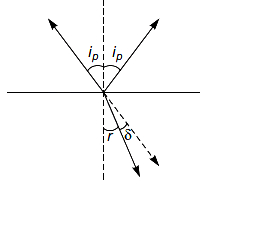
$A$ ray of light is incident at a polarising angle such that its deviation is $24^{\circ}$. Then the angle of incidence is: (in $^{\circ}$)
A
$24$
B
$57$
C
$66$
D
$90$
Solution
(B) When a ray of light is incident at the polarising angle $(i_p)$,the reflected and refracted rays are perpendicular to each other. Thus,$i_p + r = 90^{\circ}$,where $r$ is the angle of refraction.
From the geometry of refraction,the angle of deviation $(\delta)$ is given by $\delta = |i_p - r|$.
Given $\delta = 24^{\circ}$,we have $i_p - r = 24^{\circ}$ (since $i_p > r$ for glass-air interface).
We have two equations:
$1$) $i_p + r = 90^{\circ}$
$2$) $i_p - r = 24^{\circ}$
Adding these two equations:
$2i_p = 114^{\circ}$
$i_p = 57^{\circ}$
Therefore,the angle of incidence is $57^{\circ}$.
From the geometry of refraction,the angle of deviation $(\delta)$ is given by $\delta = |i_p - r|$.
Given $\delta = 24^{\circ}$,we have $i_p - r = 24^{\circ}$ (since $i_p > r$ for glass-air interface).
We have two equations:
$1$) $i_p + r = 90^{\circ}$
$2$) $i_p - r = 24^{\circ}$
Adding these two equations:
$2i_p = 114^{\circ}$
$i_p = 57^{\circ}$
Therefore,the angle of incidence is $57^{\circ}$.
0 likesView Solution
50
PhysicsMediumMCQMHT CET · 2009
If fringe width is $0.4 \,mm$, the distance between the fifth bright and third dark band on the same side is: (in $\,mm$)
A
$1$
B
$2$
C
$3$
D
$4$
Solution
(A) The fringe width is given by $\beta = \frac{\lambda D}{d} = 0.4 \,mm$.
The position of the $n_{1}$-th bright fringe from the central maximum is given by $x_{n_1} = n_1 \beta$.
For the fifth bright fringe $(n_1 = 5)$:
$x_5 = 5 \beta = 5 \times 0.4 \,mm = 2.0 \,mm$.
The position of the $n_2$-th dark fringe from the central maximum is given by $x_{n_2} = (n_2 - 0.5) \beta$.
For the third dark fringe $(n_2 = 3)$:
$x_3 = (3 - 0.5) \beta = 2.5 \beta = 2.5 \times 0.4 \,mm = 1.0 \,mm$.
The distance between the fifth bright and third dark band on the same side is:
$\Delta x = x_5 - x_3 = 2.0 \,mm - 1.0 \,mm = 1.0 \,mm$.
The position of the $n_{1}$-th bright fringe from the central maximum is given by $x_{n_1} = n_1 \beta$.
For the fifth bright fringe $(n_1 = 5)$:
$x_5 = 5 \beta = 5 \times 0.4 \,mm = 2.0 \,mm$.
The position of the $n_2$-th dark fringe from the central maximum is given by $x_{n_2} = (n_2 - 0.5) \beta$.
For the third dark fringe $(n_2 = 3)$:
$x_3 = (3 - 0.5) \beta = 2.5 \beta = 2.5 \times 0.4 \,mm = 1.0 \,mm$.
The distance between the fifth bright and third dark band on the same side is:
$\Delta x = x_5 - x_3 = 2.0 \,mm - 1.0 \,mm = 1.0 \,mm$.
0 likesView Solution
51
PhysicsEasyMCQMHT CET · 2009
In an interference experiment, the third bright fringe is obtained at a point on the screen with light of wavelength $700 \, nm$. What should be the wavelength of the light source in order to obtain the $5^{th}$ bright fringe at the same point (in $nm$)?
A
$500$
B
$630$
C
$750$
D
$420$
Solution
(D) The condition for the $n^{th}$ bright fringe in a Young's double-slit experiment is given by $y = n \frac{\lambda D}{d}$.
Since the position $y$ is the same for both cases, we have $n_{1} \lambda_{1} = n_{2} \lambda_{2}$.
Given: $n_{1} = 3$, $\lambda_{1} = 700 \, nm$, and $n_{2} = 5$.
Substituting the values: $3 \times 700 = 5 \times \lambda_{2}$.
$\lambda_{2} = \frac{3 \times 700}{5} = 3 \times 140 = 420 \, nm$.
Since the position $y$ is the same for both cases, we have $n_{1} \lambda_{1} = n_{2} \lambda_{2}$.
Given: $n_{1} = 3$, $\lambda_{1} = 700 \, nm$, and $n_{2} = 5$.
Substituting the values: $3 \times 700 = 5 \times \lambda_{2}$.
$\lambda_{2} = \frac{3 \times 700}{5} = 3 \times 140 = 420 \, nm$.
0 likesView Solution
Vedclass Products
For Students
Vedclass Test Series
Mock tests in real MHT CET style covering Physics with performance analysis. 5-day free trial.
Start Free TrialFor Teachers
Exam Paper Generator
Generate Set A/B/C/D Physics papers from 7.5L+ questions in 2 minutes. 3 chapters free.
Try FreeFor Institutes
Online Exam Module
Run live MHT CET mock exams with unlimited students, 360° analytics & white-label branding.
See DemoFrequently Asked Questions
How many Physics questions are in MHT CET 2009?
There are 51 Physics questions from the MHT CET 2009 paper on Vedclass, each with a detailed step-by-step solution in English.
Are MHT CET 2009 Physics solutions available in English?
Yes. All solutions on this page are in English. You can also switch to English or Hindi using the language buttons above the questions.
Can I practice MHT CET 2009 Physics as a timed test?
Yes. Use the Vedclass Test Series to attempt a full MHT CET mock test covering Physics with time limits and instant score analysis.
Can teachers create Physics papers from MHT CET previous year questions?
Yes. The Vedclass Exam Paper Generator lets teachers mix MHT CET Physics questions and generate Set A/B/C/D papers in minutes.
For Teachers & Institutes
Build a Custom Physics Paper
Pick MHT CET 2009 Physics questions, set difficulty, and generate Set A/B/C/D in 2 minutes.