
ChemistryQ1–54 of 54 questions
Page 1 of 1 · English
1
ChemistryMCQKVPY · 2009
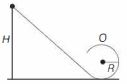
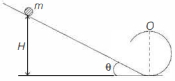
A small body is released from a height $H$ of an inclined plane. At the bottom of the plane is a loop of radius $R$ as shown in the figure below. Ignoring friction, the minimum $H$ required for the body to just complete the loop (that is, reach the point $O$ ) is
A
$2 R$
B
$\frac{5 R}{2}$
C
$3 R$
D
$\frac{7 R}{2}$
Solution
(a)
From conservation of energy, energy of particle at height $H$ over inclined plane must be equal to energy of particle at point $O$.
$\Rightarrow \quad m g H=2 m g R \Rightarrow H=2 R$
0 likesView Solution
2
ChemistryMediumMCQKVPY · 2009
The gas that has the slowest rate of diffusion among $O_2$,$H_2$,$CO_2$ and $CH_4$ is
A
$O_2$
B
$H_2$
C
$CO_2$
D
$CH_4$
Solution
(C) According to Graham's Law of Diffusion,the rate of diffusion $(r)$ of a gas is inversely proportional to the square root of its molar mass $(M)$: $r \propto \frac{1}{\sqrt{M}}$.
First,calculate the molar masses of the given gases:
$M(H_2) = 2 \ g/mol$
$M(CH_4) = 16 \ g/mol$
$M(O_2) = 32 \ g/mol$
$M(CO_2) = 44 \ g/mol$
Since $CO_2$ has the highest molar mass $(44 \ g/mol)$,it will have the slowest rate of diffusion.
Therefore,the correct option is $C$.
First,calculate the molar masses of the given gases:
$M(H_2) = 2 \ g/mol$
$M(CH_4) = 16 \ g/mol$
$M(O_2) = 32 \ g/mol$
$M(CO_2) = 44 \ g/mol$
Since $CO_2$ has the highest molar mass $(44 \ g/mol)$,it will have the slowest rate of diffusion.
Therefore,the correct option is $C$.
0 likesView Solution
3
ChemistryMediumMCQKVPY · 2009
Assuming ideal behaviour,the ratio of kinetic energies of $3 \ g$ of $H_2$ and $4 \ g$ of $O_2$ at any temperature is
A
$3: 4$
B
$1: 16$
C
$4: 3$
D
$12: 1$
Solution
(D) The kinetic energy $(KE)$ of an ideal gas is given by the formula $KE = \frac{3}{2} n R T$ (for translational kinetic energy of any ideal gas).
Number of moles of $H_2$ $(n_{H_2})$ = $\frac{3 \ g}{2 \ g/mol} = 1.5 \ mol$.
Number of moles of $O_2$ $(n_{O_2})$ = $\frac{4 \ g}{32 \ g/mol} = 0.125 \ mol = \frac{1}{8} \ mol$.
Since the temperature $T$ is the same for both,the ratio of kinetic energies is:
$\frac{KE_{H_2}}{KE_{O_2}} = \frac{\frac{3}{2} n_{H_2} R T}{\frac{3}{2} n_{O_2} R T} = \frac{n_{H_2}}{n_{O_2}} = \frac{1.5}{0.125} = \frac{1.5 \times 8}{1} = \frac{12}{1}$.
Thus,the ratio is $12: 1$.
Number of moles of $H_2$ $(n_{H_2})$ = $\frac{3 \ g}{2 \ g/mol} = 1.5 \ mol$.
Number of moles of $O_2$ $(n_{O_2})$ = $\frac{4 \ g}{32 \ g/mol} = 0.125 \ mol = \frac{1}{8} \ mol$.
Since the temperature $T$ is the same for both,the ratio of kinetic energies is:
$\frac{KE_{H_2}}{KE_{O_2}} = \frac{\frac{3}{2} n_{H_2} R T}{\frac{3}{2} n_{O_2} R T} = \frac{n_{H_2}}{n_{O_2}} = \frac{1.5}{0.125} = \frac{1.5 \times 8}{1} = \frac{12}{1}$.
Thus,the ratio is $12: 1$.
0 likesView Solution
4
ChemistryMediumMCQKVPY · 2009
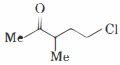
The $IUPAC$ name for the compound is
A
$1-$chloro$-3-$methyl$-4-$pentanone
B
$1-$chloro$-2-$methyl$-4-$pentanone
C
$5-$chloro$-3-$methyl$-2-$pentanone
D
$5-$chloro$-2-$methyl$-3-$pentanone
Solution
(C) The given compound is $CH_3-CO-CH(CH_3)-CH_2-CH_2-Cl$.
To name this compound according to $IUPAC$ rules,we first identify the longest carbon chain containing the principal functional group,which is the ketone group.
The numbering starts from the end that gives the ketone group the lowest possible locant.
Numbering from the left gives the ketone at position $2$.
The chain has $5$ carbons,so the parent alkane is pentane,and the ketone is pentan$-2-$one.
There is a methyl group at position $3$ and a chloro group at position $5$.
Combining these,the correct $IUPAC$ name is $5-$chloro$-3-$methylpentan$-2-$one or $5-$chloro$-3-$methyl$-2-$pentanone.
To name this compound according to $IUPAC$ rules,we first identify the longest carbon chain containing the principal functional group,which is the ketone group.
The numbering starts from the end that gives the ketone group the lowest possible locant.
Numbering from the left gives the ketone at position $2$.
The chain has $5$ carbons,so the parent alkane is pentane,and the ketone is pentan$-2-$one.
There is a methyl group at position $3$ and a chloro group at position $5$.
Combining these,the correct $IUPAC$ name is $5-$chloro$-3-$methylpentan$-2-$one or $5-$chloro$-3-$methyl$-2-$pentanone.
0 likesView Solution
5
ChemistryMediumMCQKVPY · 2009
The shape of the molecule $ClF_3$ is
A
triangular
B
pyramidal
C
$T$-shaped
D
linear
Solution
(C) The central chlorine atom $(Cl)$ has $7$ valence electrons.
It forms $3$ bond pairs with fluorine atoms and retains $2$ lone pairs of electrons.
According to $VSEPR$ theory,the molecule adopts a trigonal bipyramidal electron geometry with the two lone pairs occupying equatorial positions to minimize repulsion.
Consequently,the molecular geometry of $ClF_3$ is $T$-shaped.
It forms $3$ bond pairs with fluorine atoms and retains $2$ lone pairs of electrons.
According to $VSEPR$ theory,the molecule adopts a trigonal bipyramidal electron geometry with the two lone pairs occupying equatorial positions to minimize repulsion.
Consequently,the molecular geometry of $ClF_3$ is $T$-shaped.
0 likesView Solution
6
ChemistryMediumMCQKVPY · 2009
Among $CO_3^{2-}$,$OH^{-}$,$NH_3$ and $HCO_3^{-}$,the species that acts as a Bronsted acid as well as a Bronsted base,is
A
$CO_3^{2-}$
B
$OH^{-}$
C
$NH_3$
D
$HCO_3^{-}$
Solution
(D) Bronsted acid is a species that can donate $H^{+}$ ions,and a Bronsted base is a species that can accept $H^{+}$ ions.
$HCO_3^{-}$ can act as both:
$HCO_3^{-} + H^{+} \rightleftharpoons H_2CO_3$ (Acting as a Bronsted base)
$HCO_3^{-} \rightleftharpoons H^{+} + CO_3^{2-}$ (Acting as a Bronsted acid)
Such species are known as amphoteric species.
$HCO_3^{-}$ can act as both:
$HCO_3^{-} + H^{+} \rightleftharpoons H_2CO_3$ (Acting as a Bronsted base)
$HCO_3^{-} \rightleftharpoons H^{+} + CO_3^{2-}$ (Acting as a Bronsted acid)
Such species are known as amphoteric species.
0 likesView Solution
7
ChemistryMediumMCQKVPY · 2009
The ratio of the heat capacities $C_p / C_V$ for one mole of a gas is $1.67$. The gas is
A
$He$
B
$H_2$
C
$CO_2$
D
$CH_4$
Solution
(A) The ratio of molar heat capacities at constant pressure $(C_p)$ to that at constant volume $(C_V)$ is represented by the adiabatic index $\gamma = C_p / C_V$.
For a monoatomic gas,the degrees of freedom $f = 3$,so $\gamma = 1 + (2/f) = 1 + 2/3 \approx 1.67$.
For a diatomic gas,the degrees of freedom $f = 5$,so $\gamma = 1 + 2/5 = 1.40$.
For a non-linear triatomic gas,the degrees of freedom $f = 6$,so $\gamma = 1 + 2/6 \approx 1.33$.
Given that $C_p / C_V = 1.67$,the gas must be monoatomic.
Among the given options,$He$ (Helium) is a noble gas and is monoatomic,while $H_2$,$CO_2$,and $CH_4$ are polyatomic.
Therefore,the correct option is $A$.
For a monoatomic gas,the degrees of freedom $f = 3$,so $\gamma = 1 + (2/f) = 1 + 2/3 \approx 1.67$.
For a diatomic gas,the degrees of freedom $f = 5$,so $\gamma = 1 + 2/5 = 1.40$.
For a non-linear triatomic gas,the degrees of freedom $f = 6$,so $\gamma = 1 + 2/6 \approx 1.33$.
Given that $C_p / C_V = 1.67$,the gas must be monoatomic.
Among the given options,$He$ (Helium) is a noble gas and is monoatomic,while $H_2$,$CO_2$,and $CH_4$ are polyatomic.
Therefore,the correct option is $A$.
0 likesView Solution
8
ChemistryDifficultMCQKVPY · 2009
The ion that is isoelectronic with $CO$ is
A
$O_2^{+}$
B
$O_2^{-}$
C
$CN^{-}$
D
$N_2^{+}$
Solution
(C) Isoelectronic species are those species which have the same number of electrons.
The total number of electrons in $CO$ is $6 + 8 = 14$.
$(A)$ Total number of electrons in $O_2^{+}$ is $8 + 8 - 1 = 15$.
$(B)$ Total number of electrons in $O_2^{-}$ is $8 + 8 + 1 = 17$.
$(C)$ Total number of electrons in $CN^{-}$ is $6 + 7 + 1 = 14$.
$(D)$ Total number of electrons in $N_2^{+}$ is $7 + 7 - 1 = 13$.
Thus,$CN^{-}$ is isoelectronic with $CO$.
The total number of electrons in $CO$ is $6 + 8 = 14$.
$(A)$ Total number of electrons in $O_2^{+}$ is $8 + 8 - 1 = 15$.
$(B)$ Total number of electrons in $O_2^{-}$ is $8 + 8 + 1 = 17$.
$(C)$ Total number of electrons in $CN^{-}$ is $6 + 7 + 1 = 14$.
$(D)$ Total number of electrons in $N_2^{+}$ is $7 + 7 - 1 = 13$.
Thus,$CN^{-}$ is isoelectronic with $CO$.
0 likesView Solution
9
ChemistryMediumMCQKVPY · 2009
Among $CH_4$,$CO_2$,$H_2O$ and $SO_2$,the bond angle is the highest in
A
$CH_4$
B
$CO_2$
C
$H_2O$
D
$SO_2$
Solution
(B) The bond angle depends on the hybridization and the number of lone pairs of electrons on the central atom.
$1$. $CH_4$: $sp^3$ hybridization,tetrahedral geometry,bond angle = $109.5^{\circ}$.
$2$. $CO_2$: $sp$ hybridization,linear geometry,bond angle = $180^{\circ}$.
$3$. $H_2O$: $sp^3$ hybridization with $2$ lone pairs,bent geometry,bond angle = $104.5^{\circ}$.
$4$. $SO_2$: $sp^2$ hybridization with $1$ lone pair,bent geometry,bond angle $\approx 119^{\circ}$.
Comparing these,$CO_2$ has the highest bond angle of $180^{\circ}$.
$1$. $CH_4$: $sp^3$ hybridization,tetrahedral geometry,bond angle = $109.5^{\circ}$.
$2$. $CO_2$: $sp$ hybridization,linear geometry,bond angle = $180^{\circ}$.
$3$. $H_2O$: $sp^3$ hybridization with $2$ lone pairs,bent geometry,bond angle = $104.5^{\circ}$.
$4$. $SO_2$: $sp^2$ hybridization with $1$ lone pair,bent geometry,bond angle $\approx 119^{\circ}$.
Comparing these,$CO_2$ has the highest bond angle of $180^{\circ}$.
0 likesView Solution
10
ChemistryMediumMCQKVPY · 2009
Oxalic acid when treated with potassium permanganate in the presence of an acid,produces
A
$O_2$
B
$C$
C
$CO$
D
$CO_2$
Solution
(D) .
Oxalic acid,when treated with potassium permanganate $(KMnO_4)$ in the presence of an acid $(H^{+})$,undergoes oxidation to produce carbon dioxide $(CO_2)$ gas.
The balanced chemical equation is:
$2 KMnO_4 + 5 H_2C_2O_4 + 6 H^{+} \longrightarrow 2 Mn^{2+} + 2 K^{+} + 10 CO_2 + 8 H_2O$
Oxalic acid,when treated with potassium permanganate $(KMnO_4)$ in the presence of an acid $(H^{+})$,undergoes oxidation to produce carbon dioxide $(CO_2)$ gas.
The balanced chemical equation is:
$2 KMnO_4 + 5 H_2C_2O_4 + 6 H^{+} \longrightarrow 2 Mn^{2+} + 2 K^{+} + 10 CO_2 + 8 H_2O$
0 likesView Solution
11
ChemistryMediumMCQKVPY · 2009
The equilibrium constant for the reaction,$N_2 + 3H_2 \rightleftharpoons 2NH_3$ at $400 \ K$ is $41$. The equilibrium constant for the reaction,$\frac{1}{2} N_2 + \frac{3}{2} H_2 \rightleftharpoons NH_3$ at the same temperature will be closest to
A
$41$
B
$20.5$
C
$6.4$
D
$1681$
Solution
(C) Given the reaction: $N_2 + 3H_2 \rightleftharpoons 2NH_3$ with $K_C = 41 \dots (i)$
For the reaction: $\frac{1}{2} N_2 + \frac{3}{2} H_2 \rightleftharpoons NH_3 \dots (ii)$
Equation $(ii)$ is obtained by dividing equation $(i)$ by $2$.
Therefore,the new equilibrium constant $K_C^{\prime}$ is given by $K_C^{\prime} = (K_C)^{1/2} = \sqrt{K_C}$.
$K_C^{\prime} = \sqrt{41} \approx 6.4$.
For the reaction: $\frac{1}{2} N_2 + \frac{3}{2} H_2 \rightleftharpoons NH_3 \dots (ii)$
Equation $(ii)$ is obtained by dividing equation $(i)$ by $2$.
Therefore,the new equilibrium constant $K_C^{\prime}$ is given by $K_C^{\prime} = (K_C)^{1/2} = \sqrt{K_C}$.
$K_C^{\prime} = \sqrt{41} \approx 6.4$.
0 likesView Solution
12
ChemistryEasyMCQKVPY · 2009
The conjugate bases for $HCO_3^-$ and $NH_3$,respectively,are
A
$H_2CO_3$ and $NH_4^+$
B
$CO_3^{2-}$ and $NH_2^-$
C
$H_2CO_3$ and $NH_2^-$
D
$CO_3^{2-}$ and $NH_4^+$
Solution
(B) conjugate base is formed by the removal of a proton $(H^+)$ from an acid.
For $HCO_3^-$,removing a proton yields $CO_3^{2-}$.
For $NH_3$,removing a proton yields $NH_2^-$.
Thus,the conjugate bases are $CO_3^{2-}$ and $NH_2^-$.
$HCO_3^- \rightleftharpoons CO_3^{2-} + H^+$
$NH_3 \rightleftharpoons NH_2^- + H^+$
For $HCO_3^-$,removing a proton yields $CO_3^{2-}$.
For $NH_3$,removing a proton yields $NH_2^-$.
Thus,the conjugate bases are $CO_3^{2-}$ and $NH_2^-$.
$HCO_3^- \rightleftharpoons CO_3^{2-} + H^+$
$NH_3 \rightleftharpoons NH_2^- + H^+$
0 likesView Solution
13
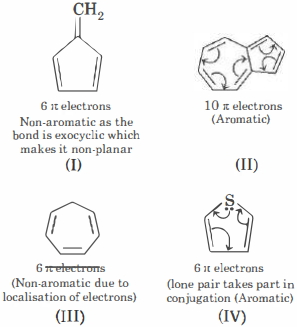
ChemistryMediumMCQKVPY · 2009
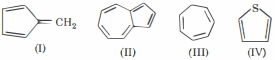
Among the following,the aromatic compounds are:
A
$I$ and $II$
B
$I$ and $III$
C
$II$ and $III$
D
$II$ and $IV$
Solution
(D) The aromatic compounds are those that satisfy the following conditions:
$(i)$ The compound must be cyclic and planar.
$(ii)$ There must be complete delocalization of $\pi$ electrons in the ring.
$(iii)$ It must follow $H$ückel's rule,i.e.,it must contain $(4n+2) \pi$ electrons,where $n$ is an integer $(n = 0, 1, 2, \dots)$.
Analysis of the given structures:
$(I)$ Fulvene: It is non-aromatic because the exocyclic double bond makes the structure non-planar or prevents continuous conjugation.
$(II)$ Azulene: It has $10 \pi$ electrons ($4n+2$ with $n=2$),is cyclic,and planar. It is aromatic.
$(III)$ Cycloheptatriene: It is non-aromatic because one carbon atom is $sp^3$ hybridized,which breaks the continuous conjugation.
$(IV)$ Thiophene: It has $6 \pi$ electrons ($4n+2$ with $n=1$) including the lone pair on sulfur participating in conjugation. It is aromatic.
Thus,compounds $(II)$ and $(IV)$ are aromatic.
Therefore,the correct option is $(d).$
$(i)$ The compound must be cyclic and planar.
$(ii)$ There must be complete delocalization of $\pi$ electrons in the ring.
$(iii)$ It must follow $H$ückel's rule,i.e.,it must contain $(4n+2) \pi$ electrons,where $n$ is an integer $(n = 0, 1, 2, \dots)$.
Analysis of the given structures:
$(I)$ Fulvene: It is non-aromatic because the exocyclic double bond makes the structure non-planar or prevents continuous conjugation.
$(II)$ Azulene: It has $10 \pi$ electrons ($4n+2$ with $n=2$),is cyclic,and planar. It is aromatic.
$(III)$ Cycloheptatriene: It is non-aromatic because one carbon atom is $sp^3$ hybridized,which breaks the continuous conjugation.
$(IV)$ Thiophene: It has $6 \pi$ electrons ($4n+2$ with $n=1$) including the lone pair on sulfur participating in conjugation. It is aromatic.
Thus,compounds $(II)$ and $(IV)$ are aromatic.
Therefore,the correct option is $(d).$
0 likesView Solution
14
ChemistryDifficultMCQKVPY · 2009
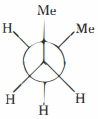
The Newman projection shown below is known as the:
A
eclipsed conformer
B
staggered conformer
C
skewed conformer
D
gauche conformer
Solution
(D) The correct answer is $(D)$.
In the given Newman projection of $n$-butane,the two methyl $(-CH_3)$ groups are at a dihedral angle of $60^{\circ}$ to each other.
This specific staggered conformation,where the bulky groups are adjacent to each other,is known as the gauche conformer.
In the given Newman projection of $n$-butane,the two methyl $(-CH_3)$ groups are at a dihedral angle of $60^{\circ}$ to each other.
This specific staggered conformation,where the bulky groups are adjacent to each other,is known as the gauche conformer.
0 likesView Solution
15
ChemistryDifficultMCQKVPY · 2009
The hydrogen ion concentration in a mixture of $10 \ mL$ of $0.1 \ M$ $H_2SO_4$ and $10 \ mL$ of $0.1 \ M$ $KOH$ solution in water,is . . . . . . $M$.
A
$0.1$
B
$0.05$
C
$0.2$
D
$0.02$
Solution
(B) $H_2SO_4$ is a diprotic acid,so $10 \ mL$ of $0.1 \ M$ $H_2SO_4$ provides $2 \times 10 \times 0.1 = 2 \ mmol$ of $H^{+}$ ions.
$KOH$ is a monoprotic base,so $10 \ mL$ of $0.1 \ M$ $KOH$ provides $10 \times 0.1 = 1 \ mmol$ of $OH^{-}$ ions.
After neutralization,the remaining $H^{+}$ ions $= 2 - 1 = 1 \ mmol$.
Total volume of the mixture $= 10 \ mL + 10 \ mL = 20 \ mL$.
Therefore,$[H^{+}] = \frac{1 \ mmol}{20 \ mL} = 0.05 \ M$.
$KOH$ is a monoprotic base,so $10 \ mL$ of $0.1 \ M$ $KOH$ provides $10 \times 0.1 = 1 \ mmol$ of $OH^{-}$ ions.
After neutralization,the remaining $H^{+}$ ions $= 2 - 1 = 1 \ mmol$.
Total volume of the mixture $= 10 \ mL + 10 \ mL = 20 \ mL$.
Therefore,$[H^{+}] = \frac{1 \ mmol}{20 \ mL} = 0.05 \ M$.
0 likesView Solution
16
ChemistryMediumMCQKVPY · 2009
If the $pH$ of a mixture of $10 \, mL$ of $0.1 \, M \, NH_4OH$ and $10 \, mL$ of $1 \, M \, NH_4Cl$ solution is $8$,the $pK_b$ value of $NH_4OH$ is then closest to
A
$3$
B
$5$
C
$7$
D
$9$
Solution
(B) Given that the mixture is a basic buffer consisting of a weak base $(NH_4OH)$ and its salt with a strong acid $(NH_4Cl)$.
$pH = 8$,so $pOH = 14 - 8 = 6$.
Using the Henderson-Hasselbalch equation for a basic buffer:
$pOH = pK_b + \log \frac{[Salt]}{[Base]}$
Here,$[Salt] = [NH_4Cl] = 1 \, M$ and $[Base] = [NH_4OH] = 0.1 \, M$.
Substituting the values:
$6 = pK_b + \log \left( \frac{1}{0.1} \right)$
$6 = pK_b + \log(10)$
$6 = pK_b + 1$
$pK_b = 6 - 1 = 5$.
Therefore,the correct option is $B$.
$pH = 8$,so $pOH = 14 - 8 = 6$.
Using the Henderson-Hasselbalch equation for a basic buffer:
$pOH = pK_b + \log \frac{[Salt]}{[Base]}$
Here,$[Salt] = [NH_4Cl] = 1 \, M$ and $[Base] = [NH_4OH] = 0.1 \, M$.
Substituting the values:
$6 = pK_b + \log \left( \frac{1}{0.1} \right)$
$6 = pK_b + \log(10)$
$6 = pK_b + 1$
$pK_b = 6 - 1 = 5$.
Therefore,the correct option is $B$.
0 likesView Solution
17
ChemistryMediumMCQKVPY · 2009
$A$ cylinder of cooking gas in a household contains $11.6 \, kg$ of butane. The thermochemical reaction for the combustion of butane is,
$2 C_4H_{10(g)} + 13 O_{2(g)} \longrightarrow 8 CO_{2(g)} + 10 H_2O_{(l)}$
$\Delta H = -2658 \, kJ/mol$
If the household needs $15000 \, kJ$ of energy per day,the cooking gas cylinder will last for about $...... \, days$.
$2 C_4H_{10(g)} + 13 O_{2(g)} \longrightarrow 8 CO_{2(g)} + 10 H_2O_{(l)}$
$\Delta H = -2658 \, kJ/mol$
If the household needs $15000 \, kJ$ of energy per day,the cooking gas cylinder will last for about $...... \, days$.
A
$64$
B
$45$
C
$20$
D
$35$
Solution
(D) The molar mass of butane $(C_4H_{10})$ is $12 \times 4 + 1 \times 10 = 58 \, g/mol$.
The combustion of $2 \, mol$ of butane releases $2658 \, kJ$ of energy,so $1 \, mol$ of butane releases $\frac{2658}{2} = 1329 \, kJ$ of energy.
The total mass of butane in the cylinder is $11.6 \, kg = 11600 \, g$.
The number of moles of butane is $n = \frac{11600 \, g}{58 \, g/mol} = 200 \, mol$.
The total energy available is $200 \, mol \times 1329 \, kJ/mol = 265800 \, kJ$.
Given the daily energy requirement is $15000 \, kJ$,the number of days the cylinder will last is $\frac{265800 \, kJ}{15000 \, kJ/day} = 17.72 \, days$.
Note: Based on the provided options and standard calculation methods,the correct answer is $D$ $(35 \, days)$ if the stoichiometry is interpreted as $2658 \, kJ$ per $2 \, moles$. Recalculating: Total energy $= (11600/58) \times (2658/2) = 265800 \, kJ$. Days $= 265800 / 15000 = 17.72$. If the reaction is per mole,energy $= (11600/58) \times 2658 = 531600 \, kJ$. Days $= 531600 / 15000 = 35.44 \approx 35$.
The combustion of $2 \, mol$ of butane releases $2658 \, kJ$ of energy,so $1 \, mol$ of butane releases $\frac{2658}{2} = 1329 \, kJ$ of energy.
The total mass of butane in the cylinder is $11.6 \, kg = 11600 \, g$.
The number of moles of butane is $n = \frac{11600 \, g}{58 \, g/mol} = 200 \, mol$.
The total energy available is $200 \, mol \times 1329 \, kJ/mol = 265800 \, kJ$.
Given the daily energy requirement is $15000 \, kJ$,the number of days the cylinder will last is $\frac{265800 \, kJ}{15000 \, kJ/day} = 17.72 \, days$.
Note: Based on the provided options and standard calculation methods,the correct answer is $D$ $(35 \, days)$ if the stoichiometry is interpreted as $2658 \, kJ$ per $2 \, moles$. Recalculating: Total energy $= (11600/58) \times (2658/2) = 265800 \, kJ$. Days $= 265800 / 15000 = 17.72$. If the reaction is per mole,energy $= (11600/58) \times 2658 = 531600 \, kJ$. Days $= 531600 / 15000 = 35.44 \approx 35$.
0 likesView Solution
18
ChemistryMediumMCQKVPY · 2009
For the reactions and their equilibrium constants given below,
$CuCl_4^{2-} + Br^{-} \rightleftharpoons CuCl_3Br^{2-} + Cl^{-}$; $K_1$
$CuCl_3Br^{2-} + Br^{-} \rightleftharpoons CuCl_2Br_2^{2-} + Cl^{-}$; $K_2$
$CuCl_2Br_2^{2-} + Br^{-} \rightleftharpoons CuClBr_3^{2-} + Cl^{-}$; $K_3$
$CuClBr_3^{2-} + Br^{-} \rightleftharpoons CuBr_4^{2-} + Cl^{-}$; $K_4$
The equilibrium constant,$K$ for the reaction $CuCl_4^{2-} + 3Br^{-} \rightleftharpoons CuClBr_3^{2-} + 3Cl^{-}$,is
$CuCl_4^{2-} + Br^{-} \rightleftharpoons CuCl_3Br^{2-} + Cl^{-}$; $K_1$
$CuCl_3Br^{2-} + Br^{-} \rightleftharpoons CuCl_2Br_2^{2-} + Cl^{-}$; $K_2$
$CuCl_2Br_2^{2-} + Br^{-} \rightleftharpoons CuClBr_3^{2-} + Cl^{-}$; $K_3$
$CuClBr_3^{2-} + Br^{-} \rightleftharpoons CuBr_4^{2-} + Cl^{-}$; $K_4$
The equilibrium constant,$K$ for the reaction $CuCl_4^{2-} + 3Br^{-} \rightleftharpoons CuClBr_3^{2-} + 3Cl^{-}$,is
A
$K_1 K_2 K_3$
B
$K_1 K_2 K_3 K_4$
C
$K_1 + K_2 + K_3$
D
$\frac{1}{K_1 K_2 K_3}$
Solution
(A) To obtain the target reaction $CuCl_4^{2-} + 3Br^{-} \rightleftharpoons CuClBr_3^{2-} + 3Cl^{-}$,we add the first three given reactions:
$(i)$ $CuCl_4^{2-} + Br^{-} \rightleftharpoons CuCl_3Br^{2-} + Cl^{-}$; $K_1$
$(ii)$ $CuCl_3Br^{2-} + Br^{-} \rightleftharpoons CuCl_2Br_2^{2-} + Cl^{-}$; $K_2$
$(iii)$ $CuCl_2Br_2^{2-} + Br^{-} \rightleftharpoons CuClBr_3^{2-} + Cl^{-}$; $K_3$
When reactions are added,their equilibrium constants are multiplied.
Therefore,$K = K_1 \times K_2 \times K_3$.
$(i)$ $CuCl_4^{2-} + Br^{-} \rightleftharpoons CuCl_3Br^{2-} + Cl^{-}$; $K_1$
$(ii)$ $CuCl_3Br^{2-} + Br^{-} \rightleftharpoons CuCl_2Br_2^{2-} + Cl^{-}$; $K_2$
$(iii)$ $CuCl_2Br_2^{2-} + Br^{-} \rightleftharpoons CuClBr_3^{2-} + Cl^{-}$; $K_3$
When reactions are added,their equilibrium constants are multiplied.
Therefore,$K = K_1 \times K_2 \times K_3$.
0 likesView Solution
19
ChemistryMCQKVPY · 2009
${ }^{234}Th_{90}$ gets converted to ${ }^{206}Pb_{82}$ through a series of radioactive decay processes. The number of alpha and beta particles lost in this transformation respectively,are
A
$6$ and $6$
B
$4$ and $2$
C
$6$ and $7$
D
$7$ and $6$
Solution
(D) The radioactive decay process is represented as: ${ }^{234}Th_{90} \longrightarrow { }^{206}Pb_{82} + x({ }^{4}He_{2}) + y({ }^{0}e_{-1})$.
$1$. For mass number conservation:
$234 = 206 + 4x$
$4x = 234 - 206 = 28$
$x = 7$ (Number of alpha particles).
$2$. For atomic number conservation:
$90 = 82 + 2x - y$
$90 = 82 + 2(7) - y$
$90 = 82 + 14 - y$
$90 = 96 - y$
$y = 6$ (Number of beta particles).
Therefore,the number of alpha and beta particles lost are $7$ and $6$ respectively.
$1$. For mass number conservation:
$234 = 206 + 4x$
$4x = 234 - 206 = 28$
$x = 7$ (Number of alpha particles).
$2$. For atomic number conservation:
$90 = 82 + 2x - y$
$90 = 82 + 2(7) - y$
$90 = 82 + 14 - y$
$90 = 96 - y$
$y = 6$ (Number of beta particles).
Therefore,the number of alpha and beta particles lost are $7$ and $6$ respectively.
0 likesView Solution
20
ChemistryMediumMCQKVPY · 2009
The element $X$ which forms a stable product of the type $XCl_4$ is $....$
A
$Al$
B
$Na$
C
$Ca$
D
$Si$
Solution
(D)
As element $X$ forms a stable product of the type $XCl_4$,it must be tetravalent.
Among the given elements,$Al$ is trivalent ($+3$ oxidation state),$Na$ is monovalent ($+1$ oxidation state),$Ca$ is divalent ($+2$ oxidation state),and $Si$ is tetravalent ($+4$ oxidation state).
Therefore,$Si$ forms $SiCl_4$,which is a stable compound.
Thus,option $(d)$ is correct.
As element $X$ forms a stable product of the type $XCl_4$,it must be tetravalent.
Among the given elements,$Al$ is trivalent ($+3$ oxidation state),$Na$ is monovalent ($+1$ oxidation state),$Ca$ is divalent ($+2$ oxidation state),and $Si$ is tetravalent ($+4$ oxidation state).
Therefore,$Si$ forms $SiCl_4$,which is a stable compound.
Thus,option $(d)$ is correct.
0 likesView Solution
21
ChemistryMediumMCQKVPY · 2009
$A$ mixture of $NH_4Cl$ and $NaCl$ can be separated by
A
filtration
B
distillation
C
sublimation
D
decantation
Solution
(C)
$A$ mixture of $NH_4Cl$ and $NaCl$ can be separated by the process of sublimation.
In this process,a solid directly changes to a gaseous state without passing into the liquid state.
$NH_4Cl$ sublimes upon heating,whereas $NaCl$ does not sublime.
The reaction can be written as:
$NH_4Cl_{(s)} \longrightarrow NH_{3(g)} + HCl_{(g)}$
$A$ mixture of $NH_4Cl$ and $NaCl$ can be separated by the process of sublimation.
In this process,a solid directly changes to a gaseous state without passing into the liquid state.
$NH_4Cl$ sublimes upon heating,whereas $NaCl$ does not sublime.
The reaction can be written as:
$NH_4Cl_{(s)} \longrightarrow NH_{3(g)} + HCl_{(g)}$
0 likesView Solution
22
ChemistryMediumMCQKVPY · 2009
The pair in which the first compound is ionic and the second compound is covalent,is
A
$Fe(OH)_2, CH_3OH$
B
$Fe(OH)_2, Cu(OH)_2$
C
$CH_3OH, CH_3CH_2OH$
D
$Ca(OH)_2, Cu(OH)_2$
Solution
(A) An ionic compound is typically formed by the electrostatic attraction between a metal cation and a non-metal anion,whereas a covalent compound is formed by the sharing of electrons between non-metal atoms.
In the given options:
$Fe(OH)_2$ is an ionic compound (metal hydroxide).
$CH_3OH$ (methanol) is a covalent compound (organic molecule).
$Cu(OH)_2$ is an ionic compound.
$Ca(OH)_2$ is an ionic compound.
$CH_3CH_2OH$ (ethanol) is a covalent compound.
Therefore,the pair where the first is ionic and the second is covalent is $Fe(OH)_2$ and $CH_3OH$.
In the given options:
$Fe(OH)_2$ is an ionic compound (metal hydroxide).
$CH_3OH$ (methanol) is a covalent compound (organic molecule).
$Cu(OH)_2$ is an ionic compound.
$Ca(OH)_2$ is an ionic compound.
$CH_3CH_2OH$ (ethanol) is a covalent compound.
Therefore,the pair where the first is ionic and the second is covalent is $Fe(OH)_2$ and $CH_3OH$.
0 likesView Solution
23
ChemistryMediumMCQKVPY · 2009
In the reaction,$SO_2 + 2H_2S \longrightarrow 3S + 2H_2O$,the substance that is oxidised is
A
$SO_2$
B
$H_2O$
C
$S$
D
$H_2S$
Solution
(D) In the given reaction: $SO_2 + 2H_2S \longrightarrow 3S + 2H_2O$
$1$. Oxidation is defined as the loss of electrons or the addition of oxygen/removal of hydrogen.
$2$. In $H_2S$,the oxidation state of sulfur is $-2$. In the product $S$,the oxidation state of sulfur is $0$.
$3$. Since the oxidation state of sulfur increases from $-2$ to $0$,$H_2S$ is losing electrons and is therefore being oxidised to $S$.
$4$. Conversely,in $SO_2$,the oxidation state of sulfur is $+4$,which decreases to $0$ in $S$,meaning $SO_2$ is reduced.
Thus,the substance that is oxidised is $H_2S$.
$1$. Oxidation is defined as the loss of electrons or the addition of oxygen/removal of hydrogen.
$2$. In $H_2S$,the oxidation state of sulfur is $-2$. In the product $S$,the oxidation state of sulfur is $0$.
$3$. Since the oxidation state of sulfur increases from $-2$ to $0$,$H_2S$ is losing electrons and is therefore being oxidised to $S$.
$4$. Conversely,in $SO_2$,the oxidation state of sulfur is $+4$,which decreases to $0$ in $S$,meaning $SO_2$ is reduced.
Thus,the substance that is oxidised is $H_2S$.
0 likesView Solution
24
ChemistryMediumMCQKVPY · 2009
Sodium oxide dissolves in water to give sodium hydroxide,which indicates its:
A
acidic character
B
basic character
C
amphoteric character
D
ionic character
Solution
(B) .
$Na_2O + H_2O \longrightarrow 2 \, NaOH$
Since $Na_2O$ is a metal oxide,it reacts with water to form $NaOH$,which is a strong base. This reaction confirms the basic nature of $Na_2O$.
$Na_2O + H_2O \longrightarrow 2 \, NaOH$
Since $Na_2O$ is a metal oxide,it reacts with water to form $NaOH$,which is a strong base. This reaction confirms the basic nature of $Na_2O$.
0 likesView Solution
25
ChemistryMediumMCQKVPY · 2009
For an ideal gas,Boyle's law is best described by which of the following graphs?
A
B
C
D
Solution
(C) According to Boyle's law,the pressure $(p)$ of a given mass of an ideal gas is inversely proportional to its volume $(V)$ at a constant temperature.
$\therefore p \propto \frac{1}{V}$ or $pV = \text{constant}$.
This relationship represents a rectangular hyperbola when $p$ is plotted against $V$.
Therefore,the graph showing an inverse relationship between $p$ and $V$ is the correct representation of Boyle's law.
$\therefore p \propto \frac{1}{V}$ or $pV = \text{constant}$.
This relationship represents a rectangular hyperbola when $p$ is plotted against $V$.
Therefore,the graph showing an inverse relationship between $p$ and $V$ is the correct representation of Boyle's law.
0 likesView Solution
26
ChemistryDifficultMCQKVPY · 2009
The $pH$ values of $(i) \ 0.1 \ M \ HCl_{(aq)}$,$(ii) \ 0.1 \ M \ KOH$,$(iii)$ tomato juice,and $(iv)$ pure water follow the order.
A
$i < iii < iv < ii$
B
$iii < i < iv < ii$
C
$i < ii < iii < iv$
D
$iv < iii < ii < i$
Solution
(A) The $pH$ values are determined as follows:
$(i)$ $0.1 \ M \ HCl$ is a strong acid,so its $pH = -\log[H^+] = -\log(0.1) = 1$.
(ii) $0.1 \ M \ KOH$ is a strong base,so its $pOH = -\log[OH^-] = 1$,which means $pH = 14 - 1 = 13$.
(iii) Tomato juice is acidic,typically having a $pH$ in the range of $4.0 - 4.5$.
(iv) Pure water is neutral,having a $pH = 7.0$ at $25^{\circ}C$.
Comparing these values: $1 (i) < 4.0-4.5 (iii) < 7.0 (iv) < 13 (ii)$.
Therefore,the correct order is $i < iii < iv < ii$.
$(i)$ $0.1 \ M \ HCl$ is a strong acid,so its $pH = -\log[H^+] = -\log(0.1) = 1$.
(ii) $0.1 \ M \ KOH$ is a strong base,so its $pOH = -\log[OH^-] = 1$,which means $pH = 14 - 1 = 13$.
(iii) Tomato juice is acidic,typically having a $pH$ in the range of $4.0 - 4.5$.
(iv) Pure water is neutral,having a $pH = 7.0$ at $25^{\circ}C$.
Comparing these values: $1 (i) < 4.0-4.5 (iii) < 7.0 (iv) < 13 (ii)$.
Therefore,the correct order is $i < iii < iv < ii$.
0 likesView Solution
27
ChemistryMediumMCQKVPY · 2009
The number of possible structural isomers of $C_3H_4$ is $...$
A
$1$
B
$2$
C
$3$
D
$4$
Solution
(B) . The molecular formula $C_3H_4$ corresponds to a degree of unsaturation of $2$. The possible structural isomers are:
$1$. Propyne: $CH_3-C\equiv CH$
$2$. Cyclopropene: $A$ three-membered ring with one double bond.
$1$. Propyne: $CH_3-C\equiv CH$
$2$. Cyclopropene: $A$ three-membered ring with one double bond.
0 likesView Solution
28
ChemistryMediumMCQKVPY · 2009
Among the four compounds,$(i)$ acetone,$(ii)$ propanol,$(iii)$ methyl acetate and $(iv)$ propionic acid,the two that are isomeric are
A
methyl acetate and acetone
B
methyl acetate and propanol
C
propionic acid and methyl acetate
D
propionic acid and acetone
Solution
(C) The molecular formulas for the given compounds are as follows:
acetone: $C_3H_6O$
propanol: $C_3H_8O$
methyl acetate: $C_3H_6O_2$
propionic acid: $C_3H_6O_2$
Since the molecular formulas for both propionic acid $(CH_3CH_2COOH)$ and methyl acetate $(CH_3COOCH_3)$ are the same $(C_3H_6O_2)$ but they possess different functional groups,they are functional isomers.
acetone: $C_3H_6O$
propanol: $C_3H_8O$
methyl acetate: $C_3H_6O_2$
propionic acid: $C_3H_6O_2$
Since the molecular formulas for both propionic acid $(CH_3CH_2COOH)$ and methyl acetate $(CH_3COOCH_3)$ are the same $(C_3H_6O_2)$ but they possess different functional groups,they are functional isomers.
0 likesView Solution
29
ChemistryMediumMCQKVPY · 2009
One mole of nitrogen gas on reaction with $3.01 \times 10^{23}$ molecules of hydrogen gas produces
A
one mole of ammonia
B
$2.0 \times 10^{23}$ molecules of ammonia
C
$2$ moles of ammonia
D
$3.01 \times 10^{23}$ molecules of ammonia
Solution
(B) The balanced chemical equation for the reaction is: $N_2 + 3H_2 \rightleftharpoons 2NH_3$.
Given: $1$ mole of $N_2$ and $3.01 \times 10^{23}$ molecules of $H_2$.
Since $1$ mole of $H_2$ contains $6.022 \times 10^{23}$ molecules,the number of moles of $H_2$ is $\frac{3.01 \times 10^{23}}{6.022 \times 10^{23}} = 0.5$ mole.
According to the stoichiometry,$3$ moles of $H_2$ produce $2$ moles of $NH_3$.
Therefore,$0.5$ mole of $H_2$ will produce $\frac{2}{3} \times 0.5 = \frac{1}{3}$ mole of $NH_3$.
Number of molecules of $NH_3 = \frac{1}{3} \times 6.022 \times 10^{23} \approx 2.0 \times 10^{23}$ molecules.
Thus,the correct option is $B$.
Given: $1$ mole of $N_2$ and $3.01 \times 10^{23}$ molecules of $H_2$.
Since $1$ mole of $H_2$ contains $6.022 \times 10^{23}$ molecules,the number of moles of $H_2$ is $\frac{3.01 \times 10^{23}}{6.022 \times 10^{23}} = 0.5$ mole.
According to the stoichiometry,$3$ moles of $H_2$ produce $2$ moles of $NH_3$.
Therefore,$0.5$ mole of $H_2$ will produce $\frac{2}{3} \times 0.5 = \frac{1}{3}$ mole of $NH_3$.
Number of molecules of $NH_3 = \frac{1}{3} \times 6.022 \times 10^{23} \approx 2.0 \times 10^{23}$ molecules.
Thus,the correct option is $B$.
0 likesView Solution
30
ChemistryMCQKVPY · 2009
Saponification is
A
hydrolysis of an ester
B
hydrolysis of an amide
C
hydrolysis of an ether
D
hydrolysis of an acid chloride
Solution
(A) . Saponification is the process of alkaline hydrolysis of an ester (typically a triglyceride) to produce glycerol and soap (a salt of a fatty acid). The reaction is represented as:
$(C_{17}H_{35}COO)_3C_3H_5 + 3NaOH$ $\xrightarrow{\Delta} 3C_{17}H_{35}COO^-Na^+ (\text{soap}) + C_3H_5(OH)_3 (\text{glycerol})$
$(C_{17}H_{35}COO)_3C_3H_5 + 3NaOH$ $\xrightarrow{\Delta} 3C_{17}H_{35}COO^-Na^+ (\text{soap}) + C_3H_5(OH)_3 (\text{glycerol})$
0 likesView Solution
31
ChemistryDifficultMCQKVPY · 2009
Reaction of $NaCl$ with conc. $H_2SO_4$ liberates a gas,$X$ that turns moist blue litmus paper red. When gas $X$ is passed into a test tube containing egg shell powder suspended in water,another gas,$Y$ is generated which when passed through lime water makes it milky. The gases $X$ and $Y$,respectively,are
A
$HCl$ and $CO_2$
B
$Cl_2$ and $CO_2$
C
$SO_2$ and $CO_2$
D
$SO_2$ and $HCl$
Solution
(A) The correct option is $A$.
When concentrated sulphuric acid reacts with $NaCl$,sodium bisulphate and $HCl$ gas $(X)$ are formed. The $HCl$ gas is acidic in nature and turns moist blue litmus paper red.
$2NaCl + H_2SO_4 \longrightarrow Na_2SO_4 + 2HCl(g) (X)$
Egg shell powder primarily consists of calcium carbonate $(CaCO_3)$. When $HCl$ gas $(X)$ is passed into a suspension of egg shell powder in water,it reacts with $CaCO_3$ to release $CO_2$ gas $(Y)$.
$CaCO_3 + 2HCl \longrightarrow CaCl_2 + H_2O + CO_2(g) (Y)$
$CO_2$ gas turns lime water milky due to the formation of insoluble calcium carbonate.
Thus,the gases $X$ and $Y$ are $HCl$ and $CO_2$ respectively.
When concentrated sulphuric acid reacts with $NaCl$,sodium bisulphate and $HCl$ gas $(X)$ are formed. The $HCl$ gas is acidic in nature and turns moist blue litmus paper red.
$2NaCl + H_2SO_4 \longrightarrow Na_2SO_4 + 2HCl(g) (X)$
Egg shell powder primarily consists of calcium carbonate $(CaCO_3)$. When $HCl$ gas $(X)$ is passed into a suspension of egg shell powder in water,it reacts with $CaCO_3$ to release $CO_2$ gas $(Y)$.
$CaCO_3 + 2HCl \longrightarrow CaCl_2 + H_2O + CO_2(g) (Y)$
$CO_2$ gas turns lime water milky due to the formation of insoluble calcium carbonate.
Thus,the gases $X$ and $Y$ are $HCl$ and $CO_2$ respectively.
0 likesView Solution
32
ChemistryMediumMCQKVPY · 2009
$10 \ mL$ of an aqueous solution containing $222 \ mg$ of calcium chloride $(mol. wt. = 111)$ is diluted to $100 \ mL$. The concentration of chloride ion in the resulting solution is $..... \ mol/L$.
A
$0.02$
B
$0.01$
C
$0.04$
D
$2.0$
Solution
(C) $1$. Calculate the moles of $CaCl_2$: $\text{moles} = \frac{222 \times 10^{-3} \ g}{111 \ g/mol} = 2 \times 10^{-3} \ mol$.
$2$. Calculate the final molarity of $CaCl_2$ after dilution to $100 \ mL$ $(0.1 \ L)$: $M = \frac{2 \times 10^{-3} \ mol}{0.1 \ L} = 0.02 \ M$.
$3$. Dissociation of $CaCl_2$: $CaCl_2 \rightarrow Ca^{2+} + 2Cl^-$.
$4$. Concentration of $Cl^-$ ions: $[Cl^-] = 2 \times [CaCl_2] = 2 \times 0.02 \ M = 0.04 \ mol/L$.
$2$. Calculate the final molarity of $CaCl_2$ after dilution to $100 \ mL$ $(0.1 \ L)$: $M = \frac{2 \times 10^{-3} \ mol}{0.1 \ L} = 0.02 \ M$.
$3$. Dissociation of $CaCl_2$: $CaCl_2 \rightarrow Ca^{2+} + 2Cl^-$.
$4$. Concentration of $Cl^-$ ions: $[Cl^-] = 2 \times [CaCl_2] = 2 \times 0.02 \ M = 0.04 \ mol/L$.
0 likesView Solution
33
ChemistryMediumMCQKVPY · 2009
Aluminium reduces manganese dioxide to manganese at high temperature. The amount of aluminium required to reduce one $g \ mol$ of manganese dioxide is $.....$
A
$1/2 \ g \ mol$
B
$3/4 \ g \ mol$
C
$1 \ g \ mol$
D
$4/3 \ g \ mol$
Solution
(D)
The balanced chemical equation for the reaction is:
$4 Al + 3 MnO_2 \longrightarrow 3 Mn + 2 Al_2O_3$
From the stoichiometry of the reaction,$3 \ moles$ of $MnO_2$ require $4 \ moles$ of $Al$ for complete reduction.
Therefore,$1 \ mole$ of $MnO_2$ requires $4/3 \ moles$ of $Al$.
Thus,the amount of $Al$ required to reduce $1 \ g \ mol$ of $MnO_2$ is $4/3 \ g \ mol$.
The balanced chemical equation for the reaction is:
$4 Al + 3 MnO_2 \longrightarrow 3 Mn + 2 Al_2O_3$
From the stoichiometry of the reaction,$3 \ moles$ of $MnO_2$ require $4 \ moles$ of $Al$ for complete reduction.
Therefore,$1 \ mole$ of $MnO_2$ requires $4/3 \ moles$ of $Al$.
Thus,the amount of $Al$ required to reduce $1 \ g \ mol$ of $MnO_2$ is $4/3 \ g \ mol$.
0 likesView Solution
34
ChemistryMediumMCQKVPY · 2009
The $pH$ of a $10 \ mL$ aqueous solution of $HCl$ is $4$. The amount of water to be added to this solution in order to change its $pH$ from $4$ to $5$ is $..... \ mL$
A
$30$
B
$60$
C
$90$
D
$120$
Solution
(C) Given,
$pH_1 = 4$,so $[H^+]_1 = 10^{-4} \ M$.
Initial volume $V_1 = 10 \ mL$.
After dilution,$pH_2 = 5$,so $[H^+]_2 = 10^{-5} \ M$.
Using the dilution formula $M_1 V_1 = M_2 V_2$:
$10^{-4} \times 10 = 10^{-5} \times V_2$
$V_2 = \frac{10^{-4} \times 10}{10^{-5}} = 100 \ mL$.
Volume of water to be added = $V_2 - V_1 = 100 \ mL - 10 \ mL = 90 \ mL$.
$pH_1 = 4$,so $[H^+]_1 = 10^{-4} \ M$.
Initial volume $V_1 = 10 \ mL$.
After dilution,$pH_2 = 5$,so $[H^+]_2 = 10^{-5} \ M$.
Using the dilution formula $M_1 V_1 = M_2 V_2$:
$10^{-4} \times 10 = 10^{-5} \times V_2$
$V_2 = \frac{10^{-4} \times 10}{10^{-5}} = 100 \ mL$.
Volume of water to be added = $V_2 - V_1 = 100 \ mL - 10 \ mL = 90 \ mL$.
0 likesView Solution
35
ChemistryMediumMCQKVPY · 2009
When calcium carbide is added to water,the gas that is evolved is
A
carbon dioxide
B
hydrogen
C
acetylene
D
methane
Solution
(C) .
When calcium carbide is added to water,acetylene gas is evolved.
The reaction is as follows:
$\underset{\text{(Calcium Carbide)}}{CaC_2} + 2H_2O$ $\longrightarrow Ca(OH)_2 + \underset{\text{(Acetylene)}}{CH \equiv CH}$
When calcium carbide is added to water,acetylene gas is evolved.
The reaction is as follows:
$\underset{\text{(Calcium Carbide)}}{CaC_2} + 2H_2O$ $\longrightarrow Ca(OH)_2 + \underset{\text{(Acetylene)}}{CH \equiv CH}$
0 likesView Solution
36
ChemistryMediumMCQKVPY · 2009
The atomic radii of the alkali metals follow the order
A
$Li > Na > K > Cs$
B
$K > Cs > Li > Na$
C
$Na > K > Cs > Li$
D
$Cs > K > Na > Li$
Solution
(D)
On moving down the group,as the atomic number of alkali metals increases,the number of shells increases,which leads to an increase in atomic radii.
Although the nuclear charge increases,the shielding effect of inner electrons predominates,resulting in a larger atomic size.
Thus,the correct order of atomic radii for alkali metals is $Cs > K > Na > Li$.
On moving down the group,as the atomic number of alkali metals increases,the number of shells increases,which leads to an increase in atomic radii.
Although the nuclear charge increases,the shielding effect of inner electrons predominates,resulting in a larger atomic size.
Thus,the correct order of atomic radii for alkali metals is $Cs > K > Na > Li$.
0 likesView Solution
37
ChemistryMCQKVPY · 2009
Which of the following statements is incorrect for $Nostoc$ and $Anabaena$?
A
$A$. $a$ and $c$
B
$B$. $b$ and $d$
C
$C$. $b$ and $c$
D
$D$. $a$ and $c$
Solution
(A) $Nostoc$ and $Anabaena$ are cyanobacteria (blue-green algae),which are prokaryotic organisms.
$1$. They do not possess tissue-level organization because they are unicellular or colonial prokaryotes (Statement $a$ is incorrect).
$2$. They possess specialized cells called heterocysts for nitrogen fixation (Statement $b$ is correct).
$3$. They are photosynthetic and can fix atmospheric carbon dioxide (Statement $c$ is correct).
$4$. They are classified as eubacteria (Statement $d$ is correct).
Since statement $a$ is the only incorrect statement,and the question asks for the incorrect option,the answer is $A$.
$1$. They do not possess tissue-level organization because they are unicellular or colonial prokaryotes (Statement $a$ is incorrect).
$2$. They possess specialized cells called heterocysts for nitrogen fixation (Statement $b$ is correct).
$3$. They are photosynthetic and can fix atmospheric carbon dioxide (Statement $c$ is correct).
$4$. They are classified as eubacteria (Statement $d$ is correct).
Since statement $a$ is the only incorrect statement,and the question asks for the incorrect option,the answer is $A$.
0 likesView Solution
38
ChemistryMCQKVPY · 2009
If the decimal $0.d25d25d25\ldots$ is expressible in the form $n/27$,then $d+n$ must be
A
$9$
B
$28$
C
$30$
D
$34$
Solution
(D) Let $x = 0.d25d25d25\ldots$ $(i)$
Multiplying by $1000$,we get $1000x = d25.d25d25\ldots$ (ii)
Subtracting $(i)$ from (ii),we get $999x = d25$,where $d25$ represents the number $100d + 25$.
So,$x = \frac{100d + 25}{999}$.
Given $x = \frac{n}{27}$,we have $\frac{n}{27} = \frac{100d + 25}{999}$.
Multiplying both sides by $27$,we get $n = \frac{100d + 25}{37}$.
For $n$ to be an integer,$100d + 25$ must be divisible by $37$.
Testing values for $d \in \{1, 2, \ldots, 9\}$:
If $d = 9$,$100(9) + 25 = 925$.
$925 / 37 = 25$,which is an integer.
Thus,$d = 9$ and $n = 25$.
Therefore,$d + n = 9 + 25 = 34$.
Multiplying by $1000$,we get $1000x = d25.d25d25\ldots$ (ii)
Subtracting $(i)$ from (ii),we get $999x = d25$,where $d25$ represents the number $100d + 25$.
So,$x = \frac{100d + 25}{999}$.
Given $x = \frac{n}{27}$,we have $\frac{n}{27} = \frac{100d + 25}{999}$.
Multiplying both sides by $27$,we get $n = \frac{100d + 25}{37}$.
For $n$ to be an integer,$100d + 25$ must be divisible by $37$.
Testing values for $d \in \{1, 2, \ldots, 9\}$:
If $d = 9$,$100(9) + 25 = 925$.
$925 / 37 = 25$,which is an integer.
Thus,$d = 9$ and $n = 25$.
Therefore,$d + n = 9 + 25 = 34$.
0 likesView Solution
39
ChemistryMCQKVPY · 2009
$A$ line segment $l$ of length $a \ cm$ is rotated about a vertical line $L$ keeping the line $l$ in one of the following three positions: $(I)$ $l$ is parallel to $L$ and is at a distance of $r \ cm$ from $L$,$(II)$ $l$ is perpendicular to $L$ and its mid-point is at a distance $r \ cm$ from $L$,$(III)$ $l$ and $L$ are in the same plane and $l$ is inclined to $L$ at an angle $30^{\circ}$ with its mid-point at a distance $r \ cm$ from $L$. Let $A_1, A_2, A_3$ be the areas so generated. If $r > (a / 2)$,then
A
$A_1 < A_3 < A_2$
B
$A_2 < A_1 < A_3$
C
$A_1 = A_3 < A_2$
D
$A_1 = A_2 = A_3$
Solution
(D) Case $I$: The area generated by the line segment $l$ is the curved surface area of a cylinder with radius $r$ and height $a$.
$A_1 = 2 \pi r a$
Case $II$: The area generated is the area of an annulus (ring) formed by rotating a line segment of length $a$ perpendicular to the axis $L$ at distance $r$ from its midpoint.
The outer radius is $R = r + a/2$ and the inner radius is $r_{in} = r - a/2$.
$A_2 = \pi R^2 - \pi r_{in}^2 = \pi (r + a/2)^2 - \pi (r - a/2)^2 = \pi (r^2 + ar + a^2/4 - (r^2 - ar + a^2/4)) = 2 \pi r a$
Case $III$: The area generated is the lateral surface area of a frustum of a cone.
The slant height is $l = a$. The radii of the two circular bases are $r_1 = r + (a/2) \sin 30^{\circ} = r + a/4$ and $r_2 = r - (a/2) \sin 30^{\circ} = r - a/4$.
The lateral surface area of a frustum is $A_3 = \pi (r_1 + r_2) l = \pi (r + a/4 + r - a/4) a = \pi (2r) a = 2 \pi r a$.
Thus,$A_1 = A_2 = A_3$.
$A_1 = 2 \pi r a$
Case $II$: The area generated is the area of an annulus (ring) formed by rotating a line segment of length $a$ perpendicular to the axis $L$ at distance $r$ from its midpoint.
The outer radius is $R = r + a/2$ and the inner radius is $r_{in} = r - a/2$.
$A_2 = \pi R^2 - \pi r_{in}^2 = \pi (r + a/2)^2 - \pi (r - a/2)^2 = \pi (r^2 + ar + a^2/4 - (r^2 - ar + a^2/4)) = 2 \pi r a$
Case $III$: The area generated is the lateral surface area of a frustum of a cone.
The slant height is $l = a$. The radii of the two circular bases are $r_1 = r + (a/2) \sin 30^{\circ} = r + a/4$ and $r_2 = r - (a/2) \sin 30^{\circ} = r - a/4$.
The lateral surface area of a frustum is $A_3 = \pi (r_1 + r_2) l = \pi (r + a/4 + r - a/4) a = \pi (2r) a = 2 \pi r a$.
Thus,$A_1 = A_2 = A_3$.
0 likesView Solution
40
ChemistryMediumMCQKVPY · 2009
The solvent of choice for carrying out a Grignard reaction is
A
diethyl ether
B
chloroform
C
ethyl acetate
D
ethanol
Solution
(A) .
Anhydrous diethyl ether is the preferred solvent for carrying out Grignard reactions.
This is because it is a highly volatile solvent,which helps in preventing oxygen from reaching the reaction solution.
Additionally,ether molecules coordinate with the magnesium atom of the Grignard reagent,which helps in stabilizing it through the formation of a complex,as shown in the structure:
$2(Et_2O) \rightarrow R-Mg-Br$.
Anhydrous diethyl ether is the preferred solvent for carrying out Grignard reactions.
This is because it is a highly volatile solvent,which helps in preventing oxygen from reaching the reaction solution.
Additionally,ether molecules coordinate with the magnesium atom of the Grignard reagent,which helps in stabilizing it through the formation of a complex,as shown in the structure:
$2(Et_2O) \rightarrow R-Mg-Br$.
0 likesView Solution
41
ChemistryEasyMCQKVPY · 2009
The reaction of butanal with $n$-propylmagnesium bromide gives a
A
chiral secondary alcohol
B
achiral secondary alcohol
C
chiral tertiary alcohol
D
achiral tertiary alcohol
Solution
(B) The reaction of butanal $(CH_3CH_2CH_2CHO)$ with $n$-propylmagnesium bromide $(CH_3CH_2CH_2MgBr)$ is a nucleophilic addition reaction.
First,the Grignard reagent attacks the carbonyl carbon of butanal to form an alkoxide intermediate.
Upon acidic hydrolysis $(H_3O^+)$,this intermediate yields heptan-$4$-ol $(CH_3CH_2CH_2CH(OH)CH_2CH_2CH_3)$.
In heptan-$4$-ol,the central carbon atom is bonded to two identical $n$-propyl groups $(-CH_2CH_2CH_3)$ and one hydrogen atom and one hydroxyl group.
Since the central carbon is bonded to two identical groups,it is not a chiral center.
Therefore,the product is an achiral secondary alcohol.
Thus,the correct option is $(b)$.
First,the Grignard reagent attacks the carbonyl carbon of butanal to form an alkoxide intermediate.
Upon acidic hydrolysis $(H_3O^+)$,this intermediate yields heptan-$4$-ol $(CH_3CH_2CH_2CH(OH)CH_2CH_2CH_3)$.
In heptan-$4$-ol,the central carbon atom is bonded to two identical $n$-propyl groups $(-CH_2CH_2CH_3)$ and one hydrogen atom and one hydroxyl group.
Since the central carbon is bonded to two identical groups,it is not a chiral center.
Therefore,the product is an achiral secondary alcohol.
Thus,the correct option is $(b)$.
0 likesView Solution
42
ChemistryMediumMCQKVPY · 2009
The hybridisation of $Ni$ centre in $[Ni(PPh_3)_2Cl_2]$ and $[NiCl_4]^{2-}$,respectively are
A
$dsp^2$ and $sp^3$
B
$dsp^2$ and $sp^2d$
C
$sp^3$ and $sp^3$
D
$sp^3$ and $dsp^2$
Solution
(A) The oxidation number of $Ni$ in both $[Ni(PPh_3)_2Cl_2]$ and $[NiCl_4]^{2-}$ is $+2$. The electronic configuration of $Ni(II)$ is $[Ar] 3d^8 4s^0$.
In $[Ni(PPh_3)_2Cl_2]$,$PPh_3$ is a strong field ligand,which forces the electrons in the $3d$ orbital to pair up,leaving one $3d$ orbital vacant. This allows for $dsp^2$ hybridisation,resulting in a square planar geometry.
In $[NiCl_4]^{2-}$,$Cl^-$ is a weak field ligand,which does not cause pairing of electrons in the $3d$ orbital. Thus,the $4s$ and $4p$ orbitals are used for $sp^3$ hybridisation,resulting in a tetrahedral geometry.
Therefore,the hybridisation of $Ni$ in $[Ni(PPh_3)_2Cl_2]$ and $[NiCl_4]^{2-}$ are $dsp^2$ and $sp^3$ respectively.
In $[Ni(PPh_3)_2Cl_2]$,$PPh_3$ is a strong field ligand,which forces the electrons in the $3d$ orbital to pair up,leaving one $3d$ orbital vacant. This allows for $dsp^2$ hybridisation,resulting in a square planar geometry.
In $[NiCl_4]^{2-}$,$Cl^-$ is a weak field ligand,which does not cause pairing of electrons in the $3d$ orbital. Thus,the $4s$ and $4p$ orbitals are used for $sp^3$ hybridisation,resulting in a tetrahedral geometry.
Therefore,the hybridisation of $Ni$ in $[Ni(PPh_3)_2Cl_2]$ and $[NiCl_4]^{2-}$ are $dsp^2$ and $sp^3$ respectively.
0 likesView Solution
43
ChemistryMediumMCQKVPY · 2009
In a one-component second-order reaction,if the concentration of the reactant is reduced to half,the rate
A
increases two times
B
increases four times
C
decreases to one half
D
decreases to one fourth
Solution
(D) The rate law for a second-order reaction is given by $r = k[A]^2$,where $k$ is the rate constant and $[A]$ is the concentration of the reactant.
If the concentration of the reactant is reduced to half,the new concentration becomes $[A]' = \frac{[A]}{2}$.
The new rate $r'$ will be:
$r' = k(\frac{[A]}{2})^2$
$r' = k \times \frac{[A]^2}{4}$
$r' = \frac{1}{4} \times k[A]^2$
$r' = \frac{1}{4} r$
Therefore,the rate decreases to one-fourth of its original value.
If the concentration of the reactant is reduced to half,the new concentration becomes $[A]' = \frac{[A]}{2}$.
The new rate $r'$ will be:
$r' = k(\frac{[A]}{2})^2$
$r' = k \times \frac{[A]^2}{4}$
$r' = \frac{1}{4} \times k[A]^2$
$r' = \frac{1}{4} r$
Therefore,the rate decreases to one-fourth of its original value.
0 likesView Solution
44
ChemistryMediumMCQKVPY · 2009
Among the compounds given below,the order of basicity is:
$(I)$ Piperidine
$(II)$ Pyridine
$(III)$ Morpholine
$(IV)$ Pyrrole
$(I)$ Piperidine
$(II)$ Pyridine
$(III)$ Morpholine
$(IV)$ Pyrrole
A
$I > III > II > IV$
B
$III > II > IV > I$
C
$II > IV > I > III$
D
$II > I > III > IV$
Solution
(A) The correct order of basicity is $I > III > II > IV$.
In compounds $I$ (piperidine) and $III$ (morpholine),the nitrogen atom is $sp^3$-hybridized,making them more basic than compounds $II$ and $IV$.
Between $I$ and $III$,compound $III$ is less basic than $I$ due to the electron-withdrawing effect of the oxygen atom present in the ring.
In compounds $II$ (pyridine) and $IV$ (pyrrole),the nitrogen atom is $sp^2$-hybridized.
In compound $II$,the lone pair on the nitrogen atom is in an $sp^2$ orbital and is not involved in resonance,making it available for protonation.
In compound $IV$,the lone pair on the nitrogen atom is involved in the aromatic sextet (resonance),making it the least basic.
Thus,the order is $I > III > II > IV$.
In compounds $I$ (piperidine) and $III$ (morpholine),the nitrogen atom is $sp^3$-hybridized,making them more basic than compounds $II$ and $IV$.
Between $I$ and $III$,compound $III$ is less basic than $I$ due to the electron-withdrawing effect of the oxygen atom present in the ring.
In compounds $II$ (pyridine) and $IV$ (pyrrole),the nitrogen atom is $sp^2$-hybridized.
In compound $II$,the lone pair on the nitrogen atom is in an $sp^2$ orbital and is not involved in resonance,making it available for protonation.
In compound $IV$,the lone pair on the nitrogen atom is involved in the aromatic sextet (resonance),making it the least basic.
Thus,the order is $I > III > II > IV$.
0 likesView Solution
45
ChemistryMediumMCQKVPY · 2009
The half-life of a first order reaction is $30 \, min$. The time required for $75 \, \%$ completion of the same reaction will be $..... \, min$
A
$45$
B
$60$
C
$75$
D
$90$
Solution
(B)
For a first order reaction,the rate constant $k$ is given by $k = \frac{0.693}{t_{1/2}}$.
Given $t_{1/2} = 30 \, min$,so $k = \frac{0.693}{30} \, min^{-1}$.
The time $t$ required for $75 \, \%$ completion is given by the formula $t = \frac{2.303}{k} \log \frac{[A]_0}{[A]_t}$.
For $75 \, \%$ completion,$[A]_t = [A]_0 - 0.75[A]_0 = 0.25[A]_0$.
Thus,$t = \frac{2.303}{0.693/30} \log \frac{[A]_0}{0.25[A]_0} = \frac{2.303 \times 30}{0.693} \log 4$.
Since $\frac{2.303}{0.693} \approx \frac{1}{0.301} \approx 3.32$,we have $t = 30 \times 2 = 60 \, min$.
Alternatively,$75 \, \%$ completion corresponds to $2 \times t_{1/2} = 2 \times 30 = 60 \, min$.
For a first order reaction,the rate constant $k$ is given by $k = \frac{0.693}{t_{1/2}}$.
Given $t_{1/2} = 30 \, min$,so $k = \frac{0.693}{30} \, min^{-1}$.
The time $t$ required for $75 \, \%$ completion is given by the formula $t = \frac{2.303}{k} \log \frac{[A]_0}{[A]_t}$.
For $75 \, \%$ completion,$[A]_t = [A]_0 - 0.75[A]_0 = 0.25[A]_0$.
Thus,$t = \frac{2.303}{0.693/30} \log \frac{[A]_0}{0.25[A]_0} = \frac{2.303 \times 30}{0.693} \log 4$.
Since $\frac{2.303}{0.693} \approx \frac{1}{0.301} \approx 3.32$,we have $t = 30 \times 2 = 60 \, min$.
Alternatively,$75 \, \%$ completion corresponds to $2 \times t_{1/2} = 2 \times 30 = 60 \, min$.
0 likesView Solution
46
ChemistryMediumMCQKVPY · 2009
The addition of $0.643 \,g$ of a compound to $50 \,mL$ of benzene (density $= 0.879 \,g \,mL^{-1}$) lowers the freezing point from $5.51^{\circ}C$ to $5.03^{\circ}C$. If the freezing point constant,$K_f$ for benzene is $5.12 \,K \,kg \,mol^{-1}$,the molar mass of the compound is approximately $..... \,g \,mol^{-1}$.
A
$156$
B
$88$
C
$60$
D
$312$
Solution
(A) Given:
Weight of solute $(w_2)$ = $0.643 \,g$
Freezing point constant $(K_f)$ = $5.12 \,K \,kg \,mol^{-1}$
Depression in freezing point $(\Delta T_f)$ = $5.51^{\circ}C - 5.03^{\circ}C = 0.48 \,K$
Volume of benzene = $50 \,mL$
Density of benzene = $0.879 \,g \,mL^{-1}$
Weight of solvent $(w_1)$ = $50 \,mL \times 0.879 \,g \,mL^{-1} = 43.95 \,g$
Using the formula for molar mass $(M_2)$:
$M_2 = \frac{K_f \times w_2 \times 1000}{\Delta T_f \times w_1}$
$M_2 = \frac{5.12 \times 0.643 \times 1000}{0.48 \times 43.95}$
$M_2 = \frac{3292.16}{21.096} \approx 156.05 \,g \,mol^{-1}$
Thus,the molar mass is approximately $156 \,g \,mol^{-1}$.
Weight of solute $(w_2)$ = $0.643 \,g$
Freezing point constant $(K_f)$ = $5.12 \,K \,kg \,mol^{-1}$
Depression in freezing point $(\Delta T_f)$ = $5.51^{\circ}C - 5.03^{\circ}C = 0.48 \,K$
Volume of benzene = $50 \,mL$
Density of benzene = $0.879 \,g \,mL^{-1}$
Weight of solvent $(w_1)$ = $50 \,mL \times 0.879 \,g \,mL^{-1} = 43.95 \,g$
Using the formula for molar mass $(M_2)$:
$M_2 = \frac{K_f \times w_2 \times 1000}{\Delta T_f \times w_1}$
$M_2 = \frac{5.12 \times 0.643 \times 1000}{0.48 \times 43.95}$
$M_2 = \frac{3292.16}{21.096} \approx 156.05 \,g \,mol^{-1}$
Thus,the molar mass is approximately $156 \,g \,mol^{-1}$.
0 likesView Solution
47
ChemistryMediumMCQKVPY · 2009
Consider the following electrochemical cell,$Zn_{(s)} + 2Ag^{+}(0.04\, M) \longrightarrow Zn^{2+}(0.28\, M) + 2Ag_{(s)}$. If $E_{\text{cell}}^{\circ} = 2.57\, V$,then the emf of the cell at $298\, K$ is $......\, V$. (in $.5$)
A
$2$
B
$1$
C
$0$
D
$-0$
Solution
(A) The cell reaction is $Zn_{(s)} + 2Ag^{+} \longrightarrow Zn^{2+} + 2Ag_{(s)}$.
Here,$n = 2$ (number of electrons transferred).
Using the Nernst equation at $298\, K$:
$E_{\text{cell}} = E_{\text{cell}}^{\circ} - \frac{0.0591}{n} \log \frac{[Zn^{2+}]}{[Ag^{+}]^2}$
Substituting the given values:
$E_{\text{cell}} = 2.57 - \frac{0.0591}{2} \log \frac{0.28}{(0.04)^2}$
$E_{\text{cell}} = 2.57 - 0.02955 \log \frac{0.28}{0.0016}$
$E_{\text{cell}} = 2.57 - 0.02955 \log(175)$
Since $\log(175) \approx 2.243$,
$E_{\text{cell}} = 2.57 - 0.02955 \times 2.243$
$E_{\text{cell}} = 2.57 - 0.0663 \approx 2.50\, V$.
Thus,the correct option is $A$.
Here,$n = 2$ (number of electrons transferred).
Using the Nernst equation at $298\, K$:
$E_{\text{cell}} = E_{\text{cell}}^{\circ} - \frac{0.0591}{n} \log \frac{[Zn^{2+}]}{[Ag^{+}]^2}$
Substituting the given values:
$E_{\text{cell}} = 2.57 - \frac{0.0591}{2} \log \frac{0.28}{(0.04)^2}$
$E_{\text{cell}} = 2.57 - 0.02955 \log \frac{0.28}{0.0016}$
$E_{\text{cell}} = 2.57 - 0.02955 \log(175)$
Since $\log(175) \approx 2.243$,
$E_{\text{cell}} = 2.57 - 0.02955 \times 2.243$
$E_{\text{cell}} = 2.57 - 0.0663 \approx 2.50\, V$.
Thus,the correct option is $A$.
0 likesView Solution
48
ChemistryMediumMCQKVPY · 2009
When $Co(II)$ chloride is dissolved in concentrated $HCl$,a blue solution is obtained. Upon dilution with water,the colour changes to pink because:
A
$[CoCl_6]^{4-}$ is converted to $[CoCl_6]^{3-}$
B
$[CoCl_4]^{2-}$ is converted to $[Co(H_2O)_6]^{2+}$
C
$[Co(H_2O)_6]^{2+}$ is converted to $[Co(H_2O)_6]^{3+}$
D
$[CoCl_4]^{2-}$ is converted to $[Co(H_2O)_6]^{3+}$
Solution
(B) The correct option is $B$.
When $Co(II)$ chloride is dissolved in concentrated $HCl$,it forms the complex $[CoCl_4]^{2-}$,which is blue in colour.
Upon dilution with water,the water molecules displace the chloride ligands,and the complex is converted to $[Co(H_2O)_6]^{2+}$,which is pink in colour.
The reaction is:
$CoCl_2 + 2HCl \longrightarrow [CoCl_4]^{2-} + 2H^{+}$
$[CoCl_4]^{2-}_{(aq)} + 6H_2O_{(l)} \rightleftharpoons [Co(H_2O)_6]^{2+}_{(aq)} + 4Cl^{-}_{(aq)}$
When $Co(II)$ chloride is dissolved in concentrated $HCl$,it forms the complex $[CoCl_4]^{2-}$,which is blue in colour.
Upon dilution with water,the water molecules displace the chloride ligands,and the complex is converted to $[Co(H_2O)_6]^{2+}$,which is pink in colour.
The reaction is:
$CoCl_2 + 2HCl \longrightarrow [CoCl_4]^{2-} + 2H^{+}$
$[CoCl_4]^{2-}_{(aq)} + 6H_2O_{(l)} \rightleftharpoons [Co(H_2O)_6]^{2+}_{(aq)} + 4Cl^{-}_{(aq)}$
0 likesView Solution
49
ChemistryMediumMCQKVPY · 2009
The rate constant for the reaction,$COCl_{2(g)} \longrightarrow CO_{(g)} + Cl_{2(g)}$ is given by $\ln[k / (min^{-1})] = -11067 / T(K) + 31.33$. The temperature at which the rate of this reaction will be doubled from that at $25^{\circ} C$ is $..... \, ^{\circ} C$.
A
$75$
B
$100$
C
$31$
D
$50$
Solution
(C) Given,$\ln k = -\frac{11067}{T} + 31.33$.
Comparing with the Arrhenius equation,$\ln k = \ln A - \frac{E_a}{RT}$,we get $\frac{E_a}{R} = 11067 \, K$.
For the rate constant to double,we use the relation $\log \left( \frac{k_2}{k_1} \right) = \frac{E_a}{2.303 R} \left[ \frac{1}{T_1} - \frac{1}{T_2} \right]$.
Here,$T_1 = 25^{\circ} C = 298 \, K$ and $\frac{k_2}{k_1} = 2$.
Substituting the values: $\log 2 = \frac{11067}{2.303} \left[ \frac{1}{298} - \frac{1}{T_2} \right]$.
$0.3010 = 4805.47 \left[ 0.0033557 - \frac{1}{T_2} \right]$.
$6.2637 \times 10^{-5} = 0.0033557 - \frac{1}{T_2}$.
$\frac{1}{T_2} = 0.003293$.
$T_2 \approx 303.66 \, K \approx 31^{\circ} C$.
Comparing with the Arrhenius equation,$\ln k = \ln A - \frac{E_a}{RT}$,we get $\frac{E_a}{R} = 11067 \, K$.
For the rate constant to double,we use the relation $\log \left( \frac{k_2}{k_1} \right) = \frac{E_a}{2.303 R} \left[ \frac{1}{T_1} - \frac{1}{T_2} \right]$.
Here,$T_1 = 25^{\circ} C = 298 \, K$ and $\frac{k_2}{k_1} = 2$.
Substituting the values: $\log 2 = \frac{11067}{2.303} \left[ \frac{1}{298} - \frac{1}{T_2} \right]$.
$0.3010 = 4805.47 \left[ 0.0033557 - \frac{1}{T_2} \right]$.
$6.2637 \times 10^{-5} = 0.0033557 - \frac{1}{T_2}$.
$\frac{1}{T_2} = 0.003293$.
$T_2 \approx 303.66 \, K \approx 31^{\circ} C$.
0 likesView Solution
50
ChemistryMediumMCQKVPY · 2009
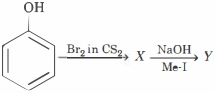
In the above sequence of reactions,the major products $X$ and $Y$ are
A
$X = \text{2-bromophenol}, Y = \text{2-bromo-1-methoxybenzene}$
B
$X = \text{2-bromophenol}, Y = \text{2-hydroxyphenol}$
C
$X = \text{4-bromophenol}, Y = \text{1-bromo-4-methoxybenzene}$
D
$X = \text{4-bromophenol}, Y = \text{4-hydroxyphenol}$
Solution
(C) The reaction sequence is as follows:
$1$. Phenol reacts with $Br_2$ in $CS_2$ (a non-polar solvent) at low temperature. This electrophilic aromatic substitution reaction favors the formation of the para-isomer due to steric hindrance at the ortho-position. Thus,$X$ is $4$-bromophenol.
$2$. In the second step,$4$-bromophenol reacts with $NaOH$ to form sodium $4$-bromophenoxide,which then undergoes a nucleophilic substitution reaction $(S_N2)$ with methyl iodide $(MeI)$ to form $1$-bromo-$4$-methoxybenzene $(Y)$. This is an example of Williamson's ether synthesis.
Therefore,the correct option is $C$.
$1$. Phenol reacts with $Br_2$ in $CS_2$ (a non-polar solvent) at low temperature. This electrophilic aromatic substitution reaction favors the formation of the para-isomer due to steric hindrance at the ortho-position. Thus,$X$ is $4$-bromophenol.
$2$. In the second step,$4$-bromophenol reacts with $NaOH$ to form sodium $4$-bromophenoxide,which then undergoes a nucleophilic substitution reaction $(S_N2)$ with methyl iodide $(MeI)$ to form $1$-bromo-$4$-methoxybenzene $(Y)$. This is an example of Williamson's ether synthesis.
Therefore,the correct option is $C$.
0 likesView Solution
51
ChemistryDifficultMCQKVPY · 2009
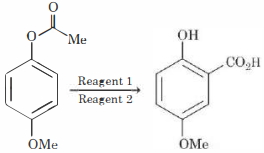
In the following transformation,reagents $1$ and $2$ are:
A
$H_2SO_4$; alk. $KMnO_4$
B
$AlCl_3$; $I_2 / NaOH$
C
$H_3PO_4$; $CHCl_3 / KOH$
D
$KOH$; $CHCl_3 / KOH$
Solution
(B) The correct option is $(B)$.
In the first reaction,$AlCl_3$ acts as a Lewis acid catalyst to facilitate the Fries rearrangement. This reaction involves the migration of the acyl group from the phenolic oxygen to the ortho position of the aryl ring,forming an ortho-hydroxyacetophenone derivative.
In the second reaction,$I_2 / NaOH$ acts as a reagent for the haloform reaction. The methyl ketone group $(-COCH_3)$ attached to the aromatic ring is oxidized to a carboxylic acid group $(-COOH)$ while producing iodoform $(CHI_3)$ as a byproduct.
In the first reaction,$AlCl_3$ acts as a Lewis acid catalyst to facilitate the Fries rearrangement. This reaction involves the migration of the acyl group from the phenolic oxygen to the ortho position of the aryl ring,forming an ortho-hydroxyacetophenone derivative.
In the second reaction,$I_2 / NaOH$ acts as a reagent for the haloform reaction. The methyl ketone group $(-COCH_3)$ attached to the aromatic ring is oxidized to a carboxylic acid group $(-COOH)$ while producing iodoform $(CHI_3)$ as a byproduct.
0 likesView Solution
52
ChemistryMediumMCQKVPY · 2009
$A$ concentrated solution of lead nitrate in water can be stored in
A
an iron vessel
B
a copper vessel
C
a zinc vessel
D
a magnesium vessel
Solution
(B) .
$A$ concentrated solution of lead nitrate,$Pb(NO_3)_2$,can be stored in a copper vessel because copper is less reactive than lead in the electrochemical series.
Therefore,copper cannot displace lead from its nitrate solution.
In contrast,iron $(Fe)$,zinc $(Zn)$,and magnesium $(Mg)$ are all more reactive than lead $(Pb)$ and would undergo a displacement reaction,making them unsuitable for storage.
$A$ concentrated solution of lead nitrate,$Pb(NO_3)_2$,can be stored in a copper vessel because copper is less reactive than lead in the electrochemical series.
Therefore,copper cannot displace lead from its nitrate solution.
In contrast,iron $(Fe)$,zinc $(Zn)$,and magnesium $(Mg)$ are all more reactive than lead $(Pb)$ and would undergo a displacement reaction,making them unsuitable for storage.
0 likesView Solution
53
ChemistryDifficultMCQKVPY · 2009
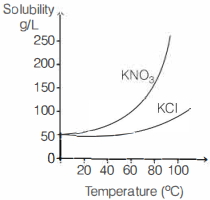
Given the solubility curves of $KNO_3$ and $KCl$,which of the following statements is not true?
A
At room temperature,the solubility of $KNO_3$ and $KCl$ are not equal.
B
The solubilities of both $KNO_3$ and $KCl$ increase with temperature.
C
The solubility of $KCl$ decreases with temperature.
D
The solubility of $KNO_3$ increases much more compared to that of $KCl$ with increase in temperature.
Solution
(C) The correct answer is $(c)$.
From the provided solubility graph,it is evident that the solubility of $KCl$ increases with an increase in temperature. Therefore,the statement $(c)$ is incorrect.
$(a)$ From the graph,it is clear that at room temperature,the solubility values of $KNO_3$ and $KCl$ are different,so they are not equal. Thus,statement $(a)$ is correct.
$(b)$ The curves for both $KNO_3$ and $KCl$ show an upward trend as temperature increases,indicating that their solubilities increase with temperature. Thus,statement $(b)$ is correct.
$(d)$ The slope of the $KNO_3$ curve is much steeper than that of the $KCl$ curve,which means the solubility of $KNO_3$ increases significantly more than that of $KCl$ as temperature rises. Thus,statement $(d)$ is correct.
From the provided solubility graph,it is evident that the solubility of $KCl$ increases with an increase in temperature. Therefore,the statement $(c)$ is incorrect.
$(a)$ From the graph,it is clear that at room temperature,the solubility values of $KNO_3$ and $KCl$ are different,so they are not equal. Thus,statement $(a)$ is correct.
$(b)$ The curves for both $KNO_3$ and $KCl$ show an upward trend as temperature increases,indicating that their solubilities increase with temperature. Thus,statement $(b)$ is correct.
$(d)$ The slope of the $KNO_3$ curve is much steeper than that of the $KCl$ curve,which means the solubility of $KNO_3$ increases significantly more than that of $KCl$ as temperature rises. Thus,statement $(d)$ is correct.
0 likesView Solution
54
ChemistryMediumMCQKVPY · 2009
Ethanol on reaction with alkaline $KMnO_4$ gives $X$,which when reacted with methanol in the presence of an acid gives a sweet-smelling compound $Y$. $X$ and $Y$ respectively are:
A
acetaldehyde and acetone
B
acetic acid and methyl acetate
C
formic acid and methyl formate
D
ethylene and ethyl methyl ether
Solution
(B)
Ethanol on reaction with alkaline $KMnO_4$ undergoes oxidation to give acetic acid $(X)$.
$CH_3CH_2OH \xrightarrow{\text{alkaline } KMnO_4} CH_3COOH \, (X)$
Acetic acid $(X)$ reacts with methanol in the presence of an acid (esterification) to form methyl acetate $(Y)$,which is a sweet-smelling ester.
$CH_3COOH + CH_3OH \xrightarrow{H^+} CH_3COOCH_3 \, (Y) + H_2O$
Thus,$X$ is acetic acid and $Y$ is methyl acetate.
Ethanol on reaction with alkaline $KMnO_4$ undergoes oxidation to give acetic acid $(X)$.
$CH_3CH_2OH \xrightarrow{\text{alkaline } KMnO_4} CH_3COOH \, (X)$
Acetic acid $(X)$ reacts with methanol in the presence of an acid (esterification) to form methyl acetate $(Y)$,which is a sweet-smelling ester.
$CH_3COOH + CH_3OH \xrightarrow{H^+} CH_3COOCH_3 \, (Y) + H_2O$
Thus,$X$ is acetic acid and $Y$ is methyl acetate.
0 likesView Solution
Vedclass Products
For Students
Vedclass Test Series
Mock tests in real KVPY style covering Chemistry with performance analysis. 5-day free trial.
Start Free TrialFor Teachers
Exam Paper Generator
Generate Set A/B/C/D Chemistry papers from 7.5L+ questions in 2 minutes. 3 chapters free.
Try FreeFor Institutes
Online Exam Module
Run live KVPY mock exams with unlimited students, 360° analytics & white-label branding.
See DemoFrequently Asked Questions
How many Chemistry questions are in KVPY 2009?
There are 54 Chemistry questions from the KVPY 2009 paper on Vedclass, each with a detailed step-by-step solution in English.
Are KVPY 2009 Chemistry solutions available in English?
Yes. All solutions on this page are in English. You can also switch to English or Hindi using the language buttons above the questions.
Can I practice KVPY 2009 Chemistry as a timed test?
Yes. Use the Vedclass Test Series to attempt a full KVPY mock test covering Chemistry with time limits and instant score analysis.
Can teachers create Chemistry papers from KVPY previous year questions?
Yes. The Vedclass Exam Paper Generator lets teachers mix KVPY Chemistry questions and generate Set A/B/C/D papers in minutes.
For Teachers & Institutes
Build a Custom Chemistry Paper
Pick KVPY 2009 Chemistry questions, set difficulty, and generate Set A/B/C/D in 2 minutes.