
ChemistryQ1–100 of 115 questions
Page 1 of 2 · English
1
ChemistryMCQJEE Main · 2015
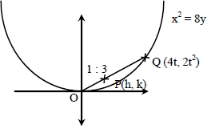
Let $O$ be the vertex and $Q$ be any point on the parabola $x^2 = 8y$. If the point $P$ divides the line segment $OQ$ internally in the ratio $1:3$,then the locus of $P$ is:
A
$x^2 = 2y$
B
$x^2 = y$
C
$y^2 = x$
D
$y^2 = 2x$
Solution
(A) The vertex $O$ of the parabola $x^2 = 8y$ is $(0, 0)$.
Let the coordinates of point $Q$ on the parabola be $(4t, 2t^2)$,as it satisfies $x^2 = 8y$ (i.e.,$(4t)^2 = 16t^2 = 8(2t^2)$).
Let $P(h, k)$ be the point that divides the line segment $OQ$ internally in the ratio $1:3$.
Using the section formula,the coordinates of $P$ are:
$h = \frac{1 \times 4t + 3 \times 0}{1 + 3} = \frac{4t}{4} = t$
$k = \frac{1 \times 2t^2 + 3 \times 0}{1 + 3} = \frac{2t^2}{4} = \frac{t^2}{2}$
From $h = t$,we have $t = h$.
Substituting this into the expression for $k$:
$k = \frac{h^2}{2} \implies h^2 = 2k$.
Replacing $(h, k)$ with $(x, y)$,the locus of $P$ is $x^2 = 2y$.
Let the coordinates of point $Q$ on the parabola be $(4t, 2t^2)$,as it satisfies $x^2 = 8y$ (i.e.,$(4t)^2 = 16t^2 = 8(2t^2)$).
Let $P(h, k)$ be the point that divides the line segment $OQ$ internally in the ratio $1:3$.
Using the section formula,the coordinates of $P$ are:
$h = \frac{1 \times 4t + 3 \times 0}{1 + 3} = \frac{4t}{4} = t$
$k = \frac{1 \times 2t^2 + 3 \times 0}{1 + 3} = \frac{2t^2}{4} = \frac{t^2}{2}$
From $h = t$,we have $t = h$.
Substituting this into the expression for $k$:
$k = \frac{h^2}{2} \implies h^2 = 2k$.
Replacing $(h, k)$ with $(x, y)$,the locus of $P$ is $x^2 = 2y$.
0 likesView Solution
2
ChemistryMCQJEE Main · 2015
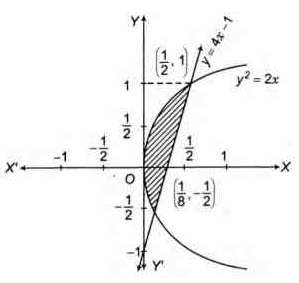
The area (in sq. units) of the region described by $\{(x,y): y^2 \le 2x \text{ and } y \ge 4x - 1\}$ is
A
$\frac{9}{32}$
B
$\frac{7}{32}$
C
$\frac{5}{64}$
D
$\frac{15}{64}$
Solution
(A) The given region is defined by the parabola $y^2 = 2x$ and the line $y = 4x - 1$.
To find the intersection points,substitute $x = \frac{y+1}{4}$ into $y^2 = 2x$:
$y^2 = 2\left(\frac{y+1}{4}\right) \Rightarrow y^2 = \frac{y+1}{2} \Rightarrow 2y^2 - y - 1 = 0$.
Solving the quadratic equation: $(2y+1)(y-1) = 0$,so $y = 1$ and $y = -\frac{1}{2}$.
For $y = 1$,$x = \frac{1+1}{4} = \frac{1}{2}$. For $y = -\frac{1}{2}$,$x = \frac{-1/2+1}{4} = \frac{1}{8}$.
The points of intersection are $(\frac{1}{2}, 1)$ and $(\frac{1}{8}, -\frac{1}{2})$.
The area is given by the integral of (right curve - left curve) with respect to $y$:
Area $= \int_{-1/2}^{1} \left( \frac{y+1}{4} - \frac{y^2}{2} \right) dy$
$= \left[ \frac{y^2}{8} + \frac{y}{4} - \frac{y^3}{6} \right]_{-1/2}^{1}$
$= \left( \frac{1}{8} + \frac{1}{4} - \frac{1}{6} \right) - \left( \frac{1/4}{8} - \frac{1/2}{4} - \frac{-1/8}{6} \right)$
$= \left( \frac{3+6-4}{24} \right) - \left( \frac{1}{32} - \frac{1}{8} + \frac{1}{48} \right)$
$= \frac{5}{24} - \left( \frac{3-12+2}{96} \right) = \frac{5}{24} - \left( -\frac{7}{96} \right) = \frac{20+7}{96} = \frac{27}{96} = \frac{9}{32}$ sq. units.
To find the intersection points,substitute $x = \frac{y+1}{4}$ into $y^2 = 2x$:
$y^2 = 2\left(\frac{y+1}{4}\right) \Rightarrow y^2 = \frac{y+1}{2} \Rightarrow 2y^2 - y - 1 = 0$.
Solving the quadratic equation: $(2y+1)(y-1) = 0$,so $y = 1$ and $y = -\frac{1}{2}$.
For $y = 1$,$x = \frac{1+1}{4} = \frac{1}{2}$. For $y = -\frac{1}{2}$,$x = \frac{-1/2+1}{4} = \frac{1}{8}$.
The points of intersection are $(\frac{1}{2}, 1)$ and $(\frac{1}{8}, -\frac{1}{2})$.
The area is given by the integral of (right curve - left curve) with respect to $y$:
Area $= \int_{-1/2}^{1} \left( \frac{y+1}{4} - \frac{y^2}{2} \right) dy$
$= \left[ \frac{y^2}{8} + \frac{y}{4} - \frac{y^3}{6} \right]_{-1/2}^{1}$
$= \left( \frac{1}{8} + \frac{1}{4} - \frac{1}{6} \right) - \left( \frac{1/4}{8} - \frac{1/2}{4} - \frac{-1/8}{6} \right)$
$= \left( \frac{3+6-4}{24} \right) - \left( \frac{1}{32} - \frac{1}{8} + \frac{1}{48} \right)$
$= \frac{5}{24} - \left( \frac{3-12+2}{96} \right) = \frac{5}{24} - \left( -\frac{7}{96} \right) = \frac{20+7}{96} = \frac{27}{96} = \frac{9}{32}$ sq. units.
0 likesView Solution
3
ChemistryDifficultMCQJEE Main · 2015
Which of the following is the energy of a possible excited state of hydrogen? $........... \ eV$
A
$-3.4$
B
$+6.8$
C
$+13.6$
D
$-6.8$
Solution
(A) The energy of an electron in the $n^{th}$ orbit of a hydrogen atom is given by the formula $E_n = -\frac{13.6}{n^2} \ eV$.
For the first excited state,the principal quantum number is $n = 2$.
Substituting $n = 2$ into the formula,we get $E_2 = -\frac{13.6}{2^2} = -\frac{13.6}{4} = -3.4 \ eV$.
Therefore,the energy of the first excited state of hydrogen is $-3.4 \ eV$.
For the first excited state,the principal quantum number is $n = 2$.
Substituting $n = 2$ into the formula,we get $E_2 = -\frac{13.6}{2^2} = -\frac{13.6}{4} = -3.4 \ eV$.
Therefore,the energy of the first excited state of hydrogen is $-3.4 \ eV$.
0 likesView Solution
4
ChemistryEasyMCQJEE Main · 2015
The ionic radii (in $\mathring{A}$) of $N^{3-}$,$O^{2-}$ and $F^{-}$ are respectively :
A
$1.71, 1.40$ and $1.36$
B
$1.71, 1.36$ and $1.40$
C
$1.36, 1.40$ and $1.71$
D
$1.36, 1.71$ and $1.40$
Solution
(A) $N^{3-}$,$O^{2-}$,and $F^{-}$ are isoelectronic species,as each contains $10$ electrons.
For isoelectronic species,the ionic radius decreases as the nuclear charge (atomic number) increases.
The atomic numbers are $N (7)$,$O (8)$,and $F (9)$.
Therefore,the ionic radii decrease in the order $N^{3-} > O^{2-} > F^{-}$.
The values are $1.71 \ \mathring{A}$,$1.40 \ \mathring{A}$,and $1.36 \ \mathring{A}$ respectively.
For isoelectronic species,the ionic radius decreases as the nuclear charge (atomic number) increases.
The atomic numbers are $N (7)$,$O (8)$,and $F (9)$.
Therefore,the ionic radii decrease in the order $N^{3-} > O^{2-} > F^{-}$.
The values are $1.71 \ \mathring{A}$,$1.40 \ \mathring{A}$,and $1.36 \ \mathring{A}$ respectively.
0 likesView Solution
5
ChemistryEasyMCQJEE Main · 2015
The intermolecular interaction that is dependent on the inverse cube of distance between the molecules is:
A
London force
B
hydrogen bond
C
ion - ion interaction
D
ion - dipole interaction
Solution
(B) The interaction energy between two dipoles (dipole-dipole interaction) is proportional to $1/r^3$ for stationary dipoles,where $r$ is the distance between the molecules.
Hydrogen bonding is a specific,strong type of dipole-dipole interaction.
London dispersion forces depend on $1/r^6$.
Ion-ion interaction depends on $1/r$.
Ion-dipole interaction depends on $1/r^2$.
Hydrogen bonding is a specific,strong type of dipole-dipole interaction.
London dispersion forces depend on $1/r^6$.
Ion-ion interaction depends on $1/r$.
Ion-dipole interaction depends on $1/r^2$.
0 likesView Solution
6
ChemistryMediumMCQJEE Main · 2015
The standard Gibbs energy change at $300 \, K$ for the reaction $2A \rightleftharpoons B + C$ is $2494.2 \, J$. At a given time,the composition of the reaction mixture is $[A] = 1/2, [B] = 2$ and $[C] = 1/2$. The reaction proceeds in the:
A
forward direction because $Q < K_c$
B
reverse direction because $Q < K_c$
C
forward direction because $Q > K_c$
D
reverse direction because $Q > K_c$
Solution
(D) Given: $\Delta G^{\circ} = 2494.2 \, J$,$T = 300 \, K$,$R = 8.314 \, J/K \cdot mol$.
First,calculate the equilibrium constant $K_c$ using $\Delta G^{\circ} = -RT \ln K_c$.
$2494.2 = -(8.314) \times 300 \times \ln K_c$.
$\ln K_c = -2494.2 / 2494.2 = -1$.
$K_c = e^{-1} \approx 0.367$.
Next,calculate the reaction quotient $Q$ for the given concentrations $[A] = 0.5, [B] = 2, [C] = 0.5$.
$Q = ([B][C]) / [A]^2 = (2 \times 0.5) / (0.5)^2 = 1 / 0.25 = 4$.
Since $Q = 4$ and $K_c \approx 0.367$,we have $Q > K_c$.
When $Q > K_c$,the reaction proceeds in the reverse direction to reach equilibrium.
First,calculate the equilibrium constant $K_c$ using $\Delta G^{\circ} = -RT \ln K_c$.
$2494.2 = -(8.314) \times 300 \times \ln K_c$.
$\ln K_c = -2494.2 / 2494.2 = -1$.
$K_c = e^{-1} \approx 0.367$.
Next,calculate the reaction quotient $Q$ for the given concentrations $[A] = 0.5, [B] = 2, [C] = 0.5$.
$Q = ([B][C]) / [A]^2 = (2 \times 0.5) / (0.5)^2 = 1 / 0.25 = 4$.
Since $Q = 4$ and $K_c \approx 0.367$,we have $Q > K_c$.
When $Q > K_c$,the reaction proceeds in the reverse direction to reach equilibrium.
0 likesView Solution
7
ChemistryAdvancedMCQJEE Main · 2015
The following reaction is performed at $298 \, K$.
$2 NO_{(g)} + O_{2(g)} \rightleftharpoons 2 NO_{2(g)}$
The standard free energy of formation of $NO_{(g)}$ is $86.6 \, kJ/mol$ at $298 \, K$. What is the standard free energy of formation of $NO_{2(g)}$ at $298 \, K$? $(K_p = 1.6 \times 10^{12})$
$2 NO_{(g)} + O_{2(g)} \rightleftharpoons 2 NO_{2(g)}$
The standard free energy of formation of $NO_{(g)}$ is $86.6 \, kJ/mol$ at $298 \, K$. What is the standard free energy of formation of $NO_{2(g)}$ at $298 \, K$? $(K_p = 1.6 \times 10^{12})$
A
$86600 - \frac{\ln (1.6 \times 10^{12})}{ R (298) }$
B
$0.5 [2 \times 86600 - R(298) \ln (1.6 \times 10^{12})]$
C
$R(298) \ln (1.6 \times 10^{12}) - 86600$
D
$86600 + R(298) \ln (1.6 \times 10^{12})$
Solution
(B) The standard free energy change for the reaction is given by $\Delta G^{\circ} = -RT \ln K_p$.
For the reaction $2 NO_{(g)} + O_{2(g)} \rightleftharpoons 2 NO_{2(g)}$,the standard free energy change is $\Delta G^{\circ} = 2 \Delta G^{\circ}_{f}(NO_2) - [2 \Delta G^{\circ}_{f}(NO) + \Delta G^{\circ}_{f}(O_2)]$.
Since $\Delta G^{\circ}_{f}(O_2) = 0$,we have $\Delta G^{\circ} = 2 \Delta G^{\circ}_{f}(NO_2) - 2 \Delta G^{\circ}_{f}(NO)$.
Given $\Delta G^{\circ}_{f}(NO) = 86.6 \, kJ/mol = 86600 \, J/mol$ and $T = 298 \, K$,we substitute these into the equation:
$-R(298) \ln (1.6 \times 10^{12}) = 2 \Delta G^{\circ}_{f}(NO_2) - 2(86600)$.
Rearranging for $\Delta G^{\circ}_{f}(NO_2)$:
$2 \Delta G^{\circ}_{f}(NO_2) = 2(86600) - R(298) \ln (1.6 \times 10^{12})$.
$\Delta G^{\circ}_{f}(NO_2) = 0.5 [2 \times 86600 - R(298) \ln (1.6 \times 10^{12})]$.
For the reaction $2 NO_{(g)} + O_{2(g)} \rightleftharpoons 2 NO_{2(g)}$,the standard free energy change is $\Delta G^{\circ} = 2 \Delta G^{\circ}_{f}(NO_2) - [2 \Delta G^{\circ}_{f}(NO) + \Delta G^{\circ}_{f}(O_2)]$.
Since $\Delta G^{\circ}_{f}(O_2) = 0$,we have $\Delta G^{\circ} = 2 \Delta G^{\circ}_{f}(NO_2) - 2 \Delta G^{\circ}_{f}(NO)$.
Given $\Delta G^{\circ}_{f}(NO) = 86.6 \, kJ/mol = 86600 \, J/mol$ and $T = 298 \, K$,we substitute these into the equation:
$-R(298) \ln (1.6 \times 10^{12}) = 2 \Delta G^{\circ}_{f}(NO_2) - 2(86600)$.
Rearranging for $\Delta G^{\circ}_{f}(NO_2)$:
$2 \Delta G^{\circ}_{f}(NO_2) = 2(86600) - R(298) \ln (1.6 \times 10^{12})$.
$\Delta G^{\circ}_{f}(NO_2) = 0.5 [2 \times 86600 - R(298) \ln (1.6 \times 10^{12})]$.
0 likesView Solution
8
ChemistryMediumMCQJEE Main · 2015
Which one of the following alkaline earth metal sulphates has its hydration enthalpy greater than its lattice enthalpy?
A
$BaSO_4$
B
$SrSO_4$
C
$CaSO_4$
D
$BeSO_4$
Solution
(D) The solubility of alkaline earth metal sulphates depends on the balance between lattice enthalpy and hydration enthalpy.
For a compound to be highly soluble,its hydration enthalpy must be greater than its lattice enthalpy.
As we move down the group,the size of the metal cation increases,which causes the hydration enthalpy to decrease significantly more than the lattice enthalpy.
$Be^{2+}$ is the smallest cation among the alkaline earth metals,resulting in a very high hydration enthalpy that outweighs its lattice enthalpy.
Therefore,$BeSO_4$ is highly soluble in water,while the solubility decreases down the group from $BeSO_4$ to $BaSO_4$.
For a compound to be highly soluble,its hydration enthalpy must be greater than its lattice enthalpy.
As we move down the group,the size of the metal cation increases,which causes the hydration enthalpy to decrease significantly more than the lattice enthalpy.
$Be^{2+}$ is the smallest cation among the alkaline earth metals,resulting in a very high hydration enthalpy that outweighs its lattice enthalpy.
Therefore,$BeSO_4$ is highly soluble in water,while the solubility decreases down the group from $BeSO_4$ to $BaSO_4$.
0 likesView Solution
9
ChemistryDifficultMCQJEE Main · 2015
The molecular formula of a commercial resin used for exchanging ions in water softening is $C_8H_7SO_3^- Na^+$ $(Mol. \ wt. 206)$. What would be the maximum uptake of $Ca^{2+}$ ions by the resin when expressed in mole per gram resin?
A
$\frac{2}{309}$
B
$\frac{1}{412}$
C
$\frac{1}{103}$
D
$\frac{1}{206}$
Solution
(B) The ion exchange reaction is: $2(C_8H_7SO_3^- Na^+) + Ca^{2+} \rightarrow (C_8H_7SO_3^-)_2 Ca^{2+} + 2Na^+$.
From the stoichiometry,$2 \ mol$ of the resin are required to exchange $1 \ mol$ of $Ca^{2+}$ ions.
Therefore,$1 \ mol$ of the resin can take up $\frac{1}{2} \ mol$ of $Ca^{2+}$ ions.
Given the molar mass of the resin is $206 \ g/mol$,the uptake capacity per gram of resin is $\frac{1 \ mol \ Ca^{2+}}{2 \times 206 \ g \ resin} = \frac{1}{412} \ mol/g$.
From the stoichiometry,$2 \ mol$ of the resin are required to exchange $1 \ mol$ of $Ca^{2+}$ ions.
Therefore,$1 \ mol$ of the resin can take up $\frac{1}{2} \ mol$ of $Ca^{2+}$ ions.
Given the molar mass of the resin is $206 \ g/mol$,the uptake capacity per gram of resin is $\frac{1 \ mol \ Ca^{2+}}{2 \times 206 \ g \ resin} = \frac{1}{412} \ mol/g$.
1 likesView Solution
10
ChemistryMediumMCQJEE Main · 2015
From the following statements regarding $H_2O_2$,choose the incorrect statement:
A
It has to be stored in plastic or wax lined glass bottles in dark
B
It has to be kept away from dust
C
It can act only as an oxidizing agent
D
It decomposes on exposure to light
Solution
(C) . It has to be stored in plastic or wax-lined glass bottles in the dark to prevent its decomposition. Thus,the statement is correct.
$B$. It has to be kept away from dust as it decomposes in the presence of dust. Thus,the statement is correct.
$C$. Hydrogen peroxide can act as both an oxidizing and a reducing agent. For example,in an acidic medium,it oxidizes ferrous ions to ferric ions: $2 Fe^{2+} + H_2O_2 + 2 H^{+} \rightarrow 2 Fe^{3+} + 2 H_2O$. In an acidic medium,it also reduces $HOCl$ to chloride ions: $HOCl + H_2O_2 \rightarrow H^{+} + Cl^{-} + H_2O + O_2$. Thus,the statement that it acts only as an oxidizing agent is incorrect.
$D$. It decomposes on exposure to light to form water and oxygen: $2 H_2O_2 \rightarrow 2 H_2O + O_2$. Thus,the statement is correct.
$B$. It has to be kept away from dust as it decomposes in the presence of dust. Thus,the statement is correct.
$C$. Hydrogen peroxide can act as both an oxidizing and a reducing agent. For example,in an acidic medium,it oxidizes ferrous ions to ferric ions: $2 Fe^{2+} + H_2O_2 + 2 H^{+} \rightarrow 2 Fe^{3+} + 2 H_2O$. In an acidic medium,it also reduces $HOCl$ to chloride ions: $HOCl + H_2O_2 \rightarrow H^{+} + Cl^{-} + H_2O + O_2$. Thus,the statement that it acts only as an oxidizing agent is incorrect.
$D$. It decomposes on exposure to light to form water and oxygen: $2 H_2O_2 \rightarrow 2 H_2O + O_2$. Thus,the statement is correct.
0 likesView Solution
11
ChemistryMediumMCQJEE Main · 2015
Which of the following compounds will exhibit geometrical isomerism?
A
$2-$Phenyl$-1-$butene
B
$1,1-$Diphenyl$-1-$propene
C
$1-$Phenyl$-2-$butene
D
$3-$Phenyl$-1-$butene
Solution
(C) For a compound to exhibit geometrical isomerism,each carbon atom of the $C=C$ double bond must be attached to two different groups.
In $1-$Phenyl$-2-$butene $(C_6H_5-CH_2-CH=CH-CH_3)$,the carbon atoms of the double bond are attached to different groups ($H$ and $CH_3$ on one side; $H$ and $CH_2C_6H_5$ on the other).
Therefore,it can exist as $cis-$ and $trans-$ isomers.
In $1-$Phenyl$-2-$butene $(C_6H_5-CH_2-CH=CH-CH_3)$,the carbon atoms of the double bond are attached to different groups ($H$ and $CH_3$ on one side; $H$ and $CH_2C_6H_5$ on the other).
Therefore,it can exist as $cis-$ and $trans-$ isomers.
0 likesView Solution
12
ChemistryDifficultMCQJEE Main · 2015
In Carius method of estimation of halogens,$250 \ mg$ of an organic compound gave $141 \ mg$ of $AgBr$. The percentage of bromine in the compound is:
A
$48$
B
$60$
C
$24$
D
$36$
Solution
(C) Mass of organic compound $= 250 \ mg = 0.250 \ g$
Mass of $AgBr$ formed $= 141 \ mg = 0.141 \ g$
Molar mass of $AgBr = 108 + 80 = 188 \ g/mol$
$188 \ g$ of $AgBr$ contains $80 \ g$ of $Br$.
Mass of $Br$ in $0.141 \ g$ of $AgBr = \frac{80}{188} \times 0.141 \ g = 0.060 \ g$
Percentage of $Br = \frac{\text{Mass of } Br}{\text{Mass of organic compound}} \times 100$
Percentage of $Br = \frac{0.060}{0.250} \times 100 = 24 \%$
Mass of $AgBr$ formed $= 141 \ mg = 0.141 \ g$
Molar mass of $AgBr = 108 + 80 = 188 \ g/mol$
$188 \ g$ of $AgBr$ contains $80 \ g$ of $Br$.
Mass of $Br$ in $0.141 \ g$ of $AgBr = \frac{80}{188} \times 0.141 \ g = 0.060 \ g$
Percentage of $Br = \frac{\text{Mass of } Br}{\text{Mass of organic compound}} \times 100$
Percentage of $Br = \frac{0.060}{0.250} \times 100 = 24 \%$
0 likesView Solution
13
ChemistryDifficultMCQJEE Main · 2015
Which compound would give $5-$keto$-2-$methylhexanal upon ozonolysis?
A
$1,3-$dimethylcyclopentene
B
$1,2-$dimethylcyclopentene
C
$1,5-$dimethylcyclopentene
D
$3,3-$dimethylcyclopentene
Solution
(A) Ozonolysis of a cyclic alkene involves the cleavage of the double bond to form a dicarbonyl compound.
For $1,3-$dimethylcyclopentene,the double bond is between $C_1$ and $C_2$.
Upon ozonolysis,the ring opens,and the carbons at the double bond become carbonyl groups.
Specifically,$1,3-$dimethylcyclopentene gives $5-$keto$-2-$methylhexanal as the product.
Therefore,the correct compound is $1,3-$dimethylcyclopentene.
For $1,3-$dimethylcyclopentene,the double bond is between $C_1$ and $C_2$.
Upon ozonolysis,the ring opens,and the carbons at the double bond become carbonyl groups.
Specifically,$1,3-$dimethylcyclopentene gives $5-$keto$-2-$methylhexanal as the product.
Therefore,the correct compound is $1,3-$dimethylcyclopentene.
0 likesView Solution
14
ChemistryMCQJEE Main · 2015
Sodium metal crystallizes in a body-centred cubic $(bcc)$ lattice with a unit cell edge of $4.29 \ \mathring{A}$. The radius of the sodium atom is approximately: .............. $\mathring{A}$
A
$5.72$
B
$0.93$
C
$1.86$
D
$3.22$
Solution
(C) In a $bcc$ lattice,the atoms touch along the body diagonal.
Therefore,the relationship between the edge length $(a)$ and the atomic radius $(r)$ is given by $4r = \sqrt{3} a$.
$r = \frac{\sqrt{3} \times a}{4}$
$r = \frac{1.732 \times 4.29}{4}$
$r = 1.857 \ \mathring{A} \approx 1.86 \ \mathring{A}$.
Therefore,the relationship between the edge length $(a)$ and the atomic radius $(r)$ is given by $4r = \sqrt{3} a$.
$r = \frac{\sqrt{3} \times a}{4}$
$r = \frac{1.732 \times 4.29}{4}$
$r = 1.857 \ \mathring{A} \approx 1.86 \ \mathring{A}$.
0 likesView Solution
15
ChemistryMCQJEE Main · 2015
The synthesis of alkyl fluorides is best accomplished by:
A
Finkelstein reaction
B
Swarts reaction
C
Free radical fluorination
D
Sandmeyer's reaction
Solution
(B) Alkyl fluorides are best prepared by the action of metallic fluorides like $Hg_2F_2$,$AgF$,or $SbF_3$ on alkyl halides. This specific method is known as the $Swarts$ reaction.
Example: $CH_3Br + AgF \rightarrow CH_3F + AgBr$.
In contrast,the $Finkelstein$ reaction is used to prepare alkyl iodides by treating alkyl chlorides or bromides with $NaI$ in acetone.
Free radical fluorination is highly exothermic and explosive,making it unsuitable for laboratory synthesis.
Example: $CH_3Br + AgF \rightarrow CH_3F + AgBr$.
In contrast,the $Finkelstein$ reaction is used to prepare alkyl iodides by treating alkyl chlorides or bromides with $NaI$ in acetone.
Free radical fluorination is highly exothermic and explosive,making it unsuitable for laboratory synthesis.
0 likesView Solution
16
ChemistryMCQJEE Main · 2015
Which of the following compounds is not an antacid?
A
Phenelzine
B
Ranitidine
C
Aluminium hydroxide
D
Cimetidine
Solution
(A) Aluminium hydroxide $(Al(OH)_3)$,cimetidine,and ranitidine are antacids,while phenelzine is not.
Phenelzine is a tranquilizer,not an antacid. Phenelzine is used as an antidepressant drug.
Phenelzine is a tranquilizer,not an antacid. Phenelzine is used as an antidepressant drug.
0 likesView Solution
17
ChemistryMCQJEE Main · 2015
Two coaxial solenoids of different radii carry current $I$ in the same direction. Let $\vec{F}_1$ be the magnetic force on the inner solenoid due to the outer one and $\vec{F}_2$ be the magnetic force on the outer solenoid due to the inner one. Then:
A
$\vec{F}_1$ is radially inwards and $\vec{F}_2 = 0$
B
$\vec{F}_1$ is radially outwards and $\vec{F}_2 = 0$
C
$\vec{F}_1 = \vec{F}_2 = 0$
D
$\vec{F}_1$ is radially inwards and $\vec{F}_2$ is radially outwards
Solution
(C) For two coaxial solenoids carrying current $I$ in the same direction,the magnetic field produced by the outer solenoid is uniform inside it and zero outside.
Since the inner solenoid is placed in a uniform magnetic field,the net magnetic force on it is zero because the forces on opposite sides of the current loops cancel each other out.
Similarly,the magnetic field produced by the inner solenoid is confined within its volume and is zero outside.
Therefore,the outer solenoid experiences no magnetic force from the inner one.
According to Newton's third law of motion,the action and reaction forces must be equal and opposite.
Since both forces are zero,they satisfy the condition $\vec{F}_1 = \vec{F}_2 = 0$.
Since the inner solenoid is placed in a uniform magnetic field,the net magnetic force on it is zero because the forces on opposite sides of the current loops cancel each other out.
Similarly,the magnetic field produced by the inner solenoid is confined within its volume and is zero outside.
Therefore,the outer solenoid experiences no magnetic force from the inner one.
According to Newton's third law of motion,the action and reaction forces must be equal and opposite.
Since both forces are zero,they satisfy the condition $\vec{F}_1 = \vec{F}_2 = 0$.
0 likesView Solution
18
ChemistryMCQJEE Main · 2015
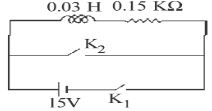
An inductor $(L = 0.03 \ H)$ and a resistor $(R = 0.15 \ k\Omega)$ are connected in series to a battery of $15 \ V$ $EMF$ in a circuit as shown below. The key $K_1$ has been kept closed for a long time. Then at $t = 0$,$K_1$ is opened and key $K_2$ is closed simultaneously. At $t = 1 \ ms$,the current in the circuit will be ....... $mA$ $(e^5 \cong 150)$.
A
$67$
B
$6.7$
C
$0.67$
D
$100$
Solution
(C) When $K_1$ is closed for a long time,the inductor acts as a short circuit. The initial current $I_0$ through the inductor is:
$I_0 = \frac{V}{R} = \frac{15 \ V}{0.15 \times 10^3 \ \Omega} = \frac{15}{150} = 0.1 \ A = 100 \ mA$.
When $K_1$ is opened and $K_2$ is closed,the battery is removed from the circuit,and the inductor discharges through the resistor. This is a decaying $LR$ circuit.
The current at time $t$ is given by $I(t) = I_0 e^{-Rt/L}$.
Given $R = 150 \ \Omega$,$L = 0.03 \ H$,and $t = 1 \ ms = 10^{-3} \ s$.
The exponent is $-\frac{Rt}{L} = -\frac{150 \times 10^{-3}}{0.03} = -\frac{0.15}{0.03} = -5$.
Thus,$I(t) = 100 \ mA \times e^{-5}$.
Using $e^5 \cong 150$,we have $e^{-5} = \frac{1}{e^5} \cong \frac{1}{150}$.
$I(1 \ ms) = 100 \times \frac{1}{150} = \frac{10}{15} = \frac{2}{3} \approx 0.67 \ mA$.
$I_0 = \frac{V}{R} = \frac{15 \ V}{0.15 \times 10^3 \ \Omega} = \frac{15}{150} = 0.1 \ A = 100 \ mA$.
When $K_1$ is opened and $K_2$ is closed,the battery is removed from the circuit,and the inductor discharges through the resistor. This is a decaying $LR$ circuit.
The current at time $t$ is given by $I(t) = I_0 e^{-Rt/L}$.
Given $R = 150 \ \Omega$,$L = 0.03 \ H$,and $t = 1 \ ms = 10^{-3} \ s$.
The exponent is $-\frac{Rt}{L} = -\frac{150 \times 10^{-3}}{0.03} = -\frac{0.15}{0.03} = -5$.
Thus,$I(t) = 100 \ mA \times e^{-5}$.
Using $e^5 \cong 150$,we have $e^{-5} = \frac{1}{e^5} \cong \frac{1}{150}$.
$I(1 \ ms) = 100 \times \frac{1}{150} = \frac{10}{15} = \frac{2}{3} \approx 0.67 \ mA$.
0 likesView Solution
19
ChemistryMCQJEE Main · 2015
In an ideal gas at temperature $T$,the average force that a molecule applies on the walls of a closed container depends on $T$ as $T^q$. $A$ good estimate for $q$ is:
A
$2$
B
$1/2$
C
$1/4$
D
$1$
Solution
(D) The average force $F$ exerted by a molecule on the wall of a container is given by the rate of change of momentum,$F = \frac{\Delta p}{\Delta t}$.
For a molecule of mass $m$ moving with velocity $v$,the force is proportional to $\frac{mv^2}{L}$,where $L$ is the dimension of the container.
From the kinetic theory of gases,the average kinetic energy of a molecule is $\frac{1}{2}mv^2 = \frac{3}{2}kT$,which implies $v^2 \propto T$.
Substituting this into the force expression,we get $F \propto \frac{m(T)}{L}$,so $F \propto T^1$.
Comparing this with $F \propto T^q$,we find $q = 1$.
For a molecule of mass $m$ moving with velocity $v$,the force is proportional to $\frac{mv^2}{L}$,where $L$ is the dimension of the container.
From the kinetic theory of gases,the average kinetic energy of a molecule is $\frac{1}{2}mv^2 = \frac{3}{2}kT$,which implies $v^2 \propto T$.
Substituting this into the force expression,we get $F \propto \frac{m(T)}{L}$,so $F \propto T^1$.
Comparing this with $F \propto T^q$,we find $q = 1$.
0 likesView Solution
20
ChemistryMCQJEE Main · 2015
If Rolle's theorem holds for the function $f(x) = 2x^3 + bx^2 + cx$ on the interval $x \in [-1, 1]$ at the point $x = \frac{1}{2}$,then $(2b + c)$ is equal to:
A
$1$
B
$-1$
C
$2$
D
$-3$
Solution
(B) For Rolle's theorem to hold on $[-1, 1]$,we must have $f(-1) = f(1)$.
$f(-1) = 2(-1)^3 + b(-1)^2 + c(-1) = -2 + b - c$
$f(1) = 2(1)^3 + b(1)^2 + c(1) = 2 + b + c$
Equating $f(-1) = f(1)$:
$-2 + b - c = 2 + b + c$
$-2c = 4 \implies c = -2$
Since Rolle's theorem holds at $x = \frac{1}{2}$,we have $f'(\frac{1}{2}) = 0$.
$f'(x) = 6x^2 + 2bx + c$
$f'(\frac{1}{2}) = 6(\frac{1}{4}) + 2b(\frac{1}{2}) + c = 0$
$\frac{3}{2} + b + c = 0$
Substituting $c = -2$:
$\frac{3}{2} + b - 2 = 0 \implies b = 2 - \frac{3}{2} = \frac{1}{2}$
Now,calculate $(2b + c)$:
$2b + c = 2(\frac{1}{2}) + (-2) = 1 - 2 = -1$.
$f(-1) = 2(-1)^3 + b(-1)^2 + c(-1) = -2 + b - c$
$f(1) = 2(1)^3 + b(1)^2 + c(1) = 2 + b + c$
Equating $f(-1) = f(1)$:
$-2 + b - c = 2 + b + c$
$-2c = 4 \implies c = -2$
Since Rolle's theorem holds at $x = \frac{1}{2}$,we have $f'(\frac{1}{2}) = 0$.
$f'(x) = 6x^2 + 2bx + c$
$f'(\frac{1}{2}) = 6(\frac{1}{4}) + 2b(\frac{1}{2}) + c = 0$
$\frac{3}{2} + b + c = 0$
Substituting $c = -2$:
$\frac{3}{2} + b - 2 = 0 \implies b = 2 - \frac{3}{2} = \frac{1}{2}$
Now,calculate $(2b + c)$:
$2b + c = 2(\frac{1}{2}) + (-2) = 1 - 2 = -1$.
0 likesView Solution
21
ChemistryMCQJEE Main · 2015
Which of the following compounds is not an antacid?
A
Cimetidine
B
Phenelzine
C
Ranitidine
D
Aluminium hydroxide
Solution
(B) $Cimetidine$ and $Ranitidine$ are well-known antacids that reduce stomach acidity.
$Aluminium \ hydroxide$ is also used as an antacid.
$Phenelzine$ is an anti-depressant drug,not an antacid.
$Aluminium \ hydroxide$ is also used as an antacid.
$Phenelzine$ is an anti-depressant drug,not an antacid.
0 likesView Solution
22
ChemistryMCQJEE Main · 2015
If one were to apply the Bohr model to a particle of mass $m$ and charge $q$ moving in a plane under the influence of a magnetic field $B$,the energy of the charged particle in the $n^{th}$ level will be:
A
$n \left( \frac{hqB}{2\pi m} \right)$
B
$n \left( \frac{hqB}{4\pi m} \right)$
C
$n \left( \frac{hqB}{8\pi m} \right)$
D
$n \left( \frac{hqB}{\pi m} \right)$
Solution
(B) According to the Bohr quantization condition,the angular momentum is given by $mvr = \frac{nh}{2\pi}$.
For a particle of mass $m$ and charge $q$ moving in a circular path in a magnetic field $B$,the magnetic force provides the centripetal force: $qvB = \frac{mv^2}{r}$,which implies $r = \frac{mv}{qB}$.
Substituting the expression for $r$ into the angular momentum equation: $mv \left( \frac{mv}{qB} \right) = \frac{nh}{2\pi}$.
This simplifies to $\frac{m^2v^2}{qB} = \frac{nh}{2\pi}$,or $mv^2 = \frac{nhqB}{2\pi m}$.
The kinetic energy $E$ of the particle is given by $E = \frac{1}{2}mv^2$.
Substituting the value of $mv^2$,we get $E = \frac{1}{2} \left( \frac{nhqB}{2\pi m} \right) = \frac{nhqB}{4\pi m}$.
For a particle of mass $m$ and charge $q$ moving in a circular path in a magnetic field $B$,the magnetic force provides the centripetal force: $qvB = \frac{mv^2}{r}$,which implies $r = \frac{mv}{qB}$.
Substituting the expression for $r$ into the angular momentum equation: $mv \left( \frac{mv}{qB} \right) = \frac{nh}{2\pi}$.
This simplifies to $\frac{m^2v^2}{qB} = \frac{nh}{2\pi}$,or $mv^2 = \frac{nhqB}{2\pi m}$.
The kinetic energy $E$ of the particle is given by $E = \frac{1}{2}mv^2$.
Substituting the value of $mv^2$,we get $E = \frac{1}{2} \left( \frac{nhqB}{2\pi m} \right) = \frac{nhqB}{4\pi m}$.
0 likesView Solution
23
ChemistryMCQJEE Main · 2015
Which one has the highest boiling point?
A
$He$
B
$Ne$
C
$Kr$
D
$Xe$
Solution
(D) The boiling point of noble gases increases down the group as the atomic size increases.
As the atomic size increases,the magnitude of van der Waals forces of attraction increases.
Among the given noble gases ($He$,$Ne$,$Kr$,$Xe$),$Xe$ has the largest atomic size and therefore the strongest van der Waals forces.
Thus,$Xe$ has the highest boiling point.
As the atomic size increases,the magnitude of van der Waals forces of attraction increases.
Among the given noble gases ($He$,$Ne$,$Kr$,$Xe$),$Xe$ has the largest atomic size and therefore the strongest van der Waals forces.
Thus,$Xe$ has the highest boiling point.
0 likesView Solution
24
ChemistryDifficultMCQJEE Main · 2015
If the principal quantum number $n=6,$ the correct sequence of filling of electrons will be
A
$ns \to (n-2)f \to np \to (n-1)d$
B
$ns \to (n-2)f \to (n-1)d \to np$
C
$ns \to np \to (n-1)d \to (n-2)f$
D
$ns \to (n-1)d \to (n-2)f \to np$
Solution
(B) According to the $(n+l)$ rule,electrons fill orbitals in order of increasing $(n+l)$ values.
For $n=6$:
$6s: n+l = 6+0 = 6$
$4f: n+l = 4+3 = 7$
$5d: n+l = 5+2 = 7$
$6p: n+l = 6+1 = 7$
Comparing the orbitals with the same $(n+l)$ value,the one with the lower $n$ value fills first.
Thus,the order is $6s \to 4f \to 5d \to 6p$,which corresponds to $ns \to (n-2)f \to (n-1)d \to np$.
For $n=6$:
$6s: n+l = 6+0 = 6$
$4f: n+l = 4+3 = 7$
$5d: n+l = 5+2 = 7$
$6p: n+l = 6+1 = 7$
Comparing the orbitals with the same $(n+l)$ value,the one with the lower $n$ value fills first.
Thus,the order is $6s \to 4f \to 5d \to 6p$,which corresponds to $ns \to (n-2)f \to (n-1)d \to np$.
0 likesView Solution
25
ChemistryDifficultMCQJEE Main · 2015
$A$ sample of a hydrate of barium chloride weighing $61 \ g$ was heated until all the water of hydration was removed. The dried sample weight is $52 \ g$. The formula of the hydrated salt is: (atomic mass: $Ba = 137 \ amu, Cl = 35.5 \ amu$)
A
$BaCl_2 \cdot 4H_2O$
B
$BaCl_2 \cdot 3H_2O$
C
$BaCl_2 \cdot H_2O$
D
$BaCl_2 \cdot 2H_2O$
Solution
(D) Mass of hydrated salt = $61 \ g$
Mass of anhydrous $BaCl_2$ = $52 \ g$
Mass of water lost = $61 \ g - 52 \ g = 9 \ g$
Molar mass of $BaCl_2 = 137 + 2 \times 35.5 = 208 \ g/mol$
Molar mass of $H_2O = 18 \ g/mol$
Moles of $BaCl_2 = \frac{52}{208} = 0.25 \ mol$
Moles of $H_2O = \frac{9}{18} = 0.5 \ mol$
Ratio of moles of $H_2O$ to $BaCl_2 = \frac{0.5}{0.25} = 2$
Therefore,the formula is $BaCl_2 \cdot 2H_2O$.
Mass of anhydrous $BaCl_2$ = $52 \ g$
Mass of water lost = $61 \ g - 52 \ g = 9 \ g$
Molar mass of $BaCl_2 = 137 + 2 \times 35.5 = 208 \ g/mol$
Molar mass of $H_2O = 18 \ g/mol$
Moles of $BaCl_2 = \frac{52}{208} = 0.25 \ mol$
Moles of $H_2O = \frac{9}{18} = 0.5 \ mol$
Ratio of moles of $H_2O$ to $BaCl_2 = \frac{0.5}{0.25} = 2$
Therefore,the formula is $BaCl_2 \cdot 2H_2O$.
0 likesView Solution
26
ChemistryDifficultMCQJEE Main · 2015
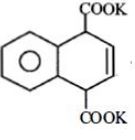
The following reaction is given:
$\xrightarrow{\text{Electrolysis}} A$
$A$ is
$\xrightarrow{\text{Electrolysis}} A$
$A$ is
A
B
C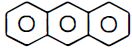
D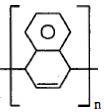
Solution
(B) The reaction is an example of Kolbe's electrolysis of a dicarboxylic acid salt.
$1$. Upon electrolysis,the carboxylate ions $(R-COO^-)$ lose electrons at the anode to form carboxyl radicals $(R-COO^{\bullet})$.
$2$. These radicals undergo decarboxylation to release $CO_2$ and form alkyl radicals $(R^{\bullet})$.
$3$. In this specific case,the two radical centers formed on the cyclohexane ring combine to form a double bond,resulting in the formation of naphthalene,which is stable due to its aromatic character.
Therefore,the product $A$ is naphthalene.
$1$. Upon electrolysis,the carboxylate ions $(R-COO^-)$ lose electrons at the anode to form carboxyl radicals $(R-COO^{\bullet})$.
$2$. These radicals undergo decarboxylation to release $CO_2$ and form alkyl radicals $(R^{\bullet})$.
$3$. In this specific case,the two radical centers formed on the cyclohexane ring combine to form a double bond,resulting in the formation of naphthalene,which is stable due to its aromatic character.
Therefore,the product $A$ is naphthalene.
0 likesView Solution
27
ChemistryDifficultMCQJEE Main · 2015
$1.4 \ g$ of an organic compound was digested according to Kjeldahl's method and the ammonia evolved was absorbed in $60 \ mL$ of $M/10 \ H_2SO_4$ solution. The excess sulphuric acid required $20 \ mL$ of $M/10 \ NaOH$ solution for neutralization. The percentage of nitrogen in the compound is
A
$10$
B
$3$
C
$24$
D
$5$
Solution
(A) Milli-equivalents of $H_2SO_4$ taken $= 60 \ mL \times \frac{1}{10} \times 2 = 12 \ mEq$.
Milli-equivalents of $NaOH$ used for back titration $= 20 \ mL \times \frac{1}{10} = 2 \ mEq$.
Milli-equivalents of $NH_3$ evolved $= 12 - 2 = 10 \ mEq$.
Percentage of Nitrogen $= \frac{1.4 \times \text{milli-equivalents of } NH_3}{\text{mass of organic compound in } g} = \frac{1.4 \times 10}{1.4} = 10 \%$.
Milli-equivalents of $NaOH$ used for back titration $= 20 \ mL \times \frac{1}{10} = 2 \ mEq$.
Milli-equivalents of $NH_3$ evolved $= 12 - 2 = 10 \ mEq$.
Percentage of Nitrogen $= \frac{1.4 \times \text{milli-equivalents of } NH_3}{\text{mass of organic compound in } g} = \frac{1.4 \times 10}{1.4} = 10 \%$.
0 likesView Solution
28
ChemistryMediumMCQJEE Main · 2015
Which of the following is not an assumption of the kinetic theory of gases?
A
Gas particles have negligible volume.
B
$A$ gas consists of many identical particles which are in continual motion.
C
At high pressure gas particles are difficult to compress.
D
Collisions of gas particles are perfectly elastic.
Solution
(C) The kinetic theory of gases assumes that gas particles occupy negligible volume and that collisions are perfectly elastic. However,it does not assume that gas particles are difficult to compress at high pressure. In reality,gases are compressible,and at high pressure,the volume of gas particles becomes significant,leading to deviations from ideal behavior.
0 likesView Solution
29
ChemistryMediumMCQJEE Main · 2015
Photochemical smog consists of an excessive amount of $X$,in addition to aldehydes,ketones,peroxyacetyl nitrate $(PAN)$,and so forth. $X$ is
A
$CO$
B
$CH_4$
C
$O_3$
D
$CO_2$
Solution
(C) Photochemical smog is formed by the action of sunlight on nitrogen oxides and hydrocarbons.
It consists of primary pollutants like nitrogen oxides ($NO$ and $NO_2$) and secondary pollutants such as ozone $(O_3)$,formaldehyde,acrolein,and peroxyacetyl nitrate $(PAN)$.
Among the given options,$O_3$ is a major component of photochemical smog.
It consists of primary pollutants like nitrogen oxides ($NO$ and $NO_2$) and secondary pollutants such as ozone $(O_3)$,formaldehyde,acrolein,and peroxyacetyl nitrate $(PAN)$.
Among the given options,$O_3$ is a major component of photochemical smog.
0 likesView Solution
30
ChemistryEasyMCQJEE Main · 2015
Permanent hardness in water cannot be cured by
A
Treatment with washing soda
B
Calgon's method
C
Boiling
D
Ion exchange method
Solution
(C) Permanent hardness is caused by the presence of dissolved chlorides and sulfates of $Ca^{2+}$ and $Mg^{2+}$ ions.
Boiling is only effective for removing temporary hardness,which is caused by the presence of $HCO_3^-$ (bicarbonate) ions.
Methods like treatment with washing soda $(Na_2CO_3)$,Calgon's method,and the ion exchange method are used to remove permanent hardness.
Boiling is only effective for removing temporary hardness,which is caused by the presence of $HCO_3^-$ (bicarbonate) ions.
Methods like treatment with washing soda $(Na_2CO_3)$,Calgon's method,and the ion exchange method are used to remove permanent hardness.
0 likesView Solution
31
ChemistryDifficultMCQJEE Main · 2015
After understanding the assertion and reason, choose the correct option.
Assertion : In the bonding molecular orbital $(MO)$ of $H_2,$ electron density is increased between the nuclei.
Reason : The bonding $MO$ is $\psi_A + \psi_B,$ which shows destructive interference of the combining electron waves.
Assertion : In the bonding molecular orbital $(MO)$ of $H_2,$ electron density is increased between the nuclei.
Reason : The bonding $MO$ is $\psi_A + \psi_B,$ which shows destructive interference of the combining electron waves.
A
Assertion is incorrect, reason is correct.
B
Assertion is correct, reason is incorrect.
C
Assertion and reason are correct and reason is the correct explanation for the assertion.
D
Assertion and reason are correct, but reason is not the correct explanation for the assertion.
Solution
(B) The assertion is correct because in a bonding molecular orbital $(MO)$, the electron density is concentrated in the region between the two nuclei, which leads to attraction and stability.
The reason is incorrect because the bonding $MO$ is formed by the constructive interference of the atomic orbitals $(\psi_A + \psi_B)$, not destructive interference. Destructive interference results in an antibonding molecular orbital $(\psi_A - \psi_B)$.
The reason is incorrect because the bonding $MO$ is formed by the constructive interference of the atomic orbitals $(\psi_A + \psi_B)$, not destructive interference. Destructive interference results in an antibonding molecular orbital $(\psi_A - \psi_B)$.
0 likesView Solution
32
ChemistryMediumMCQJEE Main · 2015
In the long form of the periodic table,the valence shell electronic configuration of $5s^2\,5p^4$ corresponds to the element present in
A
Group $16$ and period $6$
B
Group $17$ and period $6$
C
Group $16$ and period $5$
D
Group $17$ and period $5$
Solution
(C) The valence shell electronic configuration is given as $5s^2\,5p^4$.
The principal quantum number $n = 5$ indicates that the element belongs to period $5$.
The total number of valence electrons is $2 + 4 = 6$.
For $p$-block elements,the group number is calculated as $10 + \text{valence electrons} = 10 + 6 = 16$.
Therefore,the element belongs to group $16$ and period $5$.
The principal quantum number $n = 5$ indicates that the element belongs to period $5$.
The total number of valence electrons is $2 + 4 = 6$.
For $p$-block elements,the group number is calculated as $10 + \text{valence electrons} = 10 + 6 = 16$.
Therefore,the element belongs to group $16$ and period $5$.
0 likesView Solution
33
ChemistryDifficultMCQJEE Main · 2015
The correct order of thermal stability of hydroxides is
A
$Ba(OH)_2 < Ca(OH)_2 < Sr(OH)_2 < Mg(OH)_2$
B
$Mg(OH)_2 < Sr(OH)_2 < Ca(OH)_2 < Ba(OH)_2$
C
$Mg(OH)_2 < Ca(OH)_2 < Sr(OH)_2 < Ba(OH)_2$
D
$Ba(OH)_2 < Sr(OH)_2 < Ca(OH)_2 < Mg(OH)_2$
Solution
(C) The thermal stability of alkaline earth metal hydroxides increases down the group as the size of the metal cation increases.
As the size of the cation increases,the lattice energy changes,and the polarizing power of the cation decreases.
Therefore,the thermal stability increases in the order: $Mg(OH)_2 < Ca(OH)_2 < Sr(OH)_2 < Ba(OH)_2$.
As the size of the cation increases,the lattice energy changes,and the polarizing power of the cation decreases.
Therefore,the thermal stability increases in the order: $Mg(OH)_2 < Ca(OH)_2 < Sr(OH)_2 < Ba(OH)_2$.
0 likesView Solution
34
ChemistryDifficultMCQJEE Main · 2015
The heat of atomization of methane and ethane are $360 \ kJ/mol$ and $620 \ kJ/mol,$ respectively. The longest wavelength of light capable of breaking the $C-C$ bond is (Avogadro number $= 6.02 \times 10^{23},$ $h = 6.62 \times 10^{-34} \ J \cdot s$)
A
$2.48 \times 10^4 \ nm$
B
$1.49 \times 10^3 \ nm$
C
$2.48 \times 10^3 \ nm$
D
$1.49 \times 10^4 \ nm$
Solution
(B) In $CH_4,$ the heat of atomization corresponds to $4 \times BE_{(C-H)} = 360 \ kJ/mol.$
Therefore,$BE_{(C-H)} = 90 \ kJ/mol.$
In $C_2H_6,$ the heat of atomization corresponds to $BE_{(C-C)} + 6 \times BE_{(C-H)} = 620 \ kJ/mol.$
Substituting $BE_{(C-H)} = 90 \ kJ/mol,$ we get $BE_{(C-C)} + 6(90) = 620 \ kJ/mol.$
Therefore,$BE_{(C-C)} = 620 - 540 = 80 \ kJ/mol.$
The energy required per molecule is $E = \frac{80 \times 10^3 \ J/mol}{6.02 \times 10^{23} \ molecules/mol} \approx 1.329 \times 10^{-19} \ J/molecule.$
Using the relation $E = \frac{hc}{\lambda},$ the wavelength is $\lambda = \frac{hc}{E}.$
$\lambda = \frac{6.62 \times 10^{-34} \ J \cdot s \times 3 \times 10^8 \ m/s}{1.329 \times 10^{-19} \ J} \approx 1.494 \times 10^{-6} \ m.$
Converting to nanometers,$\lambda \approx 1.494 \times 10^3 \ nm.$
Thus,the correct option is $B$.
Therefore,$BE_{(C-H)} = 90 \ kJ/mol.$
In $C_2H_6,$ the heat of atomization corresponds to $BE_{(C-C)} + 6 \times BE_{(C-H)} = 620 \ kJ/mol.$
Substituting $BE_{(C-H)} = 90 \ kJ/mol,$ we get $BE_{(C-C)} + 6(90) = 620 \ kJ/mol.$
Therefore,$BE_{(C-C)} = 620 - 540 = 80 \ kJ/mol.$
The energy required per molecule is $E = \frac{80 \times 10^3 \ J/mol}{6.02 \times 10^{23} \ molecules/mol} \approx 1.329 \times 10^{-19} \ J/molecule.$
Using the relation $E = \frac{hc}{\lambda},$ the wavelength is $\lambda = \frac{hc}{E}.$
$\lambda = \frac{6.62 \times 10^{-34} \ J \cdot s \times 3 \times 10^8 \ m/s}{1.329 \times 10^{-19} \ J} \approx 1.494 \times 10^{-6} \ m.$
Converting to nanometers,$\lambda \approx 1.494 \times 10^3 \ nm.$
Thus,the correct option is $B$.
0 likesView Solution
35
ChemistryDifficultMCQJEE Main · 2015
Gaseous $N_2O_4$ dissociates into gaseous $NO_2$ according to the reaction:
$N_2O_{4(g)} \rightleftharpoons 2NO_{2(g)}$
At $300 \ K$ and $1 \ atm$ pressure,the degree of dissociation of $N_2O_4$ is $0.2$. If one mole of $N_2O_4$ gas is contained in a vessel,then the density of the equilibrium mixture is.......$g/L$
$N_2O_{4(g)} \rightleftharpoons 2NO_{2(g)}$
At $300 \ K$ and $1 \ atm$ pressure,the degree of dissociation of $N_2O_4$ is $0.2$. If one mole of $N_2O_4$ gas is contained in a vessel,then the density of the equilibrium mixture is.......$g/L$
A
$1.56$
B
$6.22$
C
$3.11$
D
$4.56$
Solution
(C) Reaction: $N_2O_{4(g)} \rightleftharpoons 2NO_{2(g)}$
Initial moles $(t=0)$: $1 \ mol$ of $N_2O_4$ and $0 \ mol$ of $NO_2$.
At equilibrium $(t=eq)$: $(1-\alpha) \ mol$ of $N_2O_4$ and $2\alpha \ mol$ of $NO_2$,where $\alpha = 0.2$.
Total moles at equilibrium: $n_{total} = (1-\alpha) + 2\alpha = 1 + \alpha = 1 + 0.2 = 1.2 \ mol$.
Molar mass of $N_2O_4 = 92 \ g/mol$ and $NO_2 = 46 \ g/mol$.
Average molar mass of the mixture $(M_{mix})$:
$M_{mix} = \frac{(1 - \alpha) \times 92 + 2\alpha \times 46}{1 + \alpha} = \frac{0.8 \times 92 + 0.4 \times 46}{1.2} = \frac{73.6 + 18.4}{1.2} = \frac{92}{1.2} = 76.66 \ g/mol$.
Using the ideal gas law $PV = nRT$ or $PM = dRT$:
$d = \frac{P \times M_{mix}}{R \times T} = \frac{1 \times 76.66}{0.0821 \times 300} = \frac{76.66}{24.63} \approx 3.11 \ g/L$.
Initial moles $(t=0)$: $1 \ mol$ of $N_2O_4$ and $0 \ mol$ of $NO_2$.
At equilibrium $(t=eq)$: $(1-\alpha) \ mol$ of $N_2O_4$ and $2\alpha \ mol$ of $NO_2$,where $\alpha = 0.2$.
Total moles at equilibrium: $n_{total} = (1-\alpha) + 2\alpha = 1 + \alpha = 1 + 0.2 = 1.2 \ mol$.
Molar mass of $N_2O_4 = 92 \ g/mol$ and $NO_2 = 46 \ g/mol$.
Average molar mass of the mixture $(M_{mix})$:
$M_{mix} = \frac{(1 - \alpha) \times 92 + 2\alpha \times 46}{1 + \alpha} = \frac{0.8 \times 92 + 0.4 \times 46}{1.2} = \frac{73.6 + 18.4}{1.2} = \frac{92}{1.2} = 76.66 \ g/mol$.
Using the ideal gas law $PV = nRT$ or $PM = dRT$:
$d = \frac{P \times M_{mix}}{R \times T} = \frac{1 \times 76.66}{0.0821 \times 300} = \frac{76.66}{24.63} \approx 3.11 \ g/L$.
0 likesView Solution
36
ChemistryMediumMCQJEE Main · 2015
The geometry of $XeOF_4$ by $VSEPR$ theory is
A
pentagonal planar
B
octahedral
C
square pyramidal
D
trigonal bipyramidal
Solution
(C) In $XeOF_4$,the central atom $Xe$ has $8$ valence electrons.
It forms $4$ single bonds with $F$ atoms and $1$ double bond with the $O$ atom,utilizing $6$ electrons for bonding.
This leaves $2$ electrons,forming $1$ lone pair.
Total electron pairs = $5$ bond pairs + $1$ lone pair = $6$ electron pairs.
With $6$ electron pairs,the hybridization is $sp^3d^2$,which corresponds to an octahedral electron geometry.
Due to the presence of $1$ lone pair,the molecular geometry is square pyramidal.
It forms $4$ single bonds with $F$ atoms and $1$ double bond with the $O$ atom,utilizing $6$ electrons for bonding.
This leaves $2$ electrons,forming $1$ lone pair.
Total electron pairs = $5$ bond pairs + $1$ lone pair = $6$ electron pairs.
With $6$ electron pairs,the hybridization is $sp^3d^2$,which corresponds to an octahedral electron geometry.
Due to the presence of $1$ lone pair,the molecular geometry is square pyramidal.
0 likesView Solution
37
ChemistryMCQJEE Main · 2015
If $y(x)$ is the solution of the differential equation $(x + 2)\frac{dy}{dx} = x^2 + 4x - 9, x \ne -2$ and $y(0) = 0$,then $y(-4)$ is equal to
A
$0$
B
$2$
C
$1$
D
$-1$
Solution
(A) Given the differential equation: $(x + 2)\frac{dy}{dx} = x^2 + 4x - 9$.
Rearranging for $dy$:
$dy = \frac{x^2 + 4x - 9}{x + 2} dx$.
Perform polynomial division on the right side:
$\frac{x^2 + 4x - 9}{x + 2} = \frac{x(x + 2) + 2x - 9}{x + 2} = x + \frac{2x - 9}{x + 2} = x + \frac{2(x + 2) - 13}{x + 2} = x + 2 - \frac{13}{x + 2}$.
Integrating both sides:
$y = \int (x + 2 - \frac{13}{x + 2}) dx = \frac{x^2}{2} + 2x - 13 \ln|x + 2| + C$.
Using the initial condition $y(0) = 0$:
$0 = \frac{0^2}{2} + 2(0) - 13 \ln|0 + 2| + C \implies C = 13 \ln 2$.
So,the solution is $y(x) = \frac{x^2}{2} + 2x - 13 \ln|x + 2| + 13 \ln 2$.
Now,find $y(-4)$:
$y(-4) = \frac{(-4)^2}{2} + 2(-4) - 13 \ln|-4 + 2| + 13 \ln 2$
$y(-4) = \frac{16}{2} - 8 - 13 \ln 2 + 13 \ln 2$
$y(-4) = 8 - 8 = 0$.
Rearranging for $dy$:
$dy = \frac{x^2 + 4x - 9}{x + 2} dx$.
Perform polynomial division on the right side:
$\frac{x^2 + 4x - 9}{x + 2} = \frac{x(x + 2) + 2x - 9}{x + 2} = x + \frac{2x - 9}{x + 2} = x + \frac{2(x + 2) - 13}{x + 2} = x + 2 - \frac{13}{x + 2}$.
Integrating both sides:
$y = \int (x + 2 - \frac{13}{x + 2}) dx = \frac{x^2}{2} + 2x - 13 \ln|x + 2| + C$.
Using the initial condition $y(0) = 0$:
$0 = \frac{0^2}{2} + 2(0) - 13 \ln|0 + 2| + C \implies C = 13 \ln 2$.
So,the solution is $y(x) = \frac{x^2}{2} + 2x - 13 \ln|x + 2| + 13 \ln 2$.
Now,find $y(-4)$:
$y(-4) = \frac{(-4)^2}{2} + 2(-4) - 13 \ln|-4 + 2| + 13 \ln 2$
$y(-4) = \frac{16}{2} - 8 - 13 \ln 2 + 13 \ln 2$
$y(-4) = 8 - 8 = 0$.
0 likesView Solution
38
ChemistryDifficultMCQJEE Main · 2015
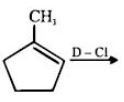
What is the major product expected from the following reaction?
Where $D$ is an isotope of hydrogen.
Where $D$ is an isotope of hydrogen.
A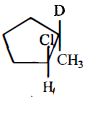
B
C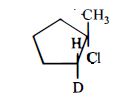
D
Both $(b)$ and $(c)$
Solution
(D) The reaction of $1$-methylcyclopentene with $D-Cl$ proceeds via an electrophilic addition mechanism.
$1$. The electrophile $D^+$ attacks the double bond to form the more stable tertiary carbocation at the $C-1$ position.
$2$. The resulting carbocation is $sp^2$ hybridized and planar.
$3$. The nucleophile $Cl^-$ can attack the planar carbocation from either the top or the bottom face with equal probability.
$4$. This leads to the formation of both possible stereoisomers (diastereomers) where the $Cl$ atom and the $CH_3$ group can be either cis or trans to each other relative to the $D$ atom.
$5$. Therefore,both products shown in $(b)$ and $(c)$ are formed.
$1$. The electrophile $D^+$ attacks the double bond to form the more stable tertiary carbocation at the $C-1$ position.
$2$. The resulting carbocation is $sp^2$ hybridized and planar.
$3$. The nucleophile $Cl^-$ can attack the planar carbocation from either the top or the bottom face with equal probability.
$4$. This leads to the formation of both possible stereoisomers (diastereomers) where the $Cl$ atom and the $CH_3$ group can be either cis or trans to each other relative to the $D$ atom.
$5$. Therefore,both products shown in $(b)$ and $(c)$ are formed.
0 likesView Solution
39
ChemistryMediumMCQJEE Main · 2015
Which physical property of dihydrogen $(H_2)$ is wrong?
A
Odourless gas
B
Tasteless gas
C
Colourless gas
D
Non-inflammable gas
Solution
(D) $H_2$ is a highly inflammable gas. Therefore,the statement that it is a non-inflammable gas is incorrect.
0 likesView Solution
40
ChemistryMediumMCQJEE Main · 2015
The number of structural isomers for $C_6H_{14}$ is
A
$4$
B
$3$
C
$6$
D
$5$
Solution
(D) The molecular formula $C_6H_{14}$ corresponds to an alkane. The structural isomers are:
$1$. $n$-hexane: $CH_3-CH_2-CH_2-CH_2-CH_2-CH_3$
$2$. $2$-methylpentane: $CH_3-CH(CH_3)-CH_2-CH_2-CH_3$
$3$. $3$-methylpentane: $CH_3-CH_2-CH(CH_3)-CH_2-CH_3$
$4$. $2,3$-dimethylbutane: $CH_3-CH(CH_3)-CH(CH_3)-CH_3$
$5$. $2,2$-dimethylbutane: $CH_3-C(CH_3)_2-CH_2-CH_3$
Thus,there are a total of $5$ structural isomers.
$1$. $n$-hexane: $CH_3-CH_2-CH_2-CH_2-CH_2-CH_3$
$2$. $2$-methylpentane: $CH_3-CH(CH_3)-CH_2-CH_2-CH_3$
$3$. $3$-methylpentane: $CH_3-CH_2-CH(CH_3)-CH_2-CH_3$
$4$. $2,3$-dimethylbutane: $CH_3-CH(CH_3)-CH(CH_3)-CH_3$
$5$. $2,2$-dimethylbutane: $CH_3-C(CH_3)_2-CH_2-CH_3$
Thus,there are a total of $5$ structural isomers.
0 likesView Solution
41
ChemistryDifficultMCQJEE Main · 2015
Match the organic compounds in column $I$ with the Lassaigne's test results in column $II$ appropriately.
| Column $I$ | Column $II$ |
|---|---|
| $A$. Aniline | $i$. Red colour with $FeCl_3$ |
| $B$. Benzene sulfonic acid | $ii$. Violet colour with sodium nitroprusside |
| $C$. Thiourea | $iii$. Blue colour with hot and acidic solution of $FeSO_4$ |
A
$A-iii, B-i, C-ii$
B
$A-ii, B-i, C-iii$
C
$A-i, B-ii, C-iii$
D
$A-iii, B-ii, C-i$
Solution
(A) In Lassaigne's test,fusion with sodium takes place and the following species are formed:
$A$. Aniline $(C_6H_5NH_2)$ contains $N$,which forms $CN^-$ ions. $CN^-$ reacts with hot and acidic solution of $FeSO_4$ to form $Fe_4[Fe(CN)_6]_3$ (Prussian blue),which is blue in colour. Thus,$A-iii$.
$B$. Benzene sulfonic acid $(C_6H_5SO_3H)$ contains $S$,which forms $S^{2-}$ ions. However,the question implies a phenolic derivative or specific test context. Given the options,if we consider the formation of a phenoxide-like species or specific test,$FeCl_3$ is used for phenol tests (red/violet colour). Thus,$B-i$.
$C$. Thiourea $(NH_2CSNH_2)$ contains both $N$ and $S$. The $S^{2-}$ ions formed react with sodium nitroprusside $(Na_2[Fe(CN)_5NO])$ to give a violet colour. Thus,$C-ii$.
Therefore,the correct match is $A-iii, B-i, C-ii$.
$A$. Aniline $(C_6H_5NH_2)$ contains $N$,which forms $CN^-$ ions. $CN^-$ reacts with hot and acidic solution of $FeSO_4$ to form $Fe_4[Fe(CN)_6]_3$ (Prussian blue),which is blue in colour. Thus,$A-iii$.
$B$. Benzene sulfonic acid $(C_6H_5SO_3H)$ contains $S$,which forms $S^{2-}$ ions. However,the question implies a phenolic derivative or specific test context. Given the options,if we consider the formation of a phenoxide-like species or specific test,$FeCl_3$ is used for phenol tests (red/violet colour). Thus,$B-i$.
$C$. Thiourea $(NH_2CSNH_2)$ contains both $N$ and $S$. The $S^{2-}$ ions formed react with sodium nitroprusside $(Na_2[Fe(CN)_5NO])$ to give a violet colour. Thus,$C-ii$.
Therefore,the correct match is $A-iii, B-i, C-ii$.
0 likesView Solution
42
ChemistryMediumMCQJEE Main · 2015
The increase of pressure on the ice $\rightleftharpoons$ water system at constant temperature will lead to:
A
a decrease in the entropy of the system
B
an increase in the Gibb's energy of the system
C
no effect on the equilibrium
D
a shift of the equilibrium in the forward direction
Solution
(D) The density of liquid water is higher than that of ice,which means the volume of ice is greater than the volume of an equivalent mass of liquid water $(V_{\text{ice}} > V_{\text{water}})$.
According to Le Chatelier's principle,an increase in pressure favors the direction that results in a decrease in volume.
Since the forward reaction (ice $\rightarrow$ water) involves a decrease in volume,the equilibrium will shift in the forward direction.
According to Le Chatelier's principle,an increase in pressure favors the direction that results in a decrease in volume.
Since the forward reaction (ice $\rightarrow$ water) involves a decrease in volume,the equilibrium will shift in the forward direction.
0 likesView Solution
43
ChemistryMCQJEE Main · 2015
Accumulation of which of the following molecules in the muscles occurs as a result of vigorous exercise?
A
Glycogen
B
Glucose
C
Pyruvic acid
D
$L^{-}$-lactic acid
Solution
(D) During vigorous exercise,the demand for energy in the muscles increases significantly.
Since the supply of oxygen is insufficient to meet this demand through aerobic respiration,the muscles switch to anaerobic respiration.
In this process,$Glucose$ is converted into $Pyruvic \ acid$ via glycolysis.
Under anaerobic conditions,$Pyruvic \ acid$ is further reduced to $L^{-}$-lactic acid.
The accumulation of $L^{-}$-lactic acid in the muscle tissues leads to fatigue and muscle cramps.
Since the supply of oxygen is insufficient to meet this demand through aerobic respiration,the muscles switch to anaerobic respiration.
In this process,$Glucose$ is converted into $Pyruvic \ acid$ via glycolysis.
Under anaerobic conditions,$Pyruvic \ acid$ is further reduced to $L^{-}$-lactic acid.
The accumulation of $L^{-}$-lactic acid in the muscle tissues leads to fatigue and muscle cramps.
0 likesView Solution
44
ChemistryDifficultMCQJEE Main · 2015
Which of the alkaline earth metal halides given below is essentially covalent in nature?
A
$SrCl_2$
B
$CaCl_2$
C
$BaCl_2$
D
$MgCl_2$
Solution
(D) According to Fajan's rule,covalent character increases as the size of the cation decreases and its charge density increases.
Among the alkaline earth metal ions ($Mg^{2+}$,$Ca^{2+}$,$Sr^{2+}$,$Ba^{2+}$),the $Mg^{2+}$ ion has the smallest size.
Therefore,$MgCl_2$ exhibits the most significant covalent character among the given halides.
Among the alkaline earth metal ions ($Mg^{2+}$,$Ca^{2+}$,$Sr^{2+}$,$Ba^{2+}$),the $Mg^{2+}$ ion has the smallest size.
Therefore,$MgCl_2$ exhibits the most significant covalent character among the given halides.
0 likesView Solution
45
ChemistryMediumMCQJEE Main · 2015
When does a gas deviate the most from its ideal behaviour?
A
At low pressure and low temperature
B
At low pressure and high temperature
C
At high pressure and low temperature
D
At high pressure and high temperature
Solution
(C) gas deviates from ideal behaviour when the assumptions of the kinetic molecular theory are no longer valid.
At $high$ pressure,the volume occupied by the gas molecules becomes significant compared to the total volume of the container.
At $low$ temperature,the kinetic energy of the molecules decreases,making intermolecular forces of attraction significant.
Therefore,at $high$ pressure and $low$ temperature,the gas deviates the most from its ideal behaviour.
At $high$ pressure,the volume occupied by the gas molecules becomes significant compared to the total volume of the container.
At $low$ temperature,the kinetic energy of the molecules decreases,making intermolecular forces of attraction significant.
Therefore,at $high$ pressure and $low$ temperature,the gas deviates the most from its ideal behaviour.
0 likesView Solution
46
ChemistryDifficultMCQJEE Main · 2015
Which compound exhibits the maximum dipole moment among the following?
A
o-Nitroaniline
B
Nitrobenzene
C
p-Nitroaniline
D
m-Nitroaniline
Solution
(C) The dipole moment $(\mu)$ is defined as the product of the magnitude of the charge $(q)$ and the distance $(d)$ between the centers of positive and negative charges,i.e.,$\mu = q \times d$.
In $p$-nitroaniline,the electron-donating $-NH_2$ group and the electron-withdrawing $-NO_2$ group are at the para positions.
Due to resonance,there is a significant charge separation where the lone pair on the nitrogen of the $-NH_2$ group is delocalized towards the $-NO_2$ group,creating a strong polar structure with a large distance between the partial positive and negative charges.
This resonance effect is most pronounced in the para isomer due to its linear geometry,leading to the maximum dipole moment compared to the ortho and meta isomers.
In $p$-nitroaniline,the electron-donating $-NH_2$ group and the electron-withdrawing $-NO_2$ group are at the para positions.
Due to resonance,there is a significant charge separation where the lone pair on the nitrogen of the $-NH_2$ group is delocalized towards the $-NO_2$ group,creating a strong polar structure with a large distance between the partial positive and negative charges.
This resonance effect is most pronounced in the para isomer due to its linear geometry,leading to the maximum dipole moment compared to the ortho and meta isomers.
0 likesView Solution
47
ChemistryDifficultMCQJEE Main · 2015
Addition of phosphate fertilisers to water bodies causes
A
increase in amount of dissolved oxygen in water
B
deposition of calcium phosphate
C
increase in fish population
D
enhanced growth of algae
Solution
(D) The addition of phosphate-containing fertilisers to water bodies leads to a process known as $Eutrophication$.
Phosphates act as limiting nutrients for aquatic plants.
When these fertilisers enter water bodies,they promote the excessive growth of algae,which is known as an algal bloom.
This excessive growth eventually leads to the depletion of dissolved oxygen in the water,which can harm aquatic life.
Phosphates act as limiting nutrients for aquatic plants.
When these fertilisers enter water bodies,they promote the excessive growth of algae,which is known as an algal bloom.
This excessive growth eventually leads to the depletion of dissolved oxygen in the water,which can harm aquatic life.
0 likesView Solution
48
ChemistryDifficultMCQJEE Main · 2015
At temperature $T$,the average kinetic energy of any particle is $\frac{3}{2} KT$. The de Broglie wavelength follows the order:
A
Visible photon $>$ Thermal neutron $>$ Thermal electron
B
Thermal proton $>$ Thermal electron $>$ Visible photon
C
Thermal proton $>$ Visible photon $>$ Thermal electron
D
Visible photon $>$ Thermal electron $>$ Thermal neutron
Solution
(D) The kinetic energy of a particle is given by $K.E. = \frac{3}{2} KT = \frac{1}{2} mv^2$.
Thus,$v = \sqrt{\frac{3KT}{m}}$.
The de Broglie wavelength is $\lambda = \frac{h}{mv} = \frac{h}{m \sqrt{\frac{3KT}{m}}} = \frac{h}{\sqrt{3KTm}}$.
This implies $\lambda \propto \frac{1}{\sqrt{m}}$.
Since the mass of a photon is effectively zero (or it travels at $c$),it has the largest wavelength.
Comparing particles,$m_{\text{electron}} < m_{\text{neutron}} < m_{\text{proton}}$.
Therefore,$\lambda_{\text{electron}} > \lambda_{\text{neutron}} > \lambda_{\text{proton}}$.
Considering the photon,the order is $\lambda_{\text{photon}} > \lambda_{\text{electron}} > \lambda_{\text{neutron}}$.
Thus,$v = \sqrt{\frac{3KT}{m}}$.
The de Broglie wavelength is $\lambda = \frac{h}{mv} = \frac{h}{m \sqrt{\frac{3KT}{m}}} = \frac{h}{\sqrt{3KTm}}$.
This implies $\lambda \propto \frac{1}{\sqrt{m}}$.
Since the mass of a photon is effectively zero (or it travels at $c$),it has the largest wavelength.
Comparing particles,$m_{\text{electron}} < m_{\text{neutron}} < m_{\text{proton}}$.
Therefore,$\lambda_{\text{electron}} > \lambda_{\text{neutron}} > \lambda_{\text{proton}}$.
Considering the photon,the order is $\lambda_{\text{photon}} > \lambda_{\text{electron}} > \lambda_{\text{neutron}}$.
0 likesView Solution
49
ChemistryDifficultMCQJEE Main · 2015
$A + 2B + 3C \rightleftharpoons AB_2C_3$. Reaction of $6.0 \ g$ of $A$,$6.0 \times 10^{23}$ atoms of $B$,and $0.036 \ mol$ of $C$ yields $4.8 \ g$ of compound $AB_2C_3$. If the atomic mass of $A$ and $C$ are $60$ and $80 \ amu$,respectively,the atomic mass of $B$ is .............. $amu$ (Avogadro no. $= 6 \times 10^{23}$)
A
$50$
B
$60$
C
$70$
D
$40$
Solution
(A) The balanced chemical equation is: $A + 2B + 3C \rightleftharpoons AB_2C_3$
Calculate the moles of reactants:
$n_A = \frac{6.0 \ g}{60 \ g/mol} = 0.1 \ mol$
$n_B = \frac{6.0 \times 10^{23}}{6 \times 10^{23}} = 1.0 \ mol$
$n_C = 0.036 \ mol$
Determine the limiting reagent:
For $A$: $0.1 / 1 = 0.1$
For $B$: $1.0 / 2 = 0.5$
For $C$: $0.036 / 3 = 0.012$
Since $C$ has the lowest ratio,it is the limiting reagent.
Calculate moles of product $AB_2C_3$ formed:
$n_{AB_2C_3} = \frac{n_C}{3} = \frac{0.036}{3} = 0.012 \ mol$
Calculate the molar mass of $AB_2C_3$:
$M.M. = \frac{\text{mass}}{\text{moles}} = \frac{4.8 \ g}{0.012 \ mol} = 400 \ g/mol$
Calculate atomic mass of $B$ $(x)$:
$400 = (1 \times 60) + (2 \times x) + (3 \times 80)$
$400 = 60 + 2x + 240$
$400 = 300 + 2x$
$2x = 100$
$x = 50 \ amu$
Calculate the moles of reactants:
$n_A = \frac{6.0 \ g}{60 \ g/mol} = 0.1 \ mol$
$n_B = \frac{6.0 \times 10^{23}}{6 \times 10^{23}} = 1.0 \ mol$
$n_C = 0.036 \ mol$
Determine the limiting reagent:
For $A$: $0.1 / 1 = 0.1$
For $B$: $1.0 / 2 = 0.5$
For $C$: $0.036 / 3 = 0.012$
Since $C$ has the lowest ratio,it is the limiting reagent.
Calculate moles of product $AB_2C_3$ formed:
$n_{AB_2C_3} = \frac{n_C}{3} = \frac{0.036}{3} = 0.012 \ mol$
Calculate the molar mass of $AB_2C_3$:
$M.M. = \frac{\text{mass}}{\text{moles}} = \frac{4.8 \ g}{0.012 \ mol} = 400 \ g/mol$
Calculate atomic mass of $B$ $(x)$:
$400 = (1 \times 60) + (2 \times x) + (3 \times 80)$
$400 = 60 + 2x + 240$
$400 = 300 + 2x$
$2x = 100$
$x = 50 \ amu$
0 likesView Solution
50
ChemistryMediumMCQJEE Main · 2015
Which of the following pairs of compounds are positional isomers?
A
$CH_3-CH_2-CH_2-CO-CH_3$ and $CH_3-CH_2-CO-CH_2-CH_3$
B
$CH_3-CH_2-CH_2-CH_2-CHO$ and $CH_3-CH_2-CH_2-CO-CH_3$
C
$CH_3-CH_2-CH_2-CO-CH_3$ and $CH_3-CH(CH_3)-CH_2-CHO$
D
$CH_3-CH_2-CO-CH_2-CH_3$ and $CH_3-CH(CH_3)-CH_2-CHO$
Solution
(A) Positional isomers are compounds that have the same molecular formula and the same functional group,but the functional group is attached to different positions on the carbon chain.
In option $A$,$CH_3-CH_2-CH_2-CO-CH_3$ is $pentan-2-one$ and $CH_3-CH_2-CO-CH_2-CH_3$ is $pentan-3-one$.
Both have the same molecular formula $C_5H_{10}O$ and the same ketone functional group,but the carbonyl group is at the $C-2$ position in the first compound and the $C-3$ position in the second compound.
Therefore,they are positional isomers.
In option $A$,$CH_3-CH_2-CH_2-CO-CH_3$ is $pentan-2-one$ and $CH_3-CH_2-CO-CH_2-CH_3$ is $pentan-3-one$.
Both have the same molecular formula $C_5H_{10}O$ and the same ketone functional group,but the carbonyl group is at the $C-2$ position in the first compound and the $C-3$ position in the second compound.
Therefore,they are positional isomers.
0 likesView Solution
51
ChemistryAdvancedMCQJEE Main · 2015
$3 \, g$ of activated charcoal was added to $50 \, mL$ of acetic acid solution $(0.06 \, N)$ in a flask. After an hour,it was filtered and the strength of the filtrate was found to be $0.042 \, N$. The amount of acetic acid adsorbed (per gram of charcoal) is: .............. $mg$
A
$42$
B
$54$
C
$18$
D
$36$
Solution
(C) The initial amount of acetic acid in $50 \, mL$ of $0.06 \, N$ solution is calculated as:
$w_1 = \frac{N \times M_{wt} \times V}{1000} = \frac{0.06 \times 60 \times 50}{1000} = 0.18 \, g = 180 \, mg$.
The final amount of acetic acid in the filtrate after adsorption is:
$w_2 = \frac{0.042 \times 60 \times 50}{1000} = 0.126 \, g = 126 \, mg$.
The amount of acetic acid adsorbed by $3 \, g$ of charcoal is:
$w_{ads} = 180 \, mg - 126 \, mg = 54 \, mg$.
The amount of acetic acid adsorbed per gram of charcoal is:
$\frac{54 \, mg}{3 \, g} = 18 \, mg/g$.
$w_1 = \frac{N \times M_{wt} \times V}{1000} = \frac{0.06 \times 60 \times 50}{1000} = 0.18 \, g = 180 \, mg$.
The final amount of acetic acid in the filtrate after adsorption is:
$w_2 = \frac{0.042 \times 60 \times 50}{1000} = 0.126 \, g = 126 \, mg$.
The amount of acetic acid adsorbed by $3 \, g$ of charcoal is:
$w_{ads} = 180 \, mg - 126 \, mg = 54 \, mg$.
The amount of acetic acid adsorbed per gram of charcoal is:
$\frac{54 \, mg}{3 \, g} = 18 \, mg/g$.
0 likesView Solution
52
ChemistryDifficultMCQJEE Main · 2015
The vapour pressure of acetone at $20\,^{\circ}C$ is $185\,torr.$ When $1.2\,g$ of a non-volatile substance was dissolved in $100\,g$ of acetone at $20\,^{\circ}C,$ its vapour pressure was $183\,torr.$ The molar mass $(g\,mol^{-1})$ of the substance is:
A
$128$
B
$488$
C
$32$
D
$64$
Solution
(D) The relative lowering of vapour pressure is given by the formula: $\frac{P^o - P_s}{P_s} = \frac{w_2 \times M_1}{w_1 \times M_2}$
Here,$P^o = 185\,torr$ (vapour pressure of pure solvent),
$P_s = 183\,torr$ (vapour pressure of solution),
$w_1 = 100\,g$ (mass of solvent,acetone),
$M_1 = 58\,g\,mol^{-1}$ (molar mass of acetone,$CH_3COCH_3$),
$w_2 = 1.2\,g$ (mass of solute),
$M_2 = ?$ (molar mass of solute).
Substituting the values:
$\frac{185 - 183}{183} = \frac{1.2 \times 58}{100 \times M_2}$
$\frac{2}{183} = \frac{69.6}{100 \times M_2}$
$M_2 = \frac{69.6 \times 183}{2 \times 100} = \frac{12736.8}{200} = 63.684 \approx 64\,g\,mol^{-1}$.
Here,$P^o = 185\,torr$ (vapour pressure of pure solvent),
$P_s = 183\,torr$ (vapour pressure of solution),
$w_1 = 100\,g$ (mass of solvent,acetone),
$M_1 = 58\,g\,mol^{-1}$ (molar mass of acetone,$CH_3COCH_3$),
$w_2 = 1.2\,g$ (mass of solute),
$M_2 = ?$ (molar mass of solute).
Substituting the values:
$\frac{185 - 183}{183} = \frac{1.2 \times 58}{100 \times M_2}$
$\frac{2}{183} = \frac{69.6}{100 \times M_2}$
$M_2 = \frac{69.6 \times 183}{2 \times 100} = \frac{12736.8}{200} = 63.684 \approx 64\,g\,mol^{-1}$.
0 likesView Solution
53
ChemistryDifficultMCQJEE Main · 2015
Two Faraday of electricity is passed through a solution of $CuSO_4$. The mass of copper deposited at the cathode is ......... $g$. (at. mass of $Cu = 63.5 \ amu$)
A
$2$
B
$127$
C
$0$
D
$63.5$
Solution
(D) The reduction reaction at the cathode is: $Cu^{2+} + 2e^{-} \longrightarrow Cu(s)$.
According to the stoichiometry of the reaction,$2 \ mol$ of electrons ($2 \ F$ of electricity) are required to deposit $1 \ mol$ of $Cu$.
The molar mass of $Cu$ is $63.5 \ g/mol$.
Therefore,passing $2 \ F$ of electricity deposits $63.5 \ g$ of $Cu$ at the cathode.
According to the stoichiometry of the reaction,$2 \ mol$ of electrons ($2 \ F$ of electricity) are required to deposit $1 \ mol$ of $Cu$.
The molar mass of $Cu$ is $63.5 \ g/mol$.
Therefore,passing $2 \ F$ of electricity deposits $63.5 \ g$ of $Cu$ at the cathode.
0 likesView Solution
54
ChemistryDifficultMCQJEE Main · 2015
Higher order $(> 3)$ reactions are rare due to:
A
shifting of equilibrium towards reactants due to elastic collisions
B
loss of active species on collision
C
low probability of simultaneous collision of all the reacting species
D
increase in entropy and activation energy as more molecules are involved
Solution
(C) Higher order $(> 3)$ reactions are rare because the probability of simultaneous collision of all the reacting species is extremely low.
For a reaction to occur,molecules must collide with sufficient energy and proper orientation.
As the number of molecules involved in a single step increases,the likelihood of them colliding at the same time and place decreases significantly.
For a reaction to occur,molecules must collide with sufficient energy and proper orientation.
As the number of molecules involved in a single step increases,the likelihood of them colliding at the same time and place decreases significantly.
0 likesView Solution
55
ChemistryDifficultMCQJEE Main · 2015
In the context of the Hall-Heroult process for the extraction of $Al$,which of the following statements is false?
A
$Al^{3+}$ is reduced at the cathode to form $Al$
B
$Na_3AlF_6$ serves as the electrolyte
C
$CO$ and $CO_2$ are produced in this process
D
$Al_2O_3$ is mixed with $CaF_2$ which lowers the melting point of the mixture and brings conductivity
Solution
(B) In the Hall-Heroult process,$Al_2O_3$ is dissolved in molten cryolite $(Na_3AlF_6)$ and fluorspar $(CaF_2)$,which lowers the melting point of the mixture and increases electrical conductivity.
$Al^{3+}$ is reduced to $Al$ at the cathode.
Carbon anodes are oxidized to $CO$ and $CO_2$.
$Na_3AlF_6$ (cryolite) acts as a solvent for $Al_2O_3$,not as the electrolyte itself; the mixture of $Al_2O_3$ and cryolite acts as the electrolyte. Therefore,the statement that $Na_3AlF_6$ serves as the electrolyte is technically false as it is a component of the electrolytic mixture.
$Al^{3+}$ is reduced to $Al$ at the cathode.
Carbon anodes are oxidized to $CO$ and $CO_2$.
$Na_3AlF_6$ (cryolite) acts as a solvent for $Al_2O_3$,not as the electrolyte itself; the mixture of $Al_2O_3$ and cryolite acts as the electrolyte. Therefore,the statement that $Na_3AlF_6$ serves as the electrolyte is technically false as it is a component of the electrolytic mixture.
0 likesView Solution
56
ChemistryMediumMCQJEE Main · 2015
$Assertion :$ Nitrogen and oxygen are the main components in the atmosphere but these do not react to form oxides of nitrogen.
$Reason :$ The reaction between nitrogen and oxygen requires high temperature.
$Reason :$ The reaction between nitrogen and oxygen requires high temperature.
A
The assertion is incorrect,but the reason is correct
B
Both the assertion and reason are incorrect
C
Both assertion and reason are correct,and the reason is the correct explanation for the assertion
D
Both assertion and reason are correct,but the reason is not the correct explanation for the assertion
Solution
(C) Nitrogen $(N_2)$ and oxygen $(O_2)$ are the primary components of the atmosphere.
They do not react under normal atmospheric conditions to form nitrogen oxides $(NO_x)$ because the reaction is highly endothermic and requires a very high temperature (e.g.,lightning or internal combustion engines) to overcome the high bond dissociation energy of the $N \equiv N$ triple bond.
Therefore,both the assertion and the reason are correct,and the reason provides the correct explanation for the assertion.
They do not react under normal atmospheric conditions to form nitrogen oxides $(NO_x)$ because the reaction is highly endothermic and requires a very high temperature (e.g.,lightning or internal combustion engines) to overcome the high bond dissociation energy of the $N \equiv N$ triple bond.
Therefore,both the assertion and the reason are correct,and the reason provides the correct explanation for the assertion.
0 likesView Solution
57
ChemistryEasyMCQJEE Main · 2015
Which one has the highest boiling point?
A
$Kr$
B
$Xe$
C
$He$
D
$Ne$
Solution
(B) As we move down the group in the noble gases,the atomic size increases.
This leads to an increase in the magnitude of the van der Waals forces of attraction between the atoms.
Consequently,the boiling point increases as we move down the group.
Among the given options ($He$,$Ne$,$Kr$,$Xe$),$Xe$ is at the bottom of the group,thus it has the highest boiling point.
This leads to an increase in the magnitude of the van der Waals forces of attraction between the atoms.
Consequently,the boiling point increases as we move down the group.
Among the given options ($He$,$Ne$,$Kr$,$Xe$),$Xe$ is at the bottom of the group,thus it has the highest boiling point.
0 likesView Solution
58
ChemistryAdvancedMCQJEE Main · 2015
Which of the following compounds is not colored yellow?
A
$(NH_4)_3[As(Mo_3O_{10})_4]$
B
$BaCrO_4$
C
$Zn_2[Fe(CN)_6]$
D
$K_3[Co(NO_2)_6]$
Solution
(C) The compound $Zn_2[Fe(CN)_6]$ is white in color.
$(NH_4)_3[As(Mo_3O_{10})_4]$ (Ammonium phosphomolybdate/arsenomolybdate derivative) is yellow.
$BaCrO_4$ (Barium chromate) is yellow due to ligand-to-metal charge transfer $(LMCT)$.
$K_3[Co(NO_2)_6]$ (Potassium hexanitrocobaltate$(III)$) is yellow.
$Zn_2[Fe(CN)_6]$ is a white precipitate formed during the test for $Zn^{2+}$ ions.
$(NH_4)_3[As(Mo_3O_{10})_4]$ (Ammonium phosphomolybdate/arsenomolybdate derivative) is yellow.
$BaCrO_4$ (Barium chromate) is yellow due to ligand-to-metal charge transfer $(LMCT)$.
$K_3[Co(NO_2)_6]$ (Potassium hexanitrocobaltate$(III)$) is yellow.
$Zn_2[Fe(CN)_6]$ is a white precipitate formed during the test for $Zn^{2+}$ ions.
0 likesView Solution
59
ChemistryDifficultMCQJEE Main · 2015
Match the catalysts to the correct processes:
| Catalyst | Process |
|---|---|
| $A. TiCl_4$ | $i. \text{Wacker process}$ |
| $B. PdCl_2$ | $ii. \text{Ziegler-Natta polymerization}$ |
| $C. CuCl_2$ | $iii. \text{Contact process}$ |
| $D. V_2O_5$ | $iv. \text{Deacon's process}$ |
A
$A-ii, B-iii, C-iv, D-i$
B
$A-iii, B-i, C-ii, D-iv$
C
$A-iii, B-ii, C-iv, D-i$
D
$A-ii, B-i, C-iv, D-iii$
Solution
(D) The correct matches are as follows:
$A. TiCl_4$ is used in $ii. \text{Ziegler-Natta polymerization}$.
$B. PdCl_2$ is used in $i. \text{Wacker process}$.
$C. CuCl_2$ is used in $iv. \text{Deacon's process}$.
$D. V_2O_5$ is used in $iii. \text{Contact process}$.
Therefore,the correct sequence is $A-ii, B-i, C-iv, D-iii$.
$A. TiCl_4$ is used in $ii. \text{Ziegler-Natta polymerization}$.
$B. PdCl_2$ is used in $i. \text{Wacker process}$.
$C. CuCl_2$ is used in $iv. \text{Deacon's process}$.
$D. V_2O_5$ is used in $iii. \text{Contact process}$.
Therefore,the correct sequence is $A-ii, B-i, C-iv, D-iii$.
0 likesView Solution
60
ChemistryDifficultMCQJEE Main · 2015
The number of geometric isomers that can exist for the square planar complex $[Pt(Cl)(py)(NH_3)(NH_2OH)]^+$ is ($py=$ pyridine):
A
$4$
B
$6$
C
$2$
D
$3$
Solution
(D) The complex $[Pt(Cl)(py)(NH_3)(NH_2OH)]^+$ is of the type $[M(abcd)]$,where $M=Pt$,$a=Cl^-$,$b=py$,$c=NH_3$,and $d=NH_2OH$.
For a square planar complex of the type $[M(abcd)]$,the number of geometric isomers is given by $3$.
These isomers are formed by fixing one ligand (e.g.,$Cl^-$) at one position and arranging the other three ligands ($py$,$NH_3$,$NH_2OH$) in the remaining three positions relative to the fixed ligand.
Thus,there are $3$ possible geometric isomers.
For a square planar complex of the type $[M(abcd)]$,the number of geometric isomers is given by $3$.
These isomers are formed by fixing one ligand (e.g.,$Cl^-$) at one position and arranging the other three ligands ($py$,$NH_3$,$NH_2OH$) in the remaining three positions relative to the fixed ligand.
Thus,there are $3$ possible geometric isomers.
0 likesView Solution
61
ChemistryDifficultMCQJEE Main · 2015
The color of $KMnO_4$ is due to:
A
$L \to M$ charge transfer transition
B
$\sigma - \sigma ^*$ transition
C
$M \to L$ charge transfer transition
D
$d - d$ transition
Solution
(A) $KMnO_4 \to K^{+} + MnO_4^-$.
In $MnO_4^-$,$Mn$ is in the $+7$ oxidation state,which means it has a $d^0$ electronic configuration (no electrons in $d$-orbitals).
The intense purple color of $KMnO_4$ is not due to $d-d$ transitions because there are no $d$-electrons.
Instead,it arises from $L \to M$ (Ligand to Metal) charge transfer,where an electron from the oxygen $2p$ orbital is excited to the vacant $Mn$ $3d$ orbital.
Since this charge transfer is both Laporte-allowed and spin-allowed,it results in an intense color.
In $MnO_4^-$,$Mn$ is in the $+7$ oxidation state,which means it has a $d^0$ electronic configuration (no electrons in $d$-orbitals).
The intense purple color of $KMnO_4$ is not due to $d-d$ transitions because there are no $d$-electrons.
Instead,it arises from $L \to M$ (Ligand to Metal) charge transfer,where an electron from the oxygen $2p$ orbital is excited to the vacant $Mn$ $3d$ orbital.
Since this charge transfer is both Laporte-allowed and spin-allowed,it results in an intense color.
0 likesView Solution
62
ChemistryMediumMCQJEE Main · 2015
In the following sequence of reactions:
$C_6H_5CH_3$ $\xrightarrow{KMnO_4} A$ $\xrightarrow{SOCl_2} B$ $\xrightarrow{H_2/Pd, BaSO_4} C$
the product $C$ is:
$C_6H_5CH_3$ $\xrightarrow{KMnO_4} A$ $\xrightarrow{SOCl_2} B$ $\xrightarrow{H_2/Pd, BaSO_4} C$
the product $C$ is:
A
$C_6H_5CH_2OH$
B
$C_6H_5CHO$
C
$C_6H_5COOH$
D
$C_6H_5CH_3$
Solution
(B) Step $1$: Toluene $(C_6H_5CH_3)$ undergoes oxidation with $KMnO_4$ to form benzoic acid $(C_6H_5COOH)$,which is product $A$.
Step $2$: Benzoic acid reacts with thionyl chloride $(SOCl_2)$ to form benzoyl chloride $(C_6H_5COCl)$,which is product $B$.
Step $3$: Benzoyl chloride undergoes Rosenmund reduction with $H_2/Pd$ and $BaSO_4$ to form benzaldehyde $(C_6H_5CHO)$,which is product $C$.
Step $2$: Benzoic acid reacts with thionyl chloride $(SOCl_2)$ to form benzoyl chloride $(C_6H_5COCl)$,which is product $B$.
Step $3$: Benzoyl chloride undergoes Rosenmund reduction with $H_2/Pd$ and $BaSO_4$ to form benzaldehyde $(C_6H_5CHO)$,which is product $C$.
0 likesView Solution
63
ChemistryDifficultMCQJEE Main · 2015
In the given reaction,the product $E$ is:
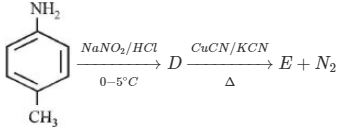
A
$4$-methylbenzonitrile
B
Toluene
C
$4$-methylbenzoic acid
D
$4,4'$-dimethylbiphenyl
Solution
(A) The reaction proceeds in two steps:
$1$. The reaction of $p$-toluidine ($4$-methylaniline) with $NaNO_2/HCl$ at $0-5^{\circ}C$ is a diazotization reaction,which forms the diazonium salt,$4$-methylbenzenediazonium chloride $(D)$.
$2$. The reaction of the diazonium salt $(D)$ with $CuCN/KCN$ is a Sandmeyer reaction,where the diazonium group $(-N_2^+Cl^-)$ is replaced by a cyano group $(-CN)$ to form $4$-methylbenzonitrile $(E)$.
$1$. The reaction of $p$-toluidine ($4$-methylaniline) with $NaNO_2/HCl$ at $0-5^{\circ}C$ is a diazotization reaction,which forms the diazonium salt,$4$-methylbenzenediazonium chloride $(D)$.
$2$. The reaction of the diazonium salt $(D)$ with $CuCN/KCN$ is a Sandmeyer reaction,where the diazonium group $(-N_2^+Cl^-)$ is replaced by a cyano group $(-CN)$ to form $4$-methylbenzonitrile $(E)$.
0 likesView Solution
64
ChemistryEasyMCQJEE Main · 2015
Which of the vitamins given below is water soluble?
A
Vitamin $E$
B
Vitamin $K$
C
Vitamin $C$
D
Vitamin $D$
Solution
(C) Vitamins $B$ and $C$ are water soluble.
Vitamins $A, D, E$ and $K$ are fat soluble or water insoluble.
Vitamins $A, D, E$ and $K$ are fat soluble or water insoluble.
0 likesView Solution
65
ChemistryDifficultMCQJEE Main · 2015
Which polymer is used in the manufacture of paints and lacquers?
A
Polypropene
B
Polyvinyl chloride
C
Bakelite
D
Glyptal
Solution
(D) Bakelite is used for making gears,protective coatings,and electrical fittings.
$(b)$ Glyptal is used in the manufacture of paints and lacquers.
$(c)$ $PP$ (Polypropene) is used in the manufacture of textiles,packaging materials,etc.
$(d)$ Polyvinyl chloride $(PVC)$ is used in the manufacture of raincoats,handbags,and leather clothes.
$(b)$ Glyptal is used in the manufacture of paints and lacquers.
$(c)$ $PP$ (Polypropene) is used in the manufacture of textiles,packaging materials,etc.
$(d)$ Polyvinyl chloride $(PVC)$ is used in the manufacture of raincoats,handbags,and leather clothes.
0 likesView Solution
66
ChemistryAdvancedMCQJEE Main · 2015
$A$ solution at $20\,^oC$ is composed of $1.5\,mol$ of benzene and $3.5\,mol$ of toluene. If the vapour pressure of pure benzene and pure toluene at this temperature are $74.7\,torr$ and $22.3\,torr,$ respectively,then the total vapour pressure of the solution and the benzene mole fraction in equilibrium with it will be,respectively
A
$35.8\,torr$ and $0.280$
B
$38.0\,torr$ and $0.589$
C
$30.5\,torr$ and $0.389$
D
$30.5\,torr$ and $0.480$
Solution
(B) Let $A$ be benzene and $B$ be toluene.
Given: $P^o_A = 74.7\,torr$,$P^o_B = 22.3\,torr$,$n_A = 1.5\,mol$,$n_B = 3.5\,mol$.
Total moles $n_{total} = 1.5 + 3.5 = 5.0\,mol$.
Mole fraction of benzene in liquid phase,$x_A = \frac{1.5}{5.0} = 0.3$.
Mole fraction of toluene in liquid phase,$x_B = \frac{3.5}{5.0} = 0.7$.
Total vapour pressure of the solution,$P_{total} = P^o_A x_A + P^o_B x_B = (74.7 \times 0.3) + (22.3 \times 0.7) = 22.41 + 15.61 = 38.02\,torr \approx 38.0\,torr$.
Mole fraction of benzene in vapour phase $(y_A)$ is given by $y_A = \frac{P_A}{P_{total}} = \frac{P^o_A x_A}{P_{total}} = \frac{22.41}{38.02} \approx 0.589$.
Given: $P^o_A = 74.7\,torr$,$P^o_B = 22.3\,torr$,$n_A = 1.5\,mol$,$n_B = 3.5\,mol$.
Total moles $n_{total} = 1.5 + 3.5 = 5.0\,mol$.
Mole fraction of benzene in liquid phase,$x_A = \frac{1.5}{5.0} = 0.3$.
Mole fraction of toluene in liquid phase,$x_B = \frac{3.5}{5.0} = 0.7$.
Total vapour pressure of the solution,$P_{total} = P^o_A x_A + P^o_B x_B = (74.7 \times 0.3) + (22.3 \times 0.7) = 22.41 + 15.61 = 38.02\,torr \approx 38.0\,torr$.
Mole fraction of benzene in vapour phase $(y_A)$ is given by $y_A = \frac{P_A}{P_{total}} = \frac{P^o_A x_A}{P_{total}} = \frac{22.41}{38.02} \approx 0.589$.
0 likesView Solution
67
ChemistryDifficultMCQJEE Main · 2015
An aqueous solution of a salt $X$ turns blood red on treatment with $CNS^{-}$ and blue on treatment with $K_4[Fe(CN)_6]$. $X$ also gives a positive chromyl chloride test. The salt $X$ is
A
$CuCl_2$
B
$FeCl_3$
C
$Cu(NO_3)_2$
D
$Fe(NO_3)_3$
Solution
(B) The presence of $Fe^{3+}$ ions is indicated by the blood-red color formed with $CNS^{-}$ ions: $Fe^{3+} + 3CNS^{-} \to Fe(CNS)_3$ (Ferric thiocyanate,blood-red coloration).
$Fe^{3+}$ ions react with $K_4[Fe(CN)_6]$ to form a blue precipitate (Prussian blue): $4Fe^{3+} + 3[Fe(CN)_6]^{4-} \to Fe_4[Fe(CN)_6]_3$.
The chromyl chloride test is specific for the presence of chloride ions $(Cl^{-})$,where $X$ reacts with $K_2Cr_2O_7$ and concentrated $H_2SO_4$ to evolve reddish-brown vapors of chromyl chloride $(CrO_2Cl_2)$.
Since the salt $X$ contains both $Fe^{3+}$ and $Cl^{-}$ ions,the salt is $FeCl_3$.
$Fe^{3+}$ ions react with $K_4[Fe(CN)_6]$ to form a blue precipitate (Prussian blue): $4Fe^{3+} + 3[Fe(CN)_6]^{4-} \to Fe_4[Fe(CN)_6]_3$.
The chromyl chloride test is specific for the presence of chloride ions $(Cl^{-})$,where $X$ reacts with $K_2Cr_2O_7$ and concentrated $H_2SO_4$ to evolve reddish-brown vapors of chromyl chloride $(CrO_2Cl_2)$.
Since the salt $X$ contains both $Fe^{3+}$ and $Cl^{-}$ ions,the salt is $FeCl_3$.
0 likesView Solution
68
ChemistryAdvancedMCQJEE Main · 2015
$A$ compound $A$ with molecular formula $C_{10}H_{13}Cl$ gives a white precipitate on adding silver nitrate solution. $A$ on reacting with alcoholic $KOH$ gives compound $B$ as the main product. $B$ on ozonolysis gives $C$ and $D$. $C$ gives Cannizzaro reaction but not aldol condensation. $D$ gives aldol condensation but not Cannizzaro reaction. $A$ is:
A
$C_6H_5-CH_2-CH_2-CH_2-CH_2-Cl$
B
$C_6H_5-CH_2-CH_2-CH(Cl)-CH_3$
C
$C_6H_5-CH_2-C(Cl)(CH_3)_2$
D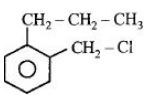
Solution
(C) Compound $A$ $(C_{10}H_{13}Cl)$ gives a white precipitate with silver nitrate,indicating it is a tertiary halide or a reactive alkyl halide that forms a stable carbocation.
$C_6H_5-CH_2-C(Cl)(CH_3)_2 (A) \xrightarrow{alc. KOH} C_6H_5-CH=C(CH_3)_2 (B)$
$B$ on ozonolysis:
$C_6H_5-CH=C(CH_3)_2 \xrightarrow{O_3/H_2O} C_6H_5CHO (C) + CH_3COCH_3 (D)$
$C$ $(C_6H_5CHO)$ has no $\alpha$-hydrogen,so it gives Cannizzaro reaction but not aldol condensation.
$D$ $(CH_3COCH_3)$ has $\alpha$-hydrogens,so it gives aldol condensation but not Cannizzaro reaction.
Thus,$A$ is $C_6H_5-CH_2-C(Cl)(CH_3)_2$.
$C_6H_5-CH_2-C(Cl)(CH_3)_2 (A) \xrightarrow{alc. KOH} C_6H_5-CH=C(CH_3)_2 (B)$
$B$ on ozonolysis:
$C_6H_5-CH=C(CH_3)_2 \xrightarrow{O_3/H_2O} C_6H_5CHO (C) + CH_3COCH_3 (D)$
$C$ $(C_6H_5CHO)$ has no $\alpha$-hydrogen,so it gives Cannizzaro reaction but not aldol condensation.
$D$ $(CH_3COCH_3)$ has $\alpha$-hydrogens,so it gives aldol condensation but not Cannizzaro reaction.
Thus,$A$ is $C_6H_5-CH_2-C(Cl)(CH_3)_2$.
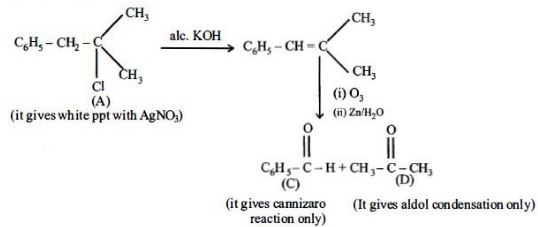
0 likesView Solution
69
ChemistryDifficultMCQJEE Main · 2015
In the presence of a small amount of phosphorus,aliphatic carboxylic acids react with chlorine or bromine to yield a compound in which $\alpha$-hydrogen has been replaced by a halogen. This reaction is known as:
A
Wolff-Kishner reaction
B
Rosenmund reaction
C
Etard reaction
D
Hell-Volhard-Zelinsky reaction
Solution
(D) The reaction described is the Hell-Volhard-Zelinsky $(HVZ)$ reaction.
In this reaction,aliphatic carboxylic acids containing at least one $\alpha$-hydrogen atom are reacted with chlorine or bromine in the presence of a small amount of red phosphorus.
The $\alpha$-hydrogen is replaced by a halogen atom to form $\alpha$-halo carboxylic acids.
The general chemical equation is: $R-CH_2-COOH + X_2 \xrightarrow{\text{red } P} R-CH(X)-COOH + HX$,where $X = Cl, Br$.
In this reaction,aliphatic carboxylic acids containing at least one $\alpha$-hydrogen atom are reacted with chlorine or bromine in the presence of a small amount of red phosphorus.
The $\alpha$-hydrogen is replaced by a halogen atom to form $\alpha$-halo carboxylic acids.
The general chemical equation is: $R-CH_2-COOH + X_2 \xrightarrow{\text{red } P} R-CH(X)-COOH + HX$,where $X = Cl, Br$.
0 likesView Solution
70
ChemistryMediumMCQJEE Main · 2015
The following statements relate to the adsorption of gases on a solid surface. Identify the incorrect statement among them.
A
Enthalpy of adsorption is negative
B
Energy appears as heat
C
On adsorption,the residual forces on the surface are increased
D
Entropy of adsorption is negative
Solution
(C) Adsorption is a surface phenomenon where molecules of a substance accumulate on the surface of a solid or liquid.
During adsorption,the residual forces on the surface are satisfied by the incoming molecules,leading to a decrease in surface energy.
Therefore,the statement that residual forces increase is incorrect.
For adsorption,$\Delta H < 0$ (exothermic),$\Delta S < 0$ (decrease in randomness),and $\Delta G < 0$ (spontaneous process).
During adsorption,the residual forces on the surface are satisfied by the incoming molecules,leading to a decrease in surface energy.
Therefore,the statement that residual forces increase is incorrect.
For adsorption,$\Delta H < 0$ (exothermic),$\Delta S < 0$ (decrease in randomness),and $\Delta G < 0$ (spontaneous process).
0 likesView Solution
71
ChemistryDifficultMCQJEE Main · 2015
Which molecule/ion among the following cannot act as a ligand in complex compounds?
A
$CH_4$
B
$CO$
C
$CN^{-}$
D
$Br^{-}$
Solution
(A) ligand is an atom,molecule,or ion that donates a pair of electrons to a central metal atom or ion to form a coordinate bond.
For a species to act as a ligand,it must possess at least one lone pair of electrons.
In $CH_4$ (methane),the carbon atom is $sp^3$ hybridized and forms four covalent bonds with hydrogen atoms,completing its octet.
Since $CH_4$ has no lone pair of electrons available for donation,it cannot act as a ligand.
For a species to act as a ligand,it must possess at least one lone pair of electrons.
In $CH_4$ (methane),the carbon atom is $sp^3$ hybridized and forms four covalent bonds with hydrogen atoms,completing its octet.
Since $CH_4$ has no lone pair of electrons available for donation,it cannot act as a ligand.
0 likesView Solution
72
ChemistryAdvancedMCQJEE Main · 2015
The reaction $2N_2O_5 \,(g) \to 4NO_2 \,(g) + O_2 \,(g)$ follows first order kinetics. The pressure of a vessel containing only $N_2O_5$ was found to increase from $50 \, mmHg$ to $87.5 \, mmHg$ in $30 \, min$. The pressure exerted by the gases after $60 \, min$ will be .......... $mmHg$ (assume temperature remains constant).
A
$106.25$
B
$150$
C
$125$
D
$116.25$
Solution
(A) For the reaction $2N_2O_5 \,(g) \to 4NO_2 \,(g) + O_2 \,(g)$,let the initial pressure of $N_2O_5$ be $P_0 = 50 \, mmHg$.
At $t = 30 \, min$,let the pressure of $N_2O_5$ decrease by $2p$. The total pressure is $P_t = (50 - 2p) + 4p + p = 50 + 3p = 87.5 \, mmHg$.
Thus,$3p = 37.5 \, mmHg$,so $p = 12.5 \, mmHg$.
The pressure of $N_2O_5$ remaining at $t = 30 \, min$ is $50 - 2(12.5) = 25 \, mmHg$.
Since the pressure of $N_2O_5$ halves in $30 \, min$,the half-life $t_{1/2} = 30 \, min$.
At $t = 60 \, min$ (which is $2 \times t_{1/2}$),the pressure of $N_2O_5$ remaining is $50 / 4 = 12.5 \, mmHg$.
Let $50 - 2p' = 12.5$,so $2p' = 37.5$,which means $p' = 18.75 \, mmHg$.
The total pressure at $t = 60 \, min$ is $50 + 3p' = 50 + 3(18.75) = 50 + 56.25 = 106.25 \, mmHg$.
At $t = 30 \, min$,let the pressure of $N_2O_5$ decrease by $2p$. The total pressure is $P_t = (50 - 2p) + 4p + p = 50 + 3p = 87.5 \, mmHg$.
Thus,$3p = 37.5 \, mmHg$,so $p = 12.5 \, mmHg$.
The pressure of $N_2O_5$ remaining at $t = 30 \, min$ is $50 - 2(12.5) = 25 \, mmHg$.
Since the pressure of $N_2O_5$ halves in $30 \, min$,the half-life $t_{1/2} = 30 \, min$.
At $t = 60 \, min$ (which is $2 \times t_{1/2}$),the pressure of $N_2O_5$ remaining is $50 / 4 = 12.5 \, mmHg$.
Let $50 - 2p' = 12.5$,so $2p' = 37.5$,which means $p' = 18.75 \, mmHg$.
The total pressure at $t = 60 \, min$ is $50 + 3p' = 50 + 3(18.75) = 50 + 56.25 = 106.25 \, mmHg$.
0 likesView Solution
73
ChemistryMediumMCQJEE Main · 2015
In the isolation of metals,the calcination process usually results in:
A
metal hydroxide
B
metal sulphide
C
metal oxide
D
metal carbonate
Solution
(C) Calcination is the process of heating an ore strongly below its melting point in the absence or limited supply of air.
It is primarily used to convert metal carbonates and hydroxides into their respective oxides.
For example:
$CaCO_3 \xrightarrow{\Delta} CaO + CO_2 \uparrow$
$CuCO_3 \cdot Cu(OH)_2 \xrightarrow{\Delta} 2CuO + H_2O \uparrow + CO_2 \uparrow$
Thus,the product obtained is a metal oxide.
It is primarily used to convert metal carbonates and hydroxides into their respective oxides.
For example:
$CaCO_3 \xrightarrow{\Delta} CaO + CO_2 \uparrow$
$CuCO_3 \cdot Cu(OH)_2 \xrightarrow{\Delta} 2CuO + H_2O \uparrow + CO_2 \uparrow$
Thus,the product obtained is a metal oxide.
0 likesView Solution
74
ChemistryDifficultMCQJEE Main · 2015
The optically inactive compound from the following is
A
$2-$chloropropanal
B
$2-$chlorobutane
C
$2-$chloropentane
D
$2-$chloro$-2-$methylbutane
Solution
(D) An optically inactive compound is one that does not possess a chiral center (a carbon atom bonded to four different groups).
In $2-$chloropropanal $(CH_3-CHCl-CHO)$,the $C2$ carbon is chiral.
In $2-$chlorobutane $(CH_3-CH_2-CHCl-CH_3)$,the $C2$ carbon is chiral.
In $2-$chloropentane $(CH_3-CH_2-CH_2-CHCl-CH_3)$,the $C2$ carbon is chiral.
In $2-$chloro$-2-$methylbutane $(CH_3-CH_2-CCl(CH_3)_2)$,the $C2$ carbon is bonded to two identical methyl groups,making it achiral.
Therefore,$2-$chloro$-2-$methylbutane is optically inactive.
In $2-$chloropropanal $(CH_3-CHCl-CHO)$,the $C2$ carbon is chiral.
In $2-$chlorobutane $(CH_3-CH_2-CHCl-CH_3)$,the $C2$ carbon is chiral.
In $2-$chloropentane $(CH_3-CH_2-CH_2-CHCl-CH_3)$,the $C2$ carbon is chiral.
In $2-$chloro$-2-$methylbutane $(CH_3-CH_2-CCl(CH_3)_2)$,the $C2$ carbon is bonded to two identical methyl groups,making it achiral.
Therefore,$2-$chloro$-2-$methylbutane is optically inactive.
0 likesView Solution
75
ChemistryDifficultMCQJEE Main · 2015
Match the polymers in column $- A$ with their main uses in column $- B$ and choose the correct answer.
| Column $- A$ | Column $- B$ |
| $(A)$ Polystyrene | $(i)$ Paints and lacquers |
| $(B)$ Glyptal | $(ii)$ Rain coats |
| $(C)$ Polyvinyl chloride | $(iii)$ Manufacture of toys |
| $(D)$ Bakelite | $(iv)$ Computer discs |
A
$(A) - (ii), (B) - (i), (C) - (iii), (D) - (iv)$
B
$(A) - (ii), (B) - (iv), (C) - (iii), (D) - (i)$
C
$(A) - (iii), (B) - (iv), (C) - (ii), (D) - (i)$
D
$(A) - (iii), (B) - (i), (C) - (ii), (D) - (iv)$
Solution
(D) The correct matching is as follows:
Thus,the correct sequence is $(A)-(iii), (B)-(i), (C)-(ii), (D)-(iv)$.
| Polymer | Use |
| $(A)$ Polystyrene | $(iii)$ Manufacture of toys |
| $(B)$ Glyptal | $(i)$ Paints and lacquers |
| $(C)$ Polyvinyl chloride | $(ii)$ Rain coats |
| $(D)$ Bakelite | $(iv)$ Computer discs |
Thus,the correct sequence is $(A)-(iii), (B)-(i), (C)-(ii), (D)-(iv)$.
0 likesView Solution
76
ChemistryDifficultMCQJEE Main · 2015
The correct statement on the isomerism associated with the following complex ions,
$A$. $[Ni(H_2O)_5NH_3]^{2+}$
$B$. $[Ni(H_2O)_4(NH_3)_2]^{2+}$ and
$C$. $[Ni(H_2O)_3(NH_3)_3]^{2+}$ is
$A$. $[Ni(H_2O)_5NH_3]^{2+}$
$B$. $[Ni(H_2O)_4(NH_3)_2]^{2+}$ and
$C$. $[Ni(H_2O)_3(NH_3)_3]^{2+}$ is
A
$A$ and $B$ show only geometrical isomerism
B
$A$ and $B$ show geometrical and optical isomerism
C
$B$ and $C$ show geometrical and optical isomerism
D
$B$ and $C$ show only geometrical isomerism
Solution
(C) For complex $A$,$[Ni(H_2O)_5NH_3]^{2+}$,it is of the type $[MA_5B]$,which does not show geometrical or optical isomerism.
For complex $B$,$[Ni(H_2O)_4(NH_3)_2]^{2+}$,it is of the type $[MA_4B_2]$. It shows geometrical isomerism ($cis$ and $trans$ forms). The $cis$ form is optically active.
For complex $C$,$[Ni(H_2O)_3(NH_3)_3]^{2+}$,it is of the type $[MA_3B_3]$. It shows geometrical isomerism ($facial$ and $meridional$ forms). The $facial$ form is optically active.
Thus,both $B$ and $C$ exhibit geometrical and optical isomerism.
For complex $B$,$[Ni(H_2O)_4(NH_3)_2]^{2+}$,it is of the type $[MA_4B_2]$. It shows geometrical isomerism ($cis$ and $trans$ forms). The $cis$ form is optically active.
For complex $C$,$[Ni(H_2O)_3(NH_3)_3]^{2+}$,it is of the type $[MA_3B_3]$. It shows geometrical isomerism ($facial$ and $meridional$ forms). The $facial$ form is optically active.
Thus,both $B$ and $C$ exhibit geometrical and optical isomerism.
0 likesView Solution
77
ChemistryDifficultMCQJEE Main · 2015
Arrange the following amines in the order of increasing basicity.
A
$p$-nitroaniline < aniline < $p$-methoxyaniline < $CH_3NH_2$
B
$p$-methoxyaniline < $p$-nitroaniline < aniline < $CH_3NH_2$
C
$p$-nitroaniline < aniline < $p$-methoxyaniline < $CH_3NH_2$
D
aniline < $p$-methoxyaniline < $p$-nitroaniline < $CH_3NH_2$
Solution
(A) The basicity of amines depends on the availability of the lone pair of electrons on the nitrogen atom.
Aliphatic amines (like $CH_3NH_2$) are more basic than aromatic amines because the lone pair on the nitrogen atom in aromatic amines is involved in resonance with the benzene ring,making it less available for protonation.
Among aromatic amines,electron-donating groups (like $-OCH_3$) increase the electron density on the nitrogen atom,thereby increasing basicity.
Electron-withdrawing groups (like $-NO_2$) decrease the electron density on the nitrogen atom,thereby decreasing basicity.
Therefore,the order of increasing basicity is: $p$-nitroaniline < aniline < $p$-methoxyaniline < $CH_3NH_2$.
Aliphatic amines (like $CH_3NH_2$) are more basic than aromatic amines because the lone pair on the nitrogen atom in aromatic amines is involved in resonance with the benzene ring,making it less available for protonation.
Among aromatic amines,electron-donating groups (like $-OCH_3$) increase the electron density on the nitrogen atom,thereby increasing basicity.
Electron-withdrawing groups (like $-NO_2$) decrease the electron density on the nitrogen atom,thereby decreasing basicity.
Therefore,the order of increasing basicity is: $p$-nitroaniline < aniline < $p$-methoxyaniline < $CH_3NH_2$.
0 likesView Solution
78
ChemistryDifficultMCQJEE Main · 2015
$A$ variable,opposite external potential $(E_{ext})$ is applied to the cell $Zn | Zn^{2+} (1 \ M) || Cu^{2+} (1 \ M) | Cu$ of potential $1.1 \ V$. When $E_{ext} < 1.1 \ V$ and $E_{ext} > 1.1 \ V$,respectively,electrons flow from:
A
anode to cathode in both cases
B
cathode to anode and anode to cathode
C
anode to cathode and cathode to anode
D
cathode to anode in both cases
Solution
(C) The $EMF$ of the given galvanic cell is $1.1 \ V$.
When $E_{ext} < 1.1 \ V$,the cell functions as a galvanic cell,and electrons flow from the anode $(Zn)$ to the cathode $(Cu)$.
When $E_{ext} > 1.1 \ V$,the external potential overcomes the cell potential,forcing the reaction to reverse; thus,the cell acts as an electrolytic cell and electrons flow from the cathode $(Cu)$ to the anode $(Zn)$.
When $E_{ext} < 1.1 \ V$,the cell functions as a galvanic cell,and electrons flow from the anode $(Zn)$ to the cathode $(Cu)$.
When $E_{ext} > 1.1 \ V$,the external potential overcomes the cell potential,forcing the reaction to reverse; thus,the cell acts as an electrolytic cell and electrons flow from the cathode $(Cu)$ to the anode $(Zn)$.
0 likesView Solution
79
ChemistryDifficultMCQJEE Main · 2015
The cation that will not be precipitated by $H_2S$ in the presence of $dil. \ HCl$ is
A
$Pb^{2+}$
B
$Cu^{2+}$
C
$Co^{2+}$
D
$As^{3+}$
Solution
(C) In qualitative inorganic analysis,cations are divided into groups based on their precipitation reactions.
$Pb^{2+}$ (Group $II$),$Cu^{2+}$ (Group $II$),and $As^{3+}$ (Group $II$) are precipitated as sulfides by $H_2S$ in the presence of $dil. \ HCl$ due to the low solubility product of their sulfides.
$Co^{2+}$ belongs to Group $IV$ and is not precipitated by $H_2S$ in the presence of $dil. \ HCl$ because the concentration of $S^{2-}$ ions is too low due to the common ion effect of $H^+$.
$Co^{2+}$ is precipitated as $CoS$ only in the presence of $NH_4OH$ and $H_2S$ (Group $IV$ reagent).
$Pb^{2+}$ (Group $II$),$Cu^{2+}$ (Group $II$),and $As^{3+}$ (Group $II$) are precipitated as sulfides by $H_2S$ in the presence of $dil. \ HCl$ due to the low solubility product of their sulfides.
$Co^{2+}$ belongs to Group $IV$ and is not precipitated by $H_2S$ in the presence of $dil. \ HCl$ because the concentration of $S^{2-}$ ions is too low due to the common ion effect of $H^+$.
$Co^{2+}$ is precipitated as $CoS$ only in the presence of $NH_4OH$ and $H_2S$ (Group $IV$ reagent).
0 likesView Solution
80
ChemistryMediumMCQJEE Main · 2015
The compound shown in the image is used as:
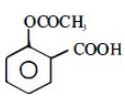
A
Analgesic
B
Insecticide
C
Antacid
D
Antihistamine
Solution
(A) The structure shown in the image is $2$-acetoxybenzoic acid,commonly known as Aspirin.
Drugs which relieve pain are called analgesics.
Analgesics are of two types: $(i)$ Narcotics and $(ii)$ Non-narcotics.
Aspirin (acetylsalicylic acid) is a well-known non-narcotic analgesic.
Drugs which relieve pain are called analgesics.
Analgesics are of two types: $(i)$ Narcotics and $(ii)$ Non-narcotics.
Aspirin (acetylsalicylic acid) is a well-known non-narcotic analgesic.
0 likesView Solution
81
ChemistryEasyMCQJEE Main · 2015
Complete hydrolysis of starch gives
A
glucose only
B
galactose and fructose in equimolar amounts
C
glucose and galactose in equimolar amounts
D
glucose and fructose in equimolar amounts
Solution
(A) Starch is a polysaccharide composed of $amylose$ and $amylopectin$. Both of these are polymers of $D-glucose$. Therefore,the complete hydrolysis of starch yields only $glucose$ units.
0 likesView Solution
82
ChemistryDifficultMCQJEE Main · 2015
The least number of oxyacids are formed by
A
Chlorine
B
Nitrogen
C
Fluorine
D
Sulphur
Solution
(C) Fluorine is the most electronegative element and has the least tendency to form $p\pi-d\pi$ double bonds. Due to its small size and high electronegativity,it forms only one oxyacid,which is $HOF$ (hypofluorous acid). In contrast,other halogens like $Cl$,$Br$,and $I$ form multiple oxyacids due to the availability of vacant $d$-orbitals.
0 likesView Solution
83
ChemistryDifficultMCQJEE Main · 2015
For the reaction $A + 2B \to C$,the rate equation is given as $\text{Rate} = K[A][B]$. If the concentration of $A$ is kept constant but that of $B$ is doubled,what will happen to the rate of the reaction?
A
It is halved
B
It remains the same
C
It is doubled
D
It is quadrupled
Solution
(C) The initial rate is given by $R = K[A][B]$.
When the concentration of $A$ is kept constant and the concentration of $B$ is doubled,the new concentration of $B$ becomes $[B]' = 2[B]$.
The new rate $R'$ is given by $R' = K[A][B]' = K[A](2[B])$.
Substituting the initial rate expression into the new rate expression,we get $R' = 2 \times (K[A][B]) = 2R$.
Therefore,the rate of the reaction is doubled.
When the concentration of $A$ is kept constant and the concentration of $B$ is doubled,the new concentration of $B$ becomes $[B]' = 2[B]$.
The new rate $R'$ is given by $R' = K[A][B]' = K[A](2[B])$.
Substituting the initial rate expression into the new rate expression,we get $R' = 2 \times (K[A][B]) = 2R$.
Therefore,the rate of the reaction is doubled.
1 likesView Solution
84
ChemistryDifficultMCQJEE Main · 2015
When concentrated $HCl$ is added to an aqueous solution of $CoCl_2$,its colour changes from reddish pink to deep blue. Which complex ion gives blue colour in this reaction?
A
$[CoCl_4]^{2-}$
B
$[CoCl_6]^{3-}$
C
$[CoCl_6]^{4-}$
D
$[Co(H_2O)_6]^{2+}$
Solution
(A) The aqueous solution of $CoCl_2$ contains the octahedral complex $[Co(H_2O)_6]^{2+}$,which is reddish-pink in colour.
When concentrated $HCl$ is added,the chloride ions $(Cl^-)$ act as ligands and replace the water molecules to form the tetrahedral complex $[CoCl_4]^{2-}$.
The formation of the tetrahedral $[CoCl_4]^{2-}$ complex is responsible for the deep blue colour observed in the solution.
Therefore,the correct complex ion is $[CoCl_4]^{2-}$.
When concentrated $HCl$ is added,the chloride ions $(Cl^-)$ act as ligands and replace the water molecules to form the tetrahedral complex $[CoCl_4]^{2-}$.
The formation of the tetrahedral $[CoCl_4]^{2-}$ complex is responsible for the deep blue colour observed in the solution.
Therefore,the correct complex ion is $[CoCl_4]^{2-}$.
0 likesView Solution
85
ChemistryDifficultMCQJEE Main · 2015
Under ambient conditions,which among the following surfactants will form micelles in aqueous solution at the lowest molar concentration?
A
$CH_3-(CH_2)_8-COO^{-} Na^{+}$
B
$CH_3(CH_2)_{11}N^{+}(CH_3)_3Br^{-}$
C
$CH_3-(CH_2)_{13}-OSO_3^{-} Na^{+}$
D
$CH_3(CH_2)_{15}N^{+}(CH_3)_3Br^{-}$
Solution
(D) The Critical Micelle Concentration $(CMC)$ of a surfactant decreases as the length of the hydrophobic hydrocarbon chain increases.
This is because a longer chain increases the hydrophobic effect and the van der Waals forces of attraction between the hydrocarbon tails,which stabilizes the micelle structure.
Comparing the given options:
$A$: $C_9$ chain
$B$: $C_{12}$ chain
$C$: $C_{14}$ chain
$D$: $C_{16}$ chain
Since $CH_3(CH_2)_{15}N^{+}(CH_3)_3Br^{-}$ has the longest hydrocarbon chain $(C_{16})$,it will have the strongest hydrophobic interactions and will form micelles at the lowest molar concentration.
This is because a longer chain increases the hydrophobic effect and the van der Waals forces of attraction between the hydrocarbon tails,which stabilizes the micelle structure.
Comparing the given options:
$A$: $C_9$ chain
$B$: $C_{12}$ chain
$C$: $C_{14}$ chain
$D$: $C_{16}$ chain
Since $CH_3(CH_2)_{15}N^{+}(CH_3)_3Br^{-}$ has the longest hydrocarbon chain $(C_{16})$,it will have the strongest hydrophobic interactions and will form micelles at the lowest molar concentration.
0 likesView Solution
86
ChemistryDifficultMCQJEE Main · 2015
Which of the following complex ions has electrons that are symmetrically filled in both $t_{2g}$ and $e_g$ orbitals?
A
$[FeF_6]^{3-}$
B
$[Mn(CN)_6]^{4-}$
C
$[CoF_6]^{3-}$
D
$[Co(NH_3)_6]^{2+}$
Solution
(A) complex ion is considered to have symmetrically filled orbitals if the electrons are distributed equally among the degenerate orbitals of the $t_{2g}$ and $e_g$ sets.
$1$. For $[FeF_6]^{3-}$: $Fe^{3+}$ is $d^5$. $F^-$ is a weak field ligand,so the configuration is $t_{2g}^3 e_g^2$. Here,$t_{2g}$ has $3$ electrons (one in each orbital) and $e_g$ has $2$ electrons (one in each orbital). Both sets are symmetrically filled.
$2$. For $[Mn(CN)_6]^{4-}$: $Mn^{2+}$ is $d^5$. $CN^-$ is a strong field ligand,so the configuration is $t_{2g}^5 e_g^0$. This is unsymmetrical.
$3$. For $[CoF_6]^{3-}$: $Co^{3+}$ is $d^6$. $F^-$ is a weak field ligand,so the configuration is $t_{2g}^4 e_g^2$. This is unsymmetrical.
$4$. For $[Co(NH_3)_6]^{2+}$: $Co^{2+}$ is $d^7$. $NH_3$ is a strong field ligand,so the configuration is $t_{2g}^6 e_g^1$. This is unsymmetrical.
Therefore,$[FeF_6]^{3-}$ has symmetrically filled orbitals.
$1$. For $[FeF_6]^{3-}$: $Fe^{3+}$ is $d^5$. $F^-$ is a weak field ligand,so the configuration is $t_{2g}^3 e_g^2$. Here,$t_{2g}$ has $3$ electrons (one in each orbital) and $e_g$ has $2$ electrons (one in each orbital). Both sets are symmetrically filled.
$2$. For $[Mn(CN)_6]^{4-}$: $Mn^{2+}$ is $d^5$. $CN^-$ is a strong field ligand,so the configuration is $t_{2g}^5 e_g^0$. This is unsymmetrical.
$3$. For $[CoF_6]^{3-}$: $Co^{3+}$ is $d^6$. $F^-$ is a weak field ligand,so the configuration is $t_{2g}^4 e_g^2$. This is unsymmetrical.
$4$. For $[Co(NH_3)_6]^{2+}$: $Co^{2+}$ is $d^7$. $NH_3$ is a strong field ligand,so the configuration is $t_{2g}^6 e_g^1$. This is unsymmetrical.
Therefore,$[FeF_6]^{3-}$ has symmetrically filled orbitals.
0 likesView Solution
87
ChemistryDifficultMCQJEE Main · 2015
At $298 \ K$,the standard reduction potentials are $1.51 \ V$ for $MnO_4^- \ | \ Mn^{2+}$,$1.36 \ V$ for $Cl_2 \ | \ Cl^{-}$,$1.07 \ V$ for $Br_2 \ | \ Br^{-}$ and $0.54 \ V$ for $I_2 \ | \ I^{-}$. At $pH = 3$,permanganate is expected to oxidize $\left( \frac{RT}{F} = 0.059 \ V \right)$
A
$Cl^{-}, Br^{-}$ and $I^{-}$
B
$Br^{-}$ and $I^{-}$
C
$Cl^{-}$ and $Br^{-}$
D
$I^{-}$ only
Solution
(B) The reduction half-reaction for permanganate is: $MnO_4^- + 8H^+ + 5e^- \to Mn^{2+} + 4H_2O$.
Using the Nernst equation: $E = E^\circ - \frac{0.059}{5} \log \frac{[Mn^{2+}]}{[MnO_4^-][H^+]^8}$.
Assuming standard concentrations for $Mn^{2+}$ and $MnO_4^-$ $(1 \ M)$,the potential at $pH = 3$ is: $E = 1.51 - \frac{0.059}{5} \times \log \frac{1}{(10^{-3})^8} = 1.51 - \frac{0.059 \times 24}{5} = 1.51 - 0.2832 = 1.2268 \ V$.
Permanganate can oxidize species whose standard reduction potential is lower than its own potential $(1.2268 \ V)$.
Comparing this with the given potentials: $Cl_2/Cl^- = 1.36 \ V$,$Br_2/Br^- = 1.07 \ V$,and $I_2/I^- = 0.54 \ V$.
Since $1.2268 \ V > 1.07 \ V$ and $1.2268 \ V > 0.54 \ V$,but $1.2268 \ V < 1.36 \ V$,permanganate will oxidize $Br^-$ and $I^-$.
Using the Nernst equation: $E = E^\circ - \frac{0.059}{5} \log \frac{[Mn^{2+}]}{[MnO_4^-][H^+]^8}$.
Assuming standard concentrations for $Mn^{2+}$ and $MnO_4^-$ $(1 \ M)$,the potential at $pH = 3$ is: $E = 1.51 - \frac{0.059}{5} \times \log \frac{1}{(10^{-3})^8} = 1.51 - \frac{0.059 \times 24}{5} = 1.51 - 0.2832 = 1.2268 \ V$.
Permanganate can oxidize species whose standard reduction potential is lower than its own potential $(1.2268 \ V)$.
Comparing this with the given potentials: $Cl_2/Cl^- = 1.36 \ V$,$Br_2/Br^- = 1.07 \ V$,and $I_2/I^- = 0.54 \ V$.
Since $1.2268 \ V > 1.07 \ V$ and $1.2268 \ V > 0.54 \ V$,but $1.2268 \ V < 1.36 \ V$,permanganate will oxidize $Br^-$ and $I^-$.
0 likesView Solution
88
ChemistryEasyMCQJEE Main · 2015
Calamine is an ore of
A
$Zinc$
B
$Aluminium$
C
$Iron$
D
$Copper$
Solution
(A) Calamine is a mineral consisting of zinc carbonate. Its chemical formula is $ZnCO_3$.
0 likesView Solution
89
ChemistryDifficultMCQJEE Main · 2015
Which one of the following structures represents the neoprene polymer?
A
$[CH(C_6H_5)-CH_2]_n$
B
$[CH_2-CH(CN)]_n$
C
$[CH_2-C(Cl)=CH-CH_2]_n$
D
$[CH_2-CH(Cl)]_n$
Solution
(C) Neoprene is a synthetic rubber formed by the free radical polymerization of chloroprene ($2$-chloro-$1,3$-butadiene).
The repeating unit of the polymer is $[CH_2-C(Cl)=CH-CH_2]_n$.
The repeating unit of the polymer is $[CH_2-C(Cl)=CH-CH_2]_n$.
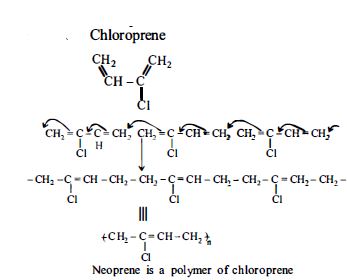
0 likesView Solution
90
ChemistryDifficultMCQJEE Main · 2015
Which artificial sweetener contains chlorine?
A
Sucralose
B
Alitame
C
Aspartame
D
Saccharin
Solution
(A) Sucralose is a trichloro derivative of sucrose. Its structure contains three chlorine atoms,as shown in the provided chemical structure. Therefore,it is the artificial sweetener that contains chlorine.
0 likesView Solution
91
ChemistryDifficultMCQJEE Main · 2015
For the equilibrium $A_{(g)} \rightleftharpoons B_{(g)}$,$\Delta H$ is $-40 \ kJ/mol$. If the ratio of the activation energies of the forward $(E_f)$ and reverse $(E_b)$ reactions is $\frac{2}{3}$,then:
A
$E_f = 80 \ kJ/mol; E_b = 120 \ kJ/mol$
B
$E_f = 60 \ kJ/mol; E_b = 100 \ kJ/mol$
C
$E_f = 30 \ kJ/mol; E_b = 70 \ kJ/mol$
D
$E_f = 70 \ kJ/mol; E_b = 30 \ kJ/mol$
Solution
(A) Given,$\frac{E_f}{E_b} = \frac{2}{3}$.
We know that for a reaction,$\Delta H = E_f - E_b$.
Given $\Delta H = -40 \ kJ/mol$,so $-40 = E_f - E_b$,which implies $E_b = E_f + 40$.
Substituting this into the ratio: $\frac{E_f}{E_f + 40} = \frac{2}{3}$.
Cross-multiplying gives $3E_f = 2(E_f + 40)$.
$3E_f = 2E_f + 80$.
$E_f = 80 \ kJ/mol$.
Then,$E_b = 80 + 40 = 120 \ kJ/mol$.
We know that for a reaction,$\Delta H = E_f - E_b$.
Given $\Delta H = -40 \ kJ/mol$,so $-40 = E_f - E_b$,which implies $E_b = E_f + 40$.
Substituting this into the ratio: $\frac{E_f}{E_f + 40} = \frac{2}{3}$.
Cross-multiplying gives $3E_f = 2(E_f + 40)$.
$3E_f = 2E_f + 80$.
$E_f = 80 \ kJ/mol$.
Then,$E_b = 80 + 40 = 120 \ kJ/mol$.
0 likesView Solution
92
ChemistryDifficultMCQJEE Main · 2015
Chlorine water on standing loses its colour and forms:
A
$HCl$ only
B
$HCl$ and $HClO_2$
C
$HCl$ and $HOCl$
D
$HOCl$ and $HOCl_2$
Solution
(C) Chlorine water is yellow in colour due to the presence of dissolved $Cl_2$.
On standing,$Cl_2$ reacts with water to form hydrochloric acid and hypochlorous acid.
The reaction is: $Cl_2 + H_2O \to HCl + HOCl$.
Since $HOCl$ is unstable,it further decomposes to give $HCl$ and nascent oxygen,which causes the bleaching action and loss of colour.
On standing,$Cl_2$ reacts with water to form hydrochloric acid and hypochlorous acid.
The reaction is: $Cl_2 + H_2O \to HCl + HOCl$.
Since $HOCl$ is unstable,it further decomposes to give $HCl$ and nascent oxygen,which causes the bleaching action and loss of colour.
0 likesView Solution
93
ChemistryDifficultMCQJEE Main · 2015
Determination of the molar mass of acetic acid in benzene using freezing point depression is affected by
A
partial ionization
B
dissociation
C
complex formation
D
association
Solution
(D) Acetic acid $(CH_3COOH)$ contains a carboxylic group $(-COOH)$ which can form intermolecular hydrogen bonds in non-polar solvents like benzene.
Due to this,acetic acid molecules undergo association to form dimers.
This association reduces the number of effective particles in the solution,which affects the colligative property (freezing point depression) and leads to an abnormal molar mass.
Due to this,acetic acid molecules undergo association to form dimers.
This association reduces the number of effective particles in the solution,which affects the colligative property (freezing point depression) and leads to an abnormal molar mass.
0 likesView Solution
94
ChemistryDifficultMCQJEE Main · 2015
Which of the following compounds has a $P-P$ bond?
A
$H_4P_2O_5$
B
$(HPO_3)_3$
C
$H_4P_2O_6$
D
$H_4P_2O_7$
Solution
(C) $H_4P_2O_6$ (Hypophosphoric acid) contains a $P-P$ bond.
Its structural formula is $(HO)_2P(O)-P(O)(OH)_2$.
Its structural formula is $(HO)_2P(O)-P(O)(OH)_2$.
0 likesView Solution
95
ChemistryDifficultMCQJEE Main · 2015
Which of the following statements is false?
A
$Na_2Cr_2O_7$ is less soluble than $K_2Cr_2O_7$
B
$Na_2Cr_2O_7$ is a primary standard in volumetry
C
$CrO_4^{2-}$ is tetrahedral in shape
D
$Cr_2O_7^{2-}$ has a $Cr-O-Cr$ bond
Solution
(A, B) $Na_2Cr_2O_7$ is deliquescent and is $NOT$ used as a primary standard in volumetry,whereas $K_2Cr_2O_7$ is used as a primary standard.
$Na_2Cr_2O_7$ is more soluble than $K_2Cr_2O_7$ due to the higher hydration energy of $Na^+$ ions compared to $K^+$ ions.
$CrO_4^{2-}$ has a tetrahedral structure.
$Cr_2O_7^{2-}$ contains a $Cr-O-Cr$ bridge bond.
$Na_2Cr_2O_7$ is more soluble than $K_2Cr_2O_7$ due to the higher hydration energy of $Na^+$ ions compared to $K^+$ ions.
$CrO_4^{2-}$ has a tetrahedral structure.
$Cr_2O_7^{2-}$ contains a $Cr-O-Cr$ bridge bond.
0 likesView Solution
96
ChemistryDifficultMCQJEE Main · 2015
In the reaction sequence $2CH_3CHO$ $\xrightarrow{OH^{-}} A$ $\xrightarrow{\Delta} B$; the product $B$ is
A
$CH_3-CH_2-CH_2-CH_2-OH$
B
$CH_3-CH=CH-CHO$
C
$CH_3-CH_2-CH_2-CH_3$
D
$CH_3-CO-CH_3$
Solution
(B) The reaction is an Aldol condensation.
Step $1$: $2CH_3CHO \xrightarrow{OH^{-}} CH_3-CH(OH)-CH_2-CHO$ (Aldol,$A$)
Step $2$: $CH_3-CH(OH)-CH_2-CHO \xrightarrow{\Delta} CH_3-CH=CH-CHO$ (Crotonaldehyde,$B$)
Therefore,the product $B$ is $CH_3-CH=CH-CHO$.
Step $1$: $2CH_3CHO \xrightarrow{OH^{-}} CH_3-CH(OH)-CH_2-CHO$ (Aldol,$A$)
Step $2$: $CH_3-CH(OH)-CH_2-CHO \xrightarrow{\Delta} CH_3-CH=CH-CHO$ (Crotonaldehyde,$B$)
Therefore,the product $B$ is $CH_3-CH=CH-CHO$.
0 likesView Solution
97
ChemistryMediumMCQJEE Main · 2015
$A$ pink coloured salt turns blue on heating. The presence of which cation is most likely?
A
$Co^{2+}$
B
$Cu^{2+}$
C
$Zn^{2+}$
D
$Fe^{2+}$
Solution
(A) Hydrated cobalt$(II)$ salts,such as $CoCl_2 \cdot 6H_2O$,are pink in colour due to the presence of the $[Co(H_2O)_6]^{2+}$ complex.
Upon heating,the water of crystallization is lost,and the salt converts to anhydrous cobalt$(II)$ chloride $(CoCl_2)$,which is blue in colour.
Therefore,the presence of the $Co^{2+}$ cation is most likely.
Upon heating,the water of crystallization is lost,and the salt converts to anhydrous cobalt$(II)$ chloride $(CoCl_2)$,which is blue in colour.
Therefore,the presence of the $Co^{2+}$ cation is most likely.
0 likesView Solution
98
ChemistryMediumMCQJEE Main · 2015
Sodium metal crystallizes in a body-centred cubic $(bcc)$ lattice with a unit cell edge of $4.29 \ \mathring{A}$. The radius of the sodium atom is approximately ............. $\mathring{A}$.
A
$5.72$
B
$0.93$
C
$1.86$
D
$3.22$
Solution
(C) In a $bcc$ lattice,the atoms touch along the body diagonal.
The relationship between the edge length $(a)$ and the atomic radius $(r)$ is given by $4r = \sqrt{3}a$.
Given $a = 4.29 \ \mathring{A}$.
$r = \frac{\sqrt{3} \times 4.29}{4}$.
$r = \frac{1.732 \times 4.29}{4} \approx 1.857 \ \mathring{A}$.
Rounding to two decimal places,we get $1.86 \ \mathring{A}$.
The relationship between the edge length $(a)$ and the atomic radius $(r)$ is given by $4r = \sqrt{3}a$.
Given $a = 4.29 \ \mathring{A}$.
$r = \frac{\sqrt{3} \times 4.29}{4}$.
$r = \frac{1.732 \times 4.29}{4} \approx 1.857 \ \mathring{A}$.
Rounding to two decimal places,we get $1.86 \ \mathring{A}$.
0 likesView Solution
99
ChemistryMediumMCQJEE Main · 2015
The synthesis of alkyl fluorides is best accomplished by
A
Finkelstein reaction
B
Swarts reaction
C
Free radical fluorination
D
Sandmeyer's reaction
Solution
(B) Alkyl fluorides are most conveniently prepared by heating suitable chloro- or bromo-alkanes with inorganic fluorides such as $AsF_3$,$SbF_3$,$CoF_2$,$AgF$,$Hg_2F_2$,etc. This reaction is known as the $Swarts$ reaction.
$CH_3Br + AgF \rightarrow CH_3F + AgBr$
$2CH_3CH_2Cl + Hg_2F_2 \rightarrow 2CH_3CH_2F + Hg_2Cl_2$
$CH_3Br + AgF \rightarrow CH_3F + AgBr$
$2CH_3CH_2Cl + Hg_2F_2 \rightarrow 2CH_3CH_2F + Hg_2Cl_2$
0 likesView Solution
100
ChemistryMediumMCQJEE Main · 2015
Which of the following compounds is not an antacid?
A
Phenelzine
B
Ranitidine
C
Aluminium hydroxide
D
Cimetidine
Solution
(A) $Phenelzine$ is an antidepressant,while $Ranitidine$,$Aluminium \ hydroxide$,and $Cimetidine$ are antacids.
0 likesView Solution
Vedclass Products
For Students
Vedclass Test Series
Mock tests in real JEE Main style covering Chemistry with performance analysis. 5-day free trial.
Start Free TrialFor Teachers
Exam Paper Generator
Generate Set A/B/C/D Chemistry papers from 7.5L+ questions in 2 minutes. 3 chapters free.
Try FreeFor Institutes
Online Exam Module
Run live JEE Main mock exams with unlimited students, 360° analytics & white-label branding.
See DemoFrequently Asked Questions
How many Chemistry questions are in JEE Main 2015?
There are 115 Chemistry questions from the JEE Main 2015 paper on Vedclass, each with a detailed step-by-step solution in English.
Are JEE Main 2015 Chemistry solutions available in English?
Yes. All solutions on this page are in English. You can also switch to English or Hindi using the language buttons above the questions.
Can I practice JEE Main 2015 Chemistry as a timed test?
Yes. Use the Vedclass Test Series to attempt a full JEE Main mock test covering Chemistry with time limits and instant score analysis.
Can teachers create Chemistry papers from JEE Main previous year questions?
Yes. The Vedclass Exam Paper Generator lets teachers mix JEE Main Chemistry questions and generate Set A/B/C/D papers in minutes.
For Teachers & Institutes
Build a Custom Chemistry Paper
Pick JEE Main 2015 Chemistry questions, set difficulty, and generate Set A/B/C/D in 2 minutes.