
MathematicsQ51–99 of 149 questions
Page 2 of 2 · English
51
MathematicsMediumMCQJEE Main · 2013
The sum of the series: $(2)^2 + 2(4)^2 + 3(6)^2 + \dots$ up to $10$ terms is
A
$11300$
B
$11200$
C
$12100$
D
$12300$
Solution
(C) The given series is $S = 1(2)^2 + 2(4)^2 + 3(6)^2 + \dots + 10(20)^2$.
The $n^{th}$ term is $T_n = n(2n)^2 = n(4n^2) = 4n^3$.
The sum of $10$ terms is $S_{10} = \sum_{n=1}^{10} 4n^3$.
$S_{10} = 4 \sum_{n=1}^{10} n^3$.
Using the formula $\sum_{n=1}^{k} n^3 = \left( \frac{k(k+1)}{2} \right)^2$,we get:
$S_{10} = 4 \left( \frac{10 \times 11}{2} \right)^2$.
$S_{10} = 4 \times (55)^2 = 4 \times 3025 = 12100$.
The $n^{th}$ term is $T_n = n(2n)^2 = n(4n^2) = 4n^3$.
The sum of $10$ terms is $S_{10} = \sum_{n=1}^{10} 4n^3$.
$S_{10} = 4 \sum_{n=1}^{10} n^3$.
Using the formula $\sum_{n=1}^{k} n^3 = \left( \frac{k(k+1)}{2} \right)^2$,we get:
$S_{10} = 4 \left( \frac{10 \times 11}{2} \right)^2$.
$S_{10} = 4 \times (55)^2 = 4 \times 3025 = 12100$.
0 likesView Solution
52
MathematicsDifficultMCQJEE Main · 2013
If the circle $x^2 + y^2 - 6x - 8y + (25 - a^2) = 0$ touches the $x$-axis,then $a$ equals
A
$0$
B
$\pm 4$
C
$\pm 2$
D
$\pm 3$
Solution
(B) The given equation of the circle is $x^2 + y^2 - 6x - 8y + (25 - a^2) = 0$.
Comparing this with the general form $x^2 + y^2 + 2gx + 2fy + c = 0$,we get $g = -3$,$f = -4$,and $c = 25 - a^2$.
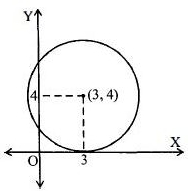
The center of the circle is $(-g, -f) = (3, 4)$ and the radius $r$ is given by $\sqrt{g^2 + f^2 - c}$.
$r = \sqrt{(-3)^2 + (-4)^2 - (25 - a^2)} = \sqrt{9 + 16 - 25 + a^2} = \sqrt{a^2} = |a|$.
Since the circle touches the $x$-axis,the radius must be equal to the absolute value of the $y$-coordinate of the center.
Thus,$|a| = |4|$,which implies $a = \pm 4$.
Comparing this with the general form $x^2 + y^2 + 2gx + 2fy + c = 0$,we get $g = -3$,$f = -4$,and $c = 25 - a^2$.
The center of the circle is $(-g, -f) = (3, 4)$ and the radius $r$ is given by $\sqrt{g^2 + f^2 - c}$.
$r = \sqrt{(-3)^2 + (-4)^2 - (25 - a^2)} = \sqrt{9 + 16 - 25 + a^2} = \sqrt{a^2} = |a|$.
Since the circle touches the $x$-axis,the radius must be equal to the absolute value of the $y$-coordinate of the center.
Thus,$|a| = |4|$,which implies $a = \pm 4$.
0 likesView Solution
53
MathematicsDifficultMCQJEE Main · 2013
The least integral value $\alpha$ of $x$ such that $\frac{x - 5}{x^2 + 5x - 14} > 0$ satisfies:
A
$\alpha^2 + 3\alpha - 4 = 0$
B
$\alpha^2 - 5\alpha + 4 = 0$
C
$\alpha^2 - 7\alpha + 6 = 0$
D
$\alpha^2 + 5\alpha - 6 = 0$
Solution
(D) Given the inequality: $\frac{x - 5}{(x + 7)(x - 2)} > 0$.
We use the wavy curve method (sign scheme) to find the intervals.
The critical points are $x = -7, 2, 5$.
Testing the intervals:
For $x > 5$,the expression is positive.
For $2 < x < 5$,the expression is negative.
For $-7 < x < 2$,the expression is positive.
For $x < -7$,the expression is negative.
The solution set is $x \in (-7, 2) \cup (5, \infty)$.
The integral values in the interval $(-7, 2)$ are $\{-6, -5, -4, -3, -2, -1, 0, 1\}$.
The integral values in the interval $(5, \infty)$ are $\{6, 7, 8, \dots\}$.
The least integral value $\alpha$ is $-6$.
Checking the options for $\alpha = -6$:
$(A)$ $(-6)^2 + 3(-6) - 4 = 36 - 18 - 4 = 14 \neq 0$.
$(B)$ $(-6)^2 - 5(-6) + 4 = 36 + 30 + 4 = 70 \neq 0$.
$(C)$ $(-6)^2 - 7(-6) + 6 = 36 + 42 + 6 = 84 \neq 0$.
$(D)$ $(-6)^2 + 5(-6) - 6 = 36 - 30 - 6 = 0$.
Thus,$\alpha = -6$ satisfies option $(D)$.
We use the wavy curve method (sign scheme) to find the intervals.
The critical points are $x = -7, 2, 5$.
Testing the intervals:
For $x > 5$,the expression is positive.
For $2 < x < 5$,the expression is negative.
For $-7 < x < 2$,the expression is positive.
For $x < -7$,the expression is negative.
The solution set is $x \in (-7, 2) \cup (5, \infty)$.
The integral values in the interval $(-7, 2)$ are $\{-6, -5, -4, -3, -2, -1, 0, 1\}$.
The integral values in the interval $(5, \infty)$ are $\{6, 7, 8, \dots\}$.
The least integral value $\alpha$ is $-6$.
Checking the options for $\alpha = -6$:
$(A)$ $(-6)^2 + 3(-6) - 4 = 36 - 18 - 4 = 14 \neq 0$.
$(B)$ $(-6)^2 - 5(-6) + 4 = 36 + 30 + 4 = 70 \neq 0$.
$(C)$ $(-6)^2 - 7(-6) + 6 = 36 + 42 + 6 = 84 \neq 0$.
$(D)$ $(-6)^2 + 5(-6) - 6 = 36 - 30 - 6 = 0$.
Thus,$\alpha = -6$ satisfies option $(D)$.
0 likesView Solution
54
MathematicsDifficultMCQJEE Main · 2013
The number of solutions of the equation $\sin 2x - 2 \cos x + 4 \sin x = 4$ in the interval $[0, 5\pi]$ is
A
$3$
B
$5$
C
$4$
D
$6$
Solution
(A) Given equation: $\sin 2x - 2 \cos x + 4 \sin x = 4$
Using $\sin 2x = 2 \sin x \cos x$,we get:
$2 \sin x \cos x - 2 \cos x + 4 \sin x - 4 = 0$
Factor by grouping:
$2 \cos x (\sin x - 1) + 4 (\sin x - 1) = 0$
$(2 \cos x + 4)(\sin x - 1) = 0$
$2(\cos x + 2)(\sin x - 1) = 0$
Since $\cos x + 2 \neq 0$ for any real $x$ (as $-1 \le \cos x \le 1$),we must have:
$\sin x = 1$
In the interval $[0, 5\pi]$,the values of $x$ for which $\sin x = 1$ are:
$x = \frac{\pi}{2}, \frac{5\pi}{2}, \frac{9\pi}{2}$
Thus,there are $3$ solutions.
Using $\sin 2x = 2 \sin x \cos x$,we get:
$2 \sin x \cos x - 2 \cos x + 4 \sin x - 4 = 0$
Factor by grouping:
$2 \cos x (\sin x - 1) + 4 (\sin x - 1) = 0$
$(2 \cos x + 4)(\sin x - 1) = 0$
$2(\cos x + 2)(\sin x - 1) = 0$
Since $\cos x + 2 \neq 0$ for any real $x$ (as $-1 \le \cos x \le 1$),we must have:
$\sin x = 1$
In the interval $[0, 5\pi]$,the values of $x$ for which $\sin x = 1$ are:
$x = \frac{\pi}{2}, \frac{5\pi}{2}, \frac{9\pi}{2}$
Thus,there are $3$ solutions.
0 likesView Solution
55
MathematicsDifficultMCQJEE Main · 2013
Let $a = \text{Im}\left( \frac{1 + z^2}{2iz} \right)$,where $z$ is any non-zero complex number. The set $A = \{ a : |z| = 1 \text{ and } z \ne \pm 1 \}$ is equal to
A
$(-1, 1)$
B
$[-1, 1]$
C
$[0, 1)$
D
$(-1, 0]$
Solution
(A) Let $z = x + iy$. Since $|z| = 1$,we have $x^2 + y^2 = 1$.
Consider the expression $\frac{1 + z^2}{2iz} = \frac{1 + (x + iy)^2}{2i(x + iy)} = \frac{1 + x^2 - y^2 + 2ixy}{2ix - 2y} = \frac{(1 + x^2 - y^2) + 2ixy}{-2y + 2ix}$.
Since $x^2 + y^2 = 1$,we have $1 - y^2 = x^2$. Substituting this into the numerator:
$\frac{(x^2 + x^2) + 2ixy}{-2y + 2ix} = \frac{2x^2 + 2ixy}{2i(x + iy)} = \frac{2x(x + iy)}{2i(x + iy)} = \frac{x}{i} = -ix$.
Thus,$a = \text{Im}(-ix) = -x$.
Since $|z| = 1$,$x$ ranges from $-1$ to $1$. Given $z \ne \pm 1$,$x \ne \pm 1$.
Therefore,$x \in (-1, 1)$,which implies $a = -x \in (-1, 1)$.
Hence,the set $A = (-1, 1)$.
Consider the expression $\frac{1 + z^2}{2iz} = \frac{1 + (x + iy)^2}{2i(x + iy)} = \frac{1 + x^2 - y^2 + 2ixy}{2ix - 2y} = \frac{(1 + x^2 - y^2) + 2ixy}{-2y + 2ix}$.
Since $x^2 + y^2 = 1$,we have $1 - y^2 = x^2$. Substituting this into the numerator:
$\frac{(x^2 + x^2) + 2ixy}{-2y + 2ix} = \frac{2x^2 + 2ixy}{2i(x + iy)} = \frac{2x(x + iy)}{2i(x + iy)} = \frac{x}{i} = -ix$.
Thus,$a = \text{Im}(-ix) = -x$.
Since $|z| = 1$,$x$ ranges from $-1$ to $1$. Given $z \ne \pm 1$,$x \ne \pm 1$.
Therefore,$x \in (-1, 1)$,which implies $a = -x \in (-1, 1)$.
Hence,the set $A = (-1, 1)$.
0 likesView Solution
56
MathematicsDifficultMCQJEE Main · 2013
Let $\theta_1$ be the angle between two lines $2x + 3y + c_1 = 0$ and $-x + 5y + c_2 = 0$,and $\theta_2$ be the angle between two lines $2x + 3y + c_1 = 0$ and $-x + 5y + c_3 = 0$,where $c_1, c_2, c_3$ are any real numbers.
Statement-$1$: If $c_2$ and $c_3$ are proportional,then $\theta_1 = \theta_2$.
Statement-$2$: $\theta_1 = \theta_2$ for all $c_2$ and $c_3$.
Statement-$1$: If $c_2$ and $c_3$ are proportional,then $\theta_1 = \theta_2$.
Statement-$2$: $\theta_1 = \theta_2$ for all $c_2$ and $c_3$.
A
Statement-$1$ is true,Statement-$2$ is true; Statement-$2$ is a correct explanation of Statement-$1$.
B
Statement-$1$ is true,Statement-$2$ is true; Statement-$2$ is not a correct explanation of Statement-$1$.
C
Statement-$1$ is false; Statement-$2$ is true.
D
Statement-$1$ is true; Statement-$2$ is false.
Solution
(A) The angle $\theta$ between two lines $a_1x + b_1y + c_1 = 0$ and $a_2x + b_2y + c_2 = 0$ is given by $\tan \theta = \left| \frac{a_1b_2 - a_2b_1}{a_1a_2 + b_1b_2} \right|$.
For the lines $2x + 3y + c_1 = 0$ and $-x + 5y + c_2 = 0$,the angle $\theta_1$ satisfies $\tan \theta_1 = \left| \frac{(2)(5) - (3)(-1)}{(2)(-1) + (3)(5)} \right| = \left| \frac{10 + 3}{-2 + 15} \right| = \frac{13}{13} = 1$.
Similarly,for the lines $2x + 3y + c_1 = 0$ and $-x + 5y + c_3 = 0$,the angle $\theta_2$ satisfies $\tan \theta_2 = \left| \frac{(2)(5) - (3)(-1)}{(2)(-1) + (3)(5)} \right| = 1$.
Since $\tan \theta_1 = \tan \theta_2 = 1$,we have $\theta_1 = \theta_2$ for any real values of $c_2$ and $c_3$.
Thus,Statement-$2$ is true.
Since Statement-$2$ is true,Statement-$1$ is also true,and Statement-$2$ provides the logical basis for Statement-$1$.
For the lines $2x + 3y + c_1 = 0$ and $-x + 5y + c_2 = 0$,the angle $\theta_1$ satisfies $\tan \theta_1 = \left| \frac{(2)(5) - (3)(-1)}{(2)(-1) + (3)(5)} \right| = \left| \frac{10 + 3}{-2 + 15} \right| = \frac{13}{13} = 1$.
Similarly,for the lines $2x + 3y + c_1 = 0$ and $-x + 5y + c_3 = 0$,the angle $\theta_2$ satisfies $\tan \theta_2 = \left| \frac{(2)(5) - (3)(-1)}{(2)(-1) + (3)(5)} \right| = 1$.
Since $\tan \theta_1 = \tan \theta_2 = 1$,we have $\theta_1 = \theta_2$ for any real values of $c_2$ and $c_3$.
Thus,Statement-$2$ is true.
Since Statement-$2$ is true,Statement-$1$ is also true,and Statement-$2$ provides the logical basis for Statement-$1$.
0 likesView Solution
57
MathematicsDifficultMCQJEE Main · 2013
If $a_1, a_2, a_3, . . . , a_n, . . .$ are in $A.P.$ such that $a_4 - a_7 + a_{10} = m$,then the sum of the first $13$ terms of this $A.P.$ is .............. $m$.
A
$10$
B
$12$
C
$13$
D
$15$
Solution
(C) Let the first term be $a$ and the common difference be $d$.
Given $a_4 - a_7 + a_{10} = m$.
Using the formula $a_n = a + (n-1)d$:
$(a + 3d) - (a + 6d) + (a + 9d) = m$
$a + 6d = m$
Note that $a_7 = a + 6d$,so $a_7 = m$.
The sum of the first $13$ terms is given by $S_{13} = \frac{13}{2} [2a + (13-1)d] = \frac{13}{2} [2a + 12d] = 13(a + 6d)$.
Substituting $a + 6d = m$,we get $S_{13} = 13m$.
Given $a_4 - a_7 + a_{10} = m$.
Using the formula $a_n = a + (n-1)d$:
$(a + 3d) - (a + 6d) + (a + 9d) = m$
$a + 6d = m$
Note that $a_7 = a + 6d$,so $a_7 = m$.
The sum of the first $13$ terms is given by $S_{13} = \frac{13}{2} [2a + (13-1)d] = \frac{13}{2} [2a + 12d] = 13(a + 6d)$.
Substituting $a + 6d = m$,we get $S_{13} = 13m$.
0 likesView Solution
58
MathematicsDifficultMCQJEE Main · 2013
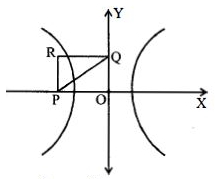
$A$ tangent to the hyperbola $\frac{x^2}{4} - \frac{y^2}{2} = 1$ meets the $x-$axis at $P$ and the $y-$axis at $Q$. Lines $PR$ and $QR$ are drawn such that $OPRQ$ is a rectangle (where $O$ is the origin). Then $R$ lies on
A
$\frac{4}{x^2} + \frac{2}{y^2} = 1$
B
$\frac{2}{x^2} - \frac{4}{y^2} = 1$
C
$\frac{2}{x^2} + \frac{4}{y^2} = 1$
D
$\frac{4}{x^2} - \frac{2}{y^2} = 1$
Solution
(D) The equation of the tangent to the hyperbola $\frac{x^2}{a^2} - \frac{y^2}{b^2} = 1$ at the point $(a \sec \theta, b \tan \theta)$ is $\frac{x \sec \theta}{a} - \frac{y \tan \theta}{b} = 1$.
Setting $y=0$,we get $x = a \cos \theta$,so $P = (a \cos \theta, 0)$.
Setting $x=0$,we get $y = -b \cot \theta$,so $Q = (0, -b \cot \theta)$.
Since $OPRQ$ is a rectangle with $O(0,0)$,the coordinates of $R$ are $(h, k) = (a \cos \theta, -b \cot \theta)$.
From this,$\cos \theta = \frac{h}{a}$ and $\cot \theta = -\frac{k}{b}$.
Using the identity $\csc^2 \theta - \cot^2 \theta = 1$,we have $\frac{1}{\sin^2 \theta} - \cot^2 \theta = 1$,which is $\frac{1}{1 - \cos^2 \theta} - \cot^2 \theta = 1$.
Alternatively,$\frac{1}{\cos^2 \theta} = 1 + \tan^2 \theta$ is not helpful here. Let's use $\csc^2 \theta = 1 + \cot^2 \theta$.
$\frac{1}{\sin^2 \theta} = 1 + \frac{k^2}{b^2} = \frac{b^2 + k^2}{b^2}$.
Since $\cos^2 \theta = \frac{h^2}{a^2}$,then $\sin^2 \theta = 1 - \frac{h^2}{a^2} = \frac{a^2 - h^2}{a^2}$.
Substituting these into $\frac{1}{\sin^2 \theta} = 1 + \frac{k^2}{b^2}$ gives $\frac{a^2}{a^2 - h^2} = \frac{b^2 + k^2}{b^2}$.
This simplifies to $a^2 b^2 = (a^2 - h^2)(b^2 + k^2) = a^2 b^2 + a^2 k^2 - b^2 h^2 - h^2 k^2$.
$a^2 k^2 - b^2 h^2 - h^2 k^2 = 0 \Rightarrow \frac{a^2}{h^2} - \frac{b^2}{k^2} = 1$.
Given $a^2 = 4$ and $b^2 = 2$,the locus of $R(x, y)$ is $\frac{4}{x^2} - \frac{2}{y^2} = 1$.
Setting $y=0$,we get $x = a \cos \theta$,so $P = (a \cos \theta, 0)$.
Setting $x=0$,we get $y = -b \cot \theta$,so $Q = (0, -b \cot \theta)$.
Since $OPRQ$ is a rectangle with $O(0,0)$,the coordinates of $R$ are $(h, k) = (a \cos \theta, -b \cot \theta)$.
From this,$\cos \theta = \frac{h}{a}$ and $\cot \theta = -\frac{k}{b}$.
Using the identity $\csc^2 \theta - \cot^2 \theta = 1$,we have $\frac{1}{\sin^2 \theta} - \cot^2 \theta = 1$,which is $\frac{1}{1 - \cos^2 \theta} - \cot^2 \theta = 1$.
Alternatively,$\frac{1}{\cos^2 \theta} = 1 + \tan^2 \theta$ is not helpful here. Let's use $\csc^2 \theta = 1 + \cot^2 \theta$.
$\frac{1}{\sin^2 \theta} = 1 + \frac{k^2}{b^2} = \frac{b^2 + k^2}{b^2}$.
Since $\cos^2 \theta = \frac{h^2}{a^2}$,then $\sin^2 \theta = 1 - \frac{h^2}{a^2} = \frac{a^2 - h^2}{a^2}$.
Substituting these into $\frac{1}{\sin^2 \theta} = 1 + \frac{k^2}{b^2}$ gives $\frac{a^2}{a^2 - h^2} = \frac{b^2 + k^2}{b^2}$.
This simplifies to $a^2 b^2 = (a^2 - h^2)(b^2 + k^2) = a^2 b^2 + a^2 k^2 - b^2 h^2 - h^2 k^2$.
$a^2 k^2 - b^2 h^2 - h^2 k^2 = 0 \Rightarrow \frac{a^2}{h^2} - \frac{b^2}{k^2} = 1$.
Given $a^2 = 4$ and $b^2 = 2$,the locus of $R(x, y)$ is $\frac{4}{x^2} - \frac{2}{y^2} = 1$.
0 likesView Solution
59
MathematicsDifficultMCQJEE Main · 2013
On the sides $AB, BC, CA$ of a $\Delta ABC$,$3, 4, 5$ distinct points (excluding vertices $A, B, C$) are respectively chosen. The number of triangles that can be constructed using these chosen points as vertices is:
A
$210$
B
$205$
C
$215$
D
$220$
Solution
(B) Total number of points $= 3 + 4 + 5 = 12$.
Number of ways to select $3$ points out of $12$ is $^{12}C_3 = \frac{12 \times 11 \times 10}{3 \times 2 \times 1} = 220$.
However,points on the same side are collinear and cannot form a triangle.
Number of triangles formed by $3$ collinear points on side $AB = ^3C_3 = 1$.
Number of triangles formed by $3$ collinear points on side $BC = ^4C_3 = 4$.
Number of triangles formed by $3$ collinear points on side $CA = ^5C_3 = 10$.
Required number of triangles $= 220 - (1 + 4 + 10) = 220 - 15 = 205$.
Number of ways to select $3$ points out of $12$ is $^{12}C_3 = \frac{12 \times 11 \times 10}{3 \times 2 \times 1} = 220$.
However,points on the same side are collinear and cannot form a triangle.
Number of triangles formed by $3$ collinear points on side $AB = ^3C_3 = 1$.
Number of triangles formed by $3$ collinear points on side $BC = ^4C_3 = 4$.
Number of triangles formed by $3$ collinear points on side $CA = ^5C_3 = 10$.
Required number of triangles $= 220 - (1 + 4 + 10) = 220 - 15 = 205$.
0 likesView Solution
60
MathematicsDifficultMCQJEE Main · 2013
If the median and the range of four numbers $\{x, y, 2x + y, x - y\}$,where $0 < y < x < 2y$,are $10$ and $28$ respectively,then the mean of the numbers is
A
$18$
B
$10$
C
$5$
D
$14$
Solution
(D) Given the condition $0 < y < x < 2y$,we can order the numbers as follows:
Since $y < x$ and $x < 2y$,we have $x - y < y < x < 2x + y$.
The median of the four numbers is the average of the two middle terms:
$\text{Median} = \frac{y + x}{2} = 10 \Rightarrow x + y = 20 \quad (i)$
The range is the difference between the largest and smallest values:
$\text{Range} = (2x + y) - (x - y) = x + 2y = 28 \quad (ii)$
Subtracting equation $(i)$ from $(ii)$:
$(x + 2y) - (x + y) = 28 - 20 \Rightarrow y = 8$.
Substituting $y = 8$ into $(i)$:
$x + 8 = 20 \Rightarrow x = 12$.
The four numbers are $(12 - 8), 8, 12, (2(12) + 8)$,which are $4, 8, 12, 32$.
The mean is $\frac{4 + 8 + 12 + 32}{4} = \frac{56}{4} = 14$.
Since $y < x$ and $x < 2y$,we have $x - y < y < x < 2x + y$.
The median of the four numbers is the average of the two middle terms:
$\text{Median} = \frac{y + x}{2} = 10 \Rightarrow x + y = 20 \quad (i)$
The range is the difference between the largest and smallest values:
$\text{Range} = (2x + y) - (x - y) = x + 2y = 28 \quad (ii)$
Subtracting equation $(i)$ from $(ii)$:
$(x + 2y) - (x + y) = 28 - 20 \Rightarrow y = 8$.
Substituting $y = 8$ into $(i)$:
$x + 8 = 20 \Rightarrow x = 12$.
The four numbers are $(12 - 8), 8, 12, (2(12) + 8)$,which are $4, 8, 12, 32$.
The mean is $\frac{4 + 8 + 12 + 32}{4} = \frac{56}{4} = 14$.
0 likesView Solution
61
MathematicsDifficultMCQJEE Main · 2013
The point of intersection of the normals to the parabola $y^2 = 4x$ at the ends of its latus rectum is
A
$(0, 2)$
B
$(3, 0)$
C
$(0, 3)$
D
$(2, 0)$
Solution
(B) The equation of the parabola is $y^2 = 4x$. Comparing this with $y^2 = 4ax$,we get $a = 1$.
The ends of the latus rectum of the parabola $y^2 = 4ax$ are $(a, 2a)$ and $(a, -2a)$.
For $a = 1$,the ends are $(1, 2)$ and $(1, -2)$.
The normals to the parabola at the ends of the latus rectum $(a, 2a)$ and $(a, -2a)$ intersect at the point $(3a, 0)$.
Substituting $a = 1$,the point of intersection is $(3(1), 0) = (3, 0)$.
The ends of the latus rectum of the parabola $y^2 = 4ax$ are $(a, 2a)$ and $(a, -2a)$.
For $a = 1$,the ends are $(1, 2)$ and $(1, -2)$.
The normals to the parabola at the ends of the latus rectum $(a, 2a)$ and $(a, -2a)$ intersect at the point $(3a, 0)$.
Substituting $a = 1$,the point of intersection is $(3(1), 0) = (3, 0)$.
0 likesView Solution
62
MathematicsDifficultMCQJEE Main · 2013
Given a sequence of $4$ numbers,the first three of which are in $G.P.$ and the last three are in $A.P.$ with a common difference of $6$. If the first and last terms in this sequence are equal,then the last term is:
A
$16$
B
$8$
C
$4$
D
$2$
Solution
(B) Let the sequence be $a, b, c, d$.
Since $a, b, c$ are in $G.P.$,we have $b^2 = ac$.
Since $b, c, d$ are in $A.P.$ with common difference $6$,we have $c - b = 6$ and $d - c = 6$.
Thus,$c = b + 6$ and $d = c + 6 = b + 12$.
Given that the first and last terms are equal,$a = d$,so $a = b + 12$,which implies $b = a - 12$.
Substituting $b = a - 12$ into $c = b + 6$,we get $c = (a - 12) + 6 = a - 6$.
Now,substitute $b$ and $c$ into the $G.P.$ condition $b^2 = ac$:
$(a - 12)^2 = a(a - 6)$
$a^2 - 24a + 144 = a^2 - 6a$
$144 = 18a$
$a = 8$.
Since $d = a$,the last term is $8$.
Since $a, b, c$ are in $G.P.$,we have $b^2 = ac$.
Since $b, c, d$ are in $A.P.$ with common difference $6$,we have $c - b = 6$ and $d - c = 6$.
Thus,$c = b + 6$ and $d = c + 6 = b + 12$.
Given that the first and last terms are equal,$a = d$,so $a = b + 12$,which implies $b = a - 12$.
Substituting $b = a - 12$ into $c = b + 6$,we get $c = (a - 12) + 6 = a - 6$.
Now,substitute $b$ and $c$ into the $G.P.$ condition $b^2 = ac$:
$(a - 12)^2 = a(a - 6)$
$a^2 - 24a + 144 = a^2 - 6a$
$144 = 18a$
$a = 8$.
Since $d = a$,the last term is $8$.
0 likesView Solution
63
MathematicsDifficultMCQJEE Main · 2013
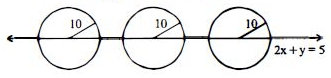
Statement $1$: The only circle having radius $\sqrt{10}$ and a diameter along the line $2x + y = 5$ is $x^2 + y^2 - 6x + 2y = 0$.
Statement $2$: $2x + y = 5$ is a normal to the circle $x^2 + y^2 - 6x + 2y = 0$.
Statement $2$: $2x + y = 5$ is a normal to the circle $x^2 + y^2 - 6x + 2y = 0$.
A
Statement $1$ is false; Statement $2$ is true.
B
Statement $1$ is true; Statement $2$ is true,Statement $2$ is a correct explanation for Statement $1$.
C
Statement $1$ is true; Statement $2$ is false.
D
Statement $1$ is true; Statement $2$ is true; Statement $2$ is not a correct explanation for Statement $1$.
Solution
(A) For the circle $x^2 + y^2 - 6x + 2y = 0$,the center is $(3, -1)$ and the radius is $r = \sqrt{3^2 + (-1)^2 - 0} = \sqrt{10}$.
Check if the center $(3, -1)$ lies on the line $2x + y = 5$: $2(3) + (-1) = 6 - 1 = 5$. Since the center lies on the line,the line is a diameter (and thus a normal) to the circle. So,Statement $2$ is true.
For Statement $1$,there are infinitely many circles with radius $\sqrt{10}$ whose centers lie on the line $2x + y = 5$. Any circle with center $(h, k)$ such that $2h + k = 5$ and radius $\sqrt{10}$ satisfies the condition. Thus,Statement $1$ is false.
Check if the center $(3, -1)$ lies on the line $2x + y = 5$: $2(3) + (-1) = 6 - 1 = 5$. Since the center lies on the line,the line is a diameter (and thus a normal) to the circle. So,Statement $2$ is true.
For Statement $1$,there are infinitely many circles with radius $\sqrt{10}$ whose centers lie on the line $2x + y = 5$. Any circle with center $(h, k)$ such that $2h + k = 5$ and radius $\sqrt{10}$ satisfies the condition. Thus,Statement $1$ is false.
0 likesView Solution
64
MathematicsDifficultMCQJEE Main · 2013
If a circle of unit radius is divided into two parts by an arc of another circle subtending an angle $60^o$ on the circumference of the first circle,then the radius of the arc is
A
$\sqrt{3}$
B
$1/2$
C
$1$
D
Information is incomplete
Solution
(D) Let the first circle be $C_1$ with radius $r_1 = 1$ and center at the origin $(0,0)$.
Let the second circle be $C_2$ with radius $r_2$ and center at $(h,k)$.
The arc of $C_2$ subtends an angle of $60^o$ at the circumference of $C_1$.
By the inscribed angle theorem,the angle subtended by the same arc at the center of $C_1$ would be $120^o$ if the arc is part of a circle passing through the center,or related to the geometry of the intersection.
However,the position of the center of the second circle is not fixed relative to the first circle.
Without knowing the distance between the centers or the specific chord length formed by the intersection,the radius $r_2$ cannot be uniquely determined.
Thus,the information provided is insufficient to solve for $r_2$.
Let the second circle be $C_2$ with radius $r_2$ and center at $(h,k)$.
The arc of $C_2$ subtends an angle of $60^o$ at the circumference of $C_1$.
By the inscribed angle theorem,the angle subtended by the same arc at the center of $C_1$ would be $120^o$ if the arc is part of a circle passing through the center,or related to the geometry of the intersection.
However,the position of the center of the second circle is not fixed relative to the first circle.
Without knowing the distance between the centers or the specific chord length formed by the intersection,the radius $r_2$ cannot be uniquely determined.
Thus,the information provided is insufficient to solve for $r_2$.
0 likesView Solution
65
MathematicsDifficultMCQJEE Main · 2013
If the image of point $P(2, 3)$ in a line $L$ is $Q(4, 5)$,then the image of point $R(0, 0)$ in the same line is
A
$(2, 2)$
B
$(4, 5)$
C
$(3, 4)$
D
$(7, 7)$
Solution
(D) Mid-point of $P(2, 3)$ and $Q(4, 5)$ is $(\frac{2+4}{2}, \frac{3+5}{2}) = (3, 4)$.
Slope of $PQ = \frac{5-3}{4-2} = \frac{2}{2} = 1$.
Since the line $L$ is the perpendicular bisector of $PQ$,the slope of line $L$ is $m = -1$.
The equation of line $L$ passing through $(3, 4)$ with slope $-1$ is $y - 4 = -1(x - 3) \Rightarrow x + y - 7 = 0$.
Let the image of point $R(0, 0)$ be $S(x_1, y_1)$.
The mid-point of $RS$ is $(\frac{x_1}{2}, \frac{y_1}{2})$,which lies on line $L$,so $\frac{x_1}{2} + \frac{y_1}{2} - 7 = 0 \Rightarrow x_1 + y_1 = 14$.
The slope of $RS$ is $\frac{y_1}{x_1}$. Since $RS \perp L$,the slope of $RS$ must be $1$ (negative reciprocal of $-1$).
Thus,$\frac{y_1}{x_1} = 1 \Rightarrow x_1 = y_1$.
Substituting $x_1 = y_1$ into $x_1 + y_1 = 14$,we get $2x_1 = 14 \Rightarrow x_1 = 7$ and $y_1 = 7$.
Therefore,the image of $R$ is $(7, 7)$.
Slope of $PQ = \frac{5-3}{4-2} = \frac{2}{2} = 1$.
Since the line $L$ is the perpendicular bisector of $PQ$,the slope of line $L$ is $m = -1$.
The equation of line $L$ passing through $(3, 4)$ with slope $-1$ is $y - 4 = -1(x - 3) \Rightarrow x + y - 7 = 0$.
Let the image of point $R(0, 0)$ be $S(x_1, y_1)$.
The mid-point of $RS$ is $(\frac{x_1}{2}, \frac{y_1}{2})$,which lies on line $L$,so $\frac{x_1}{2} + \frac{y_1}{2} - 7 = 0 \Rightarrow x_1 + y_1 = 14$.
The slope of $RS$ is $\frac{y_1}{x_1}$. Since $RS \perp L$,the slope of $RS$ must be $1$ (negative reciprocal of $-1$).
Thus,$\frac{y_1}{x_1} = 1 \Rightarrow x_1 = y_1$.
Substituting $x_1 = y_1$ into $x_1 + y_1 = 14$,we get $2x_1 = 14 \Rightarrow x_1 = 7$ and $y_1 = 7$.
Therefore,the image of $R$ is $(7, 7)$.
0 likesView Solution
66
MathematicsDifficultMCQJEE Main · 2013
$A$ common tangent to the conics $x^2 = 6y$ and $2x^2 - 4y^2 = 9$ is
A
$x - y = \frac{3}{2}$
B
$x + y = 1$
C
$x + y = \frac{9}{2}$
D
$x - y = 1$
Solution
(A) Given conics are $x^2 = 6y$ $(i)$ and $2x^2 - 4y^2 = 9$ $(ii)$.
Consider the line $x - y = \frac{3}{2}$ $(iii)$,which implies $x = y + \frac{3}{2}$.
Substitute $x = y + \frac{3}{2}$ into $(i)$: $(y + \frac{3}{2})^2 = 6y \implies y^2 + 3y + \frac{9}{4} = 6y \implies y^2 - 3y + \frac{9}{4} = 0 \implies (y - \frac{3}{2})^2 = 0$. Thus,$y = \frac{3}{2}$ and $x = 3$.
Since there is only one point of intersection $(3, \frac{3}{2})$,the line is tangent to the parabola.
Substitute $x = y + \frac{3}{2}$ into $(ii)$: $2(y + \frac{3}{2})^2 - 4y^2 = 9 \implies 2(y^2 + 3y + \frac{9}{4}) - 4y^2 = 9 \implies 2y^2 + 6y + \frac{9}{2} - 4y^2 = 9 \implies -2y^2 + 6y - \frac{9}{2} = 0 \implies 4y^2 - 12y + 9 = 0 \implies (2y - 3)^2 = 0$. Thus,$y = \frac{3}{2}$ and $x = 3$.
Since there is only one point of intersection $(3, \frac{3}{2})$,the line is tangent to the hyperbola.
Therefore,$x - y = \frac{3}{2}$ is the common tangent.
Consider the line $x - y = \frac{3}{2}$ $(iii)$,which implies $x = y + \frac{3}{2}$.
Substitute $x = y + \frac{3}{2}$ into $(i)$: $(y + \frac{3}{2})^2 = 6y \implies y^2 + 3y + \frac{9}{4} = 6y \implies y^2 - 3y + \frac{9}{4} = 0 \implies (y - \frac{3}{2})^2 = 0$. Thus,$y = \frac{3}{2}$ and $x = 3$.
Since there is only one point of intersection $(3, \frac{3}{2})$,the line is tangent to the parabola.
Substitute $x = y + \frac{3}{2}$ into $(ii)$: $2(y + \frac{3}{2})^2 - 4y^2 = 9 \implies 2(y^2 + 3y + \frac{9}{4}) - 4y^2 = 9 \implies 2y^2 + 6y + \frac{9}{2} - 4y^2 = 9 \implies -2y^2 + 6y - \frac{9}{2} = 0 \implies 4y^2 - 12y + 9 = 0 \implies (2y - 3)^2 = 0$. Thus,$y = \frac{3}{2}$ and $x = 3$.
Since there is only one point of intersection $(3, \frac{3}{2})$,the line is tangent to the hyperbola.
Therefore,$x - y = \frac{3}{2}$ is the common tangent.
0 likesView Solution
67
MathematicsDifficultMCQJEE Main · 2013
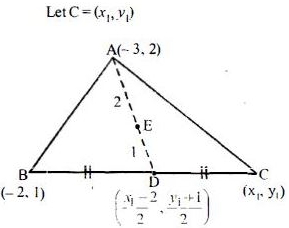
Let $A(-3, 2)$ and $B(-2, 1)$ be the vertices of a triangle $ABC$. If the centroid of this triangle lies on the line $3x + 4y + 2 = 0$,then the vertex $C$ lies on the line
A
$4x + 3y + 5 = 0$
B
$3x + 4y + 3 = 0$
C
$4x + 3y + 3 = 0$
D
$3x + 4y + 5 = 0$
Solution
(B) Let the vertex $C$ be $(x_1, y_1)$.
The centroid $G$ of triangle $ABC$ with vertices $A(-3, 2)$,$B(-2, 1)$,and $C(x_1, y_1)$ is given by:
$G = \left( \frac{-3 - 2 + x_1}{3}, \frac{2 + 1 + y_1}{3} \right) = \left( \frac{x_1 - 5}{3}, \frac{y_1 + 3}{3} \right)$
Since the centroid lies on the line $3x + 4y + 2 = 0$,we substitute the coordinates of $G$ into the equation:
$3 \left( \frac{x_1 - 5}{3} \right) + 4 \left( \frac{y_1 + 3}{3} \right) + 2 = 0$
Multiply the entire equation by $3$ to clear the denominators:
$3(x_1 - 5) + 4(y_1 + 3) + 6 = 0$
$3x_1 - 15 + 4y_1 + 12 + 6 = 0$
$3x_1 + 4y_1 + 3 = 0$
Thus,the vertex $C(x_1, y_1)$ lies on the line $3x + 4y + 3 = 0$.
The centroid $G$ of triangle $ABC$ with vertices $A(-3, 2)$,$B(-2, 1)$,and $C(x_1, y_1)$ is given by:
$G = \left( \frac{-3 - 2 + x_1}{3}, \frac{2 + 1 + y_1}{3} \right) = \left( \frac{x_1 - 5}{3}, \frac{y_1 + 3}{3} \right)$
Since the centroid lies on the line $3x + 4y + 2 = 0$,we substitute the coordinates of $G$ into the equation:
$3 \left( \frac{x_1 - 5}{3} \right) + 4 \left( \frac{y_1 + 3}{3} \right) + 2 = 0$
Multiply the entire equation by $3$ to clear the denominators:
$3(x_1 - 5) + 4(y_1 + 3) + 6 = 0$
$3x_1 - 15 + 4y_1 + 12 + 6 = 0$
$3x_1 + 4y_1 + 3 = 0$
Thus,the vertex $C(x_1, y_1)$ lies on the line $3x + 4y + 3 = 0$.
0 likesView Solution
68
MathematicsDifficultMCQJEE Main · 2013
Let $p$ and $q$ be any two logical statements and $r: p \to (\sim p \vee q)$. If $r$ has a truth value $F$,then the truth values of $p$ and $q$ are respectively
A
$F, F$
B
$T, T$
C
$T, F$
D
$F, T$
Solution
(C) The logical statement $r: p \to (\sim p \vee q)$ has a truth value $F$.
An implication $A \to B$ is false if and only if $A$ is true and $B$ is false.
Therefore,$p$ must be $T$ and $(\sim p \vee q)$ must be $F$.
For the disjunction $(\sim p \vee q)$ to be $F$,both $\sim p$ and $q$ must be $F$.
Since $\sim p$ is $F$,it implies $p$ is $T$.
Thus,$p$ is $T$ and $q$ is $F$.
An implication $A \to B$ is false if and only if $A$ is true and $B$ is false.
Therefore,$p$ must be $T$ and $(\sim p \vee q)$ must be $F$.
For the disjunction $(\sim p \vee q)$ to be $F$,both $\sim p$ and $q$ must be $F$.
Since $\sim p$ is $F$,it implies $p$ is $T$.
Thus,$p$ is $T$ and $q$ is $F$.
0 likesView Solution
69
MathematicsDifficultMCQJEE Main · 2013
If the events $A$ and $B$ are mutually exclusive events such that $P(A) = \frac{3x + 1}{3}$ and $P(B) = \frac{1 - x}{4}$,then the set of possible values of $x$ lies in the interval
A
$[0, 1]$
B
$[\frac{1}{3}, \frac{2}{3}]$
C
$[-\frac{1}{3}, \frac{5}{9}]$
D
$[-\frac{7}{9}, \frac{4}{9}]$
Solution
(C) For any event $E$,the probability $P(E)$ must satisfy $0 \le P(E) \le 1$.
For event $A$: $0 \le \frac{3x+1}{3} \le 1 \Rightarrow 0 \le 3x+1 \le 3 \Rightarrow -1 \le 3x \le 2 \Rightarrow -\frac{1}{3} \le x \le \frac{2}{3}$.
For event $B$: $0 \le \frac{1-x}{4} \le 1 \Rightarrow 0 \le 1-x \le 4 \Rightarrow -1 \le -x \le 3 \Rightarrow -3 \le x \le 1$.
Since $A$ and $B$ are mutually exclusive,$P(A \cup B) = P(A) + P(B) \le 1$.
$\frac{3x+1}{3} + \frac{1-x}{4} \le 1 \Rightarrow \frac{4(3x+1) + 3(1-x)}{12} \le 1 \Rightarrow 12x + 4 + 3 - 3x \le 12 \Rightarrow 9x + 7 \le 12 \Rightarrow 9x \le 5 \Rightarrow x \le \frac{5}{9}$.
Combining all conditions: $x \ge -\frac{1}{3}$,$x \le \frac{2}{3}$,$x \ge -3$,$x \le 1$,and $x \le \frac{5}{9}$.
The intersection of these intervals is $[-\frac{1}{3}, \frac{5}{9}]$.
For event $A$: $0 \le \frac{3x+1}{3} \le 1 \Rightarrow 0 \le 3x+1 \le 3 \Rightarrow -1 \le 3x \le 2 \Rightarrow -\frac{1}{3} \le x \le \frac{2}{3}$.
For event $B$: $0 \le \frac{1-x}{4} \le 1 \Rightarrow 0 \le 1-x \le 4 \Rightarrow -1 \le -x \le 3 \Rightarrow -3 \le x \le 1$.
Since $A$ and $B$ are mutually exclusive,$P(A \cup B) = P(A) + P(B) \le 1$.
$\frac{3x+1}{3} + \frac{1-x}{4} \le 1 \Rightarrow \frac{4(3x+1) + 3(1-x)}{12} \le 1 \Rightarrow 12x + 4 + 3 - 3x \le 12 \Rightarrow 9x + 7 \le 12 \Rightarrow 9x \le 5 \Rightarrow x \le \frac{5}{9}$.
Combining all conditions: $x \ge -\frac{1}{3}$,$x \le \frac{2}{3}$,$x \ge -3$,$x \le 1$,and $x \le \frac{5}{9}$.
The intersection of these intervals is $[-\frac{1}{3}, \frac{5}{9}]$.
0 likesView Solution
70
MathematicsDifficultMCQJEE Main · 2013
If for positive integers $r > 1, n > 2$,the coefficients of the $(3r)^{th}$ and $(r + 2)^{th}$ powers of $x$ in the expansion of $(1 + x)^{2n}$ are equal,then $n$ is equal to
A
$2r + 1$
B
$2r - 1$
C
$3r$
D
$r + 1$
Solution
(A) The general term in the expansion of $(1 + x)^{2n}$ is given by $T_{k+1} = ^{2n}C_k x^k$.
The coefficient of $x^{3r}$ is $^{2n}C_{3r}$ and the coefficient of $x^{r+2}$ is $^{2n}C_{r+2}$.
Given that the coefficients are equal,we have $^{2n}C_{3r} = ^{2n}C_{r+2}$.
Using the property $^{n}C_a = ^{n}C_b \Rightarrow a = b$ or $a + b = n$,we have two cases:
Case $1$: $3r = r + 2$ $\Rightarrow 2r = 2$ $\Rightarrow r = 1$. However,the problem states $r > 1$,so this case is rejected.
Case $2$: $3r + (r + 2) = 2n$ $\Rightarrow 4r + 2 = 2n$ $\Rightarrow n = 2r + 1$.
Thus,$n = 2r + 1$.
The coefficient of $x^{3r}$ is $^{2n}C_{3r}$ and the coefficient of $x^{r+2}$ is $^{2n}C_{r+2}$.
Given that the coefficients are equal,we have $^{2n}C_{3r} = ^{2n}C_{r+2}$.
Using the property $^{n}C_a = ^{n}C_b \Rightarrow a = b$ or $a + b = n$,we have two cases:
Case $1$: $3r = r + 2$ $\Rightarrow 2r = 2$ $\Rightarrow r = 1$. However,the problem states $r > 1$,so this case is rejected.
Case $2$: $3r + (r + 2) = 2n$ $\Rightarrow 4r + 2 = 2n$ $\Rightarrow n = 2r + 1$.
Thus,$n = 2r + 1$.
0 likesView Solution
71
MathematicsDifficultMCQJEE Main · 2013
If $p$ and $q$ are non-zero real numbers and $\alpha^3 + \beta^3 = -p$,$\alpha \beta = q$,then a quadratic equation whose roots are $\frac{\alpha^2}{\beta}$ and $\frac{\beta^2}{\alpha}$ is
A
$px^2 - qx + p^2 = 0$
B
$qx^2 + px + q^2 = 0$
C
$px^2 + qx + p^2 = 0$
D
$qx^2 - px + q^2 = 0$
Solution
(B) Given $\alpha^3 + \beta^3 = -p$ and $\alpha \beta = q$.
Let the roots of the required quadratic equation be $x_1 = \frac{\alpha^2}{\beta}$ and $x_2 = \frac{\beta^2}{\alpha}$.
The sum of the roots is $x_1 + x_2 = \frac{\alpha^2}{\beta} + \frac{\beta^2}{\alpha} = \frac{\alpha^3 + \beta^3}{\alpha \beta} = \frac{-p}{q}$.
The product of the roots is $x_1 \times x_2 = \frac{\alpha^2}{\beta} \times \frac{\beta^2}{\alpha} = \alpha \beta = q$.
The required quadratic equation is given by $x^2 - (\text{sum of roots})x + (\text{product of roots}) = 0$.
Substituting the values,we get $x^2 - (\frac{-p}{q})x + q = 0$.
$x^2 + \frac{p}{q}x + q = 0$.
Multiplying by $q$,we get $qx^2 + px + q^2 = 0$.
Let the roots of the required quadratic equation be $x_1 = \frac{\alpha^2}{\beta}$ and $x_2 = \frac{\beta^2}{\alpha}$.
The sum of the roots is $x_1 + x_2 = \frac{\alpha^2}{\beta} + \frac{\beta^2}{\alpha} = \frac{\alpha^3 + \beta^3}{\alpha \beta} = \frac{-p}{q}$.
The product of the roots is $x_1 \times x_2 = \frac{\alpha^2}{\beta} \times \frac{\beta^2}{\alpha} = \alpha \beta = q$.
The required quadratic equation is given by $x^2 - (\text{sum of roots})x + (\text{product of roots}) = 0$.
Substituting the values,we get $x^2 - (\frac{-p}{q})x + q = 0$.
$x^2 + \frac{p}{q}x + q = 0$.
Multiplying by $q$,we get $qx^2 + px + q^2 = 0$.
0 likesView Solution
72
MathematicsDifficultMCQJEE Main · 2013
Let $A = \{ \theta : \sin(\theta) = \tan(\theta) \}$ and $B = \{ \theta : \cos(\theta) = 1 \}$ be two sets. Then
A
$A = B$
B
$A \not\subset B$
C
$B \not\subset A$
D
$A \subset B$ and $B - A \neq \phi$
Solution
(B) For set $A$,we have $\sin(\theta) = \tan(\theta)$.
This implies $\sin(\theta) = \frac{\sin(\theta)}{\cos(\theta)}$,which gives $\sin(\theta)(1 - \frac{1}{\cos(\theta)}) = 0$.
Thus,$\sin(\theta) = 0$ or $\cos(\theta) = 1$.
If $\sin(\theta) = 0$,then $\theta = n\pi$ for $n \in \mathbb{Z}$.
If $\cos(\theta) = 1$,then $\theta = 2n\pi$ for $n \in \mathbb{Z}$.
Combining these,$A = \{ n\pi : n \in \mathbb{Z} \} = \{ 0, \pm\pi, \pm 2\pi, \dots \}$.
For set $B$,we have $\cos(\theta) = 1$,which implies $\theta = 2n\pi$ for $n \in \mathbb{Z}$.
Thus,$B = \{ 2n\pi : n \in \mathbb{Z} \} = \{ 0, \pm 2\pi, \pm 4\pi, \dots \}$.
Comparing the two sets,every element of $B$ is in $A$,so $B \subset A$.
However,$\pi \in A$ but $\pi \notin B$,so $A \not\subset B$.
This implies $\sin(\theta) = \frac{\sin(\theta)}{\cos(\theta)}$,which gives $\sin(\theta)(1 - \frac{1}{\cos(\theta)}) = 0$.
Thus,$\sin(\theta) = 0$ or $\cos(\theta) = 1$.
If $\sin(\theta) = 0$,then $\theta = n\pi$ for $n \in \mathbb{Z}$.
If $\cos(\theta) = 1$,then $\theta = 2n\pi$ for $n \in \mathbb{Z}$.
Combining these,$A = \{ n\pi : n \in \mathbb{Z} \} = \{ 0, \pm\pi, \pm 2\pi, \dots \}$.
For set $B$,we have $\cos(\theta) = 1$,which implies $\theta = 2n\pi$ for $n \in \mathbb{Z}$.
Thus,$B = \{ 2n\pi : n \in \mathbb{Z} \} = \{ 0, \pm 2\pi, \pm 4\pi, \dots \}$.
Comparing the two sets,every element of $B$ is in $A$,so $B \subset A$.
However,$\pi \in A$ but $\pi \notin B$,so $A \not\subset B$.
0 likesView Solution
73
MathematicsDifficultMCQJEE Main · 2013
Let $z$ satisfy $|z| = 1$ and $z = 1 - \bar{z}$.
Statement $1$: $z$ is a real number.
Statement $2$: The principal argument of $z$ is $\frac{\pi}{3}$.
Statement $1$: $z$ is a real number.
Statement $2$: The principal argument of $z$ is $\frac{\pi}{3}$.
A
Statement $1$ is true,Statement $2$ is true; Statement $2$ is a correct explanation for Statement $1$.
B
Statement $1$ is false; Statement $2$ is true.
C
Statement $1$ is true,Statement $2$ is false.
D
Statement $1$ is true; Statement $2$ is true; Statement $2$ is not a correct explanation for Statement $1$.
Solution
(B) Let $z = x + iy$,then $\bar{z} = x - iy$.
Given $z = 1 - \bar{z}$,we have $x + iy = 1 - (x - iy) = 1 - x + iy$.
Equating real parts,$x = 1 - x$,which gives $2x = 1$,so $x = \frac{1}{2}$.
Since $|z| = 1$,we have $x^2 + y^2 = 1$.
Substituting $x = \frac{1}{2}$,we get $\frac{1}{4} + y^2 = 1$,so $y^2 = \frac{3}{4}$,which gives $y = \pm \frac{\sqrt{3}}{2}$.
Thus,$z = \frac{1}{2} \pm i\frac{\sqrt{3}}{2}$.
Since $z$ has an imaginary part,Statement $1$ is false.
The principal argument $\theta$ is given by $\tan \theta = \frac{y}{x}$.
For $z = \frac{1}{2} + i\frac{\sqrt{3}}{2}$,$\theta = \tan^{-1}(\sqrt{3}) = \frac{\pi}{3}$.
For $z = \frac{1}{2} - i\frac{\sqrt{3}}{2}$,$\theta = \tan^{-1}(-\sqrt{3}) = -\frac{\pi}{3}$.
Since the question implies a specific value for the argument,and $\frac{\pi}{3}$ is a valid principal argument for one of the possible values of $z$,Statement $2$ is considered true in this context.
Therefore,Statement $1$ is false and Statement $2$ is true.
Given $z = 1 - \bar{z}$,we have $x + iy = 1 - (x - iy) = 1 - x + iy$.
Equating real parts,$x = 1 - x$,which gives $2x = 1$,so $x = \frac{1}{2}$.
Since $|z| = 1$,we have $x^2 + y^2 = 1$.
Substituting $x = \frac{1}{2}$,we get $\frac{1}{4} + y^2 = 1$,so $y^2 = \frac{3}{4}$,which gives $y = \pm \frac{\sqrt{3}}{2}$.
Thus,$z = \frac{1}{2} \pm i\frac{\sqrt{3}}{2}$.
Since $z$ has an imaginary part,Statement $1$ is false.
The principal argument $\theta$ is given by $\tan \theta = \frac{y}{x}$.
For $z = \frac{1}{2} + i\frac{\sqrt{3}}{2}$,$\theta = \tan^{-1}(\sqrt{3}) = \frac{\pi}{3}$.
For $z = \frac{1}{2} - i\frac{\sqrt{3}}{2}$,$\theta = \tan^{-1}(-\sqrt{3}) = -\frac{\pi}{3}$.
Since the question implies a specific value for the argument,and $\frac{\pi}{3}$ is a valid principal argument for one of the possible values of $z$,Statement $2$ is considered true in this context.
Therefore,Statement $1$ is false and Statement $2$ is true.
0 likesView Solution
74
MathematicsDifficultMCQJEE Main · 2013
In a series of $2n$ observations,half of them are equal to $a$ and the remaining half are equal to $-a$. If the standard deviation of these observations is $2$,then $|a|$ equals:
A
$2$
B
$\sqrt{2}$
C
$4$
D
$2\sqrt{2}$
Solution
(A) The mean of the observations is $\bar{x} = \frac{n(a) + n(-a)}{2n} = \frac{0}{2n} = 0$.
The standard deviation $\sigma$ is given by $\sigma = \sqrt{\frac{\sum (x_i - \bar{x})^2}{2n}}$.
Given $\sigma = 2$,we have $2 = \sqrt{\frac{n(a - 0)^2 + n(-a - 0)^2}{2n}}$.
$2 = \sqrt{\frac{n(a^2) + n(a^2)}{2n}} = \sqrt{\frac{2na^2}{2n}} = \sqrt{a^2} = |a|$.
Therefore,$|a| = 2$.
The standard deviation $\sigma$ is given by $\sigma = \sqrt{\frac{\sum (x_i - \bar{x})^2}{2n}}$.
Given $\sigma = 2$,we have $2 = \sqrt{\frac{n(a - 0)^2 + n(-a - 0)^2}{2n}}$.
$2 = \sqrt{\frac{n(a^2) + n(a^2)}{2n}} = \sqrt{\frac{2na^2}{2n}} = \sqrt{a^2} = |a|$.
Therefore,$|a| = 2$.
0 likesView Solution
75
MathematicsDifficultMCQJEE Main · 2013
The value of ${1^2} + {3^2} + {5^2} + \dots + {25^2}$ is
A
$2925$
B
$1469$
C
$1728$
D
$1456$
Solution
(A) The given series is the sum of squares of the first $13$ odd numbers.
The general term is ${T_n} = {(2n - 1)^2}$ for $n = 1, 2, \dots, 13$.
The sum is $S = \sum_{n=1}^{13} (2n - 1)^2 = \sum_{n=1}^{13} (4n^2 - 4n + 1)$.
Using the summation formulas $\sum_{n=1}^{k} n^2 = \frac{k(k+1)(2k+1)}{6}$ and $\sum_{n=1}^{k} n = \frac{k(k+1)}{2}$:
$S = 4 \sum_{n=1}^{13} n^2 - 4 \sum_{n=1}^{13} n + \sum_{n=1}^{13} 1$
$S = 4 \left[ \frac{13(13+1)(2 \times 13 + 1)}{6} \right] - 4 \left[ \frac{13(13+1)}{2} \right] + 13$
$S = 4 \left[ \frac{13 \times 14 \times 27}{6} \right] - 2 \times 13 \times 14 + 13$
$S = 4 \times 13 \times 7 \times 9 - 364 + 13$
$S = 3276 - 364 + 13 = 2925$.
The general term is ${T_n} = {(2n - 1)^2}$ for $n = 1, 2, \dots, 13$.
The sum is $S = \sum_{n=1}^{13} (2n - 1)^2 = \sum_{n=1}^{13} (4n^2 - 4n + 1)$.
Using the summation formulas $\sum_{n=1}^{k} n^2 = \frac{k(k+1)(2k+1)}{6}$ and $\sum_{n=1}^{k} n = \frac{k(k+1)}{2}$:
$S = 4 \sum_{n=1}^{13} n^2 - 4 \sum_{n=1}^{13} n + \sum_{n=1}^{13} 1$
$S = 4 \left[ \frac{13(13+1)(2 \times 13 + 1)}{6} \right] - 4 \left[ \frac{13(13+1)}{2} \right] + 13$
$S = 4 \left[ \frac{13 \times 14 \times 27}{6} \right] - 2 \times 13 \times 14 + 13$
$S = 4 \times 13 \times 7 \times 9 - 364 + 13$
$S = 3276 - 364 + 13 = 2925$.
0 likesView Solution
76
MathematicsDifficultMCQJEE Main · 2013
$5$-digit numbers are to be formed using $2, 3, 5, 7, 9$ without repeating the digits. If $p$ is the number of such numbers that exceed $20000$ and $q$ is the number of those that lie between $30000$ and $90000$,then $p : q$ is
A
$6:5$
B
$3:2$
C
$4:3$
D
$5:3$
Solution
(D) The set of digits is $\{2, 3, 5, 7, 9\}$. The total number of $5$-digit numbers formed without repetition is $5! = 120$.
For $p$: The numbers must exceed $20000$. Since all given digits are $\ge 2$,any $5$-digit number formed using these digits will be $\ge 23579$,which is $> 20000$. Thus,$p = 5! = 120$.
For $q$: The numbers must lie between $30000$ and $90000$. This means the first digit must be $3, 5,$ or $7$.
There are $3$ choices for the first digit. The remaining $4$ positions can be filled by the remaining $4$ digits in $4!$ ways.
So,$q = 3 \times 4! = 3 \times 24 = 72$.
The ratio $p : q = 120 : 72$.
Dividing both by $24$,we get $120/24 : 72/24 = 5 : 3$.
For $p$: The numbers must exceed $20000$. Since all given digits are $\ge 2$,any $5$-digit number formed using these digits will be $\ge 23579$,which is $> 20000$. Thus,$p = 5! = 120$.
For $q$: The numbers must lie between $30000$ and $90000$. This means the first digit must be $3, 5,$ or $7$.
There are $3$ choices for the first digit. The remaining $4$ positions can be filled by the remaining $4$ digits in $4!$ ways.
So,$q = 3 \times 4! = 3 \times 24 = 72$.
The ratio $p : q = 120 : 72$.
Dividing both by $24$,we get $120/24 : 72/24 = 5 : 3$.
0 likesView Solution
77
MathematicsDifficultMCQJEE Main · 2013
$A$ point on the ellipse $4x^2 + 9y^2 = 36$,where the normal is parallel to the line $4x - 2y - 5 = 0$,is
A
$\left( \frac{9}{5}, \frac{8}{5} \right)$
B
$\left( \frac{8}{5}, -\frac{9}{5} \right)$
C
$\left( -\frac{9}{5}, \frac{8}{5} \right)$
D
$\left( \frac{8}{5}, \frac{9}{5} \right)$
Solution
(A) The given ellipse is $4x^2 + 9y^2 = 36$,which can be written as $\frac{x^2}{9} + \frac{y^2}{4} = 1$.
Here,$a^2 = 9$ and $b^2 = 4$.
The normal is parallel to the line $4x - 2y - 5 = 0$,so the slope of the normal is $m_n = \frac{-4}{-2} = 2$.
The slope of the tangent at that point is $m_t = -\frac{1}{m_n} = -\frac{1}{2}$.
The equation of the tangent with slope $m$ to the ellipse $\frac{x^2}{a^2} + \frac{y^2}{b^2} = 1$ is $y = mx \pm \sqrt{a^2m^2 + b^2}$.
The point of contact is $\left( -\frac{a^2m}{c}, \frac{b^2}{c} \right)$ where $c = \pm \sqrt{a^2m^2 + b^2}$.
Here $m = -\frac{1}{2}$,so $c = \sqrt{9(-\frac{1}{2})^2 + 4} = \sqrt{\frac{9}{4} + 4} = \sqrt{\frac{25}{4}} = \frac{5}{2}$.
The point of contact is $\left( -\frac{9(-1/2)}{5/2}, \frac{4}{5/2} \right) = \left( \frac{9/2}{5/2}, \frac{8}{5} \right) = \left( \frac{9}{5}, \frac{8}{5} \right)$.
Since the normal is parallel to $4x - 2y - 5 = 0$,the point is $\left( \frac{9}{5}, \frac{8}{5} \right)$.
Here,$a^2 = 9$ and $b^2 = 4$.
The normal is parallel to the line $4x - 2y - 5 = 0$,so the slope of the normal is $m_n = \frac{-4}{-2} = 2$.
The slope of the tangent at that point is $m_t = -\frac{1}{m_n} = -\frac{1}{2}$.
The equation of the tangent with slope $m$ to the ellipse $\frac{x^2}{a^2} + \frac{y^2}{b^2} = 1$ is $y = mx \pm \sqrt{a^2m^2 + b^2}$.
The point of contact is $\left( -\frac{a^2m}{c}, \frac{b^2}{c} \right)$ where $c = \pm \sqrt{a^2m^2 + b^2}$.
Here $m = -\frac{1}{2}$,so $c = \sqrt{9(-\frac{1}{2})^2 + 4} = \sqrt{\frac{9}{4} + 4} = \sqrt{\frac{25}{4}} = \frac{5}{2}$.
The point of contact is $\left( -\frac{9(-1/2)}{5/2}, \frac{4}{5/2} \right) = \left( \frac{9/2}{5/2}, \frac{8}{5} \right) = \left( \frac{9}{5}, \frac{8}{5} \right)$.
Since the normal is parallel to $4x - 2y - 5 = 0$,the point is $\left( \frac{9}{5}, \frac{8}{5} \right)$.
0 likesView Solution
78
MathematicsDifficultMCQJEE Main · 2013
Let $f$ be a composite function of $x$ defined by $f(u) = \frac{1}{u^2 + u - 2}$ and $u(x) = \frac{1}{x - 1}$. Then the number of points $x$ where $f$ is discontinuous is
A
$4$
B
$3$
C
$2$
D
$1$
Solution
(B) The function $u(x) = \frac{1}{x - 1}$ is discontinuous at $x = 1$.
The function $f(u) = \frac{1}{u^2 + u - 2} = \frac{1}{(u + 2)(u - 1)}$ is discontinuous at $u = -2$ and $u = 1$.
For the composite function $f(u(x))$,we must consider the points where $u(x)$ is undefined and where $u(x)$ takes the values that make $f(u)$ undefined.
$1$. $u(x)$ is discontinuous at $x = 1$.
$2$. When $u(x) = -2$,we have $\frac{1}{x - 1} = -2$,which implies $x - 1 = -\frac{1}{2}$,so $x = \frac{1}{2}$.
$3$. When $u(x) = 1$,we have $\frac{1}{x - 1} = 1$,which implies $x - 1 = 1$,so $x = 2$.
Thus,the composite function $f(u(x))$ is discontinuous at $x = 1, \frac{1}{2}, 2$.
There are $3$ such points.
The function $f(u) = \frac{1}{u^2 + u - 2} = \frac{1}{(u + 2)(u - 1)}$ is discontinuous at $u = -2$ and $u = 1$.
For the composite function $f(u(x))$,we must consider the points where $u(x)$ is undefined and where $u(x)$ takes the values that make $f(u)$ undefined.
$1$. $u(x)$ is discontinuous at $x = 1$.
$2$. When $u(x) = -2$,we have $\frac{1}{x - 1} = -2$,which implies $x - 1 = -\frac{1}{2}$,so $x = \frac{1}{2}$.
$3$. When $u(x) = 1$,we have $\frac{1}{x - 1} = 1$,which implies $x - 1 = 1$,so $x = 2$.
Thus,the composite function $f(u(x))$ is discontinuous at $x = 1, \frac{1}{2}, 2$.
There are $3$ such points.
0 likesView Solution
79
MathematicsDifficultMCQJEE Main · 2013
The value of $\int\limits_{ - \pi /2}^{\pi /2} {\frac{{{{\sin }^2}x}}{{1 + {2^x}}}dx} $ is
A
$\pi$
B
$\frac{\pi}{2}$
C
$4\pi$
D
$\frac{\pi}{4}$
Solution
(D) Let $I = \int\limits_{ - \pi /2}^{\pi /2} {\frac{{{{\sin }^2}x}}{{1 + {2^x}}}dx} \quad ......(1)$
Using the property $\int\limits_a^b f(x)dx = \int\limits_a^b f(a+b-x)dx$,we replace $x$ with $-\frac{\pi}{2} + \frac{\pi}{2} - x = -x$:
$I = \int\limits_{ - \pi /2}^{\pi /2} {\frac{{{{\sin }^2}(-x)}}{{1 + {2^{-x}}}}} dx = \int\limits_{ - \pi /2}^{\pi /2} {\frac{{{{\sin }^2}x}}{{1 + \frac{1}{2^x}}}} dx = \int\limits_{ - \pi /2}^{\pi /2} {\frac{{{2^x}{{\sin }^2}x}}{{2^x + 1}}} dx \quad ......(2)$
Adding $(1)$ and $(2)$:
$2I = \int\limits_{ - \pi /2}^{\pi /2} {\frac{{{{\sin }^2}x + {2^x}{{\sin }^2}x}}{{1 + {2^x}}}} dx = \int\limits_{ - \pi /2}^{\pi /2} {{{\sin }^2}x dx}$
Since $\sin^2 x$ is an even function,$2I = 2 \int\limits_0^{\pi /2} {\sin^2 x dx} = 2 \int\limits_0^{\pi /2} {\frac{1 - \cos 2x}{2} dx}$
$2I = \int\limits_0^{\pi /2} {(1 - \cos 2x) dx} = [x - \frac{\sin 2x}{2}]_0^{\pi /2} = (\frac{\pi}{2} - 0) - (0 - 0) = \frac{\pi}{2}$
Therefore,$I = \frac{\pi}{4}$.
Using the property $\int\limits_a^b f(x)dx = \int\limits_a^b f(a+b-x)dx$,we replace $x$ with $-\frac{\pi}{2} + \frac{\pi}{2} - x = -x$:
$I = \int\limits_{ - \pi /2}^{\pi /2} {\frac{{{{\sin }^2}(-x)}}{{1 + {2^{-x}}}}} dx = \int\limits_{ - \pi /2}^{\pi /2} {\frac{{{{\sin }^2}x}}{{1 + \frac{1}{2^x}}}} dx = \int\limits_{ - \pi /2}^{\pi /2} {\frac{{{2^x}{{\sin }^2}x}}{{2^x + 1}}} dx \quad ......(2)$
Adding $(1)$ and $(2)$:
$2I = \int\limits_{ - \pi /2}^{\pi /2} {\frac{{{{\sin }^2}x + {2^x}{{\sin }^2}x}}{{1 + {2^x}}}} dx = \int\limits_{ - \pi /2}^{\pi /2} {{{\sin }^2}x dx}$
Since $\sin^2 x$ is an even function,$2I = 2 \int\limits_0^{\pi /2} {\sin^2 x dx} = 2 \int\limits_0^{\pi /2} {\frac{1 - \cos 2x}{2} dx}$
$2I = \int\limits_0^{\pi /2} {(1 - \cos 2x) dx} = [x - \frac{\sin 2x}{2}]_0^{\pi /2} = (\frac{\pi}{2} - 0) - (0 - 0) = \frac{\pi}{2}$
Therefore,$I = \frac{\pi}{4}$.
0 likesView Solution
80
MathematicsDifficultMCQJEE Main · 2013
The cost of running a bus from $A$ to $B$ is $Rs. \left( av + \frac{b}{v} \right)$,where $v \text{ km/h}$ is the average speed of the bus. When the bus travels at $30 \text{ km/h}$,the cost is $Rs. 75$,while at $40 \text{ km/h}$,it is $Rs. 65$. The most economical speed (in $\text{km/h}$) of the bus is:
A
$45$
B
$50$
C
$60$
D
$40$
Solution
(C) Let the cost function be $C(v) = av + \frac{b}{v}$.
Given that at $v = 30 \text{ km/h}$,$C = 75$,so $30a + \frac{b}{30} = 75 \implies 900a + b = 2250 \quad (i)$.
Given that at $v = 40 \text{ km/h}$,$C = 65$,so $40a + \frac{b}{40} = 65 \implies 1600a + b = 2600 \quad (ii)$.
Subtracting $(i)$ from $(ii)$,we get $700a = 350$,which implies $a = 0.5$.
Substituting $a = 0.5$ into $(i)$,we get $900(0.5) + b = 2250 \implies 450 + b = 2250 \implies b = 1800$.
To find the most economical speed,we minimize $C(v)$ by setting $\frac{dC}{dv} = 0$.
$\frac{dC}{dv} = a - \frac{b}{v^2} = 0 \implies v^2 = \frac{b}{a}$.
$v^2 = \frac{1800}{0.5} = 3600 \implies v = 60 \text{ km/h}$.
Given that at $v = 30 \text{ km/h}$,$C = 75$,so $30a + \frac{b}{30} = 75 \implies 900a + b = 2250 \quad (i)$.
Given that at $v = 40 \text{ km/h}$,$C = 65$,so $40a + \frac{b}{40} = 65 \implies 1600a + b = 2600 \quad (ii)$.
Subtracting $(i)$ from $(ii)$,we get $700a = 350$,which implies $a = 0.5$.
Substituting $a = 0.5$ into $(i)$,we get $900(0.5) + b = 2250 \implies 450 + b = 2250 \implies b = 1800$.
To find the most economical speed,we minimize $C(v)$ by setting $\frac{dC}{dv} = 0$.
$\frac{dC}{dv} = a - \frac{b}{v^2} = 0 \implies v^2 = \frac{b}{a}$.
$v^2 = \frac{1800}{0.5} = 3600 \implies v = 60 \text{ km/h}$.
0 likesView Solution
81
MathematicsDifficultMCQJEE Main · 2013
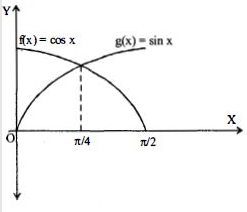
The area under the curve $y = |\cos x - \sin x|$,$0 \leq x \leq \frac{\pi}{2}$,and above the $x$-axis is
A
$2\sqrt{2}$
B
$2\sqrt{2} - 2$
C
$2\sqrt{2} + 2$
D
$0$
Solution
(B) The function is $y = |\cos x - \sin x|$.
In the interval $[0, \pi/4]$,$\cos x \geq \sin x$,so $y = \cos x - \sin x$.
In the interval $[\pi/4, \pi/2]$,$\sin x \geq \cos x$,so $y = \sin x - \cos x$.
The required area is given by:
$A = \int_{0}^{\pi/4} (\cos x - \sin x) \, dx + \int_{\pi/4}^{\pi/2} (\sin x - \cos x) \, dx$
$A = [\sin x + \cos x]_{0}^{\pi/4} + [-\cos x - \sin x]_{\pi/4}^{\pi/2}$
$A = ((\sin(\pi/4) + \cos(\pi/4)) - (\sin(0) + \cos(0))) + ((-\cos(\pi/2) - \sin(\pi/2)) - (-\cos(\pi/4) - \sin(\pi/4)))$
$A = ((\frac{1}{\sqrt{2}} + \frac{1}{\sqrt{2}}) - (0 + 1)) + ((0 - 1) - (-\frac{1}{\sqrt{2}} - \frac{1}{\sqrt{2}}))$
$A = (\sqrt{2} - 1) + (-1 + \sqrt{2})$
$A = 2\sqrt{2} - 2$ square units.
In the interval $[0, \pi/4]$,$\cos x \geq \sin x$,so $y = \cos x - \sin x$.
In the interval $[\pi/4, \pi/2]$,$\sin x \geq \cos x$,so $y = \sin x - \cos x$.
The required area is given by:
$A = \int_{0}^{\pi/4} (\cos x - \sin x) \, dx + \int_{\pi/4}^{\pi/2} (\sin x - \cos x) \, dx$
$A = [\sin x + \cos x]_{0}^{\pi/4} + [-\cos x - \sin x]_{\pi/4}^{\pi/2}$
$A = ((\sin(\pi/4) + \cos(\pi/4)) - (\sin(0) + \cos(0))) + ((-\cos(\pi/2) - \sin(\pi/2)) - (-\cos(\pi/4) - \sin(\pi/4)))$
$A = ((\frac{1}{\sqrt{2}} + \frac{1}{\sqrt{2}}) - (0 + 1)) + ((0 - 1) - (-\frac{1}{\sqrt{2}} - \frac{1}{\sqrt{2}}))$
$A = (\sqrt{2} - 1) + (-1 + \sqrt{2})$
$A = 2\sqrt{2} - 2$ square units.
0 likesView Solution
82
MathematicsDifficultMCQJEE Main · 2013
If a curve passes through the point $\left( 2, \frac{7}{2} \right)$ and has slope $\left( 1 - \frac{1}{x^2} \right)$ at any point $(x, y)$ on it,then the ordinate of the point on the curve whose abscissa is $-2$ is
A
$-\frac{3}{2}$
B
$\frac{3}{2}$
C
$\frac{5}{2}$
D
$-\frac{5}{2}$
Solution
(A) The slope of the curve is given by $\frac{dy}{dx} = 1 - \frac{1}{x^2}$.
Integrating both sides with respect to $x$:
$\int dy = \int \left( 1 - \frac{1}{x^2} \right) dx$
$y = x + \frac{1}{x} + C$
Since the curve passes through the point $\left( 2, \frac{7}{2} \right)$,we substitute these values to find $C$:
$\frac{7}{2} = 2 + \frac{1}{2} + C$
$\frac{7}{2} = \frac{5}{2} + C$
$C = 1$
Thus,the equation of the curve is $y = x + \frac{1}{x} + 1$.
To find the ordinate when the abscissa is $x = -2$:
$y = -2 + \frac{1}{-2} + 1$
$y = -2 - 0.5 + 1 = -1.5 = -\frac{3}{2}$.
Integrating both sides with respect to $x$:
$\int dy = \int \left( 1 - \frac{1}{x^2} \right) dx$
$y = x + \frac{1}{x} + C$
Since the curve passes through the point $\left( 2, \frac{7}{2} \right)$,we substitute these values to find $C$:
$\frac{7}{2} = 2 + \frac{1}{2} + C$
$\frac{7}{2} = \frac{5}{2} + C$
$C = 1$
Thus,the equation of the curve is $y = x + \frac{1}{x} + 1$.
To find the ordinate when the abscissa is $x = -2$:
$y = -2 + \frac{1}{-2} + 1$
$y = -2 - 0.5 + 1 = -1.5 = -\frac{3}{2}$.
0 likesView Solution
83
MathematicsDifficultMCQJEE Main · 2013
Let $R = \{(x,y) : x,y \in N \text{ and } x^2 - 4xy + 3y^2 = 0\}$,where $N$ is the set of all natural numbers. Then the relation $R$ is
A
reflexive but neither symmetric nor transitive
B
symmetric and transitive
C
reflexive and symmetric
D
reflexive and transitive
Solution
(A) Given $R = \{(x,y) : x,y \in N \text{ and } x^2 - 4xy + 3y^2 = 0\}$.
Factorizing the equation: $x^2 - 4xy + 3y^2 = (x - y)(x - 3y) = 0$.
This implies $x = y$ or $x = 3y$.
$1$. Reflexivity: For any $x \in N$,$x = x$ is true,so $(x,x) \in R$. Thus,$R$ is reflexive.
$2$. Symmetry: $(3,1) \in R$ because $3 = 3(1)$. However,$(1,3) \notin R$ because $1 \neq 3$ and $1 \neq 3(3)$. Thus,$R$ is not symmetric.
$3$. Transitivity: Let $(a,b) \in R$ and $(b,c) \in R$. Then $(a=b \text{ or } a=3b)$ and $(b=c \text{ or } b=3c)$.
- If $a=b$ and $b=c$,then $a=c$,so $(a,c) \in R$.
- If $a=b$ and $b=3c$,then $a=3c$,so $(a,c) \in R$.
- If $a=3b$ and $b=c$,then $a=3c$,so $(a,c) \in R$.
- If $a=3b$ and $b=3c$,then $a=9c$,which is not necessarily $c$ or $3c$. Wait,checking $(9,3) \in R$ and $(3,1) \in R$: $9=3(3)$ and $3=3(1)$. Here $a=9, b=3, c=1$. $a=9c$. Since $9 \neq 1$ and $9 \neq 3(1)$,$(9,1) \notin R$. Therefore,$R$ is not transitive.
Correction: $R$ is reflexive only.
Factorizing the equation: $x^2 - 4xy + 3y^2 = (x - y)(x - 3y) = 0$.
This implies $x = y$ or $x = 3y$.
$1$. Reflexivity: For any $x \in N$,$x = x$ is true,so $(x,x) \in R$. Thus,$R$ is reflexive.
$2$. Symmetry: $(3,1) \in R$ because $3 = 3(1)$. However,$(1,3) \notin R$ because $1 \neq 3$ and $1 \neq 3(3)$. Thus,$R$ is not symmetric.
$3$. Transitivity: Let $(a,b) \in R$ and $(b,c) \in R$. Then $(a=b \text{ or } a=3b)$ and $(b=c \text{ or } b=3c)$.
- If $a=b$ and $b=c$,then $a=c$,so $(a,c) \in R$.
- If $a=b$ and $b=3c$,then $a=3c$,so $(a,c) \in R$.
- If $a=3b$ and $b=c$,then $a=3c$,so $(a,c) \in R$.
- If $a=3b$ and $b=3c$,then $a=9c$,which is not necessarily $c$ or $3c$. Wait,checking $(9,3) \in R$ and $(3,1) \in R$: $9=3(3)$ and $3=3(1)$. Here $a=9, b=3, c=1$. $a=9c$. Since $9 \neq 1$ and $9 \neq 3(1)$,$(9,1) \notin R$. Therefore,$R$ is not transitive.
Correction: $R$ is reflexive only.
0 likesView Solution
84
MathematicsDifficultMCQJEE Main · 2013
Consider the system of equations: $x + ay = 0$,$y + az = 0$,and $z + ax = 0$. The set of all real values of $a$ for which the system has a unique solution is:
A
$R - \{1\}$
B
$R - \{-1\}$
C
$\{1, -1\}$
D
$\{1, 0, -1\}$
Solution
(B) The given system of equations is homogeneous:
$x + ay = 0$
$y + az = 0$
$z + ax = 0$
This can be written in matrix form $AX = 0$,where $A = \begin{bmatrix} 1 & a & 0 \\ 0 & 1 & a \\ a & 0 & 1 \end{bmatrix}$.
$A$ homogeneous system has a unique (trivial) solution if and only if the determinant $|A| \neq 0$.
Calculating the determinant:
$|A| = 1(1 - 0) - a(0 - a^2) + 0(0 - a) = 1 + a^3$.
For a unique solution,we require $|A| \neq 0$,so $1 + a^3 \neq 0$.
$a^3 \neq -1$,which implies $a \neq -1$.
Thus,the set of all real values of $a$ is $R - \{-1\}$.
$x + ay = 0$
$y + az = 0$
$z + ax = 0$
This can be written in matrix form $AX = 0$,where $A = \begin{bmatrix} 1 & a & 0 \\ 0 & 1 & a \\ a & 0 & 1 \end{bmatrix}$.
$A$ homogeneous system has a unique (trivial) solution if and only if the determinant $|A| \neq 0$.
Calculating the determinant:
$|A| = 1(1 - 0) - a(0 - a^2) + 0(0 - a) = 1 + a^3$.
For a unique solution,we require $|A| \neq 0$,so $1 + a^3 \neq 0$.
$a^3 \neq -1$,which implies $a \neq -1$.
Thus,the set of all real values of $a$ is $R - \{-1\}$.
0 likesView Solution
85
MathematicsDifficultMCQJEE Main · 2013
Let $S = \left\{ \begin{bmatrix} a_{11} & a_{12} \\ a_{21} & a_{22} \end{bmatrix} : a_{ij} \in \{0, 1, 2\}, a_{11} = a_{22} \right\}$. Then the number of non-singular matrices in the set $S$ is
A
$27$
B
$24$
C
$10$
D
$20$
Solution
(D) matrix $A = \begin{bmatrix} a & b \\ c & a \end{bmatrix}$ is in $S$ where $a, b, c \in \{0, 1, 2\}$.
There are $3$ choices for each of $a, b, c$,so the total number of matrices in $S$ is $3 \times 3 \times 3 = 27$.
For a matrix to be singular,its determinant must be zero: $\det(A) = a^2 - bc = 0$,which implies $a^2 = bc$.
We check the cases for $a \in \{0, 1, 2\}$:
Case $1$: $a = 0$. Then $bc = 0$. The pairs $(b, c)$ can be $(0, 0), (0, 1), (0, 2), (1, 0), (2, 0)$. There are $5$ such matrices.
Case $2$: $a = 1$. Then $bc = 1$. The only pair $(b, c)$ is $(1, 1)$. There is $1$ such matrix.
Case $3$: $a = 2$. Then $bc = 4$. The only pair $(b, c)$ is $(2, 2)$. There is $1$ such matrix.
Total singular matrices $= 5 + 1 + 1 = 7$.
Number of non-singular matrices $= \text{Total} - \text{Singular} = 27 - 7 = 20$.
There are $3$ choices for each of $a, b, c$,so the total number of matrices in $S$ is $3 \times 3 \times 3 = 27$.
For a matrix to be singular,its determinant must be zero: $\det(A) = a^2 - bc = 0$,which implies $a^2 = bc$.
We check the cases for $a \in \{0, 1, 2\}$:
Case $1$: $a = 0$. Then $bc = 0$. The pairs $(b, c)$ can be $(0, 0), (0, 1), (0, 2), (1, 0), (2, 0)$. There are $5$ such matrices.
Case $2$: $a = 1$. Then $bc = 1$. The only pair $(b, c)$ is $(1, 1)$. There is $1$ such matrix.
Case $3$: $a = 2$. Then $bc = 4$. The only pair $(b, c)$ is $(2, 2)$. There is $1$ such matrix.
Total singular matrices $= 5 + 1 + 1 = 7$.
Number of non-singular matrices $= \text{Total} - \text{Singular} = 27 - 7 = 20$.
0 likesView Solution
86
MathematicsDifficultMCQJEE Main · 2013
Let $x \in (0, 1)$. The set of all $x$ such that $\sin^{-1} x > \cos^{-1} x$ is the interval
A
$\left( \frac{1}{2}, \frac{1}{\sqrt{2}} \right)$
B
$\left( \frac{1}{\sqrt{2}}, 1 \right)$
C
$(0, 1)$
D
$\left( 0, \frac{\sqrt{3}}{2} \right)$
Solution
(B) Given the inequality $\sin^{-1} x > \cos^{-1} x$ for $x \in (0, 1)$.
We know that $\cos^{-1} x = \frac{\pi}{2} - \sin^{-1} x$.
Substituting this into the inequality,we get:
$\sin^{-1} x > \frac{\pi}{2} - \sin^{-1} x$
$2 \sin^{-1} x > \frac{\pi}{2}$
$\sin^{-1} x > \frac{\pi}{4}$
Since the sine function is strictly increasing on the interval $[0, 1]$,we apply the sine function to both sides:
$x > \sin\left( \frac{\pi}{4} \right)$
$x > \frac{1}{\sqrt{2}}$
Given the domain $x \in (0, 1)$,the solution set is $x \in \left( \frac{1}{\sqrt{2}}, 1 \right)$.
We know that $\cos^{-1} x = \frac{\pi}{2} - \sin^{-1} x$.
Substituting this into the inequality,we get:
$\sin^{-1} x > \frac{\pi}{2} - \sin^{-1} x$
$2 \sin^{-1} x > \frac{\pi}{2}$
$\sin^{-1} x > \frac{\pi}{4}$
Since the sine function is strictly increasing on the interval $[0, 1]$,we apply the sine function to both sides:
$x > \sin\left( \frac{\pi}{4} \right)$
$x > \frac{1}{\sqrt{2}}$
Given the domain $x \in (0, 1)$,the solution set is $x \in \left( \frac{1}{\sqrt{2}}, 1 \right)$.
0 likesView Solution
87
MathematicsDifficultMCQJEE Main · 2013
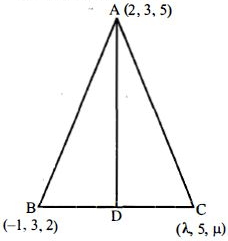
Let $ABC$ be a triangle with vertices at points $A(2, 3, 5)$,$B(-1, 3, 2)$ and $C(\lambda, 5, \mu)$ in three-dimensional space. If the median through $A$ is equally inclined with the axes,then $(\lambda, \mu)$ is equal to
A
$(10, 7)$
B
$(7, 5)$
C
$(7, 10)$
D
$(5, 7)$
Solution
(C) Let $D$ be the midpoint of $BC$. The coordinates of $D$ are given by:
$D = \left( \frac{\lambda - 1}{2}, \frac{5 + 3}{2}, \frac{\mu + 2}{2} \right) = \left( \frac{\lambda - 1}{2}, 4, \frac{\mu + 2}{2} \right)$
The direction ratios of the median $AD$ are:
$a = \frac{\lambda - 1}{2} - 2 = \frac{\lambda - 5}{2}$
$b = 4 - 3 = 1$
$c = \frac{\mu + 2}{2} - 5 = \frac{\mu - 8}{2}$
Since the median $AD$ is equally inclined with the axes,its direction cosines $l, m, n$ are equal,i.e.,$|l| = |m| = |n|$. Since $l^2 + m^2 + n^2 = 1$,we have $l = m = n = \pm \frac{1}{\sqrt{3}}$.
Thus,the direction ratios $a, b, c$ must be proportional to $1, 1, 1$. Since $b = 1$,we must have $a = 1$ and $c = 1$.
Setting $a = 1$:
$\frac{\lambda - 5}{2} = 1 \Rightarrow \lambda - 5 = 2 \Rightarrow \lambda = 7$
Setting $c = 1$:
$\frac{\mu - 8}{2} = 1 \Rightarrow \mu - 8 = 2 \Rightarrow \mu = 10$
Therefore,$(\lambda, \mu) = (7, 10)$.
$D = \left( \frac{\lambda - 1}{2}, \frac{5 + 3}{2}, \frac{\mu + 2}{2} \right) = \left( \frac{\lambda - 1}{2}, 4, \frac{\mu + 2}{2} \right)$
The direction ratios of the median $AD$ are:
$a = \frac{\lambda - 1}{2} - 2 = \frac{\lambda - 5}{2}$
$b = 4 - 3 = 1$
$c = \frac{\mu + 2}{2} - 5 = \frac{\mu - 8}{2}$
Since the median $AD$ is equally inclined with the axes,its direction cosines $l, m, n$ are equal,i.e.,$|l| = |m| = |n|$. Since $l^2 + m^2 + n^2 = 1$,we have $l = m = n = \pm \frac{1}{\sqrt{3}}$.
Thus,the direction ratios $a, b, c$ must be proportional to $1, 1, 1$. Since $b = 1$,we must have $a = 1$ and $c = 1$.
Setting $a = 1$:
$\frac{\lambda - 5}{2} = 1 \Rightarrow \lambda - 5 = 2 \Rightarrow \lambda = 7$
Setting $c = 1$:
$\frac{\mu - 8}{2} = 1 \Rightarrow \mu - 8 = 2 \Rightarrow \mu = 10$
Therefore,$(\lambda, \mu) = (7, 10)$.
0 likesView Solution
88
MathematicsDifficultMCQJEE Main · 2013
If the integral $\int \frac{\cos 8x + 1}{\cot 2x - \tan 2x} dx = A \cos 8x + k,$ where $k$ is an arbitrary constant,then $A$ is equal to
A
$-\frac{1}{16}$
B
$\frac{1}{16}$
C
$\frac{1}{8}$
D
$-\frac{1}{8}$
Solution
(A) Let $I = \int \frac{\cos 8x + 1}{\cot 2x - \tan 2x} dx.$
First,simplify the denominator:
$\cot 2x - \tan 2x = \frac{\cos 2x}{\sin 2x} - \frac{\sin 2x}{\cos 2x} = \frac{\cos^2 2x - \sin^2 2x}{\sin 2x \cos 2x} = \frac{\cos 4x}{\frac{1}{2} \sin 4x} = 2 \cot 4x.$
Using the identity $\cos 8x + 1 = 2 \cos^2 4x$,the integral becomes:
$I = \int \frac{2 \cos^2 4x}{2 \cot 4x} dx = \int \frac{\cos^2 4x}{\frac{\cos 4x}{\sin 4x}} dx = \int \cos 4x \sin 4x dx.$
Multiply and divide by $2$:
$I = \frac{1}{2} \int 2 \sin 4x \cos 4x dx = \frac{1}{2} \int \sin 8x dx.$
Integrating $\sin 8x$ gives:
$I = \frac{1}{2} \left( -\frac{\cos 8x}{8} \right) + k = -\frac{1}{16} \cos 8x + k.$
Comparing this with $A \cos 8x + k$,we get $A = -\frac{1}{16}$.
First,simplify the denominator:
$\cot 2x - \tan 2x = \frac{\cos 2x}{\sin 2x} - \frac{\sin 2x}{\cos 2x} = \frac{\cos^2 2x - \sin^2 2x}{\sin 2x \cos 2x} = \frac{\cos 4x}{\frac{1}{2} \sin 4x} = 2 \cot 4x.$
Using the identity $\cos 8x + 1 = 2 \cos^2 4x$,the integral becomes:
$I = \int \frac{2 \cos^2 4x}{2 \cot 4x} dx = \int \frac{\cos^2 4x}{\frac{\cos 4x}{\sin 4x}} dx = \int \cos 4x \sin 4x dx.$
Multiply and divide by $2$:
$I = \frac{1}{2} \int 2 \sin 4x \cos 4x dx = \frac{1}{2} \int \sin 8x dx.$
Integrating $\sin 8x$ gives:
$I = \frac{1}{2} \left( -\frac{\cos 8x}{8} \right) + k = -\frac{1}{16} \cos 8x + k.$
Comparing this with $A \cos 8x + k$,we get $A = -\frac{1}{16}$.
0 likesView Solution
89
MathematicsDifficultMCQJEE Main · 2013
The equation of the curve passing through the origin and satisfying the differential equation $(1 + x^2) \frac{dy}{dx} + 2xy = 4x^2$ is
A
$(1 + x^2)y = x^3$
B
$3(1 + x^2)y = 2x^3$
C
$(1 + x^2)y = 3x^3$
D
$3(1 + x^2)y = 4x^3$
Solution
(D) Given differential equation is $(1 + x^2) \frac{dy}{dx} + 2xy = 4x^2$.
Dividing by $(1 + x^2)$,we get $\frac{dy}{dx} + \frac{2x}{1 + x^2}y = \frac{4x^2}{1 + x^2}$.
This is a linear differential equation of the form $\frac{dy}{dx} + Py = Q$,where $P = \frac{2x}{1 + x^2}$ and $Q = \frac{4x^2}{1 + x^2}$.
Integrating factor $(I.F.) = e^{\int P dx} = e^{\int \frac{2x}{1 + x^2} dx} = e^{\ln(1 + x^2)} = 1 + x^2$.
The general solution is $y \times (I.F.) = \int Q \times (I.F.) dx + C$.
$y(1 + x^2) = \int \frac{4x^2}{1 + x^2} \times (1 + x^2) dx + C$.
$y(1 + x^2) = \int 4x^2 dx + C$.
$y(1 + x^2) = \frac{4x^3}{3} + C$.
Since the curve passes through the origin $(0, 0)$,we substitute $x = 0$ and $y = 0$ to find $C$.
$0(1 + 0) = \frac{4(0)^3}{3} + C \implies C = 0$.
Thus,the equation of the curve is $y(1 + x^2) = \frac{4x^3}{3}$,which simplifies to $3(1 + x^2)y = 4x^3$.
Dividing by $(1 + x^2)$,we get $\frac{dy}{dx} + \frac{2x}{1 + x^2}y = \frac{4x^2}{1 + x^2}$.
This is a linear differential equation of the form $\frac{dy}{dx} + Py = Q$,where $P = \frac{2x}{1 + x^2}$ and $Q = \frac{4x^2}{1 + x^2}$.
Integrating factor $(I.F.) = e^{\int P dx} = e^{\int \frac{2x}{1 + x^2} dx} = e^{\ln(1 + x^2)} = 1 + x^2$.
The general solution is $y \times (I.F.) = \int Q \times (I.F.) dx + C$.
$y(1 + x^2) = \int \frac{4x^2}{1 + x^2} \times (1 + x^2) dx + C$.
$y(1 + x^2) = \int 4x^2 dx + C$.
$y(1 + x^2) = \frac{4x^3}{3} + C$.
Since the curve passes through the origin $(0, 0)$,we substitute $x = 0$ and $y = 0$ to find $C$.
$0(1 + 0) = \frac{4(0)^3}{3} + C \implies C = 0$.
Thus,the equation of the curve is $y(1 + x^2) = \frac{4x^3}{3}$,which simplifies to $3(1 + x^2)y = 4x^3$.
0 likesView Solution
90
MathematicsDifficultMCQJEE Main · 2013
For $0 \le x \le \frac{\pi}{2}$,the value of $\int_{0}^{\sin^{2}x} \sin^{-1}(\sqrt{t}) \, dt + \int_{0}^{\cos^{2}x} \cos^{-1}(\sqrt{t}) \, dt$ is equal to
A
$\frac{\pi}{4}$
B
$0$
C
$1$
D
$-\frac{\pi}{4}$
Solution
(A) Let $f(x) = \int_{0}^{\sin^{2}x} \sin^{-1}(\sqrt{t}) \, dt + \int_{0}^{\cos^{2}x} \cos^{-1}(\sqrt{t}) \, dt$.
Using the Leibniz integral rule,we differentiate $f(x)$ with respect to $x$:
$f'(x) = \sin^{-1}(\sqrt{\sin^{2}x}) \cdot \frac{d}{dx}(\sin^{2}x) + \cos^{-1}(\sqrt{\cos^{2}x}) \cdot \frac{d}{dx}(\cos^{2}x)$
$f'(x) = x \cdot (2 \sin x \cos x) + (\frac{\pi}{2} - x) \cdot (-2 \cos x \sin x)$
$f'(x) = x \sin(2x) - (\frac{\pi}{2} - x) \sin(2x)$
$f'(x) = x \sin(2x) - \frac{\pi}{2} \sin(2x) + x \sin(2x) = (2x - \frac{\pi}{2}) \sin(2x)$.
Since $f'(x)$ is not zero,let us evaluate $f(x)$ at $x = \frac{\pi}{4}$:
$f(\frac{\pi}{4}) = \int_{0}^{1/2} \sin^{-1}(\sqrt{t}) \, dt + \int_{0}^{1/2} \cos^{-1}(\sqrt{t}) \, dt$
$f(\frac{\pi}{4}) = \int_{0}^{1/2} (\sin^{-1}(\sqrt{t}) + \cos^{-1}(\sqrt{t})) \, dt$
Since $\sin^{-1}(\sqrt{t}) + \cos^{-1}(\sqrt{t}) = \frac{\pi}{2}$ for $t \in [0, 1]$:
$f(\frac{\pi}{4}) = \int_{0}^{1/2} \frac{\pi}{2} \, dt = \frac{\pi}{2} \cdot [t]_{0}^{1/2} = \frac{\pi}{2} \cdot \frac{1}{2} = \frac{\pi}{4}$.
Using the Leibniz integral rule,we differentiate $f(x)$ with respect to $x$:
$f'(x) = \sin^{-1}(\sqrt{\sin^{2}x}) \cdot \frac{d}{dx}(\sin^{2}x) + \cos^{-1}(\sqrt{\cos^{2}x}) \cdot \frac{d}{dx}(\cos^{2}x)$
$f'(x) = x \cdot (2 \sin x \cos x) + (\frac{\pi}{2} - x) \cdot (-2 \cos x \sin x)$
$f'(x) = x \sin(2x) - (\frac{\pi}{2} - x) \sin(2x)$
$f'(x) = x \sin(2x) - \frac{\pi}{2} \sin(2x) + x \sin(2x) = (2x - \frac{\pi}{2}) \sin(2x)$.
Since $f'(x)$ is not zero,let us evaluate $f(x)$ at $x = \frac{\pi}{4}$:
$f(\frac{\pi}{4}) = \int_{0}^{1/2} \sin^{-1}(\sqrt{t}) \, dt + \int_{0}^{1/2} \cos^{-1}(\sqrt{t}) \, dt$
$f(\frac{\pi}{4}) = \int_{0}^{1/2} (\sin^{-1}(\sqrt{t}) + \cos^{-1}(\sqrt{t})) \, dt$
Since $\sin^{-1}(\sqrt{t}) + \cos^{-1}(\sqrt{t}) = \frac{\pi}{2}$ for $t \in [0, 1]$:
$f(\frac{\pi}{4}) = \int_{0}^{1/2} \frac{\pi}{2} \, dt = \frac{\pi}{2} \cdot [t]_{0}^{1/2} = \frac{\pi}{2} \cdot \frac{1}{2} = \frac{\pi}{4}$.
0 likesView Solution
91
MathematicsDifficultMCQJEE Main · 2013
Let $f:[-2, 3] \to [0, \infty)$ be a continuous function such that $f(1-x) = f(x)$ for all $x \in [-2, 3]$. If $R_1$ is the numerical value of the area of the region bounded by $y = f(x)$,$x = -2$,$x = 3$ and the $x$-axis,and $R_2 = \int_{-2}^3 x f(x) dx$,then:
A
$3R_1 = 2R_2$
B
$2R_1 = 3R_2$
C
$R_1 = R_2$
D
$R_1 = 2R_2$
Solution
(D) We are given $R_1 = \int_{-2}^3 f(x) dx$ and $R_2 = \int_{-2}^3 x f(x) dx$.
Using the property $\int_a^b g(x) dx = \int_a^b g(a+b-x) dx$,we have $a+b = -2+3 = 1$.
Thus,$R_2 = \int_{-2}^3 x f(x) dx = \int_{-2}^3 (1-x) f(1-x) dx$.
Since $f(1-x) = f(x)$,we get $R_2 = \int_{-2}^3 (1-x) f(x) dx$.
$R_2 = \int_{-2}^3 f(x) dx - \int_{-2}^3 x f(x) dx$.
$R_2 = R_1 - R_2$.
$2R_2 = R_1$ or $R_1 = 2R_2$.
Using the property $\int_a^b g(x) dx = \int_a^b g(a+b-x) dx$,we have $a+b = -2+3 = 1$.
Thus,$R_2 = \int_{-2}^3 x f(x) dx = \int_{-2}^3 (1-x) f(1-x) dx$.
Since $f(1-x) = f(x)$,we get $R_2 = \int_{-2}^3 (1-x) f(x) dx$.
$R_2 = \int_{-2}^3 f(x) dx - \int_{-2}^3 x f(x) dx$.
$R_2 = R_1 - R_2$.
$2R_2 = R_1$ or $R_1 = 2R_2$.
0 likesView Solution
92
MathematicsDifficultMCQJEE Main · 2013
Let $\vec a = 2\hat i + \hat j - 2\hat k$ and $\vec b = \hat i + \hat j$. If $\vec c$ is a vector such that $\vec a \cdot \vec c = |\vec c|$,$|\vec c - \vec a| = 2\sqrt 2$,and the angle between $\vec a \times \vec b$ and $\vec c$ is $30^o$,then $|(\vec a \times \vec b) \times \vec c|$ equals:
A
$\frac{1}{2}$
B
$\frac{3\sqrt 3}{2}$
C
$3$
D
$\frac{3}{2}$
Solution
(D) Given $\vec a = 2\hat i + \hat j - 2\hat k$ and $\vec b = \hat i + \hat j$.
First,calculate the magnitude of $\vec a$: $|\vec a| = \sqrt{2^2 + 1^2 + (-2)^2} = \sqrt{4 + 1 + 4} = 3$.
Next,calculate the cross product $\vec a \times \vec b$:
$\vec a \times \vec b = \begin{vmatrix} \hat i & \hat j & \hat k \\ 2 & 1 & -2 \\ 1 & 1 & 0 \end{vmatrix} = \hat i(0 - (-2)) - \hat j(0 - (-2)) + \hat k(2 - 1) = 2\hat i - 2\hat j + \hat k$.
The magnitude is $|\vec a \times \vec b| = \sqrt{2^2 + (-2)^2 + 1^2} = \sqrt{4 + 4 + 1} = 3$.
Given $|\vec c - \vec a| = 2\sqrt 2$,squaring both sides gives $|\vec c - \vec a|^2 = 8$.
Expanding this,we get $|\vec c|^2 + |\vec a|^2 - 2(\vec c \cdot \vec a) = 8$.
Substituting $|\vec a| = 3$ and $\vec a \cdot \vec c = |\vec c|$,we have $|\vec c|^2 + 9 - 2|\vec c| = 8$.
This simplifies to $|\vec c|^2 - 2|\vec c| + 1 = 0$,which is $(|\vec c| - 1)^2 = 0$,so $|\vec c| = 1$.
Finally,the magnitude of the cross product is $|(\vec a \times \vec b) \times \vec c| = |\vec a \times \vec b| |\vec c| \sin 30^o$.
Substituting the values: $3 \times 1 \times \frac{1}{2} = \frac{3}{2}$.
First,calculate the magnitude of $\vec a$: $|\vec a| = \sqrt{2^2 + 1^2 + (-2)^2} = \sqrt{4 + 1 + 4} = 3$.
Next,calculate the cross product $\vec a \times \vec b$:
$\vec a \times \vec b = \begin{vmatrix} \hat i & \hat j & \hat k \\ 2 & 1 & -2 \\ 1 & 1 & 0 \end{vmatrix} = \hat i(0 - (-2)) - \hat j(0 - (-2)) + \hat k(2 - 1) = 2\hat i - 2\hat j + \hat k$.
The magnitude is $|\vec a \times \vec b| = \sqrt{2^2 + (-2)^2 + 1^2} = \sqrt{4 + 4 + 1} = 3$.
Given $|\vec c - \vec a| = 2\sqrt 2$,squaring both sides gives $|\vec c - \vec a|^2 = 8$.
Expanding this,we get $|\vec c|^2 + |\vec a|^2 - 2(\vec c \cdot \vec a) = 8$.
Substituting $|\vec a| = 3$ and $\vec a \cdot \vec c = |\vec c|$,we have $|\vec c|^2 + 9 - 2|\vec c| = 8$.
This simplifies to $|\vec c|^2 - 2|\vec c| + 1 = 0$,which is $(|\vec c| - 1)^2 = 0$,so $|\vec c| = 1$.
Finally,the magnitude of the cross product is $|(\vec a \times \vec b) \times \vec c| = |\vec a \times \vec b| |\vec c| \sin 30^o$.
Substituting the values: $3 \times 1 \times \frac{1}{2} = \frac{3}{2}$.
0 likesView Solution
93
MathematicsDifficultMCQJEE Main · 2013
The equation of a plane through the line of intersection of the planes $x + 2y = 3$ and $y - 2z + 1 = 0$,and perpendicular to the first plane $x + 2y = 3$ is:
A
$2x - y - 10z = 9$
B
$2x - y + 7z = 11$
C
$2x - y + 10z = 11$
D
$2x - y - 9z = 10$
Solution
(C) The equation of a plane passing through the line of intersection of the planes $P_1: x + 2y - 3 = 0$ and $P_2: y - 2z + 1 = 0$ is given by $P_1 + \lambda P_2 = 0$.
$(x + 2y - 3) + \lambda(y - 2z + 1) = 0$
$x + (2 + \lambda)y - 2\lambda z + (\lambda - 3) = 0$ ....$(i)$
Since this plane is perpendicular to the plane $x + 2y - 3 = 0$,the dot product of their normal vectors $\vec{n_1} = (1, 2 + \lambda, -2\lambda)$ and $\vec{n_2} = (1, 2, 0)$ must be zero.
$1(1) + 2(2 + \lambda) + 0(-2\lambda) = 0$
$1 + 4 + 2\lambda = 0$
$5 + 2\lambda = 0 \Rightarrow \lambda = -\frac{5}{2}$
Substituting $\lambda = -\frac{5}{2}$ into equation $(i)$:
$x + (2 - \frac{5}{2})y - 2(-\frac{5}{2})z + (-\frac{5}{2} - 3) = 0$
$x - \frac{1}{2}y + 5z - \frac{11}{2} = 0$
Multiplying by $2$:
$2x - y + 10z - 11 = 0$
$2x - y + 10z = 11$
$(x + 2y - 3) + \lambda(y - 2z + 1) = 0$
$x + (2 + \lambda)y - 2\lambda z + (\lambda - 3) = 0$ ....$(i)$
Since this plane is perpendicular to the plane $x + 2y - 3 = 0$,the dot product of their normal vectors $\vec{n_1} = (1, 2 + \lambda, -2\lambda)$ and $\vec{n_2} = (1, 2, 0)$ must be zero.
$1(1) + 2(2 + \lambda) + 0(-2\lambda) = 0$
$1 + 4 + 2\lambda = 0$
$5 + 2\lambda = 0 \Rightarrow \lambda = -\frac{5}{2}$
Substituting $\lambda = -\frac{5}{2}$ into equation $(i)$:
$x + (2 - \frac{5}{2})y - 2(-\frac{5}{2})z + (-\frac{5}{2} - 3) = 0$
$x - \frac{1}{2}y + 5z - \frac{11}{2} = 0$
Multiplying by $2$:
$2x - y + 10z - 11 = 0$
$2x - y + 10z = 11$
0 likesView Solution
94
MathematicsDifficultMCQJEE Main · 2013
$A$ spherical balloon is being inflated at the rate of $35 \, cm^3/min$. The rate of increase in the surface area (in $cm^2/min$) of the balloon when its diameter is $14 \, cm$,is
A
$10$
B
$\sqrt{10}$
C
$100$
D
$10\sqrt{10}$
Solution
(A) Let $r$ be the radius of the spherical balloon. The volume $V$ of the sphere is given by $V = \frac{4}{3}\pi r^3$.
Differentiating with respect to time $t$,we get $\frac{dV}{dt} = 4\pi r^2 \frac{dr}{dt}$.
Given $\frac{dV}{dt} = 35 \, cm^3/min$,we have $35 = 4\pi r^2 \frac{dr}{dt}$,which implies $\frac{dr}{dt} = \frac{35}{4\pi r^2} \quad (1)$.
The surface area $S$ of the sphere is $S = 4\pi r^2$.
Differentiating with respect to $t$,we get $\frac{dS}{dt} = 8\pi r \frac{dr}{dt}$.
Substituting the value of $\frac{dr}{dt}$ from $(1)$ into the expression for $\frac{dS}{dt}$:
$\frac{dS}{dt} = 8\pi r \left( \frac{35}{4\pi r^2} \right) = \frac{70}{r}$.
Given the diameter is $14 \, cm$,the radius $r = 7 \, cm$.
Substituting $r = 7$ into the expression for $\frac{dS}{dt}$:
$\frac{dS}{dt} = \frac{70}{7} = 10 \, cm^2/min$.
Differentiating with respect to time $t$,we get $\frac{dV}{dt} = 4\pi r^2 \frac{dr}{dt}$.
Given $\frac{dV}{dt} = 35 \, cm^3/min$,we have $35 = 4\pi r^2 \frac{dr}{dt}$,which implies $\frac{dr}{dt} = \frac{35}{4\pi r^2} \quad (1)$.
The surface area $S$ of the sphere is $S = 4\pi r^2$.
Differentiating with respect to $t$,we get $\frac{dS}{dt} = 8\pi r \frac{dr}{dt}$.
Substituting the value of $\frac{dr}{dt}$ from $(1)$ into the expression for $\frac{dS}{dt}$:
$\frac{dS}{dt} = 8\pi r \left( \frac{35}{4\pi r^2} \right) = \frac{70}{r}$.
Given the diameter is $14 \, cm$,the radius $r = 7 \, cm$.
Substituting $r = 7$ into the expression for $\frac{dS}{dt}$:
$\frac{dS}{dt} = \frac{70}{7} = 10 \, cm^2/min$.
0 likesView Solution
95
MathematicsDifficultMCQJEE Main · 2013
Consider the function $f(x) = [x] + |1 - x|$ for $-1 \le x \le 3$,where $[x]$ is the greatest integer function.
Statement $1$: $f$ is not continuous at $x = 0, 1, 2$ and $3$.
Statement $2$: $f(x) = \begin{cases} -1 - x, & -1 \le x < 0 \\ 1 - x, & 0 \le x < 1 \\ 1 - x, & 1 \le x < 2 \\ 2 + x - 2, & 2 \le x < 3 \\ 3, & x = 3 \end{cases}$ (Note: The provided Statement $2$ in the prompt is incorrect).
Statement $1$: $f$ is not continuous at $x = 0, 1, 2$ and $3$.
Statement $2$: $f(x) = \begin{cases} -1 - x, & -1 \le x < 0 \\ 1 - x, & 0 \le x < 1 \\ 1 - x, & 1 \le x < 2 \\ 2 + x - 2, & 2 \le x < 3 \\ 3, & x = 3 \end{cases}$ (Note: The provided Statement $2$ in the prompt is incorrect).
A
Statement $1$ is true; Statement $2$ is false.
B
Statement $1$ is true; Statement $2$ is true; Statement $2$ is not a correct explanation for Statement $1$.
C
Statement $1$ is true; Statement $2$ is true; Statement $2$ is a correct explanation for Statement $1$.
D
Statement $1$ is false; Statement $2$ is true.
Solution
(A) Given $f(x) = [x] + |1 - x|$ for $x \in [-1, 3]$.
For $x \in [-1, 0)$,$[x] = -1$,so $f(x) = -1 + (1 - x) = -x$.
For $x \in [0, 1)$,$[x] = 0$,so $f(x) = 0 + (1 - x) = 1 - x$.
For $x \in [1, 2)$,$[x] = 1$,so $f(x) = 1 + (x - 1) = x$.
For $x \in [2, 3)$,$[x] = 2$,so $f(x) = 2 + (x - 1) = x + 1$.
At $x = 3$,$f(3) = [3] + |1 - 3| = 3 + 2 = 5$.
Checking continuity:
At $x=0$: $LHL = \lim_{x \to 0^-} (-x) = 0$,$RHL = \lim_{x \to 0^+} (1 - x) = 1$. Since $LHL \neq RHL$,$f$ is discontinuous at $x=0$.
At $x=1$: $LHL = \lim_{x \to 1^-} (1 - x) = 0$,$RHL = \lim_{x \to 1^+} (x) = 1$. Since $LHL \neq RHL$,$f$ is discontinuous at $x=1$.
At $x=2$: $LHL = \lim_{x \to 2^-} (x) = 2$,$RHL = \lim_{x \to 2^+} (x + 1) = 3$. Since $LHL \neq RHL$,$f$ is discontinuous at $x=2$.
At $x=3$: $LHL = \lim_{x \to 3^-} (x + 1) = 4$,$f(3) = 5$. Since $LHL \neq f(3)$,$f$ is discontinuous at $x=3$.
Thus,Statement $1$ is true. Statement $2$ provides an incorrect definition of $f(x)$,so Statement $2$ is false.
For $x \in [-1, 0)$,$[x] = -1$,so $f(x) = -1 + (1 - x) = -x$.
For $x \in [0, 1)$,$[x] = 0$,so $f(x) = 0 + (1 - x) = 1 - x$.
For $x \in [1, 2)$,$[x] = 1$,so $f(x) = 1 + (x - 1) = x$.
For $x \in [2, 3)$,$[x] = 2$,so $f(x) = 2 + (x - 1) = x + 1$.
At $x = 3$,$f(3) = [3] + |1 - 3| = 3 + 2 = 5$.
Checking continuity:
At $x=0$: $LHL = \lim_{x \to 0^-} (-x) = 0$,$RHL = \lim_{x \to 0^+} (1 - x) = 1$. Since $LHL \neq RHL$,$f$ is discontinuous at $x=0$.
At $x=1$: $LHL = \lim_{x \to 1^-} (1 - x) = 0$,$RHL = \lim_{x \to 1^+} (x) = 1$. Since $LHL \neq RHL$,$f$ is discontinuous at $x=1$.
At $x=2$: $LHL = \lim_{x \to 2^-} (x) = 2$,$RHL = \lim_{x \to 2^+} (x + 1) = 3$. Since $LHL \neq RHL$,$f$ is discontinuous at $x=2$.
At $x=3$: $LHL = \lim_{x \to 3^-} (x + 1) = 4$,$f(3) = 5$. Since $LHL \neq f(3)$,$f$ is discontinuous at $x=3$.
Thus,Statement $1$ is true. Statement $2$ provides an incorrect definition of $f(x)$,so Statement $2$ is false.
0 likesView Solution
96
MathematicsDifficultMCQJEE Main · 2013
Let $f(1) = -2$ and $f'(x) \ge 4.2$ for $1 \le x \le 6$. The possible value of $f(6)$ lies in the interval
A
$[15, 19)$
B
$(-\infty, 12)$
C
$[12, 15)$
D
$[19, \infty)$
Solution
(D) Given $f(1) = -2$ and $f'(x) \ge 4.2$ for $1 \le x \le 6$.
By the Mean Value Theorem,for any $x_1, x_2 \in [1, 6]$ with $x_2 > x_1$,there exists $c \in (x_1, x_2)$ such that $\frac{f(x_2) - f(x_1)}{x_2 - x_1} = f'(c)$.
Since $f'(x) \ge 4.2$,we have $\frac{f(6) - f(1)}{6 - 1} \ge 4.2$.
Substituting the given values,we get $\frac{f(6) - (-2)}{5} \ge 4.2$.
$f(6) + 2 \ge 5 \times 4.2$.
$f(6) + 2 \ge 21$.
$f(6) \ge 19$.
Thus,the possible value of $f(6)$ lies in the interval $[19, \infty)$.
By the Mean Value Theorem,for any $x_1, x_2 \in [1, 6]$ with $x_2 > x_1$,there exists $c \in (x_1, x_2)$ such that $\frac{f(x_2) - f(x_1)}{x_2 - x_1} = f'(c)$.
Since $f'(x) \ge 4.2$,we have $\frac{f(6) - f(1)}{6 - 1} \ge 4.2$.
Substituting the given values,we get $\frac{f(6) - (-2)}{5} \ge 4.2$.
$f(6) + 2 \ge 5 \times 4.2$.
$f(6) + 2 \ge 21$.
$f(6) \ge 19$.
Thus,the possible value of $f(6)$ lies in the interval $[19, \infty)$.
0 likesView Solution
97
MathematicsDifficultMCQJEE Main · 2013
If an equation of a tangent to the curve $y = \cos(x + y)$,where $-1 - \pi \le x \le 1 + \pi$,is $x + 2y = k$,then $k$ is equal to
A
$1$
B
$2$
C
$\frac{\pi}{4}$
D
$\frac{\pi}{2}$
Solution
(D) Given the curve equation is $y = \cos(x + y)$.
Differentiating both sides with respect to $x$,we get:
$\frac{dy}{dx} = -\sin(x + y) \left(1 + \frac{dy}{dx}\right) \dots (1)$
The equation of the tangent is $x + 2y = k$,which can be written as $y = -\frac{1}{2}x + \frac{k}{2}$.
The slope of the tangent is $m = -\frac{1}{2}$.
Substituting $\frac{dy}{dx} = -\frac{1}{2}$ into equation $(1)$:
$-\frac{1}{2} = -\sin(x + y) \left(1 - \frac{1}{2}\right)$
$-\frac{1}{2} = -\sin(x + y) \left(\frac{1}{2}\right)$
$\sin(x + y) = 1$
This implies $x + y = \frac{\pi}{2}$.
Substituting $x + y = \frac{\pi}{2}$ into the original curve equation $y = \cos(x + y)$:
$y = \cos\left(\frac{\pi}{2}\right) = 0$.
Since $y = 0$ and $x + y = \frac{\pi}{2}$,we have $x = \frac{\pi}{2}$.
Now,substitute the point $(\frac{\pi}{2}, 0)$ into the tangent equation $x + 2y = k$:
$\frac{\pi}{2} + 2(0) = k$
$k = \frac{\pi}{2}$.
Differentiating both sides with respect to $x$,we get:
$\frac{dy}{dx} = -\sin(x + y) \left(1 + \frac{dy}{dx}\right) \dots (1)$
The equation of the tangent is $x + 2y = k$,which can be written as $y = -\frac{1}{2}x + \frac{k}{2}$.
The slope of the tangent is $m = -\frac{1}{2}$.
Substituting $\frac{dy}{dx} = -\frac{1}{2}$ into equation $(1)$:
$-\frac{1}{2} = -\sin(x + y) \left(1 - \frac{1}{2}\right)$
$-\frac{1}{2} = -\sin(x + y) \left(\frac{1}{2}\right)$
$\sin(x + y) = 1$
This implies $x + y = \frac{\pi}{2}$.
Substituting $x + y = \frac{\pi}{2}$ into the original curve equation $y = \cos(x + y)$:
$y = \cos\left(\frac{\pi}{2}\right) = 0$.
Since $y = 0$ and $x + y = \frac{\pi}{2}$,we have $x = \frac{\pi}{2}$.
Now,substitute the point $(\frac{\pi}{2}, 0)$ into the tangent equation $x + 2y = k$:
$\frac{\pi}{2} + 2(0) = k$
$k = \frac{\pi}{2}$.
0 likesView Solution
98
MathematicsMediumMCQJEE Main · 2013
If $y = \sec(\tan^{-1} x)$,then $\frac{dy}{dx}$ at $x = 1$ is equal to
A
$\frac{1}{2}$
B
$\frac{1}{\sqrt{2}}$
C
$\sqrt{2}$
D
$1$
Solution
(B) Given $y = \sec(\tan^{-1} x)$.
Let $\tan^{-1} x = \theta$,then $\tan \theta = x$.
We know that $\sec^2 \theta = 1 + \tan^2 \theta = 1 + x^2$,so $\sec \theta = \sqrt{1 + x^2}$.
Thus,$y = \sqrt{1 + x^2}$.
Differentiating with respect to $x$:
$\frac{dy}{dx} = \frac{d}{dx}(\sqrt{1 + x^2}) = \frac{1}{2\sqrt{1 + x^2}} \cdot (2x) = \frac{x}{\sqrt{1 + x^2}}$.
At $x = 1$:
$\left(\frac{dy}{dx}\right)_{x=1} = \frac{1}{\sqrt{1 + 1^2}} = \frac{1}{\sqrt{2}}$.
Let $\tan^{-1} x = \theta$,then $\tan \theta = x$.
We know that $\sec^2 \theta = 1 + \tan^2 \theta = 1 + x^2$,so $\sec \theta = \sqrt{1 + x^2}$.
Thus,$y = \sqrt{1 + x^2}$.
Differentiating with respect to $x$:
$\frac{dy}{dx} = \frac{d}{dx}(\sqrt{1 + x^2}) = \frac{1}{2\sqrt{1 + x^2}} \cdot (2x) = \frac{x}{\sqrt{1 + x^2}}$.
At $x = 1$:
$\left(\frac{dy}{dx}\right)_{x=1} = \frac{1}{\sqrt{1 + 1^2}} = \frac{1}{\sqrt{2}}$.
0 likesView Solution
99
MathematicsEasyMCQJEE Main · 2013
If $P = \begin{bmatrix} 1 & \alpha & 3 \\ 1 & 3 & 3 \\ 2 & 4 & 4 \end{bmatrix}$ is the adjoint of a $3 \times 3$ matrix $A$ and $|A| = 4$,then the value of $\alpha$ is:
A
$4$
B
$11$
C
$5$
D
$0$
Solution
(B) We are given that $P = \text{adj}(A)$ and $|A| = 4$.
We know the property of the adjoint of a matrix: $|\text{adj}(A)| = |A|^{n-1}$,where $n$ is the order of the matrix.
Here,$n = 3$,so $|P| = |\text{adj}(A)| = |A|^{3-1} = |A|^2$.
Given $|A| = 4$,we have $|P| = 4^2 = 16$.
Now,calculate the determinant of $P$:
$|P| = \begin{vmatrix} 1 & \alpha & 3 \\ 1 & 3 & 3 \\ 2 & 4 & 4 \end{vmatrix}$
$= 1(3 \times 4 - 3 \times 4) - \alpha(1 \times 4 - 3 \times 2) + 3(1 \times 4 - 3 \times 2)$
$= 1(12 - 12) - \alpha(4 - 6) + 3(4 - 6)$
$= 0 - \alpha(-2) + 3(-2)$
$= 2\alpha - 6$.
Equating the two values of $|P|$:
$2\alpha - 6 = 16$
$2\alpha = 22$
$\alpha = 11$.
We know the property of the adjoint of a matrix: $|\text{adj}(A)| = |A|^{n-1}$,where $n$ is the order of the matrix.
Here,$n = 3$,so $|P| = |\text{adj}(A)| = |A|^{3-1} = |A|^2$.
Given $|A| = 4$,we have $|P| = 4^2 = 16$.
Now,calculate the determinant of $P$:
$|P| = \begin{vmatrix} 1 & \alpha & 3 \\ 1 & 3 & 3 \\ 2 & 4 & 4 \end{vmatrix}$
$= 1(3 \times 4 - 3 \times 4) - \alpha(1 \times 4 - 3 \times 2) + 3(1 \times 4 - 3 \times 2)$
$= 1(12 - 12) - \alpha(4 - 6) + 3(4 - 6)$
$= 0 - \alpha(-2) + 3(-2)$
$= 2\alpha - 6$.
Equating the two values of $|P|$:
$2\alpha - 6 = 16$
$2\alpha = 22$
$\alpha = 11$.
0 likesView Solution
Vedclass Products
For Students
Vedclass Test Series
Mock tests in real JEE Main style covering Mathematics with performance analysis. 5-day free trial.
Start Free TrialFor Teachers
Exam Paper Generator
Generate Set A/B/C/D Mathematics papers from 7.5L+ questions in 2 minutes. 3 chapters free.
Try FreeFor Institutes
Online Exam Module
Run live JEE Main mock exams with unlimited students, 360° analytics & white-label branding.
See DemoFrequently Asked Questions
How many Mathematics questions are in JEE Main 2013?
There are 149 Mathematics questions from the JEE Main 2013 paper on Vedclass, each with a detailed step-by-step solution in English.
Are JEE Main 2013 Mathematics solutions available in English?
Yes. All solutions on this page are in English. You can also switch to English or Hindi using the language buttons above the questions.
Can I practice JEE Main 2013 Mathematics as a timed test?
Yes. Use the Vedclass Test Series to attempt a full JEE Main mock test covering Mathematics with time limits and instant score analysis.
Can teachers create Mathematics papers from JEE Main previous year questions?
Yes. The Vedclass Exam Paper Generator lets teachers mix JEE Main Mathematics questions and generate Set A/B/C/D papers in minutes.
For Teachers & Institutes
Build a Custom Mathematics Paper
Pick JEE Main 2013 Mathematics questions, set difficulty, and generate Set A/B/C/D in 2 minutes.