
MathematicsQ1–34 of 34 questions
Page 1 of 1 · English
1
MathematicsAdvancedMCQIIT JEE · 2016
Let $-\frac{\pi}{6} < \theta < -\frac{\pi}{12}$. Suppose $\alpha_1$ and $\beta_1$ are the roots of the equation $x^2 - 2x \sec \theta + 1 = 0$ and $\alpha_2$ and $\beta_2$ are the roots of the equation $x^2 + 2x \tan \theta - 1 = 0$. If $\alpha_1 > \beta_1$ and $\alpha_2 > \beta_2$,then $\alpha_1 + \beta_2$ equals
A
$2(\sec \theta - \tan \theta)$
B
$2 \sec \theta$
C
$-2 \tan \theta$
D
$0$
Solution
(C) Given $-\frac{\pi}{6} < \theta < -\frac{\pi}{12}$.
For the equation $x^2 - 2x \sec \theta + 1 = 0$,the roots are $\alpha_1, \beta_1 = \frac{2 \sec \theta \pm \sqrt{4 \sec^2 \theta - 4}}{2} = \sec \theta \pm \tan \theta$.
Since $\theta \in (-\frac{\pi}{6}, -\frac{\pi}{12})$,$\sec \theta > 0$ and $\tan \theta < 0$. Thus,$\sec \theta - \tan \theta > \sec \theta + \tan \theta$. Given $\alpha_1 > \beta_1$,we have $\alpha_1 = \sec \theta - \tan \theta$.
For the equation $x^2 + 2x \tan \theta - 1 = 0$,the roots are $\alpha_2, \beta_2 = \frac{-2 \tan \theta \pm \sqrt{4 \tan^2 \theta + 4}}{2} = -\tan \theta \pm \sec \theta$.
Since $\sec \theta > 0$,we have $-\tan \theta + \sec \theta > -\tan \theta - \sec \theta$. Given $\alpha_2 > \beta_2$,we have $\beta_2 = -\tan \theta - \sec \theta$.
Therefore,$\alpha_1 + \beta_2 = (\sec \theta - \tan \theta) + (-\tan \theta - \sec \theta) = -2 \tan \theta$.
For the equation $x^2 - 2x \sec \theta + 1 = 0$,the roots are $\alpha_1, \beta_1 = \frac{2 \sec \theta \pm \sqrt{4 \sec^2 \theta - 4}}{2} = \sec \theta \pm \tan \theta$.
Since $\theta \in (-\frac{\pi}{6}, -\frac{\pi}{12})$,$\sec \theta > 0$ and $\tan \theta < 0$. Thus,$\sec \theta - \tan \theta > \sec \theta + \tan \theta$. Given $\alpha_1 > \beta_1$,we have $\alpha_1 = \sec \theta - \tan \theta$.
For the equation $x^2 + 2x \tan \theta - 1 = 0$,the roots are $\alpha_2, \beta_2 = \frac{-2 \tan \theta \pm \sqrt{4 \tan^2 \theta + 4}}{2} = -\tan \theta \pm \sec \theta$.
Since $\sec \theta > 0$,we have $-\tan \theta + \sec \theta > -\tan \theta - \sec \theta$. Given $\alpha_2 > \beta_2$,we have $\beta_2 = -\tan \theta - \sec \theta$.
Therefore,$\alpha_1 + \beta_2 = (\sec \theta - \tan \theta) + (-\tan \theta - \sec \theta) = -2 \tan \theta$.
0 likesView Solution
2
MathematicsMediumMCQIIT JEE · 2016
$A$ debate club consists of $6$ girls and $4$ boys. $A$ team of $4$ members is to be selected from this club,including the selection of a captain (from among these $4$ members) for the team. If the team has to include at most one boy,then the number of ways of selecting the team is
A
$380$
B
$320$
C
$260$
D
$95$
Solution
(A) Case $1$: $0$ boys are included.
Selecting $4$ girls from $6$ girls is given by ${}^6C_4 = 15$.
Selecting $1$ captain from the $4$ selected members is given by ${}^4C_1 = 4$.
Total ways for Case $1 = 15 \times 4 = 60$.
Case $2$: $1$ boy is included.
Selecting $3$ girls from $6$ and $1$ boy from $4$ is given by ${}^6C_3 \times {}^4C_1 = 20 \times 4 = 80$.
Selecting $1$ captain from the $4$ selected members is given by ${}^4C_1 = 4$.
Total ways for Case $2 = 80 \times 4 = 320$.
Total number of ways $= 60 + 320 = 380$.
Selecting $4$ girls from $6$ girls is given by ${}^6C_4 = 15$.
Selecting $1$ captain from the $4$ selected members is given by ${}^4C_1 = 4$.
Total ways for Case $1 = 15 \times 4 = 60$.
Case $2$: $1$ boy is included.
Selecting $3$ girls from $6$ and $1$ boy from $4$ is given by ${}^6C_3 \times {}^4C_1 = 20 \times 4 = 80$.
Selecting $1$ captain from the $4$ selected members is given by ${}^4C_1 = 4$.
Total ways for Case $2 = 80 \times 4 = 320$.
Total number of ways $= 60 + 320 = 380$.
0 likesView Solution
3
MathematicsAdvancedMCQIIT JEE · 2016
In a triangle $XYZ$,let $x, y, z$ be the lengths of sides opposite to the angles $X, Y, Z$,respectively,and $2s = x+y+z$. If $\frac{s-x}{4} = \frac{s-y}{3} = \frac{s-z}{2}$ and the area of the incircle of the triangle $XYZ$ is $\frac{8\pi}{3}$,then:
A
$A, B, C$
B
$A, B, D$
C
$A, C, D$
D
$A, B, C, D$
Solution
(D) Given $\frac{s-x}{4} = \frac{s-y}{3} = \frac{s-z}{2} = k$.
Then $s-x = 4k, s-y = 3k, s-z = 2k$.
Summing these: $3s - (x+y+z) = 9k \Rightarrow 3s - 2s = 9k \Rightarrow s = 9k$.
Thus,$x = 5k, y = 6k, z = 7k$.
Area of incircle $\pi r^2 = \frac{8\pi}{3} \Rightarrow r^2 = \frac{8}{3} \Rightarrow r = \sqrt{\frac{8}{3}} = 2\sqrt{\frac{2}{3}}$.
Using $\Delta = rs = \sqrt{s(s-x)(s-y)(s-z)}$,we have $r^2 s^2 = s(4k)(3k)(2k) = s(24k^3)$.
Since $s=9k$,$r^2 s^2 = 9k(24k^3) = 216k^4$. Also $r^2 s^2 = \frac{8}{3} (81k^2) = 216k^2$.
So $216k^4 = 216k^2 \Rightarrow k^2 = 1 \Rightarrow k = 1$.
Thus $s = 9, x = 5, y = 6, z = 7$.
Area $\Delta = rs = \sqrt{\frac{8}{3}} \times 9 = 3\sqrt{8} \times 3 = 6\sqrt{6}$. (Option $A$ is correct).
Circumradius $R = \frac{xyz}{4\Delta} = \frac{5 \times 6 \times 7}{4 \times 6\sqrt{6}} = \frac{35}{4\sqrt{6}} = \frac{35\sqrt{6}}{24}$. (Option $B$ is correct).
$\sin \frac{X}{2} \sin \frac{Y}{2} \sin \frac{Z}{2} = \frac{r}{4R} = \frac{\sqrt{8/3}}{4 \times (35\sqrt{6}/24)} = \frac{2\sqrt{2}/\sqrt{3}}{35\sqrt{6}/6} = \frac{2\sqrt{2}}{\sqrt{3}} \times \frac{6}{35\sqrt{6}} = \frac{12\sqrt{2}}{35\sqrt{18}} = \frac{12\sqrt{2}}{35 \times 3\sqrt{2}} = \frac{4}{35}$. (Option $C$ is correct).
$\sin^2 \left(\frac{X+Y}{2}\right) = \cos^2 \frac{Z}{2} = \frac{1+\cos Z}{2}$. Using $\cos Z = \frac{x^2+y^2-z^2}{2xy} = \frac{25+36-49}{2 \times 5 \times 6} = \frac{12}{60} = \frac{1}{5}$.
So $\sin^2 \left(\frac{X+Y}{2}\right) = \frac{1+1/5}{2} = \frac{6/5}{2} = \frac{3}{5}$. (Option $D$ is correct).
Then $s-x = 4k, s-y = 3k, s-z = 2k$.
Summing these: $3s - (x+y+z) = 9k \Rightarrow 3s - 2s = 9k \Rightarrow s = 9k$.
Thus,$x = 5k, y = 6k, z = 7k$.
Area of incircle $\pi r^2 = \frac{8\pi}{3} \Rightarrow r^2 = \frac{8}{3} \Rightarrow r = \sqrt{\frac{8}{3}} = 2\sqrt{\frac{2}{3}}$.
Using $\Delta = rs = \sqrt{s(s-x)(s-y)(s-z)}$,we have $r^2 s^2 = s(4k)(3k)(2k) = s(24k^3)$.
Since $s=9k$,$r^2 s^2 = 9k(24k^3) = 216k^4$. Also $r^2 s^2 = \frac{8}{3} (81k^2) = 216k^2$.
So $216k^4 = 216k^2 \Rightarrow k^2 = 1 \Rightarrow k = 1$.
Thus $s = 9, x = 5, y = 6, z = 7$.
Area $\Delta = rs = \sqrt{\frac{8}{3}} \times 9 = 3\sqrt{8} \times 3 = 6\sqrt{6}$. (Option $A$ is correct).
Circumradius $R = \frac{xyz}{4\Delta} = \frac{5 \times 6 \times 7}{4 \times 6\sqrt{6}} = \frac{35}{4\sqrt{6}} = \frac{35\sqrt{6}}{24}$. (Option $B$ is correct).
$\sin \frac{X}{2} \sin \frac{Y}{2} \sin \frac{Z}{2} = \frac{r}{4R} = \frac{\sqrt{8/3}}{4 \times (35\sqrt{6}/24)} = \frac{2\sqrt{2}/\sqrt{3}}{35\sqrt{6}/6} = \frac{2\sqrt{2}}{\sqrt{3}} \times \frac{6}{35\sqrt{6}} = \frac{12\sqrt{2}}{35\sqrt{18}} = \frac{12\sqrt{2}}{35 \times 3\sqrt{2}} = \frac{4}{35}$. (Option $C$ is correct).
$\sin^2 \left(\frac{X+Y}{2}\right) = \cos^2 \frac{Z}{2} = \frac{1+\cos Z}{2}$. Using $\cos Z = \frac{x^2+y^2-z^2}{2xy} = \frac{25+36-49}{2 \times 5 \times 6} = \frac{12}{60} = \frac{1}{5}$.
So $\sin^2 \left(\frac{X+Y}{2}\right) = \frac{1+1/5}{2} = \frac{6/5}{2} = \frac{3}{5}$. (Option $D$ is correct).
0 likesView Solution
4
MathematicsAdvancedMCQIIT JEE · 2016
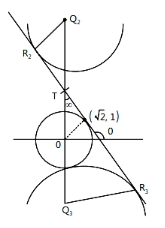
The circle $C_1: x^2+y^2=3$,with centre at $O$,intersects the parabola $x^2=2y$ at the point $P$ in the first quadrant. Let the tangent to the circle $C_1$ at $P$ touch two other circles $C_2$ and $C_3$ at $R_2$ and $R_3$,respectively. Suppose $C_2$ and $C_3$ have equal radii $2\sqrt{3}$ and centres $Q_2$ and $Q_3$,respectively. If $Q_2$ and $Q_3$ lie on the $y$-axis,then:
$(A)$ $Q_2Q_3=12$
$(B)$ $R_2R_3=4\sqrt{6}$
$(C)$ Area of the triangle $OR_2R_3$ is $6\sqrt{2}$
$(D)$ Area of the triangle $PQ_2Q_3$ is $4\sqrt{2}$
$(A)$ $Q_2Q_3=12$
$(B)$ $R_2R_3=4\sqrt{6}$
$(C)$ Area of the triangle $OR_2R_3$ is $6\sqrt{2}$
$(D)$ Area of the triangle $PQ_2Q_3$ is $4\sqrt{2}$
A
$A, B, C$
B
$A, B, D$
C
$A, B$
D
$B, C$
Solution
(A, B, C) The circle is $x^2+y^2=3$ and the parabola is $x^2=2y$. Substituting $x^2=2y$ into the circle equation gives $2y+y^2=3$,so $y^2+2y-3=0$,which factors as $(y+3)(y-1)=0$. Since $P$ is in the first quadrant,$y=1$,and $x^2=2(1)=2$,so $x=\sqrt{2}$. Thus,$P \equiv (\sqrt{2}, 1)$.
The tangent to $x^2+y^2=3$ at $(\sqrt{2}, 1)$ is $\sqrt{2}x + y = 3$. Let this line be $L$. The slope of $L$ is $m = -\sqrt{2}$.
Let $\theta$ be the angle the line $L$ makes with the positive $x$-axis,so $\tan \theta = -\sqrt{2}$. The angle $\alpha$ between the line $L$ and the $y$-axis satisfies $\tan \alpha = |\cot \theta| = \frac{1}{|\tan \theta|} = \frac{1}{\sqrt{2}}$.
Let $T$ be the intersection of $L$ with the $y$-axis. Setting $x=0$ in $\sqrt{2}x+y=3$ gives $T \equiv (0, 3)$.
For circles $C_2, C_3$ with radius $r=2\sqrt{3}$ tangent to $L$ at $R_2, R_3$ with centers $Q_2, Q_3$ on the $y$-axis,the distance $Q_3T = \frac{r}{\sin \alpha}$. Since $\tan \alpha = \frac{1}{\sqrt{2}}$,$\sin \alpha = \frac{1}{\sqrt{3}}$. Thus $Q_3T = \frac{2\sqrt{3}}{1/\sqrt{3}} = 6$. Since $Q_2, Q_3$ are symmetric about $T$ on the $y$-axis,$Q_2Q_3 = 2 \times 6 = 12$. (Option $A$ is correct).
$R_3T = \frac{r}{\tan \alpha} = \frac{2\sqrt{3}}{1/\sqrt{2}} = 2\sqrt{6}$. Thus $R_2R_3 = 2 \times 2\sqrt{6} = 4\sqrt{6}$. (Option $B$ is correct).
The perpendicular distance from $O(0,0)$ to $L$ is $d = \frac{|3|}{\sqrt{(\sqrt{2})^2+1^2}} = \frac{3}{\sqrt{3}} = \sqrt{3}$. Area of $\triangle OR_2R_3 = \frac{1}{2} \times \text{base} \times \text{height} = \frac{1}{2} \times (4\sqrt{6}) \times \sqrt{3} = 2\sqrt{18} = 6\sqrt{2}$. (Option $C$ is correct).
Area of $\triangle PQ_2Q_3 = \frac{1}{2} \times \text{base} \times \text{height} = \frac{1}{2} \times (Q_2Q_3) \times |x_P| = \frac{1}{2} \times 12 \times \sqrt{2} = 6\sqrt{2}$. (Option $D$ is incorrect).
The tangent to $x^2+y^2=3$ at $(\sqrt{2}, 1)$ is $\sqrt{2}x + y = 3$. Let this line be $L$. The slope of $L$ is $m = -\sqrt{2}$.
Let $\theta$ be the angle the line $L$ makes with the positive $x$-axis,so $\tan \theta = -\sqrt{2}$. The angle $\alpha$ between the line $L$ and the $y$-axis satisfies $\tan \alpha = |\cot \theta| = \frac{1}{|\tan \theta|} = \frac{1}{\sqrt{2}}$.
Let $T$ be the intersection of $L$ with the $y$-axis. Setting $x=0$ in $\sqrt{2}x+y=3$ gives $T \equiv (0, 3)$.
For circles $C_2, C_3$ with radius $r=2\sqrt{3}$ tangent to $L$ at $R_2, R_3$ with centers $Q_2, Q_3$ on the $y$-axis,the distance $Q_3T = \frac{r}{\sin \alpha}$. Since $\tan \alpha = \frac{1}{\sqrt{2}}$,$\sin \alpha = \frac{1}{\sqrt{3}}$. Thus $Q_3T = \frac{2\sqrt{3}}{1/\sqrt{3}} = 6$. Since $Q_2, Q_3$ are symmetric about $T$ on the $y$-axis,$Q_2Q_3 = 2 \times 6 = 12$. (Option $A$ is correct).
$R_3T = \frac{r}{\tan \alpha} = \frac{2\sqrt{3}}{1/\sqrt{2}} = 2\sqrt{6}$. Thus $R_2R_3 = 2 \times 2\sqrt{6} = 4\sqrt{6}$. (Option $B$ is correct).
The perpendicular distance from $O(0,0)$ to $L$ is $d = \frac{|3|}{\sqrt{(\sqrt{2})^2+1^2}} = \frac{3}{\sqrt{3}} = \sqrt{3}$. Area of $\triangle OR_2R_3 = \frac{1}{2} \times \text{base} \times \text{height} = \frac{1}{2} \times (4\sqrt{6}) \times \sqrt{3} = 2\sqrt{18} = 6\sqrt{2}$. (Option $C$ is correct).
Area of $\triangle PQ_2Q_3 = \frac{1}{2} \times \text{base} \times \text{height} = \frac{1}{2} \times (Q_2Q_3) \times |x_P| = \frac{1}{2} \times 12 \times \sqrt{2} = 6\sqrt{2}$. (Option $D$ is incorrect).
0 likesView Solution
5
MathematicsAdvancedMCQIIT JEE · 2016
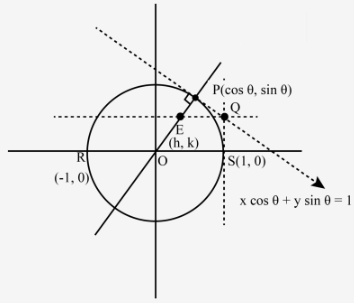
Let $RS$ be the diameter of the circle $x^2+y^2=1$,where $S$ is the point $(1,0)$. Let $P$ be a variable point (other than $R$ and $S$) on the circle and tangents to the circle at $S$ and $P$ meet at the point $Q$. The normal to the circle at $P$ intersects a line drawn through $Q$ parallel to $RS$ at point $E$. Then the locus of $E$ passes through the point$(s)$:
$(A)$ $\left(\frac{1}{3}, \frac{1}{\sqrt{3}}\right)$ $(B)$ $\left(\frac{1}{4}, \frac{1}{2}\right)$ $(C)$ $\left(\frac{1}{3},-\frac{1}{\sqrt{3}}\right)$ $(D)$ $\left(\frac{1}{4},-\frac{1}{2}\right)$
$(A)$ $\left(\frac{1}{3}, \frac{1}{\sqrt{3}}\right)$ $(B)$ $\left(\frac{1}{4}, \frac{1}{2}\right)$ $(C)$ $\left(\frac{1}{3},-\frac{1}{\sqrt{3}}\right)$ $(D)$ $\left(\frac{1}{4},-\frac{1}{2}\right)$
A
$A, D$
B
$A, B$
C
$A, C$
D
$A, C, B$
Solution
(C) Given,$RS$ is the diameter of $x^2+y^2=1$. Let $P = (\cos \theta, \sin \theta)$.
The tangent at $P$ is $x \cos \theta + y \sin \theta = 1$. The tangent at $S(1,0)$ is $x = 1$.
Solving these,$Q = \left(1, \frac{1-\cos \theta}{\sin \theta}\right) = \left(1, \tan \frac{\theta}{2}\right)$.
The line through $Q$ parallel to $RS$ (the $x$-axis) is $y = \tan \frac{\theta}{2}$.
The normal at $P$ is $y = x \tan \theta$.
Let $E = (h, k)$. Then $k = \tan \frac{\theta}{2}$ and $k = h \tan \theta$.
Using $\tan \theta = \frac{2 \tan(\theta/2)}{1 - \tan^2(\theta/2)}$,we get $k = h \frac{2k}{1-k^2}$.
Thus,$1-k^2 = 2h$,or the locus is $2x = 1-y^2$.
Checking the points:
For $x = 1/3$,$1-y^2 = 2/3$ $\Rightarrow y^2 = 1/3$ $\Rightarrow y = \pm 1/\sqrt{3}$.
Thus,points $(1/3, 1/\sqrt{3})$ and $(1/3, -1/\sqrt{3})$ lie on the locus.
For $x = 1/4$,$1-y^2 = 2/4 = 1/2$ $\Rightarrow y^2 = 1/2$ $\Rightarrow y = \pm 1/\sqrt{2} \neq \pm 1/2$.
Therefore,the locus passes through points $A$ and $C$.
The tangent at $P$ is $x \cos \theta + y \sin \theta = 1$. The tangent at $S(1,0)$ is $x = 1$.
Solving these,$Q = \left(1, \frac{1-\cos \theta}{\sin \theta}\right) = \left(1, \tan \frac{\theta}{2}\right)$.
The line through $Q$ parallel to $RS$ (the $x$-axis) is $y = \tan \frac{\theta}{2}$.
The normal at $P$ is $y = x \tan \theta$.
Let $E = (h, k)$. Then $k = \tan \frac{\theta}{2}$ and $k = h \tan \theta$.
Using $\tan \theta = \frac{2 \tan(\theta/2)}{1 - \tan^2(\theta/2)}$,we get $k = h \frac{2k}{1-k^2}$.
Thus,$1-k^2 = 2h$,or the locus is $2x = 1-y^2$.
Checking the points:
For $x = 1/3$,$1-y^2 = 2/3$ $\Rightarrow y^2 = 1/3$ $\Rightarrow y = \pm 1/\sqrt{3}$.
Thus,points $(1/3, 1/\sqrt{3})$ and $(1/3, -1/\sqrt{3})$ lie on the locus.
For $x = 1/4$,$1-y^2 = 2/4 = 1/2$ $\Rightarrow y^2 = 1/2$ $\Rightarrow y = \pm 1/\sqrt{2} \neq \pm 1/2$.
Therefore,the locus passes through points $A$ and $C$.
0 likesView Solution
6
MathematicsAdvancedMCQIIT JEE · 2016
Let $m$ be the smallest positive integer such that the coefficient of $x^2$ in the expansion of $(1+x)^2+(1+x)^3+\cdots+(1+x)^{49}+(1+mx)^{50}$ is $(3n+1)^{51}C_3$ for some positive integer $n$. Then the value of $n$ is
A
$3$
B
$2$
C
$5$
D
$4$
Solution
(C) The coefficient of $x^2$ in the expansion is given by the sum of the coefficients of $x^2$ in each term:
$= {^2C_2} + {^3C_2} + {^4C_2} + \cdots + {^{49}C_2} + {^{50}C_2} \cdot m^2$
Using the identity ${^nC_r} + {^nC_{r-1}} = {^{n+1}C_r}$,we know that ${^2C_2} = {^3C_3}$.
Thus,the sum becomes ${^3C_3} + {^3C_2} + {^4C_2} + \cdots + {^{49}C_2} + {^{50}C_2} \cdot m^2 = {^4C_3} + {^4C_2} + \cdots + {^{49}C_2} + {^{50}C_2} \cdot m^2$
Continuing this process,the sum of the first $49$ terms is ${^{50}C_3}$.
So,the total coefficient is ${^{50}C_3} + {^{50}C_2} \cdot m^2$.
We are given that this equals $(3n+1) \cdot {^{51}C_3}$.
Note that ${^{51}C_3} = {^{50}C_3} + {^{50}C_2}$.
So,${^{50}C_3} + {^{50}C_2} \cdot m^2 = (3n+1)({^{50}C_3} + {^{50}C_2})$.
${^{50}C_3} + {^{50}C_2} \cdot m^2 = (3n+1){^{50}C_3} + (3n+1){^{50}C_2}$.
Since ${^{50}C_3} = \frac{50-2}{3} {^{50}C_2} = \frac{48}{3} {^{50}C_2} = 16 \cdot {^{50}C_2}$,we substitute this:
$16 \cdot {^{50}C_2} + {^{50}C_2} \cdot m^2 = (3n+1) \cdot 16 \cdot {^{50}C_2} + (3n+1) \cdot {^{50}C_2}$.
Dividing by ${^{50}C_2}$:
$16 + m^2 = 16(3n+1) + (3n+1) = 17(3n+1) = 51n + 17$.
$m^2 = 51n + 1$.
For $n=1$,$m^2 = 52$ (not a square).
For $n=2$,$m^2 = 103$ (not a square).
For $n=3$,$m^2 = 154$ (not a square).
For $n=4$,$m^2 = 205$ (not a square).
For $n=5$,$m^2 = 256 = 16^2$,so $m=16$.
The smallest positive integer $m$ is $16$,which gives $n=5$.
$= {^2C_2} + {^3C_2} + {^4C_2} + \cdots + {^{49}C_2} + {^{50}C_2} \cdot m^2$
Using the identity ${^nC_r} + {^nC_{r-1}} = {^{n+1}C_r}$,we know that ${^2C_2} = {^3C_3}$.
Thus,the sum becomes ${^3C_3} + {^3C_2} + {^4C_2} + \cdots + {^{49}C_2} + {^{50}C_2} \cdot m^2 = {^4C_3} + {^4C_2} + \cdots + {^{49}C_2} + {^{50}C_2} \cdot m^2$
Continuing this process,the sum of the first $49$ terms is ${^{50}C_3}$.
So,the total coefficient is ${^{50}C_3} + {^{50}C_2} \cdot m^2$.
We are given that this equals $(3n+1) \cdot {^{51}C_3}$.
Note that ${^{51}C_3} = {^{50}C_3} + {^{50}C_2}$.
So,${^{50}C_3} + {^{50}C_2} \cdot m^2 = (3n+1)({^{50}C_3} + {^{50}C_2})$.
${^{50}C_3} + {^{50}C_2} \cdot m^2 = (3n+1){^{50}C_3} + (3n+1){^{50}C_2}$.
Since ${^{50}C_3} = \frac{50-2}{3} {^{50}C_2} = \frac{48}{3} {^{50}C_2} = 16 \cdot {^{50}C_2}$,we substitute this:
$16 \cdot {^{50}C_2} + {^{50}C_2} \cdot m^2 = (3n+1) \cdot 16 \cdot {^{50}C_2} + (3n+1) \cdot {^{50}C_2}$.
Dividing by ${^{50}C_2}$:
$16 + m^2 = 16(3n+1) + (3n+1) = 17(3n+1) = 51n + 17$.
$m^2 = 51n + 1$.
For $n=1$,$m^2 = 52$ (not a square).
For $n=2$,$m^2 = 103$ (not a square).
For $n=3$,$m^2 = 154$ (not a square).
For $n=4$,$m^2 = 205$ (not a square).
For $n=5$,$m^2 = 256 = 16^2$,so $m=16$.
The smallest positive integer $m$ is $16$,which gives $n=5$.
0 likesView Solution
7
MathematicsAdvancedMCQIIT JEE · 2016
Let $\alpha, \beta \in R$ be such that $\lim _{x \rightarrow 0} \frac{x^2 \sin (\beta x)}{\alpha x-\sin x}=1$. Then $6(\alpha+\beta)$ equals
A
$5$
B
$7$
C
$6$
D
$4$
Solution
(B) Given $\lim _{x \rightarrow 0} \frac{x^2 \sin (\beta x)}{\alpha x-\sin x}=1$.
Using the Taylor series expansion for $\sin(x) = x - \frac{x^3}{3!} + \dots$ and $\sin(\beta x) = \beta x - \frac{(\beta x)^3}{3!} + \dots$,we get:
$\lim _{x \rightarrow 0} \frac{x^2(\beta x - \frac{\beta^3 x^3}{6} + \dots)}{\alpha x - (x - \frac{x^3}{6} + \dots)} = 1$
$\lim _{x \rightarrow 0} \frac{\beta x^3 - \frac{\beta^3 x^5}{6} + \dots}{(\alpha - 1)x + \frac{x^3}{6} - \dots} = 1$
For the limit to be a finite non-zero value,the coefficient of $x$ in the denominator must be zero,so $\alpha - 1 = 0 \Rightarrow \alpha = 1$.
Substituting $\alpha = 1$ into the limit:
$\lim _{x \rightarrow 0} \frac{\beta x^3 - \frac{\beta^3 x^5}{6} + \dots}{\frac{x^3}{6} - \dots} = 1$
Dividing numerator and denominator by $x^3$:
$\lim _{x \rightarrow 0} \frac{\beta - \frac{\beta^3 x^2}{6} + \dots}{\frac{1}{6} - \dots} = 1$
$\frac{\beta}{1/6} = 1$ $\Rightarrow 6\beta = 1$ $\Rightarrow \beta = \frac{1}{6}$.
Therefore,$6(\alpha + \beta) = 6(1 + \frac{1}{6}) = 6 + 1 = 7$.
Using the Taylor series expansion for $\sin(x) = x - \frac{x^3}{3!} + \dots$ and $\sin(\beta x) = \beta x - \frac{(\beta x)^3}{3!} + \dots$,we get:
$\lim _{x \rightarrow 0} \frac{x^2(\beta x - \frac{\beta^3 x^3}{6} + \dots)}{\alpha x - (x - \frac{x^3}{6} + \dots)} = 1$
$\lim _{x \rightarrow 0} \frac{\beta x^3 - \frac{\beta^3 x^5}{6} + \dots}{(\alpha - 1)x + \frac{x^3}{6} - \dots} = 1$
For the limit to be a finite non-zero value,the coefficient of $x$ in the denominator must be zero,so $\alpha - 1 = 0 \Rightarrow \alpha = 1$.
Substituting $\alpha = 1$ into the limit:
$\lim _{x \rightarrow 0} \frac{\beta x^3 - \frac{\beta^3 x^5}{6} + \dots}{\frac{x^3}{6} - \dots} = 1$
Dividing numerator and denominator by $x^3$:
$\lim _{x \rightarrow 0} \frac{\beta - \frac{\beta^3 x^2}{6} + \dots}{\frac{1}{6} - \dots} = 1$
$\frac{\beta}{1/6} = 1$ $\Rightarrow 6\beta = 1$ $\Rightarrow \beta = \frac{1}{6}$.
Therefore,$6(\alpha + \beta) = 6(1 + \frac{1}{6}) = 6 + 1 = 7$.
0 likesView Solution
8
MathematicsAdvancedMCQIIT JEE · 2016
Let $b_i > 1$ for $i = 1, 2, \ldots, 101$. Suppose $\log _e b_1, \log _e b_2, \ldots, \log _e b_{101}$ are in Arithmetic Progression $(A.P.)$ with the common difference $\log _e 2$. Suppose $a_1, a_2, \ldots, a_{101}$ are in $A.P.$ such that $a_1 = b_1$ and $a_{51} = b_{51}$. If $t = b_1 + b_2 + \cdots + b_{51}$ and $s = a_1 + a_2 + \cdots + a_{51}$,then:
A
$s > t$ and $a_{101} > b_{101}$
B
$s > t$ and $a_{101} < b_{101}$
C
$s < t$ and $a_{101} > b_{101}$
D
$s < t$ and $a_{101} < b_{101}$
Solution
(B) Given $\log _e b_1, \log _e b_2, \ldots, \log _e b_{101}$ are in $A.P.$,it follows that $b_1, b_2, \ldots, b_{101}$ are in $G.P.$ with common ratio $r = e^{\log _e 2} = 2$.
Let $a_1 = b_1 = a$. Since $a_{51} = b_{51}$,we have $a + 50d = a \cdot r^{50} = a \cdot 2^{50}$,so $d = \frac{a(2^{50} - 1)}{50}$.
The sum $t$ of the first $51$ terms of the $G.P.$ is $t = b_1 \frac{r^{51} - 1}{r - 1} = a(2^{51} - 1)$.
The sum $s$ of the first $51$ terms of the $A.P.$ is $s = \frac{51}{2}(2a + 50d) = \frac{51}{2}(2a + a(2^{50} - 1)) = \frac{51}{2}a(2^{50} + 1)$.
Comparing $s$ and $t$: $s = \frac{51}{2}a(2^{50} + 1) \approx 25.5 \cdot a \cdot 2^{50}$ and $t = a(2^{51} - 1) \approx 2 \cdot a \cdot 2^{50}$. Thus,$s > t$.
For the $101^{st}$ terms: $a_{101} = a + 100d = a + 2a(2^{50} - 1) = a(2^{51} - 1)$.
$b_{101} = b_1 \cdot r^{100} = a \cdot 2^{100}$.
Since $2^{100} > 2^{51} - 1$,we have $b_{101} > a_{101}$.
Let $a_1 = b_1 = a$. Since $a_{51} = b_{51}$,we have $a + 50d = a \cdot r^{50} = a \cdot 2^{50}$,so $d = \frac{a(2^{50} - 1)}{50}$.
The sum $t$ of the first $51$ terms of the $G.P.$ is $t = b_1 \frac{r^{51} - 1}{r - 1} = a(2^{51} - 1)$.
The sum $s$ of the first $51$ terms of the $A.P.$ is $s = \frac{51}{2}(2a + 50d) = \frac{51}{2}(2a + a(2^{50} - 1)) = \frac{51}{2}a(2^{50} + 1)$.
Comparing $s$ and $t$: $s = \frac{51}{2}a(2^{50} + 1) \approx 25.5 \cdot a \cdot 2^{50}$ and $t = a(2^{51} - 1) \approx 2 \cdot a \cdot 2^{50}$. Thus,$s > t$.
For the $101^{st}$ terms: $a_{101} = a + 100d = a + 2a(2^{50} - 1) = a(2^{51} - 1)$.
$b_{101} = b_1 \cdot r^{100} = a \cdot 2^{100}$.
Since $2^{100} > 2^{51} - 1$,we have $b_{101} > a_{101}$.
0 likesView Solution
9
MathematicsAdvancedMCQIIT JEE · 2016
The value of $\sum_{k=1}^{13} \frac{1}{\sin \left(\frac{\pi}{4}+\frac{(k-1) \pi}{6}\right) \sin \left(\frac{\pi}{4}+\frac{k \pi}{6}\right)}$ is equal to
A
$3-\sqrt{3}$
B
$2(3-\sqrt{3})$
C
$2(\sqrt{3}-1)$
D
$2(2-\sqrt{3})$
Solution
(C) Let $S = \sum_{k=1}^{13} \frac{1}{\sin \left(\frac{\pi}{4}+(k-1) \frac{\pi}{6}\right) \sin \left(\frac{\pi}{4}+\frac{k \pi}{6}\right)}$.
Multiply and divide by $\sin(\frac{\pi}{6})$:
$S = \frac{1}{\sin(\frac{\pi}{6})} \sum_{k=1}^{13} \frac{\sin(\frac{\pi}{6})}{\sin \left(\frac{\pi}{4}+(k-1) \frac{\pi}{6}\right) \sin \left(\frac{\pi}{4}+\frac{k \pi}{6}\right)}$.
Since $\frac{\pi}{6} = (\frac{\pi}{4}+\frac{k \pi}{6}) - (\frac{\pi}{4}+(k-1) \frac{\pi}{6})$,we use the identity $\sin(A-B) = \sin A \cos B - \cos A \sin B$:
$S = 2 \sum_{k=1}^{13} \left[ \cot \left(\frac{\pi}{4}+(k-1) \frac{\pi}{6}\right) - \cot \left(\frac{\pi}{4}+\frac{k \pi}{6}\right) \right]$.
This is a telescoping sum:
$S = 2 \left[ \cot \frac{\pi}{4} - \cot \left(\frac{\pi}{4} + \frac{13\pi}{6}\right) \right]$.
Since $\cot \frac{\pi}{4} = 1$ and $\cot(\frac{\pi}{4} + \frac{13\pi}{6}) = \cot(\frac{\pi}{4} + \frac{\pi}{6}) = \cot(\frac{5\pi}{12}) = 2-\sqrt{3}$:
$S = 2 [1 - (2-\sqrt{3})] = 2(\sqrt{3}-1)$.
Multiply and divide by $\sin(\frac{\pi}{6})$:
$S = \frac{1}{\sin(\frac{\pi}{6})} \sum_{k=1}^{13} \frac{\sin(\frac{\pi}{6})}{\sin \left(\frac{\pi}{4}+(k-1) \frac{\pi}{6}\right) \sin \left(\frac{\pi}{4}+\frac{k \pi}{6}\right)}$.
Since $\frac{\pi}{6} = (\frac{\pi}{4}+\frac{k \pi}{6}) - (\frac{\pi}{4}+(k-1) \frac{\pi}{6})$,we use the identity $\sin(A-B) = \sin A \cos B - \cos A \sin B$:
$S = 2 \sum_{k=1}^{13} \left[ \cot \left(\frac{\pi}{4}+(k-1) \frac{\pi}{6}\right) - \cot \left(\frac{\pi}{4}+\frac{k \pi}{6}\right) \right]$.
This is a telescoping sum:
$S = 2 \left[ \cot \frac{\pi}{4} - \cot \left(\frac{\pi}{4} + \frac{13\pi}{6}\right) \right]$.
Since $\cot \frac{\pi}{4} = 1$ and $\cot(\frac{\pi}{4} + \frac{13\pi}{6}) = \cot(\frac{\pi}{4} + \frac{\pi}{6}) = \cot(\frac{5\pi}{12}) = 2-\sqrt{3}$:
$S = 2 [1 - (2-\sqrt{3})] = 2(\sqrt{3}-1)$.
0 likesView Solution
10
MathematicsAdvancedMCQIIT JEE · 2016
Let $a, b \in \mathbb{R}$ and $a^2+b^2 \neq 0$. Suppose $S = \{z \in \mathbb{C} : z = \frac{1}{a+ibt}, t \in \mathbb{R}, t \neq 0\}$,where $i = \sqrt{-1}$. If $z = x+iy$ and $z \in S$,then $(x, y)$ lies on:
A
$A, C$
B
$C, D$
C
$A, C, B$
D
$A, C, D$
Solution
(D) Given $z = \frac{1}{a+ibt}$.
$x+iy = \frac{a-ibt}{a^2+b^2t^2}$.
Equating real and imaginary parts,$x = \frac{a}{a^2+b^2t^2}$ and $y = \frac{-bt}{a^2+b^2t^2}$.
If $a \neq 0$ and $b \neq 0$,then $a^2+b^2t^2 = \frac{a}{x}$,so $b^2t^2 = \frac{a}{x} - a^2 = \frac{a(1-ax)}{x}$.
Also $y^2 = \frac{b^2t^2}{(a^2+b^2t^2)^2} = \frac{a(1-ax)/x}{(a/x)^2} = \frac{x(1-ax)}{a} = \frac{x}{a} - x^2$.
Rearranging gives $x^2 - \frac{x}{a} + y^2 = 0$,which is $(x - \frac{1}{2a})^2 + y^2 = (\frac{1}{2a})^2$. This represents a circle with radius $|\frac{1}{2a}|$ and center $(\frac{1}{2a}, 0)$.
If $b=0$,then $z = \frac{1}{a}$,so $y=0$,which is the $x$-axis.
If $a=0$,then $z = \frac{1}{ibt} = -i(\frac{1}{bt})$,so $x=0$,which is the $y$-axis.
Thus,options $A, C, D$ are correct.
$x+iy = \frac{a-ibt}{a^2+b^2t^2}$.
Equating real and imaginary parts,$x = \frac{a}{a^2+b^2t^2}$ and $y = \frac{-bt}{a^2+b^2t^2}$.
If $a \neq 0$ and $b \neq 0$,then $a^2+b^2t^2 = \frac{a}{x}$,so $b^2t^2 = \frac{a}{x} - a^2 = \frac{a(1-ax)}{x}$.
Also $y^2 = \frac{b^2t^2}{(a^2+b^2t^2)^2} = \frac{a(1-ax)/x}{(a/x)^2} = \frac{x(1-ax)}{a} = \frac{x}{a} - x^2$.
Rearranging gives $x^2 - \frac{x}{a} + y^2 = 0$,which is $(x - \frac{1}{2a})^2 + y^2 = (\frac{1}{2a})^2$. This represents a circle with radius $|\frac{1}{2a}|$ and center $(\frac{1}{2a}, 0)$.
If $b=0$,then $z = \frac{1}{a}$,so $y=0$,which is the $x$-axis.
If $a=0$,then $z = \frac{1}{ibt} = -i(\frac{1}{bt})$,so $x=0$,which is the $y$-axis.
Thus,options $A, C, D$ are correct.
0 likesView Solution
11
MathematicsAdvancedMCQIIT JEE · 2016
Let $P$ be the point on the parabola $y^2=4x$ which is at the shortest distance from the center $S$ of the circle $x^2+y^2-4x-16y+64=0$. Let $Q$ be the point on the circle dividing the line segment $SP$ internally. Then
$(A)$ $SP=2\sqrt{5}$
$(B)$ $SQ:QP=(\sqrt{5}+1):2$
$(C)$ the $x$-intercept of the normal to the parabola at $P$ is $6$
$(D)$ the slope of the tangent to the circle at $Q$ is $\frac{1}{2}$
$(A)$ $SP=2\sqrt{5}$
$(B)$ $SQ:QP=(\sqrt{5}+1):2$
$(C)$ the $x$-intercept of the normal to the parabola at $P$ is $6$
$(D)$ the slope of the tangent to the circle at $Q$ is $\frac{1}{2}$
A
$A, C, B$
B
$A, C, D$
C
$A, C$
D
$C, D$
Solution
(B) The center of the circle $x^2+y^2-4x-16y+64=0$ is $S(2, 8)$ and its radius $r$ is $\sqrt{2^2+8^2-64} = 2$.
Let $P = (t^2, 2t)$ be a point on the parabola $y^2=4x$.
For $P$ to be the closest point to $S$,the line $SP$ must be the normal to the parabola at $P$.
The slope of the tangent at $P$ is $\frac{1}{t}$,so the slope of the normal is $-t$.
The slope of $SP$ is $\frac{2t-8}{t^2-2}$.
Setting $\frac{2t-8}{t^2-2} = -t$,we get $2t-8 = -t^3+2t$,which implies $t^3=8$,so $t=2$.
Thus,$P = (4, 4)$.
$(A)$ $SP = \sqrt{(4-2)^2+(4-8)^2} = \sqrt{2^2+(-4)^2} = \sqrt{20} = 2\sqrt{5}$. This is correct.
$(C)$ The slope of the normal at $P(4, 4)$ is $-t = -2$. The equation of the normal is $y-4 = -2(x-4)$,or $y = -2x+12$. The $x$-intercept is found by setting $y=0$,giving $2x=12$,so $x=6$. This is correct.
$(D)$ Since $SP$ is the normal to the parabola at $P$,and $S$ is the center of the circle,the line $SP$ passes through the center of the circle. Thus,$SP$ is a normal to the circle at $Q$. The slope of $SP$ is $-2$. The tangent at $Q$ is perpendicular to the normal $SQ$,so its slope is $-\frac{1}{-2} = \frac{1}{2}$. This is correct.
$(B)$ $SQ$ is the radius of the circle,so $SQ=2$. $SP=2\sqrt{5}$. $QP = SP - SQ = 2\sqrt{5}-2$. Thus $SQ:QP = 2 : (2\sqrt{5}-2) = 1 : (\sqrt{5}-1) = (\sqrt{5}+1) : 4$. This is incorrect.
Therefore,the correct options are $A, C, D$.
Let $P = (t^2, 2t)$ be a point on the parabola $y^2=4x$.
For $P$ to be the closest point to $S$,the line $SP$ must be the normal to the parabola at $P$.
The slope of the tangent at $P$ is $\frac{1}{t}$,so the slope of the normal is $-t$.
The slope of $SP$ is $\frac{2t-8}{t^2-2}$.
Setting $\frac{2t-8}{t^2-2} = -t$,we get $2t-8 = -t^3+2t$,which implies $t^3=8$,so $t=2$.
Thus,$P = (4, 4)$.
$(A)$ $SP = \sqrt{(4-2)^2+(4-8)^2} = \sqrt{2^2+(-4)^2} = \sqrt{20} = 2\sqrt{5}$. This is correct.
$(C)$ The slope of the normal at $P(4, 4)$ is $-t = -2$. The equation of the normal is $y-4 = -2(x-4)$,or $y = -2x+12$. The $x$-intercept is found by setting $y=0$,giving $2x=12$,so $x=6$. This is correct.
$(D)$ Since $SP$ is the normal to the parabola at $P$,and $S$ is the center of the circle,the line $SP$ passes through the center of the circle. Thus,$SP$ is a normal to the circle at $Q$. The slope of $SP$ is $-2$. The tangent at $Q$ is perpendicular to the normal $SQ$,so its slope is $-\frac{1}{-2} = \frac{1}{2}$. This is correct.
$(B)$ $SQ$ is the radius of the circle,so $SQ=2$. $SP=2\sqrt{5}$. $QP = SP - SQ = 2\sqrt{5}-2$. Thus $SQ:QP = 2 : (2\sqrt{5}-2) = 1 : (\sqrt{5}-1) = (\sqrt{5}+1) : 4$. This is incorrect.
Therefore,the correct options are $A, C, D$.
0 likesView Solution
12
MathematicsAdvancedMCQIIT JEE · 2016
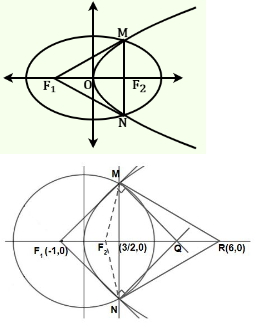
Let $F_1(-1, 0)$ and $F_2(1, 0)$ be the foci of the ellipse $\frac{x^2}{9}+\frac{y^2}{8}=1$. Suppose a parabola having its vertex at the origin and focus at $F_2$ intersects the ellipse at point $M$ in the first quadrant and at point $N$ in the fourth quadrant.
$(1)$ The orthocentre of the triangle $F_1 M N$ is
$(A)$ $\left(-\frac{9}{10}, 0\right)$ $(B)$ $\left(\frac{2}{3}, 0\right)$ $(C)$ $\left(\frac{9}{10}, 0\right)$ $(D)$ $\left(\frac{2}{3}, \sqrt{6}\right)$
$(2)$ If the tangents to the ellipse at $M$ and $N$ meet at $R$ and the normal to the parabola at $M$ meets the $x$-axis at $Q$,then the ratio of the area of the triangle $M Q R$ to the area of the quadrilateral $M F_1 N F_2$ is
$(A)$ $3: 4$ $(B)$ $4: 5$ $(C)$ $5: 8$ $(D)$ $2: 3$
$(1)$ The orthocentre of the triangle $F_1 M N$ is
$(A)$ $\left(-\frac{9}{10}, 0\right)$ $(B)$ $\left(\frac{2}{3}, 0\right)$ $(C)$ $\left(\frac{9}{10}, 0\right)$ $(D)$ $\left(\frac{2}{3}, \sqrt{6}\right)$
$(2)$ If the tangents to the ellipse at $M$ and $N$ meet at $R$ and the normal to the parabola at $M$ meets the $x$-axis at $Q$,then the ratio of the area of the triangle $M Q R$ to the area of the quadrilateral $M F_1 N F_2$ is
$(A)$ $3: 4$ $(B)$ $4: 5$ $(C)$ $5: 8$ $(D)$ $2: 3$
A
$A, B$
B
$A, D$
C
$A, C$
D
$A, B, D$
Solution
(C) $1.$ The correct option is $A \left(-\frac{9}{10}, 0\right)$.
Equation of the ellipse: $\frac{x^2}{9}+\frac{y^2}{8}=1$. Here $a^2=9, b^2=8$. Eccentricity $e = \sqrt{1-\frac{8}{9}} = \frac{1}{3}$. Foci are $(\pm ae, 0) = (\pm 1, 0)$.
Equation of the parabola with vertex $(0,0)$ and focus $F_2(1,0)$ is $y^2 = 4x$.
Substituting $y^2=4x$ into the ellipse equation: $\frac{x^2}{9} + \frac{4x}{8} = 1 \Rightarrow 2x^2 + 9x - 18 = 0 \Rightarrow (2x-3)(x+6)=0$. Since $x>0$,$x=\frac{3}{2}$. Then $y^2 = 4(\frac{3}{2}) = 6$,so $y = \pm \sqrt{6}$. Thus $M = (\frac{3}{2}, \sqrt{6})$ and $N = (\frac{3}{2}, -\sqrt{6})$.
In $\triangle F_1 M N$,the altitude from $M$ to $F_1 N$ has slope $m_1 = \frac{\sqrt{6} - 0}{3/2 - (-1)} = \frac{\sqrt{6}}{5/2} = \frac{2\sqrt{6}}{5}$. The slope of $F_1 N$ is $\frac{-\sqrt{6}-0}{3/2 - (-1)} = \frac{-\sqrt{6}}{5/2} = -\frac{2\sqrt{6}}{5}$. The slope of the altitude from $M$ is $m_{alt} = -\frac{1}{-2\sqrt{6}/5} = \frac{5}{2\sqrt{6}}$.
Equation of altitude from $M$: $y - \sqrt{6} = \frac{5}{2\sqrt{6}}(x - \frac{3}{2})$. Since the orthocentre lies on the $x$-axis (as $F_1 M N$ is isosceles with $F_1 M = F_1 N$),set $y=0$: $-\sqrt{6} = \frac{5}{2\sqrt{6}}(x - \frac{3}{2}) \Rightarrow -12 = 5x - \frac{15}{2} \Rightarrow 5x = -12 + 7.5 = -4.5 \Rightarrow x = -\frac{9}{10}$.
$2.$ The tangent to the ellipse at $M(\frac{3}{2}, \sqrt{6})$ is $\frac{x(3/2)}{9} + \frac{y\sqrt{6}}{8} = 1 \Rightarrow \frac{x}{6} + \frac{y\sqrt{6}}{8} = 1$. For $y=0$,$x=6$,so $R(6,0)$.
The normal to the parabola $y^2=4x$ at $M(\frac{3}{2}, \sqrt{6})$: slope of tangent is $\frac{dy}{dx} = \frac{2}{y} = \frac{2}{\sqrt{6}}$. Slope of normal is $-\frac{\sqrt{6}}{2}$. Equation: $y - \sqrt{6} = -\frac{\sqrt{6}}{2}(x - \frac{3}{2})$. For $y=0$,$\sqrt{6} = \frac{\sqrt{6}}{2}(x - \frac{3}{2}) \Rightarrow 2 = x - \frac{3}{2} \Rightarrow x = \frac{7}{2}$. So $Q(\frac{7}{2}, 0)$.
Area $\triangle MQR = \frac{1}{2} \times |x_R - x_Q| \times y_M = \frac{1}{2} \times (6 - 3.5) \times \sqrt{6} = \frac{1}{2} \times 2.5 \times \sqrt{6} = \frac{5\sqrt{6}}{4}$.
Area quadrilateral $MF_1NF_2 = \frac{1}{2} \times |F_1 F_2| \times |y_M - y_N| = \frac{1}{2} \times 2 \times 2\sqrt{6} = 2\sqrt{6}$.
Ratio $= \frac{5\sqrt{6}/4}{2\sqrt{6}} = \frac{5}{8}$.
Equation of the ellipse: $\frac{x^2}{9}+\frac{y^2}{8}=1$. Here $a^2=9, b^2=8$. Eccentricity $e = \sqrt{1-\frac{8}{9}} = \frac{1}{3}$. Foci are $(\pm ae, 0) = (\pm 1, 0)$.
Equation of the parabola with vertex $(0,0)$ and focus $F_2(1,0)$ is $y^2 = 4x$.
Substituting $y^2=4x$ into the ellipse equation: $\frac{x^2}{9} + \frac{4x}{8} = 1 \Rightarrow 2x^2 + 9x - 18 = 0 \Rightarrow (2x-3)(x+6)=0$. Since $x>0$,$x=\frac{3}{2}$. Then $y^2 = 4(\frac{3}{2}) = 6$,so $y = \pm \sqrt{6}$. Thus $M = (\frac{3}{2}, \sqrt{6})$ and $N = (\frac{3}{2}, -\sqrt{6})$.
In $\triangle F_1 M N$,the altitude from $M$ to $F_1 N$ has slope $m_1 = \frac{\sqrt{6} - 0}{3/2 - (-1)} = \frac{\sqrt{6}}{5/2} = \frac{2\sqrt{6}}{5}$. The slope of $F_1 N$ is $\frac{-\sqrt{6}-0}{3/2 - (-1)} = \frac{-\sqrt{6}}{5/2} = -\frac{2\sqrt{6}}{5}$. The slope of the altitude from $M$ is $m_{alt} = -\frac{1}{-2\sqrt{6}/5} = \frac{5}{2\sqrt{6}}$.
Equation of altitude from $M$: $y - \sqrt{6} = \frac{5}{2\sqrt{6}}(x - \frac{3}{2})$. Since the orthocentre lies on the $x$-axis (as $F_1 M N$ is isosceles with $F_1 M = F_1 N$),set $y=0$: $-\sqrt{6} = \frac{5}{2\sqrt{6}}(x - \frac{3}{2}) \Rightarrow -12 = 5x - \frac{15}{2} \Rightarrow 5x = -12 + 7.5 = -4.5 \Rightarrow x = -\frac{9}{10}$.
$2.$ The tangent to the ellipse at $M(\frac{3}{2}, \sqrt{6})$ is $\frac{x(3/2)}{9} + \frac{y\sqrt{6}}{8} = 1 \Rightarrow \frac{x}{6} + \frac{y\sqrt{6}}{8} = 1$. For $y=0$,$x=6$,so $R(6,0)$.
The normal to the parabola $y^2=4x$ at $M(\frac{3}{2}, \sqrt{6})$: slope of tangent is $\frac{dy}{dx} = \frac{2}{y} = \frac{2}{\sqrt{6}}$. Slope of normal is $-\frac{\sqrt{6}}{2}$. Equation: $y - \sqrt{6} = -\frac{\sqrt{6}}{2}(x - \frac{3}{2})$. For $y=0$,$\sqrt{6} = \frac{\sqrt{6}}{2}(x - \frac{3}{2}) \Rightarrow 2 = x - \frac{3}{2} \Rightarrow x = \frac{7}{2}$. So $Q(\frac{7}{2}, 0)$.
Area $\triangle MQR = \frac{1}{2} \times |x_R - x_Q| \times y_M = \frac{1}{2} \times (6 - 3.5) \times \sqrt{6} = \frac{1}{2} \times 2.5 \times \sqrt{6} = \frac{5\sqrt{6}}{4}$.
Area quadrilateral $MF_1NF_2 = \frac{1}{2} \times |F_1 F_2| \times |y_M - y_N| = \frac{1}{2} \times 2 \times 2\sqrt{6} = 2\sqrt{6}$.
Ratio $= \frac{5\sqrt{6}/4}{2\sqrt{6}} = \frac{5}{8}$.
0 likesView Solution
13
MathematicsDifficultMCQIIT JEE · 2016
Let $S=\{x \in(-\pi, \pi) \mid x \neq 0, \pm \frac{\pi}{2}\}$. The sum of all distinct solutions of the equation $\sqrt{3} \sec x+\operatorname{cosec} x+2(\tan x-\cot x)=0$ in the set $S$ is equal to
A
$-\frac{7 \pi}{9}$
B
$-\frac{2 \pi}{9}$
C
$0$
D
$\frac{5 \pi}{9}$
Solution
(C) Given equation: $\sqrt{3} \sec x+\operatorname{cosec} x+2(\tan x-\cot x)=0$
Dividing by $2$: $\frac{\sqrt{3}}{2} \sec x+\frac{1}{2} \operatorname{cosec} x=\cot x-\tan x$
Converting to $\sin x$ and $\cos x$: $\frac{\sqrt{3}}{2 \cos x}+\frac{1}{2 \sin x}=\frac{\cos x}{\sin x}-\frac{\sin x}{\cos x}$
Multiplying by $\sin x \cos x$: $\frac{\sqrt{3}}{2} \sin x+\frac{1}{2} \cos x=\cos^2 x-\sin^2 x$
Using $\cos(A-B)$ and $\cos 2x$ formulas: $\cos(x-\frac{\pi}{6})=\cos 2x$
General solution: $2x = 2n\pi \pm (x-\frac{\pi}{6})$
Case $1$: $2x = 2n\pi + x - \frac{\pi}{6} \implies x = 2n\pi - \frac{\pi}{6}$
For $n=0, x=-\frac{\pi}{6} \in S$. For $n=1, x=\frac{11\pi}{6} \notin S$.
Case $2$: $2x = 2n\pi - (x - \frac{\pi}{6}) \implies 3x = 2n\pi + \frac{\pi}{6} \implies x = \frac{2n\pi}{3} + \frac{\pi}{18}$
For $n=0, x=\frac{\pi}{18} \in S$. For $n=1, x=\frac{13\pi}{18} \in S$. For $n=-1, x=-\frac{11\pi}{18} \in S$.
Sum of solutions: $-\frac{\pi}{6} + \frac{\pi}{18} + \frac{13\pi}{18} - \frac{11\pi}{18} = \frac{-3\pi + \pi + 13\pi - 11\pi}{18} = 0$.
Dividing by $2$: $\frac{\sqrt{3}}{2} \sec x+\frac{1}{2} \operatorname{cosec} x=\cot x-\tan x$
Converting to $\sin x$ and $\cos x$: $\frac{\sqrt{3}}{2 \cos x}+\frac{1}{2 \sin x}=\frac{\cos x}{\sin x}-\frac{\sin x}{\cos x}$
Multiplying by $\sin x \cos x$: $\frac{\sqrt{3}}{2} \sin x+\frac{1}{2} \cos x=\cos^2 x-\sin^2 x$
Using $\cos(A-B)$ and $\cos 2x$ formulas: $\cos(x-\frac{\pi}{6})=\cos 2x$
General solution: $2x = 2n\pi \pm (x-\frac{\pi}{6})$
Case $1$: $2x = 2n\pi + x - \frac{\pi}{6} \implies x = 2n\pi - \frac{\pi}{6}$
For $n=0, x=-\frac{\pi}{6} \in S$. For $n=1, x=\frac{11\pi}{6} \notin S$.
Case $2$: $2x = 2n\pi - (x - \frac{\pi}{6}) \implies 3x = 2n\pi + \frac{\pi}{6} \implies x = \frac{2n\pi}{3} + \frac{\pi}{18}$
For $n=0, x=\frac{\pi}{18} \in S$. For $n=1, x=\frac{13\pi}{18} \in S$. For $n=-1, x=-\frac{11\pi}{18} \in S$.
Sum of solutions: $-\frac{\pi}{6} + \frac{\pi}{18} + \frac{13\pi}{18} - \frac{11\pi}{18} = \frac{-3\pi + \pi + 13\pi - 11\pi}{18} = 0$.
0 likesView Solution
14
MathematicsAdvancedMCQIIT JEE · 2016
$A$ computer producing factory has only two plants $T_1$ and $T_2$. Plant $T_1$ produces $20 \%$ and plant $T_2$ produces $80 \%$ of the total computers produced. $7 \%$ of computers produced in the factory turn out to be defective. It is known that $P(\text{defective} | T_1) = 10 P(\text{defective} | T_2)$. $A$ computer produced in the factory is randomly selected and it is not defective. Then the probability that it is produced in plant $T_2$ is
A
$\frac{36}{73}$
B
$\frac{47}{79}$
C
$\frac{78}{93}$
D
$\frac{75}{83}$
Solution
(C) Let $T_1$ and $T_2$ be the events that the computer is produced in plant $T_1$ and $T_2$ respectively. Let $D$ be the event that the computer is defective.
Given $P(T_1) = 0.2$,$P(T_2) = 0.8$,and $P(D) = 0.07$.
We are given $P(D | T_1) = 10 P(D | T_2)$. Let $P(D | T_2) = p$,then $P(D | T_1) = 10p$.
Using the law of total probability: $P(D) = P(D | T_1)P(T_1) + P(D | T_2)P(T_2)$.
$0.07 = (10p)(0.2) + (p)(0.8) = 2p + 0.8p = 2.8p$.
$p = \frac{0.07}{2.8} = \frac{7}{280} = \frac{1}{40}$.
So,$P(D | T_2) = \frac{1}{40}$ and $P(D | T_1) = 10 \times \frac{1}{40} = \frac{1}{4}$.
The probability that a computer is not defective is $P(\bar{D}) = 1 - P(D) = 1 - 0.07 = 0.93$.
We need to find $P(T_2 | \bar{D}) = \frac{P(\bar{D} | T_2)P(T_2)}{P(\bar{D})}$.
$P(\bar{D} | T_2) = 1 - P(D | T_2) = 1 - \frac{1}{40} = \frac{39}{40}$.
$P(T_2 | \bar{D}) = \frac{(\frac{39}{40}) \times 0.8}{0.93} = \frac{0.78}{0.93} = \frac{78}{93}$.
Given $P(T_1) = 0.2$,$P(T_2) = 0.8$,and $P(D) = 0.07$.
We are given $P(D | T_1) = 10 P(D | T_2)$. Let $P(D | T_2) = p$,then $P(D | T_1) = 10p$.
Using the law of total probability: $P(D) = P(D | T_1)P(T_1) + P(D | T_2)P(T_2)$.
$0.07 = (10p)(0.2) + (p)(0.8) = 2p + 0.8p = 2.8p$.
$p = \frac{0.07}{2.8} = \frac{7}{280} = \frac{1}{40}$.
So,$P(D | T_2) = \frac{1}{40}$ and $P(D | T_1) = 10 \times \frac{1}{40} = \frac{1}{4}$.
The probability that a computer is not defective is $P(\bar{D}) = 1 - P(D) = 1 - 0.07 = 0.93$.
We need to find $P(T_2 | \bar{D}) = \frac{P(\bar{D} | T_2)P(T_2)}{P(\bar{D})}$.
$P(\bar{D} | T_2) = 1 - P(D | T_2) = 1 - \frac{1}{40} = \frac{39}{40}$.
$P(T_2 | \bar{D}) = \frac{(\frac{39}{40}) \times 0.8}{0.93} = \frac{0.78}{0.93} = \frac{78}{93}$.
0 likesView Solution
15
MathematicsAdvancedMCQIIT JEE · 2016
The least value of $\alpha \in R$ for which $4 \alpha x^2 + \frac{1}{x} \geq 1$,for all $x > 0$,is
A
$\frac{1}{64}$
B
$\frac{1}{32}$
C
$\frac{1}{27}$
D
$\frac{1}{25}$
Solution
(C) Let $f(x) = 4 \alpha x^2 + \frac{1}{x}$ for $x > 0$.
To find the minimum value of $f(x)$,we differentiate with respect to $x$:
$f'(x) = 8 \alpha x - \frac{1}{x^2}$.
Setting $f'(x) = 0$ for critical points:
$8 \alpha x = \frac{1}{x^2}$ $\Rightarrow x^3 = \frac{1}{8 \alpha}$ $\Rightarrow x = \frac{1}{2 \alpha^{1/3}}$.
Substituting this value into $f(x)$ to find the minimum:
$f\left(\frac{1}{2 \alpha^{1/3}}\right) = 4 \alpha \left(\frac{1}{4 \alpha^{2/3}}\right) + \frac{1}{1/(2 \alpha^{1/3})} = \alpha^{1/3} + 2 \alpha^{1/3} = 3 \alpha^{1/3}$.
Given $f(x) \geq 1$ for all $x > 0$,the minimum value must be at least $1$:
$3 \alpha^{1/3} \geq 1$ $\Rightarrow \alpha^{1/3} \geq \frac{1}{3}$ $\Rightarrow \alpha \geq \frac{1}{27}$.
Thus,the least value of $\alpha$ is $\frac{1}{27}$.
To find the minimum value of $f(x)$,we differentiate with respect to $x$:
$f'(x) = 8 \alpha x - \frac{1}{x^2}$.
Setting $f'(x) = 0$ for critical points:
$8 \alpha x = \frac{1}{x^2}$ $\Rightarrow x^3 = \frac{1}{8 \alpha}$ $\Rightarrow x = \frac{1}{2 \alpha^{1/3}}$.
Substituting this value into $f(x)$ to find the minimum:
$f\left(\frac{1}{2 \alpha^{1/3}}\right) = 4 \alpha \left(\frac{1}{4 \alpha^{2/3}}\right) + \frac{1}{1/(2 \alpha^{1/3})} = \alpha^{1/3} + 2 \alpha^{1/3} = 3 \alpha^{1/3}$.
Given $f(x) \geq 1$ for all $x > 0$,the minimum value must be at least $1$:
$3 \alpha^{1/3} \geq 1$ $\Rightarrow \alpha^{1/3} \geq \frac{1}{3}$ $\Rightarrow \alpha \geq \frac{1}{27}$.
Thus,the least value of $\alpha$ is $\frac{1}{27}$.
0 likesView Solution
16
MathematicsAdvancedMCQIIT JEE · 2016
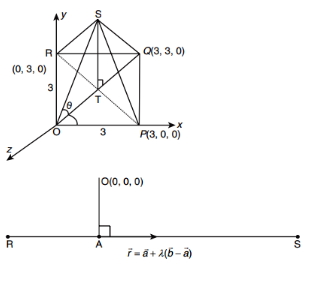
Consider a pyramid $OPQRS$ located in the first octant $(x \geq 0, y \geq 0, z \geq 0)$ with $O$ as the origin,and $OP$ and $OR$ along the $x$-axis and the $y$-axis,respectively. The base $OPQR$ of the pyramid is a square with $OP=3$. The point $S$ is directly above the mid-point $T$ of diagonal $OQ$ such that $TS=3$. Then:
$(A)$ the acute angle between $OQ$ and $OS$ is $\frac{\pi}{3}$
$(B)$ the equation of the plane containing the triangle $OQS$ is $x-y=0$
$(C)$ the length of the perpendicular from $P$ to the plane containing the triangle $OQS$ is $\frac{3}{\sqrt{2}}$
$(D)$ the perpendicular distance from $O$ to the straight line containing $RS$ is $\sqrt{\frac{15}{2}}$
$(A)$ the acute angle between $OQ$ and $OS$ is $\frac{\pi}{3}$
$(B)$ the equation of the plane containing the triangle $OQS$ is $x-y=0$
$(C)$ the length of the perpendicular from $P$ to the plane containing the triangle $OQS$ is $\frac{3}{\sqrt{2}}$
$(D)$ the perpendicular distance from $O$ to the straight line containing $RS$ is $\sqrt{\frac{15}{2}}$
A
$B, C, A$
B
$B, C, D$
C
$B, D$
D
$C, D$
Solution
(B) The base $OPQR$ is a square in the $xy$-plane with $O(0,0,0)$,$P(3,0,0)$,$Q(3,3,0)$,and $R(0,3,0)$.
The mid-point $T$ of $OQ$ is $(\frac{3+0}{2}, \frac{3+0}{2}, 0) = (1.5, 1.5, 0)$.
Since $S$ is directly above $T$ with $TS=3$,the coordinates of $S$ are $(1.5, 1.5, 3)$.
$(A)$ Vector $\vec{OQ} = 3\hat{i} + 3\hat{j}$ and $\vec{OS} = 1.5\hat{i} + 1.5\hat{j} + 3\hat{k}$.
$|\vec{OQ}| = \sqrt{3^2 + 3^2} = 3\sqrt{2}$. $|\vec{OS}| = \sqrt{1.5^2 + 1.5^2 + 3^2} = \sqrt{2.25 + 2.25 + 9} = \sqrt{13.5} = \sqrt{\frac{27}{2}} = \frac{3\sqrt{3}}{\sqrt{2}}$.
$\vec{OQ} \cdot \vec{OS} = (3)(1.5) + (3)(1.5) + (0)(3) = 4.5 + 4.5 = 9$.
$\cos \theta = \frac{9}{(3\sqrt{2})(\frac{3\sqrt{3}}{\sqrt{2}})} = \frac{9}{9\sqrt{3}} = \frac{1}{\sqrt{3}}$. Thus,$\theta \neq \frac{\pi}{3}$. ($A$ is incorrect).
$(B)$ The plane containing $\triangle OQS$ passes through $O(0,0,0)$,$Q(3,3,0)$,and $S(1.5, 1.5, 3)$.
Normal vector $\vec{n} = \vec{OQ} \times \vec{OS} = \begin{vmatrix} \hat{i} & \hat{j} & \hat{k} \\ 3 & 3 & 0 \\ 1.5 & 1.5 & 3 \end{vmatrix} = \hat{i}(9) - \hat{j}(9) + \hat{k}(0) = 9(\hat{i} - \hat{j})$.
The equation is $1(x-0) - 1(y-0) + 0(z-0) = 0$,i.e.,$x-y=0$. ($B$ is correct).
$(C)$ The perpendicular distance from $P(3,0,0)$ to $x-y=0$ is $d = \frac{|3-0|}{\sqrt{1^2 + (-1)^2}} = \frac{3}{\sqrt{2}}$. ($C$ is correct).
$(D)$ Line $RS$ passes through $R(0,3,0)$ and $S(1.5, 1.5, 3)$. Direction vector $\vec{v} = S-R = (1.5, -1.5, 3) = 1.5(\hat{i} - \hat{j} + 2\hat{k})$.
Line equation: $\vec{r} = (0,3,0) + \lambda(1, -1, 2)$.
Distance from $O(0,0,0)$ to line is $\frac{|\vec{OR} \times \vec{v}|}{|\vec{v}|} = \frac{|(0,3,0) \times (1,-1,2)|}{|(1,-1,2)|} = \frac{|(6, 0, -3)|}{\sqrt{1+1+4}} = \frac{\sqrt{36+9}}{\sqrt{6}} = \sqrt{\frac{45}{6}} = \sqrt{\frac{15}{2}}$. ($D$ is correct).
The mid-point $T$ of $OQ$ is $(\frac{3+0}{2}, \frac{3+0}{2}, 0) = (1.5, 1.5, 0)$.
Since $S$ is directly above $T$ with $TS=3$,the coordinates of $S$ are $(1.5, 1.5, 3)$.
$(A)$ Vector $\vec{OQ} = 3\hat{i} + 3\hat{j}$ and $\vec{OS} = 1.5\hat{i} + 1.5\hat{j} + 3\hat{k}$.
$|\vec{OQ}| = \sqrt{3^2 + 3^2} = 3\sqrt{2}$. $|\vec{OS}| = \sqrt{1.5^2 + 1.5^2 + 3^2} = \sqrt{2.25 + 2.25 + 9} = \sqrt{13.5} = \sqrt{\frac{27}{2}} = \frac{3\sqrt{3}}{\sqrt{2}}$.
$\vec{OQ} \cdot \vec{OS} = (3)(1.5) + (3)(1.5) + (0)(3) = 4.5 + 4.5 = 9$.
$\cos \theta = \frac{9}{(3\sqrt{2})(\frac{3\sqrt{3}}{\sqrt{2}})} = \frac{9}{9\sqrt{3}} = \frac{1}{\sqrt{3}}$. Thus,$\theta \neq \frac{\pi}{3}$. ($A$ is incorrect).
$(B)$ The plane containing $\triangle OQS$ passes through $O(0,0,0)$,$Q(3,3,0)$,and $S(1.5, 1.5, 3)$.
Normal vector $\vec{n} = \vec{OQ} \times \vec{OS} = \begin{vmatrix} \hat{i} & \hat{j} & \hat{k} \\ 3 & 3 & 0 \\ 1.5 & 1.5 & 3 \end{vmatrix} = \hat{i}(9) - \hat{j}(9) + \hat{k}(0) = 9(\hat{i} - \hat{j})$.
The equation is $1(x-0) - 1(y-0) + 0(z-0) = 0$,i.e.,$x-y=0$. ($B$ is correct).
$(C)$ The perpendicular distance from $P(3,0,0)$ to $x-y=0$ is $d = \frac{|3-0|}{\sqrt{1^2 + (-1)^2}} = \frac{3}{\sqrt{2}}$. ($C$ is correct).
$(D)$ Line $RS$ passes through $R(0,3,0)$ and $S(1.5, 1.5, 3)$. Direction vector $\vec{v} = S-R = (1.5, -1.5, 3) = 1.5(\hat{i} - \hat{j} + 2\hat{k})$.
Line equation: $\vec{r} = (0,3,0) + \lambda(1, -1, 2)$.
Distance from $O(0,0,0)$ to line is $\frac{|\vec{OR} \times \vec{v}|}{|\vec{v}|} = \frac{|(0,3,0) \times (1,-1,2)|}{|(1,-1,2)|} = \frac{|(6, 0, -3)|}{\sqrt{1+1+4}} = \frac{\sqrt{36+9}}{\sqrt{6}} = \sqrt{\frac{45}{6}} = \sqrt{\frac{15}{2}}$. ($D$ is correct).
0 likesView Solution
17
MathematicsAdvancedMCQIIT JEE · 2016
Let $f:(0, \infty) \rightarrow \mathbb{R}$ be a differentiable function such that $f^{\prime}(x)=2-\frac{f(x)}{x}$ for all $x \in(0, \infty)$ and $f(1) \neq 1$. Then
A
$\lim _{x \rightarrow 0+} f^{\prime}\left(\frac{1}{x}\right)=1$
B
$\lim _{x \rightarrow 0+} x f\left(\frac{1}{x}\right)=2$
C
$\lim _{x \rightarrow 0+} x^2 f^{\prime}(x)=0$
D
$|f(x)| \leq 2$ for all $x \in(0,2)$
Solution
(A) Given the linear differential equation $f^{\prime}(x) + \frac{f(x)}{x} = 2$.
The integrating factor is $e^{\int \frac{1}{x} dx} = e^{\ln x} = x$.
Multiplying by the integrating factor,we get $\frac{d}{dx}(x f(x)) = 2x$.
Integrating both sides,$x f(x) = x^2 + c$,which gives $f(x) = x + \frac{c}{x}$ for all $x \in (0, \infty)$.
Given $f(1) \neq 1$,we have $1 + c \neq 1$,so $c \neq 0$.
Now,$f^{\prime}(x) = 1 - \frac{c}{x^2}$.
Evaluating option $A$: $\lim _{x \rightarrow 0+} f^{\prime}\left(\frac{1}{x}\right) = \lim _{x \rightarrow 0+} (1 - c x^2) = 1$.
Evaluating option $B$: $\lim _{x \rightarrow 0+} x f\left(\frac{1}{x}\right) = \lim _{x \rightarrow 0+} x \left(\frac{1}{x} + cx\right) = \lim _{x \rightarrow 0+} (1 + cx^2) = 1 \neq 2$.
Evaluating option $C$: $\lim _{x \rightarrow 0+} x^2 f^{\prime}(x) = \lim _{x \rightarrow 0+} x^2 (1 - \frac{c}{x^2}) = \lim _{x \rightarrow 0+} (x^2 - c) = -c \neq 0$.
Thus,option $A$ is correct.
The integrating factor is $e^{\int \frac{1}{x} dx} = e^{\ln x} = x$.
Multiplying by the integrating factor,we get $\frac{d}{dx}(x f(x)) = 2x$.
Integrating both sides,$x f(x) = x^2 + c$,which gives $f(x) = x + \frac{c}{x}$ for all $x \in (0, \infty)$.
Given $f(1) \neq 1$,we have $1 + c \neq 1$,so $c \neq 0$.
Now,$f^{\prime}(x) = 1 - \frac{c}{x^2}$.
Evaluating option $A$: $\lim _{x \rightarrow 0+} f^{\prime}\left(\frac{1}{x}\right) = \lim _{x \rightarrow 0+} (1 - c x^2) = 1$.
Evaluating option $B$: $\lim _{x \rightarrow 0+} x f\left(\frac{1}{x}\right) = \lim _{x \rightarrow 0+} x \left(\frac{1}{x} + cx\right) = \lim _{x \rightarrow 0+} (1 + cx^2) = 1 \neq 2$.
Evaluating option $C$: $\lim _{x \rightarrow 0+} x^2 f^{\prime}(x) = \lim _{x \rightarrow 0+} x^2 (1 - \frac{c}{x^2}) = \lim _{x \rightarrow 0+} (x^2 - c) = -c \neq 0$.
Thus,option $A$ is correct.
0 likesView Solution
18
MathematicsAdvancedMCQIIT JEE · 2016
Let $P=\begin{bmatrix} 3 & -1 & -2 \\ 2 & 0 & \alpha \\ 3 & -5 & 0 \end{bmatrix}$,where $\alpha \in \mathbb{R}$. Suppose $Q=[q_{ij}]$ is a matrix such that $PQ=kI$,where $k \in \mathbb{R}, k \neq 0$ and $I$ is the identity matrix of order $3$. If $q_{23}=-\frac{k}{8}$ and $\det(Q)=\frac{k^2}{2}$,then:
A
$B, C$
B
$B, D$
C
$B, A$
D
$B, C, A$
Solution
(A) Given $PQ = kI$,we have $Q = kP^{-1}$.
Since $P^{-1} = \frac{1}{\det(P)} \text{adj}(P)$,we have $Q = \frac{k}{\det(P)} \text{adj}(P)$.
First,calculate $\det(P) = 3(0 - (-5\alpha)) - (-1)(0 - 3\alpha) + (-2)(-10 - 0) = 3(5\alpha) + (-3\alpha) + 20 = 15\alpha - 3\alpha + 20 = 12\alpha + 20$.
The element $q_{23}$ is the $(2,3)$-th entry of $Q$.
$q_{23} = \frac{k}{\det(P)} \times (\text{adj}(P))_{23} = \frac{k}{12\alpha + 20} \times (-1)^{2+3} M_{32} = \frac{k}{12\alpha + 20} \times (-1) \times (3\alpha - (-4)) = \frac{-k(3\alpha + 4)}{12\alpha + 20} = \frac{-k(3\alpha + 4)}{4(3\alpha + 5)}$.
Given $q_{23} = -\frac{k}{8}$,we have $\frac{3\alpha + 4}{4(3\alpha + 5)} = \frac{1}{8} \implies 2(3\alpha + 4) = 3\alpha + 5 \implies 6\alpha + 8 = 3\alpha + 5 \implies 3\alpha = -3 \implies \alpha = -1$.
Then $\det(P) = 12(-1) + 20 = 8$.
Since $Q = kP^{-1}$,$\det(Q) = k^3 \det(P^{-1}) = \frac{k^3}{\det(P)} = \frac{k^3}{8}$.
Given $\det(Q) = \frac{k^2}{2}$,we have $\frac{k^3}{8} = \frac{k^2}{2} \implies k = 4$.
Check options:
$(B)$ $4\alpha - k + 8 = 4(-1) - 4 + 8 = -4 - 4 + 8 = 0$. (Correct)
$(C)$ $\det(P \text{adj}(Q)) = \det(P) \det(\text{adj}(Q)) = \det(P) (\det(Q))^2 = 8 \times (\frac{4^2}{2})^2 = 8 \times 8^2 = 8^3 = 512 = 2^9$. (Correct)
$(D)$ $\det(Q \text{adj}(P)) = \det(Q) \det(\text{adj}(P)) = \det(Q) (\det(P))^2 = \frac{16}{2} \times 8^2 = 8 \times 64 = 512 = 2^9 \neq 2^{13}$. (Incorrect)
Since $P^{-1} = \frac{1}{\det(P)} \text{adj}(P)$,we have $Q = \frac{k}{\det(P)} \text{adj}(P)$.
First,calculate $\det(P) = 3(0 - (-5\alpha)) - (-1)(0 - 3\alpha) + (-2)(-10 - 0) = 3(5\alpha) + (-3\alpha) + 20 = 15\alpha - 3\alpha + 20 = 12\alpha + 20$.
The element $q_{23}$ is the $(2,3)$-th entry of $Q$.
$q_{23} = \frac{k}{\det(P)} \times (\text{adj}(P))_{23} = \frac{k}{12\alpha + 20} \times (-1)^{2+3} M_{32} = \frac{k}{12\alpha + 20} \times (-1) \times (3\alpha - (-4)) = \frac{-k(3\alpha + 4)}{12\alpha + 20} = \frac{-k(3\alpha + 4)}{4(3\alpha + 5)}$.
Given $q_{23} = -\frac{k}{8}$,we have $\frac{3\alpha + 4}{4(3\alpha + 5)} = \frac{1}{8} \implies 2(3\alpha + 4) = 3\alpha + 5 \implies 6\alpha + 8 = 3\alpha + 5 \implies 3\alpha = -3 \implies \alpha = -1$.
Then $\det(P) = 12(-1) + 20 = 8$.
Since $Q = kP^{-1}$,$\det(Q) = k^3 \det(P^{-1}) = \frac{k^3}{\det(P)} = \frac{k^3}{8}$.
Given $\det(Q) = \frac{k^2}{2}$,we have $\frac{k^3}{8} = \frac{k^2}{2} \implies k = 4$.
Check options:
$(B)$ $4\alpha - k + 8 = 4(-1) - 4 + 8 = -4 - 4 + 8 = 0$. (Correct)
$(C)$ $\det(P \text{adj}(Q)) = \det(P) \det(\text{adj}(Q)) = \det(P) (\det(Q))^2 = 8 \times (\frac{4^2}{2})^2 = 8 \times 8^2 = 8^3 = 512 = 2^9$. (Correct)
$(D)$ $\det(Q \text{adj}(P)) = \det(Q) \det(\text{adj}(P)) = \det(Q) (\det(P))^2 = \frac{16}{2} \times 8^2 = 8 \times 64 = 512 = 2^9 \neq 2^{13}$. (Incorrect)
0 likesView Solution
19
MathematicsAdvancedMCQIIT JEE · 2016
$A$ solution curve of the differential equation $(x^2+xy+4x+2y+4) \frac{dy}{dx}-y^2=0, x>0$,passes through the point $(1,3)$. Then the solution curve
A
$A, D, C$
B
$A, C$
C
$A, B$
D
$A, D$
Solution
(D) The given differential equation is $(x+2)(x+2+y) \frac{dy}{dx}-y^2=0$.
Substitute $y=(x+2)t$,then $\frac{dy}{dx}=(x+2) \frac{dt}{dx}+t$.
Substituting this into the equation: $(x+2)(x+2+(x+2)t) \frac{dy}{dx}-((x+2)t)^2=0$.
$(x+2)^2(1+t) \frac{dy}{dx}-(x+2)^2t^2=0$.
$(1+t)((x+2) \frac{dt}{dx}+t)-t^2=0$.
$(1+t)(x+2) \frac{dt}{dx}+t+t^2-t^2=0$.
$(1+t)(x+2) \frac{dt}{dx}+t=0$.
Separating variables: $\frac{1+t}{t} dt = -\frac{dx}{x+2}$.
Integrating both sides: $\int (\frac{1}{t}+1) dt = -\int \frac{dx}{x+2}$.
$\ln|t|+t = -\ln|x+2|+C$.
Substituting $t=\frac{y}{x+2}$: $\ln(\frac{y}{x+2})+\frac{y}{x+2} = -\ln(x+2)+C$.
$\ln y - \ln(x+2) + \frac{y}{x+2} = -\ln(x+2)+C$.
$\ln y + \frac{y}{x+2} = C$.
Since the curve passes through $(1,3)$,$\ln 3 + \frac{3}{1+2} = C \Rightarrow \ln 3 + 1 = C$.
The solution curve is $\ln y + \frac{y}{x+2} = \ln 3 + 1$.
For option $(A)$,intersect $y=x+2$: $\ln(x+2) + \frac{x+2}{x+2} = \ln 3 + 1 \Rightarrow \ln(x+2) + 1 = \ln 3 + 1 \Rightarrow x+2=3 \Rightarrow x=1$. Only one point.
For option $(D)$,$y=(x+3)^2$: $\ln(x+3)^2 + \frac{(x+3)^2}{x+2} = \ln 3 + 1$. Let $f(x) = 2\ln(x+3) + \frac{(x+3)^2}{x+2} - \ln 3 - 1$. Since $f(x)$ is strictly increasing for $x>0$ and $f(0) > 0$,it does not intersect.
Substitute $y=(x+2)t$,then $\frac{dy}{dx}=(x+2) \frac{dt}{dx}+t$.
Substituting this into the equation: $(x+2)(x+2+(x+2)t) \frac{dy}{dx}-((x+2)t)^2=0$.
$(x+2)^2(1+t) \frac{dy}{dx}-(x+2)^2t^2=0$.
$(1+t)((x+2) \frac{dt}{dx}+t)-t^2=0$.
$(1+t)(x+2) \frac{dt}{dx}+t+t^2-t^2=0$.
$(1+t)(x+2) \frac{dt}{dx}+t=0$.
Separating variables: $\frac{1+t}{t} dt = -\frac{dx}{x+2}$.
Integrating both sides: $\int (\frac{1}{t}+1) dt = -\int \frac{dx}{x+2}$.
$\ln|t|+t = -\ln|x+2|+C$.
Substituting $t=\frac{y}{x+2}$: $\ln(\frac{y}{x+2})+\frac{y}{x+2} = -\ln(x+2)+C$.
$\ln y - \ln(x+2) + \frac{y}{x+2} = -\ln(x+2)+C$.
$\ln y + \frac{y}{x+2} = C$.
Since the curve passes through $(1,3)$,$\ln 3 + \frac{3}{1+2} = C \Rightarrow \ln 3 + 1 = C$.
The solution curve is $\ln y + \frac{y}{x+2} = \ln 3 + 1$.
For option $(A)$,intersect $y=x+2$: $\ln(x+2) + \frac{x+2}{x+2} = \ln 3 + 1 \Rightarrow \ln(x+2) + 1 = \ln 3 + 1 \Rightarrow x+2=3 \Rightarrow x=1$. Only one point.
For option $(D)$,$y=(x+3)^2$: $\ln(x+3)^2 + \frac{(x+3)^2}{x+2} = \ln 3 + 1$. Let $f(x) = 2\ln(x+3) + \frac{(x+3)^2}{x+2} - \ln 3 - 1$. Since $f(x)$ is strictly increasing for $x>0$ and $f(0) > 0$,it does not intersect.
0 likesView Solution
20
MathematicsAdvancedMCQIIT JEE · 2016
Let $f: R \rightarrow R, g: R \rightarrow R$ and $h: R \rightarrow R$ be differentiable functions such that $f(x)=x^3+3x+2, g(f(x))=x$ and $h(g(g(x)))=x$ for all $x \in R$. Then
A
$ABD$
B
$ABC$
C
$AB$
D
$BC$
Solution
(D) Given $f(x)=x^3+3x+2$. Since $g(f(x))=x$,$g$ is the inverse of $f$.
Differentiating $g(f(x))=x$ with respect to $x$,we get $g'(f(x)) \cdot f'(x)=1$.
For $g'(2)$,we set $f(x)=2 \implies x^3+3x+2=2 \implies x^3+3x=0 \implies x(x^2+3)=0$,so $x=0$.
Thus $g'(2) \cdot f'(0)=1$. Since $f'(x)=3x^2+3$,$f'(0)=3$.
So $g'(2) = \frac{1}{3}$. Option $A$ is incorrect.
Given $h(g(g(x)))=x$. Since $g(f(x))=x$,$g(g(f(f(x))))=x$,which implies $g(g(x))=f(f(x))$.
Thus $h(f(f(x)))=x$. This means $h$ is the inverse of $f(f(x))$.
However,the problem states $h(g(g(x)))=x$. Since $g(g(x))=f^{-1}(f^{-1}(x))$,we have $h(f^{-1}(f^{-1}(x)))=x$.
Let $f^{-1}(x)=y$,then $f(y)=x$. The equation becomes $h(f^{-1}(y))=f(y)$.
Let $f^{-1}(y)=z$,then $y=f(z)$. So $h(z)=f(f(z))$.
Thus $h(x)=f(f(x))$.
Now,$h'(x)=f'(f(x)) \cdot f'(x)$.
$h'(1)=f'(f(1)) \cdot f'(1)$. Since $f(1)=1^3+3(1)+2=6$ and $f'(x)=3x^2+3$,$f'(1)=6$ and $f'(6)=3(6^2)+3=111$.
$h'(1)=111 \times 6=666$. Option $B$ is correct.
$h(0)=f(f(0))=f(2)=2^3+3(2)+2=16$. Option $C$ is correct.
$h(g(3))=f(f(g(3)))=f(3)=3^3+3(3)+2=38$. Option $D$ is incorrect.
Therefore,the correct options are $B$ and $C$.
Differentiating $g(f(x))=x$ with respect to $x$,we get $g'(f(x)) \cdot f'(x)=1$.
For $g'(2)$,we set $f(x)=2 \implies x^3+3x+2=2 \implies x^3+3x=0 \implies x(x^2+3)=0$,so $x=0$.
Thus $g'(2) \cdot f'(0)=1$. Since $f'(x)=3x^2+3$,$f'(0)=3$.
So $g'(2) = \frac{1}{3}$. Option $A$ is incorrect.
Given $h(g(g(x)))=x$. Since $g(f(x))=x$,$g(g(f(f(x))))=x$,which implies $g(g(x))=f(f(x))$.
Thus $h(f(f(x)))=x$. This means $h$ is the inverse of $f(f(x))$.
However,the problem states $h(g(g(x)))=x$. Since $g(g(x))=f^{-1}(f^{-1}(x))$,we have $h(f^{-1}(f^{-1}(x)))=x$.
Let $f^{-1}(x)=y$,then $f(y)=x$. The equation becomes $h(f^{-1}(y))=f(y)$.
Let $f^{-1}(y)=z$,then $y=f(z)$. So $h(z)=f(f(z))$.
Thus $h(x)=f(f(x))$.
Now,$h'(x)=f'(f(x)) \cdot f'(x)$.
$h'(1)=f'(f(1)) \cdot f'(1)$. Since $f(1)=1^3+3(1)+2=6$ and $f'(x)=3x^2+3$,$f'(1)=6$ and $f'(6)=3(6^2)+3=111$.
$h'(1)=111 \times 6=666$. Option $B$ is correct.
$h(0)=f(f(0))=f(2)=2^3+3(2)+2=16$. Option $C$ is correct.
$h(g(3))=f(f(g(3)))=f(3)=3^3+3(3)+2=38$. Option $D$ is incorrect.
Therefore,the correct options are $B$ and $C$.
0 likesView Solution
21
MathematicsAdvancedMCQIIT JEE · 2016
The total number of distinct $x \in \mathbb{R}$ for which $\left|\begin{array}{ccc}x & x^2 & 1+x^3 \\ 2x & 4x^2 & 1+8x^3 \\ 3x & 9x^2 & 1+27x^3\end{array}\right|=10$ is
A
$2$
B
$3$
C
$5$
D
$4$
Solution
(A) Given the determinant equation:
$\left|\begin{array}{ccc} x & x^2 & 1+x^3 \\ 2x & 4x^2 & 1+8x^3 \\ 3x & 9x^2 & 1+27x^3 \end{array}\right| = 10$
We can split the determinant using the property of determinants:
$\left|\begin{array}{ccc} x & x^2 & 1 \\ 2x & 4x^2 & 1 \\ 3x & 9x^2 & 1 \end{array}\right| + \left|\begin{array}{ccc} x & x^2 & x^3 \\ 2x & 4x^2 & 8x^3 \\ 3x & 9x^2 & 27x^3 \end{array}\right| = 10$
Taking $x$ common from $C_1$,$x^2$ from $C_2$,and $x^3$ from $C_3$ in the second determinant:
$x^3 \left|\begin{array}{ccc} 1 & 1 & 1 \\ 2 & 4 & 8 \\ 3 & 9 & 27 \end{array}\right| + x^6 \left|\begin{array}{ccc} 1 & 1 & 1 \\ 2 & 4 & 8 \\ 3 & 9 & 27 \end{array}\right| = 10$
Calculating the determinant value $\Delta = \left|\begin{array}{ccc} 1 & 1 & 1 \\ 2 & 4 & 8 \\ 3 & 9 & 27 \end{array}\right| = 1(108-72) - 1(54-24) + 1(18-12) = 36 - 30 + 6 = 12$.
So,$12x^3 + 12x^6 = 10 \Rightarrow 6x^6 + 6x^3 - 5 = 0$.
Let $t = x^3$. Then $6t^2 + 6t - 5 = 0$.
Using the quadratic formula $t = \frac{-b \pm \sqrt{b^2 - 4ac}}{2a} = \frac{-6 \pm \sqrt{36 - 4(6)(-5)}}{12} = \frac{-6 \pm \sqrt{36 + 120}}{12} = \frac{-6 \pm \sqrt{156}}{12} = \frac{-6 \pm 2\sqrt{39}}{12} = \frac{-3 \pm \sqrt{39}}{6}$.
Since $x^3 = t$,for any real value of $t$,there exists exactly one real value of $x = \sqrt[3]{t}$.
Since there are two distinct real values for $t$,there are $2$ distinct real values for $x$.
$\left|\begin{array}{ccc} x & x^2 & 1+x^3 \\ 2x & 4x^2 & 1+8x^3 \\ 3x & 9x^2 & 1+27x^3 \end{array}\right| = 10$
We can split the determinant using the property of determinants:
$\left|\begin{array}{ccc} x & x^2 & 1 \\ 2x & 4x^2 & 1 \\ 3x & 9x^2 & 1 \end{array}\right| + \left|\begin{array}{ccc} x & x^2 & x^3 \\ 2x & 4x^2 & 8x^3 \\ 3x & 9x^2 & 27x^3 \end{array}\right| = 10$
Taking $x$ common from $C_1$,$x^2$ from $C_2$,and $x^3$ from $C_3$ in the second determinant:
$x^3 \left|\begin{array}{ccc} 1 & 1 & 1 \\ 2 & 4 & 8 \\ 3 & 9 & 27 \end{array}\right| + x^6 \left|\begin{array}{ccc} 1 & 1 & 1 \\ 2 & 4 & 8 \\ 3 & 9 & 27 \end{array}\right| = 10$
Calculating the determinant value $\Delta = \left|\begin{array}{ccc} 1 & 1 & 1 \\ 2 & 4 & 8 \\ 3 & 9 & 27 \end{array}\right| = 1(108-72) - 1(54-24) + 1(18-12) = 36 - 30 + 6 = 12$.
So,$12x^3 + 12x^6 = 10 \Rightarrow 6x^6 + 6x^3 - 5 = 0$.
Let $t = x^3$. Then $6t^2 + 6t - 5 = 0$.
Using the quadratic formula $t = \frac{-b \pm \sqrt{b^2 - 4ac}}{2a} = \frac{-6 \pm \sqrt{36 - 4(6)(-5)}}{12} = \frac{-6 \pm \sqrt{36 + 120}}{12} = \frac{-6 \pm \sqrt{156}}{12} = \frac{-6 \pm 2\sqrt{39}}{12} = \frac{-3 \pm \sqrt{39}}{6}$.
Since $x^3 = t$,for any real value of $t$,there exists exactly one real value of $x = \sqrt[3]{t}$.
Since there are two distinct real values for $t$,there are $2$ distinct real values for $x$.
0 likesView Solution
22
MathematicsAdvancedMCQIIT JEE · 2016
The total number of distinct $x \in [0, 1]$ for which $\int_0^x \frac{t^2}{1+t^4} dt = 2x - 1$ is
A
$1$
B
$5$
C
$4$
D
$2$
Solution
(A) Let $f(x) = \int_0^x \frac{t^2}{1+t^4} dt - 2x + 1$ for $x \in [0, 1]$.
Taking the derivative,$f'(x) = \frac{x^2}{1+x^4} - 2$.
Since $x^4 + 1 \geq 2x^2$ by $AM$-$GM$ inequality,we have $\frac{x^2}{1+x^4} \leq \frac{1}{2}$.
Thus,$f'(x) = \frac{x^2}{1+x^4} - 2 \leq \frac{1}{2} - 2 = -\frac{3}{2} < 0$.
Since $f'(x) < 0$ for all $x \in [0, 1]$,$f(x)$ is a strictly decreasing function.
We evaluate the endpoints:
$f(0) = \int_0^0 \frac{t^2}{1+t^4} dt - 2(0) + 1 = 1$.
$f(1) = \int_0^1 \frac{t^2}{1+t^4} dt - 2(1) + 1 = \int_0^1 \frac{t^2}{1+t^4} dt - 1$.
Since $\frac{t^2}{1+t^4} < 1$ for $t \in [0, 1]$,the integral $\int_0^1 \frac{t^2}{1+t^4} dt < 1$,so $f(1) < 0$.
Since $f(0) > 0$ and $f(1) < 0$ and $f(x)$ is continuous and strictly decreasing,by the Intermediate Value Theorem,there exists exactly one root $x \in [0, 1]$ such that $f(x) = 0$.
Taking the derivative,$f'(x) = \frac{x^2}{1+x^4} - 2$.
Since $x^4 + 1 \geq 2x^2$ by $AM$-$GM$ inequality,we have $\frac{x^2}{1+x^4} \leq \frac{1}{2}$.
Thus,$f'(x) = \frac{x^2}{1+x^4} - 2 \leq \frac{1}{2} - 2 = -\frac{3}{2} < 0$.
Since $f'(x) < 0$ for all $x \in [0, 1]$,$f(x)$ is a strictly decreasing function.
We evaluate the endpoints:
$f(0) = \int_0^0 \frac{t^2}{1+t^4} dt - 2(0) + 1 = 1$.
$f(1) = \int_0^1 \frac{t^2}{1+t^4} dt - 2(1) + 1 = \int_0^1 \frac{t^2}{1+t^4} dt - 1$.
Since $\frac{t^2}{1+t^4} < 1$ for $t \in [0, 1]$,the integral $\int_0^1 \frac{t^2}{1+t^4} dt < 1$,so $f(1) < 0$.
Since $f(0) > 0$ and $f(1) < 0$ and $f(x)$ is continuous and strictly decreasing,by the Intermediate Value Theorem,there exists exactly one root $x \in [0, 1]$ such that $f(x) = 0$.
0 likesView Solution
23
MathematicsAdvancedMCQIIT JEE · 2016
Let $z = \frac{-1 + \sqrt{3}i}{2}$, where $i = \sqrt{-1}$, and $r, s \in \{1, 2, 3\}$. Let $P = \begin{bmatrix} (-z)^r & z^{2s} \\ z^{2s} & z^r \end{bmatrix}$ and $I$ be the identity matrix of order $2$. Then the total number of ordered pairs $(r, s)$ for which $P^2 = -I$ is
A
$4$
B
$5$
C
$1$
D
$3$
Solution
(C) Given $z = \frac{-1}{2} + i \frac{\sqrt{3}}{2} = \omega$, where $\omega$ is the cube root of unity. Thus, $\omega^3 = 1$ and $1 + \omega + \omega^2 = 0$.
$P = \begin{bmatrix} (-1)^r \omega^r & \omega^{2s} \\ \omega^{2s} & \omega^r \end{bmatrix}$.
$P^2 = \begin{bmatrix} (-1)^r \omega^r & \omega^{2s} \\ \omega^{2s} & \omega^r \end{bmatrix} \begin{bmatrix} (-1)^r \omega^r & \omega^{2s} \\ \omega^{2s} & \omega^r \end{bmatrix} = \begin{bmatrix} (-1)^{2r} \omega^{2r} + \omega^{4s} & (-1)^r \omega^{r+2s} + \omega^{r+2s} \\ (-1)^r \omega^{r+2s} + \omega^{r+2s} & \omega^{4s} + \omega^{2r} \end{bmatrix} = \begin{bmatrix} -1 & 0 \\ 0 & -1 \end{bmatrix}$.
For the off-diagonal elements to be zero: $((-1)^r + 1) \omega^{r+2s} = 0$. Since $\omega \neq 0$, we must have $(-1)^r + 1 = 0$, which implies $r$ must be odd. Thus, $r \in \{1, 3\}$.
Case $1$: $r = 1$. The diagonal elements give $\omega^2 + \omega^{4s} = -1$. Since $1 + \omega + \omega^2 = 0$, we have $\omega^2 + \omega = -1$. Thus, $\omega^{4s} = \omega$, which means $4s \equiv 1 \pmod 3$, so $s \equiv 1 \pmod 3$. For $s \in \{1, 2, 3\}$, $s = 1$.
Case $2$: $r = 3$. The diagonal elements give $\omega^6 + \omega^{4s} = -1$. Since $\omega^3 = 1$, $1 + \omega^{4s} = -1$, so $\omega^{4s} = -2$. This is impossible as $|\omega^{4s}| = 1$.
Thus, the only valid pair is $(r, s) = (1, 1)$. The total number of pairs is $1$.
$P = \begin{bmatrix} (-1)^r \omega^r & \omega^{2s} \\ \omega^{2s} & \omega^r \end{bmatrix}$.
$P^2 = \begin{bmatrix} (-1)^r \omega^r & \omega^{2s} \\ \omega^{2s} & \omega^r \end{bmatrix} \begin{bmatrix} (-1)^r \omega^r & \omega^{2s} \\ \omega^{2s} & \omega^r \end{bmatrix} = \begin{bmatrix} (-1)^{2r} \omega^{2r} + \omega^{4s} & (-1)^r \omega^{r+2s} + \omega^{r+2s} \\ (-1)^r \omega^{r+2s} + \omega^{r+2s} & \omega^{4s} + \omega^{2r} \end{bmatrix} = \begin{bmatrix} -1 & 0 \\ 0 & -1 \end{bmatrix}$.
For the off-diagonal elements to be zero: $((-1)^r + 1) \omega^{r+2s} = 0$. Since $\omega \neq 0$, we must have $(-1)^r + 1 = 0$, which implies $r$ must be odd. Thus, $r \in \{1, 3\}$.
Case $1$: $r = 1$. The diagonal elements give $\omega^2 + \omega^{4s} = -1$. Since $1 + \omega + \omega^2 = 0$, we have $\omega^2 + \omega = -1$. Thus, $\omega^{4s} = \omega$, which means $4s \equiv 1 \pmod 3$, so $s \equiv 1 \pmod 3$. For $s \in \{1, 2, 3\}$, $s = 1$.
Case $2$: $r = 3$. The diagonal elements give $\omega^6 + \omega^{4s} = -1$. Since $\omega^3 = 1$, $1 + \omega^{4s} = -1$, so $\omega^{4s} = -2$. This is impossible as $|\omega^{4s}| = 1$.
Thus, the only valid pair is $(r, s) = (1, 1)$. The total number of pairs is $1$.
0 likesView Solution
24
MathematicsDifficultMCQIIT JEE · 2016
Let $P=\begin{bmatrix} 1 & 0 & 0 \\ 4 & 1 & 0 \\ 16 & 4 & 1 \end{bmatrix}$ and $I$ be the identity matrix of order $3$. If $Q=[q_{ij}]$ is a matrix such that $P^{50}-Q=I$,then $\frac{q_{31}+q_{32}}{q_{21}}$ equals
A
$52$
B
$103$
C
$201$
D
$205$
Solution
(B) Given $P = \begin{bmatrix} 1 & 0 & 0 \\ 4 & 1 & 0 \\ 16 & 4 & 1 \end{bmatrix}$. Let $P = I + A$,where $A = \begin{bmatrix} 0 & 0 & 0 \\ 4 & 0 & 0 \\ 16 & 4 & 0 \end{bmatrix}$.
Note that $A^2 = \begin{bmatrix} 0 & 0 & 0 \\ 0 & 0 & 0 \\ 16 & 0 & 0 \end{bmatrix}$ and $A^3 = O$ (zero matrix).
Using the Binomial Theorem,$P^n = (I+A)^n = I + nA + \frac{n(n-1)}{2}A^2$.
For $n=50$,$P^{50} = I + 50A + \frac{50 \times 49}{2}A^2 = I + 50A + 1225A^2$.
$P^{50} = \begin{bmatrix} 1 & 0 & 0 \\ 0 & 1 & 0 \\ 0 & 0 & 1 \end{bmatrix} + 50 \begin{bmatrix} 0 & 0 & 0 \\ 4 & 0 & 0 \\ 16 & 4 & 0 \end{bmatrix} + 1225 \begin{bmatrix} 0 & 0 & 0 \\ 0 & 0 & 0 \\ 16 & 0 & 0 \end{bmatrix}$.
$P^{50} = \begin{bmatrix} 1 & 0 & 0 \\ 200 & 1 & 0 \\ 800 + 19600 & 200 & 1 \end{bmatrix} = \begin{bmatrix} 1 & 0 & 0 \\ 200 & 1 & 0 \\ 20400 & 200 & 1 \end{bmatrix}$.
Since $P^{50}-Q=I$,we have $Q = P^{50}-I = \begin{bmatrix} 0 & 0 & 0 \\ 200 & 0 & 0 \\ 20400 & 200 & 0 \end{bmatrix}$.
Thus,$q_{31} = 20400$,$q_{32} = 200$,and $q_{21} = 200$.
Therefore,$\frac{q_{31}+q_{32}}{q_{21}} = \frac{20400+200}{200} = \frac{20600}{200} = 103$.
Note that $A^2 = \begin{bmatrix} 0 & 0 & 0 \\ 0 & 0 & 0 \\ 16 & 0 & 0 \end{bmatrix}$ and $A^3 = O$ (zero matrix).
Using the Binomial Theorem,$P^n = (I+A)^n = I + nA + \frac{n(n-1)}{2}A^2$.
For $n=50$,$P^{50} = I + 50A + \frac{50 \times 49}{2}A^2 = I + 50A + 1225A^2$.
$P^{50} = \begin{bmatrix} 1 & 0 & 0 \\ 0 & 1 & 0 \\ 0 & 0 & 1 \end{bmatrix} + 50 \begin{bmatrix} 0 & 0 & 0 \\ 4 & 0 & 0 \\ 16 & 4 & 0 \end{bmatrix} + 1225 \begin{bmatrix} 0 & 0 & 0 \\ 0 & 0 & 0 \\ 16 & 0 & 0 \end{bmatrix}$.
$P^{50} = \begin{bmatrix} 1 & 0 & 0 \\ 200 & 1 & 0 \\ 800 + 19600 & 200 & 1 \end{bmatrix} = \begin{bmatrix} 1 & 0 & 0 \\ 200 & 1 & 0 \\ 20400 & 200 & 1 \end{bmatrix}$.
Since $P^{50}-Q=I$,we have $Q = P^{50}-I = \begin{bmatrix} 0 & 0 & 0 \\ 200 & 0 & 0 \\ 20400 & 200 & 0 \end{bmatrix}$.
Thus,$q_{31} = 20400$,$q_{32} = 200$,and $q_{21} = 200$.
Therefore,$\frac{q_{31}+q_{32}}{q_{21}} = \frac{20400+200}{200} = \frac{20600}{200} = 103$.
0 likesView Solution
25
MathematicsMediumMCQIIT JEE · 2016
The value of $\int_{-\frac{\pi}{2}}^{\frac{\pi}{2}} \frac{x^2 \cos x}{1+e^x} d x$ is equal to
A
$\frac{\pi^2}{4}-2$
B
$\frac{\pi^2}{4}+2$
C
$\pi^2-e^{\frac{\pi}{2}}$
D
$\pi^2+e^{\frac{\pi}{2}}$
Solution
(A) Let $I = \int_{-\frac{\pi}{2}}^{\frac{\pi}{2}} \frac{x^2 \cos x}{1+e^x} dx$ ... $(i)$
Using the property $\int_{a}^{b} f(x) dx = \int_{a}^{b} f(a+b-x) dx$,we have $a+b = -\frac{\pi}{2} + \frac{\pi}{2} = 0$,so $f(x) \to f(-x)$.
$I = \int_{-\frac{\pi}{2}}^{\frac{\pi}{2}} \frac{(-x)^2 \cos(-x)}{1+e^{-x}} dx = \int_{-\frac{\pi}{2}}^{\frac{\pi}{2}} \frac{x^2 \cos x}{1+e^{-x}} dx = \int_{-\frac{\pi}{2}}^{\frac{\pi}{2}} \frac{x^2 \cos x \cdot e^x}{e^x+1} dx$ ... (ii)
Adding $(i)$ and (ii):
$2I = \int_{-\frac{\pi}{2}}^{\frac{\pi}{2}} \frac{x^2 \cos x (1+e^x)}{1+e^x} dx = \int_{-\frac{\pi}{2}}^{\frac{\pi}{2}} x^2 \cos x dx$
Since $x^2 \cos x$ is an even function,$2I = 2 \int_{0}^{\frac{\pi}{2}} x^2 \cos x dx$.
$I = \int_{0}^{\frac{\pi}{2}} x^2 \cos x dx$.
Using integration by parts $\int u dv = uv - \int v du$ with $u=x^2, dv=\cos x dx$:
$I = [x^2 \sin x]_{0}^{\frac{\pi}{2}} - \int_{0}^{\frac{\pi}{2}} 2x \sin x dx$
$I = (\frac{\pi^2}{4} \cdot 1 - 0) - 2 \int_{0}^{\frac{\pi}{2}} x \sin x dx$
$I = \frac{\pi^2}{4} - 2 [x(-\cos x) - \int 1(-\cos x) dx]_{0}^{\frac{\pi}{2}}$
$I = \frac{\pi^2}{4} - 2 [-x \cos x + \sin x]_{0}^{\frac{\pi}{2}}$
$I = \frac{\pi^2}{4} - 2 [(-0 + 1) - (0 + 0)] = \frac{\pi^2}{4} - 2$.
Using the property $\int_{a}^{b} f(x) dx = \int_{a}^{b} f(a+b-x) dx$,we have $a+b = -\frac{\pi}{2} + \frac{\pi}{2} = 0$,so $f(x) \to f(-x)$.
$I = \int_{-\frac{\pi}{2}}^{\frac{\pi}{2}} \frac{(-x)^2 \cos(-x)}{1+e^{-x}} dx = \int_{-\frac{\pi}{2}}^{\frac{\pi}{2}} \frac{x^2 \cos x}{1+e^{-x}} dx = \int_{-\frac{\pi}{2}}^{\frac{\pi}{2}} \frac{x^2 \cos x \cdot e^x}{e^x+1} dx$ ... (ii)
Adding $(i)$ and (ii):
$2I = \int_{-\frac{\pi}{2}}^{\frac{\pi}{2}} \frac{x^2 \cos x (1+e^x)}{1+e^x} dx = \int_{-\frac{\pi}{2}}^{\frac{\pi}{2}} x^2 \cos x dx$
Since $x^2 \cos x$ is an even function,$2I = 2 \int_{0}^{\frac{\pi}{2}} x^2 \cos x dx$.
$I = \int_{0}^{\frac{\pi}{2}} x^2 \cos x dx$.
Using integration by parts $\int u dv = uv - \int v du$ with $u=x^2, dv=\cos x dx$:
$I = [x^2 \sin x]_{0}^{\frac{\pi}{2}} - \int_{0}^{\frac{\pi}{2}} 2x \sin x dx$
$I = (\frac{\pi^2}{4} \cdot 1 - 0) - 2 \int_{0}^{\frac{\pi}{2}} x \sin x dx$
$I = \frac{\pi^2}{4} - 2 [x(-\cos x) - \int 1(-\cos x) dx]_{0}^{\frac{\pi}{2}}$
$I = \frac{\pi^2}{4} - 2 [-x \cos x + \sin x]_{0}^{\frac{\pi}{2}}$
$I = \frac{\pi^2}{4} - 2 [(-0 + 1) - (0 + 0)] = \frac{\pi^2}{4} - 2$.
0 likesView Solution
26
MathematicsAdvancedMCQIIT JEE · 2016
The area of the region $\{(x, y) \in R^2: y \geq \sqrt{|x+3|}, 5y \leq x+9 \leq 15\}$ is equal to
A
$\frac{1}{6}$
B
$\frac{4}{3}$
C
$\frac{3}{2}$
D
$\frac{5}{3}$
Solution
(C) The given region is bounded by $y \geq \sqrt{|x+3|}$ and $5y \leq x+9 \leq 15$.
From $5y \leq x+9 \leq 15$,we get $y \leq \frac{x+9}{5}$ and $-6 \leq x \leq 6$.
The intersection points of $y = \sqrt{x+3}$ and $y = \frac{x+9}{5}$ are found by solving $25(x+3) = (x+9)^2$,which gives $x^2 - 7x - 6 = 0$ (not integer roots) or checking the graph provided.
Based on the graph,the region is bounded by the line $y = \frac{x+9}{5}$ above and the curves $y = \sqrt{-x-3}$ (for $x \in [-4, -3]$) and $y = \sqrt{x+3}$ (for $x \in [-3, 1]$) below.
The area is given by $\int_{-4}^{1} \frac{x+9}{5} dx - \int_{-4}^{-3} \sqrt{-x-3} dx - \int_{-3}^{1} \sqrt{x+3} dx$.
Calculating the integral of the line: $\int_{-4}^{1} \frac{x+9}{5} dx = \frac{1}{5} [\frac{x^2}{2} + 9x]_{-4}^{1} = \frac{1}{5} [(\frac{1}{2} + 9) - (8 - 36)] = \frac{1}{5} [9.5 + 28] = \frac{37.5}{5} = 7.5 = \frac{15}{2}$.
Calculating the area under the curves: $\int_{-4}^{-3} \sqrt{-(x+3)} dx = [-\frac{2}{3}(-(x+3))^{3/2}]_{-4}^{-3} = 0 - (-\frac{2}{3}(1)) = \frac{2}{3}$.
$\int_{-3}^{1} \sqrt{x+3} dx = [\frac{2}{3}(x+3)^{3/2}]_{-3}^{1} = \frac{2}{3}(4^{3/2} - 0) = \frac{2}{3}(8) = \frac{16}{3}$.
Required Area $= \frac{15}{2} - \frac{2}{3} - \frac{16}{3} = \frac{15}{2} - \frac{18}{3} = \frac{15}{2} - 6 = \frac{3}{2}$.
From $5y \leq x+9 \leq 15$,we get $y \leq \frac{x+9}{5}$ and $-6 \leq x \leq 6$.
The intersection points of $y = \sqrt{x+3}$ and $y = \frac{x+9}{5}$ are found by solving $25(x+3) = (x+9)^2$,which gives $x^2 - 7x - 6 = 0$ (not integer roots) or checking the graph provided.
Based on the graph,the region is bounded by the line $y = \frac{x+9}{5}$ above and the curves $y = \sqrt{-x-3}$ (for $x \in [-4, -3]$) and $y = \sqrt{x+3}$ (for $x \in [-3, 1]$) below.
The area is given by $\int_{-4}^{1} \frac{x+9}{5} dx - \int_{-4}^{-3} \sqrt{-x-3} dx - \int_{-3}^{1} \sqrt{x+3} dx$.
Calculating the integral of the line: $\int_{-4}^{1} \frac{x+9}{5} dx = \frac{1}{5} [\frac{x^2}{2} + 9x]_{-4}^{1} = \frac{1}{5} [(\frac{1}{2} + 9) - (8 - 36)] = \frac{1}{5} [9.5 + 28] = \frac{37.5}{5} = 7.5 = \frac{15}{2}$.
Calculating the area under the curves: $\int_{-4}^{-3} \sqrt{-(x+3)} dx = [-\frac{2}{3}(-(x+3))^{3/2}]_{-4}^{-3} = 0 - (-\frac{2}{3}(1)) = \frac{2}{3}$.
$\int_{-3}^{1} \sqrt{x+3} dx = [\frac{2}{3}(x+3)^{3/2}]_{-3}^{1} = \frac{2}{3}(4^{3/2} - 0) = \frac{2}{3}(8) = \frac{16}{3}$.
Required Area $= \frac{15}{2} - \frac{2}{3} - \frac{16}{3} = \frac{15}{2} - \frac{18}{3} = \frac{15}{2} - 6 = \frac{3}{2}$.
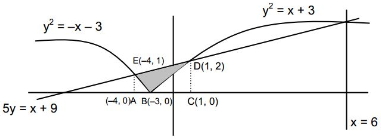
0 likesView Solution
27
MathematicsAdvancedMCQIIT JEE · 2016
Let $P$ be the image of the point $(3, 1, 7)$ with respect to the plane $x-y+z=3$. Then the equation of the plane passing through $P$ and containing the straight line $\frac{x}{1}=\frac{y}{2}=\frac{z}{1}$ is
A
$x+y-3z=0$
B
$3x+z=0$
C
$x-4y+7z=0$
D
$2x-y=0$
Solution
(C) Let the given point be $Q(3, 1, 7)$. The line passing through $Q$ and perpendicular to the plane $x-y+z=3$ has the direction ratios $(1, -1, 1)$.
Its equation is $\frac{x-3}{1} = \frac{y-1}{-1} = \frac{z-7}{1} = \lambda$.
Any point on this line is $(3+\lambda, 1-\lambda, 7+\lambda)$.
This point lies on the plane $x-y+z=3$,so $(3+\lambda) - (1-\lambda) + (7+\lambda) = 3$.
$3+\lambda-1+\lambda+7+\lambda=3 \Rightarrow 3\lambda+9=3 \Rightarrow 3\lambda=-6 \Rightarrow \lambda=-2$.
The foot of the perpendicular $R$ is $(3-2, 1-(-2), 7-2) = (1, 3, 5)$.
Let $P(x_1, y_1, z_1)$ be the image of $Q$. Since $R$ is the midpoint of $PQ$,we have $\frac{x_1+3}{2}=1, \frac{y_1+1}{2}=3, \frac{z_1+7}{2}=5$.
$x_1 = -1, y_1 = 5, z_1 = 3$. So $P$ is $(-1, 5, 3)$.
The plane passes through $P(-1, 5, 3)$ and contains the line $\frac{x}{1}=\frac{y}{2}=\frac{z}{1}$.
The plane equation is $a(x+1) + b(y-5) + c(z-3) = 0$.
Since it contains the line,it passes through $(0, 0, 0)$,so $a(1) + b(-5) + c(-3) = 0 \Rightarrow a-5b-3c=0$.
Also,the normal vector $(a, b, c)$ is perpendicular to the line direction $(1, 2, 1)$,so $a+2b+c=0$.
Solving $a-5b-3c=0$ and $a+2b+c=0$ by subtraction: $-7b-4c=0 \Rightarrow b = -4c/7$.
Then $a = 5(-4c/7) + 3c = -20c/7 + 21c/7 = c/7$.
Taking $c=7$,we get $a=1, b=-4$. The equation is $1(x+1) - 4(y-5) + 7(z-3) = 0$.
$x+1-4y+20+7z-21 = 0 \Rightarrow x-4y+7z=0$.
Its equation is $\frac{x-3}{1} = \frac{y-1}{-1} = \frac{z-7}{1} = \lambda$.
Any point on this line is $(3+\lambda, 1-\lambda, 7+\lambda)$.
This point lies on the plane $x-y+z=3$,so $(3+\lambda) - (1-\lambda) + (7+\lambda) = 3$.
$3+\lambda-1+\lambda+7+\lambda=3 \Rightarrow 3\lambda+9=3 \Rightarrow 3\lambda=-6 \Rightarrow \lambda=-2$.
The foot of the perpendicular $R$ is $(3-2, 1-(-2), 7-2) = (1, 3, 5)$.
Let $P(x_1, y_1, z_1)$ be the image of $Q$. Since $R$ is the midpoint of $PQ$,we have $\frac{x_1+3}{2}=1, \frac{y_1+1}{2}=3, \frac{z_1+7}{2}=5$.
$x_1 = -1, y_1 = 5, z_1 = 3$. So $P$ is $(-1, 5, 3)$.
The plane passes through $P(-1, 5, 3)$ and contains the line $\frac{x}{1}=\frac{y}{2}=\frac{z}{1}$.
The plane equation is $a(x+1) + b(y-5) + c(z-3) = 0$.
Since it contains the line,it passes through $(0, 0, 0)$,so $a(1) + b(-5) + c(-3) = 0 \Rightarrow a-5b-3c=0$.
Also,the normal vector $(a, b, c)$ is perpendicular to the line direction $(1, 2, 1)$,so $a+2b+c=0$.
Solving $a-5b-3c=0$ and $a+2b+c=0$ by subtraction: $-7b-4c=0 \Rightarrow b = -4c/7$.
Then $a = 5(-4c/7) + 3c = -20c/7 + 21c/7 = c/7$.
Taking $c=7$,we get $a=1, b=-4$. The equation is $1(x+1) - 4(y-5) + 7(z-3) = 0$.
$x+1-4y+20+7z-21 = 0 \Rightarrow x-4y+7z=0$.
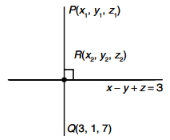
0 likesView Solution
28
MathematicsAdvancedMCQIIT JEE · 2016
Let $f(x) = \lim_{n}$ ${\rightarrow \infty} \left( \frac{n^n(x+n)(x+\frac{n}{2}) \cdots (x+\frac{n}{n})}{n!(x^2+n^2)(x^2+\frac{n^2}{4}) \cdots (x^2+\frac{n^2}{n^2})} \right)^{\frac{x}{n}}$,for all $x > 0$. Then
$(A)$ $f(\frac{1}{2}) \geq f(1)$
$(B)$ $f(\frac{1}{3}) \leq f(\frac{2}{3})$
$(C)$ $f^{\prime}(2) \leq 0$
$(D)$ $\frac{f^{\prime}(3)}{f(3)} \geq \frac{f^{\prime}(2)}{f(2)}$
$(A)$ $f(\frac{1}{2}) \geq f(1)$
$(B)$ $f(\frac{1}{3}) \leq f(\frac{2}{3})$
$(C)$ $f^{\prime}(2) \leq 0$
$(D)$ $\frac{f^{\prime}(3)}{f(3)} \geq \frac{f^{\prime}(2)}{f(2)}$
A
$B, C$
B
$B, D$
C
$A, B$
D
$A, C$
Solution
(B,C) Taking the natural logarithm on both sides:
$\ln f(x) = \lim_{n}$ ${\rightarrow \infty} \frac{x}{n} \sum_{r=1}^n \ln \left( \frac{x + n/r}{x^2 + n^2/r^2} \cdot \frac{n}{r} \right)$
$= \lim_{n \rightarrow \infty} \frac{x}{n} \sum_{r=1}^n \ln \left( \frac{1 + \frac{r}{n}x}{1 + (\frac{r}{n}x)^2} \right)$
$= x \int_0^1 \ln \left( \frac{1 + tx}{1 + (tx)^2} \right) dt$
Let $u = tx$,then $du = x dt$:
$\ln f(x) = \int_0^x \ln \left( \frac{1+u}{1+u^2} \right) du$
By the Fundamental Theorem of Calculus:
$\frac{f^{\prime}(x)}{f(x)} = \ln \left( \frac{1+x}{1+x^2} \right)$
For $0 < x < 1$,$\frac{1+x}{1+x^2} > 1$,so $\frac{f^{\prime}(x)}{f(x)} > 0$,meaning $f(x)$ is increasing.
For $x > 1$,$\frac{1+x}{1+x^2} < 1$,so $\frac{f^{\prime}(x)}{f(x)} < 0$,meaning $f(x)$ is decreasing.
Thus,$f(1/3) < f(2/3)$ (Option $B$ is correct).
Since $f(x)$ is decreasing for $x > 1$,$f^{\prime}(2) < 0$ (Option $C$ is correct).
Therefore,the correct options are $B$ and $C$.
$\ln f(x) = \lim_{n}$ ${\rightarrow \infty} \frac{x}{n} \sum_{r=1}^n \ln \left( \frac{x + n/r}{x^2 + n^2/r^2} \cdot \frac{n}{r} \right)$
$= \lim_{n \rightarrow \infty} \frac{x}{n} \sum_{r=1}^n \ln \left( \frac{1 + \frac{r}{n}x}{1 + (\frac{r}{n}x)^2} \right)$
$= x \int_0^1 \ln \left( \frac{1 + tx}{1 + (tx)^2} \right) dt$
Let $u = tx$,then $du = x dt$:
$\ln f(x) = \int_0^x \ln \left( \frac{1+u}{1+u^2} \right) du$
By the Fundamental Theorem of Calculus:
$\frac{f^{\prime}(x)}{f(x)} = \ln \left( \frac{1+x}{1+x^2} \right)$
For $0 < x < 1$,$\frac{1+x}{1+x^2} > 1$,so $\frac{f^{\prime}(x)}{f(x)} > 0$,meaning $f(x)$ is increasing.
For $x > 1$,$\frac{1+x}{1+x^2} < 1$,so $\frac{f^{\prime}(x)}{f(x)} < 0$,meaning $f(x)$ is decreasing.
Thus,$f(1/3) < f(2/3)$ (Option $B$ is correct).
Since $f(x)$ is decreasing for $x > 1$,$f^{\prime}(2) < 0$ (Option $C$ is correct).
Therefore,the correct options are $B$ and $C$.
0 likesView Solution
29
MathematicsMediumMCQIIT JEE · 2016
Let $a, b \in R$ and $f: R \rightarrow R$ be defined by $f(x)=a \cos (|x^3-x|)+b|x| \sin (|x^3+x|)$. Then $f$ is
A
$A, D$
B
$A, C$
C
$A, B$
D
$A, B, C$
Solution
(C) Given $f(x) = a \cos (|x^3-x|) + b|x| \sin (|x^3+x|)$.
Since $\cos(\theta) = \cos(-\theta)$,we have $\cos(|x^3-x|) = \cos(x^3-x)$.
Also,$|x| \sin(|x^3+x|) = x \sin(x^3+x)$ for all $x \in R$ because if $x \ge 0$,$|x|=x$ and $|x^3+x|=x^3+x$,and if $x < 0$,$|x|=-x$ and $|x^3+x|=-(x^3+x)$,so $-x \sin(-(x^3+x)) = -x(-\sin(x^3+x)) = x \sin(x^3+x)$.
Thus,$f(x) = a \cos(x^3-x) + b x \sin(x^3+x)$ for all $x \in R$.
Since $\cos(x^3-x)$ and $x \sin(x^3+x)$ are differentiable functions on $R$,$f(x)$ is differentiable for all $x \in R$ for any $a, b \in R$.
Therefore,$f$ is differentiable at $x=0$ and $x=1$ for any $a, b \in R$.
Checking the options:
$(A)$ Differentiable at $x=0$ if $a=0, b=1$ (True).
$(B)$ Differentiable at $x=1$ if $a=1, b=0$ (True).
$(C)$ Not differentiable at $x=0$ if $a=1, b=0$ (False).
$(D)$ Not differentiable at $x=1$ if $a=1, b=1$ (False).
Thus,options $A$ and $B$ are correct.
Since $\cos(\theta) = \cos(-\theta)$,we have $\cos(|x^3-x|) = \cos(x^3-x)$.
Also,$|x| \sin(|x^3+x|) = x \sin(x^3+x)$ for all $x \in R$ because if $x \ge 0$,$|x|=x$ and $|x^3+x|=x^3+x$,and if $x < 0$,$|x|=-x$ and $|x^3+x|=-(x^3+x)$,so $-x \sin(-(x^3+x)) = -x(-\sin(x^3+x)) = x \sin(x^3+x)$.
Thus,$f(x) = a \cos(x^3-x) + b x \sin(x^3+x)$ for all $x \in R$.
Since $\cos(x^3-x)$ and $x \sin(x^3+x)$ are differentiable functions on $R$,$f(x)$ is differentiable for all $x \in R$ for any $a, b \in R$.
Therefore,$f$ is differentiable at $x=0$ and $x=1$ for any $a, b \in R$.
Checking the options:
$(A)$ Differentiable at $x=0$ if $a=0, b=1$ (True).
$(B)$ Differentiable at $x=1$ if $a=1, b=0$ (True).
$(C)$ Not differentiable at $x=0$ if $a=1, b=0$ (False).
$(D)$ Not differentiable at $x=1$ if $a=1, b=1$ (False).
Thus,options $A$ and $B$ are correct.
0 likesView Solution
30
MathematicsAdvancedMCQIIT JEE · 2016
Let $f: R \rightarrow (0, \infty)$ and $g: R \rightarrow R$ be twice differentiable functions such that $f^{\prime \prime}$ and $g^{\prime \prime}$ are continuous functions on $R$. Suppose $f^{\prime}(2) = g(2) = 0$,$f^{\prime \prime}(2) \neq 0$ and $g^{\prime}(2) \neq 0$. If $\lim_{x \rightarrow 2} \frac{f(x) g(x)}{f^{\prime}(x) g^{\prime}(x)} = 1$,then:
A
$f$ has a local minimum at $x=2$
B
$f$ has a local maximum at $x=2$
C
$f^{\prime \prime}(2) > f(2)$
D
$f(x) - f^{\prime \prime}(x) = 0$ for at least one $x \in R$
Solution
(A,D) Given $\lim_{x \rightarrow 2} \frac{f(x) g(x)}{f^{\prime}(x) g^{\prime}(x)} = 1$. Since $f^{\prime}(2) = 0$ and $g(2) = 0$,this is a $\frac{0}{0}$ form. Applying $L$'Hopital's rule:
$\lim_{x \rightarrow 2} \frac{f^{\prime}(x) g(x) + f(x) g^{\prime}(x)}{f^{\prime \prime}(x) g^{\prime}(x) + f^{\prime}(x) g^{\prime \prime}(x)} = 1$.
Substituting $x=2$ and using $f^{\prime}(2) = g(2) = 0$:
$\frac{0 + f(2) g^{\prime}(2)}{f^{\prime \prime}(2) g^{\prime}(2) + 0} = 1 \implies \frac{f(2)}{f^{\prime \prime}(2)} = 1 \implies f(2) = f^{\prime \prime}(2)$.
Since $f: R \rightarrow (0, \infty)$,$f(2) > 0$,so $f^{\prime \prime}(2) > 0$.
By the second derivative test,$f$ has a local minimum at $x=2$ (Option $A$).
Consider $h(x) = f(x) e^{-x^2/2}$. This is not directly helpful,but consider $h(x) = f(x) e^{-x/2}$ or similar. Actually,consider $h(x) = f(x) - f^{\prime \prime}(x)$. Since $f(2) = f^{\prime \prime}(2)$,$h(2) = 0$. Thus,$f(x) - f^{\prime \prime}(x) = 0$ for at least $x=2$ (Option $D$).
Thus,both $A$ and $D$ are correct.
$\lim_{x \rightarrow 2} \frac{f^{\prime}(x) g(x) + f(x) g^{\prime}(x)}{f^{\prime \prime}(x) g^{\prime}(x) + f^{\prime}(x) g^{\prime \prime}(x)} = 1$.
Substituting $x=2$ and using $f^{\prime}(2) = g(2) = 0$:
$\frac{0 + f(2) g^{\prime}(2)}{f^{\prime \prime}(2) g^{\prime}(2) + 0} = 1 \implies \frac{f(2)}{f^{\prime \prime}(2)} = 1 \implies f(2) = f^{\prime \prime}(2)$.
Since $f: R \rightarrow (0, \infty)$,$f(2) > 0$,so $f^{\prime \prime}(2) > 0$.
By the second derivative test,$f$ has a local minimum at $x=2$ (Option $A$).
Consider $h(x) = f(x) e^{-x^2/2}$. This is not directly helpful,but consider $h(x) = f(x) e^{-x/2}$ or similar. Actually,consider $h(x) = f(x) - f^{\prime \prime}(x)$. Since $f(2) = f^{\prime \prime}(2)$,$h(2) = 0$. Thus,$f(x) - f^{\prime \prime}(x) = 0$ for at least $x=2$ (Option $D$).
Thus,both $A$ and $D$ are correct.
0 likesView Solution
31
MathematicsMediumMCQIIT JEE · 2016
Let $f:\left[-\frac{1}{2}, 2\right] \rightarrow R$ and $g:\left[-\frac{1}{2}, 2\right] \rightarrow R$ be functions defined by $f(x)=\left[x^2-3\right]$ and $g(x)=|x| f(x)+|4 x-7| f(x)$,where $[y]$ denotes the greatest integer less than or equal to $y$ for $y \in R$. Then
$(A)$ $f$ is discontinuous exactly at three points in $\left[-\frac{1}{2}, 2\right]$
$(B)$ $f$ is discontinuous exactly at four points in $\left[-\frac{1}{2}, 2\right]$
$(C)$ $g$ is $NOT$ differentiable exactly at four points in $\left(-\frac{1}{2}, 2\right)$
$(D)$ $g$ is $NOT$ differentiable exactly at five points in $\left(-\frac{1}{2}, 2\right)$
$(A)$ $f$ is discontinuous exactly at three points in $\left[-\frac{1}{2}, 2\right]$
$(B)$ $f$ is discontinuous exactly at four points in $\left[-\frac{1}{2}, 2\right]$
$(C)$ $g$ is $NOT$ differentiable exactly at four points in $\left(-\frac{1}{2}, 2\right)$
$(D)$ $g$ is $NOT$ differentiable exactly at five points in $\left(-\frac{1}{2}, 2\right)$
A
$A, C$
B
$B, C$
C
$A, D$
D
$B, D$
Solution
(B, C) The function $f(x) = [x^2 - 3]$ is discontinuous where $x^2 - 3$ is an integer.
In the interval $[-\frac{1}{2}, 2]$,$x^2$ ranges from $0$ to $4$,so $x^2 - 3$ ranges from $-3$ to $1$.
The values of $x^2 - 3$ are integers at $x^2 - 3 \in \{-3, -2, -1, 0, 1\}$,which means $x^2 \in \{0, 1, 2, 3, 4\}$.
Since $x \in [-\frac{1}{2}, 2]$,the points of discontinuity for $f(x)$ are $x = 0, 1, \sqrt{2}, \sqrt{3}, 2$. However,at $x=2$,the function is defined on a closed interval,so we check the interior points. The points are $x = 0, 1, \sqrt{2}, \sqrt{3}$. Thus,$f$ is discontinuous at $4$ points in $[-\frac{1}{2}, 2]$. Option $B$ is correct.
Now consider $g(x) = (|x| + |4x - 7|)f(x)$.
$f(x)$ is discontinuous at $x \in \{0, 1, \sqrt{2}, \sqrt{3}, 2\}$.
$|x|$ is non-differentiable at $x=0$.
$|4x-7|$ is non-differentiable at $x=7/4 = 1.75$.
At $x=0$,$f(x) = [-3] = -3 \neq 0$,so $g(x)$ is non-differentiable.
At $x=1, \sqrt{2}, \sqrt{3}$,$f(x)$ is discontinuous,so $g(x)$ is non-differentiable.
At $x=7/4$,$f(x) = [(7/4)^2 - 3] = [49/16 - 3] = [3.0625 - 3] = [0.0625] = 0$. Since $f(7/4) = 0$,the product $g(x) = (|x| + |4x-7|)f(x)$ becomes differentiable at $x=7/4$ because the jump discontinuity of $f$ is multiplied by $0$.
Thus,$g(x)$ is non-differentiable at $x \in \{0, 1, \sqrt{2}, \sqrt{3}\}$,which is $4$ points. Option $C$ is correct.
In the interval $[-\frac{1}{2}, 2]$,$x^2$ ranges from $0$ to $4$,so $x^2 - 3$ ranges from $-3$ to $1$.
The values of $x^2 - 3$ are integers at $x^2 - 3 \in \{-3, -2, -1, 0, 1\}$,which means $x^2 \in \{0, 1, 2, 3, 4\}$.
Since $x \in [-\frac{1}{2}, 2]$,the points of discontinuity for $f(x)$ are $x = 0, 1, \sqrt{2}, \sqrt{3}, 2$. However,at $x=2$,the function is defined on a closed interval,so we check the interior points. The points are $x = 0, 1, \sqrt{2}, \sqrt{3}$. Thus,$f$ is discontinuous at $4$ points in $[-\frac{1}{2}, 2]$. Option $B$ is correct.
Now consider $g(x) = (|x| + |4x - 7|)f(x)$.
$f(x)$ is discontinuous at $x \in \{0, 1, \sqrt{2}, \sqrt{3}, 2\}$.
$|x|$ is non-differentiable at $x=0$.
$|4x-7|$ is non-differentiable at $x=7/4 = 1.75$.
At $x=0$,$f(x) = [-3] = -3 \neq 0$,so $g(x)$ is non-differentiable.
At $x=1, \sqrt{2}, \sqrt{3}$,$f(x)$ is discontinuous,so $g(x)$ is non-differentiable.
At $x=7/4$,$f(x) = [(7/4)^2 - 3] = [49/16 - 3] = [3.0625 - 3] = [0.0625] = 0$. Since $f(7/4) = 0$,the product $g(x) = (|x| + |4x-7|)f(x)$ becomes differentiable at $x=7/4$ because the jump discontinuity of $f$ is multiplied by $0$.
Thus,$g(x)$ is non-differentiable at $x \in \{0, 1, \sqrt{2}, \sqrt{3}\}$,which is $4$ points. Option $C$ is correct.
0 likesView Solution
32
MathematicsAdvancedMCQIIT JEE · 2016
Let $a, \lambda, \mu \in \mathbb{R}$. Consider the system of linear equations:
$a x + 2 y = \lambda$
$3 x - 2 y = \mu$
Which of the following statement$(s)$ is(are) correct?
$(A)$ If $a = -3$,then the system has infinitely many solutions for all values of $\lambda$ and $\mu$.
$(B)$ If $a \neq -3$,then the system has a unique solution for all values of $\lambda$ and $\mu$.
$(C)$ If $\lambda + \mu = 0$,then the system has infinitely many solutions for $a = -3$.
$(D)$ If $\lambda + \mu \neq 0$,then the system has no solution for $a = -3$.
$a x + 2 y = \lambda$
$3 x - 2 y = \mu$
Which of the following statement$(s)$ is(are) correct?
$(A)$ If $a = -3$,then the system has infinitely many solutions for all values of $\lambda$ and $\mu$.
$(B)$ If $a \neq -3$,then the system has a unique solution for all values of $\lambda$ and $\mu$.
$(C)$ If $\lambda + \mu = 0$,then the system has infinitely many solutions for $a = -3$.
$(D)$ If $\lambda + \mu \neq 0$,then the system has no solution for $a = -3$.
A
$A, C$
B
$B, C$
C
$B, C, D$
D
$B, C, A$
Solution
(C) The given system of equations is:
$ax + 2y = \lambda$
$3x - 2y = \mu$
The determinant of the coefficient matrix is:
$\Delta = \begin{vmatrix} a & 2 \\ 3 & -2 \end{vmatrix} = -2a - 6 = -2(a + 3)$.
For a unique solution,$\Delta \neq 0$,which implies $a \neq -3$. Thus,statement $(B)$ is correct.
If $a = -3$,then $\Delta = 0$. The system will have either no solution or infinitely many solutions.
We calculate $\Delta_1 = \begin{vmatrix} \lambda & 2 \\ \mu & -2 \end{vmatrix} = -2\lambda - 2\mu = -2(\lambda + \mu)$.
If $\lambda + \mu = 0$,then $\Delta_1 = 0$. Since $\Delta = 0$ and $\Delta_1 = 0$,the system has infinitely many solutions. Thus,statement $(C)$ is correct.
If $\lambda + \mu \neq 0$,then $\Delta_1 \neq 0$. Since $\Delta = 0$ and $\Delta_1 \neq 0$,the system has no solution. Thus,statement $(D)$ is correct.
Therefore,statements $(B)$,$(C)$,and $(D)$ are correct.
$ax + 2y = \lambda$
$3x - 2y = \mu$
The determinant of the coefficient matrix is:
$\Delta = \begin{vmatrix} a & 2 \\ 3 & -2 \end{vmatrix} = -2a - 6 = -2(a + 3)$.
For a unique solution,$\Delta \neq 0$,which implies $a \neq -3$. Thus,statement $(B)$ is correct.
If $a = -3$,then $\Delta = 0$. The system will have either no solution or infinitely many solutions.
We calculate $\Delta_1 = \begin{vmatrix} \lambda & 2 \\ \mu & -2 \end{vmatrix} = -2\lambda - 2\mu = -2(\lambda + \mu)$.
If $\lambda + \mu = 0$,then $\Delta_1 = 0$. Since $\Delta = 0$ and $\Delta_1 = 0$,the system has infinitely many solutions. Thus,statement $(C)$ is correct.
If $\lambda + \mu \neq 0$,then $\Delta_1 \neq 0$. Since $\Delta = 0$ and $\Delta_1 \neq 0$,the system has no solution. Thus,statement $(D)$ is correct.
Therefore,statements $(B)$,$(C)$,and $(D)$ are correct.
0 likesView Solution
33
MathematicsAdvancedMCQIIT JEE · 2016
Let $\hat{u} = u_1 \hat{i} + u_2 \hat{j} + u_3 \hat{k}$ be a unit vector in $\mathbb{R}^3$ and $\hat{v} = \frac{1}{\sqrt{6}}(\hat{i} + \hat{j} + 2 \hat{k})$. Given that there exists a unit vector $\vec{w}$ such that $\hat{u} \times \vec{w} = \hat{v}$,which of the following is(are) correct?
A
$B, C, A$
B
$B, D$
C
$B, A$
D
$B, C$
Solution
(D) Given $\hat{u} \times \vec{w} = \hat{v}$. Since $\hat{u}$ and $\vec{w}$ are unit vectors,$|\hat{u} \times \vec{w}| = |\hat{u}| |\vec{w}| \sin \theta = \sin \theta$. Also,$|\hat{v}| = \frac{1}{\sqrt{6}} \sqrt{1^2 + 1^2 + 2^2} = 1$. Thus,$\sin \theta = 1$,which implies $\theta = 90^{\circ}$.
Since $\hat{u} \times \vec{w} = \hat{v}$,$\hat{v}$ is perpendicular to both $\hat{u}$ and $\vec{w}$.
For a fixed $\hat{u}$,there are infinitely many vectors $\vec{w}$ perpendicular to $\hat{u}$ such that their cross product with $\hat{u}$ is $\hat{v}$. Thus,option $B$ is correct.
Since $\hat{v} \cdot \hat{u} = 0$,we have $\frac{1}{\sqrt{6}}(u_1 + u_2 + 2u_3) = 0$,so $u_1 + u_2 + 2u_3 = 0$.
If $\hat{u}$ lies in the $xy$-plane,$u_3 = 0$,then $u_1 + u_2 = 0$,so $|u_1| = |u_2|$. Thus,option $C$ is correct.
If $\hat{u}$ lies in the $xz$-plane,$u_2 = 0$,then $u_1 + 2u_3 = 0$,so $|u_1| = 2|u_3|$. Thus,option $D$ is incorrect as it states $2|u_1| = |u_3|$.
Since $\hat{u} \times \vec{w} = \hat{v}$,$\hat{v}$ is perpendicular to both $\hat{u}$ and $\vec{w}$.
For a fixed $\hat{u}$,there are infinitely many vectors $\vec{w}$ perpendicular to $\hat{u}$ such that their cross product with $\hat{u}$ is $\hat{v}$. Thus,option $B$ is correct.
Since $\hat{v} \cdot \hat{u} = 0$,we have $\frac{1}{\sqrt{6}}(u_1 + u_2 + 2u_3) = 0$,so $u_1 + u_2 + 2u_3 = 0$.
If $\hat{u}$ lies in the $xy$-plane,$u_3 = 0$,then $u_1 + u_2 = 0$,so $|u_1| = |u_2|$. Thus,option $C$ is correct.
If $\hat{u}$ lies in the $xz$-plane,$u_2 = 0$,then $u_1 + 2u_3 = 0$,so $|u_1| = 2|u_3|$. Thus,option $D$ is incorrect as it states $2|u_1| = |u_3|$.
0 likesView Solution
34
MathematicsAdvancedIIT JEE · 2016
Football teams $T_1$ and $T_2$ play two games against each other. The outcomes of the two games are independent. The probabilities of $T_1$ winning,drawing,and losing a game against $T_2$ are $\frac{1}{2}$,$\frac{1}{6}$,and $\frac{1}{3}$,respectively. Each team gets $3$ points for a win,$1$ point for a draw,and $0$ points for a loss. Let $X$ and $Y$ denote the total points scored by teams $T_1$ and $T_2$,respectively,after two games.
$(1)$ $P(X>Y)$ is
$(A)$ $\frac{1}{4}$ $(B)$ $\frac{5}{12}$ $(C)$ $\frac{1}{2}$ $(D)$ $\frac{7}{12}$
$(2)$ $P(X=Y)$ is
$(A)$ $\frac{11}{36}$ $(B)$ $\frac{1}{3}$ $(C)$ $\frac{13}{36}$ $(D)$ $\frac{1}{2}$
$(1)$ $P(X>Y)$ is
$(A)$ $\frac{1}{4}$ $(B)$ $\frac{5}{12}$ $(C)$ $\frac{1}{2}$ $(D)$ $\frac{7}{12}$
$(2)$ $P(X=Y)$ is
$(A)$ $\frac{11}{36}$ $(B)$ $\frac{1}{3}$ $(C)$ $\frac{13}{36}$ $(D)$ $\frac{1}{2}$
Solution
(C) Let $W, D, L$ denote win,draw,and loss for $T_1$ respectively. $P(W) = \frac{1}{2}, P(D) = \frac{1}{6}, P(L) = \frac{1}{3}$.
$(1)$ $X > Y$ occurs if $T_1$ wins more points than $T_2$. Possible outcomes for $(T_1, T_2)$ in two games:
- $T_1$ wins both: $(W, W) \implies X=6, Y=0, P = \frac{1}{2} \times \frac{1}{2} = \frac{1}{4}$
- $T_1$ wins one,draws one: $(W, D) \text{ or } (D, W) \implies X=4, Y=1, P = (\frac{1}{2} \times \frac{1}{6}) + (\frac{1}{6} \times \frac{1}{2}) = \frac{1}{12} + \frac{1}{12} = \frac{1}{6}$
- $T_1$ wins one,loses one: $(W, L) \text{ or } (L, W) \implies X=3, Y=3$ (Not $X>Y$)
- $T_1$ draws both: $(D, D) \implies X=2, Y=2$ (Not $X>Y$)
- $T_1$ draws one,loses one: $(D, L) \text{ or } (L, D) \implies X=1, Y=4$ (Not $X>Y$)
Summing probabilities for $X>Y$: $\frac{1}{4} + \frac{1}{6} = \frac{3+2}{12} = \frac{5}{12}$. Correct option is $(B)$.
$(2)$ $X=Y$ occurs if:
- Both draw: $(D, D) \implies X=2, Y=2, P = \frac{1}{6} \times \frac{1}{6} = \frac{1}{36}$
- $T_1$ wins one,loses one: $(W, L) \text{ or } (L, W) \implies X=3, Y=3, P = (\frac{1}{2} \times \frac{1}{3}) + (\frac{1}{3} \times \frac{1}{2}) = \frac{1}{6} + \frac{1}{6} = \frac{1}{3} = \frac{12}{36}$
Summing probabilities for $X=Y$: $\frac{1}{36} + \frac{12}{36} = \frac{13}{36}$. Correct option is $(C)$.
$(1)$ $X > Y$ occurs if $T_1$ wins more points than $T_2$. Possible outcomes for $(T_1, T_2)$ in two games:
- $T_1$ wins both: $(W, W) \implies X=6, Y=0, P = \frac{1}{2} \times \frac{1}{2} = \frac{1}{4}$
- $T_1$ wins one,draws one: $(W, D) \text{ or } (D, W) \implies X=4, Y=1, P = (\frac{1}{2} \times \frac{1}{6}) + (\frac{1}{6} \times \frac{1}{2}) = \frac{1}{12} + \frac{1}{12} = \frac{1}{6}$
- $T_1$ wins one,loses one: $(W, L) \text{ or } (L, W) \implies X=3, Y=3$ (Not $X>Y$)
- $T_1$ draws both: $(D, D) \implies X=2, Y=2$ (Not $X>Y$)
- $T_1$ draws one,loses one: $(D, L) \text{ or } (L, D) \implies X=1, Y=4$ (Not $X>Y$)
Summing probabilities for $X>Y$: $\frac{1}{4} + \frac{1}{6} = \frac{3+2}{12} = \frac{5}{12}$. Correct option is $(B)$.
$(2)$ $X=Y$ occurs if:
- Both draw: $(D, D) \implies X=2, Y=2, P = \frac{1}{6} \times \frac{1}{6} = \frac{1}{36}$
- $T_1$ wins one,loses one: $(W, L) \text{ or } (L, W) \implies X=3, Y=3, P = (\frac{1}{2} \times \frac{1}{3}) + (\frac{1}{3} \times \frac{1}{2}) = \frac{1}{6} + \frac{1}{6} = \frac{1}{3} = \frac{12}{36}$
Summing probabilities for $X=Y$: $\frac{1}{36} + \frac{12}{36} = \frac{13}{36}$. Correct option is $(C)$.
0 likesView Solution
Vedclass Products
For Students
Vedclass Test Series
Mock tests in real IIT JEE style covering Mathematics with performance analysis. 5-day free trial.
Start Free TrialFor Teachers
Exam Paper Generator
Generate Set A/B/C/D Mathematics papers from 7.5L+ questions in 2 minutes. 3 chapters free.
Try FreeFor Institutes
Online Exam Module
Run live IIT JEE mock exams with unlimited students, 360° analytics & white-label branding.
See DemoFrequently Asked Questions
How many Mathematics questions are in IIT JEE 2016?
There are 34 Mathematics questions from the IIT JEE 2016 paper on Vedclass, each with a detailed step-by-step solution in English.
Are IIT JEE 2016 Mathematics solutions available in English?
Yes. All solutions on this page are in English. You can also switch to English or Hindi using the language buttons above the questions.
Can I practice IIT JEE 2016 Mathematics as a timed test?
Yes. Use the Vedclass Test Series to attempt a full IIT JEE mock test covering Mathematics with time limits and instant score analysis.
Can teachers create Mathematics papers from IIT JEE previous year questions?
Yes. The Vedclass Exam Paper Generator lets teachers mix IIT JEE Mathematics questions and generate Set A/B/C/D papers in minutes.
For Teachers & Institutes
Build a Custom Mathematics Paper
Pick IIT JEE 2016 Mathematics questions, set difficulty, and generate Set A/B/C/D in 2 minutes.