
ChemistryQ1–41 of 41 questions
Page 1 of 1 · English
1
ChemistryMCQIIT JEE · 2015
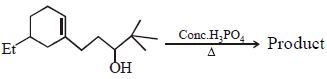
The major product of the reaction is :
A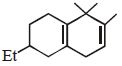
B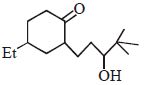
C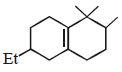
D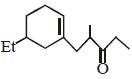
Solution
(D) The reaction involves the acid-catalyzed dehydration of a secondary alcohol using $Conc. H_3PO_4$ and heat.
$1$. Protonation of the hydroxyl group occurs to form a good leaving group $(-OH_2^+)$.
$2$. Loss of water generates a secondary carbocation.
$3$. The carbocation undergoes a rearrangement (specifically a $1,2$-methyl shift or ring expansion/cyclization mechanism) to form a more stable tertiary carbocation.
$4$. In this specific case,the carbocation attacks the double bond in the cyclohexene ring,leading to the formation of a bicyclic system.
$5$. Finally,the loss of a proton $(-H^+)$ from the carbocation results in the formation of the most stable alkene product,which is a substituted decalin derivative.
$1$. Protonation of the hydroxyl group occurs to form a good leaving group $(-OH_2^+)$.
$2$. Loss of water generates a secondary carbocation.
$3$. The carbocation undergoes a rearrangement (specifically a $1,2$-methyl shift or ring expansion/cyclization mechanism) to form a more stable tertiary carbocation.
$4$. In this specific case,the carbocation attacks the double bond in the cyclohexene ring,leading to the formation of a bicyclic system.
$5$. Finally,the loss of a proton $(-H^+)$ from the carbocation results in the formation of the most stable alkene product,which is a substituted decalin derivative.
0 likesView Solution
2
ChemistryDifficultMCQIIT JEE · 2015
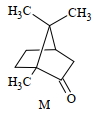
The total number of stereoisomers that can exist for $M$ is:
$M$ is a bicyclic ketone with a methyl group at the bridgehead and two methyl groups at the bridge carbon.
$M$ is a bicyclic ketone with a methyl group at the bridgehead and two methyl groups at the bridge carbon.
A
$1$
B
$2$
C
$3$
D
$4$
Solution
(B) The molecule $M$ is a substituted bicyclo[$2.2$.$1$]heptan$-2-$one derivative.
The structure has a chiral center at the bridgehead carbon where the methyl group is attached.
Due to the rigid bicyclic structure,the bridgehead methyl group can exist in two configurations relative to the bridge,leading to two enantiomers.
Since there are no other chiral centers or geometric isomerism possibilities that are not constrained by the bicyclic ring system,the total number of stereoisomers is $2$.
The structure has a chiral center at the bridgehead carbon where the methyl group is attached.
Due to the rigid bicyclic structure,the bridgehead methyl group can exist in two configurations relative to the bridge,leading to two enantiomers.
Since there are no other chiral centers or geometric isomerism possibilities that are not constrained by the bicyclic ring system,the total number of stereoisomers is $2$.
0 likesView Solution
3
ChemistryDifficultMCQIIT JEE · 2015
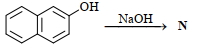
The number of resonance structures for $N$ is
A
$7$
B
$8$
C
$9$
D
$0$
Solution
(C) The reaction of $2$-naphthol with $NaOH$ produces the $2$-naphthoxide ion $(N)$.
The $2$-naphthoxide ion is a resonance-stabilized species.
By drawing all possible resonance structures for the $2$-naphthoxide ion,we find that there are $9$ distinct resonance structures.
These structures involve the delocalization of the negative charge from the oxygen atom into the naphthalene ring system,creating various keto-enolate forms.
Therefore,the total number of resonance structures for $N$ is $9$.
The $2$-naphthoxide ion is a resonance-stabilized species.
By drawing all possible resonance structures for the $2$-naphthoxide ion,we find that there are $9$ distinct resonance structures.
These structures involve the delocalization of the negative charge from the oxygen atom into the naphthalene ring system,creating various keto-enolate forms.
Therefore,the total number of resonance structures for $N$ is $9$.
0 likesView Solution
4
ChemistryMediumMCQIIT JEE · 2015
The total number of lone pairs of electrons in $N_2O_3$ is
A
$5$
B
$6$
C
$7$
D
$8$
Solution
(D) To determine the total number of lone pairs in $N_2O_3$,we look at its Lewis structure.
In the structure of $N_2O_3$ $(O=N-O-N=O)$,the distribution of lone pairs is as follows:
$1$. Each terminal oxygen atom $(=O)$ has $2$ lone pairs.
$2$. The central oxygen atom $(-O-)$ has $2$ lone pairs.
$3$. Each nitrogen atom has $1$ lone pair.
Total lone pairs = $(2 \times 2) + 2 + (2 \times 1) = 4 + 2 + 2 = 8$.
Thus,the total number of lone pairs is $8$.
In the structure of $N_2O_3$ $(O=N-O-N=O)$,the distribution of lone pairs is as follows:
$1$. Each terminal oxygen atom $(=O)$ has $2$ lone pairs.
$2$. The central oxygen atom $(-O-)$ has $2$ lone pairs.
$3$. Each nitrogen atom has $1$ lone pair.
Total lone pairs = $(2 \times 2) + 2 + (2 \times 1) = 4 + 2 + 2 = 8$.
Thus,the total number of lone pairs is $8$.
0 likesView Solution
5
ChemistryMediumMCQIIT JEE · 2015
Among the triatomic molecules/ions,$BeCl_2, N_3^{-}, N_2O, NO_2^{+}, O_3, SCl_2, ICl_2^{-}, I_3^{-}$ and $XeF_2$,the total number of linear molecule$(s)$/ion$(s)$ where the hybridization of the central atom does not have contribution from the $d$-orbital$(s)$ is
[Atomic number: $S=16, Cl=17, I=53$ and $Xe=54$ ]
[Atomic number: $S=16, Cl=17, I=53$ and $Xe=54$ ]
A
$1$
B
$2$
C
$3$
D
$4$
Solution
(D) The geometries and hybridizations are as follows:
$1. BeCl_2$: $sp$ hybridization,linear,no $d$-orbital contribution.
$2. N_3^{-}$: $sp$ hybridization,linear,no $d$-orbital contribution.
$3. N_2O$: $sp$ hybridization,linear,no $d$-orbital contribution.
$4. NO_2^{+}$: $sp$ hybridization,linear,no $d$-orbital contribution.
$5. O_3$: $sp^2$ hybridization,bent.
$6. SCl_2$: $sp^3$ hybridization,bent.
$7. I_3^{-}$: $sp^3d$ hybridization,linear,involves $d$-orbital.
$8. ICl_2^{-}$: $sp^3d$ hybridization,linear,involves $d$-orbital.
$9. XeF_2$: $sp^3d$ hybridization,linear,involves $d$-orbital.
Thus,the molecules/ions that are linear and do not involve $d$-orbitals in hybridization are $BeCl_2, N_3^{-}, N_2O$,and $NO_2^{+}$.
The total count is $4$.
$1. BeCl_2$: $sp$ hybridization,linear,no $d$-orbital contribution.
$2. N_3^{-}$: $sp$ hybridization,linear,no $d$-orbital contribution.
$3. N_2O$: $sp$ hybridization,linear,no $d$-orbital contribution.
$4. NO_2^{+}$: $sp$ hybridization,linear,no $d$-orbital contribution.
$5. O_3$: $sp^2$ hybridization,bent.
$6. SCl_2$: $sp^3$ hybridization,bent.
$7. I_3^{-}$: $sp^3d$ hybridization,linear,involves $d$-orbital.
$8. ICl_2^{-}$: $sp^3d$ hybridization,linear,involves $d$-orbital.
$9. XeF_2$: $sp^3d$ hybridization,linear,involves $d$-orbital.
Thus,the molecules/ions that are linear and do not involve $d$-orbitals in hybridization are $BeCl_2, N_3^{-}, N_2O$,and $NO_2^{+}$.
The total count is $4$.
0 likesView Solution
6
ChemistryDifficultMCQIIT JEE · 2015
Not considering the electronic spin,the degeneracy of the second excited state $(n=3)$ of $H$ atom is $9$,while the degeneracy of the second excited state of $H^{-}$ is
A
$1$
B
$2$
C
$3$
D
$4$
Solution
(C) For a multi-electron species like $H^-$,the electronic configuration is $1s^2$.
Ground state: $1s^2$.
First excited state: One electron is promoted to the next available orbital,$1s^1 2s^1$.
Second excited state: One electron is promoted to the $2p$ subshell,$1s^1 2p^1$.
The $2p$ subshell consists of three degenerate orbitals $(2p_x, 2p_y, 2p_z)$.
Since the $1s$ electron is fixed,the degeneracy is determined by the number of available $2p$ orbitals,which is $3$.
Ground state: $1s^2$.
First excited state: One electron is promoted to the next available orbital,$1s^1 2s^1$.
Second excited state: One electron is promoted to the $2p$ subshell,$1s^1 2p^1$.
The $2p$ subshell consists of three degenerate orbitals $(2p_x, 2p_y, 2p_z)$.
Since the $1s$ electron is fixed,the degeneracy is determined by the number of available $2p$ orbitals,which is $3$.
0 likesView Solution
7
ChemistryDifficultMCQIIT JEE · 2015
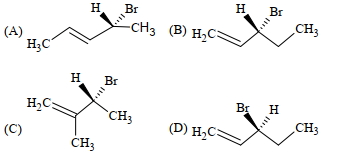
Compound$(s)$ that on hydrogenation produce$(s)$ optically inactive compound$(s)$ is (are)
A
$(A, D)$
B
$(A, C)$
C
$(B, C)$
D
$(B, D)$
Solution
(D) Hydrogenation of the given compounds results in the following products:
$(A)$ $CH_3-CH=CH-CH(Br)CH_3 \xrightarrow{H_2/Pt} CH_3-CH_2-CH_2-CH(Br)CH_3$. The product has a chiral center and is optically active.
$(B)$ $H_2C=CH-CH(Br)CH_2CH_3 \xrightarrow{H_2/Pt} CH_3-CH_2-CH(Br)CH_2CH_3$. The product is $3$-bromopentane,which has a plane of symmetry and is optically inactive.
$(C)$ $H_2C=C(CH_3)-CH(Br)CH_3 \xrightarrow{H_2/Pt} CH_3-CH(CH_3)-CH(Br)CH_3$. The product has two chiral centers and is optically active.
$(D)$ $H_2C=CH-C(Br)(H)CH_2CH_3 \xrightarrow{H_2/Pt} CH_3-CH_2-CH(Br)CH_2CH_3$. The product is $3$-bromopentane,which is optically inactive.
Thus,compounds $(B)$ and $(D)$ produce optically inactive compounds upon hydrogenation.
$(A)$ $CH_3-CH=CH-CH(Br)CH_3 \xrightarrow{H_2/Pt} CH_3-CH_2-CH_2-CH(Br)CH_3$. The product has a chiral center and is optically active.
$(B)$ $H_2C=CH-CH(Br)CH_2CH_3 \xrightarrow{H_2/Pt} CH_3-CH_2-CH(Br)CH_2CH_3$. The product is $3$-bromopentane,which has a plane of symmetry and is optically inactive.
$(C)$ $H_2C=C(CH_3)-CH(Br)CH_3 \xrightarrow{H_2/Pt} CH_3-CH(CH_3)-CH(Br)CH_3$. The product has two chiral centers and is optically active.
$(D)$ $H_2C=CH-C(Br)(H)CH_2CH_3 \xrightarrow{H_2/Pt} CH_3-CH_2-CH(Br)CH_2CH_3$. The product is $3$-bromopentane,which is optically inactive.
Thus,compounds $(B)$ and $(D)$ produce optically inactive compounds upon hydrogenation.
0 likesView Solution
8
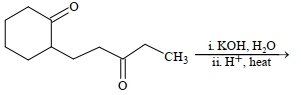
ChemistryMCQIIT JEE · 2015
The major product of the following reaction is
A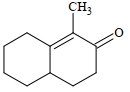
B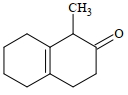
C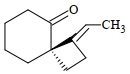
D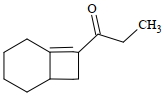
Solution
(A) The reaction is an intramolecular aldol condensation.
$1$. The base $(OH^-)$ abstracts an $\alpha$-hydrogen from the ketone group to form an enolate ion.
$2$. The enolate ion attacks the carbonyl carbon of the other ketone group to form a cyclic $\beta$-hydroxy ketone.
$3$. Upon treatment with acid $(H^+)$ and heat,the $\beta$-hydroxy ketone undergoes dehydration (elimination of $H_2O$) to form an $\alpha,\beta$-unsaturated ketone as the major product.
$1$. The base $(OH^-)$ abstracts an $\alpha$-hydrogen from the ketone group to form an enolate ion.
$2$. The enolate ion attacks the carbonyl carbon of the other ketone group to form a cyclic $\beta$-hydroxy ketone.
$3$. Upon treatment with acid $(H^+)$ and heat,the $\beta$-hydroxy ketone undergoes dehydration (elimination of $H_2O$) to form an $\alpha,\beta$-unsaturated ketone as the major product.
0 likesView Solution
9
ChemistryMediumMCQIIT JEE · 2015
In the following reaction,the major product is
$H_2C=C(CH_3)-CH=CH_2 \xrightarrow{1 \text{ equivalent } HBr}$
$H_2C=C(CH_3)-CH=CH_2 \xrightarrow{1 \text{ equivalent } HBr}$
A
$H_2C=C(CH_3)-CH(Br)-CH_3$
B
$H_2C=C(CH_3)-CH_2-CH_2Br$
C
$Br-CH_2-C(CH_3)=CH-CH_3$
D
$H_3C-C(Br)(CH_3)-CH=CH_2$
Solution
(C) The reaction is an electrophilic addition of $HBr$ to a conjugated diene,$2-\text{methylbuta}-1,3-\text{diene}$ (isoprene).
$1$. Protonation of the terminal double bond $(C_1)$ occurs to form the most stable carbocation.
$2$. Protonation at $C_1$ gives a tertiary allylic carbocation: $H_3C-C^+(CH_3)-CH=CH_2$,which is resonance stabilized.
$3$. The resonance structure is $H_3C-C(CH_3)=CH-CH_2^+$.
$4$. The bromide ion $(Br^-)$ attacks the primary carbocation site $(C_4)$ to give the thermodynamically more stable product (more substituted alkene).
$5$. The major product is $1-\text{bromo}-3-\text{methylbut}-2-\text{ene}$,which corresponds to option $C$.
$1$. Protonation of the terminal double bond $(C_1)$ occurs to form the most stable carbocation.
$2$. Protonation at $C_1$ gives a tertiary allylic carbocation: $H_3C-C^+(CH_3)-CH=CH_2$,which is resonance stabilized.
$3$. The resonance structure is $H_3C-C(CH_3)=CH-CH_2^+$.
$4$. The bromide ion $(Br^-)$ attacks the primary carbocation site $(C_4)$ to give the thermodynamically more stable product (more substituted alkene).
$5$. The major product is $1-\text{bromo}-3-\text{methylbut}-2-\text{ene}$,which corresponds to option $C$.
0 likesView Solution
10
ChemistryMediumMCQIIT JEE · 2015
$Fe^{3+}$ is reduced to $Fe^{2+}$ by using:
$A$. $H_2O_2$ in presence of $NaOH$
$B$. $Na_2O_2$ in water
$C$. $H_2O_2$ in presence of $H_2SO_4$
$D$. $Na_2O_2$ in presence of $H_2SO_4$
$A$. $H_2O_2$ in presence of $NaOH$
$B$. $Na_2O_2$ in water
$C$. $H_2O_2$ in presence of $H_2SO_4$
$D$. $Na_2O_2$ in presence of $H_2SO_4$
A
$A, B$
B
$B, D$
C
$B, C$
D
$A, C$
Solution
(A) $H_2O_2$ acts as a reducing agent in an alkaline medium.
In the presence of $NaOH$,$H_2O_2$ reduces $Fe^{3+}$ to $Fe^{2+}$: $2Fe^{3+} + H_2O_2 + 2OH^{-} \longrightarrow 2Fe^{2+} + 2H_2O + O_2$.
$Na_2O_2$ in water produces $H_2O_2$ and $NaOH$: $Na_2O_2 + 2H_2O \longrightarrow H_2O_2 + 2NaOH$.
Since $Na_2O_2$ in water generates an alkaline medium containing $H_2O_2$,it also reduces $Fe^{3+}$ to $Fe^{2+}$.
Therefore,both $A$ and $B$ are correct.
In the presence of $NaOH$,$H_2O_2$ reduces $Fe^{3+}$ to $Fe^{2+}$: $2Fe^{3+} + H_2O_2 + 2OH^{-} \longrightarrow 2Fe^{2+} + 2H_2O + O_2$.
$Na_2O_2$ in water produces $H_2O_2$ and $NaOH$: $Na_2O_2 + 2H_2O \longrightarrow H_2O_2 + 2NaOH$.
Since $Na_2O_2$ in water generates an alkaline medium containing $H_2O_2$,it also reduces $Fe^{3+}$ to $Fe^{2+}$.
Therefore,both $A$ and $B$ are correct.
0 likesView Solution
11
ChemistryAdvancedMCQIIT JEE · 2015
The $\%$ yield of ammonia as a function of time in the reaction $N_{2(g)} + 3H_{2(g)} \rightleftharpoons 2NH_{3(g)}$,$\Delta H < 0$ at $(P, T_1)$ is given below. If this reaction is conducted at $(P, T_2)$,with $T_2 > T_1$,the $\%$ yield of ammonia as a function of time is represented by:
A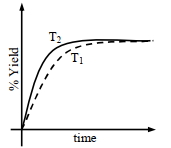
B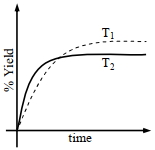
C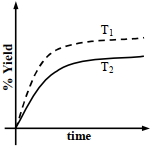
D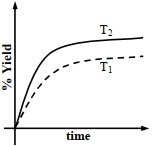
Solution
(C) The reaction $N_{2(g)} + 3H_{2(g)} \rightleftharpoons 2NH_{3(g)}$ is exothermic $(\Delta H < 0)$.
According to Le Chatelier's principle,increasing the temperature $(T_2 > T_1)$ will shift the equilibrium in the backward direction,resulting in a lower equilibrium yield of ammonia at $T_2$ compared to $T_1$.
However,increasing the temperature increases the rate of reaction,so the system reaches equilibrium faster at $T_2$ than at $T_1$.
Therefore,the curve for $T_2$ will rise more steeply initially but will level off at a lower equilibrium yield value than the curve for $T_1$.
According to Le Chatelier's principle,increasing the temperature $(T_2 > T_1)$ will shift the equilibrium in the backward direction,resulting in a lower equilibrium yield of ammonia at $T_2$ compared to $T_1$.
However,increasing the temperature increases the rate of reaction,so the system reaches equilibrium faster at $T_2$ than at $T_1$.
Therefore,the curve for $T_2$ will rise more steeply initially but will level off at a lower equilibrium yield value than the curve for $T_1$.
0 likesView Solution
12
ChemistryAdvancedMCQIIT JEE · 2015
Match the thermodynamic processes given under Column $I$ with the expression given under Column $II$:
| Column $I$ | Column $II$ |
| $A$. Freezing of water at $273 \ K$ and $1 \ atm$ | $P$. $q=0$ |
| $B$. Expansion of $1 \ mol$ of an ideal gas into a vacuum under isolated conditions | $Q$. $w=0$ |
| $C$. Mixing of equal volumes of two ideal gases at constant temperature and pressure in an isolated container | $R$. $\Delta S_{sys} < 0$ |
| $D$. Reversible heating of $H_{2(g)}$ at $1 \ atm$ from $300 \ K$ to $600 \ K$,followed by reversible cooling to $300 \ K$ at $1 \ atm$ | $S$. $\Delta U=0$ |
| $T$. $\Delta G=0$ |
A
$A$ $\rightarrow (R, T); B$ $\rightarrow (P, Q, S); C$ $\rightarrow (P, Q, S); D$ $\rightarrow (P, Q, S, T)$
B
$A$ $\rightarrow (R, S); B$ $\rightarrow (P, Q, R); C$ $\rightarrow (P, Q, R); D$ $\rightarrow (P, Q, R, T)$
C
$A$ $\rightarrow (P, T); B$ $\rightarrow (P, R, T); C$ $\rightarrow (P, R, T); D$ $\rightarrow (P, R, S, T)$
D
$A$ $\rightarrow (S, T); B$ $\rightarrow (R, S, T); C$ $\rightarrow (Q, R, S); D$ $\rightarrow (Q, R, S, T)$
Solution
(A) . Freezing of water at $273 \ K$ and $1 \ atm$ is a reversible phase change at equilibrium,so $\Delta G = 0$. Since entropy decreases during freezing,$\Delta S_{sys} < 0$. Thus,$A \rightarrow (R, T)$.
$B$. Expansion of an ideal gas into a vacuum is free expansion $(w=0)$. Under isolated conditions,$q=0$,so $\Delta U = q + w = 0$. Thus,$B \rightarrow (P, Q, S)$.
$C$. Mixing of ideal gases in an isolated container implies $q=0$ and $w=0$ (no external work),so $\Delta U = 0$. Thus,$C \rightarrow (P, Q, S)$.
$D$. Reversible heating and cooling back to the initial state is a cyclic process. For any cyclic process,the change in state functions is zero,so $\Delta U = 0$. Since it is reversible,$\Delta S_{total} = 0$,but $\Delta S_{sys}$ is not necessarily zero. However,for a cycle,$\Delta U = 0$. In this specific reversible cycle,$q \neq 0$ and $w \neq 0$ over the path,but $\Delta U = 0$. The options provided suggest $D \rightarrow (P, Q, S, T)$ is not strictly correct as $q \neq 0$ and $w \neq 0$. Re-evaluating the options,$A \rightarrow (R, T)$ and $B \rightarrow (P, Q, S)$ match option $A$.
$B$. Expansion of an ideal gas into a vacuum is free expansion $(w=0)$. Under isolated conditions,$q=0$,so $\Delta U = q + w = 0$. Thus,$B \rightarrow (P, Q, S)$.
$C$. Mixing of ideal gases in an isolated container implies $q=0$ and $w=0$ (no external work),so $\Delta U = 0$. Thus,$C \rightarrow (P, Q, S)$.
$D$. Reversible heating and cooling back to the initial state is a cyclic process. For any cyclic process,the change in state functions is zero,so $\Delta U = 0$. Since it is reversible,$\Delta S_{total} = 0$,but $\Delta S_{sys}$ is not necessarily zero. However,for a cycle,$\Delta U = 0$. In this specific reversible cycle,$q \neq 0$ and $w \neq 0$ over the path,but $\Delta U = 0$. The options provided suggest $D \rightarrow (P, Q, S, T)$ is not strictly correct as $q \neq 0$ and $w \neq 0$. Re-evaluating the options,$A \rightarrow (R, T)$ and $B \rightarrow (P, Q, S)$ match option $A$.
0 likesView Solution
13
ChemistryMCQIIT JEE · 2015
The minimum number of times a fair coin needs to be tossed,so that the probability of getting at least two heads is at least $0.96$ is
A
$5$
B
$6$
C
$7$
D
$8$
Solution
(D) Let the coin be tossed $n$ times.
The probability of getting at least two heads is given by $P(X \geq 2) = 1 - P(X < 2) = 1 - [P(X=0) + P(X=1)]$.
Since the coin is fair,$P(X=k) = \binom{n}{k} (\frac{1}{2})^n$.
Thus,$P(X=0) = \frac{1}{2^n}$ and $P(X=1) = \frac{n}{2^n}$.
The condition is $1 - [\frac{1}{2^n} + \frac{n}{2^n}] \geq 0.96$.
$1 - \frac{n+1}{2^n} \geq 0.96$.
$\frac{n+1}{2^n} \leq 1 - 0.96 = 0.04 = \frac{4}{100} = \frac{1}{25}$.
$\frac{2^n}{n+1} \geq 25$.
Testing values for $n$:
For $n=7$: $\frac{2^7}{7+1} = \frac{128}{8} = 16 < 25$.
For $n=8$: $\frac{2^8}{8+1} = \frac{256}{9} \approx 28.44 \geq 25$.
Thus,the minimum number of tosses required is $8$.
The probability of getting at least two heads is given by $P(X \geq 2) = 1 - P(X < 2) = 1 - [P(X=0) + P(X=1)]$.
Since the coin is fair,$P(X=k) = \binom{n}{k} (\frac{1}{2})^n$.
Thus,$P(X=0) = \frac{1}{2^n}$ and $P(X=1) = \frac{n}{2^n}$.
The condition is $1 - [\frac{1}{2^n} + \frac{n}{2^n}] \geq 0.96$.
$1 - \frac{n+1}{2^n} \geq 0.96$.
$\frac{n+1}{2^n} \leq 1 - 0.96 = 0.04 = \frac{4}{100} = \frac{1}{25}$.
$\frac{2^n}{n+1} \geq 25$.
Testing values for $n$:
For $n=7$: $\frac{2^7}{7+1} = \frac{128}{8} = 16 < 25$.
For $n=8$: $\frac{2^8}{8+1} = \frac{256}{9} \approx 28.44 \geq 25$.
Thus,the minimum number of tosses required is $8$.
0 likesView Solution
14
ChemistryMCQIIT JEE · 2015
An electron in an excited state of $Li^{2+}$ ion has angular momentum $3h/2\pi$. The de Broglie wavelength of the electron in this state is $p\pi a_0$ (where $a_0$ is the Bohr radius). The value of $p$ is
A
$1$
B
$2$
C
$3$
D
$4$
Solution
(B) According to Bohr's postulate,the angular momentum $L$ is given by $L = \frac{nh}{2\pi}$.
Given $L = \frac{3h}{2\pi}$,we find $n = 3$.
The radius of the $n^{th}$ orbit for a hydrogen-like ion is $r_n = a_0 \frac{n^2}{Z}$.
For $Li^{2+}$,the atomic number $Z = 3$. Thus,$r_3 = a_0 \frac{3^2}{3} = 3a_0$.
The de Broglie wavelength $\lambda$ is given by $\lambda = \frac{h}{mv}$.
From the angular momentum formula,$mvr = \frac{nh}{2\pi}$,so $mv = \frac{nh}{2\pi r}$.
Substituting this into the wavelength formula: $\lambda = \frac{h}{nh / (2\pi r)} = \frac{2\pi r}{n}$.
For $n = 3$ and $r = 3a_0$,we get $\lambda = \frac{2\pi (3a_0)}{3} = 2\pi a_0$.
Comparing this with $p\pi a_0$,we get $p = 2$.
Given $L = \frac{3h}{2\pi}$,we find $n = 3$.
The radius of the $n^{th}$ orbit for a hydrogen-like ion is $r_n = a_0 \frac{n^2}{Z}$.
For $Li^{2+}$,the atomic number $Z = 3$. Thus,$r_3 = a_0 \frac{3^2}{3} = 3a_0$.
The de Broglie wavelength $\lambda$ is given by $\lambda = \frac{h}{mv}$.
From the angular momentum formula,$mvr = \frac{nh}{2\pi}$,so $mv = \frac{nh}{2\pi r}$.
Substituting this into the wavelength formula: $\lambda = \frac{h}{nh / (2\pi r)} = \frac{2\pi r}{n}$.
For $n = 3$ and $r = 3a_0$,we get $\lambda = \frac{2\pi (3a_0)}{3} = 2\pi a_0$.
Comparing this with $p\pi a_0$,we get $p = 2$.
0 likesView Solution
15
ChemistryAdvancedMCQIIT JEE · 2015
In dilute aqueous $H_2SO_4$,the complex diaquodioxalatoferrate$(II)$ is oxidized by $MnO_4^-$. For this reaction,the ratio of the rate of change of $[H^{+}]$ to the rate of change of $[MnO_4^-]$ is
A
$5$
B
$6$
C
$7$
D
$8$
Solution
(D) The balanced chemical equation for the reaction is:
$5[Fe(C_2O_4)_2(H_2O)_2]^{2-} + 3MnO_4^- + 24H^{+} \longrightarrow 3Mn^{2+} + 5Fe^{3+} + 10CO_2 + 22H_2O$
From the stoichiometry of the reaction,the rate of change of concentration is related to the stoichiometric coefficients as:
$-\frac{1}{24} \frac{d[H^{+}]}{dt} = -\frac{1}{3} \frac{d[MnO_4^-]}{dt}$
Therefore,the ratio of the rate of change of $[H^{+}]$ to the rate of change of $[MnO_4^-]$ is:
$\frac{d[H^{+}]}{dt} / \frac{d[MnO_4^-]}{dt} = \frac{24}{3} = 8$.
$5[Fe(C_2O_4)_2(H_2O)_2]^{2-} + 3MnO_4^- + 24H^{+} \longrightarrow 3Mn^{2+} + 5Fe^{3+} + 10CO_2 + 22H_2O$
From the stoichiometry of the reaction,the rate of change of concentration is related to the stoichiometric coefficients as:
$-\frac{1}{24} \frac{d[H^{+}]}{dt} = -\frac{1}{3} \frac{d[MnO_4^-]}{dt}$
Therefore,the ratio of the rate of change of $[H^{+}]$ to the rate of change of $[MnO_4^-]$ is:
$\frac{d[H^{+}]}{dt} / \frac{d[MnO_4^-]}{dt} = \frac{24}{3} = 8$.
0 likesView Solution
16
ChemistryAdvancedMCQIIT JEE · 2015
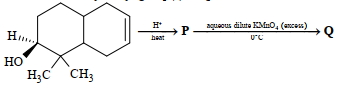
The number of hydroxyl group$(s)$ in $Q$ is
A
$1$
B
$2$
C
$3$
D
$4$
Solution
(D) Step $1$: Acid-catalyzed dehydration of the starting alcohol leads to the formation of a carbocation,which then undergoes rearrangement and elimination to form the diene $P$ (a decalin derivative with two double bonds).
Step $2$: The diene $P$ reacts with aqueous dilute $KMnO_4$ (Baeyer's reagent) at $0^{\circ}C$. This reagent performs syn-dihydroxylation of double bonds.
Step $3$: Since $P$ has two double bonds,both are converted into diols. The resulting product $Q$ contains four hydroxyl groups (two from each double bond).
Thus,the number of hydroxyl groups in $Q$ is $4$.
Step $2$: The diene $P$ reacts with aqueous dilute $KMnO_4$ (Baeyer's reagent) at $0^{\circ}C$. This reagent performs syn-dihydroxylation of double bonds.
Step $3$: Since $P$ has two double bonds,both are converted into diols. The resulting product $Q$ contains four hydroxyl groups (two from each double bond).
Thus,the number of hydroxyl groups in $Q$ is $4$.
0 likesView Solution
17
ChemistryDifficultMCQIIT JEE · 2015
Three moles of $B_2H_6$ are completely reacted with methanol. The number of moles of boron containing product formed is
A
$5$
B
$6$
C
$7$
D
$8$
Solution
(B) The balanced chemical equation for the reaction of diborane with methanol is:
$B_2H_6 + 6 CH_3OH \longrightarrow 2 B(OCH_3)_3 + 6 H_2$
From the stoichiometry of the reaction,$1$ mole of $B_2H_6$ produces $2$ moles of the boron-containing product,trimethyl borate $(B(OCH_3)_3)$.
Therefore,$3$ moles of $B_2H_6$ will produce $3 \times 2 = 6$ moles of $B(OCH_3)_3$.
$B_2H_6 + 6 CH_3OH \longrightarrow 2 B(OCH_3)_3 + 6 H_2$
From the stoichiometry of the reaction,$1$ mole of $B_2H_6$ produces $2$ moles of the boron-containing product,trimethyl borate $(B(OCH_3)_3)$.
Therefore,$3$ moles of $B_2H_6$ will produce $3 \times 2 = 6$ moles of $B(OCH_3)_3$.
0 likesView Solution
18
ChemistryAdvancedMCQIIT JEE · 2015
One mole of a monoatomic real gas satisfies the equation $p(V-b)=RT$ where $b$ is a constant. The relationship of interatomic potential $V(r)$ and interatomic distance $r$ for the gas is given by
A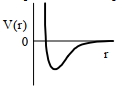
B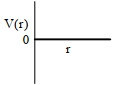
C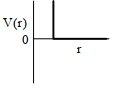
D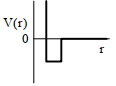
Solution
(C) The given equation is $p(V-b) = RT$. This is a simplified form of the van der Waals equation where the attractive force constant $a$ is assumed to be $0$ $(a = 0)$.
This implies that there are no long-range attractive forces between the gas particles.
However,the constant $b$ represents the excluded volume,which accounts for the finite size of the gas particles and the short-range repulsive forces.
For $r < d$ (where $d$ is the hard-sphere diameter),the potential energy $V(r)$ becomes infinite due to strong repulsion.
For $r \geq d$,since $a = 0$,there is no attraction,so the potential energy $V(r)$ remains $0$.
This corresponds to a hard-sphere potential model,which is represented by a graph that is $0$ for $r > d$ and rises vertically to infinity at $r = d$.
This implies that there are no long-range attractive forces between the gas particles.
However,the constant $b$ represents the excluded volume,which accounts for the finite size of the gas particles and the short-range repulsive forces.
For $r < d$ (where $d$ is the hard-sphere diameter),the potential energy $V(r)$ becomes infinite due to strong repulsion.
For $r \geq d$,since $a = 0$,there is no attraction,so the potential energy $V(r)$ remains $0$.
This corresponds to a hard-sphere potential model,which is represented by a graph that is $0$ for $r > d$ and rises vertically to infinity at $r = d$.
0 likesView Solution
19
ChemistryAdvancedMCQIIT JEE · 2015
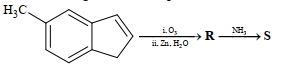
In the following reactions,the product $S$ is
A
$6-$methylisoquinoline
B
$6-$methylquinoline
C
$7-$methylisoquinoline
D
$7-$methylquinoline
Solution
(A) The reaction sequence is as follows: \\ $1$. Ozonolysis of $5$-methylindene followed by reductive workup $(Zn, H_2O)$ yields a dialdehyde intermediate $(R)$,which is $2-(2-oxopropyl)benzaldehyde$ derivative. \\ $2$. The reaction of this dialdehyde with $NH_3$ involves an intramolecular condensation reaction. \\ $3$. The nitrogen atom of ammonia attacks one of the carbonyl groups to form an imine,which then undergoes cyclization with the other carbonyl group. \\ $4$. Subsequent dehydration leads to the formation of the aromatic heterocyclic compound $S$,which is $6$-methylisoquinoline.
0 likesView Solution
20
ChemistryAdvancedMCQIIT JEE · 2015
The major product $U$ in the following reactions is

A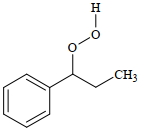
B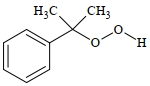
C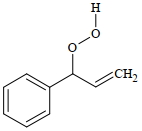
D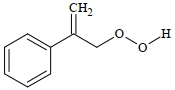
Solution
(B) $1$. The first step is the Friedel-Crafts alkylation of benzene with propene in the presence of an acid catalyst $(H^+)$. This reaction proceeds via the formation of an isopropyl carbocation,which attacks the benzene ring to form cumene (isopropylbenzene) as intermediate $T$.
$2$. The second step is the autoxidation of cumene. In the presence of oxygen $(O_2)$ and a radical initiator,the benzylic hydrogen is abstracted to form a benzylic radical,which then reacts with $O_2$ to form cumene hydroperoxide as the major product $U$.
$3$. The structure of cumene hydroperoxide is $C_6H_5-C(CH_3)_2-O-OH$.
$2$. The second step is the autoxidation of cumene. In the presence of oxygen $(O_2)$ and a radical initiator,the benzylic hydrogen is abstracted to form a benzylic radical,which then reacts with $O_2$ to form cumene hydroperoxide as the major product $U$.
$3$. The structure of cumene hydroperoxide is $C_6H_5-C(CH_3)_2-O-OH$.
0 likesView Solution
21
ChemistryAdvancedMCQIIT JEE · 2015
Under hydrolytic conditions,the compounds used for preparation of linear polymer and for chain termination,respectively,are
A
$CH_3SiCl_3$ and $Si(CH_3)_4$
B
$(CH_3)_2SiCl_2$ and $(CH_3)_3SiCl$
C
$(CH_3)_2SiCl_2$ and $CH_3SiCl_3$
D
$SiCl_4$ and $(CH_3)_3SiCl$
Solution
(B) The hydrolysis of $(CH_3)_2SiCl_2$ leads to the formation of a linear silicone polymer because it has two reactive chlorine atoms that can form siloxane linkages in two directions.
To control the length of the polymer chain and prevent further growth,chain termination is performed using $(CH_3)_3SiCl$. This compound has only one reactive chlorine atom,which caps the end of the polymer chain,preventing further polymerization.
Therefore,$(CH_3)_2SiCl_2$ is used for the preparation of the linear polymer,and $(CH_3)_3SiCl$ is used for chain termination.
To control the length of the polymer chain and prevent further growth,chain termination is performed using $(CH_3)_3SiCl$. This compound has only one reactive chlorine atom,which caps the end of the polymer chain,preventing further polymerization.
Therefore,$(CH_3)_2SiCl_2$ is used for the preparation of the linear polymer,and $(CH_3)_3SiCl$ is used for chain termination.
0 likesView Solution
22
ChemistryAdvancedIIT JEE · 2015
When $100 \ mL$ of $1.0 \ M \ HCl$ was mixed with $100 \ mL$ of $1.0 \ M \ NaOH$ in an insulated beaker at constant pressure,a temperature increase of $5.7^{\circ} C$ was measured for the beaker and its contents (Expt. $1$). Because the enthalpy of neutralization of a strong acid with a strong base is a constant $\left(-57.0 \ kJ \ mol ^{-1}\right)$,this experiment could be used to measure the calorimeter constant. In a second experiment (Expt. $2$),$100 \ mL$ of $2.0 \ M$ acetic acid $\left(K_a=2.0 \times 10^{-5}\right)$ was mixed with $100 \ mL$ of $1.0 \ M \ NaOH$ (under identical conditions to Expt. $1$) where a temperature rise of $5.6^{\circ} C$ was measured.
(Consider heat capacity of all solutions as $4.2 \ J \ g ^{-1} K ^{-1}$ and density of all solutions as $1.0 \ g \ mL ^{-1}$)
$1.$ Enthalpy of dissociation (in $kJ \ mol ^{-1}$) of acetic acid obtained from the Expt. $2$ is
$(A) \ 1.0 \ (B) \ 10.0 \ (C) \ 24.5 \ (D) \ 51.4$
$2.$ The $pH$ of the solution after Expt. $2$ is
$(A) \ 2.8 \ (B) \ 4.7 \ (C) \ 5.0 \ (D) \ 7.0$
Give the answer for question $1$ and $2.$
(Consider heat capacity of all solutions as $4.2 \ J \ g ^{-1} K ^{-1}$ and density of all solutions as $1.0 \ g \ mL ^{-1}$)
$1.$ Enthalpy of dissociation (in $kJ \ mol ^{-1}$) of acetic acid obtained from the Expt. $2$ is
$(A) \ 1.0 \ (B) \ 10.0 \ (C) \ 24.5 \ (D) \ 51.4$
$2.$ The $pH$ of the solution after Expt. $2$ is
$(A) \ 2.8 \ (B) \ 4.7 \ (C) \ 5.0 \ (D) \ 7.0$
Give the answer for question $1$ and $2.$
Solution
(A) $1.$ $HCl + NaOH \longrightarrow NaCl + H_2O$
$n = 100 \times 1 = 100 \ mmol = 0.1 \ mol$
Energy evolved due to neutralization of $HCl$ and $NaOH = 0.1 \times 57 = 5.7 \ kJ = 5700 \ J$
Energy used to increase temperature of solution $= 200 \times 4.2 \times 5.7 = 4788 \ J$
Energy used to increase temperature of calorimeter $= 5700 - 4788 = 912 \ J$
Calorimeter constant $(C_{cal}) = \frac{912 \ J}{5.7^{\circ}C} = 160 \ J/^{\circ}C$
Energy evolved by neutralization of $CH_3COOH$ and $NaOH$ in Expt. $2$ $= (200 \times 4.2 \times 5.6) + (160 \times 5.6) = 4704 + 896 = 5600 \ J$
Energy used in dissociation of $0.1 \ mol \ CH_3COOH = 5700 - 5600 = 100 \ J = 0.1 \ kJ$
Enthalpy of dissociation $= \frac{0.1 \ kJ}{0.1 \ mol} = 1.0 \ kJ \ mol^{-1}$
$2.$ After mixing,$[CH_3COOH] = \frac{100 \times 2 - 100 \times 1}{200} = 0.5 \ M$ and $[CH_3COONa] = \frac{100 \times 1}{200} = 0.5 \ M$
$pK_a = -\log(2.0 \times 10^{-5}) = 5 - \log 2 = 5 - 0.3 = 4.7$
Using Henderson-Hasselbalch equation: $pH = pK_a + \log \frac{[salt]}{[acid]} = 4.7 + \log \frac{0.5}{0.5} = 4.7$
$n = 100 \times 1 = 100 \ mmol = 0.1 \ mol$
Energy evolved due to neutralization of $HCl$ and $NaOH = 0.1 \times 57 = 5.7 \ kJ = 5700 \ J$
Energy used to increase temperature of solution $= 200 \times 4.2 \times 5.7 = 4788 \ J$
Energy used to increase temperature of calorimeter $= 5700 - 4788 = 912 \ J$
Calorimeter constant $(C_{cal}) = \frac{912 \ J}{5.7^{\circ}C} = 160 \ J/^{\circ}C$
Energy evolved by neutralization of $CH_3COOH$ and $NaOH$ in Expt. $2$ $= (200 \times 4.2 \times 5.6) + (160 \times 5.6) = 4704 + 896 = 5600 \ J$
Energy used in dissociation of $0.1 \ mol \ CH_3COOH = 5700 - 5600 = 100 \ J = 0.1 \ kJ$
Enthalpy of dissociation $= \frac{0.1 \ kJ}{0.1 \ mol} = 1.0 \ kJ \ mol^{-1}$
$2.$ After mixing,$[CH_3COOH] = \frac{100 \times 2 - 100 \times 1}{200} = 0.5 \ M$ and $[CH_3COONa] = \frac{100 \times 1}{200} = 0.5 \ M$
$pK_a = -\log(2.0 \times 10^{-5}) = 5 - \log 2 = 5 - 0.3 = 4.7$
Using Henderson-Hasselbalch equation: $pH = pK_a + \log \frac{[salt]}{[acid]} = 4.7 + \log \frac{0.5}{0.5} = 4.7$
0 likesView Solution
23
ChemistryAdvancedMCQIIT JEE · 2015
In the following reactions:
$1.$ Compound $X$ is
$2.$ The major compound $Y$ is
Give the answer for question $1$ and $2.$
$1.$ Compound $X$ is
$2.$ The major compound $Y$ is
Give the answer for question $1$ and $2.$
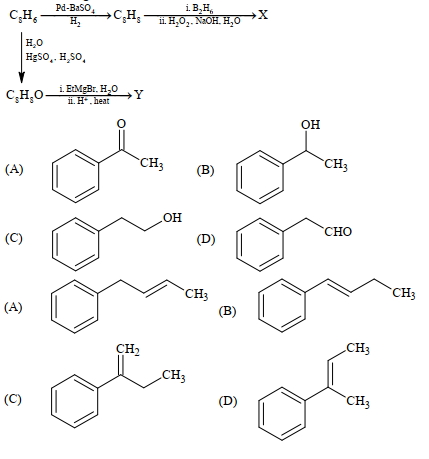
A
$1. (C), 2. (D)$
B
$1. (B), 2. (D)$
C
$1. (C), 2. (C)$
D
$1. (B), 2. (C)$
Solution
(A) $1.$ The starting material is phenylacetylene $(C_6H_5C \equiv CH)$.
Reaction with $Pd-BaSO_4/H_2$ gives styrene $(C_6H_5CH=CH_2)$.
Hydroboration-oxidation ($B_2H_6$ followed by $H_2O_2/NaOH$) of styrene follows anti-Markovnikov addition of water,yielding $2-phenylethanol$ $(C_6H_5CH_2CH_2OH)$,which corresponds to structure $(C)$.
$2.$ Reaction of phenylacetylene with $H_2O/HgSO_4/H_2SO_4$ (oxymercuration) gives acetophenone $(C_6H_5COCH_3)$.
Reaction with $EtMgBr$ followed by $H_2O$ gives $2-phenylbutan-2-ol$ $(C_6H_5C(OH)(CH_3)CH_2CH_3)$.
Acid-catalyzed dehydration $(H^+/heat)$ of $2-phenylbutan-2-ol$ proceeds via the most stable carbocation to form the most substituted alkene,which is $2-phenylbut-2-ene$ $(C_6H_5C(CH_3)=CHCH_3)$,corresponding to structure $(D)$.
Reaction with $Pd-BaSO_4/H_2$ gives styrene $(C_6H_5CH=CH_2)$.
Hydroboration-oxidation ($B_2H_6$ followed by $H_2O_2/NaOH$) of styrene follows anti-Markovnikov addition of water,yielding $2-phenylethanol$ $(C_6H_5CH_2CH_2OH)$,which corresponds to structure $(C)$.
$2.$ Reaction of phenylacetylene with $H_2O/HgSO_4/H_2SO_4$ (oxymercuration) gives acetophenone $(C_6H_5COCH_3)$.
Reaction with $EtMgBr$ followed by $H_2O$ gives $2-phenylbutan-2-ol$ $(C_6H_5C(OH)(CH_3)CH_2CH_3)$.
Acid-catalyzed dehydration $(H^+/heat)$ of $2-phenylbutan-2-ol$ proceeds via the most stable carbocation to form the most substituted alkene,which is $2-phenylbut-2-ene$ $(C_6H_5C(CH_3)=CHCH_3)$,corresponding to structure $(D)$.
0 likesView Solution
24
ChemistryMediumMCQIIT JEE · 2015
If the freezing point of a $0.01 \ m$ aqueous solution of a cobalt $(III)$ chloride-ammonia complex (which behaves as a strong electrolyte) is $-0.0558^{\circ} C$,the number of chloride $(Cl^-)$ ions in the coordination sphere of the complex is.
$\left[ K_{f} \text{ of water } = 1.86 \ K \ kg \ mol^{-1} \right]$
$\left[ K_{f} \text{ of water } = 1.86 \ K \ kg \ mol^{-1} \right]$
A
$1$
B
$2$
C
$3$
D
$4$
Solution
(A) The depression in freezing point is given by $\Delta T_{f} = i K_{f} m$.
Given $\Delta T_{f} = 0 - (-0.0558) = 0.0558 \ K$,$K_{f} = 1.86 \ K \ kg \ mol^{-1}$,and $m = 0.01 \ m$.
Substituting the values: $0.0558 = i \times 1.86 \times 0.01$.
$i = \frac{0.0558}{0.0186} = 3$.
Since the complex is a cobalt $(III)$ chloride-ammonia complex,it is of the form $[Co(NH_3)_xCl_y]Cl_z$.
For $i = 3$,the complex dissociates into $3$ ions: $[Co(NH_3)_xCl_y]^{2+} + 2Cl^-$.
This implies there are $2$ chloride ions outside the coordination sphere.
Since the coordination number of $Co(III)$ is $6$,the formula is $[Co(NH_3)_5Cl]Cl_2$.
Thus,the number of chloride ions inside the coordination sphere is $1$.
Given $\Delta T_{f} = 0 - (-0.0558) = 0.0558 \ K$,$K_{f} = 1.86 \ K \ kg \ mol^{-1}$,and $m = 0.01 \ m$.
Substituting the values: $0.0558 = i \times 1.86 \times 0.01$.
$i = \frac{0.0558}{0.0186} = 3$.
Since the complex is a cobalt $(III)$ chloride-ammonia complex,it is of the form $[Co(NH_3)_xCl_y]Cl_z$.
For $i = 3$,the complex dissociates into $3$ ions: $[Co(NH_3)_xCl_y]^{2+} + 2Cl^-$.
This implies there are $2$ chloride ions outside the coordination sphere.
Since the coordination number of $Co(III)$ is $6$,the formula is $[Co(NH_3)_5Cl]Cl_2$.
Thus,the number of chloride ions inside the coordination sphere is $1$.
0 likesView Solution
25
ChemistryMediumMCQIIT JEE · 2015
For the octahedral complexes of $Fe^{3+}$ in $SCN^{-}$ (thiocyanato-$S$) and in $CN^{-}$ ligand environments,the difference between the spin-only magnetic moments in Bohr magnetons (when approximated to the nearest integer) is
[Atomic number of $Fe = 26$]
[Atomic number of $Fe = 26$]
A
$4$
B
$5$
C
$6$
D
$7$
Solution
(A) The electronic configuration of $Fe^{3+}$ is $[Ar] 3d^5$.
Case-$1$: In the presence of $SCN^{-}$ (a weak field ligand),no pairing occurs in the $d$-orbitals. The number of unpaired electrons $(n)$ is $5$.
$\mu = \sqrt{n(n+2)} = \sqrt{5(5+2)} = \sqrt{35} \approx 5.91 \ BM$.
Case-$2$: In the presence of $CN^{-}$ (a strong field ligand),pairing occurs in the $d$-orbitals. The number of unpaired electrons $(n)$ is $1$.
$\mu = \sqrt{n(n+2)} = \sqrt{1(1+2)} = \sqrt{3} \approx 1.73 \ BM$.
Difference in spin-only magnetic moments $= 5.91 - 1.73 = 4.18 \ BM$.
Rounding to the nearest integer,the difference is $4$.
Case-$1$: In the presence of $SCN^{-}$ (a weak field ligand),no pairing occurs in the $d$-orbitals. The number of unpaired electrons $(n)$ is $5$.
$\mu = \sqrt{n(n+2)} = \sqrt{5(5+2)} = \sqrt{35} \approx 5.91 \ BM$.
Case-$2$: In the presence of $CN^{-}$ (a strong field ligand),pairing occurs in the $d$-orbitals. The number of unpaired electrons $(n)$ is $1$.
$\mu = \sqrt{n(n+2)} = \sqrt{1(1+2)} = \sqrt{3} \approx 1.73 \ BM$.
Difference in spin-only magnetic moments $= 5.91 - 1.73 = 4.18 \ BM$.
Rounding to the nearest integer,the difference is $4$.
0 likesView Solution
26
ChemistryMediumMCQIIT JEE · 2015
All the energy released from the reaction $X \rightarrow Y, \Delta_{r}G^0 = -193 \ kJ \ mol^{-1}$ is used for oxidizing $M^{+}$ as $M^{+} \rightarrow M^{3+} + 2e^-, E^0 = -0.25 \ V$. Under standard conditions,the number of moles of $M^{+}$ oxidized when one mole of $X$ is converted to $Y$ is $\left[F = 96500 \ C \ mol^{-1}\right]$.
A
$1$
B
$2$
C
$3$
D
$4$
Solution
(D) The energy released from the reaction $X \rightarrow Y$ is $\Delta_{r}G^0 = -193 \ kJ \ mol^{-1} = -193000 \ J \ mol^{-1}$.
For the oxidation reaction $M^{+} \rightarrow M^{3+} + 2e^-$,the number of electrons involved is $n = 2$ and the standard electrode potential is $E^0 = -0.25 \ V$.
The Gibbs free energy change for the oxidation of $1 \ mol$ of $M^{+}$ is $\Delta G^0 = -nFE^0 = -2 \times 96500 \times (-0.25) = 48250 \ J \ mol^{-1} = 48.25 \ kJ \ mol^{-1}$.
The number of moles of $M^{+}$ oxidized by $1 \ mol$ of $X$ is the ratio of the energy released to the energy required per mole of $M^{+}$:
$\text{Number of moles}$ $= \frac{|\Delta_{r}G^0_{X \to Y}|}{\Delta G^0_{M^{+} \to M^{3+}}} = \frac{193 \text{ kJ mol}^{-1}}{48.25 \text{ kJ mol}^{-1}} = 4 \text{ mol}$
For the oxidation reaction $M^{+} \rightarrow M^{3+} + 2e^-$,the number of electrons involved is $n = 2$ and the standard electrode potential is $E^0 = -0.25 \ V$.
The Gibbs free energy change for the oxidation of $1 \ mol$ of $M^{+}$ is $\Delta G^0 = -nFE^0 = -2 \times 96500 \times (-0.25) = 48250 \ J \ mol^{-1} = 48.25 \ kJ \ mol^{-1}$.
The number of moles of $M^{+}$ oxidized by $1 \ mol$ of $X$ is the ratio of the energy released to the energy required per mole of $M^{+}$:
$\text{Number of moles}$ $= \frac{|\Delta_{r}G^0_{X \to Y}|}{\Delta G^0_{M^{+} \to M^{3+}}} = \frac{193 \text{ kJ mol}^{-1}}{48.25 \text{ kJ mol}^{-1}} = 4 \text{ mol}$
0 likesView Solution
27
ChemistryMediumMCQIIT JEE · 2015
If the unit cell of a mineral has cubic close packed $(ccp)$ array of oxygen atoms with $m$ fraction of octahedral holes occupied by aluminium ions and $n$ fraction of tetrahedral holes occupied by magnesium ions,$m$ and $n$,respectively,are
A
$\frac{1}{2}, \frac{1}{8}$
B
$1, \frac{1}{4}$
C
$\frac{1}{2}, \frac{1}{2}$
D
$\frac{1}{4}, \frac{1}{8}$
Solution
(A) In a $ccp$ lattice,the number of oxygen atoms per unit cell is $4$.
The number of octahedral voids is $4$ and the number of tetrahedral voids is $8$.
Let the number of $Al^{3+}$ ions be $4m$ and the number of $Mg^{2+}$ ions be $8n$.
For charge neutrality,the total positive charge must equal the total negative charge:
$4(-2) + 4m(+3) + 8n(+2) = 0$
$-8 + 12m + 16n = 0$
$12m + 16n = 8$
Dividing by $4$,we get $3m + 4n = 2$.
Testing the options,for $m = \frac{1}{2}$ and $n = \frac{1}{8}$:
$3(\frac{1}{2}) + 4(\frac{1}{8}) = \frac{3}{2} + \frac{1}{2} = \frac{4}{2} = 2$.
Thus,$m = \frac{1}{2}$ and $n = \frac{1}{8}$ satisfies the condition.
The number of octahedral voids is $4$ and the number of tetrahedral voids is $8$.
Let the number of $Al^{3+}$ ions be $4m$ and the number of $Mg^{2+}$ ions be $8n$.
For charge neutrality,the total positive charge must equal the total negative charge:
$4(-2) + 4m(+3) + 8n(+2) = 0$
$-8 + 12m + 16n = 0$
$12m + 16n = 8$
Dividing by $4$,we get $3m + 4n = 2$.
Testing the options,for $m = \frac{1}{2}$ and $n = \frac{1}{8}$:
$3(\frac{1}{2}) + 4(\frac{1}{8}) = \frac{3}{2} + \frac{1}{2} = \frac{4}{2} = 2$.
Thus,$m = \frac{1}{2}$ and $n = \frac{1}{8}$ satisfies the condition.
0 likesView Solution
28
ChemistryMediumMCQIIT JEE · 2015
The structure of $D-(+)$-glucose is given. What is the structure of $L-(-)$-glucose?
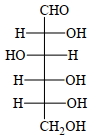
A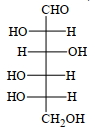
B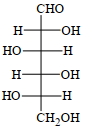
C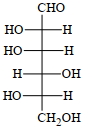
D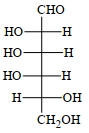
Solution
(B) and $L$ configurations are determined by the position of the $-OH$ group on the chiral carbon furthest from the carbonyl group (the $C-5$ carbon in glucose).
$D$-glucose has the $-OH$ group on the right side at $C-5$.
$L$-glucose is the enantiomer of $D$-glucose,meaning it is its non-superimposable mirror image.
Therefore,in $L-(-)$-glucose,all $-OH$ groups are inverted compared to their positions in $D-(+)$-glucose.
$D$-glucose has the $-OH$ group on the right side at $C-5$.
$L$-glucose is the enantiomer of $D$-glucose,meaning it is its non-superimposable mirror image.
Therefore,in $L-(-)$-glucose,all $-OH$ groups are inverted compared to their positions in $D-(+)$-glucose.
0 likesView Solution
29
ChemistryDifficultMCQIIT JEE · 2015
The major product of the reaction is

A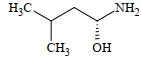
B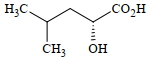
C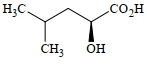
D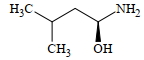
Solution
(D) The reaction of an $\alpha$-amino acid with $NaNO_2$ and aqueous $HCl$ at $0 \ ^\circ C$ leads to the formation of a diazonium salt intermediate.
This diazonium group is a very good leaving group.
The neighboring carboxylate group (or carboxylic acid) can participate in an intramolecular nucleophilic substitution reaction.
This process involves the displacement of the diazonium group by the oxygen atom of the carboxyl group,forming a cyclic lactone-like intermediate (or an activated species).
Subsequently,water acts as a nucleophile to open this intermediate,resulting in the formation of an $\alpha$-hydroxy acid with retention of configuration at the chiral center.
Therefore,the product is the $\alpha$-hydroxy acid with the same stereochemistry as the starting amino acid.
This diazonium group is a very good leaving group.
The neighboring carboxylate group (or carboxylic acid) can participate in an intramolecular nucleophilic substitution reaction.
This process involves the displacement of the diazonium group by the oxygen atom of the carboxyl group,forming a cyclic lactone-like intermediate (or an activated species).
Subsequently,water acts as a nucleophile to open this intermediate,resulting in the formation of an $\alpha$-hydroxy acid with retention of configuration at the chiral center.
Therefore,the product is the $\alpha$-hydroxy acid with the same stereochemistry as the starting amino acid.
0 likesView Solution
30
ChemistryEasyMCQIIT JEE · 2015
The correct statement$(s)$ about $Cr^{2+}$ and $Mn^{3+}$ is(are)
[Atomic numbers of $Cr = 24$ and $Mn = 25$]
$(A)$ $Cr^{2+}$ is a reducing agent
$(B)$ $Mn^{3+}$ is an oxidizing agent
$(C)$ Both $Cr^{2+}$ and $Mn^{3+}$ exhibit $d^4$ electronic configuration
$(D)$ When $Cr^{2+}$ is used as a reducing agent,the chromium ion attains $d^3$ electronic configuration
[Atomic numbers of $Cr = 24$ and $Mn = 25$]
$(A)$ $Cr^{2+}$ is a reducing agent
$(B)$ $Mn^{3+}$ is an oxidizing agent
$(C)$ Both $Cr^{2+}$ and $Mn^{3+}$ exhibit $d^4$ electronic configuration
$(D)$ When $Cr^{2+}$ is used as a reducing agent,the chromium ion attains $d^3$ electronic configuration
A
$(A, B, C)$
B
$(A, B, D)$
C
$(A, C, D)$
D
$(B, C, D)$
Solution
(A, B, C, D) $(1)$ $Cr^{2+}$ $(d^4)$ is a reducing agent because it gets oxidized to $Cr^{3+}$ $(d^3)$,which has a stable half-filled $t_{2g}$ subshell.
$(2)$ $Mn^{3+}$ $(d^4)$ is an oxidizing agent because it gets reduced to $Mn^{2+}$ $(d^5)$,which has a stable half-filled $d$-orbital configuration.
$(3)$ Both $Cr^{2+}$ and $Mn^{3+}$ have $d^4$ electronic configuration.
$(4)$ Since all statements $(A), (B), (C),$ and $(D)$ are correct,the correct option is $(A, B, C, D)$ (Note: Given the provided options,all statements are factually correct).
$(2)$ $Mn^{3+}$ $(d^4)$ is an oxidizing agent because it gets reduced to $Mn^{2+}$ $(d^5)$,which has a stable half-filled $d$-orbital configuration.
$(3)$ Both $Cr^{2+}$ and $Mn^{3+}$ have $d^4$ electronic configuration.
$(4)$ Since all statements $(A), (B), (C),$ and $(D)$ are correct,the correct option is $(A, B, C, D)$ (Note: Given the provided options,all statements are factually correct).
0 likesView Solution
31
ChemistryMediumMCQIIT JEE · 2015
Copper is purified by electrolytic refining of blister copper. The correct statement$(s)$ about this process is(are):
$(A)$ Impure $Cu$ strip is used as cathode
$(B)$ Acidified aqueous $CuSO_4$ is used as electrolyte
$(C)$ Pure $Cu$ deposits at cathode
$(D)$ Impurities settle as anode-mud
$(A)$ Impure $Cu$ strip is used as cathode
$(B)$ Acidified aqueous $CuSO_4$ is used as electrolyte
$(C)$ Pure $Cu$ deposits at cathode
$(D)$ Impurities settle as anode-mud
A
$(A, B, C)$
B
$(A, B, D)$
C
$(A, C, D)$
D
$(B, C, D)$
Solution
(D) In the electrolytic refining of copper:
$1$. An impure $Cu$ strip is used as the anode,not the cathode.
$2$. $A$ pure $Cu$ strip is used as the cathode.
$3$. Acidified aqueous $CuSO_4$ is used as the electrolyte.
$4$. Pure $Cu$ deposits at the cathode.
$5$. Impurities like $Ag$,$Au$,and $Pt$ settle at the bottom of the anode as anode-mud.
Therefore,statements $(B)$,$(C)$,and $(D)$ are correct.
$1$. An impure $Cu$ strip is used as the anode,not the cathode.
$2$. $A$ pure $Cu$ strip is used as the cathode.
$3$. Acidified aqueous $CuSO_4$ is used as the electrolyte.
$4$. Pure $Cu$ deposits at the cathode.
$5$. Impurities like $Ag$,$Au$,and $Pt$ settle at the bottom of the anode as anode-mud.
Therefore,statements $(B)$,$(C)$,and $(D)$ are correct.
0 likesView Solution
32
ChemistryMediumMCQIIT JEE · 2015
Match the anionic species given in Column $I$ that are present in the ore$(s)$ given in Column $II$.
| Column $I$ | Column $II$ |
|---|---|
| $A$. Carbonate | $P$. Siderite |
| $B$. Sulphide | $Q$. Malachite |
| $C$. Hydroxide | $R$. Bauxite |
| $D$. Oxide | $S$. Calamine |
| $T$. Argentite |
A
$A$ $\rightarrow (P, Q, S); B$ $\rightarrow (T); C$ $\rightarrow (Q, R); D$ $\rightarrow (R)$
B
$A$ $\rightarrow (P, R, S); B$ $\rightarrow (S); C$ $\rightarrow (Q, S); D$ $\rightarrow (S)$
C
$A$ $\rightarrow (P, Q, R); B$ $\rightarrow (P); C$ $\rightarrow (P, R); D$ $\rightarrow (P)$
D
$A$ $\rightarrow (Q, R, T); B$ $\rightarrow (T); C$ $\rightarrow (R, T); D$ $\rightarrow (T)$
Solution
(A) The chemical formulas for the given ores are:
Matching the anions:
$A$ (Carbonate): $P, Q, S$
$B$ (Sulphide): $T$
$C$ (Hydroxide): $Q, R$
$D$ (Oxide): $R$
Thus,the correct option is $A$.
| Siderite $(P)$ | $FeCO_3$ (Carbonate) |
| Malachite $(Q)$ | $CuCO_3 \cdot Cu(OH)_2$ (Carbonate,Hydroxide) |
| Bauxite $(R)$ | $AlO_x(OH)_{3-2x}$ (Oxide,Hydroxide) |
| Calamine $(S)$ | $ZnCO_3$ (Carbonate) |
| Argentite $(T)$ | $Ag_2S$ (Sulphide) |
Matching the anions:
$A$ (Carbonate): $P, Q, S$
$B$ (Sulphide): $T$
$C$ (Hydroxide): $Q, R$
$D$ (Oxide): $R$
Thus,the correct option is $A$.
0 likesView Solution
33
ChemistryMediumMCQIIT JEE · 2015
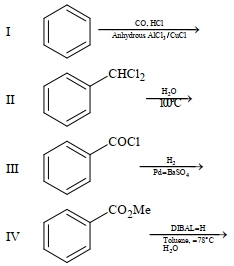
Among the following,the number of reaction$(s)$ that produce$(s)$ benzaldehyde is
A
$1$
B
$2$
C
$3$
D
$4$
Solution
(D) Let us analyze each reaction:
$I$. Gattermann-Koch reaction: Benzene reacts with $CO$ and $HCl$ in the presence of anhydrous $AlCl_3/CuCl$ to form benzaldehyde. This is a standard method for the preparation of benzaldehyde.
$II$. Hydrolysis of benzal chloride: Benzal chloride $(C_6H_5CHCl_2)$ on hydrolysis with water at $100 \ ^\circ C$ yields benzaldehyde $(C_6H_5CHO)$.
$III$. Rosenmund reduction: Benzoyl chloride $(C_6H_5COCl)$ is reduced to benzaldehyde using $H_2$ in the presence of $Pd-BaSO_4$ (Lindlar's catalyst).
$IV$. Reduction of ester: Methyl benzoate $(C_6H_5CO_2Me)$ is reduced to benzaldehyde using $DIBAL-H$ at $-78 \ ^\circ C$ followed by hydrolysis.
All four reactions produce benzaldehyde. Therefore,the total number of reactions is $4$.
$I$. Gattermann-Koch reaction: Benzene reacts with $CO$ and $HCl$ in the presence of anhydrous $AlCl_3/CuCl$ to form benzaldehyde. This is a standard method for the preparation of benzaldehyde.
$II$. Hydrolysis of benzal chloride: Benzal chloride $(C_6H_5CHCl_2)$ on hydrolysis with water at $100 \ ^\circ C$ yields benzaldehyde $(C_6H_5CHO)$.
$III$. Rosenmund reduction: Benzoyl chloride $(C_6H_5COCl)$ is reduced to benzaldehyde using $H_2$ in the presence of $Pd-BaSO_4$ (Lindlar's catalyst).
$IV$. Reduction of ester: Methyl benzoate $(C_6H_5CO_2Me)$ is reduced to benzaldehyde using $DIBAL-H$ at $-78 \ ^\circ C$ followed by hydrolysis.
All four reactions produce benzaldehyde. Therefore,the total number of reactions is $4$.
0 likesView Solution
34
ChemistryAdvancedMCQIIT JEE · 2015
In the complex acetylbromidodicarbonylbis(triethylphosphine)iron$(II)$,the number of $Fe-C$ bond$(s)$ is
A
$1$
B
$2$
C
$3$
D
$4$
Solution
(C) The complex is acetylbromidodicarbonylbis(triethylphosphine)iron$(II)$.
From the structure,the ligands attached to the central $Fe$ atom are:
$1$. Two $CO$ (carbonyl) ligands,which are $Fe-C$ bonded.
$2$. One acetyl group $(-COCH_3)$,which is $Fe-C$ bonded.
$3$. Two $PEt_3$ (triethylphosphine) ligands,which are $Fe-P$ bonded.
$4$. One $Br^-$ (bromide) ligand,which is $Fe-Br$ bonded.
Therefore,the total number of $Fe-C$ bonds is $2$ (from $CO$) $+ 1$ (from acetyl) $= 3$.
From the structure,the ligands attached to the central $Fe$ atom are:
$1$. Two $CO$ (carbonyl) ligands,which are $Fe-C$ bonded.
$2$. One acetyl group $(-COCH_3)$,which is $Fe-C$ bonded.
$3$. Two $PEt_3$ (triethylphosphine) ligands,which are $Fe-P$ bonded.
$4$. One $Br^-$ (bromide) ligand,which is $Fe-Br$ bonded.
Therefore,the total number of $Fe-C$ bonds is $2$ (from $CO$) $+ 1$ (from acetyl) $= 3$.
0 likesView Solution
35
ChemistryAdvancedMCQIIT JEE · 2015
Among the complex ions,$[Co(en)_2Cl_2]^{+}$,$[CrCl_2(C_2O_4)_2]^{3-}$,$[Fe(H_2O)_4(OH)_2]^{+}$,$[Fe(NH_3)_2(CN)_4]^{-}$,$[Co(en)_2(NH_3)Cl]^{2+}$ and $[Co(NH_3)_4(H_2O)Cl]^{2+}$,the number of complex ion$(s)$ that show$(s)$ cis-trans isomerism is
A
$2$
B
$3$
C
$4$
D
$5$
Solution
(D) $1$. $[Co(en)_2Cl_2]^{+}$: This is of the type $[M(AA)_2a_2]$,which shows cis-trans isomerism.
$2$. $[CrCl_2(C_2O_4)_2]^{3-}$: This is of the type $[M(AA)_2a_2]$,which shows cis-trans isomerism.
$3$. $[Fe(H_2O)_4(OH)_2]^{+}$: This is of the type $[Ma_4b_2]$,which shows cis-trans isomerism.
$4$. $[Fe(NH_3)_2(CN)_4]^{-}$: This is of the type $[Ma_4b_2]$,which shows cis-trans isomerism.
$5$. $[Co(en)_2(NH_3)Cl]^{2+}$: This is of the type $[M(AA)_2ab]$,which shows cis-trans isomerism.
$6$. $[Co(NH_3)_4(H_2O)Cl]^{2+}$: This is of the type $[Ma_4bc]$. It shows geometrical isomerism,but specifically,it does not have a 'cis-trans' pair in the same sense as the others (it has facial/meridional or specific geometric arrangements,but is often excluded from the simple cis-trans definition).
Thus,there are $5$ complex ions that show cis-trans isomerism.
$2$. $[CrCl_2(C_2O_4)_2]^{3-}$: This is of the type $[M(AA)_2a_2]$,which shows cis-trans isomerism.
$3$. $[Fe(H_2O)_4(OH)_2]^{+}$: This is of the type $[Ma_4b_2]$,which shows cis-trans isomerism.
$4$. $[Fe(NH_3)_2(CN)_4]^{-}$: This is of the type $[Ma_4b_2]$,which shows cis-trans isomerism.
$5$. $[Co(en)_2(NH_3)Cl]^{2+}$: This is of the type $[M(AA)_2ab]$,which shows cis-trans isomerism.
$6$. $[Co(NH_3)_4(H_2O)Cl]^{2+}$: This is of the type $[Ma_4bc]$. It shows geometrical isomerism,but specifically,it does not have a 'cis-trans' pair in the same sense as the others (it has facial/meridional or specific geometric arrangements,but is often excluded from the simple cis-trans definition).
Thus,there are $5$ complex ions that show cis-trans isomerism.
0 likesView Solution
36
ChemistryAdvancedMCQIIT JEE · 2015
The molar conductivity of a solution of a weak acid $HX$ $(0.01 \ M)$ is $10$ times smaller than the molar conductivity of a solution of a weak acid $HY$ $(0.10 \ M)$. If $\lambda_{X^{-}}^0 \approx \lambda_{Y^{-}}^0$,the difference in their $pK_a$ values,$pK_a(HX) - pK_a(HY)$,is (consider degree of ionization of both acids to be $\ll 1$)
A
$1$
B
$2$
C
$3$
D
$4$
Solution
(C) For a weak acid,the degree of ionization $\alpha$ is given by $\alpha = \frac{\Lambda_m}{\Lambda_m^0}$.
Given $\Lambda_m(HX) = \frac{1}{10} \Lambda_m(HY)$,and assuming $\Lambda_m^0(HX) \approx \Lambda_m^0(HY)$ (since $\lambda_{X^{-}}^0 \approx \lambda_{Y^{-}}^0$),we have $\alpha_{HX} = \frac{1}{10} \alpha_{HY}$.
The dissociation constant $K_a$ for a weak acid is $K_a = C \alpha^2$.
For $HX$: $K_a(HX) = C_1 \alpha_1^2 = 0.01 \times (\frac{1}{10} \alpha_{HY})^2 = 0.01 \times \frac{1}{100} \alpha_{HY}^2 = 10^{-4} \alpha_{HY}^2$.
For $HY$: $K_a(HY) = C_2 \alpha_2^2 = 0.10 \times \alpha_{HY}^2 = 10^{-1} \alpha_{HY}^2$.
Taking the ratio: $\frac{K_a(HX)}{K_a(HY)} = \frac{10^{-4} \alpha_{HY}^2}{10^{-1} \alpha_{HY}^2} = 10^{-3}$.
Therefore,$pK_a(HX) - pK_a(HY) = -\log(K_a(HX)) + \log(K_a(HY)) = -\log(\frac{K_a(HX)}{K_a(HY)}) = -\log(10^{-3}) = 3$.
Given $\Lambda_m(HX) = \frac{1}{10} \Lambda_m(HY)$,and assuming $\Lambda_m^0(HX) \approx \Lambda_m^0(HY)$ (since $\lambda_{X^{-}}^0 \approx \lambda_{Y^{-}}^0$),we have $\alpha_{HX} = \frac{1}{10} \alpha_{HY}$.
The dissociation constant $K_a$ for a weak acid is $K_a = C \alpha^2$.
For $HX$: $K_a(HX) = C_1 \alpha_1^2 = 0.01 \times (\frac{1}{10} \alpha_{HY})^2 = 0.01 \times \frac{1}{100} \alpha_{HY}^2 = 10^{-4} \alpha_{HY}^2$.
For $HY$: $K_a(HY) = C_2 \alpha_2^2 = 0.10 \times \alpha_{HY}^2 = 10^{-1} \alpha_{HY}^2$.
Taking the ratio: $\frac{K_a(HX)}{K_a(HY)} = \frac{10^{-4} \alpha_{HY}^2}{10^{-1} \alpha_{HY}^2} = 10^{-3}$.
Therefore,$pK_a(HX) - pK_a(HY) = -\log(K_a(HX)) + \log(K_a(HY)) = -\log(\frac{K_a(HX)}{K_a(HY)}) = -\log(10^{-3}) = 3$.
0 likesView Solution
37
ChemistryDifficultMCQIIT JEE · 2015
$A$ closed vessel with rigid walls contains $1 \ mol$ of ${ }_{92}^{238} U$ and $1 \ mol$ of air at $298 \ K$. Considering the complete decay of ${ }_{92}^{238} U$ to ${ }_{82}^{206} Pb$, the ratio of the final pressure to the initial pressure of the system at $298 \ K$ is:
A
$6$
B
$7$
C
$8$
D
$9$
Solution
(D) The nuclear decay reaction for ${ }_{92}^{238} U$ to ${ }_{82}^{206} Pb$ is given by: ${ }_{92}^{238} U \rightarrow { }_{82}^{206} Pb + 8 { }_{2}^{4} He + 6 { }_{-1}^{0} e$.
Initially, the system contains $1 \ mol$ of air (gaseous) and $1 \ mol$ of solid ${ }_{92}^{238} U$.
Since the vessel is rigid and the temperature is constant at $298 \ K$, the pressure is directly proportional to the number of moles of gas present $(P \propto n_{gas})$.
Initial moles of gas $(n_i)$ = $1 \ mol$ (air).
After complete decay, the solid ${ }_{92}^{238} U$ is converted into $1 \ mol$ of solid ${ }_{82}^{206} Pb$ and $8 \ mol$ of gaseous ${ }_{2}^{4} He$ ($\alpha$-particles).
The final moles of gas $(n_f)$ = $1 \ mol$ (air) + $8 \ mol$ (He) = $9 \ mol$.
The ratio of the final pressure to the initial pressure is given by $P_f / P_i = n_f / n_i = 9 / 1 = 9$.
Initially, the system contains $1 \ mol$ of air (gaseous) and $1 \ mol$ of solid ${ }_{92}^{238} U$.
Since the vessel is rigid and the temperature is constant at $298 \ K$, the pressure is directly proportional to the number of moles of gas present $(P \propto n_{gas})$.
Initial moles of gas $(n_i)$ = $1 \ mol$ (air).
After complete decay, the solid ${ }_{92}^{238} U$ is converted into $1 \ mol$ of solid ${ }_{82}^{206} Pb$ and $8 \ mol$ of gaseous ${ }_{2}^{4} He$ ($\alpha$-particles).
The final moles of gas $(n_f)$ = $1 \ mol$ (air) + $8 \ mol$ (He) = $9 \ mol$.
The ratio of the final pressure to the initial pressure is given by $P_f / P_i = n_f / n_i = 9 / 1 = 9$.
0 likesView Solution
38
ChemistryAdvancedMCQIIT JEE · 2015
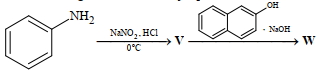
In the following reactions,the major product $W$ is
A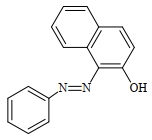
B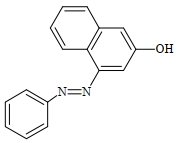
C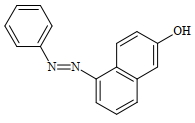
D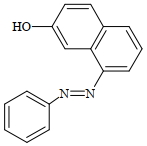
Solution
(A) The reaction proceeds in two steps:
$1$. Aniline reacts with $NaNO_2$ and $HCl$ at $0^{\circ}C$ to form benzene diazonium chloride,which is compound $V$.
$2$. Benzene diazonium chloride $(V)$ undergoes an electrophilic aromatic substitution (coupling reaction) with $\beta$-naphthol in the presence of $NaOH$ to form an azo dye.
$3$. The coupling occurs at the ortho position relative to the $-OH$ group in $\beta$-naphthol because the $-OH$ group is a strong activating group,directing the diazonium ion to the position ortho to it. The major product $W$ is $1$-phenylazo-$2$-naphthol.
$1$. Aniline reacts with $NaNO_2$ and $HCl$ at $0^{\circ}C$ to form benzene diazonium chloride,which is compound $V$.
$2$. Benzene diazonium chloride $(V)$ undergoes an electrophilic aromatic substitution (coupling reaction) with $\beta$-naphthol in the presence of $NaOH$ to form an azo dye.
$3$. The coupling occurs at the ortho position relative to the $-OH$ group in $\beta$-naphthol because the $-OH$ group is a strong activating group,directing the diazonium ion to the position ortho to it. The major product $W$ is $1$-phenylazo-$2$-naphthol.
0 likesView Solution
39
ChemistryAdvancedMCQIIT JEE · 2015
The correct statement$(s)$ regarding $(i) HClO$,$(ii) HClO_2$,$(iii) HClO_3$,and $(iv) HClO_4$ is(are):
$(A)$ The number of $Cl=O$ bonds in $(ii)$ and $(iii)$ together is two.
$(B)$ The number of lone pairs of electrons on $Cl$ in $(ii)$ and $(iii)$ together is three.
$(C)$ The hybridization of $Cl$ in $(iv)$ is $sp^3$.
$(D)$ Amongst $(i)$ to $(iv)$,the strongest acid is $(i)$.
$(A)$ The number of $Cl=O$ bonds in $(ii)$ and $(iii)$ together is two.
$(B)$ The number of lone pairs of electrons on $Cl$ in $(ii)$ and $(iii)$ together is three.
$(C)$ The hybridization of $Cl$ in $(iv)$ is $sp^3$.
$(D)$ Amongst $(i)$ to $(iv)$,the strongest acid is $(i)$.
A
$(B, D)$
B
$(B, C)$
C
$(A, C)$
D
$(A, D)$
Solution
(B) Let us analyze the structures of the oxoacids of chlorine:
$(i) HClO$: $H-O-Cl$ ($3$ lone pairs on $Cl$)
$(ii) HClO_2$: $H-O-Cl=O$ ($2$ lone pairs on $Cl$,$1$ $Cl=O$ bond)
$(iii) HClO_3$: $H-O-Cl(=O)_2$ ($1$ lone pair on $Cl$,$2$ $Cl=O$ bonds)
$(iv) HClO_4$: $H-O-Cl(=O)_3$ ($0$ lone pairs on $Cl$,$3$ $Cl=O$ bonds)
Evaluating the statements:
$(A)$ Number of $Cl=O$ bonds in $(ii)$ is $1$ and in $(iii)$ is $2$. Total = $3$. Statement $(A)$ is incorrect.
$(B)$ Number of lone pairs on $Cl$ in $(ii)$ is $2$ and in $(iii)$ is $1$. Total = $3$. Statement $(B)$ is correct.
$(C)$ In $HClO_4$,$Cl$ is bonded to $4$ oxygen atoms (one $-OH$ and three $=O$). Steric number = $4+0 = 4$,so hybridization is $sp^3$. Statement $(C)$ is correct.
$(D)$ Acidic strength increases with the number of oxygen atoms attached to the central atom. Thus,$HClO_4$ is the strongest acid,not $HClO$. Statement $(D)$ is incorrect.
Therefore,the correct statements are $(B)$ and $(C)$.
$(i) HClO$: $H-O-Cl$ ($3$ lone pairs on $Cl$)
$(ii) HClO_2$: $H-O-Cl=O$ ($2$ lone pairs on $Cl$,$1$ $Cl=O$ bond)
$(iii) HClO_3$: $H-O-Cl(=O)_2$ ($1$ lone pair on $Cl$,$2$ $Cl=O$ bonds)
$(iv) HClO_4$: $H-O-Cl(=O)_3$ ($0$ lone pairs on $Cl$,$3$ $Cl=O$ bonds)
Evaluating the statements:
$(A)$ Number of $Cl=O$ bonds in $(ii)$ is $1$ and in $(iii)$ is $2$. Total = $3$. Statement $(A)$ is incorrect.
$(B)$ Number of lone pairs on $Cl$ in $(ii)$ is $2$ and in $(iii)$ is $1$. Total = $3$. Statement $(B)$ is correct.
$(C)$ In $HClO_4$,$Cl$ is bonded to $4$ oxygen atoms (one $-OH$ and three $=O$). Steric number = $4+0 = 4$,so hybridization is $sp^3$. Statement $(C)$ is correct.
$(D)$ Acidic strength increases with the number of oxygen atoms attached to the central atom. Thus,$HClO_4$ is the strongest acid,not $HClO$. Statement $(D)$ is incorrect.
Therefore,the correct statements are $(B)$ and $(C)$.
0 likesView Solution
40
ChemistryAdvancedMCQIIT JEE · 2015
The pair$(s)$ of ions where $BOTH$ the ions are precipitated upon passing $H_2S$ gas in the presence of dilute $HCl$,is(are):
$(A) Ba^{2+}, Zn^{2+}$
$(B) Bi^{3+}, Fe^{3+}$
$(C) Cu^{2+}, Pb^{2+}$
$(D) Hg^{2+}, Bi^{3+}$
$(A) Ba^{2+}, Zn^{2+}$
$(B) Bi^{3+}, Fe^{3+}$
$(C) Cu^{2+}, Pb^{2+}$
$(D) Hg^{2+}, Bi^{3+}$
A
$(A, D)$
B
$(C, D)$
C
$(B, D)$
D
$(B, C)$
Solution
(B) In qualitative analysis,the group-$II$ cations are precipitated as sulfides by passing $H_2S$ gas in the presence of dilute $HCl$.
The group-$II$ cations include $Cu^{2+}, Pb^{2+}, Hg^{2+}, Bi^{3+}, Cd^{2+}, As^{3+}, Sb^{3+},$ and $Sn^{4+}$.
In option $(C)$,both $Cu^{2+}$ and $Pb^{2+}$ belong to group-$II$ and will precipitate as sulfides.
In option $(D)$,both $Hg^{2+}$ and $Bi^{3+}$ belong to group-$II$ and will precipitate as sulfides.
Therefore,both $(C)$ and $(D)$ are correct pairs.
The group-$II$ cations include $Cu^{2+}, Pb^{2+}, Hg^{2+}, Bi^{3+}, Cd^{2+}, As^{3+}, Sb^{3+},$ and $Sn^{4+}$.
In option $(C)$,both $Cu^{2+}$ and $Pb^{2+}$ belong to group-$II$ and will precipitate as sulfides.
In option $(D)$,both $Hg^{2+}$ and $Bi^{3+}$ belong to group-$II$ and will precipitate as sulfides.
Therefore,both $(C)$ and $(D)$ are correct pairs.
0 likesView Solution
41
ChemistryAdvancedMCQIIT JEE · 2015
When $O_{2}$ is adsorbed on a metallic surface,electron transfer occurs from the metal to $O_{2}$. The $TRUE$ statement$(s)$ regarding this adsorption is(are)
$(A)$ $O_{2}$ is physisorbed
$(B)$ heat is released
$(C)$ occupancy of $\pi_{2p}^{*}$ of $O_{2}$ is increased
$(D)$ bond length of $O_{2}$ is increased
$(A)$ $O_{2}$ is physisorbed
$(B)$ heat is released
$(C)$ occupancy of $\pi_{2p}^{*}$ of $O_{2}$ is increased
$(D)$ bond length of $O_{2}$ is increased
A
$(B, C, D)$
B
$(A, B, C)$
C
$(A, B, D)$
D
$(A, C, D)$
Solution
(A) * Adsorption of $O_{2}$ on a metal surface involves chemical bond formation,so it is chemisorption,not physisorption.
* Adsorption is an exothermic process,so heat is released.
* During electron transfer from the metal to $O_{2}$,the electron occupies the antibonding $\pi_{2p}^{*}$ orbital of $O_{2}$.
* As the occupancy of the antibonding orbital increases,the bond order of $O_{2}$ decreases,which leads to an increase in the bond length of $O_{2}$.
* Adsorption is an exothermic process,so heat is released.
* During electron transfer from the metal to $O_{2}$,the electron occupies the antibonding $\pi_{2p}^{*}$ orbital of $O_{2}$.
* As the occupancy of the antibonding orbital increases,the bond order of $O_{2}$ decreases,which leads to an increase in the bond length of $O_{2}$.
0 likesView Solution
Vedclass Products
For Students
Vedclass Test Series
Mock tests in real IIT JEE style covering Chemistry with performance analysis. 5-day free trial.
Start Free TrialFor Teachers
Exam Paper Generator
Generate Set A/B/C/D Chemistry papers from 7.5L+ questions in 2 minutes. 3 chapters free.
Try FreeFor Institutes
Online Exam Module
Run live IIT JEE mock exams with unlimited students, 360° analytics & white-label branding.
See DemoFrequently Asked Questions
How many Chemistry questions are in IIT JEE 2015?
There are 41 Chemistry questions from the IIT JEE 2015 paper on Vedclass, each with a detailed step-by-step solution in English.
Are IIT JEE 2015 Chemistry solutions available in English?
Yes. All solutions on this page are in English. You can also switch to English or Hindi using the language buttons above the questions.
Can I practice IIT JEE 2015 Chemistry as a timed test?
Yes. Use the Vedclass Test Series to attempt a full IIT JEE mock test covering Chemistry with time limits and instant score analysis.
Can teachers create Chemistry papers from IIT JEE previous year questions?
Yes. The Vedclass Exam Paper Generator lets teachers mix IIT JEE Chemistry questions and generate Set A/B/C/D papers in minutes.
For Teachers & Institutes
Build a Custom Chemistry Paper
Pick IIT JEE 2015 Chemistry questions, set difficulty, and generate Set A/B/C/D in 2 minutes.